CONCERT Grace Ko (CAS ’27) found both magic and disappointment in aespa’s performance. B2
MUSIC Tinashe’s ‘Popstar’ is forgivable but forgettable, says Eli Tuchinsky (SFS ’29). B4
FILM Cash Moore (CAS ’28) finds the best of humanity in John Wilson’s ‘The History of Concrete.’ B6
OCTOBER 2, 2026
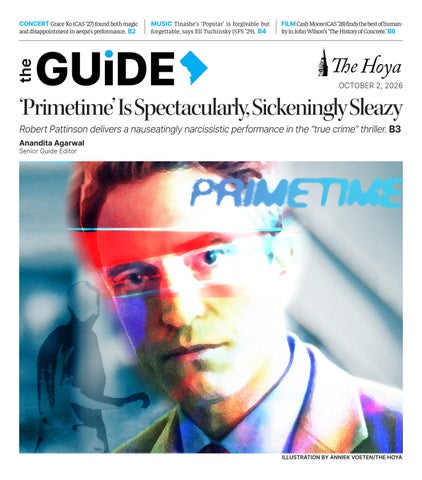
‘Primetime’ Is Spectacularly, Sickeningly Sleazy Robert Pattinson delivers a nauseatingly narcissistic performance in the “true crime” thriller. B3 Anandita Agarwal Senior Guide Editor
ILLUSTRATION BY ANNIEK VOETEN/THE HOYA
RICHIE DOWNS/CAPITAL ONE ARENA
Grace Ko (CAS ’27) believes aespa’s members are talented performers but need more fan interaction to become the full concert package.
CONCERT
A Beautiful Glitch, aespa Buffers Loading Pitch-Perfect Excellence
Grace Ko
Deputy Guide Editor
Electropop extraordinaires, aespa is a K-pop girl group that turns the modern digital world into exhilarating dance music. Now on their “SYNK: COMPLæXITY” world tour, the group brought their unique brand of pop to Capital One Arena on Sept. 22. The four-piece girl group, consisting of members Karina, Winter, Giselle and Ningning, debuted in 2020 under SM Entertainment. K-pop is often marked by generations, each having a particular set of characteristics that differentiate the groups of each generation from the others. As a group that debuted near the end of K-pop’s fourth generation, aespa stands in a strange middle. The group’s fictional lore marked the four members as humans aiming to reconnect with their hologram forms, dubbed their “ae,” through their search for the mythical planet Kwangya. This strange story formed the throughline in the band’s early discography, but was axed as fifth generation groups became more prevalent in the K-pop scene. However, with this concert, the group seems to have reclaimed their origins as supposed human-hologram hybrids. In the transitional videos that played during their quick changes, the group expanded upon
B2 |
their lore as now their digital counterparts have taken over their place in the real world, leaving them to break free from their digital prisons. It was a welcome return to an old era of K-pop and one that promised a show that would harken back to their roots. Indeed, the group’s clean and pristine, albeit occasionally messy, electronic sound transformed Capital One Arena into a massive club. Beginning with the lead single of their most recent album, “LEMONADE,” played to the group’s strengths. Surrounded by an entourage of background dancers, it was impossible not to feel the force of the hardhitting track. Their crisp, precise moves present the group as now-seasoned idols, talented performers in their own right. The master of a title track, aespa’s setlist was chock-full of songs that any modern K-pop fan would recognize. This was certainly true of the four songs following the group’s entrance on stage as the crowd screamed, danced and chanted along to “Switchblade (feat. Ty Dolla $ign),” “Whiplash,” “Black Mamba” and “WDA (Whole Different Animal) [feat. G-Dragon].” However, the group and crowd’s energy were so concentrated on these bigger moments that the subsequent less popular songs suffered a massive energy drop.
After “WDA,” the group exited the stage and transitioned into a more subdued part of the set that leaned toward pop R&B. For such a popular group, and even among a decently-packed arena, it was surprising how little enthusiasm the crowd showed for this section of the concert. It did not help that the group was more stationary for these songs, simply standing on a near-bare stage. The girls are charismatic and willing to interact with the crowd in small doses of hand hearts or cheek hearts, yet it is just not enough charm to carry momentum through six songs. Indeed, the key to breaking the lull was the energetic choreography of their latest Japanese single, “KISS N TELL.” Again surrounded by their backup dancers, the group felt as if they returned to the familiar and dynamic performers that opened the concert. The crowd, too, shifted as many stood back up on their feet, singing their hearts out to the track. With such an empty stage and simple set-ups, the pressure to perform lands on the group. The only spectacle the concert attempted to offer was in the many smoke machines — one that blew so much smoke during Karina’s solo stage that a fan yelled, “Girl, where’s Karina?” — and loud blasts of confetti. When timed accurately, it created a simple rush of pure adrenaline, but often, particularly toward the end of the concert, it felt overused and uninspired.
The members’ straightforward performances did not help with such a barebones setup. The group often faced the front of the stage, leaving many audience members with only a side-view during their choreographed performances, which were arguably their strongest moments. The only times they fully faced the whole audience were their slower songs where choreography was replaced instead with simply standing. While this allowed for more audience interaction in small smiles and waves that may have been exciting for the arena floor, the higher sections felt removed from the action entirely. It’s unfair to say that aespa doesn’t know how to put on a show. In the moments where they are at the peak of their popstar glory, in dazzling outfits and a crowd of organized background dancers matching their every beat, the group truly shines. Those moments are when the crowd truly falls into the group’s magic and the members seem to fuse with the crowd’s energy as their popstar precision is imbued with an extra smile, hip pop and wink. Their music is certainly an incredibly enticing siren call from the growing genre of glitch and electropop. However, in order to truly access the beautiful benefits of their musical software, the group may need to sort out a few glitches when they’re called out from the digital realm onto the stage.
THEHOYA.COM | FRIDAY, OCTOBER 2, 2026
A24/IMDB
Anandita Agarwal (SFS ’28) finds “Primetime” to be toe-curling, vivacious and spectacularly nauseating, even if it sometimes loses focus.
FILM
‘Primetime’ Dutifully, Deeply Disturbs, Makes Its Mark as the Psychological Thriller of 2026
Anandita Agarwal Senior Guide Editor
The United States loves to watch its own suffering. From Stephanie Soo’s YouTube channel to live courtroom footage to Ryan Murphy’s entire filmography, the “true crime” genre is now bigger and more ambiguously ethical than ever. There is something about examining the deepest, darkest and sickest moments of a stranger’s life that makes people feel better about themselves. Amid this fascination, new thriller film “Primetime” reminds us that the pursuit of entertainment value from real lives can often come at the expense of humanity, all communicated through some of the best sepia-tinted filters I have ever seen. “Primetime” is based on the short-lived rise and fall of journalist and television personality Chris Hansen’s real-life investigative show “To Catch a Predator,” which exposes “adults who try to meet teens online.” By making a spectacle out of the humiliation of child predators, the show allows
otherwise powerless viewers to feel a sense of vindication and justice. The film follows Robert Pattinson as a shockingly accurate, intensely awkward and unfailingly narcissistic Hansen as he tries to get all eyes and awards on his new show, which NBC has just granted its primetime slot. From the get-go, the film questions such an endeavor’s morality, beginning with Pattinson-as-Hansen practicing his lines for an episode’s big “gotcha!” moment over a black title card. Even knowing I was going to be extremely uncomfortable did not prepare me for the experience of Pattinson whispering what a child predator texted to a 13-year-old. Very quickly, it became clear to me director Lance Oppenheim was pulling no punches. With such an ambitious script, it would have been easy for Pattinson to be swallowed by the character he was meant to be portraying. However, instead of letting the story dictate his performance, Pattinson moves through the film with a nearly flawless focus that never lets up. His incredible performance ensures viewers rarely feel bad for the utterly
FRIDAY, OCTOBER 2, 2026 | THEHOYA.COM
unlikable Hansen, despite complexities that lend him depth, like his dissolving marriage. Beyond Hansen, the film also focuses on the other characters that make “To Catch a Predator” possible, namely producer Andie Bender (Merritt Wever) and “decoys” — what the film calls the adults who play-pretend as the adolescent jailbait — Del (Phoebe Bridgers) and Dan Plum (Skyler Gisondo). The film’s pacing, especially during the middle section, can feel jumpy and abrupt with such diverging characters. But the sheer talent of the ensemble cast excuses all of that. Particularly, Gisondo’s portrayal of a shy, naive 23-year-old aspirant who only stumbles into becoming “Decoy Dan” because he needs more credits to join the actors’ union is uncanny and deeply moving, making him an unexpected gem of the film. Praise must also be reserved for the ease Bridgers — making her acting debut — portrays an opinionated, androgynous activist-turned-actor with. The star of the film for me was Weaver’s Andie, who is the underappreciated realist that keeps the show running amid Hansen’s desires
to be the savior-hero of the United States. Her laser focus on maximizing the entertainment value of the most depraved incidents anchors the film in its original messaging — even as the storytelling takes on a more fantastical approach as Hansen’s inner psyche slowly falls apart under the weight of his own aspirations. A friend who also watched “Primetime” texted me that directors will be trying to copy its coloring for years to come. I am inclined to agree — the film’s filters, palette and effects make it a toe-curling, heart-racing visual delight. The cinematography, from snappy cuts to warped frontal shots, alongside the terrorizing score, keeps the film sharp and engaging for its entire runtime, making it feel like what it must have been like to watch “Dateline” at its best. In other words, “Primetime” is a perverted trainwreck you cannot look away from. Juggling these elements, the film can sometimes lose its focus. Specifically, the middle section featuring “Decoy Dan” and Hansen’s budding mentorship, tied back to Hansen’s past Emmy glory from uncovering child labor abuses in India for NBC, feels hazy at best and unrelated at worst. Here, Oppenheim introduces a more grotesque, outlandish element: a weird, inhumane monster starts haunting Hansen, symbolizing all the evils Hansen’s mile-wide savior complex wants to purge from the world. However, I am not sure whether it was completely effective. Despite this shortcoming, all is forgivable because Oppenheim still successfully managed to leave me walking away both deeply disturbed and impressed. “Primetime” showcases to audiences both why “To Catch a Predator” got the coveted television slot and why it should not have, making us question the media we consume. Maybe next time, we will think twice before clicking one of those police body-cam TikToks.
| B3
FILM
‘Forgotten Island’ Is Tender, Heartwarming but Too Fast Juan Almanza Deputy Guide Editor
I hate it when movies don’t go all the way. Sure, bad movies are frustrating, but nothing boils my blood more than seeing films, especially animated ones, sit on compelling narratives that are never fully explored. It’s quite fortunate, then, that “Forgotten Island” uses every minute of its runtime to explore the depths of Philippine folklore and the beautiful friendship between Jo (Gabriella Sarmiento Wilson), a troublemaking artist, and Raissa (Liza Soberano), a mathematics prodigy. The relationship between Jo and Raissa is the beating heart of the film, as visible through the opening sequence, which starts with an adorable flashback of how Jo and Raissa became friends. It’s baffling how well both characters are established from the getgo, from their stylistic differences to their behaviors in the short introduction. By the time the main plot gets moving, it feels as though you’ve already grown up with them and seen their friendship evolve in what I now crown as 2026’s best montage sequence. Now, the film truly begins, with Raissa and Jo as adults and Raissa planning to leave the Philippines to go to Caltech. After a tense last night together before Raissa’s flight, the two stumble upon a magic sand dollar that transports them to the mythical island of Nikali, drawing from traditional Philippine folklore in both its depiction and characters. The animation of “Forgotten Island” is vibrant and colorful, making the film’s
environments glow with life. While the stylization is sure to draw comparisons to the likes of “Spider-Man: Into the Spiderverse,” a much more apt comparison would be to Dreamworks’ previous film “Puss in Boots: The Last Wish” because of their shared swift action and heartfelt story. Nikali is awash with color, radiating like a tie-dye shirt, which gives it an exciting feeling, even if it feels a bit less immersive at points. I suppose the fact that Nikali is supposed to be a magical island partially excuses it from this, so I’ll chalk it up to being a mere nitpick. As for Nikali itself, the island acts both as a fresh twist on the whole “lost island” setting as well as a wonderful homage to Philippine folklore. Manananggal (Lea Salonga), a vampire able to split at the waist to become an independent flying torso and a racing set of legs, is positively frightening and acts as the main obstructive force pushing the movie forward. From the Kapra, who are behemoth tree beings, to the Duwende, gnome-like creatures, “Forgotten Island” thrives when exploring the rich trove of Philippine folklore through its worldbuilding. In this sense, the island is a character in and of itself. Without spoiling too much though, the movie suffers from breakneck pacing that makes it hard to care about anything other than the main plot. Side characters end up feeling like little more than plot garnish with how quickly they’re established and thrust into the story. The film tries to give each side character detailed arcs, but this only compounds the issue, as such depth
takes time to develop. The writing falls a bit flat here, and I found it hard to be invested in their respective stories. This rushed pace doesn’t come off as a mistake though. It was clearly purposeful as the writer’s main goal seemed to be to show off every part of Nikali while progressively pushing Raissa and Jo’s friendship to its inevitable breaking point. The story’s beats are familiar, but still sincere, and thus I didn’t find issue with some of the more predictable moments in Raissa and Jo’s relationship as they race against the clock. Jo’s desperation for the unchanging, reliable
nature of their friendship and life in the Philippines contrasts nicely with Raissa’s yearning for change and exploration. To that end, I’m not sure if I’m entirely satisfied with how the movie resolved these tensions, but that is spoiler territory. As a whole though, “Forgotten Island” never lets up in indulging in all the treats of animation. From fun and distinct stylization to some really unorthodox angles, it uses all the tricks in the book. The story is engaging, sincere and, to my great delight, further proves how Dreamworks is really helping push this innovative animation forward.
UNIVERSAL PICTURES/IMDB
Juan Almanza (CAS ’29) wants to see more of the film’s detailed world building.
MUSIC
On ‘Popstar,’ Tinashe Boldly Asserts Her Pop Sensibilities
Eli Tuchinsky
Special to the Hoya
Tinashe has occupied a semi-famous, semiunknown spot in pop music for over a decade. On “Popstar,” she brands herself as above the fight for fame, effortlessly herself and fully immersed in her style. As for whether this confidence translates to a good project, “Popstar” answers with a strong “maybe.” Fame has certainly been a roller coaster for Tinashe. Viral songs like “2 On (feat. ScHoolboy Q),” “Faded Love (feat. Future)” and her 2024 summer hit “Nasty” launched her into the cultural zeitgeist, popularizing her electronic-influenced pop R&B. While “Popstar” certainly had material for success, the end project feels bloated and feels thematically cringey. The album’s first single, “Too Easy,” is sassy and playful, mocking those who dare attempt to compete with Tinashe. “If you’re mad, then go to therapy,” she jeers, brushing off her haters with painless nonchalance. It’s a classic pop song with plenty of dance-break
B4 |
opportunities, but her attempt to appear unbothered is immediately contradicted by the rest of her album. On “Empty Stadium,” she laments her proximity to fame, saying she doesn’t “wanna die underrated” and that she waits for “applause that’ll never exist.” Her vocals on this track amount to what are essentially wails and moans pleading against her seemingly permanent celebrity status. It doesn’t help her case that the lyrics never truly evoke sadness. At best, they read as the verses an aspiring angsty musician would write at age 14 in their Notes app. Charli XCX’s “I might say something stupid” is a good example of how to write about the perpetual famous-but-notfamous condition without being annoying. Certain tracks on “Popstar” also suffer from slightly too much experimentation that somehow still keeps them boring. The latter half of the album, particularly songs like “Popstar” and “Heavy Weight,” hold back the record, incorporating sounds that, while commendable in effort, did not need to survive the cutting room. The title track, which should be a highlight, sounds like artificial intelligence was tasked to make a Tinashe song. “Heavy Weight,” for some
reason, is based around acoustic guitar and the now-dead horse eldest daughter trope, once again falling victim to the “sad Tinashe” effect. “Nobody Wanna Dance Anymore,” an eclectic song supported by a Wale x Lady Gaga sample, is mostly good but then verges into an unexpected and unwanted yeehaw-tone in the prechorus. “I’d Rather Be Alone” comes dangerously close to the aforementioned sad-Tinashe syndrome but avoids total condemnation purely due to its similarity to Rihanna’s “Kiss It Better.” Instead of diversifying the album, these songs interrupt the album’s smooth dance-pop potential and feel shoved down the audience’s throat, almost as if Tinashe insisted upon demonstrating her “unlimited star potential” to her begrudging producers. However, “Popstar” does contain a few gems. The third single, “Melatonin,” is a standout track in her discography. The song flawlessly pushes Tinashe into the realm of techno and hyperpop, perfect for the dance floor and bound to spur great remixes. Without abandoning her style, the song carves out more space in her straight dance-
track sound that is only matched by “HMU for a Good Time (feat. Channel Tres).” Other songs, including “Crash Out,” “Pillow Fight,” “Sunglasses,” “Flashbacks” and the interlude “Overdramatic,” are also great, all primarily based in groovy R&B with appropriately weird supporting sounds. “Pillow Fight” is accompanied by a unique but appreciated backing piano, “Overdramatic” includes jazzy horns and “Sunglasses,” produced by Arca, contains Arca’s signature dissonant beats. While not revolutionary, Tinashe excels at this smooth, trance-like pop R&B, and they make the album feel fluid and fun. “Popstar” is a solid addition to Tinashe’s discography, and there are albums that would be a much worse use of 39 minutes. If you already love Tinashe, its highlights will be thrilling, and its low points forgivable. If you are a hesitant Tinashe fan and only recognize Disco Lines’ “No Broke Boys” remix, I recommend just listening to the fan-favorites and singles before jumping into this new release. Like most Tinashe albums, “Popstar” had potential, but again, like her other projects, the album fails to achieve “classic” status.
THEHOYA.COM | FRIDAY, OCTOBER 2, 2026
FILM
‘The History of Concrete’ Finds a Story on Every Sidewalk Cash Moore
Special to The Hoya
“The History of Concrete” is a featurelength documentary about the most sterile substance we touch every day, but despite that, it kept me laughing for nearly two hours straight. That is because the man behind the camera is not just any director — he’s John Wilson. You might be asking yourself: “Is this really a movie about the history of concrete?” That question is surprisingly hard to answer. You do come away learning more about concrete than you probably ever would otherwise, but you will spend much more time learning and laughing about the sporadic people Wilson was lucky enough to encounter along his concrete researching journey. Best known for his HBO series “How To with John Wilson,” which posed an everyday problem and promised a step-by-step solution, Wilson started his career working for a private investigation agency, and it shows. He films everything: dogs, leaking fire hydrants, holes in the sidewalk — you name it.
Set immediately after the close of his television show, “The History of Concrete” follows Wilson as he enrolls in a Hallmark movie-writing class, hoping to make one himself. He dives into the boredom he feels after completing his show, the struggle of funding his film and, of course, concrete. The Hallmark formula survives only faintly, however, as Wilson instead creates a chaotic story about the people and places we walk by every day. Storytelling sits at the heart of Wilson’s canon. Few directors share his ability to discover the untold, and “The History of Concrete” captures the depth of humanity we all have the potential to find. We’re introduced, for example, to the owner of GumBusters, a Brooklyn-based company whose sole purpose is to clean gum residue off New York City surfaces. I’ve lived in New York City my entire life and had never seen or heard of this company before. Its charismatic business owner, however, drew a constant stream of laughter from my sold-out screening every time he uttered his signature catchphrase, “Busted!” after cleaning a piece of gum off the concrete sidewalk. In one unexpected detour, Wilson visits the first concrete street in the United States,
ON YOUR RADAR
located in Bellefontaine, Ohio. While there, he sits in on a driving lesson that goes over the concrete road and interviews the driving instructor, who tells him that some people who have lost relatives to car accidents visit the classes to drive home — pun intended — important safety advisories. Like clockwork, the next shot brings us to an urn in a woman’s living room. This woman, whose husband died in a car accident, talks about a piece of her late husband’s skin that she preserved with a motorcycle tattoo on it. She explains that there’s a company whose sole purpose is to do exactly that: preserve dead people’s tattoos. As you might guess, the next scene finds Wilson in the office of the man who runs Save My Ink Forever. Each interaction brings a new rabbit hole begging to be explored. That’s the beauty of “The History of Concrete.” Wilson points a camera at anyone remotely relevant to anything he is doing and gives them a platform to talk about all of their interests and passions. He entertains their enthusiasm to the fullest extent and with the utmost respect. Though the film can feel like randomly spliced interviews and sidequests, there are
By Grace Ko
THIS WEEK’S THEME: Homecoming Calls
MR. GEORGETOWN
TAILGATE
You can’t head into the excitement of homecoming weekend without attending the show of the year. Head to Gaston Hall on Oct. 2 at 7 p.m. as 16 hopeful male contestants shimmy their way to the esteemed title in a satirical beauty pageant. While tickets are sold out, you can add your name to the waitlist.
If you want to immerse yourself in the homecoming spirit, join a full day of homecoming traditions through the tailgate Oct. 3. For a schedule full of food, drinks, events and general Georgetown joy, walk-in tickets cost $20 for undergraduate students under 21 and $30 for students over 21. Tailgate tickets can be purchased online.
@GTOWNPB/INSTAGRAM
MATTHEW GASSOSO/THE HOYA
FOOTBALL GAME
THEATRE WEEK
A classic homecoming staple, support the Georgetown University football team as they play against the Cornell Big Red on Oct. 3 at 12:30 p.m. Tickets are free for students, who must show their GOCard upon entrance.
If you’re dreaming of a weekend outside the homecoming rush, Theatre Washington is currently hosting Theatre Week, which runs from Sept. 24 to Oct. 11. Catch different shows across iconic Washington, D.C. theater venues at discounted prices. More information about Theatre Week can be found online.
MATTHEW GASSOSO/THE HOYA
FRIDAY, OCTOBER 2, 2026 | THEHOYA.COM
enough weird coincidences and throughlines that connect each segment, creating an oddly connected experience. Strangers he interviews make unprompted but deeply relevant callbacks to the film’s earlier moments. There is something so beautiful about a coincidence, and Wilson teaches viewers that this beauty is easy to find — it is like the idea that everyone is within six degrees of separation from Kevin Bacon. We are all so much more connected than we realize, and Wilson highlights that simple and evocative truth in a way that nearly brought me to tears. As a friend put it in her Letterboxd review, “It takes so many twists and turns that it ends up going in a perfect circle.” “Past Lives” by Celine Song is one of my favorite films of this decade. The opening shot of that film shows its three main characters talking at a bar while two offscreen onlookers wonder what their relationship is to each other. I often find myself looking at people on the street or old buildings with faded signage and wondering about their story. I do not think I am alone in this curiosity. If you share it, give “The History of Concrete” a shot and see where that curiosity can take you.
@STEPAFRIKA/INSTAGRAM
| B5
FILM
Gloriously Excessive, ‘Digger’ Sees a Tremendous Tom Cruise Brad Derfner Guide Columnist
“Digger” is the loudest movie I have seen this year. It is messy, excessive and generally feels like Director Alejandro G. Iñárritu is using a sledgehammer to get his points across. In other words, I loved every second of it. When the film’s first preview screenings took place Sept. 19, the early reactions were considerably more mixed than I expected — many reviewers criticized the same aspects that made the movie so enjoyable for me. From Tom Cruise’s larger-thanlife leading performance to Iñárritu’s intricate blocking and whirlwind pacing, the entire film is relentlessly, enjoyably over the top. Cruise, in his first original movie since 2017, stars as Digger Rockwell, a comically wealthy oil tycoon whose company has caused an ecological disaster that threatens millions of lives in Europe — in large part due to Digger’s negligence. Cruise’s transformation is tremendous, wearing a fat suit and heavy makeup, and leaning into exaggerated facial expressions. At the same time, Cruise finds moments to offer more grounded, emotional scenes. Without spoilers, I cannot reveal exactly how the film uses this contrast between the two sides of Cruise’s performance, but that difference is one of the film’s most impressive aspects. This is far from a one-man show, however. Cruise is surrounded on all sides by performers who aim to match or surpass his absurd pitch. Riz Ahmed plays Ganesh, an environmental protection scientist who
works for Digger and brings a hilariously awkward energy to his role, while John Goodman plays the U.S. president, using his booming voice to turn every appearance into yet another escalation of the film’s absurdity. Jesse Plemons is also notable, remaining effective with admittedly less screen time than others in the cast. Sandra Hüller, as Digger’s younger sister Emma, was the only ensemble member who felt truly out of place to me, playing her role far too subdued for the film she’s in. The performances are only one small part of why “Digger” is so captivating. Iñárritu’s staging feels borderline theatrical, especially in an extraordinary opening sequence built around extended takes and elaborate blocking. The jokes here do not just take place in the center of the frame but unfold throughout the scene, sometimes even behind the focal characters, forcing the viewer to constantly keep up with him. This sequence is a perfect demonstration of Iñárritu’s ability to harness controlled chaos, and even though it is oftentimes exhausting, I could not look away. Iñárritu repeatedly focuses on maledominated rooms filled with immensely powerful people making decisions that would seem insane if their consequences were not so serious. These characters are frightening partly because they are ridiculous, and ridiculous partly because they possess enough power for their actions to affect millions of people. The environmental message is impossible to miss, but the film gradually becomes interested in something larger than climate catastrophe alone. “Digger” is also about who controls stories, who gets to present themselves as a hero and how
easily audiences can be persuaded to participate in someone else’s version of events. Some viewers will almost certainly find Iñárritu’s approach self-indulgent. They will not necessarily be wrong, either. “Digger” is self-indulgent and overstuffed. It hits at ideas with considerably more force than finesse. But what impressed me most is how completely Iñárritu commits to the movie he wants to make. There is no attempt to smooth away its strangest impulses or restrain Cruise’s enormous performance into something more conventionally palatable. Instead, “Digger” keeps pushing further until its exaggerated performances, frantic movement, blunt satire and absurd comedy begin to feel inseparable from one another. As far as awards prospects go, I am unfortunately not so confident. The critical consensus is still forming, but the film currently boasts a meager 46 on Metacritic, and the word of mouth does not seem much better (although I’m doing my part!). I think Cruise is still very much in play for precursors — especially the Golden Globes, which love some
star power — but I am worried this reception is just too negative for any Oscar success. Of course, the Academy has backed political satires with mixed reviews before — most memorably “Don’t Look Up” — but this just feels like too much of a mountain to overcome. Still, I’ll be holding out hope for some success for the film, which we might find in technical categories like production design, makeup and hairstyling, or cinematography, all of which have received praise across the board. No matter the criticism, for me, Cruise is the perfect performer to place at the center of this chaos. For nearly the entire film, he commands the screen with such force that Digger’s ability to galvanize crowds never feels hypothetical. We understand exactly why people would listen to this man, even when we know better. By the time the movie turns its attention to the relationship between art, storytelling and the audience, its excess starts to feel like more than style. “Digger” is fascinated by spectacle, by the people who manufacture it and by our willingness to surrender to it.
WARNER BROS./IMDB
“Digger” boisterously accomplishes what it set out to do, says Brad Derfner (CAS ’27).
MUSIC
‘The Encore’ Adds Few New Insights to ‘The Life of a Showgirl’ Wesley Sreter Hoya Staff Writer
When Taylor Swift teased a surprise announcement at the 2026 Emmy Awards, I was ready to raise my heart hands high in the air. The first song I ever learned the words to was “You Belong With Me,” and I hoped my lifelong soundtrack was about to come full circle with a rerecording of her 20-year-old debut, “Taylor Swift.” Instead, Swift introduced “Patient Zero,” the first of four new tracks on “The Encore,” a deluxe edition of 2025’s “The Life of a Showgirl.” After the original album was criticized for its inconsistent songwriting, familiar production and a concept that was more compelling than its execution, four new songs offered Swift an opportunity to give the era greater depth. Yet “The Life of a Showgirl: The Encore” mostly reinforces many of the standard edition’s flaws. The main issue with the first edition of “The Life of a Showgirl” is not that Swift writes about happiness nor that the album embraces campy lyrics. After years of writing about her heartbreak, it could have been just as compelling for her to share about finally finding the love of her life. Happiness is not inherently less interesting than heartbreak; Swift has just
B6 |
demonstrated that she can write about the latter with far more precision. Swift has effectively used ridiculous imagery before: “Karma” and “Shake It Off” are prime examples. This can work when the joke sharpens the song’s character or perspective, but on “The Life of a Showgirl,” lines meant to sound playful often feel strained — especially when paired with internet language that clashes with the meticulousness of her best writing. Despite the lackluster critical reception to “The Life of a Showgirl,” the record had the best-selling opening-week debut for an album. In a Sept. 23 Instagram post, Swift described celebrating the album’s success in Sweden with collaborators Max Martin and Shellback. “We wrote more songs,” she revealed, explaining that they were “born out of pure gratitude” for the album’s reception. I thought she was being sarcastic. She was not. Swift has channeled public criticism into compelling music before, most famously on 2017’s “Reputation.” “The Life of a Showgirl: The Encore” takes a similar approach, but rarely with the same level of purpose. Opener “Patient Zero” comes closest, balancing a mysterious violin and catchy melody with lore-filled lyrics about extending a helping hand to the current victim of one of her past lovers. Yet, the bridge’s talk-singing disrupts an otherwise well-constructed song. The delivery of lines like “And you thought it’s ’cause he loves you / But it’s ’cause he loves how everybody else loves
him” sounds awkward compared to the stronger melodies in the verses and chorus. The quality dips sharply on “Cleveland!”, which opens like the theme song to a 2010s television show nobody watched before, somehow beginning to resemble a Christmas song. Swift addresses public criticism with lines like “She’s not as hot as she was, but she was only a four” and “with all of that money, why’s she dressed like trash.” While the song adds emotional depth to the album, its focus on insults about Swift’s appearance feels disconnected from the scrutiny that actually surrounds her. The song also repeats the Travis Kelcecentric territory already exhausted on “The Life of a Showgirl,” culminating in a facepalmworthy bridge: “You only need to find one person in this entire world / Who doesn’t find you completely insufferable / And I have an important announcement to make / I found mine!” The boastful and cheery tone sounds as though the intended audience for this song is only Swift’s most devoted fans. “Pink Clouding” exposes a different weakness: Swift’s usual attention to detail turns into bloat. Ethereal production introduces images of a “magenta sunrise” and “fuchsia forever intertwined,” but the details feel haphazard. The song becomes increasingly overwritten as phrases like “pink clouding” and “gray rocking” complicate a relatively simple idea: an apology
to a past lover that Swift realizes she hurt. Meaningful and confessional lyrics like “I wake up scared that I left scars on a good person” are obscured behind this dense imagery. By “Babylon,” the album feels exhausting. Thankfully, its final track offers some muchneeded restraint. Swift combines narrative songwriting with more pop-sensible production to tell the story of someone who only appreciates what they had after losing it. While “Pink Clouding” overuses imagery, the details in “Babylon” are well-placed and serve the broader narrative, including electric fences, a small town, a well-mowed lawn and your “Aunt Virginia with a church dress on.” Even here, though, the production feels familiar, echoing “Ruin The Friendship” from “The Life of a Showgirl” and the percussion of “Dancing With Our Hands Tied” from “Reputation.” Ultimately, “The Life of a Showgirl: The Encore” does little to change the story of “The Life of a Showgirl.” At its best, it adds two good — but nonessential — songs to Swift’s catalog. At its worst, it reproduces the over-indulgence and overwriting that weakened the original album. Swift originally described “The Life of a Showgirl” as a “look behind the curtain,” but these four tracks do not make that concept feel more complete. An encore should leave an audience wanting one more song. Nearly a year later, Swift instead leaves the “Showgirl” era largely where she found it.
THEHOYA.COM | FRIDAY, OCTOBER 2, 2026
SPILLING THE CHAI
‘Best of the Best’ Is a Love Letter to South Asian Dance Aarushi Maskara Guide Columnist
I’ve heard people joke that joining Greek life is “paying for friends.” Collegiate South Asian dance teams occupy a similar role, giving you a friend group, weekend plans, travel companions and, as “Best of the Best” makes abundantly clear, plenty of romantic drama. The film follows childhood best friends Anjali (Priyanka Kedia) and Maya (Maitreyi Ramakrishnan) as they enter college and the world of competitive South Asian dance. But beneath the competitions, romance and drama, the “Best of the Best” is really about how our relationship with culture changes as we grow up — traditions that were a passive part of our lives as children can become communities we actively choose to engage in as adults. The film opens, for example, with Anjali and Maya performing Bharatanatyam at their school’s talent showcase, followed by clips of them dancing throughout their childhood. I have nearly identical home videos of my friends and me as little kids, trying our best
to dance along to whatever Bollywood song we were currently obsessed with. I grew up learning Kathak and performing at cultural events, but at 5 years old, I was not thinking about my relationship with Indian culture. My parents, however, were — dance was one way they made a community thousands of miles away feel present in my life, and what “Best of the Best” captures so well is what happens when we become responsible for maintaining that connection ourselves. Anjali and Maya set off for college intent on making their own choices for once. One parent warns them not to become “that girl” who gets her stomach pumped because she cannot handle her newfound freedom — a familiar refrain in the South Asian community. Despite all this freedom to reinvent themselves, however, Anjali and Maya ultimately find themselves back where they started: South Asian dance. Through dance, they find a community, one that’s likely broader than what either grew up with. For example, the South Asian student association is led by Indian and Pakistani copresidents, platforming different parts of the South Asian diaspora. Despite the divisiveness of differences back home, here, we choose to
come together, learn dance styles and songs from all different regions and languages. Maya similarly urges her team to rework their initial filmy Shah Rukh Khan-inspired dance, telling them, “Our culture is bigger than Bollywood.” It is a funny thing to hear in a movie where Bollywood is, unsurprisingly, everywhere, but the team eventually utilizes her feedback by using their set to tell the history of the Koh-i-Noor, India’s famed diamond stolen during colonial rule. Even as the film showcases South Asian culture and identity beyond Bollywood, it still celebrates the artists its audience grew up with — A.R. Rahman created an original song for the finale and the soundtrack is packed with all the viral Bollywood hits its audience likely knows by heart. But for all the ways “Best of the Best” celebrates South Asian culture, it does not shy away from its less flattering parts. Smart, sarcastic and opinionated, Maya is repeatedly cast as the male character in their childhood performances, while Anjali, quieter, more demure and fairer-skinned, more closely fits traditional South Asian standards of beauty and femininity and gets to be the pretty female character. That same dynamic follows them into college when Maya is passed over for the lead
role. Maya is still the outspoken one who, as the team captain puts it, is “impossible to control,” while Anjali has “more lead energy.” Their eventual arguments are not just about the lead role but about the boxes they’ve been placed into their entire lives, demonstrating how traditional expectations of femininity still persist even within the diaspora. It’s details like these that make “Best of the Best” feel authentic. I have never been on a competitive collegiate dance team, and plenty of South Asian Americans have never danced at all. But even if you do not see yourself in the experience at the center of the movie, its cultural specificity makes it easy to recognize the familiar community around you, from the strict parents worried about what might happen when their children grow up and the copious amounts of Taco Bell consumed, to frustrations with beauty standards and the bond between chosen sisters dancing together. That’s why “Best of the Best” feels like such a love letter to South Asian dance. It is not just about the literal act of dancing, but about everything built because of it: culture, friendship, drama and a community that changes with us as we grow up.
BE OUR GUEST
Bangbop Offers a Hearty Cruise Through Korea’s Cuisine nearly impossible. Every time a new plate sending out extras, starting with homemade make it well worth the trek. Our advice for any arrived at the table, we were sure we had watermelon punch, a refreshing taste of visitor is to go family style, as sharing a meal Blake Mahoney and Tuqa Alibadi Guide Columnists
On Sept. 17, Georgetown University Eating Society (GUES) was invited to Bangbop, a Korean restaurant just a 15-minute walk from campus. Located in the Foxhall neighborhood behind Georgetown, the spot’s strings of fairy lights and heartwarmingly kitschy collections of decorative knick-knacks truly made our experience feel like we were being welcomed into someone’s home for a home-cooked meal. The restaurant is family owned and employs a small but genial staff. During our meal, we spoke to Bangbop’s owner YB, the star chefs Jenny and Jaquelin, as well as the iconic servers Sarah and Jisoo. YB described the sizable menu he curated as offering a taste of his own childhood, with each dish made following the same exact recipes his mother had perfected. Moreover, the dishes were also prepared by the three generations of women in their kitchen. As YB put it, when you share a meal at Bangbop, you’re tasting generations of tradition. Not only can you taste the time and care that have gone into these recipes, but the long-standing familial tradition behind each dish adds meaningful, emotional depth to the meal. Even without tradition to back it, on the merit of taste alone, the meal was incredible — a culinary bombshell. Honestly, choosing which of the many dishes we were served to highlight was
found our favorite, and then the next one would somehow raise the bar even higher. We started with the fried jeon, golden, crispedged savory pancakes with a tender, almost custardy inside, served with a tangy soy dipping sauce. Seeing as the dish is traditionally enjoyed during Chuseok, the Korean harvest festival, which took place in South Korea on Sept. 25, it felt especially fitting for us to try it then, and it was a delectable appetizer. The tart soy sauce perfectly complemented the savory smoothness of the pancakes, creating a memorable start to the meal. From there came the owner’s personal childhood favorite, the pork belly bo-ssam (thinly sliced, unbelievably tender broiled meat), followed by the beef marinated in bulgogi — a savory, sweet, umami-rich Korean sauce — and LA galbi, soy-garlic marinated beef short ribs. Each of these three dishes was perfect and greatly enjoyed across the board. Both beef dishes were deeply marinated, with that signature balance of sweet and savory, and the meat was so tender it practically fell apart. The galbi had beautifully caramelized edges from the grill, while the bulgogi was juicy and full of flavor from the first bite to the last. An honorable shoutout must go to the bibimbap, a colorful assortment of tuna, veggies and kimchi, as well as to the perfectly spicy and impossibly soft Korean rice cakes, better known as tteokbokki. Their hospitality did not stop at the main dishes. Throughout the meal, the team kept
FRIDAY, OCTOBER 2, 2026 | THEHOYA.COM
summer’s most scrumptious fruit, and a peach lemon juice that achieved the perfect balance between sweet and tart, along with just about every side dish imaginable — from crunchy, tangy kimchi to a rotating spread of small plates including pickled veggies, marinated spinach and bean sprouts. Some of us even took home packaged kimchi for our tiny dorm fridges! Overall, Bangbop’s true strength is in the homemade feel of each dish. The menu is curated to reflect the personal favorites of this family, and every dish felt warm and comforting in a way only a meal at someone’s home could replicate. The location is the only shortcoming, but the food and the service
at Bangbop’s table truly brings the family feel to life and gives you the chance to sample as much of the menu as possible. Over the course of the evening, YB shared with us that Bangbop is something of a hidden gem in the area. After this meal, we’re hoping to help change that. There is something deeply special about a restaurant that manages to fit an entire family’s story into its food, and sitting at the dining table, you can really feel how much of YB and his family’s heart went into building this place. Needless to say, GU Eating Society will be back to work through the rest of the menu — and we can happily and confidently say that Bangbop is a GUES favorite.
@EATBANGBOP/INSTAGRAM
Blake Mahoney (SFS ’29) and Tuqa Alibadi (SFS ’27) believe Bangbop is a hidden gem.
| B7
CROSSWORD
By Luke Landegger
This Week’s Theme: Mr. Georgetown 1
2
3
4
5
13
15
16
17
6
22 27
11
12
34
35
37
38
53
54
21 25
24
29
30
32
32
34
35 39
33
36
40
42
43
46 49
10
18
23
28
31
40
9 15
20
10
41
8
14
19
26
7
44
45
47
48
50
53
52
55
56
59
60
61
62
63
64
DOWN
10. Vegetable that comes in red, yellow, orange and green 11. Lady, in Lima 12. Smoothing tool 13. Sass 17. Insults, perhaps in a 33-Across 21. Snare 23. Mimics 24. Free (of) 26. They may be used for gaming 27. “I figured it out!” 28. View from the Jefferson Memorial
30. Turn up on the beach, as a message in a bottle 32. Ceremony led by a medium 35. Breakfast chain that, despite its name, only serves U.S. cuisine 36. What a revolution may usher in 37. Mine unit 38. NFL 6-pointers 40. “___ sells seashells …” 41. Partner of tribulations 42. Supermarket sections 43. Like many reality TV programs
1. One of three in a haiku 2. Like LAX or JFK 3. “That will happen when pigs fly” 4. Win by ___ 5. Hush-hush doc 6. Suffix following east or west 7. Football field goal expert 8. Technology company that claims to have solved the Navier-Stokes problem 9. Not false
B8 |
57
51
58
ACROSS
1. Minnelli of “Cabaret” 5. Maneki-___ , the cat with a raised arm 9. Baking qty. 13. Breathable fabric 14. Fashionable clothing, in slang 15. Instagram video 16. First segment of the pageant, where contestants come together to bust a move 18. Radius neighbor 19. Speaker Nancy 20. Use, as a prayer mat 22. Delivery method not offered by Amazon? 25. Not post 26. One of two after a fork in the road 29. Second segment of the pageant, where contestants dress up to represent their clubs 31. Many an acai bowl topping 33. Perform, as Eminem 34. “Inside Out” character who’s always blue 35. With one’s back to the wall 39. Obamacare, initially 40. One who tends a grazing flock 41. Third segment of the pageant, where contestants perform their skills on stage 45. God of war 46. Tease 47. “Minecraft” monsters that may have you saying “aw, man” 49. Leads, as in a race 51. Prepare leftovers 55. Furthermore 56. Slogan followed by “ride a cowboy” ... and the theme of the pageant! 59. “Star Wars” princess 60. Language for many web pages, shortly 61. Got out of bed 62. IDs on tax forms 63. Affirmatives 64. Number one 44. Knock out 48. Place to get sober 50. Neighborhood community orgs. 52. God of love 53. Aide, in brief 54. Simple shirt 57. MTV accolade that Taylor Swift has now won 33 times 58. Chicago trains
THEHOYA.COM | FRIDAY, OCTOBER 2, 2026