ART Isabelle Cialone (CAS ’27) applauds No Lost Generation's exhibition of Afghan refugees’ art. B2
THEATRE Original musical ‘Out of Sync’ tells a familiar tale beautifully, says Eliana Kut (CAS ’29). B4
TELEVISION Aarushi Maskara (MSB ’28) wonders if ‘Love Story’ succeeds by exploiting grief. B6
APRIL 10, 2026
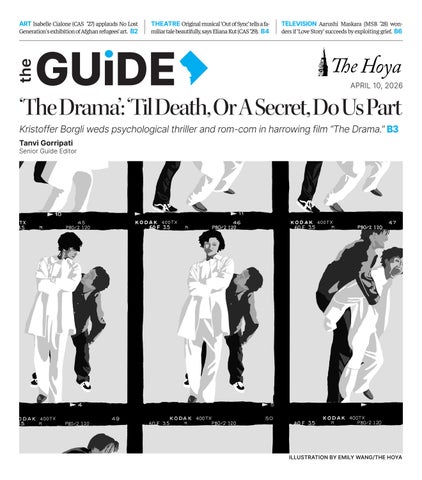
‘The Drama’: ‘Til Death, Or A Secret, Do Us Part
Kristoffer Borgli weds psychological thriller and rom-com in harrowing film “The Drama.” B3
Tanvi Gorripati Senior Guide Editor
No Lost Generation Hosts Beautiful, Poignant Exhibition of Afghan Refugee Artists’ Work
Isabelle Cialone
Senior Guide Editor
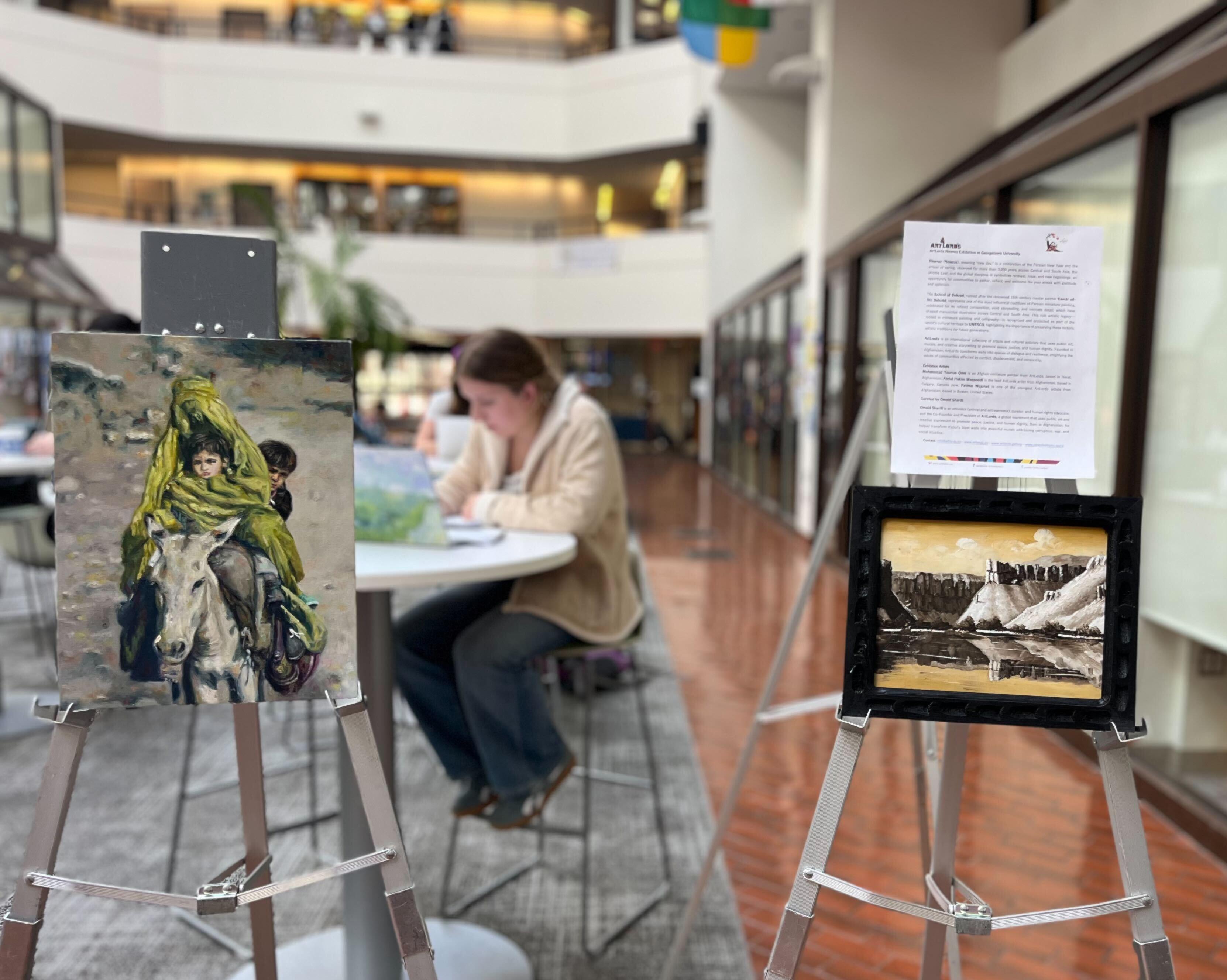
From March 23-27, the galleria of Georgetown’s Intercultural Center (ICC) was dotted with easels showcasing stylistically distinct yet thematically coherent artwork by three Afghan refugee artists. The exhibition was a partnership between student organization No Lost Generation (NLG) — a chapter of the national initiative dedicated to raising awareness about the global refugee crisis — and Afghanistan-based artist collective ArtLords.
Laura Logan (SFS ’27), co-president of NLG, said the exhibition used art as a means of protest and raising awareness, with the works highlighting the diverse and unique stories of refugees.
“It has the broader mission of trying to use art as a form of expression for resistance and kind of education,” Logan told The Hoya “They tell a broader story of justice, displacement, identity, hope for a better future.”
The exhibition, curated by ArtLords’ president Omaid Sharifi, was based around a central theme of “nawroz,” which means “new
ISABELLE CIALONE/THE HOYA No Lost Generation and ArtLords’ exhibition of Afghan refugees’ artwork was an apt, educational display, says Isabelle Cialone (CAS ’27).
day” in Farsi and refers to the Persian new year. A celebration of the arrival of spring, “nawroz” is a symbol of renewal and hope; this theme was perfectly embodied by all the exhibition’s works, despite the three distinct styles.
One painting, by artist Abdul Hakim Maqsoodi, featured a U.S. Air Force plane on the tarmac, with dozens of men running ecstatically, mid-celebration. Another of Maqsoodi’s paintings showed three travelers on one donkey — a mother in a vibrant green burqa with her two young children. Maqsoodi’s beautiful scenes of travel carried complex emotion, each brushstroke imbued with hope, anticipation, fear and resilience.
Across the room, a series of three easels carried miniature paintings in the style of traditional Afghan art by artist Mohammad Younus Qani. The trio embraced themes of home, community and connection to heritage. The Arabic script flowed alongside intricate, vibrant patterns with scenes blocked out by subjects mid-activity — scenes of life and liveliness.
The third collection, done by Fatima Wojohat, one of ArtLords’ youngest artists, tackled the experiences of female refugees healing from
repression through portraits. Bright colors and somber subjects on blank backgrounds combined to emanate the complexities of childhood joy and anxieties amidst displacement.
Since expanding worldwide, past the blank walls of Kabul, Afghanistan, used as canvases for murals, Logan said ArtLords has maintained its driving goal while emphasizing its aim of serving as an instrument of education.
“Since it’s grown into more of a global movement, their work really focuses on defending artists’ freedom and trying to use art to educate and engage communities,” Logan said.
In addition to highlighting the aesthetic value and beauty of the artists’ creations, NLG sought to amplify ArtLords’ aim to promote artistic freedom and education through art.
Logan said even briefly engaging with refugee artwork and stories can serve as a gateway to deeper understanding.
“I think it’s really easy for our students to stay in a little bit of a bubble,” Logan said. “But I think engaging with deep global issues doesn’t always have to be doing very intensive research; that’s great if you have time to do that, but some students don’t, and this
exhibit is meant to bridge that gap, to place these stories at the forefront of our vision.”
The vast array of styles between the works, from traditional Afghan miniatures to painted scenes of travel and partially-drawn portraits of women, was a welcome asset of the exhibition. It showcased the vastly different yet wholly similar experiences of the three artists — only the faintest sliver of the experiences of Afghan refugees, yet a lush and diverse selection of thematically harmonious pieces.
Altogether, the exhibition was both beautiful and impactful. Its prime location in the ICC galleria ensured broad visibility, and felt particularly poignant given the building is home to the School of Foreign Service (SFS). Many SFS graduates will likely go on to pursue careers where they make the decisions that either oust people from their countries, creating refugees, or foster sanctuary communities, welcoming refugees.
“It is horrible what goes on in the world,” Logan said. “But seeing people use art to communicate the fact that they can create beauty — it’s very inspiring and humanizing.”
‘The Drama’ Is Barely Worth the
Tanvi Gorripati
Senior Guide Editor
We have all been there — someone pulls out “We’re Not Really Strangers” at a party, and suddenly everyone is sharing things they should probably be saving for therapy. The unspoken rule is that unfiltered honesty, no matter how uncomfortable, can only bring people closer together. “The Drama” spends nearly two excruciating hours asking what happens when it doesn’t.
“The Drama” follows an engaged couple, Charlie Thompson (Robert Pattinson) and Emma Harwood (Zendaya), in the week leading up to their wedding. The two share a meet-cute at a coffee shop and proceed to get engaged. But, when a pre-wedding conversation with their best man (Mamoudou Athie) and maid of honor (Alana Haim) turns to their worst moments in life, Emma reveals something that throws both their relationship and their upcoming wedding entirely off the rails.
The acting is the film’s clearest and most undeniable highlight. Zendaya’s performance is what completes the movie; her work in the film ranks among the best of her career, and the same can be said for Pattinson. There is a particular skill in making an audience feel deeply uncomfortable while keeping them glued to
the screen, and both leads manage to strike this exact balance. Their chemistry is electric in the quieter moments, and their unraveling is particularly painful to watch. The two actors perform at the height of their abilities, ultimately saving the film from its demise as a story that does not quite match their commitment to it.
The script is well-written in the sense that it is intentionally unsettling and painful to get through; the dialogue feels realistic, and characters are cleverly written to be disliked by the audience. Director Kristoffer Borgli clearly knows how to build tension, and there are stretches of the film where the dread is almost unbearable, in the best way possible.
The film’s central problem is the characters themselves, who, despite being well-written, remain frustratingly shallow beneath all of the tension. The relationship between Emma and Charlie is explored too briefly — only through a run-through of Charlie’s wedding speech in which he talks about their relationship — so there is very little emotional investment built before everything starts to fall apart. In fact, it is difficult to understand Emma and Charlie’s reactions in the wake of their imploding relationship because the audience is unfamiliar with their typical behavior. You are watching two people fall apart without ever having really met them,
Discomfort
which blunts the impact of what should be some of the film’s most devastating moments.
Then there is the elephant in the room. Emma’s confession — that she had nearly committed a school shooting in her high school, going as far as practicing firing a rifle and losing hearing in one ear as a result — is the film’s central emotional rupture. That hearing loss plays a significant role in her first meeting with Charlie is a quietly clever detail that ties her past and present together.
The revelation is followed by the expected outrage, and Emma’s explanation traces her path from severe depression and online gun violence forums to eventually becoming an advocate against gun violence after witnessing the effect of another mass shooting on her community. It is a compelling arc, one that gestures at the complicated and non-linear ways that trauma and violence intersect in American culture.
There is something genuinely worth examining about Borgli, a Norwegian screenwriter and director, deploying a mass shooting as a narrative shock value and then declining to actually engage with it. There are threads of potentially nuanced discourse, such as the brief mention of online communities radicalizing vulnerable people and the pointed choice to cast a Black woman as Emma, which carries its own set of
IMDB
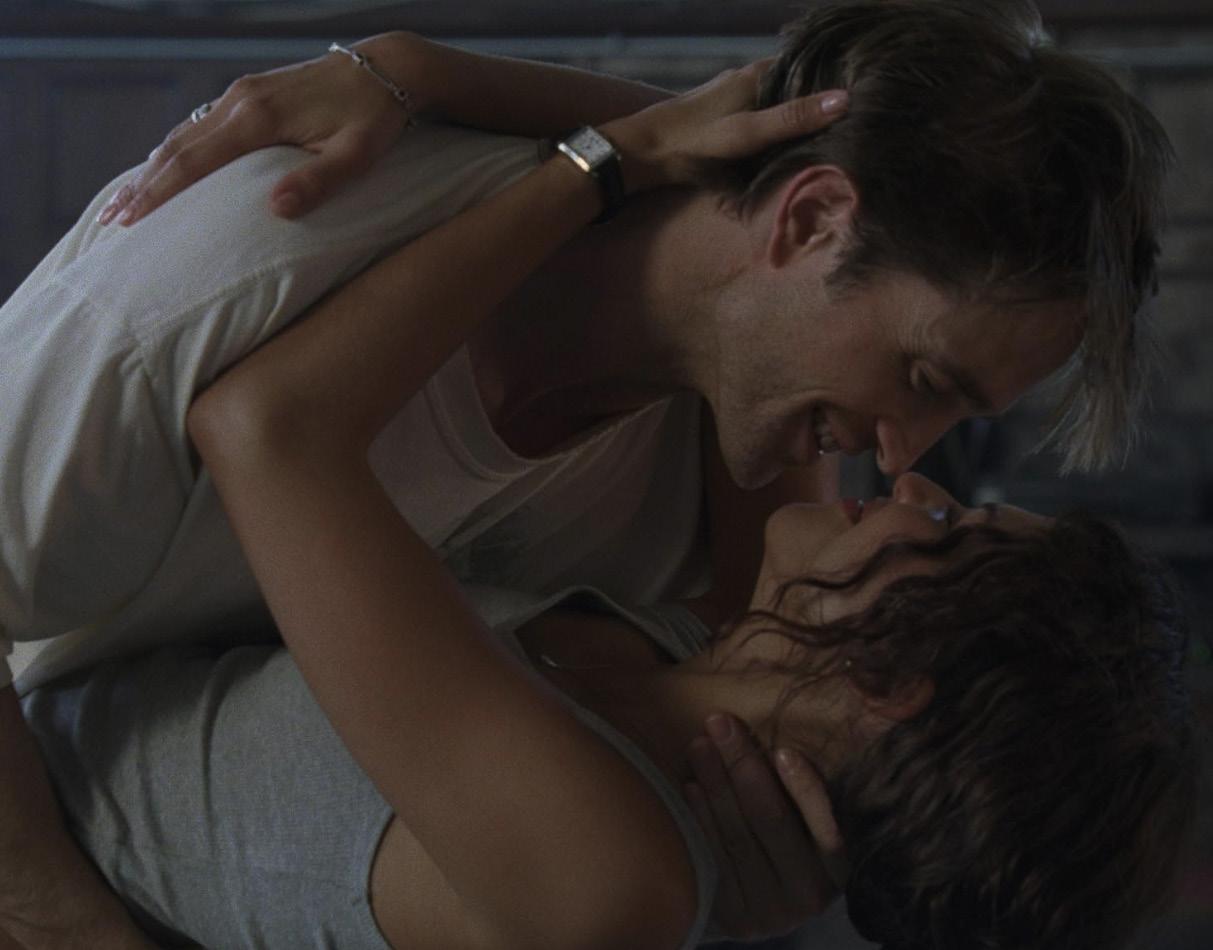
Tanvi Gorripati (CAS ’27) says “The Drama” features impressive tension and commendable performances, but fails to answer the serious questions it lays out.
implications that the film seems aware of but unwilling to unpack. Neither idea is meaningfully developed. The result makes the film seem less like a complex portrayal of American trauma and more like an exploitation of it, the kind of thing that mistakes discomfort for depth and provocation for insight. It is a frustrating missed opportunity, particularly because the bones of something smarter are clearly there.
The soundtrack and cinematography are, like the performances, a genuine strength. Both work in service of the film’s deeply unpleasant atmosphere, with the camera’s movement carrying an almost nauseating quality that suits the story well. Borgli has a real eye for visual unease, and there are moments in this film that linger long after the credits roll, bringing to my body a visceral cringe as I still sit with them.
There is, however, one odd scene with an adult Charlie caressing a young Emma (Jordyn Curet) that lands as distinctly odd, made even more uncomfortable in the light of age-gap relationship allegations that have followed Borgli off-screen. Whatever the motivation behind the scene may be, it casts a strange shadow over an already strange film.
“The Drama” is not a bad movie. It is, in many ways, genuinely impressive — ambitious, technically accomplished and anchored by two incredible performances. However, ambition is not the same as execution, and a film that raises this many serious questions and answers almost none of them has quite earned its provocations. What keeps you watching, beyond Zendaya and Pattinson’s sheer magnetism, is the relationship itself, which, despite everything, you still find yourself rooting for in a way that is hard to fully explain.
Would I watch it again? Absolutely not. It is nearly two hours of sustained, anxiety-inducing chaos that feels like a slow-motion train wreck you cannot look away from. However, despite its faults and the intense discomfort, I honestly kind of loved it, though I am still not entirely sure why.
The Emotional Harmony of (No) Pressure Creatives’ Original Production ‘Out of Sync’
Eliana Kut
Hoya Staff Writer
(No) Pressure Creatives (NPC), an Asian American musical theater group that produces original productions annually, delivers with its fourth production. This year’s original musical, “Out of Sync,” directed by Shlok Pathak (CAS, McCourt ’27), who cowrote it with Hans Yang (SFS ’28), is a beautiful and heart-wrenching story of love, loss and misunderstood expectations. Family ties and conflict are explored through the story of Kat (Jessica Cao, SFS ’28) and her best friend Carlos (Justin Liu, SFS ’28), as they substitute a Kat lookalike robot named Suki (Hailey Ahn, CAS ’27) into Kat’s life. NPC’s vision for an impactful musical culminated in catchy original songs and beautiful acting performances from the entire cast.
The musical is set in the present day and explores the life and struggles of Kat, a high school senior hoping to be accepted into Georgetown’s McDonough School of Business (MSB). Kat’s overprotective mother, Sandra (Sophia Jacome, CAS ’26), would prefer to keep both her and her brother, Peter (Arjun Singh, MSB ’26), close to home. Kat’s tech-savvy best friend, Carlos, creates a robot, Suki, that looks like and imitates Kat perfectly to beguile her mother. Kat replaces herself with Suki at home to find freedom in her life, but things begin to unravel when Suki decides to take matters into her own hands, turning on Kat and her friends.
The script felt natural, and the dazzling performances enraptured me. Kat and Sandra’s difficult and dynamic relationship was explored with nuance and tact, while the comedic deliveries of Carlos and another
student, Steven (Leon Zhang, CAS ’28), kept the musical tonally balanced. Almost every scene was complemented by an original song that developed the plot and matched the mood perfectly. It’s very difficult to create songs for musicals that don’t take away from the story or distract audiences. However, through a mix of fun ensemble pieces and deeply personal duets, the musical artists of NPC created catchy, memorable songs that truly felt ready to be performed (alongside the musical) in larger venues. Capturing events and feelings that people experience but don’t often discuss is a challenge never easily met. In fact, many productions — whether they be musicals, movies or other media — are often too obvious and brash in forefronting these complex emotions, leaving audiences feeling like they watched an exaggerated caricature of
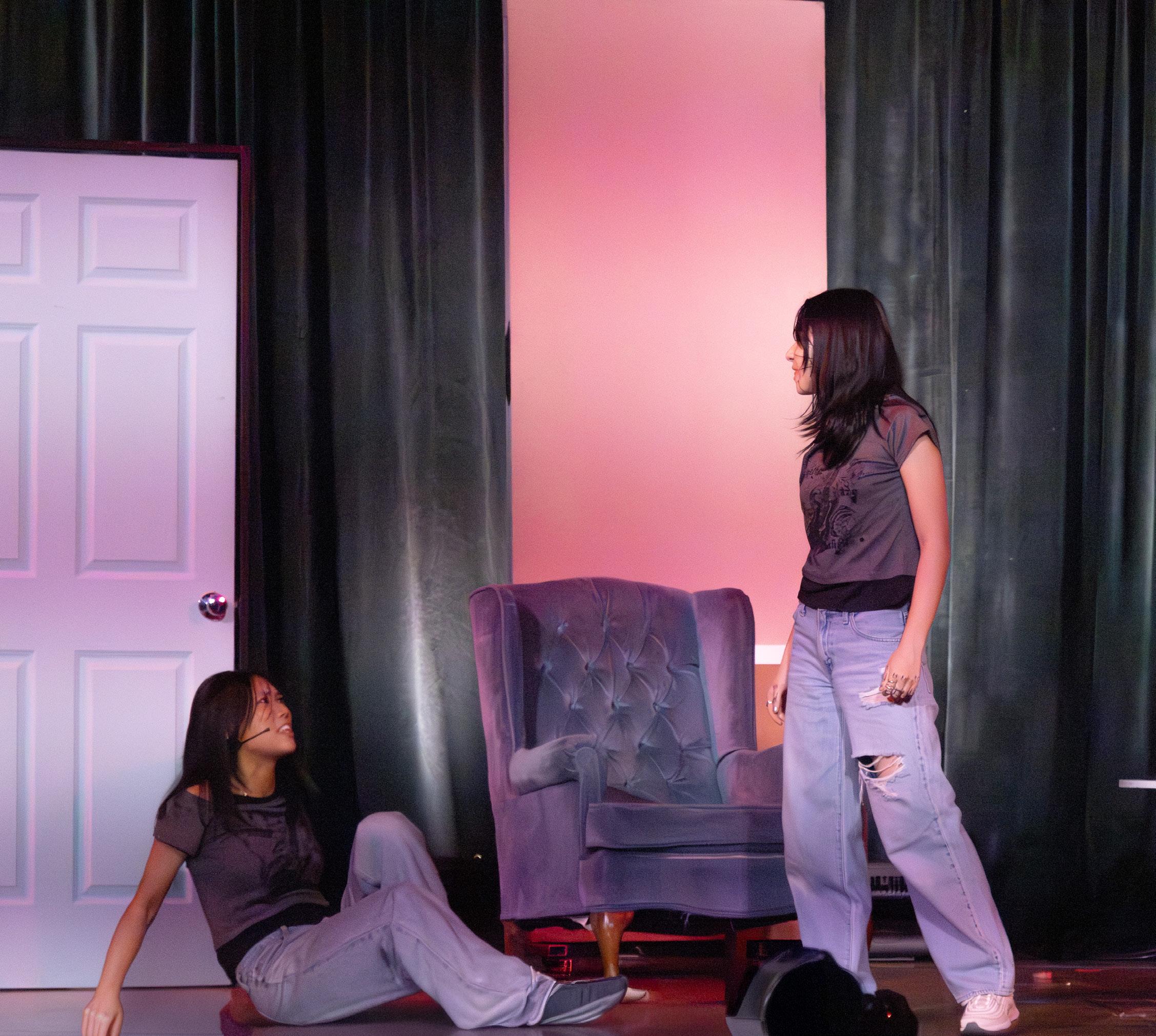
MATTHEW GASSOSO/THE HOYA Eliana Kut (CAS ’29) says “Out of Sync” conveyed a relatable and meaningful story, complete with excellent technical production.
an emotional experience. “Out of Sync” conveys very personal and relatable experiences naturally and genuinely on stage. Nothing seemed overdramatized or unnecessary. The songs and performances were beautifully put together, and the technical aspects of the show were equally impressive. The lighting changed with every scene, providing a matching tone and atmosphere. The set design, though simple, had everything necessary to support the actors without being distracting. A live instrumental ensemble provided the music for each song, a choice that I often find preferable to prerecorded tracks, as it lends an organic quality to stage productions. At times, it was difficult to hear the actors’ voices over the music, but it did not detract from the overall understanding and impression of the musical. Sound mixing is often one of the most difficult parts of a show, and the crew and performers were able to work through any difficulties with practiced ease, which was thoroughly impressive.
“Out of Sync” is a true testament to the abilities of its creators and performers. I, as well as everyone around me, was extremely touched by the story we witnessed. Difficult subjects were explored with nuanced emotion, while every performer and musician truly gave their all to create a poignant musical. I truly hope everyone with an interest in compelling stories and phenomenal performances will attend (No) Pressure Creative’s productions in the future. I have great expectations of what they will be able to create and perform in the years to come.
Riz Ahmed’s ‘Bait’ Is Braver Than Anything Bond Has Done
Anandita Agarwal Guide Columnist
What does it take to be James Bond?
That is the pivotal question that rapper-turnedstruggling-British-Pakistani-actor Shahjehan “Shah” Latif (Riz Ahmed) grapples with in “Bait” as he lands the audition of a lifetime. A six-episode miniseries created, produced by and starring Ahmed, “Bait” takes what viewers can only imagine is a lot of inspiration from Ahmed’s own life, as he has been in recurring conversations to play Bond since 2017, as many British actors of a similar age. Over the course of this period, the casting of a new Bond — or lack thereof — has become Hollywood’s hottest potato, with the rumor mill churning out a different prediction for “the next Bond” every few months. In that time period, Ahmed has cemented himself as a British-Pakistani powerhouse, gaining both Oscar and Emmy wins. More importantly, Ahmed has successfully built a network to uplift and spotlight the latest and greatest British South Asian talent, irrevocably changing the British film industry.
Amid this, the conversation around the next Bond has evolved not into a discourse of who gets to carry on the franchise, but who gets to own the name that has become synonymous with British
identity. Hence, “Bait” is not just a humorous take on Ahmed’s life, but a show that proudly and bravely argues that South Asians belong in Britain.
Starting with Shah Latif’s crucial audition for Bond unravelling as he forgets his lines, “Bait” thrusts viewers into a four-day fantastical ride into Shah’s life as he fights to redo his audition. At the same time, Shah must balance a complex tangle of familial and community relationships during Eid, the busiest time of his year as all the British-Pakistani families compete to outdo each other. His situation is further complicated when news of Shah’s audition is leaked by Shah himself as a bid to strengthen his chance of a second audition, which results in racist and vitriolic hate crimes toward his family and discourse on whether James Bond can or even should be South Asian.
Reminiscent of other recent South Asian hits such as “Polite Society” and “Monkey Man,” the show takes on an absurd, action-packed and always-funny tone as Shah’s life becomes a metaphor to dissect the real-life British media industry, from James Bond being called a “neocolonial mouthpiece” to Shah attending a contentious gala for a British museum’s unveiling of “borrowed” treasures from the Global South. The striking parallels to real-life events give the show an edge in the sociopolitical commentary it
ON YOUR RADAR
FILM FESTIVAL
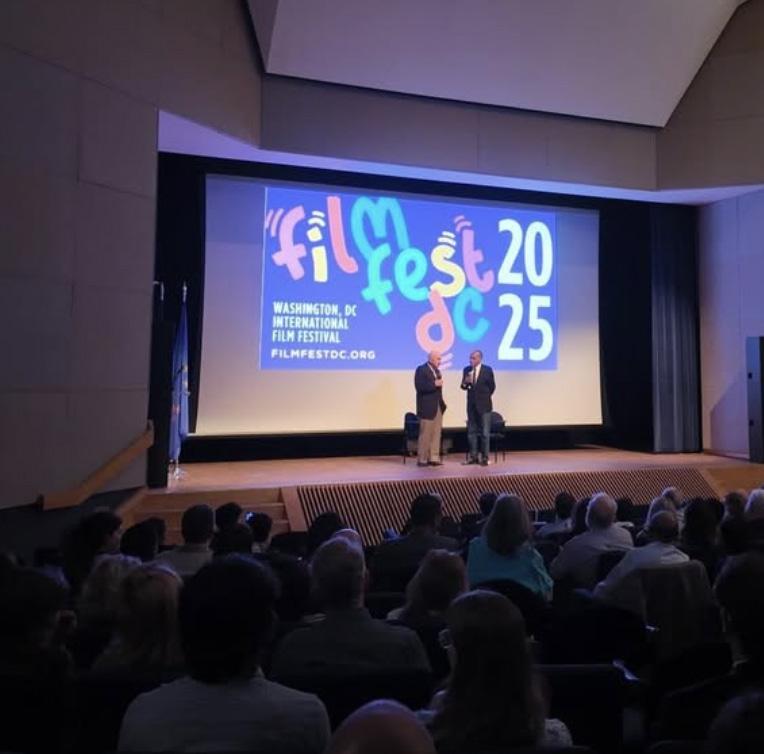
Attend Washington, D.C.’s largest and longest-running international film festival, the D.C. International Film Festival. From April 1626, the festival will feature films from international and independent cinema. The festival also showcases films made by artists who live or work in the Washington, D.C.-Maryland-Virginia area. Opening night tickets are now available for $45 for a screening of “Colours of Time” by Cédric Klapisch, premiering at the Embassy of France at 6:30 p.m.
strives to deliver, amplified by Ahmed’s personal touch to its realism. Ahmed can speak about it because he’s lived through it.
However, the show’s best moments come not from its autobiographical elements, but from the obviously untrue ones that serve to dig deep into the psyche of the often narcissistic, impassioned and maybe even schizophrenic Shah. One of the central throughlines is Shah’s imagined conversations with a severed pig head (voiced by Patrick Stewart) that he acquires from a racist hate crime of which he is a victim. In one memorable moment, Shah accidentally leaves it outside a mosque on Eid. The absurdity of a Muslim carrying around and drawing comfort from a pig’s head has never been more prevalent and ironic. The moment perfectly encapsulates the show’s dark, bold and punchy humor. The series finale takes a similar farcical tone as Shah dreams of a situation where he is forced to shoot every member of his family, a symbolic spin on Shah’s complicated feelings toward them.
These exaggerated moments help viewers not only understand Shah, but also the complex emotions surrounding British-Pakistani identity. Shah’s soliloquies to the pig unearth Shah’s immense self-loathing, a result of the extreme and violent bullying he faced due to his identity combined with his family’s well-intentioned yet
By Penelope Snoep
STAR POWER
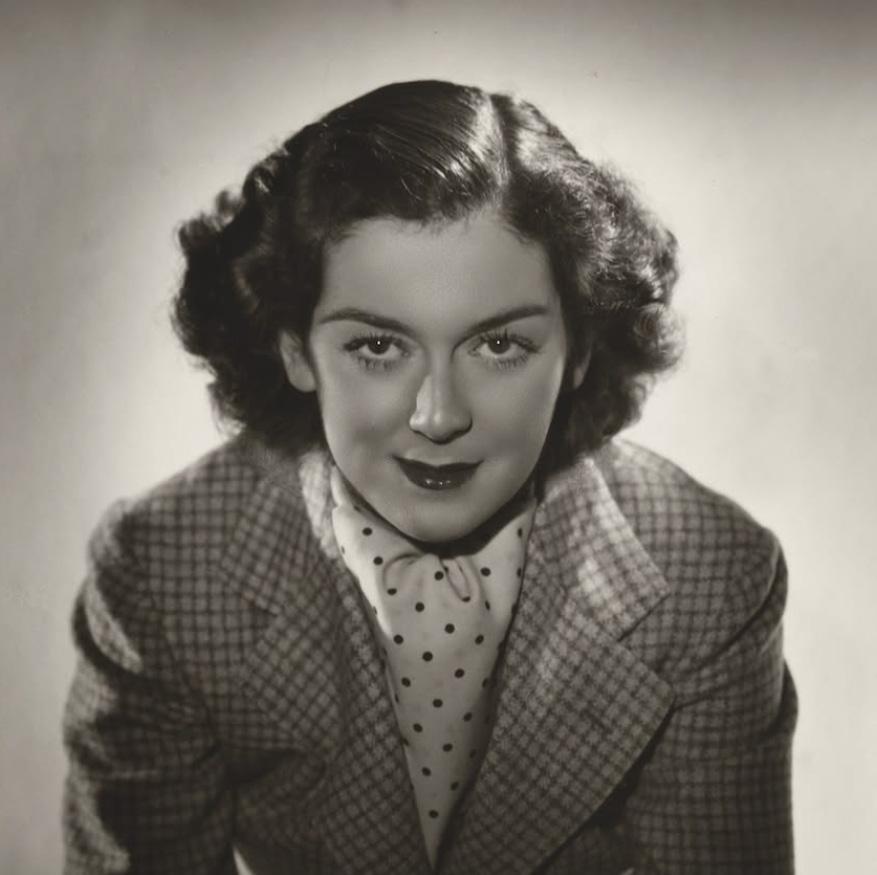
Visit the National Portrait Gallery to see the second installation of George Hurrell’s “Star Power: Photographs from Hollywood’s Golden Age,” which includes 20 vintage photographs of film icons from the 1930s and 1940s. Known to have an eye for posing and innovative lighting effects, Hurrell’s photographs influenced popular culture for decades. The exhibit is available until Jan. 10, 2027. Tickets are free.
DISTRICT SOUNDS 2026
District Sounds will return to The Wharf on April 18 from 3 p.m. to 9 p.m., showcasing a mix of hip-hop, cumbia, flamenco and house music. The festival will feature music from local public school students as well as established performers, such as an Argentinian orchestra and a finale featuring rapper ODDISSE and the Georgetown University Orchestra. Tickets are $12.
hurtful digs at Shah’s acting aspirations. Immigrant guilt, shame and suffering all rise to the surface, becoming the show’s emotional anchor.
At the heart of the show is Ahmed’s obvious love for British South Asian art and culture, from the locations to the soundtrack to the ensemble cast to the memorable cameos. However, even for a show created by Ahmed and based on his life, it could do with a little less Ahmed. The standout performances of the ensemble cast, particularly Shah’s cousin, Zulfi (the loveable and brilliantly funny Guz Khan), and his mother, Tahira (played by veteran actress and longtime Ahmed-collaborator Sheeba Chaddha), hold the show together in its weakest moments. Since the show tries to tackle so much, the storyline can feel disconnected at times, as every minute takes viewers in an unexpected direction that would be impossible to believe if it weren’t for the authenticity the larger cast brings.
Regardless, “Bait” successfully manages to be both a love letter to and dismantling of BritishPakistani identity, wrapped in an entertaining Bond-esque thriller-comedy that is constantly switching gears. If nothing else, hopefully “Bait” at least convinces you of Ahmed’s potential to say “The name’s Bond, James Bond.” Because, honestly, what has the fictional MI6 agent done that a West London Pakistani family couldn’t do?
50 YEARS OF CCAS
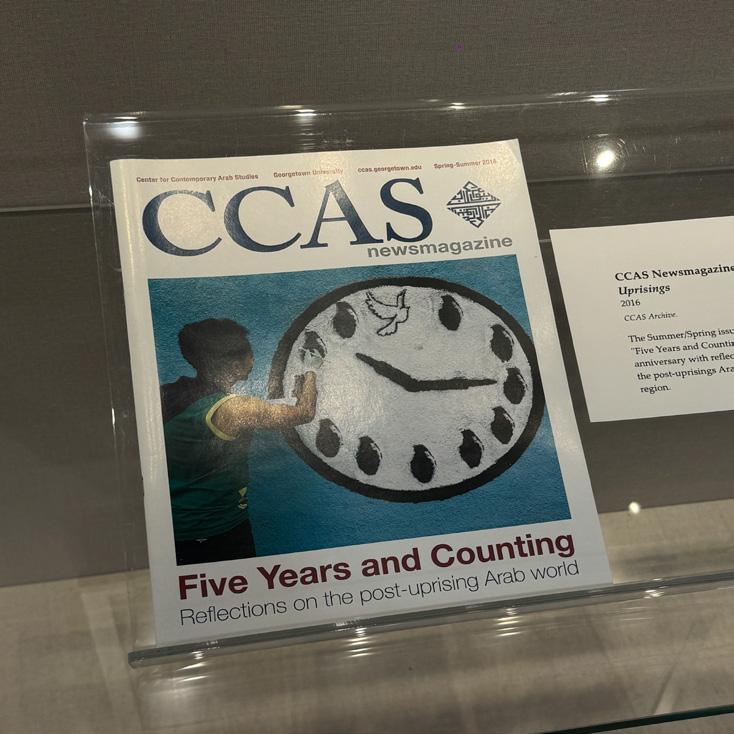
To honor the 50th anniversary of the Center for Contemporary Arab Studies (CCAS), Georgetown University’s Charles Marvin Fairchild Memorial Gallery is showcasing a physical exhibition. The exhibition features videos, images, texts, audio recordings and an interactive timeline in memoriam of the past five decades of the center’s work. The gallery is on the fifth floor of Lauinger Library.
‘Love Story’ Is Good, but Should It Have Been Made?
Aarushi Maskara Hoya Staff Writer
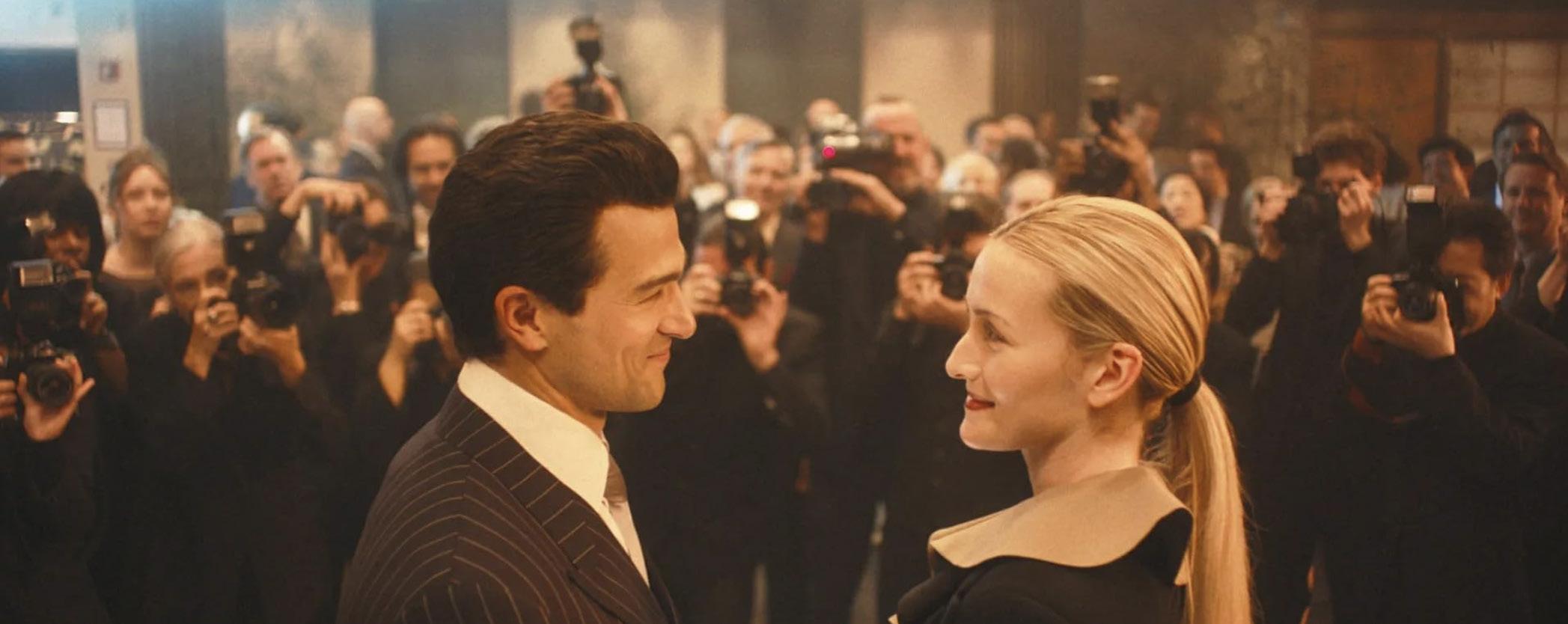
John F. Kennedy Jr. (Paul Anthony Kelly) and Carolyn Bessette Kennedy (Sarah Pidgeon) have long been remembered as a destined, doomed and endlessly idealized couple. The Kennedys are American royalty, and John and Carolyn were the it couple of their era. “Love Story” knows this and leans into this narrative to create a dramatized show of their famed love story. But, while the show is gripping, it is hard to ignore the question underneath: Should the series exist at all?
One of the show’s greatest assets is Sarah Pidgeon, whose performance as Carolyn is extraordinary and particularly impressive given how little footage of the real Carolyn Bessette Kennedy actually exists. With so few reference points, Pidgeon constructed a portrayal from photographs, secondhand accounts and the show’s source material, Elizabeth Beller’s biography of Bessette Kennedy. Pidgeon’s eyes are expressive, doing extensive work, and her scenes navigating the paparazzi convey a deep, specific discomfort that’s central to her character. The one caveat is that Pidgeon’s commitment to Carolyn’s nonchalance and cool girl persona occasionally work against her, especially in the early episodes, where she sometimes murmurs the dialogue, making some of her lines difficult to understand. Episode 7, “Obsession,” is where she truly shines, however, playing Carolyn’s breakdown over the paparazzi and pregnancy rumors with an incredible emotional rawness.
A key strength of the show is its opening right before the plane crash — when Carolyn is
getting her nails done, visibly uncomfortable and diminished — before immediately pulling us back to the woman she once was: confident and magnetic. We see how the marriage essentially erased Carolyn’s career, identity and sense of self as she became absorbed into her husband’s story.
Moving to the supporting cast, the dynamic between Carolyn and Caroline Kennedy (Grace Gummer), Carolyn’s sister-in-law, generates tension without reducing either woman. What makes the plotline so strong is that the show refuses to let either of them be right, portraying them as two women who care about the same person and struggle to coexist. Caroline is determined to protect the family’s world, whereas Carolyn is still figuring out how to exist within it.
Jackie Kennedy Onassis (Naomi Watts), Carolyn’s mother-in-law, is similarly well written; the show makes you feel for her losses and history while also feeling a certain frustration at her judgment toward her son’s relationships. It works to keep her multidimensional, making her neither a saint nor villain. On the other hand, Daryl Hannah (Dree Hemingway), John’s ex-girlfriend, is essentially reduced to a caricature of a drug addict. The performance is so flat, and its implied judgment about the real Hannah feels both unfair and a stark contrast for a show that is otherwise so focused on its characters’ complexity. Where the show has photographic reference points, its recreations are immaculate. The recreation of the famous Battery Park fight mirrors the expressions, framing and angles of the original photographs with careful precision. Kelly’s delivery during the “George” magazine launch announcement speech is almost identical to real footage, the kind of scene that makes you reach for the original clip
“Love Story” uncomfortably profits off of grief, says Aarushi
to compare. The wedding episode is equally strong. The first dance scene feels like John and Carolyn exist in a separate universe, floating just above everyone else in the room, as if to say it is the first and last time they exist in the marriage as only the two of them. Forever after that, they are under a constant microscope. The show captures how relentlessly aggressive the paparazzi were toward Carolyn in particular, almost drawing a parallel to Princess Diana. This is made explicit when John and Carolyn learn of Diana’s death; the news is already debating which outlet will auction the photos for the most money. Here, the show makes its thesis that what destroyed Carolyn was not simply her relationship with John, but the world that came with it. Still, “Love Story” is not without its flaws. It is hard to shake the feeling that the show would not exist if the couple had not died. Their tragically young deaths are what many people first think of when their names are mentioned, and that is
what the show capitalizes on. Starting with their deaths and working backward is emotionally effective but feels particularly exploitative, like it is profiting off grief. This is shown in the way the show reconstructs moments it could never actually know: therapy sessions, private arguments and internal grief. The line between dramatization and speculation is obviously blurred — after all, it never claims to be a documentary — but still feels uncomfortable. Building on this discomfort is the show’s choice to continue past their deaths entirely, to linger on the grief of Caroline Kennedy and Carolyn’s family in the aftermath. The show frames itself as a love story, but, here, it stops being about John and Carolyn and starts exploiting the devastation of others hurt in the process.
“Love Story,” for what it is, is well made. But, it is also a reminder that telling real people’s stories is dangerous, and beauty is not the same as truth.
Robyn’s ‘Sexistential’ Is Catchy, Emotional, but Weird
Francis Rienzo Hoya Staff Writer
You will need to open your mind in preparation for Robyn’s ninth studio album, “Sexistential.” Robin Miriam Carlsson, the pop icon known as Robyn, is responsible for sleeper hit “Dancing On My Own” and famous to fans of the TV show “Girls” and those with good taste. Her new album takes on the production style of the classic favorite but infuses it with more specific and strange lyrics.
The album opens with “Really Real,” a track featuring pulsating synths and lyrics about, well, sex. It is a strong start that reminds the listener of Robyn’s true talent for pop music, and it sets the tone for the rest of the album. After “Really Real,” the last thing “Sexistential” can be is boring; every song wakes you up either through its off-putting lyrics or infectious production. For example, “Blow My Mind” is a reworked version of a song from early in Robyn’s career with the same name. The lyrics are rewritten as an
ode to her baby son, a theme that reappears consistently throughout the entire album with lines like “lemme just crush your scrumptious little face.”
Robyn explores a womanhood defined by motherhood in “Sexistential” to varying degrees of success. Of the only nine tracks, most are great, and a couple are good. However, the title track is a weird, poetic rap meditating on dating during motherhood, name-dropping the high-profile dating site Raya and online marketplace Etsy. Unfortunately, it is almost unlistenable. As much as I want it to grow on me, it is an unpleasant listening experience with too many cringeworthy lines that is nowhere near catchy enough to keep me listening.
On the flip side, “Talk to Me” is a career highlight for Robyn. It has a very clever buildup, with cheeky lyrics boosted by pulsing synth production. This is an excellent example of moments where Robyn’s strange lyrics work to benefit the song. Every element is harmonious here, especially her smooth vocals that act as an instrument of their own. It is a quintessential Robyn song and the best on the album.
A close second is the last track, “Into the Sun,” which has the emotional yet hopeful energy of “Dancing On My Own.” The choppy production style, similar to that of the 1970s new wave genre, complements beautiful lyrics like “Into the sun / I might be wrong and burn on the entry.” It puts the “existential” into the album title. The more existential and reflective tracks, like this one and “Light Up,” are ultimately what work best for Robyn on this record.
Robyn redefines dance pop in “Sexistential.” She subverts the expected production style through distortion and vocal effects, including a screeching guitar solo on “Really Real” and the opening blaring effects on “Sucker for Love.” Her voice is constantly veiled in high-powered autotune and cut off by spoken word, such as on “It Don’t Mean a Thing.” The daring vocals are not distracting: They fit naturally into the song. Her main collaborator, Klas Åhlund, is a member of the Swedish music group Teddybears and has worked with Robyn since 2005, and their chemistry as a duo is clear. Her voice is complimented perfectly by Åhlund’s production, which
doesn’t overshadow the lyrics and is still the dominant feature of the songs. Her last album, “Honey,” was more poignant and emotional, but, on this record, Robyn explores a new, peppier side of herself. In an age where Charli XCX and Halsey have begun to explore motherhood in their music, Robyn shines with a joyful dance pop album that talks about both sex and becoming a parent. Even through songs that don’t work — like the title track that completely fails to deliver an enjoyable experience — Robyn has earned the right to experiment with such explorations. However, the album is short, burning out fast, and could have benefited from Robyn taking more time to explore its existential side. The album is still an overall success, as the highs outshine the single, miserable low found in the title track. The more I listen to “Into the Sun,” I relearn how essential Robyn is to pop music. Without her, female pop artists simply could not take as many risks as they do today. She deserves to be as happy and carefree as she is on “Sexistential,” and we as listeners deserve the amazing tracks that come out of it.
MUSIC
IMDB
Maskara (MSB ’28).
Thundercat Is Hyper-Focused on Being ‘Distracted’
Juan Almanza Deputy Guide Editor
After exactly six years since his last album, fusion bass maestro Stephen Lee Bruner, better known as Thundercat, proves his fire is still burning bright in his newest project “Distracted.” Now, don’t be mistaken, Bruner has been active outside of producing original albums, and his signature techno funk flair has graced projects like A$AP Rocky’s “Don’t Be Dumb,” JID’s “God Does Like Ugly” and longtime collaborator Mac Miller’s posthumous album “Balloonerism.”
The opener, “Candlelight,” introduces itself with the confidence Bruner has used to fuel all his solo albums. A solo-funk soul record is a hard sell nowadays, but the silky-smooth instrumentals and masterful bass playing that Bruner brings to the table make it a done deal. While the first half of the song features lovely background vocals as the instrumentation blends together, the second half is eager to jump into a synth breakdown, with a repetitive motif highlighting a wonderful
display of jazz collective improvisation with a bass riff, keyboard riff and drum riff, all happening simultaneously.
As a beautiful send-off to Mac Miller, who was a longtime friend, Bruner finished and released the collaboration they had had in the works, “She Knows Too Much,” as the third single to “Distracted.” It is almost impossible to encapsulate how beautiful it was to hear the two artists on a new composition, especially with Miller’s signature humor as he raps, “She way out of my league, can’t buy her love / All the books she read, she know way too much,” and Bruner’s ad-libbing in between, softly singing, “Can’t buy her love!” Bruner’s production and musical stylings have always harmonized perfectly with Miller’s laid-back deliveries and almost jazzy vocal tones.
With Thundercat at the helm, the collaborations featured on this album are uplifted by his trance-like productions. The best example of this comes with the fifth track, “Funny Friends,” featuring A$AP Rocky. A$AP’s powerful bars float across a dense beat, with ambient drums and cloudy bass riffs, all sounding as though they were
recorded in a concert hall with a lovely echo. Bruner’s chorus especially shines, as the entire song ascends to another plane of psychedelic harmonies, with closely-packed background vocals, sweeping synths and the drums coming out in full force.
Bruner’s collaboration with Tame Impala results in a psychedelic opus for the two, where the two trade choruses and production styles as their styles meld perfectly. WILLOW makes her mark on “ThunderWave,” where, even if the song itself is a bit more lackluster than other cuts, the feeling of floating above the rest of the world is washed ashore with the samples of ocean waves and twinkly synths.
Bruner’s writing style has matured, but he still maintains a distinct sense of humor that makes his albums all the more enjoyable. “Anakin Learns His Fate” references the sensational lead character from the Star Wars prequels as Bruner compares himself to the character. In the same way that Anakin later becomes Darth Vader, Bruner explores the idea that he too might be destined to not be any good for the world. While humorous, the underlying
insecurities are quite serious and touch every song on the record. It’s easily disguised by the beautiful harmonies, but if anything, such harmonies are examples of how Bruner is “distracting” himself from his darker thoughts.
“Candlelight” itself is about another one of Bruner’s creative partners who passed away, Meghan Stabile, whom he describes as candlelight. “Great Americans” flows like a stream of consciousness, with Bruner’s vocal intonations making an otherwise serious issue sound near-hilarious.
With the chaos of life, “Distracted” is Bruner’s attempt at, if not making sense of it all, distracting himself through music, and the result is beautiful. Some songs are tearjerkers disguised as funky, funny riffs, and others present themselves as they are, but are contextualized by the loss of artists like Mac Miller who helped create them. As a whole, however, “Distracted” is a sharp and ironically focused effort, which altogether transports the listener away to a world of psychedelia, funky basses and dreamy synths, all much different from the chaotic nature of the real world.
There Is No Pointe in Suffering Through ‘Pretty Lethal’
Valentina Zamudio Special to The Hoya
If you find yourself with nothing to do on a Friday evening because you finished all your homework — not even just for this weekend, but for the next four — already hit the gym, deep cleaned your whole apartment, went to the grocery store and did your laundry, I still wouldn’t encourage you to watch “Pretty Lethal.”
But if you do, you can’t say I didn’t warn you.
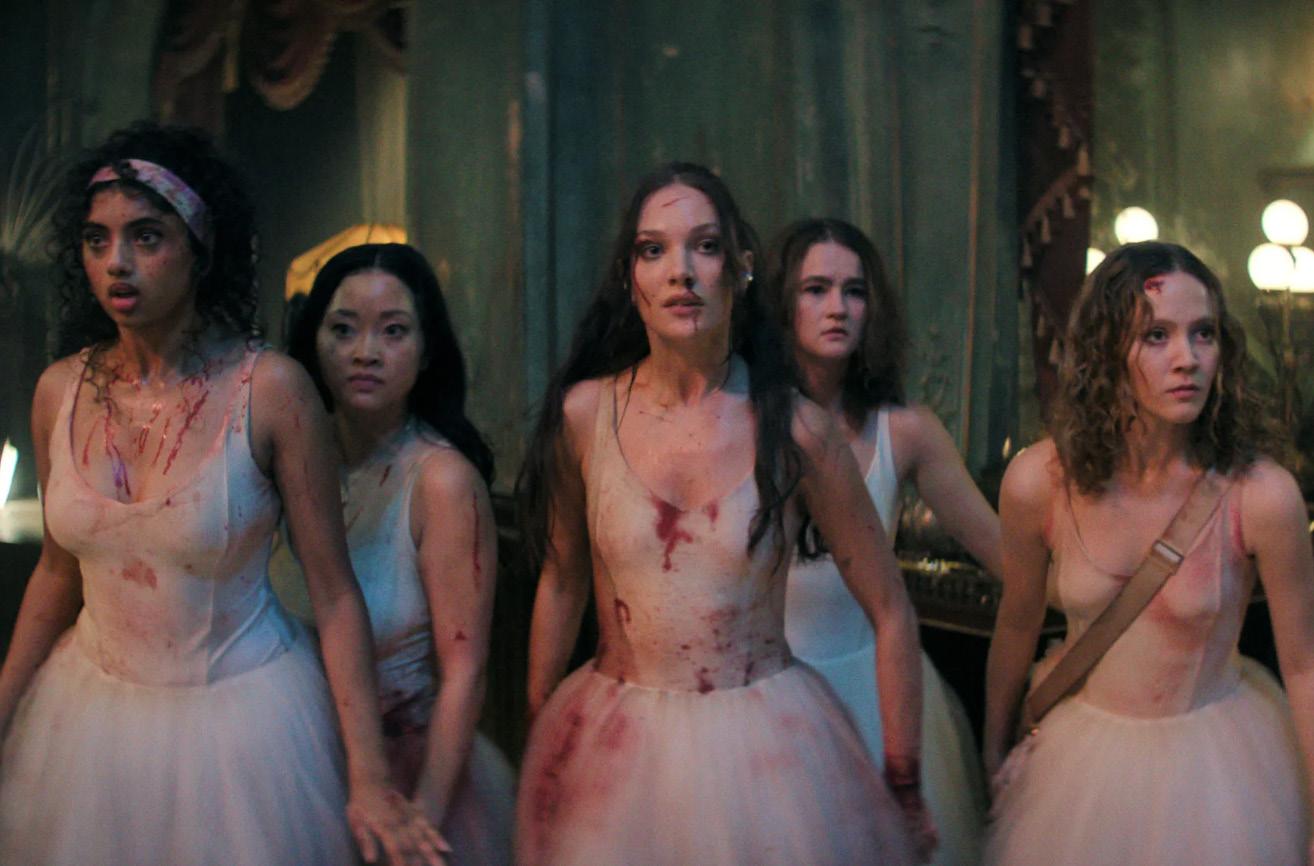
Vicky Jewson’s “Pretty Lethal” follows five ballerinas, Bones (Maddie Ziegler), Princess (Lana Condor), Grace (Avantika Vandanapu), Chloe (Millicent Simmonds) and Zoe (Iris Apatow), who travel to Budapest, Hungary to compete in a dance showcase. After a series of mishaps, their bus breaks down in front of a remote Hungarian mansion, the Teremok Inn, where they seek shelter. Early on, it is clear that not everything is as it seems. After witnessing an “unfortunate accident,” the girls find themselves trapped and are forced to fight their way out.
The premise, to its credit, is interesting. An action thriller following young ballerinas is a distinct concept. The fight scenes, which incorporated ballet-like moves, were well done and probably the only moments in the film that really kept my attention.
Arguably, that is the film’s main issue: There is really nothing that keeps you engaged.
None of the five leads was given much more than a singular character trait to embody. Bones is rough around the edges,
an outsider in the rich and composed world of ballet. Princess falls into the spoiled Princess trope — the two girls are (naturally) at odds with each other. Grace is a devout Christian. Chloe is boy-crazy, and Zoe is her protective older sister. By the end of the film, none of them have meaningfully grown. The only significant change is that they’re all now trauma-bonded and, consequently, don’t bicker as much.
In defense of the actresses, it did seem to be more of a writing issue than the acting itself. Ziegler and Simmonds truly stood out with the little that they were given, managing to make their characters real despite the flatness inherent in the script. Other than that, everyone was relatively forgettable. No character really added anything to the film, including Devora Kasimer (Uma Thurman), our supposed lead antagonist, who was left completely underdeveloped. The film probably would have made just as much sense without her. Every time Princess opened her mouth, I had to refrain from cringing. It seems as though her character was written for a different movie and thrown into the script at the last minute, because her lines, which would’ve been hilarious elsewhere, completely missed the mark. I couldn’t tell if it was a poor attempt at making the film satirical or if they thought it would add to the comedy.
Visually, there was potential in the film. The colors were muted in a way that made it feel eerie and gave it a more haunted feel than just your standard action film. The fight scenes and cinematography were well done,
and you really felt immersed in the action. However, the flat writing, which extended beyond the characters to the plot build-up itself, made it so that there was never really any dread or tension. Consequently, the setting, which could have been terrifying, ultimately came across as a nice house.
My main takeaway from the film was that “Pretty Lethal” was made for the wrong genre. This should have been a camp movie, leaning into elements of horror comedy like “Scream Queens.” It should have acknowledged its
absurdity and allowed itself to be made fun of. But, it took itself too seriously, and, in turn, there was nothing there to keep you engaged. You could look away at any point and not care to look back. It was also too predictable to be thrilling. Not once was I caught off guard by an attack or any event in the film. My mind wasn’t twisted either. Without the blood, this would easily have been rated PG-13, and no one would have batted an eye. Honestly, it probably would have done better if it had been.
Valentina Zamudio (SFS ’28) says ballerina-centric horror is a “Pretty Lethal” watch.
‘Forbidden Fruits’ Is Sinfully Sweet, but Lacks Originality
If “Mean Girls,” “Jennifer’s Body” and “Scream” had children, this year’s “Forbidden Fruits” would undoubtedly be the favorite child.
“Forbidden Fruits” is a camp comedy horror based on a play by Lily Houghton titled “Of the woman came the beginning of sin, and through her we all die.” It was adapted for the screen by Houghton and Meredith Alloway, the film’s director. The movie premiered at the 2026 South by Southwest Film and TV Festival on March 16 and is now on a limited theatrical release.
The movie follows mall witches Apple (Lili Reinhart), Cherry (Victoria Pedretti) and Fig (Alexandra Shipp), who work in a boho clothing store called Free Eden. Despite having had a falling out with past member Pickle (Emma Chamberlain), the girls welcome Pumpkin (Lola Tung) into their coven. The result? Secrets are revealed, spells are cast and blood is spilled. Reinhart is frightening from the beginning, when she first irks the viewer as a mean girl. However, her Apple isn’t just a toxic
friend, but actually psychotic and deranged. In a scene shot from Pumpkin’s point of view, the film reaches its scariest climax as the camera dwells on the look in Apple’s eyes while she delivers her monologue about how men are evil. The fact that she was able to evoke that fear from me without anything else happening on screen is applaudable.
Pedretti excels as the “Mean Girls” Karen-esque Cherry, adding depth to the often overlooked sidekick. She is incredibly funny and delivers one of my favorite moments when she asks if “someone having a nervous breakdown” could go on a “hot girl jog.” In lieu of the iconic “on Wednesdays we wear pink,” Apple forces Cherry to abstain on Wednesdays because she believes that all men are snakes, which is a ridiculous concept. Cherry is naive, easily persuaded and loyal to a fault. All she wants is approval of others, which leads to her ultimate demise.
As for the other actors, I am hoping to see Tung in more of this kind of role. There was more for her to work with than on her previous one-note project, “The Summer I Turned Pretty.” Shipp did not stand out to me, but I think it was
CROSSWORD
because her character is essentially a blend of Pumpkin and Cherry. Her few extra personality traits, like having a boyfriend, being a science genius and loving Ed Sheeran, were funny but didn’t give her a lot to work with.
Chamberlain, however, is the textbook definition of a stunt cast. I have to admit, I was excited to see my favorite Youtuber in her first feature role. Her performance was not unbearable, but she was simply less experienced than the other four and brought nothing exciting to the otherwise stellar ensemble.
Outside of the acting, as someone with a general aversion to horror, I have grown to appreciate this campy subcategory of the genre. “Forbidden Fruits” in particular featured witty comedic moments and used gore as a purposeful story tool rather than solely for shock factor.
I was immediately drawn in by the quotable one-liners, but stayed for the absurdity of the situation. The film never took itself too seriously and played into the dramatics. All I can say is I have never heard people laugh out loud this much in a theater before — and at a horror movie no less.
The extremely graphic moments, such as when Cherry gets her hair caught in and is
“eaten” by an escalator, and when Fig gets sliced in half vertically by a piece of glass, take up about five minutes of the 103-minute run time. I am afraid of everything, so I saw this as a plus. However, for being advertised as a horror movie, slasher or body horror fans might be underwhelmed.
My largest critique is that for being so obvious (Free Eden, Apple, “men are snakes”, etc.), the Christian symbolism didn’t seem to have a greater purpose. The title of the play pulls from the Book of Genesis, which is often referred to as misogynist, since a woman is at the root of original sin. Although I’ve never seen the play, I think it is likely that the depth of this theme got lost in adaptation. The idea that men want to blame women for everything bad in the world is not completely absent, but perhaps adding a more blatantly ignorant male character would pack more of a punch.
So, while I personally really liked “Forbidden Fruits,” it ultimately does not add anything new to the genre. If the concept interests you, it’s likely the film will follow through. If you’re a horror junkie looking for your next obsession, I would look for something a little more ripe.