FEATURES
GUIDE
Slavery Reparations
‘Camp Miasma’ B1
A4
Since 1920 FRIDAY, SEPTEMBER 4, 2026
THEHOYA.COM
Georgetown University • Washington, D.C. Vol. 108, No. 1, © 2026
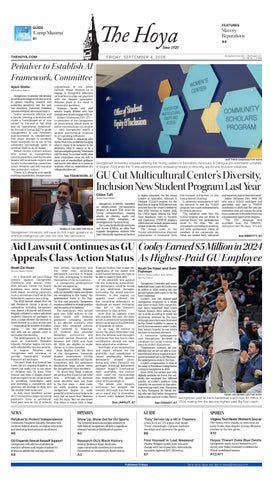
Peñalver to Establish AI Framework, Committee Ajani Stella Executive Editor
Georgetown University will develop an artificial intelligence (AI) framework to govern teaching, research and university operations over the next two semesters, University President Eduardo Peñalver announced Sept. 3. Senior university officials and a faculty steering committee will create a “consolidated set of core values” by the end of Fall 2026 and an “operational framework” by the end of Spring 2027 to guide Georgetown’s AI use. Peñalver’s announcement is Georgetown’s first major attempt to establish broad standards for AI use as the university increasingly seeks to position itself as an AI leader. Robert Groves, a senior advisor who served as Georgetown’s interim president, and the Faculty Senate will nominate experts and faculty to the steering committee, which Peñalver said will examine the university’s values. “Given AI’s ubiquity and rapidly evolving capabilities, Georgetown’s
commitment to our Jesuit, Catholic values requires us to engage in thoughtful reflection on how best to align our practices with our deepest principles,” Peñalver wrote in his email to community members. Students, faculty and staff remain largely divided over how Georgetown should engage with AI. Vedant Srinivasan (SFS ’27) — co-president of the Georgetown AI Association, which leads AI policy conversations on campus — said Georgetown needs a unified institutional response to AI’s growing influence. “The university is reckoning with the fact that AI is completely changing what it means to be someone in the workforce, what it means to be a humannavigatingsociety,”Srinivasan told The Hoya. “In an ideal world, what these committees come out with is some sort of standardized guidance and norms that allow us to know, as students, what our expectations of a college education are.” See FRAMEWORK, A7
MATTHEW GASSOSO/THE HOYA
Georgetown University stopped offering the Young Leaders in Education, Advocacy & Dialogue pre-orientation program in August 2025 amid the Trump administration’s increasing threats to diversity, equity and inclusion initiatives.
GU Cut Multicultural Center’s Diversity, Inclusion New Student Program Last Year Chloe Taft
Senior News Editor
ISABELLE CIALONE/THE HOYA
Georgetown University will issue its first major guidance on artificial intelligence use over the next two semesters.
Georgetown University sunsetted an identity-driven pre-orientation program in August 2025 amid the Trump administration’s ongoing attacks on diversity, equity and inclusion (DEI) initiatives, an investigation by The Hoya found. The Center for Multicultural Equity and Access (CMEA), an office that supports Georgetown students who have historically experienced barriers
to higher education, ran the Young Leaders in Education, Advocacy & Dialogue (YLEAD) program for the final time in August 2024 before it was removed from the center’s website by May 2025. Starting in August 2025, the CMEA began offering the Total Hoya Readiness: Intro to Vocation and Experience (THRIVE) program, which does not include programming related to identity or diversity. The change came as the Trump administration directed universities to terminate their
DEI-focused initiatives or risk losing federal funding. A university spokesperson said the decision to end the YLEAD program was made independently of outside pressure. “The transition away from the YLEAD program was not driven by external forces,” the spokesperson wrote to The Hoya. “We are committed to providing an academic and work environment where all members of our community can thrive, are treated fairly, welcomed
and respected, and do their best work.” Solene DeGaynor (SFS, MSB ’27), who was a YLEAD participant and peer-leader and later a THRIVE coordinator in 2025, said the new preorientation does not contain the same focus on identity or diversity, which was a fundamental aspect of the program. “The DEI language was scrubbed from the THRIVE,” DeGaynor told The Hoya. “It’s not See IDENTITY, A7
Aid Lawsuit Continues as GU Cooley Earned $5 Million in 2024 Appeals Class Action Status As Highest-Paid GU Employee Noah De Haan Senior News Editor
As a financial aid price-fixing lawsuit against Georgetown University and several other elite schools enters its fourth academic year, some students have begun receiving payments from a settlement fund while five defendants appeal a key ruling. The 2022 lawsuit alleges that the 568 Presidents Group, a group of universities including Georgetown that shared a financial aid formula, illegally colluded to reduce admitted students’ financial aid packages. In June, a judge allowed the lawsuit to move forward as a class action case — expanding the number of student claims — but the defendants will now ask an appeals court to reconsider that decision. The developments in this suit came as University President Eduardo Peñalver begins his term with affordability as a key priority. In August, Peñalver said Georgetown will continue to provide meaningful student financial aid packages. “We don’t think that lawsuit has merit, but it’s ongoing litigation, so there’s not really a lot to say about it,” Peñalver told The Hoya. “That lawsuit and what it alleges doesn’t have an impact on our commitment to providing meaningful need and providing a competitive and generous aid package as deep into the student body as we can.” In July, class members across all 17 universities began receiving payments from a settlement fund paid into by the 12 schools
that settled. Georgetown and the other four remaining defendants continue to litigate the case, attempting to absolve themselves of the accusations. A Georgetown spokesperson denied wrongdoing. “Georgetown strongly disagrees with the plaintiffs’ claims and denies any wrongdoing in this matter,” the spokesperson wrote to The Hoya. “As this case proceeds, Georgetown remains confident in its legal position and the merits of its defenses.” The defendants who settled paid over $280 million to the fund, which will disburse payments averaging $2,000 to all affected students, even those who attended schools still involved in litigation. All students who attended defendant universities and received partial financial aid between Fall 2004 and June 30, 2023, are eligible to make claims as a class member. Roan Bedoian (CAS ’28), chair of the Georgetown University Student Association’s (GUSA) Financial Accessibility and Equity Committee, said the settlement distribution helps relieve stress for Georgetown’s class members. “To know that these students are getting that financial aid relief now — although the pressure never should’ve been put there in the first place — does make me really grateful, because a Georgetown degree is really powerful and we’re very lucky to be here, and we know that,” Bedoian told The Hoya. “But we also know that when it comes with a huge
financial burden, that makes the significance of the degree that much heavier because you have to be able to make it back after.” If the plaintiffs win against the five remaining universities, the defendants could be forced to pay additional damages, increasing the award amount. However, in late August, an appeals court allowed the five remaining defendants to challenge an expert testimony that led to the lawsuit’s transition to class action. Now that an appeals court will consider the case, the class action is potentially jeopardized, which could lead to the dismissal of thousands of claims. In an Aug. 24 motion to vacate the case’s November trial date, the defense said the expert testimony that was key to class certification should not have been admitted as evidence. Hal Singer, an econometrician and expert witness for the plaintiffs, had established a causal relationship between defendants’ alleged pricefixing and lower financial aid packages. Although defendants claimed Singer’s conclusions were unreliable, the district court ruled his methodology was dependable. The appeals court will now weigh in. The debate over Singer’s testimony has delayed the lawsuit. Although the case was set to stand trial in November, a recent order delayed further
Noah De Haan and Sam Fishman Senior News Editor and Senior Sports Editor
Georgetown University paid men’s basketball head coach Ed Cooley over $5 million in 2024, making him the second-highest-paid coach in the Big East Conference. Cooley’s was the highest-paid Georgetown employee in a single year since at least 2000, except former men’s basketball head coach Patrick Ewing’s $12.5 million buyout in 2023, according to public tax documents reviewed by The Hoya. Although many fans were frustrated by the Hoyas’ inability to appear in an NCAA tournament under Cooley, they remain hopeful he can return the team to national relevance. A university spokesperson said Georgetown declined to comment on Cooley’s salary beyond its public disclosures. “Employment contracts are confidential and we are not able to comment beyond what is required to be reported by federal law in the 990 form,” the spokesperson wrote to The Hoya. Cooley’s compensation is close to his salary at Providence College before coming to Georgetown in 2023. Since 2000, the earliest year with digitally available tax forms, the university has employed four different coaches in Cooley’s position: Craig Esherick, the successor of championship-winning coach John Thompson Jr.; John Thompson III; Patrick Ewing, who was fired before Georgetown HAAN JUN (RYAN) LEE/THE HOYA hired Cooley; and now Cooley. Prior to Georgetown paid its men’s basketball coach over $5 million in See COOLEY, A7 2024, making him the second-highest-paid Big East coach.
See LAWSUIT, A7
NEWS
OPINION
GUIDE
SPORTS
Peñalver to Protect Independence
Show Up, Show Out for GU Sports
‘Tony’ Serves Up a Hit in Theaters
Virginia Tech Bests Women’s Soccer
A6
A2
B6
A10
University President Eduardo Peñalver will confront federal attacks on higher education and declining international enrollment.
The Editorial Board encourages students to rally behind Georgetown athletics, regardless of teams’ records or likelihood of success.
Grace Ko (CAS ’27) argues that biopic “Tony” charmingly captures Anthony Bourdain and reinvents the genre.
The Hoyas were unable to overcome an early Hokie lead despite strong offensive pushes in the late game.
GU Expands Sexual Assault Support
Research GU’s Black History
Find Yourself in ‘Lost Weekend’
Hoyas Thwart Duke Blue Devils
A9
A3
B7
A12/A11
Georgetown will add two confidential resource advisers and require students to attend an additional training seminar.
History professor Adam Rothman urges community members to immerse themselves in Georgetown’s Black history.
Phoebe Bridgers tackles love, loss and change with her characteric melancholia, Anandita Agarwal (SFS ’28) writes.
Published Fridays
Georgetown men’s soccer breezed to a 3-1 victory over Duke University to defend the Hoyas’ undefeated season.
Send story ideas and tips to news@thehoya.com
A2 | THE HOYA
THEHOYA.COM | FRIDAY, SEPTEMBER 4, 2026
OPINION EDITORIAL
Reclaim GU’s Athletic School Spirit On April 2, 1984, the Georgetown University men’s basketball team entered college sports immortality. Under legendary head coach John Thompson Jr., the Hoyas won the NCAA title game against the University of Houston, capturing the program’s first and only national championship. A crowd of 2,500 welcomed the team back to the Hilltop as conquering heroes. Four decades later, that same feeling is difficult to capture. Walking by the lackluster football stadium or showing up to a near-empty Capital One Arena for a basketball game, the student body’s pride in Georgetown athletics is harder to find. Flooded with rigorous academics, clubs and internships, Georgetown students may find it hard to squeeze school spirit into their busy schedules. That doesn’t have to be the case. Students should make attending athletics a bigger priority in their college experience. Georgetown isn’t magically going to transform into a “sports school,” but our time as college students should include showing up to athletic events and cheering on our school. Students who go to games can help our teams perform better, build school spirit and give Hoyas chances to meet fellow Hoyas and spend time away from schoolwork. Historically, Georgetown’s athletics have excelled. From our powerhouse men’s lacrosse team to a women’s soccer front that perennially sits atop the Big East to an all-eclipsing 1984 men’s basketball championship, the Hoyas’ trophy case can measure up against almost any school’s. Yet, today, Georgetown’s biggest programs, such as basketball and football, exist in a state of neglect. Years of losing seasons and virtually non-existent postseason success have left current students with no memory of Georgetown basketball — men’s or women’s — being a dominant team. Georgetown’s football team has failed to eke out a winning season for 15 years. Student attendance at games has followed the same trend. Historically, men’s basketball game attendance has been robust, averaging over 12,000 fans per game in peak years. Recently, however, the Hoyas barely manage to break 5,000. The same decline holds in football, which draws only about 2,000 to 3,000 fans per game. This lack of student attendance signals an overall lapse in engagement. The struggles of Georgetown’s most visible teams offer a straightforward explanation for declining enthusiasm, but they do not tell the whole story. The recent success of sports like soccer and lacrosse gives students plenty to cheer for — and this is reflected in the sizable crowds those teams continue to draw. Still, that doesn’t mean only winning programs deserve support. Lacking student attendance at games may make teams feel underappreciated, hurting performance and crushing school spirit. Jaxon French (CAS ’29) — the in-game officer for Hoya Blue, Georgetown’s official student spirit and fan club — said students should do a better job of showing up for Hoya sports games, whether teams are winning or losing. “I think right now we’re not doing the best job of getting out for every single game,” French told The Hoya. “I think there needs to be better turnout for women’s
HOYA HISTORY
sports and men’s sports. When our sports teams are doing well, we’re there. When it’s not, it just seems like it’s just Hoya Blue members.” Part of the discrepancy in school spirit can be attributed to changing student preferences and the modern college landscape. While sports are no doubt important to a college experience, students today, especially those applying to Georgetown, may value academics or career aspirations more. As college life gets busier, students increasingly spend their time on internships and clubs in preparation for post-college life. However, attending games can be more meaningful than a three-hour block that could otherwise be spent studying. Hoya games provide an opportunity for students to build community, meet fellow Hoyas and spend stress-free time away from schoolwork. Students should use sports as an outlet and a way to create lasting memories. Ainsley Orwig (CAS ’29), co-treasurer of Hoya Blue, said attending games can become an integral part of the student experience. “You’re going to look back, maybe see a Georgetown basketball game on TV, and be like, ‘That’s the team I used to root for. Those are the games I used to go to,’” Orwig told The Hoya. “Really, we’re just making memories here and it’s a great way to meet people and just get out there and have some fun.” The university provides plenty of opportunities for students to engage with athletics. Georgetown’s football, soccer and lacrosse teams play on campus, at Cooper and Shaw Field, with the only ticket to admission being a GoCard. Most of Georgetown’s women’s basketball games are held at McDonough Gymnasium at no cost to students and, most recently, tickets for men’s basketball home games for the upcoming year were made free for students. However, the university can only do so much. Creating vibrant school enthusiasm ultimately falls on students. Fan attendance won’t change the future of Hoya athletics or create strong school spirit overnight, but a steady increase will show that Georgetown cares about its sports. John Sanfilippo (CAS ’29), a member of Hoya Blue, said more fans showing up to games can cultivate a more active environment. “I think soccer and basketball are really where it comes into play. But even then, you find that, against lesser teams, it’s not as energetic,” Sanfilippo told The Hoya. “But if people just showed up, it still could be.” Beyond going to games, students can get engaged by reading The Hoya’s Sports section, watching game highlights and showing up to fan clubs like Hoya Blue. There will always be another assignment or club application, but making room for a sports game means making room for a more meaningful Georgetown experience.
IN THIS WEEK’S ISSUE
“
Fan attendance won’t change the future of Hoya athletics or create strong school spirit overnight, but a steady increase will show that Georgetown cares about its sports. The Editorial Board
“Reclaim GU’s Athletic School Spirit” thehoya.com
POLL
This week, the Editorial Board assesed the state of school spirit for Georgetown University athletics, arguing that students should attend sports games of all kinds, regardless of teams’ success.
To gauge student opinion, The Hoya asked its readers if Georgetown students have adequate school spirit. Of the 53 respondents, 56.6% said no, 39.6% said yes and 3.8% said they were unsure.
EDITORIAL CARTOON by Apara Chandavarkar
The Hoya’s Editorial Board is composed of six students and is chaired by the opinion editors. Editorials reflect only the beliefs of a majority of the board and are not representative of The Hoya or any individual member of the board.
Since its first issue in 1920, The Hoya has served to inform Georgetown’s campus dialogue. The following article is a glimpse into The Hoya’s rich history, allowing readers to appreciate the evolution of college journalism.
GU Excitement Mounts October 17, 2008
It’s “Kentucky or Bust” today as 2,000 Hoya boosters, 450 student ticket-holders among them, converge on Lexington for the Blue and Grey’s shot at a second consecutive NCAA championship crown. And while the Georgetown contingent treks the 520-mile road to Rupp Arena, a campus consumed by basketball prepares for a weekend of partying and a holiday April 1. Last week’s East Regional victory over Georgia Tech’s Yellow Jackets earned the GU Men’s Basketball Team their third trip in four years to the Final Four. A win tomorrow night against the Redmen of St. John’s would advance the Hoyas to the championship Monday, where they would face the victor of the Memphis State-Villanova contest. Semifinal and final games will be shown in McDonough Gymnasium on a 25’ screen rented by the Georgetown University Student Association (GUSA). National network television crews will cover the event, conducting post-game interviews with students in attendance. “Everyone’s been pretty mobilized behind the idea [of showing the games in McDonough],” said GUSA Vice President Dennis Dee (CAS ’86), “It’s an opportunity for the entire University to watch the game together.” 450 tickets to the Final Four were sold March 24 to students who had waited overnight and withstood hourly line checks.
The decision to sell tickets via a line rather than a lottery was made by GUSA and University officials who formulated this year’s ticket policy “in response to student opinion.” Students “freaked out” at the idea of a lottery, explained Mark Ouweleen (CAS ’86), GUSA President. “A lottery would have split up groups and in- creased scalping because anyone could sign up and get a ticket. The line ensured that people who wanted them [tickets] the most would get them. [Besides,] no one’s complaint [in the past] has been on the principle of a line, only on the management of one.” Ouweleen was “enormously pleased” with how the GUSA-monitored line operated. “Everyone who waited all night, and some people who joined the line Sunday morning, got tickets... The only exception was a small number of students who, despite warnings from the people running the lines that a validated student ID was needed to buy tickets, waited all night and were then unable to purchase tickets.” “While it might seem hideously unfair that no exception was made for these people, upon examination it becomes clear that to make an exception after the rules were advertised would be to do an enormous injustice to all those students who stayed home from the line simply because they didn’t have an ID,” said Ouweleen.
LETTER TO THE EDITOR AND VIEWPOINT POLICIES The Hoya welcomes letters and viewpoints from our readers and will print as many as possible. To be eligible for publication, letters should specifically address a recent campus issue or Hoya story. Letters should not exceed 300 words. Viewpoints are always welcome from all members of the Georgetown community on any topic, but priority will be given to relevant campus issues. Viewpoint submissions should be between 600-700 words. The Hoya retains all rights to all published submissions. Send all submissions to: opinion@thehoya.com. The Hoya reserves the right to reject letters or viewpoints and edit for length, style, clarity and accuracy. The Hoya further reserves the right to write headlines and select illustrations to accompany letters and viewpoints. CORRECTIONS & CLARIFICATIONS If you have a comment or question about the fairness or accuracy of a story, contact Executive Editors Nico Abreu, Opal Kendall and Ajani Stella at executive@thehoya.com. NEWS TIPS News Editors Noah De Haan and Chloe Taft: Email news@thehoya.com. Guide Editors Anandita Agarwal and Isabelle Cialone: Email guide@ thehoya.com. Sports Editors Sam Fishman and Ethan Herwick: Email sports@thehoya. com.
George Dube (SFS ’88) and Tom Granville (SBA ’88), who waited in line and bought tickets, agreed that the system was “very well organized.” Dube complained, however, that there were “too many check-ins” and that the “whole process was prolonged too much.” A midweek survey of several campus scalpers revealed that tickets were selling for as much as $400 each. One pair of tickets auctioned off April 22 netted the Senior Class Committee $1400. The DC Police Department is bracing for an event of “super bowl” proportions, expecting massive crowds in Georgetown. “We’re beefing up patrols this weekend, and we’ll have extra people on duty Monday,” said Second District Officer Matt Kane, adding, “We don’t expect anything unusual.” On-campus patrols may also be increased, said a GUPS spokesman, “but no unusual situations are anticipated.” A Hamburger Hamlet manager, who would only identify himself as “a St. John’s supporter,” expressed the sentiment of many area restauranteurs when he remarked, “We’re expecting lots of people and lots of money.” The manager of the popular M Street eatery recalled last year’s onslaught of people on Georgetown Final Four weekend. Bailey Heaps
GENERAL INFORMATION The Hoya is published once a week during the academic year with the exception of holiday and exam periods. Address all correspondence to: The Hoya Georgetown University Box 571065 Washington, D.C. 20057-1065 The writing, articles, pictures, layout and format are the responsibility of The Hoya and do not necessarily represent the views of the administration, faculty or students of Georgetown University. Signed columns and cartoons represent the opinions of the author(s) and do not necessarily represent the editorial position of The Hoya. Unsigned essays that appear on the left side of the editorial page are the opinion of the majority of the editorial board. Georgetown University subscribes to the principle of responsible freedom of expression for student editors. The Hoya does not discriminate on the basis of age, gender, sexual orientation, race, disability, color, national or ethnic origin. © 1920-2026. The Hoya, Georgetown University weekly. No part of this publication may be used without the permission of The Hoya Board of Editors. All rights reserved. v is available free of charge, one copy per reader, at distribution sites on and around the Georgetown University campus. Email: editor@thehoya.com Online at www.thehoya.com Circulation: 1,000
Founded January 14, 1920
Nora Toscano, Editor in Chief
Nico Abreu, Opal Kendall and Ajani Stella, Executive Editors Jackson Roberts, Managing Editor Noah De Haan, News Editor Chloe Taft, News Editor Jacqueline Gordon, Features Editor Serene Pai, Features Editor Thejas Kumar, Opinion Editor Leo Zhang, Opinion Editor Anandita Agarwal, Guide Editor Isabelle Cialone, Guide Editor Sam Fishman, Sports Editor Ethan Herweck, Sports Editor Angela Lekan, Science Editor Eva Siminiceanu, Science Editor Lucy Jung, Design Editor Anish Raja, Design Editor Allison Ma, Copy Chief Jaylen Peng, Copy Chief Yaya Hang, Multimedia Editor Miranda Kristina Santiago, Multimedia Editor Matthew Gassoso, Photo Editor Ella O’Connor, Audience Editor Caroline Woodward, Audience Editor
Board of Directors
Paulina Inglima, Chair
Ruth Abramovitz, Bethe Bogrette, Maren Fagan, Tanvi Gorripati, Aamir Jamil, Annikah Mishra
Connor Manrique-Johnson, General Manager Rosie Garner, Director of Business Operations Jackson Roberts, Technology Director Jacob An, Director of Logistics Stefano Rangel Haddad, Director of Outreach
Andrew Jiang Annie Quimby Liv Sanchez Brendan Fijol Joshua Lou Michael Shtrom Caroline Garland Sophia Tully Caden Larrenaga Juan Almanza Eliza Doty Grace Ko Eliana Kut Penelope Snoep Finn Balon Golnar Jalinous Jacob Nolan Sasha Ahmad Jaya Alenghat Kaitlyn Lee Adhithi Rajesh Maddie Williams Autumn Dunlop Abby Kopf Emilie Andrews Elizabeth Hoerter Grace Rutherford Connor Emmert Rohini Kudva
Academics Desk Editor Student Life Desk Editor Graduate Desk Editor City Desk Editor GUSA Desk Editor Events Desk Editor Deputy Features Editor Deputy Features Editor Deputy Opinion Editor Deputy Guide Editor Deputy Guide Editor Deputy Guide Editor Deputy Guide Editor Deputy Guide Editor Deputy Sports Editor Deputy Sports Editor Deputy Sports Editor Deputy Science Editor Deputy Science Editor Deputy Science Editor Deputy Science Editor Deputy Science Editor Deputy Design Editor Deputy Design Editor Deputy Copy Editor Deputy Copy Editor Deputy Copy Editor Deputy Photo Editor Director of Human Relations
THE HOYA | A3
FRIDAY, SEPTEMBER 4, 2026 | THEHOYA.COM
OPINION
VIEWPOINT • TOLUNSKY, ROTHMAN
Know GU’s Black History
J
ohn Smackum began working at what was Georgetown College in the early 1870s. He lived in a house on Observatory Hill that students came to call the “Smackum cottage.” City directories list him variously as a “farmer” or “laborer” at the college, but those titles capture only the barest outline of his presence on campus. He worked the university farm, cared for the mules that students occasionally borrowed and drove a wagon in campus processions. He was also a poet. Over the last decade, the Georgetown community has learned a great deal about its historical connections to slavery, but what followed slavery remains less well known. Now, the Georgetown University Alumni Association’s Black Alumni Council hopes to shed light on the African American presence on campus from emancipation to integration through a new research project called The Missing Middle. As Georgetown celebrates the 250th anniversary of the United States’ founding, we urge students, faculty, staff and graduates to examine and reflect on Georgetown’s Black history and the struggle for racial equality. John Smackum was famous for speaking in verse. The Georgetown College Journal referred to him as “poetical Smackum.” A March 1896 reminiscence described him as “the old darkey poet on the college farm” — racist language that reflects the complex mix of affection and condescension shown toward Georgetown’s Black workers in the age of Jim Crow. When Smackum died in 1899, a local newspaper eulogized him: “He was known widely as the ‘college poet,’ on account of his ability to make a rhyme answer to every question propounded to him.” Smackum was a member of Washington, D.C.’s proud Black Catholic community beyond Georgetown’s gates. He lived at 33rd and Q Street and attended Holy Trinity Church. The Georgetown College Journal noted that his 1878 marriage was well attended by “both white and colored” guests summoned by engraved invitations. Smackum had five children, two of whom, Frank and Stanton, went on to work at Georgetown following their father’s death in 1899. John Smackum is buried at Holy Rood Cemetery just up Wisconsin Avenue. He was not alone. Peter Colbert arrived at Georgetown in 1889, the year the university celebrated its centennial. Colbert worked on the construction of Healy Hall and later helped build Dahlgren Chapel, and also served as a waiter and porter. By 1942, at 83, he was still working as a porter
in the college post office. A Hoya article that year acknowledged his service: “Peter Colbert deserves to go down in college history as one of Georgetown’s institutions. He has been a familiar figure around the campus since before some of our fathers were born.” Colbert died in the same year that Samuel Halsey, Jr. matriculated as Georgetown’s first Black undergraduate student. The university’s 1950 Domesday Book honored Colbert with a photograph and a memorial that compared his broom to the hammer of St. Joseph and the nails of the Crucifixion. Colbert built Healy, Dahlgren and Ryan Halls and then worked to keep them clean. His broom symbolized the essential, daily labor that is seldom recognized in histories of higher education. In an era when many white sons of Georgetown graduates followed their fathers to be educated at the college, six of Colbert’s sons followed him to work at Georgetown. The Colberts gave the university a combined 161 years of service. The Domesday Book suggested that memory outlives physical objects. “Georgetown does not preserve the broom of Pete Colbert; but she does affectionately preserve the memory of the man.” Does she? Few people at Georgetown remember John Smackum or Peter Colbert today, although their descendants do. No monument or memorial marks them and no building bears their name. Historical memory, just like our storied buildings, requires active maintenance. The archives need regular sweeping, not to throw away what collects there but to care for items of value. The Missing Middle project shows how students, faculty, staff and alumni can collaborate to enrich our understanding of Georgetown’s history and expand our collective memory. We hope that recovering the stories of John Smackum and Peter Colbert will inspire further research and scholarship, stimulate classroom conversations and foster community engagement beyond campus. There is still much more to learn and more stories waiting to be told. Katya Tolunsky (CAS ’26) majored in American Studies and conducted research for the Missing Middle in the 2025-2026 academic year. Adam Rothman is the director of Georgetown’s Center for the Study of Slavery and its Legacies.
MATTHEW GASSOSO/THE HOYA
VIEWPOINT • CLARK, SCHNABEL, PIRTLE
Fulfill the Just Employment Policy’s Promise
F
ollowing prolonged student and worker activism, Georgetown University first implemented its Just Employment Policy (JEP) in 2005 to guarantee university employees a living wage, protect their right to organize and enshrine workers’ dignity in line with the university’s Jesuit and Catholic values. However, over the past two decades, it has become apparent to the Georgetown community that the policy has failed to keep pace with workers’ needs. Vague language, weak enforcement and a lack of worker representation in the processes that directly affect them have undermined the JEP. Georgetown has a long history of seeking worker justice collaboratively. Following this tradition, we urge Georgetown students and community members to sign our petition, which calls on the administration to meet the demands of its students and workers, without whom this institution could not exist. In the long term, students must continue to treat workers as equal members of the Georgetown community and actively engage in their struggles. Students and workers organizing for a living wage inherit the legacy of past generations of Georgetown organizers. When students founded the Georgetown Solidarity Committee (GSC) in 1996, it filled the gaps Georgetown left by organizing Friday morning breakfasts, English as a second language (ESL) classes and other events to create a space for workers to voice concerns.
VIEWPOINT • AFSHAR
One issue came up again and again: Georgetown’s unlivable wages. In response, GSC launched a living-wage campaign in Fall 2001. They engaged with the university’s Advisory Committee on Business Practices (ACBP), which advises on ethical labor practices, and organized petitions and protests. In March 2005, when it became clear that Georgetown would not budge, 26 students, alongside Washington, D.C. labor and religious leaders, began a hunger strike. They camped in Red Square, supported by medical students monitoring their vitals, visits from workers and allied student groups and even Washington, D.C. Congresswoman Eleanor Holmes Norton. Two strikers were hospitalized before Georgetown administrators finally gave in eight days later. The resulting JEP aimed to guarantee workers a living wage, the right to freely associate and organize, protection from harassment or retaliation and access to community resources. The ACBP would oversee its implementation and promised to increase total compensation to $13 per hour by July 1, 2005 — almost twice D.C.’s minimum wage at the time. Crucially, the JEP also protected subcontracted workers not directly employed by Georgetown. Just a year after the JEP was published, subcontracted workers were blocked from unionizing until a letter from 20 congressional Democrats urged then-University President John J. DeGioia (CAS ’79, GRD ’95) to respect their rights. That same year, workers were turned
away from an ACBP meeting. Across the next decade, security guards, dining hall workers, adjunct faculty, graduate students and, most recently, resident assistants all fought for and won their labor rights. Let us be clear: None of these wins came without the extreme dedication of workers, students and other community members who had to fight Georgetown’s administration every step of the way. The burden falls on the Georgetown community to hold the administration accountable to its promises. To this day, only professors, administrators and students sit on the ACBP, despite its charter requiring “one directly-hired hourly employee, and one subcontracted hourly employee” as voting members. As members of the Coalition for Workers’ Rights, we have followed GSC’s lead in building community with workers and advocating for their concerns. Through countless workers’ stories, it has become clear in recent years that the JEP no longer provides the “justice” it promised. Wages have not kept pace with the rising cost of living. Some workers’ pay and benefits have been cut. Just last year, Georgetown attempted to shift Georgetown University Transportation Shuttle (GUTS) bus drivers to subcontractors, despite many of them having worked for the school for decades. Georgetown’s bookstore employees and power plant workers lost jobs and fought back during similar attacks over the past decade.
For years, we have continued to collect grievances from workers that highlight the JEP’s current shortcomings. Our petition seeks to protect workers from managerial harassment, intimidation, surveillance, unsafe working conditionsandretaliation—including unjust termination. Workers deserve access to multilingual meetings and translated documents, opportunities for in-house training and upward mobility within their departments and above all, dignity and respect in the workplace. The lesson is simple: Georgetown does not live up to its commitments without sustained pressure from its community — from us. Students should listen to workers, stand beside them when they organize and demand that they have a meaningful voice in university decisions. Worker justice can not become important only when a crisis reaches Red Square. It must be an ongoing commitment from students and administrators to recognize workers as equal members of our community. In the Jesuit spirit of “people for others”, “cura personalis” and “faith that does justice,” it is time we demand Georgetown revise its Just Employment Policy to ensure the university upholds its values and reflects the demands of the people who make this campus run. Elinor Clark is a senior in the College of Arts & Sciences, Jackson Schnabel and Hawkeye Pirtle are seniors in the School of Foreign Service.
VIEWPOINT • GLUCKLICH
Study Iran, Not Just Its Government Demand Transparency, Not ‘Equity’
I
ran is often easier to talk about as a government than as a country. Our conversations tend to begin with the Supreme Leader, the Revolutionary Guard, nuclear negotiations, sanctions and war — institutions and policies that tell us something about the Islamic Republic, but far less about its people. That distinction matters especially now, nearly seven months after U.S. strikes started a war with Iran, and the nation finds itself once again at the center of questions about war, power and what comes next. For Georgetown University students, many of whom will leave the Hilltop for careers in diplomacy, law, intelligence, academia and journalism, the way we learn to understand Iran matters. We may one day write about it, negotiate with it or help shape policies toward it. Iran therefore offers us a larger lesson: understanding a country requires asking not only who holds power, but whose voices disappear when power becomes the sole narrative. When we debate Iran as Georgetown students, we do so through a distinctly American paradigm. But that is not all that exists. In Shiite history, for instance, the idea of “occultation” emerged more than a thousand years ago when the Twelfth Imam, Muhammad al-Mahdi, retained his authority even though he disappeared from public view. I am not suggesting the Islamic Republic copied this religious doctrine into a political blueprint. Rather, occultation offers a possible lens into a tradition where invisibility and authority are not necessarily opposites. In the United States, where presidents address nations after tragedy and during uncertainty, we expect other nations to follow that example.
Iran complicates that expectation. Competing centers of religious, military and political authority comprise its government, producing noise that makes power difficult to locate. But another kind of invisibility should concern us even more. The Islamic Republic is not only a system without a single identifiable face, but in much American discourse, a place without faces at all. The images commonly associated with Iran are predictable: nuclear sites, centrifuges, ballistic missiles, sanctions, clerics and the Revolutionary Guards. Far less visible are Tehran’s engineers, Shiraz’s physicians, Kurdish teachers, Baluchi fishermen, Isfahan’s artists, musicians, shopkeepers and students. That absence matters at Georgetown. We sit in classrooms discussing sanctions, nuclear weapons, military capabilities and regime stability. Those questions matter, but if we graduate knowing how many centrifuges Iran possesses without learning about the people living under the policies we debate, our education is incomplete. Georgetown students must take active steps to listen to the voices that don’t normally reach us. We can begin without becoming Iran specialists. Watch Asghar Farhadi’s “A Separation” or Majid Majidi’s “Children of Heaven.” Read Marjane Satrapi’s “Persepolis” or the poetry of Forugh Farrokhzad. Listen to Googoosh, then to a contemporary voice like Shervin Hajipour. Study Persian with Professor Sayeh Salour or take a course exploring Shiite thought with Professor Jonathan Brown. Follow the Jalinous Iranian Studies Lecture Series on campus,
A
s a new academic year begins at Georgetown University, I invite new and older students, as well as my academic colleagues, to reflect on whether the place we work and study is fair and equitable. And if you think fairness is important to you and to the university, work toward communication and transparency with your professors or your employers. The demand for transparency can influence how we all perform this year. To work toward fairness, every social system, including a university, must grapple with the tension between individual interest in rewards and the common wellbeing. Universities should consider social equity theory, which asks how much reward an individual gets in a social context, how fair that reward is and to what extent they deserve that reward. Equity is not the same as equality; since individuals differ in ability, effort and accomplishments, the fairness to which a system aspires must take such differences into account. In a system like Georgetown University, the concept of equity functionsacrossavarietyofdomains, including, for students, admissions, scholarships and grades, and, for faculty and staff, hiring, promotion and salary. At every level of decisionmaking, administrators and faculty at Georgetown must balance competing considerations to achieve fairness and raise high the flag of equity — which it often struggles to do. For example, consider the difficulty of deciding between prospective students with incredibly diverse backgrounds, such as disparate class and income levels, geographic locations, high school budgets, urban versus rural, different social interests Noor Afshar is a senior in the and goals and many others. Should you ask Georgetown’s admissions School of Foreign Service. or events like Rumi Night in Washington, D.C., where Persian poetry, music and art become another way of encountering the region. Attend conversations with Iranian changemakers visiting Georgetown, such as former prisoner Siamak Namazi. Seek out Iranian voices when writing about sanctions or nuclear negotiations rather than relying solely on policy analysis. These are small acts, but that is precisely the point. Engagement with another country does not have to begin with a policy memo. A film can complicate an assumption. A poem can look deeper than sanctions statistics. A language class can expose ideas that do not translate perfectly into English. A conversation can transform the abstract phrase “the Iranian people” into individual human beings with different experiences. None of this means romanticizing Iran or ignoring the actions of its government; it means refusing to conflate a government with an entire country. The Islamic Republic is difficult to read. That should make us more curious, not more certain. At a university that prepares so many students to shape how the United States understands the rest of the world, we have a responsibility to seek out the people behind the policies we study by reading their words, listening to their voices and learning how they understand their own country. As Georgetown students, we should learn to search for the people missing from the policies we study. In trying to find the face of Iran’s government, we cannot afford to lose sight of the faces of Iran.
officers about their decisions, you will hear the word “equity” repeatedly. But they will not tell you how they complete this unenviable task. Now consider the matter of grading. If equity — that is, overall fairness — were to dominate, 60% to 70% of grades are unlikely to be A, as they are at Harvard. This is possible, but ultimately, it’s the professors who decide when to assign an A grade. However, one could reasonably argue that, to achieve fairness in grading, professors should consider such factors as students’ sleep habits, mental and physical health, family commitments, work-study obligations and other factors outside of the classroom that can have a strong effect on academic performance. Similar difficulties haunt faculty and staff, where administrators use “equity” to rationalize promotion and pay. What equity apparently means in this context is fairness, not equality; faculty members’ salaries are highly unequal, determined in part by rank and length of tenure. Beyond this simple calculus, however, chaos ensues. Tossed into the equity mixer are the concepts of merit — those who produce more (in one way or another) earn more — and leverage — those who can offer something that Georgetown needs can ask and receive more, including recruitment and service. In practice, equity includes competitive, marketlike elements that go beyond the classic criteria of rank and seniority. As it turns out, students have also discovered that they have leverage to maximize their GPA, including staying away from professors who do not hand out easy A’s and rating them poorly. That leverage has enormous power over young and untenured faculty who become participants in the problem of grade inflation.
Social, psychological and ethical dimensions underlie the concept of equity and fairness. Even if there were a list of all the possible criteria that can affect the promotion and pay decisions, administrators cannot truly know all their workers in sufficient depth to see which criteria apply. For example, imagine a professor who publishes more books than another, but the other’s books are of higher quality. Salary decisions are not so granular that all books are read to evaluate their quality. The same applies to lab results and inventions. With respect to grading, I challenge students to explain the rationale for the allocation of grade percentages to an exam versus an essay. Three facts bedevil equity: There are no definitive and transparent equity criteria (for grades or for pay), while merit and leverage override many that do exist. Moreover, only God knows every relevant fact about everyone at Georgetown. Finally, those who hand out compensation and rewards (grades or pay) seldom reveal which exact criteria are being applied and when. As a result, even under the best of intentions, the use of the language of equity in private universities like Georgetown becomes an apparent exercise in concealment. Fairness in grading, promotions and compensation can never be assumed unless those on the receiving end demand and receive full transparency. I invite all students and all staff and faculty to respectfully request such transparency so that a more honest form of equity can prevail. Ariel Glucklich is a professor of theology and religious studies.
THEHOYA.COM | FRIDAY, SEPTEMBER 4, 2026
A4 | THE HOYA
FEATURES
GU Made History With Slavery Reparations. Seven Years Later, Advocates Say It Falls Short.
ILLUSTRATION BY AVELYN BAILEY/THE HOYA
Four years after Georgetown inaugurated the Reconciliation Fund to invest in the descendants of enslaved people the school owned and sold, the grant awards remain far below the university’s promises.
After revelations about enslaved laborers’ role in Georgetown’s history, the university committed to curricular changes and a reconciliation fund. Now, both look different than the university originally intended.
Serene Pai
Senior Features Editor
W
hen a journalist revealed Georgetown University’s extensive ties with enslavement in 2016, the school erupted over how to handle its problematic history. Students immediately descended upon then-University President John J. DeGioia’s (CAS ’79, GRD ’95) office, staging a sit-in to demand university reparations, in both public acknowledgment and tangible actions. Since then, Georgetown launched several reparations initiatives to recognize the GU272 — a group of 314 enslaved people sold by Maryland Jesuits in 1838 to clear the university’s debts — and established educational programs on the university’s inextricable history with the slave trade. The cornerstone initiative was the Reconciliation Fund, which awards grants to “community-based projects” benefiting the GU272’s descendants. But over 10 years after these efforts began, descendants, students and faculty say Georgetown’s commitment seems to have faltered. In 2019, when Georgetown announced the Reconciliation Fund, university administrators pledged to disburse $400,000 in grants per academic year. Since April 2023, when the first grants were allocated, the university has only allocated a third of that promise, or $400,000 in total, according to The Hoya’s analysis. Abigail Jefferson, a GU272 descendant and 2024 grant recipient, said that while the fund has been empowering, the unmet mandate shows Georgetown’s shortcomings. “Georgetown University is giving an impression that is not accurate,” Jefferson told The Hoya. “When they pull back the amount, that obviously means less descendants are being granted funding, and so that minimizes how many people’s projects are able to move forward,” Jefferson added. Though recipients are grateful for the fund’s support in preserving descendant history, some said the application process is rife with inefficiency. Internally, students and faculty say that though the university’s new core requirements touch on important topics, logistical hurdles dampen its impact. A university spokesperson contested that the Reconciliation Fund has not lived up to its promise, saying it is an “ongoing commitment” that remains active. “For the third application cycle, the review process has been completed, with a public announcement coming soon,” the spokesperson wrote to The Hoya. “The fourth application process will open again this fall.” The spokesperson added that Georgetown “has been working to address its historical relationship to slavery,” noting that the university renamed a residential hall after Isaac Hawkins, the first person named in the 1838 sale, and offers descendants legacy treatment in admissions. But even if the university announces grants this semester, the missing $400,000 allocation from the 2023 and 2024 application cycles means Georgetown would still fall far short of its original commitment. Shareen Joshi, a Georgetown professor, said the university’s
conduct, regardless of the reason, is wholly disrespectful. “The whole point of this fund and this effort is to make amends for hundreds of years of neglect, and to say that we’re not going to be able to sustain our effort for even a single-digit number of years is problematic,” Joshi told The Hoya. Money Talks In 2019, students passed a nonbinding referendum to add $27.20 to each student’s semesterly tuition to financially support GU272 descendant communities. Then-University President DeGioia instead established the Reconciliation Fund, supported by graduate donations. It was the first time a prominent American institution voted to create a reparations pool for descendants of U.S. slavery. DeGioia said the fund would meet and surpass the referendum’s expectations. “The University will ensure that the initiative has resources commensurate with, or exceeding, the amount that would have been raised annually through the student fee proposed in the Referendum, with opportunities for every member of our community to contribute,” DeGioia wrote in a 2019 press release. Hannah Michael (CAS ’21) — a founding member of the GU272 Advocacy Team, which led the push for the tuition change — said the university’s divergence from the student-passed referendum dismissed student input. “Our original asks have not been implemented as they should have by the Board of Directors, which has critically negated the integrity of the referendum process,” Michael wrote to The Hoya. The Hoya spoke with members of four out of 13 projects granted, all of whom cited concerns about Georgetown’s communication and administration of Reconciliation Fund grants. Robin Proudie received $30,000 to preserve descendant history through her organization, Descendants of the St. Louis University Enslaved. She was part of the second round of grantees, announced in October 2024 — a year and a half after the first disbursement in April 2023, which the COVID-19 pandemic had delayed three years. Proudie said she feels the university’s dedication to the Reconciliation Fund is declining. “This fund grew out of student advocacy and a referendum calling upon Georgetown to respond materially to its history of enslavement,” Proudie wrote to The Hoya. “It should not be treated as an optional charitable program.” Though Georgetown initially planned to allocate grants twice per year — once in the spring and once in the fall — the university spokesperson said “practical and logistical concerns” prompted Georgetown to restructure the grant cycle to a single annual process of “up to” $400,000. The university had originally pledged a full $400,000 annually. Malachi Robinson — another 2024 grantee who created a documentary about his enslaved ancestor, Mary Queen — said the lack of updates from the fund’s management has been frustrating.
“I just don’t know what’s happening behind the scenes for it not to be as visible,” Robinson told The Hoya. “I think it just goes to say if you say you’re going to do something, you got to do it.” Reconciliation Fund recipients said the money was transformative for their communities. Carlos Wayne Scott, who partnered with Jefferson to develop an art-based project educating schoolchildren about Jesuit enslavement, said the money sparked new conversations among students. “You could see how they came in initially not really knowing what to expect, but by the end, you could see the empathy in their young minds, and it was so powerful as we started to explore such complex emotions,” Scott told The Hoya. Robinson said the grant allowed him to memorialize his family’s history. “It’s really great to see descendant-led initiatives get the shine that they deserve, and I think that more work needs to be done in terms of overall support for these types of projects,” Robinson said. Had the university allocated the grants as initially planned, Robinson said the program would have brought Georgetown closer to true reconciliation — instead, he said, the university’s inability to meet its initial financial promise crippled the fund’s potential. “This program was a beacon of hope for a lot of descendants to really do the work for their own communities, and I really thought this could be a great model for other institutions to follow suit,” Robinson said. “It just needs to be loud,” Robinson added. “It needs to be unapologetic. It needs to be in your face instead of trying to straddle the fence.” Please Hold When Jefferson applied for the Reconciliation Fund in September 2023, university representatives told her she would receive a final decision that fall. Instead, after an interview in late November, the school awarded her grant in June 2024 — half a year after it promised, according to email correspondence obtained by The Hoya. Jefferson said the application process’ six-month delay suspended her project and forced her to find new partners. “I applied at the beginning of the first semester with the hope that that second semester we could go into implementation, but unfortunately, when the second semester rolled around, we did not hear anything,” Jefferson said. “I made an assumption that we didn’t get it, and so I went on with my life.” Multiple recipients said logistical issues plagued the fund’s administration. Robinson said correspondence was indirect and flimsy. “There wasn’t an official timeline,” Robinson said. “After the interview, I think that was one of the things I probably didn’t get a clear answer of was, ‘When is the notification period?’ I didn’t get that answer.” “I was surprised when they did reach out,” Robinson added. The third grant cycle’s recipients, the university spokesperson said, would be announced soon,
but they had to apply by February 2025 — over a year and a half ago. Proudie said consistent communication between the university and descendants would give them better opportunities to share their experiences on the application process. “The application itself was manageable, but the larger challenge has been communication and transparency surrounding the fund,” Proudie wrote. “Descendants need consistent information about when applications will open, how funding decisions are made, how much money is available, what happened during previous grant cycles, and what Georgetown has learned from the projects it funded.” Robinson said community members feel separated from Georgetown’s reparations initiatives. “There’s no communication, no updates, no acknowledgement, no announcement,” Robinson said. “To not hear anything is the real disappointing part, just because of the excitement around the initial fund when it was first announced.” Jefferson, meanwhile, said she had less than 24 hours’ notice to prepare for an interview despite not hearing back for months. “I had to scramble to change my schedule,” Jefferson said. Scott said the administration’s conduct felt insulting. “They owe that to the Descendant community — to keep us posted, to let us know, to answer emails, to get back, to say something,” Scott said. “But for there to be no communication, it just seems like neglect.” Even after receiving their grants, recipients reported little follow-up contact with the university, which they said ignored the point of reconciliation. Jefferson said she wished Georgetown played a larger role in connecting her with Jesuit school districts, given their shared identity. “It would have been great if we would have had some support with helping us enter into the Jesuit schools network.” Jefferson said. “Even though my ancestors were enslaved by the Jesuits, I personally don’t have a Jesuit network that I can easily enter into their schools.” After the descendant advisory and student awards committees choose recipients, a university review board distributes grants to award winners. The Reconciliation Fund’s website does not list what happens after funds are awarded. Robinson said he wished Georgetown did more to support and strengthen his project. “I do understand that this type of support is potentially new to this institution.” Robinson said. “It’s one thing to support it monetarily, but how are you supporting it in a way that you’re amplifying this project, you’re amplifying its reach, its impact?” Robinson added. Georgetown is the only higher education institution to establish a reconciliation fund, and university leadership has prided itself on its commitment to reckoning with the school’s history. Scott said he felt like Georgetown has not valued descendants the way it initially promised. “I don’t think we’re just anybody,” Scott said. “Our ancestors were en-
slaved by Jesuits of Georgetown, so I think it should be a high priority.” Back to the Chalkboard Alongside the Reconciliation Fund’s outreach, Georgetown also promised to look inward, teaching students to grapple with the university’s history. While community members agree on the importance of that commitment, for some, it has not meaningfully materialized. In Fall 2024, Georgetown inaugurated the Pathways to Social Justice (PSJ) requirement, headlined by a new one-credit course required for all first-years: Race, Power and Justice at Georgetown (RPJ). The class replaced the “Engaging Diversity” requirement after a three-year committee deemed it insufficient — among other reasons, it lacked an approval process to determine which classes counted, leading to diversity-tagged courses like “Gothic Fiction” and “Rock History.” RPJ and the PSJ core aimed to address those concerns using a combination of weekly large “anchoring” experiences and faculty-led discussion sections. Now, two years later, the university has restructured the class to remove the larger lectures and extend smaller discussion sections from 50 minutes to 75 minutes. No announcement accompanied the change. Adam Rothman, a history professor and the RPJ coordinator, said the class both educates students on Georgetown’s history and encourages them to find community outside of their specific school. “It helps to ground students here at Georgetown, but also pull students outside their potential comfort zone,” Rothman told The Hoya. “By starting with Georgetown, it gives all something to connect to in a more immediate, visceral way,” he added. Reem Kirja (SFS ’29), who took RPJ in Fall 2025, said she appreciated the class’ candor in discussing Georgetown’s ties to the slave trade. “For me, the value of Georgetown confronting its history, especially with all of those different factors, is that we now know more about what happened in 1838,” Kirja told The Hoya. But Joshi, who served on the RPJ creation committee, said the class is not what the group intended. “We had in mind that this would be a big deal,” Joshi said. “We imagined Gaston Hall, six lectures by Georgetown’s finest professors.” “It’s not what we have, clearly,” she added. Faculty-led discussion underpins RPJ, and each professor designs their sections’ conversations. For many university leaders, that is a plus — the class itself reflects Georgetown’s diversity. Rothman said the diversity in professors adds to the overall campus conversation. “I think it creates different kinds of conversations and brings in more diverse voices, perspectives, embodied knowledge of the class,” Rothman said. But for some students and faculty, the variety of views also means RPJ lacks the structure and cohesion necessary to create a lasting impact. Nick Hasbun (CAS ’28), who took RPJ in Fall 2024, said the array of faculty teaching the
class created widely different student experiences. “I feel like there’s a lot of variance in what your experience with that is,” Hasbun told The Hoya. “You could have a really cool professor, you could have one that’s terrible, you could have one that’s not engaging at all.” Joe Napolitano, an academic dean in the College of Arts & Sciences and an RPJ professor, said forfeiting the large lectures makes the course feel disjointed. “There’s a little bit of a loss in the sense that maybe there isn’t a common experience that students across all sections will share,” Napolitano told The Hoya. “I have tried to replicate some of those events when possible by inviting speakers or visitors to come to class so that there is a version of that happening.” The university spokesperson said the PSJ requirement educates students on the importance of diversity. “By fulfilling the Pathways to Social Justice requirement, students will gain a better understanding of how social, political, geographic, economic, and other cultural factors shape experiences of the world, as well as how these factors contribute to marginalization and inequality,” the spokesperson wrote. The RPJ class begins at Georgetown, focusing on the university’s historical connection to slavery and its Memory, Slavery, and Reconciliation initiative before expanding outward; later discussion topics include Washington, D.C., gentrification and the faith-justice intersection. Hasbun said the class failed to live up to its promise of reparations and honest dialogue. “I just think it was really forgettable,” Hasbun said. “I don’t really remember much of it because it didn’t really leave an impression or a mark on me.” Kirja said the class structure allowed some students to disengage during the course, which made discussions feel very unilateral. “I do understand that it can be really difficult to be in a class where your background is viewed as the aggressor or the oppressor,” Kirja said. “But at the same time, I think it’s very important for both sides to be learning about their history, whether it be the oppressed or the oppressor.” Napolitano said one of RPJ’s missions is to encourage students to take on Georgetown’s history and inspire them to become advocates wherever they can. “This is their institution, their history now,” Napolitano said. “They can take on the same sense of responsibility that those of us who have been here for a long time feel for that history.” As the university continues to grapple with its history of enslavement, Rothman said students must lead the way forward. “Student advocacy has been extremely important for a long time to raise awareness and encourage university administration to acknowledge its history and form partnerships with the descendant community,” Rothman said. “Any continued progress will depend on, at least in part, sustained interest by students,” he added. “If students forget about this, it’s all going to go away.”
THE HOYA | A5
FRIDAY, SEPTEMBER 4, 2026 | THEHOYA.COM
SCIENCE
GU Support Groups Teach Students Overdose Prevention Strategies Angela Lekan
Senior Science Editor
Georgetown University students marked the 25th anniversary of International Overdose Awareness Day (IOAD) with a Sept. 1 community education event where students were taught how to use an overdose reversal medication. Hoyas for Recovery, a student-led peer-support group, and the Hoya Drug Overdose Prevention and Education (DOPE) Project, an opioid education program at the Georgetown University School of Medicine, distributed naloxone, a lifesaving medication that blocks opioid receptors in the brain. Studies have shown that naloxone saves lives in over 90% of overdoses by restoring an individual’s breathing and has no effect when opioids are not present in the person’s system. IOAD began in 2001 as a global campaign that takes place every Aug. 31 to end overdose, remember those who died of overdose and reduce the stigma surrounding substance abuse. Regina LaBelle, the director of the Center on Addiction and Pub-
lic Policy at Georgetown University Law Center, said recovery and substance abuse prevention providers have made strides in addiction prevention in the last 25 years. “Recovery care systems have been expanded nationwide, these provide recovery supports that help people sustain their recovery and thrive,” LaBelle wrote to The Hoya. Substance abuse disorder remains an issue on college campuses, with one study finding that approximately 1 in 5 college students met the criteria for the disorder in 2021. Cody Thompson (GRD ’27), the co-president of Hoyas for Recovery, said overdoses can happen at any time and all students should understand how to handle them. “Overdoses can happen when we least expect it,” Thompson wrote to The Hoya. “They can happen to a friend experimenting with substances for the first time or to someone taking a pill without knowing it was a counterfeit. When someone is overdosing, you don’t have time to hesitate. Having naloxone on hand or nearby and knowing how to use it can save a life.” Naloxone is available at designated sites in every ward in Washington, D.C., at no cost and no prescription.
Georgetown has several naloxone distribution sites across its campuses, including the Office of Residential Living and the Student Health Center. LaBelle said the stigma associated with substance abuse disorder persists. “What hasn’t changed too much is that there is still a great deal of stigma attached to people with substance use disorder,” LaBelle said. “It’s seen as a choice and reflection of a moral failing, not a condition that can be prevented, treated and from which people recover.” Helena Chaves (GRD ’27), the other co-president of Hoyas for Recovery, said many students may know overdose is an issue, but do not understand how to prevent or respond to an overdose. “A lot of drug education has historically focused on ‘just say no,’ rather than giving students practical, harm reduction-based information like recognizing an overdose, using naloxone, or understanding fentanyl contamination,” Chaves wrote to The Hoya. Thompson said it is important that discussions about overdose further emphasize recovery. “When we talk about overdose, we often focus on crisis and loss
MATTHEW GASSOSO/THE HOYA
The Georgetown community honored International Overdose Awareness Day with a naloxone training and distribution session hosted by Hoyas for Recovery and the HoyaDOPE Project.
and don’t talk about what happens after someone survives an overdose,” Thompson wrote. “I know many people in recovery who have experienced an overdose while using substances and are living full and happy lives today.”
Thompson said he hopes IOAD reminds people dealing with substance use disorder that there is hope for recovery. “Many people continue to suffer in silence, and I hope they know that despite how dark life
may seem, there is hope and they have the power to change their lives,” Thompson wrote. “I know from personal experience. December 9 will mark 6 years in recovery for me. I am truly grateful for the life recovery has given me.”
GU Professor Leads Seminar on Newly Approved GU Lecturer Encourages Pancreatic Cancer Drugs, Innovative Treatment Ethical AI Use, Human Verification in Workplace
Eva Siminiceanu Senior Science Editor
A Georgetown University School of Medicine professor argued that a recently approved drug to treat pancreatic cancer will transform the disease’s future treatment. The U.S. Food and Drug Administration (FDA) approved daraxonrasib, a first-of-its-kind drug that significantly reduced the risk of death in metastatic pancreatic cancer patients in clinical trials, the FDA announced Aug. 26. Benjamin Weinberg, an associate professor of medicine at the Lombardi Cancer Center, analyzed current treatments and the benefits that daraxonrasib could bring to the future of cancer treatment at a seminar hosted by the Georgetown University School of Medicine Aug. 27. The drug, which increased median overall survival from 6.7 months to 13.2 months in a clinical trial, represents significant progress in expanding treatment options for patients with pancreatic cancer. Weinberg said daraxonrasib’s development could also lead to breakthroughs in treating other cancers. “This is going to transform the landscape of treatment for this disease,” Weinberg said at the event. “It’s not just pancreas cancer, the next ones on deck are colorectal or lung cancer.” Despite accounting for only 3% of all cancer cases, pancreatic cancer is the third leading cause of cancer deaths in the United States. Around 90% of pancreatic cancer cases are classified as pancreatic ductal adenocarcinoma (PDA), which is both highly aggressive and difficult to detect early, leaving most patients with limited treatment options. Daraxonrasib is an RAS inhibitor, or a drug that specifically targets the RAS protein in PDA. RAS is implicated in tumor growth in many can-
cers, but it is particularly prevalent in pancreatic cancer, as over 90% of PDA cases involve a mutation in the gene that encodes the RAS protein. Weinberg said that while the RAS protein has long been a target for cancer therapies, successfully intercepting its function has been a long-time goal for medical research. “Finally, we’ve hit the target that we’ve been trying to hit for many, many years,” Weinberg said. “That is really what is driving the tumor growth.” Stephen Liu, an associate professor of medicine at the Lombardi Cancer Center, said the drug will lay the foundation for further advancements in the same class of treatments. “It is a landmark achievement in an area that has been really void of advances,” Liu told The Hoya. “We can celebrate that and acknowledge that we still have a lot of work to do.” Liu said an important future focus will be combating tumors’ resistance to the drug, which is already being researched. “When the drug works, we are very excited to see those responses, but then the cancer evolves,” Liu said. “When we understand resistance, we can find ways to overcome it with newer treatments that can work if this drug fails, or even better than that, to prevent resistance.” Weinberg said future work could also address the drug’s side effects, most notably a severe rash caused by interrupting RAS proteins that skin cells need to function properly. “There’s a lot of skin maintenance as part of this drug, so you have to keep that in mind,” Weinberg said. Jill Smith, a professor at the School of Medicine currently working on a nanoparticle that can attack a target site with greater specificity to reduce side effects such as the rash, said increased precision could improve patient comfort.
Annie Quimby
Campus Life Desk Editor
MATTHEW GASSOSO/THE HOYA
A seminar hosted by the Georgetown University School of Medicine evaluated the future of a new drug to treat pancreatic cancer.
“It’s been licensed to a company that is developing it,” Smith told The Hoya. “This does not block the wild-type KRAS, which is why it has lower toxicity. This would be more for precision therapy.” Smith said combining medicines, such as the ones she is developing, can improve outcomes due to the cancer’s ability to adapt to treatments.
“Combination therapy is a must with pancreatic cancer,” Smith said. Liu said that future RAS inhibitor drugs may revolutionize cancer treatment. “This really is just the start, there are many more RAS inhibitors that may be even better or more specific,” Liu said. “This really is the first step on an entirely new path.”
GU Student Initiative Addresses Health Disparities Eva Siminiceanu Senior Science Editor
A Georgetown University student-run initiative is partnering with community leaders in India to promote sustainable solutions to iron deficiency anemia, a severe blood condition. Georgetown’s chapter of Project RISHI — a U.S. student-run nonprofit working toward sustainable development in rural India — focuses on addressing health, social justice and sustainability in India’s northwestern Beawar district through partnerships with two local organizations. Its latest initiative tackles iron deficiency anemia, a widespread issue across India, by collaborating with Lucky Shakti Leaf (LSL), a reusable cooking tool that supplements iron needs. Aashvi Bist (CAS ’27), one of the Georgetown Project RISHI’s co-presidents, said the initiative works toward improving health while honoring existing food customs. “What’s really interesting about it is that because a lot of South Asian diets consistently are vegetarian, they don’t get enough iron in their
food, so this leaf — you just cook it with vegetables and it disseminates iron,” Bist told The Hoya. Bist said the project’s internal data showed women’s iron levels increasing by around 90% in some communities, demonstrating its success. The Georgetown Project RISHI chapter also partnered with Gramin avam Samajik Vikas Sanstha (GSVS), a nonprofit focused on education and advocacy in India, to collect data on the project’s scope and impact. Alisa Patel (CAS ’28), the Georgetown Project RISHI’s co-director of initiatives, said that GSVS helped to collect and process data such as iron levels in participants’ blood, providing a quantitative measure of their work. “Because we had that partnership with GSVS, they were able to collect that data from us and then give us that information that we needed to use to apply for grants,” Patel told The Hoya. “I think having that kind of system will allow for future initiatives and to expand the scope of what we do in different regions.” Bist said Lucky Shakti Leaf’s accessibility was invaluable to maintaining long-term impact.
“One thing we really admire about LSL is the sustainability of it,” Bist said. “It’s not a one-time money donation or a one-time project that isn’t reusable. If one woman is getting this leaf, she’s likely cooking for a family. And that family is also getting the benefits of that leaf.” Project RISHI is looking to expand its work into other health issues in the coming year. Anish Patel (CAS ’28), the Georgetown Project RISHI’s co-president, said they hope to apply similar principles to work addressing cervical cancer and HIV/AIDS. “Our current and future initiatives hope to improve transparency surrounding cervical cancer as well as partnering with new NGOs aiming to provide support for women and children who have been affected by HIV, AIDS and other public health crises, as well aiding in educational resources,” Anish Patel wrote to The Hoya. Project RISHI also aims to continue on-campus collaborations into the upcoming year. Diya Reddy (CAS ’28), the Georgetown Project RISHI vice
president of public relations, said a previous partnership with the Hoya Harvest Garden that brought awareness to iron deficiency was incredibly effective. “We were able to get fresh produce and we cooked an iron-rich meal using okra, which is very dense in iron,” Reddy told The Hoya. “It was interesting to learn about that and how it affects people, and also to be able to sit down and eat a meal with people that are passionate about health and food justice.” Beyond continuing their existing work with partners on and off campus, Anish Patel said Georgetown’s Project RISHI chapter hopes to develop new advocacy partnerships with non-governmental organizations (NGOs) this year. “We hope to continue advocating for the underprivileged who are often ignored and cast aside,” Anish Patel wrote. “We hope that through our new NGO partnerships, we can create a dent in attacking concrete social and public health issues, including the stigma surrounding HIV and AIDS in rural India.”
A Georgetown University faculty member specializing in artificial intelligence (AI) advised working professionals to integrate language models effectively and responsibly in the workplace while maintaining human verification processes during a Sept. 1 webinar. Lawrence Gray, the program director for the School of Continuing Studies’ (SCS) data analytics and decision-making certificates, instructed teams and workplaces on best practices for AI integration during the webinar titled “The Augmented Team: Transforming How We Work and Collaborate with GenAI.” The event was part of SCS’ “Knowledge@ Noon” webinar series, which invites guest speakers to present professional development skills. Gray said the public often misunderstands how large language models, such as ChatGPT, work. “ChatGPT is not a search engine,” Gray said at the event. “It’s not a database. It doesn’t memorize answers. And here’s the entire secret to it — it’s one sentence: It guesses the next word.” Gray said AI tools can help professional teams address three large problems that plague most workplaces: unclear goals, unclear roles and unaddressed conversations that cause conflict. “So I want you to meet your new coworker,” Gray said. “He’s capable, tireless, never complains about the coffee and, on day one, it knows absolutely nothing about your job. Like every new hire you’ve ever had, the difference between people who get magic out of this tool and the people who get mush is not talent, it’s technique.” Still, Gray said all workplaces considering integrating AI tools should be aware of its inaccuracies and “delusions.” “It doesn’t lie in the most obvious, significant way,” Gray said. “It lies in very subtle ways that are hard to detect — that if you’re not a domain expert for something, you tend to skip over this stuff.” “You have to verify — and we talk about this in our class — the output of these models because they can and will lie, and they will lie confidently,” Gray added.
Earlier this year, Georgetown announced it would offer students licenses to Gemini, Google’s AI tool. On Sept. 3, University President Eduardo Peñalver announced plans for a university-wide AI framework aligned with Jesuit values. Still, students, faculty and staff remain largely divided over how much Georgetown should engage with AI. Gray said teams can use AI to ensure their work aligns with company goals, which may be difficult for workers to compare themselves. “The AI reads both lists, shows you every mismatch in two minutes,” Gray said. “Most teams have never done this once and so this is the exact prompt to do this, and you can take this back to your job and actually look at the alignment of your goals, organizational goals versus team goals, and see where the alignment lies.” Gray said language models work on temperature scales that determine how accurate or inaccurate their outputs will be — low temperature is consistent and factual, while high temperature is creative and varied. “Whenever you’re playing around with ChatGPT or any large language model — whether you use Claude, Gemini, Copilot, all of those — you can actually ask it to change the temperature and you could get varied responses,” Gray said. During the event, Gray gave multiple examples of deception by language models, including ChatGPT inventing a false historical event and a plot to a book that hadn’t been written. Gray also said that when engaging with language models, especially with prompts about coworkers or conflicts, users should remove identifying information. “For privacy reasons, before you just paste things, make sure you’re stripping information from it, so you’re just not providing information that could likely be used in the models later to make — they use the information that you type in order to build the latest, greatest models.” Gray said that no matter how users rely on AI, they should remember models are incapable of empathy when resolving workplace conflicts. “The honest caveat to all of this, though, is it can simulate empathy,” Gray said. “It cannot feel it. The real conversation is still your problem.”
MATTHEW GASSOSO/THE HOYA
Lawrence Gray presented on AI use in workplaces at an event hosted by Georgetown University’s School of Continuing Studies.
THEHOYA.COM | FRIDAY, SEPTEMBER 4, 2026
A6 | THE HOYA
NEWS IN FOCUS
PAGE SIX
GU Reviewing Federal Reform Directives
Your news — from every corner of The Hoya
WHAT’S NEW IN MULTIMEDIA? The Hoya: Live! Sit-Down With Mitchell Baker Check out this episode of The Hoya: Live! where The Hoya sits down with Georgetown men's soccer and Indonesian national team star Mitchell Baker (MSB ’28), who scored 13 goals for the Hoyas in the 2025-2026 season. MATTHEW GASSOSO/THE HOYA
Georgetown University will consider an Aug. 3 letter from U.S. Secretary of Education Linda McMahon that asked universities to publically announce policies against disruptive protests, affirmative action and grade inflation.
All videos are available on YouTube and thehoya.com.
Peñalver Defends GU’s Academic Freedom From Federal Interference Nora Toscano Editor-in-Chief
During his tenure, Georgetown University President Eduardo Peñalver will defend the university against federal attacks on higher education as he expects international student enrollment to continue to decline, he said in an Aug. 24 interview with The Hoya. Peñalver, who began his term July 1, is the first person with Latino heritage and second layperson to serve as president of Georgetown, the country’s oldest Jesuit institution of higher education. He joins Georgetown in an era of unprecedented public scrutiny of academic institutions, including crackdowns on diversity initiatives, immigration policy and research funding. Peñalver sat down with The Hoya to discuss his plans for leading the university — the first time The Hoya has been granted a conversation with the university president since January 2025. He said he will prioritize updating the university’s artificial intelligence (AI) policies, responding to political attacks, developing Georgetown’s Capitol Campus and promoting affordability. International Enrollment Peñalver faces a significant decline in international graduate student enrollment due to immigration restrictions and federal student aid cuts: The university expected a 20% reduction in international graduate student enrollment, with a $17 million loss in tuition revenue, as of November 2025. Peñalver reaffirmed university support for international students but said he expects total foreign enrollment — which makes up almost 19% of Georgetown’s fulltime student body — to continue decreasing due to both policy changes and declining interest in studying in the United States. “We’re committed to supporting our international students, making sure that they have the resources they need to pursue their education here, and we can’t control the exter-
nal environment in which that happens,” Peñalver told The Hoya. The federal government revised some visa requirements in July, which immigration experts, faculty and students say may threaten international students’ plans to study in the United States. The change, which now requires visa renewal after four years instead of a program’s conclusion, will particularly burden graduate students, whose programs may exceed four years and who have already faced additional funding barriers. In light of the changing desirability and accessibility of an American education, Peñalver said Georgetown has looked to expand internationally. “One way that we reach a global audience is through our international presence — launching Georgetown in Jakarta and programs that are launching in Greece,” Peñalver said. “We have the ability to reach students outside the United States as well, and all of that both has an impact in terms of what opportunities are available, but also sends a message about our commitment to global engagement.” Federal Pressure Georgetown, like many other universities, has faced mounting federal pressure to dismantle its diversity, equity and inclusion (DEI) programs under the second Trump administration. Georgetown students raised concerns after the U.S. Department of Education threatened to cut federal funding from educational institutions that did not end diversity initiatives in February 2025. An analysis by The Hoya last year found the university removed or changed DEI-related language on several webpages between February and September of last year. Peñalver said he sees the term DEI as a “lightning rod” and pointed to the university’s values as intrinsic to its approach to diversity. “We are committed to living out our Jesuit and Catholic mission, and we believe every human being was created in God’s image and is imbued with human dignity, and we are committed to a university
that reflects the richness of the human race,” Peñalver said. Ed Martin, then-interim U.S. Attorney for the District of Columbia, threatened to stop hiring Georgetown University Law Center graduates unless the school ended its DEI curriculum in February 2025. Then-Law Center Dean William Treanor rejected the warnings in a public letter, emphasizing free speech and academic freedom. Peñalver said Treanor’s approach to federal pressure models Georgetown’s principles. “I think the back and forth with the U.S. attorney last year is a good example of how we approach that,” Peñalver said. “We live out our mission and values, and we do that in ways that are consistent with the law.”
“If there’s a situation where there’s an intrusion on our autonomy or academic freedom, then I think we respond appropriately by defending our right to pursue our mission as a private institution,” he added. Georgetown’s Alwaleed Center for Muslim-Christian Understanding and Center for Contemporary Arab Studies have also been the target of federal scrutiny. A House of Representatives report released in March accused the university of fostering antisemitism, and the federal government has also scrutinized Georgetown’s relationships with international institutions, including the Qatar Foundation and some foreign schools. Peñalver condemned hatred and said that as a “private, faith-based
ISABELLE CIALONE/THE HOYA
Eduardo Peñalver, Georgetown University’s first Latino and second lay president, began his term July 1.
institution,” Georgetown safeguards its independence. “When we engage with anyone externally — whether it’s internationally, domestically, whether it’s a government or a private funder — we always ensure that we’re protecting our autonomy and our academic freedom,” Peñalver said. Peñalver said political polarization in higher education “requires our attention and vigilance.” “My impression is Georgetown is comparatively doing well with that, but it’s not something we can take for granted,” Peñalver said. Admissions & Ongoing Initiatives The 2026-27 college application cycle is the first that Georgetown is accepting the Common Application, marking a major shift from the university’s years-long practice of using its own undergraduate application. Georgetown is also one of 16 colleges whose sticker price exceeded $100,000 for the 20262027 academic year. The university estimates a 20% increase in applications this year and remains committed to offering every applicant an interview, according to Peñalver. He said the Common App will improve accessibility and affordability, building on Georgetown’s commitment to need-blind admissions and meeting students’ full financial need. “It will be a more diverse pool across a number of different parameters, and that’s one contributor to the diversity of the final class that enrolls,” Peñalver said. “But so is the sticker price, so is the generosity of our financial aid packaging and how that’s shaped.” “I think we tend to focus on that top line number, the total cost of attendance, which I understand, and it’s an important number,” he added. “But equally important is how many students are receiving aid and how generous is that aid, and that’s where my focus is.” Georgetown is currently embroiled in a legal battle alleging the 568 Presidents Group, a group of
universities including Georgetown that shared a financial aid formula, illegally colluded to reduce aid and fix prices. Peñalver said he does not believe the lawsuit has merit. Peñalver named broadening Capitol Campus opportunities and addressing AI’s role in higher education as two other major priorities. Georgetown officials raised concerns last year the Capitol Campus could lose significant revenue due to lagging enrollment. Peñalver said he is committed to “taking full advantage” of the Capitol Campus to expand student opportunities in downtown Washington, D.C. “The investment’s been made, and now we have to redeem that investment and make sure that it’s contributing to Georgetown’s excellence,” Peñalver said. Peñalver announced plans to create a university-wide AI framework in a Sept. 3 email to university community members. Georgetown began offering access to Google’s AI assistant Gemini to students, faculty and staff last spring, and introduced AI curricula in the College of Arts & Sciences and the McDonough School of Business this semester. Peñalver said Georgetown must establish itself as a leader as universities navigate AI. “We don’t have the luxury of time in developing approaches that are safeguarding the educational environment, but it’s also going to have longer-term impacts on how research is done and how workplaces operate, and we need to be thinking about what that suggests for our own both research and pedagogy,” Peñalver said. Peñalver said he will spend the fall semester meeting with various Georgetown groups to better understand their needs. “What are the things that people love and celebrate about Georgetown?” Peñalver said. “What are the things that cause them anxiety or cause them frustration? And then how can I think about those things and work them into my own aspirations as well?”
GU-Q Establishes New Major, Minors in Response to Student Demand Andrew Jiang
Academics Desk Editor
Georgetown University in Qatar (GU-Q) introduced three new academic programs for the Fall 2026 semester, the school announced Aug. 24. The programs include a science, technology and international affairs (STIA) major, an arts, heritage and cultural diplomacy minor, and a women’s and gender studies minor. The campus also hired seven new faculty members to administer the expanded curriculum. GU-Q interim Dean Clyde Wilcox said the school hopes to expand courses available to GU-Q students. “Georgetown has been in Qatar for 21 years,” Wilcox wrote to The Hoya. “We are constantly looking for ways to provide our students with opportunities to sharpen the focus of their global studies.” Georgetown’s School of Foreign Service (SFS) offers a major and minor in STIA and women’s and gender studies under the College of Arts and Sciences (CAS) on its Hilltop campus. Wilcox said GU-Q launched the new academic programs in response to student demand. “STIA is one of the most popular majors in SFS, and our
students on the Qatar campus have long shown interest in it as well,” Wilcox wrote. “Given that 70% of our students are female, Women and Gender Studies makes a lot of sense. Finally, as Qatar is also the home to a thriving artistic and cultural scene, Arts, Heritage, and Cultural Diplomacy is a perfect fit. The start of our third decade in Doha seemed like a perfect opportunity to build our curriculum in these directions.” The Arts, Heritage, and Cultural Diplomacy (Qatar) minor focuses on how culture influences international relations. Students in the program will take two core courses and four electives for eighteen credits. Jana Zablawi (SFS-Q ’28), who is minoring in women’s and gender studies, said the expanded curriculum will offer her a way to continue pursuing her interests. “Finding the Women and Gender Studies minor at Georgetown’s campus in Qatar felt like an inevitable decision and a natural extension of questions I was already asking,” Zablawi wrote to The Hoya. “What better minor could I possibly take that could teach me about the elevation of women of different backgrounds, in different fields?”
“I am learning how gender interacts with culture, religion and history – something I never dug into before,” Zablawi added. “It is fascinating to understand how women themselves defined fulfillment through ascending stages of history.” The women’s and gender studies minor requires one introductory course taught by a full-time faculty member and five cross-listed electives. Damien Tissot, a philosophy professor at GU-Q, said the minor will integrate several faculty members’ expertise. “There was not much of a program until the launch of this minor,” Tissot wrote to The Hoya. “There have always been multiple professors interested in, and teaching with/about, gender studies, in philosophy, literature, anthropology, economics, history and international politics. However, this constellation of expertise was not exactly coordinated in a coherent curriculum.” “The minor will make this strong interest on both student and faculty sides more visible and explicit,” Tissot added. “As a scholar in gender studies, I am thrilled to see this important field added to our curriculum.”
The STIA major at GU-Q requires students to take nine courses for between 31 and 36 credits, including three science fundamentals. Wilcox said he hopes the new programs will provide a
meaningful contribution to students’ experience. “These programs are just now launching,” Wilcox wrote. “We are hiring three new faculty in STIA to fill out the program
offerings, and I am confident it will be a popular major. But these programs help us provide our students with curricula that interest them and to expand our offerings.”
GEORGETOWN UNIVERSITY
Georgetown University in Qatar introduced three new academic programs, including a new major, and expanded its faculty by seven to support the curriculum as its campus enters its 21st year.
THE HOYA | A7
FRIDAY, SEPTEMBER 4, 2026 | THEHOYA.COM
NEWS
Peñalver to Enact University-Wide Identity-Focused Orientation AI Guidelines, Set of Core Values Program Overhauled by CMEA FRAMEWORK, from A1
Universities across the United States have debated how to handle AI’s growing presence in higher education and the workforce. In August, the Massachusetts Institute of Technology concluded in a report that AI is “upending foundational elements” of education and recommended faculty overhaul their curricula and educational practices. The University of Chicago, meanwhile, banned AI from all social science core classes this semester. At Georgetown, the College of Arts & Sciences inaugurated an AI ethics and application certificate this semester, and the university announced plans to give students premium access to Gemini, Google’s AI assistant, in February. When Georgetown began to roll out these initiatives in Spring 2026, many faculty said clearer university guidance about AI use is necessary. Nathan Hensley, an English professor who previously criticized the university for not providing greater direction, said he is glad Georgetown is approaching AI with Jesuit values. “To the extent that the university is getting on board with this very clear idea that people need to think for themselves and people need to read for themselves and build the skills to do analysis for themselves, that’s incredibly welcome,” Hensley told The Hoya. Still, he added, Georgetown’s guidance comes over half a year after the university shifted toward AI. “I am eager to have a robust and engaged post hoc scenario,” Hensley said. “But it’s important to note that a lot of these so-called innovations have already been functionally decided upon, and materialized infrastructurally, at the university.” Shareen Joshi, an international development professor, said Peñalver’s announcement helped address concerns she had about Georgetown’s AI architecture, but she worries that his initiative may have come too late. “The details that really matter,” Joshi told The Hoya. “We need specificity, and what we have is we’ve given everybody tools without that specificity.”
According to Peñalver’s email, the new framework will create centralized policies while allowing schools and departments to maintain flexibility. The advisory committee will also engage community members in listening sessions to ensure policies accurately reflect campus needs. Judy Wang (CAS ’27), a fellow at Georgetown’s Massive Data Institute researching AI-generated art, said the university must engage in dialogue across disciplines to develop any regulation. “Technology is extremely difficult to regulate just because of the amount of use cases it has — and then also considering we are a large university with a pretty diverse range of subjects,” Wang told The Hoya. The university will also pilot a student AI fellows program, which will train students to assist faculty in “altering their courses for the context of AI.” Peñalver released applications for fellows and an interest form for faculty with his announcement. The upcoming framework marks a partial departure from Georgetown’s previous policy to avoid a central AI apparatus. In April 2025, Molly Chehak — the director of digital learning at the Center for New Designs in Learning and Scholarship (CNDLS), Georgetown’s institute for pedagogy — said the university intended to give professors freedom. “The reason that Georgetown doesn’t have a policy that governs everyone equally is that we wouldn’t want a faculty member in one field or discipline being constrained in their use if they need it for teaching,” Chehak told The Hoya. Peñalver said Georgetown’s response to AI must be “adaptive and continuous.” “As a student-centered research university in the Jesuit, Catholic tradition, Georgetown will be a leader for higher education in creating a human-centered response to the challenges and opportunities posed by AI,” Peñalver wrote. “Articulating these principles and practical guidance is a first step in that direction.” Joel Piels (SFS ’27), an AI consultant for a law firm, said as
companies become increasingly “bullish” on AI implementation, universities must give students the tools to succeed in a workforce. “Leveraging these tools and really teaching students how to use them effectively should be a primary focus for that initiative,” Piels told The Hoya. “From a student’s point of view, we want to make sure that we’re not being penalized for using the tools that are available to us, while also agreeing that these tools need to be used in a fair and academic manner.” Chase Dobson (CAS ’27), who has denounced AI use, said that though he wishes Georgetown took a harsher stance against AI, he recognizes the university’s practical limitations. “From a purely strategic perspective, it makes sense for Georgetown to be moving in the direction it’s moving,” Dobson told The Hoya. “I think what I’ve seen is what seems to be a very zealous embrace of the idea that this is the future.” “Before the initiative, it seemed that Georgetown was doing it a bit with a lack of caution,” Dobson added. Peñalver is in his third month as Georgetown’s 49th president and has introduced multiple initiatives as he seeks to establish himself at the university. Thursday’s announcement comes just two days after he released a universitywide plan to cut unnecessary administrative bureaucracy and solicit feedback from faculty and staff. Joshi said she is worried Georgetown is approaching AI as policymakers, rather than educators. “What you need is real, sustained deliberation on really hard questions, and you can’t be shy just because it’s hard,” Joshi said. “You’ve got to give yourself space that this might take more than two semesters.” Piels, meanwhile, said the rapid development of AI technology demands speed. “I think that it needs to be done in a timely manner because we have to keep pace with the world,” Piels said. “If they were to sit back and run a three-year study on how it’s going to affect students and how we should do this, that wouldn’t work for anyone.”
Settlement Payments Begin as GU Fights 568 Presidents Lawsuit LAWSUIT, from A1 action until February 2026 or the resolution of the defendants’ appeal, whichever comes sooner. William Kovacic, an antitrust legal scholar and professor at George Washington Law, said the plaintiffs would lose much of their foundation if class certification is overturned. “It dramatically weakens the plaintiff’s position in the case,” Kovacic told The Hoya. “It makes it much more likely that they will accept a settlement on what would probably be relatively weak terms. The loss of class certification is a serious blow to the plaintiff’s case.” If class certification is lost, the lawsuit would shrink back to individual claims, rather than being open to the entire class of students. If the plaintiffs prevail in appeals court, payments made by remaining defendants would be limited to only those students, rather than the broader group. Over the past five years, Georgetown has consistently raised its cost of attendance, retaining its position as one of the most expensive universities in the country.
Peñalver said Georgetown has a commitment to need-blind admissions and meeting students’ full financial need as it expands how students can apply. “It will be a more diverse pool across a number of different parameters, and that’s one contributor to the diversity of the final class that enrolls,” Peñalver said. “But so is the sticker price, so is the generosity of our financial aid packaging and how that’s shaped.” “I think we tend to focus on that top line number, the total cost of attendance, which I understand, and it’s an important number,” he added. “But equally important is how many students are receiving aid and how generous is that aid, and that’s where my focus is.” The plaintiffs have sought to prove that the defendants worked with each other to reduce financial aid competition between them. Because the trial has not yet happened, the parties have not submitted evidence. Kovacic said the plaintiffs will likely present evidence of communications between the schools in the appeals trial. “The main focus of attention from the plaintiffs would be
communications and discussions involving the rival universities, interaction among them in which it might be possible to infer that the different universities consulted with each other in setting the aid packages — that there was collective action, collusion,” Kovacic said. “So they’ll be looking for evidence regarding meetings, phone calls, emails. All forms of electronic communications and any evidence of face-to-face meetings among the universities.” Kovacic said if the defendants did collude, students could have seen lower financial aid offers across universities, removing competition between schools for the impacted students. “If they coordinated the determination of aid terms, it meant that they would not be competing with each other to give a better package to specific candidates,” Kovacic said. “That is, a candidate who might be particularly attractive would not have the benefit of rivalry among them.” “It means that the candidates for aid would not get the benefit of these schools vying with each other to obtain that candidate by offering better terms,” Kovacic added.
MATTHEW GASSOSO/THE HOYA
A November trial date was vacated in a financial aid lawsuit as five of its defendants, including Georgetown University, are challenging key testimony that led to a class certification.
IDENTITY, from A1
in any of the theoretical framework.” YLEAD was created to foster dialogue around “ability, ethnicity, gender, nationality, race, religion, age, sexual orientation, and social class,” according to The Hoya’s review of archived CMEA webpages. THRIVE, in contrast, helps students with “acclimating to collegiate academics and resources, cultivating belonging, navigating campus life, and fostering community.” Dani Scott (SFS ’27), a 2023 YLEAD participant and 2024 peer leader, said the program was an important support system for incoming students of color and international students. “It was very much preparation for students incoming — here’s what to expect when you have all these different identities, and you’re at this predominantly white institution, and you’re with all these people who are very wealthy or who come from boarding schools,” Scott told The Hoya. “It was very much focusing on making people feel safe before they even got there and making sure that they knew that there was community there, because I’m sure it can be overwhelming just coming into Georgetown and just being thrust into everything that it is.” Over the years, international and non-white students have described difficulty finding a sense of belonging at Georgetown, a predominantly white institution. Bella Fankhauser (SFS ’28), a YLEAD participant and THRIVE peer leader, said the new program does not serve the same purpose of supporting conversations about identity and diversity. “THRIVE is a good program,” Fankhauser told The Hoya. “I think everyone who was a THRIVE-ling enjoyed it, from what I saw, and I enjoyed being a peer leader of THRIVE. However, it lacks the purpose that YLEAD was supposed to have.” Over 300 colleges and universities have cut DEI-related requirements and 175 schools have closed or restructured offices focused on diversity, according to a Department of Education report. Vivien Tan (SON ’28), who was a THRIVE coordinator this year, said the program did not include identity-focused conversations, which multiple participants said were prevalent in YLEAD. “We’re doing less identityfocused work,” Tan told The Hoya. YLEAD included workshops from peer leaders and outside experts on various aspects of identity, including race, gender and sexuality, multiple
students confirmed to The Hoya. According to multiple student leaders, THRIVE’s curriculum does not include workshops, opting instead for informational sessions on campus resources. Both programs have historically had cohorts of about 20 students. DeGaynor said she was disappointed by the CMEA’s decision to no longer offer YLEAD. “I think that one of the things that made YLEAD so special is that I met people from such a range of diverse backgrounds, and that was really the leading principle — like, ‘How can we interact and support each other?’ THRIVE felt a little bit more like a sterilized version of that.” In a May 2025 email obtained by The Hoya, a CMEA staff member referred to THRIVE as “an evolution” of YLEAD. THRIVE is the CMEA’s only pre-orientation program. Other pre-orientation programs focus on topics such as interreligious understanding and social justice, but none focus specifically on identity or marginalized groups. A university spokesperson said the YLEAD program’s structure varied over time. “It originated as primarily studentled and later gained some university support,” the spokesperson wrote. “It has seen varying periods of activity, following shifts in student interest and resources. Recently, as part of a regular Division of Student Affairs review of strategic goals and the best way to serve Georgetown students in light of available resources, the Center for Multicultural Equity & Access (CMEA) decided to reimagine the YLEAD program and build something new.” “THRIVE was grounded with elements from YLEAD and some of the students involved in YLEAD also participated in leadership roles in THRIVE,” the spokesperson added. DeGaynor said YLEAD included specific identity-focused workshops while she was a participant and leader, which THRIVE’s programming did not include. “We did a lot of presentations on what it means to be a woman on campus, what it means to be a person of color in a predominantly white institution,” DeGaynor said. “That was really helpful in terms of understanding how identity intersects and plays a role in how you operate on a college campus,” DeGaynor said. “When they rebranded as THRIVE, it was much more about academic success and setting yourself up to have access to all of the resources that Georgetown provides,” DeGaynor added. Asia Johnson (SFS ’29), a former THRIVE participant and now peer
leader, said she thinks THRIVE is a better-suited program for supporting first-year students in their transition to Georgetown. “I think that THRIVE was probably taking the best parts of YLEAD, at least in my knowledge, and then adding more activities, more like fun stuff, so that you still had the teaching of YLEAD, but also with the experiences of a normal preorientation program,” Johnson told The Hoya. “Perhaps what YLEAD was about more explicitly, THRIVE is more like implicitly,” Johnson added. Leandro Guevara Neyra (CAS, McCourt ’28), who participated in YLEAD in August 2024, said the program helped him find a community at Georgetown and in Washington, D.C. as an international student. “I was very happy to find a community that could listen to those worries and to point me to the right resources,” Guevara Neyra told The Hoya. “I think that was really helpful to have that conversation of, ‘Hey, you’re not alone. There’s all of these opportunities. There are all all of these things and people you can rely on.’” “I remember talking about race, gender, sexuality, going to different field trips to know about the D.C. community as a whole, and I found a very enriching experience,” Guevara Neyra added. Guevara Neyra said he decided not to apply to be a peer leader in 2025 because the program was restructured. “I was thinking about applying to be a leader at the end, but I think I didn’t complete the application because I saw that there were going to be some changes,” Guevara Neyra said. In September 2025, The Hoya reported that Georgetown had changed or removed DEI-related language on several university websites after February 2025, including pages for the School of Foreign Service, the McDonough School of Business and the CMEA. A university spokesperson said at the time that the university remained committed to a diverse community. Scott said YLEAD was an important space for students seeking DEI-related resources on campus and its absence has left a gap in student support. “I wish that Georgetown has stayed a little bit stronger and truer to the mission that they said that they were creating, and I hate that they faltered, even though there was no direct threat, as far as I know, into Georgetown and these programs that we have,” Scott said. “I feel like potentially there was a robbing of a certain community that Georgetown could have cultivated,” Scott added.
Cooley Second-Highest-Paid Coach in Big East at $5 Million COOLEY, from A1
2024, none of these coaches eclipsed the $5 million mark in a single year of employment. Michael LeRoy, a labor and employment relations professor at the University of Illinois Urbana-Champaign who specializes in college athletics, said the coaching market in major athletics conferences — such as the Big East — is influenced by comparison and ambition. “Pay for coaches, especially in power conferences, is set by a labor market where there is a lot of public information about coaching salaries,” LeRoy wrote to The Hoya. “Schools hope for championships and the engagement that increases with success — but since about half of schools have losing records, a lot of these contracts are failed bets.” “In the Big East, men’s basketball salaries range from $2 million to $8 million for UConn’s Dan Hurley,” LeRoy added. Tyler Turnpaugh (CAS ’29), a 202526 season ticket holder, said he does not mind Cooley’s high salary as long as it does not limit Georgetown’s ability to spend competitively on its roster. “If we have a lot of money and we’re willing to spend a lot of money, I don’t care,” Turnpaugh told The Hoya. “What I do care about is if we’re only willing to spend money on some things and not other things.” The team struggled over the decade prior to Cooley’s arrival in 2023. Since qualifying for the NCAA tournament and being crowned Big East regular-season co-champions during the 2012-13 season under Head Coach John Thompson III, the Hoyas only made the tournament twice over the next 10 years. Georgetown reached the tournament once more under Thompson III and once under Ewing, when the team gained an auto-bid in 2021 after winning the Big East tournament.
Gabe Ciralsky (SFS ’29), who regularly attends Georgetown men’s basketball games, said Cooley’s roster-building skills have proven adept but questions remain as the team struggles. “I think he’s done a good job building rosters,” Ciralsky told The Hoya. “I think every year people have been excited about the roster, and then the last two seasons they’ve jumped out to really nice starts, and then it sort of falls apart, either at the new year or, last year, at Thanksgiving.” “But I think if you look at the roster objectively, this is the best roster that we’ve had,” Ciralsky added. Elliot Landolt (MSB ’25) — a three-year board member of Hoya Blue, Georgetown University’s official student section — said the decision to pay Cooley handsomely doesn’t appear financially irresponsible because it is only a small part of the university’s budget. “I think generally when people found out that he was coming, we sort of had a sense that Georgetown was going around and funding for it,” Landolt told The Hoya. “So I’m not generally aware of the fact that there was ever concern that Georgetown was spending money recklessly or that it was going to be anything that was not going to be publicly revealed, but he’s a high-profile coach in a high-profile conference.” LeRoy said although the recent rise of name, image and likeness compensation has increased player pay, the coaching market continues to rise independently. “Coaching salaries will increase regardless of player pay,” LeRoy wrote. “These are separate labor markets.” Mike Fahy (SFS ’27), a basketball fan who arrived at Georgetown the same year as Cooley, said that while the team has improved under Cooley after finishing 0-19 and 2-18 in conference play under Ewing in the 2021-22
and 2022-23 seasons, he hopes to see growth. “The team the last three years has not made March Madness,” Fahy told The Hoya. “But with that said, you have to keep in mind the state of the Georgetown basketball program when Coach Cooley took over.” “We have seen some marginal improvements from that, just not quite the standard that we want,” Fahy added. After three years with Cooley at the helm, Georgetown still has not made it back to the NCAA tournament. Despite promising starts to the 2024-25 and 2025-26 seasons, a myriad of issues have plagued the Hoyas. Last year, Georgetown finished 1618 and 6-14 in conference play. Early wins over the University of Maryland and Clemson University boosted expectations before injuries and a failure to win close games sunk the Hoyas’ chances of an NCAA tournament bid, leaving the team’s Big East tournament upset over Villanova University as one of very few season bright spots. According to 2024 tax forms, Cooley’s salary made up about 0.5% of all payments made to Georgetown’s employees. In 2022, Cooley’s last full year at Providence, his salary made up about 2.7% of all payments made to employees. Landolt, the Hoya Blue board member, said although Georgetown gave Cooley a pay raise from his time at Providence College, his salary is a reasonable percentage of the school’s total payroll. “We are a national institution at a large scale, and, yes, $5 million is a lot of money, but at the same time, you can look at our endowment, look at our fundraising, look at the grants that are being put into context in other parts of the program, and look at the funding that’s happening for athletics overall,” Landolt said. “It might help contextualize some of the numbers.”
A8 | THE HOYA
FRIDAY, SEPTEMBER 4, 2026 | THEHOYA.COM
NEWS
Japanese Clothing Brand Uniqlo Opens New Location in Georgetown Brendan Fijol City Desk Editor
Georgetown University students lined up around the block to celebrate a Japanese clothing brand opening a storefront in the Georgetown neighborhood Aug. 28. Uniqlo’s new location at 3262 M Street includes two stories and sells its line of casual, minimalist wear. At the grand opening event, Georgetown students milled the clothes racks toting bags emblazoned with the Uniqlo brand, which operates more than 2,500 stores globally and already has a location in Arlington, Va. Benson Wang (CAS ’30), who visited during opening weekend, said that he is glad the store is easily accessible from campus. “I’ve always shopped a lot at Uniqlo, so it’s really cool to see Georgetown open up a store right as I came on campus as a freshman,” Wang told The Hoya. “They have a lot of versatility when it comes to sweaters, jackets and a lot of fall attire, so I’m really happy that they opened up the store, and I will be coming back.” Uniqlo is one of many retailers to open on M Street this year, including new apparel outlets American Vintage and Garage and eateries PopUp Bagels, Salty Donut and FlavorHive. Its new physical store takes the place of J. Crew.
Cory Spotswood, Uniqlo’s marketing manager, said he coordinated traditional Japanese taiko drum performances for the store’s opening as a cultural celebration. “It’s really to commence a celebratory moment for Uniqlo opening in the area, and just a nice offering and entertainment for the customers,” Spotswood told The Hoya. Ryan Cheung (CAS ’29), who plans on visiting the store as soon as he is able, said he was excited to learn about Uniqlo’s Georgetown expansion because he appreciates the brand’s quality. “Every item that I’ve bought from any Uniqlo, whether it be a graphic tee to thermal shirts or baggy pants, has always been satisfactory — if not straight up amazing — for its price,” Cheung wrote to The Hoya. Samantha Levy, a Uniqlo public relations representative, said the company decided to open in Georgetown because of the neighborhood’s strong customer base. “Georgetown stood out as a vibrant retail destination with a strong mix of residents, students, professionals and visitors,” Levy wrote to The Hoya. “The location also allows us to deepen our presence in the Washington, D.C. region and create a physical space where more customers can experience the quality, innovation and versatility of our products firsthand.”
Levy added that the Georgetown location will feature exclusive designs in collaboration with Georgetown Cupcake, a local business, and Kelly Towles, a D.C.-area designer. “Our goal is to be more than a retailer: we want to be a thoughtful neighbor that celebrates local creativity, supports clothing longevity and contributes positively to the community,” Levy wrote. Flyers passed out over the weekend also advertised an in-store program that allows customers to repair old Uniqlo clothes. Wang said the prices, although not inexpensive, are consistent with other local stores. “I think it’s fairly well priced, I’d say, especially for a quite expensive area,” Wang said. Cheung said the store will offer not only the promise of quality apparel but a sense of belonging as an Asian American student at Georgetown. “When it comes to the Georgetown retail scene, and also as an Asian American, we don’t often see much representation aside from boba or ramen places,” Cheung wrote. “Not that Uniqlo is an Asian-specific clothing brand or that boba and ramen places aren’t good, but Uniqlo’s clothes selection often resonates with me culturBRENDAN FIJOL/THE HOYA ally and emotionally, and I’m delightThe popular Japanese apparel retailer Uniqlo, which has more than 2,500 stores globally, opened a ed to see one of my favorite clothing new location at 3262 M St. NW on Aug. 28 to lines of Georgetown University students. stores in the neighborhood.”
GU Student Launches DC High School Renamed to Celebrate Late GU Mobile App to Resell Men’s Basketball Coach John R. Thompson Jr. Clothing on Campus Ruth Abramovitz Membership Director
Jacqueline Gordon Senior Features Editor
A Georgetown University student launched a new mobile app that lets students buy and sell clothes on campus Aug. 28. Essam (Ejay) Jazzar (MSB ’29), a finance student interested in fashion, co-founded the app “Snag — Marketplace for student” (Snag) with a Carnegie Mellon University student to make reselling clothes more accessible for college students. Since its release, the app has garnered 60 users, 10 listings and two completed trades. Jazzar said he was inspired to create the app because of the limited closet space in his freshman dorm. “If I could find a way to clear some of this space in the most convenient way possible while staying on campus and meeting new people and doing so in an efficient manner, then that’s something that I would use every day,” Jazzar told The Hoya. Alongside Hussein Al Lami, a student at Carnegie Mellon University in Qatar, Jazzar began building the app under their own digital company Yalla Labs in November 2025. Jazzar said Snag differs from other clothes resale apps — such as Depop, Vinted or Facebook Marketplace — because it is tailored towards college students. “In order for those things to work, you typically have to ship items out, or you have to receive a shipment in your Georgetown locker, or sometimes you have to go off campus and take a trip to the post office,” Jazzar said. “As a student, it’s not that easy to find that much time, your schedule is packed.” The app requires users to register with their university email address and uses geolocation to verify their location. To scan listings, students swipe right and left before making bids and communicating with the seller about items they are interested in. Sellers can also use an artificial intelligence feature that recommends prices and descriptions for listings. To prevent scams, the app keeps users anonymous until a bid is accepted and requires buyers to provide sellers with a onetime passcode once the clothes are swapped, according to Jazzar. Dima Al-Quzwini (SFS ’29), a Snag user, said the app adds an extra layer of security because it is only usable by students. “What I think could set Snag apart further is continuing to emphasize the trust element,”
Al-Quzwini wrote to The Hoya. “Unlike Facebook Marketplace or Poshmark, every buyer and seller attends the same institution.” “That built-in community verification is valuable, and I’d encourage the app to keep leaning into what makes it different from national reselling platforms,” Al-Quzwini added. Aidan Chudy (MSB ’29), another Snag user, said the app decreases wait time for reselling clothes. “The thing about Snag is it’s pretty instantaneous,” Chudy told The Hoya. “You can set a pickup time and place on campus, you walk five minutes to Red Square or the Leavey Center and you get your item, and it’s right there, which is awesome.” Tim Hakim (CAS ’29), another Snag user, said the app’s simplicity is what drew him in. “I’ve tried other apps,” Hakim told The Hoya. “I’ve heard of Depop and things like that, but the interface wasn’t easy. For me, it’s not even about the things on the app but about how it gets you in, and for me, it was instant.” “I loved how it was personalized to Georgetown,” Hakim added. Sasha Kirby (SFS ’29), who uses similar marketplace apps, said Snag will encourage students to engage in sustainable clothing practices, like selling clothes instead of buying new ones. “It’s always exciting to see new innovation around sustainability and fashion on college campuses,” Kirby told The Hoya. “I use Depop and Vinted a lot and it’s exciting to see it more localized.” Ezri Rohatgi (SFS ’29), who uses clothing-rental app Pickle, said the app would be even better with an option to rent, not just buy, clothes. “I think a really neat addition would be adding a feature where students can rent dresses or outfits for formal events, so they don’t have to buy something new each time,” Rohatgi told The Hoya. “It would be really useful to have a way to rent an outfit temporarily and not have to worry about delivery or shipping fees.” Chudy said he hopes the app continues to recruit more users, increasing the number of listings and buyers available. “For it to be very feasible, we need more people using it,” Chudy said. Jazzar said he plans to expand the app to other college campuses in the future. “I want it to be one of those things where it’s when you get onto a university or when you get onto a college campus, it’s like second nature that everybody uses this app,” Jazzar said.
MATTHEW GASSOSO/THE HOYA
Essam (Ejay) Jazzar (MSB ’29) launched a new app, which allows students to sell their clothes on Georgetown’s campus.
Washington, D.C. renamed a high school after former Georgetown University men’s basketball coach John Thompson Jr. three years after the school first opened. John R. Thompson Jr. High School, previously known as MacArthur High School, reopened under the new name Aug. 24, less than a mile from the university. A D.C. native, Thompson, who died in 2020, served as the men’s basketball coach from 1972 to 1999, leading the Hoyas to six Big East conference tournament titles and a national championship in 1984. J.P. Scymcowicz (GSB ’91), a neighborhood commissioner in Northwest D.C. who suggested the renaming, said he wanted to memorialize a local hero. “General MacArthur doesn’t really have a D.C. connection, so we didn’t want to keep that name,” Scymcowicz told The Hoya. “So I suggested that we use Coach John Thompson, because he worked in the neighborhood at Georgetown University, and he was a teacher first, more than a basketball coach.” Thompson advocated to expand college access for Black athletes and founded the John Thompson Charitable Foundation to help underserved youth in D.C. He notably walked off the court before a 1989 home game to protest an NCAA rule that set minimums for standardized test scores and grades for incoming athletes, which he believed would disadvantage low-income players. Raymond Kemp, a special assistant to Georgetown’s president, said he first met Thompson when he coached at St. Anthony’s High School, a private D.C. institution. “I couldn’t be happier that there’s a school named after him,” Kemp told The Hoya.
Kemp, who taught a number of Thompson’s athletes after arriving at Georgetown, said Thompson approached him about developing a class that his team members would thrive in. “He said, ‘I need an environment where my kids can bring themselves and their gifts and realize that they’ve got gifts and they’ve got a life,’” Kemp said. The proposal to name a school after Thompson was initially passed as a 2020 resolution by Advisory Neighborhood Commission 3D, a Northwest D.C. local government whose jurisdiction includes the high school. The Council of the District of Columbia passed a bill naming the school after Thompson in June 2025. In a written testimony to the council, Georgetown Vice President for Public Affairs Erik Smulson (COL ’89) said Thompson excelled as an educator and advocate and was a leader in collegiate basketball. “Coach Thompson achieved a 97% graduation rate for his players—a staggering accomplishment in collegiate athletics,” Smulson wrote in 2025. “He instilled in his players a deep respect for education, character, and responsibility.” Kemp said Thompson was among the earliest faculty members to urge more racial and cultural diversity in faculty hiring at Georgetown. “A variety of faculty from a variety of backgrounds; culturally, racially, and all the rest — I think John was the advent of that and helped make that happen for the university,” Kemp said. The high school underwent a $91 million renovation, according to District of Columbia Public Schools (DCPS), a move that allows it to now enroll up to 800 students — nearly double last year’s figures. The renovation added a 33,000-square-foot
building that includes new science, art and music classrooms. Scymcowicz said this is the first year the school will fit all four grades of high school students since the D.C. government began retrofitting the school from an elementary school. “You can’t have high school, big kids at desks at that were made for kindergarteners,” Scymcowicz said. “They had to do a lot of physical modifications to the school, and that took a long time. The high school opened after DCPS purchased the building from an outgoing tenant, Georgetown Day School, according to DCPS documents. The school served first-year and sophomore students in the 20232024 school year and planned to enroll 250 total students. As of 2025, the school enrolled over 390 students.
Scymcowicz, who was raised in D.C., said he grew up watching the men’s basketball team through Thompson’s most admired years. “I really knew what Coach Thompson meant to the community beyond the walls of the Georgetown campus,” Scymcowicz said. “He was beloved not only at Georgetown, but all over the city.” Scymcowicz said Thompson’s stature as a renowned coach and leader reached beyond the city. “He was probably the most famous basketball coach in college or pro, because of his work in social justice and equity,” Scymcowicz said. “It made us really proud to go to other cities and wear a Georgetown shirt because everybody knew that that was something special.”
THE HOYA FILE PHOTOS
MacArthur High School was renamed for former Georgetown University Basketball Coach John R. Thompson Jr. on Aug. 24.
GU Psychology, Data Analytics Professor Appointed American Psychological Association Division 5 President Michael Shtrom Events Desk Editor
A Georgetown University psychology professor was appointed president of a division in the American Psychological Association (APA), the university announced Aug. 24. Qiwei He, who is also a professor in Georgetown’s data analytics program, will serve as president-elect of APA’s Division 5 before becoming president in January 2027. The division — one of 54 APA subgroups — sets standards for quantitative and qualitative research methods used in psychological research across the nation. He said she plans to use her position to advance new methods for psychological research. “I was very excited because that is kind of an amazing position not only for my personal career development, but also at the same time for the whole field,” He told The Hoya. “My major was in psychometrics and data science, so that is actually a very good way to combine advanced data science and machine learning, which
is kind of my style, with a qualitative approach. I think this is a very good approach and a good platform to have these kinds of things happening.” Samuel Villarreal (GRD ’26), a graduate student who worked with He at Georgetown’s AI Measurement and Data Science Laboratory, said He is well qualified for the role of APA division president. “She’s a very talented and knowledgeable person,” Villarreal told The Hoya. “Every time I see her, she’s going into the next thing and the next project. It was a very great achievement and a great appointment by the APA to recognize her capabilities.” The APA is divided into 54 divisions, which serve as organizational groups for psychologists with similar focuses. He said using artificial intelligence (AI) to improve research practices is one of her priorities in her new role. “When we have this kind of new technology with AI or machine learning, how do you use the new technologies to help people make the measurements and make the measurements in the correct way? That is important,”
He said. “The second perspective is for the quantitative and qualitative approach to integrate them together. This kind of data was hard because we had to use our manuel to code them and label them. Currently, because it’s more high tech, these two can be combined much better than before.” Rebecca Ryan, chair of the psychology department, said He is an ideal candidate because of her understanding of modern research methods. “She is really at the cutting edge of quantitative science and psychological science,” Ryan told The Hoya. “It’s not just because she is a psychometrician and a data scientist, but because she’s using the most advanced data science to think about psychological science in her work using AI.” Ryan also said developing AI in psychological research is an important priority for her in her new role. “Psychometrics has always been one of the most quantitatively complex areas of psychology, for which we’ve always needed specially trained scientists, and AI is just sort of that to eleven,”
Ryan said. “Her research and expertise really are cutting edge.” Villarreal said he feels grateful for the opportunity to work with He before she joins the APA. “I was very happy for her,” Villarreal said. “I know that she’s always working and she’s all over the place. I was very happy to know that she’s being appointed in an organization that I know she truly treasures. It feels really good to be working and learning from a very talented and knowledgeable person in the field.” He said she is particularly excited about returning to Division 5 because her relationship with the division goes back to the beginning of her professional career as a psychologist. “Starting from my PhD dissertation, I won my first professional award from APA Division 5, so it’s a very good professional home,” He said. “After I got my honor there, I started to contribute myself and volunteer for different roles. Now, I’ve been there as a member-at-large for assessment and methodology, and I am also on the award committee.”
THE HOYA | A9
FRIDAY, SEPTEMBER 4, 2026 | THEHOYA.COM
NEWS
GUSA Senate Passes Bills on Cemetery GU to Expand Sexual Violence Resources Memorial, Community Service Day Following Implementation of DC Law Joshua Lou
GUSA Desk Editor
The Georgetown University Student Association (GUSA) Senate passed two bills stressing university values at its Aug. 30 meeting. The senate approved acts to pressure Georgetown University to build a memorial for an on-campus cemetery that was exhumed in the 1930s and create a “Hoyas for Others” Day, which would provide all Georgetown University students convenient opportunities to participate in community service. The senate also tabled a bill asking the university to initiate dialogue with non-affiliated religious groups for university-sponsored funding and other benefits. The Old College Burial Ground served as a segregated burial site for free and enslaved Black Georgetown residents and members of the Catholic Church starting in 1817. Senator Zadie Weaver (CAS ’28), who introduced the burial ground bill, said GUSA must demand the university publicly recognize its history with slavery. “If all these people know that this problem exists and have yet to do anything about any sort of memorial, then we should take it upon ourselves to at least pressure them to construct something,” Weaver said at the meeting. In 2014, the construction of Arrupe Hall unearthed multiple unmarked skeletons, sparking concern about the university’s historical ties to enslaved labor. Weaver said the graveyard initiative mirrors the GU272 reconciliation efforts, which attempt to address the long-term impacts of the university’s 1838 sale of more than 300 enslaved laborers.
“Georgetown has a long history, not only of its past dealing with slavery and events of this nature, but also trying to make some effort to reconcile,” Weaver said. “A lot of that has been done because of the Georgetown student body and GUSA passing things.” Senator Sam Baghdadchi (CAS ’29), who introduced the “Hoyas for Others” Day legislation, said the annual event would allow students to actively engage with the university’s core values. “Service is really integral,” Baghdadchi added. “It’s Georgetown’s identity and I think we as a student government should have an active role in contribution.” Baghdadchi said he has plans to work with Center for Social Justice Research, Teaching & Service (CSJ) Executive Director Andria Whistler to start planning the service day. “I want to talk with her on feasibility and start a committee working with people in the CSJ and local community service organizations,” Baghdadchi said at the meeting. “Hopefully, we will have something either at the end of this semester.” Senator Jacob Intrator (CAS ’27), who introduced the religious groups bill, said all religious groups should receive equal university support. “Some of these groups’ funding models are inherent and systemic to these groups’ identities,” Baghdadchi said at the meeting. “For example, Chabad Georgetown has this model of direct solicitation to parents, direct solicitation to alumni. To become affiliated, they can’t have external funding through the Chabad national organization; it has to be a Georgetown funded organization. These groups have to choose between compromising their identity and following the
university’s guidelines, which strip themselves of their norms, of their practices, and other identities.” “The ethos of Georgetown is a place where there can be different religious expressions and different religious understandings,” Intrator added. “I think it’s very, very important to give different religious organizations equal opportunity to resources here.” Senator Youngsung Sim (SFS ’27) proposed revising the bill to include all non-affiliated clubs. “I think if you just strip the religious text from this, generally saying to have the university put clear guidelines about access to benefits, that’d be great,” Sim said at the meeting. “I’d be in favor of making a bill generally rehauling the process of accessing benefits.” In September 2025, two investment banking student groups disaffiliated from the McDonough School of Business (MSB), sacrificing their university benefits in exchange for the ability to recruit first-year students. GUSA’s Finance and Appropriations Committee launched a subcommittee to investigate the relationship between GUSA and MSB club management, as well as find other avenues for disaffiliated clubs to gain access to benefits. Intrator said he is willing to return to the table with a bill that better aligns with the Senate’s interests by framing it to encourage the Council of Advisory Boards, which oversees student activities, to make the affiliation process more transparent. “I have no problem with including the Council of Advisory Boards into this categorization,” Intrator said. “I think folding it into something larger and getting to the root cause would be great.”
GU Professor Analyzes Four Theories on Intergroup Relations in New Book
Michael Shtrom Events Desk Editor
A Georgetown University psychology professor argued that there are four explanations for why humans are drawn to conflict in a new book published Sept. 4. Fathali Moghaddam’s book, “Theories of Intergroup Relations: Psychological Perspectives in Global Context,” analyzes four major theories of intergroup relations: irrationalist, materialist, justice-based and identity-based. Moghaddam positioned his research in the current political atmosphere, which he believes has led to increasing isolationism and social ostracism. Moghaddam said his book analyzes social groups’ tendency to exclude others, most notably in the Make America Great Again movement. “‘Making America Great Again’ is all about the category ‘American’ and the negative attitudes toward immigrants are about defining the boundaries: What is our group and what is the outgroup?” Moghaddam told The Hoya. “I was born in Iran, so I come from a part of the world where the division is between Muslim and non-Muslim, but all these divisions are the same psychological processes.” The book examines four potential explanations for conflict between groups. Irrationalist theory argues that humans enter conflict without thinking, while materialist theory claims that humans engage in conflict to gain wealth. The final two theories are justice theory, which argues that humans create conflict to establish a sense of justice, and identity theory, in which conflicts help solidify a sense of identity. Moghaddam also said that creating divisions among social groups is natural.
“There’s certain tendencies that are universal: for example, categorization,” Moghaddam said. “As soon as you categorize, people differentiate and exaggerate between groups. They are seen to be more different than they are, and also, within groups, they are seen to be more similar than they are. That’s interesting because you’ve been in so many different places and situations and you’re seeing this throughline through all of them.” Mackenzie Holian (GRD ’27), who created diagrams to supplement Moghaddam’s research, said she appreciates the accessibility of his work. “I feel like he tries to make the content as digestible as possible for the average reader in person,” Holian told The Hoya. “I think a lot of what we were focusing on with the diagrams was how to make that even more accessible.” Raimundo Salas-Schweikart (GRD ’25), a former doctoral student who Moghaddam mentored, said he admires Moghaddam’s ability to convey complex ideas. “He has a talent for avoiding unnecessary complexity — he prefers simple, straightforward ideas that anyone can grasp rather than convoluted writing or overly complex analyses,” Salas-Schweikart told The Hoya. “I try to carry these insights into my own writing and teaching.” Salas-Schweikart, who currently teaches and works as a postdoctoral researcher at Universidad Alberto Hurtado in Santiago, Chile, said he appreciates Moghaddam’s use of recent global developments not included in his prior book, “Multiculturalism and Intergroup Relations.” “I regularly use a previous version, ‘Multiculturalism and Intergroup Relations,’ in my teaching, so an updated edition that may account for recent developments — like the rise of au-
thoritarianism — and ties them to the underlying theory would be useful to me both as a researcher and as an instructor,” Salas-Schweikart said. Holian said she was excited to see Moghaddam’s written work and her visual contributions in print. “It’s always great to have the feeling of knowing that all of these things I’ve learned from him are now out there,” Holian said. “Other people will get to benefit from the same things he’s taught me, which is really exciting. He’s going to get to share his really large breadth of knowledge, and I’m really excited and grateful that I got to help contribute to that.” Holian said she learned about new psychological theories and the publishing process while working with Moghaddam. “It was really cool to not only get to see into his mind and how he comes up with these ideas and theories, but also to actually see the inner workings of what the publisher wants,” Holian said. Moghaddam said group dynamics are ingrained in human psychology. “Human beings have made tremendous progress in science and technology, but we are extremely primitive and backward with respect to relationships between groups,” Moghaddam said. “We continue to engage in destructive warfare. We continue to invest highly in destroying one another.” “Understanding the reasons for our destructiveness and our backward relationships at the group level is extremely important,” Moghaddam added. “It’s actually essential for our survival.” “I have no problem with including the Council of Advisory Boards into this categorization,” Intrator said. “I think folding it into something larger and getting to the root cause would be great.”
GEORGETOWN UNIVERSITY
Fathali Moghaddam, a Georgetown University psychology professor, published a book on intergroup relations in the context of modern global political momvements Sept. 4.
Annie Quimby
Campus Life Desk Writer
Georgetown University will institute new measures to mitigate and handle sexual misconduct after a Washington, D.C. law went into effect June 30. The university will retain two confidential resource advisors (CRAs) to counsel survivors and require all students to complete a second mandatory sexual misconduct training. The bill, passed in April 2025, is intended to improve education about sexual misconduct and expand access to confidential resources on college campuses. A university spokesperson — on behalf of the Office for Equal Opportunity Compliance, which handles equal opportunity laws like Title IX — said Georgetown is dedicated to sexual misconduct prevention. “Georgetown has long been committed to eradicating all forms of sexual misconduct and creating a safe and respectful campus community,” the spokesperson wrote to The Hoya. “We encourage students to review resources available to them.” Unlike confidential university resources, Georgetown’s Title IX Office must report information to institutional authorities, like senior university leadership. The new law will require Georgetown to designate two staff members as CRAs who connect survivors with existing confidential resources such as Counseling and Psychiatric Services (CAPS), the Office of the Student Ombuds (OMO), the Sexual Assault, Relationship Violence and Stalking Services (SARP) team and Health and Education Services (HES). Andrew Echols — the executive director of the Every Voice Coali-
tion, a national advocacy group that helped pass the bill — said the emotional labor associated with Title IX reporting often deters survivors from seeking other support, even from confidential providers. “What we see the big issues are with Title IX are the mandatory cross-examinations and live hearings that force survivors to sit at a table with the person who abused them and then answer their questions in front of a Title IX coordinator,” Echols told The Hoya. “That is so harmful and so anti-survivor in so many ways. We’re seeing that that is the barrier for so many students to even report at all.” At Georgetown, 25.3% of undergraduate women reported experiencing nonconsensual sexual contact since starting at the school, according to the university’s Higher Education Sexual Misconduct and Awareness (HESMA) 2024 survey. Izzy White (CAS ’28), the Every Voice Coalition director of state advocacy in Pennsylvania, said the bill aims to protect survivors’ stories as they navigate available resources. “But the intention is to make it impossible for a survivor’s story and data and information to go anywhere without their consent, and the only way to legally have that possible is with this privileged status,” White told The Hoya. Sara Denning (SON ’27) — a member of Sexual Assault Peer Educators (SAPE), a student group that runs trainings on sexual assault and consent — said she hopes the new law increases accountability at Georgetown. “My hope is that this legislation creates another layer of accountability and transparency around how higher education responds to sexual misconduct,” Denning wrote to The Hoya.
“Having clear legal requirements means the university has external standards to meet,” Denning added. The university is also required to offer undergraduate students a second “trauma-informed and gender-inclusive” sexual misconduct training. Currently, incoming students must complete an online module and an in-person bystander training during their first year. Heidi Paisley (CAS ’27), one of SAPE’s presidents, said the second training will help students better retain important information. “I think that repeated education again, not just front-loading all of this information your first year and having the chance to reengage with it halfway through college is going to be another way that Georgetown can commit to making a survivor-centric campus and having people know how to use the resources that they have,” Paisley told The Hoya. In the HESMA survey, 28.0% of students reported being “very” or “extremely” knowledgeable about Georgetown sexual assault and misconduct resources, a 3.7% decrease from the prior survey administration in 2019. As universities continue implementing the new guidelines, Echols said she is excited to see the sexual misconduct resources become more accessible as CRAs’ role on campus expands. “One of the things personally that I’m really looking forward to monitoring and seeing how it evolves over the next couple of years is just the role of the advocate,” Echols said. “I am really excited to see how many students utilize that resource, and excited to see how having a person whose full time job is supporting survivors — what impact that can have on a college campus, and the culture of a college campus.”
MATTHEW GASSOSO/THE HOYA
Georgetown University will offer two confidential resource advisors and require students to complete two sexual misconduct trainings after a Washington, D.C. law went into effect June 30.
Middle East Experts Question Future of US Strategy, Interference in Iran Brendan Fijol City Desk Editor
A panel of Middle East experts criticized the Trump administration’s continued interference in Iran and its implications for Iranian freedom at a Georgetown University event Sept. 3. Nader Hashemi, director of Georgetown’s Alwaleed Center for Muslim-Christian Understanding (ACMCU), Harrison Mann, a former Defense Intelligence Agency officer and Negar Mortazavi, a Center for International Policy fellow, unpacked the impact of the Trump administration’s actions on the Iranian people. The talk came after the Iran war surpassed six months on Aug. 28 and the two countries let a recent 60-day memorandum of understanding (MOU) lapse without striking a new deal. Mann said he thinks Trump does not have a long-term plan for U.S. involvement in Iran. “He went into this looking for a historic legacy-defining victory, whatever that meant, which he thought was going to be regime change, maybe that’s now as simple as regime collapse,” Mann said at the event. “And when that hasn’t happened or fails to happen, he wants to forget about the whole thing or basically avoid embarrassment.” The 60-day plan, signed in June, called for a ceasefire and outlined conditions for Iran to open the Strait of Hormuz. Both countries accused the other of violating the treaty and, as the deal expired, failed to agree upon new terms. Hashemi said the MOU represented a legitimate frame-
work for negotiations between the two powers, but that peace was undermined by President Trump’s recent comments about not being willing to uphold the conditions of the agreement. “This is to be contrasted with the remarks made by Iran’s President Masoud Pezeshkian, who said that Iran would respond immediately and positively if the United States returns to its commitments under the June agreement,” Hashemi said at the event. Mortazavi said that the administration’s stated goals have been in flux since the beginning of the war in Iran, questioning Trump’s motives for war. “He masked off that they have no interest in democracy,” Mortazavi said. “This is not about democracy or nation building, better governance, or any more freedoms.” Mortazavi said the administration’s conception of a war that targeted only the Iranian military and left civilians unharmed has proved false. “Among that minority that was enthusiastic about the war, there was thinking that there is somehow this magical formula, that there can be a surgical war that would only take out the leadership and magically bring democracy throughout the course of the war,” Mortazavi said at the event. Hashemi said the war will likely harm Iranians’ efforts to push for a more democratic regime, which has been rendered impossible by the chaos of war. “You cannot organize internally to fight for democracy when there is mass poverty and bombs are falling on your head,” Hashemi said.
Mortazavi said the war’s impact on Iranian citizens complicates the United States’ decision to continue the war. “Is the goal just to make Iranians poorer, on top of all these years of economic pressure, or is it policy change?” Mortazavi said. “It hasn’t produced policy change voluntarily by the state or by the government.” On top of the strikes, which have killed more than 3,000 Iranians, sanctions have caused inflation to rise, pushing more Iranians into poverty. On Sept. 3, the Trump administration extended secondary sanctions to countries that do business with Iran. Mortazavi said the administration overestimates its leverage in Iran, which has resisted years of U.S. economic sanctions. “There is this expression in Iranian policy circles that there’s nothing left to sanction, and there are sometimes even double sanctions on the entities that have been sanctioned before — almost every major industry has been sanctioned,” Mortazavi said. “There isn’t much more pressure left to be added.” Mann said that, despite running out of economic leverage, the administration seems confident it can wear down Iran’s resources. “The administration is trying to keep the conflict at a low boil, basically managing it, at least in their view, and then periodically trying these hail mary attempts to find the silver bullet that still eludes them,” Mann said. “From Trump’s point of view, he is willing to continue that cycle indefinitely,” Mann added.
A10 | THE HOYA
FRIDAY, SEPTEMBER 4, 2026 | THEHOYA.COM
SPORTS WOMEN’S SOCCER
MEN’S SOCCER
Hoyas Seek to Replace Graduates, Following Strong Start, Returning Rebound in NCAA Tournament Stars Look to Lead Hoyas Forward Jacob Nolan
Deputy Sports Editor
Following an unfortunate third-round loss in the 2025 NCAA tournament, the Georgetown University women’s soccer team has high expectations for the 2026 season, even as the Hoyas look to replace several key players and face a tough nonconference schedule. The Hoyas graduated eight players who started more than 20 games, including senior goalkeeper Cara Martin, who started every game while only allowing 15 goals, and the team’s top-five goal scorers from the 2025 season: graduate forward Maja Lardner; senior forward Natalie Means; senior forward Henley Tippins; senior midfielder Shay Montgomery; and senior midfielder Mary Cochran. Head Coach Dave Nolan said that spring soccer was a crucial step in preparing younger players to replace these graduates. “Spring was an important season for the players who didn’t play a whole lot because they move front center to the short grass, where you get to see them,” Nolan told The Hoya. “They’re more involved, they get more reps and more minutes.” “So we have big shoes to fill, but the players that we’re hoping can help replace what we lost last year on the attacking side would
probably be Caroline Spengler and Aug. 20 on the road and drawing the Saint Mary’s University Abby Droner,” Nolan added. Last fall, junior forward Gaels (3-0-2) 0-0 Aug. 23 to wrap Caroline Spengler and sophomore up their West Coast trip. The forward Abby Droner combined Hoyas returned home Aug. 30 for 2 assists in their limited roles. in a 2-1 loss to the Virginia Tech Through the first four games University Hokies (4-0-2). After recent losses, the Hoyas of the 2026 season, Droner has scored 2 goals and added an assist are now unranked. Although early in the season, while Spengler has registered 2 assists. Additionally, sophomore Nolan said he still has high midfielder Maddy Nylen has expectations for the team, made an impact, scoring the lone including topping the conference goal in a loss to the Virginia Tech and making a deep run in the NCAA Tournament. University Hokies Aug. 30. “Ideally, every year we have a Heading into the season, the Hoyas were ranked first in the Big couple of things,” Nolan said. East and No. 14 in the national United “First is to win the Big East regular season championship.” Soccer Coaches preseason poll. “Second is to win the Big East Junior midfielder Lizzie Heller was also named Big East Tournament championship and preseason midfielder of the then the feather in your cap is year while senior defender Kaya to make the NCAA tournament Hanson earned the title of Big East and make as deep a run as preseason defensive player of the possible,” Nolan added. After a Sept. 3 match against the year. Both players were selected to James Madison University Dukes the Preseason all-Big East team. Despite the numerous preseason (1-3) was cancelled due to weather, awards and top-15 ranking, Nolan Georgetown will face the undefeated said that preseason accolades will University of Virginia Cavaliers (4-01) at Shaw Field on Sep. 6. The Hoyas not define the season. “Rankings are on paper; our game will travel to Newark, Del. to take is played on grass,” Nolan told The on the University of Delaware Blue Hoya. “What you do on the pitch is far Hens (2-0-3) Sep. 10, followed by a more important than any rankings.” three game homestand against the Georgetown bested the George Washington Revolutionaries Fordham University Rams (2-2- (1-2-2) Sep. 16, the Xavier University 0) 4-1 in their home opener Aug. Musketeers (2-1-0) Sep. 26, and 13, before falling to the Stanford the Marquette University Golden University Cardinal (5-0-0) 2-0 Eagles (3-0-3) on Sep. 30.
Finn Balon
Deputy Sports Editor
Wiese said the team’s success last season was largely due to three offensive players. “If you’re really going to compete properly for a national championship, you need three attacking pieces,” Wiese said. “So Mitch Baker is one of those pieces. Last year Zach Zengue was one of the pieces, and then Mateo really arrived last year to become the third one.” In early August, Wiese hired assistant coach Adrian MolinaDiaz from Oregon State University, which consistently contends for the national championship. Wiese said Molina-Diaz will help to energize Georgetown’s already explosive offense. “He’s a young coach, so he brings a lot of energy,” he said. “One of the things that we were drawn to about him was that Oregon State’s very similar in their attacking tendencies to us.” He added that the coaching staff plans to tweak, rather than redesign, past years’ attacking tactics to build off of the Hoyas’ strong attacking base of players. The Hoyas drew the University of North Carolina Tar Heels (1-1-1) 1-1 in their season opener Aug. 20. After this, Georgetown went on a roll, winning against the Rutgers University Scarlet Knights (1-1-1)
2-1 Aug. 23, beating the University of Delaware Blue Hens (2-1-0) 1-0 Aug. 27 and dominating the Duke University Blue Devils (2-2-0) 3-0 Aug. 30. In all of these games, Georgetown got off to a slow start before finding offensive rhythm in the second half. Wiese also said the team captains — senior midfielder Matthew Helfrich, senior defender Oliver Stafford and junior defender Tate Lampman — will be essential to the team’s success. “They’re very vocal,” Wiese said. “They’re very thoughtful. They’re natural leaders on the field.” In addition to the captains, Wiese said he admires the leadership of all the seniors on the team. “Those are six very strong personalities, very, very close, very tight-knit, very driven guys, and they’ve all been shouldering some of the leadership to help the captains,” Wiese said. “That, for me, is maybe the reason for the most optimism,” Wiese added. “The leadership structure of this group is uniquely well positioned.” The No. 5 Hoyas next face the No. 10 Oregon State University Beavers (2-0-1), Molina-Diaz’s former team, Sept. 4, in one of the week’s premier matchups. The Beavers are coming off an upset 4-3 win vs. the then-No. 11-ranked University of Washington Huskies on Aug. 30.
After falling in the quarterfinals of the 2025 NCAA Tournament, the Georgetown University men’s soccer team has retained key players across the field as it prepares for another run at the national championship in 2026. Though six seniors departed from the team — notably midfielder Zach Zengue — plenty of talent will return, including junior forward Mitchell Baker and junior defender Tate Lampman, to play alongside seven new firstyears. The Hoyas started the year with a difficult schedule, facing both the University of Maryland Terrapins and the Duke University Blue Devils on the road. Head Coach Brian Wiese said the team hopes to build on its success from last season, which began with a similarly difficult slate that the Hoyas were not able to handle as well as they had hoped, going 1-2-2 in their first five games. “This year’s team is using last year as a stepping stone,” Wiese told The Hoya. “They’ll be very aware that the early season strength of schedule is very similar to last year, and they’re very aware that we could have and should have done better with those games last year. I think there’s a focus and an awareness of what that challenge is, and they’ve, in some ways, lived through it once already.” Wiese has retained many core players from 2025, including Baker, who was named the Big East preseason offensive player of the year, and senior midfielder Mateo Ponce Ocampo, Georgetown soccer’s most improved player last year. But the departure of Zengue, who scored 14 goals last year, leaves big shoes to fill. Last year, Wiese led the Hoyas to a Big East Championship victory MATTHEW GASSOSO/THE HOYA and the NCAA quarterfinals, where they lost a tight contest to the North The No. 5 Hoyas lost star midfielder Zach Zengue, but forward Carolina State University Wolfpack. Mitchell Baker looks to lead a strong Georgetown team.
VOLLEYBALL
Hoyas Start Season 2-0, Drop Final Match of Weekend to Northwestern MATTHEW GASSOSO/THE HOYA
Following a third-round exit in the 2025 NCAA tournament, the Hoyas must replace several key graduates as they work through a tough non-conference schedule.
WOMEN’S SOCCER
Late Push Not Enough to Complete Comeback Against Virginia Tech
Jacob Nolan
Deputy Sports Editor
A late goal from the Georgetown University women’s soccer team proved too little, too late as the Hoyas were unable to overcome the unbeaten Virginia Tech University Hokies in a 2-1 loss Aug. 30. Georgetown’s (1-2-1) offensive woes continued as Virginia Tech (4-0-2) stymied the Hoyas’ scoring attempts and broke through their defense to pepper graduate goalkeeper Reiley Fitzpatrick with shots. The Hoyas put pressure on early, as graduate midfielder Logan Jacobs moved the ball down the wing to sophomore forward Abigail Droner. The Hokies’ defense, unfortunately, stopped Droner’s passing attempt through the middle. The first serious scoring chance for either team came four minutes into the game when a Droner foul gave Virginia Tech a free kick just outside of the box. Hokie midfielder Gabby Ciocca lined up and booted a shot into the box, where it was deflected towards the goal and caught by Fitzpatrick. In the 14th minute, Virginia Tech forward Eliana Salama received a pass and dribbled around the Georgetown defense before unleashing a low shot towards the center of the net. Fitzpatrick stepped up in the box, extending her arm and leg out to make the save and keep the game scoreless. The Hoyas quickly recovered possession and cleared it downfield. The Hokies’ first goal of the game came off a corner kick six minutes later. After the ball was put in play, possession bounced
between the two teams before headed it, beating Trujillo but Virginia Tech’s Ciocca pounced sending it wide of the net. on the ball and tapped it into Droner and Mannon both the bottom right corner of the opened up the second half with net past Fitzpatrick, who did not a legitimate scoring chance, but have enough time to react. both shots hit the posts. Junior midfielder Lizzie Heller Virginia Tech quickly had a chance to tie the game in transitioned the ball down the the 34th minute. Receiving a field off a goal kick in the 54th pass from sophomore forward minute. Hokie forward Anna Aliza Mannon at the top of the Weir took a shot that Fitzpatrick box, Heller took a shot at the goal, blocked. The rebound landed but goalkeeper Julianna Trujillo right in front of a wide-open dropped down to block the shot. Salama who wasted no time in One minute later, Mannon also booting the ball into the bottom received a pass inside the box and left of the net, giving Virginia unleashed a shot of her own, this Tech a 2-0 lead. one soaring high over the net. Lubic was issued a yellow card In the 39th minute, the for dissent in the 78th minute, Hokies found themselves in a giving the Hoyas a free kick near 3-on-1 situation after catching the box. The Hokies’ goalkeeper a pass from one of their own Trujillo made a jumping save defenders and breaking through on Droner’s set-piece attempt the Georgetown defense. Virginia but collided with one of her Tech forward Anna Garrow took a defenders on the way back shot from the middle of the box down, causing Trujillo to lose towards the bottom left of the net possession. The ball popped out but was denied by Fitzpatrick, to sophomore midfielder Maddy who punched the ball away. Nylen, who quickly found the Head Coach Dave Nolan said back of the net for her first Fitzpatrick’s play kept the Hoyas career goal. in the game, but their offense was The Hoyas’ final push came unable to build off her momentum. in the 84th minute when junior “She was in a situation where she forward Caroline Spengler had the angles that she wanted,” passed to Droner, who took a Nolan told The Hoya. “When people shot near the right post but was are making big plays like that, it blocked by Trujillo. Georgetown does give the team a lift.” was unable to capitalize on the “But we needed players on the resulting corner kick, losing 2-1. field as well to make big plays, Nolan said the team needs to and unfortunately we didn’t improve its attacking game. really get any big attacking plays “They ask questions and we today,” Nolan added. didn’t have answers.” Nolan Late in the half, the Hoyas said. “We need to do better.” nearly tied the game. After The Hoyas will face the No. 12 making a move around a University of Virginia Cavaliers defender, Droner chipped the (4-0-1) on Sept. 6 at Shaw Field, ball into the middle, where first- looking to rebound after a tough year midfielder Siena White start to the season.
Jacob Nolan
Deputy Sports Editor
The Georgetown University women’s volleyball team (21) started the season off with victories against the American University Eagles (2-1) on Aug. 28 and the George Mason University Patriots (2-1) on Aug. 29 before getting swept 3-0 by the Northwestern University Wildcats (1-2) on Aug. 30 in the weekend’s finale. The Hoyas opened up their weekend with a 3-1 victory (1625, 25-21, 25-22, 26-24) over the Eagles. Despite dropping the first set, Georgetown rebounded with three narrow wins in a row to win the match. The Eagles went on a 7-0 run to start the match before first-year outside hitter Alexis Anderson registered her and the team’s first kill of the season. The Hoyas fought back to get within 3, but the Eagles’ strong start proved too much to overcome as the Eagles took the opening set 25-16. Georgetown came out hot in the second set, rallying a 3-0 lead into a 25-21 set win. Senior middle blocker Kamryn Lee-Caracci and junior outside hitter Dionna Mitchell each recorded 4 kills in the set to tie the match at 1-1. The Hoyas again jumped out to an early lead in the third set, going up 6-0 and registering 16 kills in the frame to take the set 25-22. Georgetown and American played a competitive fourth set, with a right-handed swing from junior middle blocker Berkeley Ploder breaking the deadlock and giving the Hoyas a 25-24 lead. The Eagles’ final attempt fell out of bounds as the Hoyas secured the set and the match. Head Coach AJ Bonetti said the team’s resilience after dropping the first set was encouraging. “Very proud of the team’s resolve tonight, it was a complete team effort in a fun and hostile environment at American,” Bonetti said in a Georgetown Athletics press release. “Our girls showed some resilience after that first set.” “It’s a great group to coach and we look forward to showcasing ourselves,” Bonetti added.
The Hoyas continued their strong play against George Mason with another 3-1 victory (30-28, 22-25, 25-19, 25-21). In the first set, Georgetown took a 21-17 lead before George Mason stormed back to tie the set at 22-22. Senior outside hitter Grace Albaugh delivered a late kill to win the set 30-28. The Hoyas went up 10-6 in the second set, but the Patriots went on a 5-0 run to get ahead by 1. The set reached a stalemate until late errors from Georgetown allowed George Mason to pounce and win the set 25-22. In the third set, the Patriots took an 8-4 lead before the Hoyas went on a 5-1 and a 7-1 run to help take a 19-13 lead. Two kills from Mitchell and a set error from George Mason secured the 2-1 match advantage for Georgetown. Both teams played competitively in the final set, tying things up at 6-6. A late push from the Patriots was ended by sophomore outside hitter Katherine McGregor, whose late kill secured a 3-1 match victory for the Hoyas.
Georgetown’s momentum did not carry into the final match, as the Hoyas dropped a 3-0 sweep to the Wildcats (23-25, 15-25, 17-25). Northwestern narrowly emerged from the first set with a 25-23 victory, partly due to eight serving errors from Georgetown. Mitchell and Caracci’s dominant net presence kept the Hoyas in the game, but it wasn’t enough to overcome early team mistakes. Georgetown and the Wildcats traded points early in the second set. Northwestern went on a 5-1 run and took a 15-10 lead, dominating the rest of the set to claim a 25-15 victory. The Hoyas and Wildcats played the third set close, tied 8-8 until Northwestern went on a 4-0 run and forced a timeout. Georgetown fought back after the timeout and tried to close the deficit, but the Wildcats pulled away to win the final set 25-17 to complete the 3-0 sweep. The Hoyas return to action against the University of Central Florida Knights (3-0) on Sep. 4 in Winston-Salem, N.C. at the Wake Forest Invitational. Georgetown will go on to face the Davidson College Wildcats (1-2) on Sep. 5 and the Wake Forest University Deacons on (1-1) Sep. 6.
ART PITTMAN/GEORGETOWN ATHLETICS
The Hoyas won several close sets and started the weekend 2-0, but were swept by Northwestern in the finale.
THE HOYA | A11
FRIDAY, SEPTEMBER 4, 2026 | THEHOYA.COM
COMMENTARY
SPORTS MEN’S BASKETBALL
Thunderstruck? Not Really. Vince Iwuchukwu Returns to Hoyas FOOTBALL, from A12
After approximately two hours of intermittent strikes, the storm decided Annapolis, Md., would be more interesting and abandoned Washington, D.C. While it is hard to label the league’s postponement protocol as too cautious, the lack of a single raindrop on Cooper Field that night made the delay feel futile. Lamentably, the delay was then made permanent as the Patriot League and Georgetown Athletics came to a joint decision to cancel the game. “The decision regarding Thursday’s Lafayette at Georgetown football game was made by the Patriot League in consultation with the head official, as well as representatives from both Georgetown and Lafayette,” GU Athletics wrote to The Hoya in an official release. “All options that may arise over the next 13 weeks are being considered to conclude the game.” The players, fans and staff — not involved in this decision — went home dejected. Player statistics, the score and four hours of everyone’s time vanished into thin air. The Patriot League is reportedly exploring options to change the ruling and finish the game, but this will be difficult since the Hoyas have a packed schedule and the Leopards left town last week. It is unclear why the game was not continued Friday or Saturday, which was the obvious solution. Especially in the midst of a promising first game, the cancellation was disappointing for the fans and demoralizing for the players. Since little information was provided to the public, speculation abounds about why the game was nixed. If the Hoyas can redirect their frustration, this lost game could become a learning opportunity for a squad looking to establish itself. However they feel, Georgetown must prepare for (hopefully) two halves of a key matchup against No. 10 Lehigh this Saturday.
GERMS staff on the sidelines and sent the football soaring. The Hoyas recovered it deftly, leading to junior kicker Thomas Anderson’s second field goal of the half. Anderson’s Lafayette counterpart was outclassed, missing his only attempt. The Leopards’ offense was continually halted by staunch efforts from the Hoyas, who allowed only one touchdown on a deep pass along the sideline, a rare lapse in an otherwise impressive performance. The Hoyas’ passion and poise were breaths of fresh air for all apprehensive about the season, and the team clearly fed off of its success. Following the Leopards’ score, the Hoyas’ return team had prepared a special surprise. Senior transfer Hassan Mahasin, the Hoyas’ first option as wide receiver and returner (read: talented athlete), received the kick, fumbled it, picked it up again and took off. Marvelous blocking let him fly through the defense, bringing the crowd to its feet as he ran 95 yards into the end zone. The first half ended uninterrupted by weather, and the players hustled to the locker rooms while the fans meandered to the concessions to grab their Chick-fil-A. To the disappointment of those in line for chicken sandwiches, the PA announcer subsequently announced a lightning delay, sending all fans to the Southwest Garage. Publicly available information suggests that no Patriot League football player has ever been struck by lightning. It happened once to a Colgate basketball player on a fishing trip in 2005, but that’s a different sport entirely. However, in accordance with Patriot League rules, the lightning triggered a 30-minute timer that reset with every strike.
IWUCHUKWU, from A12
played in the 2025-26 season, his senior season. “That is what my future has been reduced to: a statistic, treated as determinative, even though the circumstances of my participation were defined by a life-threatening medical emergency, a medically restricted return, and the longterm consequences that followed,” Iwuchukwu wrote in Athletes.org, a collegiate players’ association. “It is painful to be treated as though I am seeking an advantage when I am asking only for fairness and for the stated purpose of the NCAA’s hardship protections to be reflected in how my case is handled,” Iwuchukwu added. The 7-foot-1, 257-pound center averaged 11.6 points and 6.1 rebounds and was a defensive force across 24 games for Georgetown last season. He was monumental during the Hoyas’ 5-0 start to the 2025-26 campaign, which included wins over the University of Maryland and Clemson University, but he missed 10 games in the middle of the season after a medical procedure. In his absence, Georgetown went 5-5, fading from NCAA Tournament contention. Iwuchukwu’s return would make the Hoyas one of the deepest teams in the Big East at center. If Cooley effectively combines Iwuchukwu’s rebounding, scoring and defense with the team’s new backcourt, the Hoyas could become a major force in college basketball.
MATTHEW GASSOSO/THE HOYA
Iwuchukwu averaged 11.6 points and 6.1 rebounds for the Hoyas in the 2025-26 season in 24 games, including 25 points and 10 rebounds against Providence College on Mar. 7.
MEN’S BASKETBALL
Upcoming NCAA Eligibility Rulings Will Continue to Affect Hoyas’ 2026-27 Roster ELIGIBILITY, from A12
Conference and Big Ten — have banned athletes who signed professional contracts in the NFL, NBA, WNBA, the G League or any professional associates of the aforementioned leagues from participating in college athletics this season. Many fifth-years were drafted, signed out of undrafted free agency or tried out for various programs within these leagues. Disputes continue within conferences, including the SEC, which has filed a lawsuit against one of its members, Louisiana State University, for violating its policy by planning to play forRAFAEL SUANES/GEORGETOWN ATHLETICS mer professionals. Patriot League policy and lightning caused Georgetown’s The Big East is yet to rule on refootball season opener to be canceled at halftime. turning professionals to athletics. Iwuchukwu committed to returning to Georgetown following SUDOKU the appellate court’s decision. Benson, who left DePaul University after the 2025-26 season, re-entered the transfer portal 9 2 1 7 when the lawsuits and eligibility disputes began. 5 1 3 Iwuchukwu and Benson, like many fifth-year players, filed 5 9 separate suits from the larger case and have had varying degrees of success. 1 2 5 In Benson’s case, filed in the Tennessee Court of Appeals, the 4 3 8 7 court granted a stay to the NCAA similar to the nationwide case. This means that Benson is cur8 1 rently ineligible, pending appeal.
9
5
2
9 1
Iwuchukwu filed an individual case in the Queens County Supreme Court in New York, where he was granted eligibility Aug. 18. His filing argues for a medical exemption from the new rule, citing his injuries last season for the Hoyas and his cardiac epi-
sode in 2022. Another hearing occurred Sept. 1 for a final ruling, which has yet to be filed. Much of this season’s eligibility rules for the 2026-27 athletic season are still up in the air, with more court decisions likely coming in the following weeks
and months. The back-and-forth continues to affect the collegiate athletic scene as the football season gets underway. Although basketball doesn’t start for nearly two months, the inconsistency and disputes may affect the association’s second biggest sport as well.
MEN’S SOCCER
8
2
MATTHEW GASSOSO/THE HOYA
Much is still up in the air as court decisions and new policies scramble college eligibility requirements for players from the class of 2022 seeking a fifth year.
7
Hoyas Beat Duke in Ranked Bout, Keep Rolling DUKE, from A12
LAST ISSUE’S SOLUTIONS
9
2
7
6
5
3
1
4
8
1
6
4
9
7
8
5
3
2
8
3
5
1
2
4
7
6
9
3
5
1
4
9
2
8
7
6
2
7
9
8
3
6
4
1
5
6
4
8
5
1
7
2
9
3
5
1
3
7
8
9
6
2
4
4
8
2
3
6
1
9
5
7
7
9
6
2
4
5
3
8
1
3-0 in the end for their first ranked win of 2026. Wiese said he was pleased with the entire team’s display against Atlantic Coast Conference opposition. “I thought it was a pretty comprehensive team performance,” Wiese said. “I thought there was a performance by almost everybody across the board, which is what you’ve got to do if you’re going to go on the road in the ACC and play a team like Duke and win 3-0. You need everybody showing up, and I thought that happened tonight.” Georgetown returns to the Hilltop for a 7 p.m. matchup with the No. 25 Oregon State University Beavers (2-0-1) on Sept. 4, the team’s second game in a four-match stretch against ranked teams.
MATTHEW GASSOSO/THE HOYA
The Hoyas face No. 10 Oregon State in a top-ten matchup today at 7 p.m. on Shaw Field. Georgetown will look to stay undefeated and rise further in the national rankings.
Sports
MEN’S SOCCER
Georgetown vs. Oregon State Sept. 4 @ 7 p.m. Shaw Field
FRIDAY, SEPTEMBER 4, 2026 TALKING POINTS
WOMEN’S SOCCER
NUMBERS GAME
The Georgetown University women’s
Rankings are on paper. Our game is
soccer team fell short in their match
played on grass.
against the Virginia Tech Hokies.
See A10
Women’s Soccer Head Coach Dave Nolan
13
Georgetown’s football team scored 13 points against Lafayette before the game was cancelled at halftime.
COMMENTARY
Hoyas’ Patriot League Upset Cut Short Michael Hassner Sports Staff Writer
If you’re reading about the Georgetown University football team in early September, it’s probably because something abnormal happened. Last week’s season-opener was no exception, as the Hoyas came out punching and, with a 13-7 lead at halftime, looked primed to upset the Lafayette College Leopards, one of the top teams in the conference. However, an odd lightning delay and eventual cancellation left fans with more questions than answers. Last Thursday, an unconventional day of the week for college football, Georgetown hosted Lafayette in the 7 p.m. primetime slot to kick off the 2026 season. The Leopards, who finished second in the Patriot League in 2025, presented a manageable challenge for a hungry Hoya team that finished in the middle of the pack last season. The Hoyas came out looking well-coached and explosive in front of a packed Cooper Field crowd. The defensive and offensive lines, liabilities in previous seasons, were among the Hoyas’ greatest strengths. Senior quarterback Jacob Holtschlag was heavily protected, while junior running backs Clay Ash and Jayden Sumpter had ample room to explode for several runs of over 10 yards. The defense looked even stronger, providing crucial sacks deep in Leopard territory. In one key play, junior defensive lineman Ryan Hussey snuck up on Lafayette’s quarterback, delivering a fullbody blow that turned the heads of See FOOTBALL, A11
MATTHEW GASSOSO/THE HOYA
Star center Vince Iwuchukwu returns to the Hilltop and the Georgetown University men’s basketball team after dominating at both ends of the court last season but missing crucial games due to a scheduled medical procedure last November.
MEN’S BASKETBALL
After a Long Summer, Vince Iwuchukwu Is Back Sam Fishman
Senior Sports Editor
Head Coach Ed Cooley pulled off the coup of the summer: Graduate center Vince Iwuchukwu will return to the Georgetown University men’s basketball team for the 2026-27 season after a New York court granted him a fifth year of eligibility, journalist Jon Rothstein announced Aug. 27. After Iwuchukwu transferred to Georgetown for the 2025-26 season, he shined on the court even
as he battled health issues that have plagued him throughout his college career. He will likely bring much-needed rebounding, defense and scoring to the Hoyas’ center position in the 2026-27 season, filling out a Georgetown roster that lacked frontcourt depth. Iwuchukwu’s eligibility follows new NCAA rules that grant five years of eligibility during a continuous period and eliminate most loopholes. The NCAA had said the new rules — which were established June 23, after Iwuchukwu completed his fourth
season — did not apply retroactively, making him and other graduates of the high school class of 2022 who had already played four years ineligible for a fifth season and unable to appeal for an extension. Athletes were previously awarded four seasons of eligibility in the same period, but were allowed to apply for extensions if they were injured or faced other extenuating circumstances. However, Iwuchukwu sued the NCAA in the Queens County Supreme Court in New York to receive a fifth year of eligibility. A
MEN’S SOCCER
state judge granted a temporary restraining order Aug. 18, barring the NCAA from “interfering” with any university’s decision to add him to its roster for the 2026-27 season. In a Sept. 1 hearing, the court weighed issuing a preliminary injunction — a more long-term decision than a restraining order — but the court has yet to release a verdict as of Sept. 3. The NCAA argued that Iwuchukwu remains ineligible and “cannot prevail” in his case. Iwuchukwu had previously
applied for a medical waiver to secure a fifth year, citing extensive medical absences last season that stemmed from an episode of cardiac arrest in 2022. The NCAA denied his request for a second time Aug. 6, according to his complaint in New York court. In a July opinion article, Iwuchukwu said the NCAA disregarded his medical condition and only considered the number of games he had See IWUCHUKWU, A11
MEN’S BASKETBALL
Baker Stars as No. 6 Hoyas Dominate No. 19 Duke Hoyas’ Roster Remains Sam Fishman
In Limbo as Eligibility Cases Make Their Way Through Court System
Senior Sports Editor
The No. 6 Georgetown University men’s soccer team crushed the No. 19 Duke University Blue Devils 3-0 Aug. 30 in Durham, N.C., to continue their undefeated start to the 2026 season. After Duke (2-2-0) had a few early chances, Georgetown (3-0-1) dominated the match. The Hoyas were especially strong in the last half hour, after a red card left the Blue Devils with 10 men. Junior forward Mitchell Baker scored his second and third goals of the season, while junior goalkeeper Charlie DeMarco kept his second clean sheet in a row. Neither Duke nor Georgetown managed to score in the first half, but the Hoyas grew into the match and, by halftime, looked the more dominant side. Georgetown started the second half on the front foot, and it wasn’t long before the floodgates finally opened. In the 55th minute, junior midfielder David Urrutia swung in a free kick to the back post, which junior defender Tate Lampman lunged to meet. Lampman’s effort bounced over the Duke goalkeeper and into the net to give the Hoyas a 1-0 lead. After the game, Head Coach Brian Wiese said Urrutia’s performance was crucial to the team’s success. “David Urrutia in the middle of the midfield was really important and good, controlling a lot of the tempo against a very aggressive Duke defense,” Wiese told The Hoya. “He was able to calm it and put them back on their heels.” Nine minutes after Lampman’s goal, Wiese subbed three of Georgetown’s stars — Baker and senior midfielders Mateo Ponce Ocampo
Ethan Herweck Senior Sports Editor
MATTHEW GASSOSO/THE HOYA
Junior forward Mitchell Baker scored 2 goals in the win, taking his season tally to 3, off assists from senior defender Oliver Stafford and first-year midfielder Terrance Reynolds. and Matthew Van Horn — back into the match. The substitutions strengthened the Hoyas’ hold on the game. Just two minutes later, Duke midfielder Emmanuel Frimpong clumsily took out Van Horn, picking up a second yellow card, which sent him out of the game and reduced Duke’s side to 10 players. The Blue Devils struggled to recover their lost momentum for the rest of the game. Wiese said after the game that he was hoping Van Horn, Ponce Ocampo and Baker would bring fresh energy into the match. “Mateo, Van Horn, Mitch and company are old players that are match winners,” Wiese said. “So you’re hoping that in that last 25 to
30 minutes when they come back on, when the game’s a little bit more open, and maybe their defenders are a little bit more tired, they’re able to take advantage of that.” In the 71st minute, senior defender Oliver Stafford rolled a ball into Baker, who received it at the top of the penalty box with his back to goal. Baker spun around on his left foot and fired a rocket into the bottom right to make the score 2-0. Baker and his teammates wheeled away in celebration, knowing they had all but completed the job against a ranked Duke team. In the 80th minute, the Blue Devils came up with their only
shot on goal when midfielder Jonah Wolf unleashed a missile from a long-range free kick. DeMarco dove for the ball and touched it off the post and back into play, but Duke put the rebound over the bar, preserving DeMarco’s clean sheet. Two minutes later, Ponce Ocampo played first-year midfielder Terrance Reynolds through down the left wing, who squared it for Baker. Baker calmly dispatched the ball into the net to seal the win for Georgetown, taking his tally on the night to two. The Hoyas took down the Blue Devils See DUKE, A11
Visit us online at thehoya.com/sports
The ongoing fight between the NCAA and fifth-year college athletes has left some players in a precarious eligibility position as the college sports calendar starts, including recent Georgetown University men’s basketball graduate commits Vince Iwuchukwu and N.J. Benson. On June 23, the NCAA cabinet announced a change to its longstanding eligibility guidelines, allowing a fifth year of eligibility for student-athletes who enrolled for the first time in the 2026-27 season or came into the season with eligibility remaining. Fifth-year athletes argue that because the NCAA granted rising first-years through seniors a fifth year, they deserve that as well. Josh Whitman, chair of the NCAA cabinet and athletic director at the University of Illinois, said the new policy will help athletes and universities alike. “With these changes, the Cabinet has taken decisive action for the benefit of student-athletes and the system of NCAA Division I athletics,” Whitman said in a statement following
the decision. “For many student-athletes who enroll in college immediately after high school, these changes will result in the opportunity to potentially compete for an additional season in their chosen sport. For campus officials and coaches, this change provides rules that are simpler to administer and easier to predict for roster management decisions.” Despite the NCAA’s announcement, the organization’s official 2026-27 bylaws do not specifically mention student-athletes from the class of 2022 or their eligibility. A group of fifth-years filed a lawsuit in Colorado against the NCAA, and a U.S. District Court granted a nationwide injunction on July 31, giving all student-athletes from the high school class of 2022 a fifth year of eligibility. On Aug. 21, the 10th U.S. Circuit Court of Appeals granted the NCAA a stay, pausing the blanket eligibility. The athletes have further appealed the case. Amid confusion caused by the courts and NCAA, certain college conferences — including the Southeastern Conference (SEC), Atlantic Coastal See ELIGIBILITY, A11