FEATURES
GUIDE
Graduate Programs
‘Resident Evil’ B1
A4
Since 1920 THEHOYA.COM
Georgetown University • Washington, D.C. Vol. 108, No. 3, © 2026
FRIDAY, SEPTEMBER 25, 2026
GU More Than Doubled Middle East, North Africa Spending Over Past 4 Years
Noah De Haan Senior News Editor
Georgetown University’s educational spending in the Middle East and North Africa (MENA) region increased over 160% from July 2021 to June 2025, according to publicly disclosed tax information. Over those four years, Georgetown’s “educational services” spending in the region increased from over $55 million to over $145 million. Georgetown’s increased spending in MENA comes as the federal government has increased its scrutiny of higher education institutions over Middle East involvement. Jason Lane, a transnational education expert, said “educational services” is an unspecific, largely arbitrary classification that many institutions calculate differently. “This can include branch campuses, joint degrees, research partnerships, faculty and student exchanges, study abroad, executive education and contracts with overseas institutions,” Lane wrote to The Hoya.
“It also does not capture the quality, scale or strategic importance of a partnership, and it can blur very different activities, such as a short exchange program and a full branch campus,” Lane added. Since fiscal year 2022, Georgetown has more than doubled its MENAbased employees from 200 to 439 and opened a McDonough School of Business (MSB) program in Dubai, United Arab Emirates, which has already undergone a major expansion. A university spokesperson said Georgetown discloses its expenditures in accordance with federal law and maintains control over Georgetown University in Qatar (GU-Q), whose finances are mostly independent and not included in Georgetown’s spending totals. “Georgetown takes its obligations to report foreign gifts and contracts seriously and regularly provides the information required by the Department of Education,” the spokesperson wrote to The Hoya. “Georgetown carefully reviews all gifts to ensure See SPENDING, A7
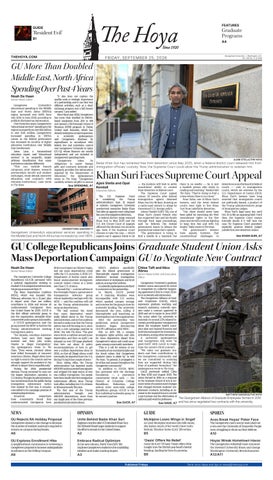
AJANI STELLA/THE HOYA
Badar Khan Suri has remained free from detention since May 2025, when a federal district court released him from immigration officials’ custody. Now, the Supreme Court could allow the Trump administration to redetain him.
Khan Suri Faces Supreme Court Appeal Ajani Stella and Opal Kendall Executive Editors
GEORGETOWN UNIVERSITY
Georgetown University’s educational services spending in the Middle East and North Africa has increased by over 160%.
The U.S. Supreme Court is considering the Trump administration’s Sept. 21 request to redetain Georgetown University postdoctoral researcher Badar Khan Suri after an appeals court ruling kept him out of immigration detention. A federal district judge released Khan Suri in May 2025 and the U.S. 4th Circuit Court of Appeals affirmed the decision two months ago. Now, if the Supreme Court chooses to take the case — which experts say it appears likely to do
— the justices will look to settle noncitizens’ ability to contest their detention in federal court. The Supreme Court appeal comes 18 months after federal immigration agents detained Khan Suri for 58 days, drawing on a rarely-used statute to allege he threatened U.S. foreign policy. Adnan Rashid (GRD ’24), one of Khan Suri’s closest friends who has supported him and his family through their legal proceedings, said he believes the federal government wants to silence the postdoctoral researcher’s speech. “The government is trying to find a needle in a haystack but
there is no needle — he is just a bookish person who sticks to reading and teaching,” Rashid told The Hoya. “They’re trying to find a crime where there is no crime.” Noor Zafar, one of Khan Suri’s lawyers, said the lower federal courts were right to free Khan Suri from indefinite detention. “Our client should never have been jailed for exercising his First Amendment rights in the first place and we will continue fighting to keep him free and with his family,” Zafar wrote to The Hoya. The government’s lawyers have argued, however, that constitutional challenges to
detention cannot be heard in federal courts — only in immigration courts, which are overseen by the U.S. Department of Justice (DOJ). Khan Suri’s lawyers have long asserted that immigration courts are politically biased, a product of the Trump administration’s purge of immigration judges. Khan Suri’s legal team has until Oct. 21 to file an opposing brief. Until then, the Supreme Court cannot formally decide if it will hear the case. No Supreme Court precedent explicitly governs federal judges’ jurisdiction over detention claims. See KHAN SURI, A7
GU College Republicans Joins Graduate Student Union Asks Mass Deportation Campaign GU to Negotiate New Contract Noah De Haan Senior News Editor
The Georgetown University College Republicans (GUCR) partnered with a national organization working to escalateU.S.immigrationenforcement, the group announced Sept. 17. The Mass Deportation Coalition (MDC), which was founded this February, advocates for a 21-part plan to deport more than one million noncitizens in 2026 and remove all undocumented immigrants from the United States by 2029. GUCR is the first official university group to join the organization, alongside other conservative policy groups and pundits. A GUCR spokesperson said the group joined the MDC to bolster the Trump administration’s existing immigration policy. “For decades, countless American workers have seen their wages lowered and their jobs stolen thanks to illegal immigration,” the spokesperson wrote to The Hoya. “Even worse, criminal aliens have killed thousands of innocent American citizens. Illegal aliens have no right to stay in the country and we strongly support the president in his efforts to deport them expeditiously.” During the 2024 presidential election, Trump promised to carry out the largest deportation operation in U.S. history. Though the administration has moved away from the public-facing immigration enforcement tactics that marked its first year, it remains committed to its campaign promise of sweeping deportations. Economic researchers have consistently found that undocumented immigrants have
little to no impact on citizens’ wages, and say mass deportations could stifle the U.S. economy. A 2024 U.S. Department of Justice report also found undocumented immigrants commit violent crimes at a lower rate than U.S. citizens. Hannah Fay — a senior advisor at the Oversight Project, a government transparency advocacy group whose leadership overlaps with the MDC — said the coalition will call on the Trump administration to ramp up deportations. “We had noticed the trend that mass deportation wasn’t really talked about in the Trump administration, and so this coalition formed to make sure that the Trump admin was still focusing on it, since it was a core campaign promise in 2024,” Fay told The Hoya. “The goal was to form a coalition around mass deportation, and then on April 1, we released an over 100-page playbook that lists out about 21 policy recommendations of how to get over a million deportations done in 2026, so that all illegal aliens could eventually be deported from the U.S. during Trump’s last couple of years.” Since taking office, the Trump administration has deported nearly 600,000 undocumented immigrants and stripped the legal status of over one million immigrants. Ten people have been fatally shot by immigration enforcement officers since Trump took office, including two U.S. citizens in Minnesota early this year. The first year of the Trump administration brought over 440,000 deportations, more than any single year of the three previous presidential administrations.
MDC’s platform specifically asks the federal government to “dramatically expand immigration detention,” increase immigration enforcement at workplaces and limit asylum, among other policies. A university spokesperson declined to comment on the partnership. In March, GUCR posted on X claiming Muslims were incompatible with U.S. society, which sparked campus outrage and outcries for the group to lose its university funding. The university denounced the post, calling it Islamophobic and launching an investigation into the organization. After the partnership was publicized, several Georgetown students began denouncing GUCR’s affiliation with MDC. Kim Le (SFS ’29), a campus immigrant rights activist, said calls for mass deportation depart from Georgetown’s values and could cause panic among community members. “This is a call for erosion of our humanity, of our moral principles and the Jesuit values that Georgetown students claim to abide by,” Le told The Hoya. “In general, it propagates a lot of fear and unease throughout the Georgetown community.” In addition to GUCR, MDC has partnered with the Heritage Foundation — a prominent conservative think tank — the District of Columbia College Republican Federation, and several other state-wide college Republican groups. GUCR is the first individual university group to be named a partner. See GUCR, A7
Chloe Taft and Nico Abreu
Senior News Editor and Executive Editor
Georgetown University’s graduate student union announced its intent to renegotiate its collective bargaining agreement (CBA) in a Sept. 23 letter to university administrators. The Georgetown Alliance of Graduate Employees (GAGE), which represents graduate teaching and research assistants, currently operates under a contract approved in 2023 and set to expire in June 2027. The union asked the university to maintain its annual 2.5% stipend increases, provide greater transparency about the employee health insurance plan and expand financial and institutional support for international students, among other demands. A university spokesperson said Georgetown will work “in good faith” with GAGE to negotiate the union’s third contract. “We value our graduate students and their contributions to the Georgetown community, and we are committed to ensuring they are supported during this time of academic formation,” the spokesperson wrote to The Hoya. GAGE previously ratified CBAs in May 2020 and August 2023. The union formed in 2016 as a response to the Graduate School of Arts & Sciences’ series of unannounced changes that changed doctoral students’ employment contracts, including an increase in the required hours to receive MATTHEW GASSOSO/THE HOYA a pay increase and the elimination of The Georgetown Alliance of Graduate Employees formed in 2016 optional paid work for professors. See GAGE, A7 and has since negotiated two contracts with the university.
NEWS
OPINION
GUIDE
SPORTS
GU Rejects RA Holiday Proposal
Unite Behind Badar Khan Suri
McAlpine Loses Wings in ‘Angel’
Aces Break Hoyas’ Poker Face
A6
A2
B5
A10
GU Explores Enrollment Hike
Embrace Radical Optimism
‘Oasis’ Offers No Relief
Hoyas Wreak Hometown Havoc
A8
A3
B6
A12/A11
Georgetown denied a rule change to decrease the number of resident assistants required to remain on campus during breaks.
A neighborhood commission is reviewing a Georgetown proposal to increase undergraduate enrollment on the Hilltop Campus.
Eighteen months after ICE detained Khan Suri, the Editorial Board urges students to support his effort to remain in the United States.
In his new column, Parth Vorn (SFS ’30) implores Georgetown students to be unyielding idealists and make a lasting impact.
As Lizzy McAlpine ventures into folk music, she leaves much of her work’s best traits behind, Westley Sreter (CAS ’29) writes.
Grace Ko (CAS ’27) says ‘Oasis’ offers little insight into the British pop band’s fateful breakup, landing far from its promise.
Published Fridays
The Georgetown men’s soccer team eked out a win over the University of Evansville Purple Aces, struggling to shore up their defense.
The Georgetown volleyball team trounced the Howard University Bison and George Washington University Revolutionaries.
Send story ideas and tips to news@thehoya.com
A2 | THE HOYA
THEHOYA.COM | FRIDAY, SEPTEMBER 25, 2026
OPINION EDITORIAL
Stand Alongside Badar Khan Suri
Khan Suri’s case also has greater implications It has been 18 months since the federal government arrested an innocent member of the George- for international students’ rights in this country. His initial detention came alongside those of othtown community. Badar Khan Suri, a postdoctoral fellow at er academics on similar charges as part of a federal Georgetown University, was heading home from government crackdown on pro-Palestinian acacampus in March 2025 when masked men sur- demics and their speech. If he loses this case, that rounded and detained him. In the coming weeks, could further embolden the Trump administration he was transported from Chantilly, Va., to Louisi- in targeting international communities on college ana and Texas before regaining an uncertain free- campuses and noncitizens’ speech as a whole. Thus, Georgetown students must step in — to safedom after 58 days in federal custody. Khan Suri’s nightmare began a little over a year guard not only the rights of Khan Suri, but thousands and a half ago now, but it is far from over. Last week, of other Georgetown researchers and students. Many members of the Georgetown community a pivotal stage of his trial began as he testified for the first time before an immigration judge while have already taken action to support Khan Suri. Last his lawyers argued for him to remain in the country. March, a week after his detainment, Georgetown facThen, on Sept. 21, the Trump administration peti- ulty led a walkout demanding Khan Suri’s release tioned the Supreme Court to review the ruling that and advocating for stronger free speech protections. granted Khan Suri release from detention while his Student-organized benefit concerts — including one held two weeks ago — and bake sales have raised immigration case continues. Now more than ever, Khan Suri needs the thousands of dollars for his legal defense fund. Izzy Volpe (SFS ’27), who took Khan Suri’s class Georgetown community’s support. If you believe in the freedom of speech, in separation between poli- in Fall 2025 and helped organize a recent teach-in, tics and academia or in Khan Suri’s simple right to said attending such events is a way community pursue the American dream, take action. Help fund members can show solidarity. “Showing up to these teach-ins is a great way his legal battles through bake sales and concerts, take part in walkouts and teach-ins and show out to meet Dr. Suri, to humanize this whole issue, at his immigration trial — both in solidarity and in also to get updates from his lawyers, to connect protest. Above all, stay informed and ensure Khan with other students and folks who are passionate about the myriad of issues that Dr. Suri’s case inSuri’s struggle does not go unnoticed. Student support is especially important. College tersects with,” Volpe told The Hoya. “We have had great turnout and great support, campuses stand at the forefront of activism, and throughout modern U.S. history, college students but there can always be more done,” Volpe added. Nick Hasbun (CAS ’28) — a student who took often speak up first against the federal government, such as during the Vietnam War or in response to Khan Suri’s class in Fall 2025, testified on his beapartheid. As Khan Suri’s case drags on, students half at his immigration trial and organized both need to continue backing him to ensure that his solidarity concerts — said that the broader comstory remains prevalent not only within the George- munity should be looking to take action, such as town community, but to national audiences as well. through student groups like Hoyas for Immigrant Khan Suri first came to Georgetown in January Rights or Students for Justice in Palestine. “There’s lots of people here who love him and 2023 as a postdoctoral researcher studying democratic peacebuilding in countries with embedded sectarian want him here, and we need to be able to reflect conflicts. That November, his wife and three children that in how we support him,” Hasbun told The joined him in Virginia, and in January 2025, he began Hoya. “So having people show up to the teach-ins teaching an undergraduate seminar on conflict in we have, having people join organizations that are South Asia and the region’s colonial legacy. Months lat- helping him like Hoyas for Immigrant Rights or er, he would be seized by federal immigration officials. SJP along with showing up to future events that To justify the detention, Secretary of State Mar- we host, all that’s important.” “There’s varying degrees to which you can get co Rubio invoked an obscure statute that allows the federal government to deport non-citizens involved, but any involvement is appreciated and who allegedly pose a threat to U.S. foreign policy extremely necessary,” Hasbun added. As the federal government’s effort to deport interests. In this case, officials targeted Khan Suri over his speech and familial associations, alleging Khan Suri stretches into its 18th month, this vithat he was antisemitic and spreading “Hamas brant student backing may fade. The solidarity propaganda.” The U.S. Department of Homeland concert in February 2026 raised over $4,000 for Security cited his ties to his father-in-law, who the legal defense fund; the benefit show two weeks was formerly a Hamas official over a decade ago ago raised a little less than $1,900. While the invaluable work of both shows and has since denounced the group. Jonathan Mendoza (GRD ’25), who founded shouldn’t be diminished, the difference in the totals Georgetown’s Jewish Graduate Student Associ- signifies that students may be losing their spirit for ation and testified on behalf of Khan Suri at his a seemingly interminable legal battle. However, immigration trial, said he felt obligated to speak this case is far too important — both to Khan Suri up due to the politically motivated nature of the and the international community as a whole — to be pushed to the back of the student body’s mind. government’s proceedings. Therefore, especially as Khan Suri enters the crit“I felt a personal responsibility to Dr. Suri in some ways — like a colleague or peer, campus ical stages of his case, the Georgetown community community member at Georgetown — but then must maintain its support. Students should continalso this moral, ethical responsibility to speak out ue to stand beside him, whether that involves donatas a Jewish person on campus, and a Jewish stu- ing to his legal fund, showing up to court or simply dent in particular, to really refute and condemn learning more about the case. This work is vital; not what the Trump administration was trying to say only to ensure one member of Georgetown’s internaabout him and his family,” Mendoza told The Hoya. tional community can fulfill his American dream, Khan Suri’s case is emblematic of the federal gov- but to ensure that all of them can. ernment’s wider encroachment on academic freeThe Hoya’s Editorial Board is composed of six studom and speech. Georgetown, like many colleges, prides itself on nurturing a diverse array of subjects dents and is chaired by the opinion editors. Editorials and views. However, if federal intervention can dic- reflect only the beliefs of a majority of the board and tate the ideas that are considered dangerous, George- are not representative of The Hoya or any individual town’s curriculum would approach indoctrination. member of the board.
HOYA HISTORY
IN THIS WEEK’S ISSUE
“
If you believe in the freedom of speech, in separation between politics and academia or in Khan Suri’s simple right to pursue the American dream, take action. The Editorial Board
“Stand Alongside Badar Khan Suri” thehoya.com
POLL
This week, the Editorial Board said Georgetown University students should remain committed to supporting Badar Khan Suri, the university researcher whom immigration agents detained in March 2025, as his immigration case and legal battle continue. To gauge student opinion, The Hoya asked its readers if they feel Khan Suri has received adequate support from the university community since he has been released from detention and throughout his legal struggle. Of the 52 respondents, 46.2% said yes, 36.5% said no and 17.3% said they were unsure.
EDITORIAL CARTOON by Apara Chandavarkar
Since its first issue in 1920, The Hoya has served to inform Georgetown’s campus dialogue. The following article is a glimpse into The Hoya’s rich history, allowing readers to appreciate the evolution of college journalism.
GU STAND Protests Sudanese Elections
Founded January 14, 1920
April 13, 2010 Georgetown and The George Washington University Students Taking Action Now: Darfur members, STAND alumni and Genocide Intervention Network staffers gathered outside the State Department on Monday to protest the illegitimacy of the Sudanese National Election, according to Georgetown STAND National Advocacy Coordinator Daniel Solomon (SFS ’13). Voting began Sunday, and, according to reports from within the African nation, the process has been unorganized, according to a Genocide Intervention Network press release. The National Elections Commission to keep the polls open through April 18. STAND members carried trashcans and bags, bearing slo-
gans such as “Sudanese Election Ballots” and “Sudanese Ballot Box,” signifying dismay with how the al-Bashir regime is handling the electoral process. “In at least one polling place in the capital city,” reports the GIN, “ballots for the wrong constituency were in use for at least four hours before the mistake was realized and fixed. Information from White Nile State indicated that problems were reported with matching political party symbols with the correct candidate.” Solomon said the current electoral conditions prevent legitimacy. “We have witnessed a variety of abuses that will prevent Sudan’s elections from running successfully, including reports of voter intimidation and elec-
LETTER TO THE EDITOR AND VIEWPOINT POLICIES The Hoya welcomes letters and viewpoints from our readers and will print as many as possible. To be eligible for publication, letters should specifically address a recent campus issue or Hoya story. Letters should not exceed 300 words. Viewpoints are always welcome from all members of the Georgetown community on any topic, but priority will be given to relevant campus issues. Viewpoint submissions should be between 600-700 words. The Hoya retains all rights to all published submissions. Send all submissions to: opinion@thehoya.com. The Hoya reserves the right to reject letters or viewpoints and edit for length, style, clarity and accuracy. The Hoya further reserves the right to write headlines and select illustrations to accompany letters and viewpoints. CORRECTIONS & CLARIFICATIONS If you have a comment or question about the fairness or accuracy of a story, contact Executive Editors Nico Abreu, Opal Kendall and Ajani Stella at executive@thehoya.com. NEWS TIPS News Editors Chloe Taft and Noah De Haan: Email news@thehoya.com. Guide Editors Anandita Agarwal and Isabelle Cialone: Email guide@ thehoya.com. Sports Editors Sam Fishman and Ethan Herweck: Email sports@thehoya. com.
toral fraud,” he said. “In addition, the Sudanese government recently began another wave of violence in the Jebel Marra region of Darfur, Sudan, creating an insecure climate for voter participation and displacing tens of thousands.” Solomon said that the protest was part of a greater campaign, run by Sudan NOW, to push for legitimacy in the Sudanese electoral process. “We’re asking for Secretary Clinton to withhold recognition of the electoral results and condemn the Sudanese regime for its circumvention of the democratic process,” he said.
Daniel Galloway
GENERAL INFORMATION The Hoya is published once a week during the academic year with the exception of holiday and exam periods. Address all correspondence to: The Hoya Georgetown University Box 571065 Washington, D.C. 20057-1065 The writing, articles, pictures, layout and format are the responsibility of The Hoya and do not necessarily represent the views of the administration, faculty or students of Georgetown University. Signed columns and cartoons represent the opinions of the author(s) and do not necessarily represent the editorial position of The Hoya. Unsigned essays that appear on the left side of the editorial page are the opinion of the majority of the editorial board. Georgetown University subscribes to the principle of responsible freedom of expression for student editors. The Hoya does not discriminate on the basis of age, gender, sexual orientation, race, disability, color, national or ethnic origin. © 1920-2026. The Hoya, Georgetown University weekly. No part of this publication may be used without the permission of The Hoya Board of Editors. All rights reserved. The Hoya is available free of charge, one copy per reader, at distribution sites on and around the Georgetown University campus. Email: editor@thehoya.com Online at www.thehoya.com Circulation: 1,000
Nora Toscano, Editor-in-Chief
Nico Abreu, Opal Kendall and Ajani Stella, Executive Editors Jackson Roberts, Managing Editor Noah De Haan, News Editor Chloe Taft, News Editor Jacqueline Gordon, Features Editor Serene Pai, Features Editor Thejas Kumar, Opinion Editor Leo Zhang, Opinion Editor Anandita Agarwal, Guide Editor Isabelle Cialone, Guide Editor Sam Fishman, Sports Editor Ethan Herweck, Sports Editor Angela Lekan, Science Editor Eva Siminiceanu, Science Editor Lucy Jung, Design Editor Anish Raja, Design Editor Elizabeth Hoerter, Copy Chief Allison Ma, Copy Chief Grace Rutherford, Copy Chief Katherine Hart, Blog Editor Yaya Hang, Multimedia Editor Miranda Kristina Santiago, Multimedia Editor Matthew Gassoso, Photo Editor Ella O’Connor, Audience Editor Caroline Woodward, Audience Editor
Board of Directors
Paulina Inglima, Chair
Ruth Abramovitz, Bethe Bogrette, Maren Fagan, Tanvi Gorripati, Aamir Jamil, Annikah Mishra
Connor Manrique-Johnson, General Manager
Rosie Garner, Director of Business Operations Jackson Roberts, Technology Director
Andrew Jiang Academics Desk Editor Annie Quimby Student Life Desk Editor Liv Sanchez Graduate Desk Editor Brendan Fijol City Desk Editor Joshua Lou GUSA Desk Editor Michael Shtrom Events Desk Editor Caroline Garland Deputy Features Editor Sophia Tully Deputy Features Editor Caden Larrenaga Deputy Opinion Editor Juan Almanza Deputy Guide Editor Eliza Doty Deputy Guide Editor Grace Ko Deputy Guide Editor Eliana Kut Deputy Guide Editor Penelope Snoep Deputy Guide Editor Finn Balon Deputy Sports Editor Golnar Jalinous Deputy Sports Editor Jacob Nolan Deputy Sports Editor Sasha Ahmad Deputy Science Editor Jaya Alenghat Deputy Science Editor Kaitlyn Lee Deputy Science Editor Adhithi Rajesh Deputy Science Editor Maddie Williams Deputy Science Editor Autumn Dunlop Deputy Design Editor Abby Kopf Deputy Design Editor Emilie Andrews Deputy Copy Editor Connor Emmert Deputy Photo Editor Rohini Kudva Director of Human Relations Jacob An Director of Logistics Stefano Rangel Haddad Director of Outreach
THE HOYA | A3
FRIDAY, SEPTEMBER 25, 2026 | THEHOYA.COM
OPINION
COLUMN • VORA
Hold On to Your Idealism
M
ovies make me tick. Big screens serve as mirrors, reflections of the human condition that tell the stories we are often too scared to consider real. I see these reflections all around campus — in surprisingly deep conversations over lunch at Leo’s, in anxious chats over dirty chais at Uncommon Grounds, in rotelearned recitations over snacks at Lau 2. These reflections motivate my column, where each entry will revolve around one of my favourite movie quotes and dive into how I see that quote manifest on campus. For the grand opening of “Hoyawood,” I bring to you a quote from the third greatest Pixar movie of all time: “Toy Story.” I recently rewatched the masterpiece, and Buzz Lightyear’s awe-inspiring words struck a chord: “To infinity and beyond!” Buzz endorses unwavering optimism, and Georgetown University students should too. Now more than ever, the world needs radical changemakers. Those who are motivated by intense idealism. Every Hoya is poised to be shaped into such a visionary. They must simply channel their inner Lightyear to fight off the pressure of pragmatism. For Buzz, it isn’t just the world, but the universe that is his oyster. His eyes never lose the dreamer’s glisten. Yet somehow, as a first-year on the Hilltop — one of the world’s finest launching pads — I’ve found myself rapidly going from Buzz to being somewhat bummed about my prospects. I walked on to campus wideeyed and ready to change the world, ready to rocket towards “infinity and beyond,” but somewhere along the last few weeks I feel like I’ve slowed to a stroll on the path of least resistance. This realization has compelled me to challenge the erosion of idealism. What is it that crushes the ambition of idealists like me? Honestly, there’s so much on campus that simply makes a homesick first-year feel incapable, and it is this gnawing feeling that convinces that same firstyear to settle for “reasonable” outcomes that are perceived as more realistically achievable. It’s easy for me to recall the pit in my stomach that manifested as I read the rejection email from the club I thought would make me feel most at home. It’s easy for me to hold on to the anxiety that made my pen dry up as I attempted my first graded essay in my international relations discussion after forgoing a good night’s sleep in preparation. It’s easy for me to stick with the disappointment that made me
abandon club basketball tryouts after a couple of missed threes on a bad shooting day. It’s so easy to fall into these patterns; it’s scary. Hard work doesn’t always work out, so why work hard at all? Suddenly, I went from thinking of changing the world to thinking of changing my schedule on GU Experience. Then I watched “Toy Story,” and Buzz’s words catalysed a change of heart. Buzz Lightyear is a toy; he’s never actually going to space, but his belief shapes his mindset. That belief lets him spread out his retractable wings, jump off any surface and spring into action with a smile on his face, achieving what seems impossible. You don’t know whether or not you’ll change the world, but the moment you convince yourself that you’re incapable, you’ve already robbed yourself of the opportunity. Arbitrary club decisions, a singular shaky essay and a random cold streak at Yates are not going to change the world, so don’t let them tell you that you can’t. Instead, write down your dreams, whether in a group chat with just yourself (that’s my outlet), in journals or on the mirror hung up inside your closet. Read those dreams as tangible goals. Then close your eyes, and see yourself having achieved them. Remind yourself that those goals are not impossible; they’re simply a little ways away. I promise you, if you think big, the small things will seem less significant in hindsight. If Buzz ever did make it to space, not even the most curious alien would ask him his first-year GPA. Don’t be disillusioned by the notion that this week’s outcomes will meaningfully derail those of the next 10 years. It certainly can feel like that in the flurry of your first-year fall, but you need to fight that feeling. Buzz still thinks he is going to space; I still think I can change the world. While this may not sound reasonable to many, all I know is that it is entirely unreasonable to be deterred by the frights of your first year. Don’t let small setbacks make you lose faith in your ability to become that radical changemaker our world so desperately needs. You can call me an idealist — clearly I’m trying to convince you to become one too — for I, just like Buzz Lightyear, know that this idealism is the only sure shot of making it “To infinity and beyond!” Parth Vora is a first-year in the School of Foreign Service. This is the first installment of his column “Hoyawood.”
MATTHEW GASSOSO/THE HOYA
VIEWPOINT • RODRIGUEZ GARNICA
Find Community Beyond the Capitol Campus
W
hen I came to Georgetown University, finding a Latino community was a priority for me. It had been such a natural part of my undergraduate experience at the University of Florida that I couldn’t imagine graduate school without one. I found that community through McCourt Avanza, Georgetown’s Latino policy initiative at the McCourt School of Public Policy. I was drawn to how clearly its mission sat at the intersection of identity and policy, the very thing that brought many of us at McCourt to the Capitol Campus. Through Avanza, I found the sense of community I had been looking for, but I had inadvertently limited my world at Georgetown to the people and organizations immediately around me. The longer I spent within the student organization space, the more I recognized how easy it is to stay within the communities we already know. It is important for us to find spaces where we feel belonging, but as a result, we grow averse to leaving the familiar. That becomes much more pronounced on the Capitol Campus, where the distance from the Hilltop Campus can make our immediate communities feel like the extent of
VIEWPOINT • SINDRAM
Georgetown, risking the inclusivity we pride ourselves on. As students, we need to be intentional about engaging with the university’s cultural traditions and participating even in the spaces where we don’t see ourselves represented. Our graduate programs are professionally oriented by design — our time is organized around our degrees and careers. As a result, we approach our peers and communities first through professional connections, leaving fewer opportunities for the kind of cultural exploration and exposure to different perspectives that the liberal arts tradition encourages. Becoming professionals shouldn’t require us to trade that exploration for professional development, especially because our experiences shape our outlooks, questions and eventually work. It makes sense, then, that many of the communities we’ve built on Capitol Campus bring the cultural and professional parts of ourselves together. But these hybrid communities, where the focus is on what comes after Georgetown, don’t always push us to experience the diversity around us. Every now and then, we sneak a glimpse of the cultural richness
that already exists on the Hilltop. Last year, I went — almost by chance — to Posada, the annual cultural showcase hosted by Ballet Folklórico Mexicano de Georgetown. I hadn’t expected its scale, and I left wondering not only how many Capitol Campus students have experienced that side of Georgetown, but also how much more I simply didn’t know about. The Capitol Campus’ self-contained nature makes it easy for our sense of community to stop at our campus borders, and in doing so, we miss out on the traditions and cultural life shaped by decades of work from students before us. I don’t think the answer is to recreate every cultural community that already exists on the Hilltop; there is room for what we’re building on Capitol Campus to connect with the cultural communities that already unite students across Georgetown. For that connection to happen, Capitol Campus students need to see the Hilltop as another part of our Georgetown experience. The communities and traditions built there belong to the broader university we joined, even when we aren’t the students who built them or the primary audiences they serve. Recognizing that we
have a stake in them gives us more reason to participate in that cultural life and, in turn, more opportunities to encounter people and experiences beyond our own. I have learned that not every space has to be for me for its existence to enrich the university I belong to. That matters even more because our opportunity at Georgetown is uniquely temporary. For just a few years, we inherit a university full of communities, traditions and people that others spent years building. Our participation here can be casual and still matter; sometimes it’s as simple as going to a community game night or student showcase. That part of student life is very special to me: we get to enjoy what other students built before us and contribute something of our own before handing it off to someone else. This transience should encourage us to find the communities that feel like ours, certainly, but also to accept some discomfort in experiencing the rest of the university we inherit. And yes, sometimes that means getting on the shuttle bus. Dalia Rodriguez Garnica is a graduate student at the McCourt School of Public Policy.
COLUMN • WOODWARD
Put Meaningful Commitments First Prioritize Your Friends Who Care
T
here is a particular kind of silence in a meeting no one wishes to attend. It is not the silence of concentration. It is the dull silence of people waiting for something to be over. Agenda items are recited and ticked off, phones glow beneath the table, and when the hour finally ends, no one bothers to hide the relief. It would be unfair to expect college students to match the efficiency of the offices many Georgetown graduates go on to fill, but most of us are at least capable of enthusiasm. This silence is its absence. It hangs over Lau 2 and the Intercultural Center on weeknights, over muted Zoom calls, over Healy lecture halls full of capable people waiting to leave. Consider what you have to do this week. For most of us, the list is long, and that is partly for the same reason many of us were admitted: We want to do difficult things, on the field, in the library or in the long apprenticeship to a craft. This drive is a finite resource, and it deserves to be spent wholly on the work you are good at and love because, divided across things you merely tolerate, it curdles into obligation and the work grows hollow. Somewhere between the first club fair and the fourth application, most of us began to divide it. Here is the request, directed at no one in particular but certainly at myself: Drop one commitment you are keeping only out of guilt or fear for your resume. As a Jesuit institution with no official Greek life, Georgetown lacks the foremost social architecture of most U.S. universities. In our intensely preprofessional culture, our student organizations have
become the leading substitute for Greek social life. This substitution costs us what a social life is meant to provide: relationships held in person and kept for their own sake. The social and the professional have become inextricably bound, and that is often why we find ourselves agreeing to too much. The clubs are rehearsals for the hierarchies most of us will enter after graduation, and while there is real value in rehearsing that life, it often crowds out much of what college offers. Our friendships are routed through organizations that also expect deliverables, while the groups that exist for enjoyment draw fewer members and less prestige. The expectation, though, is that you join several, because your friends are in three and have a Hillternship. Now, you are stretched across a half-dozen obligations, underperforming in most of them, with your heart often only in one. We do our best work in the roles we would choose again. If you already resent the hoopjumping on the road to becoming something, reconsider the road. Much of what keeps us is sunk cost, the semesters already invested. But those hours are spent either way; only future ones are still yours. Difficulty is not the problem since you do not get better at things that are already easy for you. Experimentation is not either, since you cannot know what you love until you have tried a few things you do not. Commit fully where the difficulty is worth enduring, and stop feigning devotion to the rest. The filler on a resume is easier to see through than we think. Anyone who has interviewed a
candidate knows the difference between the line they lean forward to explain and the line they hope you skip. We join something because it will sound good to say we joined it, and this peacocking enriches no one, least of all us. It is hard to operate against the grain when everyone is peacocking their hardest. When you meet people sincerely, though, they notice, and you go further in the one thing you love than you would in the four things you tolerated. None of this means you should stop pushing yourself. Pushing yourself is most of the point. The danger is subtler: The more we perform, the less we can afford to fail, because when our worth rides on how we appear, every stumble looks like exposure. We lurch between quiet selfcontempt and an ecstatic relief that lasts as long as the attention does. To someone maintaining a performance, failure is intolerable, a breach in the façade. To someone doing the work, it is ordinary, even instructive, the mechanism whereby anyone becomes good at anything. It is okay to fail at the thing you actually care about, in front of people who actually know you. What is not okay is to sit in that silence, week after week, failing quietly at something you never wanted in the first place. Drop one commitment. The one you are keeping out of guilt or fear for your resume. You will not miss it, and neither will the people sitting beside you, not so discreetly checking their phones under the table.
H
ello advice-seekers! Welcome back to another week of problems and solutions! If you would like to submit any questions for future editions of this column, please send them in with the new form. One of my roommates’ political opinions are pretty different from the rest of us, and, in many ways, it’s hard to square with even my own. I don’t want it to affect our relationships, but sometimes we walk on eggshells around issues. What should I do?
Oftentimes, people promote the idea that politics does not have to get in the way of relationships. Personally, I disagree. Politics is often a reflection of a person’s moral code, the issues most important to them and is foundational to a relationship built on trust and mutual respect. This is especially relevant at Georgetown University, where politics comprise a major part of a person’s life and work. So, feeling uncomfortable with this incongruency is absolutely valid, and you do not have to repress these feelings to maintain the relationship. Tackling this issue is going to require both introspection and some confrontation. First, I would reflect on your own beliefs versus those of your friends: what exactly do you find to be problematic about their politics, and what about your beliefs disagrees with theirs? How important are these issues to you? If you find that these disagreements are important enough that they would significantly impact your relationship with the person, Josine Sindram is a I would suggest having a sophomore in the School of transparent conversation with them. Make sure to frame the Foreign Service.
conversation around trying to understand where they are coming from and wanting to maintain a good relationship despite possible differences. Remaining confident in your own opinions yet open to hearing out your friends’ reasoning when entering a conversation such as this is a necessity for it to be productive on all sides. Politics, as an important topic, is not something we should be afraid to have conversations about – these conversations can lead to mutual respect, understanding and sometimes even changed minds. I’m a senior who hasn’t turned 21 yet, and I’m feeling left out from going to bars with all of my friends. Each time, I tell them it’s okay and to go, but I’m sad I’m alone. I want to spend time with them, but I also don’t want to hold them back. What should I do? That’s a really difficult spot to be in! It is incredibly considerate and kind of you to prioritize your friends’ fun. However, remember that as your friends, they more than likely want to have fun with you too! Maybe propose alternative, age-friendly plans, such as watching a movie, having a game night or even simply going to a bar that allows for a wider age range. This ensures everybody still has fun while making new and exciting memories! Going out can get tiring after a while, so people are usually welcome to alternative plans. And remember, you are going to have an amazing Tombs night to look forward to! Lately, I’ve been getting angrier and more irritable. It’s frustrating because I think I’m usually a pretty patient and calm person. I don’t
know if there are new stressors in my life, but I feel bad because it’s hard for me when I’m hanging out with my friends or just doing my daily routines and feel frustrated for no apparent reason. Any advice? The fact that you’re aware enough of your own emotions to recognize that this is an active issue is a really good first step. Plenty of people would simply brush this off as a natural result of stress, but you are actively working to address and change it — and you should feel good about that. When you find yourself feeling this way, especially around your friends or in your daily life, I would take a second to evaluate what could have triggered sudden irritability or anger. If you can identify a common pattern or trigger, you can work to avoid these instances or more successfully manage the resulting feelings. Remember that it is okay to step away from a situation, even a social one, in order to take a minute to calm down and compose yourself. You have already acknowledged that your moods can impact others, so taking a moment for yourself will allow both you and the people around you to have the best possible time even in moments of stress or anger. Furthermore, if you can identify one specific reason for this change in mood, such as increased stress or other factors, I would then work to reassess whether said factor belongs in your life. I hope this helps! Caroline Woodward is a senior in the College of Arts & Sciences. This is her second installment of her column “Calling in with Caroline.”
THEHOYA.COM | FRIDAY, SEPTEMBER 25, 2026
A4 | THE HOYA
FEATURES
As Federal Cuts Compound, GU Graduate Students, Faculty Lose Vital Opportunities
As the Trump administration decimated higher education funding, Georgetown slashed doctoral programs and instituted austerity measures. Students and faculty say those cuts limit graduate students’ academic experience.
ILLUSTRATION BY SERENA LI/THE HOYA
Widespread federal funding cuts have had a snowball effect on the Georgetown community as major budgetary cuts impact admissions, meaningful discussion and graduate development opportunities.
Sophia Tully and Shalini Rajkumar
Deputy Features Editor and Features Staff Writer
E
lsa Immer was in the third year of her theology doctorate at Georgetown University when the program’s cohort was halved in 2025. The department, alongside the rest of the school, faced sharp budget shortfalls as federal funding dwindled, forcing the program to downsize its funded Ph.D. slots. The impact was immediate, Immer said: Cuts limited co-curricular opportunities like research and teaching and diversity of thought in discussions. Immer, now a fourth-year student, said the reductions continue to haunt the theology and religious studies department. “It seems like it’s always looming over — this idea that ‘Oh, we couldn’t do as much with this reception, or we couldn’t organize this because of cuts,’” Immer told The Hoya. “Everybody seems a bit defeated.” Since January 2025, the Trump administration has cut $1.4 billion in federal research grants and fellowships, eliminated graduate student loan programs and restricted student visas. Georgetown, like other universities across the country, has faced devastating financial losses — in 2025, the university projected a $35 million drop in federal research funding and a 20% decline in international graduate student enrollment. Georgetown’s graduate programs took the brunt of these losses. The College of Arts & Sciences (CAS) slashed doctorate cohorts — which are fully funded by the university and include a small living stipend — for Fall 2026 and Fall 2027 by up to 50% depending on the program. Meanwhile, Georgetown’s master’s programs — the university’s typical cash cow — struggle to attract international students, which has shrunk university revenue. As admissions reductions downsize cohorts and reduce research opportunities, some faculty and students say Georgetown’s attempts to rebuild its graduate education infrastructure may be too little, too late. A university spokesperson said graduate students remain a valued part of Georgetown’s campus, and the university’s response to federal funding cuts has prioritized managing each department’s reductions on a case-by-case basis. “Doctoral studies are critical to producing the next generation of scholars and teachers, and we are proud of Georgetown’s tradition of educating and training these scholars,” the spokesperson wrote to The Hoya. “We also recognize the broader impact of doctoral education: It is central to the development of our faculty, and to the education and formation of all our students, graduate and undergraduate alike.” “Because of the university’s current financial situation and the uncertainty and instability surrounding changes in federal funding, Georgetown made reductions in the number of doctoral students admitted last year,” the spokesperson added. “These adjustments were made thoughtfully and strategically, in consultation with deans, chairs and program directors across the university and in service of Georgetown’s shared academic mission.” Georgetown is among several higher-education institutions strug-
gling against mass funding cuts. Brown University, which Georgetown identifies as a peer institution, cut admissions for their doctorate programs by 20% in Fall 2025. Harvard University, meanwhile, summarily cut all doctoral programs by over half through next year. Georgetown centered its cuts on the College, the university’s largest and oldest school, which houses the vast majority of doctorate programs across all disciplines. The Spanish and Portuguese department, for instance, admitted 25% fewer doctoral students this year after the College’s reduction mandate. Michael Ferreira, the department’s chair, said that while he prepared for financial losses, the actual damage has been far worse. “The College of Arts & Sciences is typically the one that suffers the most because it’s the oldest and it’s the largest,” Ferreira told The Hoya. “The thing is that there’s nowhere else to cut.” “We just didn’t know how bad it was going to be,” Ferreira added. Class Dismissed For many faculty members, the College’s Ph.D. cuts — made public by The Hoya in January — were the first sign that Trump’s new higher education orders would leave a lasting impact on Georgetown’s classrooms. The chemistry and government programs cut their cohorts by 25%, the history department cut by 30% and the theology and religious studies department cut by 50%. The philosophy and Arabic and Islamic studies departments, meanwhile, halted admissions altogether this year, though they plan to reinstate their doctoral programs in Fall 2027. When the College initiated the enrollment reductions in December 2025, department chairs praised the school’s individualized, program-specific approach. Now, though they continue to recognize the university’s difficult position, they say the cuts weigh heavily on their departments. Amir Zeldes, the linguistics department’s chair, said a reduced cohort limits the peer support required for carrying out research projects at the doctoral level. “When you don’t have a lot of people in the same boat as you, you can’t do as big projects,” Zeldes told The Hoya. CAS Dean David Edelstein, who spearheaded the decision-making, defended the cuts as a “regrettable” but necessary result of national trends in higher education in a January interview. In a Jan. 7 email to community members, he said he would ask a faculty committee to “conduct a comprehensive review” of doctoral programs and “offer recommendations for changes we might make over the longer run.” At a faculty town hall one month later, Edelstein said while he hopes doctoral programs will resume to full capacity after the Fall 2027 enrollment cycle, he does not know if that will happen. “I can’t guarantee that after two years we’re going to be able to go back to where we were,” Edelstein said. “And I can’t guarantee that things are going to get better, or they may get worse.” Though the structure of a doctoral degree varies by department,
programs typically involve multiple years of classes followed by dissertation research. Because Ph.D. cohorts admit few students — most humanities programs house less than 10 students per year — doctoral classes are typically small seminars where the absence of one to two students is especially obvious. For many students and faculty, meaningful discussion is a cornerstone of those programs, but as student enrollment continues to decline, fewer voices means less diversity of thought. Richard Boyd, the government department’s graduate studies director, said in the future, current fluxes could take a drastic toll on Georgetown’s ability to offer competitive doctorate programs because fewer students means less productive academic collaboration. “It’s not sustainable over the long term,” Boyd told The Hoya. “Ph.D. programs really require a certain critical mass, and if, say, we’re only able to admit one student in a subfield for a year or over the course of a couple years, then that eventually begins to diminish our ability to offer Ph.D. seminars.” Zeldes said lower student enrollment means departments struggle to fill classes. “This means that you’re going to have to offer fewer courses, which also affects the diversity of the courses, especially as you’re pressured to fill the core of what your curriculum has to include,” Zeldes said. Brandon Dotson, the theology department’s graduate studies director, said losing the doctoral program’s full eight-person cohort detracts from strong discussions and diversity of thought in the classroom. “It’s dispiriting for the students; it’s dispiriting for the professors,” Dotson told The Hoya. While Georgetown navigates Trump’s funding cuts, Edelstein said he is working to preserve the College’s “sense of purpose.” Master’s programs have faced similar changes. When Georgetown first announced budget austerity measures in April 2025, university administrators said they would look to increase enrollment in master’s programs — an important revenue source that houses the vast majority of Georgetown’s graduate students. In 2025, Georgetown graduated 4,365 master’s students compared to just 187 doctorate students. But as the Trump administration restricts student visas and federal graduate student loans disappear, Georgetown saw a 13% decrease in prospective graduate students’ intent to enroll between April 2025 and April 2026. Stephanie Gage, the School of Foreign Service’s (SFS) graduate admissions director, said while she has not yet experienced any cuts, low-revenue programs are on thin ice. “We had a lot of pressure on particular programs that tend to have lower enrollment, in general, and we’re told if we didn’t reach certain thresholds, then we were in danger of getting those programs cut,” Gage told The Hoya. Georgetown began a two-year reorganization plan in July 2025 to
dismantle and replace the Graduate School of Arts & Sciences, shifting graduate programs to specific departments in the College, the School of Medicine and School of Health. In the wake of this restructuring process, Georgetown opted to indefinitely halt some interdisciplinary master’s degrees like the environment metrology and policy and health and the public interest (HAPI) programs, citing “shifting priorities in the graduate landscape.” Adriane Fugh-Berman, HAPI’s co-director, said that while she understands the Trump administration put Georgetown in a difficult financial position, Georgetown administrators owe faculty better communication about long-term consequences. “It’s not clear why some programs were preserved and some programs axed,” Fugh-Berman said. “It was not based just on enrollment, which would have made more sense.” “When there’s a lack of transparency, these decisions can also look like there’s a lack of rationality,” Fugh-Berman added. Beyond the Classroom Doctoral programs have long served as the gateway to academia or research, training future educators, scientists and scholars. In service of that mission, graduate students often serve as research assistants and teaching assistants (TAs) during their time on campus, aiding faculty members with their scholarship and undergraduate classes. As Trump’s cuts force prolonged belt-tightening, however, doctoral candidates’ access to the teaching experience and research exposure that they need for thriving careers has shrunk. Boyd said eventually, the Ph.D. cohort size will not be able to keep pace with undergraduate demand for TAs. “Right now, we’ve been able to staff all of those sections, but the worry is that if we’re not able to admit more Ph.D. students, the numbers don’t work,” Boyd said. “Moving forward two years into the program, there just literally will not be enough Ph.D. students to staff all these sections.” Alexander Rodriguez (GRD ’29), a third-year government doctoral student, said some older Ph.D. students have had to forgo more advanced research positions to help TAs as the pool of doctorates dwindles. “Oftentimes, Ph.D. students who would otherwise be in their fourth year and expect to do a research assistantship have been reassigned to being a teaching assistant again because that labor is needed, which deprives Ph.D. students of having a different but also useful and necessary experience for being trained as an academic, and also further puts pressure on master students to sign up for that,” Rodriguez told The Hoya. Anna von der Goltz, who leads the history department’s doctoral program, said undergraduates could lose an essential learning opportunity if the school cannot fully staff discussion sections, which Georgetown has touted as a core part of its educational experience. “If these cuts persist or if the situation gets even more challenging, then we will have to rethink our undergraduate teaching model, and I think
it would ultimately mean less face time, less feedback, really less engagement,” von der Goltz told The Hoya. The graduate student experience has been especially impacted as Trump’s funding cuts have diminished research opportunities. Since entering office, the Trump administration has canceled or frozen previously approved grants totalling more than $1.5 billion from the National Science Foundation and approximately $3 billion from the National Institutes of Health, two major contributing funding organizations for higher education research. Alexandra Johnston, the linguistics department’s director of master’s programs, said federal funding cuts have undermined professors’ ability to rely on graduate research assistants’ support. “It’s happening all across higher education, and the way that we feel it specifically at Georgetown is through losses of grants and losses in the number of Ph.D. students that we can train,” Johnston told The Hoya. Halil Avci (GRD ’28), a fourthyear doctoral student, said that over time, faculty burnout may begin to impact the student experience. “This could have a ripple effect, in terms of faculty overburdened with teaching and research, and administrative things as well,” Avci told The Hoya. “If these roles would be too much, and each of them would suffer because of that, this is going to show in the classroom as well.” YuYe Tong, the environment metrology and policy (EMAP) master’s director, said the value of graduate science programs should outweigh financial cost because they bring research prestige to the university. “I understand the money is important in any kind of activity, but EMAP success in research, in education, in all of the things, taking care of students with zero attritions, scholarly publications and all these meaningful partnerships, which is more than bring to Georgetown more than just the money brings,” Tong told The Hoya. “But to a large extent, Georgetown administration is blinded by only money.” In an April town hall, then-Interim University President Robert M. Groves said that even as the university looks for short-term funding solutions, a halt in federal funding may have long-term impacts on Georgetown’s research. “We’re trying to offer bridge funding when we think their funding might come back in a few months, because if you kill them now, regenerating some research after a termination of even a few months is like starting anew,” Groves said. The Quakes to Come As enrollment continues to decline and Trump approaches the third year of his term, faculty worry these programs will be unable to recover. Ferreira said programs that are designed to produce novel research can no longer match rival institutions. “What we’re trying to do is we’re trying to continue moving forward with what we always do, and make sure that we don’t lose pace in our publications, in our research, in our collegiality, which is becoming more and more important in our collabo-
rations,” Ferreira said. “It’s sad, but it’s a climate that we’re living right now.” Georgetown currently holds the prestigious Research 1 (R1) status, which distinguishes top universities that award at least 70 research doctorates and spend at least $50 million on research and development annually. In a December 2025 town hall, Interim Provost Soyica Diggs Colbert (COL ’01) said fewer doctoral students could affect the university’s R1 status. “In decreasing the size of our cohort, it is a downstream risk for the university that we have to think about,” Colbert said. “But these were all cost-saving measures that we sacrificed.” Andrew Bennett, the government department’s chair, said doctoral students’ contributions are directly linked to Georgetown’s academic prowess. “Over time, if you have fewer Ph.D. students, your reputation contracts,” Bennett told The Hoya. “Now that’s a long, slow process, but if we were to fall out of the R1 category, that would be a considerable hit to our reputation, at least among research communities,” Bennett added. Dotson said as the university sacrifices research opportunities, its reputation may wane along with them. “These cuts — if they are sustained and we are going to kind of scrape along just above this level necessary to be an R1 university — will make it a little bit harder for us to sustain the self-image of ourselves as being right along there with the Princetons and Harvards of the world,” Dotson said. Gage, the SFS graduate admissions director, said the broad cuts to graduate admissions could send the message that Georgetown prioritizes revenue-generating programs over a holistic education. “I think it could be seen as the university isn’t being true to its values in truly looking at all of these different aspects of what makes a society work well together, and kind of only going after the things that are going to bring them money, which in the past we have looked down upon,” Gage said. Considering the university’s limited options, Ferreira said Georgetown must aim to sustain its programs through the cuts to keep options open in the future. “I think that the goal here is to survive this and then rebuild,” Ferreira said. However, Zeldes said the ability to recover from Trump’s financial cuts heavily depends on Georgetown’s current response. “Some things you can cut, and then the next year they’re easy to get back again,” Zeldes said. “Some things when you cut are very hard to get rolling again, and I hope that that’s a consideration that university leadership is taking into account.” Dotson said the theology department’s doctoral program is known for its success — its graduates have gone on to become tenured professors and appointed bishops. Now, as cohort sizes dwindle, he said, the storied department is at risk of losing student interest for good. “If we’re limping along with so few student numbers, and then people are deciding they want to opt out of this program and not be as involved because it’s not as rewarding, you can see it unraveling,” Dotson said.
THE HOYA | A5
FRIDAY, SEPTEMBER 25, 2026 | THEHOYA.COM
SCIENCE
GU Students Concerned Over EPA’s Greenhouse Gas Policy Rollbacks Jaya Alenghat
Deputy Science Editor
After the U.S. Environmental Protection Agency (EPA) announced plans to repeal most greenhouse gas standards for power plants, Georgetown University faculty and students expressed disappointment in the major climate policy shift as they look to engage in Washington, D.C. politics. The EPA’s decision removes greenhouse gas requirements for the electric power sector, which was the second largest source of U.S. greenhouse gas emissions in 2022 according to the EPA. For many Georgetown students, the repeal represents a troubling change in the approach to dealing with climate change. Sara Landry (CAS ’28), who is studying government and environment and sustainability on Georgetown’s Capitol Campus, said the shift feels particularly close to home. “I feel a lot more connected to the fact that we’re facing so many of these policies just happening,” Landry told The Hoya. “And although, yes, I can go to a congressional meeting, I can go lobby on Capitol Hill, it’s extremely difficult for any of these changes, or any of my ideals right now, to come to fruition.”
“I think a lot of students, including myself, feel very lost and helpless, and just not able to do anything about it, even though we are so close to the Capitol,” Landry added. Tim Bartley — a professor in Georgetown’s Earth Commons Institute, which researches environmental issues — said the repeal does not surprise him. “This is big and devastating, but not unforeseen,” Bartley told The Hoya. “For the past few years, the attempts by the EPA to regulate greenhouse gas emissions have been under threat and under attack, both from the Supreme Court and from the Trump administration.” Bartley said this decision is part of a broader shift away from federal regulation of greenhouse gases. “The EPA under the Trump administration has really reduced its own authority to regulate greenhouse gases and to reduce the dangers, both local and global, of burning coal for power,” Bartley said. Cynthia Wei, director of science education in Georgetown’s science, technology and international affairs program, said this decision has implications not only for climate change, but also short-term health concerns. “Not regulating it is a matter not just of impacts for cli-
mate change, but also direct and more immediate impacts for our health,” Wei told The Hoya. Wei said power plants produce air pollution known as fine inhalable particles that can lead to respiratory and cardiovascular issues. “This ruling is both about climate change and going in the wrong direction, but then also immediately about air quality and health,” Wei said. “So there’s two layers of concern with this change in the policy.” Wei said this decision will make it more difficult to combat the impacts of global climate change. “I feel like all the alarm bells are just screaming as loud as they can, and for this policy to be going the complete opposite direction of where we need to be going to just stave off the worst impacts is disappointing to say the least,” Wei said. “I don’t think I can even express what it means.” While the EPA has justified its rule change with growing electrical demand, Bartley said that demand has been influenced by the rapid growth of data centers and artificial intelligence (AI) — which often use polluting fossil fuels. “The change that’s happened in recent years is partially because the Trump administration has wanted to promote fossil
MATTHEW GASSOSO/THE HOYA
The EPA announced that it will repeal former greenhouse gas standards for power plants, a major shift in federal environmental policy that is concerning Georgetown students and professors.
fuels and the continued use of fossil fuels, but also and importantly because of the rise of data centers and AI,” Bartley said. Wei said that for Georgetown students, especially those studying environmental science, government and international affairs, the EPA’s decision-making is an example of how political decisions can diverge from scientific evidence. “ In my classes I try to emphasize that interdisciplinary perspective and how science is a re-
ally important piece of the puzzle, but you can’t solve these problems with science alone,” Wei said. “And vice versa, you really need the science to inform a lot of the policy decisions. So you can’t ignore the scientific evidence.” Landry said she is happy that Georgetown continues to pursue environmental studies and initiatives. “I really appreciate the fact that students are getting more involved,” Landry said. “It makes me really, really happy to hear that people are
continuing to push to go into this system and this major.” Landry said that as students, faculty and the public navigate the intersection of science and policy, they must continue to engage with environmental issues. “I would hope my fellow students understood, and other people in my generation understood that we really can make change,” Landry said. “The fight really isn’t over. Yes, everything might be getting repealed right now, but we need more hope.”
Health Experts Analyze Vaccination in Latin America New GU Undergraduate Club Brings Engineering To Students on the Hilltop Nola Melvin
Special to The Hoya
Latin American health experts argued that community partnerships and stronger healthcare systems can increase childhood immunization in the region at a Sept. 16 webinar. The Georgetown-Lancet Commission on Faith, Trust and Health, an initiative that seeks to strengthen trust in health services in communities across the world, brought together experts from Costa Rica, Brazil and the Pan American Health Organization to debate declining immunization rates and potential solutions across the Caribbean and Latin America. The panelists argued that empathy and communication with underserved children can increase immunization rates. Dr. Daniel Salas Peraza, the Pan American Health Organization’s executive manager of the Comprehensive Immunization Special Program, said healthcare workers help build confidence in vaccines because families rely on healthcare professionals for information. “We had to have clear communication with the population, so that they can understand that we are speaking to them sincerely, and that we are really interested in supporting them,” Salas Peraza said at the event. Salas Peraza said healthcare professionals need to listen to patients’ concerns with immunizations, even if they are based on misinformation, rather than maintain rote vaccination schedules. “If healthcare professionals can’t transmit that trust — if all they know how to do is administer the vaccine and keep the vaccine at the proper temperature — but they are not transmitting that trust, if they are not answering people’s questions, then we
see that there can be certain vaccine hesitancy,” Salas Peraza said. Dr. María Luisa Ávila Agüero, chief of infectious diseases at Costa Rica’s National Children’s Hospital, said that Costa Rica has maintained its immunization systems through consistent health policies, adaptation and an emphasis on primary and preventative care. “Costa Rica is a great example of a country that has implemented healthcare policies that transcend administrations,” Ávila Agüero said at the event. “We have placed importance on primary care and preventative care. So, this is the approach that we have managed at a countrywide level, and we also in Costa Rica have had successful information campaigns — and just because a campaign has been successful in the past does not mean it will be successful again in the future.” MATTHEW GASSOSO/THE HOYA In one example, Ávila Agüero said she spoke with a mother who chose Public health experts emphasized communication and empathy not to vaccinate her daughter against in increasing vaccination rates at a Georgetown event Sept. 16. the flu because health officials had not addressed her concerns. After Ávi- Salas Peraza said. “We need to incor- for migrants, explained how to acla Agüero sat down with the woman, porate new and more tools so that cess vaccination services, and helped countries can easily find children Brazilian healthcare providers undershe agreed to inoculation. Ávila Agüero said healthcare pro- that have not been vaccinated and stand Haitian culture. Neumann said viders should avoid dismissing par- figure out a way to easily go to them.” migrant communities face even greatDr. Nelson Arns Neumann, inter- er difficulties receiving proper care. ents who have questions or concerns. “There’s not very good levels of equi“I don’t think anti-vaccine par- national coordinator at the Brazilian ents want their children to get sick nonprofit Pastoral da Criança, said re- ty among Brazilians, and the levels are and die,” Ávila Agüero said. “I think ligious leaders also play an important even lower when we look at folks commany times they’re trying to find a role in reaching out to communities ing in from other countries like Haiti way to protect their children, and that face geographic, cultural or logis- and Venezuela,” Neumann said. Neumann said strengthening tical barriers to vaccination. perhaps they’re mistaken.” “Religious leaders can help childhood immunization rates reSalas Peraza said vaccination efforts must incorporate modern healthcare professionals to reach quires families to feel that healthcare strategies like electronic vaccine certain communities because they professionals are working with them. “We need to create a whole ecosysregistries, geolocation and artificial know the way, because maybe they intelligence to identify children have the right car to get there,” tem around vaccines,” Neumann said. “Because we can’t just do it alone.” who have missed vaccinations and Neumann said at the event. Editor’s Note: This event was According to Neumann, in determine where barriers to immuChapecó, Brazil, approximately 3,000 conducted entirely in Spanish with nization are prevalent. “We cannot leave our immuni- Haitian migrants faced difficulties simultaneous interpretation in Enzation programs behind, operating navigating the Brazilian healthcare glish. The quotes used in this article with strategies from 20 years ago,” system. Volunteers helped interpret were translated by Julian Roberts.
CDC Declares End to Cyclospora Parasite Outbreak Ryan Cooley and Eliana Li Specials to the Hoya
The U.S. Centers for Disease Control and Prevention (CDC) officially declared that the largest cyclospora outbreak in U.S. history ended Sept. 11. The parasite — which causes severe intestinal illness, nausea, vomiting, diarrhea and fatigue — spread across 49 states and Washington, D.C., this summer. The crisis prompted Georgetown University students to consider the importance of prevention efforts in disease management. Laura Bowen (SOH ’30), a global health student, said Georgetown has taught her to take a macro look at disease prevention. “Looking back on the outbreak, my Global Health education has granted me a new perspective,” Bowen wrote to The Hoya. “Now, I’m not just aware of how physicians remedy such conditions on an individual level, but how up-stream causes and wider prevention efforts also influence the spread of disease.” The outbreak was linked to iceberg lettuce processed at Taylor Farms de Mexico in Guanajuato, Mexico, prompting a recall July
17. The CDC’s Sept. 11 announcement followed a dramatic drop in new reported infections to fewer than two per day in early September, down from more than 1,000 cases per day at the peak of the outbreak in July. Rebecca Katz, director of Georgetown University Medical Center’s Center for Global Health Science and Security, said the decline in cases is likely because the expiration dates for all products with potential cyclospora contamination have passed. “There is a seasonality to cyclosporiasis,” Katz wrote to The Hoya. “The associated food products have passed their shelf life and are no longer being sold.” Katz said Georgetown officials work to keep students informed about future outbreaks and health risks. “The Office of Public Health at Georgetown closely monitors these and other outbreaks to identify early what may be a threat to students and how to facilitate mitigation efforts,” Katz wrote. During the outbreak, the Office of Public Health released guidelines for students on how to prevent infection with cyclosporiasis, including hand hygiene and food preparation. The page was most
recently updated announcing the outbreak’s end Sept. 15. Anish Patel (CAS ’28), a biochemistry and government student, said that although the outbreak no longer poses a physical threat, it thrust the public’s lingering anxieties about food safety into the spotlight. “Even though I was not affected by it, I know it made many across the country severely ill,” Patel wrote to The Hoya. “The entire outbreak created a sense of mistrust between Americans and their food companies, as we expect to have clean, hygienic produce delivered to our supermarkets.” The Food and Drug Administration (FDA) has significantly undershot its annual target of 19,200 foreign food safety investigations in past years — averaging under 1,000 per year between 2018 and 2023. FDA officials cited a lack of staff and resources, as well as lasting impacts of the COVID-19 pandemic, as reasons for struggling to meet its goal. Katz said diminished federal resources may disrupt systems that work to prevent foodborne illness outbreaks. “A lot goes into keeping people safe, whether it is early investigations of foodborne illness, strong
regulations in food production, or research that supports the development of new medical countermeasures,” Katz wrote. “When the workforce is cut or there are changes in resource allocation to these programs, there can be consequences.” Katz added that, specifically, changes and closures at the CDC can slow down government responses to issues like the cyclospora outbreak. “Changes to work force and resource allocation meant that some of the teams — particularly at CDC — dedicated to investigating foodborne outbreaks were shuttered,” Katz wrote. “This has meant that when an outbreak happens, the federal government has been slower to investigate the culprit and mitigate the consequences.” Patel said that although he is grateful the outbreak is over, he still has questions about future prevention strategies. “Seeing how something like contaminated water can create such a large national issue makes you wonder what we can do as a society to prevent something like this from happening again,” Patel wrote.
Justin Ha
Hoya Staff Writer
The Georgetown Engineering and Robotics Society (GEARS), a club aimed at fostering a longterm STEM and engineering culture at Georgetown University, opened its doors to interested students on the Hilltop this fall. GEARS founding students, ranging from biology to physics majors, have spent the past summer formulating the club’s creation, ideating potential projects and pitching the idea to interested faculty members at Georgetown. Still, the university may not see an engineering program in a very long time, as those who wish to pursue it must go through the Consortium of Universities of the Washington Metropolitan Area, which allows students to take courses at local institutions, or through the Columbia Combined Program, during which students study engineering for two years at Columbia University following their studies at Georgetown. Rafael Leme (CAS ’29), the CEO of GEARS, said the society’s goal is to work on projects and to provide Georgetown students with the same opportunities here as the engineering programs which other colleges offer, notably extensive networking with industry professionals and hands-on technical work. “We plan to expand our range of projects for future semesters, connect students to industry professionals and bring in guest speakers,” Leme told The Hoya. “Our goal is to transform GEARS into a hub for students heading into engineering, software, defense, startups or research, as well as those applying to medical school or graduate programs.” Leme said the infrastructure to foster an engineering culture already exists at Georgetown and has incredible untapped potential. “What I think is currently missing is initiative,” Leme said. “Students willing to use the resources at our disposal to build the social network and opportunities for STEM students.” With resources provided by the university, Dylan Burkett (CAS ’28),
the COO of GEARS, said he hopes to start the process for interactive projects, such as developing an arm solely controlled by our brain waves. “We are hoping to start with highly interactive projects that not only can be showcased but also be experienced by others,” Burkett told The Hoya. “Things like a brain control interface EEG, a controllable hydraulic arm, an AI agent and a satellite collection antenna are all projects that are currently in the works.” Cameron Schlesinger (CAS ’28) said there is still a lack of STEM culture at the university, despite STEM-focused programs the university offers such as Science, Technology and International Affairs (STIA), Hoya Hacks and its 3/2 program with Columbia. “There is a distinct lack of an organizing community,” Schlesinger told The Hoya. “The closest thing I’ve found is the group of kids shooting for the 3/2 program or the Hoya Hacks Hackathon, but there isn’t an organizing body for robotics or electronics hobbies. This removes the opportunity for inspiration, collaboration and most importantly, mentorship.” Schlesinger said he hopes to turn things around with GEARS and mobilize engineering students and nonSTEM students together to support each other in their projects. “If you have an idea, you can do it, and even get support from peers in related fields when things get stuck,” Schlesinger said. “We’re excited about the possibility of reaching larger audiences than just straight engineering students. We plan on introducing a ‘non-STEM’ track that focuses on projects geared towards medicine.” Burkett hopes GEARS does not repeat the same mistakes of past engineering clubs, saying that it takes teamwork and the proper infrastructure and culture to make something special like GEARS thrive. “It is not enough to have interests; you need to have a community that celebrates and participates in relevant events,” Burkett said. “We really want this club to have a strong culture and identity, one where people can feel the benefits of collaboration and belonging immediately.”
MATTHEW GASSOSO/THE HOYA
Georgetown Engineering and Robotics Society (GEARS) is bringing a new engineering community to Hilltop students.
THEHOYA.COM | FRIDAY, SEPTEMBER 25, 2026
A6 | THE HOYA
NEWS IN FOCUS
PAGE SIX
GU Improves Free Speech Grade to D- in Rankings
Your news — from every corner of The Hoya
WHAT’S NEW ONLINE? Peñalver Annouces 5 Year Strategic Plan for GU University President Eduardo Peñalver launched the development of a five-year strategic plan to meet several univeristy goals — which will be submitted to the university’s board of directors for review in June 2027 — in a Sept. 24 email. MATTHEW GASSOSO/THE HOYA
Georgetown University’s free speech climate grade increased from F to D- for 2027 in a report from an organization that conducts analyses and student surveys gauging free speech on university campuses.
Nine Professors, 3 Focus Groups To Form GU’s AI Steering Committee Annie Quimby
Campus Life Desk Editor
Georgetown University named nine professors to develop a university-wide framework for the use of artificial intelligence (AI), University President Eduardo Peñalver announced Sept. 18. The steering committee will form Jesuit values-based AI principles and practical guidance for university operations by the end of the 2026-27 academic year. Three faculty-led input groups on research, teaching and administration will assist the committee. Andrew Sobanet, a French professor and the committee’s chair, said he is excited to address such a pressing campus issue. “We have been engaging broadly with the community (students, faculty and staff) on an issue that’s currently on everyone’s mind,” Sobanet wrote to The Hoya. “It’s an amazing opportunity to learn about and share best practices for using these tools in teaching and research.” Peñalver, who has prioritized addressing the university’s stance on AI, announced plans to establish the university-wide AI framework Sept. 3. The College of Arts & Sciences instituted an AI ethics and application certificate this semester, and this week, the School of Continuing Studies debuted a new master’s degree focused on AI and leadership. Eddie Maloney, an English professor who will also serve on the committee, said Georgetown’s history and Jesuit principles provide an important basis for the committee’s work. “Our foundation in Jesuit values, ethics, policy and the humanities equips us to meet one of the largest challenges and opportunities higher
education has faced, but I think our deeper asset is decades of a culture of learning innovation and a commitment to rich, serious teaching,” Maloney wrote to The Hoya. “That history gives us a real chance to use this moment to imagine what teaching and learning will look like once we have moved beyond the reactive phase we find ourselves in.” In March, the university also granted faculty and staff premium access to Gemini, Google’s AI assistant. Julie Cohen, a professor at Georgetown University Law Center; Paul Ohm, the chief data officer at Georgetown Law; Mark Danielson, a professor at Georgetown University School of Medicine (GUSOM); and Nawar Shara, another GUSOM professor, will also serve on the committee. Laura DeNardis, the chair of the technology, ethics and society program; Cal Newport, a computer science professor; and Jeanine Turner, a professor of management at the McDonough School of Business will also be members of the committee. Emory Smith (CAS ’27), a mathematics and computer science major, said the committee’s diversity is evidence of Georgetown’s Jesuit values. “One thing I believe to be a Jesuit value is open-mindedness and approaching things from a scholarly perspective, and I think one approach they could have taken was to completely ban all AI use in the classroom,” Smith told The Hoya. “But I think they took a Jesuit approach and looked at a lot of different perspectives, or gathered a lot of different perspectives to properly analyze the situation and see what’s best for the student, and what makes most sense and what’s practical.” Sobanet said the university must still tread with caution when integrating AI into Georgetown’s institutions.
“I’ve always been an early adopter of new technology,” Sobanet wrote. “Because of its generative capacities, AI is quite different from anything else I’ve seen in my career. These are the most powerful tools any of us has ever worked with. But they are also imperfect, and their outputs need to be verified. They cannot supplant the highly rewarding work of reading, writing, problem solving and critical thinking. In other words, they need to be handled with care and used judiciously, with a critical eye. We, as faculty, need to be especially mindful of ensuring that learning outcomes are met.” Maloney said it is important to note that Georgetown has been leading AI fluency efforts for years, including housing academic experts who research the technology. “We have spent nearly four years helping our community build fluency with the tools and working to understand the profound impact that AI will have on how we carry out the mission of the university,” Maloney said. “Georgetown should be incredibly proud of the work that has happened, even as we build on it to articulate the principles that will carry us forward.” Smith said he thinks this initiative is an unbiased approach to understanding it. “I feel like, surface-level amongst my friends, there’s a negative view towards AI,” Smith said. “But I think if any of my friends were to read about the initiative, they’d recognize that it’s a responsible choice.” “It’s just saying ‘Here’s something that’s happening in the world, and we’re going to get a group together to decide what’s best,’” Smith added. “I think anybody would respect that, even my AI-hating friends.”
This article is available on Instagram and thehoya.com.
Microsoft Awards GU Professor $25,000 For Nonconsensual AI Imagery Research Veera Jetley
Special to The Hoya
A Georgetown University computer science professor was recently awarded a gift for research on artificial intelligence (AI) and its usage in nonconsensual imagery, the university announced Sept. 14. Microsoft gifted Elissa Redmiles $25,000 for her work with the Georgetown Security Lab, which researches cybersecurity and privacy, on mitigating AI-generated nonconsensual intimate imagery. The gift from Microsoft allows the security lab, a part of Georgetown’s computer science department, to independently decide how to fund research into the AI tools that remain largely unregulated. Redmiles said that while studying how AI software and tools address the needs of legal sex workers in Europe through interviews and analyzing the available tools, she realized that AI was instead being used to endanger these workers. “Around that time, AI generation of nonconsensual intimate imagery was growing, which inspired me down a line of work aiming to mitigate abuse while also protecting free sexual expression,” Redmiles wrote to The Hoya. “Having started my work in the security and privacy community — which focuses on protecting free expression, then working with the sex-working community, and then learning about how stigma around sexual expression and content harms victim-survivors of image-based sexual abuse by increasing stigma — has made protecting free sexual expression an equally important goal for me as is preventing abuse.”
According to the New York State Office for the Prevention of Domestic Violence, 96% of deepfakes are nonconsensual sexual deepfakes. Eriz Zeng, a postdoctoral fellow at the Massive Data Institute at the McCourt School of Public Policy, an interdisciplinary research hub, who also worked alongside Redmiles, said her knowledge of technical and political aspects of AI technologies was a great asset to the team. “She has a really great sense for what the sort of both the technological and policy landscape is,” Zeng told The Hoya. “Because she’s so embedded in both of these worlds, she’s really able to drive the projects in a really impactful direction,” Zeng added. In their research, Redmiles and Zeng evaluated face-swapping apps available on the Google Play Store and the App Store, which could be used to produce nonconsensual intimate imagery and child sexual abuse material. Zeng said their team was able to develop a list of apps that violated Google and Apple’s terms of service, and after contacting those companies and journalists, the apps were taken down. “We had a list of apps that we had found to be unsafe, and we both, through contacting journalists and finding contacts at Google and Apple through a network, we were able to basically report that to the platforms,” Zeng said. “We helped basically define this is a specific type of problem or abuse on the platforms that they may or may not have thought about before,” Zeng added. Zeng said that while the gift is beneficial to the research of AI security, individual companies and the industry as a whole must dedicate more funding and time to researching this developing problem.
“I think it’s a good first step that these companies are acknowledging that this is a problem that AI has really supercharged, and I’m glad that it will like help us to do more of this research and to do this research independently and do it rigorously,” Zeng said. “I’m also hoping that they also invest more of their own resources as well into studying how this problem, like how people are misusing their technologies or misusing their platforms, and just bringing more resources to enforcing their policies on their platforms.” Wisdom Obinna (GRD ’29), a computer science doctoral student who studies under Redmiles, noted that creating lasting solutions to the problems that AI poses will require collaboration across disciplines. “Psychologists, community experts, legal scholars and computer scientists might need to work much more closely together, which is something our lab does a lot, and then yeah, other things too, like detection and attribution,” Obinna told The Hoya. “So we are also thinking of better ways to detect the fakes reliably, and where possible, trace how or by whom they were created, and those tools will likely become also very important.” Redmiles said the acknowledgement by Microsoft is a reminder that her team’s work has far-reaching impacts beyond just research. “It’s rare in academia to receive funds without applying for them, and having our work given this visibility is also impactful because it means not only that Microsoft is reading and using our research but that hopefully more companies will learn about our research and improve their decision-making and efforts around image based sexual abuse,” Redmiles wrote.
GU Rejects Request to Reform RA Holiday Break Policy for Third Time Chloe Taft
Senior News Editor
Georgetown University rejected a proposal Sept. 16 that would reduce the number of resident assistants (RAs) required to remain on campus during holiday breaks — marking the third time the university turned down the request. The proposal — initially drafted by the Georgetown Resident Assistant Coalition (GRAC) in November 2025 — asked the university to revisit a November 2025 policy requiring at least one RA from every dorm work over Thanksgiving, spring and Easter breaks. In the past, one RA could staff larger “clusters” of residential living communities during these periods. Georgetown RAs unionized in April 2024 and signed their first collective bargaining agreement (CBA) the following year. In April 2026, GRAC accused the university of retaliating against their unionization efforts, alleging administrators weaponized the union’s CBA to degrade living conditions and punish RAs for minor infractions. A university spokesperson said the university will continue to honor the contract. “We regularly engage with RAs and their union in accordance with the collective bargaining agreement (CBA), which provides a forum for union and University representatives to come together
and discuss issues of mutual interest and concern,” the spokesperson wrote to The Hoya. “We are committed to working in good faith through the processes established in the CBA to discuss and address concerns.” The spokesperson contested GRAC’s union-busting allegations in April. Victoria Allen (CAS ’27) — GRAC chair and a representative on the Labor Management Committee (LMC), which facilitates discussion between union members and university representatives — said the previous system adequately staffed dorms during holiday breaks. “Campus occupancy is significantly lower during those periods,” Allen wrote to The Hoya. “Under the previous cluster-duty model, I was not aware of a volume of calls or incidents that made coverage across multiple communities unmanageable.” The Office of Residential Living (Res Living) returned the proposal to the LMC on Sept. 16, effectively denying its implementation for Fall 2026. In response, RAs have begun planning holiday duty schedules for the entirety of the 2026-27 academic year to allow students to make travel plans ahead of the upcoming Thanksgiving break. Lauren Vick (CAS ’28), a second-year RA who worked during spring break last year, said the pe-
riod was uneventful, even though the new policy, which was implemented following the CBA’s creation, requires more RAs to remain on campus. “It was frustrating, seeing all of my friends go on break,” Vick told The Hoya. “I knew it was coming because they had changed that element of the collective bargaining agreement, but there was nobody here.” “It was really quiet,” Vick added. “I didn’t get a single call.” Sam Baghdadchi (CAS ’29), a first-year RA and an LMC member, said he did not expect Res Living to delay the proposal with additional feedback. “I think every person at the table understands that RAs need to book plane tickets home, and that if we can have more efficiency and less detriment to RAs, then that’s a good idea,” Baghdadchi told The Hoya. “We did not expect the feedback that we would receive because the conversations that we had in the LMC seemed like our proposals were more favorable to admin than they necessarily were.” Anna Holk (CAS ’27), an RA and the proposal’s author, said communication delays between Res Living and GRAC have caused further complications. “It is an extension of normal bureaucratic complications and a process that is taking a lot of time, but I think that making a process
take a lot of time in that way and not being responsive to student concerns is a way that the RA experience has been disrupted and worsened,” Holk told The Hoya. In May, GRAC filed three unfair labor practice claims with the National Labor Review Board, alleging the university weaponized the CBA to worsen RAs’ living and working conditions. The claims are still being reviewed. John Lock (SFS ’28), a second-year RA, said the continued delays have discouraged RAs from engaging with the union.
“If you look at it in a vacuum, it might not be necessarily that bad because in just this particular case it’s wrong, but if you look in all the cases we’re involved in with Res Living, you see a pattern where they’re dragging their feet to make it inconvenient for everyone involved,” Lock told The Hoya. “I think this is a continued pattern to try to make the union seem inefficient so that RAs do not have to continue participating in the union,” Lock added. The LMC is currently working on changes to the proposal, which
will be considered for implementation during upcoming holiday breaks if accepted, according to GRAC’s monthly newsletter. Although the proposal will not be implemented this semester, Holk said she hopes Res Living will reform the holiday break policy before the spring. “I am really hopeful that we can resolve this this academic year and move forward with a system that allows all RAs to have the opportunities that the rest of the Georgetown community has,” Holk said.
MATTHEW GASSOSO/THE HOYA
Georgetown temporarily rejected a union proposal to combine teams of resident assistants (RAs) over holiday breaks, reducing the number of RAs required to remain on campus Sept. 16.
THE HOYA | A7
FRIDAY, SEPTEMBER 25, 2026 | THEHOYA.COM
NEWS
GU’s Middle East Spending Increased After Appeals Decision, DOJ Asks Over 160% Between 2021 and 2025 Top Court to Redetain Khan Suri SPENDING, from A1 they are in alignment with our values and our educational objectives and retains full authority over expenditure decisions.” Since 2005, Georgetown has signed over $1 billion in contracts with Qatar, largely associated with development and management of GU-Q. These contracts are not included in Georgetown’s educational services spending. Across the country, the Trump administration has increased pressure on U.S. universities for MENA-focused programs and global engagements, including reviewing Middle East studies programs and auditing foreign partnerships. Ghayda Al Ali, a professor in Georgetown’s Arabic and Islamic studies department who researches the interaction between Western and Middle Eastern culture, said Georgetown’s educational model — including its Jesuit value of cura personalis, or caring for the whole person — is a positive force in the MENA region. “I think that Georgetown’s presence as a Jesuit university that emphasizes Cura Personalis, social justice and interfaith dialogue is one that enables students to care for others beyond themselves, pushing them to understand differences and look for similarities — traits that can align beautifully with regional Islamic and MENA cultural values of community, welfare and moral education,” Al Ali wrote to The Hoya. The university spokesperson declined to specify where the MENA spending went, but Georgetown has maintained a consistent and growing presence across the region. Prashant Malaviya, MSB vice dean of programs, said Georgetown University Dubai, a Georgetown program that offers two graduate business programs, launched in the first half of fiscal year 2024 and has maintained enrollment since. “We have since graduated two cohorts, and recently welcomed our fourth cohort,” Malaviya wrote to The Hoya. “Cohort size has varied between 30-55 students. Our goal is to maintain the enrollment in this range.” One year after the program’s opening, Malaviya said, the MSB launched a joint program with the School of Foreign Service that nearly doubled student enrollment in Dubai. “Our growth will come from launching additional programs,” Malaviya wrote. “Two years ago we launched the Masters in International Business and Policy program. The first cohort graduated with about 30 students. The second cohort started their program earlier this week with 40 students.” “Both programs are supported by a small, four-person team on the ground in Dubai (four staff members) and we receive the usual support from the university and MSB that all Georgetown programs receive,” Malaviya added.
Beyond Georgetown’s Qatar campus and Dubai programs, the university is also affiliated with two study abroad programs in Jordan. Participating students pay tuition directly to Georgetown, which the university then pays to the programs. Zein Nsheiwat — who directs the Council on International Educational Exchange’s (CIEE) Amman, Jordan study center, where Georgetown routinely sends students — said the program has received three or fewer Georgetown students each semester since the COVID-19 pandemic. Nsheiwat said the CIEE’s Amman program facilitates cultural exchange between visiting students and Jordanian families. “It provides them an insight into the culture and the daily life of Jordanians,” Nsheiwat told The Hoya. “With those families who have kids, I’m sure they have seen and noticed how our students study, how they prepare for exams, how they write papers. All of what I’ve mentioned is really different in Jordan than in the U.S., so working on assignments like a paper or a policy brief is not something that is very common in our academics — it’s changing.” Raed Al-Tabini — who directs a program in Amman that accepts Georgetown students through the School for International Training (SIT), a non-profit focused on experiential learning — also said his program receives fewer than three students per semester. “We do get students from Georgetown — every year maybe one or two, and they are all in either the geopolitics or the humanitarian action one,” Al-Tabini told The Hoya. “Definitely, having a school like Georgetown sending school students to the Middle East to study politics and refugee status is very important.” In addition to the CIEE and SIT programs, Georgetown also has an affiliate program in Morocco with the Institute for the International Education of Students and a university faculty-led program in Jordan on Arabic language and culture. Since he took office in July, University President Eduardo Peñalver has made Georgetown’s global presence a priority of his administration, pointing to programs launching in Jakarta and Greece. As Georgetown continues to expand its MENA spending, several experts with regional expertise said the university’s academic presence can have far-reaching impacts. Lane said U.S. universities are increasingly spending money in MENA to expand their global resources as MENA governments look to further economically develop, though the future of such spending is uncertain amid increased federal scrutiny. “Growth has been driven by Gulf governments’ investments in workforce development, research capacity and economic diversification, together with the attraction of U.S. degrees, faculty expertise and global networks,” Lane
wrote. “Georgetown in Qatar is an example of how a sustained U.S.affiliated academic presence that serves students from Qatar and the broader region. But the environment is increasingly uncertain.” Rodrigo Adem, another Arabic and Islamic studies professor who studies Islamic thought, said bringing North American education to the MENA region encourages human growth. “The student bodies of these American campuses abroad — comprised not only of individuals from the Middle East, but also South and East Asia, as well as Africa — value access to the American paradigm of academic excellence which is brought that much closer to them, and which allows them to experience indispensable elements of American college life,” Adem wrote to The Hoya. “My view of the role of these institutions is that they translate undeniably well into MENA contexts — with respect to upholding education, innovation and human dignityasundeniablyappealingvalues — though as in any environment, the greatest outcomes are to be had by enhancing accessibility and scholarship opportunities for the underprivileged — there is room for growth here as well,” Adem added. In addition to Georgetown, other U.S. universities, including Duke University, Notre Dame University and Cornell University, have launched programming in MENA. Lane said that although U.S. education’s expansion into MENA can increase academic options, institutions should also be wary of political pushback. “It can expand research collaboration, build professional and diplomatic networks, and create opportunities for students and faculty,” Lane wrote. “It also gives students in the region access to U.S.-style education without requiring them to leave home. At the same time, institutions must address academic freedom, governance, political risk, research security and the continuity of operations during periods of instability.” Al Ali said that as Georgetown looks closer to the MENA region, it should pay close attention to North Africa, which academia typically overlooks. “If Georgetown and other American institutions invest in these historic areas, particularly by hosting educational models within North Africa, they can uniquely bridge the cultural gap between Western and Arab nations,” Al Ali wrote. “This expansion would create a better future where students mutually exchange their knowledge, heritage and experiences, though institutions must carefully navigate the challenge of maintaining academic freedom within different regional political landscapes.” “Ultimately, bringing Georgetown’s focus on international understanding to these historic civilizational hubs offers a much truer realization of its global mission,” Al Ali added.
GU College Republicans Partners With Anti-Immigration Group GUCR, from A1
to build, and not let our opposition capture our attention for too long,” Volpe told The Hoya. “We can’t be defined by our opposition because what we’re fighting for is a politics based on solidarity, not hate and division, and that will take all of us.” “It’s really important to obviously oppose what we stand against, but it’s more important to propose the world that we are actively building,” Volpe added. Around the same time as the anti-Muslim post, GUCR made a social media post discrediting same-sex marriage licenses and another condemning birthright citizenship for “foreign aliens.” Pointing to the posts, Wagner said GUCR’s actions contradict Georgetown’s values, which include promoting diversity and protecting vulnerable groups.
“Time and time again this organization continues to show contempt for a lot of the values that we have as Georgetown students in our community,” Wagner said. “They attack members of Muslim faith, members of our LGBTQ community and then sign on to organizations and operations that are targeting our immigrants and our immigrant community, our international students and targeting our access to freedom of speech and academic freedom. It’s clear that their values align with political notoriety and gain over the values of being a Hoya.” Lesaidcallingformassdeportations diminishes the humanity of undocumented immigrants. “This is essentially just a reduction of a human life into a statistical milestone,” Le said.
Fay said coalition partners must abandon messaging that only targets immigrants convicted of crimes and should call for regular immigration updates from the Trump administration. “To join the coalition, you have to agree with the key principles, which are moving from the ‘worst of the worst’ messaging to actual mass deportations,” Fay said. “Worksite enforcement should be implemented. We should focus on the whole-of-government approach, complete data transparency and meaningful metrics.” Georgetown University Student Association (GUSA) President Darius Wagner said the MDC’s beliefs are contrary to civil rights values and constitutional rights. “I think these are people that hate our country,” Wagner told The Hoya. “It’s disgusting, and it’s distasteful. The mass deportation operation has killed innocent Americans, innocent citizens, innocent immigrants. It has detained children and families that have been in our country for decades.” “Those that subscribe to this notion are the antithesis of a lot of what our nation was founded on — freedom of speech, due process,” Wagner added. Izzy Volpe (SFS ’27), another immigrant rights activist, said organizers should take this opportunity to build support for MATTHEW GASSOSO/THE HOYA immigrant communities. “We continue to focus our energy The Georgetown University College Republicans partnered into building the world that we want with the Mass Deportation Coalition on Sept. 17.
KHAN SURI, from A1 To justify Khan Suri’s detainment, the U.S. Department of Homeland Security said he was spreading “Hamas propaganda” and antisemitism — citing online posts about him and his connection to his father-in-law, a former Hamas official. He denies these allegations, and the government has published limited evidence to support its claims. The district court that freed Khan Suri found the government likely violated the First Amendment by targeting Khan Suri for protected speech and familial associations. In its Supreme Court appeal, the DOJ does not argue that it acted constitutionally — merely that federal courts cannot decide if it did. Their claim centers on three sections of the Immigration and Nationality Act (INA) they say are meant to “eliminate” district courts from overseeing noncitizens’ detention. Instead, Trump administration lawyers assert that federal law channels all immigration cases solely into immigration court so noncitizens get “just one bite at the apple — not zero or two.” Under the government’s proposed scheme, Khan Suri would remain detained throughout his lengthy immigration proceedings. But Khan Suri’s lawyers — and the 4th Circuit — said those INA provisions only apply to deportation proceedings, and detention remains a separate legal issue. In the 4th Circuit’s decision, Judge DeAndrea Benjamin wrote that “no provision within the immigration code deprived” federal courts of jurisdiction over immigration detention. Jackson Schnabel (SFS ’27), who is currently Khan Suri’s student, said the government’s purported interest in efficiency is baffling. “It does no good if you have to challenge the illegality of your detention if you have to wait for all of these removal proceedings to go through,” Schnabel told The Hoya. “That just allows the illegal detention to continue — it allows it to exist even when it’s blatantly illegal.” “If they don’t want there to be a drain on federal resources, they shouldn’t detain people for their speech,” Schnabel added. In a Monday speech to Georgetown students after
the appeal, Khan Suri said constitutional challenges are what “keeps a democracy a democracy.” Yassine Florez (GRD ’26), a student organizer and close friend of Khan Suri’s family, said he was surprised the appeal came so quickly, but believes the Supreme Court will agree with the 4th Circuit. “I am confident because we do have the precedent of winning,” Florez told The Hoya. “He was able to win in the circuit court when no one else could,” Florez added. The 4th Circuit is one of three federal appeals panels that have recently considered constitutional challenges to immigration detention — and the only one that has sided with noncitizens. Former Columbia University student Mahmoud Khalil is currently preparing a Supreme Court challenge to a 3rd Circuit decision in January that confined his case to immigration court. The federal government cited this divide as a reason the Supreme Court should hear the case, positioning Khan Suri as an “ideal vehicle” to clarify case law that will apply to the entire country. In general, circuit splits make the Supreme Court more likely to rule on a legal issue. Khan Suri expects the Supreme Court to take the case, he said Monday, because they want to block noncitizens from using federal court to secure their freedom. Florez said that if the Supreme Court takes Khan Suri or Khalil’s case, the impact will reverberate for years. “The whole goal of this appeal to the Supreme Court is to cement a law that the government can imprison anyone for as long as they want before deciding if they’re guilty or innocent,” Florez said. “Whether or not they’re pro-justice, this will set a precedent for every case in the future,” Florez added. Nader Hashemi, Khan Suri’s supervisor at Georgetown, said the case could become “one of those classic Supreme Court cases” that define the current political moment. “It will speak volumes about what direction politically this country is headed in — in an authoritarian direction, or whether the Supreme Court will establish a guardrail,” Hashemi told The Hoya. Khan Suri’s case has become a touchpoint for the Trump administration’s immigration crackdown and a rallying cry across the Georgetown community. Student protesters have said the
case is emblematic of federal crackdowns on academic freedom. Schnabel, who has attended campus protests and Khan Suri’s legal hearings, said he is disappointed that the legal battle remains ongoing. “We had the win when the ruling actually came out, but now we need to continue in this part of the fight,” Schnabel said. “But I am still optimistic that the rule of law, the rule of justice, will prevail in the long run — that as facts actually get considered, it will continue to be abundantly clear that what is going on is unconstitutional.” At Khan Suri’s parallel immigration trial last week, over a dozen students attended the hearing in support as nine witnesses testified that he should remain in the United States. Hashemi said that while political headwinds — including the Supreme Court’s current conservative majority — are against Khan Suri, he hopes the court looks solely at the facts and case law. “You have to keep reminding people that his case is still pending, that the Trump administration is unrelenting in its attempt to deport him,” Hashemi said. “The challenge of Badar Khan Suri’s supporters is to keep his case in the public eye and keep reminding people of what’s coming next, what’s at stake here, why his cause matters.” Darius Wagner (CAS ’27), president of Georgetown’s student government, said Khan Suri’s case is symbolic of the university’s commitment to studying authoritarianism and democracy. “I think this will only continue to inspire students to keep pursuing those truths, and that is why I think it’s also really important that we all stand by Dr. Badar Khan Suri, because he’s a representation of our best values of our academic freedom and of our founding principles for freedom of speech,” Wagner told The Hoya. Rashid said that even as Khan Suri faces a constant “onslaught” of litigation, he remains committed to his research and teaching. “It’s fear, but he has hope,” Rashid said. “He believes in American democracy and freedom of speech and the Constitution. He believes in it, and that’s one of the reasons why he has hope.” In an interview after his immigration hearing, Khan Suri said he hopes to live a “happy, cheerful life” as an academic. “Someday, somewhere I’m sure I will get justice,” Khan Suri told The Hoya last Wednesday.
GU Graduate Student Union Demands Expanded Support GAGE, from A1 Hadiyah Chowdhury, GAGE’s staff negotiator, said the union will build on the current contract in upcoming negotiations. “This time our priorities are not that different,” Chowdhury told The Hoya. “Pay is a big priority. Improvements to healthcare — in particular in regards to communication around healthcare — is a priority, and then we’d like to strengthen some of the language in the contract around support for international workers.” “We love our contract, and we just want to make it better,” Chowdhury added. The 2023 contract provides a $38,000 stipend for graduate student workers in nine-month programs, a $41,420 stipend for graduate student workers on a full-year schedule, a $22 per hour wage for hourly workers and 2.5% minimum annual raises for workers in doctoral programs. Rachel Milito (GRD ’27), a Spanish linguistics doctoral candidate and the former GAGE president, said GAGE leadership surveyed over 200 union members in Spring 2026 to develop accurate priorities for the new contract. “We started doing some research and talking to our membership about what were the things that they cared about for our upcoming contract to make sure that what we ask the administration for is representative of what our members want,” Milito told The Hoya. Though many of their demands remain the same, Milito said federal cuts to higher education have created financial uncertainty for graduate students ahead of the bargaining process, creating a greater emphasis on raising wages for the next CBA. “The whole outlook for graduate students feels a lot more precarious and tenuous, and a lot of people are wondering what kind of funding is
available, which partly is for their employment and partially is for their studies,” Milito said. Since January 2025, the Trump administration has made massive cuts to federal research funding and instituted additional restrictions on student visas. In April 2025, Georgetown implemented a series of financial austerity measures — including reductions to graduate program funding and enrollment — to mitigate projected drops in revenue and international graduate student enrollment. Rosie Click (GRD ’27), a fifthyear history doctoral candidate on GAGE’s bargaining team, said supporting international students in the wake of Trump administration restrictions on international graduate students is a priority for GAGE. “With the various political events and the political climate, this is a huge concern for us, and a large percentage of GAGE’s members are international students,” Click told The Hoya. “So that’s really important to us.” Chowdhury said GAGE hopes to secure financial support and increased transparency for international students. “Some of the things that we’re looking for are continued communication from administration about what they’re doing around the constantly shifting legal landscape of students and workers who are on visas,” Chowdhury said. “Also, we’re thinking about toying with the idea of perhaps some sort of financial aid specific to people going through immigration issues to sort of support them through legal processes.” GAGE will also ask the university to clarify the coverage of the union’s health insurance plan and maintain the annual 2.5% raises established in the current contract. Katherine Hayes (GRD ’26, GRD ’29), GAGE’s president, said a pay increase would help graduate students fulfill their teaching roles without worrying about financial restrictions.
“Paying our teaching assistants a living wage helps them to dedicate more time to the students in their classes and ensure that Georgetown undergraduates or graduate students are receiving the high-quality education and support for teaching assistants,” Hayes told The Hoya. “It’s really hard to teach a class if you’re worried about other expenses and you’re trying to maybe work a second job outside of Georgetown to try to cover those additional expenses,” Hayes added. Ethan Weisbaum, a fifth-year history doctoral student on GAGE’s bargaining team, said graduate students’ wages should reflect the importance of their work at Georgetown. “We really care about the university and its success, and as people who are doing a lot of the labor on campus, that makes us entitled to certain workplace treatment,” Weisbaum said. Milito said labor bargaining remains important, especially as the national cost of living continues to rise. “We were happy with the contract that we got last time, and I consider it a huge win for the union,” Milito said. “Me personally, my financials really improved after that. But I think that most union bargaining is a continuation of terms; especially when we talk about those financials, we’re always just going to be trying until we get to a place where we think that all of our graduate workers can be living comfortably.” Hayes said she hopes the final contract will better support graduate students and workers through an uncertain moment in higher education. “We look forward to working together with Georgetown to land in a place that we know benefits both grad students and the university, and we know that we’re not the only ones who are experiencing the anxiety of the changing research landscape,” Hayes said.
A8 | THE HOYA
FRIDAY, SEPTEMBER 25, 2026 | THEHOYA.COM
NEWS
GU Proposes Enrollment Expansion, Off-Campus Housing Population Cap Andrew Jiang
Academics Desk Editor
Georgetown University is looking to increase campus enrollment by 1.5%, according to a proposal about its campus plan before local Washington, D.C. officials. The proposed changes include increasing undergraduate enrollment by 1.5%, implementing a phased expansion of the medical school student population and a 970-person cap on off-campus undergraduate housing, a university spokesperson confirmed to The Hoya on Sept. 17. The proposal comes amid financial difficulties from declining international student enrollment and a rollback of federal research funding. A university spokesperson said the inclusion of more on-campus housing will help both the university and local residents. “Our recent expansion of on-campus housing capacity coupled with a modest increase to our undergraduate enrollment cap will allow more students to experience a Georgetown education with no anticipated impacts to the neighborhood,” the spokesperson wrote to The Hoya. “This enrollment increase will also help Georgetown continue to strengthen its position in the midst of uncertain times in higher education.” Non-student residents have historically complained of noise from social events students host off campus. In 2025, the Georgetown Student Neighborhood Assistance Program (SNAP), an organization designed to enforce student conduct off campus,
increased contacts by 22% from 2021 to Fall 2025. The spokesperson said the 970 student cap will prevent growth in off-campus undergraduate housing from enrollment expansions. “The proposal includes a safeguard intended to ensure the adjustment does not increase the number of students living in the surrounding neighborhoods,” the spokesperson wrote. “Beginning in Spring 2028, if the number of traditional undergraduate students living in Georgetown, Burleith and Foxhall exceeds 970, the undergraduate enrollment cap would be reduced the following academic year.” The university first pitched the plan to the Georgetown Community Partnership (GCP), a joint commission of residents and representatives from the University and the Advisory Neighborhood Committee (ANC) — a board that regulates business practices at a neighborhood level. University officials then pitched the plan to ANC2E, which encompasses the Georgetown neighborhood. Christopher Matthews, a member of ANC2E, said his ANC, which covers the Georgetown neighborhood, was supportive of the university’s measures to address neighborhood concerns. “We, as the commission, were supportive of it, and so we voted to pass along our support to the zoning commission,” Matthews said. “So from our ANC, I think we are all pretty comfortable with it.” Audrey Ray (CAS ’27), a student who lives in the Georgetown neigh-
borhood, said students living off campus largely try to avoid causing neighborhood disruptions. “I understand the residents’ concerns, especially because this is such a wealthy area, but it has been a college neighborhood for years; this is not anything new,” Ray wrote to The Hoya. “We are also paying a high cost to live in the neighborhood, so I do think we have a right to treat it like it is our home. I have visited a lot of other schools, and our off-campus homes are in much better condition; our neighborhood is a lot quieter on a Friday and Saturday night, and overall, students are a lot more respectful of the area here.” A spokesperson said the GCP has been receptive to the proposal. “The vast majority of neighbor feedback on the proposed changes has been positive,” the spokesperson wrote. “We’re grateful to have the GCP in place as a collegial and productive venue to address any neighbor concerns that may arise.” Sam Baghdadchi (CAS ’29), a Georgetown University Student Association (GUSA) representative, said although GUSA did not disapprove of the proposal, he would like to see more transparency from the university about the housing cap. “In my opinion, work to expand affordable student housing is extremely important,” Baghdadchi wrote to The Hoya. “We need to have more student housing, oftentimes, the ANC has limited that. While bringing more students to the Hilltop is important, I’m worried about the feasibility of the cap and want to have more clarification as to how upperclassmen will able to find housing that is feasible for their finances.”
MATTHEW GASSOSO/THE HOYA
Georgetown University representatives proposed an expansion for undergraduate and medical school enrollments at an Aug. 31 Advisory Neighborhood Commission meeting. Matthews said the university has a good record of abiding by quantitative guidelines and working with neighborhood commissions, and that has fostered significant trust in the university from residents.
“It’s the relationship that has so much goodwill that has enabled the university to do a lot of things that in the past the neighbors would have been far more anxious about and maybe fight against it because they’re sort
of nervous,” Matthews said. “We trust the university. They’ve been really good partners. They’ve been able to go and do things much more easily, much more cheaply, much more quickly because they have gained so much goodwill.”
GU Explores Programs Leading Middle East Policy Expert Says Israeli Election for CAS, MSB in Miami Could Reframe Israel-Hamas War, Regional Politics Ethan Herweck
Senior Sports Editor
Georgetown University is exploring options for residential and academic programs in Miami for its College of Arts & Sciences (CAS) and McDonough School of Business (MSB), a university spokesperson confirmed Sept. 23. On Sept. 14, David Edelstein, the dean of the CAS, the CAS advising deans and Paul Almeida, dean of the MSB, sent a survey to select underclassmen seeking student input on a potential university expansion into the South Florida cultural hub. The survey, accompanied by a focus group organized by the university, sought to gauge student interest in study abroad programs and what characteristics would make a semester program in Miami successful. A university spokesperson wrote, on behalf of the CAS and MSB, that the university is looking for opportunities to broaden its global presence. “Georgetown is exploring the possibility of creating a semester-based undergraduate experience in Miami, and we are seeking student input before decisions are made about what such a program might look like,” the spokesperson wrote to The Hoya. “Miami has rapidly become one of the most important business and cultural gateways in the Americas, connecting economic activity between the United States, Latin America, and global markets.” The spokesperson said student input is necessary for new programs. “We are asking students in the College of Arts & Sciences and the McDonough School of Business to complete a short survey about what they would value in a semester away from Washington and whether an experience in Miami is something they might realistically pursue,” the spokesperson wrote. “Student input is a valued part of the process to consider new programs and offerings at Georgetown,” the spokesperson added. “While no decisions have been made on a Miami-based program, student input will play an important role in shaping the next steps.” The survey asked students about their willingness to complete a semester-abroad program in Miami. It also asked about factors affecting willingness to attend such as cost, housing, local university partnerships and program and class availability. Jack Bettinger (CAS ’30), a student who took part in the university-based focus group about the potential program, said he disapproves of the potential expansion, citing the university’s ongoing financial austerity measures. “I think it’s a waste of money and I think the university’s time
and effort could be much better spent fixing things here,” Bettinger told The Hoya. “I think expanding to another campus right now is absolutely not what the university needs,” Bettinger added. Mia Deschapelles (CAS ’27, GRD ’28), a student from Miami completing degrees in both the CAS and MSB, said certain initiatives would make the program successful. “International business for sure, especially with a focus on Latin American trade,” Deschapelles wrote to The Hoya. “I would love to see the College build programs around what makes Miami unique: its bilingual communities, the history of immigration to South Florida and the city’s deep ties to Hispanic culture (as well as other immigrant communities). Personally, as a Miami-Cuban, I would love to see a CAS linguistics class that looks directly at Miami’s Spanish-English blend and studies the ‘Spanglish’ that has emerged there.” “I’d want to see strong recognition of, and real support for, the Hispanic communities that make Miami so special, rather than an opportunity to cash in on the city’s rapid growth in a way that creates a disconnect or leads to gentrification of those communities,” Deschapelles added. Over 1,200 businesses have set up regional headquarters for their Latin American operations in Miami, and the city hosts the Latin Chamber of Commerce of the USA. Danny Goodman (MSB ’29), a business school student who received the survey, said he thinks students could benefit from Miami’s business industries, although he is unsure of the program’s interest level. “I know there’s talk of a lot of financial management firms moving down to Miami just with decreased property taxes there,” Goodman told The Hoya. “Me personally, I love my friends here, and I don’t know if that experience would take away from it. But it sounds like a really cool opportunity for people that do want to do it.” Deschapelles said the program would be positive overall for Georgetown. “I’m very optimistic about it!” Deschapelles wrote. “If the initiative would be fully externally funded and not drawing from resources for other student programs, I don’t see why it would be a bad idea. It would definitely be a positive for Georgetown. I think it would expand the university’s footprint in one of the most dynamic cities in the Americas and strengthen the Hoya network in the region.”
Apple UYoung Jun Special to The Hoya
A leading Middle East policy expert warned that Israel’s upcoming election could influence the region’s security and governance agenda amid ongoing conflicts at a Georgetown University event Sept. 22. Natan Sachs, former director of the Brookings Institution’s Center for Middle East policy, analyzed Israel’s current political moment at the event, which was hosted by Georgetown’s Center for Jewish Civilization (CJC). Sachs argued that the Oct. 27 election — which will be Israel’s first since Hamas’ Oct. 7, 2023 attack — could lead to dramatic shifts in Israeli politics. Sachs said the October contest is potentially the most significant election in Israel’s history. “In every single election in Israel, they say it’s the most consequential election of a lifetime,” Sachs said at the event. “This time, there is a feeling that this may be true. The stakes have just become so high that the question is so fundamental.” Military and political tensions in the Middle East have intensified since the 1948 establishment of the state of Israel. The current Israel-Hamas war began when the militant group attacked Israel on Oct. 7, 2023, and Israel launched a military response throughout Gaza.
The resulting conflict has displaced at least 80% of the Gaza Strip’s population and resulted in the deaths of over 70,000 people, prompting a widespread humanitarian crisis. In July 2026, Hamas and other armed groups in the Gaza Strip promised to disarm as part of a ceasefire, but airstrike raids and shootings have continued between Hamas and Israeli forces. Sachs said that while Israeli Prime Minister Benjamin Netanyahu appears to be trailing his opponent, former Israeli Chief of General Staff Gadi Eisenkot, in the polls, the results remain unpredictable because no political party has a clear lead. “If you look at the polls right now, there is a very steady majority of Israelis wanting out,” Sachs said. “However, when you look at both sides, neither are at the head of the opposition, and no single opposition has a clear path to forming a government, with there being a possibility of a deadlock.” Israel’s government uses a parliamentary system with a 120-member representative body. Since no party has yet achieved a governing majority, Israel’s various factions must form coalitions supported by at least 61 congressional members. Sachs said if any member of Netanyahu’s opposition block — including coalition leaders Eisenkot, Naftali Bennett and Avigdor Liberman — wins the vote, the results could significantly change Israel’s regional
relationships, possibly improving cooperation with Jordan and Egypt. “In terms of the regional relations, we could see a very big difference depending on the election’s outcome,” Sachs said. “Eisenkot or Bennett or even Lieberman would have, I think, a very different approach to many of the regional partners.” Sachs said studying Israeli politics requires sensitivity and understanding of the current conflict. “I think Israel looms so large in the conversations these days in the United States, and often a lot of things are assumed about it,” Sachs said. “It’s very worth treating it and dealing with it as a real place that needs to be studied and understood, regardless of one’s position towards it. Anyone who cares about Israel should also understand it as a real place with real people, regardless of one’s attitude towards it.” Sachs said his experience growing up in Jerusalem showed him the importance of a peaceful solution between Israel and Palestine. “I grew up in Jerusalem in the 1980s and 1990s, and like very many people, I knew many people who were directly affected by the conflict,” Sachs said. “I’ve lost loved ones, and I think that affected dramatically how I approach it, especially in my belief that trying to find a more peaceful future is absolutely paramount — between Israelis and
Palestinians, but also between Israelis and others.” Yazen Zaroer (GRD ’27), a master’s student in the Arab studies program who attended the event, said he is unsure a regime change in Israel would amount to a meaningful impact for Palestinians. “To see that maybe the election could result in something different is interesting, especially if you ask Palestinians, who might say that, to them, any Israeli leader is, at the end of the day, an Israeli leader and wouldn’t make much of a difference,” Zaroer told The Hoya. Sachs said he hopes Georgetown’s commitment to international affairs and public discourse leads to more respectful discourse about the Israel-Hamas war. “The Israeli-Palestinian conflict has taken a place that has almost left reality and become a symbol of people’s own domestic questions, moral questions,” Sachs said. “It’s become a litmus test for things that have nothing to do with the people there. I think it would behoove us all to remember that this is not about us. It’s not about what we’re signaling about ourselves or about our politics or about primaries in the United States. It’s about real people there.” “Treating it as a real place that needs to be studied as empirically and dispassionately as possible, I think, is the crucial principle,” Sachs added.
GU to Launch New AI Leadership Master’s Degree Brendan Fijol City Desk Editor
Georgetown University’s School of Continuing Studies (SCS) will roll out a new master’s degree focused on professional leadership skills and artificial intelligence (AI) capabilities in Fall 2027. The Master of Strategic Leadership & AI, which requires 10 online courses, will develop students’ abilities to integrate machines into decision-making. The degree adds to a growing collection of AI-related programs at the SCS, including the master’s in AI management and the certificate in agentic AI solutions for managers. Georgios Moschoglou, the program’s faculty director, said SCS developed the degree to address AI’s expanding role in the professional world. “There are already many programs that focus on the technical side of AI and how to build these systems,” Moschoglou wrote to The Hoya. “We saw a different need. Organizations also need people who understand how to use AI strategically, how to lead the organizational change that comes with it and how to bring people and AI together.” “AI is no longer just a technology issue,” Moschoglou added. “It is changing how organizations make decisions, how work gets done, how
teams are structured and ultimately what we expect from leaders.” The SCS’ new degree comes as Georgetown grapples with AI’s increasing prominence in higher education. University President Eduardo Peñalver announced Sept. 3 that Georgetown will develop a central framework for AI use by the end of Spring 2027. Peñalver previously told The Hoya that developing an AI framework alongside students and staff was a priority. Georgetown also gave students premium access to the Google AI assistant Gemini in March, before Peñalver took office, and the College of Arts & Sciences launched a new certificate in AI this semester. Moschoglou said the SCS program is designed to be flexible, allowing graduates to apply skills as AI technology continues to develop. “The skills organizations need are changing very quickly,” Moschoglou wrote. “So we designed the program around capabilities that remain important even as the technology changes: strategic thinking, decision-making, leading change, coaching people, ethical judgment and understanding how organizations create value.” As some experts warn of AI’s potentially detrimental effects on education, universities across the country are weighing how to incorporate it into their policies.
Shadi Abouzeid, a professor in the SCS’ AI management program, said AI is a crucial tool in the professional workplace. “I look at AI as a tool, not as a replacement,” Abouzeid told The Hoya. “It’s a tool that is going to enhance the work you’re doing; it’s going to enhance how you approach it, and it’s going to make things a little bit faster.” Frederic Lemieux, the faculty director of the SCS’s applied intelligence degree, said AI can aid decision-making without replacing human judgment. “In practice, AI changes leadership decisions rather than removing them,” Lemieux wrote to The Hoya. “Leaders must decide when to trust a model, when to challenge it and who is accountable when it fails.” Lemieux said the new degree will teach leaders the technology’s limits and biases, helping them develop ethical use policies. “Trained professionals understand what AI can and cannot do,” Lemieux wrote. “They can separate realistic opportunities from hype. They evaluate outputs critically and recognize bias, errors and fabricated information.” “Professionals who can do this are becoming indispensable,” Lemieux added. Moschoglou said participants in the new program will be able to have practical and ethical conversations about AI implementation.
“We don’t believe AI makes human leadership less important,” Moschoglou wrote. “In many ways, it makes it more important. Judgment, communication, coaching, creativity, ethics and accountability become even more valuable when some of the work is being done by AI.” In his May encyclical, Pope Leo XIV encouraged universities to advance discussion of ethical AI use and the technology’s impact on job security. Moschoglou said Georgetown’s identity as a Jesuit institution makes it a particularly fitting place to discuss AI’s ramifications. “We don’t want students to ask only, ‘What can AI do?’” Moschoglou wrote. “We want them to ask, ‘What should we do with it? Who does it affect? Who is accountable? And how do we make sure technology continues to serve people?’” “I think a Jesuit university is a very natural place to have that conversation,” Moschoglou added. Moschoglou said he hopes the new program will support the development of future leaders. “This program really responds to a leadership gap,” Moschoglou said. “We have increasingly powerful technology, but organizations still need people who know how to lead with it.”
THE HOYA | A9
FRIDAY, SEPTEMBER 25, 2026 | THEHOYA.COM
NEWS
MSB Appoints Former Adjunt to Lead GU Improves to 23rd Place in US News Steers Center’s Real Estate Programs Rankings, Remains Tied With Emory Liv Sanchez
Graduate Desk Editor
A center in Georgetown University’s McDonough School of Business (MSB) announced a new head of real estate Sept. 16. Kelly Nagel, a former MSB adjunct professor, assumed the position in the Steers Center for Global Assets, a real estate-focused center within the MSB, this summer. Nagel will oversee the MSB’s real estate course offerings and develop the new real estate minor, which will launch in Spring 2027. Nagel said she hopes to meet growing student interest in real estate. “The Steers Center for Real Assets has been around for a few years, but really exists to provide real estate and real assets education to students at Georgetown, whether that’s undergrads or we have two grad programs,” Nagel told The Hoya. “We have a lot of pent-up demand from the students for learning more about commercial real estate and real assets,” Nagel added. “The Steer Center is organizing, in a way.” The MSB has focused on adding more course offerings within the real estate realm, including adding a real estate minor, which will be offered to undergraduate students in the spring. The Steers Center has focused on expanding its offerings of real estate courses, and as part of this expansion came Nagel’s hiring. Matthew Cypher, the center’s director, said Nagel’s hiring was a key component of the initiative’s strategy. “Within real assets is real estate but also infrastructure and energy,” Cypher told The Hoya.
“We are expanding the mandate of the Steers Center to be more of a real assets platform as opposed to a singular real estate vertical.” “Kelly’s hiring as the head of real estate is one part of that strategy,” Cypher added. “With Kelly in this position, it will allow even deeper focus on the real estate vertical to ensure that our students are getting the best possible experience, both curricular and co-curricularly that they can.” The head of real estate position allows a comprehensive director to take charge of the real estate course offerings within the MSB and tailor the real estate minor. Cypher said Nagel will run the MSB’s real estate course offerings, which educate students about the business opportunities lying within the real estate field. “She will evaluate all the curriculum at the undergraduate and the graduate levels to make sure that our classes are the best possible versions of themselves, and make determinations as to whether or not there are things we need to expand or contract,” Cypher said. “Basically, her job in a nutshell is to make sure that our real estate offering is the best version of itself,” Cypher added. Cypher said Nagel will also help develop and market a real estate minor. “She’s very involved in thinking about, what courses do we need to be offering in that minor?,” Cypher said. “What’s the content likely to be that will best suit our students? Who can we identify to teach these courses?” After teaching as an adjunct for three years, Nagel said she
was excited to become a fulltime professor at Georgetown. “I’ve been teaching for a few years, and have really enjoyed my interactions with the students and being in the classroom,” Nagel said. “But as an adjunct, I was kind of parachuting in to teach my classes from my day job, and then parachuting out. I didn’t really have a space.” Shivansh Bansal (MSB ’29), who took a class with Nagel in Fall 2025, said Nagel was an excellent professor. “She learned how to tell when a deal is not the greatest, and when it has a lot of flaws in it,” Bansal told The Hoya. “She’s worked as a consultant for a lot of real estate firms and she’s one of the few people in the industry who is willing to stand up to a multi-hundred-million-dollar pipeline and say, your thesis is flawed; you cannot execute.” “She is a phenomenal professor,” Bansal added. “She has a remarkable career.” Cypher said Nagel was largely selected for the position because of the positive impact she left upon students while teaching as an adjunct. “We care deeply about the student, and so we want to ensure that whomever we hire is capable in the classroom, and not just capable, but we need people to be excellent in the classroom,” Cypher said. “Kelly has been on our staff for a handful of years as an adjunct, and she’s taught a number of the undergraduate courses, principally the real estate finance course in the MSB. She’s done an excellent job.”
Kyle Floyd
Special to The Hoya
Georgetown University gained one spot, moving to a tie for 23, in the U.S. News & World Report’s (U.S. News) 2027 national university rankings, which were released Sept. 22. This year marks the first time that the university’s ranking — tied with Emory University — has improved since 2023, and the best rank that Georgetown has received since it was 22nd in 2024. The increase comes as the university joins the Common Application for the 2026-2027 admissions cycle, which could impact Georgetown’s acceptance rate. A university spokesperson said Georgetown plans to continue improving regardless of its ranking. “While we are proud to be ranked among the top 25 universities in the nation, we are most focused on the fundamentals of what makes our university strong,” the spokesperson wrote to The Hoya. “Georgetown will continue to actively seek out and recruit highly talented and motivated students from all backgrounds who will contribute to the academic rigor and thrive at the university.” Mark Altstaedter (CAS ’28) said Georgetown’s reputation is broader than a ranking. “I think once you reach those top 30, 25, 20 schools, it all becomes a little bit muddled in terms of how you know the difference between things because Georgetown is an extremely
old, well-established and prestigious institution,” Altstaedter told The Hoya. According to U.S. News, the 2027 rankings included a new variable called “earnings by major” that compared outcomes for individual majors in a school against the national average of outcomes for that major and eliminated the consideration of graduate debt. Nicholas Maciel (CAS ’29) said that although rankings did impact where he applied and decided to attend, he also considered other factors. “Most of the places I applied to were ranked top 20 or an Ivy school,” Maciel told The Hoya. “It was between the fact that Georgetown was ranked higher, but also in the fact that they provided good financial aid and its location was very different from where I was coming from.” Maciel said Georgetown could rank within the top 20 if the university focused on expanding areas like STEM. “I feel like Georgetown does have the facilities to be top 20,” Maciel said. “Ideally they could develop further the STEM department because I know that’s where Georgetown lacks a lot in.” Altstaedter said that while Georgetown’s $3.9 billion endowment is lower than many peer schools, Georgetown still offers a high-quality education. “I think where we probably lose in terms of the rankings is like our endowment numbers aren’t always comparable to more of those, like, you know, top 10s or the Ivy Leagues, places like that, but I
don’t think it means we’re really all that much worse off than those other schools,” Altstaedter said. Forbes, LinkedIn and Niche, other reputable sources of college rankings, ranked Georgetown 31st, 32nd and 25th respectively. Aditi Pyakurel (CAS, McCourt ’30) said Georgetown’s U.S. News ranking reflects the variety of opportunities available at the university. “I’d say it’s a pretty accurate representation,” Pyakurel told The Hoya. “It’s a really difficult school to get into, and obviously for majors — I’m doing public policy — it’s one of the best because of the opportunities that you get, and the kind of professors and the people you meet.” “Even as I’m looking at internships for the upcoming summer and upcoming spring, I know that if I apply to an internship in my local town or municipality, the fact that I go to Georgetown and it’s such a highly ranked school is definitely going to affect my chances of getting a spot in that internship compared to somebody who might not go to a high of rank or lesser-known school,” Pyakurel added. Maciel said he was proud of Georgetown’s representation in the U.S. News rankings. “I feel a sense of pride as being a Georgetown student, hearing that your own school moved up one spot, hearing it’s 23, even though it’s very slow, the fact that it’s going up is really good,” Maciel said.
Political Ethics Group Names GU Fellows Liv Sanchez
Graduate Desk Editor
A government advocacy foundation selected 10 graduate and professional Georgetown students as fellows for the second year in a row, the university announced Sept. 16. The Bryce Harlow Foundation, which aims to promote ethical governance, awards fellowships to students pursuing careers in government relations and lobbying in Washington, D.C. Each fellow receives a $9,000 tuition award and is assigned a mentor from the foundation’s board members, who are experienced professionals with a range of careers. Grace Hayden (GRD ’29) said she was interested in the fellowship and the foundation for their bipartisan reach and mentorship. “The Bryce Harlow Foundation is dedicated to advancing bipartisanship and ethical leadership among young people and the folks that their board ends up mentoring, and that’s in honor of Bryce Harlow, who was a political leader in Washington, who was known for his bipartisanship and ability to advise and counsel multiple leaders throughout his time,” Hayden told The Hoya. “I was just feeling very grateful and honored to be a part of that group who gets such a great connection to these leaders who have worked in D.C., but also all around the world, and they want to give back to help us,” Hayden added. The organization was founded in memory of Bryce Harlow — an Army officer, counselor to presidents of the United States and corporate lobbyist — in 1981 to support professionals working in lobbying and government relations with their fellowship, mentorship opportunities and workshops. Hayden said she found out about the fellowship through the Georgetown website.
“Once I found it and read more about it, I contacted some of the current fellows who were Georgetown students and asked them about their experience and about their time spent in the program,” Hayden said. “And everyone had glowing reviews.” Tyler Littlejohn (GRD ’29), another fellowship recipient, said the fellowship helped him pay for classes and guide his career path. “It has been helpful on the financial side of things, as grad school is expensive, so having that as a financial resource to help pay down my tuition has been extraordinarily helpful,” Littlejohn told The Hoya. “I think one of the things that will be very helpful is being able to have access to both a mid-career mentor as well as one of the foundation board’s mentors, who have had long and successful careers within the advocacy profession.” Owen Voutsinas-Klose (LAW ’27), who is pursuing a law degree at Georgetown while working at a government relations firm, said the fellowship appealed to him given his career goals and the mission of the foundation. “It was right up my alley as an evening student at Georgetown, working in state healthcare policy during the day, and I was very fortunate to apply,” Voutsinas-Klose told The Hoya. “It’s been a really great asset. I work at a small government relations firm with a focus on state healthcare policy, so I lobby states with a particular focus on the Medicaid program.” “It felt like a perfect synergy because lobbying is really about influencing the writing of the law, and then once the law is on the books, lobbying takes it from there,” Voutsinas-Klose added. Hayden, who is working as a legislative assistant for a local congressman, said her job allows her to balance her time between work and
her studies at Georgetown, where she is pursuing a master’s degree in business administration. “I work as a legislative assistant for Congressman Johnny Olszewski from Maryland, and it’s definitely a balance that I’ve been executing,” Hayden said. “There’s class two nights a week from 6:30 to 9:20, and my office is very encouraging, and allows me to leave when I need to leave to get to the main campus on time.” Voutsinas-Klose said the fellowship, which he has received for the second year in a row, has been helpful both financially and for professional networking. “The scholarship is just super helpful in helping me take out as little debt as possible,” Voutsinas-Klose said. “Law school is very expensive, and you pay per credit, so being able to not only get a support network, which is one of the intangibles, but also get a very generous scholarship to help pay for law school and help pay for credits and classes I want to take in order to get that magic number to graduate — any dollar helps, and working while I’m in law school also helps.” Littlejohn said he is excited to work with mentors and other fellows who hold a diverse range of political beliefs. “One of the things that I really am interested in this fellowship is being able to get a more diverse kind of perspective of the policymaking process,” Littlejohn said. “I think coming from a very heavily kind of left of center perspective in my work life, I think it is valuable, especially when we’re talking about making concrete, long-term policy changes, to be able to understand what the broader ecosystem of thoughts are on a given issue and be able to take those into consideration.” “That is one of the key reasons I was really interested in this fellowship and am excited to be able to take that head-on throughout the next year,” Littlejohn added.
MATTHEW GASSOSO/THE HOYA
Ten Georgetown students were selected for the Bryce Harlow Foundation fellowship and will receive a scholarship and career advising, the university announced Sept. 16.
MATTHEW GASSOSO/THE HOYA
Georgetown University improved its U.S. News & World Report national universtiy ranking from 24th to 23rd for 2027, retaining its tie with Emory University.
SFS Appoints Former Ambassador To India as Ambassadorial Fellow Nolan Fineman
Special to The Hoya
Georgetown University’s School of Foreign Service (SFS) appointed a former ambassador to India and finance executive as the dean’s distinguished ambassadorial fellow, the university announced Sept. 14. Richard Verma (LAW ’98, GRD ’20), chief administrative officer for Mastercard and current chair of the Institute for the Study of Diplomacy’s advisory board, will participate in teaching, public speaking events and student mentorship as part of the Asian studies program. He will teach a graduate-level class on bridging the gap between theory and practice in international affairs in Fall 2026 and an undergraduate seminar on U.S.-India relations in Spring 2027. Verma said he wants students in his courses to understand the variety of options available to practice their academic passions. “I hope the students walk away with a sense that there are multiple pathways on how to engage in national security and international affairs, and there’s not one right or one single pathway,” Verma said. “Some of the more dire things we read in the papers about technology or about geopolitics are also actually great opportunities for them to shape the future on norms and standards, and how we’re going to respond to some of these big issues.” Verma has served as U.S. deputy secretary of state for management
and resources from 2023 to 2025. Verma also previously served as an SFS Centennial Fellow, an SFS initiative celebrating its 100th anniversary by bringing diplomats, politicians and other well-respected global practitioners to hold fellowship positions, from 2017 to 2018, and held a similar position at Lehigh University in 2025. Joel Hellman, the SFS dean, said Verma’s multifaceted career is a good example for many of the school’s students. “He’s had a remarkable career that has spanned lots of different sectors and types of activity, which makes him inherently very interesting to our students because we have students who go into so many different sectors and careers and who see service in many different ways,” Hellman told The Hoya. “He can both tell people what it means to serve government at the highest level, but he can also talk about what it means to transition out of that into a private sector career,” Hellman added. Irfan Nooruddin, an Indian politics professor and friend of Verma’s, said he hopes the ambassador’s appointment will bring more attention to the Asian studies program. “The lasting legacy of this effort is a more sustained focus on India and on South Asia at Georgetown, because what he brings is new people into the room who can help us think about how we make this financially viable,” Nooruddin told The Hoya. “How do we bring the resources over
here so that we can hire more faculty, support more student research, support more student trips to India, all of the ancillary things that I think the students really want around South Asia.” Robert Lyons, the Asian studies program’s director of academic programs and operations, said Verma’s appointment will open up opportunities for SFS students to build confidence in their future plans. “Georgetown continues to open doors and possibilities for students,” Lyons wrote The Hoya. “Ambassador Verma’s career has been a journey rather than a single path, so I hope that students can see that their own professional trajectory can span sectors and opportunities throughout their careers.” Lyons also said Verma will engage with students both in and outside the classroom. “Ambassador Verma is remarkably approachable and eager to engage with the student body,” Lyons wrote. “He will participate in broader events hosted by the SFS and Georgetown at large.” Verma said he is excited to work with students, and he is happy to make time for students not enrolled in his classes. “Anytime they should reach out to me,” Verma said. “I’d love to engage with more students, and I’ll try to spend more time on campus. You don’t have to be in the class to have a good interaction, to talk about what’s going on in the world.”
A10 | THE HOYA
FRIDAY, SEPTEMBER 25, 2026 | THEHOYA.COM
SPORTS FIELD HOCKEY
FOOTBALL
GU Defeats Rider, Loses to Temple Hoyas Come Heartbreakingly Close To Comeback, Fall to Richmond Violet Hall
Special to the Hoya
The Georgetown University field hockey team suffered a loss to the Temple University Owls on Sept. 18 but bounced back against the Rider University Broncs two days later. In their first Big East game of the season, the Hoyas (4-4) came up short against the Owls (5-3), who pulled off a 2-1 victory after outshooting Georgetown 15-10 in Philadelphia. The Hoyas controlled the offense in the first quarter of the game, taking 6 shots to Temple’s 2. Junior forward Katherine Malloy scored Georgetown’s first and only goal of the game. Malloy was named to the Big East weekly honor roll for her efforts across the weekend. The action mellowed out in the second quarter. Georgetown only managed to put up 1 shot to Temple’s 2. Neither team received any penalty corners, and the Hoyas’ goalkeeper, sophomore Alex Duff, made 2 consecutive saves in goal. But Temple took over the game in the third quarter. The Owls put up 6 shots to Georgetown’s 2 and earned 5 penalty corners. Defender Rozlyn Maciejewski scored her third goal of the season in the 33rd minute and, eight minutes later, Maciejewski scored again to complete Temple’s comeback. The Owls maintained their control into the fourth quarter, continuing to outshoot
Georgetown. As the late-game Chierici both put shots on goal, pressure mounted, Georgetown but Regnart denied both. Firstdid not give up. Junior forward year midfielder Tatum Johnson Riley Fitzgerald put up her second earned herself a green card five shot of the season 2 minutes minutes from halftime, resulting into the final quarter. First-year in a two-minute temporary midfielder Tatum Johnson led the suspension from the game. The Hoyas made a marked Hoyas in shots taken with 3, but offensive improvement in the none found the back of the net. Both goalkeepers had notable third quarter. Senior midfielder games — Duff recorded 7 saves Izzy Lee scored Georgetown’s first to Alex Lepore’s 5 — but it wasn’t goal of the game — and her first enough for the Hoyas to record a win. of the season — with help from On Sept. 20, the Hoyas returned sophomore back Laney Reiser. to action against Rider (1-7), which Shortly thereafter, Malloy added to Georgetown narrowly won 2-1. The the Hoyas’ tally on an assist from Hoyas outshot the Broncs 13-6 in senior forward Elizabeth Rossotti, Lawrenceville, N.J., rebounding giving Georgetown the lead. Evening out the warnings, from their game against Temple. Georgetown controlled the Rider midfielder Eja-Maylin game offensively, managing to Mahdaoui also received a green keep the pressure on and make card. Four minutes later, Rider’s the job of senior goalkeeper Caroline Mauer disrupted this Ella Fahey’s — who took Duff’s balance with a yellow card less place — easier, but both teams than a minute left in the quarter. With just over five minutes got into foul trouble. In total, the Hoyas collected 75, while Rider left to play in the fourth quarter, trailed behind with 46. The Rider midfielder Ang Borisow scoreboard remained stagnant scored the team’s only goal of the game, but it ultimately came too until the third quarter. In the first quarter, Rider late. The Hoyas held on for a 2-1 goalkeeper Jade Regnart showed victory and were able to go 1-1 out with multiple consecutive over their week’s matches. Although Georgetown was once saves, stopping both Malloy and sophomore midfielder Adelae again able to salvage the week’s Chierici from scoring. Georgetown matches by winning its second, dominated defensively and did the Hoyas sit at 52nd in the NCAA not allow Rider to make any shots Division I field hockey rankings, despite being unable to break well behind top contenders. Georgetown will return to action through offensively. Midfielder Caroline Mauer Sept. 25 against the Providence put up Rider’s first shot during College Friars (6-2) at home in a the second quarter, but Fahey tough Big East matchup — the blocked it. Fitzgerald and Friars are ranked 39th.
Isabella Donovan Special to The Hoya
After a painful loss to the Lehigh University Mountain Hawks two weeks ago, the Georgetown University Hoyas looked to redeem themselves on the road against the University of Richmond Spiders on Sept. 19, but lost 24-21, falling just short of a comeback victory. Richmond (3-1) commanded much of the game, putting up 3 touchdowns in the first half while keeping the Georgetown (0-2) offense at bay. Though the Hoyas turned things up in the second half and the Spiders consistently struggled to execute their field goals, their new-found prowess proved too little, too late. Richmond dominated early — though they missed an opening field goal attempt, they got on the scoreboard in their second possession, sending running back Aziz Foster-Powell down the field for a 33-yard rushing touchdown. The Hoyas struggled to find an offensive rhythm, and, at the start of the second quarter, Foster-Powell found paydirt again, rushing in for another touchdown that extended Richmond’s lead to 14-0. The score seemed to jolt some energy into Georgetown. On the following drive, Johnson looked down the field to senior wide receiver Hassan Mahasin, who broke away from his defender for a 71-yard touchdown that inched Georgetown to 14-7. On Richmond’s next possession, they came within scoring range, but kicker Kyle Bitsko missed a second
field goal attempt. Still, Richmond managed to retaliate with a third touchdown from Foster-Powell, putting them up 21-7 just minutes before halftime. Bitsko also kicked another field goal with just 19 seconds left on the clock, but sophomore defensive end Henry Eber blocked the shot to keep the Hoyas within two scores. Georgetown started the third quarter strong, driving 90 yards down the field in their possession. At the goal line, Johnson rolled out of the pocket to find senior tight end Isaiah Grimes for a touchdown, narrowing the score to 21-14. Before the close of the third quarter, Richmond attempted its fourth field goal of the game, but it was again no good, making the Spiders 0-for-4 on field-goal attempts. The Hoyas took this opportunity, embarking on a 15play, 96-yard scoring drive that ended with senior tight end Burke Carroll hauling in a touchdown pass to tie the game 21-21 with just five minutes left on the clock. With the ball back in their hands, Richmond put together a gamewinning push, setting up Bitsko — who had already missed 3 field goal attempts from shorter distances and had a fourth blocked —- for a final 49-yard field goal attempt. Bitsko, however, found his range at last, drilling the ball through the uprights as the clock hit zero. Despite the loss, Georgetown showed massive improvement since the Lehigh saga. Johnson played a standout game, completing 14 of 23 passes for 193 yards, three touchdowns and
zero interceptions. Mahasin, Johnson’s most crucial target, had 4 receptions for 121 yards and a 71-yard touchdown. Junior running back Jayden Sumpter also had an impressive run, finishing with 92 yards on 11 carries — including a 45-yard run during the third-quarter scoring drive. For its part, the Hoyas’ defense kept Richmond from putting the game out of reach. Eber’s blocked field goal kept the Spiders within range before halftime, and Georgetown held the Spiders scoreless for much of the final two quarters, giving the team’s offense an opportunity to complete a comeback. Sophomore linebacker Jack Casey and defensive back Brian Lloyd notably led the defense with 8 tackles apiece, and senior defensive lineman Chigozie OgeEvans recorded one sack. Head Coach Rob Sgarlata said he was proud of the way the Hoyas played against a difficult Richmond team. “We went on the road against a good football team and kept fighting all the way to the last whistle,” Sgarlata said in a press release. “I was really happy with the four-quarter effort from our team. As it does in games like this, it’s going to come down to five or six plays, and we’ll work on getting those plays right before we return home to play against Columbia.” Georgetown will return home to face the Columbia University Lions (1-0) on Sept. 26 on Cooper Field at 12:30 p.m.
RAFAEL SUANES/GU ATHLETICS
Georgetown field hockey moves to 4-4 this season after splitting last week’s matches. The team continues conferences play against Providence at home Sept. 25.
COMMENTARY
Commanders Gamble Game Away Rayden Waweru Special to The Hoya
What should have been a chipshot field goal for Washington Commanders kicker Drew Stevens may have altered the course of the Commanders’ entire season. The Commanders’ (0-2) second NFC East divisional duel ended in yet another loss, falling 37-20 to the Dallas Cowboys (1-1) on Sept. 20. But the final score quickly became secondary. Washington quarterback Jayden Daniels left the field on a cart with his left arm secured in an air cast and a towel covering his head, a sight that left Washington with far more questions than answers about what lies ahead. After a disappointing performance last Sunday night against the New York Giants, quarterback Dak Prescott and the Cowboys came out firing, scoring on each of their first three possessions. Receiver CeeDee Lamb opened the run with a 3-yard touchdown grab, and kicker Brandon Aubrey followed with a 25-yard field goal, leaving tight end Jake Ferguson to cap the hot start with a 10-yard touchdown catch over the top. Daniels was able to weather the storm in the second quarter, using his legs and converting a huge thirdand-18 with a 24-yard strike to wide receiver Terry McLaurin. The play led Washington far enough down the field for Stevens to score a 27yard field goal. Slowly figuring out the Dallas defense, Daniels began moving Washington down the field play by play. He eventually stole the Cowboys’ early momentum with a great ball to wide receiver Stefon Diggs for a 4-yard touchdown, cutting Dallas’ lead to 17-10. The Commanders’ defense came right back out, feeding off the offense’s playmaking to force Dallas into a three-and-out. Defensive tackle Javon Kinlaw
came up with the big play, bringing range. This time, however, Stevens down Prescott for a first-down sack could not convert, missing a 51-yard to give Daniels nearly five minutes field goal wide right and leaving to work with before halftime. Washington empty-handed. But what looked at first like Daniels’ Starting the 4th quarter, Dallas best drive of the season became turned Stevens’ miss into points of its Washington’s greatest nightmare. own, as Aubrey drilled a 60-yard field Throughout the possession, goal—the longest made field goal Daniels managed the clock by any kicker this season—to again perfectly, leaving Dallas little extend the Cowboys’ lead 30-13. time to respond. He picked up Though Mariota led the offense first down after first down, using 73 yards down the field through the his legs to move the chains and air for a 20-yard laser touchdown to march Washington all the way Diggs, the Commanders’ defense to the Cowboys’ 1-yard line with still had no answer for Lamb. just three seconds remaining. Immediately after Washington Rather than kick a field goal and closed the gap to 30-20, the star take the points, Head Coach Dan receiver found the end zone again, Quinn and his staff gambled for slipping behind the Commanders’ a chance to tie the game. The bold secondary for a 24-yard touchdown move could not have ended worse that put the finishing touches on — Daniels tripped over the foot of Dallas’ first win of the season, 37-20. an offensive lineman and stumbled Though the severity of Daniels’ toward the ground, using the same injury remains unclear, Quinn left arm he injured last season to said the team is dedicated to brace his fall. Daniels dislocated supporting both the starter and the arm again, leaving Washington their backup, Mariota. without its star quarterback and “It was a dislocation,” Quinn said without any points to show for it. at the post-game press conference. Backup quarterback Marcus “X-rays showed no fracture. He’ll Mariota came out after halftime travel back home with the team. and immediately commanded More imaging tomorrow.” the offense, driving Washington The injury marks the second year down the field to set up a 47-yard in a row that Daniels has dislocated Stevens field goal that cut the his non-throwing elbow — in the deficit to 17-13. Prescott quickly 2025-26 season, Daniels missed responded, moving the Cowboys four weeks after injuring himself through the air before Aubrey against Seattle, returned for one knocked through a 44-yard field game and reaggravated the elbow. goal to extend the lead to 20-13. Just a year later, on the same hunt for Things only got worse for success, an aggressive decision may Washington when wide receiver have again left the Commanders Dyami Brown coughed up a without their franchise quarterback costly fumble, giving Dallas for the foreseeable future. With a great field position. Prescott difficult stretch of opponents ahead, and Ferguson took advantage, Washington will now have to rally connecting for their second around Mariota and rely on the touchdown of the game to give veteran quarterback’s experience to Dallas a comfortable 27-13 lead get the season back on track. as the third quarter wound down. The Commanders will look again Putting the turnover behind for their first season win in their them, Mariota and running back home opener against the reigning Jacory Croskey-Merritt pushed the Super Bowl champion Seattle Commanders back into scoring Seahawks on Sept. 27 at 1 p.m.
MATTHEW GASSOSO/THE HOYA
Junior quarterback Jack Johnson threw for 193 yards and 3 touchdowns in Georgetown’s game against Richmond University, but it wasn’t enough to overcome the Spiders.
MEN’S SOCCER
Hoyas Win Shocker Against Evansville Lily Bendavid
Special to The Hoya
The No. 5 Georgetown University men’s soccer team barely held onto their victory against a strong effort from the University of Evansville Purple Aces, winning 3-2 Sept. 21. The Aces (1-5-2) took the lead twice with goals at the start of each half, but the Hoyas (7-1-1, 1-0 Big East) responded both times, rallying to avoid what would have been a disastrous defeat to an unranked opponent at home. In the opening moments, Evansville controlled possession of the ball and created some strong chances on goal. In the third minute, winger Alejandro Fernandez got on the other end of a corner kick and headed home to put the Aces up 1-0. Though it was reviewed for offsides, the goal stood. In the following 14 minutes, Evansville dominated possession, stringing together passes to set up good opportunities while Georgetown struggled to clear the danger. Despite the pressure from the Aces, the Hoyas’ defense remained firm, keeping Georgetown in the game. The Hoyas fought back and were eventually able to get the ball downfield and set up offensively. In the 17th minute, senior midfielder Mateo Ponce Ocampo passed the ball across the box to junior midfielder Aidan Godinho, whose shot was denied by the Evansville goalkeeper. Junior midfielder Jack Brown latched onto the rebound, however, and slotted it into the
back of the net for his first career goal, tying the game 1-1. For the remainder of the half, the teams battled for possession, with little separating the two sides. A yellow card on senior midfielder Jack Heaps resulted in a free kick, though the Aces were unable to capitalize. The teams went into the half tied. When play resumed, Evansville came out more switched-on than the Hoyas again. Just five minutes into the second half, the Aces leveraged their pressure and scored their second goal of the match off a shot by midfielder Devin Shepherd, assisted by Fernandez. After the goal, Georgetown refocused offensively, making a push to generate quality chances on net, but was initially unable to convert. For the next 14 minutes, the game was relatively even, but the Hoyas were making headway. In the 64th minute, Georgetown finally broke through. Brown controlled the ball after a pass up the field, dribbled across the top of the box and took a shot across his body for the equalizing goal. Although the game grew more physical, without much management from the referees, the Hoyas did not let up. Brown said he was unhappy with how physical the game got despite coming away with the win. “Wasn’t how we wanted to play,” Brown told The Hoya after the game. “We got into some unnecessary battles and just made the game harder for ourselves. But, credit to them,
they competed really hard, and we had to match that.” Just four minutes after Brown sank his equalizer, Georgetown maintained consistent possession and drove in deep to the net. Senior midfielder Matthew Van Horn crashed the net, following up on a juicy rebound to put the Hoyas up 3-2. For the final 22 minutes, Evansville did not let up. As rain began to sprinkle Shaw Field, the intensity of the game increased. The Aces fought hard, playing aggressively and physically for the time remaining. Evansville had good chances all the way until the end of the game, but Georgetown’s defense stood tall, and quick saves from junior goalkeeper Charlie DeMarco preserved the Hoyas’ lead. The Aces’ frustration was visible, with one player slamming the advertising boards after missing a chance. After a tough final minute of Evansville making desperation plays, Georgetown wrestled out the 3-2 win. Head Coach Brian Wiese said the rainy Monday night nonconference matchup proved a mental obstacle for his players, but also gave credit to the Aces for their performance. “You can prepare a team as much as you want for a game like this,” Weise told The Hoya. “You know this is going to be the biggest mentality test you’ve had all year.” The Hoyas will travel to Akron, Ohio next to play the No. 17 University of Akron Zips (4-02, 1-0 Big East) on Sept. 25 in a ranked conference matchup.
THE HOYA | A11
FRIDAY, SEPTEMBER 25, 2026 | THEHOYA.COM
SPORTS WOMEN’S SOCCER
HOYAS BY HASSNER
Remember the Football GU Ends Nonconference Play With Wins Behind the Scoreboard SOCCER, from A12
HASSNER, from A12
More pressingly, Georgetown’s 152-year football pedigree is tragically devoid of fan traditions. At the start of the game, a live Jack the Bulldog could eat a cardboard cutout of the opposing mascot. Or, the Healy Hall bells could ring like crazy right before the game, as they do at 12 p.m. and 6 p.m. “Hoya Saxa” was coined at a football game, but it isn’t part of the fabric of game day. And heaven forbid we have a halftime show. To their credit, Georgetown and the Patriot League tried something mildly interesting by having the first game of the season on a Thursday. Where this ploy failed was in its marketing. Outside of those actively following the team, no attempt was made to proactively reach students. Any gimmicks that Georgetown football may attempt must have commensurate marketing — the games have to be fun and the fans have to know about them. The fun police might argue that the athletics department has little incentive to add to the experience, since students don’t pay for tickets. But Georgetown football exists for a number of reasons — paramount among those is to bring together the Hoya community. This investment can pay dividends, driving outsider attendance to games and creating students who will be fans for life. The football team should receive its due attention as a U.S. college tradition, an opportunity for revenue generation and primarily as part of Georgetown life. Whether you like the tactics, the physicality, the crowd, the music or the entertainment, there is a football fan in everyone, and Georgetown should do its best to draw that out.
Right now, in-game entertainment at football games is limited to sporadic performances from the Georgetown Pep Band or cheer team and the occasional announcement about the Southwest Parking Garage. Further, in-game shenanigans are part of the basketball experience, and should be part of football as well. In between quarters in the game, a random fan could kick a field goal or play a game to win lunch with a coach. Or, younger fans could run a 100-yard dash for some free merch. The University of Akron, whose football program has a similar need to increase fan engagement, drew fans in brilliantly for their second game of the season. In their game against Robert Morris University, a season ticket holder was chosen by raffle to coach the Zips’ opening drive. This gimmick — an explicit initiative from their athletic director to boost football engagement — worked like a charm, driving ticket sales and generating vast media attention, giving thousands across the country a reason to watch Akron football. You would certainly attend if your international relations professor dialed up a play-action pass on the sideline. Above all else, one thing was clearly missing from the first few games this season: the dog! While Jack the Bulldog’s paws might get toasty in the turf, his mascot alter ego could certainly survive. Fans love it when a mascot does something goofy, raucous or borderline unsafe. Jack doesn’t need to fire hot dogs out of a cannon like the Kansas City Royals’ mascot Sluggerrr, but showing up means a lot to fans.
the young Hoyas have worked to find themselves this fall and gives them a platform to build off in their Big East opener. “During pre-season and nonconference, we’ve worked really hard to build our new team’s identity, and the win against GW was a really strong team performance,” Hanson told The Hoya. “Having 4 goals and only conceding 1 off a free-kick gives us a lot of confidence going into Xavier.” After scoring 1 or fewer goals in 5 consecutive matches, Georgetown’s explosive offense appeared to be back in the team’s win over the Revolutionaries. Droner posted her second outing with 2 goals and 1 assist, while junior forward Jocelyn Lohmeyer and Hanson added their first goals of the season. Nolan said the team’s offensive opportunities had finally paid off because goal scoring can sometimes be inconsistent against strong opponents. “It’s not easy to score goals; sometimes goals are like buses,” Nolan said. “You’d be waiting for an hour, and a bus wouldn’t come, and then all of a sudden, three come along in 10 minutes.” “I was happy that we started to get some goals from the run of play, and we looked dangerous,” Nolan added. “We had opportunities where I felt like we could have had another couple from the run of play.” Earlier in the season, Nolan told The Hoya that Droner and Spengler were two players that he expected to step up and fill in for the graduating attackers. “We have big shoes to fill,” Nolan said. “But the players that we’re
MATTHEW GASSOSO/THE HOYA
The Georgetown women’s soccer team has finally hit its stride heading into Big East play, winning two matches to close out its competitive non-conference schedule. hoping can help replace what we lost last year on the attacking side would probably be Caroline Spengler and Abby Droner.” Through the first seven games, Droner has scored 4 goals and recorded 3 assists while Spengler has assisted Droner twice. Sophomore forward Aliza Mannon and sophomore midfielder Maddy Nylen have also contributed crucial goals: the game-winner against Delaware and the lone goal against Virginia Tech, respectively. Heller also scored twice in the season opener.
After an up-and-down start to the season facing a nonconference schedule full of top teams, the Hoyas will look to establish their first significant win streak of the season when they open Big East play against the Xavier University Musketeers (6-2-0) at Shaw Field on Sept. 26. The two teams last met nearly a year ago when Xavier upset Georgetown 2-0 in the Big East championship Nov. 9, just eight days after the Hoyas beat the Musketeers 4-0 to cap off a perfect 10-0-0 regular season campaign.
Hanson said that after that defeat, her team will look for vengeance Saturday. “Saturday’s definitely a game of revenge,” Hanson said. “After beating them in the regular season and then quickly going into the Big East Tournament, it was very hard to play them backto-back.” “We don’t want to let our emotions get the better of us and impact how we play, so just making sure we’re focused on winning the game and playing our best,” Hanson added.
MEN’S SOCCER
Hoyas Command Marquette in Big East Opener MARQUETTE, from A12 Despite Baker having two breakaway chances in the match’s final minutes, the Hoyas did not strike again. Strong defense and consistent attacking allowed them to breeze past Marquette and finish 3-0 — a strong start in Big East play. Georgetown has scored 8 goals in its last 2 games. Van Horn, who earned his second goal of the season during the Marquette game, said he was proud of the team’s offensive play. “I think we just have a lot of hungry guys who are looking to score, looking to assist,” Van Horn told The MATTHEW GASSOSO/THE HOYA Hoya. “I think that showed tonight.” Head Coach Brian Wiese said Georgetown football must improve the game day his players stayed composed and experience to draw students to Cooper Field en masse. focused throughout their first Big East match of the season. “The Big East games, once they SUDOKU get started, can make you lose your discipline a little bit in some ways,” Wiese told The Hoya. “Not in a bad way, but it just affects you, 3 1 7 and I thought our guys did a great job of not letting it affect them.” 7 9 The Hoyas return to action at home against the University of Evansville 6 3 Purple Aces on Sept. 21.
7
2
8
4 2
6
5
4
3
VOLLEYBALL
Hoyas Easily Handle GWU, Howard in DC Shutout GWU, from A12
8 7
3
9
2 6
1
9 5
LAST ISSUE’S SOLUTIONS
1
2
9
4
6
3
5
7
8
6
7
4
9
5
8
1
3
2
8
3
5
1
2
7
9
4
6
3
5
1
8
9
4
2
6
7
9
8
7
2
3
6
4
1
5
2
4
6
5
7
1
8
9
3
5
1
3
7
8
9
6
2
4
4
6
8
3
1
2
7
5
9
7
9
2
6
4
5
3
8
1
MATTHEW GASSOSO/THE HOYA
Senior midfielder Mateo Ponce Ocampo delivered two assists, and first-year Noah Strellnauer scored for the first time in his collegiate career during Georgetown’s win over Marquette.
a 9-3 run that maintained its pursuit of perfection. The Hoyas then held off a late GWU rally when Lee-Caracci and sophomore outside hitter Katherine McGregor’s blocks helped Georgetown finish the set 25-22 and trounce the Revolutionaries. Lee-Caracci finished with a match-high 13 kills and a .706 hitting percentage. Junior outside hitter Dionna Mitchell added 12 kills and 11 digs for a double-double, while junior setter Juleigh Urbina contributed 32 assists. Junior libero Taylor Mercado led both teams with 17 digs. The Hoyas finished with 42 kills and a .320 hitting percentage, compared to GWU’s 30 kills and measly 0.125 mark. Lee-Caracci committed just 1 attacking error on 17 attacking attempts, while Mitchell hit .476. Georgetown’s defense further limited the Revolutionaries — McGregor contributing 5 blocks and junior middle blocker Berkeley Ploder adding another 4. The Hoyas also had an advantage at the service line, out-serving GWU by a 9-3 margin. Albaugh and Urbina contributed 3 each.
The result marked Georgetown’s fifth sweep of the season and its second straight-set victory of the week, after the Bison. With non-conference play complete, the Hoyas enter their Big East schedule five matches above .500. Head Coach AJ Bonetti said Friday’s win against the Revolutionaries gave Georgetown a chance to celebrate a victory over a local opponent they lost to last season. “Anytime you can get a win against a crosstown rival, it matters just a bit more,” Bonetti said in a Georgetown Athletics release. “We’ve had our battles with GW, and tonight, we came out on top.” “We finished our preseason on a high note and will look to take this momentum with us into the Big East Conference slate next week,” Bonetti added. The Hoyas turn their focus to Big East play Sept. 25, opening on the road against the Xavier University Musketeers (7-4) before facing the Butler University Bulldogs (6-6) on Sept. 26. Georgetown’s first conference MATTHEW GASSOSO/THE HOYA game at McDonough Arena is against the University of Con- The Hoyas proved their dominance in the District as they necticut Huskies (7-6) on Oct. 2. pummeled George Washington University and Howard University.
Sports
VOLLEYBALL
Georgetown @ Xavier Sept. 25 @ 2 p.m. Cincinnati
FRIDAY, SEPTEMBER 25, 2026 TALKING POINTS
FOOTBALL
NUMBERS GAME
Georgetown football narrowly lost 24-21 to
We don’t want to let our emotions get
the Richmond University Spiders despite
the better of us and impact how we
a comeback in the second half.
play.
See A10
SENIOR DEFENDER KAYA HANSON
75
The Georgetown field hockey team committed 75 fouls in their game against Rider University.
HOYAS BY HASSNER
GU, Prioritize Gameday Fun, Encourage Fan Engagement Michael Hassner Sports Columnist
Last week, the Georgetown University football team suffered a crushing defeat to the University of Richmond, losing 24-21 on a fourth-quarter field goal as time expired. Two weeks earlier, the Hoyas were decimated in a 4514 home blowout to Lehigh University. Both were losses, but the Lehigh game was the more depressing of the two, since the result was extremely predictable — the Hoyas have lost 22 of their last 24 games against the Mountain Hawks. This level of predictability is detrimental to fan engagement, which needs urgent fixing. Each time a Georgetown student goes to watch a game, they trade away four hours of their time. This tradeoff is one thing for those who would watch anyway: students who have ties to players, an appreciation for the game of football or are part of the ingame experience, such as members of cheer or band. But what about the other 95% of the student population? Simply, the trick to drawing students to football games lies in the quality of the experience. This is especially true when the outcome of the game is predictably disappointing, such as this year’s Lehigh matchup. Georgetown needs to provide a fan experience that is fun beyond just football to beat out the many activities that a college Saturday offers. There are several ways to do this over the long term, but Georgetown could make immediate changes to impact the in-game experience. To do so, Georgetown needs to think outside the box to draw in fans who wouldn’t otherwise attend. See HASSNER, A11
MATTHEW GASSOSO/THE HOYA
Coming off back-to-back wins, including a 4-1 victory over George Washington University, the Georgetown University Hoyas will look to establish a win streak when they open Big East play at home on Shaw Field against the Xavier University Musketeers (6-2-0) on Sept. 26.
WOMEN’S SOCCER
Hoyas Enter Big East Conference Play Riding High Jacob Nolan
Deputy Sports Editor
The Georgetown University women’s soccer team faced some growing pains early in the season, fighting through a tough nonconference schedule and relying on younger players to replace the eight graduates who started more than twenty games last season. Recently, however, the Hoyas have found form, just in time for the start of the conference season Sept. 26. Georgetown (3-2-2) sought out top competition throughout their nonconference slate,
traveling to the No. 6 Stanford University Cardinal (7-2-1) while hosting the No. 16 University of Virginia (UVA) Cavaliers (5-1-2) and the Virginia Tech University Hokies (6-1-3), another top team. The Hoyas kicked off the season with a 4-1 win against the Fordham University Rams (3-4-1) on Aug. 13, where junior midfielder Lizzie Heller and sophomore forward Abby Droner combined for 4 goals and 1 assist. Junior forward Caroline Spengler assisted both of Droner’s goals. Traveling to the West Coast, Georgetown went scoreless
through two games as the team dropped a 2-0 match to Stanford on Aug. 20 before drawing the undefeated Saint Mary’s College Gaels (6-0-4) 0-0 Aug. 23. The Hoyas’ offensive woes continued when they returned to Shaw Field in a 2-1 loss to Virginia Tech on Aug. 30. The nonconference schedule’s turning point seemed to come when Georgetown held the Cavaliers, a topranked team, to a 0-0 draw Sept. 6. Head Coach Dave Nolan, in an interview after the UVA draw, said the young team’s stout defense and stellar goalkeeping showed that his
MEN’S SOCCER
players could rival top competitors. “We’re a young team, we’re getting better each game, and we’re learning every game what we can and cannot do,” Nolan told The Hoya. “We learned we can defend against a very good team.” “On another day we may have stolen that game with two or three really good counterattacks,” Nolan added. Graduate goalkeeper Reiley Fitzpatrick allowed 5 goals through six games while registering 12 saves and recording 2 clean sheets before exiting early in a win against the University of Delaware
Blue Hens (5-2-3) on Sept. 10. Following the draw against the Cavaliers, the Hoyas won back-toback matches, handing the Blue Hens their first loss of the season and rolling over their crosstown rival, the George Washington University (GWU) Revolutionaries (3-3-3) in a 4-1 win Sept. 16. Senior goalkeeper Alexa Hadley has played in relief since UVA, registering 1 save in the GWU victory. Senior defender Kaya Hanson, the team’s captain, said the GWU win was the result of how hard See SOCCER, A11
VOLLEYBALL
GU Off to Flying Start Against Marquette GU Sweeps Local Foes Finn Balon
In Nonconference Play
The No. 9 Georgetown University men’s soccer team brushed aside the Marquette University Golden Eagles 3-0 Sept. 18 in its first Big East match of the season. The Hoyas (6-1-1, 1-0 Big East) scored early against the Golden Eagles (5-2-1, 0-1 Big East) and held onto their lead for the rest of the night, adding two tallies in the second half and applying consistent offensive pressure throughout the contest. Marquette had a chance in the second minute from a free kick, but the attempt just missed the right side of the net, sparing Georgetown an early shocker. The Golden Eagles kept applying pressure and won a corner two minutes later, continuing their energetic start to the match. But the Hoyas escaped again. After Marquette’s early flurry, the tide began to turn. The Hoyas earned a corner in the 14th minute, but were unable to capitalize. Three minutes later, Georgetown drew first blood and made the score 1-0. Senior midfielder Mateo Ponce Ocampo put in a great cross to senior midfielder Matthew Van Horn, who chested the ball into the back of the net from pointblank range for a clean first goal. 14 minutes later, the Hoyas had another corner kick, but could not break through for a second point. They continued to put pressure on the Golden Eagles, earning a free kick in the 35th minute and another corner three minutes later.
Noah Viering
Deputy Sports Editor
Special to The Hoya
MATTHEW GASSOSO/THE HOYA
The no. 9 Georgetown University men’s soccer team comfortably beat the Marquette University Gold Eagles 3-0 to start conference play on the right foot Sept. 19. In the 41st minute, first-year midfielder Terrance Reynolds almost put the Hoyas further ahead going into the second half with an emphatic finish from the right side of the box, but it was ultimately ruled offside and overturned, keeping the score at 1-0. The Hoyas had 3 corners in a row as the half wound down, but Marquette held strong and kept its deficit at just one goal. The two teams traded possession at the outset of the second half, but no significant chances materialized in the first nine min-
utes for either side. A breakaway chance for Reynolds almost resulted in the Hoyas’ second goal of the night, but a last-ditch save by Golden Eagles goalkeeper Cameron Simpson blocked it. Once again, Marquette was able to stand strong and prevent another goal. The game was stagnant until the 73rd minute, when junior forward Mitchell Baker scored his seventh goal of the season. Ponce Ocampo finessed the ball past a Marquette defender to feed Baker for an easy in-
side-the-box strike and extend Georgetown’s lead to 2-0. Baker almost scored his second goal of the night two minutes later, but Simpson left the goal to jump on the ball and prevent the Hoyas from adding another. In the 78th minute, Georgetown capitalized once again with offensive pressure against Marquette. Following a corner, first-year midfielder Noah Strellnauer’s shot from the edge of the box deflected in to make the score 3-0. See MARQUETTE, A11
Visit us online at thehoya.com/sports
The Georgetown University women’s volleyball team defeated two crosstown rivals — the Howard University Bison on Sept. 17 and the George Washington University (GWU) Revolutionaries at McDonough Arena on Sept. 18 — for their final non-conference matches before entering Big East competition. Taking on the Bison (1-10), the Hoyas (8-3) faced a close opening set. Georgetown used a 7-2 run to take an early 13-9 opening lead, but Howard was relentless. The Bison crept back to bring the game to extra points, where Georgetown won 26-24. Firstyear pin hitter Avery Lewis led the Hoyas with 5 kills in the set. Georgetown carried that success into the second set, building an early 9-4 lead before decisively pulling away to win 25-11. The Hoyas recorded 7 blocks and hit .435 in the set, giving the Bison little room for error. Howard put up more resistance again in the third set, but Georgetown finished it 2519 to complete the route. The Hoyas swept the Revolutionaries (4-7) 3-0 to improve to an 8-3 record through their first 11 games. Georgetown finished the match with more kills, digs and blocks than the visitors, despite having to overcome deficits in two of the three sets.
GWU challenged Georgetown early, taking a 13-11 lead in the opening set. The Hoyas responded with a series of runs, including 7 consecutive points that brought the set to 21-15 and cemented their lead for the remainder of the set. Senior middle blocker Kamryn Lee-Caracci led the attack with 7 kills, and Georgetown closed out the set 25-17. The Hoyas recorded 17 kills in the first set to GWU’s eight, giving the visiting team little room to recover once Georgetown claimed the lead. The Hoyas carried that success into the second set with a 6-0 start after senior outside hitter Grace Albaugh served 3 aces. Georgetown then extended its lead to a comfortable 8-point margin of 12-4. Attempting to claw back into the match, the Revolutionaries responded with a 5-1 run to cut the deficit to 4, prompting a Hoya timeout. This break helped Georgetown regroup, and the Hoyas took 4 of the next 5 points and pulled away to win the set 25-14. Georgetown showed its cleanest offense in the second set, with 12 kills and just 1 attacking error. GWU, meanwhile, committed 5 attacking errors as the Hoyas moved within a set of the sweep. The Revolutionaries put up more resistance in the third set, jumping ahead to an early 8-4 lead. Georgetown responded with See GWU, A11