FEATURES
GUIDE
Political Polarization
‘Primetime’ B1
A4
Since 1920 THEHOYA.COM
Georgetown University • Washington, D.C. Vol. 108, No. 4, © 2026
FRIDAY, OCTOBER 2, 2026
LGBTQ+ Advocates Decry Trump Title IX Reversal, Call for Increased Support Noah De Haan Senior News Editor
After the Trump administration formally refused to expand Title IX protections to gender identity and sexual orientation, experts and Georgetown University activists worry about the future of LGBTQ+ legal rights. The Sept. 28 U.S. Department of Education (DOE) announcement permanently eliminated a Bidenera revision that looked to expand protections against discrimination based on gender identity and sexual orientation and broadened the definition of sexual harassment. The rule, however, never took effect because a court blocked it in 2025. Georgetown campus advocates decried the decision and called for increased community support for impacted groups. A university spokesperson said Georgetown will continue to support LGBTQ+ students through its resource center and will continue to follow federal Title IX regulations. “Georgetown is committed to fostering an inclusive community
that welcomes people of all faiths, races, ethnicities, sexualities, gender identities, abilities and backgrounds,” the spokesperson wrote to The Hoya. “At Georgetown, we are deeply proud of our religious tradition and recognize the inherent human dignity of every member of our community. Georgetown is also proud to be the first Jesuit, Catholic university to establish an LGBTQ Resource Center with dedicated, full-time staff.” “Over the past three decades, since we hired our first Title IX coordinator in 1997, we have expanded our efforts, with a specific focus on education and prevention, support for those impacted by sexual misconduct, and a prompt and equitable process to address complaints of sexual misconduct,” the spokesperson added. The 2020 Title IX update, which is currently being enforced, was criticized for making sexual assault harder to prove and narrowing the scope of university investigations to See TITLE IX, A7
MATTHEW GASSOSO/THE HOYA
Georgetown University activists denounced a Sept. 28 rule change that formally removed Title IX protections for LGBTQ+ students.
MATTHEW GASSOSO/THE HOYA
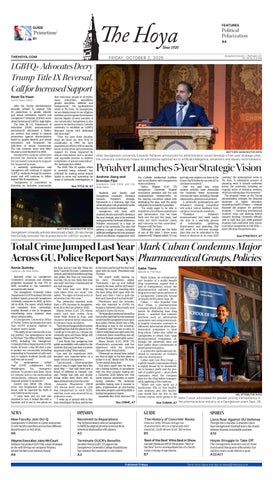
After Georgetown University Eduardo Peñalver announced his administration would develop a five-year strategic plan, the university community hopes he will improve approaches to artificial intelligence, enrollment and slavery reconciliations.
Peñalver Launches 5-Year Strategic Vision Andrew Jiang and Brendan Fijol
Academics Desk Editor and City Desk Editor
Students and faculty said Georgetown University President Eduardo Peñalver’s strategic framework is a welcome sign that administrators will proactively tackle the school’s central challenges. Georgetown will work with students, faculty and staff to develop a five-year strategic plan to be reviewed and approved by the board of directors, Peñalver announced in a Sept. 24 email to the university. The plan will address a range of issues, including artificial intelligence (AI) use, graduate school enrollment, engagement with
the Catholic intellectual tradition and reconciliation with Georgetown’s history of slavery. Darius Wagner (CAS ’27), Georgetown University Student Association president and the only undergraduate representative on the steering committee tasked with developing the plan, said the group will guide the university’s priorities. “I’m really eager to be able to transform a lot of those experiences and information that we have built over the last few years, and really put forth students’ needs and concerns on this committee,” Wagner told The Hoya. “Although I won’t see the fruits of any of this labor, I know many students will,” Wagner added. “If I can
just help one student out there in the future, that’ll be fine by me, even if I’m not there to receive it.” Over the past year, many student activists have demanded the university better incorporate community input, including through referendums, petitions and protests. A university spokesperson said Peñalver’s steering committee will solicit robust feedback from campus community members. “President Peñalver’s announcement last week marks the start of a year-long process of information gathering, discernment and planning that will result in a five-year strategic plan that can be submitted to the board of directors at its June 2027
meeting,” the spokesperson wrote to The Hoya. “A substantial amount of planning work is already underway across the university, including an ongoing series of listening sessions, which are taking place this semester.” The proposal comes as the Trump administration reshapes the financial landscape of higher education, sunsetting GradPLUS loans — a federal financial aid program for graduate students — restricting international students’ visas and slashing federal research funding. University officials said in April that just 2,488 graduate students had confirmed their intent. to enroll at Georgetown in Fall 2026 — down 13% from the previous year. See STRATEGY, A7
Total Crime Jumped Last Year Mark Cuban Condemns Major Across GU, Police Report Says Pharmaceutical Groups, Policies Annie Quimby
Campus Life Desk Editor
Reported crime on Georgetown University’s campuses and overseas properties increased by over 17% in 2025, according to the university’s annual security report. The Georgetown University Police Department (GUPD) received 168 total incident reports across all Georgetown University campuses in 2025, up from 143 in 2024. The report, which federal law mandates from universities, notably showed a rise in burglaries, exacerbating some students’ fears about campus safety. A Georgetown University Office of Public Safety spokesperson said that GUPD remains vigilant to student safety needs. “The safety of our community is our top priority,” the spokesperson wrote to The Hoya. “The Office of Public Safety (OPS), including the Georgetown University Police Department (GUPD), works 24 hours a day, 365 days a year to protect our community, including responding to thousands of calls each year to support students, faculty and staff who are in need.” The spokesperson added that GUPD collaborates with Washington, D.C. emergency services “to prevent and deter crime on campus and in the surrounding communities, enhance safety and respond quickly to incidents.” Garrett Gao (MSB ’29), whose dorm was burglarized last winter break, said he reported the theft of over $100 from his room. “I came back, and my lock was smashed in two, it looked like with a hammer, and it was in two pieces on
the floor, and so I was like ‘What the heck,’” Gao told The Hoya. “I opened the cabinet, and it didn’t look like anything was stolen. But then my roommate was like, ‘Oh, do you think they took any cash?’ And then I checked, and all my cash was gone.” “We both had over $100 in cash taken from our room,” Gao added. “No signs of forced entry or otherwise into the room.” The university reported more than a 37% increase in burglaries, from 35 to 48, from 2024 to 2025. Mansi Peters (CAS ’27), whose credit card was stolen from Yates Field House in June, said students deserve better measures to prevent these incidents. “I just think that generally, it’s pretty unsettling that of all the places in D.C. I could go to the gym to, I choose my university gym, and these things still happen,” Peters told The Hoya. “I just think that navigating that public accessibility with safety for the students that pay to go here is a pretty important thing,” Peters added. Gao said his experience with burglary was representative of a larger trend at Georgetown. “I got an email — I don’t remember when it was, it might have been like April, May — that said there were a bunch of robberies in Darnall,” Gao said. “People had cash and similar things stolen from them with no signs of forced entry into the room.” Amanda Pfundstein (MSB ’27), whose dorm room in LXR was burglarized in early 2025, said her room was entered by an unknown man. “I woke up at around 4:30 to this man standing at the door, and he was
in the room, and he had the door held open with his hand,” Pfundstein told The Hoya. “He wasn’t really leaving on his own,” Pfundstein added. “Eventually, I got up and walked towards the door, and he still wasn’t leaving. He was just standing with the door being held open with his hand, and then I had to grab the door and I just shut it so that he left.” Pfundstein said the intruder, who she reported to GUPD for burglary, behaved abnormally and refused to leave the room. “He basically introduced himself as Dez, and he said that he was someone newly hired by Georgetown to do open door policy checks, which was a little off-putting at four in the morning,” Pfundstein said. “He was so calm, so I didn’t really freak out right away. But I obviously knew something was off. And then he kept restating his name.” Iliana Bassin (CAS, MSB ’27), Pfundstein’s roommate, said her experience with the intruder changed their living habits. “Obviously we should have locked our door at night in the first place, or locked it at all,” Bassin told The Hoya. “So we started doing that.” This year’s report was the first to cite a hazing incident, in accordance with the Stop Campus Hazing Act, a December 2024 federal law that newly requires universities to report hazing statistics. The university prohibits hazing, even if consent is given, implemented an anti-hazing education program and will publish a hazing transparency report. Annabelle Kim (CAS, McCourt ’27)
Gabe Tiano
Special to The Hoya
Mark Cuban, an entrepreneur and founder of a public-benefit drug corporation, argued that a lack of transparency across the pharmaceutical industry raises drug prices and harms patients at a Georgetown University School of Health (SOH) event Sept. 28. Cuban — who founded Cost Plus Drugs, a pharmaceutical company which aims to be transparent by displaying base drug prices — asserted that industry practices such as information asymmetry and using intentionally lengthy insurance contracts to obfuscate information allow pharmaceutical companies to raise drug prices. Cuban also called on Georgetown to divest from large pharmaceutical companies, although the university does not have public direct investments in pharmaceutical giants. A university spokesperson declined to comment on Cuban’s calls for divestment. Cuban said Cost Plus Drugs — a public benefit corporation which is legally bound by its shareholders to balance profit and the pursuit of a public good — must show customers what the company pays for the drug before transparently applying a 15% mark-up. “When you only mark up a medication 15%, in this healthcare industry and this healthcare world that we live in the NEL PETERS/THE HOYA United States, we’re going to be Mark Cuban advocated for greater pricing transparency in See CUBAN, A7 the pharmaceutical industry at a Georgetown event Sept. 28.
See CRIME, A7
NEWS
OPINION
GUIDE
SPORTS
New Faculty Join GU-Q
Recommit to Reparations
‘The History of Concrete’ Rocks
Lions Roar Against GU Defense
A6
A2
B5
A10
Georgetown University in Qatar welcomed 11 new faculty members across four different departments in Fall 2026.
The Editorial Board calls on Georgetown to fulfill its original promise to reconcile its historical relationship with slavery.
Director John Wilson brings his characteristic wit to a famously dull material, Cash Moore (CAS ’28) writes.
Though the Columbia University Lions beat Georgetown’s football team, the Hoyas’ defense showed remarkable promise.
Waymo Executive Joins McCourt
Terminate GUCR’s Benefits
‘Best of the Best’ Wins Best in Show
Hoyas Struggle to Take Off
A9
A3
B7
A12/A11
Stefania Yanachkov (SFS ’06), a lead strategist at the self-driving car company Waymo, joined the McCourt advisory board.
Jennifer Peters (GRD ’27) argues the Georgetown University College Republicans has violated the university’s core values.
Aarushi Maskara (MSB ’28) praises “Best of the Best” for its moving depiction of a South Asian coming-of-age drama.
Published Fridays
The Georgetown women’s soccer team dominated Marquette offensively, but neither team could deliver a goal.
Send story ideas and tips to news@thehoya.com
A2 | THE HOYA
THEHOYA.COM | FRIDAY, OCTOBER 2, 2026
OPINION EDITORIAL
Fulfill Slavery Reparations Promise
In 2019, Georgetown University students overwhelmingly approved a referendum demanding Georgetown pay reparations to descendants of the 314 enslaved people the Maryland Jesuit priests sold in 1838 to help clear the university’s debts, known collectively as the GU272. Georgetown declined to implement the reparations efforts students envisioned, but founded a donor-led fund — the Reconciliation Fund — that pledged to grant $400,000 annually to “community-based projects” benefiting the GU272’s descendants. The initiative made Georgetown one of the first and largest institutions in the country to publicly commit to remedying its historical ties with enslavement. Since then, however, the university’s laudable effort has faltered. In September, The Hoya reported that Georgetown has only allocated a third of its initial promise. The Reconciliation Fund’s shortcomings reflect a broader lack of university action to recognize its history. Though University President Eduardo Peñalver briefly said he would include reconciliation efforts in his five-year strategic plan, this announcement was buried below six other bullet points without any further explanation. It’s unclear if he was even referencing the Reconciliation Fund’s lagging allocations. True reconciliation must go beyond words. It requires consistent and tangible actions to make Georgetown’s history visible on campus and present in its students’ minds. Students were the first to call for reconciliation efforts and continue to show support; the university needs to reflect its students’ voices. Not only must Georgetown fully honor its financial promises to descendant communities, but it should also publicize progress on the creation of a memorial for the College Burial Ground — a resting place for free and enslaved Black Georgetown residents — and improve its related curricula. A university spokesperson said the university pursues many different paths toward reconciliation. “Our work to understand and respond to the persistent legacies of slavery takes many forms — our academic engagement, our efforts at public history and memorialization and our ongoing commitment to reconciliation and collaboration with descendants,” the spokesperson wrote to The Hoya. If Georgetown wants to demonstrate its dedication to grappling with its exploitative history, it should first fulfill its Reconciliation Fund commitment. Grant recipients described delays in funding, especially after the COVID-19 pandemic, and insufficient university communication. In September, a university spokesperson told The Hoya that the third cycle of grant recipients will be announced soon — but that would still be over a year and a half after the applications were announced. The university should be transparent about why the fund appears to have faltered. In doing this, the university can affirm its commitment to reconciliation instead of staying silent. Furthermore, by not meeting the Reconciliation Fund’s original commitment, Georgetown is sidelining student voices. The 2019 student-led GU272 referendum called for a $27.20 tuition fee for each student to fund reparation efforts. The university rejected this specific approach but pledged the Reconciliation Fund would meet and exceed the referendum’s goal. Georgetown assumed the responsibility of representing student and descendant advocates; its failure to carry this out inherently suggests a lack of care for student concerns. The Reconciliation Fund, however, is only one facet of Georgetown’s responsibility to acknowledge its past. It must also comprehensively inform students about how the university was built. One specific way to increase awareness would be to establish a physical memorial for the College Burial Ground, which the university paved over in 1953 to create room for expansion and which later became the
HOYA HISTORY
site of the Reiss Science Building and Pedro Arrupe, S.J. Hall. Over 900 people were buried there, including enslaved and free Black residents of Georgetown as well as Catholic parishioners. Recently, the Georgetown University Student Association (GUSA) passed a bill calling for a memorial for the College Burial Ground. A university spokesperson said Georgetown was putting together a working group to correctly commemorate the burial ground. “To that end, in conversations with GUSA leadership, the University is organizing a working group to develop an appropriate plan for memorializing the site of the Old College Burial Ground,” the spokesperson wrote to The Hoya. The Editorial Board encourages the university to honor this commitment. A permanent physical memorial would help to commemorate and remind students of the dead whom the university paved over in its expansion. Adam Rothman, a history professor and director of Georgetown’s Center for the Study of Slavery and Its Legacies, said a memorial could help with student awareness, but it must be paired with other initiatives to truly reach students. “We could put up a memorial to the College Burial Ground, but if people just neglect or ignore it, then it’s not doing its job,” Rothman told The Hoya. “So these things always have to work together with education and awareness.” To its credit, the university has implemented far-reaching curriculum changes to supplement student learning on social justice and educate students about the GU272. In Fall 2024, Georgetown launched a required “Race, Power, and Justice at Georgetown” (RPJ) course for first-years centered on injustice and equity at Georgetown, alongside a wider Pathways to Social Justice (PSJ) requirement where students take courses that draw upon themes of marginalization, inequity and identity. The Editorial Board commends the university on these programs’ good intentions. However, their implementation has been flawed, which not only jeopardizes Georgetown’s mission of reconciliation, but also reduces the importance of descendants’ experiences. After the first year, Georgetown eliminated RPJ’s large lecture in favor of small, faculty-led discussion sections. While this helps faculty tailor lessons to their students, some students have reported that it makes the course feel disparate and disjointed since learning experiences and content vary by professor. Noor Zaareir (SOH ’29), who took RPJ last year, said Georgetown should more meaningfully engage students through programs like its 2023 partnership with descendant communities where students helped to mentor students from Maringouin, La., where many of the sold enslaved people were sent. “RPJ has the right idea, but it’s one credit and pass/fail, so it feels like Georgetown wants credit for the history without putting much into it,” Zaareir wrote to The Hoya. “It should be longer, count for more and give something back to descendants, like connecting students to community projects the Reconciliation Fund supports in Maringouin.” Students initiated discussion of and sustained pressure around reconciliation initiatives. Now that the university has taken responsibility and control over the process, it must follow through on its promises. Georgetown must distribute the full amount it committed to through the Reconciliation Fund, create a College Burial Ground memorial and improve its curriculum around reconciliation efforts. This is how Georgetown can honor the GU272 and their descendants while educating students to recognize slavery’s role in creating the institution they call home.
IN THIS WEEK’S ISSUE
“
True reconciliation must go beyond words. It requires consistent and tangible actions to make Georgetown’s history visible on campus and present in its students’ minds. The Editorial Board
“Fulfill Slavery Reparations Promise” thehoya.com
POLL This week, the Editorial Board examined Georgetown University’s slavery reconciliation efforts, urging the university to fulfill its commitment to make financial reparations, publicize progress on the creation of a memorial for the College Burial Ground and reform its introductory “Race, Power and Justice” class. To gauge student opinion, The Hoya asked its readers if they feel Georgetown has adequately fulfilled its commitment to reconciling with its history of slavery. Of the 106 respondents, 57.5% said yes, 31.1% said no and 11.3% said they were unsure.
EDITORIAL CARTOON by Apara Chandavarkar
The Hoya’s Editorial Board is composed of six students and is chaired by the Opinion editors. Editorials reflect only the beliefs of a majority of the board and are not representative of The Hoya or any individual member of the board.
Since its first issue in 1920, The Hoya has served to inform Georgetown’s campus dialogue. The following article is a glimpse into The Hoya’s rich history, allowing readers to appreciate the evolution of college journalism.
Inclusion of Descendants Integral to Reconciliation April 4, 2017
In the words of the report commissioned last summer by Georgetown’s Working Group on Slavery, Memory and Reconciliation, “Ultimately, reconciliation requires relationship.” Since Georgetown publicly acknowledged its profit from an 1838 sale of 272 slaves to a Louisiana plantation, the university has promised to engage the descendants of the slaves in the reconciliation process. However, weeks shy of a planned spiritual ceremony April 18 to express remorse over the university’s slaveholding past, the GU 272 Alliance, composed of 100 descendants, hired legal representation to push for a greater voice in the university’s response to the sale. Although senior university officials, including University President John J. DeGioia, have travelled to meet some of the living descendants of the enslaved over the past year, it is evident from the hiring of legal counsel that many feel their needs and interests were not fully represented within the reconciliation process. Most glaringly, not one of the descendants was given the opportunity to provide feedback
before the report was released last September. Without the input from descendants, some of the promises in the report, such as the establishment of an Institute for the Study of Slavery and Its Legacies at Georgetown, would ring hollow in the mission to atone for the university’s troubled past. The editorial board believes that more than any apology, memorial or institute, these descendants are the most enduring testament to the humanity of the 272, and they need to be at the forefront of any decisions made about their ancestors’ legacies. In fact, the hallmark of the university’s commitment to reconciliation — the decision to offer descendants preferential status in the admissions process, similar to the children of alumni — can only be meaningful if Georgetown extends its outreach to the community. This outreach would require more than just inviting interested descendants into these discussions, but also identifying individuals unaware of their roots to the school and alerting them to this opportunity.
LETTER TO THE EDITOR AND VIEWPOINT POLICIES The Hoya welcomes letters and viewpoints from our readers and will print as many as possible. To be eligible for publication, letters should specifically address a recent campus issue or Hoya story. Letters should not exceed 300 words. Viewpoints are always welcome from all members of the Georgetown community on any topic, but priority will be given to relevant campus issues. Viewpoint submissions should be between 600-700 words. The Hoya retains all rights to all published submissions. Send all submissions to: opinion@thehoya.com. The Hoya reserves the right to reject letters or viewpoints and edit for length, style, clarity and accuracy. The Hoya further reserves the right to write headlines and select illustrations to accompany letters and viewpoints. CORRECTIONS & CLARIFICATIONS If you have a comment or question about the fairness or accuracy of a story, contact Executive Editors Nico Abreu, Opal Kendall and Ajani Stella at executive@thehoya.com. NEWS TIPS News Editors Noah De Haan and Chloe Taft: Email news@thehoya.com. Guide Editors Anandita Agarwal and Isabelle Cialone: Email guide@ thehoya.com. Sports Editors Sam Fishman and Ethan Herweck: Email sports@thehoya. com.
Going forward, Georgetown must follow through on the principles outlined in the working group’s report to “be attentive to the interests of the descendants themselves, as well as respectful of the diversity of opinion and interest among them.” Already, the university has signaled its desire for collaboration in its meetings with descendants and genealogical research into their families’ history, but to pay more than just lip service to the process of reconciliation, the university needs to directly involve them in the decision-making process behind new initiatives, including developing scholarships, encouraging a new Working Group on Racial Justice and establishing new public monuments. Above all, the interests of the descendants should take priority in the university’s efforts to promote justice in memorializing the 272. Maintaining this relationship between our two communities will prove vital in healing a shared history mired in tragedy. The Editorial Board
GENERAL INFORMATION The Hoya is published once a week during the academic year with the exception of holiday and exam periods. Address all correspondence to: The Hoya Georgetown University Box 571065 Washington, D.C. 20057-1065 The writing, articles, pictures, layout and format are the responsibility of The Hoya and do not necessarily represent the views of the administration, faculty or students of Georgetown University. Signed columns and cartoons represent the opinions of the author(s) and do not necessarily represent the editorial position of The Hoya. Unsigned essays that appear on the left side of the editorial page are the opinion of the majority of the editorial board. Georgetown University subscribes to the principle of responsible freedom of expression for student editors. The Hoya does not discriminate on the basis of age, gender, sexual orientation, race, disability, color, national or ethnic origin. © 1920-2026. The Hoya, Georgetown University weekly. No part of this publication may be used without the permission of The Hoya Board of Editors. All rights reserved. The Hoya is available free of charge, one copy per reader, at distribution sites on and around the Georgetown University campus. Email: editor@thehoya.com Online at www.thehoya.com Circulation: 1,000
Founded January 14, 1920
Nora Toscano, Editor-in-Chief
Nico Abreu, Opal Kendall and Ajani Stella, Executive Editors Jackson Roberts, Managing Editor Noah De Haan, News Editor Chloe Taft, News Editor Jacqueline Gordon, Features Editor Serene Pai, Features Editor Thejas Kumar, Opinion Editor Leo Zhang, Opinion Editor Anandita Agarwal, Guide Editor Isabelle Cialone, Guide Editor Sam Fishman, Sports Editor Ethan Herweck, Sports Editor Angela Lekan, Science Editor Eva Siminiceanu, Science Editor Lucy Jung, Design Editor Anish Raja, Design Editor Elizabeth Hoerter, Copy Chief Allison Ma, Copy Chief Grace Rutherford, Copy Chief Katherine Hart, Blog Editor Yaya Hang, Multimedia Editor Miranda Kristina Santiago, Multimedia Editor Matthew Gassoso, Photo Editor Ella O’Connor, Audience Editor Caroline Woodward, Audience Editor
Board of Directors
Paulina Inglima, Chair
Ruth Abramovitz, Bethe Bogrette, Maren Fagan, Tanvi Gorripati, Aamir Jamil, Annikah Mishra
Connor Manrique-Johnson, General Manager
Rosie Garner, Director of Business Operations Jackson Roberts, Technology Director
Andrew Jiang Academics Desk Editor Annie Quimby Student Life Desk Editor Liv Sanchez Graduate Desk Editor Brendan Fijol City Desk Editor Joshua Lou GUSA Desk Editor Michael Shtrom Events Desk Editor Caroline Garland Deputy Features Editor Sophia Tully Deputy Features Editor Caden Larrenaga Deputy Opinion Editor Juan Almanza Deputy Guide Editor Eliza Doty Deputy Guide Editor Grace Ko Deputy Guide Editor Eliana Kut Deputy Guide Editor Penelope Snoep Deputy Guide Editor Finn Balon Deputy Sports Editor Golnar Jalinous Deputy Sports Editor Jacob Nolan Deputy Sports Editor Sasha Ahmad Deputy Science Editor Jaya Alenghat Deputy Science Editor Kaitlyn Lee Deputy Science Editor Adhithi Rajesh Deputy Science Editor Maddie Williams Deputy Science Editor Autumn Dunlop Deputy Design Editor Abby Kopf Deputy Design Editor Emilie Andrews Deputy Copy Editor Connor Emmert Deputy Photo Editor Rohini Kudva Director of Human Relations Jacob An Director of Logistics Stefano Rangel Haddad Director of Outreach
THE HOYA | A3
FRIDAY, OCTOBER 2, 2026 | THEHOYA.COM
OPINION
VIEWPOINT • HUDSON-WARD
Learn to Use AI Responsibly
A
rtificial intelligence (AI) is already embedded in the systems through which we search, communicate, navigate, create, learn and make decisions. Today, we are participating in a broader AI ecosystem simply by using mobile phones or going online. It is my hope that as students, you will embrace this distinct historical moment to leverage your leadership skills and voices to co-create a more inclusive and just society. At Georgetown University’s library, we are approaching this moment intentionally. As dean of the library, I believe we have a responsibility to help our community develop the skills necessary to navigate an increasingly AI-mediated world. That includes advancing AI literacy, helping to articulate what responsible and ethical AI use looks like, contributing to the new institutionwide AI initiative, connecting students and faculty with trusted resources and ensuring that library staff have ongoing opportunities to build the skills necessary to support our campus community. Our responsibility to students extends beyond adapting new technologies quickly. We will help shape how they are understood and used while remaining grounded in our Jesuit values and professional commitments, and aligned with human-centered approaches to knowledge creation and dissemination. Our library staff bring deep expertise within this area. Information literacy, source evaluation, intellectual freedom, privacy, access, preservation, historical context and the ethical use of information have long been central to our profession and our work at Georgetown. As students, you have important citizenship responsibilities within the information ecosystem as well. This moment raises profound questions and complications for students about truth, consent, reputation, privacy and trust. And your advocacy response should not stop at resistance to AI or generalized anxiety about it. We need you to partner with us on articulating what responsible use should look like and what standards should guide our community — especially within the non-curricular, social dimensions of campus. I am particularly concerned about what I perceive to be relative silence from students surrounding some of AI’s most troubling applications, such as deepfakes and the dissemination of misinformation as we approach the midterm elections. We’ve seen several examples in the media
about how inaccurate AI-generated content can cause real harm to individuals, communities and institutions. Other risks to students include intellectual overload, social isolationism and a reduction in emotional intelligence. At the same time, our conversations and efforts cannot be defined solely by risk. We are also witnessing remarkable possibilities through artificial intelligence, robotics and related technologies. For example, within the sciences and health fields, Georgetown students and researchers are exploring how AI might improve medical diagnoses, expand access to care, overcome barriers and create new opportunities for historically underserved communities. One exciting research project in Georgetown’s Berkley School of Nursing is exploring how AI can help advance an interdisciplinary approach to patient care. These possibilities matter. If AI can contribute to greater societal equity, students should be among those imagining and designing those applications and their execution. That is why I am asking Georgetown students to become active, informed digital citizens. Learn how AI systems work. Understand their limitations. Question their outputs and their sources. Pay attention to who benefits and who may be harmed. Follow the academic guidance and expectations of your faculty regarding AI. Use the library’s expertise. And most importantly, bring your voices into conversations about what ethical, responsible and human-centered AI should look like at Georgetown and beyond. The library will help underpin these efforts, providing you with resources and critical frameworks. But my aspiration is that Georgetown students become more than wayfinders through an increasingly complex information environment. I want you to become navigators, and ultimately designers, of what comes next. Our world needs informed, principle-centered leaders to address one of the most consequential technological shifts in human history. I believe you have the capacity to lead — right now as students and, in time, within every sector. The future of AI should not simply happen around you. Your values, judgment, creativity and intellect must help shape it and determine its future. Alexia Hudson-Ward is the dean of the Georgetown University Library.
HAAN JUN (RYAN) LEE/THE HOYA
VIEWPOINT • PETERS
Hold GUCR Accountable; End University Support Georgetown University has long taken pride in being the United States’ oldest Catholic and Jesuit university. Now we have another distinction that should trouble us. The Georgetown University College Republicans (GUCR) is the first individual university group in the country to join the Mass Deportation Coalition, a national organization seeking to deport more than one million people this year. This action is part of a larger pattern. In March, after GUCR posted that Muslims have “no place in American society,” I argued in The Hoya that Georgetown’s subsequent condemnation without meaningful consequences would make the university’s commitment to inclusion ring hollow. While Georgetown administrators said at the time that they were “reviewing” the post, they have not taken any public action. Georgetown’s access to benefits policy governs student organizations’ funding, use of university branding, access to campus space and advising. It specifies that granting a group resources does not imply university endorsement. Furthermore, it states that a group is ineligible if its mission or practices foster “hatred or intolerance.” Georgetown should apply that standard to GUCR’s repeated conduct of bigotry and terminate its access to benefits. GUCR’s new partnership extends its pattern of behavior from religious exclusion to an agenda that treats undocumented immigrants as a collective threat. The coalition seeks the removal of
COLUMN • CONATON
all undocumented immigrants by 2029, including people who have not been convicted of crimes. The Hoya reported that GUCR defended its decision by claiming that unauthorized immigrants have stolen U.S. citizens’ jobs and lowered their wages. Student leaders invoked alleged crimes committed by immigrants and said their club supports expedited deportations. The statement presents unspecific and unsubstantiated transgressions as grounds to cast an entire population as dangerous, even as the coalition explicitly seeks deportations far beyond those convicted of crimes. GUCR’s implication that unauthorized immigration makes communities more dangerous is at odds with the evidence. An August University of California, Irvine study examined crime trends across 11,500 neighborhoods representing 46 million residents between 2010 and 2018. Neighborhoods with growing estimated undocumented populations had no significant change in violent crime — and actually experienced greater reductions in property crime. While individual crimes absolutely deserve attention and victims must receive justice, that does not mean unauthorized immigrants as a group drive crime. GUCR’s claim that U.S. citizens are losing jobs is also not grounded in facts. Undocumented immigrants have had little to no overall negative effect on U.S.-born workers’ wages or employment, according to an American Business Immigration Coalition research summary.
The Economic Policy Institute, a progressive think tank, likewise describes average wage effects as neutral to slightly positive, while acknowledging that employers can exploit vulnerable immigrant workers to suppress pay in particular sectors. This research suggests that workers need enforceable labor protections, not rhetoric that blames immigrants for employers’ choices. The human stakes of accelerating deportation are not abstract. Federal immigration agents killed U.S. citizens Renée Good and Alex Pretti in Minneapolis this year. GUCR did not cause these deaths. But an organization calling for a vast expansion of enforcement must reckon with the consequences of the system it wants to give more power to. Questions of immigration status should not jeopardize human lives. While Georgetown declined to comment on The Hoya’s reporting, the co-chair of the Georgetown University College Democrats, Braedon Troy (CAS ’27), warned that GUCR’s use of the university’s name could suggest institutional support. That concern deserves an answer in Georgetown’s actions. As a public relations graduate student, I have learned that an institution’s integrity lives and dies by its ability to stay true to its values, which is tested by what it permits to be done under its name. GUCR has made Georgetown part of a national deportation campaign’s public identity. University recognition lends that association credibility even when
the administration does not endorse the group’s views. It is clear that GUCR has harmed Georgetown’s reputation and fosters hatred and intolerance. A policy disclaimer does not settle whether continuing to provide those resources is consistent with the university’s own eligibility rule. Nor does it give an answer to what this affiliation communicates to immigrant and Muslim members of our community. Georgetown had an opportunity to draw a clear line in March. Its continued recognition of GUCR has left that question unresolved in public view. Georgetown should revoke GUCR’s access to university benefits and funding under its established standards and stop allowing the group to present this partnership as a Georgetown affiliation. Revoking these benefits would also prevent the group from officially using Georgetown’s name and trademarks, similar to how unrecognized student groups like H*yas for Choice operate independently of the university’s brand. GUCR members can continue to speak and organize — they retain their free speech rights. However, Georgetown must decide whether to keep supplying its name and resources to this racist, xenophobic campaign. A university committed to the dignity of every person should not make that choice by default. Jennifer Peters is a graduate student in the School of Continuing Studies.
VIEWPOINT • BAZARGAN
Revive Our Historic Hoya Social Culture Diversify GU’s Iran Lecture Series
B
oth of my parents went to Georgetown University (gross, I know), so when I came here, I had a distinct vision of “Hoya-ness.” However, during my time at Georgetown, I’ve felt bereft of the community my family spoke so highly of. Thirty-plus years ago, many Georgetown students, including my parents, ventured back to campus to end their nights with a drink or a dance at “The Pub,” the then on-campus bar. Nowadays, the place everyone’s going to is not only a 20-minute Uber away but also different for each person you ask. Maybe this difference exists only in those rose-colored glasses of hindsight. While this may play a part in it, I think it speaks to very real institutional and cultural differences, differences that only we, Georgetown’s students, can fix. In order to address the numerous factors that have led to a degradation of on-campus community, Georgetown students, past and present, must rally together to protect and bolster our dwindling social scene. In response to neighborhood concerns, Georgetown’s policy has prioritized quickly shutting down parties through the Student Neighborhood Assistance Program (SNAP), which monitors Georgetown students living off-campus. It’s hard to have a thriving social scene on campus when every party gets shut down by 11 p.m. or midnight. I honestly wish the fix was as simple as just bringing back The Pub. Having a contained, on-campus space where students can enjoy their nights would take pressure off all parties involved — it would reduce the need for university expenditures on SNAP, assuage neighbors’ worries about rowdy students and lift a financial burden from students. However, given the financial and legal complications of having a bar on a campus where roughly three-quarters of students are underage, this would be difficult to achieve, especially given the university’s recent budget concerns.
Clubs on campus have tried to fill The Pub’s vacant social role, but they only divide us more. Many Georgetown clubs are extremely competitive. In your first year, it can feel like if you don’t get into the right club, or enough clubs, your social life is over. And while you might find a great community in the clubs you do get into, you are siloed from other groups. People trap themselves with similar students without a clear path to meet people with different perspectives or interests; there is no real overarching Georgetown social culture to unite us. At the same time, Georgetown’s highly political nature is a uniting factor. We are lucky to be in a community where so many people care so much about so many important issues. But in this amped-up political environment, within a city constantly changing the world, cheering your heart out at a basketball game can feel trivial. Still, I’d argue that community might be exactly what we need. Georgetown students are striving to become the leaders of the future, leaders who won’t fall to polarization or obstinate squabbles. It may seem idealistic at best, and dangerously inactive at worst, to suggest that grabbing a beer with a fellow Hoya or cheering with a stranger at a basketball game will help Georgetown students learn to solve looming real-world political issues. But if we can’t learn to engage in community in our little Georgetown bubble, we cannot expect to lead others to do the same out in the real world. Rather than giving up on community, we should be learning how to build kinship between people with diverse perspectives. While we can’t — and shouldn’t — force Georgetown to go back to the way it was, we can choose to create our own community. Maybe that starts with just staying on campus for Georgetown Day or
going to more basketball games. Clubs could have more joint parties or open access elements. Whatever it is, students should work with the university to create and preserve social spaces on campus, like Village A. This could also be aided by more actively engaging graduates. While Georgetown’s campus plan, the multi-year policy framework Georgetown must periodically submit to the District, was formed under the advice of administration, students and neighborhood representatives, graduates were notably absent from the discussion. This might make sense given that they no longer live on campus, but graduates still compose an important part of the Georgetown community and a part of the community that the university relies on financially. Talk to any graduate on Reunion Weekend, and you’re sure to hear a story about a crazy party from their golden days. The only reason I even know about The Pub is that my parents and their fellow Hoya friends won’t shut up about how fun it was. I think that student life is an important aspect of the Georgetown experience that many graduates care deeply about. With the engagement and support of graduates, students may have better luck and leverage in convincing the university to listen to concerns about our on-campus community. Maybe none of this will work. Maybe we’ll decide it’s more fun to stay off campus. But I think it’s worth trying to see what being a Hoya really means for this generation of Georgetown students.
Norah Conaton is a sophomore in the School of Foreign Service. This is the first installment of her column “Dazed and Confused.”
A
s the United States intensifies its war against Iran, Georgetown University’s School of Foreign Service (SFS) organized an “Iran Lecture Series” for students and faculty. The impetus behind this series is laudable — the war’s impact has spread far beyond the battlefield, disrupting global energy markets, driving up fuel and transportation costs and imposing growing human and economic costs worldwide — but the SFS’ current lineup lacks informed critics of the Islamic Republic. At this critical moment, Georgetown students need more than one policy perspective. The four invited speakers — Narges Bajoghli, Sina Azodi, Trita Parsi and Ali Kadivar — all have connections, to varying degrees, to the National Iranian American Council (NIAC), an advocacy organization that seeks to influence U.S. policy to oppose military intervention and favor diplomacy. Nader Hashemi — who organizes the series as director of Georgetown’s Alwaleed Bin Talal Center for MuslimChristian Understanding (ACMCU) — does as well. Parsi co-founded NIAC; Bajoghli participated in a 2018 Capitol Hill briefing organized by NIAC; Azodi appeared in NIACrelated programming in 2024; and Kadivar and Hashemi signed a NIAC-funded 2018 advertisement advocating a return to the nuclear agreement and economic relief. NIAC describes itself as supporting diplomacy, civil rights and sanctions relief while opposing war, and it rejects allegations that it represents the Iranian government in Tehran. Yet in footage from Iranian state television, political figures referred to NIAC and Parsi as part of an Iranian lobbying network in the United States. Those remarks, while not conclusive, warrant examination. In 2012, Parsi and NIAC lost a defamation lawsuit against IranianAmerican critic Hassan Daioleslam, who accused them of advocating for Iran’s regime. A federal judge wrote
that Parsi’s record, which includes occasional criticism of Tehran, was “not inconsistent with the idea that he was first and foremost an advocate for the regime.” For Georgetown students asked to consider Parsi’s interpretation of U.S.Iran relations, this history is relevant context for evaluating his credibility and underlying assumptions. A serious academic forum should give students the evidence and competing perspectives needed to assess those claims critically. Hashemi’s and Azodi’s public records also merit scrutiny. After Salman Rushdie, the Indian-British novelist who is a longtime target of an Iranian death fatwa, was stabbed in 2022, Hashemi baselessly suggested it was “much more likely” that an Israeli intelligence operative posing as an Iranian loyalist had manipulated the attacker to derail nuclear talks. Six Colorado Jewish organizations condemned the allegation. My concern is that a tendency to interpret events through an antiIsrael lens could lead the Iran Lecture Series to give insufficient scrutiny to the Islamic Republic’s own conduct and responsibility. Separately, Nobel Peace Prize winner Shirin Ebadi and three academics questioned Azodi’s framing of Tehran’s ideology, nuclear intentions and regional conduct. Georgetown need not accept these criticisms, but students should have the opportunity to hear and assess them alongside the speakers’ arguments. These controversies are not reasons to exclude Parsi or Hashemi. Universities should be places where contested ideas can be examined, not avoided. The Iran Lecture Series’ lineup prominently features advocates of diplomacy and critics of sanctions, war and U.S. and Israeli policies; it lacks a clear counterpoint from experts who foreground Iran’s well-documented support for Hamas, Hezbollah and the Houthis.
Thus, Georgetown should invite qualified scholars with different interpretations to model rigorous academic debate. Georgetown is educating future diplomats and policymakers whose decisions may carry enormous human and financial consequences. In order to best prepare students to make difficult decisions, the Iran Lecture Series should also include Iranian voices who question whether negotiations with the Islamic Republic can produce lasting change without fundamentally altering the political institutions that have backed decades of human-rights abuses and repression. Figures such as Ebadi, Saeid Golkar, Masih Alinejad and Behnam Taleblu have publicly challenged agreements that preserve the current leadership’s power, while other dissidents emphasize accountability and Iranian self-determination. This approach would respect academic freedom while giving students the context and evidence needed to reach their own informed conclusions. Academic freedom means genuine debate, not an echo chamber. At Georgetown, where students may go on to shape U.S. foreign policy, exposure to competing perspectives is essential to developing a fuller understanding of Iran. When future policymakers are not challenged to test competing assumptions, the consequences of an incomplete understanding can be measured in human lives and billions of dollars. Lawdan Bazargan is an IranianAmerican human rights advocate and director of the Alliance Against Islamic Regime of Iran Apologists (AAIRIA), a group focusing on Iran’s human rights abuses. A former political prisoner arrested in Iran at age 16, she is the sister of Bijan Bazargan, who was executed during the Islamic Republic’s 1988 massacre of political prisoners.
THEHOYA.COM | FRIDAY, OCTOBER 2, 2026
A4 | THE HOYA
FEATURES
As Polarization Intensifies Across the Country, Embittered GU Political Groups Drift Apart
ILLUSTRATION BY ANISH RAJA/THE HOYA
Faculty say campus polarization has flattened the diversity of classroom discussion, leading to fears of ostracization when sharing different opinions or even avoidance of political discourse altogether.
After Georgetown University College Republicans posted an Islamophobic tweet in March, Georgetown University College Democrats’ members say the clubs’ fundamental differences inhibit productive dialogue.
Evan Zhang and Meera Shah Features Staff Writers
F
or years, Georgetown University College Democrats (GUCD) and Georgetown University College Republicans (GUCR) filled university spaces for their signature event of the fall: the annual bipartisan debate. Students reveled in the opportunity to bicker, shout and even laugh over domestic, international and economic issues. Georgetown celebrated the event as an example of the school’s bipartisanship. But this year, GUCD refused to debate GUCR — six months after a string of GUCR posts that Democrats and much of Georgetown’s wider community condemned as bigoted and against bipartisan spirit. In their most prominent post on X, GUCR claimed “Muslims have no place in American society.” GUCD, as well as other campus groups, denounced GUCR’s tweets, saying they were “disgusting, un-American, and go against everything we as Georgetown students and Americans should stand for.” Lukas Pitman (SFS ’27) — the president of Georgetown Bipartisan Coalition, which hosts the annual debates — said its cancellation is the culmination of a growing political divide at Georgetown. “After the tweet incident, relationships between GUCR and GUCD were strained to say the least,” Pitman told The Hoya. “We didn’t really see that there was very much of a willingness to work with the other side.” GUCR’s post came as national Islamophobic rhetoric proliferated. One day after GUCR’s post, Rep. Andy Ogles (R-Tenn.) mirrored its message, claiming “Muslims don’t belong in American society,” sparking cries denouncing politicians hatefully disparaging minorities. Political division has surged in recent years — over 90% of both Republicans and Democrats hold an unfavorable view of each other’s party, according to a May poll. Experts say increased polarization will likely lead to more frequent gridlock and political violence. At Georgetown, students and faculty say polarization is also a burgeoning issue — students are either very vocal about their political views and go head to head in retaliatory spars, or don’t engage in political discourse at all. They cite campus controversies and a lack of political diversity as key reasons for turning to alternate spaces for meaningful discourse. A university spokesperson said Georgetown, rooted in its Jesuit tradition, aims to promote dialogue between differing viewpoints, which University President Eduardo Peñalver’s will consider a “top priority.” “Grounded in our 500-year-old Jesuit heritage, we view engagement across differences as part of our mission,” the spokesperson wrote to The Hoya. “Georgetown is deeply committed to building a campus community rooted in mutual respect and a culture of civil discourse and respectful dialogue.” Riya Rao (CAS ’29), who interned for Congress this summer, said political groups’ attacks on opposing affiliations made students reluctant to engage in discussions with those holding different views. “If you’re a part of the group of people that GUCD or GUCR is targeting or
attacking, you’re not going to want to have a meaningful conversation or discussion with them about a certain policy issue, or a bill that’s being written or just elections,” Rao told The Hoya. Mansi Peters (CAS ’27), GUCD’s co-chair, said interparty cooperation is hugely valuable, but any current interaction with GUCR requires GUCD to concede their beliefs — in this case a fundamental respect for marginalized groups — rather than creating a bipartisan compromise. “It’s important not to accept things for the sake of bipartisanship, and to only promote bipartisanship in the sense that it’s actually productive,” Peters told The Hoya. The Great Divide When the populist right-wing Tea Party movement emerged in 2009, taking U.S. politics by storm, Georgetown conservatives largely shunned it. In 2016, both the GUCR and GUCD vice chairs rejected “alt-right” movements and encouraged Georgetown conservatives to prioritize inclusion. But now, instead of meeting in person, student groups attack each other on social media. As party platforms diverge, students cite foundational issues — both an inability to agree and a refusal to engage — as barriers to meaningful conversation. In September 2025, after the assassination of right-wing activist Charlie Kirk, Georgetown public safety officials reported graphic flyers reading “FOLLOW YOUR LEADER, REST IN PISS CHARLIE” and “Hey Fascist! Catch” — a reference to a message on the bullet that killed Kirk — to the FBI. In response, GUCD, GUCR and the Bipartisan Coalition jointly denounced the flyers on social media, describing any calls for political violence as “unacceptable.” The next month, four conservative activists unaffiliated with Georgetown hosted a Kirk-inspired “Let’s Talk” table in Red Square asserting “All cultures are not equal” and “Men cannot be women.” No Georgetown group claimed responsibility for the table — but it brought the charged national discourse to Red Square. After GUCR’s March post, relationships between Georgetown’s two largest political clubs deteriorated as they became more divided. Over the past week, GUCR and GUCD have traded jabs with online statements denigrating each other’s integrity. Interactions between the clubs have all but halted. The Islamophobic post was one of three controversial posts GUCR published in March — the others reading “Marriage is the union of a man and a woman,” discrediting same-sex marriage licenses, and “Granting foreign aliens ‘birthright citizenship’ undermines our national character,” condemning birthright citizenship. The group took down the Islamophobic tweet two days after it was posted, though the other tweets remained online before the entire X page was archived two days later. Despite the account’s removal, Georgetown’s campus, including former GUCR members, erupted in outrage over the posts. GUCD members, specifically, called for administrators to cut GUCR’s university benefits, citing the university’s eligibility criteria stating clubs cannot receive benefits if it “fosters hatred or intolerance of others.”
At the time, a GUCR spokesperson said the post did not fully convey the organization’s position. “We affirm the First Amendment rights of all Americans and we are called to love everyone,” a GUCR spokesperson wrote to The Hoya in March. “Our properly articulated position is that Sharia law is incompatible with Western civilization and American society as it seeks to oppress women and persecute religious minorities.” The university launched a review of the issue but has not publicized any updates or sanctions. Abdulbaari Abdulkadir (CAS ’29), a Georgetown Muslim Student Association (MSA) board member, said the posts exceeded the bounds of normal political disagreements, attacking people’s identity rather than their political positions. “It wasn’t just disagreeing with a particular belief or policy,” Abdulkadir wrote to The Hoya. “It was questioning whether Muslims have a place in American society at all.” The post, as well as broader changes to Georgetown’s ideological landscape, coincided with parallel national trends. Over the past 10 years, the Trump administration has pushed increasingly xenophobic and Christian nationalist rhetoric, which experts say has emboldened a more extremist sect of the Republican party. Mobashra Tazamal — associate director of the Bridge Initiative, a Georgetown project researching Islamophobia — said hate has permeated college campuses. “I have not seen this current level of Islamophobic rhetoric in at least the past 10 years that I have been doing this work,” Tazamal told The Hoya. “It has gotten to such dangerous levels.” “I wasn’t as shocked that it was coming from a right-wing group, I was very much so shocked that it was coming from a Georgetown group,” Tazamal added. Earlier this month, GUCR became the first university-affiliated group to join the Mass Deportation Coalition (MDC), an organization advocating for President Trump to deport over one million noncitizens in 2026 and remove all undocumented immigrants from the United States by 2029. In a statement Oct. 1, GUCR defended their decision to join the organization, writing they “strongly condemn GUCD’s preposterous notion that securing our borders and protecting our citizens from the scourges of illegal migration ‘denies [people] their humanity.’” Braedon Troy (CAS ’27), GUCD’s other co-chair, said the club called off the debate, as well as an annual interclub flag football game, because it is no longer willing to platform GUCR. “That is still unacceptable, and the fact that they are still a full university-funded organization despite all of that, our board feels that we cannot stand alongside them in friendly competition,” Troy told The Hoya. GUCR said GUCD’s decision obstructed open dialogue and called on the group to participate in the historical debate. “For years, this debate has provided students with an opportunity to hear the competing visions of the major political parties and help form their views about the issues facing our country,” the club wrote in a Sept. 27 statement on social media. “Debate is especially important at Georgetown.”
In response, GUCD posted a statement condemning GUCR’s decision to join the MDC and rejected “these actions as Georgetown students committed to Jesuit values” to which GUCR, doubling down on GUCD, said they “refused to debate” while finding “ample time to peddle nonsensical anti-American propaganda.” GUCR did not respond to multiple requests for comment. Jackson Schnabel (SFS ’27) — a board member of Georgetown Students for Justice in Palestine, a pro-Palestinian protest group — said the backlash following GUCR’s March post exemplifies students refusing to engage with intolerance disguised as opposing political opinions. “It’s just not worth engaging with that type of rhetoric, because that legitimizes it,” Schnabel told The Hoya. “It makes it part of the norm of acceptable dialogue and I think that’s something we should check.” “I also don’t think it’s appropriate to put the burden of educating people about their prejudices, about their biases, on the people that those prejudices and biases are directly harming,” Schnabel added. The Cracks in Conversation Georgetown’s political groups were not always so fractured. Faculty reported a stark increase in polarization at Georgetown after the COVID-19 pandemic, which exacerbated national political divides. Mo Elleithee (SFS ’94), the Georgetown Institute of Politics and Public Service’s executive director, said students returned to campus in Fall 2020 exceptionally divided. “There’s been a lot of things that have polarized us over the years and throughout the history of the republic, but in my lifetime, I haven’t seen anything as polarizing as COVID was,” Elleithee told The Hoya. Jordan Van Slingerland (SFS ’26), a former GUCR board member who condemned the club’s Islamophobic post, said he felt the campus’ ability to hold bipartisan conversations deteriorated as Georgetown became more polarized. “D.C. and the Georgetown campus are a bubble of intense polarization,” Van Slingerland told The Hoya. “It’s very difficult while you’re in the bubble to realize that.” “People generally do not take the time anymore to listen to or to understand each other’s political beliefs and why they believe what they actually believe,” Van Slingerland added. As a hub for students looking to enter public service, Georgetown is known to attract students from all political backgrounds — but a 2025 survey found liberal students made up over 85% of the student body. At Georgetown’s peer universities, while there are still imbalances in party affiliation, students say there is comparatively little political tension. Compared to Georgetown, only 74% of Dartmouth College students reported they would vote for former Vice President Kamala Harris over Trump in 2024, and 45.7% of students identify as Democrats at Johns Hopkins University. Alexander Pi, a Johns Hopkins student, said he hasn’t witnessed any significant political discourse, including debates or protests, since arriving on campus.
“As of now, based on what I’ve seen, I wouldn’t consider Johns Hopkins’ campus to be politically charged,” Pi told The Hoya. Jaylen Hilario-Peralta, a Dartmouth student, said students often stay within their own political circles, with engagement in political discourse typically limited within respective clubs. “I don’t think I’d say that Democrats and Republicans are really coming and butting heads,” Hilario-Peralta told The Hoya. Hans Noel, a government professor, said Georgetown students expect civil discussion to be a tenet of campus conversations. “You don’t come to Georgetown if you’re not at least a little bit willing to be around people who are interested in politics, because that’s the kind of place we are,” Noel told The Hoya. Peters, the GUCD co-chair, said liberal students are also hesitant to speak up, not due to fears of alienation but rather a fear of hateful rhetoric being used against them. “It’s about the fact that they’re scared that their humanity or their goodwill will be written off the table before they even get a chance to engage in the discussion,” Peters said. George LeMieux (CAS ’25) — co-founder of the Philonomosian Society, an open-access Georgetown debate society — said he found students particularly hesitant to properly defend their opinions on current events due to constant misinformation and potential for backlash from other students. “Truth be told, most students are really terrified, just terrified to say what they think in a class,” LeMieux told The Hoya. Instead, students avoid speaking up for fear of ostracization, said Kimberlee Holland, a sociology professor. “I can’t think of more than one instance in the last seven years at Georgetown where a conservative student has voiced strongly a conservative position,” Holland added. ‘Let’s Talk’ There is no clear consensus on what meaningful dialogue looks like at Georgetown. Some students remain committed to fostering conversations on policy and political ideology — either through debate societies or school-sponsored programs — while others say forming friendships with students of opposing political views is a more productive path to understanding. Georgetown-sponsored programs also encourage student political dialogue — including the Doyle Engaging Difference Program and Georgetown Dialogues Initiative, which foster conversation amongst diverse viewpoints; the “In Your Shoes” program, using theater to push students out of their own perspectives; and a master’s program in conflict resolution, which offers depolarization-focused opportunities. Max Wolff-Merovick (SFS ’28), a Philonomosian Society member, said debate societies fill a gap for students as partisan clubs become averse to engaging with the other side. “You can share your opinion, knowing that they’re not going to judge you,” Wolff-Merovick told The Hoya. “Whereas if you’re in a classroom, there might be a little bit
more of a taboo around expressing yourself super authentically.” Arthur Schnieders (CAS ’27) — the president of the Philodemic Society, another open-access debate society — said requiring students to play devil’s advocate to their own beliefs promotes meaningful dialogue. “We really encourage people to push back on what they might naturally believe or what they might already believe and argue for the opposite side as a challenge,” Schnieders told The Hoya. Though they say political polarization is more intense than ever before, students believe open dialogue is most needed in the current political climate. The Trump administration has moved to silence dissent — barring progressive-leaning media outlets from the White House and firing government employees over disloyalty. Republicans, meanwhile, have accused the left of stifling conservative academic speech. Noel said he has noticed a shift in how students publicly affiliate themselves politically, with Republican students either distancing themselves from Trump’s rhetoric or becoming more vocally supportive. “When Trump becomes the nominee, there’s a lot of younger voters who were somewhat alienated from Trump and then left, but then that has rebounded, but to a different kind of Republican who’s more embracing of Trump,” Noel said. For some students and faculty, the university administration must take active steps to foster spaces for open, respectful dialogue on campus as previously welcoming spaces, like student clubs and classrooms, fail to host productive conversation. Rabbi Rachel Gartner, design specialist for “In Your Shoes,” said participation in programs fostering open dialogue is essential to a Georgetown education. “I think we owe it to students and students owe it to themselves to find their ways to these existing programs and we should continue to support them at every level of the university,” Gartner said. Van Slingerland said he hopes University President Eduardo Peñalver, whose term began in July, will shift Georgetown toward a positive environment for political conversation. “The administration has a golden opportunity, right now, to start challenging some of the divisiveness that we see on campus, and to not try and align itself with one political party or another, and to become a place where students can actually learn to contribute productively,” Van Slingerland said. “Frankly, in the workplace as a whole — hell, even in politics — you need to know how to do that,” Van Slingerland added. Pitman, the Bipartisan Coalition president, said while dialogue can feel hopeless in today’s increasingly polarized political environment, students should still aim to improve Georgetown’s own political climate and promote unity for a common good across party lines. “There’s never a right time,” Pitman said. “There’s never a perfect time for these things to happen for you to take the initiative and say, ‘I’m going to push beyond that and have hope for the future.’ It starts with you.”
THE HOYA | A5
FRIDAY, OCTOBER 2, 2026 | THEHOYA.COM
SCIENCE
Kidney Disease Expert Warns Diabetes May Contribute to Kidney Dysfunction Sarah Hsia
Special to The Hoya
A nephrologist argued that understanding mitochondrial dysfunction in kidney cells will have an impact on future interventions for diabetic kidney disease (DKD) at a Sept. 24 lecture. Dr. Farhad Danesh, the chief of nephrology at the University of Texas MD Anderson Cancer Center, argued that mitochondria in kidney cells play a key role in DKD, and that targeting dysfunctions such as excessive division of mitochondria can expand treatment options. Danesh — who studies DKD, a major complication of diabetes that damages the kidneys and can lead to kidney failure — spoke at the distinguished scientist seminar series hosted by the Georgetown University Medical Center (GUMC). Danesh said that diabetic complications, mainly high blood sugar, can often lead to kidney disease, accounting for roughly half of all new kidney failure cases in the United States. “What really is devastating about diabetes is not just having hyperglycemia, but either microvascular complications of diabetes or macrovascular complications of diabetes, including having heart disease, kidney disease and blindness,” Danesh said at the event.
Danesh said his lab studies how mitochondrial dysfunction contributes to broader kidney dysfunction. “When we think about diabetic kidney disease, there is a cascade of dysfunction from an organelle, in this case mitochondria, to an organ, which is a kidney,” Danesh said. “So the question we are posing is how do you go from an issue in the mitochondria to kidney dysfunction?” Dr. Moshe Levi, the chief science officer for research development at GUMC, said Danesh’s work is important in understanding health issues like cancer and tissue disease. “He has done incredible work over the years on understanding kidney disease, but importantly, the role of mitochondria, which is context dependent, but the concepts are important for tissue disease and cancer,” Levi said at the event. Danesh’s lab has investigated the role of the enzyme rho-kinase 1 (ROCK1) in kidney function. Their research found that the removal of ROCK-1 from mice with diabetes resulted in reduced urine albumin, a protein normally found in blood. Elevated levels of albumin in urine can indicate damage to the kidney’s filtering function. “And then the question of what happens if you knock out the ROCK1 in these mice? Do you have any ef-
fect or not?” Danesh said. “And what we found was that you see a significant reduction in the amount of albumin in the urine. So it seems that it has a protective effect.” Victoria Halperin Kuhns, an assistant professor of human sciences who studied kidney disease as a post-doctoral student, said by studying cells modeling polycystic kidney disease (PKD) — a condition marked by growth of cysts in the kidneys — she isolated the genes involved in this process. “By being able to have this particular model system, it allows us to try to isolate single variables. We’re trying to figure out what is the signaling cascade that makes the cell forget that it is a normal kidney tubular cell that becomes this crazy cyst.” Halperin Kuhns told The Hoya. Danesh said mitigating excessive mitochondrial fission, the process that helps maintain mitochondrial health where one mitochondria divides into two organelles, helps prevent further kidney damage in diabetics. “The potential intervention is therefore to reduce excessive fission, not promote it or stop normal division altogether, with the aim of restoring a healthier balance” Danesh wrote. “Our laboratory has shown that targeting
MATTHEW GASSOSO/THE HOYA
A nephrologist at the University of Texas is exploring the link between diabetes, mitochondrial dysfunction and kidney disease, and presented her work at a Georgetown University Medical School Seminar.
this process can reduce kidney damage in diabetic mice, although those findings do not yet establish a safe and effective treatment for people.” Halperin Kuhns said understanding PKD on a cellular level will help develop treatments. “So now that we know what they look like when they’re behaving normally, versus what they look like when they have polycystic kidney disease, we can try to test various drugs.” Halp-
erin Kuhns said. “And the whole goal of trying to understand this process is to develop new therapeutic techniques that we could give to patients” Danesh said he plans to dive deeper into mitochondrial mechanisms and study models that can be more closely applied to human health. “Looking ahead, our research will explore how to preserve and restore mitochondrial health, including both their internal struc-
ture and their ability to produce energy,” Danesh wrote. “We also want to understand why some kidney cells are particularly vulnerable to diabetes and test promising approaches in models that more closely reflect human disease.” “Ultimately, our goal is to translate these discoveries into treatments that help people avoid kidney failure and retain kidney function,” Danesh added.
Reproductive Health Experts Urge Increased Access THE HOYA ECO CORNER Eva Siminiceanu Senior Science Editor
Local leaders in reproductive health and fertility emphasized the importance of access to care, patient advocacy and community support at a panel discussion hosted at M.M.LaFleur in Georgetown, a clothing store whose mission is to empower working women, Sep. 23. RESOLVE, a nonprofit organization that provides support and resources to people experiencing infertility and advocates for expanded accessibility to care, hosted the event as a part of wider community outreach. Danielle Melfi, the CEO of RESOLVE; Dr. Lauren Roth, medical director of Shady Grove Fertility; and Dr. Camille Hammond, the founder and CEO of the Tinina Q. Cade Foundation, spoke at the event, which was moderated by Jummy Olabanji, a co-anchor at NBC4 Washington. Hammond said that education and outreach, even for people not currently planning on having children, is a key aspect of promoting reproductive health. “There is an opportunity to reach people who are not yet thinking about fertility, but that still may need reproductive health support,” Hammond said at the event. Reproductive health issues linked to infertility, such as endometriosis, have immediate and long-term effects on health across age groups, but are historically underdiagnosed and understudied. These issues can affect fertility by damaging reproductive organs and interfering with important processes, so recognizing symptoms and seeking care can be important for fertility later in life. Hammond said that acknowledging and addressing concerns as they arise is an important step that students can take in supporting their health.
“There are things that people are dealing with right now that they think are normal, but they’re not. Pain doesn’t have to be a baseline — and heavy bleeding, and just things that make it hard for you to do the normal things — if you’re dealing with that, you need to talk with someone,” Hammond told The Hoya. At Georgetown, Health Education Services (HES) offers support, counseling and referrals to outside resources, and the Student Health Center offers first aid, general health appointments and testing for sexually transmitted infections. Although the Student Health Center notably does not provide or prescribe contraceptives to prevent pregnancy on the basis of Georgetown’s Catholic and Jesuit identity, it can prescribe treatments such as hormonal birth control for reproductive health issues. Roth said certain conditions, or diagnostics such as Anti-Müllerian Hormone (AMH) tests, can indicate that medical support for fertility may be helpful in the future. “Just based on medical history — irregular periods; PCOS, or the new name PMOS; if an AMH, which is telling us about egg number, is unexpectedly low; if the male partner has a vasectomy, a vasectomy reversal; endometriosis — it’s a good idea to just come in and get information,” Roth said. Shady Grove Fertility is a national fertility practice with two centers located in Washington, D.C. They offer services such as in vitro fertilization (IVF), an infertility procedure where eggs are fertilized by sperm outside the body, and egg freezing, which preserves young eggs for individuals wanting to postpone pregnancy, while prioritizing patient comfort and support. Melfi said RESOLVE’s advocacy work seeks to address educational and financial barriers to reproductive care.
“It is unacceptable that people don’t have the education they need to think about this before it becomes a crisis,” Melfi said at the event. “It is unacceptable that you have to force all these financial pieces together just to be able to have a baby.” A single cycle of IVF can cost up to $25,000 on average, with many patients undergoing multiple cycles. There are currently no federal laws mandating coverage of fertility treatments such as IVF by insurance, meaning that access is often dictated by state laws and patients’ ability to shoulder the high costs of treatment. Melfi said that although Washington, D.C., and Maryland have effective insurance mandates, RESOLVE is working to standardize laws in the D.C.-Maryland-Virginia (DMV) area by passing a similar law in Virginia. “While we’re waiting for that federal change, there’s state-level change, which is really important as we think about the DMV area,” Melfi said. “D.C. has a great fertility mandate which requires insurance coverage for some employers — similarly for Maryland. We’re hoping next year to be able to
pass an insurance mandate in the state of Virginia.” Melfi also said highlighting individual experiences with reproductive health has been key to the organization’s advocacy work by bringing people together to have a collective impact on workplace insurance policies and elected officials. “Sharing your story is the number one thing because it makes someone feel so much less alone,” Melfi said. “It does matter, and it makes a difference, and showing people sharing their personal stories is the only way that any of this stuff has gotten done.” Hammond said that fertility remains an important issue for people of all ages, especially young people. “I think it’s really important for college students to be involved in these conversations, so that they can better understand and perhaps avoid some of the mistakes of people my age – if I had known better, I might have made different decisions when I was in my 20s that may have prevented me from some of the pain and a lot of the cost that I ended up with,” Hammond said.
EVA SIMINICEANU/THE HOYA
A panel event in Georgetown spread awareness about access, advocacy and ongoing local issues surrounding fertility in D.C.
Professor Launches Lab to Simulate Viruses, Aerosols
Eliot Logan and Eunseo Choi Specials to The Hoya
Georgetown University hired a new chemistry professor in Fall 2026 known for her work designing the first complete model of COVID-19. Abigail Dommer created Georgetown’s new Computational Aerobiology Lab (CABLab) to study the behavior of droplets containing organic matter at the atomic level. Dommer intends to use existing COVID-19 research to help learn more about the behavior of respiratory aerosols, which are the tiny particles expelled and suspended into the air by actions like sneezing and coughing that often carry respiratory viruses. Dommer said modeling aerosol interactions like the ones seen in COVID-19 would better inform researchers on cloud formation, particles’ airborne transmission and the climate at large. “From a climate perspective, aerosols are very important because they’re like a regulator of temperature on our planet,” Dommer told The Hoya. Dommer added that her current research aims to improve current models of respiratory aerosols based on the virus behind COVID-19 because a large body of existing research covers the virus.
“It’s a good basis system to study, so we can plop it into a respiratory aerosol and vary the atmospheric conditions, for example, and see how it directly affects the virus itself,” Dommer said. Dommer began her career researching and digitally modeling the composition of organic matter within sea spray aerosols — tiny particles that the ocean releases when waves break. The models, which simulate microscopic interactions within a single droplet of seafoam, aim to predict particles’ behavior within a system over time. As the COVID-19 pandemic spread, Dommer shifted her research from seafoam to how airborne diseases travel via droplets of water. Dommer said the boundary between the air and ocean water when sea spray aerosols are released is very similar to the interaction between air and water in human lungs. “The seafoam — it has all this organic matter, and it turns out that the biocomplexity of that surface layer is very, very similar to what we get in our lungs,” Dommer said. “So, if you think about the cells in our lungs, our lungs are also an air-water interface in a way.” Dommer said she researched how bioaerosols — mucus lining and other particulates from within the human body — could function as a medium for disease transmission.
“So the atmosphere is not a good place for biological matter,” Dommer said. “I’m wondering: How are they protecting themselves? And one of the things that is kind of becoming very clear to us is that the viruses are hijacking our own method that we use to protect ourselves from pathogens.” The New York Times twice featured Donner’s research on COVID-19 modeling — once in 2021 for the molecular model of the virus itself, and again in 2022 for a simulation of COVID-19 within a droplet of water. Haiyan He, a Georgetown biology assistant professor who studies neuroscience at the He Lab, also collaborated with Dommer to investigate the chemical conditions that enable an inhibitor — molecules that disable enzymes — to enter a neuron. The CABLab will simulate an inhibitor’s ability to the cell at different conditions, which He would then test experimentally. He said she is excited to collaborate with Dommer on the project. “I’m holding my breath,” He told The Hoya. “I’m really looking forward to seeing this producing some really interesting data.” Isaac Conde (GRD ’32), a first-year doctoral student who is the only student researcher at the CABLab, said he hopes he and Dommer can develop new research together.
“I’m kind of intimidated with Abby’s research,” Conde told The Hoya. “I mean, her Ph.D. was featured in The New York Times.” Dommer said her simulations could help improve public health policy. “We can, for example, change the atmospheric humidity, or the relative humidity, in our simulations,” Dommer said. “And that will maybe be able to help us understand what happens when water content increases or decreases in the atmosphere.” Dommer added that policymakers can use this knowledge to bolster safety precautions to contain contagious diseases. “Answering this kind of question can really help us develop, for example, better public health policies,” Dommer said. Dommer said she eventually hopes to return to her pre-COVID-19 area of study of sea spray. “I do want to get back into the environmental chemistry side of things and how the morphology of sea spray can impact climate-relevant properties,” Dommer said. Conde said Dommer is a passionate and driven scientist. “You should look out for Abby,” Conde said. “She’s probably going to be one of the big ones.”
How GU Students Feel The Global Arctic Race’s Impacts on the Hilltop Jasmine Arora Science Columnist
As global temperatures rise, many countries have looked toward the Arctic Circle to fulfill their resource needs, in what has been called an “Arctic race” — or, large nations fighting over the natural resources becoming easily accessible as glaciers melt. Despite this wealth of resources, however, even the distant Georgetown University community will face the reverberations of climate change as the melting glaciers lead to rising costs. For years, countries have debated control over the Arctic for its resources and now it is possible to extract those resources for use. On one hand, this is great news. The melting glaciers may allow nations to more easily obtain drinking water, resources like oil and minerals, access to faster shipping routes and an upper hand in the geopolitical arena. However, climate change’s impact on students is becoming more prevalent. Severe weather patterns are more frequent as global warming progresses. The Arctic serves as our world’s cooling mechanism by reflecting heat from the sun back into the atmosphere, essentially acting as a shield for the earth. If that cooling mechanism is warmed, less heat is reflected, so more heat builds up. As a result of that new warmth, Earth experiences more intense heatwaves worldwide and more extreme polar jet streams. This new development could affect students financially. Georgetown’s location in Washington, D.C., exposes the campus to seasonal temperature changes, with humid summers and bitterly cold winters requiring buildings to rely heavily on heating and cooling systems throughout the year. As harsher conditions increase the demand for HVAC systems, Georgetown would need to spend more of its overall energy costs on heating and cooling to maintain comfortable indoor temperatures. If these additional utility costs exceed the university’s existing energy budget, Georgetown may need to redirect funds. In this way, the rising costs of maintaining campus facilities could ultimately create an additional financial burden for students, making it harder for students to attend school away from home. Climate change may also create an increase in commute prices. Jet streams are dependent on the prominent difference in temperature between the warm equator and the cold poles. However, “Arctic amplification” — when the Arctic warms faster than the global average — is weakening the gradient. These changes may lead to harsher conditions for pilots to navigate and an increase in fuel consumption. An increase in fuel consumption may trickle down to the consumers who frequently utilize these materials, therefore increasing flight prices. Beyond airplane transportation, these shifting patterns in the atmosphere could potentially affect local
transit networks. Changes in turbulence and volatile weather can cause delayed flights and trains. Additionally, transportation fees will increase, making students’ holiday commutes home more economically taxing. Admittedly, Arctic commercialization frequently points to immediate economic advantages. As melting polar ice unlocks previously inaccessible ocean pathways, global supply chains will become more efficient with new discoveries. Some experts argue that faster transit times between major international ports will lower freight expenses, translating into cheaper retail prices for popular consumer goods. Furthermore, a member of the Atlantic Council’s Global Energy Center and board of directors said that securing access to minerals, oil and convenient shipping channels is a significant economic victory. However, these short-term consumer benefits distract us from the ecological reality that we are accelerating the destruction of our natural cooling mechanism. This trade-off leads directly to a fundamental ethical question about how far humanity should go in extracting natural resources before the consequences become irreversible. Sacrificing global environmental stability for temporary convenience is risky and ignores the unspoken rules of our ecosystem’s finite resources. Ultimately, international climate events like the Arctic race are not remote geopolitical conflicts. They reach directly into our dorms and personal finances. Without the consistent changes in climate change conditions, glaciers would not be experiencing melting at such an increased rate. If they did not experience rapid melting, these resources would not be available to humans to exploit. Slowing global warming is the best chance we have in making a change that will set up Earth for long-term success. Although the Arctic may seem geographically distant, the effects of increased resource competition will not remain confined to that region. Changes in global markets influence the cost of energy resources and transportation that universities are connected to through their students. What initially appears to be a distant geopolitical competition can have consequences within our daily lives. While the task of making sure our global climate is not at risk is large-scale, it is important to consider what we can do ourselves. I challenge everyone at Georgetown to examine their local consumption habits and support Georgetown sustainability initiatives. By advocating for renewable energy on the Hilltop and reducing personal consumption, Georgetown students can increase accountability. Environmental science is not an abstract field; it directly influences student life. It is up to all students to evaluate the true price of consumer use of natural resources before the global costs become irreversible.
THEHOYA.COM | FRIDAY, OCTOBER 2, 2026
A6 | THE HOYA
NEWS IN FOCUS
PAGE SIX
A Timeline of Badar Khan Suri’s Legal Battle
Your news — from every corner of The Hoya
WHAT’S NEW IN MULTIMEDIA? Sukkot Celebration Check out The Hoya’s coverage on the Office of Jewish Life’s sukkah on Copley Lawn. The Hoya spoke with Rabbi Ilana Zietman and Jewish students about the meaning of having a sukkah on campus for the Jewish holiday of Sukkot, which lasts from Sept. 25 to Oct. 2 this year. MATTHEW GASSOSO/THE HOYA
Badar Khan Suri, whom Department of Homeland Security immigration agents detained for 58 days, remains embroiled in two seperate legal battles. Follow updates in his cases with The Hoya’s interactive online timeline.
All videos are available on Instagram and online.
Code of Conduct Maintains Existing Middle East Expert Says Iran War Will Policies, Modifies No Contact Orders Only Legitimize Current Iranian Regime Chloe Taft
Senior News Editor
Georgetown University updated its student code of conduct for the 2026-27 academic year to reform its no contact order framework and add an additional step in the university’s citation process. The updated code, which outlines rules and disciplinary procedures for community members, contains minor changes, including the expansion of temporary no contact orders (NCOs), the addition of information about the disclosure of student disciplinary records and the introduction of an “impact meeting” to the Residential Living (Res Living) sanction process. The annual update is a continuation of last year’s expanded code, which significantly revised the citation process for Res Living violations and expanded the definition of student organizations, Student Advocacy Office (SAO) representatives told The Hoya. A university spokesperson said the code of conduct embodies Georgetown’s mission and values. “Georgetown’s tradition of Jesuit education honors the worth and dignity of all members of our community,” the spokesperson wrote to The Hoya. “An important expression of the values at the heart of this tradition is the Code of Student Conduct. The Code is an explanation of the standards of behavior expected of all members of the student community.” Florencia Bendersky (CAS ’27) — co-director of SAO, which advises students on disciplinary proceedings — said the changes to this year’s code of conduct are less substantive than those made to the 2025-26 code. “The biggest changes really seem to have happened last year,”
Bendersky told The Hoya. “There are some more minor changes, but nothing as big.” The updated code expands the number and types of university officials who can issue a temporary NCO — which prevents two community members from interacting, typically following a complaint to the Title IX Office or the Office for Equal Opportunity Compliance (OEOC). Previously, only the Office of Student Conduct (OSC) and employees within the university’s public safety offices could issue NCOs. Annabelle Kim (CAS ’27), the other SAO co-director, said NCO requests to SAO are rare, but the update significantly expands authorized issuers. “It doesn’t seem like temporary no contact orders is something most people have to worry about, but that is definitely a change,” Kim told The Hoya. “We just haven’t really encountered no contact orders because oftentimes when that does happen, it’s related to Title IX or OEOC.” The new code also clarifies the citation process added in the 202526 edition, requiring residential assistants, community directors and other university employees to submit an incident report for every housing violation, without any warnings. This year’s code also adds an in-person discussion with OSC, called an impact meeting, for some second-time housing violations. Josuna Kinsey (SFS ’28), the Georgetown University Student Association’s (GUSA) external affairs director, said while it is important for the OSC to investigate organizational sanctions, she hopes they do not hinder broader student life. “Student organizations are probably one of the most important aspects of Georgetown student social life,” Kinsey told The Hoya. “It’s very core to the Georgetown experience.
On that front, if there were to be so many more violations, so many more investigations that it would also hinder student organizations from hosting any sort of social life, I think that could be a major hindrance to fostering inclusivity and community on campus.” In September, GUSA introduced a bill to better collaborate with Georgetown’s Office of Neighborhood Life on the Student Neighborhood Assistance Program (SNAP), which both responds to complaints about off-campus conduct and actively patrols the Georgetown neighborhood. In Fall 2025, after the university implemented the conduct policy that abolished warnings, students expressed frustration over restrictions to student life on and off campus. That fall, SNAP’s proactive contacts more than doubled. Senator Sienna Lipton (CAS ’27), who introduced the bill, said GUSA hopes to work with the university administration to reduce citations’ impact on student life. “The most important part is being in communication with them,” Lipton told The Hoya. “It’s very easy, as students who oftentimes end up like victims of these policies, for lack of a better word, to get angry.” “I think it’s a lot of finding ways around the bureaucracy or through the bureaucracy to communicate with the relevant people about the way that these policies are impacting students,” Lipton added. Kim said students must educate themselves on the conduct policy’s content to avoid facing disciplinary processes. “We’re trying to encourage student group leaders to reach out with questions, or at the very least, read through the code themselves because it’s honestly a very long and repetitive process for organizations, and it can get very convoluted,” Kim said.
Gabe Tiano
Special to The Hoya
A leading Middle East policy expert asserted that the ongoing Iran war will not dissuade the Iranian government from attempting to create a nuclear weapon at a Georgetown University event Oct. 1. Sina Azodi, director of George Washington University’s Middle East studies (MES) master’s program, argued that the conflict could legitimize Iran to Russia and China. At the event — hosted by Georgetown’s Alwaleed bin Talal Center for Muslim-Christian Understanding (ACMCU) — Azodi discussed remaining uncertainties about Iran’s nuclear program, including why the United States has failed to stop Iranian nuclear development. Azodi said Iran’s resistance to U.S.-Israeli strikes could demonstrate the country’s military capabilities to Russia and China, which have provided satellite imagery and intelligence to Iran. “I think that Russia and China will take Iran more seriously than they did before,” Azodi said at the event. “Because of how much Iran has been able to do, their performance in the war was quite remarkable.” “This is why we’re seeing Russia and China providing intelligence to Iranians,” Azodi added. “There are also reports that China provided shoulder-held surfaceto-air missiles for Iranians.” The United States and Israel launched joint airstrikes on Iran in late February that targeted Iran’s growing nuclear capabilities and killed Supreme Leader Ali Khamenei. The resulting conflict has ensnared the Middle East and the Strait of Hormuz, a global trading corridor. Though the two sides
signed a 60-day plan to end hostilities in June, the deal collapsed and hostilities have resumed as negotiations remain fraught. The latest conflict came eight months after a U.S.-Israeli operation in June 2025 to strike three Iranian nuclear facilities. President Donald Trump claimed at the time that the strikes eradicated Iran’s nuclear capabilities, though internal U.S. intelligence assessments contradicted him. Azodi said that despite Trump’s claims, the status of Iran’s nuclear program remains unclear. “The best reading is we don’t know, but we do know that Donald Trump claimed in June 2025 that Iran’s nuclear program has been completely destroyed,” Azodi said at the event. “That’s what he claimed, but then he started this recent war on the pretext of preventing Iran from acquiring nuclear weapons. And if you think to yourself, both statements cannot be true. Either the nuclear program has been destroyed or it hasn’t been destroyed.” Azodi added that although the program was hit in the operation, Iran continues to build an enrichment facility. “The other fact that we do know is that, yes, Iran’s nuclear program has been degraded, the enrichment facilities have been destroyed, but Iranians are now working on a more fortified third enrichment facility,” Azodi said. U.S. politicians and experts have long expressed concern about Iran developing a nuclear weapon. Former President Barack Obama signed a nuclear deal with Iran in 2015 to prevent any development, though Trump withdrew from it three years later. Azodi said Iran will always retain some nuclear capability.
“There is no bomb in this world that can destroy knowledge, industrial capacity and technological know-how of enrichment,” Azodi said. “They can do it again, and we do know that Iranians are investing and trying to rapidly reconstitute the program,” Azodi added. Azodi said nuclear weapons could actually exacerbate Iran’s national security problems, setting off a nuclear arms race between Iran and other regional powers that would harm Iran’s already-strained economy and further destabilize the Middle East. “If Iran gets nuclear weapons, in the short term, I think it will deter at least regional countries from attacking it,” Azodi said. “But ultimately, I think Iran is going to be stuck in a nuclear arms race.” Azodi said Iran’s path to global prominence will mirror that of Ukraine after Russia’s invasion. “I think this war was Iran’s ‘Ukraine moment,’” Azodi said. “Before the war in Ukraine started, nobody took the Ukrainians seriously. But Ukrainians — their performance in the war was quite good. The fact that Russians have not been able to win the war says so much about Ukraine’s resilience and performance in the war. This is why I’m saying this is Iran’s Ukraine moment — where Russia and China are now seeing Iran differently than they did before.” Azodi said the United States and Iran need to reach a stable peace agreement soon as Iran’s economy struggles under the weight of the war and international sanctions. “They need jobs. They need to reconstruct and rebuild the economy. They need sanctions relief,” Azodi said. “Whether it will happen or not, that’s another issue.”
GU-Q Welcomes 11 Faculty Members to Expand STEM, Arabic Programs Myles Vuong
Special to The Hoya
Eleven new faculty members joined four departments at Georgetown University in Qatar (GU-Q) for the 2026-27 academic year. The new appointments, paired with ongoing faculty recruiting, intend to strengthen GU-Q’s new science, technology and international affairs (STIA) program, which was launched this fall, as well as existing programs in international politics, international economics and Arabic. The campus is also launching two new minor programs, including an arts, heritage and cultural diplomacy minor and a women’s and gender studies minor, which aim to modernize and expand GU-Q’s offerings. Rowan Ellis, curricular field chair of GU-Q’s STIA program who joined the university as a professor in 2024, said the new appointments aim to meet School of Foreign Service (SFS) students’ demand for interdisciplinary scientific and political exploration. “The biggest thing that’s happening right now is we’ve got multiple faculty searches running to widen the breadth of offering,” Ellis told The Hoya. “We’re recruiting for people in environment and health, in technology and society and environmental science, and that recruitment will continue into next year.” Ellis said the three STIA appointments will utilize their in-
dustry and research experience — especially in artificial intelligence (AI) and rapidly advancing technologies — to integrate both new content and skills into the major. “We’ve identified skills in data literacy and data handling as really crucial, and we want those to be sort of woven through all of our courses and curriculum,” Ellis said. “New faculty bring new expertise in blockchain technologies, AI governance, things that I think will be really, really ripe ground for student research.” Kareem Darwish, a new resident STIA fellow at GU-Q, said his experience working with AI at Microsoft, IBM and the Qatar Computing Research Institute — a national non-profit institute developing Arabic language technology — has shaped the curriculum he hopes to bring to GU-Q. “I’ve been working in the AI field since 1999, so that’s a good 27 years before most people have actually heard about the term in one sense,” Darwish told The Hoya. The appointment of AI-focused professors comes as Georgetown University considers AI’s role in higher education. University President Eduardo Peñalver announced Sept. 3 that by the end of Spring 2027, the university will have rolled out a comprehensive set of guidelines governing the use of AI in academics-related work. Darwish said he hopes his students consider the broader applications of AI platforms beyond its
chatbot capabilities — such as the possibility platforms such as ChatGPT offer for data modeling — so they can better analyze government statements and policies. “I have students think about AI not in terms of large language models like ChatGPT, but in the broader sense of what AI can do,” Darwish said. “For example, building models to do classification, building models to do clustering, this is what I would like them to actually see from a tool standpoint and from an application standpoint.” Hana Attia, a new assistant professor of international politics, said her ongoing research on economic sanctions and foreign assistance at GU-Q provides students opportunities to engage with contemporary problems, such as in her economics class next spring. “I think teaching informs research, and research informs teaching,” Attia told The Hoya. “Next semester, I’m teaching ‘Economic Statecraft,’ so there I’ll be talking a little bit more about the themes that I’m working on, drawing a little bit more on empirical data that I have collected.” “The idea is to give students insights into how the academic world functions, how research is done, how things get published eventually, so they would gain experience,” Attia added.
Sarrah Zuhair, a new Arabic lecturer, said she restructured her heritage Arabic language class to better challenge her students with their background in colloquial Arabic in mind. “The material in the textbook, when it comes to reading and listening, is a piece of cake for the heritage students,” Zuhair told The Hoya. “One of the things that I’m trying to work on right now is to come up with reading materials that challenge the students closer to the intermediate or advanced level.”
Attia said the diversity of GUQ’s student body, which brings various academic and lived experiences, elevates learning in the classroom. “I have students from all over the world and from countries that are usually underrepresented,” Attia said. “When we talk about international relations and so on, they also bring a lot of insights to class.” Zuhair said bilingual students also bring multicultural mindsets to GU-Q’s campus.
“Students who speak two languages, they have two worldviews,” Zuhair said. “They would deal with feelings and ideas in two parallel approaches.” Ellis said GU-Q’s location in Doha, Qatar, makes it a center for research and teaching in emerging science and technology. “Being located here in Qatar, we really have an interest in thinking about other knowledge centers and other places where scientific knowledge and technological advances are emerging,” Ellis said.
GEORGETOWN UNIVERSITY
Eleven new faculty members will join Georgetown University in Qatar, covering fields of study including artificial intelligence, climate change and Arabic, for the 2026-27 academic year.
THE HOYA | A7
FRIDAY, OCTOBER 2, 2026 | THEHOYA.COM
NEWS
DOE Title IX Policy Reversal Prompts New President’s University Plan Doubt, Fear Over Long-Term Impacts Spurs Hope, Uncertainty at GU TITLE IX, from A1 make investigating off-campus incidents of sexual misconduct non-mandatory. Before they were rescinded, the 2024 revisions attempted to address those concerns by broadening the definition of sexual assault and expanding university jurisdiction to off-campus incidents. Georgetown never implemented the 2024 revisions due to a July 2024 court order that stopped over 700 schools from enforcing the updated regulations, according to university officials. That order was not lifted prior to the January 2025 decision that ended the regulations nationwide. Georgetown’s Office for Equal Opportunity Compliance prohibits discrimination based on gender identity or sexual orientation. On-campus resources for students include the LGBTQ Resource Center and Counseling and Psychiatric Services. Peter Lake, a higher education attorney who specializes in Title IX, said although the rule change cements existing practices, it restates the Trump administration’s stance on LGBTQ+ rights. “I do think that the Trump administration has taken the opportunity at this time to emphasize that the rescission, which effectively took place 18 months ago, essentially rejects the Biden-era protections for LGBTQIA rights that were so prominent in the Biden era,” Lake told The Hoya. “It’s a way of reinforcing where this administration stands.” Since taking office in January 2025, Trump has targeted the LGBTQ+ community by cutting funding for gender-affirming care, reducing LGBTQ+ health programs and pushing to remove transgender athletes from women’s sports. Lake said any future attempt to reimplement protections for LGBTQ+ students would be hard fought. “Theoretically, they’ve got to follow procedures set out in the Administrative Procedure Act to change the regulations if they wanted to do that — if a subsequent administration did,” Lake said. “Of course, I don’t see that happening. President Trump is president for two more, so you’d be really looking to see if — and it’s a really big if — anyone would want to make changes down the road.” The Administrative Procedure Act requires changes to federal code to go through four phases: announcement, public comment, announcement of the final rule and a delayed enforcement date. The 2024 revisions were made after a three-year process that gathered
over 260,000 public comments. The announcement that the 2024 revisions would be fully removed from law drew national outrage from advocates, inspiring Georgetown community members to call for increased support for LGBTQ+ students and sexual misconduct survivors. Devin Weil (CAS ’28) — copresident of GU Pride, an LGBTQ+ student organization — said the revision directly implicates LGBTQ+ students. “I think it’s extremely disheartening,” Weil told The Hoya. “It’s not surprising coming out of this administration. I think what the Trump administration is doing with Title IX is a direct attack on LGBTQ students.” Andrew Echols — director of The Every Voice Coalition, a sexual violence survivor advocacy organization — said the reversion to the 2020 rule will complicate the reporting process for survivors. “This change that was announced on Monday formalizes the 2020 Title IX rule, which made it harder for students to report sexual violence, made it easier for schools to ignore sexual violence and then made the investigation process very traumatic for survivors,” Echols told The Hoya. “So I think just to say, our first message to students is we feel your hurt, we hear your rage and we’re right there with you.” Echols said although the rule change places additional barriers for LGBTQ+ students to report discrimination, they should not be discouraged from seeking assistance beyond Title IX. “I think the biggest blow, quite frankly, to the LGBTQ community with this decision is that it makes it virtually impossible to report forms of discrimination to the institution, but that does not mean that students cannot report discrimination elsewhere within the community,” Echols said. “That also does not mean that students can’t get support for the impact that that discrimination might have on their mental health, on their education, on their finances.” Grey Ni (CAS ’29) — a board member of GU Pride and student group Georgetown University Queer People of Color — said the rule change creates anxiety for vulnerable students. “College and going to university and everything, for gay people and trans people especially, is supposed to be such a liberating experience,” Ni told The Hoya. “The fact that you have the independence to be who you are and find your community, and originally you would have that little line of
foundation and safety and protection.” Ni said although the rescission didn’t change policy, it reignited anxiety for LGBTQ+ students. “It’s not something you think about — like ‘Oh, I am protected under Title IX,’” Ni added. “But, once it’s taken away and it’s like all over the news, it’s this sense of being unsure. Is it gonna actually affect you? What does this mean going forward?” Macky Grimm (CAS ’21, GRD ’27), a campus LGBTQ+ rights advocate, said removing discrimination protections for LGBTQ+ students could undermine future harassment complaints. “Ultimately, this makes it harder for people point blank to come forward and pursue justice,” Grimm told The Hoya. “So now, not only are the standards for reporting stricter, but survivors risk things like retraumatization when they’re forced to face the perpetrators in live hearings and such.” Live hearings were added to Title IX under the 2020 rules and require parties in a sexual harassment claim to face cross-examination by advisors. Grimm said the Georgetown community should organize in support of the impacted groups following the rule’s reversal. “It’s just going to be really important to come together as a community — even if it’s harder, it’s more discouraging for people to make reports,” Grimm said. “I still think that individuals or people on the individual level can go out of their way to do other things to help survivors feel like they are being seen.” Echols said Georgetown must reinforce its protections for LGBTQ+ students and sexual assault survivors through trainings and policy reiterations. “In no way does this regulation limit schools’ abilities to be proactive and to create anti-discrimination policies of their own,” Echols said. “I think a great thing for students and especially Georgetown administration to really consider is how they can protect queer and trans students at that school level. The second thing I would also say and really encourage the school to think about is the culturally-specific prevention training every single year to make sure that we’re preventing this violence before it even starts.” “I really would just urge the Georgetown administration to take this moment to reflect and be loud and clear when they say that sexual misconduct in any form has no place on their college campus, and reinforce those values in every single way that they can,” Echols added.
STRATEGY, from A1
Fund has not lived up to its promise, saying it is an “ongoing commitment” that remains active. Peñalver also reinforced the university’s commitment to the Capitol Campus, which university officials said in 2025 could lose $91.4 million by 2028 due to lower-thanexpected student enrollment. Yasmin Diallo (CAS, McCourt ’28) — who lives on the Capitol Campus and was involved in new student programming — said she hopes the strategic plan will bring new accommodations and opportunities to increase Capitol Campus undergraduate enrollment. “I do think because the programs are growing in popularity, Georgetown is starting to take it more seriously with the initiatives they’re doing,” Diallo said. “Helping out with Georgetown Weeks of Welcome, I was shocked by the amount of freshmen and sophomores I heard talking about wanting to do the public policy major,” Diallo added. “I don’t think I’ve ever heard this many people interested in the program, and they know it’s on the Capitol Campus and they’re excited for that.” Katie Jennings, the Capitol Campus associate dean of students, said the Capitol Campus has launched a range of social programming to attract new students and will continue to explore other avenues for recruitment. “We look forward to a strategic planning process that will allow us to further explore the opportunities, collaborations and paths forward for the Capitol Campus,” Jennings wrote to The Hoya. Peñalver’s five-year plan also follows the implementation of multiple AI-related university initiatives — in March, Georgetown gave students premium access to the Google AI assistant Gemini, and the College of Arts & Sciences launched a new certificate in AI in Fall 2026. In September, Peñalver
announced plans to develop a university-wide framework for AI use by the end of Spring 2027. Ando Garcia (CAS ’29), who hopes to pursue the AI certificate, said the university is taking necessary actions to incorporate AI into the curriculum. “I think this is a good first stepping stone in order to be able to build this knowledge for the university to be able to teach the younger community about important things,” Garcia told The Hoya. Shareen Joshi, an economics professor, said the strategic planning process is an opportunity for Georgetown to formally answer pressing questions about ethical AI use. “The new steering committee is a welcome start, and several of its members are already asking the right questions about teaching and learning,” Joshi wrote to The Hoya. “I think they would agree that AI is more than a policy problem: at any university right now, we are facing huge questions about how knowledge is made and validated.” Gogo Estrada (CAS ’29), who is interested in AI policy, said he doubts administrators’ ability to build consensus on incorporating the use of AI while managing its ethical challenges. “It’s important that they’re taking a position and trying to at least acknowledge that this is a reality, but at the same time, I’m not confident they can not only address different moral challenges that may come with AI,” Estrada told The Hoya. While she is hopeful about Peñalver’s vision, Joshi said the strategic plan’s impact will largely be determined during its development phase. “This is the right ambition for Georgetown, and I appreciate President Peñalver’s commitment to ensuring we participate in this conversation meaningfully,” Joshi added.
Julie Sara Boyd, the Graduate Studies Office’s senior associate vice president, said the university will explore new avenues for recruitment. “The newly created University Office of Graduate Studies, which supports graduate programs and students across the university, is taking a coordinated, datainformed approach to graduate recruitment,” Boyd wrote to The Hoya. “One focus is on ensuring prospective students understand the breadth of opportunities available at Georgetown.” Keaton Ballard (GRD ’27) — president of GradGov, the graduate student government — said she hopes the strategic plan will incorporate student input on relevant issues including affordability and support for international students. “Graduate students are an essential part of Georgetown’s academic community, and we believe this process presents an important opportunity to examine how the University can continue strengthening the graduate student experience,” Ballard wrote to The Hoya. “As the plan develops, we hope graduate students from across Georgetown’s schools and programs will have meaningful opportunities to provide input.” In his announcement, Peñalver also affirmed the university’s commitment to its signature projects. He pledged to continue Georgetown’s work to reconcile with its history of slavery — in 1838, the Maryland Jesuits sold 314 enslaved people, collectively known as the GU272, to pay off Georgetown’s debts. Wagner said he hopes to hold the university accountable for its commitments to reconciliation, including the Reconciliation Fund — which the university initiated in 2019 to pay $400,000 in annual grants to projects benefiting descendants of the GU272. “One thing with reconciliation is not only ensuring that we are doing our due diligence on campus to remember their lives and Georgetown’s actions, but also ensuring that the reconciliation bit, investing in the communities of the families of descendants, is being officially carried out,” Wagner said. The Hoya previously reported that Georgetown had only allocated a third of the funds originally ISABELLE CIALONE/THE HOYA promised to descendants. At the time, a university spokesperson Georgetown University community members praised President said that the Reconciliation Eduardo Peñalver’s strategic plan to address university challenges.
GUPD Data Reveals Mark Cuban Denounces Big Pharma, Calls 2025 Crime Increase For GU Divestment at School of Health Event CRIME, from A1
— co-director of the Student Advocacy Office (SAO), a confidential student-run service to aid individuals going through the disciplinary process — said Georgetown’s antihazing policies have also resulted in student organizations being investigated for hazing, as opposed to individual students. “We have seen organizations getting in the community standards process rather than individuals who are hosting for organizations,” Kim told The Hoya. Sean Clavadetscher (CAS ’27), a student concerned about crime on campus, said the Georgetown neighborhood’s positive reputation overshadows crimes committed within it. “It provides the student a sense of normalcy and a source of independence that the school gives us to make the right decisions, to be a conscious citizen on campus,” Clavadetscher told The Hoya. “So while there aren’t those safety checks in place, it kind of puts that role onto the students, which I think can be a valuable experience.”
“I think that the biggest proponent of that fact is that we live in one of the nicer neighborhoods, if not the nicest neighborhood in D.C.,” Clavadetscher added. Peters said while her experience was upsetting, she hopes the university continues its efforts to protect students from more serious crimes. “I’m sure that there are security and privacy concerns of a much higher degree,” Peters said. “I have no solution for how to tackle that, but I just think maybe a reevaluation of the types of security we protect and maybe the use of money that could be allocated to those kinds of things need to be reassessed,” Peters added. Gao said although he was never able to recollect the stolen money, he is hopeful future incidents can be reconciled. “I did get over $100 stolen from me, and that is a lot of money,” Gao said. “When it comes to a college student’s life and what they spend money on, that’s significant damage.” “That really stings, and it sucks because I paid so much to go here, and this is a great university,” Gao added.
MATTHEW GASSOSO/THE HOYA
The Georgetown University Police Department’s annual security report showed an over 17% crime increase from 2024 to 2025.
CUBAN, from A1
cheaper than pretty much everybody,” Cuban said at the event. Cuban said large pharmaceutical companies try to make information on pricing as inaccessible as possible because it helps them generate more profit, a practice called information asymmetry, where the drug company has better information than the consumer. “When you have big companies — United Healthcare, the Cigna, the CVSes — that dominate this healthcare industry, the more opaque, the greater the information asymmetry, the better the advantage is for them,” Cuban said. “If you don’t know the price of what you pay, then they can charge you anything and you don’t know if you’re getting a good price or a bad price.” A May report from the Pharmaceutical Reform Alliance found that nearly 70% of voters distrust pharmaceutical industry pricing practices and 90% support pricing reform. Cuban said he founded Cost Plus Drugs after reading an email about investor-at-large Martin Shkreli, who was convicted in 2018 for drug price gouging. “I’m like, ‘Okay, how can somebody do this,’” Cuban said. “‘Who’s going to put money that far ahead of people living or dying?’ And I’m like, ‘This must be a screwed up industry.’ And so I started looking into the drug industry, the pharmaceutical industry and it became very apparent that nobody ever knows the price of medication.” Cost Plug Drugs launched its website in 2022, becoming the fifth company Cuban has founded during his career. Additionally, Cuban has invested in numerous companies during his time on the show “Shark Tank.” Cuban criticized the pharmaceutical industry practice of obfuscating information through the use of intentionally long contracts. He
specifically condemned pharmacy benefit manager (PBM) contracts, agreements that determine which drugs are covered and at what price, and administrative services only (ASO) contracts, the agreements between employers that self-insure and the third-party companies that handle claims for the employer. Cuban said it would be impossible to comb through these lengthy contracts. “It’s called contractual terrorism,” Cuban said. “I bet you the PBM and the ASO contracts are hundreds of pages long. You know who can read that? Nobody. There’s not enough coffee in the world, there’s not enough lawyers, HR people, whatever it may be, who can read every detail and not have something sneak through.” Cuban said artificial intelligence (AI) and its ability to comb through long contracts could help combat “contractual terrorism.” “AI is the great equalizer,” Cuban said. “I don’t care if you love it or hate it, but every AI tool that’s available to a commercial company like any of these big conglomerates is available to somebody working at Georgetown, somebody working at a nonprofit, somebody working for the state government, somebody working for the district, whatever it may be, it’s available.” Cuban said the use of third-party companies to manage healthcare claims contributes to the pharmaceutical industry’s exploitative practices by increasing the number of intermediate companies taking profits off the top of medical treatment, thereby increasing the treatment’s cost itself. “If somebody who works here gets sick, goes to the hospital, they pay their premiums, they pay a co-pay when they get to the hospital, they pay up to their deductible,” Cuban said. “Anything above that, the school actually pays out of pocket or from the premiums that are paid in. Now,
the school probably hired what’s known as a third-party administrator to manage all those claims. They’re part of one of those big conglomerates that are killing people.” Georgetown’s third-party administrator for student claims is United Healthcare, a company Cuban criticized. University employees have the option to pick between United Healthcare, Kaiser, CareFirst and Bluefund. A university spokesperson declined to comment on Cuban’s criticism of the use of third-party administrators and United Healthcare. Cuban said if Georgetown was invested in any of these pharmaceutical companies, it would be counterintuitive to its employees’ health, because investments incentivize pharmaceutical companies to continue practices that raise drug prices. “You want what’s best for the wellness and the health of all your employees and their families and for the country,” Cuban said. “But yet you want stock or indexes or ETFs that own these companies?” Georgetown does not have any direct public investments in pharmaceutical companies, although it does hold shares in a fund that mirrors the Nasdaq-100 index. The index contains a small share of biopharmaceutical companies. Most of the university’s investments are not publicly available. Georgetown employees select where their retirement contributions go at either Vanguard, TIAA or Fidelity Investments, each of which holds funds in pharmaceutical companies like Pfizer, Johnson & Johnson and Eli Lilly. SOH Dean Christopher King said his school does not control university investments. “That’s a question that I think needs to be addressed by our leadership,” King told The Hoya. “I oversee the school, so my role is
really amplifying the issues and the opportunities for us to do better. So that’s a conversation that needs to occur at a higher level.” Tim Hakim (SOH ’29), a sophomore representative of the SOH academic council who attended the event, said Cuban’s emphasis on transparency was a key takeaway from his case against pharmaceutical giants. “For me, what stuck the most is that if you give the power to the people, then the people can achieve results,” Hakim told The Hoya. “So, for me, if we can get to the level where insurance companies and drug companies are getting to the level of transparency as Mark Cuban’s company, I think we can go a long way in improving our patient outcomes in this country,” he added. Sandeep Dahiya — a finance professor who moderated the event and the director of the Initiative on Business of Health, which aims to support businesses in addressing healthcare problems — said Cuban’s company could optimize healthcare on several fronts, especially through its transparent pricing. “I think that is a great objective, it’s a great goal to aim for, for our hospitals, for our physicians, for every part of healthcare, diagnostics,” Dahiya told The Hoya. “That would be my takeaway is that if you shine a light, make things more transparent, good things will happen.” Cuban said profits in the healthcare sector must be treated differently than in other industries because there are lives at stake. “You can say, ‘I’m just going to maximize my margins, my sales, my profits and that’s my goal.’ And that’s fine if you have a basketball arena or a basketball team and you’re trying to maximize ticket revenue.” Cuban said. “But when you’re pricing in healthcare, the difference in where you set your prices can be the difference between somebody living or dying.”
A8 | THE HOYA
FRIDAY, OCTOBER 2, 2026 | THEHOYA.COM
NEWS
Politics, Religion Experts Argue for Creativity Amid AI Employment Anxieties Alex Salim
Special to The Hoya
Four panelists argued students should value creativity over efficiency to find dignity in their professional lives amid the rise of artificial intelligence (AI) in the workforce at a Georgetown University event Sept. 29. The panel advised young people to collaborate more and appreciate the process of the work itself, rather than its end product. The panel — hosted by Georgetown’s Initiative on Catholic Social Thought and Public Life (CST) — included two journalists, a political researcher and a humanitarian who drew upon Pope Leo XIV’s “Magnifica Humanitas,” a papal encyclical about AI, to urge a human-focused approach to AI usage. Emma Goldberg, a New York Times reporter, said that AI cannot replace human creativity in the workplace. “It’s not just the product that matters but the process of creativity,” Goldberg said at the event. “The process is so much more important than the product.” David Jimenez — a manager at the Niskanen Center, a think tank that advocates for bipartisan policy solutions — said “Magnificia Humanitas” sets out a flexible groundwork to address AI issues. “The goal here is to provide a set of frameworks for us to think about these issues versus a prescription for every situation,” Jimenez said at the event. University President Eduardo Peñalver spoke on the encyclical
at a Sept. 9 panel, affirming the Pope’s message of conforming AI to respect human dignity. On Sept. 3, Peñalver announced a university-wide framework plan for AI, which intends to closely monitor AI use at Georgetown over the next two semesters, establishing a student fellows program to help faculty adapt courses to the AI era. Cecilia Flores — the executive director of Catholic Volunteer Network, a Catholic nonprofit organization — said AI has intensified the pressures of modern work life. “Our natural inclination to take our time, and to learn, and to work has been commodified, and now we’re just trying to produce as much as we can, as fast as we can,” Flores said at the event. “Just let it be; it’s not going to be perfect the first time.” Flores said young people should approach life and work with less focus on end products. “The process of learning something, the process of creating something, or even the process of just doing something is meaningful in itself,” Flores said. “Nothing is wasted.” Renée Roden — a journalist and fellow at the Jesuit Media Lab, a Jesuit organization that supports artists who incorporate Jesuit ideals into their creative work — said human creative work will always have value, echoing the teaching of Dorothy Day, a 20th-century Catholic social activist of the Catholic Worker Movement. “There’s something about making and producing and shar-
ing that, I think Dorothy Day would say, this is the theological central pillar of what work is about,” Roden said at the event. Eswyn Gray (CAS ’27), a CST undergraduate fellow, said Georgetown students often feel pressured to focus on the final product. “It can be so easy to prioritize efficiency and deliverables, just getting things done, and you lose that creative process and the excitement of collaborating with your peers and asking questions,” Gray told The Hoya. “This was a really good reminder for me to take time, slow down, listen and recenter my perspective less on work, delivery and efficiency, and more on the process of getting there.” Jordan Holmes (CAS ’26), a CST undergraduate fellow, said his experience as a student-athlete has taught him to appreciate the learning process both athletically and academically. “AI takes away that process of falling in love with craft, with failing and trying again, failing and trying again,” Holmes told The Hoya. “It’s not about the destination; it’s about the journey. And so, I took away to fall in love with the process, with the journey of work and really just bask in what it means to work with others, collaborate, and be a community.” Flores said collaboration is vital to finding purpose in professional life in the AI era. “Slow down and be curious,” Flores said. “I think sometimes we’re just so focused on what we’ve got to do that we don’t even notice the people around us and just the human beings that we are.”
ALEX SALIM/THE HOYA
Four panelists addressed youth concerns about entering the workforce as artificial intelligence becomes more prevalent at a Georgetown University event Sept. 29.
Counterterrorism Push GU School of Medicine Bioinformatics Program Receives Could Harm Intelligence Historic Recognition by Prestigious International Society Gathering, Experts Warn Diego Mateo Velasquez Frias Special to The Hoya
Natalie Kwan
Special to The Hoya
Former intelligence and policy officials examined lessons from the last 25 years of U.S. counterterrorism efforts and how policymakers can balance intelligence gathering at a Georgetown University event Sept. 30. The panelists argued that sustained U.S. pressure has kept terrorist groups on the defensive, but disrupting networks can limit intelligence gathering while relying on foreign partners makes intelligence harder to verify. The speakers — who were hosted by the Alexander Hamilton Society, a student-run organization focused on national security and foreign policy — also questioned whether U.S. policy has done enough to address the conditions that foster terrorism and urged greater scrutiny on intelligence supplied by foreign partners. Douglas H. London, an adjunct professor and former CIA counterterrorism chief for South and Southwest Asia, said the U.S. approach to counterterrorism succeeded in maintaining pressure on terrorist groups. “What the United States got right about counterterrorism was the need to maintain the tempo of pressure to disrupt activity to keep the terrorists themselves on the defensive as opposed to the offensive,” London said at the event. The U.S. campaign took shape after al-Qaida’s Sept. 11, 2001, attacks, which killed nearly 3,000 people. The Bush administration declared a “war on terror” and, less than a month later, launched military operations in Afghanistan to dismantle al-Qaida and remove the Taliban government, which had provided al-Qaida sanctuary. London said U.S. counterterrorism policy has relied on “forward defense,” which involves finding and disrupting terrorist operatives before they reach the United States — a strategy he said often inhibits intelligence gathering. “The issue with that is it requires a very high tempo to keep them, in fact, on the defensive, which deprives you often of the intelligence to know what they’re doing, how they’re planning, how they’re organized and what their leadership is thinking,” London said. “If they’re disappearing really quickly, you don’t really have a chance to collect intelligence to have a deeper understanding.” Michael Rubin, a former Pentagon official with field expe-
riences in Iran and Iraq, said when U.S. forces and personnel are no longer on the ground, the ability to gather intelligence and track the target’s movements may be lost. “You can set up a cigarette vendor somewhere near a mosque — it can be an old man sitting there for months at a time selling cigarettes,” Rubin said at the event. “But if he happens to see the right person move in, he has a way to signal. And when you’re no longer in the field, you lose that capability.” London said the U.S. withdrawal from Afghanistan in 2021 forced U.S. intelligence to rely on indirect collection, making it harder to verify information passed through intermediaries. “When they’re collecting information indirectly, which they would be in the case of Afghanistan, where we have a principal agent handling one, two or three sources, it thus becomes second- and third-hand information,” London said. The United States completed its military withdrawal from Afghanistan in August 2021 after the Trump administration signed a conditional peace deal with the Taliban in February 2020. The exit of the U.S. military resulted in the rapid collapse of the U.S.-backed Afghan government and the Taliban’s return to power. Rubin said recruiting sources often means building relationships with people who have direct knowledge of criminal or violent organizations. “You’re striking a relationship by definition with someone who, in many cases, is a bad guy,” Rubin said. “If you wanted to infiltrate with Mother Teresa, if she were still alive, you wouldn’t get a lot of insight into the greater threats to U.S. national security.” London said the risk in relying on local agents to gather information is the potential that they have been compromised without U.S. knowledge. “There are dangers in that from a counterintelligence perspective, and they’re responsible for multiple sources,” London said. “Any one of them gets wrapped up, and the whole network goes down.” Rubin said that in regards to counterterrorism and its strategies to protect national security, there is no simple, universal solution. “My mantra when I teach is there are no magic formulas. If there were, things would be a lot easier,” Rubin said.
Georgetown University’s bioinformatics master’s program became the first in the United States to be endorsed by a world-leading computational biology society, the university announced Sept. 21. The International Society for Computational Biology (ISCB), the leading nonprofit dedicated to advancing technological approaches to biology, recognized the interdisciplinary School of Medicine program for its intensive course structure in the field of bioinformatics, which combines the studies of biology, chemistry, computational statistics, coding and mathematics. For bioinformatics students and faculty, the ISCB endorsement is a newfound source of pride in their program. Aaliah Aly (MED ’27), a bioinformatics graduate student, said the ISCB’s endorsement has motivated her studies. “Graduate school has days when you feel excited about everything you are learning, but it also has days when you are tired, overwhelmed or simply looking for reassurance that all the work you are putting in is taking you somewhere meaning-
ful,” Aly wrote to The Hoya. “Hearing that Georgetown had become the first graduate bioinformatics program in the United States to receive formal endorsement from the International Society for Computational Biology gave me exactly that kind of reassurance.” Markus Hoffmann, a bioinformatics professor, said the process to attain international recognition was lengthy. “From start to end of the application, it took roughly a year,” Hoffmann told The Hoya. “Rigorously, through our curriculum, through our courses that we offer for the students, our requirements.” Aly said the evaluation of Georgetown’s education model was reaffirming. “What made it even more meaningful was knowing that this was not simply a title,” Aly said. “The program went through a rigorous review process, and knowing that an international professional organization in our own field had carefully evaluated the curriculum and formally recognized it made me feel even more confident in the education I am receiving.” Georgetown’s bioinformatics program consists of 30 credits, which are typically completed in two to
three semesters, and a 16-week internship. The program has graduates working across the government, health and business sectors. Ellie Frank (MED ’26), another student in the program, said the one-year master’s degree provides a thorough overview of the field, including a foundation in coding and an internship where students apply what they learned to a real-world project. “Bioinformatics lives at the intersection of biology, data science and computer science,” Frank told The Hoya. “It is an interdisciplinary field that requires scientific expertise, computational acumen and the ability to understand how data can tell a story.” Hoffmann said part of the uniqueness of the bioinformatics program is the continuous necessity to develop critical thinking. “Our program is different to many programs in the United States because we are very hands-on,” Hoffmann said. “In most programs you get mostly theoretical knowledge, but you don’t necessarily know how to apply it for new problems. In our classes, we build very independent skill sets. We will not give you step-by-step what you need to do to solve a certain problem.”
Frank said the program’s speaker series — which connects students with professionals from a variety of bioinformatics subspecialties — is especially valuable, and she appreciates the professors she works with. “The professors in the program not only are leaders in the field, but they are more than happy to go the extra mile and support students in their passion projects and introduce them to other professionals,” Frank said. “Because of them, I’ve had multiple opportunities to collaborate on multi-institutional projects while I’ve been in the program.” Aly said the endorsement has made her proud to be a bioinformatics student. “As graduate students, we are often so focused on the next assignment, exam, project or career step that we forget to stop and appreciate where we are,” Aly said. “The endorsement made me pause for a moment and think, ‘I am part of this program.’” “Knowing that we are the first program in the country to receive this recognition makes that feeling even more special,” Aly added. “It motivates me to work harder and makes me proud to represent Georgetown bioinformatics as a student.”
Black Diaspora Storyteller Named Gender Justice Fellow Annie Quimby
Campus Life Desk Editor
A Georgetown University research initiative welcomed a vocalist and storyteller to its residency program Sept. 26. The Gender+ Justice Initiative (G+JI,), a gender and social justice research program, announced Candice Hoyes will serve as the initiative’s researcher in residence from 2026 to 2028. Hoyes, who studied African American studies at Harvard University, plans to use her background in academia, art and music to compile a collection of essays and connect with students. Hoyes, whose work focuses on the Black diaspora and feminist perspectives, said she was drawn to the residency because of its emphasis on interdisciplinary studies. “So there’s certainly research involved in an academic sense, and that’s why Georgetown is an ideal environment, but it’s highly interdisciplinary, and so there’s an integration of public policy, theoretical basis, legal discourse, explorations in performance studies and arts,” Hoyes told The Hoya. “And all of these things combine to really ground the research and the discourse in a way that can really activate many aspects
of the university community: the students, the faculty across the schools and have the best impact beyond the context of Georgetown, as well,” Hoyes added. Hoyes’ background in academia also includes her earning a law degree at Columbia University, where she was influenced and taught by civil rights advocate Kimberlé Crenshaw. In addition, Hoyes’ music career has become a main component of her work. In August, Hoyes released her first studio album, “Expecting,” which incorporates Black musical traditions. Melyssa Haffaf, executive director of G+JI, said the residency aims to bring researchers who are creating meaningful and accessible social change to Georgetown. “The whole idea of the researcher in residence is to bring people who are doing important, transformative work both inside and outside academia — people who are shaping culture, shaping public conversations, artistic practice and who think about social justice, obviously from a feminist perspective,” Haffaf told The Hoya. “Academia sometimes can be a little bit of an ivory tower, a little bit looking too much inward, and the residency creates sort of like a bridge between academia and the
wider world,” Haffaf added. “And we think for both our student community and our faculty community, it’s very enriching to have these kinds of people brought to Georgetown.” Hoyes will be the initiative’s second researcher in residence, following Rokhaya Diallo’s residency, which lasted from 2021 to 2024. Diallo, a journalist, co-taught a course intersecting African studies and francophone studies with Haffaf during her stay. Ryan Weierman (SFS ’28), a student in Diallo and Haffaf’s “Afro Paris: Art, Identity, and Resistance” course, said the residency’s focus on intersectionality was an important part of the class. “I think it was incredibly valuable to engage with the notion of Frenchness from an intersectional perspective because it demonstrated the diversity and multiculturality of French people,” Weierman wrote to The Hoya. Hoyes said she believes music can reflect broader cultural and societal perspectives. “I’m also, as an artist, a great believer that there’s a very resonant cultural impact that music can make and that music conveys as a voice of the people in many regards, especially at times where you feel these acute inflection points, like the one we’re in now,” Hoyes said.
“I think it’s a very rich and informative time to explore histories, especially those that have been systematically suppressed or marginalized,” Hoyes added. Haffaf said Hoyes’ work sheds light on underrepresented communities through archival work. “What can we learn from people who have fought pretty much the same systems and the same structures of oppression, and I think that’s kind of some of the work that she’s doing through her archival research and also just bringing in people to the forefront who should have deserved their flowers and never really got to get them in their time,” Haffaf said. Hoyes said she hopes to encourage her Georgetown students to engage more deeply in their classes. “I hope that my presence through music and through the collaboration with the Gender Justice Initiative will activate a sense of academic and intellectual courage and integrity,” Hoyes said. “I think it’s a cultural moment where people are trying to tell us what we are and the best thing, the most productive thing and the most genuine thing is for us to see through that,” Hoyes added.
THE HOYA | A9
FRIDAY, OCTOBER 2, 2026 | THEHOYA.COM
NEWS
GUSA Confirms 5 New Cabinet Members, MSB Financial Policy Research Center Meets on Slavery Reconciliation Initiative Receives $14 Million from Psaros Family Joshua Lou
GUSA Desk Editor
The Georgetown University Student Association (GUSA) Senate confirmed five new directors and announced plans to collaborate with the university administration on slavery reconciliation efforts as well as student dining at their Sept. 27 meeting. The senate filled in director positions overseeing communications, external affairs, outreach, labor and financial accessibility and Capitol Campus advocacy. Senators also hope to hold a joint town hall with Georgetown University President Eduardo Peñalver and begin senate and executive elections, which will start in early October, with upcoming information sessions. GUSA President Darius Wagner (CAS ’27) said he had been working with Bernard Cook, associate dean and founding director of the film and media studies program, to support the Slavery, Memory, and Reconciliation Initiative. “We had a good meeting with Dr. Cook for the GU memorialization project, who gave us a lot of insight into the process,” Wagner said at the meeting. “We’ll be following back up with Joe this week, and he’d be more than willing to help support.” Georgetown launched the Slavery, Memory, and Reconciliation Initiative in 2015 to engage and reconcile with the university’s historical ties to slavery. The effort yielded new projects such as the Reconciliation Fund, which awards grants to ventures benefiting the GU272’s descendants. Senator Zadie Weaver (CAS ’28) said she has been getting student groups involved in raising awareness for the project. “I also met with Black Leadership Forum to continue to keep student groups involved,” Weaver said at the meeting. “So we have little updates as far as where Joe is taking that. But if it’s the case that admin starts to slow, we’re going to also look at mobilizing student groups to help with that and bring awareness on campus. The eventual goal is to do actual programming in the spring for Memory and Reconciliation.”
The senate also approved Melody Xu (CAS ’29) as director of the communications department, which delivers GUSA’s public messages through social media and other forms of traditional communication; Josuna Kinsey (MSB ’28) as director of the external affairs department, which oversees student engagement beyond the university’s campus; Isabella Zhao (CAS ’29) as director of the outreach department, which oversees engagement between the executive office and students; Sienna Shah (CAS, McCourt ’29) as director of the labor and financial accessibility department, which promotes campus policy regarding socioeconomic equity; and Hassan Mekky (CAS ’28) as director of the Capitol Campus advocacy department. Xu said she is looking forward to improving and diversifying GUSA’s social media presence. “I’m still trying to see how people feel about the current content,” Xu said at the meeting. “I hope to hire more deputies to contribute their own creative vision, because I think it’s super nice to have many different people’s creative visions in this.” Senator Sam Baghdadchi (CAS ’29) said he plans to meet with the election commission — an independent body that oversees GUSA elections and student referendums — to initiate info sessions for upcoming senate and executive elections, which are tentatively set for Sept. 30 and Oct. 5. “I need to meet with the election commission within the next five days to get a date set on these senate info sessions, because that just needs to happen immediately,” Baghdadchi said at the meeting. “I believe we’re required to have an executive info session, so we need to have those happen, telling people to run for GUSA.” GUSA representatives also provided updates on campus improvement projects at the meeting. Wagner said construction on the Leavey Center bridge, which has been in progress since November 2025, is set to finish up by Oct. 2.
“Leavey bridge should be open this Friday for Homecoming,” Wagner said. “They say the bridge will physically be good enough to walk across. Aesthetically, they’ll still be doing work.” Baghdadchi, who sits on the GUSA dining subcommittee, said he plans to communicate with university administration regarding the selection of a dining provider following the dining town hall meetings. The university’s current contract with Aramark will expire in June 2027. “The three presentation days went extremely well,” Baghdadchi said. “Students got in, they heard the pitches. I want to talk with the actual administration to see what happens from here. The students got to taste the food, but do we have an input? Do we have a voice? We got to have that clarity.” “Reviewing the proposals, it looked like Aramark in general had a lot of plans and a lot of claims that they’re currently executing, which are not necessarily substantiated claims,” Baghdadchi added. “Sodexo has a lot of plans, and they see all renovations being completed within three years, which is fantastic. So, if the contract assigns Sodexo, they see downstairs Leo’s being fully renovated by the end of summer, which is big.” In September, Georgetown announced three finalists for its next dining contract: Aramark, Compass and Sodexo. All three finalists proposed renovations of Georgetown’s dining halls, frameworks that emphasized student feedback and plans to expand dining accessibility. Vice Speaker Roan Bedoian (CAS ’28) said the senate met with Peñalver and plans to meet with him in future meetings and town halls. “He’s interested in trying to do a GUSA Senate x president’s office town hall for the university,” Bedoian said at the meeting. “It’d be great where he can kind of get the same feedback that we’re getting, and we can see how we can delegate that.” “He also said he’d be happy to attend a full senate meeting at some point, which is amazing since he’d be taking out time on a Sunday to come hang out with us,” Bedoian added.
Andrew Jiang and Lucy Jung
Academics Desk Editor and Senior Design Editor
A top Georgetown University donor invested $14 million into Georgetown’s financial policy research center, the university announced Sept. 22. Michael Psaros (GSB ’89) and Robin Psaros’ investment to the Psaros Center for Financial Markets and Policy, which conducts financial policy research, brings their total contribution to $25 million. The Psaros Center, established in 2010 within the McDonough School of Business (MSB), was renamed in the Psaros’ honor in 2022 after the family donated an $11 million endowment. Michael Psaros said he is proud of the center’s evolution since 2008, when the family initially donated to found the non-partisan research institution after the 2008 financial crisis. “I cannot believe what the center has accomplished in basically three years, it has become the preeminent center for financial markets and policy in the United States,” Psaros told The Hoya. “It is the only center of its kind in the academy. There are other schools that focus on the Fed. There are. Other schools that focus on other things, but we are the center for financial markets and policy.” “Most what are called ‘think tanks’ today have gravitated and are either extremely red or extremely blue, and we are known by both sides of the aisle as a truly nonpartisan center where both sides of the aisle can exchange ideas in a very constructive way,” Psaros added.
Since the Psaros’ 2022 donation, the center has looked to expand its portfolio. In January, the center appointed new members of its policy and market board that administrators said would help develop a multi-year strategy. Michael Piwowar (GRD ’94), the Psaros Center executive director, said the center will use the gift to expand into international financial research. “The center is at Georgetown, and Georgetown has an incredible global reach, and so we’re going to start taking some of the work of the center, and focusing more on things outside the United States,” Piwowar told The Hoya. “We regularly meet with delegations of folks in the financial services industries that come and visit some of the embassies here in Washington, D.C., and give them insights into how U.S. policymaking affects what they do,” Piwowar added. Reena Aggarwal, the Psaros Center’s founding director, said the latest investment will help the center fund a larger workforce. “We need to disseminate what we are doing,” Aggarwal told The Hoya. “So the marketing and communications piece becomes extremely important. So as we do more activities, we’re gonna need a larger staff.” Psaros said he is proud to support the center’s policy research in the United States. “We’re an immigrant family,” Psaros told The Hoya. “And we’re patriots, and this the center in its impact on policy to help make the country better is a genuine act of patriotism, not an act of philanthropy.” The center’s signature programs include the FinPolicy Scholars,
where undergraduate students visit financial headquarters in New York and Washington, D.C., and the Financial Markets Quality (FMQ) conferences, which unite policy and business leaders. Piwowar said the Psaros’ gift will expand both programs. “The students get really good interaction with leaders, both on the policy side and on the market side, and see the intersection between the two,” Piwowar said. “The second thing the center has been very good at is the convenings, and probably the most visible of that is our financial markets quality or FMQ conference.” “We can take all of that to the next level and expand the sort of scope of what we’re doing,” Piwowar added. Norah Yang (MSB ’29), who said she applied to Georgetown because of the Psaros Center, said she hopes the gift will expand students’ access to Psaros Center resources. “I knew it would help me understand the intersection between policy and business and was very excited about it, so the center’s been a huge part of my experience,” Yang told The Hoya. “And I’m glad that the gift will make fantastic opportunities — the Trek experience and events like FMQ that the Psaros Center offers — accessible for more GU students who are passionate about finance.” Psaros said he hopes the center will expand its role as a meeting ground between financial and policy experts. “We exist to influence,” Psaros said. “We are where Wall Street meets Washington, and that’s what the center exists to do for through convenings, rigorous research, dialogue — all of the above.”
McCourt Names Transportation Policy Executive to Strategic Advisory Board
Thomas Blanchet Special to The Hoya
A lead strategist and policy expert at Waymo, a company focusing on fully autonomous vehicles operated by artificial intelligence (AI), joined the McCourt School of Public Policy’s advisory board, the university announced Sept. 23. Stefania Yanachkov (SFS ’06) currently serves as the lead strategist and national transportation policy advisor at Waymo. She previously worked for the Congressional Hispanic Caucus Institute (CHCI), the U.S. Department of Commerce and U.S. Department of State. Yanachkov became the 22nd active member of McCourt’s board, which advises the leaders of the McCourt school on important decisions and strategies and holds a meeting with the dean and school officials each semester. The board was established in October 2021, eight years after the McCourt school’s creation, as a means to improve the school and connect it to active policy experts. Yanachkov said she hopes to continue with and expand on the board’s efforts to provide the most well-rounded policy education to students of McCourt and the university as a whole. “I think bridging sectors is what I hope to bring to the board,” Yanachkov told The Hoya. “And then bridging the two campuses, the Capitol Hill campus and the Hilltop.” “For me, what is extremely important and a mission is the human rights piece, but accessibility, and really bringing that to the forefront in terms of how we’re building that into policy,” Yanachkov added. Meredith Hanley, McCourt’s senior director of development, said the board — which is made up of many members of the policy community — serves in an advisory capacity. “The McCourt Advisory Board is a diverse group of leaders from government, business, philanthropy, and the policy world,” Hanley wrote to The Hoya. “They advise the Dean and help advance the school’s mission. They are our ambassadors and our sounding board, and they are some of our most important investors.” Dean of the McCourt School Carole Roan Gresenz said Yanachkov’s career is representative of what Georgetown has to offer and
will contribute to helping students prepare for the policy world. “Stefania’s career reflects the best of what a Georgetown education makes possible,” Gresenz wrote to The Hoya. “From countering human trafficking abroad to shaping federal tech policy, Stefania’s perspective will help us prepare students to lead on the policy questions that will define the next decade and beyond. We’re thrilled to welcome her as a member of our Advisory Board.” Maria Ghazal (GRD ’90) — a fellow board member and CEO of the Healthcare Leadership Council, a Washington, D.C.-based organization which brings together CEOs and senior leaders from different sectors of the health care industry to influence federal health policy — said Yanachkov’s work with technology and AI at Waymo make her an important addition to the board. “I think it’s really exciting to add her,” Ghazal told The Hoya. “I think it’s great to have an alum, but just as much, I think the fact that she’s representing such forward-looking technology, the intersection of her technology and AI, and even her background at the Congressional Hispanic Institute — I think it’s fabulous to bring on somebody that’s very much focused on the future.” Yanachkov’s appointment comes as Georgetown continues to consider the role that AI plays in the higher
education field. University President Eduardo Peñalver announced Sept. 3 that Georgetown will develop a central set of guidelines governing the use of AI in academics by the end of the Spring 2027 semester. Yanachkov said she hopes students can look to her experience building a career as an example for their own professional aspirations. “My path is not linear, and so I think that’s really useful for both the students that are going to read this article and the students at McCourt,” Yanachkov said. “It’s not a linear path, and so I think that’s my advice in terms of what students can take away from that is every role that you take is going to teach you how institutions really work. So don’t wait for the perfect role. Don’t wait for the perfect title.” Yanachkov said she is excited to help McCourt students take advantage of the school’s location in downtown D.C., which she said was some important advice to students looking to get into public policy. “So much of what is in national discourse and international discourse right now is happening steps away from the McCourt campus and so close to the Hilltop,” she said. “Take advantage of that; have coffee with people, build those relationships, because that is what is actually going to move the needle. Everybody that goes to Georgetown is very, very smart, but I think it’s what is going to happen outside of the classroom.”
MATTHEW GASSOSO/THE HOYA
The Psaros family donated $14 million to the Psaros Center for Financial Markets and Policy, which was renamed in the family’s honor in 2022 following an $11 million donation.
Think Tank Leader Reviews European Foreign Policy After US, China Threats Myles Vuong
Special to The Hoya
A leading think tank director argued that European countries should develop their security independent of the United States and China at a Georgetown University event Sept. 29. Bronwen Maddox — director and CEO of the Chatham House, a century-old London-based policy institute — advocated that Europe chart its own path as major global players such as the United States, China and Russia expand their spheres of influence into the continent. At the event — hosted by Georgetown’s Institute for the Study of Diplomacy (ISD) — Maddox warned that European trust in the United States is waning as the Trump administration escalates tariffs and aggressive foreign policy. Maddox said Europe has reached a critical moment in its historic relationship with the United States as President Donald Trump openly considers U.S. military encroachment into Greenland and Canada. “If there was one turning point in all this, it was the president’s musing on Greenland. I cannot overstate the extent of that shock,” Maddox said at the event. “It followed the present musing of how Canada should be the 51st state, the blazing ember and fear of Canadians over MATTHEW GASSOSO/THE HOYA that and them turning up in the A policy strategist joined the McCourt School of Public Policy’s U.K. and continental Europe in advisory board, the university announced Sept. 23. droves looking for alliances.”
“There’s the sense, as one European country put it, not only that we might have to defend ourselves without the U.S., but that we might have to defend ourselves against the U.S.,” Maddox added. Barbara Bodine, ISD director and former ambassador to Yemen who moderated the event, said these repeated attempts to expand power could permanently damage the United States’ global reputation beyond Trump’s tenure. “I think the destruction of the trust is going to be the lasting legacy,” Bodine said. “Twice betrayed, you tend not to trust again.” Throughout the past decade, China has attempted to diplomatically and economically cooperate with Europe as its presence on the continent increases. Relations between China and the United States are complex, as politicians have framed China as an economic and political rival of the United States, while Trump has made a working relationship with China a priority. Maddox said U.S.-China competition defines Europe’s present and future strategy toward international affairs as directly responsive to the U.S.-China struggle and China’s rising global prominence. “What happens to the countries that are not the U.S. and China, and how do they position themselves?” Maddox said at the event. “The U.S. has not had a rival like China, militarily, economically, technologically or ideologically.” “China spent a long time under President Xi with the strategy of trying to be the best in the world
and dominating a few dozen sectors, and we’re now seeing the fruits of that,” Maddox added. “Maybe not at the top of AI, but robotics, shipbuilding, technology and pharmaceuticals.” Bodine said Europe’s position in the U.S.-China power struggle is similar to other middle-power countries that wield substantial economic and political power without dominating global affairs. “We don’t always focus on how the rest of the world, starting with Europe, but you mentioned also the Gulf states and Africa, and I’d say even parts of Latin America,” Bodine said at the event. “I don’t think there’s even a recognition in too many hallways of policy here of really what the middle powers are, or that there are middle powers.” Maddox said that in contrast to China’s ascent, the United States has diminished its political position in the past century. “Whether that is at home, from attacking science or dismantling federal support for clean technology, or abroad by, as it seems to allies, attacking them with tariffs,” Maddox said. “That has accelerated what was happening anyway, which is China increasing its influence.” Maddox said Europe must try to increase its power to match both the United States and China. “I think Europe would like to keep hedging these things as much as it can,” Maddox said. “If Europe wants to be the third pillar of the world among the U.S. and China, then this is its moment.”
A10 | THE HOYA
FRIDAY, OCTOBER 2, 2026 | THEHOYA.COM
SPORTS FOOTBALL
VOLLEYBALL
Defense Shines in Loss to Columbia Losses to Xavier, Butler Showcase Hoyas’ Struggles to Open Big East Lily Bendavid
Special to The Hoya
The Georgetown University football team battled hard against the Columbia University Lions, but could not secure the home win, falling 20-17 in overtime Sept. 26. The Hoyas’ (0-3) defense looked dominant, forcing 2 interceptions and generating sustained pressure the entire game. Their offense, after securing a third quarter 17-10 lead, struggled to score in the following quarter and overtime possession, including missing a 37-yard field goal to hand the Lions (2-0) the win. After both teams were forced to punt their first possession, the Lions got the ball back and opened up the game. Quarterback Chase Goodwin completed long passes to advance down the field, but Georgetown’s defense largely contained the rush. A Columbia holding penalty moved the Lions back 10 yards to the 16-yard line, but Goodwin completed a pass to tight end Braden Dougherty for a touchdown on the next play, putting Columbia up 7-0 to end the first quarter. Though Georgetown also punted away their second possession, the Hoyas’ defense followed up with solid pressure that forced an incompletion and a sack on the Lions’ next drive. Sophomore defensive back Bryson Logan decisively ended Columbia’s run, intercepting an underthrown ball and returning it 14 yards to the 18-yard line. The Hoyas took over, and after 2 short runs, junior quarterback Jack Johnson completed an 18-yard pass to senior tight end Isaiah Grimes for a first down. Junior running back
Clay Ash sprinted right for 35 yards Hutch Crow at the 8-yard and another first down on the Lions’ line. Crow threw the football 26-yard line. Johnson completed directly at sophomore defensive the drive by finding senior tight back Brian Allen, drawing an conduct end Burke Carroll all alone behind unsportsmanlike the Columbia secondary for a penalty that pushed Columbia touchdown that tied the game 7-7. back 15 yards. Goodwin completed two passes The Lions took possession with just a few minutes left in the half, to wide receiver Bryce Coleman for and Goodwin completed a 45- a touchdown, tying the game 17-17 yard pass to wide receiver Beckett early in the fourth quarter. The Hoyas did not respond, and Robinson. Running back Griffin Johnson ran for 17 yards and the Lions had another chance. moved Columbia within range Georgetown’s defense applied for a field goal, before kicker Hugo unrelenting pressure, forcing Merry drove it in to give the Lions incompletions and yet another fumble that Columbia recovered a 10-7 lead at halftime. Georgetown could not convert on before junior safety Chris Martin their first possession in the third intercepted Goodwin’s throw to quarter, and Columbia got the ball cut the drive short. On the ensuing possessions, quickly. The Hoyas’ tough defense forced a fumble, and, although it was neither team could convert, recovered by the Lions, they limited sending the game to overtime. Columbia began on the 25-yard the Lions to just 2 more plays. Georgetown’s special teams line and inched closer with 5 short built off of this momentum. On plays to the end zone but were the ensuing punt, senior wide unable to secure the touchdown, receiver Hassan Mahasin dodged settling for a field goal to lead 20-17. On the Hoyas final possession numerous Columbia defenders across the width of the field, took of the game, the Lions quickly advantage of great blocks and sacked Johnson for a loss, and returned the kick 71 yards for a though they gained 6 yards back, touchdown. The Hoyas took their it wasn’t enough. On the game’s final play, Anderson’s 37-yard first lead of the game, up 14-10. The Hoyas’ defense continued field goal attempt was no good. Head Coach Rob Sgarlata said to stun the Lions. On their next possession, Columbia turned it over the team will continue to refine on downs, giving Georgetown an its play in future games. “We go one week at a time,” opportunity to extend their lead. Jack Johnson completed a 30- Sgarlata said in a post-game press yard pass to junior wide receiver conference. “This team is getting Legend Bernard, bringing the Hoyas better, you can see it from the first into Lions territory. Following a few game until right now, and we’re short plays, junior kicker Thomas looking to just keep improving.” Georgetown will look to earn its first Anderson made a 23-yard field goal season win at its Oct. 3 homecoming to put Georgetown up 17-10. Columbia’s response built game against the Cornell University up to a pass to wide receiver Big Red (1-1) at 12:30 p.m.
Jacob Nolan
Deputy Sports Editor
The Hoyas recorded 45 kills to the Musketeers’ 44, but were undone by committing 21 errors — 9 more than the Musketeers. Xavier also dominated with their net-front presence, outblocking Georgetown 10 to 5. The Hoyas’ woes continued the next day. Though they won their first set against Butler, Georgetown did not retake the lead for the rest of the match and dropped the following three sets to the Bulldogs (21-25, 25-10, 25-18, 25-16). Junior middle blocker Berkeley Ploder finished with an impressive 1.000 hitting percentage, going 5 for 5 on kills, leading Georgetown to a 25-21 opening set victory. The Hoyas benefited from errors this time, capitalizing on 2 errors from Butler outside hitter Chase Lemming to pull away late. The Bulldogs came out of the gate hot in the second set, seizing on 4 combined attacking errors from sophomore outside hitter Katherine McGregor and LeeCaracci to jump out to a 10-3 lead. Mitchell recorded back-to-back kills coming out of a timeout, but Butler continued to benefit from
Georgetown errors to tie the match with a 25-10 set victory. Georgetown played Butler close early in the third set, trading points until Butler exploded with 6 straight points and an 11-3 run to take a commanding 10-point lead. Though they were unable to mount a serious comeback and ultimately dropped the set 25-18, the Hoyas exploited 7 opponent errors to outscore the Bulldogs 9-6 for the remainder of the set. Butler quickly took an early lead in the final set, leading 7-3 and 12-7 before going on a 7-1 run to establish a 19-10 lead. The Bulldogs did not take their foot off the gas, and 2 late errors from Mitchell, along with another from Albaugh, secured the Hoyas’ fate, dropping the final set 25-16 and losing the match. Despite the loss, the Hoyas out-blocked Butler at the net 7 to 4 and committed only 3 more errors than the Bulldogs. Georgetown returns home to host the University of Connecticut Huskies (7-8, 0-2 Big East) Oct. 2 and the Providence College Friars (8-5, 0-2 Big East) Oct. 3 as the Hoyas look for their first conference win of the season.
After dominating nonconference opponents, the Georgetown University volleyball team dropped two straight contests to open Big East play. The Hoyas (8-5, 0-2 Big East) were swept by the Xavier University Musketeers (9-4, 2-0 Big East) Sept. 25, and then fell to the Butler University Bulldogs (8-6, 2-0 Big East) Sept. 26. The two losses leave Georgetown ranked No. 7 in a crowded Big East conference. Though the Hoyas put up a respectable performance, the Musketeers beat Georgetown (25-19, 25-21, 27-25) in straight sets to earn their third sweep of the season. The Hoyas scored first off and went on to exchange kills and errors throughout the first set, until miscues from Georgetown senior outside hitter Grace Albaugh and junior outside hitter Dionna Mitchell allowed the Musketeers to score 3 points in a row and take a 2017 lead. Unable to bounce back, the Hoyas lost the first set 25-19. The second set started similarly, with neither team able to take a substantial lead for much of play. Eventually, however, Xavier went on a late 7-2 run, led by kills from outside hitter Charlotte Moriarty and capitalizing on multiple errors, to build a 23-17 lead. Senior middle blocker Kamryn Lee-Caracci’s three kills late were not enough to ignite a comeback, sending Georgetown into the third set down 0-2 off a 25-21 set loss. Back on the court and determined not to get swept for the first time since the first season tournament — when the Hoyas lost 3-0 to the Northwestern University Wildcats (7-6, 0-2 Big Ten) — Georgetown exploded with a 13-4 run to take a commanding 20-14 lead. The Musketeers erased the 6-point deficit just as quickly, riding a 7-2 run to come back within 1. Georgetown came close to avoiding the sweep as they took a 24-22 lead thanks to a bad set from Xavier middle blocker Margo Kemp, but the Musketeers outscored MATTHEW GASSOSO/THE HOYA Georgetown 5-1 to complete the After going 8-3 in their non-conference slate, the Hoyas stumbled match with a 27-25 victory.
in their first two Big East games, losing to Xavier and Butler.
COMMENTARY
Commanders Shock Seahawks, Upset Reigning Super Bowl Champions 33-31 Rayden Waweru
ANTHONY PELTIER/THE HOYA
The Big East preseason poll had Georgetown eighth out of eleven teams, but Head Coach Darnell Haney and his players are confident that the conference is missing something on the team.
WOMEN’S BASKETBALL
GU Feels Underappreciated in Big East
Maddie Taylor
Contributing Editor
After a subpar season, the Georgetown University women’s basketball team ranked No. 8 in the Big East preseason poll — but Head Coach Darnell Haney believes the team will change the narrative. The team’s ranking matched the Hoyas’ final place in the 2025-26 season, which ended in a Big East tournament quarterfinal loss to the University of Connecticut that capped an under-500 record. Haney said he will not allow the ranking to define how the team sees itself. “I think when you go into this, and you look at what other people or what other people judge as your success in the future, I think that’s a bad and slippery slope to be on,” Haney said in a Big East Media Day press conference. “I think we need to judge our performance on how we see ourselves every single day in practice, how we see ourselves every single day in those games.” The Hoyas finished last year’s season with a 14-17 record (6-14 Big East). Haney said eighth is not where the Georgetown program belongs. “I envision this program to be one of the prominent programs in the Big East, and one of the prominent programs in the country,” Haney said. “And we’re doing everything we have to do to do that.” Senior forward Brianna Byars said she understands why
Georgetown was ranked where it With so many new faces, was, given last season’s results, the players made clear that but anticipates that number to chemistry matters. rise throughout the season. Agubata said the team’s “Considering how the year success is dependent on their went, I would say it’s pretty close bond. accurate,” Byars told The Hoya. “I “Winning is built on the power think once games start rolling, of friendship,” Agubata said. “So, I think that will change. I think making sure that we’re bonded our rank will go up.” and locked in is very important.” Moving up in the rankings will Byars said she agreed. be a challenge for a roster with little “Friendship is very important,” continuity. Georgetown brought in Byars said. “It’ll take you a long eight newcomers this season, while way, so I think just having that returning just four players: Byars, and then building a culture senior guard Khia Miller, junior around the friendship that we guard Destiny Agubata and junior do create is going to be a big guard Amanda Ajobiewe. piece of the tightest moments.” The Hoyas’ offense will be Byars said the team’s critical. Byars said she plans to personality will translate into take on more of a scoring role to entertaining basketball and fill gaps left by departing players. urged fans to come to games. “I’ll have to step up on the “For this year I would say our scoring end more, whether it’s team has much more personality, just a little bit or a lot,” Byars said. whether it’s off the floor, on the “You know, some games probably floor,” Byars said. “We have a really need it more than most.” great group of young ladies, and I Haney said first-year guard think that it’s gonna show. I think Bo Frost, who has represented it’s gonna show in ways that people Great Britain in international aren’t expecting women to show it.” play, demonstrates how far the “I think it’ll be a great Georgetown name travels. experience, and just as a “Georgetown is a brand,” Haney student, why not?” Byars added. said. “Georgetown women’s Haney said that he aims basketball is a brand. Starbucks to recruit players whose is a brand. Chick-fil-A is a brand. personalities mesh with his own. High academic, high-level “When I go into the portal, athletics is the brand that you’re I’m going to get a player that I going to get, and that brand know we need at that position reaches leaps and bounds outside or that type of player, but I’m of the United States.” also going to get a player with “She can shoot the cover off the the personality that I think can ball, she’s got a very high IQ and fit me,” Haney said. “And I know she’s playing amongst pro players we’re kind of speed dating when where she was playing before,” we’re going into the portal, but Haney added. the personality has to fit right.”
Special to The Hoya
Washington Commanders backup quarterback Marcus Mariota had previously won both games he played against the Seattle Seahawks as a starting quarterback. Now 3-0 after playing Seattle, the Commanders’ Sept. 27 home opener was no different. Washington (1-2) welcomed the Seahawks (2-1) as rain trickled down at Northwest Stadium, the reigning Super Bowl champions right at home in the dreary weather. The teams battled until the final whistle, and the Commanders held on for a 33-31 victory to secure their season win and hand Seattle their first loss. Washington entered fighting an uphill battle. Starting quarterback Jayden Daniels was sidelined last week with a dislocated left elbow, and with several other starters also injured, the Commanders were forced to rely on their depth against a Seattle team riding a 12-game winning streak. Both teams opened the game with punts, but Washington’s defense quickly made its presence known. Rookie running back Jadarian Price fumbled the ball on the Seahawks’ second possession, setting the Commanders up nearly in the red zone. Mariota capitalized with a 6-yard touchdown pass to running back Rachaad White, making the game 7-0. As the first quarter came to a close, Seattle quarterback Sam Darnold and his offense began to pick up steam. Darnold tore apart the Commanders’ defense with big strikes to tight end AJ Barner and star wide receiver Jaxon Smith-Njigba, quickly shaking off the slow start. Darnold and Smith-Njigba eventually connected for the equalizer; Smith-Njigba brought in a oneyard pass in the end zone’s left corner to tie the game at 7-7.
Both defenses continued to come up with big stops on third down, forcing back-to-back punts. When Washington’s offense returned, Mariota found his rhythm again after the punt. He came up with an 8-play, 60-yard drive. Wide receiver Jaylin Lane headlined the push, making a 21-yard catch before wide receiver Treylon Burks hauled in an 11-yard touchdown to give the Commanders a 14-7 lead. Darnold looked ready to match Mariota, connecting with Barner, as well as wide receivers Cooper Kupp and Tory Horton, to make big gains that pushed Seattle all the way to Washington’s 5-yard line. But with their backs against the wall, the Commanders’ defense came up huge. Washington forced three straight incompletions, including a fourth-down stop that turned the Seahawks away empty-handed. The teams traded 57-yard field goals before halftime, sending the Commanders into the locker room with a 17-10 advantage. The second half picked up right where the first left off. Seattle’s defense came out and immediately forced a three-andout, but Washington’s defense responded with an even bigger play. On a crucial third down, rookie linebacker Sonny Styles high-pointed a tipped pass for the first interception of his NFL career. Mariota quickly capitalized with his third touchdown of the game, a 30-yard strike to wide receiver Terry McLaurin that extended the lead to 24-10. Looking to keep his team in the game, Darnold picked apart the Commanders’ defense and exploited holes through the air. He made a 13-yard touchdown pass to tight end Eric Saubert, cutting Washington’s lead to 24-17. Both defenses tightened up to close out the third quarter, combining to force 3 consecutive punts, 2 from the Commanders and one from Seattle.
Just as the Seahawks’ 12-game winning streak appeared to be slipping away, Smith-Njigba refused to let it go quietly. Already in the midst of a big afternoon, Smith-Njigba added another wrinkle, making a 14yard pass to running back George Holani on a trick play that pushed Seattle into the red zone. Smith-Njigba then caught an 11yard touchdown from Darnold to even the score at 24-24. Feeling the pressure of a comeback, Washington answered with a nearly sevenminute drive, aided by an unnecessary roughness penalty from Finley, before Stevens drilled a 36-yard field goal to reclaim a 27-24 lead. Seattle wasted no time quickly moving into Washington’s territory, but rookie linebacker Kain Medrano intercepted Darnold’s pass on the first defensive snap of his career, returning it 50 yards for a pick six that extended the Commanders’ lead to 33-24. On the ensuing possession, the Seahawks marched downfield with 3 consecutive passes before Darnold found Kupp for his fourth touchdown pass, cutting Washington’s lead to 33-31 with 2:51 remaining and all three Seattle timeouts intact. The Seahawks had a chance to get the ball back and complete the comeback. White opened Washington’s final possession with a 19-yard run, but Seattle used all three timeouts to force a crucial third down. Mariota responded with a 9-yard scramble for the first down, allowing Washington to run out the clock. Mariota said he hopes to build on the game’s momentum in future weeks. “It’s one week, but it could be a stepping stone for us,” Mariota said in the post-game press conference. Washington will head across the Atlantic Oct. 4 to face the Indianapolis Colts at Tottenham Hotspur Stadium in London at 9:30 a.m.
THE HOYA | A11
FRIDAY, OCTOBER 2, 2026 | THEHOYA.COM
SPORTS MEN’S BASKETBALL
HOYAS BY HASSNER
Clear Your Calendar, Show Cooley Seeks to Outperform Rivals’ Expectations Out for Basketball Games MEDIA DAY, from A12
HASSNER, from A12
chance, and it starts with Hoya Fan Fest, which is open to all (and also free). Both teams had stretches of success last season and retained players who displayed flashes of immense potential. On the women’s basketball team, the playmaking abilities of returning players Destiny Agubata and Khia Miller will provide a strong offensive foundation. On the men’s basketball team, the shooting ability of returning players Kayvaun Mulready and Caleb Williams will be great to watch, especially after their critical role in the team’s unexpected Big East Tournament run. These returners will take the court alongside several new stars: fans should get ready to see almost 20 new Hoyas prepare to take the court in McDonough. As hype builds for next season, the athletics department has started to announce the promotional schedule for the 2026 non-conference portion of the men’s basketball season. For one, the game against the University of Maryland on Nov. 7 will be Space Jam-themed, with a hoodie giveaway for fans. The athletics department is doing its part to incentivize students to show up this season. It is time for you to do yours. Opportunities for the Georgetown population to gather together are fleeting and rare, so students should seize this moment. Importantly, the return of Hoya Fan Fest will test if students are ready to re-embrace the traditions that once defined basketball culture at Georgetown. Hoya Fan Fest is the start of the basketball season, but with your participation, it can be a catalyst for excitement at games down the road. So put on your blue and gray, grab a thunderstick and show up with energy for Georgetown basketball and the school community!
environment that fans loved so much. As part of this year’s event, women’s basketball Head Coach Darnell Haney and men’s basketball Head Coach Ed Cooley will be speaking at the event. The athletics department confirmed to The Hoya that the event will include exciting giveaways: exclusive hats for the first 500 attendees, thundersticks (also known as bambams, cheer sticks or boom sticks) and lots of additional surprises. The highlight of the night will be dramatic introductions of the players from both teams, a staple of previous events. After their introductions, the players will participate in a 3-point contest. The event will also feature a DJ and potential performances from student groups. Notable Georgetown celebrity, Jack the Bulldog, once said that the fall semester doesn’t really start until basketball season starts. Especially for transfers, first-years and those who have yet to experience Georgetown hoops, this season kickoff event is a perfect opportunity to see what the excitement is about. For the die-hard fans, the coaches’ speeches, opportunities for free merch and chances to see the players in action will be a surefire treat. The event is open to anyone, not just students, so feel free to invite a parent in town early for Family Weekend, the senior auditor from your class or even your local district representative. As easy as it is to get caught up in the endless midterm season, the late nights in Lauinger Library and the depths of the academic trenches, it’s now time to remember the fire that sustains all students: Hoya Spirit. For the first time ever, attending the home games for all sports on campus is completely free. If you’ve been waiting to get in on Hoya basketball, now is your
more ways to connect with everybody and know that we’re not just basketball players walking around. We want to be involved.” Lowe, who committed to Georgetown from the University of Kentucky in April, said he and his teammates have already developed deep relationships. “We have so much fun every single day with everybody,” Lowe said. “We hang out so much on and off the court that it’s really a family and a brotherhood.” Mulready said the team’s special bond will translate onto the court. “This team definitely feels like a family,” Mulready said. “I have built a lot of friendships and brotherhood from other teams, but this whole team collectively feels like one big family.” “We all have the same goal. We just want to win, and we know how college sports is, and how it can get real dark if you’re by yourself,” Mulready added. Cooley said this is the closest group he has coached at Georgetown. “I would say this is the first team that I feel we’ve coached that is more connected,” Cooley said in the press conference. “I think buyin has been unbelievable.” The team’s optimism follows a frustrating season for the Hoyas, who finished last in the Big East in 202526 with a 6-14 conference record. Cooley said he is looking for the team to finish games off strong this season. “Obviously, last season didn’t go the way we wanted it,” Cooley said. “I think the injuries really set us back. We lost 10 games by 6 points or less. ‘Can we finish the mission?’ is what the goal is with this group.” Cooley said veteran players and better decision-making will help win nail-biters this year.
“I think we’ll win games on shot selection, discipline,” Cooley said. “I think we have better ball handlers, decision makers with this group; we have to be able to finish the game, and I think having a little bit older players in those situations will allow us the opportunity to attempt to complete the game.” Cooley said that while the program has not lived up to expectations in recent years, Georgetown’s aura has not faded. “The mystique is not gone, absolutely not,” Cooley said. “Have we had some turbulent waters? We haven’t had the success that we want? Absolutely, but the mystique will never go away. You can’t erase history; you can’t erase dominance.” Big East Commissioner Tim Brosnan (CAS ’80), who took over the league this year, said he is counting on Georgetown’s return to prominence. “In the history of the Big East, there’s a handful of storied franchises. It is inarguable that Georgetown is one of them.” Brosnan told The Hoya. “It’s critical that Georgetown be restored to the glory days, and I know Ed Cooley and Lee Reed and the new president are committed to that, and I expect better results to come.” As they attempt to climb back to the top of college basketball, the Hoyas have been navigating an offseason of uncertainty around NCAA eligibility rules for fifth-year players. Graduate centers Vince Iwuchukwu and NJ Benson are caught in the middle: Iwuchukwu is currently eligible to compete, but Benson is not, and both situations could change as their legal cases proceed. Both players are currently practicing with the team. Cooley said the ongoing eligibility drama has affected the team and called for sweeping action to standardize eligibility rules.
MATTHEW GASSOSO/THE HOYA
At Big East Media Day, the Hoyas described themselves as a band of brothers, promising to exceed expectations. “It’s 100% impacted practice,” Cooley told The Hoya. “It’s impacted the locker room. Do you have somebody? Don’t you have somebody? I think we have to have the gall to finally make the decision one way or the other.” Mulready said the eligibility saga has required some adjustment, but that it comes with the territory. “At first, it was kind of different, but, I mean, this is college sports now,” Mulready said. “This is what we signed up for, so we got to get used to it.”
Mulready stressed the need to build trust with fans, ensuring that the team will back up their support with an entertaining, winning product. “All our games are always fun and close,” Mulready said. “I know that the fans are just waiting for us to break out the ice and win more games, but it’s just about the trust.” “Fans, just come out, man,” Mulready added. “We’re gonna win this year a lot. We just gotta build trust within each other — the players and the fans across the season.”
WOMEN’S SOCCER
Defense Shines in Draw with Golden Eagles MARQUETTE, from A12 Spengler nearly broke the tie five minutes later, catching a pass in the box and moving through the Golden Eagles’ defense, but Hurd made a point-blank save on her shot. Georgetown’s best chance of the night came in the 79th minute. Lohmeyer weaved through the opposing defense and unleashed a shot towards the far corner that evaded Hurd. The ball rang off the post and was cleared by a defender before Lohmeyer could seize on the rebound. HAAN JUN (RYAN) LEE/THE HOYA The Hoyas had a final chance with Columnists Michael Hassner and Allie Schlicht praise the less than 20 seconds remaining in formerly annual fan event returning to Georgetown this season. the game, taking a corner kick that went nowhere as the clock ran down. Referees reviewed the play to see if Marquette committed a handball, but SUDOKU concluded that it was clean, officially ending the game in a 0-0 draw. Lohmeyer, who recorded 9 shots 1 9 and 1 shot on goal, said the team supported her well, contributing to the second half’s momentum. 3 4 9 7 5 6
8
2
7 2
9
6
4
2
7 8
6
4
1 6
LAST ISSUE’S SOLUTIONS
9
2
7
6
5
3
1
4
8
1
6
4
9
7
8
5
3
2
8
3
5
1
2
4
7
6
9
3
5
1
4
9
2
8
7
6
2
7
9
8
3
6
4
1
5
6
4
8
5
1
7
2
9
3
5
1
3
7
8
9
6
2
4
4
8
2
3
6
1
9
5
7
9
6
2
4
5
3
8
Akron Cannot Overcome Hoyas’ Offensive Firepower in Thrilling Ranked Road Win AKRON, from A12
9
7
7
LEAH GALIBOIS/THE HOYA
The Georgetown women’s soccer team failed to get its offense going as they had a scoreless draw with Marquette.
MEN’S SOCCER
8
7
“I think that our offensive momentum is there,” Lohmeyer told The Hoya. “We’re really overdue for a win, so we’re excited to bring that energy and momentum into the next game and get a W.” Head Coach Dave Nolan said the team started flat and didn’t pick up the pace until it was too late. “The energy that we brought in the first half tonight wasn’t good enough,” Nolan told The Hoya. “We let Marquette dictate the type of game it was going to be, which was them defending deep, trying to counterattack and hopefully nick something off a set piece.” “We made it too easy for them by constantly going backwards,” Nolan added. “We can’t be a 45-minute team; we’ve got to be a 90-minute team.” The Hoyas will attempt to earn their first conference win against the Villanova University Wildcats (7-0-3, 2-0 Big East) on Oct. 3 in Philadelphia, Pa.
1
Casey Milliken and senior midfielder Matthew Helfrich in the 48th and 56th minutes, but could not regain a 2-goal advantage. Though both teams’ momentum slowed as the game dragged into the final minutes, Ponce Ocampo continued his strong play, exacting another shot on goal in the 78th minute and delivering a decisive blow nine minutes later. As Akron poured numbers forward to try and find an equalizer, they left themselves weak at the back, and in the 86th minute, Reynolds took advantage, leading a counterattack down the left wing before cutting in and finding Ponce Ocampo on the edge of the penalty box. Ponce Ocampo took a touch inside the area before chopping the ball onto his right foot and finding the bottom left corner to restore the Hoyas’ 2-goal lead. The game ended 3-1. Even without their main man, Georgetown had no trou-
ble producing offense and finishing chances. They have scored 3 goals in each of their last two matches, and the win moved Van Horn and Ponce Ocampo’s season goal totals to 4 and 3 goals, respectively. DeMarco also made three saves and his defenders deftly prevented Akron from having long spells of possession around the Hoyas’ penalty box. Head Coach Brian Wiese said he was proud of the team’s output, especially against another ranked opponent. “Akron is such a good team,” Wiese said in a press release. “They’re hardworking, they make life really uncomfortable for you and they have a lot of talent. I thought the guys just handled it in a very mature way at the end.” “Matt Van Horn up front was really important and good tonight, and Terrance and Mateo hooking up twice for a pair of goals was huge,” Wiese added. With this victory, Georgetown is now on a four-game win streak, during which they have scored 14 goals. Whether they
get Baker back for their next match, the Hoyas will be favorites Oct. 2 at home against the Providence University Friars (5-
3-1), where Georgetown will look to remain perfect in the Big East and get closer to securing their place in the conference tournament.
MATTHEW GASSOSO/THE HOYA
The Hoyas held onto their early lead to secure a 3-1 win against Akron and claim their fourth ranked victory this season.
Sports
FOOTBALL
Georgetown vs Cornell
Oct. 3 @ 12:30 p.m. Cooper Field
FRIDAY, OCTOBER 2, 2026
TALKING POINTS
WOMEN’S BASKETBALL
NUMBERS GAME
The Georgetown University women’s
This team is getting better, you can see
basketball team spoke on their
it from the first game until right now, and
preseason poll at Big East Media Day.
we’re looking to just keep improving.
See A10
Football Head Coach Rob Sgarlata (CAS ’94)
5
Junior forward Mitchell Baker scored 5 goals for the Indonesian National Team in the 2026 FIFA ASEAN Cup.
HOYAS BY HASSNER
Hoya Fan Fest Is Back, Get Ready for Basketball
Michael Hassner and Allie Schlicht Sports Columnists
An old Chinese proverb reads: “The best time to plant a tree was 20 years ago. The second best time is now.” The best time to be a Georgetown basketball fan was probably in 1984, but the second best time is now. For two decades leading up to 2019, Georgetown hosted an annual event called Midnight Madness in McDonough Arena. Before the start of the basketball season, the players, coaches and staff of Georgetown’s men’s and women’s basketball teams would introduce themselves to fans in an effort to build energy ahead of the season. Fans looked forward to this event as a chance to hear from the coaches, get some free merch, grab a Georgetown University Grilling Society (GUGS) burger and take photos with an inflatable Jack. Importantly, it was also an opportunity to build community with other Hoya fans and get to know the teams, catching a preview of the upcoming season. Seven years later, Midnight Madness will return Oct. 15 at 7 p.m., in a new (and hopefully improved) version called Hoya Fan Fest. The doors to McDonough Arena will open at 6:30 p.m., and fans have plenty of reasons to be in their seats on time. In details revealed to The Hoya, the athletics department aims to bring this time-honored tradition back to McDonough while preserving the passionate See HASSNER, A11
MATTHEW GASSOSO/THE HOYA
For Georgetown men’s basketball, outsiders’ opinions do not matter this season. The players backed each other unbashedly at Big East Media Day, calling the team a brotherhood, amid a widespread lack of hype beyond the program’s walls, including the Big East preseason poll.
MEN’S BASKETBALL
Hoyas Refuse To Be Written Off at Big East Media Day Sam Fishman and Maddie Taylor
Senior Sports Editor and Contributing Editor
Ahead of the 2025-26 season, the Georgetown University men’s basketball team was hyped. The Hoyas were ranked No. 6 in the Big East’s preseason poll, and both their starting guards earned all-conference honors. Fast forward one year and Georgetown comes in at No. 10 in the same poll, without a single allBig East player. That did not stop the 2026-27 Hoyas from pumping
themselves and their teammates up at Big East Media Day, however. Head Coach Ed Cooley, still searching for his first NCAA Tournament berth in his fourth season on the Hilltop, brought five players, the most of any team in the conference, to the event: senior guards Jaland Lowe and Elmarko Jackson, junior guard Kayvaun Mulready, sophomore forward Josiah Parker and junior center Chol Machot. Despite the lack of belief in the team’s prospects around the country, the Hoyas were adamant that they would prove people wrong this season.
Lowe said he was unconcerned with the team’s 10th-place Big East ranking. “I don’t really care. I know the team that we have,” Lowe told The Hoya. “We know what kind of group of guys we have and how special we look this year. We verbally expressed that. I’ve been on a couple of teams now, and I’ve told these guys this is one of the best teams I’ve definitely played for. So I’m very excited.” Mulready said he was tired of outsiders counting the team out before the season’s start. “Hoyas back, man, watch,” Mulready told The Hoya. “I’m
tired of that, man. I’m tired of it. We top four for sure.” The players’ confidence stemmed largely from their team chemistry, which is unusual for a roster that features only three returners who played more than five minutes a game last season. While the returners are leaders on the team, the newcomers also deserve credit for the deep bond within. Parker, the ringleader of much of the team’s bonding over the summer despite his recent arrival on the Hilltop, said the Hoyas’ camaraderie has extended past the doors of the John R. Thompson Jr.
Intercollegiate Athletic Center. Parker mentioned that the team goes on walks and hikes together in their spare time and played lots of pickup games at Yates Field House with students early this semester after he came up with the idea. Mulready said the pickup games are part of a broader team goal to build a relationship with the student body. “A big part of it was to just get used to the fans and students at the school seeing our face,” Mulready said. “It’s something that we’ve been talking about, being intentional about finding See MEDIA DAY, A11
WOMEN’S SOCCER
MEN’S SOCCER
Jacob Nolan
As No. 5 Hoyas Easily Zip Past No. 19 Akron
Marquette Forces Draw in Scoreless Outing PonceOcampoShines Deputy Sports Editor
The Georgetown University women’s soccer team battled the Marquette University Golden Eagles to a scoreless draw Sept. 30. Just four days after the Hoyas (3-33, 0-1-1 Big East) erupted with 3 goals against the Xavier University Musketeers (7-2, 1-0-0 Big East), Georgetown’s offense kept flowing. Unlike their previous match, however, they were unable to convert their chances into a win, creating 24 shots to the Golden Eagles’ (4-1-6, 0-0-2 Big East) 1, only to end the game 0-0. Though Marquette controlled possession throughout the game’s start, the Hoyas created the first legitimate scoring opportunity. In the 15th minute, junior forward Caroline Spengler intercepted a deflected pass from Marquette and launched a powerful shot from distance after dribbling around a defender, but missed the net high. Just five minutes later, Georgetown produced another chance. Spengler passed the ball to sophomore forward Aliza Mannon, who moved up the sideline and attempted to cross it into the middle to sophomore forward Abby Droner. The pass landed just out of Droner’s reach and went out of bounds, setting up a goal kick for the Golden Eagles. In the 25th minute, Mannon blocked a pass to set up a Georgetown corner kick, which senior defender Evelyn Casadaban launched into the middle of the box. The ball bounced around and eventually came out to junior defender Cassie Delinsky, who passed the ball to junior midfielder Lizzie Heller. Heller’s shot was blocked by a defender, and
Finn Balon
Deputy Sports Editor
LEAH GALIBOIS/THE HOYA
Four days after the Hoyas competed in a match with 7 combined goals, Georgetown played Marquette to a scoreless draw. The team is still looking for its first win in conference play. the deflected shot landed right in front of Spengler, but her long shot missed just wide of the left post. In the 39th minute, junior forward Jocelyn Lohmeyer took a pass from Mannon and maneuvered around a defender to set up a shooting lane, ultimately sending the ball just over the crossbar. Lohmeyer caught a pass off of a throw-in in the 42nd minute, angling herself around a Marquette defender and unleashing a shot towards the net. Marquette goalkeeper Mia Hurd tracked the shot and caught the ball
to keep the score even. Just a minute later, Golden Eagle forward Haley Christianson caught a pass at the top of the penalty box, but sent Marquette’s only shot of the night over the net. The Hoyas continued their offensive dominance coming out of the half, setting up a corner kick in the 51st minute. Spengler got the ball off the set piece but her shot was blocked by a defender. Lohmeyer got the ball off the deflection but also missed wide of the right post. In the 58th minute, a Mar-
quette yellow card set up a Georgetown free kick just outside the penalty box. Senior defender Kaya Hanson crossed the ball to Lohmeyer, who sent it just wide of the net. A minute later, Spengler caught a pass off a Hoya throw-in wide open in the penalty box and quickly sent the ball towards the top corner of the net, missing narrowly. In the 64th minute, Spengler sent a shot towards the far post. Hurd dove and got just enough of her hand on the ball to redirect it wide of the net. See MARQUETTE, A11
Visit us online at thehoya.com/sports
Thanks to an early offensive flurry, the No. 5 Georgetown University men’s soccer team beat the No. 17 University of Akron Zips 3-1 Sept. 26. Though Georgetown (8-1-1, 2-0-0 Big East) played their second game without junior forward Mitchell Baker — who is currently abroad playing for the Indonesian National Team — senior midfielder Mateo Ponce Ocampo scored two goals to help lead the team past Akron (5-1-2, 0-1-1 Big East). First-year midfielder Terrance Reynolds was also instrumental in the Hoyas’ success, bagging two assists to triple his collection. The Zips had an early shot on goal, but the early minutes of the game were punctuated by few scoring opportunities. Just before the 20 minute mark, however, Georgetown earned 2 corners in a span of 40 seconds, giving the team needed glimpses they were able to convert. In the 19th minute, Akron midfielder Jack Roman lunged to recover possession after clearing a corner but missed the ball and struck senior defender Oliver Stafford in the leg. After video review, the Hoyas were awarded a penal-
ty kick, which senior midfielder Matthew Van Horn knocked past Akron goalkeeper Brett Kaminski to place in the right corner of the net and put Georgetown up 1-0. The Hoyas continued the attack three minutes later, when Reynolds stole the ball in Akron’s penalty area and slid it across to Ponce Ocampo, who guided a finish into the bottom right corner of the goal to put Georgetown up 2-0. Down 2 goals, Akron turned up the heat and put the Hoyas on the defensive. The Zips earned corners in the 26th, 27th and 29th minutes but did not come away from their period of pressure with anything to show for it. Akron was awarded a similar string of corners six minutes later but was again unable to convert, coming closest to scoring in the 39th minute, when junior goalkeeper Charlie DeMarco saved a shot on goal. The Zips also wasted no time in the second half, breaking through with a hard and low shot from midfielder Thomas O’Rourke that found the rightside netting to make the score 2-1 just three minutes after the start. Georgetown regained its composure quickly, peppering Kaminski with shots on goal from sophomore midfielder See AKRON, A11