SPORTS
GUIDE
Hoyas Defeat St. John’s
The Literary Adaptation Edition
A12/11
B1
Since 1920
THEHOYA.COM
Georgetown University • Washington, D.C. Vol. 108, No. 5, © 2026
FRIDAY, OCTOBER 16, 2026
A Priest Returned from Leave. His Misconduct Continued. Fr. Alvaro Ribeiro, S.J., allegedly harrassed or groomed at least four Georgetown students. Experts say his case exemplifies how the Jesuits’ secretive disciplinary process allows accused priests to repeat their abuse. Nora Toscano, Aamir Jamil and Ruth Abramovitz
Editor-in-Chief and Contributing Editors
As James began navigating his sophomore year at Georgetown University, one of his professors recommended him for a prestigious graduate scholarship. School officials assigned Fr. Alvaro Ribeiro, S.J., an English professor, to the committee that helped James prepare his applications in Spring 2001. The priest quickly became a close mentor. Over the course of their years-long relationship, however, James said Ribeiro sexually harassed him and exploited their power imbalance — ultimately attempting to kiss him after he graduated. At the time, Ribeiro’s advances confused James, who now considers the behavior grooming. What he did not know was that another student had reported Ribeiro to the Jesuits for similar misconduct three years prior and the priest had just returned from leave when they met. The new allegations against Ribeiro markthefirstpublicreportthataJesuit priest engaged in sexual misconduct at Georgetown after being placed on leave following similar issues. His case, experts say, exemplifies a wider issue across Jesuit colleges where the Society of Jesus often does not share misconduct reports with university administrators — allowing offenders like Ribeiro to slip through the cracks. “It’s a tough thing to think that this could have been prevented,” James told The Hoya. “It makes me mad. It makes me wonder how many other people there are out
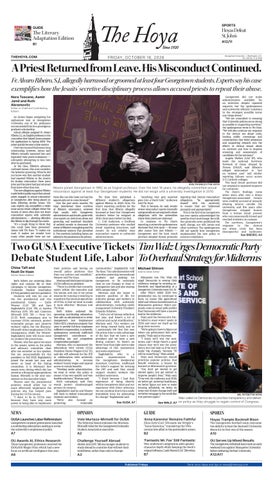
AVELYN BAILEY/THE HOYA
Ribeiro joined Georgetown in 1992 as an English professor. Over the next 18 years, he allegedly committed sexual misconduct against at least four Georgetown students. He did not resign until a university investigation in 2010. there like me who have not had the opportunity yet to come forward.” Over the past seven months, The Hoya interviewed three survivors of Ribeiro’s misconduct, reviewed their emails with Georgetown administrators and Jesuits, spoke with nine experts on clerical sex abuse and grooming, and examined hundreds of archival records to document the extent of Ribeiro’s wrongdoing and the institutional systems that permitted it. Two survivors, including James, are referred to by pseudonyms for privacy.
The Hoya first published a different student’s allegations against Ribeiro in 2020. Now, The Hoya’s reporting confirms for the first time that Ribeiro allegedly harassed at least four Georgetown students before he resigned in 2010, three years before he died. C. Colt Anderson, a Fordham University professor who studied Jesuit reporting structures, said Jesuits do not reliably relay misconduct reports to university administrators.
“Anything that gets reported goes into a black hole,” Anderson told The Hoya. That is because, he said, Jesuits review misconduct reports internally and generally are not required to share allegations with the universities where their priests are stationed. In response to The Hoya’s reporting, a university spokesperson disclosed that this April — 25 years after James first met Ribeiro — Georgetown and the local Jesuit province adopted formal protocols
requiring that clerical misconduct allegations “be appropriately shared” with the university to ensure they are “addressed promptly and appropriately.” This is the first time Georgetown has ever openly acknowledged the need for structural change. But still, the university never publicized the April change, nor told James and other survivors. The spokesperson did not specify how Georgetown implemented the new policy or ensures compliance.
Georgetown did not make administrators available for an interview despite repeated requests, but the spokesperson said university officials “condemn in the strongest possible terms any clergy abuse.” “We are committed to ensuring that University policies are as strong as possible in supporting survivors,” the spokesperson wrote to The Hoya. “We will also continue our response to the clerical sex abuse crisis, hosting public convenings and conversations that build awareness and supporting research into the effects of clerical sexual abuse on survivors and how to improve screening and assessments of candidates for the seminary.” Angela Walker (CAS ’87), who leads the national Survivors Network of those Abused by Priests (SNAP), said Ribeiro’s alleged misconduct is “not an isolated case” and similar reporting failures occur across U.S. Catholic colleges. The local Jesuit province did not respond to repeated requests for comment. The Hoya’s findings come seven years after over a dozen Georgetown-associated Jesuits were credibly accused of sexually abusing minors outside the university, and five years after Georgetown stripped honors from a former Jesuit provost who nonconsensually kissed and touched students on campus. For survivors, Georgetown’s response to the clerical sex abuse crisis has been disrespectful and lackluster. See RIBEIRO, A4
Two GUSA Executive Tickets Tim Walz Urges Democratic Party Debate Student Life, Labor To Overhaul Strategy for Midterms Chloe Taft and Noah De Haan Senior News Editors
Both tickets are centering labor rights and campus life in their campaigns to become Georgetown University Student Association (GUSA) president and vice president. Students will vote for one of the two presidential and vice presidential tickets — Zadie Weaver (CAS ’28) and Sam Baghdadchi (CAS ’29), or Ayesha Murtaza (SFS ’29) and Cameron Mirmelli (SFS ’29) — from Oct. 21-23. Both campaigns aim to increase GUSA outreach, protect vulnerable groups and preserve workers’ rights, but the MurtazaMirmelli ticket emphasizes GUSA transparency, while the WeaverBaghdadchi slate will focus more on student life protections. Weaver, who has spent two years in the senate, serves as the policy and advocacy committee chair after one semester as vice speaker. She ran unsuccessfully for vice president in Fall 2025. Baghdadchi joined the senate last year and serves as head of the dining committee. It is Murtaza’s first senate term, during which she has served as a financial appropriations liaison. Mirmelli is the only nonsenator on the executive ticket. Weaver said the presidential position would allow her to more effectively implement the policies she has helped pass during her GUSA tenure. “I want to be in GUSA exec because they have way more power in being able to implement
their policies and having an overall policy platform that they can enforce and establish,” Weaver told The Hoya. Murtaza said she hopes to improve GUSA’s efficacy as president. “There is a divide that currently exists within the executive and the senate, and one of my prime reasons for running is wanting to transform the internal operations of GUSA, is that we want to make it more effective,” Murtaza told The Hoya. Both tickets endorsed the upcoming non-binding referendum that calls on administrators to revise Georgetown’s Just Employment Policy (JEP), a keystone program that aims to provide full-time employees sufficient compensation. A university spokesperson previously reaffirmed Georgetown’s commitment to “providing fair and competitive compensation packages.” Murtaza, who co-sponsored the referendum with current GUSA President Darius Wagner (CAS ’27), said she will advocate for the JEP, in collaboration with university administration, to increase workers’ hourly wages and expand access to certain benefits. “Working under administration, we want to revise this policy to ensure it has very specific and very feasible solutions,” Murtaza said. Both campaigns said they would protect disadvantaged groups on campus. Baghdadchi said he and Weaver will work to defend international students and workers. “We’re also focused on protecting vulnerable
communities,” Baghdadchi told The Hoya. “Our administration will prioritize protecting international students and pushing for Georgetown to be extremely clear on any changes to visas or immigration law, and also staying with campus labor.” Murtaza said she hopes to improve qualities of life for minority groups and workers in collaboration with university administration, including newly inaugurated University President Eduardo Peñalver. “I did a lot of intense reflection last year, and there’s a lot of cultural and racial stratification,” Murtaza said. “Our workers are not being treated fairly, and so I particularly felt that this was the prime time to take advantage of the fact that we have a new president and we have a new dining contract. So there’s no better time than right now to take advantage of this momentum and some experience.” Baghdadchi, who is a union representative for the Georgetown Residential Assistant Coalition, reaffirmed his ticket’s support for revising the JEP and said they would support student workers like resident assistants. “I think because I had that experience of being directly within Georgetown labor and our experience with direct advocacy, we can combine that to be a really formidable force for advocating for change,” Baghdadchi said.
Michael Shtrom Events Desk Editor
Minnesota Gov. Tim Walz (D) urged Democrats to revamp their midterms strategy by centering authenticity and bipartisanship at a Georgetown University event Oct. 15. After Walz’s failed 2024 vice presidential run, he continued to focus on issues like agricultural relief and veteran homelessness as Minnesota’s governor. Walz’s proposals come as recent polls predict that Democrats will have a narrow lead in the midterms. Walz said the Democratic Party failed to meet voters’ needs in 2024 and must set itself up for long-term success. “We’re going to have to figure out where can government best serve people,” Walz said at the event. “I think we’ll win the midterms, and I think there’s a good chance that we’ll win the presidency, but God help us if we don’t make big changes, because ’32 will be something,” Walz added. Walz said Democrats should prioritize popular policies that benefit everyone, a lesson he learned as Minnesota’s governor. “You don’t get elected to get elected again; you get elected to improve people’s lives,” Walz said. “If we win the midterms and 2028, we better get universal healthcare, we better figure out how to make housing affordable, we better do some real climate change stuff and we better reengage in the world like NEL PETER/THE HOYA true partners again.” Walz called on Democrats to prioritize transparency and deliver See WALZ, A7 on policy as they struggle to regain control of Congress.
See GUSA, A7
NEWS
OPINION
GUIDE
SPORTS
GUSA Launches Labor Referendum
Vote Murtaza-Mirmelli for GUSA
‘Anna Karenina’ Remains Faithful
Hoyas Trample Bucknell Bison
A7
A2
B2
A10
GU Awards AI, Ethics Research
Challenge Yourself Abroad
‘Fantastic Mr. Fox’ Still Fantastic
GU Serves Up Mixed Results
A8
A3
B7
A12/A11
Georgetown’s student government launched a nonbinding referendum seeking to revise the university’s employment policy.
Three Georgetown professors received the $100,000 Magis Prize, which had a new focus on artificial intelligence this year.
The Editorial Board endorses the MurtazaMirmelli ticket for the GeorgetownUniversity Student Association executive.
Akshit Jain (SFS ’28) encourages students to study abroad in countries that will test their worldviews, rather than only in Europe.
Eliza Doty (CAS ’29) lauds Joe Wright’s “Anna Karenina,” translating the 19thcentury love affair to the postmodern screen.
Wes Anderson’s adaptation adds greater character depth while keeping the book’s orignal loftiness, Cash Moore (CAS ’28) writes.
Published Fridays
The Georgetown football team overcame two deficits to beat the Bucknell University Bison for its first win of the season.
The Georgetown volleyball team took an early weekend loss against Marquette University before defeating DePaul University.
Send story ideas and tips to news@thehoya.com
A2 | THE HOYA
THEHOYA.COM | FRIDAY, OCTOBER 16, 2026
OPINION EDITORIAL
Vote Murtaza-Mirmelli for GUSA This year’s Georgetown University Student Association (GUSA) elections come at a unique time for Georgetown: University President Eduardo Peñalver enters his first year, workers’ rights are front-of-mind and the university is weighing its next dining provider. The next GUSA executive will steer the student body through these challenges. While both executive campaigns boast expansive policy platforms that seek to enliven social life, decrease students’ financial burdens and support Georgetown workers and international students, the Editorial Board encourages students to vote for Ayesha Murtaza (SFS ’29) and Cameron Mirmelli (SFS ’29). Their promises to make GUSA more accessible, support the wider Georgetown community and strive for tangible, realistic policies make them the clear choice to lead GUSA. Most importantly, the Editorial Board commends Murtaza-Mirmelli’s focus on bringing GUSA closer to the student body. Only 37% of students voted in last year’s GUSA election — and that was a record turnout. As a whole, the student body seems apathetic and disconnected from their representatives, and the Murtaza-Mirmelli ticket could fix that. They aim to hold office hours and establish a standalone “transparency branch” so that students can both engage with GUSA and influence university decision-making. In an interview, Mirmelli said committing to transparency would not only help students understand GUSA’s goals, but also hold GUSA accountable. “It shouldn’t be something separate, and you shouldn’t have to send a message to an anonymous source and never get a response back,” Mirmelli told The Hoya. “We really want to bridge that gap by developing a transparency branch to keep us on track, with trackers on what we actually do in GUSA, rather than just this anonymous entity that’s supposedly doing things that students don’t really have a grasp of.” Murtaza and Mirmelli also seek to ensure the entire Georgetown community — including campus workers — feel they belong on campus. Mirmelli, a Georgetown Coalition for Workers’ Rights board member, has pushed to reform the Just Employment Policy, a 2005 standard that established protections for workers. The pair said they would work with the administration to revise the policy, aiming to increase the school’s minimum wage and expand benefits and resources. Georgetown’s workers are valuable members of our community and the next GUSA executive should support them in their struggle. Mirmelli said workers and students are fundamentally linked, arguing that workers deserve more attention for their contributions to Georgetown. “They’re the people who clean our rooms. They’re the people who make our food,” Mirmelli told The Hoya. “We live in this atmosphere together, and it’s about time we start listening to them, so that we can also appreciate all the things that they do for us,” she added.
HOYA HISTORY
This election also comes as Georgetown decides its dining contract, a pivotal front in the campus labor fight. Mirmelli’s hands-on experience in worker advocacy and the duo centering it in their campaign gave the Editorial Board confidence that they would be the strongest choice for Georgetown’s workers. Murtaza-Mirmelli also put an important focus on working against racial stratification at Georgetown, a predominantly white institution. If elected, they hope to establish a diversity week that highlights different cultures and create a new GUSA department that facilitates engagement across cultural clubs with bimonthly meetings. This change would help ensure that cultural clubs are adequately represented in GUSA and break down the divide between them. Murtaza said the duo’s background helps inform these changes. “Our backgrounds are diverse in the multitude of the work that we have done, and we hope that with our vision GUSA can be internally changed and optimized, so students feel heard,” Murtaza said. With this decision, the Editorial Board does not seek to downplay Murtaza and Mirmelli’s opponents, Zadie Weaver (CAS ’28) and Sam Baghdadchi (CAS ’29). Weaver and Baghdadchi’s platform is strong and takes many similar policy stances, alongside their plentiful GUSA experience. If students place a greater emphasis on developing artificial intelligence policy, preventing potential surveillance cameras or easing new club development, Weaver and Baghdadchi’s thoughtful frameworks are good choices. For the Editorial Board, however, Murtaza and Mirmelli’s priority on GUSA’s accessibility, as well as their narrow, realistic policy changes, make them the stronger ticket. To address laundry costs, for instance, Murtaza-Mirmelli proposes reviving a previous GUSA push for a feasible 50-cent decrease in laundry costs, rather than repeating GUSA’s unfulfilled promise of free laundry. While the Weaver-Baghdadchi platform is largely packed with good ideas, it is also simply packed. With their 35-page policy platform, it is difficult to gain a clear vision of what their administration would look like. In seeking to appease every corner of campus, the campaign sacrifices clarity and direction. Both campaigns are clearly dedicated to serving the student body’s interests, but the Murtaza-Mirmelli ticket offers a clear set of practical priorities. As Georgetown navigates labor rights, diversity issues and student engagement, students should be looking to elect a ticket that knows where to focus its attention and understands the limits of their promises. Vote Murtaza-Mirmelli on Oct. 21-23.
IN THIS WEEK’S ISSUE
“
As Georgetown navigates labor rights, diversity issues and student engagement, students should be looking to elect a ticket that knows where to focus its attention and understands the limits of their promises. Vote Murtaza-Mirmelli on Oct. 21-23. The Editorial Board
“Vote Murtaza-Mirmelli for GUSA” thehoya.com
POLL This week, the Editorial Board endorsed Ayesha Murtaza (SFS ’29) and Cameron Mirmelli (SFS ’29) based on their campaign to make the Georgetown University Student Association more accessible, support the broader Georgetown community and implement realistic policies. To gauge student opinion, The Hoya asked its readers whether they would be voting for the Zadie Weaver-Sam Baghdadchi or Ayesha Murtaza-Cameron Mirmelli ticket. Of the 99 respondents, 83.8% said Weaver-Baghdadchi, 8.1% said Murtaza-Mirmelli and 8.1% said they were unsure.
EDITORIAL CARTOON by Autumn Dunlop
The Hoya’s Editorial Board is composed of six students and is chaired by the Opinion editors. Editorials reflect only the beliefs of a majority of the board and are not representative of The Hoya or any individual member of the board.
Since its first issue in 1920, The Hoya has served to inform Georgetown’s campus dialogue. The following article is a glimpse into The Hoya’s rich history, allowing readers to appreciate the evolution of college journalism.
Restore Student Government: Bringing Back the Yard April 7, 2000
Over the last few weeks, a group of students has come together in an effort to bring authoritative student governance back to Georgetown University. Until the 1960s, the Yard functioned as a student government so formidable that even those with their hands in the university’s pockets listened to the students’ wants and needs. But in 1968, a few shortsighted freshmen brought down the long standing Yard in favor of an ineffectual system similar to those used in many high schools. Since that time, the student government has undergone frequent changes, including altering the basic administrative structure three times in the last 16 years. The current GUSA system consists of 16 voting representatives, with four students from each class forming the assembly. If brought back into power, the Yard would utilize a different, more effective system for representing the student body. The Executive Council of the Yard would consist of four class representatives, four Academic Council presidents, one housing representative and nine representatives elected by student organizations on campus. The Yard General would consist of representatives from all recognized student organizations. In addition, there would be three positions open to a campus-wide general election: president, secretary and treasurer. Thus, in conflicts with the administration, the president of the Yard could
appeal to the student organizations as a whole for support. The Students Activities Commission, a GUSA-appointed student body that allocates funds to student organizations, is currently the only vestige of real power. On top of its high overhead, the SAC abuses its powers by threatening to withhold money from noncompliant clubs. Past abuses include the SAC’s failed attempts to withhold money from GUSA in 1999 and the Philodemic Society in 1995. This year, a $300 difference (favoring the Democrats) exists between the funding for the College Republicans and the College Democrats, despite the fact that the College Republicans offered more programming last year. The Yard government would end the biased treatment of clubs by returning fiscal power to the students. Under the auspices of the Yard, each semester 75 percent of the budget for student programs would be divided equally among the undergraduate population and the remaining 25 percent would go into a general fund. Each student could then allocate his or her portion of the budget to the club of his or her choosing. Organizations could easily raise dues, which requires a special bureaucratic procedure under the current system. In addition, dues would not be subject to taxation, as they are under the SAC. There would still be a student oversight committee that would prevent club officers from spend-
LETTER TO THE EDITOR AND VIEWPOINT POLICIES The Hoya welcomes letters and viewpoints from our readers and will print as many as possible. To be eligible for publication, letters should specifically address a recent campus issue or Hoya story. Letters should not exceed 300 words. Viewpoints are always welcome from all members of the Georgetown community on any topic, but priority will be given to relevant campus issues. Viewpoint submissions should be between 600-700 words. The Hoya retains all rights to all published submissions. Send all submissions to: opinion@thehoya.com. The Hoya reserves the right to reject letters or viewpoints and edit for length, style, clarity and accuracy. The Hoya further reserves the right to write headlines and select illustrations to accompany letters and viewpoints. CORRECTIONS & CLARIFICATIONS If you have a comment or question about the fairness or accuracy of a story, contact Executive Editors Nico Abreu, Opal Kendall and Ajani Stella at executive@thehoya.com. NEWS TIPS News Editors Noah De Haan and Chloe Taft: Email news@thehoya.com. Guide Editors Anandita Agarwal and Isabelle Cialone: Email guide@ thehoya.com. Sports Editors Sam Fishman and Ethan Herweck: Email sports@thehoya. com.
ing funds for personal expenditures and distribute the general fund to organizations like the Georgetown Program Board, which does not have a direct membership. Students choosing not to allocate their funds would return them to the general fund. The new system would require only a single accountant, eliminating the many unnecessary salaried administrators in the Office of Student Programs, particularly those who work with the SAC. A direct student funding system forces each club to compete in the marketplace of ideas rather than artificially existing under the SAC system. The unresponsiveness of the university administration comes from a disrespect of students that can only be overcome by actions from an active population. Despite the best intentions of our dedicated friends in GUSA, it remains a system in which representatives cannot mobilize students. Many students do not realize this. To create a student government such as the Yard requires powerful and influential student leadership, as seen in the Yard of years before. The Yard system allows students to create strong student organizations separate from stifling administrative control, participate in a student government capable of action and revive a unique Georgetown tradition. Jack Ternan
GENERAL INFORMATION The Hoya is published once a week during the academic year with the exception of holiday and exam periods. Address all correspondence to: The Hoya Georgetown University Box 571065 Washington, D.C. 20057-1065 The writing, articles, pictures, layout and format are the responsibility of The Hoya and do not necessarily represent the views of the administration, faculty or students of Georgetown University. Signed columns and cartoons represent the opinions of the author(s) and do not necessarily represent the editorial position of The Hoya. Unsigned essays that appear on the left side of the editorial page are the opinion of the majority of the editorial board. Georgetown University subscribes to the principle of responsible freedom of expression for student editors. The Hoya does not discriminate on the basis of age, gender, sexual orientation, race, disability, color, national or ethnic origin. © 1920-2026. The Hoya, Georgetown University weekly. No part of this publication may be used without the permission of The Hoya Board of Editors. All rights reserved. The Hoya is available free of charge, one copy per reader, at distribution sites on and around the Georgetown University campus. Email: editor@thehoya.com Online at www.thehoya.com Circulation: 1,000
Founded January 14, 1920
Nora Toscano, Editor-in-Chief
Nico Abreu, Opal Kendall and Ajani Stella, Executive Editors Jackson Roberts, Managing Editor Noah De Haan, News Editor Chloe Taft, News Editor Jacqueline Gordon, Features Editor Serene Pai, Features Editor Thejas Kumar, Opinion Editor Leo Zhang, Opinion Editor Anandita Agarwal, Guide Editor Isabelle Cialone, Guide Editor Sam Fishman, Sports Editor Ethan Herweck, Sports Editor Angela Lekan, Science Editor Eva Siminiceanu, Science Editor Lucy Jung, Design Editor Anish Raja, Design Editor Elizabeth Hoerter, Copy Chief Allison Ma, Copy Chief Grace Rutherford, Copy Chief Katherine Hart, Blog Editor Yaya Hang, Multimedia Editor Miranda Kristina Santiago, Multimedia Editor Matthew Gassoso, Photo Editor Ella O’Connor, Audience Editor Caroline Woodward, Audience Editor
Board of Directors
Paulina Inglima, Chair
Ruth Abramovitz, Bethe Bogrette, Maren Fagan, Tanvi Gorripati, Aamir Jamil, Annikah Mishra
Connor Manrique-Johnson, General Manager
Rosie Garner, Director of Business Operations Jackson Roberts, Technology Director
Andrew Jiang Academics Desk Editor Annie Quimby Student Life Desk Editor Liv Sanchez Graduate Desk Editor Brendan Fijol City Desk Editor Joshua Lou GUSA Desk Editor Michael Shtrom Events Desk Editor Caroline Garland Deputy Features Editor Sophia Tully Deputy Features Editor Caden Larrenaga Deputy Opinion Editor Juan Almanza Deputy Guide Editor Eliza Doty Deputy Guide Editor Grace Ko Deputy Guide Editor Eliana Kut Deputy Guide Editor Penelope Snoep Deputy Guide Editor Finn Balon Deputy Sports Editor Golnar Jalinous Deputy Sports Editor Jacob Nolan Deputy Sports Editor Sasha Ahmad Deputy Science Editor Jaya Alenghat Deputy Science Editor Kaitlyn Lee Deputy Science Editor Adhithi Rajesh Deputy Science Editor Maddie Williams Deputy Science Editor Autumn Dunlop Deputy Design Editor Abby Kopf Deputy Design Editor Emilie Andrews Deputy Copy Editor Lucas Liang Deputy Copy Editor Sebastian Pallant Deputy Copy Editor Serena Nguyen Deputy Copy Editor Vivian Welch Deputy Copy Editor Connor Emmert Deputy Photo Editor Rohini Kudva Director of Human Relations Jacob An Director of Logistics Stefano Rangel Haddad Director of Outreach
THE HOYA | A3
FRIDAY, OCTOBER 16, 2026 | THEHOYA.COM
OPINION
VIEWPOINT • JAIN
Challenge Yourself Abroad “Think of a time you felt most unfree,” my philosophy professor asked us. I was last to answer: Driving home late one night in India, I was stopped by a police officer who must have liked the look of my car. Zero on the breathalyzer, but he asked for money anyway. An audible gasp went across the room. The apparent novelty of my experience surprised me. That night, I had to briefly become someone I did not recognize, just to get home. I learned that the system meant to protect you only holds until someone tests it. It could happen to you too — not necessarily the bribe, but the moment when something you have always trusted simply stops holding, and you find out what you would trade to get through it. Many of us at Georgetown University never find that out because we never choose to. So when you choose your semester abroad, choose somewhere that asks something of you. The School of Foreign Service reports that over 80% of its undergraduate students choose to study abroad — the vast majority of whom study abroad in European countries. There is value in a semester with language-seminar mornings, museum afternoons and tapas evenings. This new rhythm undoubtedly changes you for the better. But it rarely teaches you the one thing choosing a more unfamiliar place will: The systems holding a country together are built and sustained daily by choice, not natural law. You do not learn what I am describing by watching your own systems hold. You learn it by watching a weaker one straining to hold. This choice can free you, not just test you. Someone once asked me what I loved most about the United States. I said the supermarkets, particularly the cereal aisle. I was not joking. Back home, groceries mean multiple stops. At Safeway, I stood still for 10 minutes in front of 30 brands of the same food, choosing nothing, just marveling at how much choosing there was to do. It is the most “free” I have ever felt — over something as little as a cereal box. Choosing where to study abroad provides an even wider aisle of options, yet I see most of us reach for the same shelf: Europe. To be clear, I am not asking you to fix anyone’s school or feel grateful in front of someone’s poverty (what Georgetown professor Shareen Joshi terms
saviorism). I am asking you to observe a system operating somewhere it is not guaranteed to work — do not touch it, help it or be the hero. You will still leave with what you learned from watching those people and that system. But nothing is asked of it in return. Rather, something real is asked of you. That night in India asked for around 30 seconds of my dignity and some money. I could afford it. Someone with fewer resources in that seat may not be able to, so for them the stakes are completely different. A failing institution means something different for everyone, and Georgetown students should seek to understand that. Over the past 18 months, I have started to feel that unease again here — the hallmarks of a trusted system quivering. You can probably guess what all I am referring to. I would not list them myself, since I am here on a visa, writing under my own name. That itself should tell you about how close to the bone this is starting to feel. What took 250 years to build and hold can be brought down in days. Tomorrow that officer could be stopping you in Foggy Bottom, for he is not a uniquely Indian character. He is the product of a system that people chose not to hold up. So here is what I am asking: Go abroad somewhere where your safety net is not similar to the one you have here. I do not mean somewhere unsafe, but somewhere more than a destination. Somewhere a system you have never had to question may just show you its seams. Perhaps not Florence, not St. Andrews, not a Centennial Lab with all the uncertainty pre-removed. Go see that a system is built and kept up by choice, because the second you know that, you cannot see your own the same way again. I did not take that route myself. The privilege of an international education already tested my assumptions, so these four years, in a country turning 250 and fraying at the edges, are my own time abroad. A friend once told me that maybe something greater might come from this hard passage. I think he is right, but that greatness will only be attained through people who know how to find the rough cracks. Akshit Jain is a junior in the School of Foreign Service.
MATTHEW GASSOSO/THE HOYA
VIEWPOINT • BRAHAM
Stand Against Hateful Rhetoric; Engage Respectfully On Oct. 7, the third anniversary of the deadliest day for Jews since the Holocaust and one of the largest hostage crises in modern history, someone chalked “glory to our martyrs” in Georgetown University’s Red Square. To whoever did it and to anyone else who stood by: I want to take you seriously. We have all watched this war with real anguish. Tens of thousands of Palestinians have been killed, and grief for them is legitimate. Your right to say so in Red Square is not in question, and I would defend it. But words land in a time and a place. On Oct. 7, 2023, roughly 1,200 people were brutally murdered, and 251 were taken hostage. Regardless of what you meant, “glory to our martyrs” written on that day reads to many as glorifying the people who carried out that massacre. You chose the anniversary. You chose the square that grieving students walk through. Ask yourself why. Words like these do not only wound Jewish students. They tell the Georgetown community that someone’s grief is fair game. They also don’t work. Celebrating violence has never relieved anyone’s suffering, on campus or anywhere else. It hardens the people you most need to persuade and makes peace harder to imagine. So, as a cofounder of the Georgetown Jewish Alliance, a graduate affinity group,
I’m asking every Hoya who cares about suffering in this war to do two things. Speak up when anyone, on any side, celebrates violence. And then put that care into work that actually helps. Every career worth having will ask you to work with people whose history, faith or politics you find hard to accept. Diplomats sit across from adversaries. Doctors treat patients whose views they find abhorrent. Lawyers negotiate with the other side, and founders build teams from people who disagree. The people who have real impact on the world are rarely the ones who wound their opponents most cleverly. They are the ones who can sit in a room with someone they disagree with and still find a way to build something together. Red Square is practice for the rest of your life. If you cannot extend basic decency to your classmates, how will you do it in a negotiation, an operating room or a boardroom? For those who care deeply, as I believe many Georgetown students do, there are better ways to put that care to work. Start by helping the people suffering, and doing it together. When Dr. David Hasan, a Palestinian American neurosurgeon, operated on wounded children in Gaza, he wrote that he also paid local Palestinians to help search for Israel’s hostages because “pain does not discriminate.”
In July 2025, he opened the Academy of Hope in the Gaza city of Deir alBalah, giving hundreds of orphaned children schooling, hot meals, medical care and therapy. Thousands of Israelis and American Jews then helped fund a second academy for 1,500 more orphans. Jewish donors feeding Palestinian orphans and a Palestinian doctor funding the search for Israeli hostages is what caring for both peoples looks like in practice. We can bring that model home. Organizations like the Parents Circle-Families Forum send pairs of bereaved parents, one Israeli and one Palestinian, to speak together about choosing reconciliation over revenge. Standing Together, a grassroots movement of Jewish and Arab citizens of Israel, organizes side by side for peace and equality, even in the hardest moments of this war. Imagine Jewish and Palestinian student groups co-hosting these speakers in Red Square, the same space that was chalked on Oct. 7: planning together, sharing the stage and staying for the tough questions afterward. Listening is harder than chalking, and it lasts longer. And study the conflict alongside the people who see things differently. Take a course at Georgetown’s Center for Jewish Civilization and one at its Center for Contemporary Arab Studies, ideally with a classmate who disagrees with you. Approaching
disagreement with curiosity leads to better questions, stronger arguments and, with luck, a new friend. These approaches also work better. A widely cited 2020 study by researchers at Stanford and the University of Toronto found that extremist and provocative messages actually alienate the people you most need to reach. If your goal is a better future for Palestinians, words that hurt your Jewish classmates on their day of mourning probably moved no one closer to it. None of this requires anyone to stop believing what they believe. It only asks for actions that build something rather than tear others down. To our Jewish students: I know Oct. 7 in Red Square hurt. You are not alone, and Georgetown graduates stand with you. To everyone else: Georgetown gives you Red Square as a place to argue, persuade and engage. Use it in a way you will be proud of in 10 years. Georgetown calls us to be people for others, and cura personalis asks us to care for the whole person. Neither is just a slogan for orientation week. And neither stops at the people who agree with us. Both are choices you make every day. Dr. Sabrina Braham (COL ’95) is a co-founder of the Georgetown Jewish Alliance, a graduate affinity group.
VIEWPOINT • HUI
VIEWPOINT • FAIRBANKS
Take Advantage of Your Civic Duty; Vote Protect International Students’ Careers
A
s a Georgetown University student, political engagement can feel like a given. Not only is our campus situated in the nation’s capital, but it also boasts some of the best higher education programs for government and international relations. Red Square is consistently filled with protests, people pushing for political change and politically active student organizations. This unique political culture can, however, lull Georgetown students into a false sense of complacency. The simple fact that you attend Georgetown is not enough to be engaged with politics. Voting is the step that Georgetown students must take in order to stay informed, be politically engaged and influence the government that creates policies impacting our everyday lives. Our university is uniquely situated to make change due to our location and status. As a student in Washington, D.C., your vote is your connection to making a difference, and it matters if you choose to exercise it. Understandably, politics and government are not everybody’s life calling. Especially at Georgetown, it can be easy to feel stifled by a drive for political involvement. Not every person needs to be the most politically engaged citizen, but informed voting is the one step that every person — especially every Georgetown student — should take to avoid complacency. If we live with the consequences of government policy, it is our responsibility to take part in voting for those decision makers. Now, fewer than three weeks before the midterm elections, research candidates, understand your voter registration and make a concrete voting plan. Your vote
is a statement about how you want to shape the future — and it makes a difference. As college students, voting is especially important now. In the 2012 and 2016 elections, student voter turnout showed an upward trend. However, college students’ participation rates dropped in 2024 from 2020, according to data from the National Study of Learning, Voting, and Engagement. Barely more than half of eligible college students voted. This decline is concerning. Regardless of your party affiliation, your vote will impact your life. Whether you are a firstyear with four years left on the Hilltop or a senior who is about to enter the job market, our leaders’ policies directly impact your college life or the economic market that you are entering. Your vote now will change your life and reality and the future, and you must act now so that your future matches what you want our reality to be. My first urge to the Georgetown student body is to prioritize voting. Heading into the midterm elections, let Georgetown be a campus that leads in studentvoter turnout. Take advantage of our location, government classes, speakers and political culture to help inform yourself when you cast your ballot. Capitalize on the upward tick in college voting and counteract the recent drop in turnout. College voting is not always straightforward. Mail voting can be difficult, but it is important to work through those difficulties. Do the research to find out your state’s regulations and deadlines, and educate yourself about who and what appears on your ballot. Visit the
T
o prospective students, Georgetown University touts its Washington, D.C. location as one of its biggest professional advantages. The campus sits just minutes away from Capitol Hill, near embassies and across the river from even more consulting firms. But as an international student, I have learned being surrounded by opportunities does not always mean being able to access them. In August, the Trump administration advised universities that curricular practical training (CPT), which authorizes international students to work off-campus jobs related to their academic programs, should only be approved when graduation would otherwise be “an impossibility.” In response, Georgetown, like many universities across the country, suspended elective CPT approvals — meaning Georgetown international students cannot work off campus unless required by their major curriculum. Among Georgetown’s undergraduate schools, only majors in the School of Nursing and the School of Health include requirements that qualify under the policy. This leaves the vast majority of international undergraduates, including me, unable to receive CPT authorization for elective jobs and internships. As a government major, I had hoped Georgetown’s location would allow me to explore careers in policy and public service before I graduated. I planned to pursue an internship in the coming year, but under the new policy, getting an off-campus job — even one directly related to my major — will likely be impossible. Without this opportunity, I am limited not only in the experience I can gain now, but also in the career Callie Fairbanks is a paths I can pursue after graduation. Georgetown cannot change federal sophomore in the College of immigration rules. But it can build Arts & Sciences. nonpartisan Andrew Goodman Foundation, which Georgetown partners with, to find resources and information. Do not let the trials of college voting stop you from staying civically active and influencing the future of the nation we share. My final urge is to vote more than just every four years. Presidential elections may feel like they have all of the weight and impact, but your vote is also needed between presidential election cycles. Showing up for all elections, especially midterms this November, is vital to securing representation in our government. Midterm elections will determine who has control over the U.S. House of Representatives and the Senate, which will in turn impact legislation and policy on both the state and federal levels. Midterm and local elections are still widely influential and important in the United States, and representation through voting is vital for elections between presidential cycles. Georgetown students are inevitably surrounded by politics, politically engaged peers and history in action. However, do not let that overwhelm or stop you from taking the vital action that is voting. Develop a voting strategy, research your candidates and start the process now. Do not let requesting an absentee ballot or registering to vote prevent you from voting. Your vote is your chance to be empowered and impact the course of the United States’ political future; take the opportunity.
a clearer and more accessible career system by identifying visa-accessible positions, expanding meaningful on-campus work and strengthening pathways for students to work at eligible international organizations. Georgetown’s Office of Global Services (OGS) already publishes information about the work authorization process. The Cawley Career Education Center also offers some specialized resources for international students, like a spreadsheet of companies that recently hired Georgetown F-1 students through CPT or optional practical training (OPT), another type of work authorization. However, because the spreadsheet reflects hiring before Georgetown tightened its CPT policy, it no longer reliably shows current undergraduates which opportunities they are eligible to pursue. In my own search, job descriptions have not always clearly stated whether a position is open to F-1 students or requires unrestricted work authorization. Students may spend hours preparing an application before discovering they are not eligible for the position. Cawley should create and regularly update a positionspecific list of current openings international undergraduates can pursue legally, including on-campus roles and positions at qualifying international organizations. Unlike its existing record of past employers, the list should identify the authorization route for each opening, helping students focus on positions they can actually accept. Georgetown must also expand professional opportunities on campus. Unlike most offcampus internships, on-campus employment generally does not require CPT, and F-1 students can work for the university up to 20 hours
per week during the academic term. This semester, I began working as a teaching assistant for a Chinese course. It is not a substitute for an off-campus internship, but the position has helped me develop communication, organization and teaching skills. Additional paid research and teaching assistantships, communications positions and department-based roles could give other international students similar opportunities. These jobs cannot replace every internship, but they can help close the experience gap created by CPT restrictions. Finally, Georgetown should build stronger recruiting connections with nearby international organizations that have separate pathways for F-1 work authorization. International students can work for the World Bank and International Monetary Fund, for example, but must be authorized by the federal government — not their universities. Because authorization can take months, OGS and Cawley should introduce this option earlier through advising sessions, while inviting eligible organizations to targeted recruiting events. International students do not expect Georgetown to change federal immigration rules or guarantee internships. We do expect, however, that the university recognizes its celebrated D.C. advantage is not experienced equally. Georgetown owes its international students more than an explanation of these restrictions. It should take meaningful steps to close the professional opportunity gap they create. D.C. may be an extension of Georgetown’s classroom, but international students should not be left standing outside it. Keyi Hui is a junior in the College of Arts & Sciences.
THEHOYA.COM | FRIDAY, OCTOBER 16, 2026
A4 | THE HOYA
INVESTIGATION
Ribeiro’s Case Captures the Secretive, Ineffective Reporting Structure Across Jesuit Higher Education, Researchers Say
ILLUSTRATION BY AVELYN BAILEY/THE HOYA
RIBEIRO, from A1 James said universities’ integrity is measured by whether they go into “cover-up mode” or “reparations mode” after abuse comes to light. “As much as we would want a world where there is no misconduct of any kind, there’s always going to be misconduct,” James said. “When it happens, the question becomes: How does an institution react to it?” he added. Ribeiro’s History of Misconduct Almost a decade before James graduated, Steven Slawinski (CAS ’97) enrolled in Ribeiro’s Fall 1995 “Prize Novels” class. The 48-year-old priest sexually harassed him for the next two years, Slawinski said. He often made sexual comments in Slawinski’s class, and invited students to dinner in Copley Hall, where he was a chaplain-in-residence. When Ribeiro then proposed sleepovers to Slawinski — who was a resident assistant in the upperclassman dorm Village C — Slawinski said he was unsettled. “What I remember him saying all the time was, ‘If things are too crazy over at Village C, you can come over here and sleep over here, but be careful, because I sleep naked,’” Slawinski told The Hoya. It was during a class movie screening that Ribeiro’s behavior reached a “turning point,” Slawinski said. Sitting in a dark library room, Slawinski felt the priest’s hand traveling up his leg and thigh. “I was shocked,” he said. “I knew what it was, but I didn’t know what it was, and I just froze.” Slawinski ultimately took three courses with Ribeiro and graduated in Spring 1997. The two kept in touch, and Slawinski later asked the priest if he should return to work at Georgetown. Ribeiro encouraged him not to, Slawinski recalled. By then, Slawinski said, Ribeiro was “probably onto” John. John, whose allegations The Hoya first reported in 2020, met Ribeiro as a sophomore in Fall 1997, when the priest was his professor and chaplainin-residence. Like Slawinski, John said Ribeiro made inappropriate comments in class and in the dorm. In December 1997, John said Ribeiro “whispered” in his ear and hugged him in a Copley common room. “He’s like, ‘Hey, you got an A in my class,’ and he goes, ‘Not many people do. Can I get a hug?’” John told The Hoya. The following spring, John recalled Ribeiro talking about phallic poetry while John did laundry. Days later, he offered John a Playboy magazine, alcohol, a suit, a sit-down dinner and a trip to a movie, all of which John declined. A few weeks later, John said, Ribeiro followed John into the Yates Field House sauna, took off his own towel and shook his penis in front of him. John reported Ribeiro to Rev. William Byron, S.J., the rector, or head, of the Georgetown Jesuit Community later that semester. Soon after, Ribeiro left campus and did not return until Spring 2000, according to university records. In 2020, The Hoya independently confirmed three family members and friends heard about John’s allegations during and after the misconduct. Georgetown has never specified whether the Jesuits notified university administrators of John’s allegations — or any similar cases — in 1998. The former College of Arts & Sciences dean, Rev. Robert Lawton, S.J., and several English professors who worked with Ribeiro told The Hoya they did not know of any reports at the time.
In a statement for this article, Georgetown disclosed a novel information-sharing agreement with the Society of Jesus, but did not specify how it implemented the policy or ensures compliance. James said he has no “basis for confidence” that it would have protected him from Ribeiro’s misconduct. Regardless of whether the Jesuits told Georgetown officials about Ribeiro’s misconduct, John said the school should have recognized the situation when Ribeiro was placed on leave and removed as a chaplain-in-residence. “It’s their responsibility,” John said. “How would the school not know about it if he was kicked off the floor as a floor chaplain?” James did not know about John or Slawinski when he met Ribeiro three years later. The following spring, he was studying abroad at the University of Oxford when Ribeiro invited him to dinner. They met at Ribeiro’s hotel, where James said the priest wore only a towel. “I was uncomfortable. I believe that I tried to remain in the hallway, but he invited me into his room and asked me to sit on the bed,” James wrote in a 2018 report to the Maryland Province, the local Jesuit district. Back at Georgetown the next year, James visited Ribeiro’s offcampus residence several times, often for lunch and a Mass in the Jesuits’ private chapel. During at least one visit, Ribeiro told James he sunbathed nude on the deck, James later wrote in the report. He also said the priest occasionally kissed him on the cheek and hugged him for long periods of time. Despite feeling uncomfortable, James did not realize the behavior was inappropriate until he became a professor years later — a telltale sign of grooming, according to experts. “In retrospect, having spent 15 years as a college professor, I would never think about doing that,” James said. “But anyway, at the time, I just felt very singled out and special.” When James visited the home of Ribeiro’s relative in rural England as a graduate student, the priest suggested James take his shirt off and stay the night. James remembers feeling scared; he stayed in a guest room and locked the door. A few years later, Ribeiro invited James to a private lunch and Mass in Washington, D.C. The priest asked James to his room, grabbed him and tried to kiss him, James said. He pushed Ribeiro away. “He became very emotional and told me that he himself was gay and did not know what to do about it,” James said. “He told me that he was depressed and sad. I believe that I told him that I was sorry to hear that. I sought to get out of the room and the residence as soon as possible.” When James detailed Ribeiro’s behavior to the Jesuits in June 2018, the head of the Maryland Province wrote a letter acknowledging and apologizing “for the misconduct of the late Alvaro Ribeiro, S.J. against” him. Ribeiro continued teaching until he resigned in Spring 2010. Ten years later, Georgetown acknowledged that Ribeiro’s resignation followed an Office of Institutional Diversity, Equity and Affirmative Action (IDEAA) investigation that found he engaged in “unwanted touching of students’ posteriors while clothed.” According to the university spokesperson, Ribeiro did not live or work at Georgetown or any other university from that time until his death in 2013. Steven, John and James’ accounts, alongside the separate incident investigated by IDEAA, suggest Ribeiro abused or harassed at least four Georgetown students. It remains unclear if Georgetown ever knew about Ribeiro’s misconduct before the IDEAA inquiry.
Split Systems When John reported Ribeiro to Byron, the Georgetown rector, he assumed the Jesuits would inform university officials about his allegations. But experts say that likely never happened, and multiple Georgetown administrators who oversaw student life and conduct at the time have no recollection of any communication. The Catholic Church and Jesuit universities have long used a bifurcated reporting structure that channels misconduct complaints made directly to a Jesuit through private, internal processes — often without notifying the associated school. According to researchers who study clerical sex abuse, this siloed system fails to protect vulnerable students from reoffending priests. Anderson, the Fordham professor, said Catholic leaders’ emphasis on the church’s reputation makes Jesuits less willing to share misconduct reports with school officials and unable to effectively punish one another. “They have difficulty balancing the rules governing community life with policies at the school,” Anderson said. “At each step, all the information goes to one person, and that one person decides whether to move it up the chain, but if they move it up the chain, they probably never hear what the result is,” Anderson added. Ribeiro’s case appears to fall into this pattern. Penny Rue — Georgetown’s senior associate dean of students from 1995 to 1999, who sat on an internal sexual assault working group — said the Jesuits rarely sent misconduct reports to the university’s sexual assault services. “I can’t see how it would, unless the one who was reported had an issue of conscience,” Rue told The Hoya. John said when he met with Byron, the rector did not ask followup questions and the meeting lasted only 20 minutes. John never heard back from the Jesuits or Georgetown officials. Byron died in 2024, but when The Hoya contacted him for the 2020 story, he declined to comment, citing confidentiality agreements between rectors and Jesuits. Bethany Marlowe, Georgetown’s associate dean of students from 1986 to 2001, said that while she regularly liaised with the Jesuits, they “handled their own things” and did not share information with her. Neither Rue nor Marlowe, who both were familiar with Georgetown conduct cases at the time, remembered hearing about allegations against Ribeiro or any other priest. Marlowe could not recall a single instance during her tenure where a Jesuit relayed a complaint made against another Jesuit. Walker, the SNAP director, said that when ministers at nonsecular colleges face misconduct allegations, religious organizations “try to sweep them under the rug.” “The priest is moved from one assignment to another,” Walker told The Hoya. “When that happens, the likelihood that there will be more people victimized increases exponentially,” she added. The Boston Globe first publicized how the Catholic Church systematically concealed sexual abuse allegations in 2002 — by relocating accused priests without notifying the public. Sixteen years later, after a Pennsylvania grand jury report named over 300 priests credibly accused of sexually abusing over 1,000 children, Catholic provinces across the country released similar lists.
That led The Hoya to report on the “Georgetown 14” — the Georgetownaffiliated Jesuits named in the Maryland Province’s list. But the Jesuits’ subsequent response focused primarily on minor abuse — which experts and survivors say perpetuates misconduct against vulnerable adults like college students. Since Ribeiro allegedly harassed legal adults, the Maryland Province omitted him from its list. Elizabeth Jeglic, a John Jay College of Criminal Justice professor who researches sexual grooming, said college students are “particularly vulnerable” to abuse, especially by religious figures, because they are still developing. Before the list’s release, James raised these concerns with Mike Gabriele, the Maryland Province’s communications director. In emails reviewed by The Hoya, Gabriele reaffirmed that the province would only name priests accused of misconduct against minors, which James saw as “a reaffirmation of a tactic that has been used throughout this process to limit the scope of the church’s revelations.” “Nothing magically changed on my 18th birthday to give me the capacity to resist the grooming from Ribeiro, and so it seems to me highly myopic of the Jesuits and other church authorities to draw this line,” James said. Hollow Commitments That split reporting system did not appear to change until this April, when Georgetown and the Society of Jesus implemented novel informationsharing requirements — over 30 years after Ribeiro began his alleged misconduct against Slawinski, and six years after The Hoya first established that the Jesuits knew about Ribeiro’s conduct as early as 1998. The Georgetown spokesperson’s Oct. 14 statement was the first public admission of any such arrangement. It did not specify what the “formal protocols” entail or what compliance looks like. When specifically asked earlier in October whether misconduct reports made to Jesuits are automatically shared with the university, a Georgetown official evaded the question and did not mention the April agreement, saying the school is prioritizing communication improvements — the same promise the university has made for years. James, who only found out about the change from The Hoya, said that although the protocols are welcome news, he has no “basis for confidence” that they would have protected him from Ribeiro. “Given that one of the failures of the Jesuits throughout this entire process was a failure of transparency, the fact that these protocols were developed and put in place without any communication to survivors that we know of is disheartening — but it also fits the pattern,” James said. Over the past seven years, the university has publicized resources for survivors of clerical sex abuse, which the spokesperson pointed to as evidence of the university’s support systems. In 2021, multiple graduates accused the late former Provost J. Donald Freeze, S.J., of sexual misconduct, and Georgetown stripped him of his title and honors. Former University President John J. DeGioia (CAS ’79, GRD ’95) also established a board of directors working group to “ensure transparency and informationsharing” with the Jesuits, and Georgetown created a page on its Title IX website dedicated to clerical abuse.
But five years later, the working group appears defunct, and the webpage contains the same language it did in 2021. The Title IX website still identifies the working group as “ongoing” university work to prevent clerical abuse, but it was never listed on the board of directors’ website, and all three directors originally appointed to the group no longer serve on the board. The website contains no information about the April policy change, which came years after survivors of Ribeiro’s misconduct first raised concerns about how Georgetown handles Jesuit misconduct reports. They say the Jesuits and Georgetown must do more. James met directly with highranking Georgetown officials to discuss Ribeiro in Fall 2019, after he filed a separate report with the Maryland Province in September 2018. The province offered to pay for some of his therapy bills, but rejected his other demands, including that the Jesuits provide a full timeline of reports they received about Ribeiro. Georgetown officials later ignored James’ request to publicly name priests accused of misconduct against non-minors. “It did not feel to me that the university had much energy or enthusiasm for making those points in any way that I could see,” James said. In March 2020, when Slawinski contacted Georgetown’s Title IX office — becoming the third known person to report Ribeiro for sexual misconduct — administrators sent him a list of sexual misconduct support services. But they did not address his core concern: that what happened to him would be repeated. Slawinski quit his position as a Georgetown admissions interviewer a few years later because he could no longer honestly tell prospective students that the university was safe. “It got to the point where I couldn’t live with myself,” Slawinski said. “People were asking me who my favorite professor was and what my favorite class was, and I was either having to lie to them and tell them it wasn’t this priest, or I was having to live with what had happened in this class.” “The university didn’t live up to its obligations to me,” he added. In February 2023, Georgetown’s Title IX office hired Mike Riley, a Texas-based support coordinator for survivors of clerical abuse. When Slawinski reached back out that May, the office put him in contact with Riley — which showed to Slawinski that the university failed to make sexual-misconduct prevention an institutional priority. “Today, it just seems like you contact Title IX, and they push you off to a therapist in Texas, and that’s their way of dealing with things,” Slawinski said. In a statement to The Hoya, Riley said he lets survivors dictate sessions and acts as a “liaison” with Georgetown, coordinating meetings and communication with university officials — always with survivors’ “consent and at their direction.” John, meanwhile, said no one ever reached out to him after he reported Ribeiro to the Georgetown rector. “It was like it never happened,” John said. Rosemary Kilkenny — Georgetown’s chief diversity officer and vice president for diversity, equity and inclusion — said abuse and harassment “run
contrary to our values.” “Our commitment to maintaining a safe university environment compels us to handle these cases with great care and compassion to support the survivors who report them,” Kilkenny wrote to The Hoya through the spokesperson. Samantha Berner, the director of Title IX compliance, added that Georgetown reviews each report and takes “appropriate action in response through Georgetown’s established processes.” Anderson, the Fordham professor, saidthatwhilebetterTitleIXresources are a start, addressing the clerical sex abuse crisis requires a culture shift and “radical transparency.” John Fortunato, another Fordham professor who researched university responses to the church’s sex abuse revelations, said schools must continually discuss the crisis because “it could potentially be ongoing, and therefore we need to be vigilant.” Some Jesuit schools have dedicated websites and projects to grappling with the ethical complications of clerical sex abuse at their institutions. Georgetown, meanwhile, has only published reporting information on its Title IX site and hosted general academic conversations. Through public announcements, Georgetown has recognized the misconduct of five priests it previously employed, and one other who held an honorary degree. Georgetown has only acknowledged its connections to nearly a dozen other abusive priests in statements to student media. Allison Errico (CAS ’26) — a former member of the Sexual Assault Peer Educators (SAPE), Georgetown’s main educational resource on sexual misconduct — said the university never directed the group to cover clerical abuse in their trainings. “I really do think that we missed the mark on thinking about preparing students for or talking about what happens if faculty or staff are harming or abusing students,” Errico told The Hoya. Seven years after James first asked the university to publicize the names of all Georgetown Jesuits accused of misconduct, he does not believe anything has changed. But he still hopes the university can do better. “Georgetown has the opportunity to be a moral leader in this space, and to say that part of its Jesuit history and heritage is very dark,” James said. “Sunlight, as they say, is one of the best disinfectants,” he added. If you have information to share with The Hoya regarding this investigation, contact us at gupriests@thehoya.com or 421 Leavey Center, Georgetown University, Washington, D.C. 20057. On-campus resources include Sexual Assault Response and Prevention Team (sarp@georgetown.edu) and Counseling and Psychiatric Services (202-687-6985). Off-campus resources include the National Sexual Assault Hotline (800-656-4673) and the D.C. Victim Hotline (844-443-5732). To report sexual misconduct at Georgetown, you can contact Georgetown’s Title IX coordinator (202687-9183) or file an online report here. Students can also seek free legal advice through the nonprofit Volare’s Title IX clinic for D.C. university survivors. Survivors of clerical sexual misconduct can also contact the Survivors Network of those Abused by Priests (877-762-7432). Emergency contraception is available at the CVS located at 1403 Wisconsin Ave NW and through H*yas for Choice. For more information, visit sexualassault.georgetown.edu.
THE HOYA | A5
FRIDAY, OCTOBER 16, 2026 | THEHOYA.COM
SCIENCE Misinformation, Declining Vaccination Rates Linked, Public Health Experts Say
Caterina Dottino Hoya Staff Writer
A panel of vaccination experts evaluated the efficacy of vaccines against measles and respiratory viruses and addressed misconceptions surrounding vaccination at an Oct. 6 Georgetown University event. The panel — co-sponsored by the Association of Health Care Journalists (AHCJ) and the Expert Vaccine Analysis Team (EVAT), which strove to improve public understanding of health and vaccination — emphasized that declining vaccination rates and the spread of misinformation threaten progress against preventable infectious diseases. It also highlighted how misconceptions about vaccine safety and effectiveness can discourage immunization, leaving vulnerable populations at greater risk of severe illness and severe symptoms of illnesses like measles. Jesse Goodman, an infectious disease physician at Georgetown University, said influenza remains a serious public health concern despite the perception that it is comparable to the common cold. “Even if someone recovers from flu and is better from that, about 10% of frail adults will have a loss of their capacity for activities of daily living and a loss of their indepen-
dence, and may end up requiring full-time or assisted living type care,” Goodman said at the event. Fiona Havers, professor of medicine at Emory University and attending physician at Grady Memorial Hospital, said COVID-19 continues to pose significant risks to older adults and young children, despite declining hospitalizations and deaths since the height of the pandemic. “I think that infants and children under two are still at high risk for COVID-19 hospitalization because of their age alone, and this has been confusing because of some of the guidance put out by HHS and CDC,” Havers said at the event. Paul Offit, director of the Vaccine Education Center at the Children’s Hospital of Philadelphia, said measles can cause severe complications beyond its characteristic fever and rash, including brain inflammation and long-term immune suppression, that do not occur after the measles, mumps and rubella (MMR) vaccine. “Immune suppression does not occur following the MMR vaccine,” Offit said at the event. “I think this is an underappreciated problem. Immune suppression occurs in 100% of people naturally infected with measles, and it increases the risk for bacterial and viral pneumonias, otitis me-
dia, intestinal infections and reactivation of latent tuberculosis.” The introduction of the two-dose MMR vaccine schedule previously eliminated continuous measles transmission in the United States. In the past few years, there has been a resurgence in measles cases, with over 3,800 cases confirmed across the United States in 2026. Offit said the recent resurgence of measles is a result of declining vaccination rates and communities with large numbers of unvaccinated individuals. “We eliminated the most contagious human infection from the United States with that two-dose vaccine safely and effectively, but now with an erosion in vaccine rates and with these under-vaccinated and unvaccinated communities, measles has come back,” Offit said. Offit said that measles is particularly difficult to contain because it spreads through the air and can remain infectious in an enclosed space after an infected person leaves. “It is an airspace disease; you don’t have to have direct contact with someone with measles. You just have to be in their airspace within two hours of them being there,” Offit said. Elisabeth Marnick — immunologist and executive director of the Evidence Collective — said cor-
MATTHEW GASSOSO/THE HOYA
Health experts argued that the spread of misinformation and declining vaccination rates may increase the risks of preventable diseases like measles, leaving vulnerable populations at risk, at a Oct. 6 webinar.
recting vaccine misinformation requires more than presenting scientific evidence, citing her own experiences growing up in a family opposed to vaccination. “Ultimately, I changed my perspective because people met me with kindness, patience, curiosity, and empathy,” Marnick said. “I built relationships with people who I then trusted, and then they were able to deliver information to me without judgment that helped me change my mind.” Marnick said rather than debunking, which involves correcting false information after it spreads, vaccination experts should focus on
GU Art Gallery Exhibit Turns Heartbeats Into Art Priya Klein
Special to The Hoya
An exhibit open at Georgetown University Art Galleries from Sept. 18 to April 11 actively records visitors’ heartbeats to highlight the individuality and beauty of the human body. Using cameras and sensors, Rafael Lonzano-Hemmer’s “Look Alive” display maps the heart rates of visitors onto the gallery’s 3,000 light bulbs. The exhibition, which will run from Sept. 18 to April 11, uses complex technology to create an interactive experience that highlights the beauty and individuality of the human heartbeat. Jaynelle Hazard, head of GU Art Galleries, said the technology in “Look Alive” is not just for novelty; it symbolizes the importance of technology in modern society. “He’s not using technology just because it’s something new. He actually speaks about using technology because it’s the language of our time,” Hazard told The Hoya. The exhibition centers around pulse topology, which uses remote photoplethysmography (rPPG) to measure changes in blood volume in the skin by emitting light onto the skin and measuring how much is reflected. Instead of requiring physical contact, “Look Alive” uses rPPG to measure a visitor’s pulse remotely using a camera to measure subtle changes associated with blood flow to calculate heart rate, which is then translated into light and sound throughout polycarbonate lightbulbs in the gallery. Stephan Schulz, the head of Lozano-Hemmer’s research and development team, said the camera is able to recognize human hands by establishing what the background looks like and then detecting changes when a visitor places their hand underneath it. “That simple difference can be used to say, ‘Okay, now something is there.’ It could be just your arm,
your hand, your face, whatever,” Schulz told The Hoya. Visitors place a hand beneath a sensor, and a camera measures subtle changes associated with blood flow to calculate their heart rate. As the heart beats, blood volume in the microvasculature — the body’s smallest network of blood vessels — increases, causing more light to be absorbed and less to be reflected. Between heartbeats, blood volume drops, leading to more reflection. Schulz said that Lozano-Hemmer’s artwork relies on visitor engagement and participation. “Artwork of his is not really fully complete or activated until a visitor participates with it,” Schulz said. “Because our heartbeat, this involuntary spasm, we can’t control it.” Schulz said he remembers a time when someone with a pacemaker visited the exhibition, creating a uniquely slow but steady heartbeat. “And so the uncontrollable factor is the visitor in this case, more so than the technology,” Schulz said. Schulz said the technology can also provide unexpected insights into the human body, recalling how one of Lozano-Hemmer’s previous artworks detected his own father’s atrial fibrillation (AFib), a common type of heart arrhythmia. “I told him, ‘Well, it’s art. It doesn’t diagnose you. It just makes you notice things,’” Schulz said. “But he went to the doctor afterwards anyway, and the doctor noticed that he had AFib.” While “Look Alive” isn’t a medical device or diagnostic tool, Schulz said he hopes to improve the system’s accuracy and add features such as electrocardiograms (EKGs) in the future. “I always still am trying to improve those algorithms to become more medically accurate, so that maybe one day –– because right now we’re just detecting the BPM, we’re not looking for any of the EKG curves that you usually see in these things –– I’m
Science Columnist
Students from Georgetown University’s Berkley School of Nursing (SON) offered flu shots to Georgetown community members at a series of on-campus clinics Oct. 6, Oct. 13 and Oct. 15. The SON clinics, where current nursing students provide free flu vaccines to Georgetown students, are one of many vaccine clinics hosted by the Office of Public Health. The clinics allowed nursing students to practice injection techniques while promoting vaccine accessibility on campus during an earlier-than-usual flu season this year. Lorna Lin (SON ‘28), who helped administer vaccines at the clinic, said the experience reinforced her understanding of nurses’ roles in primary care. “Nursing classes teach us about the importance of primary prevention — being able to engage in a role that works directly with providing the Georgetown community access to an integral part of their healthcare was an amazing experience,” Lin told The Hoya. Charlotte Phillips (CAS ‘28), who received a vaccine at the Oct.
6 clinic, said this year’s event was particularly well-organized. “I felt that this year’s flu vaccine clinic was more organized than in past years, with clear signage, information tables and with people to guide me through every step of the process,” Phillips told The Hoya. Public health experts have observed an early start to this year’s flu season, making early vaccination particularly important. As the virus continues to spread, receiving a vaccine as soon as possible is key for protection against severe symptoms and prevention of disease spread. Lin said annual immunization is critical for all members of the campus community, emphasizing getting vaccinated is the easiest step people can take to protect themselves and others from the effects of the flu virus. “It is the easiest step to protect yourself and others from the worst effects of the influenza virus,” Lin said. “Furthermore, it is pertinent to get the vaccine every year. The influenza virus is ever-changing and receiving the vaccine accounts for the latest mutations.” Maddy Zhang (SON ‘28), who administered vaccines at the clinic, said that campus environments
Why GU Students Should Stay Updated on Science News Around the Globe Science Columnist
MATTHEW GASSOSO/THE HOYA
A new Georgetown exhibition is connecting art with the workings of the human body by recording visitors’ heartbeats.
hoping now with AI, as we all use it now, I will be able to filter out even more information,” Schulz said. Hazard said the cameras detect visitors’ heartbeats and location, but do not collect personally identifiable information, with the heartbeats only remaining recorded until another visitor replaces it. “Nothing is permanently stored or shared. And that was a key point for us as the galleries is that we certainly want visitor privacy. We know about sensitivities that are happening in terms of data collection now,” said Hazard. Al Acres, the chair of the art history department, said the exhibition’s significance lies in the experience it creates for visitors. “There is other interactive contemporary art these days. What I
like about the Lozano-Hemmer pieces is how genuinely meaningful they are,” Acres told The Hoya. “The technology used is intensely personal because you see your own heartbeat, yet it is also collective, as you see the heartbeats of thousands of others within the same space.” Acres said that over the last few decades, people have increasingly realized that university art museums and galleries are not solely for aesthetics and can be relevant for multiple areas of study. “They really are part of research and curriculum, and engaging with other fields,” Acres said. “Rafael Lozano-Hemmer’s work obviously connects with science, but it also connects in interesting ways with politics, economics, history and society itself.”
present unique health challenges to college students, making vaccination particularly important. “Getting your flu shot is especially important on a college campus because students are constantly in close proximity with each other, so it protects not only yourself but the people around you, especially those who may be more vulnerable to getting sick,” Zhang told The Hoya. The student-run clinics highlight the vital function nursing students and health professionals play in keeping community members healthy at a time when national data reveals a gap between health awareness and vaccination behavior among college students and adults. Less than half of U.S. adults received flu vaccines during the 2025-2026 flu season, and while 70% of U.S. college students believe it is important to be vaccinated, only 46% of college students in the United States are reported to be vaccinated. Zhang said the experience helped her build confidence in her patient care skills, especially intramuscular (IM) injections that deliver medication directly into muscle tissue. “Even though this was my first experience giving an IM injection,
I learned that going in with confidence helped the students feel more comfortable and reassured,” Zhang said. “I want to make sure I’m doing everything I can to help them feel at ease. I also became more comfortable talking to students and answering their questions.” Brandon Hu (SOH ‘28), a student in the School of Health who received his flu shot at the Oct. 6 clinic, said an accessible, on-campus vaccination clinic helps overcome barriers to getting vaccinated. “I knew I needed my flu shot this year, and having an on-campus option to receive my shot was very convenient. I’m sure others felt the same way, and this definitely increased the likelihood of others getting their flu shot as well,” Hu told The Hoya. Zhang said she enjoyed getting to build her clinical skills while providing important primary care. “I think the most rewarding part has been being able to take what I learn in lab and clinical and apply it in a real-world setting,” Zhang said. “Giving my friends their flu shots has been really exciting because I’m able to use the skills I’ve learned to help protect the people around me and keep them healthy.”
“I also think we need a culture shift that changes the way that those headings are, so that we are not using them to emphasize that false information,” Marnick said. Havers said there are some rare positive developments, citing how pregnant women can now receive an RSV vaccine to protect their infants, while babies whose mothers were not vaccinated can receive preventive antibodies during their first RSV season. “This is a huge, huge, huge public health win, and we haven’t had a lot of those in the last couple of years,” Havers said.
SENDING SYDNEY’S SCIENCE HOME
Ellie Ward
SON Hosts Vaccine Clinic Amid Early Flu Season
Jasmine Arora
prebunking, which prepares individuals to recognize misleading claims before encountering them. “What’s more effective is something called ‘prebunking’, or I like the name ‘inoculation theory of misinformation’ because I love the immunology tie-in there, and this is where we try to help forewarn and prepare people for the kinds of false information and tactics people use when they’re spreading false information,” Marnick said. Marnick said news headlines should prioritize factual information rather than repeat misleading claims, which may reinforce misconceptions among readers who do not engage with the full article.
Science has always been an international discipline at its heart. Global collaborations are the crux of many noteworthy innovations, as the recent Nobel Prizes indicate. This semester, I have been lucky enough to live on Australia’s east coast, where I can study science and explore the country’s natural beauty. In my time abroad, this topic has been at the forefront of my mind — and the recent Eureka Prizes, which celebrate exciting new Australian scientific discoveries, demonstrate why science studies must remain up-to-date with international headlines. As Georgetown University science students, the work that makes headlines today is essential to our futures. First, it is simply exciting; remembering the global scientific community’s ingenuity is inspiring. Second, today’s news will shape the research landscape as we transition into graduate schools, research positions or science-related careers. Third, staying informed across international borders sets the foundation for informed collaboration and international collaboration. With this in mind, two Eureka Prizes stood out as examples of why science students should watch international scientific discoveries: marine heatwave research and melanoma immunotherapy clinical trials. Australia’s Commonwealth Scientific and Industrial Research Organisation (CSIRO) and its Bureau of Meteorology jointly developed technology to predict marine heat waves — which cause coral bleaching, marine habitat destruction and marine species’ forced migration — up to four months in advance. Not only will the technology be crucial to mitigating marine heat waves’ short-term impacts, but it also could help inform the wider fight against climate change. The prize recognized how Australia’s work positioned the country as a global leader in studying climate change’s marine effects. New Zealand, the United Kingdom and Singapore have already expressed interest in this technology, and it is important for students to watch in the United States. Marine heatwaves have contributed significantly to broader heat waves and drought, more severe thunderstorms and wildfire seasons, and decreased snowpack on the West Coast. This increased weather severity will also disrupt marine life distribution, forcing fisheries and marine food chains to change. Learning about this work could help students interested in climate change science, marine
research and policy track where the field is moving, present exciting opportunities for future international collaboration and potentially integrate into a host of domestic projects if researchers are made aware of it. On the medicine side, another Eureka Prize went to Georgina Long — the co-medical director of nonprofit Melanoma Institute Australia’s — for their melanoma treatment research. Long’s work focuses on neoadjuvant immunotherapy, which means treatment that is administered before cancer surgery. Her clinical trials have shown that the treatment helped lower recurrence risk by 68%. It has also reduced death risk by tenfold in stage 4 melanomas and a twentyfourfold in melanoma with brain metastasis, which historically have among the worst life expectancies of metastasized melanomas. Currently, she is leading clinical trials in phases 1, 2 and 3. She also continues molecular biology research into tissue biomarkers for resistance and identifies specific case-to-case mechanisms to which individual treatments can be designed specifically. Melanoma is a well-known global health issue, and is a critical research focus in the United States. The United States National Cancer Institute has had a budget between $150 and $180 million dollars annually in recent years. Furthermore, Georgetown’s Lombardi Comprehensive Cancer Center, one of the leading research centers in the country, is studying neoadjuvant immunotherapy. It is possible that such promising clinical trial results could integrate Long’s work into cancer research and treatment at home, making it an interesting study to follow for anyone interested in where the field of medical research is headed. These are just two examples of the international science community’s relevance to Georgetown. While these projects are just beginning to play out on the international stage, they remind science students that science’s future is global. Keeping track of all the discoveries published across fields and countries is as overwhelming as it can be exciting. It is impossible to know exactly what doors will open from research like this or what article might hold the key to advancing a research question down the line, but staying informed is the first step in building a generation of international scientific thinkers. Above all, this work is inspiring, and reading about life-changing discoveries can help students remember how much can come out of what we are learning today.
THEHOYA.COM | FRIDAY, OCTOBER 16, 2026
A6 | THE HOYA
NEWS IN FOCUS
PAGE SIX
MSB Establishes New Jesuit Values Initiative
Your news — from every corner of The Hoya
WHAT’S NEW IN MULTIMEDIA? Farmers’ Market Interviews The Hoya spoke to Georgetown University Farmers’ Market visitors about their favorite items and opinions on the market, which runs every Wednesday in Red Square.
MATTHEW GASSOSO/THE HOYA
The Georgetown University McDonough School of Business’ new initiative challenges students to approach business problems through the lens of Georgetown’s core values, the university announced Oct. 7.
All videos are available on YouTube and thehoya.com. Photo by Matthew Gassoso
GU Pilots ChatGPT Premium Program 12 First-Years Compete for GUSA Senate For Faculty, Staff in Latest AI Expansion Seats, Call for Campus Improvements Andrew Jiang
Academics Desk Editor
Georgetown University gave some faculty members premium access to ChatGPT in the school’s latest bid to expand its artificial intelligence (AI) offerings, a university spokesperson confirmed to The Hoya on Oct. 14. The university’s pilot program allocates a fixed number of licenses to ChatGPT, OpenAI’s large language model (LLM), to participating faculty members and departments, which can also request student access for in-class usage. The program is Georgetown’s second public partnership with a generative AI platform after Georgetown granted students and faculty premium access to Gemini, Google’s AI assistant, in March. The spokesperson said the pilot program expands AI access across Georgetown. “The university is committed to providing access to new AI tools to the community,” the spokesperson wrote to The Hoya. “The ChatGPT pilot is designed to compare the uptake of different AI models to determine how best to serve the diverse needs of the university community.” The ChatGPT pilot program comes as University President Eduardo Peñalver develops a university-wide AI framework to govern teaching, research and university operations by Spring 2027. Nine professors will also serve on a steering committee that guides Georgetown’s AI policy based on Jesuit values. James Freericks, a physics professor who obtained a license, said while the program introducing ChatGPT is a step in the right direction, the university still does not offer sufficient access to AI tools. “I do think making access to the right level of tools in LLMs is going to be necessary if Georgetown wants to continue to be able to contribute to research at the same level as peers, because everyone else will have this kind of access — usually substantially better than what we’re currently given,” Freericks told The Hoya.
Andrew Bennett, the government department chair, who is not enrolled in the program, said he finds ChatGPT is more capable than Gemini in some tasks. “Gemini integrates well with other Google products, while ChatGPT appears to be stronger at reasoning, coding and writing,” Bennett wrote to The Hoya. “I am not sure what data protections Georgetown has arranged with ChatGPT. Personally, I mostly use Claude, as do many academics. All of these have pretty powerful free versions, at least for now.” After the Gemini announcement, students and faculty were split over AI’s role at Georgetown. Some expressed optimism, while others voiced ethical concerns surrounding AI usage. Freericks said the gap in capabilities between Gemini and other AI programs, including ChatGPT, has widened since then. “These other companies are updating their models, and they’ve gotten substantially better,” Freericks said. “I have not seen that with Gemini. So Gemini’s usefulness — unless they actually will update it — it’s becoming less and less useful because it just takes so much more work to get it to do something correctly than it does with more advanced models.” As Georgetown looks to bolster its AI presence, it has expanded its AI-related curricular offerings, including a professional degree and a College of Arts & Sciences certificate program. Desh Girod, a government professor who opted into the program, said the pilot program is helping his class understand AI chatbots’ abilities. “One thing I noticed is that ChatGPT has some way of scraping the web for news updates on a schedule,” Girod wrote to The Hoya. “In my class, we’re focused on understanding the current moment across many perspectives, so this might be a very useful tool for students.” “I hope that it helps us understand how it can improve or
inhibit learning, so we can have thoughtful conversations about responsible use,” Girod added. Nathan Schneider, a computer science professor who enrolled in the program, said that while he hopes the pilot program can assist in research, he believes undergraduate courses will have limited uses for it. “Generally, we have several labs in the Computer Science and Linguistics departments doing research on core aspects of these technologies,” Schneider wrote to The Hoya. “In terms of everyday practical use, I find that students in my lab are much better acquainted with these tools than I am, and that coding is an important use case for their work.” “I want to see whether it will help me automate tasks like certain kinds of coding and data analysis,” Schneider added. Nathan Edwards, a biochemistry professor who enrolled in the program and is looking to obtain licenses for his students, said expanded AI access requires students to understand the tool’s ethical limitations. “There is a tension there between tools which help the students learn and tools which help them avoid learning,” Edwards told The Hoya. “Trying to balance that essentially requires the students to behave responsibly and to value their own learning when potentially they could avoid doing so,” Edwards added. Freericks said the university should explore expanding access to AI tools for more members of the Georgetown community. “Making sure people who need it, researchers who need it, will have access to the highest level models should be a priority that goes into their planning for how they’re going to invest in making these tools available to members of their academic community,” Freericks said. “They should be planning now for what they’re going to do to make the best available models accessible to the people who need it, who are pushing research frontiers,” Freericks added.
Joshua Lou
GUSA Desk Editor
Twelve first-year students are running for seven Georgetown University Student Association (GUSA) Senate seats for the Class of 2030, with voting open from Oct. 21 to Oct. 23. The Class of 2030 candidates’ campaign platforms focus on reducing campus living costs, improving dining and housing conditions, and holding GUSA accountable to undergraduate students’ concerns. This year’s candidate pool is less than half of last year’s, where 26 firstyears ran for election. The candidates are Catherine Chan (CAS ’30), Braden Clements (SFS ’30), JP Eskandar (MSB ’30), Archie Gee (SFS ’30), Ved Hoskote (CAS, McCourt ’30), Adam Khan (CAS ’30), Sophia Krish (SOH ’30), Joe Lu (CAS ’30), Frankie McLaughlin (MSB ’30), Avni Patel (MSB ’30), Eyob Sissay (CAS ’30) and Sloane Wolfe (CAS, McCourt ’30). Sissay said he wants to focus on student life concerns, including club social fees and dining hours. “First, I want to boost funding for student clubs so dues aren’t a barrier and more people can join the things they love,” Sissay wrote to The Hoya. “Second, I’ll push for later hours at Leo’s, because late-night food shouldn’t be a struggle. Third, I’ll fight for free laundry, one less recurring expense weighing on students.” Hoskote said he hopes to reduce off-campus transportation and on-campus dining costs. “We can do this by making deals with Uber and Lyft to provide discount passes that make both Ubers as well as scooters and bikes much cheaper,” Hoskote wrote to The Hoya. “We can make food cheaper by negotiating with the vending companies for lower prices in their upcoming contract renewal.” Gee said that if elected, he will
aim to install more ice machines and printers around campus. “I plan to have ice machines and printers in every freshman hall so Hoyas no longer have to drink warm water at night, nor walk 10 minutes to the nearest printer every time they have to print,” Gee wrote to The Hoya. Chan said she wants to demystify the housing process for rising sophomores by collaborating with the Georgetown Student Tenant Association, an organization that aims to ensure students’ tenant rights in the Washington, D.C. community. “I’ve heard from sophomores about how the housing application process was confusing and stressful,” Chan wrote to The Hoya. “Freshmen don’t know where to get housing points or how they work. I plan on increasing GUSA’s involvement with Georgetown’s Student Tenant Association to organize the housing information sessions that used to take place.” Hoskote said he also wants to protect students from mold in campus housing. “I also am going to plan to implement a faster protocol for responding to mold in the dorms,” Hoskote said. “Too many students have gotten sick and have had to wait for housing to move them after they’ve already gotten sick.” Chan said she would fight for extended dining hours and fresh fruit in Leo J. O’Donovan Dining Hall and Epicurean & Co. “With late-night study sessions and extracurricular commitments, many Georgetown students struggle to find dining options outside traditional meal hours,” Chan wrote to The Hoya. “Students’ health should be the number one priority, which is why fresh fruit should not be something students struggle to find. I will work with Hoya Hospitality to advocate for a consistent supply of fresh fruit at Leo’s and Epi’s.”
Wolfe said she will try to ensure first-years can be more directly involved in “shaping Georgetown.” “GUSA Gives Back would offer monthly giveaways featuring Georgetown merchandise, coffee and event tickets,” Wolfe wrote to The Hoya. “The Freshman Follow-Through Initiative would track student concerns and administrative responses, while the Freshman Policy Pipeline would turn student feedback into researched policy proposals that GUSA can pursue.” Lu said he wants to connect GUSA to the student body. “I’ll make sure every student can easily find information about essential services and GUSA Senate decisions,” Lu wrote to The Hoya. “I will also push Georgetown’s administration to be more transparent about its actions and policy decisions. I will hold a monthly tabling event at Red Square where you can bring me your concerns and hold me accountable.” GUSA elections have historically faced a lack of student turnout — last year’s 37% in the executive election was a record high. Patel said GUSA needs to be more accessible. “Hosting a session — online or in person — that explains what the senator’s role is and allows members to ask questions would be a good place to start,” Patel wrote to The Hoya. “Whether it’s regular meetings or just a frequently published form that allows students to ask questions, I would like to create consistent, continuous avenues for communication.” Wolfe pitched herself as a strong candidate to represent student concerns, saying that is what students need. “You deserve a senator who is approachable, invested in your experience and willing to put in the work to build a class we’re proud to be part of,” Wolfe wrote.
Hillary Clinton Honors Leaders Advancing Women’s Economic Opportunities
Natalie Kwan Hoya Staff Writer
Former U.S. Secretary of State Hillary Clinton honored global leaders advocating for women’s security, economic opportunity and stability at Georgetown University’s annual Hillary Rodham Clinton Awards on Oct. 15. The ceremony inaugurated the Georgetown Ambassadors Award, which recognizes exceptional leadership in advancing women’s economic empowerment, and presented longstanding awards for women’s rights, peace and security. The honorees’ work included expanding microfinance, supporting self-employed women and helping women entrepreneurs grow their businesses. Clinton said economic opportunity is the foundation for peace and prosperity, even in times of instability. “You cannot build lasting peace anywhere in the world unless there is also a path to a better life,” Clinton said at the event. “When people face nothing but joblessness, instability and, yes, even hopelessness, it becomes much harder for societies and countries to move from conflict to peace, from fragility to stability.” This year’s honorees were Reema Nanavaty, director of the
Self-Employed Women’s Association of India (SEWA), a trade union; fashion designer Tory Burch; Nobel Peace Prize winner Muhammad Yunus; and Muna Sukhtian, who leads a microfinance institution for women in Jordan. Sukhrian, the inaugural Georgetown Ambassadors Award winner, said her work at the Microfund for Women — Jordan’s largest nonprofit microfinance institution — helps women in Jordan build up financial stability. “We spend years working with these courageous women, Jordanians and refugees, as they build and rebuild slowly and patiently, brick by brick,” Sukhtian said at the event. “We will keep doing it, but a single decision made in a distant office by someone in power can break it all in advance. So yes, our work is critical for this. Our collective impact is huge, and we’re proud of it. But it cannot stand on its own.” Georgetown University President Eduardo Peñalver, who spoke at the ceremony, said women’s rights include the right to economic participation. “We recognize that alongside these social and political rights are economic rights — right to fully participate in the economic life of
society,” Peñalver said at the event. “Economic opportunity and inclusion are vital for protecting the dignity of each person and promoting safety in our communities.” Clinton said meeting with a young entrepreneur who had been denied a $10,000 loan for a small business showed her that financial barriers can block the path to economic opportunity. “A lot of dreams die in the parking lots of banks, and we still struggle to make sure that people who are marginalized get the opportunities to pursue their own dreams, to make investments in themselves, their families and communities,” Clinton said. Nanavaty, one of three Clinton award recipients, said SEWA helps Indian women achieve financial and social stability. “An economy that restores nature strengthens the dignity of women and nurtures peace,” Nanavaty said. “We all see that a violent economy creates a violent world. A nurturing economy nurtures peace.” “When economic opportunities reach women, peace begins to grow, and more and more of these opportunities are coming, becoming possible in India for women,” Nanavaty added.
Clinton said SEWA has helped women build livelihoods while teaching them practical resources. “When doors of opportunity open to women, when educational pathways open to women, when societies and governments recognize the critical role that women can play in lifting the economic base of an entire country, it makes a huge difference,” Clinton said. Burch said her foundation supports women entrepreneurs with services like education, mentorship and access to capital. “I thought business and purpose could go hand in hand,” Burch said at the event. “Education fellowship programs for me are my North Star. I know that women are the answer. I know they will enhance every community. They will build business.” Yunus said universities should prepare young people to create opportunities, not just compete for jobs. “Universities and university education systems should be producing entrepreneurs rather than job seekers,” Yunus said at the event. “The young people should have the feeling that we are not job seekers; we are job creators.” Clinton said individuals and institutions should prioritize connec-
tion between economic advancement and its impact on humanity. “I think it’s really important for all of us to think about the linkage between peace and security and economic opportunity — because with-
out them being connected, you cannot have a sustained opportunity in our world for people to see their own dignity respected, to see their societies protected, to see their futures in any hopeful way,” Clinton said.
NEL PETER/THE HOYA
The Hillary Rodham Clinton Awards honored leaders championing global economic security for women Oct. 15.
THE HOYA | A7
FRIDAY, OCTOBER 16, 2026 | THEHOYA.COM
NEWS
Senate Transparency, Campus Life Tim Walz Calls on Democratic Party Top of GUSA Candidates’ Agendas To Center Authenticity in Midterms
GUSA, from A1
Georgetown will choose Aramark, the Compass Group or Sodexo to serve as its new dining contract starting in July 2027. Georgetown students have criticized Aramark for providing food services to immigration detention centers and profiting from prison labor, both of which the company has contested. Although all three potential providers have committed to collaborating with employees, none have made commitments to workers beyond required compliance with the JEP. Baghdadchi said he and Weaver will prioritize expanding dining hours, respecting labor laws and improving dining quality. “We need to work to expand hours, and I think with this new dining contract, we have a lot of great opportunities for that,” Baghdadchi said. “A lot of the new dining contract possibilities of Sodexo and Compass are promoting new and vast changes,” Baghdadchi added. “I think we should embrace those vast changes if Georgetown picks Sodexo or Compass, but we should really push for constant improvement.” Mirmelli, a board member of the advocacy group Georgetown Coalition for Workers’ Rights,
said she and Murtaza support dining providers Sodexo and Compass Group over Aramark and aim to ensure the new contract maintains worker protections and contains worker input. “Sodexo and Compass are not perfect options by any means, but it’s ultimately, to us, the workers’ decision, and it’s making sure that we hold them accountable and those practices don’t continue on campus,” Mirmelli told The Hoya. “Aramark has shown us that they cannot provide for Georgetown workers, they cannot meet labor practices, and so it’s our role to ensure that Compass and Sodexo meet those as well in a different cycle in a different way.” The Weaver-Baghdadchi campaign has centered around improving student life following complaints about restrictions on social gatherings. In Fall 2025, Student Neighborhood Assistance Program (SNAP) — which both responds to complaints and actively patrols for possible conduct violations in the neighborhoods surrounding campus — doubled proactive contacts. In recent years, university administrators have also increased restrictions to common spaces, including Village A and the Village B courtyard, on Georgetown Day and Homecoming.
Weaver said she plans to reduce barriers to student life following the recent policy changes. “A huge priority for us is ensuring that students can all party together, that they can party on campus with fewer restrictions and fewer restraints,” Weaver said. “Get rid of Vil A wristbands, let people congregate in Vil B courtyard, and that stops parties from being moved off campus so that the entire Georgetown community can enjoy socialization and be unified together that way.” Following record turnout of only 37% in last year’s GUSA executive election, both campaigns emphasized increasing transparency with the student body. Mirmelli, who is not currently affiliated with GUSA, said she wanted to run for vice president to bridge the divide between students and GUSA. “We think there’s an echo chamber in GUSA right now where student voices aren’t actually being held accountable,” Mirmelli said. “I work with a lot of the advocacy groups on campus, and I’ve personally seen this. Trying to reach GUSA is very difficult, and we want to bridge that gap because ultimately GUSA serves the student body.”
Peñalver Pushes for Political Unity, Affordability in Inaugural Address Noah De Haan Senior New Editor
committed to welcoming conservatives, progressives and moderates to Georgetown. Last month, Peñalver announced that his administration would work to address AI use, graduate school enrollment and Georgetown’s history of slavery. He will also establish a framework for AI rules by the end of the academic year. Peñalver said Friday that Georgetown’s AI approach will center student development, adding that AI models lack the traits central to humanistic unity. “We know that no matter how AI changes the workplace or our democracy in the future, our students will be better prepared for that future if they learn how to read closely, write clearly and think deeply for themselves,” Peñalver said. Peñalver also said he will address the growing unaffordability of higher education as Georgetown becomes one of the first universities in the United States that cost more than $100,000 per year. “It deprives our campus argument of the perspectives of entire segments of our society,” Peñalver said. “Georgetown will reclaim our place as a leader in accessibility and affordability.” “The reality of the $100,000 annual price of attendance calls for deep reflection about how Georgetown manages the costs of delivering a world-class education,” Peñalver added. Georgetown is currently litigating a lawsuit that claims it and 16 other elite universities colluded to reduce student financial aid packages. Peñalver did not address the lawsuit Friday, but he and the university have said they believe the suit has no merit. Peñalver also did not directly reference The Hoya’s September reporting that Georgetown has allocated only a third of the funds it promised through a reparations fund for the descendants of the GU272 — a group of 314 enslaved people sold by the Maryland Province of the Society of Jesus in 1838 to clear the university’s
debts. But he said the issue remains important to Georgetown. “Over the past decade, Georgetown’s reflection on its history and its sustained engagement with the descendants of those 272, some of whom are now Georgetown alumni, has become a model for the pursuit of truth and reconciliation,” Peñalver said. “I look forward to honoring the 10th anniversary of the beginning of that ongoing journey later this year,” Peñalver added. Peñalver said Georgetown’s Jesuit values help students find purpose. “By remaining firmly rooted in our Jesuit Catholic tradition, Georgetown will help our students in that essential human search for purpose and fulfillment,” Peñalver said. “We will sustain our commitment to both faith and reason as complementary paths toward the same truth.” At the inauguration, student and faculty leaders praised Peñalver’s leadership and pledged to support his administration. George Luta, the Faculty Senate president, said the president’s unifying message is crucial to Georgetown’s mission. “Today, there is again much global uncertainty, which only reinforces the significance of Georgetown University,” Luta said at the inauguration. “The mission statement reads that ours is a university founded on the principle that serious and sustained discourse among people of different faiths, cultures and beliefs promotes intellectual, ethical and spiritual understanding.” Peñalver said he will seek to ensure Georgetown is a place where students feel safe to make their voices heard. “For as much attention as we give to the disrupted or disinvited speakers, we should be just as concerned about the speakers who were never invited in the first place, the arguments that never happened,” Peñalver said. “These missing arguments are the dogs that fail to bark every day on university campuses across this country.”
Georgetown University President Eduardo Peñalver said he will respond to the threats posed by political polarization, artificial intelligence (AI) and declining affordability throughout his tenure in his inauguration address Oct. 9. Georgetown formally installed Peñalver as Georgetown’s 49th president in a ceremony attended by Georgetown community members and national political and academic leaders. Peñalver, who assumed office in July, will confront mounting federal pressure on higher education, including attacks on diversity, equity and inclusion (DEI) programs, scrutiny on international academic work and threats to research funding. Peñalver said productive disagreement — a key theme throughout his address — is integral to Georgetown’s pedagogy. “Pluralism — which is to say, deep disagreement about important issues — is America’s native condition, and the same is true of Georgetown,” Peñalver said in his speech. “Founded by John Carroll as a Catholic university in what at the time was an overwhelmingly Protestant country, Georgetown has always welcomed people of all religious faiths, and Georgetown’s original embrace of pluralism was at the same time an embrace of argument.” Peñalver came to Georgetown from Seattle University, where he presided over student protesters, divestment referendums, university expansion efforts and federal attacks on DEI programs. He previously served as Cornell Law School’s dean. The inauguration address was Peñalver’s first public speech that laid out his priorities for his tenure. He said his administration will focus on “internal and external” threats that could hinder Georgetown’s “ability to continue to flourish as a university.” “Georgetown will overcome those threats, leading the way for higher education,” Peñalver said. Peñalver said Georgetown must prioritize productive engagement to counter rising political polarization. “One consequence of polarization is that people who disagree do not engage with one another, or at least not productively,” Peñalver said. “Coupled with this lack of engagement, polarization leads us to see political others as abstractions and characters, not as full human beings.” “We decline to offer our adversaries platforms; we refuse to listen deeply to their arguments, even when they may have some merit,” Peñalver added. Some students feel Georgetown’s campus has become more polarized in recent years as political divisions grow. In September, the Georgetown University College Democrats refused to participate in an annual bipartisan debate against the Georgetown University College Republicans after the latter joined a “mass deportation” LEAH GALIBOIS/THE HOYA coalition and posted Islamophobic Eduardo Peñalver was officially installed as Georgetown statements online. In his speech, Peñalver Univeristy’s 49th president at an Oct. 9 ceremony.
WALZ, from A1
Two years after Republicans swept national elections, Democrats need to flip three seats in the U.S. House of Representatives and four Senate seats while defending their current seats to advance their platform. President Donald Trump, a Republican, currently has a low approval rating as Democrats are favored to take control of the House, according to recent polling. Walz said Democrats cannot concede to the Trump administration in the face of what he sees as rising authoritarianism. “I have a responsibility, as a governor, to find compromise, but I am under no obligation to meet you halfway to fascism,” Walz said. “I’m under no obligation to meet you halfway of taking away personal rights. And that part of it on the national stage became really highlighted.” “It’s like you stepped in dog shit,” Walz added. “You didn’t do it, it stinks, you can’t get it off and your inclination is trying to figure out how to get rid of it.” Walz has served as Minnesota’s governor since 2019. In 2024, Walz ran for vice president with Kamala Harris, who lost the election to Trump by 86 electoral votes. Walz announced this January his decision to voluntarily step down as governor when his term ends at the beginning of next year. Walz condemned the Trump administration’s extremist rhetoric, including Trump’s use of social media to target Walz and other Democratic politicians. Mo Elleithee (SFS ’94), GU Politics’ executive director who moderated
the event, said political upheaval has marked the past decade. “There has been a lot of economic disruption, technological disruptions, social disruption, that’s led to political disruption, and that disruptions changed what public service even looks like and means,” Elleithee said at the event. “So we’ve been thinking a lot about what the next 10 years look like.” Political polarization is increasing in U.S. communities, which 41% of local officials said caused negative outcomes in a poll conducted over the summer. Ninety-one percent of local officials also said they believed polarization on a national level is harming the country. In response, Walz urged Democrats to return to community-based politics, saying U.S. political parties have historically been less divided. “I think the antidote to that is community,” Walz said. “It is those shared values. And it is an understanding that the path we’re on is a dead end.” Walz said he saw U.S. political divisions’ severity firsthand during his vice presidential campaign. “The commonalities far outstripped the differences, but that veneer of politics, especially on the national stage, was really stifling,” Walz said. “My brand of politics was going into every place I would go into and just talk to people.” “I think what came out of that was a deep appreciation for the decency of the American people and a real stark realization of the
disconnect between the politics for entertainment versus the politics of getting things done for people,” Walz added. Molly Birr (CAS, McCourt ’29), an attendee from Minnetonka, Minn., said Walz’s talk made her proud to be from the state. “I really like his progressive leadership in the state and what he’s done for our state,” Birr told The Hoya. “I’m super grateful, so I’m excited to just hear more about how he’s approaching the midterms and what he thinks should be our strategy as a party moving forward.” Adrian Matthew Isidoro (GRD ’27) said he believes in Walz’s vision for better politics. “What Governor Walz said was incredibly grounded, especially for how people imagine national-level politicians,” Isidoro told The Hoya. “It was a very real look at how people interact with each other, and I think his vision of how people should interact with each other imposes itself on his politics,” he added. Walz said that it is ultimately up to the next generation, including Georgetown students, to change U.S. politics for the better. “I worry about this: that the default position, especially for a younger generation, is cynicism, because that’s what you see every day,” Walz said. “I hear it often, ‘I’m just not into politics,’ and my answer to that is ‘Too damn bad. Politics is into you, and so you should be as ready for that as you possibly can be,’” Walz added.
NEL PETER/THE HOYA
Minnesota governor Tim Walz advocated for Democrats to be more candid with constituents as they campaign for the upcoming midterm elections at an Oct. 15 event.
Students to Vote on Nonbinding Worker Protections Referendum Jacqueline Gordon Senior Features Editor
Georgetown University Student Association (GUSA) Senators and labor rights student-activists pushed for a referendum asking the university to amend its employment policy, which was added to the upcoming Oct. 21-23 ballot. The nonbinding referendum — which the GUSA Senate unanimously voted to add to the election ballot during an Oct. 13 emergency meeting — calls for seven amendments to Georgetown’s Just Employment Policy (JEP), which aims to ensure fair compensation and conditions for all full-time employees and contractors of the university. The referendum calls on the university to increase workers’ minimum hourly wage from $20.82 to $25, further the ability of workers to voice concerns and prioritize direct employment for third-party workers. Elinor Clark (CAS ’27), Georgetown’s Coalition for Workers’ Rights (GCWR) facilities team lead, said the referendum is an important step toward encouraging student involvement and eventual university response. “Referendums allow the student body to learn about these important issues and then speak on these important issues in an official capacity that forces Georgetown’s administration to listen to them,” Clark told The Hoya. “We’re excited about opening this discussion up to the entire student body,” Clark added. The referendum comes a month after GCWR circulated a petition demanding the university update the JEP, which was first approved by Georgetown University in 2005. Jackson Schnabel (SFS ’27), a member of GCWR, said the referendum’s place on the upcoming ballot shows how much students care about amending the JEP.
“That’s really important to us because it gets the entire university’s perspective on it, and we’ll see that this is something that the student body does deeply care about,” Schnabel told The Hoya. “That they see this as something that is currently wrong, but it’s something that can be changed, and I think it’s something that they will want to see changed.” “That’ll be a really important demonstration to the Georgetown administration that this is really the democratic will of its students,” Schnabel added. Schnabel said the referendum, which the university is not required to implement, will help persuade institutional action. “It is non-binding, which does mean the administration is not committed to take action because of the result of this, but I think that does not diminish the importance of this as a show of the democratic will of our students as a whole, and I think it becomes really difficult for the school’s administration to not take action when the students are overwhelmingly coming together in support of change,” Schnabel said. Senator Ayesha Murtazza (CAS ’29) and GUSA President Darius Wagner (CAS ’27) introduced the referendum at an Oct. 12 GUSA Senate meeting, with both sponsors seeking an expedited approval for the referendum to appear on the ballot before the Oct. 14 deadline. The Senate called an emergency meeting Oct. 13 to vote on the referendum’s addition. Wagner called on senators to push the bill forward, saying constitutional rules should not overrule the importance of the referendum. “These are people that help make our campus run around, and we can’t get past one singular rule to pass something that can change the lives of half the people that make our campus run around,” Wagner said at the emergency meeting.
Students will vote on the referendum alongside candidates for GUSA executive Oct. 21-23. Clark said GCWR will focus their campaigning efforts on tabling with the help of GUSA. “I think that we went into this fully under the impression that we would be running all of the tabling,” Clark said at the emergency meeting. “Obviously, we would appreciate your guys’ help, especially because you guys are more familiar with the process, but we are prepared to do this ourselves.” Wagner said the referendum will allow Georgetown University President Eduardo Peñalver — who was inaugurated Oct. 9 — the opportunity to listen and act on student advocacy for workers. “These presidents have the ability to create their legacy and the ability, as we, the university, the next five years, that this will fit perfectly into guiding the advocacy there,” Wagner said. Schnabel said he hopes students will vote for the referendum to demonstrate support for Georgetown workers. “Just as we want to support each other as fellow students, we also want to support the workers on this campus, support the faculty, the staff,” Schnabel said. “Everyone who is involved in Georgetown is someone that we should be fighting for, should be fighting for their best life, and that’s what this referendum is really about.” Clark said the referendum is the most straightforward way to create change for Georgetown workers. “At the end of the day, workers are the backbone of our Hoya family and we must do everything we can to respect them and support them,” Clark said. “We must use every angle available to us so that the administration understands the gravity of the situation,” Clark added.
A8 | THE HOYA
FRIDAY, OCTOBER 16, 2026 | THEHOYA.COM
NEWS
Foreign Service Honorees Condemn Trump Administration at GU Ceremony Natalie Kwan
Hoya Staff Writer
Decorated foreign service experts and officers condemned the Trump administration’s cut to U.S. foreign service at a Georgetown University ceremony honoring them Oct. 14. The American Foreign Service Association (AFSA), the U.S. foreign service’s professional association, presented awards to 11 people for their work ranging from modernizing diplomatic technology and advancing human rights to helping colleagues navigate the U.S. Agency for International Development’s (USAID) collapse last year. The awardees included former employees of USAID, a former deputy of the U.S. Secretary of State, foreign service specialists and workers across the U.S. Embassy. Rohit Nepal, who became AFSA’s state vice president in July 2025, said foreign service remains an essential part of international policy. “I think one thing that is difficult is that we still have to defend something that should be beyond argument: the idea, the value of a merit-based, nonpartisan foreign service,” Nepal said at the event. President Donald Trump ordered a near-total freeze on U.S. foreign aid when he started his second term, and USAID ceased operations in July 2025. Almost all of the agency’s over-10,000 staff members were laid off, furloughed or reassigned. Lauren Pavlovic — a member of Our USAID Community
(OUC), an organization that provided legal and emotional support to USAID employees — said the expansive cuts were blatant government overreach. “What was being done to our agency was illegal and unconstitutional,” Pavlovic said at the event. “If our agency could be dismantled without consulting Congress or following federal workplace protection laws, all of America’s institutions were potentially at risk.” William J. Burns — formerly the deputy U.S. Secretary of State and CIA director who won AFSA’s Lifetime Contributions to American Diplomacy Award — said fear of political retribution and the removal of career public servants has undermined public institutions. “We’re creating a ‘looking over your shoulder’ culture, where fear clouds the atmosphere, where good public servants are thrown to the curb with little foresight and sometimes gleeful indignity,” Burns said at the event. “Instead of long-overdue reforms, we’re focused more on retribution and cowering to people and institutions, making it more costly to speak truth to power.” “It will take time — not a single four-year political cycle, but more like a generation — to repair what’s being broken,” Burns added. Leslie Fenton, whom AFSA honored for founding support communities for USAID staffers, said foreign service officers are even more committed to their work. “The power of a united community is a rogue administra-
tion’s greatest fear,” Fenton said at the event. “That’s why they tried to dismantle our unions and the affinity groups that connected us. We started rebuilding them before we even knew what was coming. So when the administration stole our careers, that community gave us the power to fight back.” Eric Burkett — who received an award for his work in creating the diplomatic technology officer skill code in 2022, which modernized the U.S. Department of State’s technology workforce — said the right to dissent is more important than ever. “I believe that the protected right to dissent is foundational to a healthy foreign service, and I hope that we all continue to find the will to do so when required, even the precarious and difficult times that we currently find ourselves in,” Burkett said. Greg Bauer, who received the Mark Palmer Award for his work advancing democracy with the Department of State’s Bureau of East Asian and Pacific Affairs, said making progress on human rights requires persistence. “Remarks to human rights and governance, unfortunately, don’t always have positive linear progression,” Bauer said. “Just constant setbacks, backsliding, persistent effort is needed to bend the arc of the moral universe toward justice.” Joel Hellman, the Georgetown School of Foreign Service dean, said Georgetown students, as well as the awardees’ families and other AFSA members, are committed to serving the world.
“We have had the largest class enrolling in the School of Foreign Service that we’ve had in years,” Hellman said at the event. “This generation is as committed as ever. I have never seen a group of students more engaged with the world and more committed to serving the world.” Pavlovic said the fight to ensure the foreign service survives the
Trump administration is not over. Pavlovic said AFSA members and human rights activists should continue their work pressuring the government to protect their values. “All of us here today know what it means to choose public service, to believe that the government is one of the most powerful forces for good in the
world,” Pavlovic said. “It is exactly that belief that has been under attack, and if we still believe in that vision. That is what we have to defend.” “We all must keep fighting in the courts, in Congress, in our polling places, in our communities and in every venue where the truth of what happens can be told and heard,” Pavlovic added.
NATALIE KWAN/THE HOYA
The American Foreign Service Association honored 11 people for their contributions to foreign service at a Georgetown University ceremony Oct. 14, where they criticized Trump administration policies.
Chinese Toy Company GU Awards $100,000, Year-Long Leave To 3 Early Career Opens M Street Location Professors for AI Research With Annual Magis Prizes Brendan Fijol City Desk Editor
The Chinese toy company Pop Mart celebrated the grand opening of a new Georgetown location Oct. 10. Pop Mart is known for its collectible figurines, including Labubus, which rose to international popularity in 2024. Georgetown University students expressed excitement that the chain had arrived in the neighborhood and praised its selection and in-store experience. Tyler Bollinger, head of Pop Mart’s American retail operations, said the company selected Georgetown for its reputation as a prime shopping location. “Georgetown is a premier retail destination that combines a vibrant community with a diverse mix of shopping experiences,” Bollinger wrote. “This makes it the ideal location for PopMart’s newest store on M Street.” Sophie Cohen (SON ’28), who visited the store during its soft launch phase earlier this month, said the store was welcoming. “It’s just a really fun store to walk into and even just look around,” Cohen said. “I was really excited when I found out that Pop Mart was coming to Georgetown because I have a store near where I live at home, but not here.” At its grand opening, the store offered giveaways and “blind boxes,” which featured surprise collectibles. Cohen said the blind boxes were thrilling. “I just like the general concept of blind boxes,” Cohen said. “I think it’s so fun to partake in. It’s kind of like gambling, but you get a reward regardless of what you pay for.” Pop Mart is known for its character-based plush toys, figurines and accessories, which range in size from keychains to large collectibles. Joellaine Duku (SFS ’29), who also visited the store during the soft launch phase, said that though she did not purchase anything, the offerings were enticing. “I feel like I had to force myself to keep my wallet closed,” Duku wrote to The Hoya. “There’s a lot to choose from.”
“The workers there almost convinced me,” Duku added. “I think when I went they had good energy and some of them are collectors themselves, so they gave me recommendations on sections I might like.” Cohen said she appreciated the inviting environment of the store when she visited. “It was still really early when it opened up, so there were only two associates there, but they were really friendly,” Cohen said. “They helped me and my friend out the entire time. They made great conversation. I think it’s just a really good environment there.” Duku said she was not previously familiar with Pop Mart prior to her visit, but its broader popularity drew her to the store. “I had actually never been to a Pop Mart before, but one day in summer my friends from home and I took a day trip to Georgetown, and they were raving about it a lot,” Duku wrote. “I didn’t really know what it was, even though I’m someone who loves collectibles.” “During this semester, I also saw a charm on my friend’s bag in class, and when she told me it was from Pop Mart, I lowkey knew I was going to go,” Duku added. Nicole Park (SOH ’30), who visited the Georgetown location after hearing about Pop Mart from her friends in California, said she was impressed by the store’s variety. “I thought it was pretty interesting that they had a vast array of figurines and collectibles, and I just wanted something because I was looking inside with my friend and I was just intrigued by all the figurines,” Park told The Hoya. “I got one for keepsakes.” Pop Mart’s United States operations are headquartered in Los Angeles and the chain operates 14 stores in California, the most in any U.S. state. Park said the Georgetown location’s facade can underrepresent the size of its selection. “The store itself is pretty narrow, but the shelves are stocked with everything,” Park said.
THE HOYA FILE PHOTOS
Pop Mart, a Beijing-based toy brand, held a grand opening for their new location in Georgetown on M Street on Oct. 10.
Liv Sanchez
Graduate Desk Editor
Georgetown University awarded $100,000 and a year-long leave of absence to three professors researching artificial intelligence (AI) and ethics, the university announced Oct. 8. The Magis Prize, which recognizes early-career Georgetown professors who demonstrate creativity within their field, awarded advances in digital technology and AI this academic year. Kostadin Kushlev, a psychology professor; Andrea Headley, a public policy professor; and Sean Aas, a philosophy professor, won the grant to research the impact of AI on criminal justice, philosophy and self-expression. Aas said he will use the research leave to study the ethics of how AI can influence human thinking. “As AI becomes more ubiquitous, everybody’s writing the same essays about the same things, and so the purpose of the research is to develop a mode of use that is more about it helping you through the process of creation, rather than creating for you,” Aas told The Hoya. “When you’re doing this applied philosophy, you have to get out of the armchair and learn things about the
world, understand what the technologies are capable of and might become capable of,” Aas added. The grant, which was established in 2024, did not previously focus on a single field or mode of study. The prize’s new AI-centered research comes after University President Eduardo Peñalver’s September announcement that Georgetown will develop a central framework for AI use by the end of Spring 2027, among other priorities in his five-year strategic plan. Headley — the faculty director of McCourt’s Evidence for Justice Lab, which aims to use research strategies to improve the criminal justice system — said she will use the grant money to fund her ongoing research on AI technology in governance and criminal justice. “We know that artificial intelligence is rapidly transforming how governments are making decisions, in addition to how individuals are interfacing with the government writ large,” Headley told The Hoya. “I built a proposal around focusing this in criminal justice policy specifically and trying to articulate how this is an important policy domain to study due to the coercive nature of criminal justice,
and what we know historically in terms of negative relationships between criminal justice actors and historically marginalized communities.” Kushlev said he applied to the grant for the opportunity to take research leave, during which he aims to explore the ways in which AI reconfigures inputs from humans. “The key question is — how do we, one, design AI — but also how do we use AI so that it supports learning, but also preserves the unique contributions of each person when they are creating something new, whether it’s an assignment or something else,” Kushlev told The Hoya. “I was really excited about it because, in addition to the funding that it comes with, it also comes with research leave — two semesters of research leave,” Kushlev added. Headley said she will continue to involve Georgetown students in her research on criminal justice and public safety. “We have over 15 students already involved in the lab across a range of projects,” Headley said. “We have students that have already been in the field conducting interviews with us, and we’ll continue to do that as we build out the next cities, as
well as helping us analyze the qualitative data.” “I’m training students on what qualitative research methods are, and trying to help build their skill set so that they can help code the data and help get that moving,” Headley added. Aas said he hopes to use the grant to fund an interdisciplinary conference on ethical uses of AI. “I’m going to use the grant to bring people together to talk about that,” Aas said. “I’m hoping to organize a large interdisciplinary conference at Georgetown on what I call the right to mental integrity — the idea that we need to protect the boundaries of our minds against new technological means for invading them.” “I hope to hold a conference where people from all kinds of different disciplines — computer science, neuroscience, philosophy, law, maybe even theology — get together and talk about these things and foreground these issues.” Headley said she is excited to use the funding to expand upon her research and delve into the ways that AI is impacting governance and criminal justice. “I’m excited that the Magis Prize has given me the opportunity to dream a little bit and be more creative,” Headley said.
Historian Evaluates Declaration of Independence’s Worldwide Influence Following 250th Anniversary Kyle Floyd
Special to The Hoya
A historian argued that the Declaration of Independence has significantly influenced governments around the world since it was written at a Georgetown University event Oct. 14. Michael Auslin (SFS ’89), a U.S. historian known for his work on U.S.-Asian relations, argued that the Declaration of Independence inspired independence movements and revolutions around the world. At the event — which was hosted by Georgetown’s Global Irish Studies initiative and the Georgetown Institute for Global History for America’s 250th anniversary — Auslin reflected on how the declaration has remained historically significant and managed to endure in American civic society. Auslin said other countries took inspiration from the declaration in declaring their own independence. “What had once been something that was first of all unique to the Americans, and then very rare, the Americans and the French, declarations of independence became standard fare,” Auslin said at the event. “Every-
one had their own declaration of independence, with dozens appearing throughout the 19th century in all continents.” Auslin said the Declaration of Independence was so successful because it did not explicitly outline how a government should operate. “The declaration doesn’t do that explicitly, does not set out a system of government,” Auslin said. “It’s not meant to. And had it tried to do so, it would have failed. It would have been a disaster. We wouldn’t be talking about it today because it would have just been like the Articles of Confederation.” Auslin said the document served as an inspiration for governments across the world during the 19th and 20th centuries, including the First Korean Congress in 1919 — where Korean expatriates, including future president Syngman Rhee, gathered in Philadelphia to build international support for Korean independence. “About 200 Korean diaspora delegates, immigrants and sympathizers gathered to draft resolutions and make a historic march on the final day of their congress to Independence Hall, where they read
the Proclamation of Korean Independence or the Korea Declaration of Independence, and touched the Liberty Bell symbolically to connect their fight for freedom to America’s revolutionary spirit,” Auslin said. Delegates at the event specifically chose Philadelphia, where the U.S. Declaration of Independence was signed, to draw parallels between the two countries’ declarations. Auslin said the Declaration of Independence’s unique influence is apparent even in everyday life. “We have it on T-shirts and ball caps and printed on plates and make it on scarves and stamp medallions and do all sorts of different things,” Auslin said. “No one in England is putting a Magna Carta on the bedroom wall. No one in France is wearing a Declaration of the Rights of Man and Citizen T-shirt, but we do it with the declaration, and that I think speaks to the role that it plays in our national life.” Ethan Teich, an attendee at the event, said U.S. education systems emphasize the domestic impacts of the declaration without addressing the global ones. “My main takeaway was that such an American-centric document has had such a large effect
on the world, even though so much of what we learn about in schools, especially growing up, is only focused on the U.S. and only focused on America,” Teich told The Hoya. “To see the fuller picture and the fuller spectrum that it has had outside of that American lens is very unique.” Darragh Gannon — the director of the Global Irish Studies initiative — said the event was part of the university’s celebration of the 250th anniversary of the declaration. “This event is one of Georgetown University’s signature contributions to a quincentennial marking 250 years of the Declaration of Independence,” Gannon said at the event. “It is indeed a university-wide collaborative endeavor.” Auslin said the Declaration of Independence continues to symbolize the values of freedom and free expression. “The declaration at home and abroad still remains the most powerful magnet for expressing our hopes for what it means to live in a free country, to try to live up to those ideals, and to, in the words of the Constitution, always strive for a more perfect union.” Auslin said.
THE HOYA | A9
FRIDAY, OCTOBER 16, 2026 | THEHOYA.COM
NEWS
Human Rights Expert Condemns Forced HumanitarianWorker, Journalist Urge Sterilization of Indigenous Women in Peru Diverse Media Coverage of North Korea
Veera Jetley
Special to The Hoya
A human rights scholar claimed Peru carried out a genocide through its 1996 family planning campaign at a Georgetown University event Oct. 14. Ñusta Carranza Ko, a global affairs and human security professor at the University of Baltimore, argued Peru committed genocide with its National Population Program, launched in 1996. Ko’s book, “Together We Fight: Surviving Peru’s Campaign of Coercive Sterilizations,” explores the forced sterilization campaign, which targeted hundreds of thousands of poor, rural and indigenous-language speaking women within the backdrop of the Peruvian Civil War that raged from 1980-2000. Ko said the Peruvian state, by trying to eliminate future generations of indigenous language-speaking people, engaged in a genocide. “I wasn’t sure why people were taking a long time to call this genocide, and I know this was a word that has been used often in anthropology and sociology scholars that I would talk to,” Ko said at the event. “It was a genocidal act. They were trying to prevent the future births of the next generation of indigenous peoples.” “I can assure you, in Peru, we did not have an overpopulation problem,” she added. Ko expanded on her claims of genocide, saying that specific kinds of women were forcibly sterilized. “But nevertheless, there was a specific control taking place. But not all women were the targets. It didn’t take place in the fancy neighborhoods of Lima and the wealthy neighborhoods. This was taking place purposely in indige-
nous language-speaking rural areas of Peru,” she said. The National Population Program claimed to promote reproductive health and family planning that was marketed as a method to enable people to have more control over their lives. Instead, the program sterilized women unknowingly or through coercion. Ko said the program was a method to target indigenous-language speaking women by performing forced sterilizations and tubal ligations, a permanent form of birth control that involves removing the fallopian tubes. “It was sold in the government, and also to the feminist women’s rights groups within Peru, was that this was going to be a program that was going to educate people, provide women with more resources for diverse access to contraception,” Ko said. “This was a program that resulted in 294,032 sterilizations in total, roughly 20,000 of which were vasectomies. The majority of the rest, 270,000 or so, were tubal ligations.” Ko said Sarita, an indigenous-language speaking Peruvian woman she recounts in her book who was forcibly sterilized at 17 years old, and other women were not given the most basic care needed in order to manage pain or possible complications after their operations. “That was what was happening in this case, and it’s not only Sarita’s story,” Ko said. “It’s a story of the majority of the victim survivors, many of whom actually ended up passing away as a result of the complications of the course of the sterilization campaign.” Peru’s government created a Truth and Reconciliation Commission to investigate the violence that occurred as a result of Peru’s civil war from 1980 to 2000.
Ko said the state did not consider the women who experienced forced sterilization as direct victims of the conflict and their mistreatment went unacknowledged. “Now, interestingly, as a result of not being able to be included in the Truth and Reconciliation Commission’s report, women and survivors have had an even harder time to get recognition from the state that they were victimized,” Ko said. “So where do these victims go?” she added. In the aftermath of Peru’s campaign of forced sterilization, numerous court cases have sought to rectify the injustices brought upon the indigenous community. This past March, the Inter-American Court found Peru guilty of forced sterilization, reproductive violence and denial of autonomy. Ko said she sought to reintroduce indigenous storytelling methods in her book about indigenous women, ensuring her academic methodology matches the content it covers. “Part of the reason why I have chosen to use indigenous methodology to discuss the stories of the activists, the allies, the victim-survivors who are have been impacted as a result of coercive sterilizations is because it is a majority indigenous story, and to that end, you have to use and engage indigenous methodology,” Ko said. “Storytelling is so powerful in the sense that it establishes a horizontal relationship between the person that is engaging and the person that is telling the story in a non-hierarchical way,” Ko added. Resources: On-campus resources include Health Education Services 202-687-8949; off-campus resources include the National Women’s Law Center 202-588-5180.
Frances Auth
Special to The Hoya
A Swiss humanitarian aid manager and a CNN foreign correspondent shared their experiences providing humanitarian aid in North Korea and urged students to keep regular North Koreans in mind at a Georgetown University event Oct. 13. Kathi Zellweger — a senior aid manager for Switzerland — and Mike Chinoy — a scholar on China at the University of California, San Diego — reflected on how their almost 100 trips to North Korea revealed a need for pragmatic cooperation with this isolated country. Their co-authored book, “Miss Kathi: Saving Lives In North Korea,” depicts Zellweger’s experience as the longest-committed aid worker to North Korea’s vulnerable populations through thousands of records from her career. Chinoy said their book differs from others on North Korea because it centers the everyday citizen rather than the state or its nuclear program. “There are really two genres of books about North Korea,” Chinoy said at the event. “One focuses on the diplomacy surrounding efforts to end the nuclear program and the missile program. The other tends to come from defectors or people who share that perspective: how I escaped from the secret state, the Gulag, the repression, the horrors of daily life.” “There is a lot of that media logic,” Chinoy added. “What gets lost in all of this is that 99% of North Koreans aren’t involved in nuclear diplomacy, and 99% of North Koreans aren’t trying to escape. So the question becomes: What about the rest of the people in North Korea?”
Zellweger said she began working for Caritas Internationalis, an international humanitarian aid organization, in North Korea after heavy rain in July and August of 1995 caused mass destruction, which inspired her to found and resource aid programs for countryside residents. “It plunged a nation already suffering from severe food shortages, fuel and electricity into a brutal famine; for the first time, Pyongyang made an official appeal for international help,” Zellweger said at the event. “That marked the start of Caritas’ massive relief efforts, which I managed out of Hong Kong because of political circumstances. We launched appeals year-by-year, first for food aid, and later for rehabilitation work and also training programs.” Zellweger said she took a job living in Pyongyang, North Korea, as the director of the Swiss Agency for Development and Cooperation, where she worked to pilot development programs in agriculture and capacity building. “We were a team of roughly five expats and 15 to 20 locals, with foreign consultants bringing in specialist knowledge,” Zellweger said. “We did a lot of capacity development programs. One on the safe use of pesticides, because they would import very strong pesticides from China, not using any protective gear, and that ended up with many farmers having cancer.” Zellweger said a large proportion of her work was navigating ongoing negotiations with the North Korean government for expanded aid programs and more international access to aid channels. “Suspicion and cultural misunderstandings were common, but remaining impartial, non-judgmen-
tal, treating local partners with respect and honoring the importance of saving face made collaboration possible,” Zellweger said. “Over time, that trust grew to the point where authorities would allow me to film and photograph freely without censorship, even in difficult conditions.” Zellweger said it has been hard for her to access updated information from North Korea since the pandemic. “My last visit was in December 2019, and in January 2020, they closed the borders because of COVID,” Zellweger said. “Information has since that time been very scarce, but I’m concerned that ordinary citizens still would need our help.” Zellweger also said United Nations (UN) sanctions are hurting the working class more than the state. “North Korea, of course, is also facing extremely tough sanctions from the West and the UN because of its nuclear program,” Zellweger said. “Yet sanctions hurt ordinary citizens more than they pressure the regime, which has shown no signs of changing its behavior. For future engagement, direct channels to North Korea are needed to identify possible areas of collaboration, and I believe there must be a shift from sanctions to rehabilitation work and possible government cooperation.” Chinoy said attendees’ responsibilities as global citizens are to keep in mind the context and complexity of North Korea depicted in their book. “Reducing a complex society to a security threat or a bizarre caricature prevents the public from understanding the actual human landscape and the day-to-day realities of life inside the country,” Chinoy said. “This is a living, breathing society of people, most of whom are just trying to survive.”
Five Military-Affiliated GU Graduate Students Named Newmark Scholars Annie Quimby
Campus Life Desk Editor
Five Georgetown University graduate students with personal or familial U.S. military connections received a $20,000 scholarship to study public policy, the university announced Oct. 8. The Craig Newmark Veterans Scholarship provides tuition assistance for one academic year to McCourt School of Public Policy master’s students who are active-duty service members, veterans or part of military families interested in public policy. Since 2021, the scholarship has sought to make graduate education more accessible for military-connected students, according to university press releases. Daniel Winter (GRD ’28), a scholarship recipient whose father is a U.S. Air Force veteran and now works as a Veterans Affairs orthopedic surgeon, said the scholarship’s financial assistance gives valuable support to veteran families. “It’s partly paying back the service that these families have done, or in some cases, these are people that directly served,” Winter told The Hoya. “It’s giving those opportunities. I know for myself that it really helped my decision to come to Georgetown, so I know if it’s helping me, I’m sure it’s helping other people in similar situations.” Craigslist founder Craig Newmark, who is the son of a World War II veteran, created the scholarship to support as many as 10 students per year. This year’s awardees join last year’s cohort of four. Ed Holden (GRD ’27), whose father served in the U.S. Army, said receiving
the scholarship made attending McCourt possible for the first time. “This scholarship provides me the opportunity to continue to pursue that once-impossible dream by shouldering some of the burden for me and, for that, I am eternally grateful,” Holden wrote to The Hoya. “This scholarship pays back service members like my father by supporting them or their families in pursuit of a better life, through education and a plan for the future. This scholarship changes lives for the better.” Malachi Seib (GRD ’28), an active-duty Navy surface warfare officer who received the scholarship, said widening higher-education access for military-affiliated students will allow him to solicit public input on his current Pentagon work. “It’s an opportunity to get some perspective outside of just working with other people that are in the Navy and the military and civilians to support that,” Seib told The Hoya. “And I think that getting that perspective and being able to exchange ideas with how the civilian world works, or how the nonprofit sector, or the public or the private sector works, makes us able to do our jobs better.” Approximately 9% of Georgetown graduate students are military-connected, according to 2022 data. The U.S. government currently offers veterans access to financial relief through programs such as the Yellow Ribbon Program and Post-9/11 GI Bill. Holden said the scholarship assists veteran families when many government programs fail to do so. “Finding ways to recognize and support veterans and their families for a sacrifice that can’t ever truly be
paid back — even with the understanding that the men and women who sign on the dotted line and put on the uniform do so not for personal gain, but because something within them drives them to protect the little guy — is commendable, and ensuring greater financial security in pursuit of education and a better life post-service is one of the best ways to honor their sacrifice,” Holden wrote. Winter said his father’s military background motivated him to study policymaking. “It showed me his dedication to serving those people and serving the community as an orthopedic surgeon,” Winter said. “I think that inspired me to want to also do good and help people in the world, and I think policy is one of the best ways to do that.” Holden said his father’s motto of “protecting the little guy” continues to structure how he approaches his public policy education as the Trump administration has targeted diversity and civil rights policies. “My dad came to understand — from both his father and his own military service — that protecting those who could not protect themselves was paramount,” Holden wrote. “As I grew older, gained professional experience in the U.S. Senate, and now as I expand my understanding of the world at Georgetown, I find it my duty to do everything I can to amplify the voices of the many who are silenced by the current administration’s actions, and do everything in my power to protect groups that are currently being targeted, from policy to beyond,” Holden added.
GEORGETOWN UNIVERSITY
Five McCourt School of Public Policy graduate students affiliated with the military recieved a $20,000 scholarship as 2026-27 Newmark Scholars, the university announced Oct. 8.
FRANCES AUTH/THE HOYA
Mike Chinoy and Kathi Zellweger, who co-authored the book “Miss Kathi: Saving Lives in North Korea,” shared their experiences providing humanitarian aid in North Korea at an Oct. 13 event.
GU Center for Eastern European Studies Inaugurates New Fellowship Joshua Lou
GUSA Desk Editor
Georgetown University’s Center for Eurasian, Russian and East European Studies (CERES) will offer a new fellowship for business leaders studying Eurasian economies, the program announced Oct. 2. The Michael Calvey Fellowship — which is funded by investor and CERES advisory board member Michael Calvey — aims to empower students who plan on working in the post-Soviet bloc. Natalia Bertuol (CAS ’19, GRD ’28) — a graduate student of Eurasian, Russian and East European Studies — will serve as the program’s inaugural Fellow for the 2026-27 academic year. Kathleen Smith, CERES’ associate director, said the program works to expose students to the Central Asian and Eastern European regions despite limited access. “Right now, there is very little American investment entering Russia for obvious reasons,” Smith wrote to The Hoya. “However, we have students researching economic development and trade in Central Asia and the Caucasus as well as studying how Ukraine can sustain its economy and rebuild when the conflict there ends. Beside the benefit for the recipient, the fellowship draws students’ attention to exploring opportunities in the private sector.” Georgetown University has barred students from studying abroad in Russia since its full-scale invasion of Ukraine in Feb. 2022. However, the university continues to send students to programs in nearby Russian-speaking countries, including Kazakhstan and Kyrgyzstan. Bertuol — who previously served as a Fulbright scholar in Kazan, Russia — said her experience informed her interest in Russian affairs.
“You began to see all sorts of interesting things taking place as a regular person living a regular life,” Bertuol told The Hoya. “The sphere of business and economics had a very tangible element, especially the banking sector and difficulties there.” The fellowship provides a tuition and living stipend for one student pursuing a master’s degree in Eurasian, Russian and East European Studies. Fellows are chosen by the CERES admissions committee based on academic and professional record, along with declared interest in pursuing the graduate certificate in International Business Diplomacy. Calvey founded Baring Vostok, one of the first major private equity funds to focus on Russia and other former Soviet republics, which invested in some of the region’s most innovative and successful technology companies and banks. Following Russia’s full-scale invasion of Ukraine in Feb. 2022, Baring Vostok sold all of its Russian assets and turned to other international markets. Smith said Calvey wanted to continue supporting the post-Soviet world, the term used to describe former members of the Soviet Union, through his donation. “The fellowship is a sign of Mr. Calvey’s commitment to developing talent from the United States in this field,” Smith said. Trevor Gunn, a CERES professor, said he resonates with the fellowship’s goal to empower students to explore the intersection between policy and business in the Eastern European and Central Asian regions. “The commercial mindset gives you a discipline of how to sort of dissect different situations that’s applicable to everything, including public policy,” Gunn said. “Having the business mindset is a really good thing to have. Even if you went to the State Depart-
ment today, in order to basically advance professionally, you have to have knowledge of business.” Gunn said he is glad CERES thrusts students into situations where they must utilize their classroom knowledge. “The fact is that people are often learning things in school not relevant to the job market, or a very limited part of the job market,” Gunn said. “You need more practitioners, and you’re in a place that has practitioners who have the balance between both of those worlds.” Bertuol said the future for business leaders in Central Asia and Eastern Europe, particularly in Russia, remains bright. “It’s been really interesting to speak to younger members of my cohort because they began their undergraduate studies at a time when you could no longer really access Russia, and yet Russian continues to be a very popular language to study,” Bertuol said. “It’s been fascinating to speak to see how they had to circumvent, improvise, adapt and overcome the different limitations that they had.” Bertuol said she aims to build a career that combines all of her various interests. “I’m hoping to combine the strong base that I have for my undergraduate studies, the different lived experiences that I’ve had in the country, and then the different class discussions, readings and so on that I’m having with professors now,” Bertuol said. “I want to build a meaningful career that ties in all these different things,” Bertuol added. “I’m very passionate about this region and country. I think that economic trade and development is a promising way to forge those relationships. I’m sure that whatever I end up doing, the program and my professors are going to prepare me well.”
A10 | THE HOYA
FRIDAY, OCTOBER 16, 2026 | THEHOYA.COM
SPORTS FOOTBALL
FIELD HOCKEY
GU Gets First Win Over Bucknell Hoyas Bounce Back With Thriller Overtime Victory Against Colgate Lily Bendavid Hoya Staff Writer
The Georgetown University football team earned its first win of the season, defeating the Bucknell University Bison 2114 Oct. 10. It was also first-year quarterback Gavin Beard’s first win of his college career. After falling behind twice in the first half, the Hoyas (1-4, 1-2 Patriot League) answered each time before taking the lead against the Bison (1-5, 0-3 Patriot League) in the third quarter. Junior running back Clay Ash scored twice on long runs and junior running back Jayden Sumpter added one on a short run up the middle. Graduate cornerback Wedner Cadet also had 2 key interceptions in his first game back from injury. Georgetown got the game started early with a 17-yard run by Ash. Beard scrambled for a first down and then completed to senior wide receiver Hassan Mahasin for another first down. The Hoyas turned the ball over on downs after Beard missed a pass to senior tight end Burke Carroll on fourth down. Bucknell quickly moved into Georgetown territory, advancing down the field with four straight first downs to reach the red zone. Running back Michael Cadden carried the ball three times in a row before quarterback Emmett Dowling found tight end Chad Martin for their first touchdown. Bucknell led 7-0 with 7:17 remaining in the quarter. On the Hoyas’ next possession, Beard connected with Mahasin for a first down before hitting junior wide receiver Legend Bernard for a 22-yard catch. Beard’s pass intended for Mahasin in the red zone fell incomplete, but the officials flagged safety Lucas Rost for pass interference, moving the Hoyas to the 12-yard line with a fresh set of downs. Junior running back Jayden Sumpter ran for 11 yards, just 1 yard away from scoring.
Sumpter carried the ball again ball himself and then handed and rushed for the Hoyas’ first it off to Ash on the next play. touchdown, tying the game 7-7. Ash ran for 21 yards, scoring a Bucknell lost possession in touchdown to give Georgetown their following three-and-out its first lead of the game, 21-14, drive, giving Georgetown the with 1:27 left in the third quarter. ball back immediately. The The Hoyas’ defense largely Hoyas’ drive looked promising contained the Bison for the next when sophomore running back few drives and sacked Dowling Isaac Ramsey rushed 22 yards twice. The Bison did not put any to the Bison’s 45-yard line. more points on the board. Unfortunately for the Hoyas, Bucknell threatened on their Beard was sacked and threw an last drive; Dowling completed interception on the next play. two short passes to move the Bucknell took over at Bison to their own 37-yard line Georgetown’s 40-yard line. The with just under two minutes Hoyas held them, forcing the left. However, running in to Bison to a fourth-and-1 play. catch a tipped ball, Cadet once Bucknell converted for a new again intercepted Dowling’s set of downs at the 25-yard throw downfield at the 31line. Cadden ran the ball for yard line with 1:36 remaining, a touchdown, and the Bison returning it 4 yards to seal the retook their lead 14-7. win for Georgetown. Georgetown began their next Cadet, who returned for the drive at the 25-yard line, but a Hoyas this game after being delay of game call forced them sidelined with injuries for much back 5 yards. Ash ran the ball of his college career, said the game for four straight plays, gaining was an incredible opportunity. 34 yards and 2 first downs. “I’m blessed to be healthy and Linebacker Cameron Thomas be able to play this game. There sacked Beard, whose next pass are a lot of people in the world could not make up the yardage. who can’t,” Cadet said in a postThe Hoyas faced a fourth-and-1 game press conference. before Sumpter’s 1-yard rush Head Coach Rob Sgarlata extended Georgetown’s drive. praised both Cadet and the Four plays later, the Hoyas team’s work ethic, saying how had another fourth-and-1. Beard the players on this year’s team handed off to Ash, who bounced are special. off contact before finding a “He did a lot of work in the dark hole and rushing 31 yards for a that nobody saw trying to get touchdown to tie the game 14-14. back to us, and I just presented The Bison assumed possession him with the game ball in the at the 25-yard line and made locker room,” Sgarlata said in a another push downfield. They had post-game press conference. a first-and-10 at the 14-yard line, Despite the win and Beard’s and running back Jack Sullivan relatively impressive 18/23 rushed 8 yards to bring Bucknell completions for 158 yards, Sgarlata closer. On the next play, Cadet said he would not commit intercepted Dowling’s pass at the to naming him the starting 1-yard line. Georgetown took over quarterback going forward. with seconds left in the half and “I would say that it’s a ran out the clock with a handoff. competition every week,” Coach Both teams struggled to Sgarlata said. “We have got a lot score early in the second half. of different skill sets.” Eventually, the Hoyas’ defense The Hoyas will aim to build forced a three-and-out drive to a win streak as they head to set up stellar field position at the Hamilton, N.Y., to play the Colgate 38-yard line. Beard advanced the University Raiders on Oct. 17.
Violet Hall
Hoya Staff Writer
The Hoyas were unable to find their early offensive rhythm again, and ultimately fell to the Flames 4-2. After a day of rest, the Hoyas returned home to Kehoe Field to face off against Colgate. In a nail-biter game that left four quarters scoreless, the Hoyas ultimately came through with a late overtime victory. Fahey started the first quarter with a positive note for the Hoyas, making her first save in less than a minute of game time by deflecting the Raiders’ forward Morgan Willis’ attempt in what would be their only shot of the quarter. Fitzgerald, Reiser and senior midfielder Elena Perez Alejandro all put up shots for the Hoyas, but ultimately could not find the back of the net. In the second quarter, Georgetown’s sophomore goalkeeper Alex Duff replaced Fahey in goal. Duff quickly saved the only shot on goal of the quarter, an attempt by Colgate forward Alli Troth. After 3 shots by the Hoyas in less than two minutes, both Georgetown junior midfielder Colleen Maloney and Fitzgerald were awarded green cards after a series of successive fouls by Georgetown.
In the third quarter, Colgate switched their goalkeeper, substituting out Kennedy Glinn for Marissa Buck. As soon as the quarter commenced, Fitzgerald shot wide. In a flurry of fouls, junior forward Kaitlin Brice, Fitzgerald and Colgate forward Aiden Cronk all won themselves yellow cards, causing a severe short-handed situation for both teams. Cronk, fresh off her yellow card suspension, had her shot blocked by Duff. In the third quarter, Georgetown only managed to put up 1 shot, which was wide, from Fitzgerald. Willis alone put up 3 blocked shots throughout the quarter for Colgate, supplemented by 1 blocked shot by senior midfielder Lauren Widdowson. With the score remaining locked at 0-0, the game moved into an overtime period. With Glinn back in goal for the Raiders, Malloy scored the winning goal for the Hoyas with the help of Reiser. The Hoyas won 1-0 in their first overtime victory of the season. The Hoyas will be back in action next Friday, Oct. 16, against the University of Connecticut Huskies (10-1, 3-0 Big East) at Kehoe Field for their senior day game as they hope to secure a Big East victory.
The Georgetown University field hockey team faced Liberty University and Colgate University this weekend in a two-game stretch that proved difficult near the end of their regular season. The slate began Oct. 9, when the Hoyas (5-9, 0-4 Big East) suffered a 2-4 loss to the Liberty University Flames (9-4, 2-1 Big East), and ended with a 1-0 overtime victory over the Colgate University Raiders (4-7, 1-2 Patriot League). The Hoyas were able to right the ship defensively in their second game of the stretch, showcased in their shutout of the Raiders. The Hoyas’ offense quickly came alive against the Flames, with sophomore back Laney Reiser scoring her first goal of the season within the first 4 minutes of the game, assisted by senior back Caroline Suko. Junior forward Katherine Malloy sent a second shot on goal for Georgetown less than a minute later, but it was saved by Liberty goalkeeper Diane Saint Martin. Near the end of the first quarter, sophomore midfielder Adelae Chierici scored Georgetown’s second and final goal of the game, assisted by junior forward Riley Fitzgerald. In the first quarter, the Hoyas outshot the Flames 4-2. Liberty reclaimed the momentum in the second quarter, outshooting Georgetown 5-0, but Georgetown’s senior goalkeeper Ella Fahey put up a respectable showing. In the second quarter, Fahey saved 2 shots from Liberty midfielder Clarisa Iudicello and forward Luna Prieri, but allowed Liberty’s first goal from sophomore defender Julieta Tornati. The goal was assisted by both Flames defender Kyleigh Faust and midfielder Paris-Gail Isaacs. In the third quarter, the Flames managed to even the score up with the Hoyas. Near the middle of the quarter, forward Avery Pollock scored with an assist by forward Pia Iapichino, tying both teams at 2-2. Georgetown shuffled players in and out throughout the quarter, but ultimately failed to capitalize offensively. The game started to unravel for the Hoyas in the fourth quarter, and they had little time to string back together. In the last 10 minutes of the game, Liberty scored 2 goals and Georgetown was unable to answer. Forward Josefina Tomasi scored alongside LEAH GALIBOIS/THE HOYA Clarisa Iudicello with an assist Georgetown’ s field hockey team split a pair of games last week, by Mia Santana.
falling to Liberty before rebounding in overtime against Colgate.
MATTHEW GASSOSO/THE HOYA
Junior running back Clay Ash led the Hoyas with 135 yards and 2 touchdowns, and graduate cornerback Wedner Cadet secured 2 interceptions in his first game back from injury.
COMMENTARY
Trinity Rodman Continues to Shine GU Stalls Out at ITA Atlantic Regionals As Spirit Get Ready for Gotham FC MEN’S TENNIS
William Stallings Special to The Hoya
The Georgetown University men’s tennis team competed at the Intercollegiate Tennis Association (ITA) Atlantic Regional Championships, hosted by Virginia Tech University in Blacksburg, Va., from Oct. 8-12. The Hoyas sent six players, including three doubles teams, to the tournament, which involved 19 programs from across the Atlantic Region. Players outside the main draw had to win two qualifying matches on Thursday, Oct. 8, to earn one of the spots in the 64-player main draw. Junior Jacob Mann, the No. 15 seed in qualifying, opened Thursday morning by beating Morgan State University’s Yessine Kerouat 4-6, 7-6 (14-12), 6-3. In the second qualifying round, Mann took the first set 6-2 against James Madison University’s (JMU) Gur Libal. Libal answered by winning the next two sets 6-3, 6-3, ending Mann’s tournament one match short of the main draw. Sophomore Cyrus Zia followed a similar path. Zia beat Hampton University’s Kevin Jorquera 6-4, 6-1 in the first round of qualifying. In the second round, he met JMU’s Kaua Lopes Cressoni. Zia dropped the first set 6-3 and
then won the second 7-5 to force against Virginia Commonwealth a third, with Cressoni taking University’s Taisei Hata and Theo the deciding set 6-4 to claim the Mottier. The Hoyas won the match main-draw spot. at 8-5, but unfortunately lost in the Senior Henry Williams also won second round, 8-1, to the No. 2 seed his opening qualifying match. He doubles team, Blake Hilsen and lost the first set 7-5 to William & Eyal Shumilov, from the hosting Mary’s Theo Nilsson, then rallied Virginia Tech University Hokies. to win 6-3, 6-4 and move into the The regional was a return trip second round of qualifying. In the for Lamm-Bocharov, who earned second round, he lost 6-1, 7-6 (7- his first career singles win in 1) to George Mason University’s Blacksburg last fall as a firstJoshua Vargas. year. He went 2-1 that weekend, Sophomore Jonah Hill’s with wins in the qualifying and tournament ended in the first consolation draws. round of qualifying. William & The tournament continued Mary’s Dylan Chou beat him a busy stretch of fall play for 6-3, 6-1; Chou ended up winning Georgetown. Earlier in the both of his qualifying matches in fall, the team competed at addition to a main-draw match. the Commander-in-Chief’s Georgetown entered three Challenge in Arlington, Va., teams in the doubles draw. On and the Loyola Invitational Friday, Mann and Williams lost in Baltimore. The Hoyas then 8-2 in the first round to William & traveled to Newport, R.I., for the Mary’s Chou and Omar Rhazali. Hall of Fame Collegiate Classic Rhazali, a highly rated freshman, in late September. won four singles matches and The fall gives the Hoyas a chance reached the singles round of 16. to build on a strong finish last spring. Sophomore Joshua Lamm- As the No. 4 seed, Georgetown beat Bocharov and Hill made a No. 5 Butler University 4-1 in the strong doubles run for the Big East quarterfinals, winning Hoyas, beating George Mason’s four straight singles matches. The Shaharyar Saeed and Deniz Hoyas then fell 4-0 to top-seeded St. Okyay 8-7 (7-4) in the first John’s University in the semifinals. round. In the second round, The Hoyas return to the they pushed JMU’s freshman court Nov. 6 at the Navy Gold Theodor Lorentzon and Invitational in Annapolis, Md., freshman Riccardo Ciulli to a hosted by the United States Naval tiebreak before falling 8-7 (7-5). Academy, looking to carry what Junior James O’Sullivan and they learned at Blacksburg into Zia opened their doubles draw their final event of the fall season.
Golnar Jalinous
Deputy Sports Editor
Washington, D.C. rarely sees sporting success: The Washington Commanders go through rebuild after rebuild, the Washington Wizards are the Wizards and D.C. United, the city’s Major League Soccer outfit, has struggled to produce a squad that can perform consistently on the pitch. Betweenallthisdisappointment, however, is the Washington Spirit, the professional women’s soccer team. Its name is convenient, as the Spirit is bringing the sporty spirit back to D.C. Sitting third in the National Women’s Soccer League (NWSL), the Spirit are 6 points off topof-the-table Gotham F.C., the reigning division champions. While using the term “onewoman team” to describe a soccer club is harsh, it would be unfair to not focus on winger Trinity Rodman. The young attacker, the highest-paid female soccer player in the world, has 11 goals and 8 assists this campaign, making her the team’s top scorer and assist woman. Drafted to Washington at 18 years old, Rodman had the world at her feet. As the youngest player ever drafted into the NWSL, the pressure was on her from day one. However, in Rodman’s case, pressure made a diamond. In just under 150 games for the club, Rodman has netted 49 goals.
She also made her debut for the United States National Team in 2022 against the Czech Republic in a 0-0 draw, and has been an integral member since then, tallying 13 goals in 59 matches. While Rodman is Washington’s star, she cannot do it all without her teammates. She said so herself when she was named Sports Illustrated’s NWSL MVP of the month in 2026. “I think my connection with everyone — honestly, I feel like I’ve gotten to a place with almost everyone in the lineup to where I can initiate a movement or run and they know when and how to find me,” Rodman told the magazine. “I’m lucky to have such talented players around me as well.” One of her strongest teammates is winger Sofia Cantore — the club’s second-top scorer. Cantore arrived in the summer of 2025 from Juventus and played 50 games in her debut season, netting 6 goals and 1 assist. This season, she has hit those numbers in half the matches. Together, Rodman’s and Cantore’s 26 goals and assists this season have spearheaded the Spirit’s attack. However, every attack starts from the defense, and D.C.’s defense has been solid. The defensive partnership of Esme Morgan and Tara Rudd has been instrumental in the Spirit’s title charge. With Morgan and
Rudd at the back, the Spirit has recorded a club-record 10 clean sheets this season. While the Spirit is certainly the strongest D.C. team, the team must improve in front of goal to stay at the top for the remainder of the season. Rodman and Cantore are excelling, but other areas of the attack are struggling in front of goal. Forward Claudia Martínez has only 3 goals in 21 matches. Rodman is a great winger who can score and assist. That being said, the assist count within the squad is more spread out than the goal tally. It may help to push Rodman higher up the field and move midfielder Mélissa Bethi to the wing position. Bethi prefers the right side, but Cantore is too good to move. Moving attacking midfielder Leicy Santos, who has 5 goals and 4 assists this season, to attacking midfield in Bethi’s place fills that position. These minor rearrangements would put every player who has contributed this season on the pitch together — potentially sorting out the front-of-goal problem. D.C. has a blockbuster game against league leaders Gotham F.C. on Oct. 17 at Audi Field. The Spirit are in the best form of any NWSL team, with 3 wins in their past four matches. It remains up to the team whether it will make the innovative decisions necessary to cement its standing.
THE HOYA | A11
FRIDAY, OCTOBER 16, 2026 | THEHOYA.COM
HOYAS BY HASSNER
SPORTS WOMEN’S SOCCER
GU Must Get Serious, Settle Hoyas Finally Pull Off Victory in Big East On Permanent Starting QB WOMEN’S SOCCER, from A12
HASSNER, from A12 Of the three quarterbacks so far, Johnson has played the most, starting against the University of Richmond, Columbia University and Cornell University. Johnson’s Hoyas lost by 3 to Richmond and Columbia, ultimately due to failures in kicking and on defense. In the first half of the Homecoming game against Cornell, Johnson was beginning to look comfortable in the starting quarterback position. He threw a 40-yard touchdown, but also appeared to have several errors. Upon scrutiny, most of these weren’t his fault — bungled balls from his receivers led to several dropped touchdowns and first downs, and even an interception following a bobbled pass. Johnson returned for the second half only down by a touchdown, but in a similar manner to the Lehigh game, Coach Sgarlata quickly replaced him, sending out freshman Gavin Beard to make his college debut. Coach Sgarlata did not give a straight answer when asked why he benched Johnson in the third quarter. “I would dispute the word ‘bench,’” Sgarlata said in a post-game press conference. “For us, we’ve used all three quarterbacks this year, and they all have different skill sets.” This sounds more like a parent who doesn’t want to name their favorite child than a football coach in search of a team leader. Students and the media have grumbled for some time about questionable coaching decisions from Georgetown’s football staff, and confusing statements like this one don’t help. Football is a team sport, but leadership on the field falters when it takes place by committee. Following the not-benching of Johnson, Beard played a respectable second half in the Cornell game, which the Hoyas lost appallingly. After the game, Beard hinted that he was made aware of the substitution at the last minute.
“It’s tough preparing, not knowing if you’re going to play or not,” Beard said in a post-game press conference. Despite the lack of warning, and to his credit, Beard played with confidence and engineered a touchdown drive. In the Hoyas’ most recent game against Bucknell University, Beard commandeered the team to their first win of the season. After the game, Coach Sgarlata hesitantly stated that Beard would start next week, but also noted that every week going forward would be a fall-camp style competition for the starting spot. This level of quarterback flexibility is atypical across all levels of competitive football. None of Georgetown’s quarterbacks have suffered injuries — they have all just been on a very short leash. Coach Sgarlata justified his decisions by praising each quarterback individually following the Cornell game. “Jake Holtschlag is one of the best leaders I’ve been around in 31 years, Jack Johnson is very creative, keeps plays alive, and in that situation for us, Gavin Beard, in my opinion, is our best pure passer,” Sgarlata said. Yet, on the field, Sgarlata’s substitutions suggest that a quarterback’s job security depends more on his most recent performance than his individual qualities. The Southwest Garage might be hard to find, but at least it doesn’t change locations every Saturday. A quarterback’s primary burden is to lead the team, both in success and failure. Georgetown football’s quarterback play is not entirely to blame for their current struggles, but the team has clearly lacked a consistent leader on the field to build rapport with the receivers and become comfortable in the offense. When a team opportunistically changes out its leader, building a winning culture is difficult. Georgetown elects a student body president for a year, not one week at a time. Similarly, Georgetown football needs to choose a quarterback, stick with him, invest in him and build around him.
Jacobs’s shot was blocked in the 62nd minute. Three minutes later, Droner’s shot was blocked by a defender inside the box, and Bower jumped on the ball. The referees reviewed the play for a handball, but Georgetown was not awarded a penalty kick. The Hoyas continued to push, controlling possession and keeping the ball in the Red Storm’s half. In the 70th minute, Wiese aimed an effort towards goal, but a St. John’s defender blocked her shot. Bower made an unbelievable save seven minutes later to keep the game level. Spengler, latching onto a cross, kicked the ball towards what looked like a wideopen net. However, Bower leapt across goal and got her hand on the ball, sending it out of bounds for a Georgetown throw-in. In the 85th minute, Red Storm midfielder Daisy Burt was called for a handball after blocking a shot from junior midfielder Lizzie Heller. On the resulting penalty kick, Droner launched the ball into the left corner of the net, beating out Bower to snatch a 2-1 lead. The Red Storm were unable to match as time wound down, and Georgetown captured its first Big East victory of the season. Head Coach Dave Nolan said the win was rejuvenating for the
VOLLEYBALL
Hoyas Maintain Strong Campaign With DePaul Win VOLLEYBALL, from A12
errors from the Blue Demons, Georgetown retook the lead, settling into another back-and-forth sequence. Kills from Mitchell and Lee-Caracci, along with a service ace, gave the Hoyas a 25-22 victory and a 2-1 lead in the match. DePaul would not go down easily, however, and played Georgetown tough early in the fourth set. After going down 1614, the Blue Demons scored 3 in a row to retake the lead. The two teams went back and forth, and a Mitchell kill knotted the set at 21-21. DePaul scored the final 4 points to win the set, evening the match at 2 sets apiece. The Hoyas took a 6-4 lead early in the fifth set and clung to their advantage until the Blue Demons tied the set up 8-8. Multiple kills from Lee-Caracci, along with several attack errors, propelled MATTHEW GASSOSO/THE HOYA Georgetown to a 7-0 run that Coach Sgarlata’s rotation of three quarterbacks this season closed out the set 15-8 and ended the match with a 3-2 Hoya victory.
has left fans confused and this columnist fed-up.
SUDOKU
5
9
8
1 3
With Sixth Consecutive Win, GU Continues Rolling MEN’S SOCCER, from A12
7
4
2
9
6
6
8 9
7
6
9
5
4
4 4
7
1
Lee-Caracci said she was proud of the team’s offensive efforts and their ability to come back against a team like DePaul. “So proud of this team for bouncing back and taking a gritty win on the road,” Lee-Caracci said in a press release. “Best offensive effort we’ve had in conference, and shoutout to our back line for scrappy defense keeping us in rallies.” Head Coach AJ Bonetti said the win was an all-around effort. “Very proud of our team win tonight,” Bonetti said in a press release. “We had a number of Hoyas step up tonight against a great opponent, it’s always hard to win games on the road in the Big East.” The Hoyas will look to pick up conference wins over their upcoming three-game homestand, playing Creighton University Bluejays (10-8, 5-1 Big East) on Oct. 17, the Seton Hall University Pirates (8-10, MATTHEW GASSOSO/THE HOYA 0-6 Big East) on Oct. 23 and the St. After being swept by Marquette University, the Hoyas came John’s University Red Storm (15-4, from behind to defeat DePaul University and improve 11-7. 5-1 Big East) on Oct. 24.
MEN’S SOCCER
8 2
team because, unlike in other matches where the Hoyas have dominated the game but have come away with a tie or a loss, the team’s dominance was rewarded with a good result Friday night. “We’re relieved to get that 3 points,” Nolan told The Hoya. “We kept plugging away, and we kept asking questions, then obviously we got a break with the call.” Georgetown will look to build on the win Oct. 17, traveling to Indianapolis to take on the Butler University Bulldogs (6-3-4, 1-1-3 Big East). The Hoyas, currently ranked 6th in the Big East standings, must make up ground against Butler and the University of Connecticut Huskies (3-2-7, 1-0-3 Big East) if they want to earn a bid to the Big East tournament. Georgetown’s toughest conference games seem to behind them, already having played the top three teams in the conference: Villanova University (8-0-5, 3-0-2 Big East), Xavier University (8-23, 2-0-3 Big East) and Marquette University (6-1-6, 2-0-2 Big East), with their next matches against Butler — who have only one win in conference play — and DePaul University — who are winless in the Big East. The Hoyas’ last five matches are against the two teams directly above them and three teams below them in the MATTHEW GASSOSO/THE HOYA standings, giving them every opportunity to take lots of points The Hoyas picked up their first Big East win of the season after a late penalty kick from sophomore forward Abby Droner. from those games.
9
1 8
LAST ISSUE’S SOLUTIONS
9
2
7
6
5
3
1
4
8
1
6
4
9
7
8
5
3
2
8
3
5
1
2
4
7
6
9
3
5
1
4
9
2
8
7
6
2
7
9
8
3
6
4
1
5
6
4
8
5
1
7
2
9
3
5
1
3
7
8
9
6
2
4
4
8
2
3
6
1
9
5
7
7
9
6
2
4
5
3
8
1
The Hoyas finished the match with 15 shots to St. John’s 7, and Van Horn’s 2 assists took him up to 9 for the season — the most of any team member. Georgetown has now won six matches in a row, outscoring its opponents 23-5 during the run. The team dominated with and without Baker,
and will likely be shortlisted for the national championship in the coming weeks. As far as conference standings, Georgetown is now 7 points clear at the top of the Big East table, well on their way to securing the No. 1 seed in the conference tournament. Wiese’s men return to ac-
tion Oct. 16 on Shaw Field, where they will play the Seton Hall University Pirates (3-2-6, 1-0-2 Big East), looking to strengthen their grip on first place in the Big East standings. The game will have an “Indonesian Night” theme in coordination with the Indonesian embassy in honor of Baker.
penalty box, where Baker headed it past Bezama, marking his return to Georgetown with a goal to put the Hoyas up 1-0. Just two minutes later, both Howard and senior midfielder Matthew Van Horn earned free kicks to continue Georgetown’s dominance. However, despite these being an indication of how the match was trending for the Hoyas offensively, they did not directly amount to additional goals. The Hoyas extended their lead to 2-0 in the 62nd minute. Junior defender Tate Lampman spun around and connected from close range with a Van Horn cross, finding the top left corner of the net for his fifth goal of the season. Strong Georgetown defense kept St. John’s scoreless for the rest of the game, and junior goalkeeper Charlie DeMarco recorded his fifth clean sheet of the season. Van Horn recorded a second assist in the 85th minute, sending the ball to first-year midfielder Terrance Reynolds, who buried it in the bottom right corner of the net to make the final score 3-0. Wiese said he was pleased with the team’s composure, especially given the difficult environment in Queens. “Belson Stadium and St. John’s are historically one of the hardest fixtures, in my opinion, in the country,” Wiese said. “I thought the guys understood MATTHEW GASSOSO/THE HOYA what the changes needed to be The Hoyas have outscored their opponents 23-5 on their 6-game win streak, putting them and how we would like to play in atop the national rankings and making them strong contenders for the national championship. order to be successful.”
Sports
MEN’S BASKETBALL
Georgetown @ George Washington Oct. 16 @ 6:00 p.m. Charles E. Smith Center
FRIDAY, OCTOBER 16, 2026 TALKING POINTS
FOOTBALL
NUMBERS GAME
The Georgetown University football team
I want to make the NCAA Tournament.
picked up its first win of the season in an
I’m going to go dancing. So in order for
away game against Bucknell.
us to go dancing, we have to do our job.
See A10
Women’s Basketball Head Coach Darnell Haney
46
The number of days since Vince Iwuchukwu’s last hearing, still without an eligibility ruling.
HOYAS BY HASSNER
Stop Spinning GUQuarterback Roulette Wheel, Coach Sgarlata Michael Hassner Sports Columnist
The Georgetown University football team has four quarterbacks on its roster. As the season reaches its halfway mark, three of these four have seen the field for an extended period of time. For fans, this quarterback roulette has proven just as confusing as the team’s struggles on the field. Switching quarterbacks may keep opposing teams on their toes, but it does the same for Georgetown’s offensive players, who must adapt to a new play style nearly every week. The current situation is unsustainable and must change. If the Hoyas want to become serious contenders, they need to rally behind one starting quarterback. The competition for starting quarterback typically takes place during fall camp, and this year it appeared that senior Jacob Holtschlag won the spot. Holtschlag started the season, leading the Hoyas to a 13-7 lead in their game against Lafayette, which was canceled at halftime. In the following game against Lehigh University, Holtschlag started the game but was replaced by junior Jack Johnson in the third quarter. It is possible that Coach Sgarlata planned to make this quarterback switch during the Lafayette game, had it not been cancelled. The substitution called the decisiveness of the fall camp competition into question, as Johnson’s play temporarily won him the starting spot going forward. See HASSNER, A11
MATTHEW GASSOSO/THE HOYA
Georgetown women’s soccer picked up their first win in conference play Saturday night, beating St. John’s 2-1 after sophomore forward Abby Droner scored a late penalty. The Hoyas are back on the road against the Butler University Bulldogs on Oct. 17 and look to keep the momentum going.
WOMEN’S SOCCER
Last-Minute Penalty Goal Lifts Hoyas Above St. John’s Jacob Nolan
Deputy Sports Editor
The Georgetown University women’s soccer team captured their first conference win in a 2-1 victory over the St. John’s University Red Storm on Oct. 10. A penalty kick goal in the 85th minute from sophomore forward Abby Droner finally broke a 1-1 tie after the Hoyas (4-4-4, 1-1-2 Big East) dominated the second half against the Red Storm (3-64, 0-2-3 Big East). After a fourgame winless stretch to start conference play, the team finally
has a victory to build off as they look to make a desperate push for the conference tournament and save their season. Just 10 minutes into the match, junior forward Caroline Spengler ran into the penalty box off a fast break, trying to turn the corner on a defender. Spengler took a shot, but the defender blocked it with her foot, sending the ball wide of the net. Six minutes later, St. John’s struck. After receiving a pass and faking out a Georgetown defender, Red Storm midfielder Kailey McCormick sent a soaring
shot towards the net from the top of the penalty box. Her effort eluded graduate goalkeeper Reiley Fitzpatrick and found the top left corner, giving St. John’s a 1-0 lead. In the 20th minute, after junior forward Jocelyn Lohmeyer collided with another player in the box, senior midfielder Maya Wiese took control of the ball at the top of the box and took a shot that missed the net wide. Six minutes later, sophomore forward Aliza Mannon came flying into the box from the wing. Moving inside, Mannon fired the
MEN’S SOCCER
ball towards the roof of the net. Her shot rang off the crossbar and dropped into the back of the net to get the Hoyas level at 1-1. Mannon said scoring that equalizer helped the team switch on. “We conceded a goal early, and it was all about how we can come back,” Mannon told The Hoya. “Getting that goal put our minds back into the game.” “It was a good feeling, but it definitely wasn’t over,” Mannon added. In the 28th minute, Spengler advanced into the box and passed to Mannon, who came flying in from the far side.
Mannon instantly unleashed a shot after catching the pass, but her shot sailed over the crossbar. The Hoyas had another great chance to score in the 41st minute. Sophomore midfielder Maddy Nylen caught a pass in the middle of the penalty box and shot the ball towards the net, but St. John’s goalkeeper Kayla Bower denied the attempt. Coming out of the half, the Hoyas got back on the front foot, looking to take the lead. Graduate midfielder Logan See WOMEN’S SOCCER, A11
VOLLEYBALL
No. 3 Hoyas Keep Rolling in Win Over St. John’s In Tiebreaking Thriller, GU Pushes Past DePaul
Finn Balon
Senior Sports Editor
The No. 3 Georgetown University men’s soccer team (10-1-1, 4-0 Big East) beat the St. John’s University Red Storm (5-5-1, 1-11 Big East) 3-0 in an Oct. 10 Big East matchup at Belson Stadium in Queens, N.Y., making it six consecutive wins for the Hoyas. St. John’s defense came out strong, limiting Georgetown’s scoring opportunities in the first half. The Hoyas brought more consistent attacking and defending to the second half, however, and managed to score three or more goals in a match for the eighth time this season. Both teams struggled to find an edge early in the contest, with shots and chances on goal coming at a premium. The Hoyas had a decent look in the 15th minute when senior midfielder Eric Howard made a shot on goal off the game’s first corner kick, but St. John’s goalkeeper Nico Bezama headed the ball away to keep the score 0-0. The Hoyas continued to apply pressure, and senior midfielder Matthew Helfrich earned a free kick just four minutes later. Georgetown won another corner in the 22nd minute, but was unable to break through for a score, and the Red Storm retaliated with an offensive push of their own, earning a corner to match two minutes later. Junior forward Mitchell Baker entered the game in the 32nd minute, coming back to the
Jacob Nolan
Deputy Sports Editor
MATTHEW GASSOSO/THE HOYA
The win over St. John’s was the Hoyas’ sixth in a row and marked the eighth time this season Georgetown University has scored three or more goals in a match. team after missing the Hoyas’ last four matches to play for the Indonesian National Team on their 2026 FIFA ASEAN Cup-winning campaign. Baker scored five goals on the team’s run, all of which came against Bangladesh on Oct. 1. His fifth goal, on the last play of the game, sent Indonesia through to the final on goal difference. Since his international debut, Baker has become a global star via his achievements for his country. He finished his run Oct. 5 — the day
he and Indonesia became ASEAN Cup champions — and will play for Georgetown the rest of the season. Baker had a shot on goal in the 42nd minute, but a St. John’s defender scrambled to keep it out of the net, and the game remained scoreless at halftime. Head Coach Brian Wiese said he was unconcerned about the game’s trajectory at the half, even though the team had yet to find the back of the net. “We felt good at halftime in terms of how we were playing, but
it was still 0-0, and I think that can tighten guys up when you’re trying to get 3 points,” Wiese said in a post-game press release. “I thought they did a great job starting the second half to get the lead, and keep that mentality.” In the second half, the Hoyas pulled away from the Red Storm with a commanding offensive showing. After earning a corner kick in the 56th minute, junior midfielder David Urrutia crossed a precise ball into the See MEN’S SOCCER, A11
Visit us online at thehoya.com/sports
After the Marquette University Golden Eagles swept the Georgetown University volleyball team in their weekend opener Oct. 9, the Hoyas earned a come-from-behind victory against the DePaul University Blue Demons the next day to close out their Big East road trip. Georgetown was able to keep its even conference record despite its matchup with tough opponents. This is a decent indication of their ability to compete on the conference level. The Hoyas (11-6, 3-3 Big East) opened the weekend with a 3-0 loss (25-13, 25-17, 25-13) to the Golden Eagles (10-6, 5-1 Big East), despite earning early leads in the first two sets. Georgetown capitalized on 3 errors and a kill from junior middle blocker Berkeley Ploder to take a 4-3 lead in the first set. Following a 5-0 run from Marquette, senior middle blocker Kamryn Lee-Caracci’s efforts initially kept Georgetown competitive. The Golden Eagles, however, exploded on offense, winning 11 of the next 12 points to take a commanding 20-9 lead before rounding out the set 25-13. The Hoyas again took an early edge in the second set, jumping out to a 4-2 lead with kills from sophomore outside hitter Kath-
erine McGregor, senior outside hitter Grace Albaugh, Ploder and Lee-Caracci. Ploder’s multiple kills helped Georgetown to cling to their advantage until Marquette went on another 5-0 run to take a 15-11 lead. The Golden Eagles didn’t look back, going on to win 25-17. Marquette came out hard against Georgetown in the final set, seizing on multiple errors to take a 13-5 edge. Junior outside hitter Dionna Mitchell made 4 kills to help the Hoyas remain somewhat competitive, but it was not enough. The Golden Eagles pulled away with a 25-13 win to complete the sweep. Georgetown fared better against DePaul, winning the match 3-2 (18-25, 25-18, 25-22, 21-25, 15-8) after dropping the first set to return to .500 in Big East play. The Hoyas dropped the first set, a competitive set full of multiple scoring streaks. The Blue Demons went on an 8-4 run, behind multiple service aces, to close out the set. Georgetown and DePaul traded kills in the second set. McGregor made 4 kills early, until DePaul took a 13-12 lead. Led by Ploder, the Hoyas capitalized on 2 Blue Demon errors to finish out the set on a 13-5 run and tie the match at 1-1. The third set featured a competitive early sequence, and DePaul eventually took a 15-13 lead. Following a McGregor kill and 2 See VOLLEYBALL, A11