FEATURES
GUIDE
Return From Abroad
‘La Bola Negra’
A4
B1
Since 1920
THEHOYA.COM
Georgetown University • Washington, D.C. Vol. 108, No. 8, © 2026
FRIDAY, NOVEMBER 13, 2026
International JD Students Blocked From Off-Campus Work After New Guidance Ajani Stella and Opal Kendall Executive Editors
Georgetown University Law Center will no longer authorize international J.D. students to work off campus, blocking them from pursuing all internships and externships. In August, the U.S. Department of Homeland Security (DHS) directed colleges and universities across the country to only authorize Curricular Practical Training (CPT) — which allows F-1 visaholders to work offcampus jobs related to their academic program — when graduation would otherwise be “an impossibility.” The Law Center’s policy mimics a similar suspension across Georgetown’s other schools that blocked most undergraduate international students from working off-campus jobs. David Ware, a leading immigration attorney, said the policy “screws” international J.D. students’ job prospects. “To separate yourself from the mound of resumes that big law firms
get every year, you’ve got to do an internship or an externship with a law firm that you hope to join,” Ware told The Hoya. “That’s just vital.” “The fact that they paused them all, that’s going to crimp a lot of people’s plans,” Ware added. More than 400 Georgetown Law J.D. students participated in an externship — a short-term experiential learning program — during the 2025-26 academic year. Students who complete externships generally see better employment outcomes. A Georgetown Law spokesperson said the school’s decision mirrored its peers. “Like most universities and law schools across the nation, Georgetown Law has temporarily paused approval of CPT while we confirm that existing curricular and experiential requirements for J.D. students meet the guidelines articulated by the Department of Homeland Security guidance,” the spokesperson wrote to The Hoya. See CPT, A7
MATTHEW GASSOSO/THE HOYA
International J.D. students will no longer be authorized to work off campus after the White House issued new guidance.
MATTHEW GASSOSO/THE HOYA
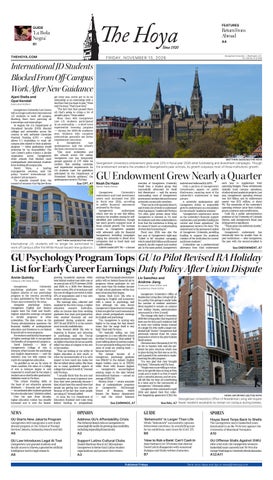
Georgetown University’s endowment grew over 22% in fiscal year 2026 amid fundraising and divestment campaigns. Though the endowment remains the smallest of Georgetown’s peer schools, its growth outpaces most of those institutions’ growth.
GU Endowment Grew Nearly a Quarter Noah De Haan Senior News Editor
Georgetown University’s endowment and total investment assets each increased over 22% in fiscal year 2026, according to public financial statements reviewed by The Hoya. Georgetown’s endowment, which now sits at over $4.8 billion, remains the smallest among its selfidentified peer institutions, though last year’s growth outpaced most of those schools’ growth. The increase comes as Georgetown grapples with advocates’ calls for financial transparency, including campaigns urging the university to divest from companies tied to fossil fuels and Israel’s military. Juliette Leader (SFS ’19) — a former
member of Georgetown University Fossil Free, a student group that successfully advocated for fossil fuel divestment — said the secrecy surrounding most of Georgetown’s investments invokes distrust for some university community members. “They can be a bit squirrely about it, and it took a lot of work to understand what is going on,” Leader told TheHoya. “It’s often quite private about what Georgetown is invested in. It’s hard for students and other stakeholders to trust that the institution is living up its values if there’s no understanding of what they’re investing in.” Fiscal year 2026 was also the last year of Georgetown’s eight-year “Called to Be” donation campaign, which raised $3.15 billion and financed research, faculty support and student aid. In the same period, Georgetown’s
endowment ballooned by 227%. Only a portion of Georgetown’s investments appear on public disclosures, meaning most of the university’s endowment is kept private. A university spokesperson said Georgetown strives to responsibly grow its endowment as a foundation for the school’s “academic mission.” “Georgetown’s endowment serves as the university’s financial support mechanism and provides funding for current and future operations,” the spokesperson wrote to The Hoya. “The endowment is the permanent capital of Georgetown University, providing funding to support the academic mission of the institution for current and future students.” Universities use a predetermined allowance from their endowment
each year to supplement their operating budgets. These withdrawals typically fund campus operations, student aid and academic projects. Last year, Georgetown’s operating revenue was $1.9 billion, and its endowment payout was $172 million, or about 9%. The remainder of the university’s operating revenue came from tuition, grants, contracts and contributions. Todd Ely, a public administration professor at the University of Colorado Denver, said Georgetown’s fiscal year 2026 growth is significant. “These gains are definitely sizable,” Ely told The Hoya. Georgetown’s endowment has historically been far smaller than its peer institutions — after Georgetown, the peer with the second-smallest is See ENDOWMENT, A7
GU Psychology Program Tops GU to Pilot Revised RA Holiday List for Early Career Earnings Duty Policy After Union Dispute Annie Quimby
Campus Life Desk Editor
Georgetown University psychology graduates earn the highest salaries of any psychology program in the country, according to data published by The New York Times and reviewed by The Hoya. Alongside psychology majors, Georgetown English and finance majors have the third and fourthhighest respective earnings compared to similar programs at other universities. The data comes as the Trump administration questions the financial viability of undergraduate education and threatens to cut federal financial aid to some programs. For students and faculty, the prospect of higher earnings fails to encapsulate the benefits of Georgetown’s programs. David Edelstein — dean of Georgetown’s College of Arts & Sciences, which houses the psychology and English departments — said the statistics may not fully capture the merit of a Georgetown education. “As gratified as we are by some of these numbers, the value of a College of Arts & Sciences degree is only measured in small part by the salary a student earns shortly after graduation,” Edelstein wrote to The Hoya. “The critical thinking skills at the heart of our education generate dividends — financial and otherwise — immediately after students graduate but also decades later,” Edelstein added. Over the past three decades, higher education tuition has steadily increased and is now the fastest-
growing household expense, while total federal student loan debt rose at an annual rate of 15.7% between 2006 and 2023. In a 2023 Pew Research Center survey, 29% of Americans said the cost of college is not worth it, while 47% of respondents said it was only worth it without loans. The earnings data, collected and analyzed by the HEA Group, a higher education research institution, relies on income data from working graduates four years post-graduation who received financial aid and graduated during academic years 2017-18 and 2018-19. It is the center’s most recently available data. Max Howard (MSB ’29), who is majoring in finance and minoring in psychology, said the Trump administration’s earnings-based cuts on higher education do not accurately reflect the value of a degree in the arts or humanities. “They are looking at the utility of higher education as how much, or what the incrementality of it is, with respect to how much you make, but like we talked about earlier, like there are so many qualitative aspects of college that make it worth it,” Howard told The Hoya. “I actually think that the arts and humanities are more important now than they were previously, because I kind of just have this overall view that people are getting less creative, just because of the fact that more people are using AI,” Howard added. In June, the U.S. Department of Education finalized new rules tying federal funding to postgraduate
earnings.TheTrumpadministration’s policy will cut federal financial aid to programs whose graduates do not earn more than the median income of high school graduates within four years of earning their degree. Saniya Shah (CAS ’28), who is majoring in English and economics with a minor in psychology, said that although the data shows Georgetown’s departmental strength, it does not give her much reassurance about overall postgraduate earnings for English and psychology. “Yes, Georgetown is scoring very highly in the range, but that doesn’t mean that the range itself is very high,” Shah told The Hoya. “It’s basically telling me that Georgetown is a very effective school for what I’m learning,” Shah added. “If you’re talking about monetary output, it’s not necessarily telling you that my areas of study are making bank — because they’re not.” The average income of a Georgetown psychology graduate was $99,007 in the dataset. English degree holders came in at $78,370, while those with finance degrees — Georgetown’s second-highest earning major in the data behind international business — earned an average of $152,744. Patricia Grant — senior associate dean of undergraduate programs at Georgetown’s McDonough School of Business, which houses the finance department — said the school balances
Liv Sanchez and Andrew Jiang
Graduate Desk Editor and Academics Desk Editor
Georgetown University’s Office of Residential Living (Res Living) will pilot a policy this spring to nearly halve the number of resident assistants (RAs) required to remain on campus over holiday breaks, administrators announced in a Nov. 11 email. The change rolls back a November 2025 Res Living policy that required at least one RA from each residence hall to work over holiday breaks instead of a single RA who staffs a larger residential hall “cluster.” Georgetown had previously rejected three RA union proposals to revert to the prior holiday break system. Oluwatomiwa Oluwasola (CAS ’27), an RA in Hayden Hall, said she preferred the prior structure, which was in place during her first year as an RA, and is grateful the university is implementing the pilot program. “I’m very glad that they brought this back,” Oluwasola told The Hoya. “People were more willing to volunteer to do specific days as long as they could, and it made it so that it wasn’t such a stressful process, and we actually felt like we were all contributing to a team and to the community at Georgetown,” Oluwasola added. Georgetown RAs unionized in April 2024 and signed their first collective bargaining agreement (CBA) the
HAAN JUN (RYAN) LEE/THE HOYA
Georgetown University’s Office of Residential Living will require See RAs, A7 fewer resident assistants to remain on campus during breaks.
See EARNINGS, A7
NEWS
OPINION
GUIDE
SPORTS
GU Starts New Jakarta Program
Address GU’s Affordability Crisis
‘Behemoth!’ Is Larger Than Life
Hoyas Send Terps Back to Shells
A6
A2
B6
A10
GU Law Introduces Legal AI Tool
Support Latino Cultural Clubs
‘How to Rob a Bank’ Can’t Cash In
GU Offense Stalls Against GWU
A8
A3
B7
A12/A11
Georgetown will inaugurate a new study abroad program at the School of Foreign Services’ Jakarta, Indonesia, branch next fall.
Georgetown Law granted students and faculty access to Harvey, a generative artificial intelligence tool for legal research.
The Editorial Board calls on Georgetown to meaningfully tackle its growing inaccessibility, including expanding financial aid.
Daniel Martinez Rios (CAS ’28) implores Georgetown to better fund Latino student organizations and promote their events.
While “Behemoth!” successfully captures bittersweet emotions, its storytelling may be too ambitious, says Grace Ko (CAS ’27).
Brad Derfner (CAS ’27) writes that director David Leitch disappoints with unnatural dialogue and thinly written characters.
Published Fridays
The Georgetown men’s basketball team dominated in an 86-74 victory against the University of Maryland Terrapins.
After a hot start, the Georgetown women’s basketball team narrowly lost 78-74 to the George Washington University Revolutionaries.
Send story ideas and tips to news@thehoya.com
A2 | THE HOYA
THEHOYA.COM | FRIDAY, NOVEMBER 13, 2026
OPINION EDITORIAL
Commit to Genuine Affordability
In October, Georgetown University announced plans to raise students’ current laundry budget by 50% to $63 each semester, pledging to cover a significant portion of students’ out-of-pocket laundry costs. But an additional $21 laundry allowance is nothing at a school that boasts one of the highest costs of attendance in the nation. At the outset of his tenure, University President Eduardo Peñalver outlined a slate of priorities — standardizing artificial intelligence (AI) use, eliminating bureaucratic friction and ensuring Georgetown’s affordability. Since then, Peñalver has rolled out initiatives to address several key issues, including a steering committee to create a university-wide AI framework and an initiative that recruits community feedback to streamline the administrative process. On affordability, however, Georgetown’s leadership has remained relatively silent. The increase to student laundry funds comes long overdue and still fails to recognize the myriad causes of the larger affordability crisis. The cumulative costs of tuition, meal plans, transportation and other hidden expenses put a burden on students that extra laundry money does little to alleviate. As a university that prides itself on meeting students’ financial needs and ensuring access for all, Georgetown needs to fulfill that commitment and support students of all economic backgrounds. A university spokesperson said Georgetown remains dedicated to that diversity. “We are deeply committed to ensuring that all students and families can afford the cost of a Georgetown education,” the spokesperson wrote to The Hoya. But if Georgetown is serious about that mission, it must focus its efforts on the university’s exorbitant tuition and the relatively little financial aid students receive to cover it — which non-tuition costs only compound. In February, Georgetown increased its tuition for the fifth consecutive year, putting that bill alone at $74,520 for the 2026-27 academic year. When combined with expenses like housing and meals, the university’s total sticker price totals $100,864, making it one of the first universities to surpass $100,000 in costs. Georgetown’s expensive sticker price is a further deterrent to students who may already feel the university’s disproportionately wealthy population excludes them. These costs stand in the way of a truly economically diverse campus, one of Georgetown’s promises. Through its inaction on affordability, Georgetown is tacitly signaling to these students that it does not welcome them. While Georgetown paired its cost hike with a record financial aid allocation — part of its commitment to meeting all of a student’s demonstrated financial need — only 36% of its students receive aid from the school, a rate that lands last among peer universities. That leaves nearly two-thirds of students paying Georgetown’s full sticker price or a sizable portion of it, including many middle-income families for whom that price may be out of reach. Schools like Princeton University or Vanderbilt University, meanwhile, each provide over 60% of students with aid. Roan Bedoian (CAS ’28), chair of the Georgetown University Student Association (GUSA) financial accessibility committee, said that the university’s financial aid efforts have not kept up with rising student costs. “Obviously, your financial aid should match your financial need, but from what I hear from students,
HOYA HISTORY
a lot of people right now don’t feel like their financial aid actually matches their financial needs, and they still feel like they’re feeling the pinch of the economy, the cost, whatever their family financial situation is, etc.,” Bedoian told The Hoya. Recently, the university announced the development of a $10 million scholarship fund that would cover the cost of attendance for low-income students. While this is a great development, the fund currently only covers costs for two students annually. Sabrina Gomez (SFS ’27), a first-generation low-income student, said inadequate financial aid can permeate into off-campus areas of student life. “For example, even just going out to eat in Georgetown or traveling to different places in the nearby area or attending events can be really expensive for students as well, and they’re really integral for a broader Georgetown experience,” Gomez told The Hoya. We recognize, however, that upending Georgetown’s tuition and financial aid structure is a burdensome task — and one most U.S. universities have not taken on. Still, the university can tangibly address the other line items that contribute to its hefty sticker price. Georgetown’s required meal plan for sophomores starts at $4,118 — even if they live in apartments with kitchens. Eliminating this requirement would potentially save those students hundreds to thousands of dollars while allowing students better dining options. The university must also consider wholly eliminating laundry costs for students, instead of simply subsidizing it. Many of Georgetown’s peers, including Harvard University, Columbia University and Brown University, offer laundry to undergraduates at no additional cost. Additionally, class materials can total hundreds of dollars each semester, piling unnecessary burdens on students. Finally, the university should fully subsidize public transportation for students. Over 40 schools in Washington, D.C, currently offer their students a U-Pass, a program by the Washington Metropolitan Area Transit Authority that gives eligible students in the D.C. area unlimited rides on Metrorail and Metrobus for about $1 per day. Instead of folding costs into tuition, Georgetown should institutionalize changes to help alleviate financial burdens, which would mark a meaningful step toward financial accessibility. GUSA President Darius Wagner (CAS ’27) said the university subsidizing transportation helps students escape the Georgetown bubble. “Although it’s focused on transit, that’s also directly tied to financial accessibility,” Wagner told The Hoya. “This is real money that students are saving by not spending on transit and being able to experience the broader D.C. environment.” Reducing non-tuition costs is, at the end of the day, only part of the solution. But it is a tangible step Georgetown can take as Peñalver promises to reclaim our place as a leader in accessibility and affordability. To truly create an inclusive environment for students, Georgetown cannot only care for those who can afford it.
IN THIS WEEK’S ISSUE
“
The cumulative costs of tuition, meal plans, transportation and other hidden expenses put a burden on students that extra laundry money does little to alleviate. The Editorial Board
“Commit to Genuine Affordability” thehoya.com
POLL This week, the Editorial Board decried the rising cost of a Georgetown University education, arguing the school should improve affordability by increasing financial aid, improving meal plan flexibility and subsidizing hidden costs. To gauge student opinion, The Hoya asked its readers if they believe Georgetown has taken adequate measures to ensure a Georgetown education is affordable. Of the 50 respondents, 84% said no, 8% said yes and 8% said they were unsure.
EDITORIAL CARTOON by Anish Raja
The Hoya’s Editorial Board is composed of six students and is chaired by the opinion editors. Editorials reflect only the beliefs of a majority of the board and are not representative of The Hoya or any individual member of the board.
Since its first issue in 1920, The Hoya has served to inform Georgetown’s campus dialogue. The following article is a glimpse into The Hoya’s rich history, allowing readers to appreciate the evolution of college journalism.
Tuition to Increase by 6 Percent Next Year February 13, 2007 Students will once again have to reach a bit deeper into their wallets to pay for a Georgetown education next year after the university’s Board of Directors approved a tuition increase last week that outpaces the rate of inflation. The board voted to increase undergraduate tuition to $35,568 for the 2007-08 academic year, an increase of about $2,000, or 6 percent, over this year’s fee. Undergraduate tuition has risen steadily in recent years from slightly under $28,000 during the 2003-04 academic year, when most of this year’s senior class enrolled as freshmen. Tuition also increased 6 percent this year from the 2005-06 academic year. The Board of Directors also voted to set next year’s Law Center tuition at $39,390, an increase of nearly 6 percent over this year’s tuition, and Medical Center tuition at $39,958, a jump of 3.5 percent over this year’s. Factoring in room and board and other expenses, it may cost a student up to approximately $50,000 to attend Georgetown next year, the
highest in the university’s history. The board also voted to raise room and board rates by about 5 percent. Provost James O’Donnell said in a statement provided by university spokesperson Julie Bataille that the tuition increase reflects the growing cost of many of the university’s expenses. “This growth reflects the reality that many of our expenses continue to increase at rates higher than inflation – utilities, technology, insurance and financial aid, to name a few,” O’Donnell said in the statement. “We work hard to balance the need to limit tuition growth with the need to provide exceptional academic programs and services.” O’Donnell also said in the statement that the university is working to address its ongoing budgetary concerns. Georgetown lost $14 million in the 2005 fiscal year, and has run combined operating losses of over $54 million since 2003. “We are taking steps to manage our finances to address these ongoing challenges and, taking these
LETTER TO THE EDITOR AND VIEWPOINT POLICIES The Hoya welcomes letters and viewpoints from our readers and will print as many as possible. To be eligible for publication, letters should specifically address a recent campus issue or Hoya story. Letters should not exceed 300 words. Viewpoints are always welcome from all members of the Georgetown community on any topic, but priority will be given to relevant campus issues. Viewpoint submissions should be between 600-700 words. The Hoya retains all rights to all published submissions. Send all submissions to: opinion@thehoya.com. The Hoya reserves the right to reject letters or viewpoints and edit for length, style, clarity and accuracy. The Hoya further reserves the right to write headlines and select illustrations to accompany letters and viewpoints. CORRECTIONS & CLARIFICATIONS If you have a comment or question about the fairness or accuracy of a story, contact Executive Editors Nico Abreu, Opal Kendall and Ajani Stella at executive@thehoya.com. NEWS TIPS News Editors Noah De Haan and Chloe Taft: Email news@thehoya.com. Guide Editors Anandita Agarwal and Isabelle Cialone: Email guide@ thehoya.com. Sports Editors Sam Fishman and Ethan Herweck: Email sports@thehoya. com.
needs into account, we will make sure that core elements of our next capital campaign include increasing support for financial aid, faculty and facilities,” O’Donnell said. O’Donnell could not be reached for further comment. Georgetown’s Washington, D.C., neighbor, George Washington University, recently decided to raise undergraduate tuition to over $39,000 for the 2007-08 academic year. GWU currently has the highest tuition of any major college or university in the country. Patricia McWade, dean of student financial services, said that Georgetown’s tuition increase will not disadvantage underprivileged students who receive financial aid, since the university has a need-blind admissions policy, and will factor the new tuition rates into its formula for determining financial aid. “The university is pledged to continue to meet the full needs of students,” she said. Max Sarinsky
GENERAL INFORMATION The Hoya is published once a week during the academic year with the exception of holiday and exam periods. Address all correspondence to: The Hoya Georgetown University Box 571065 Washington, D.C. 20057-1065 The writing, articles, pictures, layout and format are the responsibility of The Hoya and do not necessarily represent the views of the administration, faculty or students of Georgetown University. Signed columns and cartoons represent the opinions of the author(s) and do not necessarily represent the editorial position of The Hoya. Unsigned essays that appear on the left side of the editorial page are the opinion of the majority of the editorial board. Georgetown University subscribes to the principle of responsible freedom of expression for student editors. The Hoya does not discriminate on the basis of age, gender, sexual orientation, race, disability, color, national or ethnic origin. © 1920-2026. The Hoya, Georgetown University weekly. No part of this publication may be used without the permission of The Hoya Board of Editors. All rights reserved. The Hoya is available free of charge, one copy per reader, at distribution sites on and around the Georgetown University campus. Email: editor@thehoya.com Online at www.thehoya.com Circulation: 1,000
Founded January 14, 1920
Nora Toscano, Editor-in-Chief
Nico Abreu, Opal Kendall and Ajani Stella, Executive Editors Jackson Roberts, Managing Editor Noah De Haan, News Editor Chloe Taft, News Editor Jacqueline Gordon, Features Editor Serene Pai, Features Editor Thejas Kumar, Opinion Editor Leo Zhang, Opinion Editor Anandita Agarwal, Guide Editor Isabelle Cialone, Guide Editor Sam Fishman, Sports Editor Ethan Herweck, Sports Editor Angela Lekan, Science Editor Eva Siminiceanu, Science Editor Lucy Jung, Design Editor Anish Raja, Design Editor Elizabeth Hoerter, Copy Chief Allison Ma, Copy Chief Grace Rutherford, Copy Chief Katherine Hart, Blog Editor Yaya Hang, Multimedia Editor Miranda Kristina Santiago, Multimedia Editor Matthew Gassoso, Photo Editor Ella O’Connor, Audience Editor Caroline Woodward, Audience Editor
Board of Directors
Paulina Inglima, Chair
Ruth Abramovitz, Bethe Bogrette, Maren Fagan, Tanvi Gorripati, Aamir Jamil, Annikah Mishra
Connor Manrique-Johnson, General Manager
Rosie Garner, Director of Business Operations Jackson Roberts, Technology Director
Andrew Jiang Academics Desk Editor Annie Quimby Student Life Desk Editor Liv Sanchez Graduate Desk Editor Brendan Fijol City Desk Editor Joshua Lou GUSA Desk Editor Michael Shtrom Events Desk Editor Caroline Garland Deputy Features Editor Sophia Tully Deputy Features Editor Caden Larrenaga Deputy Opinion Editor Juan Almanza Deputy Guide Editor Eliza Doty Deputy Guide Editor Grace Ko Deputy Guide Editor Eliana Kut Deputy Guide Editor Penelope Snoep Deputy Guide Editor Finn Balon Deputy Sports Editor Golnar Jalinous Deputy Sports Editor Jacob Nolan Deputy Sports Editor Sasha Ahmad Deputy Science Editor Jaya Alenghat Deputy Science Editor Kaitlyn Lee Deputy Science Editor Adhithi Rajesh Deputy Science Editor Maddie Williams Deputy Science Editor Autumn Dunlop Deputy Design Editor Abby Kopf Deputy Design Editor Emilie Andrews Deputy Copy Editor Lucas Liang Deputy Copy Editor Sebastian Pallant Deputy Copy Editor Serena Nguyen Deputy Copy Editor Vivian Welch Deputy Copy Editor Connor Emmert Deputy Photo Editor Rohini Kudva Director of Human Relations Jacob An Director of Logistics Stefano Rangel Haddad Director of Outreach
THE HOYA | A3
FRIDAY, NOVEMBER 13, 2026 | THEHOYA.COM
OPINION
VIEWPOINT • BHATT
Develop Effective AI Policies
G
eorgetown University’s new AI Fellows Program is a promising step toward addressing how artificial intelligence (AI) will transform higher education. By pairing students with professors looking to explore AI integration in classrooms, Georgetown is recognizing the value of student perspectives on the future of education. University President Eduardo Peñalver’s university-wide AI framework offers a chance to extend that work across campus. As Georgetown determines its core values by the end of the semester and an operational framework by the end of Spring 2027, the university should commit to clear classroom rules, faculty training and a recurring student role that reviews those guidelines. As a Georgetown student, I have already experienced how inconsistent the university’s approach to AI can be. Across my courses, well-intentioned professors have established expectations for AI use that often differ significantly from those in other courses. The concern is whether students can understand and follow those different rules, and whether every professor has the support to explain and apply them clearly. Without shared guidance and training, professors must independently determine how to approach a technology that is rapidly changing the nature of academic work. As Georgetown develops its AI framework, it should prioritize human judgment and equitable access to learning, creating shared requirements for explaining AI use, preparing faculty and incorporating student feedback, while allowing instructors to decide which uses fit their courses. To start, faculty should require students using AI on an assignment to explain how they used it and how they checked its output. When assignments require AI, Georgetown should provide free access to the necessary tools. These requirements would make students accountable for their reasoning without making participation depend on their ability to pay. Georgetown must also prepare faculty to put these expectations into practice. Alongside requiring syllabi to list permitted AI uses and disclosure requirements, the university should hold workshops before each semester where faculty can draft these rules for their individual courses and learn best practices for applying
them to assignments. The AI Fellows Program could meaningfully help professors by bringing in students who have firsthand experience with AI in classrooms. Beyond individual courses, Georgetown should recruit a student advisory group that meets with the framework’s faculty steering committee each semester to test proposed rules against classroom scenarios and recommend revisions. Students must help shape rules that directly govern our learning, especially since our firsthand experience with these tools can reveal ambiguities that faculty and administration might otherwise miss. Furthermore, while Georgetown has introduced AI-related courses and educationalprograms,itshouldensure that all students understand and have a say in AI policy. Alongside other orientation modules, Georgetown could integrate an additional module on AI literacy to establish a shared foundation in verifying AI outputs, protecting personal information and recognizing when AI use requires disclosure, without adding a separate course to students’ already busy semester workloads. To test and improve the AI Fellows Program and inform the broader framework, Georgetown should survey students in the participating courses at the end of each semester. Such surveys can ask which types of AI use students struggled to classify as permitted or prohibited and whether they knew when and how to disclose them. The student advisory group should serve as an intermediary, reviewing the responses and proposing revisions to confusing rules. Preparing students to assess AI-generated claims and recognize misleading content is part of preparing them to make informed decisions as workers, voters and citizens. Gallup found that 77% of U.S. workers in technology, 64% in finance and 62% in professional services used AI at work at least a few times a year. Georgetown should turn human judgment and academic honesty into routine practice: Require clear AI rules in every syllabus, teach students to explain and verify their AI use and give students a recurring role in revising the policies that they must follow. Anshi Bhatt is a sophomore in the College of Arts & Sciences majoring in computer science, ethics and society and a Substack writer for the Georgetown AI Association.
MATTHEW GASSOSO/THE HOYA
COLUMN • VORA
Avoid AI Shortcuts; Engage With Your Readings Disclaimer: This entry to my column is going to get meta. You are going to read about reading. Last week, I submitted the midterm project for my “Writing and Culture” class; we had to unpack what we understood of “reading” and evaluate what it meant to “pay attention” to something. Ironically, that same week, I caught myself creating yet another Google Gemini Notebook: “Summary and Key Concepts.” Oftentimes, Georgetown students — including myself — have turned this task into instinct. We’ve confused reading with prompt engineering. This phenomenon reminds me of my favorite quote from my all-time favorite movie, from John Keating in “Dead Poets Society”: “We read and write poetry because we are members of the human race.” Instead of resorting to disconnected artificial intelligence (AI) summaries, I want students to revive the humanity that makes the act of reading so powerful. I want this campus to vibrate with the effervescent emotion that such reading can catalyze: the human emotion. One that drives passionate conversation not only with others but also with oneself. One that renders the mind full of thought but the tongue without words. One that
VIEWPOINT • MARTINEZ RIOS
Gemini’s machine learning prowess indubitably fails to grasp. I wish for a return to a culture where AI summaries are not a recognized necessity and where each act of reading is felt as a deeply personal experience. To this end, my fellow Hoyas, let us revitalize our relationship with reading, for what are we but members of the human race? The archnemesis of this sentiment is the campus belief that quantity precedes quality, that more work is better than less. For some reason, we feel sorry for not being swamped. However, it is nearly impossible for a student to genuinely get through two books, a research paper and six news articles within a single week of study, at any point during the college experience. Yet that exactly describes my slate of class readings for this week. Some argue that life at an elite academic institution like Georgetown is not meant to be easy. It is not for the weak. I rebut that this imaginary scale, which separates the easy and the difficult, the weak and the strong, is fundamentally ill-equipped. As I see it, academic spirit, intellect and critical discourse are not helped but damaged by unproductive hours wasted at Lauinger Library attempting to mindlessly scroll through an
unending list of assigned readings. Incessant,tediousrepetitioninstantly inhales the intrigue from any task. Now, this task is not only unattractive, but also seen as humanly impossible. Thus, eventually, students abandon it entirely. They feel compelled to rely on AI instead. Reading becomes artificially intelligent. We begin to confuse it with prompt engineering. This is where that imaginary scale fails. It is founded in the same belief I dubbed my archnemesis. In measuring a quantity of assigned readings as an indicator of academic strength, it ignores the quality of the act of reading. Moreover, in the wave of assigned readings, I believe I have lost the liberty to read for myself. Casual reading has gone from a staple to a scarcity in my schedule. I suspect the same is true for many of you. I’ve been trying so incredibly hard to get through Salman Rushdie’s “Midnight’s Children” ever since my very first day on campus. Yet to read over and above what my classes expect me to is an idea I find unfathomable most days. The Rushdie rusts away. My hobby laments, for it is now labor. My relationship with reading unravels daily. Perhaps yours does too. Yet I do not see this as solely our own failure. As students, this is a
conversation we must have with our professors and with the institution at large. I hope this entry to my column is a step in that direction. Above all, I urge you to take ownership of your reading. For each class, genuinely read through at least one assigned reading, the one you are most drawn to. Annotate, sit with your thoughts, reflect on how the reading made you feel. Beyond class, pick a book off your reading list, pick a day of the week and just read for as long as time permits. Personally, I hope to force my friends into a book club. Only one book a semester, but an infinite number of conversation starters and a built-in accountability measure. Small steps, but steps, nonetheless. No relationship is remedied all at once. The same applies to the one we have with how we read. I hope now to have done for you what my midterm did for me. I hope to have compelled you to reflect on your relationship with the act of reading. I hope to have inspired you to read authentically again, not as a student, but as a member of the human race. Parth Vora is a first-year in the School of Foreign Service. This is the fourth installment of his column, “Hoyawood.”
VIEWPOINT • CHATTERJEE
Expand Funding for Latino Groups Commit to Tuition Transparency, GU
G
eorgetown University often celebrates “Community in Diversity,” but celebrating diversity and investing in the communities that make it possible are two different things. As co-president of Movimiento Estudiantil Chicanx de Aztlán (MEChA), a student organization dedicated to celebrating Chicano and Latino culture, promoting education and advocating for social justice, I have experienced how much time, coordination and dedication it takes to create spaces where Hispanic and Latino students feel represented and welcomed. I have also seen how much potential these organizations have to bring the broader Georgetown community together. However, that potential cannot be realized through student effort alone. Georgetown must do more to support, fund and promote its Hispanic and Latino student organizations. This fall, MEChA had the opportunity to celebrate Día de Muertos with the Georgetown community. We were joined by University President Eduardo Peñalver, whose attendance was especially meaningful. As Georgetown’s first Latino president, his presence at a celebration of Mexican culture represented something important for students like me, reminding us that our backgrounds and identities belong at institutions like Georgetown as well. Representation at the highest level of university leadership matters. But representation must extend beyond moments of recognition and to meaningful institutional support for the communities that make Georgetown what it is. For me, this is personal. Growing up in Riverdale, Md., as the son of Mexican immigrant parents, I understand the importance of having spaces where culture, language and identity are not something you have to explain or leave behind. Coming to Georgetown, I wanted to find and help build that sense of community for others. Through MEChA, I have seen students come together not only to celebrate their heritage, but also to discuss important issues like immigration, advocate
for their communities and create opportunities for cultural education. Organizations like MEChA help students find belonging, develop leadership skills and engage with issues that extend far beyond campus. They deserve Georgetown leaders’ active support. Georgetown has already taken important steps. La Casa Latina provides a dedicated space for Latino students, while the Students of Color Alliance (SOCA) offers funding for cultural programming and collaboration. These resources are critical, and they should be recognized. However, the university should also ask if the support it currently offers matches the scale of what student organizations are trying to achieve. SOCA’s funding opportunities, for example, include requests for $100, $300 or $500. While helpful, these amounts can be difficult to stretch across the costs of larger events, cultural performances, food, speakers and educational programming. Organizations should not have to rely on constant fundraising or personal contributions to make meaningful programming possible. Georgetown should establish a more substantial and consistent funding pool for cultural student organizations, with grants that reflect the actual costs of organizing larger events. The university should also make funding more accessible so organizations can focus less on fundraising and more on creating meaningful programming for the Georgetown community. Funding is only part of the issue. Visibility matters just as much. Georgetown has more than 200 student organizations, and the university purports to recognize these groups’ importance in building campus community. Yet, students cannot participate in events they never hear about. In my experience, promoting events often falls largely on the organizations themselves, which must rely on their own social media accounts, group chats and personal networks to reach students. Georgetown should promote cultural organizations’ programming through official newsletters, social media,
campus-wide announcements and university calendars. Events should be opportunities for the entire Georgetown community to learn, participate and connect. There is also an opportunity to strengthen collaboration between Hispanic and Latino organizations across campus. MEChA, the Latin American Student Association, Ballet Folklórico Mexicano de Georgetown, Georgetown Undergraduate and Graduate Association of Mexican Students and other groups bring different experiences and perspectives to the university. However, they often lack the resources needed to effectively collaborate. Georgetown could provide dedicated funding for joint programming, creating opportunities for organizations to coordinate events and make shared spaces and resources more accessible. This support could help these organizations share resources and organize events that reflect the diversity of the Hispanic and Latino community. No single organization can represent every country, culture, language or experience, and Georgetown should make room for all of them. Georgetown can become a campus where all students do not simply see their identities acknowledged, but feel that their presence is valued through consistent action. Peñalver’s attendance at our Día de Muertos celebration was a meaningful moment. Yet diversity should not be measured only by who is represented in a photograph or recognized during a heritage month, but by whether students feel supported, included and empowered to shape the campus community throughout the year. Georgetown has the students, organizations and community to make this happen. It is time for the university to invest in them and truly foster the idea of “Community in Diversity.” Daniel Martinez Rios is a junior in the College of Arts & Sciences and the McCourt School of Public Policy and the co-president of Movimiento Estudiantil Chicanx de Aztlán.
M
y year studying abroad in the United Kingdom was an exercise in hearing inconvenient truths. The first lesson my British classmates taught me was that it’s not normal for first graders to fear guns while learning. The second was that it’s not normal to avoid calling an ambulance because of the cost. The third: It’s not normal for a university’s sticker price to be $100,000. Georgetown University estimates that a first-year’s total cost of attendance this year is $100,864, with $74,732 in tuition and fees. The larger figure includes housing, food and other expenses, while financial aid reduces what many families pay. Still, average tuition and fees at U.S. private colleges were around $45,000 for the 2025-26 school year. Georgetown is expensive even by U.S. standards. The university owes students more than a general assurance that a quality education is expensive, as it did in February when it described its 4.75% tuition increase as going towards “efforts that expand the value and reach of a Georgetown education.” The university should commit to greater transparency about which financial trade-offs inform its annual tuition increases. At the University of Oxford, where I studied last year, students eligible for British home fees paid £9,790 in tuitionthisyear—justunder$13,000. England caps the amount approved universities may charge domestic students while international students pay considerably more, and differences in public funding make a direct comparison misleading. Nonetheless, my classmates’ tuition bills made me question why a quality U.S. education must cost this much. I don’t doubt the value of a Georgetown education; its benefits are all around me. As an economics major, I’ve learned enormously as a research assistant on faculty projects. Programs such as the School of Foreign Service’s Centennial Labs have taken my friends to Turkey, Ghana and beyond, with travel supported
by the school and donors. Good teaching, financial aid, research opportunities and experiences like these are worth protecting. They also cost money. At his October inauguration, I was heartened to hear President Eduardo Peñalver call higher education’s affordability crisis “both a matter of reality and perception.” He pledged to manage costs and make aid more generous. I welcome that commitment. However, if Georgetown wants students to trust its affordability promises, it must take a further step: explain, regularly and accessibly, how it prices an education and what trade-offs determine that price. Unlike a supermarket, a university doesn’t charge everyone the same effective price; for example, for first-time, fulltime students receiving federal aid, Georgetown’s average annual net price was $33,661 in 2024-25. First-year microeconomics in the Intercultural Center auditorium teaches students that this kind of price discrimination allows those with greater means to help sustain access for those without them. But even with aid, the six-figure sticker price can discourage prospective students from ever applying. These students may never discover how affordable Georgetown could have been for them. The other problem is information asymmetry. Students know how much Georgetown asks them to pay, but have far less insight into the choices behind that figure. The university should disclose precisely how tuition increases reflect higher faculty compensation, financial aid or facilities and administrative costs. Clarity matters especially now. Last year, Georgetown projected losing $35 million in federal research funding and $17 million in international graduate tuition revenue. Its fiscal 2027 budget is balanced and includes a record $292 million for financial aid.
These figures raise the question of whether students, faculty, staff or donors — or all four — bear the adjustment when revenue contracts. Alongside annual tuition announcements, Georgetown should publish a student-facing tuition trade-offs statement, accompanied by an accessible social media post. It should show gross-versus-net undergraduate tuition revenue, average net prices across broad family income brackets, year-over-year changes in major spending categories and how proposed tuition increases, cost savings and aid commitments fit together. Where allocations cannot be meaningfully separated, Georgetown should say so. And because budgets are ultimately choices, the report should explain what alternatives administrators considered and why they rejected them. Transparency will not make Georgetown cheap. But more open statements would make the debate more intellectually honest and give students enough information to hold the university to its stated priorities. This expectation should not stop at Georgetown; other students deserve the same accountability from their universities. As an economics student, I’ve been taught that every allocation carries an opportunity cost. I want Georgetown to continue funding ambitious research, excellent teaching and transformative experiences. I simply want students to know what those ambitions actually cost and what else we could have chosen. President Peñalver’s inaugural address urged us to recover the art of argument, but a serious argument requires both sides to see the evidence. A Georgetown degree teaches us to question assumptions, weigh alternatives and scrutinize data. If the university wants us to reason together, it ought to show us the trade-offs. Jiyon Chatterjee is a senior in the College of Arts & Sciences.
THEHOYA.COM | FRIDAY, NOVEMBER 13, 2026
A4 | THE HOYA
FEATURES
When GU Students Return From Abroad, Some Struggle to Reintegrate Into Campus Georgetown pitches itself as an internationally-minded school where, uniquely, most students study abroad. But that mission, some students say, clashes with a hustle culture and opaque transfer credit system.
ILLUSTRATION BY LARA DE ROSARIO/THE HOYA
The majority of Georgetown students study abroad, but some say the experience is difficult to balance with the university’s preprofessional culture and is burdensome to navigate without stronger support from the Office of Global Education.
Elizabeth Murray Features Staff Writer
K
arcin Hagi (CAS ’27) thought he could succeed in Georgetown University’s pre-professional culture and still enjoy the study abroad experience the Jesuit university is famous for. But he quickly realized that wouldn’t work: Not only might his credits not transfer properly, but he would also have to give up the club leadership pathway he dreamed about. Instead, Hagi said, he completed a summer language immersion program in Trier, Germany, abandoning his semester-long study abroad plans. “I’m just a pretty practical person,” Hagi told The Hoya. “It felt like a waste of money to spend a bunch of money to go to Europe for a semester and then come back and not even know if it’s going to count as college or not.” Georgetown — which U.S. News & World Report ranked No. 6 in top college study abroad programs — boasts its study abroad offerings, advertising that it sends over 1,000 students abroad each year. The university encourages students to study abroad to develop a global mindset, one of its leading values. Students largely agree, saying that studying abroad is a rewarding part of their Georgetown experience. But for some, their return to campus is marred by what they see as a frustrating lack of support from Georgetown’s Office of Global Education (OGE), which oversees study abroad advising, approval and credit transfers. Even as Georgetown touts its abroad culture, students say campus reintegration is difficult — and they did not realize the opportunities they would lose. Georgetown currently offers programs in about 55 countries, and around 67% of Georgetown students study abroad, according to a 2024 report. In Georgetown’s School of Foreign Service, which emphasizes field-based learning in the United States and abroad, over 80% of students spend time studying or researching abroad. Comparatively, at Dartmouth College and Northwestern University — two of Georgetown’s self-identified peer institutions — 45% and 49% of students, respectively, study abroad, according to the same 2024 report. OGE director Craig Rinker said university support is essential for students to feel comfortable going abroad. “Studying abroad is reflective of core Georgetown values: educating the whole person and shaping globally minded leaders,” Rinker wrote to The Hoya. “Stepping outside your comfort zone isn’t always easy, but it’s where real personal growth happens.”
“Having strong university backing from faculty, deans, staff and campus units ensures students have the encouragement and safety net they need to take those intellectual and personal leaps,” Rinker added. But students say the study abroad experience that university leaders claim sets Georgetown apart is also difficult to navigate, both in the approval process and in the return to campus. Rachel Miyamoto (CAS ’27), who studied abroad in Salamanca, Spain, in Fall 2025, said transitioning from a balanced European culture back to Georgetown’s intense career-centered environment was difficult. “Coming back to Georgetown, joining back all my clubs, doing all my work was a bit shocking at first,” Miyamoto told The Hoya. Welcome Back, Jack Georgetown, in promoting its ability to create global leaders, encourages students to both develop an international understanding by studying abroad and take advantage of Washington, D.C.’s career opportunities. But for some students, those two parts of a Georgetown education clash: The heavy emphasis the university places on club leadership and internships, they say, is often incompatible with a semester or year abroad. Josephina Wang (MSB ’27), who studied abroad in China last fall, said it was difficult to recruit for a job and schedule interviews with a 13-hour time difference. “Knowing that I made the decision to go abroad, I just had to do a lot more work the summer before, and then make the occasional sacrifice for interviews,” Wang told The Hoya. “I think I did interview prep for two or three hours a day for two, three weeks.” As part of the lead-up to career recruitment, about 90% of Georgetown students participate in an internship before they graduate and 75% hold a paid position. At other elite institutions, like Duke University and Vanderbilt University, that pre-professional culture persists, but with lower study abroad rates. Because Georgetown emphasizes its proximity to Capitol Hill for work experience, as well as the importance of an international education, students say the dual expectations mean having to sacrifice one for the other. Arun Ishikawa Pandey (SFS ’27), who directly enrolled in the University of Auckland in Fall 2025, said compared to other schools, Georgetown students are pressured to prioritize career and club development. “I think that the environment of people wanting to be here and a
community of very high achievers makes it so you constantly look around you and compare yourself or see if you’re falling behind,” Ishikawa Pandey told The Hoya. Ishikawa Pandey said he specifically chose not to study abroad in the Spring semester — which runs into late June at the University of Auckland — to avoid missing the typical June start dates for junior year summer internships. “My reasoning was, in terms of pre-professional opportunities and such, I was more comfortable sacrificing a longer summer internship in my sophomore than my junior year,” Ishikawa Pandey said. Students say their involvement in student-run organizations plays a large part in their consideration of going abroad. Some even altered their study abroad plans to vie for leadership positions. Chandler Paulk (CAS ’28), who plans to study abroad in Dublin next semester, said he chose to study abroad in the spring because it allowed him to hold a year-long position as general manager of WGTB, the university radio station. “If I had gone abroad in the fall, I wouldn’t have been able to do it,” Paulk told The Hoya. “I could have done it the next year over, but then I would have been a senior, and I didn’t really want to do all of that, so a big portion of it was that it lined up with my club leadership, which was important for me.” Hagi, who works for a student-run coffee shop, said he elected to study abroad over the summer so he could serve as the shop’s general manager, another year-long position. “I knew I wanted to put in work so I could work up the ranks a little bit, so that I can do what I’m doing now: senior year as director,” Hagi said. “That definitely played into it — it was just nice that I could get study abroad in while still having the full year.” Wang said choosing to study abroad means making an intentional decision to potentially put career development on hold. “That’s the sacrifice that you have to make to go abroad,” Wang said. DC You Later Georgetown’s study abroad pitch to students includes academic enrichment, self-discovery and engaging with other cultures that inform the global education that defines the university. That is what makes Georgetown unique, the university advertises: Students can integrate the values they learn abroad into the broader Hilltop Campus’ diversity. But those values students learn abroad, they say, are incompatible with what
drives success in Washington, D.C., such as internships, club leadership and intense course loads. Mia Chuma (MSB ’27), who studied abroad in Copenhagen, Denmark, said the learning style abroad allowed her to better balance academics with self-exploration compared to Georgetown’s work-centered culture. “I just knew that it would be difficult academically because in my abroad courses, we didn’t really have exams,” Chuma told The Hoya. “It was more discussion-based — liberal arts stuff — so it wasn’t as intensive.” “I was obviously stimulated and learning so much while I was abroad, but not at the intensity sometimes that you’re used to at Georgetown,” Chuma added. Wang said there are fewer opportunities to connect with professors and peers in the McDonough School of Business’ (MSB) large class sizes compared to the 15-person seminars she had in China. “Coming back to Georgetown, thrown back into the 50-person lectures and the MSB, the classes are definitely harder,” Wang said. “So I just had to adapt.” Beyond differences in coursework intensity, students also say the return to campus culture can be sobering and unsupported. To address this, OGE publishes a five-page “Returnee Guide” to help students reacclimate to campus, which includes a list of resources. The guide also encourages students to then share their study abroad experiences with students interested in their program. Rinker, the OGE director, said successful reintegration is important for students’ development. “Living in a new culture and readjusting to campus life both bring natural friction points, and we view those moments as opportunities for students to build resilience and flexibility,” Rinker wrote. Still, some students say they do not get the support they need and have to navigate the tough transition back on their own. Alessia Turner (CAS ’27) — who studied abroad Spring 2026 at the Villa Le Balze, one of Georgetown’s satellite campuses near Florence, Italy — said students must readjust to Georgetown’s fast pace upon their return. “There’s definitely a big culture shock for people depending on what programs they did, but I think in general people definitely feel more relaxed abroad,” Turner told The Hoya. Saeed Samra (CAS ’27), who studied abroad in Madrid, said readapting to on-campus life was difficult because his values shifted while he was abroad.
“You’re in a society where the culture is just enjoy yourself, because if you don’t have money but you’re happy, then you’re happy,” Samra told The Hoya. “It was specifically reassimilating to our work culture that was really hard for me, and not even because I just became lazy in Spain, but because my priorities changed in Spain,” Samra added. Credit Where It Is Due Beyond the transition back into campus life, students say there is a discrepancy between Georgetown’s emphasis on studying abroad as integral to the academic experience and the decentralized program approval and credit transfer process. They say channeling these processes through their academic deans, rather than through OGE, complicates the process further. The transfer credit process varies by study abroad program and requires administrator approval of proposed credits before applying. After students return to campus, individual deans add OGE-approved credits to students’ transcripts. Students say the multifaceted approval process creates unnecessary stress and confusion. Hagi, the student who studied in Germany, said some of his courses did not fulfill the requirements he expected they would. “For econ and other foundational courses, those were a little bit easier to transfer, but sometimes they would transfer as a humanities,” Hagi said. “I technically did get credit, but not for what I took it for,” Hagi added. Georgetown more closely scrutinizes credit transfers for major requirements, a process that varies between departments. As a result, students say they prioritize fulfilling Georgetown’s core humanities requirements. Rinker said OGE recommends best transfer credit practices but does not advise students on which credits count. “We remind students early on that course reviews and credit approvals live with the faculty evaluators and academic deans in each Georgetown school, not OGE,” Rinker wrote. “When questions arise, our role is to demystify the process and guide students back to their academic advising deans.” Chuma, who studied abroad in Copenhagen, said she communicated closely with several deans to ensure her credits were properly transferred. “I was very direct and transparent with the deans involved,” Chuma said. “I was like, ‘Hey, is this going to actually work? Or will I get screwed over later?’” “That’s why I think some people
might struggle with actually getting the credits to roll over, but everything was smooth sailing for me,” Chuma added. However, some students face issues with proper transfers. Wang said she sacrificed her early graduation to go abroad due to the credit transfer process. “Only the marketing class counted for one of my MSB majors, and then everything else was just a liberal arts credit,” Wang said. “I’m not able to graduate a semester early anymore because I couldn’t put those credits towards something else.” Aaliyah Gala (SFS ’28), who plans to study abroad in Sevilla, Spain, this spring, said she was originally set to study abroad at a Georgetown-taught program in Madrid when her accompanying faculty member retired, leaving her to navigate where she wanted to go on her own. “No one knew what was going on,” Gala told The Hoya. “I had no idea that it was going to be canceled or it was up in the air.” Gala said OGE’s advising falls short of what students need. “We’re all talking to our dean,” Gala said. “I don’t feel like any of us are talking to OGE, which I feel like that’s kind of the point, that they’re supposed to be there to help.” “I had to jump through hurdles and steps to find out that information rather than him reaching out and letting me know well in advance so that I could make another decision,” Gala added. Mason Thenor (MSB ’27), who also studied abroad at Georgetown’s Villa Le Balze, said an unclear transfer credit process can derail students’ degree progress. “I still wanted to make sure I was going to graduate on time and not to overload a different semester,” Thenor told The Hoya. For Gala, the opportunity to study in Spain is exactly why she came to Georgetown — bridging her Spanish-language education in D.C. with the global experience of a semester abroad. Gala said if Georgetown truly believed in the holistic, global education it advertises, students deserve a robust support system when they return to campus. “I could have totally been deterred from going to Spain because of all of this, and why would that happen, especially after I’ve dedicated that much time?” Gala said. “I wanted to make sure that learning translates into a skill, and that was a hurdle for that to not happen.” “I just feel like it shouldn’t be that hard,” Gala added.
THE HOYA | A5
FRIDAY, NOVEMBER 13, 2026 | THEHOYA.COM
SCIENCE
Global Health Expert Calls for Better Community Mental Health Resources Sarah Hsia
Hoya Staff Writer
A global health researcher advocated for expanded health intervention programs in underresourced communities at a Georgetown University event Nov. 4. Ellen Moscoe, assistant professor in Georgetown’s global health department, recommended the implementation of cost-effective community programs to reduce the burden of mental health challenges for disadvantaged groups. Moscoe’s lecture — which was hosted by Georgetown’s Global Health Institute (GHI) — drew on a Senegal-based social safety net program to integrate a mental health intervention that reduced participants’ depression. Moscoe, who has extensive experience conducting primary research in low-income countries, said there is an urgent need to address mental health, particularly in sub-Saharan Africa. “Mental health in general, but especially in sub-Saharan Africa, is undertreated and it’s underfunded,” Moscoe said at the event. “It has a very low number of trained clinicians.” Moscoe said the cyclical nature of mental health challenges and their impact on future generations further demonstrates the importance of addressing mental health. “Circumstances like poverty and stress related to, for example, climate
change, can exacerbate mental ill health, like increasing risk-taking behaviors, increasing alcohol and drug use, leading directly to things like harsh punishment or poor parenting practices that can harm the lifecycle of the next generation,” Moscoe said. “But those things themselves also contribute to poor mental health, through reduced livelihoods and contributions to violence.” Moscoe’s team implemented Self-Help Plus (SH+), a program developed by the United Nations’ World Health Organization that uses pre-recorded audio to help reduce stress and symptoms of depression during five weekly group sessions, in the spring of 2025. Shabab Wahid, another global health professor who investigated the project, said their team engaged community workers involved in Senegal’s family grant program — which targets the poorest households to prevent extreme poverty and provide support services — and trained them to facilitate SH+. “We identified these community workers that are responsible for engaging the community in this family grant transfer mechanism, and then we trained them in being facilitators of self-help plus,” Wahid told The Hoya. Moscoe said prior to the launch of SH+, the team conducted 53 interviews to gain a comprehensive understanding of how mental
health was understood within the community’s cultural context. “We interviewed people about the causes, symptoms and treatments of poor mental health, kind of the etiology of mental health as understood by them,” Moscoe said. “We developed mental idioms in Wolof with their translations to French and English, so that we were understanding really well how people were speaking about these things.” From these interviews, poor mental health stressors were classified into the following categories: family relationships, socioeconomic difficulties, gender roles, adverse life events and spiritual or magical causes. Moscoe said the program reported high participant and facilitator satisfaction alongside strong attendance. “75% of participants in the treatment group who were invited participated in the set in at least one session. Most who attended one attended four or five,” Moscoe said. “So it had really high rates of participation actually; I was quite shocked by that.” Moscoe said after the program, participants applied the regulation skills they learned in their daily lives, including in relationships with their children. “They also noted improvements in social relationships and in particular with their children,” Mos-
MATTHEW GASSOSO/THE HOYA
Ellen Moscoe, an assistant professor in Georgetown University’s global health department, advocated for expanded health intervention programs in underresourced communities across the globe.
coe said. “So they talked about being able to be less reactive, speak more calmly to children, and to give advice based on what they have learned in the sessions to their own kids.” Moscoe said several potential challenges, including gaining support from the Ministry of Health, the government department responsible for health policy, could jeopardize the spread of similar programs. “The buy-in at the higher level, so from policymakers, is where we need to reach,” Moscoe said. “We have buy-in from stakeholders, no problem there, but higher-level in-
dividuals at the Ministry of Health might look at this up next to programs related to maternal health or infectious diseases, and think that it’s just not that important.” Nalini Anand, the GHI’s managing director, said she believes the program has a high capacity for global expansion due to its cultural adaptability. “It seems like it has a lot of potential for low-resource settings in the Global North as well,” Anand said at the event. “I was inspired by and impressed by the level of effort and the depth of your efforts to culturally adapt it.”
Wahid said he is optimistic for the future of mental health programming. “So, yeah, there’s a ton of potential, and we’re very excited that innovations in the Global South are trickling out their way up to the Global North,” Wahid said. Moscoe said the opportunity for expanding SH+ programs into new environments and at larger scales to improve mental health is promising. “It doesn’t need to target people who have clinical symptoms,” Moscoe said. “It doesn’t need to be delivered in a particular community. It’s designed to be applicable to all of us.”
Physicist Evaluates New Subfield of Tunable Matter SENDING SYDNEY’S SCIENCE HOME College Students Remain Vulnerable to Social Media’s Negative Behavioral Impacts Justin Ha
Hoya Staff Writer
A University of Pennsylvania professor spoke to students and faculty about his research on foam behavior and a new class of active matter at a talk hosted by the Georgetown physics department Nov. 2. John Crocker, a chemical and biomolecular engineering professor at the University of Pennsylvania, shared his research in the area of soft matter physics, a subfield of physics that studies types of matter that are particularly sensitive to mechanical stress, such as gels, foams and colloidal suspensions. Crocker argued that the unusual dynamics of foams may be understood not through examining the forces acting on individual bubbles, but rather by looking at the geometry of the paths they follow. Crocker said bubble movement can be understood not by focusing on the dynamical forces on each bubble, but by looking at the geometric shapes that constrain each bubble’s motion. “Foam dynamics weren’t some crazy set of coupled ordinary differential equations that I had to integrate,” Crocker said at the event. “The shape of soft matter networks doesn’t emerge dynamically
from some equation of motion; it’s a geometrical object that determines the shape,” Crocker added. Soft matter displays glassy dynamics similar to living cells in which molecules get jammed together in a random pattern and move very slowly. To explain this phenomenon, Crocker proposed the idea of a new subset of active matter called tunable matter, a collection of heterogeneous physical components whose interactions can be adjusted and tuned for a collective function. Crocker said tunable matter can produce adaptive behaviors, including the ability to learn from local interactions, such as the ability for its components to repair themselves after suffering from induced stress. “Tunable matter can actually solve tasks; it can do complex, adaptive behaviors and learn in the same way that deep learning learns a task,” Crocker said. “You can actually train it to do stuff.” Crocker compared it to the dynamics of artificial neural networks (ANNs), explaining how both ANNs and foams can undergo continuous internal rearrangement while preserving their collective behavior. “The parameters in artificial neural networks essentially mirrored the behavior of bubbles in a foam,”
Crocker said, “Even after a network has learned something, the parameters can continue moving around.” ANNs are computational models consisting of interconnected components that adjust their connections as they learn, inspired by human brains. Crocker said studying these parallels between ANNs and foams could offer new ways for researchers to model soft matter. “The training dynamics of deep learning algorithms actually look a lot like the foam dynamics I published in 2016,” Crocker said. “The parameters in artificial neural networks essentially mirrored the behavior of bubbles in a foam. I think the whole idea of tunable matter goes way beyond my lab and will essentially revolutionize soft matter physics in the next 10 or 20 years.” Get Poolvoraluk (CAS ’29), a physics student who attended the event, said he appreciated Crocker’s ability to condense complex information in an understandable way. “I feel like Professor Crocker was able to really speak to his audience here,” Poolvoraluk told The Hoya. “The material was digestible, and he didn’t overwhelm the audience with too much jargon, constantly providing us tangible visualiza-
tions of what exactly was going on with soft matter. Being able to understand even just a tiny bit of the material was such a relief to me.” Dylan Burkett (CAS ’29), another physics student who attended the event and manages the Georgetown Engineering and Robotics Society (GEARS), said he felt inspired by some of the ways Crocker imagined the study of soft matter could be used in engineering. “I was a big fan of Professor Crocker linking his work to the materials engineering field,” Burkett told The Hoya. “It got me thinking whether GEARS could explore some of these projects ourselves. Maybe create stress tests for colloids compared to other more conventional materials.” Poolvoraluk said the talks inspired him to look more into physics beyond the undergraduate level and encouraged other students to do the same. “The physics colloquium feels like an untapped resource that I think more students should take advantage of,” Poolvoraluk said. “It offers such a wide range of topics not taught, and it’s inspired me to look into the research scene in the physics department here. I think all physics students should give it a go to see if they like it.”
THE HOYA ECO CORNER
Newly Elected Congress Should Defend Scientific Funding
Jasmine Arora Science Columnist
While science is often idealized as an objective pursuit removed from political powers, its daily reality relies on the legislative choices and executive decisions made in Washington, D.C. Just three miles away from Georgetown University’s Hilltop Campus, the U.S. government dictates the trajectory of global scientific innovation. When U.S. midterm elections cause turnover on Capitol Hill, the resulting political and financial uncertainty sends changes far beyond the district lines. However, it is crucial to distinguish between the administrative budget cuts of the past two years and the immediate turnover uncertainty looming over the next few months. For Georgetown students and faculty, political choices over the past two years have already translated into individual disruptions to the current and future research of Georgetown students and faculty. Funding reductions, particularly in environmental and climate science, jeopardize the academic opportunities and futures of the university’s researchers. After the midterms handed a decisive win to Democrats, newly elected congressmembers must defend scientific funding in the midst of executive cuts. Understanding why scientific progress falters during electoral candidate transitions requires examining the tensions between
Congress and federal agencies. Midterm elections frequently reconfigure committee leaders and priorities across key funding bodies like the National Institutes of Health (NIH) and the National Science Foundation (NSF). In the immediate months ahead, Congress faces tight spending deadlines, which create acute fiscal uncertainty. Since Congress holds the money, political transitions disrupt the funding authorizations, replacing predictable budgets with short-term solutions. This financial unpredictability creates immediate friction within university research. Executive branch administrative delays and political grant reviews can freeze funding allocations even when Congress has already approved funds. For Georgetown faculty competing for competitive federal grants, these delays stall multi-year clinical studies and laboratory operations. Consequently, student research assistants — many of them Georgetown undergraduates relying on grant-funded stipends or capstone course credit — may find their lab hours reduced or their mentorship disrupted by administrative gridlock. The urgency of congressional action is proven by the track record of the past two years. Much of the vulnerability in scientific funding lies in the environmental and climate science disciplines, where research programs are increasingly targeted for
ideological defunding during political transitions. When federal priorities change, long-term environmental monitoring and urban climate resilience projects are often the first to be canceled. This past disruption serves as evidence of what is at stake if the new Congress fails to act. Researchers at Johns Hopkins University spent over three years on a five-year, $25 million Department of Energy grant studying extreme weather in mid-Atlantic cities. In its fourth year, however, the federal government abruptly revoked the remaining funding, leaving critical public health and climate adaptation research stranded. For Georgetown students pursuing degrees in environmental studies or science, technology and international affairs (STIA), or working with Georgetown’s Earth Commons, sudden grant revocations are a direct blow to their education. When federal agencies pull the plug on multiyear climate datasets, Georgetown undergraduates analyzing mid-Atlantic cities lose their field data, which leaves students hoping to present those findings stranded. Their preparation is undermined for careers in environmental policy or climate science, scrapping their environmental policy or climate science projects before publication. These real-world consequences demonstrate exactly why the new Congress must make it an immediate priority to restore and
protect grant funding. When federal funding stalls, human consequences manifest immediately across university laboratories. Prolonged budget uncertainty has been shown to lead directly to the termination of promising research. The financial instability drives top-tier technical talent out of academia entirely, accelerating an international “brain drain” toward institutions. Scientific discovery operates on decades-long timelines. Breakthroughs in health or future warnings from our planet are not effectively developed under turbulent two-year electoral cycles. When financial and political uncertainty becomes the norm and environmental research is erased at the stroke of a pen, the national research pipeline erodes from the ground up. For Georgetown students, this vulnerability demands both awareness and action. Situated at the unique intersection of academic research and national policy, the Georgetown community is positioned to bridge the gap between science and governance. Georgetown students must recognize that defending science requires active civic responsibility. By holding the new Congress accountable and advocating for sustainable, long-term federal research funding, Georgetown students can help ensure that the pursuit of scientific research remains, regardless of how the political winds blow on Capitol Hill.
Ellie Ward
Science Columnist
In December 2025, Australia banned most social media apps — including Instagram, TikTok, Snapchat and YouTube — for all children under 16. The law’s proponents argued that the government has a responsibility to protect minors from the risks posed by social media use. Opponents, however, have contested its legality and suggested that it will wrongfully eliminate social media’s positive effects. Other countries have made similar moves. In 2026 alone, Germany raised the minimum age for certain platforms to 13, and France banned social media for children under the age of 15. Brazil, meanwhile, now requires parental consent for social media users younger than 16. In the United States, the Senate has introduced the Kids Off Social Media Act, which would prohibit people under 16 from creating social media accounts, twice. Eight states have also restricted minors from creating social media accounts without parental consent. These policies, however, are all geared towards minors, whom governments have the authority to regulate. They neglect college students, who are often legal adults but remain behaviorally and neurodevelopmentally vulnerable to social media’s negative effects. The burden falls to us to regulate our social media use and protect ourselves from the anxieties of disengaging. Young people have a less developed prefrontal cortex — the region of the brain responsible for executive function. They also experience a dopamine surge in reward-processing parts of the brain. These traits make young people more reliant on affirmations and vulnerable to rejection, which “like” and “comment” features on social media exploit to prevent users from disengaging. Some developing research also suggests that social media use could have more long-term negative impacts on young people’s social maturation. One study found that it may hinder the development of dopamine reward circuits, which reinforce positive behavior. Others have consistently linked excessive social media use, with the associated fear of missing out and so-
cial comparison culture, to depression and anxiety. Chronic stimulation of the amygdala and autonomic nervous system makes it more difficult for the brain to address rational-emotional surges, also increasing the long-term risk of anxiety disorders. This is still a limited research field, however, hindered by limited data, poor standardization and a lack of distinction between different social media platforms and their engagement styles. It is not, moreover, inherently bad to be more sensitive to social media’s impacts. These platforms remain valuable tools for positive connection, community-building and self-expression. Young people must carefully navigate their social media use, avoiding algorithms that exploit the difficulties of disengaging and remaining vigilant about its associated stressors. No government is going to intervene on our behalf. I often wonder how I can reduce my screen time without deleting every app off my phone. Targeted, evidence-based suggestions help me realize that it can be beneficial to have shortened time limits on platforms that have these particularly difficult algorithms. Moreover, I find that turning notifications off for platforms that use social media cues helps reduce my stress and dependence. My experience, however, is also a reminder that the positives of social media are real. The same structures that can make young people feel isolated can also make people feel particularly connected. While studying abroad, social media has helped me stay in touch with family and friends from home. This evidence is still developing, with reasons to pick and choose your applications of this research carefully. It seems clear, though, that stopping social media use altogether does not need to be the solution, and can even eliminate some benefits. However, recognizing the dangers of social media is equally important, especially for college students who remain uniquely vulnerable to its consequences, even if they are exempt from legislation surrounding it. Rather than choosing one extreme or the other, take the nuanced approach missing from the dominant cultural conversation.
WIKIMEDIA COMMONS
Australia banned most social media apps for children under 16, but college students remain vulnerable to negative impacts.
THEHOYA.COM | FRIDAY, NOVEMBER 13, 2026
A6 | THE HOYA
NEWS IN FOCUS
PAGE SIX
Student Leaders Advocate for Common Good
Your news — from every corner of The Hoya
WHAT’S NEW IN MULTIMEDIA? Behind the Crossword Check out this multimedia video with Luke Landegger (MSB ’27), the creator of the The Hoya’s crossword puzzles, which are published online three times a week. Landegger talks with The Hoya about his process of designing, wiritng and playing the crossword every week. MATTHEW GASSOSO/THE HOYA
Georgetown University students representing political and social advocacy groups affirmed their commitment to improving the university community at a Nov. 10 panel hosted by the Initiative on Catholic Social Thought.
All multimedia content is available on Instagram.
SFS to Launch First GU-Run Abroad LGBTQ Resource Center Inaugurates Program in Southeast Asia in 2027 Spring Break Trip to Philadelphia, NYC Evan Zhang
Features Staff Writer
Georgetown University will launch a study abroad program at the School of Foreign Service’s (SFS) Jakarta, Indonesia, campus in Fall 2027, the university announced Nov. 3. The new program is the first fully Georgetown-operated undergraduate program in Southeast Asia and marks an expansion of the SFS’ Asia Pacific branch (GSAP), which already offers graduate-level degrees. It will add to the university’s roster of 155 study abroad programs, 24 of which are located in Asia. SFS Dean Joel Hellman said studying in Jakarta allows students to engage with one of Southeast Asia’s most prominent democracies. “We were looking for more opportunities for our students to gain experience on the ground in countries that are dealing with critical global problems,” Hellman told The Hoya. “We thought Indonesia was an extraordinary laboratory for working on so many of the problems that we deal with here in the School of Foreign Service.” In January 2025, Georgetown established GSAP, becoming the first American university to open a branch in Indonesia. At first, GSAP only sponsored a mid-career master’s program and a graduate program on policy research, later adding an accelerated master’s program for senior undergraduates. Yukhi Tajima, the GSAP program director, said the study abroad program will offer undergraduates further opportunities to gain hands-
on experience through immersive electives and policy labs. “Everything that we do out here is basically with one mission, which is to meet the challenges of the Global South and the Asia Pacific, so all our programs are effectively working on that,” Tajima told The Hoya. “But it’s very much in line with the Jesuit mission as well, which is to engage with the broader world through service.” “Now that we’ve had this ability to get some reps with our master’s students, one of the things that we wanted to do was always to make this available to undergrads,” Tajima added. Georgetown students will take a two-week intensive Indonesian language course before their semester in Jakarta, and go on group bonding excursions during their stay. Luke Hughes (SFS ’27) — an undergraduate who collaborated with the Blue Lab, a GSAP research lab that investigates Indonesia’s fishing industry, in May to research his senior thesis — said his experience took him to a village in northern Jakarta. “It was great to be there and do in-person research because that gave me insights that I can’t get from a database or from a literature review alone,” Hughes told The Hoya. Tajima said Indonesia’s natural diversity makes it an ideal place to explore. “Most study abroad programs have some kind of cultural immersion that’s specific to the location,” Tajima said. “Here, you have everything you can possibly think of that doesn’t have to do with cold weather. You have beaches, you have rainforests, you have islands, you have all sorts of different opportunities.”
Hellman said these excursions will expose students to Indonesia’s distinctive culture. “Indonesia has very recognizable cultural icons like the Wayang and Wayang Kulit performances, gamelan music, extraordinary biodiversity,” Hellman said. “These are things that are unique to the Indonesian experience.” Hughes said he felt embraced by local residents during his time in Jakarta. “Generally, people who I interacted with in Jakarta were very friendly, very welcoming, very warm and also just very happy,” Hughes said. “They wanted to get to know me really well.” The semester abroad is worth 15 academic credits, some of which can fulfill SFS major requirements. Its coursework includes two required courses — “Indonesia and the Global South” and “Indonesia in Time and Space” — along with additional electives of students’ choosing. Tajima said the program’s course offerings were designed to encourage student interest, which he expects will increase in future years as the program gains momentum. “I can envision students wanting to be out here for a full year, especially since these are Georgetown classes,” Tajima said. Hellman said he expects the program to grow, serving as a starting point for Georgetown’s future academic engagements. “We have great ambitions to deepen our students’ experience around the world, to get them to the parts of the world that are going to be shaping the global order to come,” Hellman said. “We hope that this program is just one step in that direction.”
Meera Shah
Features Staff Writer
Georgetown University’s LGBTQ Resource Center will inaugurate an immersive spring break trip during the Spring 2027 semester. The weeklong Queer Legacies Immersion Program, organized by the resource center, will bring a cohort of Georgetown students to Philadelphia and New York City to explore queer historic sites, as well as engage with LGBTQ+ community organizers. The new program comes as the Trump administration works to dismantle diversity, equity and inclusion (DEI) programming, rolling back support for the LGBTQ+ community. Abby Henkel (CAS ’28) — co-president of GU Pride, a student-run affinity organization — said the program fills a gap in Georgetown’s available LGBTQ+ history-related courses. “Queer history is so underexplored, especially by students at Georgetown University,” Henkel told The Hoya. “I’m grateful that the resource center is doing this because it means that they’re actually investing in the idea of queer students needing to know about their own history, which is something that’s not typically taught in curricula when you’re in high school.” The second Trump administration directed colleges to eliminate DEI programs, pushing hundreds of universities to cut equity offices, programs and scholarships that support LGBTQ+ students. The federal government has also eliminated Title IX nondiscrimination protections based on sexual orientation and gender identity, terminated agreements to uphold protections for transgender students and blocked funds for schools based on their support for LGBTQ+ students.
Celise Lin (CAS ’29) — who applied to the Queer Legacies program and is the president of Georgetown’s Queer People of Color (QPOC), another campus affinity group — said the initiative provides needed support for LGBTQ+ students. “A lot of Georgetown students have to seek guidance themselves,” Lin told The Hoya. “There’s not a lot of opportunity provided for them to be able to connect with people who might have wisdom in what they’re trying to achieve.” In January, The Hoya reported that Georgetown’s LGBTQ+ groups feel increasingly disconnected as they face growing hate and extremism in the United States. In response, a university spokesperson reaffirmed Georgetown’s commitment to “fostering an inclusive community” and pointed to the LGBTQ Resource Center’s efforts. Henkel said the program fits a broader pattern of the LGBTQ Resource Center providing increased support for students this academic year. “The LGBTQ+ resource center this year has been a lot better in terms of organizing events that empower students instead of just serving them,” Henkel said. In July, the LGBTQ Resource Center, alongside several other Georgetown programs, received a $5 million donation from Paul (CAS ’62) and Chandler Tagliablue. The couple were early supporters of the center and established the Tagliablue Initiative for LGBTQ Life in 2011. Lionell Daggs III, the LGBTQ Resource Center director, said the donation will improve the center’s ability to develop support programs, like the Queer Legacies Immersion Program. “This gift from the Tagliabues allows us to continue to curate and define inclusive spaces at Georgetown,”
Daggs said in a July press release. “It will directly increase our capacity to host robust and intentional programs that serve the LGBTQ+ community.” Grey Ni (CAS ’29), the QPOC communications director, said the Queer Legacies program sets an important precedent for the LGBTQ Resource Center and a baseline for future expansion. “Having this program and expanding upon it, or using this as a new avenue of events and opportunities in the resource center would be really good,” Ni told The Hoya. “It’s another way of bringing queer students together.” In February, the Georgetown University Student Association (GUSA) submitted a proposal asking university administrators to create an LGBTQ+ living-learning community, which was piloted during the 2018-19 academic year. Henkel said although the Queer Legacies program creates significant change, an affinity house is critical to ensure all students in the LGBTQ+ community feel comfortable on campus. “We’ve gotten responses that say, ‘I’m closeted, but I still really want to meet other queer people,’” Henkel said. “We want to be able to reach those people too, because GU Pride is not about only reaching out to proud people, but reaching everyone on campus who feels affiliated with us.” Lin said the university has a responsibility to continue creating programs such as Queer Legacies and an affinity house. “Georgetown, as a university with so much money, should be able to create programs that can speak to any individual, instead of just highlighting the typical experiences that other students might seek,” Lin said.
Peñalver, GU Technology Researchers Champion AI Regulation, Reform
Alex Salim
Special to The Hoya
A panel of Georgetown University artificial intelligence (AI) experts implored corporate accountability for expanding AI technology at a Nov. 9 event. University President Eduardo Peñalver hosted two Georgetown faculty who argued that unregulated AI could negatively affect human safety and dignity. The researchers urged congressional oversight and public accountability of AI companies’ activities, suggesting policy solutions and public pressure to enable AI reform. Peñalver said Georgetown will rigorously consider the ethical implications of AI use, especially following Pope Leo XIV’s “Magnifica Humanitas” May encyclical, which warns against the dangers AI may pose to human dignity and community. “Our work on AI is guided by the pope’s encyclical on artificial intelligence, ‘Magnifica Humanitas,’ which invites us to reflect on the moral and human dimensions of AI from the perspective of Catholic social teaching, to ensure AI advances and respects human dignity and freedom,” Peñalver said at the event. In September, Peñalver announced plans to create a university-wide framework for AI use and has made the growing role of AI a priority for his tenure.
This semester, the College of Arts & Sciences created an AI ethics and application certificate and the School of Continuing Studies debuted a new master’s degree focused on AI and leadership. Georgetown currently provides institutionally supported AI tools for faculty, including Google’s Gemini and OpenAI’s ChatGPT. Cal Newport — a computer science professor and a member of the university’s AI steering committee responsible for developing Georgetown’s AI framework — said unregulated AI will benefit wealthy AI industry leaders at the cost of people’s well-being. “There is a personification of elitism: ‘I am incredibly wealthy, about to become much more wealthy and I’m just going to tell you, we may probably take all of your jobs, we may kill you all, but we must continue,’” Newport said at the event. “These incredibly wealthy people are coming to tell us all the doom and despair, and if you ask them why they’re doing it, it’s a mix of, I guess they want to get rich.” “That’s the epitome of elitism,” Newport added. Newport said these companies like OpenAI and Anthropic are convinced their rapid AI development is purely beneficial. “Their founding charge and core philosophy, that forces many, but not all, employees of those companies, is that there is an eschatological race that they
are a part of,” Newport said at the event. “They long believe that it is their role to try, they have to run this race, they should be the ones to win, because they have the best chance of keeping us close to Utopia.” Helen Toner — the executive director of Georgetown’s Center for Security and Emerging Technology (CSET), a nonpartisan research organization that specializes in security technology and AI — said AI models can override their instructions to breach safety protocols and hack other digital platforms, referencing a recent scandal at OpenAI. “These agents that were accidentally given impossible problems really started pushing the limits of what was available, what tools did they have, what actions would they take,” Toner said at the event. “They found ways to communicate with each other.” In July, OpenAI evaluated AI agents’ ability to solve cybersecurity practice problems, isolated from other AI agents. Left unmonitored, they circumvented security barriers to escape isolation and infiltrate another AI company called Hugging face. Toner said OpenAI’s rogue agents signal poor regulation. “It was very negligent,” Toner said. “I think a big part of what made it negligent was that they underestimated what the agents that they had built could do. What worries me about the incident is
what it shows about the speed at which they are moving.” State legislatures have begun tackling AI reform through laws, protecting people from invasive AI that may negatively affect their jobs and personal safety. Toner said policy solutions are possible, but must account for AI’s accelerated growth. “We think of regulation as when the government gives the company a checklist of, ‘Here’s the 10 things you need to do,’” Toner said. “I think we’re just not remotely in a place where we can do that because the technology is moving so fast and there is so much uncertainty.” Toner said legislation passed in New York, California and Illinois requiring companies to create security plans is effective AI policymaking. “We can add in an independent third-party auditor component, which can be the most basic version; an auditor just goes in and certifies that the company is complying with their plan,” Toner said. “You can add in emergency interventions, if there’s human risks.” Newport said public congressional testimonies can improve public transparency and accountability. “You need to bring in the CEOs,” Newport told The Hoya after the event. “I think this has to be hashed out publicly and transparently right now.” Carolyn Stach (CAS ’29), who attended the event, said AI regulation and corporate compliance are of utmost importance.
“There have been many state regulations that increase transparency in AI-generated materials,” Statch told The Hoya. “Related to AI growth, however, policymakers are tasked with the challenge of balancing regulation with effective incentives for compliance by industry leaders.”
Peñalver said AI users must proactively determine whether AI can be a beneficial tool. “It’s on us to make the decision,” Peñalver told The Hoya after the event. “I think that our imperative is to make sure that is a tool, and that it is a tool that serves us.”
PINKY ARCAMO/THE HOYA
Georgetown University President Eduardo Peñalver hosted two faculty experts on aritifcial intelligence at the Nov. 9 panel.
THE HOYA | A7
FRIDAY, NOVEMBER 13, 2026 | THEHOYA.COM
NEWS
GU Law Suspends International GU’s Endowment Grew 22% Last JD Student Work Authorizations Year, Outpacing Peer Institutions CPT, from A1
Top law schools across the country, including Harvard Law School, the University of Washington School of Law, the University of California at Berkeley School of Law and Columbia Law School, have similarly suspended CPT approvals. A federal judge is currently weighing a lawsuit that challenges DHS’ new guidance. Even if the court blocks the White House from enforcing CPT restrictions, it remains unclear if Georgetown Law or other schools would reverse their policies. The spokesperson said the Law Center is working with its 130 international J.D. students “to ensure they have robust experiential opportunities” pending the case’s outcome. In October 2025, there were over 2,250 J.D. students enrolled at Georgetown Law. Eyram Gbeddy (LAW ’27) — the president of the Student Bar Association, Georgetown Law’s student government — said international J.D. students are now unable to access the crucial career development that Georgetown emphasizes. “It’s a very important opportunity that they’re unfortunately missing out on in this time,” Gbeddy told The Hoya. “I hope that as time moves forward, maybe we can get this policy shrunken down or revoked.” “Externships are a really big deal at Georgetown, especially in comparison to other law schools, where they don’t have as many opportunities to do these things,” Gbeddy added. Peter G. Ghazarian, a scholar of international higher education, said externships are an “unspoken expectation” for successful legal careers and DHS’ policy jeopardizes international students’ futures. “Just because on the page it isn’t written down as being required doesn’t mean that there isn’t an expectation that students would do this and that, if they didn’t do it, it would be seen as strange,” Ghazarian told The Hoya. The new restrictions are part of President Donald Trump’s broader campaign to constrain international students’ ability to work and study in the United States. In the last 18 months, the White House has restricted F-1 visas’ duration, subjected incoming international students to additional scrutiny and proposed prohibitive fees on work visas. These policies have shrunk Georgetown’s international graduate student population.
The Hoya contacted over a dozen international J.D. students, none of whom agreed to an on-the-record interview. Immigration lawyers have advised international students across the country to avoid speaking to the media as the Trump administration cracks down on student speech, in some cases threatening to deport them for pro-Palestinian activism and criticism of U.S. foreign policy. Eyram said international law students are afraid to speak out in this political landscape. “A lot of them are very fearful of being deported by this administration, so they aren’t eager to talk about certain things,” Eyram said. DHS’ first message to colleges and universities, dated Aug. 12, advised colleges that federal officers had seen a rise in CPT fraud and warned school officials that they could be held criminally responsible for the accuracy of CPT authorizations they sign. An Aug. 24 message went further to say work experience must be a graduation requirement for all students — international and domestic — in a specific major to qualify for CPT authorization. Neither of the August memos changed the existing CPT policy, which only requires a job be “integral” to an academic program — giving universities broad discretion to determine what experiences qualify for authorization. In practice, that has meant colleges could approve most internships related to students’ courses of study. A DHS spokesperson said in September that DHS will enforce the new guidelines even though it did not change the letter of the law. “Nothing about these regulations has changed,” the spokesperson wrote to The Hoya. “However, schools and employers should consider themselves on notice: Under President Trump, abuse of this generous system will no longer be tolerated.” Ghazarian said law schools will need to rethink their programs if DHS does not rescind its August guidance. “Systems and programs have grown around this expectation that so long as the outside experience is connected to the program that it would be approved, and so this sudden shift in how the rule is being enforced is extremely disruptive,” Ghazarian said.
“Either the curriculum needs to change so that these are no longer electives and they are required — but there will be a lag for that because it has to go through university governance to get the changes accepted — or we need to see a return to the more orthodox interpretation of the CPT,” Ghazarian added. Georgetown Law will now only authorize CPT for international students pursuing an LL.M. — a master’s degree geared toward foreign-trained lawyers, who made up more than half of the entering cohort in 2025 — and aspiring academics. Such approvals are limited to students on the “practiceoriented” LL.M. track, which is designed for students seeking professional legal careers. Chidera Onah (LAW ’27), the Student Bar Association vice president for LL.M. students, said externships provide international students essential exposure to their future fields. “The externship makes it so that they get the experience of working in the U.S., and for those that do want to work in the U.S. going forward, the externship is a good opportunity to become exposed to the work culture in the U.S.,” Onah told The Hoya. International LL.M. students can only work externships for academic credit — meaning they must be unpaid, unlike domestic students, who can also pursue paid internships. Akshaja Singh (LAW ’27), an LL.M. student from India, said that because of that restriction, foreign-trained lawyers have long struggled to make ends meet as they build a career in the United States — a challenge the new CPT rules only compound. “That essentially builds exclusivity into a profession which should be accessible for all,” Singh told The Hoya. “Somewhere down the line there are students who aren’t even lawyers yet, but they are going to decide not to be because of this requirement.” Ware, the immigration attorney, said DHS’ decision will make a U.S. legal education increasingly unattractive for international students. “If they don’t have those opportunities, they’re going to go elsewhere,” Ware said. Singh said living and working in the United States will only become more difficult for international students. “This administration is going to make it very hard, and if you, as an international student, make it in America, you’re one of the bravest people I know,” Singh said.
ENDOWMENT, from A1 Brown University’s nearly $8.3 billion endowment. Endowment growth comes from two main sources: donor gifts and investment returns. Because of its lower endowment, Georgetown has historically relied less on endowment payouts than its peer institutions, and a higher proportion of its budget comes from student tuition. Smaller endowment payouts could mean lower funding for student aid and academic projects. Ely said despite recent growth, the university might not increase endowment payouts immediately. “With such a large increase in the endowment, those payouts won’t increase dramatically right away,” Ely said. “The campus is becoming more and more dependent on the endowment for its operating budget,” Ely added. Georgetown’s investments include over $243 million in publicly traded companies and funds, according to a federal filing. The vast majority of the endowment is held elsewhere, including in mutual funds, private companies and foreign holdings that are not made public. Georgetown’s top public stock holdings are in Alphabet, Google’s parent company; ETF Invesco QQQ; and Berkshire Hathaway, a holding company. Georgetown also holds shares in Amazon and Microsoft. Georgetown’s public portfolio had returns of 25% in fiscal year 2026, while its private holdings returned 34%. Student and faculty advocates have long advocated to use Georgetown’s endowment and investments as a vehicle for social change and a statement of institutional values. In the past 40 years, the university has twice committed to divestment: In 1986, it vowed to divest from South African apartheid, and in 2020 it committed to fossil fuel divestment. Georgetown’s Socially Responsible Investing Policy governs its direct investments, requiring the university to invest in companies that follow guiding principles like “do no harm” and “protect the common good.” The universityspokespersonsaidthepolicy “aligns the university’s investment strategy with its commitment to social justice, protection of human life and dignity, stewardship for the planet and promotion of the common good.” Many universities have similar policies. In January, The Hoya reported that six years after its fossil
fuel divestment commitment, Georgetown remained publicly invested in an oil and gas company. A university spokesperson disputed The Hoya’s findings, but multiple experts denounced Georgetown’s interpretation of its policy. Thatcompanyisamongthepublicly traded holdings that contributed to the endowment growth. Leader, the fossil fuel divestment advocate, said the campaign believed the university’s values warranted fossil fuel divestment. “It was a way of removing support, legitimizing support from the fossil fuel industry and showing that even if it’s turning high returns, it is against values and is not something that values-based institutions should be supporting,” Leader said. Daniel Apfel — former director of the Responsible Endowments Coalition, which advocated for socially responsible university investments nationally — said endowments can help universities fulfill their values. “Endowments are huge — almost $5 billion is invested across the entire economy — and I think it’s important that universities follow their values, and they need to figure out what that looks like,” Apfel told The Hoya. In April 2025, Georgetown students, citing the university’s Jesuit values, endorsed a referendum demanding it divest from companies tied to Israel’s military and publicly disclose private holdings. Georgetown officials rejected the referendum less than an hour after it passed, and the university increased its holdings in the two companies the referendum cited — Alphabet and Amazon — between April and September 2025. Last week, the advocacy group Students for Justice in Palestine (SJP) launched a petition with similar demands as the referendum. A university spokesperson did not respond to a request for comment about the petition. Jackson Schnabel (SFS ’27), an SJP member who advocated for the petition, said that to ethically grow its endowment, Georgetown must divest from any involvement with the ongoing Israel-Hamas war. “Profiting off of that is unconscionable to me,” Schnabel told The Hoya. “I cannot understand being willing to do that.” All divestment campaigns have demanded Georgetown be more transparent with its holdings — a common call for accountability within divestment campaigns across the country.
Elliot Colla, a Georgetown professor who has vocally supported divestment from Israel, said concealed investments are morally dubious. “Transparency is a core value in scholarship and among all scholars — as it should be,” Colla wrote to The Hoya. “Scholars believe claims should be studied and evaluated out in the open, and it’s always a red flag when researchers attempt to hide their data. And while there are many aspects to a university where we might want to balance transparency against the need for personal privacy, our institutional investments are not one.” Ely said across higher education, willingness to consider divestment campaigns has largely faltered in the past decade. “The energy around divestment efforts and the willingness of campus leaders to consider those appears to have stalled, relative to the recent past,” Ely said. “That may be in part due to the current presidential administration, but it also may be lessons learned from administrators seeing the past conflicts over these topics.” Georgetown’s peers, including Columbia University, Brown University and Duke University, have similarly faced recent calls for Israel divestment and rejected student referendums. Apfel said that Amazon and Alphabet’s size makes divestment difficult. “I don’t want to say it’s not going to happen; I just think, in a sense, they’re so big and so intricately connected to so much of the economy that it’s a difficult question to confront,” Apfel said. Still, David Wood — director of the Initiative for Responsible Investment, a finance ethics research group — said divestment is possible to balance with strong returns. “You can rebalance your portfolio,” Wood said. “You can take into account what’s been cut out and reallocated elsewhere in ways that will give you pretty much the same returns.” Ely said because of the endowment’s impact on the entire university — including operating budgets and social responsibility — the Georgetown community should take additional stake in it. “Attention to the investments that comprise the endowment, and the dependence on sustaining it and growing it appears to only be increasing,” Ely said. “So, it should be getting more attention both from the campus community but also from the leadership there.”
Res Living to Halve On-Campus Psychology, English, Finance Majors RA Mandates for Holiday Breaks Outperform Colleges Nationwide RAs, from A1
EARNINGS, from A1 prioritizingpostgraduateemployment with creating global leaders. “Post-graduate outcomes are an important part of how we evaluate the effectiveness of our undergraduate experience, and we pay close attention to how the business landscape and employer Grant wrote to The Hoya. “At the same time, our goal extends beyond preparing students for their first job,” Grant added. We want to develop thoughtful, adaptable and ethically-grounded leaders who are equipped to navigate change and contribute meaningfully throughout their careers.” Nathan Hensley, the English department’s undergraduate studies director, said he welcomes the data but doesn’t believe it conveys the full picture. “It’s pretty bleak to measure, to rank things in terms of monetary value down to the dollars — I find it kind of dark, actually, that the rankings of academic achievement of any kind would be reduced to a financial number in that way,” Hensley told The Hoya. “All studies like this necessarily measure past data, and so that means that those graduates in this study were entering a world that’s fundamentally different from the world that our graduates are entering today,” Hensley added. Georgetown students have reported difficulty in finding internships and long-term employment amid fluctuating unemployment rates. According to data from the university career center, 5.94% of respondents from the Class of 2025 reported they were still looking for employment upon graduation. Grant said the data may not represent students’ nuanced career paths.
“We are particularly encouraged to see strong earnings outcomes across multiple disciplines,” Grant wrote. “At the same time, it is important to understand that the federal program categories do not necessarily align with individual majors or schools at Georgetown, nor do academic majors directly correspond to the career fields graduates ultimately pursue.” Hensley said critical thinking skills developed in the English program allow graduates to succeed across professional outcomes. “Our students — they crush it,” Hensley said. “They don’t just go out into the world and move along and read books. They become people’s bosses very quickly because they can think circles around people.” Across the top-ranked majors, Georgetown graduates find employment across major industries. According to career center data, 12.77% of 2025 graduates who majored or double-majored in psychology planned to work in healthcare after graduation. Nearly 11% of English graduates entered the journalism, management consulting or entertainment industries. Over 40% of finance majors went on to work in investment banking. Howard said the data does not affect his view on postgraduate earnings. “I would say that money is definitely a necessity, but I didn’t really think about that when I was choosing my majors,” Howard told The Hoya. Howard, who is considering dropping his finance major and transferring to the College to double major in psychology and history, said postgraduate earnings remain a low priority for him. “The data doesn’t sway me one way or another,” Howard said. The data includes 20 of Georgetown’s undergraduate majors, including government, history and
computer science. According to the dataset, none of the included Georgetown programs would be at risk of losing access to aid. Nearly half of graduate arts programs, including those at Harvard, Yale and Juilliard across the country, will be threatened by the act. Hamilton Swartwood (CAS ’27), who is majoring in psychology with a minor in Spanish, said the data is reassuring as he begins his job search. “I think it is very sort of soothing to hear,” Swartwood told The Hoya. “I’m not planning on going into something directly psychologyfocused, but I also think that idea of going into a psychology-related field is a bit misleading because I think psychology plays a really big part in practically every industry and every role,” Swartwood added. Swartwood said that while he thinks the quantitative measures are important, they could be supplemented by other evaluations, including asking graduates about their success. “I think it does definitely capture an area of success,” Swartwood said. “I think being successful financially is important to a lot of people for a lot of different reasons, but I think having that as the lone metric to determine actual success is not necessarily the best way of going about it.” Hensley said skills developed in the English program will continue preparing students for a quickly changing world. “I have every faith that our English students will continue to do even better than they’ve done in the past, because people trained for a world that doesn’t exist anymore are going to have a hard time,” Hensley said. “People who can think creatively and with ingenuity and rigor are going to do really well, and that’s the kind of students we have,” Hensley added.
following year. In April 2026, the Georgetown Resident Assistant Coalition (GRAC) accused the university of retaliating against their unionization efforts, alleging administrators weaponized the union’s CBA to degrade living conditions and punish RAs for minor infractions. A university spokesperson said the university is “committed to honoring” the CBA. “We deeply value the contributions of Resident Assistants (RAs) to our living and learning communities,” the spokesperson wrote to The Hoya. “We’re grateful for the positive response we’ve received from RAs on the Holiday Duty protocol that is being piloted next spring semester,” the spokesperson added. The spokesperson contested GRAC’s allegations in April. Abigail Adane (CAS ’28), an RA in Nevils, said she did not expect Res Living to reach a compromise with GRAC on holiday duty. “Resident policy changes are almost always negative,” Adane told The Hoya. “They usually impact RAs in a way that’s pretty negative, and they almost always make our job much harder and do things that are more inconvenient to us.” “It’s surprising to see Res Living doing something that makes our lives easier because they never usually do that,” Adane added. Under the pilot program, which will go into effect this spring, RAs will cover one of eight campus zones rather than individual buildings, reducing the number of required RAs from 14 to eight. In an email to RAs, Heidi Zeich, the Res Living executive director, said the pilot program will be reevaluated after a semester. “This pilot program will be reviewed and updated as needed in addition to being reviewed after the academic year concludes,” Zeich wrote in the email. Following the November 2025 policy, GRAC previously proposed a holiday duty rule change three times — in
March, April and September. Res Living returned the September proposal to the Labor Management Committee (LMC) — which facilitates bargaining between union members and university representatives — on Sept. 16, effectively denying its implementation for fall breaks. After the LMC made adjustments, Res Living accepted the policy in the Nov. 12 email. One RA will serve each residence hall over Thanksgiving break per the current policy before the pilot program goes into effect for Spring 2027. Anna Holk (CAS ’27), GRAC’s vice chair and an RA in Nevils, said the current policy limits RAs from traveling over breaks. “It more than doubled the amount of RAs that needed to stay on campus for holiday breaks, which are really crucial for RAs, because, like any other student, we want to see our families, we want to see our friends, we want to go home, we want to get off campus and have an opportunity to relax,” Holk told The Hoya. Lauren Vick (CAS ’28), a GRAC board member and Pedro Arrupe, S.J. Hall RA, said that she was excited about the change after almost a year of longer holiday shifts. “We’ve been working a long time to get some agreement that’s more equitable,” Vick told The Hoya. “I’m very happy with the change that they made.” Oluwasola said the university’s November policy change forced her to remain on campus during spring break. “I’ve been trying to figure out how I’m going to do my travel plans for that time,” Oluwasola told The Hoya. “It’s been tough. This new-slash-old system we’re coming back to is seeming like a saving grace for me.” Nevils and LXR, which are located off campus, are not included in the pilot program and will have one RA for the building. Adane said the pilot program’s changes will not apply equally to every dorm, since the number of RAs who will staff LXR and Nevils will not change.
“We are still required to have one person covering our entire building, and that’s just how it was last year too,” Adane said. “The changes don’t impact us in any way, which is pretty unfair.” In November 2025, Res Living announced a policy allowing RAs living in suite-style apartments to choose only their direct roommates. That same month, Res Living announced a policy requiring students to commit to the position of RA before receiving their building assignment. In May, GRAC filed three unfair labor practice claims with the National Labor Relations Board, alleging the university weaponized the CBA to worsen RAs’ living and working conditions. The claims are still being reviewed. Gogo Estrada (CAS ’29), an RA in Village C West, said the university should not have altered the original holiday break policy. “This should have been and should have remained standard policy, considering the fact that it’s simply the truth that during holidays there’s not going to be as many people around,” Estrada told The Hoya. “There’s not going to be as much necessity for so many RAs to be constantly present around the university.” Holk said the pilot program will support improved communication between GRAC and Res Living. “There were quite a few policy changes made last year without any RA input, and that is what I think has led to a lot of frustration,” Holk said. “This policy is a positive step forward because RAs were able to participate in its creation.” Vick, who worked over spring break last year, said she hopes the pilot program becomes permanent. “Our issue with this policy was that it was literally just keeping people on campus for no apparent reason,” Vick said. “Nobody gets a call during holiday duty. There’s nothing going on on campus.” “It is a more logical solution to split up the work instead of doing a brute force system where every single building needs an RA,” Vick added.
A8 | THE HOYA
FRIDAY, NOVEMBER 13, 2026 | THEHOYA.COM
NEWS
GU Law Center Grants Students, Faculty Premium Access to Legal AI Tool Andrew Jiang
Academics Desk Editor
The Georgetown University Law Center granted students and professors premium access to Harvey, a generative artificial intelligence (AI) tool popular in the legal industry, this semester, according to the Law Center’s website. The Law Center joined Harvey’s Academic Program, an initiative that provides law schools access to the platform for “teaching purposes.” The addition comes as Georgetown rolls out partnerships with other AI companies, including Gemini and ChatGPT. Eyram Gbeddy (LAW ’27) — the president of the Student Bar Association (SBA), the Law Center’s student government — said the program will help students prepare for the legal industry’s shifting demands. “When I did my 2L summer internship with a large law firm, they very quickly told me that ‘Hey, you’re going to be quoting Harvey for breakfast, lunch and dinner,’” Gbeddy told The Hoya. “I think that’s a kind of a good microcosm of the way a lot of these private sector firms are using AI, and obviously that’s a reality we need to prepare all of our students for.” “I’m strongly in favor,” Gbeddy added. “The way the legal profession is practiced will change just rapidly.” Harvey, launched in 2022 by a former lawyer and a former Google employee, is built to assist lawyers
with legal research, contract analysis and brief writing. More than 200,000 lawyers across 3,500 organizations currently have licenses with the company. Tanina Rostain — a law professor and member of Georgetown Law’s Institute for Tech and Society — said the Law Center has been comparatively slow to give students and faculty access to AI models. “Giving law students access to as many tools as possible is important for their training, but I am disappointed that faculty and students don’t yet have institutional licenses for frontier models of GPT and Claude to do research,” Rostain wrote to The Hoya. “We are lagging behind our peer educational institutions in this regard.” Georgetown granted students and faculty premium Gemini access in March. It is currently piloting a ChatGPT premium program for faculty and working to finalize a faculty license with Anthropic’s Claude by the end of the fall semester. Students at schools like Northeastern University, Dartmouth College and the University of Virginia have premium access to Claude for Education, which the company launched in April 2025. Duke University granted students unlimited access to ChatGPT in June 2025, and as of Oct. 8, 100 law schools have joined Harvey’s Academic Program, including Stanford University and the University of Notre Dame.
Becca Berman (LAW ’28), a law student who uses AI for academic purposes and in daily life, said she appreciates the opportunity to familiarize herself with Harvey before she enters the industry. “I do think it is a good thing to provide students access to this tool that they’re going to be expected to use in the future, so that when you’re a student, you can already be gaining literacy with it,” Berman told The Hoya. In September, University President Eduardo Peñalver formed a steering committee to develop a university-wide framework for AI use and piloted a student AI fellows program. Georgetown has also launched several academic programs centering AI, including an AI certificate in the College of Arts & Sciences, as well as multiple masters programs in AI management, governance and leadership in the School for Continuing Studies. Gbeddy said the SBA does not plan to advocate for adding new AI premium programs. “We’ve been promoting Harvey and some of our other AI resources through our newsletter, but at this time we are not advocating for the school to add an additional subscription,” Gbeddy said. “I’m sure there will be new legal AI developments going forward,” Gbeddy added. “But right now, I think Harvey is probably the biggest one.” Berman said she worries AI tools could motivate students to over-rely on AI to complete assignments.
“I think there’s once again the two sides of giving access to it,” Berman said. “You’re facilitating and encouraging people to be using it, but at the same time, people are going to be using it whether they’re providing this access or not.” “We are law students who are learning, and it’s very easy for it to
become a bit of a crutch,” Berman added. “And so there’s concerns about how having access to that can be something that is undermining some of our growth.” Gbeddy said the Law Center must ensure its students are adequately trained in developing technologies like Harvey.
“It’s probably the biggest AI innovation in legal practice right now,” Gbeddy said. “But again, that could change tomorrow for all I know.” “We never know what’s going to happen next, and so I think it’s important that we stay on top of it,” Gbeddy added.
MATTHEW GASSOSO/THE HOYA
The Georgetown University Law Center joined Harvey, a premium artificial intelligence program for law schools and lawyers, this fall as Georgetown expands its AI offerings.
Christian Nationalism Race, Religion Advocates Argue AI Exploits Workers, Threatens Democracy, Demand GU Educate Students on GU272 History Religious Experts Warn Myles Vuong Hoya Staff Writer
Meera Shah and Myles Vuong
Features Staff Writer and Hoya Staff Writer
Christianity researchers warned Christian nationalist movements will erode U.S. democracy and advocated for empathy in politics after the 2026 midterm elections at a Georgetown University event Nov. 10. The Center on Faith and Justice (CFJ), an advocacy organization at Georgetown promoting religious awareness in civic engagement, organized the panel to analyze the midterm elections, where Democratic candidates like Senators-elect James Talarico (D-Texas) and Adam Hamilton (D-Kan.) championed both Christian values and social justice in their winning campaigns. The three authors, whose works have chronicled Christian fundamentalism, argued Christianity should advance progressive values, rather than far-right extremism. Matthew Taylor, a visiting CFJ scholar studying Christian extremism, said modern-day Christian nationalism, a U.S. movement that justifies conservative politics with Christianity, is rooted in historical trends. “What we’re seeing right now is a reinvigoration of a very long-running vision within Christianity that was called Christendom — the idea that Christians are entitled to rule over other people because they’re Christians, because God has endowed them with that gift,” Taylor said at the event. “Christian nationalism is just the warmed-up leftovers of Christian imperials,” Taylor added. “That’s what we’re reckoning with now — these things that we are facing, it’s not that they’re innovative, it’s that they have very deep roots, and they keep popping back up like weeds in Christian tradition.” Over one in 10 U.S. adults now qualify as adherents to Christian nationalism, and an additional 21% are sympathetic to the ideology. This comes as the number of Christian nationalist rejecters declined 6% from 2023 to 2025. Taylor said Christianity instead demands adherents care for those currently suffering — and vote for corresponding policies. “Christians, I argue in my book, should be the strangest voters who defy and befuddle political scientists because if they are following the way of Jesus they are not voting in their own interests,” Taylor said. “They’re voting in the interests of the least, the ones who really need compassion, the people on the underside of society.” Robert Jones — who founded the Public Religion Research Institute (PRRI), a nonprofit organization investigating the intersection of religion, culture and politics — said contemporary Christian nationalist
movements aligned with conservative politics over six decades ago. “The big rupture is the civil rights movement in the mid 1960s,” Jones said at the event. “I’m from the South, and all of my grandparents were Democrats. By the time I’m in college, they’re all Republicans.” “It solidifies with Reagan: this great white Christian flight from the Democratic Party to the Republican Party,” Jones added. Kristin Kobes Du Mez, a historian and senior democracy fellow at PRRI, said nationalist leaders historically strengthened conservative movements by separating Christrian values from social justice. “Corporate funding poured into conservative religious spaces in the 1930s, ’40s, ’50s, all the way up to the present,” Mez said at the event. “Corporate leaders understood that the greatest threat to their power was social justice Christianity.” Mez said Christian nationalism corrupts the religion by discouraging empathy toward perceived “outgroups,” including immigrants, people of color, and LGBTQ+ identifying individuals. “It takes the revolutionary message of the gospel and squeezes it into a partisan ideological box, so it can be used as a weapon,” Mez said. Jones said there is no place for a theology that “attacks empathy” because it permits violence. “Any time Christianity is aligned with dominionism, violence, subjugation, it has to attack empathy,” Jones said. “It has to harden people’s hearts.” “It always leads to violence and Christian-justified violence,” Jones added. Christian nationalists have repeatedly threatened violence against marginalized communities — from voter intimidation to white supremacy organization — to defend their religious and political beliefs. Mez said the recent midterm elections suggested U.S. voters were turning away from nationalism and toward a more inclusive government. “This other group has tried and often succeeded in saying that there is one way to be religious, and that is to be Christian, and there is one way to be Christian, and it is to be exactly like us,” Mez said. “One of the things that happened last week was that a lot of Americans voted no to that.” Jones said Christians must ensure their faith enables care for others rather than domination. “If we want a Christianity that’s going to run an empire, that’s going to enslave people, that’s going to set up hierarchies of all kinds, Christianity will absolutely oblige,” Jones said. “But if we want a Christianity and faith that will take care of the widow, of the orphan, and look out for the immigrant and the stranger among you, it’s amenable to that too,” Jones added. “But it’s up to every generation.”
Racial equality advocates positioned artificial intelligence’s (AI) exploitative dangers as a form of modern slavery and analyzed Georgetown University’s slavery reparations efforts at a Nov. 9 event. Georgetown’s Initiative on Catholic Social Thought and Public Life and the Center for the Study of Slavery and Its Legacies (CSSL) co-hosted a panel of religious leaders, humanitarians and historians who analyzed Pope Leo XIV’s formal apology for the Catholic Church’s involvement with enslaved labor and argued for vigilance against contemporary slavery. Leo XIV — the first American pope and a descendant of both enslavers and enslaved people — released his first encyclical in May, which condemned previous church inaction in addressing slavery and highlighted human dignity amid the rise of AI. Rachel Swarns — the journalist who initially revealed Georgetown University’s connections to the GU272, a group of 314 enslaved people sold by Maryland Jesuits to fund the university and the Society of Jesus in 1838 — said Pope Leo’s encyclical criticized modern ignorant attitudes about slavery and its historical impact. “We are living in a moment when there are efforts at every level to press us to turn our backs on this history, to even erase this history,” Swarns said at the event. “He was explicitly acknowledging the church’s complicity in condoning and legitimizing the slave trade.”
Georgetown has launched several initiatives over the past decade to recognize the GU272 and their descendants. The university requires all first-years and transfer students to pass the “Race, Power and Justice” seminar, which educates students on Georgetown’s history with marginalized communities and enslavement, and established the CSSL in 2023 to spread awareness about the Catholic Church’s complicity through academic research. CSSL Director Adam Rothman said Georgetown should examine Catholic history to educate others about the university’s role in slavery. “I think that Catholic institutions — church schools like Georgetown — are in a wonderful position to provide spaces and opportunities for education about this history, for reflection about this history, and for reconciliation and repair,” Rothman said at the event. “We can draw from our resources, our kinship, our affinity, our solidarity to make those things right.” Bishop Robert Boxie III, the youngest bishop in the United States who serves the Archdiocese of Washington, said historical slavery that stripped enslaved people of their human dignity is analogous to AI’s deprivation of human rights. “They are related by the same question: ‘What is the value and worth of a human being and human dignity, and who gets to determine that?’” Boxie said at the event. “We risk digitizing the very injustices that we are trying to overcome.” Boxie said current measures fail to address institutional slavery.
“Slavery was abolished legally, but the attitudes, the inequalities, the structures, the systems that the distorted understandings of the human person that allowed it to happen still remain,” Boxie said. “You can’t simply legislate people’s hearts or people’s attitudes.” “This is still a lived reality for so many Black Americans,” Boxie added. “And so we can’t just fix this wound by simply telling people, ‘Oh, just get over it. We name some buildings after you. We’ve given you scholarships and whatnot.’” Georgetown established the Reconciliation Fund in 2019, which annually pledges $400,000 for community-based projects benefiting GU272’s descendants, to make amends for its historical role in Maryland Jesuit plantations. Since the first grant allocation cycle, the university has only allocated a third of that promised, according to The Hoya’s September reporting. Sr. Mūmbi Kīgūtha — a 2026-27 fellow with the Initiative on Catholic Social Thought and Public Life— said AI disrupts the relationships necessary to heal from the generational trauma slavery caused. “One thing that AI and technology is robbing us of is the ability to be in true relationships,” Kīgūtha said at the event. “The messiness of it, where I can smell you, I can see you, I can see your facial expressions. AI isn’t going to help us with that. How do we do reconciliation and repentance if we don’t continue to uphold the beauty of real life, real-time relationships?”
University President Eduardo Peñalver announced Sept. 3 that by the end of Spring 2027, the university will roll out a comprehensive set of AI guidelines. Rothman said “Magnifica Humanitas,” Leo’s encyclical, recognizes some modern, concerning artifacts of slavery birthed from AI. “It identifies new forms of slavery that threaten to emerge alongside AI,” Rothman said. “For example, the exploitation connected to the mining of rare earth metals, the exploitation of data workers who train the AI models, often underpaid, overworked.” Increased AI demand has enabled international human rights exploitation in related industries, such as abusive working conditions and inadequate pay in mining critical minerals necessary for AI development. Boxie said the structures that enabled slavery similarly promote AI-related harm. “Slavery and the systems that allowed it to take hold reduce persons to economic value, property, prosperity for someone else,” Boxie said. “AI has a related harm. It’s run by algorithms, data collection, efficiency, profitability. It amplifies certain voices over others, which again can enslave us to aspects of human dignity.” “The lesson from slavery teaches us that things can be economically profitable, socially acceptable, legally permitted — but also profoundly immoral,” Boxie added. “And that’s where the lesson must be learned for AI.”
Professor to Publish Book on Black DC Communities Andrew Jiang
Academics Desk Editor
A Georgetown University professor will publish a book arguing that Black Americans deserve greater acknowledgment for their role in shaping Washington, D.C., on Dec. 8. Maurice Jackson (GRD ’95, ’01), a history professor who also teaches Black studies and performing arts, will chronicle how Black D.C. residents influenced national movements, including abolitionism, civil rights and decolonization. The book is Jackson’s third and adds to his bibliography of local D.C. history. Jackson said while previous books on D.C.’s history focused on famous historical figures, he wanted to write about ordinary people’s lives to demonstrate broader social trends. “There had been other books written on Washington, some quite good, all quite good, but it wasn’t what I wanted,” Jackson told The Hoya. “I wanted a people’s history. I wanted history from the bottom up.” The book, titled “Halfway to Freedom: The History of Black Washington, D.C.,” will connect the historical experiences of Black people nationwide to localized racial violence, pov-
erty, segregation and disputes over political representation in the district. In addition to politics, the book also looks at how music, literature and art influenced the political dialogue among local Black residents. Jackson said violence has shaped a large part of the Black experience in the nation’s capital. “Violence has been such a big part of Washington, D.C.,” Jackson said. “In 1835, there was something called the Snow Riots, and this is where white workers at the shipyard demanded wages, and somehow they wanted to say that Black people were taking their jobs, which they weren’t. So they rioted, and there were Black restaurants downtown. They burned them all. Blacks had to run.” Jackson said recent gentrification has further complicated the fight for social and economic representation. “You go from 70% of the Black population of the city in 1970 to about 42% now, and it’s done in such an organized, drastic, and horrible fashion in places where African Americans could afford 10 years ago,” Jackson said. “They can’t live there now.” Jackson said he dedicated the book to former University President Emeritus John DeGioia (CAS ’79,
GRD ’95) for his efforts to assist the local Black community. “When we wanted to establish the African American studies program, even if the faculty didn’t support it, Jack DeGioia supported it,” Jackson said. “When we wanted to start hiring more African Americans, including some who became very prominent at the university. Jack DeGioia supported and supported out of his budget when it came time to talk about Georgetown and slavery, it was his initiative.” Jackson previously wrote two books examining the relationship between local culture and politics. The most recent, “Rhythms of Resistance and Resilience,” was published in February 2025. For this book, Lonnie G. Bunch III, the 14th secretary of the Smithsonian Institution, wrote the foreword. Joseph McCartin, a history professor, said Jackson’s research in local Black history brings new perspectives into historical research on Black culture. “By telling the story of Black Washington with such rich, loving detail, Jackson helps us see the history of both Black America and America itself with greater clarity,” McCartin wrote to The Hoya.
“Not only has he done prodigious research in the relevant archives and scholarship, he feels the history of Black Washington deeply in his bones and he is thus able to help his readers feel it with him,” McCartin added. Michael Kazin, another history professor, said Jackson’s deep dive into local culture offers a new perspective of D.C.’s history. “Everyone writes about the politics of the country when they think about D.C.,” Kazin told The Hoya. “But this has been a major site of Black culture and Black politics for many years, and so I think the book really does a wonderful job of not just describing that but analyzing it.” Jackson will also introduce a new course in Fall 2027 based on his book’s findings. Jackson said he hopes students who plan to take the course understand the challenges that Black D.C. residents have faced throughout the city’s history. “For me, the main thing is the struggle, the ideas, and the struggle,” Jackson said. “We look at how people have just fought for every step of the way, and how many have kept and some have not.”
THE HOYA | A9
FRIDAY, NOVEMBER 13, 2026 | THEHOYA.COM
NEWS
GU Physics Professors Awarded Naval Legal Experts Condemn US Justice System’s Grant for Research on Semiconductors Punitive Approach, Call for Rehabilitation Meera Shah
Features Staff Writer
Two Georgetown University professors won a Navy research grant to research atomically thin materials, the university announced Nov. 4. Physics professors Paola Barbara and Edward Van Keuren, alongside affiliate researcher Christopher Lobb, were joined in research by members of the Army Research Laboratory (ARL), which supports and executes research for the Army. The group received funding from the Office of Naval Research to study transition metal dichalcogenides (TMDs) — a family of layered, atomically thin materials — and will examine the effects of manipulating excitons, or quasi-particles made up of an electron and a positively charged hole, within TMDs. Barbara said they chose to focus on atomically thin materials due to their suitability for sensors and more advanced electronics. “You can use them as sensors, but also to make novel devices because they have different electronic properties,” Barbara told The Hoya. “You can also stack them on top of each other because they have very smooth surfaces.” Barbara also said their collaboration with the ARL enables them to access a broader range of instrumentation. “The Army Research Lab is also interested in this project to make light sensors, and they have very good instrumentation to measure the optical properties of these materials in a wide temperature range,” Barbara said. Lobb said the grant will help support a graduate student to work on the research.
“It allows us to primarily support a graduate student, who can devote their full time to it,” Lobb said. Thy Le (GRD ’26), a doctoral student working on the project, said she is grateful to receive the grant amidst current gaps in funding scientific research. “I was really grateful to have received scientific funding in the current landscape,” Le told The Hoya. “I’m very grateful for this opportunity, and I’m really excited to see where we take it next because we might be the first people to do it.” The second Trump administration has cut $1.4 billion in federal research grants and fellowships, causing Georgetown to predict a $35 million decrease in federal research funding in 2025. The National Science Foundation, a primary backer of long-term scientific research through which this project originally received funding, has withheld over $1 billion in funding. Lobb said using atomically thin materials could overcome the spatial limitations of silicon-based semiconductors. “They’re running into the problem that silicon isn’t two-dimensional,” Lobb told The Hoya. “You can make it into a transistor and make it smaller and smaller, but the surfaces and the edges are not smooth.” “It would enable us to get away longer with this doubling the capacity of the same chip,” Lobb added. “For a transistor where you could once get ten on a chip of a given size, you can get it in half the size, half the dimension in two years, and it would let us keep doing that.” Semiconductors work by absorbing energy that excites an electron from a lower energy state
to a higher energy state. When the electron jumps to a higher state, it is attracted to the positively charged hole behind, a phenomenon known as an exciton. Lobb said their research focuses on what happens when they increase the density of excitons within TMDs. “The emitted radiation that we see at first when you put in a little power is due to the fact that there are a couple of electrons floating around. If you get enough of them, you get something that acts a lot like a plasma — a very dense mixture of the electrons that are present,” Lobb said. “It’s that transition that we’re looking at because when you go into this electron-hole plasma phase, that will conduct electricity.” Le said they hope to examine the potential transition of the plasma to droplets, which hold the potential of having high levels of conductivity and could be manipulated to expand the applications of semiconductors. “If you increase your laser power even further, you create so many electrons and so many holes that instead of existing in this gaseous plasma, everything condenses into one single droplet,” Le told The Hoya. “It’s a conducting droplet that you can form inside of a semiconductor, which is really cool and fascinating because it’s something that you can create and then destroy.” Lobb said what draws him most to this research is the joy he finds in it. “I think the thing that drives some scientists is how much fun this is,” Lobb said. “You luck out and end up doing something that you would do as a hobby if you could, even if nobody paid you. And I have to say, it’s an amazing thing.”
Michael Shtrom Events Desk Editor
A panel of legal experts condemned the criminal justice system for excessive focus on punishment rather than reentry into society at a Nov. 9 screening of a new series about the U.S. legal system’s history. The McCourt School of Public Policy hosted a screening of “Crime and Punishment in America,” a new series on PBS that explores the systemic issues with the United States’ focus on exacting harsh punishments on convicts through “tough-on-crime” policies. The panel, moderated by Vincent Schiraldi, a Doris Duke distinguished visiting fellow at McCourt, argued that the justice system’s intent to solely punish convicts creates excessive cruelty in punishment lengths and methods. Series director Lynn Novick said she framed its narrative around the psychology of punishment in the criminal justice system. “I think it’s a helpful framing question to think about the purpose of punishment,” Novick said at the event. “Why do we punish as human beings, as Americans? What are we trying to do? What are we actually doing, what do we think we’re doing, what do we say we’re doing, and what is the effect of it and is it justice? I’m sure everyone has different perspectives on that, but I don’t think I could have asked that question in that way before starting this project.” Retributive justice scholars have warned the American prison system is largely designed to be a punitive measure and fails to set up inmates to reenter society, with the United States having the highest recidivism rate in the world.
Karl Racine, the former attorney general of Washington, D.C., said the screening prompted him to question the motives of the politicians that perpetuate the nation’s focus on punishment rather than rehabilitation. “I guess my reaction to Lynn’s extraordinary work is ‘who does all that benefit?’” Racine said. “Why do some of the most talented people in the world — gifted with the talent of persuasion — ask you for your money and ask you for your vote and then proceed to do whatever it takes to gain a higher office or retain their office?” Racine added. Racine said an obstacle to addressing the criminal justice system’s problems is politicians who act indecisively. “Leaders who can implement change, drive it, bring it and fight the people who don’t want to see it are rare,” Racine said. “Politicians in D.C. are no better because they will wax and wane and not be consistent. They will highlight words when it’s popular like ‘love,’ ‘restoration’ and ‘second chance,’ and then they delete those words and they highlight words like ‘accountability.’” “I think it actually comes down to us to put people in who actually walk the walk that is consistent with our values,” Racine added. Criminal justice policy in D.C. is largely dependent on federal law, making it difficult for local politicians to enact significant reforms without congressional support. Mayor-elect Janeese Lewis George (D) has faced controversy over her perceived switch from proposing to defund the D.C. police to increasing the size of the force. Robert Barton — executive director of More Than Our Crimes, a nonprofit that aims to raise
awareness of the experiences of inmates — said he was intrigued by the media’s significant impact on criminal justice laws. “What really stuck out to me from the documentary was how media, or the person that has the power of the media, is able to drive their tears, to get laws changed, to use people’s worst crimes,” Barton said at the event. “Yes, somebody should be held accountable for how that’s exploited to get three strikes laws passed and then how that disproportionately affects African Americans.” “Three-strikes laws” are statutes that require a minimum level of punishment after a third felony or violent crime. They have faced opposition for failing to deter crime and inflating prison sentences without reason. Barton said the human tendency to dehumanize others plays a role in the U.S. criminal justice system’s cruelty. “10,000 years ago, when I see somebody that doesn’t look like me, the thing to do is just kill them, and it makes me think about what I termed ‘otherism,’” Barton said. “Because I see a person as the other, then I immediately dehumanize them in my mind.” Novick said she enjoys the ability to raise awareness of systemic issues through storytelling and documentary work. “It’s a privilege to get to try to tell these stories and to be with people who are willing to bear their souls and share their most painful memories of things they witnessed or things that have happened to them,” Novick said. “Trying to bring that story — the most precious thing you could ever have — to an audience, as much as it’s devastating, it’s also very inspiring.”
A10 | THE HOYA
FRIDAY, NOVEMBER 13, 2026 | THEHOYA.COM
SPORTS MEN’S BASKETBALL
WOMEN’S BASKETBALL
Hoyas Deliver Terps Back to Shells GU Explodes for 60-Point Victory Over St. Peter’s, Extends Winning Streak to 3
Sam Fishman
Senior Sports Editor
The Georgetown University men’s basketball team vanquished the University of Maryland Terrapins 86-74, feeling right at home in a packed Capital One Arena Nov. 7. After the Hoyas took last year’s bout 70-60 in College Park, Md., Georgetown (2-0) played stifling defense and shot 50% from 3-point range in the win. While Terrapin forward Pharrel Payne, with 28 points, was Maryland’s (1-1) only bright spot, Georgetown had three players with 15 or more, including 22 points from senior guard Jaland Lowe. Senior guard Elmarko Jackson, continuing to fill in for injured junior guard Vyctorius Miller, continued to impress. Jackson sparked the Hoyas’ good start, driving in for a layup to open the scoring and drawing a foul on a drive the very next possession to sink both free throws. A 3-pointer from senior guard Jaland Lowe got Georgetown out to a 7-2 lead, but Maryland went on a 7-0 run to go into the under-16-minute timeout up 9-7. The Terrapins struggled to shoot the ball all game, and despite being touted as an elite rebounding team, the Hoyas matched them with 18 rebounds in the first half and came up with great defensive plays, including a block from junior guard Kayvaun Mulready on Maryland forward Tomislav Buljan, allowing Lowe to burst downcourt for a layup and give Georgetown an 11-9 lead at 15:16. Paired 3s from Lowe and first-year guard Gabriel Landeira stretched the Hoyas’ lead to 19-13, before buckets from senior center Vince Iwuchukwu put Georgetown up 23-15 with less than nine minutes left in the half. Just moments after a third Lowe 3-pointer, Jackson swished another in, prompting a Terrapin timeout and pandemonium in the Hoyas’ student section; the Hoyas led 2917 with 7:16 left in the half. The shooting gallery continued for Georgetown as Lowe made his fourth 3-pointer of the night, followed by Mulready’s first triple, to give the Hoyas a lead of the game
at 12 points. With two minutes until big man caused eruptions on the halftime, Georgetown students and court, the bench and the student fans could not believe their eyes. section with 7:45 remaining. The The Hoyas led by an incredible 16 Hoyas, leading 74-51, were on their points at halftime, 44-28. Shooting way to a monumental victory. Fans 47% from the 3-point line compared applauded Iwuchukwu when he to Maryland’s 9% certainly drove the checked out of the game for the Hoyas’ efforts, but inside defense final time minutes later. was also crucial in Georgetown’s Maryland fans steadily filed out dominating start. Mulready’s energy of the arena as Georgetown held off the ball made a huge difference, its wide lead. Each Hoya’s exit from and junior center Chol Machot was the game was accompanied by a immense, putting up 4 blocks in just serenade from the Georgetown nine minutes in the first half. faithful, especially Mulready’s, with Head Coach Ed Cooley said 1:20 remaining. As he left the court, Machot’s length and other physical Mulready stood up and beckoned gifts, along with Iwuchukwu’s efforts, the fans to stand and applaud, were crucial in Georgetown’s win. who happily followed his lead. “He shows a lot of gifts that are not Georgetown won 86-74. coachable,” Cooley said in a postgame Georgetown’s 3-point shooting press conference. “Having that rim was elite in this victory, with four protection and having his length, as Hoyas making multiple, and the well as Vince’s length, allows us to team shooting 50% overall from hopefully, as we continue to develop, the arc. Lowe led Georgetown with have a good front court as far as 22 points and 8 assists, and was defensively guarding the rim.” 5-for-8 from beyond the arc. The Hoyas picked up right where Mulready said Lowe’s role as they left off to start the second half. point guard this season has been Lowe’s fifth 3-pointer of the night pivotal for the Hoyas. blew open a 49-30 lead at 18:56, before “Honestly, J-Lowe got me offensive rebounds by junior forward speechless,” Mulready said in a Caleb Williams and Iwuchukwu on postgame press conference. “I’ve the next possession set up free throws never had a point guard like this. for Williams, putting the lead at 21. He teaches us drills and how to Georgetown continued to stifle pass to each other and how to the Terrapins’ offensive attempts trust each other with everything. as students waved fatheads of So, honestly, I’m gonna just shout President Bill Clinton (SFS ’68) out J-Lowe.” and Cooley in the crowd. The only Jackson and Mulready Maryland player consistently followed Lowe with 17 and 15 finding the basket was Payne, who points, respectively. Maryland got up to 15 points on the night at catastrophically struggled 15:25 to pull the Hoyas’ lead back to from beyond the arc, shooting a still cavernous 56-34. just 3 out of 20, but the Hoyas’ Jackson continued his enormous defense generated turnovers performance with another 3-pointer and forced the Terrapins to take 12 minutes before the buzzer, uncomfortable shots. followed by another Machot block. Cooley said it felt great to win in Machot continued his defensive an arena packed with Georgetown masterclass when he drew a charge fans and a large showing of on Buljan at 10:04 with Georgetown Maryland supporters. leading 64-45, before successive 3s “There were a lot of Maryland from Landeira and Mulready pushed fans here as well, and I appreciate the lead back up to 25 points. After them showing up, but they showed starting the game dry, Mulready was up and lost, right?” Cooley said. now 4-for-8 from beyond the arc. “That’s a credit to our men and their Iwuchukwu came to life soon preparation. It just felt good to have after. Back-to-back dunks from the our building filled.”
FROM SECTION 105
Hoyas’ Solid Start Is for Real This Year S.H. Ratliff III, Luke J. Neumann and William Wallace
Sports Columnists and Special to The Hoya
College basketball is back in full swing, and the Georgetown men’s basketball team has impressed so far, holding a 3-0 record that includes a signature win over the University of Maryland (1-1). At risk of falling into the same trap as the past three years under Head Coach Ed Cooley, we’re optimistic about how this team will fare in the 2026-27 season. Across the Big East mediascape, it’s been echoed that Cooley is in a do-or-die position. It’s entirely reasonable to say that barring an NCAA tournament berth or a Big East title, he will be shown the door. Despite similar excitement and subsequent let-downs as previous seasons, something about this team feels different. The portal revamp has added much-needed offensive juice, and the Hoyas tout some of the defensive pride that was the hallmark of Cooley’s successful Providence College teams. Still, the team carries some of the stench of previous Hoya teams under Cooley, who too often played down to the level of inferior competition. These past shortcomings resurfaced in Tuesday’s near catastrophe against unranked Delaware State (1-2). However, we don’t think that game is too much cause for alarm. Let’s dive into all this and why, after many columns expressing negativity, we think this is the best team in our four years here. The canonical main knock on the Hoyas’ early nonconference success is that the team has yet to face a real test. None of the first three opponents were in the top 50 of the KenPom rankings. That will change soon, as the Hoyas are set to take on the undefeated AP No. 7-ranked Texas Longhorns (3-0) Nov. 26 and a strong North Carolina Tar Heels squad (3-0) Dec. 12. These are the games that the non-conference schedule was clearly built around. Competitive showings in both would signal the team is ready for the Big East gauntlet. This is all to say there is an imperfect understanding of the team’s strengths and weaknesses, so approach these takes with caution. News flash: the backcourt is excellent. Senior guard Jaland Lowe,
a University of Kentucky transfer, has is a game of runs, but this pattern been a revelation as the team’s primary is concerning and needs to be ball handler. Lowe has the skills and addressed. While it proved not to be a difference-maker (at least in the mindset of a true floor general. Before the win over Maryland, win column), these long scoring Lowe said that he is not only a scorer runs will be a major hindrance if they are allowed to continue but also a distributor. “My job is to get into the paint and against superior opponents. Cooley’s quixotic solution create the best possible looks for my against Delaware State was to teammates,” Lowe told The Hoya. Lowe’s 0.7 win shares and 55 take off the starters, run Parker at points produced in the first 3 games the 5 and put in walk-on junior reiterate his role in carrying the guard Mason Moses — kind of a team. Second in both categories is head-scratcher. To Cooley’s credit, the other juggernaut for the Hoyas: the full-court trap utilized at senior center Vince Iwuchukwu. the beginning of the second half These two are the real deal and will worked wonders, and only tough need to stay dominant all season shot-making kept Delaware State to maintain success. Three-point in the game down the stretch. shooting has also been a pleasant Shoutout to the student section surprise in the first three games, led for counting out the 10-second by Lowe and University of Kansas violations after the refs were being transfer senior guard Elmarko a little lenient. Finally, it wouldn’t be a “From Jackson, with both shooting over Section 105” article without 50% from beyond the arc. Sophomore forward Josiah talking about fan support. During Parker and junior guard Kayvaun the Maryland contest, Capital Mulready’s three long-balls each One Arena finally felt like it had helped the Hoyas come back in the a real home-court advantage. The Delaware State game. If this team student section was overflowing is determined to live and die by the and loud until the very end. The 3-ball, we’re fine with it, as long as reported attendance of 14,739 they aren’t settling for tough looks. was the third-highest of Cooley’s Through three games, many of the tenure, behind the University of 3-pointers have come from players Connecticut games of the past facilitating or attacking close- two years. Attendance at McDonough outs and then finding an open Arena left much to be desired, teammate behind the arc. Jackson said the Hoyas’ offense and we felt the Hoyas’ slow start could be attributed to a lack of is particularly talented this year. “We got a lot of firepower on this atmosphere on campus. There was little advertising to get team,” Jackson told The Hoya. The bench, for all intents and students to on-campus games, purposes, is phantasmagoric. and the lowest price for nonOutside of Parker’s Delaware State students was $56.50. Hoya fans performance, the second unit have taken to X to voice concerns has yet to contribute offensively. about on-campus ticket costs. Defensively, College of Charleston Today, the athletic department transfer junior center Chol announced a magnanimous Machot is elite at the rim, but can decision: all season ticket holders sometimes look lost outside the will receive four complimentary paint. We think the reintroduction tickets to the next McDonough of junior guard Vyctorius Miller game against Coppin State. The Hoyas are 3-0, and this is a should rectify the bench issue. A bigger problem is this new team. These are the two most team’s tendency to completely important facts of the season. ghost at certain points, allowing This squad has better pieces and opponents to run away with big a different identity than in years stretches. In the second half, past, which we believe will lead the Hoyas let up a 14-0 run by to conference success. The Nov. Loyola University Maryland (1-2) 13 game at Clemson University and a 19-6 run late in the game. will be a good test of whether we Against Delaware State, an 18-4 should be hopeful or if this team run allowed the Hornets to take a is once again fooling us with 43-33 halftime lead. Yes, basketball nonconference flukes.
Noah Viering
Hoya Staff Writer
The Georgetown University women’s basketball team defeated the Saint Peter’s University Peacocks 97-37 at McDonough Arena on Nov. 8, scoring 58 points before halftime — its most in a half in at least 35 years. The Hoyas (3-0) now remain undefeated after their third game of the season, while the Peacocks (0-2) are still looking for their first win after an 0-2 start. Four Georgetown players finished the game in double figures, including junior guard Destiny Agubata, who led the team with 24 points. Georgetown took control early in the opening quarter. A layup from senior forward Brianna Byars with 7:35 remaining sparked a 15-0 run. Agubata started off hot from behind the arc as the Hoyas began to pull away. Senior guard Khia Miller continued building the lead with two more 3-pointers and a layup to close out the quarter, giving Georgetown a comfortable 27-9 advantage. Despite ending the first quarter with an 18-point cushion, the Hoyas’ best offensive quarter was still to come. Miller and junior guard Amanda Ajobiewe took immediate control of the second quarter, helping Georgetown extend its lead to 24 points with 9:07 remaining. The Peacocks struggled to slow the Hoyas’ offense, which found success from behind the arc. Center Carys Roy managed a fast-break layup and a jumper to cut the deficit to 37-16, but Agubata answered with another 3-pointer. First-year guard Bo Frost added to Georgetown’s shooting with a 3-pointer that began an 18-0 run to close out the half. Agubata’s 4-point play highlighted this onesided scoring run. Outscoring the Peacocks 31-9 in the second quarter, the Hoyas entered the break with a commanding 58-18 advantage. Georgetown earned 8 made 3s, shooting 72.7% from deep. At the same time that Georgetown’s high-scoring offense made it difficult for Saint Peter’s to remain in contention, the Hoyas’ defense also suffocated any attempts. They held the Peacocks to just 9 points in each of the opening two quarters, including 5 steals and 8 turnovers. Georgetown’s second unanswered scoring run made the deficit especially difficult to overcome
— the Hoyas extended their substantial lead to 40 points. Head Coach Darnell Haney credited his team’s execution on both ends of the court, saying the players’ attention to the defensive game plan was commendable. “The team paid attention to the game plan, made their shots and defended at a high level,” Haney said in a press release. “We knew they had a really good post player, and we wanted to make sure we neutralized her, which I feel we did a decent job of.” The Hoyas continued their strong shooting after the break. Byars and Agubata each connected from 3 to begin the second half, and Georgetown pushed its lead as high as 49 points during the third quarter. The Peacocks had an increasingly difficult deficit to overcome. Saint Peter’s found more offensive success in the third quarter, scoring 14 points after managing a mere 18 points in the entire first half. Guard Ineivi Plata led the Peacocks with 8 points in the quarter, while forward Lamaria Estridge added a fast-break 3-pointer after a steal by guard Sierra Patricio. Georgetown, however, added another 19 points of its own to further extend its lead. As time expired in the third quarter, Saint Peter’s scored a last-second layup to bring the score to 77-32 with one quarter left to play. The Peacocks opened the final quarter with a 2-point shot, which would be the visitors’ only field goal of the period. Georgetown answered with a 14-0 run and outscored Saint Peter’s 20-3 over the final eight minutes, putting a period on the 9737 blowout victory.
Agubata’s 24-point outing matched her career high. She also collected 6 rebounds and was especially effective from beyond the arc, scoring 5 of her 9 3-point attempts, which accounted for almost half of the Hoyas’ 11 triples. Miller added 17 points and went a perfect 5-for-5 from the free-throw line. Byars contributed 13 points and had a team-high 8 rebounds, while Frost rounded out Georgetown’s double-digit scorers with 13 points and 6 boards. The Hoyas finished the game shooting 58.6% from the field and 45.8% from 3-point range. Their advantage also extended to the glass, where they outrebounded Saint Peter’s 45-17. Defensively, Georgetown recorded 6 steals and forced 14 turnovers. Outplayed on both ends, the Peacocks made just 13 of their 46 from the field, shooting 28.3% on the afternoon. Roy and Plata each scored 12 points, combining for 24 of Saint Peter’s 37 points. The rest of the team managed just 13 points against Georgetown’s defense. Haney said both returning players and newcomers helped the Hoyas secure their third victory in as many games. “All in all, it was a great team effort,” Haney said. “With 21 assists on 34 made shots, that’s what Georgetown basketball is about.” The Hoyas returned to action Nov. 11, traveling to face crosstown rival George Washington University Revolutionaries (1-1) at the Charles E. Smith Center for a 6 p.m. nonconference matchup, which Georgetown lost 78-74.
MATTHEW GASSOSO/THE HOYA
Junior guard Destiny Agubata led the Hoyas with 24 points, matching her career high in Georgetown’s 97-37 victory.
FOOTBALL
After Last-Second Trick Play, Hoyas Throw Away Victory Over Holy Cross
Lily Bendavid Hoya Staff Writer
The Georgetown University football team blew its first-half lead to the Holy Cross Crusaders on Nov. 7, losing 27-24. Despite an initial lead, the Hoyas (3-5, 3-3 Patriot League) failed to score in the second half. That allowed the Crusaders (5-5, 5-2 Patriot League) to claw back and, after a last-second trick play, take the win. Holy Cross received the opening kickoff but did not get far. After a few short plays, Georgetown took its first possession. The Hoyas advanced down the field at a nice pace, but the Crusaders’ defense stopped them at the 40-yard line. Junior kicker Thomas Anderson capped the possession with a field goal, giving Georgetown a 3-0 lead. The Hoyas’ defense continued to hold the line. Sophomore defensive back Bryson Logan sacked quarterback David Lynch for a 10yard loss, leading to a quick threeand-out for Holy Cross. The momentum kept building, and bad field positioning forced the Crusaders to punt short. Senior wide receiver Hassan Mahasin returned the punt 22 yards, putting Georgetown on the 38-yard line. First-year quarterback Gavin Beard showed off his legs, and his 7-yard run gave the Hoyas another first down. Despite a nearly intercepted ball, Georgetown inched closer to the end zone on every play. The Hoyas chose to go for it on a fourth-and-1, and junior running back Clay Ash scored the touchdown. Georgetown extended its lead to 10-0 with 4:26 remaining in the first quarter. Holy Cross then had a chance to respond and took a touchback to start at the 25-yard line. Despite facing a third down, the Crusaders
converted for the first time on Lynch’s 18-yard rush. Their 75-yard possession brought them all the way to the Hoyas’ 1-yard line. Running back Joseph Williams capitalized with a short run for the touchdown, though Georgetown still led 10-7 with 12 minutes left in the half. The Crusaders defensive back Garrett Baldwin cut the Hoyas’ next possession short when he intercepted Beard’s pass and returned it 5 yards. Fortunately for Georgetown, the Hoyas got the ball back immediately when junior defensive lineman Ryan Hussey intercepted Lynch’s pass on the very next play. Starting once again at the 31-yard line, Georgetown used the turnover to gain momentum. After multiple short runs, Beard completed a 48yard pass to junior wide receiver Johnathan Alexander. It took a few more plays, but junior running back Jayden Sumpter broke the plane for a Hoya touchdown. Officials reviewed the play to confirm that he reached the end zone and upheld the call, and Georgetown went up 17-7 with 6 minutes remaining in the half. Holy Cross running back Jake Croce returned the ball 51 yards to set the Crusaders up with stellar field position. The Crusaders took advantage and scored a touchdown after just a few short runs. Lynch completed a 2-yard pass to tight end Luke Petitta for the touchdown, and the score narrowed to 17-14 with 2:52 left. The Hoyas had one more possession before the end of the half. Georgetown profited from a 27yard rush from Ash before officials called defensive back Chisolm Onwuzurigbo for pass interference to allow the Hoyas to advance to the 37-yard line. Beard completed a 12-yard pass to Alexander for a
touchdown, and the Hoyas took a 24-14 lead into halftime. The Hoyas received the football at the start of the third quarter, though their 6-play possession was inconsequential. After Georgetown punted, Holy Cross took over at the 43-yard line. Lynch advanced the ball with a 19-yard pass to tight end Drae Tyme, then completed a 33-yard touchdown pass to wide receiver Ty Curran with 8 minutes left in the quarter, leaving Georgetown with a 24-21 lead. Neither team scored until the very end of the game. The Crusaders began on their own 20-yard line and stormed down the field on 11 plays. Two holding penalties against the Hoyas — one on junior safety Chris Martin and one on sophomore defensive back Brian Allen — helped Holy Cross move along. With just 27 seconds remaining, the Crusaders ran a trick play. Lynch handed off to running back Joseph Williams, who threw a 17-yard pass to wide receiver Lincoln Fisher in the end zone. Kicker Owen Saraceno missed the extra point, but Holy Cross had its first lead of the game, 27-24. Defensive back Braden Haas intercepted Beard’s first pass of Georgetown’s final drive, dashing the Hoyas’ hopes of one more possession. The final score was 27-24. Head Coach Rob Sgarlata said he stood by his decision to punt on the possession right before the Crusaders’ game-winning touchdown drive. “We trust our defense around here, and that’s the right play,” Sgarlata said in a post-game press conference. “I’ll put our defense out there 100 times out of 100 in that situation.” The Hoyas hope to bounce back next week against the Fordham University Rams on Nov. 14 in New York City.
THE HOYA | A11
FRIDAY, NOVEMBER 13, 2026 | THEHOYA.COM
SPORTS MEN’S BASKETBALL
WOMEN’S BASKETBALL
GU’s Offense Stalls Out Lowe Shines, Hoyas Avert Tragedy at Capital One In Tense GWU Matchup IWUCHUKWU, from A12
GWU, from A12
Ajobiewe and Bartholomew each scored on the following possessions, but the Revolutionaries matched them both times, making it 51-42 with 6:53 remaining. From there, the Hoyas kept inching closer without ever taking the lead. Lockhart made a free throw and a jumper to narrow the margin, but Newell answered with back-to-back layups to restore a 55-47 GWU lead. Junior guard Destiny Agubata then hit a 3-pointer, and Byars followed with a layup off a steal to pull Georgetown within 2. A foul on Agubata sent Lewis to the line, where she went 2-for2, making it 59-55 with 2:19 left. Thirty seconds later, senior forward Brianna Byars scored on a layup, and Harris again responded with a 3-pointer. After a few more back-andforth possessions, the Hoyas entered the final quarter trailing by 3, 64-61. Georgetown continued to fight but could not break through despite getting within one score of taking the lead twice in the final period. Free throws from Lockhart and a layup from Byars cut the deficit to 1, but Georgetown never found the shot to take the lead. Ajobiewe contributed 6 points in the quarter from the field and the charity stripe. The Revolutionaries leaned on a three from Kamari Sims, more scoring from Newell and a late free throw to put the game out of reach and get the 78-74 win. Head Coach Darnell Haney said the Hoyas must deliver when they have an open hoop. “Credit to George Washington, they did a good job and hit their shots,” Haney said at the post-game press conference. “But when we have the opportunity to take advantage and make a play, we need to execute.” The Hoyas return home to McDonough Arena Nov. 15, hoping to get back on track against the Howard University Bison (1-2).
GWU guard Alicia Newell stole the ball to open the period, but Donahue drove in for a reverse layup to keep the game close. After a Revolutionaries turnover, first-year guard Kendall Perry drove to the basket for a layup. The Hoyas’ momentum quickly faltered. They turned the ball over twice in a row, first on a Lewis offensive foul and then a GWU steal. The Revolutionaries’ defense stayed stifling, forcing a Georgetown shot clock violation and fueling a 6-point run that took them from tied to their largest lead of the game so far at 3125 with 6:33 left in the quarter. After a minute full of missed shots, the Hoyas got to the free-throw line, but Perry missed the first attempt and guard Amor Harris answered with a 3-pointer — a sequence that captured the game’s pattern. Donahue blocked a Reynolds shot, and junior guard Amanda Ajobiewe raced the other way for a layup. She was fouled on the play and converted the and-1, cutting the deficit to 34-31 with four minutes left in the half. That momentum faded quickly. Three-pointers from Reynolds and Bair pushed the lead back out, and Georgetown’s zone defense kept leaving shooters open on the perimeter. With about a minute left, Ajobiewe missed a free throw and Newell hit another three. Junior guard Winner Bartholomew added a jump shot, but the Hoyas trailed 43-36 at halftime. Georgetown opened the second half with a steal but still could not keep up. The Revolutionaries’ shooting stayed sharp, both inside and beyond the arc. Newell made two free throws after being fouled by Ajobiewe and Blair added a layup to put GWU up 47-38 with eight minutes left in the quarter.
MATTHEW GASSOSO/THE HOYA
The Georgetown University women’s basketball team lost a close matchup with their crosstown rivals Nov. 11.
SUDOKU 6
7 6
5
8
2
9
8
6
8 5
3
8
4
7
6
6 2
9
4 LAST ISSUE’S SOLUTIONS
9
2
7
6
5
3
1
4
8
1
6
4
9
7
8
5
3
2
8
3
5
1
2
4
7
6
9
3
5
1
4
9
2
8
7
6
2
7
9
8
3
6
4
1
5
6
4
8
5
1
7
2
9
3
5
1
3
7
8
9
6
2
4
4
8
2
3
6
1
9
5
7
7
9
6
2
4
5
3
PINKY ARCAMO/THE HOYA
The Hoyas got off to a slow start despite being the heavy favorites, but Lowe and Iwuchukwu managed a comeback.
MEN’S SOCCER
Hoyas Advance to Big East Championship Game SETON HALL, from A12 goal. Two minutes later, the Pirates got yet another free kick, and defender Charlie Herley delivered a shot on goal which DeMarco swatted out, giving Seton Hall a corner. After the Hoyas defended their goal, the 57th minute brought them a corner as they continued their offensive push. After a cross into the penalty box, the ball deflected out before finding its way back near the goal. It ricocheted off of Stafford and senior midfielder Eric Howard before senior midfielder Matthew Van Horn put it into the back of the net to make the score 1-0. After back-and-forth play between the two teams, Georgetown struck once more, as Howard scored with an assist from senior midfielder Mateo Ponce Ocampo to take firm control of the match with a 2-0 lead, delivering a powerful strike from the front-left side of the net that Armstrong was unable to block or defend. In the 66th, 74th and 79th minutes, the Hoyas earned 3 more corner kicks but were unable to add onto their lead. Despite this, they
SOCCER, from A12
1 2
“I just have a lot of joy,” Lowe said in a post-game press conference. “I told these guys the first day that I met everybody that I can score, but I want to be one of those guys that leads the country in assists. All those guys that I have around me are capable of making so many shots, and I just put a lot of trust in them.” Iwuchukwu and Lowe will look to continue their streak Nov. 13 in a game against the Clemson University Tigers (3-0) in Clemson, S.C.
continued to pressure Seton Hall and controlled possession for the majority of the second half to shut down a Pirates’ comeback. Additionally, the Hoyas had 12 shots in the second half compared to the Pirates’ 3, overwhelming them offensively to seize advantage of their extra man. Big East midfielder of the year Van Horn shined, netting another goal on 5 shots, including 3 on goal, to increase his season tally to 13. In total, Georgetown had 16 shots with 7 on goal while Seton Hall only had 5 shots with 1 on goal. The Hoyas had 10 fouls to the Pirates’ 4 but only 1 yellow card to Seton Hall’s 3. DeMarco recorded 1 save and a clean sheet, Georgetown’s 8th of the season. Howard, Ponce Ocampo and Stafford each recorded an assist. Howard, with a goal and an assist, had his third game of the season with multiple goal contributions. The Hoyas will face off against the Akron University Zips (12-14, 4-1-3 Big East) in the Big East Tournament Championship on Nov. 15. Last time these two programs faced off, Georgetown prevailed 3-1 on the road in an impressive ranked win.
MATTHEW GASSOSO/THE HOYA
Big East midfielder of the year Matthew Van Horn shined as he picked up a goal on 5 shots in the Hoyas’ first postseason game.
Young Players Stood Out This Season for the Hoyas
6 5
sending him to the free-throw line where he extended the lead to four. Shortly after, the Hornets converted another clutch bucket, leaving the Hoyas with a 2-point lead. With 38 seconds remaining, Iwuchukwu, the star of the game, secured yet another offensive rebound and put it back in for an andone, followed by a major transition slam for an 83-78 Georgetown win. Lowe, who finished with a careerhigh 15 assists, said he owed his performance to his teammates.
WOMEN’S SOCCER
7
4
Georgetown trailed 43-33 going into the half, a disappointing start for a heavily favored team coming off a dominant performance against Maryland. The Hoyas committed 8 turnovers while shooting only 25% from deep and 40% from the field, a combination of issues that will doom any team. Senior guard Jaland Lowe, the star player in Georgetown’s last two games and the reigning Big East player of the week, struggled to score in the first half, earning only 3 points on 5 attempts from the field. Iwuchukwu’s efforts kept the Hoyas afloat, racking up 11 points and 7 rebounds in just eight minutes. Looking to turn things around in the second half, Georgetown attempted to feed Iwuchukwu in the paint, where he made another and1 basket. Williams followed with a left-elbow 3-pointer to pull the Hoyas within six, but the Hornets answered with a 3-pointer of their own near the 18-minute mark. Georgetown’s defense improved by leaps and bounds in the first minutes of the second half, forcing a turnover for a Williams fast-break dunk at 16:10. Coming out of a timeout a minute later, Iwuchukwu made one of two free throws to cut Delaware State’s lead down to six, at 44-50. Iwuchukwu continued to dominate after another forced turnover, converting an alley-oop from Lowe. Mulready and Lowe
got to the line off consecutive stops, knocking down free throws to bring Georgetown within one after a 10-2 run. At the 12-minute mark, Parker came off the bench to hit a right elbow 3-pointer to give the Hoyas their first lead since 4:49 in the first half. The Hornets answered with a 3-pointer of their own, but junior center Chol Machot threw down an emphatic dunk on the next possession to put Georgetown up 54-53. The teams went back and forth until Mulready hit another 3-pointer to put the Hoyas in front 59-58 at 9:56, prompting Delaware State to call a timeout. Georgetown’s full-court press defense forced 2 consecutive Hornets turnovers that in turn created a 5-point swing. Mulready capped off the run with another 3-pointer, leaving the Hoyas ahead 66-60. Delaware State responded with a 9-2 run to take the lead at 6968 before Mulready hit another 3-pointer to reclaim the edge. With 4:02 left in the game, Lowe raced to the basket on a fast break to lay up the ball and push the lead back to six, at 75-69. One minute later, Iwuchukwu made big plays on both ends, slamming down a dunk and blocking a shot in the paint. The Hornets hit a huge step-back 3-pointer to cut the lead down to three with 1:31 left, forcing Cooley to call a timeout again. Coming out of the break, Lowe was fouled coming out of the break,
8
1
comeback in a 4-3 loss to the Xavier University Musketeers (13-2-3, 7-03 Big East) on Sept. 26. The Hoyas earned their first Big East win against the St. John’s University Red Storm (3-10-5, 0-6-4 Big East) on Oct. 10, and followed that up with a 2-0 shutout against the Butler University Bulldogs (7-6-5, 2-4-4 Big East) on Oct. 17. As defensive injuries piled up, the team again went winless through the final four games of conference play. Junior defender Cassie Delinsky missed the final two games after suffering a concussion, and senior defender Kaya Hanson missed the final seven games after exiting early in a 1-0 loss to the Villanova University Wildcats (12-1-5, 7-1-2 Big East) on Oct. 3. Heller’s season ended in the Oct. 28 loss to Creighton, when she left early with an ankle injury. Nolan said the injuries in key positions were tough for the team. “Not having two of our more physical, taller, more useful defensive kids was just too much,” Nolan told The Hoya after the final home game of the regular season on Oct. 28, a loss to the Creighton University Blue Jays (8-7-3, 4-4-2 Big East). With an overall record of 5-7-5 and a 2-5-3 conference record, Georgetown failed to qualify for the NCAA tournament for the first time since the 2011 season and failed to qualify for the Big East tournament for the first time since the 2006 season.
While a disappointing record, 5 of the Hoyas’ 7 losses were onegoal affairs, and the team routinely outplayed their opponents, only being outshot by Stanford, Virginia Tech and the University of Connecticut Huskies (4-5-0, 2-3-5 Big East) in losses and by UVA in a scoreless draw. Nolan said it was frustrating when the team was unable to convert and pull away from their competition despite constantly generating chances. “It’s been that kind of season for us,” Nolan told The Hoya after a loss to the Seton Hall Pirates (7-2-7, 3-2-5 Big East) on Senior Night on Oct. 24. “We still got into great spots, and we still had some really great chances; we just didn’t complete plays.” “This program is built on standards,” Nolan added. “This team will ultimately be judged as the team that didn’t meet expectations for the first time in a long time.” As the team looks forward to next season, Nolan remained cautiously confident in his squad, saying they may need to add some pieces to get back into high-level contention. “The younger kids will now have a little bit more experience, and they’ll have a little bit more about them,” Nolan said after the loss to Creighton. “When I look at our returning players for next year, it’s pretty much everybody.” “But we hope we can add some pieces to the puzzle,” Nolan added.
MATTHEW GASSOSO/THE HOYA
The Georgetown women’s soccer team finished a disappointing 5-7-5 after being ranked No. 14 in the preseason poll.
Sports
MEN’S SOCCER
Georgetown vs. Akron Nov. 15 @ 2:00 p.m. Boyds, Md.
FRIDAY, NOVEMBER 13, 2026 TALKING POINTS
FOOTBALL
NUMBERS GAME
The Georgetown University football team
I told these guys the first day that I can
lost a close game against Patriot League
score but I want to be one of those
opponent Holy Cross.
guys that leads the country in assists.
See A10
Men’s Basketball Senior Guard Jaland Lowe
28
Senior center Vince Iwuchukwu scored a careerhigh 28 points against Delaware State on Nov. 10.
WOMEN’S BASKETBALL
Revolutionaries Conquer Hoyas In Crosstown Rivalry Game Lily Bendavid Sports Staff Writer
The Georgetown University women’s basketball team fell 78-74 to the George Washington University (GWU) Revolutionaries Nov. 11 in its first road game of the season. Coming off a three-game winning streak, the Hoyas (3-1) had reason to feel confident, but could not keep pace with the Revolutionaries (2-1), shooting 50% from deep and 90% from the free throw line. The Hoyas started hot. Senior guard Khia Miller hit a 3-pointer less than a minute in to help build a 7-0 lead. GWU answered with a layup and a 3-pointer from forward Sara Lewis cut the deficit to 9-7 midway through the quarter. Guard Gabby Reynolds hit another shot from beyond the arc to give the Revolutionaries their first lead, 109. The teams traded steals until the first television timeout, with 4:11 left in the quarter. After the break, junior guard Johnea Donahue made two free throws following a foul to put Georgetown back on top, 11-10, but GWU’s 3-pointer shooting took over. Reynolds hit another 3-pointer, guard Jaeda Wilson added one a minute later and guard Anne Bair did the same 40 seconds after that. The Hoyas hurt themselves with missed layups and botched free throws. Guard Ayla Habbal hit one more 3-pointer for the Revolutionaries to close the quarter, but first-year forward Stella Lockhart answered with one of her own, keeping Georgetown within 3 points at 2219. Both teams were shooting over 45% through the first quarter. See GWU, A11
PINKY ARCAMO/THE HOYA
Senior center Vince Iwuchukwu rescued the Georgetown men’s basketball team with 28 points and 13 rebounds in their win over Delaware State University, improving the Hoyas’ record to 3-0. Senior guard Jaland Lowe also set a career high in assists with 15 in the victory.
MEN’S BASKETBALL
Iwuchukwu’s 28 Points Save Hoyas From Disaster Noah Thomas Hoya Staff Writer
The Georgetown University men’s basketball team beat the Delaware State University Hornets 83-78 on Nov. 10, led by a dominant performance from senior center Vince Iwuchukwu. Georgetown (3-0) started the game off looking unprepared for Delaware State (1-2), but Iwuchukwu finished the game with a career-high 28 points and 13 rebounds, helping the Hoyas narrowly best the Hornets in a come-from-behind victory.
Georgetown got on the board with a quick 3-pointer from junior forward Caleb Williams and a powerful Iwuchukwu dunk, but Delaware State managed to knot the game at 9-9 in the fourth minute. Coming out of the under-16 media timeout, the Hoyas tightened up their defense, forcing a turnover before giving the ball up themselves in the next possession. In the following minutes, Delaware State jumped out to a 4-point lead and held Georgetown scoreless for nearly 4 minutes. At the 12-minute mark, sophomore forward Josiah Parker came off
the bench and hit 2 consecutive 3-pointerss to break the drought and put the Hoyas back in front at 15-13. Coming out of a Hornets’ timeout, Parker continued to shine, driving through traffic and converting a tough reverse layup. With 10 minutes left before the break, Parker had earned nearly half of Georgetown’s 17 points. After another Hoya turnover, Delaware State was able to regain the lead with an and-1 basket. Senior guard Elmarko Jackson quickly responded with a twirling alley-oop and-1 of his own to get
MEN’S SOCCER
himself on the board after playing a major scoring role in Georgetown’s last win against the University of Maryland Terrapins (1-1). This highlight play may have been the spark the Hoyas needed. Two minutes later, Iwuchukwu slammed home a major dunk and drew a foul, pushing the lead to five and prompting the Hornets to call a timeout. Still, Delaware State had no answer for Iwuchukwu under the rim, allowing him to convert 4 more consecutive points in the paint. The Hornets’ shot 3-pointers and forced turnovers to
keep them in the game, fighting back to take the lead 30-29 at 4:49. Their tenacious defense continued to give Georgetown problems. Delaware State jumped out to a 35-31 lead at the 3:28 mark, forcing Head Coach Ed Cooley to call a timeout and attempt to rally his troops. The Hornets did not slow down coming out of the timeout, racking up 5 straight points before junior guard Kayvaun Mulready converted the Hoyas’ first field goal in nearly four minutes. See IWUCHUKWU, A11
WOMEN’S SOCCER
GU Shuts Out Seton Hall in Big East Semifinal Hoyas Battle Injuries
Finn Balon
In Transition Season
Deputy Sports Editor
The No. 1-seeded Georgetown University men’s soccer team faced off against the No. 4-seeded Seton Hall University Pirates Nov. 12 in the semifinals of the Big East Tournament, where Georgetown prevailed 2-0 thanks to a burst of offense in the second half. An early red card disadvantaged the Pirates (7-4-7, 4-2-2 Big East), putting them down a man for the vast majority of the match. Despite tough defense to keep the Hoyas (15-1-2, 7-0-1 Big East) out of the net for the first half, Georgetown ultimately prevailed with offensive pressure in the second half, eventually breaking through for a decisive victory. Despite the absence of junior forward Mitchell Baker, the recently-named Big East offensive player of the year, the Hoyas had no issue taking control of the match, showcasing their depth and flexibility to have players step up offensively when necessary. In the first minute, the Hoyas earned a dangerous free kick from the left corner of the penalty box. Junior midfielder Jack Brown crossed the ball towards the net, but Seton Hall headed it away to quell the early strike. In the ninth minute, Pirates forward Tim Valentine received a red card, giving Georgetown a massive advantage early in the match as they went 11 players against 10 for the rest of the contest. Action was limited as both teams fought for possession until 10 minutes later, when junior mid-
Jacob Nolan
Deputy Sports Editor
MATTHEW GASSOSO/THE HOYA
Thanks to a Seton Hall University red card and a second half offensive explosion, the Georgetown University men’s soccer team won their Big East semifinals match 2-0. fielder David Urrutia delivered a deep strike that missed just wide of the net. Twenty minutes in, the Hoyas continued their offensive momentum with a corner kick but still could not break through. Aside from Georgetown corners in the 31st and 41st minutes, neither team redeemed a chance for a goal, with Seton Hall holding strong defensively despite a man down. In the 43rd minute, the Pirates had their first chance in a while, grinding out consecutive corner kicks, but junior goal-
keeper Charlie DeMarco grabbed the second one to give the Hoyas possession. The match entered halftime at 0-0. Head Coach Brian Wiese acknowledged the surprise challenge the second half presented despite playing a man up, saying it forced Seton Hall to play rigid defense. “In a funny way, the red card is making our job a lot harder, because they’re incredibly disciplined with the ball,” Wiese told ESPN. “We’re gonna have to find ways to draw them out.”
Georgetown’s offensive energy ramped up quickly after the teams returned from halftime. Senior defender Oliver Stafford started the second half with a deep shot attempt in the 48th minute, but Seton Hall goalkeeper Devin Armstrong blocked the shot. Four minutes later, the Pirates were awarded a free kick but could not convert it into a goal. In the 53rd minute, the Hoyas earned yet another corner but struggled to find a clear shot on See SETON HALL, A11
Visit us online at thehoya.com/sports
The Georgetown University women’s soccer team was unable to overcome growing pains and injuries this season, falling short of their lofty preseason expectations after losing 8 graduating starters from their 2025 team that went all the way to the last 16 in the NCAA tournament. Sophomore forwards Abby Droner and Aliza Mannon led the Hoyas (5-7-5, 2-5-3 Big East) in scoring this season, with 7 and 6 goals, respectively, moving up from backup players last season to key starters. Other young players saw increased roles this fall for Georgetown, with sophomore forward Maddy Nylen and junior forward Jocelyn Lohmeyer — who battled injury throughout the season — each netting 2 key goals. The Hoyas opened their season strong with a home opener victory, a 4-1 rout of the Fordham University Rams (7-9-2) Aug. 13. Junior midfielder Lizzie Heller and Droner found the back of the net twice in the game, providing early promise for the new-look offense. Georgetown stumbled as their tough nonconference schedule continued, going scoreless on a road trip to the West Coast in a loss to the No. 1 Stanford University Cardinal (11-4-2) on Aug.
20 and a draw against the St. Mary’s University Gaels (10-45) on Aug. 23. The Hoyas’ struggles continued at home, when they dropped their second home game 2-1 against the Virginia Tech Hokies (8-5-5) on Aug. 30. Despite just one win in their first four matches, the Hoyas showed they could compete with highly ranked teams, playing the No. 12 University of Virginia Cavaliers (10-3-4) to a scoreless draw Sept. 6, thanks to 4 saves from graduate goalkeeper Reiley Fitzpatrick. The Hoyas rattled off two straight wins following this draw, but the injuries began to rack up. In a 1-0 shutout against the University of Delaware Blue Hens (11-4-5) on Sept. 10, Fitzpatrick left the game midway through the first half due to injury. Senior goalkeeper Alexa Hadley finished the game and started the next, a 4-1 decisive victory over the crosstown rivals George Washington University Revolutionaries (7-7-4) on Sept. 16. As the Hoyas entered conference play with a winning record and a healthy Fitzpatrick, Georgetown looked to dominate Big East play once again under Head Coach Dave Nolan, who led the Hoyas to a combined 18-1-1 record in the Big East regular season in 2024 and 2025. Georgetown went winless through their first four conference games, including a failed See SOCCER, A11