GEORGETOWN UNIVERSITY’S NEWSPAPER OF RECORD SINCE 1920 thehoya.com
Georgetown University • Washington, D.C. Vol. 101, No. 6, © 2019
FRIDAY, OCTOBER 11, 2019
Making the Mix
Explore how Georgetown students build and use their playlists to represent themselves.
EDITORIAL Georgetown should increase student access to its virtual private network.
PROGRAMS LACK STABILITY Limited academic program resources present obstacles for students’ learning.
OPINION, A2
FEATURE, A4
GUASFCU CEO Placed on Leave
Former, current staffers detail toxic culture across two organizations KATRINA SCHMIDT AND CADY STANTON Hoya Staff Writers
HANSEN LIAN FOR THE HOYA
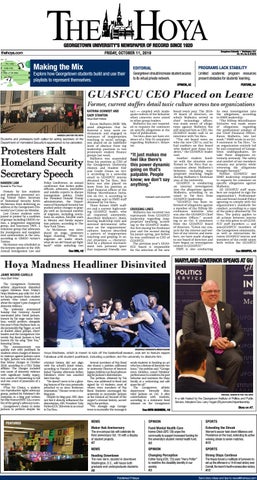
Students and professors both called for acting secretary of the Department of Homeland Security’s appearance to be canceled.
Protesters Halt Homeland Security Secretary Speech HANSEN LIAN
Special to The Hoya
Protests by law students and professors prevented acting United States Secretary of Homeland Security Kevin McAleenan from delivering an address at the Georgetown University Law Center on Monday. Law Center students were joined in protest by a coalition of groups including CREDO Action, a progressive organizing group, and Sanctuary DMV, a volunteer group that advocates for immigrants and marginalized communities in the area, according to CREDO Action’s Twitter. McAleenan was scheduled as the keynote speaker at the 16th Annual Immigration Law and
Policy Conference, an annual conference that invites public officials, advocates, journalists and notable experts to discuss immigration politics. Under the President Donald Trump administration, the Department of Homeland Security has pushed policy changes to grapple with an increased number of migrants, including restrictions on asylum, forcible waits in Mexico and family separation policies, according to The New York Times. As McAleenan was introduced on stage, protesters began chanting, “When immigrants are under attack, what do we do? Stand up! Fight back!” while unfurling two See DHS, A6
Kuran Malhotra (MSB ’20), amid allegations that he fostered a toxic work environment and engaged in instances of inappropriate touching in social settings, was placed on an indefinite leave of absence from top leadership positions in two prominent student finance groups last week. Malhotra was suspended from his position as CEO of the Georgetown University Alumni and Student Federal Credit Union on Oct. 3, according to a same-day email to GUASFCU interns obtained by The Hoya. Malhotra was also placed on leave from his position as chief financial officer of the Hilltop Microfinance Initiative on Oct. 4, according to a message sent to HMFI staff obtained by The Hoya. Three former HMFI staffers and a current high-ranking GUASFCU leader, who all requested anonymity, described Malhotra’s domineering leadership style and outsized detrimental influence on the organizations’ cultures. Sources described a pattern of inappropriate touching and groping in social situations — characterized by a physical encroachment into personal space that surpassed friendly con-
tact — coupled with inadequate redress of the behavior when concerns were raised to other group leaders. Malhotra has not responded to requests for comment on specific allegations at the time of publication. The Hoya does not have evidence of a Title IX complaint regarding Malhotra’s behavior.
“It just makes me feel like there’s this power dynamic going on that’s palpable. People know; we don’t say anything.” FORMER HMFI STAFFER
CROSSING LINES
Malhotra has received two reprimands from GUASFCU leadership regarding inappropriate touching, according to the GUASFCU leader, the first during his freshman year and the second during his junior spring, just before he was confirmed as CEO of GUASFCU. The previous year’s GUASFCU board is responsible for the selection of the new
Hoya Madness Headliner Disinvited
board every year. The 201819 board of directors, on which Malhotra served as chief technology officer, was made aware of allegations against Malhotra but still selected him as CEO, the GUASFCU leader said in an interview with The Hoya. “The old board votes on who the new CEO is, and he had enablers on that board who looked past those incidents,” the GUASFCU leader said. Another student familiar with the situation confirmed to The Hoya that accusations about Malhotra’s behavior, including inappropriate touching, began during Malhotra’s freshman year at the university. GUASFCU is conducting an internal investigation into the allegations against Malhotra, according to an email to The Hoya from GUASFCU leadership. “GUASFCU has been informed of allegations against a member of the Hilltop Microfinance Initiative who was also the GUASFCU Chief Executive Officer,” according to an Oct. 6 statement from the GUASFCU board of directors. “Given our concern for the interest and welfare of our interns and members, we have made changes to our board of directors and have begun an investigation related to GUASFCU.” HMFI is also conducting
its own investigation into the allegations, according to HMFI leadership. “The Hilltop Microfinance Initiative was made aware of allegations regarding the professional conduct of our Chief Financial Officer, Kuran Malhotra, late last week,” HMFI wrote in an Oct. 9 statement to The Hoya. “As an organization entirely led by and comprised of Georgetown undergraduates, we take these allegations extremely seriously. The safety and comfort of our members remains our priority while reviewing the allegations brought forward.” Neither GUASFCU nor HMFI leadership responded to requests for comment on specific allegations against Malhotra. All GUASFCU staff members are required to sign the organization’s Professionalism and Sexual Assault Policy agreeing to comply with the organization’s standards for conduct, according to a copy of the policy obtained by The Hoya. The policy applies to all actions between interns — the title given to all GUASFCU staff members — and non-GUASFCU members of the Georgetown community, as well as interactions between GUASFCU interns and members of the credit union both within the GUASFCU See GUASFCU, A6
MARYLAND GOVERNOR SPEAKS AT GU
JAIME MOORE-CARILLO Hoya Staff Writer
The Georgetown University athletic department disinvited rapper Fabolous from Friday’s Hoya Madness pep rally Oct. 8 after facing pressure from student activists who raised concerns about the rapper’s past charges of domestic violence. The university announced Sunday that Grammy Awardnominated John David Jackson, known by his stage name Fabolous, would perform alongside this year’s Hoya Madness host, radio personality Big Tigger, as well as student dance groups, cheerleaders and the Georgetown University Pep Band. Jackson is best known for his song “Into You,” featuring Tamia. The announcement was quickly met with pushback by students when charges of domestic violence against Jackson came to light. Jackson was indicted on four felony charges in October 2018, according to a USA Today affiliate. The charges included one count of domestic violence with significant bodily injury, two counts of threatening to kill and one count of possession of a weapon. H*yas For Choice, a studentrun reproductive rights advocacy group, pushed for Fabolous’s disinvitation in a blog post written by Ollie Hanner (NHS ’22), a member of the group’s advocacy team. Georgetown’s choice to invite Jackson to perform despite his
FEATURED
@GEORGETOWNHOOPS/@INSTAGRAM
Hoya Madness, which is meant to kick off the basketball season, was set to feature rapper Fabolous until student pushback, including a petition, led the university to disinvite him. criminal history did not align with the school’s Jesuit values, according to Hanner’s post published Tuesday afternoon before Fabolous’s event was canceled later that day. “He doesn’t seem to be a glowing beacon of the cura personalis preached to us since freshman orientation,” Hanner wrote in the blog post. Despite its blog post, HFC does not feel it directly influenced the disinvitation, HFC President Talia Parker (COL ’20) wrote in an email to The Hoya.
Several members of Pep Band also shared a petition addressed to university Director of Intercollegiate Athletics Lee Reed advocating for Jackson’s disinvitation. The petition, obtained by The Hoya, was addressed to Reed and signed by 13 students, most of whom were members of Pep Band. Students encouraged the university to reconsider Jackson as the musical act because of the rapper’s criminal history, according to the petition. “We strongly urge Georgetown to reconsider the message it
sends students in booking an act who has a history of domestic violence,” the petition said. “Georgetown Athletics, cancel Fabolous’ performance to condemn his past behavior and maintain the Hoya family as a welcoming and safe space for all.” The Georgetown athletic department formally disinvited Jackson on Oct. 8 after conversations with students, according to a statement Reed released on the Georgetown
MICHAEL HOWARTH FOR THE HOYA
In a talk hosted by the Georgetown Institute of Politics and Public Service, Maryland Gov. Larry Hogan (R) promoted bipartisanship. Story on A7.
See HOYA MADNESS, A6
NEWS
OPINION
SPORTS
Maker Hub Anniversary The on-campus lab will celebrate its third anniversary Oct. 19 with a display of student projects. A7
Fund Mental Health Care Kenna Chick (SFS ’20) urges the community to support increased funding for the university’s student mental health fund. A3
Extending the Streak Women’s soccer took down Villanova and Providence on the road, extending its active winning streak to seven matches. A12
NEWS
OPINION
SPORTS
Heading Downtown The new dorm, located in downtown Washington, D.C., will house both graduate and undergraduate students. A8
Changing Perception Esther Kang (COL ’23) uses “Harry Potter” to redefine the disability identity in our society. A3
Strong Stops Continue The Hoyas forced a multitude of turnovers to set up the offense in a 14-8 road victory over Cornell, the team’s fourth-consecutive victory. A12
Published Fridays
Send story ideas and tips to news@thehoya.com
A2
OPINION
THE HOYA
FRIDAY, OCTOBER 11, 2019
THE VERDICT Founded Jan. 14, 1920
EDITORIALS
Support Internet Access Abroad Some students studying abroad in countries like China and Russia may discover their access to internet is restricted by the local government, rendering them unable to access high quality news and essential social media sites. In countries like China, the government prohibits people from accessing a variety of websites, including Google, Facebook and The New York Times. Without access to search engines such as Google, academic research becomes unduly difficult; without access to reporting from the free press, students cannot stay current on events. Hoyas do have one saving grace: Georgetown University has a virtual private network system that allows users to circumvent internet restrictions in countries that practice censorship. However, though some students are granted VPN access, the university’s website explicitly states that students are not eligible for access. The nebulous policy creates uncertainty around internet access. To encourage students’ access to free internet, Georgetown should standardize and make more transparent the process of accessing the university’s VPN. The network has the benefit of bypassing geographic restrictions on internet access, including in countries with online censorship. With at least 34 study abroad programs in countries that have substantial internet censorship — including China and Russia — VPNs are critical to grant student access to free information for their academic pursuits. Without a VPN, students studying abroad in China cannot even have basic access to Gmail and Google Drive. Such severe restrictions limit academic freedom and prevent students from doing meaningful research on information censored by their host country. Despite the importance of a VPN, Georgetown’s website states that students may only access specific servers at the request of a staff or faculty member. Otherwise, the website states that there are no exceptions to make students
eligible for VPN access. However, students may access the VPN for university-specific business and when traveling abroad, Vice President for Information Technology Judd Nicholson wrote in an email to The Hoya. Rather than placing the onus on students to discover they may be granted VPN access, the university should publicize specific criteria for student VPN access. Providing students with the university VPN is common practice among Georgetown’s peer institutions. Institutions including The George Washington University and Harvard University both have explicit policies that grant students VPN access. Georgetown should emulate its peers in providing students with unfettered internet access. Regardless of their geographical location, students should be provided the same access to resources they would otherwise have on campus. For students who are studying abroad, VPN access is especially important to ensure the quality of their scholarship is not sacrificed because of a lack of resources. VPN access should also be granted to international students who are doing academic work at home or other students who are traveling for academic purposes. Though the university has an obligation to provide students with a VPN when necessary for academic work, Georgetown does have a reasonable interest to limit student use of the VPN to prevent excessive traffic on its VPN. To this end, the university should implement an application process for students to explain their need for the network. Before a student goes abroad, they could explain their academic need for VPN use and receive access for the duration of their trip. Georgetown should ensure its students are not subject to foreign governments’ censorship as much as possible. Students must be afforded access to information as a foundation of their academic freedom. To preserve students’ academic freedom abroad, Georgetown should publicize a VPN policy and application.
C C
Going for Gold — The Hoya wishes the best of luck to Harrison “Mr. The Hoya” Hurt (SFS ’20) in tonight’s Mr. Georgetown show. Hurt, with his golden short shorts, is sure to shine on stage.
C C C
Nuts and Bolts — A Pittsburgh couple found a stash of over 200 walnuts under their car’s hood. Holly said she found that a squirrel had been stocking food in her car after she smelled what she thought was burning gas from her engine.
Garfield Invasion — Residents of Garfield, N.J., are dealing with a feral invasion as they struggle to contain the local cat population. Locals are claiming that there are a dozen feral cat colonies, with some finding them spontaneously appearing in their homes.
Green Eggs and Ham — Taco Bamba’s owner Victor Albisu announced that he is opening a new restaurant in Ballston called Huevos that will serve eggs at every meal. Their menu will be heavily influenced by Latin flavors, but will also pay tribute to Dr. Seuss with a dish of green eggs and ham. Naturday Saints — A church of the Church of Jesus Christ of Latter-day Saints in Salt Lake City found its parking lot doused in beer after a semitrailer veered off of a nearby road and crashed. While there were no injuries or damages, the event was made particularly uncomfortable because of the church’s prohibitive stance on alcohol.
EDITORIAL CARTOON by Advait Arun
Pay Student Tour Guides Students of the Blue and Gray Tour Guide Society regularly spend their free time representing Georgetown University to prospective students. Despite their job’s similarity to other campus jobs, the tour guides are not paid by the university. Georgetown should not ask students to work on its behalf without compensation; this editorial board calls on the university to pay Blue and Gray tour guides. Blue and Gray is a club run entirely by students who work in close cooperation with the admissions office to schedule tours for visitors. Tour guides lead tours six days a week, showing prospective students and families around the university and speaking about their own experiences at Georgetown. Tour guides currently operate on an entirely volunteer basis. Student guides are only paid for work over holidays like spring and summer breaks. Despite students’ willingness to work for no pay, tour guides should nevertheless be compensated for their contribution to the university’s student recruitment process. The university must prioritize funding for tour guide payment to avoid engaging in the unfair practice of using unpaid labor. Implementing a salary on par with other student jobs for tour guides could also increase the diversity of socioeconomic status among tour guides. With an hourly wage, students would not have to face the burden of working an unpaid job. Unpaid internships reduce access to opportunity for less socioeconomically privileged people, according to Investopedia, a website focused on finance and investment reporting. Though Blue and Gray is not an internship, a similar principle could be reasonably applied to the job of tour guides. Georgetown should seek to eliminate such an economic barrier to ensure all students are represented in tour guides. The move to pay tour guides and eliminate economic barriers to the job is not unprecedented. Brown University, a university with an undergraduate body similar to Georgetown’s, started paying its student tour guides $11 per hour in January 2019, citing socioeconomic diversity as a reason for implementing pay. The university began providing a salary to ensure the perspectives of all students, including first-generation students and stu-
dents on financial aid, are shared with prospective students, according to The Brown Daily Herald. The university should follow its peer institutions like Brown so prospective students can hear experiences from a diverse array of students, not just from students who can work an unpaid job. While students should give tours out of their love for Georgetown, a salary would not diminish that spirit. Rather, a salary would merely ensure students are properly compensated for their work. This editorial board believes Blue and Gray tour guides should be paid. But this conversation is complicated, particularly given the question of where such resources would come from and how the shift would change the group’s relationship with the administration. This editorial board also understands that the volunteer nature of the society is built into the group’s DNA, as acknowledged by the Blue and Gray executive board. “This year’s Blue & Gray Executive Board always strives to listen to and support our tour guides. We have been proud to host a number of appreciation events for our tour guides in conjunction with the Admissions Office and other external partners, which we hope to continue throughout the year. Blue & Gray has always been a volunteer organization dedicated to serving the university,” the board wrote in a statement to The Hoya. “We are excited to continue showing appreciation to our tour guides for the immensely valuable service they provide and are open to further discussion with our guides and the Admissions Office on this topic.” While this editorial board appreciates the time tour guides volunteer to represent our university to visitors, we firmly believe their enthusiasm for the school should not be taken for granted. The guides are often one of the first people prospective students interact with on campus and are able to create a lasting impression on any prospective student. Their work is important to the university and the entire Georgetown community. Just like any other student who works for the university, they deserve to be paid.
(Full disclosure: Faris Bseiso (SFS ’21), a member of this editorial board, is a member of the Blue and Gray Tour Guide Society)
Maya Gandhi, Editor-in-Chief Madeline Charbonneau, Executive Editor Kiera Geraghty, Executive Editor Amber Gillette, Managing Editor Katrina Schmidt, News Editor Cady Stanton, News Editor Jake Wexelblatt, Sports Editor Allan Navarro, Guide Editor Timothy McNulty, Guide Editor Doris Zhang, Opinion Editor Will Cassou, Features Editor Meena Morar, Features Editor Subul Malik, Photography Editor Samuel Nelson, Design Editor Katherine DeMatteo, Copy Chief Sheel Patel, Social Media Editor Jenna Ryu, Blog Editor Hector Herrera, Multimedia Editor
Editorial Board
Doris Zhang, Chair
Faris Bseiso, Bianca Corgan, Joshua Levy, Joseph Yacovone, Grant Zangwill
Myroslav Dobroshynskyi Academics Desk Editor Amy Li Graduate Desk Editor Sana Rahman Campus Life Desk Editor Riley Rogerson Campus Life Desk Editor Connor Thomas City Desk Editor Joanna LaCoppola Deputy Sports Editor Steven Botsoe Deputy Guide Editor Michelle Brown Deputy Guide Editor Yu Young Lee Deputy Guide Editor Zain Sandhu Deputy Guide Editor Megan Wee Deputy Guide Editor Max Hamid Deputy Opinion Editor Rebecca Stekol Deputy Opinion Editor Afua Nyantakyi Deputy Features Editor Karena Landler Deputy Features Editor Yolanda Spura Deputy Features Editor Julia Alvey Deputy Photography Editor Margaret Fouberg Deputy Photography Editor Natalie Isé Deputy Photography Editor Kiki Schmalfuss Deputy Photography Editor Tarika Kumar Deputy Design Editor Mina Lee Deputy Design Editor Eloise Owen Deputy Design Editor Janis Park Deputy Design Editor Madeline Broderick King Deputy Copy Editor Chau Le Deputy Copy Editor Victoria Lei Deputy Copy Editor Nora Ma Deputy Copy Editor Grace Jaworski Deputy Social Media Editor Alexandra Matthews Deputy Social Media Editor Isabel Roemer Deputy Blog Editor
Contributing Editors
Susanna Blount, Will Cromarty, Erin Doherty, Harrison Hurt
HOYA HISTORY: Oct. 13, 1972
Administrator Disputes Law Tuition Diversion Charges that more than $1 million of Georgetown Law Center tuition revenues are being diverted to fund other university programs surfaced last week. The diversion of Law Center funds was reported in last week’s edition of the Georgetown Law Weekly. However, the university’s executive vice president for educational affairs said this week that the article was inaccurate and questioned the ethics of publishing the information. The Executive Vice President Rev. Edmund G. Ryan, S.J., said the actual figure of funds diverted from Law School tuitions is $700,000. He also criticized the manner in which the Law Weekly obtained the information. The article was based on a meeting of the law faculty
Sept. 29. It was written from a transcription of the meeting prepared by Greg Halbert, a student who had been paid by the Law Center dean to tape the meeting. After the meeting, Halbert “took the tapes home and transcribed them without asking the permission of anyone,” Ryan said. Halbert wrote the Law Weekly article on the basis of the transcribed tapes. “Many of the faculty and administration consider this a breach of professional ethics,” the executive vice president said. Student Bar Association president John Pinto (LAW ’73) attacked the diversion of funds this week. “We don’t mind if help flows two ways,” he said, “but the flow seems to be only a one way street. We do not find this ac-
ceptable.” Pinto said the diverted funds are needed for Law Center needs. “Georgetown Law is the third largest law school in the country,” he said. “Of the top 17 law schools, Georgetown rates 17th in student-teacher ratio.” Under the present system, tuition money from each school goes directly to the university, which then returns money to individual programs. “We know how important the need [for money] is,” Pinto said, “but we don’t think they do. We have to fight like cats and dogs to justify our expenditures.”
Louis Palmer and Bob Conrad Hoya Staff Writers
For letters to the editor and more online content, visit thehoya.com/category/opinion.
Mitchell Taylor, General Manager Sarah Mihm, Director of Human Resources David Towell, Director of Sales Brian Yoffe, Director of Financial Operations Molly Evers, Treasury Manager
Board of Directors
Will Simon, Chair Dan Crosson, Maya Gandhi, Anna Kooken, Yasmine Salam, Mitchell Taylor, Hannah Urtz LETTER TO THE EDITOR AND VIEWPOINT POLICIES The Hoya welcomes letters and viewpoints from our readers and will print as many as possible. To be eligible for publication, letters should specifically address a recent campus issue or Hoya story. Letters should not exceed 300 words. Viewpoints are always welcome from all members of the Georgetown community on any topic, but priority will be given to relevant campus issues. Viewpoint submissions should be between 600-700 words. The Hoya retains all rights to all published submissions. Send all submissions to: opinion@thehoya. com. The Hoya reserves the right to reject letters or viewpoints and edit for length, style, clarity and accuracy. The Hoya further reserves the right to write headlines and select illustrations to accompany letters and viewpoints. CORRECTIONS & CLARIFICATIONS If you have a comment or question about the fairness or accuracy of a story, contact Executive Editor Madeline Charbonneau and Executive Editor Kiera Geraghty by email at executive@ thehoya.com. TIPS News Editors Katrina Schmidt and Cady Stanton: Email news@thehoya.com. Guide Editors Suna Cha and Timothy McNulty: Email guide@thehoya.com. Sports Editor Jake Wexelblatt: Email sports@thehoya.com. GENERAL INFORMATION The Hoya is published once a week during the academic year with the exception of holiday and exam periods. Address all correspondence to: The Hoya Georgetown University Box 571065 Washington, D.C. 20057-1065
The writing, articles, pictures, layout and format are the responsibility of The Hoya and do not necessarily represent the views of the administration, faculty or students of Georgetown University. Signed columns and cartoons represent the opinions of the author(s) and do not necessarily represent the editorial position of The Hoya. Unsigned essays that appear on the left side of the editorial page are the opinion of the majority of the editorial board. Georgetown University subscribes to the principle of responsible freedom of expression for student editors. The Hoya does not discriminate on the basis of age, gender, sexual orientation, race, disability, color, national or ethnic origin. © 1920-2019. The Hoya, Georgetown University weekly. No part of this publication may be used without the permission of The Hoya Board of Editors. All rights reserved. The Hoya is available free of charge, one copy per reader, at distribution sites on and around the Georgetown University campus. Email: editor@thehoya.com Online at www.thehoya.com Circulation: 4,000
OPINION
FRIDAY, OCTOBER 11, 2019
RECONSTRUCTING DISABILITY
THE HOYA
A3
VIEWPOINT • ESTEVEZ
Rethink Misconceptions
Esther Kang
P
ossessing magic is usually an empowering social exception. To use magic is to surpass the laws of the natural world, to be able to do what “normal people” can’t do. However, in the “Harry Potter” series, Harry’s magic is not initially presented as a positive deviation from the norm. Vernon and Petunia Dursley force Harry to hide and suppress his magic in front of other nonmagical people, believing his supernatural qualities will make them more vulnerable to social scrutiny and judgment. The inverted perception of magic as a disabling trait as opposed to an enabling one highlights the heart of disability justice. While the range of an individual’s functions are determined by environmental structures, the designation of “disability” is socially constructed. Surrounded by neighbors who do not publicly validate magic, the Dursleys work to maintain Harry’s invisibility to maintain their acceptance in society. They see his scar as a physical disfigurement, a reminder of his abnormal past. They punish his involuntary disruptive behaviors by locking him in the cupboard; Aunt Petunia prohibits Harry from asking questions that would reveal his biological roots. When he sees how unabashedly and unconditionally his aunt and uncle spoil their biological son, Dudley Dursley, Harry consciously grapples with this extreme incongruence. However, he cannot specify that the difference between Dudley and himself is his magic, nor can he control the expression of his magic. After Harry receives his letter from Hogwarts School of Witchcraft and Wizardry and enters the world of magic, however, he experiences an overwhelming sense of belonging. His treatment in the magical world as a legendary hero is sharply contrasted by his dehumanized existence in the Dursley household. However, Harry’s magical identity never shifts. He does not become more or less magical by leaving one group of people and joining the next, only the perception of his magic as an “ability” does.
The flipped perception also goes both ways: People lacking magical inheritance in the magical world are often viewed as inferior. To wizards and witches like the pureblood Malfoys, people who can’t use magic or come from nonmagical families are the disabled ones, unable to properly navigate and manipulate the natural environment. Magic as an “ability” or “disability” depends on whether the people judging it themselves can utilize magic or not. The identity politics of each society’s government, from the British Parliament to the Ministry of Magic, are fundamentally reversed so that what disabled and oppressed Harry in one society is requisite for civic engagement in the other. Magical society reflects how our own society essentializes demonstrating functionality with the external world, such as sight, hearing, mobility and social communication, as a prerequisite for social recognition. Nonmagical society reveals how masking dysfunctionality, such as physical deformity or increased sensitivity to mood and stress, is also essentialized for maintaining social legitimacy. Of course, “magic” is a fictional condition, but its implications are anything but trivial. Disability exposes society’s choice to have humanity proven rather than assumed, and according to its own standards of functionality. As Hogwarts Headmaster Albus Dumbledore affirms in “Harry Potter and the Chamber of Secrets,” “It is our choices, Harry, that show what we truly are, far more than our abilities.” Though we cannot choose which traits we have or do not have, we do choose whether to condition human worth, whether to reduce individual value in terms of society’s most common denominators. That said, let us first choose to recognize disability as a cultural marker and social definition, and, in doing so, reinvent it. Esther Kang is a freshman in the College. RECONSTRUCTING DISABILITY runs online every other Tuesday.
Posting calls to social action on social media can be trendy. However, it does not contribute to anything other than a personal sense of achievement.
S
Advocate Beyond Social Media
ocial media is great for many things, like sharing photos of your vacation, slick eyeliner or outfit. Activism, however, is not one of them. On Instagram, in particular, users like to pat themselves on the back for mindlessly reposting about a social movement. Instagram users often litter their stories with the remnants of past political movements. But here’s the kicker: No one does anything else after social media posts to actually make a societal change. I’ll admit I’m guilty of mindlessly reposting, too. I will repost the sympathetic video that promises to plant trees, save the rhinos or bring aid to people in Syria on my social media platforms. Reposting makes me feel like I am contributing — as if I am some upstanding citizen just because I took 10 extra seconds to tap buttons and let my followers know the world is dying. It makes me think I am an active participant in a greater movement for change, but that is the problem: I am not doing anything by just reposting.
Social media deserves a role in activism, but it should not end there. The internet makes the dissemination of information so much easier. Because information is readily available, we have the power to make a change by raising awareness about social issues. However, we can also use our platforms to remain lazy while we pretend to say something. Reposting on Instagram is not the same thing as voting or canvassing. It is not the same thing as tapping into civic engagement to create change in a community. We have become content in using other people’s work as a substitute for our own views because, in reality, the creators of these social media movements don’t want us to stop at just a repost — they want us to take it beyond the screen. While being informed is important, investing in activism is something entirely different. It transcends a measly post to your Instagram story. Activism is initiating something greater; it is being motivated to speak your views and incite a
movement that could change your community, or even the nation. The end goal is not just to spread awareness — it is to make a movement into law. To be an activist, you can find people who believe in the same thing and march, write articles, make art or anything else that can make political noise. A successful example of proactivity through social media is the March For Our Lives movement. Teenagers curated the movement through the internet and reached out to find people with similar mindsets to incite global investment in their mission. They used social media not just to raise awareness, but also to move communities to change policy. The global recognition surpassed just a name — it became an organization through the passion of people who wished to make it something more than just a headline. March For Our Lives, however, seems to be a rare occurrence. Some may say reposting photos
on social media platforms helps promote awareness at a faster rate, but raising awareness in this way does not always promote a sense of urgency. Instead, we find ourselves comfortable sharing posts that do not elicit any substantive change. In fact, it makes us lazy and apathetic by letting us feel satisfied for not reaching for a policy change. We hide behind screens instead of facing the world’s issues head-on. Posting calls to social action on social media can be trendy. However, it does not contribute to anything other than a personal sense of achievement. We all want to feel like we are good people, even when our actions do not contribute to the greater good. Posting on Instagram about some issue you barely know about does not make you woke. In fact, it makes you the catalyst of a greater issue: indifference stemming from laziness.
AMANDA
ESTEVEZ is freshman in the College.
VIEWPOINT • CHICK
A HOYA LOOKS BACK
Support Mental Health Fund
Reject Religious Hypocrisy
This article discusses suicide and self-harm. Please refer to the end of the article for resources on and off campus.
L
ike many Hoyas, Phillip, whose name is changed for privacy, was an overachiever: He was a frequent presence on the Dean’s List and a Capitol Hill intern. While he projected the image of success to everyone around him, he was battling thoughts that he did not deserve to be here, or even to live. Phillip did what most would — he went to Counseling and Psychiatric Services. There, the therapist asked Phillip to list past instances of self-harm and suicide ideation. Afterward, he asked whether Phillip currently actively had suicidal thoughts. When Phillip responded that he did not, the therapist concluded that he was doing manageably and gave him a list of external providers. When Phillip returned to his dorm and summoned the courage to call the therapists on the list, he learned that the average cost per session would be between $150 and $300. His insurance company would cover 80% of this cost — but only if he paid $280 out-of-pocket first. Phillip knew he could never afford these rates. He turned to low-cost and free centers, only to discover the wait for his first appointment was at least nine months long. Yet the thoughts telling him to die would not wait politely for nine months. With no money and a family that seemed far more concerned about academic achievement and career success than the abstract concept of mental wellness, Phillip had nowhere else to turn. Thoughts that had begun as quiet whispers became a whirling hurricane impossible to ignore: “You are worthless. You are pointless. You are useless. You should die.”
In an aching tone, Phillip recounts hurrying to rinse blood off his arm and stash his knife beneath the sink, hoping that his roommate wouldn’t catch him in the act. He did not want to know what they would think. He thought they might hate him, pity him or find him terrifying. Without support and unable to trust anyone around him, Phillip eventually attempted suicide and was hospitalized, which further exacerbated his trauma. What pained Phillip most was the knowledge that, had he been able to find affordable help on his own terms, he might never have spiraled so deeply into crisis. Unfortunately, Phillip’s experience is neither isolated nor rare. Suicide is the second leading cause of death for college students nationwide. A 2019 study found that 46.2% of college students reported feeling depressed, 14.4% seriously considered suicide and 9.5% engaged in selfharm this year alone, according to the American College Health Association’s National College Health Assessment. These numbers have steadily increased over the last several years. During my time at Georgetown University, I have listened to many students share similar stories. In 2017, I proposed the creation of an off-campus therapy stipend to subsidize the exorbitant cost of off-campus mental health treatment for students with financial difficulties. Because CAPS only provides short-term services like most counseling centers in American colleges, Assistant Vice President for Student Health Vincent WinklerPrins, Director of CAPS Phil Meilman and CAPS Clinical Case Manager Elizabeth Steinmeyer worked tirelessly with me to create the program. Launching the stipend required me to petition the student body, pass a Georgetown University Student Association senate resolution and meet with various
administrators, which resulted in the university committing $10,000 to seed it. The stipend, known today as the Georgetown Student Mental Health Fund, has enabled students with financial difficulties to receive therapy, preventing situations such as Phillip’s from spiraling into severe crises. Moreover, as GUSA vice president last year, I was able to negotiate an additional $10,000 after meeting with University President John. J. DeGioia (CAS ’79, GRD ’95) and the board of directors. However, the fund is now rapidly depleting. As the fund’s original founder, I am increasingly concerned that students will no longer be able to receive the support that they once did. The professionals at CAPS and Health Education Services truly care about supporting students, but they can only do so much with extremely limited resources. I now urge you to sign this petition as a statement of support for the fund’s expansion and conversion to a long-term, sustainable endowment of $100,000 that would generate new funds each year, guaranteeing accessible mental health treatment for many more students in years to come. For far too long, stigma, shame and prejudice have caused students to suffer in silence until they reached a breaking point. Now, more than ever, we as Hoyas need to hear their stories and call on the university to fulfill its commitment to cura personalis and ensure that all students who are struggling and in distress are cared for and supported.
KENNA CHICK is a senior in the School of Foreign Service.
Resources: On-campus resources include Health Education Services (202-687-8949); additional offcampus resources include the National Suicide Prevention Lifeline (800-273-8255).
Raymond W. Dillon
O
ne of the most significant cultural divides in this country is between those who embrace a more secular basis for public policy and those who believe in a “Christian nation” founded on biblical principles. I do not question the faith or sincerity of the proponents of religiously focused government. Further, I respect the right of others to hold differing opinions on matters of public policy. However, I take issue with them claiming to be acting as Christians when they undercut programs intended to assist the weakest among us. It is those people eschewing a direct partnership with religion who may more fully embody the teaching of Christ in the public policies they embrace, highlighted by the conflicting opinions on the socalled “social safety net.” The raison d’etre for programs advocated by progressives — such as Social Security, Medicare and Head Start — is the supposition that it is the responsibility of the government to protect the most vulnerable in society. Religious conservatives, though, oppose what they see as the “moral hazard” inherent in an overdependence on a “nanny state.” They argue for smaller government, saying that people should take
responsibility for themselves. However, caring for one another is a central tenet of Christianity. The social programs decried by the religious right are actually a manifestation of the Christian mandate to help. Christianity consists of a call to action, not ignoring the needs of others. This call to action is evidenced in the same Scriptures often cited by the religious right, such as in James 2:17: “So also faith by itself, if it does not have works, is dead.” How faith translates to works is expressed in Matthew 22:39, wherein the Second Commandment is stated as: “You shall love your neighbor as yourself.” There are no exclusions as to who might be a “neighbor.” The advice and admonitions contained in Matthew 25 regarding those in need resonate in today’s political disputes over the role of government. It also provides a step-by-step roadmap on how to fulfill this Christian duty to love and help others. Beginning with verse 35, the path of a righteous Christian is apparent and indisputable: “For I was hungry and you gave me food, I was thirsty and you gave me drink.” This verse tracks with the Department of Agriculture’s Supplemental Nutrition Assistance Program, which helps feed our nation’s undernourished children. The support of the religious right for the current administration, despite cuts to the funding of this program, demonstrates a lack of adherence to fundamental Christian principles. Verse 35 continues with “I was a stranger and you welcomed me.” Immigration policy that turns away refugees, brands immigrants as rapists, thieves and terrorists, and takes children
a
from their mothers is the antithesis of Christian love — it is unmitigated hatred. Next, verse 36 says “I was ill and you cared for me.” Opposing affordable medical care for all Americans and denouncing any efforts to provide it as “socialism” does not comport with basic Christian values. The failure to protect the health of our citizens is the epitome of the uncaring and godless state that many conservatives falsely attribute to progressives but for which they actually advocate themselves. Verse 36 concludes with “I was in prison and you visited me.” Public policy that produces the world’s highest per capita incarceration rates, especially among people of color, coupled with efforts to block the reintegration of prisoners into society by barring them from well-paying jobs or denying them the franchise, exposes the hypocrisy of any profession of Christian forgiveness or willingness to comfort the imprisoned. Verse 36 wraps up with “Whatever you did for one of the least brothers and sisters of mine, you did for me.” There is no distinction among “brothers,” be they other Christians, Muslims or members of the LGBTQ community. Christians should help and comfort all who suffer, irrespective of who they are. All are worthy of succor, even criminals. Those who reject the Gospel of Matthew should not call themselves Christians; that term is reserved for those who strive to follow the teachings of Christ. Raymond Dillon graduated from the College of Arts and Sciences in 1977. A HOYA LOOKS BACK runs online every other Thursday.
A4
NEWS
THE HOYA
FRIDAY, OCTOBER 11, 2019
PAGE FOUR
INSIDE THIS ISSUE The MSB hosted the Public Interest Technology University Network’s first ever panel discussion. Story on A8.
Your news — from every corner of The Hoya.
verbatim
IN FOCUS BE SUSTAINABLE
“
This is something the world needs. This is something that plays to our strengths.” MSB Dean Paul Almeida on the new bachelor of science in business and global affairs degree. Story on A7.
from our blog
THE FIRST MONTH OF SCHOOL IN HAIKUS A haiku for you Is contained in this blog post. Check out the website. @HILLTOP.COMPOST/INSTAGRAM
On-campus environmental organizations, including GREEN, Hilltop Compost, GU Fossil Free, Georgetown Citizens’ Climate Lobby and Slow Food, tabled in Red Square on Oct. 7 to advocate for sustainability in an event hosted by Interhall.
blog.thehoya.com
Academic Programs Lack Resources, Endanger Stability SIMON GOLDSMITH Hoya Staff Writer
Students often depend on the mentorship and guidance of a close faculty adviser as they explore complex topics for their senior thesis. For some students, this long and stressful year of research and writing is made more difficult when the programs in which they study lack the necessary resources to support them. Chad Gasman (COL ’20) sought to explore the exclusion of trans narratives for their thesis. However, when the adjunct professor in the women’s and gender studies program they wished to work with left Georgetown University because of financial reasons regarding her position as an adjunct professor, Gasman had to take on more independent research without the stable mentorship other students receive. Programs often lack the resources of an academic department, and at times the transient nature of their teaching faculty can present obstacles for their students. The frustration students such as Gasman feel toward the volatile, unstable nature of program resources such as tenured professors and research opportunities stretches across the university, ultimately highlighting the obstacles programs face in comparison to more regimented departments.
WORKING WITHIN UNCERTAINTY
An academic program and a department are fundamentally different with respect to faculty, research and teaching. Georgetown College has 15 academic programs, ranging from cognitive science to film and media studies, each offering minors, majors or both, according to the Georgetown College website. Within the same school, however, Georgetown has 23 departments. Although academic departments focus on the more regimented tracks of arts and science and programs are often more interdisciplinary, both should be valued equally, according to College Dean Christopher Celenza. “Departments and programs should not be considered hierarchically,” Celenza wrote in an email to The Hoya. “A department is not better than a program, or vice versa; each has its own distinctive strengths. One can think of the arts and sciences disciplines as pillars, and programs as structures
that allow bridging to occur across the pillars.” Of the 15 programs, the women’s and gender studies program, though small, is one of the most popular programs on campus. Among other popular choices are the American studies program, the justice and peace studies program and the disability studies program. Despite Celenza’s assurances of equal standing within the College, programs and departments have not always found equal access to resources. Fundamentally, programs such as JUPS find themselves with less administrative help and funding security, according to professor Mark Lance, founder and co-director of Georgetown’s JUPS program. “Basically, when one is classed as a department, resources are both more secure and more extensive,” Lance wrote in an email to The Hoya. “Programs are generally funded out of the discretionary funds of the relevant dean, and can be dissolved at any time. We typically have far fewer faculty—especially tenure-line— and far less administrative help.” A tenure-line faculty member is defined as a full-time faculty member that holds the title of either instructor, assistant professor, associate professor or professor, according to Georgetown’s faculty handbook. A tenure-line track can provide a sense of job security and freedom of expression, according to Libbie Rifkin, a professor from the department of English, who helped create the disability studies minor in 2017. “Tenure means job security,” Rifkin said. “One of the most powerful resource allocations that exists is granting departments and programs the capacity to hire. Tenure is this institution which was initially developed to make it so that scholars and intellectuals could have opinions that might be dissonant with the mainstream or even their institutions.” Within the JUPS program, Lance is currently the only tenured professor, also holding a joint appointment in the department of philosophy. The program plans to take another joint tenure-line hire with the department of anthropology, according to Lance. The disability studies program currently has no program-specific faculty, but the professors are tenured in their respective departments, according to Rifkin. “We don’t currently have any of our own faculty,” Rifkin
wrote in an email to The Hoya. “As an interdisciplinary program, we have so far relied on faculty in other departments teaching classes that we can cross-list. Among the faculty who teach DS core courses are all tenured. Many of our electives (housed in other departments) are taught by tenured or tenure-line faculty.” The program hopes to make its first joint tenure-line faculty hire next year in partnership with the philosophy department, according to Rifkin. Within the WGST program, however, only two of the program’s 12 faculty members are full-time and none are tenureline.
UNINTENTIONALLY INACCESSIBLE
With a limited amount of resources designated to programs, students often find more difficulty trying to access research opportunities and build connections with their professors. With an increasing amount of students joining the WGST program, for example, a larger pressure falls on the backs of the professors who are already overworked, according to WGST major Gasman. “Our professors are spread as thinly as humanly possible,” Gasman said. “They just don’t have enough time to talk to students and really mentor them in the way that professors in other departments get.” Without a tenure-line position, adjunct professors often find themselves unable to commit adequate time to students and classes, according to WGST major Rachel Harris (COL ’21). “It’s hard for adjunct professors to devote their time and studies here when they’re not guaranteed a job from semester to semester,” Harris said. “The lack of relationships that you are able to foster is apparent because of the turnover.” At Georgetown, the average salary of an associate professor was $129,416 in 2017 and $115,225 for assistant professors, according to Chronicle Data. Adjunct professors, however, are part-time, nontenure-lined professors who are paid dependent on the amount of classes they teach. The national average base pay for adjunct professors is $19,999 per year, according to Glassdoor. As a result, many professors have to work more than one job or are unable to remain teaching at the school, according to Gasman.
“All of our professors besides professor April Sizemore-Barber and professor You-Me Park are adjuncts, which on their side means that they’re getting paid really poorly,” Gasman said. “[They] often have to take on multiple jobs or teach at multiple universities in addition to just teaching a class, so they have very limited time to support students.” Beyond job security, however, many professors may also fear retaliation if they comment against the program, according to WGST professor Elizabeth Velez. “It’s a difficult situation for my colleagues whose only appointment is as an adjunct to criticize anything about the program because, for many of them, the desire to teach full time in the program if there were a line sort of supersedes everything,” Velez said.
SECURING STABILITY
Across campus and career interests, the limited resources and connections programs produce cause students to feel a lack of security in their own relationships and job prospects. For example, while programs do offer specialized opportunities and resources, some students feel a sense of guilt by using the program’s limited budget.
Jordan Brown (COL ’21), a JUPS major and disability studies minor, was able to attend a restorative justice training through the JUPS program but still felt a sense of guilt using the resources provided. “I didn’t feel at all intimidated to ask for that funding because I feel like this program really and truly cares about me and my growth in the field of JUPS,” Brown wrote in an email to the Hoya. “I did feel kind of bad because I know the resources for these programs are so limited compared to full departments. I just want all the students who need these resources or funding to be able to have access to them.” Furthermore, the nature of adjunct professors in the WGST program does not allow for longterm planning and mentorship, according to Gasman. “Because adjunct contracts are on a semesterly basis, there is no guarantee that the professors you have one semester are gonna be there next semester,” Gasman said. “There is so much turnaround that I haven’t had the chance to take a professor more than once.” The transition to a department can fill the gaps previously felt in an interdisciplinary program, as seen through the history of the African American studies department.
In 2016, the board of directors voted to make the African American studies a full department after 13 years of being an interdisciplinary program. Through its transition, the department is now able to provide a more stable, nuanced version of its curriculum independently, according to professor Robert Patterson, who served as the department’s inaugural chair. “As a Program, AFAM largely depended on other units to offer its courses, and the kindness of committed faculty to perform additional service,” Patterson wrote in an email to the Hoya. “The hiring of tenure-line faculty has allowed us to provide a stable intellectual framework that reflects the interdisciplinarity of African American Studies.” With the greater institutionalized support a department can provide, students like Gasman feel secure in their studies and future career. “Knowing that my professors are going to be here for the long haul is really important,” Gasman said. “I can start talking about thesis ideas or research projects immediately, without there being a fear that either there is not enough time for my professors to help me out with that or without there being a fear that my professor is not going to be here next semester.”
NATALIE ISÉ/THE HOYA
Located in the Intercultural Center, Georgetown’s women’s and gender studies program only has two full-time faculty members. None of the 12 total faculty members are tenure-line.
NEWS
FRIDAY, OCTOBER 11, 2019
THE HOYA
A5
Georgetown Submits Amicus University Launches New Brief Supporting DACA Website Content, Appearance CONNOR BRANDI Special to The Hoya
Georgetown University joined 18 other colleges and universities in filing an amicus brief to the Supreme Court on Oct. 7 in support of the Deferred Action for Childhood Arrivals program. The brief highlights the contributions and perspectives that DACA recipients bring to the university’s campus and includes the stories of three Georgetown students without documentation. In filing the document, Georgetown recognized that the university itself is not a party in the lawsuit but an institution with great interest and insightful information relevant to the case. President Donald Trump’s administration announced in September 2017 that it will be ending DACA, prompting over ten lawsuits, including those from the National Association for the Advancement of Colored People and the Regents of the University of California, arguing that the termination of the program was unlawful. On Oct. 9, Trump called upon the Supreme Court to review and rescind DACA, stating that he would work on a bipartisan deal instead if the policy is repealed by the court. Hoyas for Immigrant Rights, a student organization that advocates for immigrant students on and off campus, is deeply concerned with the implications of overturning DACA, according to HFIR President Arisaid Gonzalez Porras (COL ’21). “The court’s ruling will affect the future of 800,000 people and everyone surrounding them,” Gonzalez
wrote in an email to The Hoya. “If the Supreme Court doesn’t uphold the lower courts’ decisions to block Trump’s attempts to kill DACA, everyone will lose their work authorization and protection from deportation.” DACA, introduced by former President Barack Obama in 2012, provides immigrants without documentation who arrived in the country before the age of 16 with rights and protections, including eligibility for work permits and renewable protection from deportation. The brief, signed by 19 colleges and universities, highlights that many DACA recipients are gifted and motivated students. The document also details some of the negative effects that rescinding DACA could have on society, discussing these implications by evaluating how these students will contribute to society through their aspirations and future career paths. Georgetown student and DACA recipient Juan Jose Martinez Guevara (SFS ’20), one of the three DACA recipients included in Georgetown’s comments in the brief, elaborated on his dream to pursue a career in public service. “Work for government – to help achieve what is best for America in the world and to help make the world a safer place,” Guevara wrote in the brief. Students without documentation face anxiety and injustice in fear of a DACA repeal, scared not only for their own safety but also for that of their families, according to Gonzalez.
“DACA recipients that have not yet graduated, will not be able to enter their career field without their employment authorization,” Gonzalez wrote. “But the biggest risk of them all, is that the government has all of the information of DACA recipients, including their families. It’s being a red dot on their radar and if the program ends, what stops them from starting deportations?” This amicus brief is not the first time Georgetown has expressed public support for the DACA program and its recipients. In October 2017, University President John J. DeGioia (CAS ’79, GRD ’95) and other university presidents urged Congress to pass the Dream Act, legislation that would grant residency status to many minors who are currently part of DACA. While the future of DACA is uncertain, Georgetown officials strive to protect the safety of students without documentation on campus. The university released a statement supporting students without documentation in June 2019, highlighting available campus resources. Georgetown will continue making resources available to students without documentation at the university, according to Arelis Palacios, associate director for undocumented student services. “Whether it be free legal services through our partnership with Catholic Charities Immigration Legal Services or on-campus advising, we remain fully dedicated to supporting our undocumented students and the unique challenges they face,” Palacios wrote in an email to The Hoya.
YICHU HUANG FOR THE HOYA
The new statue, installed Sept. 24 outside the Healey Family Student Center, was funded by Bob Hohmann (GSB ’68), who sponsored the employment of the first Jack’s Crew head caretaker.
New Statue Outside HFSC Honors Jack the Bulldog Mascot MADDIE BERRY
Special to The Hoya
The first Jack the Bulldog statue was installed outside the Healey Family Student Center on Sept. 24, commemorating the legacy of Georgetown University’s bulldog mascots. While the university has not confirmed whether the sculpture depicts a specific Jack, the statue is inspired by Jack Sr., the mascot from 2003 to 2013, according to Fr. Christopher Steck, S.J. Steck was the caretaker of Jack Sr., who lived with Steck on the fourth floor of New South Hall while Jack Sr. was mascot. Janet Pfister, former executive assistant to University President John J. DeGioia (CAS ’79, GRD ’95), led the creation of the statue, which was sculpted by Brian Hanlon, a nationally acclaimed sculptor. Pfister had a close relationship with Jack Sr. and often helped take care of the mascot while she was the executive assistant, according to Steck. The statue serves to physically commemorate the memory of Jack Sr., whose loving personality had a strong influence on all those around him, according to Pfister. “Jack touched our lives with his endearing expressions, his entertaining mannerisms, and his loving devotion to Father Steck and all of his Hoya family,” Pfister wrote in an email to The Hoya. “I felt it was so important to preserve his memory not just in our hearts, but in
an enduring memorial on the Georgetown campus, the home he knew and loved for his entire life.” The statue was funded by Bob Hohmann (GSB ’68), who was involved with the Georgetown men’s basketball program during John Thompson Jr.’s tenure as coach of the team from 1972 to 1999, according to Steck. Hohmann funded the employment of the first head caretaker of Jack’s Crew, the group that cares for the bulldog, starting in 2008, Steck wrote. “When demands surrounding the mascot increased (lots of requests for Jack attending different functions on and off campus), and I found myself needing to hire a student to organize Jack’s schedule, Bob stepped in to provide the funding,” Steck wrote in an email to The Hoya. The university has not installed a plaque specifying details of the history of Jack. However, a bronze donor plaque is planned for the end of October, according to Carla Tiberi, a senior project manager and landscape architect at Georgetown. The university’s decision not to currently specify which Jack the statue is modeled after creates an all-encompassing representation of the mascot, according to a former Jack Crew member Matthew Lewis (COL ’99, GRD ’06). “I certainly think there would be value to having some sort of plaque to commemorate
what exactly this Jack was but I understand the university’s position on a more “universalist” all-encompassing Jack representation,” Lewis wrote in an email to The Hoya. Before Jack Sr., most Jack the Bulldogs were not seen much on campus, according to Steck. As a mascot, Jack the Bulldog became an integral and active part of the Georgetown community when Jack Sr. arrived on campus in 2003. Once Jack Sr. began performing his “box trick” at basketball games in 2005, the mascot started to become more popular, according to Steck. “The mascot really took off with the box trick,” Steck said in an interview with The Hoya. “A certain time out would happen, and they’d paint a box in colors of the opposing team’s logo. Jack loved to attack boxes, so it was easy to get him to go after it.” The “box trick” increased Jack Sr.’s popularity, causing demand for the mascot to grow across campus, Steck said. “It was a very popular trick, and it put Jack on the radar screen for people,” Steck said. “He walked around the concords and then I set up a website to help me with requests for Jack, and it just kind of grew and grew.” Moving forward, the statue can be incorporated into a new Georgetown tradition to honor Jack Sr., according to Steck. “Pat his head for health and happiness and rub his [letter] G for goodness and greatness,” Steck said.
CLARA GRUDBERG Special to The Hoya
Georgetown University launched a new Georgetown. edu homepage Oct. 9 which includes new multimedia content, user-friendly navigation and added visuals. The new website, which will use the content management system WordPress, is the first major website redesign for the university since 2010. Vice President of Public Affairs Erik Smulson and Vice President for Information Technology Judd Nicholson notified the Georgetown community of the transition in an email Tuesday evening. The website redesign will help to spread Georgetown’s mission by better informing visitors about information on the university. The new design will also showcase the school’s best qualities and improve the website experience for individuals both inside and outside of the Georgetown community, according to Nicholson. “We hope that prospective students, undergraduate and graduate, will better understand what makes Georgetown different and the opportunities available to them as a student,” Nicholson wrote in an email to The Hoya. “Woven throughout, viewers will experience the real impact of our Catholic and Jesuit identity, location in DC, research and academic expertise and diverse community.” The old website could not support some of the visual elements that aid in conveying the Georgetown experience, according to Nicholson. “We wanted Georgetown. edu to be able to tell our story in visually compelling and dynamic ways that our previous site couldn’t accommodate,” Nicholson wrote. “We sought to incorporate multimedia that resonates with current and prospective students, such as firstperson student video or social media posts.” The university worked with Digital Pulp, a New York-based digital agency that has previously worked with Harvard University, Columbia University and the University of Virginia on website redesign, according to Nicholson and Smulson’s email to the Georgetown community. Although Digital Pulp did provide expertise in higher education website redesign, the website redesign also required efforts from many members of
NATALIE REGAN FOR THE HOYA
The new website features updated academic major and minor information and is the first major redesign for the school since 2010. the Georgetown community, according to Nicholson. Georgetown.edu’s “Areas of Study” page hosts information about possible majors and minors, making it crucial for students, according to Nicolo Ferretti (SFS ’21), the Georgetown University Student Association director of university affairs and the student representative to the Top Tier Redesign working group comprised of students, staff and faculty from each Georgetown school who regularly met to review and give feedback on the site’s layout, design and copy. Consequently, the redesign focused on clarifying that page for students and faculty. “In its first form, the areas of study page did not have the option to separate majors by school, so it was unclear what school you would have to apply to or transfer to enroll in a major,” Ferretti wrote in an email to The Hoya. “By adding better filters, we allowed students to easily explore their academic options.” Beyond improving website experiences for the current Georgetown community, the redesign will hopefully also yield benefits for prospective students, according to Ferretti. “Once someone is actually enrolled at Georgetown, they don’t really interface with Georgetown.edu a lot because they are using MyAccess, Canvas, and Starrez platforms straightaway,” Ferretti wrote. “Because of this, a lot of the newest features try to make the experience of prospective Hoyas better.” The new website provides an equally operative experience for all users, including those with vision or hearing needs, by
fulfilling the Web Content Accessibility Guidelines 2.0 AA, instructions released by the World Wide Web Consortium to make online resources accessible for those with disabilities. Web design experts from the working group assisted in improving the website’s accessibility, according to Ferretti. “The working group featured web design experts who were super into making the interface accessible,” Ferretti wrote. “I think the central webpage does a good job in being perceivable, operable, understandable, and robust.” The redesign from the old Drupal operating system stretches beyond the homepage and main tabs. Academic departments including Georgetown College’s mathematics and statistics department have been working with University Information Services to transition to the WordPress content management system, according to Department Administrator Robert Pike. The College’s mathematics and statistics department started its transition to the new website in the spring, earlier than most departments, and the shift has gone smoothly, according to Pike. “The Mathematics and Statistics Department has had an easy transition. The folks at UIS made the Wordpress migration very successful, offering training and being very responsive to outstanding issues and our accessibility,” Pike wrote in an email to The Hoya. “Additionally our staff users who contribute to the site have embraced what is seen as an easier user-friendly format with WordPress than the previous Drupal interface.”
Administration To Add Questions To 1st Cultural Climate Survey SOPHIE HABER
Special to The Hoya
Questions on intersectional identities and law enforcement will be added to the Cultural Climate Survey following a meeting between administrators and student leaders Thursday, according to Georgetown University Student Association senator Daniella Sanchez (COL ’22). The survey, conducted by the Cultural Climate Survey committee in the Office of Institutional Diversity, Equity and Affirmative Action, will collect data to measure students’ experiences of Georgetown University’s culture. New questions proposed by a GUSA petition include topics about policing on and off campus, culturally reflective curriculum, bias in the classroom from students and faculty, accessibility, LGBTQ issues, religious life, socioeconomic status and national origin. The GUSA petition has been signed by 160 students and 10 organizations supporting the inclusion of the new questions at the time of publication. The Cultural Climate Survey committee met Oct. 10 to give students the chance to present the petition’s questions and discuss how and if they could be included in the survey, which is expected to be sent to the student body next semester. While the committee is still working on the questions’ specific phrasing, the committee decided to include questions about on and off campus policing, accessibility and documentation status, according to Sanchez, who was in the meeting.
“I was a little bit hesitant walking in,” Sanchez said in an interview with The Hoya. “I knew that they were open to hearing our suggestions, especially after the petition, which really opened the door for us. I didn’t know how open they would be to actually implementing it. Walking out, I feel confident that the administration is trying to actually work with us and implement the ideas.” Prior to the meeting on Oct. 10, a three-person GUSA senate committee met with administrators and staff multiple times since Aug. 20 to write questions for the survey. The GUSA senate unanimously approved a motion Oct. 6 to support advocating for the ideas represented by the 39 new questions. Moving forward, the team of administrators, staff and students writing the survey will work to refine the questions to reflect inclusivity, according to Institutional Diversity, Equity and Affirmative Action Vice President Rosemary Kilkenny (LAW ’87). “The questions are still being finalized and were never limited to race alone,” Kilkenny wrote in an email to The Hoya. “We recognize the many dimensions of diversity and the importance of intersectionality.” The GUSA petition helped administrators understand how strongly students feel about the proposed questions, Sanchez said. “The petition definitely forced the administration to have this discussion with us,” Sanchez said in an interview with The Hoya. “I guess it was a demonstration of how seri-
ous we were. We weren’t just giving suggestions based on nothing. These were substantive and students care.” Given recent events on campus, law enforcement questions are essential to the survey, according to GUSA senator Zev Burton (SFS ’22). GUPD garnered attention after an officer was involved in an altercation with Our Daily Planet reporter Kurt Bardella at the Climate Forum 2020 on Sept. 19. “It is our responsibility to look internally and say ‘How is our policing doing?’” Burton said in an interview with The Hoya. “I really enjoy the fact that they have a statistician on their team making sure the questions are as unbiased as possible, but to not have policing in there at all is honestly naive and it kind of goes against the Jesuit value of self-reflection.” The new questions would provide the university with new data to inform future initiatives, Sanchez said. “Right now, we’re telling them things, but without this data that we’re hoping to see from this climate survey, there’s nothing pushing the administration to do something,” Sanchez said. Although adding questions would make the survey longer, the data is crucial for future GUSA legislation and university actions, according to Burton. “As a Jewish kid at a Jesuit school, naturally I want questions of religion to be in there,” Burton said. “With some of my best friends being LGBTQ at a Jesuit school, naturally there should be LGBTQ questions in there. Race is one of the biggest issues, but it is not the only issue.”
A6
NEWS
THE HOYA
University Disinvites Rapper After Student Backlash HOYA MADNESS, from A1 athletics website Tuesday night. “After engaging with students, we have cancelled the musical act for 2019 Hoya Madness,” Reed wrote. “We take domestic violence very seriously and were unaware of the charges against the entertainer when he was booked through a third party entity.” Though Pep Band was planning to participate in the Hoya Madness program regardless of the musical performer, the group approves of the decision to remove Jackson from the program, according to Pep Band President Elise Dumont (COL ’20). “The Georgetown Pep Band fully supports Athletics’ decision to disinvite Fabolous, and is looking forward to supporting our wonderful student-athletes at Hoya Madness in anticipation of the 2019-20 basketball season,” Dumont wrote in an email to The Hoya. The charges against Jackson
stem from a March 2018 incident in which Jackson assaulted his partner and the mother of his two children, Emily Bustamante, in the face seven times, according to a USA Today affiliate. Bustamante lost two front teeth because of this incident. In separate incidents that month, Jackson was also recorded waving scissors and cursing in a March 2018 TMZ video and has also threatened Bustamante’s father and brother. In March, Jackson reached a plea deal with prosecutors who agreed to drop charges if Jackson completed a pretrial intervention program and maintained good behavior, according to TMZ. Jackson was not required to participate in therapy or anger management courses as a part of the plea deal, Brian Neary, the rapper’s attorney, said to TMZ in March. Hoya Staff Writer Riley Rogerson contributed to this reporting.
@GUPEPBAND/TWITTER
Rapper Fabolous was scheduled to perform at Hoya Madness before student pushback, including from Georgetown Pep Band.
FRIDAY, OCTOBER 11, 2019
McAleenan Shouted off Stage at Law Center DHS, from A1 large signs that said, “Hate is not normal” and “Stand with immigrants.” Event moderators asked the protesters to leave, saying the rest of the audience wanted to hear what McAleenan had to say. But, after multiple unsuccessful attempts to speak, McAleenan thanked the hosts and left the stage. Under McAleenan’s oversight, DHS has carried out policies that have exacerbated an antiimmigrant environment, according to student protest organizer Sabiya Ahamed (LAW ’20). “He is the head of the Department of Homeland Security. Anything that happens under his watch, he is responsible for,” Ahamed said. “And all the things we have seen in the news, about immigrants and the way migrants are treated in this country, are his responsibility, and they’re his fault. There’s no space for the law school, for us, to be honoring his policies or him.” The DHS, which oversees the U.S. Immigration and Customs Enforcement, became a flashpoint of controversy in June 2018 as the Abolish ICE movement gained traction. The movement stemmed from the Trump administration’s controversial family separation policy, which allows federal authorities to separate children from parents or guardians after illegally entering the United States, according to CNN. Before the event, a group of Law Center protesters chanted slogans such as “abolish ICE” and “Hey hey, ho ho, DHS has got to go. Hey hey, ho ho, McAleenan has got to go” toward attendees entering the auditorium. Jeremy Penn (LAW ’21), who
participated in the protest inside the auditorium, said her group began chanting the names of children and adults who have died in ICE custody to draw attention to the narratives of those individuals. “We are bringing them into this space, because they are the center of this story,” Penn said. “It is the people who are no longer with us who are why we are doing this.” By giving McAleenan the privilege of a keynote address, the university was elevating the message of his speech and setting the tone for the event more broadly, according to Ahamed. “It’s a form of honor and respect; it’s not just a platform — it’s also a pedestal,” Ahamed said. “We are elevating his voice as the opener of the conference, and it’s going to frame the conference.” The conference was at full capacity from online preregistrations for the keynote, according to the online page advertising the event. McAleenan was expected to answer questions from the audience after his remarks. The activists’ demonstration prevented the audience from engaging in a productive dialogue with McAleenan, according to a DHS news release. “The First Amendment guarantees all Americans the right to free speech and assembly,” the news release read. “Unfortunately that right was robbed from many who were scheduled to speak and attend today’s event at Georgetown.” Law Center Dean William Treanor also expressed disappointment at the protester’s interruptions in an Oct. 7 email to all Law Center students. “We share our partners’ regret that the audience did not get to hear from the Secretary and engage in a dialogue
HANSEN LIAN FOR THE HOYA
The acting DHS secretary was met with backlash from students, professors and immigrant rights groups at his Law Center speech. through the Q&A session that was scheduled to occur following his remarks,” Treanor wrote. “Georgetown Law is committed to free speech and expression and the ability of speakers to be heard and engage in dialogue.” Law Center students launched a letter campaign Sept. 30 asking the Law Center to rescind McAleenan’s invitation to the conference. The petition garnered over 300 signatures from students, faculty, staff and outside organizations and was delivered to Treanor on Oct. 3. Law Center professor Heidi Li Feldman said she joined the protests because she believed inviting McAleenan to the Law Center normalized his harmful policies. “It’s a mistake to legitimize people who have violated law...
international law, by respectfully sitting there and listening to them as if they are just usual government officials,” Li Feldman said in an interview with The Hoya. Standing alongside peers affected by DHS policies motivated students to participate in the demonstrations, according to student protest organizer Ashley Burke (LAW ’22). “We felt the need to organize this protest because there are people within Georgetown Law, and from the undergrad campus as well, who have been personally affected by the policies of DHS, and we didn’t want to let it go unmarked,” Burke said. “We felt the need to make this a safer space for people on campus who are personally affected, to know that we are not okay with this.”
Malhotra Faces Allegations of Manipulative, Inappropriate Conduct GUASFCU, from A1 workplace and outside it. Staffers are required to sign the policy every 12 months, according to a student close to the situation. HMFI members are not currently required to sign a policy regarding sexual misconduct, according to a former staffer. Before he held a position of leadership, Malhotra was approached informally by members of HMFI leadership on more than one occasion with concerns about his excessive drinking and inappropriate behavior that made staffers feel uncomfortable, according to another former HMFI staffer. A separate former HMFI staffer detailed an experience at a party, when both had been drinking, at which Malhotra made the staffer uncomfortable with touchiness in their interactions. “I remember feeling like this is weird, like this should not be happening,” the former staffer said. After informally raising the interaction to a member of HMFI leadership, the former staffer felt blamed for the encounter and underscored the power dynamics at play in this incident and other similar ones. The staffer later resigned from HMFI, motivated in part by Malhotra’s behavior and by a desire to gain distance from a culture that fostered manipulation and discomfort for its members. “You allow this to happen constantly, and I don’t want to be responsible,” the former HMFI staffer said. “If something happens to a girl or a guy, I don’t want to be the one who’s complicit in this.”
nopolized discussions and belittled and insulted the work of other staffers, the staffer said. “Kuran is someone who likes power, and monopolizes it and abuses it,” the former staffer said, citing Malhotra as a primary reason why they resigned from the organization. The two other former HMFI staffers also cited Malhotra as a key factor in their departures from the organization. Malhotra is known to make staffers uncomfortable, both through verbal manipulation and rudeness in professional settings and inappropriate touching in social settings like HMFI parties. This behavior caused the departure of several staff members, according to the two former HMFI staffers. “It just makes me feel like there’s this power dynamic going on that’s palpable. People know; we don’t say anything,” one of the former staffers said. “That’s part of the reason why I quit.” Within GUASFCU, Malhotra created a culture of fear by using bullying tactics, like privately berating
those who confronted or displeased him, according to the GUASFCU leader. Malhotra would occasionally arrange one-on-one meetings with staffers outside of the office, during which he would criticize them at length. “He’s just attacking, and he will invoke whether you’re even capable of doing the job or whether you have the intellectual rigor to work in this thing,” the GUASFCU leader said. “He’s a bully, and that’s part of the reason that it was so hard to get him out.”
DISMISSAL OF REPEATED CONCERNS In addition to concerns about inappropriate touching, several HMFI staffers resigned because of Malhotra’s rude or manipulative behavior toward them or their awareness that Malhotra had acted inappropriately with others and leadership declined to take action, two HMFI staffers said. One former HMFI staffer recalled formally expressing concerns about Malhotra’s behavior to leadership but felt the feedback was not fol-
LEADERSHIP, POWER AND MANIPULATION
Malhotra first became CFO of HMFI for a yearlong term in spring 2018 and was reappointed in spring 2019; he was chosen as CEO of GUASFCU in spring 2019. In over a year and a half with HMFI, he became a driving force of a culture of distrust and manipulation, according to the three former HMFI staffers. One of the former HMFI staffers told The Hoya that the club’s workplace environment was the most toxic they had ever witnessed because of Malhotra’s leadership. Malhotra micromanaged staffers outside of his responsibilities, seeking opportunities to increase his personal power regardless of the impact of this pursuit on other members of the organization, according to the staffer. Malhotra mo-
TOP: GUASFCU/FACEBOOK, BOTTOM: HMFI
Kuran Malhotra (MSB ’20) was placed on a leave of absence from board positions in GUASFCU, top, and HMFI.
lowed up on. “I know that that’s not the first time that someone has complained about him to leadership, and they kind of said, ‘Ok, we’ll handle it,’ and then not done anything,” the former HMFI staffer said. Some of the former staff members who also quit because of Malhotra voiced their concerns to leadership but did not feel that HMFI’s response was sufficient. “I have other people I know who’ve quit, under the condition that they’d love to stay and help HMFI as long as Kuran was gone, and they were told that would never happen,” one of the former HMFI staffers said. “They were unwilling to take action, not even to remove him, but just to broach this topic with him that he’s had a lot of complaints.” HMFI leadership said it did formally share feedback with Malhotra last semester. “In Spring 2019, we had provided Kuran with written feedback and two members of the leadership team had conversations with him over the phone and in person,” HMFI leadership wrote in an Oct. 10 email to The Hoya. “Because
we take honest feedback seriously, the process is both anonymous and confidential.” Malhotra’s financial experience and expertise were enough for HMFI leadership to justify maintaining his role as CFO, according to one of the former staffers. “I have been told that nothing will be done,” one of the former HMFI staffers said. “That Kuran is such an important asset because he has so much knowledge.” Malhotra’s competence and dedication to his work played a similar role in the 2018-19 GUASFCU board of directors’ decision to promote him to CEO, according to the GUASFCU leader. “He spent countless hours there; he was a huge force behind the development of the credit union in driving revenues and cutting expenses,” the GUASFCU leader said. “He did a lot for the business.” The decision to prioritize Malhotra’s anticipated effectiveness as CEO over concerns about his inappropriate professional and social behavior partially results from the preprofessional culture of GUASFCU and from Malhotra’s
intimidation of those who opposed him, according to the GUASFCU leader. “They’re certainly not going to cause a ruckus and potentially jeopardize moving up because Kuran was known to be very vindictive in terms of allowing people to move up,” the GUASFCU leader said. The failure of HMFI’s leadership to take action on Malhotra’s harmful behavior and broader concerns about the club’s culture created a toxic atmosphere, one former HMFI staffer said. “I think the point is that it’s a hostile work environment, and I don’t feel safe mentally or in a physical setting with these people,” the former HMFI staffer said. “And I think that’s the point — it’s supposed to be fun. It’s a freaking club.” Hoya Staff Writers Madeline Charbonneau, Kiera Geraghty and Maya Gandhi contributed reporting. This article was updated Oct. 10 to include further comment from HMFI leadership regarding feedback given to Malhotra.
NEWS
FRIDAY, OCTOBER 11, 2019
THE HOYA
A7
Prioritize Bipartisanship Students Protest for LGBTQ In Campaigns, Hogan Says Labor Rights at SCOTUS STEELE SCHOEBERL Special to The Hoya
Politicians must focus on bipartisanship and common sense to appeal to broad audiences, according to Governor Larry Hogan (R-Md.) at an event on Monday. The event, “Working Across the Aisle: A Conversation with Gov. Larry Hogan,” was hosted by Georgetown University’s Institute of Politics and Public Service and Georgetown University College Republicans at the Healey Family Student Center. The dialogue was led by GU Politics Executive Director Mo Elleithee (SFS ’94). Getting a Republican governor elected in Maryland, where 60% of constituents are registered as Democrats, was possible by focusing on problems identified by both political parties, according to Hogan. Hogan said he strives to identify areas of cooperation for both parties. Democrats and Republicans may disagree on solutions, but identifying common issue areas can lead to bipartisan action, according to Hogan. “We have tried to find that middle ground, where we can all stand together,” Hogan said.“We both agree that there’s a problem that needs to be fixed.” Health care is an issue that both political parties in Washington, D.C, have failed to adequately address, Hogan said. The federal government must come to a unified consensus on health care policy to prevent nationwide frag-
mentation on health insurance policy, according to Hogan. “The Republicans and Democrats, they just can’t ever have a conversation about [health care],” Hogan said. “But we actually got it done. We shouldn’t have 50 different states coming up with 50 different solutions, but we couldn’t wait.” Working with leaders from both political parties in the state legislature made the renewal of the all-payer model of health care possible following federal approval from the Trump administration in 2018, according to Hogan. “We got a unique all-payer model of healthcare that we got approved through the Trump administration — the only one of its kind in America,” Hogan said. “It was a real, bipartisan, commonsense solution.” Maryland’s all-payer healthcare system was implemented in 2014, which allows the state to regulate hospital rates. The “Maryland Model” saved more than $586 million for Medicare within its first two years and is projected to save $1 billion for Medicare over the next five years, according to a press release by the Maryland Department of Health. Hogan’s healthcare plan levied a tax against insurance companies, and the resulting revenue created a $380 million fund that was used to pay off the largest health insurance claims and stabilize the individual insurance market. Hogan was first elected as
governor in 2014 and won reelection in 2018, making him only the second Republican in the state’s history to serve a second term. Hogan currently has a 64% approval rating, according to a quarterly survey by Morning Consult. Hogan is currently the chairman of the National Governors Association, where he has focused on issues such as improving and modernizing national infrastructure. Democratic and Republican governors across the nation work cohesively to resolve problems, helping them accomplish more than national legislators who are hindered by partisanship, according to Hogan. “We are not on different teams,” Hogan said. “We don’t fight every week in committee. Governors on both sides of the aisle are accomplishing more than them.” When running for his first term as governor, the Maryland economy was suffering while recovering from the Great Recession, which caused people to leave the state, according to Hogan. By focusing on practical economic issues and using his business background, his initial campaign aimed to directly solve these problems, according to Hogan. “I come at this from a different perspective than most people,” Hogan said. “I was a small business man, who had never held elected office before. I ran a campaign saying, ‘I am going to solve problems instead of playing political games.’”
Maker Hub Celebrates 3rd Year With Student Showcase MADIHA SOHANI Special to The Hoya
In honor of its third year of operation at Georgetown University, the Maker Hub will hold an event Oct. 19 which will showcase student projects created in the space. The Maker Hub, the university’s on-campus lab to explore technology through creative projects, has hosted an anniversary event every year since its opening, attracting a growing number of visitors every year, according to Don Undeen, the manager of the Maker Hub. Any student who has created something in the Maker Hub and wants to exhibit their work can be featured in the celebration, and the event itself will be open to all members of the Georgetown community. The Maker Hub, located on the first floor of Lauinger Library, was opened Oct. 19, 2016, and spearheaded by Beth Marhanka, the current head of the Gelardin New Media Center and founder of the Maker Hub. The Maker Hub provides a place for students to engage with new technologies and explore their creative aspirations, according to Undeen. “The goal was to create a space on campus where students could be creative, where we could support on-campus learning through hands-on activities, provide exposure to new technologies such as 3D printing and laser cutting,” Undeen said in an interview with The Hoya. “Really an expansion of the Gelardin New Media Center’s mission to provide access to resources and a space for building creative communities.” Both individuals and student groups use the space to create many types of projects that further a variety of purposes. Noah Martin (COL ’17, GRD ’19) started a social goods venture titled “FM31,” that produced sustainable, handcrafted goods related to social justice issues, such as sustainably created outdoor field guides, through the resources and machines provided by the Maker Hub. The space allowed Martin and his team to achieve a tangible result for the project, he said. “The Maker Hub has been crucial to our work and is, perhaps most importantly, a welcoming space for anyone and everyone who has an idea they want to bring from the conceptual to the physical,” Martin said in an interview with The Hoya. One philosophy Undeen believes guides the path of the Maker Hub is the concept HOMAGO, an acronym for “hanging out, messing around, and geeking out.” This mantra has been important in shaping the concept of the
Maker Hub in the library, according to Undeen. “First, you build a space that people want to hang out in — you make it comfortable and you make it welcoming, a place that people want to be,” Undeen said. “Then, you make tools and resources and technologies available in a very convenient way so people want to mess around.” The Maker Hub supplies specified resources to members of the Georgetown community, according to Undeen. “You provide the kinds of resources and people and support and mentors on hand so that, when people want to really geek, you are available to help them with that deep dive,” Undeen said. A large portion of the funding for Maker Hub comes from the library under the budget for Gelardin. However, the Maker Hub also receives many resources through donations from the wider Georgetown community including legos, knitting needles and yarn. Over the years, Maker Hub has expanded its involvement in the community by offering workshops from bookbinding to creating last-minute gifts for Valentine’s Day. The Idea Lab, a
space within the Maker Hub, also provides an area for classes and clubs to meet, including Hoyarn, the knitting club on campus. The Maker Neighbor program run by the Maker Hub brings in professionals as volunteers who work two hours a week in their area of specialization to help students and conduct workshops in many different fields. For the three years it has existed on Georgetown’s campus, the Maker Hub has been a welcoming place that encourages both creativity and fun, according to a university news release. “The Maker Hub has been a goto creative space where students can connect with researchers and entrepreneurs to design, solve problems, experiment, and innovate,” the news release said. By evolving to the Georgetown community’s needs, the Maker Hub has grown from a room with bare walls and three workbenches to a room with vibrant colors and creative energies, according to Undeen. “I want to see the Maker Hub grow but not just in terms of the size here or in this space but in terms of the way we are promoting hands-on learning and creative community all over campus,” Undeen said.
YICHU HUANG FOR THE HOYA
Over the years, the Maker Hub has offered a variety of workshops, including bookbinding and 3D printing.
KELLY ANDERSON Special to The Hoya
Georgetown University students demonstrated in support of LGBTQ labor rights outside of the Supreme Court on Oct. 8 as opening arguments on three high-profile cases were presented to the court. The Supreme Court heard two cases on whether LGBTQ rights are protected under Title VII of the Civil Rights Act of 1964. One case, Bostock v. Clayton County, Georgia, involves a man who alleges he was fired from his job in Georgia after his employer learned he was gay. Altitude Express Inc. v. Zarda, a similar case in which a skydiving instructor at New York’s Altitude Express was fired for sharing that he was gay with a client, was combined with Bostock v. Clayton Country, Georgia at the Supreme Court. The second case, R.G. & G.R. Harris Funeral Homes Inc. v. Equal Employment Opportunity Commission, centers around a Michigan woman who says she was fired from her job at a funeral home for publicly coming out as transgender. R.G. & G.R. Harris Funeral Homes Inc. v. Equal Employment Opportunity Commission is the first case regarding transgender rights to be heard by the Supreme Court. Hundreds gathered in the demonstrations organized by the Human Rights Campaign, American Civil Liberties Union, National Center for Transgender Equality and National LGBTQ Task Force. Around 10 Georgetown students participated in the demonstrations, according to Isai Soto (COL ’23), a GUPride and Georgetown University’s Queer People of Color member who attended the protest. Title VII of the Civil Rights Act of 1964 prohibits employment discrimination based on race, color, religion, sex and national origin. Lawyers representing President Donald Trump’s administration are pushing for the court to uphold lower courts’ decisions that the term “sex,” as defined in the parameters of employment discrimination in Title VII, does not apply to sexual orientation and gender identity, according to The Washington Post. Participating in the protests outside the Supreme Court was essential to demonstrating support for the LGBTQ community, according to Soto. “It was a really important
@HUMANRIGHTSCAMPAIGN/INSTAGRAM
Hundreds of protesters gathered in the demonstrations organized by the Human Rights Campaign, among other groups. thing to be there to show my support for my community as well as showing face for others there,” Soto said. “I don’t identify as a transgender person nor as a nonbinary person, but I understand the solidarity that comes with it.” Over 100 protestors were arrested during the demonstrations for crowding, obstructing or incommoding, according to Newsweek. As a queer woman of color, these arrests are concerning because they imply voicing opinions on LGBTQ issues can put a person in danger, demonstrator Jade Ferguson (SFS ’22) said. “It’s crazy thinking that standing up for what I believe in puts me in a place where I could possibly be in trouble and be in danger,” Ferguson said. “Especially as a queer woman of color where our judicial and law system are tainted in favor of white males.” The current administration has refused to include the LGBTQ community under the coverage of Title VII, leaving the LGBTQ community fearful of job security and safety, GUPride co-president Al Castillo (SFS ’22) wrote in an email to The Hoya. “Although LGBTQ+ Americans exist in every crossroad of life, we still live in fear of job termination, discrimination, and violence within the workplace,” Castillo wrote. “Excluding our queer, transgender, and non-binary workers from Title VII will validate the unjust treatment we endure instead of dismantling the homophobia and transphobia in companies and businesses.” These cases are monumental
for the transgender community and present an opportunity to stand up for their rights, Castillo wrote. “For the transgender and nonbinary community, it is the first time we are represented in the federal government, and we have the opportunity to speak up for our necessary liberties,” Castillo wrote in an email to The Hoya. Alongside groups advocating for the rights of gay and transgender workers, the protests included many anti-LGBTQ rights counter protestors. In response to anti-LGBTQ rights advocates, Soto held a sign saying “Fellas, Is It Gay To Have a Job?” Obstacles to any LGBTQ rights demonstrations, such as anti-LGBTQ slurs and sayings, strengthen the movement by bringing the LGBTQ community closer together, according to Ferguson. “I think it brings us closer together because we all laugh at it together and we’ll make that a photo op; we all take the time to point it out,” Ferguson said. “Our community is strengthened even more in the face of opposition.” Seeing other Georgetown student demonstrators outside the Supreme Court reflects the politically active campus environment of the university, according to Soto. “I think there’s the Georgetown label of politically active students and I feel like we’re used to being upset with the administration or higher up,” Soto said. “Of course we’re going to rally behind this because we’ll rally behind other things on campus too.”
SFS and MSB Introduce Joint Degree Program JOSHUA GIENAPP Special to The Hoya
The Bachelor of Science in Business and Global Affairs degree, a new interdisciplinary undergraduate program created jointly by the School of Foreign Service and the McDonough School of Business, will focus on the intersection of public and private spheres of influence. The BSBGA curriculum will be composed of core requirements taken within both the SFS and the MSB. The program will also include four specially-designed courses and three international experiences that students must complete during their junior and senior years that are unique to the program, separating it from the already existing global business major. Administrators from both the MSB and the SFS believe that the program represents the culmination of a long-held desire to bridge the gap between the two schools. The new joint degree represents a capstone of previously established programs, according to SFS Dean Joel Hellman. “We have, increasingly, on the business school side and ours, been recognizing the interaction between the policy of international affairs and business,” Hellman said in an interview with The Hoya. “This is meant to go way beyond what we were doing in the past and building on that.” The strength of both Georgetown’s business and international relations schools, alongside their location in the heart of American government, incubates academics who consider both the private and public sectors, according to MSB Dean Paul Almeida. “I was a little surprised when I came here that there was not a richer interaction between the schools, because most of the world’s challenges and solutions lie at the intersection of business, policy and international rela-
tions,” Almeida said in an interview with The Hoya. The BSBGA is also a method of capitalizing on Georgetown’s existing assets, according to Almeida. “This is something the world needs. This is something that plays to our strengths,” Almeida said. “The challenges and solutions of the world are always interdisciplinary in nature. It’s just that schools are not. So this was an easy and smart thing to do.” Students have shown strong support for the interdisciplinary program and Georgetown expedited the decision-making process on the degree as a result, according to professor J. Bradford Jensen, director of the BSBGA program. Since the first committee met in the fall of 2017 to explore the option of deeper SFS-MSB collaboration, the joint degree has moved with remarkable speed, Jensen said. “It may seem like a long time, that this started two years ago, but in academic time, this thing has moved very fast,” Jensen said in an interview with The Hoya. “They put together this ambitious proposal to do this undergraduate curriculum that draws on the core from both schools.” The new joint degree is specific in the methodology of custom courses and international engagements within the program. Students are required to complete international experiences during their junior year spring break, at the end of their junior year and during their senior year winter break, but are also permitted to spend a semester abroad. These aspects of the program distinguish the degree from others at Georgetown, Hellman said. “It’s not some SFS degree with finance and accounting, and it’s not an MSB degree with a little comparative politics,” Hellman said. “It’s really trying to get students to think differently about the tools available to solve prob-
lems.” The first cohort will be restricted to 20 SFS students and 20 MSB students, or students in other schools applying to transfer into the SFS or MSB. Students can apply for the BSBGA in April, at the end of their freshman year. Before applying, students must take the BGAF Signature Course 1 this spring, the first of the BSBGA’s special four-course curriculum that will focus on global markets and politics. Freshmen will be able to register for the course and all students will be placed in a lottery should registration exceed the course cap, according to Jensen. Applying to the BSBGA is not intended to be a competitive process, and Hellman hopes to expand the number of seats available in future years to meet student demand, he said. “One of the things that we decided when we were talking to students and faculty was that we don’t want to make this into yet another competition,” Hellman said. Jensen also said that a student’s GPA plays a secondary role to a student’s fit. “What we’re merely trying to do is find the students for whom this best fits their interests and who will be best suited to this kind of a program,” Jensen said. “Ultimately, we want this to become big enough so that anyone who wants to be able to do this can do it.” Even for students who are uninterested in the program, there’s still reason to be excited about the BSBGA. According to Almeida, the benefits of the program’s potential success apply to the entire university. “The idea is to elevate Georgetown to the next level in everyone’s eyes,” Almeida said. “We want to signal to the academic world that in some areas, Georgetown is the best, and you should be here.”
A8
NEWS
THE HOYA
FRIDAY, OCTOBER 11, 2019
University Moves Forward With Capitol Hill Dormitory GIULIA TESTA
Special to The Hoya
Georgetown University formally filed a zoning application Sept. 27 to construct a new dorm building on H Street near Union Station and the Georgetown University Law Center. This 11-story building will house both undergraduate and graduate students and will include 476 beds as well as space for amenities, retail and other student-centered programming, according to the university’s application with the D.C. Office of Zoning. Gonzaga College High School, an all-boys Jesuit high school in Washington, D.C., is leasing the 33,000 square-foot property to Georgetown, according to Washington Business Journal. The currently vacant lot is located in the NoMa Business Improvement District, an area that has experienced rapid growth and gentrification in recent years. Georgetown needs a new dorm to respond to a growing need for student housing, according to Geoff Chatas (COL ’85), senior vice president and chief operations officer. “We continue to see an increased demand for housing to serve both undergraduate and graduate students and will be engaging with students to ensure the building meets their needs,” Chatas wrote. Georgetown’s enrollment increased from 17,858 total undergraduate and graduate students in fall 2014 to 19,204 students in fall 2018, including 1,482 more graduate students, according to the National Center for Education Statistics. Undergraduate students are required to live in on-campus or universityoperated housing for at least
three years, and about 77% of all Georgetown undergraduate students currently do, according to U.S. News & World Report. The location of the new dorm will also provide many benefits to students given its close proximity to the Law Center and Union Station, according to Chatas. “The property is in close proximity to the U.S. Capitol, our Law Center, School of Continuing Studies and 500 First Street, NW and provides a strategic opportunity for Georgetown,” Chatas wrote. The new dorm will feature many indoor and outdoor amenities, according to university spokesperson Meghan Dubyak. “Common space and a fullsize kitchen will be located on each floor,” Dubyak wrote in an email to The Hoya. “Outside there will be a large central courtyard with a game area, pergola structures, gas grills and an outdoor fireplace, a secondary courtyard, a ping-pong table, dining/study areas, an outdoor classroom and a bioretention garden.” Georgetown is also developing a number of new academic programs at its downtown Capitol campus, an expansion of the Law Center that will benefit and be accessible to the new dorm’s residents, according to the university’s application with the DCOZ. The Law Center, the McCourt School of Public Policy and the Medical Center would all receive new spaces and programs. In addition to these academic programs, there will also be a new undergraduate program called the “Capitol Applied Learning Lab,” which will integrate experiential learning through internships and mentorship opportunities into the undergraduate experience by capitalizing on Georgetown’s
location in the nation’s capital. Despite the draws of the new location, some students doubt how beneficial the new dorm will be to undergraduates, according to Julianne Bruggemann (NHS ’23). “It’s easier for me to be by main campus right now,” Bruggemann said. “Right now, and even in the next year or so, this location wouldn’t benefit me as an undergrad. It helps a lot for people who have internships and need to get around the city.” Other students prefer the communal feel of main campus to the opportunity to live downtown, according to Reagan Leibovitz (COL ’22). “I would miss the sense of community being on a small, enclosed campus has,” Leibovitz said. “I do love running into my friends around at Leo’s or on my way to class.” Beyond its specifications to increase options for student housing, measures will also be taken to ensure the building is sustainable, according to Dubyak. “Other environmentally conscious features include solar panels on the roof – which also includes a partial green area – and a ‘green screen’ comprising vines on the outdoor walls,” Dubyak wrote. Alongside the new dorm construction, the university will also renovate dorms on its main campus in the near future, especially the freshman dorm Village C West, Dubyak said. “Village C, a more than 650room residence hall built in 1987, will receive major renovations over the next two summers, including exterior waterproofing, improvements to the HVAC and interior renovations,” Dubyak wrote.
FILE PHOTO: SHEEL PATEL/THE HOYA
The new dorm building will be located near Union Station and the Georgetown University Law Center. The 11-story building will house both undergraduate and graduate students.
@JAMESIANMUSIC/INSTAGRAM
James Ian (MSB ’05, LAW ’10) kicked off the event with a three-song acoustic performance before participating in the panel discussion in the Fisher Colloquium on Thursday.
Improve Media Portrayal of People With Disabilities, Panel Says CAROLINE HECHT Special to The Hoya
The accurate portrayal of people with disabilities in media is central to advancing the disability rights movement, actor and singer James Ian (MSB ’05, LAW ’10) said at a panel discussion in the Fisher Colloquium on Thursday. The event, titled “Disability and Inclusion in the Entertainment Industry,” featured a performance and conversation with Ian as well as a panel discussion with internationally recognized disability rights activist Judith Heumann and Ian. The event was co-sponsored by the disability studies program, the Georgetown University Disability Alliance and Georgetown Business for Impact as part of its Disability Inclusion Forum, an annual forum centered on closing the disability employment gap. Anna Landre (SFS ’21), the co-founder of the Georgetown Disability Alliance, a developing student organization encouraging education on disability issues and advocating for on-campus accessibility, moderated the event. Media heavily influences public perception of the experiences of people with disabilities, according to Ian. “Media often helps to shape our perspectives of things going on in the world, and I think it helps to influence the perspective of how people view people with disabilities,” Ian said. “There’s so many kinds of misconceptions.” Twenty-six percent of adults in the United States have some type of disability, according to
the Centers for Disease Control and Prevention. However, a study by the University of Southern California’s Annenberg School that surveyed 1,100 popular films showed that just 2.4% of characters had disabilities. Furthermore, less than 5% of television characters portrayed with a disability are played by an actor with a disability, according to The Washington Post. Some disabilities, like chronic illnesses and mental health conditions, are not immediately apparent to the general public, whereas others are more visible, according to Heumann. All disabilities, however, should be well-represented in the media, Heumann said. “The community of disabled people is quite broad and quite diverse,” Heumann said. “Many of us in this room have visible disabilities. I don’t know those of you here that have invisible disabilities, but I know that a percentage of you have invisible disabilities.” People should be more actively engaged in advancing the inclusion of disability more authentically in media, Heumann said. “When you look at the issue of disability, yes, there’s progress, but it’s still very minimal,” Heumann said. “As consumers of media, which we all are, I think we’re pretty complacent.” To protest this injustice, people should not watch films that feature an able-bodied person playing the role of a disabled person, Ian said. “The industry wants to tell our stories, but they’re not trying to use us to tell that,” Ian said. “If you see a production and there
is not a disabled person in the role as a disabled person, you know, dollars are very powerful — don’t go see that film or don’t watch it.” On Georgetown’s campus, elevators in O’Donovan Hall, Copley Hall, the Leavey Center and the Southwest Quadrangle have experienced malfunctions in the past year. Across campus, Americans with Disabilities Act buttons on automatic doors, including in the Leavey Center, throughout academic departments in the Intercultural Center and at the Student Health Center, are broken or absent. Ian, a Georgetown alumnus, said the university’s lack of accessibility negatively affected his time at the university. “When I lived in Village C freshman year, the elevators were always broken in that building; they’d be broken in Healy, too, and it was difficult,” Ian said. “I would always complain, and they would never get fixed.” Ian lives with two rare diseases: proximal spinal muscular atrophy type 3, which is characterized by muscle weakness and hypotonia, and Parsonage-Turner Syndrome, a neurological disorder that causes severe pain in the shoulder and arm. Ian kicked off the event with a three-song acoustic performance before participating in the panel. Music gives Ian the opportunity to explain his disabilities to an audience in a positive way, he said. “I can be an advocate through the arts because I have this platform where I can talk about it and I can reach a good amount of people,” Ian said.
NEWS
FRIDAY, OCTOBER 11, 2019
THE HOYA
A9
Advance Public Interest Professors To Be Honored Through Tech, Panel Says At Faculty Convocation MYROSLAV DOBROSHYNSKYI Hoya Staff Writer
Technological development should focus on promoting the public interest, panelists said during the inaugural gathering of the Public Interest Technology University Network in the Rafik B. Hariri Building on Monday. Georgetown is one of the founding members of PIT-UN, a partnership among 21 colleges and universities. The network aims to develop the field of public interest technology, which focuses on how innovative technology interacts with government policy. The PIT-UN supports technologists and policy leaders who will shape the field of public interest technology in the future through its various programs. The event was composed of several panels featuring filmmaker Ava DuVernay, Ford Foundation President Darren Walker and other leaders in higher education, philanthropic and public policy communities. Sharing stories with each other can contribute to a more inclusive environment in the field of technology, according to DuVernay, who spoke at the first panel, “Technology, Race, and Our Future.” “We’re all storytellers; everyone will walk out of this space and talk about what happened here to tell the story about what they learned,” DuVernay said. “We need to create more forums like this, more opportunities to share with each other.” Using technology for good means advancing the public interest, not the ideas of good and evil that have been appropriated and turned into brands, according to Walker, who spoke on the panel with DuVernay.
“We have been very unwavering in our idea that this must be rooted in the notion of a public interest,” Walker said. “The idea of the public interest is a space where the private interests and our interests intersect, and that is often a contested space.” Since PIT-UN’s launch in March 2019, universities in the network have developed degrees, programs and new initiatives to support leaders pursuing technology careers with an emphasis on the public good, according to the network’s website. Georgetown launched the Tech & Society Initiative, which seeks to develop new courses that consider the intersection of technology and the topics of ethics and governance. The event also included panelists from the Federal Trade Commission and the Federal Communications Commission, two regulatory government agencies that seek to protect consumers and promote growth in the technology sector in addition to enforcing antitrust laws and regulating interstate communications. The intersection of public policy and technology is more important now than ever to solve societal problems, according to University Provost Robert Groves, who introduced the first panel. “We see in our lives a rate of technological change that is unprecedented and we want to use it to impact society exponentially,” Groves said. “We envisioned intentional development to use technology to solve pressing problems of the world.” Two Georgetown faculty teams were announced at the conference as PIT-UN grant recipients out of a total of 27 grants awarded nationally through the organization. The
network supports the development of new public interest technology initiatives and institutions in academia through its PIT-UN Challenge Fund. Georgetown College professor Maggie Little and founding director of the Center for Security and Emerging Technology Jason Matheny were awarded $85,991 from the Challenge Fund for their proposal as a team to study the integration of ethics in the context of the governance of artificial intelligence. Alexandra Givens, executive director of the Institute for Technology Law and Policy and Paul Ohm, faculty director of the Georgetown Center on Privacy & Technology, were awarded $36,000 as a team for their proposal to strengthen cross-disciplinary research of computer science and law. Universities can do more to develop the field of public interest technology by incentivizing interdisciplinary studies, according to Walker. “Universities are always at the center of transformation, and certainly in this country have been, and we won’t solve this without having universities change their behavior,” Walker said. “What we at the foundation can do is help to provide the catalyzing feed resources to pilot and test some of these ideas and to partner with the public and private sector.” The promotion of the public interest seeks to ensure the protection of the most vulnerable in society, Walker said. “We need today in our new digital world to articulate and defend and protect the idea of the public interest in a digital world,” Walker said. “Unfortunately that public interest has been defined primarily by private interests and corporate interests.”
Ward 2 Candidates Sign Onto ‘No Pepco Pledge’ MADIHA SOHANI Special to The Hoya
Six candidates for Washington, D.C. Council, including two from Ward 2, have signed the “No Pepco Pledge,” agreeing to not accept campaign contributions from Pepco, Washington Gas and fossil fuel companies. The pledge calls for candidates to refuse campaign donations from D.C.-area electricity provider Pepco, Washington Gas and other fossil fuel companies and to disclose detailed information about meetings with Pepco and Washington Gas representatives and lobbyists. It also calls for candidates to support all legislation on studying the economic feasibility of alternative utility models. 350 DC, a local climate advocacy organization, launched the pledge Oct. 4 to encourage the use of renewable resources like wind, hydroelectric and solar power in D.C. Currently, there are five candidates running in Ward 2 to replace incumbent councilmember Jack Evans. Evans has not yet filed paperwork to run for reelection to the seat he has held since 1991 but has until March 5, 2020, to do so. Ward 2 Democratic primary candidates Jordan Grossman, Daniel Hernandez and Kishan Putta, Ward 4 candidate Janeese Lewis George and Ward 7 candidates Kelvin Brown and Anthony Lorenzo Green have all signed the pledge. Evans continues to be investigated for allegations that he violated D.C. Council ethical guidelines by using his position for business gain, including accepting payments in exchange for political favors. All five candidates from Ward 2 are participating in the Fair Elections Program, which dictates that they cannot accept corporate contributions. By eliminating corporate money from politics, D.C. can further develop its sustainability, according to Grossman. “We need to get corporate money out of our politics in order to build a more sustainable future in DC,” Grossman wrote in an email to The Hoya. “That’s what the No Pepco Pledge is all about, and it’s why I’m proud to be one of the first candidates to sign on to it. The pledge is one demonstration of how, if I’m elected, I’ll make decisions based on merits, not based on
ANNA FERRAZZI Special to The Hoya
The President’s Awards for Distinguished Scholar-Teachers will be presented to four Georgetown University professors in recognition of their research and commitment to teaching students at the fall faculty convocation Oct. 23, the university announced last week. The award is granted by the President’s Office after a nomination process by both students and faculty members. The accolade includes a $10,000 annual grant to the professors over three academic years to support their research. Three Georgetown College professors received the award, including history professor John McNeill, Spanish and Portuguese professor Cristina Sanz, and linguistics professor Alison Mackey. Neuroscience professor Italo Mocchetti at the Georgetown University Medical Center was also honored. These faculty members set themselves apart in their simultaneous commitment to their fields and to Georgetown itself, according to University President John J. DeGioia (CAS ’79, GRD ’95). “Our awardees represent the very best of Georgetown: the blending of academic expertise, innovative research, and impactful pedagogy that draws out the ambitions and abilities of our students and faculty,” DeGioia said in a news release announcing the recipients. The President’s Awards are part of President DeGioia’s initiative to support academic and social impact causes, according to the office’s website. Georgetown College Dean Christopher Celenza was impressed by each of the College honoree’s embodiment of the values of the College, which he believes lie at the core of Georgetown’s history and identity, he said. “I think all of them do a lot of things that are the ideals at Georgetown,” Celenza said in an interview with The Hoya. “All are very committed to advanced research in their fields. Yet, despite this research excellence and being recognized by their peers for all of this, with publications
and grants and awards and so on, each one of them is still a very committed teacher as well.” Finding the right balance between influential research and university teaching is an important part of the College’s mission, according to Celenza. “We want to make sure our faculty members are leaders in their fields, but we are also so proud that they feel that interaction with students is very, very important,” Celenza said.
“Being selected for this award by a committee of my colleagues is the greatest recognition and reward for my life’s work I could hope for.” ALISON MACKEY Linguesitics Professor
McNeill, one of the awardees, is the current President of the American Historical Association and has taught more than 3,000 students at Georgetown since he began as a professor in 1985. McNeill has earned multiple awards and fellowships throughout his career, including two Fulbright research awards and fellowships from the MacArthur Foundation and the Woodrow Wilson Center. Apart from his accomplishments, the most rewarding aspects of his work are the lasting connections he has developed with certain Georgetown students, McNeill said. “Most students, I believe, quickly forget most of their teachers, including me,” McNeill wrote in an email to The Hoya. “But some don’t, some stay in touch, and some get back in touch, out of the blue, after many years. I always appreciate that.” Sanz, the current chair of the department of Spanish and Portuguese, conducts interdisciplinary research on second-language acquisition and multilingualism. Her
studies center around methods of language learning and teaching including computerized instruction and immersion abroad. In addition to her many scholarly accomplishments, teaching students is one of the most gratifying aspects of Sanz’s work at Georgetown, she said. “I get to teach courses on the stuff that I conduct research on, so I can teach graduate seminars on the complicated variables that intervene, for good or bad, in the acquisition of another language,” Sanz said in an interview with The Hoya. “My research talks to my teaching, but my research also informs my practitioner hat.” Mackey, who works in linguistics with a focus on second-language acquisition, was pleasantly surprised that both she and Sanz were nominated for the award, she said. “We’re in two different departments but we work on the same stuff, second-language acquisition, so now we have people saying ‘second language acquisition, that must be a thing,’” Mackey wrote in an email to The Hoya. Seeing the effects that her teaching can have on students is incredibly fulfilling, according to Mackey. “Students frequently use methods, approaches and techniques they learned about in this class in their master’s papers and dissertation work, often flawlessly because they piloted and worked out issues in the methods class,” Mackey wrote. All of Mackey’s colleagues represent the values the Georgetown community is committed to, which makes the award even more special, she said. “I am in awe of my wonderful, talented and caring colleagues, how much they know, and how much they are prepared to give to their work at Georgetown, how seriously they take the business of educating our students— all this exemplifies cura personalis for me,” Mackey wrote. “Being selected for this award by a committee of my colleagues is the greatest recognition and reward for my life’s work I could hope for.”
Overnight Metro Crash Causes Monday Delays JOSHUA GIENAPP Special to The Hoya
@JANEESE4DC/TWITTER
Ward 4 candidate Janeese Lewis George signed the pledge, which agrees to not accept campaign contributions from Pepco. contributions from corporations or their lobbyists.” People must recognize and reject Pepco’s lobbying efforts in the District, according to Hernandez. “I hope the pledge brings greater awareness to Pepco’s lobbying efforts within the District and create greater pushback against it,” Hernandez wrote in an email to The Hoya. “I hope it helps demonstrate I’m running to stand for people, not corporations and I’m committed to the climate change fight.” The existential threat posed by climate change should compel government officials to take action, according to Putta. “We cannot afford distractions from this goal and we need to ensure that our government is focused on this goal. That’s why I am proud to sign this pledge,” Putta wrote in an email to The Hoya. “I have nothing personally against the employees of these companies. But this is an existential crisis and our leaders need to be focused. I intend to try to lead by example.” Pepco sources 29.8% of its energy from coal and 28.7% from natural gas, according to its envi-
ronmental fuel source information. Only 5.8% is from renewable sources. The other two candidates running for the Ward 2 seat, John Fanning and Patrick Kennedy, have not yet signed the pledge. Fanning does not intend to accept money from fossil fuel companies but has not signed the pledge, he wrote in an email to The Hoya. Although Fanning has not yet signed the pledge, he said he is happy to do so and has not received contributions from any employee of Pepco or its parent company, Exelon Corporation. While the District should move toward a more sustainable future, the second tenet of the pledge — disclosing detailed minutes of meetings with lobbyists — could create problems, according to Kennedy. “Having to take minutes of meetings with Pepco or utilities or whomever, is I think unworkable in practice,” he said in an interview with The Hoya. “I think it inhibits the free flow of information between a business that is pretty important to the constituents.”
Two out of service six-car trains collided outside Farragut West at 12:54 a.m. Oct. 7 causing delays and overcrowding across three Metro lines, as authorities opened an investigation into the incident. The crash occurred when Train 700 crashed into the immobile Train 755 at 11 mph outside Farragut West Station, according to statements released by the Washington Metropolitan Area Transit Authority. The trains were being moved back to their home railyards, and the only people on board at the time of the crash were the two operators. Although both operators initially observed stop commands coming through the signaling system and each train came to a full stop, Train 700 eventually accelerated and collided with Train 755, according to an Oct. 7 WMATA news release. “Event recorders show Train 755 and Train 700 responded to the signal system commands and came to a stop, as required,” the news release reads. “The investigation is currently working to establish the sequence of events between Train 700 coming to a stop and the collision with Train 755.” The crash resulted in delays and packed platforms for Blue, Silver and Orange Line commuters on Monday, with effects lasting through Tuesday, Oct. 8. WMATA tweets and press releases outlined 15-minute delays during the entire day of the accident. While a 6:44 a.m. tweet from WMATA on Tuesday claimed normal operations had resumed, customers like
Julie Malear pushed back. “From someone who just spent 24 mins waiting for a blue line toward Fraconica at this station, I’d say normal operations have not resumed,” Malear wrote in a tweet. Georgetown students were also affected by Monday’s delays, including Timothy Tan (COL ’23), a commuter student who makes a daily route from northern Virginia to Georgetown. “The trains were disrupted a bit because of the crash,” Tan said in an interview with The Hoya. “Usually my commute takes about 30 or 40 minutes on the Metro, but it took probably an hour yesterday.” Because of the delay, the trains were very tight on space as commuters were anxious to get on the next train home, according to Tan. “They were running basically two lines in one train, so there were twice as many people on each train,” he said. “It was very packed. People had to shove their way through to get on.” Investigators have concluded that the crash was not a signaling error problem and relayed that human factors as a possible cause of the crash were being considered, according to WMATA. “Data analysis shows that all trains were properly detected by the signal system, and appropriate speed commands were sent to the trains to maintain safe spacing,” the Oct. 7 release said. “The investigation is also reviewing human factors as a possible cause.” The operators of both trains were given mandatory drug and alcohol tests and will remain out of service for the remainder of the investigation.
The WMATA takes a holistic approach when investigating potentially employeerelated incidents, according to Dan Stessel, chief communications officer for the WMATA. “The investigation will take into account all of the factors, including the employee’s work history, results of toxicology tests, interviews and statements, as well as possible contributing factors such as fatigue, outside employment, changes to work schedule/overtime, inattention due to prohibited electronic device use, etc.,” Stessel wrote in an email to The Hoya. “Based on a full review of all factors, Metro will apply disciplinary action in accordance with our policies and applicable labor agreements.” Authorities have yet to determine the cause of the crash, however, as there is still more evidence to collect, according to Stessel. “We want to make sure we have all of the information before we draw any formal conclusions,” Stessel wrote in an email with The Hoya. “We expect to have a root cause in the coming weeks.” Metrorail accidents can be a way of exposing flaws in the system, according to Stessel. “Metrorail carries between 650K-700K passenger trips on a typical weekday, and safety incidents are extremely rare. You have a greater risk of injury in a car, bike or scooter than you do on Metrorail,” Stessel said in an email with The Hoya. “That said, even one safety incident is too many, and that’s why you see a thorough investigation to understand exactly what happened and identify ways to make the system even safer going forward.”
A10
SPORTS
THE HOYA
WOMEN'S TENNIS
FRIDAY, OCTOBER 11, 2019
FIELD HOCKEY
GU Drops Matches to Old Dominion, William & Mary IYANAH LANGA
Special to The Hoya
GUHOYAS
Sophomore Elena De Santis follows through on a strong backhand during the Hoyas' recent tournament in Annapolis. De Santis won the singles B bracket over freshman Hoya Olivia Ashton.
Hoyas Thrive at Navy Fall Invitational in Annapolis AUSTIN BARISH
Special to The Hoya
The Georgetown women’s tennis team competed in the Navy Fall Invitational against a vast slate of opponents in Annapolis, Md., last weekend. Georgetown had a wide variety of performances, ranging from losing to championship performances. The Navy Fall Invitational was the Hoyas’ second tournament of the season, having competed in the Bedford Cup from Sept. 13 to 16. The Hoyas had a few semifinal appearances at the Bedford Cup in both singles and doubles, and junior Sophie Moenster advanced to the finals of the French Open Singles Draw. In doubles matches, the Hoyas were unable to advance past the quarterfinals, but were not without some success in the earlier rounds. In the A bracket, sophomore Brooke Murphy and her partner, freshman Agata Mikos, were unable to win in the first round or their backdrop match against Navy. Senior Anna Short and freshman Olivia Ashton were able to find more success. Despite
losing their first match, they were able to advance to the consolation finals before losing, in a very close match to Navy, 7-6(4). Finally, the pair of freshman Carmen Aizpurua and sophomore Elena De Santis were able to advance past the first round before losing in the quarterfinals 6-4. In singles competition, the Hoyas accumulated many more wins than in doubles. In the A bracket, Mikos won her first match handily, winning two straight sets 6-1 before losing in the quarterfinals. Mikos then went on to win her consolation match 8-4. Moenster was unable to play because of an illness, so both of her matches were walkovers, meaning she did not even need to play in order to record those two victories. The Hoyas’ most victorious flight of the whole competition was the singles B bracket. De Santis and Ashton both won their first three matches and then competed in the championship match. De Santis was able to beat her fellow Hoya 6-3, 6-4, to win the bracket. As two of 14 competitors in this bracket, the Hoyas bested the competition to the point that
they only had teammates standing in their way of their success. In the singles C bracket, Georgetown again had to deal with illnesses but managed to still have some success. Just like Moenster, Aizpurua was unable to compete because of sickness, making her match a walkover. However, Short was able to win her first match before being eliminated in the quarterfinals. Finally, in the singles D bracket, Murphy was unable to get a win in her first-round matchup or the back draw, but did win her consolation match after her opponent went down with an injury. The Hoyas’ next competition will be at Intercollegiate Tennis Association regionals in Blacksburg, Va., starting Oct. 25. At last year’s performance, only one Hoya, Risa Nakagawa (SFS ’19), advanced to the round of 32. Only two members of the current team competed at ITA regionals last year, De Santis and Moenster. Moenster was able to pick up a win in the back draw of the singles matches, but De Santis was unable to win her back draw match, though she extended the match to three sets.
Georgetown’s field hockey team fell to both Old Dominion and William & Mary over the weekend, with these matches dropping the Hoyas’ record to 5-7. The Hoyas (5-7) faced off against the Old Dominion Monarchs (6-4) at the L.R. Hill Sports Complex in Norfolk, Va., on Oct. 4. While Georgetown’s sophomore goaltender Ciara Weets successfully blocked six shots on goal from several of Old Dominion’s players, she was unable to stop senior back Rebecca Birch from scoring in the last five minutes of play. Birch was assisted by senior midfielder Alexandria Brewer on what was her fifth goal of the season. While sophomore midfielder Halle Gill and junior forward Nell van Shaack both made attempts at scoring in the second period, their attempts went wide of the posts, and the Hoyas were unable to score. The second period saw Birch’s second goal of the game, this time assisted by redshirt junior back Marlee McClendon and sophomore midfielder Riley Taylor. The third period went scoreless, with two saves from Weets and a blocked shot from the Hoyas’ freshman forward Ellie Maransky. Just 31 seconds into the fourth period, senior forward Erin Huffman scored the third and final goal of the game for Old Dominion. Senior midfielder Michaela Bruno attempted to stop the shutout with less than three minutes left in the game, but was stopped by a save from Monarch redshirt sophomore goaltender Cam MacGillivray. The game ended in a 3-0 loss for the Hoyas. After Friday’s loss against the Monarchs, the Hoyas faced off against the William & Mary Tribe (5-5) at Busch Field in Williamsburg, Va., on Oct. 6, when they were unable to end their losing streak, which extended to four following a 5-3 start to
VOLLEYBALL
Despite three more saves by Maynes, William & Mary senior forward Annie Snead was helped to a goal by senior midfielder Christie van de Kamp. In the third period, both Maransky and Osborne made attempts at scoring, but were unable to find the back of the net. Van de Kamp scored her fourth goal of the season for the Tribe with an assist by Snead and sophomore midfielder Jorja Morgan. The fourth and final period saw two more goals from the Tribe’s Menges and Snead, as well as a Georgetown goal by Osborne, assisted by junior midfielder Jax van de Veen and junior back Ali Cronin. The final score, 7-2, was reflected in part by the difference in shots from each team. The Tribe had 37 shots to the Hoyas’ 10. The Hoyas face off against Temple University at home Oct. 11, the fourth game in their Big East series. They will then travel to Towson, Md., on Oct. 13 to play a nonconference game against Towson University and again to Loretto, Pa., to compete against Saint Francis University.
Rookies’ First Few Games Do Not Paint Full Picture
GRACE COHN
Special to The Hoya
Maddy Welch
NATALIE REGAN FOR THE HOYA
Sophomore middle blocker Lara Adekunle, 8, gathers the team for a huddle in the middle of a recent home loss for the Hoyas. meant to bring awareness to breast cancer awareness month, as the team also raised funds in support of breast cancer research. The opposing Xavier Musketeers also wore jerseys with pink numbers. Whereas the Butler match was a defiant comeback on the part of the Hoyas, the game against Xavier (5-9, 2-2 Big East) was more back-and-forth, with both teams continuing to match each other’s energy, long rallies and controversial calls made by referees that occasionally had both coaches storming along the sidelines. The Hoyas found a worthy opponent in the Musketeers and were unable to find their rhythm when they needed it most. However, the defensive effort, scrappiness and determination to not let the ball hit the floor in this game showed optimism for the future with this team. The Hoyas as a team posted an impressive 104 digs, a season-high for all Big East teams. This game found playing
the season. The first period was dominated by the Tribe, which battered at the goal, taking 15 shots while the Hoyas took none. Georgetown’s freshman goaltender Megan Maynes was able to stop eight of the shots on goal, but the Tribe still managed to score two goals. Senior forward Woodard Hooper made the first goal of the period for William & Mary, her fourth of the season. Junior forward Melanie Strik made the second goal of the period, assisted by sophomore forward Cara Menges. Menges went on to score the first goal of the second period, her second goal of the season. Senior midfielder Michaela Bruno recorded a shot on goal in the first two minutes of play but was stopped by sophomore goaltender Kimi Jones. Junior forward Cami Osborne shot on goal as well but was similarly stumped. Assisted by freshman midfielder Abby English, freshman forward Ellie Maransky scored the first goal for the Hoyas, adding to the scoreboard with seven minutes left in the second period.
ON THIN ICE
Georgetown’s Challenges Continue In Big East Play The Georgetown volleyball team fell in two close matches last weekend to open up Big East Conference play at home against the Butler Bulldogs and Xavier Musketeers. The Hoyas demonstrated a strong performance but fell just short of victory in both matches, which became five-set battles. While both games showed a valiant effort by the Hoyas, they fell short on account of attacking and defensive fronts. As games drew long, defensive errors became more frequent, making it more difficult for the Hoyas to scrap their way into close matches. Senior outside hitter Iva Vujosevic continued to deliver with 23 kills in the Butler (5-11, 2-2 Big East) match Friday, Oct. 4, yet another double-double for the season, followed next by sophomore outside hitter Elissa Barbosa, who had 13 kills. On defense, sophomore libero Jessica Cusi led the team as she fought her way into an astounding 22 digs. Freshman defensive specialist Kelly Chen contributed an impressive 12 digs. While the Hoyas fell quickly in the first set 25-15, as they looked shaky, they were able to fight their way back into a loss in the second set of only 25-23. In the third and fourth sets, the team rallied to win 25-21 and 25-20, demonstrating again the resilience and strength it has shown in Big East matches up to this point. However, the team’s energy and momentum fell as it dropped the last set 15-12 to lose the match. The Hoyas returned to the court Saturday, Oct. 5, this time for their DIG PINK! match, in which players wore pink jerseys and pink Georgetown logo Tshirts were distributed for free to spectators. The game was
FILE PHOTO: ELLIE STAAB FOR THE HOYA
Senior midfielder Michaela Bruno, 1, runs by junior midfielder Kylee Cunningham, 15, who tries to move the ball upfield.
time for freshman players like freshman middle blocker Kace Boland, and Chen brought her dig total to 30 on the weekend. Freshman setter Emma Plutnicki paced the offense with 37 assists and 15 digs, her seventh double-double of the season. While Vujosevic still contributed 12 kills in this game, she was more inconsistent and could not quite get into her rhythm. Georgetown narrowly topped Xavier in the first set 25-23, while Xavier won the second two 26-24 and 25-20. The Hoyas fought back to a 25-20 fourthset victory, but fell to Xavier in the fifth set 15-8. This loss leaves their Big East record as 1-3 this season. After these two matches, the Hoyas continued their Big East skid, losing 3-0 to Seton Hall University in South Orange, N.J., on Wednesday, Oct. 9, to drop their Big East record to 1-4 on the season. Georgetown will return home Wednesday, Oct. 16, to take on the St. John’s Thunderbirds.
At last, the time has come. The National Hockey League season is upon us. The first week is always a bit wild, since traded players are settling in with their teams, line combinations are being tested, the games actually count and many rookies are making their NHL debuts. Especially for those rookies who were drafted highly last year, analysts and fans alike will be making bold predictions about their career trajectories. Jack Hughes, the first overall pick last year, played his first game for the New Jersey Devils last Friday, in which the team struggled and gave up a four-goal lead to lose 4-5 in the shootout to the Winnipeg Jets. Hughes personally struggled in that game and was benched several times. The Devils lost their second game outright, and Hughes has looked outmatched thus far against the best competition in the world. The second overall pick, Kaapo Kakko, has also scored zero goals in the New York Rangers’ first couple of games, but the reviews have been much more positive for Kakko than Hughes. Although more shots were taken against his team than for his team while he was on the ice in the Rangers’ 6-4 victory over the Winnipeg Jets, Kakko was complimented for his composure, and his team was optimistic that he will make a scoring impact in the near future. Even though neither player scored, it is difficult to separate
the quality of the teams from the reviews of the players’ debuts. The Rangers are undefeated, and their roster is refreshed and poised for a resurgence. The Devils have also made some flashy offseason moves with the acquisitions of P.K. Subban, Nikita Gusev, and Wayne Simmonds, but have struggled nonetheless. Coaches play new and young players in protected ways, fearful of leaving them fully exposed either by placing them in strong line combinations or by matching them up against weaker competition to ease their transition into the league and grease the gears for scoring. These moves, so the story goes, help the players gain confidence and solidify their place in the league. But does a player’s opening game actually matter? On opening night in 2016, Auston Matthews made history by scoring four goals, though, in a 4-5 OT loss to the Ottawa Senators, showing us that effort doesn’t always pay off. Matthews was the first overall pick in the 2016 draft, and he has been one of the centerpieces of the Toronto Maple Leafs’ renaissance ever since. He might have even been captain if he did not commit and conceal a disorderly conduct charge over the summer, which all but guaranteed the captaincy to John Tavares. However, that is beside the point. Ever since that first game, Matthews has been highly productive and may pass through the 50-goal barrier this year after crossing one point per game for the second consecutive season last year. Also, some of the greatest players of all time scored on their very first shot in the NHL, with some of these goals occurring during their first game. The NHL released a list of the 100 greatest NHL players of all time to celebrate its centennial sea-
son, and some of those individuals scored on their first shot, too, including Mario Lemieux, Luc Robitaille and Jonathan Toews. But, despite a smattering of anecdotes, we should not get too excited about the significance of early success. Some unknown players have scored hat tricks in their debuts, including Alex Smart, Real Cloutier and Fabian Brunnstrom. Yeah, I don’t know who they are either. Cloutier and Brunnstom in particular apparently entered the league with some hype, but neither was incredible. Brunnstrom played only 104 NHL games, and Smart only played eight. So, historically, impressive debuts seem like flukes. The history books do not exactly record the names of those who didn’t score in their first game, but, if we expand our scope, there are plenty of players who overcame slow starts to their career before they became legends of the sport. This list includes Pavel Datsyuk, who was not even drafted in his first two years of eligibility and took a couple of seasons to start showing his elite ability. Martin St. Louis was also traded by his first two teams before settling in with the Tampa Bay Lightning, on which he emerged as a superstar. I suppose I have dedicated all of this space to saying some good players will have good first games, but so will not-sogood players. Also, good players might have not-so-good first games. Until the statistics have a chance to be significant, it is not important, nor possible, to try to predict the futures of these young players. And it’s especially unhelpful when their teams are struggling, too.
Maddy Welch is a senior in the School of Foreign Service. ON THIN ICE runs every other Friday online and in print.
SPORTS
FRIDAY, OCTOBER 11, 2019
WOMEN’S SOCCER
THE HOYA
A11
FOOTBALL
Hoyas Defeat Georgetown’s Strong Defense Halts Big Red Villanova, Then Providence on Road CORNELL, from A12
VILLANOVA, from A12
net. Germino-Watnick put the game away with a goal of her own off an assist by Jackson in the 85th minute, leading Georgetown to a 4-0 victory. On the day, the Hoyas recorded 21 total shots, with 14 on net as compared to the Friars’ six, two of which were on frame. The shutout marks Georgetown’s eighth of the season. Moreover, Georgetown has not lost a Big East matchup since 2017, recording its 15th-straight conference victory. Leat earned the titles of Big East Goalkeeper of the Week and Freshman of the Week for her fifth and sixth shutouts of the season, as she has been absolutely instrumental to the team’s success thus far. Carolan and Nally were also recognized on the Weekly Honor Roll for their performances in the Villanova and Providence games. Georgetown returns home Thursday to host Xavier University. The Hoyas faced the Musketeers twice last year, tying 0-0 through double overtime in their first meeting and winning 3-1 in the Big East tournament. Kickoff is scheduled for 3 p.m. at Shaw Field.
recorded two more shots before Georgetown responded with its first in the 25th minute. Despite the few opportunities to start the first half, the Hoyas soon found several offensive chances as they recorded seven shots in the first half to the Friars’ four. Scoring broke open shortly after the Hoyas’ first shot, with Carolan finishing off an assist by sophomore forward Boo Jackson in the 28th minute to secure a 1-0 lead. Carolan successfully struck again in the 32nd minute, this time off an assist from Jackson and senior midfielder Carson Nizialek. The pair of goals moved Carolan into the fourth spot on Georgetown’s all-time scoring list and sent the Hoyas to the locker room with a 2-0 lead at the half. Georgetown attacked the Providence defensive line from the start of the second half. The Hoyas tallied 10 shots in the first 30 minutes before landing a third goal in the 75th minute. Menta received the ball in the box after a shot by Germino-Watnick was deflected by the Providence keeper, passing the ball into the back of the
for his linemen’s performance, when given a game ball, Moultrie turned around and gave it to the senior caption of his offensive line. Head Coach Rob Sgarlata shared his praise of the offensive line’s ability to respond to the challenges within the close game. “We talk about it all the time. The idea is never to flinch. You play what’s presented to you. You’d rather respond to the situations as opposed to react to them,” Sgarlata said. “ Cornell made the score 8-8, and then the offense came out and got us a score. A lot of credit to our offensive line the last two weeks, being able to gain the fourth down and allowing us to run the clock out.” Sgarlata was also pleased with his defense’s continued high level of intensity on Saturday. He was particularly satisfied by the performance of sophomore linebacker Justin Fonteneaux, who received Patriot League honorable mention honors for his performance on Saturday. “For us, we’ve traditionally been strong on the defensive side of the ball. We have a ‘next man up’ mentality. Justin got his opportunity on Saturday and played very well with the opportunity,” Sgarlata said. “There’s been a very high bar set for us on the defensive side of the ball here and this group just continues to work and
FILE PHOTO: KIRK ZIESER/THE HOYA
Sophomore defensive back Micah McNiel returns to action following a downfield play in the Hoyas’ recent victory over The Catholic University of America Cardinals on Cooper Field. getting one play better. Every practice. It was nice to see how they finished the game out and closed it in the fourth quarter for us on Saturday.” Going into Saturday, Fonteneaux just wanted to “do [his]
part” when his name was called. He ended up doing that and more, ending the game with 11 tackles. Fonteneaux attributed much of his performance on Saturday to the support and trust his teammates and coach-
es have shown him during his time here at Georgetown. Looking ahead, the Hoyas play host to Fordham on Cooper Field in this year’s homecoming game Saturday, Oct. 12 at 2 p.m.
MEN’S SOCCER
GU Ties DePaul 0-0, Beats Lehigh 2-0 DEPAUL, from A12
FILE PHOTO: KIRK ZIESER/THE HOYA
Sophomore forward Boo Jackson lines up a throw-in in a recent home victory during Georgetown’s active winning streak.
SUDOKU
3
7
8
7 6 8 4 9 1 6 6 1 9 8 7 1 3 9 6 2 3 6 1 4 7 3 2 5 4 1 Last issue’s solutions
1 5 7 4 8 9 3 2 6
9 2 3 6 7 5 8 1 4
4 6 8 2 3 1 5 7 9
7 9 5 1 6 8 2 4 3
8 4 6 3 5 2 7 9 1
3 1 2 7 9 4 6 5 8
2 8 9 5 1 6 4 3 7
5 3 1 8 4 7 9 6 2
6 7 4 9 2 3 1 8 5
fluid combination between Dodson and senior forward Achara. However, once again, Nuelle came up big for the Blue Demons to keep the game scoreless. Throughout the two overtime periods, the Hoyas continued to find themselves in good scoring opportunities only to be thwarted by Nuelle. Junior midfielder Paul Rothrock found himself in behind the DePaul defense courtesy of a long ball played forward. He played a ball across the face of goal toward Achara. However, Nuelle was able to get a hand to it before Achara and parried the ball wide. Moments later, senior midfielder and defender Dylan Nealis had a golden opportunity to win the game for the Hoyas with a free kick. However, his shot was saved by Nuelle, and the game ultimately ended 0-0 after two overtimes. The Hoyas outshot the Blue Demons 24-8. Freshman goalkeeper Tomas Romero made two saves in net for Georgetown while Nuelle made eight for DePaul. Following the draw at DePaul, the Hoyas returned home to host the Lehigh Mountain Hawks (7-3-1, 3-0-1 Patriot League) on Oct. 8 in their penultimate nonconference match of the year. Similar to its previous match against DePaul, Georgetown
started quickly against Lehigh and generated a few solid scoring opportunities in the opening minutes. However, this time, the Hoyas were able to capitalize on one of their chances and score. Following a blocked cross, the ball made its way to Achara outside the left side of the box. Achara then took a touch and hit a shot that zipped past the Mountain Hawks’ defenders before finding the back of Gthe net. This was Achara’s first goal of the season in only his second match back from injury. “It’s great that Achara gets on the scoreboard. It’s great for him to get in. For him, it’s all about getting his fitness and his sharpness back,” Head Coach Brian Wiese said. That goal seemed to dictate play throughout the rest of the first half as Georgetown continued to look comfortable on the ball and find themselves in space down the wings. Junior midfielder Jacob Montes kept finding himself in space in the center of the pitch and was able to play dangerous balls forward that troubled Lehigh’s defense. “I just think especially in the pocket positions, me, [junior forward and midfielder] Jack Beer, [sophomore midfielder and forward] Zach Riviere, a lot of us got on the ball at our feet and attacked the back four,” Montes said. “And then also with Achara and Dodson, there’s so much dynamic in our attack.”
But, despite dominating play throughout the half, Georgetown was unable to get a second goal and entered halftime with a 1-0 lead. Early in the second half, the Hoyas had a number of opportunities to double their lead. In the 47th minute, Nealis hit a free kick that forced Lehigh’s goalkeeper into making a diving save. Junior midfielder and defender Foster McCune had a chance to score off the rebound but ultimately ended up hitting the post from a tight angle. However, in the 49th minute, Georgetown was able to double its lead as a result of a great solo effort from Montes. “I just had a guy to beat oneon-one and get to my left foot,” Montes said. “So I just took the opportunity. Luckily I had a really good strike and it went in so I was happy.” As the half wore on, the Mountain Hawks began to gain a bit more control of the game as the Hoyas seemed to relax more. “I think the challenge that we had today is that the goal almost relaxed us too much,” Wiese said. “They did a lot of really good things but there were a lot of details they weren’t really handling which led to some problems that I think we will have to be better at as we advance through the season.” However, the Hoyas’ defense was stout and prevented Lehigh from generating many good
looks going forward. “I think we handled some really good players today well,” Wiese said. “[Lehigh forward Josh Luchini] didn’t get a shot. He’s a very, very good player. I think that’s a credit to the back four. We were very concerned about him so that was a success for us today.” In the 70th minute, sophomore goalkeeper Giannis Nikopolidis preserved the clean sheet when he saved a penalty kick following a Georgetown foul in the box. Late in the match, the Hoyas continued to look dangerous going forward as Achara had a few fantastic efforts on goal that were saved by the Mountain Hawks’ goalkeeper. The match ended after 90 minutes with a 2-0 victory for the Hoyas. Georgetown outshot Lehigh 27-6 in a great attacking performance. Nikopolidis got the shutout in net and earned his fourth win of the year. Wiese used his depth throughout the match as he used nine players off the bench in addition to his starting 11. “The group we have gives us a lot of great options and when they’re all healthy we need to petition for a 15-man-on-thefield sport,” Wiese said. “We have guys we want to get on and guys we need to get on to get the fitness level up, but at the moment it’s who we are and we’ll take the depth for sure.” Next up, Georgetown will re-
EVOLUTION OF BASKETBALL
Leonard’s Playoff Run Ended Superteams GILLIGAN, from A12
Raptors for a hefty package of players and picks led by their franchise cornerstone, DeMar DeRozan. Leonard had a phenomenal season for the Raptors, but the team was still not expected to make a serious run in the playoffs, though it ultimately won the championship. Kawhi and the Raptors started off the playoffs by comfortably getting past the Orlando Magic in the first round. However, the team met a true challenge in the second round in the form of the Philadelphia 76ers. The 76ers were full of young talent led by Joel Embiid, Ben Simmons and Tobias Harris. Beyond this fact, these players were the epitome of young stars in today’s game, with big egos and large social media presences. Leonard was able to lead a solid team that did not meet the qualifications of a superteam, boasting only two all-star caliber players, to defeat the team dubbed by many as the next superteam. The series, in Game 7, came down to the wire after being
tied 90-90 going into the last play of the game. Leonard took charge and hit the first Game 7 buzzer-beater in NBA playoffs history to propel the Raptors to the Eastern Conference Finals against the favored Milwaukee Bucks. The 60-win Milwaukee Bucks, led by MVP Giannis Antetokounmpo, was the favorite to reach the NBA finals. No one had been able to contain Giannis so far in the playoffs, but Leonard was up for the challenge. The matchup of Leonard and Antetokounmpo would prove to be an epic battle in which Kawhi ultimately led the Raptors in scoring while defending Antetokounmpo better than anyone on the Bucks’ first two opponents. The Raptors had stunned the world by reaching the finals, but it seemed as if it was going to meet sure defeat at the hands of the inevitable Warriors. Despite Kevin Durant missing the first few games with a calf injury, the team still had to face Steph Curry, Klay Thompson, Draymond Green and DeMarcus Cousins.
Kawhi dominated the first few games including a 34-point and 12-rebound performance in Game 2 followed by a 36-point and 12-rebound performance in Game 4 to put the series at 3-1 in favor of the Raptors, putting pressure on Durant to return to play in Game 5 at the Oracle. However, this return proved to be premature and resulted in a ruptured Achilles tendon for Durant. The Warriors did force a Game 6, but Kawhi and the Raptors simply had too much momentum and won the finals 4-2. Thompson also tore his ACL in Game 6. Leonard earned his second finals MVP, culminating a spring playoff run in which he averaged 30.1 PPG and 9.1 RPG. Injuries could have led to the deterioration of the Warriors dynasty, but Kawhi’s unrelenting play also could have dismantled the team. Durant’s frustration with the Warriors medical staff for advising his return in Game 5 would contribute to his departure to the Brooklyn Nets in free agency a month later. The NBA was completely
altered in the offseason. In fact, eight of the 2019 All-Stars would change teams in July’s free agency, with the landscape of the competition shifting more than any offseason in recent memory. Fans are about to embark on one of the most entertaining NBA seasons in recent years Multiple teams have a legitimate shot at the NBA title, most if not all of which feature a new face who will play a key factor in the team’s success, as 2019 All-Stars who moved teams this summer included Kevin Durant, Kyrie Irving, Kawhi Leonard, Anthony Davis, Paul George, Kemba Walker, D’Angelo Russell and Russell Westbrook. Kawhi Leonard’s run with the Raptors ended the Warriors’ reign over the league, and ultimately the superteam era, paving the way for the future landscape of the NBA in which anything is possible. Shane Gilligan is a junior in the college. EVOLUTION OF BASKETBALL apears online and in print every other Friday.
Sports
Football Georgetown (4-1) vs. Fordham (2-4) Saturday, Oct. 12, 2 p.m. Cooper Field
FRIDAY, OCTOBER 11, 2019
NUMBERS GAME
TALKING POINTS
VOLLEYBALL The Hoyas dropped three straight matches as the team’s struggles continue well into Big East competition.
See A10
“
We have guys we want to get on and guys we need to get on to get the fitness level up.”
Men’s Soccer Head Coach Brian Wiese
MEN’S SOCCER
7
Total Consecutive wins for women’s soccer after two recent victories.
FOOTBALL
Hoyas Tie DePaul, Georgetown Travels To Defeat Cornell 14-8 Take Down Lehigh GUEINAH BLAISE Hoya Staff Writer
FILE PHOTO: KIRK ZIESER/THE HOYA
The Georgetown football team played well last Saturday, finishing with a 14-8 win against Cornell in Ithaca, N.Y. The victory was their second straight road win against an Ivy League team after defeating Columbia 2410 the previous Saturday. The Hoyas’ (4-1) defense once again continued its aggressive play with junior defensive back Jonathan Honore intercepting the ball on the first drive of the game. The offense capitalized on the turnover, driving 50 yards in less than two minutes, finishing with a 3-yard rushing touchdown from
senior quarterback Gunther Johnson. They also completed a 2-point conversion with a run from sophomore wide receiver Joshua Tomas, who ended the day with 118 allpurpose yards. While the Hoyas led for most of the game, Cornell would go down to tie the game in the third quarter with a 5-yard touchdown. Sophomore running back Herman Moultrie III was confident in the Hoyas’ ability throughout the entirety of the close game. “I’ve been playing football pretty much my whole life so along the way you kind of just learn things in order to deal with situations like that. It was definitely a high-
risk situation, basically, given the score, but I think our practice prepares us for a moment like this and I think as a team we definitely rose to the challenge,” Moultrie said in an interview with The Hoya. After a 23-yard punt return from Tomas, the team took the lead with five minutes left on the clock with a 39yard touchdown pass from Johnson to sophomore wide receiver Cameron Crayton. The defense then sealed the deal with a three-and-out, leaving the offense to run out the final four minutes left on the clock. During the final drive, Johnson managed to complete a 9-yard pass to Tomas during a fourth-andeight situation, putting him
at 6-for-9 for 110 yards on the day. Moultrie rushed the ball five times, putting him at 101 rush yards for the game, his second 100-yard performance of the season. While content with the 101 yards, Moultrie attributes his performance on Saturday to his offensive line. “I had a lot of personal goals I wanted to achieve and having two [one] hundred-yard rushing games definitely [gets me] closer to my goals. A lot of things went into that. The O-line blocked for a fantastic game, the holes were enormous,” Moultrie said. As a token of his gratitude See CORNELL, A11
Freshman midfielder Aidan Rocha looks to advance the ball down the right sidline during a recent home victory for the Hoyas.
DREW SEWALL Hoya Staff Writer
The No. 5 Georgetown men’s soccer team continued its strong 2019 campaign as they drew with DePaul over the weekend before beating Lehigh on Tuesday. The Hoyas (8-1-1, 2-0-1 Big East) visited the DePaul Blue Demons (4-5-2, 0-1-2 Big East) on Oct. 4. The Hoyas were the dominant side throughout the majority of the match as the Blue Demons played heavily on the defensive side. In the 35th minute, junior forward/midfielder Derek Dodson came close to breaking the opening tie. Following a failed clearance by DePaul, Dodson picked up the ball outside the box and hit an effort on net from about 20 yards out
that forced DePaul goalkeeper Drew Nuelle to make a diving stop. Then, in the 42nd minute, senior forward Riley Strassner got in behind the Blue Demons’ defense but went just wide of the target. The game went to halftime scoreless with Georgetown having outshot DePaul 8-5. In the second half, Georgetown continued to dictate the game but were still unable to break through DePaul’s defense. Early in the second half, freshman midfielder Dante Polvara had a decent look at the net, but his shot sailed over the crossbar. Late in the second half, the Hoyas had their best opportunity of the half courtesy of a See DEPAUL, A11
FILE PHOTO: KIRK ZIESERTHE HOYA
Junior quarterback Joseph Brunell, 13, tries to sell a fake pass play to the defense after handing the ball off to junior running back Jackson Saffold, 28. Brunell completed seven of 11 passes for 74 yards in the recent victory over Cornell in Ithaca, N.Y., last Saturday afternoon.
EVOLUTION OF BASKETBALL
WOMEN’S SOCCER
GU Extends Winning Streak to 7 RACHEL GAUDREAU Hoya Staff Writer
The Georgetown women’s soccer team traveled to Pennsylvania last week to face off against rival Villanova University at the Higgins Soccer Complex in Villanova, Pa., before traveling to Providence College, where it extended its winning streak to seven games. In their second Big East matchup of the season, the Hoyas (8-2-1, 3-0 Big East) opened with two shots in the first four minutes of play against Villanova’s Wildcats (5-4-3, 1-1-1 Big East). Despite the rainy conditions, the Hoyas were able to maintain offensive pressure
and tally eight shots in the first 45 minutes of the match. Despite promising chances that arose off a header from sophomore defender Jenna Royson, which was saved by the Villanova keeper, and multiple shots from senior forward Paula Germino-Watnick and senior defender Meaghan Nally, the Hoyas were unable to capitalize in the first half. The Hoyas’ defense held the Wildcats to three shots on goal in the first, one of which was saved by freshman keeper Anna Leat. Just 43 seconds after the whistle blew to signal kickoff in the second half, Royson led an attack with a dribble to the end line, crossing the ball to graduate forward Amanda Car-
olan, who then redirected it to junior forward Jenna Menta in the box. Menta capitalized on the assist, slotting the ball past the Villanova keeper to propel Georgetown to a 1-0 lead at the start of the second half. Senior midfielder Sarah Trissel followed the goal with a shot four minutes later, powering a header into the hands of the Wildcat keeper. Another opportunity arose in the 64th minute off Germino-Watnick’s foot, although the attempt was quickly shut down by the opposing keeper. In the 80th minute, Germino-Watnick took to the penalty mark after freshman midfielder Julia Leas was fouled in the box, finishing the set piece to increase
Georgetown’s lead to two. The Georgetown defense closed out the game by holding Villanova to three shots in the second half, two of which were on goal. Leat recorded three saves in the 2-0 victory to secure her fifth shutout of the season and the team’s seventh. The Hoyas tallied 15 shots on the day — five on goal — and earned five corner kicks to the Wildcats’ two. Georgetown closed out the week with another away conference matchup against Providence (7-4-1, 2-1-0 Big East). The Friars earned the first shot of the day in the 14th minute, slotting the ball wide of the net. Providence See VILLANOVA, A11
FILE PHOTO: KIRK ZIESER/THE HOYA
Sophomore defender Jenna Royson, 3, and sophomore forward Caitlin Moon, 22, join teammates in a goal celebration during a recent Georgetown victory. Moon has one goal on the season, scored against Bucknell on Sept. 1 in a 2-0 victory. Visit us online at thehoya.com/category/sports
Shane Gilligan
Kawhi Leonard Has Ended the Superteam Era The past 10 years in the NBA have been characterized by superteams, and the era might finally be drawing to a close at the hands of Kawhi Leonard. Ever since LeBron James decided to “take his talents to South Beach” on live television, the landscape of the NBA has changed. Although Kevin Garnett and Ray Allen had teamed up with Paul Pierce on the Boston Celtics a few years before that, never before had All-Stars announced their decision to team up with each other in such a way. A huge deal was made about the new Big 3 of the Miami Heat — LeBron James, Dwyane Wade and Chris Bosh — and the typical NBA superstar behavior and mindset was altered until Kawhi Leonard’s success in Toronto with the Raptors and decision to move to Los Angeles to join the Clippers fixed the league’s landscape. On the court, superteams universally changed the layout of the league. The Big 3 of the Heat eventually led to the formation of the Golden State Warriors’ dynasty, which has taken the NBA by storm
for the last five years. At the start of the playoffs last April, it seemed as if the Warriors would never slow down. If Durant re-signed in his looming free agency, as many thought he would, the NBA could realistically have continued to be dominated by the Warriors for the next few years. However, one man stood in the way of this dynasty: Leonard. Leonard was a relatively low-profile star coming out of San Diego State in 2011. He was quiet in interviews and showed almost no emotion on the court. Leonard was the opposite of the modern, big personality NBA superstar. Despite this persona, he proved he belonged with the best in his MVP performance in the 2014 NBA finals for the San Antonio Spurs, when he defended LeBron James with exquisite success throughout the five game series. Kawhi would show strong play in the following seasons and establish himself as a top player in the league before a fallout with the team resulted in his trade to the Toronto See GILLIGAN, A11