GUIDE
FEATURES
B1
A4
The Political Satire Edition
Neighborhood Displacement Since 1920 FRIDAY, MARCH 13, 2026
THEHOYA.COM
Georgetown University • Washington, D.C. Vol. 107, No. 14, © 2026
As GU Investigates GUCR Post, Community Members Condemn Islamophobia Jacqueline Gordon Academics Desk Editor
Two days after the Georgetown University College Republicans (GUCR) deleted a post claiming Muslims are incompatible with a Christian vision of the United States, GUCR members deleted the group’s X account as the club faces a university investigation following widespread community backlash. The now-deleted post on X said “Let’s Be Honest: Muslims have no place in American society.” After the post and the widespread outrage, several GUCR members denounced the post and left the club’s messaging channel, while other student organizations and individuals called for the university to sanction GUCR. After GUCR took down the post early Tuesday evening, a spokesperson for the group said the post did not fully represent the organization’s viewpoint. “We affirm the First Amendment rights of all Americans and we are called to love everyone,” a GUCR spokesperson wrote to The Hoya. “Our properly articulated position is that sharia law is incompatible with Western civilization and American society as it seeks to oppress women and persecute religious minorities. This wasn’t expressed in the
original tweet which is why it was promptly deleted.” On March 11, university administrators condemned the post as Islamophobic and said they are investigating the incident. In a subsequent statement on its Instagram page, GUCR said the post did not reflect the organization’s values. “Last night, the Georgetown University College Republicans were made aware of an X post regarding Muslims in the United States,” GUCR wrote on the story post, which expired Thursday. “This post is inconsistent with the values of our organization, and was made without the knowledge of the executive board. It was promptly deleted upon its discovery. Since then, appropriate internal disciplinary action has been taken.” “The executive board has taken appropriate action to ensure posts like these would not be made again,” GUCR added. “We reaffirm our commitment to Georgetown University’s values.” Since then, GUCR has archived its entire X page. In the days leading up to and after the post about Muslim Americans, the account published multiple posts referencing minority groups in the United States, including
MATT GASSOSO/THE HOYA
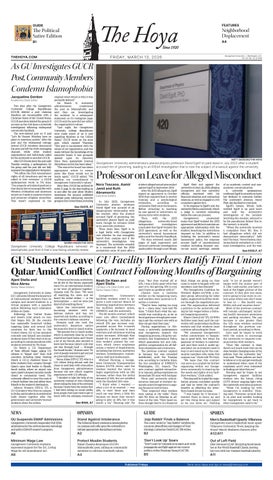
Georgetown University administrators placed physics professor David Egolf on paid leave in July 2023 after a student accused him of grooming, leading to an IDEAA investigation that is now the subject of a lawsuit against the university.
Professor on Leave for Alleged Misconduct Nora Toscano, Aamir Jamil and Ruth Abramovitz Executive Editors
In July 2023, Georgetown University physics professor See GUCR, A7 David Egolf was accused of an inappropriate relationship with his student. After the student accused Egolf of grooming, the university placed Egolf on paid leave, though he remains listed as an associate professor. Three years later, Egolf is in a legal battle with Georgetown over whether he was wrongfully barred from campus and if the university’s investigation was MAREN FAGAN/THE HOYA improper. The university revealed Georgetown University College Republicans removed an in a countersuit that the 2023 Islamophobic post from X that is now facing university review. accusations came 10 years after a
student alleged sexual misconduct against Egolf in September 2013. After the 2013 allegations, Egolf signed an agreement in October 2015 that required him to receive training and a psychological evaluation, according to university-filed court documents. Before returning to teaching, he also agreed to restrictions on interactions with students. Then, with the 2023 allegations, university-hired independent investigators concluded that Egolf violated the 2015 agreement, as well as the university’s sexual harassment policy and the Faculty Handbook. The Hoya reviewed nearly 250 pages of legal arguments and internal university investigations made public through court filings.
Egolf filed suit against the university on Sept. 26, 2025, alleging Georgetown and four university officials interfered with his financial situation and contractual relations, as well as engaged in civil conspiracy against him. In its response to Egolf’s suit, the university filed a countersuit, which a judge is currently evaluating before the case can proceed. Georgetown’s countersuit states that Egolf violated the 2015 agreement and did not maintain an appropriate relationship with the student, breaching the restrictions imposed on him. In addition to violating the university’s sexual harassment policy, the response accuses Egolf of unprofessional conduct including frequent oneon-one social meetings outside
of an academic context and nonacademic communication. A university spokesperson confirmed Egolf is currently on leave but declined to comment further. The university’s attorney, Henry Platt, also declined to comment. Egolf’s lawyer, Micah Salb, verified Egolf is on paid leave and said the university’s investigation of the incident involving the student, referred to by the pseudonym Robert Roe in the lawsuit, is invalid. “When the university received a complaint from Mr. Roe, it had allegations which did not demonstrate misconduct,” Salb told The Hoya. “Nevertheless, they immediately embarked on a fullscale investigation, and the way See EGOLF, A7
GU Students Leave GU Facility Workers Ratify Final Union Qatar Amid Conflict Contract Following Months of Bargaining Ajani Stella and Nico Abreu Senior News Editors
Georgetown University in Qatar (GU-Q) has facilitated the departure of international students from its campus and moved students to a virtual program with a pass/fail option following Iran’s retaliatory strikes on Qatar. Following the United States and Israel’s joint attack on Iran that began Feb. 28, the country has repeatedly launched strikes targeting Qatar and several Gulf countries for their ties to the United States. GU-Q has operated remotely and helped non-resident students leave if they wish to do so, according to communications with students reviewed by The Hoya. On March 2, U.S. Department of State officials began urging U.S. citizens to “depart now” from Gulf countries, including Qatar. Starting March 4, GU-Q chartered buses to drive students from campus through Qatar’s open land border to Riyadh, Saudi Arabia, where an airport was open; Qatar’s airspace remains mostly closed to commercial travel. The university offered to cover the costs of a Saudi Arabian visa and airfare from Riyadh to the student’s destination. Adeena Hossain (SFS-Q ’27), a GU-Q student who lives on campus in Doha, said students in residential halls stayed together after the government and university warned students about the strikes.
“It was scary because, as students, we all live in the dorms, especially since I’m an international student, so we were all gathered together,” Hossain told The Hoya. “We were all watching the news and we heard the initial strikes — or the interceptions — and we were just kind of all watching them.” Qatar has intercepted most incoming missiles with its defense system and has not reported any deaths, according to the country’s defense ministry. Hossain said she took the university’s departure option because she lives in Saudi Arabia. “My parents live in Saudi Arabia, which is relatively close by, so they wanted me back home, and I know a lot of my friends also decided to leave just because Qatar’s only way out was through land — through the Saudi border,” Hossain said. “So a lot of people wanted to get out just as a precautionary measure.” Sama Alissa (SFS-Q ’27), who is a U.S. citizen living abroad, said she chose to seek help with evacuation from Georgetown administrators because she saw others’ negative experiences with U.S. officials. “I decided to take the help of my university instead of even thinking about taking the help of the embassy because I knew from the stories that I had been seeing on social media, from people that have tried to get in touch with the embassy, everyone’s See IRAN, A7
Noah De Haan and Ajani Stella
Campus Life Desk Editor and Senior News Editor
Georgetown University’s facilities workers voted to approve a new contract March 10 following negotiations between the facilities workers’ union, 1199SEIU, and the university. The 30-month contract, which went into effect immediately following the vote, includes an overall 15% pay increase compounded across five 6-month segments, a $6 increase in meal vouchers and minimum starting salary increases. Although they hoped for a greater raise, facilities workers praised the contract, which covers employees across a variety of departments, including bus drivers, sanitation workers, housekeepers, maintenance staff and landscapers. Michael Fleming, a Georgetown University Transportation System (GUTS) driver, said the workers wanted the union to begin negotiations with an 18% increase, rather than the initial demand of 16%, but are satisfied with the finalized 15% raise. “I think what I wanted — what a lot of us wanted — was 18%, to start there and then work our way down a little bit, because we knew they weren’t going to give us 18%, but it was worth a try,” Fleming told The
Hoya. “But they started off at 16%. I was a little upset with that part of it, but getting 15% is cool, and I have no problem with it.” Charles Gore, a facilities worker on the bargaining team, said workers were anxious to finalize a contract. “They’ve been waiting too long for it — since June,” Gore told The Hoya. “I think that’s what the university was counting on, as far as the impatience of employees wanting to get the contract over with so they can get their first raise.” During negotiations in February, a university spokesperson said Georgetown respects the bargaining process, citing the university’s Just Employment Policy, which guarantees fair and competitive compensation for all fulltime employees and contractors. The previous contract expired in January, but was extended indefinitely until the Tuesday vote, according to Carrietta Hiers, the vice president of 1199SEIU’s Washington, D.C. branch. The new contract applied retroactively to January, giving employees an immediate 5% raise with backpay. Hiers said university administrators listened to workers’ demands amid Georgetown’s ongoing financial restrictions. “They respected what workers were saying at the table,” Hiers told The Hoya on Monday, in advance of the vote. “They heard us. Even though they’re in a financial
bind, things are going on, they came in ready to bargain with our members. And they listened.” The Georgetown Coalition for Workers’ Rights (GCWR), a student group advocating for labor rights, supported facilities workers through the negotiation process. The organization delivered a petition to the university calling for fair wages before a February bargaining session. Elinor Clark (CAS ’27), GCWR’s facilities team lead, said the university still undervalues facilities workers and that students must continue advocating for them. “We commend Georgetown’s verbal commitment to bargaining in good faith, but when the payment of workers is undervalued and their work is under-appreciated, we as students need to step in and stand up for the community members who make this campus run,” Clark told The Hoya. “We hope that this contract can serve as a catalyst for further organizing within our Georgetown community to stand up for the needs and rights of our facilities workers,” Clark added. Fleming said he is glad the negotiation process concluded quickly and that he views the contract’s benefits as offsetting the lowerthan-hoped-for pay increase. “I was happy for it because I wanted them to hurry up and get this thing done and signed so we can move on,” Fleming
said. “A lot of people weren’t happy with the money part of it. Like I said earlier, you have to look at the bigger picture of the contract. If they give you more, you’re going to lose more in certain areas where you don’t want to lose in — like health care, 401(k), sick and vacation leave.” Most of the previous contract will remain unchanged, including health insurance premiums and parking vouchers. The pay increase is also greater than the 12% raise workers received throughout the previous contract period, according to Hiers. Gore said he hopes to work with the union to encourage the university to improve communication with workers. “Once this contract is done, there’s not much more that can be done besides changing some of the policies that the university has,” Gore said. “Those policies are hard to follow or to try and get everybody to understand when most of the employees aren’t even interested in finding out what they are.” Fleming said he hopes to see Georgetown support facilities workers into the future, citing GUTS drivers’ ongoing fight with the university over labor practices. “What I’m looking for with Georgetown is stability,” Fleming said. “Everyone around here is on pins and needles looking for Georgetown to get back to what Georgetown used to be.”
NEWS
OPINION
GUIDE
SPORTS
GU Suspends EMAP Admissions
Stand Against Intolerance
‘Jojo Rabbit’ Finds a Balance
Men’s Basketball Upsets Villanova
A6
A2
B2
A12/A11
Georgetown University suspended Fall 2026 admissions for the environmental metrology and policy (EMAP) master’s program.
The Editorial Board condemns Islamophobia on campus and calls upon the university to initiate appropriate disciplinary actions.
The comic world in “Jojo Rabbit” exhibits the uncanny absurdities and dangers of Nazi ideology, Catherine Dodd (CAS ’29) writes.
Georgetown men’s basketball team upset Villanova University 78-64, keeping the Hoyas’ March Madness chances alive.
Minimum Wage Law
Protect Muslim Students
‘Don’t Look Up’ Soars
Out of Left Field
A8
A3
B5
A11
Georgetown University students expressed support for the D.C. Living Wage for All Amendment Act.
Faisal Cheema denounces GUCR’s Islamophobic post, calling on community members to cultivate interfaith values.
“Don’t Look Up” reminds us to reject anti-truth propaganda and fight against our current politics, writes Penelope Snoep (CAS ’29).
Published Fridays
Eilat Herman’s (CAS ’26) spring break lands her at the World Baseball Classic, leaving her torn with her Yankees baseball identity.
Send story ideas and tips to news@thehoya.com
A2 | THE HOYA
THEHOYA.COM | FRIDAY, MARCH 13, 2026
OPINION EDITORIAL
Stand Against Religious Intolerance This Editorial Board has spoken at length about how deeply it values the principles of free speech and debate within our community. The discriminatory statement made by an on-campus group this week demonstrated neither principle in good faith. On March 8, responding to a post from the right-wing account Libs of TikTok, Georgetown University College Republicans (GUCR) wrote on their official X page, “Let’s Be Honest: Muslims have no place in American society. Their religion is incompatible with our Christian Nation.” On March 11, GUCR posted a statement on its official Instagram page that the X post does not align with its values. “This post is inconsistent with the values of our organization, and was made without the knowledge of the executive board,” GUCR wrote in a statement. “The executive board has taken appropriate action to ensure posts like these would not be made again. We reaffirm our commitment to Georgetown University’s values.” While the post has been deleted, the harm it has caused will not simply disappear, nor could it be excused. Hate has no place on Georgetown’s campus, and it is not only disappointing but concerning that such expressly discriminatory statements permeate our student body. In response to this hateful statement and the others voiced by the same organization, the Editorial Board strongly believes the university should restrict access to benefits for GUCR or take other appropriate disciplinary action against those who made the initial statement. Georgetown’s Policy on Speech and Expression does not protect any speech or conduct that violates its Harassment Policy or the Code of Student Conduct. These policies prohibit harassment based on an individual’s religion, race, sex and other parts of their identity. The Editorial Board believes that this post is in clear violation of these policies. A university spokesperson said the post’s language conflicted with the university’s values. “We are reviewing this matter through established university processes, and we take our community’s concerns seriously and condemn this language, which is deeply inconsistent with Georgetown University’s values,” the spokesperson wrote to The Hoya. Supporting interreligious understanding is an integral part of Georgetown’s mission as a university. Thankfully, the administration recognizes this and has taken swift action. Less than a day after the post gained traction through various social channels, the university sent an email to the Georgetown community, reaffirming its commitment to religious diversity and condemning Islamophobia and saying they are actively reviewing this matter. We believe that these actions are the correct first steps. However, emails and words of affirmation will not be enough. We strongly urge the university to follow these emails with tangible and effective disciplinary measures. Georgetown must prove that its
HOYA HISTORY
policies are not just eloquent messaging, rather words that they commit to and will enforce accordingly. Students, faculty and staff alike must also consider the impact this language has upon our community. The statement risks making Muslim students feel unsafe and alienated from their own campus, while having serious consequences beyond the Hilltop. In our current social climate, where Islamophobia was at its high just this past year, this post is not simply offensive –– it is dangerous. All members of the Georgetown community and beyond have a responsibility to be conscious of the language we use instead of making uninformed blanket statements against any one group. Dima Al-Quzwini, a first-year Muslim student, said GUCR’s claims are exclusionary toward an important part of the student body. “As a Muslim woman, it is deeply frustrating to see Islam misrepresented through uneducated claims about Sharia law or the treatment of women,” Al-Quzwini wrote to The Hoya. “It is especially disappointing to see rhetoric like this emerge at Georgetown, a university that prides itself on faith dialogue and intellectual rigor. To be a Hoya is to dedicate yourself to a mission of pursuing truth and caring for the whole person. These values demand curiosity instead of ignorance and solidarity instead of exclusion.” To be clear, we are not calling for conservative voices to be silenced on campus. This would only perpetuate a cycle of harsh rhetoric and a narrative of martyrdom. Beyond that, students of all political ideologies should be able to express their ideas as they see fit. After all, students seek out a school like Georgetown to experience a full range of political perspectives, and we are at our strongest when we have an ideologically diverse student body. That being said, it is alarming when hate speech is conflated with a valid political point of view deserving of university recognition or societal acceptance. The speech displayed on GUCR’s social media is not seeking any sort of debate or even making a political argument. This was not an instance of a mere difference in political beliefs –– it was a hateful claim against others. Georgetown’s administration, faculty and students all have an obligation to balance political discourse with the creation of a safe and inclusive community. While it is heartening to see how members of the Georgetown community have banded together in the fallout, it is imperative that these efforts continue and lead to tangible action. Our university must leave no room for ambiguity in its commitment to religious tolerance and protecting the student body.
IN THIS WEEK’S ISSUE
“
Hate has no place on Georgetown’s campus, and it is not only disappointing but concerning that such expressly discriminatory statements permeate our student body.” The Editorial Board
“Stand Against Religious Intolerance” thehoya.com
POLL
On March 8, Georgetown University College Republicans (GUCR) posted on their official X page, stating “Let’s Be Honest: Muslims have no place in American society. Their religion is incompatible with our Christian Nation.” The post was deleted in the following days.
In order to gauge student opinion, students were asked if, following this post, GUCR should lose access to university benefits. Of the 579 respondents, 80% said yes, 15.4% said no and 4.7% said unsure.
EDITORIAL CARTOON by Avelyn Bailey
The Hoya’s Editorial Board is composed of six students and is chaired by the opinion editors. Editorials reflect only the beliefs of a majority of the board and are not representative of The Hoya or any individual member of the board.
Since its first issue in 1920, The Hoya has served to inform Georgetown’s campus dialogue. The following article is a glimpse into The Hoya’s rich history, allowing readers to appreciate the evolution of college journalism.
We Must Integrate Muslim Citizens January 26, 2007 CAIRO – After a late night on the town, we rushed to catch the train we needed. We had just gotten the hang of the British Underground system and were adjusting, at least, to having to pay $6 dollars to ride the equivalent of a Metro ride from Rosslyn to Capitol South. On the way, a woman wearing a hijab, or traditional Muslim headscarf, passed me in a hurry on her way to the opposite train track. I could not help but notice the looks this older woman received, and I could barely believe it when a young British teenager said to his friend, “There’s always got to be one of them.” In shock, I continued to walk. Little did that teenager know, there were at least two of “them” in the station that night. As an American Muslim, I have become accustomed to finding a balance between the differences in values and cultures of majority-Muslim countries and Western ones. However, I did not realize until my first visit to the United Kingdom how differently Muslims are treated and assimilated in that country compared with the United States. “Are you seriously traveling with that beard? Shave it, now.” I have heard such comments from my family and friends, but other than being called a “security threat” by the Israeli authorities, I have not experienced excessive discrimination at U.S. airports. The most common questions are (surprisingly): “Is your name really Hammad Hammad? Your first name and last name are really the same? Wow.” In contrast to Muslims in the United States, Muslims in the United
Kingdom seem to me to be a young, tightly-knit and disadvantaged community. Recent events around the world and the fear of extremism in the name of Islam have caused people to view Muslims with suspicion and have increased Islamophobia and xenophobia among British citizens. I saw this firsthand at the train station. The July 7, 2005 terrorist bombings in London, carried out by four British-born Muslims of Pakistani descent, had a devastating impact on British Muslims, who were suddenly viewed with even more suspicion, fear, hatred and misunderstanding. There are about 1.6 million Muslims in the United Kingdom (3 percent of the population), compared to between 3-6 million in the United States (0.7 percent). The vast majority of Muslims in the United Kingdom, 69 percent, are from the Indian subcontinent. Muslims in the United Kingdom are pushed into the margins of British society, which makes it almost impossible for them to simultaneously be British and Muslim. I met a man in London who informed me that imams at mosques receive several threats and are afraid of giving Friday sermons because they risk being misinterpreted or having their words taken out of context, not to mention being watched and recorded carefully by the intelligence community. While Muslims in the United States are not immune to discrimination (remember the six imams thrown off a plane for praying?), I could not help but feel self-conscious of my identity in London. In the United States we must take the British example as caution to ensure that Muslims are not grouped
LETTER TO THE EDITOR AND VIEWPOINT POLICIES The Hoya welcomes letters and viewpoints from our readers and will print as many as possible. To be eligible for publication, letters should specifically address a recent campus issue or Hoya story. Letters should not exceed 300 words. Viewpoints are always welcome from all members of the Georgetown community on any topic, but priority will be given to relevant campus issues. Viewpoint submissions should be between 600-700 words. The Hoya retains all rights to all published submissions. Send all submissions to: opinion@thehoya.com. The Hoya reserves the right to reject letters or viewpoints and edit for length, style, clarity and accuracy. The Hoya further reserves the right to write headlines and select illustrations to accompany letters and viewpoints. CORRECTIONS & CLARIFICATIONS If you have a comment or question about the fairness or accuracy of a story, contact Executive Editor Ruth Abramovitz, Executive Editor Aamir Jamil or Executive Editor Nora Toscano at executive@thehoya.com. NEWS TIPS News Editors Nico Abreu and Ajani Stella: Email news@thehoya.com. Guide Editors Isabelle Cialone and Tanvi Gorripati: Email guide@ thehoya.com. Sports Editors Nate Seidenstein and Madeline Wang: Email sports@ thehoya.com.
and discriminated against. Beyond the crazy hysteria produced by news commentators like Bill O’Reilly and Glenn Beck, we must examine the situation of Muslims in the United States because it is a microcosm for how other minorities will be treated in times of fear and suspicion. We must reflect on why some people ardently believe that a Quran should not be used in an optional Capitol Hill swearing-in, while the Bible, Torah and legal texts are all fine. Those who believe I am trying to “Islamicize” (How many words can Islam be made into?) the United States must learn about Islam. There is no clash of civilizations. There is no war over values. Osama does not represent Islam just as Hitler does not represent Christianity. It is easy to think of it as “us” versus “them,” but where does that take us? We are all afraid of or stereotype the “other.” Think of ways you do so, and of ways you could change that. As I am beginning my study abroad at the American University in Cairo, I cannot help but reflect on my experiences in the United States and London and wonder how people will react to me. Am I different because I am an American Muslim? Where does my Palestinian background fit? I hope to explore the differences that exist between our cultures to develop better relations across the Atlantic. I am learning new things, such as the difficulty of trying to cross the street in Cairo where traffic signs are mere suggestions. I am sure there will be many similarities, but we must not forget about understanding and respecting the differences. Samuel Yoo
GENERAL INFORMATION The Hoya is published once a week during the academic year with the exception of holiday and exam periods. Address all correspondence to: The Hoya Georgetown University Box 571065 Washington, D.C. 20057-1065 The writing, articles, pictures, layout and format are the responsibility of The Hoya and do not necessarily represent the views of the administration, faculty or students of Georgetown University. Signed columns and cartoons represent the opinions of the author(s) and do not necessarily represent the editorial position of The Hoya. Unsigned essays that appear on the left side of the editorial page are the opinion of the majority of the editorial board. Georgetown University subscribes to the principle of responsible freedom of expression for student editors. The Hoya does not discriminate on the basis of age, gender, sexual orientation, race, disability, color, national or ethnic origin. © 1920-2025. The Hoya, Georgetown University weekly. No part of this publication may be used without the permission of The Hoya Board of Editors. All rights reserved. The Hoya is available free of charge, one copy per reader, at distribution sites on and around the Georgetown University campus. Email: editor@thehoya.com Online at www.thehoya.com Circulation: 1,000
Founded January 14, 1920
Maren Fagan, Editor in Chief
Ruth Abramovitz, Aamir Jamil and Nora Toscano, Executive Editors Paulina Inglima, Managing Editor Nico Abreu, News Editor Ajani Stella, News Editor Opal Kendall, Features Editor Saroja Ramchandren, Features Editor Annikah Mishra, Opinion Editor Ella O’Connor, Opinion Editor Isabelle Cialone, Guide Editor Tanvi Gorripati, Guide Editor Nate Seidenstein, Sports Editor Madeline Wang, Sports Editor Angela Lekan, Science Editor Eva Siminiceanu, Science Editor Avelyn Bailey, Design Editor Lucy Jung, Design Editor Grace Bauer, Copy Chief Jackson Roberts, Copy Chief Shira Oz, Blog Editor Fallon Wolfley, Blog Editor Kate Hwang, Multimedia Editor Michael Scime, Multimedia Editor Matthew Gassoso, Photo Editor Caroline Woodward, Audience Editor
Board of Directors
Patrick Clapsaddle, Chair
Bethe Bogrette, Julia Butler, Amber Cherry, Madeline Grabow, Ella O’Connor, Mia Streitberger
Peter Sloniewsky, General Manager
Olivia Zhang, Director of Business Operations Rosie Garner, Director of Logistics Connor Manrique-Johnson, Director of Outreach Jackson Roberts, Technology Director
Jacqueline Gordon Academics Desk Editor Noah De Haan Student Life Desk Editor Chloe Taft Graduate Desk Editor Ethan Herweck City Desk Editor Sofia Thomas GUSA Desk Editor Pritika Patel Events Desk Editor Bridget Galibois Deputy Features Editor Serene Pai Deputy Features Editor Sophia Tully Deputy Features Editor Heidi Sui Deputy Opinion Editor Joyce Shen Deputy Opinion Editor Leo Zhang Deputy Opinion Editor Anandita Agarwal Deputy Guide Editor Juan Almanza Deputy Guide Editor Eliza Doty Deputy Guide Editor Penelope Snoep Deputy Guide Editor Sam Fishman Deputy Sports Editor Golnar Jalinous Deputy Sports Editor Maddie Taylor Deputy Sports Editor Liv Villella Deputy Sports Editor Sasha Ahmad Deputy Science Editor Jaya Alenghat Deputy Science Editor Kaitlyn Lee Deputy Science Editor Adhithi Rajesh Deputy Science Editor Maddie Williams Deputy Science Editor Ray Tian Deputy Design Editor Emilie Andrews Deputy Copy Editor Emma Costiglio Deputy Copy Editor Chloe Fong Deputy Copy Editor Allison Ma Deputy Copy Editor Jaylen Peng Deputy Copy Editor Sophie Sagastume Deputy Copy Editor Miranda Kristina Santiago Deputy Multi Editor Rosie Garner Deputy Multi Editor Rohini Kudva Director of Human Relations
THE HOYA | A3
FRIDAY, MARCH 13, 2026 | THEHOYA.COM
OPINION
LIFE OUTSIDE OF LAU
Reflect on Individual AI Use
H
ow should Georgetown University face the future of artificial intelligence (AI)? Members of our community, including The Hoya’s Editorial Board, have grappled extensively with the university’s AI policy and the integration of Gemini, Google’s AI assistant, into our curriculum. While institutional policies are necessary and can provide a general sense of how to use AI, the majority of day-to-day decisions about AI use are made by individual students. In fact, 86% of students reported using AI in the past year. Thus, in this time of uncertainty and rapid change, college students — rather than solely relying on the university’s policies — have a unique responsibility and agency over their academic experience. I urge students to be intentional about their use of AI technologies and use them to aid their bureaucratic load, not to reduce academic discomfort and challenge. The temptation to take an easy way out has long been a part of life at Georgetown and every university. High achievers with busy schedules under high pressure can quickly succumb to temptation. However, the strength of AI tools, the weakness of AI detectors and inconsistent classroom policy have led to a significant increase in academic dishonesty. I’ve observed classmates submitting papers written entirely with AI and even quoting ChatGPT verbatim in class discussions. As a student, the lines can feel very blurry. I often find myself debating whether I should use an AI tool to brainstorm ideas, summarize my readings or proofread my essays. While many professors are in the process of adapting their curricula, there’s still a lot of uncertainty, and it often feels like AI use will help academic performance and grades. This means my peers and I have to personally evaluate and decide whether and how much to use AI on every assignment. With these constant internal debates, it is important to remember that while “AI” is often used as a blanket term, not all AI use is of equal consequence. In my experience, I have seen the strongest benefits of AI come from its potential to reduce frustrating, mindless tasks. I haven’t written my own citations in months in classes with flexible policies, a task that used to take me hours of monotonous labor. Additionally, AI is incredibly helpful in the studying process, where it can instantly create tools like difficult practice exams. When used correctly, AI tools can develop our abilities, giving us time to challenge ourselves at the next level. Where AI use threatens our student body, however, is when
we begin using it in place of our critical thinking to ease our academic discomfort. Spending hours formatting MLA citations doesn’t develop my neuroplasticity or strengthen my cognitive abilities. Writing a paper (or an article for The Hoya) or struggling through a math problem set does. Uncomfortable academic tasks are critical for brain development. We are already the first generation to be less intelligent than our parents, and the more we ease difficult intellectual challenges with technology, the less we will develop our ability to think. For better or for worse, Georgetown is a pre-professional institution, and many students dedicate significant amounts of time and effort to extracurricular activities. Using AI to expedite schoolwork to free up time for clubs or maximize grades may seem like a smart investment in the future. However, the job market is precarious, with technology threatening many entry-level jobs, including positions that Georgetown students covet like consulting. Now more than ever, we need the full-bodied development that comes from critical thinking, strong written communication, and the ability to quickly adapt. Human tendencies like these may be central to our futures, and we must sacrifice immediate external results for deeper, longer-term benefits. Furthermore, while it may be uncomfortable in the moment, academic challenges actually cause us happiness and fulfillment. While TikTok has recently appropriated the term “flow state,” it’s a real psychological phenomenon that refers to the state of being fully immersed in a task of appropriate difficulty. Flow state does not come right away and requires pushing through initial discomfort. But once you’re there, whether it’s writing an essay, solving a challenging math problem or playing a piece of music, the experience is all-encompassing and blissful. We, as Georgetown students, should embrace the difficulty that comes alongside education. Quick AI fixes may make the immediate moment easier, but they hurt our long-term emotional well-being. Until administrators and professors figure out how to maintain academic challenge in the age of AI, we as students hold the responsibility to make thoughtful and informed decisions. Embrace the uncomfortable moments — your grades may take a hit, but your intelligence, future success and fulfillment will flourish. Hannah Gilheany is a sophomore in the College of Arts & Sciences. This is the fourth installment of her column “Life Outside of Lau.”
COURTESY OF FAISAL CHEEMA
VIEWPOINT • CHEEMA
Remember GU’s Commitment to Interfaith Values
M
ore than two centuries ago, an enslaved West African Muslim named Yarrow Mamout lived, worked and openly practiced his faith in the Georgetown neighborhood. Enslaved in the colonial United States and later purchasing his freedom in 1796, Mamout became known for maintaining his faith openly in the community that surrounds Georgetown University today. His life is a reminder that Muslims have been part of the American story since the earliest chapters of this nation. Today, Georgetown honors that history through the Yarrow Mamout Masjid, the university’s campus mosque — the first mosque established on a university campus in the United States to have ablution stations, a halal kitchen and a spirituality and formation hall. For many Muslim families, including my own, that space symbolizes something powerful: that faith, scholarship and belonging can coexist at one of America’s most respected universities. As a Muslim parent whose son is a first-year student at Georgetown University, I write with deep sadness and concern. In recent days, a post on X circulated from the Georgetown
THE DEAN’S DESK
University College Republicans account stating that “Muslims have no place in American society.” Some may dismiss the post as another social media controversy. For Muslim families like mine, however, those words carry a far deeper weight. My son chose Georgetown because it is a university built on Jesuit values — values that emphasize respect for human dignity, pluralism and service to others. When our family visited campus to help him decide where to pursue his education, one of the most reassuring symbols we saw was the Yarrow Mamout Masjid. That sacred space helped convince us that Georgetown was a place where our son could grow both academically and spiritually. Like many parents, we send our children to universities believing they will enter environments that challenge them intellectually while affirming their humanity. Yet during the holy month of Ramadan — when Muslims around the world reflect on compassion, humility and service — students were confronted with a message suggesting they do not belong in the very society they hope to serve. Muslims are not strangers to America. We are physicians,
scientists, teachers, entrepreneurs, attorneys, soldiers, legislators and public servants — but our place in this country extends far beyond any list of professions. Many of us, including my family, are Americans whose children were born and raised here. Our sons and daughters are as American as any others who walk the halls of Georgetown or any other university in this nation. What hurts most as a parent is the thought that students like my son might now wonder whether their presence on campus is fully welcomed. Universities should be sanctuaries of learning where young people are challenged intellectually, but never dehumanized. The freedom of speech is a cornerstone of American democracy, and universities must remain places where ideas can be debated vigorously. But freedom of speech does not eliminate our responsibility for the consequences of our words. When rhetoric suggests that millions of Americans should be excluded from society because of their faith, it does not enrich debate — it corrodes it. Equally troubling is the notion that patriotism should somehow be measured through the lens of religion. Faith does not diminish loyalty to the country. American Muslims have
served this nation with honor in every walk of life, including in the armed forces defending our freedoms. Throughout its history, Georgetown has stood as a symbol of interfaith engagement and global understanding. Its Catholic and Jesuit traditions emphasize dialogue, respect and the dignity of every human being. Speaking as a Muslim parent of a Hoya observing Ramadan, I hope this moment becomes an opportunity for reflection for the entire Georgetown community — students, families, faculty and leaders alike. It should remind us that America’s strength has always come from welcoming people of different faiths and backgrounds while holding fast to a shared commitment to dignity, justice and mutual respect. At Georgetown, a university guided by the Jesuit principle of cura personalis — care for the whole person — students of every faith should feel that they belong. Muslims were part of Georgetown’s story more than two centuries ago. Our children are part of its community today — and they will help shape its future. Dr. Faisal Cheema is a parent of a first-year student at Georgetown University.
VIEWPOINT • LARRENAGA
Focus on the Now, Not Just the Next Offer Practical One-Credit Courses
A
s one of Georgetown University’s advising deans, I spend a lot of my time working with students to think about what’s ahead. Whether it’s preparing for course registration, solidifying an internship for the summer or the big one, life after graduation, I am in the business of planning ahead. But with just over two months left until commencement, the Class of 2026 is repeatedly hearing one question from well-meaning relatives, friends and even faculty and staff: “What’s next?” If the question starts to cause you to sweat and clam up, you are not alone. Planning ahead can be anxiety-producing. As we hear from our colleagues in the Cawley Career Education Center, the job market continues to remain unstable, just like it did when your predecessors, the Class of 2020, graduated virtually and searched for jobs during the COVID-19 pandemic. It is also challenging when you’re trying to make sure that your final semester at Georgetown goes well. And by well, I don’t solely mean successfully completing all of your classes; I also mean enjoying time with your friends and crossing things off of your Georgetown bucket list. As we continue with our countdown to commencement, I strongly encourage students to welcome a “what’s now” mentality and learn how to rethink their response to the “what’s next” question. One recurring concern I hear from many of my students (and I advise 150 seniors so it’s a frequent statement) is that while their friends seem to have solidified their plans for life after graduation, they are the “only” one who doesn’t know what comes next. This is
pretty common as we enter May, but even more so this year. Some people have started to get job offers or know what graduate school they’re going to attend. But I can assure you, come mid-May, not every senior will know what’s next. That’s okay! You may figure things out the following week or month, or it may take more time. This is perfectly normal. There will be a next step for you. Please remember that graduation celebrates what you’ve done here, not what’s next. I remember when I got my doctorate, I did not have a job lined up. My negative selftalk tainted my commencement because I felt like I didn’t deserve my diploma. A few months later, I got a job, and a year later, I got the job I have now (best job in the world, in my opinion). But I wish I had celebrated graduation more for what it represented — what’s done, not the next thing. But this “what’s next” mentality isn’t just something I see in my seniors. Yes, I appreciate when students want to come in and map out their time at Georgetown and plan out each semester course by course. But it’s also beneficial to keep your energy focused on thriving in your current semester. Do your coursework, cultivate relationships with your classmates and professors and build community here — right now. Constantly living with a what’s-next mentality can deprive you of the ability to be present and recognize what’s happening now. There is still so much left of the semester, and you don’t want to be wishing it to be in the rearview mirror. Yes, we do love when students plan (I love when a student comes in with a spreadsheet of possible majors and minors). But having a
rigid attachment is not advisable. Plans change, life circumstances happen and we need to be adaptable to those changes. I often refer students to psychologist Carol Dweck, who focuses on the difference between a fixed mindset and a growth mindset. “I’ve seen so many people with this one consuming goal of proving themselves— in the classroom, in their careers and in their relationships,” Dweck wrote in her book “Mindset: The New Psychology of Success.” “Every situation calls for a confirmation of their intelligence, personality, or character. Every situation is evaluated: Will I succeed or fail? Will I look smart or dumb? Will I be accepted or rejected? Will I feel like a winner or a loser?” These questions mirror many concerns I hear from my students. But her call to action is one I’d like to see students more willing to embrace. She argues that those who can eagerly take on challenges, even in the face of adversity, reflect a growth mindset. We know that’s why you applied to Georgetown in the first place: because you were eager to obtain an education that pushed you out of your comfort zone. In the College of Arts & Sciences dean’s office, we have worked with so many students (thousands!) that we can confidently say that we know you’ll find a “what’s next” answer. But what we are hoping for right now is that you get to be present here at Georgetown. And if you need someone to hype you up about that, please find me — I’m always here for a pep talk. Vanessa Corcoran is an advising dean in the College of Arts & Sciences. This is the first installment in her revival of the column “The Dean’s Desk.”
T
here are a number of ways students can learn how to file their taxes. Some may look to a family member, artificial intelligence (AI) or the TurboTax Monster –– the one that has lived under your bed since its birth in a disturbing 2018 TurboTax TV ad campaign. However, where young people might not even think to look is at an institution like Georgetown University. If real-world applicable classes were added to the registrar, they would not have to be boring. Who would want to take TAX-1001 or DIVORCE-1003? Those both somehow sound worse than ECON-1001. Instead, imagine classes like HOW-NOT-TODIVORCE-LIKE-KING- HENRYVIII-1007 or TAXES-ANDPRIVATE-ISLANDS-1008 that blend practical knowledge with intellectual curiosity. For a school offering over 1,800 undergraduate class sections a semester, it is difficult to find courses that teach real-world skills like filing taxes or navigating the infinite other bureaucratic realities of adulthood. Georgetown should develop more one-credit experimental courses that connect students’ intellectual curiosity to real-world skills. Georgetown has already implemented some onecredit courses. Namely, the government department offers one-credit skill courses, including “Policy Briefing” and “Thinking Strategically.” The department intends for these classes to create a personalized professional learning path for students as they explore skill development relating to policy, leadership and strategy.
However, while these courses are a promising start, they remain limited to a single department. Many other skill-based onecredit courses offered are also limited to graduate students or specific majors. Classes that span across the university would be more useful. Other peer universities, such as Tufts University and the University of California, Berkeley (UC Berkeley), accomplish just this. The university may take multiple approaches to combining intellectual curiosity and practical skills. Tufts University, for example, prioritizes intellectual curiosity exceptionally well with a program called the Experimental College. Through the Experimental College, Tufts students can take one-credit classes that relate niche areas of study to fun topics, such as “The World of Crosswords” and “Designing Your Career Journey.” Georgetown should work towards launching something similar. A second approach focuses on practical skills rather than intellectual curiosity. UC Berkeley runs a program called DeCal that features one- and two-credit classes allowing students to study niche, real-world topics. Classes include “A Primer on Molecular Biology” and, interestingly enough, a psychology class simply titled “Adulting.” Georgetown does not need to choose between intellectual curiosity and practical skillbuilding. Instead, the university could pioneer a new norm. Georgetown could use these classes to chase its beloved Jesuit value of “cura personalis.” “Cura personalis” dictates that a person must care for the
whole person, including their unique circumstances and gifts. The whole mind includes both practical and theoretical knowledge. It feels safe to say, given the hours Georgetown students spend in the dark abyss of the library, that the theoretical part is satisfied. The university should also give students a low-commitment, unique opportunity to help them cultivate the practical part. While Georgetown often celebrates its academic rigor and wide array of courses, the addition of a small experimental program would hardly threaten that tradition. The university could easily borrow the playful curiosity encouraged by programs at Tufts and combine it with the practical spirit found in student seminars at Berkeley. Imagine a course that combines Tufts’ time travel course and Berkeley’s “Adulting” course. Maybe it explores adulting at different time periods, opening up new, non-ethnocentric realities of growing up. Suddenly, graduating college may seem more promising when compared to adulting during the era before WiFi — those must have been dark, archaic times. Examples like this show how experimental courses could make practical life skills part of Georgetown’s intellectual culture. By the end of the semester, students would still indulge their intellectual curiosity, but they would also walk away knowing how to manage money, read contracts and navigate the kinds of decisions that await them after graduation. Caden Larrenaga is a sophomore in the College of Arts & Sciences.
A4 | THE HOYA
THEHOYA.COM | FRIDAY, MARCH 13, 2026
FEATURES
Consequences of Neighborhood Displacement Persist for GU Students, Georgetown Residents
ILLUSTRATION BY MADELEINE OTT/THE HOYA; PHOTOS BY LIBRARY OF CONGRESS, COURTESY OF KISHAN PUTTA
Since the 1930s, Washington, D.C. housing policies have pushed Black residents out of Georgetown, making the neighborhood more racially and economically homogenous.
While university support programs have eased their college transition, Black and first-generation, low-income Georgetown students say the surrounding neighborhood’s demographic disparities have impacted their sense of belonging.
Sophia Tully and Caroline Blake
Deputy Features Editor and Hoya Staff Writer
J
abari Amud-Ramirez (CAS ’28) grew up in Fort Totten, a primarily Black and Hispanic neighborhood in Ward 4 of Washington, D.C. When he arrived at Georgetown University, Amud-Ramirez said the lack of racial and economic diversity in the surrounding neighborhood was a massive culture shock. “I felt like I was going through a portal,” Amud-Ramirez told The Hoya. “This is life here, and this is life at Georgetown, which are two completely different lives. Even though it’s in the same city, it’s two completely different places, and everything is done completely different.” Over the last century, the Georgetown neighborhood has undergone an exponential increase in the cost of living, prompting a sharp decline in its lower-income and Black population. Since 1937, the average inflation-adjusted rent in Georgetown has increased by more than 600%, while the neighborhood’s Black population decreased by over 80%. Cameran Lane (CAS ’28) — a member of the Georgetown Scholars Program (GSP), a university initiative that supports first-generation, low-income (FGLI) students — said these disparities extend onto campus, where less than 5% of the undergraduate population is Black and almost 75% come from the nation’s top 20% of earners. “There is a fair amount of racial diversity, if you’re looking at how many students are students of color,” Lane told The Hoya. “But when you look at how many Black students are on campus, the diversity that the university lays claim to doesn’t always realize itself to me.” In addition to GSP, Georgetown sponsors the Center for Multicultural Equity and Access (CMEA), which supports students from historically marginalized communities, and offers several affinity spaces, including dedicated housing communities for Black and Latino students. A university spokesperson said these resources work to provide equal opportunity for all students, regardless of their background. “Georgetown’s commitment to supporting access and affordability extends beyond financial aid, resulting in a holistic approach that ensures the success of all students,” the spokesperson wrote to The Hoya. Still, lower-income and Black students struggle to build community at Georgetown, where some say their surroundings don’t always reflect their identity. Just 38% of Black students in 2025 and 27% of lower-income students in 2020 felt it was easy to find peers at Georgetown, according to university cultural climate surveys.
Luke Frederick (GRD ’24), who studied race and incarceration at Georgetown, said economic disparities are particularly pronounced in the school’s social culture. “Coming to Georgetown, I felt like more of a cultural and class outsider than I did a racial outsider,” Frederick told The Hoya. “I come from a working-class family — my mom is a teacher, my dad works for Goodwill and doesn’t have a college degree.” “I think that’s just sort of the air around the town,” Frederick added. Dividing Lines Beginning in the 1930s, the District passed a series of housing reforms that drove up Georgetown’s cost of living and pushed working-class residents to move elsewhere. James Benton (GRD ’16) — a Georgetown professor and director of the university’s Race & Economic Empowerment Project, which supports economic and labor reforms in D.C. — said these policies overwhelmingly impacted Black community members. “A lot of the legislation, across the board, was not explicitly racial, but the way it was applied often has disparate impacts on people,” Benton told The Hoya. “Areas were targeted primarily because they were seen as bad or undesirable, and disproportionately, African Americans caught the brunt of that.” Benton said the 1934 Alley Dwelling Act, which sanctioned the redevelopment of substandard housing in the District, drove these residents out of the neighborhood with little recourse. “Residents were told, ‘We’ll rebuild. You’ll be able to come back,’ and most folks could not, because they could not afford the rents for the new apartments that were being built,” Benton said. “They couldn’t afford the mortgage for the townhouses that were created in its absence.” In 1950, Congress passed the Old Georgetown Act, which required buildings to comply with certain historic preservation standards and further threatened Georgetown’s dwindling Black population, who were often unable to keep up with steep maintenance costs. Neville Waters III, a fifth-generation Black resident of Georgetown, said his aunt’s family could not afford mandated upkeep on their home and was forced to leave the neighborhood. “Their house was ‘condemned’ because of the conditions,” Waters told The Hoya. “That was a direct example of someone who was impacted by some particular policy, whether it was applied correctly or whether it was weaponized.” Federal legislation prohibited housing discrimination in 1968, but
Benton said Georgetown remained inaccessible to most Black residents. “It becomes a matter of economics,” Benton said. “If you can’t afford to move in, then those neighborhoods are going to be closed off to you. You can’t live here if you don’t have the money. It just doesn’t work.” “It feels weird to wake up in a city where you’ve had roots for years, decades, generations, and all of a sudden you can’t afford to live there,” Benton added. Frederick said the issue was not singularly racial or economic. “We’re talking about the Black community, but whatever working-class community existed in Georgetown were all pushed out eventually,” Frederick said. “There’s a class element to this, along with the racial element. Of course, those two are always reverberating and intertwined.” In just three decades, Georgetown’s Black population dropped from nearly 30% to less than 9% of the neighborhood. Today, it stands at just 5.8%. Benton said the neighborhood’s social dynamics have fundamentally changed in the wake of this reorganization. “It’s really shocking, in a good way and in a bad way, to see how the changes have occurred,” Benton said. “There’s a feeling that something is lost, that a neighborhood can be newer and cleaner and have more services, which are all good things, but at the same time, you feel that there’s a sense of community that doesn’t exist anymore.” Growing up in Georgetown, Waters said the demographic differences are obvious. “It was a more diverse neighborhood than it is today,” Waters said. “I had white friends, Black friends. It feels less so today — in terms of younger families — people who have kids and younger families, they all tend to be white.” Monica Roache, a fifth-generation Black resident of Georgetown, said she saw a similar change in the community. “As a little girl, I was fortunate enough to see several Black families that were left,” Roache told The Hoya. “But year after year, they would pass, and then the family would end up selling the house. There might have been 15 or 16 African American families when I grew up. Now it’s just down to three families.” “That sense of community is now gone,” Roache added. Stuck in the Bubble As a result of these demographic changes, Black and FGLI students say the neighborhood is increasingly financially inaccessible. Laurel Iron Cloud (COL ’92) — a graduate of the Community Scholars Program (CSP), a sum-
mer program that mentors limited-income students — said some experiences, including off-campus housing, were unattainable. “The prices were high,” Iron Cloud told The Hoya. “From my perspective, it appeared that only the students — with not just a medium amount of money — but the super-rich students could afford to rent a townhouse.” Lane said he, like many other FGLI students, chose not to live off campus his senior year. “A lot of students can’t afford to move off of campus,” Lane said. “Housing in the area is just so ridiculously expensive that, a lot of times, it ends up being cheaper for students to just stay on campus, even in their senior year.” Today, the median monthly rent in Georgetown is $3,324, and the median price of a home is $1,190,000. In Ward 2, where Georgetown is located, the median household income is $128,048, more than double that of Ward 8. Benton said the Georgetown neighborhood is designed for an elite few, not a diverse student body. “The policies of the past have set the stage for Georgetown as a neighborhood to be this very exclusive, expensive, out-of-reach place for many people,” Benton said. “Georgetown is a neighborhood that hasn’t gotten any less fashionable.” The university spokesperson said Georgetown is dedicated to serving students from diverse financial backgrounds. “We are deeply committed to ensuring that all students and families can afford the cost of a Georgetown education,” the spokesperson wrote. “Georgetown is committed to meeting a student’s full demonstrated financial need through a combination of grants, scholarships, employment and loans.” Students, however, say these efforts do not account for the neighborhood’s high cost of living, which is 118% higher than the national average and 46% higher than D.C.’s average. Lane said the disparity projects an elitist image that can be unwelcoming. “I know some students are attracted to that,” Lane said. “Unfortunately, I think a lot of students equate elitism with opportunity and access, which is not always the case. It’s hard to deny the reality that it’s really become, maybe it has always been, a part of Georgetown’s brand to be elitist.” Lane said CMEA programming and affinity housing, such as the Black House, have helped him find community on campus. “The greatest example is the work that the CMEA does,” Lane said. “I think the Black House and the other affinity spaces that we have on campus are ex-
cellent in helping to build community, but part of that isn’t just about having space, it’s about having opportunity.” “The campus definitely alleviates a lot of that, but there’s a lot still lacking,” Lane added. Iron Cloud said she felt students were not always aware of others’ financial situations. “I’ve never felt any type of insensitivity,” Iron Cloud said. “From my perspective, it was more of a presumption. The uber rich, I think they just assumed that how they lived was how everybody lived.” Lane said future progress must recognize these underlying dynamics. “I don’t think any actor at Georgetown can reverse the decades of gentrification, but I think it’s important for us to recognize our role in it, and how it continues to impact students today,” Lane said. “Even though it’s historical, it’s a tragedy because it is economic and racial,” Lane added. “It is very much still impacting decisions students can make today.” In My Backyard Although demographic transitions in the Georgetown neighborhood have slowed since the turn of the century, as housing costs rise and diversity decreases across the District, other neighborhoods face a similar fate. Fredrick said Georgetown has served as a blueprint for the gentrification of other D.C. wards. “What happened to Georgetown is now happening to the rest of the city,” Frederick said. “There’s a precipitous drop off in the Black population in Washington, D.C. They are being priced out. Many of them are having to go to Maryland or Virginia or just move elsewhere, because the economic landscape and the housing landscape is just not working for them.” The District’s recent development projects have largely focused on new infrastructure, like an updated stadium for the Washington Commanders and renovations to the National Air and Space Museum. Benton said these benefits are appealing, but draw support away from historically neglected communities. “You have all these stadiums,” Benton said. “You have a restaurant scene that didn’t exist 20 years ago. You have wonderful theaters. You have all these amenities, but at the same time, you’ve got people in neighborhoods that are saying, ‘we have been left behind.’” Benton said the upcoming mayoral primary, the first without an incumbent candidate in 20 years, will be a test of this agenda. “This year’s election is going to come down to a referendum on do
people want this type of development, even if it means people are left behind?” Benton said. “Or do people want to invest in neighborhoods that are left behind, even if it means alienating the people who have enjoyed the benefits of all this revitalization, all this gentrification over the past 25 years or so?” Residents of Ward 3, the highest-income ward in the District, recently filed a lawsuit to halt construction of a short-term family housing program that would serve as a homeless shelter for residents. Roache said she supported similar community reinvestment, but did not think it would be well received in Georgetown. “I don’t see the community going for it,” Roache said. “I know there’s been other parts of the city that have — Ward 3, which is an affluent area — and I know there’s been a lot of kickback. They’re not gonna like it.” Lane said the neighborhood’s affluence is reflected in the university’s culture. “Georgetown, in a lot of ways, is positioned to present this image of elitism,” Lane said. “That we, as a university, are in Georgetown. I don’t think enough is done to dispel that image.” Amud-Ramirez said to mitigate this culture, the university should center minority voices. “Georgetown needs to do better at promoting the minority, showing that there is life in the minorities, and making events for those minorities to have some type of life, some type of bonding,” Amud-Ramirez said. “Because being a part of the Black community in Georgetown, we’re not as united as we should be, and I feel like it is because of the system that we’re in.” Iron Cloud said a diverse student body can inform and expand student perspectives. “Having a diverse student body is a benefit to everybody, not just to students like myself, Black and Lakota,” Iron Cloud said. “What I brought to Georgetown was a lot, in addition to what I gained. My friendships, the people I met, the lives that I’ve enriched, it was just as important as the enrichment of my life by attending Georgetown.” Benton said addressing these historic disparities, both on campus and in the Georgetown neighborhood, would require a shift in public thought and values. “These disparities didn’t happen overnight, and they’re not going to go away with a single bill or a shift in policy,” Benton said. “It’s going to take a generational type of action, in terms of policy, in terms of activism, in terms of public sentiment. How do people see themselves as members of a multicultural, multi-ethnic, pluralistic country?”
THE HOYA | A5
FRIDAY, MARCH 13, 2026 | THEHOYA.COM
NEWS
GU Exploring Expansion Within MSB, McCourt Honors Military Connected Considers Academic Program in Miami Students for Its 2025-26 Scholarship Ethan Herweck City Desk Editor
The Georgetown University McDonough School of Business (MSB) is considering expanding through an academic initiative in Miami, which would offer academic and residential programs, an MSB official confirmed to The Hoya on March 11. A Workday job listing posted Feb. 18 said the MSB is hiring a program associate to begin implementing this expansion. The program, titled the Georgetown Miami Initiative, would include undergraduate and graduate academic programs and undergraduate housing. The job listing, which is available until June 12, said the role’s duties include helping create the expansion and developing programs such as the master’s in international business and policy (MA-IBP). “The individual in this role will focus on developmental workstreams that will prepare Georgetown for the launch and growth of undergraduate and graduate offerings in Miami, including early graduate programming (e.g., MA-IBP) and future undergraduate residencies,” the listing reads. Dennis Quinn, MSB senior associate dean for global strategy, said the associate position is the first step in the potential program. “The program development associate role, which is a one-year term-limited position, is designed to assist in the exploration of this opportunity,” Quinn wrote to The Hoya. “The new associate will conduct research and assess the market potential for new programs. Georgetown University and the McDonough School of Business will still need to go through a rigorous internal and external review and planning process in the years to come. The establishment of a staff
position marks an exciting milestone for the exploration of a Miami opportunity long-term.” The initiative would be funded entirely by external sources, according to Quinn. Quinn said Miami is an important entrance for the MSB to other markets, citing Miami’s economic growth. “Georgetown’s McDonough School of Business is exploring the potential for new academic and co-curricular offerings in the greater Miami region to contribute to our students’ educational experiences,” Quinn wrote. “Miami has rapidly become one of the most important financial hubs and business gateways in the Americas, connecting economic activity between the United States, Latin America and global markets.” Mia Deschapelles (CAS ’27, GRD ’28), a student from Miami who is planning on completing an MSB graduate program, said the new program would strengthen the university’s global reach. “I think it could have a positive impact overall,” Deschapelles wrote to The Hoya. “Georgetown already has a strong international outlook and a diverse student body, and Miami would complement that well, particularly given its large Latino population and global connections. It is also a geographically accessible city with direct flights to and from major cities worldwide, which could further strengthen Georgetown’s national and international reach.” Ashley Sorato (SFS ’27), a global business student from South Florida, said the potential Miami-based programs would allow for business opportunities outside of traditional financial capitals like New York. “Miami has so many niche opportunities to work in less popular areas of business that it would make the investment worth it,” Sorato wrote to
The Hoya. “I think Georgetown should open MSB Miami to allow students to have exposure to the business world away from Wall Street.” Otto Espino (MSB ’28), another student from Miami, said the proximity to Latin America would be beneficial and similar to other satellite programs such as Georgetown’s initiative in Jakarta, which opened in January 2025. “I think it would reinforce Georgetown’s certification as being a global institution, in the sense that we have a campus in Jakarta,” Espino told The Hoya. “Miami is the connection, it is the node to all of Latin America. All of Latin American business goes through Miami, all of finance, all the real estate elements, everything goes through Miami. And that’s for good reason.” Espino said Miami is seeing economic growth due to corporate friendly tax codes. “We’re seeing that mixture that you can see like Chicago or New York or Los Angeles, but there’s a little bit of everything,” Espino said. “And it goes deeper than the corporate tax benefits, because Florida does not have state income tax, but that also applies to LLCs, etc. And right now, everybody’s following suit, like Citadel, the hedge funds kind of set the pace at first, but now a lot of other people, a lot of other high net worth individuals are also moving there.” Quinn said the program will only move forward if it is externally funded and viable for the university. “As a global business school with a strong alumni presence in the region, McDonough has identified Miami as a natural extension of its mission,” Quinn wrote. “Any final decisions around Miami will depend on the academic strength and viability of this expansion, and if launched, will be externally funded.”
Michael Shtrom Special to The Hoya
Four students from Georgetown University’s McCourt School of Public Policy received the Craig Newmark Scholarship, which provides tuition assistance to active-duty, veteran or military-connected students. The fund, which awards $20,000 scholarships to 10 students, seeks to reduce the financial burden of college tuition for students involved in the military. The scholarship provides recipients the opportunity to work with Craig Newmark Philanthropies, a company that aids military families, on public policy projects within the McCourt School of Public Policy. Meghan Hall (GRD ’26), one of this year’s Newmark scholars and a military spouse, said she appreciates the opportunity the scholarship provides military spouses to create their own paths in independent careers. “I think there is this prevailing idea that spousal sacrifice — whether of identity, job opportunities, or relationships — is the defining expectation of married military life,” Hall wrote to The Hoya. “This journey has taught me that public service comes in many forms. It is possible, for someone like me, to be both: a supporter of my husband’s military career as I pursue my own; a dedicated family member and master’s degree recipient; and more. There are many different paths to public service, and all are valid.” Hall said the scholarship helps address the lack of funding for
military-connected students that she has observed. “I am so grateful to be able to explore my professional passions with support from the Fund,” Hall wrote. “This type of opportunity — increased access to master’s degree programming — is rare. Many scholarships for military-connected students are only available based on service member rank, or are for specific professions like healthcare and education.” Cade Roy (GRD ’26), another Newmark scholar with multiple family members who served in the military, said he appreciates that the scholarship allows him to plan for the highest career aspirations and even inspire future generations. “For years, I always wanted to get my Ph.D. and be a professor,” Roy wrote to The Hoya. “I always felt that that was going to be my way of giving back, my own form of public service. Sharing a passion for a subject with other people, being able to be a mentor for students like others have done and are currently doing for me is what it’s all about.” Roy said the scholarship provides significant financial relief. “To be able to be at Georgetown and earn a Master’s degree without a high level of financial stress has been amazing,” Roy wrote. “These types of scholarships have helped keep me out of student debt, which I am incredibly grateful for.” Steve Nava (GRD ’26), another Newmark scholar who has served in the military for 13 years, said this scholarship will enable him to prioritize his family and his education while he studies at McCourt.
“It really frees up a lot for my family and me, which is nice because my wife and I just had our first child last year,” Nava wrote to The Hoya. “This scholarship has enabled me to focus on being a present partner, parent, and student, all without having to worry about how I’m going to make the next tuition payment deadline.” Nava, a graduate of the United States Military Academy at West Point, said he hopes to use his dual experiences in the military and public service to provide unique solutions to current national issues. “I hope to be able to take the lessons I’ve learned from West Point, the army and the McCourt School to better advise the decision-makers and lead the teams of policymakers working tirelessly to address the most pressing security, climate, energy, and economic issues we’re facing here at home and abroad,” Nava wrote. Hall said she is particularly excited to leverage the scholarship to tell a more authentic story of military spousehood and advocate for others in her position. “My hope is that by sharing my experiences, I can challenge perceptions about what it means to be military-connected, advocate for additional resources and shine a light on the growing number of civilian partners looking to cultivate a sense of self complementary to, and beyond, the military,” Hall wrote. “It is possible to dream bigger than your spouse’s military orders. And I hope telling my story helps others realize the same.”
SON Announces Inaugural Research Dean, Urges Opportunities for Nursing Academia
Ethan Herweck City Desk Editor
The inaugural associate dean for research at Georgetown University’s Berkley School of Nursing (SON) began his tenure March 1, marking part of the school’s effort to increase research funding and create a strategic vision for nursing research. Ulf G. Bronas previously served as a professor of biobehavioral science in nursing at Columbia University and held faculty appointments at the University of Illinois and the University of Minnesota. The new position aims to advance Georgetown’s research mission and elevate the visibility of SON and university research. Bronas said he looks forward to advancing the school’s research. “I am very excited to join the leadership team at this important time-point as we are continuing to build a robust and enduring research program that will lead nursing research in advancing health and promoting health equity,” Bronas wrote to The Hoya. Bronas will work with university leadership to streamline research collaborations and secure more funding. He will maintain an externally funded published research program, according to the SON announcement.
Bronas said Georgetown’s Jesuit values of cura personalis and cura communitas, care for the whole person and whole community respectively, align with his personal academic mission. “The foundational principles of cura personalis and cura communitas, which ground the mission of the Berkley School of Nursing closely align with my professional and personal values,” Bronas wrote. “The excellent work in social justice and health equity strongly resonates with me and made this position a great fit for me.” In addition to his academic appointments, Bronas has been a principal investigator on multiple National Institute of Health (NIH) grants, as recently as a 2025 grant on cognitive aging. His research expertise is in aging populations and health equity, specifically focusing on cardiovascular, renal and metabolic disease. Madeline Zhang (SON ’28), a student involved in colorectal cancer research, said the research dean’s appointment will increase student exposure to nursing research. “I think this is a really big step into the right direction. I wasn’t exposed to the research aspect of nursing,” Zhang told The Hoya. “We do have a research class, but that’s not something that we take until
GEORGETOWN UNIVERSITY
Georgetown University’s Berkley School of Nursing’s (SON) inaugural associate dean for research began his tenure March 1.
later on, and then by then, it’s a little difficult to get involved with research and things like that.” Zhang said community-based research best aligns with nursing values. “We have a community advisory board, which are members of the community, community leaders, nurses, other health care professionals, things like that,” Zhang said. “They’ll advise us on our project. So I think the fact that our project is very community-based is also very aligned with nursing and caring for people.” Claire Auslander (SON ’26), a threeyear research assistant, said she hopes the appointment will bring attention to nurses’ scholarship. “My engagement with community-based participatory research has reinforced the importance of co-creating care with the people it serves,” Auslander wrote to The Hoya. “I hope this will highlight the expertise of nurses in health research and support getting more nursing students involved in research at Georgetown.” Auslander said nursing research combines medical academia with patient care. “Nurses are the clinicians that spend the most time providing direct patient care. Nurse researchers bring this expertise into their work and go beyond the biomedical approach with a holistic and systems-level lens,” Auslander wrote. “Supporting nursing research is an investment in safe patient care and builds the knowledge base necessary to advance health equity.” “I am excited about a nursing research dean, especially his attunement to health equity and justice,” Auslander added. Zhang said research is part of improving patient experiences. “I do think it’s really important in terms of caring for patients, especially with my project, we’re doing health education, things like that,” Zhang said. “That’s a big thing that a lot of patients lack when we see them coming to the hospital. They don’t really know about the different screening tools when you should be screened for things like that.” Bronas said he hopes to expand research collaborations throughout his tenure. “I hope to be able to build new collaborations across the University to continue exploring new avenues of research that will have the largest impact on health science,” Bronas wrote. “I will also partner with University leadership on development initiatives that are aligned with University research priorities.”
GEORGETOWN UNIVERSITY
Georgetown University’s McCourt School of Public Policy gave four students the Craig Newmark Scholarship, which provides tuition assistance to active-duty or military connected students.
Senator Praises Joint Strikes on Iran, Urges Continued Support for Israel Noah De Haan
Campus Life Desk Editor
Sen. Rick Scott (R-Fla.) argued in support of U.S. military action in Iran and reaffirmed his endorsement of Israel at a March 11 event hosted by three Georgetown University student groups. At the event, Scott defended the U.S. operation in Iran, which began Feb. 28 and was launched by the Trump administration with Israel following negotiations with Iran about nuclear weapon capabilities. Scott, who previously served as the Florida governor from 2011 to 2019, has championed relations with Israel throughout his career. Scott said the state of Israel must subsist as a safe space for Jewish people and a U.S. ally, and called on Americans to support Israel and Jewish people. “If you care about Jews, Israel has to exist,” Scott said at the event. “It’s the only place, for sure, that Jews will always have a place, and so I think it’s very important to support Israel because the Jews need to have a place for whatever else happens.” Scott said as governor, he combatted antisemitism in the state, including at Florida Atlantic University (FAU), and monetarily supported Jewish day schools to bolster their security. “When I first became governor, people didn’t realize that there was a lot of antisemitism in the state,” Scott said. “At FAU, they had some flyers basically telling all of the Jews to leave the school. So when I first got elected, I changed the board and I got a new president.” During his time in Congress, Scott has taken several actions combatting antisemitism, including filing legis-
lation to remove funding from universities with antisemitic activities on campus and co-sponsoring a resolution condemning antisemitism. Scott said Trump’s attacks on Iran are justified, pointing to the threat of Iran producing a nuclear weapon and threatening the United States. “Trump had, in my opinion, no choice but to do it,” Scott said. “They tried negotiations — it didn’t work, they were arrogant. They said they’re not going to stop enriching uranium. They have enough for nuclear weapons — they just don’t have the capacity yet to finish it — and drop it in America and Israel. So it was going to happen, and Trump is doing the right thing.” On Feb. 28, the United States and Israel launched airstrikes on Iran, killing Supreme Leader Ayatollah Ali Khamenei, in an effort to end the country’s nuclear development. Iran quickly launched retaliatory strikes across the Middle East, and the total death toll has reached over 1,200 people. Scott said the United States remains focused on disarming Iran, while Israel is looking to instate a new regime in the country. “We’ve done a good job of getting the launchers out, and of getting the missiles out,” Scott said. “We probably don’t control the uranium yet, which we have to do. Now Israel has a different goal — their goal is regime change. If you were there, you’d do it too.” At the event, Scott also reflected on important decisions he made as governor, including passing gun control regulations and maintaining low tuition rates at Florida’s public universities. Scott said following the 2018 Marjory Stoneman Douglas school
shooting, in which a former student shot 34 people and killed 17, he took gun control measures to bolster school safety by increasing the legal age to purchase a shotgun and enabling law enforcement to seize weapons from certain individuals. “I changed the law to be 21 to buy a shotgun,” Scott said. “You could still buy one if you went with your parents, but you couldn’t at 18 years old go on your own and do it. I also passed legislation that said if you believe, in Florida, somebody is going to kill themselves or somebody else, you can go to law enforcement and they can actually go to court and take away any weapon for a short period of time. Most people would probably say that a Republican wouldn’t do that, but I also don’t want any kid in my state to get shot or killed.” Scott said he aimed to improve the affordability of secondary education in Florida, citing his success in maintaining tuition rates and increasing job preparation efforts. “I stopped all tuition increases — Florida has the lowest tuition in the country today,” Scott said. “I said, ‘I’m going to give you more money if people get a job, and then give you more money based on how much money they make,’ that way I didn’t pick degrees.” Scott said Americans must support Israel and Jewish people, encouraging students to engage in issues important to them. “I think it’s really important that we do everything we can to support Israel and to fight antisemitism,” Scott said. “I think we always have to use our voice to do it. What I recommend to everybody is that if you want people to care about your issues, then you need to be involved in other people’s issues.”
THEHOYA.COM | FRIDAY, MARCH 13, 2026
A6 | THE HOYA
NEWS PAGE SIX
IN FOCUS
Catholic Leaders Call for Female Leadership
Your news — from every corner of The Hoya
WHAT’S NEW IN SCIENCE? Navigating the Supplement Industry Check out the latest Science column by Ellie Ward (CAS ’28) examining the health regulations governing the supplement industry in the United States. Ward argues college students should use caution when watching online lifestyle influencers advertise these products. GEORGETOWN UNIVERSITY
A panel of Catholic female leaders argued about the great importance female leadership holds in promoting the common good and the Catholic Church’s broader mission at a Georgetown University event March 9.
All articles are available on thehoya.com.
GU Suspends Master’s Program, Halts GU Keeps ‘B’ in Antisemitism Report Admission for Interdisciplinary Students Noah De Haan
Campus Life Desk Editor
Jacqueline Gordon Academics Desk Editor
Georgetown University suspended Fall 2026 admissions for a master’s program in environmental science and public policy, according to a March 5 email from program administrators obtained by The Hoya. The environmental metrology and policy (EMAP) program, a twoyear master’s program that examines health and ecological risks by measuring pollutants, suspended admissions for the 2026-27 academic year due to changes within Georgetown’s graduate programs. Following the suspension, current EMAP students were informed that they will be meeting individually with faculty and staff to discuss future study plans for completing their degrees. EMAP leadership, who later announced the suspension on the program’s website, said the suspension is a result of a change in university priorities for graduate programs. “We write with unfortunate news and deep regret,” EMAP leadership wrote in the email, which was unsigned. “Shifting priorities across the graduate landscape have prompted the suspension of the Environmental Metrology & Policy program after the current academic year. We share your disappointment about this news and understand your concerns surrounding it.” “Please know that this decision was not easily made, and that program and university leadership explored every possible alternative to this outcome,” the EMAP team added. In April 2025, interim University President Robert M. Groves said the university planned to increase enrollment in master’s programs — which are an important source of university revenue — following federal budget cuts across higher education institutions. The university is currently forecasted to lose $35 million in federal research funding and, as a result, has already
begun downsizing doctoral programs within Georgetown’s College of Arts & Sciences. Bank Pooresatith (GRD ’27), a first-year in the program, said the suspension comes at a critical time for environmental policy education. “There’s a couple environmental programs here, but it doesn’t show very strong dedication towards the interdisciplinary, and suspension during this critical time in terms of environmental development in the States,” Pooresatith told The Hoya. “Suspending this program doesn’t sound good for the development of the environment here.” A university spokesperson confirmed the suspension, saying university administrators are collaborating with EMAP leadership. “University administrators and the Joint Office of Graduate Studies are assisting the program in navigating this process,” a university spokesperson wrote to The Hoya. “While most students currently enrolled in the program will graduate in May, program administrators are working with students on other graduation timelines to determine individualized programs of continued study.” The EMAP program, which was established seven years ago, studies the connection between policy and metrology, the science of measurement, and provides students with hands-on experience within Georgetown’s metrology lab. The program features faculty from Georgetown, as well as leading environmental and government institutions such as the U.S. Environmental Protection Agency (EPA), the National Institute of Standards and Technology (NIST) and the National Oceanic and Atmospheric Administration (NOAA). Currently, there are five students within the first-year cohort and nine students within the second-year cohort, according to the program’s website. The email informed the EMAP communi-
ty that students with expected May 2026 degree completion will graduate as anticipated. Bethany Perkins (GRD ’28), a firstyear currently enrolled in the program part-time who is on a scholarship, said the EMAP program’s location in Washington, D.C., makes it a unique opportunity. “I think that the program’s important, it doesn’t exist anywhere else in the country, so it’s an important niche that Georgetown can maintain,” Perkins told The Hoya. “We have so many policy majors, so much like policy in D.C., Georgetown’s not special when it comes to poli-sci, so combining our STEM capabilities and the lab and the policy is where the niche should stay.” Reagan Giesenschlag (GRD ’28), another part-time first-year within the program, said EMAP first-year students are currently facing a lot of uncertainty within the program. “We still haven’t had a chance to have conversations with the head of the program at this point, and especially for myself and my friend Bethany, we’re doing it part time, and so we are ending our first year, and would have two more years to complete the program, as it were, and all of our courses are also, like, EMAP specific for the most part,” Giesenschlag said.“We’re not sure what’s going to happen, if we’re going to just have to mix and match, we still need to have that conversation individually.” “So I don’t know if I’ll even get to take those specialty classes that were designed for this program by those practitioners from EPA or NIST,” Giesenschlag added. Perkins said preserving the program is important to continue bridging the gap between environmental scientists and policymakers. “We need these programs to be interdisciplinary because typically scientists aren’t very good at writing policy and policymakers aren’t very good at understanding complex science,” Perkins said. “So it’s a great combination of things for the real world.”
Georgetown University earned a “B” grade in its 2026 Anti-Defamation League (ADL) report card released March 10, the same grade it received in 2025. The ADL, a nonprofit organization that works to combat antisemitism, annually evaluates universities and their campuses for antisemitism and anti-Zionism via public report cards that assess public administrative actions, campus Jewish life and campus behavior. Georgetown began at a “D” grade in 2024, but rose to a “B” the next year following university efforts to improve Jewish life on campus and mandating anti-discrimination training within campus organizations. Josh Stevens, deputy director of ADL’s Washington, D.C. region, said ADL reviews the previous year when determining grades, and that Georgetown has overall impressed the organization. “We’ve given Georgetown feedback annually on their report card grade based on the previous year that we’re assessing,” Stevens told The Hoya. “If certain incidents or certain things are happening throughout the year, we respond accordingly in real time — both positive and negative. The past year has been so great for Georgetown — I think that they’ve done so much that our discourse with them and our conversations have been positive.” A university spokesperson declined to comment. Rabbi Ilana Zietman, Georgetown’s director of Jewish life, said the university’s Jewish community is robust and applauded the Jewish experience on campus. “Jewish life and academics are very strong at Georgetown,” Zietman told The Hoya. “We’re lucky to have an active and diverse community of Jewish students, staff and faculty at this university. While making up only about 5% of the student population, Jewish students know they are valued members of Georgetown.” “I can confidently say that the Jewish community loves being part of this university and we are grateful for the relationships we have with communities and individuals of all
backgrounds,” Zietman added. “The ADL report reflects that genuine integration and celebration of Jewish life here at Georgetown.” Abigail Assadi (CAS ’26) and Zach Samuel (SFS ’26), co-presidents of the Jewish Student Association, a student affinity group, said the university can still take specific steps, including expanding dining options and recognizing Jewish holidays, to further support Jewish students. “There is always more that can be done to make Georgetown accessible and welcoming for Jews, including expanded kosher dining options and minimizing academic obligations during the Sabbath and other Jewish holidays,” Assadi and Samuel wrote jointly to The Hoya. “The most critical step that the university can take to strengthen Jewish life on campus is to engage in active, meaningful and sustained conversation with Jewish students.” Assadi and Samuel added that they appreciate the university administration’s collaboration. “We always welcome the opportunity to speak with the university administration, faith groups and student organizations on issues relating to Jewish life at Georgetown,” Assadi and Samuel wrote. “We’re grateful to have participated in many such conversations this year.” Stevens said the university still faced traditionally antisemitic and anti-Zionist events, impacting Georgetown’s grade. “There were still quite a few incidents that happened on your campus this year, and those things are unavoidable, but are still reflective of things that are happening that are campus climate,” Stevens said. “You did have swastikas found on pillars in Georgetown on the campus back in June. You did have posters advertising a Jewish candidate for student government that was vandalized with the word ‘Zionist’ on it.” In April 2025, the university announced it was investigating antisemitic graffiti on a poster as a potential hate crime. Two months later, the Georgetown University Police Department (GUPD) discovered two Nazi swastikas etched into pillars at two residence halls. In July, interim
President Robert M. Groves testified before a U.S. House of Representatives committee that Georgetown had not seen serious antisemitic violence. Assadi and Samuel said some student speech has included anti-Zionist rhetoric, hurting Jewish students. “Anti-Zionist activities certainly have occurred on Georgetown’s campus, including events, publications and speech self-labeled as anti-Zionist by their organizers,” Assadi and Samuel wrote. “There is debate within the Jewish community regarding the relationship between anti-Zionism and antisemitism. But by explicitly or implicitly rejecting and invalidating the beliefs of Jewish students, anti-Zionism may pose a challenge for Georgetown’s Jewish community.” Antisemitism describes prejudice against Jewish people, while anti-Zionism opposes the political ideology that Israel should exist as a Jewish state. The term has also been broadly used to describe opposition to the Israeli government throughout the Israel-Hamas war. ADL’s methodology for their report cards includes polling Jewish students on their perception of anti-Zionism and alleged anti-Zionist and antisemitic events on campus. ADL has faced criticism for conflating anti-Zionism and antisemitism. Stevens said the ADL hopes to meet with the university, including incoming University President Eduardo Peñalver, who will assume his position in July, to review the report card, and that the ADL has already extended offers to meet with the university administration. Zietman said she encourages the Georgetown community to engage with Jewish people at the university. “I always want Georgetown students, faculty and staff to understand what their Jewish peers and colleagues experience and why, to approach us with genuine curiosity and a willingness to listen and understand us on our own terms,” Zietman said. “I encourage my students to approach all of their relationships on campus and beyond with that kind of empathy and hope others will do the same for us.”
GU Law Maintains Changes to Commencement Despite Student Petition Chloe Taft
Graduate Desk Editor
Georgetown University Law Center leadership is set to move forward with planned changes to the school’s upcoming spring commencement ceremony despite student backlash, a university spokesperson confirmed to The Hoya on March 12. Over 1,100 Georgetown Law students and community members have signed a Feb. 23 petition calling for the reversal of changes to the ceremony, which include the removal of smaller cohort-based graduation ceremonies, extending the Hilltop commencement ceremony, and replacing the Graduation Gala, a black-tie event for graduates and their friends and families. After a March 11 meeting between three student representatives and Law Center administrators, a university spokesperson confirmed to The Hoya that the university will still implement the planned changes to graduation programming. Natasha Panduwawala (LAW ’26), the president of Georgetown Law’s student bar association (SBA), said she thinks the Law Center’s commencement ceremony will not sufficiently celebrate its students.
“I don’t think I will walk away from this weekend feeling adequately celebrated for all of my hard work,” Panduwawala told The Hoya. “I think the expectation was set in the early academic calendar that we would have second graduation, we would have this gala, we would have a commencement ceremony, and I think all students are really happy with that lineup, and for them to change it and not give much information at all about what those events look like now and what those changes mean, it’s hard to say that I would feel adequately celebrated under these changes.” Joshua Teitelbaum, interim dean of the Law Center, said Georgetown Law is excited to celebrate its graduating students as planned. “The Law Center will be hosting a series of commencement activities at both the Law Center and on the Hilltop to honor the remarkable achievements of our graduates,” Teitelbaum wrote to The Hoya. “This year’s commencement week program includes some changes from recent years, and I am very much looking forward to the celebrations. It’s important to all of us at the Law Center that the commencement
activities be joyful, inclusive and accessible for all graduating students and their families.” Georgetown Law had previously held its commencement ceremony on the Hilltop Campus after conducting section-specific ceremonies on the Capitol Campus for groups of students who took their first-year classes together. The Law Center’s website explains the section-specific ceremonies would not be feasible due to construction on the Law Center’s campus. Georgetown Law initially announced these changes in a Dec. 23, 2025, email to law students and faculty. Lan-Phuong Tram (LAW ’26), one of the lead drafters of the petition, said she was shocked when she learned about the changes. “I opened the email in the middle of winter break and thought there was a mistake because the changes seemed like such an obvious logistical nightmare,” Tram wrote. “As many others have articulated, this feels like a cattle call rather than a graduation ceremony,” Tram added. Priya Agarwal (LAW ’26), who led the drafting process with Tram, said the planned changes are no longer logistically neces-
sary because of construction delays on the Capitol Campus. “That demolition is no longer happening this year, which means that there’s nothing preventing the school from reverting to the prior, accessible format of commencement for the class of 2026 and instituting the new format next year, after collaboration and consultation with the class of 2027,” Agarwal wrote to The Hoya. According to Georgetown Law’s website, this year’s commencement programming was initially planned to accommodate closures related to the construction of Tsai Hall, a new building on the Capitol Campus. Mia Plante (LAW ’26) said the main ceremony has not been well-attended in the past because it is held on the Hilltop campus. “Historically, people don’t enjoy going because it’s completely out of our way and a very difficult place to access, and I think that’s part of why they wanted to change things, obviously to save money but then also to get people to go to the main campus graduation, but there’s a reason people don’t want to go,” Plante told The Hoya. Gabriella Chadsey (LAW ’26) — the evening vice president of the SBA, who represents part-time students taking evening classes —
said section-specific events were especially important because they allowed evening students to walk across the stage with their children to receive their diplomas. “That was a really special element because there’s a lot of life changes that people go through over the four years of law school as an evening student, and that was just like such a touching tribute to the family aspect of the evening students’ experience,” Chadsey told The Hoya. “And that’s been completely taken away because there’s no way you can bring your kids across the stage if there are 1,000 students going up to get their diplomas.”
Agarwal said the administration’s response has not addressed student concerns, despite the student representative meeting with administrators, including Teitelbaum. “The responses we’ve received since then make it clear that the 1,300-plus soon-to-be lawyers affected by these changes find the reasoning provided by the deans to be woefully inadequate,” Agarwal wrote. “They’re using this petition to advocate for themselves, and we hope that a school that trained us to do exactly that sees fit to acknowledge the arguments we’ve raised.”
GEORGETOWN UNIVERSITY
Georgetown University Law Center will retain changes made to its commencement ceremony despite student backlash.
THE HOYA | A7
FRIDAY, MARCH 13, 2026 | THEHOYA.COM
NEWS
GU Professor On Leave Since 2023 for Sexual Harassment Allegations EGOLF, from A1 the investigation was conducted seems to me to be more into a witch hunt than to a genuine effort to determine what actually happened and whether there was actually misconduct.” University Investigations Interim University President Robert M. Groves, who served as provost at the time, informed Egolf in an October 2024 letter that he was planning to revoke Egolf’s tenure and fire him. Still, Groves first wanted the Faculty Responsibilities Committee (FRC), a faculty body that handles disputes between the university and faculty members, to evaluate the case. In accordance with the Faculty Handbook, Groves asserted that he reserved the right to make the final decision, and that his determination that Egolf breached the 2015 agreement was final. According to Salb, as of March 12, the FRC has not issued its final recommendations regarding appropriate disciplinary action for Egolf’s misconduct. Salb expects the FRC to decide on Egolf’s case within two weeks. The 2015 agreement resulted from 2013 sexual harassment allegations. In 2013, an undergraduate student filed an internal complaint with the Office of Institutional Diversity, Equity, and Affirmative Action (IDEAA) accusing Egolf of sexual harassment after the pair lived together for a 10-week period over the summer conducting research. Egolf was also accused of providing alcohol to the student and his roommate, both of whom were under the legal drinking age. After IDEAA found Egolf violated the university’s Policy on Sexual Harassment and Retaliation in its 2014 report, Groves, as provost, found cause for revoking Egolf’s tenure and terminating his position. Egolf filed an appeal with the Faculty Grievance Committee, which hears complaints from faculty against the university or university community members, arguing the investigation was flawed and that IDEAA’s conclusions lacked support. Complying with the Faculty Grievance Procedures, the university and Egolf entered into a confidential conciliation process, reaching an agreement that allowed for Egolf’s reinstatement. Egolf returned to teaching under specific conditions, including that he would avoid one-on-
one meetings with students in private or residential spaces, maintain a “professional” relationship with students and refrain from sexual comments and advances. Egolf was also required to complete training on student-faculty relationships, professionalism and harassment before undergoing evaluation by a forensic psychologist. Egolf’s teaching primarily involved individual work with physics students on independent research, as well as lab rotations, according to an internal university platform. According to court documents, the student who filed allegations in 2023 enrolled in independent research courses with Egolf during the 2022-23 academic year. The student also won a scholarship to work with Egolf as a postbaccalaureate. Charol Shakeshaft — a researcher specializing in sexual abuse in educational institutions and the former chair of the educational leadership department at Virginia Commonwealth University (VCU) — said university administrators should give increased attention to faculty members with previous allegations against them. “If, as an administrator, someone who reports to me has had those accusations, I would then make sure that I supervise that person very carefully,” Shakeshaft told The Hoya. “That’s my job, is to help you make sure that you don’t cross any boundaries,” Shakeshaft added. Investigators found Egolf to have violated the Policy on Sexual Misconduct and also engaged in professional misconduct applicable under the Faculty Handbook. Additionally, investigators found that Egolf violated several provisions of the 2015 agreement. The court documents detail Egolf’s admission to texting the student regularly, exchanging thousands of messages. Egolf also admitted that the student told him about ongoing mental health challenges, including generalized anxiety disorder and “blackouts.” According to the IDEAA report, Egolf paid for meals and tickets to movie theaters and the John F. Kennedy Center for the Performing Arts for the student. Investigators also found that Egolf arbitrarily raised the student’s grades and drafted, or helped draft, the student’s thesis and post-bac application — claims Egolf denied.
Salb said throughout Egolf’s years teaching, he commonly brought students, mostly in groups but sometimes individually, to a local pizzeria and paid for meals after office hours or class. The student alleged Egolf used “sexual innuendo or references” while he was still an undergraduate, which Egolf promised to elaborate on after the student’s graduation. Investigators found that Egolf “removed all prior boundaries” after graduation despite the student’s status as a mentee and post-bac researcher. Alleged Misconduct Many allegations revolve around a “graduation celebration,” in which the student privately spent a night at Egolf’s home, and the university’s investigation found that Egolf engaged in “sex-related teasing in the context of private, alcoholfueled interactions.” Georgetown’s counterclaim said that in his IDEAA report appeal regarding the night, Egolf did not dispute that he changed his shirt in front of the student, referred to as Witness 1, and that the pair consumed approximately three and a half bottles of champagne. “The graduation celebration was a culmination of more than a year of interactions and conduct whereby Prof. Egolf sought and encouraged an increasingly personal relationship with Witness 1,” investigators wrote. “The undisputed evidence reflects that Prof. Egolf hinted at and appeared excited about engaging in a night of drinking and sharing inappropriate stories of a sexual nature with his then supervisee.” While investigators did not find that Egolf made explicitly sexual comments while the student was an undergraduate, they noted he made overtly sexual remarks after his graduation. Egolf made innuendos and alluded to sharing sexual stories while the student was an undergraduate, which investigators found that “he immediately did during the graduation celebration” by mentioning stories of students propositioning him for sex and several incidents where Egolf found a former student — who stayed at Egolf’s home twice after drinking heavily — “naked, with an erection on his couch.” Egolf did not dispute that, in conversations during the graduation celebration, he discussed how nakedness was viewed by students, using examples
of students showering together and saying seeing naked men would not bother him. Egolf also made a joke about genitalia in the conversation, making racial comparisons. During the same night, when playing a drinking game that involved taping bottles of alcohol to both hands, the student alleged Egolf “offered to assist him with removing his pants to use the restroom.” Egolf also reportedly told the student he had “seen everything” in reference to naked men, though Egolf denied this allegation. The student also claimed Egolf used the restroom with the door open and encouraged the student to do the same, though Egolf said he left the door open because he was having a conversation with the student. Additionally, in a letter from IDEAA to Egolf informing him of their investigation, the 2023 student — referred to as Witness 1 — alleged that Egolf discussed the student from the 2013 incident — referred to as Witness 3 — in conversations. “Professor Egolf presented a ‘hypothetical’ where he told Witness 1 that he was previously accused of ‘having feelings’ for a student, Witness 3,” the letter reads. “He advised Witness 1 that as a result of Witness 3’s claims, he was required to remain off campus for two years.” “After telling a story referencing male genitalia, Professor Egolf offered, unprompted, that he was not gay; Professor Egolf also referenced not being gay when he described the allegations involving Witness 3, detailed above,” the letter also reads. Salb, Egolf’s lawyer, said conduct must impede a student’s “ability to take advantage” of educational opportunities to be considered sexual harassment, arguing Egolf’s behavior was not constant or pervasive. “If a faculty member makes a passing reference to something that touches on sex or sexuality, gender or other topics, it’s completely appropriate and acceptable unless it meets that sufficiently severe or pervasive standard,” Salb said. “By and large, those allegations refer to conduct that’s not even remotely sexual, or to the extent that there is anything that’s remotely sexual in them, certainly falls far from this standard of sufficiency,” Salb added. Salb claimed that the student did not report Egolf inappropriately touching him or propositioning him. The IDEAA investigation found no evidence that Egolf propositioned the student or “made overt sexual
comments” toward the student while he was an undergraduate. University Policy SalbsaidthattheFacultyHandbook is not explicit in what conduct is considered “professional” and that IDEAA’s initial letter informing Egolf of the investigation was vague in its accusations. According to the experts The Hoya spoke with, vague policies on non-sexual misconduct that blurs faculty-student boundaries are common across U.S. higher education institutions. Georgetown’s current Policy on Sexual Misconduct defines “sexual misconduct” as an umbrella term that can include sexual harrassment, sexual assault, dating violence and stalking. Sexual harassment is conduct of a sexual nature, including sexual advances, requests for sex or verbal or physical comment. “A hostile or offensive environment exists when conduct is severe or pervasive,” interpretive guidance for the policy in the Faculty Handbook states. The Faculty Handbook explicitly prohibits sexual advances in relationships with active power imbalances, such as between students and their current professors. It also requires professionalism by faculty members and protects community members from “arbitrary or capricious action on the part of any such persons.” Salb said Egolf could not have groomed the student because he was capable of consenting to interactions with Egolf. “While the student had some mental health challenges, there’s no indication that his challenges impacted his ability to consent or to understand what’s happening or anything like that,” Salb said. “The investigatorsin their reportconcluded that students cannot consent because of the power differential between them. They made that broad statement, and they did no inquiry into whether, in fact, students — this particular student, especially — could consent or decline to consent.” Anna Bull, a professor at the University of York in the United Kingdom who researches professional boundaries and sexual misconduct in higher education, said that in relationships with a power imbalance, such as professorstudent relationships, consent is not the only important factor. “Age isn’t the most relevant category here, being a student — being a position of less power in the
institution — that’s the most relevant category,” Bull told The Hoya. “Even mature students can get groomed. Even students who are in their 20s, 30s, 40s, can still get groomed because it’s the power imbalance.” “A discriminatory environment can be created regardless of whether somebody is consenting or not,” Bull added. “So it’s up to the person with more power, the professional in the situation, to uphold the boundaries.” Bull added that students often do not realize when boundaries are being crossed. “Of course the student wants to get the support from their professor — is probably enjoying the attention — because this is somebody who they probably admire, want to learn from,” Bull said. “But by the time the student starts realizing, ‘Oh my god, this doesn’t feel right,’ by that point, they feel complicit in what’s going on.” Salb said “professionalism” in a university setting is dependent on how a faculty member personally chooses to teach and mentor students, and does not necessarily require formality or distance. “Faculty actually are permitted to teach however they like, and if the university is right that acting professionally according to Georgetown policy means acting in this sort of staid way, then that would directly infringe on the faculty’s academic freedom,” Salb said. “The way Professor Egolf teaches is a reflection of the freedom that he has to teach in a way that’s most appropriate and most effective, that he believes to be most appropriate.” Shakeshaft, the VCU professor, said universities should develop more specific policies for both faculty and students to reference when evaluating professional boundaries. “I think that universities should be more explicit, not only with their faculty, but also with students, so that people understand what is and is not expected,” Shakeshaft said. Three years after the second proceedings against Egolf began, he remains listed as teaching multiple courses in Georgetown’s official schedule of classes. According to an internal university platform, no students have been enrolled in his classes since Spring 2023. Resources: On-campus resources include Health Education Services (202-687-8949) and Counseling and Psychiatric Services (202687-6985); additional off-campus resources include the D.C. Victim Hotline (844-443-5732).
GU-Q to Offer Pass/Fail Option Community Condemns GUCR Post IRAN, from A1
to see how a normal life proceeded in a place like Amman, a pretty metropolitan city, and how people were kind of unfazed by these awful things that were happening.” Other U.S.-based students were stuck in the Middle East amid retaliatory strikes while attempting to travel internationally during spring break or return to Washington, D.C. Valli Pendyala (SFS ’27), a Hilltop Campus student traveling to India, said they had a layover in Abu Dhabi, United Arab Emirates, when strikes forced an airspace closure, trapping them for nearly a week. “The way that I was treated, and all of the Americans trapped were treated, including those that lived in these countries, not only those who were traveling, was just a testament to that fact that they did not care if we lived or died,” Pendyala told The Hoya. Ethan Hill (SCS ’25, GRD ’27) — a graduate student traveling for the Armenia Nexus Program, an initiative that connects students with Armenian policymakers — said an overnight layover in Doha forced him to pursue evacuation plans following the airport’s closure. “I was only supposed to be there for a three-hour layover,” Hill told The Hoya. “And had they not overbooked the flight, I would still be in Armenia. Armenia is completely fine right now.” Hill said while the Embassy did not provide meaningful assistance, GU-Q was pivotal to his evacuation, coordinating his shuttle.
“I talked to some of my friends that go to GU-Q, and they put me on with their emergency coordinator person, and he got us booked,” Hill added. “He got me and a few of the other students — there were some other students there that I didn’t know, that were also stranded there — got us all hotels right by the campus, paid for it, coordinated our evacuation. The main campus was coordinating stuff too, but they don’t have the contacts within the region that GU-Q does.” “If it were not for Georgetown Qatar and Georgetown main campus, I would still be there,” Hill added. Hossain said she is skeptical of returning to the Doha campus amid the uncertainty. “It’s just really worrying hearing the bombs and the sounds of the missiles, even though they are the sounds of the interceptions,” Hossain. “It’s like — you’re sitting in an office, all of a sudden you hear a big shake and a big boom and the walls are shaking.” “No one really knows what’s going to happen next,” Hossain added. Pendyala said that while the experience was worrisome, it was only a fraction of what others in the Middle East and Iran have gone through. “I experienced this once for a couple of days. This is some people’s lived experiences or their entire lives,” Pendyala said. “Decisions that we make here in Washington are a matter of life and death for people in countries that we deem unimportant or disposable in some way.”
been saying that they’re very useless and they’re not very helpful,” Alissa told The Hoya. “So I didn’t even personally bother with the embassy.” GU-Q classes are virtual indefinitely and the university will allow students to choose to take classes pass/fail for the Spring 2026 semester, according to an email from the GU-Q dean to community members. Hossain said the university’s move to a pass/fail option recognizes the uncertainty students are facing. “I’m really glad that they considered that because I know a lot of students who are worried about their classes,” Hossain said. “We basically had two weeks of limbo, and even as we transition into more normal, remote classes, it’s just hard to wrap your head around class material when there’s such geopolitical tension and literally war occurring around us.” Clyde Wilcox, a government professor at GU-Q, said that while the transition to virtual classes has generally gone smoothly, students initially remained anxious. “My U.S. political systems class had been going very well, attendance was high, there was a lively discussion,” Wilcox wrote to The Hoya. “But for this first class, only a couple of students spoke. I think the students are worried and afraid, and of course not all of them are here because the airport closed before all could return for spring break.” Participants enrolled in abroad programs organized by the Council on International Education Exchange (CIEE) in Amman, Jordan, were given the option to transfer to the CIEE program in Rabat, Morocco, or return to the United States, several students confirmed to The Hoya. Isabelle Mansour (SFS ’27), a student enrolled in the Amman program, said the normalcy in the city during the attacks shocked her. “My initial thought was how it was impacting people actually on the ground, which was kind of scary to see how kind of normal the GEORGETOWN UNIVERSITY missile sirens were and the sound Georgetown University in Qatar has operated remotely and helped of missiles in the air,” Mansour told The Hoya. “So it’s kind of terrifying non-resident students leave after Iranian strikes targeted Doha.
GUCR, from A1 one discrediting same-sex marriage licenses and one condemning birthright citizenship for “foreign aliens.” These posts remained online until GUCR deleted its account. The organization also made its Instagram page private early Wednesday evening, though it was public again midday Thursday. TheGeorgetownUniversityStudent Association (GUSA), Georgetown’s student government, said GUCR’s actions constitute harassment. “There is no room for debate when it comes to the humanity of our students,” GUSA wrote in a March 11 Instagram post. “Any response from GUCR that is not a full retraction and apology for this disgusting Islamophobiaisentirelyunacceptable. We must be clear: Targeting students based on their faith, gender, or sexual orientation is not ‘political expression’; it is targeted harassment.” GUSA President Darius Wagner (CAS ’26) told The Hoya on March 10 that he met with university officials to discuss the incident. GUSA later wrote in the Instagram post that interim University President Robert M. Groves “has been briefed” on the incident and that Groves encouraged administrators to reach a formal conclusion to the investigation “swiftly.” Under Georgetown’s student organization standards, clubs receiving benefits such as GUCR are expected to uphold “respect for others” and adhere to the university’s code of student conduct and non-discrimination policies. The university code of student conduct prohibits harassment or discrimination on the basis of a protected category, such as religion, race or sex. In the days following the initial March 8 post, student groups including Georgetown University College Democrats (GUCD), GUPride, Georgetown Jewish Student Association, Georgetown University South Asian Society and Asian American Student Association condemned GUCR’s post on social media. Georgetown’s Muslim Student Association (MSA), a student
affinity group, said GUCR’s actions directly contradict the university’s values of embracing diversity. “We condemn in the strongest possible terms the recent tweet and Islamophobic sentiment expressed by GU College Republicans (GUCR),” MSA wrote in a March 11 post. “For an organization representative of, and funded by, Georgetown, a school that claims to embrace community in diversity, to be so blatantly discriminatory and hateful is unacceptable.” “Both the retweet and their followup statement reflect the xenophobic, Islamophobic, and orientalist tropes that members of our community face and institutions like Georgetown have a responsibility to counter,” MSA added. Ahmad Abuirshid (CAS ’26), MSA’s president, said it is important for community members to be well-informed about Islam in light of the post. “It’s Ramadan — it’s a good time to learn about Islam and talk to your fellow Muslims,” Abuirshid told The Hoya. “Learn more about the religion before you make your own piece or make your own remarks about it. Inform yourselves.” “I would say the person that made the tweet is very uninformed, and their follow-up was very uninformed as well, that’s the nicest way I can put it in all honesty,” Abuirshid added. GUCD’s statement encouraged students to submit a bias report to the university about the incident. After a student files a bias-related report, the university can review cases, provide support for affected students and create channels for students to file formal complaints that could lead to disciplinary action. Will Severn (SFS ’27), who is writing a letter to university administrators, said he believes GUCR is in violation of student organization standards. “They receive funding from the tuition dollars that all of us pay into the university,” Severn told The Hoya. “The student organization standards and the access to benefits policy are incredibly clear about how organizations should conduct themselves, how they practice and should operate, and that post flies in the face of all of them.” Spencer Woodall (LAW ’27), a
former GUCR board member, said the post will deter prospective GUCR members. “The college is a mostly liberal campus, and I feel like it has a very important place to make sure that people who might have more Republican-leaning views or people who just want to listen to other perspectives, they can have a place to do that,” Woodall told The Hoya. “But, the issue is that with a tweet like this, I doubt many people who were willing to hear other political beliefs or find other communities would be willing to seek out the College Republicans, because they wouldn’t want to be attributed to an organization that tweets things like this.” Jay Ennis (SFS ’07), who served as GUCR chairman in 2005, said the post does not represent conservative values. “I am disheartened to learn of the GUCR’s misrepresentation of the Islamic faith and community as it pertains to American society,” Ennis wrote to The Hoya. “It does not reflect what we as Republicans stand for and should not be reflected in a university that builds itself upon inclusivity for everyone, regardless of religious thought or creed. In a time of increasing divisiveness, I would encourage the organization to do better.” Luke Madden (SFS ’28), a registered Republican who left the GUCR chat, said the post takes advantage of the right to freedom of speech. “We are given extensive freedoms and privileges in this country, and I think this is a way of abusing those because free speech, and academic free speech in particular, is meant to cultivate intellectual conversation, discussion, on the major issues of our time,” Madden told The Hoya. “To instead turn around and use it to propagate these ideas and this rhetoric is extraordinarily hurtful.” Abuirshid said discriminatory speech should not be tolerated at Georgetown. “No one should feel comfortable saying that on a college campus where so many people have so many different backgrounds,” Abuirshid said. “We all come to study together for these four quick years, and no one should be on the receiving end of such hate speech.”
A8 | THE HOYA
FRIDAY, MARCH 13, 2026 | THEHOYA.COM
NEWS
MedStar Georgetown Initiative Surpasses 10,000 Organ Transplants Serene Pai
Deputy Features Editor
An institute at MedStar Georgetown University Hospital became the first transplant program in the Washington, D.C. region to surpass 10,000 organ transplants, the hospital announced March 3. The MedStar Georgetown Transplant Initiative announced that its surgeons have completed more than 10,000 organ transplants, which officials said marks a significant milestone and opens doors to more intensive research and technology advancements. MedStar completed its first organ transplant in 1987 and the institute, which opened in 1988, is considered one of the highest volume organ transplant programs in the United States. Rohit Satoskar, the director of medical services at the Transplant Institute, said this accomplishment marks a major step in the hospital’s growth. “The achievement is remarkable in itself, but it’s a milestone,” Satoskar told The Hoya. “We want to continue to provide improved patient access and world-class care.” By reaching 10,000 organ transplants, MedStar can now call itself the leading transplant institute in the D.C. region and exhibit the rapid growth that the hospital has been able to achieve. Dimitrios Moris, a senior transplant fellow at MedStar, said the volume of transplants and successful procedures affirms his work. “It’s very rewarding to see patients who come in, and they are in a very critical state of health, and after 10 days or 15 days, their lives have totally changed,
and they are able to go back and have a second chance in life,” Moris told The Hoya. “So I think the higher the volume, the more commitment will be to include more people, to be more inclusive of all the levels of a training hierarchy, from new faculty, new fellows, med students, residents, everybody to be part of the team.” Kidney transplants made up a majority of MedStar’s transplant surgeries, numbering in the six thousands to date and outpacing all other D.C.-area programs combined. Reginald Gohh, the medical director of the pancreatic transplant division, said that while the volume is cause for celebration, the main goal of the hospital is to provide the best possible care for patients. “What we’re trying to do is not just volume, but we’re trying to do good quality work, and that includes being on the cutting edge of different technologies, so that means also you want to be on the forefront of doing research,” Gohh told The Hoya. “Because of the sheer number of patients that we do, you can get a study done in a much shorter period of time than if you’re doing 50, 60 kidneys a year,” Gohh added. Gohh said MedStar’s high-achieving status in the transplant industry increases student exposure to transplant surgeries and operations. “In terms of medical students, they have a chance to see and observe different types of transplants and get involved in the care of these patients,” Gohh said. “So the exposure that they get, particularly if they’re interested in transplanta-
tion, is not surpassed in many other programs in the country.” Gohh said MedStar’s rapid increase in transplants displays its ambitious upward trajectory. “We started by doing, if you look historically, we did about 200 kidney transplants per year, but now we’re up to close to 400 kidney transplants per year, and that has to do with the aggressiveness of our approach at the same time trying to really do a good job taking care of our patients,” Gohh said. Tara Ossiani (SOH ’27), vice president of the Georgetown University Pre-Medical Society, said MedStar’s presence and growing success allow students to learn more about the medical field through educational and hands-on opportunities. “Having access to such a prominent transplant program nearby can offer students amazing learning opportunities through shadowing and learning more about the physical procedure itself, to gaining insight into patients’ experience from the initial evaluation, to waiting on the transplant list, to managing life post-surgery with immunosuppressants,” Ossiani wrote to The Hoya. Moris said he looks forward to the transplant center’s continued growth. “We are number one center in kidney pancreas transplants, number one center in intestinal transplants and very high volume liver transplant center,” Moris said. “It’s exciting to hit that numHAAN JUN (RYAN) LEE/THE HOYA ber, but I suspect that we will need less time for the next The MedStar Georgetown University Initiative became the first transplant program in the D.C. area 10,000,” Moris added. to complete more than 10,000 organ transplant operations, according to a March announcement.
GU Students Support GU Proposes Satellite Initiative in Greece, Announces DC Ballot Proposal to Two Masters Programs Accompanying New Location Raise Minimum Wage Liv Sanchez
Hoya Staff Writer
Sofia Thomas
GUSA Desk Editor
Some Georgetown University students are supporting a proposed ballot initiative that would increase Washington, D.C.’s minimum wage to $25 by July 2029, arguing the increase would reflect inflation and the cost of living. The D.C. Living Wage for All Amendment Act aims to increase the minimum wage in D.C. from $17.95 to $25 an hour by July 2029, while also eliminating the current subminimum wage in place for tipped workers by July 2031. The D.C. Board of Elections, the government agency that administers elections, voted to certify the initiative — introduced by One Fair Wage, a nonprofit organization that advocates for fair wages — at a March 4 meeting. Hunter Barcomb (CAS ʼ28), who works locally at Georgetown Cupcakes, said increasing the minimum wage would put college students and members of the working class in a better financial position. “Seemingly, an increase in D.C.’s minimum wage would give the working class and college students more purchasing power,” Barcomb wrote to The Hoya. For the initiative to appear on the November ballot, the board must prepare a summary statement, and organizers must draft the language of the measure and collect signatures from 5% of registered voters across a minimum of five wards during a 180 day period. Sara Holler (CAS ʼ28), who works at the front desk for the Office of Global Services and as a SafeRide driver, said a raise in minimum wage would reflect increasing living expenses in the District. “In terms of the amendment, I greatly support it, especially due to the high cost of living in D.C.,” Holler wrote to The Hoya. “As someone from rural Pennsylvania, moving to D.C. was a shock for me in terms of how expensive everything is, and I think that we should quickly address the disconnect between the cost of living and the minimum wage, because people cannot wait for slow deliberation when they are struggling to meet their daily needs,” Holler added. As living expenses increase across the country, 19 states increased their minimum wage rate Jan. 1. In July 2025, the minimum wage in D.C. increased to $17.95 an hour, while minimum wage for tipped workers is $10 an hour. In
2022, 74% of D.C. voters approved Initiative 82, which aims to phase out the minimum wage for tipped workers by 2027. However, the D.C. Council voted to keep minimum wage for tipped workers at $10 through July 2026 and then increase it gradually every two years until it would hit 75% of the normal minimum wage in 2034. Rachel Miyamoto (CAS ʼ27), a student who works for Georgetown’s history department, said that while the increase in minimum wage could be helpful, it may have economic consequences. “Currently, the minimum wage is $17.95, so this would be a significant increase,” Miyamoto told The Hoya. “I think increasing the minimum wage is obviously very helpful for people, especially in a time where there’s lots of inflation. However, there are obviously downsides to increasing the minimum wage to such a big extent because increasing the minimum wage obviously has economic implications, and so I appreciate that it’s being placed on ballots so voters can decide.” A study from the University of California, Berkeley found that a 10% increase in minimum wage could have wider economic impacts, such as raising grocery prices by 0.36% across goods purchased by both low- and high-income households. Holler said putting the initiative on the ballot allows voters to directly engage with the government on the issue. “I think that the inclusion of it on the ballot is a great way for D.C. voters to express their feelings about this issue directly, as I think often governments play around with the minimum wage without such direct input,” Holler wrote. Barcomb said the initiative would benefit student workers across the Georgetown community. “Ultimately, I believe that the raise in minimum wage would have a net positive for workers in the community,” Barcomb wrote. Holler said the initiative would allow her to feel more financially comfortable, and it offers benefits for the entire city. “The passage of this amendment would affect both of my jobs in a very positive way,” Holler wrote. “I feel like I would definitely feel more secure in my financial status and could spend less time thinking about finances.” “In general, I think it would give autonomy to workers across D.C., which would be beneficial for society as a whole,” Holler added.
Georgetown University aims to establish new academic initiatives in Athens, Greece, featuring graduate programs targeted toward Greek energy executives, a university dean confirmed to The Hoya on March 11. The university filed an application before the Feb. 28 deadline to create a university legal entity with the Greek Ministry of Education and plans to begin student enrollment in October. The initiative will house two professional master’s programs: an Executive Master’s in Leadership, offered by the McDonough School of Business (MSB), and a Master of Science in Environment and Sustainability Management, which is a collaboration between the MSB and the Earth Commons — a university institute for the environment and sustainability. Peter Marra, Earth Commons dean, said the institute has engaged in work in Greece for the past four years, and the new programs are an extension of an existing hub in the country. “In the Earth Commons we are building out several key international sites for education, research
and service activities for our faculty and students,” Marra wrote to The Hoya. “We have been doing this in Greece (ECo-Greece) for about 4 years. It’s been very successful.” The Earth Commons hub in Greece currently provides two master’s courses in environmental studies focusing on marine ecosystem health and adaptation to climate change. Alberto Bourlas (GSB ’95), president of the GU Alumni Club of Greece, said the launch of the two new programs — in partnership with the Public Power Corporation (PPC) group, a Greek energy company — is partly a result of recent government regulatory modifications that govern foreign academic programs allowed in the country. “Georgetown is launching programs in Greece, offering a master’s in leadership and an executive program in leadership and environmental sciences in collaboration with the Greek energy company PPC, after regulatory changes by the Greek minister and prime minister, which allow private foreign universities to operate in Greece,” Bourlas told The Hoya. Marra said Georgetown decided to partner with PPC, the leading energy company in Greece, after the group inquired about training their
own employees with business and environmental studies degrees. “PPC was aware of our presence in Greece and the rich alum network there and reached out to us and McDonough to explore the possibilities of executive MS degrees for their employees,” Marra wrote. Bourlas said the programs are geared toward educating professionals in Greece who cannot move to the United States for education. “The executive program is mostly aimed towards seasoned executives working in Greece who have a difficult time leaving the country for studies in the U.S., so they can access Georgetown-quality education and degrees locally,” Bourlas said. Marra said the MSB partnership is meant to train students in leading climate-conscious energy transitions. “For the joint degree we are providing with MSB, an MS in environment and sustainability management (MS-ESM), we’re excited to train people in the energy sector, information on environmental science and sustainability approaches,” Marra wrote. “This is part of the energy transition — training the energy practitioners.” Ali Arab, an Earth Commons professor, said Greece’s environment and geography make it ideal for research.
“Greece’s biodiversity and climate issues makes it an interesting spot,” Arab told The Hoya. “Also, in a way, it’s between three different continents — you get Europe, Asia and Africa, the whole Mediterranean area — so Greece has a good network of academia and research institutions, which makes it a good choice.” Bryan Alexander, another Earth Commons professor, said Greece’s economy, which faced a debt crisis between 2009 and 2019, could present academic opportunities for other disciplines. “Also, to take a look at how a very stressed economy — Greece has been in financially rough shape for about twenty years — how it manages to finance this,” Alexander told The Hoya. “So it would be interesting for people in economics, business, but also sociology.” Arab highlighted the academic potential of the new academic initiatives, saying that it can expand research possibilities. “It’s important and useful for Earth Commons and the Georgetown community in general because it provides an opportunity for students to potentially do field research in that area,” Arab said. “The overall academic exchange between communities would be really important and useful.”
Professor Publishes Book on ‘Problem of God’ Course Jacqueline Gordon Academics Desk Editor
A Georgetown University theology professor published a book March 2 based on a popular undergraduate theology course that examines the existence, challenges and meanings of God. Erin Cline, who teaches one of several “The Problem of God” courses at Georgetown, wrote the book, which is titled “The Problem of God: The Challenges of Faith, Religion, and Spirituality Today.” The book explores the challenges of religion and spirituality through an interdisciplinary look at various faith traditions and alternatives, and aims to encourage a deeper understanding of different religious beliefs. Cline said that while writing the book, she referred to her lecture notes from her years of teaching the course, reflecting on the changes she noticed. “I had my years of lecture notes and one of the things that I was aware of is that I amended my course over the years based on the changes that I was encountering in Georgetown students,” Cline told The Hoya. “Especially as students became more religiously diverse at Georgetown
and especially, more students coming in without any religious background at all. It was a fun thing to add to the class, to kind of offer some more general introductions to things, but then still get the same depth.” The book, which is organized in parallel with how Cline teaches the course, is broken into three parts: “Does God Exist?,” “What Do We Mean by God?” and “Why Believe? Challenges to Faith and Responses.” Cline said she wanted to capture her course’s conversational structure. “I do a lot of storytelling in my classes,” Cline said. “And so to weave in personal stories, from my own background, from other writers that I found inspiring and interesting, to make it a much more sort of conversational and personal approach. The goal is to have a book that anyone can pick up and take a look at and go on a journey exploring these questions.” Georgetown established “The Problem of God” course at Georgetown in the late 1960s, borrowing the title from a lectures series by Fr. John Courtney Murray, S.J. Many Georgetown students either take “The Problem of God” or “Introduc-
tion to Biblical Literature” as part of their theology core curriculum requirement. Fr. Otto Hentz, S.J., a retired Georgetown professor who taught the course for over 45 years and wrote the foreword for Cline’s book, said both the course and book reflect Georgetown’s Jesuit values. “As I say in the foreword, Jesuits believe in a liberal arts education, and a liberal arts education means making choices as best you can on your understanding of what it’s all about,” Hentz told The Hoya. “The question of God or not God, faith in God or not faith in God, touches the meaning of everything in the human story. So, if you want a serious liberal arts education, a basic understanding of what it means to be human, you have to deal with the problem of God.” Sasha Kirby (SFS ’29), a student currently enrolled in another “The Problem of God” course, said she is excited that the book will introduce a wider audience to the Georgetown course, which she appreciates for its diverse approach to religion. “As someone with little religious upbringing, it has been both important and fascinating
to examine a range of religious traditions in ‘The Problem of God,’” Kirby wrote to The Hoya. “The class has given me an opportunity to engage in open interfaith discussion based on text instead of popular assumptions.” “The course is a distinctive part of a Georgetown education, and I’m glad its impact will now extend beyond our campus through the publication of this book!” Kirby added. Cline said she hopes the book will encourage interfaith dialogue and promote awareness of a variety of religions. “One of my goals is for people to recognize even greater richness in religious life, spiritual life, questions of faith, a life of faith, than they did before,” Cline said. “For some people, this will mean a deepening of their faith. It might mean a broadening and recognizing the diversity of religious experiences, the diversity of ways that God works in people’s lives, the diversity of ways of conceiving of something infinite like God, the different ways that that can be understood, different approaches to really hard questions that we wrestle with.”
FRIDAY, MARCH 13, 2026 | THEHOYA.COM
THE HOYA | A9
ADVERTISEMENT
A10 | THE HOYA
FRIDAY, MARCH 13, 2026 | THEHOYA.COM
SPORTS WOMEN’S BASKETBALL
MEN’S BASKETBALL
Season Ends in Blowout to UConn Hoyas Take Down DePaul in Round 1 Alex Smetana
Sports Staff Writer
The Georgetown University women’s basketball team entered their Big East Tournament quarterfinal matchup against the UConn Huskies on March 7, looking to continue their momentum after a 62-58 first-round victory against Butler University. However, the Huskies’ (32-0, 20-0 Big East) formidable defensive intensity proved to be overwhelming for the Hoyas (14-17, 6-14 Big East), who lost 84-39. Demonstrating their status as the defending national champions, UConn’s activity in passing lanes and on-ball pressure became the key difference maker throughout the contest. Georgetown was limited to just 39 total points on 24% shooting from the field, while the Huskies converted their shots at a near 50% clip while forcing 26 turnovers. After losing the jump ball, the Hoyas were able to regain possession and get out to an early lead, with graduate forward Chetanna Nweke converting on 2 free throws. Shortly after, junior guard Khia Miller came up with a steal and pushed the ball in transition, finishing with a layup on the other end. The Hoyas were up 4-0 after just a minute of gameplay. UConn responded swiftly with forward Serah Williams getting open for a layup after a pinpoint pass made by guard Ashlynn Shade. On their very next possession, the Hoyas turned the ball over, leading to another made basket in the paint for the Huskies on a break, this time courtesy of forward Sarah Strong. With eight minutes left in the first quarter, the score was tied 4-4. Over the next minute, Williams rattled off 6 straight points in
the restricted area. This put the make contested jumpers with time Huskies ahead 10-4, a lead they running out. Adding on, UConn would hold and expand upon for Head Coach Geno Auriemma made the remainder of the game. it a priority to limit paint points by At the end of the first quarter, sending multiple defenders to post the Huskies unleashed a barrage players once an entry pass was made. from behind the arc, as guard Azzi Offensively, the Huskies’ approach Fudd and others drained 3-point shifted in the third quarter, as they shot after 3-point shot. By the began attacking the paint rather close of the first quarter, UConn than relying on outside shots. Strong had taken a convincing 24-10 lead. was pivotal in this quarter for UConn, The Huskies stayed hot to start scoring 6 points in the restricted area the second quarter, with forward along with great passes out of the Blanca Quiñonez draining another low post. At the end of the third, the 3-pointer just 25 seconds into the Hoyas were down 69-22. period. The Hoyas then quickly In the final period of play, the pushed the ball up the court, and Hoyas showed much more tenacity, sophomore guard Khadee Hession outscoring UConn 17-14. At the 7:53 found junior forward Brianna mark, first-year forward Braelynn Byers for a midrange jumpshot. Barnett grabbed an offensive rebound Despite a small back-and-forth and converted on a second-chance with the Huskies to open the layup to score the Hoyas’ first points of second quarter, the Hoyas choked the quarter. Sophomore guard Indya under the Huskies defensive Davis also had a strong fourth, scoring rotations, scoring only 6 additional 4 points while also dishing out a dime points during the remainder of the to senior guard Laila Jewett for a deep quarter. UConn was able to play in 3-point shot with 1:10 left in the game. transition for much of the quarter, Despite a stronger effort in the leading to fast breaks for Fudd in fourth, the Hoyas ultimately fell 84-39 addition to 3-point opportunities for to an all-time great UConn team. guard Allie Ziebell and Quiñonez. After the game, Georgetown Head Sophomore guard Summer Davis Coach Darnell Haney reflected on was able to provide some life for the team’s season as a whole, saying Georgetown to close the half, knocking he saw his players resolve. down a 26-foot 3-point shot with 50 “I feel like it’s my job to find a seconds remaining. At halftime, the way to inspire them,” Haney said Hoyas found themselves down 47-18, in the post-game press conference. and the game was already all but over. “And when I see that fight, win or Georgetown’s offensive struggles lose, and I see that inspiration that continued throughout the third they play with and the joy that they quarter, as the team was held to just play with, and I feel as if they’re 4 points in the entire period. The ready for the world. My job here at Hoyas struggled particularly in the Georgetown is to win games, right?” half-court due to the intense ball “But also, why I got in this was not pressure employed by the Huskies. for NIL and to pay players; why I got Many of Georgetown’s plays began in this is I wanted to inspire young late in the shot clock, which put people to be great in the world and pressure on perimeter players to impact the world,” Haney added.
BASEBALL
Hoyas Sweep Penn State Lions’ Series Colin Dhaliwal
Special to The Hoya
Coming off of a series win against George Mason University, the Georgetown University baseball team continued their good fortune as the team swept the Penn State Nittany Lions in a two-game midweek series at Capital One Park on March 10 and 11. The Hoyas (12-6) entered the series with a strong 10-6 record while the Nittany Lions (4-11) found themselves still searching for their first series win of the season. Georgetown capitalized on the opportunity, combining timely offense and steady bullpen performances to sweep the series. Georgetown Head Coach Edwin Thompson said he was proud of the team’s performance. “I’m truly proud of our organization,” Thompson told Georgetown Athletics. “Those are two really good wins in the past two days to sweep a Big Ten school. I’m proud of how our group battled. I thought our bullpen was just outstanding.” Georgetown opened the series with an 8-2 victory, using a four-run third inning and consistent pitching to take control of the game early. Penn State struck first in the top of the third. After shortstop Preston Yaucher tripled to center field, the Nittany Lions took a 1-0 lead when center fielder Cohl Mercado capitalized on a Georgetown fielding error, allowing Yaucher to score. The Hoyas answered immediately in the bottom half. Graduate second baseman AJ Solomon drew a walk
before junior designated hitter Ashtin Gilio launched a two-run home run to center field to give Georgetown a 2-1 lead. Sophomore outfielder Christian Hamilton soon extended the Hoyas’ lead to 4-1 with a two-run single into the outfield. Georgetown continued to apply pressure in the fourth inning after sophomore outfielder Dylan Larkins walked and then scored on a wild pitch, with a throwing error extending the lead further to 6-1. Penn State cut into the deficit in the sixth inning when third baseman Bryce Molinaro hit a solo home run to left-center field, trimming the score to 6-2. But Georgetown’s pitching staff quickly regained control and prevented further damage. The Hoyas then added insurance to an already significant lead in the seventh inning. Hamilton and senior first baseman Jeremy Sheffield opened the inning with walks, and junior catcher Braxton Templin was hit by a pitch to load the bases. Larkins lifted a sacrifice fly to left field to bring Sheffield home, and another walk by Gilio extended the margin to 8-2. First-year right-handed pitcher Charlie Hendrix earned the win, allowing one run over three innings while striking out three. The Hoyas’ bullpen handled the rest of the game, combining to hold Penn State to just two runs on five hits. In the second game of the series, Georgetown completed the sweep with a 5-4 victory, relying on late power hitting and strong bullpen work to hold off Penn State.
The Hoyas struck first in the opening inning. Gilio opened the frame with a triple down the right-field line before Peek hit a sacrifice fly to center field, allowing Gilio to score and giving Georgetown an early 1-0 lead. Penn State responded in the second inning when Molinaro connected on a solo home run to right-center field to tie the game. The Nittany Lions surged ahead in the third inning as infielder Michael Anderson launched a solo home run to center field, before infielder Spencer Barnett followed with another solo shot to right-center to give Penn State a 3-1 advantage. Georgetown then answered in the bottom of the third. Senior outfielder Travis Ilitch singled through the right side before Peek was hit by a pitch to put two runners aboard before a fielder’s choice and throwing error cut the lead to 3-2. But Penn State added another run in the fourth as Yaucher delivered an RBI single to left-center field. The Hoyas quickly responded in the bottom half of the inning. Graduate catcher Connor Price drew a leadoff walk before Larkins advanced him to second with a sacrifice bunt. With one out, graduate infielder Dante Pozzi stepped to the plate and launched a two-run home run to left field, tying the game at 4-4. From then on, Georgetown’s bullpen took complete control of the game. After starting graduate right-hander JT Raab allowed three runs over the first three innings, the Hoyas turned to first-year righthander Ashton Arroyo and senior left-hander Andrew Jergins. Graduate right-hander Griffin O’Connor delivered one of the most important outings of the afternoon, pitching three scoreless innings while allowing just two hits and striking out two batters. His performance kept Penn State from extending its lead and set the stage for Georgetown’s late breakthrough. That late breakthrough came in the eighth inning. With two outs and the game still tied, Pozzi returned to the plate and delivered again, launching a solo home run to left-center field to give Georgetown a 5-4 lead. Penn State threatened throughout the middle innings and finished with nine hits, but the Hoyas’ bullpen prevented the Nittany Lions from converting those opportunities into runs. Sophomore pitcher Ethan Rucker secured the save in the bottom half with two strikeouts. Georgetown will next host William & Mary (5-10) for a threegame weekend series as the Tribe enter on a six-game losing streak while the Hoyas look to keep their momentum going as they draw closer to Big East play.
Maddie Taylor
Deputy Sports Editor
“I just thought we were a little sluggish,” Cooley said during a postgame press conference. “I thought we were waiting too much to create action versus initiate action, and that was the biggest adjustment. We had to pick up our pace of play, we had to pick up our pace moving the ball, we had to get a little more physical with the entry passes.” Coming out of the break, Georgetown looked like a different team. Williams grabbed a steal on DePaul’s first possession of the second half, finishing a fastbreak layup on the other end to bring the deficit to just 1 point. Mack, who had only 4 points in the first half, followed with a reverse layup on the next possession, giving the Hoyas their first lead of the night. The next few minutes went back and forth, but Georgetown began to take control. After 2 successful free throws from senior center Vincent Iwuchukwu, followed by another basket inside the paint, the Hoyas went up 35-28. Georgetown continued to build momentum as the half progressed. Just over 11 minutes into the second half, the Hoyas had already matched their entire first-half scoring total of 21 points while holding the Blue Demons to just 10 points since the break. For a team that has struggled to secure close games throughout the season, Georgetown’s second half was a stark contrast. However, DePaul wouldn’t let Georgetown run away with it just yet. An alley-oop from Benson, followed by back-to-back 3-pointers from guard Kruz McClure, brought DePaul back within 2 points. With four and a half minutes remaining in regulation, Georgetown was up by just 3 points. In a tight moment, Iwuchukwu came up big in his return to Madison Square Garden.
Iwuchukwu drilled the sixth 3-pointer of his career (only the second time he’s made 2 in a game) and then a dunk, pushing the Hoyas’ lead back up to 8 and shifting momentum heavily in Georgetown’s favor. Iwuchukwu said the turnaround came from halftime encouragement. “Just belief, and my teammates believed in me, talked to me during halftime, telling me to keep my head up,” Iwuchukwu said in a postgame press conference. “Coaches told me to keep my head up. I went out there and just played my heart out.” Williams, who tied his season high with 17 points on the night, was crucial in helping Georgetown maintain its lead down the stretch. Iwuchukwu also finished the night with 17 points, adding 14 rebounds for his fifth double-double of the season. Free throws from Mack, Iwuchukwu and Williams in the final two minutes sealed the victory for the Hoyas. While the Blue Demons were able to hit a 3-pointer with one second remaining, it was too little too late as Georgetown secured the win and advanced to the quarterfinals of the conference tournament. Georgetown dominated the glass in the victory, outrebounding DePaul 42-30, while also outscoring the Blue Demons 36-20 in the paint. Cooley said defensive efforts led the Hoyas to the win. “Today was about our defense,” Cooley said. “It was about our physicality. We were prepared.” Georgetown will return to the Garden to play No. 3 seed Villanova University (24-7, 15-5 Big East) in a quarterfinals matchup March 12 at 9:30 p.m. Cooley said he understands the challenge the Wildcats will present. “We know we’re going to have a hard game tomorrow,” Cooley said. “But it’s an opportunity for us to advance.”
For the first time since 2021, the Georgetown University men’s basketball team won a Big East tournament game. On a historic day for the tournament in which all three lowerseeded teams won, the No. 11 seed Hoyas (15-17, 7-14 Big East) defeated the No. 6 seed DePaul University Blue Demons (16-16, 8-12 Big East) 63-56 on March 11 in Madison Square Garden. The victory snapped Georgetown’s four-year Big East tournament losing streak and kept the Hoyas’ season alive. Georgetown won the tip, but failed to capitalize on their first two possessions, which both ended with shot clock turnovers, and allowed DePaul the first 4 points of the game. The Hoyas failed to score in the first three minutes until graduate guard Jeremiah Williams put Georgetown on the board with a layup, a sign of the Hoyas’ poor shooting performance to come in the remainder of the first half. As Georgetown Head Coach Ed Cooley experimented with rotations in an effort to adjust, graduate guard Langston Love entered the game with just under 16 minutes remaining in the first half — his first appearance for the Hoyas since their Jan. 24 victory against Providence College (15-17, 7-13 Big East). Georgetown’s shooting struggles continued, and with just under ten minutes remaining in the first half, a jumper from DePaul guard CJ Gunn put the Blue Demons up 17-9, which would be DePaul’s largest lead of the game. The Hoyas began to find some rhythm late in the half. A secondchance dunk from sophomore center Julius Halaifonua cut the Hoyas’ deficit to 6 before Williams drained a 3-pointer to bring Georgetown within 2. Junior guard Malik Mack tied the game at 19 with just over three minutes remaining in the half, but DePaul responded with a 3-pointer from guard Layden Blocker, followed by a layup from forward NJ Benson to regain control. With 44 seconds remaining in the half, sophomore guard Kayvaun Mulready infused life into the Georgetown fans with a dunk off a perfectly placed pass from Halaifonua. At halftime, the Hoyas trailed 24-21. Shooting just 9-for-31 from the field, Georgetown was fortunate to be down just 3 in a half without much offense on either side. (Shockingly, only 2 free throws were HAAN JUN (RYAN) LEE/THE HOYA attempted between both teams.) Cooley said the Hoyas were lacking Vince Iwuchukwu dominated in the Hoyas’ win against DePaul, a sense of urgency in the first half. recording a double-double with 14 points and 17 rebounds.
WOMEN’S ROWING
Hoyas Look to Carry Momentum For a Competitive Spring Season Evan Greenfield Sports Staff Writer
As the cherry blossoms begin to bloom across the Washington, D.C. area in late March, the women’s rowing program is poised to begin their spring campaign of 2,000 meter sprint races March 22. Both the openweight (OW) and lightweight (LW) divisions will travel to Fairfax Station, Va., where the openweight crew will compete in the George’s Cup while the lightweight team will take on the University of Wisconsin in a dual meet. Leading the openweight division, Head Coach Kendall Mulligan, who has been at the helm of the program since July 2018, struck a positive tone regarding the spring season. In the athletic department’s Spring 2026 schedule announcement, Mulligan said the team’s schedule this spring favors both athletic and academic performance. “We have crafted a schedule that allows for deep competitive opportunity while balancing the academic demands of the students and feel fortunate to be in the MidAtlantic where we can stay home or travel while being able to compete against top Division I programs,” Mulligan told Georgetown Athletics. The openweight women aim to replicate their strong 2025 performance in the George’s Cup, where they finished second out of three teams but tied for the most points with local rival George Washington University, who retained the title after taking the victory in the varsity eight event. Following the George’s Cup, the openweights will make their way to Cherry Hill, N.J., to participate in
the Philly Invitational on March 28 before returning to D.C. for the April 11-13 George Washington Invitational Regatta. The Hoyas seek to build on the dominant showing they delivered in last year’s event, where they won 13-of-14 duals. Notably, juniors Yanna Grammas and Phoebe Opler, both coxswains, piloted their respective teams to wins over University of California, San Diego and West Virginia University. Last season, Grammas coxed the women’s second varsity eight, while Opler directed the women’s first varsity four. This season, the two coxswains will look to continue leading their crews to success, as the team also ushers in a new generation of coxswains. Following the GW Regatta, OW will return to action a week later in an April 18 duel against the Naval Academy in Annapolis, Md., before making the trip down south to Lake Wheeler, N.C., for the Lake Wheeler Invitational on April 24-25. The openweights will conclude the regular season by participating in the annually attended Dad Vail Regatta, which will be held in Cherry Hill, N.J., May 8-9. Last year, Mulligan said OW had a strong performance at the event. “Every boat finished top 3 in their respective events each earning the team points to secure the overall women’s team points trophy for the second consecutive year,” Mulligan told Georgetown Athletics after the 2025 edition of the event. TheHoyawilllooktomakeitathreepeat this time around after heading to Philadelphia on April 18 for the Drexel Dual — the only race of the season that will also see the lightweights compete — and then before returning to Cherry Hill for the Patriot League Rowing Championships on May 15.
The OW made history at the 2025 Patriot League Championships, finishing in second place in the 9-team field, marking the first time the program earned runner-up honors since joining the Patriot League back in 2014. The second varsity 8 crew will have a target on their backs this time around, as this year’s crew will look to defend last season’s grand final victory. Meanwhile, the LW Hoyas will open their season hosting the Wisconsin Dual on March 22 against the University of Wisconsin Badgers for the second consecutive year at Fairfax Station, Va. Last year, the Badgers bested the Hoyas in the varsity four and varsity double, whereas the Hoyas took the win over the Badgers in the eight. Following the Wisconsin Duel, the LW Hoyas will start their tour of New Jersey by heading to Cherry Hill to compete in the April 11-12 Knecht Cup. For the third event, the Hoyas will remain in the state of New Jersey again, this time heading back to Princeton for a dual versus Princeton University on April 25. In last year’s matchup, Princeton took all three races against the Hoyas in the varsity eight, four, and double. The lightweights will finish their spring with a trip to Worcester, Mass., for the Eastern Sprints on May 3, followed by the IRA Championships — the national championship equivalent for lightweight rowing, as it is not an NCAA sanctioned sport — May 29-31 in Sacramento, Calif. With tough competition all over the schedule, look for the LW Hoyas to be in great form heading into May, and ready to take back some hardware to the Hilltop while following up on their third-place finish in the 8+ last season.
THE HOYA | A11
FRIDAY, MARCH 13, 2026 | THEHOYA.COM
SPORTS OUT OF LEFT FIELD
MEN’S BASKETBALL
Whoops, I Fell Into The Halaifonua Dominates in the Paint as Hoyas World Baseball Classic! Control Boards to Upset Villanova in Round 2 VILLANOVA, from A12
Eilat Herman Hoya Sports Columnist
If you jet off to Puerto Rico for a week with no itinerary, you just might end up at the World Baseball Classic (WBC). The WBC has been swimming in the background of the baseball side of my brain — yes, that exists — since January. Still, I didn’t think I would find myself in Hiram Bithorn Stadium in San Juan, P.R., on Friday, March 6 for the first official game of Pool A. That is, until my friend Maddy saw the WBC logo on a Medalla can. I was skeptical that advertisements actually worked, until we fell for one. Maddy looked up the WBC schedule, realized that a quarter of the preliminary rounds were being hosted in San Juan — during our trip, mind you — and saw that the stadium was a nine-minute drive from our Airbnb. Tickets for Panama vs. Cuba were ten dollars. We chomped at the bit. In the week between buying tickets and the game itself, it was like a switch flipped. I saw WBC content everywhere. MLB spring training faded into obscurity as nearly every top player left his respective team’s training complex in Florida or Arizona to represent his home country in the WBC. My loyalties were crossed in all kinds of directions. As a New York Yankees fan, should I root for Yankees’ captain Aaron Judge, who is doubling as the captain of the United States’ team? For Yankees’ second baseman and captain of Great Britain, Jazz Chisholm Jr.? Or Yankees’ catcher Austin Wells, playing for the Dominican Republic? Or perhaps Yankees’ shortstop José Caballero, on Panama’s team? I settled on finding some national pride and rooting for the United States. The United States doing well would come with the added bonus of watching Judge have success in a championship game — something I’ve been waiting to see for, I don’t know, ten years. The WBC is weird. In no other situation would I find myself rooting for former Houston Astr*s infielder Alex Bregman, Boston Red Sox reliever Garrett Whitlock or New York Mets and ex-Yankee closer Clay Holmes. Nor did I think I would root for the home team at Daikin Park in Houston.
Yet there I was, on the beach in San Juan, rooting for Red Sox and Astros and Mets with a side of sunburn. Regardless, no amount of confused-fan-syndrome could have caused me to root for the Los Angeles Dodgers and pain-inmy-side Shohei Ohtani. So — of course — I woke up Thursday morning to find that he had hit a grand slam for Japan during the very first game of the entire tournament. Can he, please, just have a single bad game? I think Judge heard me complaining. He hit a home run for the United States the next day in his first at bat of the tournament. I was temporarily placated, until 17-year-old Brazilian pitcher Joseph Contreras somehow managed to get him to ground into a double play. Again, the WBC is weird. The best evidence for that is not a high schooler striking out the reigning American League MVP, though. Nor is it the sacreligious mercy rules, which end a game if a team leads by 15 runs after the fifth inning or by 10 runs after the seventh. Nor the convoluted tiebreaker rules that broke a three-way tie between South Korea, Australia and Japan by runs-per-inning-played. No, the weirdest part of the WBC was the sign outside of the stadium in San Juan — the one that told me that trombones, trumpets, cowbells and congas were permitted at the game, but for whatever reason, kazoos and vuvuzelas were not. Sadly, I didn’t see anyone with a trombone in the stands. I looked. Beyond failing to get my hands on an obnoxiously large instrument to bring to the game, I was woefully unprepared. I had no Yankees attire — not even a hat — and nothing else that would indicate my support for Panama’s cleanup hitter and Yankees should-be-starting shortstop José Caballero. To the displeasure of my friends, I resorted to yelling. My apologies are enclosed here. I have two souvenirs from my WBC experience. The first is a ball, which I may or may not have begged the bullpen for in extremely poor Spanish. The second is my newfound fandom of WBC baseball — something I will keep with me long after I inevitably lose the ball.
SUDOKU 2
8 3
5
3 4
9
5
1
3
2
2
4
1
5 3
9
7
6
3
MATTHEW GASSOSO/THE HOYA
Despite taking a hard shot to the ribs on a flagrant 1 foul, Julius Halaifonua was a key contributor, leading the Hoyas with 21 points, 10 rebounds and 1 assist.
SWIMMING & DIVING
New NCAA Rules Allow Watkins to Qualify for 50 Free WATKINS, from A12 Watkins, who said the sense of community on the team drew him to Georgetown, also credits his teammates for getting him to where he is today. “As I went through their process, it was clear that throughout the time, talking to coaches, talking to swimmers, that they wanted me to come here,” Watkins said. “It was less of just ‘you’ve got good times; we want to recruit you.’ It was more they wanted me as a person to actually come and swim at Georgetown.” “The guys were super close, way closer than I had ever been with any of my swim teammates growing up,” Watkins added. “And that was something that I thought would be really cool and something that I wanted to have in college.” Watkins said he got even more than he expected — he found a family on the team. “It’s fifty-some almost family members, especially the guys,” Watkins said. “It’s 25 other like brothers you have that you spend most of your days with, training with, kind of doing everything with them together. It’s more than a
group of friends. It’s a much stronger bond that I’ve developed, and it’s certainly become the most central part of my experience here.” Watkins said competing at NCAAs next month will not only reflect his efforts, but the hours his teammates have dedicated to training as well. “Me competing there is so much more than my 50 free,” Watkins said. “It’s all the guys that I train with every single day, the blood, sweat and tears that they put into training with me and me with them. For me, that swim is going to be a representation of a lot more than just the work I put in, but the work that every single guy put in to get us to that Big East championship and help me get to NCs.” Watkins qualifying for the NCAA championship comes after a change to the qualification process this season. To qualify for NCAAs, a swimmer must now post a qualifying time and win their event in their conference championship. The new qualification system opens the door to swimmers from teams with less funding and resources than those which are typically represented at NCAAs.
Watkins said he thinks the new change is good for the sport, improving representation. “I think it’s cool to be able to see some of that mid-major representation and not just look at the top 30 swimmers who are coming from all the Power 4 programs that have all this funding and resources at their disposal,” Watkins said. “To be able to see the kids who are getting to essentially that level of performance without all those things, it will broaden the lens of that elite tier meet.” For context, the McCarthy pool in Yates is less than twice the size of and less than half as deep — depth increases speed — as the facilities used by large squads, who practice and compete in multi-million dollar, Olympic size natatoriums. Georgetown swimming Head Coach John Carroll, who is in his first year leading the program, said he is proud to have Watkins represent the team at the fastest meet in the world. “Having Owen represent at — this is the fastest meet in the world in a lot of respects, in terms of pure speed, seeing guys go the fastest that they possibly could go in the water,
this is the fastest meet in the world — it’s a really cool feeling,” Carroll told The Hoya. “I feel really proud of Owen and feel we can really capitalize on this, and the best is yet to come for him and for the team.” In reflecting on his Georgetown swimming career, Watkins said he wants to help propel the program to new heights, giving back the support his teammates provided him. “As the next generation of kids come up to the team, being able to hopefully be a part of their training that can get them to a place like I’ve been able to get to with NCAAs would be super cool,” Watkins said. “The individual times are one thing, but I think for me, it’s more so seeing where this team can go,” Watkins added. “I want my success to then be able to help lift everyone else up. Watkins, who is currently training mainly alone as his teammates return from their post-season breaks, said he feels confident the team’s success will only grow from here. “I might be the first, but I certainly won’t be the last in terms of kids who are going to come through this program and see that type of success.”
MEN’S LACROSSE
Rory Connor, Schubert Record 4 Goals Each
1 6
perfect 5-for-5 shooting, including 3 from beyond the arc, while Williams contributed 14 points and 6 assists. The Hoyas will advance to the tournament semifinals, where they will face the No. 2 seed University of Connecticut Huskies (27-4, 17-3 Big East) at 8 p.m. on March 13. Georgetown’s postseason run now places the team among the lowest seeds ever to reach this stage of the Big East Tournament. The highest seed to ever win the tournament was ninth. Cooley said UConn’s record and ranking do not intimidate him ahead of the semifinal matchup. “I was born with a chip on my shoulder,” Cooley said. “I don’t need to play against somebody else to have a chip. We’re going to play one of the best teams in America. They have earned that right. They’re national champions.” “We’re just excited that we are here. I want our men to feel how special it is to play on a Friday night in Madison Square Garden,” Cooley added. “We’re going to give them that experience, and if we continue to do what we’ve been doing the last couple of days, we’re going to give ourselves an opportunity to advance.”
ALBANY, from A12
2 5 8
1
LAST ISSUE’S SOLUTIONS
3
7
4
1
2
5
6
9
8
8
5
6
9
3
7
4
1
2
9
2
1
8
4
6
3
5
7
4
3
2
6
5
1
8
7
9
1
9
8
2
7
3
5
4
6
7
6
5
4
8
9
1
2
3
2
8
3
7
1
4
9
6
5
6
1
7
5
9
8
2
3
4
5
4
9
3
6
2
7
8
1
defender George Acton scored his first goal of the year to give the Hoyas the 7-3 advantage. Rory Connor then scored 2 goals just 4 seconds apart and added another just over a minute later with 9:53 on the clock to give Georgetown a 10-3 lead. The goals continued to pour on as Ransom scored his second goal of the game, and senior midfielder Jordan Wray exploited an opening in Albany’s defense to score a wide-open goal and put Georgetown up 12-3 with 7:55 remaining in the third period. Warne said he was extremely pleased with the Hoyas’ third period scoring streak. “I think what we saw in the third quarter, that’s the kind of team we’ve envisioned,” Warne told The Hoya. “Our guys were really, really unselfish. And I thought that was important for us as we move forward.” Late in the period, the Great Danes rattled off 3 goals to cut the Hoyas’ lead to 6. With only 4 seconds remaining, Schubert completed his hat trick to give Georgetown a 13-6 lead into the final period. Albany showed some life ear-
ly in the fourth period, scoring 2 early goals to cut their deficit to 13-8. However, Georgetown’s defense settled in shortly after. Schubert and Liam Connor each scored midway through the period, extending the Hoyas’ lead to 15-8 and effectively putting the game out of reach for the Great Danes. First-year midfielder Johnny Price scored the final goal of the game with 3:31 remaining — his second of the season — to cap off Georgetown’s 16-8 win. The game marked the Hoyas’ best offensive performance of the year, with 16 total goals spread between 9 different goal scorers. Warne credited the team’s explosive and persistent offense, saying a new scheme better shifted players into open spaces. “We moved some personnel around,” Warne said “We moved different people into different spots, to change up some things. And I thought we got really good shots with our hands free, which is really important for us.” The Hoyas will travel to Baltimore next Tuesday, March 17, to take on the Loyola UniART PITTMAN/GEORGETOWN ATHLETICS versity Maryland Greyhounds Jack Schubert joined Rory Connor as dominating scorers in (4-2) in a matchup rescheduled the Hoyas’ rout of Albany. Both players recorded 4 goals. from Jan. 31.
Sports
MBB
Georgetown vs. Connecticut
March 13 at 8 p.m. Madison Square Garden
FRIDAY, MARCH 13, 2026
HOYAS UPSET VILLANOVA IN BIG EAST TOURNAMENT GU SOARS ON REBOUNDS, 3-POINTERS TO 78-64 VICTORY Maddie Taylor
Deputy Sports Editor
The Georgetown University men’s basketball team won its second game at Madison Square Garden this week, upsetting the Big East tournament’s third seed to keep the Hoyas’ March Madness chances alive. The No. 11 seed Hoyas (1417, 6-14 Big East) defeated the No. 3 seed Villanova University Wildcats (24-7, 15-5 Big East) 7864 on March 12 in the second round of the Big East tournament. The Hoyas controlled the paint throughout the contest, dominating the interior. Georgetown outrebounded the Wildcats 46-25 and outscored them 36-20 in the paint. Behind a standout performance from sophomore center Julius Halaifonua and a perfect shooting performance from sophomore guard Kayvaun Mulready, Georgetown advanced to the Big East tournament semifinals for the first time since 2021 and became the first 11 seed to reach Friday of the tournament in 22 years. Georgetown Head Coach Ed Cooley said that, for the second night in a row, defense was the key to the win. “I think our defense, once again, was tough,” Cooley said in the postgame press conference. “I thought we connected. I thought we had incredible leadership all over the court. Everybody that stepped on the court participated in helping us win.” After winning the jump, the Hoyas turned the ball over on the opening possession, and the Wildcats put up the first four points of the game. Halaifonua opened the Hoyas’ scoring with a putback, immediately following with a dunk and another putback that gave the Hoyas a 6-4 edge two and a half minutes in.
Georgetown quickly responded. Graduate guard Jeremiah Williams converted a layup before sophomore forward Jayden Fort threw down a dunk off a Halaifonua feed, pushing the Hoyas ahead 51-46. With just over eight minutes remaining, Georgetown had stretched its lead to 6151 as momentum shifted firmly in the Hoyas’ favor. Mulready then delivered what Cooley said was the defining moment of the game, referring to the team’s standout 3-point shooting. “I haven’t seen the stat sheet, but I know we made more than 3 today as Kayvaun made backto-back shots, which I thought was really game, set, match in that situation,” Cooley said. Standing in nearly the same spot on the floor in front of Georgetown’s bench, Mulready knocked down back-to-back 3-pointers on consecutive possessions, extending the Hoyas’ lead to 67-53 and sending the Georgetown crowd into a frenzy. Mulready said the moment was motivated by the team’s halftime focus on playing together. MATTHEW GASSOSO/THE HOYA “All the teammates, all of us Sophomore guard Kayvaun Mulready was one of the stand-out performers, scoring 14 points, including three gathered together,” Mulready 3-pointers, as the Hoyas became the second 11 seed to ever advance to the semifinals of a Big East tournament. said. “Just like you guys said about the turnovers, we After sophomore forward on both ends of the court to While Halaifonua started them secure the victory. acknowledged that as well. Caleb Williams sent Villanova keep the Hoyas close behind. the second half with an alley“We wanted to make this We said we got to trust each guard Tyler Perkins to Villanova was cold from oop, the Wildcats came out game a tough twos game, as other, and no regrets. We didn’t the free-throw line, the the field, going 0-for-7 over of the locker room hot from they’re one of the better 3-point come this far to come this far.” The shots effectively put the Wildcats reclaimed the lead. a five-minute stretch, which behind the arc, immediately shooting teams in our league, The teams traded baskets set up the Hoyas to tie the trimming Georgetown’s lead to if not the nation,” Cooley said. game out of reach for the Wildcats. Villanova attempted to fight through the early part of the game at 31 on a 3-pointer 3 with a 3-pointer from Perkins. “And we just tried to wear them back by increasing its 3-point half, but Villanova began to build from junior guard Malik Halaifonua added another down as much as we can.” momentum midway through Mack with just over a minute jumper moments later, pushing Eight minutes into the volume in the final minutes, as Georgetown struggled with remaining in the first half. the Hoyas’ lead back to five. second half, the Hoyas found but fell short, ultimately sealing turnovers. The Hoyas committed Moments later, Mulready Sophomore forward Isaiah themselves clinging to their a 78-64 victory for Georgetown. Halaifonua finished the night 10 turnovers in the first 13 banked in a 3-pointer from Abraham then added a layup, lead. The Wildcats, who went minutes, creating transition the wing, was fouled and extending the advantage to 7 4-for-15 from behind the arc in with 21 points and 10 rebounds, opportunities for the Wildcats. converted the free throw to points and forcing Villanova the first half, shot 3-for-6 in the becoming the first Hoya with Villanova scored 16 points complete a 4-point play, giving to take a timeout with just first 12 minutes of the second. that stat line in a Big East off turnovers in the first half. Georgetown a 35-31 lead at the under 17 minutes remaining. A pair of Villanova threes, tournament game since 2018. Despite the poor ball security, break. The Hoyas broke out Cooley said the Hoyas’ in addition to capitalization Mulready added 14 points on Halaifonua continued to their trademark “threeagle” defensive focus on on Georgetown fouls, cut punish Villanova in the paint celebration on the bench. Villanova’s See VILLANOVA, A11 guards helped the deficit to just 1 point.
SWIMMING & DIVING
MEN’S LACROSSE
Watkins: First Hoya to NCAA Championship Hoyas Break Losing Streak, Defeat Albany
Madeline Wang Senior Sports Editor
Between the hours of 2 p.m. and 5:30 p.m., the Georgetown University swimming and diving team typically packs the 8-lane, 25-yard McCarthy Swimming Pool. Their 6-month season comes to a close at the end of February after the Big East swimming and diving championship. This year, however, there is still one Hoya in the pool well into the month of March. Sophomore sprint freestyle specialist Owen Watkins is an 8-time Big East gold medalist, this year’s Big East most outstanding male swimmer and an integral part of the Hoya squad that recently captured a five-peat Big East Championship. At the end of this month, Watkins will add another accolade to this list: He will become the first athlete in the 77-year history of the program to represent the Hoyas at the NCAA Championships, competing in the 50-yard freestyle on March 27. Watkins, who started swimming at the age of 6, said he found his passion for the sport when he joined a new summer pool. “When I was 8, I switched to a different summer swim pool. We had a new coach there, Coach Pat, he was the one who really got me into the sport,” Watkins told The Hoya. “Swimming was fun, lots of cheers, and the meets were fun — and hanging out with friends, forming relationships there. I got better that summer, and he pushed me to start swimming winter swim.”
Jacob Nolan Hoya Staff Writer
JOHN CARROLL/INSTAGRAM
Owen Watkins smashed his personal best in the 50-yard freestyle three times in the Big East championship to win the gold medal and qualify for the 2026 NCAA championship. “And then it was all from there,” Watkins added. “Eventually, I ended up here, some 12 years later. All it took was one fun summer.” Watkins said he found his event — the 50 freestyle — through his elementary love for speed. “I love how fast paced and just don’t think, just go swim as fast as you possibly can and there’s nothing else to it,” Watkins said. “It’s the peak of competitive racing, I think, compared to any of those other events. It’s just the most adrenaline and the one I love getting to swim
the most — definitely.” Watkins not only loves competing in the 50 freestyle, but he excels in the event. Watkins entered the Big East championship with a personal best of 19.44 seconds in the 50 freestyle, just 1/100th of a second off the NCAA championship qualifying standard of 19.43. On the second day of competition, Watkins smashed the 19.43 second time mark — not just once, but on three separate occasions. Watkins broke the barrier with a mark of 19.27 seconds in the 50
freestyle preliminaries, finishing a full second faster than his closest competitors. He obliterated the mark in the final later, swimming 19.21 seconds to defend his gold and secure a place at the NCAA championships. Watkins then completed the unthinkable, setting a personal best for the third time that day, leading off the 200-yard freestyle relay with a time of 19.17 seconds – his seeding time for NCAAs. See WATKINS, A11
The No. 15 Georgetown men’s lacrosse team beat the University at Albany Great Danes 16-8 on a warm, sunny Hilltop afternoon March 10 to end a 3-game losing skid. While the Connor brothers once again dominated the scoresheet, contributions from young players and veterans alike helped propel the Hoyas to their first win since the season opener against the University of Pennsylvania (3-3) over a month ago. The Hoyas (2-3) and the Great Danes (2-4) met for the first time in program history last season, with Georgetown prevailing 12-5. With this year’s win, the Hoyas lead the all-time series 2-0. Georgetown opened scoring three minutes into the game when junior attacker Jack Schubert recovered a ground ball and scored off of a turnover from Albany goalkeeper Brady Smith. Midway through the first period, Schubert added a second goal to double the Hoyas’ lead. Albany attacker Ryan Doherty scored late in the first period after recovering a rebounded shot off the crossbar to leave the game at 2-1 going into the second. Just 12 seconds into the second period, first-year midfielder Evan MacFarland broke through the Great Danes’ defenders to score and give Georgetown a 3-1
TALKING POINTS
WOMEN’S BASKETBALL
See ALBANY, A11
NUMBERS GAME
Georgetown women’s basketball’s season
Competing, there is so much more
ended in a blow out loss to the undefeated
than my 50 free. It’s all the guys that I
UConn Huskies in the Big East Tournament.
train with every single day.
See A10
lead. Albany countered with a goal of their own six minutes later to keep the score close at 3-2. The Hoyas took advantage of multiple opportunities and openings, scoring 3 unanswered goals to bring the half to a close. Junior midfielder Pax Marshall scored his first goal of the season midway through the period, and sophomore attacker Jack Ransom scored a point-blank goal just a minute later to make it 5-2 Georgetown. In combination with the offensive effort, junior goalkeeper Anderson Moore made several key stops to preserve the Hoyas’ lead. Georgetown Head Coach Kevin Warne said he was incredibly thankful for Moore’s stellar play in crucial moments. “Albany is a high-energy team. Moore does an awesome job,” Warne told The Hoya. “Having a goaltender that bails you out, or having a goaltender that steals a few off the scoreboard, is very advantageous for us.” Graduate attacker Rory Connor put Georgetown up 6-2 with 2:06 left in the half, assisted by his younger brother, junior attacker Liam Connor. Albany scored with just 35 seconds left in the half to remain within striking distance at 6-3 going into the break. Georgetown came out strong from the locker room. Amid chaos in front of the Great Danes’ net early in the second half, senior
Owen Watkins Visit us online at thehoya.com/sports
46
Georgetown men’s basketball snagged 46 rebounds, dominating the glass compared to Villanova’s 25.