THE HOOFBEAT




ON THE COVER
Science Teacher
BALANCING THE BALLAD
INTEND TO INCLUDE
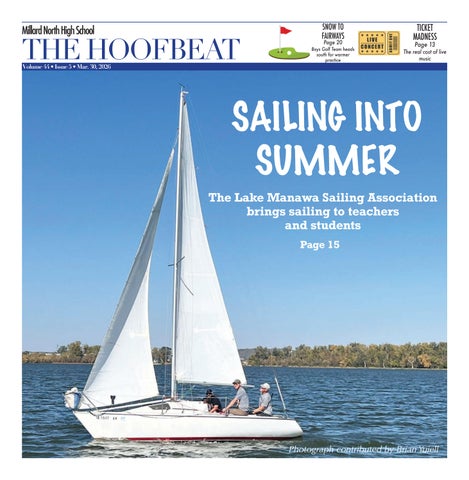
Brian Yuiell sails with crew members on Lake Manawa. Yuiell sails frequently in the summer.
STEADY COURSE
TBDLET THE SPARKS FLY CHECK
#12 A HELPING PAW

The Hoofbeat staff will publish six issues of the paper at Millard North High School (1010 South 144th Street, Omaha, NE). Type is set with the use of Macintosh and HP computers. Printing is done by White Wolf Printing, Sheldon IA. The Hoofbeat is a member of the Nebraska High School Press Association and JEA. The Hoofbeat exists for the express purpose of student information and learning.
Advertising: Advertising will be sold at $7 per column inch or by special quarter, half, or full page rates. Information can be obtained by calling 402-715-1404.
Responding to the Hoofbeat: Letters to the editor may be submitted to Room 1105 or sent to sacrotzer@mpsomaha.org. Names will be published. Letters must not contain attacks against an individual and may be edited for clarity.
Co-Editors-in-Chief
Argyrenia Pipinos
Mira Mukherjee
Front Page Editors
Grace Evert
Sarah Robey
News Editor
Katelyn Judd
Opinions Editors
Jayden Maple
Lucas Day
Nathan Yeh
In-Depth Editor
Mira Mukherjee
Lifestyle Editor
Argyrenia Pipinos
Sports Editor
Lydia Harlow
Online Editor
Sarah Robey
Cartoonists
Nadirah Johnson
Rosie Scherbarth
Artist
Nadirah Johnson
Rosie Scherbarth
Photographers
Lydia Harlow
Lucas Day
Staff Writers
Matthew Um
Miley Huynh
Parker Neville
Teja Sridher
Adviser
Sarah Crotzer
Principal
Aaron Bearinger



Four MN sophomores collaborate with NASA to launch their bright idea into orbit
MILEY HUYNH Staff Writer
Aplace where no sound exists, where humanized elements such as gravity are endlessly changing. Wild, unrestrained, chaotic, pulsing with energy, light, and heat, with celestial bodies drifting aimlessly in a near-perfect vacuum: this is our outer space.
Out of humanity’s greatest accomplishments, traveling beyond Earth’s domain and into the cosmic ocean is commendable, especially when comparing progress from the past to the present.
Despite how exhilarating space exploration sounds, it is unfortunately accompanied by several dangers.
On Earth, sunsets and sunrises are gentle because the sun’s rays are softened by our planet’s atmosphere; on the other hand, the moon has no atmosphere, resulting in blinding rays and deep, void-like shadows.
As stated by NASA, the light directly shines into their eyes, and their vision is unable to quickly adjust to extremely dark regions as efficiently. This issue greatly disrupts an astronaut’s functional vision, preventing them from carrying out tasks and weakening their spatial awareness.
A potential solution to the glare rests in the hands of four MN sophomores: Mahesh Yandra, Nathan Yeh, Prajwal Rao Sagi, and Ketan Valluru. These students have been teaming with NASA engineers on their own experiment, named the “Lunar Glow Pathfinder.”
“The purpose of this project is to create a safe environment for future space missions by using materials that do not require a proper electrical system to function,” Yandra said.
A key detail of the “Lunar Glow Pathfinder” is its use of a sustainable, zero-power light source that could mark important regions on the moon and improve visibility for astronauts during missions.
“The specific materials are phosphorescent compounds that glow on their own after being charged by light,” Yandra said. “[This] means they could provide a backup system that works even if the main power
Impact of experiment on team’s education
Connection of experiment to NASA’s mission
Alignment of experiment to team’s hypothesis
Design of the experiment meets design guidelines
source on a moon station fails.”
The project started with a company called Future Engineers, known for hosting national STEM challenges for grades K-12, promoting the “NASA TechRise Challenge.” Chemistry teacher Korian Pfeifer presented this opportunity to several classes, and Yandra found a team to take on the challenge. With over 1,000 competing teams, only 35 would be selected to go into suborbit—including Yandra’s group.
“I was so surprised that they went,” Pfeifer said. “I knew it was a good idea, but I don’t know what other [experiments] people are doing. I was beyond surprised, but also beyond proud.”
As the group’s team lead, Pfeifer not only works to supervise and provide materials but also to support the students along the way.
collect the most accurate data.
“We want to measure how quickly the light fades and determine whether the materials stay bright long enough to be useful in an emergency without severe degradation,” project member Ketan Valluru said.
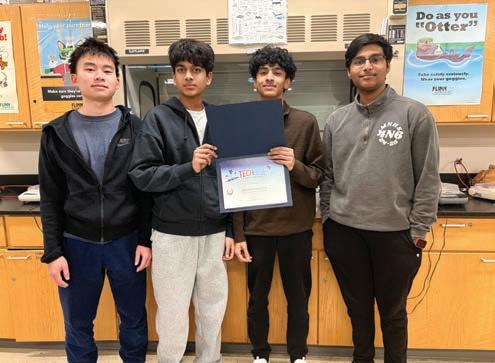
Sophomores Nathan Yeh, Ketan Valluru, Mahesh Yandra, and Prajwal Rao Ragi recieve a certificate for their selection of the “Lunar Glow Pathfinder.” Their project will launch later this year.
“I feel glad that they trusted me with this,” Pfeifer said. “They could have gone to any engineering teacher or skilled and technical science teacher. I’m so glad that they trusted me to be the one that is helping them through it.”
Photograph contributed by Korian Pfeifer
Simultaneously balancing their school life with rigorous work and weekly meetings with NASA engineers, the team continues to build and refine their project to
What started as an idea back in November 2025 is now on the way to becoming reality, with an expected launch this summer after the project passes final testing and gets approved in May.
“[My hope for the project is] that all the sensors work exactly as they need to with data collection once sent into orbit and [they can face] the unique microgravity and extreme flight conditions,” Valluru said.
The group dared to be curious, and they dared to take the chance to submit their ideas to the contest. Because of their passion, they found an incredible opportunity to put work into something they enjoy.
“Going above and beyond is always beneficial. It’s not what you’re doing in classes, it’s what you’re doing outside of classes,” Pfeifer said. “It’s what you’re being motivated to do. It’s what you’re willing to put application in for that’ll get you far.”
Like space, many opportunities have yet to be explored. In the end, the only thing that holds us back from taking the plunge is doubt. The “Lunar Glow Pathfinder” team is evidence that the sky’s the limit.
Winners announced
Launch Experiments January 2026
January 20th, 2026 May 15th, 2026 May 16th, 2026 Summer 2026
Experiment build begins
Show Case Mail Experiments
TEJA SRIDHER Staff Writer
other Earth, if you don’t mind, will you rock my kids to sleep too?
can they get rattles of pure mahogany and seeds of any sweetness? society is such a terrible family tree.”
The array of meaningful phrases created by junior Katelyn Omer in her poem, “wise beyond your tears”, demonstrates the personification of Mother Nature, while connecting the similarity between her own mother and the piece.
Both Omer and junior Liliana Stromgren recently earned accolades from the UNO Writer’s Workshop, a high school creative writing contest. The top three winners had the opportunity to read their poetry alongside a critically acclaimed poet, Maria Zoccola, author of “Helen of Troy,” on Mar. 25th.
Stromgren, winning third, aimed to incorporate real scenes from her life into her piece, highlighting the subtle forms of absence she experiences in her everyday life.
“My piece is called ‘Invisible’ and when I was writing it, a lot was going on for me family-wise. Since I have a lot of siblings, it’s really easy for me to feel invisible. I was dealing with an illness in my family, as well as my parents not always being home because they’re at work,” Stromgren said.
Both writers adopted unique elements when forming their craft. Omer, second-place winner of the contest, uses unconventional capitalization and italicization throughout the three-page-long poem.
“I use only a little intentional capitalization to emphasize the personification of Mother Nature, and to highlight the parallels between my mother and Mother Nature, as also shown by the repeating stanzas. Only lines about ‘them’ or said by ‘them’ are capitalized for clarity and to add more meaning,” Omer said.
one of those things that I tend to fall into a rhythm with that soothes me,” Stromgren said.
Junior Katelyn Omer delivers “wise beyond your tears” at the Samuel Bak Museum. She competed at the Nebraska Poet Laureate Ceremony in April of 2025, where she was a finalist.
Photograph contributed by Katelyn Omer
In this literary form, words like Mom, Mother Nature, She, and Her tend to be capitalized. The poets have plenty of experience in the writing field and feel that it’s a way to connect people together without barriers.
Both writers’ inspiration to produce impactful poetry started from a young age; English teacher Whitney Hansen was their main source of inspiration when applying to the contest.
“I chose to sponsor Slam Poetry Club because I have been writing poetry all

“Since my life can be so stressful, as everyone’s is, I was kind of done with normal journaling since I tend to spiral with it compared to when I produce poetry. It’s

WISE BEYOND YOUR TEARS
“you’re new at this. you’re bruised from this for all the right reasons in all the bittersweet ways. so you can scrawl your name on every tree and it’ll always be my favorite tattoo you’ve seen so little, but felt so much you have so much left to know.”

my life. Poetry is such an incredible way for students to express themselves, and I wanted to be part of that. I originally found out about the UNO writers workshop when I was in college myself. I took multiple poetry and fiction classes through UNO when I was in college,” Hansen said.
Katelyn Omer’s commentary on the ending of Omer’s poem
“Not only was I super happy with how this referenced the rest of the poem and tied it together, but it is super comforting and hopeful. I like the idea of the Earth, which I personified throughout the poem, looking at all of us with love and trust to do the right things in the world as we grow in it. I love the ending message that we are all where we need to be in this moment, and that we will continue to learn from a life that is full of both struggle and hope,” Omer said.
The students get inspiration from other poets at Millard North, too, especially through the Slam Poetry Club. Connecting with one another through shared storytelling lets them hear each other’s individual styles as well as their past experiences.
The poets looked forward to the workshop experience and hoped to gain a better understanding of new poetry techniques and what writing is like at a college level.
“I think it would be really cool to see how UNO presents the workshop, what they present to their writing students, and what the college demographic is like. It’ll be really great to have the opportunity to work on performing it and being in those spaces that do the poem justice,” Omer said.
Their creativity and mindfulness taken throughout the process of constructing these impactful pieces of poetry serve as a reminder of their ability to inspire others and give the world a meaningful voice.
MIRA MUKHERJEE
Co-Editor-in-Chief
The first week of March always highlights a cornerstone of human interactions: inclusion. Typically held on the first Wednesday of March, Spread the Word: Inclusion Day was founded by the Special Olympics to foster inclusion for those with intellectual and developmental disabilities.
At MN, this day has been turned into a week-long event to celebrate and promote the school’s unified classes and activities.

“‘Spread The Inclusion Week’ is about spreading the word, promoting inclusion, and just letting everybody know how important it is to include, whether it’s someone who visibly has a disability or maybe someone who doesn’t necessarily look like they have a disability, but just includes everybody,” ACP teacher Skylar Phillips said. “It doesn’t matter who they are, having them sit at your lunch table or having a conversation with them when you’re in math class and being inclusive and kind to others is really what this week is about.”
From an Inclusion Day Party to a student vs. staff basketball game, there are a myriad of activities held throughout the week to spread awareness about the ACP program.
“This week is just getting together to celebrate that we are a unified school, promoting inclusion, and reminding people that we have unified classes and we have unified sports,” ACP teacher Alexa Ryan said.
Through the promotion of inclusivity and the number of unified activities and programs offered, MN has been able to be certified as a unified school and has received a banner twice for recognition.
Junior Will Bundy and his basketball buddy junior Ben Tuccitto walkout together as the team members are announced. Bundy and Tuccitto worked as partners against staff in the game.
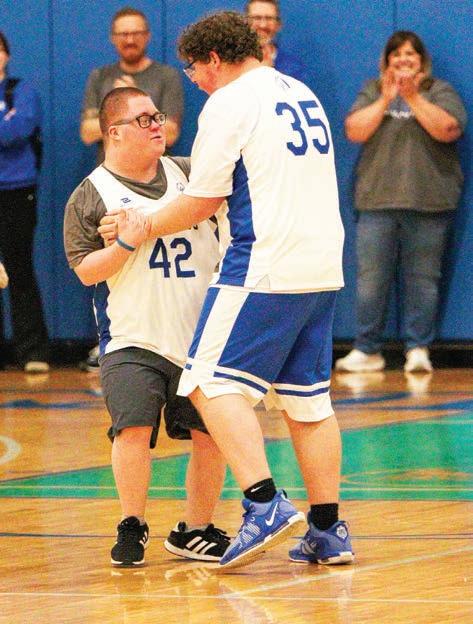
“You have to have a certain number of sports or clubs to be a unified school; you have to have so many things that are schoolwide that include or impact the whole school, and you have to have things that are student-led,” resource teacher Tricia Rohde said.
Photograph by Parker Neville
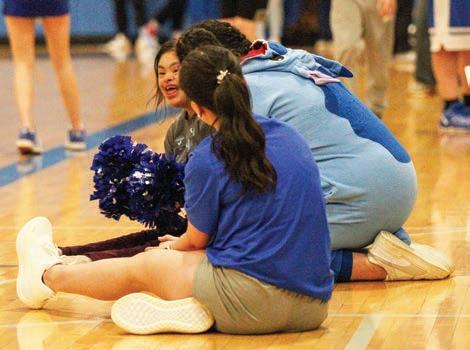
Junior Jessica Ramirez rests at halftime during the Unified Basketball game. She performed with her teammates in the Unified Cheer performance.
Photograph by Parker Neville
MN offers unified cheer, bowling, basketball, and track, as well as unified Spanish, music, and art classes that all students participate in.
“They love it. They have a great opportunity to build relationships with ACP students, and they come to realize that they’re not much differ-
ent from themselves,” Phillips said. “They can build lifelong relationships with them as an individual and not just the kid down the hall; when our students see them out, they can have that interaction with them.”
Additionally, there is also a Unified Club where students meet once a month to play games and hang out.
“That’s another way to get the word out; it helps some of our kids who don’t get out and about in the school as much to meet more friends,” Ryan said.
Students are also able to partake in unified activities and classes; for senior Bailey Linger, she has been able to interact with ACP students through participating in unified Spanish.
“It’s really fun, and it’s a break in the routine of your dayto-day classes, and it lets you build relationships with ACP kids and other peers, and you get to become a lot closer to other kids who are also helping in the classes,” Linger said.
The positive experiences from increased inclusivity are only further strengthened through Inclusion Week, which is set to remain in future years.
“We hope to do it every year. I’ve only been here for four school years, and we’ve done it every school year I’ve been here,” Ryan said.
The exposure of the ACP program throughout the school is a major objective of ‘Spread the Inclusion Week,’ as it allows for the increased inclusion and integration of ACP students and promotes inclusivity for all students.
“We really just want kindness across the board. A lot of people think the focus is just special education and having special education kids included, which yes, we do want that; it’s what the first push for this week was, but also just to make sure everybody is included,” Rohde said. “Everybody wants to have friends, so I feel like it branches across all socioeconomics and races so that we are all just included and no group will be excluded.”
Nebraska beats Vanderbilt in March Madness game, and advances into the Sweet 15 (Mar. 21)
An elderly woman crashes into a Mama’s Pizza in La Vista, injuring three children (Mar. 21)
Gas prices hit a new all-time high since 2023, in the middle of the U.S. and Iran conflict (Mar. 18)
U.S. airports are experiencing long travel lines and staffing shortages amidst a partial government shutdown (Mar. 22)
The late political activist Cesar Chavez faces new allegations for abusing women and children (Mar. 18)
Sophomore Rex Weaver attends the Central City welding competition, the first of many LUCAS DAY
Co-Opinions Editor
mbracing the sound of hammering and grinding metal, sophomore Rex Weaver moves from tool to tool, mending and welding metal pieces together to match his blueprint’s design, fighting for a winning prize at his first welding competition.
The contest was held at Central City High School on Mar. 20th, and featured seven different sessions for welders to compete in.
In each session, three teams welded while another three teams completed a written exam, testing their welding knowledge. After 30 minutes, the teams switched places.
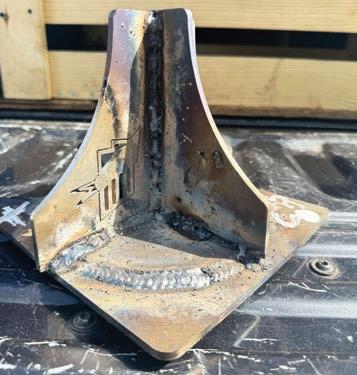
The blueprint, given to competitors when they began welding, illustrated a metalwork with a flat horizontal base and four vertical, triangular pieces with trimmed corners joined at the peak. Any incorrect dimensions, chipped or cracked appearances, or excessive welding could result in points being deducted.
“Pretty much every kid was busy, so there wasn’t a lot of talking in between or getting to see anybody…it was get in and get out,” Weaver said.

Students from across Nebraska attended the competition in hopes of sharpening their metalworking skills. For Weaver, this competition was also a chance for networking amongst nearby businesses.
“[I did the competition] mostly for exposure. I want to get different companies interested in what I’m doing and get my name out there,” Weaver said.
Weaver first began welding back in 2023, when he attended a summer camp at Western Iowa Tech Community College. However, according to Weaver’s mother, Donniebess Weaver, his passion for machines began much earlier.
“Rex has always been interested in machines. During Covid, he and his dad would buy old Power Wheels vehicles and fix them up, replace batteries, fix wheels, and modify the bodies of the vehicles. Sometimes this resulted in resale and sometimes it was a failure, but I’d say that’s where the passion for machines really began to take shape,” D. Weaver said.

“[Weaver] presented joining the academies at Metro Community College to me…and when a student says they’re interested in these academies, you sit them down and start to plan out their junior and senior year,” Hahn said.
Hahn also helped Weaver obtain a summer job from Drake Williams Steele Company, allowing Weaver to spread his name and gain connections and experience. These metro academies, internships, and competitions all help welding students build their futures.
“Without a doubt, [I’d recommend these competitions to students] because students are probably going to practice and work to develop those skills, and it gives them a good idea of whether it’s a good career area for them to go into,” Hahn said.
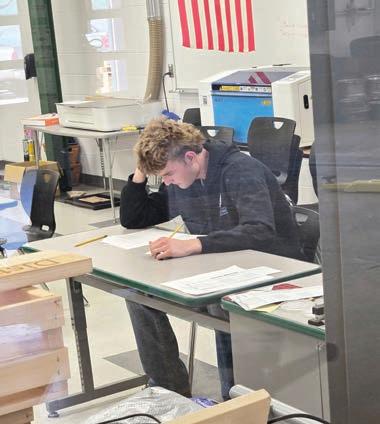
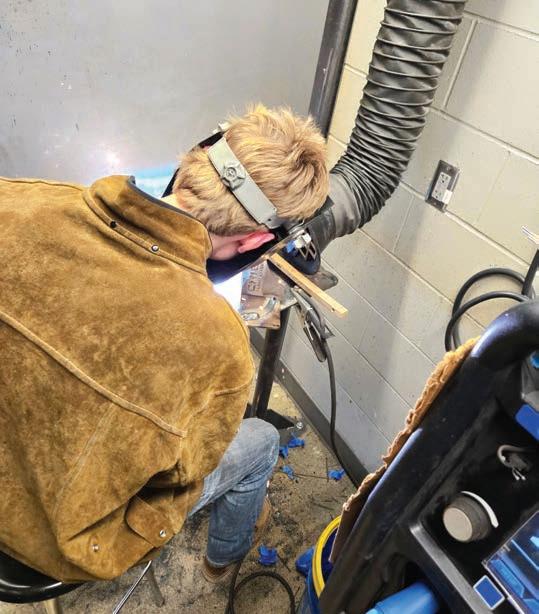
During the competition, sophomore Rex Weaver had to complete two sections to test his full understanding of welding: A test and and a project. The test, pictured to the right, consisted of 25 questions, with a minute to answer each question. The project challenged Weaver to weld four triangular pillars to a flat and circular metal base, pictured left. The process Weaver used is referred to as stick welding, which utilizes electricity to bond a metal rod (stick) to the base metal. He is pictured above applying this method. Photographs contributed by Donniebess Weaver
Throughout high school, Weaver has taken welding classes such as Introduction to Metalworking and Welding 1, and he plans to take this passion beyond his high school years.
“I think it’s fascinating being able to melt two pieces of metal together. It’s also just kind of a quiet place, and it’s nice being by yourself just measuring stuff and welding,” Weaver said.
Weaver’s counselor, Andy Hahn, seeing his passion for welding and the trades, has aided Weaver in mapping out future opportunities, including dual-credit academies and even potential internships.
By participating in the Central City competition, students like Weaver were able to practice their skills under a high-stakes setting. Through this, Weaver was able to get a taste of real-world welding and hopefully share his name.
“The competition will surely open some doors for future careers and networking. It’s a resume builder similar to any competition, be it a debate, participation in a school play, or being on the basketball team,” Donniebess Weaver said.
Completing the competition, Weaver placed 11th in stick welding and 9th in mig welding, outcompeting 37 of his peers on the metalworking floor. Beyond just a day’s work of welding, he gained an experience he’ll carry with him forever.
“I wish I had more time, we were only there for about an hour and a half…but I really like welding, so I enjoyed it,” Weaver said.
Even though the competition is over, it’s just the first of many. Weaver plans to attend more competitions and gain even more welding experience. Eventually, Weaver will be able to move up to compete at state, nationals, and even compete on the international level.
With each competition, Weaver not only improves at welding but shares his name with the world, helping him forge the future in welding he wants – a future where sparks fly.
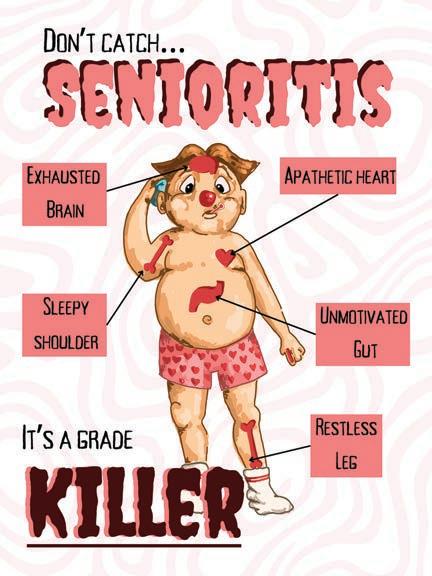
With senioritis becoming more prominent than ever, it’s important to find ways around it
Staff Editorial
t starts with one assignment turned in a day late. Nothing big, just delaying part of your daily workload to make it feel more manageable. But it doesn’t take long for things to spiral out of control: it’s hard to keep putting in your best effort, and suddenly the work you do for class just doesn’t feel worth it.
We’ve all heard the word before: senioritis. The mythical condition where seniors start to lose the motivation they carried in their early years of high school. Assignments that were once easy to maintain are now held back by near-endless procrastination, lectures fading out of our attention as we lose ourselves in our thoughts.
Whatever form it takes, senioritis takes hold of about 68% of high school students according to a survey by “ZipDo,” with 55% of seniors showing symptoms as early as February. And while the most common symptoms involve putting off assignments until the last second and struggling to focus, some students suffer from skipping assignments or even entire classes due to a lack of motivation.
So what causes this? According to the ¨University of the People,¨ college applications play a huge role in this. They argue that high school students face so much pressure to succeed and impress colleges that it becomes a sort of end goal for them, and when they reach that, it feels like they’ve crossed the finish line already.
But high school doesn’t end there. Even if you’ve already been accepted into your dream college, the
Student Speak What do you do to prevent senioritis?

work you do here is still valuable. And while you can get by with minimum effort to get passing grades that are good enough, does this really prepare you for what comes next?
This is where we come to the consequences of senioritis. Colleges will look at your grades again when they receive your final transcript after graduation, and a particularly bad case of senioritis may harm your GPA, which could risk your chances with colleges or scholarships with strict acceptance requirements.
So we know the risks of senioritis, but how can we prevent it? “ACT” recommends continuing to challenge yourself with more difficult classes and staying involved in activities. Not only does this make you look more appealing for your admissions, but it also pushes you to keep trying so you can succeed.
Furthermore, start setting goals for yourself aside from college admissions. Maybe you want to get a certain grade in a class, or maybe you want to set a personal goal, such as learning a new hobby. Whatever you choose, having a set goal to work for gives you an incentive to keep working forward so you can get what you want out of your time.
Not everything has to be academic either; you can still try to make things enjoyable for yourself. Just because you’re trying to succeed doesn’t mean you can’t have any fun. After all, it’s still your senior year: this is meant to be the peak of your high school experience, so try to balance your academics with ways to enjoy yourself as well.
Be sure to try and limit distractions as well. We live in our time where attention spans are getting shorter
Cooper Huddleston “
Making sure you get to bed on time is one of the most important things, because you don’t want to be tired
I keep all my spaces organized since procrastination is the biggest thing for me, so I stick to a strict schedule and even do yoga.
It takes a lot of motivation and good teachers that are fun and make me want to actually come to school and try.
Blake Sampson
I just do as little as I can to get all A’s, and I set limits on my phone for screen time so I’m not as distracted.
than ever, we work surrounded by virtual distractions, and with most of our work turning digital, it’s easy to get caught up in scrolling while we put off the task we have at hand. It’s important to be mindful of how we use our time, so make sure you’re spending it in a way that feels productive to you.
Finally, if it ever feels like too much for you, don’t be afraid to talk to someone you trust about it. Whether it’s a friend, family member, teacher, or another trusted individual, getting someone else’s perspective and thoughts can help you come up with methods to help that you might not have thought of otherwise.
And if you’re currently a junior, make sure not to push yourself too hard going into your senior year. While packing difficult classes into a full schedule can feel like the right choice to look good for colleges, try to at least leave yourself a few classes that you enjoy, so that your day-to-day school life isn’t completely overwhelming.
Senioritis makes the final stretch of high school more difficult than we would like, but if it feels too hard to overcome, remember that these are your final days in high school. With only two months left to go, you should do what you can to finish strong. Sure, you’ve already received your college acceptance letters and have less pressure to succeed. But while you’re here, you can still make the most of it.
By Rosie Scherbarth
“Breaking news” isn’t broken, it’s just been overused
nce upon a time, “breaking news” meant that something significant was happening right now. From a hurricane making landfall to a president resigning, the phrase carried weight. It signaled urgency and importance. Today, it’s plastered on every minor event or celebrity post, a graphic that no longer commands attention, but blends into the chaos.
Decades ago, when “breaking news” flashed on television, it meant something monumental was unfolding. Viewers knew to stop what they were doing because history was in motion. But today, the term has been stretched to the point of meaninglessness.
The roots of “breaking news” trace back to the early days of radio in the 1920s and 1930s. Networks would interrupt regular programming to report urgent developments, most famously the beginning of



World War II or the attack on Pearl Harbor.
Televisions inherited this practice in the mid20th century, when major networks cut off shows to cover national emergencies. The phase was used sparingly, partially because breaking into scheduled broadcasts came with significant financial and logistical costs. It was reserved for true emergencies.
As cable news arrived in the 1980s, spearheaded by live coverage of landmark events like the Challenger disaster, “breaking news” became a central part of brand identity. But quickly, pressure to fill the 24-hour news cycle changed how news was delivered. Graphic designs, on-screen banners, and dramatic music transformed “breaking news” from an attention-getter to a marketing tool.
Once the internet and social media entered the picture, the situation spiraled further. News organizations began competing not only with each other, but with millions of users, influencers, and even small “news” accounts. To grab attention, editors attached “breaking” to nearly every headline. The distinction between “breaking” and “recent” vanished.
In this age of media, views have become numb. From a political speech, to a movie trailer, to a viral video, everything arrives under the same flashing banner. When every notification claims crisis-level importance, audiences grow skeptical.
It’s almost a digital version of the boy who
cried wolf: when a real crisis arises, people may assume it’s just more noise and hesitate to engage.
True “breaking news” demands immediacy and impact. It should unveil facts that change public understanding of an event in progress. Today, stories that are merely new, interesting, or trending are labeled as “breaking”, completely eroding the media.
“Pew Research Center” explains that news and media outlets are rewarded for immediacy, not accuracy. They gain viewership through fast and flashy content, which produces ad revenue and sponsorships. Therefore, “breaking news” has become a tool to lure attention, drive clicks, and garner views.
Despite these trends, the solution isn’t to ban the phase, but to reclaim it. Journalists and editors need to set higher standards for when to label content as “breaking news”.
News consumers can also play a role by questioning whether the story truly rises to that level. Credibility, when lost, is often hard to regain. But hopefully through reflection and foresight, the phrase can become powerful again.
We live in an era overloaded with information. “Breaking news” once guided us through the noise to truly impactful moments in history and society. To restore its strength, we must allow “breaking news” to mean what it always did: something that deserves to stop us in our tracks.







The process behind certifying service animals and how they contribute to their owner’s support sytem.
Having pets and service dogs’ impact on members of the MN community
LYDIA HARLOW Sports Editor
Dogs and humans have coexisted domestically for millennia, and their mutual benefits for one another are extensive. Whether they are service dogs, specially trained to assist humans, or just a cute, cuddly pet, they assist their owners in a wide variety of ways.
Today, around 42.6% of households in the United States have a pet dog, with around 87.3 million household dogs living in the US alone, according to the “American Veterinary Medical Association.”
Between her experiences with her late service dog, Grace, who assisted her with her diabetes diagnosis, and her current pet, Bippy, social studies teacher Holly Carlson has grown up alongside pets, each marking a distinct stage in her life.
“I have had family dogs my whole life, and then in 2008, I ended up applying for, and getting, a service dog. She was a lovely soul. She’s been gone for six years now.” Carlson said.
As her teacher of sorts, service dog Grace inadvertently taught Bippy to alert Carlson. The dogs were trained to come up and signal their owner by smelling or licking their hand when they sense highs and lows in Carlson’s blood sugar.
especially when trained in this way.
“She was trained to alert me when a car was coming while we were walking. She would always just naturally pull me over, like if we were in the street, she’d pull me to the sidewalk,” Carlson said. “Also, she knew my name. As a person with hearing loss, sometimes I appear to be rude because I walk by and people say my name, and I just don’t know, and so she would alert me.”
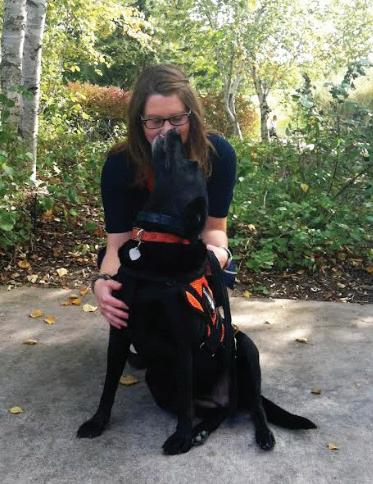
Carlson and her late service dog Grace taking a stroll in the park. Grace was integral for supporting Carlson’s diabetic needs.
Photograph contributed by Holly Carlson
“The dog I currently have still does the kind of alerting that my service dog did; she learned how to do it. My dad’s dog learned to alert me, too. Dogs are teachers, in a way, if they’re talented. Some dogs, of course, aren’t going to do that as well, but I love the kind of interconnectedness and sort of soul-caring operation that they do,” Carlson said.
Living side-by-side with a service dog, Carlson experienced all the incredible things pets are capable of,
Service dogs can be an extraordinary help to their owners, especially in terms of community and safety, but ‘average’ pets can do much too: alleviate anxiety, help their owners become more sociable, and provide a more complete outlook on life.
“Dogs have given me a great perspective on life by keeping me grounded. I watched my dog during a windy walk the other day and was impressed with her desire to just keep going, put her nose in the wind, and get through tough conditions. Dogs have given me the greatest joys and sorrow in life, but it’s worth it all in the end,” Carlson said.
This determination, inspired in Carlson by her pets, has influenced many aspects of her life and helps her maintain perspective.
rates during stress-inducing situations than those without pets.
Simply petting a dog can release oxytocin, which is often referred to as the ‘love hormone’, and directly contributes to reduced anxiety and cortisol levels. Senior Evelyn Lally has experienced this herself, with her new pet, a Cavalier named Otto.
“He really helps with overall anxiety. If I’m, like, stressing out about homework, I can sit down with my dog and pet him. He’ll lie in my lap for literally hours and just let me pet him, which is really helpful because with college, homework, clubs, and whatever, it can get stressful,” Lally said.
Every dog, and every pet in general, can have these effects on their human owners, not just service dogs or those of a special breed. While special training can help bring out some of these traits, there remains an innate connection between people and their pets.
“In a nutshell, dogs are just the most awesome companions, and then sometimes, they [service dogs specifically,] do these extra special things,” Carlson said.
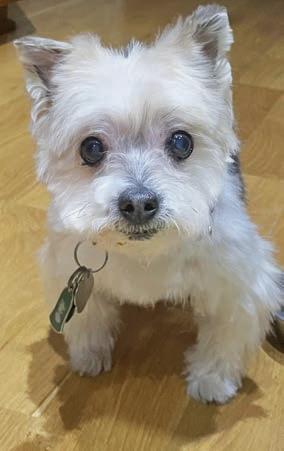
Watch and Learn Carlson’s current dog, Bippy. Bippy was taught by Grace to learn diabetic alerts.
Photograph contributed by Holly Carlson
“With my very low or high blood sugar, my hearing, and whatever, I can get really centrally focused and forget about everything else outside of me. My dogs have always helped bring me out of that,” Carlson said.
Dogs have been scientifically proven to help alleviate their owners’ anxiety. A study published in the Journal of Psychosomatic Research found that individuals who owned pets had lower blood pressure and heart
Going through life sideby-side with another creature is bound to have its ups and downs, and the aging process is a definite hardship. Carlson’s pup, Bippy, is about to turn 16 in May, an already long life for a dog. Yet, as Carlson has lived much of her life alongside different dogs, she’s gained a greater outlook on aging through them.
“There’s a stoicism that I have admired. Even though they’re aging, or even though they’re arthritic and can’t jump up to the couch anymore, they’re still a dog. Their nose still works, and dogs are born blind, so even if their vision goes, they’re still going to be who they are. And it has made me look at getting older, as if it’s just a path. There is an end to it, and yes, it can be icky, but it’s still beautiful,” Carlson said.
All in all, despite any struggles they might bring, the relationships between humans and their pets is greatly beneficial to both parties involved, whether fostered through specific training or general love and friendship.
“My grandma put this perfectly: ‘Where do you get more love and less grief in life than from a dog?’” Carlson said.
A breakdown on key characteristics of successful service animals.
• CALMING, SAFE PRESENCE
Source: Unitied Disabilities Services Foundation
Many times service animals will have to be able to support an owner during high-stress sitautions, so it is imperative they remain collected.
• HIGH ACTIVITY LEVEL
Service animals need to have the desire to work as they will likely be needed for a variety of activities and settings.
• INTELLIGENCE
Being able to perform certain tasks and handle situations is an essential part of what a service animal provides for owners.
• FRIENDLY DEMEANOR
Service animals should be able to be freindly and comfortable around a range of people and animals.
Popular dog breeds for service animals.




Boxers are loyal to their owners and are known for creating deep bonds.
Border Collies are known to be energetic and quick learners, which is necessary for the high-demanding field of service animals.
German Shepherds have numerous qualities that make them successful as service dogs. From their protective nature to innate obedience and ease at learning new skills, this dog breed is ideal for the rigour demanded of service animals.
Golden Retrievers are a popular choice for service animals as they tend to be even-tempered, allowing them to be a versatile choice for all ages. Retrievers also typically have friendly dispositions, which is necessary when dealing with a variety of people and situations.
The process for service dogs to get trained and their emotional, physical, and psychological benefits
LUCAS DAY
Co-Opinions Editor
or most, there is almost nothing cuter than walking down the street and seeing a dog fluffy like a pillow, grinning with a loose tongue and wide eyes.
It’s almost as if there’s a universal force compelling people to bend down and pet its fur, making cute “awws” as they go. It’s an especially pleasant surprise when you see a dog in restaurants or stores, watching them trot across the hardwood floors when you least expect it.
While many don’t see a dog in public every day, it’s not abnormal. In fact, many people depend on bringing their dogs wherever they go.
Their dogs are more than just man’s best friends but service animals, trained to assist their owners wherever they are.
An analysis into some of the categories of service dogs.
Service dogs are pets trained to perform specific tasks in order to aid disabled owners. These tasks can help with physical, sensory, psychiatric, intellectual, or emotional disabilities. They can guide the blind, alert the deaf, ease seizures and stress, and more.
But not just any pet can become a service dog. For starters, a service dog must be calm and collected, yet at the same time alert and responsive to trouble. Service dogs should also be healthy and at least six months of age.
Majority of the time, owners can take their dogs directly to training orientations or even virtual sessions. According to “US Service Animals,” sessions can generally provide training, videos, individual trainer support, and gear like service vests and collars.
Some programs even breed their own dogs to become service animals. Canine Companion, a nonprofit organization dedicated to providing service animals to those in need, breeds their dogs in California and raises them to become service dogs.
The organization consists of dog-training volunteers who start training puppies at just eight weeks old. One such volunteer is assistant principal Susan Marlatt, who began training dogs in 2022.
“My late husband had received his service dog from Canine Companions, and since he got his service dog free of charge, we decided to start the puppy-raise and give back,” Marlatt said.
These types of service dogs typically help blind and low-vision individuals. They typically practice selective obedience, such as not crossing the street with an owner if they see cars and the owner cannot.
From seizures and allergic reactions to diabetes, these dogs navigate their specific owner’s health concerns. Many are trained to call 911 with a K-9 alert phone and also retrieve medicine for their owner.
Volunteers such as Marlatt teach their dogs over 35 different cues, including sit, kennel, and more complex tricks like visit, where the dog lays their chin on someone’s knee. However, volunteers are mostly geared toward adjusting their dogs to hectic environments.
“Our big thing is to take them
These dogs help people who need help with everyday tasks, such as those with spinal cord and brain injuries. These service dogs retrieve objects, turn on lights, provide balance, and can even help their owners into wheelchairs.
out into public and socialize them. A lot of people might have seen that I’ve been at some football or basketball games with my puppies in training,” Marlatt said.
While in public, service dogs are on the job, requiring them to stay observant of their surroundings while guiding their owners. Service dogs are usually the most needed while in public, making it a troubling task when onlookers can’t help but come up and pet them.
“When people are out in public with their service dog, it’s important not to go up and just pet the dog because you don’t always know what that service dog is doing for that person… if people pet without asking, sometimes that can distract the dog,” Marlatt said.
Around 18 months of age, once the dog has learned to act appropriately and can follow basic commands, they’re turned over to professional trainers at Canine Companions. From there, they are taught more specific commands to help prospecting owners.
“I’m just bringing them up from a puppy to a teenager, if you will. I teach them to act appropriately and walk on a leash. When they go to professional training, they’re actually teaching them how to turn on light switches, tug a rope to open a door, or tug a laundry basket,” Marlatt said.
These dogs at Canine Companions and numerous other organizations have changed people’s lives, helping physically and emotionally impaired complete tasks that would otherwise be impossible.
A study by Purdue University found that service dogs significantly increased factors such as emotional, social, and workplace functioning. Service dogs have been shown to generally improve mental health and wellbeing, however each family’s situation differs.
According to “Canine Companions,” children afflicted with autism who obtained service dogs saw improvements in managing sleep, well-being, and social interactions. Moreover, service dogs can help veterans suffering from PTSD by standing behind their legs in public, creating a buffer between them and crowds while keeping them grounded.
Service dogs can even help with conditions like epilepsy or cerebral palsy. They can perform basic mobility tasks for their owners, such as opening and closing doors, and even sense when a seizure is impending. While many people see dogs in public and can only think about how cute they are, these service dogs are more than just cute balls of fur but animals on the job. These dogs have helped families across the globe overcome unbearable physical and emotional stress, bringing them both a helping paw and a friend for life.
Source: Unitied Disabilities Services Foundation
concert ticket sales spark
Co-Editor-in-Chief
hen I first heard of Harry Styles’ upcoming tour to showcase his fourth studio album, I was excited at the possibility of scoring tickets to one of his highly anticipated tour dates.
But slowly, I realized that was out of the question. The presale and on-sale prices ranged from $50 to just over a grand, but since I hopped on the bandwagon a little late, my options seemed limited to exorbitant resale prices.
How had concert prices skyrocketed this high? As a global superstar, Harry Styles’s previous tours had been financial successes.
To account for nuances, we have to look at all the resources put into these large-scale tours, from the individual artists’ hard work on their music to producers, crew members, dancers, and others involved in the creative process.
But at the end of the day, artists have the final say on their concert ticket prices. And is paying a couple hundred dollars to be in the nosebleeds or forking out as much as three grand to get a premium seat worth it to see your favorite music artist?
For many, it is, even if the cost far exceeds their financial capabilities. A large part of why ticket sales have increased so much in recent years has to do with dynamic pricing, a strategy to determine pricing by

looking at various market components, from supply and demand, competitor pricing, and consumer patterns, according to “Pricefx.”
Ticketmaster, the world’s largest ticket marketplace, is notorious for using dynamic pricing; this is something that artists have the choice to opt out of or even make their own negotiations with the company.
Although Ticketmaster’s monopoly over concert prices poses issues in terms of overall affordability, there are many measures that can be instituted to mitigate these effects -- and it does stem from the artist themselves.
I never realized how much control artists had over the price of their concert tickets. I understand that this is a huge balancing act; artists and their teams have the right to adequate compensation, but some of the pricing of these concerts seem to be blown out of proportion, especially in light of the fact that artists can dictate the prices.
Music is a universal language; it can be transmitted across linguistic, physical, and cultural boundaries. Ideally seen as a connecting facet of human life, financial barriers in today’s music industry have impeded the real power of music: its accessibility.
Concert prices should not be a barrier to seeing your favorite music artist, especially since there are so many ways to mitigate these costs, from increasing venue space to having more specific, tiered-pricing instead of dynamic pricing.
Famously, when the band Oasis reunited in 2025 for their first live performances since their dissolution in 2009, the pricing for tickets due to the extremely high demand skyrocketed, leading Oasis to actually do away with dynamic pricing for the North American tour dates.
1. Pound (abbv.)
3. Newtion’s invention, for short
5. Party favor instruments
7. British chips
8. A threat, “or ___...”
9. informal greeting: “Hey __!”
10. Pen filer
May 12th - Bring Me The
Kansas City, MO

May 13th - Bruno Mars Minneapolis, MN

June 19th - Alex Warren Omaha, NE
This outward nonconformity to the high resale tickets that are synonymous with major ticketing companies illustrates the power artists can have on concert prices.
2. Doing well, like a flower
to look after 4. Make do 5. Chief’s city (abbv.) 6. Snake noise
11. Number, for short
12. Numeró 1. Done without effort
Additionally, according to “NPR,” artists like Olivia Dean, Billie Eilish, and Hozier have also sought to reduce the effect of high resale prices by utilizing the “Face Value Exchange” feature on Ticketmaster, which ensures tickets can only be sold at the price a consumer originally paid for them. w
Though these means have not been in vain, concert ticket prices are still at an all-time high.
By incorporating more methods to mitigate high resale costs, like increasing venue space and decreasing dynamic pricing, the bridge to more affordable and accessible concert tickets will allow music’s real power to be experienced and heard by all.

The supply and demand of tickets, as well as competitive pricing, and inventory levels are some examples of how dynamic pricing can effect the average price for a majority of concerts, and companies use data collection and customer preference to futher move prices.
he scoreboard flashes the final numbers. A few points short. A tenth of a second too slow. One missed mark that costs you the meet and your chance to move forward. Standing there alone, the gym silent except for echoes of the crowd, you feel the weight of every practice, every early morning, every extra rep. It all points straight to that single result, and there’s no one else to share it with.
As an athlete, I know what that feels like. In individual sports, the thought isn’t “we lost.” It’s quiet, brutal, and personal: I didn’t do enough. There’s no teammate to cover for you, no one else to apologize to, no shared glory if it goes right.
That kind of pressure teaches you to be honest with yourself. There’s no hiding behind luck, coaching decisions, or teammates’ mistakes. You either face it or let it crush you -- and I’ve learned that facing it is the only way to grow.
The pressure of wanting to be the best and be at the top can feel unbearable, especially for young athletes still learning how to handle failure. But it’s also what makes individual sports so powerful. There’s a clarity in knowing that your effort directly determines your outcome.
According to the “American Psychological Association”, athletes in individual sports often develop strong independence
and self-discipline because they rely entirely on themselves. Every mistake is yours, but every victory is yours too. There’s no debate, no excuses -- only the results of your preparation and mental focus.
I’ve felt the sting of losing by just a few points. I’ve also felt the rush of finally hitting the mark after months of early mornings and long practices. Both experiences teach lessons you can’t get from a team environment.
You learn how to pick yourself up. You learn how to analyze what went wrong. You learn how to push harder next time because there is no one else to do it for you.
There is a strange freedom in individual sports. No one else dictates your pace, your strategy, or your goals. That freedom lets you experiment, push boundaries, and learn what you are capable of, even if the scoreboard does not reflect it immediately.
Team sports create a completely different mindset. A lost game belongs to everyone, not just one person. Missed passes, dropped shots, and defensive mistakes mix together to form the final outcome. Teammates talk it through. They pick each other up. They move forward together. According to the Aspen Institute’s Project Play initiative, team sports help young athletes develop communication, trust, and
• Learning to cooperate with teammates and coaches
• Appreciating the strengths and weaknesses of each other
• Managing others’ feelings and approaches
• Practicing leadership roles


emotional resilience.
Wins feel bigger because everyone contributed. Losses feel less crushing because you are not alone in carrying them. That shared responsibility can be comforting, but it has tradeoffs.
In a team, responsibility can sometimes get lost in the group. A player can have a bad game and still walk away with a win because the team carried them. In individual sports, that’s impossible. The scoreboard doesn’t lie.
That honesty can be terrifying, but it forces athletes to grow. There is also a different kind of pressure in team sports. The fear of letting others down is real. Missing the final shot or losing focus during a crucial play does not just affect you; it affects everyone relying on you.
Team sports also teach lessons you cannot always get alone. You learn patience, compromise, and how to forgive both yourself and your teammates. Those skills go beyond sports and stick with you in school, work, and life.
For me, losing alone feels heavier in the moment, but it is also quieter. No one else needs to hear you swear under your breath or feel the disappointment beside you. That quiet builds mental toughness in a way that cheering crowds and supportive teammates cannot replicate.
• Im proving physical health
• Learning discipline and time management
• Handling success and failure
But both environments are essential for athletes. Individual sports teach accountability, resilience, and how to stand alone with the result. Team sports teach connection, cooperation, and how to fight for something larger than yourself.
• Hitting personal mastery of a particular domain
• Growing in independence
• Forming aspects of mental resilience
• Fostering personal

Learning how to balance both -- how to handle the thought “I failed myself” and the thought “I failed my team” -- is one of the most valuable lessons sports can offer.
The burden of a lost meet, a missed mark, or a failed chance is hard to carry. But that weight shapes athletes, builds character, and pushes you to come back stronger. Standing alone or standing with a team, sports teach one thing that can’t be learned anywhere else: how to face failure, take responsibility, and keep moving
SARAH ROBEY
Co-Front Page Editor
t is a warm summer day. The sun is glistening on the water as the waves splash against the shore. The wind blows through your hair while the sails flap above you, carrying your boat smoothly across the lake. Lake activities are always a highlight of the summer. For physics teacher Brian Yuiell, sailing at Lake Manawa is one of his favorites.
Yuiell was introduced to sailing as a kid by his grandfather, who had a sailboat out on Lake Michigan. Yuiell has continued this passion and sails at Lake Manawa in Council Bluffs, Iowa, as a member of the Lake Manawa Sailing Association. The association was founded in 1986 and has around 150 members, sailing from late April to the end of October.
“It’s a group of people ranging from 12 to their 80s that have a passion for sailing. Many people do a lot of racing, but there is also a social aspect where we’ll get together and have a cookout. People are out cruising on boats sharing that common love for sailing,” Yuiell said.
Yuiell is very involved in the association and has become a sailing instructor. He has been teaching how to sail for the last two years.
“I want to help other people fall in love with sailing. I also learn a lot. I have done it enough where I see something and I just react, but teaching forces me to rethink all those little whys that, over time, you just forget. Every time I go out, I am learning something, and I just wanted them to be excited and passionate about sailing,” Yuiell said.
The association runs an all-volunteer sailing school. Several club members contribute their time and experience to help others learn to sail.
“It was especially helpful that Brian jumped right into on-the-water coaching, which requires patience, good communication skills, and the ability to meet students where they are. For students who are struggling or who lack confidence, one-on-one coaching can make all the difference in their sailing experience,” Lake Manawa Sailing Association President Teresa Silence said.
Sophomore Julian Wrubel is one of the students learning from this program. Wrubel began sailing in the spring of last year and is also part of the Lake Manawa Sailing Association.
“My family wanted to learn to sail in the Caribbean and the Bahamas, so we got into it that way. We also saw there were sailing lessons at Lake Manawa, so that is how we got into the program,” Wrubel said.
The Lake Manawa Sailing Association offers a variety of classes, whether you are a beginner exploring sailing for the first time or want to improve your skills.
“Sailing can be a hobby, a sport, a form of relaxation, a life experience, or a way of life. Whether someone is interested in sailing at the local lake or sailing
to the Bahamas, it all begins with one sailing lesson. We feel it’s important to offer people that opportunity,” Silence said.
The introduction classes teach beginners the key skills needed to sail.
“You have to learn how the wind works and the waves in the water and how that actually affects how your boat is traveling. Then they teach you how to prepare the boat and how things work. Then you actually learn to sail on the water so you gain experience controlling the boat,” Wrubel said.
After mastering sailing, some may participate in sail racing like Yuiell. While Yuiell did sail race from time to time with his grandfather, he recently became a dedicated sail racer in the last few years after a series of injuries. In the summer, he usually races around three times per week.
“I am very competitive. I can’t compete on the bike. I can’t compete in swimming. I can’t run, so I wanted to go back to sailing,” Yuiell said.
Through the association, he met his crew member, Jörg, from Germany. The two have been racing together for almost two years.
“He was brand new to sailing, and I was his instructor, so I taught him, and he wanted to get into the type of boat I race on called a Snipe,” Yuiell said.
The racecourse for sail racing is usually set up as a triangle. The first leg of the race is going into the wind. Because you are sailing directly into the wind, you have to keep turning your boat to get to the next checkpoint, called the wind marker. This is where you turn around to get to the second leg, which is called a broad reach. The wind is now on your side. Af ter turning around the wind marker again to get to the third leg, the wind is blowing behind you. Whoever crosses the finish line first wins.
“Sometimes you do that loop once, sometimes it’s twice. They’ve got all kinds of different patterns that you can do, but the basic idea is a triangle,” Yuiell said.
Whether it is a competitive race or a relaxing ride, sailing has always been enjoyable for Yuiell.
“Every time I go out on the water, I always remember my grandpa. He was a big part of my life. From the beginning, it has always fascinated me, and maybe that’s also why I teach physics, but how am I taking wind and making it move a boat just by wind? No two times that you go out on the water are the same. It might be on the same lake, same boat, but the wind is different. It’s always different,” Yuiell said.
Wrubel also shares the same enjoyment and hopes to try sail racing for the first time this summer.
“It’s just really fun to control a boat. You have so much control, and you can go wherever you want. I also enjoy flying airplanes, so it’s all kind of the same,” Wrubel said.
With the season approaching, Yuiell and Wrubel hope to continue spending many days on the water. Whether it is competing in races or enjoying a relaxing ride with their families, there are many fun experiences to look forward to.


PARKER NEVILLE Staff Writer
hen war breaks out, we always see the big picture on the news, about Russia’s latest attack on Ukraine, or the most recent developments about the conflict in Gaza. But we don’t always see how war impacts day-today life in the region. In particular, we don’t always see how this impacts the children whose families are torn apart by conflict.
This is where the organization War Child comes in, providing children with mental health support, education, and emergency aid even when the press turns away. But in addition to accepting donations, the charity also has a unique way of raising funds: music.
This brings us to HELP(2), War Child Records’ most recent album, published on March 6. Featuring 23 songs from different artists, all money raised from streams and record sales goes directly to the effort to help kids

As an album, HELP(2) covers a wide range of genres, so while you may not enjoy every single song in it, you’re sure to find at least a few that match your tastes, perhaps even more than you would expect, as the album is really high quality overall.
• Released March 6, 2026, HELP(2) is a charity compilation recorded over one week at Abbey Road Studios.
• Every purchase or stream supports War Child’s programs to protect, educate, and support children impacted by conflict.
Sources: War Child UK
One thing that was impressive about the album is just how many talented and recognizable artists and bands they got together. One such group was the Arctic Monkeys, a popular British band that came back after four years of not releasing music to open the album. However, the time between their most re cent releases didn’t hold them back. Their song, Opening Night, perfectly set the mood for the album: somber, but somewhat hopeful, and served as a great hook to get people to keep listening.
Following this up is Flags by Damon Al barn, which immediately showcases just how different the songs in HELP(2) can be, contrast ing the rock instrumentals and style of Opening Night with a steady beat and sections of spo ken, almost conversational lyrics.
While the first part of the album is really strong
and enjoyable, a lot of the songs in the middle don’t feel terribly cohesive with each other. The 343 Loop by King Krule is an example of this as the only purely instrumental song in the set, and while there’s nothing wrong with this style of music, it makes the song feel like it’s missing something when it’s surrounded by so many songs with meaningful, well-written lyrics.
Not all of the songs transition into each other that well in this section, either. After Warning by Cameron Winter ends with a nearly overwhelming expression of rage, the listener is thrown into the hyperactive party-like song Don’t Fight the Young by Young Fathers. While moments like this are hard to avoid with how much some of these songs contrast, this jump is nearly whiplash-inducing due to how sudden the change is.
more serene feel overall. When the War is Finally Done by Foals uses the new slow pace to talk about how being afraid of “what our cities have become” due to war, but still wanting the conflict to end so we can move on from the fear it gives us.

• HELP(2) channels all proceeds to War Child, supporting children living through war and conflict worldwide.
Then, to pull everything together, we have the closing track, The Book of Love by Olivia Rodrigo. While it feels a bit odd to end an album featuring songs about war with a love song, the soothing acoustic instrumentals and calming lyrics make it seem less out of place. It feels hopeful, like a reminder that things will be ok.
• Millions of children today face displacement, trauma, and disrupted education due to ongoing global conflicts.
Luckily, the album comes back together as it reaches a climax with Begging for Change by Pulp, a rock anthem that is ab solutely overflowing with energy and passion, serving as a direct call to action for the audience to push for change. The song also features a children’s choir as a prominent part of its backup vocals, making the song feel much more raw and powerful, while also reminding listeners of the kids the album seeks to help.
The remaining songs bring
• Features Arctic Monkeys, Olivia Rodrigo, Depeche Mode, Pulp, Beabadoobee, Foals, Fontaines D.C., Ezra Collective, and Greentea Peng, among others.
• Genres range from rock and pop to indie and experimental, all created specifically to support War Child.
Sources: War Child UK
• The original The Help Album (1995) raised over £1.2 million for children affected by the Bosnian War.
Sources: War Child UK

While HELP(2) isn’t perfect, it’s a high-quality album with a unique variety that gives it an appeal that you can’t get from a typical artist or band’s album. Regardless of your music tastes, you should give it a try: even just one listen can get children the help they need.

All-girls robotics team qualifies for the state tournament for the first time, reflecting on a remarkable season
JAYDEN MAPLE
Co-Opinions Editor
Acrowded gym awaits the chaos of blocks, parts and judges clashing with each other for another opportunity to win the state championship.
Each second puts stress on people, the bot and the coaches to do whatever they can to be competition ready. With the people watching on all courts, the pressure is on for everyone involved.
On February 28th, when MN’s own 5069D, an allgirls robotics team, participated in the VEX Robotics state tournament for a chance to reach the Worlds tournament by playing a game of push back.
This tournament, hosted by Omaha North High School, is one of the gateways for teams to make it to the World’s tournament, and to solidify which are the best teams in the state. Around 50 teams from all over the state qualified, with 6 of MN’s teams, including 5069D.
This team has proved itself to be a future frontrunner, with their bot showing some success on both the field and when it comes to its reliability and functionality, basing their model on previous models.
“Something unique about our robot is that it’s based on one of our failed designs. It’s pretty ironic because the fact that it actually works is shocking,” freshman Mahathi Vedagiri said.
The team was created this year to accommodate the growing interest in the robotics program, which now has 7 teams, with only 1 not qualifying for the state tournament.
The team, consisting of both freshman and sophomores, are all first year members in the V5 division, with a couple coming from the middle school division, VEX IQ, but many are full first year players to robotics, with many ways of seeing how the program works.
“I really thought we were gonna make high-tech human robots but when I got here, it was not what I realized and I think it’s so much better,” Vedagiri said.
The varying experience between each member has made them into a team with potential, even if there are arguments about their design or strategy, they manage to compromise and come together to win.
“When we’re designing the robot, what we’ve been trying to do is get everyone together to discuss what we’re gonna do so that we know how we are gonna finalize everything, ” freshman Evelyn Finny said.
With their entrance into the high school level, they have been given more tools and resources to grow in general, allowing them to expand upon ideas they have for competition.
“We have been permitted to use text-based code to make it more organized. Block code is more or less used for the controller now because of this,” freshman Lasya Kalamadugu said.
With their newfound skills and their coordination to work together, they have been successful throughout this year. An example of this is shown in December, when they won the Judges Award at the Omaha North tournament, which is an award that recognizes teams that have performed special accomplishments and/or shown determination.
Overall, their season came to an end after the state tournament, but with their newfound experience, help from others, and an ability to compromise, they have shown themselves to be potential frontrunners at the next state competition, and don’t seem to be stopping on the road to potential.
“Even though we are a diverse group of people with many different perspectives, we can figure out a solution and that has been a very good experience for us this year,” Vedagiri said.
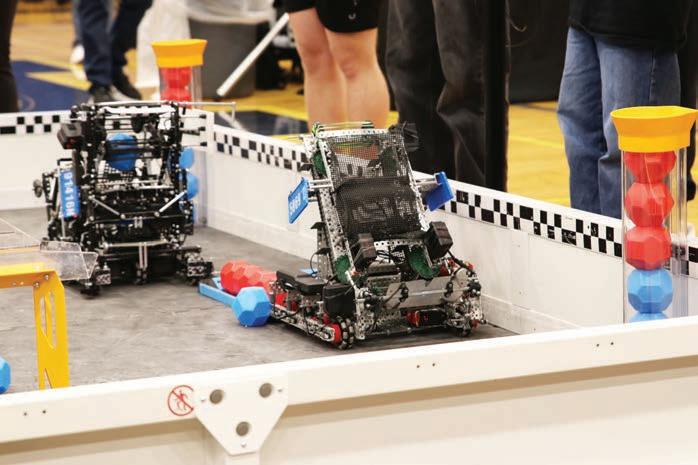
The two robots are in a game of push back, the Girls state team’s robot 5069D is ready to shove the others team robot back. This is at the VEX state Tournament, where control strength and quick decisions determine the winner.
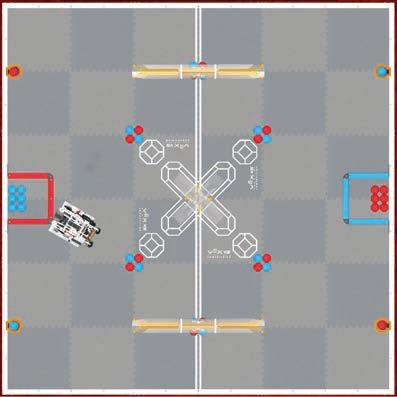
Goal
- Push the other robot out of the arena or make it unable to move
Match Setup
- Two robots start across from each other inside the ring Arena
- A flat surface with a clear boundary that robots must stay inside
Robot Limits
- Robots must fit within allowed size and weight rules
- They must be built safely with no sharp or damaging parts
- All pieces need to stay attached during the match and follow approved power and control guidelines
How a Round Ends
A robot loses if it is pushed out, flipped, or cannot move
Control the Center
- Staying near the middle gives you more space and control
Win the First Move
- Getting the first push helps you take control early Arena
- A flat surface with a clear boundary that robots must stay inside.
Use Angles
- Push from the side instead of straight on to throw off balance
Stay Low and Stable
- A lower build makes it harder to tip over Grip the Surface
- Better traction helps you push stronger and resist force
Stay Low and Stable
- If you get pushed, adjust fast instead of fighting it too long

separately from the rest of varsity, ensuring they’d be in peak condition come State.
“Our boys’ team posted our highest finish ever, so that was great. We had a great team this year, the best I’ve ever been a part of,” senior Matthew Brailita said.
Brailita broke 4 school records individually, as well as contributing to the 2 broken relay records. Addition ally, he swam the ninth fastest time in Nebraska history in the 200 IM.
“I was pretty happy, especially because it was our school record,” Brailita said. “In prelims, I got first, but in finals, I got second, but I was happy with the time.”
But a 3rd place team finish isn’t created by just one person; points were contributed by numerous members, launching the team to the podium.
“We had some of our seniors really step up, like Jonas Judina, who went from being a good breaststro ker to finishing fourth at state. Evan Cortez went from talking about making state to, all of a sudden, being a school record holder on a relay and making it back

NATHAN YEH
Co-Opinions Editor
n the court at Millard North, every pass, every play, and every cheer shows the power of Special Olympics Unified Sports.
In Special Olympics Unified Sports, individuals with intellectual disabilities (athletes) and those with out (partners) participate on the same team for training and competition, promoting in clusion and friendship.
The team is led this year by coach Ka tie Fusselman, who has been a resource teacher at MN for eight years. This sea son has marked her second year as head coach of the Unified Basketball team.
Fusselman has coached the MN Uni fied Basketball team in preparation for upcoming competitions, including the East Regional Tournament in March and the Spring Games Tournament in April.
been challenging.
“Finding consistency and being able to at tend practices regularly, that’s a challenge for the partners, especially because we practice
Despite many challenges, they have tackled them and made it work with significant support
APRIL 4-6, 2026
LINCOLN, NE
“This year, since we went through a full season, we knew what to expect.
We knew our tournaments would be in March and April, so we focused on practicing in January, Febru ary, and March to be ready for the final tournament in April,” Fusselman said.

As the season has intensified, establishing routines for practice within students’ full schedules has
“Our partners, Chase and Johnny, returned this year, and I think what’s most helpful for us is just their consistency... it helps to have our partners organize the practices with us,” Fusselman said. One of these returning partners, junior Chase Fisher, has been involved with the Unified Basket ball team ever since his freshman year. He has stepped up as a partner this year, proving himself as a
T
“When we’re down, we have a team meeting and talk about what’s going on. Everyone agrees and works together,” Fisher said.
The team’s partners have gained significant experience over the past few years, as evidenced by their
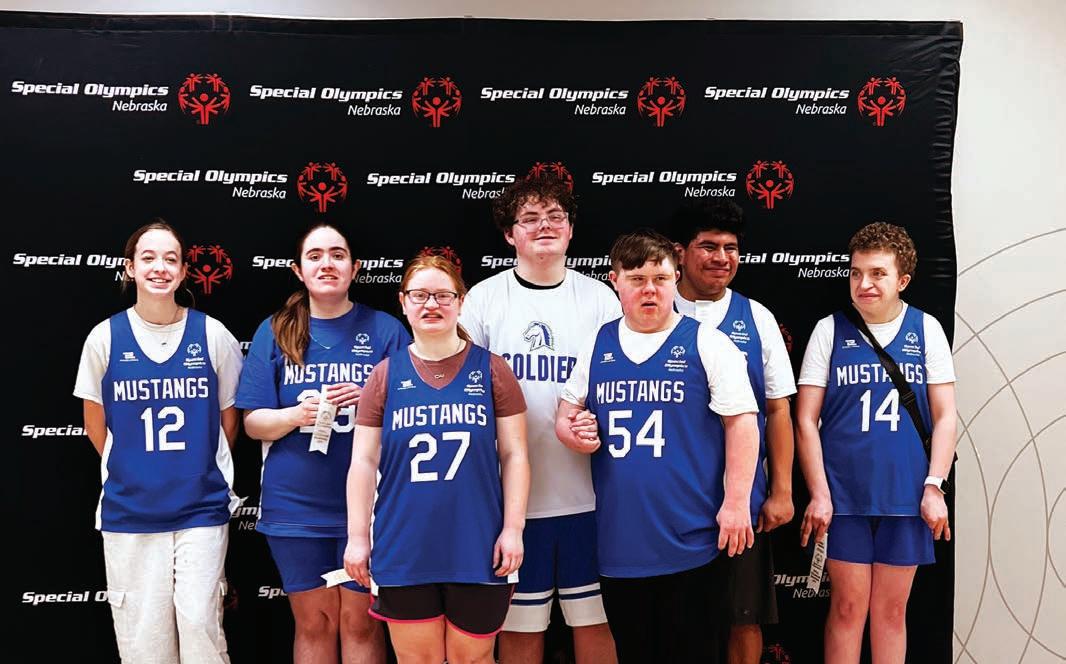
Members of the team pose together, celebrating their performance in the Unified Champion Schools Basketball Tournament. This tournament has more participation and competition than many others, since it is during the school day.
Photograph contributed by Katherine Fusselman
others up.
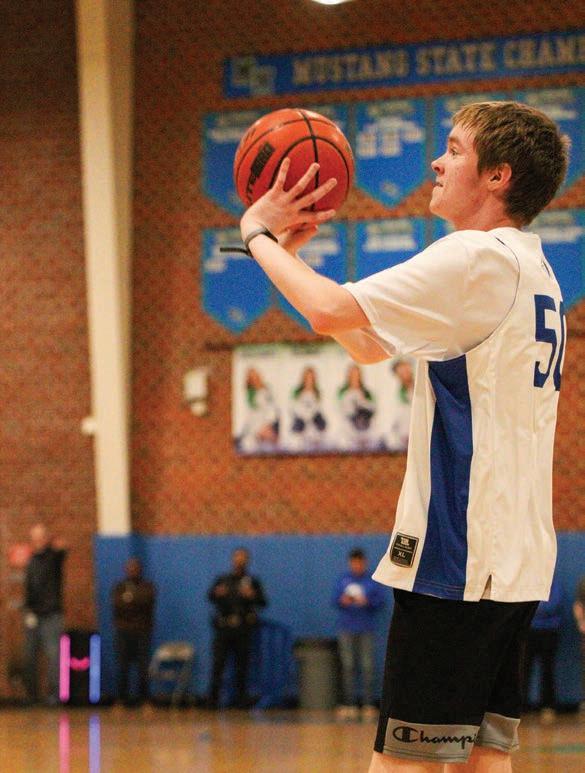
Sophomore athlete Matthew Hulsebusch shoots the ball during the MN pep rally. His favorite part of the program is being around his friends and improving together.
Photograph by Parker Neville
“I think with our partners, we see a lot of growth in their leadership. It can be difficult to shift from the role of being an athlete and competitor to being a partner who is supportive and focused on helping others succeed,” Fusselman said.
During competitions, the team shows support for one another, displaying the chemistry the players have forged over the past few years.
“I think what makes Unified Sports so fun and exciting is that people cheer for both teams. It’s all positive, friendly competition—everyone just wants to get better, and the kids are excited to be there and to perform,” Fusselman said.
After games, the players reflect on areas of improvement. Sophomore Matthew Hulsebusch, an athlete on the squad, has thought about his experiences with the team.
“We’re working on getting closer to the win and improving as a team. My favorite part of being on the team is just playing basketball and being out there with everyone,” said Hulsebusch.
As an invaluable part of Millard North, the Unified Sports Program helps students develop their athletic skills, confidence, and leadership.
“Without it, those kids might not feel included. I’m happy they have this so they can feel loved and appreciated,” Fisher said.
KATELYN JUDD News Editor
veryone who lives in Nebraska, or at least the Midwest, is very familiar with the constant fluctuating state of the weather. This is especially true this year, with our 80-degree days in February, alongside the more than 50-degree dips when it snows the very next day.
This unpredictability affects countless people. Especially the spring sports, that depend on the warmer weather in order to practice in playing conditions outside. The MN golf team is one of the affected, and to combat this disadvantage, Boys Golf coach Eric Welte decided to take the players down to Bella Vista, A.K. to escape the temperamental temperatures here.
“It’s the first time we’ve done anything like this since I’ve been involved [with golf],” Welte said, “[The trip] is mainly because the weather here in March is pretty iffy, and for practice and team-bonding.”
The last time the team did anything like this was ten years ago, on a trip to Kansas City to play on their ‘Top Golf’ ranges. This time, going double the distance for warmer weather and more playing time, opens up opportunities for bolstering group cohesion and strengthening team spirit.
The team went on the trip during the MN conferences break, leaving early on Mar. 13 and arriving back home on Mar. 16. For two seniors on the team, this trip serves as their final capstone achievement before they graduate.
Senior Kaden Sudds, who has been on the team since his freshman year, is committed to University of Nebraska-Lincoln for golf. His personal connection to golf has shaped his attitude and the way he views the sport.
adversity. It’s an outlet for when things get stressful; you’re just going out there to golf with your buddies at the end of the day, and there’s nothing better than that.”
After the 6.5 hour drive down, the team and chaperones stayed in an large AirBNB house on a lake, where many of the players brought their fishing poles and enjoyed themselves out on the water. The team received around five new members this season, and senior Max Goodwin believes that the trip served as an integration for them
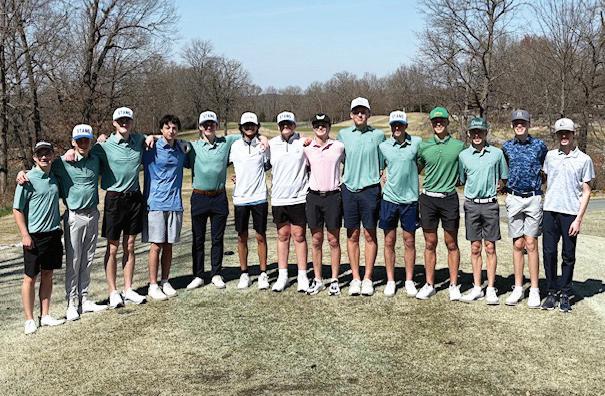
The boys bond together through their multi-state tournament experience, becoming a closer-knit unit.. This trip accentuaded the teams collaboration and allowed the seniors to step up further into leadership roles.
“We’re all going to be in the same house, and so we will all be around each other, meeting the new players on the team and building connections on and off the course. Just spending more time together is the best thing we could do,” Goodwin said.
More than the legacy I leave, I want [the new members] to be able to create a legacy of their own.
KADEN SUDDS SENIOR “ “
“I used to play baseball, but then I was diagnosed with epilepsy. I had to find something else, and so I just fell in love [with golf] from there because it was the only sport I could play,” Sudds said. “It’s helped me handle
Jock Talk
What is your favorite place to go eat post-game?
Ellie Engstrom Freshman “

“ Everybody likes to go to 7-brew to get drinks, or we go to Chipotle or Chick-fil-A.
Photograph contributed by Eric Welte
solidified and unified all together as a family. He offers a different perspective on students, being able to see them both inside and outside the classroom.
The quality time spent together taught the new players how to be on a team, and what it means to be a part of their family.
“I hope that [the new teammates] know what it means, and how special it is being a part of this team. You get the opportunity to go out there every single day with your brothers, and I think that’s just so special,” Sudds said. “I think more than the legacy I leave, I want them to be able to create a legacy of their own.”
After spending three days constantly together, whether it was on the ‘Top Golf’ courses, out back fishing, or playing cards in the game room of their house, Welte doesn’t doubt that new players will feel
Dylan Lee Senior “ “ Freddy’s,because you can get a nice burger and their fries are really good, and especially on a hot day their ice creams really nice.

“It’s really something that we spend a lot of time just on the golf course, it’s a social interaction place. Guys that I thought were super quiet, they start to open up and really get talking when they get out on the course,” Welte said.
Goodwin even feels a sense of responsibility to the younger teammates to show them the ropes and lead them to success. As he is in his second year on the team, he felt like he was ready to step up into a leadership role. His hope for the team stretches far beyond the time he’ll spend with them over his last few months.
“I hope to be remembered as the guy that loved everybody. The kind that showed up and was a leader of the team in the right ways, pointing people in the right direction and who never brought the team down,” Goodwin said.
Carter List Junior “ “ Chipotle is always good, or we go to Cane’s... we always go as a team.

Journey Siedlik

Sophomore “ “ I really like to go to Chipotle, and I also like Medi’s because it’s close to my house.