University of Wisconsin-Madison
Since 1892 dailycardinal.com
Thursday, October 8, 2026
l
‘YOU SHOULD NOT BE HERE’
NEVER STOP MAKING ART
Trump attempted to ban CNN, MS NOW and Politico from White House. It’s our responsibility to protect them.
In an interview with The Daily Cardinal, John Green discusses the importance of continuing to make art.
+ OPINION, PAGE 6
+ NEWS, PAGE 4
Act 10 heads to Wisconsin Supreme Court By Jane Dardik CITY NEWS EDITOR
Democratic officials across Wisconsin argue Act 10 is harming workers across the state, pushing for repeals amid the 2026 midterm elections. Former GOP Gov. Scott Walker enacted Act 10 in 2011 and has been a contentious topic between Republican and Democratic state officials since it was put into law. Democrats have attempted to repeal the law multiple times, but have not succeeded. The law curtailed collective bargaining rights for most public sector employees, limiting negotiations to base wage increases capped at the consumer price index. There have been claims against Act 10, saying it has harmed teacher retention. State Sen. Kelda Roys told The Daily Cardinal Wisconsin is facing a teacher reten-
tion crisis because of Act 10. “It’s harder for young people to make the decision to go into teaching because they know they’re likely to not be able to afford to buy a house, have children or live in the communities where they’re teaching because their wages have not kept up with inflation,” Roys said. “The benefits that were once the big draw of public sector employment are being ratcheted down, and the employees are bearing a greater share of those costs.” Madison Teachers Inc. told the Cardinal Act 10 has left Madison schools “starved” for funds. Dr. Joe Gothard, superintendent of Madison Metropolitan School District (MMSD), told the Cardinal MMSD has had to rely on outside reinforcements for its budget. “Our community has supported referen-
dums to make sure we have the operational capacity to afford our employees’ wage increases,” Gothard said. “That’s been critical.” Lawmakers in favor of Act 10 argue union stipulations allow for greater district flexibility. The Wisconsin Institute for Law and Liberty (WILL) actively defends Act 10’s merits and represents teachers in support of the law. Will Flanders, the research director for WILL, said the act has allowed school districts to save over $1.6 billion annually by shifting district costs onto employees. “School districts have been given a lot more freedom in terms of their hiring practices and how they reward teachers for good performance,” Flanders told the Cardinal. “They can be more creative in their pay systems.” Roys disagreed, calling the argument “dubious.” “There is literally not one community in
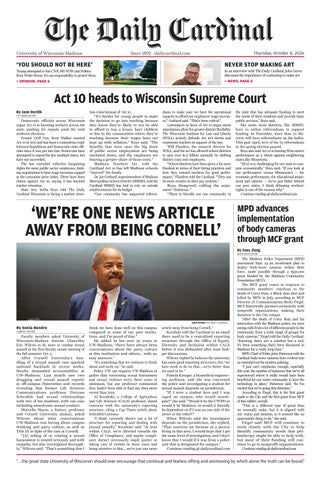
‘WE’RE ONE NEWS ARTICLE AWAY FROM BEING CORNELL’
the state that has adequate funding to meet the needs of their residents and provide basic public services,” Roys said. She notes most districts, like MMSD, have to utilize referendums to support funding. In November, more than 70 districts will have referendums on the ballot. This past April, 60% of the 75 referendums in the spring election passed. Roys also said Act 10 is hurting Wisconsin’s performance as a whole against neighboring states like Minnesota. “[It’s] very challenging for our state to compete economically,” Roys said. “If you look at our performance versus Minnesota’s — the economic performance, the educational attainment and salaries — we’ve just fallen behind our peer states. I think debasing workers’ rights is one of the reasons why.” Continue reading @ dailycardinal.com
MPD advances implementation of body cameras through MCF grant By Zoey Jiang ASSOCIATES EDITOR
JAKE PIPER/THE DAILY CARDINAL
By Sonia Bendre CAMPUS EDITOR
Faculty members asked University of Wisconsin-Madison Interim Chancellor Eric Wilcots to do more to combat sexual assault at the first faculty senate meeting of the fall semester Oct. 5. After Cornell University’s handling of a sexual assault case sparked national backlash in recent weeks, faculty demanded accountability at UW-Madison. Last month saw two drugging and sexual assault reports at off-campus fraternities and records revealing that former Life Sciences Communications professor Dietram Scheufele had sexual relationships with two of his students, with one case including unwelcome sexual conduct. Marcella Hayes, a history professor and Cornell University alumni, asked Wilcots about what conversations UW-Madison was having about campus drinking and party culture, as well as Title IX in light of the case at Cornell. “[A] telling of or relating a sexual harassment is treated seriously and with empathy, but also investigated thoroughly,” Wilcots said. “That’s something that I
think we have done well on this campus compared to some of our peer institutions, and I’m proud of that.” He added in his over 30 years at UW-Madison, “there have always been conversations about the party culture at this institution and others… with no easy answers.” “It’s something that we continue to think about and work on,” he said. Policy UW 146 requires UW-Madison to gather data concerning sexual harassment and sexual violence every three years at minimum, but one professor commented they hadn’t been able to find any data more recent than 2019. Al Kovaleski, a College of Agriculture and Life Sciences (CALS) professor, stated concerns with the university’s reporting structure, citing a Cap Times article about Scheufele’s actions. “I think currently there’s not a lot of structure for reporting and dealing with [sexual assault],” Kovaleski said. “At least within CALS, we’re directed towards the Office of Compliance, and maybe compliance doesn’t necessarily imply justice or taking care of victims in these cases and being attentive to that… we’re just one news
article away from being Cornell.” Kovalski told the Cardinal in an email there used to be a centralized reporting structure through the Office of Equity, Diversity and Inclusion within CALS before it was disbanded after state budget discussions. Wilcots replied he believes the university has some good reporting structures, but “we have work to do on that… we’re better than we used to be.” Pamela Kreeger, a biomedical engineering professor, said she was concerned the police unit investigating a student for sexual assault depends on jurisdiction. “If I were a student here and I was raped on campus, who would investigate?” she said. “Would it be the UWPD or would it be Madison, or would it literally be dependent on if I was on one side of the street or the other?” When Wilcots said the investigator depends on the jurisdiction, she replied, “That concerns me because as a person living in this area, I would hope that I get the same level of investigation, and I don’t know that I would if it was from a police unit that is designated for campus.” Continue reading @ dailycardinal.com
The Madison Police Department (MPD) announced Sept. 24 an accelerated plan to deploy body-worn cameras within their force, made possible through a $350,000 grant funded by the Madison Community Foundation (MCF). The MCF grant comes in response to community members’ reactions to the death of Corey Ruiz, a Black man shot and killed by MPD in July, according to MCF Director of Communications Becki Fiegel. MCF historically partners exclusively with nonprofit organizations, making their donation to the City unique. “After the death of Corey Ruiz and his interaction with the Madison police, we were seeing calls from a lot of different people in the community from a wide range of groups for body cameras,” Fiegel told the Daily Cardinal. “Knowing that’s not a solution but a tool, it’s been something that’s been discussed in Madison for a really long time.” MPD Chief of Police John Patterson told the Cardinal body-worn cameras have evolved into an essential tool for modern policing. “I just can’t emphasize enough, especially this year, the number of instances that we’ve all experienced where it really would have been beneficial for our entire community to have the technology in place,” Patterson said. “So I’m excited that we’re going this direction.” According to Fiegel, this is the first grant made to the City and the first grant from MCF of this calibre, overall. “This is a different type of grant than we normally make, but it is aligned with our vision and mission, so it seemed like an appropriate thing to do,” she said. Fiegel said MCF will continue to work closely with the City to help identify community needs that philanthropy might be able to help with, but most of their funding will continue to go to nonprofit organizations. Continue reading @ dailycardinal.com
“…the great state University of Wisconsin should ever encourage that continual and fearless sifting and winnowing by which alone the truth can be found.”
news l
2
Thursday, October 8, 2026
An independent student newspaper, serving the University of Wisconsin-Madison community since 1892 Volume 136, Issue 8
2142 Vilas Communication Hall 821 University Avenue Madison, Wis., 53706-1497 (608) 262-8000
News and Editorial editor@dailycardinal.com
dailycardinal.com
Education student rates are dropping, UW won’t stop fighting it By Haellie Opp SPORTS EDITOR
Editor-in-Chief Alaina Walsh
Managing Editor Avery Chheda
News Team Campus Editor Sonia Bendre College Editor Grace Carlson City Editor Jane Dardik State Editor Audrey Lopez-Stane Associate News Editor Zoey Jiang Features Editor Jake Kilander Opinion Editors Brady Ahler • Siena Ferraro Arts Editors Ryan Kim • Liset Zacker Sports Editors Otton von Sothen • Haellie Opp Sports Associate Editor Luca Muehlbauer Special Pages Editor Natalie Popper Photo Editor Jonathan Mintz Graphics Editors Eloise Guth • Klaire Maduscha Science Editors Lauren Eno • Addison Dama Life & Style Editors Isabella Bajaras • Jackson Baker Beet Editor Lizzi McGann Podcast Directors Yadiel Chavez • Amellia Fowler Digital Editor Meredith Schadrie Video Director Ted Hyngstrom Copy Chiefs Emma Schieffer • Brendan Wolf Copy Editors Isabella Barajas • Delaney Chronister • Kim McGee • Aarav Amin • Danielle Witelson
Business and Advertising business@dailycardinal.com Business Manager Wyatt Vail Marketing/Outreach Director Hallie Egelseer Social Media Manager Aanya Agrawal Ad Manager Lauren Downham The Daily Cardinal is a nonprofit organization run by its staff members and elected editors. It receives no funds from the university. Operating revenue is generated from advertising and subscription sales. The Daily Cardinal is published weekdays and distributed at the University of WisconsinMadison and its surrounding community with a circulation of 10,000. Capital Newspapers, Inc. is the Cardinal’s printer. The Daily Cardinal is printed on recycled paper. The Cardinal is a member of the Associated Collegiate Press and the Wisconsin Newspaper Association. All copy, photographs and graphics appearing in The Daily Cardinal are the sole property of the Cardinal and may not be reproduced without written permission of the editor in chief. The Daily Cardinal accepts advertising representing a wide range of views. This acceptance does not imply agreement with the views expressed. The Cardinal reserves the right to reject advertisements judged offensive based on imagery, wording or both. Complaints: News and editorial complaints should be presented to the editor in chief. Business and advertising complaints should be presented to the business manager. Letters Policy: Letters must be word processed and must include contact information. No anonymous letters will be printed. All letters to the editor will be printed at the discretion of The Daily Cardinal. Letters may be sent to opinion@
Editorial Board Avery Chheda • Alaina Walsh • Brady Ahler • Siena Ferraro • Safa Razvi Chair Safa Razvi
Board of Directors Scott Girard, Chair • Don Miner • Nancy Sandy • Nathan Kalmoe • Jack Kelly • Gary Achterberg • Jennifer Sereno • Kelly Lecker
© 2026, The Daily Cardinal Media Corporation ISSN 0011-5398
For the record Corrections or clarifications? Call The Daily Cardinal office at 608-262-8000 or send an email to edit@dailycardinal.com.
The University of Wisconsin-Madison was named the No. 1 School of Education (SoE) in the nation for the third year in a row in April. An additional 12 graduate programs in the school were also ranked in the top 15 by U.S. News. And yet, in the last two decades, awarded education degrees have been on a steady decline. Dr. Thomas Owenby, associate dean for Teacher Education, told The Daily Cardinal teacher burnout is a “complex phenomenon” the university may be in a position to have an impact on. He said the university is asking themselves how they can provide “high-quality preparation, [support] access and [incentivize] people to stay in the state of Wisconsin.” While nationally there are fewer students graduating with education degrees, UW-Madison is seeing a trend up. Owenby said it’s “hard to know” why students are enrolling here and why they are doing it now, but he attributes it to the variety of certifications the School of Education offers. “With each of those programs, there’s depth and strength. That’s part of the reason why we have our teacher education center — to look at ways that we can collaborate across those programs,” Owenby told the Cardinal. “It’s going against some of the structural constraints within the institution where you have these silos of programs and departments and schools and colleges, and a way to cut across that and create this space for horizontal collaboration.” Alongside falling numbers of education graduates, teacher burnout is one of the major concerns currently facing education. Brian Zimdars teaches business and marketing at Middleton High School and told the Cardinal teachers are trying to figure out the human connection behind AI and what skills they want students to use when interacting with it. “When speaking with English teachers, the creative side or arts [it’s] definitely is harder for them because there’s so many tools out there that can write an essay now or create different graphics. Teachers here have done a really nice job of implementing ‘when can AI be appropriate?’” Zimdars said. “You [the student] don’t want to just have an AI created for you and should be authentic to who you are.” Entering his seventh year teaching, Zimdars said teacher burnout is dependent on circumstances. He told the Cardinal it’s “tricky” for
teachers to know what other career opportunities are available for them. “We’ve also seen people who have worked in more of the corporate setting. They’re like, ‘nope, I’m burned out from that, and I wanna be around students and provide that energy,’” Zimdars said. “It really does depend on your situation [and] what fills you up. Fortunately for me, being [around your] own students and giving back fills me up.” Although the education landscape is constantly changing, UW-Madison’s Elementary Education enrollment reached an all-time high this current academic year, according to Elementary Education Program Manager Kathi Koppa. In a statement to The Daily Cardinal, Koppa said they predict that trend will continue for a few years. The Early Career Teaching Institute was created for Wisconsin alumni one-tofive years out of the program, Owenby said. Teachers are invited back to receive highquality professional development to be in a “space of celebration, community and reflection,” compensating them for their time to “elevate the professionalism of being a teacher,” Owenby said. In 2023, the Madison Metropolitan School District had 140 vacant teaching positions, according to In Business Madison. With UW-Madison’s high-ranking School of Ed and financial assistance launched in 2020, they saw a growth in overall number of students by 10%. One big attraction for the School of Ed is the Teacher Pledge — an agreement to pay the equivalent of in-state tuition and fees in exchange for pledging to work at a Wisconsin PK-12 school for three to four school years after graduation. This assistance opened the door for more students to leave school with lower debt or financial troubles. UW-Madison designed the pledge as a research study on how to build teacher retention in the state of Wisconsin and address the shortage in “qualified and credentialed teachers,” according to Owenby. UW-Madison is looking at the trend of teacher retention and the teacher shortage, specifically in the state of Wisconsin, and what may be an effective way to combat it. “If it proved to be effective, based on those findings [from Teacher Pledge data], then ideally it would be a policy intervention that the state would consider taking on, from a funding perspective, to administer across the state to all education preparation programs in public and private colleges and universities,” Owenby said. Zimdars said districts are working towards assessing teacher retention by “general
JONATHAN MINTZ/THE DAILY CARDINAL
need days” and recognizing the work that teachers are doing. “Professional development days are really centered around what, not just the school is going for, but within each teacher’s content area, that the time is being used to get better and improve their practice,” Zimdars said. About 60% of undergraduate teacher education students and about 90% of graduate students take the Teacher Pledge. As an out-of-state student, UW-Madison junior Amelia Dalton considered the Pledge, but ultimately it wasn’t enough to keep her in the program. Not being from Wisconsin made it hard to commit to living there, and Dalton told the Cardinal it wasn’t where she saw her life post-graduation. Now enrolled in Consumer Behavior and Marketplace Studies in the School of Human Ecology (SoHE), she feels a stronger sense of job security. “The teachers are so underpaid nowadays that it just seemed hard to justify paying the out-of-state tuition for an outcome that wouldn’t help me financially,” Dalton said. To address student retention, Owenby said the School of Ed has started another initiative called Retain Wisconsin this year. According to Owenby, the pilot project works with the Wisconsin Evaluation Collaborative in the Wisconsin Center for Educational Research. Owenby said it is partnering with 11 local districts in Wisconsin to understand their data of why teachers are staying or leaving. “We know there’s certain things we can do as a teacher education program and as a university,” Owenby said. “But there’s obviously a role to play for
district partners, state funders and policymakers to try to create an atmosphere in a work environment in which teachers want to remain in teaching.” When UW-Madison looks at student enrollment numbers, they examine all those considering attending the university and those considering going into teaching. “For those who are admitted and choose to attend — in most of our teacher certification programs for undergrad, at least — they’re folks often doing general education requirements and things of that nature before they start the professional sequence of those teaching and educational courses,” Owenby said. When she switched majors, Dalton said she knew she “wasn’t throwing it away forever,” because she did “love the idea of being a teacher.” “If I end up getting a job in marketing or advertising post-grad, I know that down the line I can go back to school and get a master’s in education and be a teacher somewhere,” Dalton said. “Whether that’s at a middle school, high school or even eventually becoming a professor and teaching something related to marketing.” While there is not one answer to why the education majors are increasingly choosing UW-Madison, Owenby praised the staff who are behind the success. “I think for us, on an institutional basis, it’s been more a question of how [we can] continue to engage productively with our district partners in terms of high-quality field placements and strong partnerships with them,” Owenby said. “Their role as school-based teacher [plays] a central, pivotal role in highquality teacher preparation.”
news dailycardinal.com
Thursday, October 8, 2026
l
3
A day in the life of the UW-Madison Marching Band By Erin Bickford STAFF WRITER
At 6:45 a.m. on gameday, campus is quiet as students sleep off their Friday night hangovers in preparation for a long day of tailgating and football. The streets are cold and empty. The stores have yet to open. But in the Lakeshore campus, the University of WisconsinMadison marching band practice field comes alive. Bikes from the members’ morning commutes line the fence, the sounds of scales and chatter fill the air and the ground is scattered with instrument cases and boxes of donuts brought to share. Football games at UW-Madison are made of a lot more than just football itself. The Wisconsin Marching Band helps create the atmosphere and tradition surrounding each game, but the energy requires more work behind the scenes than many fans can imagine.
For gamedays with an early kickoff, like the Oct. 3 game against Michigan State University, which started at 11:30 a.m., band members have an early wakeup with rehearsal starting at 6:45 a.m. The musicians run laps around the field, stretch and play their warmup scales as a group. They then practice playing the visiting school’s fight song and any new songs for the week, as turn around for learning music is fast. “Every week we have a brand new show,” Noah Showalter, a sophomore in the marching band, told The Daily Cardinal. Band members typically spend at least 10 hours a week practicing because they learn a new halftime show each week, and rehearsal is rarely a straight run-through. Coaches are constantly stopping the band to repeat sections, and while interruptions can be frustrating, the
players remain focused on getting each part right. The hard work is especially visible as they practice their spacing on the field, using the UW-Madison Marching Band’s unique style, “stop at the top” — a technique requiring musicians to raise their knees to a 45-degree angle while keeping their shins perpendicular to the ground. “It’s pretty draining to come out here every single weekend and have to perform for everyone,” Caralyn Felcyn, the assistant drum major, told the Cardinal. “Being the leader I feel like you have to just go out there and be the light to everyone, and show you’ve got the energy. You have to hype people up, even when it hurts and it’s hard.” The drum major and assistant drum major serve as the band’s leaders and conductors on the field. During rehearsals, they keep tempo and help to instruct musicians.
Madison fails to pass funding for Willy Street stabilization program By Phoebe Morris STAFF WRITER
The Madison Common Council failed to pass a proposed $100,000 stabilization program for Williamson “Willy,” Street, resulting in the shut down of several local businesses. The council voted 13-7 on Sept. 8, turning down $100,000 for Willy Street businesses affected by protests over the shooting of Corey Ruiz. The proposal failed by two votes, and now 30 businesses will not receive revenue for damage caused during the two-week-long protests. Ruiz was fatally shot on July 22 by a Madison Police Officer at the intersection of South Baldwin and Willy Street. Community members created a four-corner blockade around the crime scene after Ruiz’s death, halting business for many storefronts on the street. District 6 Alder Davy Mayer originally proposed $300,000 for the program, hoping to save businesses from closing. After getting pushback on budgeting, the program went down to a proposed $100,000. “We can debate precedent all day, but when there’s a clear path to doing real public good, I think we should take it,” Mayer wrote in a City of Madison blog. “The whole purpose of city government is to invest in our neighbors and community, particularly when they’re hurting and in need.” The budget was originally set at $300,000 to give each business $10,000, but the Madison Finance Committee cut $200,000 coming from contingent funding to save for potential future emergencies. President of the Williamson-Marquette Business Alliance and witness to the shooting, Chip Cruz, told The Daily Cardinal the money would have gone to the 30 most economically affected businesses. However, once the budget was cut down, most businesses wouldn’t have
received enough to fix damages, Cruz said. “These businesses would look at $3000 [each]. It doesn’t go very far on the payroll. This was their fault,” Cruz said. “One thing that’s absolutely definitive is [businesses are] directly impacted, and they’re going to continue to be impacted just by proximity.” Since the shooting, Cruz said multiple businesses have closed, and at least two more businesses expect to within the next two months. Cruz said he worries most for his employees’ paychecks, some including single mothers and UW students. “A lot of employees were really impacted by this. [Employees] were missing the paycheck or missing a couple of shifts or getting their hours cut,” Cruz said. Cruz said he hopes the shooting of Ruiz will create change among future generations and leaders. “There’s a lot of people who have been around for a long time making decisions who are largely disconnected from reality in this situation, and so my hope with you guys is that this story and the other stories that we’re working on will at least spark more knowledge and a better future,” Cruz said. Danny Moreno has shown up to numerous police brutality protests, and told the Cardinal it’s important to show up for community members and businesses because he would want the community to show up if he was killed. “Standing together as a community also means supporting each other when people are struggling, especially when small businesses are trying to recover from something that was out of their control,” Moreno said. He said part of being a community is having a government that will step in during times of struggle. Continue reading @dailycardinal.com
BEN FRAWLEY/THE DAILY CARDINAL
The next level of on-field leadership comes from the rank leaders, who lead the band’s 26 ranks. Ranks are groups that coordinate with different instruments and positions on the field, according to John Griffon, a freshman drummer. Leigh McComb, Rank Four’s leader described the role as one that helps “hold people accountable when they are marching” and to “maintain a community.” Once everything has been perfected around an hour and a half later, the band gathers for one last discussion before starting a beloved pregame tradition “the fun-on.” During the fun-on, the drum major leads everyone through a comedic run-on which involves skipping, chanting at the other ranks and playing random songs. The performers then have a break to go home, eat and change into their uniforms before heading
to Union South for their performance at the Badger Bash. Everyone meets in the underground loading dock, where they eat snacks, apply glitter to their faces and store their valuables in ziploc bags to carry for the day. For good luck, they rub the drum major’s fuzzy hat and after a quick warmup, it is time to march into Union South. “It’s just this rush of energy,” Showalter said when describing his pre-performance feelings. “Everyone is working together and everyone wants to have fun.” During the football game the musicians are always on call, having to play the last eight beats of “On Wisconsin” for every first down the football team makes and playing a variety of songs when teams call time-outs. Continue reading @dailycardinal. com
While Wisconsin’s political divide deepens, experts say elections remain competitive By Karma Voth STAFF WRITER
Wisconsin’s electorate has become increasingly polarized with fewer voters crossing party lines. Yet, the state remains one of the country’s most competitive political swing states. That tension was central to the remarks from Craig Gilbert, a Wisconsin political reporter for the Milwaukee Journal Sentinel and former Washington Bureau Chief, who spoke at the Rotary Club of Milwaukee about the factors shaping the 2026 midterm elections on Sept. 29. Drawing on historical voting patterns, polling and changes in the state’s political geography, Gilbert detailed that Wisconsin’s competitiveness has persisted throughout recent decades even as its electorate has become less likely to move between parties. Gilbert also said Wisconsin voters have become more consistent in their partisan choices over time. Ticket splitting, where voters choose candidates from different parties for different roles in the same election, has declined. Partisan divisions increasingly correspond with geography, particularly between urban and rural areas. For decades, Wisconsin has been a swing state. However, political divides have become increasingly noticeable along county lines and voters have been changing positions from election to election. In recent elections, there has been deviation away from this. “Some of the fault lines in the electorate are deeper than they used to be. There’s a much deeper urban-rural divide, a big education divide. Geographically we’re more polarized, people tend increasingly to live in politically likeminded places,” Gilbert said. Such trends have made elections less likely to see large swings, Gilbert said, because “there are fewer swing voters. And people are more consistent in how they vote for one party or another.” With fewer voters moving between parties, changes in statewide results increasingly depend on changes in turnout. Yet the increasing polarization of Wisconsin’s electorate has not eliminated the state’s competitiveness. Gilbert said while voters and the electorate are less “swingy,” this often encourages voters to vote. “The miracle of Wisconsin to me is…that it has remained so close despite so many big changes in voting patterns, politics and somehow the gains one party has made have been
DRAKE WHITE-BERGEY/THE DAILY CARDINAL
cancelled by the gains the other party has made,” Gilbert said. Gilbert said Wisconsin’s close statewide margins therefore do not necessarily indicate an electorate filled with undecided voters. Instead, increasingly stable partisan coalitions can produce close elections while having a nearly even divide, since neither party has a decisive advantage across the state. “Culturally, we’re a high participation state. But also, when you’re as competitive as Wisconsin is, people are spending a lot of money mobilizing voters, and voters understand what the stakes are, and that really drives up the participation numbers,” Gilbert said. Concerning the 2026 midterms, Gilbert explained how many factors have changed in Wisconsin. “Overwhelmingly, the president’s party almost always loses ground in midterm elections.” Gilbert said. “People are voting against the people in charge, and usually the voters in the out-party are more motivated than voters who align with the party in power, so they turn out at higher rates and swing voters tend to vote against the party in power.” According to Gilbert, if Republicans plan to see gains during the midterms, they “have to persuade a number of voters who don’t like the president, or don’t think the president is doing a good job, to vote for the same party for governor.” Continue reading @dailycardinal.com
news
4
l
Thursday, Oct 8, 2026
dailycardinal.com
Wisconsin Union debuts purple terrace chairs for domestic violence awareness By Maia Weissman STAFF WRITER
The Wisconsin Union is partnering with the University Health Services’ (UHS) Survivor Empowerment Fund to produce a limited-edition purple mini terrace chair commemorating Domestic Violence Awareness Month, according to an official Wisconsin Union press release. Nearly one in 10 students at the University of Wisconsin-Madison report experiencing “physical, emotional, and/or sexual abuse by a dating partner in the past 12 months,” according to UHS. Fifteen percent of all proceeds from the purple chairs will be donated directly to the Survivor Empowerment Fund, which provides emergency financial support to students impacted by intimate
partner violence, sexual assault or stalking, according to Director of UHS Survivor Services Molly Caradonna. The organization expects to see around $2,000 in revenue, Caradonna said. “[$2,000] would allow us to provide 10 survivors with home security systems, which is something that we do to help student survivors either obtain or uphold protective orders,” Caradonna told The Daily Cardinal. “That also could help us provide a student survivor with a security deposit to get to a safer living situation.” In addition to raising money, Caradonna expects the purple chair initiative to help expand awareness about dating violence on the UW-Madison campus. Caradonna said UHS is also working towards this goal through an October-
long “Purple Thursday” visibility campaign: placing purple ribbons and examples of “green flags” and “red flags,” indicating healthy and unhealthy relationship dynamics, on Bascom Hill each Thursday. One of the Survivor Empowerment Fund’s main goals this year is to educate students on different kinds of domestic violence — including technologyenabled coercion and sexual abuse, particularly stalking and surveillance, which has been growing in recent years, Caradonna said. “[Domestic violence] can look like physical violence, but it really looks like any dynamic of power and control in a relationship,” Caradonna said. “We’re also seeing a significant increase in technology-facilitated abuse.” Out of all students in partnered
COURTESY OF WISCONSIN UNION
relationships on a university campus, 10.8% reported experiencing dating violence at some point, according to a 2019 Association of American Universities (AAU) Campus Climate Survey. For marginalized groups, such as disabled and queer students, the rate of domestic violence jumps to almost double that of their peers, at 17.1% and 17.3% respectively, the same
survey found. “It’s something that impacts the health and wellbeing of our entire community, even those that haven’t directly experienced violence themselves,” Caradonna said. “Our rates are on par with other universities, so it’s not a UW-Madison-specific problem — it’s a problem we have culturally with violence.”
John Green continues to make art. He thinks you should too. By Liset Zacker ARTS EDITOR
I interviewed John Green in an unassuming room tucked behind the Capitol Theater at the Overture Center for the Arts. The room was just offstage from where Green would soon perform and out of sight of the line of fans eagerly entering the theater. In contrast to the impressively accomplished resume Green carries, he appeared before me looking quite commonplace, shaking my hand and saying simply, “Hi, I’m John.” Podcaster, creator of Crash Course, bestselling author, self-proclaimed “divinity school dropout.” Green has donned many hats, but his rise from fame to generational notoriety occurred seven years after his first book release, with the 2012 YA novel, “The Fault in Our Stars.” Green’s brief stop in Madison was the 10th event on his 20-stop tour for his first foray into adult fiction writing, “Hollywood, Ending,” released on Sept. 22. The novel is his first work of fiction in nine years. In collaboration with the Wisconsin Book Festival and A Room of One’s Own Bookstore, the event stop was Green’s only stop with free admission. Additionally, every attendee received a free, signed copy of “Hollywood, Ending.” The event was first come, first served, but by the start, all 1,089 seats were filled, with over 800 hopefuls turned away, according to a nearby Overture Center employee. As book lovers and Green buffs alike filed
into the theater, I sat next to Green (or, as I now called him, “John”) on a gray couch, trying to keep my cool and forget the prominence of my interviewee. Like many of his novels, “The Fault in Our Stars” explored deep themes, woven together with meticulous characterization and a constant ambience of humor. Not only did the groundbreaking novel connect with readers of all ages, but it particularly struck a chord with young readers who connected deeply with his characters. Somehow, in Green’s words, an “innocuous middle-aged dad in Indianapolis who makes educational content” made readers feel hopeful and seen in a world frequently
The Daily Cardinal Crossword • By Ryan Mathiason Across 1 ___ not to laugh challenge 4 IG videos 7 Absolutely love 8 Powerful volleyball shot 9 Work with needle and thread
Down 1 Ocho - cinco 2 “You ___ what you sow” 3 Popular water bottles named for a mythical creature 5 Badger football head coach Fickell 6 Gush, like lava from a volcano
1 4 7 8
2
3 5
9
6
plagued by despair. “I didn’t know what it was like to be a teenager when I was a teenager; I certainly don’t know what it’s like now, but I think a lot of those experiences are universal,” Green told The Daily Cardinal. He explained that, although he’s never felt completely in tune with younger audiences, the shared experiences of love, grief and trauma help guide his writing. He feeds off of his young audiences and listens to the attendees at his events, many of whom are from younger generations. Fans also frequently relate to the profoundly complex relationships Green explores, which unabashedly promote the importance of love. Green graduated from Kenyon College with a B.A. in English and Religious Studies. Although he spent his time in college joyfully hanging out with friends and reading, the years after brought him a sense of dread common to many graduates. For a long time, Green didn’t know the answer to the constantly asked question, “What are you going to do with your life?” In part, he said, because he believes it’s an idiotic question. “It’s stupid because you’re going to do more than one thing with your life, and it puts a lot of pressure on you when you’re 21,” Green said. “The actually interesting question is who you’re going to do life with.” Green didn’t originally envision himself as a writer, but now his writing is as much of
a personal need as it is a job. “I’ve always written to escape,” Green said. “The whole problem with being a person is that you’re stuck the whole time you’re here inside of one consciousness, and writing is as close as I can get to being free from that.” Along with his personal connection, Green acknowledges the deep connection of his readers’ own experiences to the vulnerability in his art. “When you make art, you have to make yourself vulnerable to it,” Green said. “You have to bring your deepest self to the story, or the painting, or the YouTube video, or whatever you’re making, because you know that the people who are engaging with that art are also going to bring their deepest self to it.” After thanking Green for his time and ending with a discussion about his tour necessities (grape Uncrustables and Diet Dr. Pepper), I returned to my own seat in the theater to hear Green discuss his novel. Hollywood, Ending Told from the dual perspectives of young actors Juniper and Kai, “Hollywood, Ending” follows the pair from the early days of filming the fictional movie, “Andy Warhol Never Gets Old,” to the subsequent launching of their high-profile careers into super-stardom. Green’s vulnerability is ever-apparent and woven throughout his characters, world-building and plot points. Inspired, in part, by his time spent on movie sets during the adaptations of his bestselling novels, Green explores the weird, shared experience that happens on movie sets and his love-hate relationship with the film industry. This relationship is a combination of a love of movies but a strong dislike for the newly created attention economy amplified by Hollywood and the idea that private experience is increasingly turned into public discourse, an idea he revisited throughout his book talk. Before the show even began, the joy was palpable. While a few were wearing paraphernalia from the Green Universe, many were holding their new copies of “Hollywood, Ending.” Some were already nose deep in the pages of Green’s latest novel. Continue reading @ dailycardinal.com
science dailycardinal.com
Thursday, October 8, 2026
l
5
Wisconsin residents help Marshfield researchers track tick-borne threats By Brad Wensel STAFF WRITER
Nearly 6,000 ticks were collected annually in 2024 and 2025 from residents all over the state, representing almost every Wisconsin county. The ticks collected were sent in as part of Marshfield Clinic’s Tick Inventory via Citizen Science project. Wisconsin recorded a record 8,929 cases of Lyme disease in 2025, and in the past two decades reported cases have increased by more than 400%. Researchers at the Marshfield Clinic Research Institute are turning to the public to help understand where the ticks carrying the disease are found and what other pathogens they may carry. Through public tick donations, Marshfield researchers
collect specimens from across Wisconsin and other states, hoping to gather enough ticks for a microbiome study, according to Alexandra Linz, associate research scientist at the Marshfield Clinic Research Institute. “If I’m out tick dragging, I can only hit so many locations. It just takes a couple hours to do each one. But from citizen scientists, we get ticks from 13 or 14 different states. So it covers a lot more ground than we could cover by ourselves,” Linz told The Daily Cardinal. Before Marshfield Clinic adopted a community approach, it collected ticks by “dragging,” which involved pulling a metersquare cloth along vegetation to see what grabbed on. Linz said this method can provide inconsistent results, as the number of
ticks collected varied widely. People can request collection kits by emailing tics@marshfieldclinic.org. After finding a tick, put it into the container and complete a short survey on where the tick was found, adding to a growing database. Linz, a microbiologist by training, originally began the program to study the microbiome of ticks — the communities of microorganisms that live inside them which requires hundreds of ticks. “I wanted to see if there were any characteristics of the nonpathogenic microbes in a tick that might influence whether or not it also carries a pathogen,” Linz said. In 2025, Marshfield Clinic began pathogen testing and found Borrelia burgdorferi,
PHOTO COURTESY OF NIAID
the bacterium that causes Lyme disease, in more than 50% of the adult female deer ticks they tested. Researchers also found geographic differences in the prevalence of Lyme-causing bacteria in the ticks. Among Wisconsin’s four ecoregions they analyzed, the Driftless region of southwestern Wisconsin had the highest proportion of bacteria-
positive ticks at 62%, although most samples came from state parks that may not represent the entire ecoregion. The statistic doesn’t mean a person has a 50% chance of developing Lyme after a tick bite; transmission depends on many factors, including how long the tick has been attached to skin, Linz said. Continue reading @ dailycardinal.com
The research behind the first FDA-approved drug for Alexander Disease The FDA approved Zanvastro, the first drug to treat Alexander Disease, a breakthrough that wouldn’t have been possible without research at the By Addison Dama STAFF WRITER
The Food and Drug Administration (FDA) approved Zanvastro, the first injectable treatment for Alexander Disease, on Sept. 3. Alexander Disease is a genetic condition where a mutation in glial fibrillary acidic protein (GFAP) causes excess protein production that deteriorates the myelin sheath surrounding nerves within the brain and causes a buildup of abnormal protein clumps called Rosenthal Fibers, according to Cleveland Clinic. The disease can lead to seizures, delayed intellectual and physical development, speech issues, among other symptoms, depending on age of onset. Much of our understanding of Alexander Disease comes from Albee Messing and his colleagues at the Waisman Center. According to Messing, his research was an international collaboration between him and colleagues at the University of Alabama-Birmingham, Columbia University and the University of Durham, England. The research was the first of its kind on Alexander disease, as previous studies only described autopsies of deceased patients, according to Messing. “What I decided pretty quickly was that this was so significant that I should just drop everything else we were doing in the lab and spend the rest of my career trying to understand Alexander Disease. That would be my contribution to science,” Messing told The Daily Cardinal. His lab developed two test mice for research: a control with no GFAP gene and one with a duplicate GFAP gene. The knockout mouse was originally designed to test whether GFAP is essential for development and injury response. The GFAP overproducing mice tested whether GFAP alone
PHOTO COURTESY OF MARVIN 101, WIKIMEDIA COMMONS
pushed astrocytes into an overactive state. The surprise was that excess GFAP produced Rosenthal Fibers, and killed the mice, according to Messing. Researchers originally hypothesized gene duplication caused the genetic mutation, since mice genetically designed to overproduce GFAP developed Rosenthal fibers, Messing said. Messing and his lab found that a single-nucleotide mutation in the GFAP gene caused Alexander Disease. “It wasn’t too long after that that we thought, you know, if we’re putting this much effort into trying to understand it, maybe we should also try to do something about it,” Messing said. Results from mice that produced no GFAP provided insight into eliminating the protein as a possible treatment for Alexander Disease. “If we could just figure out a way to get rid of GFAP, that would take care of Alexander disease,” Messing said. “If
there were side effects, they wouldn’t be as bad as having Alexander disease.” The team received a National Institute of Child Health and Development grant for drug repurposing in 20052007, and began searching for existing FDA-approved drugs that could treat Alexander Disease. They screened these drugs for eight to nine years, but were only able to find drugs that reduced symptoms by minimal amounts. In 2008, the Ramon family in Spain undertook a massive fundraising effort after their son Juanma was diagnosed with Alexander Disease. The fund raised money for a disease too rare for pharmaceutical companies to pursue. According to Messing, the fund raised about 2 million euros and allowed the team to look for new treatments for Alexander Disease. Ionis Pharmaceuticals developed new antisense technology in the early 2010s. This new technology allowed
researchers to manipulate gene expression using short stretches of DNA. In 2013, Messing and his team decided to use antisense to suppress the GFAP gene, according to Messing. “What antisense offered us was the possibility of very specifically suppressing GFAP, and in a much more targeted way,” Messing said. In mouse models, antisense not only stopped the production of Rosenthal fibers, but it also eliminated fibers that had already formed. Researchers inject it into the cerebrospinal fluid, where it binds to messenger RNA and prevents the GFAP gene from being translated into a protein. Then a nuclease degrades the protein, Messing said. The researchers partnered with Ionis, which specializes in RNA- and DNA-targeted medicines, to create a human version of the GFAPeliminating antisense. This human version was approved this September as the drug Zanvastro. “The initial challenge just from the first genetics was getting enough DNA samples to test because it is so rare,” Messing said. In clinical trials over a one-year period, Zanvastro was shown to preserve motor function. No long-term studies have been done yet. “My hope is that they find a way to do this so that the people are getting better, not just stabilized,” Messing said. Tracy Hagemann, Associate Research Professor at the Waisman Center, continues to research GFAP and look for ways to advance therapeutic strategies for Alexander Disease. Researchers are focusing on ways Zanvastro can improve patients with existing Alexander disease and on developing ways to administer it intravenously or orally, rather than via lumbar puncture, according to Messing. “But that’s now far off in the future,” Messing said.
opinion
6
l
Thursday, October 8, 2026
dailycardinal.com
Looksmaxxing: Who wins in the race to look your best? By Robin J. Faulk STAFF WRITER
A social media influencer told me about the human skull before my TA could. In my biological anthropology lab, we were given the opportunity to handle various recreated parts of the human skull. One cranial bone, the maxilla, forms the upper jaw. The left and right zygomatics are the cheekbones. In examining each bone, a mortifying realization hit me. Clavicular had already taught me these things from my TikTok For You page. Clavicular sounds made up, but it’s actually an elongated version of the word clavicle, or collarbone. Braden Peters took up this moniker as a reference to his own collarbones, which are apparently optimal. He has over 1 million followers on Instagram. He also regularly streams on Kick. His claim to fame? Looksmaxxing: making
yourself more beautiful through any means possible. Recently, he was charged with rape in the state of Massachusetts. Peters has tied an entire set of measurements and ratios to his selfworth and encourages his audience of primarily young men to do the same. This overwhelming fascination with one’s bone structure is a part of looksmaxxing. Some aspects of looksmaxxing are actually beneficial, like working out regularly, eating well, going outside and soaking up the sun. I think it would be wonderful if teenagers were able to look up to an influencer suggesting these things, and there is someone who fits that bill. Except, in the same breath, he suggests taking a hammer to your face in a practice called ‘bonesmashing.’ He also suggests you take a cocktail of drugs and supplements. When you wrap the metaphorical (and, in Peters’s case, literal) pill
in a piece of cheese, you can parade around looksmaxing like some health and wellness journey, and the young people watching the content can swallow it way easier. Looksmaxxing sounds extremely unwise (or, at least I hope that’s the conclusion you’ve come to), but it’s caught on like wildfire online. The reason it permeates the minds of our generation so well is because we’re pretty malleable brain-wise. I mean, just look at fraternities. Impressionable young men want to join, so much so that they find it desirable to throw condiments at each other in a damp basement. When you’re young, the future is uncertain, and looksmaxxing dangles certainty in front of your un-bonesmashed face. It tells you your life is essentially out of your hands because everything is predetermined by your looks. On the other hand, you’re capable of ascending. If you do what Peters
does, you might be able to go from a LTN to a MTN. You will never be as beautiful as young Rob Lowe or Tom Welling, but you have the power to change your appearance. All of this says looksmaxxing isn’t really beneficial physically, emotionally or mentally. Who is it benefiting then? While there is not an official report of Peters’s actual net worth, his wealth shines through in his lifestyle and career, where he’s able to employ video editors and cameramen. His rise to fame also granted him a spot at New York Fashion Week. He has also traveled to and posted content from nightclubs in Paris and recently filmed his trip to Tel Aviv. So many doors opened for Peters as a result of his deep-rooted selfhatred, but how many doors does this open for the hordes of young men maiming themselves at his command? The streamer would
say it’s a result of his looks, that ascending helped him wealthmog or whatever stupid word he’ll come up with next. In reality, it’s because Clavicular has tapped into a deeply insecure audience, and it’s proven very lucrative. Currently, he’s offering up Camp Looksmax II, which is seven days in Los Angeles with him and another influencer who goes by Hex. It’s $7,500, and travel costs are separate. So, just seven days letting two dudes you deem hot boss you around? Okay, sure. Not to mention the money he makes through Kick and other monetized websites. Clavicular claims to make $80,000-100,000 a month. Looksmaxxing is a lot of things. At its core, it is exploitative. There is no one quick fix to looksmaxxing because it’s indicative of a larger culture of domination. If we want to ‘solve’ this social contagion of sorts, we will have to confront that culture.
“You should not be here”: The chilling implication behind President Trump’s word By Maxwell Goldberg STAFF WRITER
It does not take long in the Constitution to reach where the very First Amendment is protected. The United States was founded on the outspoken voices of citizens who were unhappy with the way the government was treating them, and freedom of speech has always been one of its core values. Americans spoke out against their oppressive leaders through newspapers and pamphlets, understanding the fundamental importance of protecting this right to free speech. For the first time in our country’s history, this free press is being oppressed by the president. In an attempt to “clean out fake news” from the White House, President Donald Trump attempted to suspend the media license of three major news networks — CNN, MS NOW and Politico — barring them from the White House Press Corps. For CNN, this is particularly important, as they make up one of the five rotating media members in charge of covering the president, along with ABC, CBS, Fox News and NBC. The barring of CNN upends the normally scheduled coverage of the president, leading to complications in a currently well-oiled machine. Within the following days, the other four media channels making up the president’s coverage decided to suspend their roles out of solidarity with CNN. A court order eventually restored all three of the news channels’ access to the White House after a week-long stand off. In response, the White House promoted their own online news coverage dubbed “Trump TV,” according to The Guardian. However, even after the restoration, President Trump greeted CNN reporter Kaitlin Collins with the chilling words: “You should not be here”. While the damage is mitigated for the time being, the attempted effort should be a major alarm bell for the entire country. Allowing one individual to dictate what can and what can not be reported on is a dangerous — and unconstitutional — precedent to set.
MEGHAN SPIRITO/THE DAILY CARDINAL
Free speech not only allows us to stay well informed on our government, but gives the citizens ample information to keep the government in check. Events such as Watergate, the Monica Lewinsky Scandal and the Pentagon Papers were all widely reported on by the media, allowing U.S. citizens a transparent view on the operations of the government and ensuring government officials are not taking advantage of their positions of power. This aspect is even more important now than ever, as President Trump attempts to exert as much unilateral power as he can, issuing executive orders throughout his second term at a faster rate than any other president in U.S. history. Many of these orders have been met with significant public upheaval, such as his attempted efforts to dismantle birthright citizenship. While the orders are published via government websites and the Office of the Federal Register, the media plays the largest role in reporting the new decisions to the public. Without the media present to broadcast the efforts by the government, the public would be relatively oblivious to the inner workings of the government. This reality is incredibly dangerous, as it takes the power out of the hands of
the people, allowing it to consolidate to a single person. In other words, it is a major step towards totalitarianism. President Trump has not been one to shy away from comments on dictatorship, with his flaunting comments on being a “day one dictator” when elected or his claim that many Americans are saying “maybe we like a dictator.” While he has repeatedly claimed this is not his goal, it is obvious, whether in name or not, he is attempting to gain significant control over the government, overstepping the checks and balances of congress and the courts. The major blockade in this way is the media, which he has never shied away from attacking. Control of the media is usually the largest step towards totalitarianism. If one can control how you are being reported to the majority of citizens, then it is far easier to gain significant public support. Whether intentional or not, the media has become one of the biggest checks on government power. Take this check away and the government becomes significantly freer to do as they please. Modern examples are not hard to come by. While most Americans would view these countries as infe-
rior, and often significant rivals, they are also the ones who continuously repress their media. Countries such as North Korea, Turkmenistan and Eritrea, all most likely viewed in American’s minds as less advanced or less “free” then the U.S., top the Committee to Protect Journalism lists of countries with the most media censorship. While the methods of censorship are different in each country, the one unifying quality is the media always portrays the government in a positive light, usually based on a myth-like interpretation of the central leader. The media has allowed the individual or government to take complete control over the country, often rigging elections or staying in power indefinitely. With President Trump’s emphasis on his cult of personality, with the “Make America Great Again” movement becoming a defining factor to his presidency, as well as Jan. 6th marking a definitive time he attempted to keep power over the country, the parallels between the U.S. and other countries are becoming scarily clear. The media, often the powerful instrument of the citizens, may be one of the last lines of defense. While the initial court order and the overall reaction by other media channels is a positive response to quell the potential risk, it is absolutely imperative as a country we protect the free speech rights of these networks. Regardless of an individual’s thoughts on the quality of media being produced or the growing concern for biases, it should be universally acknowledged that the role of media is necessary for our countries functioning. Without the ability for these news channels to cover the most influential person in the country, if not the world, it gives too much power to a figure who already seems set on acquiring as much unilateral influence as he possibly can. It is our responsibility as citizens to protect the media’s inherent rights, in order for them to aid us in protecting our own.
sports dailycardinal.com
Thursday, October 8, 2026
Column: When the coaches and the media disagree, who’s right? By Jonathan Mintz PHOTO EDITOR
I think we all know preseason polls are a bit silly. The 2022-23 North Carolina men’s basketball team famously missed the 68-team NCAA tournament entirely after being given the No. 1 spot in the preseason AP poll. College football fans, and even coaches, have long complained of SEC bias in preseason polls that reinforces later rankings. Just this year, the AP preseason football poll ranked Penn State at 18, and they just lost to a Wisconsin team whose fans largely thought the highlight of their season would be finally getting to fire Head Coach Luke Fickell. Women’s hockey is certainly more predictable. In the NCAA era, the team that would end up winning the championship starts, on average, at position 2.28 in the preseason poll. Still, more often than not, the preseason No. 1 fails to live up to expectations and win the national championship game. This year, preseason pollsters can’t seem to make up their minds. The U.S. College Hockey Online (USCHO) preseason poll gave the nod to Wisconsin while the Western Collegiate Hockey Association (WCHA) preseason coaches poll voted overwhelmingly for Ohio State. The Case for the Badgers Look, I get it. There’s no replacing Caroline Harvey. There’s no replacing
Kirsten Simms, Laila Edwards, Lacey Eden or even Vivian Jungels — who last year quietly became the Badgers’ all time plus/ minus leader. But, the Badgers may not need to. Not a single one of those PWHL first round draft picks scored in the national championship game this past spring. The past few years, all the attention has been, understandably, on the Olympians, so Wisconsin’s depth has flown well under the radar. The Badgers return three pointper-game players in Kelly Gorbatenko, Cassie Hall and Adéla Šapovalivová, alongside 10-plus goal scorers Maggie Scannell and Laney Potter. Just as incredible is the incoming rookie class — headlined by super-prospect and flag football extraordinaire Nela Lopušanová. Badger rookies logged eight points over two wins at St. Lawrence University. Haley Box and Rosalie Tremblay had particularly strong showings, while Lopušanová and Maddy Kimbrel made a strong impression as well. I haven’t even mentioned the Badgers’ biggest strength: their goaltending. Ava McNaughton returns for her senior season after splitting time last year between Madison and Milan. McNaughton, a likely first round pick in the 2027 PWHL draft, left Wisconsin’s season opener against St. Lawrence after a collision in her own net. Thankfully the injury proved inconsequential yet, but if McNaughton was out long-term, it could have been disastrous for Wisconsin. Continue reading @dailycardinal.com
l
7
Emile Kisse finds success in first season at Wisconsin By Ava Hudson STAFF WRITER
With four seconds left on the clock, junior Forward Emile Kisse found the upper-left corner to give Wisconsin a 2-1 win over Portland on Sept. 5. The goal he described as “a little bit of magic,” propelled the Badgers to a 5-0-0 record — the sixth time in program history Wisconsin has opened the season with five consecutive wins. Kisse has only been with the Badgers a short time, but his impact has been difficult to miss. Through seven games, Kisse has already tallied three goals and provided an offensive spark for a Wisconsin team that finished 8-8 last season. Despite scoring the game-winning-goal against the Pilots, he was quick to put the moment in the context of the team, rather than himself. “Our whole team stayed focused throughout the whole game and fortunately I was lucky enough to reap the rewards,” Kisse told The Daily Cardinal. He entered his first season with the Badgers as a junior after spending his first two years at Fordham University. He appeared in 34 games for the Rams and totaled 10 points on four goals and two assists. Before his transition to college soccer, Kisse played for the Toronto FC Academy, earning the club’s Top Goalscorer Award and FTF All-Star First Team Honors. He then
played for the North Toronto Nitros and was ranked No. 24 prospect among players born in 2005 in Canada. Kisse’s time in Toronto helped shape his belief he could one day play professional soccer. Toronto FC assistant coach Marcus Laquie reinforced that narrative and encouraged Kisse to see his potential as more than just a possibility. Laquie pushed him to believe that he could — and should — reach those goals. When the time came to pursue college soccer, his decision to join Fordham was an easy one. The coaches and the environment provided what Kisse was looking for to start his collegiate career. After two seasons, he felt that it was time for a new opportunity. “I just wanted a different challenge,” Kisse said. “Obviously my previous school was in a different conference and we were a good team, but I wanted to see where I could challenge myself at a better conference and fortunately for me, Wisconsin said they were in need.” The process wasn’t without uncertainty, but Wisconsin eventually emerged as the right fit for Kisse. He was drawn to the ambition of the coaching staff and its plan for the team, while the coaches saw a player who could contribute immediately. “They told me that I would be the right fit to not only help Wisconsin win and to be a part of their plan, but for me to develop as a football player,” Kisse said. Continue reading @dailycardinal.com