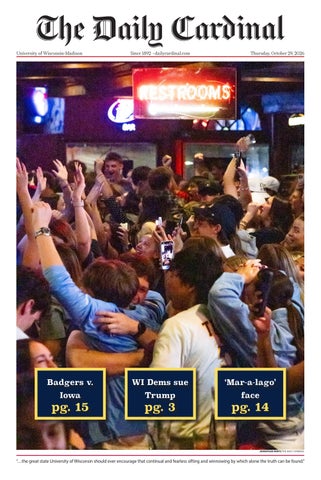
University of Wisconsin-Madison
Since 1892 dailycardinal.com l
Thursday, October 29, 2026
Badgers v.
WI Dems sue
‘Mar-a-lago’
Iowa
Trump
face
pg. 15
pg. 3
pg. 14
JOHNATHAN MINTZ/THE DAILY CARDINAL
“…the great state University of Wisconsin should ever encourage that continual and fearless sifting and winnowing by which alone the truth can be found.”
news l
2
Thursday, October 29, 2026
An independent student newspaper, serving the University of Wisconsin-Madison community since 1892 Volume 136, Issue 11
2142 Vilas Communication Hall 821 University Avenue Madison, Wis., 53706-1497 (608) 262-8000
News and Editorial editor@dailycardinal.com
dailycardinal.com
UW Systems presidential finalists talk policy, goals for role By Ted Hyngstrom VIDEO DIRECTOR
Editor-in-Chief Alaina Walsh
Managing Editor Avery Chheda
News Team Campus Editor Sonia Bendre College Editor Grace Carlson City Editor Jane Dardik State Editor Audrey Lopez-Stane Associate News Editor Zoey Jiang Features Editor Jake Kilander Opinion Editors Brady Ahler • Siena Ferraro Arts Editors Ryan Kim • Liset Zacker Sports Editors Otto von Sothen • Haellie Opp Sports Associate Editor Luca Muehlbauer Special Pages Editor Natalie Popper Photo Editor Jonathan Mintz Graphics Editors Eloise Guth • Klaire Maduscha Science Editors Lauren Eno • Addison Dama Life & Style Editors Isabella Bajaras • Jackson Baker Beet Editor Lizzi McGann Podcast Directors Yadiel Chavez • Amellia Fowler Digital Editor Meredith Schadrie Video Director Ted Hyngstrom Copy Chiefs Emma Schieffer • Brendan Wolf Copy Editors Isabella Barajas • Delaney Chronister • Kimberly McGee • MacKenzie Bien • Lucy Simmons
Business and Advertising business@dailycardinal.com Business Manager Wyatt Vail • Eleanor Zhang Marketing/Outreach Director Hallie Egelseer Social Media Manager Aanya Agrawal Ad Manager Lauren Downham The Daily Cardinal is a nonprofit organization run by its staff members and elected editors. It receives no funds from the university. Operating revenue is generated from advertising and subscription sales. The Daily Cardinal is published weekdays and distributed at the University of WisconsinMadison and its surrounding community with a circulation of 10,000. Capital Newspapers, Inc. is the Cardinal’s printer. The Daily Cardinal is printed on recycled paper. The Cardinal is a member of the Associated Collegiate Press and the Wisconsin Newspaper Association. All copy, photographs and graphics appearing in The Daily Cardinal are the sole property of the Cardinal and may not be reproduced without written permission of the editor in chief. The Daily Cardinal accepts advertising representing a wide range of views. This acceptance does not imply agreement with the views expressed. The Cardinal reserves the right to reject advertisements judged offensive based on imagery, wording or both. Complaints: News and editorial complaints should be presented to the editor in chief. Business and advertising complaints should be presented to the business manager. Letters Policy: Letters must be word processed and must include contact information. No anonymous letters will be printed. All letters to the editor will be printed at the discretion of The Daily Cardinal. Letters may be sent to opinion@
Editorial Board Avery Chheda • Alaina Walsh • Brady Ahler • Siena Ferraro • Safa Razvi Chair Safa Razvi
Board of Directors Scott Girard, Chair • Don Miner • Nancy Sandy • Nathan Kalmoe • Jack Kelly • Gary Achterberg • Jennifer Sereno • Kelly Lecker
© 2026, The Daily Cardinal Media Corporation ISSN 0011-5398
For the record Corrections or clarifications? Call The Daily Cardinal office at 608-262-8000 or send an email to edit@dailycardinal.com.
The three finalists for the Universities of Wisconsin System president — Steven Holley, Tonjanita Johnson and Bernard Savarese — shared how they would lead the 13 institutions of the system at two public forums. The two forums were hosted Monday and Tuesday at UW-Parkside and UW-Madison, respectively. The candidates presented their visions on how they would lead and fielded questions from students, staff, administration and the public on topics ranging from AI to collective bargaining. The winner will fill the Presidential vacancy opened by the firing of former President Jay Rothman in April, whom the Board of Regents voted unanimously to remove over concerns related to his transparency, approach to AI and style of leadership. Holley stresses hands-on learning, working with students Holley, the current executive vice chancellor and chief operating officer at the University of Mississippi, answered questions relating to learning style, leadership and how he would work with university and public stakeholders. Asked about what the Wisconsin Idea means for the a verage student and how he would keep it at the forefront of the Universities of Wisconsin, Holley said he would aim to provide additional “hands-on applied learning” so students could practice hard skills before entering the workforce. He also said higher education
will “always be an engine” for students’ careers. “We are in the business of career pipelines, as I have myself,” Holley said on Monday at UW-Parkside. “We enable that.” He said Wisconsin universities “need to be good stewards” of public funds, and said he would seek further sources of funding for the System. Holley also stressed the importance of research at system institutions, saying he would work to lower barriers to research funding. UW-Madison ranks fifth in the country for its university research expenditures. Holley said he wanted to “create the best, most thorough support services, and ensure that we have great success.” Asked about the value a college degree provides, Holley said he — a first-generation college student — was “proof” that higher education is “worth it.” At UW-Madison, Holley was repeatedly pressed by a group of students near the front of the room on hot-button issues related to immigration and the war in Gaza. Asked about whether he would support a divestment from Elbit Systems, a global defense technology company UW-Madison is indirectly invested in, Holley said he would “use the appropriate channels” and “explore the work of the trust fund office.” “We will absolutely continue to work with students to make sure that resolution goes through the appropriate process,” he said. Asked if he supported the war in Israel, Holley stressed he could
APO hosts ‘Walk a mile in her shoes’ fundraiser By Alexa Cattouse SENIOR STAFF WRITER
Alpha Phi Omega hosted a “Walk a Mile in Her Shoes,” fundraiser Oct. 25 in a University of Wisconsin-Madison parking lot, challenging around 15 male and 25 female participants to march a mile in high heels. Donations from the walk supported campus sexual assault victims and the Rape Crisis Center (RCC), a sexual violence resource center. “Walk a Mile in Her Shoes” is a popular fundraising event to show male solidarity for sexual assault victims, challenging men to walk a full mile in high heels to support female sexual assault and domestic abuse survivors. The event is also an effort to reflect and educate men on sexual assault and domestic violence awareness. About 40 participants donated to Alpha Phi Omega’s GoFundMe page, with proceeds going to support RCC, Dane County’s only full-service sexual violence resource center. The fundraiser comes nearly a month after the University of Wisconsin-Madison Police Department (UWPD) announced two sexual assault investigations relating to the university’s Greek fraternities and amid a national conversation surrounding the role of Greek life after a two-year-old sexual assault case at Cornell University gained publicity.
At the event, Alpha Phi Omega members led the participants, mostly college-age men wearing a variety of high heels, from Parking Lot 60 near the School of Pharmacy to Picnic Point. RCC representatives shared pamphlets, hotline numbers and other resources at the fundraiser. The challenge is inspired by the idiom “walk a mile in their shoes,” meaning you should understand someone’s backstory before judging them. Cooper Barkley, sophomore and member of Mu Epsilon Delta, told The Daily Cardinal showing up helps survivors know they are supported and surrounded by allies. “It’s so easy in an environment like this one to feel you’re alone in the problem that you’re facing,” Barkley said. “It’s an issue that’s not widely talked about because people don’t want to really admit that it’s happening to them.” Alpha Phi Omega Vice President of Pledging Henna Smerda said the idea of the event started off as a joke with the fraternity’s president, Kai Bennett. Smerda said planning of the fundraiser took three weeks and the university approved the event to be on campus just last week. Continue reading @dailycardinal.com
not provide a direct position, but instead a space for discussion and information access. “I wish we would not occupy people,” he said. On immigration enforcement and support on university campuses, Holley said he felt “very strongly about invading peoples’ individual human rights as [a] citizen of this country” and said “the balance to that is to acknowledge the laws that are in this country at this time.” He said he would “look at expanding” student advocacy and support and said he would defend student rights “within the letter of the law.” “We should submit to the law, absolutely,” Holley said. “But I will do everything I can to protect our students.” Holley was asked about the lengths he would “commit to following the law” — with the questioner particularly asking about whether or not he would follow the “Jim Crow South.” Holley said that he would “always work” to show “the consequences of current law.” Holley also said he was committed to meeting with students to discuss surveillance technologies, such as Flock and Axon cameras. In July, the UW-Madison Police Department said they would not be renewing their Flock ALPR Contract. Johnson points to possibilities, stresses accessibility and education on AI Originally from Butler, Alabama, Johnson focused her vision around increasing the possibilities of the UW
System. Currently the senior vice chancellor for academic and student affairs in the University of Alabama System, she also discussed AI, educational development and accessibility in her leadership role. Johnson said the Wisconsin Idea is fundamentally about relationships, not outreach, and said Wisconsin already has a great idea. She said she wants to make the promise of the Idea even more possible — by building forward, not starting over, and by thinking “of education as a lifelong opportunity.” “The decisions we make today must do more than address present challenges,” she said. “They must also expand tomorrow’s possibilities.” Johnson said a variety of her previous experiences would allow her to hit the ground running if she got the position. She said it isn’t policies, processes and procedures that make universities successful, but people. “How we lead people matters just as much as what we ask people to accomplish,” Johnson said. On AI, Johnson said the technology will affect “how we teach, how we learn, how we research, how we work, and how we serve our communities.” She said she would try to shape and change AI at the UW System, not react. She stressed the “AI excellence” of the UW-Madison campus. In May, UW-Madison named 2026 its “Year of AI Readiness and Competency,” which formalized the university’s preparation of students and faculty AI use. Continue reading @dailycardinal.com
news dailycardinal.com
Thursday, October 29, 2026
l
3
UW students discuss importance of the student vote, ballot referendums
LUCY SIMMONS/THE DAILY CARDINAL
By Madelyn Rybak STAFF WRITER
The University of WisconsinMadison’s Sigma Lambda Gamma National Sorority hosted a panel featuring the Wisconsin Union Directorate’s Society & Politics Committee (WUD SOPO) and the Associated Students of Madison (ASM) to discuss the importance of the student vote Oct. 16. The Sigma Lambda Gamma National Sorority, a multicultural sorority founded in 1990, hosted the panel as part of their “Gamma” week of social events. The panelists — Associate Directors of WUD Society & Politics Jacob Hucke and
Lauren Weliky, ASM Student Vote Coordinator Emily Bolstad, and District 8 alder and university student Ellen Zhang — told students how to vote and shared their thoughts on the midterm elections. The panel encouraged students to vote and criticized three statewide referendums. Weliky said the word choice used is intentionally confusing to the average citizen. “If it’s hard to understand [the] political issues, that’s probably on purpose,” Weliky said. The first referendum, if passed, would ban future governors from raising taxes or fees using their
partial veto power. The second referendum would add a clause to the section of the state constitution that protects freedom to gather in places of worship in Wisconsin, even in a state of emergency. The third referendum looks to “prohibit governmental entities in the state from discriminating against, or granting preferential treatment to, any individual or group on the basis of race, sex, color, ethnicity, or national origin in public employment.” If passed, this referendum would apply the principle to government agencies, Wisconsin public schools, the University of Wisconsin school system and Wisconsin Technical College System. In addition to criticizing ballot language, the panelists said negativity surrounding politics can discourage civic engagement. Bolstad said she believes building a sense of community can break that barrier. “Going outside, going to these events, it’s like a really nice breather,” Bolstad said. “It reminds yourself that everything is not completely on fire.” Hucke added political conversation bridges gaps and builds political awareness. “I want to give [political] information to other people, and it’s kind of my
Wisconsin Democrats sue Trump for using taxpayer dollars for campaign ads By Alena Shores STAFF WRITER
The Democratic Party of Wisconsin and State Treasurer candidate Yee Leng Xiong filed a lawsuit with Democracy Defenders Action against the Trump Administration for using taxpayer dollars to pay for advertisements promoting President Donald Trump. The press release states that U.S. Congress originally allocated $20 million for border security and “commemorative events” for employees. Instead, the money was used to assault Trump’s opponents in the midterms while endorsing himself. The U.S. Customs and Border Protection, Department of Homeland Security (DHS), Office of Management and Budget, Trump and other people in leadership positions across offices were named in the lawsuit. The complaint says “defendants do not have authority under the Constitution or federal statutes to take taxpayer funds appropriated by Congress for other purposes, and to pay for another unauthorized purpose.” The lawsuit also states the act of using federal funds for campaign advertisements is “separately and specifically forbidden by federal law.” Along with violating federal law, the complaint also mentions the Hatch Act and the Administrative Procedures Act. The Hatch Act, signed in 1939, ensures nonpartisan federal programs to protect federal employees from partisan pressure at work. The Administrative Procedures Act was signed in 1946 and makes regulations for all federal agencies and gives the public participation in decisions.
“It’s an outrageous abuse, and it’s past time for the ads to stop and the lawbreakers to be held accountable,” Xiong said. “This administration has already made life more expensive for Wisconsin families. Now they’re taking hard-earned dollars and using them for illegal ads for political gain.” The complaint specifically calls for the advertisements to stop and an order to reimburse the money. In a statement to The Daily Cardinal, Democratic Party of Wisconsin Chair Devin Remiker said the ads are, “one of the clearest examples of the Trump administration’s corruption that Wisconsinites have had to pay for.” The Trump administration used these funds to air the ads over 2,700 times between Sept. 23 and Sept. 29, in what the DHS called the “National Media Campaign.” Trump alleged on Truth Social Oct. 5 he paid for the advertisements with his own money from MAGA Inc., a super PAC that “can accept unlimited contributions, but it must disclose its donors.” In 2024, MAGA Inc. spent over $456.8 million on promotions for Republican candidates. According to the lawsuit press release, the White House said there would not be reimbursements for the advertisements that had already run. “The Democratic Party of Wisconsin brought this lawsuit because we are committed to fighting for working people,” Remiker said. “We will do whatever it takes to hold them accountable for exacerbating that suffering by illegally abusing taxpayer dollars to prop up Trump’s failed policies in a desperate attempt to buy an election.”
way of staying in the loop of things,” Hucke said. “Learning new perspectives, that’s always a good thing.” After the panelists concluded their presentation on voter information, Zhang discussed her role in student life and government operations as a Common Council member. Zhang, the only student and Asian woman on the city council, said young people and students of color should know their voice matters in politics. “I feel like a lot of people in this room can relate to being the only person of color, being the youngest person, trying to advocate for something,” Zhang said. “I want people to know that what you do and what you feel really matters.” On Madison’s Common Council, Zhang’s main objectives are prioritizing affordable housing and public transportation, she said. “I first became interested in being an alder because I like solving problems,” Zhang told the audience. On the Common Council, Zhang serves on the Business Economic Resources Committee, the Metropolitan Planning Organization, and the Madison Arts Commission. Zhang claimed partisan barriers stand in the way of affordable housing.
“The reason that housing is so expensive in Madison is because a lot of Republicans in the legislature are tied to real estate companies, so they have an interest in making it harder,” said Zhang. “They have an interest in making it harder to build affordable housing because you need to retaliate against the landlords.” Zhang encouraged students to vote, saying voting is an essential tool to advocate for one’s interests. “You are the only person who can advocate for your presence,” Zhang said. Students can cast their ballot on or before election day, Tuesday, Nov. 3. In-person voter registration is open until Oct. 30, and students must be at least 18 years old and have a valid voter identification card to register, which can include a Wisconsin driver’s license or passport. Polls are open across campus from 7 a.m. to 8 p.m. on election day, and early voting is open from 11 a.m.-5 p.m Oct. 20-30 at various locations on campus, including Memorial Union, the School of Nursing, the School of Human Ecology and Union South. For further information about specific polling locations, ballot contents and absentee ballot requests, visit myvote.wi.gov.
Madison draws younger crowds with mixed opinions on affordability By Zainab Chowdhur STAFF WRITER
Madison’s growing appeal to Generation Z professionals is bringing young workers to the city for career opportunities, green spaces and a slower pace, but rising costs threaten to make the city less accessible, according to Madison residents. Madison was ranked as one of the best mid-sized U.S. cities for Gen Z in 2024 and 2025, and the generation makes up 15.2% of Madison’s 280,000 total residents. The demographic is largely fueled by the University of Wisconsin-Madison, where 64.4% of students are a part of Gen Z. Only 14.7% of Dane County’s population is aged 65 or older, compared to other Wisconsin counties that have an average of 20%. Yonathan Taye, a PhD candidate and teaching assistant at UW-Madison, told The Daily Cardinal opportunities for professional growth may play a key role in attracting the younger crowd. “There are often conferences here which are opportunities for me to present my research or network with people for professional development,” Taye said. “I got hands-on teaching experience relatively quickly as well.” He said the vast collections at the Wisconsin
Historical Society and close proximity to collections in Chicago supported his research ambitions and drove him to Madison. District 8 Alder Ellen Zhang told the Cardinal she believes state politics, academia and biotech research being centered in Madison incentivises younger people to move from surrounding areas. Wisconsin Biohealth Tech Hub is just one of the federally funded research opportunities receiving $50 million for workforce development and biotech research in 2025. University of Wisconsin-Madison is one of the 15 consortium members collaborating to advance the state’s biohealth sector. It is expected to produce employment opportunities across the state, including in Madison. Slower pace, greener place Tara Viswanath, a 26-year-old who recently moved from Washington D.C. to Madison for work, told the Cardinal she views Madison as slow-moving and more relaxed compared to the East Coast. “People are burnt out. Madison is more in nature and has a more digestible lifestyle [which is] less overwhelming,” she said. Continue reading @dailycardinal.com
PHOTO COURTESY OF BRYCE RICHTER/UW-MADISON
news 4
l
Thursday, October 29, 2026
dailycardinal.com
UW-Madison alum says he misrepresented public footage as campus pig gas chamber By Gabriela Pineiro STAFF WRITER
University of Wisconsin-Madison recent graduate, aiming to close a university meat research laboratory’s gas chamber for pigs, said he misrepresented publicly available footage as his own footage of UW-Madison’s gas chamber in a statement to The Daily Cardinal on Oct. 25. Allied Scholars for Animal Protection (ASAP) member Ryan Blum launched a campaign against the use of a carbon dioxide gas chamber at UW-Madison’s Meat Science & Animal Biologics Discovery (MSABD) laboratory building in September, claiming as recently as Oct. 22 that he sneaked into the building in spring 2026 and captured footage of pigs in the chamber. The footage he claimed was his is actually public footage from an Australian gas chamber. University spokesperson Chris Barncard challenged Blum’s footage in an Oct. 21 email to the Cardinal. The footage shows “multiple pigs loudly vocalizing within a dark room, but it is difficult to identify the specific surroundings,” according to previous reporting from the Cardinal. “While Blum says he sneaked into
UW-Madison animal facilities to capture video with a hidden camera, this claim has been debunked by multiple sources, including the UW Police Department,” Barncard said. “Blum’s video actually comes from another, publicly available video made in 2015 by activists associated with a group called Farm Transparency Project.” Barncard said the 25 seconds of footage after the 4:10 mark of the 2015 video, recorded in Benalla, Australia, “matches Blum’s posted video exactly, though he appears to have manipulated the original by cropping, darkening and blurring it.” “Every clip Blum has posted of the interior of the secure portion of the Meat Science and Animal Biologics Discovery Building and of other UW-Madison facilities is taken from outreach videos that have been available on UW-Madison websites and video channels for years,” Barncard added. The Cardinal sent the 2015 video to Blum Oct. 23. On Oct. 25, Blum admitted a video he had circulated was edited footage from an Australian gas chamber. “I am issuing this statement to take accountability and to express my
deep remorse for misrepresenting my investigation of the gas chamber at the Meat Science and Animal Biologics Discovery Building,” Blum said in the statement. “Although the University does gas pigs using CO2, I edited existing footage from a gas chamber taken by activists in Australia. I presented that as footage I got from Wisconsin, which was wrong, and there is no justification for it. To those who I have misled, including friends, family, members of the public, the University and journalists, I am deeply sorry for lying to you and the damage it has done. I also wanted to say an especially deep apology to the activists who risked their lives to capture the footage from Australia. I hope that, by taking some time away from public involvement in the movement, I can use that time to improve and become a better advocate for animals.” Blum’s campaign website has been taken down, and his Instagram account appears unavailable as of Oct. 26. ASAP Founder and CEO Faraz Harsini told the Cardinal Blum is no longer employed by ASAP as of Oct. 26. The MSABD does operate a
chamber — likely the only university-controlled carbon dioxide gas chamber for hogs — and other universities house meat processing plants and meat science divisions. The chambers are widely used commercially, though the ethics of the practice have been debated. UW-Madison Police Department (UWPD) Executive Director of Communications Marc Lovicott told the Cardinal UWPD ended its investigation into Blum in September after concluding the video was not taken at UW-Madison’s MSABD Building. “After looking into the claims and reviewing the video, we don’t believe… he accessed any UW buildings,” Lovicott said. “The video appears to be heavily edited with publicly available video clips, including video clips from non-UW-Madison facilities.” Blum hosted an event Oct. 22 at Van Vleck Hall advertised as “addressing the campus gas chamber,” where audience members questioned the true origin of the video. At the time, Blum remained adamant that the footage he released came from a UW-Madison gas chamber, but declined to provide more information about sneaking into the facil-
ity, citing his lawyer. He questioned the motive behind the accusations. “It is a very common police tactic to use the human need to correct behavior to actually get more information,” Blum said. “I shared generally how I gathered information, but strongly given my lawyer’s advice, I did not explain exactly how I snuck in and got it.” He said at the Oct. 22 event that he hadn’t received any similar videos and didn’t know the origin of the claim. “The police are allowed to lie to you to get information to try to find reasons for arrests, things like that,” Blum said. At the event, Blum said he began his journey into veganism and animal activism after downloading Instagram at the age of 15 and seeing videos of animals in factory farms. “By complete coincidence, I ended up going to the only university in the country that gasses pigs using CO2,” Blum said. Editor’s note: This story was edited Oct. 26 at 11 a.m. to change wording post publish. It was updated at 12:26 p.m. to include that Blum is no longer employed by Allied Scholars for Animal Protection.
Madison community members ‘Arrest the killer cop’: Students criticize Common Council decision to protest Glass’s firing, Ruiz fire Independent Police Monitor murder prior By Lilly Nicandri STAFF WRITER
Madison Students for a Democratic Society (SDS) and community members marched to Madison Municipal Building Oct. 20 to protest the proposed firing of Interim Independent Police Monitor (IPM) Aeriamique Glass and demand accountability for Kiel BaitingerPeterson, the Madison police officer who shot Corey Ruiz in July. The march preceded a 12-hour Common Council meeting that ended with Glass’s termination. The IPM looks into complaints filed by Madison residents against Madison police and the Madison Police Department (MPD). The Office of the Independent Police Monitor can release conclusions based on these reports, but cannot discipline the police. The IPM was also responsible for facilitating the process of finding a permanent monitor. The march centered on concerns that firing Glass before taking meaningful disciplinary action against Baitinger-Peterson would undermine independent police oversight and public trust. Glass’s tenure has drawn controversy. In August, she was involved in an altercation with Madison police at a protest following Ruiz’s shooting. She also faced criticism after releasing a report featuring an AI-generated cover image of Madison and has previously publicly criticized city officials. The Common Council cited Glass’s August altercation with police in its resolution to terminate her. But protesters argued that the council’s focus on firing Glass, rather than police accountability, sent the wrong message about institutional oversight. During the march, students held up signs reading “Arrest the Killer Cop” and “Justice for Corey Ruiz,” chanting “Black Lives Matter” and “No justice, no peace, no racist police” and, some read, “ICE, KKK, MPD, they’re all the same.” “We don’t believe that [Glass] has done anything wrong,” Bradley Keenan, chair of Madison’s SDS chapter and organizer of the
march, told The Daily Cardinal. “We believe that she has supported the people against police brutality, and my message to the Common Council is students are not stupid. We will know who votes against firing her and who votes for her [termination].” Keenan stated concerns Glass’s firing sets a poor precedent for independent police oversight. “It is concerning to see that after the Independent Police Monitor does her job and investigates the police in cases of wrongdoing, the city retaliates and comes for her job,” Keenan said. “I think that it sets a precedent that future independent police monitors cannot remain independent, or they [will] fear losing their job.” Keenan said police assaulted Glass during the altercation, and the public is overlooking it. He also pointed to Glass’s investigation into Richard Lee Johnson’s death, initially ruled as a cocaine overdose but later found to be due to cardiac arrest as a result of police neglect due to Glass’s involvement. “I think the police officers involved should be charged for criminal neglect and homicide,” Keenan said. Keenan later spoke at the Common Council meeting in favor of Glass. “It is ridiculous that this Common Council could even consider firing the independent police monitor before any meaningful action has been taken against the police officer, Kiel [Beitinger-]Peterson, that murdered Corey Ruiz in the street,” Keenan said. “This item sends a shameful message to every officer in Madison, emboldening them to use excessive force whenever they please with the knowledge that the City of Madison will back them up.” Other students at the march shared similar sentiments. “The biggest concern is that [Glass’s firing] will become a non-isolated pattern,” Evan Epps, a junior at UW-Madison and member of the BLK PWR Coalition (BPC), told the Cardinal. He said if Glass were fired, the community would feel less able to hold institutions accountable. Continue reading @dailycardinal.com
By Lilly Nicandri STAFF WRITER
Madison’s Common Council fired Interim Independent Police Monitor (IPM) Aeiramique “Meeka” Glass after a 12-hour long meeting Oct. 20, where citizen comments criticized the termination as only decreasing public trust in local institutions. Glass’s firing was brought to a council vote after her failure to facilitate the hiring of a permanent Independent Police Monitor (IPM) and her refusal to follow city policies, called Administrative Procedure Memorandums (APM), when contracting and purchasing. Madison residents protested the vote, saying it was a hindrance to police oversight, a distraction from the investigation into the death of Corey Ruiz and expressed frustration over an altercation Glass had with police officers in August also playing a role in the vote. Those who spoke at the meeting advocated for police accountability, transparency, the importance of having an IPM and highlighted how police brutality is handled in the Madison community. Alder John Guequierre criticized the role of the Office of the Independent Monitor (OIM) and the Police Civilian Oversight Board (PCOB) in an email to The Daily Cardinal. “The PCOB and OIM have no authority to file criminal charges and no authority to implement policing procedures. They can only recommend,” Guequierre wrote. “Their power derives solely from whatever moral authority they have earned from the people of Madison and the alders whom they elect. Absent that, they are only howling in the wind.” Amelia Royko Maurer, a member of the Community Response Team, told the Cardinal that requiring Glass to follow every APM could undermine the independence of the OIM, saying “she can’t follow all APMs and do her job.” Maurer spoke at the meeting in favor of Glass. “You have given voice and clarity to individ-
uals and families who have suffered immense pain and loss, who would have otherwise been gaslit, shut down and pushed beyond the horizon of their mental capacity,” Maurer said, crying. “You have revealed what is possible in independent oversight in Madison. I’ve been doing this for 14 years. I don’t know anybody who could do what you’ve done.” Maurer’s time ran up before she could finish her speech, and other speakers repeatedly asked the mayor if they could give up their time to let her speak. All requests were denied. The ordinance that oversees the OIM states the monitor must follow City of Madison contracting policies. The ordinance also states no city employees or officials can use their positions of power to undermine the independence of the police monitor. Glass previously accused the attorney’s office of violating the ordinance, stating they interfered with the OIM’s independence. City Attorney Michael Haas maintains the authority of the monitor falls under applicable state laws and city administrative procedures. Many community members echoed Maurer’s sentiments and believed the OIM should be completely independent from city operations. “The purpose of the independent police monitor is exactly that: to independently monitor the Madison Police Department on behalf of the Madison community,” Everett Penne, a member of Madison Students for a Democratic Society, said at the meeting. “It does not mean monitoring the police in a way palatable to the police, nor how the council feels sees fit.” To highlight the importance of Glass’s job, a speaker at the council meeting expressed the racial disparities in Madison Police Department (MPD) arrests. Based on MPD’s quarter two report, 60.8% of use-of-force reports involved black community members compared to white community members, who only made 30.2% of use-of-force arrests during the same period. Continue reading @dailycardinal.com
news dailycardinal.com
Thursday, October 29, 2026
l
5
Conservative group files lawsuit against loan program for minority teachers By Mia J. Warren SENIOR STAFF WRITER
The Wisconsin Institute for Law and Liberty (WILL) filed a lawsuit against the Evers administration Sept. 14, over accusations of racial discrimination through diversity, equity and inclusion (DEI) loan programs. Gov. Tony Evers vetoed a Republican-led bill in May aiming to cut the Minority Teacher Loan Program, as well as others promoting DEI initiatives. The program, under Wisconsin’s Higher Educational Aids Board, administers loans to minority education students which may be 100% forgiven. It allows students to receive up to $10,000 each year if they agree to teach in a public or private school where 40% or more students are minorities. “Far-right actors like WILL have for years pushed the false narrative that simply acknowledging discrimination and taking steps to reverse it is somehow a form of discrimination in itself,” Sen. Chris Larson, D-Milwaukee, said in a statement to The Daily Cardinal. “This is back-
wards and un-American.” WILL outlined a “Roadmap to Equality” on their website where they detail their targets and progress in a movement against DEI. “Eliminating DEI completely requires working with Congress to make these changes permanent and remove all race-based programs from federal law,” WILL’s website reads. The complaint cites the 14th Amendment, as well as the precedent set by the U.S. Supreme Court in 2023 that gutted affirmative action. The Wisconsin Supreme Court unanimously struck down a similar race-based scholarship program this summer. WILL represented the plaintiff Citizens Defending Liberty in both cases. “Sadly, our highly corrupt United States Supreme Court has largely sided with this view, leaving Wisconsin and the Higher Education Aids Board virtually powerless to fight back as it relates to race-based higher educational aids,” Larson said. WILL reported their progress as 89% complete across 80 target federal institutions and programs. The institution wants to “root out DEI from the federal bureaucracy.”
WILL uses similar litigation techniques to target state programs in Wisconsin. In 2024, Beloit School District removed racial eligibility criteria from their Grow Your Own Multicultural Teacher Scholarship Program after legal threats from WILL. “I truly believe that if we are ever going to live up to the idea that all people are created equal, and ensure that all people are equally protected under our laws, we need to be able to acknowledge, identify, and examine the root causes of discrimination — not just based on race but in all its many forms — so that we can take steps to reverse it,” Larson said. Anti-DEI’s impact on education This lawsuit follows Republicanled pushback against DEI in the midterm elections. A constitutional amendment written by Republican legislators prohibiting preferential treatment based on race will appear on the Nov. 3 ballot. Wisconsin is rated the worst state for racial equality in education and had the highest gap in public high school graduation rates between white
Madison Public Market enacts free parking until 2027 By Madelyn Rybak STAFF WRITER
Madison Public Market announced they will provide free parking outside their building for the remainder of 2026 with an anonymous donation, according to social media posts posted by the Market Oct. 21. The Madison Public Market’s grand opening was slated to open this July, but switched to a soft opening following the shooting of Corey Ruiz. The grand opening was rescheduled for Nov. 9. The Market celebrates local culture through sharing diverse foods, handcrafted arts and traditions across the city. Their menu features produce from Wisconsin farms, culturally diverse prepared food and locally made food products. “We’ve heard from visitors that parking cost and parking availability can factor into their decision to visit the Market,” Keisha Harrison, chief executive officer, told The Daily Cardinal. “Being able to offer free parking gives us an opportunity to address that concern directly, encouraging more people to visit and support the Market’s small
businesses and merchants.” Parking at Madison Public Market is typically $2.55 an hour. The money raised from parking was dedicated to help the Madison Public Market Foundation pay for maintenance services and building upkeep. There are 106 total available parking spots, six of which are pick-up spots that had already been free before the grant. The market’s decision to implement free parking comes from their goal of creating a diverse and equitable space for customers. Free parking opens up access not only for customers, but also the small business owners that rely on them, according to Harrison. “Because the donor has chosen to remain anonymous, we’re going to respect that request and keep the details of the gift private,” Harrison told the Cardinal. “What’s most important from our perspective is the impact: it gives us an opportunity to remove one potential barrier to visiting the Market and make it easier for people to come experience the businesses, food and programming here.”
COURTESY OF MADISON PUBLIC MARKET FOUNDATION
and Black students, according to a 2026 WalletHub report. Adalberto Castrejón, a University of Wisconsin-Madison Ph.D candidate researching higher education policy, told the Cardinal Wisconsin’s inequalities among both students and teachers deserved to be addressed head-on. Without clear policy, Castrejón said he wonders how Wisconsin will grapple with racial inequalities in the future. “What is the replacement? How do those equalities that persisted then get addressed?” Castrejón said. WILL released their own report on Wisconsin’s racial inequality in March of this year, where they cite poverty and low marriage rates in Black families as just a few factors in the gap. “Race itself does not cause low academic achievement,” said WILL Research Director Will Flanders on their website. “It’s time for an honest discussion about poverty and family structure. We also must look to other states with high black student populations and replicate their efforts to address gaps successfully.” Castrejón said having representation and teachers that identify with students is important for positive
outcomes. Minority students that feel represented by their teachers are shown to perform better on standardized tests and have higher attendance rates, according to research from the Wisconsin Policy Forum. The Minority Teacher Loan Program initially set to encourage minority teachers to commit to Wisconsin schools with a diverse student body. Financial support is incredibly important for student access to college, Castrejón said. “When these policies stop that funding, those resources should then get cycled in for student success,” he said. Of UW-Madison’s current student body, 32% are students of color, and Castrejón said despite anti-DEI attacks, minority enrollment has not been significantly impacted. “Students are still enrolling into universities at the same rate, but how does their student experience change?” Castrejón said. “Within the four-to-six year graduation period, there might be changes to those outcomes, and I’m really interested in seeing how that started.”
MPD weighs surveillance concerns, public safety in new drone program By Lilly Nicandri STAFF WRITER
The Madison Common Council unanimously voted to approve a resolution filed by the Madison Police Department (MPD) Oct. 20 to apply for and accept a 200,000 dollar federal grant through the U.S. Department of Justice’s Community Oriented Policing Services Program to pilot a drone as a first responder initiative. The program is different from MPD’s current unmanned aircraft systems (UAS), which are currently utilized to search for missing or injured persons and to locate evidence. Drones will be sent when officers are dispatched for service in the west police district. The drones will arrive first, allowing for officers to have real-time information to assess situations prior to arriving at the scene. MPD hopes the drones will help to further de-escalate situations to prevent violence between police and community members. The implementation of drones as a first responder has been increasing across the country, leading MPD to request federal funding, according to Matthew Tye, assistant chief of police at MPD, in a memo sent to City Council. The resolution sourced a recent randomized trial in Montgomery County, Maryland, which showed 19.5% of calls were resolved by a drone alone. MPD gave examples of instances where surveillance de-escalated situations. One instance occurred on State Street where people were protesting. The cameras along the street allowed officers to assess the situation and respond without revealing themselves to protestors and further escalating the situation, according to the memo. MPD said they were able to analyze another altercation at an encampment at the Williamson Street and Baldwin Street intersection with their current UAS program. They could then decide how to respond before receiving a 911 call, and were able to successfully take control of the situation. District 4 Alder Michael Verveer told the Cardinal if the drones are used appropriately, they can be a helpful tool for cops in de-escalation tactics and avoiding unnecessary conflict. “I can tell you as someone that [has] attended
JONATHAN MINTZ/THE DAILY CARDINAL
the Mifflin Street block party for years —it takes place in the district I’m elected to represent— that the police use of drones have been helpful in [ensuring] the event goes off as safely and smoothly as possible,” Verveer said. “The cops don’t use drones to look for people drinking. Drones are able to spot if violence might be taking place or if a fight is occurring.” Verveer said he believes drones provide critical video evidence to solve crimes, but federal funding is key. According to Tye, acquiring funding may be a longer process. “This administration has been a little bit different than past administrations as far as following the established procedures and timelines for grants,” Tye said. “[It’s] kind of a big unknown if we get it or not.” Drones are a public safety concern, with residents being worried over violated privacy, unwarranted surveillance and recording without consent. MPD follows a policy and state ordinance requiring the force to avoid using drones for random surveillance, warrants when gathering information from private areas, and targeting or intimidating people in a discriminatory manner. According to Tye, MPD does not use current drones randomly on patrol or for surveillance of private areas, and complies with a surveillance ordinance. Continue reading @ dailycardinal.com
news
6 • Thursday, October 29, 2026
dailycardinal.com
Language tables are about more than just practice. They create lasting connections. By Nadja Duss STAFF WRITER
A University of WisconsinMadison student learning Spanish and seeking extra practice could go to Union South on any Tuesday at 5 p.m., climb the steps to the second floor and join in on the weekly conversation tables. If they can’t remember these directions, however, following the sounds of laughter, lively conversation and the occasional “¿Cómo se dice?” would ultimately lead them to the same place. Learning a new language takes practice, and at both La Mesa de Conversación and Bate Papo, students, faculty and Madison residents have the opportunity to hone their fluency and foster friendships through conversation — while enjoying the Wisconsin tradition of splitting a pitcher of Union South beer. La Mesa de Conversación translates to “the Conversation Table” and meets on Tuesdays from 5 p.m. to 6:30 p.m. in The Sett. Steve Fondow, the coordinator for Spanish 101 and 102 in the Department of Spanish and Portuguese, currently runs “Mesa.” Fondow attended UW-Madison as an undergraduate and graduate student, where he participated in the tables both times. Later, following the completion of his PhD, he returned to run the program at the invitation of the Department Chair at the time. Unlike a traditional language class or tutoring session, Mesa focuses on more casual, everyday conversation. “It’s a way to provide students an opportunity to practice using their Spanish in a less academic environment,” Fondow told The Daily Cardinal. “To make sure that [students] get practice using the things that they’re learning in class.” Mesa’s Portuguese counterpart, Bate Papo, translates to “chat” in Portuguese, and meets on Thursdays at the same time and place. The Department of Spanish and Portuguese has hosted Bate Papo for close to 50 years, according to its current organiser Levi Cross. Cross is a PhD candidate and instructor in the Department of Spanish and Portuguese. “It’s not structured in any sort of way,” said Cross. “I think that’s really beneficial because it helps people have organic conversations in ways that they might experience if they were to travel to…any Portuguese speaking place.” Cross also attended the tables as an undergraduate student and took over management almost two years ago following the retirement of the previous organizer, Ellen Sepega. Many UW-Madison students who attend the conversation tables appreciate the
JOHNATHAN MINTZ/THE DAILY CARDINAL
laid back nature of the events. “I really wanted to improve my conversational Spanish. I feel like [Mesa] is a good way to practice that [in a] low risk environment where you don’t have grades on the line,” UW-Madison junior Jamie Nick told the Cardinal after attending her second Mesa meeting. While learning a new language can be difficult already, it’s especially hard without travel where you are fully immersed with the language and culture. Mesa and Bate Papo, however, give students the opportunity to surround themselves with a language without even leaving campus. “[Bate Papo] just helps to be exposed more to the language,” James Gansen, a student learning Portuguese at UW-Madison, told the Cardinal. This is Gansen’s first semester attending Bate Papo. Speaking is considered by many learners to be one of the most difficult and vulnerable aspects of acquiring a new language. The attendees of the conversation tables recognize this and encourage that vulnerability. “The only way to get better is by speaking, using the language, practicing and being uncomfortable,” Lucy Jumbeck, a UW-Madison graduate student and Spanish 101 teaching assistant, told the Cardinal. Jumbeck facilitates the weekly Mesas. “It just takes so much time. So, unfortunately, you have to make yourself uncomfortable [to] learn.” A little over a year ago, UW-Madison’s Greater University Tutoring Service discontinued its World Language Learners program that had connected students with tutors. Both Mesa and Bate Papo provide alternatives to these resources, even if they don’t completely fill
the gap. Within the last year and half, Fondow has been working with GUTS to get a tutor for the first and second semester Spanish courses. “We actually have a tutor and she [the tutor] comes to the conversation table sometimes but she’s primarily doing real tutoring... not so much conversational [practice]...so we balance each other out,” Fondow said. Both Fondow and Cross prioritize fostering a welcoming atmosphere that encourages beginners to join. “Everyone’s really respectful of the different language levels,” Cross said. “If there’s someone who is just starting in Portuguese…they’ll often stick to the side, but people are really good about including them in the conversations by speaking slowly or using words that they might have learned already…just to get them to engage.” Fondow described Mesa as “just hanging out with friends,” and attendees feel it. “[The atmosphere] is very low-key,” UW-Madison senior and regular Mesa attendee Elise Edwardsen told the Cardinal. “You only participate how much you want to participate, there’s nobody there pressuring you to do anything…you’re not trying to adhere to a requirement.” While the setting is relaxed, attendees still share a common academic goal. “[People] are there because they want to learn,” Mesa attendee Jacob Pelegrin told the Cardinal. “That’s what makes it such a good, productive environment.” Pelegrin, along with many Mesa and Bate Papo attendees, is not a current UW-Madison student but a Madison resident. The tables’ openness to the com-
munity of Madison is another aspect of Mesa and Bate Papo that makes them unique. “We have community members…who are also in the same boat as students,” Cross said. “They’re looking to improve their language skills, or just have someone to speak with.” Bruce Moffat, one of Bate Papo’s most loyal attendees and aspiring polyglot, falls under this category. Moffat first started attending Bate Papo while studying Portuguese through UW-Madison’s Division of Continuing Studies. “It’s welcoming to people who are just working in the [Madison] area or people passing through,” Moffat told the Cardinal. “It’s never the same cast of characters, either. Each week it changes.” Moffat speaks English as his native language, speaks Spanish at home with his wife who is from Costa Rica, speaks Portuguese every week at Bate Papo and in his spare time, is working on his French. Moffat also values Bate Papo for its distinction from a classroom and openness to errors. “You learn that you have to put yourself out there [and] make mistakes,” Moffat said. “I think making mistakes is the best way to learn.” Some of Mesa and Bate Papo’s regular attendees are native speakers who want to sustain their fluency. “I’m fluent, but forgetting words is really common when you stop speaking any language,” Lucas Palomino, a UW-Madison graduate student from Brazil, told the Cardinal. Palomino appreciates Bate Papo for not only the language practice, but the community it fosters. “[Bate Papo] is really open and friendly. You don’t need to know Portuguese to come…everyone’s just happy to have you there.”
Unsurprisingly and inevitably, many friendships have formed through both Mesa and Bate Papo. “I made a friend from the computer science department, and he’s from Taiwan,” Fondow said. “He just finished his PhD and he moved to California, but he’s actually texted me and he said he’s coming back this next week to visit Mesa and to hang out in Madison.” Any Mesa and Bate Papo attendees who are of age often enjoy drinks from the Sett Pub in Union South, something that contributes to the sense of camaraderie at each weeks’ events. “[You’ll] notice that Brazilians are very expressive and affectionate, so you’ll see people hugging at the beginning and at the end of the Bate Papo,” Moffat said. UW-Madison offers instruction in over 60 languages, from Ancient Greek to ASL. Mesa and Bate Papo give students, and all community members, a low pressure, friendly environment to experiment with their skills and truly recognize the progress they make. “There’s a lot of people that go there that have very different backgrounds, but they want to learn Spanish for their own reasons,” Pelegrin said. “It’s just a lot of different people coming together and having a fun conversation.” The large presence of UW-Madison alumni also goes to show how the university’s language department is one that keeps its students coming back. “I made some of my best friends while at Bate Papo. I think it incentivized us to keep going, which is why we see when people come here,… they’ll return week after week… you don’t get that contact anywhere else,” Cross said.
election dailycardinal.com
Thursday, October 29, 2026
l
7
What’s on the Madison ballot for midterm elections?
KEVIN PARK/THE DAILY CARDINAL
By Audrey Lopez-Stane STATE NEWS EDITOR
Election Day for midterm races across the nation is Nov. 3. Here’s what you will see when casting your ballot in Madison, Wisconsin. Governor’s race The Democratic candidate Milwaukee County Executive David Crowley and the
Republican candidate U.S. Rep. Tom Tiffany face off after Gov. Tony Evers left the seat open following his two terms. The two candidates are paired on the same ticket with the nominees for lieutenant governor. Crowley runs on the ticket with current Secretary of State Sarah Godlewski, and Tiffany runs with Lancaster Mayor David Varnam. Attorney General
Incumbent Democrat Josh Kaul faces a challenge from Republican Fond du Lac District Attorney Eric Toney. This is a rematch from 2022 when Kaul defeated Toney by just over one point for the seat that heads the Department of Justice. Secretary of State Three candidates are vying for the open seat as Godlewski runs
for lieutenant governor. Democrat Milwaukee Alder JoCasta Zamarripa, real estate investor Republican Jay Schroeder and former Racine Alder Peter Karas of the Green Party face off for the seat holding the state records and seal. Treasurer Incumbent Republican John S. Leiber faces a challenge from Democrat Marathon County Supervisor Yee Leng Xiong. Wisconsin hasn’t reelected a state treasurer in over 20 years, and this seat signs checks and manages the state’s trust fund. 2nd Congressional District Incumbent Democrat U.S. Rep. Mark Pocan is uncontested in his race for the U.S. House of Representatives. Pocan has held the seat since 2013. 76th Assembly District Voters on Madison’s east side will see this race on their ballot. Madison Alder Democrat Dina Nina Martinez-Rutherford and Republican Nina Chat face off for the seat left open by Rep. Francesca Hong who ran and lost to Crowley in the Democratic primary for governor. 77th Assembly District Voters on Madison’s west side will see this race on their ballot. Incumbent Democrat state Rep. Renuka Mayadev faces a challenge from Republican Jane McCormick, a real estate broker. See which Assembly district you live in here. Dane County Sheriff Incumbent Democrat Kalvin D. Barrett is uncontested in this race. Dane County Clerk Of Circuit Court Incumbent Democrat Jeff
Okazaki is uncontested in this race. Constitutional amendments Three constitutional amendments appear on the ballot, all which are written and proposed by Republican lawmakers. The first aims to end the governor’s partial veto powers. It states “Partial veto. Shall section 10 (1) (c) of article V of the constitution be amended to prohibit the governor, in exercising his or her partial veto authority, from creating or increasing or authorizing the creation or increase of any tax or fee?” The second aims to allow people to gather in places of worship during declared emergencies. It states “Freedom to gather in places of worship during an emergency. Shall section 18 of article I of the constitution, which deals with religious liberty, be amended to prohibit the state or a political subdivision of the state from ordering the closure of, or forbidding gatherings in, places of worship in response to a state of emergency, including a public health emergency?” The third aims to prohibit governmental discrimination race, sex, ethnicity or national origin, like affirmative action. It states “Governmental entity discrimination prohibited. Shall section 27 of article I of the constitution be created to prohibit governmental entities in the state from discriminating against, or granting preferential treatment to, any individual or group on the basis of race, sex, color, ethnicity, or national origin in public employment, public education, public contracting, or public administration?” Early voting on campus is held at the School of Nursing, School of Human Ecology and Union South from 11 a.m. to 5 p.m. and at Memorial Union from 11:30 a.m. to 5:30 p.m. until Oct. 30. Day-of polling places and more voting information can be found here. Election Day is set for Nov. 3.
special pages
8 • dailycardinal.com
The Daily Cardinal’s Wisconsin football
By Josh Murphy REPORTER
Grading position groups and coaches at the halfway
We’ve officially passed the midpoint of the Wisconsin Badgers’ 2026 season. Wisconsin sits at 5-2 and sixth in Big Ten standings. Most importantly, they’re ranked No. 25 in the latest AP Poll — their first appearance in the rankings since Week 2 of the 2023 season. Despite some rough showings in the opener against No. 4 Notre Dame at Lambeau Field and the penalty-filled affair versus No. 12 UCLA, the Badgers knocked off No. 13 Penn State in Happy Valley and earned their spot in the AP Poll after their dismantling of No. 16 USC Oct. 24. With five games remaining in the season for the Badgers, here’s a midseason report card for their position groups and coaches.
Quarterbacks grade: B-
Wisconsin’s backfield has been underwhelming this season. You could attribute their lack of success to injuries or offensive playcalling, but many Badger fans agree they want to see more of the rushing attack they saw against USC. Abu Sama III, Darrion Dupree and Bryan Jackson II have each shown flashes of potential but haven’t yet established a consistent, effective ground game. The leading rusher among the three is Sama with 295 yards, 72 of which came on his lone touchdown of the season in the home opener against Western Illinois. Dupree has 215 yards and two touchdowns, and Jackson has put up 117 yards to two touchdowns. Collectively, the trio is averaging 4.9 yards per carry on the season — a good figure but one that is inflated by Sama’s long touchdown run. This is not a bad running back committee, but it has yet to really find its footing and provide a consistent, reliable rushing attack to open up the passing game.
Offensive line grade: B+
Wideout Tyrell Henry set a program record for catches in a game with 14 receptions against Eastern Michigan. Tight end Jacob Harris scored an electrifying 72-yard game-winning touchdown against Penn State. Receiver Chris Brooks Jr. is tied with Harris for most receiving touchdowns on the season, with three on the season thus far.
report card
point of the 2026 season. rusher, with five sacks and two forced fumbles on the season. This linebacker group has been as dominant as the Badgers have had in years, and they have been the lifeblood of this defense.
However, Joseph has struggled with accuracy throughout the season, posting a measly 57.2% completion percentage on his passes. He has five interceptions across his first four games, and has gone three straight games without a giveaway, but he has not eclipsed 150 yards passing in any of those starts. His passing game is what is limiting Wisconsin’s overall ceiling. But Joseph’s rushing ability sets him apart from previous Wisconsin quarterbacks. He has 365 yards on the ground with four touchdowns and is the team’s leading rusher. Because of his legs, Joseph’s C+ midseason grade is bumped to a B-.
Running backs grade: C+
Wisconsin’s protection up front has been a bright spot on an otherwise underwhelming offense. They’ve done well in pass protection, allowing just eight sacks through seven games — fourth fewest in the Big Ten.
Establishing a stronger threat through the air should be the offense’s number one priority heading into the latter half of the season.
Secondary grade: ASince giving up 239 yards passing and two touchdowns in the opener against the Fighting Irish, the Badgers’ secondary has clamped down on opposing receivers and been a steady force — and they deserve recognition.
Emerson Mandell’s return from a foot injury that caused him to miss the first four games of the season has provided another boost for this unit. While the Badgers still haven’t found their footing in consistently establishing the run, the offensive line has been a dependable unit and a considerable improvement from last season.
Wide
receivers/tight grade: B-
ends
The defensive line absolutely dominates the trenches for the Badgers. They thrive in the run defense, allowing just 96.4 rushing yards per game — sixth best in the Big Ten. They’ve also racked up 35.0 tackles for loss for a whopping 179 yards, delivering their magnum opus against the Trojans when they held them to -17 rushing yards. The pass rush has been strong too, with 13 sacks so far on the season. Wisconsin’s defensive line is a well-oiled machine with several standout performers. Hammond Russell IV has been on the Badgers’ strongest assets all around, with 2.5 tackles for loss alongside 2.5 sacks. Junior Poyser has also started to establish himself as Hammond’s right-hand man on the defensive line, with two pressures against USC. EJ Whitlow’s defensive line has been strong in every facet of the game this season, and they earn an A grade because of it.
Linebackers grade: A+
Wisconsin’s receiving unit has shown flashes of potential but has struggled to establish itself as a consistent threat through the air.
The linebackers are undoubtedly Wisconsin’s strongest position group on the roster. Cooper Catalano leads the team with 60 tackles, and Mason Posa shines as one of the best linebackers in college football. According to Pro Football Focus, Posa has an overall defensive grade of 88.0, which ranks 12th best among 766 qualified linebackers. Sebastian Cheeks excels as a pass
Overall, the special teams unit has been dependable for Wisconsin and earns an A- grade because of it.
Jeff Grimes’ second season as the Badgers’ playcaller has produced mixed results. While Grimes has occasionally shown flashes of creativity with his playcalling, the Badgers have struggled to consistently move the ball down the field.
Lincoln Riley’s USC Trojans have one of the most prolific passing attacks in college football, and the Wisconsin defense held quarterback Jayden Maiava to just 5.1 yards per attempt while picking him off twice. Colton Joseph has had his fair share of highs and lows with the Badgers since transferring from Old Dominion. The senior quarterback has thrown for 1,256 yards and 11 touchdowns through seven games this season.
the opener, booting a 70-yard monster that went out of bounds at the Fighting Irish’s one-yard line.
Offensive Coordinator Jeff Grimes: C
Still, Wisconsin’s passing attack has been relatively limited, particularly against stronger defenses. While some of that can be attributed to Joseph’s inconsistencies and offensive play calling, the receiving corps hasn’t consistently generated explosive plays.
Defensive line grade: A
Thursday, October 29, 2026 • 9
Safety Matt Jung and cornerbacks Javan Robinson and Bryce West have all been important contributors for this secondary. The unit as a whole has given up just four passing touchdowns through seven games this season, and clamping down on opposing receivers has significantly helped the pass rushers get to the quarterback.
Kicker/punter grade: A-
They average just 330.1 yards per game, which is fourth-fewest among offenses in the Big Ten. Their 179.4 passing yards per game are the second-least in the conference only to Michigan. The offense has easily been Wisconsin’s weak link, and Grimes earns the lowest midseason grade because of it.
Defensive Coordinator Mike Tressel: A+
Mike Tressel’s defense has been nothing short of spectacular this season. The Badgers allow just 15.3 points per game, which is tied for fourth-best in the Big Ten. Their performance against the Trojans was ridiculous, holding them to just seven points – the fewest a Lincoln Riley-coached team has ever scored in a game. They’ve also dominated conference play, allowing just 47 points in four games — the fewest in the Big Ten and Power 4 conferences. Even when the offense has struggled, the defense consistently makes key plays leading the Badgers to big wins. Through seven games, there is little question that Tressel has been one of the drivers of Wisconsin’s defensive success.
Head Coach Luke Fickell: B+
There has not been a more polarizing figure in recent years for Wisconsin football than Luke Fickell, who has endured his fair share of ‘fire Fickell!’ chants over the years. It seemed like it would be more of the same for the Badgers after their blowout 41-13 loss against Notre Dame in the opener. Since that loss, however, the Badgers defense has emerged as one of the fiercest units in college football, and the offense has generally been good enough to complement the defense and help win games, as proven by its comeback victory against Penn State.
Kicker Gavin Lahm has been reliable for the Badgers this season, converting 10 of 12 field goals and 21 of 22 extra points. Punter Sean West has averaged 43 yards on his p u n t s and had a highlight-reel moment in
His recruiting this season also deserves some praise. Fickell and the Badgers landed 5-star edge Jalanie George and 4-star linebacker Blake Betton, who attended Wisconsin’s win over USC and flipped his commitment from Penn State. It hasn’t been a perfect tenure for Fickell at Wisconsin, but it’s time to give credit where credit is due. The Badgers have been playing sound football, and the strong recruiting bumps Fickell’s midseason grade from a B to a B+. With five games left to go on the 2026 campaign, the Badgers are in a promising position to control their destiny, but still have much to improve on. The progression of the offense throughout the remainder of the season will dictate how far this team can go. PAGES BY NATALIE POPPER
arts
10
l
Thursday, October 29, 2026
dailycardinal.com
Sleeping With Sirens brings mini death wall, crowd surfing to Madison tour stop By Alexa Cattouse SENIOR STAFF WRITER
Iconic post-hardcore band Sleeping With Sirens performed at The Sylvee for their “An Ending In Itself” tour Oct. 21, inviting Madison’s alternative scene to mosh, crowd surf and scream their lungs out to their heart-throbbing lyrics. Sleeping With Sirens is an Orlando-based post-hardcore band that formed in 2009. The band received breakthrough attention when their most popular song, “If You Can’t Hang,” off their sophomore album “Let’s Cheers To This,” was released in May 2011. The Sylvee was transported back to the early 2000s, when emo culture was at its golden age. Fans dressed in black fishnets, black Converse, vibrant dyed hair, band shirts and kandi bracelets — all essentials of emo fashion. The band is known for frontman
Kellin Quinn’s high-pitched vocal range, heavy guitar and drums that carry an emotional delivery. Alongside Pierce the Veil and A Day to Remember, Sleeping With Sirens is a staple to any emo or alternative playlist. During their nearly hour-anda-half show, Sleeping With Sirens played songs from their newest album “An Ending In Itself.” The majority of the setlist was throwbacks and fan favorites such as “Better off Dead,” “If I’m James Dean, You’re Audrey Hepburn” and “The Bomb Dot Com V2.0.” Opening with the rageful and head-banging “Kick Me,” the band was impressed with the crowd’s high energy and excitement. Throughout the concert, numerous crowd surfers moved across the crowd with security waiting by the barricade to catch them. The crowd formed mosh pits and a
DANIELLE WITELSON/THE DAILY CARDINAL
small “death wall,” a common occurrence during heavy metal and punk concerts when the audience splits down the middle, creating a space in the middle until the band’s heavy guitar riff drops and both sides clash. They eventually slowed down to perform an acoustic version of their first-ever song, “I’m Coming Home (Big Gulps),” which also went viral on TikTok after fans rediscovered
the song recently. The band also performed an acoustic cover of the Goo Goo Dolls’ “Iris,” and the crowd pulled out their phone flashlights to illuminate the venue. Although their original setlist includes the song “Who Are You Now,” for their Madison stop, the band collectively decided to replace the song with “Crosses.” They stated they chose the more
upbeat song because they “didn’t want to kill the energy that the crowd has been bringing.” Despite playing in Milwaukee a couple of times and the Janesville area, this is the band’s first time playing in Madison, and it’s safe they will return. “Wisconsin, you are now my new favorite f-ing state,” Quinn shouted out to the audience.
The Indigo Girls turn Overture Center into a celebration of community The folk-rock duo bring decades of music and activism to Madison, inviting audience members to sing and dance along. By Ophelia Sidmore STAFF WRITER
The audience at the Indigo Girls’ concert seemed to certainly get a little ‘closer to fine’ at Overture Center for the Arts, as the duo played through their decades-spanning catalog of folk-rock anthems Oct. 22. The Indigo Girls, composed of multi-instrumentalists and vocalists Amy Ray and Emily Saliers, met while attending elementary school in Georgia. Since then, they have released 16 studio albums together, most notably their self-titled project, “Indigo Girls,” which sold over 2 million copies and achieved double-platinum status. The Indigo Girls are also political activists, championing causes like the environment, LGBTQ+ rights and Native American rights. In a clear display of this, the show had a backdrop of an Immigration and Customs Enforcement office, with letters spelling out ‘vote’ across the wall. The scene also included a sign listing various immigrant populations and the protections, such as Temporary Protected Status, that have been denied to them. Linda Perry opened the night, walking onto a set full of various instruments including a piano, guitar and violin. Perry is an accomplished musician and songwriter, writing for artists like Christina Aguilera. She was also the lead singer and guitarist for 4 Non Blondes. Perry’s deep voice commanded the crowd’s attention from the moment she arrived, filling the theatre as she sang songs like “Feathers in the Storm” and “What Lies with You.” She also kept an open dialogue with the audience throughout her set, sharing the deeply personal experiences and trauma behind her songs. Following Perry and a twenty-minute intermission, Saliers and Ray took the stage to thunderous applause.
The duo, along with a band composed of Julie Wolf on keyboard and vocals, Lyris Hung on violin and vocals, and Lucy Wainwright Roche and Kelly Hogan on vocals, launched immediately into “Ozilline,” followed by fanfavorite “Power of Two,” which naturally elicited a passionate sing-along. The crowd was lively, oftentimes getting up out of their seats to dance, clap (mostly) in time, and sing choruses that have stood the test of time in the duo’s over forty-year career. Around thirty minutes into the performance, Saliers spoke into the microphone. “I just want to give a quick shoutout tonight to Shannon Barry,” Saliers told the crowd. “You have friends who really love you.” Barry attended the concert with her friends, and it was her eighth Indigo Girls concert. “To have a call-out tonight was the most amazing, incredible thing I could’ve ever imagined,” Barry said. “It’s full circle.” The show continued in typical Indigo Girls fashion, with a balanced lineup of love songs, from “I Believe in Love,” to slow songs like “Look Long,” to lively songs like “Shame on You.” When the duo played “Go,” with the lyrics ‘raise your hands, raise your hands high,’ the crowd happily obliged. Saliers and Ray switched instruments between almost every song, utilizing a banjo, mandolin, ukulele, and electric and acoustic guitars. Throughout it all, fans sang along to their favorite lines, got up from their seats and danced, turning the performance into a space where community and connection were on full display. The Indigo Girl’s messages of harmony and love rang true throughout Overture Center the entire evening. This sense of connection extended to the duo themselves. Earlier this year, Saliers announced she had been diagnosed with cervical dystonia tor-
NATHAN SLAVENS/THE DAILY CARDINAL
ticollis and essential tremor, a condition that makes it more difficult for her to hold a straight tone while singing. Although this happened during the show, Ray was always there to back her up, demonstrating the duo’s enduring musical partnership and strength of their onstage bond. Saliers, Ray, Perry and the band closed the night with a lively rendition of “What’s Up,” originally written and performed by Perry’s former band, the 4 Non Blondes. A sing-along and dance party all in one, every audience member was on their feet as the musicians closed with their hit song, the
ever-classic and ever-relevant “Closer to Fine.” Above all, the concert was a beautiful celebration of true fans who clearly and deeply love the band, the songs and the messages they bring. There was something truly magical about how the crowd created community, even if only for a brief night, to sing along to songs that held worthy messages of love, freedom and self-discovery. There is no experience quite like live music, and The Indigo Girls performance makes the time spent as part of their audience feel as spirited, bright and vibrant as the music itself.
life & style dailycardinal.com
Thursday, October 29, 2026
l
11
Tuning in to midterm season: What are UW-Madison students listening to? By Yareli Gutierrez SENIOR STAFF WRITER
I was so confused when my Spotify Wrapped dropped this year, and my top artist was Piero Piccioni, an Italian composer of jazz and film scores. Where was Frank Ocean? Steve Lacy? Even Olivia Rodrigo was absent from the rankings. Then I thought about what I listen to while I study and write for hours every day, and it all clicked. Before every exam and every article I write, I go back to the same playlist titled “Un sueno italiano,” which consists of Piero Piccioni’s entire jazz discography. If there are any words in a song, my attention is drawn to analyzing the lyrics rather than the exam looming in front of me. There are two things you can’t seem to take away from University of WisconsinMadison students now that Midterm season is in full swing — caffeine and headphones. Students are finding their own ways to stay focused while studying for exams,
writing papers and finishing their projects. Getting the right study playlist ready isn’t always as simple as picking your favorite genre. For some students, it also depends on the type of studying. As a pre-nursing major, UW-Madison sophomore Serena Reyes said she switches between genres depending on what class she’s studying for. “I like listening to reggaeton while I’m doing microbiology because I feel like I don’t really need to dig into my brain,” Reyes told The Daily Cardinal. “Whereas, if I really need to focus, like on an educational psych reading, I’ll listen to more slow jazz music.” Reyes also loves listening to 70s and 80s music, like Barbara Mason’s “Yes I’m Ready.” The music serves as a tool to help her review the material, but there are some assignments, Reyes said, where she has to work in silence to get them done. UW-Madison junior Jessica Ceballos de Santiago also tailors her playlist according to
what she’s working on. When she’s preparing for a big exam, she’ll often kick off with some instrumental music on YouTube, often opting for playlists that have rain or fireplaces as background images, which adds to her studying vibe. As an elementary education major, Ceballos de Santiago said when she needs motivation, she turns to music with lyrics. “I can listen to Bad Bunny while writing an essay, and it’ll have me locked in, but when I’m studying for math, that’s when I need to listen to instrumental because the lyrics will not let me be able to fully process the equations,” she said. Her top songs this midterm season are “2 AM” by Sza and Drake’s “Fire and Desire.” She said music is a great way to get into the right headspace for a long study session. For UW-Madison junior Evelyn Sepulveda — a Mexican-American student — music is also a way to connect with home and her culture. Sepulveda said she finds moti-
GRAPHIC BY DANIELLE WITELSON
vation in listening to Spanish music while she studies. “What I love about being Mexican-American in college is that I can listen to music in two languages. It’s very motivating to listen to Spanish rock while studying because it reminds me of why I’m here and why I’m studying in the first place,”
Sepulveda said. “That alone makes me focus more.” It’s clear there’s no single formula for creating the perfect midterm study playlist. But personally, I’m going to keep Piero Piccioni in my midterm study rotation, at least until my next Spotify Wrapped comes around.
Wando’s still wins over Wisconsin students, alumni 30 years later By Maia Weissman STAFF WRITER
Every University of WisconsinMadison student knows it. The energy that fills Camp Randall Stadium at the end of the third quarter, when thousands of students rise from their seats and rumble the stadium. The moment literally registers on the Richter scale. “Jump Around” rated within top two of all college football traditions nationally and is one of UW-Madison’s most iconic traditions. But its humble beginnings starting at the first floor jukebox at Wando’s may come as a surprise. In 1998, injured Tight End Ryan Sondrup and his teammate Erik Waisanen were tasked by the marketing manager to find a song that would bring more energy to the fourth quarter, Jay Wanserski “Wando,” the owner of Wando’s and Jay’s told The Daily Cardinal. “They had a list of 20 songs and ‘Jump Around’ was their number one,” Wanserski said. “That Monday they all came in here and were handpicking songs off the jukebox.” Wando’s is easily one of the bestknown and most beloved bars on campus, and was even rated as one of the top 10 college bars in America, according to a 2025 ranking by The Athletic. From the infamous fishbowl, which started as a 100-ounce mix of alcohol, sweet-and-sour mix, pineapple juice and Sprite served only to groups of three or more, to being the birthplace of “Jump Around” itself, Wando’s is home to many UW-Madison traditions. “You’re just happy that your business model has made it through the test of time,” Wanserski said. “You know, people love to come into town and have a fishbowl or [they say] ‘Let’s go to that bar that was featured as the birthplace that of ‘Jump Around.’’”
YOONJEONG SIM/THE DAILY CARDINAL
Wanserski’s ties to UW-Madison trace all the way back to 1988, when he was recruited by the university as a walk-on punter for the Badgers. Through his four years as a student, he fondly remembered his experiences working as a bouncer for several local bars, including the 602 Club. After graduating in 1992, he took a job at Frank Beer Distributor in Middleton, where he learned about the sale and distribution of alcohol. In March 1994, Wanserski achieved his life-long dream when he purchased the old 602 Club to make way for his new bar. Naming the business came naturally. “When I was a bouncer for six years
on campus, everybody knew me as Wando, the bouncer, so I just thought that was an easy name,” Wanserski said. Over 32 years later, Wanserski still insists on working the front door. “I was born to do this,” Wanserski said. “I love approaching people.” Before NIL, most bouncers employed at Wando’s were student athletes, including J.J. and T.J. Watt, Wanserski said. Today, Wando’s and Jay’s employ over 80 UW-Madison students, fostering a small, but close-knit community on campus, N.J. Delmore, Wando’s general manager and 2026 UW-Madison graduate, said.
“I would say that Wando’s has some of the best camaraderie,” Delmore said. “All of my roommates that I’m living with now are people I met working at Wando’s, so I think it’s a very tight group.” Delmore said he actually got the job by complete accident. He was mistaken for a different applicant while still a sophomore in 2024, but now he can’t imagine his life without Wando’s. “It’s been just a good experience to have in college and it’s good work,” Delmore said. “Especially when you work at a bar like this, that’s got the name of Wando’s, the football bar, home to ‘Jump Around’ and stuff. It’s kind of iconic.” Working with Wanserski himself has also been a beneficial professional experience, Delmore said. Delmore plans to continue working in hospitality in the future and even hopes to open his own restaurant one day, so Wanserski has been a big inspiration to him. “I’ve learned a lot from Wando,” Delmore said. “He’s taught me a lot about if I were to ever open my own spot, how to operate something like this and kind of the mindset you need to have going into it. It’s not for everyone to run in a hospitality business.” Despite expected ups and downs over the years, the most rewarding aspect for Wanserski has simply been the memories he’s helped to create and the nostalgia his bar can provide, even 30 years down the road. “I mean, everybody knows this bar. Everybody loves the spot,” Wanserski said. “I tell you, I’m happy with all the people that have met here, all my employees that have met here, that now have children, and they all bring their kids in on the weekends to show them where mom met dad, and this is where we worked at.”
science
12
l
Thursday, October 29, 2026
dailycardinal.com
UW students may need to pay the price if they want a winning football team By Katherine Strangberg STAFF WRITER
In the 2024 and 2025 seasons, the Wisconsin Badgers football team experienced their first consecutive season-losing record since 1992, coming on the heels of consistently ranking in the top five in the Big Ten from 2017-2019 and ranking ninth in program spending. In their July report “The Collapse of Badger Football is Not a Football Story,” University of WisconsinMadison Economics Professor Ananth Seshadri and colleague Junjie Guo detailed the reasons behind Badger Football’s sudden decline. The report attributed the decline to three factors: UW-Madison’s inability to keep talent they develop on campus, a lack of autonomy from tuition freezes and state interventions and strong, fast-moving institutions. This month, Seshadri and Guo released a follow-up report,
“Rebuild the Badgers: Not Just the Roster,” which focuses on what the university has done since to rebuild Badger football. “The July report asked why Wisconsin fell behind in Football,” Seshadri said in an email to The Daily Cardinal. “The follow-up asks what Wisconsin has done about it and how to make the rebuild last.” The report found, in comparison to July, Wisconsin has rebuilt recruiting programs, player resources and expanded NIL commercial capacity. “The question is no longer simply whether Wisconsin will spend more. It is whether it has built an institution capable of responding when the market changes again,” Seshadri said in the email. In the old model, Badger football would recruit the players that other schools missed and develop them into star players. In the era of NIL, that model is no longer viable, according
to Seshadri. “Find, develop, retain, win. That was our model. The old model did not let schools pay for players directly for playing football. Players can now be paid directly… and can move more.” Seshadri said in both academics and athletics, UW-Madison has an eye for potential. “We see value where others miss. We develop it. We keep it, and then the most important part is just to keep it,” Seshadri said in the email. Because of the budgeting model, the Badgers are not the highest bidders for talent. Though football makes up 60% of athletic revenue, it receives only about 23% of spending, and the money set aside for athletics does not compare with other institutions, according to the report. Now, football players who develop their talent with the Badgers are not earning potential money they could be making at other universities, so
JOE KIM/THE DAILY CARDINAL
they leave. “Borrowing, building, personnel, purchasing and operating flexibility. Those are the kinds of flexibilities our institution lacks in general,” Seshadri said. According to Seshadri, tuition freezes constrain UW-Madison’s ability to spend efficiently across multiple programs. Because of state legislation, in-state tuition has been kept around the $12,000 mark consistently. Seshadri compared this to the
University of Minnesota, an institution that he deems to be less elite than UW-Madison, yet, according to him, their tuition is about 20 to 25% higher. “You can’t be paying bottom dollar for a great football experience,” Seshadri said. Seshadri said he has believed UW-Madison’s tuition to be too low for years, and not just because of football, he said in an email to the Cardinal. Continue reading @dailycardinal. com
Students learn about local food systems at community dinner By Lauren Eno SCIENCE EDITOR
Students and faculty members gathered on Oct. 22 for a community dinner and panel hosted by the Wisconsin Alumni Student Board (WASB) and Slow Food UW about the political, economic and social forces shaping the food on their plates. Three University of Wisconsin-Madison professors discussed challenges for local and global food systems, ranging from consolidation and agricultural labor to the role of institutions in supporting sustainable agriculture at the “Food for Thought” event. Panelists included Jennifer Gaddis, a professor in the department of Civil Society and Community Studies whose work focuses on school food systems, labor and the politics of food; Michaela Hoffelmeyer, an assistant professor of Community and Environmental Sociology who studies agricultural labor and inequality; and Irwin Goldman, a professor of Plant Sciences specializing in plant breeding and genetics. The event allowed students to engage with local food systems over a free community meal of lentil bolognese, focaccia and apple crumble prepared by Slow Food UW, a student organization connecting students with local agriculture and serving accessible, sustainably produced food to the campus community. “We’re literally making a meal for community members to eat, so they can understand where food comes from and why that should matter to them,” Slow Food UW Co-President Olivia Hernandez told The Daily Cardinal. Control of food systems Although food consumption can be framed as a matter of personal choices, panelists said agricultural policy, corporate ownership and market consolidation significantly impact how food is produced, distributed and priced. “What’s really important is to understand the systemic dimensions of how food becomes accessible and normalized,” Gaddis said. “We have a whole lot of corporations and billionaires who have an outsized amount of power, and they have a lot of ability to lobby, either themselves or through organizations, for the kinds of policies that they want.” Hoffelmeyer said when a small number of companies control significant portions of food production and distribution, individual consumers’ influence on food systems is limited. “We feel like [as] consumers, we have a ton
of choice, maybe more choice than we’ve ever had before,” Hoffelmeyer said. “But if you look at consolidation and concentration of power, it’s actually just a handful of companies owning many, many brands… The people owning [a] stake in those companies are not actually representative of the majority of people who are acting as consumers.” The panelists said food companies’ low prices are often only possible because of low-wage labor conditions under which food is produced. “In the state of Wisconsin, you’ve seen a massive increase of farm workers in the ‘90s, in terms of international immigrant workers. That’s really changing who does a lot of the agricultural labor in the state, but not necessarily who’s celebrated or who’s included in decision-making about agricultural production,” Hoffelmeyer said. “I think part of [understanding food systems] does start with recognizing who is doing a good chunk of the labor in the state.” Gaddis added that demand for inexpensive
food places a strain on farmers and agricultural workers throughout supply chains. “The challenge is that there is this drive to have food be cheap for consumers… a lot of times, what is happening is we’re sort of squeezing producers more and more and more,” Gaddis said, adding food systems are “intertwined” with democracy. The debate between supporting farmers and asking for lower prices is relevant in Wisconsin, where agricultural production plays a significant role in the state’s economy but does not necessarily translate into affordable, locally sourced food for residents, according to Hernandez. “If you’re going to be a state that’s such an agricultural powerhouse, especially as far as producing for the rest of the country, you should think that your own residents are reaping those benefits, and they’re not,” Hernandez said. “Local food and local vendors shouldn’t be expensive. That’s not a luxury.”
The panelists also discussed how public investment, diversification of food supply chains and stronger regional supply networks could reshape how food is produced and distributed. “We could potentially be using policy and be using federal dollars to support a very different kind of food system,” Gaddis said. “One that maybe supports organic agriculture, one that supports agroecology.” Agroecology is an approach that applies ecological and social concepts to the design and management of sustainable food systems, seeking to optimize interactions between humans and the environment while allowing people to choose what they eat and influence how it is produced. “Our ability to connect people across these spheres of work would be such an enormous help,” Goldman said. “It would also help with so many other social issues in our world if we understood each other better.” Continue reading @dailycardinal.com
Building a sustainable food system
The Daily Cardinal Crossword
• By Ryan Mathiason
32 Rental agreement 33 Playground equipment also called a “teetertotter” 34 Person who might say “Back in my day”
18 “Home ___” (1990 movie) 19 Infamous cyclist Armstrong 20 National bird of Mexico and America 21 Get ready to propose
Across 1 Instrument on the Guinness logo 5 Make dirty 11 Gel to soothe a sunburn 12 San Francisco’s region 13 Tests covering half of a course’s material 15 Gets older 16 It’s painted in a pedicure 17 Time when people dress up to go out? 22 Apple pie ___ mode 23 Wu-Tang ___ (‘90s hip-hop group) 24 Over ___ (off in the distance) 27 Words yelled at someone who overslept 31 Extra performance at the end of a concert
Down 1 Topping on Hawaiian pizza 2 Legendary boxer Muhammad 3 Piece of fishing equipment 4 Colorful part of a flower 5 Young woman 6 Center of a storm 7 Old-school office fixture 8 Very mad 9 Flavor of yellow Skittles 10 Made less difficult
12 Rhyming nickname for Wisconsin’s MLB team 14 Narcissist’s problem 17 U.S. President between Grant and Garfield
1
2
3
4
5
11
6
25 Uno + Uno 26 Section of Taylor Swift’s career 28 Small amount 29 “___ your imagination!” 30 The “p” of MPH
7
10
14 15 18
16
19
20 21
22 24
9
12
13 17
8
23 25 26
27
31
32
33
34
28 29 30
the beet dailycardinal.com
Thursday, October 29, 2026
l
13
Top 10 Sexiest Buildings on UW-Madison Campus By Adam Capatske STAFF WRITER
All articles featured in The Beet are creative, satirical and/or entirely fictional pieces. They are fully intended as such and should not be taken seriously as news. After spending a month on this campus, there is one debate I’ve heard most in passing: “What building is the sexiest?” Someone needs to put this argument to rest, and that someone is me, Adam Capatske. Here are your 2026 Sexiest Buildings on Campus: 10. Vilas Hall The younger sister of Mosse Humanities, Vilas, makes this list because there’s an art to aging like wine instead of impossible dogs. On the inside, she’s complicated, but on the outside she’s mysterious, inviting and definitely dirty. The only reason it isn’t any higher is because the age gap between
a 19-year-old (me) and a 64-yearold (Vilas) seems like a bit much (cough* cough* Bill Belichick). 9. Sewell Social Sciences According to all three of the ladies I’ve spoken with, Sewell cracks the top 10. Sure, he’s a little overgrown and forgets to manscape, but who doesn’t like a slightly older, brunette and burly guy? There is a little bit of work to be done; however, many of the women said, “I can fix him.” Sewell isn’t just sexy; he’s “husband material.” 8. Memorial Library I bet you weren’t expecting Memorial Library to be on this list. You are probably asking why not Memorial Union. I would, but Mem U is a pick-me that has a pretty backside, and that’s all; however, I had to throw in Memorial Library for the kink
fans out there. I’m talking to you, Interim Dean Wilcots. And I’m talking about the cages. What happens in the Memorial Library cages stays in the Memorial Library cages (Call me, Eric!). 7. Discovery Building Sometimes you aren’t looking for a Mustang or a Lamborghini; a solid Tahoe checks all the boxes, and that’s Discovery. She’s arguably a sleeper building, but she’s striking, she’s adventurous and let’s not forget about the forum. The forum is robust in all the right places. Something about the natural light architecture and Mesozoic garden on the main floor securely places Discovery as a top lover. 6. Bascom Hall I know, I know, I know. What is Bascom doing on this list? I want to note your legs will be shak-
Misiorowski throws 4,000,000,000 mph pitch, vaporizes Dodger Stadium By Lizzi McGann BEET EDITOR
All articles featured in The Beet are creative, satirical and/or entirely fictional pieces. They are fully intended as such and should not be taken seriously as news. Brewers fans, they did it. Milwaukee is in the 2026 World Series. Brewers fans, supporters of fallen National League teams and patriots everywhere are ready for Milwaukee to get the chip. In part to celebrate and in part to test his allegedly immortal limits, star pitcher Jacob Misiorowski used the fullest extent of his pitching arm last weekend on his final victims before the World Series, the Los Angeles Dodgers. On the precipice of a sweep, Brewers coaching staff asked The Miz to put Dodgers players and fans alike in their place. Shohei Ohtani, sensing the danger ahead, begrudgingly led off the Dodgers batting order with the same terror in his eyes as a rabbit stuck in barbed wire, facing the 6 feet 7 inches specimen on the mound for the final time this season. “You have failed this city,” The Miz said. Ohtani attempted to pat his head and signal to coaches what the hell was going on, but once the Mizard of Oz flipped his welding mask down, it was too late. The ball superheated exponentially higher as each cell on Misiorowski’s fingers left its surface, flying faster than light speed through the keyhole. The impact it created on William Contreras’s catcher’s mitt gave birth to a small star at home plate, clocking in at
4,000,000,000 mph and 5,600 kelvin. The Brewers’ roster was left unscathed in a Wisconsin-shaped field of desolation almost two miles across, left only with a suggestion of a place called Los Angeles ever being there. Loved ones of the home fans at this game remarked their deceased were probably okay with it, especially since none of them had been baseball fans before Decoy’s first pitch. The team has made their way back to Milwaukee after leaving what was left of the City of Angels, and aren’t letting their feet off the gas for these last few games. The Brewers have collaborated with NASA to create a special vacuum chamber bullpen called the Apollo 32 so their legendary pitcher can continue to throw nukes without the surroundings reflecting it. GM Pat Murphy saw to leaving a wake of destruction in LA almost identical to that of San Diego. After making quick work of the Padres, the Brew Crew have decided the whole West Coast can get it. Making their way through the barren wasteland of California, the Brew Crew prepares to plow through the Tampa Bay Rays and win the 2026 World Series. In anticipation of the next week of baseball, MLB Headquarters in New York are debating measures to ensure the safety of the end of this season. MLB is considering allowing players to wear full astronaut suits, but the topic remains in heavy debate in Manhattan over tagging and patch branding opportunities. Continue reading @ dailycardinal.com
GRAPHIC BY LIZZI MCGANN
ing before you even enter Bascom. Once you’re inside, you are in for an even hotter and sweatier time, and not just because there’s no A/C. Bascom is the one-night stand of buildings; you visit it once, and you’re done, except if you have your political theory lecture there three times a week, like me. And I’ll be the first to say that class and building are really having their way with me this semester. 5. Levy Hall Despite being open for only a little over a month, Irving & Dorothy Levy Hall is already making a splash on this list. The new home of the College of Letters & Sciences is a marvel. She’s perfect. You would do anything to marry this girl. The only downfall is that she always gets what she wants. Her dad is a financial advisor at Goldman Sachs, and he means business. She’s always calling Daddy
for money, and she doesn’t plan to work a day in her life. But her dad has recently fallen ill, and you’re worried you’ll have to pick up two extra jobs to support her while she stays home sending fan mail to the Dancing with the Stars casting committee. A stunning brunette with rich, dark brown eyes. A smile that transcends words. A laugh like an angel’s whisper. She’s the perfect girl for you, but you know you aren’t good enough for her. 4. Morgridge Hall When you read the title of this article, you knew Morgridge was going to be on this list. I’m not sure anybody could deny the way your palms get sweaty, knees weak and arms heavy, when her shining, bright blue eyes look down on you. Need I say more? Continue reading @ dailycardinal.com
Mitch McConnell learns new hand sign
COURTESY OF GAGE SKIDMORE/WIKIMEDIA
By Parker Rupnow STAFF WRITER
All articles featured in The Beet are creative, satirical and/or entirely fictional pieces. They are fully intended as such and should not be taken seriously as news. Recently, Mitch McConnell has been making headlines with the new, hip peace signs he’s been showing off after his recent health scare. His dope peace signs have increased his popularity with America’s youngsters, and they also are “in no way indicative of any ascending paralysis or vegetative state,” his team told The Beet. However, the trend-savvy Sen. McConnell knows that with Gen Z, less is always more. To show those whippersnappers the effort he’s making to connect with young people on our plane while he still can, he’s dropped the pointer from the peace sign, creating an even cooler hand gesture with just his middle finger! Furthermore, McConnell has dubbed the new hand sign “The Rizz Peace Sign” so young Americans are comfortable using it, his team said. McConnell told The Beet via the DECtalk device he borrowed from the Hawking estate that the Rizz Peace Sign is meant to bring unity and peace to all who use it and receive it, which he believes are sorely needed in these polarizing times. When you give someone the sign, you are “rizzing them up,” which McConnell’s team told The Beet is Gen Z slang for making a new friend. Hoping to get the country to join him with this
new trendy hand sign, McConnell has been showing the symbol to his colleagues all day just to rizz them. So far, he’s used his middle finger to rizz White House tourists, fellow Congresspeople, the President and Chinese President Xi Jinping moments after a historic 17-hour negotiation that ended decades of disagreements between China and the United States. Another strategy McConnell is using to help the Rizz Peace Sign catch on is showing the sign directly to kids. During a recent visit to an elementary school, McConnell showed each student and teacher the hand sign in what his team called “an attempt to rizz every child in the school.” Following the visit, 93 children dropped out of school, and 117 restraining orders were filed. Even with McConnell trying his best to spread positivity with his new sign, there are a few bad apples that don’t like this new trend. One police officer in particular, Sergeant Janine Dinkle of the Washington, D.C. Police Department, claims the Rizz Peace Sign is allegedly a sign of hate, and that contrary to common belief on Capitol Hill, ‘rizzing up’ elementary school children is actually illegal and predatory. In response, the senator gave a simple statement to the media, demonstrating the hand sign to reporters. Even with minor pushback, McConnell’s team isn’t worried. Continue reading @ dailycardinal.com
opinion ‘Mar-a-Lago face’ reveals the ugly double standard in Trump’s White House 14 • Thursday, October 29, 2026
PHOTO COURTESY OF THE WHITE HOUSE
By Brady Ahler OPINION EDITOR
From Rudy Giuliani’s press conference at Four Seasons Total Landscaping to the infamous “covfefe” tweet, the Trump era has been an endless source of memes. The internet’s latest obsession stems from Susan Dell’s visit to the Oval Office, with many netizens joking about her uncanny appearance. The term “Mar-a-Lago face” emerged to describe a look that has become increasingly common in both the White House and Trump’s inner circle throughout his second term. Mar-a-Lago face is generally characterized by intense plastic surgery, exaggerated makeup and obvious filters on social media, exemplified by Trump officials like former Homeland Security Secretary Kristi Noem and former U.S. Ambassador to Greece Kimberly Guilfoyle. Beyond the memes lie some serious implications about this new beauty standard. The throughline behind all of Mar-a-Lago face’s bizarre characteristics is a desire to appear younger. However, the standard does not appear to be applied equally. For the most part, it is the women of the Trump administration and inner circle that are opting for this look. It is said that “culture starts at the top,” and with a president notorious for his abhorrent comments about women’s appearances, it is no surprise the women in his White House may feel an immense pressure to conform to this incredibly distorted, and frankly horrifying, beauty standard. Amid a decades-long feud between Donald Trump and Rosie O’Donnell, he reportedly referred to her as a “slob” and a
“fat pig.” More recently, Trump shouted “quiet piggy” to a female journalist in a recorded interaction on Air Force One. Trump, the epitome of health and wellness, a man of thin stature and incomparable beauty, clearly feels comfortable making public attacks on women for their appearances. Seriously though, these comments coming from perhaps the most powerful man in the world carry tremendous weight — pun intended. Trump’s perversion toward younger women is evident throughout his career. As the owner of Miss Universe and Miss Universe Teen, Trump bragged in an interview with Howard Stern, “...I’ll go backstage and everyone’s getting dressed … and I’m allowed to go in because I’m the owner of the pageant and therefore I’m inspecting it.” Trump’s comments over the years send a message that women’s bodies and appearances are subject to evaluation by men with power. It is reasonable for women in his circle to assume that in order to hold power or to have their voices respected, they must adhere to the beauty standards he holds towards women. It is glaringly obvious this standard is not applied to the men of the Trump White House. Scrolling through the official White House Cabinet website, there is not a wrinkle in sight in any of the women’s portraits. As for the men? Wrinkly. Bald. Blemished. The men in Trump’s circle needn’t worry about their appearance. Their job security is tied to their performance, rather than the evidence of age on their skin. Of course, this trend is not isolated just to the Trump administration. Women face
pressure from media, corporations and their social networks to appear younger. However, the pressure is amplified when your boss, the President of the United States, has no problem referring to professional women as “pigs.” The women in Trump’s orbit have access to the money and resources to make such extreme cosmetic changes to their appearances that most people do not. If the most institutionally powerful women in the country must stretch their skin and pump their faces to attain and hold power, what message does that send to ordinary people? What message does it send to young girls who aspire for political office? So no, Susan Dell did not arrive at the Oval Office via UFO and the Cabinet does not have the Capitol citizens of Panem on their vision boards (probably). Dell’s startling appearance is a result of a president who not only disrespects women, but believes their value is inversely related to the number of wrinkles on their foreheads. Young girls who dream of entering politics should have role models who are leaders because of their ideas and accomplishments. Instead, they see a White House where women face an impossible and inhuman beauty standard, led by a president who believes that even the most powerful women can be reduced to their appearances. Women should not have to look young to be taken seriously, and they shouldn’t have to fear that aging will diminish their worth. If Trump can look the way he does and surround himself with men whose faces show their age, he can afford women the same respect.
dailycardinal.com
The White House Women’s Health Task Force is a trapdoor. By Siena Ferraro OPINION EDITOR
The extent of Donald Trump’s knowledge of the female body is how to assault it. Even so, the ever-insolent president has, once again and at nobody’s request, tossed his toupee in the ring of women’s health. Trump signed an executive order Oct. 19 introducing the White House Women’s Health Task Force. Per the president’s statement, the Task Force — assembled with his most ardent work horses — intends to advance research initiatives surrounding women’s health and bolster patient-centered care. It takes only a swift glance at his impudently catastrophic presidency to understand this executive order is not a lifeboat amidst the “woke mob’s” choppiest seas. It’s a deliberate artifice to further stymie female bodily autonomy and quality of life. At the most superficial level — that is, on paper — the president has contorted his previous misogynistic musings into seemingly sensible legislation, placing weight on scientific arguments for female healthcare and claiming to support women. He also has not clarified any fund allocation, leaving the entirety of the funding to Congress. Trump, a notoriously accused rapist, neglector and abuser of women, is a first-rate hypocrite in claiming any concern for women’s health. From his numerous appearances in the Epstein Files to his dodgy assault coverups, it is difficult to find any evidence that Trump cares about women. Because he doesn’t in the slightest. As he said in a 2005 conversation with Access Hollywood, he just wants to “grab them by the pussy.” So, perhaps the reason he is so confident in his hypocrisy has nothing to do with his actual beliefs, and everything to do with his national appeal. A week out from the midterm elections, Trump is barely afloat with a 32% approval rating nationwide, and a 29% approval rating with female voters specifically. Like any businessman would, he is casting his net far and wide to reel in the greatest yield. He is subverting his perverse ideologies into seemingly beneficial, femalecentered healthcare. Again, this hypocrisy is no mistake — and neither is his illogical commandeering. Traditionally, United States women’s health is spearheaded by the first lady. Melania Trump was present and spoke briefly at the executive order’s signing — arguably the most visible she’s been in recent memory. Even
so, her wandering-eyed husband discerned assembling the “MAGA-vengers” was a superior administrative command, thus minimizing the First Lady as is typical of him. Plainly, Trump took away control of women’s health from a woman. The irony is insulting. This broadening of control should come as no surprise, based on Republicans’ covert misogyny between every fold of their legislatures. With abortion bans and limitations spanning 40 states and the Department of Government Efficiency cutting $3 billion in funding for women’s health research, it is explicated time and time again that the MAGA agenda is uninterested in supporting women. It only cares about monopolizing the female body. The Trump administration has been anything but shy when propagandizing reproduction, and this imbecile-stacked Task Force is certainly no exception. They claim to benefit girls and women at every stage of their lives, with pregnancy being identified as one of those “planned” steps. That assumption in itself is misogynistic. It’s also an economic ploy. After all, Trump is a businessman. When a woman carries a pregnancy to term — wanted or unwanted, as apparently there is no difference nowadays — that, of course, gives way to new life. A new life, which will need myriad supplies purchased to grow big and strong, thus stimulating the economy. A new body, which will grow to be a new worker in this excessively-industrialized hellscape of a country. A new worker, who will be reduced to another brittle brick in the wall of capitalism. But what about the mother? Turns out, it was never about the woman herself, but what she could give. Such archaic musings are not only popularized, but legalized. It’s a living testament to the president’s disrespect and hatred of women. It’s the crux of the Task Force. Especially as the midterms approach, it is imperative women voters remain steadfastly critical and skeptical of the politicians who claim to have our best interests. Because, though we should not need to in the first place, failure to read between the lines could cost us our freedom. It could be fatal. Don’t entrust power-hungry executives with your welfare. When their priority is control, your health, rights and freedom become bargaining chips. It will cost you far more than a vote.
PHOTO COURTESY OF THE WHITE HOUSE
sports dailycardinal.com
Thursday, October 29, 2026
l
15
Ranking upcoming opponent quarterbacks on Wisconsin’s schedule By Joseph Settimi STAFF WRITER
Wisconsin arises from the first half of the college football season with a battle tested 5-2 record, an effort if duplicated, will be enough for the program’s best record since 2021. This year’s roster excited many at the start of the season and now is garnering national respect for its defense and relative bullishness for its offense. Wisconsin’s record is the best in the past decade just seven games in, as both sides of the ball have relatively delivered on those pre-season expectations. The defense has suffocated opponents, ranking second in the entire country in red zone touchdown percentage, and overall posting a top 20 defense. The rest of the season rides on the back of being able to out perform the quarterback position — not just on offense, but on defense. Colton Joseph has provided more of an answer in the
position than Wisconsin has had in years. In order to achieve a desired 8-4 record, he’ll need to continue his play. The defense will need to shut down a laundry list of talented opponent signal callers, like they did to Southern California’s Jaidan Maiava, last Saturday night. All five remaining quarterbacks will provide unique challenges with each of their skillsets, though some more than others. 1. Malik Washington, University of Maryland, Sophomore If you watched Malik Washington play Wisconsin last year, his first place ranking won’t be much of a surprise. His athleticism is intoxicating, at a size that doesn’t make any sense for that level of speed and elusiveness. Washington has a catapult for an arm, torching Wisconsin deep multiple times in 2025, and doesn’t have the same issues with pressure that many other quarterbacks on this list
do as he constantly conjures out-ofstructure plays from nothing. Because of this, he may be Wisconsin’s biggest challenge. In keeping with the trend of endless contradictions in his skillset, Washington throws with incredible touch and accuracy, save for the occasional miscalculation. As good as the good is, he can trust his athleticism to a fault. He will take sacks and throw interceptions in lieu of the routine plays you see from quarterbacks of lesser talent. He knows what he is capable of, saving Maryland on crucial downs, but his hubris can get the best of him. Wisconsin can slow Washington down with a pass rush athletic enough to challenge him, but defensive backs will need to hold up in coverage when he inevitably extends plays. Luckily for Wisconsin, the rest of the Maryland roster is not as good as their quarterback. They just fired their head coach and could likely be
Column: Wisconsin men’s hockey leaps to No. 2 amid top 10 upsets By Abigail Bures
Is the current ranking system working?
STAFF WRITER
Even though the Wisconsin Badgers didn’t play this previous weekend, they jumped four spots in the U.S. College Hockey Online (USCHO) rankings Oct. 25, putting them in the top two teams in the nation, just behind No. 1 Michigan. Unfortunately, the advance in rankings doesn’t necessarily mean Wisconsin is prepared for upcoming Big Ten opponents. Wisconsin sits with a record of 4-00, a decent spot to be, but all other teams in the top 10 have played at least five games this season. The Badgers’ bye week, in which they played an exhibition game that didn’t count toward their overall record, and other surprising top 10 upsets, meant Wisconsin had nowhere to go but up. Greater NCAA losses Early in the NCAA Division I men’s hockey season, teams move around the rankings at a much higher rate than later on. Wisconsin jumped from No. 6 to No. 2 in one week, even though they didn’t play a series that could’ve affected the ranking. Major upsets across the top half of USCHO’s ranks meant a lot of teams were bound to lose a few places. Minnesota, previously unranked, defeated No. 3 North Dakota and pushed the Fighting Hawks down to eighth in the league. Michigan State fell two places after splitting a series with New Hampshire. Denver, the previous NCAA champions, won once against Boston College and tied the second game of the series, pushing the Pioneers from fourth to third. Three teams in the top six moved down in the rankings after this past weekend. Wisconsin and Denver both moved upward, although Denver only came in one spot ahead of where they started the week at No. 4, while Wisconsin advanced four places. Michigan retained the No. 1 spot in the league.
In preseason polling, the USCHO ranked Denver, Michigan, Michigan State, North Dakota, Minnesota Duluth and Wisconsin as the top six teams in that order. At this point, each of these teams has changed positioning three weeks into the season. NCAA college hockey uses two different ranking systems that serve different purposes. Human media polls, like the USA Hockey College Hockey Poll and USCHO’s system, are formed by coaches and media members to rank the top 20 teams on overall performance. These rankings have zero influence on the seeding for postseason tournaments, however, they are widely used during the regular season for series-to-series tracking and performance discussion. The NCAA tournament selection system, called the NCAA Power Index (NPI), is a college hockey official ranking system specifically designed for tournament selection and seeding. It relies solely on mathematical formulas, rather than human decisions, and ranks each team on their resume, including strength of schedule, win-loss record, road versus home results and more quantitative data points. For the 2025-26 season, the NCAA set the NPI formulas for postseason play at win percentage being 25% and strength of schedule being 75% of the score. Each system creates advantages and disadvantages for teams. The NPI’s formulas can be adjusted by the NCAA, and they offer a purely statistical outlook, which some players and fans may prefer. Human media polls provide additional context with factors outside of a win-loss ratio, including injuries and history between competitors. The two types of ranking systems rarely agree on rankings past the top five teams. After the weekend’s series, only three of the top five teams in NPI’s and USCHO’s rankings align. No. 3 Union on NPI’s ranking doesn’t even appear on USCHO’s list. Continue reading @dailycardinal.com
one of the easiest tests remaining on Wisconsin’s schedule. 2. Drake Lindsey, University of Minnesota, Junior It feels very familiar to watch Drake Lindsey’s approach to the quarterback position. His unwillingness to move in the pocket is almost charming, and NFL teams may have fallen in love 20 years ago. It’s a method that wouldn’t work for someone any less strong, or accurate than Lindsey. He may deliver a more beautiful ball than anyone else on this list, working the sidelines to perfection, with constant deep balls with touch and velocity. He finds holes in zones and is a legitimate processor, moving from read to read when he deems it necessary. If that was it, he may be number one on the list. It’s incredibly rare to find a college quarterback with his brain
and eyes for the field. Unfortunately, his nostalgic pocket stoicism can be taken too far. When he gets pressured, he has little urgency to step into throws or evade rushers. He will often throw fading away from the rush to avoid getting hit, and the lasting effect of pressures seem to stick around for plays after — with short armed throws and more fadeaways from clean pockets. Fortunately for Lindsey, Minnesota’s offensive line is one of the most stout in the country. He has only taken three sacks all year, though some of that is because of his unwillingness to get hit. Washington offers more of a problem solving dimension, hence his placement on this list, but Lindsey will be the most dangerous if Wisconsin’s pass rush fails to show out during the border battle Nov. 28. Continue reading @dailycardinal. com
Trick or treat? Badgers face Halloween test against Iowa By Alaina Walsh EDITOR-IN-CHIEF
The Wisconsin Badgers have a chance to turn Halloween into a nightmare for Iowa — and put an end to a four-game losing streak against the Hawkeyes in the process. Newly ranked No. 25 Wisconsin (5-2, 3-1 Big Ten) travels to Iowa City Saturday to face Iowa (5-2, 2-2 Big Ten) in the 100th meeting between the programs. The Badgers enter the matchup with momentum after a 24-7 upset victory over formerly ranked No. 16 Southern California Oct. 24. Wisconsin’s defense held the Trojans to minus-17 rushing yards and forced two interceptions, delivering one of the team’s most impressive performances of the season. The win led to Lincoln Riley’s Trojans falling out of the AP top 25. Now, Wisconsin will face another physical Big Ten opponent with a defense capable of making life difficult for the Badgers’ offense. Iowa has won four consecutive games against Wisconsin, outscoring the Badgers 118-26 during that stretch. A defensive showing in the making If Wisconsin hopes to leave Iowa City with the Heartland Trophy, a 72-pound brass bull, its defense will need to bring the same intensity it showed against USC. The Badgers stifled the Trojans’ rushing attack last weekend, while outside linebacker Sebastian Cheeks helped lead the pass rush with 2.5 sacks. Wisconsin’s defensive performance gave the offense room to work and helped the Badgers control the game’s pace. Iowa presents a different but equally challenging test. The Hawkeyes rank among the nation’s top defensive teams, allowing 14.3 points per game through their first seven contests. They also average 3.14 sacks per game, putting the pressure on opposing quarterbacks and disrupting offensive rhythm. The Hawkeyes have recorded two shutouts this season, holding Northern Illinois (0-7) and Northern Iowa (3-4) scoreless. They also limited Washington (4-3) to minus-3 rushing yards in their 41-24 victory in Seattle Oct. 9. Their confidence might be shaken though, after their tough 24-10 loss to Wisconsin’s border rival Minnesota (5-2) Oct. 24, which also pushed them out of the top 25. Wisconsin’s ability to establish its ground game and protect Quarterback Colton Joseph
JAKE PIPER/THE DAILY CARDINAL
will be crucial against Iowa’s aggressive front. The Badgers rushed for 142 yards against USC, led by Abu Sama III’s 71 yards on 17 carries. If Wisconsin can sustain drives and avoid costly turnovers, it could keep Iowa’s defense on the field and create opportunities for its offense to find the end zone. Hawkeyes bring a dangerous rushing attack While Iowa’s defense has been a strength, especially this season, its offense has also shown the ability to produce explosive performances. The Hawkeyes average 179.1 rushing yards per game, with four different players recording a 100-yard rushing performance this season. Their ground game gives Iowa a reliable way to control possession and wear down opposing defenses. However, they will be without their leading rusher Kamari Moulton, out for the rest of the year due to injury. But Iowa does have a big, scary weakness on offense — an internal competition for quarterback. The Hawkeyes have alternated between Jeremy Hecklinski and Hank Brown throughout the season. Hecklinski, who was named the starter before the Iowa v. Minnesota game, was pulled in favor of Brown after throwing an interception and struggling to generate offense. Brown provided a late spark with a fourth-quarter touchdown pass, but also threw two interceptions in Iowa’s 13-10 loss. With both quarterbacks listed as potential starters on Iowa’s latest depth chart, Wisconsin could face either quarterback — or another rotation — on Saturday. Countinue reading @dailycardinal.com
graphics
Hay There
A New World
Kirby is Fine
Klaire Maduscha
Bridge
l
Thursday, October 29, 2026
dailycardinal.com
16
Layna Castellanos Alvarez
Klaire Maduscha
Sunset
Meghan Kemper Long and Far Ago Ago
Layna Castellanos Alvarez
Meghan Kemper