KLAIRE MADUSCHA/


By Mary Al-Bazi STAFF WRITER
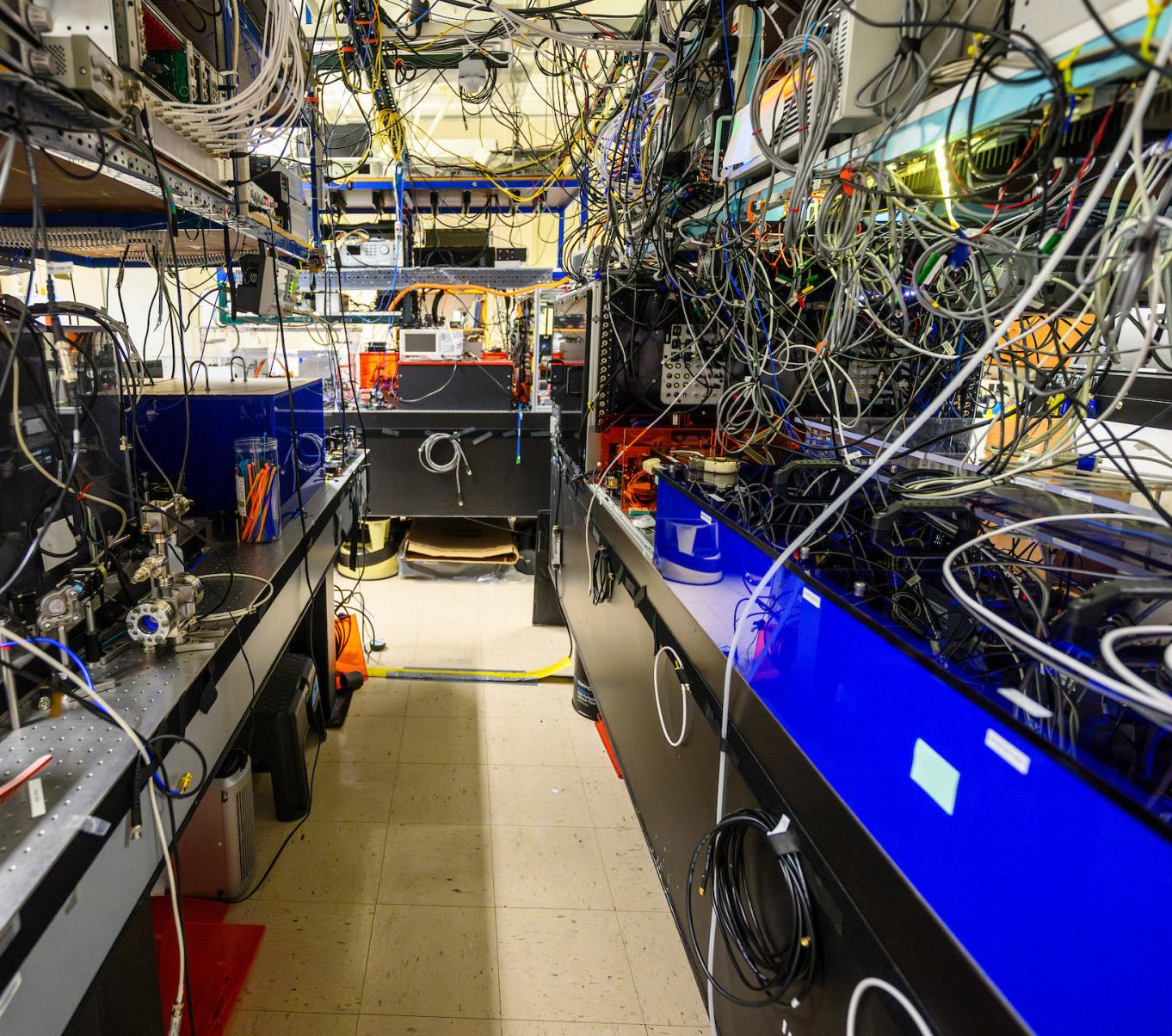
Teams of researchers at the University of WisconsinMadison spent months submitting proposals to the Department of Energy’s vast new Genesis Mission — an initiative centered around artificial intelligence (AI) but naming research goals in fields as varied as nuclear fusion and molecular biology. Many of UW-Madison’s proposals center around one burgeoning crosscollege priority: quantum.
The Genesis Mission, launched by an executive order in Fall 2025, says that the U.S. faces an AI “race for global technology dominance” requiring “a historic national effort, comparable in urgency and ambition to the Manhattan project.”
UW-Madison assigned a leader of the Wisconsin Quantum Institute (WQI) to coordinate the university’s response to the Genesis Mission, and its stated goals overlap with five of the six College of Engineering moonshots announced this May, including investment in quantum.
Executive Director of the WQI Ona Ambrozaite, who will coordinate the Genesis Mission response, told The Daily Cardinal quantum research is something that requires a team effort.
“We need the incentives to bring all of this together in kind of a sustainable way,” Ambrozaite told the Cardinal.
The Genesis Mission provides “incentives” for American quantum researchers to come together to share the work that they have been doing, according to Ambrozaite.
Ambrozaite, who also cofounded the Johns Hopkins
Science Diplomacy Group, said while international quantum research efforts are important, having domestic priorities is also necessary.
“[The Genesis Mission] is a national-level mission that would help us really translate the excellent foundational research that our faculty and teams are doing here into this real-world technology,” Ambrozaite said.
Mark Eriksson, director of the WQI and principal investigator of the Eriksson Group, told the Cardinal AI can help develop and maintain quantum hardware and software.
Among other areas of research, fast quantum computing can help researchers better visualize how atoms come together to form different molecules and materials, according to Eriksson.
“Once quantum computers get big enough, it’s hoped that people will be able to use quantum computers to help design better molecules,” he said.
Reach for the sky
Quantum research is on the College of Engineering’s list of Engineering Moonshots — an ambitious list of goals published May 2026 inspired by the challenges listed in the Genesis Mission.
“By doing moonshots, we’re going to solve some hard problems,” Grainger Dean of the College of Engineering Devesh Ranjan told the Cardinal. “For me, moonshots are these audacious goals for the next ten years.”
Ranjan said that developing quantum research and giving it practical applications could grow manufacturing. Currently, Wisconsin stands as the second highest-ranking state for
manufacturing employment — next to Indiana. Ranjan said he wants to bring Wisconsin back to number one.
“Manufacturing is in our DNA,” he said.
The Genesis Mission hopes to develop quantum research and computing through developing AI systems, bringing together American businesses, academia, national laboratories and existing scientific research.
A look to AI, nuclear fusion
The initiative accepted applications from a wide array of fields of scientific research — from manufacturing and materials to nuclear fission and fusion energy. Ten of the 26 Genesis Mission goals directly reference nuclear energy.
Quantum manufacturing, embodied AI and fusion energy cover three of the six engineering moonshots.
One of the engineering moonshots is “securing critical resources” in Wisconsin, which
aligns with a Genesis Mission goal of “securing critical materials” on a national scale.
Ranjan said UW-Madison and the greater Midwest have the opportunity and the resources to drive the change promised by the moonshots.
“It’s not about taking advantage of the resources,” he said. “It’s about how to protect our resources.”
AI data centers have been a source of contention in Wisconsin recently for environmental reasons, with DeForest community members recently pushing back against the development of a QTS data center within their town.
Ranjan said fusion energy is one of the most important things to consider when thinking about potential drives toward AI by the government.
“If we have the energy solution first, and then we’re also working jointly to make sure the large language models are less energy intensive…I think we have a game-changer,” he said.
By Zoey Jiang ASSOCIATE NEWS EDITOR
United States Citizenship and Immigration Services (UCIS) announced a new policy memo May 22 stating that individuals seeking a green card must return to their home countries to complete the process. Students who arrive on visas and stay for longer than its validity will be among those most affected.
The USCIS memo describes obtaining a green card, or an “adjustment of status,” as an “extraordinary act of administrative grace,” and a privilege granted by the government rather than a right.
From now on, “a foreigner who is in the U.S. temporarily and wants a green card must return to their home country to apply, except in extraordinary circumstances,” USCIS Spokesperson Zach Kahler wrote

in an announcement on May 22. “This policy allows our immigration system to function as the law intended instead of incentivizing loopholes.”
The change, apart from undetermined “extraordinary cases”, is meant to reduce the need to “find and remove” those who remain undocumented after being denied residency.
The USCIS announcement
said nonimmigrant residents, such as students, come to the U.S. for a specific purpose and must leave shortly after. However, the Department of Homeland Security has reported that foreign students overstay at much higher rates than any other type of nonimmigrant. In 2016, students “overstayed” more than twice the rate of foreign visitors with visas and eight times more
than visa waiver travelers.
Under long-standing practice, students on visas could apply for green cards right in the U.S. without having to uproot their lives, and the same goes for spouses,outstanding professors and researchers which the DHS classifies as priority workers.
The new policy could force people apart with no definite timeline. Green card processing times can take anywhere from several months to several years. At the University of Wisconsin-Madison, students are concerned.
“I just find [the change] another way that the current administration is trying to put more blockages in the way of people who want to get here,” Aniruddh Nambudiri, a UW-Madison student, told The Daily Cardinal. Continue reading @dailycardinal.com
By Zoey Jiang ASSOCIATE NEWS EDITOR
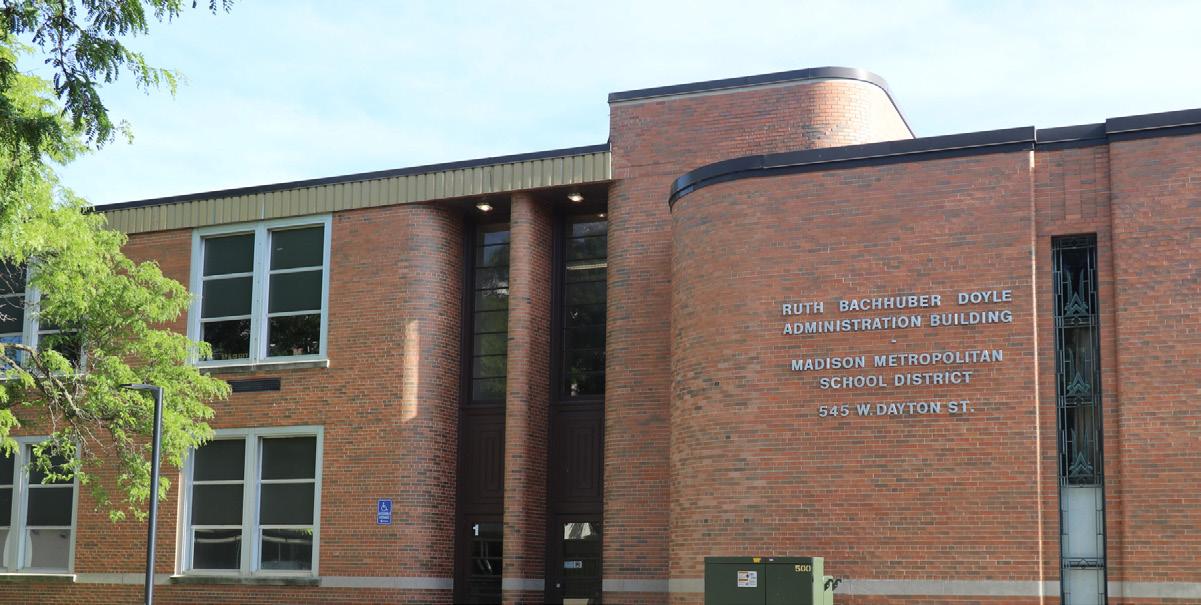
The Madison Metropolitan School District (MMSD) is seeking state approval to change how it ranks high school students for the Wisconsin Guarantee program, potentially affecting how many students are automatically admitted into University of Wisconsinsystem schools.
Students who place in the top 10% of their class at the end of the 11th grade are automatically admitted to all UW universities, save for UW-Madison, under a state program known as the Wisconsin Guarantee, provided they apply by the regular deadlines. Students who apply by the early deadline and rank in the top 5% of their class are automatically admitted to UW-Madison.
School districts are specifically required by state administrative guidelines to submit no more than the stringent 5% or 10% cutoffs. This means even if the overall number of students surpassed the
10% and 5% percentages, all students with GPAs in the top 10% and 5% were found to be eligible for automatic admission.
The Wisconsin Guarantee requires school districts to create a ranking system solely using students’ GPAs. In the fall of 2024, MMSD decided to use unweighted GPAs and kept that policy in 2025.
District directors Mary Jankovich and Langston Evans wrote a memo to members of the Board of Education May 18 requesting a student tie-breaking process. The board unanimously approved MMSD’s proposal at the May 18 School Board meeting.
“MMSD must implement a formal tiebreaking process to comply with both state statute and this guidance,” Jankovich and Evans wrote in the memo. “Approval of this process will ensure the district can consistently and fairly differentiate among students with identical GPAs while remaining fully compliant.”
Despite the lack of a tiebreak-
ing process, some high school students enjoyed the Wisconsin Guarantee program.
Lauren Alibali, a recent Madison West High School graduate, went through her admissions process being in the top 5% of her grade.
“I’d say I really valued the Wisconsin Guarantee because it made applying to college a lot easier. I knew I had a great option to rely on so I really liked that. I could see my hard work be reflected through my admissions process,” Alibali told the Cardinal.
Another recent Madison West graduate Zoey Kim wasn’t part of the Wisconsin Guarantee for UW-Madison, but she said it’s a beneficial program for instate students.
“I do think it’s a really good program because it gives students in the state more educational opportunities that otherwise wouldn’t get to them,” Kim said. “I got in [to UW-Madison] so even though I didn’t qualify,
By Courtney Krenn SENIOR STAFF WRITER
President Donald Trump attended a roundtable event in Chippewa Falls June 5 to highlight his administration’s support for Wisconsin agriculture. The event, held at Custer Farms, marked Trump’s first visit to Wisconsin since beginning his second term.
While the event was promoted as a discussion about farmers and rural America, much of the attention focused on broader political issues. During the hour he spoke, Trump discussed the economy, future elections and his political opponents. He only around 15 minutes of his time directly addressing agricultural policy.
Trump opened the event by praising Wisconsin farmers.
“We love the farmers. We love everything about your state,” Trump said.
Trump also pointed out what he described as “falling costs”.
“Your fertilizer’s down, your energy’s down, your oil, your gas is all coming way down. And frankly, I thought it would go much higher than it did,” Trump said.
Gas prices across the country have hit record highs since the war in Iran broke in February 2026. In early May, gas prices in Wisconsin averaged $4.378 per gallon, which is $1.448 more than a year ago.
Trump reminded attendees that his presence was not just for show, but to simply show his dedication to Wisconsin agriculture.
“I don’t need this, I got elected, what the hell do I have to be here for?” Trump said. “I could be home right now in the beautiful White House, enjoying watching somebody else on television talking.”
He then warned supporters about potential consequences in future election outcomes, particularly if Democrats took the presidency in 2028 or congressional majority this November.
“By the way, if [Democrats] win, this country is finished,” Trump said. “We’re in trouble. So I hate to say that you have no choice, but I don’t think you have much of a choice.”
The focus on issues beyond agriculture was not limited to Trump’s remarks. During the Air Force One arrival at the Chippewa Valley Regional Airport, protesters gathered outside to voice opposition to the administration in general.
Robert Gounly, a retired Wisconsin resident, said he was not protesting agricultural policy at all.
“I’m afraid I’m not protesting agricultural policies today. I’m a retiree and I have never worked on a farm. So I’m just using this as an opportunity to say my feelings,” Gounly told The Daily Cardinal.
Gounly said his feelings stemmed from what he calls a growing culture of hostility in American politics.
“I’m saying America is better than this. I think this administration has created an environment where it’s correct to hate, it’s correct to put out angry messages to people you don’t like, and that disgusts me,” he said.
Other protesters, like scientist Crispin Pierce, still kept agriculture at the forefront of their mission. Pierce told the Cardinal that Wisconsin deserves an administration that addresses both economic and environmental concerns.
“These are people who live the life of farmers and understand. They need support that both recognizes the need to help farmers in this country, but also looks at the sustainability of farms and talks about proper attention,” Pierce said.
Pierce argued that the administration’s message Friday did not match the needs of Wisconsin farmers.
“I think it’s an embarrassment to the people in this area to come in and try to promote an agenda that hurts farmers,” he said.

[Wisconsin Guarantee] didn’t prevent me from being able to still get in on my own.”
When looking at students with the same GPA at the 10% and 5% cutoff marks, they will now be assessed in three criteria in order: The student with the highest ACT composite score wins the tie; If they have the same score, the students will be compared with the total of their completed college credit-eligible courses, such as AP, Early College Credit or other dual-credit courses; if they are still
tied, the student with the highest attendance rate between ninth and eleventh will win the tie.
“ACT scores correlate with college GPA and continuation rates, while completion of college-level coursework is associated with stronger academic performance in college. Consistent attendance further reflects behaviors tied to degree completion,” the memo said. “Applied in sequence, these criteria offer a fair, objective and research-based method for resolving GPA ties.”
By Jane Dardick CITY NEWS EDITOR
From bus routes to a new train service, University of Wisconsin-Madison students are fueling alternative transportation options in Madison.
A 2023 UW Transportation Services survey showed 70% of students walk or ride the bus on good weather days and 80% on bad weather days.
UW-Madison currently has 9,000 parking spots for 76,000 faculty, staff and students, according to UW Administrative Services.
Andrew Liedl, the Madison Metro Transit marketing manager, said UW-Madison’s four biggest bus routes — routes 80, 81, 82 and 84 — make up 2.2 million rides every year and 18% of ridership overall.
“The university has been an important part of our community for many years,” Liedl told The Daily Cardinal. “Our transit system and the city itself would not be the same without it.”
Liedl said the Metro would not be able to offer the same frequency of service without the populations of students, visitors and school staff in Madison, and the region’s Metro Transit system would “look very different.”
Bikes are another popular method of transport used on campus. BCycle — a popular electric bike company — called Madison “one of the country’s most bikefriendly cities” on its website, as well as providing tips for campus riders.
Shawn Koval, the Dane County program manager for the Wisconsin Bike Fed, told the Cardinal making biking and walking accessible for students should be a high priority for the city.
“[Madison] is a growing city with a lot of outdoor recreation opportunities and a lot of fun things to do, so making sure non-car transportation opportunities are the easy choice for students is critical,” Koval said. “For students, having a holistic experience while here in Madison and for Madison to receive the benefit of student activity and business is important.”
Koval cited a study showing students who actively commuted to school were “positively associated with visuospatial skill, working memory, attention and general intelligence, as well as with grades, arithmetic scores, and reading fluency and comprehension.”
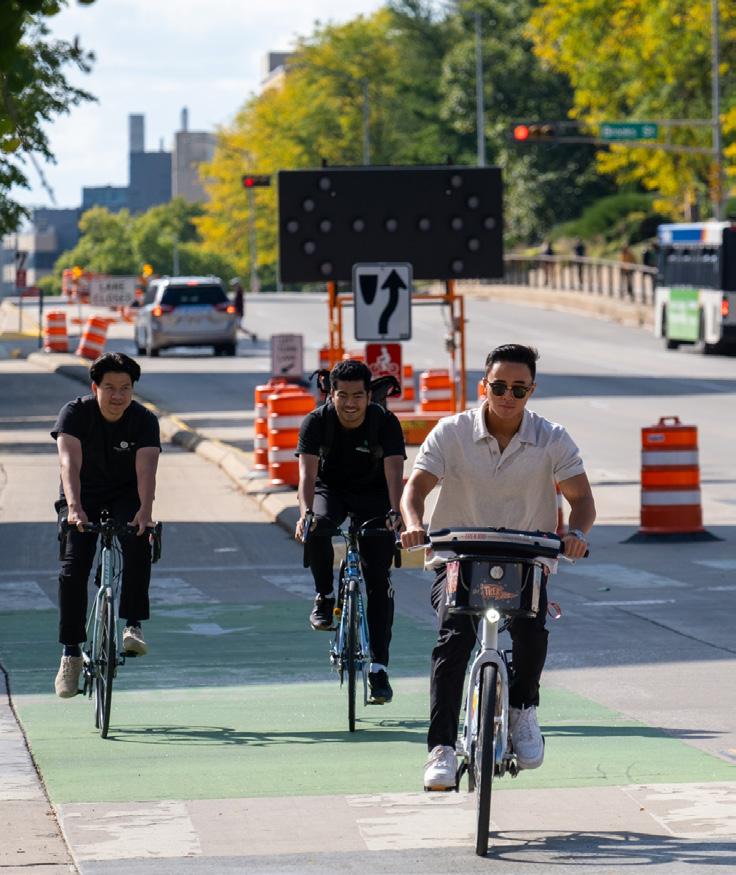
The benefits of biking outside of academics are still numerous, according to Koval. He noted traffic safety, healthier students, community involvement and environmental benefits as reasons why students should opt to bike.
Although Madison does not currently have a train service, the city officially sold the state’s former Human Services building to Landmark Development on June 2. The building will feature a train station for Amtrak’s Hiawatha West — a service providing two daily round-trip routes between Chicago and Milwaukee.
The executive office of public affairs of the Wisconsin Department of Transportation (WisDOT) told the Cardinal expanding a rail service to Madison “has been a goal of the state’s rail plans for many years.”
“Students would likely comprise a significant share of riders on any passenger services in Madison, as they are nationwide,” WisDOT said.
Amtrak does not plan to offer the service until 2030, with updates to bridges and rails required before operation begins.
Liedl also said student involvement is crucial as transportation grows and changes in Madison.
“As Madison continues to grow, students will remain important voices in building a transportation system that is more efficient, environmentally responsible, and better connected to education, employment, housing, and other opportunities throughout the region,” he said.
By Michael Reilly STAFF WRITER
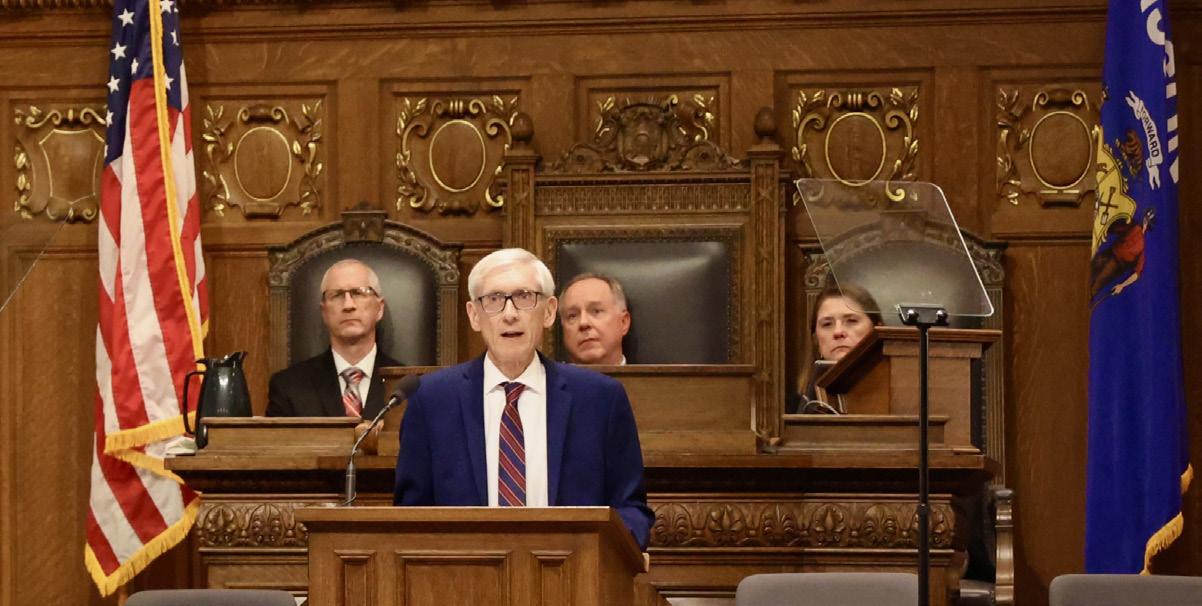
A $1.8 billion spending agreement backed by Gov. Tony Evers and Republican legislative leaders failed to pass in the Senate last month, despite polling showing overwhelming public support.
The package, negotiated by Evers, Senate Majority Leader Devin LeMahieu, R-Oostburg, and Assembly Speaker Robin Vos, R-Rochester, would have increased funding for special education and technical colleges while providing tax relief through payments of $300 to individuals and $600 to married couples.
Evers praised the agreement after its announcement, stating that the leaders were able to “put politics aside” on a plan that uses a portion of the projected $2.37 billion surplus to “do the right thing for Wisconsinites across our state.”
Throughout his two terms,
Evers has championed financial support for working families and public education in his budgets, particularly through his declarations of the Year of the Worker in 2024 and Year of the Kid in 2025. He also strongly committed to tax cuts in his 2026 State of the State address for the Year of the Neighbor.
Despite this support, the bill failed after an analysis by the Legislature’s nonpartisan budget office found it would have created a $2.9 billion deficit at the end of the 2027-29 biennium.
Controversy surrounds the deal as Evers, LeMahieu and Vos all retire at the end of this term. If the deal had passed, the three lame-ducks would then leave the deficit with the new governor, legislative leaders and budget next year.
In the 18-15 vote, three Senate Republicans joined Democrats on party lines to curb the deal.
Gubernatorial candidate Sen. Kelda Roys, D-Madison, who
voted against the proposal, said the Fiscal Bureau’s analysis heavily influenced her vote.
“Our job is to make responsible long-term fiscal decisions for the state of Wisconsin,” Roys told The Daily Cardinal. “You don’t spend money before you know how much you have.”
Roys added that economic uncertainty at a national level played a part in her decision, saying that rising costs amidst international conflicts make it “very difficult to plan as a state lawmaker.”
Since the beginning of the Iran war in February, prices have skyrocketed for Americans, including gas, energy, flights and other fuelrelated expenses.
After the bill failed to pass, a Marquette Law School Poll found that roughly 80% of Wisconsinites supported the agreement — including 77% of Republicans and 82% of Democrats.
The question given to respon-
By Ted Hyngstrom SENIOR STAFF WRITER
When the academic year ends, thousands of University of Wisconsin-Madison don’t leave — and the Madison economy thrives because of it.
UW-Madison students make up more than 16% of the city’s population, and their presence as workers and consumers stretches well into the summer months. More than 11,000 undergraduate students enrolled in summer classes for the 2025 summer session, and the university’s office of student financial aid lists close to 15,000 jobs available through the university alone.
For many students who stay, work is a necessity.
“I really didn’t think it’d be productive not to work because I’m paying rent,” Brendan Angel, a junior studying finance and information systems, told The Daily Cardinal. “I think it’s annoying how a lot of us have to keep paying rent for the summer.”
Angel, who works part-time as a DJ at Chasers 2.0, said his schedule fits well around his summer life.
“For me, it’s nice because the job right now is Thursday, Friday and Saturday — and so is DJing,” Angel said. “That’s why I kind of like these types of jobs because during the school year — during the week — I can just kind of have my free time to do what I want.”
Local businesses throughout downtown Madison often tailor their summer strategies around students’ needs. One example is local Wisconsin-themed retail store Wisconsin Design Team (WDT).
Catie Harris, a WDT employee, told the Cardinal WDT employs students in a variety of positions, including sales, internships, marketing and journalism. She said WDT “could not operate as it does” without the support UW students provide.
“Having students on our team allows us to stay continuously connected with our audience and remain informed about campus-related news,” Harris said.
Another local business, Mad City Moving (MCM), took the opportunity to expand their business to the student community with student moving and storage services.
MCM owner Brenda Roessler told the Cardinal her business stepped in to help students move when some private apartments stopped doing so during the COVID-19 pandemic.
“We found that as an opportunity to assist students and out-of-state parents in the process to make it smoother,” Roessler said.
Roessler also discussed MCM’s philanthropic efforts. In collaboration with the Department of Financial Aid, University Housing and two students, MCM supports Badger Reclaim — an initiative allowing students to discard unwanted items at a pick-up point. MCM then provides transportation and storage of the items for future distribution.
“That’s really the biggest thing that I can take away with the students: how we’re now able to assist students who have items at move-out in May that they no longer want,” Roessler said.
Both MCM and WDT also consider the impacts of seasonal mobility.
During the 2020 census, Wisconsin created a Complete Count Committee (CCC) to ensure students who moved away during the summer recess would still be counted.
After spring move-out, Roessler said household moving keeps her business steady during the summer, instead showing a slowdown during the winter months.
“We stay pretty steadily busy from April through October, and then it’s a slower season during November through the winter,” Roessler said.
WDT’s Harris said the busiest time of year coincides with the first and last weeks of the school year, with the business pivoting towards Wisconsin residents during slower months.
“With many students leaving town, we design collections geared towards people who live in [and] are from Wisconsin and the Midwest as a whole, rather than just our student audience,” Harris said.
As a whole, Harris stressed the importance of students on WDT’s operations.
“Students have an incredibly large impact on WDT,” Harris said. “Our brand could not operate as it does without the engagement and support we get from UW students.”
dents outlined the bill’s appropriations but did not mention its potential to leave Wisconsin’s budget in the red.
Roys believes the poll’s results may have been different if it included the findings of the Legislative Fiscal Bureau, and said the poll was not conducted in a “responsible and truthful way.”
On June 4th, Sen. LeMahieu released a statement citing the poll’s findings. He urged two more Senators to “stand with
the 80% of Wisconsinites who support [the] compromise.”
Because much of the Senate is currently focusing on campaigning for the midterm elections in November, it’s not likely two senators will raise their hand to re-vote and pass the deal.
Although the proposal failed, Roys said Senate Democrats are “eager and willing” to negotiate a deal with a smaller price tag, particularly one focused on education.
By Addison Dama SCIENCE EDITOR
Five University of Wisconsin system schools awarded degrees to 29 incarcerated students for the first time in more than 50 years, helping set students up for success in life after prison, according to a Department of Corrections press release and Peter Moreno, the Director of the Prison Education Initiative.
The Prison Education Initiative is a University of Wisconsin-Madison program that gives those incarcerated in Wisconsin access to higher education by offering courses at correctional facilities and in-person instruction. The project also includes tutoring, financial aid and academic advising, one-on-one mentoring, reentry planning and alumni support after release.
The program is designed to increase post-release employment and reduce reincarceration rates. Largely, a main goal is to boost economic activity and create safer communities in Wisconsin, according to the DOC press release.
Launched in 2022 with a $5.7 million Workforce Innovation Grant, the Prison Education Initiative has helped more than 200 students earn associate’s degrees or other UW credentials, according to a DOC press release. This year marks a significant milestone, as its graduates will be the first incarcerated students to earn a bachelor degree from UW-system schools other than Madison in over 50 years.
The Prison Education Initiative (PEI) began by supporting UW-Madison courses at Oakhill Correctional Facility. Today, five UW campuses — including UW-Eau Claire, UW-Green Bay, UW-Madison,
UW-Milwaukee and UW-Stout — now offer courses at 11 DOC facilities. This year, UW-Green Bay awarded 15 bachelor’s degrees and 9 associate of arts and sciences degrees; UW-Eau Claire awarded 8 bachelor’s degrees, and UW-Stout awarded 6 bachelor’s degrees, according to Moreno.
“I would say education is the best rehabilitation there is,” Cristobal Guerrero-Kresovich, one of the first incarcerated individuals to earn a UW bachelor’s degree through the PEI, said in a press release. “It trumps anything that anyone could do inside the prison system.”
Participation in prison-based education reduces the risk that a student will commit new crimes and return to prison by about 40 percent. This means lower incarceration rates, lower costs to taxpayers and higher employment.
“Investing in education in correctional facilities is a common-sense strategy to meet our economy’s need for skilled workers and to help individuals gain the skills needed to succeed in our communities,” Governor Tony Evers said in a news release.
But for graduates, the impact is deeply personal. A college degree opens up opportunities for employment, improves self-confidence and helps incarcerated individuals build a plan to move beyond prison.
“I’m looking forward to turning in my blue collar for a white collar,” Guerrero-Kresovich said. “When I go to the job board and it says ‘bachelor’s degree required,’ I know in 60 days I’ll be able to apply for those positions.”
By Yareli Gutierrez STAFF WRITER
For decades, Madison has been considered a spearhead for LGBTQ+ activism. This June, a variety of pride month festivities in Madison are celebrating that continued effort — on and around the University of Wisconsin–Madison campus.
For students staying in Madison this summer, Pride Month has a full calendar of events including drag bingo, art markets, brunches and festivals. The events are great ways to celebrate LGBTQ+ pride, support queer artists and connect with the broader Madison community.
One of the month’s marquee events, Live on Queen, will take place on June 26 at the Orpheum Theater. Beginning at 5 p.m., the free drag variety show will feature performances and activities for all ages, including magicians and face painting to spirit tastings and, of course, live drag performances. Events like VolunQueer day, Sun Prairie Pride Fest and the Pride Ride will take place throughout June and showcase the diversity of Pride celebrations around Madison, featuring music, nightlife, family-friendly festivals and community gatherings.
The gold star of Pride events in Madison will be The Big Gay PRIDE Market, taking place June 19-21 at the Alliant Energy Center. The

Big Gay PRIDE market is a key celebration during Pride Month and a great way to connect with artists, vendors and
local businesses in the local queer community. With over 200 participants, community members are invited to
explore vendors’ booths, learn about Pride Month’s history, participate in clothing swaps and watch local comedy and
drag shows.
This year, the market includes a new event — The Big Gay Pageant on Friday, June 19 from 7-9 p.m. The event aims to give the community a way to “support upand-coming performers from all over Wisconsin,” according to their website.
On the same weekend, students and community members 21 and older can attend the Pride Drag Brunch hosted by Bianca Lynn Breeze at the Bur Oak on June 21. This event will be a high-energy, joy-filled celebration of love, self-expression and fierce drag entertainment,’’ according to Bur Oak.
The brunch will include drag performances, music, food and drinks, giving students and community members another way to celebrate Pride with their loved ones, all while enjoying local entertainment.
Just outside of Madison, Stone Horse Green will host Middleton Pride 2026 on June 13 with free admission. The family-friendly festival includes music, performances and activities, and a variety of local vendors, organizations and Queeraffirming businesses.
The diverse offering of events during Pride Month offer students and Madison locals endless opportunities to explore the city, connect with and learn from local LGBTQ+ organizations and support queer-owned and queer-centered spaces.


Every incoming freshman has heard horror stories about dining hall food, but Madison’s food scene is not limited to the walls of Gordon Hall.
“I got really sick of the dining hall,” Hirsch said, emphasizing that it was difficult to choose from the same rotation of meals every week, especially after home-cooked meals over breaks.

bus routes to get to her classes, which was harder on weekends or late at night when less buses were running.However, new Badgers don’t only need to worry about settling into dorm life their first semester, they’ll also need to start thinking about housing for the following year.
“There was a lot of external pressure to find a place early first semester,” Hirsch said.
Most UW-Madison undergrads, including freshmen, sign leases for the next year by October or November of the previous year, according to a report from the Department of Planning and Landscape Architecture.
Hirsch, who didn’t sign a lease until February during her second semester, had different advice for incoming freshmen. It’s better to focus on settling into college during the fall and look for housing during the spring, she said.

Finch suggested going to the dining hall earlier before the lunch or dinner rush or walk to a less crowded dining hall. He also recommended using meal exchanges at the restaurants in the student unions for a change of pace.

At a university that typically takes in more than 8,000 freshmen every year and has a total population of over 50,000 students, incoming students often struggle to find a consistent social group.
“The biggest challenge I faced this year was trying to be social as much as possible,” DeCook said.
“I would definitely say the most important thing is just try to find your group, put yourself out there,” Finch said. “It definitely can be difficult, but UW-Madison is massive, so you’ll find people pretty easily with the same interests as you.”

“There’s also an incredible amount of great restaurants around town, and so definitely check that out,” Finch said.
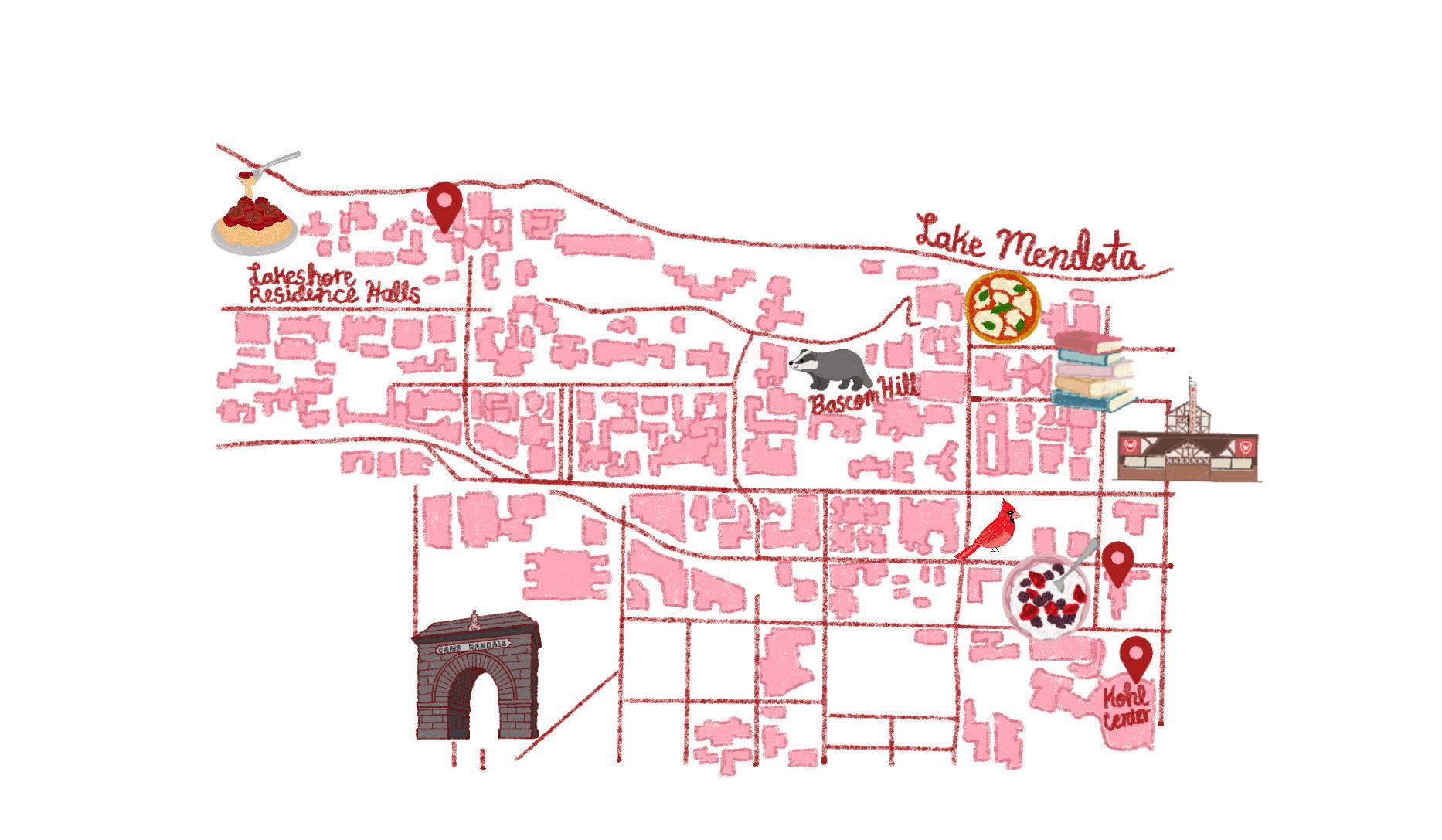

Most students will live in the dorms their first year, and it can be a dramatic adjustment for students used to living at home with their parents. DeCook spent his freshman year at Waters Residence Hall on Lakeshore.



Both Finch and Hirsch recommended incoming freshmen take advantage of the Student Organization Fair to meet other students and explore club options. This fall, the fair will be held from 5 p.m. to 8 p.m. on Sept. 9 and 10 at the Kohl Center and host over 400 student organizations on campus.

“Something I wish I had known before attending UW-Madison is that there is a definite disparity between the culture of Lakeshore and southeast area dorms,” DeCook said. Finch spent his freshman year at Witte Hall, and said there were stark cultural differences between the traditionally quieter Lakeshore dorms and the noisier Southeast dorms. During his first semester, Finch said the noise level impacted his sleep and ability to focus while studying in his dorm.
“Southeast, specifically Witte [and] Sellery [are] very, very talkative, and can be very, very loud Thursdays, Fridays and Saturdays, or even Tuesdays and Wednesdays,” Finch said. “In my case, that was a shell shock for me.”
By Ryan Kim ARTS EDITOR
The first dementia villages in the United States will open in Sheboygan in July and Fitchburg in the fall of 2027, offering dementia patients an alternative to traditional nursing homes and memory care facilities.
The first two U.S. villages are Dementia Innovations’ Livasu in Sheboygan and Agrace’s Ellen and Peter Johnson Dementia Village in Fitchburg. Both villages were inspired by BeAdvice’s Hogeweyk in the Netherlands, the world’s first dementia village, and both facilities worked closely with BeAdvice for several years to build villages in the U.S.
Dementia villages are care facilities where dementia patients live in communities with familiar amenities like grocery stores, salons, spas and theatres staffed by specially trained staff devoted to making residents feel at home.
Dementia is an umbrella term for symptoms affecting memory and thinking, with Alzheimer’s disease being the most common form. About 110,900 Wisconsin residents aged 65 and older have Alzheimer’s, while more than 55 million people across the world live with dementia, with that number predicted to double every 20 years.
Lynne Sexten, Agrace’s president and CEO, told The Daily Cardinal the dementia
village model took time to reach the U.S. because it requires significant investment while challenging traditional approaches to memory care.
“The dementia village model challenges how care is designed, financed and regulated in the United States,” Sexten said. “Memory care systems in the U.S. tend to favor rigid structure and efficiency. They are built around clinical care and risk control…
Good dementia care is not only clinical excellence. It is creating moments of connection, familiarity and joy.”
Eloy van Hal, Hogeweyk co-founder and BeAdvice senior managing advisor, told the Cardinal Hogeweyk was created to provide people with dementia a normal life instead of an institutional one.
“People with dementia are people first, and they respond normally like you and me,”
van Hal said. “That’s what we have to realize first and learn more about.”
Despite initial skepticism, Hogeweyk has operated successfully since opening in 2009. Fifty percent of patients received antipsychotic drugs when the facility operated as a nursing home in 1993, compared to 8% in 2015. van Hal said there’s a difference when it comes to how the Netherlands and the U.S. operate their care facilities.
“When you move in, you
average a use of eight different kinds of medications,” van Hal said. “We promote that people live long and die quickly...But that doesn’t mean that you do all kinds of medical interventions.”
van Hal said creating the village showed how difficult it’s been to change the current clinical and medical model.
“Many people said, ‘You’re crazy’… but after the opening, many people became inspired,” van Hal said. “It became a bigger success than we ever hoped.”
Agrace’s village will consist of eight households organized around residents’ lifestyles and values, according to Liz Kopling, Agrace’s assistant vice president of marketing and communications.
“It will be as close to home as possible,” Kopling told The Cardinal. “We’re trying to make that possible by building a village that is just like an average home that you would see here in the greater Madison area, so they can experience life the way that they would be living it at home with lots of access to nature.”
Sexten said she hopes the model changes how society views dementia patients and care.
Agrace’s campus will be staffed by specially trained caregivers and healthcare students in exchange for subsidized workforce housing, and offer a day club to adults with dementia still living at home.

“We de-institutionalized a nursing home and offered people a neighborhood instead of an institution,” van Hal said. “The doctors are here, the nurses are here, but you don’t see them because they’re not dressed like doctors. They still are doctors, they still are nurses, but people receive the support and care they need in a much more normal way.”
While both villages follow Hogeweyk’s model, affordability remains a challenge. Kopling said Agrace intends to match costs to other memory care offerings in Madison while supporting partially subsidized care based on financial need, while Livasu’s prices range from
$95,000 to $175,000.
van Hal acknowledged that bringing the Hogeweyk model to the U.S. presents challenges. While the Dutch dementia village is donation-funded, American dementia care is often more expensive and privately funded.
As the first U.S. dementia villages prepare to welcome residents, Kopling said she hopes the villages will change not only how dementia care is offered, but how people living with dementia are perceived.
“We can give people humanity and dignity by just treating them as people,” Kopling said. “The dementia village at Agrace is going to give people hope that there is a wonderful life to be lived.”
By Brad Wensel STAFF WRITER
The Bat Brigade’s weekly surveys provide valuable information to researchers while allowing community members to participate in science. With four of Wisconsin’s eight bat species’ populations threatened, these surveys help researchers monitor how the local bat population responds to disease outbreaks like white-nose syndrome (WNS).
“It can happen pretty fast. You can have a 90% decline of the population in one season,” Makeela Magomolla, a bat brigadier and master’s student in the Nelson Institute for Environmental Studies, told The Daily Cardinal.
Bats are a vital part of Wisconsin’s ecosystems and are major consumers of agricultural and forest pests, according to the Wisconsin DNR. They are capable of eating up to 1000 insects an hour.
“They’re definitely misunderstood. Most people overlook them because people aren’t usually out at night,” Magomolla said.
Because bats play an important role in controlling insect populations, their decline has become a growing concern for researchers. The U.S. Geological Survey’s National Wildlife Health Center in Madison is working on a vaccine to help bats fight a more recently found fungus.
“They hope to use vaccine efforts to help bats in western states, where populations haven’t developed immu-
nity,” Magomolla said.
Much of this concern is related to White-nose syndrome. The fungal disease discovered in Wisconsin in 2014 is characterized by white fuzz on bats’ noses and wings. It disrupts hibernation by causing bats to wake up more often, burning through their fat reserves and leading to high winter mortality rates.
The Bat Brigade collects data such as locations of specific bat calls with echometers, and later sends this data to Wisconsin’s Department of Natural Resources (DNR).
Magomolla and other members of the Bat Brigade have found seven of the eight bat species in Wisconsin within the Lakeshore Nature Preserve, and are still searching for the last one, to better survey the species.
“It’s like the last Pokémon we need to get,” Magomolla said.
The recordings from an echometer can help identify bat species that are present in the area, but they cannot determine how many individual bats there are. It is impossible to tell whether multiple calls come from different bats or just one bat calling repeatedly.
There have been acoustic recordings suggesting the presence of the eighth species within the Lakeshore Nature Preserve, but confirming its existence is more complicated.
“The only way to be 100% sure would be to set a trap and verify by hand, so it’s not official yet,” Magomolla said.
Besides acoustics, the Bat Brigade is able to track bat populations with bat boxes placed on the trail to Picnic Point within the Lakeshore Nature Preserve. The number of bats peaked around 360 in 2014, but dropped below 100 from 2017 to 2021 due to white-nose syndrome, according to the Bat Brigade.
Since WNS was found for the first time in New York in 2006, it has spread to most U.S. states and Canadian territories, causing the little brown bats, northern long-eared bats and tricolored bats’ population to decline by over 90% according to the National Park Service — all of which are common in Wisconsin.
Over the last several years, some bat populations around the U.S. have started to develop a natural resistance to WNS, according to the U.S. Geological Survey. They hope to use vaccine efforts to help bats in western states where populations haven’t developed immunity.
In addition to the scientific value provided by the research, the Bat Brigade gives students and community members a chance to participate in conservation work.
“I came to an info meeting and was like ‘I’m not affiliated with the university, what can I do?’ and was told ‘everything’” Magomolla said, referring to her experience before starting her master’s program.
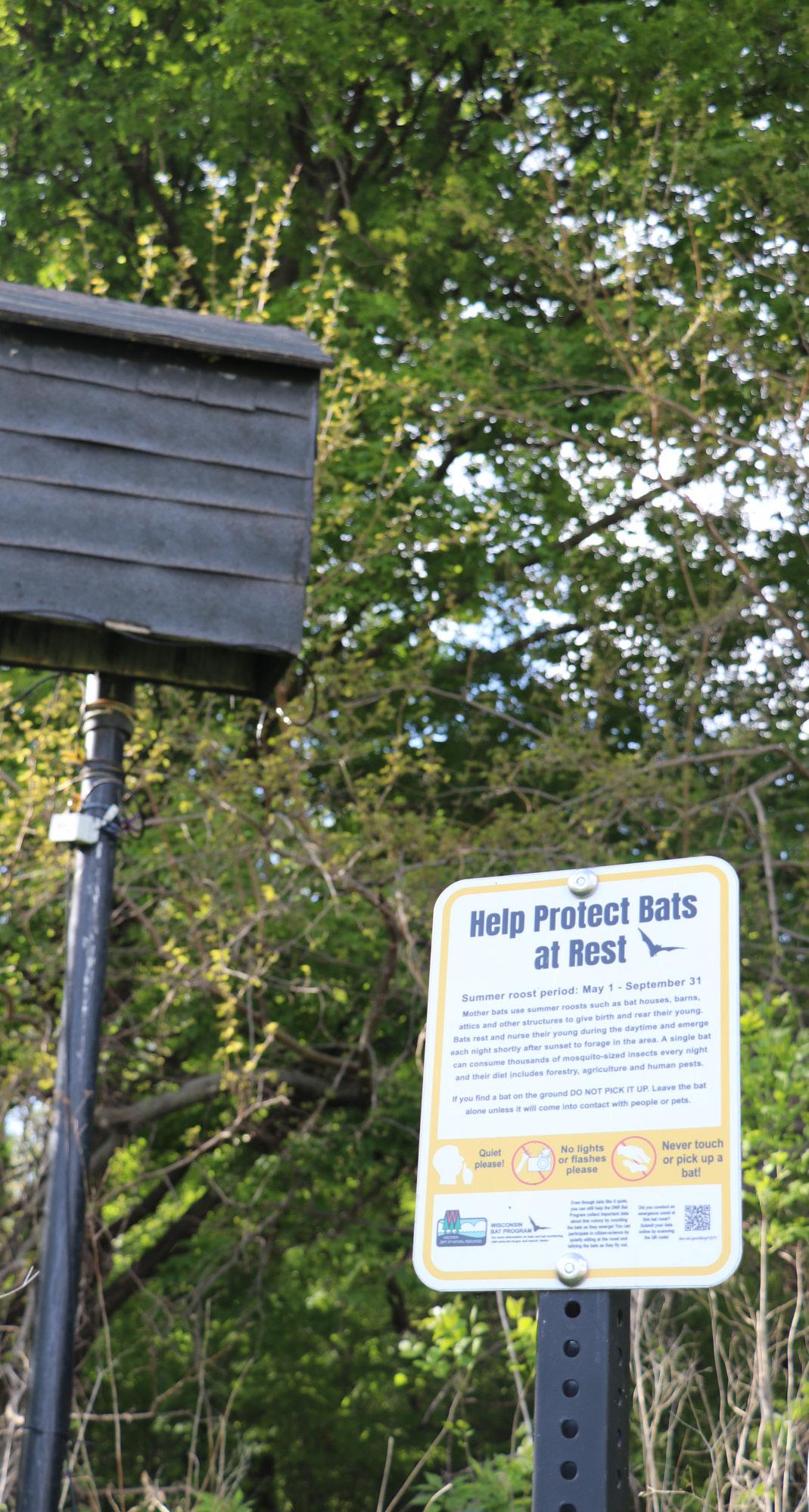
Other members said some volunteers travel from nearby cities like Chicago and Minneapolis, because there are no similar programs in the Midwest.
As bat populations continue to recover and monitoring efforts expand, the Bat Brigade offers scientists and community members alike a chance to contribute to wildlife research in their own backyards.

By Ava Hudson STAFF WRITER
After closing the 2025 season with a 17-7 loss against rival Minnesota Golden Gophers in the yearly Axe game, the Badgers ended with a disappointing 4-8 record — their worst in 30 years. For a program that once had an impressive streak of 22 consecutive bowl games from 2002-23, its results this season fell well short of expectations.
As Wisconsin gears up for the 2026 season, their focus shifts toward rebuilding the core aspects of Badger football: a strong run-game and dominant defense. The Badgers hope to put one of their most difficult seasons behind them and improve to a winning record this year.
In the Luke Fickell era of Wisconsin football, the team has continued to trend downward. What started as former Athletic Director Chris McIntosh’s first and largest hire, turned into an overall team record of 17-21 with Fickell as head coach. Struggles under head coach Luke Fickell, significant roster turnover, offensive production and an inconsistent defense have emerged as the team’s biggest problems.
Football under Fickell
Fickell’s original seven-year, $7.8 million a year contract was set to end in 2029, but despite last seasons’ poor results, he still received contract extensions in 2023 and 2024, lengthening his contract to 2032.
After the 2025 season, Fickell requested to not receive another contract extension. There has yet to be any discussion about buying out his contract as both Fickell and the athletic department have high hopes for the 2026 season.
The Badgers’ offense struggled last season, finishing 14th in the Big Ten with a 2-7 record in conference play, and two back-to-back shutouts to The University of Iowa and Ohio State. The team averaged 12.8 points per game, scored only 19 touchdowns and ended the season No. 4 in the conference in rushing yards allowed per game.
After the rough start to the 2025 season, Athletic Director Chris McIntosh issued a message to fans acknowledging the program’s struggles while reaffirming his support for Fickell and increased funding for the program.
“Athletics is committed to elevating the investment into our foot-
ball program to position us to compete at the highest level,” McIntosh said in the statement. “As a department, we must provide our coaches the tools necessary to succeed.”
McIntosh pointed to infrastructure, staffing and recruiting as key areas for investment as the program works to return to contention in the Big Ten.
New offensive recruits
In an effort to revitalize the offense, the Badgers acquired quarterback Colton Joseph from Old Dominion. The Sun Belt Offensive Player of the Year threw for 2,624 yards and 21 touchdowns, and rushed for 1,007 yards and 13 touchdowns for Old Dominion last season. Joseph has the potential to make a difference for Wisconsin, providing the dual-threat output the Badgers have been looking for.
Along with Joseph, the Badgers’ offseason additions include running back Abu Sama III from Iowa State and the University of Minnesota’s (UMN) wide receiver Malachi Coleman. Sama III rushed for 732 yards and 5 touchdowns last season, helping the Cyclones to an 8-4 record. Coleman averaged 16.6 yards per reception for the Gophers last year.
New running backs coach Jayden Everett helped recruit Sama III to Wisconsin, adding an experienced playmaker to a backfield looking to rebound in 2026. Everett joined the Badger coaching staff in January 2026 after coaching at The University of Michigan and UMN.
Injuries have plagued Wisconsin football. In 2023, Tanner Mordecai broke his throwing hand and missed a few games. Early in the 2024 season, Tyler Van Dyke tore his ACL and was out for the year. Last year, Billy Edwards Jr. only appeared in two games after getting hurt in the opener.
A defense in need of attention
The Badgers biggest area for improvement is their pass defense. Last season, the Badgers ranked No. 13 in the Big Ten in passing yards allowed per game. To address those struggles, the Badgers added cornerbacks
Cai Bates and Javan Robinson through the transfer portal.
Bates appeared in seven games for the Florida State Seminoles, and entered college as a four-star recruit and a top-20 cornerback prospect for the 2024 class. Robinson spent
the last two seasons at Arizona State where he posted a career-high 42 total tackles in 2025.
Also joining the Badgers’ defense is senior safety Marvin Burks Jr. from Missouri and Justus Boone, a redshirt senior at the University of Arkansas. Burks adds experience to a young safety room, recording 131 total tackles in three seasons. Boone lacks the same experience, but as an edge defender, he adds the build the Badgers are looking for to improve on the rush.
Beyond 2026, class of 2027 four-star recruit Mekhi Williams committed to Wisconsin after decommitting from Florida State. Williams is the No.1 ranked safety in Florida and ranks 107 nationally.
On the other side of the goal line, there were a few bright spots, particularly late in the season. In a win over the University of Washington, the defense held the Huskies to just 10 points, never allowing them to establish a consistent rhythm. The Badger defense also held Oregon, Illinois and Minnesota to below 20 points with minimal yardage.
Returning linebackers Mason Posa and Cooper Catalano will lead the Badgers defense once again. The duo served as the foundation to Wisconsin’s defense and will be counted on to provide leadership and stability in 2026.
The Badgers experienced significant roster turnover following the 2025 season, with 23 players departing the program, including wide receiver Vinny Anthony II, tight end Tucker Ashcraft, running back Dilin Jones and offensive lineman Joe Brunner.
Fickell and the Badgers brought in one of the largest recruiting classes in program history with 34 new additions to the roster. With the funding increase, they were able to outbid teams for many top players, creating plenty of opportunities for the Badgers’ next season.
Former Jacksonville Jaguars coaching fellow Ari Confesor and former NFL special teams coordinator Big Ligashesky are also joining Everett on Wisconsin’s coaching staff ahead of next season as the new receivers coach and special teams coordinator, respectively.
The Badgers marks Ligashesky’s the seventh college program where he has held a special teams role.
Continue reading @dailycardinal.com
By Luca Muehlbauer SPORTS ASSOCIATE EDITOR
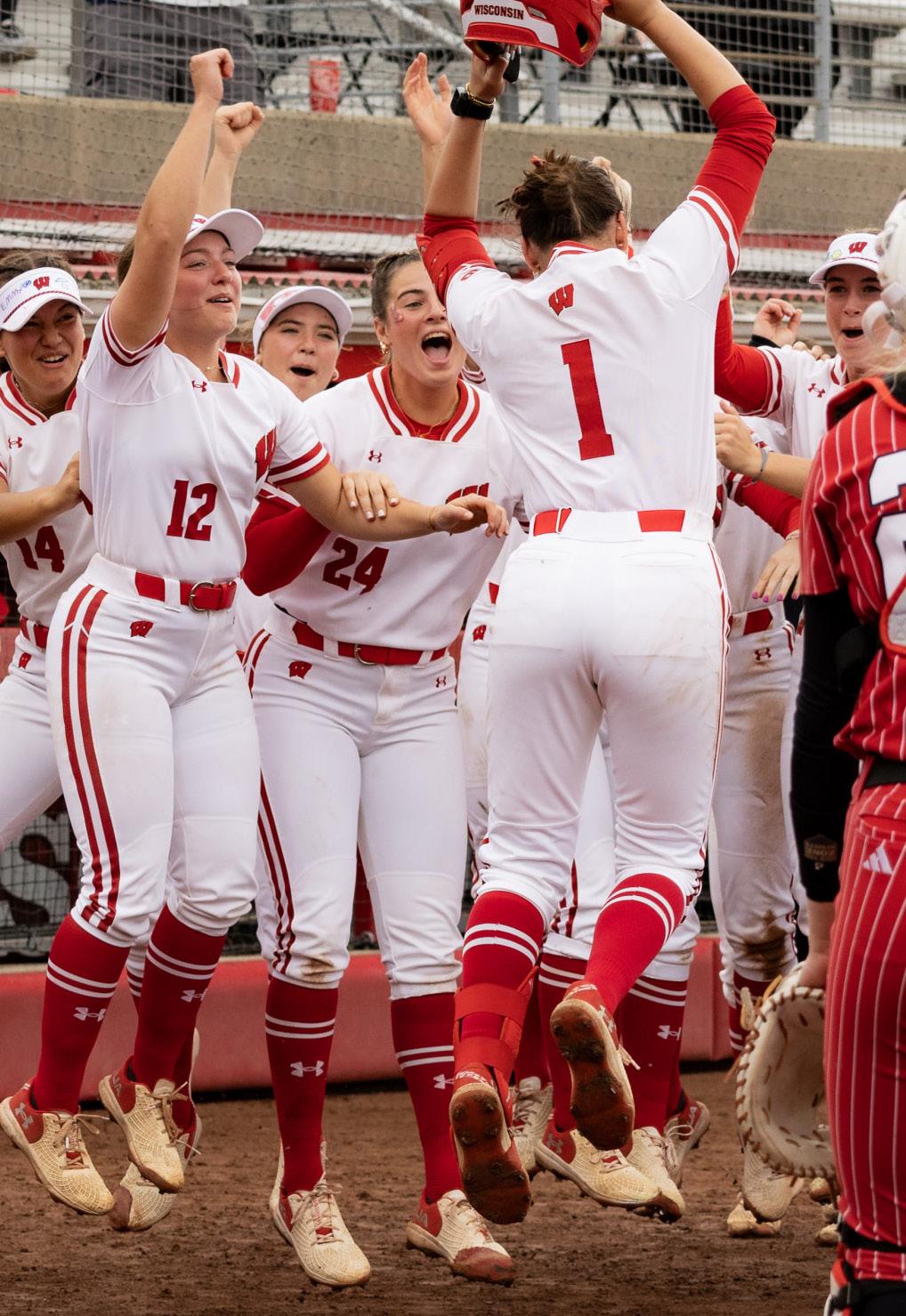
The Badgers finished their softball season 33-21 (14-10 Big Ten), tied with 2025 and 2001 seasons for the third most wins in a season in program history. Wisconsin also made their first appearance in the NCAA tournament since 2022 and made it to the Big Ten Tournament semifinal for the third time in program history.
The Badgers started the year 13-8 heading into conference play. UCLA swept the Badgers in a three game series early in the season. Over the next ten games, Wisconsin bounced back and went 8-2 before going 0-3 with Nebraska at home.
With twelve games left in the regular season, the Badgers went on a 9-3 run to clinch the No. 7 seed for the Big Ten Tournament.
In the first round of the tournament, Wisconsin faced No. 10 Purdue. In the last two innings of the game, the Badgers put up four unanswered runs against the Boilermakers and clinched their first Big Ten Tournament win since 2024.
In the quarterfinals, the Badgers played No. 2 Oregon, pulling off a huge upset and beating the Ducks for the first time in program history. Wisconsin scored in six of the seven innings, scoring 11 runs and securing a spot in the Big Ten Tournament semifinals.
Wisconsin fell to UCLA 19-5 in the semifinal, but that didn’t stop them from getting a bid to the NCAA Tournament.
The Badgers earned the No. 2
seed for their regional bracket and were grouped with Baylor University, the University of Texas and Wagner College.
The Badgers opened the NCAA tournament with a walk-off win over Baylor in the ninth inning. After their impressive first win, Wisconsin fell to Texas 9-0 and later lost to Baylor, officially putting their national championship dreams to bed.
After an impressive season, head coach Yvette Healy’s five-year contract agreement was extended through June 30, 2031, holding her title at Wisconsin since 2010.
A lot of Wisconsin’s talent hails from nearby Madison. Twelve of the 22 players on the roster are Wisconsin natives and some of the biggest stars’ skills were developed locally.
The Badgers recruitment of homegrown talent has provided the team with a stable dugout in recent years. Hilary Blomberg, a Verona native, broke the record for most home runs in a single season in program history with 16 home runs in the 2026 season.
Blomberg led the team with 60 hits, 16 home runs, 51 RBIs, and a .357 batting average — with the team batting average sits at .305.
After returning to the NCAA Tournament and tying for the third-most wins in program history, Wisconsin will enter 2027 with momentum. With much of the roster returning and team chemistry at an all time high, eyes will be on the Badgers — especially Blomberg — as they enter the 2027 season.
By Shreya Bhargava STAFF WRITER
I have spent a concerning amount of my life trying to make myself sound impressive in 150 words or less.
Resume bullets. Cover letters. Personal statements. LinkedIn descriptions. The tiny boxes on applications that ask you to explain your entire personality, leadership style, career goals and greatest obstacle overcome before the page times out. Somewhere between formatting resume margins and trying to make “sending emails” sound like a transferable skill, it becomes hard not to wonder what all of this is supposed to add up to.
A job, obviously. An internship. A better school. A better opportunity. A successful future.
But then what?
We are taught to treat success like a ladder: good grades lead to a good resume, which leads to a good internship, which leads to a good job, which leads to a good life. The problem is this version of success asks us to keep climbing without ever stopping to ask whether the ladder is leaning against the correct wall.
Success is often presented as something external and provable: a salary, a relationship, a perfectly planned future. However, a meaningful life cannot be measured that simply. The most important parts of success are often the least visible from the outside.
Psychologists call this contingent self-worth: the habit of tying your sense of value to whether you meet certain standards. For some people, that standard is academic achievement. For others, it is approval, appearance, competition, career success or being seen as someone put together. You do not just want to succeed — you need success to confirm that you are enough.
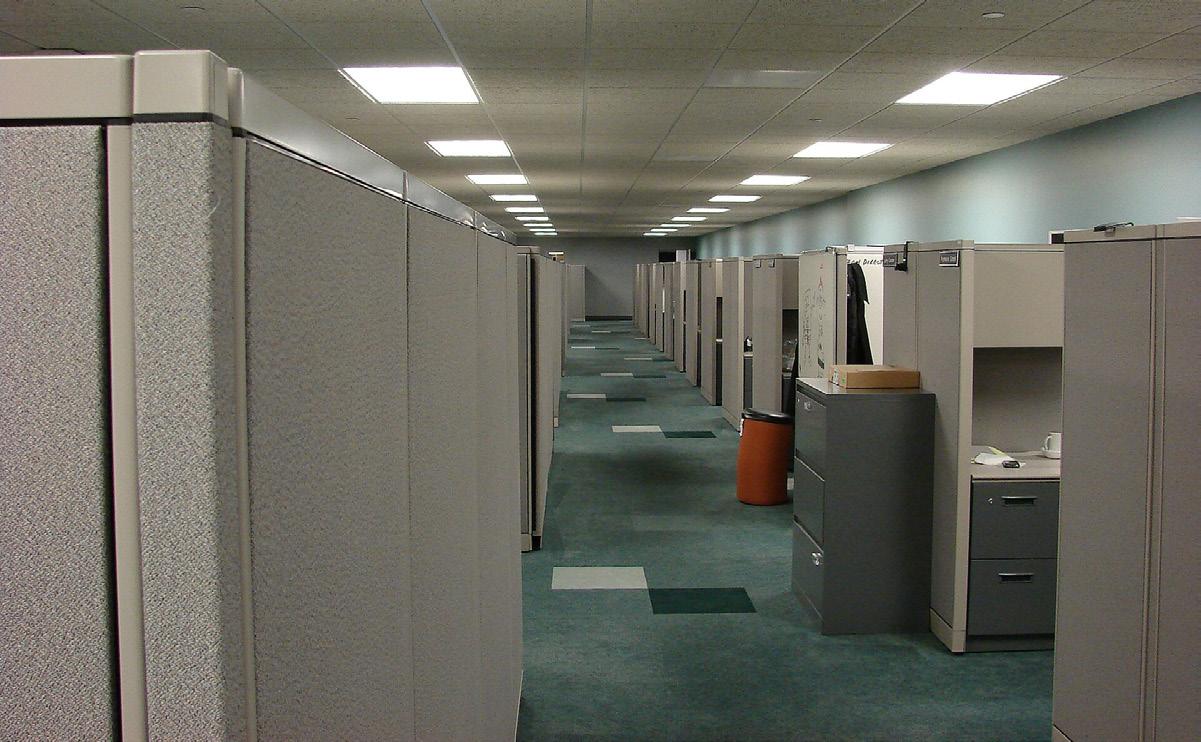
This is especially true in that strange age range between 18 and 22, when you are technically an adult,
but every decision still feels like it could determine your entire future. You are old enough to be expected to know what you want, but young enough that half the time you are still figuring out how to do laundry correctly or make a phone call without mentally rehearsing it first.
Yet somehow, this is also when we are supposed to be making huge life decisions. We are expected to pursue a career, build experience, network, apply to the right opportunities and somehow know where all of it is heading.
The pressure is not always loud, but it is always there. It sits in the back of your mind when you are studying late, refreshing your inbox, applying to another internship or wondering if you are already behind in a race you never meant to enter.
The strangest part is that most of us are doing all of this for a word we cannot even define: success.
Everyone strives for it. But when you ask people what success actually means, the answers are all over the place.
I once asked someone how they would know if they were successful. They did not hesitate: spouse, two kids and $300,000 a year.
Honestly, I respected the confidence. There was something almost peaceful about having an answer so clean. No spiral, no twelve-step definition, no “it depends.” Just a number, a family and the feeling that life had gone according to plan.
But the more you sit with that answer, the more complicated it becomes.
What if you make the $300,000, but hate the way you spend your days? What if you find a spouse but the marriage is lonely? What if you have the kids but one of them gets sick? What if you get everything you said would make you successful and then life does what life does and takes something from you anyway?
That is not meant to be
depressing. It just means success is hard to define because no definition can survive every possible version of being human.
Once you start adding conditions, the definition gets messier. Maybe success is making good money and having a family. But also having healthy children. And doing work that matters. And also not being so stressed that the life you built becomes something you need to recover from.
At a certain point, success stops sounding like a goal and starts sounding like a life where nothing bad ever happens – but that life does not exist.
You can make all the right choices and still not be safe from grief. You can work hard and still be disappointed. You can love people well and still lose them. You can plan your whole life around becoming stable, and then something completely out of your control can come in and rearrange everything.
So then what are we measuring?
Success cannot be one final result. It cannot just be a salary, a relationship status, a job title or a perfectly healthy family. Not because those things do not matter, they do. Money matters. Stability matters. Health matters. Pretending those things are shallow just because they are not guaranteed feels dishonest.
But they are not the whole story.
Success is not something you can hold up at the end of your life and say, “See? I did it correctly.” It is more like a relationship you keep building your entire life. It changes as you change. It changes when you gain things. It changes when you lose things. It changes when the thing you thought would make you happy suddenly feels smaller than you expected, or when something simple starts meaning more than you thought it would.
When we are younger, success seems obvious. It feels like one day you will become the kind of person who has everything figured out,
and life will finally feel settled. You will have the career, the confidence, the family, the stability, the purpose. You will know you made it because your life will look like the kind of life people are proud of.
But growing up complicates that picture.
The obvious things still matter. Most of us want to do well, make our families proud, build stable lives and look back one day feeling like we used our potential for something real.
But there are other things that are harder to put on a resume. Being okay in your own head. Having relationships that do not just look good, but feel good. Laughing often. Becoming someone people feel safe around. Staying ambitious without becoming impossible to satisfy. Building a life that still feels like yours when nobody is clapping for it.
That may be why success feels so impossible to define. The things that make a life meaningful are not always the same things that make it look impressive.
Nobody asks on an application if you are kind to the people who know you best. Nobody gives you an award for learning how to rest. Nobody posts a LinkedIn update for becoming less afraid, forgiving yourself, surviving something quietly or choosing a life that makes sense to you even if it
does not make sense to everyone else. But those things matter too.
The mistake is believing success has to be something we can prove. Something we can point to. Something other people can recognize immediately. But some of the most important parts of success are not always visible from the outside. Success is not avoiding every bad thing. That is impossible. It is building a life that can still hold love, meaning and some version of peace when bad things happen anyway. There may not be one perfect answer. Maybe that is the point. The more we try to define success, the more it becomes clear that we are not looking for one sentence. We are looking for a way to live. Success is not the moment when everything finally goes according to plan. It is not proof that life protected you from grief, uncertainty or disappointment. It is not one perfect outcome that tells the world you did everything correctly. Maybe success is the ability to look at your life, with all its mess and unfairness, and still feel like you are building something honest. Not perfect. Not guaranteed. Not always impressive. But honest.
And maybe that should count for more than we let it.
By Sydney Frusher STAFF WRITER
If you were online at all in the past six months, you remember the internet’s obsession over the series, “Love Story,” exploring the relationship between Carolyn Bessette and John F. Kennedy Jr. While I’m not going to criticize its inaccuracies or technical aspects, I noticed there was an obvious response amongst social media that spoke to the broader social schema users seem to be plagued by once again: the micro-trend.
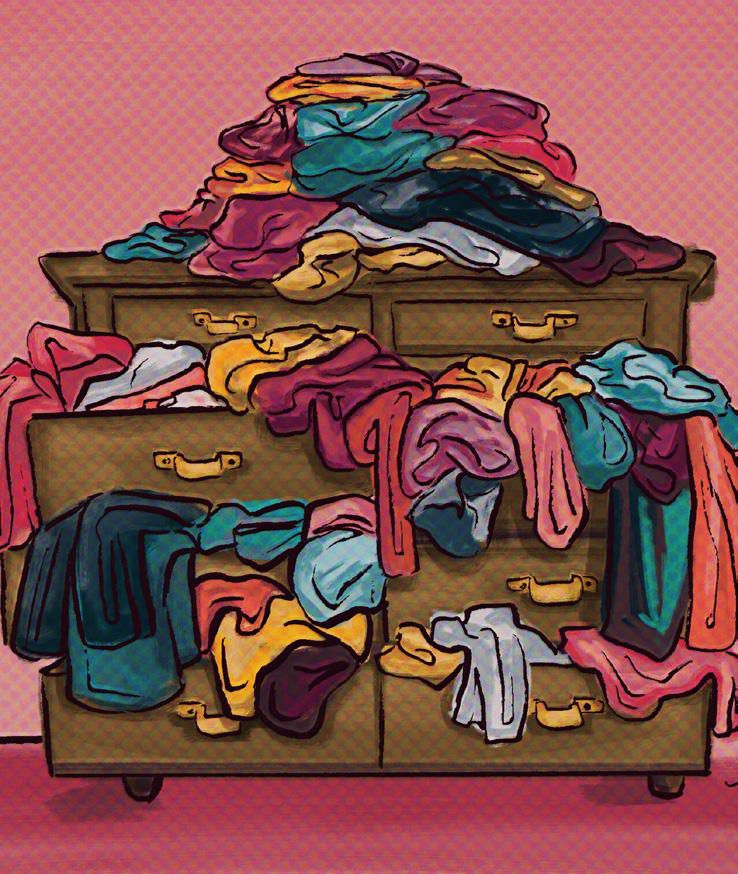
The hyper fixation on Carolyn Bessette’s 90s minimalist style, taking hold of social media creators and consumers alike, only fueled the pre-existing departure of individualism and self-expression. Such media-driven instability leaves people ravaging their closets or online vintage platforms to find the most chic, 90’s effortless pieces to take part in the aesthetic-based trend. All of which seems to be a part of a recurring cycle that accelerates every instance of online aesthetic rage.
It seems as if we Gen Z-ers lose our sense of self to feed the demands of a fast-changing society. Getting caught up and dressing like hot-andcoming celebrities or idealized figures, dead and alive, to be perceived in a certain light. However, how can we know who we are or what we like if we are so absorbed in how we are perceived?
With the increased usage of social media across all platforms, especially Instagram and TikTok, people are more exposed to what is and will be cool today, especially in the realm of aesthetics. It seems that since 2020, the cycling of
trends has skyrocketed at an exponential pace, with a new hot topic almost every month. From street-style athleisure, office siren, 90s minimalism, to this summer’s TBD micro-hit, such an influx of indecision in social spaces leaves its consumers unsure and unaware of what they like in relation to what social media practically demands people to present themselves as.
Such viral aesthetic-based pieces have found themselves embedded in UW-Madison gameday, Lily’s Classic and Mifflin, and even day-today style across campus. Some of the most frequent trends seen around have been polka dot almost-everythings from tops to accessories, capri pants of all kind, blue-light opticals similar to, if not actually, the MiuMiu round tortoise spectacles (link here), half-up half-down hair clipped together with some variation of EmiJay’s Big Effing Clip, and many others I’ve gotten so used to seeing I no longer register.
While men’s fashion has seen a less apparent plague of trend-hopping, the rise of jorts, straight-leg jeans, basic tees, and 2000s-esque wraparound sunglasses have made their way to campus as well. Micro-trends like these can prompt exclusive undercurrents surrounding UW-Madison’s campus culture especially in this wave of quasi-popularity; a concept that is almost solely dictated by how someone presents themselves both online and off, creating this parasocial relationship between others and ourselves especially during this wave of being ‘in’.
Society has this dilemma of valuing a unique and eclectic style while simultane-
ously rejecting those who don’t submit to the demands of social media’s erratic and indecisive trend cycle. It is a dilemma that those who spend maybe a bit too much time online, like myself, often fall into the trap of. But keep in mind that following or not following the rapid trend cycles yet to occur will not define the place one stands in this faux-fashion hierarchy.
I’m no different in the desire to peopleplease and look objectively cool and put together, but there is a difference between trying out new styles, colors, etc., and dressing like Carolyn Bessette Kennedy or any celebrity to keep up with what social media or even people on the street want to see you in.
Finding one’s personal style is a process that inevitably comes with wearing perceivably ugly and unflattering clothes. But you cannot know what works on your body without knowing what doesn’t. Trial and error is real, and a fear of failure, especially in the realm of personal style, should not hold you back from dressing the way you want that reflects who you are.
Being considered niche and cool can be great, but what cost does that come at if one solely relies on what social media or the general public deems it to be? In the realm of style and aesthetics, as well as a society that rapidcycles through them, personal style should be curated as a result of filtering through which trends one feels best in, instead of permitting external media influence to define it.
Although the intake of social media’s viral sensations can impair stylistic judgement, we
shouldn’t get too wrapped up in the bipolarity of its micro-trended indecisions, especially on a campus flooded with a variety of media consumers. Instead of allowing ourselves to be consumed by notions of aesthetic paralysis and the media’s fashion paradox of choice, we need to leave behind algorithm-based style choices. PSA to over-consumers and chronically online individuals: today’s top trending item could be tomorrow’s millennial junkyard, and past decade’s trash will probably end up next year’s treasure. Don’t get lost in the obscurity of social media’s endless wardrobe malfunctions. Wear what works for you, not for them.
By Abigail Bures STAFF WRITER
The Madison Museum of Contemporary Art (MMoCA) celebrated its 125th anniversary of free access to public art on June 4 by unveiling its new summer exhibits.
“Throughout [MMoCA’s] history, we’ve been free and open to the public as core to everything we do,” Andrew Rogers, Director of Communications at MMoCA, said. “In order to do that, it costs us about $50$60 per person to actually have people come to the museum, so we absorb that cost.”
Private funding and events, such as Art Fair on the Square, help support the museum and the access it provides. Art Fair on the Square is one of MMoCA’s largest fundraising events of the year, and Rogers encourages those who are interested in art to attend or volunteer.
“I think everybody would benefit from spending more time with artwork,” Rogers said. “Being able to connect with each other, offline and in person, is a great way to have that social moment, to rethink a problem, approach it from a different angle, and [find] a more creative solution.”
Color, movement and lyrical abstraction
Extended Play: A-Side, a name
By Daily Cardinal Staff
EDITORIAL TEAM
inspired by vinyl records, is a collection of art that uses color to connect one piece to another, despite different artists, mediums, sizes and designs. The exhibit also examines artists’ use of movement to shape new techniques, especially through the language of music.
lectively believed color drives meaning in paintings.
Sam Gilliam, another artist associated with the school, greatly inspired the Extended Play: A-Side exhibit.
The idea of lyrical abstraction, a style Gilliam followed,
to their lyrical roots, a few label headings read, “Swing and Synocaption,” “Complex Harmonies” and “The Head.” MMoCA brought musical connection to viewers in more modern ways by providing a playlist with music that
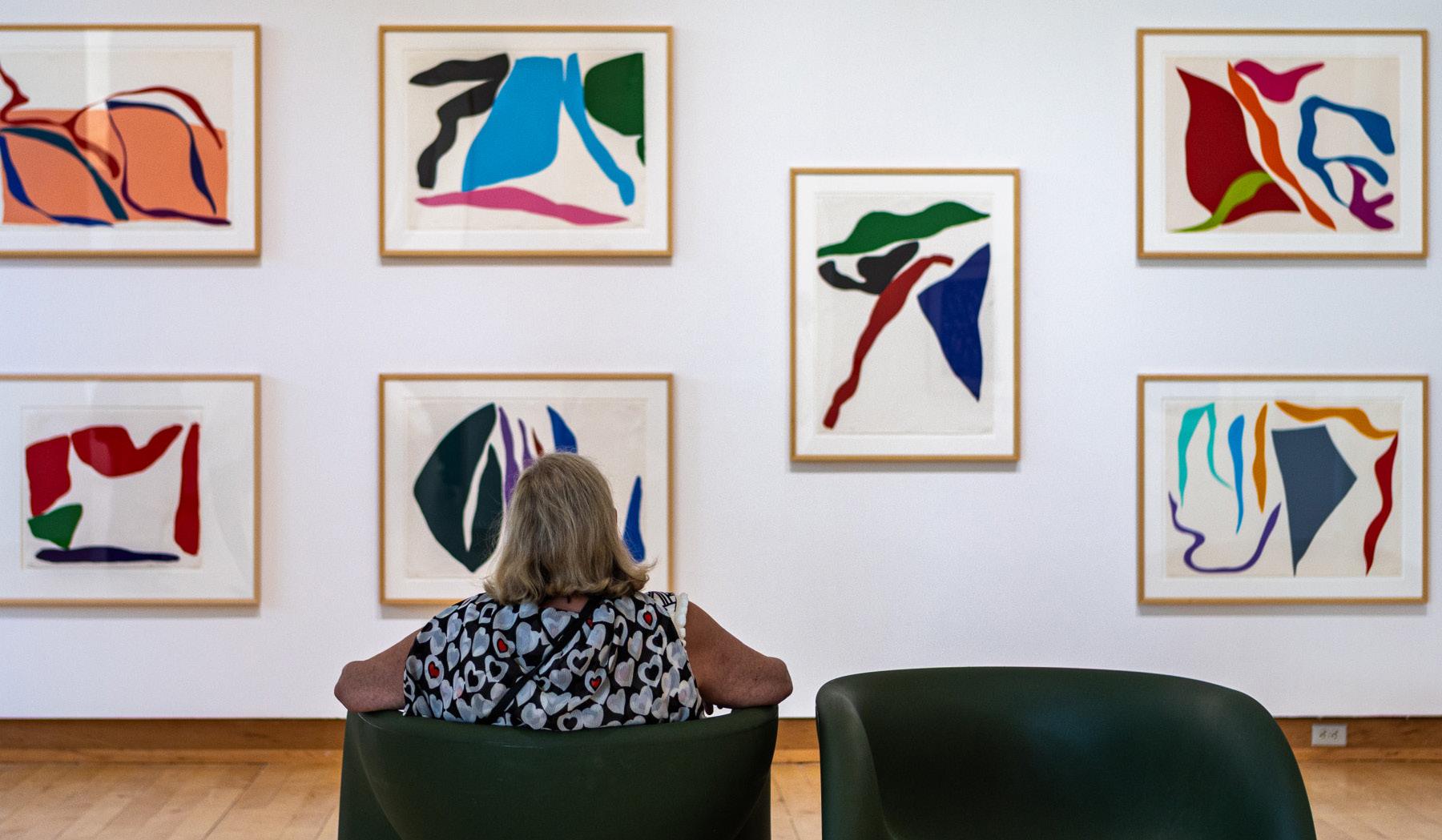
The exhibit houses works of Morris Louis, Kenneth Noland, Alma Thomas and other artists connected to the Washington Color School — a group of artists who col -
moves away from the strict geometry of hard-edge painting and minimalism into artworks with more fluid coloring, visible brushstrokes and layers.
Connecting the artworks
inspired the exhibition series. A second installment, Extended Play: B-Side, will be displayed in the museum at a future date.
Other exhibitions on display include David R. Harper’s “Good Morning Sweetheart” and Gelsy Verna’s “Mother, Father, Please Help Me.” Good Morning Sweetheart is a multi-media collection of three-dimensional artwork, including ceramics, sculptures, stained glass and textiles. Everyday household items are used throughout the exhibition to explore the memory of these objects. Artists purposefully altered these everyday items to prompt intentional viewing and discussion.
Mother, Father, Please Help Me honors Verna’s artwork and her time spent teaching at the University of WisconsinMadison as an associate professor before she passed away in 2008. Verna’s artistic style often prompts questions around identity, history and power.
David Dunlap, the curator of this exhibition, used layering techniques to combine many of Verna’s works into a single large piece, following Verna’s belief that “images and symbols change over time, and that new meanings emerge through revision, proximity and combination,” according to MMoCA.
For many college students, reading is a foreign hobby. It’s either viewed as a luxury reserved for adults with extra time or a dreaded task required for classes. Despite this common view, the summer provides the perfect opportunity for students to shut down their computers and relax with their next read. Summer should be so relaxing that the most difficult task is choosing what to read next.
To help students disconnect from their screens, the Daily Cardinal staff compiled a list of their favorite summer reads to purchase from the nearest bookstore or check out from your local library.
“Call Me By Your Name” by
André Aciman
If you’ve ever seen the film, you know the gorgeous landscapes and cinematography completely awe the viewer. And the reading experience is no different. As the narrator, 17-year-old Elio documents his thoughts and whirlwind emotions as he falls in love with his father’s 24-yearold student, Oliver, who is visiting their home in Italy for the summer (and who also shares the same feelings). Elio’s vulnerability, shown through his thoughts, is so intimate and almost intrusive that it displays the rawness of his inappropriate and secretive relationship with Oliver. I remember reading this for the first time a few summers back, taking in both the description of those gorgeous landscapes and Elio’s innermost feelings. You feel so encompassed by nature in the story that you become the story. It will be one of the most visceral — and thus one of the best — books you’ll ever read.
— Audrey Lopez-Stane, State News Editor
“East of Eden” by John Steinbeck
“East of Eden” is a literary and historical fiction book centered around two families, the Hamiltons (poor but content) and the Trasks
(rich but troubled). The book is set in Salinas Valley, California in the late 1800s to early 1900s. The story reflects the biblical tale of Cain and Abel through Adam Trask’s twin sons, Caleb and Aaron. There are many interesting themes throughout the novel, such as a biblical struggle between good and evil and the weight of inheriting your parents’ flaws. While this is a heavy book, I found the character development and multiple themes very interesting. Steinbeck’s descriptions of setting and the emotions of the characters are also really well done. Fun fact: I bought my copy of “East of Eden” at Leopold’s Books Bar Caffe on Regent Street! — Grace Carlson, College News Editor
“One Golden Summer” by Carley Fortune
A Carley Fortune summer read truly always hits the mark. Based in a picturesque Canadian cottage town, “One Golden Summer” follows the slow-burn relationship between vacationer Alice and local bombshell Charlie. After over a decade, Alice returns to the cottage in Barry’s Bay, hoping for a break from city life and her allconsuming job. Readers will fly through this read and become entranced by the idyllic descriptions of nature and chemistry you can feel through the page. While the banter had me kicking my feet, the raw emotion made me connect with these characters through to the end. Although a summer read in the summer seems basic, this is a can’t-miss novel perfect to take in under the sun.
— Liset Zacker, Arts Editor
“Remarkably Bright Creatures” by Shelby Van Pelt
“Remarkably Bright Creatures” by Shelby Van Pelt is a beautiful novel about a grandmother who never stopped loving and her friendship with an octopus, Marcellus. Despite an on-screen adaptation released on May 8, the book itself weaves the genres of mystery and literary fiction together in a way
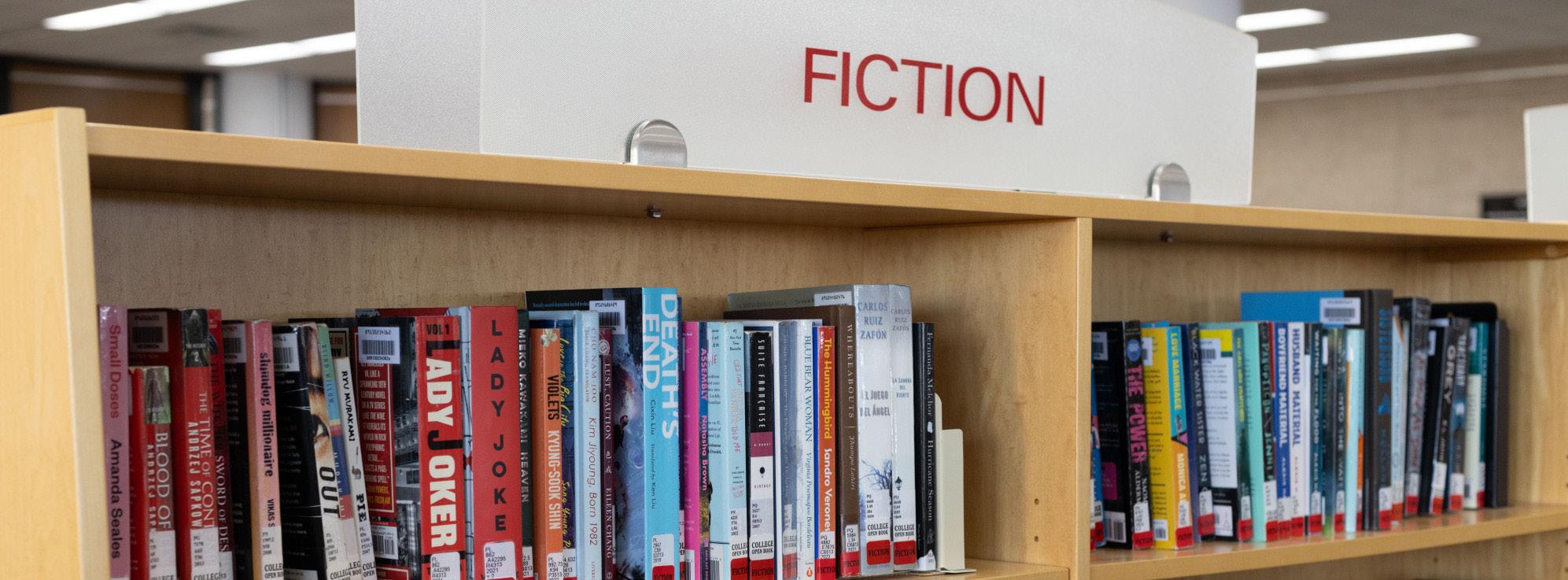
that readers will remember it for a while. This novel was absolutely joyful to read. While Van Pelt’s writing is addictive, the characters are truly what make the book what it is. You don’t expect a grandmother and an octopus to find friendship, but reading the connection between them spurs you to spend every moment with them.
— Zoey Jiang, Associate News Editor
“The Seven Husbands of Evelyn Hugo” by Taylor Jenkins Reid
If there’s one book to throw in your backpack before coming to Madison, make it “The Seven Husbands of Evelyn Hugo.” Taylor Jenkins Reid’s novel follows the flashy and secretive life of Hollywood icon Evelyn Hugo as she reflects on love, ambition and the choices that shape who we become. Equal parts old Hollywood drama and emotional gut punch, the novel explores identity, reinvention and finding yourself. Both glamorous and devastating, it’s a perfect summer read — fast-paced enough to fly through by the lake, but layered enough to leave you thinking about it long after the final page.
— Alaina Walsh, Editor-in-Chief
“The Water Seeker” by Kimberly Willis Holt
Some of Madison’s most enticing features are its lakes, and, like Madison’s Isthmus is nestled
between Lake Mendota and Lake Monona, nestled between two trees is the only proper way to dive into Kimberly Willis Holt’s “The Water Seeker.” The novel follows Amos Kincaid’s journey shaped by loss, relationships and the Oregon Trail’s long pull west. The fight between the known and the unknown will take you westward with the Kincaids, making it impossible to step away from Willis Holt’s story from the American frontier to the Willamette Valley. With more depth, adventure and detail thought possible in roughly 300 pages, “The Water Seeker” is the perfect coming-of-age story to complement a summer spent lakeside in Madison.
— Avery Chheda, Managing Editor
“What You Are Looking For Is in the Library” by Michiko Aoyama
Though not perfectly set in the summer, this is a perfect summer read for anyone who seeks an appreciation of life. The book itself is simplistic, with a touch of nostalgia on each page, as each character receives a book from the librarian around a problem they’re going through. The story focuses on 5 interconnected characters. A love story to libraries, librarians and readers, this novel is so beautifully written, teaching you small life lessons and reminding you to look at problems from a new perspective. By the way, this book might make you get into creating felt objects!
— Ryan Kim, Arts Editor