

By Alaina Walsh EDITOR-IN-CHIEF
A Madison police officer fatally shot a Black man Wednesday afternoon after authorities said the man injured an officer with a knife during a struggle near Williamson and South Baldwin streets on Madison’s eastside. The event sparked large protests and an independent state investigation.
The incident began around 1:34 p.m. when officers responded to reports of a man attempting to open the doors of locked vehicles in the Williamson Street neighborhood, Madison Police Chief John Patterson said during a Wednesday evening press conference. Police said the man fled on a bicycle before officers confronted him several blocks away.
According to Patterson, officers attempted to take the man into custody, leading to a physical struggle. The man produced a knife and injured one officer. After an attempted taser deployment was unsuccessful, the injured officer fired his service weapon three times, striking the man. The man was transported to a local hospital where he was
pronounced dead.
The officer who fired the shots was also taken to a hospital with injuries that were not believed to be life-threatening.
Three other officers were present during the incident. All four officers have been placed on administrative leave, consistent with department policy.
The Wisconsin Department of Justice Division of Criminal Investigation has assumed responsibility for investigating the officer-involved shooting, the standard procedure for fatal police shootings involving Wisconsin law enforcement agencies.
The shooting marked Madison’s first fatal police shooting since 2015, when Madison police Officer Matt Kenny fatally shot 19-year-old Tony Robinson, an unarmed Black man, while responding to reports of a disturbance near Williamson Street.
Robinson’s death sparked weeks of protests and became a defining moment in Madison’s conversation about race and policing. The Dane County district attorney later declined to file criminal charges against Kenny, concluding he acted in lawful self-defense, and the
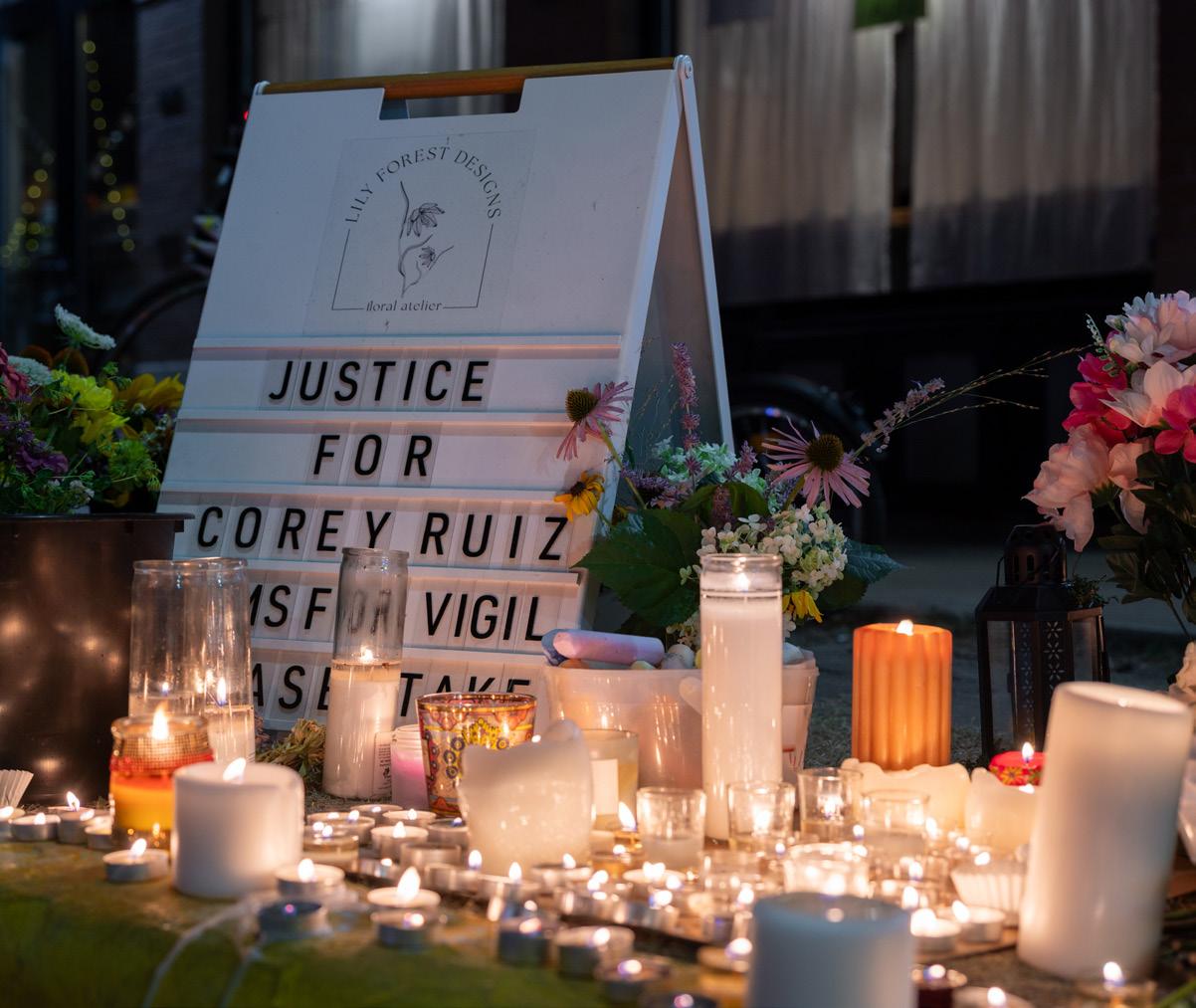
Madison Police Department determined the shooting complied with department policy. Cellphone video of the encounter circulated widely on social media Wednesday afternoon and drew hundreds of protesters to the scene and later to the state Capitol. Community members called for transparency and accountability as the investigation moves forward. Madison Mayor Satya Rhodes-Conway said in
a statement that she was “angered and saddened” by the shooting and pledged that the city would support a full and transparent investigation. Gov. Tony Evers also called for transparency and accountability as state investigators review the incident.
Police had not publicly released the identities of either the man who was killed or the officers involved as of Thursday morning.
By Abigail Bures STAFF WRITER
Wisconsin’s Knowles-Nelson Stewardship Fund expired on June 30 after the state legislature failed to renew the state’s primary land conservation program, leaving future grants for parks, wildlife habitat and outdoor recreation projects without dedicated funding.
Since its creation in 1989, the program has awarded roughly $33 million annually for land acquisition, habitat restoration and recreational development across Wisconsin. In Madison alone, the fund has awarded 28 grants for conservation projects, mostly focused on land acquisition and expansion and dredging — a process of removing debris from bodies of water.
The stewardship program, renamed after former Governors Warren Knowles and Gaylord Nelson, was designed to provide the Wisconsin Department of Natural Resources (DNR) the financial ability to purchase land, develop park trails and maintain parks and facilities.
“Knowles-Nelson is how we conserve land to protect environmentally sensitive areas,” Charles Carlin, director of strategic initiatives at Gathering Waters, Wisconsin’s Alliance for Land Trusts, told Wisconsin Watch in March. “It’s how we provide access for hunters and anglers and silent sports recreationists.”
Governor Tony Evers and the DNR proposed a 10-year renewal of the fund at $100 million per year in
a 2024 budget request. This proposal failed to pass, and the Wisconsin Legislature did not build room for funding in the budget.
For the first time since its start in 1989, the Knowles-Nelson Stewardship Fund will receive no support from the state government, even though 93% of Wisconsinites want lawmakers to renew state funding for land protection.
City of Madison Parks Division Conservation Resource Supervisor Hannah Quinlan said acquisition of land and conservation go hand-in-hand.
“Having a particularly large area is helpful for wildlife, but
— and lack of public access to recreation are all reasons why an increase in support of conservation is necessary for the benefit of Wisconsin, the DNR reported in a formal testimony.
Quinlan said that University of Wisconsin-Madison uses natural areas for a unique purpose — as research hubs.
The Prairie Ridge Conservation Park and the Lakeshore Nature Preserve are two locations Quinlan said students at UW-Madison, as well as Madison Area Technical College and Edgewood College, visit for research projects, particularly in ecology.
“Those two sites owned by the

being able to manage that land and make sure the prairies get burned and the wetlands get restored is crucial,” Quinlan told the Cardinal.
Quinlan oversees Madison’s 21 conservation parks and works closely with other organizations and volunteers to maintain these areas.
Increases in land prices, lifestyle changes — including society’s preference toward organized activities over independent outdoor recreation
university are also working to conserve land and wildlife in a similar way to how the City manages our properties in respect to conservation,” Quinlan said. “These areas are protected and they’re there for people to research. They help support the education of students at UW.”
The UW-Madison Arboretum is another similar organization. While the arboretum has never received funding from the Knowles-Nelson
Stewardship Fund, it’s another conservation effort that provides educational support around land management and use. “The Stewardship Fund is, by far, the best tool we citizens of Wisconsin have to maintain our natural heritage of plants and animals in natural communities,” Signe Holtz, director of the DNR’s Endangered Species Program said in a report on Wisconsin stewardship.
In Dane County alone, the Knowles-Nelson Stewardship Fund has provided grants for 512 projects, investing over $78 million in the past 37 years. Most recently, the Driftless Area Land Conservancy received funding to purchase the Kernan Trust property and add 83.37 acres to the Southwest Grasslands area.
“People are not separate from the land. It’s really important to steward these natural areas,” Quinlan said. Without support from the Knowles-Nelson Stewardship Fund, future attempts to protect natural areas and boost outdoor recreation may come with significant limitations. Wisconsin programs that rely heavily on this funding, like the DNR, will see strained resources.
“I think this is going to have to be a central conversation in the next state budget that can be as simple as appropriating money to the stewardship program in the short term,” Carlin told Wisconsin Watch. “And then there’s a much broader conversation to be had about, how do we again get serious about taking care of our land and water so that our kids and grandkids inherit a better Wisconsin than we do.
By Aanya Agrawal SOCIAL MEDIA MANAGER
Irving and Dorothy Levy Hall will welcome students this fall, Associate Dean of Arts and Humanities Grant Nelsestuen told The Daily Cardinal.
The University of WisconsinMadison announced the construction of the Irving and Dorothy Levy Hall in May 2024. The building will be home to eight Humanities departments,: African American Studies, American Indian & Indigenous Studies, Asian American Studies, Chicanx/e & Latinx/e Studies, Gender & Women’s Studies, History, Jewish Studies and Religious Studies.
“It’s likely that nearly every incoming student will take a class in Levy Hall over the course of their college education,” Interim Chancellor Eric Wilcots said in May 2024.
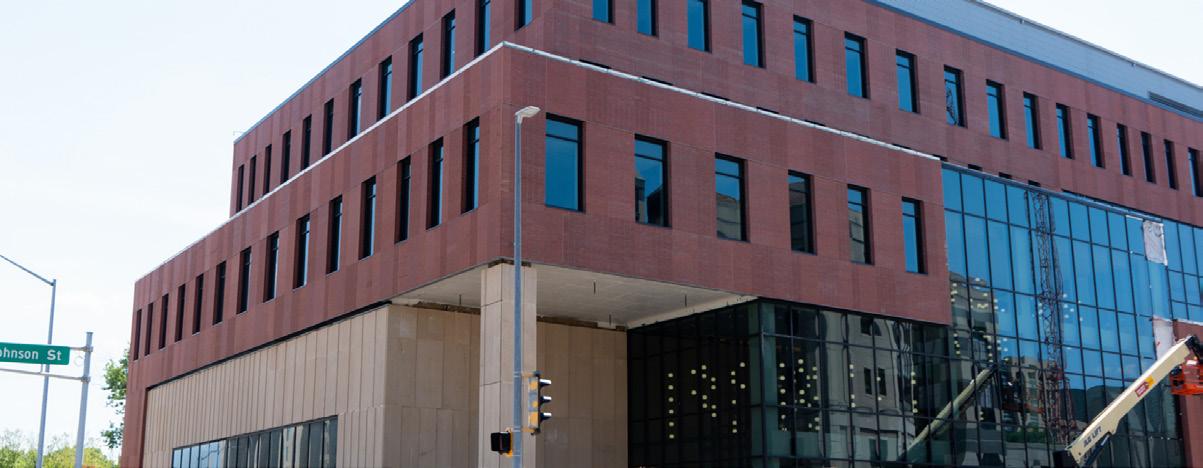
Located at North Park and West Johnson, the 136,000 square feet building includes 13 classrooms and a rooftop garden. Levy Hall features classrooms from the large Phillips Auditorium to mid-sized and smaller sized spaces, all equipped with state-of-the-art facilities.
“It’s a new building. It’s going to have 21st century technology, lots of light and many amenities. It will provide a modern, clean and vibrant space for faculty and students,”
Nelsestuen said.
The building is named after the parents of Badger alums Marv and Jeff Levy who donated $20 million to the project. The $115 million building also received $60 million in state support. Wisconsin lawmakers allocated an additional $5 million to demolish and relocate the departments of the old humanities building.
“It sends a strong signal that the humanities play a crucial role at UW — Madison and in our lives in general,” Nelsestuen said about the University’s investments in the arts and humanities.
Levy Hall will serve as a holistic
By Sonia Bendre CAMPUS EDITOR
Nuclear fusion startup Realta Fusion will begin construction on their research and development facility and corporate headquarters in OM Station, a former Oscar Mayer plant on Madison’s north side, by the end of this year. The project will receive up to $55 million in financial incentives from the city and state.
Realta plans to create over 600 new jobs and will look to UW-Madison as a major “talent pipeline,” Kieran Furlong, CEO and co-founder of Realta Fusion, told The Daily Cardinal.
The location allows Realta to continue primarily operating out of Madison near their existing Wisconsin HTS Axisymmetric Mirror (WHAM) lab, which Realta uses alongside the University of Wisconsin-Madison. Realta spun out of UW-Madison research, and Furlong cited the university as a benefit to the Madison location over other locations the company considered in Illinois, New Jersey, New Mexico and Tennessee.
Furlong said Realta hopes to continue their working relationship with UW-Madison and hire across majors, creating jobs in sales, management, laboratory work, manufacturing and research.
Nuclear fusion is a reaction created by smashing two hydrogen atoms together at high temperatures, forcing them to
fuse and release a neutron and massive amounts of energy. The technology has never been deployed on an electrical grid, though Furlong hopes to build grid-connected fusion by the 2030s.
The research facility will house Realta’s deuterium-only fusion device prototype, Hammir. Allaying city council concerns, Hammir will not reach fusion-level temperatures because it will not utilize tritium, a radioactive hydrogen isotope. Realta expects to break ground on the facility by the end of the year, according to the press release.
In addition to the financial incentives and convenience, Furlong cited manufacturing expertise as a reason Realta chose Wisconsin.
“When we need to get things manufactured for our experiments, there’s plenty of people here in-state that we can look to to get things made,” he said. “I think the state of Wisconsin is definitely leaning in and making a strong case for Wisconsin to be a hub of the future fusion industry, and that will include manufacturing.”
What’s in the financial package?
The largest component of Wisconsin’s $55 million financial package is a state sales and use tax exemption for fusion projects passed April 3, estimated to save Realta $37.5 million in construction and development costs.

environment that serves the needs of faculty, staff and students at the same time, according to Nelsestuen.
The building’s planning process brought together architecture firms, department chairs and students to ensure the building reflected the
needs of its future users.
“[Levy Hall] is a concrete testament —literally — to the investment that UW-Madison has in the humanities and the importance that it plays in students’ lives, whether they major in humanities or not,” Nelsestuen said.
Ben Wikler, Pete Buttigieg rally Democratic Party in Madison tour stop
By Ethan Morse STAFF WRITER
Former Democratic Party of Wisconsin Chair Ben Wikler and former Department of Transportation
Secretary Pete Buttigieg visited Madison on July 17 to promote Wikler’s new book “This is the Plan: How to End America’s Meltdown and Save Democracy.”
The book, which came out July 21st, focuses on defeating President Donald Trump and details Wikler’s vision for Democracy.
As a Madison native, Wikler chose the Overture Center as the first stop on his book tour. He also plans stops in 11 other cities, including Washington, D.C., Chicago and San Francisco. Each stop will host different political figures alongside Wikler, including former U.S. House of Representatives Speaker Nancy Pelosi and Illinois Gov. JB Pritzker.
Wikler, who chaired the state Democratic party from 2019 to 2025, said at the tour stop the book maps out a comprehensive plan to “dictator-proof the American government, defeat MAGA at every level of the ballot and build a future for democracy, opportunity and freedom for all.”
He chose to not seek reelection as chair of the state Democratic party in 2025 after an unsuccessful run to chair the Democratic National Committee.
“I miss him.” Susan Bickley, an 86-year-old from Fitchburg, said at the event. “I think we need stronger leadership here. I miss having someone who was ready to talk to anybody and be in any room.” Devin Remiker currently chairs the state Democratic party.
Wikler drew upon his experiences as chair, where he was largely credited with transforming the Democratic Party through major blue shifts and fundraising gains across the state.
“We were in free fall,” Wikler said. “It was like we grabbed the last branch by the cliff and we grabbed it by our finger nails, and we’re still at the edge of the cliff, but now we can see the mountain top.”
Wisconsin previously had what experts considered to be some of the most gerrymandered legislative maps in the country, which Wikler said made the state a “democracy desert.”
When Gov. Tony Evers signed new maps into law in 2024, Wikler said “it felt like a pie in the sky.”
He also spoke about the 2025 Wisconsin Supreme Court race, which garnered national attention around Elon Musk’s record-breaking fundraising for conservative candidate Brad Schimel. Despite
Musk’s efforts, Justice Susan Crawford won the race to keep the court’s liberal majority.
“If we can defeat Elon Musk, we can win at the White House,” Wikler said.
Democrats are looking to reclaim the state legislature, consisting of the Assembly and Senate, in November after 16 years of a Republican majority. They’re also fighting to retain the governor’s seat, which is up for grabs after Evers, a Democrat, announced last year he was not seeking reelection.
Wikler said this Democratic trifecta was necessary for change.
“There is a new path out of this dark moment and a new dawn for American democracy,” he said.
Rich Novotney, a 67-year-old attendee, said “if the Democrats can win a trifecta, just going back to what we were doing before is not enough. We need fundamental change in a lot of different areas.”
Wikler also pushed his model of Democratic organization nationwide, where Democrats attempt to take back Congress after Republicans flipped it in 2022.
The release of “This is the Plan” comes amid doubts in the Democratic Party’s direction. The AP-NORC Center for Public Affairs reported in May 2025 that 36% of Democratic voters feel very or somewhat pessimistic about the direction of the party.
Gerri Gurman, an 80-year-old attendee, said the way the nation operates the government needs to change.
“We need to listen, be curious and care and find wise people.”
Buttigieg, the moderator of the event, is speculated to be a favorite for the Democratic nominee for the 2028 presidential race. He won the WisPolitics straw poll at the state Democratic Party convention in June to be backed for a presidential bid.
He has previously made appearances in Republican-leaning states while he considers national ambitions. Though some worry about discrimination, as Buttigieg is openly gay.
“I think he’s fantastic,” Novotney said. “I worry about how homophobic our country is. He’s going to struggle against homophobia, but if he were the nominee, I would support him 1,000%.”
Attendee Josh Sulman, 46, said Buttigieg could “debate the hell out of somebody like Vance.” Vice President JD Vance is a favorite among Republicans for a presidential bid in 2028.
Wikler emphasized the power in local communities to create change, optimistic that Democrats can rally in the nation.
“It feels good to build power and it feels good building things,” Wikler said. “Hope is the consequence of action.”
By Jane Dardik CITY EDITOR
The Dane County Board of Supervisors signed a resolution on June 8 condemning UW Health and Children’s Wisconsin for pausing gender-affirming care for minor patients after federal funding threats back in December 2025.
The Department of Health and Human Services (HHS) proposed a rule for hospitals, stopping funding for Medicaid and Medicare if they continue to perform sex-rejecting procedures (SRPs) on minors – procedures that use pharmaceutical or surgical interventions to attempt to align an individual’s physical body and appearance with an identity that differs from their biological sex.
“These changes are necessary to protect the health and safety of children and reflect HHS’ review
of recent information on the safety and efficacy of sex-rejecting procedures (SRPs) on children,” the proposed rule said.
In early July, HHS sent NPR an official document stating the department would “likely not be finalizing” the proposed rule.
UW Health and Children’s Wisconsin Milwaukee cover the majority of transgender youth care in the state, according to Aria Trucios, Dane County Board Supervisor for District 9.
Trucios told The Daily Cardinal federal funding threats are currently “paused,” and they see no reason for pediatric gender affirming care to stop at UW Health and other Wisconsin hospitals.
“While we continue to believe this is evidence-based care, threats from those federal actions are not fully resolved,”
a UW Health statement to the
Cardinal said. “Therefore, the current risk is too great to resume this care. We recognize the challenges faced by impacted patients and families and remain committed to providing patientcentered care and supporting their health and well-being throughout this critical time.”
HHS previously said the decision was made based on a peer reviewed study which found early gender interventions could lead to issues such as infertility.
Erin Welsh of District 7 told the Cardinal hypothetical funding cuts are not enough for care facilities to shut down transgender youth care.
“While I understand the concerns of these healthcare providers, their decision…was driven by fear of the current federal administration; not law, not science,” Welsh said. “It sets a dan-
gerous precedent for the healthcare and bodily autonomy of all Dane County residents to let fear of retribution drive access to necessary medical treatment.”
Trucios said the healthcare pause is “heartbreaking.”
“I felt it was necessary for us all to stand together unified and call out the horror and callousness of the decision that was being made,” Trucios said.
Jay Brower, the Dane County Board Supervisor for District 13, told the Cardinal the most important thing for the board is to make sure there is access to care in the Dane County community, whether it’s being provided by UW Health or another facility.
“[At the board meeting] people talked about the impact on them — on their kids not being able to receive care they’ve become accustomed to
and rely upon,” Brower said. “There is a need to support people in their self expression, identity and understanding, and it seems like an important issue to me to ensure fairness and equity in healthcare.”
While the board urges UW Health to resume transgender healthcare for minors, Trucios and Brower both note they do not have oversight over UW Health. They said the resolution is only meant to advise and give perspectives of constituents.
Trucios and other sponsors of the resolution argue there is no longer a threat to hospitals who provide gender affirming care for minors. The Dane County Board of Supervisors is now pushing for UW Health to resume pediatric transgender healthcare until they are legally unable to do so.
By Ted Hyngstrom STAFF WRITER
City of Madison officials are preparing to cut nearly $7.2 million from the 2027 operating budget in order to comply with state guidelines limiting municipal spending.
Officials are projecting that the city’s 2027 cost-to-continue budget — the amount of capital necessary to keep funding city services, bills and paychecks — will exceed the maximum amount allowed as calculated under state law. City agencies must cut their budgets or lose nearly $9 million in state financial aid.
City of Madison Finance Director David Schmiedicke told The Daily Cardinal refuse collection, community services, city job training and childcare programs could all be reduced.
A common council website post outlined what agencies will do to achieve a 2% budget reduction in their July 17 initial budget requests. The guidance halts excess budget requests and blocks hiring for already vacant positions — a situation District 8 Alder Ellen Zhang said will cause “more pressure” on city workers.
“Departments will have fewer new programs and services available as they deal with the challenge of maintaining current service,” Zhang told the Cardinal.
The Madison city budget is split in two separate sub allocations — a longterm, big-ticket, bond-sale-funded ‘capital budget’ and a short-term, day-to-day, ‘operating budget.’ The capital budget is funded by bond sales, while the operating budget relies on a combination of state and federal grants, service charges, fees and voter-approved tax-increase referendums — though local property taxes make up the largest share.
The operating budget supports dayto-day city operations such as employee paychecks and civil services.
The operating budget also funds local public transportation. While some states — including Illinois, Arizona and Washington — allow regional transit authorities (RTAs) to levy a transit-fund tax — thereby freeing funds within the operating budget — Wisconsin state law does not allow RTAs to do the same.
In 2009, Democratic Governor Jim Doyle signed Wisconsin Act 28, giving RTAs the power to fund public transit by levying a sales tax. Before RTAs could begin collecting revenue, Governor Scott Walker repealed their taxing power in the 2011 state biennial budget, Act 32.
The act also limited property tax increases, instead anchoring taxes to net increase in construction.
The budget cap joins former Gov. Tommy Thompson’s 1990 Expenditure Restraint Incentive Program (ERIP) — a state program incentivizing voluntary spending restraint in exchange for state financial assistance currently. It also capped the amount cities and municipalities could spend on services in exchange for Act 10.
During the budget engagement session, District 10 Alderwoman Yannette Figueroa Cole said she’s worried about the impact the cuts could have on employment quality for city workers, and stressed the amount of pressure businesses are already under due to a lack of workers.
“Currently, the city is operating with a staff that is short about 200 positions
to do the regular work,” Figuora said. “The idea that to have to cut more positions when we don’t already have so much need to fill vacancies worries me more than to have to cut jobs right now.”
Madison city leaders were able to stave off a budget crisis for 12 years, but were unable to stop a long-term structural budget deficit formed.
Facing a $22 million deficit in the 2025 budget, voters passed a one-time $20 million referendum that raised property taxes by an average of 2.7% and funded city services.
Going forward, city leaders created a five-year budget plan giving officials a framework to plan for future deficits.
“We expect there to be these deficits every year, and then we have to look at options to close the [deficit],” Schmiedicke said. “We do have a significant fund-balance that we can use. There’s some ‘special charges’ we can look at, but in the case of this budget, [we’re] about $7 million above the expenditure restraint limit.”
Zhang said despite the effects on service, most effects will be indirect to students.
Despite the challenge, several alders
expressed confidence in city divisions’ abilities to plan and adjust to accommodate the shifting budget during the question-and-answer.
District Five Alder Regina M. Vidaver praised Madison Public Works Director Charlie Romines, who she said during the 2024 budget crisis suggested making seasonal city staff members full-time — saving tax dollars while bringing greater stability to the public service.
“We were bringing people in, giving them stable jobs that had great benefits [to stabilize] families,” Vidaver said. “That’s the kind of ingenuity that we have in our staff, and I know that that is what they are going to bring to the table during these challenging times.”
City agencies submitted budget requests to the Mayor’s office for review on July 17th. Requests will be viewable to the public August 3rd on the city website.
“I can only hope — and maybe predict — that things will turn around [in] the next two years after this midterm,” Zhang said. “But until then, we’ll just have to do our best.”
By Zoey Jiang ASSOCIATES EDITOR
Starship Technologies has withdrawn its tiny, white food delivery robots from the University of Wisconsin-Madison’s campus alongside other universities in the United States, the company announced early June.
The robot delivery company, based in Estonia and San Francisco, said they reduced their campus operations to focus on retail grocery chains and hot food delivery in cities across Europe and the United States.
“Starship has worked closely with all of its university campuses and industry partners to ensure continuity of service through the backto-school 2026-2027 season, with transition plans in place to minimise disruption for campus communi-
ties,” the announcement said.
As part of the transition, over 1,200 robots originally operating on college campuses will be moved to support grocery retailers across Europe and the U.S.
Thirty robots first descended onto UW-Madison’s campus in 2019, when the university launched their partnership with Starship. Their most recent count is 13, according to the Wisconsin State Journal.
“The robots adapted well to our campus and provided a valuable service for our customers,”
Brendon Dybdahl, a University Housing spokesperson, told The Daily Cardinal. “Their service helped us showcase new technologies and added convenience to our dining program, and the robots became a fun part of the UW-Madison community.”
The Starship robots helped with food accessibility for students, particularly during the pandemic when the university had to navigate keeping students fed while practicing social distancing.
“At the height of the service, during the pandemic, we commonly saw 300-400 deliveries per day,” Dybdahl said. “In recent years, particularly after our resident dining plan structure changed to a meal swipes model, we were down to 20-30 deliveries per day.”
Before the meal swipes model, UW-Madison would have students pay as they ate at dining places.
Over the past seven years, UW-Madison students have summoned meals and late-night snacks alike with the food robots, placing their orders on the Starship Deliveries

app. Starting in 2024, the robots delivered Meal Exchanges as well, most often from the campus convenience store Flamingo Run.
Dybdahl said University Housing is currently exploring alternatives for food delivery services.
“We’ll miss seeing the robots around our campus, but we’re grateful for what Starship brought to our dining program,” he said. “University Housing is always looking for new ideas and ways to enhance our dining service, and we learned a lot through this partnership that we can use to keep innovating in the future.”
By Jake Kilander
FEATURES EDITOR
On a sunny, mid-60s Friday afternoon in Madison, Wisconsin, Mar is getting her bike fixed. During her 20s in Costa Rica, Mar would mountain bike everywhere. Now, as a resident of the Eagle Heights community, Mar’s bicycle connects her to the University of Wisconsin-Madison campus and the city of Madison as a whole.
In Madison, a bike is the key to the city. Designated as a platinum “Bike-friendly” community by the League of American Bicyclists, bike lanes, commuter paths and ample bike racks make not owning a car a reasonable reality in the city.
“It really is my independence because we don’t have a car,” Mar said. “The bus is pretty good, but with the bike, I really don’t have to wait for anything.”
Mar is part of the estimated 30-40% of Dane County residents who do not drive a car. In the City of Madison, that percentage is over 40%.
Owning a bike won’t save you from
mechanical difficulties, but Bikes For Kids Wisconsin provides Dane County with a myriad of resources. Bikes for Kids is a non-profit organization whose mission is to, “increase the use of bicycle-based transportation for underserved communities through access, low-cost repairs and education.”
“We’re working to make sure everyone has access to a bicycle,” Kristie GoForth, executive director of Bikes for Kids and advocate for underprivileged communities told The Daily Cardinal. “We view bicycles as far more than just fun or recreational. We see them as a tool for economic mobility.”
GoForth joined Bikes For Kids in April 2020, when it was still called Free Bikes 4 Kidz Madison. GoForth said she immediately had ideas for expansion.
Since GoForth’s arrival, Bikes for Kids Wisconsin has expanded from the City of Madison to give away free bicycles to both children and adults throughout Dane County. GoForth told the Cardinal the pandemic was a key factor in forcing that organizational pivot.

“That first year we ended up giving 1,101 bikes away, almost all to essential workers,” GoForth said.
Freddie, a Madison nurse’s assistant, is one example of Bikes for Kids service. Before Bikes for Kids stepped in with a new commuter bicycle, Freddie rode a Razor scooter an hour and a half both ways to work in the COVID wing of St. Mary’s Hospital.
“They [Freddie’s co-workers] gave that to him, and he was just tears streaming down his cheeks saying, ‘nobody’s ever done anything this nice for me.’ It changed his life,” GoForth said.
Freddie could now get to work in 20 minutes and stop at the grocery store on the way home. Thanks to Bikes for Kids, Freddie is an example of what transportation equity looks like in practice.
The Greater Madison Metropolitan Planning Organization (MPO) is just one organization responsible for Madison’s strong bicycling infrastructure. The Greater Madison MPO has access to federal funding streams and to access them, proposed transportation plans must further their goal to “balance roadway, public transit, bicycle, pedestrian, and other transportation needs to achieve an exceptional quality of life for all in the Greater Madison area.”
Benjamin Lyman, a transportation planner at Greater Madison MPO, works on administering a few of the federal initiatives. One is the Transportation Alternatives Program, which funds projects that improve bicycle and pedestrian facilities and infrastructure. Another is the Surface Transportation Block Grant Program, which administers roughly $10.5 million to roadways, pedestrian paths and busing infrastructure.
For any project up for review, Lyman and the Greater Madison MPO apply a scoring system. Many factors are included in the score, including if the project will result in equitable transportation.
“We made some adjustments in 2019 and 2020 and again in 2021 and really looked more at historical underinvestment in a lot of our neighborhoods at a regional basis, not just within the City of Madison,” Lyman told The Daily Cardinal.
According to Lyman, projects could score better if they connected those underrepresented neighborhoods to employment opportunities or other areas of the city. Those underserved areas were determined through a multitude of factors, like income-level, race and ethnicity. Lyman told the Cardinal that because of new federal restrictions on how their funds can be appropriated, that criteria may have to change.
The Trump administration’s executive orders
targeting DEI prohibit federal funds from going towards any program that uses race or ethnicity as a criteria for review. For the MPO, this means they cannot consider the racial demographics of a community being impacted in a proposed plan to insure project approval. According to Lyman, the MPO instead focuses solely on economic elements of a region, such as income, education and access to a vehicle.
Lyman also said that he doesn’t anticipate the shift in criteria having a noticeable effect on where and how funds get used.
“We are doing our best to serve the people of our planning area and of Dane County and to ensure that the people who are transportation disadvantaged reap the benefits of our investments,” Lyman said.
Another way the Greater Madison MPO is meeting the transportation needs of its region is the RoundTrip program, aiming to cut down on single-driver commuters by connecting people to alternative transportation resources.
Zia Brucaya, RoundTrip’s Program Manager for Greater Madison MPO, takes Bikes for Kids’ transportation equity mission one step further.
“We really provide a one-stop shop for people to come learn what their transportation options are in Dane County and then connect [them] with information and resources to support them in using those different modes of transportation,” Brucaya told the Cardinal. Brucaya said administering the RoundTrip program gives her a unique perspective on the existing transportation network.
“We are relying on communities to be implementing public transit, bicycle networks and safe pedestrian networks so that these options are appealing to people and actually accessible to them,” Brucaya said.
At Bikes for Kids Wisconsin, GoForth and her team are hoping to make it easier for people to connect to those alternative transit networks. For the past two years, they have had help from Badger Volunteers, a semester-long program from the Morgridge Center for public service connecting badgers to community organizations. The volunteers at Bikes for Kids learn how to do basic bike repairs and help organize the 12,000-square-foot warehouse.
“It makes me feel like I’m doing something important and gets me away from my schoolwork and actually involved in the community,” Avery Damel, a UW-Madison senior and volunteer with Bikes for Kids Wisconsin, told the Cardinal.
Damel participated in the annual Spring Bike Giveaway on April 11. The organization gave away 1,200 bikes at the event.
Continuereading@dailycardinal.com

By Liset Zacker ARTS EDITOR
Homer’s Greek epic “The Odyssey” follows the king of Ithaca, Odysseus and his herculean 10-year journey home after the Trojan War to reunite with his son, Telemachus, and wife, Penelope. As suitors descend on Ithaca hoping to seize the throne, Telemachus sets off to find his father.
Written around the 8th century B.C., the 12,109-line poem is one of the oldest surviving works of literature and remains a staple in high school English classrooms.
Much like the pedestal Homer’s “The Odyssey” sits on in the book world, director Christopher Nolan rests on a similar one in Hollywood. His ingenuity and reputation in ambitious filmmaking made him the best person to adapt the nearly 3,000-year-old story, and months of promotion of the film’s grandeur only fueled the anticipation.
Much of the excitement stemmed from its uniqueness, a credit to Nolan’s relentless pursuit to supersede his previous work. “The Odyssey” is the first feature film to be shot entirely with IMAX film cameras, which capture more detail and a greater aspect ratio than typical digital cameras.
Despite its perks, the sheer size, weight and noise of the cameras render them difficult to use, a seemingly small issue for Nolan, who simply invented an easier-touse version. Nolan also has a famous disdain for CGI, opting instead for a 60-foot puppeteered cyclops and a female
stunt double replacement for Odysseus to pull off the movie.
Despite Nolan at the helm, a press tour to rival Odysseus’ journey home and a starstudded cast that rivals the Met Gala invite list, I wanted to judge “The Odyssey” for myself. Armed with the knowledge from my AP Literature lessons on Homer’s poem, I snagged the only ticket I could: a 10 a.m. showing of “The Odyssey” in all its IMAX glory.
The hype, it turns out, was well warranted.
Despite its 2-hour and 52 minute run time, this masterclass in filmmaking never hit a lull. Instead, Nolan’s unrelenting commitment to practical filmmaking creates a tangible world that feels immersive from beginning to end.
This was also helped by Nolan’s insistence on filming on location instead of building sets. The crew spent mornings hiking up mountains to film in a fortress, or hours on a boat, creating expansive and realistic visuals. Every character, setting and costume felt ancient and weathered, just like Homer’s epic.
Nolan wasn’t the only one to manufacture the 8th century B.C. feel; the score and cast helped tremendously.
To create the film’s score, composer Ludwig Göransson opted for ancient Greek instruments and metal scraps in place of a traditional orchestra.
The cast members wholly transformed into their roles, shedding the past skins of their stacked resumes and delivering raw, emotional and relatable performances that implored
By Ryan Kim ARTS EDITOR
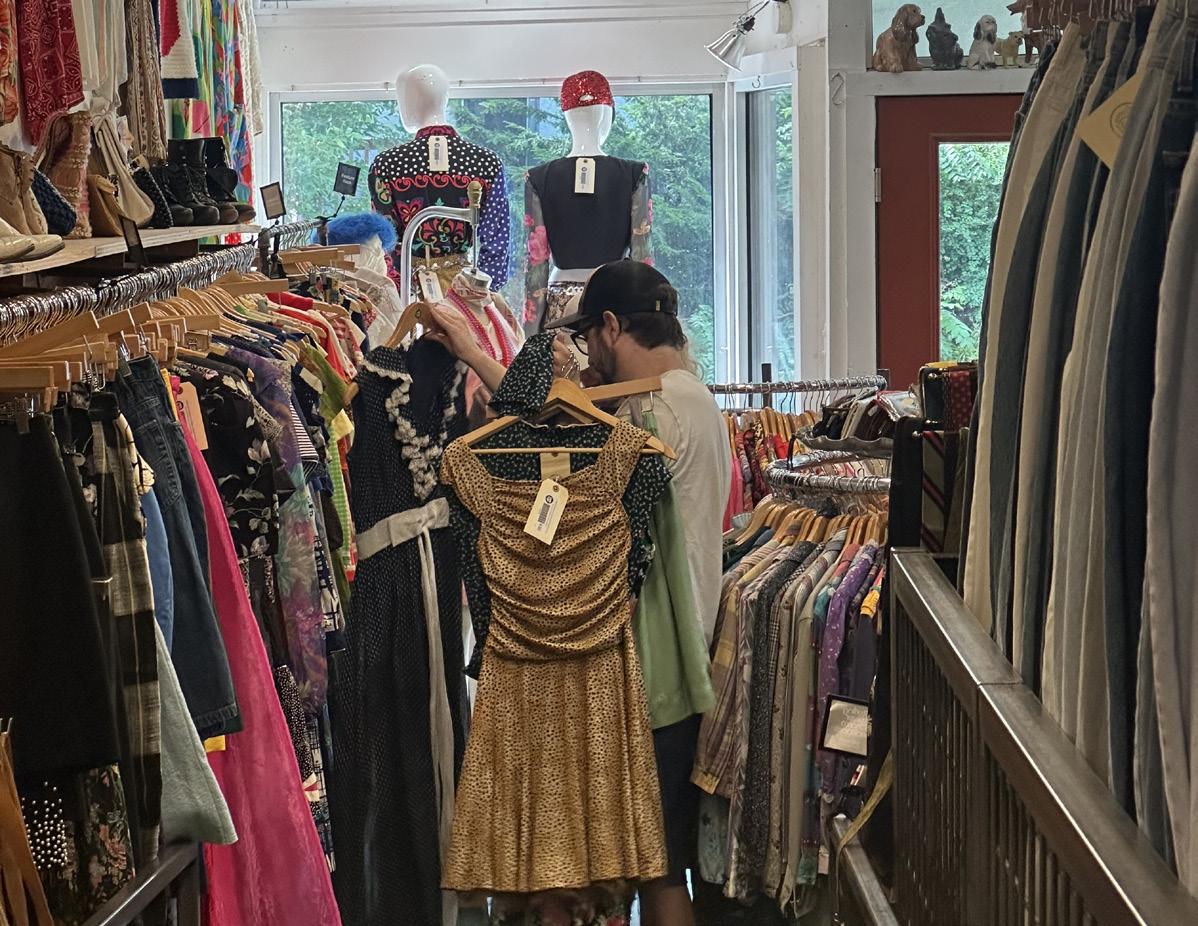
Vintage fashion trends come and go — from Y2K aesthetics to 90s streetwear — but Madison’s secondhand community continues to grow. Across 16 vintage stores in Madison, the Vintage Passport invites people to discover new pieces and favorites through Sept. 1.
The Vintage Passport was created in 2025 by Sami Head, owner of Sandhill Goods, and Elissa Blaeser, owner of Silver Rose Vintage. Blaeser’s store opened on West Lakeside Street in May 2024, where she kept a map of other vintage stores in the area to help customers discover more shops.
“I wanted to have a tangible way to show people some of the other shops that were around,” Blaeser told The Daily Cardinal.
“So if someone was looking for cowboy boots, I could be like, ‘Oh, you should go to Arbor House. Let me show you where it is on the map.’ And [Head] was like, ‘Oh, we should take your map, and we should make it into a vintage passport.’”
“There have been times where I’ll have a swarm of people in here with the passports ready to go...I love the exposure. It’s kind of like word of mouth,” Benck said. “It’s such a welcoming thing for Madison. This has been really nice because it really encourages people to trot around the city and really explore the city, not just these stores.”
The passport, Benck said, also highlights how little the stores directly compete with one another, as each store sells something unique and is a part of his community.
“I don’t really consider these folks my competitors,” Benck said. “I know them all personally, and some of them have been vendors here at this store who have spun off and had their own success.”
you to connect with them.
Anne Hathaway delivers a hauntingly heartbreaking performance as the disregarded Penelope. Robert Pattinson embodies a disrespectful coward as the main suitor Antinous. But it is Samantha Morton as Circe — a sorceress with the ability to transform people into animals — who steals the show, delivering a harrowing monologue about the excused cruelty and inherent greed of men toward women and power before promptly turning Odysseus’ men into what they are: pigs.
For all of its brilliance, however, there were times I felt disconnected from the movie – a criticism I heard echoed and amplified by my non-film lover friends.
That’s because “The Odyssey” isn’t made for everyone.
The average moviegoer with no interest in Greek mythology might not enjoy, appreciate or connect with this film on the same level. It was made for those who love the art of filmmaking, for that exclusive club where the entry fee is a Letterboxd account: cinephiles. Because, while the dialogue, characters and plot all excelled, it’s the technical aspects that brought this movie — and this world — to life. Not the parts created 3,000 years ago by Homer, but the choices made by Nolan to go above and beyond.
The sheer effort it took to make this film is enough for a standing ovation, but it’s Nolan’s execution that will win “The Odyssey” the accolades I’m sure it will receive.
Within its first summer, the passport program partnered with 15 stores, giving out 750 booklets in the community. This year, the organizers included an additional store on the map and printed more than 1,200 copies, with several shops already asking for restocks, according to Blaeser.
“I reached out to people via DM on Instagram and was just like, ‘Hey, I’m making this map. Can I include your shop?’ And everybody was like, ‘Oh my God, this is such a great idea. Of course, we would love that,’” Blaeser said. “I think everybody really likes it...and were excited to just jump on board.”
Over the years, vintage has continually evolved and Peter Benck, owner of Good Style Shop, has watched vintage clothing move from niche interest to mainstream trend since he opened his shop in 2011. At Good Style Shop, he curates that shift through a collective of clothing and jewelry.
“When I was young, I always thought that vintage clothing was a great outlet of self-expression,” Benck told the Cardinal. “I thought that Madison certainly needed a sort of creative toolbox for a lot of people like me, and I kind of saw the Good Style Shop as that.”
Benck said the Vintage Passport introduced a new type of advertising, making it better than paid promotion on Instagram, TikTok or other social media.
After collecting stamps from 10 vintage stores, Benck said visitors will receive a 10% discount at any store on the map. Once they’ve collected all 16 stamps and taken a passport photo during happy hour at any of the stores, they can enter their booklet into a raffle, where three winners receive gift cards worth $25, $50 or $100.
Each store also has its own unique stamp, making the card into a record of all the places they explored. Blaeser said she loves seeing people come into all the stores, as it brings more customers in to show them something new.
“A bunch of people have come into my shop, and...I know I’ve heard from the other shops that they’ve also heard from people like, ‘Hey, I’ve never been here. The passport brought me in,’” Blaeser said. “So it brings me so much joy to hear that all their shops are getting new people in their shop...it’s a really great way to support each other.”
The Vintage Passport showcases the uniqueness of each store while allowing people to tour around Madison’s secondhand culture. This project was made possible by the community, and Benck said he’s happy with how it has turned out and more.
“We’re a creative toolbox, because these places benefit people looking for self-expression or looking for something to do or show someone Madison,” Benck said. “This map right there is just about as powerful as anything like a tourist convention bureau could ever produce, and that was just like a promotional tool that [Blaeser’s] came up with.”

By The Daily Cardinal Editorial Board
Madison has spent decades cultivating an image as one of America’s most progressive cities. It promotes inclusion, emphasizes equity and prides itself on compassionate leadership.
But those values can not be measured by campaign slogans, yard signs or political branding. They are measured by how a city responds when compassion is most necessary.
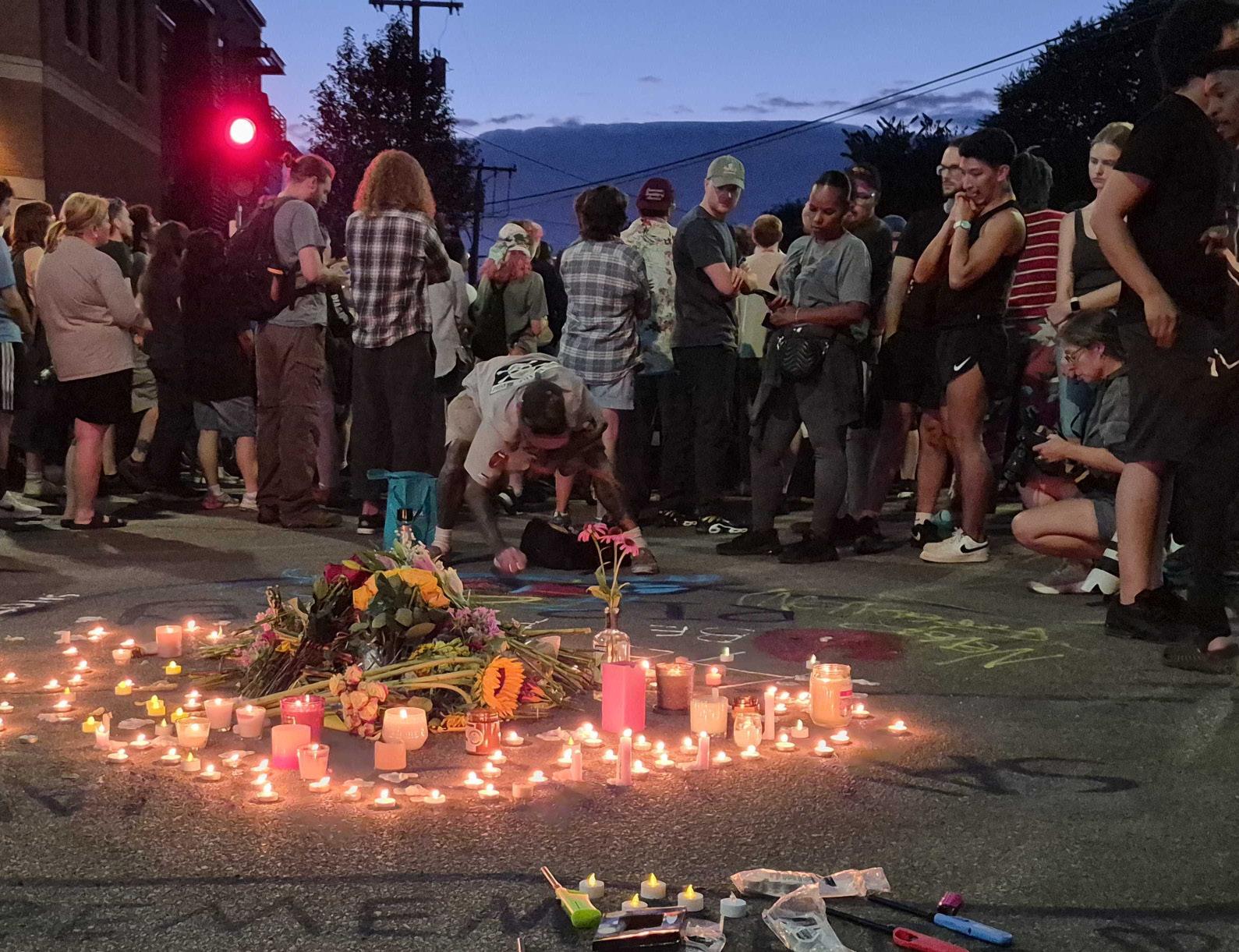
Last week, protests erupted after the fatal police shooting of 38-year-old Corey Ruiz, a Madison native experiencing homelessness and untreated mental illness. He was tased, restrained and ultimately shot three times by Madison police officers on Williamson Street outside the Willy Street Co-op. The location is significant, considering its place as the cultural heart of one of Madison’s most politically progressive neighborhoods. The Wisconsin Department of Justice is currently investigating the shooting as part of standard procedure for deaths that occur during an encounter with officers. The legal process deserves space to unfold, but patience cannot become another excuse for political paralysis. Bystander videos have already become publicly available, raising serious questions about the city’s repeated claims that de-escalation is central to its policing.
But waiting for the investigation’s conclusion should not prevent Madison from confronting a larger question that has existed long before Ruiz’s death.
What kind of city do we become when homelessness, untreated mental illness and behavioral crises continue to end in encounters with armed police?
Ruiz reportedly possessed a fixed-blade knife and an officer sustained injuries in the struggle. Those facts matter. Officers routinely face dangerous and unpredictable situations, and every use of force warrants a thorough investigation.
Yet acknowledging those facts does not dismiss the question confronting Madison.
If four officers could not safely resolve an encounter with one individual without resorting to lethal force, what does that say about the city’s crisis response system? If someone experiencing homelessness and mental illness is met first and foremost by armed officers, the failure did not begin when shots were fired. It began long before police were called to the scene.
Mental illness and alleged petty theft should not become death sentences, and no one should die because a community lacked better ways to respond to someone in crisis.
This is not a simple, isolated tactical failure. It was the predictable consequence of a city that continues to criminalize poverty and behavioral health crises while relying on armed law enforcement as its primary response. When vulnerable residents are consistently treated as public safety threats rather than neighbors in need of care, deadly outcomes are, unfortunately, increasingly foreseeable.
Madison demands to be recognized as a national model of progressive governance. Yet genuine progres-
sivism demands more than supporting ambitious policies when they are politically convenient. The city cannot continue to hide behind a progressive image while state violence remains an accepted endpoint of its public safety model. It must build and support institutions that reflect its progressive values when circumstances are uncomfortable, unpredictable and sometimes dangerous.
And this tragedy did not occur in a vacuum.
The city’s painful history offers a reminder that promises alone have never produced accountability. After the 2015 police killing of 19-year-old Tony Robinson, Madison saw widespread demonstrations, emotional public hearings and countless promises to reform. Community organizations, including the Urban League of Greater Madison, responded by creating spaces such as the Unity Picnic to promote healing and solidarity.
More than a decade later, the same conversations have returned with striking familiarity.
The pattern has become painfully recognizable. A tragedy occurs. Demonstrations fill the streets. Listening sessions, task forces and committee meetings follow. Officials promise transparency while reforms move slowly through government channels, if at all. Eventually, public attention fades, political urgency dissipates and the institutions responsible for change outlast the communities demanding it.
Madison has become remarkably effective at managing outrage instead of solving the problems that create it.
The city’s failure to adopt one of the most basic accountability tools available to modern policing is another example of the same
institutional inertia. Body cameras for frontline officers need to be available, funded and required. Disputes over this have repeatedly delayed implementation, leaving the public to depend on cellphone footage whenever an encounter occurs. Public trust should never be compromised. When accountability depends on a bystander capturing an incident, the system has already failed.
Public trust should never depend on whether someone nearby happened to press record.
Transparency is not a concession the government offers after a tragedy. It is a responsibility they must uphold under their oath.
Regardless of where investigators ultimately determine the officers acted within Wisconsin law is an important question. But legality alone cannot answer whether Madison has built the kind of public safety worthy of the values it professes.
Those are separate questions.
Madison must confront the societal failures that produced this encounter in the first place. A legal finding will not erase the reality that homelessness, untreated mental illness and addiction remain amongst the most significant public challenges our residents face. Those issues cannot be addressed through policing. Nor can it answer whether sufficient investments are being made in housing, behavioral health and civilian crisis response systems. Expanding civilian crisis response systems is not about vilifying law enforcement; it is about recognizing that many situations require expertise beyond traditional policing.
Some might argue that Ruiz’s
possession of a knife justified the officers’ actions. Others will point to the ongoing investigation and caution against drawing conclusions before all evidence is released. Those considerations do matter and deserve careful examination.
Yet legality and morality are not interchangeable.
Even if the investigators come to the conclusion that the officers’ actions complied with Wisconsin’s use-of-force laws, that legal determination cannot erase the larger institutional failure that placed everyone in that position. Whether an action satisfies the law is separate from whether Madison has built a public safety system worthy of a city that claims compassion as one of its defining values. The conversation should not end when the Department of Justice releases its findings.
Waiting for investigations should not mean waiting to confront structural problems that have been visible for years. Lengthy review processes have, too often, become political cooling-off periods, allowing public momentum to simmer while institutions return to business as usual.
Madison has an opportunity to choose a different path.
City leaders should expand permanent, civilian-led crisis response teams so mental health emergencies, addiction and homelessness are no longer treated first as policing problems. Investments in housing, behavioral health care and other preventive social services would reduce the need for police intervention in many low-level incidents before they escalate into dangerous encounters. Strengthening
independent civilian oversight should include granting review bodies meaningful disciplinary authority and increasing transparency surrounding officer misconduct. City leaders should also fully fund body cameras as a basic accountability measure rather than allowing budget disputes to delay reforms that strengthen public trust.
The University of WisconsinMadison cannot remain a passive observer either. As the city’s largest institution and one of its most influential economic and cultural forces, the university has the platform to advocate for policies that better protect Madison’s most marginalized residents. Thousands of students live, work and build their lives throughout Madison. The health of the city is inseparable from the health of its university community. Ultimately, Madison’s identity is not defined by the values it claims to hold. It is defined by the people it chooses to protect it.
A truly progressive city is not one that simply speaks the language of compassion. It is one that builds institutions capable of practicing it, especially for those with the least power.
The investigation into Corey Ruiz’s death will eventually end. The larger question facing Madison will not.
Until the city matches its progressive ideals with equally ambitious investments in care, prevention and accountability, those ideals remain aspirations rather than achievements.
By James Norcross STAFF WRITER
It’s 1 p.m. on a Sunday morning and you’re washing stir fry sauce-stained pans in place of a faulty dishwasher that your landlord won’t fix. But it’s okay because the Scrub Daddy is here to save the day — or once was. Its bristles are on their last straw and your favorite kitchen staple is now a far cry from the sponge warrior it started as. Sometimes you don’t know what you’ve got until it’s gone. Joni Mitchell’s (or Janet Jackson’s) words speak true to the pillars of college apartment living.
When college students and their families are expected to spend over $100 billion on back to campus supplies across the nation this year, it’s important to know what is worth your buck when picking out the must-haves, especially for students living alone for the first time. For a smooth transition out of the dorm halls, here are some essentials for moving into your new apartment, according to University of Wisconsin-Madison students.
Finding the Right Apartment
Before they can spend hours browsing the aisles of HomeGoods or GoodWill, students at UW-Madison face a difficult task when trying to find their first apartment, often scrambling to sign their first lease with people they’ve known for only a month their freshman year. Most students will sign as early as October or November.
“You don’t even know who your friends are at that point,” Brianna Martinson, a rising
junior at UW-Madison told The Daily Cardinal.
Considering that less than one third of off-campus housing can be considered “affordable,” one of Rue’s apartment essentials isn’t something you can’t search for at the store — a cheap lease.
“You’re probably gonna be at school most of the time anyway, so I wouldn’t spend too much money on a really nice apartment unless you know you’re gonna be home all the time,” Rue, a rising second-year master’s student at UW-Madison said.
Cooking
A significant change for first-time apartment renters leaving their dorms is losing easy access to meals (and ice cream) at the many iconic UW-Madison dining halls.
“You’re gonna have to learn how to cook pretty quick,” Rue said.
Rue recommends a cast iron pan, which is “easily [her] favorite thing in the house” as well as a Dutch oven to make cooking easier. Lodge offers more budget-friendly options for both cooking staples.
“Most recipes require that you just throw everything into the pot,” Rue said. “Then you just cook it and it’s done.”
However, as the semester goes on and midterms take up more and more of your daily schedule, finding time to cook can be tough and your grocery runs may begin to consist more and more of Trader Joe’s frozen meals. Rue said that she really likes her air fryer to enhance these dishes.
“It makes the frozen food that you do buy that much better,” she said. “It comes out crispy and you don’t have to worry about it.”
Off-campus living often means having roommates, and Martinson has a lot of them. Martinson lives with six other people in her downtown apartment, but said the living experience “ended up working really well” thanks to “good storage systems.”
“Trying to save space is a big deal,” Martinson said.
To maximize the amount of room for seven people to live in, Martinson and her roommates use lots of cubbies for the pantry to “divide up space” and have lots of mini fridges, for storing as many sparkling waters as the heart desires.
Storage solutions, such as cubbies and containers can be found new online or used at one of Madison’s many thrift stores.
Even after getting advice from older siblings and friends who have helped pave the treacherous path of first-time college apartment living before you, there are some lessons that can only be learned through the living process. Maybe it’s the three-in-one vacuum you thought would work perfectly, but actually requires a deep clean after each use, or the TV stand you waited too long to get so the low coffee table had to suffice. You’ll get better at it next time, though.
“It’s gonna be a chaotic experience, but you can make the most out of it and be a good roommate,” Martinson said.


By Jackson Baker LIFE & STYLE EDITOR
On a recent Saturday afternoon in Madison, it was hot — very hot. Inside the bar where I watched England play Norway in the World Cup quarter finals, I was sweating more than my drinks, which had already left the table a sopping wet mess before the clock even hit halftime.
I started feeling nauseous and looked down at my phone’s weather app, which glared back an ominous “Feels like 99 degrees.” The room started spinning and I shuffled to the bathroom. I shakily bent over the toilet and, to my relief, didn’t throw up.
I made a few big mistakes that day though; one of which was choosing to go to a bar with broken air conditioning. But another was that I had forgotten about the elixir of life: water. I forgot to drink it, but I also forgot that Madison has plenty of it in the form of five lakes. I’ve been taking full advantage of them ever since. The last few weeks have been filled with mid-day dips and late night swims. But there are more ways to cool off than just the docks on Lake Mendota. And as a University of Wisconsin-Madison senior spending my fifth summer in Madison, I feel obligated to share with you the city’s best options for beating the heat this summer, and even early fall semester — for the sake of journalism, of course.
The Rink
Yes, the ice rink. As UW-Madison students, we are blessed with walking-distance access to the Sub-Zero Ice Center in The Bakke. On a hot day, when you would do anything to escape the heat, gliding around in the cool air of a climate controlled facility can’t be beat. I didn’t discover the beauties of the Bakke’s Sub-Zero rink until recently, but, since then, I’ve regretted not going every summer.
Beaches
As much as I love a good ice rink, summers aren’t meant to be spent inside. Most students looking to dive in the isthmus’ lakes will choose one of two spots: the docks at Memorial Union and … actually, that’s pretty much where you’ll find 90% of students on any given summer afternoon. But if you’re brave enough to venture off campus, just east past the Capitol or west past Vilas Zoo, you’ll find beaches — sandy beaches with access to Lake Monona and Lake Wingra. Spots like B.B. Clarke Park near Williamson Street and Vilas Park Beach are some of Madison’s most picturesque spots
to cool off, and, best of all, they’re also largely unknown to most students.
Consume Something Cold!
I’ll do you a favor and skip the obvious answers. Yes, The Chocolate Shoppe’s ice cream or an iced coffee near campus will always offer great relief from a heat wave. But let me put you on to The Globe, Madison’s premiere institution for mango lassi. This smoothie-esque drink is a cold Indian specialty that blends sweet mango with yogurt and ice. If lassi’s not your thing, walk a couple blocks down to Los Gemelos for a glass of horchata, a cool Mexican rice-based drink blended with cinnamon, vanilla and sugar.
Just Invest in the AC
This might come as a shock, but about 30% of dorms at UW-Madison are without central air conditioning. And recently, with an underground chilled water line on campus bursting, some buildings are relying on temporary generators to solve the broken AC issue in university spaces. But we’re not in Europe guys, get with the times! At dorms without central AC, you can apply to have your own window units installed by the university or bring a portable unit that can be plugged into the wall. If you’re on a budget, keep your eyes peeled on Facebook Marketplace. Otherwise, head to the Target at Hilldale mall.
BEWARE!
Summer’s not all sunshine and rainbows, though they both occur pretty frequently during the season. So, there are a few things you’ll want to avoid. If you see a stinky green blob floating in the water, that might be a poisonous algae bloom that can kill your dog. Pro tip: you can head to the Public Health Madison & Dane County website to check the water quality of your chosen swimming spot before taking the plunge. If you’re spending time indoors this summer, you also shouldn’t rely on a fan to cool you down. In some cases, it can actually make things worse. The CDC recommends against using fans because they create a wind-chill effect that gives your body the sensation of being colder without actually reducing your body temperature. This can lull you into a false sense of comfort when you should be seeking a cooler indoor area.
Most importantly, stay hydrated! Beer doesn’t count. I learned that the hard way.

By Lauren Eno SCIENCE EDITOR
As Wisconsin positions itself as a hub for artificial intelligence infrastructure, environmental advocates from the Sierra Club are asking a court to require a more extensive review of one of the state’s largest proposed data center developments.
Midwest Environmental Advocates filed a lawsuit in July on behalf of the Sierra Club of Wisconsin, challenging a Wisconsin Department of Natural Resources (DNR) decision to not require an Environmental Impact Statement (EIS) for the proposed Vantage Data Centers campus in Port Washington, Wisconsin.
The lawsuit argues the project’s scale warrants a comprehensive environmental review before construction proceeds because of potential impacts on Wisconsin’s energy demand, water resources, air quality and surrounding communities.
“The most basic step when a massive, potentially devastating project, like the Port Washington Data Center, is proposed is to study the potential impacts,” Elizabeth Ward, director of Sierra Club Wisconsin Chapter, told The Daily Cardinal.
The case comes as Wisconsin attracts billions of dollars in other AI investments. Microsoft announced a $3.3 billion expansion of its Fairwater data center campus in Mount Pleasant, while Vantage Data Centers, Oracle and OpenAI plan to develop the Port Washington center as part of a broader $15 billion effort to expand computing infrastructure for artificial intelligence.
Unlike traditional data centers that primarily store information or host websites, AI facilities perform mathematical calculations to train and operate machine-learning models. The high-density computing hardware used generates three to five times more heat than standard racks, requiring extensive, continuous cooling systems.
Data centers were also estimated to consume approximately 1.5% of global electricity in 2024, with the consumption predicted to double by 2030. In the United States, data centers accounted for roughly about 4.4% of electricity use in 2023. That figure could reach between 6.7% and 12% of
total U.S. electricity demand by 2028.
Because much of that electricity is still often generated from fossil fuels, the Sierra Club argues expanding data center capacity could increase greenhouse emissions while placing strain on electrical grids.
While the developments promise thousands of jobs and to expand Wisconsin’s role in AI development, environmental advocates argue the state must fully evaluate the longterm environmental impacts.
A lawsuit centered on environmental review
The Wisconsin Environmental Policy Act requires state agencies to prepare an EIS for actions that may affect the quality of the human environment. According to the DNR, an EIS is intended to “inform decision-makers and the public about the anticipated environmental and socioeconomic effects of a proposed action or project and alternatives to the proposal.”
The DNR determined an EIS was not required for the Vantage project, while the Sierra Club argues the decision failed to account for the project’s scale and potential impacts.
Ward said Sierra Club hopes the lawsuit will establish a precedent for future large-scale data center developments.
“We hope that in addition to securing an Environmental Impact Statement on the Port Washington project, DNR moves forward with conducting EISs on projects of this significance as a standard practice, one that we believe is required by law,” Ward said.
According to Sierra Club, emails obtained through public records requests show DNR staff initially indicated that an EIS would be required because of the project’s size and scope. The organization alleges the agency reversed course after project representatives expressed concerns that an EIS could delay development.
Concerns about energy demand
A major focus of Sierra Club’s argument is the electricity needed to operate the facility. According to the organization, the Port Washington campus could require up to 3.5 giga-
By Katya Sopkovich STAFF WRITER
As one of the nation’s leading research universities, the University of Wisconsin-Madison offers students access to thousands of research opportunities. In 2024, the university ranked fifth nationally in research volume and expenditures, spending $1.93 billion on research.
Despite UW-Madison’s reputation as a research powerhouse, positions can be hard to find.
“It’s just kind of a double-edged sword,” biology major Quinn Kiesow told The Daily Cardinal. “There’s so much research, but there’s so much competition.”
Kiesow said more students are pursuing research because of the emphasis placed on undergraduate research, particularly in biology courses.
watts of power when completed.
“The data center will rely on gas-fired power plants that use a lot of water, worsen air quality and create more climate pollution,” Ward said. “This investment in fossil fuels in order to fuel data centers has led to Wisconsin’s largest utility, We Energies, dropping their climate goals.”
An Environmental Analysis Summary conducted by the DNR states that Vantage contracted with We Energies to procure electricity from new and existing sources, including gas-fired, solar, nuclear and wind plants, as well as battery storage/power plants. Vantage’s website states that 70% of the campus’ power will originate from zero-emission energy resources.
While data centers powered by renewable energy generally have lower operational carbon emissions than those relying primarily on fossil fuel, experts warn this isn’t a feasible option for data centers with current technologies.
“We’re not able to power data centers solely with renewable energy right now,” Brian Nelson, an electrical engineer who works on grid infrastructure and power systems, said.
The lawsuit highlights potential emissions from backup diesel generators — which are needed for potential power outages — as interruptions can disrupt computing services.
The Vantage project received an initial operation permit for more than 40 diesel generators, according to Ward. Sierra Club estimates that if all 45 generators operated simultaneously for one hour, nitrogen oxide emissions would be equivalent to approximately 5.2 million vehicle miles traveled, based on calculations using Bureau of Transportation Statistics data.
Nitrogen oxides contribute to ground-level ozone formation. Ozaukee County, where the project is located, is currently a nonattainment zone for the federal 2015 ozone standard. That means ozone levels already exceed federal air quality standards.
Last fall, Kiesow started working as a field technician for the Ané Lab, collecting data in cornfields and investigating beneficial associations between microbes and plants. This summer she transitioned from the field to lab work, prepping plant samples and preparing bacteria to be used in the field.
Outside the lab, Kiesow also works in the Dairy Cattle Center — milking and treating cows and in the Marlowe Lab, where she just completed vasectomy training to prepare mice for an upcoming research project.
Throughout her time at Madison, she has found her positions in a variety of ways: directly emailing labs, word of mouth and the university’s job board. Others required more initiative.
She discovered her current position in the Dairy Center during a facility tour. Her role in the Marlowe Lab came after walking the animal science and microbiology buildings.
“I was like, Oh, Marlowe Lab, and they had a link on their website that was looking for undergrads,” Kiesow said.
Still, she said many research labs make openings difficult to find.
“There’s just so many labs that are really bad with their websites, and that are just archaic,” she said.
For Kiesow, summer research offers more than just lab experience.
“You can do things like long days in the lab and really bond with your lab workers,” she said.
Kiesow used her research experiences to explore different areas of science on her way to Veterinary School. She found that she loved the surgical training in the Marlowe Lab and said that “I was like, this is super cool. I could definitely see myself doing this.”
Psychology major Madison Featherstone is also using the summer to explore her potential career paths.
She is working on the “Biogames Games” project for the Cognitive Development and Communication Lab, which examines the gamification of biological concepts and its impact on thirdthrough fifth-grade students.
In addition to her research, Featherstone is also balancing a separate internship. Even so, she said the work barely feels like a job.
“The research is so interesting, it doesn’t feel like work,” Featherstone told the Cardinal. She said summer research differs from the academic year because students have more independence over projects such as updating the lab’s website.
During the school year, Featherstone earns course credit for her research. During the summer, however, she is being paid. Paid undergraduate research opportunities during the academic year are rare, but many structured summer research programs offer stipends for undergraduate research.
Of the 13 programs under the Summer Research Opportunity Program – a collection of summer research programs for undergraduates – 11 have confirmed student stipends.
Featherstone said her research experience ultimately helped her realize what she does – and does not – want from her future career.
“I decided I don’t want to get my doctorate. I just think that I don’t have that specific passion for it,” she said. “I’ve decided I’m gonna do my master’s in social work because I can do a very similar thing.”
Beyond building research skills, Featherstone said undergraduate research can help students better understand their interests while expanding their professional network.
“You just build a great network of people who have had experience in something you’re interested in,” she said.
By Siena Ferraro OPINION EDITOR
It’s 2026, and women are hated more than ever.
From abortion bans to acid attacks, there is a sickening uptick in misogynistic attitudes and anti-feminist rhetoric globally. In March of this year, the United Nations chronicled a stark worldwide decrease in basic rights for women, as well as an increased presence of the manosphere which, if you’re unfamiliar, spans a litany of blogs and internet forums promoting misogyny and hypermasculinity.
While it is a common historic trend for men to be the perpetrators of misogyny, it is inaccurate to blame them entirely for this recent spike in anti-feminism, because the reality is far more disconcerting.
Women’s suffering and incessant oppression in this country is escalating to unprecedented levels as a direct consequence of fellow women’s actions.
Far-right female figures and politicians, such as Representatives Marjorie Taylor Greene and Lauren Boebert, and Trad-Wife extraordinaire Abby Roth, have blood on their hands just as much as any man. Through supporting anti-women legislation and robbing women of the choice to live a life of traditional domesticity, they cause direct harm to womankind as a whole. Even worse, they capture the attention and warrant the respect of conservative men, solely because they are anti-women.
Ultimately, women with both
their worldviews and platforms normalize implicit misogyny by catering their commentary to the hyper-masculine MAGA zeitgeist.
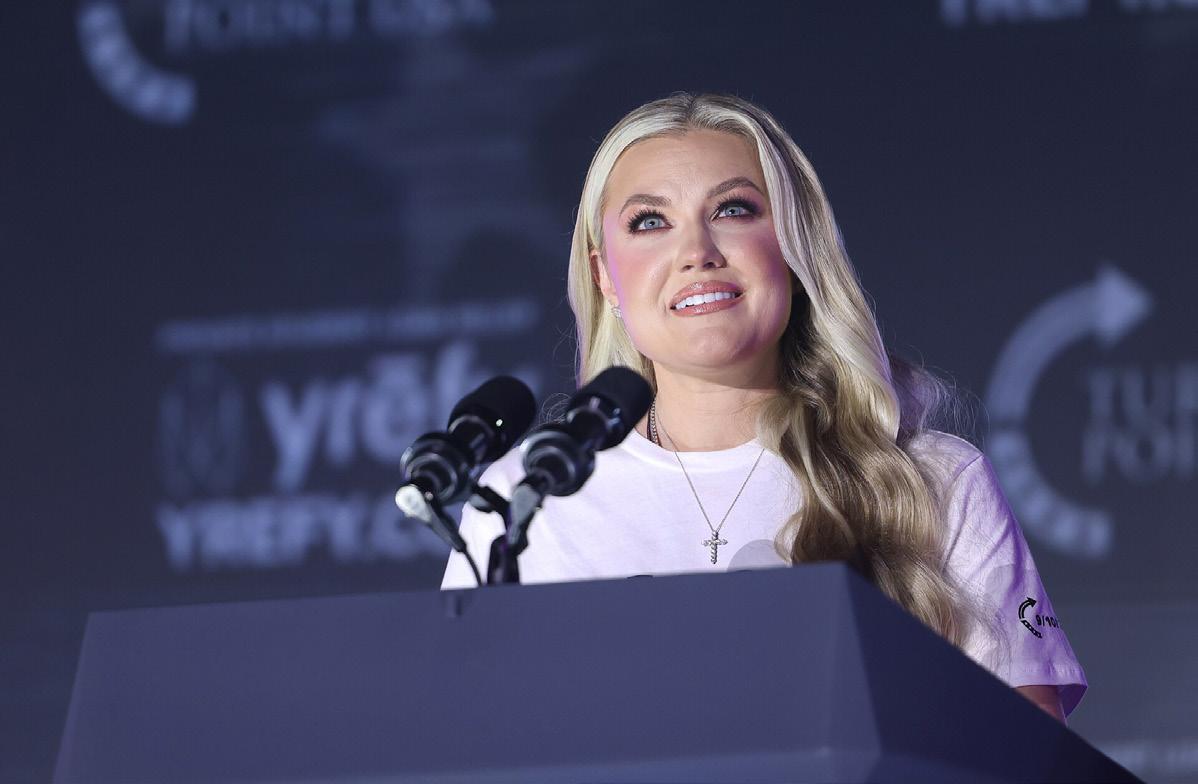
The utter pinnacle of this ruthless phenomenon is none other than Erika Kirk, widow of conservative activist Charlie Kirk and newly-minted CEO of his right-wing monolith, Turning Point USA (TPUSA). She is infamous for her avant-garde (so to speak) public appearances mourning her late husband, as well as for her relentless gospelizing of women being placed on this God-given earth to churn out children with just as much haste as they should churn butter on their homesteads.
In her husband’s wake, Kirk has embodied the ultra-conservative values of TPUSA and unleashed them on an even larger scale with an even more vulnerable audience. She is attributed as bolstering Christiannationalist ideas of delicate, submissive femininity and having “more babies than you can afford.”
Arguably worse is that men respect her authority because of her misogynistic rhetoric; consequently, the idea that a woman’s authority is valid only when she rebukes social progress is embossed into the modern American psyche, not only at her hand, but at that of the men who tolerate her.
Let me be clear: despite her “girlboss” persona, Kirk is not a feminist — she would certainly be the first to tell you that. What she and her PR team whitewash is her indulgence in the benefits of feminist ideals whilst
proselytizing the invalidity of womankind without reserve. Yet, every time she addresses hoards of rightwingers from her podium of selfimportance, Kirk seems remiss of the foundational idea of feminism as a sociopolitical shift: freedom. Freedom of choice, freedom from others’ jurisdiction and freedom to exist on this planet as a woman, without the incessant din of patriarchal musings.
Perhaps unbeknownst to her, Kirk is living and capitalizing off the very freedoms she claims women do not need. She is a CEO. She is a mother. She is pursuing her Ph.D. from Liberty University. She hosts a podcast. None of these feats would ever be even a remote possibility for her without feminism.
Kirk is preaching from behind bulletproof glass, in both the literal and figurative senses.
As is common in our present cultural and political mediascape, many internet users have noted this irony and, subsequently, mocked Kirk through oftentimes brutal memes and irked critique. But, what goes unsaid is the severity of Kirk’s prejudiced agenda — and that is certainly not a laughing matter. Coping through online humor is perhaps a temporary bandage to an ever-bleeding wound that spasms and sputters with unbridled misogyny upon being neglected.
For the sheer livelihood of American women, it is high time for this wound to be cauterized.
It is a glaringly simple truth that must be elucidated: traditional gender
roles and values are not under attack, though Kirk so often claims otherwise. Rather, a woman’s choice to live a certain lifestyle is on the precipice of total erasure. Does a woman want to perfect her sourdough starter, serve her husband and be a mother? Does she want to become a lawyer, never marry and travel the world? What about a combination of those things — or none of them?
A woman’s choice should not be political in any context, but it is. Kirk is directly responsible for the partisanship of female livelihood, as well as the normalization of oppressive notions formed against her own gender.
The intention of this argument is not to tear down Kirk or muddy her name — we have myriad smears against women from all sides of the political spectrum circulating American media, and it is inher-
ently misogynistic to attack a woman’s character on the basis of her relationship with gender. The point at hand is instead the cruciality of educated critique in understanding why, exactly, it feels like we’re going backwards in widespread attitudes towards women. Because we are, and the proof is uncanny. We, as an ever-shifting American people, have the responsibility to veto attacks on women. It’s as simple as that. What’s more, we as women have the responsibility to support one another in a world that thinks our very existence to be inferior. After all is said and done, feminism at its genesis was a demand for equality fostered through rich sisterhood and feminine connectivity. It would be an insurmountable shame if women continue to be enemies to our own kind.
Wisconsin can elect progressives if Democrats stop standing in their way
By Brady Ahler
OPINION EDITOR
In the midst of a “civil war” between progressives and moderates in the Democratic Party, Wisconsin’s gubernatorial primary has emerged as one of the most consequential battlegrounds.
For months, it seemed to be a three-way race between Lt. Gov. Sara Rodriguez, state Rep. Francesca Hong and former Lt. Gov. and 2022 U.S. Senate Candidate Mandela Barnes. That was, until Rodriguez’s campaign imploded due to financial issues that led to the firing of her long-time campaign manager and the revelation that she was essentially out of money.
The day after Rodriguez suspended her campaign, Milwaukee County Executive David Crowley announced he would rejoin the race with the endorsement support of Gov. Tony Evers, just ten days after Crowley suspended his initial bid.
Despite his support for a competitive primary and conviction to neutrality, Evers has decided to intervene and play kingmaker. The goal of his endorsement is plain to see: consolidate opposition to Hong.
Once believed to be a long-shot candidate, Hong has led in nearly every poll this year, including Marquette Law School’s most recent poll on July 22, where she was 11 points ahead of the second-place candidate. She also leads the Democratic field in the number of individual donors to her campaign.
At this point in the race, Hong is the one to beat.
Yet the criticism remains the same: She is too progressive to win Wisconsin.
While this idea has dominated commentary on Hong’s campaign, that argument has become the Democratic Party’s favorite selffulfilling prophecy.
For decades, party leaders have warned that progressive candidates are “unelectable”, only to intervene before voters ever have the opportunity to prove otherwise. The result is a political culture where instilling fear in the base stifles energetic, people-driven progressive campaigns to make way for status quo moderate Democrats.
Despite what moderates would like you to believe, progressives can win in Wisconsin.
In her convention speech, Hong references
Bob La Follette, whom she says at the time was considered “unreasonable, impractical and unelectable.” Under La Follette, Wisconsin was the birthplace of progressivism, once called a “laboratory of democracy,” trailblazing policies such as direct primary elections, workers’ compensation, and progressive taxation.
La Follette’s legacy alone does not prove that progressives can win in Wisconsin, but it weakens the argument that Wisconsinites will reject bold politics. Wisconsin did not import this ideology from somewhere like San Francisco or Brooklyn. We invented it.
Wisconsin’s history of electing progressives isn’t isolated to a governor over 100 years ago. Russ Feingold, one of the fiercest progressives in the Senate for decades, was a champion for Wisconsin, serving three terms from 1993-2011. Feingold, similar to Hong, ran on a platform of economic populism, taking on corporations and fighting for the working class.
Electability is not an elusive quality that all moderates have and progressives lack. It is the ability to build support, raise money, mobilize volunteers and communicate an inspiring vision for the future. By those metrics, Hong is the clear winner.
To say that Crowley is the more “electable” candidate is a complete contradiction in itself. The reality is, Crowley already lost. He dropped out of the primary. He couldn’t build the momentum to pull ahead in the crowded field of Democratic contenders. It wasn’t until Evers raised him from the dead that he was viewed as a viable candidate.
This is not to say that Crowley is a bad candidate or a bad leader. Crowley has done amazing work in Milwaukee County to make housing affordable, create jobs and cut carbon emissions, among a myriad of other
policy accomplishments. In terms of executive experience, Crowley is perhaps the most qualified candidate in the field. However, Crowley has not shown that he can inspire a movement in the way that Hong does.
What Democrats want right now is change. They want someone willing to fight for them rather than uphold the status quo. They want a candidate beholden to the people rather than to corporations and wealthy donors. They want someone who imagines a better future rather than toils in the misery the party currently enjoys.
Democrats are on the losing team, so it’s time to change playbooks.
Hong offers what Democrats need most in this moment: hope. She envisions a Wisconsin where no child goes hungry at school, no parent has to choose between child care and rent, and no worker has to sacrifice a paycheck to care for their newborn or sick parent. She envisions a Wisconsin where public schools are fully funded, where health care is affordable and where all workers can fight for higher wages and better conditions. She envisions a future determined by the people of Wisconsin, not the greed of the few.
The Democratic Party is on the precipice of a new era. Voters are frustrated with failed promises and ineffective strategies. It is time to think bigger than what we believe is politically feasible and begin “fighting like hell” for what people actually need. Democrats cannot seek to inspire people through tweaking the status quo or campaigning solely on fear of Republicans.
In the August primary, Wisconsin Democrats face a choice much larger than any one candidate. They can retreat to the familiar politics of caution or embrace the state’s history of bold change.
We cannot continue to say that progressives are unelectable if we never let them try.

By Otto von Sothen SPORTS EDITOR
Shawn Eichorst was presented to the media as the University of WisconsinMadison’s new Athletic Directory on July 7 during his introductory press conference.
Following former Athletic Director (AD) Christ McIntosh’s departure from Wisconsin in April to become the Big Ten’s deputy commissioner for strategy, UW-Madison launched a search committee made up of former Badgers and executives to fill the position.
Eichorst formerly served as University of Nebraska and University of Miami Athletic Director and most recently as the deputy AD at the University of Texas-Austin (UT-Austin).
Interim Chancellor Eric Wilcots spoke first at the press conference, sharing his excitement at the idea of a former Badger returning to the Dairy State.
Eichorst is a Lone Rock, Wisconsin native who served as a Deputy AD under Berry Alvarez from 2006 to 2011. During those years, Wisconsin’s football program played in the 2010 and 2011 Rose Bowls.
Restoring Wisconsin’s football program back to its former glory may be the biggest task Eichorst will face.
Wilcots spoke on Eichorst’s success at UT-Austin, noting similarities between the two institutions. UT-Austin and Wisconsin are big state schools that are renowned for both their sports and academics, and both universities are located in the capital of their state and home to some of the country’s most passionate sports fans.
Eichorst was part of a powerhouse at Texas where he won the Learfield’s Director’s Cup in four of the last five years. It’s undeniable that the Longhorns might have the best athletic program in the country, dominating college athletics in many Olympic sports as well as football and baseball. However, replicating that success will be a true challenge for Eichorst in this age of Name Image and Likeness, as Texas has a notably bigger budget than Wisconsin.
Eichorst said he was proud to be back in his home state and will prioritize the care of student athletes and education. In the coming weeks, his mission is to meet and identify
By Ava Hudson STAFF WRITER
After finishing the last two seasons with a losing record, head coach Luke Fickell and his staff have worked to build a high-ranked recruiting class for the 2027 season. With 23 commitments from 11 different states, Wisconsin’s 2027 recruiting class ranks No. 25 nationally.
The young group features a blend of highly-ranked instate and out-of-state recruits, helping shape the future of Badger football. Improving the offense is a priority during recruitment season, as Wisconsin averaged just 12.8 points per game in 2025.
They addressed their offensive drought by landing fourstar running back Kingston Allen, the No. 1 prospect in Wisconsin. The 2025-26 Gatorade Wisconsin Football Player of the Year rushed 3,436 yards for 57 touchdowns at Notre Dame Academy, breaking the state’s single-season rushing record.
Allen is a stellar addition for the Badgers. He will provide the offensive power the Badgers desperately need after finishing No. 16 in the Big Ten for total rushing yards. He gives the Badgers a physical runner capable of carrying the offense.
Wisconsin also landed one of the nation’s top tight ends in Korz Loken— a four-star recruit who ranks among ESPN’s top 300 recruits nationally. In his high school sophomore season, Loken had 28 catches for 425 yards and nine touchdowns. Unfortunately, his junior year was cut short due to an arm injury.
the needs of stakeholders and coaches across Wisconsin’s athletic programs.
“I want to have deep relationships not only within the athletics department but across the aisle in academics. I really want to lean into the educational piece of what we’re doing,” Eichorst said. “I want to get to know our stakeholders, ticketholders, donors, student athletes and head-coaches.”
Eichorst’s failed stint at Nebraska was not brought up. He spent four seasons with the Cornhuskers from 2013-17 and his tenure there is the biggest gap on his resume. He was criticized for firing successful football Head Coach Bo Pellini and hiring Mike Riley as a replacement, who went 19-19 in the 2015 to 2017 seasons with the Cornhuskers.
Ultimately, Eichhorst is getting a new shot at an AD position in a new era of college athletics. Badger fans are getting an experienced executive across all four college power conferences who will try to bring that swagger back to Wisconsin athletics.
“There is swag in Texas, and we got swag too, but we have a little humility with that deal,” Eichorst said.
In 30 career games, Williams totaled 10 interceptions. He said the relationships he developed with coaching staff, combined with the university’s strong academic programs, ultimately made Wisconsin the right fit.
The Badgers continue to add defensive strength with offensive tackle Cole Reiter. Hailing from Germantown, Wisconsin, Reiter is ranked No. 2 in the state. He chose Wisconsin over other Big Ten schools including Michigan, Indiana and Ohio State. At six-foot-seven and 315 pounds, his size and speed set him apart. Reiter provides the help the Badgers are looking for on pass protection.
Rounding off the top recruits of the 2027 class are defensive lineman David Hill, wide receiver Jai Jones and quarterback Jack Sorgi.
At 6-foot-2 and 315 pounds, Hill provides size for the defensive line. He is a top 90 ranked defensive lineman. Jones recorded 54 receptions for 922 yards and 10 touchdowns over 13 games. Sorgi, son of former Wisconsin quarterback, Jim Sorgi, led his team to a 7-4 record and completed 31 touchdowns.
The 2027 class has speed, agility and athleticism, everything Wisconsin needs to compete in the Big Ten. Recruiting momentum has remained strong even though Wisconsin is looking to rebound from recent struggles on-field.
Leading the Badgers’ defensive class is safety Mekhi Williams, who committed to Wisconsin in June. Williams’ commitment represents one of the biggest recruiting victories under Fickell. The fourstar prospect chose Wisconsin over Nebraska and Louisiana State University, after previously decommitting from Florida State.
Williams ranks as the No. 10 safety and the No. 107 overall prospect in the nation.
So far, the recruiting class has been a bright spot for Fickell. The Badgers were able to keep many of Wisconsin’s best players home, like Allen, Reiter and Loken, beating out top Big Ten and SEC schools. While the recruits look promising, the development is the most important part and it starts with winning this season. If Wisconsin shows meaningful progress over the next season, the 2027 class could become the foundation for the team moving forward. If the program continues to struggle, questions will remain about Fickell’s leadership for the future.