Over the course of the summer before the 2025-26 school year, English teacher Jay Bush, alongside computer science teacher Nandhini Namasivayam, applied for a school grant to develop a specialized AI companion for Bush’s English class. Upon the school administration’s approval of the funding, Namasivayam and Bush received compensation for the additional work that it would take to develop the tool, enabling them to use examples of essay feedback from Bush’s classes to create a bot that mimicked Bush’s behavior. Enter: ChatJPT.
According to Bush, the platform is helpful in identifying editing opportunities for students, largely through questions that probe for more complex arguments. “The bot isn’t really to help at the brainstorming stage; it’s meant to be a revision tool,” Bush said.
Namasivayam explained her collaboration with Bush. “The idea came up about a year ago, and then we worked on it over the summer,” she said. “We proposed the idea to the school, of working together to create a bot, probably around this time last year, when sophomores are working on essays.”
In order to train the model,
Namasivayam explained the scope of materials that were used for the bot.
“[We] fed it a lot of the information and data that Mr. Bush had about his English classes; his essays and his feedback,” she said. “We molded the tool into a mini replica of Mr. Bush’s feedback.”
Although ChatJPT has been in development for several months, it was only very recently that it was first applied in the classroom. During the essay project for “The Great Gatsby”, Bush’s sophomore students were able to experiment with the platform, comparing the feedback given to past assignments from Bush himself to that of his AI clone. ChatJPT was purposefully coded not to generate entire essays for students. Instead, it annotates existing drafts to provide feedback on unclear sentences or underdeveloped ideas. According to sophomore Neal Goel, ChatJPT is trained to respond with very specific types of input. “ChatJPT [...] can reword sentences or clarify punctuation, changing some phrasing for different paragraphs,” Goel said.
Sophomore Owen Bowie expressed just how similar ChatJPT was to Bush himself. “The analysis style that it was recommending to me was very similar to what Mr. Bush recommends, really going deep on the glowing words and analyzing that.”
Goel also noted some flaws with the current model. For one, feedback can vary drastically in length, resulting in occasionally uneven edits. “It would either give a huge response, a whole list of things to improve that would span a couple of pages, or it would hone in on one very specific thing,” Goel said. According to Bush, the current model struggles with concision, so reducing feedback length and making revision suggestions more manageable for students to parse through is what he and Namasivayam will be working on for future updates.
Even though the model isn’t perfect, Bush believes it is still important to dedicate time toward improving ChatJPT so it can function as another medium for his students to hear suggestions. According to Bush, the primary reason for spending so much time training and iterating upon ChatJPT was to increase the timeliness of feedback. Oftentimes, English teachers spend weeks writing comments for students’ assignments. Bush explained that this often results in students forgetting about their essay, and as a result, struggling to implement the feedback as well as they might have had the project been fresher in their mind.
Menlo Welcomes New Athletic Director
by SHAAN PARIKH
After 14 years leading athletics at the American School of London, Menlo’s new Athletic Director, John Farmer, is leaving behind the troubles of crosscontinent tournaments for the familiarity of the Bay Area.
For Farmer, the move is a personal decision as much as a business one. With his parents and two of his three sisters living in the Bay Area, relocating here with his family had always been an option. When the job opportunity at
Menlo opened, everything fell into place. “All those things kind of came together at the same time,” Farmer said.
Menlo’s emphasis on athletics to build character quickly stood out to Farmer. “I was immediately drawn to the aspect of athletics being really tied to character and education,” he said. “It’s a great teaching opportunity for people to think through life lessons and character development.”
Farmer’s vision for his new role
aligns with his core philosophy: a program that doesn’t measure its success in wins and losses. “Success, for me, is two things: joy and character development,” he said. “If the kids are having a great time, bonding with each other, feeling like they’re a part of something big and being challenged to think through difficult situations in real time, I’m happy.”
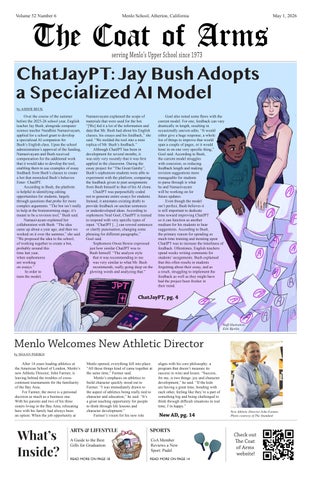
Staff illustration: Eilir Bjorlin
ChatJayPT, pg. 4
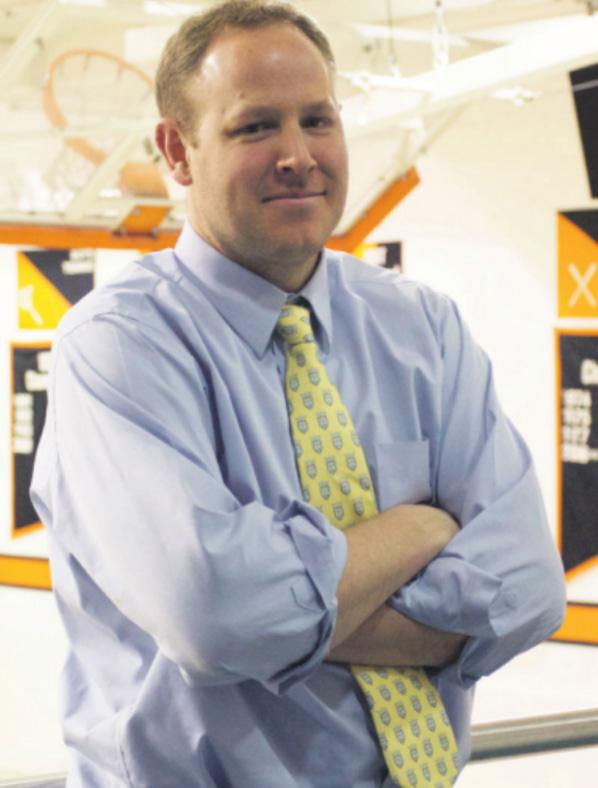
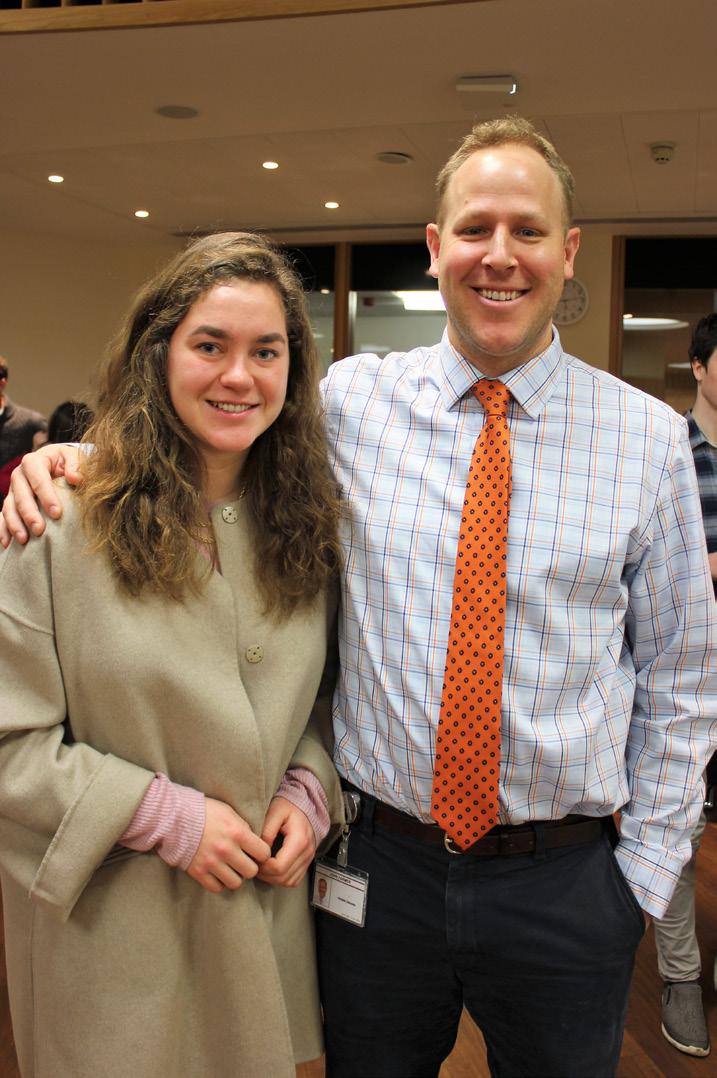
New Athletic Director John Farmer. Photo courtesy of The Standard
Overflow Ordeal: Students and Residents Face Off on Parking
by LARRY ZHAO
On a sunny morning in late March, senior Ella Skinner parked her car on Rose Avenue because the Menlo parking lot was full. After school, Skinner returned to a message scrawled over her windshield. “When I came back, my car was covered in pollen,” Skinner said. “Someone had used their finger and smeared on the car, ‘two hours, idiot.’” Although the message is likely motivated by the two-hour time limit signs for cars parked in certain areas, Skinner’s incident ultimately stems from a student parking shortage on campus.
This year, 221 students applied for parking permits, which is 46 cars too many for Menlo’s parking lot of 175 spots to handle. Around 20 students carpool to school, but this still leaves many students who have to find parking elsewhere, not to mention the sophomores who have recently received their licenses and have to wait until the start of their junior year to apply for parking permits.
Local neighbors haven’t been happy with the excess of cars overflowing into the streets around campus. Over the past few months, Menlo has received several complaints from homeowners about students parking for too long or blocking driveways. The main roads from which these complaints are received include University Drive, Rose Avenue, Lee Drive and Macbain Avenue.
Several locals on Rose Avenue said the issue has only
come up recently. “I’ve been here 30 years. This has never been an issue until March of this year. [...] It’s been a huge problem, and all the neighbors are upset,” an anonymous resident said.
Another resident on Rose Avenue highlighted the troubles the neighbors face on a daily basis. “I understand a predicament if there’s not enough parking, but here’s the problem. Cars park every day here on both sides of the street, so there’s not enough room for two cars to get by,” they said. “It was like a traffic jam. [...] It’s honestly almost every day.”
A third resident, who claims to have coached at Menlo in the past, feels frustrated that the school can’t provide sufficient parking space for students. “They don’t have enough parking. It’s horrible. Menlo needs more parking. You know, they need to provide it. The neighbors shouldn’t have to provide it,” they said. “It’s garbage [the students] leave [on the streets]: In-N-Out and some forks.”
According to Director of Security Mustapha Moutri, “The general sentiment from those neighbors is a desire for better respect of residential boundaries and driveway access, and we want to ensure we remain good neighbors,” he said.
In one of Menlo’s weekly student announcements from November, students were instructed to park only in designated parking lots and to avoid parking on certain streets. Menlo has also placed signs on problematic streets to alert students not to park there, and an additional security guard was set in place to watch Macbain Avenue. “Students
Staffillustration: EilirBjorlin
can help by being mindful of where they park – avoiding blocking driveways even slightly and strictly adhering to posted time limits. Carpooling or using alternative transportation whenever possible would also significantly reduce the pressure on those streets,” Moutri said.
“
It’s a complex issue where both students and residents feel they are in the right.
Upper School Assistant Director Adam Gelb believes that if a student really wants to get a parking spot, they should just arrive early. “It takes a little bit of time and planning, right? If you feel like it’s one of those days where you want to guarantee you have a spot and you have a pass, show up early,” Gelb said.
Still, senior James Yue feels annoyed when he can’t find a spot in the morning. “I do think that they should [give] less parking permits each year, because it is really disappointing when you get to school, and you can’t find a spot,” Yue said.
Additionally, sophomore Neal Goel emphasized the extra walking time when having to park outside of Menlo. “The biggest problem is just that after school, sometimes it’s hard to make it to practice on time. Having to walk, it’s probably two to three times the distance,” he said.
According to Moutri, the parking issue doesn’t have an easy fix. “It’s a complex issue where both students and residents feel they are in the right. It will take some empathy from our neighbors and a lot of help from our students to find a lasting solution,” Moutri said.
Q&A: New ASB President Zander Deutch and VP Ava Allen
by LAUREN GIESSELMAN
The following has been pared and edited for clarity.
Q: How did your campaign process go?
Deutch: I would say the campaign process went well. We focused on talking to a lot of people and seeing what they would be interested in policy-wise, then we tried to work those suggestions into our speeches. We were kind of operating on a weird schedule, just because we didn’t have that many days between when we formalized that we were going to run, and when the election was. Personally, I just enjoyed hearing from a lot of people, and I learned a lot through the process. I talked to some people who were former student body presidents to try to get insight into what did and didn’t work.
Allen: Our campaign process was pretty good. We have a big emphasis on house systems, just because we’ve seen how enjoyable that has been for the student body,
that. Our biggest challenge was coming up with a policy or implementing a change that was both reasonable and appealing to students.
Q: What led the two of you to run for student council president and vice president together?
Deutch: Since sophomore year, we’ve been discussing it because we both were really passionate about student council and wanted to work together on it. We started talking about it much more this year, how it would work, agreeing on roles, and how we would work on meetings and delegate stuff if we were elected.
Allen: I wasn’t on student council in my freshman year, but ever since then, we’ve been working together; we’ve either both been senators or president and senator, or some combination of that. I was really good friends with Paige Miller (‘24) my freshman year, and she was student body vice president at the time, and Zander’s brother was president, so we had role models in that space.
Q: What changes will the student body see on campus next year under your leadership?
We hope that by the first day of next year, we’re going to have multiple stores downtown offering discount codes to students if they show a Menlo student ID.
We also want more games on the quad, such as ping pong, spike ball and volleyball to make it exciting.
Allen: On campus, we really want to implement more house competitions. I think that was a big thing for us, seeing that we only had two this year, and I know that the whole school
shows up for that, so we want to add at least one or two more, just to keep the spirit up and build a stronger community here at Menlo.
I don’t think that we only got elected for some students, or we’re only here to make the seniors happy. I think we’re here so that everybody at Menlo, regardless of your grade, can participate.
Q: How do you plan on accommodating the issues and requests of those who did not vote for your campaign?
Deutch: I don’t think that we only got elected for some students, or we’re only here to make the seniors happy. I think we’re here so that everybody at Menlo, regardless of your grade, can participate. We plan on working closely with Connor Yonkers and Bella Lieu to make sure that their ideas are also seen through because we think that they ran a great campaign and that their ideas deserve similar recognition.
Allen: I think that our competitors had really good ideas, too, and I understand the people who voted that way. We’re going to have a form for people to vote on what they’d like to see action taken on, whether that be themes or policy changes. I think it’s important that we continue to let everybody have a voice and not just those who voted for us.
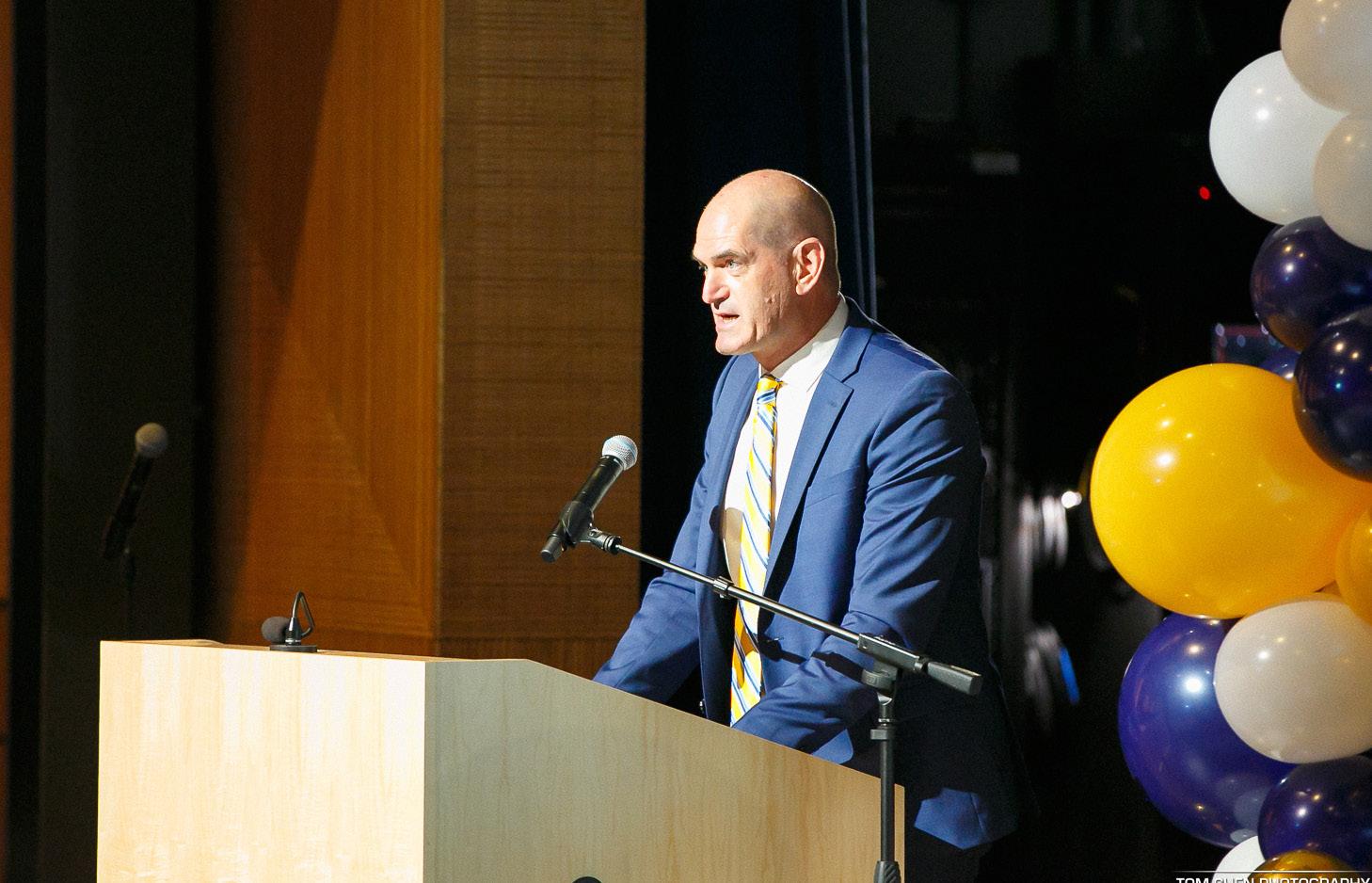
Director of Security Mustapha Moutri
Junior Zander Deutch
Junior Ava Allen, left, and Junior Zander Deutch, right. Photos courtesy of Menlo School.
Menlo Faculty Say Goodbye
Miles Bennett-Smith
by MALIA CHEN, CAROLINE CLACK, ASHER DARLING & SIENNA LEW
History teacher, journalism advisor and coach Miles Bennett-Smith is leaving Menlo after three years at the school. Bennett-Smith plans to move to Seattle, where he has extended family, as he is growing a family of his own; BennettSmith and his wife are expecting a baby boy in May.
Before coming to Menlo, BennettSmith worked in the Summit public school district of Redwood City, the same district where upper school history teacher Franco Cruz-Ochoa had previously worked. After hearing about Ochoa’s positive experience at Menlo, Bennett-Smith became interested in the school for its extensive extracurricular offerings and sizable history department. “When there became a history opening, [...] I jumped at the chance and interviewed,” he said.
Maura Sincoff
by ELAINA HUANG
This spring, English teacher Maura Sincoff will be completing her 33rd and final year of teaching at Menlo, where she has served both the middle school and the Upper School English Departments. Most recently, Sincoff has taught Rhetoric Honors (previously AP Lang), Argumentation and Communication Honors and has served as the Director of the Writing Center since 2001, where she offers individual help and peer tutoring resources to students.
Before coming to Menlo, she had been teaching in Texas for seven years and wanted to experience a different environment. Next school year, Sincoff will enter a new chapter of her teaching career at a middle school in the Bay Area.
Sincoff has been part of the Menlo community for over three decades and will be missed dearly by her colleagues
During his time at Menlo, Bennett-Smith taught U.S. History, AT Government and Politics, along with Intro and Advanced Journalism. He has also been an assistant coach for the crosscountry and track teams, as well as for varsity soccer.
While Bennett-Smith has loved being part of the Menlo community, continuing at Menlo no longer makes logistical sense for him and his family. Bennett-Smith lives in San Francisco and commutes over an hour to and from Menlo every day, and those long drives were a significant factor in his decision to leave the school. “I am someone who is open to new adventures, and the next chapter, the new venture, I think is going to make more sense in Seattle,” he said.
Bennett-Smith said that the things
English teacher Oscar King IV, who has taught Rhetoric Honors with Sincoff ever since coming to Menlo in 1993, looks to Sincoff as his mentor and as an inspiration for his teaching. “She cares deeply and thoroughly — not just that her students gain the skills in writing that they need, but that they gain the confidence to see themselves as writers,” King said.
According to science teacher Cristina Weaver, who first worked with Sincoff in the Menlo Middle School, she is an excellent teacher. “Ms. Sincoff is a very insightful and patient teacher. [...] She pours her love of books and writing and people into every aspect of her work,” Weaver said.
Her colleagues and close friends all highlight her thoughtfulness and deep care for both her friends and students. Weaver and King have both received the baked goods Sincoff made for them after major events such as the births of King’s children.
“She also finds ways to recognize and support the people around her on a regular basis,” Weaver said.
“From when I started at Menlo, Maura has been my unassailable champion,” King said.
Science teacher Todd Hardie will also feel Sincoff’s absence deeply. “When Maura leaves Menlo, the school will be losing someone who brings a rare combination of heart, integrity and quiet excellence that is irreplaceable,” he said.
More Stories Online
Other faculty leaving Menlo include:
• Science teacher Zachary Eagleton
• Math teacher Christine Walters
• History teacher Sabahat Adil
• Science teacher Zane Moore
• Computer Science teacher Zachary Blickensderfer
To read their departing stories go to menlocoa.org.
he’ll miss most are his relationships with students and fellow faculty members. He said his goal is to help students feel like they have ownership, whether that be in the classroom or on the sports field. “[I’m] really trying to treat students like adults, while constantly knowing that [they’re] not yet adults, and [they’re] just learning,” he said.
Bennett-Smith plans to continue teaching and coaching in Seattle. “I don’t really just want to teach in a place. I want to be a part of the community. I’m going to be active, engaged in the life and love that is on campus,” he said.
Eugenia McCauley
by VINCENT MUSSER
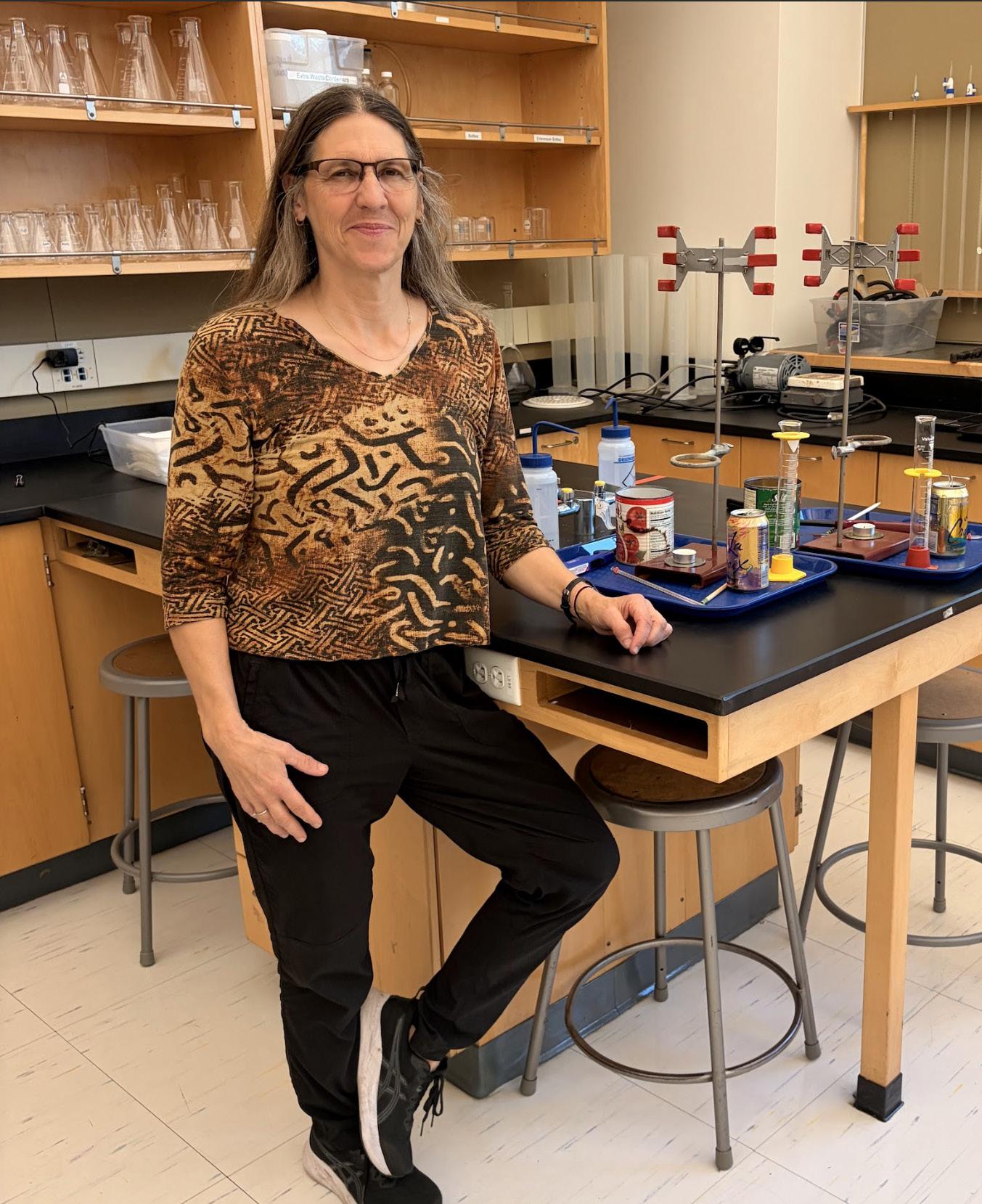
After 25 years at Menlo, Upper School chemistry teacher Eugenia McCauley is wrapping up her final experiment and retiring at the end of this year.
Upon finishing graduate school at Stanford University, she originally planned to research computational chemistry at Sandia National Laboratories, which she thought would be her dream job; however, something didn't pique her interest in the way she hoped. Instead, she went into teaching classes at a community college, then to other local Bay Area high schools like Gunn and Pinewood, before finally landing at Menlo in 2001, teaching chemistry — the subject she has always loved.
As the year comes to an end, McCauley reflects on all that she has been able to experience in her time at Menlo. The amazing colleagues, inspiring students and school’s ability to truly care about their students made her almost certain this would be her job forever. “To me, I particularly loved the teachers and all the interesting people I have gotten to meet,” McCauley said.
A Menlo experience that will always stand out to her during her time here is the administration’s ability to quickly adapt to any situation, one example being the COVID-19 pandemic. She was impressed with how the school, teachers and students all came together. Past students also express their thoughts about her. “I think she’s a great teacher because I love how patient she is,” sophomore Parker Sunwoo said.
Though McCauley won’t have another full-time job, she has considered continuing her career as an educator in the future; however, it wouldn’t be as a teacher,
but as a tutor.
McCauley has not yet decided what is in store for her future after Menlo. “I don’t have anything concretely planned,” McCauley said. In her free time, she wants to get more involved in the activities she has always enjoyed, but hasn’t had enough time for, one being joining a brass band in New Orleans. McCauley has played piano since being a kid, eventually expanding to brass instruments as well, and with her future plans, she hopes to reignite those lost passions. When she was a kid, McCauley began by playing piano but eventually moved to brass instruments. She is also very involved with South American culture, often participating in Brazilian dancing and percussion, and she wants to authentically experience it in Brazil.
Even though McCauley has loved her past 25 years here at Menlo and will never forget the memories that she has made, she expresses her excitement for what the future holds, whether that future includes chemistry or not.
Chemistry teacher Eugenia McCauley stands at her class lab. Staff photo: Vincent Musser
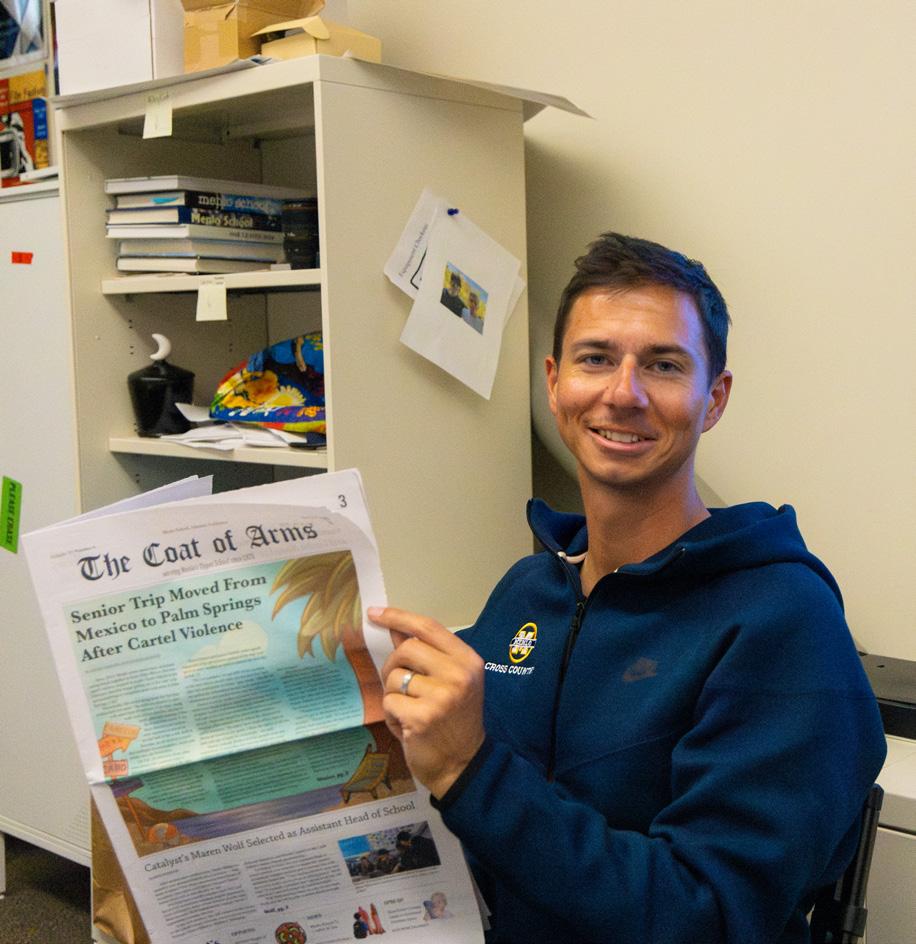
Miles Bennett-Smith reading The Coat of Arms. Staff photo: William Gardner
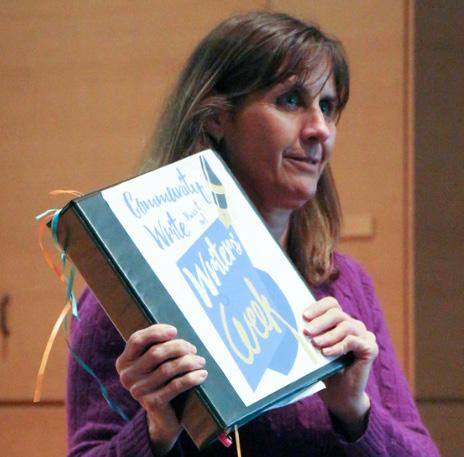
English teacher Maura Sincoff presents during Writer’s Week. Photo courtesy of Pete Zivkov
ChatJayPT
Continued from pg. 1
“The idea was that hopefully, I could give them a bot that would give them more immediate feedback during the process, and therefore allow them to learn more quickly [and] more effectively,” Bush said.
Going forward, Bush has aspirations for what ChatJPT may evolve into. “In the longer term, we’re trying to overcome some of the limitations that come with the basic commercial version of ChatGPT, or for that matter any other Large Language Model (LLM). And the way that we have to do that is at some point probably going to [involve] the school investing in our own LLM,” Bush said. “That’s going to cost money, but it will significantly amplify the
approximations of teacher feedback and should be utilized accordingly. “This is never going to replace teacher feedback. No bot that’s out there right now can even get close to a skilled teacher in terms of the feedback, the individualization, the particular curricular priorities,” Bush said.
Where Is the Class of ‘26 Headed? Here’s the Data So Far
by BAELYN BATORY & PAYTON LEE
As the school year comes to a close, college decisions are flooding in, sending our seniors away from coast to coast. The Class of 2026 is charting a wide range of paths that shed light on their new plans for the next four years.
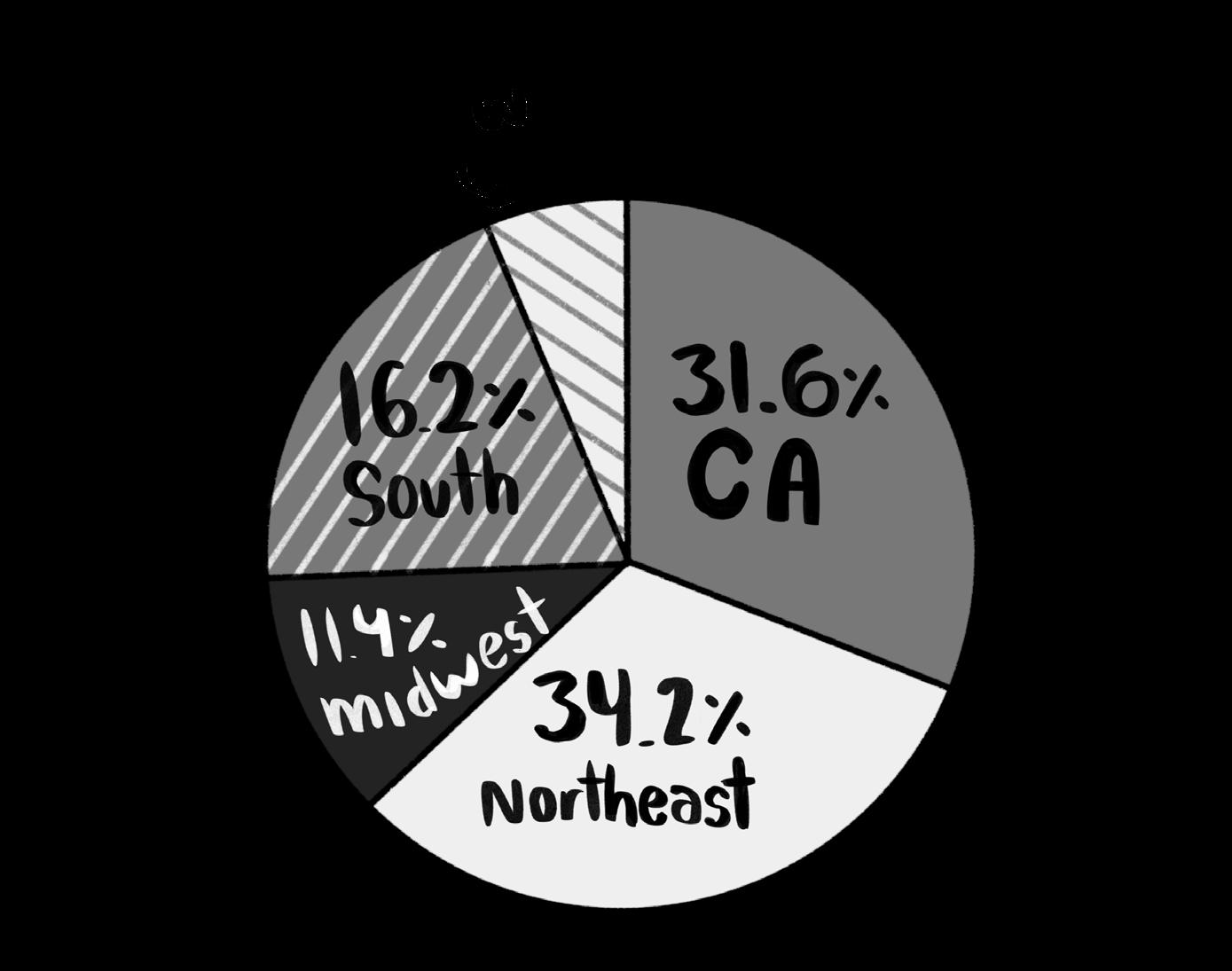
As our classmates head off to college, we were curious to see the distribution of their colleges across different regions in the U.S.
Our data showed a majority of the commitments are concentrated in both California and the Northeast, with strong representation in public and private universities.
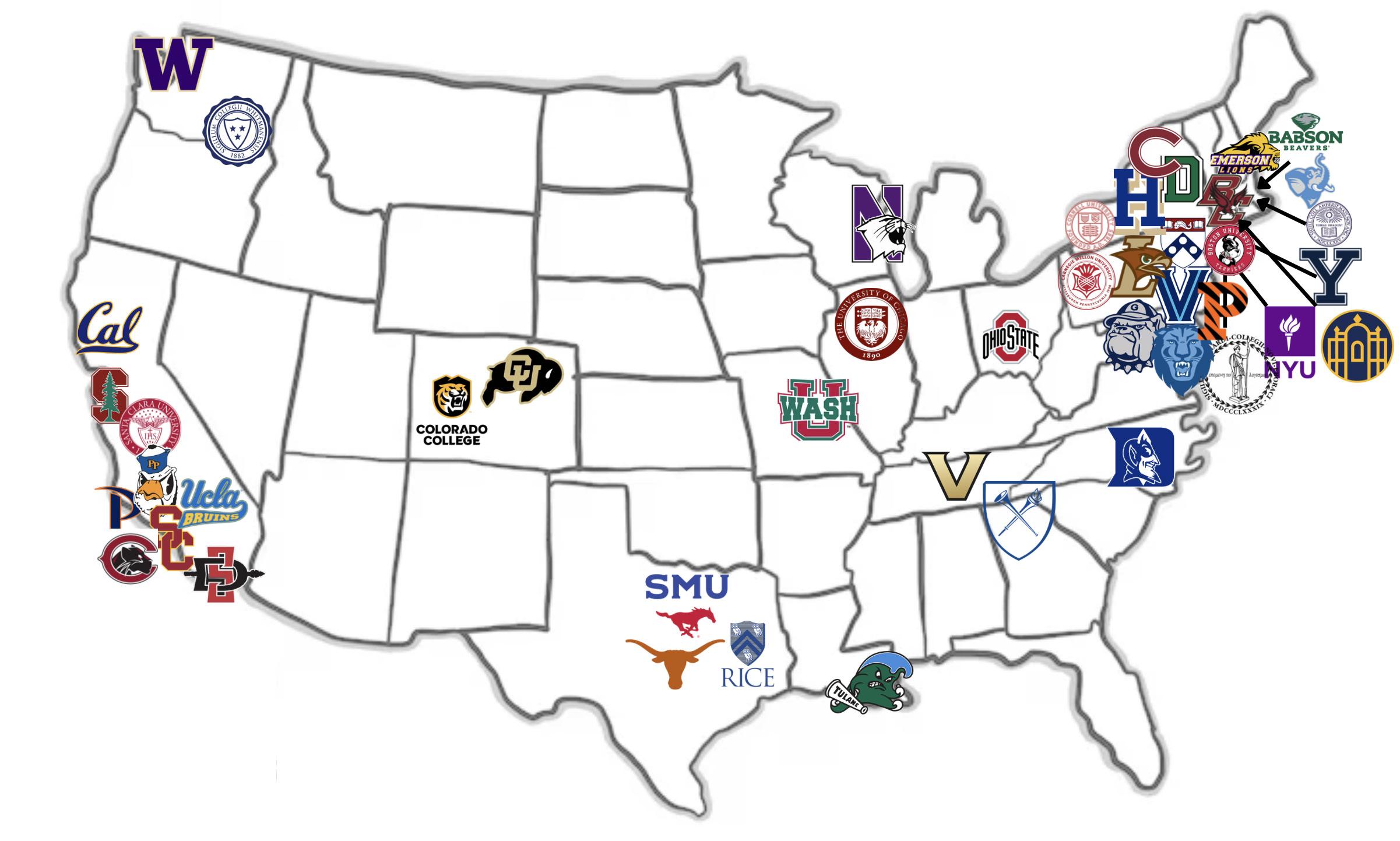
Several universities, including Washington University in St. Louis and Duke University have already seen an increase in Menlo School commitments.
So far, the Class of 2026 will be attending eight universities that no Menlo graduates went to last year. Some of these include: San Diego State University, University of Texas at Austin, Pepperdine University and Emerson College.
Disclaimer: This data is based only on students who have announced their commitments up until April 26.
Colleges With the Most Student Commits
College Destination by Region
Opinions
BTS is Back and Better than Ever: “Arirang” Album Review
by SIENNA LEW
From lighting the world up like dynamite to wowing audiences with their smooth-like-butter charm, Korean boy band BTS finally came back in full swing this spring. After nearly four years apart, split between mandatory military service and solo creative projects, BTS released their fifth full-length album, “Arirang,” on March 20. With 14 new tracks to enjoy, the album carries the weight of absence and return in a nod to their heritage.
The album borrows its name from one of Korea’s most iconic and enduring folk songs, “Arirang.” While there isn’t one true meaning tied to it, this song is classically about separation and longing for reconnection (fitting for a group whose identity has recently been defined by being apart!) So, in honor of BTS’ long-anticipated return and a journey back to their cultural roots, I’m here to unpack five of my favorite songs.
Body To Body
“I need the whole stadium to jump.” The opening of this song hits with a demand, because before anything else, the group makes one thing clear: they’re back, and they’re here to stay.
On the surface, “Body To Body” reads as a sensual, sleek track built around the idea of needing physical closeness with someone else. But underneath, it’s a thinly veiled craving for the group’s reunification with their beloved fans. As the very first track of BTS’s return to stardom, this track has an extremely difficult job: set the tone and bring the energy. And it does just that.
Driven by a dark, pulsing EDM core, this rap-forward song feels like a kinetic explosion brimming with intense energy. Anytime I listen to the bridge, traditional Korean instruments and echoes of the folk song “Arirang,” leave me wanting more. It’s an acknowledgement of their beginnings as a hip-hop group that nobody knew.
Most of all, it’s a reminder to listeners that we should always remember where we came from and take pride in how far we’ve come.
If “Arirang” is about separation and longing, “Body To Body” gets you ready for a joyful reunion. And honestly, it’s the track that should have led the album.
“
The group makes one thing clear: they’re back and they’re here to stay.
“
Normal
I’ve always been a sucker for rock-tinged pop, and “Normal” is no exception. It’s easy on the ears and quite repetitive, but it has enough elements that
the lyricism — the immense pressure of being an artist who shares every part of themselves publicly, yet having their every move be scrutinized.
The vocalists get their moment to shine in this song, and even the rap verses take place in a talk-sing hybrid. Truly, it’s a simple yet fun listen that just makes me happy to bob my head along to.
Hooligan
Sonically, this song is confusing, so you never know what to expect next. I can see why many friends of mine (even fellow BTS fans) have complained about their ears bleeding after listening to this song.
But that’s exactly why I like it: there are so many fascinating elements to focus on, from the instruments to the singing or rapping. I agree that the production might not feel cohesive to your average pop listener, but experimentation in K-pop is nothing new, and I’m a firm proponent of embracing the oddness.
“Hooligan” is a rap-forward song that gives each of the three BTS rappers standout parts that showcase their unique vocal tones and rap flows. A melodic, string arrangement kicks off the song, which makes you anticipate something emotional and slow, but then, electronic synths start fading in.
Then come the sharp, cutting sounds of knife blades clashing harshly, followed by a cackling laugh track that feels faintly Joker-esque. This one’s a doozy, but it’s definitely a fun listening experience.
Swim
A quintessential BTS title track always has a flair
for the dramatic, whether it be booming drums or electronic guitar riffs. So when I first listened to “Swim,” I was certainly expecting to be blown away by an incredibly layered production. But this understated track subverted all of my expectations, and it also lives right up to its name.
“Swim” has had an impressive reign as #1 on the Billboard Global Top 200 for four straight weeks, as of April 23. As the album’s main track, the song’s as refreshing as swimming in a fresh blue ocean: simultaniously undramatic and sophisticated.
Its F-minor key gives it a slightly moody, sensual vibe and a cooltone. Believe me when I say this is one of the most synth-heavy songs I’ve ever heard, giving it the feeling of having a real-life pulse. Soft rap and vocal segments from all members contribute to its overall laid-back feel, and lyrically, it’s a dive into the group’s forward-looking optimism and vow to keep swimming forward through it all.
Something to note is that “Swim” is fully in English, which heightens its chances of becoming a frequent staple on radio stations — well, only if they’re still wary of playing songs in other languages. But come on, it’s the 21st century!
Merry Go Round
“Merry Go Round” leans into trippy, almost psychedelic-rock-inspired vibes, which checks out, since the talented Kevin Parker from Tame Impala collaborated on this song! The song is dreamy, with each of BTS’s vocalists hitting a melodic, airy falsetto at some point during the verses or chorus. This ballad has strong emotional resonance as well, highlighting that shouting the lyrics doesn’t necessarily make a song more impactful than whispering them!
Overall, this song proves that BTS can truly do the best of both worlds, switching genres and subject matters, yet still making their artistry land well.
Menlo is Ruining the Potential of the House Competitions
by LILA OZDEMIR
One school, four houses: Halverson bears, Douglass otters, Warren panthers and Lapolla owls. Menlo mythology told us that the standoff between these houses would be the battle of legends, yet, despite high expectations, the result of such a clash has been pathetically underemphasized by the school.
Last school year, Menlo began the house competitions to promote school spirit. During such assemblies, everyone dresses in their house color and cheers on their housemates as they compete in challenges. While most go all out in such events, the sparsity and lack of proper emphasis on house spirit devalue the experience.
Menlo started the house competitions for spirit, yet the lack of investment in them makes the system feel cut short.
of the few random assemblies per year, houses are so insignificant that I often hear people stutter when trying to remember the different names, simplifying their house by color or mascot.
Now, I’m not sure why we’ve only had three house competitions (the last one of the year was in February), but the rarity of such events makes it hard to take competitions seriously. How can there be school spirit around houses when the last competition ends before the last school quarter even begins?
The house system has so much potential at Menlo. If the school wants students to care about the house system, it needs to increase the campus relevance. I’m talking beyond the occasional house meetings and the once in a blue moon assemblies. In addition to increasing the number of house-related events, I think offering housebased activities on campus would really boost spirit.
For instance, students love playing games on the quad. Why do we only have large assemblies to compete for house points? If Menlo Student Life spent just a bit more effort turning those games into mini house events
(spikeball on the quad, anybody?), people would feel much more pride in their houses.
Furthermore, instead of offering a random surprise or food truck with a long line to the winning house, Menlo can give out an open-to-all treat with the winning house as the theme. Let’s say Douglass wins a competition. What would be a more amazing way to boost both campus and house spirit than if FLIK gave out green cupcakes to celebrate the win, or if Menlo bought a green spikeball set? The library also organizes many small events, which serve as the perfect opportunities for more house points. Beyond the housethemed nail art in November, there has been nothing to reinforce house pride.
Ultimately, Menlo started the house competitions for spirit, yet the lack of investment in them makes the system feel cut short. To fully maximize the house spirit, Menlo should make an effort to host more house assemblies throughout the year and bring the charm of school houses to light.
Staff illustration: Sienna Lew
Staff illustrations: Tali Kauffman
Menlo Students Need Breakfast Just as Much as Teachers
by HADLEY RYE
Every Monday and Friday morning, I rush past the cafeteria doors and towards the delectable pastries inside, thinking this may finally be the day I arrive in time for Menlo’s breakfast. However, I am greeted with nothing but mere morsels of pastries and scraps of food left in tins. Trudging through first period on an empty stomach, I’m forced to wait out the clock until lunch.
or binging later to compensate for my missed meal.
Concerningly, Centers for Disease Control and Prevention data indicate that only about one in four high school students eats breakfast daily, and roughly 18% skip it every day; the number one reason being a lack of time. I personally relate to the statistics, since I prioritize extra sleep over preparing food, which takes about 20 minutes out of my morning.
this without extra cost, less popular Snack Shack items could be taken off the menu and instead go towards these breakfast options. Even something as simple as having a toaster running in the mornings with slices of bread, bagels and cream cheese would help provide energy for students to last until lunch, which would just subtract from the bread provided at lunch instead of costing extra.
I fail to truly absorb information in my classes when I skip breakfast, and I end up dealing with my stomach growling embarrassingly loud
during class or binging later.
“ “
While it may seem fine to skip breakfast and simply “make up for it” with lunch, that’s not the case, especially for teenagers. Breakfast is essential for health, academic and athletic performance, all of which are severely needed for Menlo students. We often hear it referred to as the most important meal of the day, replenishing glucose stores after a period of overnight fasting, helping boost energy levels and alertness. Often, I fail to truly absorb information in my classes when I skip breakfast, and I end up dealing with my stomach growling embarrassingly loud during class
While the simple solution could be “just arrive earlier,” it’s not that simple for many students. Personally, I have to get a ride from my brother each morning, which means both of us must be ready before facing traffic, parking a couple of blocks from the school and then finally walking through the loop to go into school. Many students also take the bus, which affects arrival times and leads to an influx of students competing for food at the same time.
“It’s a cost issue,” Menlo’s Director of Dining Services Thien Hoang said. “It’s not my choice if we have [regular] breakfast for the students.” I acknowledge that FLIK does not control its budget and that our headworking teachers are the priority for breakfast. However, as teenagers, we are at an essential stage of growth, and breakfast is necessary to help us complete our numerous duties as students to the best of our ability. FLIK already works hard to provide food for both the students and teachers. Small cost-effective tweaks could be made to be able to provide a proper breakfast for students and staff.
One idea is to offer pre-packaged options that don’t require baking or cooking, which would be a great option for people who don’t have much time before classes start. This could include a small station with protein bars for on-the-go snacks. To provide for
With a small tweak like this that avoids both high costs and added burden on staff, students and faculty will be provided with enough food to stay healthy, focused and energized throughout the day. Students already racing against the clock each morning won’t have to worry about whether or not they’ll have breakfast. A
Losing the May Marbles Crossword
by SIENNA LEW
Bolded
clues are May themed! Find the answers by scanning this QR code:
ACROSS
(1) Didn’t win at Monopoly? Don’t be this kind of loser!
(4) Your English teacher might correct you if you don’t use this word when asking to go to the restroom. Or: name of this month.
(5) Most commonly used English word.
(6) Your sophomore science teacher’s favorite rock band, abbr.
(8) Your freshman science teacher feels electric with joy since you used this scientific unit, abbr!
(9) Element whose symbol comes from its LaTIN name.
(11) Middle Eastern North African affinity group at Menlo, abbr.
(12) The initials of the guy who composed Requiem in D Minor.
(14) The plot of a story can also be called this.
(15) May can be called many things, but one of these titles honors this specific affinity group.
(18) When you’re sick, your doctor might give you one of these (in shorthand).
(19) A plural verb of existence
(20) Don’t partake in one of these, much less seven — they’re deadly.
(22) Close sports game? You’d call it a nail-____!
(24) You might see children braiding one of these this month at a farmer’s market.
DOWN
(1) Someone from this franchise might wish “May the Fourth be with you.”
(2) Oh-m gee: scientific units galore! I’m sorry, I couldn’t resist.
(3) Gym bros are always trying to squeeze in one more ___ at the machine.
(4) Transcription in biology has this type of single-stranded nucleic acid involved.
(6) Menlo’s 2 weeks of experiential learning before the summer kicks off.
(7) Vamos a celebrar la independencia de México en ese día.
(10) The second Sunday of May is reserved for celebrating this reason you exist.
(11) In this card game, you want to avoid having the last unmatched card, also called the Old ___.
(13) “Actions speak louder than words” is a prime example of this type of figure of speech.
(16) National, abbr.
(17) Rooted giant that thrives and grows in May.
(21) What salt calls itself in Chemistry.
(22) You might want to check this vital, abbr, if you binge too much of “The Pitt.” (23) This moon of Jupiter’s is the most volcanically active world in the solar system.
“Love Story” Shouldn’t Dismiss Accuracy for Enjoyment
by CAROLINE CLACK
“This story is inspired by actual events. Certain depictions of people and events have been dramatized or fictionalized for storytelling purposes.”
Based on Elizabeth Beller’s 2024 book, “Once Upon a Time: The Captivating Life of Carolyn Bessette-Kennedy,” Connor Hines and Ryan Murphy’s “Love Story: John F. Kennedy Jr. & Carolyn Bessette” is a popular nine-episode series.
At the start of each episode, however, this disclaimer flashes to protect the show’s creators from legal liability, should their dramatizations provoke the individuals portrayed in the film into taking legal action. But this vague disclaimer, which appears whenever a creator blends fact and fiction for entertainment, should not give producers a free pass when dramatizing stories about real people for public amusement.
“Love Story” traces the romance between ‘America’s Prince’ John F. Kennedy Jr. and fashion publicist Carolyn Bessette through family pressure, marital discord and public scrutiny in the mid to late 90s.
While some aspects of the series have been verified through interviews with friends and paparazzi photos,
others have been deeply misconstrued or even fabricated.
According to individuals portrayed in the film, including actress Daryl Hannah and members of the Kennedy family such as Jack Schlossberg (nephew of John F. Kennedy Jr.), certain depictions sacrifice accuracy for entertainment.
I understand that minor inaccuracies can make a drama series more engaging for viewers, like when the producers heightened drama and subconsciously encouraged viewers to root for John and Carolyn by positioning ‘characters’ such as Hannah and sister to John F. Kennedy Jr., Caroline Kennedy, as obstacles to the central love story. However,
“Love Story” is not merely a work of fiction. The contents concern the lives of actual people, both living and deceased. Inaccuracies, especially ones made without the consent of involved individuals, can have real-world consequences.
In a New York Times guest essay titled “How Can ‘Love Story’ Get Away With This?” Hannah writes about how the show fails to accurately represent her life, conduct and relationship with John F. Kennedy Jr. She described how producers chose to portray her as “irritating, selfabsorbed, whiny and inappropriate” through the inaccurate actions and behaviors the show’s creators attributed to her character.
According to Hannah, since the series aired in February, she has received threatening messages from fans and seen permanent damage to her reputation. Should her well-being be the price of a slightly punchier storyline? The harmful effects of misconstrued details are not unique to “Love Story.”
Individuals portrayed in similar “inspired by actual events” films like “Inventing Anna,” “When They See Us” and “The Crown” argue that inaccurate portrayals cost them jobs, created safety concerns and severely damaged their reputations.
Coming from someone who truly did enjoy “Love Story” and similar works, I still strongly believe that accuracy should never be sacrificed for entertainment value if those inaccuracies have the potential to harm portrayed individuals in any way, shape or form.
Creators of dramatized “true stories” involving non-consenting figures have an ethical responsibility not to invent defamatory behavior.
At the same time, viewers have the responsibility to view shows like “Love Story” as fiction first, not a source of truth about real people.
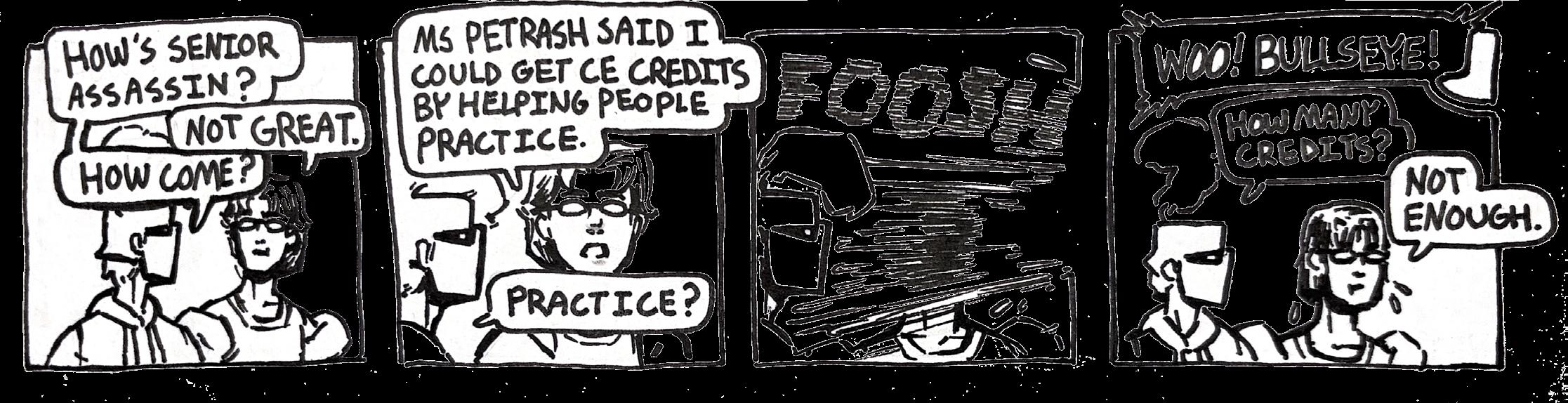
A comic series by guest illustrator
Jonah Block
Menlo Struck Out When it Got Rid of Its Softball Team
by NATALIA JUNO,
Due to its compelling combination of competition and camaraderie, it is no wonder that softball is the fourth most popular girls’ sport, according to the California Interscholastic Federation (CIF) 20242025 Sports Participation Survey. It ranks more popular than several Menlo girls’ sports, such as basketball, tennis, flag football, cross country, swimming and diving, water polo, golf and lacrosse. Yet, despite having been offered at Menlo previously, it is no longer one of Menlo’s 11 girls’ offerings. Adding a softball team would not only satisfy experienced players at Menlo but also attract new athletes.
“The main factors when deciding whether to add softball are budget implications, field space issues and whether enough girls hold sustainable interest,” Director of Athletics Earl Koberlein said. At Menlo, we have six girls’ sports in the fall, but only three in the spring. CIF data shows that far more girls participate in fall sports, meaning there’s ample room for Menlo to support another spring program. While some may question how popular the sport would be, many Menlo athletes have softball experience.
Menlo is known for having well-rounded students, skilled in both academics and athletics. In addition to our experienced players, others who may not have played recently would
likely try softball. “It would be fun to play softball again and have the opportunity to do that not in a club,” freshman Maggie Peiffer said. While Menlo’s baseball program has been very welcoming to the handful of girls who have joined, it hasn’t been able to replace softball. “Baseball was a great experience, and I am grateful for all the opportunities that were given to me. Despite their similarities, I think there’s a lot that softball has that baseball doesn’t. It just wasn’t what I was looking for,” sophomore Becca Clack said. Adding a softball team could also benefit Menlo boys who have expressed disappointment that we do not have boys’ volleyball or wrestling. Because Title IX requires that girls have equal opportunities in sports, adding softball could make it easier to add a boys’ sport. “I think a lot of students may feel oppressed because they play sports on their own, but would love the opportunity to play for their school. I think it’s a great idea to add more sports,” sophomore Hunter Moulds said.
A more well-rounded offering of popular high school sports will make Menlo more appealing to prospective students. Assistant Director of Student Belonging Courtney Tyler, a former college softball player and current club coach, shared her insight: “I work with tons of athletes in the area. Not many talk about Menlo. When I ask why, the fact that softball isn’t offered is a barrier to them applying. I’ve also seen this with middle schoolers who don’t come to the upper school because we don’t have
softball. […] Not having the program they are passionate about has caused them to look elsewhere for their high school experience.”
Baseball was a great experience. Despite their similarities, I think there’s a lot that softball has that baseball doesn’t. It just wasn’t what I was looking for.
Sophomore Becca Clack
“ “
When asked why Menlo dropped its softball program years ago, Tyler believed it was due to a lack of athletes. “But in recent years, softball [has been] incredibly booming, especially in this area. It’s way more popular now and has a lot more exposure in terms of the collegiate level being broadcasted professionally with Athletes Unlimited. It makes sense to revisit this as the landscape of softball, and the engagement in this area has changed. I would love to see it at Menlo,” Tyler said. Every time I look at the banners hanging above the basketball court, I notice Menlo’s girls’ CCS softball championship from 2011. Let’s add to that in the 2027 spring sports season!
EllaStaffillustration: Skinner
GUEST WRITER
Freshman Seminar Should Include Financial Literacy
by ZOE HAYES
All Menlo freshmen are required to take a year-long course called freshman seminar, which rotates through short units on topics such as healthy relationships and “vibe-coding.” But despite the course’s wide scope, it omits one of the most essential life skills: managing money.
From budgeting to understanding saving, credit and long-term financial decisions, financial literacy is fundamental to adult life. Yet at Menlo, these skills are mostly pushed to later years — often appearing only in optional senior programming like Life Beyond Menlo — by which point many students have already formed lasting financial habits.
“I think it’s important for freshmen to be financially literate,” freshman Chase Riley said. “We need to have the tools to make important decisions about our spending.”
Riley and his freshman class are the first to experience freshman seminar as a year-long course, consisting of ten classes instead of the original six. Along with rotating through courses, freshmen often attend whole-grade assemblies during their freshman seminar block.
Students regularly need to make financial choices, whether related to spending money on lunch or movies, saving income from a job or budgeting allowances. Small choices add up, and without understanding their longterm impact, bad habits develop. Menlo needs to take action to prevent poor life skills from taking hold of students.
track income and expenses before spending freely, as off-campus privileges come in sophomore year, often leading to increased spending) and gaining a basic understanding of taxes to lower nervousness around the topic and install habits early. Equally important are the basics of credit scores, compound interest and the difference between needs and wants.
“
I see a real value and advantage to talking about financial literacy earlier. The question is whether it’s one of the ten most pressing issues for ninth graders.
Beyond Menlo program in the final weeks of school during M-term.
But by the last weeks of senior year, it may be too late. Beyond the vast majority having senoritis, it is also unfair to require them to learn something so vital to their lives at the last minute. “I think seniors digest some of it, but not as much,” Fauver said. “They’re kind of done at that point.”
Financial literacy does not need to be taught all at once, but freshman year is the most logical place to start. With off-campus lunch, jobs and greater independence just around the corner, students are already on the verge of making more significant financial decisions.
Overall, letting freshmen go into sophomore year without a class or assembly on financial literacy does them a great disservice. If freshman seminar is meant to prepare students for life at Menlo, then giving them a basic understanding of how money works is essential.
I think it’s important for freshmen to be financially literate. We need to have the tools to make important decisions about our spending.
Freshman Chase Riley
While these assemblies cover a variety of topics, none yet teach financial literacy. If Menlo cannot add a financial literacy course to freshman seminar, it should at least dedicate an assembly to cover the topic briefly.
As for what should be covered, the most critical topics for freshmen include budgeting (learning to
The Coat of Arms
These are not abstract adult concerns; they are tools students will need the moment they earn their first paycheck or open a bank account, tools that a Menlo education should be providing.
Freshman seminar Sex-Ed teacher Jake Fauver acknowledges the value of introducing financial literacy earlier, but also points to the challenges of fitting it into an already packed curriculum. “I see a real value and advantage to talking about financial literacy [earlier],” Fauver said. “The question is whether it’s one of the ten most pressing issues for ninth graders.”
Fauver suggests that if financial literacy were introduced in freshman year, it should focus on foundational concepts. “The value of saving and showing that money grows on its own is really important,” Fauver said. “Understanding the difference between debit, credit and investing — just having a sense of where money comes from and how easy it is to overspend.”
At Menlo, financial literacy does appear in other areas of the curriculum, but often later and less consistently. Some students encounter it in upper-level math courses, while seniors have access to optional financial literacy workshops during the Life
Assistant Video Editor.............................................................Payton Lee
Staff Writers......................................................Asher Darling, Larry Zhao, Vincent Musser, Aaron Widjaja, Sachin Nukala, Sadie Evans, Sophia Wang, Malia Chen, Anya Ramani, Sienna Lew, Caroline Clack, Andrew Chriss, Sophia Jia, Kayla Banatao, Reika Myhren, Rafi Kauffman, Savannah Smith Adviser......................................................................Miles Bennett-Smith
We want to hear your voice!
We appreciate hearing your opinions, whether it’s through guest writing, letters to the editor-in-chief or comments on our website and Instagram @menlocoa. Please reach out to the editor at noah.levin@ menloschool.org or to
The Coat of Arms 50 Valparaiso Avenue Atherton, California 94027 (650) 330-2001 Visit us online at
Mission Statement
The Coat of Arms is an independent, student-led open forum for student expression. All decisions relating to the management and content of The Coat of Arms are fundamentally the responsibility of students. Coat of Arms reporters strive to acknowledge their internal biases and tell meaningful stories with empathy, fairness and journalistic integrity. The Coat of Arms staff is committed to building on the legacy of past staffs while setting the foundation for future members.
Upper School Wellness Counselor Jake Fauver
Staff illustration: Yuna Lee
May 1, 2026
Wacky Wonder Locations for Your Next Afternoon
By Lisa Huhs
From the Golden Gate Bridge to Alcatraz Island, the Bay Area is well known for its landmarks, though some of its most memorable spots are a little less conventional. With a range of places including historic and bizarre mansions as well as hidden art installations along the coast, these “wacky wonders” offer a different take on traditional tourism: part history, part mystery, part eccentric artistry. However, all of them are worth the visit.
Filoli Gardens
Tucked away in Woodside’s lush hills, Filoli is consistently an awe-inspiring location — a historic estate built in the early 1900s for a wealthy mining and banking family. Its name also holds a special meaning: a combination of “fight,” “love” and “live.” The mansion and gardens were later preserved and opened to the general public. Carefully designed gardens with vibrant flowers surround Filoli’s impressive estate, with walking pathways and fountains around almost every corner. While strolling through, everything feels calm and controlled, almost as if it’s a movie set. One thing that stands out is how peaceful it was; it’s easy to spend hours just wandering and grounding yourself. However, although it’s beautiful, parts of the estate feel too elegant to be considered “wacky,” which makes it stand out less compared to the other locations.
Winchester Mystery House
The Winchester Mystery House in San Jose definitely lives up to its name as arguably one of the strangest mansions in the country. Built by Sarah Winchester over several decades, starting in the late 1800s, the house is famous for its bizarre design: staircases that lead into ceilings,
doors that open into walls and oddly shaped rooms. It was allegedly built this way due to her belief in confusing spirits, which somehow adds to the house’s allure and eerie vibe. Touring it felt confusing in the best way, intriguing yet not frustrating. Having an unusual and slightly unsettling manner, it’s unlike any house I’ve ever seen. On the downside, it occasionally becomes crowded, which detracts from the quiet, mysterious atmosphere. Arguably, the best time to visit is in October, when seasonal events like the recent “Fright Night” turn the residence into an impressively large-scale haunted house for the spooky season.
San Mateo Japanese Tea Garden
The San Mateo Japanese Tea Garden just might be one of the most peaceful places in the bay. Originally created in the late 1800s as a part of a Japanese exhibit for a world’s fair, the garden was later moved and redesigned into its current appearance. Inspired by traditional Japanese architecture, it features koi ponds, lanterns, wooden bridges and gorgeously arranged plants. The structures are made using natural materials like wood and stone with earthy colors that harmonize with the surrounding greenery. While it is serene, the unique aspect comes from its unexpected beauty — it looks boring and frankly kind of ugly before you enter; however, the outside is false.
As you walk around, you are immersed in Japanese culture and immediately put at peace — an impressive feat considering the usually busy Bay Area surroundings. The best time to visit is in the spring, when the plants are the most vibrant or in the early mornings when the garden is quiet.
Wave Organ
The Wave Organ in San Francisco is a unique acoustic sculpture built on the edge of the Marina District, using stone, pipes and recycled materials. Created in the 1980s by artist Peter Richards in collaboration with the Exploratorium, the Wave Organ was designed to transform wave movement into sound by channeling water through the pipes as the tide rises and falls. The result is a soft and unpredictable sound created entirely by the ocean. Sitting and listening is truly a one-of-a-kind experience; however, some downsides are that the sounds can be pretty subtle and hard to hear if the waves are calmer than usual, and I do wish the environment was a bit more aesthetically pleasing. The best time to visit the Wave Organ is during high tide; the waves are more active, and the sounds are easier to hear.
Unconventional Events That Define the Bay Area
By Araha Modi
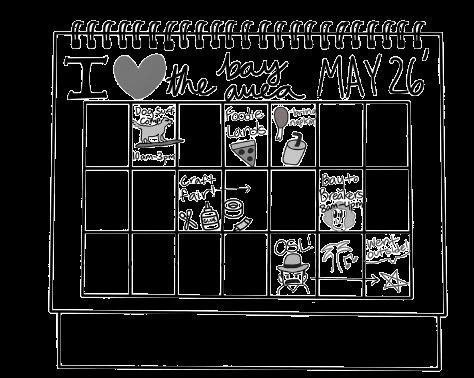
If you’re lucky enough to stroll along Linda Mar Beach in August, you’ll see dogs riding the waves like professional surfers. Every year, Pacifica hosts the World Dog Surfing Championships; however, this doggy surfing event isn’t the only hidden gem the Bay has to offer. From collecting local craft fairs to live music to Breakers run in San Francisco, the Bay Area has niche events that the majority have no idea even happen — here’s your chance to experience something new.
Each year in the Bay Area’s very own backyard, the top dog surfers compete on the waves of Pacifica’s Linda Mar Beach in the World Dog Surfing Championships, each trying to take home the winning prize. The event is more than watching furry four-legged friends ride the waves — both humans and dogs can enter costume contests and fetch contests, experience a dog wellness fair and socialize with other pet lovers. Additionally, there’s the opportunity to bring home a new friend at the dog adoption van.
Upper school English teacher Bridgett Longust, has spectated the puppy surfing event multiple times with her dog, Coconut. “Coconut loves to go to the beach, and there are all these other dogs and people,” Longust said. “It’s a mashup of dog culture, coastal culture and surf culture.”
The Bay Area hosts numerous creative events as well, including the Renegade Craft Fair. Whether you’re
an avid shopper hoping to acquire handcrafted goods or simply admiring the intricate craftsmanship, this fair has much to offer. Renegade Craft Fair is comparable to a traveling marketplace in some ways, taking place in other major cities like Chicago, New York and Los Angeles, in addition to Fort Mason. They host three fairs annually, during spring, summer and winter, and offer events from night markets to holiday fairs. This event offers a bustling scene to explore and shop from both local and national vendors.
Menlo librarian Christina Appleberry loves stationery and is a frequent attendee of similar artistry marketplaces. “It’s cool to get a handmade gift for people,” Appleberry said. “I like to support local business[es].”
On a different note, get out your silliest costume ever and prepare for the Bay to Breakers 114th annual run! Breakers is a fun, silly and energetic run in San Francisco — unlike any other. Hosted in May, the race features three main events: 12k, 15k and Centipede. The centipede race is a race where 13-15 people, all connected, run together for the
duration, often in crazy costumes such as pink gorilla suits or neon cowboy outfits.
“It’s a mashup of dog culture, coastal culture and surf culture.”
Upper school English teacher Bridgett Longust
Freshman cross-country runner Connor Yonkers is interested in running in Bay to Breakers, especially after hearing about how unique this particular event is. He is excited to participate in the future and already has plans for his costume. “I would always want to wear my Michael Jackson outfit while doing it,” he said. From vibrant arts festivals to wacky events, the Bay Area offers something for everyone. Whether you’re exploring local art, relaxing at the Dog Surfing World Championship or racing centipede-style with friends, these events highlight the community, spirit and diversity of the Bay. Each event is an opportunity to get out of your comfort zone, try something new and immerse yourself in the full potential of San Francisco.
Staff illustration: Autumn Chambers
Hidden Gems of the Bay: Local Thrift Finds and Favorites
By Savannah Smith
You’ve flipped through dozens of hangers, when, finally, you pull one forward and uncover the reincarnation of your Pinterest board save. You spot a bag you’ve been eyeing for a while and realize it’s marked down $50. You take a chance on an especially eccentric top, and somehow, it works perfectly in the dressing room. These are the thrills of thrifting, unattainable through any other avenue of shopping.
And of course, let’s be honest, the best feeling of all: someone asks where you got it, and you respond, “I thrifted it.”
Living in an area with as high of a concentration of innovation, sustainability and entrepreneurial spirit as the Bay Area, we are naturally surrounded by a thriving thrifting ecosystem. But navigating the maze of boutiques, Goodwills and curated vintage stores can be enough of a barrier to stop even the most thriftingcurious shopper.
Look no further, your guide to the best thrifting in the Bay Area has arrived.
To start off, it is imperative to acknowledge that the best of finds typically are sourced from a good Salvation Army or Goodwill. My top recommendation would be the Family Salvation Army on Geary Street: by far the largest (two stories) and most organized Salvation Army I have ever come across.
If you’re looking to turn thrifting into more of a day trip, two things are probably true: you want a cuter, boutique-style vibe, and
you have the time to hop between stores with smaller selections. If that assertion rings accurate, my first recommendation would be With Love Vintage, a recent addition to Haight-Ashbury. The store is curated down to every seam, with adorable doodads sprinkled throughout (pins, foldable mirrors, rings. With Love Vintage is the perfect stop for flowy, colorful pieces. They recently released a timely “festival curation” featuring crochet pieces across a range of shapes, colors, glitter and sequins. Upstairs, they have an equally robust men’s collection that has some standout vintage jackets.
“Living in an area with as high of a concentration of innovation and entrepreneurial spirit as the Bay Area, we are naturally surrounded by a thriving thrifting ecosystem.”
Moody Goose Vintage is a standout vintage collaborative, featuring over 20 Northern California curators. Its bright blue, two-story storefront on Polk Street is hard to miss. The mother-daughter duo behind the store curates a wide selection for all genders, with pieces that walk the fine line between statement and everyday wear. They post “Mama Goose Faves” on TikTok, where Jenny, the mother behind the store, shares her favorite pieces of the week, which is great for keeping up with their stock. But the store is more than just their clothes. They regularly host community events to bring their customers together, with their recent hit being a Coachella Styling night. Pro tip: don’t miss the thermal photo booth, which prints your picture on receipt paper.
“The best feeling of all: someone asks where you got it, and you respond, ‘I thrifted it.’”
The real thrift gems of the Bay Area, however, unfold in the parking lots, sidewalks and pop-up racks of the Bay’s vintage markets. The Sunset District’s “Second Hand Saturdays,” hosted by the Sunset Mercantile, is my personal favorite. I’ve found vintage watches with colorful gem-studded bands, a 49ers bomber jacket from the 80s and an endless rotation of cowboy boots – let’s just say the trek to the Sunset District on the third Saturday of every month is beyond worth it. The Pickwick vintage show at the Ferry Building every other month is another notable market, so long as you get there earlier enough to beat the crowds.
Stanford Shopping Mall or even a quick “add to cart” click might feel like the tempting option next time you feel inclined to purchase, but thrifting has so much more to offer.
Bay: Your Next Side Quest
A Morning at the Farmer’s Market
By Penny Diehl and Lauren Giesselman
In the Bay Area, farmers markets are so much more than a way to get produce and check out local vendors; they are a true blend of food, culture and identity within the community. A morning spent at the farmers market is filled with fresh smells, rich conversation, live music and nourishing food, grown or cooked with care. While the produce world may be dominated by big grocery stores today, finding a local farmers market that matches your vibe is the perfect way to practice sustainable shopping and support local farmers and bakers.
Mountain View Farmers Market
The Mountain View Farmers Market, which has over 80 vendors from 9 a.m. to 1 p.m. every Sunday, is rated third in all of California for its impeccable range of vendors and vibrant atmosphere. If you want to start your Sunday with a sweet treat, Beckmann’s Bakery pies are always the perfect choice and truly some of the best on the market. Local sourcing is crucial in the farmers market industry, and Mission Fresh Fish does just that with plenty of seafood, including Dungeness crab, locally sourced from Half Moon Bay. Stop by Rodin Ranch and pick up some flavored almonds, including butter toffee, honey roasted citrus, applewood smoked and so many more, for the easiest pantry snack. If you choose to visit the market during autumn, the true must-have is Lucky You Orchard’s cold-pressed apple juice that packs a true punch of seasonal spirit. The Mountain View Farmers Market is perfect for families looking for a splash of fun in the community with live music, family-owned businesses and even balloon animals for the little ones.
Burlingame Avenue Farmers Market
Nestled in suburban Burlingame, there is no question that you will find delicious homegrown produce and family-owned businesses on the corner of Burlingame Avenue and Park Road. Starting in the middle of March, vendors sell fresh produce, beverages, baked goods and so much more every Sunday from 9 a.m. to 1 p.m. The atmosphere in Burlingame is unlike that of a bigger town; individuals who went to high school together now stop in the street, greeting each other with their children. It truly feels quaint and comfortable, and the incredibly kind and dedicated vendors definitely contribute to the great atmosphere. If you’re craving sweet, California-grown fruits, stop by Vasquez Berry Farms, a family-owned business that provides ripe, seasonal berries. With their assorted berry crates or singular fruit bundles, it’s truly the best way to start your morning on a warm, and sweet, note. For Sunday grocery shopping, the Burlingame Avenue farmers market is the perfect place: low-key but extremely high-quality. Make sure to get there early, as parking can get hectic!
San Mateo Farmers Market
Located at the College of San Mateo, the San Mateo Farmers Market is one of the smaller yet still remarkably vibrant markets in the Bay Area. Including not only fresh produce but also local handmade goods, the San Mateo Farmers Market is also a wonderful combination of culture and creativity. Every Saturday from 9 a.m. to 1 p.m., more than 30 vendors set up booths, preparing to sell their products through the morning and early afternoon. The crowd in the San Mateo Farmers Market is smaller, making it a less overwhelming shopping experience and perfect for those who want to relax and simply browse. Without question, this market earns the award for efficiency, whether it’s the level of ease to find exactly what you need or the convenient location, the San Mateo Farmers Market really is an elevated, local farm-supplied grocery store. Spending a Saturday morning browsing the produce market in San Mateo is a great activity for anyone interested in local goods, and even better for those who appreciate a quiet, stress-free Saturday morning.
California Avenue Farmers Market
Rain or shine, Palo Alto residents flock to the California Avenue Farmers Market on Sundays to stock up on all of the fresh natural luxuries the market has to offer. On a hot summer morning, it’s essential to stop by Gourmonade Lemonades and grab a raspberry lemonade. While $8 a bottle sets them at a high price, they’re more than worth it. As Mother’s Day creeps up, Contreras Flowers, a family-owned business since 1980, has the perfect beautiful arrangements of fresh cut flowers, fresh and dried eucalyptus, custom bouquets and wreaths. On the way out, if you want to try something out of the norm, Big Chuck’s Ostrich sells ostrich meat fresh from Gilroy, and if you want something extravagant, you can buy an ostrich egg for $75. For a morning shopping experience, California Avenue is the perfect place to pick up your essentials.
May 1, 2026
More Than Just a Market: Chavez Supermarket
By Anya Ramani
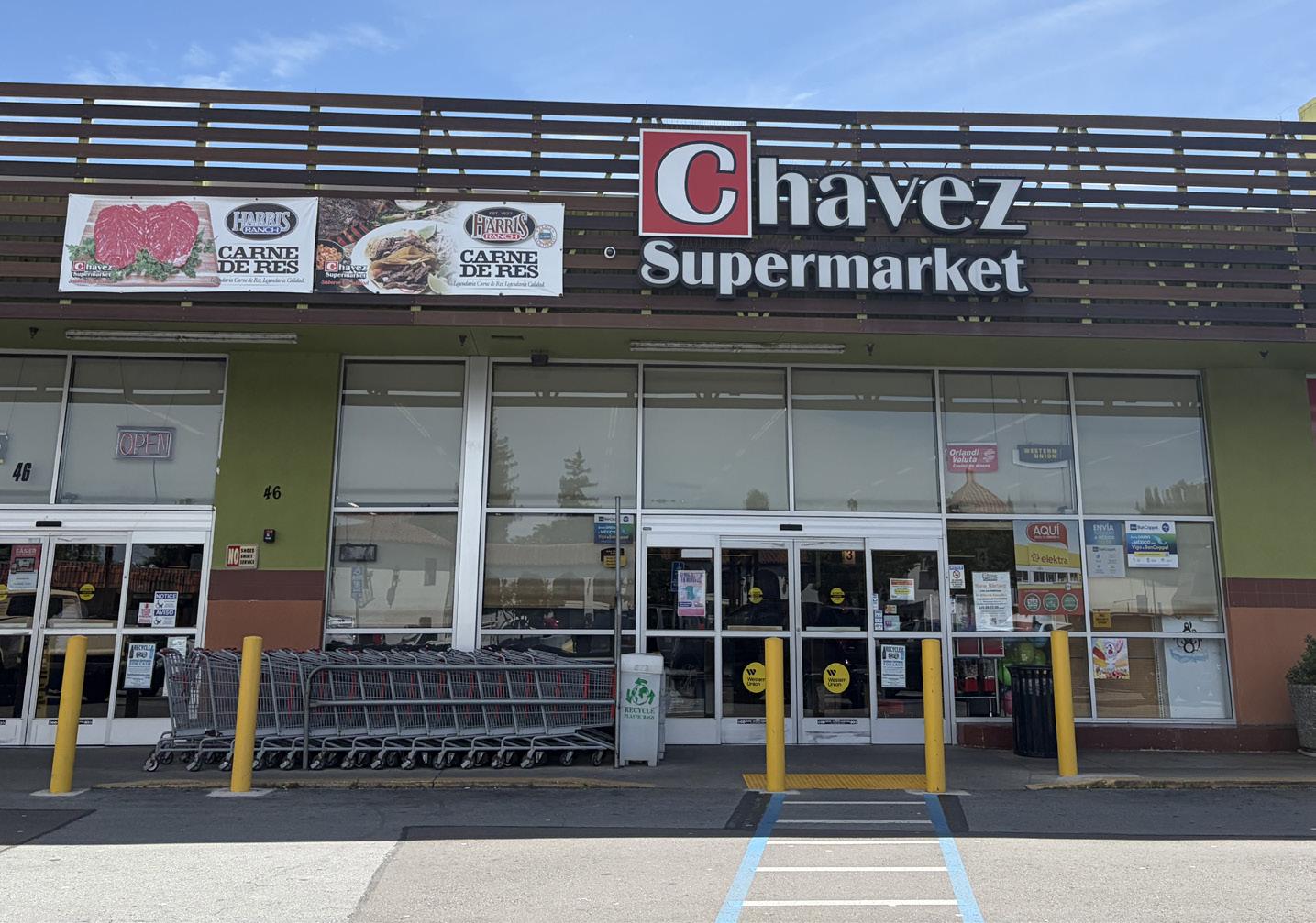
Just a six-minute drive down El Camino lies, arguably, the best Mexican grocery store ever: Chavez Supermarket. Chavez, as we frequenters call it, has everything from an aisle dedicated to tortillas to a self-service-style beans station. Instead of having a Starbucks inside the store like any old Safeway, Chavez has a well-regarded taqueria. It’s a Mexican food haven and one-stop shop that creates a community of its own.
Though critics may argue that Chavez is not strictly a “hidden gem” because there are multiple locations, I beg to differ. Certainly, the wider Bay Area community can put a name to the fame, but Menlo students are surprisingly out of the loop when it comes to Chavez.
“The taqueria is more authentic than your average Chipotle, but watch out for the green chillies — they bring the heat!”
First, Chavez has a playful, family-friendly atmosphere, constantly buzzing all day. When you pull into the modest parking lot, you’re likely to see kids playing on the mechanical horses at the storefront, adding to the Disney-like feel. Entering the sliding doors, you are pleasantly surprised by the sweet aroma of Mexican baked goods: conchas and orejas, types of Mexican sweet bread, line the shelves of a self-serve panadería (bakery).
While my local Safeway draws the after-work crowd, Chavez is particularly popular at lunch. The taqueria serves standard options, and the cooks make a “show” of chopping and searing large cuts of meat. My go-to order is a Jr. Burrito with rice, pinto beans, pollo asado, pico de gallo, salsa verde and guacamole, of course. The taqueria is more authentic than your average Chipotle, but watch out
for the green chillies — they bring the heat!
Since I could write endlessly about every section of Chavez, I am going to explain my top three: the dry goods shelf, the kitchenware section and the tortilla aisle.
The dry goods shelf refers to the small section near produce that houses mild to diablo-level chillies, bins of beans from different countries and unique spices. I saw a little girl dragging her mom towards a spice packet she wanted to pair with some Peruvian beans and rice at home; though Chavez is marketed as a Mexican grocery store, it caters to multiple cultures.
The kitchenware section and the tortilla aisle were side by side, which added to my overall excitement. Handmade mortars and pestles could be used to grind chillies and make salsas. A nearby family examined a floral-decorated clay pot they hoped to use to cook beans and stews. My hands were already full with my family’s dinner and spicy Mexican candy for dessert, so I made a mental note to return to explore some more another time.
The tortilla aisle was essentially split into two. One side presented the regular grocery-store brand tortillas, like Mission and Guerrero, while the other half had La Rosa white, blue corn tortillas and even a stack of Chavez-brand tortillas. My complaint with some of these generic tortillas is that they break easily, but the more authentic tortillas were as soft and pliable as I’d hoped. Fun fact: Chavez in
San Jose has a tortilla factory inside the market, where white corn tortillas, chips and masa for tortillas and tamales are made daily.
One last part of Chavez that deserves an honorary mention is a small money transfer booth: Vigo by Western Union. This service focuses on international remittances, particularly to Latin America, Europe and Asia. Initially, I wasn’t sure why a grocery store needed a money transfer service, but I realized that it serves the financial needs of its immigrant clientele, some of whom send remittances to family members in Mexico and Latin America. Chavez also offers check cashing, reflecting efforts to increase customer accessibility.
Chavez will always have a place in my heart, no matter how many other Mexican grocery stores I discover. Its warm community, ethnically diverse offerings and support for the immigrant population are what make it special. So next time you find yourself in need of a snack, give Chavez a chance.
San Francisco Theater Deserves Its Flowers Too
By Sadie Evans
San Francisco is no New York City when it comes to the theater scene, but there are certainly many options to find a thrilling act. And honestly, that’s kind of what makes it fun — you don’t need to fight your way through Times Square or pay expensive Broadway prices to see something just as memorable.
“You don’t need to fight your way through Times Square or pay expensive Broadway prices to see something just as memorable. ”
The closest viewing experience to Broadway theater that you’re going to get in the Bay is one of the main theaters in San Francisco: the Orpheum, the Golden Gate or the Curran Theater. This means that even though the performances themselves don’t take place on a Broadway stage, it’s the same exact show with the same sets, costumes, choreography and level of talent.
The Orpheum Theater is arguably
the most iconic of the three. It’s a more classic theater with the exact feel of a real Broadway stage, and it’s where you’ll find the biggest touring shows. Currently, they’re showing the eight-time Tony awardwinning show Hadestown, and will show the Phantom of the Opera, The Outsiders, The Great Gatsby and more later in the year.
If you want to take a step down from a big-scale, Broadway-level show, you can look into the regional theaters of San Francisco. Regional theater is professional theater produced locally for the community, rather than part of the big Broadway system in New York. Even though regional shows might not be at the same level as a Broadway or a touring show, they can still be
amazing productions to see — and they are a cheaper option.
One of the best regional theaters in our area is the American Conservatory Theater, or ACT. The theater actually won the Regional Theatre Tony Award in 1979. It’s known for presenting a mix of classic plays and newer works and for maintaining a high production quality. At the same time, it definitely feels more intimate than a massive touring house.
But the theater scene in San Francisco doesn’t stop there. If you’re willing to explore beyond the bigger names, there are so many other theaters scattered across the city and the rest of the Bay Area. Theaters such as The Marsh, a much
smaller and more intimate venue, love to feature new works and solo performances. There are also places like the San Francisco Playhouse that feature a wide variety of shows from mainstream programs to more avant-garde productions.
“What makes the San Francisco theater scene special is that it doesn’t try to compete with New York. ”
What makes the San Francisco theater scene truly special is that it doesn’t try to compete with New York. Like the city itself, the theater scene delves into its own territory and style, while remaining diverse in its options. In San Francisco, you can see a massive touring musical one night, a smaller one-person show the next night and something experimental and immersive after that. Theater in San Francisco never gets its flowers, and it 100% deserves some more credit.
The entry of Chavez Supermarket in Redwood City. Staff photo: Anya Ramani
Staff illustration: Baelyn Batory
Coach Kim Prioritizes Cohesiveness for Girls Lacrosse
by RAFI KAUFFMAN
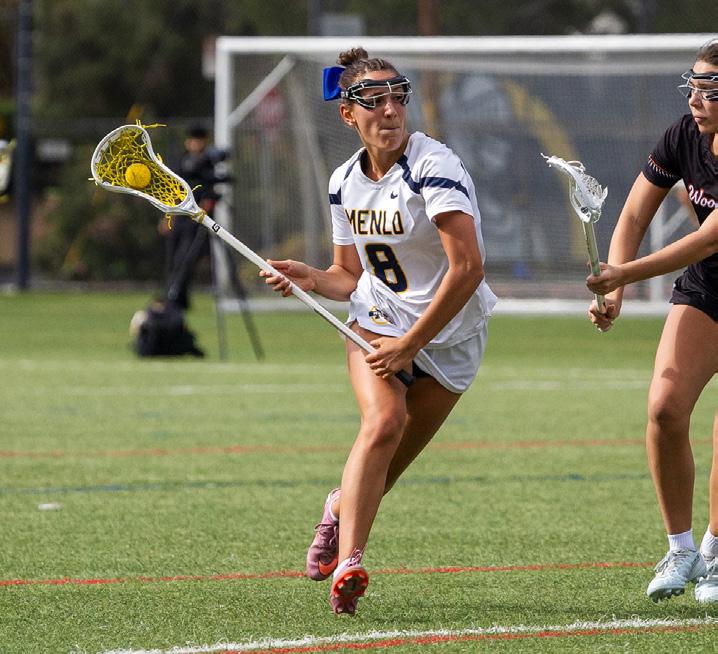
Girls Lacrosse head coach Blake Kim’s mission began with a simple goal: ensuring that freshmen and seniors do not feel like strangers. “I wanted there to be a little bit more program-wide support for one another,” Kim said. He wanted to avoid the similar divide he sees on far too many school teams where different grades won’t bond. “[The seniors and freshmen] sometimes don’t even look like they’re at the same school,” Kim said.
The performance on the field reflects the wide variety of experience across the team. The Knights currently hold a dominant 11-4 record, only losing two
Boys Golf Strives for a Comeback in CCS Playoffs
by KAYLA BANATAO
With the spring sports season well underway, the Menlo varsity boys golf team aspires to attain the program’s first CCS bid in six years.
Heading into this season, there was uncertainty around the team’s future, especially with the loss of five key seniors; however, as the season has progressed, certain underclassmen have proven themselves able to fill those spaces: sophomore Spencer Toland, freshman Obasi Winn and freshman Riley Jasen.
Head coach Mark Madayag emphasizes his pride in the new players stepping up, while also recognizing the growth necessary for a successful end to the season. “Our new players are improving quickly, but golf has a steep learning curve, and they’re still gaining valuable experience,” Madayag said. On top of this, the team’s wide age range has
created a strong bond within the program.
Returning players have already noticed the team’s fresh energy. “This is a group of guys that has a good dynamic both on and off the course, which makes a huge difference because your teammates will pick you up after a bad round,” junior Ryder Chen said.
After last year’s 6-6 record, the team aspires to rebound by trusting in its execution on the course. “We’re a very capable team, and as long as we stay dedicated to improving our game, things will fall in place,” Winn said.
The team has adjusted well to this year’s roster changes, claiming two wins against rival school Sacred Heart Prep. The first match finished with 206-223, and the second match ending with a dominating score of 202-227. The team started this season with a 6-3 record as they look to carry their energy into CCS.
of those games by two goals or fewer. Most recently, they beat strong playoff contenders, St. Francis High School, by ten plus goals. This win brings significant promise heading into the playoffs.
Their wins have been led by four impressive senior co-captains. “[The four senior co-captains are] lights out and NCAA bound,” Kim said. Since these veterans are seasoned in the sport, the lacrosse staff has decided to reduce traditional playcalling styles, known as “X’s and O’s.”
Instead, Kim lets the girls play in a free-flowing style. “Strategically, I don’t
have to set up a lot of set plays,” Kim said. “They’re so high-level. I just like to sit back and watch.”
Junior Noa Levav, a three-year varsity player, said that the new autonomy the team has under Kim has allowed the Knights to play more instinctively. “We just kind of give everybody the opportunity to score […] allowing us to cut and move the ball quickly to naturally create those plays,” Levav said.
Even the varsity’s go-to plays are simple. “It’s more like a pick and roll. It’s just something that naturally happens,” Levav said.
Track Redefines Itself, Targeting League Finals
by ASHER BECK
The Menlo track team is racing toward the finish line of an action-packed season. Having completed two standout West Bay Athletic League (WBAL) meets and an impressive Arcadia Invitational, the boys and girls teams are gearing up for the WBAL trials and finals on May 5 and 8.
This season, the track and field team was introduced to John Dagata, its new head coach. Dagata believes that the track team has been bolstered by a strong crosscountry group built earlier in the year and has steadily been improving its sprint and field-event teams throughout the season.
“On the boys side, we’ve always leaned in hard on our distance group. [But] the sprint team has come back into fold [and] this new girls jump group is looking very good for us,” Dagata said.
During the Arcadia Invitational alone, 14 athletes posted personal bests, including sprinting and hurdles star sophomore Tres Onyejekwe, who recorded a 37.58 in the 300m hurdles, shattering the meet age-group record.
Sophomore Oliver Olbekson and junior Henry Hauser in the 800m and 1600m races have also been key players for the distance team, with Maxwell Johnson and Onyejekwe rounding out the sprinters group.
On the girls side, freshman Adrianna Ananyi scored a top 100-meter time at last month’s John Owens Invitational, and the 4x800 relay team placed fifth at the K-Bell Invitational. Freshmen Sierra
Wynn and Claire Barkely have also been standouts for the girls’ team in shot put and high jump, respectively.
Following fall’s cross-country season, Dagata focused his work on staff additions ahead of the spring season. “It was important just to organize,” he said.
“Track and field [has] a lot of different types of athletes. Trying to get everyone on the same page has definitely [taken] time,” Dagata said. “Number one was getting a good staff together. [...] We were extremely blessed to get some of the coaches that we have.”
Boys Lacrosse Breakout Season Heads to Playoffs
by TALLULAH EVANS
As they roll into the CCS playoffs, the Menlo boys lacrosse team aims to continue its dominant season, with a 11-4 record. Following a 5-11 record last season, the team has bounced back and put last year behind them.
With a new coaching staff and player additions, many returning players have seen dramatic changes in how the team operates. “This season we are way tighter as a team and it shows in the record, especially compared to last year,” junior Merrick Ward said. “Everyone is happy to be here and excited to play lacrosse.”
The boys lacrosse program has shifted its leadership and welcomed head coach Will Mark, a professional lacrosse player for the New York Atlas in the Premier Lacrosse League. “This season’s been great so far, and we are finding our identity as a team,” Mark said. “We found out pretty quickly we like to push the pace, and this team has lots of energy.”
Last spring, a tough loss to St. Francis High School ended Menlo’s season early. This season, however, the team has not only beaten the Lancers 7-6 in a thrilling overtime match, but they have only lost four games against a strong schedule of familiar opponents,
including St. Ignatius College Preparatory, which ranks in the top 45 in the nation according to MaxPreps.
“This season has been awesome, and with a younger coaching staff, the team came out with a different vibe,” senior Will Farrell said. “We have held our own very impressively.”
The team expects to see St. Francis, St. Ignatius and Sacred Heart Prep in the WCAL playoffs this year. “Our program knows what to expect going into playoffs, so we will be prepared,” Farrell said.
Although the team has had a strong start to the season, three key players have gone down with injuries in games against Sacred Heart and Berkeley High School, both of which resulted in losses. Senior Palmer Riley tore his ACL, freshman Rio Yamada fractured his hip and sophomore Chase Brown sprained his wrist. Still, with three starters out, the team holds hope to succeed in the playoffs.
The team’s turnaround from last season reflects more than just a record, but a shift in the community. “If I was a high school player, I would want to be on that team,” Mark said. “The team camaraderie is the best part.”
Senior Andrew Levitt cradles the ball in his stick as he scans the field. Staff photo: Evan Grant
Senior Hannah Bernthal runs upfield. Staff photo: Julia Livingston
Junior Joseph Hurd rounds the bend with baton in hand. Staff photo: Evan Grant
Senior William Beesley watches his ball as it rolls across the green. Photo Courtesy of Pam McKenney
New Athletic Director
Continued from Pg. 1
by SHAAN PARIKH
At a school as academically focused as Menlo, balancing commitments is an ongoing challenge. Farmer sees his role as a bridge to that divide. “Academics have to come first. That’s just the reality of the situation,” he said. Still, Farmer plans to help athletes navigate high-stakes games, and he hopes coaches and teachers will find solutions. “So much of it is about
communication,” Farmer said.
The committee who led the search for the new hire believe Farmer’s people skills set him apart from the other 250 applicants considered for the role. Director of Communications Shayne Olson said Farmer’s relatability set him apart. “Every person that we saw him interact with — whether it was the student on the panel or other people that interviewed him — he just had a gracious way of connecting with people,” Olson said. Olson believes the Menlo community will simply enjoy having Farmer around. “He’s kind and he’s funny and he’s warm. People are going to like getting to know him,” she said.
For now, Farmer says he needs to stay calm as he transitions into his role next fall. “I will make some mistakes, and I hope that people just show some grace and some understanding, and that we can move ahead and figure it all out together,” he said.
Looking into his future at Menlo, Farmer knows what victory means for himself. “I would hope that students would look back and think, ‘Some of my best times in sports were at Menlo with my teammates, with my coaches, in an environment that was both competitive and supportive at the same time,’” Farmer said.
The Hottest Sport That Is Spreading to the US: Padel
by RILEY HUANG
Multiple reports from sources like The Athletic say Padel is one of the fastest-growing sports in the 21st century, with global revenue expected to grow by 50% come 2032. Yet, many of you may never have heard of this sport.
A fusion of tennis and squash, padel is rapidly gaining traction across the globe, especially in Europe and South America.
In the U.S, it has been overlooked by a similar, well-known sport: pickleball. Maybe because of its gentle learning curve or laidback style, pickleball has captured the hearts of every American and their mom.
Staffillustration: BaelynBatory
and padel. “It’s definitely better than pickleball. In pickleball, you’re just doing the dink stuff, while [in] padel, you’re actually hitting the ball a bit more and able to have pretty long, crazy points with the walls,” Sargeant said.
Padel, however, offers a unique three-dimensional aspect by adding a wall on the side and back that you can use to outplay your opponents, creating something that some would call a better version of pickleball.
Tennis head coach Francis Sargeant has similar thoughts about pickleball
Although padel is less accessible than pickleball because of how expensive padel courts are to make, there are still a few options close by, like Bay Padel. With 12 indoor padel courts across facilities in San Francisco and Sunnyvale, Bay Padel offers a great experience for $28-$35 per person.
Even though it’s a bit pricey or tricky to access in the Bay Area, padel is considered one of the fastestgrowing sports in the world, giving you no reason to not give it a shot.
Playing on the weekend is a good way to wind down with friends, socialize with new people, exercise and experience what padel has to offer for the first time –– and hopefully what will be many times.
In the Classroom and on Horseback, Science Teacher Laura Huntley Finds Freedom and Purpose Through Polo
by SHAAN PARIKH
For science teacher Laura Huntley, polo is a completely different way of thinking, moving and connecting. Polo has taught her unique lessons that have translated into her engagement in the sciences and in life.
Huntley’s experience with sports did not begin with polo. She grew up riding on an equestrian team, focusing on intense precision with her childhood horse named Icy. “I was just interested in riding horses from a very young age,” she said.
During the fall of 2009, while Huntley was in graduate school at Stanford University, she essentially stumbled onto a polo team, where riders are much more free and fluid compared to equestrian. Although she knew there was a team, she had never seriously considered trying it until a friend encouraged her to sign up at a campus event. “My friend didn’t really end up sticking with it, but I was, like, obsessed,” Huntley said. That spontaneous moment sparked a passion for a new sport that has lasted to this day.
What stood out most to Huntley was how different polo felt from traditional riding. Instead of striving for perfectionism in the smallest of details, polo requires trust and adaptability between a rider and their horse.
“You kind of tell them the speed that you want to be at, and the direction you want to go […] and a well-trained polo pony will go naturally,” Huntley said. That slight tweak in horse riding style allowed Huntley to have a sense of freedom she had not felt before with a horse.
“I love the freedom of it compared to the riding I used to do,” Huntley said. The unpredictability and quicker pace drew Huntley in as well. “You don’t know what’s going to happen next.”
Beyond the speed and competitive spirit, the connection with the horse is what Huntley values above all. “There’s more of a sense that the horse wants to win, and you want to win too,” she said. “It’s just such a great feeling […] that kind of oneness with the horse.” This shared focus that Huntley had with her horse in college, named Mimosa, transcended a language and species
barrier, creating a special bond that sets horseback riding apart from any other sport.
In polo, it [is] more instinctual since it’s about your mind-body connection with the horse. “ “
Polo has also challenged Huntley in ways she wasn’t accustomed to in traditional riding. Despite her experience riding, Huntley struggled with her handeye coordination and with making pure contact with the ball. “I’m not a great hitter,” she said. Instead of getting discouraged, this new challenge gave her a strong incentive to train and play more.
“I could really enjoy something that I’m not naturally gifted at,” Huntley said. “It’s very easy to love things that you’re good at, but it’s harder to love things that you’re not.” She has learned that lesson through polo, and she brings that mindset to both her sport and her teaching.
Huntley's relationship with polo has grown beyond just playing. She now coaches polo at Stanford Polo Club, teaching beginners how to ride and play. “Teaching polo requires a lot of patience which really helps in the classroom,” Huntley said.
While teaching polo has many beneficial aspects towards Huntley’s career in teaching, science itself relies on intellectual thinking, and Huntley sees polo as a different kind of challenge. “In polo, it becomes more instinctual since it’s about your body and the mind-body connection with the horse. Physics is more cerebral,” she said.
Upper School Science Teacher
Laura Huntley
Science teacher Laura Huntley glides with her pony as she approaches the polo ball. Photo courtesy of Huntley
John Farmer poses with an alumni at his former school. Photo courtesy of asl.org
COMMITTED CORNER COMMITTED CORNER
Bianca Putanec, Brown University
by JAMES
Inspired by her love for soccer since she was three years old, senior Bianca Putanec strived to play at the collegiate level ever since setting foot on Menlo’s campus. In March, she committed to play Division I soccer at Brown University.
As a child, soccer was not a primary focus for Putanec. She participated in gymnastics before fully committing to soccer in sixth grade, joining the MVLA club soccer team based in Mountain View.
Unlike most recruiting journeys that build gradually, Putanec’s recruiting process came together all at once. Throughout high school, Putanec regularly reached out to coaches, hoping to attract interest. Originally, she
planned on playing Division III soccer, considering schools like Occidental and Middlebury college. “I thought I was going to a smaller program, because that’s where most of the coaches that were responding [were] from,” Putanec said.
Putanec’s Division III recruiting profile shifted dramatically after a pivotal tournament. Her standout performance during an ECNL event in Phoenix drew the attention of several high-level coaches she had previously been in contact with. This allowed Putanec to consider more opportunities and favorable factors in her recruitment process. “Academics were a big part of my decision, which is why I didn’t follow through with [some] other schools,” Putanec said.
After Putanec was admitted to Brown through early decision, she reached out to the coaching staff, who invited her to an ID camp on campus. Following the camp, the coaching staff offered her a spot, and Putanec did not hesitate. “It was an easy choice once they extended the offer,” Putanec said.
Putanec’s connection to Brown began well before her commitment. Attending an ID camp in 2024, Putanec spent four days training and getting to know the campus, an experience that left a lasting impression on her. “The energy on campus was so electrifying,” Putanec said. “There was this warmth you don’t always feel at other schools.”
Beyond her impact as a player, Putanec’s leadership has been an integral part of the team. “Bianca is a natural leader who never fails to energize the team and raise the work ethic at both practices and games,” senior teammate Josie Lee said. “She truly cares for every player, and she brings such a special sense of unity and joy to the team that no one else could.”
Arki Temsamani, Babson College
by DEVEN DHOLAKIA
Senior Arki Temsamani first picked up a tennis racket at four years old under the guidance of his father, a former collegiate tennis player in France. This March, he announced his commitment to play Division III tennis at Babson College.
Temsamani’s father introduced him to tennis at an early age, but he was also very adamant that Temsamani pursue other sports. “He wanted me to be as strong as I could be athletically, and also not to get burned out of tennis,” Temsamani said.
As a freshman at Menlo, Temsamani made the highly acclaimed varsity team, which is currently ranked among the top four teams in the nation. “Having Arki as a teammate is great,” junior Surya De Datta said. “He always brings energy and lifts up the whole team’s mood.”
Temsamani consistently played in tournaments for maximum exposure. These included United States Tennis Association (USTA) tournaments and Universal Tennis Rating (UTR) tournaments around the country. He plans on continuing these tournaments more frequently as he’s taking a gap year and starting his collegiate career in 2027. Most importantly, he kept close relationships with many collegiate coaches. “I talked to all the coaches who were interested in me, even if I wasn’t seriously considering their schools,” Temsamani said. “The interview process was a great way to learn about different tennis programs.”
Temsamani went on many college visits and traveled to watch teams he was interested in. “By watching the team play, I could demonstrate my interest, but I also could observe the team dynamics,” Temsamani said. “I am a big team guy; my team [members are] my brothers, so
Trevor van der Pyl, Pomona College
by ANDREW CHRISS
Senior Trevor van der Pyl didn’t grow up obsessed with football — in fact, it was barely on his radar. “I didn’t really care about football at all,” he said.
After recording 832 yards and 14 total touchdowns as an elite two-way player on Menlo’s varsity football team, he is continuing his career at the collegiate level, taking his talents to play Division III football at Pomona College.
The driving force behind his decision to play football at the next level was varsity football head coach Todd Smith. “[Coach Smith] was the one who brought up recruiting,” van der Pyl said.
However, van der Pyl’s relationship with Smith hasn’t always been as strong as it is today. In fact, when van der Pyl was an underclassman, he feared playing varsity football because of Smith.
“[Coach Smith] was very scary,” van der Pyl said. But as he spent more time with Smith, he started to understand him little by little. “Coach Smith does things his way, which, looking back on it, I think is a great way.”
Though van der Pyl can’t point to one specific turning point in his high school career, each year provided new information for him to absorb, leveling up
his play. “I wasn't always the greatest, but I just kept working,” van der Pyl said.
Looking back on his time at Menlo, van der Pyl’s favorite memory was beating Sacred Heart Prep back-to-back in his last two seasons.
“I love to see any score where [Sacred Heart Prep] is losing to us,” van der Pyl said.
For van der Pyl, it was difficult to choose the school that best fit him, especially considering the weather conditions on the East Coast. He mentioned that a crucial component of his commitment to Pomona was its location. “I’m definitely a California dude,” he said.
It seems van der Pyl has a good plan for what he would like to pursue at Pomona College next fall.
“[I want to] keep exploring, hone in on something that I find interesting because I haven’t found out one thing yet, but I’m confident that I will,” he said.
According to his teammates, van der Pyl established himself at Menlo as an energetic leader.
“In the locker room, Trevor is full of joy, passion and love for the game,” junior teammate Charlie Auerbach said.
this was a really important factor for me.” Babson was always Temsamani’s first choice. “From the moment I visited the school, I knew it was the right fit for me.” Babson has a strong focus on entrepreneurship, ranking as the number-one school in the country in that field. This, along with their focus on experiential, hands-on learning, aligned with Temsamani’s long-term goal of starting and running his own business. The combination of a top ten DIII tennis program, a great academic fit and an excellent relationship with head coach Michael Kopelman made Babson the ideal choice.
Temsamani is looking forward to life at Babson and looks to make an impact on the tennis team from day one.
Senior Trevor van der Pyl evades defenders along the sideline. Staff photo: Noah Levin
Senior Bianca Putanec kicks the ball down the field in the 2026 CCS Championship game. Photo courtesy of Blake Putanec
PARK
Senior Arki Temsamani jumps to hit a serve. Staff photo: Julia Livingston
Student Nail Techs File and Polish Their Way to Menlo
by AUTUMN CHAMBERS
There is nothing more satisfying than getting a fresh set of nails. All around the quad, it’s easy to see that Menlo students have colorful, intricately designed nails year-round. This year, some students are turning away from salons, opting to do their own nails or even start their own nail businesses.
My interest in doing nails started when I did my mom’s nails when I was younger for fun, and we would always go together to get our nails done.
Junior Tessa Sundar
Dissatisfied with nail salons in the area, junior Charlotte Moceri pivoted in a new direction: doing her own Gel-X nails at home. “I couldn’t find [a salon] that would give me the designs or quality that I was looking for,” she said.
Moceri also enjoys doing her own nails, even if it took countless hours to master. “I feel like I have mastered doing solid colors on myself,” she said.
Junior Tessa Sundar started her own business, Cuteicle, after discovering her interest in Gel-X and complex nail designs. “My interest in doing nails started when I did my mom’s nails when I was younger for fun, and we would always go together to get our nails done,”
Sundar said. “For semi-formal sophomore year, I decided to get Gel-X for the first time, and I was like, ‘oh my gosh, this is so cool to do.’” From there, Sundar began practicing on herself and on nail stands to improve her skills.
Sundar has turned her love of doing nails into a small business that lets customers book her services online. Her primary customer base is her business’s Instagram followers and Menlo students. “I didn’t expect to gain such a close relationship with the customers,” Sundar said. “You get to talk and interact with people a lot while doing their nails.”
To continue learning, Sundar routinely practices different sets and researches certain designs that intrigue her. “Allowing myself to just be creative with the nail designs is really fun,” she said. “That’s something that I enjoy the most about it.”
Sundar manages her small business herself. “It’s pretty challenging, but it’s also fun,” Sundar said. “It’s taught me a lot about how to manage my money and organize everything and [...] be professional.”
Sundar envisions her next steps as partnering with Dress
for Success, a nonprofit based in San Francisco that helps disadvantaged women feel confident in job interviews by providing professional attire. She wants to donate simple, chic sets, such as short French tips, to enhance their outfits and their confidence. “I’m looking forward to starting [that collaboration] this summer.” Sundar is proud of her business, but she wishes she had more confidence at the beginning of her nail tech journey. “I thought it would be a lot of work to get all the materials and then ask people, ‘Can I do your nails?’” Sundar said. “Some advice that I would give my past self would be to keep an open mind.”
What is the Hype With Needoh
by VICTORIA YANG
“Do you have a Needoh? Can I feel it?” These are two questions that students seem to be asking on a daily basis at Menlo. Clearly, Needohs, squishies and fidget toys are trending all over campus.
The craze has all the hallmarks of being inspired by social media, as ASMR and “Needoh hunting” videos have received thousands of views and comments. “[Needohs are] fun to squish,
Squishies?
Senior Hanna Yu always has a few Needohs on hand from her large collection.
“I think the company has done a great job of turning something that could
I think for certain people, it actually helps their functioning,” Dominguez said. Needohs invoke contrasting opinions: some think that it helps with focus, while others think it’s a disturbance for class.
I would hope that by [Needohs] becoming so popular, hopefully it destigmatizes them.
Upper School Wellness Counselor Stefie Dominguez
For example, freshmen Cooper Phillips and David Kishi have different opinions on the effect and distraction of the Needohs, though both ultimately enjoy them. Kishi argues that squishy toys can distract students from classwork, but also believes that it is part of the appeal. However, Phillips believes that the products can help students focus in certain situations. So, if Needohs help or hurt a student’s focus and stress depends on the student.
Whether as an aid for concentration or as a distraction, Needohs and squishies have established their place in the classroom among students and faculty. But the answer to whether they are worth the hype is completely dependent on who you ask. “I love them. I think they’re fun, and they’re really squishy,” Borbón said.
Junior Andrea Espidio-Limon shows off her new nails done by Tessa Sundar. Photo courtesy of Sundar.
Arts & Lifestyle
Menlo Opens the Curtains for Annual Film Festival
by ANGELINA ABUYAGHI
Whether it be Tarantino, Spielberg, Hitchcock or Gerwig, all influential directors started somewhere. Every year, Menlo’s aspiring student filmmakers get their own opportunity to showcase the months spent behind the camera and time editing with the annual Menlo Film Festival set to commence in the Spieker Center on May 7.
Through the power of memory and music, we’re able to reconcile and understand each other at the end. “ “
As a way to end Creative Arts Week, the small but talented group of filmmakers is thrilled to host the community and debut their new projects. All year long, they film, edit and produce their own creative projects in anticipation.
Some films even take close to a year to complete. Senior Julia Livingston is excited for the showcase of her longawaited film: “A Kind of Melody.” The film details the story of a passionate saxophonist named Lucas who dreams of becoming a musician but feels invisible to the person closest to him: his mother. It takes the audience through both of their emotional journeys while music guides them back to each other.
Livingston describes in her artist statement that her inspiration for “A Kind of Melody” sprouted from a love of music and gratitude for love. She was inspired by how music carries memory — how a single sound can collapse time, bringing the past into the present.
The film stars junior Jacob Wang, who is also the composer. “I wanted to write [the character] for Jacob, and I was really inspired by his live music performances with [a] saxophone. Because he’s just such a talented musician. He can play saxophone and the piano. So I knew I wanted it to be centered around music,” Livingston said.
Wang has three original songs that he created for the film. For composers, creating a song can take from 30 minutes at the shortest to sometimes even weeks. He recalls finding interest in composing when he was in fifth grade, and since then, he has been writing his own songs, someday hoping for them to be published.
When Livingston asked Wang to compose music for the film, he was thrilled to agree. “[I wanted to show that] through the power of memory, music, we’re able to reconcile and understand each other in the end,” Wang said.
The composing factor of the film came quickly to Wang, and one of the songs was inspired by a hardship that he faced. “There was a person I used to connect with, [the song] came from a very painful place deep inside. Even though it has nothing to do with the film, I felt it fit the film’s theme very well [...] it built the theme’s color,” Wang said.
The film’s music includes touches of smooth classical music, which Wang even had Juilliard musicians assist him with. All of the slight background notes are composed by him and are not just generic online sounds.
Wang hopes that his music will bring Livingston’s ideas to life. “[The music’s role in the movie is to evoke] maturity and childlike hope. You know, that feeling when you’re at Disneyland, and you’re like wow, this world is so great,” he said.
Not only will Wang’s compositions be featured in the film, but he will also be starring in it. But Livingston has cast an accomplished actor outside of Menlo to play Lucas’s mother: Chesi Ho. The film has a parallel storyline about the mother’s internal journey, where Ho will dive into the mother’s past and her history with
music. Both characters will have two storylines in parallel universes, but will eventually come together.
Livingston began writing in July and finished in August — just in time for it to be submitted in her college application portfolio. She decided on a dramatic short film to captivate her audience and exaggerate the importance of selfconfidence and the role of one’s parents in it. Along with Livingston’s film debut,
For many producers, it’s the little things that keep them motivated.
“Whenever [I hear] crisp footsteps — I really focus on those. Or it’s like a crisp sound, or if I see myself acting, and I’m, like, whoa, that guy’s kind of good […] it makes you want to keep acting,” Mungai said.
Gardner and Ruwitch spent close to three months writing and filming. They chose to create a film that was not only dramatic and action-packed, but also a satirical play on the court system.
Gardner and Ruwitch.
The film highlights the story of a kid who cheats on a test, but in this alternate school system, the disciplinary system is like the justice system. Gardner explores the idea of a mock-court case to prove innocence.
When making a movie, there’s more work behind the scenes than some would suspect. Junior Solomon Mungai took the lead role of sound production for the film. For most films, like this one, the sound design plays a crucial yet sometimes unnoticed role.
Selected Student Profile: Keira Wong
by SADIE EVANS
The following has been pared and edited for clarity.
Q: Describe yourself in three words.
A: Creative, observant and fashionable.
Q: What would be your life’s theme song?
A: “Make Your Own Kind of Music” by Cass Elliot.
Q: What is your favorite thing to do in your free time?
A: Probably scrapbooking. I also like to paint, draw and do air-dry clay.
Q: What’s your favorite thing you’ve ever made?
A: I made my own corkboard out of all the corks that my family and I collected from different wineries.
Q: What’s your favorite food?
A: I love anything with carbs, so sourdough bread and pasta. I also really love sushi.
Q: In your opinion, what’s the best Menlo lunch?
A: I really like the pulled pork sandwiches with coleslaw.
Q: What are your top three favorite artists?
A: Lizzy McAlpine, Zach Bryan and The Lumineers.
Q: What’s your favorite sport?
A: To watch, probably basketball. To play…I’m not very good at playing sports. I’m more of a watcher.
Q: If you could teleport to any fictional land, what would it be?
A: I want to go to The Good Place and see if I could figure out it was the Bad Place all along.
Q: What are some items on your bucket list?
A: I want to travel to all the national parks eventually. I want to do something I’m really afraid of; I’m really afraid of heights, so maybe skydiving.
Q: What is your dream job?
A: I want to do something that can help change the world. I’d also love to be a sports broadcaster or work for a Formula One team.
Q: What’s your favorite word in the dictionary?
A: I like the word palindrome, it rolls off the tongue well. My favorite palindrome is “tacocat.”
Q: If you won the lottery, what would you do with the money?
A: I would travel the world.
According to Mungai, the atmosphere while filming was lighthearted and playful. “It was all sunshine and rainbows,” Mungai said Often, directors are the ones who are most noticed for their work. While that is true, it takes a team. Wang and Mungai show the behindthe-scenes aspects of what makes a film successful. Oscar-worthy short films, “A Kind of Melody” and “Asked and Answered,” will be debuting at Menlo’s Film Festival — an unforgettable event that everyone is encouraged to attend.
Q: If you could instill one piece of advice to the lower grades, what would it be?
A: Don’t compare yourself to others.
Senior Keira Wong poses for senior photos. Photo courtesy of Wong
Junior Jacob Wang
Quad Games Are Having Their Moment at Menlo
by MALIA CHEN
On any given afternoon, Menlo’s quad is filled with activity — students dart around spikeball nets while others crowd around ping-pong tables –– waiting for their turn to play. What began as a fun way to pass time has emerged as one of the most visible trends on campus.
In the past few weeks, both ping-pong and spikeball have surged in popularity, drawing in students from all grades. You can find students playing both games at all times of the day, including during tutorial, free periods, lunch and after school.
For many students, these games are appealing for two main reasons: they’re easy to learn and even easier to join.
spikeball to the next level by creating a competitive tournament. They’ve made a bracket, pairing players into teams based on skill level. The tournament, which includes eight players divided into four teams, has become a friendly competition among people in the free block. The tournament is still growing, but students are excited to see where it goes. “So far the tournament has been a fun way to talk to new people because everyone crowds around as we play, and we also get to be a little bit competitive,”
senior Elia Choe said.
Senior Hadley Larson has been teaching a lot of fellow classmates how to play spikeball. “It’s a super easy game to play and learn,” Larson said. “It requires just a little bit of hand-eye coordination, and then it’s pretty applicable to almost any student.”
Spikeball’s rise has been especially rapid. Many students attribute the game’s prevalence to the recent stretch of warm weather, which has brought more students outside to the quad to enjoy the sun. “People wanted to hang out outside, and it was a fun activity where anybody could join in. It’s been really fun when it’s nice out, because a lot of people can play together,” Larson said.
However, the game’s appeal extends beyond a streak of sunny weather. Spikeball is a highly social game that allows large groups to play together. “I enjoy playing spikeball because it allows us to build community and create new friends while also having a competitive, fun environment,” sophomore Ryder Shaw said.
Seniors with a free period during A block have taken
For most students, the obsession with ping-pong and spikeball has only emerged in the past few months.
After senior Evan Arcilla played ping-pong for the first time with his friend, fellow senior Maverick Desuasido, he was hooked.
Since then, Arcilla has spent countless hours practicing and improving his skills, especially during basketball season. He would often play before basketball games, after practice and even as late as 1 a.m. on the junior quad. Arcilla has also helped spread the popularity of ping-pong across campus, particularly in his free period, which he shares with senior Calvin Barad.
Barad thinks ping-pong has seen higher demand due to the recent blockbuster movie “Marty
Supreme.” “Some people didn’t like the movie, and some people really liked it, but I feel like the people who liked it really got more into ping-pong,” Barad said.
Arcilla believes one reason ping-pong has recently gained recognition is simple: many students didn’t even realize the equipment was available. “I feel like once people saw [other people] playing, they were like ‘oh, maybe we should try playing this,’” Arcilla said. “And then more people started playing.”
Like spikeball, ping-pong is very accessible and fun to play with multiple people, according to Arcilla. Games like “King of the Court” allow players to rotate in quickly, making it easy for large groups — and students across grades — to participate.
Senior Charlie Allard emphasizes the social nature of ping-pong as a key factor in its recent uprising. “I think it’s more like the social aspect that makes ping-pong popular,” Allard said. “It incorporates a lot of people, and different grades can play.”
The growing popularity of both games has also created some challenges. As more students play both ping-pong and spikeball, equipment shortages have been far more common. The limited amount of ping-pong balls and broken spikeball nets has made it difficult for everyone to participate.
Despite these obstacles, enthusiasm shows no signs of slowing. Many students say the games offer a refreshing break from academics, giving them a chance to relax and connect with friends during the school day. Whether it’s a competitive ping-pong rally or a lively game of spikeball on the quad, these recreational activities have become a defining part of student life this semester at Menlo.
Earl Koberlein to Retire After Tenure as Athletic Director
by NOAH LEVIN
At the start of the school year, it was announced that Athletic Director Earl Koberlein would retire at the end of the year after eight years at Menlo.
Koberlein grew up in San Jose and played high school basketball, track and baseball at Bellarmine College Preparatory. After a coaching shakeup late in his senior year, the new staff offered Koberlein a scholarship to play Division I basketball at Stanford University.
At Stanford, he was a four-year starter, averaging ten points per game in his final two years with the Cardinal. “Stanford is near and dear. I loved all my
time there,” Koberlein said. Following a year of pro basketball in Australia, Koberlein returned to the Bay Area and earned his master’s degree in sports management from University of San Francisco in 1994.
A couple of years later, Koberlein found himself back on the Farm, and this time as an assistant athletic director and later a senior associate athletic director. However, after 22 years at Stanford, as NIL expanded across college sports, Koberlein realized he wanted to avoid the incoming business-oriented collegiate model. “I was worried about
the sustainability of the college athletic model,” he said. “That was eight years ago. I had no idea how bad it was going to get.”
In 2018, Koberlein decided to come to Menlo as the Athletic Director. “I always thought at some time in my career I wanted to be a high school athletic director, and it would happen at the sunset of my career.” Even though Koberlein was no longer working with Olympiclevel athletes, he still found the same excitement in helping Menlo athletes succeed. “[That joy] was easily replaced with those relationships with high school students and middle school athletes, trying to achieve the best they can.”
Koberlein played an integral role in the creation of the girls’ flag football team. “It was floated around CCS, and I was like, this is such a Menlo-type sport. We could be really good at it,” he said. “I wanted to be on the front edge. I didn’t want to not do the jump in the first year and then try to catch up in the second year.”
After discussions with the administration about creating the team, Koberlein hosted a meeting for interested students. To his excitement, 33 girls showed up. “I asked what do you guys want out of it? Do you want to just have fun, practice once a week like a club, or do you want to go five days a week and really try to be good at it?” Koberlein said. The enthusiasm was immediately reflected. “Kylie Jones (‘24) was a
lacrosse athlete, and she stood up and went, ‘No, we want to be good.’”
A few months later, the team was formed, making national headlines as a frontrunner in changing the world of high school athletics. This past fall, the Knights took home the first-ever flag football CCS championship.
Koberlein’s favorite moment from his time at Menlo took place last year.
“Beating [Sacred Heart]Prep in the Valpo Bowl last year was probably up there, the night game with the talcum powder, and it was just so exciting.”
Koberlein floated the idea of retirement last year, but ultimately decided to return one last time after talking with Head of School Than Healy.
“My father worked his butt off for his career, and as soon as he retired, he got sick, and he couldn’t enjoy his retirement. His health just declined after his retirement. And from that day, I just said, ‘if I can ever retire, and I have the means to, I want to do it and enjoy life.’”
Looking forward to retirement, Koberlein is excited to play golf and relax, opportunities that rarely appear during the school year. “I joke with people now. I think the biggest stress I’m gonna have now is, like, do I want to plant that plant there or there?” he said.
“But seriously, I have children that are all over the U.S. I want to be able to travel, work in the yard, golf and just spend more time with family and my wife, since I can.”
Athletic Director Earl Koberlein speaks at the Menlo Athletics Hall of Fame ceremony. Photo courtesy of Tom Chen Photography
Staff illustrations: Baelyn Batory
Arts & Lifestyle
Menlo Alumni Reflect on Their Experiences Abroad
by SOPHIA WANG
The first day of college can be one of the most exciting — and nerve-racking — experiences of young adults starting a new chapter of their lives. A fresh location with new people, places and freedom is truly special. Yet, instead of stepping into a classroom at the end of summer, some students find themselves immersed in nature, exploring ancient cities and traveling the world.
A gap year is an opportunity to explore the world before settling down into an independent lifestyle, and a bridge between high school and college. While not many choose to take the gap year, with only two opting to last year, according to Associate Director of College Counseling Elena Wong, those who do thoroughly enjoy their time.
“Students who take the time to
reflect, talk with others and build a plan rarely regret their choice,” Wong said.
Menlo alum Cormac Mulloy ‘24 is a great example, relishing his time in Spain.
After being a highly-touted water polo recruit, Mulloy was offered a scholarship to play at Stanford University. However, Mulloy was set to wait a year before enrolling and reclassifying to the class of 2029. There was a big question around the response people would have to his decision, but it was soon evident that it wouldn’t be a problem.
“[Everyone was] really supportive and understood that it was a great opportunity considering my circumstances,” Mulloy said.
Every minute of his gap year proved rewarding, as Mulloy explored independent life. “I lived in Barcelona,
played pro for Club Natació Barcelona [and participated in] an international Spanish immersion school,” Mulloy said. “[I was able to] improve at water polo, experience city life, live far away from home and build independence.”
During his experience, Mulloy also picked up new skills, such as art and guitar. Mulloy had very little regrets about his gap year, feeling thoroughly satisfied with the skills and unforgettable memories he gained in his year abroad.
When asked whether he would do it all over again, he had no hesitation. “100%, [it was] such an amazing experience,” Mulloy said.
Similarly, Menlo alum Liv Leschly ‘24 felt as though she could finally relax during her gap year. After years of rigorous academics and college preparation, Leschly found herself burnt out and in desperate need of a fresh experience.
“The break was honestly really needed,” Leschly said.
Traveling all over the world to places like Tokyo, Barcelona, Thailand and Australia allowed her to explore parts of the world she’s never seen before and branch out to experiences outside of school. “By the time I came back and started college, I felt much more excited to learn and actually study something I cared about,” Leschly said.
Not only did her gap year improve her college experience moving forward, but it set her up with life skills: going through new problems and learning how to handle them. While travelling in Asia, Leschly was caught in a major flood and learned how to navigate chaos
and fear, trying to move to safety while simultaneously nursing a concussion. “It was really chaotic and honestly really scary because we didn’t fully know what was happening or what the safest option was,” Leschly said.
The situation became more dire as one of her close friends developed sepsis from the contamination, forcing Leschly to navigate a foreign country’s medical procedures at high stakes. The whole experience was unforgettable and pushed her to stay calm in hard circumstances, the type of lesson that can’t be taught in school.
One of the most important realizations she came to was what she wanted to do when she grew up. Leschly had leaned towards teaching, but she was unsure whether it was the right lifestyle fit for her. However, during her gap year, Leschly felt the impacts of what she could do as an educator and became truly convinced that it was the right path.
“I want to do work that actually feels meaningful and fulfilling, not something I chose for superficial reasons,” Leschly said.
After the year, she felt much more self-aware and grounded, her experiences nurturing her integration into adult life.
For Mulloy and Leschly, as seniors explore the world, they start to understand more about why their actions matter, and most importantly, how they can steer the world around them.
“I definitely didn’t always make the perfect decisions, especially financially, but that was part of learning how to navigate life on my own,” Leschly said.
Senior Send Off: Graduation Gifts for Every Occasion
by RORY WESTERMANN
Typically, gift-giving is pretty straightforward, but graduation gift shopping can be tedious as you search for the perfect present and end up wrestling between a gift basket and a customized robe. Regardless, it seems as though there is no set criteria for graduation gift shopping, but I hope this gift guide provides you with helpful ideas and direction.
Practical Items
As senior students prepare to depart from home for college or abroad, the transition can be difficult and expensive, especially when purchasing a multitude of items essential to establishing a life away from home. This is why a practical gift is a great way to celebrate the momentous occasion — symbolic of new independence and definitely not boring.
Everyday bags/clothes: Some sort of tote or backpack is a necessity for attending class or work, and they can become pretty worn out after high school. Additionally, establishing a proper wardrobe is mandatory when applying for jobs, interviewing and attending formal events.
Suitcase: This may seem like a boring gift, but a high-quality, long-lasting suitcase is essential to those who will be traveling more during or after high school.
Headphones: For last-minute study sessions in busy college classes, headphones can be a lifesaver for those wanting to limit distractions.
Wallet: While it seems like cash and credit cards may be taken over by digital payment methods, a wallet remains a classy gift that is easy to put on key chains and can hold all sorts of things.
Something Special
celebratory gift.
Necklaces/Bracelets: Jewelry is a minimal yet thoughtful gift, yet it remains very appropriate to give to a recent graduate. To increase thoughtfulness, consider choosing something with a meaningful engraving or birthstone.
symbolic of a student’s transition to adulthood.
Whoop/Oura ring: Devices to track sleep, fitness goals and provide overall health statistics can be extremely beneficial given the drastic post-graduation changes.
Graduation is a great time to give something a student has wanted for a while or something that would not ordinarily be given to them. The end of high school, a significant milestone in a student’s life, deserves a
Watch: A classy and timeless piece of jewelry that can be worn forever and is a staple gift.
Perfume/cologne: Scents often correlate to a certain period of one’s life, and gifting a perfume can remain
Digital Camera: Especially after departing high school, students are likely to attend more activities and events — having a high-quality camera to capture photos is a great way to remember a formative period in any student’s life.
Memorable Experiences
Often, experiences are the most memorable and enjoyable gifts that create amazing memories for life. Especially after the difficulty of school, planning fun activities can be a great way to relax.
Live event tickets: Attending concerts and sports games can be expensive, but experiencing the event guarantees priceless memories.
Travel voucher: Many students take trips in the summer after high school, so consider purchasing a travel voucher to help ease travel costs and give students access to an unforgettable experience.
Sentimental Gifts
Arguably, the most important gifts are sentimental ones — things that make an impact on how you feel and give an opportunity to really celebrate a pivotal point in a student’s life.
Handwritten note: Nothing is simpler, yet more impactful than a handwritten note.
Scrapbook: Creating a compilation of photos and memories of not just high school, but of childhood as well, can be an intentional way of signifying the importance of graduation.
Keepsake box: A box filled with tokens of life before graduation, including clothes, art projects and schoolwork, can bring back memories of how a student’s life has changed — and how it will continue to flourish.
Liv Leschley ’24 and Cormac Mulloy ’24 enjoy dinner abroad in Barcelona. Photo courtesy of Leschly
Staff illustration: Tali Kauffman
Arts & Lifestyle
Three Days by the Golden Gate: Outside Lands 2026
by ALLISON ZHOU
Ready to experience the yearly peak of the San Francisco music scene? Look no further than Outside Lands. Over the course of the threeday event from Aug. 7 to Aug. 9, thousands of music enthusiasts meet up in San Francisco’s Golden Gate Park with one goal in mind: living the Outside Lands experience.
Last year, the 2025 OSL lineup was more hip-hop and pop-dominant, featuring chart-heavy artists such as headliners Tyler, the Creator, Doja
Cat and John Summit, as well as other big names such as Hozier, Doechii and Thundercat. The ambiance felt high-energy, lively and fueled by one of the fastest ticket sell-outs in OSL history.
Meanwhile, the 2026 OSL lineup feels more like a panoply: a mix of indie-rock, electronic and pop. From pop icon Charlie XCX, nostalgic rock band The Strokes and Rüfüs Du Sol’s blend of house and techno, this year’s headliners showcase a dynamic mix of styles that has a little bit of everything for everyone. Junior Sajni Gaitonde, who is planning on going to
Outside Lands this year, expressed her excitement for this year’s lineup. “Honestly, this year’s better. At the start, I thought it was just house music, but there’s all these good artists, so this year is the best year. Last year it was just Tyler, the Creator [...] This year, Sunday has Empire of the Sun, Saturday [has] Malcolm Todd and Sienna Spiro, both of whom I like,” Gaitonde said. The different sections in Golden Gate Park ensure that everyone has a place where they feel comfortable and can have fun. There are food stands featuring over 100 local Bay Area eats such as Um.ma’s
lobster tail, Korean corn dogs and Johnny Doughnuts’s Dubai Dream Bars. Additionally there are lounging areas, and many performance stages such as Twin Peaks, Sutro and SOMA. In the middle of the field, there are pop-ups to buy OSL merch from trendy brands that were also there in 2025, such as Pacsun and Gap. After experiencing everything Outside Lands has to offer, here are some tips I would give to maximize your experience (and maximize the $250 day-ticket):
Tips and Tricks
1. Be mindful of how much you are using your phone. Your cellular service might not work at OSL, so be prepared for your messages not to be sent. In case of an emergency, make sure you have meeting spots planned with your friends ahead of time. It is also a good idea to bring a portable charger. Always be sure to live in the moment to gain the full experience!
2. Plan your ride. Since San Francisco is far away from many parts of the Bay, the process of finding transportation and the actual commute can be chaotic. I wouldn’t recommend using an Uber because of the long distance, but finding another driver or taking the CalTrain are good alternatives. If you feel safer in a Waymo, that is also a possible choice. I definitely wouldn’t recommend parking, because it costs extra, and can be difficult to find a parking spot.
3. Don’t overpack. In huge crowds, bags tend to be lost easily, and there is a limited number of lockers for storing personal belongings. Although you’ll want to pack light, I would recommend bringing a jacket since San Francisco has fairly volatile weather and is known to be cold at night. Remember, all bags and boots are checked! “Bring a water bottle to refill since you can’t bring water in or liquid in,” senior Elise Chen, who went to OSL last year, said.
Staffillustrations:EilirBjorlin
4. Wear comfortable shoes. You’ll notice that there is a lot of traveling between venues, especially if you plan to listen to multiple artists. While leaning into the perfect festival aesthetic is a must, don’t sacrifice your comfort.