15th Street News
April 2018


by Hollye Carroll Staff Writer
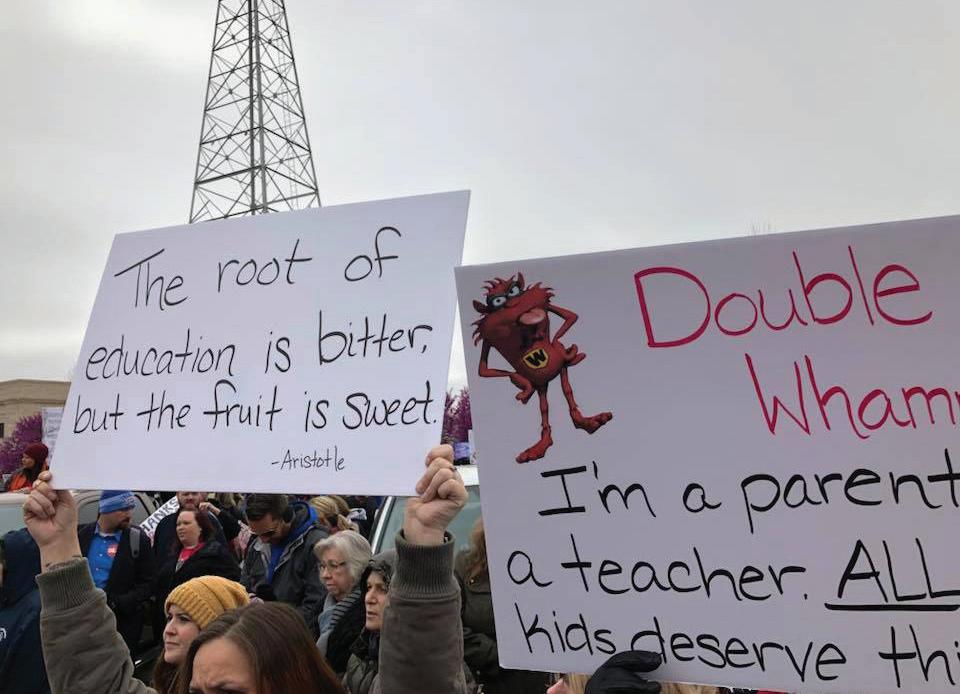
Teachers across the state went on strike April 2 in response to the lack of support from local government. This marks the first teacher strike in Oklahoma since 1990. The Oklahoma legislature had an April 1 deadline to vote on the teacher pay raise — the last one happened 10 years ago. Legislators hoped to prevent the strike by passing a last-minute bill March 28 that provided teachers with an average pay raise of $6,100.
However, the Oklahoma Education Association is seeking a $10,000 pay raise for teachers over three years, a $5,000 pay raise for support professionals over three years, a cost-of-living adjustment for retirees and the restoration of funding for education and core government services.
Oklahoma teachers are ranked among the lowest paid in the country despite the bill lawmakers passed March 28. House Democrats strategically used a procedural move to bring Senate Bill 1086 to the House floor only to have it blocked by Republicans on Monday, April 2 and Tuesday, April 3. Ruby Coyle, 29, an Oklahoma City Public School kindergarten teacher at Coolidge Elementary, expressed her hopes and concerns about the strike.
“I’ve been looking forward to the strike and so have all of my coworkers,” Coyle said. “I haven’t spoken to a teacher who doesn’t support the strike in some capacity. What makes me nervous is that teachers could become divided or end up settling for less than we deserve just to reach a deal. I think one of the strengths and weaknesses of our profession is that we are a pretty diverse populace as far as our political beliefs. It’s hard to unite people who have such different ideas about how the world works.”
Oklahoma is ranked 49th in the country when it comes to teacher pay. Arkansas pays $14,000 more and Texas pays $20,000 more. Some are making the most of the situation. Coyle said she received an email from the State of Texas upon earning her teaching license.
“They set up shop at a hotel downtown and it was an open invite to come interview with them,” Coyle said. “The email is in normal type, except in bold it says ‘$20,000.’”
Coyle spoke about the reality of Oklahoma teachers leaving the state for bordering states paying more. Last year’s Teacher of the Year moved to Texas with his wife, also a teacher, and they are now earning a combined extra $40,000 a year.
“I mean, that amount of money changes lives,” Coyle said.
Those opposed to the strike have expressed concerns over the lack of childcare available on April 2.
Matt Barger, 39, is the Specials Instructor at Special Care, Inc., a 501(c)(3) nonprofit organization located in northwest Oklahoma City. Barger spoke about the dilemma they faced in wanting to close in solidarity with teachers: Their students require extra assistance, which The Boys and Girls Club or a day camp at Science Museum Oklahoma cannot provide.
“This decision was primarily made because a lot of the students have physical and mental disabilities that require special supervision,” Barger said. “We’re going to be open for all of the school-age students. We have classrooms available for anyone, K-12, when they’re out of school on holiday breaks and we decided to be open for them during the strike.”
Barger said he supports the teachers’ strike professionally but also personally, because his wife is an OKCPS teacher.
“Teachers are thought of as public servants but not viewed the same way as firefighters,” he said. “They’re seen as the hired help. The role of a teacher today is so multifaceted and they haven’t had a raise in 10 years. I don’t think anyone would tolerate that in his or her line of work. Especially a person who has earned a degree, earned a licensure and done all of
the things teachers are required to do in order to teach.”
Coyle spoke about the disparity in hours worked and pay received. She’s contractually paid for a seven-hour workday, yet works at least 60 hours a week.
OKCPS provides an incremental pay raise of roughly $200 a month, but as the allocation per student continues to decrease, the out-ofpocket money each teacher spends continues to increase.
“I’ve had to buy a printer and a laminating machine that I keep at home because we can’t even print in color at school,” Coyle said.
One thing remains clear: Our local educators showed up Monday and felt optimistic about the future.
“It was so empowering to be with my fellow teachers on Monday and I’m planning on returning to the State Capitol every day until the strike is over,” Coyle said. “I’m just reminded of the Lilian Katz quote: ‘Affluence makes even mediocre teaching look good and poverty can make masterful teaching appear mediocre.’”
An estimated 30,000 teachers and educators gathered at the State Capitol Monday, April 2, with thousands returning Tuesday. According to the Oklahoma Teacher Walkout Facebook group, 200 of 550 school districts remained closed through Friday, April 5 (at time of press).
by Bella Kok Staff Writer
Since the school shooting in Parkland, Florida, Rose State has taken measures to ensure the safety of staff, students and visitors. The school hosted a Keeping Our School Safe panel in March. This panel discussed the steps that would be taken in an emergency situation, including an active shooter on campus. In addition to the panel held March 1, an active shooter demonstration will take place on campus from 8:30-8:45 a.m. April 12. The demonstration will be a collaborative effort between the Midwest City Police Department, Rose State campus security and Rose State theatre students.
While the event will take place in the Student Center, the entire campus will participate in the drill. All classes and offices on campus will be placed on lockdown. According to a campus-wide email, students who do
not have an 8 a.m. class should avoid campus until 9 a.m. because roads will be blocked and students will not have access to any services in the Learning Resources Center or Testing Center.
In recent years, most wellknown school shootings, including Columbine, Sandy Hook and Parkland all occurred at primary and secondary schools, rather than postsecondary institutions like Rose State. However, in the past five years there have been 36 school shootings on college campuses across the United States.
“Regardless of the numbers, the Rose State College Administration treats the potential of school shootings as relevant and a threat to the safety of our students and faculty,” said Richard Andrews, the senior director of Rose State campus operations. “As such we proactively prepare and train for that possible scenario.”
For the past several years, the Midwest City Police Department has helped Rose State prepare for the worst.
“We plan for the worst and hope for the best. Schools have drills for a tornado, they have fire drills; unfortunately, now they need to have active shooter drills,” Lt. Roger Ross of the Midwest City Police Department explained. “You have these drills for several reasons, one of which is so people realize what to expect when the police arrive on scene; other reasons might be to prepare their minds of what they might see, hear, smell; the different emotions they might experience. And especially so the people will have some kind of plan in place in attempts to survive these incidents.”
Ross advised students, faculty and staff to notify the authorities if they see something strange.
“If they hear that someone is going to do something or is planning something, call the police. If they see anything on social media that would indicate something is going to happen, screenshot it, and call the police,” he said.
For more information on how to prepare for an active shooter
drill or event, read the Rose State College emergency management document at 15thstreetnews.org.
To sign up for Raider Alerts that provide campus emergency notifications, visit getrave.com/login/ rose.
8:30 a.m.: Drill commences, all offices are to implement "secure in place" safety procedures. Turn off all lights, lock doors and do not answer the door if someone knocks. Remain out of sight. Campus personnel managing the drill will be spot-checking for compliance. No class instruction should be occurring during the drill.
8:45 a.m.: Once receiving the all-clear message, resume normal teaching schedules.
10 a.m.: Emergency personnel and others directly managing the exercise will conclude their involvement in the drill.
by Madi Zick Staff Writer
Students huddled together. Calling and texting loved ones to inform them about what’s going on. Silence throughout the halls. These actions occur when there is a lockdown in schools today. With recent events in the media, people are wondering: What is the next step?
At Rose State, many precautions are being taken to make sure that everyone is prepared for a school shooting.
“Rose State College takes safety and security of the students, faculty and staff as a number [one] priority,” Tamara Pratt, vice president of external affairs and marketing.
Pratt discussed the presence of Rose State security and how they are available 24/7, along with contracts with the Midwest City Police Department, to have officers on campus.
Pratt explained how there is a designated individual for the coordination of safety and security. That designated individual is Joedon Hughes. Hughes is the new safety, security and risk manager at Rose State. Previously he was a commander in the military, served for nine years and has a certification through the Occupational Safety and Health Administration,
with more than 300 hours of training. Hughes’ plan for Rose State is to have one unified safety plan to guarantee that everyone is on the same page.
“A huge priority right now is the emergency response plan; the program that we have in place right now is under heavy review,” Hughes said. “I would like to see more feedback and training available to faculty, staff and students.”
One of the many opportunities that Rose State has provided for the students and staff to participate in was the discussion panel for school safety held earlier this semester.
At the panel they discussed “the opportunity for all schools in Oklahoma to invite the Oklahoma Office of Homeland Security, School Security Institute to visit their campus and provide an in-depth review of policies, procedures, plans, team-building and a facility assessment,” according to Jackie Wright, professor of Emergency Management.
Wright said the question of “Run, Hide, Fight” or “Detect, Deter, Defend” arose at the panel. If a dangerous situation presents itself, people must choose one of the options discussed as their initial response. The first response people should have if in danger is to run away. If there is no way to run away and escape, the next
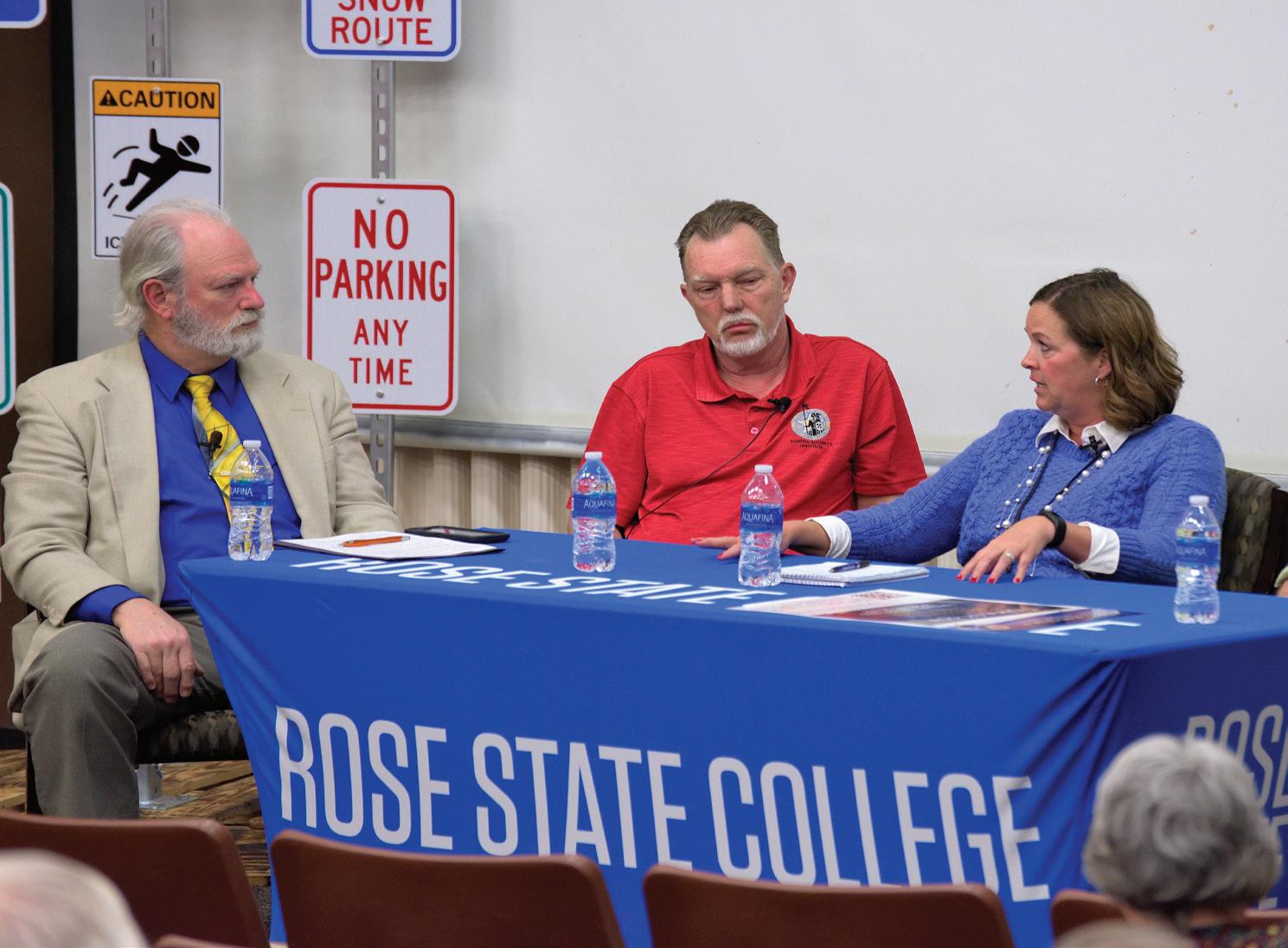
option is to hide. Then, if neither of those options is available, the next thing to do is to fight. The time for questions from the audience eased some parents from the burden of worrying.
Rose State is ensuring everyone is prepared in case of an emergency, and will be “providing a series of training programs that deal with such issues as a campus shooter, fire emergencies, hazardous weather drills and training on a variety of safety and security-related scenarios,” Pratt said.
Rose State will hold a live shooter demonstration during the morning of April 12, along with other training programs. However, in a true active shooter situation, Rose State students can be notified with Raider Alerts from the college by signing up through the Raider RAVE alert system. Students can access this online and through Raider social media accounts to receive emergency updates on campus. This helps to ensure that everyone is informed and ready in case a disaster strikes.
by Yesenia Gonzalez Staff Writer
Every 98 seconds, someone in America is sexually assaulted, according to the Rape, Abuse, and Incest National Network. Domestic abuse and sexual assault can happen to anyone, male or female. There are resources available for students who may be experiencing abuse, sexual harassment or other forms of mistreatment.
Websites and apps offer information, while licensed counselors and human resource department personnel can offer emotional and legal guidance, respectively. Rose State offers free, confidential counseling services for currently enrolled students, faculty and staff. Students, including concurrent students and college personnel can also file a report with the Human Resources office if an incident is related to Rose State.
There are often warning signs that precede abuse. Possessiveness, over-controlling behaviors and wanting to keep a person to themselves may seem flattering in the beginning but eventually become isolating, according to Director of Special Services Dr. Joanne Stafford. Potentially abusive partners may also exhibit jealousy toward others, check personal messages, manipulate a partner into doing uncomfortable things and make a partner feel guilty when partaking in unapproved activities.
“Sometimes people work to ignore; ‘oh, he really didn’t mean to

say that; it wasn’t so bad, he was angry.’ Just because someone is angry doesn’t give them the right to physically or verbally abuse you,” Stafford said.
Title IX is part of the Education Amendments Act of 1972, which prohibits sex discrimination on campuses that receive federal funding. There are Title IX coordinators on campus who handle sexual misconduct allegations.
Bertie Nutter is the senior director of Human Resources and there are two deputy Title IX coordinators on campus: Erin Logan, the student conduct officer, and Alyssa Loveless, the director for residence life. All other college employees and staff members are required to report incidents of which they become aware. Concurrent students on Rose State’s campus are also covered by Rose State policies. While the Human Re-
sources office offers privacy when handling reports of alleged sexual misconduct, only a licensed counselor, such as Stafford, can offer confidentiality if a student wants emotional support without pursuing legal action.
“We don’t require immediate [reporting],” Nutter said. “Our policy does say we want that complaint within 180 days. After that, witnesses, evidence, information that we would need to conduct a proper investigation starts drying up.”
A student can still file a report with local police after the 180-day deadline to report an incident that occurred on campus or with another Rose State student or staff member.
“Standard of evidence [requirement] for Title IX to determine that someone is responsible for sexual misconduct is preponderance of the evidence, so we review
all of the information that’s available and we have to determine and qualify it,” Nutter said. “[A] certified investigator has to look at all of that and determine, ‘is it more or less likely that the behavior occurred?’ and it can be 50/50 with just one side [more compelling] ... So [local law enforcement] has a higher standard of evidence that they have to adhere to.”
Careful analysis of evidence secures that anyone being victimized is protected. A thorough investigation ensures that there are no false or misleading accusations. False police reports can be charged as felonies or misdemeanors, depending on which jurisdiction the report was filed in.
According to Stafford, students should have a plan of action if they choose to move forward with reporting an incident. One of the first steps a student should take to ensure their safety is to find a place to live that is away from the perpetrator. Then, a person can file a victim’s protective order with local law enforcement. The VPO makes it illegal for the offender to be in the same area as the victim. There may be some clauses in the order which vary on a case-bycase basis.
There are multiple resources on campus and in the community to guide students experiencing sexual misconduct or domestic abuse. An extensive list of resources can be found under community resources at rose.edu. Any institution receiving federal funding, including public elementary and high schools, provides a way to file reports.
by Katie Duer Staff Writer
Non-traditional students at Rose State may have several different barriers and obstacles to overcome when deciding to further their education. For students with children of their own, securing a degree can be even more difficult.
There are several programs available at Rose State that cater specifically to students with particularly challenging circumstances. The mission of the SMART program at Rose State is to link single-parent students to campus and community resources for academic and life success. SMART is an acronym that stands for Single Mothers Academic Resource Team, but the program is a resource available to all single parents. The SMART grant is from the Women’s Foundation of Oklahoma. This is the third
year for Rose State to receive the $5,000 award.
DeAvian Wright is a single father of a 7-month-old son and member of the SMART program. He recently began his second semester at Rose State.
“Everyone in the program has been so welcoming and I knew when I started that this was exactly where I was meant to be,” Wright said.
“The goal of the SMART program is to provide support services for single parents,” said Monique Bruner, director of degree completion and Student Retention and SMART program coordinator at Rose State.
Wright said the SMART program has given him a steady foundation.
“I am really looking forward to taking advantage of all of the resources that are available,” Wright said. “It has made it so much easier to focus on my school work so
that when I get home I can spend time with my little boy.”
The benefits of the SMART program have made a difference by increasing the number of single parents who are graduating college.
“Each year, we consult with a small group of single parents and learn what they specifically need to be successful,” Brunner said. “In the last three years, we have sponsored workshops on study skills, how to communicate with faculty, understanding college processes and demystifying financial aid.”
Regarding the workshops from last year, Bruner said, “We have also asked several community leaders to present: Ryan Blair International Dream Print, Makeup Artist Michael Harris, community activist Paula McDade and numerous others,” Bruner said. “We have noticed an increase of single moms who graduate since our initial support interventions. It’s obvious that
support helps students get over the obstacles that may stop them from graduating.”
The SMART program offers benefits and allows for single parents to be part of a community on campus. Some of these benefits include:
• Academic Advisement
• Book Discussion Group
• A limited number of free books are available: The Price of Motherhood: Why the Most Important Job in the World is Still the Least Valued by Ann Crittenden
• Social Services Resources
• Summer Bridge Program
• Support Services
• Rose State College Personal Counseling Services
The SMART program is changing the landscape for single-parent families.
For more information about the SMART programs, visit rose.edu.
The geosciences students at Rose State are teaming up with the 15th Street News and The 6420 to provide weekly forecasts on the publications’ websites, 15thStreetNews.org and the6420.com. In addition, they will provide some insight into weather phenomena in our summer magazine, which will be on stands in May.



Kelly Kornell

What is your major?
Geosciences with emphasis in Atmospheric Science.
What made you interested in meteorology?
I decided to pursue the career field when I was in high school, but I’ve always been fascinated with the weather as a kid. What are your future plans? My future plans are open to all aspects of the career field. I would like to be a meteorologist in the Air Force as I continue to serve, but if not, then I will pursue a meteorology job in the civilian sector.
What is your major?
Geosciences with emphasis in Atmospheric Science.
What made you interested in meteorology?
When I was younger, oftentimes when it rained, and especially when it thundered, I would go outside to watch the storm. I would often sit on the patio to read a book while enjoying the environment. What are your future plans? After graduating from Rose, I plan to transfer to the University of Oklahoma.
What is your major?
Geosciences with emphasis in Atmospheric Science. What made you interested in meteorology?
I love doing math so naturally I chose a science that depends heavily on math. What are your future plans? My future plans include going on to graduate school. I hope to do some type of research.
What is your major?
Geosciences with emphasis in Atmospheric Science. What made you interested in meteorology?
What really drove me to pursue an education in meteorology was going storm chasing with my stepfather. What are your future plans?
As for future plans, I’m still not sure what I want to do. I want to learn and apply as much I can in my life. I’ve also been considering teaching, but I want to wait a few years before I commit to that.
by Bailey Walker Staff Writer
This school year has brought an explosion of political activism to campus. Four different politically-oriented groups have established themselves in the 2017-2018 school year. In order of funding, they are: Democratic Socialists of America, Rose State Political Science Club (formerly Civox), the College Republicans, and Turning Point USA. Notably, this list leans to the right as Rose is home to one left group, one non-partisan group and two right-wing groups. The two conservative groups offer students different options.
The College Republicans was founded by Josey Meyers, a criminal justice major, and is sponsored by Social Sciences Professor Joetta Gatliff. Meyers seeks to change the narrative surrounding the Republican Party, wanting to dispel accusa-
tions of hate, bigotry and racism. College Republicans plan to conduct canvassing campaigns for Republican candidates, and at meetings students can find conservatives talking about current events in the U.S.
Rose State’s Turning Point USA chapter has close ties to the College Republicans. Founded by the College Republican’s Vice President of Public Relations
Sean Roemer, a business major, TPUSA kicked off in late February. Advised by Social Sciences Professor James Davenport, Turning Point’s key platform is anti-socialist and pro-capitalist, associating with figures such as Tomi Lahren, Milo Yiannopoulos and former Breitbart editor Ben Shapiro. TPUSA seeks to promote free market policy, reduce the scope of government, and promote conservative ideals on college campuses.
“I want to show there is another side to campus,” Roemer said. “Furthermore, I looked at how
socialism has been implemented throughout the years and it has always failed. Just look at Social Security in the United States. It is on the verge of being bankrupt and will not allow people to get what they agreed to. This is because America began to trust the government too much.”
While some groups blame the lack of funding for Social Security on over-trust of government officials, political groups differ on the cause. Jean Folger and Tim Worstall from Investopedia and Forbes, respectively, attribute the shortfalls of Social Security to tax policy not keeping pace with demographic shifts, as the elderly population of the U.S. is on track to double in only 40 years.
The national organization TPUSA and subsequently local chapters who benefit from national funding are different from the College Republicans, notably in their affiliate groups. TPUSA National lists the David Horow-
itz Freedom Center as a partner organization, which has been labeled as an extremist anti-immigrant, anti-Muslim hate group by the hate group indexer and civil rights organization Southern Poverty Law Center. Additionally, according to tax data analyzed by the IB Times, the Alliance Defending Freedom, which is a TPUSA donor, has been labeled an anti-LGBTQ hate group by the SPLC.
Whatever your flavor of conservatism, whether your tendencies leads you to the bottom right of the political chart—anarcho-capitalist or the moderate right—Rose State has the club for you.
The College Republicans meet at 2:30 p.m. every other Tuesday in Social Sciences, Room 135. This semester’s meeting dates are April 10, 24 and May 8.
Turning Point USA meets at 4 p.m. the second and fourth Wednesday in Social Sciences, Room 230/231.
by Courtney Burleigh Staff Writer
Rose State’s annual excursion to the Crystal Bridges Museum of American Art, held Saturday, April 28 will be an opportunity for people who enjoy architecture, sightseeing and road trips.
The trip is organized by Humanities Professors Sherri Mussatto and Lori Morrow; the annual trip to the Crystal Bridges is for anyone wanting to learn about and experience American history through art, architecture and more.
Crystal Bridges is located in Bentonville, Arkansas. According to Professor Sherri Mussatto, the museum “has a wonderful collection of American art and beautiful grounds to explore.”
Attendees have the option to explore the museum independently or follow behind the guided tour provided by the museum docents.
Those attending this tour will earn Passport Points for Rose State’s Passport Program. Mussatto ex-

plained that non-Rose State students are invited as well.
“Of course, the benefit to everyone is enjoying a very nice day of exploring American art and learning more about it,” Mussatto said. “It’s so much better than simply viewing these works of art in a textbook.”
The bus trip to Crystal Bridges is a tradition, and despite being held
for several years in a row, Mussatto said she and her students enjoy their adventures each and every time.
“Professor Morrow and I look forward to the day when we can be with our students as many of them experience an art museum for the first time,” Mussatto said. “Even if they have been to an art museum
before, they might not have been to one as large as the Crystal Bridges museum. It’s so exciting to hear their reactions to some of the pieces of art … Usually, the reality of the experience surpasses their expectations. Many times, students are not sure what to expect, but the events of the day are fun, and it’s just nice to get out of town and see new sights.”
To sign up for the trip, students must take their student ID and a copy of their class schedule to the Community Learning Center. The trip costs $40 for students and $60 for non-students. Attendees will depart at 7:45 a.m. April 28 at the Community Learning Center. There will be a stop for dinner on the way back, and the bus will arrive at Rose State by 9:30 p.m. Saturday.
“Students have a reduced rate, but family members, friends, and people from the community are all welcome to come along,” Mussato said. For more information about the trip to Crystal Bridges, contact Mussatto at smussato@rose.edu or 733-7503, or Morrow at lmorrow@ rose.edu or 733-7507.
by Payton Hayes Online Editor
Dr. Frances Hendrix, former vice president of Academic Affairs, was an inspirational pillar at Rose State for 37 years. She played a pivotal role in many of the major changes that took place during her time on campus. Hendrix made the decision to retire this year, and her final day on campus was March 9.
Hendrix began her work with Rose State in August 1981 and retired this year, after helping the college complete its visit with the Higher Learning Commission. Dr. Jeanie Webb, President of Rose State, described Hendrix’s hard work, as well as her persevering and positive attitude during her time on campus.
“She has provided policies and procedures that continue to improve the quality of the education and experience of the students at Rose State College. She has seen and experienced both good and difficult times at the college and has remained positive throughout it all,” Webb said.
Hendrix may be humble and short in stature, but the Rose State community should not confuse this with her long list of accomplishments.
“She is dedicated, ethical and hardworking,” Webb said. “Dr. Hendrix truly cares about Rose State, not only from an academic perspective, but also an institutional and community perspective. She has implemented many new academic programs.”
By following her everyday routine and putting her extensive higher education and institutional knowledge to work, Hendrix impacted thousands of students’ futures over the past 37 years.
“She has the ability, with her higher education and institutional knowledge, to sift through information and get right to the heart of the matter,” said Humanities Academic Adviser Jeff Conkin. “She deals compassionately and directly with conflict so that issues are resolved quickly.”
Conkin worked with her as a part of the Enterprise Development-Reach Higher program and as the Humanities adviser with the programs in that division.
“My office was close to hers, and she was always there to answer questions and be supportive and listen to me and give me information, just with her great experience not only at Rose State, but also her statewide higher education experience,” Conkin said.
Hendrix played an influential role during her time at Rose State,
working through changes and embracing staff and students alike to positively impact their lives.
“She has been a strong advocate in bringing new programs to the campus, such as Cyber Security, Developmental Education, STEM and STEAM, Emergency Management and many more,” Webb said.
Hendrix stands as an inspiration to students and faculty alike.
“Students can look to [Hendrix] as a role model for making a difference and for working however long it takes to complete the task,” Webb said. “Dr. Frances Hendrix will be forever remembered at Rose State College,” Webb said.
Conkin explained that he thinks inspiration can be found in her devotion to Rose and her community. He added that devoting yourself, not only to learning as much as you can about whatever your job is, but to how your job can fit into the bigger picture and help other people, is equally important.
“I’ve learned a lot from Dr. Hendrix, as she is a good mentor,” said Isabelle Billen, associate vice president for Academic Affairs and Institutional Effectiveness. “She’s a planner, and she teaches you how to plan ahead, think and back up before you react.”
Billen added that Hendrix is a pillar that stands to represent and inspire all women looking to
further their education and make a difference in their communities.
“Frances brings loyalty, ethics, trust, dedication and knowledge to our institution,” Webb said. “We have been so privileged to have someone who cares deeply about our campus.”
While Hendrix was notably quiet about her personal life, she was friendly and kind.
“Dr. Hendrix has always had a friendly greeting and a listening ear,” Conkin said. “She has been very supportive of faculty and staff in areas of professional enrichment, and a great leader when it comes to developmental education at the college. She will be missed and treasured for both her personal connections and overall legacy.”
Hendrix admitted that she has not made any immediate plans for the foreseeable future; however, after so many years of hard work and planning, it might be a nice change of pace to keep her options open.
“The college has been fortunate to have such an extraordinary leader, and it is my hope she will continue to be active on our campus with future endeavors,” Webb said.
To view a campus tribute video for Hendrix, visit 15thstreetnews. org.
by Haley Humphrey Social Media Coordinator
Summer will be here in a heartbeat. One of the most common activities many people enjoy during this time is swimming. However, water can be dangerous. If water safety is not practiced, drowning can occur in any body of water. For the first time in three years, the Wee Water Wahoo event the Rose State Aquatic Center holds was cancelled April 4 due to the teacher walkouts. Since schools are not open, the students do not have a means of transportation to arrive at the event location.
“Drowning is the second leading cause of unintentional injury-related death to children 2-14 in Oklahoma,” according to the Safe Kids Oklahoma organization. This group, along with others like Healthy Schools for Oklahoma, U.S. Army Corps of Engineer, Junior League of OKC and the Oklahoma City Fire Department had collaborated with the Rose State Aquatic Center to put on the Wee Water Wahoo event for more than 500 kindergarteners throughout the Oklahoma City area. The event, which was to occur from 9 a.m. to 2:45 p.m. April 6, teaches hands-on water safety to children.
Kim Queri, Aquatic Coordinator and professor of Social Sciences, was enthusiastic to share the significant process of the event that has dedicated partnerships and
helpful volunteers.
“It was geared toward schools that are involved with healthy lifestyles,” Queri said.
The organizations assisting in the Wee Water Wahoo event aided in administering schools with
“It looks like organized chaos,” Queri said.
The event brings joyful fun to an important lesson all students should be informed about.
“I’m not sure who is having more fun, the volunteers in the

the educational materials teachers need to instruct students throughout the year. Once the month of April is reached, students can be brought to a facility to reemphasize water safety education. Queri discussed how there are four sessions the children rotate through.
The children divide into groups of 75-120. Throughout the event, they listen to a lecture, watch a video and then experience the water in the Rose State pool with the volunteers’ observation and interaction.
water playing with the kids, or the kids in the water,” Queri noted.
Water safety is essential to life. Without the organizations and volunteer efforts from the Rose State Men’s Soccer team, lifeguards and many more, the annual event would have ended a long time ago.
“It was fun to play with the kids,” Jackson Slayter, Rose State Soccer player, said. “My favorite part [was] knowing it was their first time being in the water and seeing their reaction.”
The acknowledgment of the
need for more children’s aquatic programs was heard years ago when Brett Wood, a previous aquatic coordinator, orchestrated more youth community programming that could be held at the Rose State Aquatic Center.
Queri stated that the complex’s previous mission was directed toward the adult community. Now, because of Wood’s and Queri’s consistent efforts, Rose State Aquatic Center has expanded its focus in creating student-oriented clubs, teams and special events. It is home to the Mid-Del school swim teams (Carl Albert, Del-City and Midwest City) to practice and host meets.
Rose State’s swim club, which also uses the facility, travels and competes. Queri knew the members wanted an organization at the collegiate level where they could further their swimming careers. They started with six students, but the club has now progressed to more than 20.
Expansion is always on the horizon. With support from Rose State President Jeanie Webb and the renovation projects the Aquatic Center has gone through, Rose State will continue to be a strong advocate of water safety and event growth.
If interested in learning more about the water safety events taking place at the Aquatic Center or signing up to volunteer for next year’s Wee Water Wahoo event, contact Queri at kqueri@rose.edu.
“Do you support State Question 788 (the legalization of medical marijuana)?”
By Haley Humphrey Social Media Coordinator & Danny Fritts Sports Editor

Andrew Mullins, Business
“It’s a step in the right direction. There are many benefits; [for instance] we have CBD oil, which is used as the healing aspect of medical marijuana.”
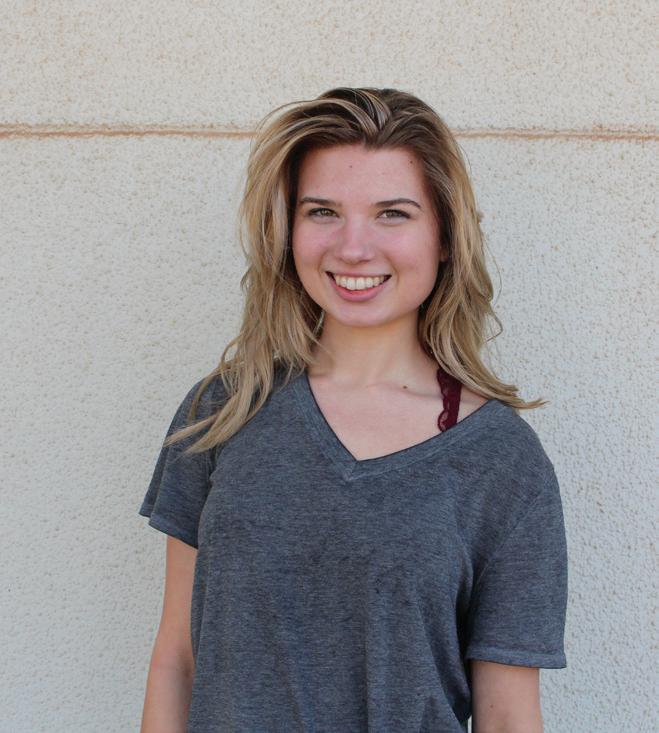
Lindsey Reece, Dental Hygiene
“Yes, as long as it’s used for medical reasons.”
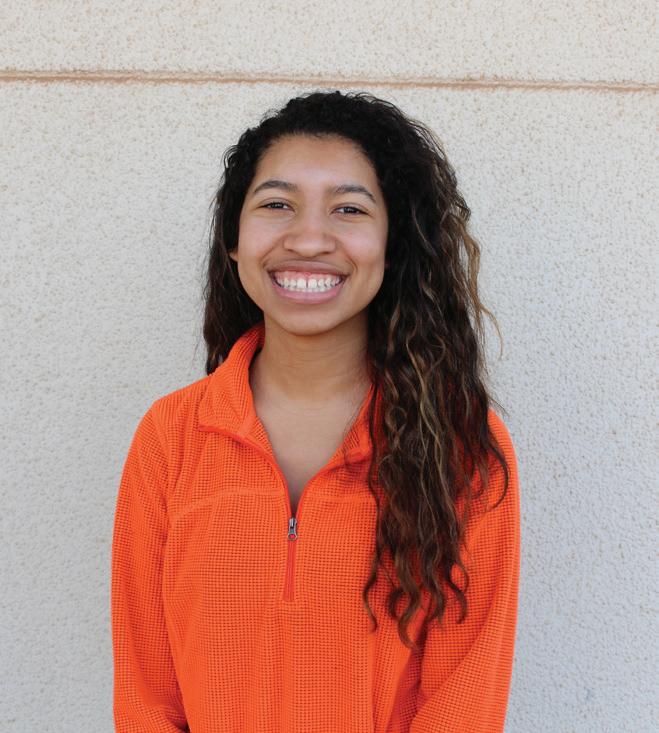
Caitlin Rodriguez, Art
“It should be passed for medical reasons. As long as it’s legally followed through with a doctor, then I don’t have a problem with it.”

Dillon Williss, Nursing
“Yes, because it can have positive effects on people who struggle with pain. Since the opioid crisis is at an all-time high, why are we rejecting a natural alternative to pain management?”
by Danny Fritts Sports Editor
This month’s Raider Spotlight features sophomore outfielder Jada Austin. Austin is a graduate from Lawton Eisenhower High School and currently wears No. 12.
What’s one aspect of your game that you excel at?
“I would love to say that I excel at every aspect of the game,
but obviously that’s not true. But something I am confident about is my hitting. I feel that I have been able to use slapping to my advantage. Especially at the level I’m striving to be at, I am able to control and position my hits based on the defense, giving me edge over the competition.”
What’s an area of your game that you can get better at?
“One area of my game that I feel like I need to improve at

is my mental game. Physical is usually an easy fix but the moment I step into my head is when I truly start to struggle. Being that I tend to be my own biggest critic, I always drive for perfection and often stress when I don’t meet my expectations.”
Describe your favorite memory playing at Rose State.
“This is a hard question; I have so many from both my sophomore and freshman year, so I’m just going to say every day
is my favorite memory. I have been blessed with the opportunity to meet and play so many amazing people while playing ball at Rose that has made every day one that I won’t forget.”
Catch Austin and the Lady Raiders’ next home game as they take on Connors State College on at 4 p.m. April 10. For a full look at the rest of the schedule and player statistics, visit rscraiders.com.

by Danny Fritts Sports Editor
Fergie once sang, “I be up in the gym, just working on my fitness.”
With summer around the corner, many will be looking for ways to become more fit. There are quite a few ways for people to increase their activity levels. Whether a person is an extreme athlete or someone who just wants to live an active and healthy lifestyle, there are fitness options available. Although it is challenging, fitness is choice that can be rewarding in many aspects of life.
Stephano Simmons, a personal trainer at Gerrity Fitness Center on Tinker Air Force Base, walked us through a few ways on how to implement and manage an active life.
Hydration Simmons noted that drinking plenty of water is a great start to living a healthy lifestyle. No amount of
work can reduce the body’s need for water. According to Healthline, the Institute of Medicine recommends that men should drink 104 ounces of water per day while women should drink at least 72 ounces. Since every system in the human body needs water to function, drinking plenty of it is a great start.
Nutrition
Simmons also said that eating a big, healthy breakfast is vital to your body.
Like Adelle Davis once said, “Eat breakfast like a king, eat lunch like a prince and eat dinner like a pauper,” Simmons said.
Many people tend to do this backward. Due to the busy lifestyle many live, the majority does not allow enough time to eat breakfast. Once dinner rolls around, many people will eat an unhealthy meal that will sit in their system while they sleep, which can lead to unwanted fat.
When it came to exercising, Sim-
mons made the case that eating properly is just as important when you have a certain goal in mind.
“You cannot out-train a bad diet,” Simmons explained.
Exercise
For those that want to start working out, Simmons stated that full body workouts make a difference.
“Muscle balance is key. If you’re going to push, you have to pull. If you work the top, work the bottom. If you work the front, work the back,” Simmons added.
Beginners should start with fullbody workouts because that is how our bodies operate. When we mix in different compound movements, that is where we tend to see results. As for bodybuilders, they tend to have split workout routines. For example, they will specifically work on chest and triceps one day, then back and biceps the next day.
A workout that Simmons uses for his beginners is known as Mindy’s
5x5. The five workouts are bench press, squat, deadlift, rows and overhead presses. A workout for people with a limited amount of time is working on pull-ups and squats one day, then dips and deadlift the next.
People live busy lives, but finding ways to be fit can potentially reduce stress levels and ultimately help people feel better.
Exercises and the Muscle Groups They Target:
Bench press: Chest, shoulders and triceps
Squat: Quads, hamstrings, glutius maximus, core
Deadlift: Lower back, core
Rows: Trapezius, latissimus dorsi, (middle back) biceps and forearms
Overhead press: Shoulders, trapezius and triceps
Pull-ups: Upper back, deltoids and biceps
Dips: Chest and tricep
This issue’s recipe features Randy Hayes’ meatloaf recipe. As a vegetarian for almost seven years, my mouth still waters when I smell this dish cooking in our house. Check out the vegan modifications at 15thstreetnews.org.
Prep time: 10 minutes
Cook time: 1 hour
Serves: 8-10
Ingredients:
• 5 pounds of ground beef
• 1 24-ounce jar mild of salsa
• 1 24-ounce bottle of ketchup
• Garlic salt (optional)
• Non-stick cooking spray
Instruments:
• Large mixing bowl
• Large glass baking dish
• Spatula
• Tin foil Instructions: Preheat the oven to 350 degrees. In a large mixing bowl, thoroughly mix the hamburger and salsa together. Add in salt if desired.
Spray the inside of the baking dish, making sure to coat the sides well. Then, drop the hamburger mix into the baking dish and form it into a loaf shape. Cover with foil and cook for roughly 30 minutes at 350 degrees, checking occasionally to
keep the loaf from burning. Once the loaf is fully cooked through, pour off the excess grease.
Top with a generous layer of ketchup and return the loaf to the oven for another 20-30 minutes. Watch carefully. The loaf should have a slight char to it but it should not be burned. Enjoy.
Optional: Once the meatloaf has cooled in the fridge, you can cut it into thin slices for use on meatloaf sandwiches.
Optional: Ground turkey meat may also be used.
Recipe by Randy Hayes


by Mina Onar Assistant Editor
Color and warmth are spread when spring comes around. It takes away the heaviness and the cold of the past months of winter and many cultures celebrate the upcoming spring with joy. The idea of spring cleaning is not limited to only one day of house cleaning in Iran; in
fact, it is the basis of Persian New Year called Nowruz. Nowruz means “new day,” notifying that spring has come. This year the event began March 20.
“Every year, Nowruz coincides with the start of spring and traditionally celebrates the rebirth of nature. It also coincides with the spring equinox,” said Nick Bastani, who is an Iranian-American and Rose State academic adviser.
The celebration of nature’s rebirth lasts for two weeks. Nowruz is said to have started in Iran, which is why it is also known as the Persian New Year, or Iranian New Year. It is celebrated not just in Iran but in other Middle Eastern and Central Asian communities as well. While not acknowledged as a national holiday, there are other countries that celebrate Nowruz. Some countries that celebrate the Persian New Year include: Azerbaijan, Afghanistan, Albania, Uzbekistan, Turkmenistan, Georgia, Iraq and Turkey. Nowruz brings every Iranian together to celebrate the Persian New Year.
“It means rebirth of nature and start of another cycle of life, unifying of people and nations,” Bastani continued. “It helps my soul and brings me peace. I love to share this season with friends around the world.”
As Nowruz brings many people together, it is celebrated in Oklahoma City by many people as well.
Bastani added that the state of Oklahoma has recognized the Persian New Year when Gov. David
Walters was a governor.
“Persian community along with our fellow Americans celebrate the Nowruz with music, food and fun.”
This national holiday of Iran is celebrated around the world by many people who often try to celebrate it as traditionally as possible.
“Children are dressed in traditional clothing for different shows across the world,” Bastani said.
Even though Nowruz, the Persian New Year, seems culturally different than the new year in the U.S., there are still similarities between the two. “From the spiritual standpoint, they both represent peace, tradition and family,” Bastani said.
One of the biggest differences between the New Year in the U.S. and the Persian New Year is that the Persian New Year celebration lasts for almost two weeks.
“On the 13th day around the world, we bring ends to our festivity,” Bastani added.
This year, the celebrations were held at Lake Arcadia for a full day of picnic.
by Payton Hayes Online Editor
One thing that is forever constant is the changing of seasons, and with it comes seasonal fashion. Spring is here and fashion is soon to follow with pastels, florals and polka dots galore. Even though it's already April, and it’s still on the chillier side in Oklahoma, fashion enthusiasts can be prepared to put their best foot forward when the weather warms up with these spring style tips.
Patterns: Solid colors are great but there is nothing more eye-catching than an interesting pattern. Popular patterns this season include florals, checkerboard prints, animal prints, flames, geometric prints, polka dots, houndstooth prints and the classic stripe. Bold colors such as yellow, bright orange, dark forest green, baby blue, baby pink and classic lipstick red are currently popular.
Denim: Jean jackets, skinny jeans, mom jeans, boyfriend jeans and mom shorts are all popular year-round staples that also make an appearance in the spring. Dress up old denim jackets with buttons, patches or embroidery, and dress them down by distressing them. Denim is a fabric that will likely never go out of style due to its durability and versatility, and should be taken advantage of

in the spring. Jean shorts come a variety of colors and floral patterns look best with classic denim, black denim and white denim. Distressed denim vests are making an appearance in red and black denim, decorated with patches and buttons. Striped tees are attractive paired with distressed, cuffed jeans or black denim. Bold colors pair well with boyfriend jeans and a pair of Chucks.
Mixing Textures: Styling a singular bold piece is one thing, but when it comes to mixing textures, it's a whole other ball game. While it might seem tricky at first, incorporating different textures into a wardrobe can add variety and depth to an otherwise one-dimensional look. How do you go about mixing textures? It’s actually quite simple.
First, stick with basics. Don’t over complicate the outfit by throwing in a bunch of wacky patterns and bold colors. Instead, go for something basic and build up. Take stripes, for example. Someone went with a basic black and white striped T-shirt, they could throw in a floral skirt and some flats for a dressed-up look or dress it down with cuffed, distressed black jeans, some heeled booties and a floral blazer. But how does one go about mixing actual textures? It’s easy. A luxurious, white faux fur coat would go well with faux leather pants, chunky boots and a satin top. The soft fur compliments the intense look of the leather pants and boots, and the satin top adds to the luxurious feel whilst keeping balance. Statements: Some eye-catching
pieces in stores, like the gold sequin crop-tops at JCPenney or the holographic skater skirts from Hot Topic. But in truth, these items rarely get worn. Statement pieces find their moments year-round, but remain in the back of our closets because most people don’t know how to style these lovely gems. However, like the texture and pattern tips above, it isn’t hard to make a bold piece look good— just keep it simple. Those holographic skater skirts could be paired with a band tee and some Vans for a casual look. To dress it up, go with a ruffled, chiffon blouse, a cardigan and a pair of flats. The gold sequin crop top would be great paired with those black distressed skinnies and the chunky heels mentioned earlier. When it comes to building an outfit, it's usually safe to pick your focal point and build around it. Whether someone is styling a statement piece, multiple textures and patterns or even trying to figure out how to wear a bold color, it’s always best to build up from one piece at a time. Besides, it’s just fashion, and it’s all about experimenting and having fun. The late fashion designer and artist Alexander McQueen said, “Fashion should be a form of escapism, and not a form of imprisonment.” Play around with textures, patterns and bold colors this spring, because life is too short to wear something boring.
version of the ballot measure.
When Oklahomans go to the polls June 26, State Question 788 will give voters the opportunity to decide whether Oklahoma will join the 29 states and District of Columbia, which currently allows their residents to use marijuana medically.
The legalization of marijuana for both medical and recreational use has been debated for years. First steps toward legalization in Oklahoma began with the passing of Katie’s Law in 2015, allowing for the use of Cannabidiol products in children with seizures. CBD products including oils, salves and edibles are manufactured from hemp rather than marijuana to limit the presence of tetrahydrocannabinol, the psychoactive molecule found in high concentrations of marijuana.
In 2016, Gov. Mary Fallin signed an additional law into effect amending the state definition of marijuana so that CBD substances containing less than the three-tenths of one percent level for THC are not included. From there, the use of CBD products expanded to help those with other ailments.
SQ 788 intends to legalize the licensed use, sale and growth of marijuana in Oklahoma for medicinal purposes. Lawmakers on both sides of the aisle, doctors and business owners all have their ideas about if and how legalization for medical use should occur in Oklahoma. Supporters of the ballot measure have already overcome one hurdle, winning a case in the Oklahoma Supreme Court regarding its wording. The ballot measure was challenged and rewritten by former Oklahoma Attorney General Scott Pruitt.
“[Pruitt] went through under his powers as attorney general and tried to rewrite the ballot measure in a way that would frame the argument in a pretty negative light,” said Democratic Rep. Scott Inman.
Inman added that Pruitt, an opponent of both medical and recreational use, selected wording to help get the bill defeated and therefore made the measure seem as though it was legalizing the use of marijuana for everything. In March 2017, the Oklahoma Supreme Court ruled against Pruitt’s rewritten
Still some believe that SQ 788 in its current form does not provide for adequate regulation of the drug, or sets Oklahoma up for legalization in a way that is not solely medical.
“The reason [SQ 788] might have a negative effect is because even though it’s titled medical marijuana, if you read the state question, there’s portions of it that really cover recreational marijuana,” said Republican Rep. Roger Ford.
Ford thinks marijuana does have medical benefits and Oklahomans should be able to vote on a bill regarding medical or recreational marijuana, as long as they know exactly what that bill includes.
When it comes to medical legalization, opponents often point to what they deem as a lack of scientific research to back the assertions of the healing and restorative effects claimed by advocates. But
someday start a dispensary in Oklahoma.
Herban Mother was founded from the desire for the Najars to improve their own health. From humble beginnings selling organic produce through their distribution company Herban Gardens, a turn toward natural medicine, including the extraction of essential oils, occurred. When the pair met Ryan Early, CEO of OKC-based Can-Tek Labs, the only FDA-licensed manufacturer of CBD in the state, a great partnership was formed.
“We were able to take the production that we did and, [through] letting Ryan and Can-Tek Labs ... become the mixologists and add the CBD, [make] it just an incredibly high quality, strong anti-inflammatory [and] pain reducer,” said Mary Najar.
The Najars believe in their products and can recount story after story of lives changed

those currently running Oklahoma’s legal cannabis dispensaries see things differently.
“Any doctor who says he doesn’t know enough to recommend this, then his higher education stopped when he crossed that stage and got his diploma,” said Hector Najar, who co-owns Herban Mother with his wife Mary.
Najar further explained there are simply too many peer-reviewed studies published in scientific journals or available online for people to continue to deny the effects. The Najars became educated on some of the effects of cannabis during their time working with a medical marijuana dispensary in San Jose, California. They watched participants in a Stanford University clinical trial for cancer patients and knew they would
Doctors had given him a prescription of pharmaceuticals and surgery to manage his pain for the rest of his life. Now Najar speaks joyfully of the day he walked into the orthopedic surgeon’s office able to turn down medication and say, “I don’t need you.”
While some lawmakers feel that SQ 788’s current wording is masking some of its true intent, others believe this historical bill has the potential for a number of positive impacts on the state.
“We’ve not had a legalization question for marijuana make it on a statewide ballot in state history,” Inman said. “Once medicinal use is legalized here, that it will sort of destigmatize the use of marijuana.”
Inman thinks much of the negative backlash others may perceive will be minimal pointing to the success seen, in multiple areas, by other states who have legalized the drug. Colorado, where marijuana use is legal both medically and recreationally, boasted a tax revenue of $198.5 million in 2016. If it were possible to sustain them, revenue numbers like this could have the potential to eliminate Oklahoma’s budget shortfalls.
Inman also pointed out the broader benefits in terms of healthcare, specifically for citizens with chronic neurological diseases. Inman’s father suffers from Parkinson’s disease, one of many neurological disorders for which medical marijuana is studied as a treatment.
through the use of CBD, including their own.
“Look what I can do,” said Najar, while turning his head and body quickly from side to side. “I couldn’t do this in October. I was a cripple.”
Prior to his use of CBD, Najar found himself unable to function normally in daily life because of his chronic neck and back pain. Even the simplest of tasks were painful or even dangerous. He needed help to dress and was unable to turn his head from side to side when driving. Bending over sometimes meant his wife finding him on the floor, too overcome with pain to move.
“I’ve been to the point to where I wanted to commit suicide, I hurt so bad,” Najar said as he and his wife fought back tears at the memory.
“[Legalization] might have a long-term benefit to those folks who are suffering with diseases that could benefit from it, and then obviously the ancillary benefit of their family members who care for those people,” Inman said.
The debate will continue until voters take to the polls in June. For both Inman and the Najars, the hope is that voters will take the time to educate themselves on the matter.
“If people would realize it’s very, very safe, CBD, and be open to it. It won’t kill you. Tylenol, Ibuprofen can kill you this could change the world,” said Mary Najar, “It could absolutely change the world.”
To read SQ788 in full, visitsos.ok.gov/documents/questions/788.pdf.
For more information on voting and voter registration, visit ok.gov/elections/Voter_Info/ Register_to_Vote/.
Adult Night
April 20
RSC Wellness Center
6-8 p.m.
Leader Lunch Series
April 10
Innovation Station
11:45 a.m. - 1 p.m.
Spring Fest
April 17-19
RSC Campus
- Humans vs. Zombies - Pizza, Volleyball, & Hammocks - Escape with Bob Ross Paint Night
Dog Trick Contest & Color War
April 20
Traub Elementary (near RSC soccer fields) 11 a.m.
RSC Student
Recital Hour
April 9
HC 128
3:30 p.m.
Norman Music Fest April 26-28
Festival of the Arts April 24-29
Active Shooter Drill
April 12
RSC Campus
8:30 a.m.
OKC Thunder vs. Memphis Grizzlies
April 11
RSC hosting the Oklahoma Association for Developmental Education
April 14
Community Learning Center 10 a.m. - 2 p.m.
Adult
Recruitment Night
April 10
University Center 5-7 p.m.
New Student enrollment opens for summer/fall!
April 2
Poetry Reading
April 10
LRC, second floor 2 p.m.
Student Life Banquet
April 23
RSC Wellness Center 5:30 p.m.
Earth Day
April 22

Editor-in-Chief, Graphic Artist
Michelle Rojano
Assistant Editor
Mina Onar
Multimedia Editor
Bailey Bussell
News Editor
Emily Siddiqui
Online Editor
Payton Hayes
Circulation Manager
Janae Willams
Social Media Coordinator
Haley Humphrey
Advertising Director
Brayden Conover
Sports Reporters
Danny Fritts
Scott Sharkey
Madi Zick
Staff Writers
Ariel Bryant
Courtney Burleigh
Katie Duer
Reginal Fields
Yesenia Gonzalez
Joshua Rojo
Bailey Walker
Bella Kok
Kaitlyn Burden
Hollye Carroll
Stock photos from Pixabay
Adviser
Darcy Delaney
Letters to the Editor
The 15th Street News welcomes and encourages letters to the editor. Letters should be a maximum of 300 words and are subject to editing for obscenity, clarity and space. Submissions must include name, major and phone number. 15th Street News reserves the right to not publish submitted letters.
Letters to the editor may be hand-delivered to FA110.
Policies
The 15th Street News is published monthly and is a designated public forum. Student editors have the authority to make all content decisions without censorship or advance approval. Columns, commentaries and letters to the editor are personal opinions of the writers and do not necessarily reflect the views of 15th Street News or other students, faculty or administrators of the college.
Anyone having a complaint may contact the Editor-in-Chief, 733-7400.
15th Street News is a member of OCMA, OPA, ACP, Great Plains Journalism Association, and the Society of Professional Journalists.
This publication is printed by the Edmond Sun, issued by RSC and authorized by the Advisor of Student Publications.
RSC in compliance with Titles VI and VII of the Civil Rights Act of 1964, as amended, Executive Order 11246, as amended, Title IX of the Education Amendments of 1972, Americans with Disabilities Act of 1990 and other federal laws and regulations does not discriminate on the basis of race, color, sex, age, national origin, religion, disability, sexual orientation or status as a veteran in any of its policies, practices or procedures.
This includes, but is not limited to, admissions, employment, financial aid and educational services.