WESTFIELD — Mayor Michael McCabe gave a short narrative presentation to the City Council on the fiscal year 2027 city budget of approximately $180,2 million that is driven largely by state-mandated costs and an increase in health care premiums.
The budget is an increase of $7.3 million, or 4%, over the FY26 budget.
After taking a few questions, the budget was referred to the Finance Subcommittee, chaired by Councilor Daniel Knapik, with Councilors Brent Bean II and Cindy Harris, for a line-byline review.
McCabe began by thanking councilors for their work behind the scenes in trying to understand and collaborate with him on the budget. He singled out Knapik, who he said has been working with him since January to try to figure out the best method to move forward.
He said the 2027 budget maintains level services to the community while addressing a series of significant and compounding financial problems due to longstanding structural issues and recent cost pressures.
“To understand the current position, it is important to consider the limitations of Proposition 2 1/2 along with ongoing gaps in state funding in key areas of our general budget,” he said, naming Chapter 70 education aid, school transportation and Chapter 90 capital transportation funding. He said personnel costs have increased modestly across all sectors, but the continued escalation of health care costs presents a substantial and unpredictable burden.
McCabe said since the adop-
tion of Proposition 2 1/2, the city of Westfield has consistently chosen not to tax to the full allowable limit, with the intent of remaining mindful of the burden on residents. “While this approach provided short-term relief, it has contributed over time to a structural imbalance in funding city services. Addressing that imbalance will require the continued use of the excess levy capacity for the second consecutive year,” he said. Last year, the mayor increased taxes by 6%, based on the same rationale.
To address the city’s structural budget challenges, McCabe said that the FY27 budget proposal includes a 4% increase in the levy, along with the use of $1.25 million in debt service capacity and $2 million of free cash. “The 4% increase represents an estimated $280 impact to the average taxpayer, while also reducing excess levy capacity by $1.5 million. This is an important step toward improving long-term fiscal stability,” he said.
While contending that the use of free cash is not recommended for ongoing operations, he said its limited use in the budget helps offset approximately $140 in taxes in the short term, which would have to be paid by the residential consumer. This method would allow the city to maintain level services while addressing immediate financial pressures.
McCabe said Westfield continues to face challenges related to the underfunding of unrestricted government aid, which he called a critical revenue source that supports all aspects of municipal operations and state mandates that are either partially funded or not funded at all.
According to McCabe, based on the state’s 2002 unrestricted government aid funding formu-
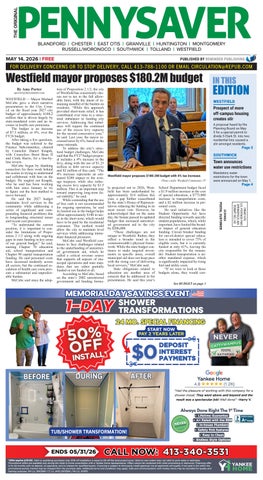
Westfield mayor proposes $180.2M budget with 4% tax increase.
Photo credit: Westfield Community TV
IN THIS EDITION
WESTFIELD
Prospect of more off-campus housing creates stir
A proposal heard by the Planning Board on May 5 for a special permit to divide 5 Clark St. into two residential lots caused a stir amongst residents. Page 3
SOUTHWICK
Town announces water use restrictions Mandatory water restrictions
town were announced on May 1.
4
la projected out to 2026, Westfield has been underfunded by approximately $14 million this year, a gap further exacerbated by the state’s House of Representatives reducing the funding in its most recent vote. However, he acknowledged that on the same day, the Senate passed its updated budget that increased unrestricted government aid to the city by $206,000.
“These challenges are not unique to Westfield. Rather, they reflect a broader trend in the commonwealth’s physical framework. While the state budget continues to make targeted investments in specific areas, overall municipal aid does not keep pace with the rising cost of delivering local services,” McCabe said.
State obligations related to education are another area of concern that he addressed in his presentation. He said this year’s
School Department budget faced a $1.9 million increase in the cost of special education, a $775,000 increase in transportation costs, and a $2 million increase in personnel costs. He said initiatives like the Student Opportunity Act have directed funding towards specific student populations, which, while important, have limited the broader impact of general education funding. Circuit breaker funding for out-of-district special education is intended to cover 75% of eligible costs, but it is currently funded at only 61%, leaving the city responsible for the remainder. Student transportation is another mandated expense, which is significantly impacted by rising fuel and utility costs.
“If we were to look at those budgets alone, they would con-
STRM: Gonzalez reacts to Baystate’s merger with
By Ryan Feyre rfeyre@thereminder.com
SPRINGFIELD — Baystate Health’s recent acquisition of Mercy Medical Center, set to become official on Nov. 1, is making waves throughout the region as people scramble to prepare for what this will mean for health care in Western Massachusetts.
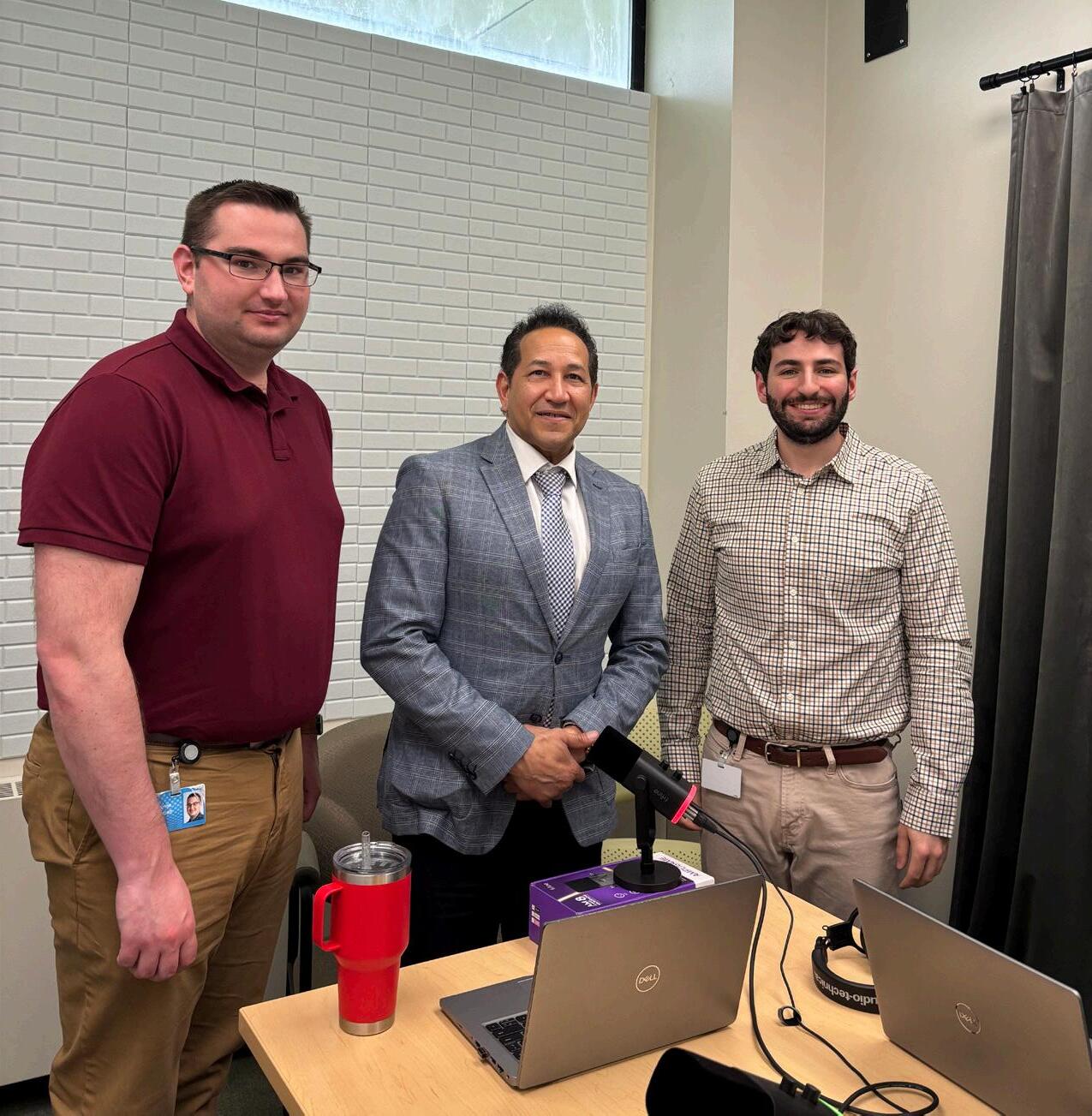
On the latest episode of “So That Reminds Me,” state Rep. Carlos Gonzalez sat down with hosts Dennis Hackett and Tyler Garnet to discuss what is on the horizon in light of this announcement and how he plans to gather more information about the merger.
As of press time, Gonzalez met with Baystate Health President and CEO Peter Banko to gain more clarity about the impact the merger may have and how the decision may affect personnel, services and the role Mercy has in the region. He shared that he’s also privately met with the speaker of the state’s House of Representatives and is working with the Department of Public Health and personnel at Baystate to determine the best path forward following the announcement.
“We’ve been trying to make
By Sarah Heinonen sheinonen@thereminder.com
SPRINGFIELD — Springfield City Councilor Michael Fenton has announced that he will run against incumbent Tara Jacobs to represent Western Massachusetts on the Governor’s Council, an influential body that reviews judicial appointments and advocates for the state’s judicial infrastructure needs.
The Governor’s Council is a body of eight members, presided over by the lieutenant governor. The council meets once a week to
sure that we are in tune to what are the needs of that potential merger, but also more importantly, upon getting the notification, what changes we may potentially see that can adversely affect the services of the personnel at Mercy,” Gonzalez said.
The Springfield Democrat foresees a bevy of potential health impacts hitting the area when this merger officially takes shape. He mentioned the birthing center closing at Mercy and the overflow of people in the region’s hospitals as potential concerns for people who need hospital services in a prompt manner.
“Sometimes we may have seen in the past a bulging of people going to emergency rooms across our hospital systems, and that may have a negative impact,” Gonzalez said. “And that’s a five-minute to 20-minute delay on providing medical attention to somebody in an emergency situation, [which] could, you know, cost lives.”
On the topic of whether he thinks the merger will prevent Mercy from shutting down, a concern delegates and residents have had in the past, Gonzalez said that “mergers are like marriages,” and “many marriages
consent on the governor’s choice of judges, clerk magistrates and members of the Parole, Appellate Tax, Industrial Accident and Industrial Accident Reviewing boards, as well as public administrators, notaries and justices of the peace. Governor’s Council members also advise the governor on major outlays from the state treasury, such as building courthouses, and on pardons and commutations.
“The Governor’s Council is really a check on the governor,” Fenton said. “It’s the perfect complement of my skill set. This
end up in divorce and changes need to happen.”
“That’s why it’s important that we get answers directly on what they foresee are potential changes or challenges, and how can the state be impactful and find a system through this process,” Gonzalez said.
He noted that Baystate and Mercy are economic engines for the region “in so many ways,” whether it be through the birth centers or local pharmacy at Mercy. In that same breath, Gonzalez said the merger carries some potential drawbacks such as a loss of jobs, a problem he said will hopefully be addressed in future discussions with hospital leadership.
“We hope that whatever bargaining rights [doctors and nurses] have at Mercy can continue to remain,” Gonzalez said.
He shared that his job as a state representative is to serve the people, and although some are excited about the merger, he wants to make sure it doesn’t negatively impact residents in our region.
“I believe that government is for the people, by the people,” Gonzalez said. “Now is the prime time to be echoing your sentiments as to what you feel is a need. And if we can attach a cost
position really needs someone who has legal training to scrutinize judicial appointments.”
Fenton has been an attorney for 17 years, most recently with Shatz, Schwartz and Fentin. He is also a professor at Western New England University School of Law. He added that his 14 years spent on the City Council have provided him with the experience to thoroughly vet decisions based on facts and information.
For Fenton, reviewing the governor’s selection of judges is among the most consequential decisions. The process of being
on those
named a judge is “rigorous and invasive,” he said. “It is deemed by many to be the highest accomplishment of an attorney.” He said candidates must demonstrate that they have the “highest ethical standards, the appropriate demeanor” and the requisite background. “Life-changing moments happen in these courtrooms,” Fenton said.
Because the districts are population-based, District 8 is the largest geographical district, consisting of 102 cities and towns west of Palmer. Fenton said the Governor’s Council provides “a chance to elevate Western Massachusetts people to more positions.” Fenton said no current members of the state Supreme Judicial Court, the Appellate Tax Board or the Parole Board hail from Western Massachusetts.
“The council should be doing more than just reacting,” Fenton said. “They should be recruiting members of the bar, so vacancies don’t occur, or if they do, they are as short as possible.”
As a member of the Governor’s Council, Fenton said, “Investing in our judicial infrastructure would be a top priority.” He referenced the courthouses in Pittsfield and Springfield as just two of those in need of review. Particularly close to home for Fenton is the replacement for the Roderick L. Ireland Courthouse, Springfield’s district court.
Fenton said there are also smaller courthouses that should also be reviewed, including ones in Chicopee and Northampton. Aside from courthouses, he said, “If there are large projects that have gone unfunded — roads, bridges — I could use the position’s proximity to the governor to advocate for that.”
For Fenton, the position in Boston would be all about Western Massachusetts. He said, “If the Governor’s Council isn’t going to advocate for this, who will?”
“When I ran for this position four years ago, it was a campaign issue. We still don’t have a site. We deserve a first-class hall of justice for Hampden County,” Fenton said. “For a while, the state refused to acknowledge there was a problem with the Springfield courthouse. Meanwhile, people are going to work in a sick building.”
WESTFIELD
Prospect of more off-campus housing creates stir
By Amy Porter aporter@thereminder.com
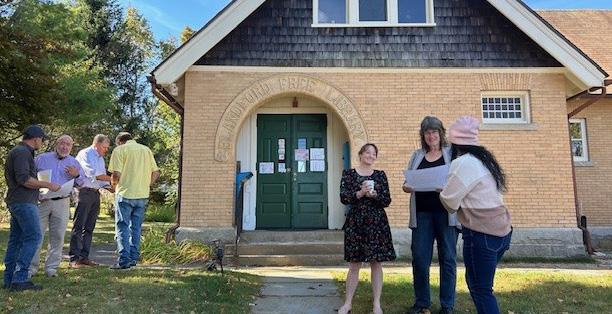
WESTFIELD — A proposal heard by the Planning Board on May 5 for a special permit to divide 5 Clark St. into two residential lots to add a second multi-family housing structure caused some angst amongst residents.
The plan was presented by Rob Levesque of R. Levesque Associates and on behalf of Chad Hedges of Off-Campus Housing LLC. The existing building houses up to 10 college students.
Residents on the dead-end street and in the area objected to increasing the density of the environmental justice neighborhood, misbehavior like public urination, the lack of parking, and the increase in cars the houses would bring. The residents who spoke also noted the safety of children going to Whitney Park and the architectural nonconformity of the plan as reasons for their skepticism. The hearing was continued to May 19.
Levesque said the housing subdivision on the lot meets all of the lot size and frontage requirements. He said the new two-family house, a duplex, would have a front door on Clark Street and a main entrance off to the side, with parking to the rear. “All of the standards have been met,” he said.
He said the new house would be similar to the existing house on the property, but more modern with a front gabled look. There would be multiple entrances on the new structure, which would not be as tall.
When asked if Levesque knew the room count in the new house and its intended use, he said he wasn’t sure. “I know the questions came up. These gentlemen have multiple properties that have housed college students,” he said.
Planning Board member Bernard Puza said he hadn’t realized how many properties are owned by Off-Campus Housing, LLC. He said he had taken a drive past them and found them all of them pretty well kept. Levesque said they are owner-operators and do a lot of the work themselves.
Member Cheryl Crowe asked if a condition could be added to the special permit to not have college students. Levesque said there are regulations on who you can exclude, which he called a “sticky wicket,” and suggested
Continued from page 1
sume the entire amount of revenue that the city receives. So it really has been kind of a balancing act,” McCabe said.
McCabe said citywide personnel costs have increased between 2 and 3%, reflecting negotiated agreements and standard adjustments consistent with expectations. “Managed through the normal budget process, it is impossible for the city to expect the mayor’s office and its team to not give wage increases to our workers who deserve them. So just note, that is not going to go through my office anytime during
the board defer to City Planner Jay Vinskey.
Vinskey said the board had put that condition on apartments on Court Street, which Planning Board Chair William Carellas said the owners had voluntarily accepted.
“Anyone can be a college student or a graduate student. I don’t know the Planning Board’s intent. We do have a provision of no more than four unrelated tenants,” Vinskey said.
Opening questions to the public, Ward 3 Councilor Bridget Matthews-Kane questioned the architectural conformity of the plan with two duplexes tandem to each other. She said normally they are side by side, but the new building would have one in the front and one in the rear.
She asked if any other buildings in that neighborhood are a duplex turned 90 degrees. She said the proposal should be rejected because it is inconsistent with the architectural style of the neighborhood.
Levesque said the gabled roofs, height and scale of the planned building are consistent with those in the neighborhood. He said, typically, existing duplexes would have access in front and back for both tenants. He said the new building would have two units, with several bedrooms. “It does meet the architectural style,” he said.
Kenneth Mendoza of Kellogg Street spoke against the proposal on the basis of traffic congestion, the narrow streets and the safety of children. He said these properties generate five or more vehicles per dwelling and on-street parking, which is not just an inconvenience but a safety hazard.
Mendoza said he believed it was unlawful to market houses primarily or exclusively toward students in economic justice communities, and that concentrating high-density disruptive uses in one neighborhood creates an unequal burden on the community, contributing to a pattern of overuse. He said he was not opposed to college students but to the impact on the fabric of the environmental justice community with a high density of minorities, which is where he decided to invest after his tour of duty. He said he would take it up with Mass Environmental Justice.
In a formal letter of opposition to the project, Mendoza
a budget cycle where we are not going to try to increase livable wages for our workers. It’s just not going to happen,” he said.
The most significant and least predictable source of pressure on the budget, according to McCabe, remains health care. “Following a 36% increase in FY2026, the city is now facing an additional 15% increase in FY2027.
That represents an approximate $3 million increase in the costs for the upcoming fiscal year; an impact of municipal [budgeting] municipalities have very limited control over.”
McCabe said in addition to state assistance, the remaining revenue streams include new growth, local receipts and levy
spoke about fairness. “Marketing housing primarily or exclusively towards ‘students,’ combined with the concentration of these properties in areas identified as environmental justice communities, raises serious concerns about disparate impact. Even if not intentional, concentrating hi-density, disruptive uses in one neighborhood while others remain protected creates an unequal burden on that community,” he wrote.
Abutter Monique Lopez of 9 Clark St. said after looking at the plans, she questioned whether both houses would be on .20 acres after they add a driveway and space for four cars per dwelling. She said Clark Street is a dead-end street, and there are already two homes on the street that house college students.
“If you’re adding two additional dwellings with additional cars, that adds to the density. How will you address the safety of the people who live there? I’ve lived there since 1998. I work at the university, I get it,” Lopez said. “I’m curious, if the special permit is granted, how is that going to impact the neighborhood when there is a density issue in the neighborhood on a dead-end street.”
Nelson Lopez of Clark Street said he had never had any problem with the neighborhood until college kids moved in. He said there was drinking in the yard, and someone broke his fence backing out. He said when the photo was taken of the yard where the new house will be built, there were no cars in it, but normally it is filled with parked cars. He asked where people are supposed to park, and said it was an issue of safety and congestion.
Levesque said there had been a lot of discussion about safety. “This is a city street,” he said, with full access to water and sewer. He said they are not requesting additional on-street parking. “From a safety standpoint, there is no known safety issue here,” he said.
Planning Board member John Bowen asked for help with the math on the parking. Vinskey said two cars per unit is the requirement.
Resident Jane Ocsin, who said she doesn’t live in the neighborhood but watches water, sewer and trash fees, said houses like these are abusing the system and
capacity. He said new growth for FY27 is projected to remain essentially flat, conservatively estimated at approximately $200,000. “That is well below historical norms,” he said, reflecting a combination of factors.
“We have broader economic conditions in the state of Massachusetts and local development realities that continue to shape new growth in the city of Westfield. Considerations such as aquifer protection and ongoing concerns related to truck traffic, particularly on the north side, play an important role in guiding development decisions and, in turn, influence the pace and scale of new growth. While these priorities are essential to protect-
not being charged properly. She said Clark Street probably has a 4-inch-low flow pipe that needs to be replaced. “Sewer is the same thing. If they’ve got multirooms all with bathrooms, say nine college kids living there, they probably have two sewer fees, which are going up to $600/ year in July,” Ocsin said, adding, “That house is abusing it.”
During the board discussion, Bowen said he thinks parking is going to be a nightmare. “This is the hardest part of our job. I want to deny this, but it’s legal.”
Member Richard Salois said if they’re listing four people in both units, they could have 16 cars in the lot with eight parking spaces. “The numbers don’t work,” he said.
Someone pointed out that the existing building is being marketed for 10 people, not eight, which Vinskey said predated the ordinance.
Levesque said he actually agreed with the point. “I don’t think it’s an unreasonable statement, with 10 people in that house, what we’re showing wouldn’t work,” he said, agreeing that adding a condition in the permit of a maximum of four people per unit would clean it up. “The existing structure is part of the permit. You would need to condition the limit of no more than four unrelated people,” Levesque said.
Carellas said he would be happy to condition that limit, but
ing community assets and quality of life, they also have a direct impact on revenue generation,” McCabe said.
In response to ongoing discussions around strengthening economic development, the proposed FY27 budget includes funding for an economic development officer position to help identify opportunities that align with the city’s priorities while supporting long-term fiscal sustainability.
McCabe said the budget reflects a careful effort to balance fiscal responsibility with the obligation to provide consistent and reliable service to residents.
“This approach signifies a commitment to making the difficult
even in a single-family or traditional mother-daughter home, you could end up with four or five cars or more.
Bowen suggested requiring a fence down the middle of the lot.
“I don’t think we’ve ever dealt with this high of a density before of .10 and .20 acres. Not only that, this is a narrow, deadend street with the biggest municipal playground in town at the end of the dead-end street,” said member Philip McEwan. Vinskey said the board has approved .2 lots, but McEwan said not on a dead-end street.
Levesque pointed out that it is a full-width city street.
“The board can condition what it wants, and the applicant can go forward or not go forward. It is in the zoning ordinance already, no more than four unrelated,” Vinskey said. Levesque said while he would argue that the plans are not drastically and architecturally different, he did feel that the question of parking was a fair point, and they need to look at it.
“I would like to request a continuance. I think if they’re renting to 10 people in the existing structure, that’s an issue. I think parking is absolutely a legitimate question and concern. Hopefully, we’ll come back with some information, maybe a reduction, and have some solutions,” he said, before the hearing was continued to May 19.
but necessary decisions today to ensure the city’s long-term fiscal stability and continued delivery of essential services,” he said. On a side note, McCabe said he has been traveling the state, recently addressed Senate President Karen Spilka and spoke in forums with Western Massachusetts’s rural communities and other mayors across the Pioneer Valley. “Our financial position is appreciably better than most. I think the number is, there are 200 of the 351 cities and towns that are looking for some sort of general override. We are fortunate that we don’t have to do that, because we have excess capaci-
See BUDGET on page 8
Kenneth Mendoza of Sackett Street said he believed the Environmental Justice community, which already houses off-campus housing, is being unfairly impacted.
Photo credit: Westfield Community TV
Southwick announces mandatory water use restrictions
By Cliff Clark cclark@thereminder.com
SOUTHWICK — The Water Commission and DPW Water Department announced mandatory water restrictions for town water customers.
The announcement came on May 1, the earliest restriction date allowed according to the town’s water withdrawal permit due to a period of low water flows on the Westfield River.
“In accordance with Southwick’s Water Withdrawal Permit through MassDEP, and pursuant to its authority, the Water Department has declared a State of Water Supply Conservation, thereby imposing a mandatory Water Use Restriction on non-essential outdoor water use,” according to the DPW’s announcement.
There is no other regional municipality that uses the flow of the Westfield River to determine when a mandatory water restriction can be implemented, and it’s for one reason: the protection of fish habitat.
“May 1 through June 30: the 502 cfs [cubic feet per second] minimum flow is protective of habitat for fish spawning during the spring bioperiod [which is the period during which certain biological processes dependent on stream flow rates occurs or is likely to occur],” according to the town’s water withdrawal permit.
The town must implement the restriction if the Westfield River has a flow rate of below 502 cubic feet per second and
By Cliff Clark cclark@thereminder.com
SOUTHWICK — During a discussion between water commissioners last year about the mandated water restrictions that town residents must deal with each summer, one commissioner, Dave Meczywor, suggested that the DPW partner with a company to offer rain barrels at reduced rates for water conservation.
After some searching, the department chose The Great American Rain Barrel Company.
“This will be our second year
then above that flow rate for three consecutive days to drop them.
While protecting fish habitat is a factor, the river’s flow rate is also used to determine the daily maximum withdrawal of water for the town.
It’s not water withdrawal as one might think; it is the water withdrawn from the Great Brook Aquifer, which is recharged by the Westfield River Basin.
From July 1 through Sept. 30, the flow must be below 174 cubic feet per second for seven consecutive days for the restrictions to be implemented. Lifting it requires a flow above 174 cfs for seven days to be lifted.
Those flows are mandated by the town’s water permit issued by the state Department of Environmental Protection in 2014, which is renewed every five years.
Westfield’s Water Department implemented its mandatory water restriction in midApril, which was triggered by the state’s declaration of level 1 drought conditions in the Connecticut River Valley Region. It remains in effect.
With the restrictions in place, Southwick’s water customers are permitted “non-essential” outdoor water use only once a week, on a specified day, before 9 a.m. and after 5 p.m., according to the town’s website.
Which particular day residents can use water is determined by their street address. The water commissioners divided the town into north and south regions, along Granville Road, Depot
partnering with The Great American Rain Barrel Company,” said DPW Director Rich Bosak about the program. “It is a wonderful idea because it catches water runoff from roofs and gutters and gives residents multiple beneficial uses like watering flower beds, watering their vegetable gardens, and washing vegetables when harvested, as well as having it as a back-up water source outside if needed.”
Investing in a rainwater barrel helps residents understand that they are a part of the solution to waste less water.
“It is a perfect example of
Street and South Longyard Road.
Those living north of that line with odd-numbered properties can use non-essential water on Monday mornings and evenings. Even-numbered properties in the north region can use non-essential water on Tuesdays.
For those in the southern region with odd-numbered properties, non-essential water can be used on Wednesdays. Those in that region with even-numbered properties are allowed on Thursdays.
On Fridays, Saturdays and Sundays, as well as throughout town between 9 a.m. and 5 p.m. daily, no non-essential outdoor water use is permitted, according to the town’s website.
Non-essential water use includes watering lawns using sprinklers, washing cars and washing structures or pavement. Handheld hoses to water lawns and gardens are not covered by the ban, nor are soaker hoses or drip irrigation systems.
Use of water as part of core functions of a business, to produce food or fiber, to maintain livestock, for health or safety reasons, or to satisfy the requirements of a law or regulation are also still allowed during the ban.
Another exception is to establish a newly planted lawn in a home or business built in the previous 12 months, or to establish a new lawn on any property in September.
For those who disregard the restrictions, the town has the authority to issue a $50 fine for the
showing water conservation in a do-it-yourself way throughout the spring and summer months and showing effort in helping our environment right in your own backyard while protecting our water resources at the same time,” Bosak said.
The barrels can be used to prevent rainwater from reaching impervious surfaces that often channel it into local streams, rivers and ponds.
“Hopefully, we have a good turnout of residents purchasing rain barrels with this program and [we] are able to continue with it as
Where water customers live in Southwick determines which day of the week they can use non-essential water.
first offense and $100 for subsequent offenses. As an additional measure of enforcement, the town’s water metering system allows the Water Department to track all water meters hourly, as the equipment automatically sends data to a central computer server.
Water customers whose meters record flow rates consistent with outdoor non-essential use will be flagged and investigated. DPW crews will travel around town and will also be on the lookout for violators. If an individual customer violates the ban, the DPW will
the years go on,” he said, adding that he and his father use the rain barrels to conserve water.
“I’m taking steps of my own to conserve water right in my backyard, too,” he said. Investing in a rainwater barrel helps residents believe that they are a part of the solution to waste less water. And there are other benefits to collecting rainwater.
Rainwater is “soft,” and free from minerals and chemicals such as chlorine, fluoride, and calcium, which are often present in municipal water.
send a letter to the customer with a written warning. If the customer violates the ban again, another letter will be sent, and a $50 fine will be issued. Under the terms of the DEP permit, town water customers have the collective power to increase the number of days of outdoor watering allowed from one to two, if they could reduce the number of gallons used per customer per day to 65, which has only happened a handful of times in town over the last decade. Restrictions are lifted on Sept. 30 regardless of the river’s flow.
gram, visit www.greatamericanrainbarrel.com/community and select Southwick.
Barrels are offered for $89 and will be available to pick up from noon to 4 p.m., Saturday, May 30 the DPW facility at 661 College Highway. Deadline for purchase is 5 p.m., Sunday, May 17. The Great American Rain Barrel is a local food-import company that has been repurposing foodgrade shipping drums into rain barrels since 1988. The Great American Rain Barrel Co. has been an approved vendor by the MASS Department of Environmental Protection since 2010.
About the barrels:
Rainwater is also considered the perfect choice for watering plants or washing cars and windows.
According to the U.S. Environmental Protection Agency, 30% of daily water use is outdoors, and using the rain barrels could save the average homeowner 1,300 gallons of water annually and decrease water bills by as much as 40%.
A 500-square-foot roof can fill a properly installed 50-gallon rain barrel in approximately one hour. One full rain barrel will water a 200-square-foot garden. To find out more about the barrels and to participate in The Great American Rain Barrel Pro-
• Made in Massachusetts with 100% repurposed, food-grade, UV-protected and BPAfree barrels.
• Most durable rain barrels on the market: 3/16” wall thickness. Screen filtered to keep mosquitoes out.
• Will last for years when properly drained and stored for winter. Pay for themselves in one year.
• Several rain barrels can be linked together in an easy five-minute setup.
• Available colors: Forest Green, Earth Brown and Nantucket Grey. Also available unpainted.
Photo credit: Southwick DPW
HILLTOWNS
Chester Granite Saw to offer guided tours
By Amy Porter aporter@thereminder.com
CHESTER — The Hilltown Hikers have announced a day of open guided tours from 9 a.m. to 5 p.m. at the historic Granite Saw property on 9 Prospect St., across from the Chester Railway Station Museum, during Chester on Track on May 16.
The Granite Saw, which is open to the public from dawn to dusk every day, features a walking path that passes by the old buildings, machinery, and the 12foot diameter shot saw structure, which is still standing today.
During Chester on Track, tour guides will share the history of the Granite Saw property, a stone cutting and finishing plant established in 1870 in the historic Chester Factory Village. It was purchased by Elizabeth Massa, the current president of the Western Mass Hilltown Hikers, in September 2023 and donated to the nonprofit to conserve and historically preserve the entire mill operation.
The Hilltown Hikers and its volunteers are cleaning up the property after 80 years of abandonment by cutting back invasive species, dead ash trees, fallen trees, and 8-12 inches of sediment that covered its floors, uncovering more of its history every day.
This project is one of a kind
in Western Massachusetts. It is the first stone finishing plant in the area where granite and, on occasion, marble, was brought to Chester to be cut and finished for monuments and historical buildings, and shipped throughout the country by rail. Remnants of the plant can be seen by visitors today.
Historical artifacts and media boards from the era will be on display during Chester on Track, and visitors may also take home a piece of renowned Chester blue granite. The Hilltown Hikers will also hold raffles of Granite Saw and Lost Railroad shirts, safety vests, water bottles and more.
Massa said the Hilltown Hikers are interested in hearing from relatives of anyone who worked at the Granite Saw location. She said they may contact her by phone at 413-302-0312 or by email at westernmasshilltownhikers@aol.com. She encouraged people to follow the Chester Granite and Polishing Works Facebook page.
Chester on Track will take place all day on Saturday, May 16, and will feature a parade on Main Street beginning at 10 a.m., where there will be a craft fair, plant sale, “one-lung” steam and gas engine demos, classic cars and a Chester Fire Department duck race. There will be live music by the Pitoniak Brothers, D
Rod and the Uprising, Tom Willy Filliault, and Just Us with Linda Burns on two stages throughout the day, at the Chester Railway Station and on the porch of the Inn on Main Street.
At the Chester Railway Station will be a train show inside, and the opportunity to explore all of the train cars on the property, including the former Bernie’s Dining Depot, a 1946 Pullman coach-turned restaurant that was moved from Chicopee to a permanent spot at the station this
past year, along with several 1920s-era freight cars and a children’s boxcar.
Children’s activities, including a bounce house, petting zoo, donkey rides, an archery booth, story walk and state police K-9 demos, among many other activities, will be featured at the Emery Street ballfield. More information is available at chesterrailwaystation.net and on the Chester Railway Station and the Western Mass. Hilltown Hikers Facebook pages.
Memorial Library moves to Blandford Town Hall
By Amy Porter aporter@thereminder.com
BLANDFORD — Porter Memorial Library will close on May 18 to move its collection to its temporary home in Blandford Town Hall, where it will reopen on June 8.
While the library operates out of Town Hall, renovations will begin at the historic 1892 library building on 87 Main St. During the three-week closure, residents are being asked to hold onto any books from the library, which may be returned when it reopens.
Library Director Nicole Daviau said the library will move to a dedicated room in Town Hall, right next to the Council on Aging. “It’s big enough to allow us to bring over the entire collection. Its square footage, in terms of usable space, is about the same size as the library’s,” she said, adding, “We’re moving into where my first-grade classroom was.”
“Berkshire Athenaeum is allowing us to use their old shelving, so we didn’t have to buy any shelving for it. It’s been a really long moving process, so we’re excited about this,” she added.
The library Board of Trustees and Daviau received word in December that the Massachusetts Board of Library Commissioners awarded a $5.4 million Small Population library construction grant to the town of Blandford for the renovation and expansion of Porter Memorial Library, as part of the Massachusetts Public Library Construction Program. Small Population grants are awarded to municipalities with populations of less than 2,500.
Also announced at the time was a bequest to the library from Sumner Robbins, who passed
away in 2024 at the age of 99, that totaled more than $900,000. Robbins, a lifelong resident, served the community in many different ways over his lifetime.
“His generosity to the library was limitless,” Daviau said. She said Robbins stipulated in his trust that the bequest must be used for the expansion of Porter Memorial Library.
Daviau said the plans for the renovation are at 90% completion and have been approved by the state. The last 10% will be finished in the next week or so.
“We’ve made decisions about most of the finishes, everything is designed to the details,” she said. They are waiting to get final approvals from different town boards on engineering details, such as the transformer and septic.
“We’re still on track, within our timeline, on budget and on schedule. The team that we have has been phenomenal in getting our project to this point in a way that’s been painless and actually fun,” she said.
Daviau said the worst part of the whole project so far has been emptying the 130-year-old building, which she called “an immense challenge.”
“When a director leaves a library, they leave all their stuff. Times that by 130 years of directors.” She said a lot of what was left behind has been in the attic, going back 130 years, and the entire building has to be cleaned out.
Daviau said a moving company is coming on May 19 to move the collection over to Town Hall at 1 Blandford Stage Road, which is within walking distance, but books are heavy to move. “We’ll probably do a ceremonial book brigade moving back,” she said.
The hope is that they will move back to the completed library in November of 2027.
Meanwhile, Daviau is looking at the move to Town Hall as an opportunity. “We’ll be using Town Hall to bring awareness into what we have to offer,” she said, adding that they hope to bring in people who do not go to the library, some for accessibility reasons. “We’re looking at this as an opportunity to increase our outreach and our accessibility to people.”
Daviau is also looking forward to the summer reading
program when school ends. She said it will be space-themed and will celebrate the new space. The schedule for the summer reading program will be announced at the end of May.
“I was anticipating this process to be more challenging. It feels like it should be harder than it has been. This has felt manageable; it’s surprising to me how manageable. Every day, we’re in process and on schedule; everything is going according to plan,” Daviau said, adding, “It’s been good. I’m looking forward to being in our new space.”
Guided tours of the Granite Saw, a 12-foot diameter shot saw, will be available during Chester on Track, 9 a.m. to 5 p.m., on May 16. Reminder Publishing file photo
library will be four times its size,
ing its 1892 character.
WESTFIELD TECH VS SICS BASEBALL
BASEBALL
The Westfield Tech tigers defeated the SICS Bulldogs 16-1 at Bullens Field May 5 on Tech's Senior Night.
Westfield Tech seniors - Antonio Simpson, Andrew Galczynski, Hunter Bokio, and John Knapik - were honored with their families on Senior Night May 5.
Starting pitcher Antonio Simpson delivers a pitch.
Camden Witczak scoops up an SICS grounder.
Hunter Bolio scores a run while Josh Elmer rounds third on his way to score another.
Senior Antonio Simpson on the mound for Westfield Tech at their May 5 game with Springfield International Charter School.
WTA senior John Knapik readies a throw to first.
Logan Czekovsky lets a close inside pitch go by.
Lucas Cummings flies in for another Tiger run.
ty,” he said.
During a brief discussion following the presentation, Knapik said in relation to health care, the Senate had just stripped the provision to require GLP-1 funding unless prescribed for diabetic purposes and not weight loss. He asked if that would impact the anticipated $3 million increase in health care costs for the city.
McCabe said Westfield was not affected, even though last year the GLP-1 coverage cost the city about $800,000. “This year the GLP-1 is not being offered in the HMO Blue or the Blue Cross/Blue Shield, which [are] the essential services for the city,” he said.
“So even though it’s not being offered, the increase was still $3 million,” Knapik said. McCabe said he had just received the number for a 15%
increase in health care costs, after putting 10% in his original budget, costing the city another $1 million. Bean commented that two or three years ago, there was more money due to federal funding. “Now, we’re back to where we used to be. In the grand scheme of things … I’m seeing across the state a lot of overrides in Proposition 2 1/2. You’re also seeing a lot of debt exclusion with Proposition 2 1/2. What’s your opinion
TheReminder.com
Every week we will provide you with a complete listings of deaths from the preceding week from throughout Greater Springfield. We are doing this as a convenience to our readers in case you miss an obit in the daily paper. We hope you find this useful and that you will refer to it weekly.
AGAWAM
Mary Kiefer
Ernest Lagacy Jr.
Judith M. LeClerc
Ann G. Lincoln
FEEDING HILLS
Robert G. King
Elaine S. Verallis
MONTGOMERY
Christopher M. Mann
SOUTHWICK
Roland R. Allen
WEST SPRINGFIELD
Barbara A. Leshinski
Vincent Rizzo
WESTFIELD
Josephine A. Delekta
Shirley Mae Dewey
Lionel “Butch” Joaquin
Margaret E. Osowski
Roger A. Page
Robert T. Parks
Dorothy Saalfrank
Andrew D. Scheip
about that? Is that going to be the common theme moving forward in this commonwealth,” he asked. McCabe said that, looking at Westfield’s budget specifically, if the city can get through one more year of legitimately using some excess levy capacity, that will increase property tax revenue over time. “Once that’s done, then 2 1/2 has a larger, meaningful number,” he said. Bean asked if there had been any conversation in his meetings to prevent the kind of override
and debt reduction that has happened so rapidly across the state. McCabe said the reason he’s ramping up now is that he’s trying to seed 2028. “2027 is behind us already. The budget came out today. I’m trying to seed 2028 and put a fine point on it,” he said, adding, “Let’s be honest, when we all came into our positions, were we budget experts? No, we came from all walks of life. The exact same thing occurs with our legislators, with our representatives and our senators.”
DINING
New theater group introduces itself with first production
By Trent Levakis tlevakis@thereminder.com
EASTHAMPTON — In an effort to bring fresh, queer and gender diverse stories to the local theater scene, a new theater group, Why’s It Gotta Be?, has formed here in Western Massachusetts.
The group, which started in the fall, is gearing up for its first production, the dark comedy “Legoland,” which will run at CitySpace from May 22-31.
Founder, actor and president of Why’s It Gotta Be?, Devin Dumas, told Reminder Publishing that he, along with fellow peers who are now on the board of the new group, saw a gap in consistent productions related to queer and gender diverse stories and thought, why not fill this need with a fresh new group committed to offering just that?
“We really just wanted to create a consistent space for queer theater, for new theater, for gender diverse theater that we weren’t really seeing in the area,” said Dumas. “And that’s not at anyone else, there’s absolutely wonderful theater in the area, like K&E does great stuff, Easthampton Theater Company does great stuff, Exit 7 does great stuff. But some of us found ourselves in a position where we always seemed to be waiting to see who would announce the next queer-based show, or the next gender diverse show, or the next new thing, rather than something that had been done several times before. So, I grabbed a couple people that I was close with and was like, ‘hey why don’t we just make something that’s consistent for that,’ so we did.”
Dumas explained that he wanted the mission and goals of the group to be clear and present in its name.
“I came up with it because I’m 27, and I’m very vocal about wanting to see queer relationships expressed healthy in media, and I was often asked, ‘Oh, well, why’s it gotta be gay? Why’s it gotta be queer? Why’s it gotta be trans? Why’s it gotta be all these things?’ And you get so tired of hearing that to a point that it’s almost like how queer used to be a slur and we reclaimed it as an identity. I’m almost reclaiming that for us now. You can’t tell us ‘Why’s it gotta be’ anymore because that’s the whole point now. ‘Why’s it gotta be queer?’ Because that’s our whole thing,” said Dumas.
With that said, Dumas and the group feel that the best way to kick things off is with a production of Jacob Richmond’s dark comedy, “Legoland.” The play tells the story of Penny and Ezra Lamb, siblings who have been home-schooled on a hippie colony their whole lives and dying to get out.
After a failed attempt at connection in Walmart, the commune is busted, and the siblings — each seething with repression — are enrolled in a Catholic private school where they are instant social outcasts. A cross-continental adventure ensues for the two siblings through this irreverently dark story bursting with originality, bringing audiences along for the ride in an engaging fashion as the Lamb siblings are prying for connection any way they can get it.
“Legoland” opens at CitySpace on Friday, May 22, at 7:30 p.m. The rest of the shows will take place on May 23 at 2 p.m. and 7:30 p.m., May 24 at 2 p.m, May 29 at 7:30 p.m., May 30 at 2 p.m. and 7 p.m., and on May 31 at 2 p.m. The show contains adult language, according to organizers.
General tickets are $25 and available for purchase online at wigbtheater.org/legoland. During the run on May 26 at 7:30 p.m., the group will also host a fundraiser called Mid-Run Drag Trivia night inside CitySpace to support the newly formed group.
Dumas is directing “Legoland” and shared that this play has always been a production he wanted to be a part of.
“I actually said I didn’t want to do ‘Legoland’ first because I knew people knew it was something that I really, really wanted to do. I didn’t want to seem like I started this theater group so I could do ‘Legoland.’ But then ... we decided that ‘Legoland’ from a public-facing standpoint was the most approachable title out of anything,” explained Dumas.
“The play has nothing to do with Legos, but we figured a dark comedy that really gets a little gritty and is just fast paced backto-back-to-back, and has this cool title ‘Legoland,’ that draws people in, and we can just make this really colorful, fun, inviting and interactive immersive show. We just decided, let’s try that.”
Julia Adamo and Terrance Peters are starring in this production as Penny and Ezra Lamb. Both actors have worked with Dumas before and with some of the other local groups as well. Both shared that they are eager to be part of the first production from the group.
“The wonderful thing about both the Massachusetts and Connecticut community theater is it’s a very small world, and so I had known Devin a little,” said Peters. “When I’d seen this new group that a lot of folks that I respect and like working with were very supportive, and then [I] saw they were doing ‘Legoland,’ a script that has been on my radar for so long and is very rarely done, even though I think it’s such a fantastic script, I decided to put my foot through.”
Peters said he is a big fan of any group that puts its communi-
ty first, and added that when he learned about the story behind the group’s name and mission statement, he knew Why’s It Gotta Be? is committed to creating a welcoming environment.
Adamo, also a board member for the group, shared similar sentiments about the opportunity to be a part of the group’s first production. Having worked with Dumas through a production he directed through Exit 7, Adamo considers Dumas a great connector in the local theater space.
“He has this remarkable way of just bringing people together and creating such a sense of community around queer art that I was like anything I can do with Devin I want to do,” she said.
Adamo said that Dumas’ vision for the group is meaningful as it adds a niche within the larger and overall healthy local theater scene in the area.
“There is such a robust theater scene in the Western Mass. area, and we’re really grateful for that, and there’s so many enthusiastic performers, and there are so many amazing productions going on, so it’s a really wonderful and supportive community with a lot of people who are doing really cool, really fresh and interesting work,” Adamo said. “But the idea that we can find our niche within this larger scene while consistently prioritizing really fresh and diverse work, just feels really exciting.”
Future goals
Dumas already has long-term visions for what is possible for the new cadre. Specifically, he hopes to one day purchase sound and lighting equipment for the cadre, offer stipends to makers and artists, produce in-house and
audio film productions, and ultimately secure a space to utilize for performances and rehearsals to outsource to other developing and independent artists.
Dumas said that he hopes the group can add a multimedia aspect to their work, as well. Along with his background in theater, Dumas also has a background in audio drama storytelling and hopes to add that to their repertoire.
“I really view audio drama as a form of theater art, film as a form of theater art. I’d really like to see us at some point further down the road be able to reach out to people who are interested, if not performing on stage, perhaps performing behind a screen or behind a microphone, and creating space to tell fresh stories, queer stories, different stories in that format,” Dumas added. “We’re doing this for us, we’re doing this to share art, we’re doing this to tell stories, we’re doing this for audiences. We’re not doing this to make fortunes, we’re doing this to share visions, so if we can
help other artists by providing a space five, 10, 15 years down the line, that’s the goal too.”
In the meantime, as the group grows from its infancy, Dumas hopes to facilitate more shows. Simultaneously, the plan is to keep an eye out for a permanent home, hopefully in Easthampton or Northampton, but the group is open to any opportunities in the region.
“We definitely are gravitating a little bit more towards Northampton and Easthampton when we do events just because there’s a lot of performance space and a lot of people that we feel will resonate with these stories, but we’re open to anywhere within the area,” said Dumas. “We really hope that we can get audiences in that these stories resonate with, but also performers that these stories resonate with, because we do it for both of them. And just really hoping we can continue with our long-term creative goals as well.”
To learn more about Why’s It Gotta Be? visit wigbtheater.org.
Terrance Peters (left) and Julia Adamo (right) star in Why’s It Gotta Be? Theater Group’s first production, “Legoland.”
Photo credit: Why’s
Amjad Real Estate LLC, to Zain Safdar and Sana Abeer, 554-556
David S. Walles and Katherine H. Walles to Joseph Bortolussi and Katie Bortolussi, 384 Pine
Doreen J. Letendre and Thomas J. Letendre to Hannah Boulais, 762 Suffield St.
Jeffrey J. Benoit to Nicholas J. Benoit and Jaclyn M. Benoit, 14 Briarcliff Drive
Ronald Miller, representative, and Wayne Miller, estate, to Kristen Fitzgerald, 47 Corey
Sean Stevenson to Matthew Liimatainen and Matthew Robert Liimatainen, 67 Colemore