MARCH 26, 2026
WHS pops concert plays to a packed house
WESTFIELD
Westfield raises Irish flag to honor St. Patrick’s Day
In honor of St. Patrick’s Day and the community members who share Irish heritage, the city of Westfield raised the Irish flag at City Hall on March 17.
Page 4
SOUTHWICK
Pioneer Valley gets green light on marijuana cultivation
The Select Board unanimously approved amending its host agreement with Pioneer Valley Trading Co. after being satisfied that its proposal to extract oils from cannabis flower didn’t involve manufacturing.
Page 5
HILLTOWNS
Gateway votes to restore positions using stabilization
The Gateway School Committee voted to restore positions slated to be cut in the initial budget proposal by moving $383,832 intended for capital stabilization into the general fund.
Page 6

By Amy Porter aporter@thereminder.com
WESTFIELD — The 73rd annual pops concert, “American Spectacular,” played to a packed house in the Westfield High School gymnasium on March 13 and 14, featuring the WHS band, jazz combo and jazz ensemble, along with small groups that played in the Jazz Cafe, one of three stages set up for the concert.
Featuring a mix of patriotic songs and tunes from American music royalty, the gym came alive with the joy of music. Director Patrick Kennedy highlighted many of the talented musicians with solos, announcing those who had participated in the senior western district and junior
western district festivals.
District musicians included Westfield Technical Academy French horn player Mark Beaulieu and tuba player Fred Ryczek in the junior district concert band; and WHS district concert band players Jordan Bell and Brandon Cekovsky on French horn, Lani Ching on flute and piccolo, and Krystyna Goulette on flute; Owen Lisee on trumpet and Liam Corbett on alto saxophone in the junior district concert band.
District jazz ensemble players featured were Matthew Bussell on guitar, Sharon Gurung and Luis Palma-Gobout on trombone, and Jacob LaVertu on bass trombone; Joseph Melendez and Haleigh St. Jean on trumpet, Mirabella Prefontaine on bass
guitar and Colin White on tenor saxophone.
Moving on to the MMEA All-State Music Festival this year will be Bussell, who sang and played piano during the concert and was selected for the all-state contemporary ensemble as a vocalist, and Raeghan McGrath, featured as a soloist, who was selected for the concert band on alto saxophone. The entire concert will be featured on Westfield Community TV, which was there with the new mobile programming van manned by Brady LePage and WHS volunteer Kayden Smith, and sound and lighting by Jay Pagluica and Ken Stomski, who pointed out the seven cameras set up in the gym. A student video
was also displayed on a big screen during the performance of “The Summer of ‘69 — The Music of Woodstock” by the concert band.
Toward the end of the evening on March 14, the seniors in the band came forward to thank Kennedy for fostering their love of music, in several cases giving testimony of how he encouraged them to try new instruments and venture into new musical directions. Kennedy also serves as the co-advisor for the class of 2026.
To his delight, the seniors presented Kennedy with a miniature statue of him as conductor. He said when he told them as freshmen that they would be his last senior class, he was lying, as he’s not going anywhere. “I’m having too much fun,” he said.

A packed house listens to the jazz combo at the 73rd Annual Pops Concert on March 13 & 14 in the WHS gymnasium.
Reminder Publishing photo by Amy Porter
Area resident stranded in Lebanon aids humanitarian efforts



By Sarah Heinonen sheinonen@thereminder.com
BEIRUT, LEBANON — It is hard to be away from home for extended periods. Harder still when one is in a war zone. Hassan Mourad, a Springfield resident who traveled to Lebanon on business in late February, became stranded in the country amid the Iran War. However, he has turned his circumstances into action, working to help displaced people however he can.
On March 17, Reminder Publishing reached out to Mourad via Zoom. He stood in front of a wall of windows. In the background, the setting sun cast a warm, hazy glow over the skyline of Beirut. The haze, he explained, was from the plumes of smoke that rise from the hourly air strikes in Douha, Lebanon, a couple miles south of Beirut. Throughout the course of the interview, Mourad repeatedly looked behind him into the distance as the sound of air raids carried across the city.
Mourad, a first-generation Lebanese American, is a 33-yearold business owner and father of two who was born and raised in Springfield. He went to Lebanon to strike distributing deals for
his uncle’s line of hair care products. Less than 48 hours later, the United States and Israel launched surprise attacks against Iran. After Iran’s Supreme Leader Ayatollah Ali Khamenei was killed in the first wave of attacks, Hezbollah, a Lebanese political party and banned paramilitary group, launched missiles at its neighbor and long-time adversary, Israel. Israel responded by stepping up its attacks against Lebanon and launching a ground invasion.
Many Americans left Lebanon immediately after the war began, Mourad said, but a few days later when the American embassy closed, commercial flights largely stopped. The only flights available now are through Beirut-based Middle East Airlines. He had booked a flight to Turkey, but it was canceled. He said if he were able to successfully catch a flight, it would likely take him to Cyprus or Egypt, and he would need to make his way to the United States from there.
Mourad is less concerned with fleeing the country, though, and more focused on helping people in Lebanon, much to the dismay of his family. He said his parents are worried, particularly when they
hear reports of aid workers killed in air strikes. His mother calls him every day asking him to come home. “I tell her, ‘I have to help our people,’” he said.
Mourad’s children also fear for their father. While he tries to assure them that he is safe but said they are old enough to understand news reports. “They tell me, ‘No one is safe. Look at what happened in Gaza.’ Once I feel like my mission here is complete, I’ll be more focused on getting home.”
When asked how he is faring, Mourad said, “I’m still alive, so that’s good. It’s a surreal experience for me.” He admitted, “It takes a lot of courage to be out here.”
This is not Mourad’s first time in Lebanon while the country is at war. Israel crossed into Lebanon in October 2024, and despite a ceasefire signed roughly two months later, there have been consistent air strikes since. Mourad’s parents left Lebanon to escape war with Israel, which has been recurring since 1978.
“In 2024, I was very unhappy with the situation in the Middle East. It bothered me to pay taxes and have that money go to weapons used to kill people here
in the Middle East,” Mourad said of Israel’s use of American-made arms to strike Lebanon. He began a GoFundMe campaign to raise money and then distributed food, diapers and baby formula to the people who were displaced by the fighting.
“Maybe it’s God’s plan putting me back here,” Mourad wondered aloud, and not for the first time.
Mourad said the current air strikes have once again displaced the same people who fled their homes in 2024. Given just 30 minutes of warning, many did not have time to gather possessions, Mourad said. Pushed north to the Litani River, up to 35 miles from their homes near Lebanon’s border with Israel, an estimated 1 million people — 19% of the country’s population — are displaced, sheltering in schools, sleeping in cars and camping in tents.
“In winter in Lebanon, it rains,” Mourad explained. The few belongings of people living in tents along the side of the road are often washed away in rainstorms. That is why Mourad has focused on providing people with blankets and pillows. “My parents raised us to give to the poor,” he said. He is also focusing on making
and delivering meals to people, as it is the Islamic holy month of Ramadhan. During Ramadhan, observant Muslims fast from sunrise to sunset. Each evening, Mourad distributes the meal to break the fast, called Iftar. He also hands out food for Suhoor, the meal that is eaten before the fast begins again at sun-up.
“It’s the month when you recalibrate. You might get off the path of God, but in Ramadhan, you are with family, you celebrate and you get back to God,” Mourad said, tearing up. After a moment, he collected himself and said, “They turned what was supposed to be one of the best times of the year for Muslims into hell, honestly.” Mourad has been working with local social media influencers to help share the situation on the ground in Lebanon. He has also worked alongside organizations, including Amity Foundation, Banin Charity Association and Wish Foundation, to help provide displaced people with necessities. While the current fighting has led to the displacement, Mourad said the people he sees have grown used to the danger

From left: Hassan Mourad hands food to a child whose family is sheltering at a school. Hassan Mourad talks about the humanitarian need in Lebanon. Smoke rises from a nearby airstrike in Lebanon.
Photo credit: Hassan Mourad
See LEBANON on page 3
‘Frustrated by the extremes,’ lawmaker urges rent control talks
By Katie Castellani State House News Service
BOSTON — State Sen. Cindy Friedman heard enough of the arguments over what will really help the state’s housing affordability crisis on March 17 and pressed the opposing sides to get to the bottom of it themselves.
After hearing testimony for and against a ballot initiative (H 5008) capping annual rent increases, she urged proponents and opponents to get together and find a middle ground. That scenario could yield the kind of compromise that could take the ballot question off the table for November.
“I am just so frustrated by the extremes,” Friedman, the Senate chair of the Special Joint Committee on Initiative Petitions, said during a hearing Tuesday.
The proposed ballot question would limit annual rent increases to the Consumer Price Index or 5%, whichever is lower.
Opponents have said it would stymie housing production in the state while proponents say the reform is crucial to keep residents housed comfortably and from fleeing for less expensive states.
“Somewhere in the middle is the truth. What would be really wonderful for the Legislature is if you all got together and figured out what a middle ground is,” Friedman said. She added, “This is why it is so hard to figure out how to solve these problems. It would be incredibly helpful if these two groups got together and said, ‘You know what, let’s find a way to do some of both,’ and I urge you
Lebanon
Continued from page 2
to do that.” Friedman’s comments reflect lawmakers’ hesitation to adopt the controversial measure.
State Sen. Paul Feeney said the issue of housing affordability is nuanced and there are “a lot of questions” that need to be addressed.
“It is evident to all of us in the Legislature that we need to act boldly, but we need to do it and vet these issues so that we don’t affect housing growth downstream,” Feeney told the News Service after the hearing. “That is kind of that sweet spot: How do we make the commonwealth affordable for people, but at the same time increase production. And that is something that I think a lot of us are grappling with. Today’s hearing showed that for everyone to see.”
During the hearing, Feeney noted he was not passing judgement on the measure when he asked proponents how to make sense of the fact that investors have said they will no longer fund projects in Massachusetts while it’s widely agreed the state needs more supply.
Mark Paul, an associate professor of economics at Rutgers University, responded by saying there is no peer-reviewed study published in the U.S. that shows rent control leads to a drop in housing supply and new construction. He related the issue to debates from decades ago over whether establishing a minimum wage would cause employers to layoff workers.
“The same thing is happen-
they have faced over the past few years. “I just feel like everybody’s numb here. They’re just waiting to die,” Mourad said. As the father of an 11-year-old and 7-year-old, he said it is “heartbreaking” to watch fathers try to comfort their young children.
ing with rent control,” Paul said. “When we see states considering it, developers are saying ‘we’re going to leave’ but that really hasn’t played out.”
Whitney Airgood-Obrycki, senior researcher at the Harvard Joint Center for Housing Studies who testified as a neutral expert, said studies have found regulations on rental prices are associated with a drop in rental supply. She also said evidence suggests the policy has little effect on new construction and, in Massachusetts, the end of rent control in 1994 didn’t have a significant impact on building trends. However, the concept has been shown to deter new construction when newer buildings are not exempt from rent caps.
The ballot measure this year includes an exception for units built within the last decade and is somewhat stricter compared to those recently passed in other states like Washington, California and Oregon. In those states, rents are capped at the lower of 10% or the CPI plus 5% to 7%, and there are exceptions for units built within the last 12 to 15 years, according to Airgood-Obrycki.
While they agree boosting the housing supply is important, proponents say residents facing steep rent hikes can’t afford to wait years for new homes to be built.
“This is a fair policy that will create stability for residents, protect communities from displacement, and ensure that Massachusetts remains a place where working families can afford to live, while allowing landlords to operate and profit and preventing
the worst corporate actors in the housing market,” said Carolyn Chu, executive director of Homes For All Massachusetts, the campaign backing the proposed ballot question.
State Sen. Barry Finegold said Denver and Raleigh, North Carolina, have seen a drop in rents and asked supporters: “Shouldn’t those be the models that we follow to have rents actually fall and make it more affordable for people?”
Tram Hoang, a senior associate at PolicyLink, said it’s important to look at rental price changes by sub-market because rents are dropping for high-income earners, as opposed to lower-income residents, because vacancy rates for higher-end rental units are rising. Also, it’s rare for someone’s rent to drop and it’s more likely a resident may move to a different unit with a cheaper rent, she said.
“Building at the top is very great because it adds housing supply. But if we want immediate benefits to those who are in most dire conditions, then building at all levels in every sub-market is critical,” Hoang said. Along with concerns about diminishing housing supply, opponents said the measure would shift costs onto small property owners.
Tony Lopes, a small property owner and vice president of the Small Property Owners Association, said more than 60% of housing providers in the state are small property owners, many of whom own two- or three-family homes and have another full-time job.
“We are not corporations. We are your neighbors,” Lopes
Mourad said the narratives he hears from United States politicians and pundits about people in Lebanon hating Americans is not true. “That doesn’t exist, and it upsets me,” he said. Referring to people who spread such narratives, he said, “I don’t think they know who we are, how the Lebanese people are. They love us, to be honest.” He said that he walks around wearing a shirt emblazoned with “USA” and has never faced any negativity around it. “People don’t hate Americans. They hate American foreign policy. I think Americans hate American foreign policy, too. I have friends in the Army. I don’t want to see them die in Iran.”
told lawmakers while testifying against the measure.
Feeney asked opponents “what is the answer then” to the state’s housing crisis if it’s not rent control. The panel of opponents said building more units is crucial as well as reducing red tape and making it easier to rezone properties.
Finegold also asked opponents what they believe would happen to housing production in communities that border other states if Massachusetts passed the measure.
“It’s already happening, senator, with the rumors of rent control, [developers] are already crossing over to New Hampshire,” responded Neily Soto, chair of Methuen City Council and board member of Massachusetts Housing Coalition.
Soto’s testimony aligns with observations from the Federal Reserve Banks’s Beige Book and top Beacon Hill leaders.
During an event held by the Greater Boston Chamber of Commerce two weeks ago, Gov. Maura Healey – who is staunchly opposed to the initiative petition — said that when the idea of rent control going on the ballot came out she got calls from six developers who had lost investment funds.
“Investors are afraid,” the governor said. “It’s totally at odds and counteractive to what we’re trying to do.”
Katie Castellani is a reporter for State House News Service and State Affairs Pro Massachusetts. Reach her at kcastellani@ stateaffairs.com.
Mourad insisted that the issue is not a partisan one. “I voted for Trump. All I cared about — that he sold me on — was stopping wars. Now, we’re seeing the opposite of what we voted for. Why do we not, as Americans, extend compassion to other people? We’re very more similar than different.” He added, “I just want people to live in peace here.”
People can follow Mourad’s humanitarian efforts and see updates from Lebanon at instagram. com/hassan.mourad. Donations to Mourad’s crowdfunding campaign can be made at tinyurl.com/ lebanese-aid-alliance-2026. As of press time, he has raised $8,794.

Westfield raises Irish flag to honor St. Patrick’s Day
By Amy Porter aporter@thereminder.com
WESTFIELD — In honor of St. Patrick’s Day and the community members who share Irish heritage, the city of Westfield raised the Irish flag at City Hall on March 17.
Community Development Director Peter Miller hosted the flag raising and read a proclamation from Mayor Michael McCabe, who was out of town for the ceremony, naming the month of March “Irish Heritage” month, noting the long tradition of leadership by Westfield’s Irish community in all sectors of the city and expressing gratitude to the Sons of Erin.
“There is no place better to be than Westfield on St. Patrick’s Day. Our community has been wellserved by those of Irish-American heritage in education, business, public service, and politics, and I am proud to represent Mayor McCabe, the Westfield community, and my Irish-American family today at this celebration,” Miller said.
A delegation from the Sons of Erin was in attendance, including Irishwoman of the Year Rosema-

rie Hodgdon, Westfield Parade Marshal Rebecca Hart, and the 2026 Sons of Erin colleen Reese O’Connell and members of her court Maggie Leen, Angelica Racette, Savanna Mazeika and Giara Curran. Also present was State
Representative Kelly Pease and City Councilor Michael Burns. The flag will fly through Monday, March 23, during which time the facade of City Hall will be lit in green, white and orange, the colors of the Irish flag.

Hampton Ponds residents and Water Commission seek a compromise
By Amy Porter aporter@thereminder.com
WESTFIELD — Some progress was made at a second meeting of the Water Commission with Hampton Ponds residents on March 12, where both groups
agreed to work on a compromise regarding the sewer grinder pumps, which the city has been maintaining, repairing and replacing for the past 25 years.
The meetings were in response to a certified letter sent to 47 residents at Hampton Ponds




in early December from Public Works Executive Director Randal Brown, stating the commission had met three times in September, October and November to discuss discontinuing maintenance on Hampton Ponds residents’ septic grinder pumps.
Susan McFarlin, president of the Hampton Ponds Association, said included with the certified letters was a copy of the final resolution of the vote on Nov. 10, which stated: “The City of Westfield agrees to cease paying for all costs, labor and parts as of June 30, 2026. After July 1, 2026, all of the costs, labor and parts shall be paid by the homeowner.”
McFarlin said the decision alarmed many residents and goes against an agreement made 25 years ago by the city to cover maintenance.
The grinder pumps were first installed in the 1990s after residents were required to hook up to the sewer system due to new environmental regulations to prevent waste from leaching into Hampton Ponds, she said.
The city initially paid for the pumps in the 1990s through a grant from the state, and residents were told they would last 20 years and signed a contract to maintain them. But after continuous breakdowns and malfunctions in the first couple of years, the residents brought a petition to the City Council on August 16, 2001, asking the city to take over maintenance of the pumps.
According to the minutes, the council voted at the 2001 meeting, “That the proper steps be taken to train the Public Works employees to maintain the grinder pumps in the Hampton Ponds area and that the matter be referred to the Public Works Commission, Law Department and Mayor.” While there is no written follow-up documentation that has been found, the city has been servicing and replacing the pumps ever since that 2001 meeting.
During the discussion on March 12, Water Commission
Chair Joseph Popielarczyk pushed back on some of the claims of Hampton Ponds residents, including that the pumps had been installed for the public’s benefit. “It wasn’t solely for public benefit; this is privately owned infrastructure. The city extended the sewer line to try to resolve the problem,” he said.
Participating in the discussion was new Water Commissioner Christopher McCrary at his first meeting. He said that he had a hard time believing that everyone was forced to install the pumps. “Probably, the majority of the people saw the benefit,” he said.
McCrary said the bigger problem for him is that the Westfield city ordinance states that grinder pumps are to be maintained by owners, making the practice of the last 26 years what he called nebulous. “From my perspective, the answer isn’t one or the other. It isn’t taking it off of the homeowners indefinitely, but phased in. I’m inclined to say take some time to look into this, and communicate with the homeowners,” he said.
Popielarczyk said there was never anything solidified in writing after the 2001 City Council meeting.
“Even if we don’t have a written policy, the issue is nobody came to us,” McFarlin said, referring to the discussions that took place last fall about the continued maintenance of the pumps.
The certified letter they received in December was the first communication with homeowners that the practice would be changing, which McFarlin said violated due process.
McCrary said it is his understanding that all agendas are posted.
“The Hampton Ponds Association dealt respectfully with the city for 33 years, but never the Water Commission,” McFarlin said. She said it is unfair to expect residents to look at the agenda of a commission they had never dealt with in the past about the grinder pumps.
City Solicitor Shanna Reed,
also present at the meeting, said the pumps were originally funded by a Community Development Block Grant to provide assistance to the homeowners. She said the owners signed a contract in the 1990s that they would maintain the pumps, before the petition to the City Council in 2001, when the city took over maintenance.
Reed said the auditor questioned that practice in 2011. Former City Councilor Christopher Crean drafted a resolution in 2012 to end maintenance by the city, but dropped it due to pushback for political reasons, according to Reed.
“This is messy, obviously,” said Ward 6 Councilor William Onyski. The fact that residents were forced to put this in or face a lawsuit; the fact that the city serviced it for 25 years, a precedent is set.” He suggested a compromise in which the city maintains service for as long as homeowners continue to live in their homes, and once a house is sold, the new owner could take over the maintenance.
“I personally don’t think in perpetuity,” said Popielarczyk. ‘The fact that it’s been paid for this long … It’s time to sunset that. The association is looking for the policy to read upon the sale of the house … It seems tough until the next transfer or sale,” he said.
“Some will happen sooner than others. It’s easier if we pick a date, say 10 years from now,” McCrary said, with Popielarczyk expressing concern about future follow-up, saying there needs to be a written policy.
Susan McFarlin, president of the Hampton Ponds Association, said the residents would be meeting on March 16 and discussing what they believe would be a fair resolution of the disagreement.
After further discussion, the Water Commission voted to rescind the certified letter and resolution sent to residents that would have discontinued service and maintenance as of July 1, and continue the discussion to the next meeting on April 16 at 5:30 p.m. in Room 201.

The Irish flag is hoisted on St. Patrick’s Day at Westfield City Hall by Community Development Director Peter Miller, the Westfield Sons of Erin colleen and her court, Westfield Parade Marshal Rebecca Hart and Irishwoman of the Year Rosemarie Hodgdon and Councilor Michael Burns.
Reminder Publishing photos by Amy Porter
SOUTHWICK
Pioneer Valley gets green light on marijuana cultivation
By Cliff Clark cclark@thereminder.com
SOUTHWICK — The Select Board unanimously approved amending its host agreement with Pioneer Valley Trading Co. after being satisfied that its proposal to extract oils from cannabis flower didn’t involve manufacturing, which is not allowed in residential zones, but processing, which is.
“So, I’m okay with it,” said Select Board member Douglas Moglin, who raised the possibility of Pioneer Valley’s proposal to use a 24-acre parcel on Granville Road for growing marijuana indoors and outdoors — and extracting oils from harvested flower for vape pens, and other products like gummies and tinctures — might be considered manufacturing prohibited in a Residential 40 zone.
The town’s chief administrative officer, Nicole Park-
By Cliff Clark cclark@thereminder.com
SOUTHWICK —
Several
months in the works, a report on the condition of the town’s roads was released during the Select Board’s March 16 meeting, and contrary to what most residents think, the roads aren’t in too bad a shape, but it will still cost over $13 million to fix them all.
“For Southwick, your overall score was a 71.35. That’s actually not too bad. On average, we see anything, really, from a 68 to a 74 on average in Massachusetts or New England for that matter,” said Anthony Garro, a senior vice president for BETA, an engineering firm based in Rhode Island that has a satellite office in Chicopee, which conducted the study.
Before Garro began his presentation, Select Board member Russ Anderson explained the purpose of the report and generally how the road assessment was conducted.
“We wanted an independent review that gives our DPW staff a roadmap, no pun intended, on how do we go from here and how do we spend our money wisely?” Anderson said.
Garro explained that the town has been using its services for over 10 years, but it hadn’t conducted a survey using the
er, told the board during its meeting on March 16 that she had spoken with the zoning enforcement officer to get his opinion on the definition of extraction as it relates to the town zoning bylaw.
After explaining to him the extraction process, he agreed that it wasn’t manufacturing, she said, adding that “processing is in the bylaw.”
Select Board member Diane Gale then read the general requirements of any marijuana business that might seek to open a facility or retail shop in town, which are “all aspects of the use relative to the acquisition, cultivation, possession, processing, sale, distribution, dispensing, testing, researching or administration of marijuana, products containing marijuana, related supplies, or educational materials must take place at a fixed location.”
“Those are the zoning by-
law supporting opinion … allowable,” Gale said.
Moglin asked Pioneer Valley’s owner, Michael Albert, to explain “what’s involved with what products you are going to make there.”
Albert said the “lab” will be inside a room about 120 square feet of a 4,800-squarefoot building that will be built and used for growing cannabis indoors.
Inside the small space, there will be a piece of equipment that Albert described as a cylinder. The cannabis flower is put inside the cylinder, the top is sealed, and either butane or propane, or both, is pumped into the cylinder, and the solvent properties of the gas remove the oils from the flower.
Albert said the oil is then refined for use in vape pens.
“Essentially, you’re like pressing olives for olive oils,” Gale said.
newest AI tools and technology available since the last survey in 2016, before talking about the pavement management program and the draft report it prepared for the town.
“Pavement management program is not something that; it’s just you put on the shelf. It’s something that you need to use every year. Something that you update as improvements are made by the town, or as conditions change, or as assets change, or you might even have utility improvements that could be impacting the roadways as a whole. But most importantly, it gives you the foundation for helping you make informed decisions,” Garro said.
“The whole concept of pavement management is that roadways deteriorate over time,” he said.
Ranking roads on a 100-point scale, 100 being best, Garro said the goal was to take the town’s 70 miles of roads and bring them up to 100.
BETA used three steps to get there, Garro said.
The first was mapping every road, intersection to intersection or every 20 feet, he said.
To do that, BETA drove a vehicle equipped with a LIDAR scanner and 360 camera that captured and recorded the conditions.
The LIDAR scanner, coupled with the 360 camera images,


picks up pavement defects and deterioration that can’t be seen by the naked eye.
It then analyzed the data to develop a plan to generally prioritize which roads should be addressed, with the understanding that roads can change significantly, even over one winter, he said.
The roads, using AI, were then ranked on condition. There were no roads in town that got a 100, but some of the worst roads were Ed Holcombe at 27, Birchwood Road at 27 and Woodside
The remaining space will be used for drying and processing the flower, he said.
When requesting to amend the host agreement, Albert proposed using 3 acres of the 24-acre parcel to install three 35-by-100-foot greenhouses, with half of that space used for outdoor growing.
At the meeting on March 16, Albert said much of the cannabis grown outside will be used for its oils because it is of lower quality than what’s grown inside, where the conditions can be controlled, resulting in a higher quality flower.
“The quality of outdoor flower doesn’t match with anything grown indoors,” he said.
He estimated growing between 3,000 and 4,000 pounds annually.
As for security measures, Albert described them as “pretty much like Fort Knox.
“You won’t even see the
Circle at 29.
While not really an option, Garro said if nothing was done to repair the roads, each would drop about two points each year.
The most important thing about the information is that it provides a breakdown of major road repairs and where the town is percentage-wise, he said, adding that about 40% of the town’s roads only need routine and preventive maintenance.
“But then you can also see what you have at the bottom of
fence to get into the sliding gate [with pin-pad access] from the road. All the public would be able to see is just the dirt driveway to get to the back of the property there,” he said.
The Police Department will have to sign off on the operation’s security procedures as part of the special permit process, and the company will need to begin operations.
Albert said the operation would not be visible from Granville Road.
Before Moglin made the motion to amend the agreement, he explained why he raised the questions.
“I just wanted to get an explanation around that, and I kind of see where it’s going and, you know, as long as, you know, it’s not creating … that you’re not bringing in machinery and chemicals and stuff in order to create other products other than what’s growing.”
the curve, meaning minor and major rehab, where you’re at about 30 miles that you need to take care of,” Garro said.
When deciding which roads to tackle first, Garro said all the bad ones can’t be done all at once, which he added “becomes a balance.”
He said it’s important to include the roads in poor conditions for major repair, but the town should also work on roads to extend their life using different
See ROADS on page 7

HILLTOWNS
Gateway votes to restore positions using stabilization funds
By Amy Porter aporter@thereminder.com
HUNTINGTON
— At a special meeting on March 16 to discuss and vote on the school budget, the Gateway School Committee voted to restore positions slated to be cut in the initial budget proposal by moving $383,832 intended for capital stabilization into the general fund. Some of the funds in the capital stabilization account were contributed by the towns towards a new roof.
At the start of the meeting, Superintendent Melissa Matarazzo presented four options to the committee. The first option was to project rural school funding at $16 million statewide and put $971,316 in the Gateway Regional budget, the amount they were originally slated to receive for this school year before rural school aid was reduced to $12 million statewide in December 2025.
The first budget proposal had the lower amount of $652,419 for rural school aid that the district actually received this year after the reduction to $12 million statewide.
Matarazzo said this option would add $318,897 to the general fund, and would restore several positions, including the assistant director of pupil services, 0.2 FTE music to Chester Elementary, one instructional assistant at Littleville Elementary, one school adjustment counselor, one wood shop teacher and one instructional assistant at Gateway Regional. Option one would contribute $794,195 to the Capital Stabilization Fund.
Matarazzo said this is the option that she and the business manager were recommending.
None of the options pre-
sented would increase funding to the towns.
“It is a risk. We have moved expenses that are not people into rural school aid,” Matarazzo said, adding that the risk of not being able to pass the budget in the towns is weighed against that.
The other three options presented involved moving funds intended for the capital stabilization account into the general fund, with differing amounts and positions restored. Only option four, which was ultimately voted for by the committee, restored the same number of positions as option one, and was received most favorably by the committee.
Blandford School Committee member Nicole Daviau, who participated remotely, asked what would happen if they voted for option one and rural school aid came in at less than the $16 million statewide. “How do we address that,” she asked.
Matarazzo said they would address it the same way they did this year. When it came in lower, they made it up over the course of the year. She said to lessen the impact, in the new budget proposal, they moved people and classroom impacts out of rural school aid into expenses.
Business Manager Amy Mason said there are often new grant applications and multi-year grants available, which is how they were able to handle the fund
ing reduction this year.
Chester School Committee representative Brian Forgue asked if they voted to move funds from capital stabilization, and then rural school aid comes in higher than anticipated, could they restore the stabilization account?
Mason said that since capital
stabilization is non-foundation money and part of the general fund, and rural school aid is grant money and not part of the general fund, it might not work that way.
Later in the meeting, School Committee member Jason Forgue asked retired Assistant Superintendent and Business Manager Stephanie Fisk, who was also attending remotely, if that transfer would be possible. Fisk said it would not. She said the money from stabilization would go into the general fund, and rural school aid would have to be spent out and treated as a grant. Any left-

over money in the general fund would go to the excess and deficiency account at the end of the year, and there would be a wait of six months for it to be certified before it could be transferred.
Mason said moving capital stabilization funds into the general budget would bring the budget back up, but would burden the towns with a higher amount that they would be assessed the following year.
Jason Forgue said he was happy that the district had projected the lower amount of $12 million statewide for rural school aid in the budget this year. He also said the committee was trying to cram the discussion into one week that should have been taken up two months earlier.
“I think it will be our job as committee members to sell it,” said Brian Forgue. He said they needed to explain to the towns that some of the additional dollars they gave to capital stabilization this year are needed for services. “This is what it means for the kids,” he said.
Jason Forgue said even if they did not transfer any funds from capital stabilization, at the end of next year, they would have only $1.8 million of the $3 million needed for a new roof.
“We’re going to have to borrow money anyway,” he said.
Jason Forgue said ultimately, by the end of the meeting, the committee had to vote on an option. “Each one of these still has positions we’re losing,” he said, mentioning the director of technology, a position that provides resources to member
towns. “Any of these proposals will not get us back to where we were,” he added.
“What’s not up there is option five, to restore the same positions and increase assessments (to the towns),” Jason Forgue said. “If we send a 2.44% increase, it’s just a matter of how we get there.”
A motion was made to vote on option one, to increase the projection for rural school aid to $16 million. Before the vote, Huntington Selectman John McVeigh asked if the capital stabilization funds were initially intended for a new roof.
“It’s not only for the roof, but it’s primarily for the roof,” Jason Forgue said, adding, ‘We increased it to try to get closer to the roof.”
“Then you’re going to have a huge fight in Huntington,” McVeigh said.
The School Committee ultimately voted down the first option to increase the projection for rural school aid due to the risk involved, with only a few members in support. Jason Forgue said there is no evidence that rural school aid will be increased this year. “The evidence is going the other way,” he said. Ultimately, the option to move the higher amount of $383,832 intended for capital stabilization into the general fund, and contribute $410,263 to the stabilization fund, passed unanimously, and the meeting was adjourned.
Jason Forgue said he plans to attend upcoming Select Board meetings in the towns.
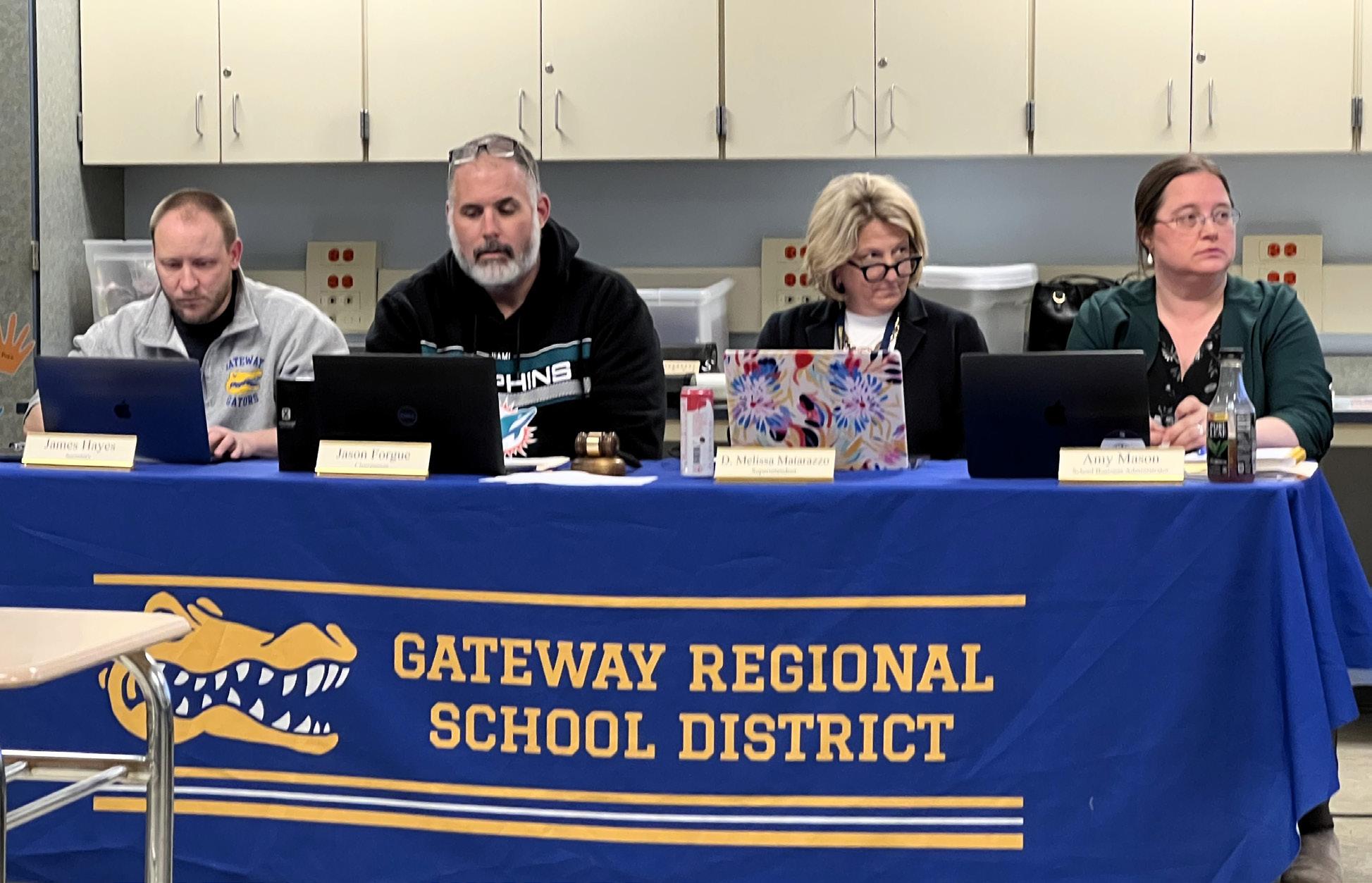
From left, Gateway Regional central office assistant James Hayes, School Committee chair Jason Forgue, Superintendent Melissa Matarazzo and Business Manager Amy Mason discuss budget cuts at its March 11 meeting.
Reminder Publishing photo by Amy Porter
Man arraigned in connection with child porn
By Cliff Clark cclark@thereminder.com
WESTFIELD — A Level I registered sex offender was arraigned last week in district court in connection with one count of possession of child pornography, the second offense, according to court records.
After Jason C. Everritt, 38, of Butternut Road, Westfield, was arraigned in district court in connection with the single charge, he was released on personal recognizance, according to court records.
The investigation into Everritt began in December 2024 when a trooper with the State Police was investigating the distribution of child pornography on what is known as a BitTorrent network.
BitTorrent is a peer-to-peer file sharing protocol that allows users to distribute and download large files by breaking them into small pieces that are shared directly between multiple computers rather than from a single central server.
During the investigation, the trooper focused on a specific IP address that was being examined for possible child pornogra-
phy possession, according to the trooper’s report.
After identifying the device, the trooper was able to download 50 files, which he reported contained “explicit and illegal” content from the computer using the IP address, he reported.
An administrative subpoena was granted, and the trooper was able to tie the computer to Everritt living on Butternut Road, the trooper reported.
An investigation into the backgrounds of the residents at the Butternut address revealed Everritt was a registered Level I sex offender in Westfield after being convicted in 2014 on five counts of child pornography possession in Virginia, according to the trooper’s report.
In Massachusetts, Level 1 sex offenders are classified as having a low risk of reoffending and posing a low degree of danger to the public. Because of this, their information is not available to the general public, according to state law.
In April 2025, a search warrant was executed at Everritt’s Butternut Road home by the State Police Detective Unit assigned to Hampden County District At-
torney Anthony Gulluni and the State Police Cyber Crimes Unit. Several devices were located and seized for forensic analysis before investigators tried to interview him. He declined to do so without his attorney present, the trooper reported
A forensic analysis began at the home on five of the devices, and during the preliminary examination, investigators found multiple images consistent with child sexual abuse, according to the trooper.
A total of 28 cached images of child sexual abuse were identified on-site, the trooper wrote.
Because a child lived in the home with Everritt and his wife, the state Department of Children and Families was notified.
While being interviewed by DCF and asked about the allegation, he “freely explained the situation,” the trooper wrote.
He told DCF that he had downloaded pornography for the first time in a long time using a BitTorrent website, and there was a big file he downloaded that was in Chinese. He said that he wasn’t aware there were child sexual abuse images included, the trooper wrote.
He allegedly admitted to looking at the files, which he said were mostly of adults, but at one point, he noticed the child sexual abuse images, according to the trooper.
Everritt told the investigator he regretted downloading the images. The judge ordered several conditions before Everritt was released on personal recognizance. He was not to have any unsupervised contact with children under 18, according to court records.
He will return to court on April 24 for a pretrial hearing. If convicted, Everritt could be punished by imprisonment in state prison for not more than five years, or in a jail or house of correction for not more than two and one-half years, or by a fine of not less than $1,000 nor more than $10,000 for a first offense, according to state law.
For a second offense, he could face imprisonment of not less than five years in a state prison, or by a fine of not less than $5,000 nor more than $20,000, or by both such fine and imprisonment for the second offense, according to state law.
Parents encouraged to attend Stop the Swerve event
SPRINGFIELD — Hampden
District Attorney Anthony D. Gulluni is encouraging parents and guardians across Hampden County to attend the upcoming Stop the Swerve prevention event alongside their high school, driving-age students.
The free event will take place on Thursday, April 2 at 5:30 p.m. at the Basketball Hall of Fame in Springfield. Stop the Swerve is focused on addressing the dangers of drunk, drugged and distracted driving for our community’s teenagers. The initiative brings together students, families, law enforcement and community partners with one shared goal: preventing tragedies on our roadways before they happen.
A central component of the evening will be a new, locally produced documentary that examines the devastating impact of a real crash in our community.
The documentary centers on the tragic death of Jemyliana Vargas, a young Springfield woman who lost her life following a crash on Interstate 91 in Longmeadow in 2023. The incident underscores how quickly a routine drive can turn fatal and the devastating ripple effects these crashes have on families, friends and the broader community. By sharing her story, with the support of her loved ones, the program aims to put a human face to the consequences of impaired and distracted driving and reinforce
Roads
Continued from page 5
maintenance activities.
“This is going to help you better plan your projects from a mobilization standpoint. So, the town can save money by planning your projects, but also appropriately planning them geographically,” he said.
When it came to cost, Garro said the analysis indicated the town should spend about $930,000 annually to maintain

the importance of making safe decisions behind the wheel.
Following the documentary, an assistant district attorney who specializes in motor vehicle homicide cases will speak about the legal consequences of impaired and distracted driving, as well as the long-term impact these incidents have on victims, families and entire communities.
“This event is not just for students, it’s for families,” said Gulluni. “Parents play a critical role in shaping safe driving behaviors. Stop the Swerve is an opportunity to come together, learn from real life events, and have conversations that can ultimately
its average road score of 71.35.
“Ideally, you want to show improvement, and you want to set goals related to improving your score. So, for instance, a goal, a good goal to hear for the town would be to shoot for 75. We just need to determine how long that’s going to take,” he said.
In the draft report, every segmented road in town was scored and given an estimated price for repair.
For example, Bugbee Road, which scored 93, would only need $3,942 to maintain it for a year. Congamond Road, which

save lives.”
In addition to the presentation, students will have the opportunity to participate in interactive safety activities, including driving simulators, impairment-goggle exercises and a pedal cart challenge designed to demonstrate the effects of impairment and distraction behind the wheel.
While students engage in these activities, parents will have the opportunity to attend a presentation by an assistant district attorney about the risks and liabilities associated with underage drinking and hosting teen gatherings.
The evening will also include
underwent a major reconstruction several years ago, is scored at 89, and only needs $18,684 to maintain.
On the other end of the spectrum for estimated costs for repair is Davis Road, which was scored at 40, with a cost of $697,147 for a major rehabilitation, primarily because it is about 1⅛ miles long.
Fernwood Road was another needing major rehabilitation at an estimated cost of $329,653 for just under three-quarters of a mile of pavement.
While Granville Road scored
the announcement of winners from the 2026 Stop the Swerve Public Service Announcement and Billboard Challenge, recognizing local students who have created impactful messages promoting safe driving.
All attendees of driving age can enter a raffle for free driving school tuition through AAA.
The Stop the Swerve event is free and open to all Hampden County parents and high school students. No registration is required.
More information can be found at hampdenda.com/ or on the Facebook event page: facebook.com/share/1L2NxFqEPV.
70, because of its length — just over 4 miles — its estimated cost for only routine maintenance is estimated at $684,149.
There has been some talk by Select Board members about the possibility of going for a bonding authorization of $20 million for road repair, Garro said its analysis found that $13.07 million was needed.
That includes $5.5 million for major rehabilitation, $5.7 million for minor rehabilitation, $1.6 million for preventive maintenance and $285,357 for routine maintenance.

Staff Writers:
Sales Manager: Scott Greene
Account Executives: Matt Mahaney, Paula Dimauro, Lisa Nolan, Jeanette Grenier, Paul Poutre, Andy Shaw, Laura Tassistro
Classified Account Managers: Roxanne Miller-Longtin, Evan Marcyoniak, Shannon Spada
Sales Support: Carolyn Napolitan
Financial Department: Nancy Banning
Hampden County District Attorney Anthony Gulluni poses for a photo with teenagers at the 2025 Stop the Swerve event.
Area chambers of commerce partner to Fill the Food Bank
By Sarah Heinonen sheinonen@thereminder.com
For the past few years, six area chambers of commerce have banded together to address a need that affects the people they serve across Hampden County — food insecurity. This year, the Greater Westfield, Greater Holyoke, West of the River, ERC5/East of the River, Springfield Regional and Greater Chicopee chambers of commerce are working together again for the third annual Fill the Food Bank event.
The fundraising and networking event, taking place on Tuesday, March 31, benefits the Food Bank of Western Massachusetts, a nonprofit which sources, stores and distributes foodstuffs to many of the local food pantries across the four counties of Western Massachusetts. In 2025, the pantries in the Food Bank’s member network served more than 122,000 people.
For every $1 donated, the Food Bank is able to supply three meals to the people who visit food pantries. Jillian Morgan, director of development for the Food Bank of Western Massachusetts, explained that the Food Bank’s return on investment is possible due to partnerships with the US. Department of Agriculture, the Massachusetts Emergency Food Assistance Program and local grocery stores and businesses. The event is designed to bring together local leaders, businesses and the community. The proceeds from ticket sales go directly to the Food Bank. Food donations are also collected at the event.
In each of the past two years, the roughly 150 guests have collected close to 2,000 pounds of food ahead of the event. Each year has had a theme regarding what types of foods to collect. The first year was focused on rice and beans. Last year, there was a peanut butter and jelly theme.
This year, donations are centered around soup and pasta. Diana M. Szynal, president and CEO of the Springfield Regional Chamber, said the chambers check with the Food Bank prior to the collection to determine what goods are most needed. Monetary donations are also welcome. Last year’s event raised $10,511 and “several hundred pounds” in food donations were collected, Morgan said.
“It’s a great opportunity for us to network with businesses in Hampden County.” Morgan said. It gives people an opportunity to take a tour of the facility and meet the staff. Morgan said, “We just make it a really fun environment.”
Szynal said it is a relaxed setting with brief remarks. Partners Restaurant & Catering will provide a baked/mashed potato bar. There will also be raffles, which feature prizes donated by members of each chamber. The raffle proceeds will benefit
the Food Bank.
“It’s a great opportunity for six chambers to work together,” Szynal said. “All chamber events are networking events, but this is next level because you’re networking with people from other chambers.” Reflecting on the cyclical nature of organizational networks, Szynal said many of the nonprofits supported by the Food Bank are chamber members.
“We do a lot of third-party events throughout the year,” Morgan said. Collectively, these fundraisers contribute about $1 million to the Food Bank’s operating budget. “When other businesses fundraise for the Food Bank. It amplifies our success. We’re taking advantage of their network,” Morgan said, “so we’re not always going to the same people” for donations.
Morgan said food insecurity continues to grow. Szynal shared a similar sentiment, “Things are getting so
expensive for people, people who may not normally find themselves coming up short.”
Citing the rising cost of living, Szynal said the number of people using the Food Bank now is equal to or surpasses figures from the coronavirus pandemic. She said the Food Bank is bracing itself for even more users in summer 2026 when federal cuts to the Supplemental Nutritional Assistance Program take effect and policy changes make it more difficult to apply.
Szynal thanked the sponsors of the event: Baystate Health, Country Bank, People’s Bank, Canopy Management Group, GoNetSpeed and All States Materials Group. “They step up. They want to support the chambers; they want to support the Food Bank.
To purchase tickets, visit tinyurl.com/fill-the-food-bank.
Baystate Noble Hospital receives Patient Safety Excellence Award
WESTFIELD — Baystate Health is pleased to announce that Baystate Noble Hospital has achieved the 2026 Patient Safety Excellence Award from Healthgrades, the No. 1 site Americans use to find a doctor or hospital.
This recognition puts Baystate Noble in the top 10% of
hospitals in the nation for patient safety.
This recognition reflects Baystate Health’s mission to deliver compassionate, quality, and accessible care — advancing its communities’ health for all.
“Baystate Noble Hospital is honored to be recognized with



by Healthgrades for our dedication to patient safety,” said Brandon Okezie, president and chief operating officer of Baystate Noble Hospital. “This recognition speaks to the teamwork and accountability that guide our work every day as we serve our community, neighbors and families. At Baystate Noble, safety comes first for every person, in every moment.”
The recognition of Baystate Noble is based on patient outcomes. To determine the national leaders in patient safety, Healthgrades evaluated risk-adjusted complication and mortality rates from approximately 4,500 hospitals nationwide across 13 patient safety indicators, with each PSI
representing a serious, preventable complication.
Patients treated at Baystate Noble and other award-winning facilities had significantly lower risk of experiencing these leading complications:
• In-hospital fall resulting in fracture (52.4% less likely)
• Collapsed lung due to a procedure in or around the chest (57.5% less likely)
• Catheter-related bloodstream infections acquired in the hospital (67.8% less likely)
• Pressure sores or bed sores acquired in the hospital (71.9% less likely)
“The data behind this year’s Patient Safety Excellence Award highlights how measurable im-
provements in safety can prevent thousands of complications,” said Dr. Alana Biggers, MPH, medical advisor at Healthgrades. “By prioritizing evidence-based safety practices, Baystate Health’s community hospitals are achieving better clinical outcomes and cultivating a culture where patients come first.”
Baystate Franklin Medical Center and Baystate Wing Hospital also earned the award, reflecting the continued excellence and dedication of care teams across Baystate Health. To learn more about the Patient Safety Excellence Award™ and view data insights not available anywhere else, visit healthgrades.com.

Every week we will provide you with a complete listings of deaths from the preceding week from throughout Greater Springfield. We are doing this as a convenience to our readers in case you miss an obit in the daily paper. We hope you find this useful and that you will refer to it weekly.
AGAWAM
Alice Ann Angelo
Joseph E. Cincotta
Margaret Faust Talmadge M. “Thelma” Gross
William M. Pawlin
FEEDING HILLS
Joseph Nicolas Gilberti
William J. Lambert
SOUTHWICK
Karen A. Brzezinski
Larry Veprauskas
WEST SPRINGFIELD
Roger H. Bilodeau
Daniel J. Callahan
James E. Finnie
Norma M. Gumlaw
James F. Martin
WESTFIELD Eric J. Clarke
Frances E. Noyes David Sullivan
Back Porch Festival returns March 27 for its 12th year



By Trent Levakis tlevakis@thereminder.com
NORTHAMPTON — More than 60 artists will perform at 12 walkable venues in the city’s downtown when the 12th annual Back Porch Festival returns to Northampton from March 27-29.
The Back Porch Festival is a collaborative effort between Signature Sounds and the Parlor Room Collective. Founded in 2014 as a one-day event at the Academy of Music Theater in Northampton, the event has since grown into a multi-venue celebration featuring the best in American roots music. Each year, the festival includes a live broadcast of the Back Porch radio show before a live audience, and this year’s will take place on March 29 at 9 a.m. at The Iron Horse.
Back Porch Radio host Jim Olsen has been on the airwaves of WRSI since 1984, serving as the station’s program and music director from 1985 to 1996. When the station moved to Northampton in 1996 and became 93.9 The River, the Back Porch came with it.
In the first year of the Back Porch Festival, Olsen and organizers were looking to put on a one-day concert for the community, and when their booked act canceled at the last minute, organizers improvised and turned the single show into split performances between three different artists.
The festival officially expanded to the format that is currently celebrated in 2023.
“In this day and age, when you book so many bands, it’s kind of inevitable that something will happen with someone and they can’t make it. We haven’t
had one yet this year, but you never know,” said Olsen. “Part of putting on an event like this is just having the flexibility and the foresight to have a plan when problems arise.”
The lone multi-day winter musical festival in New England will kick off the festivities on March 27 with the first headliner show at the Academy of Music featuring BERTHA: Grateful Drag, the world’s first Grateful Dead Drag band. The show begins at 8 p.m. and includes an allstar collective of queer and allied East Nashville talent coming together in full force for a good cause, according to organizers.
Headlining the second day of the weekend is the Back Porch Bluegrass Spectacular featuring Peter Rowan and Sam Grisman Project playing music from Old & In The Way and more. Old & In The Way was a short-lived but groundbreaking bluegrass band featuring Jerry Garcia, David Grisman, Vassar Clements, John Kahn and Peter Rowan. The show will celebrate their influences and classic repertoire. It begins at 7 p.m. inside the Academy of Music.
I’m With Her, the harmony-rich, Grammy-winning supergroup of Aoife O’Donovan, Sarah Jarosz and Sara Watkins, will close the weekend as the final headliner with a performance inside the Academy of Music on March 29. Special guest Olive Klug will also be featured.
“The thought process in planning this is, let’s do this at a time of year where everyone could really use it. You never know in New England what you’re going to get with the weather. You can’t rule out a snowstorm during the last weekend of March,” Olsen said with a laugh. “I feel like
March is just that month where it’s sort of no longer winter, but it’s also not really spring yet. So, it’s this long month where you’re kind of waiting to get back outside, and this is a little emphasis to get back outside and enjoy.”
Special to this year’s Back Porch Festival will be the debut of the new concert film, “You Got Gold: A Celebration of John Prine.” Playing March 29 at 11 a.m. at the Academy of Music, the tribute concert film captured in October 2022 at Nashville’s Ryman Auditorium honors the legendary songwriter’s enduring legacy.
The film brings together family, friends and acclaimed artists like Bonnie Raitt, Brandi Carlile, Tyler Childers, Lucinda Williams, Dwight Yoakam, Jason Isbell and Bob Weir to celebrate Prine’s life and music on the iconic stage. The film screening is included with a Ramble Pass, which grants access to every show at the festival except for the evening headlining shows at the Academy.
“This film has been released this year, and they’re doing select premieres in certain markets, so we’re lucky here in Western Mass. to show this film at the Academy of Music,” Olsen said. “It’s a cool new wrinkle we have this year that we haven’t had in the past.”
Also new to this year’s festival is Secret Planet, a community-supported music group bringing borderless, underground artists to Western Mass. Olsen said the group gathers bands from all over the world to the region and that they will be featured on Saturday through a new “Global Back Porch” performance at 33 Hawley St.
“We’re always looking for
interesting ways to shake things up,” Olsen said.
When it comes to booking artists, Olsen explained that the festival’s lineup is filled with a good mixture of national touring and local acts. He said that around 4,000 tickets are typically sold for the event, which therefore brings additional business to downtown.
“The reason we do this is to give it more of a festival feeling. That idea that usually when you go to a music festival it’s an open field or somewhere where there’s a lot of things happening around the ground so we just use downtown Northampton as our festival grounds. It makes for a more social event because rather than sitting in a seat and watching a show, you’re up and moving around,” said Olsen. “You have so many choices of different things to go see. Having a walkable downtown in Northampton and having everything within walking distance just makes it so that not only do you go to different venues and see music, but you might stop at a café and get a coffee or stop at a restaurant for some food or check out a store.




It really enlivens the whole city, which was the idea.”
Olsen said it is rewarding for him and fellow Back Porch Festival organizers to see the event’s growth over the years and what it has turned into most recently. He added they look forward to another great festival weekend.
“It means a lot because when we started this, it started very small and humbly, and we’ve been able to grow it a little bit every year. Now we’re getting recognition all around the U.S. for it and from artists that really want to come and play it. It’s just exciting,” said Olsen. “For many years, our group produced Green River Festival, which is and was a wonderful festival that has become a really big deal. It’s fun to get to sort of grow another festival with a totally different format and feel into something that’s exciting and that people are really enjoying, so it’s been great.”
For more information on this year’s Back Porch Festival, its schedule, full lists of performers and venues, or to purchase tickets or a ramble pass, visit backporchfest.com.
From left: Larry Campbell and Teresa Williams perform during the 2024 Back Porch Festival. The Willie Nelson Tribute performance from the 2024 Back Porch Festival. Las Cafeteras performing at a previous Back Porch Festival.
Photo credit: David Molnar.



WESTFIELD STATE VS MCLA
BASKETBALL



Westfield State defeated MCLA 95-68 in the semifinals of the MASCAC men’s basketball tournament Feb. 27 at the Woodward Center.
WSU sophomore Kenney Rogers directs a play.
Westfield's Joe Thomson goes high for a basket.
Jason James puts up a basket with Jalen Sullivan looking on.
Xavier Lewis goes up for a basket guarded by Craig Williams.
Kenney Rogers drives past Frank Field.






Xavier Lewis completes a layup over Colin Quinn.
A. Z. Allah delivers a basket with Joe Thomson looking on.
The WSU cheerleading team celebrates an Owls' basket.
Kenney Rogers fires one in from long distance.
A.Z. Allah drives past Kamau Franks

PLUMBING

144 Papers: St. Joseph Dr., Wisteria Ln., Pembroke Terr., Rockingham Cir., Dartmouth Ln.,
- Prospect St., Chestnut St., Somers Rd.
Papers: Gerrard Ave., Holy Cross Cir., Kingston Ave., Lombard Ave., Nelson St., Roderick Ave., Partial- N. Main St.
166 Papers: Braeburn Rd., Channing Rd., Tufts St., Van Dyke Rd., Wood Ave., Boulder St., Admiral St., Thompson St., Partial-Dwight Rd. (odd side only)
131 Papers: Shawmut St., Mayfair St., Westminster St., Thompkins Ave., Partial-Gates Ave
64 Papers: Anne St., Helen Cir., John St., Vadnais St., Converse Cir.
327 Papers: Melwood Ave., Chestnut St., Bluegrass Dr., Maple St., Powder Hill Rd., Fairhaven Dr.
174 Papers: Orchard Rd., Pine Grove Cir., Partial-Parker St., Porter Rd., Allen St.
150 Papers: Breezy Knoll Rd., Elm St., Mapleshade Ave., Pleasant St., Oak Bluff Cir. LONGMEADOW - THURSDAY, HOOK DELIVERY
83 Papers: Williamsburg Dr., Eunice Dr., Tabor Crossing, Morgan Ridge, Burns Meadow, Churchill Dr., Partial - Converse St.
84 Papers: Chandler Ave., Partial - Longmeadow St.
109 Papers: Birnie Rd., Brookside Dr., Crescent Rd., Longview Dr., Fairhill Dr., Partial - Longmeadow St.
54 Papers: Bliss Rd.
87 Papers: Andover Rd., Ashford Rd., Cranwell Ln., Deerfield Ave., Willow Cir., Williston Dr., Willow Brook Rd., Partial - Frank Smith Rd.
157 Papers: Albemarle Rd., Arcadia St., Barclay St., Chiswick St., Fairway Dr., Franklin Rd., Lincoln Pk., Whitmun Rd., Woodmont Rd.



96 Papers: Brookwood Dr., Kenmore Dr., Knollwood Dr., Partial - Shaker Rd.
99 Papers: Barbara Ln., Quinnehtuk Rd., Village Dr., Pioneer Dr., Partial - Maple Rd., Frank Smith Rd., Wolf Swamp Rd.
100 Papers: Norway St., Nevins Ave., Partial - Maple Rd.
157 Papers: Birch Rd., Yarmouth St., King Philip Dr., Sheffield Ave., Partial-Wolf Swamp Rd.
115 Papers: Hopkins Pl., Hawthorn St., Fairfield Ter., Laurel Ln., Partial-Laurel St.
42 Papers: Lynwood Dr., Duxbury Ln., Elizabeth Cir.
67 Papers: Woolworth St., Woodside Dr., Blokland Dr., Wilkin Dr., Grassy Gutter Rd.
65 Papers: Park Dr., Brittany Rd., Normandy Rd., Partial-E. Greenwich Rd., Colony Rd.
149 Papers: Prynne Ridge Rd., Wyndward Rd., Wildwood Glen, Maplewood St., Partial-Maple Rd. WILBRAHAM - THURSDAY, HOOK DELIVERY
35 Papers: Arbor Ln., Greenwood Rd., Oak Ridge Dr., Old Orchard Rd.
61 Papers: Gary Dr., Pidgeon Dr., Raymond Dr., Ruth Dr., Sawmill Dr.
228 Papers: Echo Hill Rd., Highmoor Dr., Meeting House Ln., Rice Dr., Ridge Rd., Highridge Rd., Hitching Post Ln., Partial - Mountain Rd., Monson Rd., Tinkham Rd., Main St.