Southwick Select Board split on supporting meals tax
The discussion held by the Select Board before it decided to support having Town Meeting vote up or down on implementing a meals tax in town might be described as snippy.
Page 2
WESTFIELD
Council passes first vote to change regular meeting time
After a lengthy discussion, the City Council took a first vote of 9-4 to change the time of regular City Council meetings from 7 p.m. to 6 p.m. at its March 5 meeting.
Page 3
HUNTINGTON Gateway School Committee postpones budget vote
After a two-hour discussion about painful budget cuts, the Gateway School Committee postponed its vote on the budget.
Page 5
DiZoglio continues legislative audit push
By Sarah Heinonen sheinonen@thereminder.com
SPRINGFIELD — The 2026
state election may not be until the fall, but candidates are already making the rounds across the commonwealth to introduce themselves and make their case to voters. Massachusetts Auditor Diana DiZoglio may be running unopposed, but that does not mean she is without opponents.
On a recent trip to Springfield, she sat down with Reminder Publishing to discuss the role of the auditor and the controversy she has become embroiled in.
DiZoglio said most residents in the state do not know what the state auditor does.
“I’m not the IRS,” she said, referring to the federal Internal Revenue Service. “I don’t audit individual people.” Instead, she said the auditor reviews the expenditures of the state government. She said that for the first time in decades, the auditor’s office completed audits of all departments in the executive branch, as required every three years by law.
While DiZoglio may have auditing the executive branch down to a science, efforts to audit the state Legislature have created controversy and litigation.
DiZoglio has plenty of experience with the Legislature. She served six years as a state representative beginning in 2013, after which she was elected to the state Senate until she was elected to the office of auditor in 2022. DiZoglio said she decided to run for auditor to use what she had learned about state government to ensure Massachusetts operates with transparency and equity.
DiZoglio’s platform at that time included reinstating the
ability to audit the Legislature. In 2024, DiZoglio delivered on that campaign promise when a ballot question she championed was passed by 72% of voters. She said she intends to review state contracts, settlements and receipts to see how the state is spending tax dollars, but the leadership in the Legislature, namely Senate President Karen Spilka and her counterpart in the state House of Representatives, Speaker Ronald Mariano, argue that it would violate the separation of powers as laid out in the state’s constitution.
DiZoglio said that argument is “complete baloney,” because it conflicts with history. She said auditing the Legislature was commonplace until the 1990s when House of Representatives Speaker Charles Flaherty blocked Auditor A. Joseph DeNucci from auditing him. DiZoglio pointed out that Flaherty later admitted to conflicts of interest and was convicted of felony tax evasion.
“If you are refusing an audit, what are you hiding?” DiZoglio asked.
DiZoglio has been pursuing litigation against the Legislature, Mariano and Spilka to force them to comply with an audit. Attorney General Andrea Joy Campbell has objected to this, insisting that her office is the only entity authorized to enter into litigation on behalf of the state. Meanwhile, she has filed a motion to dismiss the suit on behalf of the Legislature.
“Gatekeeping justice is not leadership. It’s obstruction,” DiZoglio said. DiZoglio said the Legislature funds the attorney general’s office, creating a conflict of interest. She cited a 12% increase in the attorney general’s fiscal year 2026 budget as a “quid pro quo.”
DiZoglio sought approval
from the Massachusetts Supreme Judicial Court to name attorney, Shannon Liss-Riordan, who is willing to represent DiZoglio, as a special assistant attorney general for the purpose of the litigation.
On March 4, Judge Dalila Argaez Wendlandt denied DiZoglio’s request on the basis that she did not provide case law sufficient to support the request, something DiZoglio disputes. Liss-Riordan, who DiZoglio said is working pro bono on her case, lost a bid for state attorney general against Campbell in 2022. While the litigation is in
progress, DiZoglio said, “We have a plan B.” Her office has introduced a ballot question to expand public records requests to include Legislature and governor’s administration with certain exemptions. She said having documents, receipts and records available to the public improves the public’s faith in state government. She said municipalities are subject to public records requests under the law, as is her office. She said the Legislature
State Auditor Diana DiZoglio speaks at the 2025 MassDem State Convention held Sept. 13, 2025, at the Mass Mutual Center in Springfield. Republican file photo
See DIZOGLIO on page 2
STRM: Wildman and Christie discuss St. Patrick’s Day
By Ryan Feyre rfeyre@thereminder.com
HOLYOKE — Winter’s twilight is mercifully upon us, which means “green season” is about to reach its apex with the St. Patrick’s Day festivities.
On the latest episode of “So That Reminds Me,” Holyoke St. Patrick’s Committee President Jim Wildman and Holyoke Grand Colleen Jadyn Christie sat down with hosts Chris Maza and Tyler Garnet to discuss the 2026 St. Patrick’s Day celebrations, including the 49th annual 10K road race on March 21 and the 73rd St. Patrick’s Parade on March 22.
While most of the weekend will remain unaltered, there is one notable addition to this year’s festivities: a sensory-friendly viewing area from Elm Street through Maple Street on Appleton Street. According to Wildman, the twoblock section of the route will serve as a designated area for families, children and individuals who want a calmer environment.
The zone will take effect from Elm Street through Maple Street with no emergency lights or flashing lights and no sirens or amplified alarms. Bands during this portion will also play strings only.
Wildman said the idea for this section came from his time marching in the Tralee St. Patrick’s Day parade during a trip to Ireland last year. He shared that the band and music stopped, and they noticed some children with headphones on. When he returned from the trip, Wildman said he made sure to add a similar zone to the Holyoke parade this year. He shared that Magic for Maddie and the Miracle League of Western Massachusetts are sponsoring this initiative.
“I told the parade coordinator, and a few others, I said, ‘we have to do this,’ and they all agreed, we were all in agreement,” Wildman said. “We’re hoping that this is a huge success.”
The remainder of the weekend will function similarly to past years. Both Wildman and Christie reflected on their excitement for the festivities, including the focus on celebrating surrounding communities.
“It’s very much a dedication for all our regionals; and again, without them, we don’t have much of a parade,” Wildman said. “So, that’s why we try to get out, we try to network with all of them.”
The yearly networking with other communities has yield-
ed a sizable economic impact throughout the region. Wildman said a financial study done 15 years ago found that the parade weekend that year brought in $22 million from events, sales, restaurants, hotels and everything else that factors into the weekend.
This year, Wildman said the goal is to spearhead another financial study. He shared that it’s important to capture the weekend’s impact because the celebration touches people from not just the region, but around the globe.
“We’re broadcasting 22 [News], we have a million viewers, and we have another, I think, three or four hundred thousand that watch us online,” Wildman said. “Outside of that, as far away as Australia, Poland, Hawaii … we have these people that are from Holyoke that have moved because they can’t make it home for the weekend, they’re still trying to get involved with that homecoming and enjoy the parade.”
The weekend’s camaraderie is felt right at home too, especially by Christie, who reflected on her time as colleen after years of enjoying the annual traditions with her family.
“It’s an incredible honor, getting to know a lot of the young girls who specifically gravitate towards me because of my crown,” Christie said. “I’ve done some visits and some tea parties with some of the local little girls, and it’s just amazing just to see how much they look up to you. You walk in and … their jaws drop, this is real.”
gins at 1 p.m. on March 21 and the 73rd annual parade starts at 11 a.m. on March 22. Readers can listen to the full podcast episode by visiting thereminder.com/our-podcast or search “So That Reminds Me” on your favorite podcasting platform.
The 49th annual road race be-
Southwick Select Board split on supporting meals tax
By Cliff Clark cclark@thereminder.com
SOUTHWICK — The discussion held by the Select Board before it decided to support having Town Meeting vote up or down on implementing a meals tax in town might be described as snippy.
“No one’s in favor of adding a tax,” said board member Diane Gale, who supported the tax, during the brief debate on the issue at the March 9 meeting.
That prompted a sharp response from board member
Douglas Moglin, who was a “solid no” on the proposal.
“Except you two,” he said, referring to Gale and board member Russ Anderson, who also supported the tax.
The idea of imposing a meals tax in town has infrequently come up as a topic of discussion over the last two years, but it’s largely been the town’s Economic Development Commission pushing it.
During the EDC’s last meeting, which Anderson attended as the commission’s liaison, commission Chair Greg Deily was
unequivocal in his support.
“You’re not going to decide where to go based on .75 cents on $100,” said Deily at that February meeting. He also attended the board’s meeting on March 9 to again advocate for having Town Meeting decide.
The state has a 6.25% sales tax on prepared meals, which is often increased by a 0.75% local option tax, bringing the total to 7% in most areas. The tax applies to restaurants, cafes, food trucks and prepared food at grocery stores. There are exemptions like
food sold by weight, deli meat or drinks in unopened containers.
Deily pointed out that every town adjacent to Southwick had a meals tax.
“In fact, every other town our size and larger has opted into this, so we are the only one leaving it on the table,” Deily said, which prompted another sharp retort from Moglin.
“Maybe that’s why people are coming here,” he said, which elicited a quick response from Gale.
“Yeah, right. To avoid it, sure,” she said, which drew Anderson into the exchange.
“Pizza’s seven cents cheaper,” he said.
“But they’re going to pay more for gas here, so there,” Gale continued.
Dizoglio
Continued from page 1
should be, too.
The attorney general’s office is not the only place DiZoglio thinks Mariano and Spilka are exerting influence. While most of the state representatives in Western Massachusetts have been supportive, she said several legislators who had been in favor of the audit have either gone silent on the issue or have changed their position, specifically citing state Sen. Jake Oliviera as one of the latter.
DiZoglio said Senate and House leadership determine what committee positions legislators have, including who is named chair, which comes with a stipend of about $45,000 on top of the base $82,000 salary. Because of this, she said, leadership can “dictate whether the representatives
“That’s true,” Anderson said. Before that exchange, Gale explained why she supported the tax.
“We have talked about this a few times in the past. With growing costs that are out of control — and we can’t control many of them — I think it’s time to adopt the meal tax, at a minimum,” she said.
Anderson, as Gale said earlier, stated that no one likes adding taxes “to anything.”
“But with that said, the state’s not exactly going to help us out,” he said. He added that he frequents many of the restaurants and diners in town, and while acknowl-
See MEAL TAX on page 4
and senators can pay rent or not.” For Oliviera’s part, he stated on Reminder Publishing’s “So That Reminds Me” podcast in a July 2025 episode that he believes DiZoglio is so committed to pursuing the audit to be in the public eye because she is “more interested in raising her personal profile than actually doing her job as auditor.”
In response to those who question her motivations, DiZoglio said, “Respectfully, folks are going to say what they want to say. Absolutely, I’m going to tell people what my priorities are,” while running for auditor. However, she insisted she is pursuing the ability to audit the Legislature because it is her obligation as an independent elected official. “We should not be hiding,” she said, and the people who are against the audit “prefer to do business behind closed doors at the State House.”
St. Patrick’s Committee President Jim Wildman and Holyoke Grand Colleen Jadyn Christie sat down with hosts Chris Maza and Tyler Garnet on the latest episode of “So That Reminds Me.”
Reminder Publishing photo by Debbie Gardner
WESTFIELD
Council passes first vote to change regular meeting time
By Amy Porter aporter@thereminder.com
WESTFIELD — After a lengthy discussion, the City Council took a first vote of 9-4 to change the time of regular City Council meetings from 7 p.m. to 6 p.m. at its March 5 meeting. The second vote to change the city ordinance will be taken on March 19, and if it passes, the new meeting time will take effect on April 2.
City Councilor William Onyski spoke first on the motion originally presented by Councilors Brent Bean and Ralph Figy. He said the time change was last discussed in 2018 and did not pass. He said at the time, looking into it, councilors in favor found the earlier time would allow more people to come to public participation and make it easier for department heads who end their work time at 5 p.m. to attend.
City Councilor Dan Allie said public participation is the people’s time, saying it is their right, privilege and necessary duty to be informed. He said many groups have filled council chambers in the past. “As a City Council, we cannot have expertise on everything we’re
required to vote on,” he said.
“We should not make it harder for people to be involved.”
City Councilor James Adams spoke about his experience with wake times at the Firtion-Adams Funeral Home.
“The days of having a wake from 7 to 9 are over,” Adams said, adding that when he has a wake from 4-7 p.m., very few people come in after 6 p.m. “I deal with the general public every day. I think 6 p.m. is better,” he said.
City Councilor Bridget Matthews-Kane said that while there is no perfect time, every constituent that she has heard from has recommended staying at 7 p.m., and City Councilor Kristen Mello said the same.
City Councilor Karen Fanion, on the other hand, said she also heard from families with young children and older adults who said 6 p.m. would be easier.
Bean said he was not convinced the current public participation could be called robust, and believes it would be easier for people to attend the earlier time. “Unless it’s a really big topic, we see the same people. Something like this is as good as its last vote,” he said, suggesting that if it doesn’t
work, the council could revote and change back the time. Bean said he was also thinking about the hours between 5 and 7 p.m. when department heads are waiting around for the meetings.
City Councilor Daniel Knapik mentioned the large attendance by young families at the meeting on Feb. 4 concerning the proposed reentry facility on Southampton Road, which started at 6 p.m. “There’s not going to be a perfect time. It’s striking the number of people that don’t come out when the sun goes down,” he said, adding that people can send in emails that should include a request that the email be read into the record of the meeting.
“Let’s give it a shot and see how it goes. I’ll be a yes to support 6 p.m.,” Knapik said.
Figy said he did not receive feedback from residents in Ward 2 when asked. He said the majority of people in the ward, which encompasses the Senior Center, are seniors. “I think we look at it and see if it works. I would appreciate the support on this motion,” he said.
City Councilor Nicholas Morganelli Jr., who expressed his opposition to the
time change in the previous meeting, referred to data given during public participation that evening by Christopher McCrary, a member of the public and Water Commission, who said 70% of communities in the commonwealth started their meetings at 7 p.m.
“Everybody I’ve talked to has said 7 p.m. is a good time. Lastly, all of us were candidates for City Council in the fall, with the understanding that City Council meetings would start at 7 p.m.,” Morganelli said.
Onyski said he did some number crunching on his own with help from the city clerk. He said from the start of the fiscal year on July 1 to the end of February, there were 12 City Council meetings at which 32 people spoke. He said five of them thanked Councilor Rick Sullivan for his service. Fourteen were department heads, city councilors or someone presenting a city project. He said the remaining 13 were members of the public, one of whom spoke at three different meetings. “So 10 different people came to speak in public participation in 12 meetings; that averages one person a
meeting. That’s problematic,” Onyski said, Both Allie and Morganelli said if he had gone back three to five years, the numbers would have been larger.
Mello said she was going to vote with what people told her. “However, I think a lot of the reasons people are saying it’s difficult to show up would be alleviated if we could manage a hybrid meeting like a lot of other municipalities can do … If it were possible for people to zoom again, they could, and a lot of this would be alleviated no matter what time you did.” Morganelli made a motion to amend the meeting time to 6:30 p.m., which failed. He then made a motion to amend to implement the new time in January 2028, which failed. He then made a motion to table the vote to the next meeting, which also failed.
The first vote to change the City Council’s regular meeting time to 6 p.m. passed 9-4, with Burns, Fanion, Figy, Councilor Cindy Harris, Knapik, Onyski, Adams, Bean and Councilor John Beltrandi voting in favor. Matthews-Kane, Mello, Morganelli and Allie opposed the measure.
Businesses, volunteers sought for Career Fair and Credit for Life
By Amy Porter aporter@thereminder.com
WESTFIELD — Westfield Public Schools is seeking business and community participation for two events for area high school students.
The High School Career Fair, taking place on April 1 in Scanlon Hall at Westfield State University, will be attended by juniors from Westfield High School, Westfield Technical Academy, St. Mary’s High School and White Oak School.
Local businesses are sought who would like to set up tables — which will be provided — and share their fields with students. There is no cost to participate. “If they are recruiting for jobs now or work in a field they want to get kids interested in, they are welcome,” said organizer Kate Perez.
The event, which will draw 400 juniors from area Westfield schools, will run from 9:40 a.m. until 12:10 p.m., and vendors are welcome to set up beginning
at 8:30 a.m.
The students, who will arrive in two shifts, will be encouraged to ask business representatives questions such as what they like best about the job, what training is required, and what can students do to prepare for a career in the field?
Businesses and organizations looking to recruit students for jobs now or over the summer are also encouraged to participate.
“We have had kids leave with a job,” Perez said.
“It’s an opportunity to talk to students, tell them what you’re looking for in future employees or if you have current openings to fill; a chance to recruit for your field instantly or to spark interest in the future,” she said.
Interested businesses may email Kate Perez at kate.perez@ schoolsofwestfield.org to sign up.
The Career Fair is held in partnership with the Greater Westfield Chamber of Commerce and Westfield Education to Business Alliance.
Credit for Life Fair
Volunteers are also needed for the Credit for Life Fair on April 8, which will take place in the Westfield High School gymnasium, with student participation from WHS, WTA, St. Mary’s, White Oak, Southwick Regional School, Lower Pioneer Valley Education Collaborative and Gateway Regional High School.
Put on by the Western Mass. Credit for Life Committee, Perez said Credit for Life is a lively and fun interactive event that engages students in real-world budgeting and money management issues.
At the fair, students will select a profession, receive a monthly take-home salary and navigate various booths — such as housing, insurance, clothing and retirement — to make “purchases” using imaginary cash, credit or savings. The goal is to help students to learn how to live within their budget.
Volunteers, who are asked to arrive at 7:30 a.m. for training, will be assigned to a booth and engage
with students as they make their financial decisions. While many of the volunteers come from the financial industries, all backgrounds are welcome, and volunteers will be matched at suitable booths. The first shift of students arrives at 8:30 a.m. and the fair ends at noon.
Refreshments for both events will be supplied by Westfield Technical Academy.
To sign up as a volunteer for Credit for Life, contact Kate Perez at kate.perez@schoolsofwestfield.org.
Adam Rzegocki of Berkshire Bank helps Westfield Tech students Timothy Bennett-Cyr and Parker Coughlin to “sign up” for phone and internet service.
Reminder Publishing photo by Amy Porter
SOUTHWICK
Moglin raises questions about proposed dog park
By Cliff Clark cclark@thereminder.com
SOUTHWICK — When representatives of the Friends of the Southwick Dog Park announced it had a site just off Hudson Drive, they acknowledged that the property would bisect the proposed route of the Sam West/Hudson Drive connector, which one Select Board member said he has reservations about.
“I have one additional reservation about this whole project, two, actually,” said board member Doug Moglin during the board’s meeting two weeks ago.
Agreeing that the proposal is an “excellent idea,” Moglin, however, had two questions he believes need answering, both about the 32-acre property the Friends say Tilcon Mineral gifted them for the park.
He wants to know how the special permit that Tilcon Minerals operates under might be affected by the gift, and could it hamper efforts to build the proposed connector between Sam West and Hudson Drive.
“One is the fact that this was land that was part of a special permit that is still running because it’s still under active excavation, and under the special permit. I believe even when this was approved back in whenever, it required [that Tilcon Minerals] under that special permit come back with a redevelopment plan,” Moglin said.
Meal Tax
Continued from page 2
edging it was an uneducated
And it could be a subdivision plan or a plan to donate the property, he said.
“That needs to be done, and it wasn’t done; they just doled out a piece of the land to another entity,” Moglin said about the company’s property gift.
“That may or may not have dramatic implications for the redevelopment of the surrounding parcels,” he added.
For example, what if Tilcon decided to create a residential or even commercial development project on the property?
“People may or may not want to be near a dog park. I don’t know. It’s just not up to me, but it may mess with the rest of it,” he said.
“I would have thought that as part of the redevelopment plan, Tilcon was going to come back in front of the Planning Board — or someone from this board, or myself, would have been front and center to say, ‘hey, make sure on your redevelopment plan you’re showing that Hudson Drive to Sam West Connector as part of your redevelopment plan’ ... because that needs to get done,” he said.
That concern led him to his second question — could it hamper the town’s long-term goal of connecting Sam West to Hudson Drive?
“[Tilcon] gave away the land that we’ve been working on and working with them and the state to design the connector of Sam
guess, he is seeing more people he doesn’t recognize.
“I would think 75% of people that are going to Roma’s or to Blackboard [Congamond] are not from town,” Anderson said.
West to Hudson, [and] suddenly it’s a piece of private property,” Moglin said.
When the Friends announced its proposal to the Select Board in February, it made clear that the plan was to gift the dog park to the town when completed, including the route of the connector, “saving taxpayers tens of thousands of dollars in future legal fees, easements and administrative costs,” Friends’ representative Keith Deyo said at the board meeting.
“And this is a big one — roadway completion,” Deyo said at the meeting. “An unencumbered track of property gifted to the town of Southwick to complete the future connection of Sam West Road to Hudson Drive.”
Moglin didn’t dispute that promise but said the town has been planning for the connector for over a decade.
“We’ve been doing the layout, we already have gotten significant grants and other funding for that project,” Moglin said.
He wanted to know if the dog park proposal might jeopardize the Sam West-Hudson Drive connector project.
“To me, [the connector] is very, very important to the future development in the town of Southwick for that industrial park,” he said, adding that the idea behind the connector was to allow the park to expand and attract “good, clean businesses that
See DOG PARK on page 8
Deily said at the meeting that while he couldn’t get exact food and beverage sales for Southwick, he estimated that levying the tax would generate between $125,000 and $150,000 annually.
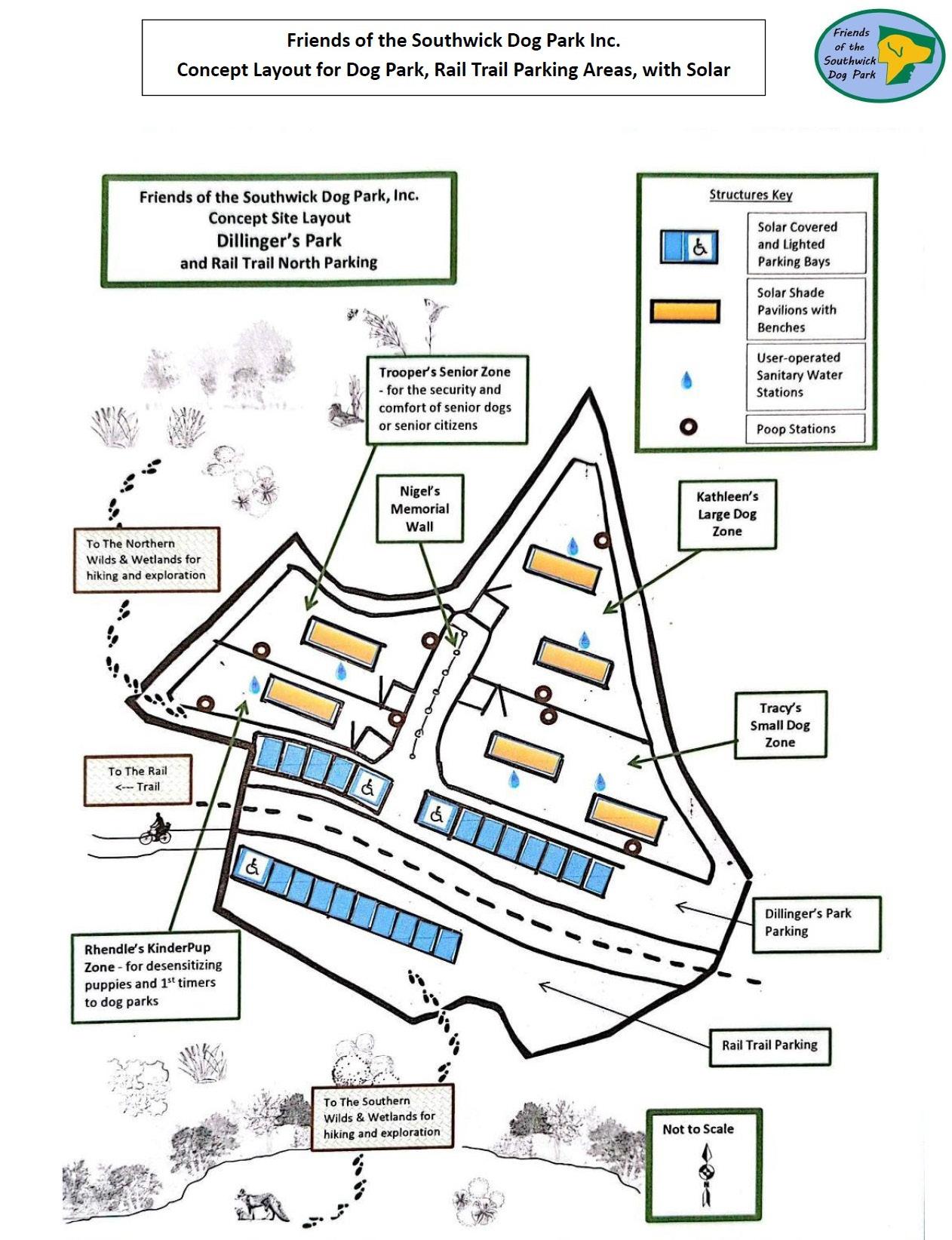
This is the proposed layout of Dillinger’s Dog Park that the nonprofit Friends of Southwick Dog Park, Inc., plans to build off Hudson Drive on 32 acres. It was gifted by Tilcon Minerals, Inc. Select Board member Douglas Moglin has “concerns” about how the project might affect the proposed Sam West Road/Hudson Drive connector that will bisect the property.
Reminder Publishing submitted photo
The town’s chief administrative officer, Nicole Parker, said the state’s Division of Local Services, which helps manage municipal finance by providing guidance, oversight, and training to local officials, gave her the same estimate.
Gale said if the tax isn’t adopted by Town Meeting, there is a possibility the town will cut back on services.
Anderson was more direct in his forecast for the town’s financial situation without the meals tax.
“So, which is it? Pick what you want. Less schools. Less fire. Less police. Less [snow] plows … it’s gonna be something,” he said.
Before Gale asked for a motion to have Town Meeting decide the issue, Parker gave her “spiel.”
“If you’re going to spend $100, and we ask for .75 cents extra, would that be such a burden? And to get $120,000, $150,000, or even more in revenue each year,” she said.
Anderson and Gale voted in favor of having Town Meeting decide. Moglin voted against it.
The possibility of levying a short-term rental tax — stays of 31 days or less — was brought up at the meeting.
Moglin didn’t think having the town pursue that as a revenue option was worth it.
“There’s not enough of them to be even consequential. Just doing the paperwork will cost more than we bring in,” he said. The state already collects a 5.7% occupancy tax, including in Southwick.
The town could adopt a local tax of up to 6%.
HILLTOWNS
Gateway School Committee postpones budget vote
By Amy Porter aporter@thereminder.com
HUNTINGTON — After a two-hour discussion on painful budget cuts, the Gateway School Committee postponed its vote on the school budget at its March 11 meeting.
The cuts were made to keep the budget presented to the member towns under 2.5%. In her presentation, Gateway Superintendent Melissa Matarazzo said the proposed budget of $18,254,669 has an increase of $1.5 million, primarily driven by four factors: a 12.48% increase in health insurance, an increase close to $1 million in Hampshire County retirement contracts, contractual obligations in negotiation and outgoing school choice, not including vocational. Matarazzo said at level-services, increases are still above 8%.
Matarazzo also said the budget, which she admitted is being prepared by two new staff members, herself and Business Manager Amy Mason, is based on assumptions of at least level funding from state and federal sources, including Chapter 70 funding, rural school aid, special education, transportation and that the U.S. Department of Education will continue to operate.
“In thinking about the overall picture, the sources that are not our towns’ do not keep pace. How do we balance this?” Matarazzo asked. “We are not alone. It’s a challenging year, particularly for our rural schools.”
Matarazzo said that as they worked through bringing the budget into balance, there were needed items that were never put in, and roles that were eliminated. Proposed cuts include the director of technology and assistant director of pupil services, and moving the funding for the directors of human resources and accountability and grants to grant-funded positions.
Teaching positions slated to be cut include part-time music and wellness teachers in Chester Elementary; one world language and culture teacher at Littleville, and a reduction of the full-time Spanish teacher and library-media specialist at Gateway Regional to part-time. Slated to be eliminated are wood shop and a school adjustment counselor at Gateway Regional.
Also slated to be reduced are instructional aides and secretarial positions, materials, supplies and textbooks funds. There are no professional development funds in the general budget.
The elimination of the assistant director of pupil services created a lot of discussion during the meeting.
Preschool and special education teacher Susan Rhoads, who is retiring at the end of the year, expressed her concern about the elimination of the position, saying that she believes it will be detrimental to the district, resulting in its being out of compliance with deadlines and detrimental to the supervision and training of new staff.
Rhoads said the position was created a decade ago when it became clear the workload in the pupil services needed more help. She said areas of growth in the district have been in special education, English language learning and early childhood, all of which fall under the Director of Pupil Services Kurt Garivaltis. She said Chris Tamburrino, the current assistant director, reads, edits and provides feedback on IEPs, runs the transition program for young adults between 17 and 22 until they age out, and oversees the Life Skills program in the school, among other duties.
During the meeting, Matarazzo announced that the special education program at
Gateway had been honored and recognized with three awards at the winter conference of the Massachusetts Association of Special Education Directors on March 5 in Plymouth. Recognized were Garivaltis as the Rural/ Suburban Special Education Director of the Year, Tamburrino with the Transition Program of the Year and Amy Mason, Inclusive Practices of the Year, for her work as the former head and founder of the vision impairment program at Gateway Matarazzo said that in creating the budget, they created a districtwide education team leader position that will be funded by grants and take over the most important tasks of the assistant director of pupil services.
“It’s not common for districts our size to have a full-time assistant director of pupil services,” she said, adding that her vision is for the team leader to handle a similar set of tasks without having an administrator at that level, which is more affordable.
School Committee member
Jeana Briggs from Chester said she has been inundated with emails from teachers in support of the assistant director. “As a parent with four kids on IEPs — it’s a bad move. I get we’re in a financial crisis,” she said, adding that she didn’t think taking somebody away who gives so much was the right thing to do.
Briggs called the pupil services department “one of Gateway’s shining stars.”
“Look at that list. It’s a very sad, sad list,” Briggs said.
“It’s disproportionately looking at the arts. It’s totally gone at this point,” said Brianna Sloane of Huntington. School Committee Chair Jason Forgue of Chester said graduation requirements are heading towards drastically reduced arts.
A parent in the audience expressed concern about the reduction of an adjustment counselor. “The mental health of our students is so important, and we know the mental health of teenagers as a whole. While it doesn’t have a direct teaching impact, it
has a giant impact,” she said.
School Committee member Stephanie Simonowicz from Middlefield said the district is in a deficit because students are leaving. “Then we’re not even considering three or four things that directly impact students; now we’re talking about eliminating someone in pupil services,” she said, adding that students will leave if they don’t feel supported.
School Committee member Brian Forgue from Chester said that is the conversation. “It’s a tradeoff. A lot of our towns are dealing with overall decreases — larger than the district’s.” Forgue said Chester has 40% of its population who are 65 and older and a shrinkage of its tax base. “We also need to consider what towns can absorb.”
Matarazzo said she plans to explore why students are choosing homeschool and school choice. She said the work that has been done with the Barr Foundation has made the high school an amazing place to be, with smaller numbers leaving. Earlier in the meeting, she said, overall, the school population has increased this year by 10.5 students.
“What are we doing? Our towns are strapped. What are we going to do,” said Briggs. “We have to start thinking outside the box.’”
Jason Forgue said it is in their best interest to present a budget that has a decent chance to pass. “The history in this district has been drastically opposed to budgets above 2.5%,” he said, remarking that they had invited state Sen. Paul Mark and state Rep. Nicholas Boldyga to the meeting, who sent a letter instead of showing up.
Earlier in the meeting, Brian Forgue read the letter from the legislators, with Mark promising to do everything in his power to come to the next meeting. Forgue called the letter vague, especially regarding rural school aid. “They didn’t say what they were doing to support it,” he said. “I hope in the coming months to
see examples of putting their money where their mouth is.”
Matarazzo agreed that each of the cuts to the budget is heartbreaking. “Communities should be proud that we’re bringing in $1.5 million in grant funding, but it’s not a long-term solution,” she said. “The state is not at all supporting rural districts right now. It’s a risky time to be in public education.”
Jason Forgue suggested looking at the stabilization account. He said the School Committee had gone to the towns and had asked them to continue to keep the payment formerly used to pay back elementary school buildings in their budgets, which they had agreed to do two years ago, with the idea of putting aside money for a new roof.
“I think we are mortgaging our kids. We know we need the roof. When it comes down to that loan payment, I’d like to at least consider either lowering the stabilization account to offset costs, or propose a higher budget to the towns,” Forgue said.
School Committee member Pegg Dragon of Huntington said she thought of that too, “if we could take a portion of it into the current budget because there are extraordinary circumstances.”
Forgue proposed setting a special meeting on March 15 to consider using some stabilization funds to offset the budget, to which all members agreed. No vote was taken on the budget, which has to be presented to the towns by March 17.
The committee set a special meeting for Monday, March 16, at 7 p.m. to consider adding money from its capital stabilization account, some of which is designated for a new roof, to offset cuts in the general budget.
Forgue said he had recently attended the Connecticut Valley Roundtable, at which he said everybody shared the same concerns. “We are certainly not alone,” he said.
“Thank you for your creative thinking about funding. Thank you for your advocacy,” said Garivaltis.
WESTFIELD STATE VS SALEM STATE
Westfield State defeated Salem State 58-56 at the Woodward Center on Feb. 18.
REMINDER SPORTS PHOTOS TAKEN BY MARC ST. ONGE
Westfield State's Jailyn Garvin-Martin tosses a shot.
Westfield State’s Gianna Strange guards Kylie Schrock as she tries to bring the ball in play.
Caroline Galvani goes up for a basket.
Westfield State’s Sophia DeAngelis drives through the paint.
Morgan Reynolds and Amayah McConney battle for the ball.
Gianna Strange shoots for a 3-pointer.
Kayley Downie, of Easthampton, and Cameron Bradford double up on Maria Orfanos.
Westfield State’s Tavi Williams, of Springfield, gets past Ernidia Goncalves.
Jailyn Garvin-Martin comes up against Ernidia Goncalves.
Question delays town agreement with Pioneer Valley Trading Co.
By Cliff Clark cclark@thereminder.com
SOUTHWICK
— The owner of Pioneer Valley Trading Co. appeared before the Select Board seeking to amend the community agreement between the business and the town to allow the company to start a cannabis grow operation.
It appeared to be as easy as checking three boxes on the agreement and the board approving the agreement. However, Select Board member Douglas Moglin, who was clearly in favor of amending the agreement, wondered if the town’s zoning laws allowed for a manufacturer to operate in a Residential 40 zone.
“I don’t know if we want to enter into an agreement with them until we understand the answer to that question,” Moglin said during the meeting.
When PVPC owner Michael Albert appeared before the board two weeks ago, he asked to have the host agreement between his company and the town amended to allow him to start a cannabis grow operation, of which a portion of it would be done outside.
Included in the grow operation proposal, he also plans to build a 4,800-square-foot metal building that will be used to dry the plant, trim it and process it.
He also plans to build out a space in the building for extracting oils from mature cannabis plants. The oils would be used for vape pens, often referred to as weed vape pens, and other products like gummies and tinctures, which are all tested.
Moglin said that when he was looking over the draft of the amended agreement, he noticed that three boxes needed to be checked to complete it — two to authorize cannabis cultivation indoors and outdoors and one for a marijuana product manufacturer.
“On the third box, does that jive with our zoning for manufacturing in a residential zone under our cannabis zoning bylaw,” he asked, adding that the bylaw clearly allowed indoor and outdoor cultivation in an R-40 zone.
“I just want to make sure the manufacturing piece is as well,” he said as he began scanning the marijuana zoning bylaws adopted by Special Town Meeting in December 2023.
“… just looking at this now, and I read it a few times, not in this context … I don’t know if it’s permitted,” he said.
Board members Diane Gale and Russ Anderson both reminded Moglin that a special permit would be needed by Pioneer Valley to start the grow operation.
Moglin said he wasn’t sure the extraction of the oils, which he defined as manufacturing, was allowed regardless of needing a special permit.
“I don’t see it in the cannabis (bylaws) where it’s allowed, period,” he said.
Moglin suggested that the omission of manufacturing from the bylaw when it was adopted could have been an oversight.
Gale said that it would be up to the Planning Board to decide.
Anderson agreed, saying it sounded like attorneys would have to get involved.
“I mean, it’s going to get flushed out in the process,” he said.
Moglin, however, said the agreement does not involve the Planning Board.
“This is between us and the CCC (Cannabis Control Commission) and the applicant, not the Planning Board,” he said.
Having a host agreement between a municipality and a cannabis business is the first requirement of the CCC when it begins the process of licensing an operation.
“Once they have [the agreement], then [PVTC] makes an application to the Triple C for the actual permit, and then they have to get the special permit from the Planning Board,” Moglin said.
Gale suggested that the actual
Dog Park
Continued from page 4
employ a lot of people.”
The discussion was motivated by a request from the Friends to have a warrant article included at May’s Town Meeting, allowing the town to accept the donation
growing of cannabis could be defined as manufacturing.
“You could also interpret [a] commercial greenhouse as manufacturing,” she said. She then asked the board if they preferred to defer the decision until Town Planner Alvin Allen provided a definitive answer.
They agreed, with Gale commenting: “OK, so the delay is, of course, the growing season.”
If the bylaw needs to be amended to include manufacturing, Town Meeting would have to adopt it.
Last week, Albert proposed using three acres of a 24-acre parcel he owns on Granville Road to
when the park is complete.
“It seems premature,” Moglin said.
The Friends are seeking to build Dillinger’s Park. They said the park will be a community-minded, intergenerational dog park.
It will have multiple parks, including a park for senior dogs and senior folks, and provide
install three 35- by 100-foot greenhouses, with half of that space used for outdoor growing. He estimated growing between 3,000 to 4,000 pounds annually. On the parcel would be the building that would include the oil extraction room.
A security fence will be installed around the operation with a sliding gate with pin-pad access, and the Police Department will have to sign off on the operation’s security procedures as part of the special permit process the company will need to begin operations.
Albert said the operation would not be visible from Granville Road.
parking for northern access to the Rail Trail, which will be covered and lit. The parking roof will have solar panels installed. There will also be a 22acre area that will be called The Wilds, which will feature a natural preserved forest, riverfront, wetlands, and animal habitats for community exploration and enjoyment.
TheReminder.com
Every week we will provide you with a complete listings of deaths from the preceding week from throughout Greater Springfield. We are doing this as a convenience to our readers in case you miss an obit in the daily paper. We hope you find this useful and that you will refer to it weekly.
AGAWAM
Alice Ann Angelo
Robert E. Connor
Margaret Faust
Lois L. Hardina (Bence)
Christine M. Meyer
FEEDING HILLS
Frederick T. Casiello
Gary L. Stowe
SOUTHWICK
Douglas W. Haas
Faye M. Parks
WEST SPRINGFIELD
Daniel J. Callahan
Kathleen T. Baker
Lionel J. Couture
Raymonde Couture
James E. Finnie
Raymond Leo LaFlamme
David
Thomas “Chooch” Sammataro
Dolores B. Stryszko (Calvete)
WESTFIELD
Patricia A. Lajewski
Kenneth Premny
David Sullivan
Ludmilla Tokartschuk
Pioneer Valley Trading Co.’s location at 660 College Highway, Southwick.
Reminder Publishing photo by Cliff Clark
Latest ‘Resident Evil’ breathes new life into survival horror genre
By Dennis Hackett dhackett@thereminder.com
I might be a big scaredy cat when it comes to horror, but one series I cannot get enough of is Capcom’s “Resident Evil” survival horror saga.
Although some animated and live action films have had terrible reception over the years, “Resident Evil” is largely known for its survival horror and horror action games, starting with the original in 1996.
The series revolves around different protagonists dealing with the fallout from the research of the Umbrella Corporation, a pharmaceutical company secretly creating bio-organic weapons in the hopes of taking over the world by selling their viruses to the highest bidders. These viruses turn people into zombies or even more horrific creatures, which eventually led to the destruction of Raccoon City, a town in the U.S. specifically built for Umbrella to do its research, at the end of “Resident Evil 3.” Despite the company eventually going under as result of its crimes, other organizations and Umbrella’s remnants pick up their pieces in future installments.
My first introduction to “Resident Evil” was with “Resident Evil 4,” which came out in 2005. Several years after its release, I got my first taste of it when a neigh-
NORTHAMPTON — On Sat-
urday, March 21 at 3 p.m., Valley Classical Concerts will wrap up its 2025-26 season when the Boston-based chamber orchestra “A Far Cry” comes to Sage Hall, Smith College, Northampton. Audience members are encouraged to arrive early and enjoy a 2 p.m. conversation with the artists and longtime New England Public Media host John Montanari, as well as find convenient parking and beat the line at the box office.
A Far Cry is a conductor-less chamber orchestra whose mission is to ignite a love for music and utilize its power to bring people together locally and across the globe. Described as “a refreshing corrective to classical music’s rigid hierarchies” by WBUR, “A Far Cry” was founded on the belief that every voice deserves to be heard. Instead of one artistic di-
bor brought the game over for us to try, and I was immediately enamored by the game’s protagonist, Leon S. Kennedy, known for his cheesy one liners, combat prowess and being an extremely cool character beloved by many. While I did not ever finish that game, Leon stuck with me from that point on as one of my favorite characters in the medium.
Years later, when Capcom started giving the series modern remakes, starting with 2019’s “Resident Evil 2 Remake,” which also stars Leon, I finally began to sink my teeth into the series and finished that and 2023’s “Resident Evil 4 Remake,” cementing them as two of my favorite games of all time.
When I learned that the latest installment, “Resident Evil Requiem” would be blending the series’ survival horror roots with the action from 4, 5 and 6, along with bringing Leon back as one of the game’s two protagonists, I was sold immediately.
“Requiem” also stars Grace Ashcroft, an FBI agent tasked with looking into the mysterious deaths of survivors from Raccoon City who have become infected with the T-virus, the virus from the original game, that has been lying dormant in the survivors’ bodies for close to 30 years. In the game’s opening minutes, Grace is abduct-
rector, the collective of musicians (“Criers”) curate and submit program ideas inspired by individual curiosities, the greater musical community, and what is happening in the world at large. Their program on March 21 is typically diverse. It will open with “SAY,” by Shelley Washington (b. 1991), a searing examination of what it means to be of mixed race in contemporary America. The program will continue with a more familiar suite drawn from Aaron Copland’s “Appalachian Spring,” in its original instrumentation for 13 players. Finally, “A Far Cry” will present Beethoven’s 6th (“Pastoral”) Symphony, but in a version for six solo strings arranged by Beethoven’s contemporary Michael Gotthard Fischer.
Tickets may be purchased at the door or in advance on Valley Classical Concerts’ website, val-
ed by Victor Gideon, a former Umbrella researcher, and whisked away to the Rhodes Hill Care Center, a house of horrors under the guise of an experimental treatment facility. Leon, a survivor of Raccoon City, is also in search of a cure for the T-virus, which leads to him tracking down Gideon. Eventually, his search leads him back to where it all began, the bombedout husk of Raccoon City.
Players get the best of both worlds in terms of the gameplay that “Resident Evil” has come to offer over the years. Grace, in her first real field action, gives players the traditional survival horror mechanics from the series’ roots, focusing on puzzle solving, limited resources and plenty of scares as she is chased through the care center by both traditional zombies and even more terrifying creatures. On the other hand, Leon has been doing this for 30 years, so he’s at the top of his game, blowing through hordes of zombies with a full arsenal of weapons, taking notes from entries like 4.
Capcom nailed the blend of gameplay styles, with both shining and taking up about half of the game’s 12-hour runtime. I loved the game’s brisk pace, which feels like a breath of fresh air compared to other, bloated AAA video games that can take dozens of hours to finish. One of
the greatest decisions they made was offering players the choice to play in a first-person perspective like in 7 and 8, or playing in a third-person perspective like the modern remakes.
“Requiem” has a very high replay value with plenty of things for players to collect and discover, as well as the ability to carry over certain things from previous playthroughs, including weapons and the knowledge of the game’s puzzles to make those later playthroughs smoother.
“Requiem” follows a similar narrative formula to prior “Resident Evil” games, starting as grounded as you can for a zombie game before exploding into an off the wall experience full of action and crazy set pieces. The game also serves as a capper for the saga with Umbrella, sprin-
leyclassicalconcerts.org. Adult tickets are $35. College students are $10, while students 18 and under, Smith students and staff, and Massachusetts Card to Culture holders are admitted free of charge. VCC particularly encourages patrons to bring their children and grandchildren and share with them the excitement of live chamber music.
Saturday’s concert will be in memory of Valley Classical’s President Dr. William Harbison, a devoted music lover who worked tirelessly on behalf of VCC, the Springfield Symphony, and the cultural life of the region.
Valley Classical Concerts was founded as “Music in Deerfield” in 1979. Now based in Northampton, their mission is to bring world-class professional performers of classical chamber music to the Pioneer Valley.
kling the seeds for a new, bigger threat in future entries. It is also chock full of references and nods to the prior games, serving as a great farewell to the series’ history while leaving room for familiar characters to return.
“Resident Evil Requiem” is an excellent blend of the series roots in survival horror and its later action-oriented entries, while also finding a balance between treading familiar ground with fan-favorite characters and forging new paths with new characters. “Requiem” serves as a great entry point for new players while also giving longtime players one of the series’ best entries.
“Resident Evil Requiem” is available on PlayStation 5, Xbox Series X/S, Nintendo Switch 2 and PC.
FIREWOOD
LANDSCAPING
Derek D. Panaia to Clifford Baulkman, 7G Castle Hills Road
Joshua M. Dufrane to Peter Anthony Rodriguez, 52 Peros Drive
Paul R. Gauthier, Paul Gauthier, Shavone L. Gauthier and Shavone Gauthier to Joseph Judd and Julie Judd, 27
Richard D. Veighey Jr., and Jo Ann Wells-Veighey to Timothy P. Veighey, 47 Norris St.
Robert E. Carter and Nancy Marie Carter to Edward John Brewer Sr., and Roseanne Patricia Brewer, 60 Elizabeth St.
Daniel S. Reider and Jordana N. Bloom to Robin Quinn, 500 East River Road
J. Sperry Realty LLC, to Georges E. Nasr and Marlene Nasr, 11 Campbell Road
Heather Cahillane to Michael LaValley, Melissa LaValley and Virginia Zygmont, 1114 Hampden
Juan M. Moscoso and Jennifer T. Moscoso to Erin Ruggiano, 34 Maple Crest Circle Unit B
Kathryn M. Zweir to Martin Amaya-Barraza and Maritza P.