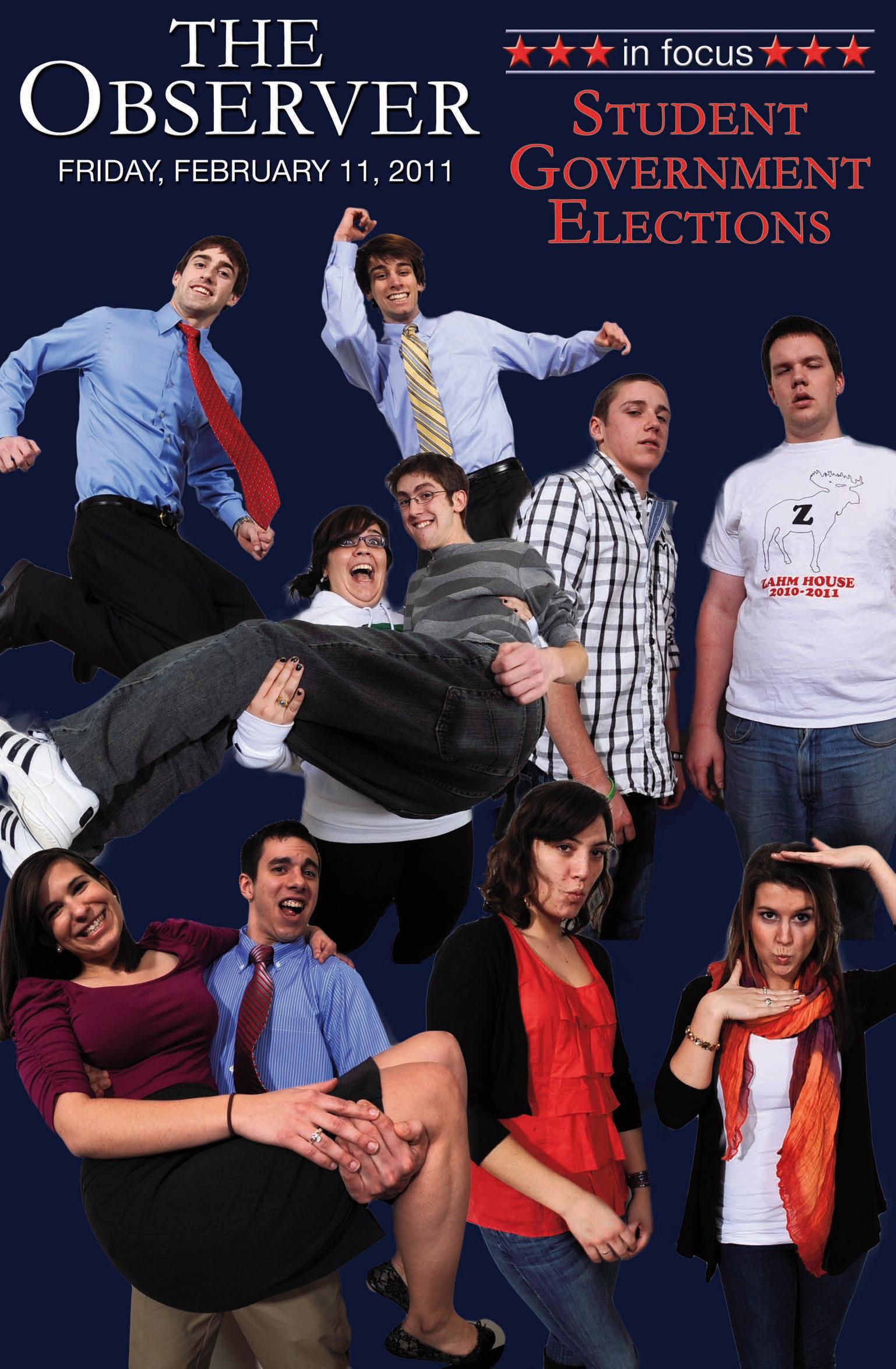
Photo Illustration by Dan Jacobs and Blair Chemidlin

Who They Are:
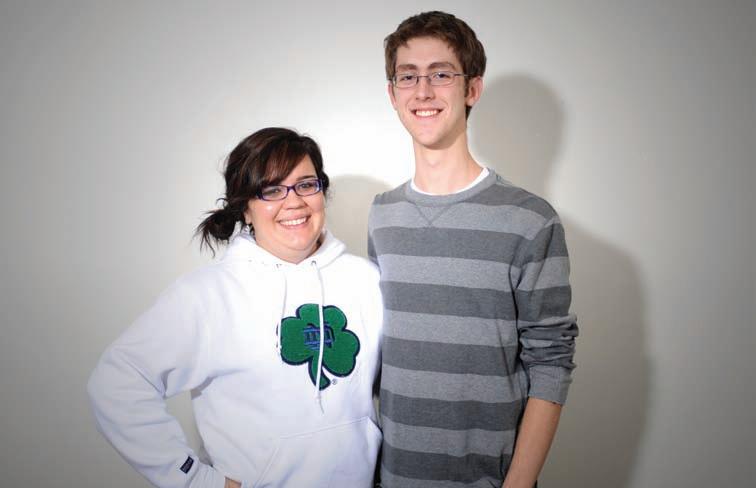
Presidential candidate Ricky Bevington is a sophomore in Sorin College and director of the First Undergraduate Experience in Leadership (FUEL) program. He is a Program of Liberal Studies major. Olivia Colangelo is a junior in McGlinn Hall, where she serves as hall president. She is a civil engineering major.
In their words
◆ Top Priority : Bevington and Colangelo cite University teamwork as one of their main goals, and their top priority is to put a student voice on the University’s Board of Trustees.
◆First Priority: If elected, this ticket’s first move will be to install printers in all academic buildings, especially O’Shaughnessy Hall, for students’ convenience.
In our words
◆ Best Idea : An annual State of the University address. Different leadership groups on campus would share with the Notre Dame community their goals for the year and their plans for achieving these goals.
◆Worst Idea: Creating a dorm equality commission to compare and correct differences in dorm experiences would not be efficient or necessary. Each dorm has a unique style, and hall councils can more effectively address any problems in dorm experience than an overarching committee.
◆Most Feasible Idea: Printers in all the academic buildings. Many academic buildings have printing sta-
tions already, so this goal is definitely within reach.
◆Least Feasible Idea: Stepan Center pep rallies for more sports. Even football pep rallies are not always well-attended.
◆Fun Facts: Bevington and Colangelo have known each other since they were 12 years-old. The two attended the same middle school and high school in Pittsburgh, Pa.
◆Notable Quote: “Students aren’t just people who live here part of the year. They’re people that really care about [South Bend] and really want to get involved, and we want to be able to show that”-
Bevington
Bottom Line
Bevington and Colangelo’s ideas apply to a broad range of student concerns. Some of their ideas may be logistically difficult but their core goals of university teamwork, student body unity and student government efficiency are a solid base for their platform.
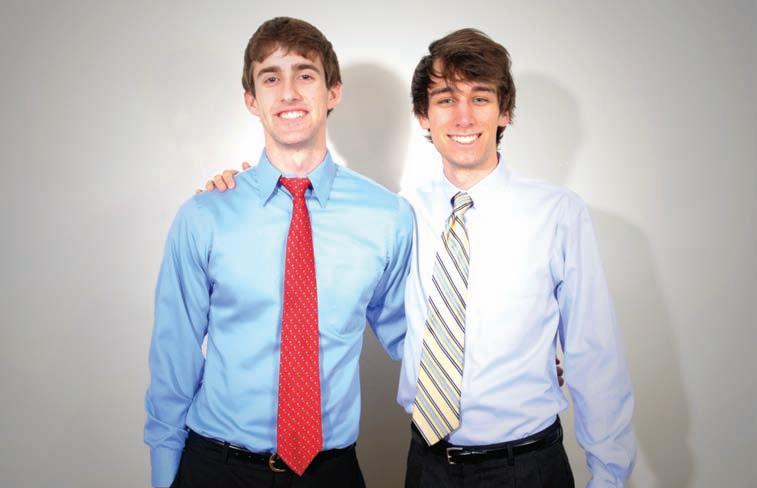
Who They Are Presidential candidate Patrick McCormick, a junior from Keough Hall, is a political science and Peace Studies major. Vice presidential candidate Brett Rocheleau is a sophomore finance and math major from Keenan Hall. McCormick is currently the chair of the Social Concerns Committee for student government, and he serves on the student advisory board at the Center for Social Concerns. Rocheleau is sophomore class president.
In Their Words
◆Top Priority: McCormick and Rocheleau plan to make Notre Dame the premier forum for events uniting public figures to advocate for social justice. They hope to create a series of events modeled after this year’s Playing for Peace tournament.
◆ First Priority: The ticket plans to broaden student government so it can work on multiple issues simultaneously and be more responsive to students’ desires.
In Our Words
◆Best Idea: Using the influence of the University and its athletic brand to host a series of nationally recognized events on campus to promote social justice. Notre Dame athletics could be a recognizable and powerful face for these causes.
◆Worst Idea: Creating a space on campus for students and faculty to meet in an informal setting over drinks. Legends already offers a restaurant and pub.
◆ Most Feasible Idea : Increasing student participation in local elementary school programs and inviting middle school students to “shadow” Notre Dame students with similar interests. The Center for
Social Concerns already collaborates with over 60 local organizations.
◆ Least Feasible Idea : Granting club status to a gay-straight student support group and encouraging the Office of Institutional Equity to add sexual orientation to its nondiscrimination clause. These groups have been denied recognition by Notre Dame’s administration numerous times.
◆Fun Facts: Rocheleau has webbed toes and loves to watch “Glee,” and two of McCormick’s role models are Disney characters Rafiki and the Mad Hatter.
◆ Notable Quote : “Keenan was built as a bomb shelter during the Cold War, so when the fire alarm goes off, I’m like, this thing’s gonna go down with a slow simmer; it’s not going to burn down.” –Rocheleau on his residence hall
Bottom Line
McCormick and Rocheleau offer a wide range of proposals related to social concerns and the University’s mission. Their ideas involve restructuring student government and altering the role of student body president to focus on large-scale social justice issues in addition to continuing to focus on everyday student needs.









Who They Are:
Student body presidential candidate
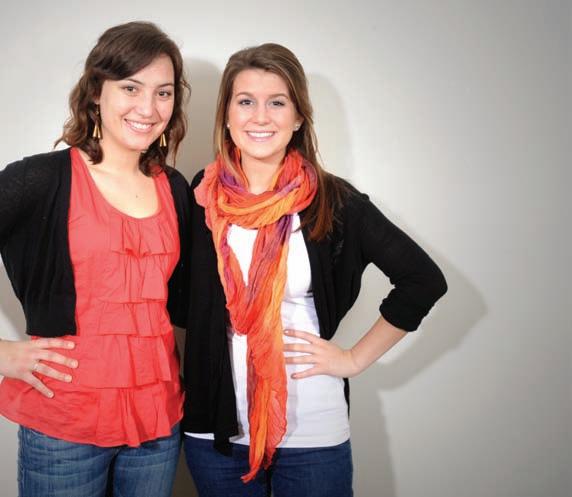
Catherine Soler, a junior from Farley Hall, is an accounting major. Vice presidential candidate Emily LeStrange is a political science and American Studies double major, formerly of Howard Hall and currently living off campus. Soler is the current student body president and LeStrange serves as Off-campus Concerns chair in Student Senate.
In Their Words
◆Top Priority: Soler and LeStrange plan to make student government a resource for student needs, with services ranging from tutoring, expanded sexual assault resources and a basketball ticket exchange.
◆ First Priority : The ticket pledges to enhance dorm life through talks with school administration, rectors and hall presidents. Soler and LeStrange hope to make changes, like improving kitchen supplies and offering student input in hiring rectors.
In Our Words

◆Best Idea: Soler and LeStrange want to get student input on what fast food restaurants will occupy the LaFortune Student Center when leases begin to expire in 2012. They also plan to give students more say in what items are sold at the Huddle.
◆Worst Idea: Study Space availability assistance. The team wants to design an interactive website to help students find open study spaces on campus, but the real problem is the rush of students ambushing study spaces around midterms and finals.
◆ Most Feasible Idea : The ticket’s Student Employment Reform and Job Fair is a two-pronged approach to improve oncampus employment. Revamping the current job board requires some technological streamlining but is plausible. Additionally, this year has proved campus fairs, such as the off-campus housing fair, can be effective for student needs.











◆Least Feasible Idea: Taxi reform, while a strong idea, would be difficult to implement. Although students use taxis regularly, this task might be too large.
◆Fun Facts: Soler, a native of Oyster Bay, N.Y., only eats New York pizza, and LeStrange is proud of her nickname “Bellatrix” after the “Harry Potter” villain.
◆Notable Quote: “Emily and I would be honored to serve the student body and hope that our experience is an advantage.” — Soler
Bottom Line
Soler and LeStrange tout their experience and current positions in student government as instrumental in the transition period in between student government administrations. Their top priority of using student government as a greater resource for students seems obvious and somewhat vague, but their platform contains specific goals such as a heated bus stop and a multicultural food festival. Given their experience, their goals are all feasible. They would also continue current relationships
Who They Are Student body presidential candidate
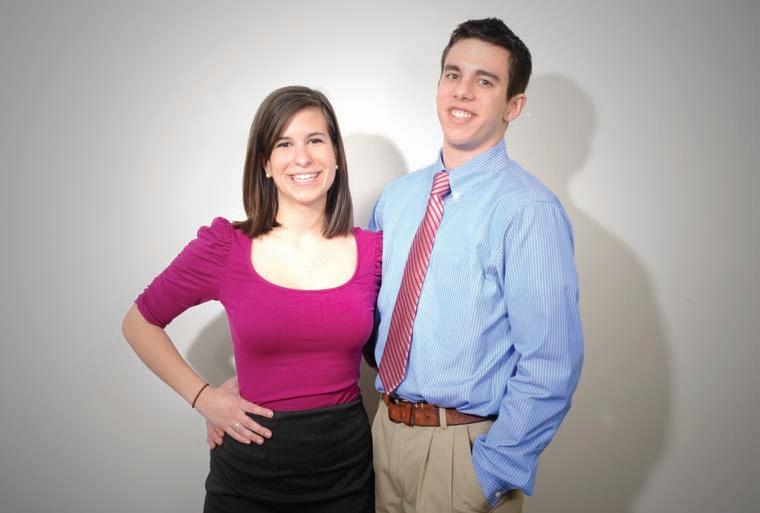
James J. Ward, current junior class president, is an aerospace engineering major who lives in St. Edward’s Hall. Vice presidential candidate and current freshman class president Heather Eaton lives in Cavanaugh Hall.
In Their Words
◆Top Priority:Ward and Eaton plan to put in the framework for eventual tuition reform.
“We want to release financial aid information and make everything fair,” Ward said.
◆First Priority:They plan to restore the price of quarter dogs to 25 cents and add more points to Grab n’ Go.
In our words
◆Least Feasible Idea:Working for the inclusion of sexual orientation in the nondiscrimination clause. Efforts to achieve this goal have been denied by the University administration for several years.
◆Best Idea: Addressing the campus drinking policy. Removing the policy against drinking and drinking games will keep students on campus, according to Ward and Eaton. The ban on drinking games isn’t cutting down on binge drinking, Ward said, but instead drives students off campus.
◆Worst Idea: Creating an off-campus crime database to track the safety of neighborhoods for current and potential residents. While parts of this plan are new, including landlord reviews, there is already a crime database in place.
◆Most Feasible Idea:Creating a fall week to kick off the football season. Ward said a “Fall AnTostal,” would hopefully be a joint effort between the Student Union Board and class councils.
◆Fun Facts:Eaton has double-jointed elbows. Ward was once a vegetarian, but then he rediscovered chicken.
◆Notable Quote:“My brother is a sophomore in high school, and he’s infinitely smarter than me. He wants to go here. I want to make sure he has an even better time here than I did.” – Ward
Bottom Line
Ward and Eaton have a well-rounded platform, and their smaller, reachable goals are mixed in with lofty aspirations for the future of Notre Dame. While making student government more approachable is an admirable promise, the ticket lacks concrete plans for this lofty goal.
Who They Are:
Freshmen Kevin Noonan and Matt Thomas represent Zahm House this year, running on its annual ticket for the student body president and vice president. Although many students think their campaign is simply a chance for the residents of Zahm to poke fun at student government, Noonan, who writes for The Observer’s Scene section, said his motivation lies deeper.
“I’m doing this solely to make friends,” Noonan said. “I have yet to.”
In Their Words
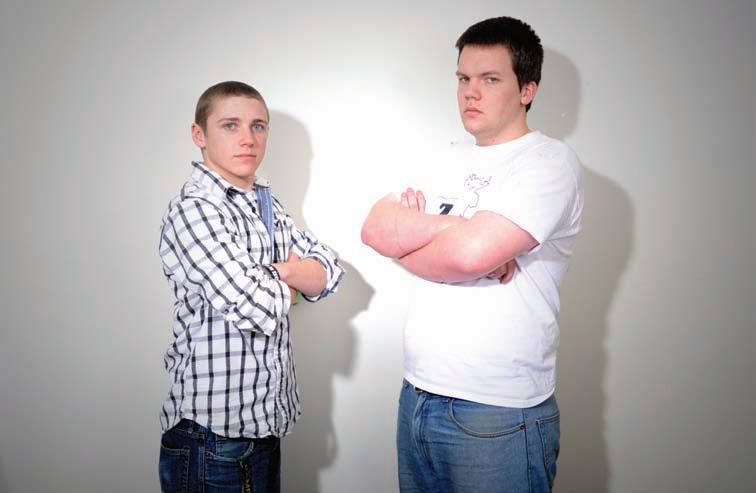
◆ Top Priority : Noonan and Thomas said they plan to construct a giant magic dome over campus through which they can control the weather as well as the surrounding scenery.
“Something like The Truman Show mixed with the dining hall from Harry Potter,” Noonan said.
◆ First Priority : The pair said their first act after being elected would be banning vegans from campus.
“I’m sensing some kind of conspiracy going on there,” Noonan said. “They’re doing something, and we plan on finding out what.”
This act would be followed closely by the elimination of Keenan Hall, Thomas said.
In Our Words
◆ Best Idea : “Hangover Hours” in the dining halls on Saturdays and Sundays from 2-4 p.m. Students schedules often vary on weekends, and more flexible hours at the dining halls would prove helpful for many.
◆ Most Feasible Idea : None.
◆ Least Feasible Idea : The construction of a new food court in place of Keenan Hall. Keenan will most likely remain standing, and LaFortune Student Center with its many eateries is less than five minutes away from the proposed food court.
◆ Fun Facts : Noonan has appeared as a “before” model on many commercials such as Hydroxycut and Acutane. Thomas was on the famous team of wizards that defeated Lord Voldemort.
◆ Notable Quote : “Lower standards, fewer memories, that’s how I live my life,” Noonan, on his outlook on life, which he plans to establish at Notre Dame.
Bottom Line Noonan and Thomas continue an annual Zahm Hall tradition by running for student body president and vice president with no prior student government experience and a very slim chance of winning the election. The election could be tense with so many names on the ballots, but Noonan and Thomas offer both a nice break from the solemn atmosphere, as well as some good entertainment for the student body.
Experienced candidates offer feasible, realistic campaign promises based on day-to-day needs of
Editor’s note:Each year, The Observer’s Editorial Board meets with all of the candidates for student body president and vice president.
This week, the board had a meeting with each ticket, during which the candidates presented the most important parts of their platforms and answered questions from Editorial Board members.
From this year’s five tickets, all with ambitious ideas, the Editorial Board was able to narrow its debate to two pairs of candidates.
While the majority of the board voted to endorse current student body president Catherine Soler and her running mate Emily LeStrange, a number of members voted to endorse Pat McCormick and Brett Rocheleau.
Beyond supporting different candidates, the majority and dissenting opinions represent different views of the role and scope of student government at Notre Dame.
The Observer Editorial Board narrowed the endorsement discussion to two tickets: one with simple and tangible ideas to enhance student life on and off campus and one with a sweeping vision of change within the Office of the Student Body President.
Current student body presi-
dent Catherine Soler and vice presidential candidate Emily LeStrange, Off-Campus Council chair in Student Senate, have experience in student government and suggest ideas such as student employment reform.

The ticket of Pat McCormick, chair of the Social Concerns Committee in Student Senate, and running mate Brett Rocheleau, sophomore class president, presents a compelling platform of uniting student government with larger social justice causes.
The majority of the Editorial Board backed Soler and LeStrange for the feasibility of their ideas that will directly affect student life — which, after debate, most board members concluded is the student body president’s primary role.
Soler and LeStrange propose a job fair to showcase the various job opportunities on campus as well as a reform of the current job board detailing campus employment opportunities. The duo emphasizes the difficulty students have finding on-campus employment, and pledge to improve it.
They also promote a plan to improve dorm life by examining the discrepancies among residence halls and working to
standardize what is offered, for example, through working with rectors and hall presidents to ensure that each dorm has relatively equal fitness equipment and kitchen supplies.
The pair also suggests smaller ideas for campus improvement, such as installing lights on McGlinn field, expanding tutoring resources and creating a heated bus stop at Library Circle.
Finally, Soler and LeStrange tout community relations as a primary focus of their platform. They hope to build on Soler’s relationships with local law enforcement and community leaders. These objectives are simple and practical and Soler has shown she can tackle the ideas she has outlined.
Bookstore, one of her main promises when she campaigned to lead the student body last year.
Soler also began to communicate regularly with law enforcement when alcoholrelated student arrests soared at the beginning of the school year. Her presence in the meetings with law enforcement and University officials helped to slow the rate of arrests and work toward improving the relationship between the University and the community. Another term for Soler would create continuity in the student body’s relationship with the community.
The role of the student body president is first and foremost to speak and work on behalf of the students ... Soler’s vision for student government focuses on day-to-day student needs. Her platform is standard. Yet her ideas are achievable and would directly benefit the student body.
As student body president, Soler quickly implemented the Rent-a-Text system in the Hammes Notre Dame
While Soler’s campaign focuses on student life, McCormick’s stated “to-do item No. 1” is to use student government to make Notre Dame the premier forum for national social justice goals. He has contacts in Washington, D.C., and his
accomplishment of spearheading the Stand for Sudan rally and Playing for Peace basketball tournament earlier this school year, he proved he can advance his social justice goals.
But is this the role of the student body president?
Like Soler, McCormick proposes ideas to improve student life. But the majority of the Editorial Board felt the dual mission of achieving large social justice goals and instituting improvements to life on campus was not feasible, especially in an institution known for its inefficiency.
The role of the student body president is first and foremost to speak and work on behalf of the students. McCormick’s first priority, as stated in his campaign platform, is his social justice agenda. His goals are commendable, but are best achieved in a different position.
Soler’s vision for student government focuses on day-today student needs. Her platform is standard. Yet her ideas are achievable and would directly benefit the student body.
We, the majority of The Observer Editorial Board, endorse Catherine Soler and Emily LeStrange for Notre Dame’s student body president and vice president.
Presidential candidate Pat McCormick can summarize his platform’s greatest quality and greatest flaw in a few simple, hypothetical questions.
“Are we going to have the student government we have always had, or can we build this bigger?” McCormick asked the audience during Wednesday’s debate, not waiting for a response. “Can we re-imagine what student government is about?”
McCormick’s 32-page platform description embodies the “bigger” student government he and running mate Brett Rocheleau envision. They seek to establish Notre Dame as the premier forum for events advocating social justice using current contacts as well as the influence of the University and its athletic brand, while simultaneously meeting students’ needs on and around campus.
This broad, bold view, combined with McCormick’s contagious enthusiasm about the potential future of such a government, earned the votes of these members of The Observer Editorial Board. Yet this same broad, bold view also drove a majority of the Board away from this endorsement.
In their campaign platform, McCormick and Rocheleau show full awareness of the relatively menial, yet necessary, day-to-day tasks of our student government and, more specifically, of the student body president and vice president.
For example, they hope to return the price of Quarter Dogs at the Huddle Mart to 25 cents rather than the 33 cents one currently costs.
According to McCormick, the information he and Rocheleau have gathered says pricing the hot dogs at 25 cents will cost the Huddle Mart somewhere around $2,500 and he hopes student government can supplement those fees.
The juniorsophomore combination also hopes to increase the undergraduate print quota, renew traditional dorm events such as “Wake Week” and the “Fisher Zoo” and make “Whine
Week” a yearly venture on behalf of student government.
These jobs cannot be overlooked in properly fulfilling the roles of student body president and vice president. Thus, McCormick’s ticket plans to create a new director of Constituent Services position to “coordinate all constituent service efforts across student government.”
The only way anyone will learn if McCormick and Rocheleau can fulfill their admirable ambition of both helping the students and helping the students to help others is to let them have a chance.
benefit a worthwhile cause.
While this director tackles the inefficiencies of the Student Senate in an attempt to meet these goals, McCormick and Rocheleau will spend their time primarily focused on expanding Notre Dame’s role in social justice.
The two dream of a concert following in the footsteps of “Hope for Haiti Now,” uniting actors, entertainers and politicians in an attempt to
This bold thought seems feasible because McCormick has accomplished similar projects before, though on a vastly smaller scale. In October, serving as chair of the Social Concerns Committee, McCormick led the effort which resulted in the Universitywide “Stand with Sudan” rally and “Playing for Peace” 3-on-3 basketball tournament. These events raised awareness across campus with the help of the men’s lacrosse and basketball teams, and culminated in a delegation from Notre Dame traveling to Washington, D.C., to spread the goal from the Notre Dame point of view.
Yes, the goals addressing social concerns laid out in McCormick and Rocheleau’s platform are much larger than a basketball tournament accompanied by a rally, but so are the capabilities of the student body president when compared to the capabilities of a Student Senate committee chairman.
McCormick and Rocheleau do not ignore the small things they will need to attend to,
but rather plan to fulfill those endeavors with the help of their senators and the director of Constituent Services. McCormick and Rocheleau want to pave the way for Notre Dame students to make a larger difference.
Would it be easier for these two to focus simply on the former set of goals? Of course. Are both sets attainable? Quite possibly.
Can McCormick and Rocheleau succeed in both regards? Their platform says they believe they can, though of course they can’t really know the answer. Neither can the Notre Dame students who may or may not vote for them Monday. This Editorial Board certainly does not have a solid way to prove they can or cannot.
The only way anyone will learn if McCormick and Rocheleau can fulfill their admirable ambition of both helping the students and helping the students to help others is to let them have a chance.
It is for this reason that we, the dissenting members of The Observer Editorial Board, endorse Pat McCormick and Brett Rocheleau for student body president and vice president.