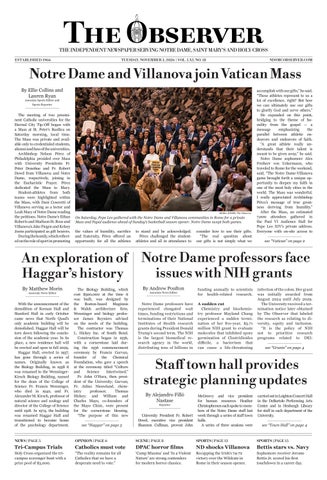
THE INDEPENDENT NEWSPAPER SERVING NOTRE DAME, SAINT MARY’S AND HOLY CROSS ESTABLISHED 1966
TUESDAY, NOVEMBER 3, 2026 | VOL. LXI, NO. 18
NDSMCOBSERVER.COM
Notre Dame and Villanova join Vatican Mass
By Ellie Collins and Lauren Ryan Associate Sports Editor and Sports Reporter
The meeting of two preeminent Catholic universities for the Eternal City Tip-Off began with a Mass at St. Peter’s Basilica on Saturday morning, local time. The Mass was private and available only to credentialed students, alumni and fans of the universities. Archbishop Nelson Pérez of Philadelphia presided over Mass with University Presidents Fr. Peter Donohue and Fr. Robert Dowd from Villanova and Notre Dame, respectively, joining in the Eucharistic Prayer. Pérez dedicated the Mass to Mary. Student-athletes from both teams were highlighted within the Mass, with Dani Ceseretti of Villanova serving as a lector and Leah Macy of Notre Dame reading the petitions. Notre Dame’s Ethan Roberts and Madison St. Rose and Villanova’s Jake Fiegen and Kelsey Joens participated as gift bearers. During the homily, which reflected on the role of sport in promoting
KEIRA JONES| The Observer
On Saturday, Pope Leo gathered with the Notre Dame and Villanova communities in Rome for a private Mass and Papal audience ahead of Sunday’s basketball season opener. Notre Dame swept both games.
the values of humility, sacrifice and fraternity, Pérez offered an opportunity for all the athletes
to stand and be acknowledged. Pérez challenged the studentathletes and all in attendance to
consider how to use their gifts. “The real question about our gifts is not simply what we
accomplish with our gifts,” he said. “These athletes represent to us a lot of excellence, right? But how we can ultimately use our gifts to glorify God and serve others.” He expanded on this point, bridging to the theme of humility from the gospel — a message emphasizing the parallel between athletic endeavors and endeavors of faith. “A great athlete really understands that their talent is meant to be given away,” he said. Notre Dame sophomore Alex Freiherr von Uckermann, who traveled to Rome for the weekend, said, “The Notre Dame-Villanova game brought forth a unique opportunity to deepen my faith in one of the most holy cities in the world. The Mass was wonderful. I really appreciated Archbishop Pérez’s message of true greatness deriving from humility.” After the Mass, an estimated 7,000 attendees gathered in the Paul VI Audience Hall for Pope Leo XIV’s private address. Everyone with on-site access to see “Vatican” on page 2
An exploration of Haggar’s history
Notre Dame professors face issues with NIH grants
By Matthew Morin
By Andrew Poulton
funding annually to scientists for health-related research.
Notre Dame professors have experienced elongated wait times, funding restrictions and terminations of their National Institutes of Health research grants during President Donald Trump’s second term. The NIH is the largest biomedical research agency in the world, distributing tens of billions in
A sudden cut Chemistry and biochemistry professor Mayland Chang experienced a sudden termination of her five-year, $3.71 million NIH grant to evaluate molecules that inhibited spore germination of Clostridioides difficile, a bacterium that can cause a life-threatening
Associate News Editor
With the announcement of the demolition of Keenan Hall and Stanford Hall in early October came news that North Quad’s only academic building will be demolished. Haggar Hall will be torn down following the conclusion of the academic year. In its place, a new residence hall will be erected and open in fall 2029. Haggar Hall, erected in 1937, has gone through a series of names. Originally known as the Biology Building, in 1958 it was renamed to the WenningerKirsch Biology Building, named for the dean of the College of Science Fr. Francis Wenninger, who died in 1940, and Fr. Alexander M. Kirsch, professor of natural science and zoology and director of the College of Science until 1918. In 1974, the building was renamed Haggar Hall and transitioned to become home of the psychology department.
The Biology Building, which cost $500,000 at the time it was built, was designed by the Boston-based Maginnis & Walsh architecture firm. Wenninger and biology professor James Reyniers advised on the needs of the building. The contractor was Thomas L. Hickey Inc. of South Bend. Construction began in 1936, with a cornerstone laid during the 1936 commencement ceremony by Francis Garvan, founder of the Chemical Foundation, who gave a speech at the ceremony titled “Culture and Science Intertwined.” Fr. John O’Hara, then president of the University; Garvan; Fr. Julius Nieuwland, chemistry professor; Thomas Hickey; and William and Charles Mayo, co-founders of the Mayo Clinic, were present for the cornerstone blessing. “The purpose of this new see “Haggar” on page 5
Associate News Editor
infection of the colon. Her grant was initially awarded from August 2024 until July 2029. The University received a termination notice later obtained by The Observer that labeled the research as relating to diversity, equity and inclusion. “It is the policy of NIH not to prioritize research programs related to DEI: see “Grants” on page 4
Staff town hall provides strategic planning updates By Alejandro Filló Nastase University President Fr. Robert Dowd, executive vice president Shannon Cullinan, provost John
McGreevy and vice president for human resources Heather Christophersen each spoke to members of the Notre Dame staff last week through a series of staff town halls. A series of three sessions were
carried out in Leighton Concert Hall in the DeBartolo Performing Arts Center and in Hesburgh Library for staff in each department of the University.
Reporter
see “Town Hall” on page 4
NEWS | PAGE 5
OPINION | PAGE 6
SCENE | PAGE 8
SPORTS | PAGE 13
SPORTS | PAGE 15
Holy Cross organized the tricampus scavenger hunt with a prize pool of $3,000.
“The reality remains for all Catholics that we have a desperate need to vote.”
‘Camp Miasma’ and ‘In a Violent Nature’ are strong contenders for modern horror classics.
Recapping the Irish’s 74-72 victory over the Wildcats in Rome in their season opener.
Sophomore receiver Jerome Bettis Jr. scored his first touchdown in a career day.
Tri-Campus Trials
Catholics must vote
DPAC horror films
ND shocks Villanova
Bettis stars vs. Navy
NEWS
2 | THE OBSERVER
Vatican
Continued from page 1 the Mass was provided the option to attend the papal audience. Donohue and Dowd commenced the event by each reading letters of gratitude to the Pope that expanded on the importance of sport and its relation to the Universities’ Catholic values. “At a time when many in our world struggle with loneliness and isolation, it has never been more important for the Notre Dame and Villanova families to come together, as we are doing during these days, to celebrate important ways we can build community, namely through our shared faith and our love of sport,” Dowd said. “Sport is a school that can teach us much about fraternity and peace.” The four teams, men’s and women’s basketball from both schools, offered the Pope gifts, including customized jerseys. Villanova’s gifts were presented by Kevin Willard, Tyler Perkins, Matt Hodge, Denise Dillion, Brynn McCurry and Jasmine Bascoe. Notre Dame’s were presented by Micah Shrewsberry, Braeden Smith, Logan Imes, Niele Ivey, Hannah Hidalgo and Kelly Ratigan. After holding a golden basketball while posing for a
photo alongside the Villanova representatives, the Pope dribbled and asked McCurry, “Where is the hoop?” Following the gift-bearing, Pope Leo began his official address to the audience with remarks emphasizing the influence spirituality and athletics have on a wider society — highlighting how they can work together to foster closeness, solidarity and peace. “During sporting events, there is the natural desire to cheer, often passionately, for one’s own side,” Pope Leo said. “It is important to remember that in any competition, the members of two teams, even when they have a competitive rivalry, are certainly not enemies. I hope, therefore, that despite the competitive nature of college basketball, there will be opportunities for the players and the fans of both teams to get to know each other in your days here in Rome.” After hearing Pope Leo’s message about sports’ many benefits and connections to the spiritual life, Freiherr von Uckermann said, “I feel that the most impactful message came right before the apostolic blessing, when he reminded the audience that, more than any individual or team award, the most important prize is the gift of eternal life. I’d say that this trip has made me think about
the parallels between sports and the journey to sainthood.” Pope Leo has previously written on the power of sport in his letter, “Life in Abundance,” released Feb. 6, 2026, in which he detailed his hopes that athletics might be a uniting force in the world rather than a divisive one.
TUESDAY, NOVEMBER 3, 2026
While the Pope recently underwent surgery. In his speech at the papal audience, Dowd said, “Your Holiness, you have been constantly in our prayers these last few weeks, as we have asked God to the intercession of our lady to grant you good health.
And, well, it appears that our prayers have been answered.” The Pope was not in attendance at the games on Sunday. Contact Ellie Collins at ecollin9@nd.edu and Lauren Ryan at lryan5@nd.edu
KEIRA JONES| The Observer
Fifth-year guard Braeden Smith, senior guard Logan Imes, fifth-year guard Kelly Ratigan and senior guard Hannah Hidalgo pose with Pope Leo XIV, who was presented with a jersey, a basketball and plaque.
PAID ADVERTISEMENT
PAID ADVERTISEMENT
NEWS
4 | THE OBSERVER
Grants
Continued from page 1 Research programs based primarily on artificial and non-scientific categories, including amorphous equity objectives, are antithetical to the scientific inquiry, do nothing to expand our knowledge of living systems, provide low returns on investment, and ultimately do not enhance health, lengthen life, or reduce illness. Worse, so-called diversity, equity, and inclusion (‘DEI’) studies are often used to support unlawful discrimination on the basis of race and other protected characteristics, which harms the health of Americans. Therefore, it is the policy of NIH not to prioritize such research programs. Therefore, no additional funding will be awarded for this project, and all future years have been removed,” the letter read. Chang said that after her grant was terminated, she was left without funding to pay the two graduate students and two postdoctoral researchers working on the project in her lab. “Suddenly, there was nothing, you know, to support them,” Chang said. Chang reapplied for the same grant, this time erasing all of her racial and ethnic information and including updated information on the research progress she had made. Chang identifies as an Indigenous American also of Hispanic and Asian descent. Her resubmitted application was scored in the top 2% of those submitted in its class and approved for $3.69 million in funding, about the same as the one that had been terminated. “It’s the same grant, except I had to resubmit it again as a new grant,” Chang said. While Chang has currently secured funding for her project, she expressed that uncertainty still looms large. “I don’t know if next month they’re gonna come and tell me, ‘We’re terminating your grant.’ And the thing is that you can’t plan a lot of the postdocs. They’re hired on a yearly basis, and so it’s not like your grant terminates and you tell them goodbye. You still have to pay salaries.” Longer wait times Multiple professors reported experiencing longer wait times regarding either receiving their grant funding or receiving a decision on their grant’s approval. Chemistry and biochemistry professor Olaf Wiest experienced an abnormally long wait time during one part of the grant approval process for his grant focused on enzyme mechanisms with the protein HMG-CoA reductase. “Sometime in March, I got contacted by the program officer about some additional information,” Wiest said. “And then I got crickets, nothing, silence.” Wiest didn’t hear from the NIH until late July, four
months later, when he was notified that his grant had been approved. In the past, he said, this stage would typically take four to six weeks. Biology professor Cristian Koepfli also experienced a delay in his grant process. “It did take probably a bit longer than it would have taken in the past. I had to submit some additional documents and descriptions,” Koepfli said. Felipe Santiago-Tirado, another biology professor, also shared that he has experienced delays in receiving funding, even after the approval of his grant. “Also, even for awarded grants [like mine], there has been long delays between the yearly disbursements,” Santiago-Tirado wrote in an email to The Observer. Bradley Smith, a professor in the department of chemistry and biochemistry, explained the grant process for his research using fluorescent molecules in cancer surgery treatment. “I had a grant under review, and it had been a long time waiting, and I was very frustrated, but, actually, that money did finally get awarded. I got it in June, although they backdated it to April, but I essentially got, more or less, the money that I had requested,” Smith said. Several professors speculated that these longer wait times are a result of various staffing changes within the NIH. Restrictions on international research Multiple professors at Notre Dame experienced new restrictions in their ability to utilize their grant money internationally. Marya Lieberman, a professor of cancer research, said that she had to cut most of her sub-Saharan African collaborators out of her research project due to a new NIH requirement to cut foreign subawards, instituted in May 2025. “Effective with the date of this notice and until the details of the new foreign collaboration award structure are released, NIH will not issue awards to domestic or foreign entities (new, renewal or non-competing continuation), that include a subaward to a foreign entity. Additionally, NIH will no longer accept prior approval requests to add a new foreign component or subaward to an ongoing project,” the NIH policy states. In September, NIH created a new application and award structure that allows collaborating U.S. and foreign research organizations to receive separate awards. Lieberman received a fiveyear grant from the NIH in 2022 that required collaboration with co-principal investigators from low-andmiddle-incomecountries. “We are trying to test a new technology for identifying substandard and falsified cancer drugs, and the way that cancer
drugs are prepared and used in the African hospitals made them a good initial location for the tests,” Lieberman wrote in an email to The Observer. The new restrictions took place during year four of her award, just as the team was preparing for clinical implementation in several hospitals. “It’s had a big impact on our work and our ability to study bad quality products that affect patients all over the world, including right here in the US,” Lieberman wrote. Lieberman was, however, able to secure funding from a foundation to continue funding most of her African collaborators. Lieberman also detailed how she shifted her NIH grant in the wake of the new restrictions. “We decided to pivot the NIH project to look at cancer drug quality in the American gray market, probing online sellers who evade FDA regulations,” Lieberman wrote. “The very first sample of a cancer drug that we received from an online US seller was one of the same brands that we had earlier collected in Africa.” Koepfli also said he experienced similar issues with his research with his partners in African countries. “With new NIH funding … we cannot pay study nurses or students or scientists in other countries,” Koepfli said. Koepfli detailed that much international research is no longer possible due to the lack of funds. “I do think it takes away a lot of opportunities to do great research,” he said. “Some things just can’t be planned because infectious diseases, as we all know, they pop up in new places. Cases go up, cases go down, and I think there is much less room for adjusting to such situations,” Koepfli said Koepfli said he was required to provide documentation for his new grant to show that all the biological samples for his research were in freezers at Notre Dame and that he would not require partners in Africa to do work for the project. “This has been a really big change,” Koepfli said. Fewer grants approved Smith and Santiago-Tirado also stated that fewer grants are being approved than in years past, although some individual grant awards have been larger. “I’ve heard from colleagues that have gotten scores in the 14 percentile and are not getting their grants awarded,” Santiago-Tirado wrote in an email to The Observer. Data from the nonprofit Association of American Medical Colleges confirms that the number of NIH grants awarded was reduced by 12% between fiscal year 2024 and fiscal year 2026. Contact Andrew Poulton at apoulton@nd.edu
TUESDAY, NOVEMBER 3, 2026
Town Hall Continued from page 1
In their speeches, each administrative leader highlighted the University’s efforts in athletics, artificial intelligence, South Bend partnerships and its strategic framework. Dowd kicked off his speech by sharing that the U.S. Senate’s passing of the Protect College Sports Act on Sept. 28 will affect Notre Dame by increasing student-athlete protections and benefits, and noted that specific information about guiding parameters will come once the bill is passed by the House of Representatives. He acknowledged AI’s role in improving efficiency but maintained that Notre Dame needs to ground its efforts in the principles outlined in Pope Leo’s Magnifica Humanitas encyclical, asserting that unlike human dignity, efficiency is “not an ultimate value’.” For Dowd, the ability of students to be “AI fluent” regardless of their degree pursuit is very important — as is the ability to be creative. These efforts creates friction according to McGreevy, as some classes allow and others restrict AI. Because graduation requirements encompass different subject areas, students will take courses with both policies. “We want there to be classes that don’t use AI,” McGreevy said. “This develops the skills, the muscle memory, the capacity to really address questions.” Cullinan urged everyone to take the university’s AI training, warning that AI creates vulnerabilities, such as the emergence of phishing scams. The panelists moved to discussing the Pathways to Notre Dame program, which Dowd called a “historic investment in financial aid.” He stressed that the university is still working on communicating and increasing awareness of its financial aid support system, so that prospective students don’t dismiss applying based on tuition
cost. Referring to the University’s need-blind policy, which includes international students, Cullinan stressed the University’s goal of increasing the diversity of students living and studying together on campus. In addition to increasing diversity on campus, University administration hopes to strengthen partnerships with the city of South Bend, through projects like the Colfax Corner and the inaugural Notre Dame Arts Biennial. The Colfax project will create job opportunities for companies in South Bend and help revitalize downtown, while the Arts Biennial will be a series of cultural and artistic events running from January to June 2027. “The current community plan is the first one that is interested in using the words South Bend, Indiana,” McGreevy said. Dowd said the University envisions a future where it uses its academic and research expertise to be part of a community working together. When discussing the 2033 Strategic Framework, McGreevy shared that the project is only in its third year. For the next 7 years, McGreevy said the University will continue to work with the Vatican as its lead partner for its sustainability initiative and on appropriate AI use. McGreevy stated the University will be undertaking one of its “biggest capital investments” in the form of advances to science and engineering buildings. The provost acknowledged that the University’s global rankings are seen by the administration as an issue. As such, there is a goal for the University to increase its reputation on this stage. Cullinan concluded by providing insight into the draft of the upcoming financial report, declaring that despite inflation, nonessential spending has decreased by 4%. Contact Alejandro Filló Nastase at afillona@nd.edu
PAID ADVERTISEMENT
NEWS
TUESDAY, NOVEMBER 3, 2026
Holy Cross hosts Tri-Campus Trials By Julian Orozco Reporter
In an event that brought together students from the University of Notre Dame, Saint Mary’s College and Holy Cross College through a scavenger hunt, Holy Cross’ Student Government Association facilitated the first-ever Tri-Campus Trials on Thursday evening. The event required students to be organized into teams of six students, with two students from each campus. Registration occurred at 6:30 p.m. in Vincent Atrium. Students could come with partners in mind or find a group during a social gathering before the competition began. Students then set out to complete sets of clues across the tri-campus. Through the challenge, students competed for a $3,000 prize pool. Members of the winning team each earned a $300 voucher for Crystal Mountain Resort, a ski resort. Players for the secondplace team each won a $100 Visa gift card, while members of the third-place team each received a $75 gift card. Forty-two participants attended in seven groups. Only the top 24 winners were able to gain prizes. Freshman Charles Muzi, a Holy Cross student in the Gateway Program, helped to organize the event. He shared that the inspiration for the programming was his experience being a former camp counselor and a youth group leader. “I had done a scavenger hunt previously in my youth group, just on a much, much smaller scale,” Muzi said. He also shared that being a Gateway student allowed him to meet more people, which may have been more limited if he had been admitted via regular decision to the University. “I never would have made these great friendships. And so I thought, what’s a way to be able to show this to people and show people what they’re missing out on and bring together what’s supposed to be a tri-campus community,” Muzi said. “And that’s when I settled on a tricampus scavenger hunt.” In the planning phase for the event, organizers took into account students who may have had social anxiety or are more introverted to find other team members during registration with a social gathering. An event like this, according to Muzi, “lives or dies by
advertising.” He routinely travels between Holy Cross and Notre Dame, but for the event, he also went to Saint Mary’s for recruitment. Campus engagement co-chair junior Elizabeth Dickinson assisted with the marketing and planning of the event as a member of the Holy Cross Programming Board. She explained key challenges when it came to promoting the scavenger hunt across the three campuses. “Whether it’s creating posters or trying to get both of the campuses to post this event on their social media platforms, marketing is the biggest thing, especially with an event at this scale,” Dickinson stated. She plans to help assist with improving promotion of the event next year. However, Dickinson felt that the event was an overall rewarding experience for the tri-campus community to have. She shared that she was proud that Holy Cross was able to lead this programming. “I think it really shows that, although we’re small numbers, we really care about the impact of the tri-campus,” she said. “And if we have even a small role in shaping this community and how things come to be in the next couple years, then it’s really good that we’re the ones to do it.” Holy Cross director of student activities Carolyn Kitz explained that the event also ref lected Holy Cross’ broader commitment to community and student engagement. She noted that bringing students together from different campuses in teams is not only “another layer of building that community and broadening out the heart of who Holy Cross is, but reaching out to Saint Mary’s and to Notre Dame.” Kitz said that more collaborative activities are currently in discussion with the Student Activities Office at Notre Dame and soon at Saint Mary’s about further tri-campus events. Through this, they hope to “do at least one, maybe a few big events a year that would be all three campuses working together.” Muzi hopes that students formed new relationships through the event and feel more comfortable reaching out to and visiting students on different campuses where they may “connect as a community in a way that they otherwise might not.” Contact Julian Orozco at jorozco1@hcc-nd.edu
Haggar
Continued from page 1 biology building is to provide facilities for the teaching of all divisions of biological sciences, and to aid in graduate research. Unusual features of the hall will include a photomicrographic laboratory that will be constructed so as to ‘f loat’ within the structure, eliminating all vibrations. The delicate instruments in this room will be housed in concrete benches weighing several tons,” the Notre Dame Alumnus, the University’s alumni magazine at the time, wrote in 1936.
THE OBSERVER | 5
Education used the basement of the building from 1972 until it moved to the RaclinCarmichael Building off Notre Dame Avenue in 2005. On Oct. 19, 1974, following months of renovation funded by a $750,000 gift from the Haggar Foundation, Haggar Hall was dedicated for the psychology department. The newly renovated building housed seven classrooms, including a 150-seat auditorium as well as psychology research rooms with a variety of controlled research variables including lightproofing, soundproofing and one-way mirrors. The Haggar Foundation is a Dallas-based organization founded by Joseph Haggar Sr. The gift was provided by sons Edmond R. Haggar ’38, the foundation’s chairman andJoseph Haggar Jr. ’45, as well as daughter Rosemary Haggar Vaughan in honor of their father. Daniel Lapsley, the chair of the psychology department from 2009 to 2016 and now a professor emeritus, explained that over time renovations replaced the Haggar Hall Library, several classrooms and conference rooms to increase faculty office space. These renovations led to misalignments in the mechanical system of the building. As a result, Lapsley said, “all the mechanicals in the buildings don’t work well anymore.” Despite noting a lack of space for conferences and structural problems, Lapsley fondly remembered seeing his colleagues in the hall. “If you talk to some of my colleagues, they’ll say there’s one thing they miss about Haggar Hall and that is the hallways are not 100 yards long and moreover, there was more reason to bump into our colleagues,” Lapsley said. “We would visit with each other. You don’t often see our colleagues that much anymore, you know, more people work from home and their
offices are far-f lung, no one wants to go up to the fourth f loor to see their colleagues.” Nevertheless, he said, he is not nostalgic for Haggar Hall, citing the need for a modern home for the department. “I think Notre Dame has always wanted, our aspirations for all the departments, not just psychology, is that we become players in the discipline,” Lapsley said. “So, Haggar Hall was kind of old and dilapidated, but we did not want to be an old dilapidated department, so our ambitions are such that we required new space. So, I’m grateful for Haggar Hall. It did bring us all together. It served as a foundation for our department.” By the end of their time in Haggar, Lapsley shared that the psychology department was in seven different buildings across campus, so the department had been requesting a larger area to combine all of the department into one building. When Corbett Family Hall was completed in 2017, the psychology department moved there. In 2019, the Office of Sustainability took up Haggar Hall for temporary use. Geory Kurtzhals, executive director of campus sustainability, noted that while the Sustainability Office used Haggar Hall in the past, its offices are no longer within the building. Kurtzhals noted that neither she nor any current members of her team have experience working in the building. Currently, the Office of Sustainability is located in the Campus Distribution Center. Since then, Haggar Hall has served as a swing building for departments whose primary buildings are under construction. Additionally, it has served as home of the Fischoff National Chamber Music Association.
Haggar Hall Construction and Completion Haggar Hall was designed with a culture room for “dangerous germs” in the immunology department. The building was also built with a f lexible f loor plan so that rooms and laboratories could be switched without structural changes. The first f loor was initially designed for laboratories with no stationary furniture, while the second f loor was designed to include classrooms, a lecture hall and the dean’s and other administrators’ offices. The second f loor also featured a herbarium, reading rooms and a library. Finally, the top f loor was for additional laboratories and a greenhouse. In February 1937, as the building neared completion, O’Hara wrote in the Alumnus requesting funds for a wide range of additional materials, including aquariums, zoology tables and pathology desks, which amounted to $58,000, nearly $1.4 million in today’s dollars. By March, the installation of new equipment had begun — a process that continued through April. The building was in full-time operation beginning with the 1937-1938 academic year. Contact Matthew Morin at In 1952, the Museum of mmorin2@nd.edu Biodiversity, which had previously been housed in the Science Building since 1884, moved to the Biology Building while the old Science Building was renovated and transformed into LaFortune Student Center. Joanna Larson, the current curator of the Museum of Biodiversity and GreeneNieuwland Herbarium, noted that while the museum’s collections were stored in the Biology Building, they were not on public display and were only occasionally used as teaching resources. Following the completion of the Galvin Life Science Center in 1971, the collection and the biology department moved again. The University began to renovate the building to prepare it for use by a different department. Courtesy of the Hickey Family Indiana University’s South The facade of Haggar Hall, formerly known as the Biology Building, Bend Center for Medical has remained unchanged since 1937. Now it is being demolished.
OPINION
6 | THE OBSERVER
TUESDAY, NOVEMBER 3, 2026
Tuesday takes: The midterm race to the bottom By Harrison Fischer Columnist, “Tuesday Takes”
This is the first midterm I’ve followed as a voting-age adult, and I have to say, I’ve spent most of the cycle wincing and wishing American politics could be more decent. I do not mean quiet, agreeable or boring. Elections should involve fierce arguments about serious issues. Candidates should criticize one another, challenge bad records and explain why their opponents should not hold office. But some basic boundaries ought to remain, and in the final weeks of these campaigns, both parties seem to be racing to see who can blow past them first. Two stories, one from each side, show just how low things have gotten. In Alaska, Republican Senator Dan Sullivan is running against Democrat Mary Peltola. He is also sharing the ballot with Dan J. Sullivan, a retired teacher who has done little campaigning and initially sought to appear under virtually the same name and party affiliation as the incumbent. That alone would be suspicious. It became worse when The New York Times reported that members of Peltola’s campaign participated in an effort to recruit the second Sullivan and discussed finding other candidates whose names might confuse voters. A former campaign manager said Peltola knew about the effort, while Peltola has denied any knowledge of it. Recruiting a candidate because he shares an opponent’s name is an embarrassingly stupid political trick. It assumes Alaskans are too careless to notice the difference and too gullible to realize they are being manipulated. Peltola’s campaign wasn’t attempting to offer voters another qualified choice; they were attempting to trick them into selecting the wrong person. If Democrats believe Peltola is the better candidate, they should trust Alaskans enough to make that case honestly. Republicans have hardly shrouded themselves in honor either. In Ohio, Republican gubernatorial candidate Vivek Ramaswamy aired an advertisement featuring Donna Arthur, the estranged mother of his Democratic opponent Amy Acton. Arthur accused her daughter of being a liar and made the case against her in the election. The advertisement omitted an important piece of context, however: Acton was removed from her mother’s custody after suffering severe neglect and abuse, including sexual abuse by her stepfather. Ramaswamy took the story of a woman who survived childhood neglect and sexual abuse and turned it into an attack ad against her. Using a candidate’s family member in an attack ad is already questionable, but an estranged mother whom Acton has accused of neglecting her and remaining with the man who sexually abused her daughter is especially horrific. Whatever the disagreements voters may have with Acton, the trauma she experienced as a child has nothing to do with her qualifications to govern Ohio.
ASHLEY ZHENG | The Observer
Ramaswamy eventually pulled the ad, but only after initially doubling down and spending hundreds of thousands of dollars airing something that never should have made it onto television. While these two episodes are not identical, what connects them is a basic contempt for voters from both parties. Rather than persuading citizens, the campaigns sought to confuse, shock or disgust them. Whenever something like this comes out, partisans on each side point to something the other side did. Democrats bring up Republican election trickery, and Republicans bring up Democratic ads that got personal. They might both have a point, but I don’t think it matters much. “They started it” couldn’t even get you out of trouble for a playground argument in kindergarten, so I don’t know why it should work for people running for Senate. I’m not asking for opposing candidates to be best friends with each other. I just want the attacks to have something to do with the job. Talk about their votes, their policies, whether they’re competent, whether they’ve been honest in office. Don’t recruit people with the same name to attempt to deceive voters, and don’t put someone’s estranged mother in an ad. Equally importantly, if your own party crosses a line, call it out right away instead of waiting until after the polls close to see if it worked. Our politics reflect what voters reward. If deception and cruelty produce victories, campaigns will continue using them. If we reject candidates who rely on those methods, both parties will eventually be forced to adjust. I am not asking politicians to stop fighting. I just want them fighting about the things that actually affect the people they hope to govern. That should not be a radical demand. However, campaigns
are only going to change if voters make them, and since this is running on Election Day, that means you. If you haven’t voted yet, go vote. And when you’re filling out your ballot, think about more than just the party next to each name. Think about how those candidates ran. Did they argue about anything
real, or did they spend the last few months trying to confuse people or dig up someone’s worst memories? Your vote is the one thing every campaign can agree that they want, so it’s worth asking whether the way they went about trying to get that vote is something you want to reward. PAID ADVERTISEMENT
The views expressed in this column are those of the author and not necessarily those of The Observer. Write to Harrison Fischer at hfische3@nd.edu
OPINION
TUESDAY, NOVEMBER 3, 2026
THE OBSERVER | 7
Catholic universities must protect creation By Maria Eduarda Grill Columnist, “Below the Dome”
The whole world was f looded. Then, the cosmos fell back into chaos. That is how János Székely, grand chancellor of Pázmány Péter Catholic University, retold the story of Noah to a room of Catholic university leaders in Budapest. Last month, I attended the Catholic Universities Partnership annual conference with the Nanovic Institute. The theme was the protection of the integrity of creation, and several board members addressed the audience during the opening session. Székely’s talk was the one I kept returning to long after it ended. He began where Scripture begins. In the creation story, he noted, the phrase “God said” appears 10 times, so the world was created in 10 utterances, the same number in the commandments God would later give his people. John’s Gospel carries the idea forward when it opens with “In
the beginning was the word...” For Székely, those utterances still live inside creation. “Every atom has in itself the presence of those 10 words,” he said. Creation carries an objective truth, and as he put it, “Man is also a part of the objective truth.” The f lood, in his telling, is what happens when that order is abandoned, and the world slips back into chaos. Caring for creation is our responsibility, he said, and seeing the world ecologically means confronting how much we have failed to understand. In his words, “The ecological perspective is an awakening to our ignorance.” This idea shaped the whole conference. That way of addressing the natural world changes the weight of the conversation. If the world exists by chance, I owe it nothing. A world that exists out of necessity is simply there to meet my needs. If the world is a gift from a Father who made it with care, protecting it becomes an act of gratitude, and
it deserves care for its own sake, whether or not I benefit. Székely then turned from Genesis to the way we live now. Many believe the world is a free competition where the strong survive, he said, and that possession leads to happiness. Both beliefs, he argued, shrink what a human being is because we are also culture, art and love. Even private property, he said, has limits. The church has made this argument before, and the world has listened. Pope Francis released “Laudato si’” in June 2015, timing it to shape the United Nations climate talks in Paris that December. The encyclical is widely credited with helping build the momentum behind the Paris Agreement. In it, Francis gave the logic that Székely described a name: the technocratic paradigm, the habit of treating the world as something to measure, control and use, trusting that more efficiency and more growth will repair whatever we damage along the way. Székely
captured the same idea in a single line. “The path of life is not quantitative truth.” For all the force of his argument, I left Budapest wondering whether the people in that room heard his warning as one about themselves. It would be easy to take Székely’s critique as aimed at someone else: corporations, markets, a secular culture that measures everything. But universities, Catholic ones included, live by the same logic he warned against. We compete for rankings, measure success in endowment size, research dollars and graduate salaries and treat growth every year as proof of mission. I know that logic from the inside. Searching for summer internships and studying for midterms this fall, I often find myself measuring my own life by the numbers: applications sent, offers received and grades earned. A free competition where the strong survive describes the race for prestige among universities and their students
as well as it describes any market. If the path of life is not quantitative truth, the institutions gathered in Budapest may have the hardest awakening to do. Near the end, Székely turned to the final judgment. “In the final judgment, [God] will ask if when I was thirsty, you gave me drink, when I was hungry, you gave me food and what type of world you leave to the next generation.” Catholic universities face that question twice. They help decide what kind of world the next generation inherits, and they also form the students who will inherit it. Answering Székely honestly means turning his critique on their own campuses first. The views expressed in this column are those of the author and not necessarily those of The Observer. Write to Maria Eduarda Grill at mgrillda@nd.edu
Catholics must vote, even when it ‘doesn’t matter’ By Zack Pohlman and Duncan Stangel Assistant Managing Editor and Opinion Editor
News out of the Vatican this week might have the Founding Fathers rolling in their graves. Catholics have a tenuous history of political participation in the United States. This history includes politicians who have been attacked for being “agents of the pope.” It features prominent figures like former New York Gov. Al Smith, the Kennedy family, former President Joe Biden and Vice President JD Vance. It contains derogatory political cartoons and signs that state “Irish need not apply.” And now, a sitting pope has voted in an election in the United States. The Vatican confirmed that the American pope cast a mailin ballot in Tuesday’s midterm election. A recent, and inadvertent, leak of voter rolls from multiple Illinois counties meant that Robert Francis Prevost’s voting history was publicized. As people quickly began scrounging for some shred of controversy, it was easy to realize that he is a fairly normal (possibly even uninteresting) voter. He voted in the Democratic primaries in 2008 and 2010 then voted in the Republican primaries in the next three election cycles. As for general elections, he voted in 2012, 2014, 2018, 2024 and 2026. Like many Catholic Americans, he’s voted for candidates of different parties, while also participating about half the time. From an American political
ASHLEY ZHENG | The Observer
perspective, does his vote even matter? Leo voted in Illinois, a state that has been carried by Democrats for nine consecutive presidential elections. This year’s midterm election will decide who fills the retiring Sen. Dick Durbin’s seat. The last time an Illinois senator was up for reelection, the incumbent Democrat won by 15% of the vote. It holds a variety of policies that don’t align with Catholic doctrine, as does almost every state in the United States that falls consistently on either side of the political aisle. Illinois has some of the most permissive abortion laws in the country, and last year Gov. JB Pritzker signed a state law legalizing physician-assisted
death. Meanwhile, both the Pope and Pritzker stand against the Trump administration’s immigration policy, protecting the dignity of human beings whose civil rights are regularly disregarded by violent immigration enforcement tactics. Illinois, like every single state in the country, represents policies that are not aligned with Catholic doctrine. In a gerrymandered, politically uncompetitive Illinois, Pope Leo is hardly the deciding vote for the balance of power in any legislative or executive election in which he participates. Against this backdrop, what good is the vote of any Catholic, let alone the pope? Catholics ought to remember
that voting is not merely a political act and that by choosing to vote or not vote for a particular candidate, we are making a moral statement on their policies. Even if your vote “doesn’t matter” in the sense that the election results will be unchanged, the Catechism of the Catholic Church demands that we engage in voting. The section on The Authorities in Civil Society says in paragraph 2240, “Submission to authority and co-responsibility for the common good make it morally obligatory to pay taxes, to exercise the right to vote, and to defend one’s country.” The reality remains for all Catholics that we have a desperate need to vote. Our free will
enables us to select the candidate, but as Catholics — in adherence to teachings that may differ from the opinions held by a wide majority of Americans — we ought to vote for the goals of the faith we love and hold dear. In the spiritual context, that is spreading the Gospel. In the deeply practical sense, it is feeding the hungry, giving drink to the thirsty, clothing the naked, housing homeless people, visiting the sick and imprisoned and burying the dead. It is the work that is ours to perform but never ours to finish. The Catechism, paraphrasing the Epistle to Diognetus, reminds us that we are castaways, we are “resident aliens,” we are not truly at home in America or any other country. We may vote in U.S. elections, but as Christians we are “citizens of heaven,” merely passing our days on earth. If you’ve voted already, you contributed to the mechanism that keeps our democracy intact. If you haven’t, we implore you to consider voting, regardless of who it is for. Voting gives Catholic morality a voice in public life, one that can be heard across the country and lives up to the words above the entrance to the Basilica of the Sacred Heart: God, Country, Notre Dame. The views expressed in this column are those of the author and not necessarily those of The Observer. Write to Zack Pohlman at zpohlma2@nd.edu and Duncan Stangel at dstangel@nd.edu
SCENE
8 | THE OBSERVER
TUESDAY, NOVEMBER 3, 2026
I survived ‘Camp Cinewhack’ By Marguerite Marley Scene Copyeditor
Horror movies are the best, aren’t they? Especially this time of year: curling up by the fire, bowl of candy by your side, listening as your friends gasp and scream at what is happening on screen. With Halloween upon us, the DeBartolo Performing Arts Center presented back-toback double features on Friday and Saturday night. The theme was slashers at summer camp, a genre I admit I do not have much experience with. So sans any other Halloween plans, I might have attended “Camp Cinewhack” on the second night. Both nights, the opening film was Jane Schoenbrun’s much anticipated film “Teenage Sex and Death at Camp Miasma,” which won the Queer Palm at this year’s Cannes Film Festival. This was the film I was the most excited for as I am a big fan of Schoenbrun’s previous film, “I Saw the TV Glow.” On Friday night, the center also played “Friday the 13th Part 2,” but since I hadn’t seen the first one, I thought it best to skip Friday night. When I attended on Saturday, the second film was “In a Violent Nature,” a Canadian film that came out in 2024. “Teenage Sex and Death at Camp Miasma” follows queer filmmaker Kris Williams (Hannah Einbinder), who’s been tasked with reviving the Camp Misama franchise — an 80s horror franchise akin to “Halloween” or “Friday the 13th” — after it fell off in the early 2000s due to its transphobic premise: The main villain of the franchise is a ghost child called Little Death (Jack Haven) who switches between being male and being female on a weekly basis. Despite all this, Kris is a big enough fan of the franchise to make a pilgrimage to go visit the recluse actress who played the final girl in the first movie, Billy Presley (Gillian Anderson), and tries to get her to sign on to be a part of the reboot. As they discuss a potential for a franchise reboot, more and more parts of the film come to life. Anderson is giving it her all. Though I’ve been a fan of hers for a while, this project really shows her range. She’s able to do a lot with the persona. Einbinder, as the polyamorous queer filmmaker, was also very good at making me annoyed at her. They joked about polyamory one too many times, but the first couple of times, the joke worked very well. Anderson and Einbinder had a lot of chemistry which really made the film pop. I also really enjoyed Haven as Little Death, though they didn’t have a lot to do. I think Haven really nailed the physicality of these silent yet deadly killers. Another auxiliary performance
I really enjoyed was Amanda Fix as a young Billy. She was able to capture the ethereal energy found in a lot of 70s and 80s horror icons. Overall, I really enjoyed the film. Beside the baffling sequence toward the beginning of the film in which the two women eat fried chicken in an overly sensual way — it almost made me throw up my popcorn — the visuals were incredible. Though I found it a bit overly literal, at times I did really enjoy it and was glad I had the opportunity to see it on the big screen. After a 15-minute intermission, “In a Violent Nature” started. The film follows a serial killer awakened after 10 years of being at rest, who manages to kill four out of seven friends staying in a cabin near where he
was murdered. “In a Violent Nature” spends more time with the killer than the victims. The films spends much of its time watching the killer’s back as he lumbers through the woods, getting his perspective. With the third and fourth kills, the audience does not even see the victims, instead just getting a view of the lake they are swimming in, interrupted only once by one of the girls popping back above the surface to scream right at the end. Since the films follows the killer for most of the story, the tension of the kills is not really there. Instead, the filmmakers put a lot of effort into the gore and special effects. While that is something I appreciate in a horror movie, it was a
little disappointing when that seemed to be the majority of the film. I tend to like my horror with a bit more substance than that. The movie is almost completely devoid of a score, using the sound of nature to underscore a lot of the horrific things happening throughout the film. I really appreciated the decision as when there was lot of noise, it tended to be during important kills. This movie is also notable for being set mostly during the day, distinguishing it from other slasher films. The cinematography was incredible, and even when I wasn’t enjoying the story, I could always look at the pretty scenery for a change of pace. Maybe it’s because it was the second film of the night, but I
did find it to drag on a little bit, even though it was only about 90 minutes long. If you are looking for a slasher with substance, this really isn’t it, but it’s still a fun addition to any scary movie night. Both of these movies are strong contenders for modern horror classics, and though I did enjoy “Teenage Sex and Death at Camp Miasma” more than “In a Violent Nature,” they were both incredible theatrical experiences I would recommend. If horror movies are your thing, or if you just want to keep the Halloween spirit alive before Mariah Carey eventually takes over the airways, check either of these films out. Contact Marguerite Marley at mmarley01@saintmarys.edu
PAID ADVERTISEMENT
What Just Happened?! A 2026 Midterm Results Discussion Friday, Nov. 6 4:00–5:30 p.m. 215/216 McKenna Hall Opening reception with light refreshments. Open to the public.
Join us for an engaging panel discussion as CNN Correspondent Arlette Saenz, Wall Street Journal Editor at Large Gerard Baker, and Professor of Political Science James Curry unpack the results of the 2026 US midterm elections. This panel will analyze the election’s key outcomes, voter behavior, ongoing contention, and the broader implications for American democracy. Don’t miss this chance to hear from top experts about what it all means for the future of US politics.
IN DISCUSSION WITH:
Arlette Saenz
James Curry
CNN Correspondent based in Washington, DC
Professor of political science, University of Notre Dame
Gerard Baker Editor at large, Wall Street Journal
Democracy Initiative Gallivan Program in Journalism, Ethics, and Democracy Rooney Democracy Institute
Learn more at go.nd.edu/democracy
SCENE
TUESDAY, NOVEMBER 3, 2026
THE OBSERVER | 9
‘Hells Highway’ explores gruesome driver’s ed By Sienna Williams Scene Writer
I thought that Halloween was over, but on the first day of November I spent an hour and a half of my Sunday scaries at DPAC, viewing the bleak, retrospective documentary “Hells Highway: The True Story of Highway Safety Films.” OK, I understand how innocuous that title may come across. “What’s so scary about safety,” you may rightfully inquire. But in response, I would ask you to shift your focus to that fourth word, “true,” as it alludes to a fatal fact and the fear thereof. Through a collection of archived footage, Bret Wood, the documentary’s director, explores the visceral imagery of gruesomely gory driver education films from the ’60s. Among those f lashing bits of traffic tragedies are interviews that explore the driving motivations, scholastic implementations and overall societal implications of the morbid highway safety motion pictures. Maybe that intrigued you. Spooky season may be over, but it is never too late to get in your daily dose of disturbia, right? Wrong. Nothing about this film felt like entertainment, aside from a few facetious jokes strewn about the script. The drivers’ education videos exhibited make no attempt to be modest; instead, moments of motion picture blind the eye with bright blood and mangled bodies displayed within, around and sometimes even under the bucket of bolts that buried them there. All real, all raw. Those narrating their own
ASHLEY ZHENG | The Observer
understanding of what went right and what went wrong contextualize the usage of film to educate students without directly involving them in what they should learn. They describe the usage of motion pictures to facilitate the education of children on manners, stories on how to spot a shoplifter and cops on the more ubiquitous forms of training. However, the most impactful kind of educational film was on traffic safety. The morbid driver’s education videos were distributed among high schools nationwide, leaving no room for the imagination. Students were forced to witness the repercussions of reckless driving
and think twice about speeding, sleeping or skipping the seat belt — it could be the last thing they ever do. As a non-driver, I found this documentary helpful in its simultaneous defending and detesting of the visual publication of highway safety films. I was not swayed to the further fear of driving, nor was I convinced otherwise, only debriefed on the bleak canon event of driver’s ed students in the ’60s, among other things. As the film f lashed violent scenes of signal 30s (the police’s term for fatal traffic accidents), older men, producers, videographers and scriptwriters defended their roles in the
output of the highway safety films, content in the belief that even one of their viewers could avoid a traffic tragedy due to viewing them. On the other hand, those much younger described a different story. As they watched them in their adolescent years, some felt indifferent to the precaution, some mildly traumatized, others desensitized. This “shock-value” styled treatment began in the late 1950s, as photographers and, later, videographers ventured to the scenes of tragedies to capture macabre imagery. Films produced during this brazen era were mostly done so tastefully, however. Films observed by rookie
PAID ADVERTISEMENT
Leading the Holy Cross Way An Executive Series with President Marco J. Clark Ed. D.
President/CEO: South Bend - Elkhart Regional Partnership
BETHANY HARTLEY The Cost of Caution: Why Regions, and People, Drift
11-6-26
1-2:30 PM
Driscoll Auditorium
Free to the Public
and soon-to-be drivers consisted of some rather inviting, Holly wood-style titles like “Wheels of Tragedy,” “Highways of Agony” and “Last Date.” Most commonly, the films would depict those experiencing the joy of the newfound freedoms that come with driving, only to erupt in fatal collisions, despite prior warning. Of course, they did so with good intentions, for they thought displaying the dreadful would inspire a more defensive drive. Maybe witnessing the highway safety films is not for you. Al right, that’s okay. Try listening to them instead. Within the documentary, descriptions of the students’ reactions to the safety subjection varied minutely, as most were consumed with shock, as intended. But, when prohibited from leaving the classroom, students were simply asked to listen. So, instead of seeing still cadavers twisted into unfathomable shapes, or witnessing bones protruding from those who had narrowly escaped fate, students shut their eyes to the not-so-sweet sounds of the suffering injured or the cries of the loved ones of those lost. Words were diminished to morphemes in the times of such paramount anguish. This fact supports the idea of Richard Wayman, the director of these Highway Safety Foundation films, that “there are no words to describe agony, only sounds.” However, allow me to reiterate that “Hells Highway: The True Story of Highway Safety Films” not only depicts the frightening, unforgiving and nonfictitious realities of reckless driving but delves deeper into the perceived benefits, and lack thereof, of the macabre motion pictures. The backlash bred in outrage over the production of such visceral and violent educational apparatuses did not come until years after the images of mutilated men and women wrecked left the reminder of highway safety in the minds of experienced, novice and prospective drivers alike. If you do not care for this kind of documentary, I completely understand. Although I have only scratched the surface of what it entails. What has been described was not inferred but witnessed. So much within it I have failed to cover, but heed my warning: It does well to condense 10 years’ worth of a scare campaign onto the screen, as the men who had captured, seen and produced it speak fondly or poorly of its effect on the individuals it had reached. Contact Sienna Williams at swilliams04@saintmarys.edu
PAID ADVERTISEMENT
SPORTS
TUESDAY, NOVEMBER 3, 2026
THE OBSERVER | 11
FOOTBALL
Lytle: When should we worry about the defense? By Henry Lytle Associate Sports Editor
While Notre Dame emerged from Gillette Stadium in its 99th matchup against Navy with a 35-13 victory, the first-half performance posed some significant concerns on the defensive side of the football. Notre Dame found itself trailing 13-7 with 1:52 remaining in the second quarter after Navy led its third consecutive drive of over 11 plays to score a touchdown, with all of the damage being done on the ground. While Notre Dame was still missing key contributors up front, the performance begs the question of consistency ahead of the most critical game of the season against Miami. First, let’s not overreact to a 22-point victory in a road rivalry game, albeit against 2-6 Navy. This season in college football has provided weekly upsets that seemingly get more ridiculous the longer the season goes on. Saturday evening, previously ranked No. 2 Ohio State fell on the road to unranked USC as a touchdown favorite. BYU fell on the road to 4-4 UCF in overtime two weeks ago. Three weeks ago, No. 1 Georgia fell to unranked Auburn in a rivalry game. What has provided great entertainment for fans has shown that anyone is beatable any given Saturday, and Notre Dame is not immune to this reality of the sport. The Irish have been able to win the games they should this season, all by double digits, which cannot be overlooked. With that being said, as I experienced the first half of the Notre Dame-Navy game in Gillette Stadium, doubt was left in Notre Dame’s consistency, especially in unfamiliar road environments. The Midshipmen began the game with a 14-play, 44-yard drive that ate 8:17 off the clock and followed that up with another 16-play, 66yard drive consuming 8:43 from the clock. After the consecutive field goal drives, quarterback Jackson Gutierrez led a touchdown drive of 11 plays that retook a 13-7 lead for Navy and dominated time of possession, wearing down Notre Dame’s defense even more. Not only did Navy control the tempo of the game with its methodical rushing offense, but Gutierrez picked apart the Irish defenders with strategic cuts behind his offensive line, timely pitches and the occasional pass. Gutierrez led the Midshipmen to 163 yards rushing on 4.7 yards per carry in the first half. The quarterback alone accounted for 110 yards and the lone touchdown by the end of the game. I will acknowledge that Notre Dame is struggling with injuries throughout its defensive unit. Junior safety Brauntae Johnson has struggled with a foot injury;
junior linebacker Kyngstonn Viliamu-Asa is working back from an arm injury; junior cornerback Leonard Moore was available but did not play; and senior linebacker Drayk Bowen exited the game with a lower-body injury in the second quarter. While these players are some of the biggest contributors on that side of the football, Notre Dame has no excuse to get exposed via the ground attack as it did. After the Irish began the season generating pressure with ease, the pass rush has struggled in the last four games. The defense failed to record a sack against BYU and Navy, while only managing two against North Carolina and Stanford. While Chris Ash’s defense recorded 13 sacks across the first four games, there has been little to no success creating quarterback hurries in the month of October. Notre Dame’s best players at the line of scrimmage are all playing, even if not fully healthy, and they’ve been beaten physically in the last two matchups against Navy and BYU in different ways. Against BYU, quarterback Bear Bachmeier was excellent on third down, going 8 for 12 and accounting for all 4 touchdowns with 2 rushing, 1 passing and 1 receiving. Then, Notre Dame’s run defense looked extremely porous against an offense that simply elects not to pass in Navy. Every offense presents a different matchup for this unit, but why has Notre Dame all of a sudden been unable to stop the run after entering the BYU game as a top-10 unit nationwide? I am not the first person to criticize the play calling on the defensive side, but it should be noted that the defense has been unable to generate pressure and continues to rely on zone coverage. If the Irish play consistent soft-zone coverage against Miami, they will get shelled through the air, much like the BYU performance or the 2025 Texas A&M performance. In 2024, as the previous defensive coordinator, Al Golden discovered the capabilities of the defense in predominantly man coverage after the NIU loss. To play effective man coverage against top-tier opponents such as Miami, the Irish need playmakers on the outside, which they have at the cornerback, safety and linebacker. While many guys are not fully healthy, they will need to make an impact if Notre Dame’s defense is going to be able to stop Miami. Chris Ash should run more man coverage. He should blitz more to create pressure because Notre Dame simply hasn’t had that in the last four games. These defensive woes come at the worst possible time in Notre Dame’s season. After losing on the road to BYU, the Irish looked flustered on the field and still banged up against Navy despite coming off the bye. Nobody is expecting
Notre Dame to be perfect on the season, especially in such a chaotic year around college football, but this Miami game has been circled for over a year as a revenge rivalry game on home turf. It just so happens that the Hurricanes possess one of the best receiving duos in the country with Malachi Toney and Cooper Barkate, along with a Heisman candidate Darian Mensah at quarterback who has thrown for 25 touchdowns and only 1 interception through eight games. To beat Miami, Notre Dame will need a defensive improvement under Chris Ash, playing the best football on that side of the ball it has under his scheme. In the Marcus Freeman era, when the pressure is on, Notre Dame has been able to show up on defense at home, excluding the Texas A&M game in 2025. It has often been sluggish offensive performances that led to losses
DECLAN HUGGINS | The Observer
Senior safety Luke Talich makes a critical fourth down stop against Navy at Gillette Stadium on Oct. 31, helped secure the 35-13 victory.
against Ohio State, NIU and Marshall. Notre Dame fans have a right to be concerned considering the matchup, injuries and recent performances when defense has been ol’ reliable and now is
presenting issues. However, all will be forgiven if Notre Dame beats Miami. Contact Henry Lytle at hlytle@nd.edu
PAID ADVERTISEMENT
SAINT MARY'S PROGRAM IN THEATRE PRESENTS
PER FOR M A N CES NOV 5TH & 6TH AT 7:30 PM NOV 8TH AT 2:30 PM LITTLE THEATRE MOREAU CENTER FOR THE ARTS
SCAN FOR ticke ts
SPORTS
12 | THE OBSERVER
TUESDAY, NOVEMBER 3, 2026
ND MEN’S SOCCER
ND takes late momentum into ACC tournament By Jack Muething Associate Sports Editor
Notre Dame men’s soccer concluded its regular season with a 7-5-3 record across 15 matches. The team went 4-4 in conference play and finished eighth, ultimately securing the last seed to host a home game for the first round of the ACC tournament on Wednesday, Nov. 4. The program had one of its most successful starts in recent years, going 5-1-2 in its first eight games, including a five-game winning streak with wins over two ranked opponents. One of those victories came against then-No. 1 Stanford, though it ended up not nearly as impressive as it seemed at the time. The Cardinal finished the season at No. 25 in the final rankings, so the win lost some of its value. Notre Dame also beat then-No. 3 Clemson, which finished the year with a 12-22 record and a 6-1-1 record in conference. Notre Dame handed the No. 2 team in the country its only conference loss of the season.
Another impressive part of that five-game winning streak was the timely goal scoring in the clutch against both Clemson and Michigan. The Irish scored winning goals after the 85th minute in both contests, seemingly displaying an ability to win late in games, but that luck of the Irish seemed to run out. After the Stanford game, the team went 2-4-1 in its next seven games, including a four-game winless streak immediately following the upset. They began the stretch with a loss to Syracuse, a team that finished 13th of 15 teams in the ACC, with only its win in conference play coming against Notre Dame. The team followed up the home loss with another disappointing result, a draw with UIC, who finished its season 4-6-4. Then, Notre Dame lost to California at home before traveling to Chapel Hill to face North Carolina and losing 7-1. That game seemed to spark a change in form for Notre Dame as it beat Boston College in the next game 2-0. They followed that
up with a 2-1 loss to Louisville. The Irish put together a very solid performance against the No. 10-ranked Cardinals, as they were a goal-line clearance away from the match ending in a draw. The season came to an end Friday night with the Irish picking up a dominant 3-0 win against the Duke Blue Devils. Notre Dame finished the season strong, but its wins in that stretch came against the bottom two teams in the ACC, so it’s hard to gauge how well that will translate to the ACC tournament. Multiple newcomers were key players who made a huge impact for the Irish in the regular season. Four new Irish players started every game for the team, and the three leading goal scorers all made their Notre Dame debuts this year. Freshman forward Tristan Tropeano led the team in points with five goals and two assists, including the game-winner against Clemson in the dying moments of the game. He was followed by Vlad Walent, who transferred from Wake
Forest and started every game for the Irish at outside back this year. He had four goals and three assists in the regular season, including the critical assist to Tropeano against Clemson. Freshman forward Michael Capretto rounds out the top three as another impact player, picking up three goals and four assists in regular season play. A key returner has been senior midfielder Nolan Spicer, who returned from an injury in the offseason and began his season with a slow start. Spicer finished the year with goals in backto-back games while also picking up an assist against Duke. The team captain had two goals and seven assists as a junior, and he is finding his form at the right time for the Irish ahead of postseason play. One of the main stars for the Irish has been the man between the pipes, Blake Kelly. The junior goalie is fourth in the ACC with a 76% save percentage, but he leads the conference in total saves with 63 and saves per game with 4.2 per contest.
Another team captain, Kelly picked up shutouts in two of the Irish’s final three games, which was a significant rebound from his earlier-season play. While Kelly allowed six goals against North Carolina, he did still pick up six saves against the Tar Heels on 18 shots. Since then, the Irish defense has played very solidly, largely helped by the return of senior defender Sean McDowd. He got injured in his second game of the year, but since his return, he has started the last three games, which will help the defense tremendously as it gets ready for ACC tournament play and potentially the NCAA tournament. Right now the Irish are on the edge of the bubble for the NCAA tournament. A win against Virginia would go a long way to solidifying a spot in the tournament, whereas a loss may knock them out altogether. Read the unabridged version of this article at ndsmcobserver.com Contact Jack Muething at jmuethin@nd.edu
ND MEN’S BASKETBALL
Collins: Irish may have found the path to success By Ellie Collins Associate Sports Editor
In the wacky world of college basketball, the madness is not limited to March anymore. With the rise of the transfer portal and the idea of incremental program progress out of fashion and perhaps obsolete altogether, teams can surprise out of nowhere in games where the talent margin is generally razor-thin. The task nowadays is to blend a cohesive unit and get them to play with passion for the season writ large. Those two ingredients have been sorely lacking in Micah Shrewsberry’s first three seasons at Notre Dame. Let us not chalk it up to divine intervention that a trip to Rome and a papal visit cured the program’s longstanding ills. Shrewsberry’s fourth edition, however, showed the kind of passion, fortitude and defensive intensity Notre Dame fans have been longing to see in its 74-72 comeback upset victory over Villanova, a projected NCAA Tournament team, in the Eternal City Tip-Off at Palazzo dello Sport on Saturday. As mentioned, surprise victories happen regularly in the now-professional world of college hoops. But not all wins are the same, and this one showed that maybe Shrewsberry put together a nice blend of talent (despite an extremely limited NIL budget) to offset the exodus of top players, including star point guard Markus Burton, in the offseason. Burton’s replacement from Gonzaga, fifth-year transfer Braeden Smith, expertly directed the Irish and proved cold-blooded at the free-throw line down the stretch on his way to 16 points and
4 steals. He led a number of the 10 roster newcomers who made impressive debuts across the pond. But it was one of the Irish’s two holdovers from last year who proved the difference-maker. Sophomore forward Brady Koehler, whom Shrewsberry touts as a potential NBA player, keyed a 14-4 run in the Irish’s late comeback from a 66-60 deficit with less than four minutes remaining. He hammered home a fast-break dunk in the face of star Wildcat guard Tyler Perkins on an assist from Smith to cut the lead to one
with 1:44 left. Then, after Notre Dame took the lead on a three-pointer from an unlikely source in fifth-year Winthrop transfer center Logan Duncomb, Koehler blocked a three-point attempt and drilled two shots from the line to give the Irish a 74-70 lead with four seconds left to snuff out any chances of a loss. Koehler not only filled the box score (16 points, 8 rebounds, 2 steals, 2 blocks), but he played with grit and toughness against a big and experienced front line. He was not alone in the thrilling
comeback win in front of a raucous crowd. The Irish had a 16-15 lead early in the first half but then trailed the rest of the way, by as much as 10 points on multiple occasions, until the late surge. Recent Notre Dame teams tended to let go of the rope in such situations, but this group never did. The Irish did it with relentless defense and offensive rebounds on a night they shot only 35% from the field, as they forced 20 turnovers by the Wildcats Wildcats that led to 20 points and tallied 16 secondchance points. It is much easier to
PAID ADVERTISEMENT
pull an upset when the shots are falling. It is much more impressive when you do it by outworking and outhustling your opponent. There is still a lot of work to be done. With the Irish picked to finish 16th out of 18 in the ACC’s preseason media poll, the season could still prove to be another disappointment for the Irish. But all roads that lead to success come from the way Shrewsberry’s squad did it in Rome. Contact Ellie Collins at ecollin9@nd.edu
SPORTS
TUESDAY, NOVEMBER 3, 2026
THE OBSERVER | 13
ND MEN’S AND WOMEN’S BASKETBALL
Men’s team shocks Wildcats to open college season
Irish secure Eternal City sweep
By Ben Hicks
By Ben Hicks
The pope may have attended Villanova, but God still loves Notre Dame. In game one of year four, Micah Shrewsberry’s Irish finally hit the big shot, made the big stop and sealed the win as Notre Dame came back from 10 down in the second half to shock the Wildcats. Although Pope Leo XIV wasn’t in attendance Sunday, both teams were granted some divine healing pregame. Notre Dame’s key offseason addition, graduate forward Logan Duncomb, returned from an injury suffered at Dayton on Oct. 17, while Villanova regained the services of senior forward Kwame Evans Jr. following a leg injury of his own. Notre Dame, tailored in new navy uniforms, won the tip, and the college basketball season was underway. Villanova senior guard Tyler Perkins opened the scoring with a left-handed banker before Notre Dame sophomore forward Brady Koehler answered with a left-lane drive of his own. It was a three-point barrage early on for both sides, as each group canned 3 triples in the first four minutes of action. Cornell transfer Jake Fiegen buried his first two in a Nova jersey, but Irish senior guard Braeden Shrewsberry paced the scoring early, capitalizing with a pair of threes on broken possessions. After the elder Shrewsberry called on his bench for the first time, highly touted freshman guard Jonathan Sanderson was welcomed to college basketball with a questionable flagrant 1 from the whistle of Pat Driscoll. The resulting foul shots were sandwiched between Villanova scores, punctuating a 9-0 run. With the crowd on its side and a much deeper, more athletic roster, only its 12 early turnovers were holding back Kevin Willard’s Wildcats. That embarrassing display of ball security probably angered the coach more than when his bald head capped off a fan engagement “Name That Dome” segment, which also included St. Peter’s Basilica and the Pantheon. The Irish displayed improved team offense compared to a season ago, especially with Gonzaga transfer Braeden Smith piloting play. He was just 1 for 6 shooting, but Notre Dame got better looks with its veteran crew on the floor. Villanova also failed to capitalize on a clearly laboring Duncomb, only leading the rebounding margin by 4 at the break. All told, Villanova led Notre Dame 35-31 at the intermission, but the outnumbered Irish faithful controlled the
A lthough an Augustinian currently resides in the Apostolic Palace, it was all Holy Cross on the hardwood in Rome Sunday as No. 13 Notre Dame women’s basketball downed Pope Leo XIV’s alma mater Villanova. The 99-75 victor y earned the Irish a sweep of the Eternal City Tip-Off doubleheader, after the men completed a shocking comeback in the matinee session. To no surprise, senior guard Hannah Hidalgo paced the Irish from start to finish. The preseason ACC Player of the Year opened her Wooden Award campaign w ith a near-triple double of 32 points, 8 assists and 7 rebounds. Sophomore for ward Leah Macy added an efficient 27 points and 14 rebounds in her collegiate debut as the Irish opened up a 19-point edge at the break and never looked back. It was a slow start for Notre Dame as Hidalgo was only able to pierce the net nearly three minutes in. However, that was the only scoring drought of the night. The Irish quickly regained momentum to ignite the now-majority Notre Dame crowd after fans inordinately fizzled out follow ing the men’s matchup. “I really appreciate all the fans that came out, our benefactors that made this possible,” head coach Niele Ivey said. “It just speaks to something about our University and how connected we are.” Ivey also noted how the team was inspired by the men’s comeback, adding that the only thing better than one w in is two. After Hidalgo had to carr y the load throughout the improbable Elite Eight run last March, Ivey made it an emphasis to surround her star w ith more scoring threats. That plan cr ystallized in the second quarter as the Irish canned five triples to blow open the game. A 14-5 run to start the period was supported by two treys from prized Princeton transfer Madison St. Rose and another from highly touted freshman guard Jenica Lew is. The Irish defense was also stif ling over the first 20, holding Nova to just 26 points on 11 for 35 shooting. If the first half belonged to Hidalgo as a reminder of past success, then the second half was a look to the future as the coming-out party for Macy. The Kentucky native,
Sports Editor
Sports Editor
MARIELLA TADDONIO | The Observer
Sophomore forward Brady Koehler drives to the basket against Villanova in Rome. He led the Irish with 16 points in the 74-72 win.
energy and excitement heading to halftime. Shrewsberry led all scorers with 10, while Villanova’s staggering 15 turnovers were caused in part by 2 steals each from Smith, Koehler and senior guard Logan Imes. Willard was blunt when assessing his team’s ball security postgame. “You can’t have 20 turnovers.” Villanova began to build the lead thanks to Perkins at the start of the second half. The Virginia native connected on three consecutive triples, igniting Nova Nation just after Duncomb scored his first Irish points to momentarily bring the deficit to one. Villanova freshman giant Luigi Suigo, an Italian native, slammed home an alley-oop as Nova began to open the lead. The Wildcats held a 10-point advantage at the under-12 timeout, when mascot Will D. Cat jokingly seemed to pull his hamstring while learning the Irish jig from Leprechaun Riley. While very funny, it was a sign of things to come for Villanova. Duncomb picked up his fourth foul shortly thereafter, but the Wildcats were unable to capitalize as Notre Dame countered every blow to keep the margin within six. It stayed there for roughly the entire eight minutes Duncomb was siloed to the bench. He returned at the underfour timeout after Smith calmly converted three free throws to cut the deficit in half. With dueling “Go Irish” and “Go Nova” chants ringing through Palazzo dello Sport, the final four minutes had the atmosphere of a Final Four game. It was the Irish faithful who earned the chance to erupt, as Koehler threw down a monster schiacciata over Perkins to make it a one-point game with 90 seconds left. Smith then stripped Royal on the other end and set up Duncomb with yet another crafty pass. From there, it was the big moment from the big player that Micah Shrewsberry
had long awaited. Despite attempting just three treys all of last season, Duncomb calmly cashed the go-ahead three, and Notre Dame’s climb back was complete. A clutch block and a pair of free throws from Koehler sealed the deal, and the Irish closed it out 74-72. “Brady Koehler’s a beast. He was so good down the stretch for us, defensively and offensively,” Shrewsberry said with a smile. “We’re a tough team,” Smith said of the comeback. “During the off-season, we talked about being the toughest team. To have the opportunity to show that tonight was tremendously fun.” Shrewsberry also recognized Smith, his prized portal point guard. He credited the North Carolina native for steadying the ship, adding, “The poise that he plays with, he wills you to the right moment.” Notre Dame received balanced scoring from its newly constructed roster as Smith, Koehler, Shrewsberry and fifth year guard Ethan Roberts all landed in double figures. The Irish turned the Cats over 20 times for 20 points and also grabbed a staggering 17 offensive boards. Notre Dame only led for a little more than four minutes, but you couldn’t tell by the euphoria spilling from the Irish bench into the student section. Shrewsberry was awestruck by the environment, saying, “I’ve been coaching for 25-plus years, and I had the biggest smile on my face as we were pulling up to the arena. To see [fans] out tailgating … I’ve been a part of some really cool games and this is right at the top of the list of experiences.” The Irish return to South Bend to open the Purcell Pavilion portion of the schedule this Thursday against the Mercyhurst Lakers. The 7 p.m. tipoff will be streamed on ACCNX as the Irish look to remain perfect in home openers under Shrewsberry. Contact Ben Hicks at bhicks2@nd.edu
who missed all of her freshman campaign w ith an injur y, tallied a double-double of 19 points and 10 rebounds in just 14 minutes. “Macy’s so big for us. I was telling her, ‘Welcome back.’ For her to show up and show out how she did, I’m so proud of her,” Hidalgo said postgame after audibly gasping at the sophomore’s stat line. Hidalgo f lashed her keen playmaking ability more in the second half, setting up St. Rose and Lew is again from beyond the arc. Hidalgo credited the threepoint tandem for her assist total, adding, “I’m so grateful for my teammates. They were available for me to get the assist.” Ivey also recognized Hidalgo’s innate ability to take over the game. “It’s amazing. She’s somebody that I love to coach. I love her tenacity. I love that she’s a dog,” the former Notre Dame guard herself added. The Irish ballooned the lead above 20 for much of the half, cruising to a dominant start to the season. Notre Dame was scorching from all areas, finishing a staggering 56% from the f loor, 43% from three and 70% from the stripe. It was Irish supremacy on the interior as well, w ith Macy leading the group to a 50-32 edge in paint points. The matchup also marked Hidalgo’s second output over 30 points on the European continent, after putting the world on notice during her first career game in Paris 2023. “Basketball has taken me all over. Not a lot of teams are able to be in the position that I’m in, so I’m so grateful,” Hidalgo said. The Irish w ill welcome fellow Holy Cross institution Stonehill to South Bend when they return to the U.S. this week. Both Ivey and Hidalgo were open about how important this trip was for their relationships w ith faith, but Ivey also believes the trip was transformative for her group on the court. “I think it’s gonna help us grow. This is a new group, so they’re learning in the fire. They’re blossoming in front of our eyes,” Ivey said. The home opener against the Skyhawks is scheduled for a 7 p.m. tip-off inside Purcell Pavilion on Friday evening, w ith streaming available on ACCNX. Contact Ben Hicks at bhicks2@nd.edu
PAID ADVERTISEMENT
SPORTS
TUESDAY, NOVEMBER 3, 2026
THE OBSERVER | 15
FOOTBALL
Notre Dame wins its ninth straight over Navy By Henry Lytle Associate Sports Editor
Notre Dame played Navy in a Halloween rendition of the rivalry matchup, with the Irish winning the past eight straight games. It was a spooky first half for the Irish, who saw the Midshipmen run 43 plays and nearly quadruple their time of possession. However, they bounced back in the second half, appearing like a different team. Notre Dame earned a hard-fought 35-13 win in Gillette Stadium, dominating all facets of the latter half to emerge victorious in the rivalry. Navy began with the ball and promptly led a long, winding drive that set the tone for its firsthalf performance. Midshipman quarterback Jackson Gutierrez converted a critical fourth-and-3 to keep the drive alive from Notre Dame’s 43-yard line. But after 14 plays, the offense stalled, setting up a career-long 38-yard field goal by Nolan Bartley. The drive was Navy’s longest of the season in total plays and time of possession, and it concluded with a 3-0 lead. When it was finally Notre Dame’s turn, junior quarterback CJ Carr wasted no time in his first series, finding senior wide receiver Jordan Faison for a 24-yard completion. The Irish moved past midfield on another 13-yard completion to senior wide receiver Jaden Greathouse but found themselves facing a critical fourth down on the Navy 29yard line soon after. Electing to go for it, sophomore Nolan James Jr. found a hole behind freshman tackle Will Black and junior guard Anthonie Knapp to extend the drive. Finally, Carr found junior wide receiver Micah Gilbert open in the secondary for an 11yard score to give the Irish a 7-3 lead with 1:47 to play in the first quarter. Navy’s offense was far from finished, though, responding with yet another grueling drive. After having a 64-yard touchdown run brought back by a holding penalty early in the drive, the Midshipmen regained composure and took the rest of the first quarter clock. They converted another critical fourth down, this time fourth-and-4 from their own 42-yard line, with Gutierrez catching a pass from Braxton Woodson on the rollout. Navy capitalized on a pass interference penalty committed by senior safety Adon Shuler in the end zone, bringing the ball to the Notre Dame 9-yard line, where the offense stalled again. Another Bartley field goal brought the margin to 7-6, with 8:04 remaining in the second quarter. After struggling to get a stop, offensive coordinator Mike Denbrock’s offense didn’t do the exhausted defense any favors; miscommunications and poor decision-making led to a
three-and-out. Gilbert was completely out of sync with Carr, resulting in an incompletion; then Carr forced another pass 30 yards downfield to Faison into an area crowded with Midshipmen. Navy took over from its own 37-yard line and led another grueling 11play 63-yard drive, eating 5:38 from the clock, finishing the half leading the Irish in time of possession 23:33 to 6:27. Notre Dame had 1:52 to work in only its third offensive series of the game, trailing 13-7. Carr began with a 10-yard completion to Gilbert, followed by another 10yard completion to Greathouse, taking the offense out to Navy’s 48-yard line. Then, James broke free through the middle of the offensive line for a 52-yard touchdown scamper with 55 seconds to go in the half. After the game, Carr said, “I thought we executed well throughout the day, fought through a little adversity. We only had three drives in the first half, but we were able to come away with points when we really needed it.” Despite appearing on its back foot the entire first half, Notre Dame escaped with a narrow 1413 lead. The Irish gave up a season-high 163 yards on the ground at 4.7 yards per carry to Gutierrez and the Navy offense that seemingly got whatever it needed in the first half. Head coach Marcus Freeman said his message at the break was “Don’t panic, don’t panic. That’s what outside noise and voices try to get you to do, is panic. Don’t panic. Figure out what we’ve got to do to make sure we’re executing at a higher level.” The team returned from the locker room with an opposite demeanor. Carr methodically operated the Irish offense to begin the second half with five straight completions, balancing his looks with the Notre Dame rushing attack. Freshman running back Jonaz Walton carried the ball six times as well, punching in the touchdown to give Notre Dame breathing room at 21-13. Additionally,
sophomore receiver Jerome Bettis Jr. saw considerable looks, catching three passes for 30 yards on the drive. Navy punted for its first time midway through the third quarter, and the Irish offense took over again right where it left off. James capped off a 69-yard touchdown drive with a 23-yard score, his second of the game. The sophomore star finished the game with 107 yards as Notre Dame’s leading rusher. Finally rested, Notre Dame’s defense earned a critical fourthdown stop as senior safeties Luke Talich and Adon Shuler stuffed Gutierrez on a fourth-and-2 rush from Navy’s own 43-yard line at the end of the third quarter. Bettis saw more action in the fourth quarter as he scored on the opening play with a 31-yard reception to extend the lead to 35-13. He led the Irish in receiving with six receptions for 78 yards and a touchdown. Freeman said, “I thought [Bettis] had a really good week of practice…but he capitalized off his opportunities, which is the most important for a wide receiver.” Defensive coordinator Chris Ash’s defense completed a scoreless fourth quarter and held the Midshipmen to 56 total yards in the second half, a far cry from conceding 163 on the ground in the first half. When asked about the preparation for Miami, Carr added, “We can make it some big thing, but at the end of the day, we have to come in, prepare, we have to do what we do throughout the week and then attack on Saturday, which is what we’re hoping to do.” After the disappointing conclusion in Provo, the Irish looked shaky against Navy in the 99th rendition of the rivalry game. It’s a well-timed return to South Bend in the biggest home contest in recent history for the Irish. Notre Dame will look for a pivotal win in front of a College GameDay audience next weekend. Contact Henry Lytle at hlytle@nd.edu
DECLAN HUGGINS | The Observer
Sophomore running back Nolan James Jr. makes a 23-yard touchdown run against Navy. James led the Irish attack with 107 rushing yards.
Jerome Bettis Jr. tallies career day
DECLAN HUGGINS | The Observer
Sophomore Jerome Bettis Jr. catches his first career touchdown, leading the receivers against Navy in the 35-13 win at Gillette Stadium.
By Henry Lytle Associate Sports Editor
Fresh, young players have continued to emerge to shoulder the offensive and defensive load of a college football season for Notre Dame, but Jerome Bettis should be a familiar name. While Notre Dame’s offense saw only three possessions in the first half at Gillette Stadium, sophomore receiver Jerome Bettis Jr. found a career day in the second half to lead all Notre Dame receivers in receptions, yards and touchdowns in the 35-13 victory over Navy. Bettis’ role has consistently increased throughout the season, and he filled an impact receiver position in a critical game to give the Irish offense a much-needed second-half boost. Bettis is the son of legendary Notre Dame running back Jerome Bettis, who played for Lou Holtz before embarking on a 13-year career in the NFL, most famously for the Pittsburgh Steelers. Bettis Jr. was a three-star recruit by On3, playing football and running track at Woodward Academy in Georgia. As a freshman for Notre Dame, Bettis played in one game, against Navy, catching a 6-yard pass in the fourth quarter. Now in his sophomore season with the Irish, he has seen his playing time increase considerably as the season has progressed. He caught 2 passes against Rice for 61 yards, 1 against Purdue for 26 and 1 against Stanford for 5. Against Navy, starting boundary receiver junior Micah Gilbert was not fully healthy and took fewer snaps, granting an opportunity for the 6-foot-2 Bettis to step into his place on the outside. Bettis saw his first reception on the opening drive of the second half. He caught 3 passes on that drive alone for 30 yards, stepping into a key receiver role that junior quarterback CJ Carr relies on. This drive gave Notre Dame the 21-13 lead, a critical step to dominating the second half against the Midshipmen. Head coach Marcus Freeman said, “I thought [Bettis Jr.] did a really good job taking advantage of his opportunities. I thought he
had a really good week of practice.” On the opening play of the fourth quarter, Carr found a streaking Bettis on the left sideline for the receiver’s fifth reception of the day and his first career touchdown. The 31-yard passing score gave Notre Dame a 35-13 lead, which would last until the conclusion. Commenting on Bettis’ ability to seamlessly step into the receiver rotation at a critical point in the game, Freeman said, “The ability to say ‘hey, put him in there in this moment’, and then the play calls and the defense dictate whether the ball goes to him. But he capitalized off his opportunities, which is the most important for a wide receiver.” Bettis capitalized on his matchups against the Navy coverage on the outside and found the biggest opportunity of his young career to make an impact. The receiver ended the day with one more reception in the fourth quarter from backup freshman quarterback Noah Grubbs. It was a 12-yard reception on third down that allowed the Irish to run out the clock en route to the victory. Bettis’ ability at the boundary gives Notre Dame more insurance at an injured position. Notre Dame has already lost transfer receiver Quincy Porter to a knee injury, while Gilbert has been below 100% and playing limited snaps. Bettis has created a role for himself and is already a fan favorite with a well-known name recognizable anywhere in South Bend. “As we talked about as a staff, if there are opportunities to be intentional about trying to get guys in the game that can help us, then we’re going to do it,” Freeman added. While he may not see an increased role in the upcoming game against Miami, Bettis has shown the talent and execution to fill in for Notre Dame and be a critical weapon for Carr. Don’t be surprised when you hear ‘touchdown, Jerome Bettis Jr.’ for years to come. Contact Henry Lytle at hlytle@nd.edu
B:10.25" T:10"
PAID ADVERTISEMENT S:9.5"