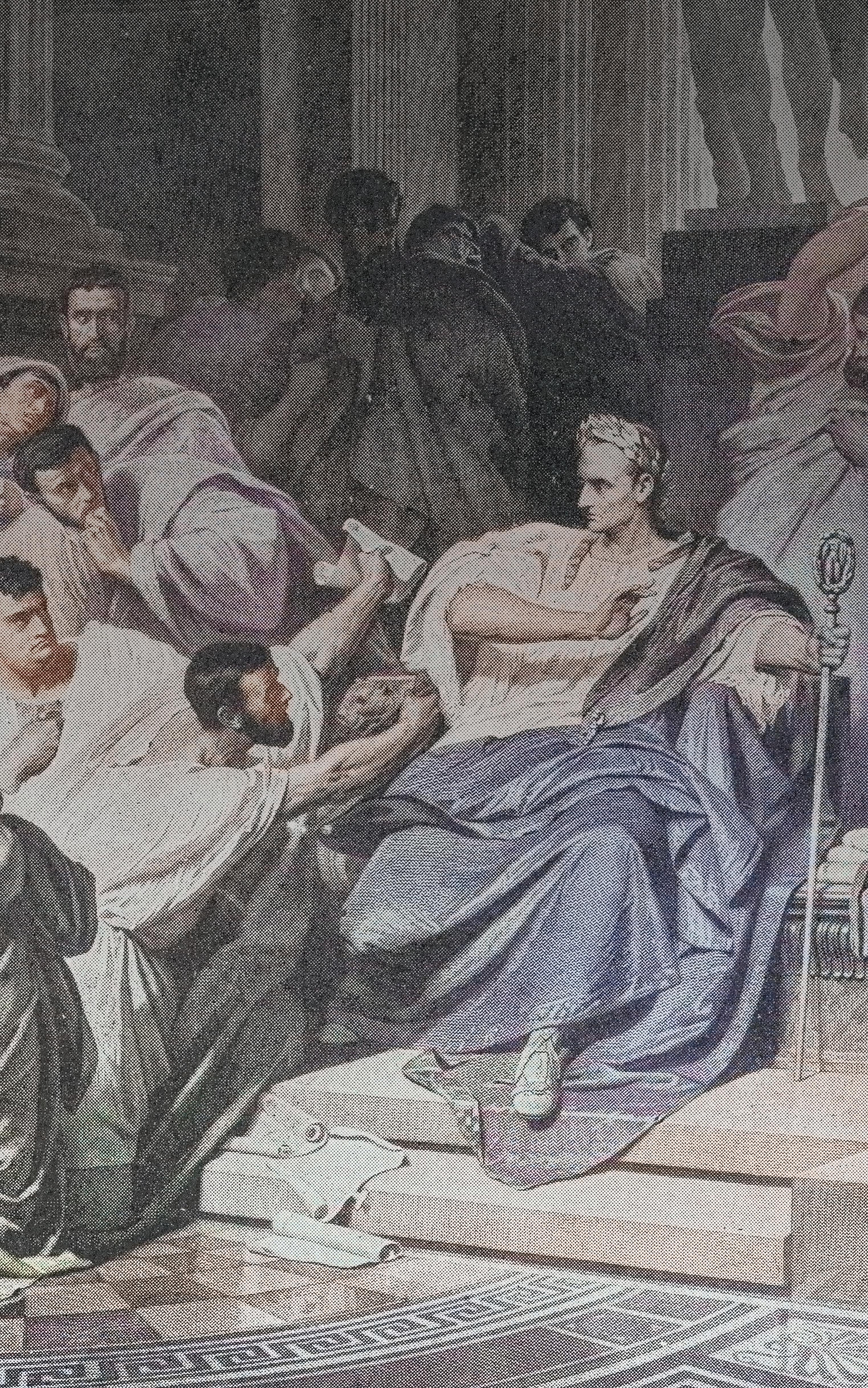

Celebrating 50 years of Irish women’s athletics
By Payton Dymek Associate Sports Editor
Women officially began filling the Notre Dame classrooms in 1972; however, it wasn’t until 1976 the addition of women’s varsity sports was established. For four years, women joined club sports such as tennis, rowing, fencing and basketball, which laid the foundation for the formation of the first varsity teams. The Unviersity introduced tennis and fencing as the first two women’s varsity sports, with basketball following in 1977; over the next two decades, volleyball, swimming, soccer, softball and rowing were given varsity status.
As Donna Losurdo Beaudet ’76 recalled during the 2022 reunion, she helped propel the Notre Dame field hockey team despite the difficulties that came with creating a team of such stature. With the team varying in experience level,
they practiced on a grass field that was used as a parking lot during football games and utilized donated uniforms and equipment. With no funding from the University, players were responsible for travel arrangements and all the costs associated with it.
But with an earned club status the following year, the team received greater support through improvements in equipment and facilities.
However, the lack of athletic trainers and financial aid still burdened the team.
“It wasn’t easy building a program from scratch.
Everything was a first: the first team, first game, first victory, et cetera.,” Beaudet explained. “But the challenges we faced were far outweighed by the camaraderie and commitment we all felt and that indescribable feeling of pride of having played for Notre Dame. Fifty years later, it still seems like yesterday.”
Jane Lammers ‘77 always
loved competing in sports, and the desire to join the tennis team outweighed the lack of a women’s team. The women did not have a varsity team and were told there were many steps like forming an interest group and then a club team, which was a process that could take at least five years. Lammers would be graduating in four and didn’t want to miss out on her chance to play tennis.
Sophomore Betsy Fallon ’76 had tried out for the men’s tennis team, but both desired a team of their own.
“Soon Betsy and I met and advertised tennis tryouts and scheduled matches with the coaches at the other Indiana, Ohio and Michigan universities,” Jane explained. With history professor Carole Moore as the volunteer coach, the two petitioned every year until their team earned varsity status.
With this athletic season marking the 50th anniversary
of women’s varsity athletics, director of athletics Pete Bevacqua announced there would be a university-wide, year-long celebration, coined “Cheer Her Name.”
“I am looking forward to meeting and celebrating many of our past student-athletes from the past five decades over the next year and hope that this provides increased growth and exposure to our women’s programs at Notre Dame,” Bevacqua said.
Although each women’s varsity program hosts a “Cheer Her Name” game throughout their season, the main celebration took place over the weekend of Sept. 19, 2025, where both past and present female student-athletes were united back on campus.
The celebration also included those who have consistently contributed to the success of the Cheer Her Name campaign. Over 300 former athletes returned for various moments of recognition,
including at a reception that took place before the women’s volleyball game against Michigan, a soccer game against No. 2 Duke and the distribution on multiple honors during the. Sept. 20 football game against Purdue. At the game, former women’s basketball standout Ruth Riley Hunter (1997-2001) presented the flag.
Throughout the past 50 years, women’s varsity athletics at Notre Dame have earned 18 national championships across many sports including basketball, fencing and soccer. Notre Dame’s Monogram Club also presented 350 honorary monograms to not only athletes from 1972 to 1977, but also for founders of the Women’s Athletic Association — Ellen Hughes ‘77, Lammers and others — in appreciation for their constant support.
Contact Payton Dymek at pdymek@nd.edu
MARIELLA TADDONIO | The Observer
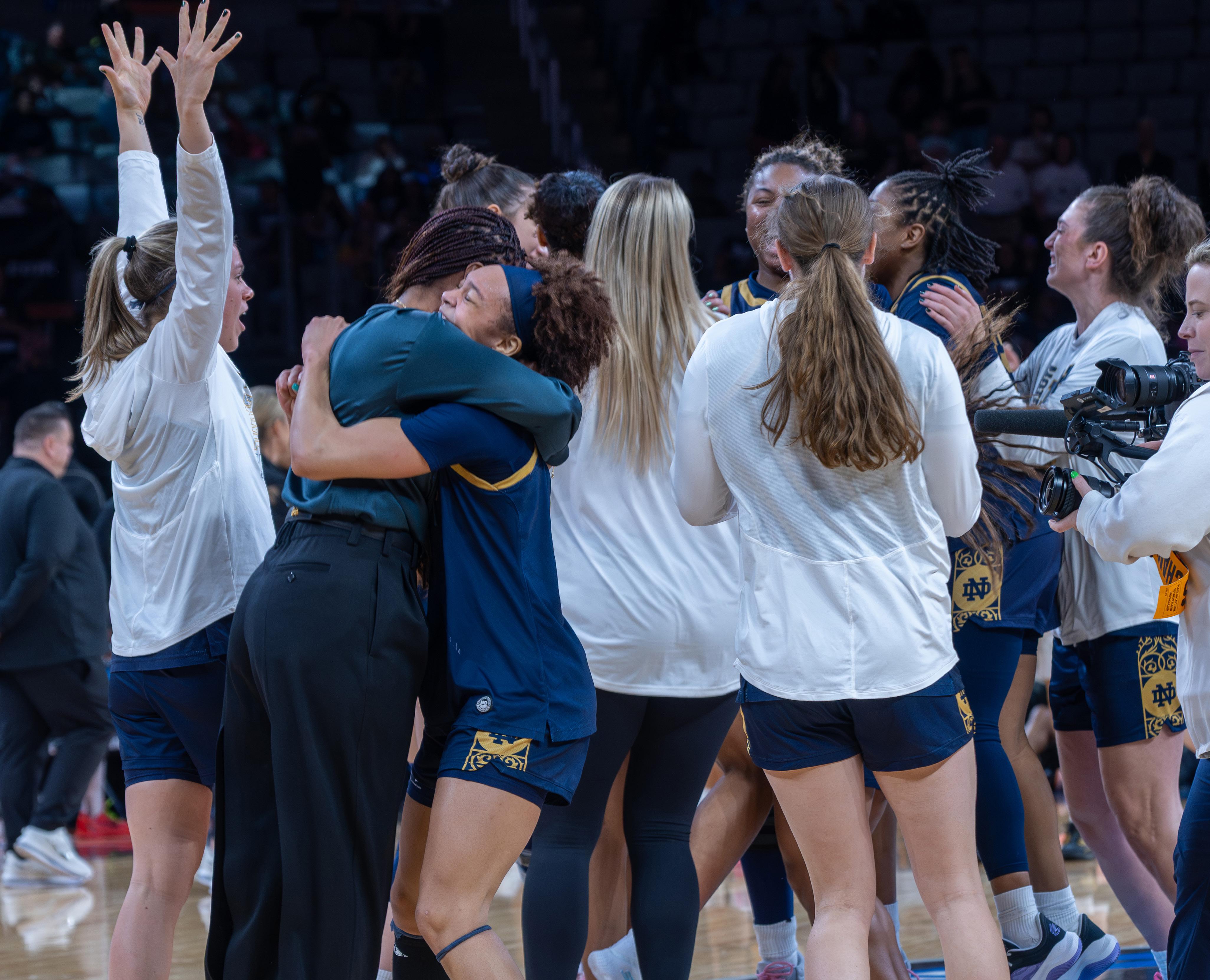
Junior guard Hannah Hidalgo hugs current head coach and 2001 national champion Niele Ivey after Notre Dame upset Vanderbilt in the Sweet Sixteen at Dickies Arena in Fort Worth on March 27. Hidalgo, the ACC Player of the Year, recorded a triple-double of 31 points, 11 rebounds and 10 steals to advance the Irish into the Elite Eight for the first time since 2019.

THE INDEPENDENT NEWSPAPER SERVING NOTRE DAME, SAINT MARY’S AND HOLY CROSS
SMC students mobilize for sexual violence march
By Berhan Hagezom and Soledad Castellanos
Saint Mary’s News Editor and Associate News Editor
The annual sexual violence awareness event, Take Back the Night, provided students an opportunity to march for increased prevention and response efforts on Wednesday. This event marks 23 years since it was established at Saint Mary’s and continues to be led by students and the Belles Against Violence office.
Take Back the Night, established at Saint Mary’s in 2003 by Jackie Zins, is part of a global awareness initiative established in the 1970s, where similar smaller protests came about to call out women’s safety and demand more resources. The first ever rally for TBTN was established following the murder of Susan Alexander Speeth, a microbiologist from Philadelphia who was stabbed
on her walk back from home, a block away. The International Tribunal on Crimes against Women took place the following year in Brussels, Belgium, with a candlelit vigil and a TBTN march proceeding afterward.
The event is split into multiple parts, including the Survivor Speak Out, a march around the University of Notre Dame and a prayer service the following day.
The kickoff celebration In Stapleton Lounge of Le Mans Hall, BAVO gathered students in a kickoff event of sign making, with the third day of an open viewing of the “What Were You Wearing?” exhibit. Food was catered by Sugar Rush.
Mallory Lipps, the BRAVO coordinator at Saint Mary’s, shared that the initial event allows students to receive a preliminary break prior to going to the other events later that
SMC falls short on campus housing
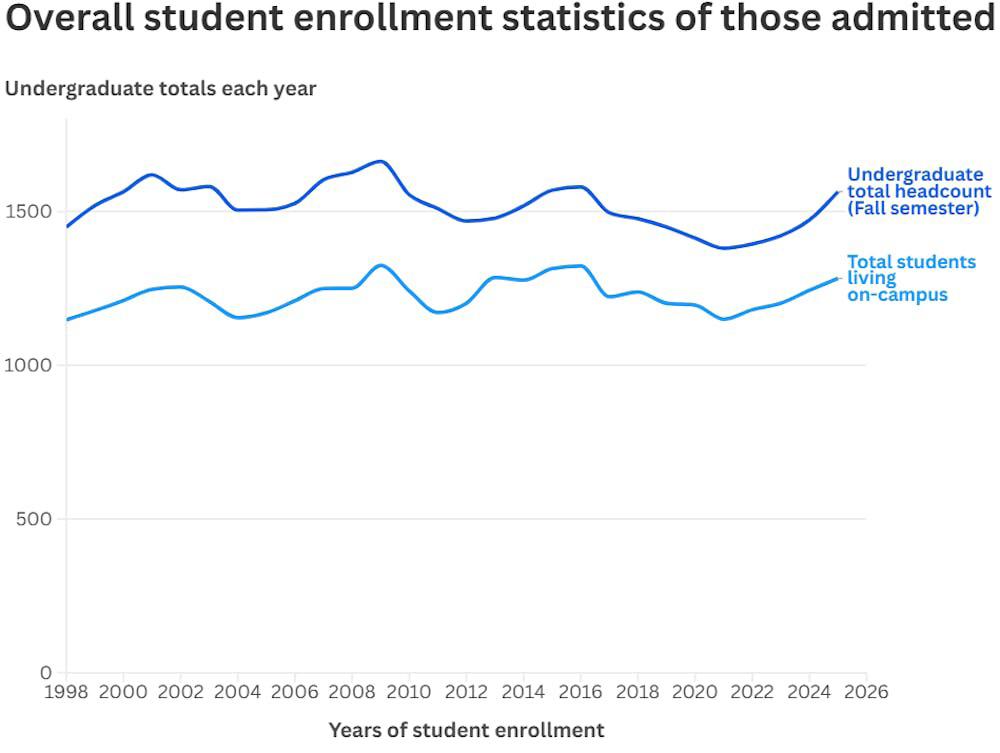
The total undergraduate head count has generally fluctuated. Within the last five years, a steady trend of increasing enrollment can be observed.
By Aynslee Dellacca and Berhan Hagezom Managing Editor and Saint Mary’s News Editor
As the end of the semester approaches, Saint Mary’s College has opened its housing portal for students to select dormitories. However, new limitations within the system have changed the process for
NEWS | PAGE 4 Lecturer returns
many students. Increased enrollment, combined with decisions by the Office of Residence Life to close off sections of housing, has created a more competitive environment for those entering the lottery system.
To better understand the College’s housing process, The Observer reviewed enrollment data from 1998
see “Housing” on page 4
OPINION | PAGE 5
Trump and church
When politics become sacred, our moral understanding and vision becomes distorted.
day. It provides a space where they are surrounded by others with support around a sensitive topic.
“I think how it benefits us is that it’s really to get us together in one space, so you don’t feel like you have to go over there
exploration of the first 50 years of women’s athletics at the University of Notre Dame. SPORTS | INSIDER 3 Pay the women An argument that Notre Dame should not just a cheer her name, it should compensate. FRIDAY, APRIL 17, 2026 | VOL. LX, NO. 58
by yourself … It helps get our volunteers and those interested
see “TBTN” on page 3
Luke Combs concert set to rival football crowds
By Matthew Morin Associate News Editor
Billy Joel, Johnny Cash, Whitney Houston and Garth Brooks are among the famous names to grace the University of Notre Dame’s football stadium as performers.
On Saturday, Notre Dame Stadium will add another artist to this listing, hosting Luke Combs on his “My Kinda Saturday Night” tour. The country artist is set to take the stage at 5:20 p.m. alongside Dierks Bentley, Ty Myers, Jake Worthington and Thelma & James.
The concert comes just six months after Zach Bryan played at the stadium to a packed house in September. The concert was announced by the University in October, and they expect its attendance will exceed 80,000 people.
As preparations are underway, the University’s Operations, Events, and Safety team is working to ensure safety for all students and concert-goers over the weekend.
Logistically, the event will function very similarly to a normal football weekend, according to Mike Seamon, vice president for University Operations, Events, and Safety, in a written statement to The
Disinvited lecturer Eman Abdelhadi returns to present on American Muslim politics. SCENE | PAGE 7
Observer.
“In many ways, they are identical. The logistics of moving 80,000 people safely in and out of the stadium, the parking protocols, and the energy on campus feel very much like a typical Saturday in the fall. The primary difference is that these events allow us to further strengthen our ties with the local community, bringing people together through a shared love of live music,” wrote Seamon.
Seamon also noted that, as with a regular football game, the full game day hospitality teams and parking coordination will be utilized. His team has also worked with local businesses to prepare for the influx of people to the campus and the greater South Bend area.
Lee Sicinski, executive director of University Events, also noted in a statement to The Observer that the operations of the concert will be very similar to those of the Zach Bryan concert.
Over the course of the week, the stadium has undergone a transformation to create a setup and stage similar to the Zach Bryan concert. Sicinski wrote that this setup allows for both standing and seated fans not only in the traditional seats but
Name
also with floor seats. He noted that this allows for an addition of several thousand people to the typical seating capacity and that this is “one of the largest ticketed events in the history of Notre Dame Stadium.”
Sicinski continued that it is his number-one priority to protect the stadium and playing surface, especially as they are putting up lighting, sound equipment, other technology effects and “the largest stage we have seen to date.”
Keri Kei Shibata, assistant vice president for Campus Safety and chief of police of the Notre Dame Police Department, shared in a written statement to The Observer that campus safety and the safety of concertgoers are going to be on the same level as a regular football weekend.
“Our preparations are built on our gameday model. We have scaled our staffing and patrol to handle more than 80,000 guests. This includes everything from traffic control to perimeter security and interior stadium safety,” Shibata wrote.
However, she did note that some policies shift to accommodate
see “Concert” on page 3
Berhan Hagezom | THE OBSERVER
Berhan Hagezom | THE OBSERVER
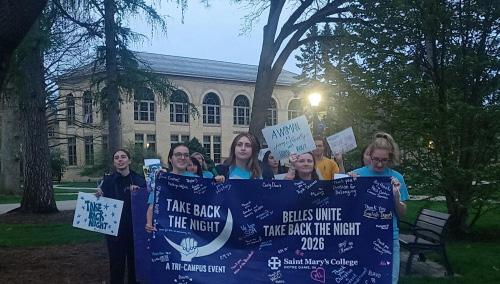
Students at Notre Dame, Saint Mary’s and Holy Cross College came together for a Take Back the Night march on Wednesday evening. TBTN is a global initiative for increasing sexual violence awareness and support.
What is your most (or least) favorite part about going to a baseball game?
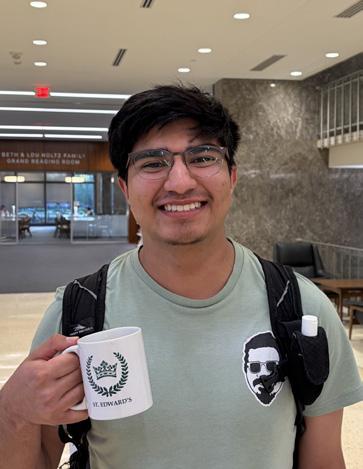
Juan Montoya sophomore
St. Edward’s Hall
“The expensive food prices.”
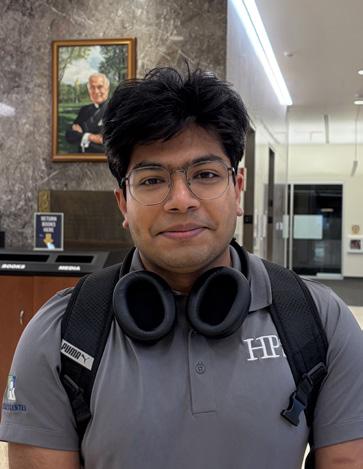
Enosh Kalley graduate student
Fischer Graduate Residence
“I’ve never been.”
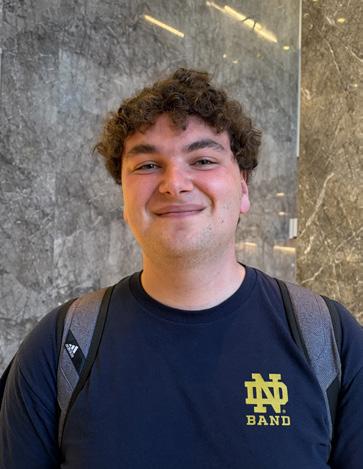
Michael Alfamo sophomore
O’Neill Family Hall
“The food is the best part.”

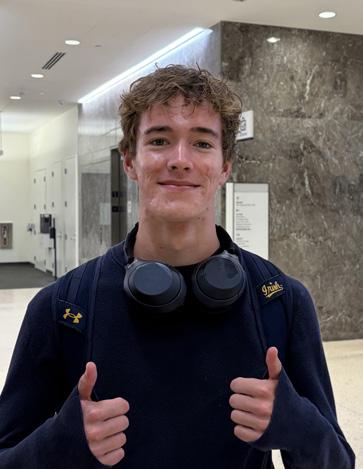
Jack Bertram freshman
Stanford Hall
“The food is fire.”
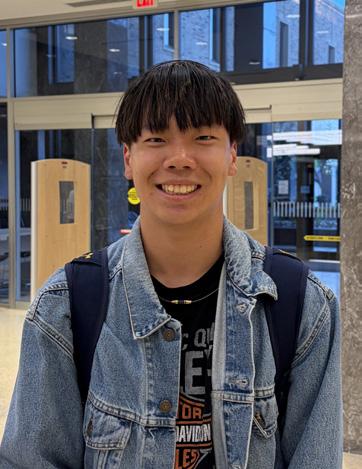
Riku Sugie freshman
Dillon Hall
“The home runs.”
Who are you most excited to see this weekend?
Friday
Latin Expressions Reception
Annual cultural celebration hosted by Latinx Student Alliance. LaFortune Champions of Diversity Room 10 p.m. - 11 p.m.
Saturday
Saint Mary’s tennis vs. Knights
The Belles will face the Knights at home.
11 p.m.
Sunday
Eucharistic Procession
Militia of the Immaculata hosts annual Eucharistic Procession. Basilica of the Scared Heart and Main Building Steps 1 p.m. - 2 p.m.
Monday
The Ongoing Struggle of Being Native Enough
Carrie Lowry Schuettpelz on complexities of Native identity. Carroll Auditorium, Madaleva Hall 5 p.m.
Tuesday
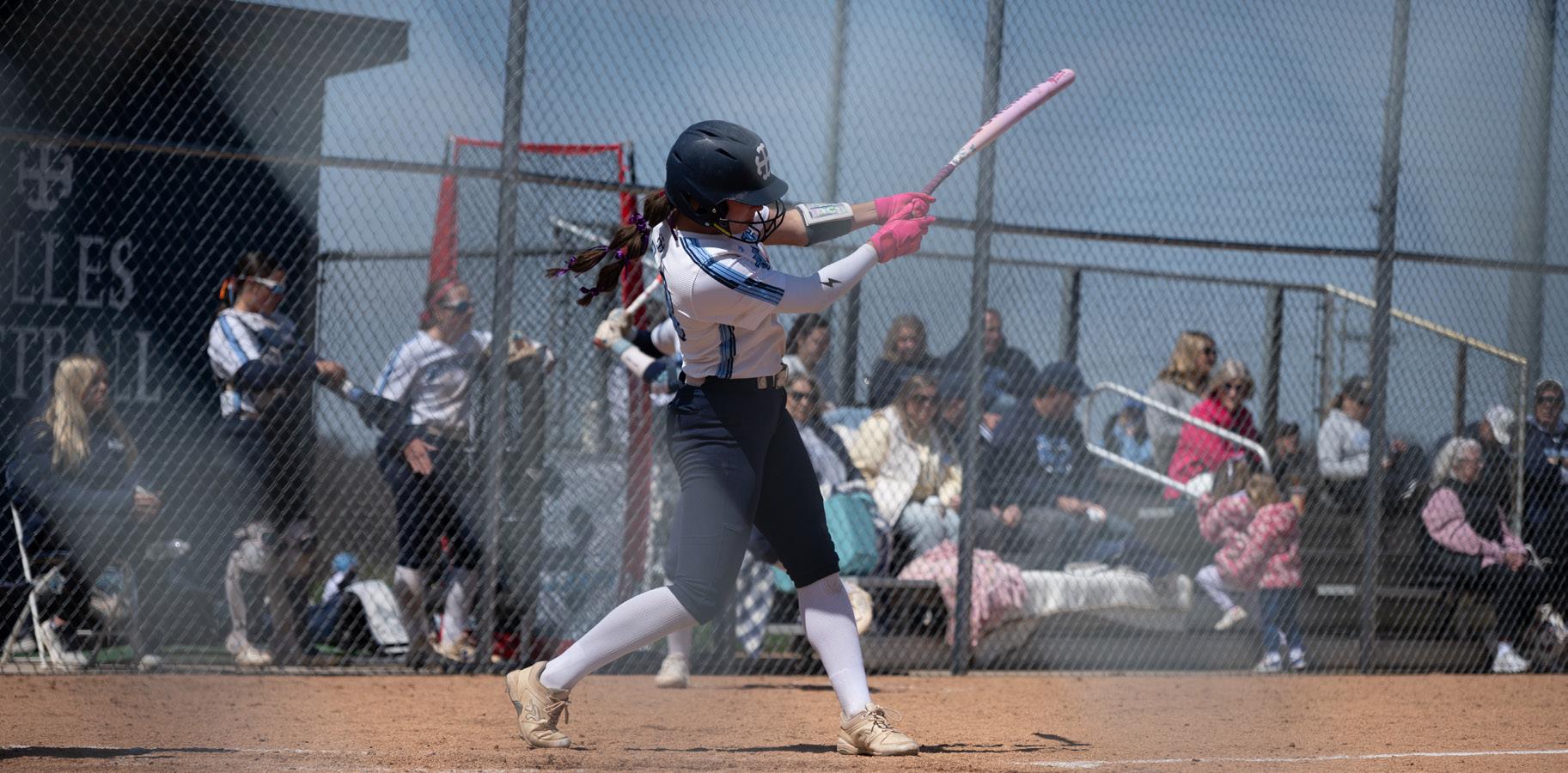
Notre Dame softball vs. Central Michigan
The Fighting Irish will face off against the Chippewas. Melissa Cook Stadium 5 p.m.
PHOTO OF THE DAY | MARIELLA TADDONIO
TBTN
Continued from page 1
together, helps rally us and get us pumped up to go over there. It is a really heavy topic, and so it’s also like a levity point for us too to maybe have a little bit of fun before we take on the really hard stuff tonight,” she stated.
For the first time, Take Back the Night and Raise Your Voice will be taking place in the same year. Lipps explained that they wanted to execute a week on sexual assault awareness at the College and see how well it works in the future. They also said it was due to availability of certain Notre Dame buildings and took the best option possible.
Survivors speak out
Following the kickoff event, students were escorted, by Blinkie, to McKenna Hall due to inclement weather and a lack of major turnout. Once dropped off, students were led to the second floor where they waited for the Survivor Speak Out event in the conference room.
The University of Notre Dame’s Prevention, Outreach, Education, and Training team, part of the Office of Institutional Equity, collaborated with BAVO for this event to be possible. They, along with others, are part of the Take Back the Night Committee, which helps with planning and coordination of the event.
Abby Bulgrien, director of victim services at the Family Justice Center of St. Joseph County, a local nonprofit organization for survivors of interpersonal violence, discussed the organization’s involvement with TBTN and their support of allocating resources to students.
“Our organization sits on the CSAP committee, so the Notre Dame Committee for Sexual Assault Prevention that includes Holy Cross and Saint Mary’s as well. So we are … helping to provide awareness for how sexual assault, domestic violence and stalking is impacting not just the campuses themselves, but the community around them, because so many students are involved off campus,” she noted.
The confidential event allows students to speak in a safe space on stories of sexual violence and for allies to be in solidarity with them. Students have the opportunity to submit and share their stories whether through proxy or by speaking
Concert
Continued from page 1
policies shift to accommodate concertgoers having field-level access. As with football games, the NDPD will be enforcing a clear bag policy and screening at the gates of the stadium. Shibata stated that while NDPD does
out themselves.
“I think it’s really important to give someone a platform to have their story heard, so that others who may have experiences but aren’t able to speak out, feel seen and heard, even if it’s not in their own story,”
Lipps said.
Lipps shared that around 25% of undergraduate women experience sexual assault or rape on college campuses.
Reported by the Journal of Interpersonal Violence, about one in four women will experience sexual assault.
In a joint interview with The Observer, senior Ally Krause and junior Daniela Rivera, BAVO Student Advisory Committee members, shared the importance of having spaces such as Survivor Speak Out in embracing conversations that may have topics otherwise seen as taboo.
“It just means so much that we’re able to have these type of talks, because in some places, these types of conversations are not permitted or they’re silenced … I find that it’s really valuable that we’re allowed to have these really difficult, sometimes critical conversations,” Krause said.
The march
Throughout the course of Take Back the Night, students had the opportunity to make posters that show support of survivors while fighting against sexual violence. The march started outside of McKenna Hall, where students were given instructions on how to shout back. Students then began the march, with chants such as “Who’s campus? Our campus! Who’s body? My Body!,” and “Hey Hey, Mister Mister! Get your hands off my sister!”
With a path mapped in the event handout, students took to Notre Dame’s campus marching through God Quad under The Golden Dome with signs raised and voices loud. At the front, the biggest sign read, “Belles Unite Take Back the Night 2026,” held by BAVO SAC members. Other signs behind stated, “A Woman is Somebody Not Some Body” and “Break the Silence, Stop the Violence.”
Lipps explained that the march allows allies and survivors to empower themselves and reduce the barriers of speaking out their truth. It gives a path for the tri-campus community to come together under a common issue.
“A lot of times, people don’t
not release a specific number of officers who will be at the event, staffing will be similar to a football Saturday. NDPD will also be working with local agencies in regard to traffic patterns in the area.
“We work in lockstep with the South Bend and St. Joseph County Police Departments, as well as state agencies. These
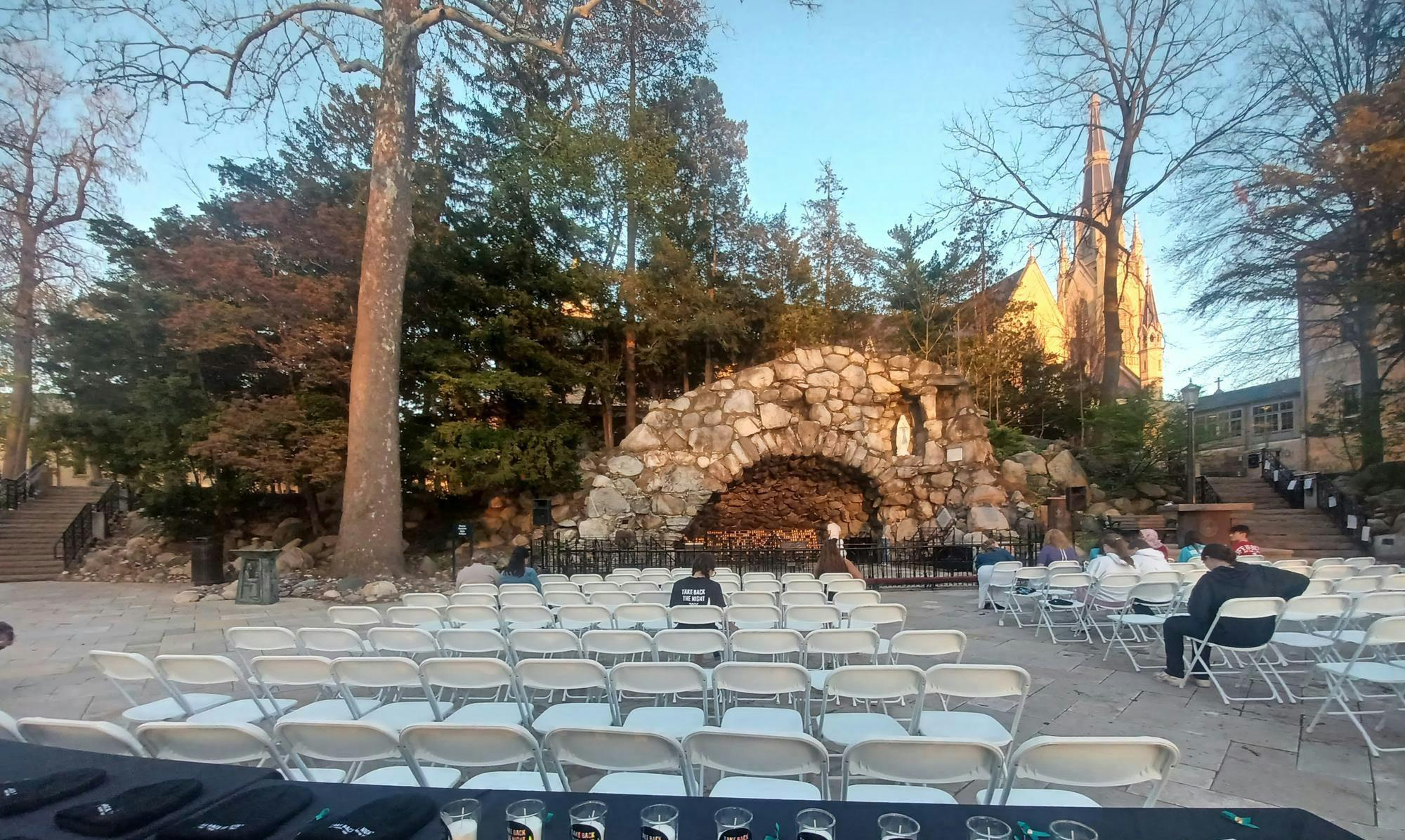
The Grotto of our Lady of Lourdes hosted students from diverse faith traditions. The event was shifted to Thursday to clarify confidential and non-confidential resources for students and welcome faculty and staff.
feel like they can speak about these issues openly, or can’t support these issues without barriers or maybe some pushback,” she highlighted. “And so tonight [is] to really empower students, whether you’re a Smick, whether you go to Notre Dame, whether you’re at Holy Cross, whether you’re male, female or nonbinary, too, this is not just an event for women. [It] is to make you feel like you are not alone, and also to get people who care about these issues to feel like they’re making a change and making a difference.”
Multi-faith prayer service
Despite rain earlier in the day, the prayer service continued on Thursday at the Grotto of Our Lady of Lourdes with lines of chairs prepared for attendees at 8 p.m. Students and faculty from different spiritual backgrounds were welcome to come to the multi-faith prayer service.
Lipps shared that the prayer service was moved to Thursday to provide a clear description to the community on confidential and non-confidential events and to ensure that faculty are still able to stand in solidarity with students.
“It was moved to Thursday because the Speak Out and march are confidential. So staff who are not confidential, which does not include myself, cannot go to the Speak Out and the march,” Lipps stated.
The prayer service was co-organized by Krause and senior Carly Davis but was put on in collaboration with faith organizations from througout the tri-campus community. Davis shared that she reached out
partnerships allow for a unified command, ensuring things run smoothly and are secure,” Shibata wrote.
Road closures and parking restrictions will be enforced, so Shibata encourages concertgoers to refer to NDPD’s social media to view parking and traffic maps. In regard to possible inclement weather, Seamon noted that
to ensure these groups would be comfortable speaking at a service dedicated to sexual violence survivors. Partners included: Saint Mary’s Center for Faith, Action, and Ministry; Notre Dame Muslim Student Association and Jewish Club of Notre Dame.
The event included a preliminary announcement and prayer by sophomore Quinlen Schachle, followed by the welcome and prayer one by Krause. Krause continued by leading a call and response of “Suvivors, We believe you — Survivors, we empower you — Survivors, we love you.” The intersessions were then led by Delana Cates with prayers two and three provided by graduate student Fathya Salih and junior Anna Heck, before moving onto speeches.
Editor’s note: Cates is a former writer for Scene at The Observer, the newspaper’s arts and culture section.
Davis and Krause picked Schachle to have a male leader as a speaker, in order to represent this issue occurring across all genders, as noted by Lipps. In the preliminary announcement, he shared the importance of advocating for survivors and not hiding behind silence.
“Too often, conversations about sexual violence are treated as if they are women’s issues. When they’re not, they’re human issues. And their issues that men, collectively, have a responsibility to confront. Not because men are inherently bad, but because we are shaped by systems that too often excuse harm, minimize accountability and teach us to ignore the experiences of others,” he
University Operations, Events, and Safety have continued to monitor the forecast weather and will communicate directly with concertgoers if weather-related decisions are made for the show. He encouraged concertgoers to opt in to University Alert for weather communications during the concert by texting UNDFANS to 226787.
said.
The manifestation and call to community were done by Davis, with the quiet meditation and lighting of candles spoken by Krause. The event concluded with a closing from Schachle, where he read a poem by Wendell Berry titled, “The Peace of Wild Things.”
An increase of reports
Considering the recent sexual assault reports made within the tri-campus, predominantly to the University of Notre Dame’s Office of Institutional Equity, student groups like POET and BAVO have emphasized the importance of their existence.
“I feel kind of dual sided about the increase in reporting. On one side, it’s shocking and it’s jarring and it’s horrifying to hear things that are happening to people, but on the other side, it means that people are comfortable reporting,” Krause stated.
Rivera doubled down on the need for campus resources to combat issues such as the last three reported assault cases. She continued to express gratitude to those in support of spreading awareness and participating in the active fight for safer communities.
“Even if it’s Ally or I or other amazing staff members, we’re always here to hear you, believe you, and with these types of events, just like, show up, even if you show up as a supporter, you’re always welcome,” Rivera stated.
Contact Berhan Hagezom at bhagezom01@saintmarys.edu and Soledad Castellanos at scastellanos01@saintmarys.edu
“Notre Dame Stadium is iconic, and we want it to be a vibrant part of the community yearround. We hope to continue hosting these major events as a way to bridge the gap between the University and the community,” Sicinski wrote.
Contact Matthew Morin at mmorin2@nd.edu
Berhan Hagezom | THE OBSERVER
Disinvited lecturer returns to Notre Dame
By Lucy Loes News Writer
On Tuesday afternoon, the Kroc Institute hosted Eman Abdelhadi, assistant professor at the University of Chicago, as a part of the Intersectionality and Peace Series for a talk titled “Adrift: U.S. Muslims and the End of Liberalism.”
The event began with Abdelhadi’s lecture on American Muslim politics across the last 26 years and how the group serves as a diagnostic case for the broader fracture within the Democratic Party. Her lecture was followed by an open discussion allowing the students and faculty in attendance to discuss the lecture before opening it back up to questions for Abdelhadi.
Last year, Abdelhadi had been slated to speak at the annual peace conference but was disinvited at the last minute, with administrators citing a University security policies requiring a police presence at all events regarding Israel and Palestine. The decision received backlash and was interpreted as censorship and silencing of pro-Palestinian voices. Abdelhadi released her own statement condemning the disinvitation.
“I think right now, all of the institutions of our society are under attack. All of the things that ironically make us great are under threat whether that’s free speech, higher education, our right to protest. The way to
Housing
Continued from page 1
2025, focusing on total undergraduate enrollment each fall semester and the percentage of students living on campus. The data shows increases in both categories over the past five years.
The Observer also compiled data across the College’s five main residence halls — Le Mans Hall, Holy Cross Hall, McCandless Hall, Regina North and Regina South Halls — as well as housing designated for seniors, including Opus Hall and Lourdes Hall, which will open in fall 2026. The residence office is reallocating a significant amount of room for incoming freshmen in Le Mans Hall and McCandless Hall.
Increased enrollment
According to the Saint Mary’s Fact Book, total enrollment has fluctuated over the past 30 years. As of 2025, the College’s undergraduate population reached 1,565 students, its highest level since 2016.
The Fact Book was accessible on the Saint Mary’s website when The Observer began its analysis. After The Observer contacted dean of enrollment management and marketing Sarah Gallagher Dvorak with a question referring to the Fact Book, the Fact Book
face that is to stand up to it and insist on our right to free communication, on our right to academic freedom, on our right to free speech,” Abdelhadi said in an interview with The Observer.
In a statement to The Observer, Mary Gallagher, dean of Notre Dame’s Keough School of Global Affairs, wrote, “An invitation for Professor Abdelhadi to return at a later date was extended following last year’s cancellation, which was due to insufficient time to secure appropriate safety and security arrangements. We are pleased to have welcomed her this year.”
As a previous fellow at the University, Abdelhadi said her relationship with Notre Dame and her desire to stand up to censorship brought her back.
“I feel accountable to my community and to God to do the right thing, and my accountability is not to the bosses or the institutions and politicians. So, at the end of the day, I want to be able to say that I did everything I could; I did what I thought was right,” Abdelhadi said.
Abdelhadi began her lecture by discussing voting patterns during George W. Bush’s presidency, specifically mentioning that in the wake of 9/11, Muslims switched from relatively invisible to a highly targeted group in American politics. “In the Republican Party, Muslims become the consistent boogeyman that is brought up every election … Muslims are constantly instrumentalized as this enemy number one for
was removed from the College’s website.
When asked about the removal, executive director of marketing and communications Charles Simpson said in a statement to The Observer that the College, “has been engaged in a multi-year plan to ensure we are removing outdated or archived content from our website that is not accessible to all readers.” The documents were previously available as PDFs. Simpson’s statement did not specify when the Fact Books would be restored to the website.
Total undergraduate enrollment has steadily increased since 2021, including a 5.8% increase in 2024 and a 6.2% increase in 2025. The freshman class of 2029 included 455 students in the fall of 2025, the largest freshman class since 2016. According to Dvorak, the College expects another large incoming class for the next academic year.
“Our enrollment looks strong for the Class of 2030. Our student enrollment has been growing the last four years,” Dvorak wrote in a statement to The Observer in mid-February. “Last year was a great year and we are running ahead of last year in accepts and deposits for the fall.”
The largest undergraduate student population Saint Mary’s hosted within the last 30 years was in 2009 with 1,664 students, 99 students more than in fall 2025. That year, the College also housed
the Republican Party, which naturally pushes them into the arms of the Democratic Party,” Abdelhadi said.
As a result, Muslims in the United States were beginning to become semi-incorporated into the Democratic Party by 2008, and this incorporation was further advertised by Barack Obama’s presidential campaign.
Although the Democratic Party won the majority of Muslim votes, Abdelhadi stressed that many were hesitant to trust Obama.
“He did not end the war in Iraq. He did not end the war in Afghanistan. He did not close Guantanamo Bay. He famously dropped many drones, illegally killing many, many civilians in Yemen and elsewhere. And so within the Muslim American community, there was a sort of discomfort,” Abdehadi said.
In the 2020 election, the demographic was no longer the main rhetorical device of the campaign. Muslims in the United States seemed to be split into two groups: a progressive coalition that voted for Bernie Sanders and a more conservative group that sided with conservative Christians.
Abdelhadi highlighted a caveat to understanding this trend. “People have such an instinctive belief in Muslim social conservatism,” Abdelhadi said. “On almost any issue, there’s almost as many Muslims who believe the more left wing position.”
According to Abdelhadi, the beginning of the genocide in
its greatest number of on-campus students, 1,325, which was 84.9% of the population.
The percentage of students living on campus has remained relatively consistent, ranging from 81% to 84% over the past 30 years. In fall 2025, 1,283 students lived on campus, 81.9% of the undergraduate population.
Housing limitations
The Observer also compiled data on the total number of rooms and beds available for students living on campus. According to floor plans and housing data provided on the College’s website, Le Mans Hall, Holy Cross Hall, McCandless Hall and Regina North and Regina South Halls contain a combined 673 rooms with 1,295 beds. Freshmen, sophomores and juniors can only live in these five dorms and are required to live on campus unless granted commuter status.
Opus Hall and, beginning in fall 2026, Lourdes Hall are both designated for students with senior credit status or higher. These halls add a combined 68 rooms and 120 beds. Including these halls, the College will offer 741 rooms and 1,415 beds for the 2026-2027 academic year. Based on 2025 on-campus residency figures, only 43 beds would have remained unoccupied. If Lourdes Hall had been available in 2025, that number
Gaza was a reckoning moment for many Muslims, especially those promised incorporation into the Democratic Party. The Democratic Party’s support for Israel resulted in a shift in support among Muslim voters, with some voting uncommitted or voting for the Green Party candidate in the 2024 election.
“This does not represent an ideological shift to the right. This represents an anger at the Democratic Party. And in fact, that is the case for so many groups of color that the Democrats lost in 2024. When you look at the data on their actual beliefs, there hasn’t been a rightward shift, and what that tells [us] is that this is a protest vote,” Abdelhadi said.
Abdelhadi paralleled this trend with the general public, particularly younger voters.
According to the Pew Research Center, 80% of Democrats see Israel unfavorably, and Republicans ages 18 to 49 hold a similarly negative opinion. Abdelhadi said the protest wave of 2023 and 2024 stemmed from the youth of the general public, not just Muslims.
“It might have been Muslim led in certain areas, but young people en masse took to the streets to protest the genocide of Palestinians, and the Democratic Party responded by calling them antisemitic, sending in the police, advocating for them to lose their jobs, supporting their doxing, supporting their censorship. It’s not just American Muslims who
would have increased to 91.
Lourdes Hall will add 44 rooms for seniors and graduate students on its third and fourth floors. However, most of these rooms are singles, resulting in a net increase of just 48 beds for students who are not required to live on campus.
According to 2026-2027 room selection guidelines shared with students via email, the College will preallocate specific sections — and in some cases entire residence halls — to incoming freshmen. McCandless Hall will be fully designated for freshmen, while additional rooms in Holy Cross Hall and Regina North and South Halls will also be reserved. This marks a shift from previous practices. In past years, Le Mans Hall primarily housed upperclassmen, with only the fourth-floor annex hallway designated for freshmen in more recent years.
Director of residence life and community standards Juls White said freshmen housing was previously distributed across multiple residence halls rather than concentrated in specific buildings or sections.
Graduate students who lived on campus were previously housed on the second floor of Regina South Hall. For the 2026-2027 academic year, however, White said graduate students are encouraged to live in Lourdes but can select another location during their selection time.
suddenly saw themselves as not incorporated in this project of liberalism, but Gaza also comes to cast a shadow on the entire project of liberalism,” Abdelhadi said.
Abdelhadi believes the election results were indicative of a failure of both American democracy and Democratic politicians. “I think the reason the Democrats lost against the most unpopular president in American history in 2024 is because they offered nothing. They literally offered nothing. The American public didn’t move to the right — they did,” Abdelhadi said.
Furthermore, Abdelhadi stressed the intersectionality of these political issues, particularly when it comes to justice and constitutional rights. She said the events in Palestine held a mirror to American society.
“You think you’re free? You can’t protest. You think you’re free? If you say your opinion on social media, you’re going to lose your job. You think you’re free? Your politicians know that you all believe this thing, and they still won’t do it,” she said. “You think you have a democracy, where is it?”
In a final call to action, Abdelhadi said, “And so we can continue to raise that mirror, right? To address these things, we have to do it in a coalition; we have to say that Muslim issues are not just Muslim issues.”
Contact Lucy Loes at lloes@nd.edu
Within Le Mans Hall, the College’s largest residence hall, the second, third and fourth floor annex hallways will be reserved for incoming freshmen. These sections comprise seven singles, 15 doubles, 13 triples and 21 quads, totaling 160 beds. McCandless Hall will also be designated for freshmen, removing 32 singles, 63 doubles and 32 triples — 127 rooms or 254 beds — from upperclassmen selection. White said the second and third floor annex hallways in Le Mans Hall were chosen to be preallocated for incoming freshmen due to an under-selection by upperclassmen due to room size. In total, 183 rooms, or 414 beds, will be unavailable to rising sophomores, juniors and seniors. An unspecified number of additional rooms in Holy Cross and Regina North and Regina South Halls will also be reserved for freshmen. The increase in preallocated housing for freshmen, combined with rising enrollment, reflects the College’s continued growth. However, these changes may place additional strain on housing availability for current students, particularly rising sophomores and juniors who are still required to live on campus.
Contact Aynslee Dellacca at adellacca01@saintmarys.edu and Berhan Hagezom at bhagezom01@saintmarys.edu
By Grayson Beckham Columnist, “Citizen Gray”
Dying sucks.
I’m not the first person to say that. I definitely won’t be the last.
But we all have to do it.
Even though Father Time remains the only unquestioned mediator in the course of human events, I was heartbroken last December when former Sen. Ben Sasse was diagnosed with pancreatic cancer. Most estimates slot pancreatic cancer’s five year survival rate at 13%. It’s essentially a death sentence.
When I first became politically conscious — just before high school — I tried to fashion myself as a “classical liberal.” You know, one of those “principled conservative,” anti-Trump types. I expected to register for the Republican Party once I turned 18. I would often talk politics with my dad, who heavily influenced me in this direction. I even found my own hero, Ben Sasse, the Republican senator from Nebraska. Sasse went to Harvard and has a doctorate from Yale. He was a former college president. He was one of seven Republican senators who had the courage to vote to convict Donald Trump during his Jan. 6 impeachment trial. He was, quite literally, everything I wanted to be when I grew up.
Of course, I matured politically. I started talking politics with my other parents. I read more books and got a more diverse set of news. I formed my own opinions. I now call myself a staunchly liberal Democrat. But I still always had a special place in my heart for Ben Sasse. The American right would be
By Sophia Anderson Opinion Copyeditor
Before I transferred to ND, I went to college on the East Coast. I had never been before my freshman orientation; I had never been anywhere outside the Midwest or the South. While “midwesterner” wasn’t really a part of my identity while growing up here, it became one in Boston. I spent most of my time around people from the East Coast, and when you start every class of your freshman year announcing where you’re from, “Kansas” is bound to stand out against the various Massachusetts suburbs everyone else grew up in. I began to identify with people from states I’d never even been to; I would smile extra at anyone from Wisconsin, Iowa, or (back then) Indiana.
After a while, my various midwestern connections got
Why I’m grateful to die

well served to emulate Sasse’s self-described methods of “very conservative” policy and “tonal moderacy.” So would the left.
Sasse retired from the Senate in 2023, becoming President of the University of Florida. I checked up on him from time to time, remembering him as one of my first political idols. When he announced his cancer diagnosis last December, my dad and I were shocked. We went out to dinner and couldn’t seem to talk about anything else.
But what happened next — and continues to happen — amazed me.
Most people quietly retire from public life when receiving a terminal cancer diagnosis. Most people are so intimidated by the enormity of eternity that they spend their remaining months on Earth passively waiting for their final breath.
And that’s understandable.
But to quote Sasse himself, “I
did not decide to die in public. I obviously ended up with a calling to die.”
Sasse chose to reclaim his death, using his platform as a public figure to publicize his journey. The name of his podcast — Not Dead Yet — summarizes its purpose quite well. He’s done many interviews, most recently with Ross Douthat of the New York Times, from which I am heavily drawing the facts of Sasse’s diagnosis. The interview’s title is “How Ben Sasse Is Living Now That He Is Dying,” which I find to be an apt descriptor of his life. He admits that he is dying. He has not chosen to make his journey about his “battle” with cancer, but rather a discussion of what he knows he won’t get to experience — the joys, the sorrows and the work that has been robbed from him.
In his New York Times interview, he shows unabashed hate for death, calling it a “wicked
thief.” Yet he celebrates its finitude, arguing that “it’s pretty good that you pass through the vale of tears one time and then there will be no more tears, there will be no more cancer.”
And I wonder: Should we be grateful for death?
In a way, I think so. It is a hackneyed platitude to claim that we cannot experience the good without the bad. But it’s so true.
I know I’m not breaking new ground here. And I know my audience. This is a column written by an undergraduate at the University of Notre Dame. It may be read by a few hundred people on campus. Maybe a few alumni., and probably my parents, but not much more.
We can’t have that kind of humility without death. Death allows us to see our own limits; that there is an awesome God who created this universe — this
The case against Ohio
me in contact with the the founders of a new “Midwest Club,” where members would gather monthly for a dose of Midwestern culture. At our first meeting, over chili and cornhole, we went around in a circle and made our usual introductions: what’s your name, what’s your major and where are you from?
Expecting a rich and diverse range of Midwestern experiences, from Omaha to St. Louis to Des Moines, I was shocked at what I heard. Twothirds of the group was from a state I coudn’t even place on a map — Ohio.
The purpose of this article is not to bash Ohioans, if excluding someone from the definition of “midwesterner” could be interpreted as bashing. As a lifelong resident of a flyover state, it would be audacious to make fun of anyone else’s home state. In fact, I have a lot of respect for Ohio: they have
a lot of well-known cities, My goal is simply to address the objective but strangely unsaid truth that Ohio is, never was, and never will be part of the American Midwest.
First, the geography simply doesn’t work. I’m no etymologist, but I do know that “Midwest” comes from two other words, “mid” and “west.” Ohio is neither of these — in my research for this article, in fact, I studied a map of the US, and noted that Ohio is located firmly on the North and Eastern part of the country. It may not be “East Coast,” as there are states more East and on the coast, but it certainly isn’t mid or west. If Ohio is geographically part of the midwest, then so are Kentucky and Tennessee; I’ll let this evidence speak for itself.
Additionally, there’s a significant culture difference
life — in order for us to enjoy it. He was so providential in His wisdom that He limited this gift to allow us to understand this life’s value. O necessary sin of man! O happy fault that gave us death!
It is death that is allowing me to reflect on one of my political heroes. It is death that inspired Thornton Wilder to write in his play “Our Town” that earth is “too wonderful for anybody to realize.” He asks, “Do human beings ever realize life while they live it?” He wrote “maybe the saints and poets.” I doubt that Sen. Sasse would call himself a saint. He probably wouldn’t call himself a poet either. But I think he has managed to realize life just about as much as anyone on this earth can.
When Ross Douthat asked Ben Sasse if he’s ready to die, he said no. Yet he reflected on his Christian faith and how he finds consolation that, at the end, “we get to approach the Almighty … to approach the divine and call him Daddy, Abba, Father.” Sasse said to meet Christ will be “pretty glorious.” I tend to agree.
Ben Sasse won’t ever read this article. I won’t ever get to meet him — one of my heroes. But I’m okay with that. He’s going to die. I’m going to die. And his final inspiration has been to teach me how to die a little bit better. I wish he could know my gratitude.
The views expressed in this column are those of the author and not necessarily those of The Observer.
Contact Grayson Beckham at gbeckham@nd.edu
between Ohioans and the true Midwest. True midwestern states traditionally have agriculture-dominated economies. Nebraska, Iowa and Kansas all have one thing in common: they produce a lot of food. It’s part of our day-to-day lives; most of my friends growing up have a family member that lives on a farm, including myself. We drive past hay bales, we’ve ridden in tractors and we buy our meat directly from the farmer to store in a meat freezer in the garage.
Ohio, on the other hand, has a historically industrial economy. They are known for manufacturing over agriculture, making them culturally and economically more similar to the East than the Midwest.
Finally, Ohio just doesn’t have Midwestern history. It was admitted to the U.S. before any Midwestern
states; the next to join (Indiana and Illinois) were not added until years later. The bulk of the Midwest was added in the Louisiana Purchase and thus have a shared history; they were settled by pioneers, turned into farm land and developed a shared culture: the nation’s heartland. As a whole, Ohio is simply not part of the midwest I grew up in, but the East I moved to. If |a family vacation to you looked like New York or Philadelphia, not Chicago or St. Louis, you aren’t a midwesterner, and that’s okay. Ohio makes a beautiful, rich and important part of the American Northeast.
The views expressed in this column are those of the author and not necessarily those of The Observer.
Contact Sophia Anderson at sander38@nd.edu
MEG HAMMOND | The Observer

Originality is outdated in Hollywood
By Isabela Garza Sanchez Scene Writer
In the age of financial greed, artificial intelligence and a yearning for nostalgia, the magic of the film industry has been quietly vanishing without us noticing. Hollywood has traded creative risk for financial safety, slowing the development of innovative cinema and new ideas. Originality is outdated, and repetition is trending.
I can vividly remember sobbing as I left the cinema after watching “Avengers: Endgame” at the age of twelve. Just like my super dramatic sobbing at Black Widow’s death, theaters have defined the consumption of movies while simultaneously creating lifelong memories
for fans and moviegoers alike. These experiences define filmmaking, creating spaces to experience the art itself. Yet, there has been a shift in cinema within these last years. Companies are gearing toward blockbuster spectacles over original art, decreasing the opportunity to create innovative and unique stories.
What once used to be the greatest night of the year for Hollywood is now seen as simply “another award show.” Known for celebrating moving stories and the talented artists behind them, the Academy Awards were the best watchlist for audiences and critics alike, yet there was a strange pattern in this year’s Oscars: 70% of the major nominated films were
adaptations, sequels or based on existing material. Very few pieces could be called “new.” This trend has caused fans to crave new ideas, as seen with the praise and 16 nominations for the 2025 supernatural horror film “Sinners” by Ryan Coogler. An ambitious, visually stunning world that blends horror, blues music and historical themes, “Sinners” follows twin brothers, both played by Michael B. Jordan, trying to leave their troubled lives behind. As they return to their hometown to start again, they discover that an even greater evil is waiting to welcome them back. This concept is rarely seen in the horror genre, with few people noticing some similarities with the 1996 film “ Dusk Till Dawn.”
PAID ADVERTISEMENT
Deo Gratias
Within those new, original films found in the Academy Awards, I have found my favorite film of the year. I know we still have a lot of 2026 left, but I know I will not encounter a movie like Norwegian writer-director Joachim Trier’s “Sentimental Value.” Sisters Nora and Agnes reunite with their estranged father, a once-renowned director. After he offers Nora a leading role, and she refuses, the sisters must navigate their complicated relationship with their father while dealing with the young star he casts in her place. It is a deeply resonant film praised for its emotional authenticity, nuanced performances, and thoughtful exploration of family dynamics, generational trauma,
and the reconciliatory power of art. These are new and innovative stories that have captivated audiences from Clarksdale, in Mississippi, to Oslo, in Norway. The public wants to see something new, no more sequels and reboots as seen in Disney’s 2025 live-action adaptation “Snow White;” the film received a lot of media backlash. After its release, critics and audiences stated that the film diminished the original’s charm. Even so, Hollywood has continued to prioritize safer, pre-existing intellectual property over groundbreaking storytelling; it is the fear of failure. So, seeing unique pieces succeed is remarkable.
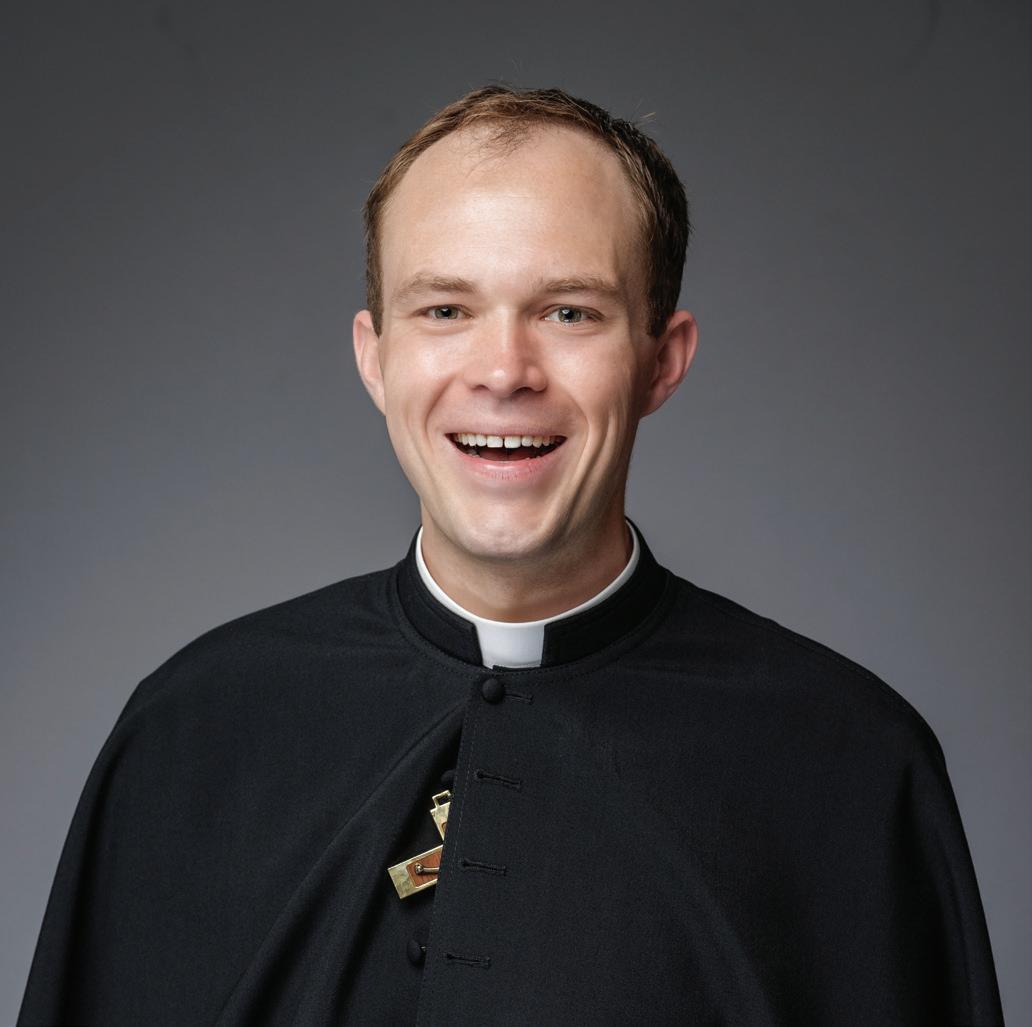
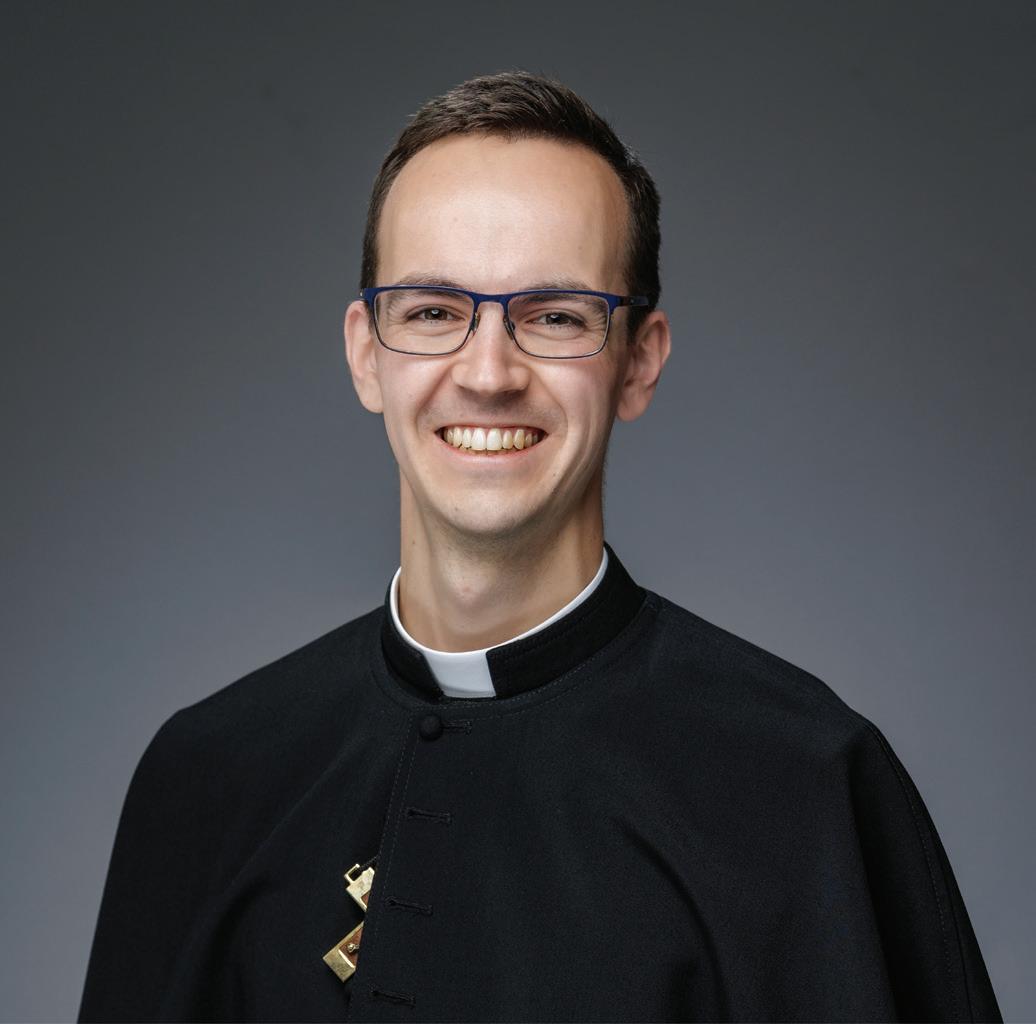
The Congregation of Holy Cross celebrates the recent Ordination to the Priesthood of Rev. Thomas “T.J.” Groden, C.S.C. & Rev. Christopher Mulholland, C.S.C.

“I


While money is dismantling imagination, technology is creeping into its production and threatening the human part. AI can now write scripts, generate entire visual sequences and produce digital actors who never existed. At the Zurich Film Festival, “Tilly Norwood,” a fully AI-generated actor, ignited an ethical firestorm when real actors discovered their faces, voices and physical movements had been used as training data without their knowledge or consent. That isn’t innovation. It’s theft dressed up as progress. What made cinema human was never its perfection. It was the shaky camera. The moment an actor faltered and the crew kept rolling. The unexpected emotional beat that no one planned, but everyone felt. AI doesn’t capture those moments. It eliminates them. What it produces instead is something technically flawless and spiritually empty. Yet, what is most frightening isn’t if audiences will reject it. It’s that, eventually, we won’t be able to tell the difference. Art is art because it is human — AI is anything but human.

Hollywood has traded creative risk for financial safety, and the culture is paying for it quietly, one sequel, one adaptation, one reboot at a time. Cinema was never just entertainment. It is what ties people together. We may have different preferences, favored actors, ideal motifs, treasured characters or respected directors, but it all comes back to the need for storytelling. What’s being lost isn’t just originality or box office numbers. Companies have replaced stories worth telling with stories that are believed to sell while AI is removing the human essence of what makes art, art. The industry will survive. It’s too profitable not to. But survival and vitality are not the same thing. The question worth asking isn’t whether Hollywood fights back. It’s whether what comes out the other side will still deserve to be called cinema.
Maroney leads the way as Irish beat Louisville
By Lauren Ryan Sports Writer
Despite a 45-minute delay to the game due to weather on Thursday evening, the Notre Dame women’s lacrosse team came out strong and never looked back as it closed out the regular season with a decisive victory over Louisville.
This game marked the end of the road for the Louisville Cardinals, who had already been eliminated from ACC Tournament contention. But for the Irish, the final regular season contest would be critical in giving them momentum to take into the postseason, especially after the 4OT loss at Syracuse on Saturday.
From the opening draw, the Irish dominated. Senior
joined the scoring party with an impressive drive from behind the cage. Maroney, Bacigalupo and Irish tallying goals in the first five minutes of the matchup against Louisville are not at all out of the ordinary but still remarkably promising for the future.
For Maroney especially, this game was about to become the best of her career.
Another freshman who certainly deserves mention for her early impact on this game is goalkeeper Ceci Patterson. Patterson smothered two shots from practically inches outside the crease, which only fed the already high energy for the Irish.
After those saves, a fast break goal by Maroney, her second of the day, was the last
midfielder, and Franny O’Brien, a senior midfielder, led the way on defense with three and two caused turnovers, respectively. The balanced attack was incredibly promising for the Irish, especially considering superstar sophomore attacker Madison Rassas had yet to be really involved.
The second quarter was more of the same for Notre Dame. Murphy yet again took less than a minute to score an unassisted goal, and though Louisville secured the draw, the defense prevented the Cardinals from even penetrating the 8-meter arc. When Notre Dame committed its own first turnover of the day, Maura Irish immediately intercepted a pass to prevent
held their ground. Notre Dame went woman-up for the first time of the afternoon after a dangerous shot penalty, and Rassas quickly added her name to the scoring sheet in dramatic fashion with a perfectly placed behind-the-back goal.
As the clock wound down, Maroney achieved a hat trick of her own from a difficult low angle to extend the lead to 11-1 and send the game to halftime. Overall, the aggression of the Irish compared with that of the Cardinals was a key factor in the first half. Notre Dame was tripling Louisville’s caused turnovers at 9-3 and more than doubling their ground balls at 146. Any Louisville player who attempted to clear was triple
attacker Emma Murphy had three points in the first 2 minutes, 8 seconds of play, scoring two goals herself and assisting one for freshman midfielder Maura Irish.
Notre Dame’s strong, aggressive defense — one of the best in the nation — soon proved that it was coming out just as strong as the Irish offense. Louisville’s first three offensive possessions resulted in three turnovers. In that span, freshman attacker Charley Bacigalupo also added her first goal of the game.
The impact of freshmen like Bacigalupo, Irish and attacker Grace Maroney can hardly be overstated. Maroney quickly
straw that forced a Louisville timeout.
Though it struggled slightly at the draw circle, uncommon for Notre Dame as freshman Uma Kowalski typically dominates, the stifling Notre Dame zone defense prevented any open looks for Louisville.
In a play that highlighted the freshman class even more, Patterson saved a free-position shot and cleared it to Irish, who found a wide-open Bacigalupo to finish the goal. Murphy was next to score, completing her first-quarter hat trick.
The first quarter ended with the score 8-0 Irish. Sisters Lila O’Brien, a sophomore
the Louisville clear. In other words, it appeared, through the first 20 minutes of play, that Louisville simply could not keep up.
The Cardinals did first get on the board on a woman-up opportunity. But on their next offensive opportunity, a Louisville shot hit the pipe and wound up in the stick of senior defender Abigail Lyons, a play that just about summarized how Louisville could not catch a break in the game so far.
A few Irish possessions came up empty as Cardinals goalkeeper Haley Richards found her rhythm a bit, but the Irish defense decisively
own fourth goal, making the score 13-1. The back-to-back freshman goals continued to demonstrate the incredible scoring talent of Notre Dame’s youngest stars.
If one had to find a criticism for the Irish in this game, it would be their woman-down performance. After a penalty sent the Louisville offense to a 7-on-6 opportunity, the Cardinals capitalized by scoring their second goal of the day.
Rassas made up the deficit quickly, though, netting her second goal of the day. Though the Irish offense had certainly slowed down after its red hot start, it maintained control of the game with long, controlled possessions, so even possessions that did not end in goals remained effective. With just four seconds remaining in the third quarter, Maroney scored once again, this one assisted by junior midfielder Angie Conley.
Notre Dame still had some difficulty at the draw circle, but its play everywhere else on the field was so dominant as to make that aspect easy to overlook. However, the draw will be an area that will certainly impact Notre Dame’s success as it moves into ACC Tournament play.
By the fourth quarter, even the defense joined in on the scoring, as Lyons picked up a ground ball and took it coast to coast to expand the Irish lead to 14. After that, Notre Dame went on a run to rival its first-quarter momentum. The O’Brien sisters executed a textbook double team, and Grace Maroney notched her sixth goal of the day on the other end of the field. Moments later, junior midfielder Meghan O’Hare scored her first goal of the day, becoming the seventh Notre Dame player to score.
teamed, while the speed of graduate defender Julia Carr and sophomore midfielder Shannon Earley in transition rendered the Irish practically untouchable on their clear attempts.
In the opening of the second half, the defense remained stifling. Carr helped force a low-angle shot that Patterson easily denied. In addition to the staggering caused-turnover statline, the defense was dominant.
With 11:06 remaining in the third quarter, Bacigalupo became the third Notre Dame player with a hat trick in the game. Two minutes later, Maroney bounced in her
As the clock wound down, the level of play descended slightly, and Louisville was able to score a third goal, its first at even strength. But overall, it was all Irish at Arlotta Stadium in this final regular season fixture. The final score was 18-3.
Takeaways from the game should be tremendous confidence in the Notre Dame defense, which held Louisville to its fewest goals all year, as well as an encouraging display of the depth of the Notre Dame attack in the absence of newly named Tewaaraton Award nominee Kate Timarky. Notre Dame now heads to Charlotte to face Clemson in the ACC Tournament on Wednesday.
Contact Lauren Ryan at lryan5@nd.edu
DECLAN LEE | The Observer
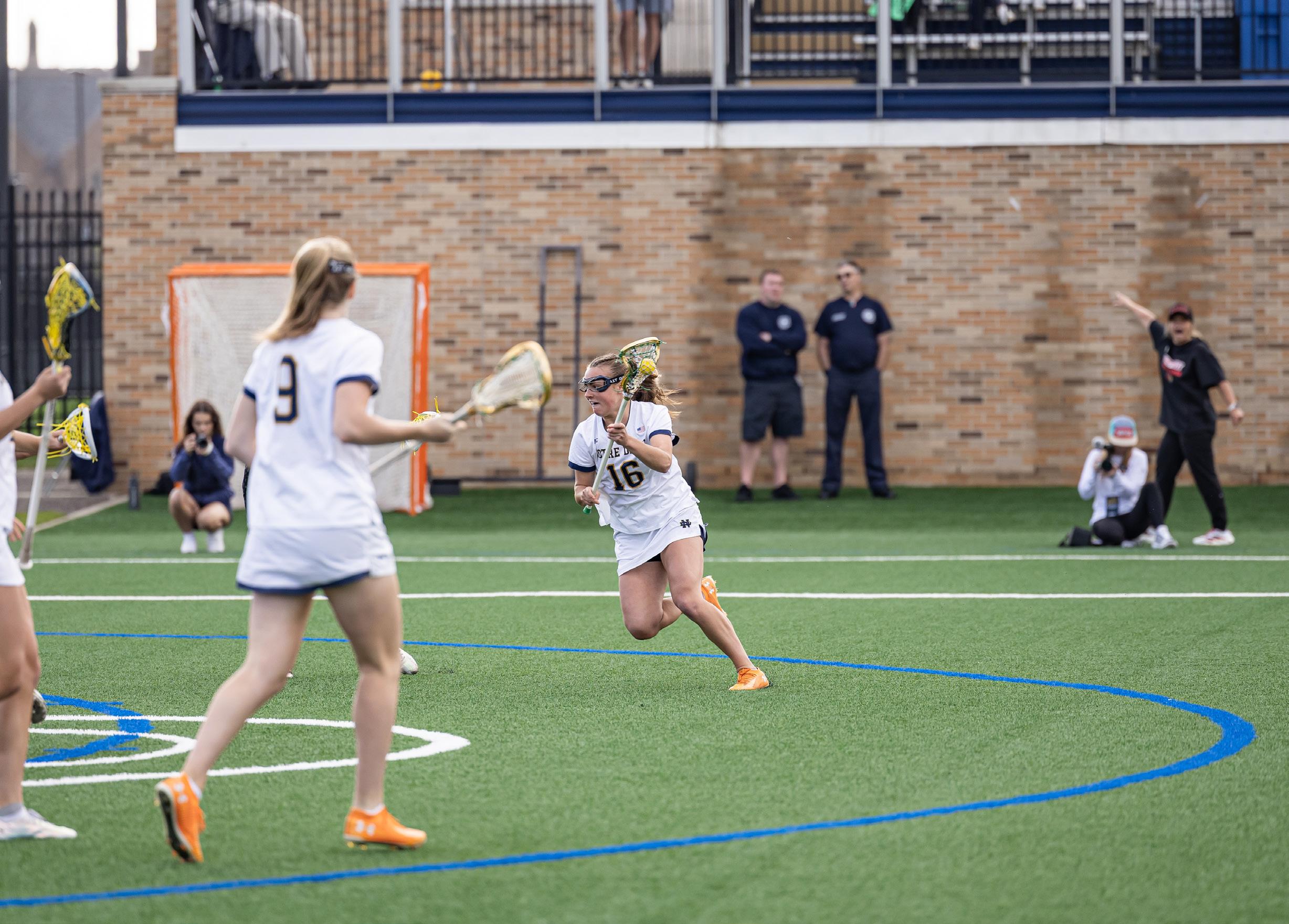
Freshman attacker Grace Maroney moves toward the crease during Notre Dame’s 18-3 win over Louisville at Arlotta Stadium on April 16, 2026. Maroney’s 6 goals marked a career high, and her star-studded classmates added four more goals as the youthful Irish now head to the postseason.
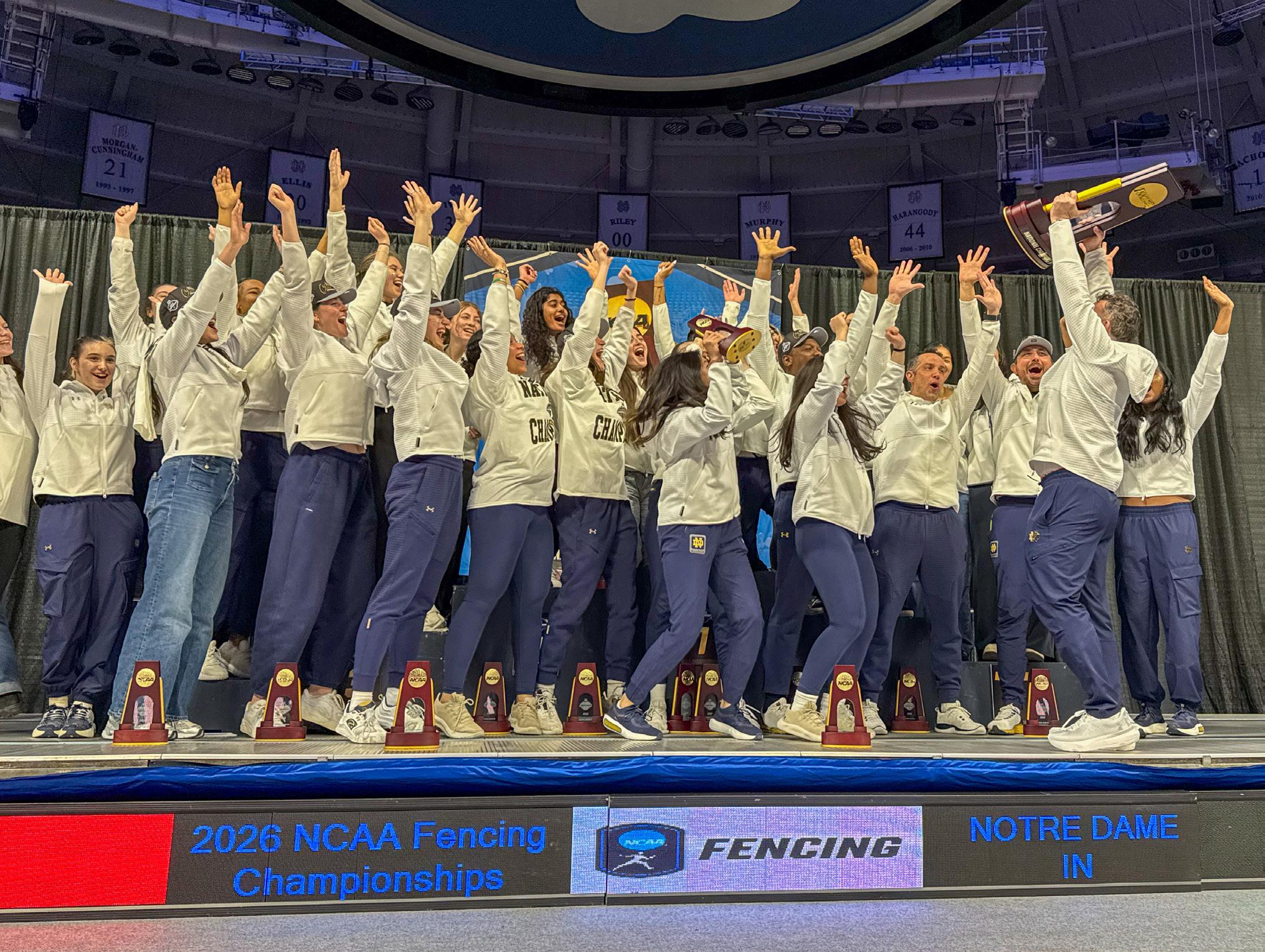
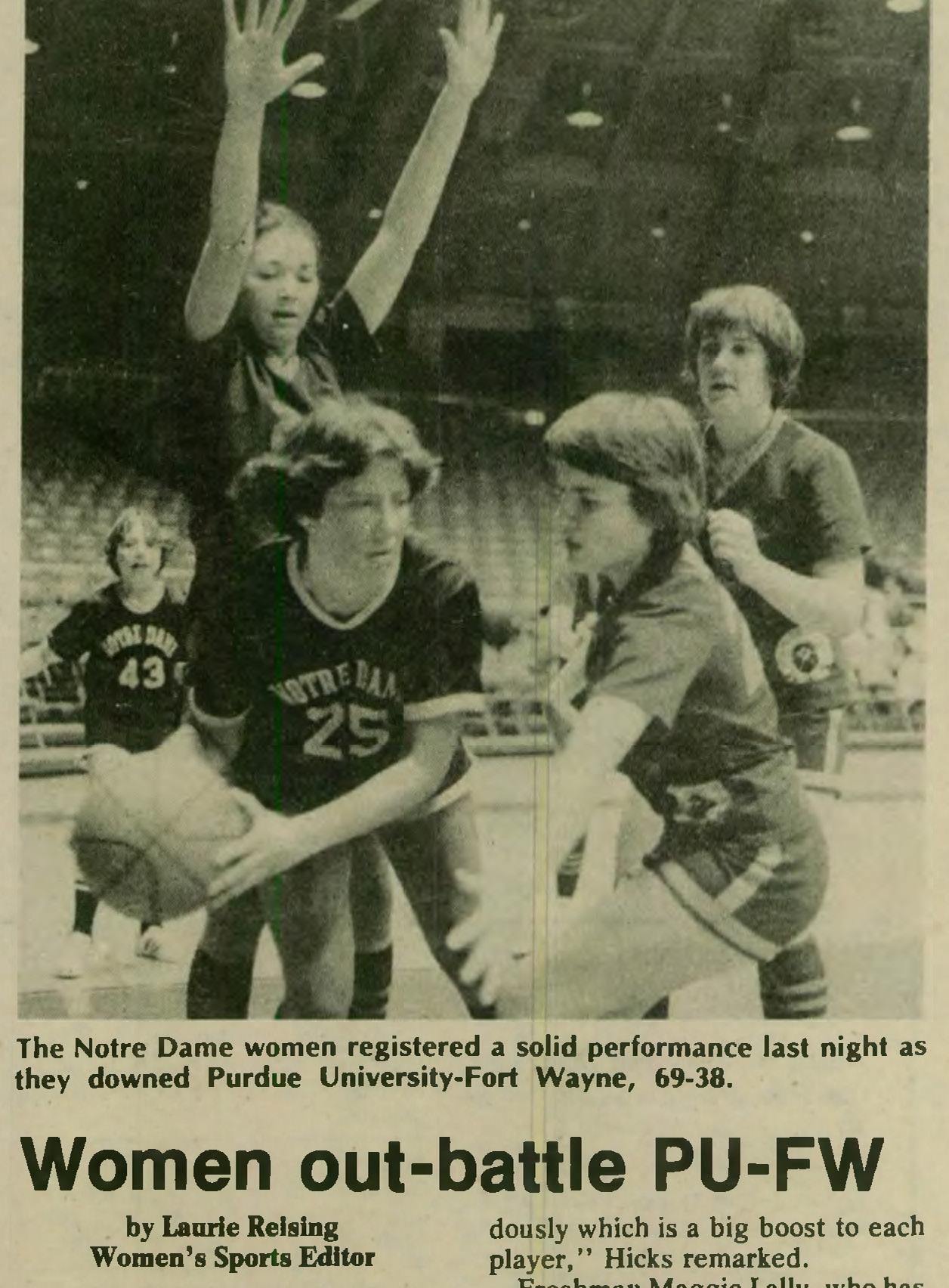
Cheer Her Name
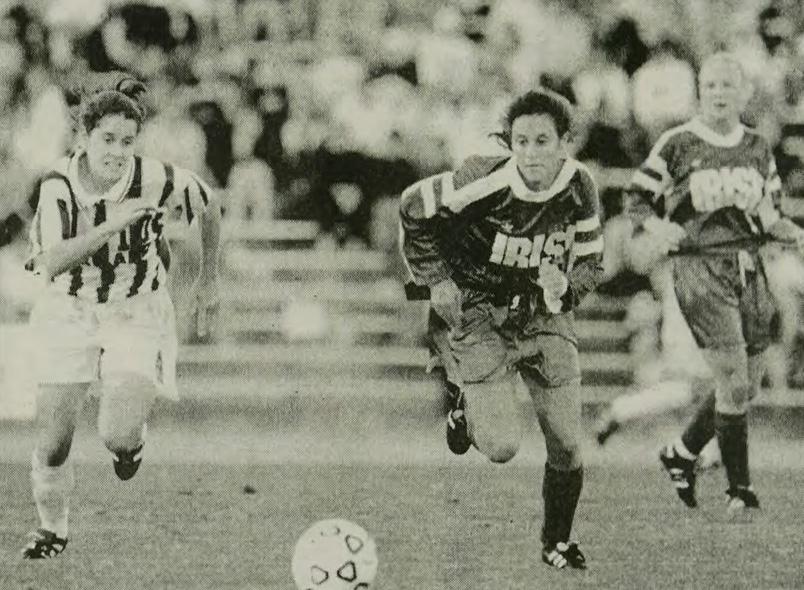
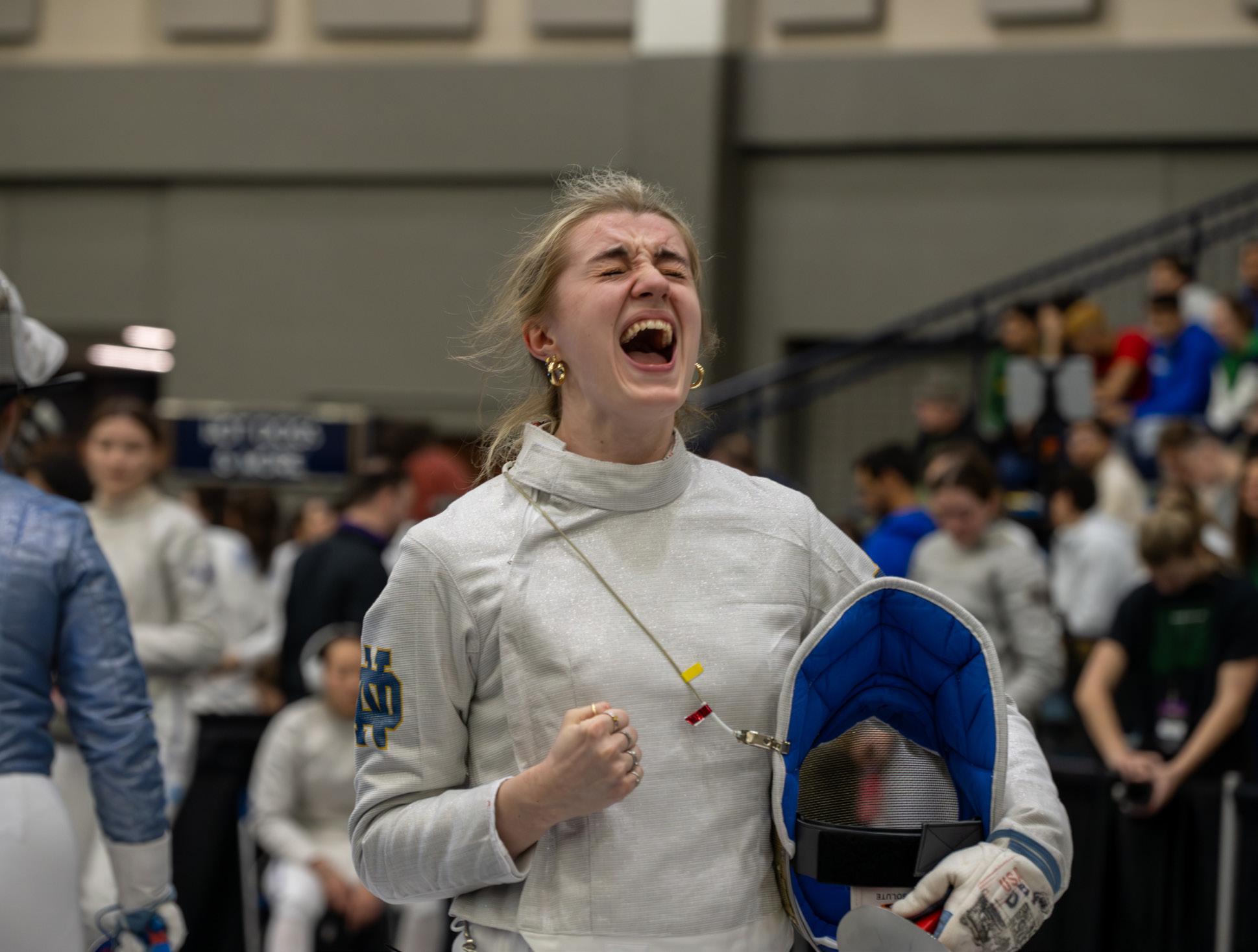
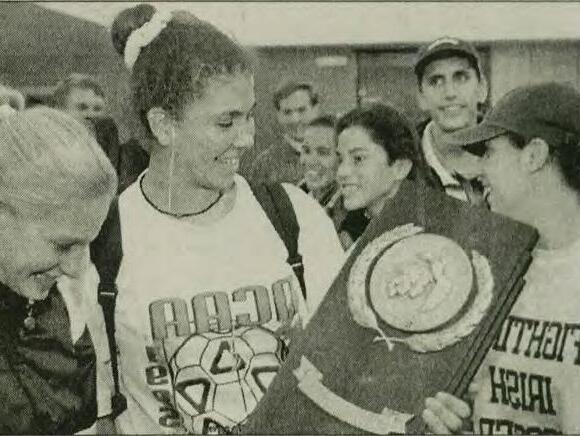
The Observer celebrates 50 years of Women’s athletics at Notre Dame.
Photos by Mary Taddonio and from The Observer’s archives
Softball falls to Indiana after disastrous inning
By Katelyn Huber Sports Writer
On Tuesday evening, the Notre Dame softball team faced Indiana on the road at Andy Mohr Field in Bloomington. In a night where their hitting never got going, the Irish lost to the Hoosiers 11-1.
The Irish are nearing the end of their season, having compiled a record of 17-26. They have played many well-respected teams this spring, including Louisville, Auburn, Liberty, Georgia Tech and San Diego State. When it came time to face a red-hot Indiana team, the Irish ultimately could not keep up.
Sitting at 31-10, Indiana has obtained an impressive record this season. The Hoosiers have faced competitive pitching as well, such as Army, Delaware, Ohio State and Stonehill. Leadoff hitter Aly VanBrandt and Avery Parker are hitting over .400 respectively, each also tallying 11 home runs on the season. Between the fierce hitting pedigree of all nine starters, and three starting pitchers throwing below a 3.0 ERA, Indiana has been a tough challenge for any opponent.
For the Irish, freshman infielder Ava Zachary has been a huge asset on the offensive end. Leading off for Notre Dame, she has collected 42 hits with a .412 average throughout the season.
Junior utility player Sydny Poeck has also played a large role in Notre Dame’s ability to compete, hitting .311 and earning one of Notre Dame’s few hits against Indiana. During her sophomore season, Poeck had eight multihit games and a 17-game onbase streak. This season senior pitcher Micaela Kastor has also been an integral piece for the Irish, starting 16 games. As a
junior, she made a team-high 32 appearances and 21 starts in the circle. She also won 10 games for a second-straight season. On the mound, junior pitcher Kami Kamzik got the start for the Irish and was immediately tested by Indiana. The Hoosiers kicked off the game with a strong first inning, scoring a run after Notre Dame began empty. The Irish quickly struck back in the top of the second, beginning with a Poeck single through the infield. Poeck advanced to second on a wild pitch and then to third after sophomore Avery Houlihan grounded out. With a runner in scoring position, junior outfielder Tenley Sweet singled past the shortstop, driving in Poeck for the first Irish run. While this inning evened the score at 1-1, it was the closest Notre Dame would get throughout the rest of the game.
Indiana retook the lead in the next inning, scoring an additional two runs to make the margin 3-1. The Irish held Indiana scoreless in the third, but the Hoosiers could not be denied in an explosive fourth inning. Indiana scored eight runs, capped off by a grand slam from Alex Cooper. This brought the lead to 11-1 and closed scoring for the day. The Irish had one more opportunity in the fifth but were unable to manage any success.
The Irish concluded the game with one RBI, while the Hoosiers recorded nine, driving in hitters throughout the game.
Sweet ended up logging her 10th RBI of the season during the second inning. She scored 19 runs as the team’s first pinch runner off the bench her freshman year.
Contact Katelyn Huber at khuber01@saintmarys.edu
Irish baseball bounces back against Valparaiso
By Zach Jones Sports Writer
Notre Dame baseball stifled regional foe Valparaiso with a 6-1 victory on Wednesday afternoon. Following the win, the Irish improved to 17-15 overall, while the Beacons fell to 9-23 on the year. Notre Dame has now won 18 straight games against Valparaiso, with its last loss to Valparaiso coming in May 2012.
It was a pristine afternoon at Frank Eck Stadium, with game-time temperatures in the high 70s and a slight wind pushing toward left field. Freshman left-hander Caden Crowell toed the rubber to get things started in the top of the first. Crowell, a Valparaiso native, wriggled out of a
bases-loaded jam in the first before settling down for two more clean frames. In total, Crowell delivered three shutout innings, scattering two hits and a walk along the way. It was a solid bounce-back outing for the young lefthander, who’s had a tough freshman campaign. He brought an inflated 8.40 ERA into the contest after some difficult outings against North Carolina and NC State. With his strong start against Valparaiso, Crowell looks to be regaining confidence on the mound. He’ll be an important contributor for the Irish moving forward, whether it’s as a midweek starter or a long reliever on the weekends.
Designated hitter Mark
Quatrani got the Irish on the board with a solo home run in the first. The Irish were held scoreless for the next four innings, though it wasn’t for lack of trying. Notre Dame put plenty of runners on base but struggled to bring them home, stranding two in the second, three in the fourth and two in the fifth.
Valparaiso tied the game in the fifth with a solo home run to left field. The game was knotted at 1-1 until Notre Dame put up three runs in the sixth to take a 4-1 lead. In that consequential inning, Quatrani worked a bases-loaded walk to put the Irish up 2-1. Sophomore left fielder Bino Watters then laced a two-run single through the right side to pad the Irish advantage.
The Irish added two insurance runs in the seventh off three consecutive doubles from first baseman Parker Brzustewicz, catcher Shane Miranda and third baseman Jamie Zee. Neither team scored in the eighth or ninth, making the final score 6-1 Irish.
Graduate righty Eli Thurmond was the first man out of the bullpen, coming on in the top of the fourth. He worked two innings of one-run ball, giving up three hits. He was relieved by senior southpaw Noah Rooney in the sixth, who twirled two scoreless innings. Sophomore righty Oisin Lee pitched a scoreless eighth, and freshmen righty Will Jaisle closed out the contest with a clean
ninth inning.
Watters, Miranda, and Quatrani led the Irish at the plate. Watters went 3-5 with two RBIs, making hard contact each time up. Miranda delivered a 3-3 afternoon and scored twice, while Quatrani slugged the Irish’s lone home run and logged two RBIs as well.
Notre Dame will continue ACC competition this weekend with a three-game road series at No. 8 Florida State. All three games will be streamed on the ACC Network. First pitches in Tallahassee are scheduled for 6 p.m. Friday, 2 p.m. Saturday and 1 p.m. Sunday.
DECLAN LEE | The Observer
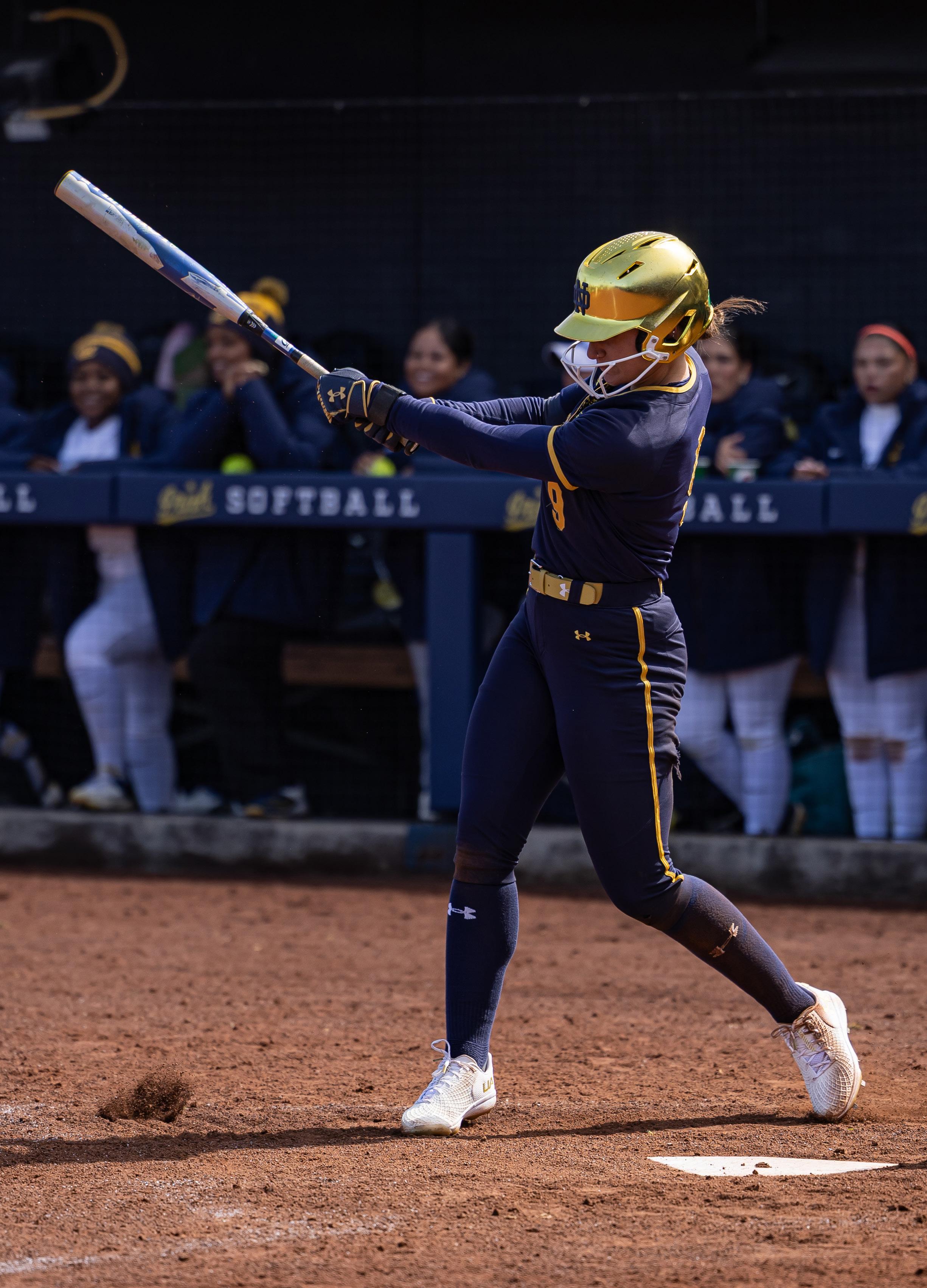
Senior outfielder Mickey Winchell takes a cut during Notre Dame’s 6-2 win over Cal at Melissa Cook Stadium on March 28, 2026. The California native is hitting .322 with 6 extra base hits and 13 stolen bases this year.
Irish women’s golf heads to ACC Tournament
By Jocelyn Fulcher
Sports Writer
This Thursday through Sunday, the Notre Dame women’s golf team will compete in the ACC Tournament. The team will head to Wilmington, N.C., to play at the Porters Neck Country Club.
Freshman Taryn Cagle said the team has yet to play on the course but added, “Our junior, Alex Lapple, played conference there her freshman year. She will be super awesome and useful for some prior course knowledge.”
The Irish had a strong finish to their regular season. The team played in the Maryland Terps Invitational April 5-6, finishing 10th out of 16 teams. The team had a combined score of 48 over par, with Alex Lapple having the best score of 11 over.
The junior finished 39th individually.
The ACC Tournament competition will be fierce. The tournament will include No. 1 Stanford. “The ACC is
subjectively the most competitive conference, so we are super excited to go play amongst the best,” Cagle said.
The Irish need to do well in hopes to qualify for the NCAA Regionals to carry on their season. Only the top four teams advance. Cagle and the team are confident going into the weekend, though.
“I think the team consensus is excitement,” the freshman explained. “It’s always a blessing to be able to go out there and do what we love and compete.”
“Sticking to our routines and committing to targets and numbers is always top priority in any event we play. We have been working really hard, so we are going to be going in with confidence knowing we have prepared,” she added.
The four-day event can be streamed on the ACC Network this Thursday through Sunday starting at 7:30 a.m.
Contact Jocelyn Fulcher at jfulche3@nd.edu




MARIELLA TADDONIO | The Observer
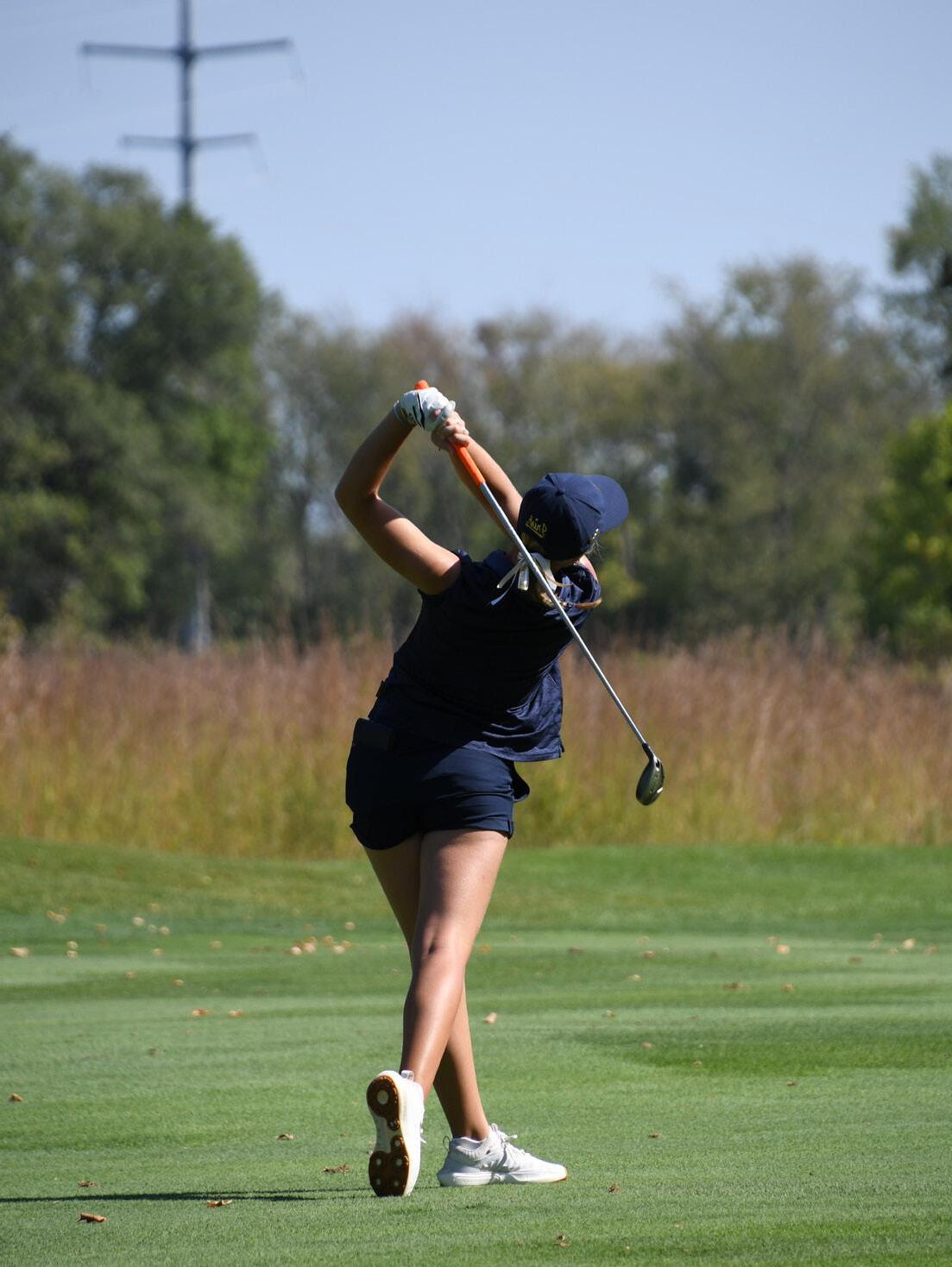
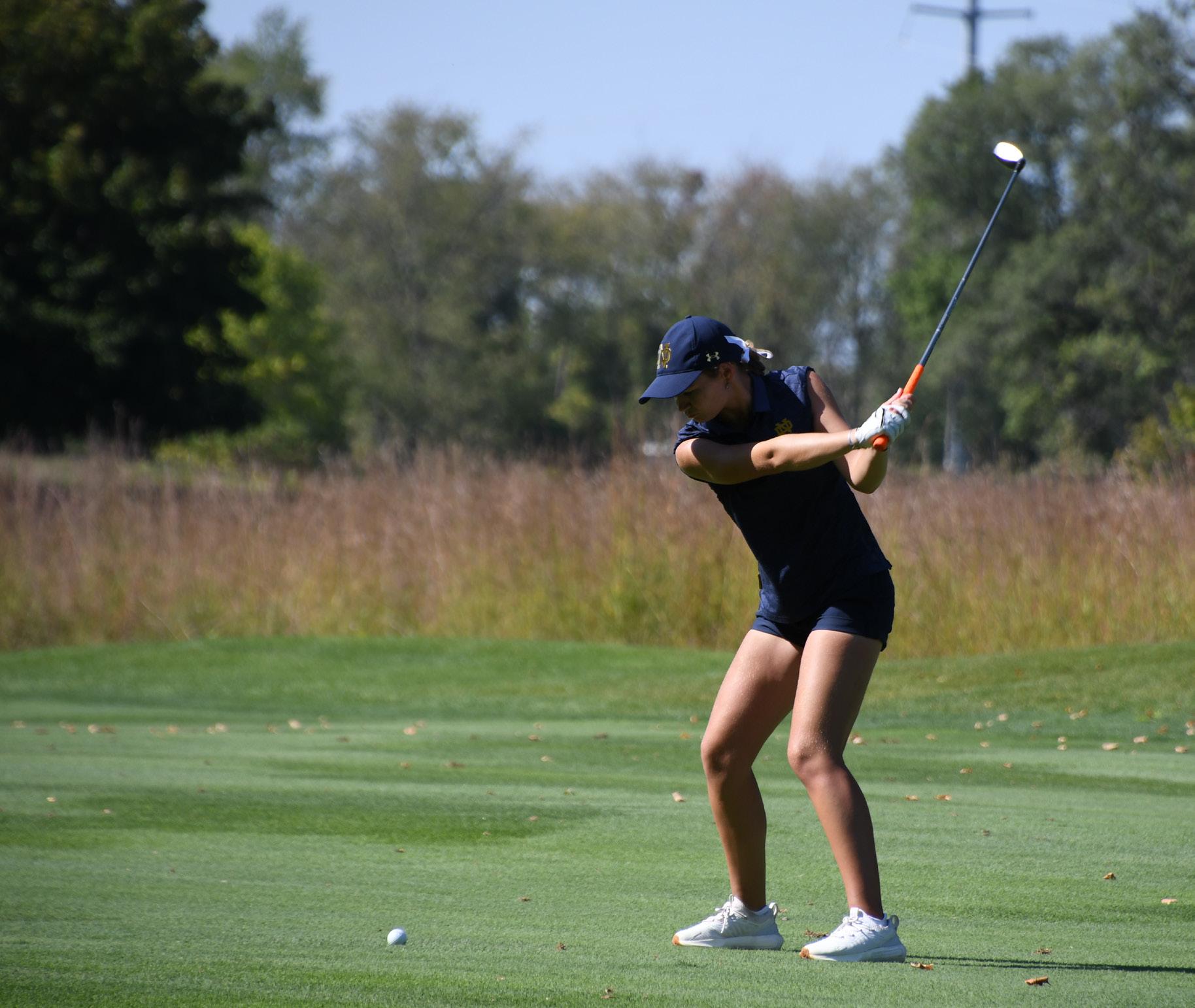
Freshman Taryn Cagle hits out of the fairway during the Women’s Fighting Irish Classic at Warren Golf Course on Sep. 28, 2025. The Irish picked up their first tournament win under head coach Breanna Jenco.
Bianca Molnar: A flame for the game
By Jacek Kawczynski Associate Sports Editor
In the fall of 2024, Notre Dame freshman Bianca Molnar made her first appearance on the team college tennis circuit. Playing at the No. 4 singles spot, she led Ball State’s Sarah Shahbaz 7-6, 2-1 before the match was abandoned. In the following months, Molnar kept winning, accumulating a 24-14 singles record for the year and finishing an impressive 5-2 against ACC competition. Molnar looked like she was more than ready to step into the spotlight, which wasn’t surprising given her already monumental career accolades.
A California native, Molnar developed her game against some of the best competition found anywhere in the world. In 2023, Molnar claimed her first professional WTA singles and doubles points, defeating a top 400 women’s player in the process. A year later, she powered her way to the Junior Indian Wells doubles title, together with partner Alyssa Ahn, already cementing her name in what is widely known as “tennis paradise.”
Following her strong junior career, Molnar chose to continue her tennis journey at Notre Dame, both for its excellent athletics as well as its grounding in faith. Currently midway through her sophomore season and preparing for the 2026 NCAA Championships, I sat down with Molnar to discuss the transition to college tennis, her game and the challenges ahead of her.
While there are never more than two opponents across the net, college tennis is an entirely different game than junior tennis. For one, junior tennis rarely involves dozens, if not hundreds, of fans screaming in between every point. In a sport traditionally known for its decorum, college tennis takes a complete turn, bringing those extra elements of fire and fervor to the game. College tennis also involves changes in lifestyle and practice schedule. While juniors tend to play tournaments more sparsely, often picking and choosing tournaments as they prefer, college tennis takes away that flexibility. Players often compete in two, sometimes three, duals a week, often participating in both singles and doubles. The fast-paced regimen of college tennis can be rewarding but also draining on both the mind and body in a way juniors is not. Speaking on her experience making the switch, Molnar
explained, “For me, the first few months were tough…getting used to the travel and higher intensity. What helped was relying on my teammates in tough moments. Whenever I was having a hard time adjusting, they were there to support, that’s what makes it [the college dynamic] so special.”
The team aspect is indeed the most prevalent difference between college tennis and any other format of the sport. Whereas individual players or pairs play mostly for themselves, college players represent their team and school, each of them a crucial component of an efficient machine. Along with the format comes pressure and greater expectations.
“Yeah, when I’m out there, I’m playing for myself, but also for my teammates. …You wanna make sure that you do your part week in and week out,” Molnar said.
While the added pressure often makes life difficult for college players, it makes wins all the more rewarding and prepares them for careers on tour.
When asked about whether the circumstances of college matches can better prepare players for the professional stage, Molnar said, “For sure, I think [the pressure] prepares you for big moments in the pros. Here, your team is counting on you, so maybe when you face an important point or tight moment at like 3-3 in the third [set], you’ll be much more used to that feeling.”
Both she and the team will be expecting to play some important points in the upcoming weeks, especially in this weekend’s ACC Championships. Notre Dame enters the tournament ranked No. 10 in a loaded field, while Molnar currently sits at No. 63 in the ITA rankings.
So far this season, Molnar has taken a step up, playing primarily at the top court for singles and partnering with senior Bojana Pozder at the No. 1 and No. 2 doubles spots. She has accumulated a 13-9 singles record, with her best win coming against Berkeley’s No. 16 ranked Johanne Svendsen, 7-5, 6-4.
Speaking about her game, Molnar said, “I love to be aggressive…big serve and forehand, stay on the front foot. A lot of serve-plus-one to finish the point early.”
Molnar will have to bring her A game if she wants to make a splash at the ACC Championship and the looming NCAA Championship.
“My personal goal is to become an All-American, which is awarded to the top
20 singles players and top 10 doubles teams at the end of the season,” she said.
Looking beyond this season, Molnar hopes to use her time at Notre Dame to grow as both a person and a player.
She said, “I definitely want to play professionally after college. That has always been a goal of mine, and it’s one of my motivations for playing.”
While the college circuit has become a factory for producing top 100 players in recent years, tennis is still one of the most challenging sports to play professionally. The nearly yearlong calendar, travel and coaching expenses, and mental fatigue all play a role in the difficulties pros
encounter. To avoid burnout, it is important to have a deep passion for the game, as well as strong reasons to continue playing.
When I asked Molnar what she loves most about the sport, she told me, “I love competing…the thrill of winning a crazy point or a close match, that’s what keeps me going. Also, having these long-term goals like going pro helps.”
She again emphasized the importance of team culture in keeping her motivated, “It’s obviously a long season, so whenever I’m feeling burnt out or tired from matches, I lean on the team for support. In practice, sometimes we get
super competitive, but the friendly rivalry keeps things fun.”
These next few weeks will be big ones for Molnar and Notre Dame women’s tennis. The season has been a bit of a roller coaster, but they currently sit at 17-8 and have all the capabilities to make multiple deep runs in the postseason. Individually, Molnar will likely relish the opportunity to take on the country’s best players, and, win or lose, her passion and dedication to the game ensure that her tennis future looks bright.
Contact Jacek Kawczynski at jkawczyn@nd.edu
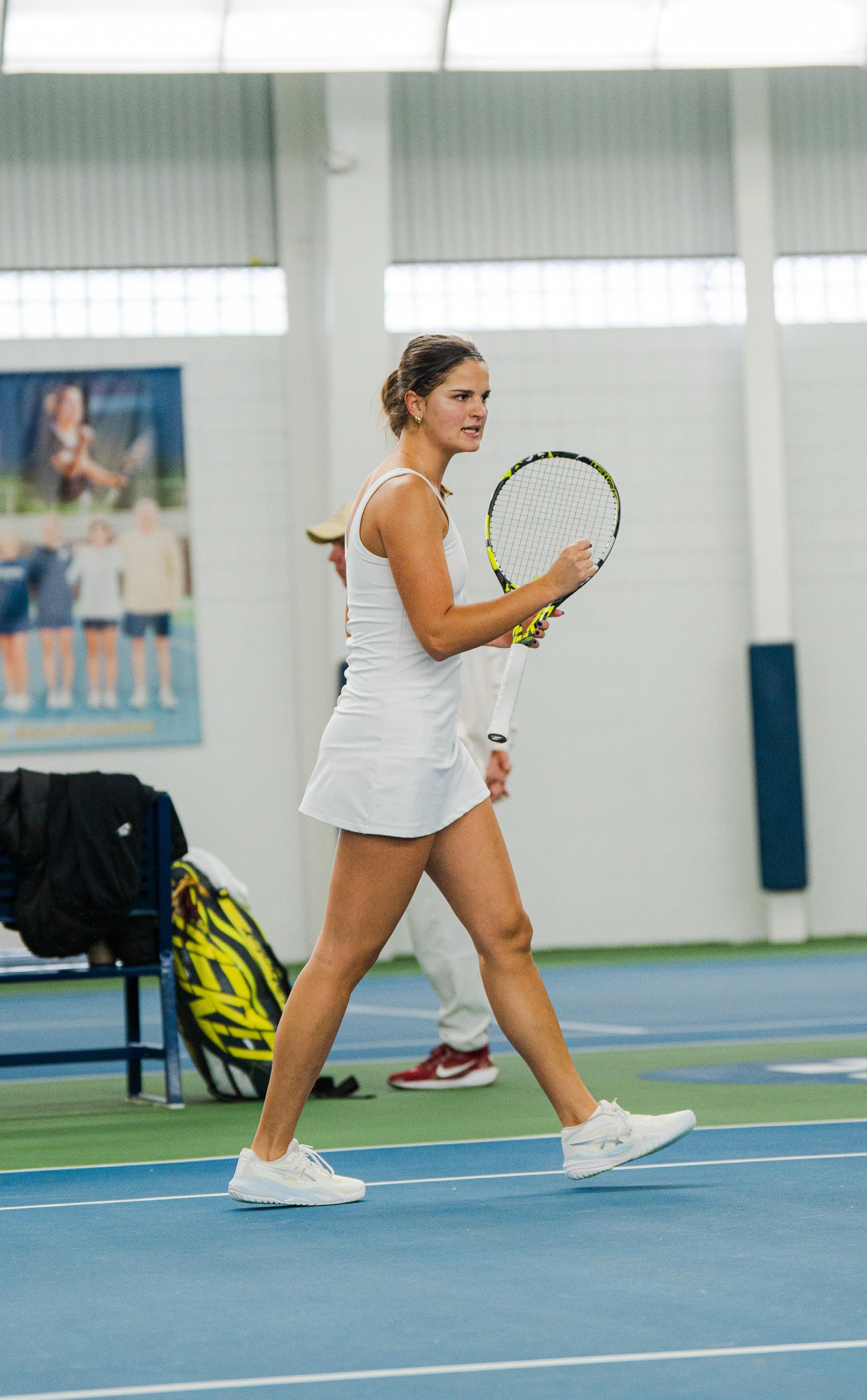
KEVIN SANCHEZ | The Observer
Sophomore Bianca Molnar celebrates a point during Notre Dame’s 4-2 win over Florida State at Eck Tennis Pavilion on Feb. 22. Molnar, ranked as the 71st-ranked player nationwide, is 20-11 in singles play this year.
Collins: Cheer for her? Compensate her, too
By Ellie Collins Associate Sports Editor
In the world of collegiate athletics, male athletes receive the lion’s share of handouts from the House v. NCAA settlement, which, effective in 2025, allows universities to distribute up to $20.5 million of sports revenue to its athletes. With football and men’s basketball already receiving substantial name, image and likeness compensation, the settlement has not stopped schools from throwing more dollars
into the “funny money” package. According to many reports, football rosters will require $40 million to $60 million in combined school and NIL resources to compete with the top spenders. Meanwhile, men’s basketball costs reportedly will jump 65% for next season. We all know that football drives the car, and men’s basketball is in the front passenger seat. But female athletes apparently must once again earn every cent they get.
Title IX requires that revenue-sharing models distribute
opportunity and financial compensation to female and male student athletes equally. Yet, early plans suggest that roughly 90% will be going to the big two and 5% each to women’s basketball and other programs. If it were 10 years ago, one could argue that this is only logical — women’s athletics struggle to sell tickets or attract television eyeballs. But that argument is now nothing short of facile. We live in a post-Caitlin Clark NCAA world.
In 2024, a record 18.9 million people tuned in to watch South
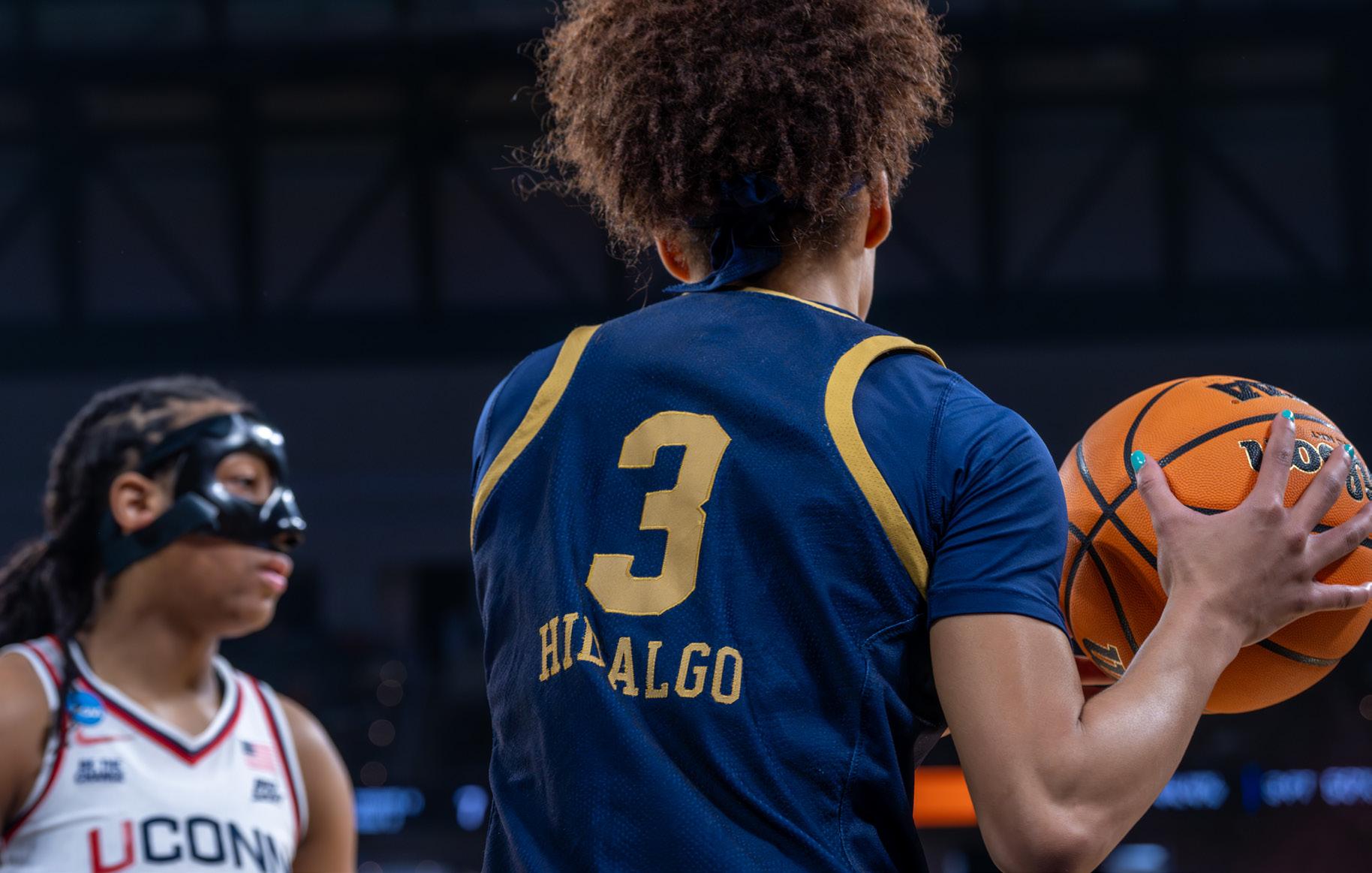
Carolina take down Clark’s Iowa squad in the NCAA women’s basketball championship. This year, even without the Hawkeye legend, the title game between South Carolina and UCLA (airing on a Sunday and not in prime time) still drew 9.9 million viewers — a 104% increase from 2022. While Clark alone cannot be credited with all the glory, she no doubt changed the sport’s scope and success. Iowa women’s basketball ticket revenue more than tripled between her sophomore and senior campaigns, and the same can be said for South Carolina; UConn has additionally seen a sharp upward trend since 2021, bringing in 4.2 million last year.
The sport has a significant star presence, and many players are cashing in via NIL opportunities on social media. It is an open secret in big-time football and men’s hoops that many NIL deals are just a way to funnel dollars to players without any reciprocal services.
Supposedly, the College Sports Commission’s clearinghouse, commonly referred to as NIL Go, charged the powerhouse accounting firm Deloitte with the task of validating that deals over $600 will bring legitimacy. I am not holding my breath. The lawsuits will be many when a deal is nixed, and the beat will go on. Meanwhile, female stars who consistently bring value with their name, image and likeness actually live up to the plan’s intentions.
Despite this disparity, it appears the schools will simply “feed the beast” under the new revenue-sharing plan and wait for the next Clark to force their hand to actually notice that the ladies deserve, if not equal pay, at least more than crumbs from the banquet table set out for the big men’s sports. Unfortunately, I am pessimistic about this possibility. Clark thrived because she could be compared to her male counterparts — most notably in how her shooting range compared favorably to the legendary Steph Curry. Women’s college basketball, however unnecessary the correlation is, will always exist and be discussed in relation to the men’s game. Collegiate softball, volleyball, gymnastics or even soccer sadly do not have the same platform to take off quite like hoops. Do not get me wrong. I hope that I am laughably and unconscionably incorrect. But the growth in NCAA women’s basketball and the extant lack of equal recognition among its athletes — at least in any way beyond a “Cheer Her Name” campaign — poses a question concerning whether or not they will ever receive a level playing field. This is something I cannot exactly answer, but I can promise one thing: if female athletes ever do make their way to that arena, they will do so on their own, with no help from anyone else.
Contact Ellie Collins at ecollin9@nd.edu
Chukwu and Engle’s international impact
By Chris Dailey Sports Writer
Notre Dame sophomores Izzy Engle and Annabelle Chukwu are sophomores in name only. The superstar forwards play beyond their years. Engle brings blistering speed and a clinical nature in front of the net. Chukwu brings sublime technique and tenacious desire to win. Together, they’ve formed the best attacking tandem in the country and are earning well-deserved international attention.
Engle, a goal-scoring phenom from Edina, Minn., was recently called into U.S. Soccer’s U20 April training camp. Alongside some of the best players in all of college soccer, Engle will don the red, white and blue for two friendly games against Brazil.
In the first game on April 12, Engle started alongside five other college players and five National Women’s Soccer League pros. The match was played at CPKC Stadium, home to the Kansas City Current and the first stadium purpose-built exclusively for women’s soccer.
Engle will more than likely feature for the U20s at the 2026 FIFA U-20 Women’s World Cup in Poland this September. Her pace combined with her elite technical ability makes her a vital piece to the squad.
Engle has utilized that unique skillset across a wildly successful first two seasons with Notre Dame.
She has posted consecutive 19-goal seasons, added six assists to her resume this fall and is averaging a goal every 75 minutes she’s on the pitch. After claiming Atlantic Coast Conference Freshman of the Year honors in 2024, she added to the trophy case by earning the ACC Offensive Player of the Year this past fall.
Her best trait, however, is perhaps the one that goes unaccounted for.
“She has a great mentality,” Notre Dame head coach Nate Norman said. “A superpower I think a lot of players that are really successful have is they have this healthy confidence about themselves. She really believes in herself, but there’s no sense of arrogance in herself.”
Engle’s confidence has propelled her to the top heights of college soccer. In the fall, she was a finalist for the Mac Hermann Trophy, college soccer’s equivalent of the Heisman Trophy. With continued growth on the pitch, reaching the summit for the game’s most prestigious honor feels inevitable.
Her counterpart Chukwu is no less brilliant. After a three-goal campaign her freshman year, Chukwu registered 12 goals and three
assists this past season. Like Engle, Chukwu was named to the All-ACC First Team.
She’s also earned her fair share of international success for the United States’ northern neighbor.
On April 11, Chukwu scored two goals as she recorded her first senior international goals in Canada’s 4-0 win over Zambia at the 2026 FIFA Series in Brazil.
Chukwu is no stranger to scoring goals for the Canucks. Before arriving at Notre Dame, she broke Christine Sinclair’s long-standing record for the most youth-international goals in Canadian soccer history.
Not bad company, considering Sinclair’s 190 international goals are a world record for men or women.
“What’s great is [Chukwu] was a very successful youth player but we’ve continued to see her grow in terms of her development and her improvement,” Notre Dame head coach Nate Norman said. “She’s a soccer junkie, she wants to play and get better, and she’s inquisitive. She’s got a lot of humility as well.”
The process for Engle and Chukwu to represent their nations is an interesting one. The respective federations reach out to Norman and Notre Dame, who then grant releases based on academics and availability. Notably, in her freshman year,
Chukwu missed the first chunk of the fall season to represent Canada at the FIFA U-20 World Cup — which is held every two years.
“U.S. Soccer and the Canadian soccer federation are great to work with. They get you information early, they are also okay if there is a window that doesn’t make sense to go to because it’s midterms or finals,” Norman said.
He continued by saying, “When it happens in the fall it’s tough because we want our kids to always be here in the fall, but it’s a balance. If there’s opportunities to play in a Youth World Cup or actual World Cup qualifying, we’re not going to hold them back if they’re missing our fall games.”
That support Norman offers the student-athletes to pursue lifelong dreams is a reason Notre Dame has been able to recruit such high-level talent over the past few years.
Watching them thrive on the international scene is part of the payoff.
“To watch them to be able to have success in these different environments and have the opportunity to play on the national platforms is great for them and the program. We take a lot of pride in what they do,” said Norman.
“College women’s soccer is such a high level I don’t think people really understand,” said Norman. “I tell people and I don’t think they believe this: playing in the ACC in college probably means you’re probably playing in the top 4-5 leagues in the world. That’s professional and amateur. I don’t think people understand the quality.”
For Norman, the proof is in the pudding.
Notre Dame has consistently developed top-level talents. From the senior class this fall, Leah Klenke has signed with the Houston Dash, Carolyn Calzada is playing for the Portland Thorns and Laney Matriano has signed with BK Häcken in Sweden.
With their insanely productive output for the Irish and international resumes, there is no doubt Engle and Chukwu will be next up in two years.
But for now, Norman will be grateful to have his high-flying stars in South Bend, as the program looks to capture its first national championship since 2010.
He also noted that when Engle stars alongside the professionals, and Chukwu nets hat tricks in senior competition, it’s further vindication that Notre Dame is playing among the best of them.
Contact Chris Dailey at cdailey2@nd.edu
ND WOMEN’S SOCCER
MARIELLA TADDONIO | The Observer
Junior guard Hannah Hidalgo inbounds the ball during Notre Dame’s 70-52 loss to UConn in Fort Worth on March 29, 2026. One of the college basketball’s most marketable stars, Hidalgo has numerous endorsements.