LIAM FLYNN | The Observer
INSIDER
2 | THE OBSERVER
TUESDAY, NOVEMBER 17, 2026
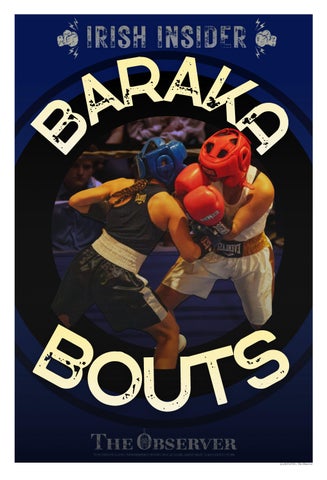
BARAKA BOUTS
Sports and global good: president Rosie Binette By Josie Brown Sports Reporter
Rosie Binette is the current 2026-27 president of the Baraka Bouts women’s boxing program at Notre Dame. Binette, a senior neuroscience major, has competed in the Baraka Bouts tournament since her freshman year. This year, Binette is focusing on two main goals. First, she is fighting to defend her impressive two-year championship streak. Second, she wants to continue to teach the skill of boxing to new members. Binette first learned about Baraka Bouts during the activities fair her freshman year at Notre Dame. Under guidance from her mother, she was advised to “sign up for something that you never thought you would.” While Binette was hesitant, she saw the club as an opportunity to get involved on campus and go outside her comfort zone. Despite her initial limited experience, Binette found a love of the technique of the ring. In her freshman year, she worked up the courage to register for the tournament under the name “Rosie ‘the Riveter’ Binette” but had no expectations going into it. She won the first round in a contested split decision and said, “I can’t believe it.” Early on, it was clear that Binette had a knack for attacking. Binette’s performance only skyrocketed from there. When asked about how she approaches the ring, Binette said, “everyone is like so freaking scared to get in the ring.” In her sophomore year, she returned to the ring with a goal to simply make it past the first round. She was slated against tough competition but prevailed, making it past the first round and into the
ZOE KEANE | The Observer
Junior captains Rosie Binette (back row, far right) and Kiska Porter (back row, middle) joined their teammates in 2025 for the 23rd annual Baraka Bouts. Now in the 24th Bout, Binette is the club president while Porter is a vice president, and they work leading practices and club fundraising.
finals. The finals presented a serious challenge as she faced off against the previous senior captain, Luisa Capobianco. Binette entered the ring ready to give it her all, unwilling to go easy on the captain. In support, Binette’s mom f lew out to watch her daughter compete, which gave the fighter an extra boost. It was a tough match with the two going back and forth on advantage, yet in a split decision, Binette prevailed, winning her first Baraka Bouts Championship as a sophomore. In her junior season, Binette was no longer an underdog but rather a front-runner to take the championship once more. Binette became a captain in her third year as an
experienced boxer in the ring. In the first Bout of the tournament, Binette took on Lindsey Weeter and cleaned up the ring with a unanimous decision in the captain’s favor. However, the finals came against a much tougher opponent in sophomore Eugenia Rios. Rios was certainly punching up against Binette in an almost deja vu role reversal for the captain. Still, Binette denied Rios her Cinderella story and secured her second championship. In her fourth season, Binette is after her third consecutive championship. She surpassed her first opponent, Alyssa Ehler, in the semifinals in a unanimous decision. Wednesday, she takes on Eugenia Rios once again in the
finals to defend her title. Binette graduated into the role of president after serving as “Missions” captain her junior year. Under her leadership, Binette spearheaded fundraising efforts for Holy Cross Missions in Uganda. Binette said that the fundraising element of Baraka Bouts was one of the things that drew her to the boxing program. She highlighted the club’s fun activities, including group runs before game days, which incentivize people to get involved and raise money, as they are more willing “to ask and to raise money because it’s like, this is not completely for us.” As president, she has continued this through her leadership and recruitment, recruiting an inf lux
of new members. In addition, with her emphasis on charity, Baraka Bouts has surpassed its old $50,000 goal to $54,000 and raised its goal to $75,000. For Binette, “The Pit” or the Baraka Bouts practice area underneath the Purcell Pavilion has become not just a second home but an escape from the pressures of life. She stated that practices are “the most distressful thing that you can do.” Baraka allows her to find not just sisterhood but community without involving academic life. She stated that “everyone is here for the workout; you’re here for the girls.” For Notre Dame students, this is a rare opportunity, and Binette has taken advantage, showing up to six to eight practices a week. Binette stands behind the principle that Baraka Bouts is “the most Notre Dame thing to do.” It is a combination of sport and charity for people around the world. Binette said that for anyone interested in joining but worried about the time constraints, they should understand, “we offer eight practices a week,” and “that’s your workout.” In addition, new members should not have to worry about any prior experience, as the club trains everyone in a step-by-step program that meets each fighter where they are. To watch Rosie attempt to claim her final title, you can attend in person to watch the Baraka Bouts finals at the Danke Ballroom on Wednesday, Nov. 18.
TEAGAN BARRY | The Observer
In the 24th Baraka Bouts, the fighters are presented to the crowd at Dahnke Ballroom at Notre Dame in the semifinal round on Sunday, Nov. 15. The finals will take place on Wednesday, Nov. 18 to crown champions. The proceeds from tickets directly go to fundraising to build schools in Uganda.
Contact Josie Brown at jbrown68@nd.edu
THE INDEPENDENT NEWSPAPER SERVING NOTRE DAME, SAINT MARY’S AND HOLY CROSS ESTABLISHED 1966
TUESDAY, NOVEMBER 17, 2026 | VOL. LXI, NO. 22
Editorial: Notre Dame needs dialogue The Observer Editorial Board Last month, University President Fr. Robert Dowd launched the Ad Hoc University Committee on Respectful Dialogue. In his statement announcing the creation of the committee, Dowd said that “unprecedented polarization” in American society has impacted life here at Notre Dame. He also reported that students and faculty at the University desire greater opportunities to engage with those who hold views different from their own. We share that desire. The Observer is committed to the pursuit of truth made possible by open inquiry. We believe ideological diversity benefits the
academic community, and we believe it is of vital importance that members of the University community feel Notre Dame is a place where they can speak freely. We hope the committee agrees. Dowd tasked the committee to consider how the University “can foster a culture of respectful dialogue across differences.” We wonder whether the committee sees the primary issue as a lack of respect or a lack of dialogue. In the experience of members of this editorial board, Notre Dame students and faculty are broadly respectful in their speech. Anecdotally, conversations among students are courteous and good-natured (the primary exception being on the
anonymous social media app Fizz). We are grateful that hateful and violent rhetoric is rare at Notre Dame. But respect alone isn’t enough for constructive dialogue. In fact, we worry the virtue of respect has morphed into selfcensoring conformism, and that a culture of fear that chills free expression has begun to pervade campus. Last year, when The Observer interviewed students about ongoing construction in South Dining Hall, many refused to associate their names with a complaint, even regarding something as innocuous as delayed food service. Dining hall construction isn’t see “Dialogue” on page 7
SMC opens new Trustey Trail with ceremony By Berhan Hagezom and Gabriela Aguilera-Perez
NDSMCOBSERVER.COM
McGlinn hires new rector
By Observer News Staff
In an email received by McGlinn residents at 9 p.m. Sunday, director of residential life Breyan Tornifolio announced that McGlinn Hall would be receiving a new rector. The announcement comes on the heels of the University of Notre Dame’s investigation into former McGlinn rector Elizabeth Greenop, which found Greenop not responsible for sexual misconduct she had been accused of over the summer. “I wanted to reach out to share the exciting news that Monica Leon has accepted our offer to serve as Rector in McGlinn Hall beginning in January,” Tornifolio wrote in
the email. Tornifolio stated that Leon is a 2024 graduate of the University and previously served as an assistant rector of Howard Hall. The email provided a brief biography of Leon, noting that she is originally from El Salvador but was raised in Georgia. During her time at the University, Leon was a resident of Walsh Hall and received a degree in political science before pursuing a master’s degree in French and Francophone studies. Leon’s profile from Howard Hall’s website says that as of last academic year, she had hoped to attend law school. see “Rector” on page 6
The Observer appoints new editor By Observer News Staff
Following the groundbreaking ceremony held in June, Saint Mary’s College hosted the ribbon-cutting for the Trustey Trail on Friday afternoon. The event location was changed from the designated outdoor location to O’Laughlin Auditorium due to a weather advisory. The $4 million trail, a donation gift from Kristine Anderson Trustey ‘86 and her husband Sean McGraw, is a two-mile loop that begins at the back of Regina Hall, behind the Indiana Toll Road, Madeleva Drive and half of Loretto Road. Lori Johnson, vice president of student enrollment and engagement, said that the overall implementation of this trail aligns with the campus’ strategic plan, Revere and Revise, to build spaces and programs dedicated to promoting health. “I think it certainly helps beautify the campus,” Johnson said. “I also think it is part of how we can offer opportunities for students and everyone in the tri-campus to have a place and
a space to walk, reflect, jog, be with friends out in nature, and I think that supports health and well-being too.” Libby Koultourides, associate vice president for advancement, opened the ceremony by sharing the purpose of the new trail and thanking the benefactors, Trustey and McGraw and their family and friends. In a written statement to The Observer, Koultourides shared that the Trustey Trail includes “several areas with seating for prayer and reflection, as well as a fitness area with equipment.” Board of Trustees student representative senior Kathryn O’Connell described the new trail within the ceremony as “a special gift to students that creates an accessible space where we are invited to further explore the campus that first attracted us with strong ties to our incredible history.” She reminisced about her own time as a freshman walking around Saint Mary’s through unpaved paths, as well as former College president Sister Madeleva Wolff’s autobiography and poems about the importance of beauty and reflection in
quiet spaces. Wolff’s walking stick was also used during the ceremony to hold the ceremonial ribbon, which was carved by her from a tree on campus. College President Katie Conboy highlighted in her speech how the trail also embraces the overall campus master plan that would allow the college’s scenery to “be more connected, more pedestrianfriendly and more welcoming to our own community and to the tri-campus community.” Following further mentions of the trail and donation, Trustey and McGraw were given a book that had entries from students, faculty and staff regarding their appreciation for their donation toward the development of the trail. Trustey proceeded to discuss the planning for the trail, which was mainly focused on having walkers enjoy nature and have a place to exercise and reflect. However, she noted that its circular shape is similar to the patterns of circles she noticed during her time at Saint Mary’s,
NEWS | PAGE 5
OPINION | PAGE 7
SCENE | PAGE 10
SPORTS | PAGE 14
SPORTS | PAGE 15
Senior Charles Sander shares how he became the University’s 22nd Rhodes scholar.
Opinion polls may have some place in politics, but should not be used for candidate policies.
The Irish rock band released their 16th studio album that renews hope in the band.
Irish dominate Boston College 41-7, avoiding any chance of a loss to the Eagles.
Baraka Bouts vice presidents discuss their experience leading the club and fundraising.
Saint Mary’s News Editor and Reporter
Rhode scholar at ND
Polls aren’t effective
see “Trail” on page 6
U2 returns
Nicholas Kowal has been appointed as The Observer’s Holy Cross News Editor, becoming the first to assume the position in the newspaper’s 60-year history. Kowal, who was hired as an associate news editor and has served as the de facto leader of the Holy Cross news team since August, was announced as the newest member of the Editorial Board — The Observer’s governing body — at its Sunday meeting. “I thought, you know what? Why not? College is about trying new
things. And so, I just kind of took the opportunity and ran with it,” Kowal said of his August appointment. The senior communications major said he became acquainted with The Observer through a journalism ethics class, where he met Notre Dame News editor Megan Cornell. “This semester, Nick’s taken incredible initiative in building the Holy Cross News Department,” Cornell wrote. “I’ve been impressed with his commitment to journalism and dedicated reporting, and see “Editor” on page 5
Gray Nocjar | The Observer
Senior communications major Nicholas Kowal became the first Observer news editor designated for Holy Cross college in 60 years.
‘Holy War’ victory
One-two punch
DAILY
4 | THE OBSERVER
QUESTION OF THE DAY:
TUESDAY, NOVEMBER 17, 2026
If you had a time machine would you want to go to the past or the future?
Have a question you want answered? Email photo@ndsmcobserver.com
Tim Tilton
Andrew Stevens
Brayden Savoie
Paul Stevenson
Frederick White
“Past.”
“Future.”
“Past.”
“Past.”
“Past.”
freshman St. Edward’s Hall
freshman St. Edward’s Hall
freshman Stanford Hall
junior Baumer Hall
senior Siegfried Hall
SOCIAL MEDIA POLL
PHOTO OF THE DAY | TEAGAN BARRY
Have an idea for a poll? Email lmartin01@stmarys.edu
Do you utilise library resources to the full advantage? I take a full advantage I do not take full advantage
8.9%
I somewhat take advantage
36.0%
55.1%
THE NEXT FIVE DAYS
CROSSWORD | WILL SHORTZ
Want your event included here? Email news@ndsmcobserver.com
Tuesday Concert: The Gesualdo Six Experience some of UK’s finest consort singers. 7:30 - 9 p.m. Reyes Organ and Choral Hall
Wednesday Holy Cross women’s basketball vs. Olivet Nazarene The Saints take on the Tigers. 7 p.m. McKenna Arena
Thursday Film: Mississippi Masala (1991) See a film directed by Indian American filmmaker Mira Nair. 9:30 - 11:30 p.m. Browning Cinema, DeBartolo Performing Arts Center
Friday Notre Dame volleyball vs. NC State The Irish challenge the Wolfpack on senior night. 6:30 p.m. Purcell Pavilion
Saturday Notre Dame football vs. Southern Methodist University The Irish face off SMU in their last home game. 7:30 p.m. Notre Dame Stadium
ndsmcobserver.com “TO UNCOVER THE TRUTH AND REPORT IT ACCURATELY” 900 Hesburgh Library, Notre Dame, IN 46556 Editor-in-Chief Gray Nocjar Managing Editor Grace Tadajweski
Asst. Managing Editor: Noah Cahill
Social Media Editor: Lilly Martin
Asst. Managing Editor: Abby Hernan
Ad Design Manager: Liam Flynn
Asst. Managing Editor: Henry Jagodzinski
Advertising Manager: Cass Sisk
Asst. Managing Editor: Zack Polhman Notre Dame News Editor: Megan Cornell SMC News Editor: Berhan Hagezom Opinion Editor: Duncan Stangel Sports Editor: Ben Hicks Scene Editor: Peter Mikulski Photo Editor: Mariella Taddonio Graphics Editor: Liam Flynn
Policies The Observer is the independent, daily newspaper published in print and online by the students of the University of Notre Dame du Lac, Saint Mary’s College and Holy Cross College. Editorial content, including advertisements, is not governed by policies of the administration of any institution. The Observer reserves the right to refuse advertisements based on content.
The news is reported as accurately and objectively as possible. Unsigned editorials represent the opinion of the majority of the Editor-in-Chief, Managing Editor, Assistant Managing Editors and department editors. Commentaries, letters and columns present the views of the authors and not necessarily those of The Observer. Opinion space is available to all readers. The free expression of all opinions through letters is encouraged. Letters to the Editor must be signed and must include contact information. Questions regarding Observer policies should be directed to Editor-in-Chief Gray Nocjar.
Today’s Staff News
Megan Cornell Berhan Hagezom Matthew Morin
Graphics
Ashley Zheng
Photo
Mariella Taddonio
Opinion
Sophia Anderson
Sports
Henry Lytle
Scene
Luke Foley
Editors Henry Jagodzinski Zack Pohlman Abby Hernan
NEWS
TUESDAY, NOVEMBER 17, 2026
THE OBSERVER | 5
Notre Dame student named 22nd Rhodes scholar in school’s history Jackson Musto Reporter
Even as he sat on the 26th f loor of a San Francisco skyscraper, hearing his name called, Notre Dame senior Charles Sander still couldn’t believe he was going to be a Rhodes scholar. “I’d already accepted that I’d lost. They had this massive cabinet with a ton of snacks, so I was thinking about what snacks I was going to take when I left,” Sander said. “I thought that was the most I could get out of that day.” The Rhodes scholarship is a prestigious and fully funded postgraduate award that allows students to continue their studies full time at the University of Oxford. Sander, originally from Sacramento, California, was named to the United States Rhodes scholar Class of 2027 on Nov. 14, selected from more than 3,000 applicants and 238 finalists. He is Notre Dame’s first Rhodes scholar in the last three years and the 22nd in the University’s history. This selection marked a new chapter in a lifelong journey that began when Sander was 5 years old and grew into a calling to study what Sander called “the biggest possible set of why questions.” Sander credits the beginnings of his scientific interest to his parents and the spirit of curiosity that they fostered in him. From a young age, they constantly pushed him to think more deeply about any problems he encountered. “I’d be out in my backyard
gardening with my mom, and I’d ask, ‘Why are all the plants green?’ That’s an average fiveyear-old thought. My mom would be like, ‘Why do you think they’re green? What do plants need? Do plants need energy?’” Sander said. This curiosity took on a few different forms before he arrived at Notre Dame. A fourth-grade trip to the zoo left him thinking about becoming a biologist and studying animals. Eventually, however, he decided to focus on neuroscience specifically to pursue solutions to mental illness. Even after that decision, however, Sander’s path still took a wide range of turns. During his time at Notre Dame, he ended up studying in eight different majors, ranging from Spanish to the Program of Liberal Studies. He will graduate as a triple major in biological sciences, economics and applied and computational mathematics and statistics — all of which are with honors. At the University, his time in Notre Dame’s Patzke Lab, working with stem cells in particular, made him realize that he needed more of an interdisciplinary focus. “We weren’t solving the vast complexity that is mental illness,” Sander said. “I’ve always been a person who’s been motivated by impact. I think science is incredibly interesting, but ultimately what I want to do is help people.” This experience led him to add a major in economics and, eventually, applied and computational mathematics and
statistics. In the long term, he hopes to help develop precision medicine for psychiatry, working on more targeted treatments based on individuals’ specific issues and needs. “That’s an incredibly lofty goal, and I don’t know if we’ll be there in 20, 30 or 50 years, but that is what I hope to dedicate my life to,” Sander explained. Oxford has a large group of interdisciplinary neuroscientists and statisticians who will help Sander develop the skills needed to address this problem. Initially, the Flatley Center for Undergraduate Scholarly Engagement had advised Sander not to apply to too many postgraduate fellowships, at the risk of spreading himself too thin. He ended up writing a large number of applications but didn’t look into the Rhodes scholarship. “I told my parents, ‘I just can’t ask eight people for letters of recommendation. That’s so much work,’” Sander said. Sander shared that speaking to his parents, they advised him, saying, “Charles, you can do this. We believe in you.” Sander ended up putting together an application with two weeks to go before the deadline. Each one of the eight professors he asked said yes, and he was selected as part of a pool of 16 finalists to travel to San Francisco for a final round of interviews. Though he enjoyed the intellectual conversation and meeting with the other finalists, he thought his chances of
being accepted were slim. “My dad and I went out to this Chinese restaurant after my interview on Friday, and I thought I did so awful,” Sander said. “I was literally crying in this Chinese restaurant.” They eventually called the applicants back to announce their final decision, and Sander was more than elated with their decision. “I just felt like my soul had left my body because I thought there was literally no chance that I was getting it. I had already accepted that I’d lost. I was preparing to clap for whoever it was, and the first name they called as the winner was me,” Sander said. Sander looks forward to continuing his research into the problems of the mind and sharpening the tools he will need to fight issues of mental illness in the future. He credits the community of Notre Dame for allowing him to pursue a wide range of studies throughout his time as an undergraduate. He also wanted to acknowledge the two people who helped begin his scientific journey. “I’d like to thank my parents for supporting me throughout all of college and really believing in me throughout this process, because I truly would not have done it if they hadn’t sat me down and told me that this was something I was capable of,” Sander said. “They’re my number one heroes in this process.” Contact Jackson Musto at jmusto@nd.edu
EPP files civil rights complaint against graduate recruitment process By Nick Augustini Legal Correspondent
The Equal Protection Project filed a civil rights complaint with the U.S. Department of Justice on Nov. 12, alleging that the University of Notre Dame and 29 other higher education institutions participate in a graduate recruitment program that unlawfully favors applicants based on race. The complaint challenges the Institute for Recruitment of Teachers Consortium, a program affiliated with Phillips Academy Andover that seeks to increase diversity in graduate education and the teaching profession.
The EPP is part of the Legal Insurrection Foundation, a nonprofit whose mission is to promote individual rights by “fighting against group identity ideologies.” The group alleges that universities participating in the consortium use the IRT program to circumvent federal restrictions and recruit from an applicant pool that has already been screened with race-conscious objectives in mind. IRT provides participants with graduate admissions counseling, assistance preparing application materials, access to recruiters and application fee waivers. According to the IRT, these waivers “represent savings of at least $1,000 per
applicant.” According to demographic information cited in the complaint, members of racial minorities make up 93% of the IRT’s 2026 cohort. The complaint cites the Supreme Court’s 2023 decision in Students for Fair Admissions v. Harvard, which struck down race-conscious admissions policies at Harvard University and the University of North Carolina. The EPP argues that the ruling reinforces its claim that universities cannot use third-party programs to indirectly provide racial preferences prohibited under federal law. In addition to the ruling, the EPP argues the arrangement violates
Title VI of the Civil Rights Act, which prohibits discrimination based on race, color or national origin in programs receiving federal financial assistance. As a recipient of federal funding, Notre Dame must comply with Title VI across its graduate admissions, recruitment and financial aid practices. The complaint does not establish wrongdoing, and there has been no formal investigation announced by the DOJ. Rather, the filing requests an inquiry into the practices of the participating universities. Contact Nick Augustini at naugusti@nd.edu
Editor
Continued from page 3 I’m excited to continue working with him in his new role as Holy Cross News Editor.” As a department editor, Kowal is entitled to vote on Editorial Board matters, including editorials and editorial policies. He occupies the first new role on the board since a Social Media editor was established in 2019. “Nick is just such a great guy,” editor-in-chief Gray Nocjar said. “From the moment that I met him, I could tell that his confidence and energy were going to take that department off the ground.” Though Holy Cross College and The Observer were both founded in 1966, the newspaper did not officially incorporate the College as a served community until 2018. An Observer editorial from Aug. 17, 2018, stated the paper’s current news coverage as “incomplete” without also serving the Holy Cross community, and called on the College’s students to join the paper. “From this point forward, we will be ‘The independent newspaper serving Notre Dame, Saint Mary’s and Holy Cross,’” the editorial stated. From fall 2018 to fall 2025, The Observer published 95 articles marked under “HCC News” tags. Since the start of 2026, 41 Holy Cross news articles have been published. Berhan Hagezom, Saint Mary’s news editor, helped contribute to the growth in Holy Cross articles by writing seven herself and corresponding with College leadership, including College President Marco Clark. “Though I’ve covered several stories on Holy Cross since the end of my freshman year, it was never going to be enough to encompass the student body and what they faced and encountered on a day-to-day basis,” Hagezom wrote. Hagezom stated her eagerness to train Kowal on news writing and editing, and to help him understand “the responsibilities of representing small campuses.” Since taking over in August, Kowal has written on topics including a transfer program for veterans from Holy Cross to Notre Dame, the surging membership of Holy Cross students within the Band of the Fighting Irish, and the expansion of the College’s intramural sports. He currently hosts news meetings in room 143 of the Vincent Building, and he is attempting to secure a private space for the department at Holy Cross, similar to the permanent offices in the basement of the Saint Mary’s Student Center and the ninth floor of Hesburgh Library. Kowal plans to spend the remainder of his term, which ends on Mar. 15, 2027, increasing the newspaper’s presence at Holy Cross by recruiting more reporters and obtaining permission to add more print newsstands in College buildings.
NEWS
6 | THE OBSERVER
TUESDAY, NOVEMBER 17, 2026
Mendoza students comment on AI expansion By Erik Gunderson and Nicole Rafacz Reporters
As artificial intelligence becomes increasingly integrated into business, students in the University of Notre Dame’s Mendoza College of Business are adapting to changing classrooms that increasingly embrace its application. In recent years, the college has started to emphasize the use and understanding of AI tools as a critical part of its education curricula. Some courses now directly incorporate AI into assignments, while others maintain certain restrictions on its use. Joe Ke, assistant department chair and director of undergraduate studies for the IT, Analytics and Operations department in the college, described AI as having reached “a very interesting stage.” “If you have [a] good enough model you are paying for, for example, a premium version of these tools, the entire semester could have been done with a single prompt,” he said. Ke added that Mendoza is striving to produce professionals that not only understand AI but can properly use it. Olivia Quinn, a senior studying business and finance analytics, shared that the business analytics curriculum has changed considerably since she began studying at Notre Dame in 2023, shifting from pen-and-paper skills toward more conceptual knowledge and AI application. During her finance internship last summer, she was able to discuss the topic in depth with
Trail
Continued from page 3 especially in friendships. “Through it all, we’ve remained a circle — a circle of friendship, a circle of faith, a circle of trust and a circle of love, and I’ve come to appreciate that that is not unique to our group,” Trustey stated. She encouraged those who plan to walk the trail to put down your phone and talk to others, even if it’s just a simply greeting. Local musician and friend of Trustey, Janet Gunn, sang “Rise Up” for audience members to “have in our minds as we are thinking about and opening the trail today.” Following the song, Fr. Paul Kollman, a close friend of Trustey for 40 years, provided blessings and a prayer on behalf of the new trail. In an interview with The Observer regarding why he brought plants to bless, Kollman shared that because of the weather, he hoped to bring something that “looked
Rector
Continued from page 3
experienced professionals. However, Quinn expressed concerns about whether students who lacked the more traditional financial education she received before the college’s shift in focus toward AI would be able to thrive. “I feel like I came off with a pretty good balance,” she said. “I’d be curious to see how a younger student would be prepared.” During her freshman year, Quinn took courses focused on technical tools, including Python, R and SQL. As AI technology has developed, she noticed that coursework increasingly shifted toward conceptual knowledge and applications of machine learning. “I feel like at this point, a lot of the business analytics electives are kind of very repetitive,” Quinn said. “They’re just kind of explaining the concepts of AI and we don’t really go any deeper than that.” In her AI and Global Business seminar elective, students examine how companies should implement AI and use tools such as Claude to develop prototypes. Though she believes classes like these provide an interesting perspective on AI use, she thinks it also may lead to the loss of traditional technical instruction. Quinn recalled that her freshmanyear Python coursework required her to develop coding skills independently, often seeking assistance from teaching assistants during office hours. Now, she more frequently consults ChatGPT or Claude when trying to understand unfamiliar concepts. Ke said that he understands concerns from Mendoza students that
a focus on AI could come at the expense of hard financial skills but emphasized that the school was still “in transition” with regard to AI implementation. Ke added that he and his colleagues are increasingly having to confront what he termed “performative learning,” where “a student would attend the class, look like they’re learning and they would sometimes try and pay attention in class,” only to turn to AI to do their work. The difficulty of policing AI use, he said, is leading many professors to try “going back to the fundamentals” by instituting closed-book exams. Nick Bullard, a junior studying finance and history with a minor in AI Essentials for Business, emphasized the importance of understanding AI rather than relying on it to complete assignments. He argues that students who use AI can gain an advantage compared with classmates who do not, especially in classes where professors permit its use. Conversely, he says that relying on AI to complete technical work without understanding the process could leave students less prepared to evaluate its results. “The building of those hard skills is still absolutely necessary to be able ... to check the judgment of whatever the AI outputs,” Bullard said. His experiences with AI policies have differed between Mendoza and his history courses. Bullard described Mendoza’s more permissive AI rules as a “genuinely helpful thing” for his education in finance but said that “the softer skills that you get from the liberal
arts” could be undermined by excessive AI use. “If I were in charge, it would be a different policy across the different colleges,” Bullard said. Lily Hagan, a junior studying finance and history with an AI Analytics in Business minor, described variations in classroom expectations, saying that some professors prohibit AI entirely, while others allow students to use it at their discretion or in specific assignments. In her AI auditing course, she said students use Claude to write Python code to learn how different inputs affect the resulting outputs. Rather than requiring students to develop advanced coding skills independently, the course emphasizes using AI to conduct audits on large datasets. After completing two internships, she observed that familiarity with AI tools has become increasingly important in the workplace. “I think that from the beginning, having AI has allowed me to do more of the work I actually want to do and less of the kind of busy work that I would rather not do,” Hagan said. She also described using AI as a resource in her humanities coursework. While writing papers for the introductory philosophy course God and the Good Life, Hagan asked ChatGPT to challenge her arguments and identify weaknesses in her reasoning, without relying on AI to write the papers themselves. However, Hagan says she has observed other students using AI to complete entire assignments without reviewing the generated work.
She noted the technology’s effect on learning depends largely on how students choose to use it. In regard to improvement of courses in Mendoza, Quinn said she would prefer clearer guidelines outlining when students can use AI and when assignments should require independent work. Although she recognizes the professional benefits of AI integration, differences between professors can leave students uncertain about their expectations. By contrast, Hagan said she would favor leaving most decisions to individual professors because she believes appropriate AI use varies across disciplines and assignments. She said that a university-wide policy should establish broader principles while allowing instructors to determine how those principles apply to their courses. Bullard proposed incorporating required AI instruction early in Mendoza students’ academic careers. He said that establishing a common understanding of the technology would allow professors to encourage its use while evaluating students on their application of it. Ke hopes more students come forward with suggestions about how professors should police AI. He noted that Mendoza’s decision to create AI minor programs was due to student input and that the college is “really trying to hear from what students are thinking about [and] what they think we need.”
at least green, and then the walking stick is, of course, emblematic of the way that the trail will be used by most who use it.” Pictures were then taken of the ribbon-cutting, where the ringing of the bell occurred at the same time from the bell tower of Le Mans Hall. A reception was held after the ceremony, where attendees were encouraged to walk through the trail. In an interview with Trustey, she noted that they are happy to continue their collaboration with the College, considering their former donations of $2.5 million given to the Kristine Anderson Trustey Student Wellness Program and the acquisition of 40 acres for the College in 2017. “We are thrilled with our relationship with Saint Mary’s and how we were able to be collaborative in the design of the trail,” Trustey stated.
this project, they have been able to remain on site. They have also found that there are various underground utility networks that need to be avoided when constructing the trail. This is a placeholder for an unpublished image Freshman Addison Hanford shared that though it wasn’t a major ordeal, they would sometimes have to “take a different route to get to work or walk around certain construction areas.” A new sidewalk has been added to the trail that intersects with the bus stop at Holy Cross Circle, along with talks of potential benches there and alongside the trail’s prayer nodes. Alongside this, they will be installing seven blue light phones with cameras and seven cameras around the trail. Freshman Faith Elfering noted that though it wasn’t a huge inconvenience to her daily routine, she sometimes had to go around “construction barriers or change my usual route, particularly when
going toward The Avenue to get to the path to Notre Dame or get to the bus stop behind Moreau.” In the spring, about 75 trees and three prayer nodes will be fully planted and installed. They will be planted in a nationally recognized arboretum on the southern side of the trail, which will have a span of 25 species of trees. They are currently partnering with the sisters on this project. Bowman expressed his gratitude to the College’s facilities team for being able to be a part of developing and maintaining the trail along with the ground staff. “I just think the Trustey Trail is something I’ve wanted,” he noted. “I’ve been here 16 years, and from day one, it’s something that I thought the College needs to keep the students safe [and] keep them off the road running.”
Construction Process Following the groundbreaking ceremony on Jun. 5 during
reunion weekend, students heard about the development of the trail taking place throughout the course of the summer and through the fall. Junior Madeline Freeman, a student worker in the Office of Alumnae Relations, remembered hearing about it prior to the groundbreaking ceremony but didn’t see the full story until she was “coming back to campus this year and social media over the summer as well.” According to the executive director of facilities, Benjamin Bowman, construction began in the spring, when they partnered with Indiana Earth Inc., Pemberton-Davis Electric Inc. and asphalt company Rieth Riley. For safety measures to ensure they aren’t blocking pedestrian traffic, they’ve added safety barrels, barricades, f lashing lights and caution tape. Some typical challenges that come with local construction are that contractors tend to also be involved in other assignments, but for
Tornifolio noted that Leon will be participating in rector training
during the rest of the fall semester. Assistant director of
residential life Ally Liedtke, who has served as interim rector, will continue to hold her
position remainder semester.
Contact Erik Gunderson at egunders@nd.edu and Nicole Rafacz at nrafacz@nd.edu
Contact Berhan Hagezom at bhagezom01@saintmarys.edu and Gabriela Aguilera-Perez at gaguileraperez01@saintmarys.edu through of
the the
OPINION
TUESDAY, NOVEMBER 17, 2026
Dialogue
Continued from page 3 the only area in which students are hesitant to share their opinions. In the past year, we’ve noticed fewer students submitting letters to the editor, more requests for anonymity in interviews and general reluctance to express controversial opinions, whether political views or
criticism of the University. Notre Dame’s internal research supports our anecdotal observations. Thirty-six percent of students who responded to the University’s 2025 Inclusive Campus Survey said they felt uncomfortable expressing their political views with people in positions of authority (R As, faculty, academic advisor, etc.), and 33% said they would be uncomfortable doing so with their
peers. The Foundation for Individual Rights and Expression reported this year that 43% of Notre Dame students “self-censored on campus at least once or twice a month” and gave the University an “F” ranking overall — putting the University in the bottom 15% of the report’s 261 surveyed schools. We advise the committee
THE OBSERVER | 7
— which includes only one undergraduate and one graduate student — to host open meetings with the broader University community. The administration should be open to feedback from all students and faculty members, not only those who were hand-selected by committee organizers. The committee’s final report should likewise be made available for public scrutiny.
We recommend a “final draft” be presented to the community for parting feedback before it is made a part of the University canon. And if the committee is willing to listen, we urge students to share their experiences. The committee will only be able to understand how stif led speech is on this campus if students have the courage to speak.
LETTER TO THE EDITOR
The alien case against opinion polls In the run-up to the midterms I got a text from a political campaign that essentially asked me: Are you for or against nuclear power? While I am inclined to believe that receiving this text is an inherently good thing — congressional candidates gauging popular opinion to be as representative as possible in their campaigns — I couldn’t understand why I felt so irked reading it. (This struck me as pretty weird because I am a fan of nuclear power.) As I walked to NDH, it sparked a debate with a fellow member of the Notre Dame poli-sci cult, who replied with all the usual admirable responses, championing popular sovereignty. But, being the contrarian I am, I kept pressing, and now I honestly believe texts like this are one component of why there is such public frustration with how we choose our representatives. Please bear with me, because I know what you are thinking: Chloe is against democracy and does not want us to be faithfully represented in government. I do want you to be faithfully represented, and I will get to what “faithful” could mean. For the sake of my argument, I want to clarify: secondary issues are those that are not central to the immediate needs of or current political sentiment in the district. The delegate model is representation in which the representative is elected to be the direct mouthpiece of the people while the trustee model emphasizes decisionmaking based on individual judgment and issue expertise. The best candidates come from all walks of life with original experiences that make policy better: teachers, veterans, doctors. So why wouldn’t they want to propose something new by applying their valuable experiences? Instead you see some candidates trading this for a text response. A foster care caseworker may have a brilliant new take on education policy,
Courtesy of Chloe Younis
since they witness children they manage frequently change schools. I want to read this on their platform. The purpose of these texts sent to voters is to gauge their opinions and build a platform for the upcoming election. If I ran, I would probably do it too, because it is an effective way to be aligned with your district. However, it feels like a disservice to citizens because it restricts policy innovation. When a campaign polls on secondary issues, I can’t evaluate the reasoning behind a candidate’s positions, or whether they’ve built a team capable of putting together a thoroughly researched platform. These skills are essential in a position where it is not a requirement to care what the electorate thinks of a representative’s decisions for the next two to six years. If a sudden complicated issue emerges, how can voters trust a candidate with a track record of going with the f low on small issues? Let me give you a worstcase scenario to demonstrate how I see it: A political outsider with the means to fund a team
of researchers to put together a platform for their district decides the best way to win is to gauge only what the majority agrees with. (Well, maybe those people should run instead, then, because they can form an opinion.) This candidate is elected to office because the electorate thinks, “Wow, this person definitely aligns with me and seems capable.” This cognitive minimalist enters office. Aliens land on Earth and demand the world’s supply of a rare mineral in exchange for the cure to an uncommon but devastating illness. Earth has only just discovered this mineral. We don’t know the benefits or discoveries that could arise from it. It’s clear it is valuable to the aliens, but that value is unbeknownst to humanity. This is an indivisible issue. The aliens can’t give us 50% of the cure, and they want the full supply or nothing. There isn’t much time. The deciding vote is now up to Representative X. There is no district poll for this that the average voter has a strong opinion on or middle ground to find. They haven’t had to form many critically
thought-out opinions of their own outside their party and district platform, since secondary talking points were based on a platform curated partly by opinion polls. Their decision is not thoroughly thought through. Devastation ensues. They can’t give real reasoning behind it when the American people demand answers. Despite this hypothetical making you think I am insane, the fundamental problem isn’t: it is difficult to do a snapshot poll on a crisis that demands immediate answers. Effective governance calls for independent thinkers. Look, I’m not saying that opinion polls do not have a place in politics. They do. I am all for opinion polls once a member is in office to gauge what a representative decision may look like on ongoing issues, but I don’t think they should be used to inform a candidate’s secondary policy positions. When this is done, I believe it creates an information gap for voters trying to make the most rational decisions possible, because they don’t know what decisions the candidate intends to make of their own volition. Their authentic judgment is
not put forward. In part, this may undermine voters’ decisional autonomy. The bottom line is: I would rather vote for a candidate I agree with 80% of the time who has a team and is able to give good, wellresearched reasoning for dissent on smaller issues and propose a new policy I haven’t thought of before, than for a candidate whose platform I agree with 100% but who took the “lazy” way there in an attempt to gain voters on the margin. That is, as long as the 20% of secondary issues arises from honest reasoning, where we can see their train of thought, not a section of the platform dedicated to the appeasement of PAC donors. That isn’t independent thinking. Some might say, “Of course we need opinion polls, a politician needs to know where they are wrong, so they can learn and grow.” There is truth in that statement. Yet, I would argue on the big issues, a candidate will know when they don’t align with the electorate. Any campaign staffer handling press will notice when a scathing popular article drops, and that is a sign to self-correct. Doesn’t the electorate deserve just a little bit of leeway to judge their politicians on their own opinions? Secondary issues are a testament to having a good team of people with reasoning skills. They allow for faithful representation where voters can see the effectiveness of a candidate as a trustee. These smaller positions shouldn’t be disqualifying litmus tests, of course. Big issues central to the campaign are where a candidate’s qualities shine as a delegate. On issues that are not of the utmost importance to the electorate, a poll captures only the civically engaged few. This is where judgment should not be overlooked. When candidates rely on a curated platform, on a single issue, or on claims such see “Alien” on page 8
OPINION
8 | THE OBSERVER
Alien
Continued from page 7 as “I will vote with my party 100% of the time,” they don’t look to the future. They are defined by their party and others, and they are not pushed to pioneer new policy ideas for the better. Voters are not just voting for a party; they are voting for the candidate. This scenario makes
races less competitive, gives national parties greater weight, fuels division, and pushes no one to innovate for the better. If you are not able to take a holistic perspective and have ideas on multiple fronts, you may not have a policy-oriented mind built for making such significant decisions that affect the lives of so many. What kind of person decides secondary platform
commitments out of curated poll results? Someone who, I believe, does not align with the ideals of deliberative democracy, though it may seem so on the surface. The people have the right to judge something genuine from a candidate in the court of public opinion, because a single vote can be the distance between you and a life-altering policy. In the end, I like opinion
TUESDAY, NOVEMBER 17, 2026
polls. Even so, I think we need politicians with a clear vision: goals voters know throughout the campaign, holistic awareness of the people they hope to represent, and views of their own, not sticking to the campaign status quo. Otherwise, the person you hope to vote for loses themselves to the politician, and our system needs real people with real opinions, concerns, and political ethos.
I am aware that this is a hot take. I didn’t believe it myself until that text, so please, if you can dispute this, do. I would love to have my mind changed, and if that happens, I will write a retraction explaining my hubris. My email is cyounis@ nd.edu. Chloe Younis Class of 2027 Nov. 16
LETTER TO THE EDITOR
How the marshmallow frenzy began As you ready for the final home game of the year, there is a decades-old tradition that began many moons ago. Yes, the marshmallow frenzy. However, you have been fed a salad bar of misinformation about the origins of said tradition, and so I must set the record straight. ChatGPT tells me the tradition began in 1988 or 1991. Oh, nay I say. It had its origins in the depths of Irish despair. Let me take you back to my freshman year, Sept. 1981, as the Irish opened with a convincing 27-9 win against LSU at home with a brand-new coach. Barely three weeks into my collegiate career, the Irish were ranked No. 1 in the nation. It was the high-water mark of football in my four years at Notre Dame. We ended the season 5-6, the next year 6-4-1 (we had ties back then) then 7-5 and finally 7-5. Never ranked again. By the way, our new coach was hired straight out of Moeller High School in Cincinnati. No, really. Look it up. I know what you are thinking: Boohoo, boomer. Tough luck. Out of the depths of despair, one needs entertainment, which leads me to my senior year, Nov. 17, 1984, and the first-ever marshmallow fight. How do I know that date? It was the birthday of my friend and co-conspirator Jimmy (not his real name) as we looked for anything to tickle our fancy on a cold, wet and miserable day. We went to clean out the marshmallow shelf at Martin’s. Yes, the very same Martin’s on Ironwood. Although, I believe I also went to an ALDI behind Corby’s Bar (both bulldozed for weekend condos and a Trader Joe’s). I remember ALDI because marshmallows were two bags for 99 cents. It was the good old days although inf lation was running at 4.3% that year. The fight began as an ongoing feud we had with the cocky, arrogant and somewhat better-looking gents of Dillon Hall. Some things don’t change, do they? We, the rapscallions of Zahm Hall, (the very same Zahm Hall that you
DIONE PAHILAN | The Observer
have been known to pillory), were the actual architects of this noble and enduring tradition. I wish the story ended right there. Fast-forward to 2001 and my friend Jimmy,
whose real name is James, finds himself enrolled in the ND Executive MBA program in a misguided attempt to improve his lot in life. As such, he attends games as a graduate student and, much
to his immature delight, finds himself in the midst of a white melee of marshmallows. He stoops, picks one up and promptly beans an NBC cameraman in the back of the head. Witnessed by an
overzealous and authoritarian usher, Jimmy is promptly detained and escorted down to the authorities. As he removes his ball cap, he reveals the balding pate of an obviously middle-aged student. Officer Jones (not his real name) shakes his head in disbelief, issues a $25 citation and ejects Jimmy from the stadium. Little did Officer Jones realize, he had caught the big fish, the top dog and the originator of the whole escapade that is today a lasting home-game tradition. So now you have the real story. The real date: Nov. 17, 1984. You can look for Jimmy this coming Saturday as his criminal record has been expunged, and his daughter Ann Louisa (definitely not her real name) is now attending Our Lady’s University. Please refrain from plunking the cameramen. They are just making a living. Go Irish! Danny Maier Class of 1985 Nov. 15
PAID ADVERTISEMENT
Leading the Holy Cross Way An Executive Series with President Marco J. Clark Ed. D.
President/CEO: Notre Dame Federal Credit Union
THOMAS GRYP Capitalism, Compassion and the Common Good
11-20-26
1-2:30 PM
Driscoll Auditorium
Free to the Public
TUESDAY, NOVEMBER 17, 2026
PHOTO
THE OBSERVER | 9
ND vs. BC The Fighting Irish defeated the Eagles on Nov 14, 2026. Notre Dame won 41-7. Photography by Teagan Barry and Lina Liu
SCENE
10 | THE OBSERVER
TUESDAY, NOVEMBER 17, 2026
U2 touches greatness again on ‘Carnaval de Luz’ By Luke Foley Scene Editor Emeritus
For the past 15 years, U2 has been a running joke in the online music community, and I’m sick of it. The band made an enemy of an entire generation of millennials after forcing their 13th studio album, “Songs of Innocence,” onto everyone’s iTunes account in 2014. You would think U2 publicly executed a starving child given how mad people are about this still. Nevertheless, one misguided promotional tactic later and many under 30 have written off one of the greatest rock bands of all time. But not I. Rising above the noise, I dived into their discography and discovered outstanding music full of soul and ambition. Has U2 been inconsistent this century? Yes, but the quartet’s restless creativity makes them hard to completely write off as a washed-up legacy act. They’ve also been undergoing an artistic renaissance after surprise-releasing two EPs earlier this year, “Days of Ash” and “Easter Lily.” Both contained some of their most impressive work in recent memory, which made me all the more excited for their 16th studio album, “Carnaval de Luz,” released Friday. “Days of Ash” and “Easter Lily” were somber affairs, capturing the band’s struggle with political unrest and personal loss. Upon the release of “Days of Ash,” frontman Bono described the EP as containing “songs of lamentation,” compared with the forthcoming album’s “songs of celebration.” This contrast proved accurate: “Carnaval de Luz” is raucous and bouncy. While social issues still
ASHLEY ZHENG | The Observer
loom large, the songs are about personal encounters with joy and love in an increasingly hostile world. The album kicks off with the opener “Go (Carnaval de Luz),” a frenetic electronic opener that sets the mood that the following songs run with: “La Reina” grooves with a crunchy guitar riff and classic Bono reflections on the divine feminine. “Street of Dreams,” the album’s lead single, has grown on me significantly since it was first released months ago. The Edge’s guitar riff is simple but so damn catchy, and Bono’s lyrics are so unashamedly corny that I now find them endearing; when Bono sings, “Justice an obsession on the street of dreams,” I nod along like he’s making perfect sense. “The Mirror
Maker (Rosalía)” is a fun tribute to Spanish singer Rosalía written after Bono and the band became obsessed with her 2025 album “Lux.” It’s another high-energy track with some slick acoustic guitar strumming. Sometimes the album’s boisterous attitude can be grating; a band of 65-year-olds can only have so much convincing swagger. “Silencio” doesn’t work for me despite the decent guitar riff — Bono’s sensual delivery of religious imagery made me shift in my seat. The chorus of “Superficiality” features a bizarre falsetto from Bono. And “Midnight Sunshine” has some real lyrical clunkers like “You say God no longer cares for us / I say the stars are only there for us.”
However, halfway through the album comes the plaintive interlude “If the World Is at War We Better Not Be,” which reads as the thesis of not only the album but the band: “No such thing as rock and roll / We just needed it to be.” Bono and the band have always been haunted by political unrest, and they have used their music to spread hope. That hasn’t changed 50 years into their career. Beneath the album’s exuberance is a tacit acknowledgment of today’s darkness creeping in, but the band remains committed to hope and the power of music: “But I sing this without a doubt / A light has entered the darkness / No darkness can put it out.” This leads into the more reflective
second half, which includes the album’s crowning jewel, “The Greatest Show on Earth.” This song is peak U2: poignant lyrics about a marriage falling apart, an expansive soundscape and a soaring melody from Bono. It’s not only the band’s best song this year but one of their best songs of all time. Another highlight from the back half is “Can’t Stop Us Now,” with some really gorgeous guitars and fluttering synths. It’s no coincidence that longtime collaborator Brian Eno helped out on these two songs — he always brings out the best in U2. The album concludes with “Torn,” which features Dolly Parton’s final recording. It’s fitting that one of the last public figures beloved by everyone delivered a haunting elegy for families torn apart by political polarization. This song ends the album on a dour note, balancing the album’s optimism with a stark acknowledgment of the difficult road ahead to reconciliation. “Carnaval de Luz” is the sound of a band finding renewed hope in both the world and their creativity. Focused and energized, the band recovers the epic guitar riffs and infectious confidence that propelled their early career. And while the album sometimes suffers from saccharine lyrics and meandering compositions, it is a more than worthwhile addition to their discography. Maybe it’ll even inspire a reappraisal of the band among a younger generation who don’t have any iTunes grievances. Contact Luke Foley at lfoley2@nd.edu
‘Wicker’ is a hilarious romp with real heart By Naala Barnes Scene Writer
I went to the theater as a joke. My friend and I thought that “50 Shades of Hay” would be hilariously bad and give us a laugh. But when the end credits rolled, I remember meeting her wide eyes with my own surprise, both of us thinking the same thought: “That was actually really good.” I am not joking when I say “Wicker” is a great movie. I can acknowledge that I will be getting a judgmental glance for saying it — and I get it. The first shot made me lose my appetite for the McDonald’s I had sneaked in, and I wince whenever I tell people what I watched over the weekend. But you have to listen. “Wicker,” directed by Alex Huston Fischer and Eleanor Wilson, has no affiliation to “The Wicker Man” franchise. The romcom fantasy drama follows a lonely Fisherwoman (Olivia Colman) who is ostracized by the other women in her village. The town is run by its patriarchal marriage traditions that incite the Fisherwoman to visit the Basket Weaver (Peter Dinklage) to commission him to craft her a husband. When he creates the Wicker Husband (Alexander
ASHLEY ZHENG | The Observer
Skarsgård) for her, their marriage creates a sort of chaos within the town. What begins as a seemingly monster-kink of a movie evolves into a tale about jealousy, conformity, marriage and ownership. This movie is weird. Forty minutes in, it occurs to you that, yes, you are watching basket smut, and watching the people of this odd village be so bawdy, petty and
cruel about it makes you sigh. But I found the film to be very heartwarming at times and ridiculously funny throughout. The Basket Weaver’s monologues are both existentially serious and comical; the antagonist is compelling and well written; the Wicker Husband is full of charm; and the Fisherwoman is fallible and genuine. The characters, the acting, the soundtrack and
the cinematography are all strong. “Wicker” has its uncomfortable moments, but it is a fun ride. You catch yourself invested in its absurdity. I will also say that, as an amazing plot guesser, I was wrong about the movie’s plot. I had been expecting the normal ‘monster turning human’ route or some erotic film — but instead the movie explores much more original concerns.
I have no major complaints about this movie and hardly any minor complaints. That is not to assert that this film was perfect. It just doesn’t try to be anything other than what it is: a fable. And what it sets out to do, it executes. There is much to take if you so please. You can take the Mother Tree’s messages and the Basket Weaver’s wisdom to heart, or you can take this film as just a good laugh. Either way, you won’t be disappointed. I think you’d only be disappointed if you went in expecting an erotic film. Yes, the movie is raunchy and rated R for a reason. However, the film loses the eroticism halfway through and instead gains deep substance, leaving you with the spooks of a good fable. So would I implore you to see it? Yes. You were obviously intrigued enough to read this review. If you are still full of judgment at this review and cannot believe me when I say it is worth your time, go see it. You will walk out like the 94% of other viewers, astonished that this movie is genuinely good. And yes, you too will put Wicker Husband front and center on your “hear me out.” Contact Naala Barnes at nbarnes@nd.edu
SCENE
TUESDAY, NOVEMBER 17, 2026
THE OBSERVER | 11
DC Drama and the unsavory future of Paramount By Jack Schreiber Scene Writer
Earlier this week, James Gunn and Peter Safran stepped down from their roles as co-CEOs of DC Studios. While it is unclear if the two were directly fired, fans are speculating the duo was strongly urged to step down by Skydance CEO David Ellison. Their inauguration in 2022, almost exactly four years prior to their termination, was met with much praise from comic book fans and cinephiles alike. Gunn was one of the most beloved names in the superhero genre, having been known for fan favorite movies like “Guardians of the Galaxy” and “The Suicide Squad.” Gunn and Safran set out to make creativity the main focus of the DC universe, curbing Marvel’s infamous ubiquitous style in hopes of bringing about more variety. “Superman” was a quirky sci-fi film rife with Gunn’s signature odd yet hopeful tone. Meanwhile, “Clayface” was a relatively small-budget body-horror film. This creative multiplicity can be seen in their television shows as well. “Creature Commandos” was an animated creature feature while “Peacemaker” was a vulgar action show. At times, “Lanterns” felt more like a small-town sleuth show akin to “True Detective” than a superhero show. Gunn and Safran are set to be replaced by Jeremy Latcham, a former executive for Marvel Studios and protege to current king of Marvel, Kevin Feige. He served as executive producer for a number
DIONE PAHILAN | The Observer
The first is about the cre- of these movies were directof classics in his Marvel tenure, like “The Avengers,” ative vitality of Skydance. ed by well-known auteurs of “Spider-Man: Homecoming” Gunn and Safran’s auteur ap- the film industry. Names like and even Gunn’s “Guardians proach is not the first to be Ryan Coogler, Paul Thomas put on the chopping block by Anderson and Bong Joon Ho of the Galaxy.” Latcham doesn’t exactly David Ellison and Skydance. were allowed to tell nearly share Gunn and Safran’s This termination mirrors that completely original stories on enthusiasm for creativity. of Pamela Abdy and Michael a huge scale. All of these movLatcham has said his admin- De Luca, former CEOs of the ies had a production budget istration will focus more on Warner Bros. Motion Picture of $90 million or more, with crowd-pleasing tentpoles, cit- Group, which occurred just the most expensive, “Digger,” us for an engaging panelwas discussion as a budget reporthaving days before the merger ing his self-described “Would Join edly completed. my grandma watch this?” test CNN Correspondent Arlette Saenz, Wallaround $180 million. The pair took a similar ap- Additionally, many of these as a core tenet of the future of Street Journal Editor at Large Gerard Baker, DC Studios. Needless to say, proach to film production as movies were met with critiProfessor of Political Curry “One Battle After cal acclaim. Safran and Gunn. TheirScience busi- James we can kiss the auteur ap- and Another” ness model was largely based proach to DC goodbye. unpack the results of the 2026 US midterm took home the Oscar This announcement comes around giving big-name di- for Best Picture last year elections. This blockbuster-level panel will analyze thewhile election’s “Sinners” is the most as another major shakeup rectors outcomes, voterthat behavior, nominated film in the history budgets. Movies markedongoing in leadership following the key Academy Awards. Still, their time and at Warner Bros.implications in- of thefor landmark Paramount-Warner contention, the broader Bros. merger. This reveals clude “Sinners,” “One Battle some of their movies have American democracy. Don’t miss this chance two major things about the After Another,” “Mickey 17,” led to divisive discourse and to“The hear Bride!” from topand experts aboutAll whatcontroversy, it all like “The Bride!” “Digger.” merged studio.
What Just Happened?! A 2026 Midterm Results Discussion Friday, Nov. 6 4:00–5:30 p.m.
215/216 McKenna Hall Opening reception with light refreshments. Open to the public.
means for the future of US politics.
PAID ADVERTISEMENT
IN DISCUSSION WITH:
Arlette Saenz
James Curry
CNN Correspondent based in Washington, DC
Professor of political science, University of Notre Dame
Gerard Baker Editor at large, Wall Street Journal
Democracy Initiative Gallivan Program in Journalism, Ethics, and Democracy Rooney Democracy Institute
Learn more at go.nd.edu/democracy
and, especially, “Digger.” However, out of the movies in Abdy and De Luca’s tenure named above, only “Sinners” made a profit at the box office. This reveals what the future of the DCU under Skydance will look like. Ellison and crew are clearly set to focus more on profitability than creativity. Similarly to Abdy and De Luca, Gunn and Safran’s projects struggled at the Box Office. While “Superman” profitted with $618 million gain, it underperformed against studio and industry expectations. Similarly, “Clayface” has been able to make a profit at the box office with $109 million, but it only nets out as the eighth highest grossing horror film of 2026. Meanwhile, “Supergirl” bombed with $126 million gross against a budget of about $186 million. Skydance is quickly cementing itself as a creatively bankrupt studio focused almost entirely on profit. While Gunn and Safran’s movies could be chalked up to the nebulous and somewhat melodramatic issue of “superhero fatigue,” the truth is their movies did not make the substantial money Ellison desires. So he subbed out the creative execs for someone more safe, a shell of Feige, in an attempt to catch up with Marvel. Expect more four-quadrant crowd pleasers than ever before coming from Skydance as the creative vitality of the studio seems less than strong. This also reveals that the leadership of Skydance may not be truthful to their word. In early October, Ellison met with Gunn and Safran to inform them their jobs were safe following the Paramount acquisition, advising them to “keep doing what you’re doing.” Now here we are, just a little over a month later, and the pair are out of a job. This makes it clear Ellison and his cronies may not uphold the agreements they made prior to the merger, such as maintaining the journalistic integrity of CNN and CBS, or releasing films theatrically. These agreements were already lukewarm enough, and now I’m not even sure Ellison will see them through at Skydance. This termination is about more than just DC. The film industry now only has four major studios to rely on, so every decision made by newkid-on-the-block Skydance can be integral for understanding what the future of the movie business looks like. And if the dismissal of Gunn and Safran is any indication, we’re headed in a pretty unsavory direction. Contact Jack Schreiber at jschrei3@nd.edu
SPORTS
12 | THE OBSERVER
TUESDAY, NOVEMBER 17, 2026
ND FOOTBALL
Viliamu-Asa dominates in Irish ‘Holy War’ victory By Nikki Stachurski Associate Sports Editor
The sky was dim, but the lights in Notre Dame Stadium were bright as No. 5 Notre Dame hosted unranked Boston College in the 29th installment of college football’s “Holy War” Saturday afternoon. The visiting Boston College Eagles came into the game 4-5, with most of their success coming from the offensive generation of quarterback Mason McKenzie. The redshirt junior leads the Eagles in both passing and rushing yards,and Notre Dame defensive coordinator Chris Ash structured the Irish defense on limiting McKenzie in all aspects. Junior linebacker Kyngstonn Viliamu-Asa was imperative to the defensive efforts. ViliamuAsa, who suffered an ACL injury in 2025 and has been playing through a thumb and wrist injury the latter part of this season, was a force to be reckoned with during the Irish victory over the Eagles. Despite a slower start to the first quarter, it became clear early on that the Irish defensive plan was to limit McKenzie’s impact through the air. Notre Dame had
Viliamu-Asa playing as a spy, a strategy that assigns a linebacker or safety to mirror and track a dualthreat quarterback. While the plan limits the standard pass coverage Notre Dame usually gravitates toward, the decision to implement Viliamu-Asa as a spy was a brilliant move by the Irish defense. Not even a minute into the first quarter, Viliamu-Asa limited McKenzie’s rushing attempt, tackling him and keeping the Eagles to a 1-yard gain. On the next major drive for the Eagles, McKenzie scrambled to the left and gained 6 yards before another inevitable Viliamu-Asa tackle. Scrambles up the middle did not work either. The Eagles’ quarterback learned this the hard way at the six-minute mark of the first, gaining just 5 yards before senior defensive lineman Keon Keeley joined Viliamu-Asa for the tackle. McKenzie appeared frustrated, electing for another quarterback keeper on a first-and-10 with just over a minute left in the first. He only made it 4 yards before Viliamu-Asa stopped his efforts, his fourth and final tackle of the quarter. Notre Dame spent much of the
second quarter on offense, earning three touchdowns and a field goal, but the last three minutes saw a desperate Boston College offensive attack. The Eagles finally adapted late in the second quarter, attempting trick plays to throw Viliamu-Asa off, but little success was found. Eagles’ wide receiver Johnathan Montague Jr. made it a yard before Viliamu-Asa got ahold of him. Viliamu-Asa stopped McKenzie yet again to stall out the Eagles as the dominant first half came to a close. The second half saw a pivot in priority for Boston College, having running back Bo MacCormack III take the lead on offense. In the first couple of seconds of the third, Viliamu-Asa got a personal foul for his intense defense. However, the California native recovered from the penalty in the final few minutes of the third quarter. He combined with senior linebacker Jaiden Ausberry to limit MacCormack’s rush to 4 yards for Viliamu-Asa’s final tackle of the game. “[Viliamu-Asa] is as intense, as physical, in practice as anyone I’ve ever coached on a consistent
TEAGAN BERRY | The Observer
Junior linebacker Kyngstonn Viliamu-Asa celebrates one of seven tackles during Notre Dame’s 41-7 win over Boston College on Nov. 14.
basis. And that is high praise coming from me,” head coach Marcus Freeman said after the game. In three quarters of high-quality defense, Viliamu-Asa led the Irish in tackles with seven total and five solo. He commanded the defense and set a strong tone for the Irish, especially considering the absence of senior linebacker captain Drayk Bowen. Not only has Viliamu-Asa stepped up in the past three games, but he has contributed to the finetuning Irish defense that has kept must-win games within reach. “No wonder he’s a great player,
but he makes our team better. He makes our team better in many different ways, and we are lucky to have him,” Freeman added. The Irish are shifting gears to prepare for SMU and Syracuse, two games necessary to cement Notre Dame’s playoff aspirations. With the season coming to a close, Notre Dame must continue to strive for the highest level of excellence, an effort exemplified through players like Viliamu-Asa. Contact Nikki Stachurski at mstachu2@nd.edu
PAID ADVERTISEMENT
2026 Dean’s Speaker Series:
Patrick Cady
Chief Executive Officer, Global P&G PRO 12:30 – 1:30 p.m. Friday, November 20 Jordan Auditorium Mendoza College of Business Lecture is free and open to the public. The Dean’s Speaker Series is sponsored by the Eugene Clark Distinguished Lecture Series endowment.
SPORTS
TUESDAY, NOVEMBER 17, 2026
THE OBSERVER | 13
ND HOCKEY
Irish shock No. 4 Michigan State on home ice By Ethan Laslo and Josie Brown Sports Reporters
Following last weekend’s road sweep at Penn State to earn its first two Big Ten wins of the season, the Notre Dame hockey team returned to the familiar confines of Compton Family Ice Arena to open the home portion of its conference slate. The Irish sufficiently removed doubts that were cast early in the year as the group toppled No. 4 Michigan State not once, but twice, to vault up the Big Ten standings. Game one Entering Thursday night, Notre Dame had failed to defeat Michigan State in hockey in 10 consecutive meetings. In fact, in those 10 meetings, the Spartans had outscored the Irish 46-16, including 21-6 in South Bend. Unfortunately for the No. 4 Spartans, the Nelson brothers had other plans Thursday night. The first period ended 0-0 but had plenty of action in the first 20 minutes. Notre Dame saw several breakaway opportunities, with sophomore forward David Klee and senior forward Evan Werner having shots saved by Spartan goalie Joshua Ravensbergen. The Spartans seemingly took the lead on a long-range strike from the blue line by defenseman Chase Reid at the 10:31 mark of the period, but it was wiped away after a review determined a high sticking call
against MSU. The teams traded offense the rest of the period, with the Irish successfully killing a Spartan power play in the final five minutes. But by the end of the first 20, the Irish had outshot the Spartans 10 to 6. In a surprise turn of events, the Irish had the nation’s No. 4 team on its heels outside of one waived goal. The fireworks began in the second period. After an offensive onslaught to begin the frame, Michigan State forward Shane Vansaghi opened the scoring on a goal in which he came all the way down the left side, crossed freshman goalie Patrick Quinlan’s face and def lected his shot off the low right post. The Irish refused to back down, though. Just a minute later, senior forward and captain Danny Nelson brought the puck into offensive ice for the Irish. From the left half wall, he zipped a cross-ice pass to his brother, freshman forward Sammy Nelson, who put it away from just outside the crease to level the game at 1-1. Neither team would find the back of the net again in the second period. The Spartans had made quite the offensive statement, however, as they outshot the Irish 16 to 7 in the second 20. To open the third period, neither team saw any particularly great chances. Then, in a f lash, Michigan State found an opening. Spartan forward Jack Hextall took control of the puck in the corner of
the Irish zone and fed it to Vansaghi, who was just inside of the right faceoff circle. He wound up and zipped a onetimer top left past Quinlan to give MSU a 2-1 lead with 12:17 remaining. Just over three minutes later, the Irish had a chance with sophomore forward Pano Fimis winning a faceoff in offensive ice. He poked it away to senior defenseman Henry Nelson, who was waiting at the Big Ten logo. His wrist shot was def lected left toward the waiting Fimis, who put it past Ravensbergen top right to bring the Irish back level with 9:01 remaining. Neither squad was able to capitalize again in the third period, so the fans in Compton Ice Arena got bonus hockey for the first time since Oct. 23 when the Irish fell 2-1 to Merrimack. This time, they would not be denied. The Irish sent out Danny and Sammy Nelson along with senior defenseman Paul Fischer, and the trio immediately took control of the opening faceoff. Off a missed shot from Fischer, Danny Nelson passed to Sammy Nelson at the left faceoff circle. The youngest Nelson skated around to the right circle, whipped a wrist shot top right and gave his squad a 3-2 win just 21 seconds into the overtime period. It was the second-fastest overtime winner in program history for Notre Dame. Game two The night after, the Irish
emerged victorious in a shootout after a tied 1-1 game. Going into the second game of the series, the Spartans should have been out for revenge. Instead, they played scared, often relenting control of the puck without much competition. In the first period, both offenses were evenly matched with the puck evenly distributed on both sides of the rink. Quinlan looked strong early, confidently blocking a slap shot by Michigan State freshman defenseman Brady Peddle. Quinlan rose to the challenge throughout the game, but he was spectacular in the first. In one instance, Quinlan was one-on-one with Spartan sophomore forward Ryker Lee, and he stepped up to block the puck right between his padding. Offensively, it is clear head coach Brock Sheahan made it an emphasis to get the puck on the stick of Sammy Nelson. Fischer stated after the first period that Nelson is the type of player fans should “look for him to keep going and going.” The period concluded with an unsuccessful Irish power play, ending the period 0-0 with both teams anxious for a goal. The tension carried through the rest of the evening, with the Spartans offense instantly peppering after the first intermission. Quinlan was solid all series long, but he received a considerable amount of aid from the defensive lines throughout Saturday‘s contest. Heading into the third, Danny Nelson said the Irish
were “getting a few more pucks behind them.” This momentum paid off when Werner slapped the puck into the top left corner of the net with under three minutes to play in the third period. Compton roared, but the Spartans were scheming. Just barely 30 seconds later, Tommi Männistö snuck the puck past Quinlan to tie the game and send it into overtime. In overtime, the Irish sent out the same three men as the night prior. The Irish moved with a rapid pace down the ice, leaving no room for the Spartans to catch up. With senior forward Brennan Ali and Henry Nelson taking the ice, Fischer was set up to score nearly halfway through overtime. However, this was denied and ultimately led to a shootout. The air was thin in the arena as the Spartans’ first shot was denied by Quinlan. After a few more errant attempts, finally, the long-anticipated Sammy Nelson stepped up. He slapped the shot just around Ravensbergen’s reach to secure a monumental second point for his team. Next, the Irish head to Columbus, Ohio, to take on the Buckeyes Friday, Nov. 20 and Saturday, Nov. 21. The respective 6:30 p.m. and 5 p.m. puck drops will both be streamed on B1G+. Contact Ethan Laslo and Josie Brown at elaslo@nd.edu and jbrown68@nd.edu
PATRICK MACDONALD | The Observer
Notre Dame hockey floods the ice following freshman forward Sammy Nelson’s shootout winner against Michigan State on Nov. 13, 2026. The youngest of the Nelson brothers also provided the 3-2 overtime winner in Thursday’s series opener as his first career goal. The Irish improve to 3-2-1 in Big 10 games with the win and tie against No. 4 Michigan State.
SPORTS
14 | THE OBSERVER
ND FOOTBALL
‘Holy War’ victory proves history doesn’t repeat itself By Noah Cahill
Assistant Managing Editor
Clouds filled a drab sky at midafternoon as temperatures started to dip — an eerily familiar environment for a particular contingent of Notre Dame faithful. Everyone in the stadium, young and old, knew about the events of Nov. 20, 1993. Those who lived through the heartbreak, however, stand a tad more pensive all these years later. That game started a couple of hours earlier, with the temperatures running a touch colder. Boston College was ranked 17th on a seven-game winning run and jumped out to a 10-0 first-quarter lead. The matchup looked very different in 2026, and head coach Marcus Freeman’s team reminded everyone of that from the opening kickoff. After winning the toss and electing to defer, the Irish defense surrendered just one first down before forcing a punt. Defensive coordinator Chris Ash deployed Kyngstonn Viliamu-Asa as a spy on 3rd-and-8, and the talented junior linebacker tripped up a scrambling Mason McKenzie short of the line to gain. Notre Dame’s opening script included a heavy dose of run, with sophomore back Nolan James Jr. collecting 28 yards on a march down the field, but it was Heismanfavorite CJ Carr who broke the deadlock. The junior quarterback escaped a blindside rusher and fired a strike on the run to junior wideout Micah Gilbert, who shook off his corner and walked into the end zone for his team-high sixth touchdown through the air this season. The Irish forced a three-and-out and picked up where they left off on offense, this time with the ball in Jonaz Walton’s hands. After the freshman running backs’s 17 yards brought Notre Dame to midfield, senior wide receiver Jordan Faison made a costly drop that stalled the drive. Faced with a decision on 4th-and-2, Freeman elected to punt. Notre Dame’s defense capped off the first quarter with another quick stop. Viliamu-Asa and McKenzie had a chess match on second and third downs, with Viliamu-Asa getting the better of him on both occasions. On second down, Viliamu-Asa paused for a beat before joining the Irish rush and hurrying McKenzie into an incompletion. On third, McKenzie waited for the running back to leak out late and locked onto him. Without the same outlet that gained the Eagles their only first down on the drive, McKenzie was forced to dirt the ball. In man coverage on both plays, the Irish blanketed every Boston College option downfield. To start the second quarter, offensive coordinator Mike
Denbrock utilized a more balanced attack: Gilbert and senior receiver Jaden Greathouse caught chunk plays while James continued to grind, capping off the drive by trucking an Eagles defender and powering into the end zone. At this point, momentum was building rapidly. Boston College went three-andout again, courtesy of more sticky coverage from the Irish secondary. Seemingly trading touches each drive, it was now Walton’s turn to run all over the Eagles. After his 28-yard gain got the offense in business, a crafty toss play to Faison brought Notre Dame two yards away from a three-score lead. On the third time of asking, Walton punched it in to make it 21-0. Only three plays into the next drive, senior defensive end Boubacar Traore came up with a strip sack that allowed fifth-year linebacker Jaylen Sneed to dive in the end zone, making the score 28-0. It seemed like nothing could go wrong for the Irish, and even when it did, they had an answer. After forcing yet another three-and-out, Faison fumbled on the punt return, handing the Eagles their first real opportunity of the evening. They went not three, but four-andout this time. Freeman called all three of his timeouts, leaving Carr and company with just under a minute to work with. That was all they needed to set up junior kicker Spencer Porath with a 40-yard field goal try — which he nailed. If there were any doubts in the minds of Irish fans before kickoff, they were gone after the first 30. Beyond the 31-point onslaught, the Boston College offense was held to just 46 yards, 2 first downs and 4 plays in Irish territory. For a Notre Dame team plagued by slow starts this season, it couldn’t get much better. Coming out of the locker room, the Eagles showed signs of life. A rare misplaced Carr pass — his second interception of the season — set Boston College up at Notre Dame’s 27-yard line. After Viliamu-Asa’s illegal hands-tothe-face penalty tacked 11 yards onto a Bo MacCormack run, the sophomore back ran it in two plays later. Carr responded as one would expect a Heisman hopeful to, completing four passes for 62 yards and a touchdown. Atoning for his earlier mistake, Faison added another brilliant catch to his highlight reel, high-pointing a jump ball in the corner of the end zone and, after further review, completing the process of the catch. It may not have been tightrope-walkagainst-Miami good, but it sure wasn’t far behind. The remainder of the third quarter featured more Notre Dame defensive dominance as the Eagles
managed only two first downs after the early score. The Irish generated another fourth-down stop to begin the fourth quarter, and looking to pile on, drove into field goal range behind a 50-yard scamper from Walton. While the drive ultimately fizzled out, Porath nailed his second field goal of the game from 37 yards to extend Notre Dame’s lead to 41-7. Notre Dame Stadium’s light show at the TV timeout, accompanied by heavy-hitting electronic dance music, was probably the most entertaining part of the game’s remainder. Both teams fielded backup quarterbacks and dug into the depth chart, neither putting points on the board as the clock ran out. The wire-to-wire demolition in every phase was a testament to how Freeman and his coaching staff prepared the team long before taking the field on Saturday. “Their job is just to go out and practice as hard as they can, and really focus on what we’re asking them to focus on,” Freeman said after the game. “Our job is to make sure we hold our guys accountable to the standards we set … We do that every day.” The ever-improving Irish offensive line bullied Boston College to the tune of 276 yards on the ground. Barring an uncharacteristic mistake, Carr was as poised as ever, connecting with 11 different receivers for 217 yards and a pair of scores. The Notre Dame secondary barely put a foot wrong in coverage, allowing the defensive line to wreak havoc all night. Ash’s unit held the Eagles to 136 yards of offense, turned them over twice and stopped them on all four fourthdown attempts. Of all the talented players on this Irish defense, very few have had Viliamu-Asa’s impact. With senior captain middle linebacker Drayk Bowen out due to an injury, he has taken the new leadership role in stride, not only with his on-field production, a team-high seven tackles, but with the effort he puts in day in and day out. “I’ve coached and played with some real dudes … He’s on a different level,” Freeman said of Viliamu-Asa’s intensity in practice. “Guy on offense will try to get mad and start fighting; he’ll run back to his huddle and start laughing and smiling.” He paused with a wry smile. “It’s a little bit sick, man.” It was a night full of standout performances on both sides of the ball for the Irish. They got about as close to perfect football as a team can get. Do that two more times, and Notre Dame can expect to find itself in the College Football Playoff with as good a shot as anyone to go all the way. Contact Noah Cahill at ncahill2@nd.edu
TUESDAY, NOVEMBER 17, 2026
Stachurski: Faison is far underrated By Nikki Stachurski Associate Sports Editor
As the Irish have been battling injuries off the field and tough opponents on, senior wide receiver Jordan Faison has cemented himself as a valuable asset to Notre Dame’s offense. Faison’s name is familiar to Irish fans due to his unique backstory. Originally committed to Notre Dame for men’s lacrosse, he then chose to walk on to the football team. He made the permanent switch to focus on football full time after the 2025 lacrosse season, and he has been phenomenal for the Irish on the gridiron. His performances against Miami and Boston College have been two of his strongest showings, and he stepped up in moments when the Irish needed him most. In the second quarter of the Miami game, Faison scored Notre Dame’s first touchdown of the game with an old-school toetap touchdown on a 27-yard pass from junior quarterback CJ Carr. The play was crucial to the Irish momentum in the game, establishing a 10-0 lead and proving the Irish could gain explosive plays against the visiting Hurricanes. Faison totaled 77 receiving yards and 6 receptions in the marquee win. Faison’s creativity was especially visible Saturday against Boston College. At the beginning of the second quarter, Faison made a difficult catch and used crafty footwork to evade a tackle. He shook the defense and gained 19 additional yards just for the referees to overrule the play, stating that Faison stepped out on the crafty cut. Fans roared in outrage after the call on the field was overturned, but Faison’s quick thinking and ability to find openings in tight defenses have consistently been a
trademark of his style of play. With just over 10 minutes left in the third quarter, Carr shot a dart to Faison, who bested his defender and caught the 13-yard pass just inside the pylon. The referees reviewed the play, determining whether or not Faison was inbounds, and emerged with the right decision for a touchdown. Against the Eagles, Faison scurried for a 28-yard rush on his first carry of the season. It is important to remember that Faison is not a player just recently making waves. He has been a dependable player for the Irish for years, becoming the rare former walk-on to be named a captain. He has been nominated for the Burlsworth Trophy, the award given to the best FBS player who started his career as a walk-on, three years in a row, and was a semifinalist in 2025 and 2026. So far this season, Faison leads the entire team in receiving yards, with 615 in 10 games. He is tied with junior wide receiver Micah Gilbert for second-most touchdowns all season at 6. Most impressively, Faison is ranked as the second-greatest all-purpose player on the team, behind freshman running back Jonaz Walton. Faison might not be the f lashiest player, the fastest receiver or the most-talkedabout player on offense, but he is reliable and a steady force on the Notre Dame team. The journey from star lacrosse player to football walk-on to team captain is a lengthy one, paved with hard work and discipline. Jordan Faison’s praise is long overdue, and while he might not be as alluring as Carr, Walton or James Jr., the Irish would not be ranked No. 5 in the nation without him. Contact Nikki Stachurski at mstachu2@nd.edu
MARIELLA TADDONIO | The Observer
Senior receiver Jordan Faison catches a pass against Miami on Nov. 7. Faison caught touchdown passes against the Hurricanes and Eagles.
INSIDER
TUESDAY, NOVEMBER 17, 2026
THE OBSERVER | 15
BARAKA BOUTS
One-Two Punch: Kylie Carney and Kiska Porter By Dylan Kowalski Sports Reporter
With the Baraka Bouts finals Wednesday evening, The Observer interviewed the two vice presidents of the Women’s Boxing Club, Kylie Carney and Kiska Porter. The annual Baraka Bouts tournament and fundraiser takes place during the fall semester, with all the proceeds going to two Holy Cross secondary schools in Uganda: St. Joseph’s Hill in Kyembogo and Lakeview Secondary School in Jinja. Carney and Porter shared their stories and connection to the club in the 24th edition of the Baraka Bouts. Both Carney and Porter have been involved with the Women’s Boxing Club since first arriving on campus, and both served as junior captains in 2025. Carney served as the fundraising captain. She directed all the Friday fun runs, which raised funds during football weekends when alumni are visiting. Her other responsibilities included emailing local businesses for fundraising and helping give every boxer an idea of how they can meaningfully contribute to the effort. Porter, meanwhile, was the practice captain, overseeing the physical training that prepares boxers to compete in the Bouts. “I focused on getting the girls to the skill level that they needed to be to compete in the tournament,” Porter said. “Also, just helping them get strong and have confidence in their boxing skills. This year, I’m more of that executive position, so I’m doing kind of organizational things. But it’s still been great, and I love coaching the girls and when I can, throwing mitts. It’s the best part.” This year, beneficiary St. Joseph’s Hill School broke ground on a new faculty and staff housing development
TEAGAN BARRY | The Observer
Junior Caolinn Flinn wins over junior Rylie Marafiato in a split decision in the Baraka Bouts quarterfinals on Nov. 9. Flinn won in the semifinals on Nov. 15 to move on to the finals on Wednesday, Nov. 18. There will be eight fights in the finals to determine winners across respective divisions.
near campus. Porter hopes to visit Uganda one day, as her family speaks Swahili, saying, “I think it’s a great opportunity to practice my Swahili skills and also just see what the club’s been doing the last few years.” Typically, Baraka Bouts aims to raise $50,000, but it has already met that mark this semester. Now, the club intends to raise $75,000 by the end of the Bouts. So far this year, both Carney and Porter have worked in the corner, helping their teammates compete. Porter has an automatic bid to the finals on Wednesday, so she has been cornering matches in the early rounds. She has title aspirations this year, and has been training consistently with last year’s president, Layann Wardeh.
NATALIA ONATE| The Observer
Two fighters begin a round in the 24th Baraka Bouts semifinal on Nov. 15. The final will take place on Wednesday, Nov. 18 in Dahnke Ballroom.
Porter also gets advice from her father, who served in the military. When she steps in the ring, she wants to compete like her favorite boxer, Alicia Baumgartner. Unfortunately, Carney was medically benched for Baraka Bouts in 2026 but has found fulfillment in coaching the other boxers. “The season looks different, even just in terms of some of the practices. I wasn’t able to maybe lead … as many of the workouts as I would have liked to,” she said. “There was so much beauty in the way that it ended up being. I got so much closer with so many boxers, because … instead of me also focusing on my individual training, I was really taking the majority of the time I was there, was throwing mitts with other people or … cornering for people.” Looking back on their experiences, both Carney and Porter found Baraka Bouts to be a core part of their experience at Notre Dame. Carney noted how Baraka was the most unexpected part of her student experience, with its integration of athletics, camaraderie and fundraising. “Never did I ever think I would come to college and box, especially with a background in ballet,” Carney said. “I feel like you go for the workout, and you have no clue really what this club’s about, and you’re just instantly hooked on the community … I think it just fosters a really incredible community
of people … I think it’s just a very unique thing to be part of because it taps into so many different channels of your life at Notre Dame.” Porter echoed her sentiments. “Some of my best friends came from Baraka Bouts. I think it’s had the biggest impact on my social life here,” Porter said. “Just getting to work together is the biggest thing, hitting mitts and doing bag workouts with your friends is … indescribable. You can’t put words to the experience. It is so much fun.” Porter said she hopes to pass on her experiences and the importance of the club to younger fighters. “I hope that all the boxers take away that they’re fighting for a good cause,” she said. “Win or lose, you’re really there fighting for something outside of yourself.” As for Carney, she wants to instill courage in the underclassmen, as many new members have zero boxing experience. “Stepping into that ring is terrifying,” she said. “If you show up and put in the work, you can see how far you can really push yourself, whether that’s in the ring or, you know, out of the ring, trying new things while you’re here at Notre Dame. Or just even going to something where you know nobody, and all of a sudden making friends with strangers.” After four years boxing, Carney and Porter have found
lessons in the ring they will take with them as they prepare for their next chapters. One of Porter’s biggest lessons from Baraka Bouts is to never quit, citing Apollo Creed’s line “There is no tomorrow!” from “Rocky III.” She hopes to bring this mentality to her next chapter, as she is currently applying to graduate schools and aims to work for a triple-letter agency. Carney’s biggest takeaway is to have “no regrets,” saying that in “the last 10 seconds of any bout that you’re competing in, you never want to leave that ring feeling like, ‘Oh my gosh, I wish I’d given a little more.’” As part of the Reilly Program, Carney will return for a fifth year and graduate with two undergraduate degrees in mechanical engineering and design. As their time with Baraka Bouts is winding down, both said they would like to thank the coaches, led by Nate Walker, whom Carney described as more than his title. “He is absolutely that person who is making sure everything’s running smoothly all season long. He’s getting the energy up, getting on people’s butts when they need to be. So, Nate is our heart and soul,” she said. The finals of the Baraka Bouts will take place Wednesday in Dahnke Ballroom starting at 7 p.m. Contact Dylan Kowalski at dkowals2@nd.edu
B:10.25" T:10"
PAID ADVERTISEMENT S:9.5"