THE INDEPENDENT NEWSPAPER SERVING NOTRE DAME, SAINT MARY’S AND HOLY CROSS
TUESDAY, APRIL 21, 2026 | VOL. LX, NO. 59
TUESDAY, APRIL 21, 2026 | VOL. LX, NO. 59
By Will Prisco News Writer
The Anti-Defamation League, a Jewish advocacy organization that seeks to combat antisemitism, has released its annual campus report card evaluating the current state of antisemitism on college campuses and how higher education institutions are responding.
The ADL’s antisemitism report card assesses 150 schools based on 32 criteria, divided into three categories: “Publicly Disclosed Administrative Actions,” “Jewish Life on Campus” and “Campus Conduct and Climate Concerns.” The ratings given in each category contribute to a college’s overall grade.
The ADL gave the University of Notre Dame a B grade on April 13, an improvement from the C grade it had in both 2024 and 2025. The ADL notes that although Notre Dame operates as a Catholic university and does not have a Hillel or Chabad organization on campus, it maintains a sizable Jewish population and an official Jewish student club recognized by the University. The report also highlights Notre
Dame’s efforts to combat antisemitism through events such as Antisemitism Awareness Week and its investment in Jewish and Israelrelated studies.
The ADL report also outlines specific administrative policies and responses taken by Notre Dame, especially in light of the Israel-Hamas war that began Oct. 7, 2023. It notes that the University has taken significant steps to condemn Hamas and antisemitism, pointing to former University President Fr. John Jenkins’ statement condemning the kidnapping and killing of Israelis by Hamas. The same statement also called for a permanent cease-fire and the flow of humanitarian aid into Gaza.
The University, in a statement to The Observer, highlighted its efforts to combat antisemitism.
“In the context of our mission as a Catholic university, Notre Dame seeks to ensure that all members of this community experience a true sense of belonging. We recognize and prize the many contributions of our Jewish students, faculty and staff, and we condemn in no uncertain terms all forms of anti-Semitism. As noted in the ADL’s
positive assessment of Jewish life on campus, the University routinely hosts events and discussions aimed at educating members of the campus community about the history and dangers of anti-Semitism,” a spokesperson said.
“Thanks to the efforts of our Jewish student organizations as well as various University departments, there are many opportunities for our Jewish community members to gather for fellowship and mark religious holidays. Together, these efforts and resources contribute to the broader aim of building the beloved community on campus,” the statement concluded.
The report identifies several areas for improvement, especially in the wake of campus protests in spring 2024 that urged Notre Dame to divest from Israel and re-evaluate its ties with Israeli universities and institutions.
The ADL’s report docks the University for the “level of hostile anti-Zionist student groups” on campus as well as for lacking a Jewish alumni group, a group supporting Jewish employees
By Observer News Staff
Notre Dame students and faculty received an email at 8:30 p.n.regarding an AI company, entitled Kerra, at 8:30 p.m.
The email came from freshman Caden Chuang, a founding team member of the company. Speaking with The Observer, Chuang said he initially had an email list of about 30,000 people, however, chose to solely limit his email to the undergraduate population.
The company’s website self-advertises as an “AI agent for college students.” Their website states, “Kerra connects to your university Canvas and automatically creates lecture notes, practice tests, and assignment draft from your course materials.”
The email continues to explain the AI software, “reads every slide, PDF, and reading your professor uploaded and turns it into an actual study guide; Augments your assignment completion ability; Adds every deadline to your calendar so you don’t miss anything from your professor’s announcements.”
As of 9:20 p.m., Chuang reported the emails had been deleted from his Notre Dame email. The emails had been removed from Notre Dame students’ inboxes as well.
The Responsible Use of Data and Information Technology Resources Policy and Communications Policy within du Lac do not expressly forbid the use of mass emails to students by other students.
The Notre Dame academic honor code policy on generative AI states, “representing work that you did not produce as your own, including work generated or materially modified by AI, constitutes academic dishonesty. Use of generative AI in a way that violates an instructor’s articulated policy, or using it to complete coursework in a
see “Email” on page 4 see “ADL” on page 4
The email, sent by Chuang, advertises, “I built an AI agent that connects to your Canvas and sees everything: your grades, assignments, schedule, all of it. It figures out exactly where you’re falling short and gives you the precise roadmap to get an A with the least amount of work possible. Your only job is to pull up to the exam.”
By Matthew Morin Associate News Editor
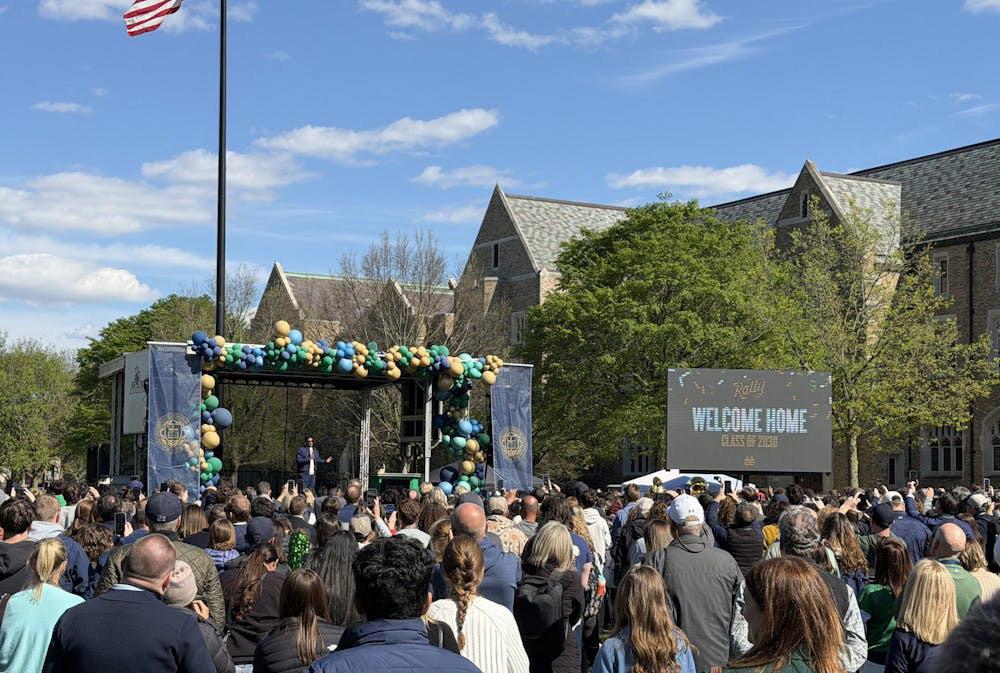
Members of the class of 2030, accompanied by their families, gathered on the intersection of South Quad for the final time to conclude The Rally 2026.
Beginning on Sunday morning, the event brought students of the incoming class together for various events around campus, with opportunities to interact with their future classmates.
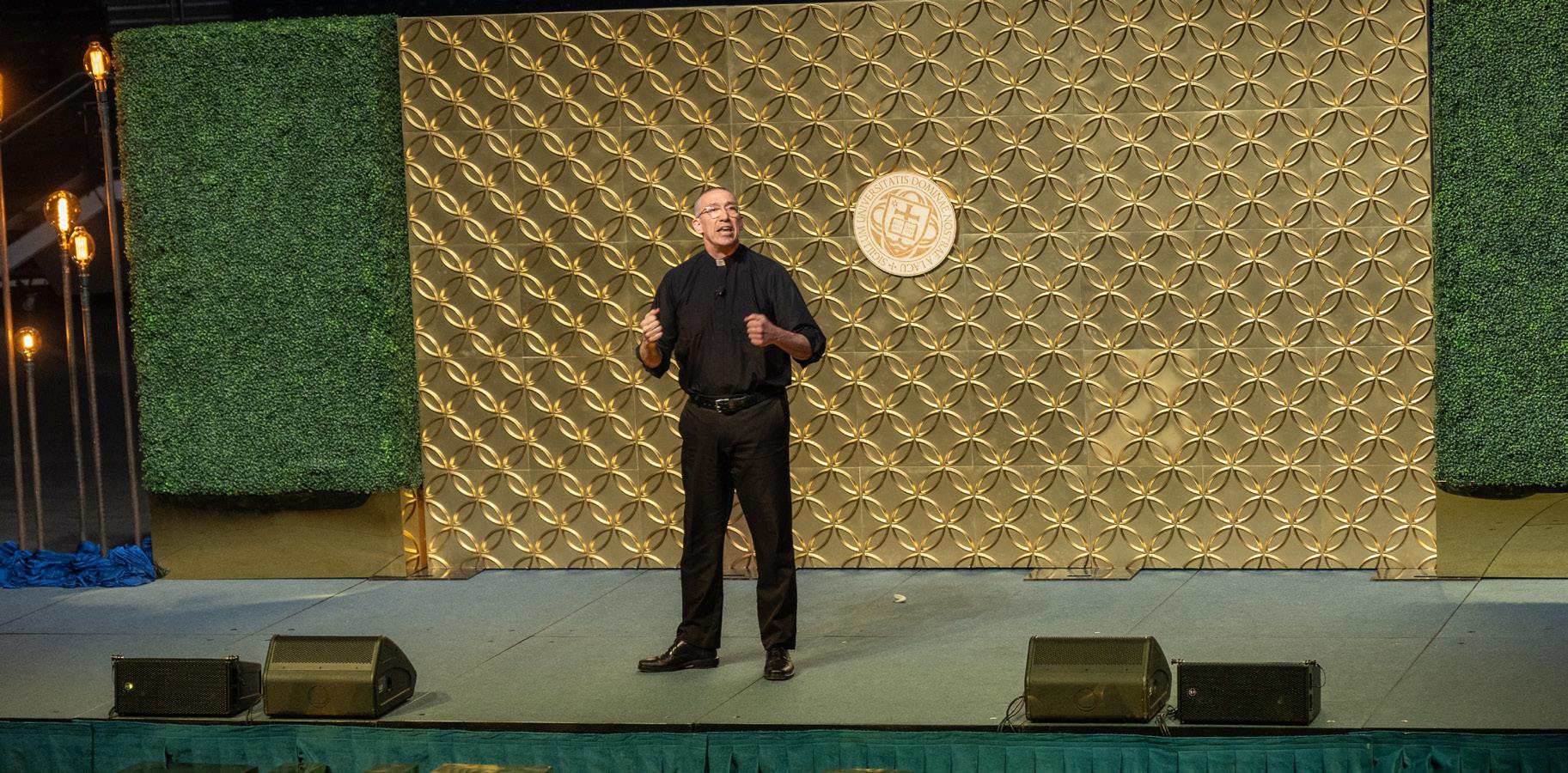
The final event, which is new this year, was known as “Love Thee, Notre Dame!” Starting at 4 p.m., Fr. Pete McCormick, assistant vice president of Campus Ministry, served as DJ while guests arrived.
Issac Schmitz, an admitted student from Indiana who hopes to major in mathematics and actuarial science, said his thoughts about the event with The Observer.
“I definitely loved it. It’s something different here,” he said. “My favorite part of being here is watching everybody else love it so much, honestly.”
At 4:15 p.m., the last members of
NEWS | PAGE 3
Public station cuts
the class of 2030 made their way to South Quad, led by bagpipers, as McCormick introduced the dorms that were present at the event. These included Cavanaugh Hall, Coyle Hall, Duncan Hall, Pasquerilla East Hall, Ryan Hall, Walsh Hall and Welsh Family Hall.
Concluding his time as DJ, McCormick played Neil Diamond’s ‘Sweet Caroline,’ which he described as “the most singable, sing-alongable song.”
Notre Dame Leprechaun sophomore Louis DelFra took to the stage next, dancing with McCormick and leading the students in a call-and-response chant of “We Are,” followed by the response of “ND!”
Hall Presidents Council cochairs, seniors Megan Klein and Joe Tunney, were the next to speak to the crowd. As they took the stage, Klein thanked all previous speakers, and Tunney called out the various quads on campus, asking students to cheer for their own.
Klein told all students that regardless of whether or not their family had attended the University, or wherever
Public broadcasting stations share the aftermath of funding cuts following overturned order. OPINION | PAGE 5
they came from, they would be welcomed and will find their place there. Tunney then continued, saying that dorm life would be more than a place for these students to live but rather the place for students to meet their closest friends.
Gabriela Chiguil, an admitted student to the Keough School of Global Affairs, similarly noted the inclusive nature of the community, specifically describing upperclassmen teaching her the words to Notre Dame songs and including her in activities.
Vice president for undergraduate enrollment Micki Kidder returned to the stage following their speeches, mentioning each event that admitted students participated in over the weekend. “You have felt the love, the investment, in each of you,” she said.
Kidder continued, saying, “Regardless of your path to Notre Dame, please know that there is home here in South Bend for every single one of you.”
Before leaving the stage, Kidder introduced a surprise guest for the incoming class, Irish head football
new guard A shake-up is underway in graduate student government, bringing changes to leadership. SCENE | PAGE 8
The country star delivered a fiery performance in the Notre Dame Stadium on Saturday.
coach Marcus Freeman. He recalled when he first arrived at the University six years ago and that throughout his time since, there have been highs and lows he has experienced.
Freeman continued that these moments are what make one’s experience and “Life is more like a quilt” because it has one solid back
| PAGE 10
with various pieces sewn together on the front. He continued that the back of his quilt was the University. which has always been there for him and will also be there for admitted students.
“I always say Notre Dame will change your life if you let it, but
see “Rally” on page 4
SPORTS | PAGE 11
Deborah Garcia senior Ryan Hall
“Iced Shaken Espresso.”
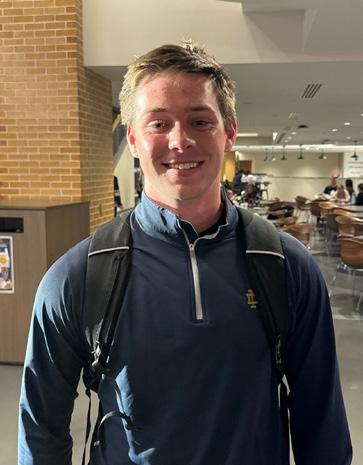
Jack Farrell freshman Knott Hall “No caffeine needed.”
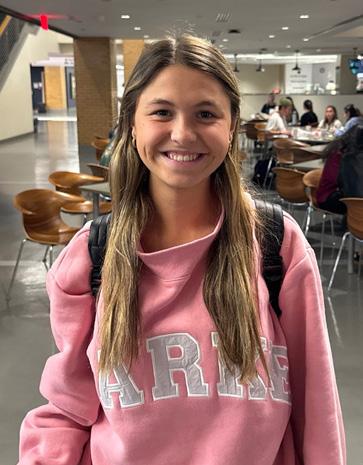
Riley McNaboe freshman Ryan Hall “Strawberry Refresher.”


Chris Wang senior off-campus “Ultra Spice Guava Monster.”
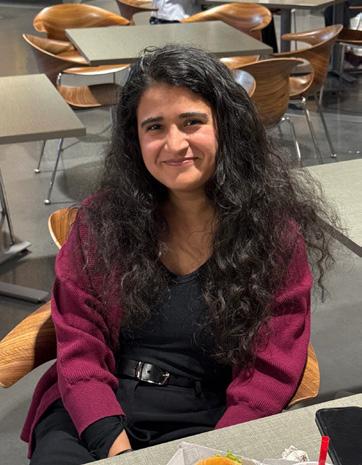
Akriti Dhasmana senior off-campus “Latte.”
Tuesday
Notre Dame Softball vs. Central Michigan
The Irish take on the Chippewas at home.
5 p.m.
Melissa Cook Stadium
Wednesday
Notre Dame Day
Donate to various causes on the 13th annual Notre Dame Day. All day notredameday.nd.edu
Thursday
Film “Atlantics” (2019)
A genre-bending approach to anger, love and ghosts. 6:30 p.m.
DeBartolo Performing Arts Center Browning Cinema
Friday
Unveiling of The Shirt 2026
Celebrate with The Shirt Project and donate to charity. 4:30 p.m.
Library Lawn
Saturday
Maltilda the Musical
A young girl finds the courage to stand up for what is right. 7:30 p.m.
Moreau Center for the Arts, O’Laughlin Auditorium
By Sophie Lewandowski News Writer
President Donald Trump’s Executive Order 14290 in May 2025 declared that the Corporation for Public Broadcasting needed to cease its NPR and PBS funding, deeming it “outdated and unnecessary” for them to receive government funding. Despite this order being recently reviewed and overturned nearly a year later by U.S. District Judge Randolph Moss due to its contradiction of the First Amendment, its impact on public radio continues to have a ripple effect of unemployment and loss of programming.
Tim Richardson, an adjunct faculty with the Communication Studies department at Saint Mary’s College, teaches broadcast media production and film and video classes. He said that while the recent ruling is a win for freedom of the press, the damage to public broadcasting has already been done. Now, stations must rely more heavily on community contributions to make up some of that difference.
“It doesn’t restore any of the funding that was lost, which was over 1 billion dollars, as they dismantled the main distribution for those funds,” Richardson said. “So, it keeps it from getting worse, but unfortunately, the damage has
been done, and so local stations and such have had to rely even more heavily on the local community contributions.”
The effects of the funding cuts are also wide reaching. CBP has existed on a schedule where it receives its funding two years in advance, as television productions take a considerable amount of time to plan and produce. Congress eliminated the two-year funding plan with the cuts, and the CPB dissolved.
Anthony Hunt, station manager at 88.1 WVPE, an independent radio station owned and funded by Elkhart Community Schools, said that the transformation of these systems and the funding losses have led to blind spots in coverage across the country.
“So now there is no way to get funding from the federal government to individual stations at this time, at least in a distribution model, such that public broadcasting is able to exist in 99% of the country,” Hunt explained.
Within Elkhart, Indiana, and its surrounding counties, the impact of this can be seen directly in how the federal and state government policies have affected the budget of WVPE. Hunt said WVPE has experienced major funding cuts of $250,000.
“So, what’s sad about [the situation] is, and that is pertinent to where I’m at is that, in my case,
public radio at WVPE, we lost a quarter of a million dollars between what we would have received from the federal government money and what we would have received from the state, which also chose to cut our funding because they were doing a knee-jerk reaction,” Hunt said.
To make up the difference between what has been lost and what is needed to keep stations running, radio stations have had to turn more heavily to their communities for financial support. Stations have now made it their new normal to request donations from listeners in their broadcasts.
For WVPE, 70% of funding was made up of government support. Now, that portion must come from listeners.
“So loss of all the state funding and the federal funding means that now 70% of my budget comes from the people who listen to and then donate to the programming, and then 30% of the pay from businesses. So, really, I’m a 70/30 split, but I’m now 100% community supported,” he said. “If the community loses interest in what we’re doing, we’re sunk. So my goal is to try not to do that.”
The effects of the executive order have not been felt equally across the country either. Not every radio station relied on government funds in equal parts.
In some states, such as parts
of Alaska, budgets were majority composed of federal and state funding, while various radio stations in Nevada, Iowa and New Jersey relied less on government support, therefore posing less at risk.
Hunt said this environment has sparked competition between broadcasting stations as they compete for listeners who will support them.
Laurie McFadden, the director of Notre Dame’s student media program, wrote to The Observer that 88.9 FM WSND, the University of Notre Dame’s non-commercial radio station, is independent of federal funding and not affiliated with NPR as a member station. WSNDFM was not severely affected by the cuts that came to many public radio stations.
Individuals and organizations are already taking steps to minimize the damage of the funding losses. The judge’s ruling initially allows public radio stations such as NPR and PBS to continue broadcasting, and the same organizations are able to take steps to support other stations who rely on their coverage.
“Additionally, with the support of the Distribution/Interconnection (D/I) Committee and NPR Board, NPR announced that all PRSS interconnected public radio stations will be granted total relief from interconnection fees for two years,” McFadden wrote.
Some shows have been lost and staff proportions cut, Richardson said, due to the lack of money to keep them going. He mentioned that it will take time for radio stations to recover.
Richardson also highlighted that what is important now is to not take media for granted, as it’s the stories covered at this level that are most relevant to daily life.
“The same way when you look at local news stations, the reason people still tune in to local news is because it’s local, it’s things happening in your own backyard,” he said. “And that’s why those stations are able to thrive, and the same thing with public media, like WNIT, are covering events that are here locally, diving into things happening right in our backyard. Those things get really important, and they get really heavily affected the most when you have cuts made from above.”
Public broadcasting may not exist in the same way it once did, but it continues to impact the communities it is a part of. “Having trusted, curated sources like WNIT ... and local public radio with NPR, having those to be able to vet and research and do the actual journalism that’s involved in getting you accurate news that affects you is important,” he said.
Contact Sophie Lewandowski at slewandowski01@saintmarys.edu
By Mara Hall Associate News Editor
Every undergraduate residence hall at Notre Dame is led by a rector. Their jobs are multifacted, and are “a pivotal role in Notre Dame’s mission to nurture a community where students grow spiritually, thrive socially, and succeed academically,” according to the rector’s website.
When Sorin Hall became the first standalone undergraduate residence in 1888, Fr. Andrew Morrissey, a future president of the University, was appointed its first hall rector. Since then, at least 470 individuals have served as a rector. While some aspects of the role have remained the same since Morrissey’s tenure, others have not.
Married rectors live in dorms
Most rectors are single, but not all. A pilot program exists for rectors to marry and still remain in their positions. In a written statement to The Observer, Karen Kennedy, associate vice president for Residential Life, explained that the informal program allows rectors to move their significant other into their residence hall after marriage, joining them in the rector’s apartment. This situation has occurred five times in the past decade.
Walsh Hall rector Cheyenne Joseph is the most recent
addition to the program. Her husband, Aibel Joseph, joined her in the residence hall beginning in the fall of the 2025-2026 academic year.
“The first rector to marry and welcome a spouse into a residence hall occurred in 2017, and the option has continued for rectors who have become engaged since that time,” Kennedy wrote.
In 2017, Noel and Jaclyn Terranova told The Observer that she was pregnant, and they were still discussing raising a child in the dorm. Beginning in the fall of 2017, Keenan had a new rector, James Tull.
As of March 23, Joseph’s out-of-office message read, “I have left Notre Dame to go on maternity leave and will not be returning.”
Women’s residence halls accept male rectors in acting roles
After Joseph retired as a rector on March 17, Richard Mazzei, known by students as Mazz, took over as the acting rector of Walsh Hall.
Mazzei served as the rector of Fisher Hall from 20142021, then as rector of O’Neill Family Hall from 2021-2022. After a brief stint as the interim rector in Carroll Hall, he became acting rector of Farley and Breen-Philips Halls. Presently, he is a minister-in-residence in
Baumer Hall.
A spokesperson for the University confirmed that all three times Mazzei has served as an acting rector in a women’s dorm, his residence has remained Baumer Hall.
Some Walsh residents voiced their support for Mazzei’s presence, although they have hit some hiccups while trying to plan for next year.
Laurel Hamilton said that despite Mazzei not living in Walsh Hall, he is easily accessible.
“If you need to talk to him, you can just email him, and he will reply, honestly, within seconds, so it feels like he is there all the time,” she said. “Everybody really loves Mazz, and we feel like he adds so much to our culture. We miss Cheyenne, but we feel very well taken care of.”
Haley Nieman, incoming president of Walsh Hall, described Mazzei as “incredible,” explaining he treated the incoming executive team to a meal at O’Rourke’s to plan the upcoming year.
“He has really tried to integrate himself into the dorm and get to know the Walsh community as great as possible,” Nieman said.
Molly Kenney, a member of Walsh Hall’s St. Andre Committee for freshman onboarding, said she was “a little shocked” when she learned Walsh would be led by a male
rector, but “his personhood makes up for all of it.”
“It is just a little difficult trying to figure out next year when we do not have anyone for next year. I think that is kind of frustrating because I am thinking about August, and it is hard when there is not really someone who is going to be here in August,” Kenney said of the temporary nature of Mazzei’s position.
Consecrated religious declines
When women were first admitted to Notre Dame in 1972, the landmark decision also brought about change to who could serve as a rector. Kathleen Cekanski-Farrand in Badin Hall and Joanne Szafran in Walsh Hall became the first lay, and first female rectors that year. Prior to this, all rectors were consecrated religious individuals, with the exception of when Notre Dame housed midshipmen during World War II.
Not until the academic year 1987-1988 did the University have a lay male rector, Joseph McKenna, in Sorin College. This coincided with the beginning of the presidency of Fr. Edward Malloy.
Over time, the number of consecrated religious individuals has decreased. Since 1972, there has only been one academic year in which all rectors were consecrated religious:
1996-1997. Since then, the slope of decline has steepened.
In the 2016-2017 academic year, lay rectors outnumbered consecrated religious ones. Since crossing that threshold, the percentage of residences led by lay rectors has only grown.
Tenures of rectors shorten
The highest average tenure for rectors in individual residence halls was achieved from 1897 to 1901 at 7 years. After the average dropped to as low as 1.7 years from 1917-1921, it eventually rebounded to 6.14 years from 1977-1981 and remained above six years for three of the next four half-decades.
Since the turn of the 21st century, the average tenure of rectors has been cut in half. The average tenure from 20172021, 2.9 years, is the shortest average in 50 years.
Of the 24 rectors who started between 2002-2006, only one is still serving in their role — Fr. Ralph Haag in St. Edward’s Hall. Four out of 35 rectors who began between 2017-2021 are still serving as of this year. At least three of those four will not to be returning to their current residence hall, or retiring altogether.
Contact Mara Hall at mhall27@nd.edu
By Emily Barlett News Writer
The Mendoza College of Business just launched its Minor in AI Analytics in Business, which aims to prepare students to apply AI in real-world business environments. Entry into the minor is preceded by an application process and is open to the Class of 2028 and beyond. For the first cohort of students, there were 94 applicants, 62 of which were admitted to MAIB.
The minor consists of nine elective credit hours and two required courses: Analytics Workflows with Power BI and AI in Business. Electives within the minor include Predictive Analytics, Society and Networks, AI & ML for Urban Analytics and AI Auditing & Governance, among others.
Joe Ke, director of undergraduate studies in IT, analytics and
Continued from page 1
and a pro-Israel student group on campus.
Student Voices for Palestine, a student group at Notre Dame that has protested Israel’s wartime actions, condemned antisemitism while dismissing ADL’s definition of antisemitism as overly broad.
“SVP stands firmly against anti-Semitism on Notre Dame’s campus and beyond. As a part of our commitment to make campus a welcoming place for students of all identities, SVP highlights Jewish Voice for Peace’s rejection of the ADL’s political definition of anti-Semitism, which dangerously conflates anti-Semitism with criticism of any actions of
Continued from page 1
operations; Martin Barron, associate teaching professor in IT, analytics and operations; and Corey Angst, department chair of IT, analytics and operations, said in a joint interview with The Observer that Mendoza plans to debut a second AI-focused program, the Minor in AI Essentials in Business, this upcoming fall. “MAIB is open to select Mendoza students for now, and MAEB will be open to the entire University,” Ke said.
The administrators and professors of program said that the MAIB program offers a more intensive analytical focus, while MAEB will highlight broader AI literacy. As of April 17, applications had not yet opened for MAEB.
“MAEB will introduce foundational AI knowledge while focusing on ethical considerations and leadership skills,” Ke said.
MAEB will consist of three core
the state of Israel, repressing free speech,” the organization wrote in a statement to The Observer.
Zane Zachary, a senior and the president of the Jewish Club of Notre Dame, dismissed the ADL’s critiques of the University.
“The ADL seems to rank based on the presence of organizations that may be pro-Zionist/Israel, along with service organizations like Chabad. I personally don’t think the ADL’s ranking prioritizes what the broader Jewish community values,” he wrote in a statement to The Observer.
“For example, the ADL ranks schools based on whether they have faculty and student training on antisemitism. It’s odd to flunk us on that because we have virtually no antisemitism. It’s like prescribing a
way not expressly permitted by the faculty member, will be considered a violation of the Honor Code,” while noting that generative AI may be used to augment learning.
Continued from page 1
you have to let this place change your life,” Freeman said, before inviting up the Notre Dame Glee Club to sing the alma mater.
Following the alma mater, the Notre Dame Band of the Fighting Irish played the University’s fight song before Kidder returned to the podium to officially conclude The Rally.
“Everyone was super welcoming. You could go to anyone and say ‘hi.’ It was super nice,” Julian McFarlane said, who plans to study mechanical engineering when he arrives on campus later this year.
Ricky Ecklord, a committed student from New Jersey, said, “I came in kind of unsure. Although
courses: Applied AI for Business Professionals, AI and Global Business and Ethics of AI and Data Analytics. Electives for MAEB consist of similar classes to the MAIB, which must add up to 7.5 credit hours. There are also several unique electives, including Project Management and Intelligent Processes & SCM, with more pending.
The administrators and professor said the programs are aimed to help students leave Notre Dame ready to make a difference in their careers.
“Students can come in ready to compete, ready to go and be experts of their company from day one,” Barron said.
The faculty expects that the MAEB program will be selective, accepting approximately 60 students per year.
Both minors highlight Notre Dame’s emphasis on integrating
treatment without showing widespread illness,” he added.
Zachary characterized Notre Dame’s ‘B’ rating as “flattering” but added that he thought the University deserved a higher grade.
“Overall, ND achieved the outcome that matters, the outcome that the ADL wants. Notre Dame just used different methods than what the ADL wants. So, I think we deserve a +A because we don’t need a dozen three-letter nonprofits to descend upon South Bend to fight antisemitism,” he wrote.
The ADL found that the University “met expectations” in regard to publicly disclosed administrative actions and received an “excellent” rating on criteria related to Jewish life on campus, while reporting little to no
Chuang said his goal in sending this email to the student population was to make students aware of Kerra and give them a resource that will allow students to support their learning and efficiently manage their academics.
According to him, the company’s
I was already committed, I was a little nervous about meeting new people, but I think I left having found a family that I’m excited to see going into August.”
Paige McAleer, a committed student studying neuroscience and behavior, noted that at the “Love Thee, Notre Dame!” event specifically, she had the opportunity to continue to meet and interact with new people and spend time with them.
“I thought The Rally was a great experience overall. I got to meet a ton of people that I’m going to be spending the next four years with, and it was really cool to see new aspects of Notre Dame that I hadn’t gotten to see before,” McAleer said.
Speaking with The Observer following the event, Kidder said, “The Rally has been incredibly
technological innovation in its business curriculum. “AI has become a core business function,” Angst said. “It is something that our students are going to be interacting with for years after they make it to the workforce.” With a focus on developing both practical and technical skills, the minor gives students a unique insight into the process of incorporating new technologies within organizations.
Ke, Barron and Angst said these courses are becoming increasingly relevant in today’s business world.
“What we’ve seen over the last couple years is rapid AI adoption across businesses,” Barron said. “It’s massively changing how they conduct themselves and do their work across a range of different functions.”
These programs are expected to make students more competitive in professional settings. “We wanted to
concerns regarding the campus climate for Jewish students.
Jeffrey Campbell, a Notre Dame economics professor who is Jewish, expressed his views on the report and the overall climate toward Jewish students.
“Earning an A on this report requires a university’s administration to fulfill its Title VI responsibilities to all of its students, at least a small Jewish student life on campus and a lack of anti-Jewish hate. Our administration does well vis-a-vis Title VI, and there are signs of Jewish student life. Neither our students nor faculty & staff accept anti-Jewish hate generally, but a loud minority hates the Jewish state and Jewish self-determination. Without their actions, we deserved an ‘A.’ At other schools, this anti-Jewish
aim is to give students more time to explore all the opportunities outside the classroom and spend more time with their friends.
“You’re not gonna remember what happens in the classroom. You’re gonna remember what happens outside the classroom, all the crazy stuff, all the
successful in terms of making every admitted student and their families feel welcomed at Notre Dame. The energy has been high.”
She also expressed gratitude for current students and departments in creating an inviting atmosphere for incoming students.
“We’re so grateful for all the collaboration across campus, and the ‘Love Thee, Notre Dame!’ event at the very end was magical. I think people appreciated the intentionality and the authentic hospitality this weekend, and us celebrating all of the components of a Notre Dame education: academics, faith and community, and this event highlighted all of those in a beautiful way, so we are super excited,” Kidder said.
Contact Matthew Morin at mmorin2@nd.edu
meet that demand we were seeing from our students and prepare them for the current workforce,” Barron said.
Martijn Cremers, Mendoza College of Business dean, explained in a written statement that these minors are important to the University’s dedication to multidisciplinary learning. In previous years, business courses were not widely available to non-business students.
“Expanding access to our courses through these minors has been an important step forward for the College,” Cremers wrote. “Today, these minors provide meaningful access to business education, equipping students with practical skills that complement their primary field of study.”
Contact Emily Barlett at ebarlett@nd.edu
hate has gone mainstream, and they earned Cs or Ds. So I think that Notre Dame is a good place for Jewish students, and our B grade does not contradict that assertion,” Campbell wrote.
Notre Dame has hosted several discussions and panels with the goal of promoting respectful and informed dialogue on antisemitism. These events have included “Antisemitism and Other Hates,” “Safety through Solidarity: The Fight Against Antisemitism,” “One Year After October 7: Historical Backdrop and Future Prospects” and “Beyond ‘Eternal Hatred’: Reconsidering the Nature of Antisemitism.”
Contact Will Prisco at wprisco@nd.edu
interesting stuff they do outside of class,” Chuang said. Chuang noted he was not concerned about negative ramifications or possible consequences from the University administration, saying that he sees the promotion of the tool as a “social good.”
“I believe it is a social good, a force for good for the campus itself, so I felt compelled to really help my fellow classmates,” Chuang said.
Ardea Russo, the director of the Office of Academic Standards, confirmed the University is aware and looking into the email.

By Oliver Ortega
I am not one for student politics. This I found out my freshman year of college, at another elite Midwestern university. A debate between two presidential tickets for a prominent Latino student group on campus turned nasty. It was telenovela-style drama, with accounts of backstabbing, crying from audience members and sexual jealousies rolled into one. The new guard clashing with the old guard, more or less. Those in attendance left the debate either wildly upset or luridly entertained, in that sort of greasy way you get from watching ‘Jerry Springer’.
Nonetheless, in graduate school, I gave it another try. At the end of my first year at Notre Dame, I joined the English Graduate Student Association, known as EGSA, and signed up to be our department’s representative at the Graduate Student Union, now known as the Graduate Student Government. Then, the pandemic hit, and, like many, I withdrew into a social-distancing cocoon. Fast forward to today, and I would say I feel too jaded to get involved in the student group scene again. But I would be remiss if I didn’t take the pulse of graduate student politics from time to time, especially during election season.
On Thursday, April 16, the new president of the GSG was sworn in during the last council meeting of the year. Sanchita Chakraborty, a PhD candidate in Applied and Computational Mathematics, will take the helm alongside two vice presidents — Kyle Walker, a PhD candidate in the Department of Mathematics; and Bless Adjornor, a PhD candidate in the Department of Civil and Environmental Engineering and Earth Sciences. The election was uncontested, so when I spoke to Chakraborty on the last day of voting, March 31, her victory was more or less a done deal.

“I hope to be a very proactive president,” Chakraborty, a second-year student, told me over a videocall. Previously, she served as the GSG’s professional development chair in the outgoing administration. During our talk, Chakraborty stressed the importance of providing graduate students “incentives to reengage” with graduate student government in order to improve existing initiatives. Among the actions that the incoming administration proposes are including laptops in emergency funds for graduate students, expanding parking subsidies for students who have served as teaching assistants and modifying career fairs to include more opportunities for master’s and PhD students.
The GSG, founded in 1970, represents students from the College of Arts and Letters, the College of Science, the School of Architecture, the College of Engineering and the Keough School of Global Affairs.
The GSG meets once a month during the school year for roughly two hours, and, on average, 60 people will be present at any given meeting. Each department
gets two voting members. All in all, roughly 2,600 students fall under the umbrella of the GSG. Mendoza College of Business and the Law School have their own student governing bodies, but both are allowed non-voting representation.
I spoke to one of our current representatives for English, Daryna Gladun. Gladun is a poet and playwright, who is wrapping up her master of fine arts degree through the Creative Writing Program. She also served on the committee overseeing this past election. Gladun, who is from Ukraine, said she got involved in order to feel like she had influence over her educational experience in the United States. This was especially important for her in light of last year’s widely publicized immigration crackdown on student visa holders by the Trump administration.
“As an international student, I see the appeal of getting some control over our stay in the University and having power over the process,” she said. Gladun said she thought many other international students share her motivation for joining the GSG.
While roughly three out of every ten graduate students at Notre Dame are international, a much larger proportion of students involved in the GSG are from outside the country. It’s not surprising, then, that the GSG sent out a mass email last semester encouraging graduate students to oppose the Trump administration’s proposed four-year cap on student visa holders. It was my first time seeing the GSG urge its members to take political action like that.
As for the election being uncontested, Gladun noted that the council was confident that Chakraborty, Walker and Adjornor were the right people for the job. Still, she said she would have liked to see more options. The three-person ticket came together about a month before the election. Chakraborty and Kyle knew each other from serving in the outgoing council, in which Walker was the representative for the math department. They linked up with Adjornor, who had no previous GSG experience, after meeting him at a candidate info session earlier in the semester. Chakraborty said she got the blessing of the previous two

presidents of the GSG.
Though last year’s election was contested between two tickets, in the recent history of the GSG, most elections have featured only one slate of candidates. And there’s also been a pattern of dismal voter turnout. In this recent outing, for instance, just over 100 total ballots were cast.
“I don’t like those numbers,” Walker said, adding the low participation rate underscores the need to make the “GSG as representative as it can be so that it can fulfill its function.” In addition to tackling tech equity, parking costs and career opportunities, he said the new administration would be looking to address concerns around summertime transportation. One issue is that Transpo’s #17 bus, the campus sweep, doesn’t run during summer recess. This route connects Notre Dame’s campus to graduate student housing at The Landings, in addition to stopping at Holy Cross College and Saint Mary’s College.
“There are a lot of irons in the fire already,” he said.
During my interview with Chakraborty, I brought up the issue that inspired the birth of this column: the sudden closure of the graduate student lounge in Hesburgh Library at the end of last academic year. At the time, I sent numerous emails to GSG officers asking for them to intervene. No one responded. Chakraborty apologized on behalf of the GSG and explained that April is a transition period for the new officers — my complaints may have gotten lost in the shuffle. Still, this incident is an example of why many students don’t buy into student government. It’s hard to shake off the notion that it’s really administrators pulling the strings and that whatever student government does is minimal.
Nonetheless, I applaud graduate students for keeping the GSG going these last 50-odd years. Though the GSG is not a labor union with bargaining power, they were still very influential in pushing the provost and the graduate school to institute a recent pay raise, from what my sources tell me. And the social programming is pretty good. For instance, I had a blast doing whitewater rafting in downtown South Bend’s East Race Waterway at the start of the academic year. And the professional development programming has definitely gotten better in recent years.
Still, a shake-up is in order. It’s unacceptable that only one slate of candidates runs for office most years. And the percentage of voter turnout should be much higher than single digits. Trips to the park, poster sessions and career fairs are good, but imagine having a real union to fight for us graduate students. So says the O.G. Peace.
The views expressed in this column are those of the author and not necessarily those of The Observer.
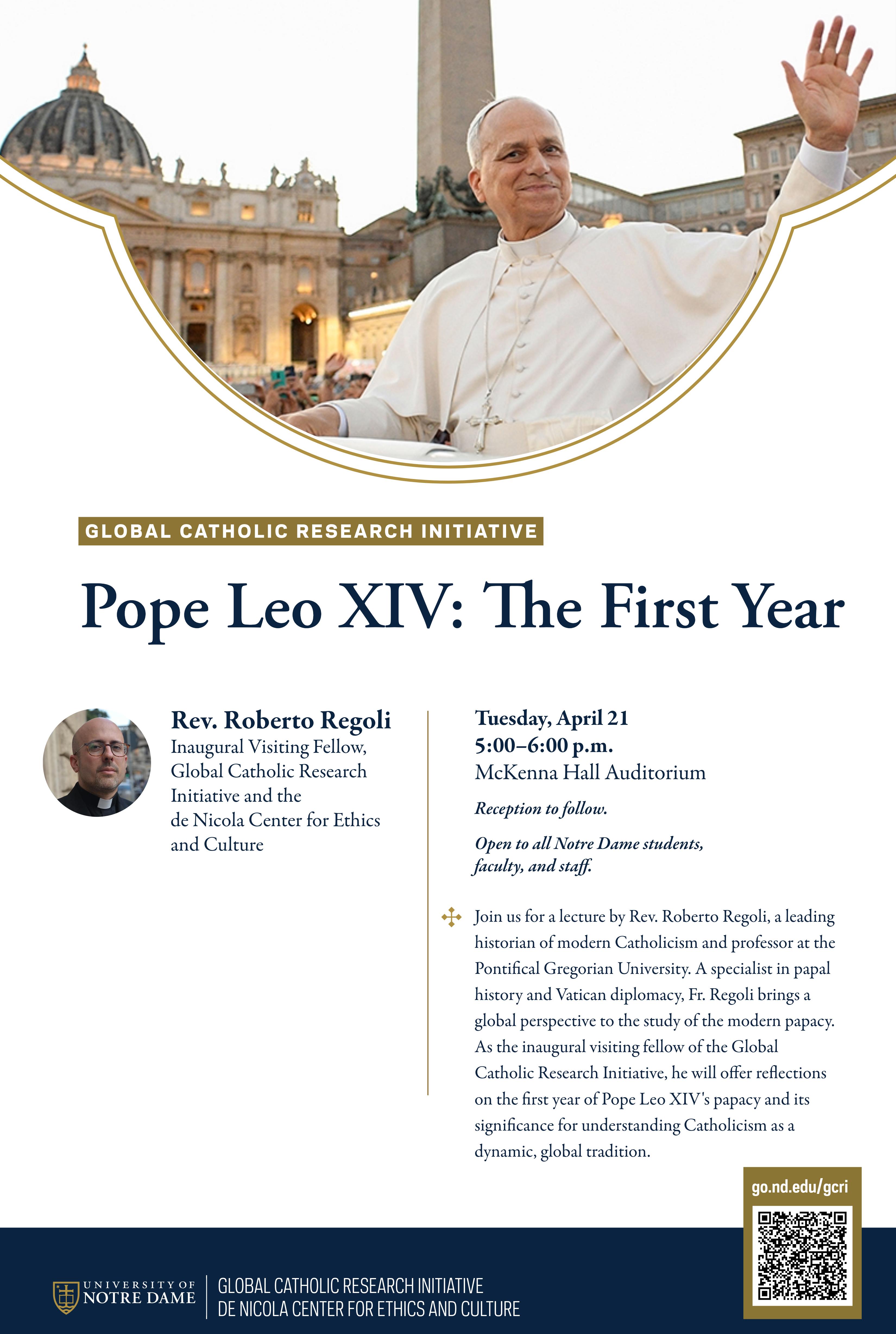





By Sydney Jansen Scene Writer
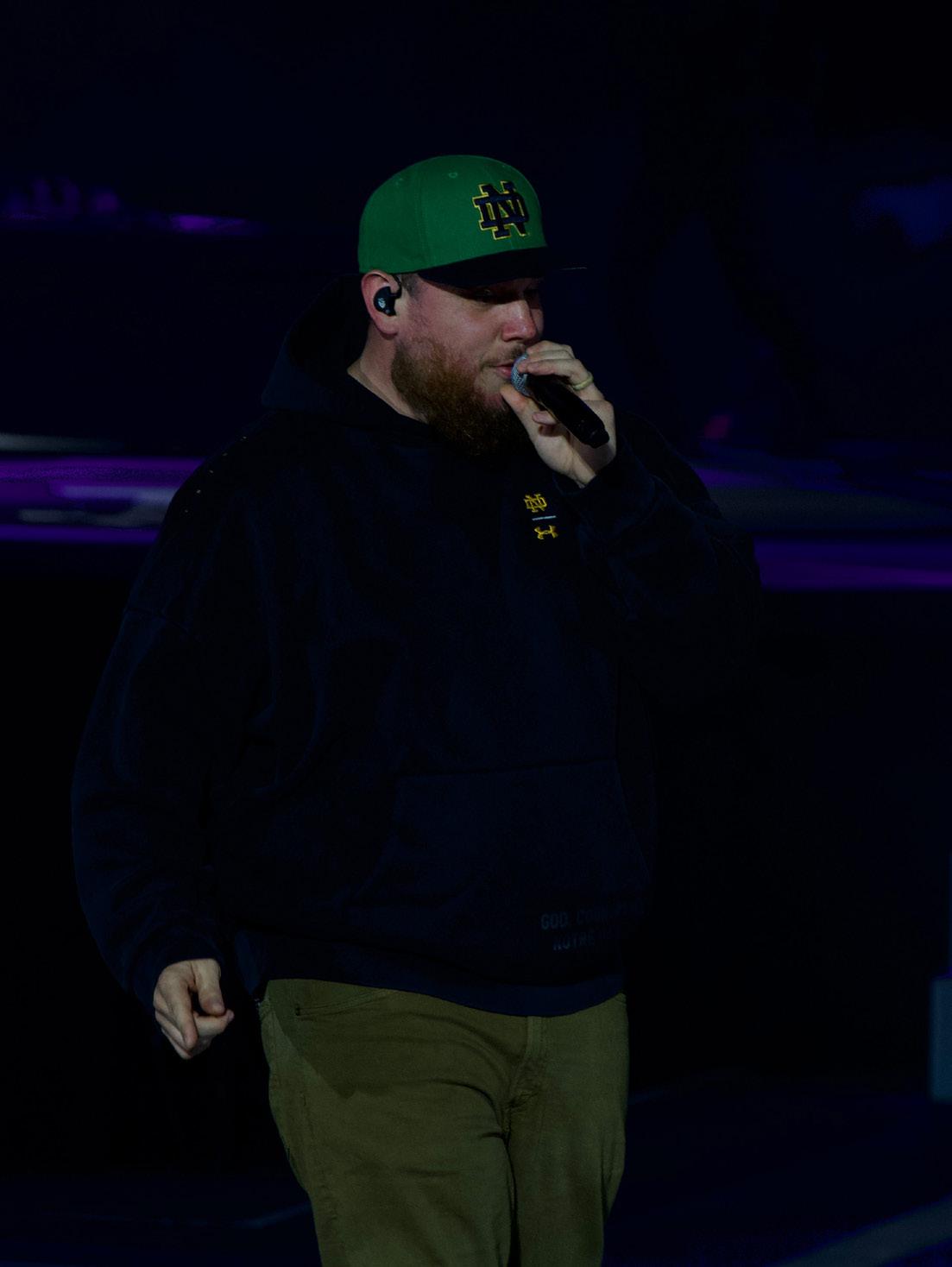
I don’t know what you were up to this weekend, but “My Kinda Saturday Night” was seeing Luke Combs live at Notre Dame Stadium. Although the sky was gray, the Golden Dome was shining above about 77,000 fans below in merchandise lines, parking lot tailgates and the roaringly country stadium for one night only.
Celebrations before the show resembled those of football gamedays, and so did the traffic. Combs released specialized Notre Dame memorabilia that fans sold out on both Friday and Saturday at merchandise stands around campus, so those partaking in gearing up with the Notre Dame LC look had to wait in growing lines before the noon opening. Once goods were secured, fans got “Back in the Saddle” and line danced the day away with friends and family at tailgates; the Luke Combs Camp ran a whiskey tailgate in front of campus’s Legends restaurant at 3 o’clock with many in attendance. Whether they were attending the show or listening from their dorm rooms, students flooded
Stadium and Joyce Lots for a long day of Irish shenanigans.
Stadium doors opened at 5 o’clock, so “Bootleggers” and those just there for a good time alike headed to the stadium to catch the appetizing four opening acts before the main course. The show began with artists Thelma & James at 5:20, shortly followed by Jake Worthington, Ty Myers and Dierks Bentley bringing enough “yee” for the “haw” that was to come later that night. Having not listened to these artists or their setlists previously, I certainly found some great talents that will circulate into my Spotify rotation whenever I need some “5150” or “Two Trains”.
After my friend and I collected guitar picks and met some other fans in the General Admission pit in between the opening acts, cowboy boot stomps rumbled around the stadium in excitement for Combs’ arrival. A classic sing-along to Neil Diamond’s “Sweet Caroline” fiercely transitioned to “Shipping Up to Boston,” and at that moment the rest of the world drifted away. The lights went down, and from then on, it was only us and that stage for the rest of the night.
Eventually Combs showed up in the stadium, and he also made sure to show out when it came to representing the Irish; with a green Notre Dame hat, Notre Dame sweatshirt and his iconic leprechaun-like beard, he was ready to “cheer cheer for Old Notre Dame” as God intended. Him and his band brought the Irish spirit to an all-time high when they took a shot on the floor near the barricade and headed to the stage for an electric performance.
Overall, the setlist was “Beautiful Crazy,” as it neatly packed in songs of a brokenhearted cowboy with fiery hits perfect for you to shake some denim. Songs “My Kinda Saturday Night,” “Lovin’ on You,” “Hurricane” and “She Got the Best of Me” turned up the volume here in South Bend as crowds thundered almost as much as the Indiana skies. That was then followed up by “Tell ’Em About Tonight”—a song perfectly encapsulating the memorable mark that shows like this one leave on someone’s life. “One Number Away” and “Going, Going, Gone” then brought the show to a slower pace but not for long.
After fans gave their all to “Back in the Saddle,” Combs sent us his love with hits “Sleepless in a Hotel Room,” “Better Together,” “Be By You” and “Beautiful Crazy,” among many others. Afterwards, the classic country spirit was reignited with performances of “Alcohol of Fame,” “1, 2 Many” and “Beer Never Broke My Heart” featuring killer light shows and fire effects that warmed crowds on a night as “Cold as You.” During this beer-loving bit of the show, the Irish saw some familiar faces up onstage when former football players Sam Hartman, Joe Alt, Riley Leonard and Jerome Bettis joined the singer to shotgun a beer mid “1, 2 Many.”
As the stadium went dark, and Combs waved his “goodbyes,” excitement climbed just in time for a spirited three-song encore. Before jumping headfirst into the last songs of the night, Combs took a sincere moment to appreciate the opportunities his success has brought him. With a lifetime love for music, Combs was grateful to be standing on a stage, covering songs he’d been hearing since he was young. This heartfelt admiration transitioned into a remarkable Tracy

Chapman cover of “Fast Car” that gave you the feeling that you “could be someone.”
Combs couldn’t leave the stage without one last rodeo. He revved up the fans with “Where the Wild Things Are” and, lastly, “Ain’t No Love in Oklahoma.” The “Twisters” single was the perfect way to end the night in South Bend after the 1 a.m. tornado warning that rang around campus earlier that day. Fans were ‘riding in on the wind and rain’ that day, but Combs left us with lots of love in Indiana.
Whether you are a die-hard fan or someone who simply tagged along to the nosebleeds, you sallied out of that stadium with love for Luke Combs’ charm. Fans flooded the South Bend streets playing Combs loud enough to hear across Saint Mary’s Lake as they waited in stop-and-go traffic, reminding me just how special our community really is. Notre Dame is home to fans of every niche, but it’s also home to family. Anyone under the Golden Dome that night “rode that rocket as far as it could fly,” and they did so together.
Contact Sydney Jansen at sjansen01@saintmarys.edu



By Jocelyn Fulcher Sports Writer
This past weekend, the Notre Dame women’s golf team concluded its season at the ACC Tournament in Wilmington, N.C.
The Irish finished tied at 13th with California, both schools shooting +16.
Freshman Taryn Cagle commented on the greens at Porters Neck Country Club, saying “The course wasn’t overly difficult, but used the greens as its defense. The big, undulated greens meant the potential for extremely long lags and well-placed bunkers in the fairway resulted in a couple difficult approaches from the sand.”
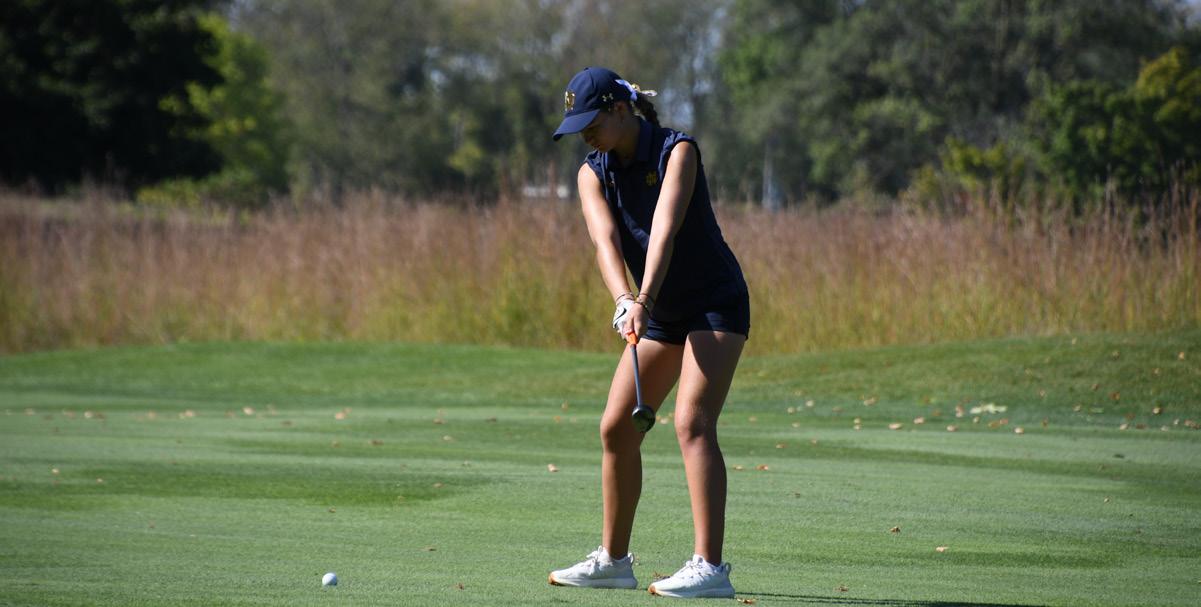
However, the unideal grounds did not stop the Irish from having one of their strongest performances in the conference final.
Sophomore Bridget Wilkie tied 11th for overall personal scores. Wilkie shot a 212 (-4) over the course of the tournament, making her just 10 strokes behind the top-finisher Paula Martín Sampedro from Stanford.
Not far behind, sophomore Maddy Bante finished tied for 35th with a score of 218 (+2), followed by freshman Jordan Levitt who shot 225 (+9) and Cagle who shot 229 (+13). Concluding scoring for Notre
Dame, junior Alex Lapple finished 74th with a score of 232 (+20).
The Irish started the tournament with shooting 12 over par but were able to improve as the tournament went on. On the second day, the Irish shot only 5 over par and finished the final day with shooting 1 under par, contributing to their total score +16. Compared with previous tournaments, the Irish showed significant team improvement.
When speaking on the team’s performance, Cagle said, “Though ACCs ended the season and we did not advance to regionals, the team showed huge improvements from last year’s conference finish. We put up some good scores and overall it was a strong way to end the spring.”
The team is done for the season, but Cagle praised the season and
team’s diligence. “It has been awesome to see the growth we have made as a team from the beginning of fall to now,” she said.
“The new coaches have been incredible for the program and we are grateful for all the little things they have done behind the scenes to help build us into the best group of golfers possible.”
The Irish are looking forward to next season, especially because the roster will feature mostly returning contributors.
“No one is graduating,” Cagle said. “So it will be awesome to have all the same faces and our incoming grad transfer and try to build off the momentum we created this spring.”
Contact Jocelyn Fulcher at jfulche3@nd.edu
By Nikki Stachurski Associate Sports Editor
The Irish remain at the top of the polls after defeating the Blue Devils 7-6 in an ACC matchup this past weekend.
Notre Dame got on the board first with an unassisted goal by sophomore midfielder Matt Jeffery, who scored the only point of the first quarter. Despite having the home advantage, the Blue Devils were kept scoreless as the first quarter concluded.
Notre Dame was not able to maintain their lead throughout the second. The Blue Devils finally seemed to have woken up, and the home team used their bustling crowd as a major advantage for the offense. While on the one-man advantage, Michael Ortlieb connected with Liam Kershis to tie the game for the Blue Devils. Less than a minute later, Irish senior midfielder Will Maheras found graduate midfielder Will Angrick to give the Irish the lead once again. Just after five minutes of play in the second, Ortlieb scored for Duke to tie the game again. After over seven minutes of back-and-forth defending, Brady Scioletti found the back of the net and gave the Blue Devils their first lead of the game heading into halftime.
The game had already promised to be a tough matchup, but fans were glued to their seats to see if the catand-mouse game would continue in Durham. Five goals were scored in the third quarter, with four consecutive goals by the visiting Irish. Jeffery scored two more unassisted goals, his one-man offensive show earning him his first hat trick of the year. Graduate midfielder Jalen Seymour scored with under
six minutes remaining in the quarter with an assist by freshman midfielder Dylan Faison, who then scored his own goal three minutes later. Despite being down by two, Duke’s Benn Johnston scored with three seconds remaining in the third quarter, cutting Notre Dame’s lead to 6-5.
The fourth quarter was a battle of high intensity on defense, each team desperate
to limit the other to keep the game close. After almost 10 minutes of play, Faison scored unassisted to put the Irish at seven. Less than a minute later, Johnston capitalized on a pass by Max Sloat and scored another Blue Devil goal, placing the home team down by two as the clock slowly ticked down.
The Irish pulled out all the stops on defense to keep
the Blue Devils from scoring but were outmaneuvered by a last-minute goal by Sloat to cut the Irish lead to one. With only eight seconds left, though, there were no more tricks to be pulled from the royal blue sleeves as Duke fell to Notre Dame at home.
The 7-6 win was not the high-scoring victory fans have come to expect from the Irish, but the win kept the
Irish at No. 1 and in a fabulous position for postseason play as the season winds down.
Notre Dame will face No. 4 Syracuse for its last home game Saturday, April 25, at Arlotta Stadium. The game will begin at noon and will be televised on ACC Network.
Contact Nikki Stachurski at mstachu2@nd.edu
By Ethan Laslo Associate Sports Editor
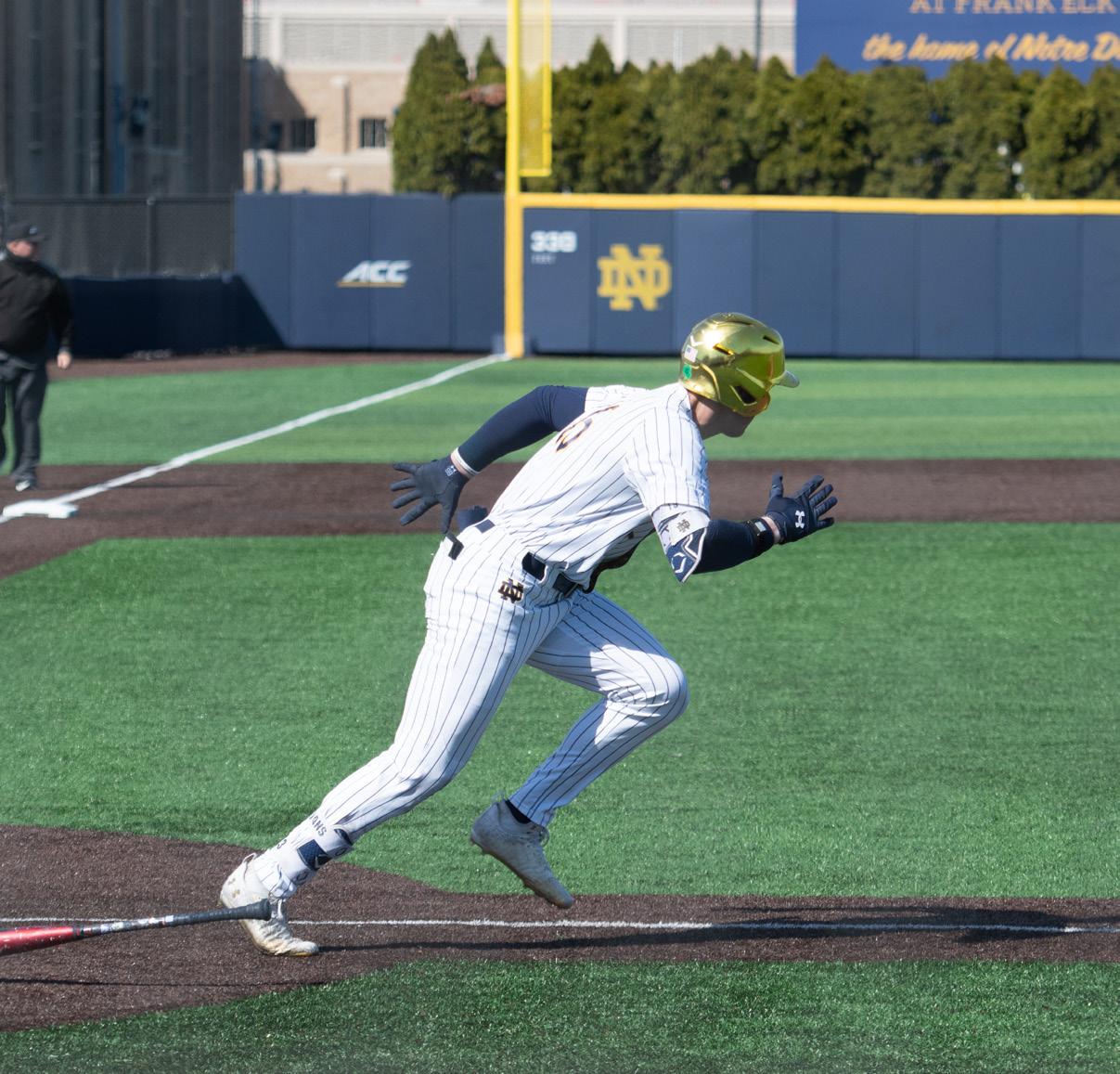
In game one of Notre Dame’s weekend showdown with Virginia, one of the best teams in college baseball, one play nearly upended the Cavaliers entirely. Sophomore designated hitter Bino Watters stepped up to the plate in the bottom of the third and belted a two-RBI triple to extend the Irish lead to 3-0. Virginia would come back, but not before Watters established his dominant presence early
in the series.
It’s been an up-and-down year for Notre Dame baseball. They started off with a solid non-conference showing before having an even hotter start to ACC play. That tear culminated with a No. 23 ranking after sweeping No. 19 Clemson at home, their first appearance in the polls since finishing 2022 as the consensus No. 5. Though things have taken a turn for the worse since then, utility man Watters has been a key contributor through it all. A member of the 2025 ACC All-Freshman
team, Watters broke out during his freshman season and has carried that momentum into his sophomore campaign with the Irish.
Last season, he started 43 of 44 games he appeared in and slashed .317/.436/.549. It was an impressive collegiate beginning, but Watters has only improved this season. Through 35 games, all of which he has started, Bino has hit .354/.434/.597 with 51 hits and 17 extra-base hits. Despite the team’s struggles as of late, Watters has been on a tear with an impressive 13-game on base streak. Of those 13 games, seven of them have also been multi-hit games.
It almost seems as if Watters pays no mind to the opponent staring him down from the mound. Even when squaring off with some of the nation’s best squads – No. 2 North Carolina, No. 8 Florida State, No. 10 Virginia and more – Watters has remained remarkably consistent and focused.
The Virginia series, in particular, was a great one. Over the course of the weekend, Watters belted six hits across 13 at-bats, including the two-RBI triple on Friday. Saturday and Sunday were just as impressive, with Bino notching two singles in each game and an RBI on Saturday that built on the lead that ultimately snapped Notre Dame’s eight-game losing streak.
Watters’ consistency is a testament to his dedication to his craft. However, he credits much of his success to his coaches as well. Speaking
after a game, Watters said, “The coaches are putting us in a good spot with the scouting reports.”
According to Watters, head coach Shawn Stiffler has done an excellent job preparing all of his players for success at the plate in his fourth season at the helm.
But through all of his personal success, Watters has also found himself embracing more of a leadership role on a Notre Dame team dominated by underclassmen. He has moved into this position flawlessly and has found fulfillment in the success of his comrades just as much as in his own.
“I think we’ve got a lot of depth in the room and a lot of talent,” he said following the Irish’s 6-1 win over Valparaiso on April 14.
After freshman catcher Shane Miranda’s standout 3-for-3 performance, Watters said, “It’s good to see guys that don’t play everyday get their shot and shine.”
Arguably the most impressive aspect of Watters’ game is his versatility. It’s hard to credit him to one position because he can truly do it all. Over his two seasons with the Irish, he has started games in the infield, outfield and as a designated hitter. He has clearly been excellent as a hitter but has also shown prowess defensively. Even when not swinging the bat, he has been an anchor for Stiffler’s squad.
Going forward, Watters has expressed supreme confidence in the ability of his team to snap out of their midseason slide. They may be
struggling at the moment, but Bino has faith that they will wind up just fine and be set to make a run when the time comes.
“I think we’re gonna heat up soon, which would be nice,” he explained before the Florida State trip. “I think if we put our best foot forward and everybody comes together and we figure this out down the stretch, I think we’re gonna be an awesome team.”
This weekend, the Irish return home for a showdown with the team that kickstarted their run to end last season: No. 22 Boston College. Watters will bring the same poise he has maintained all season, looking to fuel his team to a series upset.
Maintaining that belief and poise through the grind of baseball season can be tough, but Watters has found that his persistence and motivation begin off the diamond.
“I put a lot of trust in God and a lot of time into my faith,” he said.
The long season of America’s pastime lends itself to those who endure, and Watters said, “staying level-headed and grounded with the Lord outside of baseball [is key].”
Watters will be in action, when Boston College comes to face Notre Dame at home Friday at 6:30 p.m. The series continues into the weekend on Saturday, April 25, at 2 p.m. and concludes Sunday, April 26, at 1 p.m. All three games will be at Frank Eck Stadium.
Contact Ethan Laslo at elaslo@nd.edu
By Zach Jones Sports Writer
Notre Dame baseball went 0-3 last weekend at No. 8 Florida State, falling to 17-18 overall and 7-14 in Atlantic Coast Conference play. The Irish dropped Friday’s opener 11-0, lost a close contest Saturday 9-7 and then fell in Sunday’s final game by a score of 6-4. The Irish are now under .500 for the first time since their season opening loss at Florida Atlantic.
Friday’s 11-0 drubbing was a forgettable game, but there were some bright spots. Notre Dame kept the contest close in the early innings, led by a solid performance from starter Xavier Hirsch. Hirsch, a senior righty making his second start of the season, threw five innings, allowing four runs, two of which were unearned. After posting two good starts in consecutive ACC series, Hirsch looks to be the Irish’s new Friday night starter. At the plate, the Irish were held to five hits, sophomore first baseman Parker Brzustewicz leading the lineup going 2-2 with a walk on the night.
The Irish came out Saturday eager to even the series with
the hosting Seminoles, and they almost succeeded. The Irish showed a lot of resolve and toughness in Saturday’s game, but ultimately couldn’t take home a win. After a rough start — FSU led 9-2 after five innings — the Irish put up four runs in the sixth inning. They rallied for another run in the ninth, but ultimately fell short, falling by a final score of 9-7.
Irish ace Jack Radel wasn’t his usual dominant self Saturday, giving up six runs through three innings of work. Facing a seven-run deficit in the top of the sixth, the Irish put up a four-spot to pull within three of the Seminoles. In the inning, Notre Dame set the table with a double and a walk. Sophomore Bino Watters, the designated hitter in Saturday’s contest, then slugged a double to bring sophomore shortstop Noah Coy home. The next batter, Brzustewicz, came through with a two-run single, scoring junior catcher Mark Quatrani and Watters. Three batters later, freshman third baseman Jamie Zee capped the Irish rally with a single to score Brzustewicz.
With freshman lefty Caden Crowell neutralizing the Seminole lineup, the Irish entered the ninth
needing three runs to extend the game. After a walk and a single, Coy scored on a muffed ground ball. However, with the next batter grounding into a double play to end the inning, the Irish fell two runs short, the Seminoles coming away with a 9-7 victory.
Offensive bright spots for the Irish included Watters’ 3-5 afternoon and three RBIs from Brzustewicz. On the mound, Crowell twirled four innings of one-run ball in a commanding performance out of the bullpen. Crowell seems to be embracing a new midweek starter/weekend relief role with his excellent performances in his last two games against Valparaiso and Florida State.
Freshman lefty Dylan Singleton was the starting pitcher for the Irish on Sunday as they sought to avoid a winless weekend. In just his second start of the season, Singleton delivered a gritty performance that put the Irish in a position to take the contest. He pitched 3.2 solid innings, allowing two runs on five hits. He was relieved in the fourth by sophomore righty Oisin Lee, who spun 1.1 scoreless frames to keep the Irish in the game.
At the plate, the Irish scored
runs in the third, fourth and fifth innings off RBIs from Quatrani, freshman first baseman Dylan Passo and Zee. The Irish held a 4-2 lead after six complete, and it seemed as if they’d escape the series sweep.
The pesky Seminoles, however, used a big seventh inning to make a late comeback, scoring four times in the inning, thus sweeping the Irish. At the plate, leaders for the Irish included Quatrani, who went 2-4 Sunday; Watters, who walked three times and scored a run; and Zee, who paced his peers with two RBIs.
With their 0-3 performance in Tallahassee, the Irish are now 1-11 in their last four ACC series. They’re sitting at 7-14 in conference play with nine conference games remaining. To make the postseason, they’d likely have to be .500 or better in the ACC, meaning they’d have to go 8-1 against their remaining opponents in order to be in bubble conversations for the postseason.
There were bright spots this weekend for the Irish, though. Hirsch and Singleton delivered solid starts Friday and Sunday, respectively, keeping the Irish in the games, and they may be bookend starters going forward with
Radel locking down Saturday duties.
At the plate, Watters had a nice weekend, going 5-8 across the slate and collecting four walks. Brzustewicz had a solid Friday and Saturday, going 2-2 in the opener and leading the Irish in RBIs Saturday. Finally, Crowell delivered a great four innings out of the bullpen Saturday.
As sports writer Ethan Laslo noted two weeks ago, bullpen struggles have plagued the Irish during their recent slide, and those struggles were evident against the Seminoles. The Irish were within striking distance Friday and held a two-run lead Sunday, but implosions in later innings sunk the Irish. The offense, which ranks around the middle tier of ACC squads, just doesn’t score enough runs to cover for the bullpen’s woes.
Notre Dame has a chance to wash the sour taste of losing out of its mouth with a Wednesday trip up to Lansing, MI, where the team will take on Michigan State at 6 p.m. This weekend, Notre Dame will host No. 24 Boston College for three games.
Contact Zach Jones at zjones3@nd.edu
By Jacek Kawczynski Associate Sports Editor
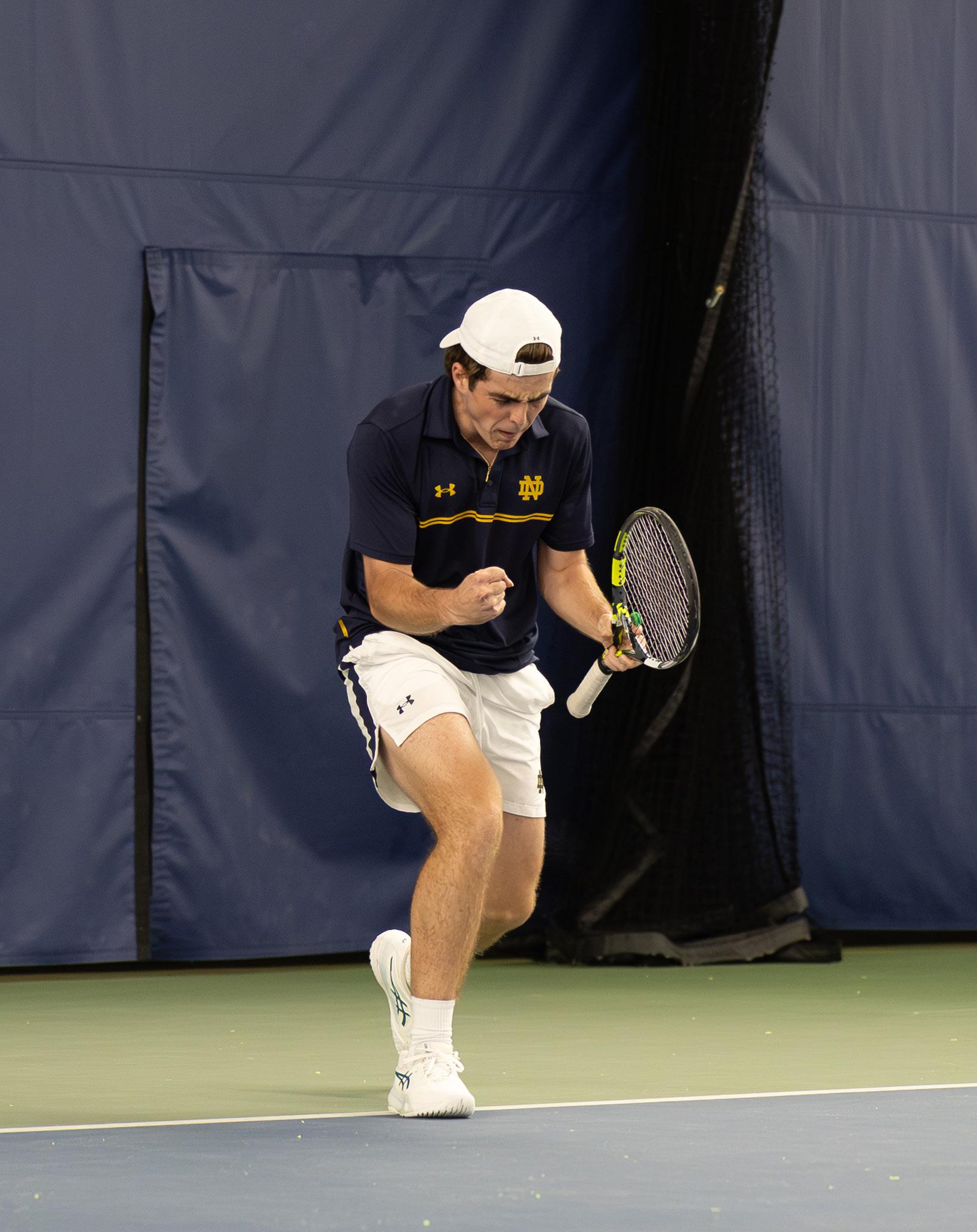
Last weekend, the Notre Dame men’s tennis team flew down to Cary, N.C., where it competed in the 2026 ACC Men’s Tennis Championship. Despite facing one of the best fields in college tennis, the Irish had all the momentum and firepower to cause some chaos at the tournament. No. 3 Notre Dame received the coveted double-bye, along with Wake Forest, Virginia and Stanford, granting the teams an automatic spot in the quarterfinals.
In the quarterfinals, the men faced off against No. 11 North Carolina, who swept Virginia Tech in the first round and beat No. 6 Clemson in second round. Notre Dame held on in a turbulent matchup, defeating the Tar Heels 4-3 to book a meeting with No. 2 Virginia. While the Irish kept things closer than they did a month ago, they remained unable to keep up with the Cavaliers in the deciding moments and crashed out of the tournament in a 1-4 loss. In the doubles competition, Notre Dame started off poorly against North Carolina, despite senior Sebastian Dominko and graduate Perry Gregg defeating Roan Jones and Anthony Wright
6-4 in the opening match. Logan Zapp and Ian Mayew responded for the Tar Heels, beating juniors Evan Lee and Chase Thompson 6-4. North Carolina’s Niels Ratiu and Chris Xu clinched the doubles point, grinding out a 6-4 win against sophomores Peter Nad and Luis Llorens Saracho.
Moving into the singles competition, Llorens Saracho quickly avenged his doubles loss, defeating Zapp 6-1, 6-2, putting Notre Dame on the board. Gregg followed up with a 6-2, 6-1 blitz against Roan Jones, giving the Irish a 2-1 lead. Dominko capitalized on the momentum and extended the Irish lead, beating Chris Xu 6-3, 6-4. Mayew upped the pressure on the Irish, beating sophomore Giuseppe Cerasuolo 6-4, 6-2. Ratiu tied things up for the Tar Heels with a clutch 7-5, 6-3 victory over Nad.
Facing an early elimination, Notre Dame junior Kyran Magimay remained calm under duress and battled out a 7-5, 6-4 win against Constantinos Djakouris. The win sent Notre Dame to the semifinals of the tournament, where a dominant Virginia team awaited.
Virginia
Unlike against their previous encounter, the Irish got off to a brilliant start in doubles against
the Cavaliers. Nad and Llorens Saracho delivered a flawless performance to oust Dylan Dietrich and Andrés Santamarta Roig, 6-3. Gregg and Dominko sealed the doubles point with another solid performance, defeating Jangjun Kim and Måns Dahlberg, 6-3. Notre Dame was unable to keep the lead during the singles events, with Kim racing past Nad to even up the score, 6-3, 6-2. Dahlberg fought past Llorens Saracho 6-4, 6-2, handing Virginia the lead. No. 1 Dietrich affirmed his place at the top of collegiate tennis, dismantling No. 18 Dominko 6-4, 6-2, putting the Cavaliers one win away from advancing. Roig finished the job for Virginia, beating Cerasuolo 6-3, 6-4. After their dominant singles performance against Notre Dame, Virginia went on to face defending national champions Wake Forest in the final, falling 4-2. Although Notre Dame was not able to complete the upset against Virginia, the tournament yielded largely positive results. Gregg and Magimay both led before their respective matches were abandoned, meaning that if just one player had a better performance, the dual could have swung in Notre Dame’s favor. Additionally, the doubles victory against Virginia bodes well for the upcoming NCAA Championship, where that singular point can often determine the
ND WOMEN’S TENNIS
result of a matchup. There are certainly things to work on before May comes around, but Irish fans should be feeling confident about the team’s
chances at a deep run in the season’s closing stages.
Contact Jacek Kawczynski at jkawczyn@nd.edu
By Jacek Kawczynski Associate Sports Editor
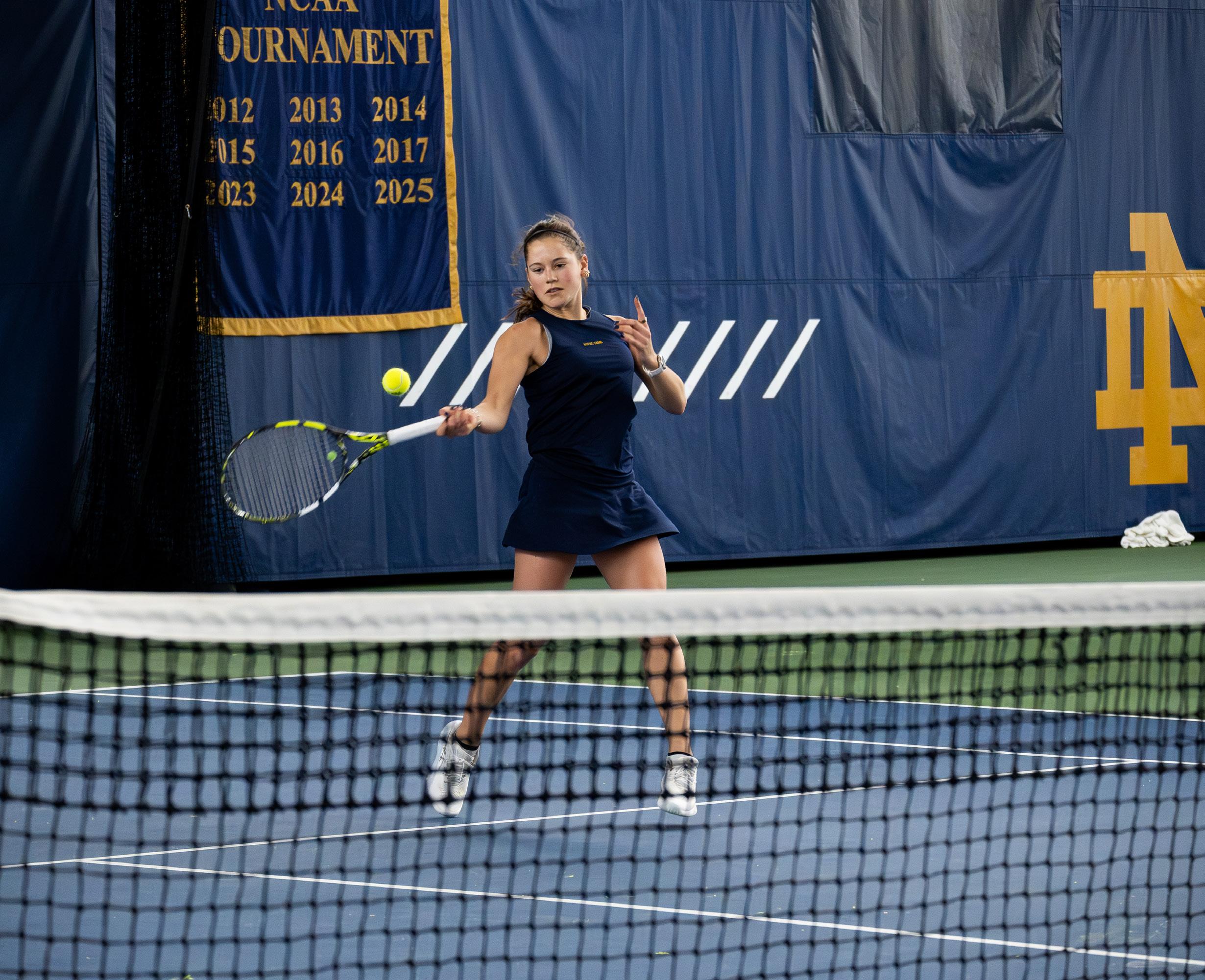
Notre Dame women’s tennis began its 2026 postseason journey at last weekend’s Atlantic Coast Conference championships in Cary, N.C. Going 16-8, the Irish came into the tournament as the conference No. 10 seed and quickly showed that they are not to be underestimated.
They began the tournament with a second-round matchup against No. 15 Boston College and advanced with a 4-2 victory. The win set them up against No. 6 Clemson, whom they defeated 4-3 in stunning fashion.
Notre Dame ultimately fell short against No. 2 North Carolina with a final score of 1-4, but the Irish nevertheless demonstrated their ability to compete with the best teams in the nation.
Boston College
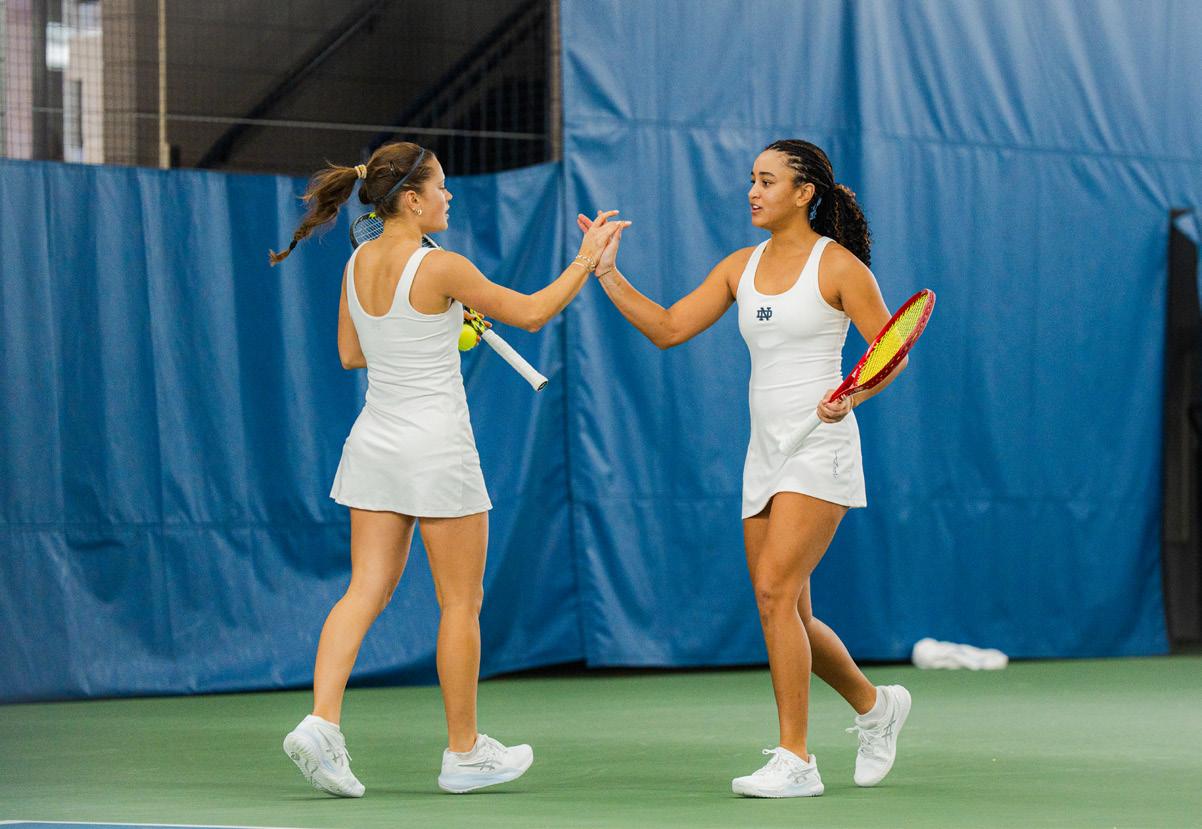
Things got off to a rough start against Boston College, with senior Akari Matsuno and freshman Mari-Louise Van Zyl falling 6-4 to Eagles Olivia Cutone and Leyden Games. Sophomore Bianca Molnar and senior Bojana Pozder pulled one back for the Irish, battling past Seren Agar and Olivia Benton 6-4. Boston College managed
to tough it out at the No. 2 doubles position, with Bella Camacho and Tola Glowacka defeating Notre Dame senior Rylie Hanford and freshman Gabriella Rawles 7-5.
The Irish brought the heat in singles, however, with Matsuno setting the tone with a 6-4, 6-3 win over Agar. Freshman Sophia Holod made her first appearance of the tournament, defeating Glowacka 7-5, 6-4 to hand Notre Dame the lead.
Hanford followed up with a gritty 6-4, 6-4 win against Camacho before Games finally took a singles match for Boston College, beating Pozder 6-1,
3-6, 6-3. Notre Dame freshman Jessica Kovalcik put the dual to rest, defeating Nadia Barteck in a clutch comeback win, 1-6, 6-3, 6-4.
There was no rest for the weary, as Notre Dame advanced to take on a strong Clemson team in round three. Hanford and Rawles kicked off doubles play, knocking out Clemson’s Talia Neilson-Gatenby and Romana Cisovska 6-4. Van Zyl and Matsuno secured the team doubles point, defeating Sophie Clayton and Artemis Aslanisvili 6-3.
Clemson quickly turned the tables in singles, starting with Neilson-Gatenby, who flew past Holod 6-3, 6-0 to put the Tigers on the board. Aslanisvili went on to defeat Hanford 6-4, 6-1, and Cisovska followed suit, demolishing Pozder 6-2, 6-1 to put Notre Dame on thin ice. Kovalcik continued her solid weekend, beating Ria Bhakta 6-2, 6-2 and sparking a glimmer of hope for the Irish. Matsuno tied things up with a gutsy 7-5, 6-4 win over Rinon Okuwaki before Molnar completed a triumphant Notre Dame comeback, powering past Jade Groen 6-1, 5-7, 6-1.
The Irish carried that momentum into their dual against the Tar Heels, where they came out guns blazing in doubles. No. 7-ranked Tar Heel duo Oby Kajuru and Susanna Maltby crushed Pozder and Molnar 6-0 in the opening match. Hanford and Rawles quickly responded for the Irish by upsetting No. 5-ranked Alanis Hamilton and Reese Brantmeier 6-4. Matsuno and Van Zyl snagged the doubles point for Notre Dame, defeating Anna Frey and Maddy Zampardo 7-5.
The Irish could not maintain their firepower in singles, where
they faced a lineup of three players ranked inside the top 40. Kajuru flew past Matsuno 6-2, 6-2. The match was followed shortly by Brantmeier, who upended Molnar 6-3, 6-3. Tatum Evans made it 3-1, defeating Sophia Holod 7-5, 6-3 before Zampardo closed out the dual with a 6-4, 0-6, 6-4 win against Notre Dame’s Hanford.
It was an overall successful weekend for the women’s team, who managed to play above their seed and work their way into the quarterfinals. The comeback against Clemson served as a testament to their mental toughness under pressure, which has been built by a brutal schedule this spring. Not to be overlooked, the doubles win over North Carolina and two top 10 pairs should provide a tremendous confidence boost heading into the tail end of the season.
Things will only get tougher from here, as the Irish prepare to face a gauntlet at the 2026 NCAA championships. The team will need to show the same grit and consistency they did this weekend if they wish to make a deep run and leave a mark on the college tennis landscape.
Contact Jacek Kawczynski at jkawczyn@nd.edu