THE INDEPENDENT NEWSPAPER SERVING NOTRE DAME, SAINT MARY’S AND HOLY CROSS ESTABLISHED 1966
TUESDAY, NOVEMBER 10, 2026 | VOL. LXI, NO. 20
NDSMCOBSERVER.COM
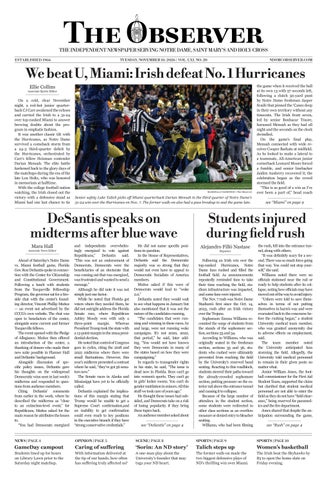
We beat U, Miami: Irish defeat No. 1 Hurricanes Ellie Collins
Associate Sports Editor
On a cold, clear November night, a red-hot junior quarterback CJ Carr awakened the echoes and carried the Irish to a 31-24 over top-ranked Miami to answer brewing doubts about the program in emphatic fashion. It was another classic tilt with the Hurricanes, as Notre Dame survived a comeback storm from a 24-3 third-quarter deficit by the Hurricanes, orchestrated by Carr’s fellow Heisman contender Darian Mensah. The elite battle harkened back to the glory days of the matchups during the era of the late Lou Holtz, who was honored in memoriam at halftime. With the college football nation watching, the Irish closed out the victory with a defensive stand as Miami had one last chance to tie
MARIELLA TADDONIO | The Observer
Senior safety Luke Talich picks off Miami quarterback Darian Mensah in the third quarter of Notre Dame’s 31-24 win over the Hurricanes on Nov. 7. The former walk-on also had a pass breakup to seal the game late.
DeSantis speaks on midterms after blue wave Mara Hall
the game when it received the ball at its own 13 with 57 seconds left, following a clutch 50-yard punt by Notre Dame freshman Jasper Scaife that pinned the ‘Canes deep in their own territory without any timeouts. The Irish front seven, led by senior Boubacar Traore, harassed Mensah as they had all night and the seconds on the clock dwindled. On the game’s final play, Mensah connected with wide receiver Cooper Barkate at midfield. As he looked to make a lateral to a teammate, All-American junior cornerback Leonard Moore forced a fumble, and senior linebacker Jaiden Ausberry recovered it; the celebration began as the crowd stormed the field. “This is as good of a win as I‘ve ever been a part of,” head coach see “Miami” on page 9
Students injured during field rush
Ahead of Saturday’s Notre Dame vs. Miami football game, Florida Gov. Ron DeSantis spoke in connection with the Center for Citizenship and Constitutional Government. Following a lunch with students from the Tocqueville Fellowship Program, the governor sat for a fireside chat with the center’s founding director, Vincent Phillip Muñoz — an event not advertised by the CCCG’s own website. The chat was open to benefactors of the center, alongside some current and former Tocqueville fellows. The event opened with the Pledge of Allegiance. Muñoz then offered an introduction of the center, a thanking of donors who made their new suite possible in Flanner Hall and DeSantis’ background. Alongside discussion of specific policy issues, DeSantis gave his thoughts on the widespread Democratic wins seen in last week’s midterms and responded to questions from audience members. Citing DeSantis’ comments from earlier in the week, where he described the midterms as “close to an extinction-level event,” for Republicans, Muñoz asked for the main reason he attributes the losses to. “You had Democrats energized
and independents overwhelmingly energized to vote against Republicans,” DeSantis said. “This was not an endorsement of Democrats. Democrats were the beneficiaries of an electorate that was coming out that was energized, was frustrated and wanted to send a message.” Although he did note it was not simply just one factor. While he noted that Florida got voters where they needed them, he did not outright address the Florida Senate race, where Republican Ashley Moody won with only a three-point margin. Whereas President Trump took the state with a 13-point margin in the 2024 presidential election. He noted that control of Congress goes in cycles, citing the 2018 and 2022 midterms where there were small fluctuations. However, this year’s midterm presented a contrast where he said, “they’ve got 56 senators now.” The Senate races in Alaska and Mississippi have yet to be officially called. DeSantis explained the implications of this margin stating that Trump would be unable to get a Supreme Court confirmation,and an inability to get confirmation could even reach to key positions in the executive branch if they have “strong conservative credentials.”
He did not name specific positions in question. In the House of Representatives, DeSantis said the Democratic majority was so strong that they would not even have to appeal to Democratic Socialists of America members. Muñoz asked if this wave of Democrats would lead to “woke 2.0.” DeSantis noted they would wait to see what happens in January but also mentioned that it was not the nature of the candidates running. “The candidates that were running and winning in these races, by and large, were not running woke campaigns. It’s not 2020, 2022, that period,” he said, later adding, “You would not have known they were Democrats in many of the states based on how they were campaigning.” In regards to transgender rights in his state, he said, “The issue is dead now in Florida. Boys can’t go into women’s sports. They can’t go in girls’ locker rooms. You can’t do gender mutilation in minors. All this stuff we took care of years ago.” He thought these issues had subsided, and Democrats take on a risk of losing popularity if they bring these topics back. An audience member asked about
NEWS | PAGE 4
OPINION | PAGE 5
SCENE | PAGE 8
SPORTS | PAGE 9
SPORTS | PAGE 10
Students lined up for hours on Library Lawn prior to the Saturday night matchup.
With information delivered at the tip of our hands, how often has suffering truly affected us?
A one-man play about the University’s founder that may tugs your ND heart.
The former walk-on made the two biggest defensive plays of ND’s thrilling win over Miami.
The Irish beat the Skyhawks by 83 to open the home slate on Friday evening.
Associate News Editor
GameDay campout
Caring of suffering
see “DeSantis” on page 4
‘Sorin: An ND story’
Alejandro Filló Nastase Reporter
Following an Irish win over the top-ranked Hurricanes, Notre Dame fans rushed and filled the football field. As announcements repeatedly reminded fans to take their time reaching the field, stadium infrastructure was impacted, and some fans were injured. The Nov. 7 rush was Notre Dame Stadium’s first since the Oct. 14, 2023, rush after an Irish victory over the Trojans. Sophomore Emma Williams recounted the surge of students from the stands of the sophomore section, sections 33 and 34. According to Williams, who was originally seated in the freshman section, sections 35 and 36, students who rushed were ultimately prevented from reaching the field by the University’s reserved band seating. Reacting to this roadblock, students steered their paths toward the already-crowded sophomore section, putting pressure on the exterior rail above the entrance tunnel and causing it to collapse. Because of the large number of attendees in the student section, some students were redirected to other class sections as an overflow measure or denied entry to bleacher seating. Williams, who had been filming
Talich steps up
the rush, fell into the entrance tunnel, along with others. “It was definitely scary for a second. There was so much force going that way. You could not stop yourself,” she said. Williams noted there were no officials stationed near the rail or ready to help students after its collapse, noting how officials may have moved out of the way to avoid injury. “Ushers were told to save themselves in terms of not putting themselves in harm’s way and were evacuated back to the concourse before the rushing began,” a student University medical team member, who was granted anonymity due to adverse effects on employment, said. The team member noted the University anticipated fans storming the field. Allegedly, the University told medical personnel to remain in their given posts no matter what. Junior William Jones, the football commissioner for the First Aid Student Team, supported the claim but clarified that student medical personnel are not able to enter the field as they do not have “field clearance,” being reserved for paramedics and the fire department. Jones shared that despite the anticipation surrounding the game, see “Rush” on page 4
Women’s basketball
DAILY
2 | THE OBSERVER
QUESTION OF THE DAY:
TUESDAY, NOVEMBER 10, 2026
Who was your first celebrity crush?
Have a question you want answered? Email photo@ndsmcobserver.com
Megan LaMena freshman Pasquerilla West Hall “Ross Lynch.”
Julia English
Grace Rodakowski
Colin Hauck
Amely Duran-Orantes
“Prince Charming from Cinderella.”
“Tom Holland.”
“Hermione Granger.”
“Agent Otto from Odd Squad.”
freshman Pasquerilla West Hall
freshman Pasquerilla West Hall
freshman Keenan Hall
freshman McGlinn Hall
SOCIAL MEDIA POLL
PHOTO OF THE DAY | MARIELLA TADDONIO
Have an idea for a poll? Email lmartin01@saintmarys.edu
What was your experience during the Miami game day? My experience was great! My experience was average
13.4%
my experience was terrible 4.5%
I did not attend
77.4%
THE NEXT FIVE DAYS
CROSSWORD | WILL SHORTZ
Want your event included here? Email news@ndsmcobserver.com
Tuesday Exploration Fair 2026 Explore a variety of majors, minors and academic programs. 6 - 7:30 p.m. Dahnke Ballroom
Wednesday Veterans Day Observance Join the ROTC community in honoring America’s veterans. 5 - 6 p.m. Clarke Memorial Fountain, Fieldhouse Mall
Thursday Men’s hockey vs. Michigan State The Irish take on the No. 4 Spartans 7 p.m. Compton Family Ice Arena
Friday Trusty Trail ribbon cutting and dedication Saint Mary’s College celebrates a new additions to its campus. 3:30 p.m. Between The Avenue and Loretto Road
Saturday Men’s football vs. Boston College The Irish face off against the Eagles. 3:30 p.m. Notre Dame Stadium
ndsmcobserver.com “TO UNCOVER THE TRUTH AND REPORT IT ACCURATELY” 900 Hesburgh Library, Notre Dame, IN 46556 Editor-in-Chief Gray Nocjar Managing Editor Grace Tadajweski
Asst. Managing Editor: Zack Pohlman
Social Media Editor: Lilly Martin
Asst. Managing Editor: Noah Cahill
Ad Design Manager: Liam Flynn
Asst. Managing Editor: Abby Hernan
Business Manager: Zack Pohlman
Asst. Managing Editor: Henry Jagodzinski
Advertising Manager: Cassandra Sisk
Notre Dame News Editor: Megan Cornell
Policies The Observer is the independent, daily newspaper published in print and online by the students of the University of Notre Dame du Lac, Saint Mary’s College and Holy Cross College. Editorial content, including advertisements, is not governed by policies of the administration of any institution. The Observer reserves the right to refuse advertisements based on content.
SMC News Editor: Berhan Hagezom Opinion Editor: Duncan Stangel Sports Editor: Ben Hicks Scene Editor: Peter Mikulski Photo Editor: Mariella Taddonio Graphics Editor: Liam Flynn
The news is reported as accurately and objectively as possible. Unsigned editorials represent the opinion of the majority of the Editor-in-Chief, Managing Editor, Assistant Managing Editors and department editors. Commentaries, letters and columns present the views of the authors and not necessarily those of The Observer. Opinion space is available to all readers. The free expression of all opinions through letters is encouraged. Letters to the Editor must be signed and must include contact information. Questions regarding Observer policies should be directed to Editor-in-Chief Gray Nocjar
Today’s Staff News
Megan Cornell Soledad Castellanos
Berhan Hagezom
Graphics
Ashley Zheng
Photo
Mariella Taddonio
Opinion
Sophia Anderson
Sports
Ellie Collins Ben Hicks
Scene
Luke Foley
Editors Gray Nocjar Henry Jagodzinski Grace Tadajweski
PAID ADVERTISEMENT
NEWS
4 | THE OBSERVER
DeSantis
Continued from page 1 concerns over the ‘Islamification’ of the United States with the election of Sen. Abdul El-Sayed. In response, DeSantis shared, “In Florida, we just did a bill that I signed into law that allowed us to designate certain, not just limited to Islamism, but groups, as foreign terrorist organizations. So we were able to do that for the Muslim Brotherhood and for CAIR, Council of American-Islamic Relations.” He noted that CAIR sued, but a federal judge sided with the state. He explained the ramifications of this, as it also limits people from taking money from an education savings account to a school with Brotherhood links. DeSantis noted the stronghold conditions of Democrats will frustrate the Trump administration. “But it’s not just the next two years, because you are not going to retake congress in 2028. You probably won’t retake the Senate in 2030. You are probably looking at 2032,” he said. He noted that for Republicans to win in 2028 an underlying change would need to occur, but even so, they will be facing a Democratic congress. Later in the event, he explained that with all the focus on the presidency, the bottom-up has been neglected. In response to a question about the Washington Post reporting a possible presidential run, he complained about anonymous sources in the media where “they run on gossip.” He pushed back on policy to avoid AI regulations or Big Tech to 10 years, instead noting companies should be held responsible for using name, image and likeness or allowing chatbots to counsel teenagers on suicide, harm to parents or stuff that is sexually explicit. “The idea that Big Tech and the Republicans are just in bed together, I think, is a mistake from a policy perspective. I think it is a huge mistake from a political perspective,” he said. He contrasted the broad Democratic swing to Florida where he said the Republicans only lost one state Senate seat yet maintained a large majority. However, he noted this was not the case for all states. “We were able to battle that storm. Texas did not. Texas is the most important Republican state besides Florida,” he said. “If Republicans don’t have Texas as an anchor with Florida, you are not viable nationally.” Muñoz asked what the leading issue harming GOP candidates was, noting Vice President JD Vance attributed it to ending the war in Iran. DeSantis believed Operation Midnight Hammer in June 2025 was important and effective, but the subsequent efforts to prompt regime change have come without a clear objective. Instead, he offered that people should look to where the Democrats are spending money in advertising, saying this cycle it was corruption in Washington. He touted that he has never traded stocks while in an elected role, but would do so upon leaving office,
noting “I think I’d be pretty good at it.” However, he would not do so in office if elected again. He cited that his lack of trading stocks was also supported by voters and emphasized that in order to get things done, you have to have voter trust — a reason he attributed the passing of his property tax ballot measure to. DeSantis shared that there was another proposition from the legislature that he did not support, and it failed to pass. In response to an audience question about what he was most proud of during his time as governor, DeSantis said that he did everything he promised. DeSantis attributed affordability issues to the borrowing and spending of $6 trillion over a 13-month period in 2020 due to the COVID-19 pandemic. He noted that the war did affect inflation but returned to his prior claim for the root cause. He contrasted this to his economic control of Florida, where he claimed that under his tenure, the state has seen continued reduction of budgets, despite inflation and population growth, along with paying off over half of the state’s debt. “The size of government in Florida is smaller today than the day I took office and we have the smallest government per capita of any state in the United States. And what does that lead to? More economic growth than any state in this decade during my tenure as governor,” he said. As the conversation progressed, Muñoz inquired about specific policy issues, beginning with immigration. DeSantis explained that Trump did what he said he would do. At the state level, DeSantis explained that all of his policing forces collaborate with the Department of Homeland Security through ICE’s 287(g) program agreements. Later in the event, he noted that he wiped out sanctuary states and cities. “We have almost half of the 287G arrests in the entire country in the state of Florida, but you haven’t seen the stuff you saw in Minnesota in Florida,” he described. He opposed the idea that immigration enforcement should come with the committing of additional crimes since that created amnesty, and raised concerns over widespread birth tourism, which could affect demographics. Regarding tariffs, DeSantis thought policies needed to be rooted in national security. In his perspective, countries should aspire for reciprocal trade in which countries were following the same rules. On abortion, DeSantis said Florida beat out the initiatives, but, more broadly, pro-life movements did not have a plan when the Dobbs v. Jackson decision landed. DeSantis last spoke at Notre Dame in 2024, where he was protested by students. This time, attendees were checked in upon entering Flanner Hall. The approximately 80 attendees outnumbered the available chairs, with many left standing along the sides and back of the CCCG suite. Contact Mara Hall at mhall27@nd.edu
TUESDAY, NOVEMBER 10, 2026
Students camp out for ESPN’s “College GameDay” Isabelle Baier Reporter
On Saturday morning, Notre Dame hosted ESPN’s “College GameDay” on Library Lawn with Touchdown Jesus and Notre Dame Stadium in the background before the highly anticipated matchup between the No. 11 Irish and No. 1 Miami Hurricanes. Several hundred students and fans camped Friday night and early Saturday morning for a chance to kick a $1 million field goal and stand in the pit surrounding ESPN’s stage. Some Notre Dame students camped out Friday; some arrived Friday night and others early Saturday morning. The pit opened Saturday around 6:30 a.m. Tommy Fickell, a freshman, said he went to Library Lawn around 4 p.m. Friday to camp out. It was a long night with around three hours of sleep altogether. He said he was woken up throughout the night by people talking, yelling and fighting with each other. Fickell got into the pit around 7 a.m. after being woken up at 4:30 a.m. when the line started moving and condensing as workers urged
Rush Continued from page 1 there was nothing unusual about FAST’s preparation, and the number of FAST volunteers was not altered. Jones mentioned there is a behind-the-scenes communication system which connects all medical personnel. Similar to 911, incidents are picked up over radio and camera to be addressed, and appropriate people may be informed. Band clarinet senior John Geitner witnessed the rush and stepped in as an “usher” to prevent injuries. Geitner shared the band’s typical seating plan is based on seniority, with seniors at the front and freshmen at the back. However, close to the game’s end, upon noticing the upcoming rushing of the field, the band inverted the seating plan. “The seniors, who were more experienced with this sort of thing, in the back line and the freshmen, who, obviously, haven’t really done this before, were more packed up from where they could be a little safer and a little less like in the middle of the action,” Geitner said. According to Geitner, the band not only took this measure to help keep people from entering the band’s section but also to protect expensive equipment. Geitner said he was inspired by those who took initiative and worked as a collective. “Even with like a minute left on the clock, kids were already starting to push this way. You could sort of feel the pressure of it,” Geitner said. “We were corralling them off to the side.” Geitner described the scene as chaotic, sharing the pressure at the top pushing down to the bottom led
everyone to stand up and get rid of their lawn chairs. Tensions arose as the line formed and several students attempted to cut. Freshman Claire Ceasar said that around 4 a.m. three people tried cutting in front of her in line, and she told them, “I’ve been out here the past 7 hours. Move.” Fickell was one of the first 300 people into the pit and received a lottery ticket for a chance to kick the $1 million field goal. He said the pit held around 500 people, and workers let them inside in groups of 50. He said camping out was worth it, but that he “wouldn’t do it again.” He said it was an exhausting experience and went back to his dorm to take a nap on Saturday. Ceasar said that the highlight of her “College GameDay” experience was getting on TV and getting the Home Depot gloves that were given out. Freshman Aubrey Marasco was one of the last 20 people let into the pit. She and her friends got to Library Lawn to camp around 9 p.m. Friday. Like Fickell, Marasco said Friday was a very long night with little sleep, especially as temperatures
dropped below 40 degrees at night. Despite the cold, Marasco said that the experience was worth it and was “something that every student should do at some point in their college experience.” To avoid long stretches in the cold, some students coordinated shifts waiting in line. Students in Keenan Hall sent a document in their hall group chat asking fellow residents to sign up for a time slot, beginning at 3 p.m. Friday. The Notre Dame Police Department monitored the lawn while students camped. Announcements sounded periodically, reminding students they were not allowed to set up tents overnight. Andrea Halun Ramirez, a freshman, said while waiting in line she noticed a middle-aged man approach a group of girls who were waiting in line Friday night. She said that police interjected after being prompted by several other students, and that they “told the man he couldn’t be sitting so close to them.”
some students to trip, panic or cry. He noted the rush this game was a lot more aggressive than the rush his freshman year, attributing the difference to the rise in emotions and the heated rivalry between Notre Dame and Miami. Saint Mary’s junior Rowan Finnigan visited the hospital as a result of a sprained ankle sustained during the event. While Finnigan shared she was initially “super excited” to rush the field, she later realized the danger in the event. According to Finnigan, she was pushed around during the rush, leading her foot to get caught in the bleachers and causing her and others to fall forward. “I was like on top of another girl. There was a girl on top of me, and then it just became like eight people on top of me,” Finnigan said. “I just couldn’t see anything. I didn’t know where I was.” Finnigan noted it was her boyfriend, Notre Dame junior Andrew Nance, who largely contributed to her safety. With no immediate help from officials, Nance helped to lift Finnigan up and guide her through the crowded field to a safer place to rest and check on her injuries. Finnigan stressed, at times, it felt like there was insufficient medical support. “I know there was a lot of people hurt, so I assume they were just running around,” Finnigan said. “There was no way to really call for a medic. You just have to find them.” After Finnigan encountered medical student volunteers, they examined her foot and made a splint by breaking a broom handle. According to Finnigan, a pair of fans who were orthopedic foot surgeons saw what was going on and “took over,” instructing the students.
Following their intervention, Finnigan was taken to the medical room and then the hospital, where she was discharged with a sprained ankle. Nance accompanied Finnigan to the hospital. “The hospital was swamped because there were multiple people in beds in the hallways,” Nance said. “Probably three-fourths of them were Notre Dame fans. I saw their jerseys.” Nance expected the rush to cause more injuries needing hospitalizations. He noted the fans in the hospital were mainly older adults. Finnigan said she should have known the risks of rushing but that fellow students could have been more careful. Throughout the rush, an announcer on the stadium intercom repeatedly reminded fans to descend through the stands slowly. Later, the announcer shared the field had reached its full capacity and directed fans who had not reached the field to not join the crowd on the field. Later, the announcer attempted to lead fans off the field, reminding them all exits were open and the scoreboard exit was fastest. “The health and safety of faculty, staff, students, fans and visitors is Notre Dame’s utmost priority. Unfortunately, in the celebration that ensued after an exciting football victory on Saturday night, we are aware that some people sustained treatable injuries despite established protective measures implemented by the University,” University spokesperson Erin Blasko wrote in an email statement to The Observer.
Contact Isabelle Baier at ibaier@nd.edu
Contact Alejandro Filló Nastase at afillona@nd.edu
OPINION
TUESDAY, NOVEMBER 10, 2026
THE OBSERVER | 5
We know about suffering. Can we care about it? By Francisco de la Cuadra Mancilla Columnist
We have become remarkably good at knowing about other people’s suffering. We’re able to follow wars as they unfold and read about humanitarian crises thousands of miles away. We can access more information in seconds than previous generations could in a lifetime. And yet, I wonder whether knowing so much has made us better at caring. How often do we feel something for a minute about someone else’s suffering and then just move on? When was the last time someone else’s story changed the way we see the world? I have been thinking about these questions through the idea of accompaniment, especially in Notre Dame global affairs professor Steve Reifenberg’s work. In “Santiago’s Children,” Reifenberg reflects on the time he spent working at an orphanage in Chile. He arrived with big plans to improve the children’s lives. Then he got sick. The children and people around him took care of him. He had come to help them, and now they were helping him. I find that reversal interesting. Reifenberg came to understand that accompaniment meant walking alongside people and learning from them. Showing up with answers or assuming he knew what was best for someone else wasn’t part of it. He had to allow himself to be changed by them too. He went to Chile thinking about what
ASHLEY ZHENG | The Observer
he could give, and, in the end, he found out how much he had to receive. We sometimes forget that caring for others goes both ways and that, at some point in our lives, we too may need to be accompanied. Last summer, I spent some time at Casa Monarca, a migrant shelter in Monterrey, Mexico, and I started to think about this differently. I met people whose journeys were difficult for me to understand and whose futures were uncertain. I remember Mauricio, a Salvadoran man who had lost his leg after falling from a freight train. Many afternoons we watched cartoons and talked about ordinary things. Some days we just sat together. I didn’t understand everything
he had been through, and I can’t say my being there changed his life. Those afternoons did change how I think about what it means to be there for another person. It’s easy to talk about migration in statistics and policies, and we spend our time trying to understand the structures that force people to leave their homes. But somewhere in those conversations we start to forget about the people themselves. Each number is a person, someone like Mauricio. The same goes for anyone dealing with poverty or violence and for anyone who is lonely. Everyone has a story that doesn’t fit into the boxes we use to make sense of the world. Pope Francis warned against
what he called the globalization of indifference. Part of it, I think, comes from getting so used to seeing suffering that we stop letting it affect us. We scroll past another crisis and read another headline, and then the day goes on. Sometimes the problems seem so big and far away that caring starts to feel pointless. Still, we can care about something even if we can’t fix it. I wonder if, as students, we sometimes underestimate how much this matters. We’re encouraged to think big and change the world, to spot problems and come up with solutions. Those ambitions are worth having. But what good are solutions if we forget the people they’re meant to serve? An encounter doesn’t
have to become a research project, and service doesn’t have to produce something we can measure. Sometimes it just means making time for a friend who’s struggling. Or listening to someone whose life and experiences look nothing like ours, even when it’s easier to look away. Accompaniment can’t replace justice or institutional responsibility. It can remind us why that work matters. Behind every policy and every crisis are people, and their lives deserve to be taken seriously. I keep coming back to Reifenberg’s experience in Chile. He went believing he had something to give, and he ended up needing the people he had come to serve. Maybe that’s part of why we should care about others, even the ones we don’t know and may never meet. Their lives matter whether or not we can do anything for them. Seeing that says something about us, too. None of us gets through life entirely on our own. We can’t be everywhere or fix everything, so the least we can do is not look away. Knowing about the world’s problems doesn’t get us very far unless we’re willing to let the people living through them matter to us, and learning to walk alongside each other is where that starts. The views expressed in this column are those of the author and not necessarily those of The Observer. Write to Francisco de la Cuadra Mancilla at fdelacua@nd.edu
The work doesn’t end at the polling booth By Christopher Saenz Columnist
Almost a week has passed since the midterm elections, and I think it’s worth asking ourselves: Could I have done more? What could I have done differently? We have the opportunity to make our voices heard and a civic duty to make our country better through participation. For some of you, this was your first election. If you voted, I commend you. It’s a privilege to have a say in how our government is run. That doesn’t stop at the polling booth, and our civic duty doesn’t end in November. When I was 19, I had the opportunity to vote in my first presidential election. My dad passed down advice he had received from his grandfather, who immigrated from Mexico and became an American citizen. That duty was passed down through our family. I’ll never forget the conversation my dad had with me. He asked whether I was going
DIONE QUIAMBAO PAHILAN | The Observer
to vote, and I wasn’t sure. I didn’t feel informed. I didn’t know whom to vote for or what the measures on the ballot meant. I hadn’t learned about the people asking to represent
me. Looking back, I wish I had taken that responsibility more seriously, and while I ended up voting, I simply voted the party line. I grew up in Los Angeles in
a blue-collar, pro-union, proDemocrat family. Both my parents were born in California, and I never experienced the hardships that earlier generations of my family faced
coming to this country. Maybe that made voting easier to take for granted. I voted the way I was raised for a long time. But after getting married and having children, some of my beliefs began to shift. And that’s OK. I’m 38 now, and I’m not the same person I was at 30, 25 or 19. Some values have remained, while others have changed. Growing up gives us opportunities to rethink our opinions. I don’t think aligning with one party on every issue always makes sense. We all have different things that matter to us. We should understand why we believe what we believe, rather than vote purely red or blue because that’s what we’ve always done. Politics have become so contentious that I understand why people want nothing to do with them. Just because we can choose not to participate doesn’t mean we should. We would be better off if more of us examined our beliefs see “Polls” on page 6
OPINION
6 | THE OBSERVER
Polls
Continued from page 5 and listened to others. Just because I believe something doesn’t necessarily make it true. That’s a reason to keep asking questions, not to stop listening. Charlie Kirk was a controversial individual, and many people disagreed with him. Whatever we thought of his opinions, I think there’s something worth considering in the idea of having open conversations with people who disagree with us. My life experience isn’t everyone’s life experience. What shaped my opinion might be completely different from what shaped yours. We can disagree without deciding that the other person isn’t worth hearing. Seeing Jason Sudeikis at “College GameDay” recently reminded me of one of my favorite lines from “Ted Lasso”: “Be curious, not judgmental.” I come back to that advice often. Having difficult conversations is hard. Listening without passing judgment can be harder. If we want to find common ground and make things better, that’s where we must start. So where do we go from here? Some people are celebrating the election results. Others are disappointed or concerned about the country’s direction. Regardless of how you voted, this is a call to action. I’m more concerned with your participation than which party you support. The more people who participate, the more elections can ref lect our communities. Participation means more than casting a ballot. If you’re unhappy with a policy your elected officials support, send them a message. If something matters to you, learn about it and speak up. Don’t take everything you hear at face value. Look it up yourself. Legislation can be difficult to understand, but we have more resources than ever to become informed. We also have a responsibility to question what we find. At Notre Dame, we talk about being a “force for good.” I believe we all want, in our own ways, to make our country and our world better. We have different vocations and different ways to serve. Political participation is one opportunity to be informed, open-minded and compassionate enough to listen to someone else’s story. To the students reading this, don’t let your age convince you that you have to wait to make a difference. In this election, 26-year-old Michael Alfonso won a seat representing Wisconsin’s 7th Congressional District. Whether or not you agree with his politics, his election is a reminder that young people can step forward and represent their communities. When I was 18, I thought politicians were people in their
30s or 40s. I didn’t realize that I could have been one of those people trying to make things better. You don’t know what you don’t know, and I wish I had recognized the opportunities right in front of me. Missing an opportunity doesn’t make the next one any less valuable. Time is a f leeting gift. Being young gives you the chance to try, fail, get back up and try again. Don’t wait until you think you know everything to get involved. None of us ever will. As an older student, I’m proud of the hard work it took for you to get to Notre Dame. Sometimes I wish I had put in that work earlier in my own life, but people develop in their own time, and that’s OK, too. I can’t go back to my first election and do things differently. I can take my father’s advice more seriously today. When the next election comes,
I hope you won’t wonder what more you could have done. Be present. Be curious. Listen with an open mind and an open heart. It’s never too early to make a difference, and it’s never too late to start.e participates. Against this backdrop, what good is the vote of any Catholic, let alone the pope? Catholics ought to remember that voting is not merely a political act and that by choosing to vote or not vote for a particular candidate, we are making a moral statement on their policies. Even if your vote “doesn’t matter” in the sense that the election results will be unchanged, the Catechism of the Catholic Church demands that we engage in voting. The section on The Authorities in Civil Society says in paragraph 2240, “Submission to authority and co-responsibility for the common good make it morally obligatory to pay taxes, to
TUESDAY, NOVEMBER 10, 2026
exercise the right to vote, and to defend one’s country.” The reality remains for all Catholics that we have a desperate need to vote. Our free will enables us to select the candidate, but as Catholics — in adherence to teachings that may differ from the opinions held by a wide majority of Americans — we ought to vote for the goals of the faith we love and hold dear. In the spiritual context, that is spreading the Gospel. In the deeply practical sense, it is feeding the hungry, giving drink to the thirsty, clothing the naked, housing homeless people, visiting the sick and imprisoned and burying the dead. It is the work that is ours to perform but never ours to finish. The Catechism, paraphrasing the Epistle to Diognetus, reminds us that we are castaways, we are “resident aliens,” we are not truly at home in
America or any other country. We may vote in U.S. elections, but as Christians we are “citizens of heaven,” merely passing our days on earth. If you’ve voted already, you contributed to the mechanism that keeps our democracy intact. If you haven’t, we implore you to consider voting, regardless of who it is for. Voting gives Catholic morality a voice in public life, one that can be heard across the country and lives up to the words above the entrance to the Basilica of the Sacred Heart: God, Country, Notre Dame. The views expressed in this column are those of the author and not necessarily those of The Observer. Write to Christopher Saenz at csaenz@nd.edu
PAID ADVERTISEMENT
democracy talk
America’s 250th, As Seen Through Film To commemorate the 250th anniversary year of American independence, the University of Notre Dame, the Georgetown Democracy Initiative, and the Washington Political Film Foundation will host a viewing of a special compilation of America in film over the years. The viewing will be followed by a multicampus discussion on American democracy, the midterms, and the prospects for America’s next 250 years. Open to all Notre Dame students, faculty, and staff. Movie snacks provided. Tickets available for pickup one hour prior.
Democracy Initiative Arts Initiative Department of Film, Television, and Theatre
Wednesday, November 18 5:00–7:30 p.m. DeBartolo Performing Arts Center 5:00–6:00 p.m. Act One — Looking Back Browning Cinema 6:00–6:20 p.m. Intermission 6:20–7:30 p.m. Act Two — Looking Forward Patricia George Decio Theatre
Learn more at go.nd.edu/democracy
TUESDAY, NOVEMBER 10, 2026
PHOTO
THE OBSERVER | 7
Down goes No. 1
The Notre Dame Fighting Irish took down the Miami Hurricanes in Notre Dame Stadium on Nov. 7, 2026. The Irish won 31-24. Photography by Mariella Taddonio
SCENE
8 | THE OBSERVER
TUESDAY, NOVEMBER 10, 2026
‘Sorin: A Notre Dame Story’ tugs your ND heart By Ainslie McKenna Scene Writer
On a cold, rainy Thursday night, I found myself in possession of a ticket to a one-man show about Fr. Edward Sorin, our University’s founder. I was asked to work last minute at a dinner where some of the attending guests received tickets to the show following dinner. With the leftover, unclaimed tickets, I was able to attend as well; hesitantly, I grabbed a seat in the Patricia George Decio Theatre at the DeBartolo Performing Arts Center. I had only briefly heard that the play was happening and saw very little advertising for it, so I was pleasantly surprised when the theater seats began filling up. The audience buzzed with anticipation until a little after 8:30 p.m., when the show began. The stage was simple: Off to stage left were a chair, a trunk, a desk and some accessories that Sorin would use or wear throughout the show. The backdrop was three projection panels that assisted the actor in telling the story. Throughout the show, they included pictures and videos accompanying what Sorin was saying, like news clippings from when the Main Building burned in 1879. The stripped-down set matched the vibe of the solo priest subject: minimalist, humble, ascetic. Sorin himself was played by Notre Dame class of 1989 alum Anthony Lawton. For an hour and 15 minutes, Lawton recited his lines nearly flawlessly. With no characters to riff
off of, Lawton spoke to himself like he was reciting a diary entry or directed one-sided conversations to God above. Often, it felt almost like the audience was taking on the Godlike persona, with Lawton making his pleas and prayers to us. An impressive display of artistic tenacity, the one-man performance blew me away. The story itself was nothing too revolutionary: Sorin arrives from France and builds a university on the lakes. It details the growth of the University through its early years with some key details of how the school came to be. Surprisingly, the play was quite funny! Whether it was Lawton’s comedic timing and French accent or the writing itself, the show garnered more than a few laughs from me and the rest of the audience. The play as a whole was entertaining and impressive, but it was not without flaw. While the overall points were mostly historically accurate, my main concerns were not with what was presented but with what wasn’t. In the entire play, there was no mention of the Indigenous people of the area. They did not talk about how Father Sorin wanted to pass on the work of founding the University to someone else so that he could be a missionary to the Potawatomi. In 2026, it should be the bare minimum to acknowledge the important role of the Potawatomi in Notre Dame history. Alongside the lack of Indigenous people, there was a noticeable lack
of women. The play touched on Mother Angela and other Holy Cross sisters serving as nurses in the Civil War, as well as the founding of Saint Mary’s College in Michigan and its later move to South Bend, but more often than not, the mentions of women came as an afterthought, despite their early and important role in helping found the University. The line often quoted from Sorin to Moreau reads, “This college … will be one of the most powerful means for good in this country.” It is printed on the inside of the play program, mentioned in the script and, famously, featured on the Founder’s Plaque near Saint Mary’s Lake. However, as I learned in class with professor Kathleen Cummings (and in her Notre Dame Magazine article, “The Women of Past Presence”), this quote does not tell the full story. A few lines later, Sorin says, “. . . once the Sisters come — whose presence is so much desired here — they must be prepared,” and continues on describing the type of work they are needed for. The omission of the Sisters in this regard strips their importance from the founding of Notre Dame and the help they provided to Sorin. So despite the play being about Sorin founding Notre Dame, it fails to include the women who helped him do so and the Indigenous people whom he felt connected to. For a contemporary play, I would have expected more sensitivity around these subjects. Lastly, one thing that surprised me when I first opened up the program
was that the show was “A production of Notre Dame Development’s Storytelling & Engagement Team.” I wasn’t sure what this really meant until the last few minutes of the play. Sorin was at the end of his life, and in this dramatized version, his posthumous soul watched the development of the University over time. The screens displayed video clips and images of how the University grew, both in literal size and in the growth of adding women and a more diverse student body. Lawton stood in the middle of the stage facing the audience and looking up to “God,” reacting to the screens behind him. He expressed such joy at the future of the school but in his exclamations of praise said things to the effect of “Look how far we’ve come, but we’re not done yet.” Then, addressing God, the University or the audience, he remarked that only “you” have the power to take the school further; there’s still work to be done. With the context of the University’s development team creating this show — and the QR code on the back of the program asking for donations to the Sorin Society — this show was clearly made with the end goal of collecting funds from donors. While interesting and entertaining in its own right, it’s a play made by Domers and for Domers. So while at its core the play is a rose-colored view into Notre Dame’s past so that the audience members can contribute to its future, it was unexpectedly moving. Maybe it was the music, ambience or Lawton’s
acting, but the ending scene of Sorin’s death into the post-death montage tugged at the heartstrings of the audience members. It showed that Notre Dame isn’t just an institution but a home for so many, a place of hope and a continuation of a long history of devoted and inspiring people. I had the lucky opportunity to sit next to a kind woman from the class of 1977 who also happened to live in my same dorm, Farley Hall. Before the show, we shared a conversation about traditions and what we love about our residence hall, and as I walked away from the play after, I couldn’t help but see what the show was portraying in my own life at that moment. My presence in that theater on Thursday night was not by accident, nor was it meaningless, no matter how random it felt to me. My presence in that theater was the result of the people before me, giving what they could — time, talents, donations — to make this University something truly special. The show is not meant for Broadway, but not because it isn’t good. I think back to Lou Holtz’s famous quote: “For those who know Notre Dame, no explanation is necessary. For those who don’t, no explanation will suffice.” This sentiment was never more true than in the auditorium that night; not everyone in the world would feel the emotional core of the show, but for this audience, no explanation was necessary. Contact Ainslie McKenna at amckenn6@nd.edu
What I saw when the ’Canes came to South Bend By Ainsley Hale Scene Writer
The infamous Catholics vs. Convicts rivalry goes way back, officially beginning at kickoff in Burdine Stadium in Miami on Oct. 7, 1955, when the Notre Dame Fighting Irish defeated the Miami Hurricanes 14-0 — so much for the home-field advantage. The iconic slogan itself, however, was brought to life by Notre Dame students Joe Fredrick and Pat Walsh. During the summer of 1988, Joe Fredrick was home watching “SportsCenter” when a report aired about several Miami players being arrested, which in turn sparked the remark by his brother that the upcoming Miami versus Notre Dame game would be “Catholics versus Convicts.” So, Joe Fredrick and his friend Pat Walsh (with help from his roommate Mike Caponigro) quietly printed and sold hundreds of thousands of dollars’ worth of the controversial shirts around South Bend ahead of the Oct. 15, 1988, football game (in which Notre Dame ended up dramatically edging out Miami 31-30). For this past weekend’s rematch, I can imagine the more widespread printing of the Catholics vs. Convicts shirts more than doubled the total amount of earnings made by the dorm room operation in 1988. You could feel the anticipation around campus once the week of the 2026 Catholics vs. Convicts
rematch finally arrived. Decorative Miami hate banners hung on the outside of dorms, along with a few commemorative poster editions of The Observer, Page 13, Aug. 20, 1988: “Beat the rush. Hate Miami now. Signed respectfully, the class of 10.15.1988” posted on the doors of buildings around campus. I personally found humor in how seriously some Notre Dame students and the die-hard Irish football fans take this rivalry, although I can recognize the significance of the occasion and its accompanying festivities. So here’s my personal experience this weekend:
Friday festivities and the ‘GameDay’ broadcast
During one of my club meetings earlier in the week, I had heard rumblings of people planning to camp outside on Library Lawn Friday night ahead of the ESPN “College GameDay” broadcast on Saturday in hopes of infiltrating the “pit” for the morning show; I thought it was ridiculous. However, upon exiting Hesburgh Library at 8 p.m. on Friday, I noticed the makeshift camps of students huddled around pizza boxes and exchanging words with the occasional Miami fan who dared to flash a hand gesture “U” at them. Having transferred from a college that did not have a football team, I severely underestimated the dedication of the Irish football faithful and that of my fellow classmates
to make it on Pat McAfee’s fieldgoal-kick segment. On Saturday, I did observe several individuals take to the (tops of) trees surrounding the “GameDay” stage. In an effort to get a better view or to get on ESPN, who knows.
Tailgating
Ah, tailgating, the highlight of every game day. For whatever reason, tailgating before 7:30 p.m. games always feels longer than tailgating before 3:30 p.m. games, even though I spend roughly the same amount of time eating, mingling and occasionally participating in a round of some cup-pong-esque game. I was curious as to how many Miami fans would attempt to mingle or set up tailgates among the sea of Irish, bagpipes and shamrock green. I did not spot many, although I can report a near robbery of one of the coolers at the tailgate I was at — convicts living up to their name. The suspect was questioned, and, unfortunately, the Irish who intercepted him did not know Bryan (apparently he was at this tailgate, so says the convict), so the attempted Hurricane burglar was sent on his way.
The game (our Super Bowl) I felt like I was in the middle of a tush push trying to get into the stadium. I became well acquainted with those around me in this very overstimulating and claustrophobic period of time. Very cozy. At least I
got a short reprieve from the cold? My friends and I had lined up at the gate about two hours before kickoff, but clearly not early enough, given the swarm of students already ahead of us. I honestly do not know why they bothered putting up the metal railings between metal detectors; they were fighting for their lives against the sheer mob of Irish fans before finally succumbing to the tush push. Once we were finally able to scan our tickets at the kiosk, the battle was not yet over because then came the mad dash (stampede) up the ramps and through our designated student section gates to claim the best seats we could get our hands on (and obviously a light-up bracelet too). I had heard horror stories about how not all the students would be let into the stadium or how we would have a repeat of the overflowing student section at the first game of the year. Although there were definitely stragglers hanging out in the aisles, the ushers allowed students to watch from the tunnels so they could still experience this literally electric game (thanks to the impressive LED bracelet light display). Very innovative thinking with the lights on the band members’ hats too.
Storming of the field
I felt like I was in the middle of a tush push trying to get into the stadium. I became well acquainted with those around me in this very
overstimulating and claustrophobic period of time. Very cozy. At least I got a short reprieve from the cold? My friends and I had lined up at the gate about two hours before kickoff, but clearly not early enough, given the swarm of students already ahead of us. I honestly do not know why they bothered putting up the metal railings between metal detectors; they were fighting for their lives against the sheer mob of Irish fans before finally succumbing to the tush push. Once we were finally able to scan our tickets at the kiosk, the battle was not yet over because then came the mad dash (stampede) up the ramps and through our designated student section gates to claim the best seats we could get our hands on (and obviously a light-up bracelet too). I had heard horror stories about how not all the students would be let into the stadium or how we would have a repeat of the overflowing student section at the first game of the year. Although there were definitely stragglers hanging out in the aisles, the ushers allowed students to watch from the tunnels so they could still experience this literally electric game (thanks to the impressive LED bracelet light display). Very innovative thinking with the lights on the band members’ hats too. Contact Ainsley Hale at ahale9@nd.edu
SPORTS
TUESDAY, NOVEMBER 10, 2026
THE OBSERVER | 9
FOOTBALL
Miami
Continued from page 1 Marcus Freeman said in the postgame press conference, “and as special of a moment, as special of an outcome that I’ve been a part of since I’ve been the head coach here.” Miami played the tilt without superstar wide receiver Malachi Toney, and the Irish took advantage to win in a game they never trailed and led by as many as three touchdowns. Notre Dame took the lead on the opening possession of the game. Sophomore running back Nolan James Jr.’s 12-yard dash to the Irish 42 ignited Notre Dame’s first possession, and his subsequent 4-yard rush converted a fourth down at the Irish 48 to keep the offense on the field. Though a Carr connection to junior tight end Jack Larsen on 3rdand-9 got the Irish to the ‘Canes 28, it fell short of the sticks, and Notre Dame was held to three as junior Spencer Porath nailed a 44-yard field goal. A defensive delay-of-game call on the Irish put Miami at the ‘Canes 33 to start its first chance with the ball, but a relentless Irish defense paired with a raucous crowd forced a near-immediate punt from the 44. Freshman back Jonaz Walton carried the Irish on the ensuing series, collecting 26 yards on four carries, but Notre Dame’s drive was once again stalled at the ‘Canes 48, and an efficient punt by Scaife set Miami back at its 3 with 1:38 remaining in the first quarter. Two incompletions and one 2-yard gain showed that unflappable Hurricanes quarterback Mensah was capable of feeling pressure in the pocket as the Irish forced another punt. On the ensuing Irish drive, Carr hit senior wideout Jordan Faison at the Irish 28, who advanced it 26 yards to the Canes 39 to close out the first. Carr then laced a perfect spiral to the right pylon for a magnificent 27-yard pass to Faison for the first touchdown of the night
MARIELLA TADDONIO | The Observer
Junior cornerback Leonard Moore forces a fumble on the final play of Notre Dame’s 31-24 win over Miami on Nov. 7. The defense stood tall when it mattered most after enduring a third-quarter storm from the Hurricanes.
with 14:02 on the clock and a 10-0 lead on the scoreboard. The Miami offense appeared to finally settle in under the big lights, marching the ball down the field on a string of short-yardage conversions and a 22-yard hit to the Irish 22 from Mensah to wide receiver Vandrevius Jacobs. Two critical defensive holding penalties by the Irish on third down kept Miami’s drive alive, including one that stationed Miami at the 1-yard line with a fresh set of downs locked in a trip to the end zone. The Irish stiffened, denying three straight runs capped on third down by a swarming Ausberry and Traore of Mensah on a 3rd down sweep. The ‘Canes had to settle for a field goal that cut the lead to 10-3. “I feel like we made a big statement,” Traore said of Notre Dame’s defensive performance. “I feel like everybody knows we’re a great team, but tonight kind of showed everyone what we’re capable of doing.”
The Irish were forced to punt after their next drive fizzled at their own 44 on the second series of downs, but the Notre Dame defense took care of business and got Miami off the field after four plays. With 2 minutes left in the first half and the House That Rockne Built jumping, the Irish had the ball at their own 19. Juxtaposing the atmosphere, Carr has never appeared so calm and collected in the pocket, delivering a masterful string of darts beginning with a 10-yard completion to junior running back Aneyas Williams after a Josh Allen-like scramble to avoid a potential drive-killing sack. From there, Carr worked the Irish deep into Miami territory. After a connection to senior receiver Jaden Greathouse put the Irish at the 18-yard line, Carr delivered a shotgun strike to junior receiver Micah Gilbert on a play-action glance pass that put the Irish up 17-3 at the break. Carr finished the night 29-of40 for 319 yards and 3 touchdowns.
Earning the critical second touchdown of the game generated true momentum, especially considering the Hurricanes appeared ready to hit paydirt earlier after knocking on the door at the Irish 1-yard line. In the first half, the Blue and Gold outgained Miami by 251 yards to 145. Straight out of the tunnel after halftime, junior linebacker Kyngstonn Viliamu-Asa and a cohort of Irish defenders shook down the thunder and got home to sack Mensah at the ‘Canes 27 to force a punt. Faison returned the kick for 56 yards to get the Irish to the ‘Canes 30, and on 2nd-and-13 from the 20, Carr hit a wide-open Gilbert on a dig pattern for a 20-yard touchdown toss that capped another drive with precision. The Irish looked as if they had taken control with 12:05 left in the third and a 24-3 lead. “Every game, it just gets better and better,” Gilbert said of his camaraderie with Carr. “We’re always communicating with each other, so
PAID ADVERTISEMENT
Leading the Holy Cross Way An Executive Series with President Marco J. Clark Ed. D.
Doctor
PETER TAN From Humble Beginnings: An Amazing Journey
11-13-26
1-2:30 PM
Driscoll Auditorium
Free to the Public
today was just another example of us constantly putting the work in and coming out and being able to showcase it.” With its back seemingly against the wall, Miami seized momentum for the first time. On the ensuing drive, Mensah finally led the high-powered ‘Canes to paydirt as he completed a 12-yard pass to tight end Elija Lofton for Miami’s first touchdown, rounding off an 11-play, 65-yard drive. With 24-10 on the board, the Hurricanes held Notre Dame to a three-and-out, and a shanked 25-yard punt by Scaife placed Miami in excellent field position at its own 48. Moore and defensive lineman Tionne Gray went down injured on the prior drive, and the Irish felt their absence as the ‘Canes matriculated down the field via the air; they found the end zone on a 12-yard connection by Mensah on a fade pass to Barkate. The shifty receiver beat reserve sophomore cornerback Mark Zackery IV, who Miami targeted with Moore out of the game. After Carr and his unit were ushered off the field following another three-and-out against a suddenly grueling ‘Canes defense, Moore returned for the Irish, and so did the earlier defensive dominance, as diving senior safety Luke Talich picked off an out route intended for Lofton at the Irish 49. The third quarter ended with Notre Dame facing 3rdand-11 at its own 48. The Irish gambled on the subsequent 4th-and-2, and a phenomenal play call dialed up by offensive coordinator Mike Denbrock hit big as Carr found James Jr. on a wheel route for 36 yards, setting up 1stand-goal at the 7. A facemask penalty on Miami after an unsuccessful Carr rush on third down put Notre Dame at the one with a first down, and James Jr. dashed to find the striped end zone; the Irish led 31-17 with 12:55 remaining. The ‘Canes answered quickly thereafter, converting a key 3rd-and-8 and cashing in as Mensah hit Barkate again, this time on a slant, to cap a 6-play, 75-yard drive. With 9:53 remaining, it was again a one-score game. On the next drive, Walton dashed for the longest run of the night with a 20-yard rush to the ‘Canes 36, but it was not enough, as the Irish drive stalled and Porath missed a 53-yard field goal wide left. After a 6-play, 47yard drive, Miami turned the ball over on downs as it failed to convert on 4th-and-6 at the Notre Dame 18 as Talich again got the better of Mensah and Lofton by breaking up a potential touchdown pass on the left sideline. The Irish tried to run out the clock, but an unsuccessful attempt by James Jr. on 3rd-and-5 on the second series of downs led to the key Scaife punt and the game’s climax. All said, with its playoff lives on the line, Notre Dame seized the moment in an epic win over the Hurricanes. There is no doubt the legacy of Holtz was honored tonight. The Irish now prepare for their matchup with Boston College next weekend in South Bend. Contact Ellie Collins at ecollin9@nd.edu
SPORTS
10 | THE OBSERVER
TUESDAY, NOVEMBER 10, 2026
ND WOMEN’S BASKETBALL
Irish crush Skyhawks in home opener By Josie Brown Sports Reporter
The Notre Dame women’s basketball team rendered the Stonehill Skyhawks flightless at the home opener on Friday, claiming a 12340 win. While this game may not be the toughest on Notre Dame’s earlyseason calendar, the early dominance signals that this Irish team is not rebuilding but rather running back its 2025-26 season success. On the court Friday night, the Irish looked as if they were scrimmaging their JV counterparts as all five Irish starters scored double digits while the Skyhawks could barely scrape together a measly 40 points. Additionally, the Irish’s capacity to be comfortable under pressure could signal a very competitive season ahead for this young team. The Irish wasted no time in the first quarter, with star senior guard Hannah Hidalgo running both sides of the court. On offense, Hidalgo repeatedly used her flashy first step to get around perimeter defenders. Defensively, Hidalgo was a star, causing havoc on nearly every Skyhawk possession. With Hidalgo’s inspiring efforts, Notre Dame wrapped up the first quarter leading 30-10. Stonehill was desperate for points throughout the game, but its shot
selection and spacing destroyed any hope of putting points on the board. The Skyhawks were running into each other in the paint, often leading to wasted possessions. In addition, with excellent defending from junior forward Anaya Hardy and freshman guard Jacy Abii, the Skyhawks were unable to avoid blocked shots. Abii finished the night with 4 blocks, a very impressive total for a guard. Notre Dame also took every opportunity to steal the ball from the unaware Skyhawks, leading takeaways in the first half by a resounding 10-2. While Hidalgo led the turnover charge with 10 steals over the course of the game, sophomore forward Leah Macy’s impact on both ends also enabled the commanding 67-21 halftime advantage. Macy scored 14 points in just the first half and 24 points overall. She also aided her teammates’ success with 6 assists and 8 rebounds and was incredibly efficient from the floor again in just her second career outing after missing her entire freshman season with an injury. In the third quarter, Notre Dame looked like an all-star roster with all five starters reaching double digits before the final frame even began. Freshman guard Jenica Lewis added 15 points off the bench to give the Irish six double-digit scorers on the
Luke Talich overcomes ’Canes By Ellie Collins Associate Sports Editor
The Irish entered this season with a star-studded defense, boasting All-America candidates Brauntae Johnson, Kyngstonn Viliamu-Asa, Boubacar Traore, Leonard Moore and captain Drayk Bowen. Nine games in, a former walk-on from Cody, Wyoming, has arguably been Notre Dame’s most valuable defensive player. Filling in for an injured Johnson, senior safety Luke Talich has gone from a part-time playmaker to a full-time star, making a habit of showing up when the Irish need him most. With Notre Dame’s playoff life on the line, Talich answered the bell against then-No. 1 Miami this weekend, particularly as the Hurricanes attempted to come back from a 24-3 third-quarter deficit. After being stuffed on their opening drive out of the halftime locker room, the Hurricanes scored touchdowns on three of their final five drives. The only stops by the Irish defense came courtesy of Talich and his penchant for seizing the moment. The rangy and supremely athletic safety expertly diagnosed an out
route to Miami’s Elija Lofton and made a spectacular diving grab to snag the ball away from the tight end and hand star quarterback Darian Mensah his second interception of the season. “[Lofton] was beating us on out routes during the game, and so I felt it coming,” Talich said of the play in the postgame press conference. Then, with Miami driving late, down 31-24 in the fourth quarter and deep in Irish territory, Mensah and his crew had a chance to even the score or perhaps take the lead. Facing fourthand-6 at the Notre Dame 18 with 3:43 on the clock, Mensah again looked to an apparently open Lofton on the left boundary of the end zone; Lofton got both hands on the ball, but Talich’s violent swipe knocked it out of his hands before he could complete the catch, which kept the Irish in control. If Notre Dame goes on to achieve its goal of championship glory, that extra effort by Talich may go down as the key moment that allowed a College Football Playoff opportunity. Editor’s Note: Read the unabridged version of this story at ndsmcobserver.com. Contact Ellie Collins at ecollin9@nd.edu
evening. Head coach Niele Ivey subbed every active player on her roster in and out throughout the fourth quarter, getting some younger players more experience as the season
began. Still, the Irish dominated, increasing their lead and ending their home opener with a 123-40 finish. This Tuesday at 7 p.m., Notre Dame aims to continue its hot
startas Detroit Mercy comes to Purcell Pavilion. Streaming will be available on ACCNX. Contact Josie Brown at jbrown68@nd.edu
MARIELLA TADDONIO | The Observer
Senior guard Hannah Hidalgo flexes after a layup during Notre Dame’s 99-75 victory ov Villanova in Rome on Nov. 7. The All-American posted 32 points, 8 assists and 7 rebounds to earn the Eternal City Tip-Off sweep. FOOTBALL
PAID ADVERTISEMENT
SPORTS
TUESDAY, NOVEMBER 10, 2026
THE OBSERVER | 11
FOOTBALL
Stock up, stock down: Notre Dame vs. Miami By Ethan Laslo Staff Reporter
In what may have been the biggest win at Notre Dame Stadium since the Irish toppled No. 1 Florida State in 1993, Notre Dame upended No. 1 Miami 31-24 on Saturday night. Head coach Marcus Freeman and his men sprinted to a 24-3 lead by the third quarter before the Hurricanes stormed back within one score by the end of the frame. The Irish held on, but certainly made sure the folks in the sold-out stands got their money’s worth. Stock up: CJ Carr’s Heisman hopes After opening the season as the widely considered Heisman favorite alongside Texas quarterback Arch Manning, junior quarterback CJ Carr gradually slipped out of the top three as Miami stars Darian Mensah and Malachi Toney joined Ohio State receiver Jeremiah Smith as the season progressed. Carr had been efficient, but lacked the statistical
volume of a Heisman-winning quarterback. It also didn’t help that arguably his worst game of the season before Nov. 7 was against BYU, the lone ranked team the Irish had played to that point. On Saturday, though, Carr rose above all criticism he’s received this year. The signal caller finished 29-of-40 through the air against the ‘Canes for 319 yards and 3 touchdown passes. That included what many considered a “Heisman moment” — On 3rd-and-4 from Notre Dame’s 25-yard line with 1:30 remaining in the second quarter, Carr dropped back, scrambled nearly back to his own end zone and threw a laser to junior running back Aneyas Williams for a first down. Since the win, Carr has risen back to Heisman favorite on multiple sportsbooks, ahead of Mensah, Smith and Utah quarterback Devon Dampier. Stock up: Luke Talich (again) Since junior safety Brauntae Johnson, likely first-round
NFL Draft pick, exited Notre Dame’s Week 1 win over Wisconsin with an injury, senior safety Luke Talich has more than picked up the slack. Entering the Miami game, Talich led the Irish with two interceptions. He found his third against the ‘Canes, jumping an out route and diving to completely shift the momentum of the game during the third quarter. It was just the second interception Mensah had thrown all season. Talich has also been heavily involved in the run game. Along with his 3 interceptions, he is tied for second among Irish players with 41 tackles, along with a 10-yard sack to his name. His six tackles and pass def lection against Miami were just the latest in a series of excellent starts for the emergent star of the Irish secondary. Stock up: Chris Ash, for now Following the BYU game, the narrative surrounding defensive coordinator Chris Ash was eerily reminiscent of last season, when Notre Dame’s 0-2 start prompted
similar scrutiny. The defense was playing too much zone. It wasn’t aggressive enough. It seemed like when things mattered most, the typically dominant unit sputtered. Then, Ash and the defense put those narratives to bed against Miami. With several key pieces out due to injuries, including captain and star senior linebacker Drayk Bowen, the Irish shut down the nation’s top offense in the first half. Granted, Toney was also absent, but the Irish’s missing parts mostly leveled the playing field. Leading 24-3 at one point in the third quarter, the Notre Dame defense found itself in a pickle after senior cornerback Leonard Moore and sophomore Jayden Sanders both left the game with injuries. That opened the door for Miami to finally put some drives together and bring the game within a touchdown, but it ultimately didn’t matter. The stat of the game? Notre Dame’s defense, according to PFF, generated 34 pressures against Miami, a season high.
Stock down: Health of the defense As good as it was on Saturday night, injuries still haunt the Irish defense. Entering Saturday, the Irish were missing Bowen, Johnson, fifth-year starting corner DJ McKinney, junior defensive lineman Francis Brewu and sixth-year lineman Jason Onye. Then, as if things couldn’t get any worse for Ash’s unit, Moore and Sanders went out during the game, as previously mentioned. Thankfully, the Irish now have a few games to recoup and get healthy before the postseason, assuming they handle their business down the stretch. The most interesting questions will certainly be around the return timetables of Bowen, Johnson and McKinney. Nothing has been confirmed yet, but the return of all three could mean huge gains for the already great Irish defense. Contact Ethan Laslo at elaslo@nd.edu
PAID ADVERTISEMENT
2026 Dean’s Speaker Series:
Anne St. Peter Founder of Global Prairie
Global Prairie is a purpose-driven global marketing firm with an unwavering commitment to using business as a force for good.
&
Chris Marquis
Author and the Sinyi Professor at the University of Cambridge Judge Business School
12:30 – 1:30 p.m. | Fri., Nov. 13 Jordan Auditorium Mendoza College of Business
Lecture is free and open to the public. The Dean’s Speaker Series is sponsored by the Eugene Clark Distinguished Lecture Series endowment.
B:10.25" T:10"
PAID ADVERTISEMENT S:9.5"