THE INDEPENDENT NEWSPAPER SERVING NOTRE DAME, SAINT MARY’S AND HOLY CROSS ESTABLISHED 1966
TUESDAY, SEPTEMBER 29, 2026 | VOL. LXI, NO. 12
McGlinn and O’Neill SYR shuts down within one hour By Mara Hall Associate News Editor
On Saturday, the McGlinn Hall and O’Neill Hall joint SYR in Stepan Center was shut down around 9:40 p.m., roughly an hour after doors opened. This came after multiple liquor violations were issued and four ambulances were called to the Stepan Center. In a statement to The Observer, university spokesperson Erin Blasko wrote, “The University reserves the right to intervene when individual or collective behavior or actions threaten the health and safety of the campus community and/or overwhelm campus and community resources. Notre Dame students are expected to behave in a manner consistent with the University’s Standards of Conduct. This includes those standards related to the legal and responsible possession and consumption of alcohol.” University alcohol possession policy regulates that no underage student may
consume or be in possession of alcohol. “Students of legal age may possess or transport a reasonable amount of alcohol for personal use to their oncampus residence in closed containers and in suitable packaging, consistent with the concept of responsible and moderate consumption,” the policy states. No alcohol is permitted in common areas, and for students who may legally have alcohol, it must be less than 14% alcohol concentration by volume. Kegs are not permitted. The policy continues, “Intoxication by any student, regardless of age, whether in public or in private, is prohibited.” The Notre Dame Police Department blotter reports four liquor violations occurring at Stepan Center on Saturday around 9:12 p.m. The disposition for all four of these incidents was “OCS review.” When asked for comment, the Office of Community Standards deferred to the
University statement. Isabelle Camilleri, an offcampus senior who previously lived in McGlinn Hall and was in attendance at the SYR, explained that when she and her friends arrived around 8:50 p.m., they headed for the restroom. They witnessed a girl enter with vomit on her shirt, who was hardly able to walk. A friend of Camilleri’s ushered the girl into a restroom stall and sat her down. While Camilleri was not priv y to exactly what happened in the stall, she explained that another person went to get a resident assistant, and several R As arrived. People were removed from the bathroom, and Camilleri and her friends headed for the dance f loor. According to PulsePoint, four ambulances were called to the area of Stepan Center, and another was called to O’Neill Hall. PulsePoint reports that the first call for an ambulance came in around 8:57 p.m. to the area of Stepan Center. Medic 9 and Paramedic 1662 responded. See “SYR” on page 4
NDSMCOBSERVER.COM
Schnell to talk amid AI scrutiny By Observer News Staff Dartmouth Provost and former Dean of Notre Dame’s College of Science Santiago Schnell will give a keynote address at the de Nicola Center for Ethics and Culture’s annual fall conference Friday. Schnell served as dean from 2021, upon the resignation of Mary Galvin, until 2025, when he was appointed Dartmouth’s provost. Last week, The Dartmouth reported that an investigation of Schnell’s academic articles and opinion pieces yielded a median 96% “AIwritten” text percentage, using Panagram, an artificial intelligence detector. The article cited an October 2025 University of Chicago audit, which found Panagram to have a “near-zero error rate.” Dartmouth President Sian Leah Beilock announced in an email to campus that she is conducting a “rigorous, objective review” of Schnell’s use of AI in “his academic
publications and public writing.” Communications specialist Ken Hallenius confirmed in an email statement that the de Nicola Center is aware of the recent reporting regarding Schnell’s use of AI, as well as Dartmouth’s ongoing review. While Schnell will not speak on AI, “the use of artificial intelligence raises difficult questions for universities and society more broadly, and the current discourse only underscores the importance of engaging those questions openly,” Hallenius wrote. Schnell responded with his own op-ed in The Dartmouth, titled “What I’ve Learned About AI and Academic Integrity,” in which he apologized for not disclosing his AI use and vowed to adhere to that standard going forward. “I have great reverence for the power of words and crafting a compelling argument. See “Lecture” on page 3
Local bishop consecrates University in Basilica By Matthew Morin and Jackson Musto Associate News Editor and Reporter
Over 30 campus priests were present at the ceremony, with Rhoades entering the Basilica last to the hymn “Draw Us in the Spirit’s Tether.” “This is a historic occasion. This is the first time that the University of Notre Dame, in its long history, will be consecrated to the Sacred Heart of Jesus, so we celebrate this Mass with joy and thanksgiving,” Rhoades said. Rhoades then went on to thank Dowd, Haake, McCormick, Ching and Fr. Gerry Olinger, as well as students Luke Fisher, Sabrina Richter, Gabriel Wollak and Clare Hettich, who Rhoades said first approached him with the idea for the consecration. Fisher, who inquired about the consecration for a project in
JONATHAN KARR | The Observer
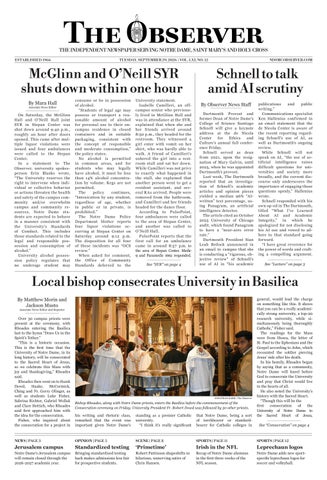
Bishop Rhoades, along with Notre Dame priests, enters the Basilica before the commencement of the Consecration ceremony on Friday. University President Fr. Robert Dowd was followed by 30 other priests.
general, would lead the charge on something like this. It shows that you can be a really academically strong university, a top-20 research university, while simultaneously being thoroughly Catholic,” Fisher said. The readings for the Mass were from Hosea, the letter of St. Paul to the Ephesians and the Gospel according to John, which recounted the soldier piercing Jesus’ side after his death. In his homily, Rhoades began by saying that as a community, Notre Dame will kneel before God to consecrate the University and pray that Christ would live in the hearts of all. He also noted the University’s history with the Sacred Heart. “Though this will be the first consecration of the University of Notre Dame to the Sacred Heart of Jesus,
his writing and rhetoric class, remarked that the event was important given Notre Dame’s
standing as a premier Catholic university. “I think it’s really significant
that Notre Dame, being a sort of torchbearer or standardbearer for Catholic colleges in
NEWS | PAGE 3
OPINION | PAGE 5
SCENE | PAGE 8
SPORTS | PAGE 11
Irish in the NFL
Leprechaun logos
Notre Dame’s Jerusalem campus will remain closed through the 2026-2027 academic year.
Bringing standardized testing back makes admissions less fair for prospective students.
Robert Pattinson shapeshifts in hilarious, unnerving satire of Chris Hansen.
Recap of Notre Dame alumnus in the first three weeks of the NFL season.
Notre Dame adds new sportspecific leprechaun logos for soccer and volleyball.
Jerusalem campus
Standardized testing
‘Primetime’
See “Consecration” on page 4
SPORTS | PAGE 12
DAILY
2 | THE OBSERVER
QUESTION OF THE DAY:
TUESDAY, SEPTEMBER 29, 2026
What album can you listen to for the rest of your life?
Have a question you want answered? Email photo@ndsmcobserver.com
Morgan Ridgway
Cora Callander
“Mutter by Rammstein.”
“The Stranger by Billy Joel.”
sophomore Le Mans Hall
sophomore Holy Cross Hall
Julia Holthaus
Riley Conklin
Claire Cho
“Gutterflower by The Goo Goo Dolls.”
“OK Computer by Radiohead.”
“AM by Arctic Monkeys.”
sophomore Pasquerilla West Hall
freshman McGlinn Hall
PHOTO OF THE DAY | MARIELLA TADDONIO Lewis Hall of Pancakes CavChella 99
junior McGlinn Hall
SOCIAL MEDIA POLL Both Neither Have an idea for a poll? Email social@ndsmcobserver.com 29
8
222
What dorm event did you attend on Friday, Sept. 18?
THE NEXT FIVE DAYS
CROSSWORD | WILL SHORTZ
Want your event included here? Email news@ndsmcobserver.com
Tuesday Film “Fargo” (1996) A Minnesota kidnapping case turns a town upside down. 7:30 - 9:15 p.m. Browning Cinema, DeBartolo Performing Arts Center
Wednesday Craft and Unwind: Student Concerns Drop-In Drop-in space to craft, and chat about graduate student life. 4 - 5 p.m. Duncan Student Center
Thursday Zombie Preparedness Festival Learn the importance of apocalypse safety and preparedness. 11 a.m. - 2 p.m. Gate E at Notre Dame Stadium
Friday Humor Artist Show 90 minutes of improvised long-form comedy. 8 p.m. - 9:30 p.m. Lab Theatre Washington Hall
Saturday Notre Dame women’s lacrosse vs. Michigan The Irish play against the Wolverines at home. 9 a.m. Loftus Sports Center
ndsmcobserver.com “TO UNCOVER THE TRUTH AND REPORT IT ACCURATELY” 900 Hesburgh Library, Notre Dame, IN 46556 Editor-in-Chief Gray Nocjar Managing Editor Grace Tadajweski
Asst. Managing Editor: Zack Pohlman
Social Media Editor: Lilly Martin
Asst. Managing Editor: Abby Hernan
Ad Design Manager: Liam Flynn
Asst. Managing Editor: Henry Jagodzinski
Advertising Manager: Cassandra Sick
Asst. Managing Editor: Noah Cahill Notre Dame News Editor: Megan Cornell SMC News Editor: Berhan Hagezom Opinion Editor: Duncan Stangel Sports Editor: Ben Hicks Scene Editor: Peter Mikulski Photo Editor: Mariella Taddonio Graphics Editor: Liam Flynn
Policies The Observer is the independent, daily newspaper published in print and online by the students of the University of Notre Dame du Lac, Saint Mary’s College and Holy Cross College. Editorial content, including advertisements, is not governed by policies of the administration of any institution. The Observer reserves the right to refuse advertisements based on content.
The news is reported as accurately and objectively as possible. Unsigned editorials represent the opinion of the majority of the Editor-in-Chief, Managing Editor, Assistant Managing Editors and department editors. Commentaries, letters and columns present the views of the authors and not necessarily those of The Observer. Opinion space is available to all readers. The free expression of all opinions through letters is encouraged. Letters to the Editor must be signed and must include contact information. Questions regarding Observer policies should be directed to Editor-in-Chief Gray Nocjar
Today’s Staff News
Henry Pearson Megan Cornell Soledad Castellanos
Graphics
Asheley Zheng Liam Flynn
Photo
Mariella Taddonio
Opinion
Sophia Anderson
Sports
Henry Lytle
Scene
Luke Foley
Editors Zack Pohlman Grace Tadajweski Abby Hernan
NEWS
TUESDAY, SEPTEMBER 29 2026
THE OBSERVER | 3
Notre Dame Jerusalem campus remains closed By Drew Poulton and Henry Pearson Associate News Editor and Reporter
Amid ongoing conflict in the Middle East, Notre Dame students will not return to the Jerusalem campus for the spring semester. The campus has been closed to students since October 2023. Following the Oct. 7 Hamas attacks in Israel and the subsequent conflict, Notre Dame students were evacuated from the Jerusalem campus. The ongoing conflict with Iran, which began Feb. 28, 2026, delayed plans to resume programming for Notre Dame students. The campus, also known as the Tantur Ecumenical Institute, was founded in 1972 following a request from Pope Paul VI. Prior to the evacuation of students, Tantur offered Notre Dame students both semester-based and summer programming. Notre Dame’s Global Safety and Security Review Committee
reviews study abroad campuses that are in countries designated as Level 3 or above by the U.S. State Department, which recommends that travelers reconsider travel to these areas due to “serious risks to safety and security.” Israel has been a under a Level 3 travel advisory since Oct. 11, 2023. According to Robert Leis, director of Study Abroad, the committee determined two weeks ago the Tantur campus will not be open to Notre Dame students during the spring semester. “Israel gets reviewed constantly, probably on a monthly basis. And the determination has just always been that at this time we‘re not ready to reopen undergraduate student participation,” Leis said. “They’re looking for a period of maintained stability.” In a statement to The Observer, the University noted it considers the “necessity and appropriateness of proposed or ongoing travel to a particular destination,” a traveler’s “personal preparedness and
proposed measures for mitigating risks” and the capabilities of the U.S. and local governments when reviewing the campus‘ status. Leis hopes the summer 2027 program will be able to run but said that he is still “waiting for that period of stability to realize.” Had the conflict wrapped up in 2023, Leis believes “for sure we would have reopened the region by now.” Some scholars and faculty remain on the campus, which continues to do work with both Christian and Muslim populations as well as hosting various events, such as book talks and academic forums. In the past, the campus has maintained relationships with local universities, including Bethlehem University, a Palestinian institution, and Hebrew University, an Israeli institution, allowing Notre Dame students to take courses from three universities. “It really is sort of a hub to bring together different thoughts,
different ideologi[es], to have these discussions,” Leis said. Leis noted that students studying Middle Eastern studies or global affairs were particularly interested in the program when it was available, although other majors also attended. In 2023, students on the Jerusalem campus were evacuated to Amman and eventually relocated to London following the outbreak of conflict. The University partnered with Crisis24 to update students during the evacuation. Leis described the student experience of evacuating and connecting with locals at the Tantur Institute. “It‘s a bit of a sad story, but I appreciated that the student had this level of thoughtfulness when they were evacuated. They got to know people, they made friends, they were having a great time engaging with the community. And then, when they were evacuated in this vehicle, and these people show up to get them out of sight and get
them across the border and fly them out,” he said. Notre Dame was at the forefront of evacuation efforts. “It was a humbling thing for the students to experience, and I‘m glad that introspectively, they had that, but it‘s also a testament to sort of Notre Dame‘s commitment to safety for the students in that location.” In regards to the future of the Jerusalem program, Leis anticipated there may be some initial hesitancy from students. “I think it would take a few cycles before the numbers get up to par because it‘s going to take people seeing more and more students going and coming back before they‘re like, okay, let‘s do it,” Leis said. However, Leis expressed optimism that the program will eventually draw as many students as it once did. Contact Drew Poulton at apoulton@nd.edu and Henry Pearson at hpearso2@nd.edu
Hesburgh Library updates search database system Alejandro Filló Nastase Reporrter
Hesburgh Libraries moved to an open-source library system called FOLIO on June 15, utilizing a search interface called VuFind, also known as FiNDit at the University of Notre Dame. Tara O’Leary, director of communications and marketing for Hesburgh Libraries, said that the institution began to plan the transition to a new system more than three years ago. The new system was intended to replace a previous system implemented in 1999. This previously involved the integrated library system Aleph 500 and the online search tool Primo Library Discovery Service, known campuswide as OneSearch. “These systems were outdated and reaching the end of their life,” O’Leary wrote in a statement to The Observer. “In fact, Notre Dame was one of the last Aleph users in the United States.” Asked about the selection process for the new system, O’Leary highlighted a collaborative process. “A team of Hesburgh Libraries faculty and staff worked with colleagues in the Office of Information Technologies, Procurement, and the Office of General Counsel to solicit proposals from four major library system providers,” O’Leary wrote. This team “evaluated and
Lecture
Continued from page 1 And as provost, I strive to
tested these systems” between July 2023 and December 2024, before recommending the new system. Despite launching the new system, Hesburgh Libraries acknowledged the need to make continued adjustments. “Post-launch, our technical teams have been working diligently with our vendors to resolve system bugs and address the feedback we’ve received from users,” Margaret Meserve, dean of the Hesburgh Libraries, wrote in a statement to The Observer. “As primary users of the library catalog, the input of our readers is invaluable — we are truly grateful to those who have shared observations and suggestions as they’ve worked with the new system.” Some of the recent system updates since the launch include filtering books and media section filtering, linking and access points, search ranking, journal enumeration, musical scores and improving the search functionality. Second-year English doctoral student Lillian Hammen shared that the subject of the new library system brought mixed feelings. Whilst the new Bento-style box system is appreciated, Hammen noted the lack of search functionality for specific items. “I found it with Hesburgh’s system last year, but I’ve then gone and put the name back in verbatim, copied and pasted out of my bibliography. And the system can’t find it,” she added. “And then I end up sitting there,
playing with search terms to try and figure out how to bring it up.” When asked if she had noticed feedback on the new implementation, Hammen was unable to provide comments from her peers because it is too early in the semester. She plans to see whether the current update will be operative later in the semester. “So what’ll be interesting is after fall break, when I sit down to start working on my seminar papers, and I’m running brand new searches for brand new projects,” she said. Junior Raymon Duran noted issues in the system, discussing the library’s new search interface and its inability to access the Oxford English Dictionary database. “One broad search bar when you first get into the website that apparently doesn’t apply to everything. It does not work as a search-all mechanism,” Duran said. “I found, especially when it’s a database and not a scholarly article, it’s kind of harder and takes more steps to get there.” In his concluding remarks, comparing the old and new systems, Duran stressed that “the main thing with these systems is simplicity. Simplicity is appreciated by everyone. The more intuitive these systems are, the better they are for everyone.” Nevertheless, Meserve wrote that the new system has made significant strides in addressing issues from the previous
lead with integrity and believe I must adhere to the highest standard,” Schnell wrote in The Dartmouth. According to Hallenius,
Schnell was “invited to speak on a topic related to this year’s theme, ‘But Where Can She Be Found? Wisdom from Age to Age,’ and his
MARIELLA TADDONIO | The Observer
FiNDit replaces a nearly 30 year old system, known as OneSearch, after a series of examinations and recommendation by faculty and offices.
one. She hopes students can aid in this process by recommending adjustments and changes. “I encourage readers to offer feedback using the Report a Problem form. Any observation or issue, however small, is worth telling us about. We are working daily to refine and improve the new system, and we are grateful to our campus community for their input and partnership in the process,” she wrote. This sentiment is also shared by engineering librarian William Baer, who said, “Whenever you put out a new product like this, the first few months are going to be a lot of tweaking.” Though most of the major issues have been fixed, Baer also noted that it is unfair to compare a brand-new system against its much older predecessor.
“They’re working and getting some steps that were automated in the old system,” Baer noted. “It took 30 years for them to get some of those things out. It’s not going to take that long to do it now.” To continue gauging success and implement further relevant updates, O’Leary wrote that “the Libraries will continue to maintain a channel to surface any issues or ideas for improvement from faculty, students and staff.” This will be seen later in the fall, when the Hesburgh Libraries plan “to convene focus groups of faculty and students to take stock of where the system is serving them well and where there is further room for improvement.”
presentation will focus on education and human f lourishing.” The conference, which will occur from Thursday
to Saturday, will include over 100 speakers and 1000 guests from a “wide range of disciplines and perspectives,” Hallenius wrote.
Contact Alejandro Filló Nastase at afillona@nd.edu
NEWS
4 | THE OBSERVER
TUESDAY, SEPTEMBER 29, 2026
Consecration Continued from page 1
devotion to the Sacred Heart is in the DNA of this University, just as devotion to Our Lady is in its DNA. Blessed Basil Moreau placed the Holy Cross priests under the special patronage of the Sacred Heart in 1841, the year before he sent Father Edward Sorin and the Holy Cross brothers to establish a school here in Indiana,” Rhoades said. “Father Sorin personally had a profound devotion to the Sacred Heart and named the first church he built here in 1844 in honor of the Sacred Heart of Jesus,” Rhoades continued. “And when the second church, this beautiful Basilica, was dedicated in 1888, Bishop Joseph Dwenger, the second bishop of Fort Wayne, dedicated it to the Sacred Heart of Jesus.” He referenced the revelation of God’s love being present on the cross and the University being born “from the heart of the church,” before discussing the Tower of Babel and Pope Leo’s encyclical “Magnifica Humanitas,” where the pope notes how working together for the common good can prevent dehumanization and ruin. “Blessed Basil Moreau, in speaking about the educational mission of the Congregation of Holy Cross, insisted that ‘the mind will not be cultivated at the expense of the heart,’” Rhoades said. Rhoades concluded his homily by praying for students to continue loving and honoring the Sacred Heart. At the end of Mass, Rhoades, along with the priests and members of the congregation, processed
JONATHAN KARR | The Observer
Bishop Kevin Rhoades lifts the monstrance in celebration of the first consecration of the University of Notre Dame to the Sacred Heart of Jesus. The consecration followed a month of various events in preparation of the Mass. Rhoades provided a homily during the Mass and read encyclicals.
out of the Basilica, through Bond Quad, past Badin Hall and Coleman-Morse, onto South Quad and up Main Quad to the Sacred Heart of Jesus statue. Upon arriving at the statue, those present sang “O Salutaris Hostia” before reciting the Litany of the Sacred Heart and the Prayer of Consecration. “I was glad to celebrate Mass at the Basilica of the Sacred Heart for the consecration of the University
of Notre Dame to the Most Sacred Heart of Jesus today. To consecrate ourselves to the Sacred Heart is to remain in Christ’s love and carry that love into the world—building communities where truth is proclaimed clearly, charity is practiced generously, and division gives way to reconciliation,” Rhoades shared in an email statement to The Observer. Ching remarked that the consecration is as an opportunity to
work past the divisions that often define human experience. “Everything that is encapsulated in the Sacred Heart of Jesus — compassion, mercy, love and forgiveness — that’s the stuff that’s going to lead us to sanctity,” Ching said. “Inasmuch as that’s difficult for us to do as human beings, here’s an opportunity to resolve to be a little bit better at it and to ask for God’s help to be better at those things.”
Dowd echoed this gladness. “Since my days as an undergraduate student, one of my favorite places on campus is the area around the statue of the Sacred Heart of Jesus in front of the Main Building at the center of campus,” he shared in a press release. Contact Matthew Morin at mmorin2@nd.edu and Jackson Musto at jmusto@nd.edu
SYR
Continued from page 1 This call was cleared at 9:41 p.m. The second call to Stepan Center was received at 9:14 p.m. Medic 2 and Medic 1661 responded, with the call being closed at 10:03 p.m., according to PulsePoint. At 9:22 p.m., another call was received for Stepan Center. Medic 1 responded, and the call was closed by 10:16 p.m. Less than a minute later, a call was received at 9:23 p.m. to the area of Stepan Center. Medic 4 responded to the call and, according to PulsePoint, it was closed at 10:15 p.m. Camilleri explained that around 9:40 p.m., the SYR was shut down. The music stopped, but the group on the dance floor continued singing until they eventually reached a point where they had been singing for too long without music. Someone came on the speaker and explained that, with the resources the campus had available, the event had to be shut down since they had already called four ambulances. At this point, everyone was asked to leave. Blasko declined to comment about who made the choice to shut down the event. According to PulsePoint, at 9:44 p.m., a call was received for O’Neill Hall. Medic 9, Paramedic 1661 and Paramedic 1662 responded, and the call was closed by 10:20 p.m.
ALY ROTHFUS | The Observer
The McGlinn-O’Neill SYR was shut down around 9:40 p.m., with the event starting 40 minutes prior. The picture is part of a video taken at 9:43 p.m. near the entrance of Stepan Center. This was one of five ambulances called to Stepan Center and O’Neill Family Hall within less than an hour.
Reading from an email, Camilleri shared that doors opened at 8:30 p.m., with an official start time of 9 p.m. PulsePoint did not report any other new medical calls arising amid these calls to Notre Dame’s campus. PulsePoint does not share the nature of the incident in its reports. South Bend Emergency Medical
Services Division, within the South Bend Fire Department, includes seven Advanced Life Support ambulances: Medic 1, 2, 4, 5, 9, 10 and 11; and three paramedic chase cars: Paramedic 1660, 1661 and 1662. These are further subdivided. Five medic units and two paramedic units serve the city of South Bend. Two medic units and one paramedic unit serve the broader St. Joseph
County. Molly Di Carlo, public information officer for Campus Safety, declined to comment. All members of McGlinn and O’Neill Hall Staff, rectors, assistant rectors and resident assistants did not respond to requests for comment. All members of McGlinn and O’Neill Hall Government, including
presidents and vice presidents, did not respond to requests for comment. The South Bend Fire Department Emergency Medical Services Division nonemergency contact did not respond to request for comment. Contact Mara Hall at mhall27@nd.edu
OPINION
TUESDAY, SEPTEMBER 29, 2026
THE OBSERVER | 5
Why standardized testing has failed By Jonas Lane Columnist
On Sept. 9, the University of Notre Dame announced it would once again require standardized testing for applicants in the 2027-28 cycle, joining Ivy League schools and a growing list of top-tier universities in walking back the test-optional experiment that COVID brought to higher education. To some, this looks like a return to rigor. To me, it looks like a retreat from fairness. I grew up in the small town of Danville, Illinois, and went to a small Catholic high school, the kind of place that doesn’t have a strong test-prep industry or classmates whose parents can pay $200 an hour for a private tutor. I’ve watched friends who were sharper than half the kids at wealthier schools two hours away get outscored not because they knew less, but because they’d never seen the specific tricks the test rewards. Standardized testing was sold to America as the great equalizer and a single number that could measure raw ability regardless of ZIP code. In practice, it has become one of the most reliable ways to measure a family’s bank account. This isn’t just a hunch of mine from personal experience. Researchers at UC Berkeley’s Center for Studies in Higher Education tracked more than 1.6 million California high school graduates who applied to UC schools between 1994 and 2016. They found that family income, parental education and race account for over 40% of the variance in SAT/ ACT scores among Berkeley applicants, which is up from
LIAM FLYNN | The Observer
25% just two decades earlier. Test scores showed far greater bias against low-income, firstgeneration and underrepresented students than high school grades did, in part because of unequal access to test preparation and coaching that isn’t taught in regular classrooms. Harvard’s Opportunity Insights project, matching test scores to federal tax records, found children from the wealthiest 1% of American households were approximately 13 times more likely to score 1300 or higher than children from low-income families. The consequences of that gap don’t stay on paper; they show up on campus. Research from the National Association for College Admission Counseling, examining nearly a million students across 28 institutions that dropped
testing requirements, found that roughly two-thirds of those test-optional schools saw enrollment growth among underrepresented groups outpace similar schools that still required scores. A separate study presented at the American Educational Research Association found that adopters of test-optional policies saw increased enrollment of Black, Latino and Native American students, along with Pell Grant recipients. A 2025 analysis in Frontiers in Education points to the same underlying mechanism, tying longstanding gaps in test scores to unequal school resources, test-prep access and even stereotype threat, which causes students to underperform out of fear of confirming a stereotype about their group.
That’s what Notre Dame and every other school turning back stands to lose. A campus isn’t just a collection of transcripts; it’s a community built from different hometowns, social classes, income brackets, first languages and life experiences. When a single timed exam becomes a gatekeeper again, schools don’t just lose “diverse-looking” admits: they lose the kid whose perspective comes from working a night shift, the student who can speak to what it’s actually like to grow up food insecure instead of reading about it in a case study, the roommate who introduces everyone else on the f loor to a culture they’d never encountered. That texture is what makes a university intellectually alive, and it’s precisely what a test-required admissions process filters out.
Notre Dame says it will evaluate scores “in full context” and that no single number will decide admission. I believe that’s sincere. But once a score exists on paper, it takes on a life of its own: compared, averaged into class profiles, leaned on because it’s easier than the hard work of actually reading an application closely. Notre Dame’s own statement says test scores help identify “talented applicants from lessfamiliar schools.” I’d argue the opposite is more often true: the test hides talent because it measures test-taking conditions as much as it measures the student. None of this means grades or coursework rigor should stop mattering. But re-elevating a test that tracks family wealth as closely as it tracks ability isn’t a step toward rigor. It’s a step back toward a campus drawn from a handful of ZIP codes instead of the whole country it claims to represent. If Notre Dame and its peers want a more accurate picture of who’s ready to succeed and contribute to a richer campus culture, the data suggests they already have it — in transcripts, coursework and four years of a student’s actual record. The tests were supposed to be the great equalizer. Instead, they are a wealth detector and a quiet filter excluding the diversity these schools say they value. The views expressed in this column are those of the author and not necessarily those of The Observer. Write to Jonas Lane at jlane8@nd.edu
LETTER TO THE EDITOR
Dartmouth provost’s AI case is unfair The recent controversy surrounding Dartmouth Provost Dr. Santiago Schnell’s (former dean of the College of Science at Notre Dame) use of artificial intelligence is being unfairly portrayed in the media. On Sept. 21, 2026, The Dartmouth reported that Schnell’s writings published in 2026 had a median ‘AI-written’ text percentage of 96%. This report came after a global news platform Semafor reported that Pangram, an AI detection program being touted as a highly accurate AI detector, determined Schnell’s op-ed article published in the Washington Post (Aug. 9, 2026) to be 100% AI-written. After reading the Dartmouth article, I combed through Schnell’s op-ed article sentence by sentence to see if I could detect AI-ness in his phrases and sentences. Most of us, especially
faculty, believe that we have a “hunch” that goes off when reading so-called AI-sounding texts. But I struggled to pinpoint exactly what could have flagged Schnell’s text as AI-written. So I ran his article in Pangram to see what “evidence” it gives. I was disappointed to find that no explanation or analysis was given, other than a score. Not knowing what specific textual features flagged Schnell’s writing as 100% AI-written, I want to share my perspective on this case by focusing on issues related to the interpretation of the score and the expectations to disclose AI use in published texts. Regarding Pangram’s score, I’m concerned that the phrase “100% AI-written” is being interpreted by some as “AI wrote the entire paper.” Pangram acknowledges that the “model has
ASHELEY ZHENG | The Observer
a non-zero error rate” and recognizes serious consequences a false accusation can cause. The credence given to Pangram is based on the near-zero error rate reported by several studies. Commenting on the
credibility of Pangram’s algorithm, The Dartmouth cites a report of a study that tested Pangram’s performance on blogs, reviews, resumes, news and novels as sample texts. Near-zero error rate on specific
types of data set may not equally apply to texts using different genres, topics, content and languages. Marketing their product as the most reliable AI detector, see “Provost” on page 6
OPINION
6 | THE OBSERVER
Provost
Continued from page 5 Pangram showcases on its website an experimental study using academic writing samples. However, the study used 40 nonnative English-speaking graduate students’ papers from the same faculty, written before 2019, as human-text samples. These limitations do not lessen the value of these studies, nor do they invalidate the impressive performance of Pangram. I’m glad that a powerful tool such as Pangram is continuously being tested with different types of data and is being improved. At the same time, because people’s engagement with AI widely varies and the process of engagement with AI — just like the process of writing itself — is messy, its scores should be used as a helpful clue, not forensic proof. The sense of betrayal felt by
some members in the Dartmouth community is partly based on the fact that Schnell did not disclose the use of AI. The Dartmouth cites a spokesperson from the Washington Post, who told Semafor that “its policies require guest writers to confirm their submissions are not created or manipulated with artificial intelligence or editing software.” Defining what constitutes “manipulated” by AI in writing is highly challenging, and the current Washington Post guidelines for op-ed do not specifically mention policies on AI. If using AI as a language broker is considered problematic or should be disclosed, we should also question the routine practice of university presidents’ employment of others for crafting emails and communication pieces issued with their names without disclosing others’ involvement. How do we reconcile the double standard of condoning certain types of assistance
and condemning others? Many international scholars use for-pay editors to edit, revise or translate their papers into English to publish their studies in journals edited by AngloAmerican editors. In fact, some journals specifically instruct nonnative English-speaking scholars to use a language editing service or have their writing “checked by native speakers.” The assumption is that their writing needs to be “cleaned up” to pass muster. For example, Elsevier, among many other journals, instructs authors to “write in good English” and offers editing services. Its “Plus” plan, which is recommended for nonnative English-speaking writers, includes detailed language check (e.g., spelling, grammar, sentence structures and terminology) as well as focus on logic, structure and the flow of the writing. Whether the use of such editing services should be disclosed varies by journals.
TUESDAY, SEPTEMBER 29, 2026
For nonnative English writers such as Dr. Schnell, myself and my international students, AI is a game changer. We now have this “native-speaking” assistant available 24/7 to show grammatical errors, suggest idiomatic expressions and native-sounding linguistic choices that can help erase our nonnativeness in writing and pass the gatekeeping without paying a hefty fee. According to The Dartmouth, in his Sept. 18 email to students and faculty, Schnell wrote that he used AI for “language refinement, copyediting, improving clarity and organization and making writing processes more efficient.” This is similar to the tasks performed by for-pay editors. Just as we fear AI for its potential to stunt the growth of students’ critical thinking skills, we should also fear allowing Pangram’s powerful algorithms to replace human judgment.
Disclosure: I used ChatGPT for language refinement, copy editing, improving clarity of my ideas, checking the soundness of my claims and factual accuracy. After completing it, I ran this article through Pangram, and it assessed my writing as 100% human-written. Eun-Young “Julia” Kim Center director, Center for the Study of Languages and Culture Sept. 28 Editor’s note: The Observer does not permit the use of AI in its writing. The use of AI in the above article as described in the author’s own personal disclosure was permitted under extraordinary circumstances. Namely, the use of the technology itself furthers the author’s argument in a demonstrative way by eliciting a false negative result from AI fact-checker Pangram.
Tuesday takes: The middle ground on voter ID By Harrison Fischer Columnist
My ever useful NDID can get me into campus buildings, pay for a meal and prove that I am a student. One place it cannot help me, however, is an Indiana polling place. Since July 2025, Indiana law has prohibited identification issued by educational institutions from being used as voter ID. Although the ban is the subject of ongoing litigation, it is currently in effect. A student registered to vote in Indiana must instead present identification issued by the state or federal government, such as an Indiana driver’s license, state ID or passport. This rule seems like common sense. Voting is among the most consequential acts a citizen can perform, and asking someone to prove that they are the person listed on the voter roll is quite reasonable. Showing identification is already a familiar part of boarding a plane, opening a bank account and getting into Danny Boy’s. Why should voting, which is more impactful than all of these things, receive less protection? Opponents of voter ID requirements raise a different concern. Not every eligible voter drives, owns a passport or lives near an office that issues valid identification. Older voters, people with disabilities, low-income citizens and students may face additional obstacles obtaining the documents that a state requires. Even when an ID itself is free, acquiring a birth certificate, traveling to an office or taking time away from work may not be. There is research to support both sides of the voter ID debate. A Government
ASHELEY ZHENG | The Observer
Accountability Office review found that most registered voters examined did possess the necessary identification to vote under these new, stricter rules, but ownership rates varied among demographic groups. Voter ID regulations were mixed in terms of their effects on turnout. The stricter requirements were associated with lower turnout in Kansas and Tennessee, but the GAO cautioned that these findings do not necessarily apply to every state or election. As per usual, Americans are presented with a false choice on voter ID. You can either be a defender of election integrity or a defender of voting rights, as if a functioning democracy did not require both. Political leaders on both sides have turned voter ID into another partisan battle, making it harder to find a pragmatic solution that will strengthen
our democracy. I support requiring voters to verify their identity, especially given instances of fraud that have occurred in recent elections across the country. However, that requirement must come with a corresponding obligation from the government. If a state requires an ID to vote, it should ensure that every eligible voter can obtain one without paying out of pocket for the ID or the documents needed to receive it. States should operate mobile ID services at college campuses, nursing homes, rural communities and other places where voters may have difficulty reaching a government office. States should also accept a broad range of secure identification, including driver’s licenses and birth certificates, but also military and veteran IDs and tribal IDs. Recently expired identification could
also remain acceptable for a limited period when the photograph and name still match the voter’s registration. Students who lack qualifying identification should be able to obtain a free state-issued voter ID through services offered on college campuses and through other educational institutions. The goal should not be to weaken ID regulations but to ensure that every eligible voter can reasonably satisfy them. This approach is not a new invention. In a report from all the way back in 2005, the bipartisan Commission on Federal Election Reform, led by former President Jimmy Carter, endorsed voter identification while also recommending free IDs and mobile offices for people without driver’s licenses. Its proposal recognized that election security and voter participation are not opposing goals, as we
have been led to believe by our current elected leadership. Indiana already provides free state ID cards for voting and allows voters without qualifying ID to cast provisional ballots, which are counted later only if proper ID is presented within a certain window. These are meaningful protections, but the government can go further to remove barriers for all voters. My NDID should not automatically become an ID qualified for voting simply because it has my photograph. It should have to satisfy clear security standards. But if it meets those standards, the name of the institution written across the top should not disqualify it, even if that institution is not the government. Voter ID is absolutely a reasonable and necessary safeguard but only when the government assumes responsibility for making identification genuinely accessible. Asking citizens to prove who they are in order to complete their most important civic duty is not too great a burden. On the other hand, asking them to overcome needless costs and obstacles before exercising a constitutional right is. Political elites may claim that we have to choose between protecting elections and helping people vote. I say that we are perfectly capable of doing both. Thanks for reading this week’s Tuesday Takes. The views expressed in this column are those of the author and not necessarily those of The Observer. Write to Harrison Fischer at hfische3@nd.edu
TUESDAY, SEPTEMBER 29, 2026
PHOTO
THE OBSERVER | 7
Notre Dame vs. Purdue The Notre Dame Fighting Irish took on the Purdue Boilermakers on Sept. 26, 2026. The Irish won 49-10. Photos by photo editor Mariella Taddonio
SCENE
8 | THE OBSERVER
TUESDAY, SEPTEMBER 29, 2026
‘Primetime’ is a surreal Chris Hansen satire By Alex Fitzpatrick Scene Writer
“What would have happened if I wasn’t here?” It’s a question that Chris Hansen asks himself throughout “Primetime,” but one he would rather not answer by the film’s conclusion. Set in 2006, the film chronicles the final years of the controversial Dateline NBC television program “To Catch a Predator” at the peak of its popularity. The show, which ran from 2004 to 2007, lured adult men who had engaged in sexually explicit online conversations with people posing as minors into a house rigged with hidden cameras. Hansen, the front man of the series, would confront them on camera before law enforcement took them into custody. If you aren’t familiar with the show, it’s even more absurd than it sounds. Long-since-graduated “Twilight” alumnus Robert Pattinson plays Hansen, depicted here as a wannabe Stone Phillips, whose on-screen persona has become his entire identity. In an early scene, Hansen records post-production narration at the network’s Rockefeller Center studio. He exuberantly insists on performing take after take, frustrating his colleagues with his unwarranted, David Fincher-esque zeal for perfection. Pattinson relishes putting heightened emphasis on “lubricant” and “c-m” to great comedic effect. The film walks the tonal tightrope with great confidence. Despite its
DIONE QUIAMBAO PAHILAN | The Observer
grim subject matter, it recognizes the inherent ludicrousness of “To Catch a Predator” and leans into it. The humor here functions on a nihilistic wavelength. In one scene, Hansen wakes his estranged children to watch the latest episode of “To Catch a Predator” with him, a moment that had my theater in hysterics. Director Lance Oppenheim’s knack for drawing cringe comedy from the show’s on-set antics recalls the work of Nathan Fielder (Fielder and Oppenheim collaborated on the upcoming Elizabeth Holmes documentary “You Can See Everything,”
which releases later next month). Oppenheim also seems to have taken a page out of the Safdie brothers’ casting playbook. Jeff Zucker cameos essentially as himself, much as Kevin O’Leary does in “Marty Supreme.” Other familiar faces, like Jonathan Lipnicki (best known as the kid from “Jerry Maguire”), play against type in surprising ways. Still, the film rests almost entirely on Pattinson, who throws himself into the role. Hansen’s mannerisms and unmistakable cadence are all here. The performance isn’t subtle: Pattinson plays him as a vampiric
caricature rather than a believable human being. It’s the right choice for a character whose ambition has engulfed any sense of perspective. Pattinson’s work here is even more impressive given that he was filming “The Drama” and “Die My Love” simultaneously while also prepping for “The Odyssey.” I feel like I’m preaching to the choir here, but Pattinson’s run continues to make the case that he’s one of the few genuine movie stars left. Skyler Gisondo is also a standout as the fictional “Decoy Dan,” a babyfaced aspiring actor chasing his SAG
card. As he becomes more involved in the production, his need for validation collides with his moral reservations. Merritt Wever and Phoebe Bridgers round out the ensemble cast, with the latter continuing her hot streak following last month’s “Lost Weekend.” “Primetime” wisely doesn’t take on the daunting task of psychologizing Hansen’s behavior or that of the men he pursues. Oppenheim is much more interested in the broader questions the show raises for the people involved in its production outside of Hansen — and for those watching it. This isn’t surprising, despite this being Oppenheim’s narrative feature debut. His already extensive documentary work has often examined alienation and the strange ways people construct identities for an audience. The film does have substantial narrative shortcomings. At times, it seems unsure whether Hansen or Dan is its protagonist, especially as Dan moves to the forefront in the third act. Without spoiling the climax, I found myself wanting a more fleshed-out resolution, a complaint I rarely have, instead of the mere gruesome denouement the film delivers. Even so, “Primetime” is often hilarious, unnerving and anchored by a Pattinson performance that captures the irony at the heart of the film’s metacommentary. Contact Alex Fitzpatrick at afitzpa5@nd.edu
There’s some chemistry in ‘The Love Hypothesis’ By Marguerite C. J. Marley Scene Copyeditor
Romantic comedies are coming back in a big way. Though it might not be the explosion the genre had in the early 2000s, it’s still been on the up and up. Nowhere is this more clear than in Ali Hazelwood’s book-turned-film “The Love Hypothesis,” which came out this past Wednesday. The film follows Olive Smith (Lili Reinhart) in the third year of her doctoral studies at Stanford, who, while trying to get two of her friends to start dating, starts a fake relationship with Dr. Adam Carlsen (Tom Bateman), a postdoc who is having trouble getting funding for his research because he does not have permanent roots in California. Of course, real sparks start to fly, and their relationship goes from fake to not fairly quickly. Originally a book that went incredibly viral right at the beginning of the pandemic, this is a story that has been very important to me for a very long time. I’ve read it almost three times at this point, so, of course, I was ecstatic when I saw the movie announcement. But does it hold up to the book? Mostly. I wasn’t originally that excited about Lili Reinhart as Olive Smith; I haven’t really seen anything she’d done since “Riverdale,” and that didn’t give me a lot of hope, but she was able to balance the quirkiness of
ASHELEY ZHENG | The Observer
her character with some of the more intense dramatic scenes in the film. Turns out when she’s not confined to the worst-written show of our generation, she’s actually a pretty good actor. Tom Bateman as Adam was the best he could be given the script. A better actor might have been able to elevate the part into something a little bit better, but as is, Adam Carlsen just comes off as a bit wooden. Because we follow Olive’s perspective for the whole movie, we never see him do anything outside his
relationship with Olive, and we never get to see him display an emotion other than grumpiness or anger. That doesn’t give Bateman much to work with, and even what he does tends to come off as bored disinterest throughout the project. Nowhere is this more clear than in the singular sex scene. I did find it a bit goofy how Bateman recites in the flattest voice possible what appear to be fairly generic self-esteem mantras that were clearly meant to be sexy but to me just felt extremely flat and uninterested — he might as
well have been reading off a grocery list. Another thread throughout the film is the struggle that women in STEM face — in fact, it is the reason for the third-act breakup. The grant that Olive has been going after at a lab under Tom (Arty Froushan), a friend of Adam’s, takes a turn when he coerces her to sleep with him, or else he’ll just steal her work and claim it for himself, causing a rift in Olive and Adam’s (fake) relationship. I really enjoyed this as a catalyst for a third-act breakup. Too often in
these movies, the man messes up in a big way and then gets out of it with an apology, but this felt like a natural way to break our main couple apart. One thing that always makes or breaks a rom-com (at least for me) is its supporting cast of characters; they always make sure the world feels more realistic. “The Love Hypothesis” has a great one. Olive’s best friend Anh (Rachel Marsh), Anh’s love interest Jeremy (Nicholas Duvernay) and Olive’s roommate Malcolm (Jaboukie Young-White) are incredible. Marsh was a standout performance. Her punchline to the joke “I’m seeing someone … like a therapist” actually made me laugh out loud in my room. She has such great comic prowess, and I do hope to see her in more projects in the future. These characters and their relationships with Olive are perhaps the movie’s saving grace. I could really feel how close all the characters were to each other, and that just made the experience that much better. Overall, the movie is pretty good — not a masterpiece but a solid date/ girls’ night watch if that’s the kind of thing you are into (which, to be clear, is my thing). “The Love Hypothesis” is an all right adaptation of an all right romance novel, and sometimes that’s just what you need to get you through a long week. Contact Marguerite C. J. Marley at mmarley01@saintmarys.edu
SPORTS
TUESDAY, SEPTEMBER 29, 2026
THE OBSERVER | 9
FOOTBALL
Safety Joey O’Brien shines in first career start By Chris Dailey Senior Sports Reporter
Five months ago, freshman Joey O’Brien’s Notre Dame career appeared to hit a major roadblock before it had truly begun. During the Irish’s annual Blue-Gold spring game, the 5-star safety went down with an injury early in the contest. He later appeared on the sideline with a brace and crutches before posting an Instagram story from the hospital. Almost immediately, speculation began to swirl among Notre Dame media and Irish fans online about the severity of the injury and whether O’Brien might ultimately redshirt his freshman season. Viewed as a player capable of contributing meaningful snaps from day one, the possibility of an extended absence raised immediate concern surrounding Notre Dame’s depth. “That was a scary moment,” O’Brien recalled in his postgame press conference after Notre Dame’s 49-10 demolition of Purdue. “That was my first injury ever, so obviously it was like a setback. But everyone’s so supportive there. It’s really like a family, so there wasn’t really any stress,” he added. Five months later, O’Brien’s injury is firmly in the rearview mirror. In fact, only four games into his young Irish career, the hyper-athletic freshman earned a start against the Boilermakers. And he surely made the most of it. Trailing 14-0 early in the second quarter, Purdue was looking to string together a strong drive and keep the game within reach. That was until O’Brien registered an assisted sack on thirdand-11 that seemingly knocked the wind out of Purdue’s sails for good. O’Brien, a five-star safety recruit out of La Salle College
High School in Wyndmoor, Pennsylvania, used every bit of his 6-foot-5 frame on the electric takedown. Coming off the blitz, O’Brien shed a Purdue blocker before diving at full extension to finish off the pressure created by senior Irish pass rusher Boubacar Traore. It’s hard to pinpoint exactly one play as the “tipping point” in Notre Dame’s 49-10 demolition of Purdue. But if there was a moment when the energy surrounding the Irish reached another level, it was undoubtedly immediately following O’Brien’s sack. Notre Dame’s offense even responded to the momentum created by O’Brien on the ensuing drive. The Irish chewed 5:59 off the clock en route to a 13-play, 85-yard drive that ended with a CJ Carr rushing touchdown. For O’Brien, the opportunity to make an impact Saturday had been several days in the making. “They told me I was starting Saturday on Tuesday,” O’Brien said. “It was a ton of preparation, making sure I’m good with everything because it was a lot on my plate, but they helped me. The guys, Luke Talich and Tae [Johnson], helped me a lot. They were always meeting with me too, so they made it easy for me,” he added. O’Brien worked closely with both Talich and Brauntae Johnson, who were sidelined this weekend due to injury, thrusting the freshman into a considerably larger role than the one he earned through the first three games of the season. Still, the highly touted freshman was far from entering his first start without meaningful game experience. O’Brien had already begun making his mark on special teams, appearing against Wisconsin, Rice and Michigan State. Just one week before his first start, he delivered an
impressive tackle in kickoff coverage against the Spartans. Those early-season reps helped ease O’Brien into the larger role and prepared him for his assignment against Purdue. “I told Luke I wasn’t too nervous going out there,” O’Brien said. “Playing in those first few games, that helped me. But of course you’re starting on the No. 3 team in the country. It’s a great feeling and the nerves were definitely high, but all the guys were really supportive of me. They calmed me down and made sure I knew what I was doing.” O’Brien was also grateful to line up alongside one of his other mentors, senior captain Adon Shuler. “He’s the best player on the team,” O’Brien said of Shuler. “He’s a dog. He literally leads me every time. Meeting extra with him, going over little things, calling me at night, going over film. He’s a great leader, great teammate,” he added. It’s clear that the standard set by Notre Dame’s veteran talent has already left an indelible mark on O’Brien’s approach.
That mindset paired with the freshman’s rare physical tools has given Notre Dame plenty to be excited about what he could become. Marcus Freeman offered a glimpse into that potential during his weekly press conference leading up to Saturday’s matchup with Purdue. “He’s one of those freaky athletes,” said Freeman. “He can run, he can cover, he can hit. But now he’s building trust that he can get his job done consistently. That comes from preparation.” The description Freeman provided of O’Brien’s game has inevitably led to comparisons with former Notre Dame great and the second highest-paid safety in NFL history, Kyle Hamilton of the Baltimore Ravens. At 6-foot-4, Hamilton’s rare blend of length, range and athleticism made him one of Notre Dame’s premier professional prospects in recent memory. As a similarly sized safety with many of the same characteristics, O’Brien is beginning to hear those comparisons quite frequently. Even the Peacock broadcast compared O’Brien to
Hamilton over the weekend. When asked what he thought regarding these lofty comparisons, O’Brien said, “It’s a great feeling being compared to him, but I’m Joey O’Brien.” “I got to do what I got to do. I’m just trying to be the best me and best player to help this team,” he said. Skills and physical attributes aside, it’s that confidence that makes O’Brien a special player. For a freshman to have that genuine internal belief is rare — and likely very exciting for Freeman. Looking ahead, O’Brien’s not satisfied with mere comparisons, however. Much like Hamilton did during his three years at Notre Dame, O’Brien wants to leave a legacy that lasts. “I want to be an All-American,” O’Brien said. “I want to help this team win a National Championship,” he said. “I want to help them do whatever they can, so that means coming in early mornings, late nights. That’s what I’m going to be able to do.” Contact Chris Dailey at cdailey2@nd.edu
MARIELLA TADDONIO | The Observer
Freshman safety Joey O’Brien catches the ball in the 49-10 Irish victory at Purdue on Saturday, Sept. 26. O’Brien recorded 5 tackles and 0.5 sacks in his first start for Notre Dame, filling in for an injured Luke Talich. FOOTBALL
Bryce Young stars as defensive anchor By Payton Dymek Staff Reporter
Notre Dame, looking for its first undefeated September under Marcus Freeman, came to West Lafayette hungry, especially the defense. On a beautiful early-fall afternoon, a semi-full RossAde Stadium, with students getting as rowdy as possible in their Boilermaker overalls, attempted to shake the Irish defense during a much-needed Purdue conversion in the second quarter. Junior quarterback Ryan Browne dropped back to pass just as junior defensive end Bryce Young exploded past the right tackle, sacking Browne at the 15 and
forcing a fumble. Senior linebacker Drayk Bowen secured the loose pigskin and waltzed into the end zone to push Notre Dame to a 28-0 lead with 4:15 remaining in the first half. While Bowen gets credit for the points in the box score, Young made the critical contribution as part of a dominant display by him on the afternoon. Head coach Barry Odom’s Boilermakers had an interesting start to the season, opening with a win against Indiana State, followed by losses to Wake Forest and UCLA in offensive shootouts. Despite the 1-2 record entering Saturday, Purdue’s passing attack led the way to 118 points in its early matchups with efficiency and big
plays. However, facing an Irish defense ranked No. 3 in the country, allowing only 7.7 points per game, Purdue found it could not sustain its past success against a dominant Notre Dame defense spearheaded by Young from the opening play. Browne struggled to even attempt passes downfield, as the Irish front seven created havoc in the backfield and made him uncomfortable all game long. Young led the way with his relentless pressure that stopped plays before they could even start. The junior and former five-star recruit set the tone from the game’s opening play from scrimmage as he sacked Browne and nearly forced a fumble after a powerful bull-rush. “You start the game off with a big
play like that ... that’s a huge momentum builder,” Freeman said of the play during the postgame press conference. “Now, we got to continue to build on that, but to win that play in that fashion is huge.” Posting 3 tackles and 2 sacks, Young and his teammates, including fellow junior defensive end Boubacar Traore and junior linebacker Kyngstonn Viliamu-Asa, controlled the line of scrimmage, allowing only 40 yards on the ground and forcing Purdue to be completely one-dimensional. During his Irish career, Young has seen the field in almost every game and has improved with each passing season. As a freshman, he tallied 23 tackles and led the team
with 3 blocked kicks (which tied for second in the FBS). He finished his sophomore campaign with 20 tackles and registered 2 sacks. While he flashed in his first two years, Young is enjoying a breakout junior season with 14 tackles and 3 sacks. His ascent comes in large part due to his technical growth and pre-snap awareness. As Notre Dame moves toward taking on ranked opponents like BYU on Oct. 17 with strong run games, Young’s ability to control the edge and surpass any offensive lineman will be a point of reliance for Freeman’s squad. Contact Payton Dymek at pdymek01@saintmarys.edu
SPORTS
10 | THE OBSERVER
TUESDAY, SEPTEMBER 29, 2026
ND MEN’S SOCCER
No. 10 Irish fall in unexpected loss to Syracuse By Chris Dailey Senior Sports Reporter
The No. 10 Notre Dame men’s soccer team fell to unranked Syracuse on Friday night 1-0 in a crushing result for the Irish. The loss doesn’t sting because Notre Dame outplayed
Syracuse. In fact, the Orange dominated on the ball and forced the Irish to sit back in a low block and defend for much of the contest. Nor is it crushing because the Irish missed a clear-cut chance. Notre Dame had few positive moments in transition, but there was never a
definitive chance to score. The result was crushing because Notre Dame was still riding the high of beating No. 1 Stanford Cardinal on the road just six days prior 3-1. Head coach Chad Riley’s squad had proved it belonged among the nation’s elite and could contend
MARIELLA TADDONIO| The Observer
Sophomore midfielder Diego Green maintains possession amidst pressure from Detroit Mercy on Sept. 15, where the Irish won the game at home 4-0. Green has recorded one assist and seen action in eight games.
with anyone in the country. Perhaps it was due to the effects of cross-country travel. Maybe it was simply an unlucky night at the office. Or perhaps Syracuse is truly the better squad. Whatever the reason, Notre Dame’s defeat at this moment in time can be best described as nothing short of deflating. The first half produced not much substance. Syracuse dominated on the ball and outshot the Irish 5-2, and things looked bleak for Notre Dame. In front of a near-capacity crowd at Alumni Stadium, the red-hot Irish appeared to be a shadow of themselves. The second half was better from the Irish as they did at least show heart and a desire to win the ball back, although keeping the ball proved to be a struggle. Eventually, in the 71st minute, junior defender Will Schroeder had a moment of miscommunication with junior goalkeeper Blake Kelly. Rather than allow Kelly to scoop the ball up on an incoming Syracuse cross whipped in on the ground, Schroeder accidentally booted the ball out for a corner kick. Sure enough, Syracuse’s Ivan Irinimbabazi drilled a volley home off the corner to score the game’s lone goal. The moment was stinging for the Irish, who did well defensively to hold their shape throughout the entire match, staying compact and not allowing the Orange to find anything easy. It stings for Kelly specifically, as the star goalie was playing fantastically. On the
few Syracuse attempts that were enough to challenge him, Kelly made great work of them all. However, there was truly no chance for him on the corner kick goal courtesy of Irinimbabazi. In the final 10 minutes of the match, Notre Dame showed signs of life. Playing with greater urgency, glimpses emerged of the Irish team that had taken down the best team in the nation just six days earlier. Freshman forward Tristan Tropeano made great runs dropping into the midfield while classmate and fellow forward Michael Capretto extended the pitch and looked for runs in behind the defense. Junior Ian Shaul and senior Nolan Spicer picked up the attacking intensity in the midfield. For those final 10 minutes, the entire tone of the game flipped. However, despite the uptick of energy, the Irish couldn’t find the back of the net and the game finished 1-0. The win marked Syracuse’s first ACC victory of the young season after starting 0-2, while it was Notre Dame’s first loss in conference play and moved it to 2-1 in the conference. Looking ahead, Notre Dame will seek to find that same tempo they played with in the late minutes when taking on University of Illinois Chicago at Flames Field on Tuesday. Kickoff is set for 8 p.m. EDT. The Irish return to ACC action at Alumni Stadium against Cal next Saturday at 7 p.m. Contact Chris Dailey at cdailey2@nd.edu
ND WOMEN’S SOCCER
Irish draw tight affair against No. 4 Duke By Dan Kilcoyne Sports Reporter
The Notre Dame women’s soccer team picked up a record sixth draw of the season as it remains undefeated Notre Dame has recovered well this season after a difficult start, but a trip to Durham, North Carolina, will prove one of the toughest tests of the year. The Blue Devils were 6-1-1 on the season before the match, but they were keen to bounce back after their 4-2 loss to No. 7 North Carolina last time out. The Irish won both of their two encounters against the Blue Devils last year, but this proved to be a much tighter affair as the sides could not be separated, ending 1-1 for Notre Dame’s sixth tie of the season. For Notre Dame, all eyes were on junior forward Annabelle Chukwu as she returned from international
duty with Canada at the U20 Women’s World Cup. The Irish remain undefeated and have climbed back to No. 15 in the NCA A rankings with two emphatic victories to kick off ACC play. The Irish started well in an open game, with 4 shots in the first seven minutes; however, the Blue Devils’ quality was never going to sit back and soon came out strong. The game mellowed, with both sides looking solid defensively, and for the Irish, sophomore defender Gabi Poretto shone in the heart of defense. Poretto has been a staple for the Irish since her transfer from Kentucky, where she earned SEC All-Freshman team honors, and was her usual commanding self as she led Notre Dame’s back three formation. Neither side was able to break the deadlock and went into the second half goalless.
The Irish would come out hopeful, which soon turned into action as a long ball found junior forward Lily Joseph, who muscled past the Duke defender before rolling her shot past the keeper and into the net in the 49th minute. The Irish kept their foot on the gas as junior winger Riley DeMartino launched a ball over the top that found junior forward Izzy Engle, whose shot crept wide of the post. Engle had scored in every game against the Blue Devils in her career and came extremely close to continuing her record. Despite Notre Dame dominating possession, it was the Blue Devils who struck next. Jocelyn Travers picked up the ball, skipping past one defender before firing a thunderbolt into the roof of the net for the second goal of her career. The Irish responded well as DeMartino and Engle linked
up again, this time with DeMartino finding a wideopen Engle at the back post. However, her header was tipped onto the woodwork to deny her yet again. Notre Dame looked very positive despite the missed chance, with its two strikers up top causing chaos and splitting the Duke center-backs time after time. But on defense, the Irish were sitting back, giving the Blue Devils plenty of space on the edge of the box to launch long shots, with Sonoma Kasica producing some excellent saves. The clock kept ticking, both sides hungry for a winning goal, and it nearly came as Notre Dame freshman midfielder Reese Canada slammed a free kick from 35 yards out into the crossbar, reminiscent of her incredible free kick against Michigan State. The Irish thought they’d found a winner as a corner
was headed back across the box to Chukwu, who tapped in from close range, but the goal was disallowed due to a foul by Joseph, and neither side could do any more as time ran out on a thrilling draw. Neither team is likely pleased with the result, but a draw feels fair after such a back-and-forth game. The Irish may have dominated, but the Blue Devils always looked a threat on the counter, and both sides will be optimistic heading into the rest of their ACC schedule. The Irish return to North Carolina on Friday as they travel to No. 1 North Carolina at 6 p.m. With two draws against top-5 opposition so far this season, the Irish will be keen to finally turn one into a win and show that they will be contenders in the postseason. Contact Dan Kilcoyne at dkilcoyn@nd.edu
SPORTS
TUESDAY, SEPTEMBER 29, 2026
THE OBSERVER | 11
ND MEN’S SOCCER
Irish stand out three weeks into NFL season
By Ethan Laslo Sports Reporter
The NFL season is back in full swing. Week 3 has come to a close, with former Irish players around the league finding themselves at the top of depth charts and stat sheets alike. Let’s take a look at some standouts through three games. Running backs shine early The most vocal talking point around Notre Dame football so far this season has been the running game. That’s because the Irish lost two of their best running backs in recent history: Jeremiah Love and Jadarian Price. The two built up impressive resumes during their time together in South Bend and have now taken their respective talents to the pro level. Love, now the feature back for the Arizona Cardinals, has already shown f lashes of excellence through his first three games. He’s averaging a respectable 3.9 yards per carry, including a 90-yard effort on 21 carries in the Cardinals’ 36-30 loss to the San Francisco 49ers on Sunday. Love also notched his first pro touchdown in his first regular season game, scoring on a 5-yard rush in the 26-14 Cardinal win over the Los Angeles Chargers. Price has taken over the starting role for the Seattle Seahawks, particularly due to the lingering injury of returning back Zach Charbonnet. He’s been in more of a committee than Love, splitting carries with Emanuel Wilson and George Holani in the first three games. Nevertheless, he has also shown the capability to be a star back in the future. Price has totaled 119 yards
on 28 carries, equating to 4.3 yards per carry. Although he hasn’t recorded a touchdown yet, his 25-yard rush in the Seahawks’ 31-7 win over Love and the Cardinals in Week 2 was the longest by any Seahawk thus far. Besides Love and Price, another former Irish running back has firmly established himself among the league’s upper echelon of bell cows. Kyren Williams, now in his fourth season as the L.A. Rams feature back, has picked up right where he left off. He has three consecutive 1,000-yard rushing seasons to his name and, through three games, is on pace for a fourth. His 214 rushing yards rank eighth in the league, and his 5.6 yards per carry place him fifth among backs. Last weekend against the Denver Broncos, he recorded a season-high 88 yards on 15 carries, which included a 30-yard burst. Three elite safeties headline defenses Entering the NFL season, Notre Dame safeties Kyle Hamilton, Julian Love and Xavier Watts already found themselves among the league’s elites. Hamilton, ever the Swiss Army Knife, has firmly entrenched himself as the NFL’s top safety and the centerpiece of Jesse Minter’s Baltimore Ravens defense. Julian Love was and still is one of the key defensive pieces of the defending champion Seattle Seahawks and “the Dark Side.” Finally, Xavier Watts enters his second season with the Atlanta Falcons after a breakout rookie year in which he recorded five interceptions en route to being
a finalist for the Defensive Rookie of the Year award. This season, all three have picked up right where they left off. Hamilton, although yet to record an interception for Baltimore, leads the Ravens with 14 solo tackles and is second on the team in total tackles with 26. Only linebacker Roquan Smith has more with 28. Hamilton has also proven to be effective at creating pressure, with 2 tackles for loss and 2 pass def lections recorded. Julian Love and the defending champions got off to a hot start to the season before falling to backup quarterback Marcus Mariota and the Washington Commanders last Sunday. Love was absent with a calf injury, an absence the team clearly felt as Mariota picked the Seahawks apart through the air. In his first two games, the former Irish corner recorded an interception in each game. Finally, second-year ballhawk Watts also notched a turnover of his own through the first three games, picking off his first pass of the year in the Falcons’ 35-14 upset of the Green Bay Packers. He also recorded his first career forced fumble the team’s Week 2 loss to the Carolina Panthers. The Falcons are still trying to make their way back to being among the best in the league, and Watts has looked like one of their future keystones in doing so. Business as usual up front Notre Dame has long had a strong tradition of producing line talent, both offensively and defensively. In 2026, it has six starting offensive
lineman in the NFL across six teams, three of them particularly excelling thus far. Tackle Joe Alt is the anchor of the L.A. Chargers line, having not given up a sack in the first three weeks following his shortened Pro Bowl 2025 season. Guard Quenton Nelson remains a mainstay of the Indianapolis Colts front, with eight consecutive Pro Bowls and two consecutive SecondTeam All-Pro honors to his name. Tackle Ronnie Stanley is also a familiar face for the Baltimore Ravens, having been named to his second Pro Bowl in 2024. The Irish have three more starters on offensive lines around the league as well: Broncos tackle Mike McGlinchey, Jaguars center and second-year captain Robert Hainsey and Packers guard Aaron Banks, who has struggled with injuries so far this season. On the defensive side, two former Irish standouts have also had solid starts to 2026. Defensive tackle Rylie Mills, now fully healthy for the Seahawks, has come out strong through three weeks. He’s particularly excelled in the run game. Besides Mills, fellow defensive tackle Jerry Tillery has also become a common face for the Colts. Like Mills, he has also been particularly involved in the run game this season, but he did record a sack in his team’s 3330 overtime loss to the Kansas City Chiefs in Week 2. Finally, and perhaps most surprisingly, Notre Dame has also built a case as “Long Snapper U.” Two NFL long snappers — the Panthers’ J. J. Jansen and the Chicago Bears’ Scott Daly — hail from Notre
Dame. This puts Notre Dame in a select group of schools that have more than one starting long snapper in the NFL today. Jansen stands out, currently holding the title of longest tenured player in the NFL. He has also played the most games in Panthers history, nearing 300 games entering 2026. Irish alumni highlight elite kicking games In addition to the long snappers, the Irish have two kickers currently starting for NFL squads. Interestingly, one of them didn’t actually play football for Notre Dame. Brandon Aubrey, currently with the Dallas Cowboys, played soccer for Notre Dame and eventually got his jump into football by trying out for the USFL and later joining the Cowboys. He has now established himself as one of the best kickers in the league, already drilling a 60-yard field goal in his team’s Week 2 win over Washington. Meanwhile, Spencer Shrader emerged from a tight preseason battle the starting kicker for the Colts. The decision to go with Shrader has paid off for the Colts, with the former Irish kicker a perfect 8-for-8 on field goals this season, including three from beyond 50 yards. It’s not a surprise Shrader is accurate from distance as his record-setting 54-yarder against Louisville in 2023 was the last field goal from beyond 50 yards that the Irish recorded until Spencer Porath’s 52-yarder against Wisconsin in Week 1 of 2026. Contact Ethan Laslo at elaslo@nd.edu
MARIELLA TADDONIO | The Observer
Defensive end Gabe Rubio signals a play during the Steelers Training Camp in Latrobe, Pa., on Aug. 16. Rubio was selected in the the 2026 NFL draft in the sixth round and was 210th overall. Rubio has not seen any action in his first three games. Defensive linemen Rylie Mills and Jerry Tillery are making an impact on the field for the Seahawks and Colts in 2026.
SPORTS
12 | THE OBSERVER
TUESDAY, SEPTEMBER 29, 2026
FOOTBALL
Irish smoke Boilermakers 49-10 By Chris Dailey Senior Sports Reporter
Progress has been the measuring stick for Marcus Freeman’s No. 3 Notre Dame team through the opening month of the season. On Saturday against Purdue, the Irish offered perhaps their clearest indication yet of just how far they have come. Notre Dame overwhelmed Purdue from the opening snap, pairing a relentless defensive effort with a high-flying offense en route to a 49-10 win in West Lafayette. It was clear from the first play that Notre Dame came out with a point to prove, much like it did with an early defensive touchdown against Rice and a huge gain on the opening snap against Michigan State. This time around, the blistering opening came courtesy of junior Bryce Young when the 6-foot-6 pass rusher took down Purdue quarterback Ryan Browne with a thunderous sack. Young’s strong start laid the groundwork for what was to come: pure dominance from the Irish. After a 3-and-out on the opening drive, the Irish offense was flawless through the rest of the first half. Taking over at its own 47-yard line after a failed fake punt attempt by the Boilermakers, the Irish took just four plays to march into the end zone on their second possession. A 2-yard rush by sophomore running back Nolan James Jr. — who received the start over junior Aneyas Williams — was followed by a 17-yard strike from quarterback CJ Carr to senior wide receiver Jordan Faison. Two plays later, Carr struck again, finding senior wideout Micah Gilbert on a beautifully constructed pitch-andcatch for a 27-yard touchdown. Another uninspiring drive from Purdue thereafter paved the way for Gilbert to shine again late in the first quarter. On second-and-7 from Notre Dame’s 17, Carr fired a
slant to Gilbert, who proceeded to break off for an explosive 56-yard gain. Nearly immediately after, Williams burst through a gaping hole on the ground and dashed for a 22-yard touchdown rush. The play marked Notre Dame’s first 20-plus-yard gain on the ground this season. Notably, Williams tossed the ball to the referee immediately after scoring. Against Michigan State, he was flagged for unsportsmanlike conduct after a rehearsed touchdown celebration — much to Freeman’s frustration. “The week didn’t shake him,” said Freeman of Williams. “He came to work every day. But it’s always great to see the rewards.” It would be unfair to assess Notre Dame’s first-half thrashing without giving credit to the Irish defense. Senior defensive tackle Armel Mukam delivered a vicious sack of Browne on Purdue’s ensuing drive. One play later, fellow senior lineman Boubacar Traore provided the initial pressure before freshman Joey O’Brien finished the job, notching the first sack of his Notre Dame career. By the game’s end, Notre Dame recorded 6 sacks and held Purdue’s offense to 218 total yards. The Boilermakers averaged a measly 1.3 yards per rush and just 3.2 yards per play. “I knew we had to get pressure on the quarterback,” said Freeman of his team’s defensive performance. “However many guys we need to send in, we will do.” Notre Dame capped its exceptional first half with 3 more touchdowns, the first of which was perhaps the most impressive of the game. Much like the 17-play touchdown drive in the third quarter of last week’s 27-10 victory against Michigan State, the Irish offense strung together a 13-play drive before punching in a touchdown. Starting from its own 15, the Irish moved the ball all the way into the Purdue 2 over the next six minutes.
With only 6 feet separating Notre Dame from the end zone, Williams lined up in the wildcat and moved the Irish 1 yard closer on first-and-goal. However, an interesting development unfolded as Purdue defensive back Hudauri Hines promptly pushed Carr on the play as the gunslinger lined up out wide. Carr got his revenge on the very next play, scampering into the left side of the end zone for a 1-yard touchdown. In his celebration, Carr made sure to share a few words with Hines. When asked after the game what he said to the cornerback, Carr said, “We were just talking about the game.” One minute and 38 seconds later, Young powered through the Boilermakers’ offensive line and obliterated Browne. Sure enough, the hit jarred the ball loose, allowing senior captain Drayk Bowen to scoop it up and return it for
a touchdown, extending Notre Dame’s lead to 28-0. Notre Dame put its final stamp on the first half with a quick 6-play, 49-yard drive capped off by a 3-yard touchdown reception by James Jr. If the first half was a rock ’n’ roll concert as the Irish played smashmouth football, the second half was a more orchestrated symphony. Notre Dame did what it needed to in order to keep starters healthy and see out the win. After a shaky third quarter that included Carr’s first interception since November 2025, Notre Dame added 14 points in the fourth. The first was a short flip from Carr to junior tight end Cooper Flanagan for his third touchdown toss on the day. The second came when freshman backup quarterback Noah Grubbs entered the game and connected with junior receiver Matt Jeffery. If the relative lack of
explosiveness didn’t illustrate the difference between the two halves, the numbers did — Notre Dame accumulated 273 yards in the first half and 171 in the second. Regardless, Freeman was pleased that Notre Dame’s commanding advantage created opportunities for younger players to gain valuable game experience. “There were some teachable moments. It was good to get them in there,” Freeman said. “There’s nothing better than real game reps.” As the Irish seek to improve with every passing game, they now turn their attention to another road test — a clash with North Carolina in Chapel Hill Saturday. And while Notre Dame may not be a finished product yet, Freeman likely believes his squad is getting a whole lot closer. Contact Chris Dailey at cdailey2@nd.edu
MARIELLA TADDONIO | The Observer
Junior wide receiver Micah Gilbert celebrates his touchdown reception with teammates in the first quarter of Notre Dame’s 49-10 win over Purdue at Ross-Ade Stadium. Gilbert finished with 2 receptions and 83 yards. STAFF REPORT
Notre Dame unveils new leprechaun logos By Henry Lytle Associate Sports Editor
On Sept. 28, Notre Dame added new leprechaun logos for soccer and volleyball for its Under Armour apparel line. The new designs bring the sportspecific logo total to six, joining football, hockey, basketball and golf for the 2026-27 season. Notre Dame’s iconic leprechaun logo was modified for the first time in 2025 for the football program before other sports were given distinct marks later last year. The new symbols were designed by Notre Dame’s Fighting Irish Media, with input from student-athletes within the volleyball and soccer programs.
The leprechaun logos were featured in social media posts across platforms by Notre Dame Fighting Irish Athletics, promoting the new merchandise offerings featuring the marks. As the official Notre Dame partner, Under Armour will supply the sportswear featuring the logos on various pieces of apparel for purchase online. The Notre Dame leprechaun logo originally emerged on the cover of Time on Nov. 20, 1964, alongside first-year football coach Ara Parseghian. It was designed by sports artist Theodore W. Drake for $50 and has since become an iconic sports logo, universally recognizable in the world of college athletics. The leprechaun represents Notre
Dame’s Fighting Irish spirit, paying tribute to Irish heritage, courage, tenacity, determination and fortitude. The leprechaun became the official university mascot in 1965, following Parseghian’s immediate success for Notre Dame’s football program, as he finished 9-1 in his opening season. Today, the symbol carries on the legacy of Parseghian and other legendary coaches and players as Notre Dame’s secondary logo. The athletics department has announced that more sportspecific leprechaun logos are to come in upcoming seasons. Contact Henry Lytle at hlytle@nd.edu
KEVIN SANCHEZ | The Observer
Notre Dame leprechaun Riley Catena yells into his shillelagh during the Irish’s 52-0 win against Rice in Notre Dame Stadium on Sept. 12.