THE INDEPENDENT NEWSPAPER SERVING NOTRE DAME, SAINT MARY’S AND HOLY CROSS ESTABLISHED 1966
FRIDAY, AUGUST 28, 2026 | VOL. LXI, NO. 3
NDSMCOBSERVER.COM
Observer appoints ND’s third geothermal plant new management set to go online this year By Observer News Staff Grace Tadajweski, The Observer’s longest-serving assistant managing editor, took over Friday as managing editor — the paper’s No. 2 position. “I’m very excited to be stepping into the role of managing editor,” Tadajweski said of the new position. “The Observer is composed of incredibly driven, passionate and diligent students, and I feel honored to be able to support and work alongside them in a new capacity.” Tadajweski is originally from Lebanon, Pennsylvania, and lived in Lyons Hall before relocating off-campus. She majors in American studies and film, television and theatre at Notre Dame. She joined The Observer news department in August 2023 and has written over two dozen articles since. Tadajweski served as a production assistant and an associate news editor under former Notre Dame news editors Isa Sheikh and Liam
Kelly. She became an assistant managing editor under then-editor-in-chief Kelly, and retained that position in March. “Grace is the epitome of dedication at The Observer,” editor-in-chief Gray Nocjar said of the new appointment. “She has worked the late nights, sat in for the most tense Editorial Board meetings and she has witnessed more changes to the paper than anyone. Through it all, she has stayed the course.” As managing editor, Tadajweski is responsible for implementing the editorial policies of the newspaper and leading a majority of shifts to create The Observer’s twice-weekly print newspaper. “The Observer is an invaluable vessel for accountability, transparency, connection and voice for the tri-campus community,” Tadajweski said. “Its work is important, and I am thankful to be a part of the team that ensures this historic institution lives on.”
By Mara Hall Associate News Editor
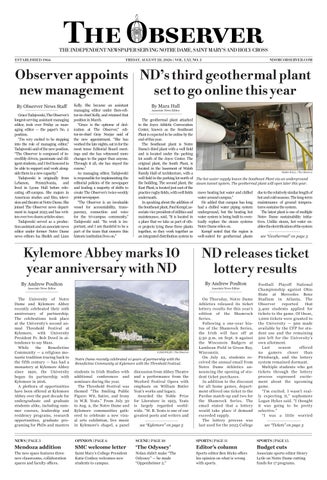
The geothermal plant attached to the Joyce Athletic Convocation Center, known as the Southeast Plant is expected to be online by the end of this year. The Southeast plant is Notre Dame’s third plant with a well field and is located under the parking lot south of the Joyce Center. The original plant, the South Plant, is located in the basement of Walsh MARA HALL | The Observer Family Hall of Architecture, with a well field in the parking lot north of The hot water supply leaves the Southeast Plant via an underground the building. The second plant, the steam tunnel system. The geothermal plant will open later this year. East Plant, is located just east of the practice rugby fields, with well fields move heating hot water and chilled due to the relatively similar length of hot and cold seasons. The long-term water around campus.” underneath. He added that campus has long maintenance of ground temperaIn speaking about the addition of the Southeast plant, Paul Kempf, as- had a chilled water piping system tures sustains the system. The latest plant is one of multiple sociate vice president of utilities and underground, but the heating hot maintenance, said, “It is located in water system is being built to even- Notre Dame sustainability initiaa place that we take as part of oth- tually replace the steam systems tives. Unlike steam, hot water enables the electrification of the system er projects tying these three plants Notre Dame relies on. Kempf noted that the region is together, so they work together as an integrated distribution system to well-suited for geothermal plants see “Geothermal” on page 3
Kylemore Abbey marks 10 year anniversary with ND
ND releases ticket lottery results
By Andrew Poulton
By Andrew Poulton
The University of Notre Dame and Kylemore Abbey recently celebrated their 10th anniversary of partnership. The celebrations took place at the University’s second annual Threshold Festival at Kylemore, with University President Fr. Bob Dowd in attendance to say Mass. While the Benedictine Community — a religious monastic tradition tracing back to the fifth century — has had a monastery at Kylemore Abbey since 1920, the University began its partnership with Kylemore in 2016. A plethora of opportunities have been offered at Kylemore Abbey over the past decade for undergraduate and graduate students alike, including summer courses, leadership and residency programs, research opportunities, graduate programing for PhDs and masters
students in Irish Studies with additional conferences and seminars during the year. The Threshold Festival was themed “The Smiling Public Figure: Wit, Satire, and Irony in W.B. Yeats.” From July 30 to Aug. 2, the Notre Dame and Kylemore communities gathered to celebrate a new visual arts exhibition, live music in Kylemore’s chapel, a panel
discussion from Abbey Theatre and a performance from the Wexford Festival Opera with emphasis on William Butler Yeat’s works and legacy. Awarded the Noble Prize for Literature in 1923, Yeats is largely regarded worldwide. “W. B. Yeats is one of our greatest poets and writers and
On Thursday, Notre Dame Athletics released its ticket lottery results for this year’s edition of the Shamrock Series. Following a one-year hiatus of the Shamrock Series, the Irish will face off at 5:30 p.m. on Sept. 6 against the Wisconsin Badgers at Lambeau Field in Green Bay, Wisconsin. On July 22, students received the annual email from Notre Dame Athletics announcing the opening of student ticket purchases. In addition to the discount for all home games, department offered one ticket to the Purdue match-up and two for the Shamrock Series. The email stated that a lottery would take place if demand exceeded supply. The lottery process was last used for the 2025 College
NEWS | PAGE 3
OPINION | PAGE 6
SCENE | PAGE 10
SPORTS | PAGE 11
SPORTS | PAGE 15
The new space features three new classrooms, collaboration spaces and faculty offices.
Saint Mary’s College President Katie Conboy welcomes new students to campus.
Nolan didn’t make “The Odyssey” — he made “Oppenheimer 2.”
Sports editor Ben Hicks offers his opinion on what is wrong with sports.
Associate sports editor Henry Lytle on Notre Dame cutting funds for 17 programs.
Associate News Editor
Mendoza addition
Associate News Editor
LUKE FOLEY | The Observer
Notre Dame recently celebrated 10 years of partnership with the Benedictine Community at Kylemore with the Threshold Festival.
SMC welcome letter
see “Kylemore” on page 5
‘The Odyssey’
Editor’s column
Football Playoff National Championship against Ohio State at Mercedes Benz Stadium in Atlanta. The Observer reported that 3,400 students applied for tickets to the game. Of those, 1,000 tickets were granted to the University — 500 made available by the CFP for student use and the remaining 500 left for the University’s own allotment. Last season offered no gamers closer than Pittsburgh, and the lottery system remained dormant. Multiple students who got tickets through the lottery process expressed excitement about the upcoming game. “I’m excited. I wasn’t really expecting it,” sophomore Logan Hykes said. “I thought it was going to be pretty selective.” “I was a little worried see “Tickets” on page 3
Budget cuts
DAILY
2 | THE OBSERVER
QUESTION OF THE DAY:
FRIDAY, AUGUST 28, 2026
What is your favorite ice cream flavor?
Have a question you want answered? Email photo@ndsmcobserver.com
Julia Smith
Allison Connolly
Kaylynn Wills
Amelia Dykes
Katie Torres
“Moose tracks.”
“Raspberry chocolate chip.”
“Mint chocolate chip.”
“Superman.”
“Cookies and cream.”
freshman Flaherty
freshman McGlinn
freshman Holy Cross, North
freshman Le Mans
freshman Pasquerilla East
SOCIAL MEDIA POLL
PHOTO OF THE DAY | MARIELLA TADDONIO
Have an idea for a poll? Email lmartin01@saintmarys.edu
How many unread emails do you have? 0 1-50 51-100
6.5%
Over 100
32.6%
36.6%
24.2%
THE NEXT FIVE DAYS
CROSSWORD | WILL SHORTZ
Want your event included here? Email news@ndsmcobserver.com
Friday Flick on the Field: “Rudy” Watch “Rudy” from the terf field at Notre Dame Stadium. 9 p.m. - 11 p.m. Notre Dame Stadium
Saturday The Met Opera Live in HD: “Aida” (Verdi) Two royal rivals go head to head in an Egyptian opera. 1 p.m. - 4:15 p.m. DeBartolo Performing Arts Center
Sunday Notre Dame volleyball vs. Xavier The Irish take on the Musketeers in volleyball. 1 p.m. Purcell Pavilion
Monday Notre Dame men’s soccer vs. Harvard Notre Dame’s men’s soccer team faces Harvard. 7:30 p.m. Alumni Stadium
Tuesday Kroc Institute Ice Cream Social The Kroc Institute celebrates the new semester with ice cream. 5 p.m. - 7 p.m. DeBartolo Quad
ndsmcobserver.com “TO UNCOVER THE TRUTH AND REPORT IT ACCURATELY”
Asst. Managing Editor: Sophie Hanawalt
Ad Design Manager: Liam Flynn
Asst. Managing Editor: Abby Hernan
Business Manager: Zack Pohlman
Asst. Managing Editor: Henry Jagodzinski
Systems Administrator: Jack MapelLentz
Notre Dame News Editor: Annelise Demers SMC News Editor: Berhan Hagezom Opinion Editor: Duncan Stangle
900 Hesburgh Library, Notre Dame, IN 46556
Interim Sports Editor: Ben Hicks
Editor-in-Chief Gray Nocjar
Interim Scene Editor: Luke Foley
Managing Editor Aynslee Dellacca
Photo Editor: Mariella Taddonio Graphics Editor: Liam Flynn Social Media Editor: Lilly Martin
Policies The Observer is the independent, daily newspaper published in print and online by the students of the University of Notre Dame du Lac, Saint Mary’s College and Holy Cross College. Editorial content, including advertisements, is not governed by policies of the administration of any institution. The Observer reserves the right to refuse advertisements based on content.
The news is reported as accurately and objectively as possible. Unsigned editorials represent the opinion of the majority of the Editor-in-Chief, Managing Editor, Assistant Managing Editors and department editors. Commentaries, letters and columns present the views of the authors and not necessarily those of The Observer. Opinion space is available to all readers. The free expression of all opinions through letters is encouraged. Letters to the Editor must be signed and must include contact information. Questions regarding Observer policies should be directed to Editor-in-Chief Liam Kelly.
Today’s Staff News
Will Prisco Soledad Castellanos Sophie Lewandowski
Graphics Liam Flynn
Photo
Keira Jones
Opinion
Duncan Stargel
Sports
Ben Hicks Noah Cahill
Scene
Peter Mikulski
Editors Noah Cahill Gray Nocjar Grace Tadajweski
NEWS
FRIDAY, AUGUST 28, 2026
THE OBSERVER | 3
Mendoza’s North Addition honors founding dean By Zach Pohlman Assistant Managing Editor
The “H” has become an “A,” as the North Addition of the Mendoza College of Business officially opened for students over the summer. The John Francis Cardinal O’Hara, C.S.C., Commons features new collaboration spaces for students, faculty offices, a third-floor terrace and three new classrooms. Dean Martin Cremers described the building’s former footprint as forming the letter “H” when viewed from above. With the new addition connecting the north wings of the building on all floors, it is now in the shape of an A. “We’ve created, I think, a space that is really focused on community,” Cremers said. The College, which did not have furniture in the atrium prior to the COVID-19 pandemic, has nearly doubled the number of study spaces available to students. Aiming to maintain the connections between instructors and students even within a larger classroom, the centerpiece addition is a new 140-seat auditorium. With the new space, the College can offer more foundations classes in the building rather than Geddes Hall or neighboring DeBartolo Hall. “It does allow us to, on the one
Geothermal Continued from page 1
thereby making the equipment energy source agnostic as greener energy systems come along, Kempf noted. The closed loop geothermal plants on campus work by pumping water through wells, which are located 300 feet below ground and 20 feet on center in a grid-like pattern. These pumping systems allow for heat energy exchange across the temperature gradient of the water that enters the system and the average 50-degree Earth temperature, Kempf explained. The system works off of three loops — the well field loop, chilled water loop and hot water loop. The well field loop is responsible for the earth energy exchange while the heat recovery chiller uses energy to heat and cool the water. It can run on three modes: heating, cooling or simultaneous.
Tickets
Continued from page 1 because of the culture at Notre Dame to buy tickets and sell them for inf lated prices. But I’m glad that that didn’t happen this time around,” junior Victoria Gibek said.
hand, teach more students, serve more students, and it also allows some of our most popular faculty to have more students get access to their course,” Cremers said. Faculty members like Carl Ackermann, who teaches three sections of Foundations of Finance, provided feedback that contributed to the final design of the space. Ackermann said he often uses the projector to show multiple slides at once during class, which is a capability that not all classrooms on campus have. “I think that’s a critical learning setup to be able to project two things at once. And they did that in the most brilliant way I’ve seen, which is that there are two huge screens on each side of the front of the room, and each of those screens allows you to show two different things,” Ackermann said. Two of Ackermann’s other suggestions included the center aisle since he often will move around while teaching. While not one of his suggestions, the new classroom on each floor also features a rolling lectern with adjustable height. Grisoli said that the lecterns are in the classrooms on a trial basis to determine if they would be a good fit for other spaces in Mendoza. “We’re going to get some faculty feedback on it, and then we’re prepared to roll them out,” he said.
In addition to designing the new space for improved functionality, a conscious effort was made to connect the new spaces to Mendoza’s recent history and its century-old mission. Cremers said that he was pleased with how well the new addition integrated into the existing structure. “What I also really like about the new building is that it makes the whole business school have a more modern look, with more glass, etc. but at the same time still feels like it’s always been there,” he said. The new spaces were designed to impress with blue- and gold-colored accents throughout the many windows offering views and natural light. The terrace on the third floor, accessible only to faculty, features outdoor furniture and views of the “Big Four” — the Basilica of the Sacred Heart, Main Building, Hesburgh Library and Notre Dame Stadium. “It’s a north-facing addition, so it doesn’t get a lot of direct sunlight, but it gets lots of ambient light,” Grisoli said. “So, the architects really helped us with skylights coming in from the third floor to help share this, and then all the faculty offices have side lights and the transoms to bring daylight in.” Ackermann also praised the architects and planning team and the new classroom space.
“The people who made the design decisions and its execution were amazing,” he said. “They thought through this long in advance, and they solicited ideas and feedback from many of us so we really had an opportunity to specify our preferences.” “Thankful for the partnership between the Mendoza College of Business and donors,” university architect Dan Cook said in a statement. “They seamlessly complement the existing facility while bringing tremendous new capacity for learning, community, and research to the university.” The dean said that the design choices made, particularly with the artwork, hark back to the founding principles of the business school at Notre Dame. “The whole new edition is made after our founding dean,” Cremers said. “So it’s also an opportunity to emphasize our connection to our founding dean, the Congregation of Holy Cross and the University.” O’Hara founded Mendoza, then called the College of Foreign and Domestic Commerce, in 1921. He defended the need for a business school at a Catholic university dedicated to the liberal arts, writing in an essay, “The primary function of commerce is service to mankind. Business has a code of ethics based very largely on divine principles. When this code is followed, commerce can
and does advance civilization.” Mendoza’s present-day mission to “grow the good in business” has its roots in its founding dean’s vision for the College. A bust of O’Hara sits outside the first-floor auditorium, and his coat of arms and motto — “Ipsam sequens non devias,” or “Following her, you will not go astray,” referring to the Virgin Mary — will be featured in the center of the collaboration space. The permanent bronze bust by artist Jay Hall Gallagher is slated to arrive in November. Four large bas-relief panels were commissioned from Scottish artist David J. Mitchell to surround the Cardinal’s coat of arms. Two will feature scenes of Holy Cross priests in their ministry, and the other two will feature two parables from the Gospels: the Parable of the Good Samaritan and the Parable of the Talents. Mendoza is hosting an open house in the John Francis Cardinal O’Hara, C.S.C., Commons Thursday, Aug. 27, from 11:30 a.m. to 1:30 p.m., with an ice cream social. Students can pick up a journal with O’Hara’s writings and talk to each of the academic departments in the atrium.
In heating and cooling modes, the heat recovery chiller uses the energy from the well field loop to output the desired temperature of water. In simultaneous mode, the heat recovery chiller can bypass the well field loop and transfer heat between the different required temperatures, Kempf explained. The Southeast Plant features six chillers which can each be turned on and off and set to a mode independently of one another. Once at the desired temperature, around 40 degrees for chilled water and 120 degrees for hot water, the water can be sent across campus. While the chilled water lines are buried directly in the ground, the hot water lines run through the existing steam tunnels, which are used for heating and connect buildings across campus. Most of the buildings on campus, which do not use steam directly, convert steam to hot water at the building,
reaching 180 degrees. Connectivity efforts between the plants included digging up shallowly covered parts of the tunnels on Library Lawn this summer in order to put piping in the tunnels. The team is currently creating a piping loop to connecting the three geothermal plants. Kempf estimates 15% to 20% of the heating and cooling load is currently coming from geothermal energy, with building connectivity being the primary bottleneck. Looking into diverse measures to heat and cool campus, Kempf wrote, “Geothermal is one means of producing heating and cooling, a multifaceted approach diversity energy production and creates reliability and resiliency in an energy production system. Geothermal could grow to be an even bigger source of energy as could other means.” These efforts would also allow the system to take
advantage of off-peak utility costs while still meeting demand. Doing this requires secure capacity — a way of storing the utilities or having them on hand before they are needed. Kempf explained this secure capacity is currently in the form of one chilled water storage tank, holding 2 million gallons of water and producing 16-ton hours of chilled water, near the east facility. There are plans to add two more tanks at each plant — a combination tank, which can f lip between hot water and chilled water seasonally, and a dedicated heating hot water tank. Additional diversity and secure capacity is in the works at the power plant near the lakes. Kempf explained both a steam condenser and condensing economizer can be added to the system to maximize the efficiency of the power plant. While this infrastructure is not yet online on the power
plant side, the hotter water removes the infrastructure barriers at the individual buildings in the dead of winter. 120 degrees is not enough for the system to operate during the winter. Day to day, the three geothermal plants are “essentially unmanned” and run on an automated system, according to Kempf, although he notes every shift does a walkthrough inspection once or twice a shift. All three of the geothermal plants are equipped with higher pressure steam backups should there be an issue as there is no substitute for heating in the wintertime, according to Kempf. “It is one thing to be uncomfortable in the summer with cooling, although people will tell you it is just as important, but freezing the buildings would be really bad,” Kempf said.
While some felt that the random lottery system was the best way to determine who received tickets, others thought that the selection should be based by class seniority, giving older students ticket preference. Sophomore Zachary Wirth said he though the process should be carried out via a
weighted lottery, in which students in higher grades had better changes of receiving tickets, while maintaining some level of randomness. “Seniors should be the first to get it, and then it should be a lottery for like freshmen through juniors,” Conroy said. An additional ticket lottery will be held for the Purdue
game at Ross-Ade Stadium, with a price tag of $110 with an added $5 facility fee. The deadline to register is Sept. 14. Students will be notified on Sept. 16 if they successfully obtain tickets. John Breeden, associate athletics director, tickets, sales & revenue strategy, did not immediately respond to a
request for comment regarding the lottery process and if all who applied for tickets in the lottery received one.
Contact Zach Pohlman at zpohlma2@nd.edu
Contact Mara Hall at mhall27@nd.edu
Editor’s Note: Notre Dame news editor Megan Cornell contributed reporting to this story. Contact Andrew Poulton at apoulton@nd.edu
NEWS
4 | THE OBSERVER
FRIDAY, AUGUST 28, 2026
Phase one of multi-step SDH renovation complete By Megan Cornell Notre Dame News Editor
Having returned to campus this week, students were able to use South Dining Hall’s newly renovated serving space after it was partially closed during the spring semester. The completed serving area is one phase of a multi-step renovation in honor of the dining hall’s 100th anniversary in 2027. Much of the hall’s construction is structural rather than cosmetic, involving fixing behind-the-scenes utility and structural issues, as well as building out the basement to be the new kitchen prep and food storage space. “We gutted the basement, lowered the basement floor by a foot, completely repiped, replumbed, redid a bunch of structural work
to make sure we could support the new equipment and connected it to the geothermal plant,” Dan Cook, university architect, said. This structural work allows the space to retain its character despite renovation. “It’s important to keep in mind that yes, we’re modernizing the kitchen space, but we’re restoring the body of South Dining Hall and keeping the tradition of the two dining areas with the same wood panels, the same tables, the same chairs, but restored,” Luigi Alberganti, executive director of campus dining, said. For students, the new serving space is the most noticeable change in the dining hall thus far. Last school year, students ate out of a temporary serving area in the
western dining room. David McDonald, the executive director of institutional dining strategy, expressed his gratitude toward students for their patience with the renovations. Alberganti said feedback from students about the serving space has been “overwhelmingly positive.” The next phase of construction is renovating the west eatery, which is under construction now. “That’s the only part of the building that’s off limits, and we’re going through that room in the next four months,” Alberganti said. According to Alberganti, “Seating capacity is restricted a little bit” because the western dining room is closed. However, the dining hall’s ability to produce food remains unaffected.
Cook shared that planning for the renovation began in 2022 when the University facilities team drew plans and visited dining halls at schools like Michigan and Yale for inspiration. “There were a lot of coordination milestones involved. University staff form facilities, food service, the fire department, utilities, the building contractor, architects, engineers, the City of South Bend and health departments all revolved around making sure the building was built safely and in compliance with standards for serving food,” Cook said. The dining hall’s former layout was designed in 1997 and reflected food service design from that era. “When you fast forward 20-something years, things are very
different. There is a lot of insight with things like allergies, dietary restrictions that need to be addressed. It’s also the efficiency of the equipment, the speed and quality of the food, and the variety of the food,” Alberganti said. The renovation includes new made-to-order stations using GrubHub, which will be coming out in the next few weeks. Sustainability was a high priority during the renovation, and the construction included installing a green roof, as well as high-efficiency features and equipment. The budget for the project has not been finalized, but Cook confirmed the project is on track thus far. Contact Megan Cornell at mcornell@nd.edu
Notre Dame launches space exploration minor By Matthew Morin Associate News Editor
Beginning in the fall of 2026, the College of Engineering is offering a new minor titled Earth & Planetary Sciences in Space Exploration. Directed by Clive Neal, a professor of civil and environmental engineering and Earth sciences, the new minor requires 15 credit hours, including a foundational theology course titled “Space Ethics: Creation, Commerce, Colonization” and a capstone titled “Living & Working on Our Moon.” Students in the minor will additionally take 3 elective courses. The space ethics course also counts toward the University’s Catholicism and Disciplines requirement. Upon declaring the minor, students meet with Neal for a planning meeting before it is officially added to their degree. Speaking with The Observer, Neal emphasized that while the minor is titled Earth and Planetary Science because it is under the breadth of the Earth
Kylemore
Continued from page 1 playwrights of the Irish language,” Lisa Caulfield, director of the Kylemore Global Centre in Connemara, Ireland said. Also present for the anniversary celebrations, Dowd was presented a commemorative gift in tribute by the Benedictine Community to the 10 years of partnership. “It was a really special moment to have him there for the few days to also bear witness to the festival and enjoy the company of the actors, musicians and the good food,” Caulfield said. The Sunday Mass served as a culmination of the week’s festivities honoring the local community and tenured relationship. At the celebration, Dowd
Sciences department, it is focused on space exploration. “I’m hoping that it will be popular because we had the Artemis 2 launch. We’ve now got NASA saying we’re going to have a permanent presence on the moon through Moon Base, so it’s an exciting time to get involved in space exploration, especially as we see the International Space Station coming to the end of its life,” said Neal. “Now there’s commercial consortia that have come together to propose commercial, low-Earth-orbit destinations, so the future looks bright in terms of private sector involvement in space exploration as well as space agency involvement.” Neal noted that he hopes to build a larger digital presence within the department and, based on demand, grow the department beyond its current 30-student capacity, including expansion into the Mendoza College of Business. Depending on this demand, Neal said he hopes to grow the minor into a major in space
exploration or even a space exploration institute. Explaining the courses, Neal stated that the minor is not limited to Earth and planetary science but also includes broader topics such as low Earth orbit, microgravity, deep space astronomy and exoplanets, among other multidisciplinary areas of study. During the capstone course, students will dive into geology, the lunar environment and the engineering aspects of creating a habitat and life support for humans on the moon. They also discuss NASA’s space policy, architecture and funding for space exploration. Neal expressed that he hopes courses and programs such as this will broaden the appeal of space engineering, especially as he sees it being an underdeveloped part of the aerospace engineering curriculum. The creation of the new minor, Neal said, is based on the large increase in job growth within the space sector, specifically within private sector and commercial lunar payload
services. “Now, [in] 2019, 128% job growth across the board, and then you get the pandemic and everything starts going negative. Well, they had 66% job growth during a pandemic. You got a sector that was growing and still kept growing even when everything was shutting down, and so that, to me, it resonated with our decision makers that we really need to support this and help it to grow,” Neal said in regard to job growth in the space industry. He noted job growth in intuitive machines, aerospace, astrobotics, space tourism and other domestic and international companies. Overall, Neal noted that he is most excited about the future. “I can see the potential of ND alums who are already working at NASA. I’m trying to bring back Jim Geffre, who’s the deputy [program manager] for the Moon Base at Johnson Space Center, trying to get him back to give a talk
this semester, and I think that we can have Notre Dame students starting companies and Notre Dame students leading companies and getting involved in the space sector … because that’s the future of low Earth orbit,” said Neal. Neal concluded by saying that there are more than just engineering jobs among the possibilities for careers in this sector. “There’s opportunity for more than just engineers. Everybody thinks, oh, we’re building rockets. We’re doing this, but there’s so much more that’s needed. There’s psychology for the human space program. It’s human health in microgravity and in deep space travel,” Neal said. “So [if ] you want to make a difference down here, think about space exploration. There are a lot of new technologies that need to be developed or have spin-back potential down here.”
reflected upon the milestone, stating, “We are delighted to mark 10 years of partnership between Notre Dame and the Benedictine Community at Kylemore Abbey. As a global Catholic research university, we are grateful for the ways that the partnership has deepened our connectedness to Ireland and furthered our efforts to educate in ways that build bridges across disciplines, ideas, peoples and cultures,” the Notre Dame article shared. As for the inspiration behind the festival’s artistic focus, Caulfield shared that the arts are a central part of the surrounding region’s cultural identity. “You can throw a stone and hit an artist in the West of Ireland, right? Whether it’s a visual artist, whether it’s a musician, whether it’s a writer, you know, there’s just
such a complexity of talent that’s in the west of Ireland,” Caulfield said. Kylemore’s program’s artistic undertones were a result of the community’s interests and desire for a creative zone. “I thought it would just be a gift to give artists and visual representation to people who really are kind of struggling in a world that is very capitalistic focused,” Caulfield said. Caulfield emphasized the close connection between the Kylemore program location and student experience, detailing the “gift” of creative freedom that comes with residing in the West of Ireland. Students have the ability to look across Irish mountains and landscapes at Kylemore, which Caulfield attributes as reason for Kylemore’s ability to inspire. “I think a place like Kylemore,
it’s a very inspirational and spiritual space,” Caulfield said. Reinforcing the sense of intentionality and presence that comes with living among the Benedictine Community, Caulfield added, “Our students and anyone who comes to visit us are exposed to this Benedictine community that lives according to this rule of Saint Benedict, and it’s a very contemplative rule. It gives you a set of guidelines, but it also, you know, makes each moment of your day very intentional.” Caulfield noted that this “beautiful intentionality with everything” extends to external relationships. “They have the saying of listening with the ear of the heart, and I find that a beautiful image of how we can really be present for people, and I think places like Kylemore can help us get out of our own heads
and be present for one another.” Moving forward, Caulfield said the Kylemore program will continue to offer the same hospitable community centered around reflection. “For the future, I think Kylemore has a space to offer that is really unique and continues to be shaped by our community here, and hospitality is at the heart of it,” Caulfield said. “We really want to welcome everyone with a warm Irish welcome and make sure that they feel a part of the family.” “I think we do have a special place in the offerings of the world, and I think to honor it and to be a part of that tradition is really, really unique for the University and a real great opportunity for students.”
Contact Matthew Morin at mmorin2@nd.edu
Contact Andrew Poulton at apoulton@nd.edu
PAID ADVERTISEMENT
OPINION
6 | THE OBSERVER
FRIDAY, AUGUST 28, 2026
LETTER TO THE EDITOR
Welcome to St. Mary’s College Welcome to a new academic year — and a special welcome to the Class of 2030, our transfer students and our new graduate students! As you already know, there is something new in our familiar campus landscape this fall. For the first time in its 100-year history, the bell tower in Le Mans Hall has a bell. Today, a new sound becomes part of the rhythm of our days. The bell itself is not new. Forged in 1865, just 20 years after the founding of Saint Mary’s, it carries a long history within it. But it has now found a new home — and a new community to hear it. Bells do more than tell time. They call people together.
They mark beginnings and endings. They announce moments of celebration and invite us to pause in times of sorrow. They remind us to listen. And sometimes, they summon us to act. I hope you will do some deep listening during your time at Saint Mary’s. Listen to your professors and to the questions they ask — not only the ones you can answer immediately but also the ones that unsettle you or awaken your curiosity. Listen to people whose backgrounds, experiences, beliefs or opinions differ from your own. Our community offers extraordinary opportunities to encounter new perspectives, form
unexpected friendships and discover how much we can learn with and from one another. Listen to the call of the Holy Spirit. Listen, too, for what directly calls to you. It may be a field of study you had never considered, a talent you have not yet tested, a question of faith or purpose or a problem in the world that awakens your attention. Education is partly about gaining knowledge and experience. But it is also about becoming attentive enough to recognize what matters to you — and courageous enough to respond. The bell will add its voice to Saint Mary’s, but it will not be the most important
voice on our campus. That voice belongs to you — to the questions you ask, the ideas you test, the convictions you express and the ways you speak for and with others. Alongside the voices and traditions of Notre Dame and Holy Cross, you will help create the distinctive Saint Mary’s harmony in our tricampus community — three institutions with individual identities, shared opportunities and much to learn from one another. The Sisters of the Holy Cross founded Saint Mary’s more than 180 years ago because they believed in the transformative power of education. They prepared generations of students to make a difference
in a world that needed them. You are now part of that living tradition. So, as this academic year begins, listen carefully — to your faculty, to the voices of those sharing our community today, to the wisdom of those who came before you and to the emerging voice within you. Then consider how you want your own life to ring out into the world. The Le Mans tower bell has waited a long time to be heard at Saint Mary’s. I hope it encourages you to find — and use — your voice, too. Katie Conboy, Ph.D. President Saint Mary’s College Aug. 26
LETTER TO THE EDITOR
Agriculture is more than a science I raise Angus cattle in St. Paris, Ohio, so I am biased. Record beef prices have been good to my family. When the president announced on Aug. 21 that the U.S. would waive out-of-quota tariffs on 300,000 metric tons of imported ground beef, cattle futures fell, and so did my profit margin. Take a bite anyway. Federal labor data put ground beef at $6.89 per pound in July, up 57 percent in five years. For a family on a tight grocery budget, that’s a big number. That said, look at the snack aisle and ask yourself what you are buying. Refined starch and oil — now look at the prices. Plenty of chips, cookies and cereal run five, six, seven dollars a pound, or more. A pound of ground beef gives you about 80 grams of complete protein, several days’ worth of B12, iron and zinc. Priced against what it delivers in nutrients, beef is underpriced in the grocery. So, when we say beef is expensive: compared to what? From where I stand, the price is barely high enough to break even. What that price is supposed to do A cattle farm is not a factory. The annual calf crop is roughly half steers and half heifers. Steers get fed and harvested at 18 to 20 months; they become beef, period. A heifer is a young female that has not yet had a calf, and she is the only animal on my farm with two possible futures. I can sell her, and she becomes beef like her brothers, or I can keep her back, breed her and turn her into a cow who produces one calf a year for the next decade. Retaining heifers is the only
way to increase supply. It takes time and expense. Not selling her today reduces the supply of beef in the short term and adds costs for me tomorrow. She won’t produce a calf for nearly two years and then it’s another year and a half until that calf is market weight. Stripping away the rural imagery and keeping a heifer is a capital budgeting decision: Does the net present value of her future calves beat her cash value today? Right now, it does not. Keeping her means forfeiting a $2,000-plus payday, financing two years of feed and pasture before her calf is born and discounting those cash flows against high interest rates and years of market risk. When the discounted returns cannot beat today’s cash price, we sell. I’m not the only rancher seeing the numbers this way. In fact, the USDA’s National Agricultural Statistics Service announced the beef cow herd at 27.6 million head in January, the lowest since 1961. For the first time in years, replacement heifer retention was up, but it was only up by 1 percent, according to NASS. Even at record prices, most of us are still selling. That should tell you how thin the margin is. What we get if we let it work Letting the market reward expansion delivers what national policy says it wants. With imports reaching a record high this year at 17.3 percent and USDA treating agriculture as a national security concern, we need a policy that strengthens domestic production and shrinks our reliance on imports. It steadies prices, because larger herds absorb shocks better than constrained ones. And it
keeps nutrient-dense protein affordable for growing children, expectant mothers and aging parents. Catholic social teaching offers a different view of the problem. Earth’s goods belong to everyone; food is a common good before it is a commodity. Clearing the supply of a market is fine, but this is a market that feeds humans; you don’t have to be Catholic to understand there is a difference. Notre Dame gives us space to see both, and the inspired courage to call it out. Suppressing the price of beef for 90 days undermines the ability of farmers to secure future supply. Saving a few cents today will lead to a smaller herd and tighter supply later. Why I am writing this here Notre Dame takes on the world’s hardest problems: poverty, migration, war, disease and climate. Students come here to work on things that matter. Agriculture makes that list, but mostly as an environmental science. Notre Dame researchers work with Indiana farmers on soil health, cover crops and water quality, and that is good work. I came here as a rancher hoping to find the bigger picture — agriculture as an economy, and the ethics of what gets grown, who gets fed and at what cost. I found less of that than I had expected from a place this ambitious. Agricultural economics and applied ethics in food policy deserve a bigger stage at Notre Dame. From a distance, the shelves are full and food is plentiful. The reality is that it’s a fragile system. What takes years to grow and establish can be destroyed in one political season.
LIAM FLYNN | The Observer
And unfortunately, there are fewer farmers willing to take on that task every year. The family counting dollars in the grocery checkout and the family trying to cover a farm payment are not opponents. They are engaged at opposite ends of a single act of mercy but will never know the other exists. A policy that causes one of them to lose has failed them both. Agricultural technicians are plentiful. Agriculture needs
people who can look at the numbers and speak the truth that the numbers can’t describe. Notre Dame is good at forming people in that way. I suppose this is a calling for all of us to answer. In the meantime, I have heifers to decide about this fall. I would like to keep them. The discount rate is telling me not to.
PAID ADVERTISEMENT
Adam Frantz MBA Class of 2027 Aug. 25
OPINION
FRIDAY, AUGUST 28, 2026
THE OBSERVER | 7
LETTER TO THE EDITOR
The SoFi deal destroys Notre Dame’s mystique While walking the campus recently I noticed that the view of the Golden Dome was obscured by a dense, mustardhued haze which I assumed was particulate from the wildfires raging in Canada. But no. It was the noxious residue of Notre Dame’s latest and most shameless brand sellout to date, to SoFi. Many will ask: “What’s SoFi?” A toenail fungus remedy? A male pattern baldness palliative? No, it’s a bank. A bank with no branches and shallow roots. This latest sponsorship deal will require ND’s iconic football jerseys to be defaced by a patch with SoFi’s unimaginative black and white logo. This unforgivable act of brand vandalism is the equivalent of painting a carbuncle on the cheek of the Mona Lisa. What’s next? Holy Cross priests offering Mass at the Basilica with the Chick-fil-A logo emblazoned on their vestments? I mean, if it was necessary at all to form a co-branding relationship with a financial institution, why not Bank of Ireland? At least that would have been consistent with the co-branding arrangement with the university’s preferred alcoholic beverage vendor, Guinness. And what does ND get from SoFi? Twenty million dollars, chump change in the total scheme of things. Why a university with a $20
billion endowment and the nation’s fifth-highest percentage of alumni donors needs to sully its brand and desecrate its uniforms is beyond me. There are other ways to fund NIL without adding SoFi graffiti to our team’s jerseys. For example, why doesn’t the administration hire Sotheby’s to auction off the 19th century Luigi Gregori murals that once so beautifully decorated the second f loor of the Administration Building? No one can see them anyway, shrouded as they were in a paroxysm of revisionist guilt by kitschy “tapestries” that look like they were sourced from Walmart’s fabrics department. This SoFi deal is perfectly consistent with the administration’s seemingly irresistible impulse to monetize every aspect of the Notre Dame mystique in one grubby, cash grab after another as we “squeeze like a champion today.” The problem is, if this envelope is pushed too far the mystique evaporates as ND’s once unique identity becomes progressively less distinct from our SEC and BIG 10 rivals. I can imagine the ND/SoFi co-branding commercials that will be aired during the interminable TV timeouts on NBC where our leprechaun uses his cell phone and SoFi account to pay ND’s ticket scalping partner SeatGeek for seats to
JONATHAN KARR | The Observer
next year’s highly anticipated match up with Kent State. Brace yourselves, Fighting Irish faithful. The ultimate branding desecration is just
around the corner: Stadium naming rights. I can see it now: “Tire Shack Notre Dame Stadiumwhere Irish victories
keep rolling in.” Thomas Carroll Class of 1974 July 30
LETTER TO THE EDITOR
Carry on the legacy of Right to Life Notre Dame is a university rich in tradition, with generations of students dedicated to preserving and carrying forward its special legacy of faith and service rooted in Catholicism. This commitment to the Catholic identity is ref lected in the largest pro-life club in the nation — Notre Dame Right to Life, established early in America’s abortion debate and remaining an active and powerful part of our on-campus
community. The club was created at Notre Dame in 1972, becoming the first collegiate pro-life club in the country. Even more significant is that this all happened when Roe v. Wade had not yet been decided, showing Notre Dame’s commitment to defending the most vulnerable members of society outside of formal politics. Notre Dame Right to Life solidified over the next decade through active involvement on the campus;
PAID ADVERTISEMENT
petitioning leadership to promote the pro-life perspective; hosting community events; and working to educate fellow students on the beauty and dignity of all human life. The club became a central space for engaging questions of life, law and Catholic identity at a moment when these issues were becoming increasingly more polarizing. Today, the rich legacy of Notre Dame Right to Life continues. Not only are we the largest non-academic, student-led club on campus, we are also the largest pro-life student group in the nation with over 700 members. Many of the early goals, practices and events are still prevalent in our club today. Like our founders, we have continued to sponsor trips to pray outside of abortion clinics; host talks to educate our student body on human rights issues such as abortion, IVF and the death penalty; and plan events to raise awareness and build community amongst Notre Dame students. Every year since its founding in 1974, we have sent buses filled
with students to Washington D.C. to the March for Life. Our service efforts have expanded over the years and now include throwing baby showers at our local Women’s Care Center, raising thousands of dollars for Let Them Live — an organization that supports women in crisis pregnancies — and hosting brunches for undergraduate parents and their families, as well as organizing many volunteering opportunities throughout the year. Respect Life Week was first advertised in The Observer in 1972, dedicating the week to promoting an attitude of love and respect here on campus towards the unborn. This year, our theme for Respect Life week will be Cor Iesu, fons vitae, meaning Heart of Jesus, source of life. In line with the consecration to the Sacred Heart that will take place on Sept. 25 in the Basilica, we hope to emphasize the beauty of the connection between an unborn child’s heartbeat and that of their mother connecting it to the Sacred Heart of Jesus beating for each of us.
Our patron saint for this year will be St. Michael the Archangel. We pray for his intercession. Help us to have the humility to boldly defend the sanctity of all human life with pilgrimages such as trips to pray outside abortion clinics and the March for Life. Help us to have the strength to change hearts and minds with talks and tabling events across campus. Help us to have the grace to serve in a way that honors the image of God in the least of our brothers and sisters. For students interested in getting involved with prolife efforts on campus, visit our website righttolife. nd.eduwhere you can join our email list, access our events, meet our team and get connected to our special community and mission. Our board looks forward to meeting all of you and continuing to build a culture of life here at Our Lady’s University! St. Michael the Archangel, pray for us! Therese Phelan Class of 2027 Aug. 21
OPINION
8 | THE OBSERVER
FRIDAY, AUGUST 28, 2026
LETTER TO THE EDITOR
Notre Dame athletic teams can win it all It is highly likely that 20262027 will be one of the most exciting years in Notre Dame sports history for two reasons — football, and Hannah Hidalgo. I graduated from ND in 1974 and, while in school, I attended some of the most exciting events in sports history. During my freshman year, I watched Austin Carr play basketball his senior year. He averaged 38 points a game that year and scored 61 points in a NCAA Tournament game — a record that still stands today, 55 years later. On Dec. 31, 1973, ND beat Alabama 24-23 in the Sugar Bowl to win the national championship. Bear Bryant never lived down Tom Clements’ end zone pass to Robin Weber. Twenty days later, on Jan. 19, 1974, the men’s basketball team broke UCLA’s 88 game winning streak at Purcell Pavilion, 71-70, in one of the most thrilling games you can imagine. Fast forward to today. The enthusiasm for Notre Dame football on and off campus is palpable, so one needn’t explain why the Irish may win it all this year in record fashion. Suffice to say, the team is in the zone. So, let’s discuss Hannah Hidalgo. To begin, Coach Ivey has five fabulous freshman recruits coupled with two very talented players from the transfer portal and some excellent returning players. The team will be solid. But basketball fans who have attended the past three years of ND women’s basketball have seen a show like no other. Hannah has not only scored in double figures in every game she has played in while wearing an ND jersey, but she broke the NCAA record for steals in one game (16) and in one season (204) this past basketball season. If she even comes close to her last year’s steals numbers, she will break the NCAA career record. It is also highly likely she will end up scoring more than 3,000 points for her career — a feat only a handful of players have accomplished, none of whom have played for Notre Dame. But these numbers — while wildly impressive — do not accurately describe Hannah’s performance on the court. Unlike any other college basketball player (male or female) who ever played the game, her defensive prowess causes opposing coaches and players to actually change their offensive game plans to take into account her presence on the court. This is insane. But don’t take my word for it, ask the winningest coach in women’s basketball history, UConn’s Geno Auriemma, or Hall of Fame coach Muffet McGraw. “She’s just a unique player that comes along once in a lifetime, and she has the ability to disrupt and cause chaos like nobody I’ve
ever seen,” Auriemma stated in an ESPN article. McGraw quips that the best way to prepare to play against Hannah Hidalgo is to scrimmage six-on-five to account for Hannah’s defensive capabilities. Really? An extra player on defense to replicate the pressure Hannah puts on opponents! But it’s true. We’ve seen it for three years — all game, every game. She is relentless. In one game, she scored 44 points, had 9 rebounds, 4 assists and 16 steals in 28 minutes of play! She clearly loves the game, and it shows every minute she is on the court. I was so lucky to have watched Austin Carr, attended the Sugar Bowl in 1973 and the UCLA basketball game in January 1974. I am just as
lucky to watch Hannah’s amazing thievery in real time and can’t wait for the 2026-2027 season to begin. All this to say, your student experience at Notre Dame will stay with you for your entire life. Watching Hannah Hidalgo play basketball should be part of that experience, even if you are not a sports fan. Caitlin Clark proved she is the finest offensive player to ever play the college game. By the end of next year, people may well be saying that Hannah Hidalgo is the finest overall player to ever play the game. Time will tell but, in any event, you shouldn’t miss the show. Tuck Hopkins Class of 1974 Aug. 10 PAID ADVERTISEMENT
MARIELLA TADDONIO | The Observer
SCENE
FRIDAY, AUGUST 28, 2026
THE OBSERVER | 9
‘Obsession’ keeps you guessing By Marguerite Marley Scene Copy Editor
I think when film historians look back at the summer of 2026, they’ll do so with a focus on independent horror. Two of the biggest movies this summer, “Obsession” and “Backrooms,” have much in common. They both come from Gen Z filmmakers, were made on smaller budgets compared to the average Hollywood blockbuster and are incredible. This summer, “Obsession” seemed to take the world by storm, making $505 million off a budget of only $750,000. I think that’s great — I love seeing good movies do well. “Obsession” follows Bear, a 20-something still living in his hometown and still hanging out with his high school friend group, who makes a wish on a novelty toy that his friend Nikki will love him “more than anyone else in the world.” It works, and the wish makes her completely obsessed with him, though Nikki might not be the person he thought she was. Though the plot is relatively simple (the director Curry Barker mentioned in
an interview that he was inspired by an episode of “The Simpsons”), Barker can present Nikki’s slow descent from “girlfriend” to horror movie monster in a way that is slow enough to make you feel every moment of tension as you’re taken through a familiar tale of a wish gone wrong. You know what should happen next but never really know what will happen, which makes this the perfect movie to watch
in a group, as you’ll inevitably want to discuss what the heck you’re watching unfold and who the real villain is. This sense of unpredictability keeps you intrigued and eager to see how the story develops. Of course, the breakout performance is Nikki’s (Inde Navarrette). Navarrette contorts her face in ways that make her look like a completely different person, from smiling so wide she stops looking like herself to PAID ADVERTISEMENT
LIAM FLYNN | The Observer
frowning in a way that, under different circumstances, might have been considered cute. But Bear (Michael Johnston) is also amazing. He’s an adorkable misogynist who’s also willing to go any length to keep his “girlfriend” under his thumb — it’s a hard tightrope to straddle, but Johnston does it wonderfully. The small budget meant Barker relied on practical effects more often than most filmmakers have to (e.g., the dead cat at
the beginning), which adds to the visceral horror. The scrappy look of this production does nothing but add to the charm. The sound design is incredible, taking advantage of Navarrette’s performance, especially her inhuman scream that amplifies the tension. The use of lovey-dovey music also puts the viewer on edge, as we watch what’s supposed to be a rom-com but, given the circumstances, never quite feels like one. I don’t tend to get scared by horror movies — I know it’s all fake, so it’s easy to view it as fiction — but after watching this film, I couldn’t help but sleep with my desk lamp on. Just in case, of course. Though its star has already moved on to bigger things, rumor has it that Navarrette will make her Marvel Cinematic Universe debut later this year as Rogue. Still, “Obsession” won’t be a movie soon forgotten. I hope that Hollywood is able to learn a lesson from it and take chances on younger filmmakers. What can I say? I’m an optimist. Contact Marguerite Marley at mmarley01@saintmarys.edu
SCENE
10 | THE OBSERVER
FRIDAY, AUGUST 28, 2026
Let’s be honest about ‘The Odyssey’ By Luke Foley Scene Editor Emeritus
This past summer has been a big feast for pop culture: Prime Video cemented its status as the king of YA romance slop with hits like “Off Campus” and “Sterling Point,” which put Gen Z in a choke hold; Drake returned from exile with three new albums that catapulted him back to the top of rap; horror had a big moment as novice filmmakers from YouTube broke several box-office records with “Obsession” and “Backrooms”; and “Spider-Man: Brand New Day” was an unusually great superhero film with a devastating emotional core. But amid all of this, “The Odyssey” stood out as the event of the summer. Christopher Nolan’s towering adaptation of one of Western civilization’s most iconic stories was a bona fide cultural phenomenon. Critics, who not too long ago held their noses up at Nolan for being a low-brow entertainer for film bros, have done a complete about-face on him since “Oppenheimer” and heaped mountains of praise on the film. Audiences ate up the hype moments and aura of the final act. Film format fetishists got off on telling everyone in their lives they saw it in IMAX. And as the summer draws to a close, “The Odyssey” has become not only Nolan’s highest-grossing film of all time, but the highest-grossing R-rated film of all time. And it’s already the favorite to win best picture at the Oscars! Who can argue against all that? I will. Just as Peter Griffin once bravely said he did not care for “The Godfather,” I stand here to say that I did not care for “The Odyssey.” Now, I don’t think it is an awful film, and I’m not some big
Nolan hater; I love his filmography, and I think “Oppenheimer” is one of the best films of the decade so far. However, Nolan’s take on “The Odyssey” frequently frustrated me and exposed some of his biggest weaknesses as a filmmaker. My primary issue with Nolan’s “The Odyssey” is that he was more interested in making an “Oppenheimer 2” than in actually adapting Homer’s epic. The focal point of Nolan’s interpretation is the Trojan horse trick and the resulting sack of Troy. He views the Trojan horse as the original sin of Western civilization, the foundational violation of divine law and natural order that unleashed a world of chaos, mistrust and violence, one we are still dealing with today as military adventurism and war crimes abound. Now, in a vacuum, this is a beautiful thesis and
a pleasantly surprising display of Christian ethics from Nolan. But is this what “The Odyssey” is really about? Reframing “The Odyssey” as an anti-war fable is interesting on the face of it, but it nearly breaks the rest of the movie because “The Odyssey” isn’t really about what happened in Troy nor does it view what happened in Troy as a moral disaster — if Nolan wanted to make a movie about that, he should have adapted “The Aeneid”! The resulting film is disjointed, as Nolan fails to integrate the anti-war thesis with the swashbuckling sea voyage that makes up most of the run time. Nolan comes off as uninterested in the crew’s escapades and treats them like a rote checklist (though standout moments are scattered throughout, including an arresting body horror sequence
LIAM FLYNN | The Observer
when Odysseus’ men morph into pigs). They fail to build on Nolan’s driving thesis, and their inclusion feels like the result of inherited obligation rather than genuine interest. The first two acts also significantly struggle with weak writing and characterization. I thought Odysseus was an incredibly flat protagonist, despite a decent performance from Matt Damon. Nolan renders Odysseus as a guilt-ridden, tortured man who must grapple with the consequences of his warmongering innovation — sounds an awful lot like Oppenheimer! But Odysseus is not Oppenheimer. “The Odyssey,” specifically the sea voyage, requires an Odysseus who is a brash, conniving and stubborn tactician hellbent on getting home. But Nolan’s Odysseus is sullen and boring, a
cipher devoid of any character. His motivations and feelings are rarely communicated: We get no real sense of his anger, grief or longing throughout the journey, only vague guilt about Troy. And no, having one good monologue after the siren scene is not enough! On top of all these character problems with Odysseus, the writing is often awkward and curt, a sizable step down from Oppenheimer’s brilliant and layered script. And lastly, we need to have an honest conversation about Nolan’s IMAX fetish — it’s gotten out of control. Him shooting an entire film in IMAX 70mm is a wildly impressive accomplishment, but did it result in a good-looking film? Not really. The IMAX camera’s bulkiness nearly eliminates any possibilities for interesting shot compositions. Yes, the frame is big, but the shots are usually static and flat. If you think I sound crazy, go back and watch “Tenet” to see how much better that film looks — the colors and textures just pop! Nolan should utilize IMAX a little more intentionally in his next film. I commend “The Odyssey’s” commitment to practical effects. I commend how it has stirred up interest in auteur-driven storytelling in general audiences. I commend some excellent ensemble performances, especially Robert Pattinson and John Leguizamo. But this film didn’t really work for me. Nolan was so concerned about making a big statement about our times that he forgot to make a coherent adaptation. I guess it’s just Emily Wilson and I against the world. Contact Luke Foley at lfoley2@nd.edu
Remembering Dolly Parton By Harry Penne Scene Copy Editor
Even if you’re not a country music fan, it’s impossible to ignore Dolly Parton. She was a true gem and national treasure, known for her unconditional love for all. Following a brief battle with cancer, Parton died on Aug. 25 at the age of 80, surrounded by her loved ones at the Vanderbilt University Medical Center in Nashville. This comes nearly 18 months after the death of her husband of six decades, Carl Dean. Her death was announced on Instagram by her nephew, Bryan Seaver. Parton was born on Jan. 19, 1946, in a one-room cabin in Sevier County, Tennessee, the fourth of 12 children in a poor family. Growing up in the Smoky Mountains influenced her songwriting, and her family shaped her spirituality. Her first single, “Puppy Love,” was released when she was 13. At 18, Parton moved to Nashville to pursue music professionally,
but she didn’t break through until the 1960s when she joined “The Porter Wagoner Show.” Eventually, she left the show to pursue a solo career. While Parton is best remembered as a country artist, her decades-long career has crossed several genres, including pop and rock. Funnily enough, when she was to be inducted into the Rock & Roll Hall of Fame in 2022, she initially wanted to decline the offer, claiming she wasn’t a rock star. In 2023, she released her first rock album, “Rockstar,” to “earn” her place in the Hall. Her country songwriting is best seen in classics like “Coat of Many Colors” — an autobiographical work about her mother sewing a coat from scraps and about finding beauty in all things, even hardship — as well as “Jolene.” Her pop-influenced music surfaced in the early 80s with classics like “9 to 5,” the theme song for the film of the same name, and “Here You Come Again.” Beyond music, she has worked on
television, film and Broadway; opened Dollywood theme park; owned a truck stop; and even authored cookbooks. What Parton will be most remembered for, beyond her music, is her philanthropy. Her most famous charity is the Imagination Library, launched in 1995, which provides free books to preschool children regardless of familial income. She was inspired by her father, who couldn’t read or write. Parton regarded her father as one of the smartest people she knew, and she was profoundly struck by how illiteracy could limit one’s opportunities. The program expanded internationally and has distributed more than 325 million free books. The Dollywood Foundation, established in 1988, helps children in Sevier County stay in school and offers scholarships for them to pursue higher education. Her philanthropy has a lasting quality: She has established institutions that can continue doing good for many years to come.
As a Tennessean, the news of her loss was especially poignant. When my mother texted me the news, my stomach sank. Many in the state viewed her as family; she took on a role akin to the unofficial godmother of Tennessee. I can remember that, for a couple of months during high school, I would pass by a billboard on I-65 that read something along the lines of, in Parton’s signature font, “You are loved.” She didn’t sign it with her name, but with a butterfly. She has done immense work to give back to her home state. Amid the 2016 Great Smoky Mountain wildfires, she established the My People Fund and raised over $12 million for relief. Her theme park, Dollywood, in Pigeon Forge, has worked to revitalize the community since its inaugural season in 1986, bringing jobs and tourism to Sevier County. Additionally, in the park, she sustains traditional skills and Appalachian crafts, like glassblowing and blacksmithing, through demonstrations.
Parton’s passing has transcended the political divide, with both Democrats and Republicans alike mourning her. She is one of the figures whom the whole nation respects. The White House has ordered that flags be lowered to half-mast in her honor for a week. In the United Kingdom, the King’s Guard outside Buckingham Palace played “9 to 5” on Aug. 26. Truly, the whole world is feeling her loss. Parton’s memory will continue to live on, and her legacy is far from over. Per her wishes, “Dolly: A True Original Musical” will open on Broadway on Jan. 19, her 81st birthday, with previews beginning in December. Furthermore, we know at least one new song is to come because, on Jan. 19, 2045, a never-before-heard Dolly track contained in a time capsule will premiere at Dollywood. Rest in peace, Dolly. You will always be remembered. Contact Harry Penne at hpenne@nd.edu
SPORTS
FRIDAY, AUGUST 28, 2026
THE OBSERVER | 11
COLUMN
Hicks: College sports has problems By Ben Hicks Sports Editor
When I arrived in South Bend in the autumn of 2024, among my first tasks was to find the sports editor of The Observer and learn how I could become involved with this publication. I never dreamed that I would one day occupy that position; or travel to Boston, Dallas, Provo, Utah, and Rome working for this paper for that matter. Yet, two years later, here we are. I joined this paper to accurately and fairly report on Notre Dame athletics and pursue my passion for storytelling through the amazing student athletes at this institution. The stories I still enjoy crafting the most are the features in which I am trusted to chronicle an athlete’s life outside the lines. From a piece on the Baraka Bouts senior captains with an interview that was conducted over Zoom from my Dillon Hall dorm room, to my account of KK Bransford’s return from a grueling surgery that was written on site in the bowels of Ohio State’s Schottenstein Center, I believe that my talent as a writer comes from my ability to capture the human experience of sport. Despite this, I understand the power that opinion holds in contemporary sports media. Between Stephen A. Smith, Charles Barkley and Pat McAfee, ESPN and other outlets have shifted away from traditional journalism to a form of coverage defined by brashness and partiality. Opinion has also been beneficial to me. Two of my most-read articles are my columns on Notre Dame’s 2025 College Football Playoff snub and the future of Irish women’s basketball. When my friends, classmates and faculty discuss The Observer with me, they often want to defend or rebuke a take I made. So for the remainder of my term as editor, I’ll be authoring
a weekly column where I provide my opinion on three controversial topics plaguing the sports world. I never stray from my commitment to journalistic integrity and ethics, and this series will be no exception. Without further ado, here is the first edition of the weekly sports editor’s column. Major conferences stand to prohibit professionals from returning to college athletics It’s no secret that college athletics has been mired in an era of turmoil since House v. NCAA was filed in the Northern District of California back in 2020. When Judge Claudia Wilken granted class-action certification to any Division I athlete since 2016, resulting in a settlement of over $2.8 billion in backpay from the NCAA and its member institutions, administrators, coaches and fans alike knew the previous era of amateurism was dead and gone. But I don’t think anybody could’ve foreseen the levels of absurdity we reached this week here in the Wild West. The ruling by Wilken has set forth an era in which any NCAA regulation that an athlete or school disagrees with ultimately results in a lawsuit — we’ll touch on this later. For a long while, it seemed like there was no true source of equitable authority protecting the integrity of college athletics. But earlier this week, we finally saw the major conferences take a stand. After a previous suit granted temporary restraining orders to athletes from the high school class of 2022 seeking a fifth year of NCAA eligibility, a group of NFL players who appeared in training camp and preseason games for a multitude of NFL teams attempted to return to college football. LSU head coach Lane Kiffin was quick to upgrade his roster, adding Cleveland Browns
tight end Dae’Quan Wright and former Irish defensive end Junior Tuihalamaka, both of whom were previously without eligibility. They had no eligibility because they had already graduated and played four years, but in 2026, being a college athlete doesn’t require being a real college student. Notre Dame head coach Marcus Freeman expressed it would too difficult for a player to succeed academically and athletically at this point in the preseason, to which Kiffin replied, ”If you can’t get him in for admissions, then I would probably say the same thing.” The reality is the contrary. Freeman, Notre Dame and every major conference, including Kiffin’s superiors at the SEC offices in Birmingham, Alabama, have standards and respect for the game and its processes. Kiffin does not, and that was made abundantly clear with the manner in which he exited Ole Miss, as well as with his conduct this week. Transgressive judgements make rule of law impossible I’ll keep this section short, as I will likely return to this topic frequently in the series. The truth is I could write thousands of words on how I would fix college sports, but frankly, nobody cares, and I have other responsibilities that actually hold meaning in my life. For now, I’ll just state bluntly that the reliance on court injunctions by student-athletes and their agents — mainly their agents — is short-sighted, self-serving and antithetical to the spirit of fair competition. Substantial, complex problems like what college athletics faces currently demand a permanent solution. Endless contradictory court orders is anything but permanent. I don’t fault Wilkin, or any player who earned backpay in the House case. Student-athletes deserve to be compensated for
their labor and the immense profits which they generate for their institutions. But throwing mud at the wall to see what sticks with lawsuits in an effort to gain the ability to transfer to your fifth school in five years is ridiculous. We can debate whether the Protect College Sports Act or a professionalized collective bargaining model is best for the future — but for now, we need to stop with the lawsuits. LSU women’s basketball coach believes her program can end war in Ukraine We return to the Bayou for our final highlight of the week, as provocative LSU women’s basketball coach Kim Mulkey is once again in the news for insensitively handling her roster. The four-time national champion previously caused a stir when Brittney Griner, her standout All-American at Baylor in 2013, disclosed that the coach asked her to conceal her sexuality to protect the recruiting efforts of the program. Mulkey reportedly expressed that Griner being openly gay could damage the program’s reputation at the Baptist school in Texas. The player-coach relationship suffered further strain in 2022, when Griner was detained for 293 days in a Russian prison, and the coach offered no comment. This week, the coach lost talented forward Kate Koval, after a Russian freshman, Anna Minaeva, was added to the frontcourt after the closing of the transfer portal. Koval, who played at Notre Dame as a freshman in 20242025, was born in Kyiv and has a father who is currently serving the Ukrainian forces as a drone operator as they defend their freedom from unprovoked invasion. According to nola.com, Mulkey said she met with Koval and told her to “Know that what I have to do in this
business, I cannot make a decision to not recruit somebody that can help our program because of a conf lict between two countries.” The insensitivity of that comment cannot be quantified, yet it is all the while unsurprising from a coach who previously requested a player remove social media posts of her girlfriend because she played at a religious institution. CBS also reported that Mulkey hilariously suggested that Koval and Minaeva could be ambassadors for solidarity and directly inf luence the ending of the nearly five-year conf lict. To be clear, Russia can end this war whenever it chooses. It isn’t the responsibility of a 20-yearold college basketball player to halt the murderous campaign of a foreign government. I hate to grill incessantly on one institution, but the characters at LSU ignite immense controversy. I do not envy the job of Tigers athletics director Verge Ausberry, the father of Irish senior linebacker Jaiden Ausberry, who has to manage a head coaching stable of Kiffin, Mulkey and men’s basketball bench boss Will Wade, who was previously fired in Baton Rouge after receiving Level I NCAA violations for making “strong-ass offers” to recruits. Today though, those offers are legal, and Wade has returned to his post. Wade’s story proves the absurdity of our current circumstances. Wade suggests that time is indeed a f lat circle, and I wouldn’t be surprised if we are still here next spring arguing over the same worthless, immaterial issues. Stay tuned for week two of this column next Thursday. If you have any issues you would like to see covered, or would like to express your inevitable displeasure, feel free to email me at sports@ndsmcobserver. com. Contact Ben Hicks at bhicks2@nd.edu
HCC MEN’S SOCCER
Saints cap off unbeaten week to start season By Claire Watson Senior Sports Reporter
The Holy Cross men’s soccer team finished up their second week of the season with two wins on their home turf against Cleary and Lawrence Tech, respectively. Cleary On Saturday, the Saints followed up their season-opening draw with nationally ranked Madonna against the Cleary University Cougars. Cleary came out and knocked in the first goal
of the game at the 18-minute mark. Holy Cross quickly came back as sophomore forward Xavier Fox found the back of the net to tie up the game in the 25th-minute. Fox was fed by fellow sophomore forward Nikolas Panayiotou, the Virginia native collecting his first career assist. The teams entered the locker rooms still knotted at 1-1, but the Saints pulled away in the second half. In the 52nd-minute, junior midfielder Victor Sanz Paz notched a goal with support from freshman defender Mika Oberheim. The strike was the
Spaniard’s first career goal in a Holy Cross kit. At the 79-minute mark, Fox added the insurance with his second goal of the night, completing the brace. Freshmen central midfielder Tonino Porpiglia, a local product from Goshen, Indiana, added the assist, making the final score 3-1. Overall, Fox led the team with two goals from his four shots on goal. Furthermore, Saints sophomore goaltender Guillermo Borondo stood on his head in his first career match, saving seven shots while under constant bombardment.
Lawrence Tech The second matchup of the week was against Lawrence Tech, with the Saints picking up their first shutout victory of the season by a score of 3-0. In the 20th-minute, Fox found the back of the net yet again with an assist from senior midfielder Diego Martinez. Holy Cross once again pulled away on the other side of the intermission, as Sanz Paz assisted Oberheim’s first career goal. Sanz Paz shined again six minutes later, scoring after an assist from senior defender
Anthony Cruz to seal the decisive triumph. In total, the Saints had 12 shots and five corner kicks. Senior goalkeeper Sam Negus played all 90 minutes of the game, but didn’t have to face a shot on goal thanks to the stifling Saints backline. The team now stands at 2-01 on the season and will face off against Huntington on Saturday, Aug. 29 with kickoff set for 7 p.m. Contact Claire Watson at cwatson7@nd.edu
PAID ADVERTISEMENT
FRIDAY, AUGUST 28, 2026
PHOTO
THE OBSERVER | 13
Holy Cross Men’s Soccer On August 26, the Saint’s faced Lawrence Tech and won 3-0. By Keira Jones
SPORTS
14 | THE OBSERVER
FRIDAY, AUGUST 28, 2026
ND VOLLEYBALL
Irish ready to kick off season with Ball State By Payton Dymek Staff Reporter
Notre Dame volleyball is kicking off its season with a pair of home games this weekend. They are slated to face Ball State on Friday, before the Xavier Musketeers — who won 26 games and reached the NCA A Tournament last year — come to South Bend on Sunday. The Irish played two exhibition games over the last two weeks: one at Indiana University and one in Purcell Pavilion against the University of Michigan. Last season, the Irish struggled in non-conference play. It will be crucial to ignite the
season with a much cleaner start. Between a highly touted recruiting class and a set of new transfers, Notre Dame has several new faces debuting this Friday. The Irish haven’t played against Ball State since 2019 and, in that match, they took the Cardinals to four sets and walked away with the win. Overall, Notre Dame is 4-3 against Ball State all-time. Ball State captured the MAC regular season championship a year ago, and is projected to finish second in the league this year. Aside from the preseason poll, the Cardinals also had three players named
to the Preseason All-MAC Team. Senior middle hitter Gwen Crull — who led the team with 17 solo blocks and was second in the MAC with a .384 attacking percentage — and Camryn Wise — who led the MAC and was 23rd nationally with an attack percentage of .398 — spearhead a talented Ball State roster which will give Notre Dame a tough opening match. Junior defensive specialist Sophie Ledbetter was also on the preseason team after recording 483 digs for an average of almost four per set last year. The Cardinals will have two setters controlling
KEIRA JONES | The Observer
the offense: senior Lindsey Green and sophomore Reese A xeness, who were both 2025 MAC Setters of the Year with 7.30 and 4.44 average assists per set, respectively. On Sunday, the Irish will face off against Xavier. The last time the two programs met was in 2012, when Notre Dame walked away with a five-set victory. On Aug. 24, the Musketeers opened their season against another ACC competitor, Pitt, where they fell in three quick sets. Despite opening with a loss, junior outside hitter Charlotte Moriarty set the tone for her season
with a career-high 17 kills against the fourth-ranked Panthers. Aside from Moriarty, junior defensive specialist Kelsey Niesen controlled the defense with 10 digs alongside redshirt sophomore McKinley Boehm, who had three blocks. First serve between the Cardinals and Irish is set for 6:30 p.m. on Friday inside Purcell Pavilion. Game two against Xavier is set for 1:00 p.m. on Friday, and both matches are available for streaming on ACCNX. Contact Payton Dymek at pdymek@nd.edu
KEIRA JONES | The Observer
FINN SCALLON | The Observer
Then-seniors Cailey Dockery and Lucy Trump and then-freshman Maya Evens are photographed during a November weekend series with Miami and Florida State last year. Evens tallied 283 digs a year ago as a freshman, and along with a highly-touted recruiting class, will aim to return the Fighting Irish to the NCAA Tournament for the first time since the 2020 season.
SPORTS
FRIDAY, AUGUST 28, 2026
THE OBSERVER | 15
COLUMN
Lytle: Budget cuts reveal 17 teams don’t matter By Henry Lytle Associate Sports Editor
Notre Dame athletics announced budget cuts for 17 of its Division I programs during the 2026 summer. The decreases do not include Irish football, which has seen its annual budget explode since its national championship run in 2024-25. The program has reportedly spent roughly $40 million for the 2026 roster — all in hopes of a national championship. But that still leaves the public wondering what the University’s actions truly mean for the rest of Notre Dame athletics. The Irish sports that stay safe from budget cuts for the near future are men’s and women’s basketball, men’s and women’s lacrosse, men’s and women’s soccer and men’s and women’s hockey, as well as the aforementioned football program. This means that sports such as baseball and softball, fencing — the reigning collegiate national champions, track and field, cross country, swimming and diving and tennis, among others, are all at the mercy of athletic director Pete Bevacqua’s judgment regarding their future monetary prospects. Notre Dame baseball notably
has been given a decrease to 10.2 scholarship spots for the future, a 12% decrease for a proud program that reached Omaha as recently as 2022. Clearly, the department believes the days of College World Series appearances are over for Notre Dame and that it would be better off spending on other athletics. The announcement unveils a concerning reality for every sport excluding football — we don’t believe you are worthwhile to invest in. Recently, money has become one of the most difficult topics for every university, and Notre Dame is by no means an exception. The Irish athletic department made headlines in men’s basketball for spending a reported $3.4 million in NIL, the second-lowest number in the entire ACC for the 2025-26 season. The talent deficiency was evident as the Irish missed the ACC Tournament completely, finishing tied for 16th. Nearly the entire roster left for more money following the season. In fact, the only starter returning is senior guard Braeden Shrewsberry, son of head coach Micah Shrewsberry. This announcement is a major blow for storied women’s
sports, including track and field, fencing and softball, among many more. Even if the budgets stay roughly the same now for some of the top programs, the university has shown a willingness to prioritize the bottom line over the success of its down-ballot athletics programs. The harsh reality is that every Notre Dame program besides football and men’s and women’s basketball operates with zero or negative profit. Women’s basketball is following a season in which a short-handed roster made an Elite Eight run, demonstrating an ability to remain competitive despite not having the highest budget in the sport. Led by superstar guard Hannah Hidalgo, who nearly averaged a triple-double, the Irish dazzled the country before running into a talent deficit against UConn. If competing for national championships in basketball was the focus, Notre Dame would have attacked the transfer portal for Hidalgo’s senior season. Instead, Notre Dame lost seven of its top eight contributors to graduation or the transfer portal and has only added two players out of the portal, despite not being among the 17 affected
programs. These budget changes come around major milestones for Notre Dame football, notably with the construction of the Jack and Kathy Shields Family Hall, the $100 million-plus football training facility. Complete with multiple f loors and a Hall of Legends, the 158,000-square-foot facility is the most ambitious college football facility ever constructed, giving the public insight into where the university’s athletic interests lie. Additionally, Notre Dame was the most active it has been to date in the transfer portal, bringing in high-profile additions in receivers Mylan Graham and Quincy Porter, defensive linemen Tionne Gray and Keon Keeley and cornerback Jayden Sanders. Notre Dame reportedly earned $196 million during the 2024-25 season on its run to the National Championship Game. This was the highest amount earned by any collegiate team with the help of Notre Dame’s exclusive home T V contract with NBC. Since the run, the university has started selling alcohol in the stadium, increased its jersey prices by 15%, raised its football NIL budget from $20
million to more than $40 million and announced a new $20 million sponsorship with Sofi for jersey advertising, milking every last drop of revenue in its football program. Even with all of the spending and support for football, does it really move the needle to a national championship? The Irish have the Heisman Trophy front-runner in CJ Carr starting at quarterback, the best cornerback in college football in Leonard Moore, the team’s sack leader in Boubacar Traore returning and a dominant offensive and defensive line, but a playoff run is still no guarantee. While Notre Dame is one of the clear favorites to win it all this season, a subpar schedule leaves them with a narrow path to the playoff, where more than one loss could lead to another disappointing December. Football spending is coming at the expense of other celebrated Notre Dame sports. If you spend $40 million on a football roster and don’t win a national championship, when is enough, enough? Contact Henry Lytle at hlytle@nd.edu
JONATHAN KARR | The Observer
Head coach Marcus Freeman, athletics director Pete Bevacqua and University President Fr. Robert Dowd accept the Sugar Bowl trophy following Notre Dame’s 23-10 win over Georgia on Jan. 2, 2025. Freeman’s rise as one of the elite coaches in college football has forced Bevacqua and Dowd to reshape athletic finances in an era of great uncertainty for higher education.
B:10.25" T:10"
PAID ADVERTISEMENT S:9.5"
S:15.5"