THE INDEPENDENT NEWSPAPER SERVING NOTRE DAME, SAINT MARY’S AND HOLY CROSS ESTABLISHED 1966
TUESDAY, SEPTEMBER 15, 2026 | VOL. LXI, NO. 8
NDSMCOBSERVER.COM
Flock cameras found surveilling ND campus exits By Andrew Poulton and Gray Nocjar Associate News Editor and Editor-in-Chief
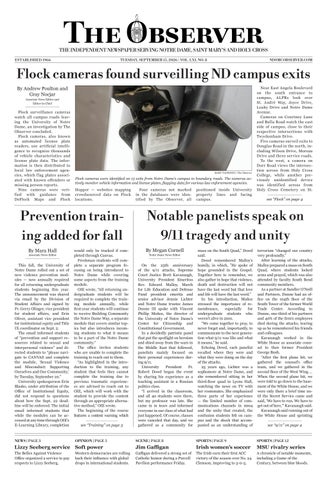
Flock surveillance cameras watch all campus roads leaving the University of Notre Dame, an investigation by The Observer concluded. Flock cameras, also known as automated license plate readers, use artificial intelligence to recognize thousands of vehicle characteristics and license plate data. The information is then distributed to local law enforcement agencies, which f lag plates associated with known offenders or missing person reports. Nine cameras were verified with guidance from DeFlock Maps and Flock
MARY TADDONIO | The Observer
Flock cameras were identified on 13 exits from Notre Dame’s campus to boundary roads. The cameras actively monitor vehicle information and license plates, flagging data for various law enforcement agencies.
Hopper — websites mapping crowdsourced data on Flock locations.
Prevention training added for fall By Mara Hall Associate News Editor
This fall, the University of Notre Dame rolled out a set of new violence prevention modules — now annually required for all returning undergraduate students beginning this year. The announcement was shared via email by the Division of Student Affairs and signed by Fr. Gerry Olinger, vice president for student affairs, and Erin Oliver, assistant vice president for institutional equity and Title IX coordinator on Sept. 2. The email informed students of “prevention and support resources related to sexual and interpersonal violence” and directed students to “please navigate to CANVAS and complete the module, ‘Sexual Violence and Misconduct: Supporting Ourselves and Our Community,’ by Tuesday, September 22.” University spokesperson Erin Blasko, under attribution of the Office of Institutional Equity, did not respond to questions about how the Sept. 22 deadline will be enforced. The initial email informed students that while the modules can be accessed at any time through OIE’s E-Learning Library, completion
would only be tracked if completed through Canvas. Freshman students will complete a separate program focusing on being introduced to Notre Dame while covering some aspects from the training module. OIE wrote, “All returning undergraduate students will be required to complete the training module annually, while first-year students will continue to receive Building Community the Notre Dame Way, a separate module that covers similar topics but also introduces incoming students to what it means to be a part of the Notre Dame community.” The office invites students who are unable to complete the training to reach out to them. “As highlighted in the introduction to the training, any student that feels they cannot complete the training due to previous traumatic experiences are advised to reach out to OIE, which will work with the student to provide the content through an appropriate alternative method,” OIE wrote. The beginning of the course features a content warning which see “Training” on page 3
Four cameras not marked in the databases were identified by The Observer, all
positioned inside University property lines and facing campus.
Near East Angela Boulevard on the south entrance to campus, ALPRs look over St. André Way, Joyce Drive, Leahy Drive and Notre Dame Avenue. Cameras on Courtney Lane and Bulla Road watch the east side of campus, close to their respective intersections with Twyckenham Drive. Five cameras surveil exits to Douglas Road in the north, including Wilson Drive, Moreau Drive and three service roads. To the west, a camera on Dorr Road views the intersection across from Holy Cross College, while another previously unidentified device was identified across from Holy Cross Cemetery on St. see “Flock” on page 4
Notable panelists speak on 9/11 tragedy and unity By Megan Cornell On the 25th anniversary of the 9/11 attacks, Supreme Court Justice Brett Kavanaugh, University President Emeritus Rev. Edward Malloy, March for Life Education and Defense Fund president emerita and senior advisor Jennie Lichter and Notre Dame trustee James Dunne III spoke with Vincent Phillip Muñoz, the director of the University of Notre Dame’s Center for Citizenship and Constitutional Government. In a decidedly patriotic panel that put the spotlight on heroism and shied away from the wars in the Middle East that followed, panelists mainly focused on their personal experiences during 9/11. University President Fr. Robert Dowd began the event by sharing his experience as a teaching assistant in a Russian politics class. “I arrived in the classroom, and all 40 students were there, but my professor was late. She came in in tears and informed everyone in our class of what had just happened. Of course, classes were canceled that day, and we gathered as a community for
mass on the South Quad,” Dowd said. Dowd remembered Malloy’s homily, in which, ”He spoke of hope grounded in the Gospel. Together here to remember, we also gather in hope that violence, death and destruction will not have the last word but that love and life will have the last word.” In his introduction, Muñoz stressed the importance of remembrance, especially for undergraduate students who weren’t alive in 2001. “We come together to pray, to never forget and, importantly, to communicate to the next generation what 9/11 was like and what it means,” he said. Echoing Dowd, each panelist recalled where they were and what they were doing on the day of the attacks. 25 years ago, Lichter was a sophomore at Notre Dame, and she remembered sitting in her third-floor quad in Lyons Hall, watching the news on TV with her roommates. She emphasized three parts of her experience — the limited number of communications channels in 2004 and the unity that created, the confusion students felt on campus and the shock that accompanied as an understanding of
terrorism “changed our country very profoundly.” After learning of the attacks, Malloy prepared a mass on South Quad, where students locked arms and prayed, which was also attended by faculty South Bend community members. As a partner at Sandler O’Neill and Partners, Dunne had an office on the 104th floor of the South Tower of the former World Trade Center. According to Dunne, one-third of his partners and 40% of the firm’s employees died during the attacks, tearing up as he remembered his friends and colleagues. Kavanaugh worked in the White House as associate counsel to then former President George Bush. “After the first plane hit, we gathered the counsel’s office team, and we gathered in the second floor of the West Wing … When the second plane hit, we were told to go down to the basement of the White House, and we were only there a brief time until the Secret Service came and said, ‘We have to run. We have to get out of here,’” Kavanaugh said. Kavanaugh said running out of the White House and sprinting
Notre Dame News Editor
see “9/11” on page 4
NEWS | PAGE 3
OPINION | PAGE 5
SCENE | PAGE 8
SPORTS | PAGE 9
SPORTS | PAGE 12
The Belles Against Violence Office organized a service to pay respects to Lizzy Seeberg.
Western democracies are rolling back their influence with global drops in international students.
Gaffigan delivered a strong set of Catholic humor during a Purcell Pavilion performance Friday.
The Irish earn their first ACC victory of the season over No. 24 Clemson, improving to 3-0-5.
A chronicle of notable moments, including a Game of the Century, between blue bloods.
Lizzy Seeberg service Soft power
Jim Gaffigan
Irish women’s soccer
MSU rivalry series
DAILY
2 | THE OBSERVER
QUESTION OF THE DAY:
TUESDAY, SEPTEMBER 15, 2026
What is your favorite type of ice cream?
Have a question you want answered? Email photo@ndsmcobserver.com
Colton Eikermann
Ethan Brown
Dante Aloi
Mary Lisa Bradshaw
Declan Sweeney
“The blue kind.”
“Sea salt caramel.”
“Cookies and Cream.”
“Chocolate peanut butter.”
“Dulce de leche.”
freshman Carroll Hall
freshman Carroll Hall
sophomore Dunne Hall
freshman Farley Hall
freshman Duncan Hall
SOCIAL MEDIA POLL
PHOTO OF THE DAY | KEVIN SANCHEZ
Have an idea for a poll? Email social@ndsmcobserver.com
How do you read The Observer?
THE NEXT FIVE DAYS
CROSSWORD | WILL SHORTZ
Tuesday Saint Mary’s Volleyball vs. Kalamazoo Angela Athletic & Wellness Complex 7 p.m. The Belles face off against the Hornets in volleyball
Wednesday Paladino Bite-Sized Art Raclin Murphy Museum of Art Noon - 12:15 p.m. Brief program exploring a piece of the current exhibition
Thursday From Michiana to the Congo Data Centers panel discussion C103, Hesburgh Center for International Studies 12:30 - 2 p.m. Rushed construction on data centers harming mining conflicts
Friday 2025-2026 SCOTUS recap Eck Hall of Law Room 1130 12:30 - 1:45 p.m. Law professors review this year’s SCOTUS decisions
Saturday Notre Dame football vs. Michigan State Notre Dame Stadium 7:30 p.m. The Irish face off against the Spartans at home
ndsmcobserver.com “TO UNCOVER THE TRUTH AND REPORT IT ACCURATELY” 900 Hesburgh Library, Notre Dame, IN 46556 Editor-in-Chief Gray Nocjar Managing Editor Grace Tadajweski
Asst. Managing Editor: Noah Cahill
Social Media Editor: Lilly Martin
Asst. Managing Editor: Zack Pohlman
Ad Design Manager: Liam Flynn
Asst. Managing Editor: Abby Hernan
Advertising Manager: Cassandra Sisk
Asst. Managing Editor: Henry Jagodzinski Notre Dame News Editor: Megan Cornell SMC News Editor: Berhan Hagezom Opinion Editor: Duncan Stangel Sports Editor: Ben Hicks Scene Editor: Peter Mikulski Photo Editor: Mariella Taddonio Graphics Editor: Liam Flynn
Policies The Observer is the independent, daily newspaper published in print and online by the students of the University of Notre Dame du Lac, Saint Mary’s College and Holy Cross College. Editorial content, including advertisements, is not governed by policies of the administration of any institution. The Observer reserves the right to refuse advertisements based on content.
The news is reported as accurately and objectively as possible. Unsigned editorials represent the opinion of the majority of the Editor-in-Chief, Managing Editor, Assistant Managing Editors and department editors. Commentaries, letters and columns present the views of the authors and not necessarily those of The Observer. Opinion space is available to all readers. The free expression of all opinions through letters is encouraged. Letters to the Editor must be signed and must include contact information. Questions regarding Observer policies should be directed to Editor-in-Chief Gray Nocjar
Today’s Staff News
Megan Cornell Matthew Morin Berhan Hagezom Mara Hall
Graphics
Ashley Zheng
Photo
Mariella Taddonio
Opinion
Sophia Anderson
Sports
Henry Lytle
Scene
Luke Foley
Editors
Gray Nocjar Abby Hernan Zack Pohlman
NEWS
TUESDAY, SEPTEMBER 15, 2026
THE OBSERVER | 3
BAVO honors Lizzy Seeberg with annual service By Sophie Lewandowski Staff Reporter
16 years following the death of Lizzy Seeberg, the Belles Against Violence Office coordinated their annual prayer service in respect to her life for the third consecutive year on Thursday. Behind the large bushes that line the path parallel to Riedinger House, students sat in chairs, listening quietly to hymns, speeches and prayers. Seeberg died by suicide on Sept. 10, 2010, after her criminal reports of being sexually assaulted by a Notre Dame football player were dismissed by police and administration, and she was accused of lying. Five days after her death and 15 days after she had submitted the report, the accused football player, Prince Shembo, was approached for questioning, according to an article by the National Catholic Reporter. Shembo was never convicted of a crime or faced punishment. The service began with an opening prayer and the reading of a poem. Liturgist and music director Erin Taylor
led attendees in the singing of Psalm 23. Students participated in intercessory prayers for the campus community and survivors of sexual assault, violence and suicide. BAVO coordinator Mallory Lipps then gave each attendee f lowers to place beside the bench marking Seeberg’s memorial site. Taylor performed as students placed f lowers alongside it, leading to quiet ref lection. BAVO student coordinator senior Anna Ivezaj shared that about half of attendees were familiar with Seeberg’s story. She believes holding the memorial acknowledges the memories belonging to those who remember Seeberg but also allows a new group of students to learn about who she was. “So it’s both an experience of being able to honor her but also to learn about her as well and to carry on her traditions,” she said. The service not only serves as a chance for students to encounter Seeberg’s life and story as the service also serves to acknowledge the experiences of those who have are
survivors of violence. “A lot of times we talk about survivors, but they’re also victims of sexual assault. And in this, we wanted to hold space in this specific memorial for the other victims of sexual assault or interpersonal violence and suicide,” Lipps said. Sophomore Estela Mendez attended the memorial to support her friend — a leader in BAVO who helped organize the event. According to Mendez, though, the service led her to think a lot about community and the actions and conversations that are held within it. “I’ve just been thinking about sisterhood recently. I loved how they mentioned it’s been 16 years since it’s happened, and it kind of [caught] me by awe how we’re all so connected,” Mendez said. ”And they still put in so much work and effort for all the victims of violence, and I think it really just inspires me.” According to Lipps, Seeberg’s story allows members of the Saint Mary’s community to expand conversations on sexual violence and assault. Seeberg is an inspiration for some of BAVO’s initiatives, including
SOPHIE LEWANDOWSKI | The Observer
Students listened to liturgist and music director Erin Taylor perform a closing hymn at Lizzy Seeberg’s memorial service while laying flowers.
Take Back the Night and several peer education programs. “A lot of victims don’t like to speak up, which is valid. I think it [the memorial] builds a comfortable space for those who have been affected by anything to do with violence, and I think it builds a safe space in Saint Mary’s and lets everyone know that they are heard,” Mendez said. Ivezaj shared she hopes the service reminds students they are not alone.
“I hope one thing you take is that you are truly never alone. I feel especially in college, you move away from [your] home, you find new people that you’ve never met before, that you tend to find yourself being lonely,” Ivezaj said. ”Though, there’s always sources on campus that are able to help you and that you’re truly never alone with anything in life.” Contact Sophie Lewandowski at slewandowski01@saintmarys.edu
Speakers address election trends before midterms By Gracie Shea Reporter
The Rooney Democracy Institute and the Democracy Initiative at the University of Notre Dame cosponsored a panel titled, “American Democracy and the 2026 Midterms” on Friday afternoon in Jenkins and Nanovic Halls. The forum was held in accordance with the upcoming midterm elections on Nov. 3. Speakers included former talk show host Chris Matthews, Princeton politics and public affairs professor Frances Lee and former U.S. ambassador and diplomat to the Holy See Francis Rooney. Matthew Hall, the institute’s director, moderated the panel. The panel began with an evaluation of Republican and Democratic party strategies going into the midterm elections.
Training
Continued from page 1 reads, “This course contains descriptions and dramatized scenarios of sexual violence, coercion, and harassment. No explicit images or language are used.” The warning continues, “If you are affected by any of the material in this course, there are resources and support services available to you. Access information about resources and support at equity. nd.edu/resources or by navigating to the end of this course.” The platform prevents the modules from being completed out of chronological order.
Concerning the Democratic party, Lee noted recent elections have favored progressive candidates over traditional or moderate Democrats. As a consequence, she predicted there would be greater factionalism and potential conflict within the Democratic party. “It will have the effect of increasing factions in the Democratic parties ... It will be difficult to come together under President Trump,” she said. “But it will have consequences should the Democrats retake the president’s seat after 2028.” Regarding the Republican party, Matthews spoke on Trump’s strong influence over the party’s members and its impact on Congress as a whole. “The Republicans are just hiding under a mask of Trump, and our system can’t work that way. It’s a collaborative system of people who
put the non-public interest above the public’s,” Matthews said. The panel also addressed concerns about election security. Due to the high-stakes nature of elections, Lee remarked these concerns made sense. “There’s a reason why we pursue mid-cycle gerrymandering or redistricting, whereas that’s not historically normal,” she said. However, Lee shared despite these issues, the American public has not moved an unfavorable opinion on voting. “President Trump has been denouncing American elections since he came on the stage, and it hasn’t put the aggregate public opinion that much on that. Still about 57% of people believe the votes counted actually. It’s not really different than it was in the early part of the 21st century,” Lee said.
Matthews also noted the apparent lack of evidence for election fraud being committed as highly as the Trump administration suggests. “I’ve always been proud of the fact that we have fair elections in this country,” he said. Matthews acknowledged concerns over undocumented immigrants casting votes and shared there should be minimal worry about it. “Foreign people, illegal people don’t vote in this country. I don’t know why people would risk going to any public institution and declare themselves as voters,” Matthews said. He highlighted that Trump never brags about the 2024 election and instead consistently emphasizes his loss of the 2020 election. According to Matthews, this strategy is aimed to “keep the voters angry.”
Rooney described the political battle over immigration as “alienating.” “The American people have a sense of fairness,” Rooney said. “No one wants to have innocent people, especially children and women, rounded up.” The panel concluded with a message for younger and first-time voters on how they should approach the midterm elections. “I feel like the landscape will be very different,” Lee said. “We shouldn’t blame young people for taking time to get interested in politics.” Lee cited the increase in “dormant” campaigns in which constituents feel a lack of political efficacy.
Last school year, Notre Dame had multiple reports of sexual abuse, including a rape in Jordan Hall of Science in which no suspect has been apprehended and three sexual assault reports made to the Notre Dame Police Department involving the same individuals in the month of March. Currently, McGlinn Hall rector Elizabeth Greenop is on leave while the University investigates sexual misconduct allegations. This summer, the University released the results of an external evaluation, authored by Helen Cantwell from the law firm — Debevoise & Plimpton, into accusations against former Zahm Hall
rector Fr. Thomas King. The results of this investigation secondarily uncovered misconduct by Fr. David Porterfield, former rector of Sorin College. This report sparked a wave of policy and practical implementations, including a policy on “Handling Reports of Sex-based Misconduct or Violence Against Students by Persons in Positions of Trust” to provide coordination regarding sharing reports between Notre Dame and the Congregation of Holy Cross, reporting requirements to the Board of Trustees and a reaffirmation of educational programing. “The OIE Prevention, Outreach,
Education, and Training (POET) team developed the module in response to feedback from students and in further support of University President Fr. Bob Dowd’s commitment to students to expand annual educational programming,” OIE wrote, discussing the new modules. “The module contains information specific to the Notre Dame community as well as generalized content originally created by Active* Consent, a consent education and research program based out of the University of Galway in Ireland.” The email concluded by noting, “No single individual or group — whether students, faculty, or
administrators — can solve the deeply troubling issue of interpersonal violence alone, but together, we can continue our efforts to fulfill our mission to honor the human dignity of each individual and create a community where we all can flourish. Thank you for joining us in this shared aspiration.” OIE did not respond to questions about module requirements for staff. Olinger did not provide comment. Oliver deferred a request for comment to Blasko.
Contact Gracie Shea at gshea@nd.edu
Contact Mara Hall at mhall27@nd.edu
NEWS
4 | THE OBSERVER
Flock
Continued from page 1 Mary’s Road — connecting the University to Saint Mary’s College. Other previously unf lagged cameras were found at Wilson Drive, Moreau Drive and a service drive leading into the Gold Lot used for football games. “The City of South Bend and/or St. Joseph County can answer questions about the off-campus use and location of Flock and other security cameras,” University spokesperson Erin Blasko wrote in a statement to The Observer. Blasko did not respond to questions regarding the cameras’ purpose on the University’s campus, who installed them and whether the Notre Dame Police Department has access to their data. NDPD deferred questions to Blasko, while South Bend Police Department did not respond to multiple requests for comment. Blasko also referred to a university statement sent to The Observer in January. “We make a comprehensive and multi-layered approach to security, which includes CCTV, a professional public safety force, student-led safety programs, and advanced communications technologies,” part of the statement read. “CCTV is part of our approach and is
9/11
Continued from page 1 through Lafayette Park is “seared in [his] memory.” He also spoke of Flight 93 and the bravery of the passengers who prevented death and destruction in Washington D.C. It is not known whether Flight 93 was destined for the White House or the Capitol. Beyond their initial shock, the panelists recalled how grief and sadness gave way to American unity and resolve in the days and weeks afterward. 30 days after the attacks, Malloy visited Ground Zero as a guest of the New York police and fire departments. He recalled being at the first precinct and interacted with police officers and individuals who shared stories. “This was not a one-day event for Notre Dame or for me,” Malloy said. “It was an event that went through weeks and months, and many Notre Dame people were able to visit [Ground Zero] and get a sense of what happened there.” As the only surviving senior executive at Sandler O’Neil, Dunne described dealing with “left-hand issues” that involved continuing the business and “right-hand” issues that stemmed from the tragedy. He shared he could not remember being himself following the event. “Those were tough conversations because you saw everything in humanity. You saw the best,
TUESDAY, SEPTEMBER 15, 2026
a best practice across higher education and business. As a matter of public safety, we do not publicize where cameras might be located. We have adopted strict guidelines around how any footage is used, which ensures that access to footage is restricted to authorized personnel for official use only and carefully balances campus safety and privacy.” CCTV cameras, which operate in a closed-loop system to transmit and store security camera footage for a specific organization, differ from newer surveillance systems like Flock cameras. Mariella Taddonio A f lock camera located next to a CCTV camera Multiple identified Flock cameras were found beside existing security cameras. An ABC57 article in August 2025 reported that SBPD has used Flock Safety’s technology since August 2021, when 45 were installed throughout the city. The article stated the number of cameras had since increased. At the department’s second quarterly safety meeting in 2025, assistant chief Dan Skibins reported that Flock had been used to successfully find an abducted 2-year-old following an abduction. The case was one of 80 cases involving Flock cameras in the first six months of 2025. St. Joseph’s neighboring counties have begun
terminating their relationships with Flock Safety, including Starke, Kosciusko, Noble and Marshall — all this week. The counties cited concerns with data privacy, souring public opinion and vandalism. Flock Safety, once a relatively anonymous presence among the nation’s surveillance apparatus, has faced a plethora of backlash in recent months.
NPR reported in August that cameras had been vandalized in at least 36 states. Reporting from The Washington Post describes a pattern of law enforcement using Flock Safety as a stalking tool. This was most recently highlighted when a San Jose police officer was fired after using Flock data to notify a domestic violence suspect of a victim’s whereabouts.
The Observer was unable to verify how Flock cameras are being used at Notre Dame. It is unclear with whom the data, if actively collected, is being shared and if that data has been used for any law enforcement purposes.
you saw the worst and you had to absorb it all, and it was a very difficult reality,” Dunne said. Kavanaugh recalled how “grief turned to resolution” in the White House and urged students to watch Bush’s address at the Washington National Cathedral, spoken three days after the attacks. While the White House was surrounded by legal work and focused on rallying the country after the attacks, Kavanaugh recalled the president throwing the first pitch at Yankee Stadium. Kavanaugh mentioned it provided “a message to Al Qaeda and a message to our country as well.” Lichter remembered Notre Dame hosting U2 a month after, the first show of what would become the band’s 9/11 tribute tour. Five million people watched the concert via livestream, and the band flew out first responders from New York City and brought them on stage during the last song of the show. For students and young people in attendance at the lecture, Dunne stressed the importance of “preparing early” for inevitable crises. He credited his family, his Notre Dame education and Catholic faith for giving him the resiliency to handle the aftermath of the attacks. “You have to have a moral fiber. That’s why Notre Dame is the greatest school in the world, because it teaches the entire person. The academic rigor, the athletics, the moral education prepares you
for when things go bad, and they will go bad,” Dunne said. Attendees responded with a round of applause. Lichter echoed Dunne’s advice. Speaking of a conversation in which a student asked how to “never forget” 9/11 without having experienced the event, she emphasized “9/11 is part of our story because it’s part of the story of the nation.” “Part of what we’ve tried to do today is arm you with stories that can become part of your own remembrance of 9/11 that you can share in the future. I think that’s part of our responsibility as citizens,” Licther said. Muñoz took one question from the audience, asking panelists how the “consensus that the Iraq War was largely mistaken impacted our understanding of 9/11.” Kavanaugh responded, saying the “Iraq War was distinct from September 11” and routed the conversation back to American unity. “Wars are difficult and when you’re losing life, the popularity is going to diminish somewhat, but I don’t think that should change our understanding of the unity in the wake of September 11,” Kavanaugh said. Kavanaugh also mentioned the need to confront threats abroad that can impact the United States as he noted the large bipartisan approval for the Iraq War. Malloy cautioned students from “rushing to judgement” about the Iraq War and conflict
in the Middle East. He said his travels to the Middle East inform his perspective on the issue and encouraged students to “appreciate the complexity of the world,” so they can “be informed in these hard decisions that people have to make.” Outside of comments Lichter made about the Iraq War impacting study abroad and the number of veterans in her generation, these remarks were the only discussion of the conflict that followed 9/11. To conclude the event, Muñoz asked panelists to share how they were changed by the events and what students should take away from them. “When I hugged my children and remembered that Chris, Herman, Tommy, Jimmy, none of these guys could hug their children anymore, the intensity with which I hugged them was greater. My son said today, and Peggy Noonan, I think wrote it, ‘A crisis is the world’s greatest editor,’” Dunne said. Lichter assigned students a few “pieces of homework,” including reading the New York Times’ “Fighting to Live as the Towers Died,” The New Yorker’s, “The Real Heroes are Dead” and The Atlantic’s “The Man who Refused to Sit on The Sidelines,” which profiles New York firefighter Kevin Dowdell. “These are difficult and sad pieces to read, but it was a difficult and sad day,” Lichter said. “A big part of how we honor these
voices is to remember their specific names and their particular stories.” Malloy reflected on the power of prayer, the Eucharist and Mass on South Quad, which he said was “beyond anything [he’d] ever imagined.” Kavanaugh also said the events strengthened his religious faith. “Matthew 25 is something I think we all grew up with, helping people in need. To connect it to September 11, the people, the firefighters rushing up the stairs, the people helping the disabled person down 68 flights, the red bandana, Father Judge, all the stories,” he said. To honor these role models, Kavanaugh told students to “take advantage of our opportunities to make the country stronger and better, to get involved and to remember the great humanity and the great shared values that we have as Americans, even in the divisions.” The Jeanie Poole O’Shaughnessy Memorial Lecture was established by Patrick O’Shaughnessy and the CCG in 2022, following the unexpected death of Notre Dame cheerleader and alumna Jeanie Poole O’Shaughnessy. Previous speakers include Supreme Court Justice Amy Coney Barrett, Florida Governor Ron DeSantis and Secretary of State Mike Pompeo.
GRAY NOCJAR | The Observer
A Flock camera adorns a lamppost on Notre Dame Avenue near the south end of campus on Sept. 14, 2026. The surveillance device, pointing toward the Dome, was located over 130 yards within campus borders.
Contact Andrew Poulton at apoulton@nd.edu and Gray Nocjar at gnocjar@nd.edu
Contact Megan Cornell at mcornell@nd.edu
OPINION
TUESDAY, SEPTEMBER 15, 2026
THE OBSERVER | 5
Who still believes in soft power? By Maria Eduarda Grill Columnist, “Below the Dome”
At a panel on American universities and international development hosted by the Center for Strategic and International Studies, Purdue University President Mitch Daniels told a story about a dinner in Taiwan. He had just taken the job and was meeting with a group of the university’s oldest alumni, seated around a rounded table. Someone suggested they go around and introduce themselves. Daniels described what happened next: One man said he had built the country’s ports. The next said he built the railroads. Another, the highway from Taipei out to the coast. Another, the water system. By the time they had gone all the way around the table, it felt like there was nothing built in the country that a Purdue graduate hadn’t touched. Nobody planned that. Purdue didn’t send engineers to Taiwan in the 1960s with a strategy memo. It sent students who happened to study there, went home and spent their careers building the country their degrees had prepared them to build. Sixty
years later, that turned into something political scientists would describe as soft power. Soft power is a term Joseph Nye created in the late 1980s as the ability to persuade others through attraction and persuasion. Nye would often come back to the example of education. Nye argued that higher education leaders could build American soft power by expanding international student and cultural exchange programs. He told Congress that exchange students go home with a better opinion of the country they studied in and the people they met while there. That inf luences the version of a country a person carries home with them, and then spends a career acting on. That story carried real weight for decades. Even a president not known for soft power idealism made the case for it. George H.W. Bush once said “International exchanges are not a great tide to sweep away all differences, but they will slowly wear away at the obstacles to peace as surely as water wears away a hard stone.” It’s worth wondering whether that kind of patience still has a place. The United States isn’t
ASHLEY ZHENG | The Observer
pulling back alone. Australia has tightened its student rules in recent years, capping new enrollments and raising financial and Englishlanguage requirements after years of treating international students as one of its top export industries. Parts of Europe are moving the same direction, with the U.K.’s post-Brexit changes making PAID ADVERTISEMENT
it harder for international graduates to stay and work, and other countries following with restrictions of their own. A bloc of Western democracies is simultaneously deciding that the open door needs a smaller opening. China, meanwhile, is telling a different story. According to Global Student Flow data, its international student
population dropped sharply during the pandemic but is projected to recover this year and climb to roughly 550,000 by 2030. Much of that growth is deliberate: China’s scholarship diplomacy funds international students, largely from countries tied to its Belt and Road Initiative, betting on the see “Influence” on page 6
2026 Dean’s Speaker Series:
Domenico De Sole
retired chairperson of TOM FORD International, former President and CEO of Gucci Group
Managing a World Class Business: The Intersection of Fashion and Finance 12:30 – 1:30 p.m. Friday, September 18 Jordan Auditorium Mendoza College of Business
Watch the House of Gucci Movie!
Lecture is free and open to the public.
Available on streaming platforms
The Dean’s Speaker Series is sponsored by the Eugene Clark Distinguished Lecture Series endowment.
OPINION
6 | THE OBSERVER
Influence
Continued from page 5 same theory Nye described decades ago. So the question worth
sitting with is who still believes soft power works, and what that belief is being replaced with. Western countries spent the back half of the 20th century building inf luence through attraction, and
the last several years have looked more like a turn toward tighter borders, tariffs and a more transactional read of foreign relations. Whether that’s a permanent shift or a passing mood is hard to
TUESDAY, SEPTEMBER 15, 2026
say from the inside of it. What’s clearer is that the tool built slowest, over generations, is the one being reconsidered first. The views expressed in this
column are those of the author and not necessarily those of The Observer. Write to Maria Eduarda Grill at mgrill@nd.edu
25 years later: remembering 9/11 By Duncan Stangel Opinion Editor
In 2001, the competitive reality television show “Murder in Small Town X” failed to take America by storm, as many of its contemporaries had done. Ten contestants were brought to a town called Sunrise, where everyone else was acting out a murder mystery in real time. It was shelved, sold off and canceled again before being lost to more popular media. Beneath the clunky game design, ten ordinary Americans, ranging from deli owners to office workers to firefighters, showed what normalcy looked like — adult, but existing in a naive bubble, where an entire town was their mystery to solve. Each episode, one was “killed” off by the fictional serial killer. An honorable family man named Angel Juarbe Jr. won on Sept. 4, 2001. I wasn’t alive for the events of Sept. 11, though my parents and teachers thought wistfully about the days when the biggest worry was California Rep. Gary Condit’s missing mistress or the reunification of the Jackson 5 the night before. It was America. And Sept. 11 was just another morning. Until it wasn’t. I live about an hour and a half away from Shanksville, Pa. It’s a tiny town in Pennsylvania where the fourth plane was grounded in a field when the passengers stormed
LIAM FLYNN | The Observer
the cockpit. It is believed that it was destined for the Capitol Building or the White House. Instead, the divot exists in Pennsylvania, where a museum was erected. I visited in eighth grade, months before the COVID-19 pandemic. It was a somber place, where you could listen to phone calls made by people who were going to die. Yet, they made the brave choice anyway, and when passenger Todd Beamer said, “Let’s roll,” a flight attendant’s cart slammed against
the cockpit door with such force that the hijackers put the plane into the ground. “Let’s roll” even has its own Wikipedia page. The rallying cry became one of payback, as thousands of Americans were sent to forever wars in two countries. Some blame poor planning. Others blame the nefariousness of corporations or “the elite.” The American response to 9/11 is now almost as historically impactful as the day itself. In my world, I
have seen politicians ranging from Vice President JD Vance to disgraced former Maine Democratic Senate nominee Graham Platner decry the war and what they saw. Elevated cancer rates and health maladies for American veterans hang in the air two decades after the endless horror and violence. This act of terrorism put this country on a new trajectory, one where threats were at our doorstep and our supposed friends could be plotting our
downfall. It led the United States to make many decisions — good and bad — as it sought recompense for the 2,977 victims that day. There have been wars, invasions and memorials. Many have wept, and others have raged. No one has been the same since, even as those of us who are students at Notre Dame now have no collective memory. The events of that day radiate through our very being, and that sense of fear is still very common across the country. Angel Juarbe Jr. won $250,000 on “Murder in Small Town X.” One week later, he ran into the Marriott World Trade Center hotel, where he was crushed by falling debris. He was found weeks later. Even the winner of one of America’s new little television games was not immune to terrorism. As I think of him and 2,976 others today, I remember that America is a country to be loved and cherished. Not because it is perfect, but because together we have survived the darkest storms and brightest days. The views expressed in this column are those of the author and not necessarily those of The Observer. Write to Duncan Stangel at dstangel@nd.edu
The senior moment: enjoy your last year By Abby Hernan Assistant Managing Editor
A year ago today, I was abroad in London, taking a beautiful walk across the Thames to class and preparing for my first weekend trip to Spain. When I look back at my time abroad, I remember getting to see Michelangelo’s David in Florence, trying paella in Madrid and getting to walk through the National Gallery in between my London classes. Now I am a senior, and I am back at Notre Dame. I am a political science major, but I took physics abroad and enjoyed it. So, I decided to take general chemistry this semester, which is a majority freshman class. When I walk from my lab in Jordan Hall and get to my senior thesis class in Jenkins-Nanovic, the atmosphere is completely different. Maybe it is the comfort that comes after being somewhere for four years, but there is a fervor that is lost compared to the freshmen who have their whole college career ahead of them. However, I think this difference
comes from more than just comfort and experience. It comes from the same feeling that I had abroad: curiosity. In Europe, I was eager to try and do everything I could: every museum, every play and every restaurant. When I am on Notre Dame’s campus, I do not get the same feeling. It is not that Notre Dame’s campus does not have much to offer because it very much does, but it is the fact that I feel like I need to figure out my life beyond Notre Dame. In chemistry, I hear people introduce themselves to each other, talk about joining new clubs and figuring out where they want to go abroad. When I sit down in my thesis class, I hear about graduate school applications, finding a job or even figuring out what they want to do with the rest of their lives. It is natural for there to be a difference in attitudes between two people in different phases of life, but what if it did not have to be? Some seniors leave college mentally before they leave it physically. The stress of the future looms over their heads way before they put
LIAM PRICE | The Observer
their graduation cap on. While it is important to plan ahead, it is also important to take some time off and explore the campus you have to leave soon. Take a walk through Raclin Murphy, try a new coffee at Cafe J, go to a dorm’s Mass you have not been to before and stay present. A study published in 2020 tested the effect of treating a weekend like a vacation and found that it can increase happiness with exploratory
analyses citing increased attention to the present moment. This shows that a simple change in mentality can turn a weekend of stress and applications into a much-needed mental break. As seniors, we need to remember to stay in the moment. The future is near, but it is not here yet. Just like a junior stepping off the plane at Heathrow and a freshman trying to learn the names
of their classmates, take a second to be curious and explore. We are here before we are there. The views expressed in this column are those of the author and not necessarily those of The Observer. Write to Abby Hernan at ahernan@nd.edu
TUESDAY, SEPTEMBER 15, 2026
PHOTO
THE OBSERVER | 7
Notre Dame vs. Rice Notre Dame Fighting Irish faced the Rice Owls on Sept. 12, 2026, the Irish won 52-0. Photography by Kevin Sanchez and Lina Liu
SCENE
8 | THE OBSERVER
TUESDAY, SEPTEMBER 15, 2026
Jim Gaffigan delivers strong set of Catholic humor By Harry Penne Scene Copyeditor
The University of Notre Dame and a mainstream Catholic comedian who is unafraid to discuss and joke about his faith: It was a match made in heaven. On Sept. 11, 2026, comedian Jim Gaffigan performed a stand-up set at Purcell Pavilion as part of his “Everything Is Wonderful” tour. Gaffigan is one of the best-known contemporary comedians, with three Emmys to his name. The stage design was fairly standard for a stand-up show: Colored lights illuminated the back of a stage populated only by a microphone, a stool and the performer. Video boards were on either side of the stage, allowing individuals in the nosebleed sections, like myself, to clearly see the performance. The evening began with an opening act from special guest Ted Alexandro. Alexandro’s set was an enjoyable icebreaker. His best material drew from his experience teaching middle school students the recorder, or “Satan’s little f lute,” as he called it. Nothing in his act was truly exceptional, nor was anything egregious; it did its job of loosening up the crowd for Gaffigan. I honestly struggled to hear the opening act at some points. This was due to several factors: His microphone was
not loud enough, people were still looking for their seats and members of the audience were chatting with each other. Purcell also only put the lights at half level, which, while commanding audience attention, is not as effective as full darkness. When Gaffigan came on, the venue seemed to fix the audio issues as well as turn off all of the arena lights. Gaffigan’s set was overall very funny. He began with some Notre Dame-related commentary, including his accurate prediction that the Irish would beat Rice at Saturday’s football game. He commented that American Catholics seem
to love three things: Notre Dame, alcohol and, secretly, funerals. He also noted his Hoosier heritage, explaining how he grew up in Northwest Indiana, not too far from Notre Dame. A decent portion of his set was devoted to anecdotes about the struggles of raising teenagers, providing some very good observational comedy. His delivery and content were similar to some of his previous material, but this time, it felt more grown-up, ref lecting his current parenting stage. An area of particular emphasis in the act concerned social media woes.
ASHLEY ZHENG | The Observer
Easily, my favorite bit of the night was his material on being an extraordinary minister of Holy Communion and how he didn’t want to assume the role in the first place but was forced into it by his wife. Unsurprisingly, this material seemed to sit especially well with the Notre Dame audience. For a closing bit, it was a strong sendoff. Gaffigan has a fantastic stage presence, and I enjoyed his delivery style. He used his signature voices and accents well, and his timing was great. There was no crowd work, but that is not surprising given the size of the venue.
By and large, his material was good. There weren’t any parts where I thought a bit ran its course or was uncomfortable. There was also no overreliance on profane or blue content, which was refreshing. Gaffigan hit many of his standard tropes: Catholicism, family, introversion and food. He even made references to some of his older bits, referring to himself as the “Hot Pocket guy” at one point. My biggest critique: I wish the set had been longer than an hour. I enjoyed the material thoroughly and would have liked more. I was also surprised that Gaffigan didn’t do more Catholic-related content; if there’s a venue for it, Notre Dame is the place. The timing was also quite strange given that it fell during an already busy home-opening football weekend. Coming off of AC/DC exactly one week prior, hosting another big-name talent seemed more suited for the spring semester. Regardless, I am glad the University hosted a stop on the tour. All in all, I thoroughly enjoyed Jim Gaffigan’s performance at Purcell Pavilion. He delivered his routine well, with fresh topics and legitimately funny material. I would recommend catching a live performance or, if the show ends up being recorded, listening to the album. Contact Harry Penne at hpenne@nd.edu
With great power, comes great loneliness By Isabela Garza Sanchez Scene Writer
“With great power, there must also come great responsibility,” were Aunt May’s final words in the 2021 film “Spider-Man: No Way Home.” The quote, originally written by Stan Lee for the narrator’s closing caption of “Amazing Fantasy #15” in August 1962, was later attributed to Peter Parker’s guardian, Uncle Ben, in the 2002 film “Spider-Man.” The message is simple: If you have the ability, strength or resources to help others, you have a moral duty to use them for good. But “SpiderMan: Brand New Day” has a different theme — with great power, there must also come great loneliness. In the film, Peter Parker, excellently portrayed by Tom Holland, grapples with this new reality and the burden of his powers while still trying to be “your friendly neighborhood Spider-Man.” Between epic fight scenes, tragic antagonists and new (as well as old) relationships, the story redefines traditional
heroism: self-sacrifice when no one remembers who you are. In the third film, Peter realizes the only way to prevent reality from collapsing is for everyone, including his best friend Ned (Jacob Batalon) and girlfriend MJ (Zendaya), to forget who he is. And so, sorcerer Doctor Strange (Benedict Cumberbatch) casts a spell, sending the multiversal characters back and erasing Peter from everybody’s memory. With this, Peter plans to reintroduce himself to his friends but ultimately decides not to, as the danger that follows him will always compromise his friend’s safety. When the film came out in 2021, it was argued that it was the uppermost agony Parker has faced after losing his second father figure, Tony Stark, in the 2019 film “Avengers: Endgame.” While that statement might have been true in the moment, the fourth adaptation has escalated the recurring tendency of making Peter’s life even more miserable. In the newly historic
blockbuster, grossing over $2.4 billion worldwide and ranking as the third highestgrossing movie of all time, “Spider-Man: Brand New Day” shows us a new version of the adored superhero. Peter, now living in a rundown apartment with Stark Industries tech, continues working as New York’s friendly neighborhood hero with the help of detective Jean DeWolff (Liza Colón-Zayas) as liaison with the N YPD while his identity is still unknown. Amid his attempt to balance his superhero life with mental turmoil and amplified Spidey powers, Marvel has given us a much-yearned-for film that goes beyond immersive cinematography and dynamic fight scenes: We see what it means to be exceptional. In a world obsessed with greatness, people sometimes forget what it truly means to be one of the greats. The list includes what one would expect when in search of success: sacrifice, determination, consistency. But most forget what it truly means to be at the pinnacle of excellence. It is lonely up
on the mountain of excellence due to hardships few are willing to endure. Not only is this the sole reason Peter finds himself in isolation, but fear of hurting his loved ones adds to the turmoil up until he meets the troubled Jean Grey (the Sadie Sink version). As one of the strongest mutants alive, Jean Grey has been played by Famke Janssen in the original trilogy, Sophie Turner as the younger version in later films and now by Sadie Sink in the Marvel Cinematic Universe with a timely appearance in preparation for the anticipated film, “Avengers: Doomsday.” With a history of grief and betrayal, Sink depicts Jean as a young woman with a tragic past in search of vengeance as she torments Spider-Man with her telepathic powers, convinced that vengeance is justice. Jean mirrors Parker’s situation, but her loneliness turns to resentment rather than moral responsibility. As the film continues, some members of the audience feel a deep connection with the altered character while others
question the veracity of her fragmented life. Does a broken villain deserve sympathy? From whatever stance one may find oneself, it is agreed that Jean as well as Peter, each through their own narratives, vividly portray the sacrifice one makes in pursuit of greatness. Of course, not everybody has the privilege (or curse) of having superhuman strength, agility and Spidey senses, but one may easily identify with the core pattern within the Spider-Man multiverse. From Nicholas Hammond in the 1970s television series “The Amazing Spider-Man” to Shameik Moore voicing Miles Morales in “SpiderMan: Into the Spider-Verse” and “Spider-Man: Across the Spider-Verse,” our friendly neighborhood hero has always been a story of responsibility and resilience. But “SpiderMan: Brand New Day” asks us to think beyond: Having great power can lead to loneliness, and so the question is, what are you willing to sacrifice? Contact Isabela Garza Sanchez at igarzasa@nd.edu
SPORTS
TUESDAY, SEPTEMBER 15, 2026
THE OBSERVER | 9
ND WOMEN’S SOCCER
Notre Dame women’s soccer is back in business By Chris Dailey Sports Reporter
The Fighting Irish picked up a critical win over No. 24 Clemson on Friday night to open up their ACC account in style. Fresh off a 2-0-5 start to
“To do that, I’m proud of them.” The game started off fast. Notre Dame scored instantaneously after a direct loose ball fell into the path of junior Ellie Hodsden inside the 18-yard box. The dynamic forward was
rest of the first half. Anchored by a stellar midfield trio of seniors Chayse Ying and Charlie Codd alongside freshman Reese Canada, Notre Dame outclassed the Tigers. The pure brilliance Notre Dame showed on the ball was espe-
KEIRA JONES | The Observer
Freshman midfielder Reese Canada dribbles past a sliding defender against Clemson on Friday, Sept. 11. Canada has started every game this season and logged a full 90 minutes for the third time against Clemson.
the season in non-conference play, Nate Norman’s side aimed for a win as the team looked to bootstrap its way back into the national rankings. “We’ve been there in a few games but slipped up in the last moments or not gotten results,” Norman said postgame.
able to do enough to get her foot on the ball, redirecting it to an on-running freshman Kate Kemmerley. The forward then poked it past Clemson star goalkeeper Nona Reason to give Notre Dame the lead just 26 seconds into the match. Notre Dame dominated the
cially impressive considering Clemson’s defense only allowed two goals through its first seven matches of the season. By the end of the first 45 minutes, Notre Dame outshot the Tigers 9-1. All-American junior forward Izzy Engle
featured for a solid 20 minutes while Hodsden provided a relentless work rate up top. The second half was much different, however. Clemson appeared to be a different team as the Tigers totally controlled possession. The Irish struggled to maintain the ball as Clemson’s star-studded backline seemed to suffocate Notre Dame’s attack. The Tigers’ pursuit to equalize the game was rewarded in the 65th minute off an own goal. After Clemson senior midfielder Dani Davis whipped in a delightful corner that def lected off the back of a Notre Dame defender, the Tigers bench erupted in celebration as Alumni Stadium fell silent. The goal felt awfully similar to much of Notre Dame’s season — dominant for long stretches, only to see a result slip away in the end. This time, however, the Irish had an answer. In the 77th minute, Hodsden was tripped in the box after an insightful run forward. With Engle sidelined at that point, Kentucky transfer defender Gabi Poretto then stepped up to the spot and delivered to seal the deal for the Irish. The penalty marks the third consecutive game in which Hodsden has drawn a penalty — perhaps one of the craziest stats in all of college soccer at the moment. “I think [Ellie] is such a unique player,” Norman said. “She combines the speed, the strength and power that it’s so difficult. Defenders don’t know how to handle her because they haven’t seen anyone
like that. It’s exciting when she gets the ball, you feel like something great can happen. She’s had a great season.” Norman also commented on the freshmen who have starred all season long, especially on Friday night. Forward Bristol Kersh was lethal on the wing, taking on defenders for fun. Canada, meanwhile, displayed a calming yet tenacious presence in the middle of the park. And Kemmerley, of course, delivered one of the biggest moments of all, finding the back of the net just 26 seconds into the match. “It’s been great. [Freshman defender Gracie] Milam in the back has been great too. I think it’s a group that thought when they came in we should be a veteran team. But we’ve had so many players out and at the World Cup that they’ve had to step into bigger roles, and they’ve just been taking it,” Norman said. Notre Dame next takes the pitch on Friday night against Boston College at home. Kickoff is set for 7 p.m. From there, the Irish face a grueling away slate with trips to No. 3 Duke and No. 7 North Carolina, respectively. The Blue Devils are led by Mia Minestrella, whose nine goals have Duke f lying to start the year. North Carolina is 23time national champions and always one of the toughest challenges for Notre Dame. After a statement win over a ranked opponent, maybe Notre Dame is finally ready to prove it is back. Contact Chris Dailey at cdailey2@nd.edu
FOOTBALL
Irish finally win home opener, frying Rice 52-0 By Ben Hicks Sports Editor
If there was any doubt about Marcus Freeman’s ability to win home openers, his team was certainly unaware of that on Saturday afternoon in South Bend. After crushing defeats to Northern Illinois and Texas A&M, respectively, in the 2024 and 2025 home openers, the Irish quickly squashed any inkling of a three-prise. The Irish defense forced three first-half turnovers, all of which were converted into scores, and the Irish raced away to a 52-0 victory over Rice. Rice, which finished head coach Scott Abell’s first season at 5-8 last fall, made the trip to South Bend following an impressive 31-3 home win over Houston Christian. The Owls returned 46 members from last year’s group, which lost the Armed Forces Bowl to Texas
State. The Irish were hoping for a more assuring start than the one they produced a week ago in the Shamrock Series win over Wisconsin at Lambeau Field. Despite a slow first half that raised more questions than answers, N otre Dame dominated in the second half to tame the Badgers and open 2026 at 1-0. After the 1966 National Champions presented the nation’s colors and the Band of the Fighting Irish blared the “Victory March” to begin its 181st season, Notre Dame won the coin toss and deferred its choice to the second half. Sophomore kicker Erik Schmidt booted the ball high into the sunny South Bend sky, and football had officially returned to the cathedral of college football. On just the second play from scrimmage, senior safety Adon
Shuler snuffed out an outside handoff, laying the boom to force a fumble from running back Davis Lane. Senior lineman Boubacar Traore was quick to pounce on the loose ball, scooping it 24 yards to the house for his second career defensive touchdown, the first coming from a 34-yard pick-six during the Irish’s 66-7 romp of Purdue in 2024. The scoopand-score was also one of the fastest defensive touchdowns in program history, besting last year’s opening-minute pick-six from Jalen Stroman to commence the 70-7 drubbing of Syracuse. “It felt like a dream, but as soon as I picked it up, I knew it was real life. I don’t really do that much. Whenever the opportunity comes, I try to make the most of it,” Traore said of his return. Freeman also spoke postgame on the importance of it,
saying, “He’s back. It’s great to have his energy, his presence, the skill set, the play-making ability.” Freeman also credited the intensity of his captain, Shuler, adding, “He’s playing extremely physical. And it’s a choice to play with that type of velocity and mindset.” “Adon sets the tone. That’s just who he is. He makes a lot of big plays in the trenches,” junior linebacker Kyngstonn Viliamu-Asa said. Rice put the ball on the turf two more times on its next drive, which ended when senior linebacker Jaiden Ausberry recovered the latter of the two to set the Irish offense up at the Rice 38-yard line. Junior quarterback CJ Carr and company wasted no time, as their first action resulted in a textbook three-play, oneminute drive, punctuated by a 25-yard dart from Carr to
senior receiver Jordan Faison. Freeman noted that the game plan called for the offense to take some shots and open the playbook up more than they had against Wisconsin. “We knew if they gave us the opportunity to throw some of those deep balls or one-on-one balls, we were gonna do it,” he said. The next Notre Dame possession was a bit longer but concluded with the same result of Carr to Faison, this time on an 11-yard bubble screen. Carr, the preseason Heisman Trophy front-runner, diced through the Owl defense with surgical precision, racking up 51 yards on 4 completions to three different receivers. “He was making the right decisions and getting us in the right protections, the right checks,” Freeman said of his star quarterback. see “Football” on page 10
SPORTS
10 | THE OBSERVER
Football
Continued from page 9 Faison was sure to credit the lead blockers he followed on the score, saying, “We’ve been working that since fall camp. The dudes in front of me handle business. Couldn’t do it without them.” The barrage continued into the second quarter, as sophomore back Nolan James Jr. added 7 more via the ground game. The New Jersey native’s smooth spin move at the 10-yard line set up his 1-yard score just a play later. Later on in the frame, the Owls’ triple-option would backfire, as quarterback Jacurri Brown’s pitch was well behind the targeted offset back D’Andre Hardeman Jr. Viliamu-Asa plucked the ball while sliding out of bounds, and just two carries later, James was in the end zone for the second time. Saturday was Viliamu-Asa’s
first game back after suffering an ACL injury in the Syracuse game in November 2025. But in his eyes, he was never gone. “I feel like I’ve been here the whole time. Never left,” he said bluntly. Notre Dame punctuated its near-perfect first half with another quick scoring drive, this time created by a 38-yard punt return from Faison. Two plays later, Carr escaped the pocket while directing junior receiver Micah Gilbert away from the safeties. Carr, who ended the day completing 16 of 20 passes for 253 yards and 4 scores, hit Gilbert with a strike at the back pylon from 39 yards out to close the quarter. The Irish were perfect in the red zone and 3 for 4 on third downs, entering the locker room with an impressive 42-0 lead. The second half began the way many did back in the early 1990s, with big plays by Bettis. Sophomore wideout Jerome Bettis Jr., whose
father starred for Lou Holtz and eventually the Pittsburgh Steelers, hauled in a 56-yard bomb from Carr before being interfered with in the end zone later in the series. That penalty set up Carr’s fourth touchdown toss, a 2-yard connection with senior tight end Cooper Flanagan. Carr complimented Bettis, saying, “Unbelievable job going out there and making plays. He’s done it throughout the spring and the fall. He’s a guy we trust.” Faison agreed, stating, “It was great for the young guys to get out there because the game is a different atmosphere. It allows them to grow, and our entire room to grow.” Carr also gave a shoutout to his offensive line, which has taken tremendous strides forward following its shaky first half in Green Bay. “A group of guys we trust to be at their best week in and week out, and they’re the ultimate
TUESDAY, SEPTEMBER 15, 2026
competitors. I feel like I didn’t even play a football game the way they were protecting me out there. I don’t think I got touched all day,” Carr said. From there, freshman quarterback Noah Grubbs, who ranks second in touchdowns in Florida high school history, took over the offense. His first drive under center ended with a 36-yard kick from Purdue transfer Spencer Porath. The consensus four-star recruit demonstrated accuracy and pocket composure in his next series, which spanned 59 yards before stalling out on downs inside the red zone. The Owls nearly opened their account late in the fourth quarter, but senior linebacker Kahanu Kia stripped the hurdling Brown, with freshman lineman Rodney Dunham collecting the loose change. It was the first time the Irish forced 4 fumbles since a December 2020 win over Syracuse.
Fellow freshman Teddy Jarrard took the final drive for Notre Dame, which ended in victory formation to seal the 52-0 shutout. It was the first Irish shutout since a 44-0 snow-covered triumph over Boston College on Nov. 19, 2022, and the first homeopening blanking since 2009 against Nevada. The win also keeps Notre Dame unbeaten at 6-0 all-time against the Owls. The Irish will return to Notre Dame Stadium next Saturday, with Michigan State coming to town for the first home game under the lights of 2026. The Spartans have commenced head coach Pat Fitzgerald’s first season with two wins, but they’ve yet to begin Big Ten competition. Saturday’s showdown with Sparty is set for a 7:30 p.m. kickoff, with the national broadcast provided by NBC. Contact Ben Hicks at bhicks2@nd.edu
FOOTBALL
Collins: Wake-up call for fans, not running backs By Ellie Collins Associate Sports Editor
Notre Dame won its first two games in formidable fashion. Although expected against unranked Wisconsin and Rice, both wins showcased this team’s potential to bring championship gold to South Bend and its hungry faithful for the first time since 1988. But that conversation is, above all, monotonous. Head coach Marcus Freeman relentlessly stresses the importance of grounding his touted group in the moment. “You waste time daydreaming about an uncertain future,” he said in a March 19 press conference after the first day of spring ball. “Who cares? You should be focused on being the best
version of you.” And that is exactly what Irish fans must do, too. In the press conference following the 52-0 shutout against the Owls, I watched Freeman grow visibly annoyed by a reporter’s question about what his team must “clean up” before next week’s matchup against Michigan State. “I haven’t watched the film,” he began. The question (and Freeman’s curt response) can work as a microcosm of all the others the program hears incessantly — will this team be good enough next week? Will it be good enough in January? For Freeman, what happened Saturday is only one step in a season-long journey. The only moment is now. This week’s hot topic will undoubtedly be junior running back
Aneyas Williams’ pedestrian performance against Rice and the inadequacy it implies for Notre Dame’s backfield in future contests. Here is my admittedly presumptuous recap so you can skip all the related drivel — Williams’ stock is down. He rushed for 29 yards on only 9 carries on Saturday and looked somewhat slower and less physical than usual. How quickly it can be forgotten that he toted the rock 20 times for 90 yards and 2 touchdowns just 6 days earlier against a physical Wisconsin defense. Last year, the talk about the running game focused on not only the big-play heroics of Jeremiyah Love and Jadarian Price but also the inability to consistently convert in short-yardage situations
KEVIN SANCHEZ | The Observer
Sophomore running back Nolan James Jr. finds a running lane against Rice on Sept 12, 2026. James Jr. rushed for 2 touchdowns in the 52-0 victory, setting a new career high after a receiving touchdown against Wisconsin.
and Price’s penchant for red-zone fumbles. Now, it revolves around Williams’ failure to resemble either legend, both making their mark as NFL rookies. He is a different type of back who excels at pass protection, receiving out of the backfield and physical running between the tackles. All said, the memories of explosive runs Williams cannot seem to rekindle for fans are ones they should not expect. (The last time I checked, Love and Price did not win a title. But the Indiana running back did. What was his name again?) Each season is different. Love and Price allowed first-year starter CJ Carr to develop in an offense where opponents keyed on the future first-round NFL Draft picks. This year, the seasoned signalcaller will allow Williams and the rest of the room to develop as they take on new roles. That is how you enhance an already good team and make it great. Though Irish fans want a finished product in the opener, truth be told, programs cannot win championships in September, but they can lose them by not continuing to improve. Freeman has proved that his teams get better throughout the year. And as of now, the offense has done its job. In fact, it currently ranks first in the country in ESPN’s tempo- and opponent-adjusted measure of efficiency. As for those 2025 shortyardage struggles, Notre Dame has converted on an impressive 8-of-10 runs in short-yardage situations. The first order of business for the running backs this season is to ensure the offense maintains possessions and lets Carr work his magic. Before all is said and done, I believe the Irish running game led by Williams will be more than good enough by season’s end. Sophomore Nolan James Jr. boasts elite skills as a receiver, and watch
out for lightning-fast freshman Jonaz Walton, who flashed big-play potential against the Owls. The failure to “live in the moment” among the fanbase also showed itself in the student section’s attitude toward an infamous opponent. Chanting “F*** Miami” late in the fourth quarter against an outmatched Rice team is embarrassingly unbecoming for a few reasons. First, let Miami think about Notre Dame. Notre Dame should think about Miami the week of Nov. 7. If you need evidence, look no further than the Northern Illinois loss in 2024 after the huge win over Texas A&M. This misstep put the Irish in must-win mode the rest of the season, something Marcus Freeman hopes to avoid this year. I would rather pretend to be a Michigan fan and storm the field against a MAC team than give a classless display to fixate on — of all programs — the Hurricanes. Let the storm that is coming on the first Saturday of November brew. One can only hope that the team does not have the same attitude as its student section. As underscored by Oregon’s loss to Oklahoma State, nothing in college football is certain (except the Wolverines getting unfair calls). Nobody knows what will happen next week, much less on Nov. 7. Often, a potential season deemed “the year” is wasted by focusing on the result instead of the process. “We are in a race against every team in the country to improve,” Freeman said Monday. “Who can improve faster? That’s the challenge.” The end of the season will arrive soon enough, even if it is in late January. Bring on the Michigan State Spartans. Contact Ellie Collins at ecollin9@nd.edu
SPORTS
TUESDAY, SEPTEMBER 15, 2026
THE OBSERVER | 11
FOOTBALL
Led by Faison, Irish receivers impress to start By Ben Hicks Sports Editor
If there was any position group from the historically efficient 2025 Notre Dame offense to examine under the microscope and criticize, it would be coach Mike Brown’s wide receivers. Of course, with the greatest running back duo in modern college football history and reliable options at tight end, now-junior quarterback CJ Carr didn’t need to heavily rely on the wideouts. With Jeremiyah Love and Jadarian Price, both heads from that savage backfield monster gone to the NFL, as well as starting tight end Eli Raridon, head coach Marcus Freeman had to find Carr some new shiny toys. To do so, he circled the receivers’ position. It wasn’t that Notre Dame receivers were uncharacteristically poor in 2025; the position group was just buried at the bottom of the list of successes for a good team. It didn’t help that two of the room’s greatest contributors, Malachi Fields and Will Pauling, have now moved to the NFL ranks, suiting up on Sundays for the New York Giants and San Francisco 49ers, respectively. In fact, all returning Notre Dame receivers combined to finish 2025 with just 69 receptions for 888 yards and 5 touchdowns. That figure pales in comparison to the total produced by Fields and Pauling alone. When you consider that of the above total, 49 catches, 640 yards and 4 scores were accounted for by now-senior receiver Jordan Faison, the outlook heading into this fall
seemed even more bleak. To begin filling out the receivers room, Freeman and Brown began internally. Faison, a starter on Notre Dame’s 2024 National Championship lacrosse team, directed his attention solely to the gridiron this spring. That decision paid off, with Faison becoming the rare former walk-on to earn captaincy when he was named among the Irish’s four on-field leaders. “It’s the greatest honor I’ve ever had in my life. Going out there to lead for them, they make my job easy because they go out there every day wanting more,” the Florida native said. While he was the only highproducing pass catcher to return to Notre Dame, he wasn’t the lone high-profile offensive weapon. Senior Jaden Greathouse, who starred during Notre Dame’s run to the national championship game in 2024, is back and healthy following an injury-plagued 2025 season, which saw the Texan appear in just 4 games, making only 4 catches. From there, Freeman, Brown and general manager Mike Martin hit the transfer portal hard. When Brian Hartline, a collegiate teammate of Freeman and the architect of the sport’s greatest receivers factory, left Ohio State to become the head coach at South Florida, the Irish plucked two of the Buckeyes’ most prized young talents. After both had sat behind first-round draft pick Carnell Tate and the country’s pound-for-pound best player, Jeremiah Smith, Mylan Graham and Quincy Porter headed to South Bend to complete the most talented
KEVIN SANCHEZ | The Observer
Senior wide receiver Jordan Faison breaks a tackle on his way to a touchdown against Rice on Sept. 12, 2026. Faison collected a pair of touchdowns, leading the Irish with four catches in the 52-0 home opener victory.
front-end receiving corps during Freeman’s tenure. Graham, a junior from down the road in Fort Wayne, Indiana, was a consensus fivestar recruit coming out of high school, while Porter, a sophomore from New Jersey, was ranked as high as the 13th best player nationwide in his high school class. “They’ve had a lot of growth since they got here. Diving into the playbook and understanding defenses is a huge part of their game. It’s great seeing those guys go out there and do that,” Faison said of the receiving corps following Saturday’s dominant 52-0 win over Rice. The Irish also improved the depth at the position from within this offseason, as many younger, yet familiar names witnessed exponential development over the summer. The son of one of the
PAID ADVERTISEMENT
greatest Notre Dame players of all time, sophomore Jerome Bettis Jr., and junior twosport star Matt Jeffery each caught two passes on Saturday afternoon, both doubling their career totals. Sophomore Elijah Burress, son of Super Bowl champion Plaxico Burress, a Pittsburgh Steeler teammate of Jerome Bettis Sr., caught 3 passes against the Owls, equaling his career total. Yet another NFL heir, freshman Devin Fitzgerald, son of Hall of Famer Larry Fitzgerald, reeled in his first career reception as well. “It was great for the young guys to get out there because the game is a different atmosphere. It allows them to grow and our entire room to grow,” Faison said. The captain also expressed his pleasure with how dispersed the touches have been.
Whether or not Faison predicted the early success of the group, he certainly made it clear that he expected plenty of receivers to make plays for Carr this year. “We go in with the game plan of beating the guy in front of us and making CJ’s job as easy as we can. Whichever one of us gets open the most is gonna get the ball the most. If one guy makes a play that just encourages the next guy to make a play,” he said before the season opener against Wisconsin. Freeman also noted how important it is to have the myriad receivers all becoming involved with offense. “To see all those wideouts get the opportunity to get their hands on the ball is big,” he added, following the shutout over Rice. All told, 9 receivers contributed to haul in 22 passes on Saturday, tallying 351 yards and 3 touchdowns for the oftscrutinized position group. The unsung hero of the unit is junior Micah Gilbert, whose 9 career catches for 93 yards seemed to go unnoticed as he prepped for a breakout junior campaign in Northern Indiana. The Charlotte native hauled in 3 crucial catches in week one, before finding paydirt on Saturday for his second career score. As the Irish prepare to face stronger defensive secondaries and the young running game continues to develop, Freeman will be counting on the wide receivers and their leader to step up. With Faison leading the charge, Notre Dame pass catchers are no longer an afterthought, not in the minds of the media or their quarterback. So how have they made that change so rapidly? “It’s consistency — showing up day in and day out,” Faison concluded. Contact Ben Hicks at bhicks2@nd.edu
SPORTS
12 | THE OBSERVER
TUESDAY, SEPTEMBER 15, 2026
FOOTBALL
ND vs. Michigan State: reviving a historic rivalry By Ethan Laslo Sports Reporter
This Saturday, Notre Dame renews one of its longeststanding rivalries when the Irish welcome Michigan State to town for the first time since 2017. The two programs have agreed to a home-and-home series that renews the rivalry for at least the 2026 and 2027 seasons. Saturday’s matchup will be the 80th between the two storied universities. Notre Dame leads the series 47-291, not including two vacated wins in 2012 and 2013 over the Spartans as a result of academic misconduct violations. The two programs compete on the field for the Megaphone Trophy, which was introduced in 1949 by the Notre Dame and Michigan State Alumni Clubs. Since the introduction of the trophy, the Irish lead the series 33-27-1. Even before the introduction of the Megaphone Trophy, though, the rivalry between the Irish and the Spartans goes way back. The first meeting of the two took place in South Bend on Nov. 25, 1897, a matchup in which the Irish emerged victorious 34-6. Notre Dame dominated the early years of the series, notching eight consecutive wins, including the 1897 game before Michigan State, then known as Michigan Agricultural College, won 17-0 in the rivalry’s first time in East Lansing. The Irish continued their dominance until the post-World War II era, when Michigan State began to regain some ground. From that point on, the Irish and Spartans have shared the field for some bona fide college football classics. Let’s take a look at some of the most memorable. Nov. 5, 1949: First ranked matchup and the Megaphone Trophy In just the second matchup between Notre Dame and Michigan State after World War II, the Irish traveled to East Lansing as the nation’s top-ranked squad riding a 5-game winning streak and 33-game unbeaten streak that dated back to 1946. Notre Dame had captured national championships in both the 1946 and 1947 seasons, with quarterback and safety Johnny Lujack becoming their second Heisman Trophy winner in the latter. In 1949, the rivalry’s first showdown for the Megaphone Trophy, Notre Dame and head coach Frank Leahy had a stacked squad. They featured unanimous All-Americans, fullback Emil Sitko and defensive end Leon Hart,
who would go on to win the Heisman Trophy that season. Michigan State and head coach Biggie Munn entered the matchup No. 10 in the nation as one of the country’s rising college football contenders. In a physical slugfest at Macklin Stadium, the Irish prevailed 34-21 en route to a 10-0 record and their seventh national championship. Nov. 19, 1966: “The Game of the Century” The term “Game of the Century” has been thrown out a lot over the history of college football, but Notre Dame and Michigan State’s iconic 1966 showdown in East Lansing certainly has a case to be the definitive classic. Michigan State entered the game ranked No. 2 and was hot off the heels of their fifth national championship in 1965. Notre Dame entered ranked No. 1 on an eight-game winning streak. It was widely considered the national championship game in an era that lacked a definitive “final showdown” of the college football season. The game itself lived up to the hype and then some. Notre Dame, missing star quarterback Terry Hanratty and running back Nick Eddy to injury, got off to a slow start as Michigan State jumped out to an early 10-0 lead. After a late touchdown pass in the first half by backup quarterback Coley O’Brien, the Irish trailed 10-7 at the half. The third quarter was largely a back-and-forth affair, with both teams trading opportunities until Notre Dame evened the score 10-10 on a 28-yard field goal by Joe Azzaro. The game remained knotted up until Notre Dame received the ball with 1:24 to play at their own 30-yard line. However, legendary Irish head coach Ara Parseghian chose to play conservatively, running the ball four times in order to not risk a turnover. After the game ended in a 1010 tie, Parseghian’s decision was widely criticized. He defended it for years on account of the risks it posed and the injuries his team had already suffered, which seemed to be the right approach. The tie ultimately led to Notre Dame securing its eighth national championship, ranked No. 1 by The Associated Press and UPI polls. However, Michigan State also claims the 1966 national championship on account of the National Football Foundation, naming the Irish and Spartans co-champions on account of their tie. Sept. 22, 1990: “The Immaculate Def lection” In yet another classic edition of the rivalry in East
The Observer
In 1966, Notre Dame planned its travel route to East Lansing in “The Game of the Century.” The Irish came in ranked No. 1 and ended the game at a 10-10 tie, eventually claiming co-national champions with the Spartans.
Lansing, the top-ranked Irish trailed the No. 24 Spartans 19-14 late in the fourth quarter. After a solid drive that brought the Notre Dame offense to the Spartans’ 25-yard line, quarterback Rick Mirer rocketed a pass toward the end zone. Michigan State defensive back Todd Murray was unable to secure the ball despite being in position, with it instead bouncing off his chest and into the arms of Irish receiver Adrian Jarrell at the 1-yard line. Moments later, running back Rodney Culver plunged in for the game-winning score, securing a 21-20 Irish victory and continuing what eventually became an eight-season win streak in the rivalry for Notre Dame from 1987 to 1994. Sept. 17, 2005: The flag plant In head coach Charlie Weis’ first season in South Bend, the Irish upended No. 23 Pittsburgh and No. 3 Michigan on the road in back-to-back weeks to rocket them from unranked to No. 10 in the country entering their week three home opener against unranked Michigan State. In their third consecutive rivalry game in as many games to start the season, Notre Dame had to battle to even remain in the game. Trailing 38-17 with five minutes remaining in the third quarter, the Irish rattled off 21 unanswered points to take the game to overtime. The Irish received the ball first, eventually
having to settle for a field goal. Unfortunately for the home crowd, quarterback Drew Stanton and the Spartans would not be denied on their ensuing drive. After Stanton started the drive with a 10yard scramble of his own, running back Jason Teague put the dagger in the Irish with a 20-yard touchdown scamper to earn a 44-41 win for the Spartans. However, the most iconic moment of the game arguably came after, when the Spartans planted their f lag at midfield of Notre Dame Stadium, only further fueling the already bitter rivalry. Sept. 18, 2010: “Little Giants” In the fourth consecutive edition of the rivalry in which neither team was ranked, the longest such streak of the rivalry in the era of modern college football polls, Notre Dame traveled to Michigan State for a game that entered into college football lore for its ending. In a back-and-forth affair, the Irish and Spartans battled to a 28-28 deadlock at the end of regulation. In overtime, much like 2005, the Irish received the ball first. Facing third-and-3 from the Spartan 18-yard line, Dayne Crist’s pass to Kyle Rudolph was stuffed for a gain of just 2 yards, forcing a Notre Dame field goal. On Michigan State’s drive, Kirk Cousins and the Spartan offense were stuffed on 3 consecutive plays to force
fourth-and-14. Head coach Mark Dantonio jogged out his kicking team, leading most to believe his squad would tie the game and take it to another overtime. However, unbeknownst to the Irish defense, Dantonio had called “Little Giants,” a fake field goal inspired by the movie of the same title. Holder and former high school quarterback Aaron Bates fielded the snap, rolled out and hit tight end Charlie Gantt for a touchdown in one of the most iconic endings to a game in college football history. Spartans win, 34-31. This Saturday, one of college football’s most underrated rivalries returns when the Spartans, headed by first-year head coach Pat Fitzgerald, return to South Bend for the rivalry’s newest edition. Fitzgerald has his own history of upsetting the Irish, having been a star linebacker for Northwestern when the unranked Wildcats upset the No. 9 Irish 17-15 as four-touchdown underdogs in South Bend. Saturday night, Fitzgerald’s Spartans will need similar magic to upset the No. 3 Irish, who have looked excellent in their first two games thus far. Only time will tell what the weekend has in store, but the return of the rivalry is undoubtedly a net positive for both squads. Contact Ethan Laslo at elaslo@nd.edu