Have a question you want answered? Email photo@ndsmcobserver.com
Which U.S. president would you like to have dinner with?
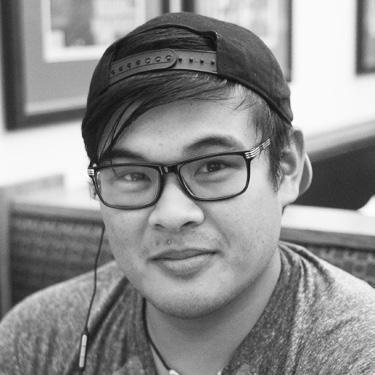
Joseph Tang
senior morrissey manor “Teddy roosevelt.”
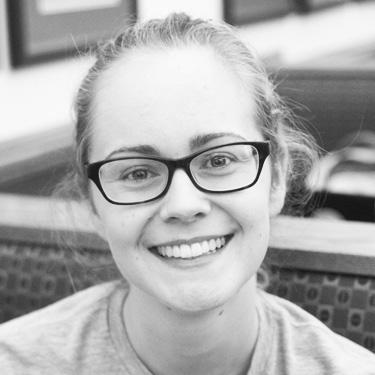
Dani L’Heureux senior off campus “d wight e isenhower.”
Chris Bowers junior Zahm house
“John F. Kennedy.”
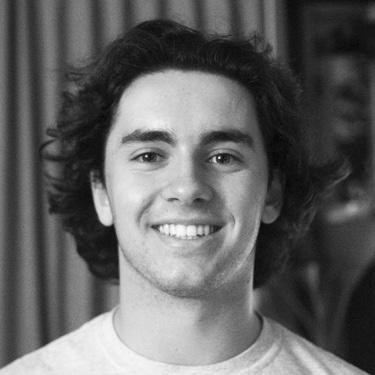
Alec Jbara freshman Zahm house
“Abraham Lincoln.”
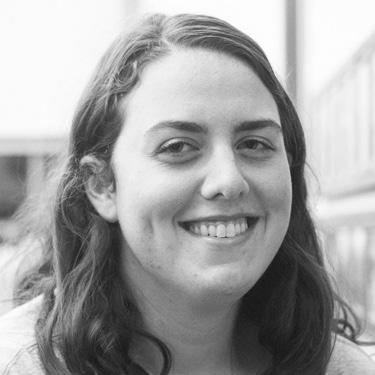
Casey Valentine senior badin hall
“James K. Polk.”
Julia Suarez senior Walsh hall
“Teddy roosevelt.”
MICHELLE MEHELAS | The Observer
A participant works with paper and clay at an art workshop hosted by the Saint Mary’s art department Saturday. Department chair Sandra Ginter directed the event, which was part of the high school pop-up exhibition program.
Today’s Staff
The
regards itself as a professional publication and strives for the highest standards of journalism at all times.
do, however, recognize that
will make mistakes. If we have made a mistake, please contact us at (574) 631-4541 so
can correct our error.
Monday
Panel Discussion: “Politics of Dignity” Hesburgh Center
12:30 p.m. - 1:30 p.m.
Come discuss whose dignity counts.
Book Discussion with Fr. Julian Carron McKenna Hall
6 p.m. - 8:30 p.m.
Panel is open to the public.
Tuesday
Research Seminar: “Good Writing and Wicked Problems in Poverty Studies”
McKenna Hall
8:30 a.m. - 9:30 a.m.
Paws to Relax
North Quad
Noon - 2 p.m.
Come pet your stress away. Rain location is Washington Hall.
Want your event included here? Email news@ndsmcobserver.com
Wednesday
“Tracing a Line”
200 Riley Hall
4:30 p.m. - 6:30 p.m.
Exhibition opening and public talk by artist Crum and Singel.
Vespers
Geddes Hall Chapel
5:15 p.m. - 5:45 p.m.
Join the McGrath Institute for Church Life for prayer.
Thursday
“Books for Cantors”
Eck Visitors Center
5 p.m. - 6 p.m.
Last of three lectures by 2017 Conway speaker Susan Rankin.
Milton String Quartet
Leighton Concert Hall
7:30 p.m. - 9:30 p.m.
This year’s Fischoff Competition grand prize winner.
Friday
“The Life and Ideas of Liu Xiaobo”
1030 Nanovic Hall
Noon - 1 p.m.
Lecture by visiting professor Perry Link.
Men’s Soccer vs Pittsburgh Alumni Stadium
7 p.m.
The Irish take on the Panthers.
student looks to win cystic fibrosis scholarship
By KELLI SMITH news Writer
s ophomore e mily a pakian knew her painting needed to be extraordinary.
a fter several days and hours spent poring over her canvas, she picked up her paintbrush and dipped it in colors she felt were most natural for the finishing touches of her painting. With a specific image in mind, she slowly guided her paintbrush over the canvas’s surface before stepping back to view the finished product.
The result is a close-up portrait of a brunette girl with arms outstretched and a wide smile on her upturned face. h er exposed neck displays a red and blue trachea leading down to a pair of lungs, as if peering at her through an x-ray. r ed, yellow and purple flowers stud the dark-green background behind her.
“ r oses are sort of the symbol for cystic fibrosis,” a pakian said. “ i guess it symbolizes how i try to live my life, trying to accept whatever happens to me with a positive embrace.”
Painting this picture was no ordinary past-time: a pakian submitted it for a a bbv ie c ystic Fibrosis ( c F) s cholarship contest along with an essay and list of her
achievements for a chance to win up to $22,000.
The scholarship is specifically intended for a merican undergraduate and graduate students with c F, which, according to the c F’s Foundation website, is “a progressive, genetic disease that causes persistent lung infections and limits the ability to breathe over time.”
a pakian is one of what the website said is approximately 30,000 a mericans diagnosed with the disease.
“ s ome people are diagnosed when they’re older, but i was diagnosed three weeks after i was born, so [ c F] has been part of my life forever,” a pakian said. “ i t’s hard to describe because i ’ve lived with it my whole life, so i honestly don’t know anything different.”
a long with the painting, a pakian submitted an essay about a c F research study she participated in when she was in middle school. For the study, a pakian said she had to eat “a disgusting powder” whose flavor would not be disguised despite her mother’s efforts to bake it into different types of food.
a fter many failed efforts to mask the powder, a pakian said she finally decided to eat it plain to help research efforts.
“That [study] increased my
awareness of how i want to do something that will help with c F,” a pakian said. “ i think it’s just really important, too, especially because so much research has gone into c F for me to do whatever i can to help further that research because there’s so much not known about it.”
a fter winning an initial $3,000 academic scholarship in June along with 39 other undergraduate and graduate scholars who won the first round of the contest, a pakian is now in the running for the undergraduate $22,000 Thriving s tudent s cholarship, which will be awarded to one of the undergraduate finalists by the end of o ctober.
o nline voting to determine the winner of the $22,000 is currently taking placing on a bbv ie’s website. The number of votes a finalist obtains comprises 30 percent of his or her score while the judging panel’s criteria decides the other 70 percent.
“ i f i win [the Thriving s tudent s cholarship], i can share that story more with people and help advocate for c F,” a pakian said. “For some people with c F, it can be hard because of so many medical complications, so winning can maybe show people that it’s possible to deal with c F.”
a s symptoms differ caseby-case for c F patients, a pakian said her symptoms include pancreatic-insufficiency that makes it difficult for her to digest most foods other than fruits and vegetables, a persistent cough and longer-lasting regular illnesses.
Though a pakian said n otre d ame’s s arah b ea d isability s ervices have been helpful, she said transitioning to college and implementing her routine of treating her c F symptoms was an adjustment for her.
“ c oming into [ n otre d ame] and having to keep that schedule the same is different because there are some things i need to do, like order and pick up my own medication,” a pakian said. “ i t’s just small things that are different, but i have good friends who i ’ve told about it, and they support me, and it’s really nice to have that support group who don’t mind if i have to go do my treatments while something else is going on.”
a long with what a pakian said are “many medications” that she has to take, she also dedicates 40 minutes of her morning and night every day to c F treatment. When she is sick, she does it three times a day.
“ i usually have to wake
up earlier to do respiratory clearance treatments, so that involves a nebulizer, which i use to breathe in my saline solution that helps clear the mucus in my lungs,” a pakian said. “ i also use a vest which literally shakes you to help get out the mucus.”
With what the c F Foundation’s website said is an average lifespan of about 37 years for c F patients, a pakian said she struggles to accept the fact that c F can be fatal.
“ i feel like i need to motivate myself by reminding myself that this is an illness that could potentially go downhill at any time, so that’s definitely a challenge for me,” a pakian said. “a nd i know that. i just have trouble balancing that.”
a s a chemical engineering major, a pakian said she is considering going into the bioengineering field after graduation to dedicate some of her life to helping people infected with c F.
“ i try not to think about the negativity that is brought by [ c F] because i ’ve had a good life so far,” a pakian said. “ i t helps having such a good family and good friends who support me and love me no matter what happens, too.”
Contact Kelli Smith at ksmith67@nd.edu
SMC hosts annual parents weekend
By COLLEEN ZEWE news Writer
saint mary’s sophomores did not have to wait until fall break to unite with their families this year, as the college hosted its annual sophomore Parents Weekend over the weekend.
sophomore olivia bentley said she enjoyed the tailgate and watch party, since it allowed her friends and parents to familiarize themselves with one another.
“my favorite part was cheering on the Fighting irish with my parents and fellow belles,” bentley said.
sophomore nicole Popow said she got to spend quality time catching up with her mom, and she enjoyed the chance to talk face-to-face.
“i enjoyed just being able to sit down and talk with my mom in person about things that have been going on in our lives,” Popow said.
bentley, who is from baltimore, said she thinks parents weekends are valuable because she does not see her family often.
“i think it’s very important to see my parents and family as much as possible,” she said. “Parents Weekend allows me to stay
connected with them and is a good excuse for them to come visit me here in south bend.”
Popow sophomore Parents Weekend also offered students a chance to show their families where they live during the school year. she said her mom enjoyed seeing where Popow spends most of her time.
bentley said she enjoyed showing her family her dorm room and the south bend community.
“i think being able to spend time with our family on saint mary’s campus is important because they are able to see the hard work we are putting in here,” she said.
sophomore caitlyn Gibbs said she enjoyed reuniting with her family at her home away from home.
“it’s hard being away from your family for so long, so any opportunity to see them is a blessing,” she said. “it also is a way for parents to show their support of their daughters’ college education. college is difficult, and it is always nice to be reminded that you have people in your corner.”
Contact Colleen Zewe at czewe01@saintmarys.edu
Paid a dverT isemen T
of university village in the 1970s and 1980s.
“she moved to south bend and she immediately began looking for the Korean population, and that Korean population — at that time, there was a pretty decentsize Korean population living in the village, the university village,” collier said.
Graduate student crystal spring, who lives in the village and wrote a letter to the editor describing the save the village movement, spent five years of her childhood living in the village while her father completed his physics doctorate program at notre dame after immigrating to the united states from Korea.
“I don’t think we would have survived without that community and without the resources and without the proximity that the university village had to campus,” she said. “and coming full-circle for me ... when we found out that I was pregnant as grad students, we decided that we couldn’t live in the apartment that we were currently living in .” experiencing the village as both a child and a parent has made her appreciate the resources it has to offer even more, spring said.
“I thought everyone had access to this kind of support and be able to have a safe place to go trick-ortreating,” she said. “after having lived in a lot different cities and as an adult, I know that that’s actually a very rare experience. and as a parent at the village, I really appreciate everything that’s there specifically to support families.”
rose dougherty, the wife of an architecture graduate student who lives in the village, said the history of the village made a big impact in the save the village movement.
“We’ve had so much fun looking back at the history,” dougherty said. “how Fr. hesburgh started it, how much he clearly loved it and it’s been going for over 70 years and it has been so important to so many families.”
t he community
With the university’s deadline for the relocation of village residents looming, notre dame administrators announced sept. 13 that undergraduates will be required to live on campus for six semesters in order to emphasize and build community.
using this logic, Gardner said it does not make sense to disrupt a “thriving” community in the village.
“What I’ve understood is the main reason for [the six-semester requirement] is ... to increase
campus community life,” Gardner said. “not everybody’s excited about that. You have on the flip side a community that has been thriving since the 40s, yet you’re going to say ‘I’m sorry, there’s no longer space for you.’”
spring, who lived on campus for all four years of her undergraduate experience at notre dame, said her time at the village has been even more essential for her than her time in an undergraduate residence hall.
“having experienced both of those communities — the dorm community and the village community — I think the village community has been a lot more essential to my thriving as a student at notre dame. dorm culture is great, and the village is great for a lot of the same reasons. … all the reasons why notre dame could fathom to have this be a mandate — the six-semester thing — are also reasons that people love the village and need the village.”
village resident sarah o’brien, whose husband is a graduate student, said the village community closely relates to that of a dorm community.
“all of a sudden you just instantly belong to a place like you do in an undergrad dorm, and the fact that they get that value because they’re trying to keep students on campus … doesn’t make sense at all,” she said.
naomi burton, another village resident whose husband is a graduate student, said she does not know how she would have made it through the transition to life at notre dame without the support of the village community.
“I was pregnant, we had two kids, it was rob’s first semester at school and the winter was long,” she said. “and my friend was across the hall ... and it was like this lifesaving friend that helped me get through that first year of being sick and everything else.”
The isolation parents feel as a result of their spouses constantly studying and working is offset by the village, dougherty said.
“The fact that we have this communal green and playground in the back of all of our buildings — we can go out and all the other mothers come out there throughout the day and we’re just chatting — is just great,” she said.
If notre dame is truly interested in prioritizing community, burton said, administrators should work to save a community that has consistently been one of the university’s strongest.
“one of the former residents said routinely The university village would come in as the highest-ranked residence hall as far as community and the sense of loving that and needing that for
years,” burton said.
spring said she and her family wouldn’t be as dedicated to notre dame without their experience in the village.
“I’m going for my third degree from this university, and I just know that if we just lived in some random apartment complex that was not a part of the university ... that we would not have retained those ties to the university,” spring said.
t he internationalization according to the movement’s website, the village’s population is made up of over 60 percent international families. The village’s affordable housing, proximity to campus and tight-knit community is essential for grad students who travel across the world to study at notre dame, o’brien said.
“because I knew moving in that it was going to be torn down I was just like, oK, yeah,” she said. “and it wasn’t until I heard the experience of international families that I was like wait a second — how is the university doing this? how are they just destroying this when it’s such a lifesaver for especially international families?”
collier said this internationalization of the village has been a staple of the community.
“They cooked meals together, they were like a little model u n.,” he said. “and we lose something as a notre dame community when we lose this internationalization of the village.”
This internationalization is a major benefit for families whose kids might not otherwise be exposed to different cultures in south bend, o’brien said.
“In our building there’s a family from columbia across the hall, saudi arabia upstairs, Lebanon, nepal,” she said. “so my kids are playing with kids from all around the world. We’re never going to get this experience again, this is amazing.”
aside from the diverse cultures blending together, spring said the village community helps provide for needs that international families wouldn’t be able to meet without its support.
“especially for international families who don’t have cars, the whole neighbor community thing is essential,” she said. “one of our downstairs neighbors right now, they came from argentina just a couple of months ago, and within a few days of moving their son got croup … and our other neighbor was able to drive them [to the hospital]. Without that they probably would’ve had to call for an ambulance, which would’ve incurred a lot of medical fees that they just couldn’t afford.”
Without the village, burton
said, some international families will even be separated for the remainder of a graduate student’s program.
“since we started saying ‘save the village,’ trying to move that direction, we’ve heard stories from international families that are just heart-wrenching,” she said. “one [student] said ‘I’ll have to go get a roommate and send my wife and child back to uganda because we won’t be able to afford to live here.’”
t he movement
one of the criticisms of the save the village movement is that the university announced it would close the village in the summer of 2014, but the movement to save it did not start until this fall. dougherty said the lack of action in the past few years was due to a lack of information and a belief that there would be a replacement ready for residents as there was when vetville was transformed into the village.
“It really was because they gave us very little information, but they led us to believe that they were going to offer us something else on campus … for affordable rates,” she said. “and as we were coming up on our last year and we still have not had any information given to us [since the 2014 announcement] then we went and started asking what’s the plan for us.”
a Wndu article announcing plans for an $82 million commercial investment further spurred action, o’brien said.
“We gathered a group … and then from there, a few days later we got the petition started and going,” she said.
o’brien said publicity for the movement picked up after the petition gained 25,000 signatures in about three to five days.
When the residents met with affleck-Graves, burton said, he told them there is land for a replacement village and plans to build it, but the cost of construction is too high for the university to justify building it.
“When we talked to John affleckGraves about it, he didn’t say that a donor couldn’t be found, but they just haven’t tried that route,” she said.
The argument that building housing specifically for families wouldn’t be fair to unmarried graduate students also doesn’t justify not building , o’brien said.
“That argument just doesn’t hold up,” she said. “a married student can’t have a roommate. and if they have kids, they have dependents to support on whatever stipend they’re getting or no stipend.”
Gardner pointed out that most resources the university offers do not apply to every member of the community.
“ … If you think about any resource, it doesn’t meet all of the demands of the university’s population, but it meets a substantial demand that it’s willing to offer that service,” he said.
burton said many residents believe the true reason for the university’s current plans is the revenue it would generate from a commercial endeavor.
“It really is just the profitability,” burton said. “We just think that as a university they’re not just a business. They’re a university — and a catholic university at that — and so sure, families aren’t profit-making, but they have a duty to families to have affordable housing.”
spring said the university’s reluctance to provide for families shows “a very clear prioritization of commercial profits over its mission.”
“The rents that we pay cover the maintenance of the buildings — the buildings are all paid for,” she said. “so the university is not losing money by having the village as it stands right now. The problem for them is that it’s not making them money … but the university just keeps seeking these revenuebuilding endeavors.”
This is in conflict with the university’s mission, spring said, because it goes against catholic teachings.
“I think it’s absolutely a pro-life issue,” she said. “The catholic church emphasizes that the parents are the primary educators of the child, etc., and so the mission of supporting those parents and supporting those families should be central to the university.”
Faculty members within the university are taking the save the village movement seriously, Gardner said.
“a lot of people that have been around the university for a lot of years recognize the great resource that the village provides and the great community that’s there,” he said. “and I think that it’s been a tool in getting great graduate students here, and I think it’s been a tool in campus life.”
The main goal of the movement is to acquire an extension of the leases at the village before relocating the community to a replacement location they are asking the university to invest in, dougherty said.
“at this point, essentially, housing for married students is not in the 50- or 100-year plan that notre dame has,” she said. “We just think — and there are enough people who agree — we need to convince them that it is something that ought to be in their 50- or 100year plan.”
Contact Courtney Becker at cbecker3@nd.edu
con TI nued F rom PaGe 1
event on campus to increase turnout, junior student organizer davis Gonsalves said.
“We emailed all the hall presidents and went to all the hall councils that accepted our request,” he said.
m cLellan said the organizers used the power of social media to inform students about the event.
“We have a flyer that we posted on social media,” m cLellan said. “We also made a Facebook event and shared it with everyone we know.”
m cLellan said having a successful inaugural signature
event will help make future d unne Funne r unnes even better.
“We just wanted to have a good, solid first signature event that we can build off of for future years,” m cLellan said. “This is going to be a lot of trial and error since it’s the first one ever, but ultimately we want a base for next year.”
m cLellan said dorm participation was crucial in establishing the r unne.
“We just want as much participation as possible, especially within d unne,”
m cLellan said. “I know we had a lot of people in d unne do it this year, but we could always use more. n ext year we want everyone from the
start of the year to know about it and when it is so we can get as many people from d unne as possible.”
o ther student organizers included juniors b rendan Watts and Pete s eidner and freshman b en huls.
Contact Morgan Johnson at mjohnson@nd.edu
By MATTHEW MUNHALL
s cene Writer
one of the recurring motifs in the fourth season of “Transparent,” the Amazon series chronicling the trials and tribulations of the dysfunctional Pfefferman family, is the music of “Jesus christ superstar.” humor is mined from this Jewish family’s infatuation with Andrew Lloyd Webber and Tim r ice’s musical/rock opera about Jesus — a highlight, for me, is when matriarch shelly (played by the brilliant Judith Light) belts “I don’t Know how to Love him” while riding a camel — but the music also scores some of this season’s most poignant scenes. “everything’s Alright,” based on the Gospel story in which mary magdalene anoints Jesus with expensive perfume, reprises multiple times. “Try not to get worried, try not to turn on to / Problems that upset you,” magdalene urges Jesus in the song. “don’t you know / everything’s alright, yes, everything’s fine.”
Those lyrics become a reassuring mantra for the members of the Pfefferman clan, each of whom is still struggling to achieve some semblance of inner peace. “Transparent” has always been about the difficult process of self-realization. This season these efforts are hindered most acutely by borders, both geopolitical and
social. borders construct identities, but they also create binaries. “Transparent” navigates the messy in-between, as the Pfeffermans continue to grapple with their identities, within the family and in the world at large.
This border crossing begins when maura (Jeffrey Tambor) accepts a speaking invitation in Israel, and her youngest daughter Ali (Gaby hoffmann) tags along for the trip. In Jerusalem, maura discovers that her father moshe (Jerry Adler), who she believed was dead, is not only alive, but an air-conditioning mogul famous for his cheesy infomercials. meanwhile, Ali meets an activist named Lyfe (Folake olowofoyeku), who takes her to a commune in ramallah, a Palestinian city in the West bank. There, Ali attempts to reconcile her Jewish heritage with the Israeli government’s treatment of Palestinians. back in Los Angeles, eldest sister sarah (Amy Landecker) and her ex-husband Len (rob huebel) revive their relationship by experimenting with polyamory. Josh (Jay duplass) is haunted by the ghost of r ita, the babysitter who had a sexual relationship with him when he was a teenager. After asserting herself through her one-woman show last season, shelly continues to stake out an identity independent of her family. shelly’s character arc is responsible for some of the season’s funniest moments, as she takes improv classes and invents an
Italian alter ego named mario.
“Transparent” remains at its best when its characters’ individual journeys come into conflict with one another and secrets come out into the open — as in this season, when the rest of the Pfeffermans join maura and Ali in the holy Land. In one of the season’s most heartbreaking moments, moshe tells maura that her aunt Gittel, who was killed in the holocaust, was also transgender — something maura’s late mother kept from her. “my whole life, I thought I was alone in this,” maura laments to Ali. “Imagine if I’d known.»
The Pfeffermans’ contentious family vacation builds to a beautiful scene in which more truths float to the surface as the family swims in the dead sea. With the gorgeous blue water as a backdrop, their familial conflict, and eventual reconciliation, is imbued with an almost spiritual reverence. Again the family returns to “Jesus christ superstar,” this time singing “The Last supper”: “Always hoped that I’d be an apostle / Knew that I would make it if I tried.” even after four seasons, it is moments like these — gorgeous, indelible and unexpected — that continue to make “Transparent,” flaws and all, so compelling.
Contact Matthew Munhall at mmunhall@nd.edu
By ADRIAN MARK LORE
We stand on the shoulders of giants, but refuse to question their infallibility. This noxious rigidity is the metastasis of blind faith: Who are our “forefathers” and why do we care? What do they know that we know not better now?
This anti-dogmatic thesis saturates ben Frost’s latest studio record, “The centre cannot hold,” with the cathartic trauma of intellectual conversion. It’s the logical continuation of Frost’s meditations on authority and power that defined his stunning 2014 effort, “A U r o r A.”
Largely, indeed, Frost’s subversive attitude is not in conflict with religion — the quintessential source of infallible doctrine — but with “civilization” and its problematic normalization of mutually assured selfdestruction. While it would be reductionist to describe the record as a reaction to “the Trump era,” the record’s gripping, high-energy ambiance does react to contemporary geopolitics.
most obviously, the twinkling 12 seconds of “A single hellfire m issile costs $100,000” function not as music but rather as a moral statement, especially when coupled with the quiet, morose trembling of “healthcare.”
As always, Frost’s industrial noise soundscapes strongly evoke his usual theme of dread. The cyclopean synths on “eurydice’s heel” soundtrack orpheus’
quest to revive the nymph, but the track’s conclusion, channeling William basinski, mourns through its cyclical disintegration, investigating the mortal’s inevitable failure, and perhaps the inevitability of death.
Frost also understands, however, that death is not the ultimate consequence of suffering; to survive the 21st century’s assault on common humanity is, strictly speaking, not enough, as trauma eternally victimizes.
“Trauma Theory” thus becomes one of the record’s most powerful statements: through the track’s psychedelic assault of bright noise ringing within cavernous darkness, Frost expresses the harrowing cognitive dissonance that manifests when trauma meets faith.
These two polar forces war recurrently over the course of the contested record, and are even represented in the record sleeve’s imagery: the white innocence of hope and the dark blue pandemic of despair. While they can temporarily coexist, they are mutually exclusive; the psyche’s zero-sum tension. because each necessarily seeks to overcome the other, Frost declares, the center cannot hold.
Wasting no time, Frost viscerally explores this phenomenological liminality on the record’s opening track, “Threshold of Faith” — the record’s most dynamic and complete artistic statement. The track’s low-end pulse grips the body with freezing horror, and the increasingly sharper high-end progression culminates either in transcendence or in desolation. but it must be the latter, for the track alludes to the downfall
of giants on whom we’ve placed our trust — that is, what happens when compounded suffering reaches over the threshold.
every successive moment on the record, then, explores this experience of hopelessness; namely, the realization that — as the penultimate track explicitly puts it — “All That You Love Will be eviscerated.” naturally, this makes “The centre cannot hold” gruesome from start to finish, especially in the absence of Frost’s pop-structure sensibility that heavily marked “A U r o r A;” but these departures also make the record more compelling.
The record ends, unsurprisingly, with an unhappy conclusion Frost offers on the record’s final track, “e ntropy in blue,” the chaotic resolution when despair finally — perhaps inevitably — overcomes.
Contact Adrian Mark Lore at lore.1@nd.edu
“The Centre Cannot Hold ”
Ben Frost
Label: Mute
Track: “Threshold of Faith”
If you like: Prurient, Untold, Puce Mary
A spoonful of sugar
Elizabeth Greason sports e ditor
For as long as I can remember, “ m ary Poppins” has been my favorite movie.
m aybe it’s strange for a junior in college to be wholeheartedly attached to a children’s movie, but I grew up with m ary, b ert, Jane and m ichael. I watched “ m ary Poppins” so frequently, I felt like an honorary member of the b anks family.
The meaning of the movie has changed for me as I’ve grown up with it.
When I was younger, it would throw me into fits of giggles. I loved to watch m ary Poppins and b ert leap into the chalk paintings on the London sidewalks and dance with the penguins and race off into the steeplechase on carousel horses. I loved watching the children float up the ceiling with Uncle Albert as they laughed uncontrollably. b ut, my favorite part of the movie was watching “George get sacked.” I guess I simply did not realize how dark the scene in which m r. b anks gets fired from his job at the bank really was, watching as a three or 4-year-old.
o n the surface, “ m ary Poppins” may appear to be a pure children’s movie. b ut, as Walt d isney discovers in “ s aving m r. b anks,” the film in which d isney attempts to obtain the screen rights to P.L. Travers’ m ary Poppins novels, m ary Poppins isn’t for the children. s he’s there for m r. b anks. s he does more for m r. b anks than she does for the children.
I still love “ m ary Poppins.” I can’t help but smile watching m rs. b anks bounce around n o. 17 c herry Tree Lane rallying her sister suffragettes and grin watching the entire b anks family gather to finally fly a kite. b ut those scenes have taken on a whole new meaning to me as I’ve grown up with the movie.
There’s another layer to “ m ary Poppins.” o ne of disillusionment, one that sees past the magic. o ne that is aimed at the adults in the movie. o ne that makes “ m ary Poppins” more than just a children’s movie.
m rs. b anks is trapped in a v ictorian housewife’s unhappy life. m ichael spends much of the movie wanting to learn how to fly a kite, but m r. b anks spends so much time at the bank that he is unable to do so.
m ary Poppins, the chimney sweeps and the bird woman are the only characters who have any semblance of real happiness in their lives — the irony of which should not be lost on adult viewers, who are aware that the life of a chimney sweep was, in fact, miserable. b ut the message proves the point that work and money should not be what bring you happiness, as m r. b anks doesn’t even crack a smile until he loses his job and realizes how free he is.
There’s so much going on around us on a daily basis, it’s easy to get caught up and forget what really matters, as George b anks did. We bury our heads in books and computer screens and fail to recognize the magical things going on around us — the little things that make all the difference between a bad day and a good one, a good day and a great one. We miss out on the moments that matter because we simply let ourselves be too preoccupied.
s o, take a cue from “ m ary Poppins.” Look for those little elements of magic, and take the time to feed the birds and fly a kite.
Contact Elizabeth Greason at egreason@nd.edu
The views and expressions of the inside column are those of the author and not necessarily of the Observer.
letter to tHe edItor
Response to Oct. 6 editorial
While it is undeniably heartening to hear a call for more clinical staff at the University c ounseling c enter (Ucc ), (“Lend a h and to the Ucc ” o ct. 6, 2017 o bserver e ditorial), it also would be remiss to leave unacknowledged the University’s efforts to bolster the number of Ucc mental health providers in recent years. In 2013 and 2014, the d ivision of s tudent Affairs provided funding for Ucc ’s hiring of an additional three FT e psychologists and in 2016 purchased the mental health telephone services of afterhour counselors year round. In 2017, the athletic department contributed funding for two more
Ucc psychologist positions to help ensure mental health services for student-athletes. c an the Ucc use more resources in terms of staff? Always. Will the University continue to lend its ears, hands and heart to the mental health needs of its student body? o f that, I have no doubt.
Free the stigma; honk your car horn
In a particularly memorable episode of d isney’s “Phineas and Ferb,” the title characters sing a pop-rock tune to commemorate aglets. d on’t know what an aglet is? I didn’t either, until Phineas and Ferb informed my 12-year-old self that it is the small plastic tube fitted around the end of a shoelace that keeps the shoelace from fraying.
“A-G-L-e -T ( d on’t forget it) / We’re gonna tie the world together,” they sang.
I think most of us college-aged adults would agree that “Phineas and Ferb” was a pretty phenomenal show during our lower and middle school careers. I saw a large portion of the episodes, but this one, the one about something as simple as an aglet, stuck with me.
An aglet is a smart and useful invention that we don’t know much about, Phineas and Ferb told us, and it deserves to be praised.
I was reminded of this episode yesterday on a car ride from m ilwaukee to campus when one of my car mates told us she rarely honks her horn, and that since she had gotten her new car, she couldn’t recall having used it one time. I was slightly appalled. I’m from Kansas, where car honking does not occur as much as in say, n ew York c ity, but I have serious respect for the car horn, and I don’t understand the resistance against using it.
The car horn deserves praise, even more so than the aglet, so here’s a bit more information about it.
m iller r eese hutchison patented a car horn, also known as a klaxon, in 1908 because he was concerned about the increase in traffic in n ew
York c ity. The name klaxon comes from the Greek word “klazo,” to scream. A common quip of the time, however, was that hutchison created the klaxon to deafen people so that they would have to buy his other invention, hearing aids.
The klaxon is the voice of your car. Just as you might scream in the face of danger, let your car scream on the road to an accident. It’s there for our protection. It’s there to alert others of incoming danger. It’s there, right in the middle of the steering wheel, to be used.
I know. r oad rage is on the rise and occasionally ticked-off drivers slam their horn without end in a not-so passive aggressive statement. It’s not fun being the recipient of that blast. b ut I’d rather someone alert me of my mistake with a roar than do nothing. For if they do nothing, I might not realize I’ve done anything wrong.
We don’t get a lot of opportunities to drive while school is in session, but as fall break nears, please cozy up to your car horn. If the car in front of you at the light doesn’t move when it turns green, give ’em a little nudge with a short beep and friendly wave. If someone cuts you off and endangers you, give ’em a hard blast and let them know.
Let’s break the stigma against using your car horn. Unfortunately, I don’t have a catchy tune about the klaxon to sing to you all, but I do have a proposition: If we all start using our car horns more frequently, we’’l be more likely to feel comfortable using them when we need to the most.
Lauren Fox is a junior PLS major who enjoys listening to summer hits of the 2000s and playing 500 rummy. You can follow her on twitter via @bylaurenfox and send fan mail to lfox6@nd.edu.
The views expressed in this column are those of the author and not necessarily those of The Observer.
Susan Steibe-Pasalich director
University c ounseling c enter o ct. 8
Lauren Fox Life Goes on
The path forward
our nation has developed over more than two centuries into the world’s example for a constitutional republic. We have codified the doctrine of natural rights and protected freedom at home and abroad. Yet today, we are increasingly unwilling to examine the difficult questions of our nation’s history and to treat our ideological opponents as well-meaning citizens rather than personal enemies. o verexposure via social media leads us to lose perspective. v ideos of riots fill news channels and Facebook feeds, creating the perception that political violence is commonplace. It would follow logically from the attention paid to riots that many Americans support or are involved in the violence. Therefore, they believe that physically attacking those with whom you disagree and those in law enforcement is an acceptable concept.
This is an easy narrative to accept — to take what social media and news outlets spin as fact, and come to the conclusion that America is headed to hell in a hand basket. but what people often lose sight of are the many times our nation has been headed towards hell. We have hurdled there with more force and speed, and with far more significant consequences than today’s divided political climate. recall the c ivil War, the deadliest conflict of our nation’s history in which Americans fought Americans. recall World War II, the threat of the Third reich and the near complete fall of europe. Also recall that with both conflicts, we showed this world to have no place for ideologies founded on human inequality. With each crisis we
overcome, we Americans prove to be a resilient people. We will argue about politics and divide ourselves in every conceivable way, but will always unite when called upon. nothing has changed so dramatically as to suggest we do not still have this ability. In terms of the current political environment and free speech issues, historical perspective makes apparent the impact of social media. To be clear, political violence like the riots at berkeley is unacceptable and must be stopped. but social media has exacerbated reactionary instincts with which we have always contented, but to which we have not been so attuned. In order to combat this trend and return sanity to political discussion, we must have faith in ourselves. We must have confidence in our fellow citizens.
To this end, I would encourage you to read and interpret our nation’s history and the news of today for yourself. do not let others restrict the positions you take or the conclusions you reach — your opinion is yours alone, and your right to express it is clear and nearly unrestricted, per the constitution. To those who would argue otherwise, this definition of free speech is not an excuse for racism, intolerance or other expressions detrimental to the rights of others. It is instead a recognition of the fact that laws are made to protect rights from government and not to manage the affairs of private citizens. because fundamental rights like the freedom of speech and exercise of religion do not draw power from any branch of government. They are truths of humanity. They are granted by our creator, and are essential to human dignity. They support the individual, allow liberty to flourish when properly protected, and thus give rise to a nation like ours.
soon it will be our turn to lead. While we face nothing like the global crises of the 20th century, significant challenges are ahead. The most consequential policy issues include the ballooning national debt and uncontrolled federal spending on the domestic front, and the geopolitical aggression of russia, c hina and Iran abroad. cultural issues like deterioration of the family culture and doubts about the American creed, which affirms equality regardless of class, also pose significant challenges. We must confront these obstacles and more. being mindful of the following points will help us to do so. balanced opinions — informed by a combination of principle, pragmatism, historical context and a common morality — are the best policy. Politically-motivated violence is unacceptable. many Americans face difficult challenges every day, and positive change begins at the individual and family level. most importantly, the protections afforded to us by the constitution mean that the sensationalist media, gridlocked legislature and immature chief executive do not dictate the terms of daily life.
Let us take advantage of the opportunities to learn all that we can about the country and the world while at notre dame in order to take responsibility for the future.
Nick Marr is a sophomore from San Diego, California. He is majoring in history and political science with a certificate in international security. His favorite liberal is John F. Kennedy. He knows there could be opinions other than his own, and he encourages them to be directed to nmarr@nd.edu.
The views expressed in this column are those of the author and not necessarily those of The Observer.
The summer blockbuster is dying
— and we should let it
revenue is down because there’s just too many of them. We are suffering from a bad case of franchise fatigue. Thankfully, there exists the perfect remedy. It’s called an independent property.
For the first time since 2006, north American summer box-office revenue will not reach four billion dollars. Ticket sales will have fallen 16 percent since last year — the largest drop in the modern movie era. Franchise films like “The mummy” and “Transformers 5” performed far below expectations. Though “Wonder Woman” and “spider-man: homecoming” both received outstanding reviews, good word-of-mouth was not enough to save the season for the big studios. The summer movie season, it seems, just isn’t what it used to be. Perhaps this has a lot to do with the fact that your average summer blockbuster isn’t reserved for summer anymore. not long ago, studios would typically only release their big-budget tentpole films in June and July. That’s not possible today. The landscape is just too crowded to confine these films to a few months of the year. It feels like every film being released today is part of a franchise in one way or another. originality looks like a thing of the past. There are over 200 sequels, prequels, reboots and adaptations confirmed to be in production through 2022 in hollywood. This includes four sequels to James cameron’s 2009 film “Avatar” and six more additions to the marvel cinematic Universe. Pixar has a fourth “Toy story” and “The Incredibles II” in the works, and it looks like we’ll be getting a new star Wars film every christmas for the foreseeable future. revenue isn’t down for these movies because they’re bad, necessarily.
An independent property (IP) is a film that has come from an entirely original idea. It’s not a sequel to an earlier film, it’s not adapted from a book, it’s not a reboot of a franchise or a remake of another piece of cinema. It’s just a new movie. For several years now, hollywood has been profoundly lacking in IPs. In the era of big-name actors and pricey cGI, movies are more expensive than ever to produce. couple this with better at-home entertainment systems and unjustifiably high theatre prices, and movie studios are understandably concerned about spending the money to produce a film and then being able to recoup their investment. They think IPs are a major risk; they believe moviegoers are more likely to see something they already know at least a little about than something entirely new. The logic has made the studios billions over the past decade. It also, however, leads studios to invest in familiar choices over better, more original ideas.
That trend is finally reversing. This summer, a movie called “baby driver” (directed by edgar Wright) opened to rave reviews. on nothing but its own merits, on word of mouth and critical acclaim, the movie has become wildly successful. so far, baby driver has grossed over $193 million against a budget of just $34 million. The success of baby driver and the failure of several bigbudget franchise films this year demonstrates that independent properties can still do well at the box office. For
the average viewer, it doesn’t matter if it’s a movie they are familiar with or not. If a movie is good, people will pay to see it.
It’s time for a rebirth of independent properties. For far too long now, hollywood has rejected originality in favor of safety, no doubt depriving us of amazing stories. I love star Wars. I’ll be at the midnight premiere of The “Last Jedi” this december. but the last thing I want is to live in a time where the only movies made are star Wars movies. The world is far too big and the human imagination far too boundless to limit ourselves to the stories we’ve already told.
What’s the next star Wars, what’s the next harry Potter? Who will have the next beautiful creative idea that will change popular culture, that will become ingrained in our social consciousness for decades? If we don’t give more independent properties a chance, we’ll never find out. Thousands of screenwriters are writing thousands of scripts that tell thousands of stories — stories they want to share with the rest of the world. There’s a ton of great ideas out there. I can’t wait to see them on the screen.
Patrick McKelvey splits his time between being a college sophomore and a grumpy old man. A New Jersey native and American studies major, he is interested in a legal career after graduating Notre Dame. If you can’t find him at the movies, he can be reached for comment at pmckelve@nd.edu
The views expressed in this column are those of the author and not necessarily those of The Observer.
Patrick McKelvey In moderation
Nicholas Marr c ivics c orner
Happy Birthday: update personal paperwork, contracts or financial assets and liabilities. Taking care of business will ease stress as well as help prepare you for economic changes that could disrupt your professional or personal position. Being smart about debt and spending will ensure that you maintain financial stability. r omance is on the rise and a commitment can be made. your numbers are 6, 11, 16, 22, 26, 37, 42.
ARIES (March 21-April 19): Consider your vocational options. Contact someone you’ve worked with in the past. you’ll be offered an alternate option to your current professional position. Weigh the pros and cons before you make a decision that will have lasting effects.
TAURUS (April 20-May 20): g et involved in activities that allow you to show off what you have to offer. Physical encounters will give you a sense of what you are capable of. Strive to reach your personal goals and celebrate your success with someone you love.
GEMINI (May 21-June 20): Personal growth and physical improvements should be a priority. The more motivation you drum up, the easier it will be to carry out your plans and reach your goals. Don’t procrastinate when you should be taking action.
CANCER (June 21-July 22): Do your best to nurture important relationships. Aim for equality and sharing as much as you can in order to build a strong bond that can withstand any of life’s challenges that come your way. Make love a priority.
LEO (July 23-Aug. 22): you’ll be at odds with someone who doesn’t see things the same way you do. l isten carefully before explaining your side, and together you will come up with a way to move forward. Intelligence and common sense will be required.
VIRGO (Aug. 23-Sept. 22): A day trip or family gathering will be enlightening and entertaining. r omance is on the rise, along with updating your image and exploring new possibilities. Partnerships are favored and a promise can be made.
LIBRA (Sept. 23-Oct. 22): A staid approach to the way you deal with money, health or legal matters will give you the edge you need. Don’t let anyone rush you into making a decision before you are ready. Being thorough will prove beneficial.
SCORPIO (Oct. 23-Nov. 21): handle changes at home carefully. What you contribute to a group or someone in need of assistance will put you in a good position when dealing with friends, relatives and co-workers. Stand up for your rights and the rights of others. r omance is on the rise.
SAGITTARIUS (Nov. 22-Dec. 21): keep an open mind, but don’t change your lifestyle just because someone else does. l isten and observe and you will find bits and pieces of information that are valuable to you. Walk away from stressful situations or anyone trying to pressure you.
CAPRICORN (Dec. 22-Jan. 19): Downtime will do you good. Make special plans with someone you love or take a day to relax all by yourself. g o over all the things you can eliminate that contribute to your stress.
AQUARIUS (Jan. 20-Feb. 18): Do your best to get along with everyone. Take time out to discuss your plans with someone you love. having the same agenda as the person you do the most with will make it easier to make future plans.
PISCES (Feb. 19-March 20): Do your best to get along with everyone. Take time out to discuss your plans with someone you love. having the same agenda as the person you do the most with will make it easier to make future plans.
Birthday Baby: you are practical, motivated and reliable. you are precise and supportive.
Jumble | DAvID hOyT AND JEff kNurEk
sudoku | ThE MEPhAM grOuP
wINGIN’ It | OlIvIA WANg & BAIlEE EgAN
WOrk Ar EA
heisman is barkley’s to lose
s ince his monster game against Iowa where he collected 358 all-purpose yards, s aquon b arkley has 36 carries for only 131 yards, and many people who called this h esiman race over before it started are now starting to reconsider. Which is ridiculous.
b ecause s aquon b arkley is going to win the h eisman. What separates b arkley from the rest is his ability to seemingly create nothing out of something. Take s aturday’s 31-7 over n orthwestern for example.
After suffering through the first half where he finished with negative yards running the ball, b arkley broke the then 10-0 lead wide open with two scores in the third quarter, first a one-yard pile leaper and then a 53-yard burst to put a game away that Penn s tate was having trouble putting to bed.
Just when you think he’s not going to burn you, he does. b arkley’s gamechanging ability is what makes him an undeniable contender for the h eisman, and he can do it on the ground, through the air and on special teams. h e’s Penn s tate’s leading rusher and receiver, and his ability to affect games, regardless if he’s having a 300 or a 100yard day, make him undeniably the reason why Penn s tate is ranked third in the country.
b arkley seems to be able to put the n ittany Lions on his back when they need him to, and his patience is remarkable for someone whose talent demands the ball. Take a look at his second touchdown from s aturday—despite having a quiet game, b arkley’s mental fortitude to sit behind the line and wait for the hole to develop instead of trying to make a play right
away is exemplary. The game comes to him, rather than the other way around, and his craftiness and ability to play smart is what I think separates him from the bunch
Take a look at his supposed fellow contenders, Lamar Jackson and b aker m ayfield (but don’t forget about Josh Adams). While both are undeniably talented, they have both exhibited the fatal flaw of folding under pressure after a poor team performance — Jackson against n orth c arolina s tate and m ayfield against Iowa s tate this past weekend. While both still had relatively good performances, when it mattered most, they failed. Jackson threw a pick-six with his team trailing by a touchdown with 3 minutes to go, and m ayfield failed to lead his team down the field on a game-winning drive, throwing an incompletion on fourth-and-four.
All three are on teams that were dreaming of the playoff when the season started, but realistically, only b arkley’s team is still in the running. I’m a firm believer in a team’s performance factoring into an individual’s and vice versa, and b arkley’s calming aura seemingly has had an effect on the rest of his team, while Jackson and m ayfield have come up short in chances to help their teams stay alive in the playoff race. While there’s still a lot of football left to be played, Penn s tate has as good a chance as anybody to run the gauntlet and be one of those four teams, and with the way s aquon b arkley has been changing games this season, that chance may turn into reality.
Contact at Tobias Hoonhout at thoonhou@nd.edu.
The views expressed in this Sports Authority are those of the author and not necessarily those of The Observer.
Red Sox beat Astros, avoid elimination in ALDS
Associated Press
bosTon — hanley ramirez waved a “believe in boston” flag during pregame introductions, drawing cheers from a Fenway Park crowd fearful of a second straight postseason sweep.
Then he gave the red sox exactly what they wished for: more october baseball.
“I just tried to wake everybody up,” ramirez said after delivering four hits and three rbIs to lead the AL east champions to a 10-3 victory over the houston Astros in Game 3 of the AL division series on sunday.
“I think that’s my job: Find a way to come through in big situations,” the designated hitter said. “It’s the playoffs. It’s go time.”
david Price pitched four scoreless innings after another boston starter faltered, and 20-year-old rafael devers hit the go-ahead homer to help the red sox snap a five-game postseason losing streak.
mitch moreland had three of boston’s 15 hits — matching its combined total from Games 1
and 2, a pair of 8-2 losses. Jackie bradley Jr. hit his first postseason homer, a three-run shot in a sixrun seventh that put the game away.
e arly trouble
carlos correa homered for the Astros as they took a first-inning lead for the third straight game. Up 3-0 with two on and one out in the second, houston chased doug Fister and Joe Kelly retired George springer before Josh reddick hit a long fly ball to right field that mookie betts caught at the top of the short wall to end the inning.
“It would have been a great spot for us to get another three runs and big momentum for us. And that seemed to be big momentum for those guys,” reddick said.
“They come up after that and they take the lead. so I just l wish the park was a little bit shorter.”
red Sox relief
Kelly pitched the third, and then Price scattered four hits and a walk while throwing 57 pitches in his longest outing since July. since going to the bullpen in
september after missing most of the season with elbow problems, Price has made seven straight scoreless appearances.
“he’s a machine. he’s a competitor. And when he’s on the mound he’s going to give everything he has,” ramirez said. “That’s him. That’s his attitude. ”
e arly trouble ii
Astros starter brad Peacock escaped the second inning with a 3-1 lead despite loading the bases with nobody out, but he ran into bigger trouble in the third.
After Peacock struck out boston’s no. 3 and 4 hitters, moreland doubled and scored on ramirez’s line drive over left fielder Gonzalez’s outstretched glove. Francisco Liriano gave up devers’ two-run homer to right that gave boston a 4-3 lead — its first in 44 postseason innings dating to Game 1 of the 2016 ALds Peacock allowed three runs and six hits in 2 2/3 innings. Liriano got just one out while allowing one run and two hits for the Astros, who have never swept a postseason series.
Vinatieri lifts Indianapolis over San Francisco in OT
Associated Press
IndIA nAPoLIs — san Francisco scored two touchdowns sunday at Indianapolis. hey, it’s progress. but the offensive woes that have kept the 49ers winless through five games are still there; at times, they were so glaring that even coach Kyle shanahan couldn’t sugarcoat them following a 26-23 overtime loss.
“You’ve got to have success to get the confidence,” shanahan said. “That was very frustrating throughout the game — we had a number of opportunities.”
And, as usual, they blew those chances.
The most promising sight was seeing brian hoyer go 29 of 46 for 353 yards with two T d passes and no interceptions. otherwise, the 49ers didn’t do much.
After scoring a touchdown in one of its first four games, san Francisco went nearly 3½ quarters without another against the colts (2-3).
The big scoring barrage came courtesy of a 6-yard shovel pass to Kyle Juszczyk and a 5-yard
catch George Kittle made on fourth-and-goal and required his wrestling to barely crack the goal line.
It still wasn’t good enough.
san Francisco has now lost four straight games by three or fewer points, becoming the first team to achieve that dubious feat since the 1994 houston oilers. The 49ers were 4 of 14 on third downs, rushed 22 times for 66 yards and couldn’t cross midfield in overtime. carlos hyde logged eight carries for 11 yards.
“We have three backs that are up, and we try to give them all carries and go with the hot hand. We felt like ( matt) breida was the hot hand at the time,” shanahan said before being asked about hyde and a possible injury. “no, it was just about trying to go with the hot hand.”
The colts’ offense didn’t do much either.
They got touchdown runs from marlon mack and Jacoby brissett to take a 23-9 lead early in the fourth quarter, let that lead slip away and then watched brissett get picked off at the goal line in overtime.
The difference was that when brissett got another chance, he delivered by positioning Adam v inatieri for a 51-yard field goal to win it.
“We found a way in overtime,” colts coach chuck Pagano said. “We’ll take it right now any way we can. but you’re exactly right. You’re up 14 in the fourth, you’ve got to find a way (to finish).
here are some other observations from sunday:
m r. c lutch
v inatieri’s fourth field goal of the day sent him past Gary Anderson (538) into second on the n FL’s all-time list. It was only one part of his milestone day. he tied George blanda (639) for third in most field goal attempts, tied Jason hanson (327) for no. 5 on the n FL list for games played, and made the 10th overtime field goal of his career — an n FL record.
remembering the past 49ers receiver Pierre Garcon and colts running back Frank Gore both got a rare chance to face the teams that drafted them. both played pretty well.
Tobias Hoonhout Associate sports e ditor
nFL | coLTs 26, 49ers 23
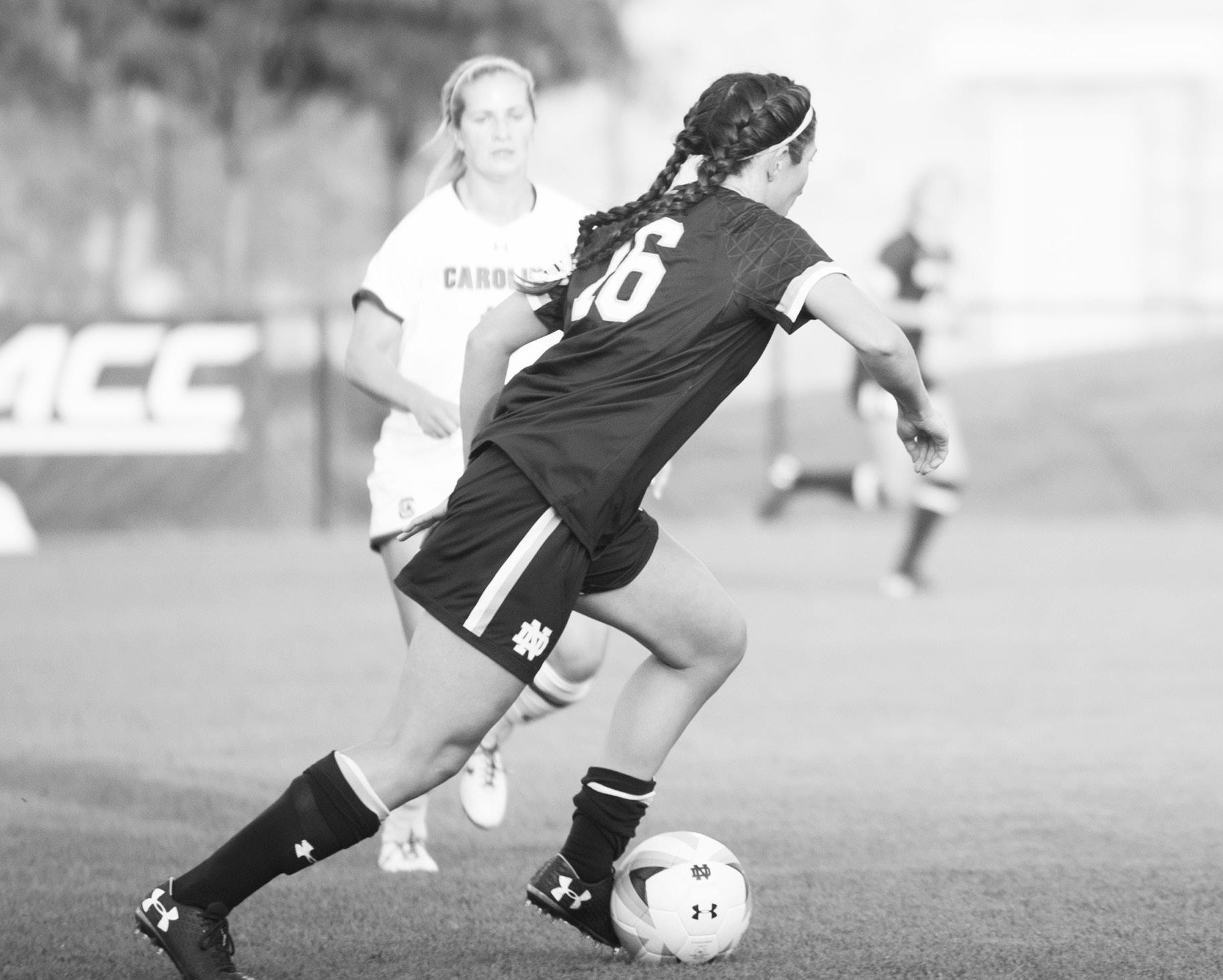
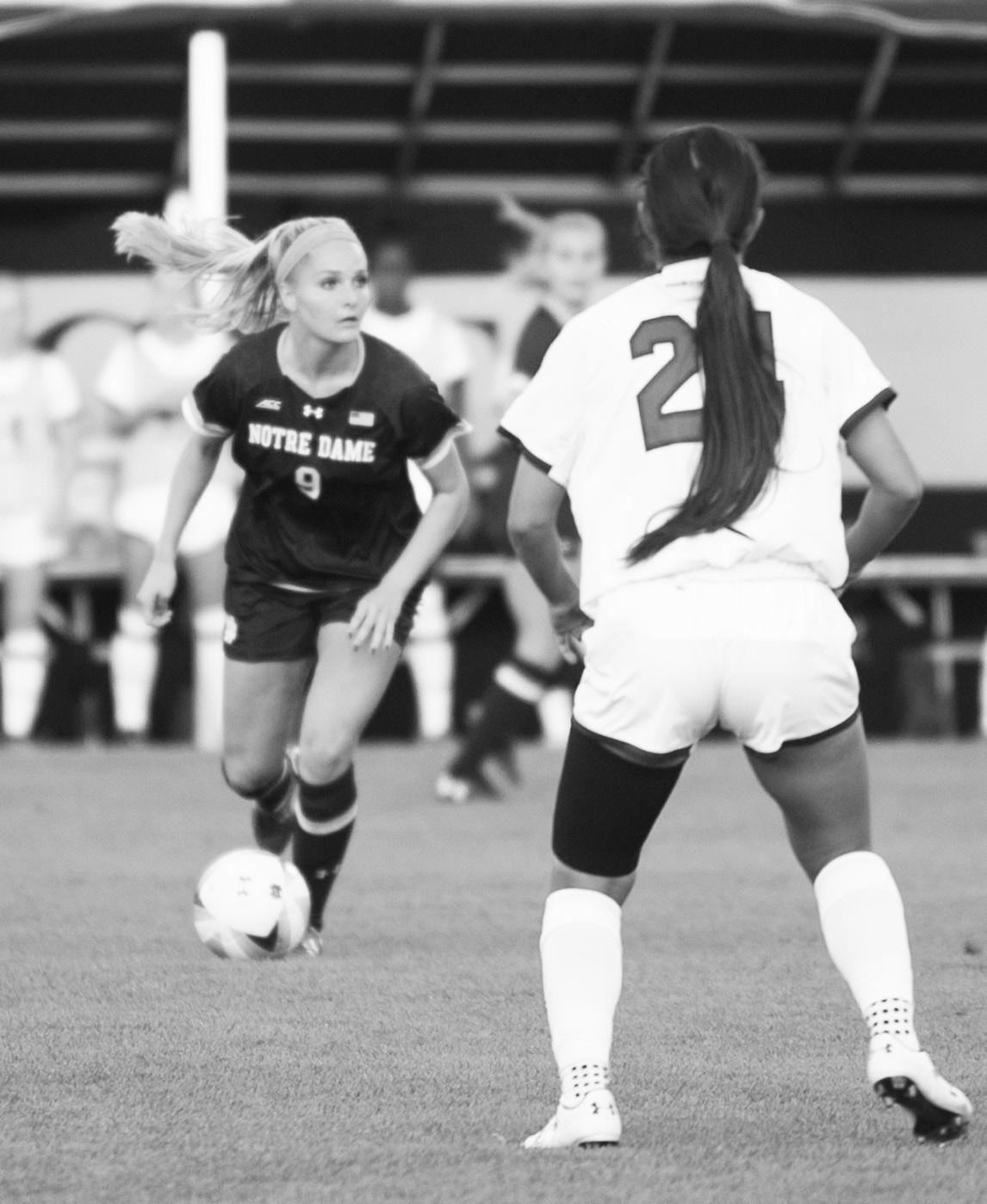
Irish graduate student midfielder Sandra Yu dribbles the ball during Notre Dame’s 1-0 double-overtime loss to South Carolina on Sept. 1 at Alumni Stadium. Yu’s goal on Thursday gave her seven on the season.
W Soccer
The goal for Yu marked her seventh of the season and helped n otre d ame equal their goal total from the 2016 season at 26.
v irginia was able to notch things up at one in the 60th minute, and despite efforts on both sides, the score would remain that way through all of regulation and both overtimes. The i rish did have a bit of a scare as they were outshot 4-1 in the first overtime, but they were able to escape unscathed and walk away with the tie in front of a boisterous crowd at Klockner s tadium.
o n s unday, n otre d ame was able to pick up the win on home turf, but it did not come easy. d espite generating a number of offensive chances, the i rish still found themselves tied at zero after 45
Swimming
women’s team knocked off the c ardinals. i n the dual meet, the i rish broke away winning 20 out of 32 events, beating the c ardinals 153.5146.5 on the men’s side and 181.5- 118.5 women’s side. m ultiple event winners for the i rish included senior Justin Plaschka (50-yard freestyle and 100-yard butterfly), senior r ob Whitacre (100-yard and 200-yard backstroke), sophomore a bbie d olan (50-yard free, 100yard free, and 200-yard free), junior m eaghan o ’ d onnell (100-yard breast stroke) and sophomore e rin s heehan (100-yard butterfly). The i rish also won the women’s 200-medley relay and the
minutes. The team came out in an even more aggressive fashion in the second half, and the effort finally paid off in the 68th minute when sophomore striker Jennifer Westendorf was able to bury a cross from sophomore forward n atalie Jacobs to open up the scoring. Jacobs would eventually net one herself 20 minutes later to add an insurance goal, although the i rish would not need it as they held on to the shutout.
The win continued a solid string of good fortune for n otre d ame on s undays, improving their record to 6-0 when wrapping up a weekend on s unday.
a fter a weekend of acc play, i rish head coach Theresa r omagnolo saw a number of positives from her team, especially on the offensive side of the ball.
“ o ur forwards did a really good job holding onto the ball,” r omangolo said.
women’s 400-freestyle relay. i n addition to the upperclassmen, there were also freshmen that stood out and performed for the i rish in their debut meets. s tandout freshman for the i rish included Zachary Yeadon and Lindsay s tone. i n his collegiate debut, Yeadon broke two records and won the 500-yard and 1000-yard freestyle against Louisville’s a lla merican m arcelo a costa. s tone won the 500-yard and 1000-yard freestyles with times of 4:50.07 and 9:51.48 respectively.
The i rish will next face off against m ichigan s tate and the 15th-ranked men and fifth-ranked women of Texas a & m at home this Friday, with the a ggies sticking around on s aturday for a dual-meet.
“ i thought we did a good job of keeping the ball in the opponent’s end and producing some opportunities for ourselves.”
With only four games remaining in the regular season, n otre d ame finds itself in a three-way tie for fourth place currently in acc standings. The team will certainly have an uphill battle if it hopes to repeat the same success it had last year, finishing
with a regular-season conference championship. For r omagnolo, the key for her team is take things one game at a time.
“We just have to look at it one game at a time and continue to grow as a team. o ur next game isn’t until s aturday, and it’s our last home game,” r omagnolo said. “We will look to send our seniors out on a good note at home and then beyond
that we will still have three more games on the road from there.”
n otre d ame will next play on s aturday when the i rish host v irginia Tech on s enior n ight. The game kicks off at 7 p.m. as the i rish will look to pick up a win in their last home game of the regular season.
Contact Alex Bender at abender@nd.edu
Paid a dverT isemen T
PETER ST. JOHN | The Observer
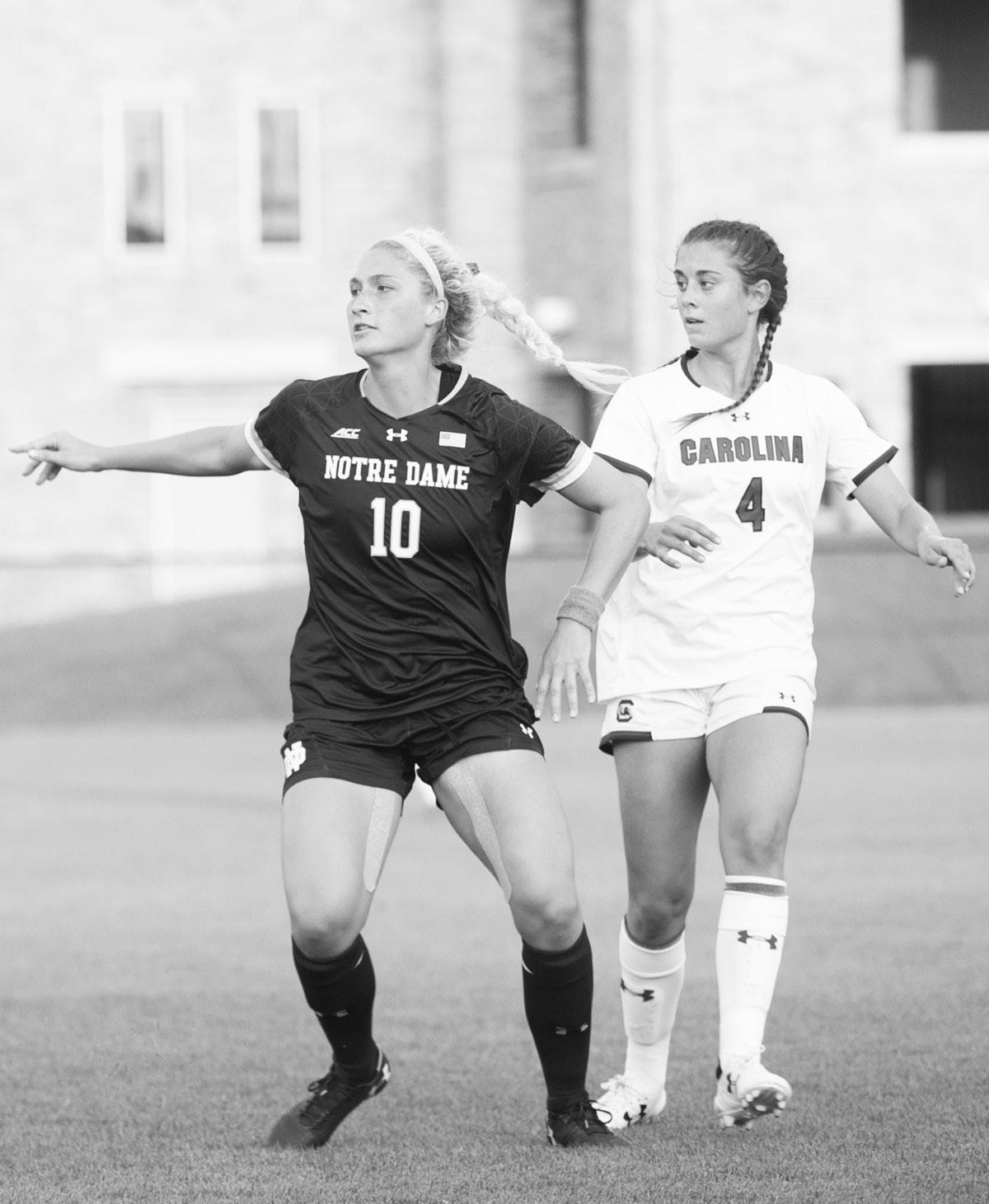
Irish sophomore forward Jennifer Westendorf tries to shake off her defender during Notre Dame’s 1-0 loss to South Carolina on Sept. 1.
PETER ST. JOHN | The Observer
goaltender Jordan Uhelski to give n otre d ame a 2-1 lead.
Just a minute and a half later, however, h untsville again responded with a goal of their own to knot the score at 2-2, and then took a 3-2 lead a few minutes later off of a power play.
With 1:30 left in the period, junior defenseman d ennis Gilbert blasted a shot from the point into the net to tie the game at 3-3.
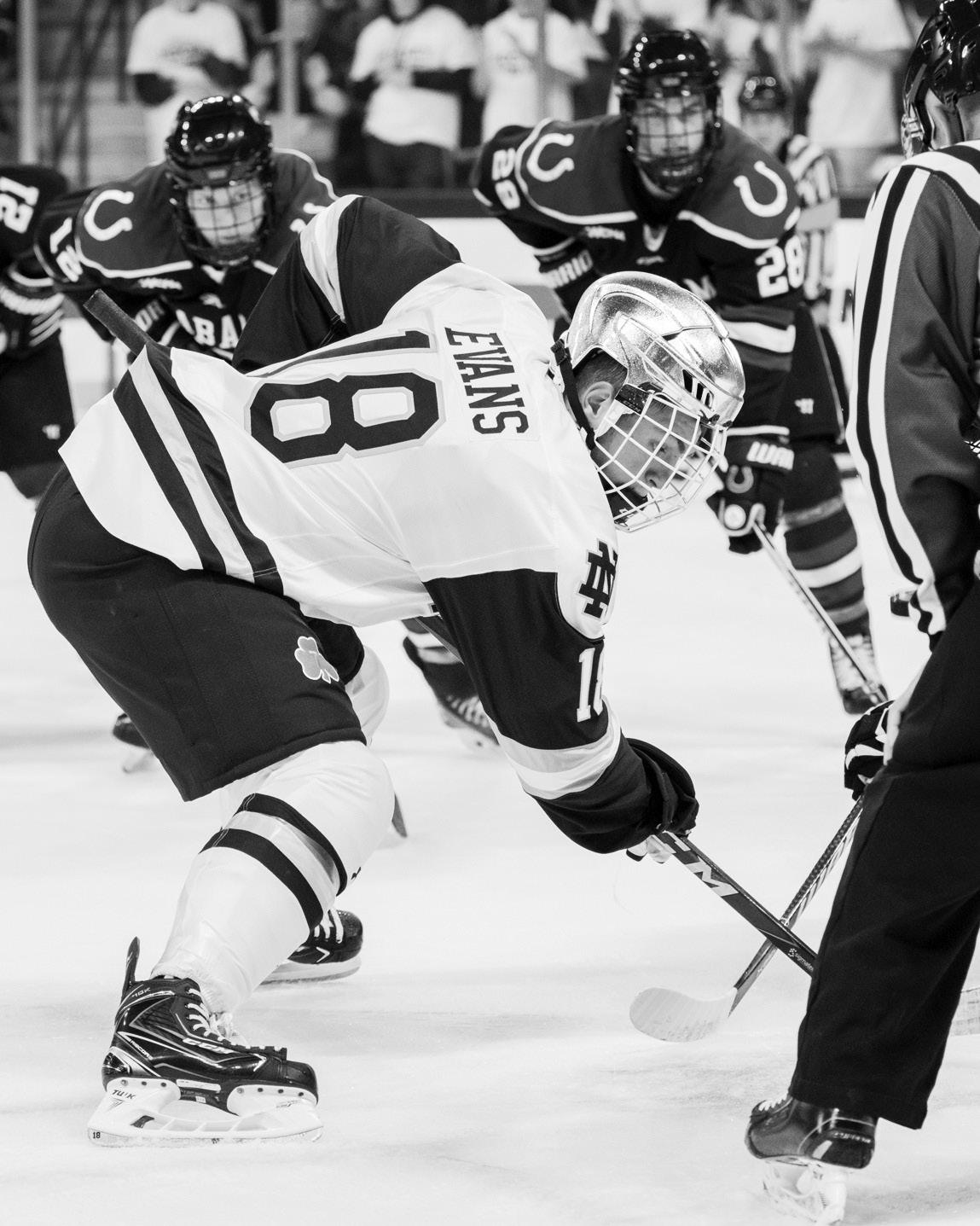
Almost six minutes into the third period, n otre d ame once again grabbed the lead after senior forward Jake e vans scored a power play goal. d espite a furious
h untsville rush in the final minutes of the game, the Irish were able to hold on, and senior captain Jake
e vans added an empty net goal with 18 seconds left to seal the win for the Irish.
e vans finished the game with two goals and one assist. s enior defenseman
Jordan Gross recorded three assists, while junior forward
Andrew o glevie pitched in two assists. n otre d ame
sophomore goaltender c ale
m orris recorded 25 saves on 28 shots. n otre d ame finished two-for-five on the power play, and killed off four of the five penalties it took.
n otre d ame head coach
Jeff Jackson said he thought m orris had a good first career
start despite some hiccups.
“I thought he did a good job tonight,” Jackson said. “It was a good start for him and a good start for our team too. I thought we were a little jittery, the puck kept bouncing on us a lot and I thought that was what led to a lot of two-on-ones. The puck was bouncing on our defense a lot and created opportunities for them. s o we just have to settle things down a little bit. We had some stretches where we were really good and some stretches where I thought we were making some soft plays with the puck.”
Jackson also said he liked what he saw from the freshman on the team.
“Theisen showed what
during Notre
have hoped, as a give-and-go between senior midfielder b lake Towns and Farina gave Towns a free run down the right wing. After making the goalkeeper commit to him, Towns threaded a pass to a streaking Gallagher in the middle, who slotted the ball home to give the Irish a 1-0 lead at 46:50 — his eighth goal of the season.
h owever, c lemson responded quickly with a goal of their own in 50th minute, as freshman midfielder Alexander h emmingsen punched the ball in during a scrum in front the n otre d ame goal to level the score at one apiece. Throughout the rest of the half, it was c lemson who generated most of the genuine scoring opportunities. h ubbard came up with
several big saves, however, and withstood the opponent’s offensive pressure all night, as c lemson outshot n otre d ame 19-8 over the course the game while holding a slight 5-4 margin over the Irish in shots on goal. Just when things appeared destined for overtime, junior Irish defender Felicien d umas won a free kick deep in c lemson territory. From an angle too steep on the left wing to try for goal, Gallagher instead chipped a cross into the middle of the box and it found the head of fellow senior Farina, who smashed it into the back of the net to give the Irish their winning goal at 88:02. n otre d ame returns to action for a nonconference showdown with rival m ichigan on Tuesday night inside Alumni s tadium. The Irish and Wolverines will kick off at 7 p.m. on A cc n etwork e xtra.
kind of shot he’s got,” Jackson said. “I thought [forward m ax] e isenmenger played well. I moved him over to right wing when we shortened the bench a little later on in the game, but all in all I thought [defenseman] m att h ellickson was really good, so from first impressions I thought they all did a really good job tonight.”
o n s aturday, n otre d ame were more stingy defensively as they blanked the c hargers 4-0 in the second matchup of the weekend, led by the goaltending of freshman d ylan s t. c yr.
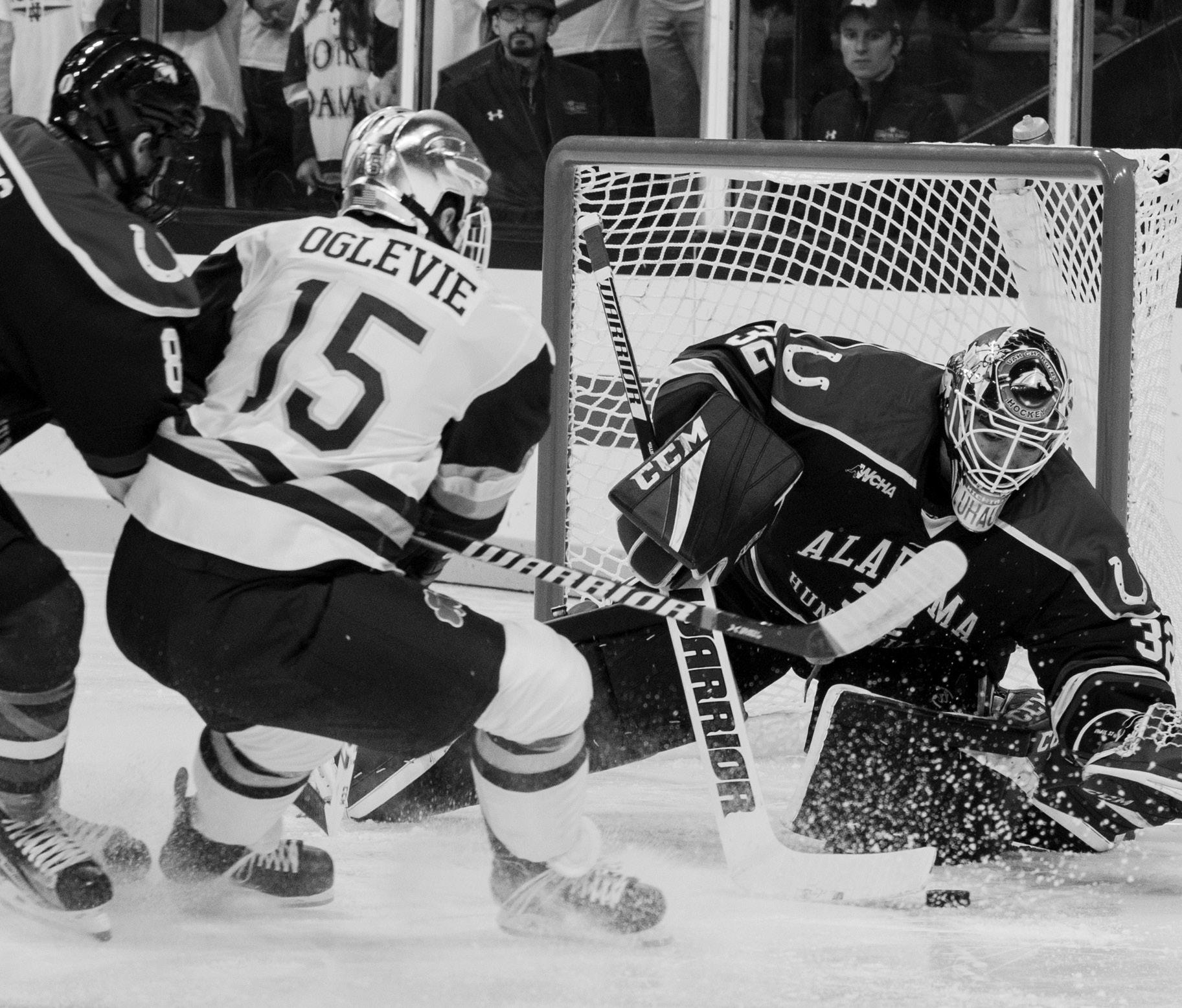
After a relatively slow first period which saw n otre d ame kill three power plays, the Irish saw a glimmer of hope as the c hargers were called for hooking with 33.5 seconds left in the period. They would capitalize on their power-play opportunity swiftly, as o glevie scored on a one-timer at the buzzer to put n otre d ame up 1-0.
With a one goal lead, the Irish dialed it up in the second period. Wasting no time at all, Gross scored his first goal of the season with the help of an assist from Theisen and senior forward b o b rauer. Ten minutes later, the Irish would gain another power play as a result of a hooking call on the c hargers. o glevie recorded his second goal of the night at the buzzer again, thanks to the assist from e vans.
With a three-goal lead, the Irish played confidently in the third period. s t. c yr continued his mastery inside the net, and the Irish defensemen held the c hargers to only a few opportunities. h alfway through the period, freshman forward m att s teeves recorded his first collegiate goal, assisted by h ellickson and junior forward Joe Wegwerth. The Irish
would contain the c hargers for the rest of the period and go on to win the matchup by a four-goal margin.
For the Irish, Jake e vans recorded two assists on the night, o glevie managed to record his 12th multi-point game and c yr recorded 34 saves and a shutout in his first collegiate start.
“We knew he was a good goaltender,” Jackson said on the freshman’s performance. “ h e’s a real competitor, he likes to handle the puck … h e played really well, so I’m really happy for him. h e’s a very intelligent goaltender, he knows how big he is, and he uses it to his advantage.”
“... There will be teams that will try to crowd his crease, and that doesn’t really bother him. People look to go high on him but he plays such good angles, he’s in position aggressively. h e’s in control, and he can afford to play aggressively because he does such a good job with rebounds too.”
The Irish will turn it up a notch in their next game, hosting top-ranked d enver next weekend at home. The Pioneers dominated the Irish in the Frozen Four last season en-route to the national championship, winning 6-1.
“That was then and this is now,” Jackson said on the matchup. “I told them in the room, we’re not going to blow this out of proportion. It’s a big series, playing the n o. 1 ranked team in the country, and justifiably so. They’re a very talented team … they know it, I don’t have to talk to them about it, so we’ll have normal work week and just focus on getting better.”
Contact Michael Ivey at mivey@hcc-nd.edu and Connor Mulvena at cmulvena@nd.edu
PETER ST. JOHN | The Observer
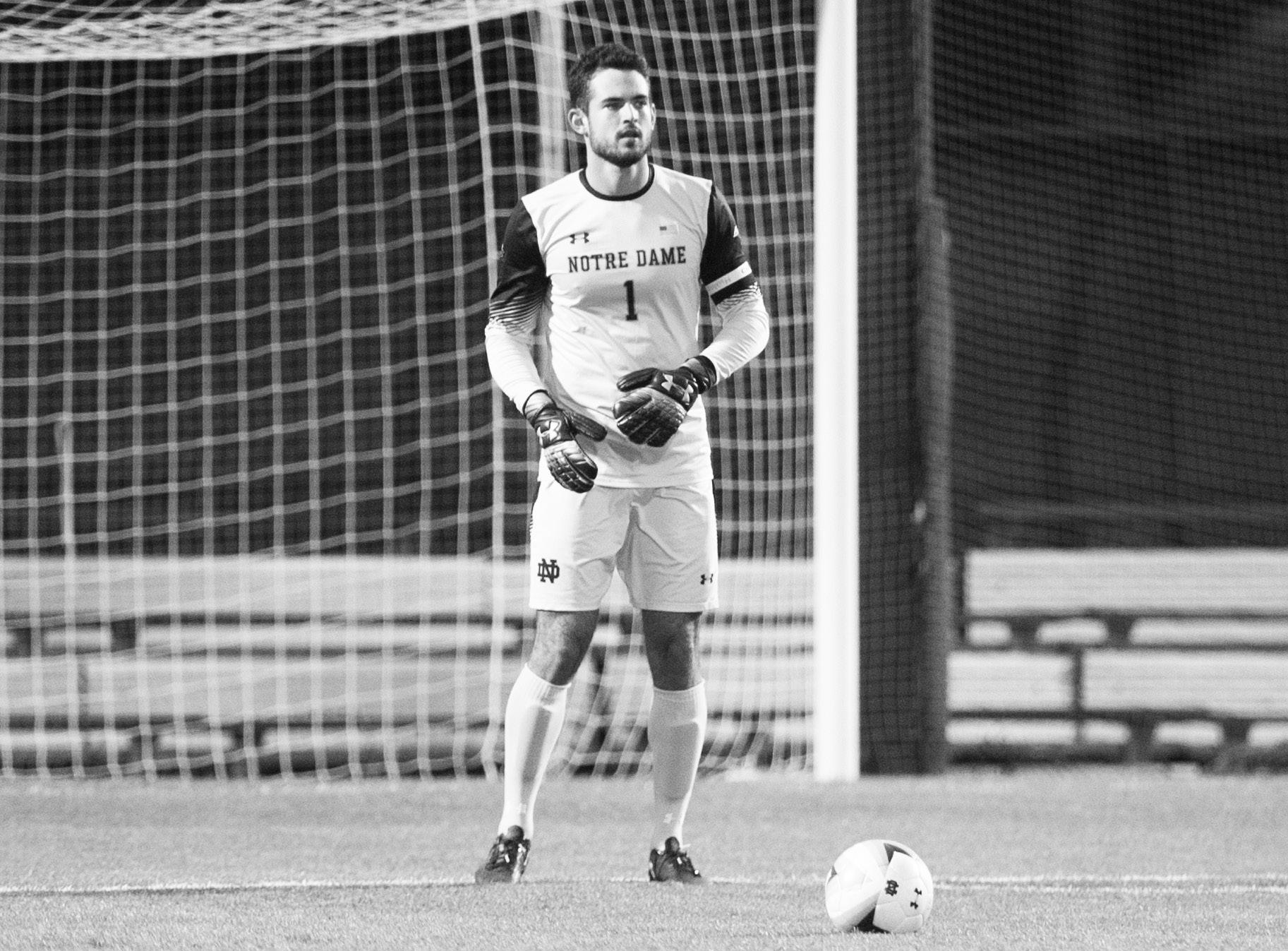
Irish graduate student goaltender Chris Hubbard surveys the field during Notre Dame’s 2-1 victory over Northwestern on Oct. 1 at Alumni Stadium. Hubbard had four saves in Friday’s 2-1 win against Clemson.
MACKENZIE MARINOVICH | The Obsberver Irish junior forward Andrew Oglevie takes a shot
Dame’s 5-3 victory over AlabamaHuntsville on Friday at Compton Family Ice Arena. Oglevie had his 12th multi-point game on Saturday.
men’s soccer | nd 2, clemson 1
l ate goal lifts nd to victory
Observer Sports Staff
l ooking for a signature win in a top-10 matchup against n o. 5 c lemson on Friday night, n o. 9 n otre d ame found it, topping the Tigers 2-1 on the road at h istoric r iggs Field.
s enior forwards Jon Gallagher and Jeff Farina scored for the Irish (8-2-1, 3-1-1 A cc ), who stunned c lemson (8-3-0, 2-3-0 A cc ) with a goal in the 89th minute to claim the victory. With the win, n otre d ame improved to 3-0-1 against c lemson since joining the A cc five years ago, starting in 2013 when the Irish visited c lemson and bested another tough Tigers squad by a score of 2-1 in overtime.
Friday’s game saw much of the same. In front of its home crowd, c lemson came out strong in the first few minutes of play. h owever, a midfield giveaway in the fifth minute by the Tigers led to a breakaway for Farina and
a bona fide opportunity for n otre d ame, but the senior forward’s shot was denied by junior c lemson goalkeeper Ximo m iralles. The Irish almost scored again in the 23rd minute, when Gallagher dribbled around m iralles down the left wing and flicked the ball on goal, but a sliding c lemson defender safely cleared the would-be-goal.
The rest of the first half was all c lemson, as the Tigers were consistently dangerous on offense around n otre d ame’s goal. In the 38th minute, c lemson senior midfielder o liver s hannon powered a shot that fizzed in towards the net, but was punched away by n otre d ame captain and graduate student goalkeeper c hris h ubbard to keep the game scoreless heading into halftime.
The Irish started the second half as well as they could
By MIChael Ivey and COnnOr M ulvena sports Writers
The Irish opened their season in commanding fashion this past weekend, sweeping visiting Alabama- h untsville 5-3 on Friday and then 4-0 on s aturday in the regularseason opener at c ompton Family Ice Arena.
o n Friday, after a scoreless first period, the Irish (2-0) scored 12 seconds into the second period on the power play when junior defenseman b obby n ardella blasted a shot from the point to give the Irish a 1-0 lead. b ut h untsville (0-2) responded just 36 seconds later with a goal of their own to tie the game 1-1.
Three minutes into the second period, freshman forward c olin Theisen gave the Irish the lead again after firing a shot from the point past junior h untsville
& diVinG | dennIs sTArk relAys
notre Dame ends weekend with win over Syracuse
By alex Ben Der sports Writer
c oming off nearly a full week of rest, n otre d ame performed well in two conference games over the weekend, tying n o. 13 v irginia 1-1 on the road Thursday, before coming back home and defeating s yracuse 2-0 on s unday.
It became clear early on Thursday that the Irish (74-3, 3-2-1 A cc ) were in for a tough challenge as they faced an aggressive v irginia (8-3-3, 3-1-2) attack that led the A cc in shots coming into the contest.
Although the half started quietly, just before the halftime break the Irish put on a solid display of passing before graduate student midfielder s andra y u was able to pull away from a defender and strike the ball home, giving her team the 1-0 lead.
Observer Sports Staff
The n o. 17 men’s team and n o. 25 women’s team opened their seasons for the Irish this past weekend, finishing second in the d ennis s tark r elays to the n o. 7 men and n o. 9 women’s teams of l ouisville on Friday, but bouncing back to defeat the c ardinals in the first dual meet of the season on s aturday.
c oming off of one of the best seasons in program history, n otre d ame’s hope of starting the season strong with a win fell just short in its opening meet. In the 54th d ennis s tark relays, named in honor of the program’s first coach, l ouisville reigned supreme for both men’s and women’s teams in the clash between the A cc rivals.
The l ouisville’s men narrowly beat out the Irish 130-128 and the c ardinals women’s team beat out the
women’s team 134-130. d espite the loss to l ouisville, the Irish won 10 out of 22 events, and broke six meet relay records including: the men’s and women’s 300yard breaststroke relay, the women’s 1500-yard freestyle relay, men’s 200-yard freestyle relay, and the men’s and women’s 400-yard freestyle relays. In addition to relays, sophomore Abbie d olan etched her name into the r olf Aquatic c enter record books with her 1:46.69 leg of the Irish’s 800-yard freestyle. The Irish weren’t the only team in attendance to break meet records as l ouisville sophomore and the 2016 A cc Freshman of the year m allory c omerford swam her leg of the 300-yard butterfly relay in 52.96 seconds.
After finishing second on Friday night, the Irish got their revenge s aturday morning when both the men’s and
PETER ST. JOHN | The Observer
Irish sophomore forward Natalie Jacobs looks to pass during Notre Dame’s 1-0 overtime loss to South Carolina on Sept. 1. see
swimminG
MACKENZIE MARINOVICH | The Observer Irish senior forward Jake Evans prepares for a faceoff during Notre Dame’s 5-3 victory over Alabama-Huntsville on Friday.
Defense
more.
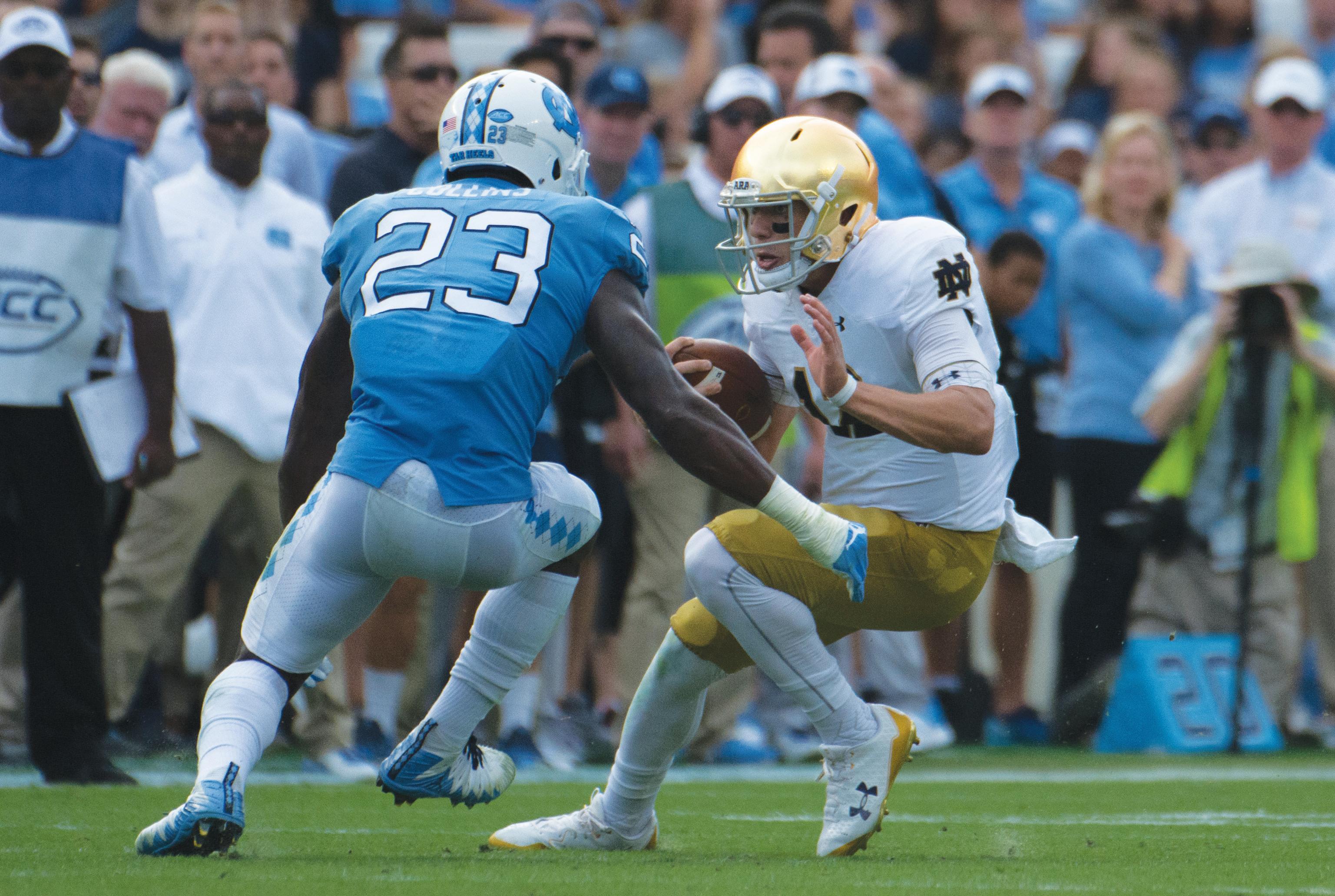
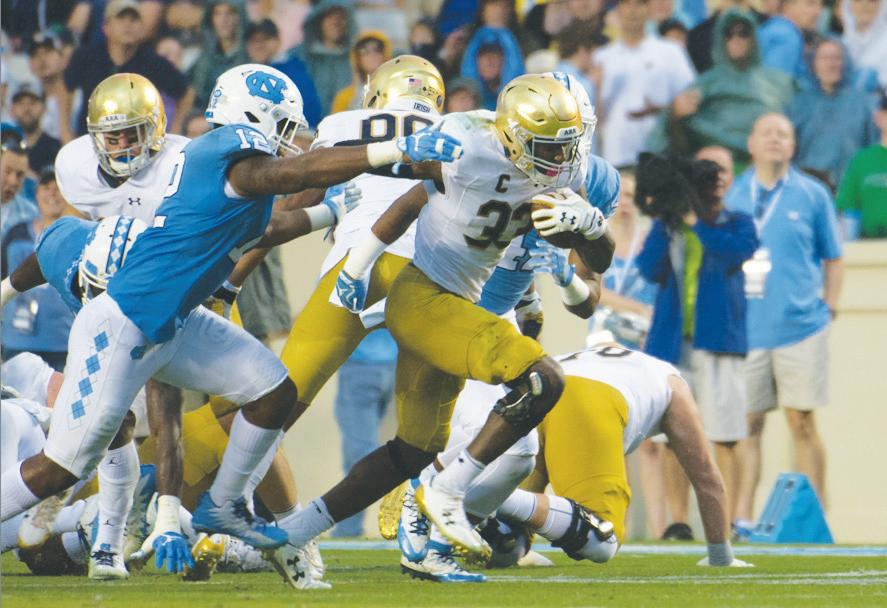
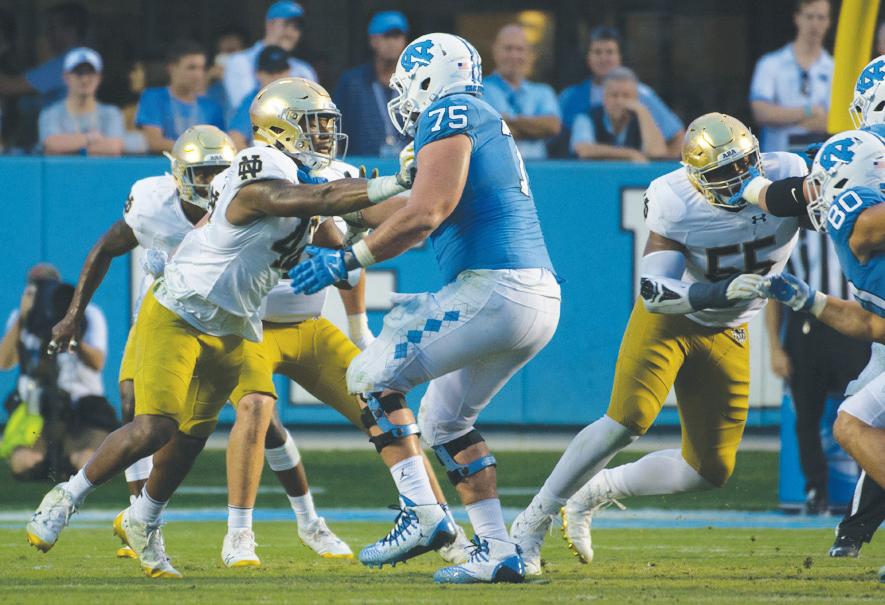
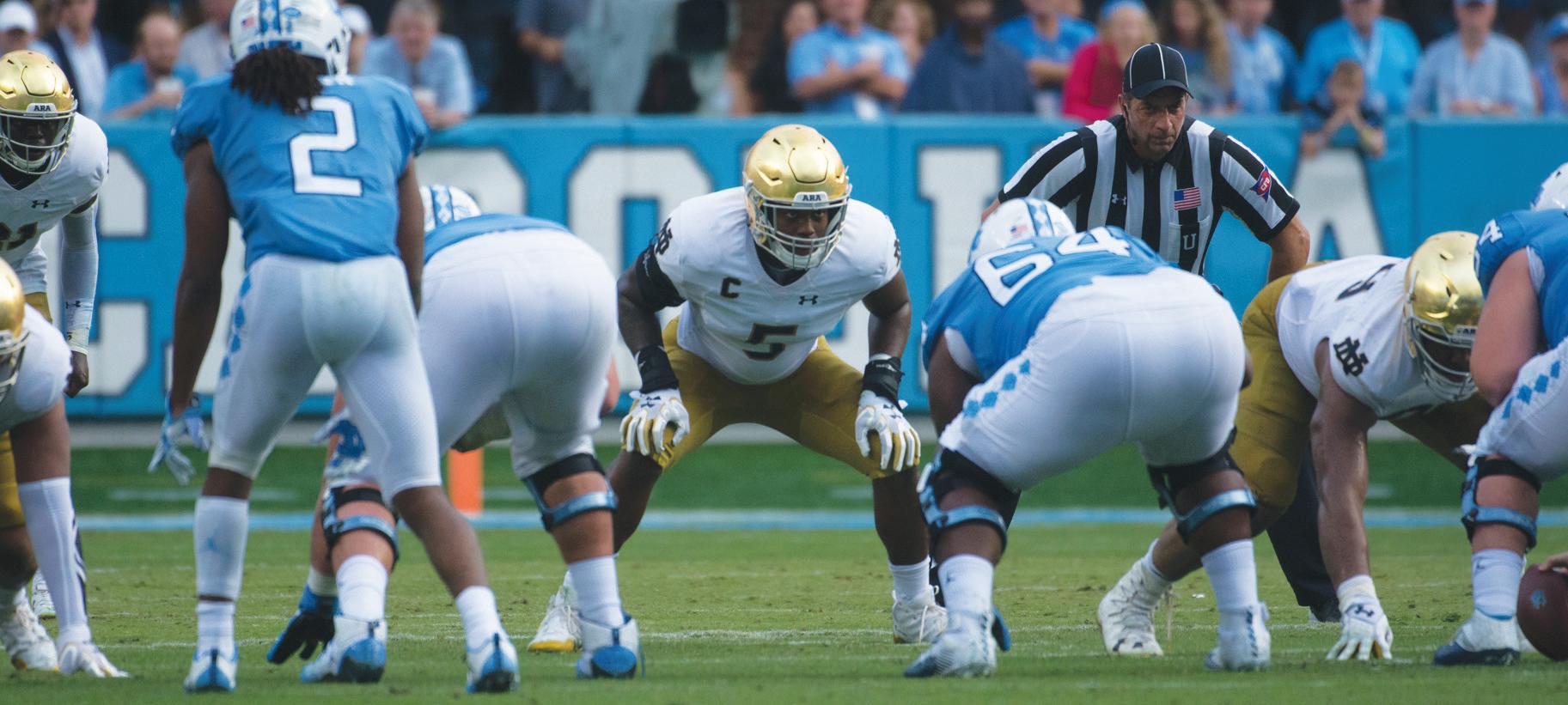
and then — 23 minutes into the game, on its sixth possession — north Carolina finally earned its first first down of the contest. the irish (5-1) had held the tar Heels (1-5, 0-3 aCC) to five consecutive three-and-outs to start the game. they recorded a total of eight on the day, plus a safety by senior defensive end Jay Hayes and junior defensive tackle Jerry tillery and an interception by sophomore defensive end Julian okwara that also came without a tar Heels first down on the drive. okwara said the entire defense is always determined to get off the field on third downs.
“Whenever we get to third down, we’re in there to go get a stop,” okwara said. “that’s something we practice every day, thirddown situations and getting off the ball, getting to the quarterback, reading the tackle and trying to make the right play.”
But the irish three-and-outs were not simply the product of successful third downs. the tar Heels consistently faced difficult third-down situations, with an average third-down distance of 6.1 yards and four plays of thirdand-nine or more.
on first down in particular, the irish defense set the tone, letting up only 2.4 yards on average over the course of the game, and holding the tar Heels to an average of a 2.2 yard loss per first-down play on the opening five drives of the game. that first-down
Padanilam
Long’s offense, rolling out of the pocket and making the throws that Wimbush has often struggled with at times this year.
But as the game progressed, Book didn’t look as comfortable. He was kept in the pocket a little bit more, and he struggled to read the defense and make his progressions after the tar Heels (1-5, 0-3 aCC) started to make adjustments. on his last 20 attempts, Book completed only nine passes and threw two interceptions.
and all of that invites the following question: did anyone really expect Book to throw the ball 31 times in the first place? Let alone 25 times in the first half?
You’re lying if you said yes. and in the end, it all worked out fine. Book didn’t play well enough to stir up any questions about Wimbush’s job security, as my colleague daniel o’Boyle suggested a strong performance could in his column friday; nor did he play poorly enough for the irish to ever truly feel threatened in this game.
So we didn’t really learn much about the irish passing game with or without Wimbush in Saturday’s game. and the fact Book threw more times in the first half than Wimbush had in either of the previous three games suggests we really didn’t learn much
performance starts with the defensive line, which Jay Hayes said feeds off its own success due to the competitive attitudes of every player in the unit.
“it’s so competitive in the d-line room,” Hayes said. “guys want to get tackles for losses, they want to get sacks, they want to get forced fumbles and they want to get fumble recoveries. the guys are so competitive. When someone gets something, everyone’s happy, but everyone wants to get something too. that’s what keeps the d-line rolling. it was competitive before, but not like this. they count pressures, they count wins and losses during the game, everyone counts everything.”
okwara echoed that sentiment, saying defensive line coach mike elston ensures the unit builds on every successful play it makes.
“Coach elston tries to get us fired up,” okwara said. “We feed off each other and we try to execute and make plays for each other.”
Last year, the irish forced a total of 32 three-and-outs, while no team forced more than 68. the nation’s leaders in the statistic were none other than national champions Clemson, with national runners-up alabama in second place. the eight threeand-outs forced by the irish against the tar Heels bring them to 23 for the season, an average of a little under four per game. irish senior linebacker drue tranquill said the defense has had great success this year, but was determined to truly make a statement in north Carolina.
“Coach elko challenged us this
about the offensive strategy going forward, either.
What about the other facets of Saturday’s win?
Well, nothing much new there, either.
Junior running back Josh adams ran for another 100-plus yards in the first half, buoyed largely, again, by another long touchdown run — this one to the tune of 73 yards — that has seemingly become the norm on a pergame basis for the captain. and when the irish took adams out of the game to deal with his dehydration, we saw sophomore deon mcintosh yet again close out another irish win, this time with his best performance of the season — 12 carries, 124 yards and two touchdowns, all in the second half. and while mcintosh’s performance was impressive, it also wasn’t altogether surprising. the sophomore had closed out games before, and this time he just took on a bigger role against a much weaker defense — one that had given up five yards per carry and 222 yards per game entering Saturday — behind one of college football’s best offensive lines. this game offered a glimpse at the real depth notre dame has at the running back spot. But if head coach Brian Kelly is going to continue to label adams as the “bellcow” back and play musical chairs with the backups when he needs a spell, it doesn’t really tell us much about the role mcintosh will play in closer games against
week,” tranquill said. “for the most part we’ve been able to get by and still beat our opponents down, but there’s always been a drive here or there where they accumulated too many yards on us, so the coaches challenged us this week. for the most part i think we still did great but i think there are still things we can look at as far as really punishing opponents goes, but we definitely took a step forward to that today and had a great performance.”
With the exception of a 16-play field goal drive that ended in the fourth quarter with the irish already leading by 19 points, no tar Heels drive lasted more than two minutes, as the irish defense neither bent nor broke, ending drives quickly by stops and turnovers. Hayes said he was determined to make opponents fear the irish defense, and that starts with stopping offenses as soon as possible.
“We take pride in getting threeand-outs,” Hayes said. “that’s our whole goal getting in every time we go out there. they’re going to go three-and-out. We don’t want them to try to drive down the field in us. We take pride in that.
“We don’t want a team to think they can run on us; we don’t want a team to drive down the field; we don’t want a team to think they can push us around. We want to instill fear, fear of us as a front four, as a front seven, as an entire defense with all the guys in rotation. We want to instill fear in those five o-linemen that are facing us.”
Contact Daniel O’Boyle at doboyle1@nd.edu
better teams — a la uSC, north Carolina State, miami (fL) or Stanford — going forward. on the other side of the ball, the defense was dominant. it kept the tar Heels offense without a first down the entire first quarter and a good chunk of the second quarter. plus, it forced another three turnovers and even added two points on a defensive safety to close out the first half.
But against a north Carolina offense that was averaging less than 400 yards of offense per game and had already turned from its graduate transfer starter to a redshirt freshman at quarterback just a few games into the season, there probably wasn’t much that can be gleaned from the defense’s performance either.
So what’s left to say?
Well, notre dame took care of business Saturday, beating a vastly inferior and thinner team, just as it was supposed to. now the irish have a bye week, giving them two weeks to prepare for their biggest game the rest of the way: a night game at home against current-no. 14 uSC. and that’s a game when we’ll actually learn about who this irish team has become in the last four weeks.
Contact Ben Padanilam at bpadanil@nd.edu
The views expressed in this column are those of the author and not necessarily those of The Observer.
Scoring
n otre d ame 7, nortH carolina 0
Cam Smith six-yard pass from ian Book (Justin Yoon kick)
14:54 remaining
Drive: 15 plays, 80 yards, 4:57 elapsed
notre dame 14, n ortH c arolina 0
Josh adams 73-yard run (Yoon kick)
12:38 remaining
Drive: Two plays, 73 yards, 0:17 elapsed
notre dame 14, n ortH c arolina 7
anthony ratcliff-Williams 25-yard pass from Chazz Surratt (freeman Jones kick)
1:50 remaining
Drive: Six plays, 47 yards, 1:49 elapsed
n otre dame 16, nortH carolina 7
Jay Hayes safety
00:28 remaining
n otre dame 19, nortH carolina 7
Yoon 29-yard field goal
11:15 remaining
Drive: Seven plays, five yards, 2:47 elapsed
n otre dame 26, nortH carolina 7
deon mcintosh 35-yard run (Yoon kick)
6:41 remaining
Drive: Two plays, 46 yards, 0:28 elapsed
n otre dame 26, nortH carolina 10
Jones 34-yard field goal
14:11 remaining
Drive: 16 plays, 56 yards, 4:31 elapsed
n otre dame 33, nortH carolina 10
mcintosh 24-yard run (Yoon kick)
14:11 remaining
Drive: 11 plays, 75 yards, 5:06 elapsed
Put it in the books
Ian Book made his first career start in place of the injured Brandon Wimbush. The sophomore passed for 146 yards and completed 17 of his 31 attempts. The Irish rushing game was also in full swing, as both Josh Adams and Deon McIntosh ran for over 100 yards. Adams burst through defenders for a 73-yard touchdown run, while McIntosh scored twice in the second half.
KATHRYNE ROBINSON | The Observer
Irish sophomore quarterback Ian Book sidesteps a defender during Notre Dame’s 33-10 victory over North Carolina on Saturday at Kenan Memorial Stadium in Chapel Hill, North Carolina. Book passed for 146 yards in his first start and threw his first touchdown pass, opening scoring with a 6-yard pass to Cam Smith on the first play of the second quarter.
KATHRYNE ROBINSON | The Observer
Irish senior linebacker Nyles Morgan stares down the offensive line prior to the snap during Notre Dame’s 33-10 win over North Carolina on Saturday at Kenan Memorial Stadium in Chapel Hill, North Carolina.
KATHRYNE ROBINSON | The Observer
Irish junior running back Josh Adams breaks away from a defender during Notre Dame’s win Saturday.
KATHRYNE ROBINSON | The Observer Julian Okwara, left, attempts to rush the passer during Notre Dame’s win over North Carolina.
KATHRYNE ROBINSON | The Observer
Irish junior tight end Alize Mack returns to the line of scrimmage during Notre Dame’s 33-10 win over North Carolina on Saturday.