Former Republican senator, presidential candidate shares vision for Republican Party
By JACK ROONEY
A ssociate News Editor
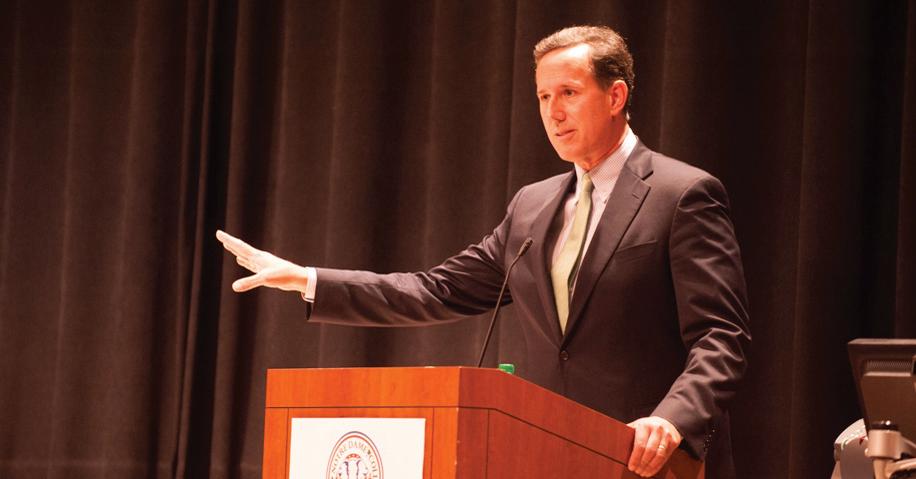
Former Pennsylvania senator and 2012 R epublican presidential candidate R ick Santorum spoke to a capacity crowd in the Carey A uditorium of the H esburgh L ibrary on Wednesday afternoon and said R epublicans must refocus their efforts and political strategy on strengthening the A merican family.
Santorum, who was also promoting his book, “ B lue Collar Conservatives: R ecommitting to an A merica That Works,” said promoting family is economically and socially beneficial, but often
draws criticism.
“The biggest determiner of economic success: family structure, by far,” Santorum said. “If you come from a single parent family, [it’s a] much harder road.
“A nd yet if you talk about the importance of family, the importance of marriage, the importance of mothers and father raising children, you are a dinosaur. You are a oldfashioned, out-of-step, moralizing hater, when all you’re trying to do is give kids in A merica a chance. Why isn’t the government on the side of marriage?” Santorum, who spoke at
see SANTORUM PAGE 5
Professor wins Career award Saint Mary’s celebrates Constitution Day Lecture features Jesuit history
By ALEX CAO News Writer
Nitesh Chawla, professor of computer science and engineering and director of both the Interdisciplinary Center of Network of Science and Applications and the Data, Inference, A nalytic and Learning Lab, was awarded the 2015 Early Career award by the Institute of Electrical and Electronics Engineers (IEEE) Computational Intelligence Society (CIS).
“I am very excited and honored to receive this award,” Chawla said. “Every year IEEE CIS selects one scientist or engineer working in computational intelligence area, under the age of 40, to receive the IEEE CIS Outstanding Early Career Award.
"It is a recognition of the contributions to-date and the promise of the contributions that lay ahead.”
see AWARD PAGE 4
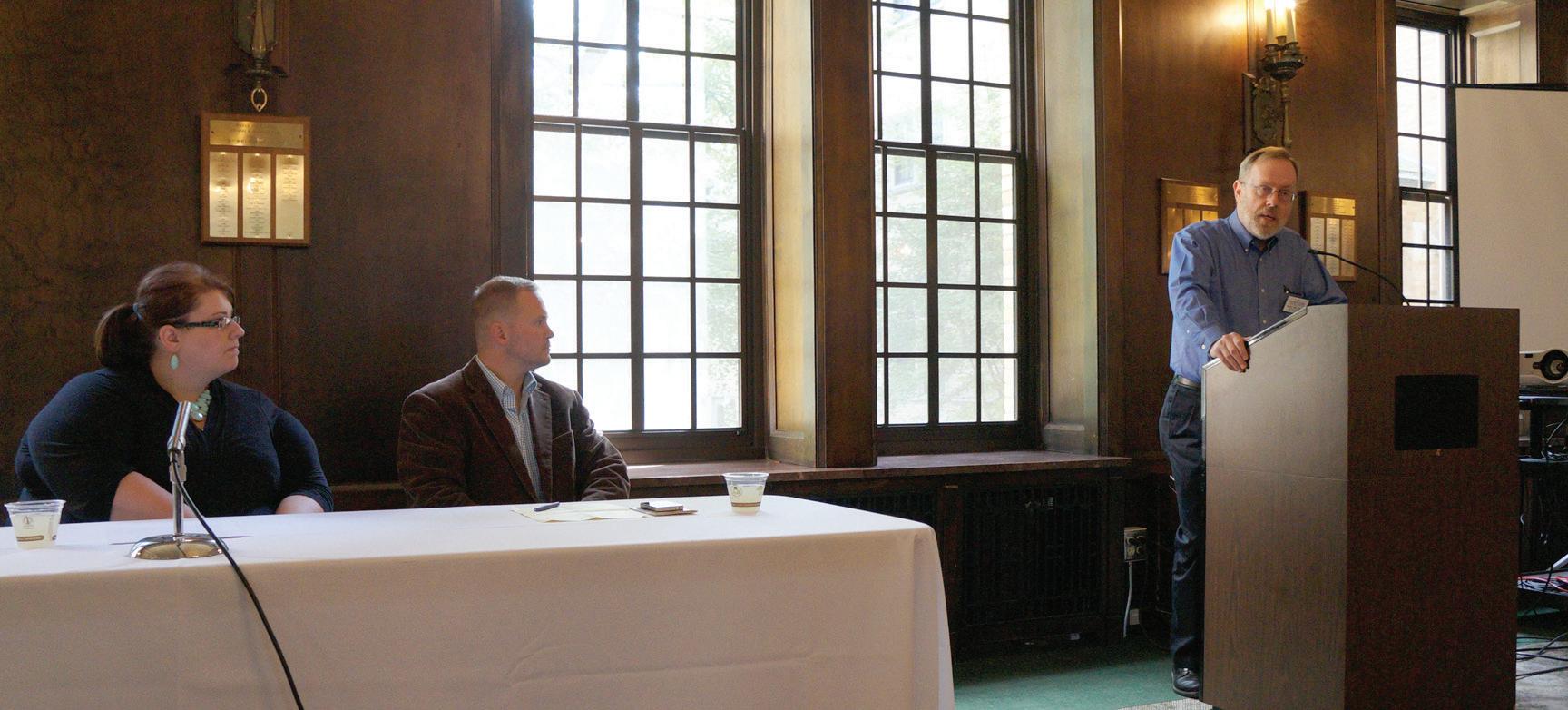
Julia Dunford (left), the South Bend
Saint Mary’s professor Marc Belanger
By ALI THOMPSON News Writer
Saint Mary’s commemorated Constitution Day on Wednesday with a panel to examine different perspectives and experiences in regards to the United States Constitution. The panelists, who each addressed varying opinions of the Constitution, included chair and associate professor of political science Marc Belanger, senior and communication studies major Julia Dunford and the deputy
chief of staff to South Bend mayor Pete Buttigieg, Brian Pawlowski.
Constitution Day was created in 2004 by an act of Congress to commemorate the completion of the Constitution 227 years ago in 1787, said associate professor of communication studies and event coordinator Michael Kramer.
This year’s theme, “Unique Ideas, Unique Experiences,” was inspired in part by a comment from Belanger, said Kramer. Belanger pointed out the uniqueness of the United
States Constitution in comparison to the systems of other nations, which makes the document worth our exploration and analysis.
Kramer said that Belanger's idea relates to the idea that people in the United States have their own unique experiences engaging with the constitution.
“The Constitution is unique and the ways in which we encounter it are unique,” Kramer said.
see PANEL PAGE 4
By ANNMARIE SOLLER News Writer
John T. McGreevy, dean of the College of A rts and Letters and professor of history, presented the Cushwa Center Lecture as part of a yearlong celebration of the bicentennial of the birth of Fr. Edward Sorin, founder of the University.
The lecture, titled “The Jesuits, Father Sorin, and the 19thCentury Catholic Revival,” focused on the Jesuit order, who McGreevy said are oddly contemporary in their focus on internationalism.
McGreevy said one of the impressive aspects of the Jesuits is their development of a Catholic community more attuned to the reverberations of global Catholicism than seemed imaginable in 1816.
Jesuits came from Europe to the United States for two
see JESUITS PAGE 4
SARAH OLSON | The Observer
Rick Santorum addresses the future of the American economy and his vision for the Republican Party while also promoting his new book, “Blue Collar Conservatives: Recommitting to an America That Works.”
CAITLYN JORDAN| The Observer
Senior
mayor’s deputy chief of staff Brian Pawlowski (center) and
(right) participate in a Constitution Day event.
Systems
(574) 631-8839
Policies
QUESTION OF THE DAY:
Sizhen
Tori Lew sophomore Ryan Hall
“Football
Moira Hubbell senior Lyons Hall
“Drummer’s
Meghan O’Brien senior off-campus
“Veteran’s Day vigil.”
Francis Liang freshman
Welsh Family Hall
“Fall break.”
Da
“Section tea.”
|
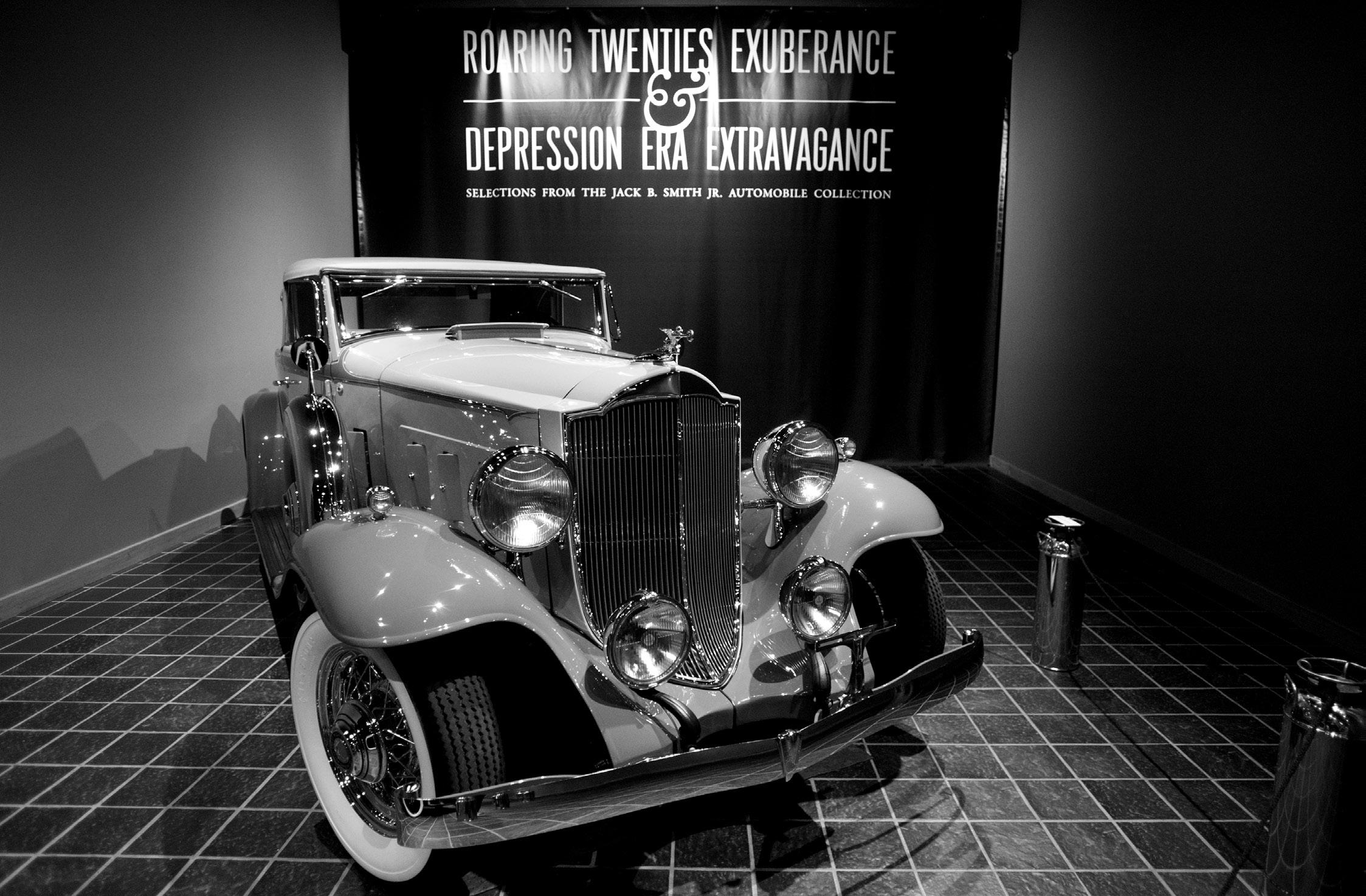
The 1932 Packard Light Eight Roadster (900) is one of four automobiles from the Jack B. Smith Jr. automobile collection on display in the Snite Museum of Art. The Roaring Twenties Exuberance & Depression Era Extravagance exhibition will remain open through Nov. 30.
Today’s Staff
Corrections
The Observer regards itself as a professional publication and strives for the highest standards of journalism at all times. We do, however, recognize that we will make mistakes. If we have made a mistake, please contact us at (574) 631-4541 so we can correct our error.
Thursday
Information SessionTruman Scholarship Brownson Hall
3:30 p.m. - 4:30 p.m.
Learn about the application process.
Mindful Meditation Coleman-Morse Center
5:15 p.m. - 6:15 p.m.
Open to all students of all faiths.
Friday
Cross Country Notre Dame Golf Course
3:30 p.m. - 6 p.m.
National Catholic Championships
Graduate Student
Mass Basilica of the Sacred Heart
5:15 p.m. - 6:15 p.m.
Social will follow.
Saturday
Blackhawks Training Camp Compton Family Ice Arena
10:15 a.m. - 12:40 p.m. Blackhawks host open practice.
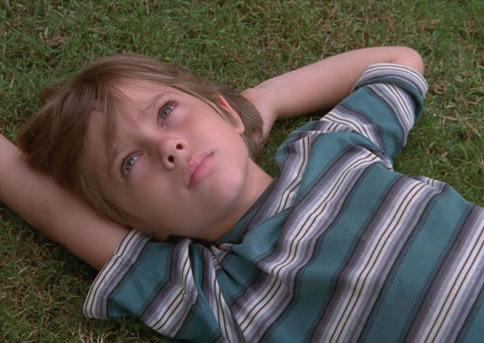
Film: “Boyhood” DeBartolo Performing Arts Center
6:30 p.m. - 8:30 p.m. Filmed over 12 years.
Sunday
Mass at the Basilica Basilica of the Sacred Heart
11:45 a.m. - 12:45 p.m.
Music by Notre Dame Folk Choir.
Film: “Boyhood” DeBartolo Performing Arts Center
3 p.m. - 5 p.m.
Cost is $4 for students.
Monday
“Conceptions of Philology” McKenna Conference Center Sept. 22 & 23 Part of the Henkels Lecture Series “Presenting Your Research” Brownson Hall 4 p.m. - 5 p.m. Undergraduate workshop.
CAROLINE GENCO
The Observer
Professor studies sociality in baboons
By PETER DURBIN
News Writer
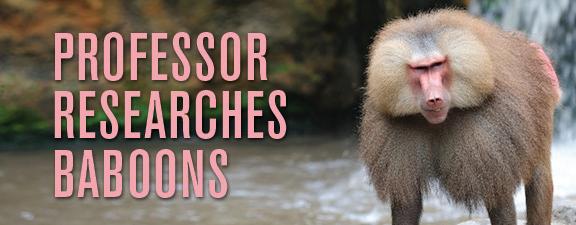
A new study has found that social interactions are not just important for humans, but for baboons as well.
Elizabeth Archie, Clare Boothe Luce Assistant Professor in the Department of Biological Science, conducts a massive study on hundreds of wild female baboons, analyzing the animals' social group activities.
The project is run in conjunction with a team of scientists from some of the country’s most prestigious universities, including Duke University and Princeton University, according to a University press release.
The project, founded in 1971 by Archie’s collaborator Jeanne Altmann, takes place in southern Kenya in the Amboseli National Park.
“[The park] is a grassy savannah dotted with a few trees, with lots of other wildlife,” Archie said.
According to a University press release, the team uses a vast array of data, dating back to 1984, regarding the social relationships of wild female baboons.
Archie lives on site for about two months of the year.
“I love visiting the baboons because it’s like checking in on the latest episode of my favorite TV
drama,” Archie said. “I get to find out who died, who had a baby, or who rose or fell in social rank.
“I’ve always been interested in animal social relationships and how social interactions in animals compare to those in humans.”
The team attempts to analyze how groups of wild female baboons successfully solve a variety of daily tasks.
“Animals have to solve a series of problems in their lives, including finding food, escaping from predators and mating,” Archie said. “Animals utilize social relationships to help them solve these problems.”
Archie’s current research aims to correlate a relationship between social interactions and extended life spans.
According to a University press release, Archie’s analysis of the data set has found female and male baboons both lived longer when they had strong social connections.
“These results suggest that
SENATE
social effects on life span are not unique to humans,” Archie said. Archie’s team’s findings also relate to other social mammals, such as rats and dolphins.
“There have been a handful of studies that have shown that an animal’s social connections can predict their longevity,” she said. “Our results help confirm this phenomenon in mammals and suggest it might be widely shared across several social species.”
Archie’s team hopes to extend their research into male baboons, but this is a surprisingly difficult process.
“Female baboons live in the same social group for their whole lives, so when they disappear from the group, we can be pretty certain that they died,” Archie said.
With such groundbreaking research, Archie hopes that her team’s results will be applicable to future human social research.
Contact Peter Durbin at pdurbin@nd.edu
Senate discusses campus safety
By JESSICA MERDES News Writer
Student Senate gathered Wednesday evening to discuss safety on campus and how it is addressed. Many members of the senate attended the safety summit on Tuesday that collaborated with the N DSP.
Student body president L auren Vidal discouraged students from traveling in the South Bend area unaccompanied.
“One of the most alarming
things that we were presented with at the summit is that 80 percent of incidents happen when students are walking alone throughout South B end,” Vidal said. “We need to watch out for each other and work to promote the overall safety of students.”
Over the past five years, Student Senate has worked to strengthen the relationship between students and the South Bend police. According to Vidal, crime rates involving students, which usually involve alcohol-related incidents, have dramatically decreased.
“The key is to have respectful interactions with the officers,” Vidal said. “R ather than running away or making excuses, be honest and show respect.”
Other topics of discussion included the quad markets for Oct. 10. More details would be finalized as the event approaches, Vidal said.
A shley Calvani, representative for Cavanaugh Hall, brought up a concern about the allocation of financial aid for textbooks.
“The textbook financial aid was moved from the jurisdiction of the rectors to the general financial aid office,” Calvani said, “However, many girls in Cavanaugh have stated that the financial aid for textbooks is no longer a part of their packages.”
The group decided to look into the issue of financial aid changes and discuss it in the future.
Contact Jessica Merdes at jmerdes@nd.edu
Panel
Kramer said this year’s panel was chosen to provide three unique experiences and perspectives on the Constitution in line with this idea of considering the document.
“Not all democracies are the same,” Belanger said. “In fact, the United States is pretty unique in the way its democracy operates. If you look at the Constitution through a comparative politics lens, you’ll see that the United States has the oldest written constitution. However, not all constitutions are written documents.
“The Constitution is unique because it is relatively short and focuses on government mechanisms, not specifics.”
Jesuits
reasons, McGreevy said. Jesuits followed the Catholic tide of emigrants who left Europe between 1820 and 1900, as more than half of the 60 million people were Catholics.
A nother reason McGreevy said Jesuits came to the United States was because they were kicked out of 22 European and L atin A merican countries between 1840 and 1900.
When the Jesuits came to A merica, they carried the books, journals, devotional pamphlets, chalices, rosaries and holy water from a European Catholic world in crisis and translated them into an A merican idiom, McGreevy said.
McGreevy used the example
Award
The IEEE CIS awarded Chawla the award for his groundbreaking research in data mining, machine learning, network science, and its numerous applications especially with inconsistent and difficult-to-read data.
“[My work involved figuring out] how to learn and develop algorithms to cater to data sets which have extreme events, rare events and distributions that are not consistent and stationary and how do you develop algorithms to react unique challenges and data,” said Chawla. “Some of my work is the most-cited work in learning from imbalanced data such as in a method called SMOTE [Synthetic Minority Oversampling Technique] … and some of the work we have done in developing machine-learning algorithms for non-traditional distributions and non-stationary data was also consideration for this award as well as awards have more recently earned for work I was doing in network science where we published groundbreaking work in link prediction.”
Chawla said he is applying that data to help healthcare systems provide personalized care
Dunford, who spent the summer interning at the South Bend mayor’s office, said that even though she spent a large amount of time in close proximity to politics, she has not dealt with or thought about the Constitution since my high school exams.
The subject brought her back to eighth grade, when her teacher gave a speech on the magic behind the Constitution, Dunford said. Her teacher explained the importance of the Constitution as the framework that allowed us to make changes and gave us a government that was sustainable.
“Saint Mary’s teaches us how to discuss, research, and most importantly, how to find our voice, use it and use it often,” Dunford said.
of Fr. John Bapst, a Jesuit priest in Maine, to describe the range of missionary work in the United States during the 19th century.
“One way Bapst is part of the 19th century revival is [through his] devotional culture. A second way is education. A key component to the 19th century Catholic Revival is a focus on Catholic education and more broadly Catholic institutions,” McGreevy said.
Bapst started his own Catholic school after he lost his case protesting the use of the King James Bible in public school, he said.
“There are almost eerie similarities between Bapst's story and that of Notre Dame’s founding president Reverend Edward Sorin,” McGreevy said. “L ike Babst, Sorin was marinated in Catholic devotional culture, [which was] just reaching full
that is more focused on treating the patient rather than care that is strictly focused on fighting disease.
“For a long time, we have been focused on a disease-centered approach. That’s when we have an individual who has a Disease A, we try to cure the disease not really looking at who the individual is, what are the more common diseases that individual has, or the circumstances that individual may be in. ... Our researched is focused on [thinking] about who that person is, how do you personalize medicine, personalize care or customize wellness strategies for that individual based on anatomical and health records of that individual.”
Chawla said his work is also adapted to suit roles in fields ranging from medicine to security.
"[In] the next couple of years the basic foundation of research is taking a big shift towards Big Data … So how do we calculate how much we trust in the data? ... How do we attach a veracity and reliability on that data? So that’s one area of research that will keep us busy for the next couple of years," he said.
Contact Alex Cao at acao@nd.edu
U ltimately, Dunford said she realized how the Constitution has affected her every day life.
“It’s the reason I have a right and an obligation to speak,” she said.
Pawlowski agreed with Dunford's view of the Constitution's constructive power in the United States.
“Whether you’re on a local level here, whether you’re on a student governing council, whether you’re on a state legislature board — it’s really important that you think through how you view the document,” Pawlowski said.
“There will always be debates. We should think about what we believe or support and why.”
Contact Ali Thompson at athomp01@saintmarys.edu
pitch.”
McGreevy said Jesuit globalism has a history that peaked in the 19th century, declined and then re-emerged again in the Second Vatican Council.
“Their orientation to the world, their linguistic curiosity, ... now seems oddly contemporary,” McGreevy said.
“While it is uncertain how this new era of Catholic globalization is going to work, the Catholic connections and communities now being forged by text messages and Skype necessarily follow the paths that were laid by Bapst and Sorin,” he said.
Contact Annmarie Soller at asoller@nd.edu
the invitation of Notre D ame College R epublicans, said R epublican candidates center their economic messages on three principles: lowering taxes, cutting spending and balancing the budget. These three points of emphasis cater almost exclusively to small business owners, who only comprise three to five percent of the population, he said.
Instead, Santorum said, R epublicans should focus on how economic policies impact workers. H e told a story from the 2012 R epublican National Convention, where he delivered a speech in the midst of other R epublicans who only spoke to small business issues.
“Imagine, now, instead of one after another [ R epublican politician] coming out, had someone walked out with an employee of a company, and the employee of the company stood up and talked about how important the policies that create opportunity for businesses are to grow for their job, and talk about the standpoint of a worker, and talk about how important policies are
to help workers in A merica,” Santorum said.
“Well that’s what we’re trying to do with this book. I believe in pro-growth policies. I believe that we need to grow the economy. Yes, we need smaller government. Yes, we need to look at our tax code [because] we have the highest corporate taxes in the western world. … We need to do something to keep companies here, to grow companies here [and] create opportunities. B ut that isn’t enough.”
Santorum said his presidential campaign and his new book sought to create a more inclusive nation in the face of fierce political discord.
“[ M y campaign] had a message that resonated,” he said.
“We had a message that said, ‘We are inclusive, we care about everybody. We don’t just focus on business people or corporations. We want to create an opportunity for everybody, and we know that the problems confronting A merica are, in part, economic, and here’s something we can do about it.'
“Imagine if we actually included people who didn’t think anybody cared about them. Well that’s the focal point of this book. A nd the
amazing thing about this is it’s not a liberal [or] conservative issue. The policies and the ideas that we put forward actually do something that I think is really important in this country. I think people are tired of division.”
“[My campaign] had a message that resonated. We had a message that said, ‘We are inclusive, we care about everybody.’”
Rick Santorum former Pennsylvania senator
The book, which was “born out of the 2012 campaign,” proposes a way to bridge the A merican political divide, Santorum said.
“[The political climate] is certainly as ugly as I’ve seen it in my lifetime,” he said. A nd people are tired of it. They’re sick of R epublicans and D emocrats not wanting to get anything done. They’re sick of pointing the finger at each other. There doesn’t seem to be any common ground. B ut, see, I believe what we’ve laid out here [in the book] is a common ground because it’s common sense.”
Santorum said A merica “need[s] to recreate a manufacturing juggernaut in the U nited States” and work to give all citizens an equal opportunity, which is more difficult in the context of the current welfare system and tax structure.
“We’re setting up a system that is harmful to women and children, and we call that benevolence and kindness and all these wonderful words the left likes to use,” he said. “There’s nothing compassionate about this. There’s nothing compassionate about stopping and discouraging people from forming solid bonds for themselves as well as for their children and their community.”
Santorum said the interesting situation in immigration also contributes to political polarization and prohibits greater unification.
“I can understand why corporate A merica, as they are the chamber of commerce, is all for more legal immigration: cheap labor, higher profits,” he said. “I just don’t happen to look at human beings in A merica as a commodity. I look at workers as men and women who are trying to provide for themselves, and in some cases their
family or their relatives, and try to make a decent living. The government shouldn’t be out there undermining their ability to get a decent wage.
“So here you have, the horrible confluence of people who are looking at [immigration] as political power on the one side and profits on the other side, and the guys in the middle, the average working A mericans, get stiffed.”
With his book, and his possible 2016 presidential campaign, Santorum said he aims to change the course of the polarization in the U nited States and instead unite people.
“What I’m trying to do in this book, what I’m trying to do within the party, is try to rewrite the narrative, and write it in a way that brings people together,” he said. “People who are poor realize that the government programs harm them in many ways. I’m not saying that the money they get harms them, but the incentives are very harmful, the structure is very harmful. So it’s an opportunity for us to reach out and bring people who don’t think we care about them.”
Contact Jack Rooney at jrooney1@nd.edu
A Series of ND pride
Brian Lach Multimedia Editor
I love traveling.
From simple day trips at the beach to spending spring break in Chicago, something about visiting new places has always enthralled me. That’s why when one of my jobs offered me the opportunity to travel to Indianapolis for this past weekend’s Shamrock Series I couldn’t say no. While Indianapolis admittedly isn’t as glamorous as some of the Series’ past locales (Chicago and Dallas, for example), I was excited as I dragged myself out of bed for the trip early that morning Friday.
A rriving in Indianapolis a little under four hours later, I checked in to my hotel and dropped off my bags. A lmost immediately, I was bombarded by a variety of familiar sights and sounds. A man wearing a Notre Dame polo directed me toward the stairs, which I descended as a recording of the University marching band played softly in the background. Flanked by Shamrock Series banners and surrounded by Irish alumni and students alike, I made my way to Pan A m Plaza, which played host to a multitude of events throughout the weekend. D rummers’ circle, traditionally occurring under the midnight gleam of the G olden D ome, found itself in the shadows of L ucas Oil Stadium. Instead of Touchdown Jesus or South Quad, the pep rally found the city of Indianapolis as its backdrop. R ather than heading to South D ining Hall for dinner, students filed into various restaurants throughout downtown, bemoaning their inability to use flex points on the road.
On Saturday as I made my way up to the press box, I was immediately greeted by a spectacular panorama of the stadium below. Filled with a sea of Notre Dame colors, chants and cheers, I found myself filled with the same excitement as any other game day — three and a half hours away from campus, the massive L ucas Oil Stadium felt oddly like home.
While I was already aware of it, this past weekend truly demonstrated to me the universal nature of our university. Notre Dame isn’t just a college in South B end; Notre Dame is a family, spanning across multiple states, countries and continents. Notre Dame exists wherever its community exists — this much is clear at every Notre Dame event, regardless of location. I know that regardless of where my life takes me, I will always be blessed to be a part of the Notre Dame family. We are Chicago. We are Dallas. We are Indianapolis. We are Notre Dame.
Contact Brian Lach at blach@nd.edu
The views expressed in the Inside Column are those of the author and not necessarily those of The Observer.
LETTER TO THE EDITOR
Increase our print quota
L et’s face it: Notre D ame students have a tendency to complain, especially over any new policy that the U niversity enacts. While usually exaggerated, the uproar about Notre D ame’s most recent change to the print quota has clearly become an issue that is affecting students’ ability to succeed academically.
A t the beginning of this semester, the print system that yielded students at most 3,000 pages during the previous year, measured in dollars, was inexplicably switched to a point system that reduced students’ quota to 1,000 pages per year. U nused points will not roll over to the next academic year. While at first glance, this change may just be viewed as another measure to be environmentally friendly, while no doubt being a money-saving measure for the U niversity, Justin M cCurdy’s viewpoint last week notes that there are some confusing nuances based on how many pages students print and whether or not the print job is single or double-sided.
Even more critically, this adjustment has quickly become a detriment for students — and we’re only three weeks into the semester. A direct effect of this
QUOTE OF THE DAY
new printing system is that students have to change the way that they learn by printing less of their academic materials. Ironically, since more and more professors are also limiting the use of electronics in classes, printing off the assigned readings is becoming a necessity. This misalignment between OIT and classroom rules will only lead to more and more frustration and expenses for students as the semester goes on.
We want to implore that students’ print quota is increased.
A s seniors working on our theses, capstones and final projects, we have already burned through half of our allocated printing for the semester. Is anyone up for pooling his or her money to buy our own printer?
“Every human being on this earth is born with a tragedy, and it isn’t original sin. He’s born with the tragedy that he has to grow up. That he has to leave the nest, the security, and go out to do battle. He has to lose everything that is lovely and fight for a new loveliness of his own making, and it’s a tragedy. A lot of people don’t have the courage to do it.”
Helen Hayes A merican actress
EDITORIAL CARTOON
Emily Mediate Simone Oberschmied seniors L yons H all Sept. 10
Christopher Damian Ideas of a University
On empty classrooms
Willis Konick retired in 2007 as one of the University of Washington’s most sought-after professors.
For Willis, as his students called him, the classroom had changed over the years. According to the Seattle Times, “ [Willis] said teaching Dostoyevsky novels in the 1960s was easy because he didn’t need to explain radicalism to students. The students often came to class stoned — but he didn’t find that as annoying as today’s students, who often text-message during class.”
In 2011, researchers at Wilkes University surveyed 269 college students on their cell phone use. In the study, 92 percent admitted using their phones to text during class, with 10 percent admitting they had texted at least once during an exam. Most students, however, believed that their professors were unaware of the students’ cell phone usage.
Trying to understand the effects of multitasking, a 2010 study by Sylvain Charron and Etienne Koechlin found that when pursuing a goal, the brain’s medial frontal cortex ( MFC) works as a single unit to perform the necessary task. But when pursuing two concurrent tasks, the left and right sides of the MFC divide and attempt to work concurrently in pursuing those goals. When a greater reward is associated with one task, however, greater focus is placed upon that task at the expense of the other.
David Meyer, a psychology professor at the University of Michigan, commented on the study: “Under most conditions, the brain simply cannot do two complex tasks at the same time. It can happen only
LETTER TO THE EDITOR
when the two tasks are both very simple and when they don’t compete with each other for the same mental recourses. A n example would be folding laundry and listening to the weather report on the radio … But listening to a lecture while texting, or doing homework and being on Facebook — each of these tasks is very demanding and each of them uses the same area of the brain.”
This helps to explain why cell phone use in the classroom has been found to correlate with a .36 grade drop on a 4-point scale and why those in direct view of classroom multitaskers have lower test scores than their peers. If you’re on your phone in class, are you really there?
According to Willis: “The cellphones are an addiction. They’re more than just a nuisance … It’s hard to wean them from the phones.”
“Wean” is a striking word, as if, by acting out improvised literary scenes in his classes, Willis not only grabbed his students’ attention but also nourished them. Unlike many classes, which transmit information through monologues that could be gathered from another student’s notes, Willis’s course transmitted life. It reminds one of John Henry Newman’s words: “The general principles of any study you may learn by books at home; but the detail, the colour, the tone, the air, the life which makes it live in us, you must catch all these from those in whom it lives already.”
But this life which makes it live in us is scarce, ending as it escapes the lips and dying as it bleeds onto the notebook page. I once had a philosophy professor who told his students not to take notes in class. He told us that notes encourage us to save the illumination for another time, but, in his class, the intellectual moment
was now! Words are not to be stored away for later use; they are to change us at this very moment. Ideas are supposed to live and breathe and grow, as we discuss and argue and hang on every word.
Thus, the philosopher is often the man who would like to write and publish but who finds his time constrained by the world around him, carried on by his friends in shared wonder. Such wonder requires more than a book or a detached lecturer, just as Socrates points out that becoming a doctor requires more than hearing something from a book or happening upon a few drugs.
The philosopher cannot be made from philosophy books. First he must be awakened, from his buzzed stupor, from his cell phone, even from his books. He must be called out of the cave by name. But few will offer such an invitation. Perhaps this is what inspired James Schall to title one of his books: “A nother Sort of L earning: Selected Contrary Essays on How Finally to Acquire an Education While Still in College.”
If you cannot be awakened in the classroom, be awakened outside of it. Rumor has it that when the University of Washington banned smoking in its buildings, Willis taught through a classroom window while chain-smoking cigarettes, with living literature filling the room like secondhand smoke.
Christopher Damian graduated from Notre Dame in 2013. He is currently pursuing a J.D. and an M.A. in Catholic Studies at the University of St. Thomas. He can be contacted through his blog at universityideas.wordpress.com
The views expressed in this column are those of the author and not necessarily those of The Observer.
Santorum leaves concerned unaddressed
Speaking to a packed William J. Carey Auditorium in the Hesburgh L ibrary, R ick Santorum arrived with the intention of exchanging ideas about what challenges the Republican Party will face in the 21st century economy, which he calls in his new book, “Blue Collar Conservatives.” M icrophone in hand, Santorum dove right in to his thesis: “typical A mericans” are getting squeezed out by different interests and the G OP needs to focus more on addressing such concerns.
He argued that the two major parties cater either too much to big corporations or to small businesses, which get too much attention considering their small percentage in the labor market. With elegance, Santorum described how a common favorite word among people is their own name; how can the G OP continue to ignore these folks that keeps A merica running?
A fter providing a context for the current state of the labor market, Santorum interestingly switched his focus to immigration. Citing trends in legal and undocumented immigration, he argued that because immigrants come to A merica and work for less, bluecollar workers face more competition for employment. Accordingly, this transition is responsible for the decline of manufacturing in the states, which he argues desperately needs to be revitalized. Additionally (according to Santorum), because immigrants do not quickly assimilate, increasing legal numbers annually could negatively re-shape traditional A merican values, such as the home and family. Finally, Santorum concludes that President Obama and the Democrats clearly support immigration because these newcomers
will generally vote left. While some of these statements may be true to some extent (or maybe not), the former senator barely considered potential flaws in his claims. I’d like to briefly address some issues our speaker left unaddressed.
Santorum’s premise that “too many” immigrants hurt A merican workers is so ambiguous that he could probably fit another few blanket statements inside that claim. While many immigrants are low-skilled and will be willing to work for less than A mericans, he fails to mention that lower costs for companies will allow them to charge lower prices, which help the average consumer live better. He also did not mention that on the whole, studies have shown that increasing immigration will increase gross domestic product, the GDP (i.e., make everyone better off).
Immigrants are generally more willing to accept jobs A mericans do not want, such as agriculture and waste removal; immigrants also take less welfare benefits per capita than is generally assumed — between 20022009, they contributed a net $115.2 billion surplus to the Medicare trust fund, according to a 2009 Health Journal article. A nd would it not be the Christian thing to do to also accept people from Haiti, L iberia and Sierra L eone when their wages could literally increase 2000 percent in A merica?
A ssimilation may also be a legitimate concern, but the Pew Research Center has found that over 90 percent of second-generation H ispanics speak English well. Again, Santorum dismisses the notion that the market will naturally reward immigrants that assimilate. This
is discussed in greater detail by GMU economist Bryan Caplan.
Finally, the former senator described how Obama and the left just want more immigrants to increase their voting base. However, this accusation leaves Santorum open to its contrapositive — it might be implied that he does not want more immigrants simply because they would not vote Republican. However, if Santorum genuinely believes that too many immigrants would actually harm A merican workers, in spite of all the evidence supporting free trade and the free movement of people, then to borrow A lex Nowrasteh’s words, this should be an argument to build a wall around the welfare state, not the nation.
Ironically, the movie trailer that segued into Santorum’s speech channeled “A merican” images included major landmarks in New York City: home to Ellis Island and the stories of millions of immigrants that shaped the development of our nation.
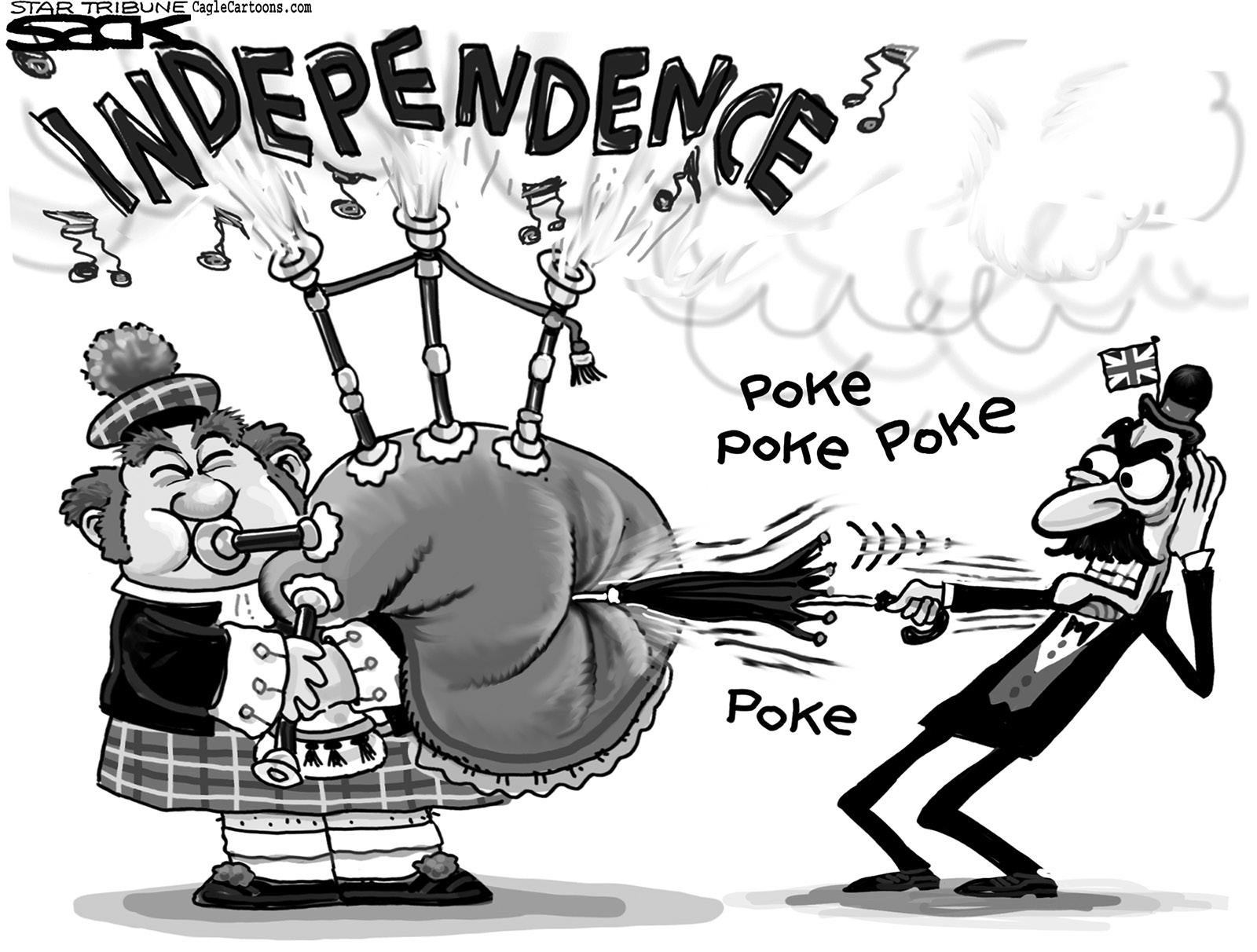
If R ick Santorum honestly wants the lives of bluecollar conservatives, and the rest of A mericans, to be better off, he should consider opening his mind to a more open border immigration policy. Instead, our speaker borrowed British Unionists’ words of the week and simply said, “No thanks.”
Connor Roth senior D uncan Hall Sept. 17
controller for the device and also allows users to browse notifications and certain apps in, what seems to be, a less socially obtrusive way.
In 2001, a balding man sporting a black turtleneck sweater entered a small, dim room and stepped onstage — ready to change the technology dynamic forever. G azing out into his audience, he declared the new direction of his company: offering “1,000 songs in your pocket.” To emphasize his goal, he pulled a small white box out of his jeans, displaying for the first time the A pple iPod.
The iPod was innovative in its technical details, but it became more influential in the status symbol it created out of A pple. A t the time it was assumed that technology was blocky and ugly, but the iPod presented a sleek alternative that was easy to use. It made wires and chips sexy, and other technology had to fight to follow its precedent.
The iPhone came as the next evolution in the A pple mantra of appeal. The big reveal highlighted its responsive touchscreen and sleek finish. A lthough A pple did combine, or, depending on who you ask, steal, ideas from various sources to produce its final product, the tech specs and usability wowed geeks and businessmen alike. The iPhone replaced the iPod as the new status icon.
A pple’s 2014 keynote marketed their newest “invention,” the A pple Watch. The product serves as a complement to the iPhone, as it can act as a
The A pple Watch fulfills its role as a wearable item that offers faster access to notifications and important applications, however, the keynote did not live up to the innovations of those past. The health aspect does seem appealing, but its constant vitals monitoring sets me on edge, having recently read Dave Eggers’s “Circle.” Overall, it does not seem to be worth $350.
Unless, of course, you buy it for what it symbolizes. The A pple Watch encompasses where A pple has been headed ever since 2001, when it realized people buy its products not because they’re truly innovative, but because they have a certain “feel” that society has come to value.
This can be sensed in A pple’s portrayal of the Watch. The company brought in Marc Newson, a designer known for his futuristic and high-fashion concepts. Newson based the Watch on one of his previous IKEPOD designs, and A pple milked this collaboration for everything its worth. There is a whole section on the page devoted to the product about the multitude of cases and loops available. Other facets detail the “over 2 million ways to see time” or “new types of conversation,” available through what it calls “D igital Touch.”
If this isn’t evidence enough, wander over to the iPhone 6 reveal. “Bigger than bigger,” A pple
advertises — because no one actually cares if its “better.” There are major advancements going on under the hood, but the company deems it more important that the buyer knows the shell was redesigned, the camera software was updated, the phone is “faster” and, perhaps, A pple Pay will finally work again. Oh, and there’s a new iOS that will make your old devices useless.
A pple in the time of Steve Jobs took the field of technology in new directions. “Jobs” reminded viewers that the secret to success is to know what people want before they want it. Steve Jobs did this with the A pple I, the iPod and the iPhone. A t times, he went out of his way to convince the “blind” masses what they needed, and, in hindsight, was right each time.
But I remain unconvinced with the A pple Watch and the progress of the new iPhones. It seems to me that I’d be paying for product placement and the development of new buzzwords, rather than true innovation, especially when the new hardware and software developments are there, just less emphasized.
I’ll be impressed again when A pple figures out how to bring Jobs back from the dead, although if Pixar is any indication, he must be working wonders tweaking the after life experience.
Contact Daniel Barabasi at dbaraba1@nd.edu
The views expressed in this column are those of the author and not necessarily those of The Observer.
of National records and almost-good “obsurecore” singles. “Where,” I ask the Pitchfork review comment section, “is our savior now?”
“Yeezy season approachin’, **** whatever y’all been hearin’.”
Opening up his latest album with a middle finger to the rest of your iTunes library, Kanye West indirectly promised to put all modern music to shame. However, in my friends’ and my own experiences, “Yeezus” didn’t do that – it didn’t even come close. While Kanye’s ambitions for the record were unrivaled, his lyrical clumsiness and Diet Death Grips/Clipping L ite production prevented Yeezus from being the rap game-changer many hoped it would be.
In other news, Radiohead has essentially given up on putting “Kid-A” sized effort into their studio records. James Murphy abandoned his own incredible dancerock fusion project to make a disappointing dance-rock fusion record with A rcade Fire. Death Grips is dead. The biggest innovators in music seem to be going MI A in some terrifying mass (s)exodus.
A s a Scene writer, I would love to hear a record that, through radical innovation and musical expertise, yells at me Kanye-style: “whatever you’re listening to is good, but this is the greatest record of ALL TIME!”
Unfortunately, the artists who release records like that — Radiohead, A rcade Fire, Death Grips, West himself — are slumping. There hasn’t been a single record this year that’s drawn me away from my sentimental hoard
That’s when Cal Chuchesta came to me in a dream and said, “Swans gud jab on yer strang ten.” Waking up intrigued, I did my research and found out that swans were large white birds and close relatives of geese and ducks. No dice musically.
One more google search later, I found that Swans was also a post-punk band from New York that happens to be one of the most consistently awesome groups of the modern musical era. Evolving from extremely harsh noise-rock to gothic rock to post-rock, Swans has managed to craft several modern classics with diverse sounds. The intensity that Swans levies without resorting to walls of distortion is incredibly impressive and stems from a combination of tribal rhythms, heavy lyrics and subtly mutating crescendos and decrescendos. Last year, Swans released “The Seer,” their grandest effort yet. Filled with growling guitars, eerie harmonies, relentless grooves and immersive atmospheres, “The Seer” fell between rock, metal, jazz and ambient without sounding like any previous fusion. It balanced a consuming darkness with moments of swirling beauty.
The band’s newest effort, “To Be Kind,” is a whole new beast. Boasting bass and guitar riffs that simultaneously sound like they’re out of old westerns and pit bull’s mouths, it’s a vicious animal that contemplates the primacy of the human spirit. Opening with a rattling list of universal ideas like love, suffering and “now,”
“Screen Shot” mirrors the continual cycle of activities and reduces them to their most basic forms. It’s truly an exploration of possibilities and limitations of life — how actions can be reduced to singular verbs and moments that mean very little.
The record continues in a similar thematic vein, exploring youth an an excuse for immaturity in “Just a L ittle Boy”, the inability to separate sex and control from love in “She L oves Us” and the repetition of our days and thoughts in “Things We Do.” In essence, “To Be Kind” struggles against our animalistic spirit while displaying the raw power of what we can do despite our limitation. A ll of these heavy themes are carried by extremely raw, yet incredibly precise grooves that morph, explode and implode in consistently thrilling ways. From the pummeling drums to ripping guitars and penetrating bass, the production and performance are flawless.
Musically, “To Be Kind” defies our conception of the song through relentless repetition, unrestrained song structure and an extremely unique, chant-like lyrical style. It’s a record that demands to be listened to, and simply seems bigger and more consequential than basically every record that’s been released recently. In today’s ailing indie scene, Swans is the perfect group to take up where yesterday’s forward-thinkers left of.
Contact John Darr at jdarr@nd.edu
The views expressed in this column are those of the author and not necessarily those of The Observer.
Daniel Barabasi Scene Writer
John Darr Scene Writer
By CAELIN MILTKO Scene Writer
When Ed Sheeran tweeted in June that he was forced to use a band on his most recent tour due to the nature of his new songs, I’ll admit I was a little disappointed. I understood, but I still felt like he couldn’t be the same impressive musician I’d seen open for Taylor Swift a year prior. Of course, I probably should have known better.
Yes, he has a background band now, but he’s also using multiple looper pedals and experimenting on stage more than ever. He has the right to do so; it’s H IS stage and his audience is as excited as him when something new works out.
Opening for Ed Sheeran at his Chicago show Tuesday was U.K.-based band Rudimental. The band had at least four vocalists, a drummer, a keyboardist and even a trumpeter. This made for a mix of sounds, each song different from the last. Their variable sound made for a good opening to the main act.
I attended Sheeran’s concert with a friend of mine from high school. The weekend of the M ichigan game she’d been in D.C. watching him perform. A s such, she was quite sure she knew exactly what would happen in Chicago. It was surprising how often she was wrong.
The opening song was the same — Sheeran stepped
out to screams and performed “I’m a Mess.” It quickly became apparent to me that the presence of a background band did not mean he was doing any less. He still had his guitar and the looper pedals that astound me every time he uses them. Between nearly every song he’d switch out guitars (I smiled at that, remembering the broken guitar string that caught him up at Taylor Swift). In fact, the band didn’t become apparent to me until he started rapping “Take It Back.”
A fter strumming the opening lines of the song, he removed his guitar and grabbed the microphone to perform. Songs like “Take It Back” and “You Need Me, I Don’t Need You” have always impressed me. I never expected the man who sings slow, sad songs like “The A Team” or “Tenerife Sea” to also be able to rap as effectively as Ed Sheeran does.
Perhaps one of the most impressive things about the concert was his use of background graphics. Originally, four screens showed Sheeran as he performed, but soon enough there was an illustrated performance of “The Man” and “I See Fire,” featuring a dragon sequence from the second part of “The Hobbit.” He even referenced Rupert Grint’s role in his “L ego House” video, displaying dancing Ron Weasley and Ed Sheeran L ego men behind him.
A ll of these bits were clearly consistent with prior shows. My friend told me exactly what I needed to be
watching and when. But, as I mentioned before, she didn’t always know.
The first surprise was his performance of “A ll of the Stars” from the motion picture “The Fault In Our Stars.” Before singing, he warned the audience that he had only performed the song live twice before and that it could be a bit rocky. Of course, as soon as the audience recognized the song, everyone was too busy singing along to notice if he messed up.
The second, and probably more notable of his surprises, was his use of an electric guitar midway through the show. He came on to perform “Nina,” once again warning that he had never played the song live. He’d also never performed with an electric guitar. It was a hit with everyone and by the end of the song, you could see on his face how satisfied he was with the risk he’d taken.
Ed Sheeran’s new album already proved he was undergoing massive shifts in sound, and that he was willing to take risks with the popularity he’d already gained. “X” wasn’t what anyone expected from the British songwriter. H is experimental nature in his concerts shows that this evolution is not likely to stop anytime soon and, hopefully, on his next album we’ll have the chance to hear something this inventive again.
Contact Caelin Miltko at cmoriari@nd.edu
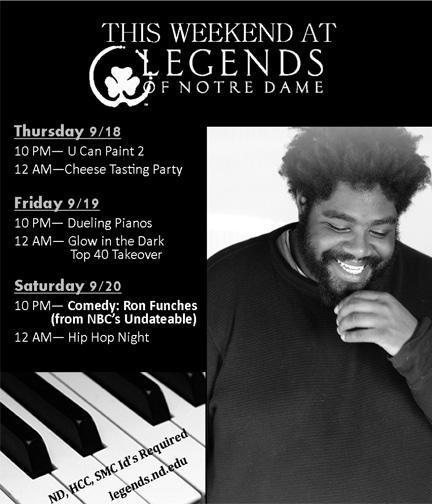
WEEKEND A T A G LAN C E
THURSDAY
What: U Can Paint 2
When: 10 p.m.
Where: Legends
How Much: Free for students
D o you sometimes mistake your doodles for a Picasso masterpiece? No? It doesn’t matter, anyone can get a painting lesson for free – supplies provided. Who knows, maybe the next legendary artist will be discovered at L egends.
FRIDAY SATURDAY SUNDAY
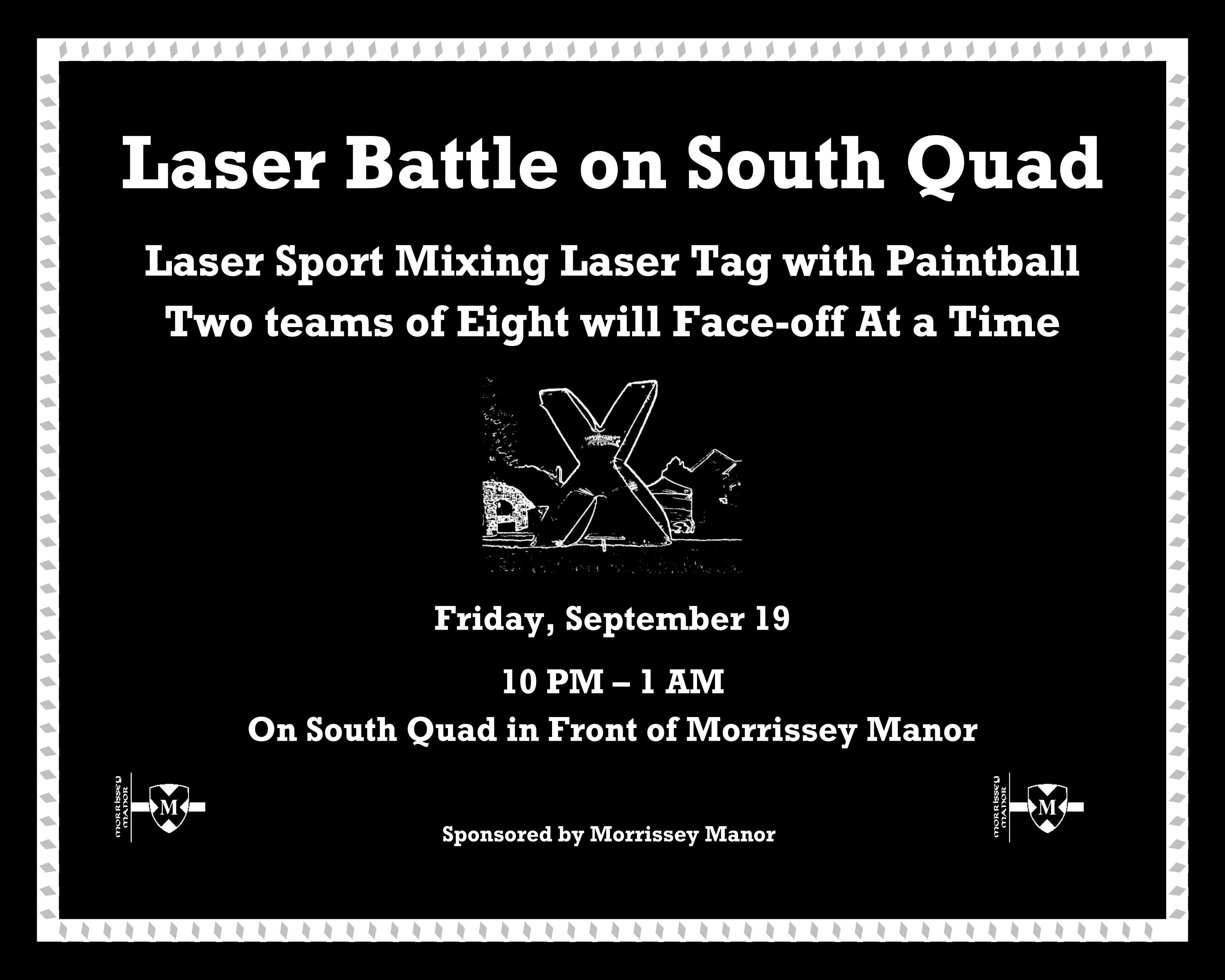
What: Great Gatsby Dance
When: 10 p.m. – 1 a.m.
Where: Bond Quad
How Much: Free
You wouldn’t miss out on a Gatsby party would you, old sport? G et ready to break out your best ‘20s apparel and bust out your swing dancing moves. (Tip: fringe is not only essential to the era, but it also makes your dancing appear 10x better.)
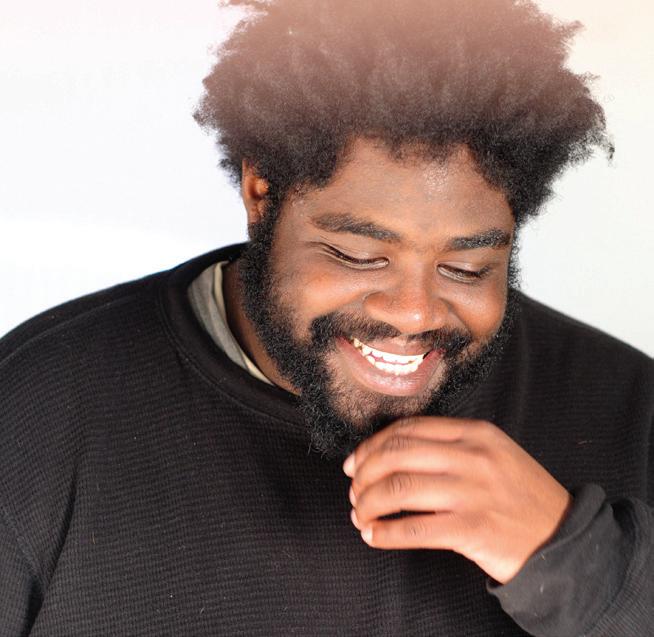
What: Ron Funches, comedian
When:10 p.m.
Where: Legends
How Much: Free
Start off your night with comedian Ron Funches, who stars in N B C’s “Undateable” and has worked on “Portlandia” and “B ob’s B urgers.” It’s sure to be “Funches of Fun!”
When it;s over don’t go anywhere – hip-hop night starts at midnight.
What: “Boyhood”
When: 3 p.m.
Where: DPAC
How Much: $4 for students
Richard Linklater’s groundbreaking film was in production for 12 years. Starring the same cast thorughout, the effect earned it 5-star reviews from all the top newspapers and it stands at a 99% rating on Rotten Tomatoes. Don’t miss out on this revolutionary film while its showing on campus.
Baseball no longer America’s game
Zach Klonsinski Sports Writer
Last week, my compatriot in the Sports Authority column, Alex Carson, wrote an impassioned piece about why IndyCar was so much better than NASCAR. While I could spend an entire column explaining why he is wrong, I’ll instead admit one area where, although Alex did not specifically touch on it, IndyCar does have NASCAR beat, as well as most of the other professional sports in North America:
IndyCar’s schedule has half as many races as NASCAR NASCAR has 36 races, IndyCar has 18. NASCAR’s schedule in 2014 began with the Daytona 500 on Feb. 23 and won’t reach its championship until Nov. 16. Throw in the two weeks before Daytona that drivers and teams have obligations, and there are less than three months when NASCAR is not officially active. IndyCar, by comparison, began March 30 and came to a conclusion Aug. 30. The NASCAR season drags on until it reaches the Chase, which finally revitalizes it some.
This long season phenomenon is not isolated to NASCAR, though.
Baseball is the worst offender. The Baltimore Orioles kicked off their season March 31. They clinched the AL East on Tuesday night, 151 games and 169 days after their season opener, and they still have to play another 11 games before even getting to the postseason, which may last until November.
While this is not only ridiculously taxing on players, staff and the media that have to cover them, in my opinion, it is also absolutely why baseball has been falling off the national radar for years. Fans nowadays simply do not have the attention span to pay attention to that many games, opting to only check in periodically. While baseball during its glory days of the 1940s and 50s was one of the only sources of entertainment — dominating radio, television and places to go during the time — modern fans have so many other options, especially during the most interesting and important times of the baseball season.
Think about it: baseball begins at the transition of March into April. What else is going on in the sports world? The NHL and NBA playoff pushes are just beginning — who, in their own rights, also have way too long of seasons. Who cares about the baseball games going on this early? There will only be 140 more to see.
Then the baseball playoffs begin — also the worst playoff system in sports, but perhaps that is for a different discussion — at the end of September, start of
October: the beginning of the NFL regular season. There was a time when baseball could have contended with NFL storylines, but it is no more. The last few weeks of headlines have been dominated (perhaps rightly) by Ray Rice, Adrian Peterson and the NFL’s drug policy, even though football games really only dominate one day of the week and baseball plays every night. Yet there has been little to no national media coverage of the playoff pushes in baseball.
Why? Because having 160 games in a year makes each individual game seem meaningless. Why pay attention to one game when you can see what is going on every 12 or so and understand your team’s position just as well? This is especially true of what used to be baseball’s time: the summer months of June, July and even August, when baseball is literally the only big sport going. Now watching those games towards the end of August (when the NFL is getting into gear, mind you) almost feels pointless. There is a general apathy developing among the public to baseball.
For example, the “SVP and Russillo” talk show asked its listeners in February what topic they wanted the hosts to talk less about. The response? Baseball. The number of times baseball was a subject of conversation during February? Zero.
Yes, sports fans wanted “SVP and Russillo” to talk less about a sport they never talked about. Sorry baseball, but you must do something to change that.
Start by giving each game more meaning: cut the schedule down to 100 games. Maybe even less. Basically start the season in May, (June if the NBA and NHL finals prove too much of competition) and have the playoffs in September. Make it a true summer sport. This still leaves plenty of room for a 100 game schedule with plenty of days off for rest, travel and an All-Star break. It gives each individual game more meaning, albeit still not much; at least it’s trending in the right direction.
I know this won’t sit well with baseball purists, but I’m sorry, you represent only a fraction of what baseball used to have, and you don’t sell out most stadiums for 82 games a year.
I suppose I do owe baseball an apology for singling them out, though. I could say many of the same things about the NBA season and even my beloved NHL season, but those will remain discussions for another day.
Contact Zach Klonsinski at zklonsin@nd.edu
The views expressed in this Sports Authority are those of the author and not necessarily those of The Observer.
Panthers suspend Greg Hardy indefinitely
Associated Press
CHARLOTTE, N.C. — The Carolina Panthers NFL team has placed Greg Hardy on the exempt-commissioner’s permission list, meaning the Pro Bowl defensive end has been removed from the team’s active squad until his domestic violence case is resolved.
The decision comes just hours after the M innesota Vikings took a similar disciplinary approach with Adrian Peterson, who is addressing child abuse charges in Texas.
Hardy was convicted July 15 of assault on a female and communicating threats after the victim claimed the player threw her in the bathtub and onto a sofa covered with guns before threatening to kill her. Hardy is appealing the ruling and a jury trial is set for Nov. 17.
He will continue to be paid his weekly salary of $770,588.23. Hardy also is allowed to be at
the team facility, but will not practice.
Panthers general manager Dave G ettleman said it was a tough decision given the changing climate in the NFL
“Our overriding goal has always been to do the right thing,” G ettleman said.
The GM said he expects Hardy to be out at least through November.
Hardy said he understands he needs to step away from football and take care of his legal problems.
“I am entitled to due process and my day in court, and that’s where my focus should be,” Hardy said in a statement.
“I appreciate the Panthers for giving me this opportunity and look forward to being back with my teammates. I am disappointed to leave my teammates and the Carolina Panthers during our season. My decision to take a leave of absence allows me to focus on my family until
the legal process has run its course.”
Had Hardy not taken a leave of absence with pay, he likely would have faced an unpaid suspension from the league.
The NFL Players A ssociation released a statement Wednesday saying, “Today, Greg Hardy made a decision to take a voluntary leave of absence to resolve his pending legal issue. The NFL PA and NFL worked with Greg, his representatives and the Carolina Panthers on this matter. We support this decision and hope the best for him and his family.”
Earlier Wednesday, with security around the stadium stepped up, Hardy and his agent Drew Rosenhaus emerged from the team’s facility, stepped into the player’s Bentley and drove away. Earlier, two police officers on motorcycles guarded the entrance to the team’s practice facility.
Giants inch closer to NL
West
title
in the second for a 1-0 lead.
Associated Press
PHOENIX — Pinch-hitter
Matt Duffy delivered a tiebreaking single in the ninth inning and the San Francisco Giants narrowed their gap in the N L West, beating the A rizona Diamondbacks 4-2 Wednesday.
The Giants pulled within two games of the divisionleading L os A ngeles Dodgers, who lost at Colorado 16-2. The contenders each have 10 games left.
Duffy’s one-out hit came on a full count against closer Addison Reed (1-6). Pablo Sandoval walked with one out, Brandon Crawford singled and pinch-hitter Brandon Belt walked, setting up D uffy. Crawford had four hits.
Sergio Romo (6-4) pitched one inning, and Duffy batted for him. Santiago Casilla got his 17th save.
Crawford hit an RBI double
A ndrew Chafin, making just his second major league start, tied it in the A rizona second with an RBI single off Madison Bumgarner. The hit came in Chafin’s first big league at-bat.
Bumgarner labored through six innings allowing at least two baserunners in the first three. Trying for his 19th win, he gave up seven hits and struck out six.
The Giants took the lead in the fifth thanks to an infield hit, a walk, a wild pitch and a pair of sacrifices that produced one run.
Bumgarner gave up the tying run in the bottom of the fifth, when A .J. Pollock ran home on a thrown third strike that bounced to Giants catcher
A ndrew Susac. Susac threw out Mark Trumbo at first base, but Pollock hustled to the plate on the throw and beat Buster Posey’s throw back to Susac.
Chafin allowed two runs on
three hits with four walks and two strikeouts in six innings.
T rainer’s room
Giants: OF A ngel Pagan was scheduled for an MR I on Wednesday for his back injury, and missed his third straight game. ... Belt played for the first time since being activated from a concussion on Monday. Diamondbacks: 3B Jake L amb (quad) remains limited, but is expected to return to the lineup when the team plays at Colorado beginning Thursday. L amb came on as a pinch hitter on Tuesday and struck out.
Up next
Giants: RH P Tim Hudson (9-11) goes for the Giants on Friday at San Diego after the club gets Thursday off. He’s coming off the worst start of his career, in which he allowed six runs on eight hits in one inning of a 17-0 loss to the Dodgers last week.
MLB | GIANTS 4, DIAMONDBACKS 2
Belles look to rebound at Classic this weekend
By MANNY De JESUS Sports Writer
A fter finishing 10th at the O’Brien National Invitational, the Belles will compete in the DePauw Small College Classic this weekend at Deer Creek Golf Club in Clayton, Indiana, before beginning conference play the following week.
Despite not finishing higher in their last tournament, the Belles are confident that they will find a way to rebound, according to Belles coach Kim Moore.
“First off, I am extremely happy on [our] efforts to turn around their scores for day two this weekend,” Moore said. “Everyone improved on their day one scores, which is exactly what I’m looking for in every event. The beauty of having a young team is that they are all excited to get back out there and play in the next event. I am looking forward to a great week of practice, and I’m confident that our work this week will lead to a good bounce back at DePauw.”
Saint Mary’s competed against some of the top teams in the country when it hosted the O’Brien National Invitational, including last year’s national champions, R hodes, and Washington University in St. Louis, who are
both ranked first in their respective regions.
Turning the Belles’ focus on this weekend’s tournament, Moore said winning the MI AA comes with playing in as many tournaments as possible and that playing against top teams only makes the team better.
“I feel that every tournament we play in is great preparation for our MI AA conference play,” Moore said. “As any PGA golf professional would say, the best way to prepare for any golf tournament is to play more golf tournaments. This weekend we will see a few conference opponents, and it will be a great way for us to see how well we compare to them.”
At the front of the Belles’ charge will be senior Janice Heffernan, who has led Saint Mary’s at both of the competitions so far this season and earned MI AA Golfer of the Week on Sept. 1. As the lone senior on the team, Moore said her work ethic on and off the
field is what has helped get her to where she is today as the leader of the team.
“I am not surprised with Janice Heffernan’s success this season,” Moore said. “She has consistently improved her game from year to year, and I did not think this year would be different. Her success is directly related to the hard work she puts in at practice on a daily basis. She is an extremely focused individual, and it shows not only in her golf game but in her academics. You need to have a great deal of self-discipline to excel at this sport, and the selfdiscipline Janice has shown will be extremely helpful in her future nursing career.” Heffernan will lead the Belles as they compete in the DePauw Small College Classic on Saturday and Sunday at the Deer Creek Golf Course in Clayton, Indiana.
Contact Manny De Jesus at mdejesus@nd.edu
Observer
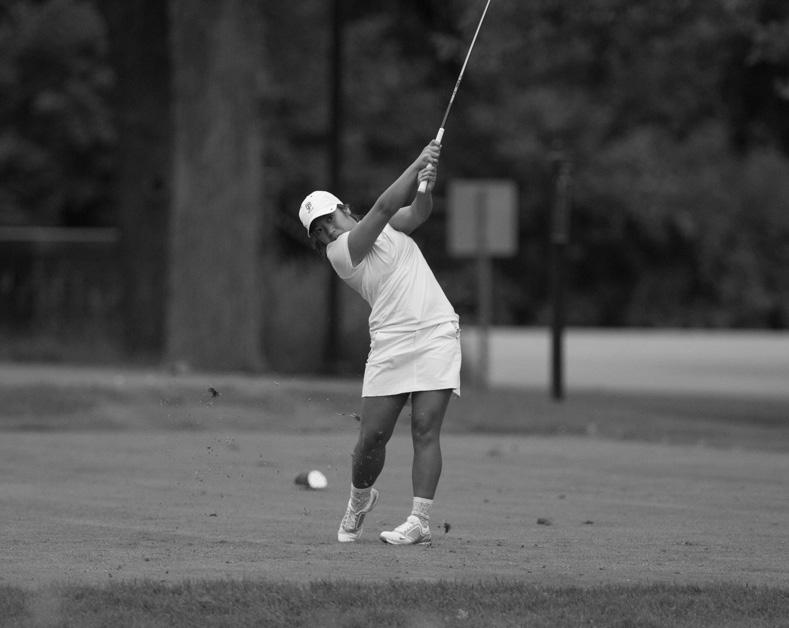
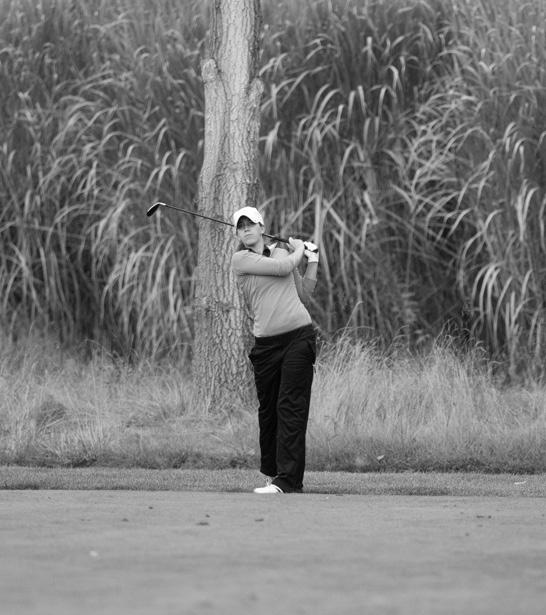
Belles senior Janice Heffernan hits a shot at the O’Brien National Invitational on Sept. 15, 2013, at Warren Golf Course.
Observer File Photo
Belles sophomore Rachel Kim tees off on Sept. 15, 2013, at the O’Brien National Invitational, hosted by Saint Mary’s at Warren Golf Course.
Irish head to Illinois for Windon Memorial
By MIKE GINOCCHIO
Sports Writer
A fter stumbling a bit during their last outing at the G opher Invitational, the Irish look to get back on track this weekend when they return to the links.
Notre D ame travels to Evanston, Illinois for the Windon M emorial, hosted by Northwestern U niversity, on Sunday.
Irish head coach James Kubinski said he is not concerned about the team’s 10th place finish at the G opher Invitational, feeling it does not tell the whole story.
“We were disappointed with our overall team finish last time out but, when you have just two players off their game in our ‘5 Player / Count 4 Scores’ college golf format, it often hides some of the big positives,” Kubinski said. “The fact is, we had three of our five players post some very good scores. Sophomore M att R ushton missed a top-10 finish in a good field by one shot; a freshman, Thomas Steve, led our team through 36 holes after an excellent 71 in tough conditions in round 2, and senior Patrick G rahek
played two very solid rounds. We were close, one more solid score in a couple of those rounds, to posting a very strong team finish, so that’s an important takeaway for our team.”
The Irish enter uncharted territory over the weekend, as this marks the first time that the team will play in the Windon M emorial during Kubinski’s 11-year tenure as coach.
“We’re not yet familiar with the golf course,” Kubinski said. “Northwestern hosts their event on a yearly rotation of courses in their locale, so most of the players competing will be trying to learn the golf course. We’re certainly excited for and appreciative of the opportunity to compete at Evanston though, as it’s an excellent field of teams to compete against and our Chicago alumni base is very strong.”
In addition to playing a new course, the Irish are switching up their lineup, adding players who Kubinski said have earned the right to compete this weekend.
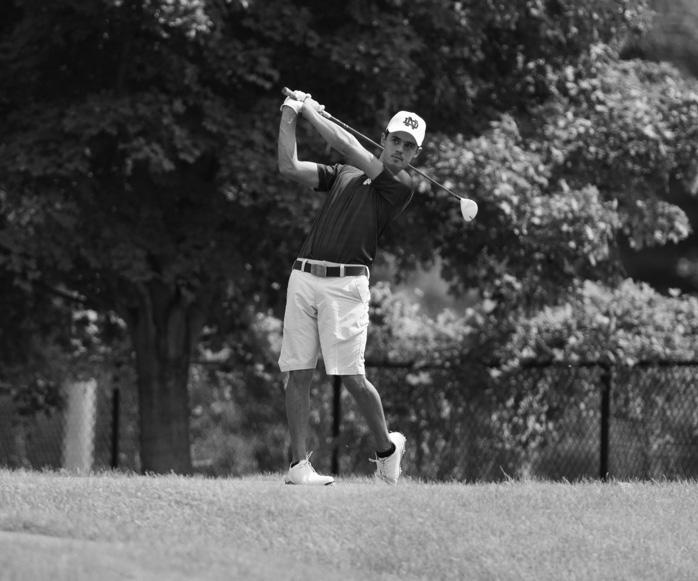
“We’re adding senior Tyler Wingo and sophomore L iam Cox to join mainstays
M atthew [ R ushton], Patrick and Thomas in our lineup for Chicago,” Kubinski said. “ B oth Tyler and L iam earned their spots through team qualifying play this week, so they’re playing well. A ll five are certainly capable of posting strong scores so it will just be a matter of learning a new golf course, finding that comfortable feeling competing and executing our shots for us to see some great scores.”
In the end, Kubinski said he sees the Windon M emorial as an opportunity to put a poor showing behind, focus on the rest of the season, and improve as a team.
“Our team is not yet who we can become,” Kubinski said. “So our focus is on staying within the process we started at our home competition on A ugust 31st, where we posted some great scores as a team (280 and 281), putting a small bump in the road at M innesota’s tournament behind us and bringing a great attitude and approach to Chicago.”
The Irish resume play on Sunday at Evanston G olf Course for the Windon M emorial. The tournament continues through M onday.
Contact Mike Ginocchio at mginocch@nd.edu
KEVIN SONG | The Observer
Irish sophomore Liam Cox follows through on a putt in the Notre Dame Kickoff Classic on Aug. 31 at Warren Golf Course.
KEVIN SONG | The Observer
Irish junior Zach Toste hits a drive during the Notre Dame Kickoff Classic at Warren Golf Course on Aug. 31.
Freshmen
with what was going on with this team.”
Cage has seen snaps at the unit perhaps most impacted by freshmen — defensive line. Due to the loss of former linemen Stephon Tuitt and L ouis Nix in the offseason, the Irish have had to bolster their depth by inserting freshman such as Cage, Grant Blankenship, A ndrew Trumbetti and even H ill, who has seen time at defensive end.
“Coming here, you have to have a role, and I’m accepting my role,” H ill said. “I’m a thirddown kind of guy — they utilize me in pass rushing and situations like that. It is what it is, and I like being in that role.”
H ill has seemingly thrived in his role so far, as he’s recorded five tackles and two sacks in two games.
“D uring practice, I was practicing at a good level,” he said. “When we did one-on-one pass rushing, [defensive line] coach [ M ike] Elston sparked some good things out of me, so I knew I could make an impact on the team in some way, and that’s definitely [in] pass rushing.”
Further down the line, Trumbetti has added five tackles, despite missing last weekend’s game after a head injury suffered during a hard hit against M ichigan on Sept. 6, and Blankenship and Cage have recorded three tackles each.
“R ight now, I’m picking things up pretty quickly, since I’ve got
my teammates here to help me out,” Cage said. “[Junior defensive lineman] Sheldon Day, he’s been a real help, helping me with the plays, my stance, how to get off the ball.”
Notre Dame’s freshmen contributions have extended beyond the line into the linebacker and secondary units, where first-year linebackers Greer Martini and Nyles Morgan, cornerback Nick Watkins and safety Drue Tranquill have seen time.
Tranquill has split time at safety and linebacker and currently leads the freshmen with nine tackles.
“I’m just a guy that can move around,” Tranquill said. “I have a little bigger body, so I’m able to come down and play that rush kind of [linebacker]. I can also drop into coverage, too, so that’s kind of where they see my skills at.”
Tranquill, a Fort Wayne, Indiana, native, had originally committed to Purdue, Notre Dame’s most recent opponent, but he flipped to Notre Dame in November of last year.
“It was a little later in the process, obviously,” Tranquill
said. “That’s the first reason I committed to Purdue — I didn’t think that Notre Dame would offer. … But Coach Kelly came on late there, and he really did, he made me feel wanted, which was a big thing for me.”
The stories of several other freshmen on this year’s squad are not too dissimilar from Tranquill. H ill, who received little national attention until late in the recruiting process, committed to the Irish last December.
“I didn’t have a lot of offers at all,” he said. “I was underweight and just now that I’m here, it’s a blessing being here, and I’m really glad to be part of this team.”
A nd Cage made a literal lastminute decision, choosing the Irish on National Signing Day in February.
“When I first came out that tunnel and [saw] 80,000 people looking at you, cheering you on, just having your back and going out on the field and going out against the opponent, there’s no better feeling,” he said.
Contact Brian Hartnett at bhartnet@nd.edu
EMILY McCONVILLE | The Observer
Irish freshman safety Drue Tranquill celebrates a tackle during Notre Dame’s win against Purdue on Saturday at Lucas Oil Stadium.
EMMET FARNAN | The Observer
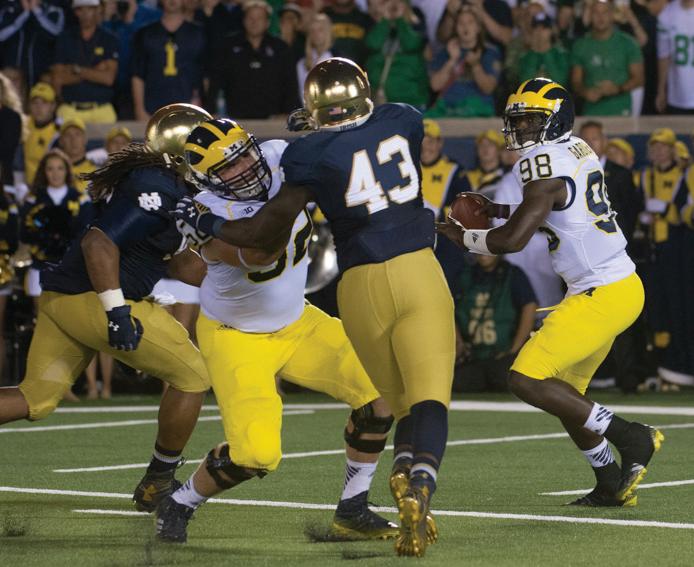
Irish freshman defensive lineman Grant Blankenship runs towards the scrum during Notre Dame’s 31-0 win over Michigan on Sept. 6.
Proposal
The proposed schedule would allow for clubs to play a few more matches (the Irish are scheduled for 17 this year; the new proposal calls for 22 regular-season contests) spread out over a longer period of time. As a result, a common fixture of today’s college soccer landscape — playing two games in one weekend — would go out the door as the proposal calls for a minimum of three nights between successive matches. It’s a part of the proposal Clark said he supports as it would line up college soccer in that regard with the rest of the world, where clubs rarely play without a few days of rest.
“The biggest advantage would be the one game a week,” Clark said. “It certainly would be less class missed — though we don’t miss many classes. We’re pretty careful with how we schedule, but it would be easier from that point of view.”
The Irish play five midweek matches this year — the maximum allowed under the proposal would be three; however, four of those five are within a few hours’ distance, against Michigan, Northwestern, Indiana and Michigan State. The fifth is a home match with Virginia Commonwealth. But while Clark said he sees the move to spread matches out as a plus, he remains skeptical about the rest of the proposal.
“For me, there’s too many areas of concern,” Clark said.
For starters, the new schedule would include starting the spring part of the campaign on the third Saturday in March. The high temperature on March 15 this year? Forty degrees. And while matches are currently played on campus sites in December, some fields — like that at Notre Dame — are heading into winter rather than out of them.
“The only game we have played in the spring is the game when
we play Mexico’s U-20s on the last weekend of April,” Clark said. “And up to then, there’s no real growth in the grass here, so it’d be difficult to go until then.”
And the status of the outdoor grass field isn’t the only thing Clark is concerned about — he said he is also concerned about availability of practice facilities.
“We all share Loftus, so you’ve got softball, baseball, men’s lacrosse, women’s lacrosse, track and men’s and women’s soccer,” Clark said. “[During the spring,] we usually get the last slot, and while it’s fine going there when we’re not in season, it would be a challenge [in the spring].”
As the system is currently set up, teams are allowed to play a few exhibition matches during the spring, like the one against Mexico’s U-20 team, but Clark said he wouldn’t want to lose the time he uses to really work on his players’ technical abilities.
“[The spring] gives you a chance to really work on basics,” Clark said. “As it sits now, the fall is about competing; the spring is more about teaching and learning.”
Additionally, the passing of the proposal could open up Pandora’s Box for other sports to pursue similar moves, creating chaos in college athletics. Clark said he also sees concern with the plan since many schools have a shared stadium for their soccer and lacrosse teams.
“Once it comes down to logistics, a lot of the schools in the ACC share facilities with lacrosse, so simply you’re in a position where you’ve got to start looking at facilities situations,” Clark said.
When push comes to shove, Clark said moving to a year-round schedule might be easier said than done.
“I think it’s got a long way to go — that’s my thought on it,” Clark said. “There are advantages, but there are a lot of hurdles as well.”
Contact Alex Carson at acarson1@nd.edu
Klonsinski
Notre Dame controlled almost the entirety of the game. For most of the second half, the Wildcats had 10 players, sometimes even all 11, inside their own penalty box, desperately trying to cause as much traffic as possible to stymie a relentless Irish attack. Twenty-five seconds from overtime, the Irish had their hearts broken on what seemed like a harmless clearing attempt and Kentucky’s only shot of the second half.
G o back another week and you see Notre Dame’s draw with then-No. 9 G eorgetown at the I U Credit Union Classic on Aug. 31. At first glance, one might think a 0-0 tie between the No. 1 and No. 9 teams in the country would mean a fairly even match.
Quite the contrary, actually.
Notre Dame outshot its opponent 23-9, including an 8-3 advantage in shots on goal, appearing to have the upper hand for the majority of the 110 minutes. A gain, like the Kentucky game, the Irish just could not find the back of the net.
“Soccer is a strange game,” Clark said last week. “I’m still trying to seek answers for this, and I’ve been doing it for long time.”
Notre Dame’s goal production has been streaky so far: In their final exhibition match of the year, the starters scored four goals in their 60 minutes
of action; the team tallied five altogether in the match. The offense then buried two, zero, four and zero goals in the first four matches of the regular season.
L ast weekend, the Irish opened their ACC schedule with a tough road match at No. 20 Syracuse, a team that had not given up a goal in its first four matches of the season. It did not take much to see how important this matchup was for Notre Dame, especially with its offensive streakiness.
It took nearly 75 minutes, but Notre Dame finally got the breakthrough its season may have needed.
Sophomore defender Brandon Aubrey rose up and headed in a cross from junior forward Patrick Hodan for his first career collegiate goal, and the Irish withstood an Orange blitz for the final 15 minutes of the game to escape, 1-0. It was the first match all season during which Notre Dame was outshot, 13-12, yet held another commanding 8-3 advantage in shots on goal.
Aubrey’s goal was not just important in the Syracuse match: I believe it could be the one that opens the floodgates for the whole team. In the draw and loss earlier this year, the Irish swarmed, buzzing around all around the net, but could not buy a goal. Especially coming off the Kentucky loss, there must have been a nagging frustration about dropping a
game they should have won. At what point does not being able to score in big moments begin creating doubts in the back of the mind, especially with the ACC season beginning and a number of the top teams in the country looming?
Aubrey’s goal cleared most of that up for me and gave me more confidence in the depth of scoring talent the Irish have on the roster this year. Six goals have been scored by five different players so far, and that does not even include graduate student captain A ndrew O’Malley or his fellow defender senior Max L achowecki, both of whom recorded three goals for the Irish last year. Neither does it include Hodan, whose 11 goals last year was second on the team, nor a goal from either of the two talented freshmen forwards who have seen plenty of playing time already, Jeffrey Farina and Jon Gallagher. It is only a matter of time before the Irish consistently score two or three goals a game with all the talent they have, and the Aubrey goal last weekend may just have been the breakthrough they needed.
Yes, ladies and gentlemen, the Irish are still going to be quite alright.
Contact Zach Klonsinski at zklonsin@nd.edu
The views expressed in this column are those of the author and not necessarily those of The Observer.
PA
I D A DVE RTISE M ENT
Observer File Photo
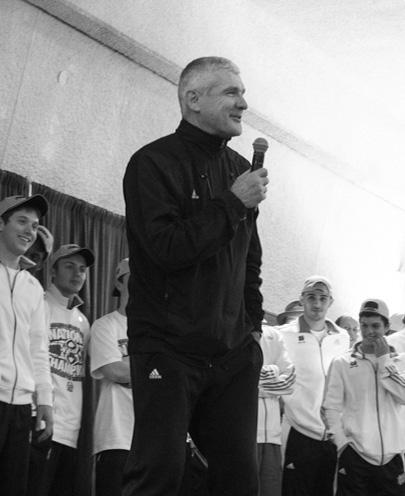
Irish coach Bobby Clark addresses the crowd during Notre Dame’s national championship celebration on Dec. 15.
Edited by Will Shortz
The Observer welcomes back Christopher Brucker’s Highly Punlikely for this year. We are also proud to introduce Dome Nuts, a new comic from Alexandria Wellman. The Observer apologizes for the absence of Sudoku Happy Birthday: Your
For answers, call 1-900-285-5656, $1.49 a minute; or, with a credit card, 1-800-814-5554. Annual subscriptions are available for the best of Sunday crosswords from the last 50 years: 1-888-7-ACROSS. AT&T users: Text NYTX to 386 to download puzzles, or visit nytimes.com/mobilexword for more information. Online subscriptions: Today’s puzzle and more than 2,000 past puzzles, nytimes.com/crosswords ($39.95 a year). Share tips: nytimes.com/wordplay. Crosswords for young solvers: nytimes.com/learning/xwords.
Altering the
you handle
and opportunities to explore
and health matters will bring about a
possibilities. Emotions will be difficult to control, but will also help you address and rid yourself of pending problems that have contributed to stress. Focus on the positive. Your numbers are 4, 12, 18, 23, 33, 36, 41.
ARIES (March 21-April 19): Don’t keep secrets. Getting everything out in the open will give you a clear conscience to move ahead with the changes you’ve been contemplating. Socializing and networking will bring you in contact with people who have something worthwhile to offer.
TAURUS (April 20-May 20): Volunteer something unusual that you have to offer. The people you meet along the way will be impressed with your services, talent and insight. A new partnership will be beneficial as long as you keep the contributions equal.
GEMINI (May 21-June 20): Take it upon yourself to connect with people that you know have something to offer or groups you feel you can contribute to successfully. Don’t be shy regarding your skills, but present what you can do in a skillful, diplomatic manner.
CANCER (June 21-July 22): Your interest in foreign cultures and philosophies will spark your curiosity regarding courses, traveling and joining in events that can broaden your knowledge. Making an unusual change to the way you look will grab attention. Romance is on the rise.
LEO (July 23-Aug. 22): Handle money matters carefully. Good fortune will come to you from an unusual source. Listen to complaints and look for solutions that won’t compromise anyone’s position. Don’t be afraid to make a substantial move if it will benefit you.
VIRGO (Aug. 23-Sept. 22): Guard your money and possessions. Changing the way you do your job is encouraged. Avoid anyone looking for an argument or trying to push you into doing things you don’t want to do. Poor information will lead you down the wrong path.
LIBRA (Sept. 23-Oct. 22): Indulge in things that will expand your mind and your friendships with people from different backgrounds. Refuse to let someone bully you or make you feel guilty for wanting to do things your way. Change will be rewarding.
SCORPIO (Oct. 23-Nov. 21): Promote the skills, talents and project you enjoy doing the most. An opportunity to begin a new partnership or business may entice you, but practicality must be considered. Taking on too much will cost you and jeopardize your chance for success.
SAGITTARIUS (Nov. 22-Dec. 21): Taking care of other people’s affairs will bring you added benefits, but you are best to refrain from letting anyone interfere in your personal matters. The changes you make at home won’t please everyone, but will benefit you financially.
CAPRICORN (Dec. 22-Jan. 19): Keep your opinions to yourself until you have facts and figures worked out to back your theory. Use your insight and expertise to gather difficult information. Money will come to you from an unexpected source. Love is highlighted.
AQUARIUS (Jan. 20-Feb. 18): Take pride in what you do and you will avoid criticism. Look at your current work situation and you will find a way to use your skills to suit the changes going on in your life. Diversification will lead to a better lifestyle.
PISCES (Feb. 19-March 20): You will be sensitive to what people do and how they treat you. Hold off committing to a deal that hasn’t been fleshed out and put on paper. Be as open and honest as possible when dealing with relationships. Birthday Baby: You are an imaginative dreamer. You are courageous, intuitive and relentless
FOOTBALL
Freshmen stepping up for injury-ridden Irish
By BRIAN HARTNETT Managing Editor
Throughout his tenure, Notre Dame head coach Brian Kelly has stressed the phrase “next man in” to refer to the seamless transition that he believes should occur when a player goes down due to injury, suspension or demotion.
This year, the “next man in” at several key positions include several unfamiliar faces, members of a 23-member freshman class representing 14 different states.
The No. 9 Irish have played 11 freshmen thus far, and eight of them have made appearances for a defense that currently allows slightly more than 10 points per game.
“Everybody in every position, if you’re like a two- or possible three-deep kind of guy, you need to pay attention to the person in front of you with all the injuries taking place and just learn from their mistakes and try to do what you have to do in the games and practices,” freshman linebacker Kolin Hill said.
MEN’S SOCCER
As Hill mentioned, injuries have taken their toll on the Notre Dame roster through three games thus far. Graduate student safety Austin Collinsworth, senior linebacker Jarrett Grace, junior safety Nicky Baratti and sophomore cornerback Cole Luke have all missed time on the defensive side of the ball with injuries, while sophomore safety Max Redfield had to sit out most of the win over Purdue after he was ejected for targeting. Additionally, four players on defense, including senior defensive lineman Ishaq Williams and junior cornerback KeiVarae Russell, have been withheld from competition since mid-August due to an ongoing academic investigation.
With so many contributors out, enter players like freshman defensive lineman Daniel Cage.
“I was excited, just to know that I was going to play — that’s what I was fighting for,” Cage said. “I didn’t want to redshirt — I wanted to come in and make an immediate impact with what
Notre Dame looking at present, future
Bobby Clark still undecided on new schedule proposal
By ALEX CARSON Sports Writer
Nearly a month and a half ago, West Virginia Athletic Director Oliver Luck met with representatives from Major League Soccer — A merica’s top-flight league — to discuss a proposal that would radically alter the way that men’s soccer is played at the NC AA level. The most notable feature of the plan — one spearheaded and supported by many college soccer coaches nationwide — is that it would take the regular season and stretch it into two parts, a slightly longer fall season and a spring season.
To many, especially on the surface, it seems like a good plan. But some, on the other hand, aren’t quite sold. A nd despite his spot on the Advisory Committee, Irish coach Bobby Clark has not quite bought into the new idea.
“I’m not sure [how I feel about the proposals] to be perfectly honest with you,” Clark said. “There are a lot of advantages, but there are also a lot of disadvantages.”
Irish offense given the spark it needed to fire up season
Two weeks ago, in this very same column, I discussed that despite losing last season’s top goal scorer Harrison Shipp to graduation, Notre Dame was still in an extremely desirable position. A ll of the other players who scored for the Irish (3-1-1, 1-0 ACC) last year are back this year, as well as a large chunk of the remaining starters.
“No, ladies and gentlemen,” I proclaimed, “the Irish are going to be quite alright.”
Two weeks later, the Irish already have two non-wins on their record and have fallen from the preseason No. 1 to a “lowly” No. 5. They were upset at home by an unranked Kentucky team during their own tournament. At times, goals have seemed to be impossible to come by.
But yes, ladies and gentlemen, they are still going to be quite all right.
In the loss to Kentucky, Notre
EMMET FARNAN | The Observer
Irish freshman linebacker Kolin Hill rushes towards Michigan graduate student quarterback Devin Gardner during Notre Dame’s 31-0 shutout win against the Wolverines on Sept. 6 at Notre Dame Stadium.
EMMET FARNAN | The Observer
Irish sophomore defender Brandon Aubrey sends a pass in a 1-0 loss to Kentucky on Sept. 8. Aubrey has
matches for Notre Dame this season and has tallied one goal and three shots.