University to allow select Chinese factories to produce officially liscensed products
Observer Staff Report
notre dame is launching a pilot program that will allow selected factories in china to manufacture university-licensed products, with the goal of determining if they can meet and maintain worker treatment standards, university president Fr. John Jenkins said in an email to students late wednesday night. in 2013, university executive vice president John a ffleckgraves appointed a worker participation committee ( wpc) to review notre dame’s licensing code of conduct due to an increasing frequency of interactions between the university and china, according to the website
of the office of the executive vice president.
a fter two years of research and deliberation, the wpc issued a set of recommended changes to the university’s existing licensing policy. Jenkins approved these recommendations and directed the pilot program to begin, according to the email.
according to Jenkin’s email, the university implemented a policy in 2001 that prohibited 11 countries, including china, from producing notre dame-licensed products.
“The university’s decision at that time was bold, principled and widely applauded,” Jenkins
Professor panel analyzes voter demographics syrian refugee shares experiences
By EDDIE DAMSTRA news writer
a panel of four faculty experts gathered in the geddes hall coffee house Thursday evening to discuss different demographic groups and their implications on the 2016 election in an event titled “identity politics? Thinking about groups in the 2016.”
The event was hosted by nd votes ’16, a non-partisan coalition dedicated to promoting
voter participation in next year’s elections.
political science department chair david campbell began the discussion by highlighting the significance of the youth demographic in a merican politics. he centered his speech on challenging “myths about young people and their role in a merican politics.”
campbell said many people generalize that the “youth are apathetic liberals” – a claim he said retains some degree of
truth. nonetheless, campbell said there are certain misconceptions about youth voters. addressing the students in the room, campbell said, “on most issues your generation does lean farther to the left than your parents and your grandparents.”
however, campbell said one exception to this is the issue of abortion.
“young people today look
By LUCAS MASIN-MOYER news writer
a refugee of the s yrian civil war, using the pseudonym a min a hmed, and president of the Tanenbaum c enter for i nterreligious l earning d r. g eorgette b ennett, both representing the m ultifaith a lliance for s yrian r efugees, spoke on the s yrian refugee crisis Thursday morning in d ebartolo h all.
s ince protests began in
m arch 2011, the s yrian civil war has taken its toll on the nation’s people, b ennett said. a ccording to b ennett — who called the crisis in s yria “the worst humanitarian crisis in the world” — more than half a million people have been killed, 12 million have been internally displaced or are in need of urgent care and four million have registered as refugees since the start of the
Club hosts walk to raise funds for ALS research
By CLARE KOSSLER
a ssociate news e ditor
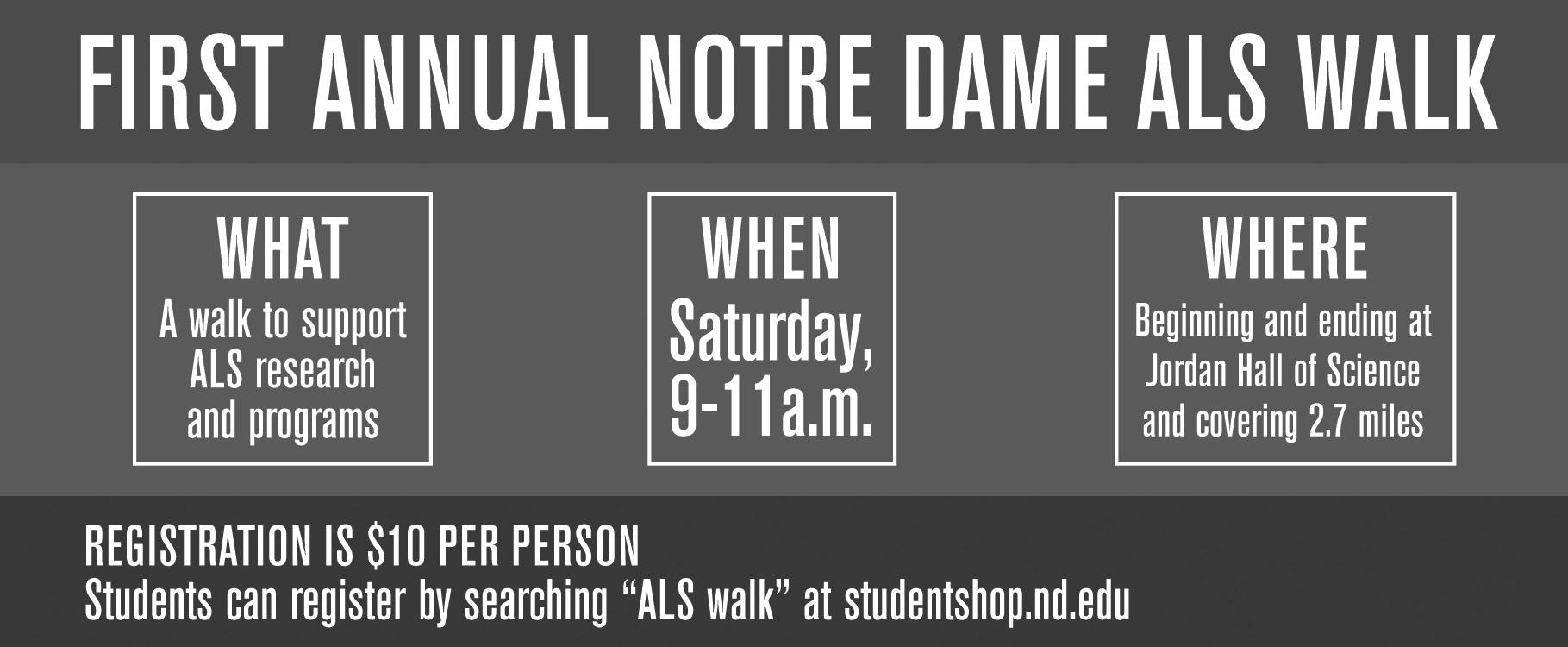
little more than a year after videos of people soaking themselves with ice water flooded Facebook feeds for the “als ice-bucket challenge,” the neuroscience club will hold the first annual notre dame als walk on saturday, in conjunction with the college of science.
a ll proceeds from the walk will support als programs and research, social service chair of the neuroscience club junior chris Ferari said.
Ferari, who helped promote and organize the event, said the goal of the walk is to raise awareness for the disease on campus and “make people aware that we want this to be something we’re going to do every year.”
“[ we want] to get it on everyone’s radar and say, ‘This is something that we want to continue to do. als isn’t going away, so we want to continue to raise awareness past just this year,’” he said.
a myotrophic lateral sclerosis
see als PaGe 5
ANNMARIE SOLLER | The Observer
University executive vice president John Affleck-Graves speaks at an open forum with the Worker Participation Committee in the McKenna Hall Auditorium on Jan. 26.
JANICE CHUNG | The Observer
see reFugee PaGe 4
see voTes PaGe 4
(574) 631-4542 jrooney1@nd.edu Assistant
(574) 631-4541 mgreen8@nd.edu, wlin4@nd.edu Business
Question of the Day:
At what age did you stop trick-or-treating?
Desk (574) 631-4543 sports@ndsmcobserver.com
Scene Desk (574) 631-4540 scene@ndsmcobserver.com Saint Mary’s Desk hehmse01@saintmarys.edu
Photo Desk (574) 631-8767 photo@ndsmcobserver.com
Systems & Web Administrators (574) 631-8839
Policies
Luke Ripley sophomore o’neill hall “14.”
Dennis Gilbert freshman morrissey manor “i still trick-or-treat.”
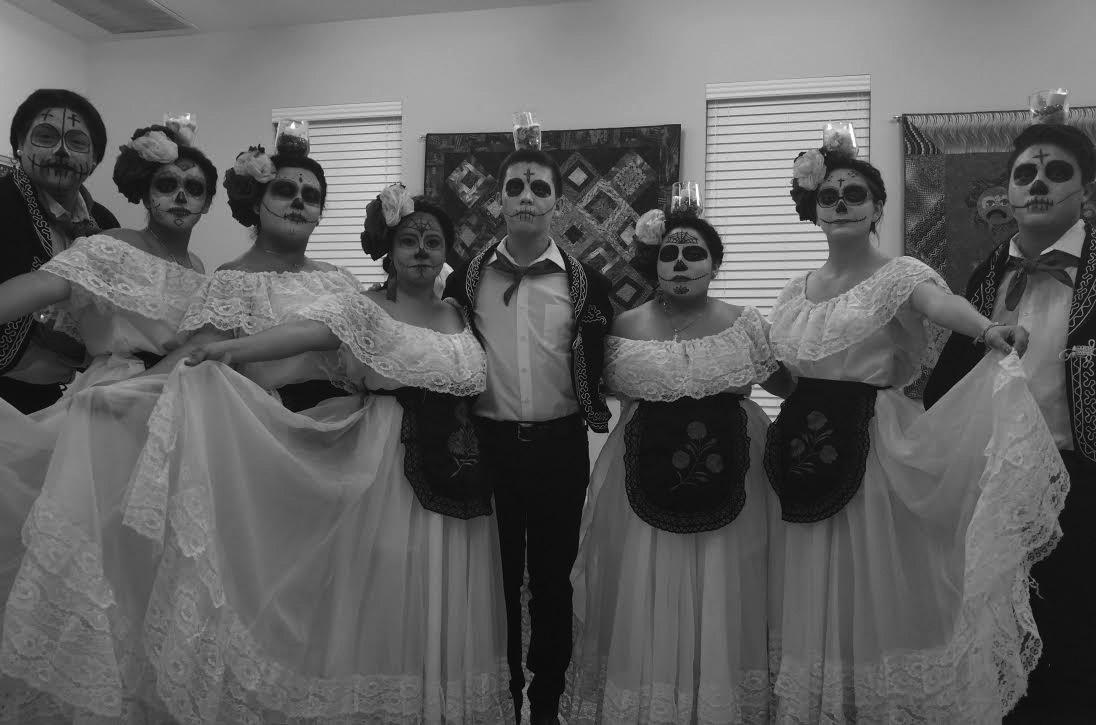
Members of Notre Dame’s Ballet Folklorico commemorate the lives of their dead loved ones in honor of Día de los Muertos, a Mexican holiday that celebrates the lives and spiritual journeys of dead family and friends with food, drink and parties.
Today’s Staff
News
c lare kossler
matthew mckenna
martha reilly
Graphics
Janice c hung
Photo
m ichael yu
Corrections
Sports
marek mazurek
maureen schweninger
Zach k lonsinski
Scene
matt mcmahon
Viewpoint
austin Taliaferro
The observer regards itself as a professional publication and strives for the highest standards of journalism at all times. we do, however, recognize that we will make mistakes. i f we have made a mistake, please contact us at (574) 631-4541 so we can correct our error.
Friday
Labor Cafe
Geddes Hall
5 p.m.-6 p.m.
Explore social justice issues with the Higgins Labor Program.
ND Women’s Soccer vs. Virginia Tech Alumni Stadium
7 p.m.-9 p.m.
The Irish take on the Hokies.
Saturday
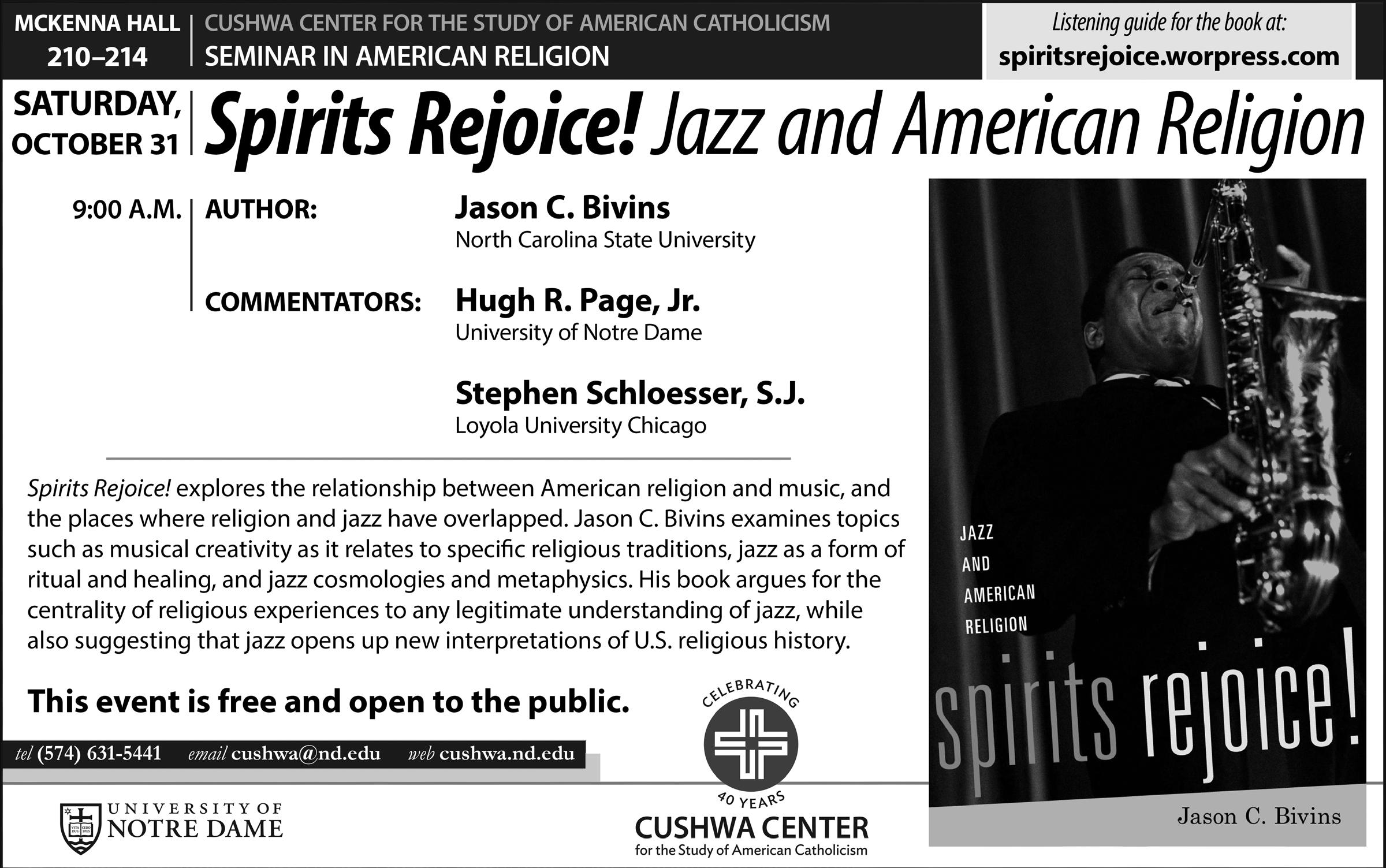
Religion Seminar
McKenna Hall
9 a.m.-12 p.m.
Discover links between religion and jazz in America.
Saturday Vigil Mass
Basilica of the Sacred Heart
5 p.m.-6 p.m.
Celebrate mass with fellow students.
Sunday
All Saints’ / All Souls’
Day Mass
Dillon Hall
1:30 p.m.-2:30 p.m.
Spanish Mass and Day of the Dead celebration.
Evening Vespers
Basilica of the Sacred Heart
7:15 p.m.-8:15 p.m.
Evening prayer in the Lady Chapel.
Monday
Urban Plunge
Information Session
Geddes Hall 4 p.m.-5 p.m.
Information on winter break service program.
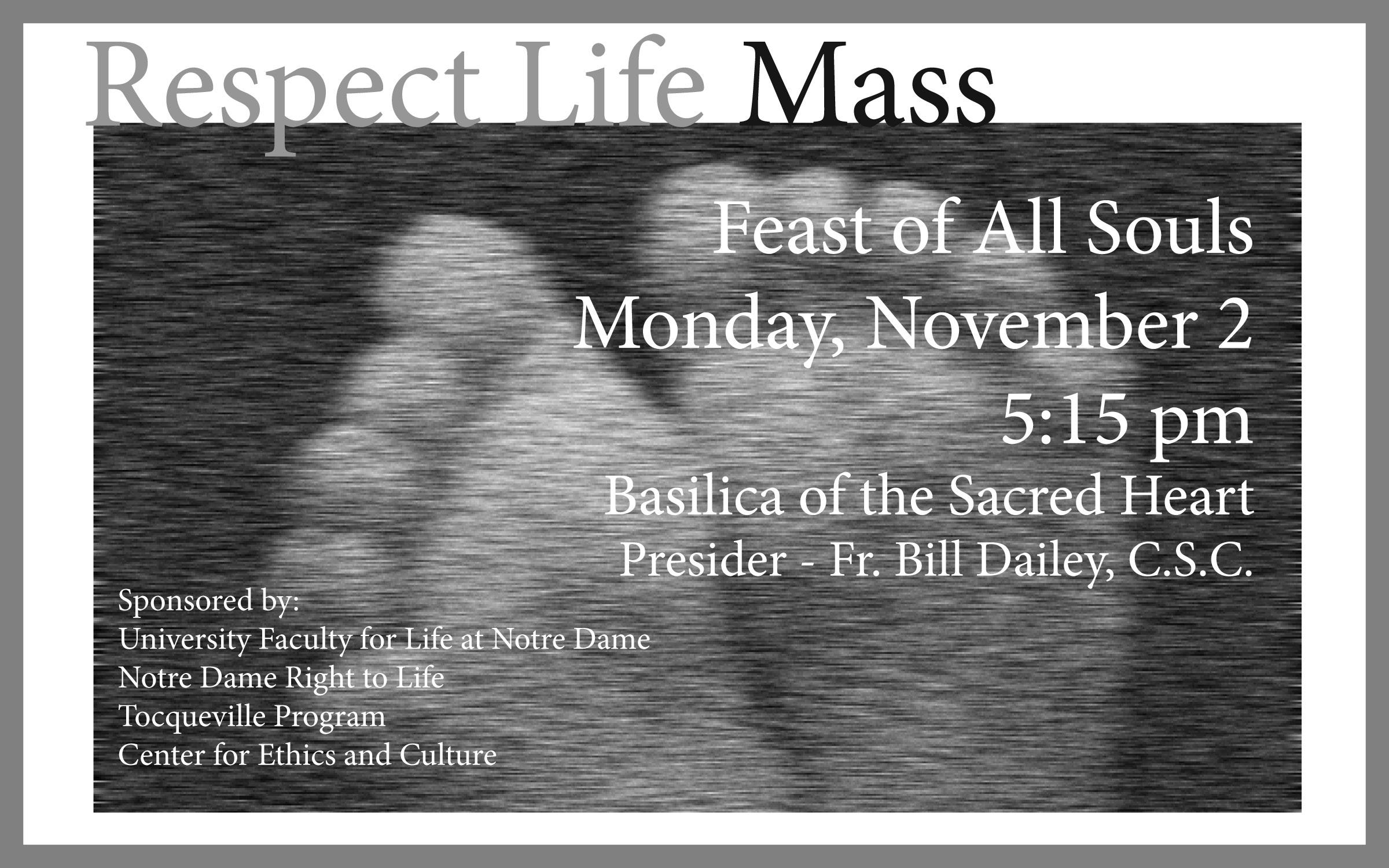
Respect Life Mass
Basilica of the Sacred Heart
5:15 p.m.-6:15 p.m.
Pray for greater respect for human life.
Tuesday
Workshop: “Crafting a Strong Grant Proposal”
Brownson Hall
5 p.m.-5:45 p.m.
Learn about grants.
Snite Salon Series
Snite Museum of Art
5 p.m.-5:45 p.m.
Gather to discover artwork and exchange thoughts.
MONICA VILLAGOMEZ MENDEZ | The Observer
By AIDAN LEWIS news writer
Executive explains benefits of impact investing campus ministry celebrates saint at prayer service
a ndi phillips, a vice president in the urban i nvestment g roup at g oldman s achs, spoke about the importance of impact investing during a conversation with director of the g igot c enter for e ntrepreneurship s am m iller on Thursday evening. phillips served as the keynote speaker for the 2015 i rish i mpact s ocial e ntrepreneurship c onference.
a ccording to the conference's website, the aim of the conference is to discuss impact investing, the practice by which investors finance projects that can provide social benefits to a community. phillips said her work at g oldman s achs aligns with this practice and that she has made it her mission to “drive strong financial returns while also having a very strong social impact.”
“There are opportunities to invest in the communities where we live and work that can have that double bottom line,” phillips said.
a s a result, impact investing is not only be beneficial to the investor, but also to the government and individual communities, phillips said. she said the main problem service providers face in trying to help the community is a lack of funding.
“i f what i’m paying for is outcomes, which is at the end of the story, how do i get the capital i need as the service provider to actually deliver the service?” phillips said.
Furthermore, phillips said many service providers would
be unable to recover from large investment failures.
“s ervice providers don’t have the financial wherewithal to absorb the risk of not reaching the impact and therefore not getting paid.”
i n contrast, large companies like g oldman s achs can absorb this type of risk, phillips said. she said because of this, service providers can “use private capital to finance the services people need.”
phillips discussed several projects through which impact investing has al-
“Get involed in the social issues you care about in such a way that you begin to understand what the challenges are and how to effectuatuce change in that area.”
Andi Phillips vice president Urban Investment Group Goldman Sachs
ready been beneficial for g oldman s achs and the community. she said one particular project involved funding prevention programs in m assachusetts for at-risk young men in order to prevent recidivism, which is the cycle of arrests and convictions to which many firsttime criminals fall prey.
The problem, phillips said, was that “the government
was spending of all its money to actually put these kids in prison and incarcerate them and didn’t have the money to pay for the preventive services.”
she said g oldman s achs provided this funding, with the potential to receive financial returns depending on the success of the program.
“For every decrease in recidivism and increase in employment, the commonwealth will make a payment,” phillips said.
The program was a great success, phillips said, lowering m assachusetts’s recidivism rates and bringing financial returns to g oldman s achs.
phillips also discussed the positives of some of g oldman s achs’ impact investing failures, specifically an attempt at r ikers i sland to lower recidivism through cognitive behavioral therapy. a lthough the therapy failed to have an effect, phillips said the venture “represented a very different way of the government doing business.”
“There was no waste of taxpayer dollars, because it was g oldman s achs and bloomberg philanthropy that lost money,” phillips said.
Finally, phillips offered advice for those looking to become involved in the impact investing field.
“g et involved in the social issues you care about in such a way that you begin to understand what the challenges are and how to effectuate change in that area,” she said.
Contact Aidan Lewis at alewis9@nd.edu
By KATIE GALIOTO news writer
underneath the high altar of the basilica of the sacred heart rests a relic of st. marcellus, a roman centurion martyred in 298 a d. for refusing to deny his catholic faith.
campus ministry hosted its annual prayer service for st. marcellus on Thursday night in the basilica to remember and celebrate the martyr and all he represents.
Fr. peter rocca, rector for the basilica, said st. marcellus refused to offer incense to an idol in honor of the emperor’s birthday during his time as a soldier in Tangiers, morocco. he was put on trial for his disobedience and ultimately sentenced to death for his refusal to renounce his christian faith. oct. 30 is the feast day of st. marcellus.
“The story goes that he stood in front of the standards of his legion — the legion’s flags — and then made a public declaration that he was a christian and could no longer keep the oath that he had made to serve the emperor,” rocca said.
The basilica is also home to the relics of members of the Theban legion, including its chief, st. maurice. during the rule of diocletian, a time of christian persecution, the legion was instructed to kill a group of christians they encountered. many of the soldiers believed in the christian faith and refused to follow orders, choosing to die instead.
“These men, many of whom were martyrs, gave their lives for christ,” rocca said. “They point,
not to themselves, but they point to their commitment to Jesus christ, their faith in Jesus christ. we need those kind of reminders, i think, in our daily lives.”
a lan kreider, professor emeritus at anabaptist mennonite biblical seminary, recounted the martyrdom of st. marcellus at the prayer service. rocca said a large number of mennonites travel to the basilica from goshen, indiana, each year to participate in the prayer service.
“The mennonites have almost adopted st. marcellus in particular as a patron saint of their commitment to pacifism,” rocca said. “ … They come all the way here, sometimes walking on foot, from goshen, indiana, to offer their prayers to god in front of the icon of st. marcellus.”
at the prayer service, Fr. emmanuel katongole, associate professor of theology and peace studies, delivered the 2015 st. marcellus day address.
st. marcellus is considered the patron saint of conscientious objectors, which aligns with values notre dame hopes to instill in its students, rocca said.
“i think [st. marcellus] is very important and relevant to students because he was willing to stand up for what he believed in, no matter what the cost might be,” rocca said. “he had the courage to profess his faith in christ, to speak the truth, to be a real witness to Jesus and his beliefs. i think we need models of people like that today.”
during the years of christian persecution, mass was often celebrated in roman catacombs on the tombs of martyrs, rocca said. he said relics are often placed under altars in observance of this tradition. Fr. sorin brought the relics of st. marcellus, st. maurice, the Theban legion and many other saints to the university from his trips to rome during the 1860s.
“These relics are visible, tangible signs that speak to — in this case — the sacrifice that the individual made for his belief in Jesus christ,” rocca said.
rocca said st. marcellus provides an example to guide students faced with making decisions.
“i think too often we are hesitant to speak up, hesitant to do the right thing, hesitant to say the right thing,” rocca said. “it’s a matter of taking to heart what we profess as christians and living it out in our daily lives. and sometimes it will mean disagreeing with friends.
“i would hope and think that all of our graduates would have the guts and the courage to say and do the right thing, just like st. marcellus.”
Contact Katie Galioto at kgalioto@nd.edu
SMC students tour campus ghost story sites
By NICOLE CARATAS news writer
Thirteen years after the publication of "Quiet hours," a collection of ghost stories taking place in various locations across saint mary's campus, the student activities board (sab) held a tour Thursday for students to hear the book's different stories in the buildings where they were reported to have occurred.
sab member sinead hickey said “Quiet hours” was published in 2002 and written by saint mary's alumnae shelly houser, veronica kessenich and k risten matha. w hile they were students, they interviewed hundreds of staff, faculty and local residents to put together a collection of stories of different sightings and happenings that transpired on campus.
“a ll the stories are about occurrences which happened on our campus,” hickey said.
“This book is not only fun, but it also gives us a little insight into the history and identity of our school."
hickey said the entertainment committee of sab planned this tour as their main halloween event.
“This is a fun opportunity for students on campus because it
is an option for a non-drinking halloween event. you can have fun without a drink,” hickey said. “it is a fun way to learn about the ghosts on campus and campus history.
"part of the saint mary’s identity is the ghosts present on campus.”
The tour started in the south lounge of regina hall, hickey said. participating students received a map, which showed three of the dorms on campus — regina hall, le mans hall and holy cross hall — where members of sab were stationed.
students then went to the three locations and sab members read the corresponding stories in “Quiet hours” that took place in each specific hall. in regina hall, students heard stories about pianos that played without anyone touching them, doors found inexplicably opened when they were originally locked and mysteriously rippling water in the pool that used to be in the building’s courtyard.
a fterwards, students proceeded to holy cross hall. This dorm was the first building of the college and was previously saint mary’s academy. The book tells stories about a mysterious sighting of a young nun and a large dog in front of the building
which are displaying erroneous information and are fueling xenophobia in this country.”
conflict.
s he said many people have a mistaken perception of these refugees.
“ w hat you see on the news is mostly men and families, [but] this is not the typical case,” b ennett said. “ you are not seeing the ones left behind and those are the most vulnerable ones.”
m any of those left behind are women and children, who make up 80 percent of refugees, b ennett said. s he said despite its history of accepting immigrants, the united s tates has accepted only 249 s yrian refugees since the start of the crisis, and any efforts to help these refugees have been misleading
“The [ o bama] administration has agreed to resettle 100,000 refugees, but this is 100,000 total refugees, not s yrian refugees,” b ennett said. “ s yrian refugees are only 10,000 [of these refugees], that’s the quota. w hat you don’t hear is that the quota was higher a few years ago.”
b ennett said n otre d ame students and faculty have the ability to make a difference by doing things like starting a blanket and sleeping bag drive and using social media to combat “hate websites
during a time when only a single, older nun wore a habit, and no nuns owned a dog.
The book also notes occurrences of noises being heard in the bathrooms — especially those on the third floor — that sounded like people brushing their teeth or showering when no one was actually there.
sophomore mackenzie griffin, who participated in the tour, said she believes the stories.
“i definitely think the ghosts stories on campus are real,” griffin said. “i haven’t experienced anything, but there is a lot going on in the bathrooms in holy cross. you’ll hear people walk in and do their nightly routines, but there’s nobody there.”
The last stop on the tour was le mans hall, where students heard the stories of people from building services finding a child’s hand print on a window, security staff feeling a cold chill in the un-airconditioned stapleton lounge and a student seeing a man in Queen’s court — reportedly one of the most haunted hallways in the building — run past her and through a wall during her nightly rounds as a resident assistant.
Contact Nicole Caratas at ncaratas01@saintmarys.edu
these demonstrations, other people took to the street in other cities,” he said.
a fter b ennet presented the refugee crisis in numbers, a hmed gave a personal perspective on the crisis, starting from its beginnings during the a rab s pring.
“ we thought s yria was going to ride out this wave of protests, but an event in m arch 2011 in a city called d araa where some school children wrote some graffiti [started the conflict],” said a hmed. “[These children were] listening to what they heard on T v. They wrote, ‘the people want the fall of the regime.’”
a hmed said the children were captured and tortured by s yrian p resident b ashar al- a ssad’s brother, a security chief in s yria. a ccording to a hmed, when the parents of these children asked about their children’s well-being, the security chief said in response, “g o back home and forget about your children, go back and sleep with your wives and make new children. i f you do not, i ’ll send my men to your wives and help them make new children.”
a hmed said this response sparked wide-ranging protests in d araa, which the government repressed violently.
“ w hen the first blood was spilled on the street from
a lot more like their grandparents than their parents in terms of their stance on abortion,” he said.
campbell concluded with another exception to the rule: the issue of gun control. campbell said young people “aren’t terribly liberal” on gun control.
p rofessor of political science darren davis began his speech with the number 12.3 projected on the screen. he said the significance of that number is that a frican a mericans comprise 12.3 percent of the a merican population, a seemingly small figure in comparison to the total population.
however, davis said a frican a mericans can still affect the outcome of the election.
“we don’t elect our president nationally, we have something that’s called the electoral college,” he said.
davis said in states with large black populations, a frican-a mericans can impact the state election.
“a frican-a mericans can potentially influence 32.9 percent of the 270 votes that are needed to win in 2016,” davis said. “ ... This is how race becomes important in national politics.”
a ssociate professor of political science r icardo ramirez devoted his talk to the l atino demographic. he said there are a substantial amount of l atinos eligible to vote who are not registered.
a hmed said he decided to take action against the a ssad regime in response.
“ i could not tell my son i did nothing,” he said.
h owever, a hmed said his actions against the regime had dire consequences, and he was forced to leave the country.
“ i don’t think we were stupid,” a hmed said. “ i don’t regret — never a moment in my life will i regret — what i did.”
s ince being forced to leave s yria, a hmed said he has worked to help those affected by the crisis, especially the most vulnerable in this crisis, such as children.
“This is the tragedy, a lost generation,” a hmed said. “The danger is the time bomb we will face in the future. k ids without education feel abandoned and angry. These guys will grow up and have two choices — either beg money, or fight for someone.”
a hmed also said students at n otre d ame can help the refugees affected by the crisis.
“ i hope that you will help us in saving this lost generation,” a hmed said. “ we want to stop them from being radicalized and we want them to have hope.”
Contact Lucas Masin-Moyer at lmasinmo@nd.edu
most l atinos live in nonswing states, he said, which parties and candidates typically ignore. ramirez also said many l atinos are young, and young people tend to be on average less politically involved. ramirez said he thinks l atino voting turnout will increase for the 2016 election, largely owing to the fact that they “feel under attack” from donald Trump’s campaign.
“if l atinos associate a certain party with not wanting them who do you think they are going to vote for?” he said.
The final speaker, associate professor of political science christina wolbrecht, focused on the implications of women’s voting habits on elections and said there is a larger gender gap in the younger generations.
however, wolbrecht said the gender gap seems to exist only amongst whites.
“There isn’t much of a gender gap at all with nonwhites,” wolbrecht said.
wolbrecht said while many would expect issues directly related to women to cause a large gender gap, in reality this is not the case.
“The truth is that men and women actually don’t vary a great deal in their preference on the kind of issues we usually consider women-specific, such as abortion, equal pay and requiring religious institutions to provide birth control,” wolbrecht said. “w here we see bigger differences between men and women is support for the social welfare state.”
“The reality with l atinos is that they have potential to impact elections if they were to be mobilized,” ramirez said. he said the reason for the lack of mobilization of and outreach to l atinos who are eligible to vote is a combination “of where they live and the fact that they’re young.”
nd votes ’16 is sponsored by the rooney center and notre dame’s center for social concerns. on nov. 12, nd votes ’16 will hold a student forum as a part of their continued initiative.
Contact Eddie Damstra at edamstra@nd.edu
paid a dverT isemen T
said in the email. “ it was hoped that n otre d ame’s action would encourage other institutions to follow, and that collectively pressure could be put on countries to reform their labor laws.”
Jenkins said that since no other universities have adopted similar policies, and n otre d ame’s action had no discernable influence on the practices of nations that deny freedom of association, the wpc was created to reevaluate the university’s policy.
“ w hile still holding to the principle that freedom of association ought to be allowed and independent unions permitted, and recognizing that in the p eople’s r epublic of
a LS
con T inued F rom page 1
(als), also referred to as lou gehrig’s disease after the new york yankees baseball player diagnosed with the disease in 1939, is a “progressive neurodegenerative disease that affects nerve cells in the brain and the spinal cord,” according to the als association’s website.
The website says patients living with als have an average life expectancy of about two to five years following diagnosis.
sean kassen, the director for academic advancement in the college of science, said the rarity and severity of als make walks like the upcoming one at notre dame important in raising awareness and generating interest in research for the disease, which is sometimes overlooked in favor of more prevalent diseases.
“als is a tough disease to get. it is a scary disease. it is a devastating disease; there is no cure,”
c hina such rights are denied at the level of national laws and practices, the wpc considered whether there might be other criteria we should employ focused on the policies and practices of particular factories,” the email said.
The committee worked with verite, an internationally-recognized non-profit organization, to assess six selected c hinese factories using a list of 71 criteria. They proposed four specific recommendations, shared with the n otre d ame community at a public forum in s eptember.
“First, that n otre d ame undertake a pilot program with factories that met our standards to see if they sustain a standard of performance acceptable to n otre d ame, and we can confidently verify such performance,” the email
kassen said. “a nd still there’s not a lot of research that is out there on the direct causes, and hence the potential way to cure it.
“ … als is a [disease] that largely i would still say people don’t understand, and by doing a walk like this it brings it front and center. it brings more awareness first and foremost.”
besides raising awareness, Ferari said he hopes the walk will encourage als research at notre dame, where there are currently few people actively involved in als or als-related research.
a mong the few at notre dame whose research is relevant to als is biochemistry ph.d. candidate Tiffany snow. snow currently studies the nmda receptor in the brain, which she said has been associated with huntington’s disease, a lzheimer’s disease, alcohol dependence, strokes and als
“The receptor i’m working on, very little is known about how it’s behaving and why it behaves in certain ways, and especially – what’s more interesting – how
said. i n addition, the university will work with factories in the area that fell short of their standards to see “if they can improve to an acceptable level.”
n otre d ame will also begin evaluating similar factories in other countries that currently manufacture n otre d ame-licensed products.
“ e ven with the formal, legal right to form and join an independent union, worker participation may be below what is acceptable, and the university can use its leverage to encourage improvement. m oreover, the review of factories in different countries could establish a useful benchmark as we deliberate about acceptable standards.”
The committee also recommended the university
and why it behaves under neurological stress or some sort of disorder,” snow said.
“This receptor – because it’s in a lot of neurons in the brain and a lot of important areas of the brain – when something goes wrong in it, it’s seen in a lot of different disorders,” she said.
To support her research, snow received an als ice bucket challenge fellowship for the 20142015 academic year.
“i think while it might seem inconsequential to look at a certain receptor – just one receptor or maybe one part of that receptor –it’s looking at the little things like that that will answer bigger questions that will affect thousands and tens of thousands of people, potentially, in a lifetime,” snow said.
a lthough this weekend’s walk is the first of its kind to occur on campus, it is not the first als walk to have a notre dame connection.
les mccarthy, a notre dame parent and member of the notre dame club of mid-hudson
paid a dverT isemen T
review and, as necessary, revise the current l icensing c ode of c onduct to include a “a richer understanding of worker participation and, in general, that it reflects the best practices and the principles of c atholic social teaching.”
Finally, the committee suggested the formation of a student subcommittee, in addition to continuing campus participation in the conversation.
i n response to calls to reject the recommendations, Jenkins analyzed the morality of the policy, concluding that n otre d ame’s actions would not support or sustain any form of injustice.
“ p articipation allows us to affirm those factories that have high standards of worker participation, and to
valley, helped organize a walk through the mid-hudson valley club in 2009 following the loss of one of its members, notre dame ph.d. class of 1970 alumnus gus raspitha, to the disease.
“w hen we lost him in the spring of 2009, we decided we really should do something to raise awareness,” mccarthy said. “so our club held this first walk nov. 15 of ’09, of which there were 55 of us walking.”
The hudson valley walk to defeat als has taken place every fall since its inception in 2009, and during that time it has grown from 55 individual walkers raising nearly $5,000 in 2009 to 147 walk teams raising more than $346,000 in 2014. in total, the walk has raised more than $1 million to benefit support services, awareness and research for als since they began the hudson valley als walk, members of the notre dame club of mid-hudson valley have been in contact with various people at notre dame about the prospect of holding an
encourage other companies to meet these standards,” the email said. “ w hether this in fact occurs is something about which a pilot program will give us valuable information.”
a ccording to the email, the pilot program ultimately seeks to promote the full set of workers’ rights recognized by c atholic social teaching at a global level.
“ i emphasize that this change in policy in no way signals a lessening of n otre d ame’s commitment to the full set of workers’ rights recognized by c atholic social teaching,” Jenkins said. “o n the contrary, with the wpc , we are trying to develop a policy that is as effective as it can be in furthering the recognition of those rights around the world.”
on-campus walk, kassen said.
“They’ve been very big supporters of our efforts here with rare disease research, and [mccarthy] has always suggested that we try to do an als walk,” kassen said. “a nd so once this new [neuroscience] club came up we talked together … i knew this is something he was very passionate about, and so we came to the conclusion that we potentially could do this [event]. a nd that’s when i presented the idea to the neuroscience club.”
From there, the neuroscience club undertook organizing the walk, which Ferari said he hopes will become the club’s “signature event.”
This weekend’s walk will span a distance of 2.7 miles, with a stop at the grotto for a short prayer. registration is $10 per person, and snacks and coffee will be available to participants before the walk.
Ferari said participants are also encouraged to wear costumes in the spirit of halloween.
so far, kassen said, the event has generated significant interest.
“every time you do an event for the first time, a lot of it is you’re trying to get people to show up, you’re going to learn sort of on the fly, you have to do all your due diligence ahead of time, you have to make sure all the paperwork is done appropriately and that the correct people at the university know about it,” kassen said. “ … To me, [the walk] has already been a win. people are already signing up and they want to attend.”
looking toward the future, mccarthy said he hopes the walk will have a real impact in stimulating advances in the field of als research.
“w here will this take us on campus?” he asked. “only time will tell, but if history teaches us anything, it could be the start of something big. it’s my desire that the luck and the skill of the irish just might be what can make a significant contribution to solving this mystery.”
Contact Clare Kossler at ckossler@nd.edu
iNSide coLumN
Beyond the stigma
recently, mental illness awareness week was held here on campus. symbolized by the word of life mural’s green glow, the national a lliance on mental illness (nami-nd) hosted a number of speakers and coordinated an entire week of events designed to raise awareness and provoke discussion about mental illness throughout campus. nami-nd is assuredly due commendation for its exertion in organizing the week and its events.
w hen it comes to conversation concerning mental illness on campus, the most transparent objective typically involves an aim toward exterminating stigma surrounding mental illness. This objective is undeniably paramount in improving mental health at notre dame, but it is also important to recognize that de-stigmatizing is just one component of any mission devoted to ameliorating the state of mental health on campus. a n optimal environment for accommodating mental health on campus is one where all students and faculty not only understand the genuine obstacles that mental illnesses pose for some individuals, but also an environment where everyone has the knowledge and experience to be in the best position possible to provide meaningful support to those who may need it. additionally, there are numerous benefits to mental health awareness initiatives having objectives aimed at educating the public to be prepared on how to act if one of their friends or peers has the courage to be transparent about struggling with their mental health. one of the main hopes of de-stigmatizing mental illness is that it will cultivate an environment where individuals are not ashamed or afraid to seek help. This environment becomes much more effective if the general population is prepared to provide support and (if necessary) get professional assistance involved. obviously, there is no single method appropriate for all situations, but any form of training that increases the preparedness of individuals across campus would be advantageous. of course, none of these suggestions are designed to mitigate the importance of the de-stigmatizing objective. There is a reason this goal is the cornerstone of most campaigns about mental health awareness. if anything, these additional objectives highlight the importance of de-stigmatizing since, intuitively, a population that has disregard for stigma surrounding mental illness should be more receptive to initiatives targeted toward increasing its knowledge of mental illnesses and capacity to assist those who may need support.
it is clear, however, that de-stigmatizing is often the most translucent component of mental illness awareness campaigns. because this objective can often dominate mental health discussions, it is important to note an optimal state of mental health on campus should involve more than just this single goal. ideally, our campus can be an environment where individuals not only are comfortable speaking about mental illnesses they may be struggling with, but one where their peers are also educated about these mental illnesses and prepared to provide beneficial support.
Break the glass
Kyle Palmer m r. p recedent
a fter wednesday’s gop presidential primary debate, i wrote my regular Friday column with a predictable analysis of the debate. by yesterday morning, it was polished and ready to send off (The observer asks i submit my columns by 5 p.m. the day before publishing). however, something else happened that made me scrap the entire column and start over.
i sat down for lunch yesterday shortly after 1 p.m., prepared to study for a quiz in my 2 p.m. class that i hadn’t studied for whatsoever. adding to the concerns over the quiz was the discontent i had for the dining hall at the time due to the removal of the almighty dining tray in an effort to conserve water one day out of the year. upon sitting down, shedding my jacket and grabbing a napkin, i looked up and saw a freshman sitting in the middle of a table alone, obviously emotionally unsettled, choking back tears and not expecting anyone to join her. i noticed others saw the freshman as well, but no one stood to do anything about it. i debated whether i should do anything at all. a fter all, i only had an hour before my quiz for which i was unprepared, and i certainly wasn’t the right person to comfort the young student, but i eventually stood and did something about it anyway. i walked over to the freshman, asked if she wanted to sit with anyone and invited her to join me. a fter sitting down together, i introduced myself and asked what had been bothering her and to tell me a bit about herself. That’s when i learned she was a freshman who had had a particularly rough week. classes had come back with a vengeance after fall break, and she didn’t feel at home in the friend group she had formed since august. she felt totally alone and just needed to release some tears. i had forgotten how stressful life might be as a freshman. over the last three-and-a-half-years, i had come to call this place home with supportive friends and faculty. i asked when she had last called home, and she told me she had done so that morning. The student missed her mom and couldn’t wait to go home for Thanksgiving and christmas. i hadn’t realized how lucky i was to never be homesick over these last few years. That isn’t to say i don’t love going home and spending time with my family, but i found a home in those around me at notre dame, and i
was normally too busy to think about going home. a fter our brief conversation, the freshman’s tears had subsided and a smile appeared, and she headed off to prepare for a project.
The last thing i want is for this column to be perceived as some sort of pat-on-the-back for helping out a fellow student in need. if anything, it should bring condemnation for me rather than commendation; it should bring criticism because i hesitated to do anything at all at first. There i was, so concerned with a quiz that i nearly missed out on fulfilling what, i believe, was and is a moral obligation. how often do we nearly miss out on the things that matter, such as helping and uplifting one another? how often do we fail to consider the plight of others because we have something in front of us that requires immediate attention?
i encourage anyone reading this to be mindful of those around you and react when your help is needed. never mind the inconveniences or the concern that you aren’t prepared to handle the situation of a stranger — you are prepared enough. if you’re on the other end of this situation and you’re going through hard times, don’t worry about inconveniencing another; just seek out a friend who is willing to listen. sometimes life can feel as if you are looking at others through a window or a television screen, their lives unaffected by yours and yours unaffected by theirs. regardless of the side of glass you feel you’re on at the time, looking out or looking in, my chief suggestion is this: don’t hesitate to break the glass. don’t hesitate for even a moment as i did.
now, as i write this column quickly to make my 5 p.m. Thursday deadline, immediately after taking that quiz, which i likely would have done better on had i chosen to study for that extra period of time, i only regret i didn’t react faster for that freshman and that i didn’t provide an email address for an open medium for the venting of stress. if she is reading this, or anyone who just wants to vent in the confidence of a fellow student you don’t actually know, my email address is below. send me a message. i guarantee i won’t hesitate this time.
Kyle Palmer is a senior from Dillon Hall studying accountancy. He welcomes any challenges to his opinions and can be reached at kpalmer6@nd.edu
The views expressed in this column are those of the author and not necessarily those of The Observer.
response to “i nfants charge”
i read s teve s weeney’s letter “ i nfant charge” in Tuesday’s edition of The o bserver with interest. l ike s teve, my wife and i are both 2006 graduates, and i ’m also a legacy student who enjoys the chance to come back and cheer on the i rish every year. m y first daughter was born in 2013, and when we made plans to come to that year’s navy game, i was at first indignant over the infant charge. $80 for a threemonth old? n otre d ame’s avarice knows no bounds. n ot wanting to subject our daughter to poor weather or buy her the most expensive nap of her life, we got a sitter.
n ow that i have a second daughter and have come to three home games without them (including this year’s Texas game), i ’ve realized n otre d ame s tadium isn’t like the other venues s teve described for two reasons. First, most professional sports teams’ stadiums have individual seats where there is plenty of room on a lap. n otre d ame s tadium does not — the crowded benches often hardly leave room for me, much less my children. Those stadiums often have extensive lounges, facilities, heated apparel shops and the like for parents whose children need a respite from the weather. n otre d ame s tadium does not.
s econdly, and i think more importantly, there is no feasible way to enforce a two-year age limit. a irlines have plenty of time at check-in to enforce their policy. Theme parks can take the time at the
admissions gate — there’s no rush to get in. yet in the 30 minutes preceding kickoff, 80,000 fans have to get in the stadium, often in poor weather. it’s hardly the place for checking birth certificates. w hich, of course, would be necessary. w ith the face-value ticket prices accelerating yearly and the secondary market skyrocketing, you mean to tell me some fans wouldn’t try to pass their three- or four-year-old off as a two-year-old? w ith that kind of economic incentive, i wouldn’t blame them. i ’m sure most fans wouldn’t want to be the ones getting that kid’s sneakers in the back every time c .J. p rosise runs for a first down.
The real problem here is not the infant policy, it’s the ticket prices, which have quintupled since i went to my first game. were the prices more reasonable, i wouldn’t mind paying to bring my daughters for part of the game, but the $500 price tag for my family of four this year was simply too high. Families with children of any age should be outraged. no doubt the university is merely keeping pace with its competitors and other entertainments, but it makes it a lot harder on alumni families who want to bring their children back to wake up the echoes.
Ryan Klaus sports writer
Letter to the editor
Starting from zero
i started my junior year prepared. on the first night of the semester, my roommates and i opened a huge bottle of diet coke celebrating the fact that we were finally not starting from zero. indeed, with six jobs, two majors, 19 academic credits, many close friends and a sense of familiarity, i firmly believed this year would be the time for me to shine, to excel, to change the world. i was so ready to take my first step on this amazing journey. i never expected my first fall would occur in the domain most familiar to me: writing. as a columnist for The observer and a writing tutor, i always consider writing as my strength. Two weeks into the semester, i received my first grade for an essay assignment. i was a little bit surprised when the professor called me into his office and kindly reminded me that my writing was “problematic.” one week after that unfortunate incident, i got another paper back with the professor suggesting i should consider rewriting the essay because i did not closely follow the requirements listed on the prompt. i was shaken and alarmed. as a result, as i started my third essay assignment, i chose the easiest topic — comparing the theories of hobbes and locke — and gave up the other four more interesting but riskier ones. i carefully examined my understanding of the two philosophers, avoided all the nuances in their respective theory, made sure that the logic was consistent and checked my spelling three times. i remember walking into the sun after turning in the paper and thinking to myself: you did everything you possibly could do. Things would change this time. Two weeks after, i got it back. i saw my professor’s comments on the margin: you have a good understanding of the two theories, but your thesis is too conservative. you explain the two theories quite well, but you are not arguing for anything. next time, take some risks and try to work on a more challenging thesis. Jacqueline novogratz, one of the most recognizable figures in international development, once said, “They say a journey of a thousand miles begins with a single step. i took mine and fell flat on my face.” six weeks into the semester, i had already taken a few courageous steps, but i fell on each and every one of them. i failed at every attempt to live up to my own expectations. profoundly disappointed with myself, i talked with my mom, complaining that my constant efforts only resulted in constant failures. i was not receiving satisfactory
grades. i was having a writing crisis. i was not getting enough sleep, because i simply did not have the time for it. “it should not be like this,” i concluded with frustrating tears, “i am already a junior, for heaven’s sake. i should already have my life together!” out of nowhere, my mom said, “That’s too bad. i can see that you lost your humbleness.” “w hat do you mean? i am humbled, like, every single day.” “no, you are simply sad and disappointed. you are not humbled.”
before i could argue back, my mom, like many chinese parents, started to repeat the important role of humbleness in ancient chinese culture and warned me against the serious dangers of losing it. i shut up, knowing she would probably go on for another hour up in the metaphysical clouds without offering any tangible solution to my situation. in the end, however, my mother did offer a solution: “This might sound weird, but i hope somebody can destroy something for you, and then you will understand.”
much confused and a bit terrified, i directly went to the grotto after the talk. i sat on the bench for a long time, hoping that destruction, no matter in what form, would never come.
a nd of course, it came.
it was 2 a.m. and i was still working on a paper in the library. it was the seventh attempt of the semester to regain my confidence in writing. i started two weeks before and had already done much research and talked with my Ta about it. Though she suggested i change my thesis into a more challenging one, i chose to stick with the original draft. starting from zero sounded like a strategy too risky for me, and by the way, i never wanted to lose anything i had, especially given that i have already lost too much in the last six weeks. as i reached the conclusion part of my eight-page paper, i reminded myself once again that i needed to include every single necessary element of “good academic writing”: a summary of my argument, counterargument, the “so-what movement” and … pzzz. The words disappeared. The music stopped. i saw my own face on the screen: a shocked, terrified and hopeless one. my computer had crashed.
Five seconds later, i recovered from the shock and finally figured out what just happened. my first reaction was frantically trying to reopen my computer. i connected it to the power source. didn’t work. i kept pressing the power button for more than two minutes. didn’t work. i even talked to it, begging it to come alive again. didn’t work. everything was gone, just like that. i packed all my things and walked out of the library, numb with
grief and confusion.
it is funny. i had been extremely afraid of destruction ever since my mom mentioned it, yet while walking across god Quad with all my essays and problem sets gone, i was calmer than ever. since i could not work on the essay, check if my professor had updated our newest grade for problem set five or open the calendar to see my must-do list for the next day, i simply wandered around campus without a plan. This undesirable accident had forced me to start from zero again, and it felt like freshman year.
as an international student, i had to learn every single thing when i first came here. i had to learn what theology is. i had to learn what a counterargument was. i had to learn about a merican popular T v shows. i had to learn about when to laugh and when not. i had to learn about how to use a knife and fork. i was never afraid to ask for help, because i knew i was ignorant. Failure was the norm of my life. w hen i failed, i just learned how to stand up. The habit of learning made everything so easy to accept. nothing was ever dreadful. Then it suddenly occurred to me that despite the constant failures, the grinding process of learning everything, the sense of strangeness i had whenever i walked on campus, i was very happy every day as a freshman. it came from the courage to start from zero and the acceptance i had to learn everything on the journey. a ll of a sudden, i realized i had not enjoyed the happiness of being humble for a long time. The crash of my computer 20 minutes ago, a destruction which my mom had long been hoping would occur, forced me to start anew and empowered me to once again be humble.
Just give up the fight tonight and start everything from zero tomorrow. it is not that dreadful, i told myself.
The next morning, i successfully opened my computer. everything came back. The essay assignment i was working on the night before was still there: eight pages, single space, with a thesis not so challenging but easy to defend.
i smiled and dragged it to the trash box. empty trash. i was finally humble enough to start from zero again. it felt so good.
Dan (April) Feng is a junior political science and economics double major. She is from Beijing, China, and lives in Lyons Hall. April welcomes all comments (or complaints) and can be reached at dfeng@nd.edu
The views expressed in this column are those of the author and not necessarily those of The Observer.
l essons learned at The observer
l ate nights. e arly mornings. not enough coffee in the world to keep you awake during that morning calculus class. it’s a story most college newspaper editors know well but would never change. we’re willing to put in the hours not only because of the close-knit community, one of the biggest draws, but because the skills you learn working for a college newspaper are invaluable across professional industries. here are five reasons why.
you meet a wide range of people c ollege is a bubble, but working on the paper exposes you to a wide range of people and viewpoints. d uring my four years on The observer at notre dame, i interviewed a british literary scholar, the c hief marketing o fficer of subway, the university president and the only o rthodox Jewish student on campus. reaching beyond the bubble has huge value later on in the working world.
you get used to criticism most professors at notre dame weren’t outwardly critical of my writing, focusing on what i could do better instead of what i did wrong. w hile i
appreciated this approach in my classes, criticism is an unavoidable aspect of the professional world and life in general. my freshman year, i remember the first article i received back from my editor was completely covered in red ink, entire sections crossed out. i probably went home and cried that night, but soon learned not take things so personally (and that criticism helps you improve).
you master the art of succinct writing i used to think the phrase “writing is an art” meant i could use an unlimited number of words to make things sound beautiful. now i believe that regardless of the writing form, every single word needs to have a purpose. working on the paper taught me to boil down stories to their very core, write conversationally and include only the most powerful quotes. a ll of this prepared me well for a career in digital media.
you get comfortable leading conversations most people love talking about themselves. o nce you learn that, asking questions and leading conversations isn’t all that hard. w hen i started out as a reporter, i was scared to even place a call to a stranger. i read and reread my emails 10 times before requesting an interview. but with experience, i gained the confidence to assert myself during interviews,
pursue contacts and ask the tougher questions. you learn to work well under pressure s ome of my most stressful days in college, i was under deadline for an article on the same day i had a major test. i spent free moments calling sources and writing while simultaneously trying to memorize history or statistics formulas. The observer demanded everything of you, and you had to figure out how not to let your grades slip. it took years, but i learned to stay calm and trust that everything would get done (and that the world wouldn’t end if it didn’t).
i loved being an e nglish major at notre dame. but truthfully, none of my classes stand out to me years later the way my days and nights spent in The observer office do. w hile i nurtured my love for literature through my major, the newspaper that gave me the hands-on, practical education i needed to jump into the real world after graduation.
i n the end, i’m thankful for the sleepless nights and overconsumption of chocolate. The observer was the best (free) course i took at notre dame.
Sara Felsenstein can be reached at sfelsens@gmail.com
The views expressed in this column are those of the author and not necessarily those of The Observer.
April Feng storyTime
Sara Felsenstein guest columnist
By MATT MUNHALL scene writer
“it’s not so easy writing about nothing.”
That is the declaration that opens “m Train,” the new memoir from the musician and writer patti smith. Those words are relayed to her by a cowboy in a dream, but they also serve as a guiding force for the book. “m Train” isn’t about nothing per se, but smith is more concerned with capturing her inner state than giving a play-by-play of the pivotal events of her life. i nteriority is favored over traditional narrative, attempting to give the reader a glimpse inside the mind of the g odmother of p unk.
w hile smith’s previous memoir, “Just k ids,” documented her relationship with the artist robert mapplethorpe, “m Train” is centered on solitude. again and again throughout the book, smith writes of going to her beloved cafe ‘i no in greenwich v illage and sitting down at “her table” to write, accompanied only by her usual order of black coffee, brown toast and olive oil. i n smith’s hands, this quotidian act becomes a ritual that verges on the spiritual.
smith has called the book “a roadmap to my life,” and she populates it with surreal dreams, memories of her late husband Fred “sonic” smith, travel diaries and reflections on her writing process. but she bestows the most reverence on the artists she adores, especially writers, who become saintly figures in her mind. smith seems especially fascinated by visiting the graves of her literary heroes, including a rthur r imbaud, sylvia plath and Jean g enet. on these pilgrimages smith frequently brings talismans — a string of beads for g enet, stones from a French guiana prison for g enet — as signs of her devotion.
There is a spiritual dimension not only to smith’s idolization of certain artists, but to the very act of reading itself. i n one chapter she recounts a period of intense obsession with the Japanese surrealist writer haruki murakami. smith recalls spending several weeks fixated on the abandoned house at the center of murakami’s novel “The w ind-up bird c hronicle,” wondering whether the property is real or imagined. she even considers that she could “just innocently meet him for coffee where portals connect” in order to find out the answer. she later leaves the novel in an airport and despairs over having lost the “mascot of [her] resurging energy.” i n smith’s world, books have the immense power to revive one’s spirit.
smith holds a similar romantic view of the crime procedurals she loves, which include “l aw & order,” “csi : m iami” and “The k illing.” even the act of watching these shows becomes its own kind of ritual. at one point, when smith’s connecting flight home through l ondon is delayed, she decides to check into a hotel and spend all day and night in her room watching british detective shows. The sense of the mystical is reinforced when she runs into an actor from one of these dramas in the hotel bar. “yesterday’s poets are today’s detectives,” she declares — speaking to how seriously she takes her favorite detective shows.
i was compelled by the web of cultural references smith weaves in “m Train,” even when many of her literary references were unfamiliar to me. she seems aware this might be the case with many readers, but insists it is fundamental to the way she conceptualizes herself. “writers and their books. i cannot assume the reader will be familiar with them all, but in the end is the reader familiar with me?” smith asks,
after discussing the g erman writer w g sebald’s “a fter nature.” “i can only hope, as i offer my world on a platter filled with allusions.”
i think smith is correct in her hope that these allusions are revealing. part of this is my misguided belief that if i read murakami with a similar intensity i will somehow tap into the swagger she embodies on the album cover of “horses,” clutching her suspenders and black jacket slung over her shoulder. i could watch every episode of every crime procedural and i wouldn’t become patti smith. nonetheless, the art that is important to us — especially the works that move us so deeply as to regard them with an almost religious intensity — becomes a part of how we experience the world. smith’s love of crime dramas isn’t purely for their entertainment value. For her, there is a resonance to be found between herself and these “detective inspectors whose moodiness and obsessive natures mirrored [her] own.” w hen art connects with us on such a deep level, it can speak to our personal experiences and affirm our feelings as valid and real. it is for similar reasons that i have recently become obsessed with c rybabies, a podcast hosted by new yorker writer susan orlean and the actress sarah Thyre. orlean and Thyre invite guests on their show to talk about the films, plays, songs and other moments that bring them to tears. guests on past crybabies episodes have included many artists i idolize: comedians a my poehler, Julie k lausner, Jason mantzoukas and Jenny slate; writers Tavi g evinson and h ilton a ls; “mad men” creator matthew weiner.
w hile the concept behind the show is great, it only works because of how vulnerable their guests allow themselves to be about why certain works affect
them so deeply. on a recent episode, g evinson discussed the song “These days” by nico and its use in one of the most memorable scenes from “The royal Tenenbaums.” she said the song brings her back to watching the film for the first time as a young teenager. g evinson eloquently describes how the song fills her with nostalgia for that time in her life and evokes a “real chemical reaction” in her.
on another fantastic episode, megan a mram, who wrote for the sitcom “parks and recreation,” discusses a short exchange between l eslie and ron during the show’s final season. l eslie asks, “w hy would anybody ever eat anything besides breakfast food?” to which ron responds, “people are idiots, l eslie.” a mram talks about how the scene channels all the emotions she felt as the show came to an end earlier this year — both the joy of having worked in such a great environment, but also the sadness over the death of fellow “parks and rec” writer harris w ittels.
l istening to the podcast, i was incredibly moved by these two moments in particular. g evinson and a mram so eloquently speak to the ways in which art can be shaped by personal experience. The podcast as a whole is all about art at its most affecting — when it provokes a visceral emotional reaction. critical distance is fine, but art is really at its most powerful when it becomes so deeply embedded within our lives and our memories. both “m Train” and crybabies share this profound belief that the art that moves us becomes an intertwined part of us. a nd those discussions aren’t really “about nothing” at all.
Contact Matt Munhall at mmunhall@nd.edu
By NICK LAUREANO scene writer
Editor’s Note: This article is a continuation of Nick Laureano’s piece of the same name that ran in yesterday’s edition. set the time circuits to February 2010 and hit 88 mph. “The k ing’s speech” — a film that is decent in every possible sense of the word — beat “The social network” for oscar gold. a s a startling portrait of egotism, jealousy and betrayal that captured the ethos of the internet generation, “The social network” is one of the best films of this decade. it truly earns comparisons to films like “citizen kane” and “rashomon.” everything about “The social network” — its screenplay, acting, directing, editing, cinematography, sound design, literally all of it — is sharper than “The k ing’s speech.” it is not, however, a feel-good story about a historical hero à la “The k ing’s speech.” rather, it is a portrait of a modern antihero that leaves its viewers with a cynical outlook on the state of modern culture. l ike period settings, serious tones and claims of historical truth, happy endings seem to score points with oscar voters these days, as the last truly startling film to win best picture was 2007’s “no country For old men.”
earlier that February night, colin Firth snagged the best actor award for his entirely adequate portrayal of g eorge vi, england’s stuttering king at the center of “The k ing’s speech.” sure, Firth’s stutter was convincing, but the portrayal as a whole felt hermetically sealed. despite recurring allusions to the k ing’s childhood woes, one never got the feeling that Firth’s g eorge ever existed beyond the beginning and end of the film. Firth’s
technical mastery of g eorge’s mannerisms was impressive; but in so diligently imitating the actual k ing, one sensed that Firth squandered an opportunity to imbue the role with any of his own personality.
some of the all-time great screen performances depict real people — peter o’Toole’s turn as T.e l awrence comes to mind. but, as scott a nderson noted in his “word & Film” article “w hat’s r ight and wrong in ‘l awrence of a rabia,’” o’Toole and the makers of “l awrence of a rabia” were criticized by many historians for taking artistic liberties with their portrayal of l awrence. rather than depict a patriotic war hero, o’Toole paints l awrence as an antihero with a temper. The result for a nderson is a film that trades historical accuracy for profound emotional truth. i couldn’t agree more — that’s what great acting is all about. Firth was merely playing at imitation. consider eddie redmayne. he snagged the oscar this past year for contorting his body for two hours in “The Theory of everything.” on his way to the stage, he stepped over michael keaton (full disclosure: i cried when keaton lost). w hereas redmayne’s performance as stephen hawking was mostly preoccupied with imitating hawking’s crippled posture, keaton’s was all truth. despite what keaton has said in interviews, his performance as r iggan Thomson in “birdman” was clearly informed by his own life. perhaps only keaton, a man who left a blockbuster franchise only to drift into relative obscurity for the second half of his career, could have played r iggan, a man who left a blockbuster franchise only to drift into absolute obscurity. even keaton’s role in an ambitious film like
“birdman” parallels r iggan’s role in his audacious stage adaptation of raymond carver’s “w hat we Talk about w hen we Talk about l ove.” keaton’s pure candor in “birdman” made his performance braver and more emotionally resonant than redmayne’s imitation of hawking. redmayne put almost nothing personal on the line; keaton threw his whole life down on table.
perhaps it is because these imitation pictures keep winning awards that hollywood keeps making them, even though all so-called prestige pictures are something of a financial gamble for the studios. enter “steve Jobs.” directed by danny boyle from a script by aaron sorkin (“west w ing,” “social network”), “steve Jobs” plays like, well, a play. its three acts depict the moments leading up to three product launches: apple’s macintosh in 1984, the neXTcube in 1988 and apple’s i mac in 1998. l ots of sorkinisms are deployed: characters walk and talk; characters break into verbal violence at inappropriate times and places; and michael Fassbender’s Jobs is constantly talking about two or more different things and expecting those around him to keep up.
The entire film takes place while Jobs is getting dressed for presentations, so not much actually happens. rather, sorkin fills this liminal space with weighty dialogue about what has happened (“she’s not my child!”) and what will happen (“it will be the most tectonic shift in the status quo since — ” “since ever.” it’s a crack marketing squad that put that line in every trailer, subtlety be damned). The narrative mechanics might not yield much in the way of story, but they do allow Fassbender to strut his
stuff as Jobs. nevertheless, Jobs comes off as a silicon valley demagogue, rather than the visionary he so often claims to be.
Fassbender doesn’t look at all like steve Jobs, but in his assumed posture and voice, one gets the sense that he is trying to. he mostly excels in a role that requires him to move from one overthe-top verbal confrontation to another, briefly meditating on past events in between each oral bout. The performance is sound, but sorkin’s stunted portrait of Jobs is unreceptive to even Fassbender’s attempts to breath life into the role. he and those around him are constantly talking about events that occurred between each of these product launches, yet all these events feel like narrative artifice rather than things that actually happened. The film’s subtitle ought to be “stuff happened that you don’t get to see but hey, you get to hear about it, so there’s that.” remember in “The social network” when we actually got to see the things the characters were talking about?
well that got rather preachy. don’t worry: i’m not one to complain without offering a solution. The good news is hollywood is a business. since it is ultimately the consumer’s money that foots the bill, we hold all the power. so “tl;dr”: don’t go see any movies between october and december because they’re all unimaginative garbage and we ought to teach hollywood a lesson. maybe someday we’ll even see a movie about our triumph over hollywood. wait a minute …
Contact Nick Laureano at nlaurean@nd.edu
everyone wants what they don’t have, right? actually, that’s not always true, especially when you consider the natural hair movement of the 21st century. black men and women across the united states have chosen to rock their curls as opposed to chemically altering their hair to straighten it or wearing “safe” and “acceptable” hairstyles. cultural anthropologists started to notice the black community shifting to natural hair in the early 2000s, and this trend is quickly becoming a norm.
w hy does hair matter? hair matters because it is read like a text. you can learn a lot about the person sitting in front of you in class based on their hair. did they just roll out of bed? how long has it been since they showered? gross, but it’s true — hair gives us a lot of information about another person. on a deeper level, hair is even a racial and
gender signifier. our identity is mixed into our hair just as much as fruity-tuttismelling conditioner.
we can thank the black activists of the 60s and 70s for laying the groundwork for ‘hair reform’ by gracing the world with the space-filling afro, which has come back as a popular culture phenomenon. women and men all over the world are following suit and wearing their hair “natural.” natural hair is more than “just a way to wear hair,” it’s a way to fight the pressure to assimilate to an unrealistic standard of beauty.
This movement is inspiring critical cultural work concerning beauty standards. For a long time, straight hair has been a key component to being beautiful because it is rare to see celebrities or billboards promoting naturally curly hair. Think of victoria’s secret model’s hair flowing in the wind as the unrealistic standard for most people across racial boundaries. From an advertising standpoint, images of natural-haired beauties are starting to pop-up in advertisements
by dove and pantene. There is nothing wrong with straight hair, but the point is that curly hair should be embraced in its bouncy glory too.
This specifically matters for the black community. by carrying out this movement, beauty standards are not changed but opened up to more standards. if black curly hair can continue to go mainstream, many people will no longer feel the pressure to straighten their hair. some people believe straightening curly hair makes it more manageable. This is not true, however, as chemicals and hot tools used to straighten hair can be detrimental to your health and your checkbook.
in most cases, the chemical perming agent of choice is ammonium thioglycolate solution. if this perming solution is kept in the hair too long, it can lead to burnt skin, broken hair and a lot of tears. The tears might also come from the burn in a person’s pocket after paying up $5075 for a perm every four to six weeks. going natural is a cheaper alternative to
hairstyling as products associated with it cost $10-15 and can last as long as a perm. These examples shed light on the practicality of natural hair and make it an option to consider.
The natural hair movement is about redefining beauty in relation to hair within the black community. This movement builds community and fosters bonds through the sharing of the latest hair secrets and styles. The versatility of curls on the heads of black people is paving a way toward greater acceptance and understanding of ourselves and even each other. The power of wearing your hair in the natural state is empowering to women and men not only in the u s., but also globally. There is something cosmic about embracing what you do have and not worrying about what you don’t.
Contact Lena Madison at lmadison@nd.edu.
The views expressed in this column are those of the author and not necessarily those of The Observer.
Lena Madison scene writer
coming to grips with the royals
Alex Carson a ssociate sports e ditor
The k ansas city royals are two games away from winning the world series, and they’ll have five chances — if they need that many — to get it done. i still don’t think i’m okay with this.
yes, i understand the fun narrative the team has created. The royals were for so many years a ragtag bunch of misfits — save carlos beltran — full of “aaaa” players who’d make sportscenter’s “not Top 10” list more often than they’d make its more positive counterpart.
it’s a fan base that’s suffered a lot, and certainly one that deserves the team they’ve found themselves cheering for. it’s an energetic group of players that complements the recent passion brought by royals fans to kaufmann stadium, and one that is, generally speaking, a likable crew.
but i still can’t fathom living in a world where the royals are the best team in baseball. nope. w hy am i a hater?
well, let’s start at the top, with royals manager ned yost, who i’m pretty sure is an idiot masquerading as a successful baseball manager. Time and time again, he makes puzzling decisions, like leaving a non-roster spring training invitee, ryan madson, in the game a week ago to face José bautista with the game on the line instead of brining in closer wade davis — who was warm in the bullpen — to get an extended save. madson missed his downand-away spot, and unsurprisingly, bautista deposited the ball in the bleachers to tie the game in the top of the eighth. of course, l orenzo cain won game six and the alcs, for the royals in the bottom of the same inning when he scored from first on a single to right field, because these are the fluky things that happen to k ansas city these days.
related: blown ball-strike calls in a 2-1 game with the tying run 90 feet away for Toronto also happen to benefit the royals these days, it seems, which was a little annoying. or maybe it’s silly things like e ric hosmer’s bat flip on his walk-off sacrifice fly early wednesday morning to win the first game of the world series,
or ... actually, nah.
it’s time to look in the mirror and admit it: i’m simply a bitter, beleaguered c leveland sports fan who’s tired of seeing the perennial al central last-place team suddenly in back-to-back world series.
l ook, here’s the thing: a year ago, the royals snuck into the playoff via the w ild card game and back-doored their way into the “real” postseason thanks to a come-from-behind win over oakland.
That’s where it should’ve stopped. Twelve months ago, the royals weren’t that good of a baseball team — and one i was certain was worse than my beloved i ndians, who missed the playoffs after underperforming. but, of course, k ansas city pulled out 10 more wins the rest of that postseason and found itself hosting game seven of the world series for all the marbles.
For my sanity, i’m glad they came up short.
This year the story changed, however. i finally can admit the royals are a “good” team. but i still can’t convince myself they’re befitting of the title “world champions.”
The cardinals? a much better team this year. same thing with p ittsburgh, who won 98 games and then got bounced by a suddenly-hot pitcher in a one-game playoff. The coming demise of Jake a rrieta is going to be a real enjoyable thing, by the way.
i f the royals can find a way to get the last two wins — and let’s face it, they should at this point — i’ll be happy for my friend who’s from k ansas city. but i’m still going to struggle to come to grips with the idea of the royals being the best team in baseball.
The royals are supposed to be that team that always screws up, a team an i ndians fan like me can count on for 15 wins every season.
so, mets: please. help.
Find some way to save this. because i’d much rather admit you’re the best team in baseball than have to finally admit it’s the royals.
Contact Alex Carson at acarson1@nd.edu
The views expressed in this Sports Authority are those of the author and not necessarily those of The Observer.
Timberwolves storm back in emotional win
Associated Press
los angeles — with heavy hearts and occupied minds, the minnesota Timberwolves hung on to win one for Flip.
ricky rubio had a career-high 28 points and 14 assists and the Timberwolves rallied from a 16-point deficit in the second half to beat the los a ngeles lakers 112-111 wednesday night in their first game since Flip saunders’ death.
w hen l ou w illiams somehow missed a 4-foot runner at the buzzer, m innesota hugged and celebrated a fortunate break in a cathartic victory. kevin martin scored 23 points for the Timberwolves three days after they lost saunders, the longtime coach and team president who battled hodgkin’s lymphoma.
“i think we had a little help today,” rubio said. “it’s been a tough week. it’s hard to explain. everybody went through a lot of pain. but even though Flip’s gone, he will stay with us forever.”
saunders’ recent death and a pregame moment of
silence put both teams in a somber mood in their season opener. both wore warmup shirts honoring the coach. The Timberwolves’ shirts bore the slogan “we ,” while the l akers’ said “F lip.”
m innesota led 111-102 with 2:11 left, but the l akers finished on a 9-1 run. w illiams hit a 3-pointer with 31 seconds left to trim m innesota’s lead to one point. martin missed a jumper before w illiams missed his leaner.
“we stayed together as a team, something that we’ve been doing a lot this week,” said k arl-a nthony Towns, who had 14 points and 12 rebounds in his nba debut. “( we’re) working together as a family and doing a great job of keeping his vision alive. we just seemed to have coach saunders on our side, especially with l ou w illiams shooting a floater for the game. nine times out of 10, he hits that. but i think we had a sixth man on the floor.”
kevin garnett had four points and seven rebounds to begin his 21st nba season, becoming just the third player in league
NhL | avalanche 2, lighTning 1
history to last that long. garnett, who was persuaded to return to minnesota by saunders last season, left the locker room without speaking to reporters.
kobe bryant scored 24 points in the first game of his 20th season with the l akers, breaking John stockton’s nba record for the most seasons with one team. bryant largely appeared to be his usual spry and aggressive self in his first game since January after his third straight season ended early due to injury, but he missed his final eight shots down the stretch as m innesota rallied.
“That timing will come back,” bryant said. “i haven’t played in a minute.” w illiams scored 21 points in his first game with l os a ngeles. The l akers returned from the worst season in franchise history with a taste of their potential, but more disappointment when w illiams’ shot missed.
“ w hen i let it go, i thought it was a bucket,” w illiams said. “it’s a routine play for me.”
Avalanche overcomes
four-game losing streak
Associated Press
Tampa , Fla. — a lex
Tanguay and nathan mack innon each had a goal and an assist, s emyon varlamov made 34 saves and the c olorado avalanche beat the Tampa b ay l ightning 2-1 on Thursday night to end a four-game losing streak.
varlamov won his 108th game with the avalanche and moved past dan b ouchard into second place on the franchise wins list. Jarome iginla had two assists to move past phil housley (1,232) into sole possession of 38th place with 1,233 points in his career.
Tampa b ay, coming off a 1-1-2 road trip, got a goal from a lex k illorn.
Tanguay opened the
scoring during a goal-mouth scramble with 4:03 left in the first. a no-goal call on the ice was overturned after a video review.
The avalanche made it 2-0 with 6:56 left in the second after iginla sent a pass from behind net off goalie b en bishop that mack innon put into the net from in-close.
mack innon has five goals and 10 points in five games against the l ightning.
k illorn got the l ightning within 2-1 during a power play with 4:14 left in the second. it ended a scoreless stretch of 156 minutes, 3 seconds for Tampa b ay, which had consecutive road shutout losses at c hicago and st.
l ouis.
varlamov stopped a
short-handed breakaway shot late in the first by valtteri Filppula. The goalie also made a save on o ndrej p alat’s breakaway early in the third. no T es : c olorado coach p atrick roy is 1-1-1 in road games at Tampa b ay. he never won a road game as a goalie against the l ightning during his hall of Fame playing career, going 0-7-1. ... l ightning lw Jonathan d rouin was a late scratch with a lowerbody injury. ... Tampa b ay c c edric p aquette missed his second straight game due to an ankle injury. ... l ightning c brian b oyle returned after missing three games with an undisclosed injury. ... Tampa b ay recalled c Jonathan marchessault from s yracuse of the ahl
interhall
con T inued F rom page 16
offense. This week, the g riffins (4-0) will start a new quarterback, freshman c hase Jennings, while moving their current quarterback — sophomore a ndrew Foster — to receiver.
b abiak said the g riffins are experimenting and moving around their talent in order to generate more on the offensive side of the football.
“ w e are just trying it out,” b abiak said. “ o ur current quarterback is a great athlete so we’re trying to think of different ways to dynamically use him.”
w hen asked what the g reen w ave (2-2) need to do to slow down the g riffins, m assey said it will come down to Fisher’s ability to control the line of scrimmage.
“ o ur [offensive line] and [defensive line] are both hard-nosed and aggressive,” he said. “ i n order to be successful, we need to keep our edge in the trenches and allow our playmakers time to make plays.”
For s tanford, the concern is the health of its players. a fter narrowly defeating last-ranked o ’ n eill in their final game of the regular season, the g riffins were in need of rest, b abiak said.
“ w e have been struggling with some injuries this season,” he said. “ h opefully fall break allowed us to
recuperate properly and we can get everyone out there. w e just need to come out and play, on both sides of the ball, and we’ll win the game.”
The g riffins and the g reen w ave will kick off at 2:15 p.m. at r iehle Fields.
Contact Dominic Ianelli at rianell@nd.edu
No. 2 howard vs. No. 7 c avanaugh
By JOE EVERETT sports writer
i n the first round of the playoffs, n o. 2 h oward will take on n o. 7 c avanaugh, with both teams excited for what the playoffs might hold.
The d ucks, with a record of 5-1 on the season, boast the higher seed in this matchup. h owever, the c haos (3-3), led by senior captain k atherine k aes, think they can make their mark this postseason.
“ i am very optimistic for c avanaugh going into the playoffs,” k aes said. “ w e’ve been improving with every game, and i believe that’s going to continue going into this weekend.”
h oward senior captain and quarterback s tephanie p eterson said she is confident in her team’s mentality going into the matchup.
“ w e have set an expectation of winning this whole season, so we’re looking to continue that in the
paid a dverT isemen T
playoffs,” p eterson said. “ w e need to make sure we take it one game at a time if we want to get to the s tadium.”
w ith each game in the playoffs being a win-orgo-home situation, both captains said they were focused on each teams’ keys to victory.
“ i think the key to winning against h oward is to stay focused,” k aes said. “ e very team plays a different game, and the key is going to be learning and adapting to how h oward plays quickly at the beginning of the game, and then go on to dominate from there”.
For h oward, p eterson said the key will be a bit simpler.
“[ i t’s] just playing how we know how to play,” p eterson said.
The d ucks and the c haos will face off s unday at l a b ar p ractice c omplex at 5 p.m.
Contact Joe Everett at jeveret4@nd.edu
No. 3 morrissey vs. No. 6 Sorin
By MAUREEN SCHWENINGER sports writer
n o. 3 m orrissey faces off against n o. 6 s orin in the first week of the playoffs this s unday.
s orin sophomore captain and linebacker m att r equet said the o tters have made significant changes since the regular season began.
“ w e started out as a
pass-heavy team,” r equet said. “ b ut we’ve started to implement a power running attack to pick up some yardage to take the pressure off our air attack.”
m orrissey (3-1) features a strong ground game, spearheaded by sophomore captain and quarterback d eclan Zidar and senior running back h unter w hite, who has eclipsed the 100-yard mark multiple times this season. r equet said the o tters have prepared to contain that running game.
“The main focus this week has been stopping the run and being disciplined,” r equet said. “ w e know that m orrissey has a strong running attack and is always well prepared each week.”
s orin (2-1-1) has more to prove this season, but that is a challenge r equet said the o tters are taking head on.
“ w e would love to keep this season going obviously,” r equet said. “ i know that the seniors don’t want to end their football careers on a loss, so we are going to put everything out there. i think we are a better team than our numbers show, and if we can put together four solid quarters, we could go far in the postseason.”
The o tters and the m anor go head-to-head s unday at 2:15 p.m. at r iehle Fields.
Contact Maureen Schweninger at mschweni@nd.edu
No. 4 farley vs. No. 5 Pasquerilla West
By ALEX BENDER sports writer
n o. 4 Farley and n o. 5 p asquerilla w est face off in a matchup between two teams determined to make it to n otre d ame s tadium for the interhall championship.
b oth teams have had a great deal of success so far this season, but they have done so with strengths on opposite sides of the ball.
p asquerilla w est (4-1-1) has been strong on defense, while Farley (5-1) has relied on its offense.
Finest senior co-captain a li b uersmeyer said she has been pleased with her team’s growth as the season has progressed.
“This has been an awesome season so far. From the beginning our offense has been so effective, and combined with a defense that’s been consistently improving, our team has looked really good,” b uersmeyer said.
“The best part of the season has definitely been the high level of cohesion of the entire team, across the offense and defense and along with our coaches. The atmosphere has been really fun — i think that’s greatly contributed to our success so far.”
a nother of Farley’s cocaptains, senior r ose- m arie m azanek, said she was particularly excited for this matchup.
“This will definitely be a great match up between a great offense and defense. r eally two great teams overall,” m azanek said. “ i feel like the key to success is coming out strong in the first series for both our offense and defense and making sure that we are playing our game.”
o n s unday, Farley and p asquerilla w est will compete to keep their dream of playing in n otre d ame s tadium alive at 4 p.m. at l a b ar p ractice c omplex.
Contact Alex Bender at abender@nd.edu
No. 4 Keenan vs. No. 5 Siegfried
By BRENNA MOXLEY sports writer
k eenan will take on s iegfried on s unday afternoon in a n o. 4 vs. n o. 5 clash to start off the postseason.
s iegfried (3-1) is looking to keep its season alive and grab its fourth win of the season. s enior safety and captain g rady s chmidt said the team took a break from practicing right before playoffs.
“ h aving fall break between now and our last game made it tough to stay focused on football, but i ’m confident that we’ll be ready to go on s unday,” s chmidt said.
h e said the r amblers’ game plan is to remain flexible and make adjustments based on how the k nights are playing.
s chmidt also named a few players he expected to stand out for the r amblers.
“a couple players to look out for are [senior] James b owyer on the [offensive] line and [junior] Jake m aier at cornerback,” he said.
k eenan (3-1) defeated k eough, o ’ n eill and d illon en route to the playoffs, although the k nights lost by a single point to rival s tanford in the b attle for the c hapel.
k eenan and s iegfried will face off s unday at 1 p.m. at r iehle Fields.
Contact Brenna Moxley at bmoxley01@saintmarys.edu
m Soccer
contest against n orthwestern marked the eighth overtime result and fifth-consecutive overtime match for the i rish this season. d espite drawing in double overtime, the i rish outshot the w ildcats, 39-7 — the program’s most shots since posting 36 in a 7-1 win over p ittsburgh on o ct. 3, 2012.
“There is a lot we can take away from last week on both sides of the ball,” h odan said. “ we have to learn from the mistakes we made and clean up all the little things.
“ we will definitely be ready for s aturday [against p itt].”
p itt fell, 1-0, to acccontender d uke last Friday, only managing two shots in 90 minutes of play. The i rish, however, took down d uke in overtime, 3-2, on o ct. 10. s ophomore forward Jeffrey Farina scored in the 97th minute off a corner kick from h odan to put the i rish past the b lue d evils. b efore notching the game-winning assist against d uke, h odan added the first two goals for a team-high five points on
the game.
Though he had a slow start to the season, h odan has led the i rish in conference play and currently ranks second on the roster at 10 points, with three goals and four assists. The senior midfielder and tri-captain said he’s excited to see the i rish play to their full potential, as he heads into his last regular season match of his n otre d ame career.
“The season has gone pretty well up to this point,” h odan said. “ i t’s exciting that we have done well, but it’s even more exciting because i don’t think we have truly played up to our full potential yet.”
“ we are very close to doing so and hopefully we can put everything together at the right time to make a big run in the postseason.”
b efore the beginning of postseason play, the i rish host p itt on s aturday at 2 p.m. at a lumni s tadium. The game will be broadcast live on espn 3, and the senior class will be recognized before the start of the game.
Contact Kit Loughran at kloughr1@nd.edu
“ we match up well against everyone, to be honest,” r omagnolo said. “ we’re a great defensive team, not just the back four. we’ve limited all our opponents’ chances.”
The matchup is likely to be the last time on the a lumni s tadium pitch for the i rish seniors, including n aughton, r occaro, forward a nna m aria g ilbertson, midfielder g lory w illiams, defender b rittany von r ueden and forward m ary s chwappach.
“This is a game that’s just as important as every other
game. yes, it’s s enior d ay and we want to put forth a good performance, but we want to play well for ourselves and to help with seeding heading into the ncaa tournament,” r omagnolo said.
n otre d ame will have to stick to their strengths in order to upset the h okies, r omagnolo said.
“ we need to play our game: get the ball and move it, create opportunities on attack,” she said. “ d efensively, we need to put pressure on them and make them uncomfortable on the ball. The big, strong, physical team that they are, they like to do set pieces, so that’s something
we’ll be looking out for and trying to defend.” r omagnolo said the task of containing and outshooting v irginia Tech will be a team effort.
“ w hen you have a team like this, we have so many outstanding individuals,” r omagnolo said. “ we’ve seen different people step up and we’ve seen the whole team step up, and that’s what we’re looking for.”
n otre d ame’s final regular season game against v irginia Tech will begin Friday at 7 p.m. at a lumni s tadium.
Contact Renee Griffin at rgriffi6@nd.edu
paid a dverT isemen T
EMMET FARNAN | The Observer
Senior midfielder Patrick Hodan makes a move on a defender during a 3-1 win over Virginia on Sept. 25 at Alumni Stadium.
EMMET FARNAN | The Observer
Members of the men’s soccer team celebrate a goal during a 3-1 win against Virginia on Sept. 25 at Alumni Stadium.
EMMET FARNAN | The Observer
Irish sophomore defender Ginny McGowan dribbles around a defender during a 1-0 loss to Florida State on Sept. 27 at Alumni Stadium. McGowan has started in eight games this season.
paid a dverT isemen T
over the weekend, hoping to see some improvement despite some shifts in the lineup. Jackson said he would reward practice work effort with ice time.
“ i t’s about trying to give guys a look,” Jackson said. “ i f they’re working hard in practice, then i felt they deserved a chance. w e’ll continue to do that even on defense.”
Junior defenseman Justin w ade and his fellow blue-liner freshman d ennis g ilbert earned praise from Jackson on w ednesday. Jackson said he liked what he saw from the unit — even if he had never intended them to play together.
“ i t actually happened by
accident Friday night with a ndy r yan getting thrown out,” Jackson said. “ w e saw something positive putting together [ d ennis g ilbert and Justin w ade]. … That’s how things happen sometimes, by accident. i t’s a balancing act.”
w ade, a native of a urora, i llinois, said he was simply happy for the opportunity to play for the i rish. h e came to n otre d ame by way of the ushl’s c edar r apids r ough r iders and only began to focus on hockey after giving up football in middle school.
“ s ixth-grade year, when i missed one football game for a hockey game, my football coach told me to quit,” w ade said.
From high school hockey to the ushl to h ockey e ast, w ade said he has seen a
great deal of change in the way that teams play.
“ i t’s interesting because d uluth is a skill team,” w ade said. “ b ut p enn [ s tate] was more of what i was used to from the ushl . They were very aggressive and fast. g oing to h ockey e ast, it’s just execution and positioning. i f you get out of position, if you don’t execute, h ockey e ast capitalizes quick.”
The i rish and h uskies are scheduled to play s aturday and s unday. s aturday’s puck drop is scheduled for 3:05 p.m. at X l c enter in h artford, c onnecticut, while s unday’s action will take place in the b arclays c enter in b rooklyn, n ew york. The teams will face off at 2:35 p.m.
Contact Brett O’Connell at boconne1@nd.edu
CAITLYN JORDAN | The Observer
Junior defenseman Justin Wade surveys the ice during a 2-0 loss to Boston College on Feb. 27 at Compton Family Ice Arena.
MONICA VILLAGOMEZ MENDEZ | The Observer
Irish sophomore winger Anders Bjork takes the puck up the ice during a 3-1 victory over Boston College on Feb. 28 at Compton Family Ice Arena. Bjork had seven goals and 15 assissts last season.
MONICA VILLAGOMEZ MENDEZ | The Observer
Players on the Irish hockey team celebrate a goal during a 3-1 victory over Boston College on Feb. 28 at Compton Family Ice Arena. Sophomore goalie Cal Peterson had 55 saves in the game.
l ooking at expectations this season, b rey doesn’t think having a less impressive record this season indicates regression.
“ i don’t know if i ’d put 32 wins on it,” b rey said at w ednesday’s acc m edia d ay. “ you know, the current group is highly motivated and has tasted a lot of good stuff, so they’d like to play further, and that’s nothing that i laid out for them, which is great. [Junior guard d emetrius] Jackson set that tone. [ s enior forward Zach] a uguste has set that tone.”
w ith the loss of g rant and guard/forward p at c onnaughton, the i rish will have to figure out a way to make up for the combined 29 points per game those two provided. a uguste said he is not concerned about offense being an issue for the i rish this season despite the major losses.
“ you know, we play efficient basketball, and we play together, so i think it’s going to be something that we handle as a team,” a uguste said at acc m edia d ay. “ e ven though me and d emetrius, we take that role where we understand we’ve got to start putting more balls in the hoops. i think if we just continue to do that, i think we’ll be fine.”
b rey said this season’s team will be significantly different because of the changing personnel. n otre d ame successfully played with a smaller lineup last season, which included g rant, c onnaughton, a uguste, Jackson and junior guard s teve v asturia. This
time around, b rey said the spacing on the court will match the changed lineup.
“ i think when you play [sophomore forward b onzie] c olson and a uguste together, your spacing is a little different than a uguste and c onnaughton together, and i still think we have to work to figure that out because when we spread the floor we’re really at our best,” b rey said. “ b ut there really is that culture of moving the ball and making the extra pass. w e’re a little bit bigger. w hen you have a [junior forward v.J.] b eachem and a c olson on the floor, those are two seven-foot wing spans that are on the floor together, so defensively we end up getting our hands on a few more things. a nd i think Jackson and v asturia are two of the better defensive guards in the country.”
Tonight, b rey will test his new lineup against the Fighting s aints, who finished 23-10 last season and tied for the c hicagoland c ollegiate a thletic c onference regular-season title. s t. Francis returns both its leading scorers this year in juniors i lya i lyalev (17.2 points per game) and e dvinas p resniakovas (13.2). i n addition to claiming a piece of their conference championship, the Fighting s aints made it to the naia tournament for the first time in 20 years.
The last time the i rish lost an exhibition game was in 1999, when m arathon beat n otre d ame 105-81.
b rey said he will look to give some of the younger players experience as the i rish are still trying to determine what their rotation off the bench will look like.
c olson and b eachem, who both contributed from the bench last season, will be expected to fill g rant and c onnaughton’s spots in the starting lineup.
“ i think ultimately [the rotation is] up to [ b rey], but at the same time i think we have guys who can play,” Jackson said. “ w e have a really deep team. w e have a lot of hard workers. w e have a lot of talented players. s o if [ b rey] decides to do that, i think guys will step in, and
we really have developed that next-man-up mentality, so guys will step in and fill the void and be ready to go.”
b rey named senior forward a ustin b urgett, along with Jackson and a uguste, captain for this season, which could indicate an increased role this season. Junior forward a ustin Torres, who contributed in 27 of last season’s games, could also see an increase in minutes. The i rish will
also welcome three fourstar freshmen recruits to the court this season: forwards e lijah b urns and m att r yan and guard r ex p flueger. The opportunity to play in another e lite e ight is several months away, but the road starts Friday for the i rish against s t. Francis. n otre d ame will tip off against the Fighting s aints at 7 p.m in p urcell p avilion.
Contact Manny DeJesus at mdejesus@nd.edu
Observer File Photo
Irish senior forward Zach Auguste reaches for the tip-off at the start of a 81-70 victory against Wichita State on March 26 in Cleveland, OH. Auguste had 15 points and six rebounds in the game.
Observer File Photo
The 2014-2015 men’s basketball team hudles up during an 81-70 victory over Wichita State on March 26 in Cleveland, OH. The Irish advanced to the Elite Eight with the win. Sophomore guard Demetrius Jackson was the leading scorer for the Irish with 20 points. Jackson was named to the 2015-2016 preseason All-ACC team this week.
Happy Birthday: Think before you react. don’t jump to conclusions or make assumptions. Focus on yourself and how you can make improvements that will ensure your happiness and well-being. strive for perfection as well as living within your means. don’t allow emotions to take over or hinder your ability to get things done. your numbers are 5, 13, 23, 26, 32, 38, 44.
ARIES (March 21-April 19): stay grounded, even if someone tries to upset you emotionally. Focus on your personal needs and doing things that you find exciting. love is on the rise, and avoiding feelings of jealousy will keep an important relationship running smoothly.
TAURUS (April 20-May 20): get things out in the open if you are having a problem with someone. knowing where you stand and what you can expect will help you make better choices. a day trip will bring you clarity and open up your options.
GEMINI (May 21-June 20): don’t follow someone without questioning what’s in it for you. make positive changes to the way you live and who you hang with and it will be easier to break the habits and routines that cost you financially and emotionally.
CANCER (June 21-July 22): move things around to suit your needs. get out in your community and see if there is something you can do to bring about positive changes. don’t let someone’s negativity get you down. remember, actions speak louder than words. make a difference.
LEO (July 23-Aug. 22): you’ll inspire the people you talk to today. your expressive and engaging way of presenting your ideas and plans will draw someone special to your side. an opportunity must not be overlooked. romance is highlighted.
VIRGO (Aug. 23-Sept. 22): you’ll be able to see the big picture, but that doesn’t mean you should neglect the fine details that require a little more attention. ask questions and challenge anyone who you feel may be offering false information.
LIBRA (Sept. 23-Oct. 22): your involvement in matters that concern you will give you a platform to use your skills in order to make a difference. romance is encouraged and will help improve your personal life. a change of scenery will make your life better.
SCORPIO (Oct. 23-Nov. 21): d on’t trust anyone with your money, your possessions or your ideas. Try to develop a project by yourself or with someone you know you can trust. a change to your routine will make your life better.
SAGITTARIUS (Nov. 22-Dec. 21): p ut your time and effort into selfimprovements, not into trying to change others. not everyone will be overjoyed with the changes you make, but that will make it easier for you to weed out who you want in your circle and who you don’t.
CAPRICORN (Dec. 22-Jan. 19): Focus on the people in your life who mean the most to you. m ake a difference to someone who has something to offer in return. s haring will bring you satisfaction and open up options that you never considered in the past.
AQUARIUS (Jan. 20-Feb. 18): Tell the people you love exactly how you feel, and you will get an interesting response that will warm your heart. love is on the rise, and children and family affairs will lead to greater unity and prosperity.
PISCES (Feb. 19-March 20): l ook out for your own interests or someone will take advantage of you. m ake changes to your home that will give you greater freedom to follow creative pursuits. a n opportunity to make money from home looks promising.
Birthday Baby: you are outgoing, entertaining and farsighted. you are unique and compassionate.
work a rea
JumbLe | david hoyT and JeFF knurek
SudoKu | The mepham group
JuSt add Water | eric carlson & John roddy
fLiNG by SPriNG | riley mccurrie
meN’S baSKetbaLL hocKey
notre dame prepares for first exhibition game Irish set for Hockey East play
By MANNY DeJESUS sports writer
w ith the final seconds on the clock winding down, former i rish guard Jerian g rant’s 3-point attempt flew over the rim, and k entucky erupted in celebration while n otre d ame walked off the court in disbelief as its chances at a Final Four went down the drain.
a s successful as last season was — n otre d ame finished 32-6 last season, defeated both d uke and n orth c arolina en route to the program’s first acc championship and made it to the programs first regional final appearance since 1979 — i rish head coach m ike b rey said his team wants more. The i rish embark on that mission tonight as n otre d ame takes on s t. Francis ( i llinois) in their first exhibition matchup of the 20152016 season.
By BRETT O’CONNELL sports writer
Fresh off of a pair of 3-3 draws with n o. 5 m innesota d uluth during its opening regular season homestand, n otre d ame now prepares to travel to c onnecticut for a pair of tilts against the h uskies this weekend.
The i rish (1-1-2) will attempt to earn their first victory in two weeks s aturday as they face uc onn (3-20), which is coming off a 5-2 victory at home against n o. 7 b oston u niversity on Tuesday.
The h uskies have averaged 3.8 goals per game to start its season and has yet to lose at home.
The i rish have yet to hold an opponent to fewer than three goals in a single game this season, which has forced the offense to try to keep pace. s till, i rish head coach Jeff Jackson said he was confident his team is ready to turn the corner defensively
— particularly in regards to the penalty kill. “ c onsidering the week before, i thought we made some really good progress on our penalty kill,” Jackson said. “ i also thought [sophomore goaltender c al p etersen] was much more focused — i think those two things might be tied together a little bit. The penalties were a problem, but on s aturday i thought we came out with a lot of energy and a lot of speed [on the penalty kill].” Jackson also lauded the efforts of the highly-ranked m innesota d uluth squad.
“ you have to give d uluth a lot of credit, because they’re a good team,” he said. “There’s always give and take with every opponent — but i expect them to be in the hunt at the end of the year, in the national tournament.”
Jackson said he paid particular attention to the play of his defensive pairings
Playoffs begin Sunday ND to wrap up season against Pitt
By DOMINIC IANELLI sports writer
The first round of the playoffs will feature n o. 2 s tanford and n o. 7 Fisher. Fisher junior captain s hannon m assey said his team placed a special emphasis on offense this week as it prepares to face a talented s tanford defense.
“ we need to be able to control the ball with sustained drives and limit turnovers,” m assey said. “ i f we are able to do that, i am confident in our team’s ability. we have been working on continuity and execution on offense.”
d espite its perfect record, s tanford senior captain d an b abiak said s tanford is still looking to improve and tweak its high-powered
By KIT LOUGHRAN sports writer
The i rish close their 2015 regular season against p itt on s aturday at a lumni s tadium.
n o. 14 n otre d ame (8-3-5, 3-2-2 acc ) will play host to acc rival p itt (5-8-3, 0-61) to wrap up both teams’ regular season play. l ast year, the i rish finished their
regular season with a 4-1 victory over the p anthers that clinched their secondstraight acc regular-season title.
“ p itt is always a difficult team to play against,” senior tri-captain and midfielder p atrick h odan said.
“They play similar to some of the other acc teams we’ve played this year so we should be prepared for their
style of play.”
The i rish face the p anthers after a series of road contests that left n otre d ame with two draws and one loss to snap its eight-game unbeaten streak. n otre d ame drew, 0-0, against v irginia Tech on o ct. 16 and four days later tied, 1-1, with n orthwestern. The i rish then fell, 2-1, to n o. 2 w ake Forest on o ct. 23.
“a fter a few unlucky results, it’s important that we get back to the basics of outworking the opponent, moving the ball quickly, limiting mistakes and finishing our chances,” h odan said.
Finishing chances speaks to n otre d ame’s continuous overtime results, as the
squad readies for v irginia Tech
By RENEE GRIFFIN sports writer
n o. 14 n otre d ame will face its final test of the regular season when n o. 5 v irginia Tech visits a lumni s tadium on Friday. The acc showdown has the potential to substantially affect the seeding of both teams in the ncaa tournament, which begins n ov. 13 following the conclusion of the conference tourney next weekend.
“[ a win] would obviously
be a nice end to the regular season,” i rish head coach Theresa r omagnolo said.
“ we’ve had some great tests: d uke, n orth c arolina [and] v irginia Tech — those are all phenomenal games to end the regular season and prepare us for whatever we might face in the postseason.”
The i rish (12-4-1, 5-4-0 acc ) have won four of their last five games, with a narrow 2-1 defeat at the hands of n o. 8 n orth c arolina coming as the lone loss.
m eanwhile, v irginia Tech (14-2-1, 6-2-1 acc ) is coming off a win against p ittsburgh. i ts season highlights include an o ct. 22 tie against n o. 3 Florida s tate and an a ug. 23 win against n o. 2 west v irginia, but the h okies also have losses to the Tar h eels and n o. 7 c lemson.
w ith the h okies ranking 12th in the nation in scoring, r omagnolo said countering their offensive aggression will be a key to the game.
“They’re a good attacking team: big, strong and
physical, and very opportunistic in the goals that they score,” she said. “ we need to make sure that we take care of the ball and defend well like we have been.” h owever, r omagnolo said this year she’s been pleased with n otre d ame’s defense, led by seniors k atie n aughton and c ari r occaro, and is confident the team can make it tough for even elite attackers to find the back of the net.
Senior forward Zach Auguste hangs on the rim in a 68-66 loss to Kentucky in the regional finals of the 2015 NCAA Tournament.