World-class athletes share their stories and encourage leadership
By CAITLIN SISK News Writer
The Olympic athletes who came to campus as part of the deloitte Olympic and Paralympic Roadshow on Tuesday shared how their experiences in athletics have informed their lives as leaders.
War veteran and amputee, u.S. Paralympic Sled hockey team member and Paralympic gold medal hopeful, Rico Roman, shared his story alongside Steve Mesler, three-time Olympian and Olympic gold medalist in bobsledding, in the Jordan Auditorium of the Mendoza College of Business.
Mesler said after winning a gold medal he retired and started
a non-profit organization with his sister that connects children to athletic mentors. Mesler said he also does corporate consulting work through deloitte.
Mesler said he has been successful in following his passion and his story is an example for many students with similar goals.
“I’m doing the things now that a lot of people, especially the kids from the business school, want to get into, whether it be corporate consulting work, whether it be being the best in the world at something, whether it be impacting the world using things that you’re passionate about,”
Mesler said.
Roman said his road to becoming one of the best in the world at
sled hockey began with a serious injury he received while serving in Iraq.
“In 2007, I was injured due to a roadside bomb … due to complications I had my leg amputated, and during my rehab process I found the sport of sled hockey through a group called Operation Comfort that helped veterans in San Antonio,” Roman said. “When I was first invited to come and play the sport I didn’t even want to try it to be honest, and now I turned that around by going to the guys that are injured and asking them to come and try the sport and sharing my story with them because I’ve been in their same predicament
Syrian crisis unifies students
By GABRIELA MALESPIN News Writer
A new group focusing on awareness, support and action with regard to the Syrian crisis has formed in order to extend Notre dame’s spirit of compassion across the globe.
A core group of students, in partnership with the Center for Social Concerns (CSC), American Red Cross Nd, human Rights Nd, the Arabic Club and Peace Fellowship, will
UN troops reduce violence
By CHARLIE DUCEY News Writer
In light of the ongoing conflict in Syria, Tuesday’s lecture about united Nations (uN) peacekeeping efforts had special resonance.
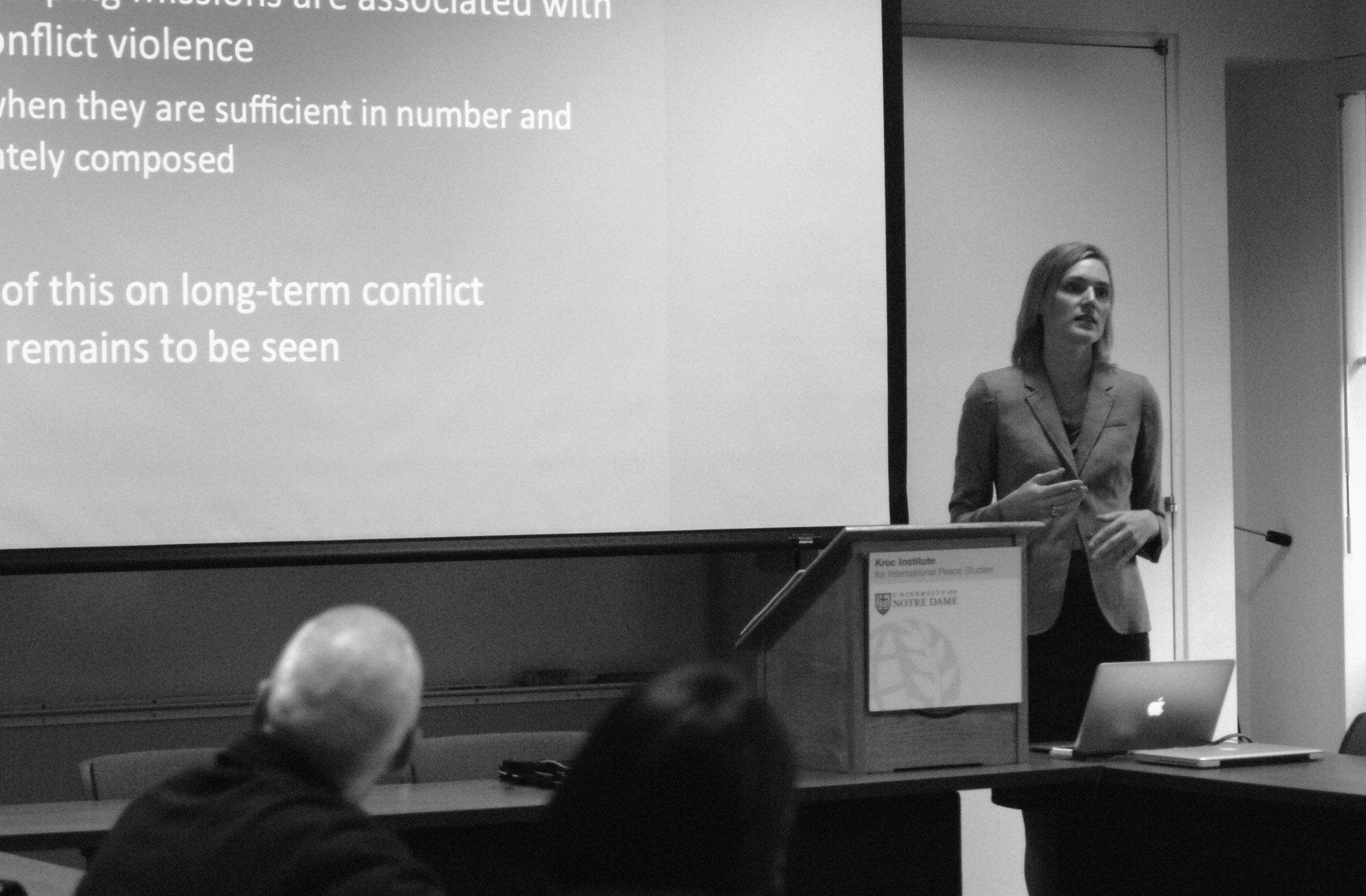
Megan Shannon, a Kroc Institute visiting research fellow from Florida State university, said her research suggests the uN can effectively reduce violence in situations of civil war.
Shannon said uN
peacekeeping initiatives were put to the test in two particular missions that occurred in
areas of violent sectarian conflict in Africa. The missions were ONuMOZ, the initiative in
Mozambique, and MONuSCO, the initiative in the democratic Republic of the Congo.
Shannon said the two initiatives teach different lessons about how the uN can promote peace in war-torn countries. during the ONuMOZ initiative, a large number of armed uN troops were stationed in the country but not explicitly authorized to attack rebel forces. Meanwhile, the MONuSCO
Moreau welcomes new exhibits
By REBECCA O’NEIL News Writer
The Saint Mary’s College Moreau Center for the Arts unveiled three new exhibits on Friday, Oct. 11. The hammes, Sister Rosaire and Little Theater galleries welcomed Lawrence Sumulong, Shawne Major and Ann Tarantino to their respective walls.
Tiffany Bidler, assistant professor of art and directory of the galleries, said Sumulong, a photographer based out of New york, was an ideal choice in her quest for “resonance” in the gallery.
Sumulong’s multimedia creation, “From the Prison house,” documents the experiences of Filipino Muslim female domestic workers, Bidler said.
“There are many departments, professors and students on campus who are interested in the experiences of women in a global context and so I thought his work would find an audience at Saint Mary’s,” Bidler said.
The black and white slideshow features photos taken at the Salam Compound, a walled community of displaced Filipino Muslims. In an effort to improve
the living conditions of Muslims in the Philippines, the Libyan government bought the land for the compound in Tandang Sora, Quezon City in the 1970s, Bidler said.
“Students who have taken courses in global Studies or gender and Women’s Studies — or any course that focused on issues of gender, religion and social justice — would appreciate Lawrence Sumulong’s concern with the difficulties faced by migrant workers and his desire to use his artistic abilities to help us hear the voices of these women,” Bidler said.
Sumulong also showed images from a diary that a Filipino domestic worker had kept while wrongfully imprisoned in Saudi Arabia. While the woman did not live in the Salam Compound, her experience reflected that of many female domestic workers who did.
Notre dame senior Ryan Shea said he saw the exhibit and considered it “very bleak.”
Shea said he was deeply moved by the numerous prayers the prisoner had written in her diary
see MOREAu PAGE 4
SARA SHOEMAKE | The Observer
Megan Shannon research fellow Kroc Institute
see SyRIA PAGE 4
see PEACE PAGE 5
EMMET FARNAN | The Observer
Rico Roman, far left, and Steve Mesler, far right, discussed their life experiences and values during the Olympic-Paralympic Roadshow.
see OLyMPIANS PAGE 5
(574) 631-8767 obsphoto@gmail.com Systems
(574) 631-8839
Question of the Day:
Mary Tomasik
senior Farley hall
“12th floor of the
Casey Skevington sophomore Farley hall
“Bond hall.”
Cristy Gutierrez senior off campus
“The library ... reluctantly, LaFun.”
Christina Mondi
senior Farley hall
“Brownson hall.”
Catherine Juska sophomore Cavanaugh hall
“The A.C.E. building.”
Maria Martinez sophomore Farley hall
“LaFun computer cluster.”
Today’s Staff
Corrections
In the Oct. 14 issue of The Observer, the article “Students visit areas of urban poverty” incorrectly stated that the urban Plunge program through the Center for Social Concerns takes place over fall break. urban Plunge happens during winter break, and sign-ups are open until Nov. 1. The Observer regrets this error.
ASHLEY
SMC students to peruse Peru this fall break
By HALEIGH EHMESEN News Writer
Fall break will be a bit more than rest and relaxation for six Saint Mary’s students who will go on pilgrimage to Peru.
Assistant director of Campus Ministry Regina Wilson said she will lead the students as they visit a group of Sisters of the holy Cross,
the communities these sisters serve and an impoverished parish.
It is an important distinction that the trip is a pilgrimage rather than a service trip, Wilson said. The difference in emphasis is subtle, but the focus of a pilgrimage is seeing the experience as a spiritual journey of faith, she said.
Wilson said this focus
comes about by recognizing the people they encounter as fellow pilgrims in a spiritual sense.
“Each and every moment we recognize that the people we go to meet are fellow pilgrims on a journey of faith in their own lives,” she said.
Wilson said, accordingly, a significant aspect of the pilgrimage is interacting with
everyone in the communities they visit.
“As pilgrims, we go to meet people and to experience the ways their lives are holy and thus, the ways that we might meet the Christ that is revealed in their holiness,” Wilson said. “Of course, this doesn’t mean we won’t be doing things, but we hope to be doing things with the children, youth and elderly of the community — to have interactions with them about their lives.”
Wilson said she and the students prepared for the trip during hour-long meetings once per week this semester. They read a book about pilgrimage and Pope John Paul II’s book “Ecclesia in America.”
Junior Kristen Millar said the weekly sessions centered upon assigned readings and discussion of aspects of poverty and solidarity. The students also learned about Peruvian history and culture.
“[The sessions] helped us to recognize in ourselves why we are going and helped to prepare for experiences there,” Millar said. “The readings also helped us to understand how we fit into the community in Peru.”
The holy Cross sisters, who live and serve in Lima, will bring the pilgrims to visit a group of women the sisters serve and minister to in Matucana, Wilson said. The group also will visit local religious sites, including shrines to St. Rose of Lima and to St. Martin de Porres.
The group will visit a parish in northwestern Peru called Santísimo Sacramento.
Sophomore Madeline h arris said Fr. Joe u hen, a Notre d ame graduate of 1980, is the
pastor of this parish of approximately 30,000 people who live in extreme poverty. h arris said the group will work with the parish’s staff to create bags of food for local families. But she said she most looks forward to spending time with the parishioners themselves.
“Just talking to them and hearing about their life experiences compared to my own will be an amazing experience in and of itself,” h arris said.
Wilson said Saint Mary’s Campus Ministry sponsors pilgrimages exclusively to
“We are hoping the students meet Christ in the encounter with the people they meet and the holy places they visit. And that it is an experience of communion and solidarity with another culture.”
Regina Wilson assistant director Campus Ministry
places where the Sisters of the holy Cross live and serve. In the past, the office sponsored a pilgrimage to Monterrey, Mexico.
A grant called “Women’s Call in Church and Society” made possible this year’s pilgrimage to Peru, Wilson said. Saint Mary’s received funding from the Council of Independent Colleges and the Lilly Endowment, Inc.
“The grant’s purpose is to help students with vocational discernment,” Wilson said. “Campus Ministry has developed this particular way, the pilgrimage experience, as a way for students to look at questions of identity and vocation.”
Millar said she is most excited about meeting the Peruvians in the communities they will visit.
“I can’t wait to experience the joy that they have and learn about the problems that they are facing socially and economically — and hopefully share a little bit of myself with them,” she said.
The pilgrimage is about experiencing solidarity in shared faith, Wilson said.
“We are hoping the students meet Christ in the encounter with the people they meet and the holy places they visit,” Wilson said. “And that it is an experience of communion and solidarity in another culture.”
Contact Haleigh Ehmsen at hehmse01@saintmarys.edu
entries. The piece served as a way to humanize the unseen and oppressed women, Shea said.
“These prisoners are not a visible part of our lives and thus easy to forget about,” Shea said. “Obviously, it was quite dark.”
The exhibits of Major and Tarantino’s pieces were more introspective, Bidler said.
“Sumulong’s photographs have a meditative quality and the lines of writing he photographs formally resonates with the lines and threads in the work of Tarantino and Major,” Bidler said.
Tarantino said her work focuses on “lonely figures in unknown landscapes, underwater creatures, unknowable beings, neural networks, and maps of cities — real and invented.”
Bidler said Tarantino
establishes a systematic theme in the delicate patterning of nervous tissue, emotional ties found in contemporary social networks and the elaborate web of parasitic and symbiotic relationships required to maintain healthy ecosystems.
Poured ink is blown through a straw to create intricate patterns on the gallery’s white walls, Bidler said. Tarantino is also known to use an air compressor to propel paint depending on what surface she is painting.
“Tarantino creates site-specific wall drawings that are temporary and ephemeral,” Bidler said.
Tarantino, an assistant art professor at Pennsylvania State university was able to establish a personal connection with students while painting her piece on the surface of the gallery’s walls.
“Ann Tarantino came to campus to create her wall painting and
she spent time talking to students informally and answering questions about her process. It was really wonderful to have her here as a resource for our students,” Bidler said. “We have courses in fibers, painting and photography in the art department and one of the charges of the gallery is to expose students to different artistic practices.”
Major said she is interested in how the perception of reality is affected by dreams, memory, superstition, religion, bias, prejudice and fear. Major wove cheap plastic items together to create various wall hangings in her exhibit.
“My mixed-media works refer to the overlay of belief systems created by the individual to piece together their personal paradigm,” Major said.
Major said she uses various objects and even “junk” to create a metaphorical image of how
people take in information and to challenge traditional ideas about art.
“My vocabulary — a combination of kisch, ersatz and craft materials, junk and personal objects — is re-aesthetisized into accumulated forms that serve as metaphors for the build-up, organization and assimilation of information,” Major said. “The vernacular, as a language of objects indigenous to my class and culture is used here to subvert the hierarchy of art.”
The fact that the mass-produced, synthetic materials that make up her pseudo-tapestries deliberately aim to undermine the elitism associated with handcrafted objects, Major said.
Bidler said the way Major uses found objects in her work imparts a sense of the objects being inherited.
“Shawne Major works with
fibers and found objects. her work emphasizes materiality and provides a sense of permanence, they have the feeling of inherited objects,” Bidler said.
Bidler said the works of both Tarantino and Major, though different, are concerned with memory and information.
“I enjoy the complexity of her work and the way the small accumulated objects she embeds in the piece trigger personal memories and associations,” Bidler said.
“Ann Tarantino and Shawne Major are both interested in systems, networks, memory and information but these interests are manifested in really different ways in their work. “
Bidler said all three of the exhibits will be on display until Nov.1.
Contact Rebecca O’Neil at roneil01@saintmarys.edu
host a Syrian Solidarity lunch today from 12:30 to 2:30 p.m. in the geddes hall Coffee house.
Junior Matthew Caponigro, one of the organizers of the event, said the solidarity lunch is meant to keep people thinking about the Middle Eastern nation.
“We coordinated [a] fast and prayer for Syria [on Sept. 7] and then
went back to the drawing board and said ‘how are going to make this a sustainable movement? how are we going to make this an issue on campus?’” Caponigro said.
The lunch is free with a suggested donation of $5 and will include typical Syrian food, Caponigro said. The event will also feature speakers and literature about the Syrian conflict. There will be time for follow-up questions with speakers and a sign-up sheet for
students hoping to get involved with the new Syrian work group on campus.
“The Syrian lunch is the first event of what is going to be a larger campaign,” Caponigro said. “We’re working through the established structure of the clubs [that coordinated to put on the lunch] to try to put together a cohesive, comprehensive response that addresses the issues of peace in the Syrian conflict.”
PAI d AdVERTISEMENT
Among other plans, Caponigro said the group hopes to organize a dinner after Thanksgiving break, invite a keynote speaker to highlight life in Syria, create petitions for non-violent action and Skype with a reporter from the broadcasting company Al Jazeera.
Caponigro said the CSC and the Kroc Institute for International Peace Studies have previously sponsored lectures about the Syrian crisis. Today’s lunch is about
letting students know the problems in Syria are ongoing and their support makes a difference, he said.
“I want students to know that this issue isn’t going away anytime soon,” Caponigro said. “Basically, I want people at refugee camps to know that there are students thinking about you, praying for you, supporting you.”
Contact Gabriela Malespin at gmalespi@nd.edu
Director discusses racial roles in theater
By EMMA BORNE News Writer
Notre dame director of Theater Kevin dreyer spoke with Pulitzer Prize-winning playwright of “Ruined” and “Intimate Apparel” Lynn Nottage about race and the representation of race in theater on Tuesday in the deBartolo Performing Arts Center’s decio Theater.
dreyer said the title “A Conversation about Race and Representation” was a result of a problem of race in theater the university has been trying to address.
Olympians
being injured overseas.”
Roman said he hopes sharing his story will shed light on how students can best hone their leadership skills to reach their full potential.
“They’re being led into this opportunity right now … They’re gearing [up] to be leaders, and I feel like me sharing my story with them hopefully will give them tools along the way that will help them in choosing the right paths and of course choosing the right people,” Roman said.
Mesler said injuries that stalled his track aspirations pushed him towards a gold medal in bobsledding and the issues he noticed in athletic mentorship allowed him to create an innovative solution.
“It kind of grew out of some conversations that we’ve had on campus over the last several years about ‘how do we engage more performers of color,’ ‘how do we build an audience that comes to expect that of us.’ Not that they’re impressed that we do it, but that they’re disappointed when we don’t,” dreyer said.
The conversation began with Nottage, an African American herself, discussing her interest in African American art. She said this interest began at a young age under the influence of her parents.
“My parents were
“We looked at the current model of athletes working with kids and how it just wasn’t practical and how we could do better and engage kids more and turn that into something now that is in three different countries and donating tens and tens of thousands of dollars of technology to schools and connecting athletes with thousands of kids,” Mesler said.
Roman said the ability to change one’s mindset and work towards a larger goal can create success in the face of difficulties.
“Stuff happens. And it happens for a reason. you never know what might lie ahead of you. It might not be a big bomb in the middle of the road up the street, but you never know what might happen to you,” Roman said. “Focus on the big prize.
PAI d AdVERTISEMENT
deeply invested in art, in particular African American art,” Nottage said. “I grew up going to see plays at the Negro Ensemble. I saw all this sort of seminal work from the black arts movement and that was my foundation.”
Nottage said as her interest in the arts grew she became deeply interested in playwriting. She has written many celebrated plays and has won several awards for her work.
despite her success the journey has not always been easy, Nottage said. She spoke with dreyer about an issue of race representation that arose when
For me that prize is getting a gold medal in Sochi Russia.”
Most importantly, students need to use failure as a motivation to succeed the next time, Roman said. he faced failure when he did not make the u.S. Paralympic Sled hockey Team the first time he tried out.
“I didn’t go home disappointed that I didn’t make the team. I just went home more determined to make this team the following year,” Roman said. “I went back out to tryouts and I’ve made the team and I’m the first war veteran to make the u.S. sled hockey team.”
As official sponsors of the u.S. Olympic Committee, d eloitte initiated this Olympic and Paralympic Roadshow several years ago in an effort to both motivate students to achieve
one of her plays was staged in germany.
“In germany I know that they have the habit of producing black plays in black face and very recently they wanted to do [one of my plays], and I said ‘I have no problem with them doing it, they just can’t do it in black face,’” Nottage said.
dreyer said Latino playwrights are currently dealing with a similar issue, in this case brown face.
Nottage said it is incredibly unfair to not have Latinos or African Americans act in the roles of their own race and ethnicity.
“In America it makes no sense,
their goals and to share the values of their company in an interesting way, Mark Chain, member of Mendoza College of Business Accountancy Advisory Board, said.
“The Olympic athletes have such inspirational stories that we’re thinking we can inspire students to reach their full potential by hearing the stories of the u.S. Olympic athletes, and it gives us an opportunity to tell students about our firm and opportunities we have within our organization too because there’s such similarities,” Chain said. “If you think about our core values of community of teamwork, integrity, strength from diversity, commitment to each other and those are the same qualities that are part of the u.S.
Peace
CONTIN u E d FROM PAgE 1
initiative deployed fewer uN forces in an enormously hostile situation and allowed troops to use offensive force if needed.
In explaining the difference between the interventions, Shannon said the mission of the uN in promoting peace has changed.
“The uN peacekeepers were initially intended for post-conflict missions, but now they intervene as hostilities persist,” Shannon said.
Shannon said she drew from a large body of research to uncover whether the peacekeeping initiatives have been successful, but she found that little information exists concerning immediate effects of uN intervention. Most of the relevant research is focused on longterm outcomes of uN efforts, she said.
“We are, unfortunately, limited by research that emphasized only the broad outcome years after the uN has been present in a warzone,” Shannon said. “From what we know, it seems that the uN has little success mitigating short-term violence in conflict scenarios.”
An important feature of the assessment for Shannon was differentiating between certain varieties of uN forces, she said.
“The three varieties of uN forces that we can examine are observance, police and armed troops,” she said. “Observance involves officials discerning what is needed for
where you have a huge pool of Latino actors who are desperate for work to put on a play where there’s a Latino cast and choose to cast white folks. I think that’s incredibly dismissive of an entire acting pool,” Nottage said.
Nottage said her piece of advice for students of color looking to go into theater is not to be afraid. “don’t be afraid to take the full journey,” Nottage said. “you must be tenacious and you must have absolute belief in what you’re doing.”
Contact Emma Borne at eborne@nd.edu
Olympic movement.”
Sophomore Christine Shiba said the stories of the speakers related closely to the life of a college student, even though most college students will never go to the Olympics.
“One of the things they kept saying is that you think everything’s going wrong and then you find a different way to get out of it, and I really liked that message because there’s a lot of times in college where you’re not really sure of yourself. you’re not really sure where you’re going, but you have the ability to get through it and to succeed. you just have to make sure you’re doing the right things,” Shiba said.
Contact Caitlin Sisk at csisk1@nd.edu
peace resolutions, police train and protect civilians, and armed troops divide warring factions and utilize more drastic measures to promote peace.”
Shannon said armed troops in large enough numbers are the most effective method for attaining peace.
“As the uN commits more military troops to a civil conflict, battlefront violence will decrease,” she said.
There was nearly a 75 percent decrease in monthly battlefield deaths in conflict zones when uN armed forces were present en masse, Shannon said.
But, Shannon said, deploying armed forces to the Syrian warzone is impractical given the current political strife among the members of the uN defense council. Moreover, she said certain cases, such as the conflict in Rwanda, show the potentially negative impact of uN peacekeepers.
“It is possible that the uN provided a false sense of security during the hutu rebellion, resulting in more deaths,” she said.
Shannon said the uN nonetheless has a great capacity to promote peace in the world.
“uN peacekeeping missions are associated with reduced conflict violence, though long term conflict resolution remains uncertain,” Shannon said.
Contact Charlie Ducey at cducey @nd.edu
Stop. And think.
Emily Hoffmann Sports Writer
Rarely do professors introduce a reading assignment with the following words: “you will not be tested on this information. I just want you to stop. And think.”
Perhaps some (and likely, most) of us would brush off this reading. If the material will not be on the exam, analyzed in a paper or quizzed in class, then forget it!
That was my plan when an upper-level visual communications design professor used those words to introduce “do good design” by david Berman. Regardless, when I found myself on a plane the next weekend, the book thrown in my purse at the last second and very few other assignments to do post-syllabus week, I opened the cover. To my surprise, I read straight through the assigned chapter to the one after.
While you may dismiss this book recommendation, thinking it’s for designers only, please keep reading. Berman uses the introduction to elevate everyone to the role of designer. We live in an era that encourages creativity, personalization and design in everything we do. Each time you build a playlist, edit your profile on any number of social media platforms, take a survey or — god forbid — use Comic Sans for a sign on your door (the design snob in me might not knock), you join the design world. With everyone empowered and interconnected, Berman believes “that the future of our world is now our common design project.” The direction of the world is up to us. We can continue to sell sex, deceive consumers and praise the Miley movement, or we can stop. Think (remember, Madonna did this already), and do better. do good.
It’s a quick read, thanks to interspersed pictures (this is a design course, after all), whimsical comments scribbled in margins as if made by the editor’s Sharpie, and jaw-dropping analyses of the advertising industry and consumerism. A call to action, “do good design” wastes no time in grabbing readers’ attention. how is this for a daily news update: today alone, 1,200,000,000 doses of Coca-Cola were ingested; 882,000,000 Marlboro cigarettes were shipped outside the united States; 41,000,000 Mcdonald’s customers were served; 14,000,000 BIC pens were disposed of; 6,200,000 kilos of plastic were molded for bottled water; 3,000 promotional messages were seen by the average American; 73 species became extinct — the list goes on. And Berman wrote this book in 2009; I stutter to begin the question of what four years may have done to those numbers. If we had joined Berman’s call to action, perhaps those numbers may have changed for the better. I can’t help but pause, look up from my computer screen, take a sip from my plastic bottle of diet Coke and stop. And think. Well played, professor. Well played.
Contact Emily Hoffmann at ehoffma5@nd.edu
The views expressed in the Inside Column are those of the author and not necessarily those of The Observer.
A handy dandy guide to inclusion
Mia Lillis We are N d
Recently, some Viewpoint columns have caused many domers to go on the defensive about their everyday speech and behavior. If you have been on the fence about your own speech and behavior, and wish to become as inclusive and compassionate as possible, I humbly offer the following pointers to consider.
When speaking ... do: Be mindful of your language. don’t: use derogatory terms.
Language is often the easiest habit we can change to become inclusive — but when left unexamined, it is also the most prominent way to appear exclusive. going into my freshman year here, I frequently used the phrase, “that’s retarded.” I was dimly aware the phrase was not politically correct due to association with people with disabilities, but I had chosen to disregard this warning flag in favor of continued use of a term that was popular among my peers and that had already imbedded itself in my vocabulary.
As luck would have it, I was placed with a roommate who helped to organize the Special Olympics. Needless to say, my roommate did not appreciate use of the word “retarded,” and she was outspoken about this. Such a phrase equated the individuals she worked with and deeply cared for with negative associations.
Warning flags had resided in my mind for a year, but it was not until I was confronted by my roommate’s discomfort that I felt prompted to remove the word from my vocabulary. It was a challenging transition at first, as the word would slip out mindlessly, but every time I let it slip I immediately noticed and felt guilty.
Such awareness caused the word gradually to disappear from my vocabulary. I certainly still feel bad for having used such a derogatory term for so long, but at this point, I no longer use the phrase, and I figure, better late than never.
When someone calls you out for what they perceive as exclusive behavior ... do: Be receptive. don’t: get defensive.
When people call us out on our behaviors, we have the power to choose how we perceive such calling out. On the positive side, it is a chance to learn and an opportunity to become more aware of the broader social implications and consequences of our speech and actions. On the negative side, considering such comments a personal attack can lead to defensiveness and non-constructive discourse.
Recently, I was called out on something I said that had made people feel excluded. I had commented that an event appeared to be heteronormative, and while I had said this in an attempt to promote inclusion, my approach had made friends feel guilty for wanting to attend the event.
When this was brought to my attention, my first instinct was to get defensive — my intentions had been good, so why was it my fault the message was misunderstood? It was only after pushing past feelings of pride and arrogance that I was able to recognize my approach had hurt people and this would be something to remember for the future. Following this, I felt guilty for my initial defensiveness, but I chose to use this as a learning moment, to help shape interactions in the future, as I strive for better sensitivity and inclusion. When you realize you’ve messed up ... don’t: Become overwhelmed with guilt.
do: Channel your guilt positively. In both of the above examples, I mentioned the ensuing guilt I felt upon realizing my actions were not compassionate and exclusive. guilt is a tricky emotion, for while guilt is warranted when we mess up, there are several ways guilt can be channeled, and not all of them are positive. When I was getting little sleep at the beginning of last year, my irrationality got the better of me and I got into a fight with one of my close friends, in which we both exchanged vicious words.
Eventually, I realized I had messed up, but I let the guilt consume me and avoided seeing my friend for quite a while because I could not forgive myself. Eventually, we grew apart, and now we are merely acquaintances. If I had managed the guilt more constructively, we would likely still be friends today. Instead, because I allowed the guilt to consume me, I lost a friend. I have since learned the importance of properly handling guilt — allowing guilt to consume you and trap you in a loop is constructive for absolutely no one. Acknowledging the guilt, apologizing for misdeeds and perhaps paying it forward and calling someone else out when they use derogatory language, are much more constructive and healthy responses.
None of us are perfect. We all make mistakes. hopefully, these pointers will improve our ability to process these mistakes and help us to strive for the deepest inclusion possible. Best of luck in your quest!
Mia Lillis is a senior living in Cavanaugh Hall. She can be reached at mlillis@nd.edu
The views expressed in this column are those of the author and not necessarily those of The Observer.
A friendly response to the Breaking Bad polemic
This week, I was deeply saddened to hear that one of my favorite shows, Vince gilligan’s masterpiece “Breaking Bad,” was going to turn me into a meth-head killer who hates Jesus. This news, as reported in a Viewpoint column earlier this week (“Breaking Bad: ‘five seasons of sin,’” Oct. 15), struck me, seeing as I did not realize the influence this program would have upon me. I discovered that the narrative revolving around Walter White’s drug empire would adulterate my conscience, leaving me so deeply affected by the story that I would adjust my moral compass to find killing, drug-dealing and even “pervasive profanity” acceptable. With every installment of this show, I learned, I was distancing myself from Jesus and getting ever closer to the reefer madness.
The writer of the article, so graced with insight that even watching the show was apparently unnecessary for him to pass judgment, made me open my eyes to the fact that “Breaking Bad” was not a beautiful story of an antihero embarking upon a moral odyssey akin to those depicted in beloved greek and Shakespearean tragedies, but was rather a big middle finger to ethics, law and order and to the Big Man himself. The author made me realize how “bad” a show it was without ever even having to bring up its artistic qualities. That would be beneath him.
Rather, he rightly argued that “Breaking Bad” is only considered good because many people watch it, expertly disregarding the fact that it is the most critically acclaimed show in history and other shows on its own network, like “The Walking dead,” have more viewers.
In the end, the writer’s call to action inspired me. As a film, television and theatre major, I must fulfill his request for a show where a terminal teacher starts evangelizing. And then dies. That would be so interesting, riveting and well-developed that it would truly end the problem of “the boredoms of television” that the columnist exposed. Overall, I am just so thankful that I can reverse the damage done to my psyche by the pernicious Walter White and his associates and move on to “good” television. I will focus on the classics of the medium that the author lists, such as “The Flintstones,” “The Today Show” and “Jeopardy.” you know, real art.
Cody Mason sophomore Knott hall Oct. 15
lETTER TO ThE EDITOR
I have a confession: I’m a half white, half Mexican, heterosexual male, and I’m a beneficiary of unearned privileges. Because I’m a heterosexual dude, I get to be a member of the sex and sexual orientation that has dominated Western civilization for 3,000 years. Win.
Because I’m half Mexican, I have a hispanic last name and get to benefit from affirmative action, but I’m half white, so I don’t look Mexican and don’t receive a lot of outright discrimination. double win. While I’m at this, I’m also book-smart, really tall and have dashing good looks, all arbitrary things that arbitrarily benefit males. Triple win.
I am essentially a lightning rod for every issue of diversity and privilege possible. Because of these things and other factors, I usually find myself with conflicted feelings when I talk about diversity and privilege. My thoughts on these issues are by no means complete, but I have a message for everybody who discusses these two issues: chill out.
The way these issues of diversity and privilege usually get brought up follow this formula: 1) somebody — usually, but not always, someone in the majority — says something offensive, 2) somebody — usually, but not always, someone in the minority –– takes offense and tells
lETTER TO ThE EDITOR
Chill out and be kind
the offender he or she takes offense, and 3) the offender is offended that the offended takes offense. you can then rinse and repeat this cycle until the two groups completely alienate each other and the initial issue is no closer to being resolved than where they started.
Now, if we presume Step 1 happens, the first stage for rational intervention begins with the interventionists in Step 2. To you interventionists, I say: chill out. I’m not saying don’t be offended — there are some things that simply shouldn’t be said — but also keep in mind the boundaries of personal opinion and the leeway afforded by comic elements.
I might think the acronym “LOL” is the organic emergence of Orwellian Newspeak and is destroying creative thought and the English language, but I can’t stop its usage despite my disdain for it. I even recognize that the ironic “LOL,” like the ironic “#hashtag” Facebook so mercilessly ended, could be used for comic effect. So, when I see it used, although it irks me, I chill out. I address it when it’s pertinent, but I don’t fly into a frenzy whenever somebody violates my sacrosanct language ethics. however, like I said, there are some times where an intervention is morally obligatory. For me, some of these lines revolve around issues of racism, homosexuality and sexism. To me, cases that flirt with these lines are detrimental to the type of community we try to build at
Notre dame.
Sometimes, I get really angered by some of the things I hear and see, but I still need to chill out. These are all sensitive issues, and offenders oftentimes don’t view themselves as offenders — in fact, they do not want to offend. Therefore, they must be approached with the dignity and respect of another human being. These “offenders” are our interlocutors, and no transforming dialogue can be reached without calm and respectful language.
Let’s assume though, for argument’s sake, the offended does respond angrily and with spite. The “offender,” who never had any intention of offending, is now all of a sudden accused of racism, sexism, homophobia, classism and being a jerk. The “offender” probably has good reason to be offended at this point.
To you offended offenders, I say: chill out. I know you never intended to offend, but a lot of us do things we never intend to do — I, for example, never intended to live in the united States. I was just born here, but that doesn’t deny my responsibility to account for the implications of my lifestyle here now that I’m a semirational adult. The person you inadvertently offended was somehow hurt by something you inadvertently did; listen to him or her. Try to hear the complaint.
Far too often, I see people take offense at someone’s “tone,” and then the issue never gets addressed. Recognize the
person’s dignity as a human being and hear him or her out.
Perhaps after fully intentional dialogue these two parties still find themselves at an impasse. Now, I’m going to suggest something the offending party might not like: defer to the offended. I know, I know, the offended are so inordinately obsessed with “political correctness” that they are sucking the fun out of everything. But allow me to take the term “political correctness” — a typically evasive term — and replace it with the word “kindness.” Ask what it is you’re fighting for; is it really worth the effort and the amount of offense this other person takes? I would guess it’s not. Besides, I’m sure you can find other ways to have fun.
Issues of diversity and privilege are incredibly important because they are exactly that: issues. They affect people, whether we like it or not, and the only way to overcome them is through dialogue and deliberate personal change. To do this, though, we must learn how to talk about these things. To that end, I say: chill out and be kind.
Robert Alvarez is a senior majoring in the Program of Liberal Studies. He is living in Zahm House. He welcomes all dialogue on the viewpoints he expresses. He can be reached at ralvare4@nd.edu
The views expressed in this column are those of the author and not necessarily those of The Observer.
Knott’s S y R celebrates America
yesterday grace Chiarella published a Letter to the Editor (“Sy R themes disrespect rural poverty,” Oct. 15) claiming, in no uncertain terms, that Knott hall’s annual Sy R mocks rural poverty. As members of the Knott hall staff, we wanted to address some of the issues raised in the article. In particular, Chiarella states, “Although the SAO-approved theme for Knott hall’s Sy R this past weekend was ‘Americana,’ students preferred to call it the ‘White Trash Bash’ as they asked around for a pair of ‘jorts’ to borrow or boarded the bus bound for the dance at the RV hall of Fame.” She goes on to claim this dance was nothing short of poverty-themed and offensive to millions of Americans who live in rural poverty. First and foremost, we would like to personally and unequivocally apologize on behalf of ourselves and the dorm to anyone who was offended by some residents’ referring to the dance as the “White Trash Bash.” This is not the theme of the dance, and it is highly offensive. The hall staff and hall government took numerous steps to prevent this rogue theme from becoming pervasive, and the failure of our efforts reflects a failure of leadership.
The actual theme of Knott’s annual Sy R is “Americana.” Put differently, the goal of the dance is to celebrate patriotism and love for the united States. Most attendees to the dance wear some sort of apparel normally associated with the united States. Many wore items such as American flag bandanas, jean shorts and flannel shirts. Why was this the case? The term Americana connotes a specific type of American patriotism and culture. Merriam-Webster provides two definitions: “materials concerning or characteristic of America ... or a genre of American music having roots in early folk and country music.” This theme is poignantly captured by legendary artist Norman Rockwell, whose art is almost universally referred to as “Americana” in nature. In fact, one of the most famous books on the subject is
titled “Norman Rockwell’s Americana.” his paintings depict ordinary Americans going about their lives, often in rural or suburban areas. Blue jeans, a uniquely American fashion, feature prominently in many of his pieces, as do flannel shirts, baseball, family dinners etc. Therefore, the decision by many residents to wear items such as jean shorts, flannel shirts and American flag bandanas should not be conceived as an attempt to mock any group of people, but as an expression of a distinctly American fashion.
As with all things, some people chose to take things too far. Chiarella is correct that this happened — some residents took the theme in an unacceptable direction. We are deeply sorry and will continue doing everything possible to rectify this situation. To the best of our knowledge, however, Chiarella did not contact any member of the Knott hall staff or government. had she done so, she would have been informed of vigorous efforts to counteract the term “White Trash” and other manifestations that are offensive. Instead, she decided to write a Letter to the Editor of The Observer, publicly shaming Knott hall, rather than trying to engage in a constructive and helpful conversation. In the future, we would appreciate being contacted directly, as we seek to make Knott hall the best place possible and find feedback of any sort to be extremely helpful.
We deeply and sincerely appreciate Chiarella’s concern and seek to stamp out this and all other manifestations of insensitivity we see. In the future, we can promise Knott hall will double and triple efforts to disassociate this dance and any Knott hall function from the term “White Trash.” Knott prides itself on being an inclusive, welcoming and accepting community, and it will only seek to build on those pillars in the future. If any member of the Notre dame community wishes to further discuss this issue, we are happy to do so at his or her convenience.
Robert Alvarez Man on a Nag
By JOHN DARR Scene Writer
“Overproduced.”
It’s a word that gets thrown around an awful lot here in the indie community. here’s the usual scenario: Jim likes Band A. Band A isn’t famous, so they don’t have the money to invest in Top-40, radio-level production. Jim doesn’t care about that, though — the band writes powerful songs with creative lyrics. The production, with its flaws and rough edges, gives the music a familiar and relatable feeling. Jim is happy with Band A and shares its music with every cute girl he meets.
Somewhere down the road, Band A releases a catchy song that some company uses in a commercial. The song blows up, and suddenly the band has money for Top-40, radio-level production. Band A proceeds to release an album that sounds cleaned up and professional. Since the record lacks the flaws and rough edges of its predecessors, Jim feels disconnected from the music. It’s almost as if the band has left him behind for a pop-radio audience. Jim is sad, and he goes off in search of other bands, hoping that his band might one day come back.
I’m a lot like Jim. I love finding hidden
gems, bands that haven’t broken through the mainstream and are still recording music in home studios. But I’m also a producer — I can really get into an album where every note sounds perfect, where every musical surface is shiny and clean. Often I find myself defending albums that get pinned with the “overproduced” tag. After all, production is simply the shaping of sound that goes beyond the actual recording of the instruments. The ways to shape sound that can increase the meaning and power of the music are endless.
Sadly, I can’t find a way to defend the Avett Brothers’ new album, “Magpie and the dandelion.”
The Avett Brothers is an extraordinarily talented indie-folk trio whose fantastic songwriting and direct yet effective lyrics have pushed them to the forefront of the genre. On past albums, their production has boasted small hints of do-it-yourself recording — a muddy bass drum here, some grit in the guitar strings there. Each little touch brought the Avett Brothers’ stories of small town social webs and existential American journeys remarkably close to home. They were a band that seemed to have a home in your jeans pocket; they belonged hidden in a cowboy’s cap.
On “Magpie and the dandelion,” the Avett Brothers completely lose that feeling. Every instrument is stripped bare of personality, crafted in a Top-40 mold. Songs that attempt to recall the front porch end up recalling Target commercials instead. Without any rough edges or sonic personality, “Magpie and the dandelion” falls incredibly flat. The unavoidable fact is that it’s overproduced to death.
If only the songs themselves could save the album. Lyrics are the Avett Brothers’ strength — listen to “The Ballad of Love and death” and try not to cry. It’s the powerful simplicity and honesty that carry the band’s songs right to the heart of every listener.
But in the context, “Magpie’s” supermarket lyrics like “Pack a change of clothes and a pillow for the road for when we drift off to sleep” sound irrelevant, prepared and cheap. The Avett Brothers, who so often excel at making listeners feel at home, simply sound like they’ve lost their home themselves.
Thankfully, a few songs do pull out of the pack. “good To you” and “Bring your Love To Me” boast exquisite arrangements with subtle instrumental flourishes that craft tangible atmospheres of emotion in spite of flat production. A live
version of “Souls Like the Wheels” from “The Second gleam” naturally escapes the production woes of the album. It’s not as if “Magpie and the dandelion” is a horrific album; it just sounds far away and alien, and in folk music, that’s deadly. As the one live recording on the album shows, this album could have been great if it had been recorded and produced with some sort of human edge. As an Avett Brothers fan, let me leave you with this advice: wait for the next concert and experience this album as it should be experienced — real, rough, and human.
Contact John Darr at jdarr@nd.edu
“Magpie and the Dandelion”
The Avett Brothers
Label: American Records
Tracks: “Bring Your Love to Me,” “ Souls Like the Wheels”
If you like: The Head and the Heart, Mumford and Sons
On a vacation to New york, he found the city to be the perfect place to explore with his photography. he decided to make a move to the Big Apple and began his project in November of 2010.
We’ve all been guilty of it at some point. For me, it happened this summer at a Ke$ha concert.
No, I did not crowd surf or participate in illicit activities, but I did snap a few pictures of strange strangers. What else are you supposed to do when you see a bald man with a painted head and a pink beard?
Of course, there are different strategies you can implement. you could pull out my go-to and snap a fake selfie, try the click-and-run technique or stand far away so there is no way he or she will detect your sly intentions (although, this low-risk tactic usually results in low-quality creeper shots).
I’m sure you can relate to having tried out at least one of these techniques, but would you be courageous enough to ask a stranger for a photograph or even to strike up a conversation with the person to find out his or her story?
That’s exactly what Brandon Stanton, creator of the Facebook-page-turned-book, “humans of New york,” does daily.
According to a 2011 New york Post profile, Stanton had been sporadically interested in photography while working in Chicago as a bond trader but became more and more active after losing his job in 2010, focusing on people he saw on the street.
Stanton says on his website that he planned to turn his project into a photographic census of New york, weaving more than 10,000 portraits into an interactive map.
however, this idea changed after his friend persuaded him to set up a Facebook page dedicated to the project. In one year, the page garnered 500,000 followers, and the number stands at over one-and-a-half-million today.
As his method of presentation progressed, so did the structure of Stanton’s media. he soon added a new aspect to his photos: captions. Stanton started to find out the stories behind the faces he photographed. With a mixture of visual and written elements, the audience can gain deeper insights into the lives of the people pictured.
This combination drew more people to the page and led Stanton to again change his intent for the project. he decided to provide new photos each day, complete with quotes and captions.
The photos featured on the humans of New york page feature a variety of people, from a germaphobe on his morning commute in a clean suit, to the inside of a 16-year-old’s surprisingly insightful journal, to an ancient man with a flowing silver beard and head of hair
quoted saying, “I look like god. don’t I?”
The self-titled humans of New york book was released Oct. 15. and features 400 pictures accompanied by quotes, captions and stories. I have been an avid fan of the Facebook page for a while and just received my pre-ordered copy.
The book contains photos from all three years of the project thus far, which adds dimension to the book, since Stanton’s pictures have evolved greatly over time.
One downside of this fact is that only recently have the pictures started to delve deeper into the lives of the people photographed. I love being able to learn about how others choose to lead their lives and why they make the choices they make. Some of the captions of the earlier pictures merely state where the photo was taken. however, the photographs in the book are still beautiful and thought-provoking.
This book acts as a welcome, vibrant contrast to the dull philosophy and calculus books on my cramped desk. It serves as a quick transport out of dreary South Bend to a world filled with unique, bright scenes and people.
The book and project serve as inspiration to live life to the fullest and to stay true to who you are. Overall, humans of New york is picture perfect.
Contact Erin McCauliffe at emccaulif@nd.edu
The views expressed in this column are those of the author and not necessarily those of The Observer.
Erin McCauliffe Scene Writer
f all Break Playlist
By KEVIN NOONAN Scene Editor
I finished my third test in four days on Monday, just in time to start my second essay in three days so I can get to work on my god-knows-how-many group project in god-knows-how-many days, and it all has to get done by Friday when fall break starts or I fail and everybody hates me and gOd, W hy AM I SO
Needless to say, I’m a little wound up. And I know I’m not alone. I overheard a full conversation on the merits of the different flavors of Five hour Energy, and anyone under normal circumstances would know that every Five hour Energy is “I Can Feel Myself Slowly dying from drinking This” flavored. So, what’s my idea of an ideal fall break? Some people might say Vegas, but my idea of “break” isn’t exactly bright shining lights, late nights and losing every dollar in my pocket. Maybe I’m biased by the fact that I’m the worst gambler in the history of cards, but I think Vegas would just stress me out.
Others might visit friends at other colleges, and I’ve done that in the past. But after visiting friends once or twice and getting all the material I’ll ever need to make jokes about fraternities, I’m not exactly on board that train either.
No, my ideal fall break is a 10-hour drive or a twoand-a-half-hour train ride and an hour or so flight away — home. The only thing in between me and my warm bed and home-cooked food is 50 million
tests, papers and projects, but I can almost see the light at the end of the tunnel, and it can’t get here fast enough.
Contact Kevin Noonan at knoonan2@nd.edu
By MADDIE DALY Associate Scene Editor
As a junior trying to graduate on time with two majors and a minor, find a summer internship and attempt to maintain even the slightest morsel of sanity, ideally, I would spend my fall break at home, curled up with some Netflix and home-cooked food, doing absolutely nothing requiring too much strenuous brain activity.
Also ideally, I would be already done with my four midterms and not sick with a cold and pink eye in both eyes, but, hey, we can’t always get what we want. That said, I still will be going home for fall break, but my brain will be quite busy applying for internships, catching up on all the reading I haven’t done, writing two papers and completing one presentation. Some break.
Regardless of all my complaining, I am eternally grateful to Notre dame for giving us an entire week off to regain our energy lost during the first tiresome half of the semester. I just can’t imagine spending that break actually having fun — unless we’re talking about next year, because then I’ll be in Vegas.
Contact Maddie Daly at mdaly6@nd.edu
By KEVIN NOONAN Scene Editor
Sometimes you have to throw story, plot continuity, character development, believability, moral sensibility, acting, aesthetics and, above all, subtlety to the wind and grab onto the one thing you know and hold on like it’s the last space shuttle to the moon before the world explodes into a million pieces — ridiculousness.
This is the one and only thread connecting Robert Rodriguez’s hyper-violent exploitation action film, “Machete Kills,” but that doesn’t mean it’s not a strong thread. No, the sheer dedication to the absolutely ridiculous throughout the film, whether it be a machine gun bra or a ray gun that turns people inside out, provides for an entertaining, if sloppy, confusing and overlong, watch.
Like the first installment in the series, 2010’s “Machete,” the film follows enigmatic ex-Federale
bounces around from one over-the-top action piece to the next, most of which feature his favorite tool, the machete.
The basic plot of the movie involves Machete tracking down a super missile (at the behest of the president of the united States, played by Charlie Sheen in one of the many hilarious celebrity cameos that keep the film from ever dragging too much) that’s been hijacked by a crazy Mexican drug dealer and revolutionary named Mendez. Mendez, we soon find out, suffers from dissociative personality disorder and flips between psychotic drug dealer and inspired revolutionary against the drug trade at a moment’s notice.
he’s wired the missile to his heart, which leads Machete to the missile’s manufacturer, the hyperbolically evil Voz, played by Mel gibson.
gibson gives his most entertaining performance to date as
Voz, a parody of every over-explanatory and eccentric super villain in hollywood history. Instead of playing into tired stereotypes of parody villains, gibson brings a sincere energy to the ridiculousness of his character; he believes he’s a prophet, he’s obsessed with space and space weapons, and he’s a dedicated “Star Wars” fan.
Though not as successful as its predecessor at landing a point or developing a story, the movie’s sincerity in paying homage to the bad action movies it’s parodying keeps it from being stale or stupid.
It’s by no means a perfect movie. From the first minute, it’s unbelievably violent (I tried to count the seconds before the first person was killed but I got wrapped up in the action too fast to keep track). The violence is over the top to the point of being cartoonish, as all bad B action movies are, but at $20 million, this film’s budget is quite a bit
larger than those notoriously cheap movies, and sometimes the bloodshed is a little too real here.
And at 108 minutes, “Machete Kills” may seem like a fast movie, but it drags in the middle almost to the point of killing the pace of the film, and it ends up at least 20 minutes too long.
That being said, those 20 minutes include some of the brief star appearances that became one of the best running gags of the movie. Jessica Alba, Antonio Banderas, Lady gaga, Cuba gooding, Jr., Alexa Vega, Sofía Vergara and William Sadler have small, but generally hilarious, bits in addition to Amber heard and Michelle Rodriguez’s costarring roles, all of which show how much fun movies like this must be for the actors. Or maybe Robert Rodriguez just blackmailed them all.
The subdued, near-silent performance from danny Trejo as the titular Mexican superhero is
what makes the movie, though. With a sillier actor, all the explosions, gun battles and blood splatter might devolve into pure camp, but Trejo’s unmoved seriousness grounds the movie and provides a contrast to the ridiculousness that makes the entertainment possible.
In the end, if you can stomach a little blood and a few severed limbs, “Machete Kills” is an imperfect but undoubtedly fun action ride.
Contact Kevin Noonan at knoonan2@nd.edu
“Machete Kills”
Studio: Quick Draw Productions
Director: Robert Rodriguez
Starring: Danny Trejo, Mel Gibson
MPAA Rating: R
Machete Cortez as he
Let the celebration begin
Samantha Zuba Sports Writer
Party on, yasiel Puig.
Carlos Beltran might take issue with Puig’s celebration on a triple Monday in g ame 3 of the NLCS, but I definitely don’t. Baseball could use more guys who enjoy the game as much as Puig clearly does.
Puig cranked a ball past Beltran and celebrated as he stepped out of the batter’s box because he thought he had hit a home run. Puig flipped his bat high in the air and raised his arms. When Puig saw the ball bounce off the wall, he hustled into third, where he again celebrated, this time for a triple.
Beltran complained that Puig hasn’t yet learned the right way to act as a player. yes, he has. Puig plays the game right because he lets his energy speak for him as much as his talent.
Puig has been a sparkplug for the d odgers this season. Puig had 44 hits in his first month as a player, second only to Joe d iMaggio’s 48 as a rookie in May 1936.
The d odgers needed offense, and Puig delivered. Led by the surging Puig, the d odgers moved from 16th in OPS before the All-Star break to 5th after the break and won the NL West.
But Puig does more than hit. h e plays the game like an eager Little Leaguer, and that’s a good thing, even if it makes him a little unpredictable.
Puig is fun to watch not only because he’s good, but also because you never know when he might start dancing on third base. h e made the d odgers fun to watch too, while at the same time helping them become a contender. Puig doesn’t let anyone doubt his passion for the game because he makes sure everyone can see it, and his energy rallies fans. The crowd at d odger Stadium on Monday sure cheered like they didn’t mind Puig’s celebration.
Some of baseball’s legendary playoff moments have
come from spontaneous, exuberant outbursts. No one is scolding Carlton Fisk for bouncing around and waving his shot out of the park in g ame 6 of the 1975 World Series. It’s one of the best baseball clips of all time.
Kirk g ibson’s fist pump after his home run off d ennis Eckersley in the 1988 World Series is another baseball treasure, although g ibson waited to celebrate until he had rounded first base.
Baseball players shouldn’t celebrate every long fly ball before they step out of the box. But during the playoffs, it’s fun to see players get pumped up.
When Puig hit his almosthome run Monday, the d odgers were down 0-2 in the series to the Cardinals, and going down 0-3 would have basically spelled “The End.” The d odgers needed to win, and Puig played like he understood that. h is excitement wasn’t disrespectful; it proved that he understood what was at stake.
Fisk and g ibson became legendary because they reacted to their successes with such genuine excitement. That’s everything parents want to see from their kids when they sign them up for Little League. That’s joy for the game.
g ranted, Puig should scale back some of his wildness so he doesn’t become a negative clubhouse presence. Puig did not spend a lot of time in the minor leagues, so he missed a lot of lessons about how to work with teammates on a professional level.
Beltran, though, seems to think growing up means not getting excited and not showing fans that you’re having fun.
Puig has some maturing to do, but I hope he never grows up if it means he has to stop celebrating what he loves to do.
Contact Samantha Zuba at szuba@nd.edu
The views expressed in this Sports Authority are those of the author and not necessarily those of The Observer.
Boston holds off Tigers
Associated Press
dETROIT — Once again this October, one run was enough.
John Lackey edged Justin Verlander in the latest duel of these pitching-rich playoffs, and Boston’s bullpen shut down d etroit’s big boppers with the game on the line to lift the Red Sox over the Tigers 1-0 Tuesday for a 2-1 lead in the AL championship series.
Mike Napoli homered off Verlander in the seventh inning, and d etroit’s best chance to rally fell short in the eighth when Miguel Cabrera and Prince Fielder struck out with runners at the corners.
“The runs are pretty stingy,” Tigers manager Jim Leyland said. “This is what it’s about in postseason, is good pitching.”
d espite three straight gems by their starters, the Tigers suddenly trail in a best-ofseven series they seemed to control just two days ago. g ame 4 is Wednesday night at Comerica Park, with Jake Peavy scheduled to start for the Red Sox against d oug Fister.
Lackey allowed four hits in 6 2-3 innings, striking out eight without a walk in a game that was delayed 17 minutes in the second inning because lights on the stadium towers went out.
“I think that little time off gave him a chance to slow down a little bit. he was excited and pumped that first inning,” Boston catcher Jarrod Saltalamacchia said. “Kind of getting excited with his slider, throwing a little too hard and leaving it over the middle, but he was still pretty effective.”
It was the second 1-0 game in this matchup between the highest-scoring teams in the majors. That’s been the theme throughout these playoffs, which have included four 1-0 scores and seven shutouts in the first 26 games.
After rallying from a fiverun deficit to even the series in g ame 2, Boston came away with a win in d etroit against one of the game’s best pitchers. The Tigers had a chance for their own comeback
in the eighth when Austin Jackson drew a one-out walk and Torii hunter followed with a single.
But Cabrera, who failed to reach base for the first time in 32 postseason games for the Tigers, never looked comfortable against Junichi Tazawa, swinging and missing at the first two offerings and eventually chasing an outside pitch for strike three.
“he just did a great job pumping the fastballs away,” Saltalamacchia said. “he’s so sneaky with that 94-95 (mph), it’s tough to hit.”
Fielder was even more overmatched against Koji uehara, striking out on three pitches.
uehara also pitched the ninth for a save, ensuring that Lackey’s fine performance wouldn’t go to waste.
Lackey pitched poorly his first two seasons in Boston after signing an $82.5 million, five-year contract in d ecember 2009. Then he missed all of 2012 following elbow ligament-replacement surgery.
he’s been better this season, and he kept the Tigers off balance Tuesday by effectively changing speeds.
“he just never gave in,” Saltalamacchia said.
Napoli’s first at-bat in the majors was against Verlander on May 4, 2006, at Comerica Park. he homered then, too.
“he’s tough. he was on his game tonight. he was keeping all of us off balance,” said Napoli, who rubbed his bat on teammate Jonny g omes’ beard before going up to the plate. “I got to a 3-2 count and put a good swing on a pitch, was able to drive it.”
In the last two games, the Tigers have started Verlander and 21-game winner Max Scherzer — and the Red Sox won both.
Throw in Anibal Sanchez’s outstanding effort in the opener, when the Red Sox managed only a ninth-inning single in a 1-0 loss, and d etroit’s three starters in the ALCS have combined to allow two runs and six hits with 35 strikeouts in 21 innings.
Still, the Tigers have fallen behind because their bullpen blew a four-run lead late in g ame 2 and the offense came up empty at home on
Tuesday.
d etroit stranded runners on first and third in the first, then wasted Jhonny Peralta’s leadoff double in the fifth. Peralta reached third with one out, but an overanxious Omar Infante struck out and Andy d irks grounded out.
Verlander needed every bit of focus after Jacoby Ellsbury’s one-out single in the sixth. The Tigers have not held runners well this year, but a number of pickoff throws helped prevent a steal. At one point, Verlander appeared to be pointing at his wrist, as if to ask the dugout if his delivery to the plate was quick enough.
Amid all that, Verlander got Shane Victorino on a flyout, and after Ellsbury moved to second anyway on a wild pitch, d ustin Pedroia grounded out to end the threat.
Napoli’s homer was the first run allowed by Verlander since Sept. 18 — he pitched six scoreless innings in each of his last two starts in the regular season before blanking the opposition for 21 innings in the playoffs.
That streak ended with one swing by Napoli.
Lackey was pulled with one on in the seventh. Craig Breslow came on and walked Alex Avila, but Infante’s groundout ended the inning.
The Red Sox appeared to be in deep trouble when d etroit led 5-0 in g ame 2, but d avid Ortiz tied it with an eighthinning grand slam off closer Joaquin Benoit, and the Red Sox won it in the ninth.
Verlander looked ready to halt any notion of momentum for the Red Sox. he struck out six straight in the second and third, matching a single-game postseason record.
Lackey did his best to keep pace, retiring 10 in a row before Peralta’s double.
The Tigers had taken nohitters into at least the sixth inning of the previous three games. Verlander fell an out short of extending that streak when g omes hit a roller up the middle for an infield single in the fifth.
“We won a game with four hits tonight. It says a lot about this team,” g omes said.
Belles rally past Comets
By MICHAEL GINOCCHIO Sports Writer
It took the entire allotted five sets, but after falling early to Olivet, Saint Mary’s rallied back in thrilling fashion to take the match 3-2 (20-25, 21-25, 25-19, 25-23, 15-10).
The momentum shifted in the third set for the Belles. With the score tied at 13 and both teams having traded points back and forth, the Belles (9-11, 7-5 MIAA) broke it wide open. Saint Mary’s went on a five-point run, building an 18-13 lead they never relinquished, and later added another five-point run at the end of the set to take it 25-19 and ultimately swing the match in its favor.
Belles coach Toni Elyea noted the standout performance of junior libero Meredith Mersits (24 digs) and junior middle hitter
Melanie Kuczek (12 kills).
“I think Meredith [Mersits] just did a fantastic job on defense tonight,” Elyea said. “She really ran our system well. I think Melanie [Kuczek] hit very well this evening, and she also blocked very well.”
Another key player for the Belles was freshman setter Clare McMillan, who continued her impressive season by adding a gamehigh 46 assists. The performance was not lost on Elyea.
“[McMillan] really has been doing just a tremendous job,” Elyea said. “She has fast hands, she’s getting the ball in the hitters’ hands where it needs to be, and I’m very proud of her.”
The Belles started the match slow, dropping the first set 20-25 after a 1-7 start and losing control of the second at the end, losing 21-25. despite being happy
with the win, Elyea sees room for improvement.
“[We need to work on] executing the plays,” Elyea said. “The playcalling from Clare has gotten much better, but we made a few too many unforced errors tonight. We need to execute the plays that we want to run.”
The Belles don’t have much time to rest, with a match looming this Friday against Trine (10-13, 4-7 MIAA).
“They’ve got two tremendous outside hitters,” she said. “We’ll need to block extremely well on the outside and be able to read the hitters much earlier than we did tonight. We can play with them.”
The Belles travel to Angola, Ind., to take on the Thunder on Friday.
Contact Michael Ginocchio at mginocch@nd.edu
healthy Manning rewrites history
Associated Press
ENgLEWOOd, Colo. — Just two years removed from the neck troubles that weakened his right arm but strengthened his resolve, Peyton Manning is off to the best start by any quarterback in NFL history. he returns to Lucas Oil Stadium on Sunday a much better player than the one who left Indianapolis teary-eyed in 2012 after the Colts let him go in favor of Andrew Luck.
Manning has four terrific targets in d enver to go with the skill, intellect, work ethic and determination he’s always had.
With Wes Welker,
d emaryius Thomas, Eric d ecker and Julius Thomas sharing the catches, the unbeaten Broncos are averaging an eye-popping 42 points a game. Manning has thrown for a record 22 T d s in the first six weeks, and Knowshon Moreno is keeping defenses honest with a league-leading seven T d runs.
Manning loves dissecting defenses and poring over game film but hates digging deep into his own psyche to decipher what makes him tick.
Listen closely to some of his words, though:
“I love practicing every day.”
“I’m still learning.”
“By no means do I have everything figured out.”
This from the four-time MVP who narrowly missed out on a fifth last year.
Most quarterbacks blowing out 37 candles on their birthday cake tire of the tedium of meetings, practices and workouts. They start daydreaming about life after football.
Not Manning.
“Everybody enjoys playing in an NFL football game, but I still enjoy the preparation, the work ... and being effective,” Manning said.
Take him out of his comfort zone, put him in a new city with a new team. It’s the perfect challenge.
The beauty of Peyton Manning is his beautiful mind.
NBC football analyst Cris Collinsworth said the line he hears most from opponents is “he’s playing chess when most of us are playing checkers.”
“I think that’s really his No. 1 asset,” added Tony d ungy, Collinsworth’s colleague and Manning’s former coach. “he is so smart, he’s got such a great memory, such great recall.”
Collinsworth said he studies harder for Manning’s games than any other ones “because I don’t want to look stupid. Because I know that he’s going to do something where I’m going to go, ‘Now, what just happened there?’”
When John Fox says No. 18 is a fellow coach on the football field, he’s not just rattling off another cliche.
Manning’s incessant instruction fills d ove Valley during every practice. d uring training camp, he gave some 1-on-1 tutoring to Montee Ball.
“One day we were out there just me and him and he’s yelling things like it’s 11-on-11,” Ball recounted. “he’s pointing out the middle linebacker and yelling at the tight end, changing the call. I look back like, who’s he talking to?”
Belles get second shot against Alma
By MEREDITH KELLY Sports Writer
After falling 4-0 to Alma a month ago, the Belles will play the Scots for a second time at home today.
“Our last game against Alma was probably our worst performance of the year, so we’re excited to get another shot at them,” Belles coach Michael Joyce said.
“Our biggest problem last time around was our intensity level. They’re a very good team; we’ll have to be ready to go this time around.”
The Belles (6-4-3, 4-2-3 MIAA) are on a four-game winning streak, with their last two games reaching overtime. Saint Mary’s has played six of its games this season into overtime.
The Belles are currently ranked fifth in the MIAA conference, three spots behind Alma (8-5, 8-2 MIAA), which is in second.
Joyce said the team has grown since its first game against Alma and he hopes to see a better outcome from this game.
“We are a much different
M Soccer
CONTIN u E d FROM PAgE 16
back post, so I figured I’d get up and see if anything came through, and the keeper got a hand on it and pushed it wide and I got it in the goal.”
The Irish began into the second period in full force and with much calmer weather conditions.
Shipp battled past three defenders within the first minute and took his first shot of the second half, nearly hitting the post from 20 yards out. Shipp had a total of seven shots, two on goal, in the second period.
Though the Irish dominated the second half, the Wildcats did not back down.
In the 50th minute, sophomore midfielder Cole Missimo maneuvered around three Irish defenders and Wall, who was out of the net, to notch his first goal of the season for the Wildcats.
d espite outshooting the Wildcats 19-2 in the second period, the Irish came up scoreless.
Notre d ame dominated both overtime periods, outshooting Northwestern 5-0.
Junior forward Vince Cicciarelli had the best shot at goal for the Irish in the overtime periods. Cicciarelli headed the ball at the goal off a cross from senior defender Luke Mishu with 20 seconds left in the first extra period, but Wildcat junior defender g rant Wilson cleared it away.
team now than we were then,” he said. “We were still coming together with our chemistry. I think we’re a much tighter unit now. We understand roles and player tendencies on the field better.”
Joyce said although the team has improved drastically since the beginning of the season, there are still some things the team needs to work on.
“There are a couple things we need to do better this time around, such as win balls in the air and defend one-on-one better,” he said.
Saint Mary’s will rely on players like senior Jordan diffenderfer, who had three shots and one goal last game against Kalamazoo, and sophomore Mollie Valencia, who had six shots on goal.
The Belles have yet to lose at home, posting a record of 5-0-2 at home, and hope to continue their winning streak.
Alma and the Belles will kickoff at 4 p.m. at Saint Mary’s.
Contact Meredith Kelly at mkelly29@nd.edu
This was the fifth double overtime match for the Irish this season, and so far the Irish have finished each in a draw.
“We just have to learn to finish at the end of the day,” Lachowecki said.
The Irish take on North Carolina State in Raleigh, N.C. at d all Soccer Complex on Oct. 26 at 7 p.m.
Contact Kit Loughran at kloughr1@nd.edu
ALLISON D’AMBROSIA | The Observer
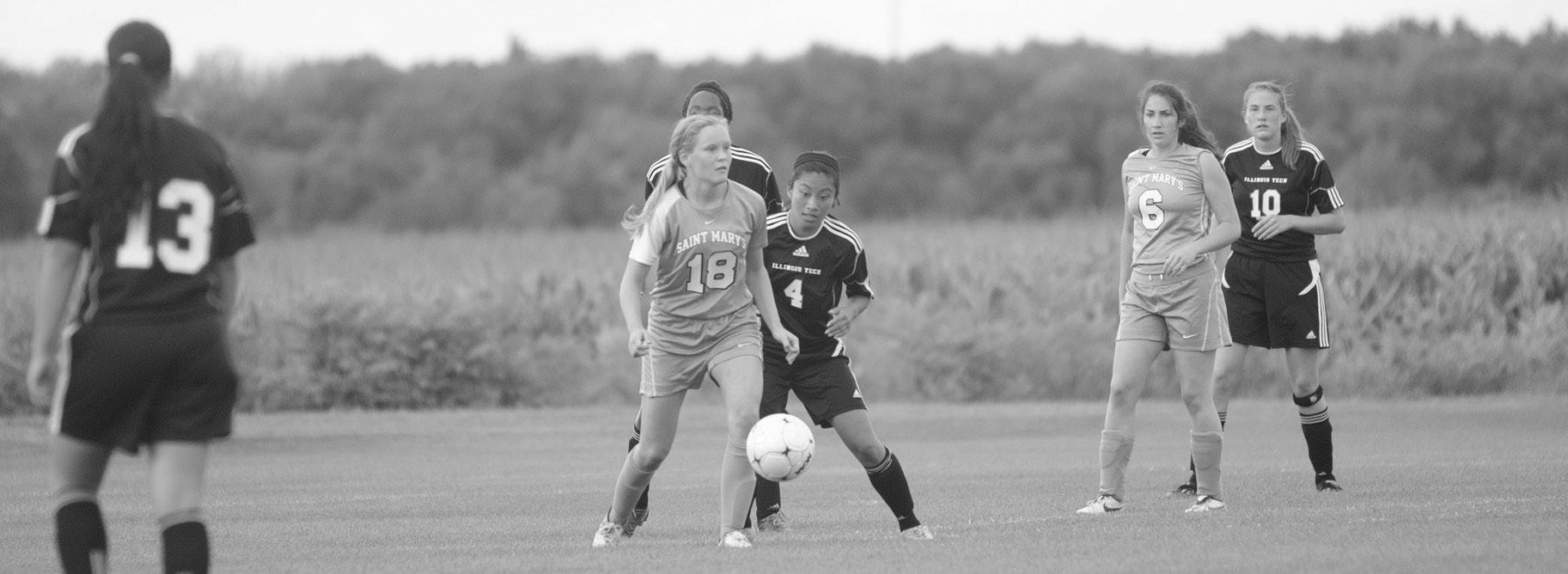
Sophomore midfielder Maggie McLaughlin protects the ball in the Belles’ 4-1 win over Illinois State on Sept. 2. McLaughlin scored once in the match and has two goals this season.
Irish take eighth at Crooked Stick
By ISAAC LORTON Sports Writer
After two days and three rounds of golf, the Irish finished in eighth place out of a field of 14 teams in the Crooked Stick Intercollegiate in Carmel, Ind.
On the par-72 Crooked Stick golf Club course, Notre dame shot a collective 302 to end the tournament with an overall score of 912 (306, 304, 302). On Tuesday, the Irish outshot seven of its competitors but failed to move up in the rankings from eighth place.
“I thought [Tuesday] we played middle of the road,” Irish coach Jim Kubinski said. “We did some good things, but we made some mistakes. Our approach shots were not as good as they should
have been. We had our lowest scoring round of the tournament on a tough day, so that was good to see.”
Kubinski said approach shots set the Irish apart from the toptier teams in the field.
No. 12 Arkansas finished in first place with an overall score of 875 (306, 285, 284), No. 8 georgia placed third with a 801 (295, 290, 296) and No. 15 Florida State took fourth with a 887 (292, 296, 299).
“We have to get better inside 150 yards,” Kubinski said. “From there, the best teams make birdies. We made some birdies, but we also made bogeys. We need to clean up that, and I think we can do it.”
Irish senior Niall Platt led the Irish with a 15th-place finish and a 7-over total score of 223 (78, 72, 70). Platt shot a two-under-par 70 to move from 34th to 15th place from Monday to Tuesday. Sophomore Cory Sciupider tied
“We did some good things, but we made some mistakes. Our approach shots were not as good as they should have been.”
Jim Kubinski
Irish head coach
for 29 with a 13-over 229 (77, 73, 79), and junior Tyler Wingo tied for 39th with a 231 (79, 77, 75).
“Niall [Platt] had his third top-15 performance on the season, which is great,” Kubinski said. “he has played beautifully. Tyler Wingo got better every day, and Cory [Sciupider] played three-under-par for nine holes [Monday].”
Freshmen Liam Cox and Matt Rustler rounded out Notre dame’s five golfers. Cox tied for 43rd while Rustler tied for 56th, with total scores of 232 (75, 76, 81) and 235 (79, 78, 78), respectively.
The young Irish team struggled to let shots go, which affected its game, Kubinski said.
“Some of our younger guys need to grow more emotionally,” Kubinski said. “They may hit a bad shot, [and] they can be angry, but they then need to focus on the next shot.
“Part of it is, us as coaches need to emphasize the need for emotional maturity, and it takes some time and some work to get our points across. Buying into that, we do it in small pieces, and they have to realize they can’t hold onto every shot.”
The Irish next travel to Beallsville, Md., to play in the georgetown Intercollegiate beginning Monday.
Contact Isaac Lorton at ilorton@nd.edu
ASHLEY DACY | The Observer
Senior Niall Platt follows his drive at the Fighting Irish Gridiron Golf Classic at the Warren Golf Course on Oct. 9, 2012. Platt’s 70.83 strokes-per-round average leads Notre Dame this year.
kids that we’ve recruited that I’ve had my hand on. The other guys here are coming along. But it’s a process.’’
Some of the veteran players, including Braxston Cave, Kapron Lewis-Moore and Manti Te’o, lashed out on Twitter against their coach’s comments.
Since that game, however, Notre dame is 20-3 in regular season games.
“Every family’s going to have good days and bad days,” Kelly said. “That might have been one of our bad days, but we kept it in. We talked about it. We aired out our differences. We took accountability for where mistakes were made, and we moved on from it.
“We didn’t relive it. We moved from it. And so I think that’s probably the point — that, as you move forward, you learn from past experiences, and you build off of those past experiences.”
l ee in or out?
uSC senior receiver Marqise Lee’s status for Saturday’s game is up in the air after he missed the Trojans’ 38-31 victory over Arizona with a knee injury.
Lee, the reigning Biletnikoff Award winner, has 30 catches for 385 yards and one touchdown this season and owns or shares 24 uSC records for receiving and kick returning. In 2012 against the Irish, Lee had five catches for 75 yards. According to various reports, Lee said he would be ready for Saturday’s game.
Kelly said the Irish are preparing
l ittle
CONTIN u E d FROM PAgE 16
sophomore Elyse h ight, who split time last season.
“It was really exciting to [be named the starter] just because of the talent level of the other three keepers,” she said. “I can’t take a day off because I know they’re right behind me working hard, and they push me to keep pushing myself.”
Little solidified her commitment to the starting job with an impressive run in goal at the beginning of the season. The h oward h all resident allowed only four goals in the team’s first 10 games and recorded four consecutive shutouts, two against ranked opponents.
Little attributed much of her strong start to the Irish defense, which has held opponents to an average of 10.3 shots per game.
“Even though I get credit for [wins], a huge part of it is my backline and how they play, day in and day out,” Little said. “They’ve been there for me through all my bad passes and screw-ups in the goal.” d espite her reliance on the defense’s play, Little has also made continuous strides in goal, Waldrum said.
“I think we’ve seen [improvement] in her
as if Lee will play.
“Obviously, you have to pay special attention to that,” he said. “There will be times where you’ve got to think about double coverage. you’ve got to think about special coverages for him. So all that has to be part of your thought process. So we move forward thinking that he’s going to be in the lineup.”
In Lee’s absence against Arizona, sophomore receiver Nelson Agholor stepped in seven receptions for 161 yards, including a 62-yard touchdown catch.
“The one thing is if you watch that game closely, to close out the game, they needed to convert some third downs running the football late,” Kelly said. “[Agholor’s] in there blocking safeties, physical. That’s the kind of player he was. That’s what we saw. A guy that plays every single play.
“he was a very good defensive player, too, in high school. So that’s the kind of player, that tenacious, every play, and elite speed and size. So just a complete player from that standpoint.”
The Trojans finally have stability at quarterback after alternating redshirt sophomores Cody Kessler and Max Wittek early in the year. Kessler has nailed down the starting job and has thrown for 1,129 yards and eight touchdowns while completing more than 60 percent of his attempts.
Replacing Grace graduate student linebacker dan Fox will see more playing time at one of the inside linebacker positions after junior linebacker Jarrett grace fractured
distribution and in her kicking game,” he said. “She was one of the reasons we were able to win at [then-No. 1] North Carolina — she made multiple good saves in that game. She’s made some big saves in some big moments.”
As Notre d ame closes out its conference schedule, Little will be called upon to make some even more important saves. h owever, her current challenge is a bit more psychological, as it involves finding ways to help the Irish snap their three-game losing streak. Little has allowed six goals over the losing streak, including a controversial game-winning goal to No. 1 Virginia on Thursday.
“As a keeper, it’s extremely important to not let your mistakes eat at you because you let a goal in one minute, and the next minute, you’ll have to come up and make a big save,” she said. “If you’re still thinking about the mistakes you just made, you’re not going to be fully focused on the thing that you have to do next, and that can cost your team. As a keeper, you’ve got to just take things in and let them go.”
Just like the comments and jeers of opposing fans.
Contact Brian Hartnett at bhartnet@nd.edu
his leg in Notre dame’s 37-34 win over Arizona State. grace is out for the season.
Earlier in the season, Fox was listed as the starter at the “Mike” linebacker position but lost his job to grace. Kelly said Fox reacted the way he expected him to.
“he was livid,” Kelly said. “he was mad. And then he handled it like a captain, senior, leader — although he doesn’t have a ‘C’ on his shirt, he handled it the way that I would expect somebody of his character to handle it. he just went to work. And worked on getting better.
“Now he’s got a great
opportunity to finish his senior year and finish it in an incredible fashion. So we’re really proud of him. I told him that. We’re proud of the way he handled himself in a tough, tough circumstance, and it’s only going to benefit him down the road.”
Fox and junior Joe Schmidt will man the “Mike” position, while graduate student Carlo Calabrese and senior Kendall Moore will play at “Will,” Kelly said. Kelly had previously mentioned the possibility of playing freshman Michael deeb but said the Irish would rather not play him, preserving a year of eligibility.
“If we have a situation there where a man goes down, he’s got to be ready to play,” Kelly said. “So we’re preparing him to play, and he’s capable of playing.”
Day to be ready Sophomore defensive end Sheldon day should be ready to play Saturday, Kelly said. Kelly said day, who has missed the previous three games with an ankle injury, practiced Monday and will meet with the media Wednesday evening.
Contact Matthew DeFranks at mdefrank@nd.edu
WEI
LIN
| The Observer
Senior quarterback Tommy Rees prepares for a play against Michigan State on Sept. 12. The 17-14 win was the 10th consecutive home victory for the Irish, and Rees racked up 142 passing yards in the game.
CELEBRITIES BORN ON THIS DAY: Vanessa Marcil, 45; Emeril Lagasse, 54; Sarah Ferguson, 54; Penny Marshall, 70.
Happy Birthday: your success will be measured by how much you are willing to give and do for yourself as well as for those around you. you will have plenty of opportunities, but it’s how you handle each and every situation that will count. It’s time to take control, take action and take a stab at reaching your ultimate goal. your numbers are 9, 16, 19, 23, 38, 40, 49.
ARIES (March 21-April 19): Look inward and do your best to be mindful and aware of what others are going through. decisions you make must be based not only on what’s best for you, but also for those you work or live with.
TAURUS (April 20-May 20): don’t sit around waiting for something to happen. Network, set up meetings and mingle with people who share your interests or concerns. Express your ideas and you will discover a profitable venture. A partnership will be in your best interest.
GEMINI (May 21-June 20): don’t get involved with anyone who tends to meddle. Someone is likely to confuse you intentionally, causing an emotional setback. Taking one step at a time and following through with your plans secretively is in your best interest.
CANCER (June 21-July 22): Explore different philosophies, cultures or interests. you can learn from the experiences you have and the people you meet along the way. Socializing will help you gain perspective on what’s available to you and how you can achieve your goals.
LEO (July 23-Aug. 22): Living in the past or taking a step backward is not the answer. you must face dilemmas head-on and do your best to rectify any persistent problems. A change of heart will lead you to a better destination.
VIRGO (Aug. 23-Sept. 22): you can successfully manipulate any situation you face by using a practical approach and having a logical plan in place. don’t let a personal relationship come between you and a clear and sound decision. deception and emotional manipulation are apparent.
LIBRA (Sept. 23-Oct. 22): you can get ahead if you don’t procrastinate when it comes to making an improvement regarding your surroundings or the people you are dealing with daily. New prospects for work or personal benefits are available. get moving.
SCORPIO (Oct. 23-Nov. 21): get an early start and you will make personal and professional gains. Being on top of a situation will convince others to give you a chance. Presenting what you want and what you can offer will lead to success.
SAGITTARIUS (Nov. 22-Dec. 21): don’t expect everyone to agree with you. Sticking to facts and being honest in your assessment of any situation will be necessary if you don’t want to be blamed for interference and improper guidance. Make alterations geared toward improving your domestic life.
CAPRICORN (Dec. 22-Jan. 19): An opportunity is apparent. don’t back down or give up when giving your all will lead to greater benefits. good fortune through contracts, investments and personal decisions is within reach. Offer suggestions to unpredictable individuals, not financial assistance.
AQUARIUS (Jan. 20-Feb. 18): use your head and proceed with caution when dealing with people who can influence your future. Focus on your attributes and how you can get ahead and take better care of your needs. Emotional deception and escapist tendencies will cause a problem.
PISCES (Feb. 19-March 20): TEmotional matters are likely to pop up. deal with any such issues concisely before they manifest into something that is difficult to control. Legal and financial matters will turn out in your favor. Protect your health and peace of mind.
Birthday Baby: you are thoughtful, intuitive and imaginative. you are unique and intense.
JuMBlE | dAVId hOyT ANd JEFF KNuREK
SuDOku | ThE MEPhAM gROuP
MEN’S SOCCER | NOTRE dAME 1, NORThWESTERN 1
Little stays cool in goal ND draws with Northwestern
By BRIAN HARTNETT Sports Writer
As Notre d ame’s goalkeeper for its first season in the ACC, freshman Kaela Little has played in front of some of the most avid student sections in college soccer.
But she said the big and, occasionally, hostile crowds don’t bother her. Instead, they help her to relax.
“Sometimes, I’ll hear something the [people in the student sections] say, and it’s actually really funny, and I’m laughing at what they’re saying behind me about me,” Little said. “Sometimes, it helps me just laugh a little in a tense moment in a game.”
Little’s calmness under pressure, combined with her leadership skills, has helped the Tulsa, Okla., native become a key contributor in her first season with the No. 13 Irish.
By KIT LOUGHRAN Sports Writer
The No. 2 Irish battled No. 13 Northwestern into double overtime and finished in a 1-1 deadlock at the rainsodden Alumni Stadium on Tuesday.
Notre d ame (7-0-5, 3-0-2 ACC) controlled the majority of the match and out-shot the Wildcats (8-3-2, 1-1-0 BI g TEN) 22-6, despite getting off to a slow start. The Wildcats out shot-the Irish 4-3 in the first period.
“This is South Bend, Ind., so don’t want to make the rain an excuse,” Irish coach Bobby Clark said. “We started very slowly, but having said that we actually did get a goal in that period. In the second half and OT we really dominated.
The majority of the first period consisted of significant back-and-forth play by both teams as each squad tried to find its comfort zone in the unfavorable conditions and did not take any dangerous chances at goal.
The Irish had a near chance at goal in the 16th minute off of a pass from senior forward h arrison Shipp to sophomore midfielder Connor Klekota, but Northwestern junior goalkeeper Tyler Miller cleared away the ball to prevent the goal.
“I think what really helped her right from the beginning with the team was her confidence and the demeanor she brings to the table,” Irish coach Randy Waldrum said of Little. “Right from d ay 1, even as a freshman, she’s organizing the back line; she’s getting onto players when they’re in the wrong spot. She’s really a take-charge personality, and we’ve lacked that for a couple of years with our goalkeepers.”
when she emerged from a competition of the team’s four goalkeepers to get the starting nod. Little won out over junior Sarah Voigt and
Little first took charge in Notre d ame’s training camp
Northwestern has not lost to the Irish since 2000, compiling a 3-0-3 record in the last six matchups.
“They are a well-organized team and difficult to play down,” Clark said. “ you have to be patient, and maybe it just wasn’t our night tonight.”
In the 37th minute, senior forward Leon Brown fought off a tackle to get the ball to sophomore midfielder Evan Panken. Panken deposited a cross from close range to junior defender Max Lachowecki who knocked the ball in from the right side for an Irish goal.
“I try to get into the attack as much as I can, and I got up on the right side because I thought a cross was coming in,” Lachowecki said. “I was the only guy up on the
Kelly anticipates ‘great matchup’
By MATTHEW DeFRANKS Assistant Managing Editor
Irish coach Brian Kelly did not beat around the bush regarding Saturday’s matchup with uSC.
“I think our players will be the first ones to admit that this is our rivalry game,” he said. “This is our game that we look forward to against uSC.
“It’s such a great matchup, great tradition, great history. It’s part of the history of Notre dame football that they really recognize as that one singular game.”
Notre dame (4-2) has made the rivalry a more competitive one in recent years, winning two of the last three contests after dropping the previous eight matchups with the Trojans (4-2, 1-2 Pac-12). The road team has won the past four games, and the Irish have not beaten uSC at Notre dame Stadium since 2001. Additionally, uSC has not lost a non-conference road game since 2002.
“We would hope that both programs are competing each and every year for BCS Bowls and playoff opportunities, and I think that’s where both programs want to
be, that they’re on equal footing, that you don’t have to wait three, four years to get a win,” Kelly said. “you know, I think both programs are looking forward to those days where it’s a great matchup, year in and year out.”
despite playing 84 times before, this game will be new territory for uSC interim coach Ed Orgeron. Orgeron took over for former coach Lane Kiffin after Kiffin was fired following a 62-41 loss to Arizona State on Sept. 28.
Orgeron was previously a head coach at Ole Miss from 2005 to 2007. he went 10-25 with the Rebels.
Only two uSC coaches have ever beaten Notre dame on their first try. Neither did so in South Bend.
l earning from 2011
In 2011, the Irish welcomed the Trojans to Notre dame Stadium for the first night game in more than 20 years. They brought out special new helmets and piped music into the stadium for the first time ever.
But Notre dame’s extra additions were not enough, as they fell
to uSC 31-17 in front of a group of prized recruits. Kelly said impressing the recruits this weekend is simple.
“The atmosphere, the game, the people around will take care of the environment.
“And then just win the damn game. Win the game. That’s what you need to do.”
After the game two years ago, Kelly, then in his second year, pointed out the differences between his players and former coach Charlie Weis’ players.
‘‘you can see the players that I have recruited; you know who they are,’’ Kelly said on Oct. 22, 2011. ‘‘We’ve had one class of
WEI LIN | The Observer
Sophomore receiver Chris Brown makes a diving catch out of the reach of a Michigan State cornerback on Sept. 12, a 17-13 Notre Dame victory. The Irish take on rival USC on Saturday.
GRANT TOBIN | The Observer Freshman goalkeeper Kaela Little sets up a kick in the Irish’s 1-0 loss to UCLA on Sept. 1. Little has only given up 11 goals in 14 matches.