Students rally in spite of poor weather conditions for annual March for Life
By KAITLYN RABACH news Writer
WasHInGTOn, d.C. — Three hundred and twenty notre dame and saint Mary’s students joined thousands of anti-abortion demonstrators on Wednesday in Washington, d.C. for the 41st annual March for l ife. due to low temperatures and winter storm warnings, senior Jennifer Gallic, notre dame March for l ife Trip Coordinator, said some Washington-bound buses were cancelled and numbers at the event were smaller than usual.
“unfortunately, only about half of our [590 registered students] were able to make it to d.C.,” Gallic said. “despite the cold, the group that made it was excited to stand with hundreds of thousands of pro-lifers to defend life.”
The March began at 12 p.m. on the national Mall where antiabortion advocates gathered for an hour-long rally, notre dame
senior a manda bambury said. The group then marched to the supreme Court to mark the anniversary of “roe v. Wade,” the 1973 supreme Court ruling that struck down anti-abortion laws, she said.
“For a gathering of so many people it is a very pleasant atmosphere,” bambury said. “It is not violent or hateful at all, but is filled with people who are so full of life and who really want to try and make a difference.
“It is such an honor, a privilege and a blessing to be able to walk side by side with my fellow notre dame, saint Mary’s and Holy Cross students and faculty who are so passionate about the cause and to walk by people who have traveled so, so far to march.”
The trip, organized by both notre dame and saint Mary’s r ight to l ife groups, receives sponsorship from the notre dame Center for Ethics and Culture, the notre dame
Observer Staff Report
The Observer General board elected news Editor a nn Marie Jakubowski as the 2014-15 Editor-in-Chief on Wednesday.
Jakubowski, a native of Grand rapids, Mich., is a double major in English and spanish with a
minor in Journalism, Ethics and democracy. a resident of McGlinn Hall, Jakubowski has coordinated all
CSC advocacy course promotes common good
By LESLEY STEVENSON news Writer
students in the one-credit advocacy for the Common Good course underwent nearly eight hours of training saturday in preparation for a semester of researching social problems, planning response strategies and executing events to raise public awareness.
Michael Hebbler, director of student leadership and senior transitions at the Center for social Concerns (CsC), is teaching the advocacy course to students from notre dame, saint Mary’s College and Holy Cross College.
“It’s pretty broad, but for the purposes of this course, advocacy is accompanying people on the margins and working to change the structures that lead to oppression,” Hebbeler said.
sophomore Jessica Peck, a student currently enrolled in the course, said the training helped her prepare to research and address deep-seeded social concerns.
“The training session was a sampling of a lot of different ways of drawing attention to important issues,” Peck said. “We talked about what motivates people to act and how to tap into that when mounting an advocacy campaign.
“We also talked specifics: What are necessary considerations when hosting an event? How do you conduct a successful lobbying visit to a congressman, senator or other elected official? How do you frame your issue when talking to the media?”
Hebbeler said he plans for his students to split into four small groups to research and address specific social problems of interest to the Catholic relief services (Crs) and CsC, including immigration reform, the conflict in syria, global hunger and incarceration. He said students will develop a clear message about the topic and share that message through a “public meeting,” anything from lobbying a congressional representative to hosting a rally.
“The course project culminates in the public meeting, but we remind our students that it’s very much in the process where learning takes place,” Hebbeler said.
Junior Matt Hing took advocacy for the Common Good the first time it was offered in the spring of 2013. He said he studied immigration reform, worked on a letterwriting campaign and met with a congressional representative to discuss the issue.
“You do the project, and you can see that you enacted actual change,” Hing said. “You see all your efforts. You see the result you made. You can see people are talking about it afterward, and that was a really cool feeling to see that a group of people can actually make a small-scale difference with enough time and enough resources.”
Hebbeler said students often take advocacy for the Common Good after they have first-hand experiences with injustice through programs like the CsC’s border Issues seminar. He said those
students want to fight for justice but do not know how to accomplish real change.
“The main reason for this course on advocacy is for students to channel their passions on different
social issues that they’ve encountered through their time here at notre dame,” Hebbeler said. “You become impassioned and then you
Photo courtesy of Michael Hebbeler
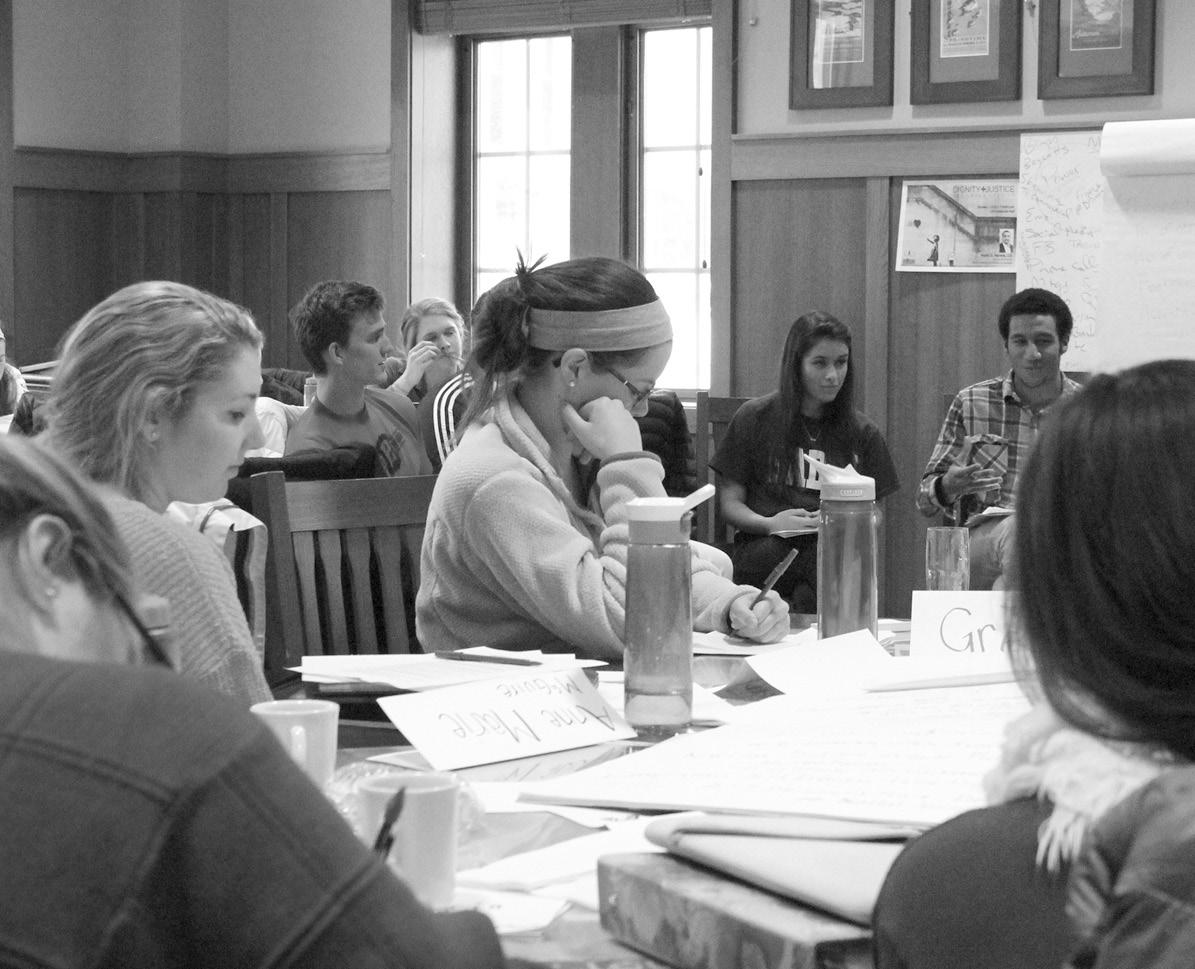
Students in the Advocacy for Common Good course trained with Catholic Relief Services on Jan. 18, in Geddes Hall’s coffee house.
Photo courtesy of Anna Carmack
Notre Dame and Saint Mary’s students gathered on the streets of Washington D.C. with other anti-abortion demonstrators
(574) 631-4542 mthomass@nd.edu Assistant
Question of the Day:
krabac01@saintmarys.edu
Photo Desk (574) 631-8767 obsphoto@gmail.com
Systems & Web Administrators (574) 631-8839
Policies
Today’s Staff
News Carolyn Hutyra rebecca O’neil
a bi Hoverman
Graphics steph Wulz
Corrections
The Observer regards itself as a professional publication and strives for the highest standards of journalism at all times. We do, however, recognize that we will make mistakes. If we have made a mistake, please contact us at (574) 631-4541 so we can correct our error.
Sean Perkins
freshman siegfried Hall
“buzz a ldrin, neil a rmstrong and Joe smith.”
Luke Dziedzic sophomore sorin College
“buzz a ldrin, neil a rmstrong and I’m not even going to guess a third.”
Allie Soisson senior off campus
“buzz a ldrin, neil a rmstrong and ... brian Kelly.”
Troy Nguyen
freshman
Carroll Hall
“neil a rmstrong, buzz a ldrin, Queen Elsa.”
Charlie Warner freshman Carroll Hall
“neil a rmstrong, buzz a ldrin and bradley Cooper.”
Eric Richelsen freshman Carroll Hall
“neil a rmstrong, buzz a ldrin and Tom Hanks. He was up there right?”
FARNAN | The Observer
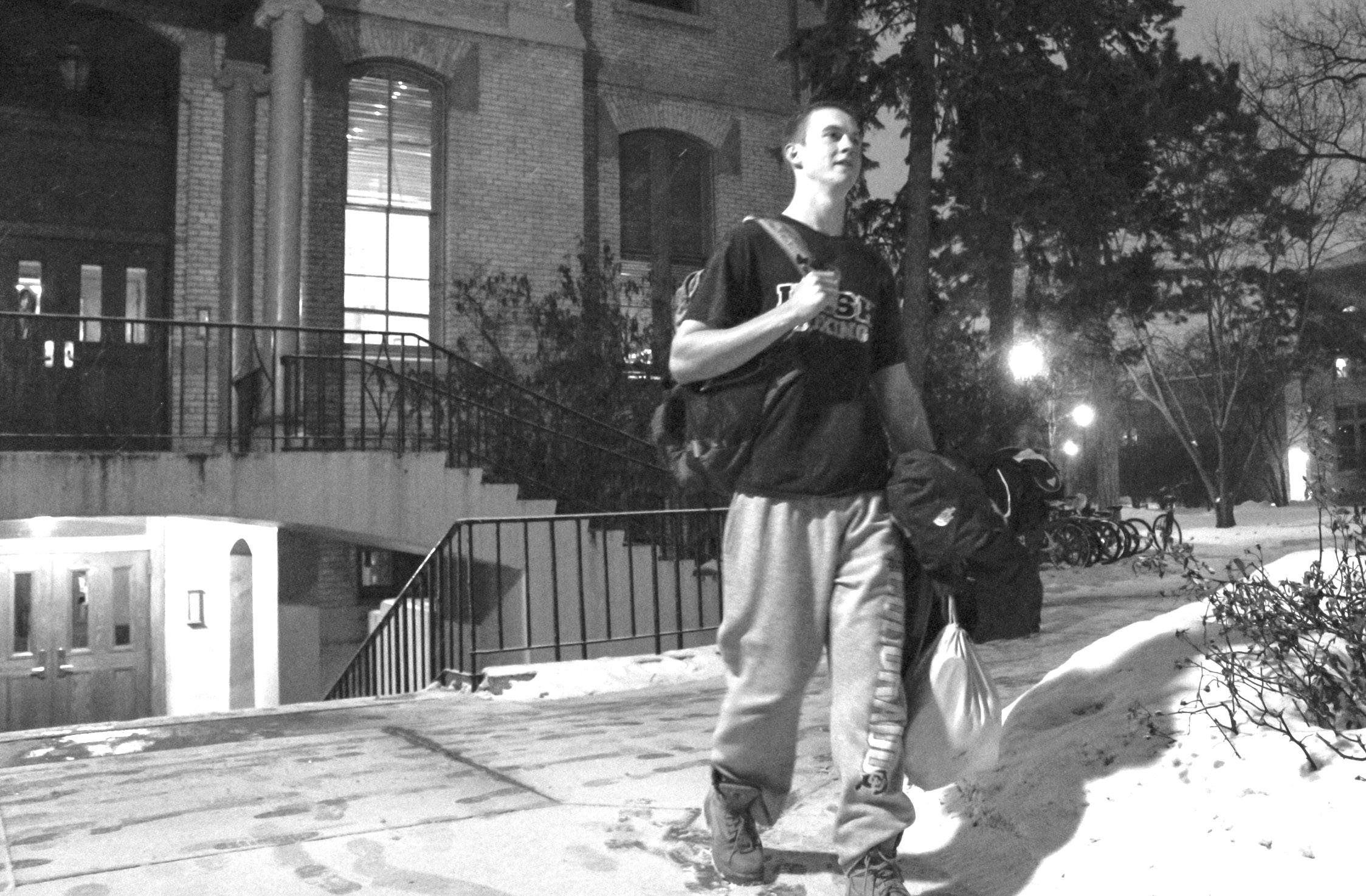
Sophomore Michael Flanigan seems unphased by the cold after a Bengal Bouts workout on Tuesday, despite negative windchills. Similar below-average temperatures in the teens are forecasted to continue until Friday.
Thursday
Majors Night Reckers
6 p.m.-8 p.m.
Meet students and professors from every department on campus.
Student Film Festival DeBartolo Performing Arts Center
6:30 p.m. and 9:30 p.m.
Tickets $4 to $7 at the ticket office.
Have a question you want answered? Email obsphoto@gmail.com Want your
Friday
Stress Buster Friday: Art Therapy St. Liam Hall
1:30 p.m.-2:30 p.m.
In the third floor conference room.
Harper Chili Cook-Off Harper Hall
3 p.m.-5 p.m.
Bring $10 to judge the contest and vote for your favorites.
Saturday
Harlem Globetrotters Joyce Center
p.m.-8:30 p.m.
1 p.m.-5 p.m.
This four hour 2013 film reveals life at this prestigious University.
Dance Company Auditions
Rockne Memorial
7 p.m.-8 p.m.
Arrive 10 minutes early to sign in.
Monday
Talk: “Irish-American Novels and Songs” Flanner Hall
12 p.m.-1 p.m. By Rolf and Magda Loeber.
Panel Discussion: Out @ Work LaFortune Center 7 p.m.-8:30 p.m. Navigate the workplace as an LGBTQ oerson.
EMMET
nuns offer applied communications experience
By KELLY KONYA and MACAILA DEMARLO
s
aint Mary’s Editor and news Writer
associate professor of communications Marne austin took a new angle on her Introduction to Communications course last fall, requiring her 40 students to travel to the convent of the sisters of the Holy Cross in order to speak to local nuns.
If students are not actually doing communication, there is no point in studying it, austin said.
“Even though we are saint Mary’s, founded by the sisters and have the convent right here, it is often the case that young women can go through all four years of college without ever knowingly interacting with the sisters, which is a huge bummer,” austin said. “Whether you identify as a Catholic or not, it’s important to understand our
history and legacy being at this school.
“The three young sisters who founded the College did so when the odds were against them, and to have the courage to do what they did is pretty remarkable and should be a story of empowerment for the women here.”
students met with their assigned sisters five times over a five-week period, austin said. Their assignment involved gathering oral histories from the sisters on their experiences in faith and service with plans to eventually compile a video documentary for the College and congregation.
austin said she plans to use this practice in all of her introductory courses because it is a great way to engage both the ideal of interpersonal communication and understanding history.
“I think every moment is a
moment of intercultural and interpersonal growth. so often we get stuck in our heads some idea of what ‘normal’ is, and there’s no such thing,” she said. “We think that people are the same and there’s this assumed homogeneity.
“Even when we live in a place like south bend or like saint Mary’s, where we look around and think we know these people, we all have such different diverse stories to tell. There’s always those people in our communities who we overlook, including those right across the street from us or our neighbors who we see all the time, but we really have no idea who they are.”
The majority of the students were apprehensively excited about connecting with the sisters, but by the end of the five visits, all had gained invaluable stories to share with others, austin said.
“but that isn’t to say that they didn’t have some hard times with it,” she said. “We did have a few sisters who had problems with alzheimer’s, so a lot of the women in the classroom had to cope with that. They learned some awesome lessons from this and had to work in handling ethical issues.”
First-year student Kathryn Mathews said the experience completely changed her ideas of nuns since she is not Catholic and previously believed nuns spent their entire days in prayer and reflection. Matthews was paired with Maura brannick, a retired nurse from st. Joseph Hospital.
“When she [brannick] saw all
SENATE
the poverty in town, she wanted to set up a free clinic for patients but didn’t have much money,” Matthews said. “so while working at the hospital, she met some interesting characters who eventually helped her fund her project, like one notre dame student who was volunteering there.”
Mathews said brannick discovered this notre dame student donated money toward her goal years later.
“The student told sister brannick that she would be the first one he’d see when he makes his millions,” Mathews said.
sister brannick formed friendships with a local motorcycle gang, who also helped her clinic get started.
“They told her to let them know if anyone messed with her,” Mathews said. “she still goes to the clinic once a week. she wants to help the community as long as she lives.”
Mathews said over the five weeks, she and sister brannick grew very close, and though she had never met a sister before the class, she really enjoyed building their friendship.
sophomore lauren Wells also thought the project was an amazing idea, though she was initially hesitant to ask a stranger personal questions.
“I was partnered with sister Mary Elizabeth loughran, and she was a joy to work with,” Wells said. “I began to look forward to my afternoons with her because they became a highlight of my week.
“It added so much peace and
clarity to my life to talk with her and share our experiences. as our relationship continued to grow, the interviews were almost like therapy sessions. It was a time that all my anxiety from student teaching, homework and other extracurricular [activities] just went out the window, and sister Mary Elizabeth helped me gain perspective on life.”
Wells said her pairing was an act of fate, as the two women had so many things in common.
“I’m studying to be an English teacher, and she spent years of her sisterhood doing the same thing,” Wells said. “also, I’ve attended several mission trips to belize, and in the same way, sister Mary Elizabeth spent over 20 [years] working in brazil to spread her mission and teach in schools there.”
austin hopes her students will continue to engage with people around the College who have such great stories to share.
Currently, austin is teaching an introductory course where the students will meet younger sisters in the convent and shadow them on a day where the sisters work in the local community.
“It’s our ethical imperative to understand each other’s stories in building our community,” austin said. “That’s why I embark on such projects. It’s the only way we’re going to grow.”
Contact Kelly Konya and Macaila DeMarlo at kkonya01@saintmarys.edu and mdemario01@saintmarys.edu
Campaign draws volunteers
By MARGARET HYNDS news Writer
at Wednesday night’s student senate meeting, student body president a lex Coccia updated
members on the student government’s new campaign combating sexual assault, One is Too Many.
“We now have 135 volunteers trained for [the campaign],”
several volunteers started door-to-door visits in their dorms to discuss the launch of the campaign and speak about resources available on campus pertaining to sexual assault, he said.
The Gender relations Center is also helping with the campaign by providing student government with pamphlets detailing ways friends can help victims of sexual assault, Coccia said.
national engagement and outreach director rosie shepherd attended the meeting and presented her resolution outlining the senate’s support of the organizational bylaws of the atlantic Coast Conference (aCC) student body President Conference.
Coccia attended the inaugural aCC student body President Conference shortly after the university joined the aCC in september 2013.
according to the resolution, which passed during Wednesday’s meeting, the goal of the president’s council is to “foster cross-campus communication between active institutions in the aCC;
Institute for Church l ife and alumnae, Gallic said. The commitment to funding expresses the university’s larger commitment to expressing the importance of life issues to its students, she said.
“We have had people from notre dame go [to the March] since it started,” Gallic said. “The numbers were only a couple in the beginning, but notre dame has always been represented. notre dame is committed to life issues, Gallic said. r ight to life is part of the Catholic Church’s mission and Catholic social Teaching. she said the close relationship between the organization and the president’s office is evident in the university’s decision to give excused absences to students who participate in the March.
Gallic said involvement with the r ight to l ife Club at notre
Advocacy
get back to campus and life goes on, things get busy and yet this passion remains.
“We provide this course as a structured way forward to work on those issues and effect change … We provide a way for [students] to address the root causes, the structures that create the injustice that they’ve encountered.”
Hebbeler said he worked with the Crs to implement the course last January. He said the Crs previously sent one representative to campus each semester to train the students in advocacy and prepare them for their work during the semester, but this year an additional Crs representative came to observe the process.
“no other school is doing this exact thing with Crs,” he said. “We have other courses [at notre dame] that are examining advocacy … but as far as working with Crs in this manner on an accredited advocacy course, there are no other programs like that and courses like that.”
The class closely aligns with Catholic social Teaching and the Church’s views on human dignity, Hebbeler said.
“These are large-scale issues, but Catholic social Teaching reminds us that it’s the dignity of each individual that we are seeking to uplift, to protect, and that does something to our dignity,” he said. “Justice is right relationship, and so for the dignity of persons on the margins, but also our own dignity, we seek out these issues and we commit to the work in the name of solidarity.”
Peck said she considered the course her opportunity to follow a call to action.
“We can’t be content wishing well on the world or feeling bad because some people don’t have food to eat and that’s just too bad,” she said. “We are in a position to act, and this class is giving us the tools to do that.”
Contact Lesley Stevenson at lsteven1@nd.edu
dame helped shaped her perception of others and taught her the importance of the inherent dignity of all human persons.
“This group really shapes how you view other people in terms of the dignity that they have,” Gallic said. “at its core, the prolife movement is about human dignity, so that definitely provides a different outlook on life — you see people through their worth as created in God’s image.”
Gallic, who has attended seven marches in her lifetime, said she found it encouraging to stand with so many others with the same passion for pro-life issues. she said it gives her the strength to continue to fight for a cause she “holds dear to her heart.”
“Just being involved with pro-life issues can sometimes be discouraging when you see the culture shifting so far away from it,” Gallic said. “being at the March last year … by people who are so passionate about it, reminds you that you are not the
only person fighting for this and [shows] how important of an issue it is.”
The r ight to l ife Club at notre dame works to educate students on life issues and provides students with a way to get involved, Gallic said. since the group is at a Catholic institution, she said she believes the group is supported more than pro-life groups at other a merican college campuses.
“Compared to other prolife groups at other universities, our group is very well received,” Gallic said. “We receive a ton of support from the administration.
“There is always going to be, especially on college campuses, people affected by abortion, and for those people seeing reminders of the pro-life movement can be hard, but we have never experienced a lot of resentment or a lot of negativity.”
saint Mary’s senior a llie r ichthammer said she feels she is in the minority at saint Mary’s
since she is pro-choice.
“I personally feel like it is a woman’s responsibility to choose what she does as far as reproductive issues and I don’t think that the government, or anyone else, should be involved in that decision making process,” r ichtammer said. “I think it is a citizen’s private right to choose what they would like to do.
r ichtammer said she thinks abortion will occur whether or not it is legal, and she said she feels abortion should be made safe as a result. a lthough she said she does not feel nervous about expressing her pro-choice views, at times she does feel reluctant.
“On the whole, I really haven’t experienced anything negative being a pro-choice supporter on saint Mary’s campus, but it can feel a little awkward sometimes when people are talking about ‘killing babies’ or things like that,” r ichthammer said. “When
they bring it into that context, as far as abortions go, I don’t really view it like that. I view it as a women’s reproductive health issue rather than an abortion issue.”
Gallic said the r ight to l ife Club is always wiling to engage in discussion with students about their beliefs and said anyone is welcome to come to the group’s events, including those who are not pro-life supporters. she said events like the March allow members of the club to engage with people from all different backgrounds and support groups, especially those of younger generations.
“at the March you are able to network with other college campuses, people of older generations and experts for the cause,” Gallic said. “It is great to see so many people come together for the pro-life cause.”
Contact Kaitlyn Rabach at krabac01@saintmarys.edu
continue the pursuit of being pioneers of higher education, athletics and extracurricular activities; enable collective actions that affect all participating institutions; and promote a strong relationship among all institutions.”
senators also discussed upcoming signature dorm events and general on-campus events.
Toni schreier, McGlinn Hall senator said Majors night will take place in south dining Hall this Thursday from 6-8 p.m.
“Everyone is welcome, and we’re expecting both teachers and professors from
Editor
of The Observer’s news coverage for the past year.
“I am so honored and humbled to be chosen as The Observer’s next leader,” Jakubowski said. “I have learned so much from the past few years here and I cannot wait to see what we can accomplish going forward.”
Jakubowski became news Editor in the spring of 2013, and the first major project of her term was leading the coverage of Pope Francis’ election in
every department to be there,” schreier said.
schreier also reminded senators that McGlinn casino night will take place this saturday from 10 p.m. to 1:30 a.m.
O’neill Hall senator Kyle McCaffery said only one dorm has currently entered a contestant for next Thursday’s Miss notre dame pageant, an O’neill signature event. There is, however, still time to sign up.
Other events in the next month will include the Keenan revue and l ewis Hall of Pancakes ( l HOP), which will occur on Feb. 7.
Contact Margaret Hynds at mhynds@nd.edu
March 2013. she will spend the upcoming summer as a reporting intern with the Concord Monitor in Concord, n H.
Jakubowski said she looks forward to building off the momentum of past Editorial boards and learning from the challenges ahead.
“I’m going into this with a lot of energy and excitement because I am so proud of the work everyone does in this office,” she said. “I have a lot to learn, and I am so lucky to be a part of this incredible organization.”
Jakubowski will take over as Editor-in-Chief on March 3.
Earning his words
Mike Ginocchio sports Writer
so what’s up with richard sherman? not him personally, mind you. I’m wondering about the situation around him. by now everybody’s probably seen the aftermath of the nFC championship game, where seattle cornerback sherman helped advance his team to the super bowl after deflecting a would-be touchdown away from 49ers receiver Michael Crabtree and into the arms of a seahawks teammate. Then Fox sideline reporter Erin andrews asked sherman for his thoughts on the game and, well, you know what happened next.
My biggest question in the wake of the “sportsmanship” and “graciousness” argument is what did we expect from him in the first place? Even before he declared himself “the best corner in the game,” he’s been pulling similar stunts throughout his career. after all, didn’t we all secretly admire the way he went after EsPn First Take’s skip bayless, calling him an “ignorant, pompous, egotistical cretin?” (What sports fan hasn’t thought that about bayless?) but now that he lets out a burst of passion after playing a critical role in getting his team to the super bowl, we’re supposed to expect that he should have just put those feelings of excitement away? Would you?
did sherman hurt anyone? no. Other than Crabtree’s feelings, maybe, but having played this game I can a guess how Crabtree will respond: tear sherman apart the next time they meet and then say absolutely nothing and let sherman eat crow. and sherman will probably just laugh and take it in stride, knowing that Crabtree won that round. It’s all in the game, right? and sherman at least walks the walk to go with talking the talk (and talk … and talk …) With 20 career interceptions in his three seasons in the league, he has objective evidence that he is in fact the best corner in the game. but athletes are supposed to be role models, you might think. Well, why not at least consider sherman as one? He came straight out of Compton, Calif., graduated high school as salutatorian, went to stanford (one of the best schools in the country, if not the world) and returned for his last year of eligibility to begin work on a master’s degree. It’s hard enough getting an undergraduate degree without playing a sport as timeconsuming as division I football, let alone a master’s degree while playing it. and if he isn’t enough of a role model for you, then you can always look at his teammate: seahawks quarterback russell Wilson (on whom you could write at least two columns’ worth.) sherman makes the game fun. and in reality, there are far worse things you could be than a smart, talented cornerback who jaws with his opponents. so you can bet that I’ll enjoy watching him in the super bowl — getting burned again and again by Peyton Manning and the broncos. What? I may like it when there are “villains” in sports, but that doesn’t mean I have to root for them, right?
Contact Mike Ginocchio at mginocch@nd.edu
‘Post-racial a merica’ isn’t a thing
Linden Kat’s Meow
Possibly the most despised concept I have encountered, a “post-racial” society embodies a world in which naïve individuals believe, because slavery is no longer legal in the united states and there is a black president in office, that racism has suddenly been abolished. I’m sorry to break the bad news, but we are anything but a progressive nation of racially accepting individuals.
a quick anecdote — I recently did a project on the ethnic identity at notre dame and found my primarily Caucasian classmates were very shocked to find that more than a dozen of my latino peers have faced racial discrimination on campus over the past four years. Varying from blatant name calling by peers, to racial profiling by a broad spectrum of notre dame affiliates, racism is very much alive.
I am not angry my classmates had no idea racist and prejudiced people exist on this campus. I suppose I am a little happy I had the pleasure to meet those innocent enough to hold nothing but positive views of their racially diverse peers. Or maybe they were shocked people voiced their racist views directly to ethnic students instead of laughing about it among their white peers. I would like to think it is the first explanation, though. but, as much as our brochures and commercials would love to boast a diverse and united campus, there still exists a distinct tension amongst a fair amount of the student body.
On a greater scale, I recently read an article in which a well educated african american woman, unable to attain work, changed her name and ethnicity on a jobsearching website to appear Caucasian and immediately received over a dozen job offerings, while her original account
EDIToRIAL CARTooN
— listing her true identity — received only two. The fact that she was forced to change her identity in order to be acknowledged by employers is unbelievable and a concept many people with a purely European background and name would not be aware was even a concern for people of color. This instance alone is enough to prove that “post-racism” has yet to be achieved in the united states. To be terribly cliché and quote dr. Martin luther King, Jr., we are not yet a nation that judges people “not by the color of their skin but by the content of their character,” but a nation that values whiteness over darkness, ethnicity over skills and most importantly, appearance over character.
I am unsure as to where I stand in this situation, because although I identify with my Mexican american roots very strongly, my name has German origins from my father’s side, which in itself reads very well on paper. Without having met me, many people believe I am white, but my obviously racially-ambiguous features say otherwise. My father changed his last name a few decades ago to his paternal grandfather’s last name. He did so because he understood the necessity to assimilate as much as possible in america. but things are still uncertain for my future. My father is able to get away with being Caucasian or latino when he chooses, but when the time comes for me to apply to jobs, will I be rewarded for my Caucasian name or rejected for appearing too ethnic and deemed unprofessional? am I “light-skinned” enough to pass for Caucasian? Or am I not ethnic enough to fill the minority requirement for the company to which I will someday apply?
The fact that, statistically, I will likely be paid less than my white female counterpart is not acceptable. The fact that I will likely be passed up for a job because a less qualified, but more Caucasian-appearing woman looks better for the company is not
acceptable. but in an america where job opportunities are difficult to come by, it is reality.
Many people say that ethnic individuals need to “get over” slavery, or segregation, or the mass genocide of native americans, because we now have equal rights and hundreds of years of slavery and racial and ethnic discrimination in the united states should be forgiven. Though we read about the Civil rights Movement in our history books, we forget that out grandparents, and probably a lot of our parents, lived in a time where blacks, latinos and other ethnic minorities were not equal to whites. There are people alive today in america who fully support segregation and see nothing wrong with their beliefs, and that alone is scary.
as much as I would love for one’s skin color or ethnic-sounding name not to play a part in the judgment of his or her character, it is reality. We will never live in a post-racial america. as pessimistic as that sounds, there will never be a point in which I can just be a human being. I will always be an “other” in predominantly white america. but, I am not sure if that’s a bad thing. I like being Mexican american. I like being recognized as an individual with a rich heritage and background. I will not apologize if I sound too “radical,” because this is anything but a militant rant as some may like to assume — it is presentation of reality. but I will yell “Viva la raza!” if my “too liberal” words are not enough and that becomes what it takes for my ethnicity to be respected.
Katrina Linden is a sophomore English and Latino Studies major living in Lewis Hall. She can be contacted at klinden1@nd.edu
The views expressed in this column are those of the author and not necessarily those of The Observer.
Katrina
Fiscal woes: The federal spending addiction
Raymond Michuda Common s ense
When I think about the sheer number of things wrong with our federal government, I get rather overwhelmed. It’s quite sad that I feel this way, but this is the reality of the modern day a merican political arena. If I were writing a book, I might have enough space to identify all of these problems, but since this isn’t the case, I want to talk about what I view as one of the most important issues in a merican politics, which is our federal government’s mind-boggling fiscal irresponsibility.
Currently, the government is about $17 trillion in debt, which comes out to $54,000 per citizen and $150,000 per taxpayer. since september 2012, national debt has increased $2.5 billion each day. With this type of problem, you’d think Congress and the president would make a serious effort to fix it, right? but that’s operating under the assumption that our politicians behave rationally. This year, the government will spend $3.8 trillion while only receiving $3 trillion in revenues. It doesn’t take a Harvard law degree to realize those numbers just don’t add up. There are multiple factors causing this problem, but here I want to pinpoint the main cause and address that. Government spending is largely divided into two
categories: discretionary and mandatory spending. Every year, the government can freely choose how much money to appropriate to discretionary categories, which include defense, infrastructure, education and other smaller budgetary items. as a whole, discretionary spending will make up about 30 percent of this year’s budget, with defense spending accounting for 20 percent of the total budget.
Mandatory spending, on the other hand, will account for 64 percent of this year’s spending. This type of spending is dominated by the entitlements (including social security, Medicare and Medicaid.) spending for these programs is based on set eligibility requirements instead of yearly appropriations. The government can decrease mandatory spending by changing eligibility requirements or lowering benefits, but doing so reduces the amount of free money that people receive, which is political suicide. Therefore, there is far more control and oversight over discretionary spending, where the government must actively choose how much to spend each year, as opposed to mandatory spending, where the money spent is already decided by previously written laws. This notion has been demonstrated in the past 50 years, where mandatory spending has steadily eroded the discretionary share of the budget.
For those of you that think our spending
problem is caused by defense, consider this: In 1963, defense spending was equal to about 10 percent of GdP, and entitlement spending was about six percent. In 2013, defense spending was around four percent of GdP (and falling), while entitlement spending was around 15 percent and growing rapidly. Clearly, in the recent years of debt explosion, we’ve seen a significant increase in entitlement spending at the expense of defense funding.
To make matters worse, some of the entitlement programs will run out of money soon if current laws remain unchanged, with Medicare becoming insolvent around 2025 and social security following suit around 2035. Even though these entitlements are some of the most prominent expenditures in the budget, our mathematically-challenged politicians have found a way to set them on a path for destruction. The maddening part is that we’ll all be paying into social security for about 25 years, but if the Congressional budget Office’s predictions are correct, we won’t get any of our money back. Personally, I dislike the concept of social security in the first place, but if we pay into the trust fund, we ought to get a return on our investment.
a nd it gets even worse: the “a ffordable” Care act will add $1.8 trillion to federal outlays over the next 10 years. To me, the democrats’ insistence to retain this law
a n outsider’s perspective
is baffling. spending this much money on a controversial new program when we already owe $17 trillion is blatantly irresponsible. The bottom line is the government needs to stop creating new spending programs because it cannot handle the ones we already have. as citizens, we need to hold our politicians accountable, but we don’t. Instead, we keep electing the same people and expecting different results. If we don’t act soon to curtail our national debt, we will eventually get to the point where the government is consumed in a sea of interest payments, and entitlement spending has exploded to the point that our country can no longer afford to defend itself from foreign enemies. raising taxes is simply not the answer. It doesn’t address the outof-control growth of mandatory outlays, and it only provides more money to feed Congress’ spending addiction. The spending itself must be reduced, and we must elect people willing to do this. until then, we’re left wondering what it would be like to have a President and Congress with foresight and common sense.
Raymond Michuda is a sophomore in the College of Engineering. He can be contacted at rmichuda@nd.edu
The views expressed in this column are those of the author and not necessarily those of The Observer.
Katarina Goitz Guest Columnist
In my studies and personal experience, I’ve come to learn and accept that the person who can best solve a particular community’s social issues is an “insider,” or someone who has always lived there. In the documentary “The Interrupters,” for example, local community members work against violence in Chicago and are successful because they are from the community and have been in similar circumstances as the people they are helping.
In my peace studies class, I also learned on an international level that foreign organizations and world powers are notorious for entering war-torn countries and attempting to rebuild them using their own strategies. In the aftermath of war, for example, we learned from visiting professor laura Heideman that international aid in serbia and bosnia, although temporarily helpful, funded some unnecessary initiatives and disrupted the functional workings of local nonviolence organizations by forcing them to structure like Western nGOs. as a result, many of the local organizations crumbled when the foreign donations dried up.
When foreign powers address the issues they or their donors believe to be most important in ways they think are most effective, ignoring the customary practices and current initiatives of local
organizations, their actions lead to an inefficient usage of resources. In the same way, “insiders” in a community usually personally know the people and understand what the area needs better than “outsiders” do.
While this is all very true, I have often wondered, “What about me?” If my hometown is relatively peaceful and I come from a background free from the major struggles the people in these communities face, does that mean I can never do anything to help them except for changing legislation? I am compelled by the power of local community organizing, but does that mean I am useless on a local level if I am in an unfamiliar city? While in Chicago on the latino Communities Organizing against Violence Center for social Concerns seminar, I attempted to resolve these burning questions. a lthough local people of l ittle Village in Chicago staffed most of the organizations we visited, I did meet some people who were from other areas. I learned that the key to working as an “outsider” was to listen to the residents’ ideas, learn more about local culture, show that you care and be genuine.
at Enlace, a community group that works against nonviolence through programs such as mentoring in schools and meeting with gang members on the streets, we met Catherine Ifurung, a school-based mentor who met regularly with students and listened to them, trying to build relationships with them and
help them create goals for the future. she told me that even though she was from a different state and demographic than the students, she was able to connect with them by finding other things they had in common. Even though it would take them time to open up, it really made a difference when she just listened to them and met them where they were with no judgment, showing them she cared.
at saint agnes of bohemia Church, we met Fr. Tom boharic, a priest in a predominately Hispanic area who himself was not Hispanic nor originally from that neighborhood. He said he was concerned with striving to learn about and appreciate the culture of the community, deferring to their wisdom. He said being an outsider is fine as long as one is seeking to learn from the community. He described an outsider’s presence as potentially being seen as an “act of peace” because that person is willing to come into a violent neighborhood just because he or she cares about its people. Much of the community organizing in which he was involved also stemmed from what the parishioners wanted to organize. He acted upon what they needed and not just upon what he wanted to do.
Finally, I learned from the executive director of the southwest Organizing Project, Jeff bartow, that it is important to appreciate the local culture and to present oneself in an honest way. using one’s own mannerisms and speech is fine because attempting to use the local
vernacular sounds false if it is unnatural. It is also unfair and insincere telling someone from the local area that you are “just like” him or her if it isn’t true. It is vital to be genuine because the people from the local area can tell if someone is acting falsely.
a lthough people from the local community are usually more relatable as community leaders, it is possible for an “outsider” to work against violence through community organizing as long as he or she appreciates the culture, defers to local knowledge and tries to find common ground while still remaining genuine. I have received affirmation that being a legislator is not my only option when it comes to effecting change in communities. I could also work as a counselor in a school, lead a community organizing program or work with a local church to help those in need. Overall, knowing that the local people have the best knowledge, I need to work humbly with them to meet the needs of their community. Instead of coming in with my own solutions, I need to listen and work out solutions with local community members, using their systems, since their insights are just as good as, if not better than, my own.
Katarina Goitz is a sophomore majoring in accountancy. She can be contacted at kgoitz@nd.edu
The views expressed in this column are those of the author and not necessarily those of The Observer.
If horseracing is the sport of the kings (even though it’s not a sport), then gambling is the way everybody else deals with having to stand around in the heat for hours on end watching little men whip large animals around a circle.
We bet on everything sports-related in this country, from the super bowl (reported line as of 7 p.m. last night — broncos -2.5) to, in last year’s super bowl, whether the san Francisco 49ers would score exactly four points (+9999) and even whether or not beyoncé’s hair would be straight or curly at the start of the super bowl halftime show last year (straight: -140, Curly/Crimped: Even Money).
Technically, I’m pretty sure, sports gambling in the united states is fairly restricted, and is pretty much limited to sports events and can pretty much only be done in nevada, with some exceptions. The laws and regulations on gambling are complex and difficult to decipher, so, like the good business student that I am, I’m just not going to. What I do wonder, though, is how we haven’t developed into gambling on Hollywood. With the wide variance of results and seemingly little predictive ability of studios when it comes to what will and won’t be a success (see: “The lone ranger,” “r.I.P.d.”), it could be argued that the betting possibilities for Hollywood films is more exciting than those for sports events.
If I gave you an over/under of “The dark Knight” on its opening weekend in 2008 of $150 million at the domestic box office, a couple things would have come into play. One, did you think “The dark Knight” had the potential to come close to or exceed the all time opening weekend record set by “spider-Man 3” the year before (the record was $151 million)? The first film in the series, “batman begins,” had only opened to $48 million, so maybe you should take the under — that’s a big leap. but in the time since Christian bale’s star had risen, and the trailer had been exploded on the Internet. On top of that, in a morbid sense, Heath ledger’s premature death six months before the film’s release and rumors of an all-time great villain in his performance as The Joker had spiked interest in the film.
but would all that have been worth putting a bet on even money odds (you make back as much as you bet on top of your original bet) for the batman sequel to break the all time opening weekend record? Well, it should have been, because it did, earning over $158 million and blowing past the previous record on its way to an eventual billiondollar global box office haul.
That’s just an example from the past, though. let’s take a look at some possible bets for this coming weekend. Obviously, this kind of gambling is straight up illegal if you do it in real life,
but if I’m just doing it for fun, nobody can prosecute me, right? sounds like a solid legal defense if I’ve ever heard one. a nyways, here we go.
First, just to lay some ground rules for the non-degenerates.
If the odds are +/-, it’s describing either how much money you have to bet to win $100 (a minus odds) or how much you win if you bet $100 (a plus odds). so, with the bet above that the 49ers would score exactly four points, the +9999 odds means that if you’d bet $100 and they had scored exactly four points, you would have won your $100 back plus an extra $9999.
If the odds are 2:1 or 4:1 or 3:2, it’s you multiply the fraction by your bet and then add your original bet. so, if the odds on me to finish this article on time are 60:1 and you were to bet $5 (foolish child), and I were to finish it on time and you won the bet, you’d win $305 dollars (60x5=300, plus your $5 bet).
a n over/under bet is even money or 1:1 odds. I am in contention for worst gambler of all time. The first time that I went to las Vegas after I turned 21, I walked in $200 in my pocket and somehow managed to leave with a net $240 loss. I don’t know what happened, but whatever it was, you should never actually take gambling (or any) advice from me. Thank goodness this is fake, but also that I’m the editor so nobody can stop me from writing it.
1. “I, Frankenstein” o/U $15 million
The only film opening this weekend is the aaron Eckhart starring “I, Frankenstein,” a movie whose trailer looks like, with a little reworking, could have been a hilarious fake film trailer in the hands of robert rodriguez or Quentin Tarantino. but since it’s not fake, but a very real, very expensive ($68 million budget), very awful looking movie, it will be presented to the public this weekend against the less than stellar competition of “r ide a long” in its second week, “The nut Job” in its second week and “Frozen” in its 10th week. The supercool folks at boxoffice.com (full disclosure — I used to intern there, also full disclosure — nobody I have ever met has ever cared. no offense to them though, thanks for the internship) have a neat tool/algorithm that allows them to predict, with some statistical accuracy, the likely weekend box office gross for films each weekend. The site predicts “I, Frankenstein” will open in second place at $15.3 million, trailing a predicted $20.5 million for “r ide a long.”
There are a few things going for “I, Frankenstein.” One, there isn’t anything really good out there right now. It has no new competition to fight against. sci-fi movies are hard to predict, and one of the reasons is because even the really awful ones are big box office draws sometimes. I don’t know why, you don’t know why, even the people who go see them probably don’t why, but sometimes a horrific sci-fi/fantasy film will
come out of nowhere. a nd there’s no football this weekend, so maybe instead of watching football, people will want to go see Frankenstein. I don’t know, I’m grasping at straws. but there’s no way this film is anywhere near successful. One, as previously stated, it looks awful. Two, it hasn’t been released to critics yet, another indicator of its general lack of quality. last year, in this same weekend, the top film, “Mama,” opened at $28 million, but the only other film to cross $15 million was multiple Oscar nominee “Zero dark Thirty.” The most similar film to “I, Frankenstein” to open that weekend was “broken City,” a bad-looking action thriller aimed at male audiences, which opened at $8.2 million.
If they’re banking on aaron Eckhart’s starpower, let’s look at the last movie in which he was the sole star. so throw out “The dark Knight,” throw out “Olympus Has Fallen,” even throw out the awful “The rum diary,” and what are you left with? “Erased,” a movie that ended up going to video-on-demand before it grossed enough at the box office to actually be measured. no, “I, Frankenstein” will not be good, and it will not make money.
Bet: Take the Under
2. You will see a thinkpiece along the lines of “The beast wasn’t Frankenstein, the doctor who made him was Frankenstein.” (3:1)
Parlay (meaning both the above and the following conditions must be true in order to win): A. The article will be on Gawker, Slate or Huffington Post. B. The writer will relate this movie to the failure of education in America. C. You will see the headline retweeted or reposted on Twitter or Facebook and won’t actually read it (6:1). look, we get it. Frankenstein wasn’t the monster. He was the doctor. It’s supposed to be dr. Frankenstein’s monster. a nd this movie is possibly the worst offender on this front, with the title of the actual film getting it wrong. but Mary shelley didn’t title her book “dr. Frankenstein’s Monster,” did she?
If Hollywood executives are anything like me and they skated by in high school and didn’t actually read shelley’s book because the first 20 pages were super weird, who can blame them, really? I’ll tell you who — people who make money writing by being enraged by things like this. You want to know who won’t read it? Me.
Bet: I’d bet however much Aaron Eckhart got paid to star in “I, Frankenstein”
Contact Kevin Noonan at knoonan2@nd.edu
The views expressed in this column are those of the author and not necessarily those of The Observer.
adapted from Orson scott Card’s classic sci-fi novel, this 2013 thriller starring Harrison Ford and a sa butterfield tells the story of Ender, a young but brilliant human in training to become a soldier in a coming war. The book is one of the most famous works of science fiction literature in the last thirty years, and the movie isn’t too shabby either.
FRIDAY
What: Student Film Festival Where: DPAC When: 6:30 and 9 p.m.
How Much: $4
The notre dame student Film Festival returns to the debartolo Performing a rts Center for its 25th year to celebrate the works of aspiring filmmakers. Past students who’ve participated in the festival have gone on to prestige and awards-filled careers, and audience members can participate in the festival by voting for the audience Choice award.
SATURDAY
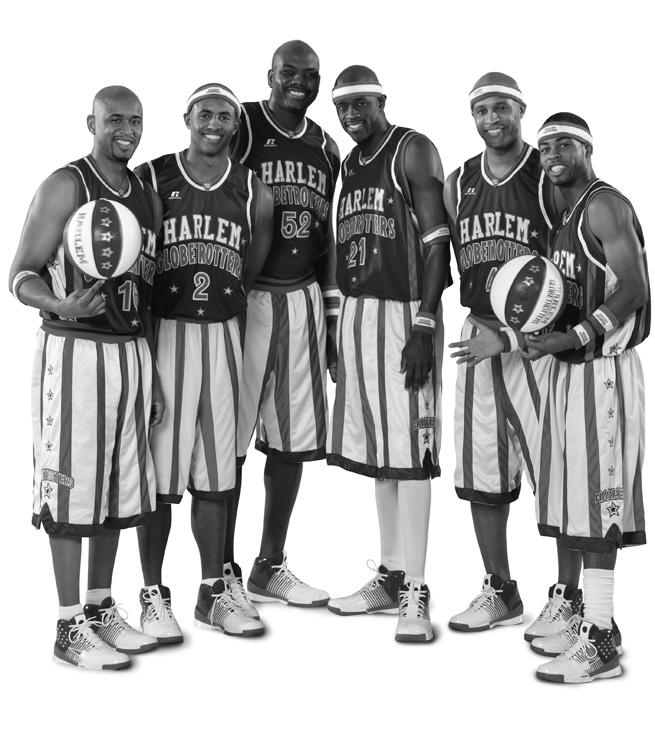
What: Harlem Globetrotters Where: Joyce Center When: 7 p.m. How Much: $19+
The Magicians of basketball and a mbassadors of Goodwill, the Harlem Globetrotters, bring their high flying and wild play style to the Joyce Center this weekend as a part of their 2014 Fans rule tour, after last year’s mania that included letting fans vote on the rules in the game.
SUNDAY
What: “At Berkeley”
Where: DPAC
When: 1 p.m.
How Much: Free
This acclaimed documentary details the administrative and student life at Cal-berkeley, one of the most prestigious colleges and institutions in a merican academia. In the new York Times review, stephen Holden said the film shows that “the modern university is a complex organism that, to function efficiently, needs every component, including someone to cut the grass.”
Greedy CEOs brought up the idea, “Well, why don’t we make the websites pay for the bandwidth they require? They’re using the Internet even more than the consumers are!”
I’d like you to take a moment and count up all the hours you spent on netflix, Hulu, HbO Go or any other video streaming site. My count, probably underestimated, is around 500 hours. Five hundred wondrous hours where I escaped from reality and found myself worrying about the troubles of individuals I will never see again once the episode, season or show ends. but all that’s over. There’s no more netflix. You’re free. l ive your own life.
ladies and gentlemen, the truth is the Internet died on Jan. 14, 2014. With the ruling of a district court on Verizon v. Federal Communications Commission (FCC), the days in which we thrived with net neutrality are over, putting an end to online equality. based on this historic decision, Verizon, Comcast, aT&T and all the other Internet service Providers (IsPs) can now dole out preferential treatment to the websites they choose. let’s get down into the nitty-gritty on this. before this decision, the exchange for a website looked like this: The consumer pays the IsP for their connection, the IsP connects you to the website you want and anyone can make a website and host information.
However, the IsPs realized they had made a mistake with this agreement, as they only levied a one-way toll.
With the decision from last week, the fatcats got their wish. Part of the verdict negated two previous rules on Internet neutrality. First, wired and mobile connections may not block lawful content or services. second, fixed line providers may not “unreasonably discriminate in transmitting lawful network traffic.”
Essentially, Verizon, aT&T and Comcast now get to be the online mob, collecting “protection” kickbacks so that websites, especially kingpins like Google, a mazon, Facebook and netflix, still get speedy connections.
Then, if a payment is missed, suddenly posting a status, loading a movie or doing some online research takes entire seconds to load. Consumers, as in you and I, get the worst deal, and we begin to migrate to new sites that pay their dues.
Then, there’s also the question of to whom the extra dues will bounce back. Corporations hate losing money, so the consumers are going to be footing the bills. That means if you want a website with more bandwidth, you’ll have to pay more for it. If the IsPs follow through with their agenda, soon we’ll have the Internet of the rich, where you can watch movies and download files, and the Internet of the poor, where you can read articles on static websites.
now, the battle was lost, but the war still struggles on. I provided you with a white lie to grab your attention, and the truth is the Internet isn’t dead yet.
In fact, this past week, Wired declared war. down with the FCC, Wired says, down with IsPs. The soldiers, the consumers, need to make their wishes heard. The Internet should be an equal place. It’s a place of the people, where anyone can be heard, and fame arises from true talent and ingenuity rather than wealth and class.
a ll those hours of netflix, of watching funny cats and grueling through last-minute research papers have prepared us for this. The very item that will be taken away gave us the power to take it back. Our own need for entertainment will turn the tide.
On Jan. 18, 2012 we had the great Internet blackout. On Jan. 11, 2013, reddit co-founder and Internet activist aaron swartz committed suicide after months of federal accusations that tried to make him out to be the greatest scapegoat of the corporate agenda against a free Internet.
now, a year later it’s our turn. We can’t let the past efforts and wins go unrecognized. We must make 2014 the year the people took back the Internet for what it was meant to be, an icon of equality.
Contact Daniel Barabasi at dbaraba1@nd.edu
The views expressed in this column are those of the author and not necessarily those of The Observer.
Daniel Barabasi s cene Writer
Steelers, Ravens play old-school
Aaron Sant-Miller sports Writer
This is the third in a 10-part series discussing the best rivalry in sports. In this installment, Aaron SantMiller argues for Steelers-Ravens. Join the discussion on Twitter by using the #BestRivalry.
“The players hate each other, the coaches hate each other … There’s no calling each other after the game and inviting each other out to dinner, but the feeling is mutual. They don’t like us and we don’t like them.” — Hines Ward, retired steelers receiver
Clearly, the Jackie Moon philosophy of “Everybody love everybody” has not yet found a home on the gridiron in baltimore and Pittsburgh, in what steelers coach Mike Tomlin terms the best rivalry in football.
since Thanksgiving of 2007, the ravens and the steelers have played each other 15 times. In every game but one, the game was decided by only one score. More impressively still, 11 of the last 15 times these teams have gone toeto-toe, the winner has won by four points or less.
some people may reject the notion that this is the best rivalry in sports. some may even reject the idea that this is the best rivalry in the nFl. Though the nFl structure encourages rivalries, the salary cap, injuries, the draft, compensatory picks and the violent nature of the game do their best to ensure a league of equal opportunity. all it takes is one off-season for a team to go from 12-4 to 2-14 (see Texans, Houston).
sure, neither the ravens nor the steelers made the playoffs this season. some may consequently challenge the importance of these games. some may challenge this rivalry’s relevancy. Fair enough. Fair enough.
Here is what I will say to that. Over the last 10 years, these two teams are a combined 200-110. since the last conference realignment in 2002, one of these two teams has won the aFC north all but three times. at least one of these two teams has competed in four of the last six aFC Championships. One of the two teams has also been in three of the last six super bowls, and twice the ravens or the steelers have brought home the lombardi Trophy over the last six seasons. Mind you, this is in a professional sports league based on communist-like values. You can’t argue the relevancy of these teams right now.
so the table is set. Two teams have an impressive resume in recent history and consistently play uniquely close games.
Intrigued? Guess what? I haven’t even touched on the rivalry itself yet.
These are two teams built around hard-hitting defense, two teams that pride themselves on a physical identity. When these teams play each other, it’s like watching a game from ten to fifteen years ago, before the nFl took to the air and flags were thrown every other series for “targeting.”
When the ravens and the steelers play, there will be injuries. There will be big hits, both legal and illegal. There will be shoving after almost every whistle and there will be incessant trash talk that even the most innocent fan will wish he or she could hear from the couch.
These are two of the most physical sports teams in the nation and they have the reputation to match what is seen on sundays. When they meet, it is a clash of dreadnaughts, bringing some semblance of accuracy to every war metaphor applied to the game of football.
This past Thanksgiving, that brutality was on display. When the game ended, the steelers had lost their starting running back, a top defensive lineman and four offensive linemen to injuries, while the ravens lost two of their top corners, a top receiver and a starting outside linebacker. Just another ravens-steelers matchup, as this has become the standard for these two teams.
This rivalry doesn’t have catchy names for critical game-deciding plays. Would you expect anything else from these two teams? These are two teams that pride themselves in a hardhat mentality, a working-class identity, just getting the job done.
still, you had the infamous attempt by Mike Tomlin to “interfere” with ravens returner Jacoby Jones, you have Charlie batch’s game winning drive in 2012, Flacco’s 92-yard drive and 26-yard touchdown pass to Torrey smith with eight seconds left in 2011 (this is after he had dropped the wide-open go-ahead score two plays previously) and Polamalu’s strip sack of Flacco with less than four minutes remaining and the steelers down four in 2010.
This rivalry has the essential elements of all good rivalries. Close games. relevant teams with a history of excellence. Memorable moments. an intensity that, in football, brings a unique physicality and scrappiness. Oh, and the teams hate each other. That’s fun too.
name two other teams who regularly put on a better performance and provide consistently exciting and close games. don’t worry, I can wait.
Contact Aaron Sant-Miller at asantmil@nd.edu
The views expressed in this Sports Authority are those of the author and not necessarily those of The Observer.
NFL
Ex-Cowboy Brent convicted
Associated Press
dallas — Former dallas Cowboys player Josh brent was convicted of intoxication manslaughter Wednesday for a fiery wreck that killed his teammate and close friend, Jerry brown.
He faces up to 20 years in prison for a december 2012 wreck after a night of partying with fellow Cowboys players. He could also get probation.
Jurors took about nine hours over two days to convict brent, who was led from the courtroom in handcuffs as family members sitting in the front row of the gallery sobbed.
a mong those sitting with brent’s family was stacey Jackson, brown’s mother. Jackson did not respond to questions as she left the courtroom Wednesday with brent’s family, but she has said in interviews that she’s forgiven brent and could testify in support of a lighter sentence for him when that phase of the trial begins Thursday. attorneys from both sides remain under a gag order that prevented them from commenting after the proceedings.
Prosecutors say brent, a defensive tackle, was drunk when
he crashed his Mercedes on a suburban dallas highway in december 2012, killing brown, a linebacker on the Cowboys practice squad who had also been brent’s teammate at the university of Illinois. Officers who arrived on scene saw brent trying to pull brown’s body from the wreckage.
Police say brent’s blood alcohol level was tested shortly after the crash at 0.18 percent, more than twice the legal limit for drivers in Texas. Prosecutors last week argued that the burly, 320-pound defensive tackle had as many as 17 drinks the night of the crash.
brent’s attorneys argued the blood tests used by police were faulty and that brent could not have drank nearly that much. attorney George Milner said his client was “guilty of being stupid behind the wheel of a car,” not drinking beforehand. brent retired from the n F l last year, but his ties to the Cowboys were prominent at trial. Two current players, barry Church and danny McCray, testified about hanging out with brent and brown, first playing video games, then having dinner and going to Privae, a dallas nightclub.
NHL | CarOlIna 3, PHIladElPHIa 2
sean l ee, a Cowboys linebacker, attended part of the trial to show support for brent, and Cowboys owner Jerry Jones said this week that he was closely watching for a verdict.
“Certainly it’s tragic. We’ve all, to some degree, have been a part of this,” Jones said on Tuesday, according to the Cowboys’ website. “We support Josh. This has been just a terrible experience for the families who lost a loved one and for Josh who loved Jerry as well.”
Jurors saw a video of brent appearing to hold bottles of Champagne in each hand and credit-card receipts that showed brent had purchased three bottles. They also saw police dash cam footage of brent losing his balance during field sobriety tests and occasionally stumbling over his words while talking to officers.
It was, in the words of prosecutors Jason Hermus and Heath Harris, a textbook case of intoxication manslaughter. The prosecutors told jurors in their closing argument that they should send a message about the danger posed by drunken drivers.
Tlusty nets game-winner
Associated Press
PHIladElPHI a — Jiri Tlusty scored the tiebreaking goal in the third period to lift the Carolina Hurricanes to a 3-2 victory over the Philadelphia Flyers on Wednesday night.
nathan Gerbe had a highlight-worthy goal and a lexander semin also scored for Carolina, which improved to 3-0 against Philadelphia this season.
Claude Giroux and scott Hartnell scored for the Flyers, who lost for just the second time at home in their last 14 games.
Tlusty beat Flyers goalie steve Mason from close range high to the glove side with 6:10 remaining.
The game originally was scheduled for Tuesday but was postponed due to the snowstorm that hit Philadelphia and much of the northeast. a s a result, Carolina also moved its home game against Ottawa
from Friday to saturday in order to avoid playing on three straight nights. The Hurricanes play at buffalo on Thursday.
semin opened the scoring for Carolina with just over 8 minutes left in the first period when he fired a wrist shot over Mason’s glove hand into the top shelf.
neither team generated much offense in the opening period, as the Hurricanes outshot Philadelphia 8-3.
Each team scored once in the second period, with Gerbe putting the Hurricanes up 2-0 with a breakaway goal with 6:22 left in the period. Gerbe benefited from a mistake by Flyers defenseman luke schenn, who misplayed a pass back to the point and couldn’t recover when the speedy Gerbe got behind him.
He put the puck through his legs and wristed it past Mason with his hands in an awkward position on a goal that surely
will be played countless times on the nightly highlight shows. Philadelphia got on the board with 35 seconds left in the second when Giroux scored from a tough angle when his backhander ricocheted off the chest of Carolina goaltender a nton Khudobin and into the goal. a nd the Flyers tied it just 3 minutes into the third period on Hartnell’s power-play goal. Giroux took the initial shot from the top of the left circle and Wayne simmonds failed on the rebound attempt. but the puck caromed off Khudobin and to Hartnell, who scored from point-blank range.
Mason had struggled in his last four games, with a 4.55 goals-against average, but brought a strong career record against Carolina into Wednesday’s contest. Mason entered 5-1-1 with a 1.85 Gaa against the Hurricanes. He finished with 29 saves.
TRACK AND FIELD
Irish return to host Notre Dame Invitational
By CASEY KARNES sports Writer
notre dame returns to l oftus Fieldhouse on saturday for the notre dame Invitational after last weekend’s successful road trip to Michigan for the simmons-Harvey Invitational.
The Irish excelled in a nn a rbor last weekend, claiming 27 top-10 finishes on the women’s side and 24 on the men’s. The 400-meter relays were particularly impressive as both the men (3:17.84) and the women (3:49.11) claimed first place. both teams, the women led by sophomore Margaret bamgbose and senior Michelle brown and the men, by seniors Chris Giesting and Pat Feeney, qualified for the nC aa
championships last season, and Irish head coach Joe Piane said their confidence level is rising as this season progresses.
“For the ladies, [confidence] is extremely high, because we have not only a good team of four, but we’re deep to about six ladies,” Piane said. “a nd on the men’s side we have two great legs in Feeney and Giesting, and then four or five freshmen that could really fit in. so I think both of their confidence is really high.”
The 400-meter relays also placed first in notre dame’s first home meet of the season, the blue and Gold Meet, where the Irish won 26 out of 33 events. The notre dame Invitational will be the first time the Irish have hosted a meet since before
winter break, and Piane said they are eager to return to their home track.
“I think it helps a great deal,” Piane said. “They understand the place, they know the place. They hopefully get a good night sleep in their own bed. but the best thing is that this track is so fast, and it’s fast because it’s huge. It’s the biggest indoor track in the united states, so that’s got to help.”
still getting used to the home track will be a talented group of freshmen. Piane said he has been pleased with their performance thus far, particularly middle-distance runners Chris Marco and Jacob dumford. Piane said that both freshmen and returning runners should
only get stronger as the season continues.
“Every year you can improve a great deal,” Piane said. “For some kids it was the first time they competed, for some of them the first in nine months. I saw some kids compete very well. We had a lot of good things happen, we really did.”
With the aCC championships only a month away, the Irish have only a few more meets to prepare, meaning that the freshmen’s growth must continue.
Piane also said he is likely to decrease the amount of experimentation as runners focus on their strongest events. l ast weekend, brown added the 200-meter dash to her arsenal, and finished second. While that
was a successful experiment, Piane said that as the events increase in intensity, runners will be more likely to conserve themselves for their best races.
“We’ll probably do some [more experimentation], but the farther along you go, you can’t experiment as much,” Piane said. “For example … we have the Meyo meet [coming up], and I can guarantee you those guys are going to want to run really fast in the individual events.”
notre dame will look to defend its home track and continue its strong early start to the season at the notre dame Invitational on saturday.
Contact Casey Karnes at wkarnes@nd.edu
Buzzer-beating layup pushes Olivet past Belles
By A.J. GODEAUX sports Writer
d espite leading for the first 16 minutes of the second half, s aint Mary’s was unable to withstand a frantic Olivet rally in the final minutes, as the b elles fell to the Comets 70-68
Wednesday night.
“We played a great game tonight,” b elles coach Jenn Henley said. “We just went cold from the floor in the last eight minutes. still, I’m proud of the way our team played tonight.”
a fter an 11-2 run put the b elles (5-12, 3-5 MI aa ) up 6152 with 8:33 left in the game, s aint Mary’s looked well on their way to their fourth conference win, but Olivet (15-2, 7-1) would not go away, going on a 12-3 run of their own to take their first lead of the second half with 3:47 left on the clock.
The b elles kept the deficit within three, and after Comets senior guard Kelsey Campbell split two free throws, the b elles had the ball down 6865 with an opportunity to tie the game with 22 seconds left. b elles sophomore guard Maddie Kohler found herself with a wide-open three-point attempt from the left wing and hit the shot to tie the game with 10 seconds to go.
Coming out of a Comets timeout, Olivet senior guard Chelsea siba went coast-tocoast, draining a circus shot layup with four-tenths of a second left to give the Comets the win.
“We had our chances to put this one away down the stretch,” Henley said. “We just let them stay around too long, and they made the most of it.”
It was a tale of two halves for the b elles, who, after, battling back and forth with the Comets in the opening minutes of the first half, opened up a ninepoint lead going into halftime thanks to 56 percent shooting from the field. The b elles weren’t nearly as effective
in the second half, however, shooting 35.5 percent, while the Comets rebounded from a poor first half by sinking 50 percent of their shots in the second to fuel their comeback. d espite winning the turnover battle 17-14, Henley said the turnovers the b elles did commit were costly.
“Our turnovers down the
“We had our chances to put this one away down the stretch. We just let them stay around too long, and they made the most of it.”
Jenn Henley Belles coach
stretch really were what gave Olivet the momentum in the closing minutes,” Henley said. b elles sophomore forward Krista Knapke led all scorers with a season-high 23 points, while junior forward and MI aa Player of the Week a riana Paul notched 12 points for the b elles. s enior guard s hanlynn bias added 10 points and six rebounds.
The b elles are off this weekend, but will attempt to climb back into the thick of the MI aa race when they take on a drian at 7:30 next Wednesday at home.
Contact A.J. Godeaux at agodeaux@nd.edu
Louderback mixes experience with youth
By ZACH KLONSINSKI sports Writer
a fter continually being among the top teams in the big East, the Irish face new challenges with the team’s move to the aCC, having to prepare for new opponents, facilities and playing styles. The Irish are now in a conference with six teams who finished last season ranked above them in the final polls.
“The aCC, top to bottom, might be the best conference in the country,” said Irish coach Jay l ouderback, now entering his 25th season at the helm of the program. l ouderback also noted that although they have never played in the conference before, the Irish are not complete strangers to aCC competition.
“We’ve usually played three or four aCC schools every year in our regular season, so we’ve been to a lot of those schools,” he said.
l ouderback and assistant coach Catrina Thompson will look to the experience of the team’s three seniors: britney s anders, Jennifer Kellner and Julie s abacinski.
“We have three seniors that have played in our lineup for three years … They all have played number one doubles at times so they’ve got a lot of good match experience, big match experience,” said l ouderback. “We have three freshmen that are going to be playing for us that haven’t been through any college tennis so those seniors will really help us with that transition.”
This freshman-senior relationship has already manifested itself on the doubles
court. Two of the three doubles teams for the Irish are made up of a senior and a freshman. Kellner and freshman Monica robinson will team up as well as s abacinski and freshman Mary Closs. The other doubles team consists of s anders and her sophomore partner from last year Quinn Gleason.
“We felt like with three seniors, the experience they have would be unbelievable to have one on each doubles team,” said l ouderback. “We tried it in the fall … and the teams meshed really well. We felt very good about it.”
The good results quickly followed in the fall, as the Irish doubles squads defeated Michigan’s number-one-and two doubles teams in the first tournament of the year.
“They looked really good,” said l ouderback. “It was just something we tried and it happened to work immediately.”
a s the fall season progressed, sometimes the team would send different players to different tournaments around the country, often splitting up the three teams and causing players to constantly play with different partners, something l ouderback said would be good both for those already in the doubles rotation and for increasing the depth of the team overall.
“When someone’s out, we’ve got two or three others that will be able to just go right in,” he said.
On the singles side, l ouderback thinks the team will be very deep. Five of the six slots on the singles side to start the year will consist of players who also play doubles in a typical dual match, with the sixth
position still open for a number of different players to play their way into.
“I feel like we just don’t have any holes this year,” said l ouderback. “We look very good from [position] one to six.”
l ouderback will look to his seniors off the court as well to teach the ins and outs of college tennis, as the team has to do a lot more traveling this year than last.
“Flying out of here in February is not always fun.”
Contact Zach Klonsinski at zklonsin@nd.edu
KEVIN SONG | The Observer
Irish senior Britney Sanders serves as senior Julie Sabacinski looks on during the pair’s doubles match during Notre Dame’s 4-2 victory over Baylor on Feb. 23, 2013. Sanders and Sabacinski are two Irish players with the opportunity to compete at both singles and doubles in the upcoming spring season.
to play,” Herr said. “but I learned so much from it. It was ridiculous actually because even after games where I didn’t play, the coaches didn’t need to talk to me — I didn’t have an impact on the game, I was just in the stands — but they [asked], ‘Hey, what’d you see out there?’ … It was like a self-check.”
Jackson said many similarities — both positive and negative — exist between the two players.
“sammy still needs work on his skating, similar to a nders,” he said. “He needs to develop more agility to his game and first-step quickness and a nders was the same way. but his body and his hockey sense and his hands make him a formidable player.”
Those attributes have come in handy for both Herr and the Irish. With the score tied at three and less than six minutes remaining on Friday against l ake superior state, Herr worked his way toward the net to score the
“You’ve just got to play the role and you’ve got to realize if you’re not strong enough and you’re getting bounced around, you’ve got to get strong enough and you’ve got to compete harder. And if it’s not working out for you, you’ve got to make it work. ”
game-winning goal. He added another goal on a breakaway to make the game’s final margin 6-3.
Herr will try to continue to use that “big” mentality — finetuned from learning from the stands a year ago and working hard in the weight room in the offseason — to lead the Irish to a sweep when they host no. 11 northeastern on Friday and saturday night.
“It’s difficult [when you’re a freshman] because you’ve got guys that are 24 [years old] out there and you consider them big and manly guys,” Herr said. “but you’ve just got to play the role and you’ve got to realize if you’re not strong enough and you’re getting bounced around, you’ve got to get strong enough and you’ve got to compete harder. a nd if it’s not working out for you, you’ve got to make it work. but I realized that that’s my role, and I realized that coming in here. It just took me awhile to learn it.”
Contact Sam Gans at sgans@nd.edu
MICHAEL YU | The Observer
Irish sophomore forward Sam Herr shoots the puck during Notre Dame’s 4-2 victory over Lake Superior State on Jan. 18. After seeing time in only 13 games as a freshman, Herr is tied for the team lead in goals with 12 and drawing comparisons to former Irish captain Anders Lee.
Sam Herr Irish sophomore forward
18 percent of their attempted shots.
“You don’t want to play a lot of zone when you play a team that shoots that many 3-pointers,” McGraw said.
Meinhardt
competition would likely make him the top foilist in the International Fencing Federation (FIE) rankings.
“Finding out from my coach in Paris felt great obviously but it actually wasn’t a huge deal at first,” he said. “It really set in coming back and getting congratulations from my family and the n otre d ame family ... I’m incredibly grateful for that support.”
Irish fencing coach Janusz b ednarski has high praises for Meinhardt, both as a fencer and as an example for the rest of the young Irish squad.
“Gerek is someone who can blend high-quality academics with the time-consuming work required to be the best foilist in the world,” b ednarski said. “a nd his teammates say, ‘Hey I want to do that, too.’”
Meinhardt stressed how different n C aa competition was from the international scene.
“I really like fencing [for n otre d ame] because of the team atmosphere,” he said. “ unlike with the international events, I’m training with my teammates all the time.”
Currently in his first year of the M ba program at Mendoza, Meinhardt works
nation. The Irish have averaged a positive rebound margin of 12.9 this season.
“We need to capitalize on [our strength rebounding],” McGraw said. “We have a little bit more size and we need to take advantage of that as well.”
While Miami does not have a player over 6-foot-2, n otre d ame has four players 6-foot-3 or taller. Over the last six games in January, the Irish have averaged 45.3 points in the paint per game, which is more than half of their points scored per game.
“We’ve been looking to play down low more over the last few games,” McGraw said. “We have been trying to establish our inside game before we go outside, so that’s something we’re going to continue to work on.”
On Monday, the Irish claimed their 17th win of the season over n o. 11 Tennessee 86-70. n onetheless, n otre d ame failed to win the battle on the glass against the l ady Vols (14-4, 3-2 s EC).
Tennessee finished with 46 rebounds to n otre d ame’h 37.
“It will be a challenge for our guards and our post too. I think everybody has to defend on the perimeter, which has been a little bit of a problem for us this year.”
On the inside, n otre d ame is also one of the better rebounding teams in the
to balance his n C aa and elite international competitions with his life as a n otre d ame student.
“It takes a lot of effort and time-management as far as getting work done,” he said, “but luckily my parents got those things ingrained in me when I was young.”
Meinhardt began to fence at age nine, when his parents signed him up for a fencing club in his hometown of s an Francisco. The club had recently been opened by family friend and two-time Olympic foilist Greg Massialas, his coach to this day.
“a t first, I just really enjoyed competing,” he said, “and I started doing really well and kept going with it.”
a s he went along, the accolades began to pile up — he was the Junior n ational Champion from 2006 to 2009, s enior n ational Champion in 2007, 2008 and 2012, three-time Junior World Championship medalist and an Oympian in b eijing and l ondon, among several others.
a nd with his new title, Meinhardt has attained the highest accomplishment of all — the number one foilist in the world.
Contact Andrew Robinson at arobins6@nd.edu
the post, and rebounding, we need to get better in all those areas.”
On Monday, the Irish gave up 46 first half points but held Tennessee to only 24 points in the second half. a ccording to McGraw, this was a result of some defensive adjustments at half time that the team may carry on against Miami.
“We worked on guarding the post a little bit differently, which helped,” she said. “We also dealt with screens differently, which helped as well. We’ve been working on our zone too, but that’s still an area we’re going to keep improving on.” n otre d ame will look to continue its undefeated start to this season tonight at home against Miami. The game begins at 8:30 p.m. at Purcell Pavilion.
Contact Aaron Sant-Miller at asantmil@nd.edu
“We didn’t really rebound well against Tennessee, so it’s really important for us to really establish ourselves on the boards against Miami,” McGraw said. “ s till, we have quite a few things we’re focusing on fixing. The primary focus is our defense. On the perimeter, in
n T
EMMET FARNAN | The Observer Irish junior guard Whitney Holloway looks for a teammate during Notre Dame’s 99-50 home victory over UNCW on Nov. 9, 2013.
Complete the grid so each row, column and 3-by-3 box (in bold borders) contains every digit, 1 to 9. For strategies on how to solve Sudoku, visit www.sudoku.org.uk
CELEBRITIES BORN ON THIS DAY: balthazar Getty, 39; Guy Fieri, 46; diane lane, 49; John Hurt, 74.
Happy Birthday: Jump into action and take a leap of faith. Take the skills you have acquired this past year and turn them into something that will help you aspire to new heights. strive to reclaim love, companionship and diversity. reconnect with old friends and make life changes that will inspire you to live, love and laugh. Your numbers are 2, 8, 12, 20, 24, 37, 41.
ARIES (March 21-April 19): What you do to help a cause will raise questions. Take care of personal responsibilities before offering your services to outsiders. a relationship will take an emotional turn. speak up and air your concerns, but don’t make an impulsive move.
TAURUS (April 20-May 20): Opportunities are present, but you may misunderstand what’s expected of you. do not make a commitment. You are better off learning all you can and developing a plan that will enable you to handle whatever situation you face with ease.
GEMINI (May 21-June 20): Put your best foot forward. ask questions and take on new projects. What you offer will be greatly appreciated. a change will occur in the way you move forward with your plans if you lend someone a helping hand.
CANCER (June 21-July 22): Emotional matters will lead to arguments if you aren’t careful about how you deal with others. Take a deep breath and get involved in something you enjoy doing. avoiding sticky situations will give you time to think matters through and regroup.
LEO (July 23-Aug. 22): Get moving. The more mobile you are, the happier you’ll be. Taking on domestic tasks will help improve your surroundings, comfort and attitude. a partnership looks good and details regarding how to move forward can be made.
VIRGO (Aug. 23-Sept. 22): before making a decision, listen to what’s being offered. an impulsive move will turn out to be costly. love is in the stars and romance will set the mood. Children will play a role in a decision you make.
LIBRA (Sept. 23-Oct. 22): don’t overdo it at home. Too much to eat or drink will result in physical or emotional problems. You are better off going to a destination that makes you feel relaxed, or spending time with someone who brings you comfort and joy.
SCORPIO (Oct. 23-Nov. 21): Get together with someone who brings out the best in you. new ideas will result in changes that will encourage you to live better. Ease stress by addressing emotional issues. Take care of personal business and move on.
SAGITTARIUS (Nov. 22-Dec. 21): Getting together with a colleague you used to work with will spark ideas that can lead to new opportunities. share your insight and experience and you will change the way people view you. a change at home will bring you emotional satisfaction.
CAPRICORN (Dec. 22-Jan. 19): Expect to face some opposition along the way. It may annoy you, but showing anger will not fix what’s wrong. back away until you have a better idea on how you want to handle this situation. Focus on love and romance.
AQUARIUS (Jan. 20-Feb. 18): Go over your personal papers and look at your financial situation. an old idea used in an updated and diverse manner will help you bring in extra cash. use past experience and physical endurance and you will excel.
PISCES (Feb. 19-March 20): Get out and mingle, offer assistance and go where the action is. There are deals to be formulated and money to be made. don’t let a change in partnerships slow you down. Opportunity doesn’t linger. Make your move and don’t look back.
Birthday Baby: You are innovative, unique and tenacious. You are dedicated, loyal and humanitarian.
| daVId HOYT and JEFF KnurEK
Now arrange the circled letters to form the surprise answer, as suggested by the above cartoon. THAT SCRAMBLED WORD GAME by David L. Hoyt and Jeff Knurek Unscramble these four Jumbles, one letter to each square, to form four ordinary words.
Jumbles: Answer: When he put the finishing touches on his book about clocks, his wife said
—
HoCKEY
Herr embraces role as goal-scorer for Irish
By SAM GANS sports Writer
One of the players leading notre dame in goals this year did not find the back of the net at all for the Irish a season ago. It was not because he missed the majority of the season to injury or was ineligible. a nd it was not because he’s a freshman this season.
sam Herr spent much of his rookie campaign watching his team’s games instead of playing. The now-sophomore did rack up some minutes — he played mostly sparingly in 13 of notre dame’s 41 games and had one assist — but was usually scratched and relegated to the stands, where he learned by watching former Irish captain a nders l ee.
Following l ee’s departure to the new York Islanders organization, Herr has followed in his footsteps by doing what l ee did best: score goals.
Herr is tied with fellow sophomore forward Mario lucia for the team lead with 12 goals. a lthough Herr has emerged as a top offensive threat for the no. 15 Irish (14-8-1, 3-5-1 Hockey East) the journey wasn’t always easy. Herr missed all of
January his freshman season with a bout of mononucleosis.
That was sandwiched between a first half and second half of the season marred by individual inconsistency.
“When we recruited him, we certainly saw some potential for him to develop into a top-line player,” Irish coach Jeff Jackson said. “but last year, I think he had a hard time finding that consistency. He’d show signs — like one game he’d play really good and then he’d kind of disappear for five games. so he wasn’t in the lineup as much as he probably would have liked to have been.”
a s lack of playing time mounted, the message from Jackson to Herr was clear: to see the ice, the 6-foot, 206-pounder needed to play bigger.
so Herr said he used the time to make mental notes of how l ee played big by getting to the net and winning the puck in tough areas of the ice. He combined those mental notes with increased strength developed over the summer to breakout this season.
“Obviously, it’s frustrating for any player sitting out; they want
Herr scored twice to give the Irish a 6-3 win over the Lakers.
FENCING
Hurricanes visit Purcell
By AARON SANT-MILLER sports Writer
a fter a three-game stint on the road, the n o. 2 Irish will return to Purcell Pavilion tonight to host a CC rival Miami.
“We love playing at home because our fans are the best in the country,” Irish coach Muffet McGraw said. “They give us energy and are so much fun to play in front of. We need that, so after three in a row, we are a little fatigued. It will be great to be back in the friendly confines of Purcell Pavilion.”
n otre d ame (17-0, 4-0 a CC) will attempt to contain an offense that emphasizes 3-point shooting. Miami (11-7, 3-2 a CC) is averaging 19.6 3-point attempts per game, and 30 percent of the Hurricanes’ shots are from beyond the arc. The Irish, though they lead the n C aa in 3-point shooting percentage, only fire from beyond the arc on
Meinhardt earns top world rank
By ANDREW ROBINSON sports Writer
a fter a third-place finish at the Paris Foil World Cup this past weekend, notre d ame captain and u s national Team foilist Gerek Meinhardt is on top of the world — literally. a t the end of the prestigious international tournament, Meinhardt became the first a merican in history to be named the world’s top foilist.
The Irish captain, representing the united s tates in the event, entered the weekend with the no. 2 world ranking. His primarily goal, however, was simply to start the 2014 season with a strong showing.
“I wasn’t sure what to expect honestly,” he said. “The first tournament of the season can be a little shaky sometimes.”
Meinhardt showed few signs of shakiness, however, winning his opening bouts
15-9, 15-10 and 15-9 against world-class competitors from Germany, s outh Korea and the Czech r epublic. He took a quick 11-5 lead against James d avis of b ritain in the quarterfinals, and capped it off with a 15-10 victory.
In the semifinal matchup, Meinhardt squared off with Enzo l efort from the host country France. He fell behind 8-6 early in the bout, but charged back to a 13-8 lead. l efort, however, with the loud home crowd providing him energy, battled and got the final touch in a 15-14 victory. l efort went on the win the gold, and Meinhardt finished with the bronze.
“There’s always room for improvement,” he said, “but I was really happy to finish in third place.”
s hortly after the bout, Meinhardt’s coach brought him even better news — the points he earned in the
MICHAEL YU | The Observer
Irish sophomore forward Sam Herr skates with the puck during Notre Dame’s 4-2 victory over Lake Superior State on Nov. 18. The night before,
EMMET FARNAN | The Observer
Irish sophomore guard Michaela Mabrey looks to shoot during Notre Dame’s 99-50 victory over UNCW on Nov. 9, 2013. see W bball PAGE 14