Print Edition of The Observer for Thursday, September 24, 2015
students compete to design virtual tour
ND mobile app will feature five best tour designs of VisitND Challenge early in November
By JENNA WILSON news writer
e arlier this semester, n otre d ame students were invited to participate in the v isit nd challenge, a competition in which individuals or teams of students compete head-to-head to see who can create the best virtual tour of campus.
d on g inocchio, the u niversity a lliances d irector at sap, one of the challenge’s sponsors, said the challenge was created after the u niversity realized visitors wanted a cohesive tour of campus, but could
not find one online.
“ u nfortunately, the resources [for a tour] are sort of spread around at n otre d ame,” g inocchio said. “ you know, you can go to the website, there are some tour nd resources for the bigger sights, the alumni office has some resources, athletics has resources, admissions has resources, but it takes some effort to put them all together.”
The winning tours will appear on the nd mobile app, which will allow visitors to campus to utilize the tour,
saint mary’s hosts transgender activist
By NICOLE CARATAS news writer
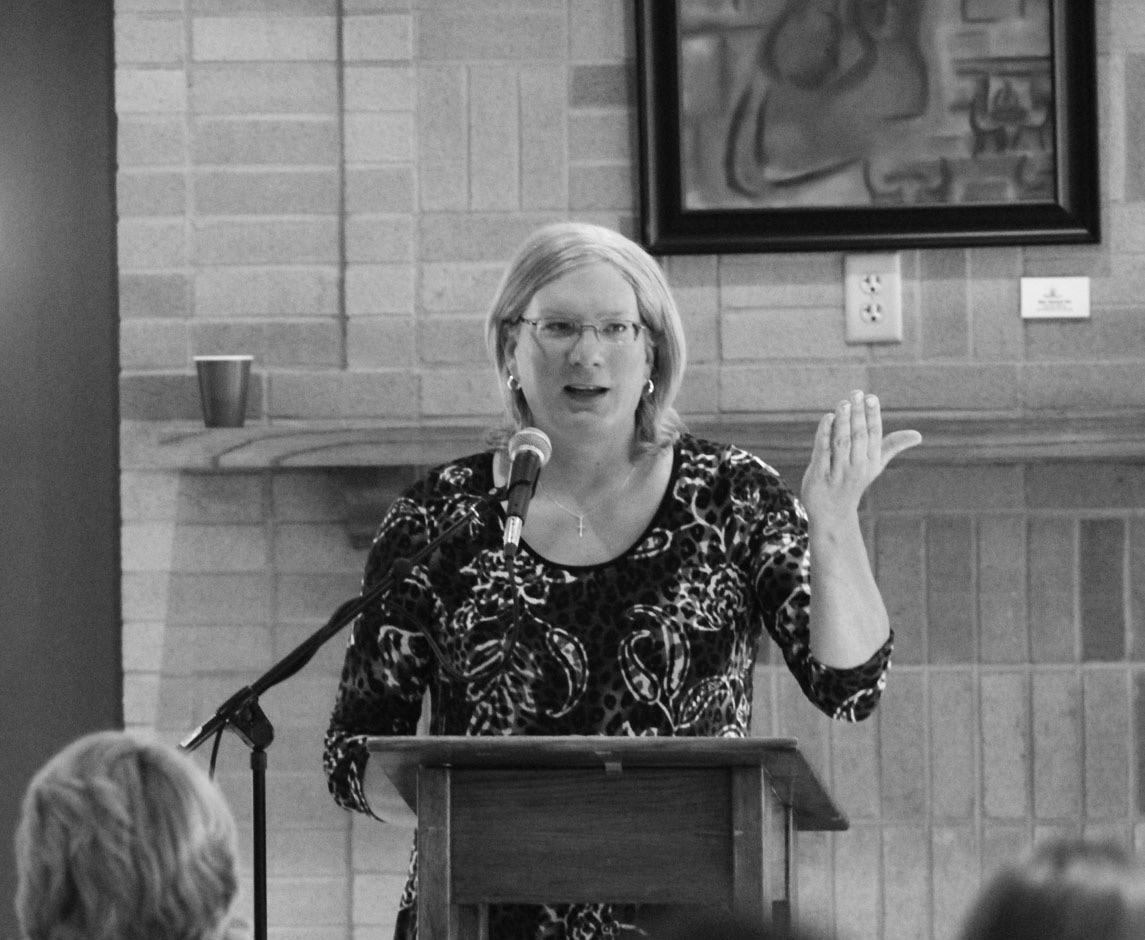
saint mary’s department of gender and women’s studies and the psychology department hosted meghan buell, a transgender woman, who shared her experiences at dalloway’s c lubhouse on wednesday.
buell, who is the founder of Trees, i nc., a non-profit organization that brings education and resources about trans issues to small towns in the m idwest, said she grew up in a small town in i ndiana and she spent 35 years struggling with
see buell paGe 7
Exhibition raises suicide awareness
By SELENA PONIO news writer
eleven hundred backpacks scattered across south Quad wednesday held a heavier message than the book weight they usually carry.
The backpacks were a suicide awareness exhibition called “send silence packing,” and each one represented one of the 1,100 college students who commit suicide each year. The exhibition was a collaborative effort between active minds, a non-profit organization, and the notre dame’s national alliance on mental illness club (nami-nd).
each backpack acted as a small token of remembrance for one
of the lives claimed by suicide. sophomore courtney Koch, a member of nami-nd said she hoped this display would act as a conversation-starter on campus and convince students to ask more questions about mental health.
“mental illness is a legitimate health issue and should be treated with the same amount of seriousness as we treat physical illnesses,” Koch said. “it’s not just something that should be pushed off to the side.”
nami-nd president junior Katie paige said the planning process for the exhibition started at the end of last spring when the club received approval from active minds. paige
Sandy Hook teacher stresses power of hope
By ANDREA VALE news writer
Kaitlin roig-debellis, a teacher present during the december 2012 shootings at sandy hook elementary school, spoke wednesday night in the hesburgh library about how hope helped her overcome her experience, found
a non-profit and publish a book in the wake of the shooting. despite the grim events that acted as a catalyst to roig-debellis’ talk, her words were optimistic and encouraging.
“your perspective determines how you react or not to every situation in your life,” roig-debellis said, “you have the choice. you alone
have the power … it will make the impossible feel possible.”
roig-debellis described the events and choices that molded her life, from her adoption as an infant to her first teaching job at sandy hook — all of which involved “the balance found in life. There are highs and lows, there is good and bad found on any one day, in any
one moment.
“both are always present,”roigdebellis said. “it is a choice which to focus on.”
roig-debellis said during the shootings, her choice became one between life and death for herself and her 15 first-grade students. she said she ushered her students into a tiny bathroom, and together they
hid in silence as gunshots rang out.
“For myself the only decision that needed to be made was, ‘do i want my students and i to survive?’” roig-debellis said, “The only answer to that was yes. … what i was asking them to do must have sounded impossible. our see bacKpacKs paGe 7
see sandy hooK paGe 4
MONICA VILLAGOMEZ MENDEZ | The Observer
Megan Buell, a transgender woman and found of Trees, Inc., speaks at Dalloway’s Clubhouse at Saint Mary’s College on Wednesday.
SUSAN ZHU | The Observer
Group discusses Dorm Week, Design for America
By MEGAN VALLEY news writer
student senate met wednesday night to talk about dorm week and to learn about human-centered design projects on campus currently being carried out by notre dame’s chapter of design for america (dFa).
The meeting opened with a discussion about the first-ever dorm week, which took place last week. several senators criticized the timing of the event, both in the year and the day. mcglinn hall senator christina murphy and howard hall senator amy smikle both said dorm week could be improved by hosting it at a different point in the year.
“i think fall, especially football season, is a really busy time for a lot of people and they have to prioritize what they want to do,” murphy said. “i know we did it because of the weather and all the outdoor activities the dorms wanted to include, but i think we could look at doing it another time when people have more opportunity and desire to look for things to keep them busy.”
“during the day it was a little early,” smikle said. “For people who have late classes and for people who get out of class and want some down time and don’t really want to go straight from class straight to go dunk someone or go to a cookout, i think it could be beneficial to move it later in the day when people are trying to procrastinate homework or are coming back from dinner and see something on the quad.”
several senators also lodged complaints about communication on all fronts. badin hall senator alexandra Fincher said some hall presidents felt they were not given enough time to come up with events, while pangborn hall senator Taylor still said issues communicating with the student activities office led to the cancellation of pangborn’s karaoke event because the speakers were never delivered.
carroll hall senator ryan heard said a possible miscommunication prevented carroll from fully participating.
“Technically, carroll is on south Quad, but i don’t think we were included on south Quad festival day,” heard said. “carroll just didn’t
really do anything at all for the entire dorm week. so next year if we could get included on south Quad, that’d be great.”
after the dorm week discussion, John wetzel, a leader of the dFa chapter, led the student senators in a workshop on human-centered design. The workshop took senators through dFa’s project at notre dame to reduce food waste in the dining halls.
wetzel said the dFa model was a good example for the senators to adopt when solving problems in student government.
“The human system, such as a government or a university, requires a little bit of a different process than a mechanical, biological or financial system, when you’re addressing the problems that are faced by those communities,” he said. “They’re very contextual, so you need to know what’s going on in your dorm and in the specific population you’re looking at and targeting, or within the university as a whole.”
Contact Megan Valley at mvalley@nd.edu
Nuns examine life of archbishop cartographer delivers address for digital week
By BECKI JEREN news writer
sister amy cavender and sister patricia ann Thompson held a conversation wednesday at saint mary’s about their may 2015 trip to san salvador, el salvador, to attend the beatification of a rchbishop oscar romero. The two nuns shared stories and insights from their experience, along with pictures they took during the trip.
cavender said prior to the trip she had “never dreamed of going to the beatification.”
she said catholic relief services — a nonprofit organization whose mission according to their website is to “assist impoverished and disadvantaged people overseas” — made the trip possible by providing them with hospitality and accommodations.
cavender and Thompson both spoke about romero’s life and provided background on his various works and accomplishments that contributed to the decision of the church to beatify him. romero was appointment archbishop of san salvador in 1977 because he was seen as a “safe choice,” cavender said.
during the 1970s, violence and murder began to escalate in san salvador, and following his appointment, romero “became more confrontational … very outspoken about social justice,” cavender said.
romero was shot to death while saying mass in 1980 for being an outspoken advocate against the injustice happening among the
poor and repressed in el salvador at the time, cavender said, and is seen as a martyr for his faith. concerning the beatification ceremony itself, cavender said “people came from all over the world, [the ceremony] was very well done, very well organized.”
more than 100,000 people gathered to witness his beatification, she said. she and Thompson said volunteers turned out in great numbers to help distribute water to the attendees.
“i am impressed by [the promise] of el salvador’s future,” cavender said of the volunteer work she observed.
cavender and Thompson said over the course of their travels, they also visited the chapel of the divine providence hospital where romero died, and his home, which was turned into a museum in honor of him. a lthough romero was a diocesan priest, he resided with Jesuit priests for many years, they said.
“he took the notion of living in simplicity very seriously,” cavender said.
she said she and Thompson visited the monseñor romero center at central a merican university — which is run by the Jesuit priests — and the metropolitan cathedral of the holy savior in san salvador, where romero is buried.
“[romero] remains a source of inspiration and empowerment for many people,” cavender said at the end of the talk.
Contact Becki Jeren at rjeren01@saintmarys.edu
By MAURA MONAHAN news writer
it’s an exciting time to be a cartographer.
Tim wallace, a graphics editor and cartographer for the new york Times and ph.d. candidate in geography at the university of wisconsin-madison, delivered the keynote speech, titled “newsroom geography,” at notre dame’s geographic information systems (gis) day. The speech, given wednesday afternoon in carey auditorium at hesburgh library, was part of notre dame’s second annual digital week and explored the design process and applications of cartography in journalism.
gis day is an “annual salute to geospatial technology and its power to transform and better our lives and the lives of those around us,” according to the center for research computing’s website.
wallace said his design process is influenced by the belief that the best graphics are those that facilitate reader comprehension by making complex stories accessible.
“a really good graphic will immediately give you the story,” wallace said. “you don’t want to overburden or overwhelm your reader. a good principle that i work with would be, ‘how can
i strip this down, or design this thing, so that the person who i’m communicating with knows what i’m talking about immediately and fully understands the concept that i’m trying to convey when they finish reading it?’”
in reports of investigations of disasters, such as the malaysian airlines flight that disappeared in 2014, wallace said geographical graphics can be especially useful in transmitting complex data to readers.
“people were really craving information when flight mh370 went missing,” wallace said. “we’re always looking for reliable data to show what’s happening, and it doesn’t always come in a very friendly, mapping-ready format. we have to find the pattern in the data, the signal in the noise. we find the visual to support the story.”
comparative geographic visuals also help to make areas all over the world accessible to readers, especially through graphical juxtaposition of familiar locales with distant ones, wallace said. interactive maps, he said, are a favorite of readers because they allow sophisticated spatial mapping of information, such as chronological maps that show stories visually developing in time. advancements in technology have transformed the industry, as mapmakers can now use
paid a dverT isemen T
more precise data and more high resolution satellite imagery than ever before.
“i would say that nowadays we are experiencing ‘geo heyday,’” wallace said. “if you compare it to past times — people have always been making maps and doing geography, but the tools for visualization have changed.” cartography at the new york Times has been impacted by recent trends toward readers consuming news online rather than in print, he said.
“one of the foremost things we think about when we’re making our maps is not just to show the geography but also to think of the scale of the display that people are consuming information on,” wallace said. “more recently in the last few months we have started creating graphics that are really designed to be mobile first.”
wallace said he was excited about the possibility for geographical content to continue to create and support journalistic storytelling on the cutting edge.
“nowadays, it seems like the sky’s the limit. we can do a lot with interactive data. we can do a lot with colors,” he said. “but maybe we’ll find over time that that sky wasn’t the limit.”
Contact Maura Monahan at mmonaha@nd.edu
classroom bathroom was a threeby-four foot space.
“ ... we stood there huddled, squished like sardines, listening to the sheer horror of what was happening on the other side of the cinder block. pure evil reigned. my students looked up with me with pleading eyes and said, ‘miss roig, i want to have christmas this year,’ ‘miss roig, i want to have my mom,’ ‘miss roig, i don’t want to die today.’ i said, ‘i know, it’s going to be all right.’
“i did not think it was going to be all right … and so in that moment that i was sure was going to be our last, i told my students how lucky i was that they were in my class, how happy i was to be their teacher and that i loved them all very, very much. i wanted something positive to be the last thing they heard.”
Following the shootings, roigdebellis said she struggled with a loss of independence as a result of trauma.
“i couldn’t go anywhere in public. ... i couldn’t be in the dark. … it was infuriating,” she said. however, roig-debellis said in choosing hope, she was able to
Andrea Vale at avale@nd.edu s
begin the healing process through starting a non-profit and penning a book.
“instead of focusing on questions that i was never going to answer, i had to focus on the ones that i could,” she said, “and in focusing on those questions ... it gave me renewed hope because it gave me a purpose.”
as gifts poured in for the sandy hook survivors from across the world, roig-debellis said her class responded by sending gifts to an elementary school in Tennessee, who in turn sent white boards to a class in arizona.
From this pattern roig-debellis said she founded classes4classes, a non-profit that aims to “actively engage students in learning a social curriculum through the exchange of gifts with other K-8 classrooms, which fulfill a need or vocational objective,” according to its website.
“i am an ordinary person. i am a teacher, i am a wife, i am a runner, i am a survivor,” roig-debellis said. “i am just like you. … i am somebody who made a choice that what could have been unbearable wasn’t going to be. we each have that choice.”
along with the map and app’s other functions, g inocchio said.
“ n otre d ame has invested in the nd mobile app, which most of us have on our phones, and there is a tour module on there that n otre d ame hasn’t deployed, hasn’t used, so the idea is solicit the creativity and innovation of students to create those tours that eventually will be available to visitors and really anyone,” g inocchio said. “ we all have an opinion on what to see at n otre d ame and we all have different, interesting opinions on what to see because we are blessed with such a beautiful campus.
“ s o it was really those ideas coming together, and the administration wanting to sponsor [this event].”
g inocchio said the chal -
“You know, a lot of people visit Notre Dame, they aren’t neccesarily here for football weekend or for an admissions tour. They are here because they are passing through, or they are a friend or family member of someone who goes to Notre Dame ... ”
Don Ginocchio University Alliances Director SAP
lenge asks students to create a tour that is thematically linked, easy to follow and innovative.
“ it could be a theme around spiritual sights, architectural sights, athletic sights, prospective student sights, what a prospective student would like to see,” he said. “The idea of the contest is to engage students in educational and fun experience that exposes them to technology.”
The deadline to enter a tour proposal was s ept. 21, g inocchio said. a committee will review all the entries, and on s ept. 25, the top 10 entries will be announced.
“The judges are the allstars of the n otre d ame leadership,” g inocchio said. “ we wanted to involve all the communities that have an opinion: athletics, game day operations, communications, admissions and alumni. it’s a really nice way for the different stakeholders and constituents in the university to come together.”
a ccording to g inocchio, there are 13 judges, including Joyce l antz, director of r ecruitment
and c ommunication for undergraduate a dmissions, Julie b oynton, director of i nterior a rchitecture and p atrick Flynn, professor of computer science engineering and electrical engineering.
g inocchio said after the university announces the top 10 entries, the winning teams will create their tour. The students will have to create a video to accompany each tour stop, along with a paragraph that explains the significance of each stop and a picture of each stop on the tour. o nce students create these videos, they will be placed in the tour module in the nd mobile app.
The entries will then be judged again, and on n ov. 6, the judges will choose top five tours.
g inocchio said the tours will go live on the nd mobile app on n ov. 13.
“ we don’t have and probably will never have a lot of signage on campus,” he said. “ w hat’s nice about technology is that it provides a nonintrusive way for those that have an interest to access all that information and decide what they want to see. we want everyone to appreciate n otre d ame the way we do.”
g inocchio, who is on the judging committee, said the committee will consider fan and user feedback when evaluating the tours and choosing the winners. The winners will be announced on d ec. 1.
“There will be four winners. First place wins $2500, second prize is $1000, m odo labs, who is the vendor for the software is providing another $1000 prize, and sap will provide sap merchandise to one of the winners,” g inocchio said. “The committee did talk, and if there is another really great idea at that time we’ll evaluate if there is something we can do for that team, at least recognize them in some way, including just asking them to help us implement their tour, which is recognition within itself.”
g inocchio said the challenge aims to educate students in a fun and interesting way about technology and also help the university improve the visitor experience.
“ you know, a lot of people visit n otre d ame, they aren’t necessarily here for football weekend or for an admissions tour,” g inocchio said. “They are here because they are passing through, or they are a friend or family member of someone who goes to n otre d ame, or they’ve always wanted to visit n otre d ame or they saw the movie r udy, and, you know, they want to see those sights. This will help them do that.”
Contact Jenna Wilson at jwilson@nd.edu
reverse culture shock
you’d think i ’d be used to it by now. a s a junior, i should expect and accept the late nights writing papers and studying for exams. b ut as a junior returning from abroad, accepting the late nights and study culture has been a lot harder than i imagined. b efore you go abroad, people always warn you about the culture shock you’ll experience when you get to a new country. w hat they don’t prepare you for is how the country you called home will turn into a culture you’ll never be ready to return to. m y time in r ome was the most amazing experience of my life. i n my 102 days abroad, i traveled to eight countries and made memories that will last a lifetime. To keep those memories alive, during my many hours of procrastination i go back and read all of my blog posts from my travels. The exposure to so many new cultures and experiences inspired me to write detailed descriptions about how i felt and what i saw on some of my weekend trips. i t was a time for me to reflect and absorb everything around me through writing, the one way i can absorb my thoughts and experiences best.
a s much as i missed life at s aint m ary’s, nothing could prepare me for the shocking amounts of work and responsibility waiting to swallow me whole. i t’s a huge lifestyle change to make in a short amount of time, especially when weekends that once consisted of plane rides to new countries now consist of studying and an endless flow of papers ( e nglish and c ommunication major problems). a lthough it usually makes me sad, one of the beauties of my procrastination problem is discovering new ways to handle culture shock from reading my travel blog.
h ere is one passage i always return to whenever i can’t cope and feel like losing hope:
“ i ’ve never really been a person who enjoys having a routine or a strict schedule to follow. i ’ve always kind of gone with the flow, taking whatever life throws at me. To some, this quality may seem irrational or unstable. To me, i ’ve realized it to be a quality i ’ve recently discovered about myself and want to embrace more and more. i love embracing change. c hange makes me stronger, helps me live a happier lifestyle, teaches me to embrace positive thinking, opens my eyes to the huge world around me and eliminates boredom and regret from what-ifs.”
i t’s ok to miss my life abroad, but i have to take my own advice and embrace the changes life throws at me. a fter all, change is inevitable. a lthough my culture shock and assimilation back to the s aint m ary’s lifestyle has been difficult, i would never wish to rush my time here. s aint m ary’s is my home, even with all the work that comes with it. i n the end, the changes i face will only make me stronger, and i am so ready to embrace every moment of it.
Contact Alaina Anderson at aander02@saintmarys.edu
The views expressed in the Inside Column are those of the author and not necessarily those of The Observer.
What’s good?
Women supporting women
it could have been a comedy: celebrity n o. 1 dishes about celebrity n o. 2 in an interview; celebrity n o. 2 calls out celebrity n o. 1 on live television (with celebrity n o. 3 cheering in the background); a merica celebrates.
e xcept it was the vma s (which could be classified as a comedy based on the outfits), and celebrity n o. 1 was m iley c yrus and n o. 2 was n ikki m inaj (and n o. 3 was r ebel w ilson in a cop costume, looming in the background). Two women in the same industry lopping at each other’s hamstrings while a third revels in the drama. a nd how many of us — me included — walked around for the next few days tossing out “ m iley, what’s good?” like spitballs?
we encourage this kind of catfighting because on some level it’s satisfying to watch. i t’s a familiar trope that’s fun to laugh at. e xcept this continues in real life, beyond red carpets and spotlights. Time and again, we hear of women — especially women in power or competition — going for each other’s throats. a nd we laugh.
o r at least, we’re supposed to. That’s why, despite increasing disgust over its polarizing content, we still have shows like “The v iew.” b ut the four hosts may have finally overstepped their boundaries by attacking a m iss a merica contestant, Kelley Johnson, who’s also a nurse. “ w hy does she have a doctor’s stethoscope around her neck?” jeered host Joy b ehar, who in addition to coming across as profoundly stupid angered medical professionals across the nation.
Fortunately, nurses and their allies took to social media to put “The v iew” back in its place. l ike many traditionally female occupations, nursing is often the object of misunderstanding, condescension and ridicule. b ut coming from other women, this double standard stings even more. we can comfort ourselves knowing how much we hated “The v iew” anyway and how we’d never ever say anything like that about nurses. b ut how many of us can say we genuinely respect all the other m iss a merica contestants who get torn to shreds on social media and don’t have a greater community to fall back on?
The problem bleeds into more serious avenues, too. women join the ranks of those who swear that
famous athlete X couldn’t possibly have raped that girl; she’s a liar, she’s trashy, he’s innocent. w hite feminists disregard the damage we’ve caused by prioritizing ourselves over women of color, prolonging and even deepening the rut between the privileged and underprivileged that we’ve sworn to bridge for ourselves. a re we so afraid of losing the respect and opportunities we’ve gained that we’re unwilling to share the spotlight, even with each other?
i don’t feel sorry for m iley c yrus, i don’t think n ikki m inaj received or made any serious damage and it’s pretty clear that Kelley Johnson and her fellow contestants will be just fine. b ut when women who don’t support each other get more attention than women who do, our efforts for equity and respect are undermined. w hen we aren’t our own best friends, how can we expect to find allies? h ow can we say we’re moving forward when we’re clawing over each other to get there? a nd if we’re not — if the rest of us are taking the high road and lifting each other up — why are we encouraging our most public representatives to behave this way?
The women of n otre d ame and s aint m ary’s are in a unique position to live out this commitment of support across boundaries. i n our references to and interactions with each other, we can choose to treat each other not as opponents but as components of the same community. i n the face of so much work to do — combatting sexual assault, eliminating the wage gap and shattering that glass ceiling, to name a few — we’ll be our own best friends if we can be each other’s allies. o ur interests as women and as people in this community rely on securing the best interests of our neighbors. That mentality can make a difference. s o don’t sneer at a woman’s career or lifestyle or outfit. d on’t dish out cheap insults to those who aren’t around to spar back. d on’t defend or subscribe to stereotypes. a nd don’t cheer when women in the spotlight tear each other down. i nstead, demonstrate what we demand from others and show other women — all other women — the dignity we expect for ourselves.
That’s what’s good.
Jennifer Vosters is a senior living in Le Mans Hall. She is an English major with minors in theatre and Italian. She can be reached at jvoste01@saintmarys.edu
The views expressed in this column are those of the author and not necessarily those of The Observer.
Alaina Anderson news writer
Jennifer Vosters bellev iew
Where
For all my international student friends who cannot be with their families during m id- a utumn m oon Festival this s unday.
For all my friends who are experiencing cultural shock.
For all those who are struggling to blend in and to find a home and to those who are still trying to find, accept and appreciate who they are and who they are becoming. (pronounced ku-hsiang)
noun
The place where you were born and where you die (translated by Jenny n g).
“ i have been away from for two years now, and i don’t think i will ever be back again.” i explained to a freshman girl from v ietnam, who was sobbing and telling me how much she missed home and how hard it had been to blend in n otre d ame.
“a pril, what is ? i s it c hinese? d oes it mean c hina?”
“ n ot really.”
“ d oes it mean hometown? Family?”
“ n o, not exactly.”
“ w hat is it, then?”
o ddly enough, i did not know how to put the word in e nglish. yet, this feeling of “ i cannot translate it” is another form of .
i left c hina and came to a merica two years ago. l ittle did i know then that i was embarking on a great journey, a journey of finding what meant to me. a fter 13 hours up in the air in the world of bliss, i landed in reality. Two hours later, i was on an airport shuttle in the middle of an endless cornfield. i was surrounded by a group of people of all colors speaking different languages (most of them i could not understand). i was very much lost, but of one thing i was sure — this place was definitely not home.
d uring my first year at nd, though i was busily embracing exciting new challenges, c hina — the place where i was born and raised — always came back to me in my sweetest dreams: i was standing in the yellow r iver, with my feet deeply buried in the mud of my home country. i was riding a bike along the central line of b eijing, from Tiananmen s quare to the b ird n est, surrendering to the pulse of the city. i was eating the fish my grandma made for me, letting the taste of home cooked meals sink into my body.
m ost frequently however, my dream was not about the beautiful images mentioned above. i t was filled by one motion: i was walking on a path, a path to home, to my .
Then, there i was, at b eijing i nternational
a irport, back in c hina for c hristmas break. i saw my parents waving to me from a distance. i ran toward them and gave each of them a big hug. Quite unexpectedly, my mom put her nose close to my face, sniffed hard and said, “ wow, Feng d an (Feng d an is my c hinese name), you smell like a merica!” i laughed. “ c ome on m om, does it matter?” s he looked at me for a while and whispered, “ n o.” n evertheless, i could see from her eyes and i knew right away. i t did matter. i n the smell of a merica, something about me had already irreversibly changed, without me even knowing it. i was no longer considered full c hinese. i heard a crispy broken sound. The string between c hina and snapped.
i left c hina after two weeks, confused and afraid. u p in the air again, i experienced, for the first time in my life, the feeling of rootlessness. There i was, a tiny person, floating in the sky surrounded only by clouds, flying from one place to another, neither of them my . s uddenly, i was terrified by the journey, by the changes already taken place and yet to come, by the person i was becoming. i had a long conversation with my best friend the first night i was on campus. “ you have to first find yourself to find ,” she said, “and the best way to do so is to travel.”
The following c hristmas break, i spent much time walking around b eijing. i t was the first time that i truly closely and carefully looked at the city, a place where i had lived for 18 years. i climbed to the top of Jing m ountain and admired the Forbidden c ity at sunset, drawing the last ounce of heat from its long day. i tried to discover the old me in the warmth radiating from the jade and golden roof of the splendid royal palace. i sat by the foot of the thick cardinal wall surrounding the Tiananmen s quare and leaned my entire body on it, thinking i would once again feel secured in its embrace, as i had many times as a child. i admired the asymmetry of the cornices of the Temple of h eaven and climbed the sacred staircases in front of it, barefoot, dreaming that i could obtain a feeling of balance as i did before. i walked around the hutongs (narrow streets in traditional neighborhoods in b eijing) and said hello to local people, trying to feel at home again. h owever, the buildings, the people, the colors, the smells — all of them became so strange, so distant to me. Though i still appreciated their astonishing beauty, i could only admire them from the perspective of a pril Feng, to whom they were simply b eijing, not . i did find myself, but only part of it.
i was up in the air again. i n the dimly lighted cabin, i could not stop thinking about my experiences in b eijing, again and again, until it occurred to me that neither c hina nor a merica would ever be for me. i t is never a real
“ Inside myself is a place where I
and that’s where you
concept until you leave it — the moment when you do, it changes from a place to live to a place to miss. m y life had already taken me — through numerous transformations and conversions — to a place i had never been to, and when i turned back, the origin of my journey had already receded into darkness. Forward had become the only choice. i just hoped, secretly but ardently, that i could take a piece of with me.
c hinese n ew year arrived several days after i returned to campus. s ome of my c hinese friends ordered some dishes from g olden d ragon and we celebrated the n ew year in the basement of Farley h all. we talked about those ingredients that one could never get in an a merican supermarket: s ichuan green peppercorns that can make your entire mouth numb, the magical c hinese anise that makes vegetable taste like meat, baby g inseng that can “increase your blood and nourish your vitality.” w ithout these magical spices, s weet and s our p ork tastes like ketchup-fried pork. g eneral Tso c hicken tastes like c hicken m c n uggets soaked in ginger and vinegar water. we joked about the food and laughed very hard. Then, one of my friends said, “ i t is funny. These things will never taste like c hina, but they taste like .” That was the first time i heard the word since i came to a merica. i stopped laughing, cleared up all the complaints in my mind, and carefully tasted the food in my mouth. i t was true. u nder the thick cover of basil, chipotle peppers and allspice, and mixed with all those a merican flavors, there it was, . i t was not a taste of c hina. i t was not a taste of a merica. i t was a mixture of both, like myself, and it was actually quite good. For some mysterious reasons, i felt like meeting an old friend in a new world. i will never forget that taste. i t represents something to me.
Two days after the new year dinner, i stood in front of a window in o’s haughnessy h all and looked at the golden campus at sunset. i accidentally caught the reflection of my eyes on the window frame and suddenly, i saw it, , more clearly than ever. i found it, finally, in my own eyes, and i understood at last. it is when you stare at yourself, long and hard, when you are no longer afraid of your changes, when you finally forgive, accept and appreciate who you are becoming, that you find o . it has never left, and it never will. it is always with you, every day and everywhere.
Author’s Note: Thanks to Jenny Ng for giving me the best translation of I have ever heard.
Dan (April) Feng is a junior political science and economics double major. She is from Beijing, China and lives in Lyons Hall. April welcomes all comments (or complaints) and can be reached at dfeng@nd.edu
The views expressed in this column are those of the author and not necessarily those of The Observer.
“There
By KELLY McGARRY scene writer
platforms for speaking out against injustice are not uncommon, but the message is never more powerful than when conveyed through art.
Tuesday night at washington hall, the center for social concerns (csc ) hosted two musical acts whose talents provide an outlet to illuminate social issues and call others to action. The musicians traveled from different parts of the appalachian region to share their regional culture and universal message with the community, especially students participating in the csc’s appalachia program. The typical venue for these artists might be a protest or rally, but their performance on a calm evening on notre dame’s campus served as a reminder to remain conscious of social justice issues even in times of peace.
The night began with a solo performance from singer-songwriter Tom breiding who hails from w heeling, wv, one of the sites for the csc’s appalachia
immersion seminar. his performance included many heart-breaking originals that called attention to workers’ rights. a captivating storyteller, Tom gave accounts of the lives of 20th century miners and the abuses they suffered. his lyrics told their stories in a narrative style that emphasized the humanity of the miners and their families. one particularly riveting song “The women and children of ludlow” recollected the horrific ludlow massacre, in which the coal companies opened fire on a tent camp of striking mineworkers and their families. in his lyrics, breiding made frequent references to the united mine workers of a merica, the labor union that sought to protect mine workers in the early 20th century, as it still does today. breiding’s dedication to the rights of workers was obvious in his focused lyrics and passionate performance. a fter breiding’s performance, The emancipators, a Knoxville-based band that identifies their genre as subversive hootenanny, took the stage. The
emancipators derive their name from an abolitionist newspaper that was published in Tennessee in 1820. They mention the nuclear weapons facility in their hometown — the same facility that produced the bombs that were dropped on hiroshima and nagasaki — as one source of ignition for their activism, among countless other issues. The ensemble included guitar, bass, banjo and even flute and took an entertaining angle by passing out lyrics and asking the audience to sing along. The group consisted of mitzi wood-von mizener, guy l arry osborne, durant Thompson and Kevin collins. The members have diverse backgrounds and careers, but come together to create music that promotes peace and freedom. Their setlist included many well-known songs such as the traditional a fricana merican freedom anthem “Follow the drinking g ourd.” Their rendition of “w hich side are you on?,” played on banjo with all members gathered around a single microphone, reflected the belief that there is no neutral ground
when it comes to issues of justice, and every person is responsible for making a choice. singing along to well-known songs brought the audience together, but The emancipators also delivered a powerful performance of original songs. one upbeat blues original “There’s work to be done” was a call to action that warned “you might go to jail, lose a job, or a friend,” but nevertheless addressed a huge array of issues.
The emancipators closed their performance with a rendition of “we shall o vercome” that was particularly moving to the notre dame audience. The experience was reminiscent of Father hesburgh in the famous photograph hand-in-hand with martin luther King Jr. The emancipators asked to audience to link hands in a similar fashion, and join their voices together in hope of freedom and equality across an array of issues.
Contact Kelly McGarry at kmcgarry@nd.edu
By NICK LAUREANO
scene writer
my Film, Television and Theatre classmates know, i have a propensity to interpret everything i watch as a western (even “mad men”). i think i am fascinated by the manner in which westerns use symbols to establish a deep, almost collective mythology. w hite hats, boots with spurs, and six shooters trigger thoughts of a frontier populated with lonely, troubled men who must ultimately use violence in the name of justice. To my classmates’ relief — or hopefully, if perhaps a bit narcissistically, disappointment — i do not believe “mad max: Fury road” is a western.
w hat i love most about “Fury road,” which is playing Thursday through saturday in debartolo 101, is how its richly textured mythology is presented. rather than give much in the way of exposition, “Fury road” simply immerses the audience into its world, no questions asked. consider how director george miller presents the audience with a haggard society under the heel of an ozymandian ruler, whose power comes from his control of the water supply. with just a few delicately framed shots, miller displays the slaves’ conflicting hatred and reverence towards their despot, immortan Joe. look at the tattoos designating max rockatansky’s “crazy blood” as “hi-octane,” which seamlessly blend the film’s dieselpunk aesthetic with miller’s own twisted vision of the future. The most telling detail in this vein is the attention paid to the ceremony of
war. steering wheels to the “war rigs” are stacked and stored in the form of a pyramid, or perhaps a christmas tree. a blind guitarist heralds the arrival of immortan Joe’s war party with piercing riffs from his twin-necked guitar/flamethrower. Just fifteen minutes into “Fury road,” we have an incredible familiarity with miller’s world. “Fury road” may not be a western, but it uses symbols to establish its mythology with the same beautiful economy that characterizes the best westerns.
“Fury road” is essentially a two-hour long, kind of silent, but very loud chase movie. rather than bore the audience, the straightforward story allows miller to showcase his distinctive style. consider miller’s unconventional use of color. many post-apocalyptic movies de-saturate their colors with reckless abandon. These movies — which are practically black and white — often mistake gloom for true depression. (even the instant classic “children of men” indulged in this trope.) conversely, miller hyper-saturates his colors, meaning vehicles kick up sand of the same yelloworange tint as sulfur, and the audience is treated to a turquoise sky rather than the run-of-the-mill grey sky they’ve become accustomed to. miller knows the best method to portray his exceedingly complex story world is with an equally rich color palette. The results are breathtaking. despite the constant on-screen chaos, “Fury road” is shot and edited with supreme clarity. miller and his cinematographer, John seale, wisely refrain from using the shaky cam technique that too many
filmmakers use as a crutch to “heighten” (read: create) tension. seale spends valuable screen time on long shots (the opposite of close ups), which allows the viewer to create a mental map of each scene. lesser actions films skip this step, leaving the viewer at the mercy of an indecipherable barrage of quick cuts, rather than presenting a coherent action scene. miller’s most notable stylistic flourish is his manipulation of the frame rate. he indulges in slow motion frequently, but as an exclamation point at the end of key sequences, rather than a glorification of the violence. more interestingly, miller strategically speeds up the onscreen action at important moments. it accelerates to breakneck speeds when immortan Joe graces one of his disciples with eye contact, or when a mortally wounded “war boy” sprays chromed paint on his face before engaging in a suicide attack, in a deranged cross between seppuku and Kamikaze. This mesmerizing technique has the effect of mainlining adrenaline, and is reminiscent of the “sunday may 11th, 1980” sequence in “goodfellas.” perhaps the most notable aspect of “Fury road” is its protagonist. (spoiler: it’s not max.) The story’s heart and unexpected hero is charlize Theron’s imperator Furiosa. much has been made about the film’s feminist undertones, with critics singling out scenes in which Furiosa seems to be an even better warrior than Tom hardy’s max. similar themes were present in the summer’s second-best blockbuster, “mission impossible: rogue
nation.” w hatever your stance on the feminist movement in action films, there’s no denying that tough, emotionally charged performances like Theron’s deserve a universal audience.
“Fury road” isn’t a flawless film. The end of the second act seemed clichéd on first viewing. one character makes a devastating realization, consequently walks off into the desert alone, and collapses; all while the orchestral score is cranked up to eleven. but to be honest, the second time i saw “Fury road” i didn’t care that this scene may be trite. i was so emotionally invested in the lives of its nearly tacit characters that this admittedly inorganic flash of melodrama felt somehow earned. ultimately, “Fury road” is something of a paradox. it’s a gloriously dense portrait of a wonderfully straightforward story. it’s a piece of popular, mainstream entertainment that shatters decades-old mainstream conventions. it’s a bizarre miracle. even though academy award winners Quentin Tarantino, a lejandro iñárritu and charlie Kaufman are slated to release pictures in the coming months, you’re unlikely to see a better movie this year than “Fury road.” movies like “mad max: Fury road” are why i go to the movies. oh what a film! w hat a lovely film!
“mad max: Fury road” is screening in debartolo 101 Thursday at 8 p.m, Friday at 8 p.m. and 10:30 p.m. and saturday at 10:30 p.m.
Contact Nick Laureano at nlaurean@nd.edu
By MATT McMAHON scene writer
The late ‘60s girl group The shaggs is the most contentiously debated band you have never had the pleasure (or displeasure, depending on who you ask) of hearing. e xperimental musician Frank Zappa has said they are “better than The beatles.” Kurt c obain praised their sole album “philosophy of the world” as his fifth favorite album of all time. music writer l ester bangs argued the same album was one of the landmarks of rock ’n’ roll history in his provocative, if ostentatious, 1981 article in The v illage voice named after Zappa’s assertion. yet, if you actually listen to the band’s recorded tracks off the album, you are greeted by what sounds like the atonal improvisations of a group of kids getting their hands on their parents’ unguarded instruments. The vocals are chanted erratically, the drums follow no deceivable path and the guitars sound woefully out of tune. rolling stone writer c hris c onnelly wrote “‘philosopy’ may stand as the worst album ever recorded.” nevertheless, The shaggs have been repeatedly covered, and their story is so bizarre that the band was the subject of a recent off-broadway play, which used all original music save for the title cut from “philosophy.”
The shaggs were composed of the four w iggin sisters: dorothy and betty both on vocals and guitar, helen on drums and r achel on bass. The band formed, as the story told by journalist susan orlean goes, after the girls’ father austin w iggin Jr. began to see his palmreading mother’s foretold fortunes about his adult life coming true; her biggest prediction was that his daughters would play in a band. a s a result, austin bought his daughters instruments, pulled them out of school and set a rigorous schedule for them to practice daily and perform at their small new hampshire town’s community hall.
The shaggs wrote simplistic songs musing about the little things in their life that they were exposed to enough to write about: losing pets, praising parents, exuding kindness, futile daydreaming. The lyrics are often just as odd as the music played over them. strangely, though, the sentiment behind simple lines like “There are many things i wonder / There are many things i don’t / it seems as though the things i wonder most / a re the things i never find out” are poignant and lasting. so lasting, as a matter of fact, that the band’s straightforward way of writing songs has seen a huge resurgence in the past couple of years.
The landscape of music has never been as fertile with similarly minded confessional bedroom punk, noise rock and folk from budding female artists,
not entirely unlike the w iggin sisters, as it is now. These young musicians are effectively recontextualizing and giving clarity to The shaggs impenetrable work and, not to overstate at all, justifying their utter adolescent existences.
The band most inspiring this spiritual connection is girlpool, a stripped back punk duo with a penchant for raw instrumentation and emotive harmonies. The project, helmed by c leo Tucker and harmony Tividad, combines repetitive guitar riffs with sing-talk vocals that pierce straight to the heart of their lyrics. “i was taught what to believe / now i’m only certain that no one is free / Tranquilize me with your ideal world,” Tucker and Tividad shout in unison on “ideal world,” seemingly reading from one of the w iggin sister’s diaries a few years after “philosophy” (which concludes “we do our best, we try to please / but we’re like the rest we’re never at ease / you can never please anybody in this world”).
l ike The shaggs that came before them, girlpool peers Frankie c osmos and palehound, two solo-effortsturned-full bands, originated covering concise, childlike topics like school, pets and loneliness — all of which are not mutually exclusive. The opening track to Frankie c osmos’s 2014 affecting debut “Zentropy” is The shaggsesque “a rt school.” “h igh school makes you crazy / h igh school made me cry,” lead singer greta Kline reverberates. on an early take, the production is lo-fi, the guitar sounds cheap and the recording buzzes from being taped in the close quarters of her bedroom, which she portrays in the song’s music video while dancing alone to Justin bieber’s “baby.” e lsewhere on “Zentropy,” Kline writes a touching ode to her passed dog by way of “sad 2,” echoing The shaggs’s own “my pal Foot Foot.” Kline’s tribute to her best friend features a wealth of tugging two to four line verses, ending with the most vivid expression, “i just want my dog back / is that so much to ask? / i wish that / i could kiss his paws.” The shaggs’ footprints can be seen and heard all over the sentimental track, especially considering “my pal Foot Foot,” which features a very similar verse in “Foot Foot, where can you be? / Foot Foot, why won’t you answer me?... w herever you are / i want you to come home with me.” palehound’s contribution to this sub-sub-genre that i’ll cheekily call “pet sounds” comes in the form of “pet carrot.” her debut single, “pet carrot” has e llen Kempner hauntingly harmonizing with herself “i’ve got a pet carrot / my best friend is a parrot” over deep twanging folksy grunge. The vocals and abstractions harken back to “Foot Foot” as much as Kline’s direct style. still, a lot of the forces behind this
strange revival are coming from more straight punk acts. a fter all, The shaggs resided at the intersection of pop and punk; their songs were attempts at pop structures, but not being able to play the instruments is one of the main ideas behind the origins of punk rock. e xamine for instance the 17-minute, 8-song album “papa c remp” by c herry glazerr, another contemporary of girlpool and Frankie c osmos. on “Teenage girl,” the punk act juxtaposes images of girlhood with the reflection “i nternalize so much but so little / don’t make us feel belittled / world.” a lmost exaggerating the style, they dedicate an entire line in a quick moving minute-and-a-half-song to one gigantic yet suffocating word: “world.”
This fascination from many of the aforementioned acts speaks to the universality of what could otherwise be perceived as acute introspections or excused as overly simplistic. The shaggs, in their quirky lyricism that itself verged on the overly simplistic, have shown that brevity can no less make a lasting impact, in no short part because of the ease of relatability and individual extrapolation.
g etting a bit more dense, speedy ortiz’s recent single “swell c ontent,” a bruising rush of garage punk about writer’s block, doubles as an allegorical embracement and kiss-off — simultaneously — of first time immature relationships, romantic or otherwise. i n the first of a series of escalating diatribes, lead singer and guitarist s adie d upuis admits, “i have been rejected for semesters at sea,” recalling an unreliable college relationship that ended at the prospect of exploration abroad.
meanwhile, the song’s recently released music video recalls an even more youthful expression for the complicated and often times suppressed range of teenaged emotions: summer camp. The short explores finding yourself in the rough, but open, environment of a typical day camp or sleep-away camp, with help from the buck’s rock performing and c reative a rts camp — where d upuis attended and worked as counselor, advising, among others, palehound’s e llen Kempner. speedy ortiz’s loose yet controlled playful style, teetering on falling apart at any second, here is empathetic to the sorts of lasting experiences The shaggs presumably never had the chance to be a part of, having spent their days and nights practicing for their father. straying a bit farther away from The shaggs, but still navigating in the same musical not quite movement of the past two years, are the more fleshed out but just as personally intimate waxahatchee, m itski and a ngel olsen. a ll three musicians feature tighter backing bands than The shaggs and infinitely more complex
writing, yet they all employ elements of The shaggs searching perspective. Take the rollicking, overlaid drum riffs on waxahatchee’s “<” jarring as much as her heartbreaking croon, “ you’re less than me / i am nothing.” or a ngel olsen’s and m itski’s antique-sounding voices, or their anachronistic, confessional album titles: “burn your Fire For no w itness” and “bury me at makeout c reek,” respectively.
l ikewise, the more fully formed acts Tacocat, potty mouth, Torres, bully, c hastity belt and hop a long, all etching out larger spaces to work in than their claustrophobic ancestor had, are nonetheless similarly indebted to The shaggs’s adolescent meditations. e ach has released a stellar album with some form of gruffness or hard edge in the past year, filling out the teenaged w iggin’s work making sure their sacrifices in childhood were not for nothing. To curtly answer the question posed in the introduction, it’s probably not time to give The shaggs another listen — nor may it ever be. Their described outsider music is still far too atonal and unmelodic to enjoy and with the added knowledge of their background it’s even more difficult to listen to their songs with unbiased ears — it’s near impossible to hear any of the recordings and not feel a tinge of discomfort for their situation at the time.
however, understanding their story and hearing the similarly minded music coming from their over-40-years-theirlatter spiritual descendants makes The shaggs even more essential than when they were originally being hailed as “better than the beatles.” synchronistic, off-kilter artists like girlpool, Frankie c osmos and c herry glazerr are acting like translators, not only for the w iggin sister’s personal worlds, but also for the worlds of all frustrated young women. These young artists are finally putting into music what The shaggs weren’t able to nearly 50 years ago.
i n fact, dorothy w iggin returned to music to release “ready! g et! g o!” in 2013 as the frontwoman of the dot w iggin band. The album is slightly more listenable and as a result a lot less interesting than her work in The shaggs. The plain writing and atonal vocals are still there, but the properly arranged and played instrumentation only detracts from The shaggs’ signature style, or lack thereof. unfortunately, dot just barely missed the burst of the stylistic bubble that would have legitimized and explained her comeback. a s it stands now, though, the continued expansion of said style in the two years since is only lending more credence to The shaggs’ highly contentious contributions.
paid a dverT isemen T
con T inued F rom page 16
and two [Florida s tate on s unday] in the country. i think we think we’re right there with everybody. we’ve only lost one game. 7-1-1 is a great record. There’s a lot to feel confident about.”
To knock off the c avaliers, r omagnolo said the whole team needs to show up and perform.
“ it’s going to take a team effort,” r omagnolo said. “ w hen you’re playing other top-10 teams like ourselves, you need the team to play well. o bviously someone needs to put it in the back of the net, somebody needs to step up sometimes and make that special play. b ut as a team in these types of games, you have to defend well as a team and keep the ball as a team, you have to attack as a team. it’s the team mentality to go out there with kind of a chip on our shoulder saying we’ve got something to prove this weekend.”
m ore specifically, r omagnolo said the game plan starts with the defense and the need to keep an organized shape against a possession-oriented team.
“ i think that v irginia is a team that possesses the ball really well,” r omagnolo said. “ we want to make sure we defend well, we’re organized, we keep play in front of us.”
o nce the i rish get the ball, r omagnolo said the key will be to have an aggressive mindset, while at the same time playing within themselves.
“ w hen we win [the ball, we want] a patience to our attack, but also an attacking mentality,” r omagnolo said.
“ s o that we get out in numbers together and we read
where the space is and we attack space. we have to be dangerous in our attack.”
The n otre d ame offense has certainly been dangerous thus far this season. The i rish are averaging 2.33 goals per game, and even though they were held scoreless against c lemson, they outshot the Tigers, 15-13, and r omagnolo said keeping up that shooting streak is important.
“ s occer’s a funny game,” r omagnolo said. “ you can outshoot an opponent and lose and vice versa. a t the end of the day, i think we created enough chances to win that game. we always want to see even more quality chances, and i think that’s something playing opponents like v irginia and Florida s tate, you might only have six shots in a game like that. it’s not about how many shots, it’s about creating quality opportunities and finishing up on the opportunities that we do have.”
w hile some teams may balk at the pressure of playing the top two teams in the country back-to-back, r omagnolo said the i rish are excited to test themselves against the best.
“[The team] is excited to prove something,” r omagnolo said. “ we’re excited about what we can do in the acc . These are great games to have this early in the season to be able to measure ourselves and see what things we’re going well and what things we need to continue to improve on ourselves so that we can make a great run as the season goes along.”
The i rish take on the c avaliers at 7 p.m. Thursday night at Klockner s tadium in c harlottesville, v irginia.
Contact Marek Mazurek at mmazurek@nd.edu
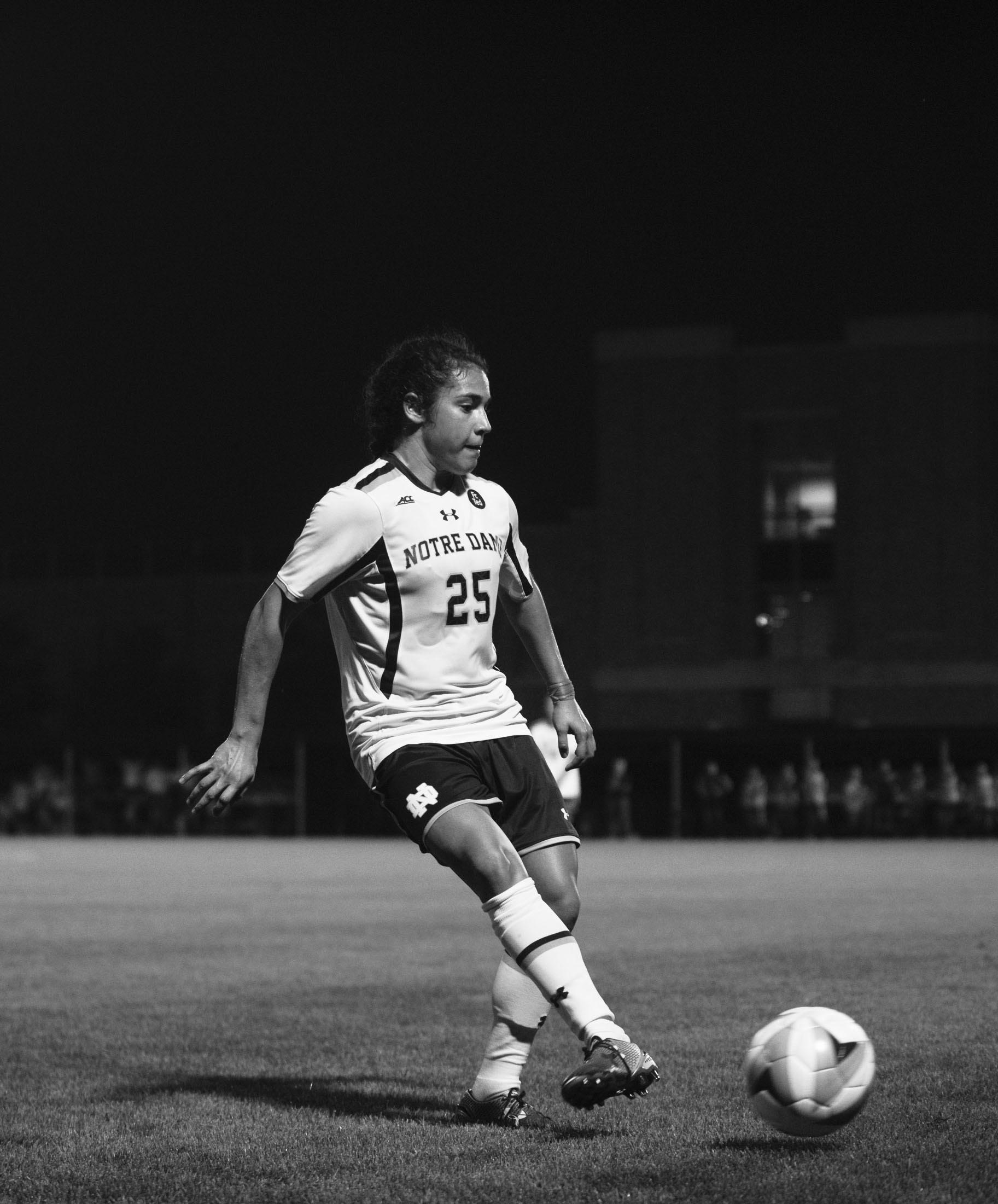
MICHAEL YU | The Observer
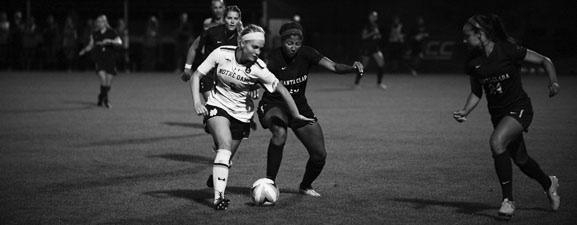
Irish sophomore defender Monica Flores makes a pass during Notre Dame’s 2-1 win over Santa Clara on Aug. 28 at Alumni Stadium. Flores finished the game with one shot on goal.
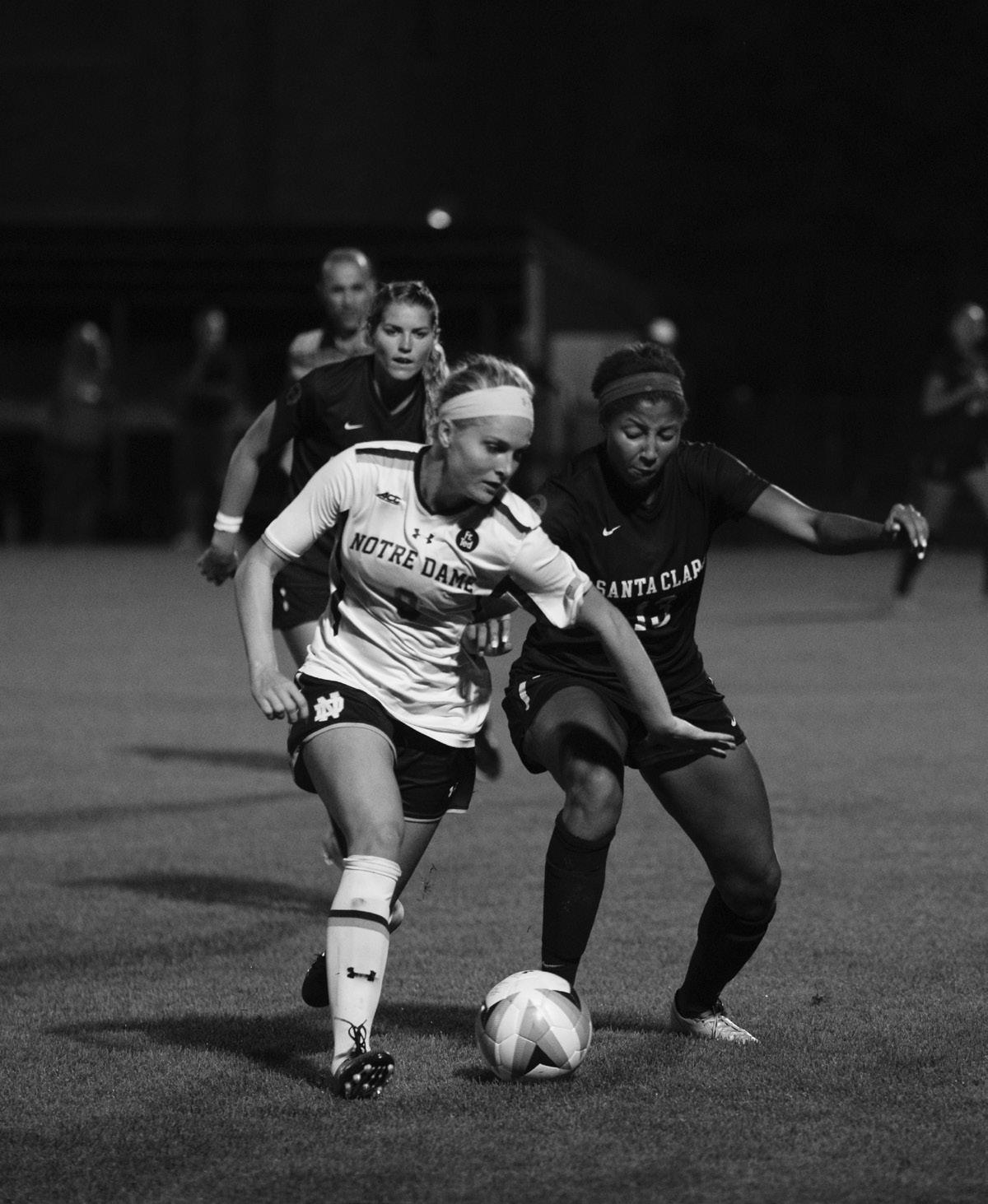
MICHAEL YU | The Observer
Irish freshman forward Natalie Jacobs dribbles past a defender during Notre Dame’s 2-1 win over Santa Clara on Aug. 28.
Naughton
feel for things,” n aughton said. “ b ut over the years, i stepped into that role and now am more comfortable leading, with help from the rest of the captains.”
o ne of her fellow captains, senior defender c ari r occaro, has also been a reliable player for the i rish over her 55 starts, and works with n aughton to protect the i rish goal.
“[ c ari and i ] have played together for several years,” n aughton said. “ s he hasn’t always been on the backline, but through youth n ational Teams and stuff, we have been able to play on the defensive line together.
“That’s helped us develop a chemistry within the entirety of the backline, so we can all be on the same page, have each other’s backs and trust in each other with whatever comes our way. it’s comforting.”
n aughton has competed on the international stage since 2009, most recently with the u s u -20 team. That experience was valuable because it helped her stay in shape and improve her skills for play at n otre d ame, n aughton said.
“The training and the atmosphere of [national team] practice really helped me in the college environment because it’s faster, with all of the best players in the country, and the coaches are always top-notch,” she said. “ you’re always going to get the best of everything, so it’s been really helpful for me coming into the college arena.”
s till, n aughton, like the rest of her i rish teammates, has found herself challenged by collegiate offenses. s he said the top-ranked Florida s tate attack that n otre d ame lost to 3-1 in the 2014 acc semifinals is “pretty unbelievable, probably the best i ’ve seen in a really long time.”
“From that [Florida s tate game], we learned that we have to step up the level of our own game, because to see them kind of run over us was defeating and demoralizing,” n aughton said. “ i f we want to compete on the national stage, we have to be able to keep up with them.”
a fter 2014 ended in the ncaa tournament thirdround loss, n aughton said she had high standards for both the i rish and for herself this season.
“For the team, we definitely want to make the best run that we possibly can,” she said. “For myself, the goal is just to be a consistent player and continue to do my job on the backline and make sure we make the other team pay for sending anything our way.
“There’s always going to be some bumps and bruises along the way, but as a whole
i think we’ve definitely met and exceeded most of our goals so far.”
w ith the 2015 season heating up and a matchup on the road against n o. 1 v irginia on Thursday, time will tell if the senior will exceed 2,109 minutes played this year — a personal high she reached when she was a freshman — while guiding the i rish on a deep postseason run.
n aughton will graduate in d ecember as a a nthropology and s panish double-major and set her sights on the next level of competition.
“ i ’ll be done here in a couple months, which is bittersweet,” she said. “The [ n ational women’s s occer l eague] draft is in mid-January, so we’ll see what happens. i obviously want to play soccer for as long as possible.”
Contact Renee Griffin at rgriffi6@nd.edu
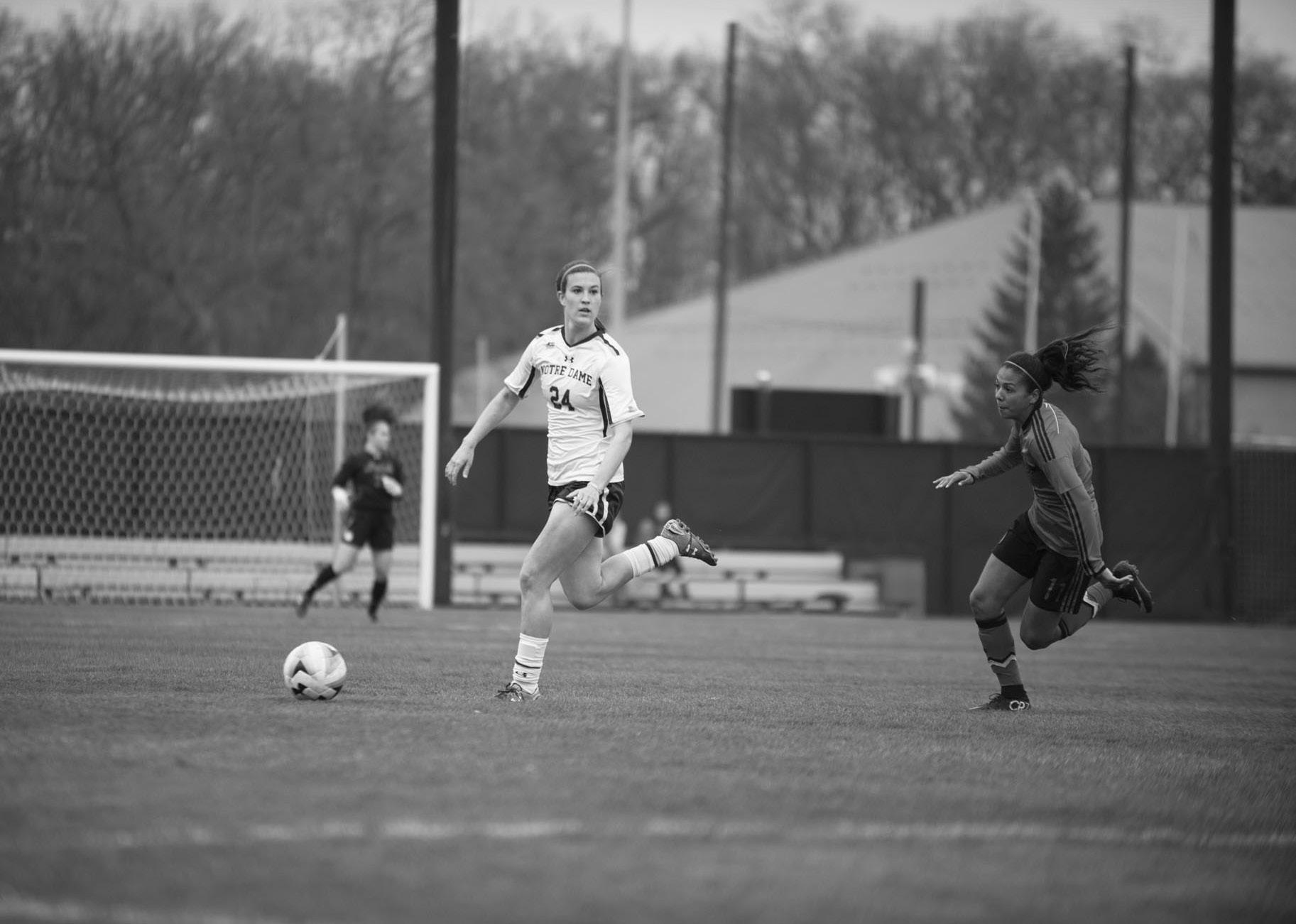
CAITLYN JORDAN | The Observer
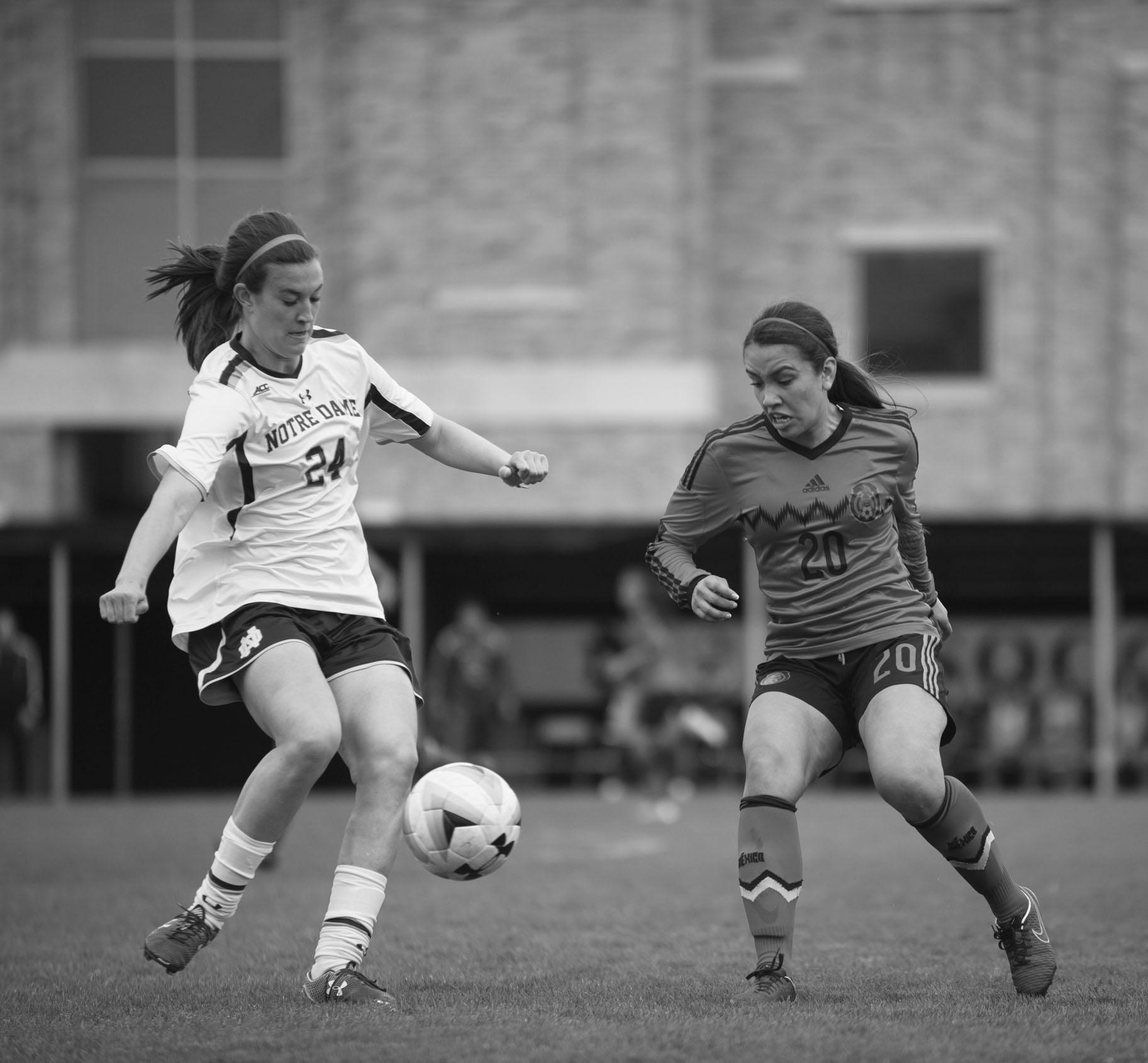
Irish senior defender Katie Naughton looks up the field during Notre Dame’s 4-1 win over the Mexico U-20 National Team on April 24 at Alumni Stadium. Naughton has started all nine games this season.
Happy Birthday: Take one step at a time and make sure you have the approval of those who could potentially cut your progress short. sticking to rules and regulations and being ready to deal with unexpected changes will make the upcoming year an eventful one. your undivided attention will be required in order to achieve the goals you set. your numbers are 7, 16, 22, 25, 32, 39, 41.
ARIES (March 21-April 19): romance will play a major role in your life. discussing future plans with someone you love will bring you one step closer to living the lifestyle you desire. call in favors if it will help you get what you want.
TAURUS (April 20-May 20): e motional issues will ruin your day if you let a squabble turn into a major argument. Focus on doing things for others as well as finding solutions to the challenges you face. g et along and do your best to keep the peace.
GEMINI (May 21-June 20): make plans to have some fun. plan to visit a retreat, conference or destination that will offer intellectual stimulation. l ove is on the rise, and sharing with someone you care for will improve your life.
CANCER (June 21-July 22): draw on your resources and learn from those around you and you will take strides toward accomplishing great things. a n opportunity to discover new philosophies or religions that fit your current mindset will bring you greater clarity.
LEO (July 23-Aug. 22): you’ll be ready to make changes to your appearance, skillset or geographical location. d on’t let someone’s reluctance to see things your way cause uncertainty when it comes to following through with your plans. push forward with strength and courage.
VIRGO (Aug. 23-Sept. 22): make personal changes that will help you build greater confidence. being realistic about what’s possible and what isn’t will be the deciding factor regarding what you end up accomplishing. d on’t waste time on sketchy plans or partners.
LIBRA (Sept. 23-Oct. 22): Keep a close watch over the things you value the most. e motional matters are sure to increase the pressure being put on you by someone you have been questioning lately. a sudden change will play out in your favor.
SCORPIO (Oct. 23-Nov. 21): avoid an emotional confrontation with someone over work-related matters. Try to do a good job and let your work speak for you. it’s o K to do things a little differently as long as the end result is spectacular.
SAGITTARIUS (Nov. 22-Dec. 21): your busy schedule and efficient way of handling everything that comes your way will make an impression on someone special. you don’t have to exaggerate when you’re already doing great work. l ove is in the stars.
CAPRICORN (Dec. 22-Jan. 19): b e open and honest with others, but be willing to walk away if things don’t work in your favor. staying on top of an unfolding situation will give you a good indication of where you stand and what’s to come.
AQUARIUS (Jan. 20-Feb. 18): you’ll have insight into what others want and how to go about making things happen. The simpler you keep things, the easier it will be to strategically position yourself for future opportunities.
PISCES (Feb. 19-March 20): someone will pry into your personal affairs. d on’t divulge information that can be used against you. protect your reputation, assets and your possessions. someone you least expect will let you down or disappoint you. a realistic plan will be required.
Birthday Baby: You are unpredictable, popular and adventuresome. You are unique and persistent.
Nd WomeN’s soCCer
Notre dame readies for No. 1 Virginia
Irish prepare for tough test against Cavaliers
By MAREK MAZUREK sports writer
Facing the number one team in the country is a challenge no matter the circumstances. Facing the top team in the country on the road five days after losing your first game of the season in double overtime a week before is another story.
That is the task ahead of the i rish as they face n o. 1 v irginia on Thursday in c harlottesville, v irginia. Though n o. 16 n otre d ame (7-1-1, 0-1-0 acc ) lost a heartbreaker against c lemson on s aturday, i rish head coach Theresa r omagnolo said the team is staying positive and is excited to move into a high-powered stretch of its schedule.
“ i think we’re excited for the weekend,” r omagnolo said. “ i mean we play number one [ v irginia on Thursday]
smC sports
Naughton brings durability, experience to team
By RENEE GRIFFIN sports writer
i n her collegiate career, defender Katie naughton has recorded 6,900 minutes competing in games for notre dame — and there are still nine matches left in her final regular season.
w ith naughton anchoring the defense, no. 16 notre dame has never allowed more than 20 goals in a season. naughton and the i rish are off to another strong start defensively this year, conceding just four goals over their first nine games. naughton has started every game since the beginning of her freshman year, and 2015 is the third year as captain for the e lk grove v illage, i llinois, native.
“ w hen i first was named captain [as a sophomore], it was a new territory for me, so i was trying to learn the ropes from the upperclassmen and get a
Belles beat Hornets, even conference record
Observer Sports Staff
Volleyball
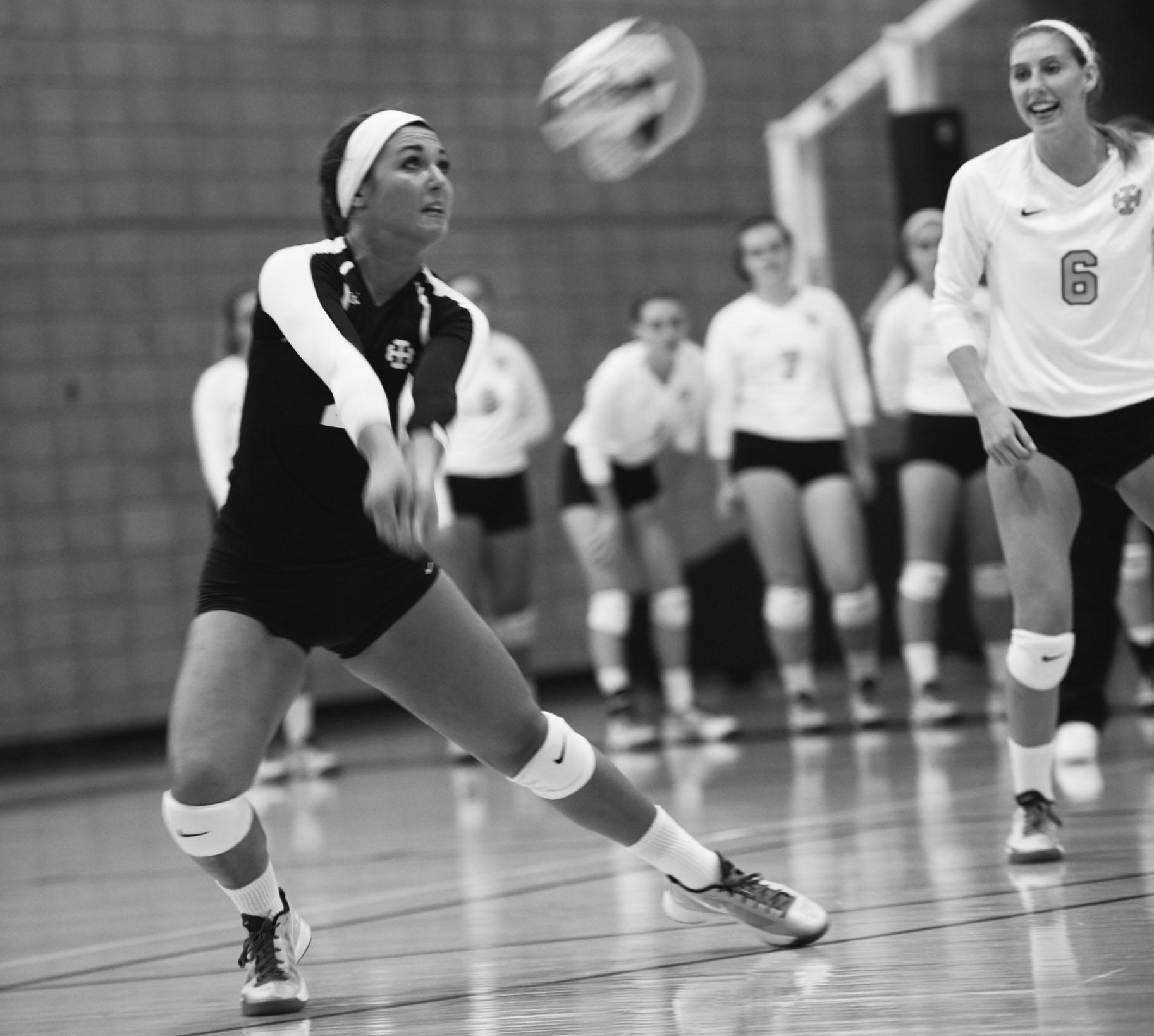
s aint m ary’s leveled its miaa record Tuesday night with a three-set sweep of rival Kalamazoo at a ngela a thletic Facility.
The b elles (8-3, 2-2 miaa ) rode a .390 attack percentage, the program’s highest rate since hitting a .415 percentage against western new e ngland c ollege on o ct. 21, 2008, to a 25-16, 25-15, 25-8 victory over the visiting hornets (1-11, 0-5 niaa ).
i n comparison, s aint m ary’s defense held Kalamazoo’s offense to a .036 attack percentage while piling up five blocks and forcing 17 hornet hitting errors.
s enior outside hitter Katie hecklinski paced the b elles with 12 kills on 24 attempts while making just one hitting error. h ecklinski also added eight digs and a block to her score sheet by the end of the night.
Junior outside hitter meaghan g ibbons led the way for the b elles on the defensive side, registering a game-high 11 digs, while sophomore
defensive specialist mcKenzie Todd added another nine.
Junior setters c lare mc m illan and a lexis g rady each dished out 16 assists for the b elles. g ibbons (.533) and junior c olleen Kilgallon (eight kills, .500) each posted kill percentages at .500 or higher in the victory.
The b elles continue play this weekend by hosting h ope at the a ngela a thletic Facility on Friday at 7 p.m. before squaring off with another conference rival the next day on the road at o livet.
Cross Country
s aint m ary’s will return to action this weekend as the b elles prepare to compete in the miaa Jamboree, hosted by hope.
The Jamboree will be the b elles’ fifth meet of the season and fourth in the past three weeks.
The miaa Jamboree will feature team scoring, which was not counted in last weekend’s s partan i nvitational, where the b elles were paced by junior b rittany b eeler, who
CAITLYN JORDAN | The Observer
Irish captain and senior defender Katie Naughton picks a pass during Notre Dame’s 4-1 win over the Mexico U-20 National Team on April 24 at Alumni Stadium. Naughton has scored one goal this season.
see naughTon paGe 14
CAITLYN JORDAN | The Observer
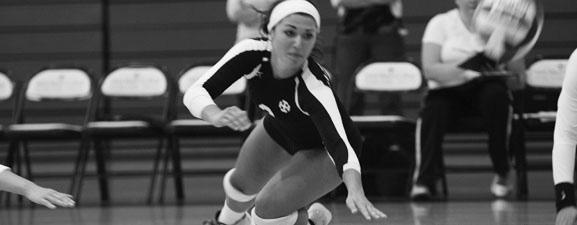
Belles sophomore libero McKenzie Todd bumps the ball during Saint Mary’s 3-0 win over Manchester on Sept. 1 at Angela Gym. Todd finished the game with four digs.