Print Edition of The Observer for Thursday, September 17, 2015
Columnist examines religious liberty
2015-2016 Notre Dame Forum event considers implications of Vatican II on American Catholicism
By CATHERINE OWERS
a ssociate
ross douthat, author and new york Times columnist, spoke on the evolution of religious liberty in america since the second vatican council on wednesday afternoon in decio Theatre of the debartolo performing arts center. The event was part of the 2015-2016 notre dame Forum, which is titled “Faith, Freedom and the modern world: 50 years after vatican ii.”
douthat said he looked to the second vatican council’s declaration on religious freedom, “dignitatis humanae,” to track
Show
the evolution of the church’s attitude toward religious liberty.
“[it] formally established the roman catholic church’s support for religious liberty and developed the church’s teaching to the point where it was no longer deemed necessary for catholics to argue for a preferential, state-established position for the catholic church in countries around the world,” he said. although the document was written in rome, douthat said, the “crucial transformative voices” that crafted “dignitatis humanae” were american. Furthermore, american catholicism gave an
confronts sexual assault
By ANDREA VALE news writer
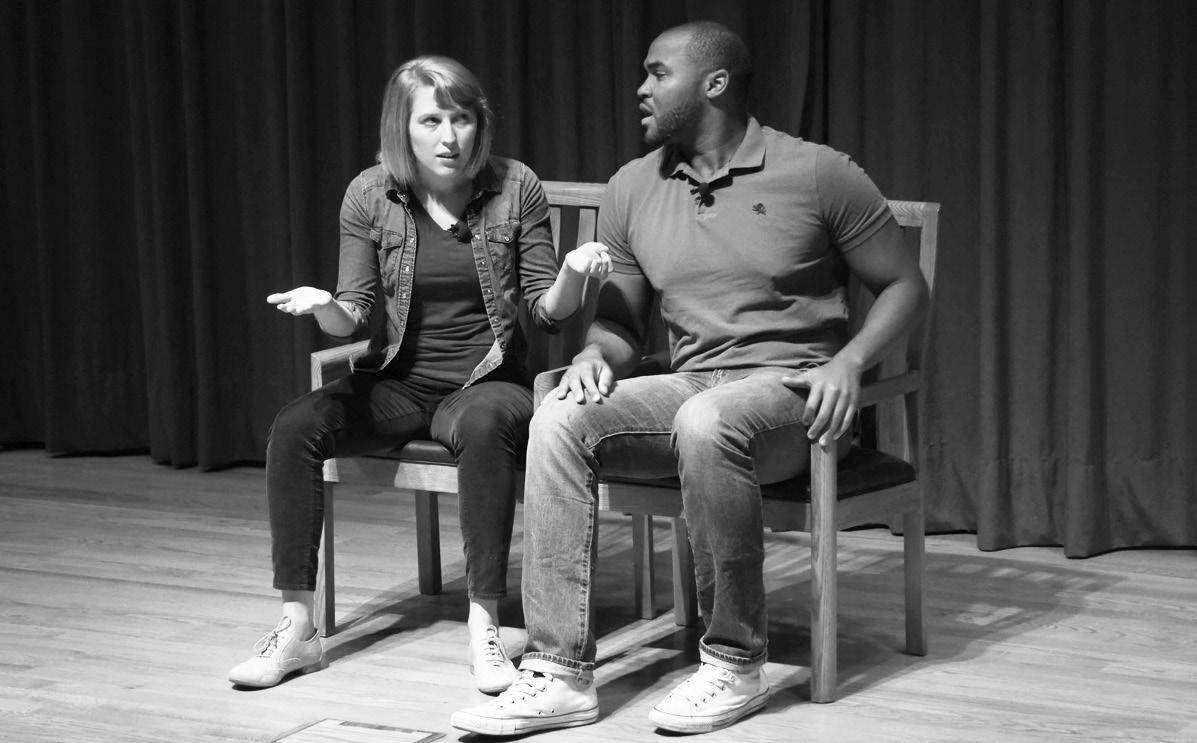
c hicago-based catharsis p roductions came to campus and performed “a re you g etting the signal?” on wednesday night in debartolo hall, combining scripted and improvised scenes with audience participation. The show used humor to provoke discussion about common misconceptions and misunderstandings surrounding sexual assault.
“catharsis p roductions was founded in 2000 when c hristian murphy and gail
stern met at a one-act play festival and discovered they shared a passion for comedy, social justice and advocacy,” maura Kinney, marketing and communications coordinator for catharsis p roductions, said in an email. “our mission statement: To change the world by producing innovative, accessible and research-supported programming that challenges oppressive attitudes and shifts behavior.”
according to regina g esicki, assistant director
example of the positive relationship the church could enjoy with the government.
“anyone looking for evidence 50 years ago that the church had nothing to fear from dropping its call for a preferential position for catholicism could look to the united states, could look to notre dame, and be immediately reassured that the church could flourish absent such patronage,” he said. “and anyone looking for evidence that one form of liberalism, liberal democracy at least, could be trusted to protect the church’s freedoms, rather than perpetually going against it … could likewise
look to america and could find what looked like very solid proof of concept.
“so while a document like ‘dignitatis humanae’ had still been imaginable without the american example, and the arguments that undergirded it might
still have resonated as catholics tried to grapple with twentieth century realities, politically, theology can only be so abstract. it ultimately needs a reference point in actual existing politics. … having the american example made an immense difference in the debates, its outcomes, and the document and teaching itself.”
douthat said in contemporary times, the american catholic consensus that the church can flourish in the liberal democratic experiment is fracturing. “one crack is showing up a little
notre dame offers digital marketing program
By SAM FENTRESS news writer
it was a friendship destined for success.
p aul s laggert and p eter methot met several years ago at a conference for unicon, a global consortium for people working in executive education. n ow s laggert, director of non-degree programs in executive
education for the m endoza c ollege of b usiness, and methot, managing director of executive education at r utgers b usiness s chool, have something to show for their friendship: a week-long digital marketing certificate program co-sponsored by the two schools, which will take place on notre d ame’s c hicago campus from s ept. 28 to o ct. 2.
methot said the goal of the program, which will convene in a university-owned building on m ichigan ave., is to equip marketing professionals with the tools to engage new audiences in the digital sphere, particularly through outlets like social media, search engines and mobile devices.
Lecture explores mission of Holy Cross education
By NICOLE CARATAS news writer
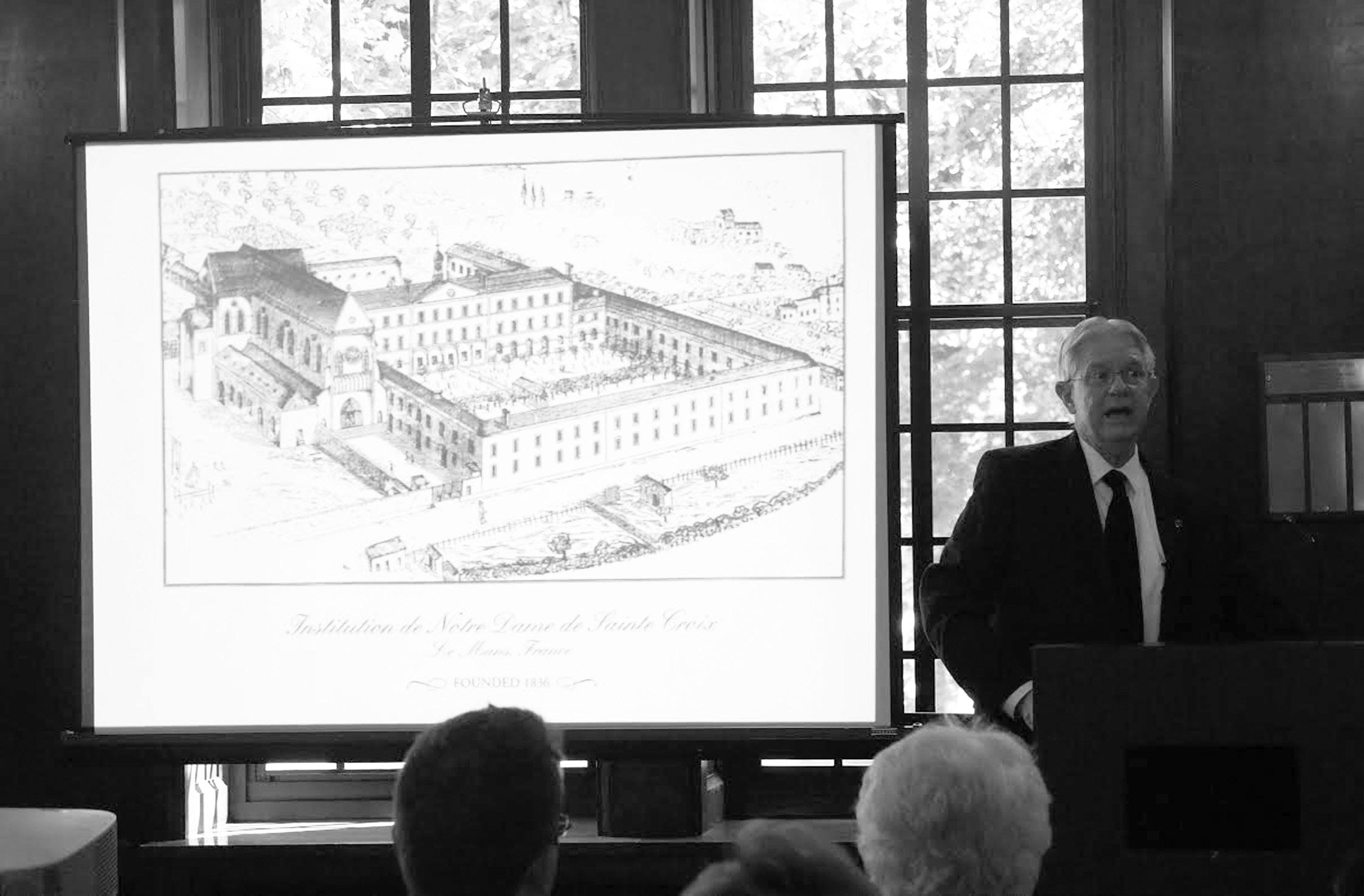
in a lecture at saint mary’s wednesday, brother Joel giallanza spoke on embracing and continuing the mission of a holy cross education, and how saint mary’s helps to do just that.
The lecture focused on the mission of holy cross education and how it should be applied to modern schools. giallanza, the associate director of the holy
cross institute at st. edward’s university, said the purpose of a holy cross education is to help prepare students for the world after school and the supply them with the necessary tools to be active and ethical citizens.
giallanza said it is important to consider how the current education system will affect the future.
“For the college to offer what it says it offers, what do we as faculty, as staff, need to be,” he said. “what kind of persons do we
needs to be? because it will not happen by itself — otherwise we’d be running a factory.”
giallanza explained the history of holy cross education, starting in 1835 when Fr. basil moreau decided to start a boarding school.
“The [school] would become a place of promise,” giallanza said. “The heritage would become a source of passion, life and especially educational life.”
CAITLYN JORDAN| The Observer
Catharsis Productions actors Phillip Sheridan and Anne Dufault use humor to start discussions about sexual assault around campus.
Ross Douthat n ew
ork Times columnist
631-8839
Brad Martin sophomore Zahm house
“p iadinas … by far.”
Sadie Zacharek sophomore cavanaugh hall
“pasta stir fry at ndh.”
John Judge freshman Zahm house
“cinnamon rolls during breakfast.”
Jim English sophomore Knott hall
“c hicken alfredo pizza at sdh.”
Katharine Janes sophomore pasquerilla east hall “i ndian night.”
Chloe Georgiades freshman Farley hall
“vanilla ice cream with chocolate sauce and sprinkles.”
Brother Joel Giallanza spoke on the mission of a Holy Cross education during the “Embracing and Continuing the Mission” lecture at Saint Mary’s
Today’s Staff
Corrections
The observer regards itself as a professional publication and strives for the highest standards of journalism at all times. we do, however, recognize that we will make mistakes. i f we have made a mistake, please contact us at (574) 631-4541 so we can correct our error.
4:30 p.m.-5:30 p.m. Celebration of Dante’s minor works for his 750th birthday.
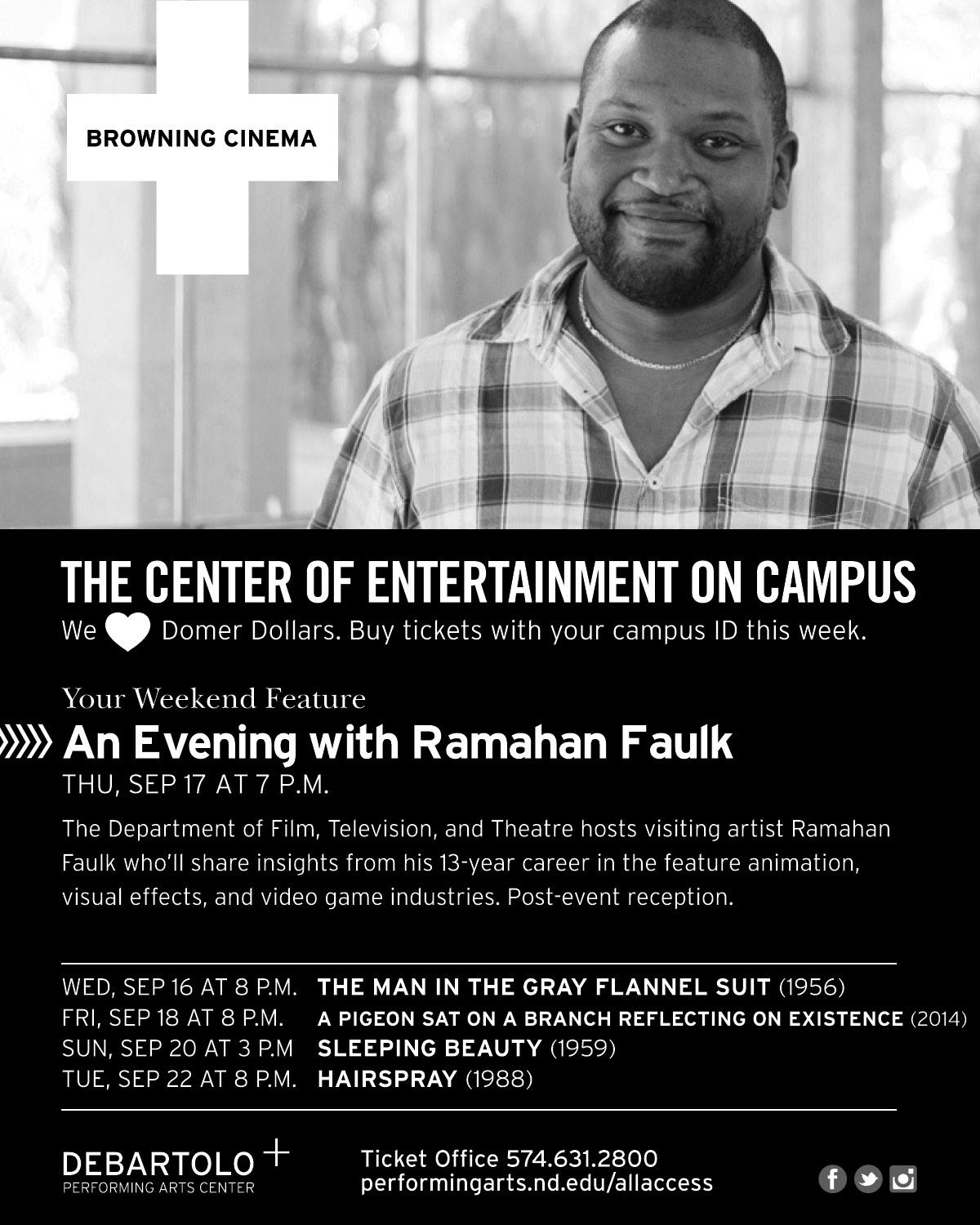
An Evening with Ramahan Faulk
DeBartolo Performing Arts Center
7 p.m.-8 p.m. Visual arts presentation. Friday
Blackhawks Training Camp Compton Family Ice Arena 10:30 a.m. -12:40 p.m. Team opens training.
The Future of the Past Hesburgh Library
4 p.m.-5:30 p.m.
Lecture on revival of Ireland from 1891-1922. Saturday
Football vs. Georgia Tech
Notre Dame Stadium 3:30 p.m.
The Irish take on the Yellow Jackets.
Rules of Engagement
Raclin-Carmichael Hall at IUSB
11 a.m.-12 p.m.
La Misa en Español
Dillon Hall
1:30 p.m.-2:30 p.m.
Mass celebrated in Spanish.
Vespers
Lecture on global health volunteerism. Sunday
Bascillica of the Sacred Heart
7:15 p.m.-8:15 p.m. Evening prayer in the Lady Chapel.
Monday
Getting Started in Research
Brownson Hall 4 p.m. -5 p.m.
Workshop on research project process.
Discussion with Chilean Ambassador Visitation Hall
KATHLEEN DONAHUE | The Observer
Group discusses sustainability, online forum
By MEGAN VALLEY news writer
student senate met wednesday night for presentations on new sustainability initiatives in the dining halls, the novo registration program and onward, student government’s new online forum for students.
l inda Kurtos, director of sustainability, addressed student complaints about the removal of styrofoam cups from the dining halls, saying sustainability has a unique set of priorities.
“something to remember about styrofoam is it really is a very bad actor in the world of sustainability,” Kurtos said. “ w hen we talk about
sustainability, we think about ‘how do we do the best, first for people, then the planet and then for profit?’”
Kurtos also discussed what the money saved will be used for.
“part of this program is to reallocate some of the money saved from not buying the polystyrene cups and put it toward more local and more sustainable food,” she said. “so now, we’re using all a local dairy farmer for our dairy products in the dining halls.”
a fter Kurtos’ presentation, chuck hurley, university registrar, held a discussion with student senators about novo, the class registration system that replaced darT this fall,
including information about future updates that will be made, such as adding ciF forms.
The meeting ended with a presentation from student body president bryan r icketts, director of constituent services John Kill and director of campus Technology michael mcroskey about onward, an online forum to give students a place to post their concerns.
Kill said onward will be a student-driven way to address problems and offer possible solutions.
“we’re trying to establish this idea of problem and solution. it falls under what we call ‘ideation to probable action,’” he said.
only notre dame
undergraduate students will be able to access onward, which is set to launch next week — faculty and graduate students will not be able to see it. r icketts described the program as being “like yik yak, but not anonymous.” students can make and vote on posts; posts with more votes will receive more attention. in order to improve transparency with student government and the administration, mcroskey and ricketts said problems that are being addressed will be “pinned” to the top of the feed with updates to let users know the problem is being handled.
ricketts said he hopes this new program will encourage students to be more vocal about
their concerns.
“w hen nidia [ruelas, student body vice president,] and i were out campaigning, we went and knocked on pretty much every door on campus, talked to every student that we could and got a lot of great ideas,” he said. “it’d be great if we could do that every day, but we can’t. senators can bring their ideas to us, but there’s 8,000 students at this school and they have ideas and concerns to share.”
The student senate meets every wednesday at 6 p.m. in the notre dame room of laFortune student center. a ll meetings are open to the public.
Contact Megan Valley at mvalley@nd.edu
Lecture
con T inued F rom page 1
giallanza said the boarding school was designed solely for the benefit of the students. he said the plan was to design a curriculum that would help the students learn not only the subject matter being taught, but also how to form values and how to implement those values into their lives after school.
giallanza said there were three principles a holy cross education needed to have to be successful: information, formation and transformation. according to giallanza, information means academic excellence, while formation means putting the information into use. he said transformation is defined as a student’s use of his or her education after graduation.
when considering modern holy cross institutions, giallanza said there are additional points beyond the three principles that schools need to meet. he said he believes saint mary’s meets all of these principles.
“First, holy cross education is concerned primarily with leading students to understand and to live the gospel,” giallanza said. “second, holy cross education enables students to become informed and active citizens. holy cross education nurtures an environment of collaboration and cooperation, supported by a sense of community, which touches and includes everyone associated with the college.”
giallanza said the principles fostered by a holy cross education will help teach students important values, which will help students in many different aspects of their lives.
“holy cross education teaches respect: personal, social, racial, political, cultural, religious, gender included in this diversity,” he said. “holy cross education fosters participation in the life of a living community and promotes dialogue between faith and knowledge, faith and daily life, faith and culture.”
Contact Nicole Caratas at ncaratas@nd.edu
on the catholic left. in the age of pope Francis, the current pontiff’s scathing criticism of global capitalism and the american-led world order has maybe started to encourage a more radical catholic left critique of the american system than we have seen since probably the vietnam era,” he said. “on the catholic right, especially maybe the younger catholic right, there’s an increasingly felt tension between being american and being catholic, stronger even lately than some of the tensions created by roe v. wade. and this tension is emerging for a reason that’s relevant for the specifics of ‘dignitatis humanae,’ one of the elements of religious liberty that that document deemed essential to the political order — the idea that freedom of religion encompasses the freedom of the religious community.”
The guarantee of corporate religious freedom is no longer apparent, douthat said, citing recent attempts by the u s department of health and human services to enforce mandates of contraception on catholic institutions, as well as aclu lawsuits against catholic hospitals.
“w hat all of these examples have in common, in addition to the connection to the sexual
revolution, is that they represent places where state pressure is being brought to bear not on catholicism as embodied at mass on sunday, but on catholicism as a corporate identity, catholicism as the impetus and organizing idea behind the institutions which seek to serve the common good,” he said. “in each case, and perhaps more as time goes by, the church is being told that trying to serve others is not sufficient, that catholics must accept that the price maybe of their most basic ministry is to accept a secular definition of the common good and be governed in certain ways by secular power rather than the constitution of the church.”
douthat said the catholic church in america has been weakened in the last 50 years, as evidenced by declining mass attendance and a decrease in religious vocations, yet the church maintains a distinctive place in american politics.
“The church is still large enough, still potent enough, still intellectual enough to have many — to be frank — enemies, who would like to see it weakened or brought low, meaning that catholics are not or not yet the quirky, marginal, amish-style religious minority that tends to be tolerated and accommodated very easily under secularism. but at the same time, the church is too weakened, divided, possibly
declining certainly in some cases to effectively fight its battles when those enemies circle or attack.”
religious liberty protections are often unnecessary for the stronger religious groups, and easy to extend to the weaker religious groups, douthat said.
“it’s the weakened, but still important, institutions in between that are more likely to see their protections shrink, and that’s roughly where the church has found itself today,” he said.
douthat said many who want to restrict the church’s religious liberties do not view christianity itself as problematic, but instead identify the problem as one set of issues, where traditional christian teaching is not compatible with contemporary views on human rights.
“so in this sense, many people who support what i think are real restrictions on religious liberty see themselves as operating in the space of reasonable regulation allowed for by ‘dignitatis humanae’ itself, in the passage where the council fathers noted that religious liberty is still subject to certain regulatory norms,” he said. “and many even see themselves ultimately as friends to catholicism and christian religions, offering a kind of construction pressure and constructive criticism, a helping hand into sexual modernity — one that will be eventually vindicated by a third or
paid a dverT isemen T
fourth vatican council, at which point catholic resistance today will look a little silly.”
many catholics agree with these opinions, douthat said, and the best defense of religious liberty should focus on religious pluralism, rather than on religious liberty itself.
“The part of ‘dignitatis humanae’ that matters most in america right now is again the document’s stress on the corporate nature of religious freedom,” he said. “and to the extent that catholics are hoping to persuade people outside the church that something important in american life is threatened in the current religious liberty debate, they need to press the case that this kind of communal freedom, this associational freedom, is essential to the american experiment as we know it. and if it gives way to a strictly individualistic understanding of religious liberty, something precious will have been lost.”
religious pluralism is not a threat to liberal values, douthat said, but a complement to a liberal democracy.
“a healthy pluralism allows people of any persuasion, secular or religious, progressive or conservative, to build a culture with a sense of mission, a place where certain ideas are generally accepted or taken for granted, certain organizing principles are assumed,”
he said. “and at the same time it’s telling them that they have to do this within their own private institutions, rather than aspiring to impose their ideas on a grander, society-wide scale.”
douthat said the tensions between the church and the wider culture should also serve as a reminder that the church does not have a permanent political home.
“even as we seek to preserve that congruence between the american order and catholic freedom that inspired so much optimism in 1965, we should also not to expect it to last indefinitely,” he said. “we should realize that liberal democracy, like all political orders, is time-bound and contingent, and not the ultimate good that the church is called to preach. as american attitudes toward religious liberty evolve, the church must be prepared to adapt and move forward, douthat said.
“if a synthesis between being american and being catholic, which seemed to be getting easier in the 1960s and may be getting more difficult today, we should be challenged but not necessarily troubled by that change,” he said. “‘heaven and earth shall pass away,’ Jesus said ‘but my words shall not pass away.’ but he was not talking about the u s constitution.”
Contact Catherine Owers at cowers@nd.edu
“o nce upon a time it was just this one-way media. There was radio, there was T v, there was newspaper, there [were] billboard[s],” he said. “now, with the internet and the hyper-informed consumer, they’re deciding who the right fit is to solve their problems or to provide their needed products and services.”
according to slaggert, the partnership bridges two key components: the robust digital marketing program at rutgers and the professional audience of the notre dame area, particularly c hicago, which is home to more notre dame alumni than any other city.
“peter was able to bring us the content and proven instructors from rutgers, we were able to provide a venue and support and marketing and exposure in the c hicago area,” slaggert said.
“That’s what you look for in a partnership.”
e ach day of the five-day program will be split into two three-and-a-half hour “modules” which will touch on different aspects of digital marketing. The modules will present a combination of lectures and group exercises, where professionals will be able to apply what they’ve learned to their own workplaces, methot said.
according to the program’s page on mendoza’s website, the program will cover topics such as social media marketing, search engine marketing, online customer acquisition and web analytics. a module called “personalized d igital e xperiences,” for instance, will give professionals a better sense of how to use consumer data in marketing.
“[ personalized data] takes you from an anonymous consumer to dan, who is this age and this demographic in this location,” methot said.
“That’s how personalized digital experiences come into play. it’s using the data to better serve the needs of the possible consumer.”
a lthough these kinds of programs mainly appeal to professionals specifically involved in marketing, methot said they also attract people who need an understanding of the digital world in fields like sales, leadership and information technology.
“it’s a pretty broad audience, but generally speaking, it’s people that bring with them at least five to 10 years of business experience and are having their businesses changed or transformed due to digital impact,” he said.
slaggert and methot said they hope the relationship between the two universities will continue to provide new opportunities for professionals to learn.
“ we really feel that the model moving forward is
paid a dverT isemen T
these kind of cross-collaborative partnerships among prestigious schools,” methot said. slaggert and methot said they hope the relationship will eventually work two ways, allowing notre dame to bring unique programs to an audience in the rutgers area, particularly new york and new Jersey.
“i f we can take programs that they have that are successful and bring them to our more natural customer base, and if we can take programs we’ve developed to his natural customer base, that’s a winwin for both institutions,” slaggert said.
The program will be an educational experience not only for professionals, but also for the universities behind it, slaggert said.
“since it’s the first time, it’s a pilot,” he said. “ we want to sit down and figure out what worked, what didn’t, what we want to do differently, what do we want to do better and then look for new opportunities.”
i n the end, slaggert said it is his friendship with methot that is important.
“it works because there’s a personal relationship that exists with people on both sides,” slaggert said. “ we were able to build that, and leverage that into something that we felt would benefit both operations and the customers we both have.”
Contact Sam Fentress at sfentres@nd.edu
Improv
of educational initiatives for notre dame’s g ender relations center, c hristian murphy is a 1992 graduate of notre dame. murphy will also be on campus oct. 12 to speak as part of relationship v iolence awareness month.
murphy will “speak about his personal history and the journey from notre dame to founding catharsis, a production company with such a unique way of working against interpersonal violence,” g esicki said.
The show was performed by only two actors, phillip sheridan and a nne dufault. The duo employed a medley of scripted material, audience suggestions and improvisation to enact a series of three scenes, each followed by open discussions among audience members.
“The scenes are used to illuminate some of the ridiculous aspects of the stereotypes we assign each other based on gender and sexuality and help everyone think about all the assumptions we connect to dating, consensual sex and rape,” Kinney said. “The goal is to really dive into the unique issues of each campus by talking to and engaging with students.”
during the first scene, sheridan and dufault narrated the thought processes of a man and woman at a party, highlighting how disinterest can be misinterpreted as “vibes.”
audience members were asked to decide the direction of the scene by volunteering a pickup line for sheridan’s character to use, choosing whether dufault’s character should be “nerdy” or “ditzy” and deciding whether sheridan’s character should show his sensitive or “macho” side.
a fter the first scene, the actors led a discussion about the damaging impact of particular words society uses to describe sex, inequalities between genders and gender norms. The group analyzed conflicting cultural expectations for women to be passive and soft-spoken yet sexually confident, as well as pressures for men to be heterosexual, tough and emotionless womanizers.
during the second scene, audience members were given red cards reading “sTop.” w henever they thought the ensuing scene, depicting a stereotype-conforming man and woman at an off-campus party, became too embarrassing or difficult to watch, audience members held up their cards. The scene was followed by a discussion of the multiple aspects that made the depicted situation inappropriate.
“it is our feeling that sexual assault, and most forms of interpersonal violence, are manifestations of larger cultural issues, like racism, sexism, homophobia, etc.,” Kinney said.
“our programs attempt to get at the heart of those issues and encourage everyone to intervene at all levels when oppressive behavior emerges — from when someone makes a sexist joke to when someone is being creepy at a party.”
The actors stressed that sexual assault can take place along any gender dynamic and the importance of, and societal impediments to, bystander intervention.
The third and final scene consisted of a talk show discussing the blurred lines that can confuse the distinction between consent and rape. dufault played the host, while sheridan played a college boy defending himself against accusations of rape. The scene was followed by a discussion identifying various “red flags” in the defendant’s version of events.
“we use humor never as a way to make light of a serious issue, but as a way to illuminate the biases and hypocrisies of a culture where sexual assault is so prevalent,” Kinney said. “Through active participation and laughter, rather than lecturing, we find that our audiences are more engaged and motivated to step up and stop violence in their communities.” a n sos advocate, a representative from the rape crisis center of st. Joseph county, was sitting in the back of the auditorium in a private area outside of the performance room, available in case audience members became upset or distressed during the show.
sheridan and dufault ended the show by listing various local resources students can take advantage of in the case of sexual assault, including the counseling center in st. l iam hall and the sos rape crisis center of st. Joseph county. They promoted support for victims of sexual assault, encouraging students to make sexual assault a more discussed and less victim-stigmatizing subject.
“w hat we can say to make a huge cultural shift is saying, ‘i support you, here’s a counseling center; i support you, here’s the phone number for a support group,’” sheridan said.
“here at notre dame, we are called to create a community where we honor the dignity of all and where we are our brothers’ and sisters’ keepers,” g esicki said. “ we should challenge one another to be active bystanders, to overcome our personal barriers to protect one another from harm. … i hope this year’s production continues the robust campus conversation around sexual assault and violence prevention. i hope “a re you g etting the signal?” encourages our community to continue to hold each other accountable and to change our culture to one where everyone does their part to show that violence is not tolerated.” Contact Andrea Vale at avale@nd.edu
young and dreaming
Parents are people, too
Janice
i recently started watching a Korean variety show called “The r eturn of s uperman.” i t’s a series that follows the daily lives of fathers and their adorable children, ranging from seven months to 11 years old. e ach episode captures the adventures that unravel when these men are left to care for their kids for 48 hours without the help of their wives.
i only started watching this because of my mom. s he got hooked on the show last winter, and her favorite stars are these two-year old triplets. n ow, i ’ve never liked kids, but for some reason, watching this show is my procrastination method of choice this semester, and it’s made me realize some things about my own parents. a side from the hilarity that inevitably ensues when children are involved, there are a lot of moments that are quite touching. o ne father nearly cries tears of joy when his twins walk for the first time. a nother takes his sons bungee jumping to build their self-confidence. i n segments throughout the episodes, all the fathers talk about how they’ve gotten closer to their kids thanks to the program. d espite their struggles, the love they have for their children is unconditional.
i n a scene i distinctly remember, one father was talking about how his child gave him another reason to live. h e described his wife and daughter as his spring in the midst of winter, because at the time, he had been struggling with depression.
This made me wonder if my parents had similar experiences. They never talked much about their hardships, and i never talked to them about mine, but we’ve recently been able to open up to each other more. i think they’ve loosened up a bit because the majority of their parenting is done. n ow we can get to know each other beyond the parent-child dynamic. e very time i go home, i learn more about what they are like as individuals.
i t’s a sign of growing up to realize that your parents are people, too. w atching this series helped me understand a bit more about what things are like from their perspective. e verything they do is out of love for their children, and i appreciate this so much more as i get older. s o let’s take some time today to call our parents and thank them for everything they’ve done for us. Keep in mind that despite any faults we may have, in their eyes, we are perfect.
Contact Janice Chung at jchung2@nd.edu
The views expressed in the Inside Column are those of the author and not necessarily those of The Observer.
Background: L’Arche is an international organization for people with and without intellectual disabilities to live together and learn from each other. Huiling is a similar organization in China that provides services from group homes to supported working places for people with intellectual disabilities. Because of my dream of founding the first L’Arche community in China, I was recommended by L’Arche International to visit Huiling, to learn more about the living situations of people with intellectual disabilities in China and try to establish friendship between the two organizations. All names below are made up for privacy reasons.
“i am from l’a rche.”
“ w hat is l’a rche?”
“a n international organization for people with and without intellectual disabilities to live together and learn from each other. it provides homes, warm homes, for people with intellectual disabilities. it was founded in France. now it has communities in 46 countries. i worked there.”
“i nternational? wow. you worked there? you must be an expert in this field then. m aybe you can help me out. d oes … what’s it called? l’a rche, does l’a rche have any idea how to stop my daughter from doing this?” her daughter, d andan, once again, pulled off her underwear in front of me.
honestly, d andan’s behaviors weren’t surprising — i have many friends with severe autism who tend to do the same thing when they are nervous or when they have unmet needs.
“m y daughter does it every time when she wants to go out. s he hates staying at home.”
“Then why don’t you let her go out?”
“it is too much trouble. s he doesn’t like being looked at and you know, when she gets nervous, she takes off all her clothes and tears them up in public. s he is hopeless. s ometimes i just start crying. w hy the hell does this happen to me?”
“a ctually, d andan has taught me how to accept my vulnerability in the past week, so please don’t be hopeless about her.”
“ you are too kind. Thanks for saying that, but sometimes even i , her mother, cannot see any value in her. s he contributes nothing to society.”
a h, here we go. we think differently. i n c hina, an atheist country, a person’s value comes from his or her contributions to the society. b ut for my friends at notre d ame, a person’s value comes from g od. it is not the difference between huiling and l’a rche, it is the difference between two cultures.
o n a separate occasion, the volunteer at “ hope g roup,” a drawing workshop for kids with intellectual disabilities, was kindly introducing the kids to me. “This is Tingting, she has autism. That little boy, p anpan, in the corner, doesn’t have autism, just learning disabilities. This girl over here, Fangfang, has d own s yndrome … ”
“a nd she is a wonderful painter.” i couldn’t stay silent anymore so i rudely interrupted her.
“e h, yeah, she likes painting.” s he looked at me with confusion.
i continued. “a nd p anpan is amazing at blending different colors. Tingting is an awesome listener.”
“a h, yeah, they do have different talents. a nyways, the disability level of kids in this workshop is pretty high compared to those in other workshops. m ost of them are really slow in learning things. They may need a month to learn to do things that we can learn to do in five minutes. b e patient with them,” she said. s uddenly, p anpan stood up and nudged me. he looked into my eyes and said very slowly, “ yeah it is difficult for the kids here to learn to do certain things. They usually pay so much more effort than normal people do.”
he paused for several seconds. “a ctually, i am one of them.” Then he gave me the most genuine smile i had ever seen in my life. it struck me. i didn’t know how to deal with his bravery and confidence. i was
such a coward.
o n my first night, i asked, “e xcuse me, s ister Zhang, where ... where can i get hot water? i am desperate for a shower.”
“o h, there is no hot water here. n o worry, you will get used to it. c old water is good for your health.”
“o h … oK. a nd … how do i flush the toilet?” i n many places in c hina, you don’t sit on the toilet, you squat down and do whatever you need to do.
“ s ee that big container over there? you get some water and flush everything down yourself.”
“o h … oK, cool!”
That night, in a little room over 90 degrees, sweaty and tired, i had a long conversation with s ister Zhang, a c hristian nun who had served in huiling and lived in this little room for four years. “how do you deal with all this every day?”
“d eal with what?”
“d eal with … you know, the shower, the toilet, no air conditioning … ”
“o h, i am happy here. i stay with those kids with intellectual disabilities every day. i am poor but they enrich my life from within.”
i was happy we were able to communicate on such a high spiritual level.
“ yeah, sometimes when i see those kids with intellectual disabilities and their passion for life, their happiness for simply waking up everyday, i just think, what reasons do i have not to love my own life?”
“e xactly. you are staying here for a week right? i will pray for you that you can experience that divine joy of being poor ‘outside’ and being ‘rich’ inside.”
s he seemed very understanding and peaceful, so i decided to impress her more with my ‘deep thoughts.’
“p eople with intellectual disabilities help me see who i really am because they don’t see all those labels on me, notre d ame student, c hinese, high gpa … They see me as i am.”
“a t the very beginning you felt sad, right?”
“ yeah, i felt like i was so normal, so … worthless.”
“b ut despite that, they still love you, don’t they?”
“ yeah, they trust me and love me, unconditionally.”
“l ove you unconditionally, as you really are. w ho does that remind you of?”
“ you mean … g od?”
s he was finally smiling. “ d o you still feel sorry for yourself that you have to flush the toilet on your own?”
“Thank you, s ister.”
“i understand you come from l’a rche, and you want to found the first l’a rche in c hina?”
“ yeah, but i just realized that it is so hard, getting money, dealing with the government, everything.”
“ you want to establish a sign of joy and peace for our society and change society’s view on people with intellectual disabilities, not just to keep people with intellectual disabilities fed and clothed, right?”
“ yeah.”
s uddenly, the electricity in her little room went off. i n complete darkness, i heard her gentle laugher.
“ wow, thank you g od, this is just what i want, because now i want to light her heart up with the following words. yuan, if you are serious about changing the world, be the change you want to see.”
s he could not see my face, but i was smiling.
l ater, i looked at a full cup of cheap coffee i had just bought from mc d onalds. This was the first time i drank coffee in 20 days. c offee is a luxurious thing in rural parts of c hina. i drank it up quickly, like i had been in a desert for three days. i was celebrating my reunion with coffee, something so essential and common in notre d ame. p athetic yet extremely enlightening. i f i learn to celebrate every small bit of life, in the end, maybe i will learn to celebrate life itself.
Rebecca Feng is a junior studying English literature and accounting. She can be contacted at yfeng2@nd.edu
The views expressed in this column are those of the author and not necessarily those of The Observer.
Chung graphic designer
Rebecca Feng guest columnist
Pressing ‘1’ for English is a great American value
Courtney Phelan
a Facebook friend of mine recently shared an image. w hile i see images shared on social media every day, this one struck me particularly hard.
The image depicted a woman holding a phone receiver away from her face and looking outraged, with red text superimposed on it that said, “im in america , why do i have T o press 1 For english !” w hen i looked at the image’s original page, it was full of other images lamenting the destruction of a merican values.
w hile i could write forever on what the incorrect use of punctuation and obnoxious style will lead me to believe about the intellect of whoever holds this viewpoint, i’ll save that for another day. i could also write a piece reminding readers that the united states of a merica does not have and has never had an official national language. a nd that even if it did, democratic countries with a national language do not require all citizens to speak that language.
i nstead, i’m going to focus my rage on the ignorance of that question (or exclamation?) on explaining how difficult it is to simply “learn e nglish.”
w hile experts love to squabble about which languages are the most difficult to learn, e nglish is generally regarded as one of the most difficult. e nglish is a g ermanic language with significant influences from l atin, French and greek. This means that unlike French, g erman or mandarin, where letters are normally pronounced the same way in every word, pronunciation in e nglish is a crapshoot.
For instance, take the phrase “through tough thorough thought, though.” much of e nglish pronunciation is memorization, and luckily for native e nglish speakers, we memorized common words when we were young. e nglish language learners have to learn the finicky rules of e nglish pronunciation, then quickly learn all the exceptions to those rules.
For someone who does not speak e nglish at home, constructions like adding an “e” to change the sound of an “o” can be the epitome of confusion. For proof of this, think about the difference in pronunciation between “some,” “one,” “home,” and “epitome.”
many aspects of our grammar present difficulties, too. e nglish syntax critically important, and yet often the distinction between two different sentences is that the order of the correct one “just sounds right.” Just as i, someone with an untrained musical ear, am unable to immediately harmonize with a note someone is playing, an e nglish learner will struggle to tell you why my ear is an “untrained musical ear” rather than a “musical untrained ear.”
e nglish also has these ridiculous things called “verbal phrases,” which are two-word phrases that change the meaning of a verb, like “ask out,” or “ask around.” verbal phrases are difficult enough on their own for an e nglish learner. but imagine trying breakdown your thought process so you can speak properly during a stressful situation, like when you have a broken down car, are going through a break up or have a nasty acne break out. it’s enough for anyone to have a mental breakdown.
c lever illustrations of my points aside, learning another language is an extremely difficult task that
requires you to change the way your brain processes and produces information. Foreign language professors will tell you that in order to learn a new language, you have to make mistakes. m istakes are how language learners reach beyond the basics and learn what exactly they are doing wrong so they can correct it. but when e nglish learners in the united states make mistakes, they are often assumed to be stupid, made fun of or told to try harder. i n my Foundations of esl ( e nglish as s econd l anguage) class, we have often talked about how esl students need courage to simply raise their hand in class. many esl learners, discouraged by all this, are driven into silence.
p ressing “1” for e nglish when calling somewhere is not a sign of the destruction of a merican values. r ather, it is an extraordinary example of many of the values on which a merica was founded and is supposed to embody — inclusiveness, aide to the underdog and equal opportunity. most phone calls that give a language option are phone calls that require spoken clarity and total understanding, like calls to your bank or electric company. a llowing people who struggle (understandably so) with e nglish, or are at a stage in learning where they need to make mistakes, to conduct their business in the language they feel most comfortable is not un a merican. it’s one of the most a merican things you can do.
Courtney Phelan is a junior English major living in Le Mans Hall. She can be contacted at cphela01@saintmarys.edu
The views expressed in this column are those of the author and not necessarily those of The Observer.
The a mazing race: w hite house 2016
“ d o you think it’s fair that h illary’s hair gets a lot more scrutiny than yours does?”
i f you had to guess, where would you say this question came from? a dramatic reality T v series that you would never admit you were a fan of in public? The kind of gossip-filled magazine you would never keep in your house but read at every salon visit? well … sort of.
b ased on the question’s content those are all very good guesses, but this question comes from a different source of entertainment — one that has seemingly become more drama-filled than “The h ills” and more drenched in mindless gossip than “ s tar.”
The race for the 2016 p residential candidacy.
The “ h illary” mentioned in the quote is h illary c linton, and the question itself was asked of b ernie s anders by the n ew york Times. This is not an isolated incident or a mindless gaffe. i n fact, this type of language is becoming more and more commonplace in both the 2016 election and a merican politics in general.
For example, let’s look at last night’s gop p residential primary debate.
w ith u s . income inequality at the highest it has been since 1928, the influence of the i slamic s tate ( isis ) continuing to spread throughout and beyond the m iddle e ast and the fact that there were 204 mass shootings in the first 204 days of 2015 among a myriad of other historically pressing issues facing our nation, what would you think would be the first question of a debate designed to select a nominee for the next leader of this country?
you guessed it: an inquiry into the apparent feud between d onald Trump and c arly Fiorina.
Though it was masked as question related to national security, this question was a thinly-veiled
attempt to fuel the ever-entertaining but wholly unproductive fight between Fiorina and Trump which has taken over recent news. The type of dialogue spurned by this question continued as r and p aul, Jeb b ush and s cott walker jumped into the conversation, and the stage stopped resembling a debate and began to resemble an episode of “The r eal world: r onald r eagan p residential l ibrary e dition.”
w hile the moderators and candidates eventually got around to real issues, the gossip-fest was far from over. a fter a bout of serious discussion on foreign policy, the first segment ended with an all-important question to c arly Fiorina: h ow did she feel about d onald Trump making negative comments about her face? s uddenly the r epublican candidate pool once again succumbed to the petty bickering and personality jabs that have become characteristic of the race thus far.
i n this debate, we had political reality sandwiched between ‘reality’ T v w ith the first debate segment beginning and ending with Trump and Fiorina’s personal feud, digs at candidates who aren’t polling so well and of course references to Trump’s exorbitant wealth, one could easily forget some real issues were discussed. c andidates addressed and argued about the details and wisdom of the i ran deal, about r ussia’s action in s yria, special interest groups and the issue of funding for p lanned p arenthood.
b ut little to none of this will make the headlines or even be discussed on political talk shows. w hy? b ecause a mericans are enamored with the non-political, with the absurd and amusing. we’ve sacrificed our focus on reality and moved on to something more closely resembling “Jersey s hore.” w hile real issues were covered, many of them of great urgency and concern, they were easily lost to the noise of bickering about personal appearance and the spectacle of d onald’s smirks.
w hich leads us to ask: i s this the only way to get people involved in politics? i s the i ran nuclear deal too boring? d oes the p lanned p arenthood controversy leave viewers wanting in entertainment? o r, perhaps, does the media underestimate the a merican people and our passion for the issues that directly affect our lives?
w hile we can’t force the media to ask the important questions, and we can’t force our political candidates to answer them, what we can control is whether we succumb to the gossip-filled, mudslinging, reality T v series this presidential race has become. Too many times we have found ourselves skipping over news stories pertaining to real issues like the impending government shutdown or tax reform in order to read about the latest controversial d onald Trump quote, and many of us have probably had the same experience — it’s only human. i n the same way we are tempted to sleep through our morning classes everyday, get into y ik yak wars every time we see something we don’t like or binge watch “The b achelorette” the night before our final exams, we are also tempted to just give into the empty political rhetoric we are exposed to everyday.
The difference is that in the case of the 2016 elections, the future of our country depends on whether we can resist this temptation. Thus, while we shouldn’t necessarily stop sleeping through our 8:20 classes on Friday mornings, we should make our very best effort to focus on the issues that matter in our political elections.
Roge Karma is president of BridgeND, a bipartisan student political organization that brings together Democrats, Republicans and all those in between to discuss public policy issues of national importance. They meet Tuesday nights from 8-9pm in the McNeil room of LaFortune. They can be reached at bridgend@nd.edu or by following them on Twitter @bridge_ND
The views expressed in this column are those of the author and not necessarily those of The Observer.
Roge Karma bridging the gap
By ADAM RAMOS scene writer
o ur society has a propensity for covertly liking the unlikeable. m aybe it’s because we appreciate those who do and say things we don’t have the gall to put forth ourselves, or maybe it’s simply because we love the chaos those characters bring to society. w ith either reason in mind, enter d onald Trump and Kanye west. o n the surface, they two completely different icons, yet if you call “business” and “music” by the same word, Trump and west’s bios become eerily similar — each man defined by his severe ego, limitless ambition, immense success and a comical amount of controversy.
w ith Kanye’s recent 2020 presidential announcement at The m T v v ideo music awards, and Trump’s current r epublican candidacy runaway, maybe it’s time to imagine these two great forces colliding in an election. w hile it may not make for the most erudite
of elections, in a country plagued by a seemingly endless list of issues, it could certainly help illuminate our political flaws. w hether or not you, as a citizen, would support either candidate, the implications of such an election is interesting.
Kanye boomed over the cheer of a confused but nonetheless riled vma crowd, “ i don’t know what i finna lose after this. it don’t matter though, cuz it ain’t about me.”
Kanye makes a point: s peaking your mind shouldn’t mean tarnishing your image. s ensitivity is beginning to mask free speech and society is worse off because of it. p oliticians constantly dance around topics in order to appease the multitudes of agendas. Though Trump is often criticized for his brash, sometimes ignorant, comments, it’s clear he is beginning to change the game in terms of speaking one’s mind. i f candidates start following this trend of unabridged speech, we will be rewarded with a more transparent, clearer understanding of
our candidates and their beliefs. n ot only that, but candidates may also adopt Trump’s confidence. n ow, confidence goes by many names. w hether “swagger” is in your lexicon, or you tend to use “arrogance” more, everyone can agree both Kanye and Trump are the epitome of such descriptors. w hile too much confidence can be a bad thing, we only need to look at the polls to see how the u s responds to it. Trump’s dumbfounding surge in the polls doesn’t exactly correlate with his positions on keys topics. a merica just loves a man who gets what he wants. c andidates must begin matching Trump and Kanye’s confidence or forever hold their policies. o n the other side of the coin, maybe we need Trump to help us realize the faults in voting based on presentation. w hile presentation and oration are key components of a successful presidency, they certainly are not the most important. yet, i would be remiss if i didn’t at least explore the idea of a joint ticket.
i n fact, in a recent phone interview with “The v iew,” Trump was asked if he would consider m r. west as a running mate, to which he jeered, “The thing i like most about Kanye west is that he always speaks so nicely about me.” The d onald may be for it, but if i know anything about Kanye, he may have some problems with not being the first name on the ticket.
i ’m not blind to the fact that “Kanye west for president” may seem as about legitimate as “ vote for p edro,” but if this current race has taught us anything, it’s never to count a candidate out. w hile meticulowusly perfected beats may not translate to strong foreign policy; who knows, maybe Kanye’s got some tricks up his sleeve. b ut if the politics do end up the same, i still would appreciate a Trump vs. west debate. i ’m already seeing Kanye and Trump wwe -esque intros.
Contact Adam Ramos at aramos6@nd.edu
o ver the past couple of days, one would be hard-pressed to not notice the new update that s napchat recently rolled out. a cross everyone’s feed, people watched themselves vomiting rainbows while their eyes popped out to unhealthy proportions. w ith every release of something “new,” there’s bound to be an initially strong response, even if it’s not necessarily good — just think back to the two sequels in the “h angover” film series. a t the risk of sounding like the old man on campus: when is enough, in fact, enough? i was keeping up with s napchat, albeit struggling to maintain pace, when the social media app
first came up big on campus. i fully supported it when there were complaints of shallow social interactions for a supposed social media app. i defended it when they introduced the “chat” function to an app that made its bread and butter on hastily captured pictures being sent back and forth. i even, some how some way, justified the reasoning behind “ s napcash,” the ability for users to send money (in a nutshell, this seemed to me a business response to the emergence of the payment-sharing app, venmo).
b ut this is where i draw the line. This reminded me of the tragic moment when Facebook became “uncool.” That moment came on the verge of endless layout changes and confusing innovations that only
served to make their long-time users only more confounded and left asking — why fix what wasn’t broken? There’s something to be said about change to freshen up a stale product. a fter all, some people are quite cognizant about how a certain leading multimedia technology company allegedly rehashes existing, old products, repackaging them and promoting them as the newest thing on the market. a nd the thing about it is, these people are the same ones who get in line on the first day to purchase these “new” products. w ith that said, this model does not work with s napchat. The thing that drew people to s napchat was its ability to share with friends instantaneously — and only temporarily — what was going on with and around
them. e very picture and video they shared was novel, because everyday people were doing something different; no one has the same day twice (save for b ill murray in “g roundhog d ay”). yet this need to add in video effects only serves to make a mockery of their users, as if we were a group of over 200 million five year-olds that need to be entertained with bright lights and flashy images. There’s no need to fix what isn’t broken — otherwise s napchat might simply be the very ghost for which its logo is so well-known.
Contact Miko Malabute at mmalabut@nd.edu
The views expressed in this column are those of the author and not necessarily those of The Observer.
Miko Malabute scene e ditor
By NICK LAUREANO scene writer
For two decades, p ixar has kept a hand on the marionette that is their audience’s emotions. a t times, this hand was a heavy one. d espite seemingly large emotional payoffs, p ixar’s efforts failed to arrive at any profound truth. Think of “up,” with its dazzling opening sequence and debased third act. a t its best, the studio exercised a delicate touch, creating moments that yielded true catharsis, as the emotional tidal wave that crashed upon the audience perfectly coalesced with some deeper meaning. The denouement of “Toy story 3” comes to mind.
perhaps, then, the genius of “i nside o ut” is that it could never have failed to achieve this beautiful lockstep between our emotions and meaning because, well, the whole movie is an examination of our emotions. The sadness that comes with the death of a beloved character could never feel like a cheap shot in a film that passionately argues for the primacy of sadness in the human experience.
“i nside o ut,” which will play in d eb artolo 101 Thursday through s aturday, is very much a coming-of-age story, though not in the typical sense.
w hereas most coming-of-age stories see their characters achieve independence (think of c ameron Frye kicking his father’s vintage Ferrari out the window in “Ferris bueller’s day o ff”), “i nside o ut” examines the importance of dependence. Joy believes she can keep r iley’s mind in ship shape on her own, but she can’t. r iley believes an act of defiance is the best solution to her problems, but it isn’t. a nd they both believe the best — scratch that — the only way to function is without sadness/s adness (that’s little s for the emotion and big s for the character, who is an emotion. d on’t worry, it’s not a confusing movie). it is not surprising that Joy resorts to confining s adness to a small circle, far from r iley’s important mental machinery, especially after r iley’s misguided mother asks her to smile to benefit her stressed-out dad. Joy, and therefore r iley, are not yet at the age where they can digest all the nuances of emotion. To them, if you’re not 100 percent happy, then you must be 100 percent sad (notice, all of r iley’s happy memory orbs are 100 percent yellow, her sad memory orbs 100 percent blue. we adults can expect this to change by the end of the film). s o the only course of action is to renounce sadness/s adness.
no matter how much we may want to, we cannot live entirely independent of sadness. we cannot live in eternal joy. w hy? wouldn’t this be better? no (obviously), because as Joy learned in the dark recesses of r iley’s mind, our human experiences are often a mixed bag. we depend on the multitudinous combinations of our emotions to help us make sense of the multitude of events life throws at us. i n learning the importance of sadness, r iley and Joy ultimately learned that life is bittersweet.
i’m really just scratching the surface here. a nd oh, that surface! i f the last three paragraphs were a giant pill of meaning that needed to be swallowed, then the surface of that pill, of p ixar’s latest confection, is as sweet as an e verlasting g obstopper. The humor, like the premise, is some of the cleverest the studio has produced. i first saw “i nside o ut” opening night, surrounded by small children, and i wish the student union b oard ( sub ) could rent a couple dozen 6-year-olds for this week’s screenings. o nly surrounded by small children who will laugh hysterically at some of the sillier gags can you appreciate the complexity of a comedy that appeals to kids from two to 92. yes, i giggled at some of the childish sight
gags, but i howled at the adult jokes. i n fact, a certain quip about bears is probably my favorite joke from the entire p ixar canon. a fter a depressing stretch of failures — “brave,” “monsters university” and the abominable “c ars 2” — it’s good to be having fun at a p ixar movie again.
v isually, “i nside o ut” is a treat (duh). it’s not quite as pretty as “Finding nemo,” and because it mostly lacks subject matter that is grounded in reality, it’s not as startlingly impressive as “ wall -e” or “r atatouille” (which is underrated in every regard). but hey, few films are. The pit of doom/memory dump is frighteningly cavernous, and all of those little memory orbs look — and sound — fantastic. d irector pete d octer wisely includes a handful of super-wide shots to give his audience a sense of the mind’s expanse. e ven though all these shots are animated, their sheer scope tickled me in the same way david l ean’s desert compositions in “l awrence of a rabia” did.
“i nside o ut” will play in d ebartolo 101 this Thursday through s aturday. sub is sponsoring the screenings, and student tickets are $3.
Contact Nick Laureano at nlaurean@nd.edu
NHL experiences golden age
Brett O’Connell sports writer
Though it still resides behind its beefier brothers, the n F l and the mlb , in a merican sport culture, it’s hard to argue against the early 21st century’s growing reputation as the golden age of the nhl and professional hockey in a merica.
Though some teams, such as the consistently-mediocre p hoenix c oyotes and the sneakily-good Florida p anthers, still struggle to draw crowds, stadiums and rinks from toasty southern c alifornia to glitzy b rooklyn are projected to sell out almost every game in the 2015-2016 season, which opens in roughly 20 days. c ombine the continued monetary success of nontraditional market teams in places like l os a ngeles, n ashville and Tampa b ay with the revitalized fervor for hockey in the states of i llinois and p ennsylvania, amongst others (credit to m innesota here — the s tate of h ockey never saw even a hint of decline), and the financial future for the nhl seems bright.
w hat’s more, the league recently signed a landmark $600 million deal with m ajor l eague b aseball a dvanced m edia, which will give the baseball group the rights to hockey’s out-ofmarket T v broadcasting and internet streaming. Though the nhl will still maintain control of the means and production values of hockey content streamed by mlbam , the six-year contract will allow new markets at home and abroad to experience hockey from the comfort of their living rooms. For a sport whose arguably biggest barrier to fandom lies in its lack of accessibility for both viewers (T v schedules are crowded) and players (ice melts), this deal could spell even further expansion of popularity for hockey, which is only just starting to produce
consistently-elite domestic talent.
This year, the nhl will seek to create a faster, more frenetic game, with adjustments to goalie equipment being considered and new 3-on-3 overtime rules already in the process of being put in place. a s a hockey fan, it has been a while since there has been this much buzz around a new season.
The nhl’s big wigs seem to recognize this swell of popularity, too — that much is made clear by the recent announcement of two yetto-be-named expansion teams that will be joining the league in the next few years if all goes according to plan. Though we don’t know for sure the locations and names of the new teams, all signs seem to point to a return to Quebec and the rebirth of the old n ordiques franchise in the east, as well as the very first major league team to be hosted in l as vegas in the west.
i t’s difficult to say what expansion will do for the league’s revenue. b esides, not all of the recent news has been good for those with a financial interest in professional hockey – the recent stagnation of the c anadian dollar, combined with ballooning costs for maintaining the league’s many arenas, is causing some salary cap strife amongst the teams with the highest payrolls. b ut this much is clear: The product the nhl is putting on the ice is attracting more consumers, both in person and over the airwaves, than it ever has before. r eally, the numbers aren’t even close. This is a beautiful time for the sport of hockey. Fans can only hope this trend continues upwards from here.
Contact Brett O’Connell at boconne1@nd.edu
The views expressed in this Sports Authority are those of the author and not necessarily those of The Observer.
l indor, salazar lead Tribe
Associated Press
past Kansas city
cleveland — Francisco
l indor, making a late run for al rookie of the year, was 3 for 4 with a home run and four rbi s to lead the c leveland i ndians to a 5-1 win over the Kansas c ity r oyals on wednesday night.
d anny s alazar (13-8) took a three-hit shutout into the seventh before m ike moustakas started the inning with a home run. The right-hander allowed one run and struck out six in seven innings.
l indor, who matched his career high in hits and rbi s, had a solo homer in the first for his 100th hit since being called up from the minors on June 14. he added a two-run single in the second and an rbi single in the fourth.
l indor also began the fifth with an outstanding play at shortstop. he dove to his left to come up with a lex r ios’ ground ball and made a onehop throw to first from his knees for the out.
The i ndians (72-72) got back to .500 and remained in contention for the second wild-card spot in the al
d anny d uffy (7-8) allowed four runs in 2 1/3 innings for Kansas c ity, which has dropped nine of 12.
l indor drove a 1-0 pitch several rows deep in the leftfield bleachers in the first.
Following Jason Kipnis’ rbi single in the second, the switch-hitter punched a hit through the right side for a 4-0 lead.
l indor’s first two hits came from the right side against the left-handed d uffy. h is fourth-inning single was off right-hander Jeremy g uthrie.
l indor, 21, was c leveland’s no. 1 draft pick in 2011, the eighth overall. he began the season at Triple-a c olumbus.
c leveland entered play five games behind houston, but also trailed m innesota and l os a ngeles in the wild-card race.
Kansas c ity was a seasonhigh 31 games over .500 (8251) on s ept. 3 before its recent rough stretch. The r oyals are still 10 games ahead of m innesota in the al c entral.
blue Jays 7, braves 1
aT lan T a — d avid p rice allowed one run in seven innings, r ussell m artin hit a homer and drove in four runs, and the Toronto b lue Jays beat s helby m iller and
the a tlanta b raves 9-1 on wednesday night to protect their lead in the al e ast.
p rice (16-5) gave up six hits and had nine strikeouts as he improved to 7-1 since coming to Toronto in a trade with d etroit. he lowered his era to 2.42.
The b lue Jays stayed three games ahead of second-place new york in the division. The yankees beat the r ays 3-1.
Toronto had 12 hits as it returned to its customary high-scoring pace after managing only a combined two runs in two straight losses. m artin hit a two-run double in the four-run first and added a two-run homer off r yan Kelly in the ninth.
m iller (5-15) didn’t make it through the fourth inning as he gave up five runs, four earned. h is era rose to 3.00 after he allowed four or more earned runs for the third time in his last five starts.
m iller’s streak of winless starts was extended to 22. it is the longest streak for any pitcher in a season he was an a ll- s tar. The right-hander, who has the worst run support in the majors, has lost 14 consecutive decisions since his last win on m ay 17.
Jose b autista had a runscoring double and r yan g oins drove in a run in the first. The b lue Jays knocked m iller out of the game with another run in the fourth.
b en r evere drove in two runs with two hits, including a double in the fifth, for Toronto.
The b raves’ run came in the first. n ick m arkakis hit a leadoff double and scored on Freddie Freeman’s fly ball. c hristian b ethancourt had three hits.
Toronto first baseman e dwin e ncarnacion had three hits and two walks in his return after missing two starts with a sore left middle finger.
p rice walked b ethancourt and pinch-hitter r yan l avarnway to open the fifth but then had help from an unusual double play. s econd baseman c liff p ennington couldn’t catch a shallow pop fly by m arkakis, but his throw to g oins forced l avarnway at second. g oins threw to third baseman Josh d onaldson, who tagged b ethancourt when he slid past the bag.
yankees 3, rays 1
s T. pe T ersburg , Fla. — p rized rookie l uis s everino
rebounded from his worst start, g reg b ird homered and drove in two runs, and the new york yankees beat the Tampa b ay r ays 3-1 on wednesday night to keep pace in the al playoff race. The second-place yankees, who lead the wild-card chase, took two of three from Tampa b ay and stayed three games behind Toronto in the al e ast.
s everino (4-3) allowed one run and six hits in 5 2-3 innings. The right-hander gave up a career-high six earned runs over 2 1-3 innings in an 11-5 loss Friday to Toronto. a fter b ird had a secondinning rbi double, c hase headley put the yankees up 2-0 with a run-scoring single in the sixth. b ird, also a rookie, made it 3-1 on his ninthinning shot.
Justin w ilson, d ellin b etances and a ndrew m iller, who pitched the ninth for his 34th save, combined for 3 1-3 scoreless innings for new york.
c hris a rcher (12-12) gave up two runs, four hits, four walks and struck out seven over six innings for the r ays. h is fourth strikeout of the game, coming against brett g ardner in the third, broke s cott Kazmir’s single-season club mark of 239 set in 2007. s teven s ouza Jr. cut the r ays’ deficit to 2-1 on a towering, run-scoring double that center fielder Jacoby e llsbury appeared to briefly lose sight of near the warning track. a video review failed to determine if the ball had struck an overhanging catwalk, which would have made it a gametying homer.
b etances entered with one out in the seventh and walked the bases loaded before striking out James l oney on three pitches. l oney had gone 3 for 3 against s everino. yankees slugger a lex r odriguez went 0 for 4 in his second game since an mri exam Tuesday determined he has a bruised left knee. The designated hitter homered Tuesday.
“i feel fine,” rodriguez said before the series finale. “it’s banged up a little bit, but it’s ready to go.” a-r od will get a chance to rest the knee during a threegame interleague series against the nl e ast-leading new york mets that starts Friday night at c iti Field because the designated hitter will not be used.
Belles prepare for action at home and away
By BEN PADANILAM, RYAN KLAUS and SEAN KILMER sports writers
s
occer
s aint m ary’s looks to pick up its first win of the season tomorrow when it welcomes Trine to Junior i rish a irport
Fields.
heading into the game, the b elles (0-5, 0-3 miaa ) are coming off a tough 2-0 defeat to Kalamazoo on m onday.
b elles head coach Ken nuber said he believes it was a game his team could have just as easily won.
“i was disappointed for the
girls we didn’t get the win on monday,” nuber said. “ we played very well against the team picked to win the league and should have gotten the result. we created a bunch of opportunities and just couldn’t finish.”
h aving only scored one goal in five games, finishing opportunities has been a problem for the b elles all season. d espite these struggles, nuber said he has seen improvement by his team in each game thus far.
“The conference schedule does not leave a bunch of room for true training with a crazy three games in six days, but we are improving,” n uber said. “i feel good about the progress we are making, and the players are starting to get healthy.”
Tomorrow, the b elles play host to the Thunder (1-4, 0-3), who have struggled as well over their last four games. a fter winning its season opener against m anchester — a team s aint m ary’s fell to by a score of 1-0 — Trine has lost four straight and been held scoreless in all of those matches. w ith that in mind, nuber said his team has a great opportunity to come away with its first victory of the season.
“Trine is a much-improved
team that will attack us on the flanks,” nuber said.
“i think if we can continue to create scoring chances, we can get our first result.”
The b elles will take the pitch against Trine tomorrow at 4 p.m. at Junior i rish a irport Fields.
Cross Country
s aint m ary’s will return to action this weekend as it heads to m ichigan s tate to compete in the s partan i nvitational.
For the b elles, the s partan i nvitational follows last weekend’s c alvin Knight i nvitational, where s aint m ary’s placed 15th.
“o verall, i was really pleased with the team’s performance at c alvin. we ran well together,” s aint m ary’s head coach Jackie b auters said. “ however, i think some people could have had better performances with a more relaxed start. it is easy in the big races to get sucked out too fast in the first 800 to 1,600 meters and then take a hit in the middle of the race. i ’m hoping the team can be more mindful of their pacing off the line this Friday, especially as it will be an even faster field.”
w hile all of the races so far for the b elles have been fivekilometers, Friday’s race will the first six-kilometer event for the b elles in 2015.
“For our first-years, it will be a great time to test run their first 6K,” b auters said.
“a lthough it isn’t a significant difference from the 5K in many ways, racing a new distance always provokes a little nerves. i ’m glad we have one to get under our belt before our [ miaa ] Jamboree.”
Friday’s s partan i nvitational is part of a crucial stretch for the b elles that includes last week’s c alvin Knight i nvitational and next weekend’s miaa Jamboree.
“a s a team, i don’t have placing expectations, but
[ i ] do have hopes for where people will individually finish,” b auters said. “ i think if we race smart, everyone can have a really great day. i ’ve never taken the team to msu before, but i hear that it runs flat and fast and i ’m excited to see a great race.”
The s partan i nvitational is set to begin at 11:50 a.m. Friday on the m ichigan s tate campus in e ast l ansing, m ichigan.
Volleyball
a fter a pair of losses last week, s aint m ary’s will look to right the ship this weekend at the m illikin Fall Frenzy in d ecatur, i llinois.
l ast week, the b elles (5-3, 1-2 miaa ) played three conference games in four days, losing in straight sets to n o. 2 c alvin and a drian on either side of a four-set victory against Trine.
a fter that foray into league play, the b elles return to nonconference action Friday when they head west to face webster and r ose- h ulman in a pair of neutral-site contests.
The b elles will face webster first Friday, and the g orloks (4-4, 2-0 sliac ) enter the contest on a three-match winning streak, taking games in straight sets against e ureka, i owa wesleyan and s aint l ouis c ollege of p harmacy. s aint m ary’s will conclude the day against the e ngineers (8-3, 0-0 hcac ), who raced out to a quick 8-1 start this season, but come into this weekend on a two-game skid after losses to c entre and o hio wesleyan.
First serve for the b elles goes up in d ecatur, i llinois, on Friday at 7 p.m.
Contact Ben Padanilam at bpadanil@nd.edu, Ryan Klaus at rklaus1@nd.edu and Sean Kilmer at skilmer@nd.edu
paid a dverT isemen T
paid a dverT isemen T
CAITLYN JORDAN | The Observer
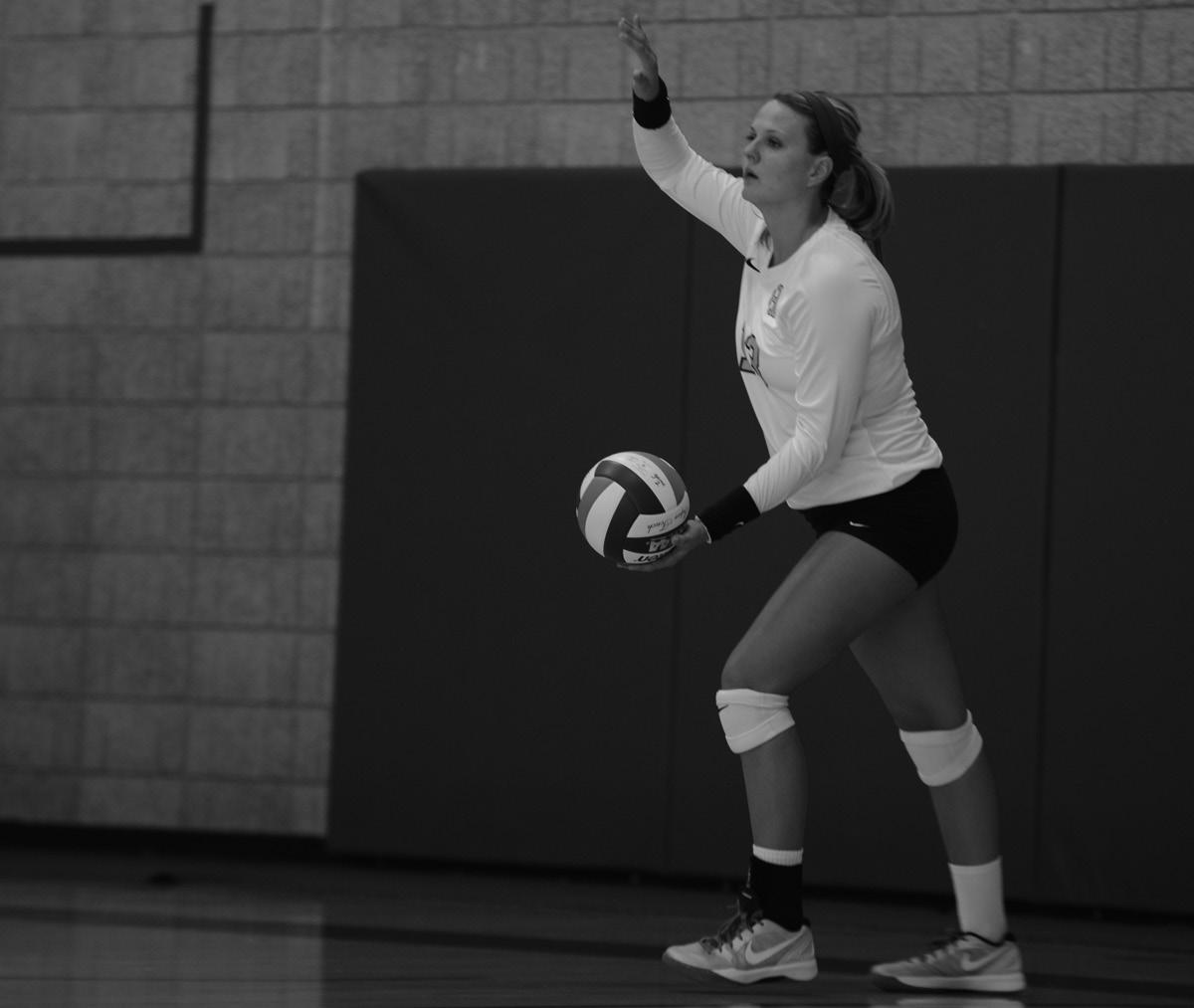
Junior setter Meaghan Gibbons winds up for a serve during the Belles’ 3-0 shutout win against Manchester on Sept. 1, 2015.
16
last year, and we were able to watch the seniors last year lead and help everybody along the way. we are just hoping to fill those shoes and do our best.”
a s for this year’s seniors, a ragon said she, s eidel and s ydni m eunier live together off-campus.
“ i t’s probably the best situation i could have,” she said. “ l iving with your teammates, we all keep each other accountable and kind of help each other make good choices as far as sleeping and eating and of course, training. we all know when we have a big workout coming and that kind of thing. i t’s really nice to live with my teammates; i think we’re going to grow closer throughout the year just by being roommates.”
That chemistry will be important for the i rish this season as they move into the second year of associate head coach m atthew s parks’s tenure. a ragon said there is a greater comfort level this year compared to last.
“ e verything was new last year,” a ragon said. “ n ow we have a year under our belts having coach s parks. h e seems more comfortable and i think all the girls really like coach s parks, they like his training program. i think it’s been a really good
W Golf
con T inued F rom page 16
with her second-place finish last weekend evidence of that. h olt said the i rish have connected well in the first few weeks of the season, and team chemistry is at a good point headed into the weekend.
“ i ’m very happy with where we’re at,” h olt said. “ i had a lot of fun traveling with them, and the team dynamic is really good,” she said. “There is a lot of respect amongst them. i ndividually they’re good players, but as a collective they have a lot of potential and they’re starting to see that. e veryone’s in a good place right now.”
w hile the i rish had a senior leader in c ampbell at the top of the scorecard last
thing and this year, being used to his training, i think everyone’s going to do well.”
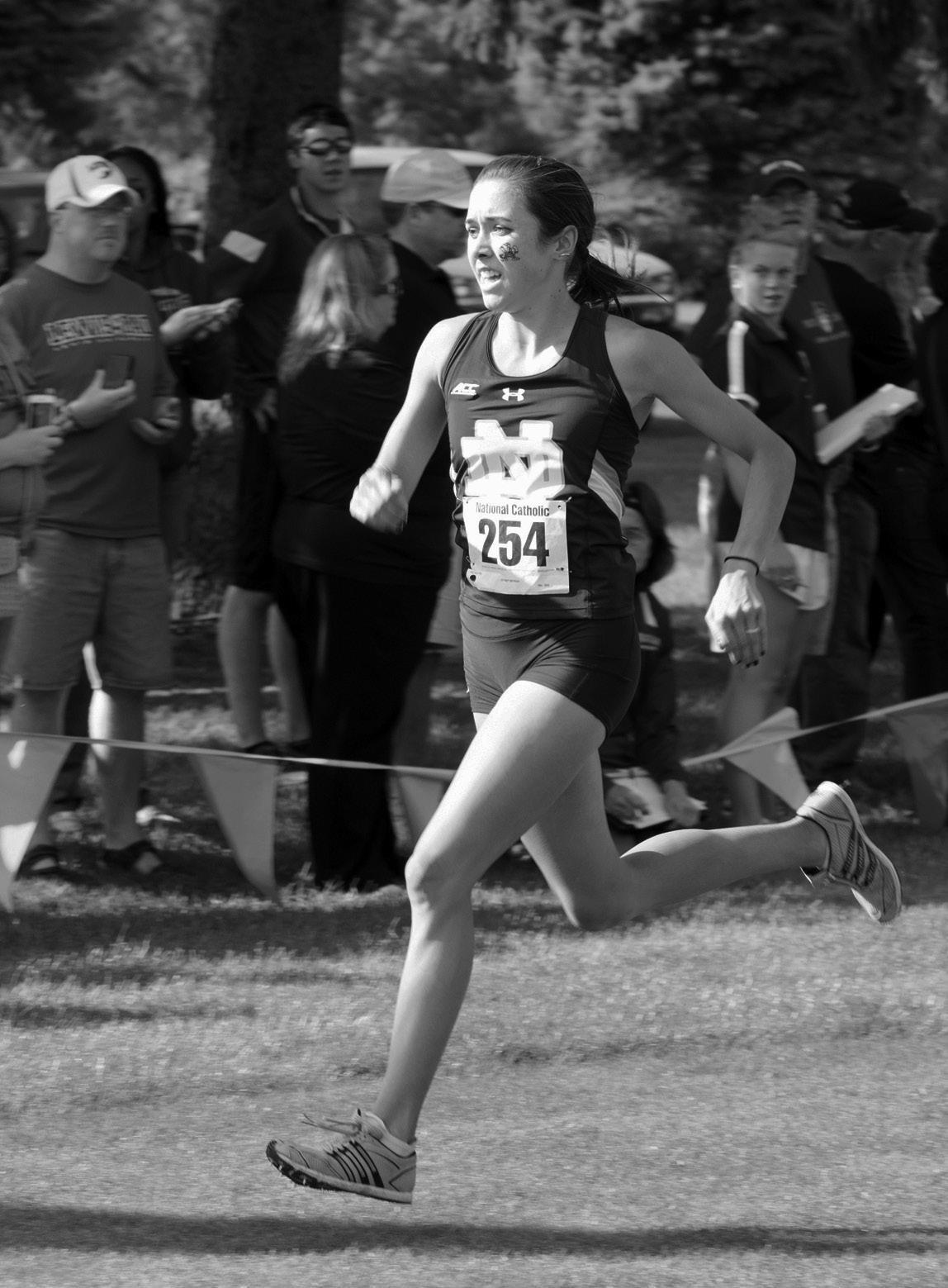
Though s parks is in his second season, he is changing up the training program for the star runners on the team like a ragon and s eidel. i nstead of competing in the opening meets of the season, s parks plans to have a ragon and others do a separate training regime, a plan which a ragon said is good, because it will keep her rested and give her time to come back from a nagging injury.
“ i have a bit of an injury right now, so that’s why [ s parks] is holding me back,” a ragon said. “ b ut also m olly s eidel isn’t racing either and i think that’s just to kind of keep her fresher later in the season and make her ready for the meets that really count, like acc s, regionals and nationals.”
d espite not racing much in the first part of the year, a ragon is staying focused on helping the team once she gets back.
“ r ight now i ’m hoping to get healthy and be able to be a contributor at acc s and nationals,” a ragon said. “a s far as team goals, i think we hope to win acc s and score in the top ten at nationals.”
a nd while it may be a few weeks until a ragon races, her impact should be felt — both on the course and off it.
Contact Marek Mazurek at mmazurek@nd.edu
weekend, they also had a pair of freshmen contributing — i sabella d i l isio finished tied for fifth while m addie r ose h amilton finished tied for 11th. d espite the duo’s freshman status, c ampbell said her teammates shared the same vision for the season.
“a ll of us are very competitive and have the same goals [to make it to ncaa s], so being aligned with regards to that transcends class years,” c ampbell said.
The i rish look to continue their strong start to the season s aturday at the s chooner Fall c lassic, teeing off at 9 a.m. at b elmar g olf c lub. p lay will continue in the three-day tournament s unday and m onday.
Contact Daisy Costello at mcostel4@nd.edu
NCaa footbaLL
Doughty paves path to becoming top prospect
Associated Press
bowling green , Ky. — b randon d oughty might be the best quarterback you haven’t heard of, until now.
p rojected as a mid-round n F l draft pick, the w estern Kentucky sixth-year senior could be the next obscure Q b from a small school to get attention at the next level. p laying for mid-major schools certainly didn’t keep b altimore’s Joe Flacco ( d elaware) or p ittsburgh’s b en r oethlisberger ( m iami of o hio) from becoming pro starters and s uper b owl winners.
s uch lofty aspirations are a distant thought for d oughty, whose priority is getting w K u (2-0) past i ndiana (2-0) on s aturday. i f he knocks off yet another p ower 5 conference team en route to a c onference usa title, the rest should take care of itself.
“ h onestly, i have no idea what they’re saying about me and haven’t talked to anybody,” d oughty said of his n F l prospects. “ i ’m just trying to make this team better and get us to where
we want to be.”
d oughty’s resume’ suggests anything is possible. h e led the nation in passing last season with 4,830 yards and 49 touchdowns, broke several school records and won the s ammy b augh a ward as the nation’s top passer. The 6-foot-3, 220-pound d oughty is c - usa’s preseason o ffensive p layer of the year choice and on watch lists for other national awards.
d oughty’s current numbers aren’t likely to vault him into the h eisman Trophy conversation, especially with p ower 5 conference players leading that discussion. b ut he’s coming off a 441-yard performance in last week’s 41-38 shootout win over l ouisiana Tech that included a 37yard touchdown pass.
d oughty already has a season-opening victory over s outheastern c onference member v anderbilt under his belt and can add a victory over a b ig Ten school if they beat the h oosiers on the road. w inning will likely require
paid a dverT isemen T
a h eisman-worthy performance from the d avie, Florida, native especially with h illtoppers senior running back l eon a llen sidelined. h e was a 1,500yard rusher in 2014, but suffered a season-ending left knee injury last week. “ i ’m expecting more responsibility, but that’s part of the game,” d oughty said. “Things change, but you just don’t replace a guy like l eon. i ’m hoping we can do that by committee, and everybody has to step up.” d oughty can’t do it alone, but w K u ’s offensive success begins and ends with him. h e’s shown he’s up to the challenge, making his own remarkable comeback from injury.
h e was a backup in 2012 after sustaining a seasonending knee injury in his first start the previous year, then reclaimed the starting spot in 2013 under then-coach b obby p etrino. d oughty followed a victory over Kentucky with eight interceptions over the next two games, a disastrous stretch leading to his benching for a game.
t ight e nd u
con T inued F rom page 16
tight end position.”
“i wanted to be a linebacker,” bavaro said. “i don’t think tight end was the huge, premier position that it’s become. … but when you’re 18 years old and coaches say the best way to get on the field is to play [tight end], you play it. it’s not that i didn’t like tight end; i loved tight end. but back then tight end was essentially an extra offensive lineman that was eligible for passes.”
i n today’s modern n F l , the tight end is often split out wide and targeted just as often as receivers; one has to look no further than the statistics of players like rob gronkowski and Jimmy graham, occasionally eclipsing the 1,000-yard mark and hauling in 10 or more touchdowns in a season. d uring the 1970s and 1980s, though, tight ends wouldn’t see the field if they couldn’t block efficiently.
“First and foremost, the tight end was there to block,” bavaro said. “back then it was 75, 80 percent of the requirement of the position. … i f you couldn’t block, you were pretty useless.
“That has transformed over time to something i don’t even recognize anymore.”
The shift in the utilization isn’t something totally unforeseen in football; notre dame passed the ball on 49 percent of their offensive snaps in 2014 compared to just 32 percent in mac a fee’s senior year. This has been a trend across all of football, and more pass attempts equates to a need for more weapons on the field. To the notre dame tight end greats, however, blocking was what made them the most useful at the time.
“i was never just purely a
receiver,” bavaro said. “it was a fun part of the game, but it was like dessert after the main meal playing football, which was blocking.”
bavaro, mac a fee and casper have been entrenched in notre dame lore for decades, but have been joined in the 21st century by the likes of a nthony Fasano, John carlson, Kyle rudolph, Tyler e ifert and Troy niklas.
mac a fee has ideas as to how notre dame began to churn out top-tier tight ends, but doesn’t know for certain.
“it may have been perpetuated when dave casper started and i followed him, and then the tight ends that came along after me that had good statistics, caught the ball and were utilized in the offense,”
mac a fee said. “once that’s established, these kids that are getting recruited, they look at that.
“i think when they see the ball is being thrown to a tight end at a certain school, they’re going to pay more attention to that school and follow it through the year.”
bavaro, on the other hand, isn’t so sure how notre dame turned into “Tight e nd u”. nevertheless, he’s consistently impressed with the coaching staff finding players that can live up to the name.
“[ notre dame] always seems to have a stud,” bavaro said. “it’s year after year. once one goes, there’s somebody there to replace him immediately. There’s almost no incubation time, these guys are waiting in line. w hile the great one is playing this season, they’re not going out and recruiting somebody in a year or two — they already have somebody there who’s kind of waiting in the wings to take over.”
Contact Brian Plamondon at bplamond@nd.edu
Observer File Photo
Notre Dame tight end Mark Bavaro leaps in the air for a catch during the 1984 season. Bavaro played for the Irish from 1981 to 1984.
Edited by Will Shortz No. 0808
For answers, call 1-900-285-5656, $1.49 a minute; or, with a credit card, 1-800-814-5554.
Annual subscriptions are available for the best of Sunday crosswords from the last 50 years: 1-888-7-ACROSS. AT&T users: Text NYTX to 386 to download puzzles, or visit nytimes.com/mobilexword for more information. Online subscriptions: Today’s puzzle and more than 2,000 past puzzles, nytimes.com/crosswords ($39.95 a year).
Share tips: nytimes.com/wordplay. Crosswords for young solvers: nytimes.com/learning/xwords.
Happy Birthday: Think before you react. don’t jump to conclusions or make assumptions. Focus on yourself and how you can make improvements that will ensure your happiness and well-being. strive for perfection as well as living within your means. don’t allow emotions to take over or hinder your ability to get things done. your numbers are 5, 13, 23, 26, 32, 38, 44.
ARIES (March 21-April 19): stay grounded, even if someone tries to upset you emotionally. Focus on your personal needs and doing things that you find exciting. love is on the rise, and avoiding feelings of jealousy will keep an important relationship running smoothly.
TAURUS (April 20-May 20): get things out in the open if you are having a problem with someone. Knowing where you stand and what you can expect will help you make better choices. a day trip will bring you clarity and open up your options.
GEMINI (May 21-June 20): don’t follow someone without questioning what’s in it for you. make positive changes to the way you live and who you hang with and it will be easier to break the habits and routines that cost you financially and emotionally.
CANCER (June 21-July 22): move things around to suit your needs. get out in your community and see if there is something you can do to bring about positive changes. don’t let someone’s negativity get you down. remember, actions speak louder than words. make a difference.
LEO (July 23-Aug. 22): you’ll inspire the people you talk to today. your expressive and engaging way of presenting your ideas and plans will draw someone special to your side. an opportunity must not be overlooked. romance is highlighted.
VIRGO (Aug. 23-Sept. 22): you’ll be able to see the big picture, but that doesn’t mean you should neglect the fine details that require a little more attention. ask questions and challenge anyone who you feel may be offering false information.
LIBRA (Sept. 23-Oct. 22): your involvement in matters that concern you will give you a platform to use your skills in order to make a difference. romance is encouraged and will help improve your personal life. a change of scenery will make your life better.
SCORPIO (Oct. 23-Nov. 21): don’t trust anyone with your money, your possessions or your ideas. Try to develop a project by yourself or with someone you know you can trust. a change to your routine will make your life better.
SAGITTARIUS (Nov. 22-Dec. 21): put your time and effort into self-improvements, not into trying to change others. not everyone will be overjoyed with the changes you make, but that will make it easier for you to weed out who you want in your circle and who you don’t.
CAPRICORN (Dec. 22-Jan. 19): Focus on the people in your life who mean the most to you. make a difference to someone who has something to offer in return. sharing will bring you satisfaction and open up options that you never considered in the past.
AQUARIUS (Jan. 20-Feb. 18): Tell the people you love exactly how you feel, and you will get an interesting response that will warm your heart. love is on the rise, and children and family affairs will lead to greater unity and prosperity.
PISCES (Feb. 19-March 20): look out for your own interests or someone will take advantage of you. make changes to your home that will give you greater freedom to follow creative pursuits. an opportunity to make money from home looks promising.
Birthday Baby: You are outgoing, entertaining and farsighted. You are unique and compassionate.
Complete the grid so each row, column and 3-by-3 box (in bold borders) contains every digit, 1 to 9. For strategies on how to solve Sudoku, visit www.sudoku.org.uk
JumbLe | david hoyT and JeFF KnureK
‘Tight End U’ rooted in Notre Dame’s history
Nd Cross CouNtry
holt praises squad’s growth
By DAISY COSTELLO sports writer
Following a season-opening victory at the m ary Fossum i nvitational in e ast l ansing, m ichigan, the i rish travel to n orman, o klahoma this weekend to compete in the third annual s chooner Fall c lassic, held at b elmar g olf c lub.
The i rish tied for eighth a year ago when they played the tournament, and i rish head coach s usan h olt took away a lot of positives from the team’s season opener as the i rish look forward to a return to o klahoma.
“ o verall, we played pretty steadily,” h olt said. “There were a couple of blips, but i thought they managed themselves and their games well, which is always encouraging to see.”
h olt said her team managed the game well last weekend, but also noted there was room for improvement when her players put themselves in good positions.
“ w e had probably four occasions where we had girls under par, which is always encouraging,” h olt said. “They just have to get comfortable staying there.” s enior captain Talia c ampbell said the field at the s chooner Fall c lassic will be more difficult than the field the team encountered last weekend. The field this weekend is nearly unforgiving, featuring acc rival Florida s tate as well as b ig 12 schools o klahoma s tate, o klahoma, Kansas s tate and Kansas. sec foes Texas a & m and defending champion m ississippi s tate round out the “power five” teams the i rish will face in the tournament.
“ o verall the field is a lot stronger, with teams from the b ig 12 and sec , so it should be a good tournament to see where we stand,” c ampbell said.
h olt said c ampbell has adjusted well to the return to the links after the summer,
see w golF paGe 12
By BRIAN PLAMONDON sports writer
it might be an invented, much-debated moniker, but notre d ame’s status as “Tight e nd u” seems to ring true after 40 years of evidence.
w ith a strong foundation in the 1970s, the i rish have now had five tight ends become first or second-round n F l draft picks over the last decade. w hile these recent tight ends have put up prolific numbers on the stat sheet, the origins of notre d ame’s dominance at the position go back to a time when blocking was a tight end’s primary duty.
d ave c asper was the first i rish player to bring prominence to the position when he tallied 21 receptions for 335 yards and four touchdowns en route to team offensive mvp honors in 1973, a season that culminated in a national championship.
c asper’s exploits were followed by the sterling career of Ken m ac a fee, who was a three-time a ll-a merican from 1975 to 1977.
notre d ame’s tight end legacy continued into the 1980s, with m ark b avaro garnering a ll-a merica honors during the 1984 season before winning two super b owls with the new york g iants, a team that inducted him into its r ing of honor in 2011.
The biggest thing all three have in common, however, is that none of them came to notre d ame thinking they would end up at tight end. c asper actually earned honorable mention a ll-a merican honors as an offensive tackle the season before he broke out at tight end. m ac a fee and b avaro said they were recruited at other positions but settled at tight end to appease their coaches.
“i was a wide receiver and a defensive tackle — kind of a strange combination,” m ac a fee said. “c oming to notre d ame, the coaches said, ‘hey, we’ll probably utilize you as a tight end and a wideout,’ … but it wasn’t until my junior year that it was completely the
Aragon embraces leadership role for Irish
By MAREK MAZUREK sports writer
i rish senior m olly s eidel stole the headlines over the summer, winning the 10,000-meter run at the ncaa championships.
b ut she’s not the only senior important to n otre d ame’s success this season. d anielle a ragon has a role to play for the i rish, both on and off the course.
The b illings, m ontana, native holds all- acc honors for her performance on the course, but off it, a ragon looks to impact the team with her leadership.
“ i think i have been working on just helping the freshman figure things out and trying to be more aware of if people are confused about something or struggling with school,” a ragon said. “ i think all the seniors and our fifth-year, Karen [ l esiewicz], have really tried to step up and fill the shoes. w e had great seniors
see Xc paGe 12
see TighT end u paGe 14
Nd WomeN’s GoLf
WEI LIN | The Observer
Senior Danielle Aragon runs towards a second-place finish in last year’s National Catholic Championship at Notre Dame Golf Course.
Observer File Photo
Irish tight end Ken MacAfee carries the ball during the 1976 season. MacAfee played for Notre Dame from 1974 to 1977. He was a three-time All-American and the 1977 Walter Camp Player of the Year.