BAVO sponsors showing of CNN’s documentary exploring sexual assault on college campuses
By HALEIGH EHMSEN Saint Mary’s editor
The Belles Against Violence Office (BAVO) sponsored a showing of and panel discussion on the CNN documentary “The h unting g round” on Thursday evening in O’Laughlin Auditorium on Saint Mary’s campus.
Saint Mary’s College President Carol Ann Mooney introduced the film, which deals with sexual assaults on college campuses including Saint Mary’s and Notre d ame.
“The film promotes action and an important message and voices that need to be heard,” Mooney said. “I am
very proud that two Saint Mary’s women and a Saint Mary’s father were willing to be featured.”
In addition to Saint Mary’s and Notre d ame, several other schools were also featured in the documentary, including u niversity of Southern California, h arvard, d artmouth, North Carolina and yale, among others.
Lt. Pat Cottrell, a retired official of Notre d ame Security Police (N d SP), was featured in the documentary to talk about sexual assaults on Notre d ame’s campus specifically.
By KATIE GALIOTO News Writer
On April 1, lawyers representing Notre d ame and e SPN presented their oral arguments in front of St. Joseph Superior Court Judge Steven h ostetler in a case to determine if Notre d ame Security Police (N d SP) violated Indiana’s Access to Public r ecords Act (AP r A). The unresolved issue at the crux of the case is whether or not the law considers N d SP a private agency.
In September and
Court hears ESPN, NDSP lawsuit SCC to hold first ever Dance-A-Thon Film reflects on Irish uprising
By CLARE KOSSLER News Writer
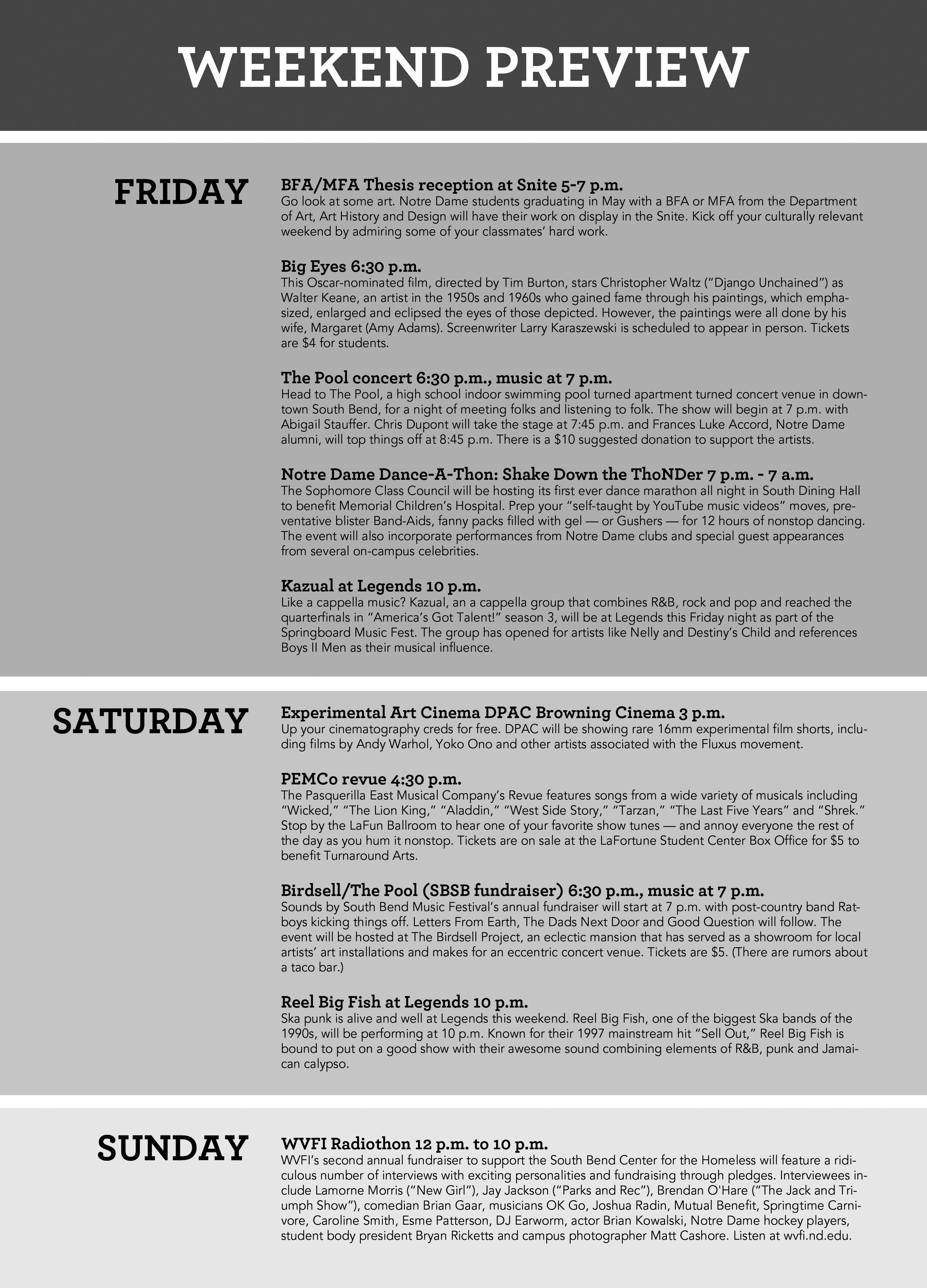
Just a few weeks after the h oly h alf, Notre d ame will see another kind of marathon come to campus — this time, a dance marathon.
From 7 p.m. Friday night until 7 a.m. Saturday morning in South d ining h all, the class of 2017 Sophomore Class Council (SCC) will host Notre d ame’s first annual d ance-A-Thon, the
proceeds of which will benefit Memorial Children’s h ospital in downtown South Bend.
SCC Treasurer Neil Joseph said the idea for the fundraiser was derived from the example of a number of universities, including Penn State and Ohio State, which have raised thousands of dollars through month-long campaigns that culminate in massive dance parties.
“A lot of other colleges
have been doing dance-athons to raise money for hospitals in their area, and we just really wanted to do something where we had an impact on our community specifically,” he said.
Joseph said all proceeds from the d ance-A-Thon will help to fund the the estimated $10 million expansion of Memorial Children’s h ospital in South Bend, which, according to its website, “treats children with
a wide variety of medical and surgical diagnoses from more than 20 referral hospitals throughout Southwestern Michigan and Northern Indiana.”
“They [Memorial Children’s h ospital] were really in dire need of this new addition for their pediatric unit, and so we met with them, and they were really excited,” Joseph said.
By MADISON JAROS News Writer
The Irish centenary celebration, commemorating 100 years of Irish independence in 2016, will feature Notre d ame’s documentary “1916: The Irish r ebellion” as a major pillar of the festivities, Thomas J. & Kathleen M. O’ d onnell Professor of Irish Studies Bríona Nic d hiarmada said.
The documentary tells the story of the 1916 e aster r ising, an event that ultimately led to Ireland’s independence. A three-part series, it will feature leading scholars from around the world, many of them from Notre d ame, d hiarmada said. The documentary was produced by award-winning director Pat Collins and will be narrated by Irish actor
(574) 631-8767 photo@ndsmcobserver.com
Systems & Web Administrators (574) 631-8839 Policies
Evan de la Rosa freshman St. edward’s hall “Tightrope walker.”
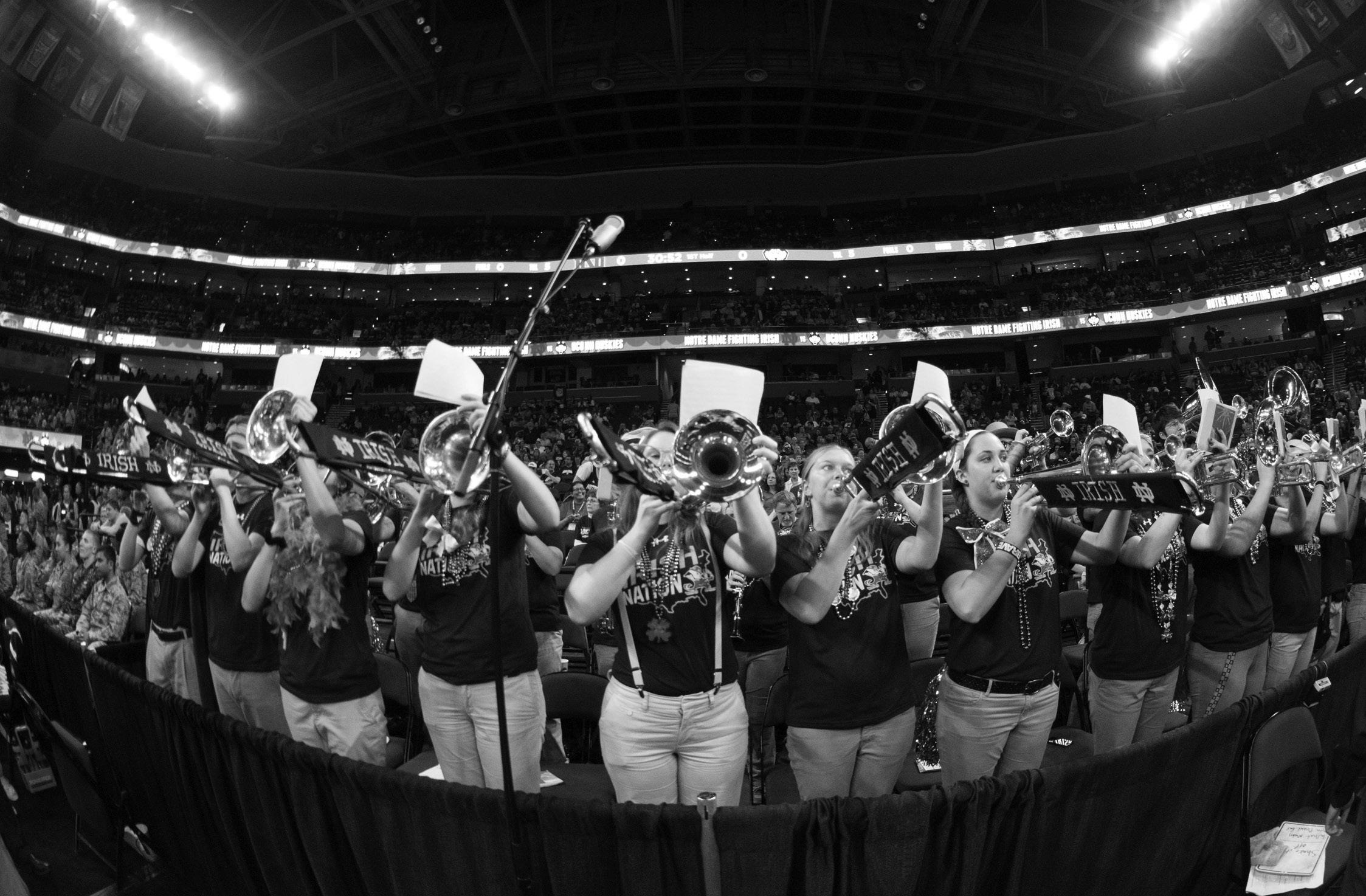
The Band of the Fighting Irish performs during Tuesday’s national championship game between Notre Dame and Connecticut at Amalie Arena in Tampa, Florida. The No. 1 seed Irish lost to the No. 1 seed Huskies, 63-53.
Today’s Staff
Corrections
The Observer regards itself as a professional publication and strives for the highest standards of journalism at all times. We do, however, recognize that we will make mistakes. If we have made a mistake, please contact us at (574) 631-4541 so we can correct our error.
Kickoff to a threeday event to launch businesses.
6:05 p.m. Notre Dame vs. Florida State.
Saturday
“A Midsummer Night’s Dream” Washington Hall
4 p.m.-6 p.m.
Theatrical performance.
Fiestang: “Kapamilya, Of the Same Family”
South Dining Hall
3 p.m.-7 p.m.
Filipino cultural event. Sunday
La Misa en Español Dillon Hall
1:30 p.m.-2:30 p.m. Spanish Mass.
Monday
“Getting Started in Research” Brownson Hall 4 p.m.-5 p.m.
Undergraduate Workshop.
“Mothers of Bedford” Geddes Hall
7 p.m.-8:30 p.m.
Film and discussion on mothers in prison.
Tuesday
Rolfs
11 a.m.-5:30 p.m.
Appointments are encouraged. Softball Melissa Cook Stadium
6 p.m.-8 p.m. Notre Dame vs. Bowling Green.
Professor examines ethics of non-violence
By JEREMY CAPELLO LEE News Writer
Addressing a standingroom-only audience, Judith Butler, professor of comparative literature at u niversity of California Berkeley, gave a lecture titled “The e thics and Politics of Non-Violence” on Thursday night at McKenna h all Conference Center as part of the annual y usko Ward-Phillips Lecture series.
Butler said it is not only difficult to define non-violence with certainty, but the principle of non-violence, once established, can also be easily misconstrued.
“A principled view on nonviolence can sometimes be interpreted as violence. And when that happens those who make that interpretation consider it to be the right one, and those whose actions are being interpreted as violence consider it to be very wrong,” Butler said.
“ e ven if non-violence
seems like a solitary act, it is mediated socially and depends on the recognition of conventions governing nonviolent modes of conduct.”
Butler said these principles of non-violence are often subverted by opposing social structures. In particular, the police response to the 2011 student protests at u niversity of California Berkeley, during which unarmed students were allegedly beaten, demonstrated a challenge to the established protocol of non-violence.
“What happens increasingly often is a deliberate policy meant to suspend or nullify recognition of the conventions of civil disobedience. ... This opens the way to construe non-violence as violence.”
Butler said the traditional conception of self-defense when discussing non-violence is an important one to consider, as it submits that killing for the safety of
loved ones is justifiable. This exception to the principle against killing, however, eventually leads to ethical conflict.
“The exception to the rule is important, perhaps more important than the rule itself. If there are exceptions to the prohibition on killing,
and if there always such exceptions, this assumes that the prohibition on killing is less than absolute,” Butler said.
Though people usually accept killing in defense of loved ones, they are not as willing to kill in defense of those with whom they have no relations, she said.
“A dubious distinction emerges between those who are close to one in the name of whose protection one may commit violence, and those in the name of whose defense one may not kill,”
Butler said.
“ you’ve started with a pacifist who makes a couple of distinctions, but now we see that the logic according to which those exceptions are made is on a continuum with a certain war logic.”
“The distinction between populations that are worth violently defending and those that are not implies that some lives are simply more valuable than others.”
To solve this ethical dilemma, Butler said it is important to uphold the equality of all lives, no matter how different.
“I’m suggesting that a thoroughly egalitarian approach to the preservation of life ... that subscribes to a notion of rational democracy that is
usually left out of the ethical considerations of how best to practice non-violence,” Butler said.
Butler said there is much opposition against this inclusive form of non-violence, and as such, supporters of this policy should expect criticism.
“Such allegations are meant to paralyze the speaker, distort the position against war and violence. ... When that happens, the critique of war is actually misconstrued as a battle-cry,” she said.
d espite this conflict, Butler said it is important to seek out like-minded groups willing to uphold this principle of non-violence.
“It’s important to hope, but to embody the hope in action, to link arms and minds to form that overwhelming solidarity,” Butler said.
Contact Jeremy Capello Lee at jcapell@nd.edu
Judith Butler professor of comparative literature u niversity of California Berkely
Fiestang returns with new NDFS partnership
By SAMUEL CHAN News Writer
The Filipino-American Student Organization (FASO) will once again be holding its annual Fiestang Cultural Show but with a unique twist this year: It will bear the theme “Kapamilya: of the same family.”
Attendees of the show, which takes place Saturday from 3 to 4:30 p.m. at South d ining h all, will be able to enjoy “traditional and modern Filipino dances,” a u niversity press release said.
The show will be followed by a Filipino dinner served at both North and South d ining h alls until 7 p.m., with dishes such as bistek (beef steak) and pansit bihon guisado (noodles), according to the Notre d ame Food Services (N d FS) website.
This is made possible through a “milestone” partnership between FASO and N d FS, Fiestang
commissioners and seniors Chris Aquino and Isabel Camara said.
“This has always been in the works, and this year was the right year for it to happen. The new person in charge [N d FS d irector Chris Abayasinghe] has a strong likening towards diversity and making people aware,” Aquino said. “There are also a lot of Filipino people on staff working in the dining halls, so combining those two it resulted in a N d FS sponsorship where it’s actually the dining hall that provides the Filipino food for the show, as opposed to just having it catered every year.”
This move is expected to improve the club’s visibility on campus. Currently, it has an active membership of about 50 students, Aquino and Camara said.
Compared to the previous venue of Stepan Center, the choice of location will “hopefully encourage some
underclassmen to check it out, see that it’s a good event and expect it for the years to come,” Camara said. “It’s a giant part of the exposure.”
Aquino and Camara said they anticipate around 200 people will come to Fiestang, with families from the South Bend community representing about one-third of that number.
“Filipino culture is so vivacious, you could walk around the Philippines and see someone singing their soul out with karaoke or being very into a certain dance. … That’s what our culture is and why the show’s always been around,” Camara said. “We all come together for the sole purpose to just celebrate being Filipino.”
Apart from this, Aquino stressed the importance of the values reflected in Fiestang.
“The show is a celebration of our culture,” Aquino said. “It’s full of music, joy,
Activists appeal to youth
By MEGAN VALLEY News Writer
Last night in McKenna hall, the d ean’s Fellows of the College of Arts and Letters invited three speakers from Kalamazoo, Michigan — Michael Wilder, yafinceio harris and Sam Bailey, a professor from Kalamazoo Community College — to speak about the Peace d uring War project. Peace d uring War is a group that visits high schools, juvenile homes and prisons to share Wilder’s and harris’s story about their life of drugs and crime and redemption after prison. Wilder said they hope to change lives by showing young people they can turn their lives around.
“We tell our story to the youth so that they don’t make the same mistakes we made and end up in prison like we did,” he said. “Our story ends in good, but a lot of young people that go on that same path don’t end up good; they end up dead, they end up in prison forever.”
Wilder and harris talked about their childhoods and adolescences being surrounded by a culture that did not encourage them to have a life outside of crime. harris said to have aspirations in that culture was looked down upon.
“To try to be positive is a negative in our neighborhood,” he said. “But to be positive around you all, to be positive to your teachers, is a plus to them, and they make you feel glorious and good.”
Wilder and harris said Peace d uring War has spoken with 3,000 to 4,000 troubled youth in the past three years,
visiting all the juvenile homes and alternative high schools in Kalamazoo and has traveled to speak to youth in other parts of the country as well.
Wilder said his work with the program has changed his life and allowed him to contribute
“We tell our story to the youth so that they don’t make the same mistakes we made and end up in prison like we did. Our story ends in good, but a lot of young people that go on that same path don’t end up good; they end up dead, they end up in prison forever.”
Michael Wilder Peace During War
more to his community, after years of dealing drugs.
“Now, I have seven police officers’ personal numbers in my phone, including the narcotics agent that raided my house and caught me with drugs in 2008,” he said. “Now, they call on us for community help. If drug dealers get out of hand, they call Peace d uring War. If the gang violence gets to an accelerated rate, they call Peace d uring War. We’re so honored and proud to be a part of that.”
harris said he and Wilder started speaking in schools because they wanted to share their stories, but they did not expect it to become a job for
and has great food. Sounds cheesy, but 110 percent honest that is what our culture boils down to — and food is important, really important.
Family is the core of everything and music and fun.”
Aquino also said N d FS is planning on instituting Filipino cuisine as a regular rotation in the dining halls, similar to the current arrangement for the Korean, Vietnamese and Indian cuisine that appear roughly every fortnight.
“It starts with the show pretty much,” he said. “This is so different from what we have known Fiestang to be from previous years.”
The show has gained the support of other organizations, including Multicultural Student
Programs and Services (MSPS), according to its assistant director, Arnel Bulaoro.
“Fiestang is one of many signature events designed to celebrate culture and create community building events,” he said. “I am simply a sounding board for the organization. … It has been a pleasure to watch the exchange of ideas between Food Services d irector Chris Abayasinghe and the FASO officers.”
According to FASO’s Facebook page, the show will offer free admission and the first 80 attendees without a meal plan will receive free meal tickets for the Filipino dinner.
Contact Samuel Chan at schan3@nd.edu
them.
“We’re just happy to be here, to change lives,” he said. “We’re just happy to be who we’re becoming.”
Contact Megan Valley at mvalley@nd.edu
Author shares experience living with Asperger’s
By MEGAN UEKERT News Writer
d avid Finch, the author of the New york Times bestselling book “The Journal of Best Practices,” spoke with his wife, Kristen Finch, on Thursday in Carroll Auditorium at Saint Mary’s.
Finch has written for both The New york Times and h uffington Post on Asperger’s syndrome, which is also a central theme of his book. “The Journal of Best Practices” details a two-year period after his diagnosis of Asperger’s, five years into his marriage with Kristen.
“I just wanted to write a book to make people laugh,” he said of the book. “I’ll write about how I ruined someone’s life.”
In addition to his writing, Finch has also been featured in an NBC feature that aired on r ock Center with Brian Williams, and he travels around the country talking about the realities of autism and Asperger’s.
“A lot of people who are on the [autism] spectrum are individuals who can observe very well what’s happening around them and really fly
“I just wanted to write a book to make people laugh. I’ll write about how I ruined someone’s life.”
David Finch writer
under the radar,” he said.
“We hyper-process everything. Marriage and autism are very similar in the sense that ... you stand back and look at the relationship and think it’s completely normal, but you sometimes don’t realize what is going on inside.”
Finch said when his first book went on sale, he received many surprising letters from people who were fighting their way through
similar situations. The common thread in all the letters was that the book gave them hope, he said.
“Autism and Asperger’s doesn’t always have the word ‘hope’ attached to it,” he said. “It is not easy for everyone; some people have a very difficult time. There are lots of amazing gifts and talents, almost super powers out there in the minds of these people.”
According to the C d C, one in 68 people are diagnosed with autism. h owever, Finch said even to this day he still strays away from telling people he has Asperger’s because of the social stigma that comes with it. People still try to give him “special treatment” when he comes to speak at events, he said.
“Most doctors should walk into the room with your child’s or your diagnosis saying, ‘ you have a high power functioning machine here, he’s/she’s got an amazing mind.’ In reality, no doctors come in just saying that. They say that you have Asperger’s
and it is going to be very difficult for you.”
Finch said there are four rules he has developed to lead to success, not only for people on the autism spectrum. The fourth rule, he said, revolves around learning to adapt. “ ... you cannot fail unless
you fail to adapt,” Finch said.
“We live in a neuro-typical world, not an autistic world. h ow do you fail when you have people to love you, to understand you and to guide you?”
Contact Megan Uekert at muekert@nd.edu
Students to compete in Chinese speech contest
By WEI LIN Assistant Managing editor
Students of the Chinese program will demonstrate their aptitude in the
language by competing in the eighth annual Chinese Speech Contest in h esburgh Center Auditorium at 7 p.m.
Friday.
Freshman Ailsa Xing and
junior Zachary Sturm will serve as emcees for this contest. Associate professor yongping Zhu, who is a chair in the d epartment of e ast Asian Languages and
Cultures, will provide the introductory remarks to start off the contest.
Approximately 20 students who were recommended by their language instructors will have the chance to present on a variety of topics. These topics range from the student’s experiences in learning Chinese and the benefits of learning Chinese to topics including arts and addressing race.
The contestants will be competing within their level of language proficiency, with the exception of fourth- and fifth-year Chinese students, who will compete with students from both levels.
Associate professional specialist Chengxu y in spearheaded the event along with various other instructors.
“Our primary goal in organizing this event is to enhance the study of Chinese at Notre d ame and to foster a sense of community among our language students,” y in said.
She said the large number of students in the Chinese language classes inhibits interaction between students of different levels of instruction.
“The speech contest provides an excellent opportunity for students to get to know each other better,” y in said, “[It also] allows students at lower levels to be inspired by the achievements of those at higher levels.”
In attendance will not only be Chinese language students and the language
instructors, but also faculty in the Chinese language program who are not involved in facilitating language acquisition.
“The contest will also provide an opportunity for [all of] our faculty to assess the learning outcome of our students, especially in the area of pronunciation and intonation,” y in said.
y in said students worked with their instructors to flesh out their speeches and rehearsed them their own time. She emphasized many hours of work went into preparations for the contest.
Specific speech titles include “ e volution Of Chinese Music,” “China Allowed Me To Accept My Skin Color” and “ u nder the d ome,” among others.
Along with the d epartment of e ast Asian Languages and Cultures, the Office for u ndergraduate Studies of the College of Arts and Letters, the Kellogg Institute for International Studies and the Center for the Study of Languages and Cultures will also be sponsoring this annual event.
The winners of each category will have the chance to compete in the u.S. Midwest “Chinese Bridge” Speech Contest, which will be hosted by Notre d ame on April 18. The winners will compete against contestants from more than 10 different Midwestern universities and colleges.
Contact Wei Lin at wlin4@nd.edu
MONICA VILLAGOMEZ MENDEZ | The Observer
Best-selling author David Finch and his wife, Kristen, discuss Finch’s diagnosis of Asperger’s syndrome and its impact on their life together.
November 2014, e SPN reporter Paula Lavigne requested incident reports from N d SP related to student athletes. On both instances, Notre d ame denied the request on the basis that N d SP is not a public law enforcement agency and is therefore not subject to AP r A.
According to documents filed in St. Joseph Superior Court, e SPN Inc. filed a complaint against the u niversity on Jan. 15 after Notre d ame refused to release the incident reports for the second time, contrary to the opinions of Indiana Public Access Counselor (PAC) Luke Britt. Britt, an attorney appointed by the governor to provide advice and assistance on Indiana’s public access laws, issued an opinion on Oct. 31 notifying N d SP that his office considers it to be a public law enforcement
agency subject to AP r A. On Jan. 5, in his response to Lavigne’s second complaint, Britt wrote that he expects N d SP to comply with AP r A and release its records, although his opinion does not have the force and effect of the law.
e SPN submitted both of Britt’s opinions as evidence for their argument in court, according to a report in the South Bend Tribune last Thursday.
On Feb. 12, d amon Leichty and g eorgina Jenkins, representing Notre d ame as attorneys from Barnes and Thornburg, submitted a written defense outlining the u niversity’s argument that N d SP is a private police department.
Leichty argued that N d SP derives its power from the Notre d ame Board of Trustees, not the Indiana state government, according to the Tribune report.
powers’ and ‘statutory powers, privileges and immunities as sheriffs and constables,’ the Trustees may restrict their ability to serve civil process,” Notre d ame’s brief stated. “By statute, campus law enforcement serves at Notre d ame’s pleasure and in accordance with an oath that the Trustees describe — not the government.”
Leichty’s defense brief also emphasized past cases involving the A r AP and private universities, stressing PAC opinions in Notre d ame’s favor from 2003, 2009 and 2011.
“For more than 30 years, and certainly well-settled for more than a decade, private university police departments have not been subject to AP r A,” Leichty wrote. “There has been no intervening change in the law that justifies an abrupt shift on this issue.”
Leichty argued that changing the status of N d SP
to a public agency could lead to the public disclosure of private institutional records, according to the Tribune.
“In a society where an open government is considered essential to a properly functioning democracy, not every iota of information is subject to public scrutiny,” Leichty wrote. “That principle resounds with even more force when e SPN (advancing a sports media purpose) seeks to subject private institutions, such as Notre d ame or its campus police department, to a law intended for government scrutiny.”
According to the Tribune, James d imos, a Frost Brown Todd attorney representing e SPN in the case, argued Notre d ame should be subject to government scrutiny because it possesses the police powers of arrest.
“The u niversity of Notre d ame Security Police d epartment desires to operate in the shadows as a
secretive force with all of the police powers under Indiana law but none of the public scrutiny,” d imos wrote in the plaintiff’s brief, which was filed March 9.
d imos also wrote the privacy records of Notre d ame students would not be affected if N d SP was declared a public agency because of protection under the Federal e ducational r ights and Privacy Act (F er PA).
Notre d ame is asking for the case to be dismissed, while e SPN is asking the court to order Notre d ame to release the papers and pay legal fees.
Assistant Vice President for u niversity Communications d ennis Brown said Notre d ame is confident in its position after presenting its argument in court.
According to the Tribune report, h ostetler plans to issue a ruling by April 20.
Contact Katie Galioto at kgalioto@nd.edu
Cottrell said N d SP preferred to keep its crime statistics as low as possible.
Cottrell said this problem was magnified as his bosses would say they had empathy for victims of crimes but did not really support them. Additionally, Cottrell said N d SP could not contact any athlete or athletic staff directly, regarding of any accusation, without first going through u niversity officials.
Paul Browne, vice president for public affairs and communications for the u niversity, said Cottrell’s assertion was false.
“‘The h unting g round’ ... was wrong in unsupported and inaccurate assertions that the u niversity sought to suppress crime statistics and shield athletes from investigators,” he said in a statement.
r achel h udak, a former Saint Mary’s student, was featured in the documentary regarding a sexual assault that allegedly happened on Notre d ame’s campus. h udak said Mooney disregarded her sexual assault complaint in a meeting.
Tom Seeberg, father of Lizzy Seeberg, a former Saint Mary’s student who committed suicide after an alleged sexual assault by a Notre d ame football player, spoke on his daughter’s behalf.
Seeberg said Lizzy
reported the alleged assault the day after it happened and received a threatening text from another football player.
Mooney spoke after the film and said students may wonder why she did not agree
“‘The Hunting Ground’ ... was wrong in unsupported and inaccurate assertions that the University sought to supress crime statistics and shield athletes from investigators.”
Paul Browne University vice president, public affairs and communications
to be interviewed by CNN for the movie.
“I hope you know that student privacy is of the utmost importance,” Mooney said. “ you may also be wondering about r achel’s comment, and I remember our conversation very differently than she does. It is through her pain that she remembers. I am, and was then, very sorry I cannot take her pain away.”
response to the film
Five panelists spoke after the documentary, including Karen Johnson, vice president of Student Affairs at the College, Connie Adams,
director of BAVO, Stacy d avis, chair of the g ender and Women’s Studies department, senior Payton Moore and Brian young, commander of the St. Joseph County Special Victims u nit.
Adams said two key areas stand out most to her after watching the documentary. The first area, she said, was the theme of survivors that feel alone.
“We as a community can respond in a compassionate way,” Adams said.
The second theme in the film is activism, she said.
“They are so many ways we can take on this issue,” Adams said. “We can really assume that call to action.”
d avis said there was a horrible repetitiveness in the documentary of schools covering up sexual assaults.
“My first response was anger,” d avis said. “Then I realized you all have an incredible opportunity because all schools want to get paid and stay open. It was a good thing that [the documentary] shamed schools, so that you [students] are treated fairly.”
reporting sexual assault
Johnson said the number of reported campus assaults depends on where the assault is reported. She said there are between four to six reports of sexual assaults annually that come across her desk in Student Affairs.
“If they report at Notre d ame, our office doesn’t get
that information,” Johnson said. “It’s really important to know that we work with the Title IX coordinator at Notre d ame, and that’s as far as we can work with them. What we do here is to provide as
“When
in the documentary. h e said St. Joseph County SV u will work with a student as soon as an incident is reported to the department.
“We work with the victim and want to be consider-
we’re talking about violence, we’re talking about taking power away. The support has to be about getting that power back, and the support we have on campus is to empower the students.”
Connie Adams director, BAVO
much support regardless of where they were assaulted. Things can change if we all work together to make that happen.”
Adams said it is important to listen to the student’s needs through the healing process.
“When we’re talking about violence, we’re talking about taking power away,” Adams said. “The support has to be about getting that power back, and the support we have on campus is to empower the students.”
As an alumna of Saint Mary’s, Adams said she has seen growth returning to the campus as the director of BAVO. The office began in the spring of 2010, and it has continued to evolve and grow since then, especially in regards to student activism, she said.
young said he was struck by the lack of compassion on the part of law enforcement
ate to what has happened and certainly compassionate towards what she’s going through,” young said.
Johnson said he also works closely the Title IX coordinator at Notre d ame.
“We can’t dictate to Notre d ame what the outcome of a case should be, but we can only support our students. The hard part for all of us is that we are two separate legal entities, and therefore the best I can do is meeting and going through the processes,” she said.
The panel concluded without answering all audience questions. Moderator Frances Kominkiwicz said all questions submitted by members of the audience will be answered in a written document on the BAVO webpage and sent out in an email.
Contact Haleigh Ehmsen at hehmse01@saintmarys.edu
Liam Neeson.
“ you either do something properly, or you don’t do it at all,” d hiarmada said. “And I suppose, being Notre d ame, if we’re going to go for it, we’re going to go for it. So we wanted to do this at the highest production values possible, and we started like that from the beginning.”
d hiarmada is Irish but said a documentary commemorating the American Civil War inspired her to write the series.
“About five years ago, I had been watching Ken Burns’s ‘The Civil War,’ which is a fantastic documentary, and it really made the Civil War intimate for Americans again,” d hiarmada said. “It was this wonderful, personal view — but it also contextualized it. And I remember thinking at the time, wouldn’t it be fantastic if we could do something similar for 1916?”
The Keough-Naughton Institute at Notre d ame worked closely with scholars in Ireland to produce the documentary, giving it a unique perspective, d hiarmada said.
“I think if I were [creating the documentary] in Ireland, it might be a different documentary,” she said. “The fact that I’m based in the states, it’s emanating from the u niversity of Notre d ame, which has a strong connection with Ireland. Particularly the KeoughNaughton Institute for Irish Studies — we’re a leader in Irish Studies. So we have this connection, this back and forth, and I think it’s that
perspective that we’re able to look over back to Ireland, bring what we have over here over there and bring Ireland back to us.”
Walter h . Annenberge dmund P. Joyce Chair in American Studies and Journalism r obert Schmuhl, who was also involved in the creation of the documentary, said the series’ global scope sets it apart.
“This documentary will consider the global significance of the e aster r ising,”
Schmuhl said. “Many depictions focus overwhelmingly on the consequences within Ireland. The Notre d ame production takes a broader and more comprehensive approach, considering, for example, the involvement of Irish America in the r ising and afterwards.”
In 2016, Ireland will play a cinematic version of the documentary in Irish embassies around the world, d hiarmada said. d irector of Notre d ame’s d ublin Center Kevin Whelan said the documentary’s broad and inclusive scope and scholarly focus will tell the story of Ireland in a way it hasn’t been told before.
“I believe that the documentary will allow every Irish person to access the best recent thinking on the r ising, a pivotal event in forming modern Ireland,” Whelan said. “Because of its high production values and content, I am very confident that it will also project very positive view of Notre d ame.”
This inclusive scope is important to Ireland as it looks back at its history and growth as a nation, d hiarmada said.
“Telling the story now, 100 years on, after the peace
process, I think we can look at it as history,” she said. “It’s still quite contentious. But I think what we’re trying to do here, and it’s very much in tune with what the Irish government is trying to do in their centenary commemorations and celebrations, is to be more inclusive. Because we now have new sources … many more archives are opened up to us than would have been the case at the 50th anniversary. So I think we can be a bit more generous in our telling. Painting parts of the story that had been left out before.”
The documentary isn’t only looking back toward the past — it’s looking forward to the future, Taoiseach of Ireland e nda Kenny said in a promotional video for the series.
“I’ve been to Notre d ame. I really am grateful to Notre d ame for what they’re doing here, in leading in an academic way the background, the understanding, the comprehension, of 1916 — and more so, what it means and will mean for the future, for the start of the journey of the next century,” Kenny said.
“That’s going to encourage and invigorate and motivate Irish people all over the world — proud of their ancestry, proud of the journey our country has come on, proud of the way that we have dealt with sacrifices economically and otherwise over the years, and proud now that a young generation, a rising generation in Ireland and abroad, are proud of their past, proud of their heritage, and will create and change the frontiers of the future,” he said.
Contact Madison Jaros at mjaros@nd.edu
dance
CONTIN ued F rOM PAge 1
“We were just thinking big.” SCC President Noemi Ventilla said the d anceA-Thon will be the second major event hosted by the SCC this year; their first was the g reat g atsby d ance in September.
“We did g atsby in the fall, and we realized that having campus-wide events, bigger events has a lot bigger impact and durability than a lot of the events that class councils do,” she said.
But bigger events entail greater commitments of time and resources, and Joseph said organizing the d ance-A-Thon has proved “a huge learning process.”
h owever, Ventilla said the combined efforts of all SCC members — which have fueled a large-scale promotional campaign extending across social media, youTube and the event’s brand new website — have transformed what began as a distant vision of a dance marathon into an imminent reality.
“There are 37 of us [on SCC], so there are 37 people working on it,” she said. “Before then, we had committees, and they did their own thing, but because this is such a huge process, we all came together.”
Ventilla said their promotional efforts have already generated a lot of excitement in the community.
A variety of sponsors has contributed to the event, and even more organizations have indicated their interest in participating in coming years.
“We’re going to have a ton of really great things, but the real potential for this is in the future,” she said. Included in the festivities lined up for this year’s d ance-A-Thon are live performances by student organizations, an inflatable obstacle course, music, free food and, of course, dancing.
“It’s an all-night thing, so if you’re coming back to campus at 3 a.m. and don’t have somewhere to go, instead of Taco Bell, come to us,” Ventilla said.
Both Ventilla and Joseph said their eventual hope is to create a club which will take over organizing future d ance-A-Thons.
For the present, however, Joseph said the SCC’s primary objective is to encourage participation among the student body, both in terms of donations and attendance at the actual event.
“We really want people to come out and have fun, and that will set the tone for coming years,” he said.
Joseph said students can support the event by donating through a link on the event website (http:// nddanceathon.weebly. com),or by texting “Beacon N d ” to 20222, which will make an automatic donation of $5 to Memorial Children’s h ospital. h e said the SCC will also be collecting donations in person throughout the night.
“ e very little bit counts,” Joseph said. “It’s kind of corny, but it really does.”
Contact Clare Kossler at ckossler@nd.edu
Shooting of motorist in S.C. caught on camera
Associated Press
NOrT h Ch A r L e STON, S.C.
— The traffic stop starts like any other: an officer pulls over a motorist, walks up to the driver’s side window and asks for license and registration. What happened minutes later appears to take place without any obvious sign of provocation or conflict: The driver opens the door and runs, and the officer chases after him.
Video released Thursday from the dashboard of white North Charleston police Officer Michael Thomas Slager’s cruiser captures the very first moments he and black motorist Walter Scott meet, a strikingly benign encounter at its earliest stages. It changes within minutes as Scott takes off running and the officer runs after him.
The video captures the moments leading up to a fatal shooting that has sparked outrage as the latest example of a white police officer killing an unarmed black man. The
shooting itself was captured by an eyewitness on his iPhone and provided the impetus for the officer to be charged with murder and fired.
But questions had remained how the traffic stop turned deadly. The dash cam video provides a more complete picture of the encounter.
Seth Stoughton, a former police officer and criminal law professor at the university of South Carolina, said the dash cam video shows nothing that would indicate that such a routine traffic stop would escalate to a fatal shooting.
“It’s not entirely normal. Most people don’t run during traffic stops. But it is not overly threatening or anything that should take an officer aback,” Stoughton said.
The shooting took place on Saturday and the department and Slager’s lawyer said the officer fired in self-defense during a scuffle over his departmentissued Taser. Within days, the eyewitness video surfaced and
immediately changed perceptions of what happened, leading the department to charge Slager with murder and fire him from the force he’d worked on for five years.
The dash cam video shows Scott being pulled over in a used Mercedes-Benz he had purchased just days earlier. Police have said he was being stopped for a broken tail light. Slager is seen walking toward the driver’s side window and heard asking for Scott’s license and registration. Slager then returns to his cruiser. Next, the video shows Scott starting to get out of the car, his right hand raised above his head, then he quickly gets back into the car and closes the door.
Seconds later, he opens the door again and takes off running. Within a city block or two, out of the dashboard camera’s view, Slager catches up to him in an empty lot.
A bystander noticed the confrontation and pushed record on his cellphone, capturing
video that has outraged the nation: it shows Scott running away again, and Slager firing eight shots at his back.
There is almost nothing in Slager’s police personnel file to suggest that his bosses considered him a rogue officer capable of murdering a man during a traffic stop. In the community he served, however, people say this reflects what’s wrong with policing today: Officers nearly always get the last word when citizens complain.
“We’ve had through the years numerous similar complaints, and they all seem to be taken lightly and dismissed without any obvious investigation,” the rev. Joseph darby, vice president of the Charleston branch of the National Association for the Advancement of Colored People, said Thursday.
The mostly black neighborhood where the shooting took place is far from unique, said Melvin Tucker, a former FBI agent and police chief in four southern cities who often
testifies in police misconduct cases.
Nationwide, training that pushes pre-emptive action, military experience that creates a warzone mindset, and legal system favoring police in misconduct cases all lead to scenarios where officers see the people they serve as enemies, he said.
“It’s not just training. It’s not just unreasonable fear. It’s not just the warrior mentality. It’s not just court decisions that almost encourage the use of it. It is not just race,” Tucker said. “It is all of that.”
Both Slager, 33, and Scott, 55, were u.S. Coast guard veterans. Slager had one complaint in his personnel file of excessive force that was ultimately dismissed. Scott had been jailed repeatedly for failing to pay child support. But neither man had a record of violence. Slager consistently earned positive reviews in his five years with the North Charleston Police.
iNSidE ColuMN
Awkward guests
Annmarie Soller Photographer
you may or may not have had this problem. you are talking to your friend from home, and you are explaining why Notre dame is simply the best: the community, the sports, top academics, et cetera. your friend doesn’t believe you, so you say, “you need to visit.”
Then you realize what you’ve just done. you’ve offered an invitation for your friend to stay and hang out with you. you may be off the hook if your friend is just as busy as you are being studious but also trying to create something that resembles a social life. Or you may be giving directions for how your friend can get to your dorm from Main Circle.
I’m not saying guests are bad; I’m pointing out that having guests is awkward. how are you supposed to entertain them? South Bend is not a thriving metropolis, and the majority of the school year is cold. you obviously begin with a tour of campus: visit the grotto, take the typical dome pic and show off your tiny dorm room (unless you live in one of the spacious West Quad dorms). But then what?
What if there is no home football game or basketball game or insert favorite Notre dame sport here to spectate? What if there are no performances in dPAC or events at Legends? What if the Snite hasn’t changed its collections, and all you see from the library windows is construction?
While it is highly unlikely that nothing is happening, it is likely that you may not even think of these ideas. you want to be entertaining, but you also want to show your friend your college experience. Personally, when I’m not studying or working or in a meeting, I’m playing video games or, more likely, sleeping. My friends could do that anywhere.
There is a lot of pressure to make the visit ideal, but what makes a trip to our lovely home under the dome worthwhile? A visit to our campus is rarely like what the media perceives a typical college campus to be like. The quads are dormant, save for those few warms days in late spring and early fall when it is nice enough to spend a good chunk of time outside. Parties only happen Thursday, Friday and Saturday (unless it’s syllabus week or Wake Week), and even then, there is no guarantee you can find one. And what happens when your friend plans to stay for a few days or their whole spring break? When do you reach the limit of the fun things you can do? I wonder if this burden of being the awkward host works both ways. Maybe other campuses go dormant, and there are certainly more remote campuses than ours. After you’ve “entertained” your friend, you should bring up how great it would be to see how their campus compares. Then once you’ve conquered awkward guests, you can advance to hosting awkward relatives.
Contact Annmarie Soller at asoller@nd.edu
The views expressed in the Inside Column are those of the author and not necessarily those of The Observer.
Richard Klee guest Writer
Fr. Ted and women at ND
Fr. Ted was a fighter for human rights. As chief of the Civil rights Commission, brokering landmark compromises that gave new legal protections to many Americans, and as Notre dame’s longest serving president, opening Notre dame to female students and integrating Notre dame’s leadership with lay men and women, Fr. Ted sought greater respect for the god given dignity of many. As Notre dame examines how to renew Fr. Ted’s tremendous legacy today, it could find no better concern than Notre dame’s underrepresentation of women in leadership and underrepresentation of minorities across the university. I will focus on the former here and write about the latter in a subsequent column.
In 2013-14, Notre dame held a university-wide forum on “Women in Leadership.” during many events, scholars and leaders offered compelling research and personal experience regarding the unique and essential contributions of female leaders. Studies showing increased efficiency, transparency and effectiveness in organizations with strong representation of women in leadership were matched with stories of women overcoming great odds to lead.
At the end of this same year, Notre dame had eight open positions on the Board of Trustees to fill. The results were not what one would expect of a year dedicated to “Women in Leadership.” Seven men and only one woman were selected, further reducing the representation of women on the Board from 30 percent to 27 percent. The highest level of governance, the Board of Fellows, elected one male to its lone open position, maintaining its disproportion of 11 men and just one woman. For a governance structure in which business is approved by two-thirds majority, this means that for the Fellows and for the Trustees, the votes of women are not needed for approval of any matter. Such conditions undermine the lay participation in governance that Notre dame claims and that Fr. Ted began. There is no secular or religious definition of “laity” in which women are so marginalized.
Talk about women in leadership, without dramatic improvement in their representation, degrades the university’s credibility as Catholic and as an institution of higher learning. having written about challenges facing female faculty and students in previous columns, I will focus on staff here. In a recent town hall talk, executive Vice President John Affleck-graves voiced his concern about a lack of diversity at Notre dame, saying that he would “challenge my nine direct reports to tackle the situation.” yet what was not said was that eight of these nine directly reporting administrators are male, a situation which Affleck-graves has had, in a decade as eVP, ample time to tackle. Indeed, many of these directly reporting administrators, in turn, oversee leadership structures that are dominated by men, such as the Finance division, with five of its six leaders being male; Auxiliary Operations, where all six who hold the title of “director” are male; the Controller’s Office, in which eight of the nine persons with the title of “controller”
EdiToriAl CArTooN
are male; Campus Safety, where all but one of the eight directors or chiefs are male; or the Investment Office, where all nine top administrators are male. These are just a few of many male-dominated leadership structures at Notre dame. Such structures breed insularity and artificially narrow the paths to leadership.
As many of these positions are held by long-term employees of Notre dame, Notre dame’s “corporate culture” is indicted by such underrepresentation of women. Those men who fit the model of what Joan Williams, a scholar of work culture, calls the “work devotion schema,” willing to greatly reduce family and community commitments in favor of long hours, heavy office responsibility and a nearly always engaged electronic connection to work, advance. This model of “workplace devotion” was long ago rejected by the world’s most efficient economies like germany, and plenty of research describes both its inherent inefficiencies, as well as its deleterious effects on women’s vocations particularly.
From a Catholic perspective, Pope Francis’ habit of testing fathers in the confessional about how much time they spend with their children and asking adults about how often they are with their elderly parents are vivid examples of how the Church defends the responsibilities of family as primary, against encroachment by work devotion. The failure of Notre dame’s administration in the last decade to improve the representation of women in leadership and their own practice of the “work devotion schema” speaks more stridently and effectively than talk of diversity. Put simply, the current path to leadership is debilitating for men and for women, and male aggrandizement in leadership is a symptom of Notre dame’s sick culture of work.
A prominent female scholar recently shared a story of having a photo taken with Fr. Ted. Near the end of his life, he was seated in a chair, and she crouched down to be nearer to him for the picture. Fr. Ted looked at her and said, “Notre dame women stand tall.” She stood for the photo and shares it today as a memento of Fr. Ted’s gesture of respect. Such respect for women as leaders, present and future, motivated Fr. Ted to make many controversial but effective changes to Notre dame’s organization and culture. Now there are generations of Notre dame women who blaze trails in many fields. Notre dame needs many more women in leadership. until this happens, Notre dame is not truly governed with the laity, and its potential as a Catholic research university is hindered by its infirm work culture and insular, inefficient and mostly male governance. The university can only benefit from greater organization and collaboration, especially led by female alumnae, faculty and staff, to recruit, retain and advance more women at Notre dame. To celebrate and promote Fr. Ted’s legacy, the time has come for effective changes at his beloved university, to restore the vision of men and women as partners in leadership.
Richard Klee graduated from Notre Dame in 2002 and is now a doctoral candidate in the Department of Theology. He can be contacted at richard.f.klee.12@nd.edu
The views expressed in this column are those of the author and not necessarily those of The Observer.
PE replacements, student input, straight talk
for now.
In April 2014, the university announced it would replace the freshman Pe requirement with a new First year of Studies class beginning in fall of 2015. having passed the swim test with flying colors and become a force in team handball as a freshman, I can’t say I was pleased about it. I was less pleased when First year of Studies dean, skillful speaker and fellow blues player hugh Page told the South Bend Tribune, “The decision was made based on what we see around the country and what’s in the best interest of our students.” This approach is, as I’ve argued elsewhere, an incomplete way to go about making decisions since the actions of our peer universities shouldn’t dictate what we do here and because “in the best interest of our students” comes off a little paternalistic when the ad-hoc committee making this decision last spring did not have a student on it.
But since the decision was made long ago, the important thing this April is to make sure that whatever form the new First year Studies course takes is a positive use of students’ time. The class of 2019 will be the most talented and accomplished class ever to attend Notre dame until the class of 2020 moves in, and it deserves to have academic requirements worthy of its attention and increasing sums of money. eliminating Pe will lay off or reassign at least 12 people on the university’s payroll and remove another timeslot where a smartphone and MacBook-dependent generation can be uninterruptedly social. In short, we need a really good reason to back up the change. A proposed syllabus exists. I can’t get a copy of it. But having read around the topic and talked with some who are important enough to see the syllabus, I am going to do something I rarely do in The Observer and remain neutral
lETTEr To THE EdiTor
We know at least the following. The class, called the “Moreau First year experience,” will be a graded, onecredit-per-semester course with a 50-minute meeting once a week. Thematically the class is based on the “five pillars” of a holy Cross education — mind, heart, zeal, family and hope — and seven themes — “Orientation to university Life, Strategies for health and Wholeness, Community Standards and Cultural Competence, Strategies for Success in the Classroom, discernment, Cultivation of Spiritual Life and Mind-Body Awareness.” There will be light reading and/or online assignments to complete before class to guide discussions and a capstone project at the end of each semester. All this will hopefully be commensurate with the time commitment of a normal one-credit course.
One could not infer this information from the university’s press release last April, in which dean Page was quoted saying the following: “rebranding and further centralizing health, wellness and cultural competency initiatives campus-wide — within the context of an integrative paradigm for our First year experience — better enables us to meet the evolving needs of students. It also promises to strengthen and diversify linkages between the academic, co-curricular and residential dimensions of the larger Notre dame ethos and the Congregation of holy Cross educational charism that informs it.”
“Initiatives campus-wide — within the context of an integrative paradigm … to meet the evolving needs of students” is weighed down with more linguistic baggage than Taylor Swift/Charlie Sheen/Mel gibson/Scott Stapp/ Courtney Love/Kurt Cobain/Lindsay Lohan pulling a Conestoga wagon. Capping it off with linkages, ethos and an informative charism gives it a buzzwordy finish that tells us nothing about the content of the course. Were someone, hypothetically, inclined not to like a given policy
change and looking for weak, nonspecific verbiage to demean in writing as devoid of substance and indicative of a bad policy program, this would be it. If someone looking for evidence that purely in the name of doing as the Ivies do we were going to pan a constructive, decades-proven method of soberly acquainting Notre dame students from every corner of campus, this passage would be the smoking gun.
What brought me around to the possibility that this change could be a good idea was talking with Jake Wittenberg, a fellow Stedsman and a student representative to the team designing the course. When I asked him how the course accomplishes anything you couldn’t get from simply living as a Notre dame student, Witt said this over email: “Oftentimes students are only made aware of the incredible resources available to them too late to truly take advantage of them (I think everyone knows this feeling).” As a second semester senior who sometimes regrets never applying for a CuSe grant and just found out that you can access Ancestry.com through the library website, this resonates with me.
I’m not ready to embrace the course. I’m concerned about firing staff, inflating grades and decentering physical activity from student life. But I’m not ready to trash it in the student newspaper yet, either. For policy-making administrators not interested in stoking 1,000-person strong online petitions and viewpoint wars, the way forward is simple: get students involved, stop making big decisions at the end of the year and, for the love of god, stop using “paradigm.”
Alex Caton is a senior political science major in the one and only St. Edward’s Hall. He welcomes commentary and jam session invites at acaton@nd.edu The views expressed in this column are those of the author and not necessarily those of The Observer.
“how was break?” “g ood.”
As I boarded the plane on my way back to campus this weekend, I couldn’t help but notice the shamrock Notre dame tie that the suited man sitting across the aisle from me was wearing. As I found my seat, I considered whether or not to engage him in conversation. Perhaps he was an alum, maybe a fan or even one of the many that seem to sport N d apparel for no particular reason. My first instinct, this being a two-hour, early morning flight, was of course to say nothing. But as I settled into my seat and opened my book, I could tell that he was glancing over at my dillon hall t-shirt, and, figuring that at most we would engage in some casual banter about last week’s basketball games, I decided to go for it. “did you go to Notre dame?” I asked. “Class of 2010, losingest class in Notre dame football history,” he responded with a smirk. We spent about 15 minutes talking, catching up on dorms, the basketball team, campus construction and the current state of Feve. Just before the end of our conversation, he offered one piece of advice: “In these last few weeks, talk to everyone around you. My biggest regret is that I took for granted that I would always be surrounded by such talented, interesting and passionate people as I was during my time at Notre dame.”
As I returned back to my reading, I couldn’t shake my new friend’s words. I began to reflect back on the past few days before break and then the previous few weeks, and I struggled to think of many meaningful conversations in which I had engaged. Sure, there had been plenty of acquantainces in passing, debates with my roommates, the parade of five-minute conversations at Finni’s that all seem to blur together and an endless string of questions about how spring break had been and plans for next year. When I returned to campus, I began to ask my friends, particularly those that seemed to be most engaged, if they had ever stopped to reflect on the meaning of their daily conversations.
I heard from one that he believes students to be “generally indifferent about one another beyond their close friends.” Closer attention to detail revealed that students rarely engage in anything beyond shallow conversations with their classmates in the majority of my classes. I don’t believe that this indifference is intentional. On the contrary, I have had the opportunity to get to know so many incredibly interesting and genuinely engaging individuals during my four years here. Nevertheless, I believe that there is a true social problem here at Notre dame. We are surrounded by some of the most interesting people that we may ever know, but we are too wrapped up in our own lives to make an effort to get to know them.
The costs of our neglect of those around us are twofold. First, there are the direct personal costs: the lost opportunities for friendship, the unexplored common ground and the failure to move beyond our comfort zones. After I began to ponder this problem, I became aware of just how many times a day I pull out my phone to pass spare moments in time: in the dining hall, between classes, at the gym, seemingly everywhere. each of these times that we fail to meaningfully engage those around us, we lose out on a potential connection. Perhaps you’re OK with that. Maybe you have your friends, and that’s all you need. As a relatively introverted person, I have certainly felt that sense of complacency before. But there is a deeper, more indirect cost to our perpetuated culture of solitary busyness, a social cost that exceeds the sum of the individual private costs. As a result of our indifference, the vulnerable in our community go unnoticed. A passing glance at y ik yak reveals that there are many people here struggling to fit in, feeling lost or isolated. even if as individuals we deem our own personal costs incurred from the lack of meaningful discourse on campus to be insignificant, we must acknowledge and
take responsibility for these social costs.
My suggestion is not that there is not currently any meaning in our daily lives, nor that we must completely reorient our priorities. Nevertheless, there is clearly much that can be done to cultivate more meaningful conversation and relationship building in the midst of the hectic, overcommitted lives we live. Schools across the country, including harvard, Princeton, duke and Virginia, have begun participating in the Sustained dialogue Campus Network, an initiative that organizes students into groups that meet regularly to build relationships and develop strategies to improve student relations. Perhaps that is something that Notre dame can explore in the future. In the meantime, I have a few simple suggestions.
First, make a purposeful effort to be mindful of those around you and the many opportunites you have to engage them. Second, resist the temptation to withdraw into the safety and security of your phone and your closest friends. And finally, feel free to reach out to me directly at bobrien6@nd.edu with any questions or suggestions. I have been assembling a list of individuals who are interested in forming an informal network of students to facilitate conversation on campus. My initial goal is quite simple. I thought it might be helpful to have a google doc with some limited information like interests and availability to get us started. I’m not quite sure where it will go, but I hope that it is a step in the right direction. If you are intested in discussing relationship building on campus or anything else that is on your mind, we would love to hear from you.
Brendan O’Brien senior off-campus April 9
Alex Caton Modest Proposals
By ISAAC LORTON
Senior Scene Writer
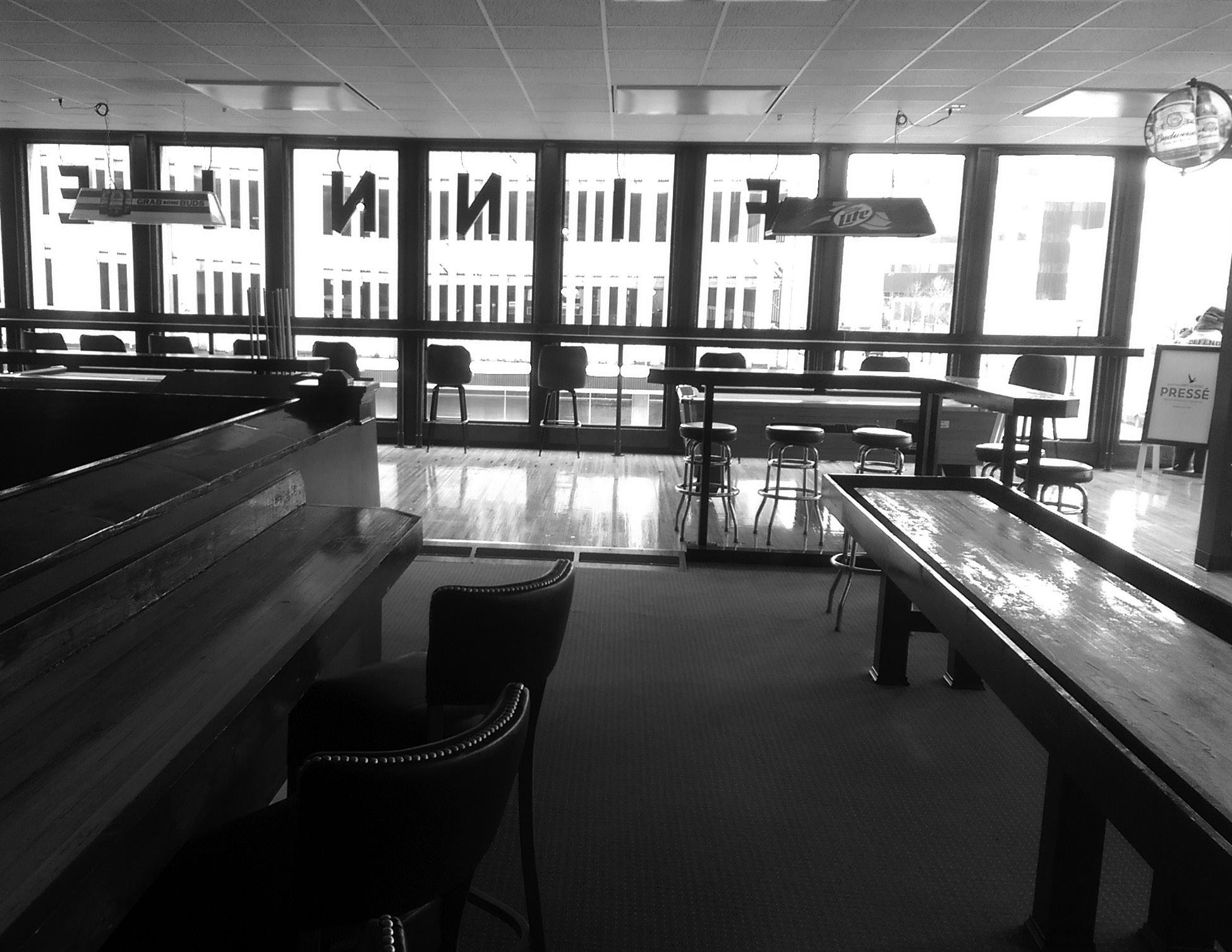
r ick roszkowski tried to come back to the police force after being shot in the line of duty as a South Bend Police Corporal in 2004, but after a few years, he had to give that up due to permanent lingering injuries.
he retired from the force in 2008 and began searching for what to do next. he worked under his cousin, who roszkowski said taught him a lot about business, as a facility manager. But he had always wanted to start a bar and grill. And with the help of family and friends, he did. It began in 2011.
“I had never really noticed this building before — it had been vacant for a few years — I happened to drive by and look in the windows,” roszkowski said, looking out of his office onto his two-leveled bar and restaurant. “The second I looked in the windows, I said ‘This is it. I’ve got to get this building.’
“So with some investors’ help, I was able to purchase the building and get the bar going. When I walked in, I knew what design I wanted, I knew what vision I wanted for the building. So we started with just friends and family working. Most of them pitched in, and most were unpaid for almost three years. They’re making this happen.”
he called it “Finnies Next door” or “Finnies Nd.” After four years of saving money and attracting generous investors, working hard to convert a bank to a bar and hurdling red tape, Finnies Next door will have its grand opening Saturday. The bar is roszkowski’s dream
actualized, he said.
“As a matter of fact my wife and I — we’ve been together over 30 years — we were walking around downtown Indy, and I couldn’t have been maybe 18. We were walking together, and we walked past rick’s Bar or rick’s Place or whatever it was down there, something, and I said, ‘That’s my dream to own one one day,’ and sure enough.”
roszkowski drew upon the good and bad qualities he experienced while working at bars, both as a civilian and as a police officer working security at local bars. he said he thinks Finnies Nd will emphasize all of the positive qualities he has gathered and fill a void in South Bend.
“Well, looking forward, that’s what I want to do,” roszkowski said. “I’ve had the opportunity to learn from a lot of people, both bad and good, and I take little bits from each bar that I’ve worked and just try to learn things and see things I’d either like to duplicate or make changes to, things that weren’t working. I’m a social person, so I like to talk to people and get their input, so all throughout the years of doing it, I just felt like I could bring something that people wanted.”
The goal of Finnies Nd was to bring all kinds of people together, roszkowski said. he added that Finnies Nd does not cater to one socioeconomic group or another — it caters to everyone.
“My thought process was, ‘Why should the rich have it all? Why because I’m a working-class guy, why can’t I have a nice clean, upscale environment, without the upscale pricing? Something that I can afford, something that I would be happy going out to. Why do I have to settle for my
shoes sticking to the floor when I walk in? I can’t afford to go to [upscale places]. Why can’t people like you and I be able to have that experience without being in an upscale bar?’” roszkowski said. “I just thought I could provide something that South Bend needed: a big city feel, without big city prices.”
This idealism, however, did not mean roszkowski was going to provide a lessthan-quality product. he said the only times he “cracks the whip” is for cleanliness, safety and “strict attention to detail.”
“Ninety percent of people do not recognize detail; they won’t come in and know all the little things,” roszkowski said. “It’s about those little things. One hundred percent of people recognize lack of detail.”
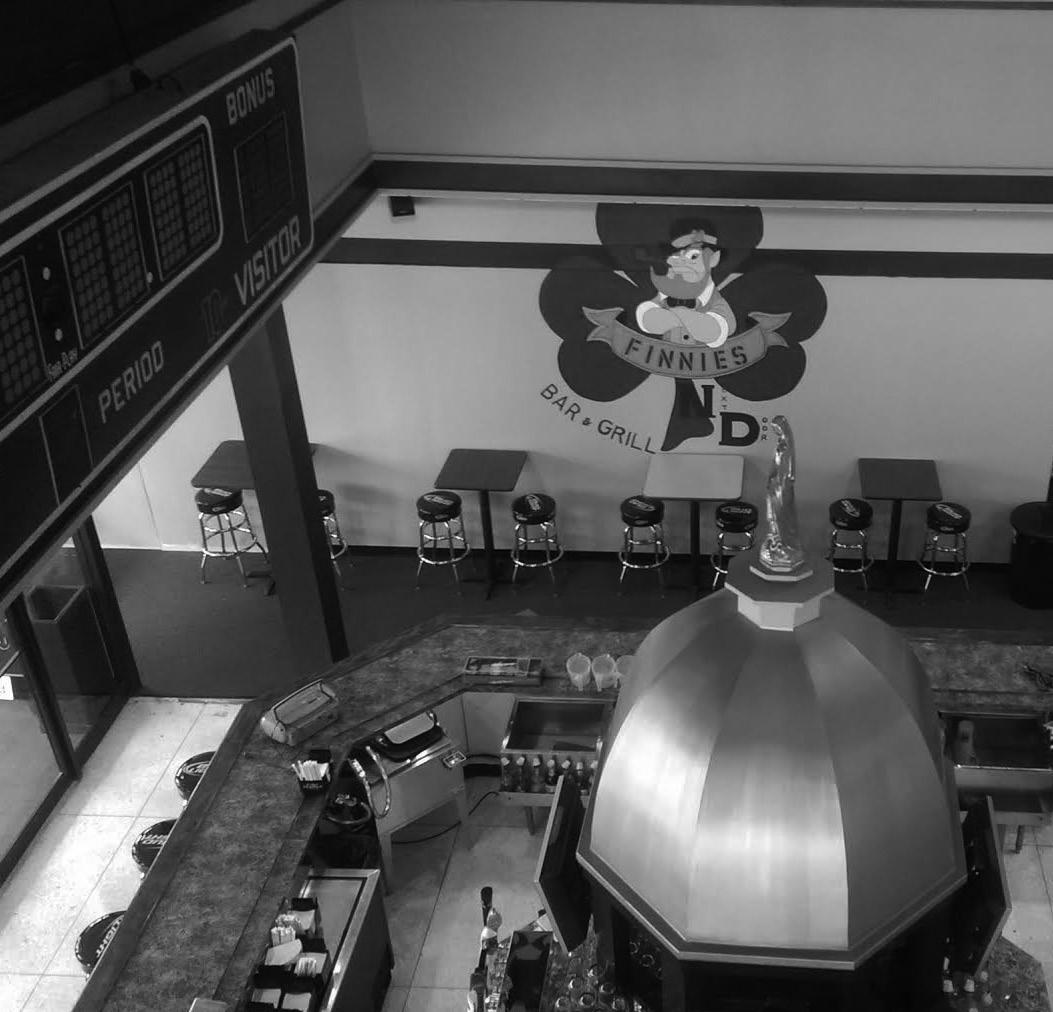
Born and raised in South Bend, roszkowski wanted his bar to reflect both South Bend and Notre dame. A giant golden dome topped with Mary sits on the main square bar, a giant shamrock with a leprechaun challenges patrons from the wall, and Notre dame homages and memorabilia are all around.
“I’ve been a Notre dame fan all my life — and Cubs — and it’s exactly what South Bend is,” roszkowski said. “It’s kind of a thing to honor. I am a die-hard Notre dame fan. I don’t want to hide that, I guess.”
In creating the atmosphere, roszkowski said he wants to burst Notre dame’s bubble and increase involvement in the city but also rid South Bend residents of their preconceived notions that students are “spoiled brats,” born with “silver spoons in their mouths.” With Finnies Nd, roszkowski said he didn’t want to perpetuate the status quo of separating students and South Bend citizens. he wants them
to come together, relax and just have fun all together. The demographic of Finnies Nd is “everybody.”
“There’s a divide,” roszkowski said. “you have your ‘townies’ and your ‘domers.’ Working in bars and security, I have made some very very close — to this day — friends who were students of Notre dame. They’re just as hard-working as [South Bend residents]. I have heard both sides, and I kind of want to incorporate both and say we’re not all against Notre dame. Without Notre dame, South Bend doesn’t exist. It’s as simple as that. It’s hard for students to break that bubble, but it’s also hard for people in town to get along with students.”
roszkowski said he hopes students, blue-collar workers and wealthy business people will all be able to come together and enjoy themselves at Finnies Nd, “like a wedding.” A bar where everyone feels at ease. A bar where everyone feels right next door.
“What I did when I designed this place was I wanted an at-home bar feel,” roszkowski said. “So when you’re sitting down at our main bar, I want you to feel like you’re at a neighborhood bar — you’re welcome, people know your name. I want that feel at that main bar.
“We have almost 600 capacity, and I think with 600 people here at a time, I can still make them all feel at home,” roszkowski said. “That’s the biggest goal. There’s something for everybody.”
Finnies Nd’s grand opening will begin Saturday at 11 a.m. on the corner of Main St. and Wayne St.
Contact Isaac Lorton at ilorton@nd.edu
Crisis nears for college game
Tyler Wojciak Sports Writer
Well, that was fun.
After erasing a nine-point deficit in the second half to beat Wisconsin, duke was crowned as the champions of college basketball for the fifth time in the school’s history. duke’s dramatic win over Wisconsin was an outstanding conclusion for yet another fantastic year of March Madness, as the NCAA tournament proved itself once again as the most exciting tournament in sports.
But that’s exactly what it is: a conclusion. Now what?
Outside of the diehard college basketball fans, many casual fans won’t reinvest their interests into the sport for another 11 months. For most, fans have already redirected their attention to baseball and won’t concern themselves with college basketball again until the football craze that sweeps over the nation every year reaches its end by March of next year.
The hangover college basketball feels following its riveting postseason is no secret, and NCAA basketball officials have addressed the need to close the gap in popularity between the sport’s postseason and its regular season.
“I don’t think internally we’re blinded by the success of the NCAA tournament,” dan gavitt, the NCAA vice president of men’s basketball championships, said during the Final Four in Indianapolis. “We realize the game needs to be worked on the other 11 months.”
But why does the sport reach such a lull during its regular season?
It doesn’t lack star power, as the one-and-done rule basically ensures the most gifted recruits out of high school play college basketball for at least one year. The coaches who have been the faces of college basketball for years are still present and succeeding — just look at the Final Four. Mike Krzyzewski, Bo ryan, Tom Izzo and John Calipari are four of the 10 best coaches in the sport over the last 15 years and were all competing against each other in Indianapolis.
The problem is, as Iona head coach Tim Cluess simply put it in an interview with The New york Times, “The product stinks.”
Connecticut women’s basketball head coach geno Auriemma said he shares a similar belief and made a splash publicly by criticizing the men’s game even more harshly than Cluess.
In a pre-Final Four teleconference last week, Auriemma said, “I think the game is a joke. It really is. I don’t coach it. I don’t play it, so I don’t understand all the ins and outs of it. But as a spectator,
forget that I’m a coach, watching it, it’s a joke. There’s only like 10 teams, you know, out of 25, that actually play the kind of game of basketball that you’d like to watch.”
That’s quite a bold claim, especially when coming from the mouth of one of the best basketball coaches to have ever lived. unfortunately for the sport of college basketball, the statistics back up Auriemma.
According to KPISports.net, the average points per game for teams has seen a relatively steady decline from 75 in 1995 to 67.1 in 2015.
Furthermore, according to Seth davis of Sports Illustrated, this season was the slowest season in terms of possessions per 40 minutes since tempo started to be tracked in 2002.
These numbers can be attributed not to any specific problem with the players and coaches, but mainly to the style in which the game is now played.
Men’s college basketball is being played with more physicality than ever before, and this increase in physicality has led to a slower and lower scoring game than the sport has seen in quite some time. This is a far stretch from the way the creator of basketball James Naismith had intended for the game to be played, as he explicitly prohibited “shouldering, holding, pushing, tripping or striking in any way the person of an opponent” in the fifth of his 13 original rules for the game of basketball.
This style of play is also far less exciting for fans, as the lack of scoring makes the game a lot less entertaining and is a primary reason why the game is nearly irrelevant for many viewers during the regular season.
It is clear college basketball is nearing a crisis state, and the officials of the sport have to address these issues as they enter into one of the sport’s most critical offseasons in its history.
Many fans, coaches and basketball experts are calling for rule changes to enhance the game’s entertainment value, including a shortened shot clock, an extended arc under the basket and a wider lane.
The NCAA men’s basketball oversight committee will meet May 13-15 to discuss potential rule changes for the sport in order to enhance its entertainment value to fans. This three-day span will be extremely critical not only for the current state of college basketball but also for the future of the sport.
Contact Tyler Wojciak at twojciak@hcc-nd.edu
The views expressed in this Sports Authority are those of the author and not necessarily those of The Observer.
Indians’ pitchers barely miss out on no-hitter
Associated Press
h O u STON — e ven if four Cleveland Indians pitchers had combined on a no-hitter, manager Terry Francona wasn’t certain it would’ve been cause for celebration.
Jed Lowrie broke up the bid by homering with one out in the ninth inning for h ouston’s only hit Thursday in a 5-1 win for the Indians.
Before that homer, Trevor Bauer and the Indians’ bullpen had walked seven batters.
“I asked Millsy (bench coach Brad Mills) in the ninth: ‘If we get through this with a no-hitter are we supposed to be excited?’ I wasn’t really sure,” Francona said.
“There’s a lot of baserunners. So that was probably the least of our thoughts. We were just trying to set up our staff and win a game and do what we think is right.”
Bauer was pulled after throwing 111 pitches through six innings. h e struck out a career-high 11
and walked five.
h e was slightly more excited about the prospect of taking part in a no-no.
“Anytime you have a nohitter going, it’s fun and there’s a special air in the building,” Bauer said.
“Obviously it’s unfortunate to see the home run, but the team won and at the end of the day that’s what matters.”
r elievers Kyle Crockett and Scott Atchison each pitched a scoreless inning before Nick h agadone took over.
h agadone struck out Chris Carter to begin the ninth. Lowrie then sent a 94 mph fastball far over the left-center field wall for h ouston’s only hit.
“Lowrie swung and missed on a fastball and I tried to throw another one and he didn’t swing and miss,” h agadone said.
Lowrie and the Astros were relieved to escape with a hit.
“It’s a weight lifted off the whole dugout, the whole team,” Lowrie said. “ h opefully it was good for morale.”
The Indians have not pitched a no-hitter since Len Baker threw a perfect game in 1981 against Toronto.
Bauer and the Cleveland relievers teamed to strike out 16.
Corey Kluber opened the Indians’ season Monday night by holding h ouston hitless until Jose Altuve’s two-out single in the sixth.
There were five no-hitters in the majors last year, capped by Washington’s Jordan Zimmermann throwing a gem on the final day of the regular season.
Lowrie’s shot came 50 years to the day after a wellknown home run in h ouston history. The old Astrodome opened on this date in 1965 with an exhibition game, and Mickey Mantle hit the first home run inside the building.
The Astros struck out a total of 36 times in losing two of three to Cleveland. The h ouston lineup features several players who either hit it far or don’t hit it at all.
Colts make Luck one of NFL’s highest-paid players
Associated Press
INdIANAPOLIS — Andrew Luck is sticking around Indianapolis for at least two more years. If Jim Irsay has his way, it will be for a whole lot longer.
The Colts surprised nobody Thursday by announcing they would exercise the fifth-year option on their franchise quarterback, a move that guarantees him a salary of more than $16.1 million.
But before making the 25-yearold one of football’s highest-paid players, Irsay wanted to make a shot at winning another Super Bowl title this season. So rather than going full throttle on Luck’s second contract, the Colts have been working the free-agent market and now will turn their attention to the draft to improve Luck’s supporting cast. Then, Irsay & Co. will try to lock up some other key players from Luck’s rookie class. Thursday’s decision gives the front office a chance to get it all set up.
“It’s not like we don’t have conversations about a possibility, so to speak, of something,”
Irsay told reporters during last month’s owner’s meetings. “But I really think the most likely scenario is going to be going into the offseason next year is when that second contract will come up. That’s the vision I have right now.”
Luck’s agent did not return a message left at his office Thursday.
There’s little doubt, though, that the Colts will do anything it takes to keep Luck in town.
Since taking him as the No. 1 overall draft pick in 2012 instead of heisman Trophy winner robert griffin III, Luck has started all 48 games, led the Colts to the playoffs three straight times, been to the Pro Bowl each season and emerged as the league’s best young quarterback.
With Luck running the show, the Colts have advanced one step deeper in the playoffs each season, losing to the Super Bowl champion Patriots in January’s
AFC championship game, and he’s shown steady improvement each year, too.
In 2014, Luck broke the Colts’ single-season records with 4,761 yards passing, 40 touchdown passes and eight straight 300yard games.
This season, he could play with the most talented offense of his career after Indianapolis added three receivers — Andre Johnson, Vincent Brown and CFL veteran duron Carter — and running back Frank gore to the mix. And they’ll be looking for even more help in the draft. And coach Chuck Pagano expects Luck to continue on that path in 2015, regardless of the looming contract talks.
“My focus is on the football team. Andrew’s focus, like I know Andrew, is on being the best quarterback that he can be. We’ve got a job to do. We’ve all got jobs to do,” Pagano said last month. “We’ll focus on those jobs. We’ll focus on those roles that we all play. It (the contract) won’t be a discussion.”
NFl
belles prepare for Trine Spring Classic
By DAISY COSTELLO Sports Writer
Saint Mary’s rounds out its regular season this weekend after a two-week hiatus in the Trine Spring Classic at Zollner g olf Course in Angola, Indiana.
The Belles’ last tournament play resulted in a 13thplace finish at the W u STL Spring Invitational, with the team finishing just two spots from the bottom of the pack. Belles head coach Kim Moore said she has a more optimistic outlook on this weekend, attributing it to more opportunities for outside practice time over the past couple of weeks.
“We have had some
opportunities to get some nine-hole practice rounds in,” Moore said. “I’ve been very impressed with the shots and scores I’ve seen during those sessions.”
The Trine Spring Classic will feature 11 d ivision III schools, including conference foe h ope, Moore said. h ope leads MIAA standings, averaging 323.3 strokes per tournament, with Saint Mary’s sitting in third place with an average stroke count of 343.2. h ope and Trine are on a roll coming into the Classic, as both earned first-place finishes in their last events. d espite the high level of competition, Moore said she has strong faith in her roster.
“I’m looking for us to have a good team finish,” Moore said. “I think with this field and this course, we can achieve that goal.”
Belles junior Katie Zielinski has recently established herself as one of the highest performers on the Belles squad. Zielinski led the team both at the W u STL Spring Invitational, where she posted a two-day score of 177, tied for 56th place, and was among the highest performers at the Jekyll Island Collegiate Invite in mid-March. Moore said she expects the junior, who has shown dedication and efficiency in practice, to continue to build upon her earlier success this weekend.
Saint Mary’s seeks to hold up during hectic weekend
By DOMINIC BUSH Sports Writer
With conference play in full swing, the Belles are set for a busy weekend featuring six games in three days — if the Midwest spring cooperates.
Today’s doubleheader at MIAA rival Alma was originally scheduled for Wednesday, but consecutive rainouts forced its postponement.
After Friday’s trip to Alma, Michigan, the Belles (16-6, 3-1 MIAA) have a short turnaround as they play host Saturday for a doubleheader against another conference foe, Olivet.
The Belles conclude their hectic weekend by traveling to e lmhurst, Illinois, to play two against nonconference opponent e lmhurst on Sunday.
The Belles have relied on a host of new faces for the bulk of their offensive production.
“We have a strong freshmen class, no doubt about it,” Saint Mary’s head coach Kelli Zache said.
Belles freshman outfielder/ third baseman Makenzie d uncan has led the team’s offense this season. She is hitting at a .431 clip with four home runs and 21 r BIs. The La Salle, Michigan, native leads the team in slugging percentage (.738), total bases (48) and doubles (eight). She ranks third in hits (28) and
second in runs scored (21). d uncan has not been the only bright spot for the class of 2018. Sisters Cassie and Jamie young have excelled at the plate and in the field. Cassie, who anchors the outfield in center, has provided a consistent bat all season. She is one of two position players on the team batting above .400 and has been a threat on the base paths with five steals in six attempts.
Jamie young, hitting .366, also leads the team in runs scored (23) and is a perfect 4-for-4 in steal attempts. She and classmate Kelsey r ichards form one of the league’s best young doubleplay combos at shortstop and second base, respectively.
Alma (16-10, 7-1) is lead by one of the best pitchers in the country. Sophomore Morgan Stratton boasts a 9-3 record with a 1. 45 er A and enters Friday’s action with 92 strikeouts on the season against only 14 walks. She was recently named the conference’s pitcher of the week and has the benefit of extra rest from the rainouts.
The Belles then face the offensive powerhouse Olivet (10-10, 2-4) on Saturday. At the heart of the Olivet lineup is freshman Kris Forest. The first baseman doubles as the team’s cleanup hitter, and she comes in batting .411 with two home runs and 25 r BIs.
Forest is joined by sophomore pitcher Ashlynn grubb, who is batting .470 and leads the team in hits with 31.
e lmhurst (15-7, 1-1 CCIW) is built around senior Bella Masini. The second baseman presents the biggest challenge for Belles pitching on Sunday. Masini carries a .383 batting average along with 16 r BIs and 30 total bases, both of which are team highs among qualified players.
Zache said the Belles know they have their work cut out for them during such a busy weekend. With the MIAA tournament fast approaching, Zache said the quality of Saint Mary’s schedule has prepared them for postseason play.
“So far this season, I wouldn’t say we have played weaker opponents. We have a tough schedule this year,” Zache said.
Zache also said she remains positive and excited about what her young team “can accomplish this season and seasons to come.”
Weather permitting, today’s first pitch in Alma, Michigan, will be 3:30 p.m. Saturday’s doubleheader at the Saint Mary’s softball fields is scheduled to begin at 1 p.m., as is Sunday’s away series in e lmhurst.
Contact Dominic Bush at dbush@nd.edu
“She has had some really good practice days, and I’m really looking forward to seeing how that relates to her play on the course,” Moore said of Zielinski.
The Trine Spring Classic is the Belles’ last regular season tournament before NCAA Automatic Qualifier rounds for MIAA r egionals. The Belles would earn a spot in the NCAA Automatic Qualifying rounds, should they maintain their thirdplace standing in-conference. With the end of the season and finals quickly approaching, however, Moore said she wants to make sure the Belles maintain focus.
“We have finals coming up
in the first week in May, and there is always a tendency to lose a little focus, knowing that [school] is almost over,” she said.
Moore said she wants the Belles to use the tournament as a way of maintaining focus going into postseason play, with a strong performance giving the team confidence going into tournaments with the best teams in the conference.
Saint Mary’s closes its season this weekend at the Trine Spring Classic in Angola. The Belles are set to tee off at Zollner g olf Course on Saturday at 1 p.m.
Contact Daisy Costello at mcostel4@nd.edu
SMC aims for hot start at Trine
By BRETT O’CONNELL Sports Writer
The Belles look to bounce back from Tuesday’s loss to Olivet in a critical conference matchup with Trine on Saturday.
Saint Mary’s (5-6, 1-2 MIAA) has struggled with consistency as of late, going 4-4 in its last eight games and dropping two of its three conference matchups. This weekend, the Belles will try to avoid losing two consecutive games for the first time since the first two matches of the season during their 1-2 road trip to Oregon.
Trine (3-4, 0-3 MIAA) represents an opportunity for the Belles to gain ground in the MIAA against a streaky opponent. The Thunder won three close matches in March, only to lose all three of their early April matchups by a combined score of 46-17. The Belles have given up 28 goals to conference opponents this season.
Saint Mary’s head coach Amy Long said it would be important to get off to a good start against Trine, citing a poor offensive effort in the first half against Olivet as an area she would like to see her team improve upon.
“Moving forward from the Olivet game in which we struggled to produce more than two goals in the first half, we plan to focus on scoring first and getting the lead in the first 10 minutes of the game at Trine,” Long said. “Momentum is huge in our game, and we failed to gain any momentum in the Olivet game until the second half, and it ended up being too late
for a comeback.”
The Belles defense must be sound in order for the team to build an early lead, Long said, and Trine senior midfielder Taylor g ast poses a threat to that game plan. g ast has excelled offensively for the Thunder, scoring 21 points in seven games to lead the team.
Long said the Belles have built a defensive strategy specifically with g ast’s offensive ability in mind.
“Trine’s Taylor g ast’s number of goals this season is definitely reason to watch her closely and crash quickly on any drive she makes to goal,” Long said. “We always inform our defenders of our opponent’s leading scorers, and they communicate when those players have the ball so that we are able to crash quickly and hopefully shut down any shot opportunity or at least take the angle away. I am confident in our defense’s ability to limit the number of goals g ast scores on Saturday.”
The Belles currently sit tied for third in the MIAA with one win and two losses behind Albion, Calvin and Kalamazoo, who hold a threeway tie for first place with identical 2-0 conference records. A win against Trine would tie Saint Mary’s for second, while a loss would allow Trine to climb out of last place. The conference champion is determined by regular season record, with no postseason.
The Belles clash against the Thunder this Saturday at 1 p.m. in Angola, Indiana.
Contact Brett O’Connell at boconne1@nd.edu
SMC l ACroSSE
N d gears up for Big Ten test
By ANDREW ROBINSON Sports Writer
With many of the standouts from the Stanford Invitational taking a breather, the Irish will head to Louisville, Kentucky, for the ACC/Big Ten Challenge this Saturday with a large, somewhat younger crew.
Notre dame and Louisville will represent the ACC in the meet, and they will be butting heads with Indiana and Michigan State from the Big Ten. The scores of each team will be combined with its partner, and the winners will claim bragging rights for their conference.
Though the Irish will bring a large team — there are 87 Notre dame entries across all events — some notable athletes will be taking a rest after competing on back-to-back weekends.
Senior Chris giesting and junior Margaret Bamgbose in the 400-meter races, junior Molly Seidel in the 5,000 meters, sophomore Jacob d umford in the 1,500 meters and senior Jade Barber in the 100-meter hurdles will not be competing after winning their respective events at Stanford.
“These are our athletes that we know are going to be competing at the end of the year at the national championships,” Irish head coach Alan Turner said. “The travel [to Texas and Stanford] the last two weeks has been pretty brutal, so giving them a break during this long season will go a long way.
“We’re going to take larger numbers and give our younger kids a chance to compete. For about two dozen of them, this is their first outdoor meet. Our goal is to let people compete, have some fun and get better.”
For those who did run last week at Stanford, Turner said
he expects them to carry their momentum to Louisville.
“For those that are coming up on their third meet, last weekend [at Stanford] should be a building block, and I expect them to just get better and better every meet,” he said.
Turner said he has been especially impressed by freshman javelin thrower greg Bombara and expects him to perform well again at Louisville.
he also said he will be looking for freshman Parker e nglish to have strong performance in the 200- and 400-meters.
“Parker has run some very good splits on relays, but she still hasn’t had that great individual breakout race yet,” he said.
Senior discus thrower d ominick Padovano will compete again at Louisville after throwing 54.42 meters at Stanford, enough for a fourthplace finish.
With a lot of younger athletes, Turner said he views this weekend as primarily as an opportunity for growth.
“My objective for this weekend is not necessarily for the ACC to defeat the Big Ten,” Turner said. “All the coaches there are … saying, ‘Let’s use this meet to get better.’ But at the same time, of course we still want to beat each other.
“It’s been a friendly rivalry [between the conferences].
At Louisville, they give the athletes T-shirts, dinner afterwards — it’s a good atmosphere to compete in.”
The Irish will travel to Cardinal Park in Louisville for the ACC/Big Ten Challenge, which is scheduled to begin at 11 a.m. Saturday.
Contact Andrew Robinson at arobins6@nd.edu
Notre Dame steers west for Natoma regata
By BRETT O’CONNELL Sports Writer
The No. 16 Irish departed by plane Thursday morning as they set out on their longest trek of the year to the Lake Natoma Invitational in Folsom, California.
The Lake Natoma Invitational is a two-day regatta featuring a host of teams from across the nation, including Pac-12 hosts and yearly NCAA competitors California and ACC rival Virginia. The team has been preparing for this regatta for two weeks, having kept a regular training schedule save for a short break over the easter break. The Irish are looking to improve upon their heat times as they reach the halfway point in their spring season.
Junior coxswain Jill ryan praised the growth of her teammates in recent weeks.
“I think that we are not the same team that raced Virginia in Oak ridge,” ryan said. “I think we’ve made a lot of improvements. On our most recent 2k test, we had several girls [set personal records], which I think says a lot about our potential for California.”
ryan said the Irish squad hopes to rise in the rankings with fast times against crews like No.
3 California and No. 4 Virginia. If the Irish do not win the ACC tournament later this year, they will have to rely on their regular season showings to obtain an at-large bid to the NCAA championship. For that reason, regatta performances such as this weekend’s showing at the Lake Natoma Invitational are vital for the team’s postseason hopes.
The team, however, is confident in its ability to continue improving, according to ryan.
“This weekend, we just need to come together as a team,” she said. “[We need to] focus on rowing together. I’m feeling really optimistic.
“So far I think the team has done a much better job at racing. We were inexperienced in Tennessee. having had two weekends under our belt and a lot of good practices, I feel like we’ve gotten to be better, more competitive racers.”
That said, Skorcz also added the team had some things to work on, including some of the more mental aspects of the competition.
“I think we still need to work on getting our blades in the water, being more aggressive and harping the racing mentality,” she said. “[We’re focused on] really throwing it out on the line
and not getting intimidated by our competitors. I think we’ll be in a really good place by the end of the season.”
Irish head coach Martin Stone said he had high expectations for the weekend’s events.
“We want to have our best race of the year,” Stone said. “We’re progressively getting better. Practice went well this week — we’ve gotten better overall.”
The distance between Indiana and California does not pose an obstacle to the well-travelled Irish, who have competed in Ohio and Tennessee already this season, Stone said.
“We’re here early enough, we got out early today,” Stone said on Thursday. “We’ll be alright. Travel isn’t an issue. We’ve done this before, so we’ll be good to go.”
despite the regatta’s formidable attendance list, Stone said he was excited for the opportunity for his team to show their improvements.
“We race very tough competition,” Stone said. “It will be interesting to see how this turns out.”
The Irish will take part in the first of two race days this Saturday in Folsom.
Contact Brett O’Connell boconne1@nd.edu
Belles handle Pilots, look forward to Knights
By MICHAEL IVEY Sports Writer
Saint Mary’s extended its winning streak to three matches against Bethel on Thursday afternoon, winning by a final score of 7-1 at South Bend racquet Club.
In singles action, the Belles (9-7, 3-1 MIAA) took five of six matches, all of them in straight sets. Senior Kayle Sexton won at No. 2 singles, 6-2, 6-1; senior Jackie Kjolhede was also victorious, 6-4, 6-2. Senior Shannon elliot dropped only a single game her entire match, winning 6-0, 6-1, while junior Margaret Faller took her match at No. 5 singles by an identical score. Freshman Bailey Oppman was even more dominant in her match, completely shutting out her opponent, 6-0, 6-0. Junior Andrea Fetters’s match at the top of the singles lineup ended during the second set after she had captured the first by a score of 7-5.
In doubles action, the Belles’ top doubles team of sophomore
Sam Setterblad and Sexton ended up on the wrong side of their match, dropping an 8-6 decision. The second doubles team of Fetters and elliott were victorious, 8-1. In the third and final doubles match, the team of freshman Maddie Minuado and Faller blanked the their opponents, 8-0.
“They did a nice job of playing efficiently overall,” Belles head coach dale Campbell said of his team. “They knew they were favored to win, but they did what they had to do. Shannon elliott, Margaret Faller and Bailey Oppman all won their matches, losing only one or no games, so they were probably our best performers on the day. [Faller] only lost one game in both matches combined.
“No. 2 and 3 doubles teams won convincingly, and really everyone did pretty well in doubles. We are getting stronger, but still need to communicate a bit better in doubles. We can’t get frustrated by hurdles. We just have to move on and think of the next shot or the next point.”
The Belles are back in action Saturday afternoon when they take on Calvin in a home conference game. The Knights (7-6, 2-1 MIAA) are coming off of a 5-4 win over Albion on Wednesday.
“We just have to get everyone ready for their best day,” Campbell said. “Calvin will be tough, and I believe one team will win 5-4 or 6-3. It should be close in most every position. It will be whichever team prepares itself the best and wants it more. I hope that is us, and I will do what I can to help get the team ready. They just need to get into a rhythm tomorrow and get their timing down, along with some rest for Saturday. If we can win Saturday, we will most likely be guaranteed a spot in the conference tournament final four.”
Saint Mary’s and Calvin are scheduled to face off 1 p.m. Saturday at Saint Mary’s Tennis Courts.
Contact Michael Ivey at mivey@hcc-nd.edu
MICHAEL YU | The Observer Freshman Parker English carries the baton in the 4x400-meter relay during the Meyo Invitational on Jan. 24 at Loftus Sports Center.
w l acrosse
CONTIN ued F rOM PAge 20
Penn State.
The two teams’ common opponents include No. 14 Ohio State, Virginia Tech and Marquette. The Irish beat all three by at least eight goals, while the Wolverines fell to both the Buckeyes and the hokies by scores of 13-5 and 1312, respectively. Both teams beat Marquette in Milwaukee earlier in the season — the Irish ran away to a 18-8 victory March 25, and the Wolverines pulled out a 10-7 decision March 20.
Sunday marks the first-ever meeting between Michigan and Notre dame in women’s lacrosse, as 2015 is only the second year the Wolverines have fielded a varsity team. Consequently, Michigan’s team is made up entirely of sophomores and freshmen.
The Irish will have to avoid looking beyond Michigan as matches against No. 5 Northwestern and No. 11 Louisville loom next week. The three-game homestand marks the end of the regular season for Notre dame, as the ACC tournament begins in Charlottesville, Virginia, on April 23. A win would also be Notre dame’s ninth on the season, the magic number for the team to clinch a .500 record and be eligible for the NCAA tournament.
Notre dame’s offense has managed to score at least 12 goals in five of its last six games, fueling the squad’s recent success against ranked teams. Sophomore attack Cortney Fortunato paces the Irish in goals with 42, far ahead of the team’s next leading scorer — junior attack rachel Sexton, who has 27. Fortunato also ranks No. 13 in the country with 3.23 goals per game.
The win over Virginia on Saturday was a landmark game for sophomore goalie Liz O’Sullivan, as she made a careerhigh 11 saves and then added nine more against the Orange on Tuesday. Senior defender Barbara Sullivan also tied a school record by hauling in nine draws against the Cavaliers. defensively, the Irish have held opponents to an average of 8.85 goals per game this season and force an average of 11.31 turnovers per game, placing them fourth in the NCAA. For its part, Michigan is tops in the Big Ten in caused turnovers and is 17th in the NCAA, forcing 9.5 per game. Notre dame and Michigan square off at Arlotta Stadium at 1 p.m., as the Irish hope to carry their current momentum into the postseason. Please recycle
AMY ACKERMANN | The Observer
Sophomore attack Cortney Fortunato moves upfield in a 17-5 victory against Detroit on Feb. 15 at Loftus Sports Center. Fortunato leads the team with 42 goals and 14 assists this season.
M Tennis
Notre dame will meet up with Wake Forest on April 17 and North Carolina State on April 18.
The first home match of the Notre dame’s final three-game stretch comes against a Clemson team amidst one of its toughest stretches of the season. The Tigers have lost five straight matches, the last four of which were at home. Their most recent defeat was a 6-1 loss to Wake Forest last Sunday.
“Clemson’s a really good opponent,” said Sachire. “We played them twice last year. They may not be doing as well right now, but they were a top-20 team last year, and many of those guys are still on the team this year.”
Notre dame’s most notable player this season, junior Quentin Monaghan, picked up consecutive victories over top-15 singles opponents to end Notre dame’s road trip. Monaghan was ranked 10th when this week’s rankings were announced, the highest a Notre dame singles player has been ranked all year. The junior is
w Tennis
CONTIN ued F rOM PAge 20
the match will be a difficult one for his team.
“They’re very, very good,” Louderback said. “They’ve done well in the conference and nationally, too, especially during the indoor season.”
In order to come away from the match with a victory, Louderback said there are two points of emphasis for his team. First, he said the Irish must be sure to play within themselves.
“For us, the biggest thing we have to do is not worry about what they’re ranked and just go out there and play,” Louderback said. “That’s something that I think we’ve done a good job of this season and just need to continue to do going forward.” In addition to staying
riding a 10-match winning streak and will seek his 11th consecutive win against the top singles player for the Tigers, presumably senior Alejandro Augusto.
Outside of Monaghan, Sachire said he has been particularly impressed with the recent play of junior Alex Lawson and sophomore Josh hagar.
“Alex Lawson has played particularly well lately. At the beginning of the year he wasn’t finishing matches, but lately, he has done a good job of doing that and performing well overall,” said Sachire. “It might not look like it on paper, but Josh hagar had a great weekend as well and has really improved a lot in recent weeks.”
heading into the match Friday, Notre dame’s 4-5 conference record has it currently in eighth place in ACC standings. Clemson comes into the contest in 12th, ahead of only Boston College.
The match between the Tigers and Irish is slated to begin at 3:30 p.m. Friday at Courtney Tennis Center.
Contact Ryan Klaus at rklaus1@nd.edu
focused, Louderback said the doubles point will be a key point in the match.
“Our best shot at them is if we can go out there and get the doubles point to put some pressure on them in the singles,” Louderback said. “That would be really big for us.”
Following this matchup, the Irish will only have two matches remaining next weekend before the ACC championship in Cary, North Carolina, on April 22-26. Louderback said he believes his team is prepared for postseason play, given the level they have been playing at all year.
“Our big thing is to keep playing like we have been,” Louderback said. “We’ve done a really good job of competing, and that’s what we want to do. every match we’ve played, our kids have continued to fight, and that’s been the reason
we’ve seen people step up at different times and when we’ve needed it.”
While he does not believe this matchup serves as a measure for where the team stands going into the postseason, Louderback said he does believe it will be a great opportunity for his team to continue to prepare for the postseason.
“We’ve shown that we can be competitive with everyone and have had tight matches with some of the best teams in the country,” Louderback said. “It’s a really good opportunity for us to play such a highly-ranked team.”
The Irish will take the court this afternoon against Miami at Courtney Tennis Center, with the match set to start at 3:30 p.m.
Contact Ben Padanilam at bpadanil@nd.edu
MICHAEL YU | The Observer
Junior Alex Lawson strikes the ball in a 4-3 win over Oklahoma State on Jan. 24 at Eck Tennis Pavilion. Lawson lost in three sets to Cowboys senior Nicolai Ferringo .
MICHAEL YU | The Observer
Sophomore Monica Robinson readies a forehand shot against Stanford in a 6-1 loss on Feb. 6 at Eck Tennis Pavilion. Robinson lost in three sets to Cardinal freshman Taylor Davidson.
baseball
CONTIN ued F rOM PAge 20
Irish head coach Mik Aoki said the Irish simply have to take advantage of the slight opportunities they are given by some incredible teams, including the Seminoles this weekend.
“I think a lot of it is a timely hit here and there, but I certainly don’t want to take anything away from Louisville or u VA when we had the opportunities to maybe convert a run, like in that 18-inning game, or maybe get a base hit that gets us the winning run,”
Aoki said. “ … I thought we competed great against [Louisville], I thought we competed great against Virginia — we’ve just got to do the same thing and hope that the score at the end of the game has us with more runs than they do.”
The Seminoles don’t have the highest team batting average in college baseball. They don’t even crack the top 10. They do, however, know how to get on base and score and score in bunches, Aoki said.
“As usual, [the Seminoles] are an offensive juggernaut,” Aoki said. “The
thing I think you have to do against Florida State is you have to limit them to one run or two runs in the innings they score because they are so good at turning one run into five runs.”
Florida State is tied for second in the nation in onbase percentage at .418, leads the country in walks and is fourth in runs with 265. Notre d ame pitchers will have to be at their best, Aoki said.
“They’re a team that is incredibly disciplined at the plate,” Aoki said. “ you have to make pitches to get them out. They’re not really going to chase a lot outside of the strike zone. It’s not like they’re a high-prolific batting average team, but the hits that they get are balls that typically run themselves into the gap or find themselves over the fence. So we just have to limit it and we have to go out there and continue to compete they way we have all year long. I think slowly but surely we’re sort of returning. I like where we’re at, and I like our chances going into the weekend.”
Notre d ame’s starting rotation has been in flux in the past few weeks, though. Senior pitcher Scott
Kerrigan was removed from his usual Friday start in the Pittsburgh series due to some soreness in his arm. Freshman hurler Brandon Bielak and junior pitcher Nick McCarty both moved up in the rotation while freshman e vy r uibal took over the Sunday slot.
Aoki is again moving the lineup around for this weekend against Florida State, and the Sunday starter will likely be McCarty but is still to be determined.
“[Sophomore] r yan [Smoyer] will go Friday,” Aoki said. “Brandon will go on Saturday, so we kind of keep him on his rest, which we felt like he’s got the 120 or whatever it was on Saturday, so we wanted to keep him on schedule. On Sunday, Nick is getting a little bit more soreness than he’s sort of accustomed to, so we’ll play that one by ear now.”
The Irish will look to take down the top-10 Seminoles this weekend at Frank e ck Stadium, with first pitch slated to be thrown at 6:05 p.m. Friday, 2:05 p.m. Saturday and 1:05 p.m. Sunday.
Contact Isaac Lorton at ilorton@nd.edu
Softball
CONTIN ued F rOM PAge 20
senior outfielder e milee Koerner’s nod in 2013.
On the mound, the Irish are led by sophomore r achel Nasland and junior Allie r hodes. Nasland (15-6) leads the team in wins, er A (2.34), innings pitched (146.2) and strikeouts (146). r hodes (124) sports an er A of 2.79 and has struck out 74 batters in only 80.1 innings pitched. In addition, r hodes has either won or saved every game she has pitched in since March 21, when she was the winning pitcher in a 13-0 victory against g eorgia Tech.
On the other side of the diamond, the e agles (16-15, 1-8 ACC) have lost two of their last three games and had a scheduled game against Boston university on April 8 postponed due to inclement weather. They will rely
on the young bat of freshman outfielder Annie Murphy, who leads the team with a .318 batting average and 28 hits while also swiping 13of-14 bases. Junior outfielder Megan Cooley has compiled a .280 batting average but is a perfect 14-for-14 in stolen base attempts on the season. On the mound, the e agles rely on freshman Allyson Frei, who leads the team with an 11-9 record and a 2.85 er A, with 119 strikeouts in only 113 innings pitched. The other pitcher of note for the e agles is sophomore Jordan Weed, who is 3-2 on the season with a 5.14 er A in 46.1 innings pitched.
The Irish look to continue their winning ways against the e agles when they travel to Chestnut h ill to play at Shea Field for the first of two games Saturday. First pitch is scheduled for 1 p.m., and the final match-up is scheduled for Sunday at noon.
Happy Birthday: This is a year to take action. Sitting back will only make you anxious and will lead to regret. Step up and get started. you are responsible for your own happiness. Set your sights high and don’t be afraid to make mistakes. What you learn from your experiences will contribute to a prosperous future. express your thoughts and don’t look back. your numbers are 4, 11, 15, 27, 32, 39, 46.
ARIES (March 21-April 19): get involved in the events, activities and networking functions that will allow you to use your skills and make new contacts. don’t be discouraged by negative or critical individuals when you should be putting your thoughts and energy into exceling.
TAURUS (April 20-May 20): you’ll be tempted to overspend on items you don’t need. Think before you commit to any deal that requires monthly contributions or payments. unexpected bills are likely to leave you short of cash. Pace yourself in all aspects of your life.
GEMINI (May 21-June 20): emotional deception will be present when dealing with business partnerships. Focus on what’s in front of you instead of wallowing in past regrets or failures. There is much to gain if you approach life in a vibrant and engaging manner.
CANCER (June 21-July 22): Make career choices that will lead to professional advancement and more money. educational pursuits will lead to contacts that will play a part in helping you reach your goals. Love and romance will have an impact on your life.
LEO (July 23-Aug. 22): your energetic mood will attract attention and bring about an opportunity to get ahead. Attend conferences, seminars or networking events that will allow you to meet potential clients. don’t let an emotional situation ruin your chances to advance.
VIRGO (Aug. 23-Sept. 22): Interacting with people who have knowledge or expertise regarding something that interests you will lead to an unusual opportunity. explore your options and consider a partnership that can help you develop new skills. Love is in the stars.
LIBRA (Sept. 23-Oct. 22): your ability to see all sides of an issue will help bring order to a chaotic situation. your talent will not go unnoticed, and greater personal and professional assistance will be offered. A positive change regarding an important relationship is apparent.
SCORPIO (Oct. 23-Nov. 21): draw from past experience in order to avoid being taken for granted. Keep life simple and refrain from unnecessary spending. Concentrate on home, developing innovative ideas and mastering what you enjoy doing the most. Make romance a priority.
SAGITTARIUS (Nov. 22-Dec. 21): Put honesty and integrity first. don’t evade issues that need to be addressed. The purpose of clearing the air is to allow you the right to move forward without guilt. do what needs to be done and don’t look back.
CAPRICORN (Dec. 22-Jan. 19): Size up whatever situation you face without getting into a dispute with someone who is disagreeable. Work alone in order to avoid interference. Put more into home, family and self-improvement, and you will make gains and avoid disruptions.
AQUARIUS (Jan. 20-Feb. 18): Surround yourself with people who are aiming to get the same results as you. Focus on work, partnerships and getting ahead. don’t get into senseless arguments over petty matters. do your own thing and try to make monetary gains.
PISCES (Feb. 19-March 20): Keep a low profile. Now is not the time to confront a situation. Instead, put your time and effort into your dreams and ideas. Once you have an ironclad plan in place, you can make your move with confidence. Birthday Baby: you are entrepreneurial and powerful. you are charismatic and appealing.
JuMblE | dAVId hOyT ANd JeFF KNureK
Sudoku | The MePhAM grOuP
HiGHly PuNlikEly | ChrISTOPher BruCKer
doME NuTS | ALeXANdrIA WeLLMAN
Nd SoFTbAll
Notre Dame set to host No. 8 Seminoles for three games Bats look to keep slugging in ACC
By ISAAC LORTON Senior Sports Writer
The Irish will have a tough task ahead of them this weekend when they host No. 8 Florida State in a threegame ACC weekend series.
Notre d ame looks to steal the series from the Seminoles (26-9, 11-4 ACC), who currently sit in second place in the Atlantic d ivision of the ACC, behind Louisville. The Irish (21-10, 6-9) are second-to-last in the Atlantic d ivision, just in front of Boston College.
d espite taking its best shots at No. 6 Louisville — including an 18-inning marathon — and No. 16 Virginia in ACC series during the month of March, Notre d ame came out empty-handed.
Observer Staff Report
It has been almost a month since Notre d ame has lost a game, and as the team heads to Chestnut h ill, Massachusetts, to take on Boston College, the Irish look to extend what is at this point a 15-game winning streak in a three-game conference series against one of their traditional rivals.
d uring the streak, the Irish (29-11, 10-5 ACC) have been an offensive powerhouse, outscoring their opponents by a staggering margin of 130-18, and as a team, they have been batting at a .407 clip. The Irish have also been strong at home, winning their last 11 games at Melissa Cook Stadium. At the plate, the Irish are led by sophomore outfielder Karley Wester,
Irish return home against Clemson
By RYAN KLAUS Sports Writer
Notre d ame returns home
Friday for the first time since March 22 when it takes on Clemson to kick off a regular season-ending homestand.
The Irish (12-9, 4-5 ACC) finished their four-game road trip Sunday on the wrong side of a 5-2 decision against No. 16 North Carolina. After winning their first matches against Miami and Florida State, the Irish dropped their
final two matches of the trip to No. 6 d uke and North Carolina.
“We’re feeling pretty good,” Irish head coach r yan Sachire said. “The last two matches were both losses, but those were both against top-level opponents.”
Following the loss to North Carolina, Notre d ame will play its final three regular season matches at home. After Clemson (10-13, 1-8),
see M TeNNIS PAGE 16
Squad to battle ACC rival Miami
By BEN PADANILAM Sports Writer
Notre dame returns to Courtney Tennis Center today for its penultimate home match of the season, welcoming No. 17 Miami for an ACC contest.
The Irish (14-6, 8-3 ACC) are coming off two road wins this past weekend. First, they swept Wake Forest in a 7-0 victory on Friday in Winston-Salem, North Carolina, and then they followed that performance with a tightlycontested 4-3 win at Virginia Tech on Sunday.
Today, however, the Irish return home to battle the hurricanes
(12-5, 8-2). The match is currently scheduled to be played outdoors at Courtney Tennis Center, which would make it the first outdoor home match for the Irish on the season. Their previous matches have been played indoors at eck Tennis Pavilion. entering today’s match, the Irish have won five of their last six ACC matches and six of their last seven overall. By comparison, the hurricanes have lost two of their last three. despite the differing momentums entering the game, Irish head coach Jay Louderback said he recognizes
see W TeNNIS PAGE 16
who leads the team with a .445 batting average and 61 hits. Wester has also scored a team-leading 42 runs and is currently a perfect 23-for23 in stolen base attempts on the season. e lsewhere, the Irish are boosted by senior infielder Katey h aus’ teamhigh 11 home runs and 41 r BIs. Overall, seven of Notre d ame’s starting nine are batting over .300, and three are batting over .350.
Wester’s play for the season has been critical for the Irish, and she is drawing national attention for it: Wester is currently one of 26 finalists for the u SA National Softball Collegiate Player of the year Award. She is the second Irish player in program history to be named a finalist for the award, joining
Observer Staff Report
No. 13 Notre d ame has the chance to build off backto-back upsets of No. 8 Virginia and No. 6 Syracuse when it faces Michigan at Arlotta Stadium on Sunday afternoon.
The Irish (8-5, 3-3 ACC) will have the advantage of momentum when they return home, as they cruised by the Cavaliers, 14-4, on Saturday to kick off a short road swing. The squad then traveled to Syracuse and eked out a 12-11 overtime win over the Orange on Tuesday. Sunday’s game will be the first Irish home game in April; their last match in Arlotta Stadium was a 9-8 loss to No. 2 North Carolina on March 29.
The Wolverines (5-7, 0-2 Big Ten), meanwhile, are currently on a five-game losing streak following a 11-5 defeat at the hands of No. 12
MICHAEL YU | The Observer Freshman pitcher Brandon Bielak steps up to bat against Central Michigan in an 8-3 win on March 18 at Frank Eck Stadium.
MICHAEL YU | The Observer
Junior Quentin Monaghan follows through on a shot in a 4-3 victory against Oklahoma State on Jan. 24.
Nd woMEN’S TENNiS
MICHAEL YU | The Observer
Junior Julie Vrabel prepares a backhand stroke in a 6-1 loss to Stanford on Feb. 6 at the Eck Tennis Pavilion.