H e trut H and report I t accuratel Y
Former Texas state senator connects women’s health issues, economic opportunity
By LUCAS MASIN-MOYER
news Writer

H e trut H and report I t accuratel Y
By LUCAS MASIN-MOYER
news Writer
In June 2013, Wendy davis fought for the protection of abortion rights in an 11-hour filibuster in the texas state senate. nearly three years later, she continued her advocacy for women’s health with an hour-long talk and discussion at notre dame. Hosted by the notre dame college democrats, the event was co-sponsored by Women in politics, progressive student a lliance, bridgend and the department of gender studies.
davis said her own personal experiences with women’s health issues has colored her views on the issues, especially in regards to her
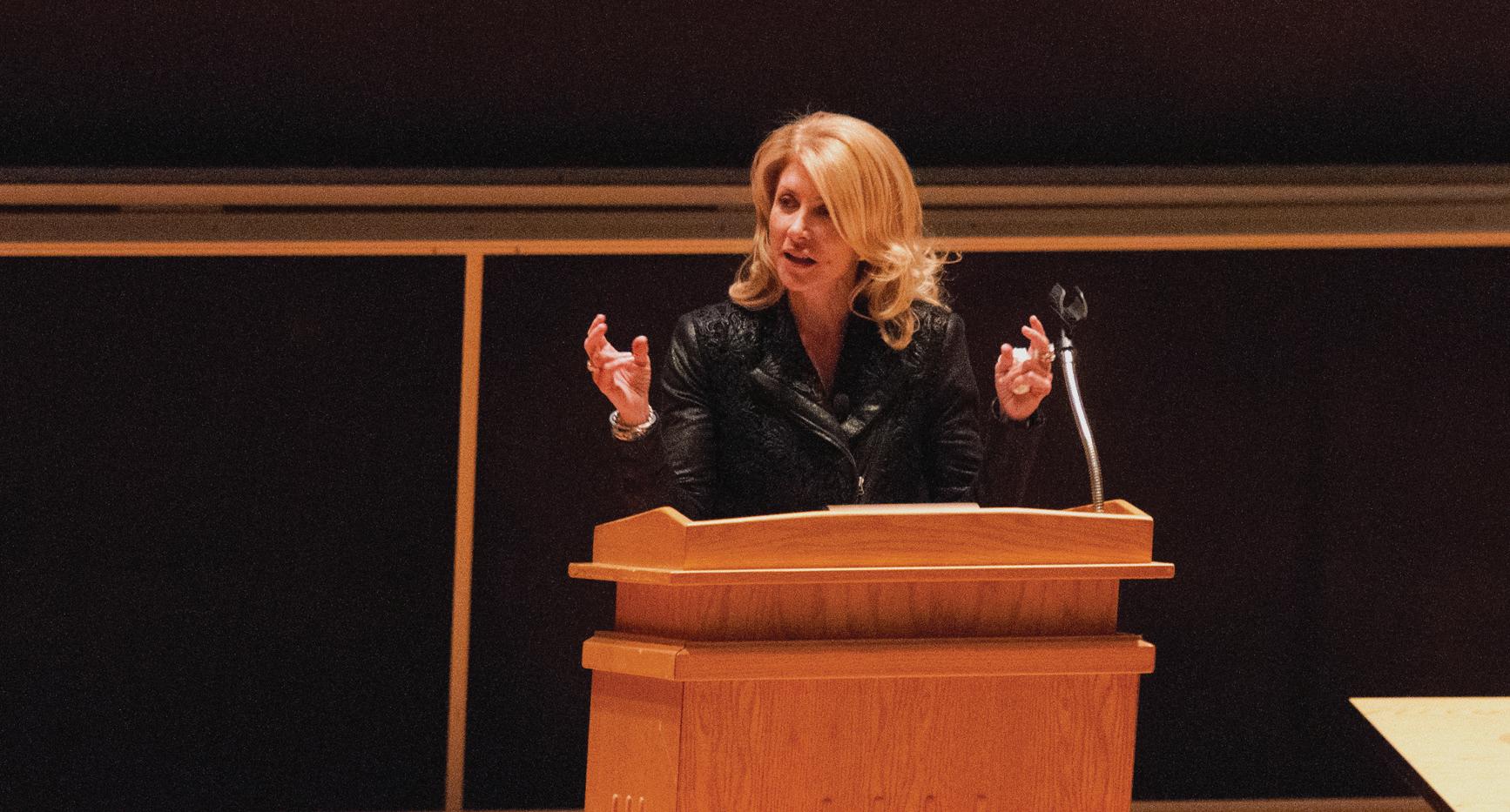
Former Texas senator Wendy Davis stressed the importance of women’s healthcare Tuesday. She noted the importance of government legislation protecting a woman’s right to healthcare facilities.
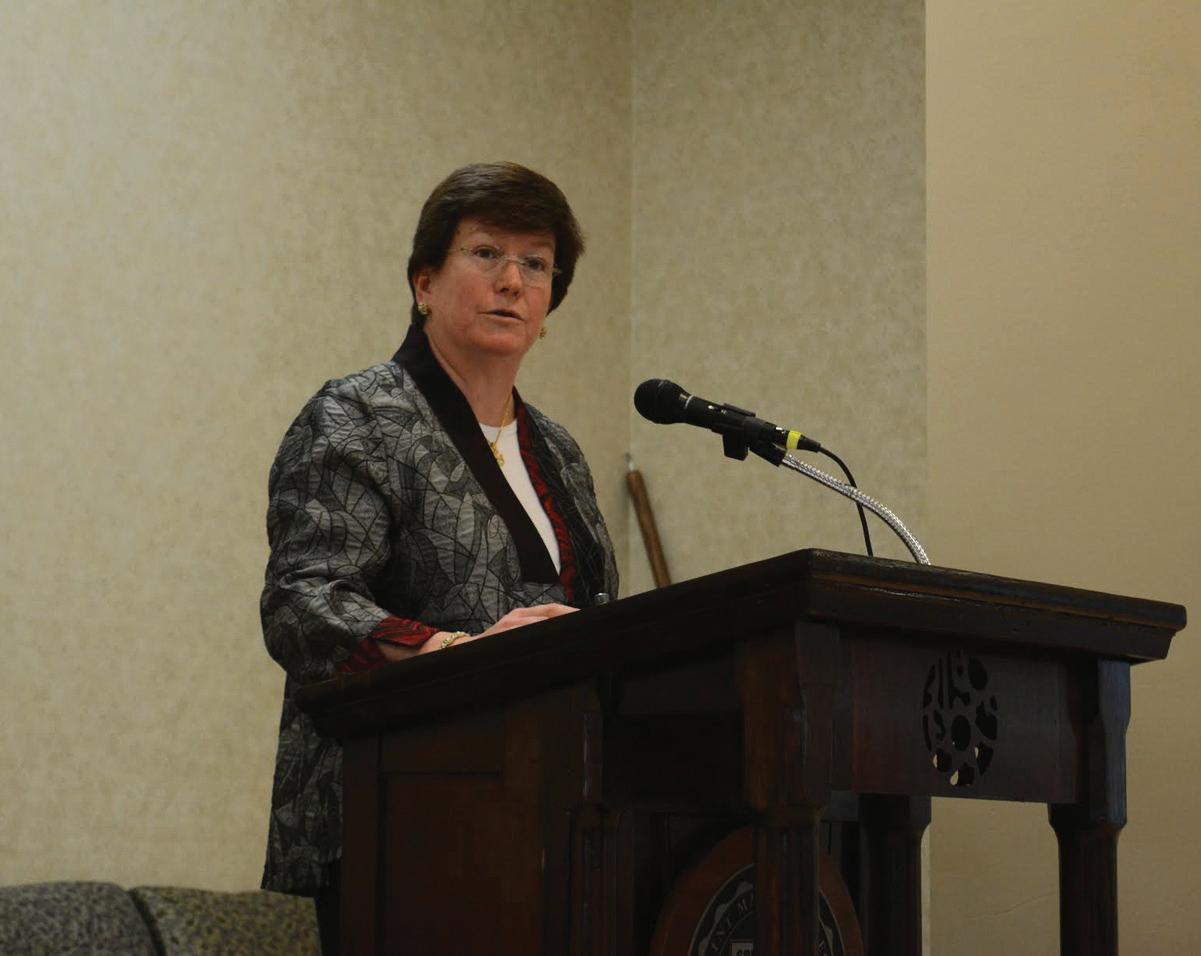
Saint Mary’s alumna Mary Burke ’85 speaks about women in the workforce. Burke has over 25 years of experience in banking.
By ALEX WINEGAR news Writer
saint mary’s alumna mary burke ’85 presented as a keynote speaker on women in the workforce for the college’s 11th annual diverse students’ l eadership conference ( dslc )

on monday. according to the student diversity board’s website, burke has had over 25 years of investment banking experience within the food industry. she specializes in financial

two students injured in a car crash s aturday night remain in critical and serious condition, memorial Hospital reported monday evening. notre d ame junior Jack r iedy and s aint m ary’s junior m ary Gring were with s cott Gring, a s outh b end resident and m ary’s father, heading
see crasH paGe 3
By MEGAN VALLEY news Writer
pulitzer prize-winning author Junot díaz spoke monday at the 2016 notre dame literary festival as the featured author speaker.
díaz said he tries to accomplish three goals when speaking to an audience.
“one: defense of the arts. two: create the space for conversations about the kind of themes the books themselves engage in. three: modeling the kind of writer that one is,” he said. “You never know if anything actually works. … You just have to have a lot of faith.” as an immigrant from the dominican republic, díaz said
wanting to become a writer was a “strange thing” to his family.
“I wouldn’t say they were encouraging,” he said. “I also wouldn’t say they were discouraging. It was so off-the-map … to present to your parents that you wanted to be an artist. It wasn’t something even to be
By JENNA WILSON news Writer
the Keough school of Global a ffairs held the opening keynote panel of the schools’s first conference “for the planet and the poor” on monday.
the keynote included remarks from university president fr. John Jenkins, followed by a panel of four speakers.
“no issues are more

challenging, perhaps, or pressing than those we will discuss in coming days — care for the earth’s environment, alleviating extreme poverty and achieving sustainable development,” Jenkins said. “In a world where differences in faith often lead to conflict and destruction, this dialogue draws us together as one human family in conversation about our common home. let us make this conference a shinning example about how
this dialogue about our world can draw us together in solidarity and common commitment.”
While the conference focuses on the complex problems, it is important to remember that all these problems are solvable, Jenkins said.
“a n adequate response to the challenges before us will demand the very best science and technological
see poVertY paGe 5
Corrections
In the a pril 4 issue of t he observer, don bishop was misidentified. He is the a ssociate Vice p resident of undergraduate e nrollment. t he graphic accompanying the article incorrectly reported that 3,665 students were admitted; 3,565 students were admitted. In the same paper, a story incorrectly stated the driver of the car in an accident had been released from the hospital saturday night. He is still in the hospital in stable condition. t he observer regrets these errors.
If



Shelby Cox first year regina Hall
“my winter coat.”
Christina Herrera sophomore regina Hall
“my
Tyler Booth junior le mans Hall
“my laptop.”


Lauren Richey first year regina Hall
“my computer.”
Tory Millar sophomore le mans Hall
“my baby blanket.”
Emma Vreeke
junior le mans Hall
“photos of family.”
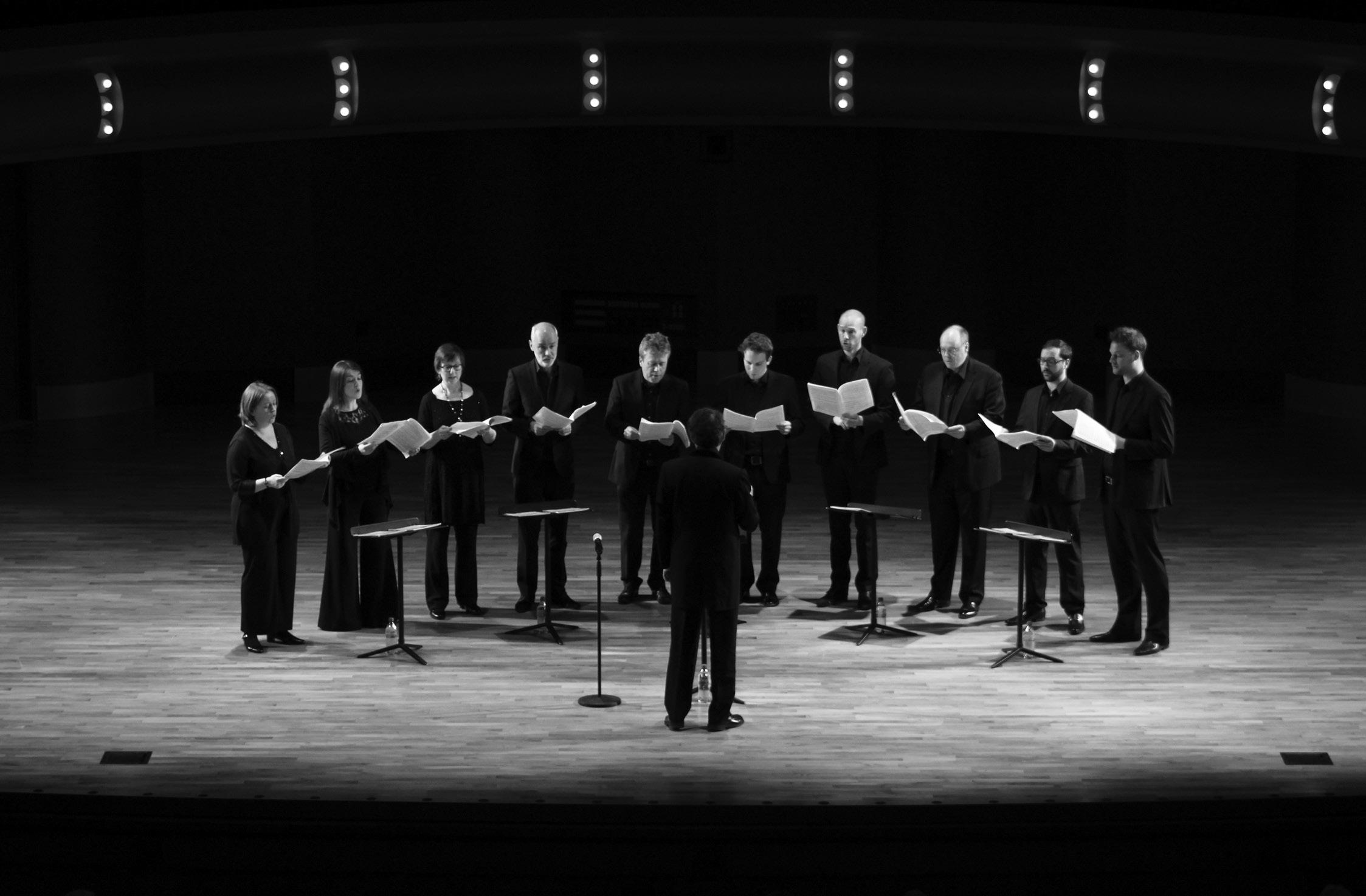
The Tallis Scholars perform sacred a cappella music in the DeBartolo Performing Arts Center on Sunday. The Scholars, directed by Peter Phillips, specialize in music in the Renaissance era or style.
Memorial Mass Basilica of the Sacred
5:15 p.m.-6:15 p.m.
In
2:30 p.m.-5:30 p.m.
Tax returns prepared without appointment.
Christ for the Curious Coleman-Morse Center
7 p.m.-8 p.m.
Come discuss the Resurrection. Thursday
Guided tour of Special Collections exhibit.
Mindful Meditation Coleman-Morse Center 5:15 p.m.-6:15 p.m.
Open
Friday
Bengali
6:30 p.m.-8 p.m.
Experience culture and traditional dinner.
ND Women’s Tennis vs. Clemson Eck Tennis Pavillion
3:30 p.m.-5:30 p.m.
The Irish take on the Tigers.
Saturday
“Agency, Persons, and Kant”
McKenna Hall
8 a.m.
Philosophers discuss Kant’s works.
Eucharistic Adoration Basilica of the Sacred Heart
11 p.m.
24-hour Eucharist celebration.
2016 election observer: christina Wolbrecht
By RACHEL O’GRADY a ssociate news editor
Editor’s Note: Throughout the 2016 presidential campaign, The Observer will sit down with Notre Dame experts to break down the election and its importance to students. In this ninth installment, Associate News Editor Rachel O’Grady asks the director of the Rooney Center for the Study of American Democracy, Christina Wolbrecht, about the role of women in politics in the 2016 election.
ro G: c linton has the potential to be the first female p resident of the united states. s eeing as your area of study focuses on women in politics, I’ll intentionally leave this question open [and] broad for you. What implications does this have on politics as a whole? moreover, why has it taken so long to even conceive of women in the highest office in the land?
c W: t here are many reasons why the u s . has yet to have a female president. p olitics has been traditionally viewed as a male endeavor. o ne of the questions the Gallup organization has asked the longest — since the 1930s — is whether citizens would vote for an “otherwise qualified”
woman for president. until the 1970s, fewer than half of a merican said they would — there are still voters who say they would not. o ur expectations for the presidency — assertive, bold, strong, warrior — are at odds with our stereotypes about women. Women have traditionally entered politics later in life than men, — usually when their children are older— leaving them less time to climb the political career ladder to the very top. Women have been dramatically under-represented — or not represented at all — in the careers that have produced presidents in the 20th and 21st centuries — generals, vice presidents, senators, and governors — meaning that the eligible pool for possible female presidents is very small compared to the eligible pool of men. a ll of these factors — and more! — have produced a context in which the nomination of a woman for president has been very long in coming in the u s
ro G: turning to look at the G op, it looks like the party is starting to split amongst trump supporters and the “never trump” set. c ould we see a real shift in the republican party over the next year, or even few years? What does that look like?
pa I d a dV ert Isement
c W: p arties are constantly transforming in response to changed realities, electoral outcomes, and political debate. t he republican primary race has certainly been unprecedented in many ways and challenges many assumptions about the ways in which party nominations work in the u s . However, the race is not unprecedented in the sense of revealing important divisions within the party — the same
could be said of the d emocrats. p arties throughout our history have been characterized by divisive figures and issues which split parties internally; examples include teddy roosevelt’s b ull moose break from the republican party in 1912 over p rogressivism and the d ixiecrats split from the d emocratic party over civil rights in 1948. o ne can also think of the riots outside the 1968 d emocratic national c onvention in c hicago or the delegates booing nominee b arry Goldwater at the
republican convention in 1964. a s in all of those cases, I would expect the outcome of the 2016 primary season will be that the republican party will change in important ways, although exactly how remains to be seen and depends in part on whether trump actually secures the nomination.
s ome would argue that trump represents a different challenge to the republican party than the historical cases I have mentioned, each of which was rooted in a fundamental disagreement about the ideological and policy direction of the party.
I agree. trump disrupts the republican party in many other ways, including his unorthodox approaches to political debate and campaigning, and his expressed willingness to violate a number of democratic norms. t hese are issues of great importance to our political process and political community. o n the question of party divisions, however, as social scientists and journalists scramble to understand the sources of trump’s support, it is increasingly clear that his supporters tend to share priorities and a view of the world that distinguishes them from non-trump supporters in the republican base. In that sense, this is not so different than many other internal splits parties have faced.
ro G: Income inequality is an increasingly prevalent issue. d o any candidates provide real solutions, and more importantly, can any of them implement their policies to actually improve the current income disparity?
c W: Income inequality is significant in the u s . and has attracted increasing attention during this electoral cycle. I would emphasize that income and wealth inequality have been on the rise throughout the industrialized world; what most distinguishes the u s is how little our public policy does to alleviate the effects of that disparity. a ddressing the causes of income inequality is difficult, as they are rooted
cont I nued from paGe 1
east on a bridge over the s t. Joseph r iver near n iles, m ichigan. s cott Gring, the vehicle’s driver, lost control on the icy road and spun across the center line, crashing into a westbound car. ( e ditor’s note: Jack r iedy is a s cene writer for t he o bserver.)
While emergency responders were attempting to extricate r iedy and m ary Gring
in broad shifts in the economy and society at national and global levels. much of inequality is driven by stagnant wages in the lower and middle income deciles and staggering income growth for the most wealthy. What candidates can do is propose policies to alleviate the hardships and uneven opportunities that inequality causes. such policies might range from changes in the tax code to education policy to direct social welfare benefits. I would encourage students to look closely at the sorts of very specific policy solutions the candidates are proposing to address those conditions, and to be attentive to debates about how effective those policies would really be.
ro G: taking it back to college campuses, particularly here at nd, where the Indiana primary is fast approaching, what is something we, as college students, should be paying particular attention to?
c W: a t notre d ame, most students remain registered in their home states, so I hope and expect that many students have already had a chance to participate in their state’s primary via absentee ballot. o ne downside of a caucus system is it makes it difficult for outof-state residents to have a say. c ollege students should be paying attention to the issues that they feel will have the biggest impact on our country and world today and in the years to come, be that the environment or trade or income inequality or civil rights or the size of government or insert your passion here. I’d encourage students to learn as much as they can about the issues they care about and about the arguments each candidate is making on the issues that matter most to you. I don’t have any advice on what students should be paying attention to, but I do very much hope that our students are indeed paying close attention to this election, and will become informed and effective participants in our political process.
Contact Rachel O’Grady at rogrady@nd.edu
from the vehicle, another eastbound vehicle lost control and struck a fire truck protecting the scene, which was pushed into the Gring car with the students still inside it.
a ll three people in the Gring vehicle were taken to m emorial Hospital in s outh b end. a s of m onday evening, r iedy remained in critical condition. m ary Gring’s condition was reported as serious and s cott Gring’s as stable, according to the hospital.
By STEPHANIE SNYDER news Writer
s aint m ary’s students danced their way to discovering personal identity m onday during “ t he s alsa s tory: e mbracing d ance through d ialogue,” an event in the annual d iverse s tudents’ l eadership c onference ( dslc ).
a ssociate professor of humanistic studies l aura a mbrose and assistant professor of music e mily m c m anus led the dance lesson and discussion. In addition to teaching the basic salsa step, they also taught variations of salsa — cumbia, side step, merengue and tango.
a mbrose said knowing the origins of salsa dance will help students determine what stereotypes exist and what is culturally accurate.
“It is a representation of pan- l atin identity,” she said. “It is danced throughout the a mericas, and, as of the 21st century, globally.”
a ccording to a mbrose, pan- l atin is term that is inclusive to all people who are of a l atino heritage. t here
is no single global version of salsa, but there are interpretations based on the community — c uban, p uerto r ican, d ominican, etc., a mbrose said.
“It becomes this innate way of creating community,” m c m anus said. “It can also be a way of building communities or excluding communities.”
s ome styles of salsa are favored more in certain cultures, while other styles are looked down on, which causes a cultural separation, m c m anus said.
“We continually perform identities,” she said. “It’s where your cultural affiliation is.”
d ances have stereotypes that are often different from the real reasons people learn to dance, m c m anus said.
“‘ d ancing with the s tars’ is representing a generic ritual,” she said. “ t hey’re not realizing anything about cultural affiliation.”
m c m anus said students are often concerned about what to wear when attending dance lessons, rather than on the dance itself.
“I thought I had to wear heels,” m c m anus said. “ b ut then I found myself falling. a nyone can do this — you don’t have to wear anything specific.”
a mbrose emphasized dance is not only about how someone looks while dancing, but how the person feels.
“I started dancing when I was in college,” she said. “It was an avenue to my femininity and my sexuality. m y relationship with dance was fundamentally me becoming comfortable with my body.”
s enior s tudent d iversity b oard fundraising chair Katherine m orley said she had only one previous experience with dancing the salsa, but the workshop gave her a new perspective on the dance.
“It was interesting to learn about,” m orely said. “It was cool to see it as an adult now and think of it as a club setting and not just on ‘ d ancing with the s tars.’”
Contact Stephanie Snyder at ssnyder02@saintmary’s.edu
beliefs on abortion.
“the issue of [abortion] is not to impose our ideas on other people — particularly when we may not understand the position a person is in, and the decision she is making,” she said.
according to davis, she made the decision to terminate a pregnancy.
“[I was] post-20 weeks of pregnancy of a much-wanted pregnancy that I had waited years to have, and ... our very much-wanted child was suffering from a fatal fetal brain abnormality,” davis said. “What we were told was that if our child survived delivery, which she would likely not, that she would live a life of tremendous suffering — if she lived long at all — and we made a decision out of love.”
she said her abortion prompted her 2013 filibuster in the texas senate to block a bill, which banned abortions after 20 weeks and greatly restricted women’s access to abortion clinics.
“that was my decision to make; it wasn’t a decision that a legislature made for me,” davis said.
However, abortion only addresses one facet of the issue, davis said. many women still face barriers to climbing the social ladder, such as the large cost of childcare, she said.
country are women and one-third are raising children on a minimum wage,” she said.
due to these facts, davis said it is vital to have a discussion on these issues.
“I think it is very important that, as we have these conversations about women regarding equal opportunity in this country, we necessarily put together [the] connection between reproductive autonomy and economic opportunity in this country,” davis said.
In order to have these conversations, however, davis emphasized the need to embrace feminism.
“We’re on a college campus, and, as I look around the room, I see a dramatic number of women,” davis said. “feminism is responsible for that. I think it is important for us to embrace and not hide from that word.”
davis said her political views on the lack of opportunity women experience in the united states were impacted by experiences her family had during her early life.
“[my mother] and my grandmother, like so many women in this country today, strapped on or laced up their shoes, with a single purpose — to lift up their children to have a better future than each of them had,” davis said. “but they lacked an education and an opportunity to fulfill these dreams for themselves.”
“It was far harder in those days, in my mind, that in the imminently practical immigrant world that you would pursue something as impractical as being a writer. I thought it was going to be difficult for me, but these days, I’ve discovered the young people I work with are under even more pressure to earn out.”
for you to raise questions about what are the harmful assumptions that this society imposes on people that you yourself have absorbed,” d íaz said. “I always tell people a great way to maintain that conversation is to read, to write, to go see art that raises these kind of questions — make it a part of your life and a part of your practice and you’re much more likely to overcome it.”
d íaz said he has mixed feelings about his work in
spite of his success.
“I’m pretty much a reluctant writer,” he said. “I’ve become very successful at something I’m ambivalent about. I think the jury is still out if this is going to be my life calling or not. It’s so strange to say. … I think that’s just my nature. I’ve always been kind of a questioner, been uncertain of things.”
Contact Megan Valley at mvalley@nd.edu
pa I d a dV ert Isement had.
d íaz’s books, including p ulitzer p rize-winning “ t he b rief Wondrous l ife of o scar Wao” and national b ook award finalist “ t his Is How You l ose Her” draw on his experience as a d ominican immigrant.
“ f or me, it became a matter of life or death if I could find a way to present the complexity of my community, as an artist, as a writer,” he said. “If only because, by highlighting that complexity, I could start to make some sort of sense.”
a ccording to d íaz, people of color tend to have an “internalized oppression” because of the white-dominated society they live in — a problem he frequently explores in his writing. He said these negative feelings toward the self must be confronted.
“ more important than anything is to begin an internal discussion, to begin to make space in your life
“for so many women in this country today, whether they are married or single, entering the workforce or entering the academic arena so that they can earn the kind of income that would help make their lives better, can be impeded by the obstacle that is unaffordable child care,” davis said.
the lack of access to high paying jobs is another barrier women face, according to davis.
“In spite of the fact that more than 50 percent of college graduates are women, two-thirds of minimum wage workers in this
davis said she enjoyed certain opportunities that allowed her to climb the ranks her mother and grandmother could not. one of the most important of these, davis said, was her access to a local planned parenthood clinic.
“It was my access to the only healthcare that I had for four years, at a planned parenthood clinic near my home,” she said. “that clinic provided me my woman care, my cancer screening and diabetes screening. but it also was a place where I could get counseling.”
Contact Lucas Masin-Moyer at lmasinmo@nd.edu

restructuring, recapitalizations, turnarounds, private and public placements of debt and equity capital, as well as providing corporate finance and strategic advisory services. she is currently a founding partner of l akeshore food advisors, llc
In her talk, she said there is more to a career than just the money made.
“sure, we work to make some money … but I think another way to look at it is, we are all looking for meaning, engagement, challenge and satisfaction,” she said.
she credits her conceptions of being female in a male-dominated field as stemming from advice that a former boss gave burke when she was one of the only women in her field, she said.
“my boss pulled me aside and said, ‘mary, there are not really many women in the work you are doing. so whatever you do, people are going to remember,’” burke said. “so I took that to heart, because there really are few women that I work with. most of the clients that hire me are men.
“I still believe today that if I work hard, maybe a little harder than others, and am a little better than others ... that it will be remembered,” burke said. according to burke, women have to work harder to prove themselves in order to thrive in a male-dominated work world.
“Whatever you want to do, hard work is what brings promotion and satisfaction,” she said. “no one deserves to be promoted or receive a pay raise without hard work.”
t he u s. women’s soccer team and their recent lawsuit demanding higher pay exemplifies this point, burke said.
“Had these women complained and sued four years ago
and really hadn’t proven themselves, they would not have been as well-heard as they are today,” she said. “Work rewards are not going to come to you for just showing up. You need to work hard, and find some meaning in it.”
“ ... It’s the only way because, I will tell you, there are women I have worked with over the years who will complain and bellyache about this and that,” she said. “Just if you work harder on this or that — try a little harder — you get the work done and you’re going to succeed. a nd that goes a long way.”
burke believes the gender gap between careers will vanish someday, but only if the conversation continues, she said.
“We have to keep talking about it,” she said. “We have to make an effort. When you’re the boss, make sure you pay people equally. You have to pay it forward. I think what the u s women’s soccer team did was great, but they didn’t do it when they were nobody. t hey got really good, and then got to pay it forward for the rest of us. I think those conversations are important.”
However, burke said the data regarding differences between pay for men and women needs to be examined critically.
“I think we have to look at the data, too, because I do sometimes think a lot of women are in nursing, education, social sciences, while the pay for those jobs is not necessarily the same as in investment banking, which is almost all guys,” she said. “so we have to be careful with the data. but the men and women who are nurses, they deserve the same pay for the same work.”
other keynote speakers
Kristi pellegrini ’09 and bree newsome will speak tuesday as part of the conference.
Contact Alex Winegar at awine01@saintmary’s.edu
innovation available,” Jenkins said. “It must call on experts to develop sophisticated and effective policies at the national and global level. It must influence governments and institutions around the world, yet it also must address the deeper moral, spiritual and theological questions about who we are individually and collectively—and who we want to be together.”
a ccording to d ean of the Keough s chool s cott a ppleby, the s chool planned this inaugural conference to underscore the convergence of three current events.
“ t he first [event] is the promulgation of l audato s i: o n c are for our c ommon Home, p ope f rances’s bracing, widely discussed and debated encyclical, calling for nothing less than ethological and ecological convergence of all peoples and nations in response to a global crisis precipitated, the p ope argues, by the intertwined dilemmas of rapid environmental degradation and unjust global economic practices, both of which take their largest toll on the poor,” he said.
t he united n ation’s adaption of the s ustainable d evelopment Goals ( sd G) is the second event the conference emphasizes, a ppleby said.
“[ t his goal] has an ambitious and comprehensive agenda to end poverty in all its forms, everywhere, eliminated hunger, ensure healthy lives, promote inclusive and sustainable economic growth, build peaceful and inclusive societies, provide access for justice to all and build
effective, accountable and inclusive institutions at all levels,” a ppleby said.
“a nd here, I mention only seven of the sixteen sd Gs. a nd for the sake of brevity, I include the p aris c limate a greements within this category of remarkable steps forward.”
t he third event is the founding of the Keough s chool, a ppleby said.
“ t he first new school or college established at n otre d ame in nearly a century, the Keough s chool aspires to become a recognized world leader in globally oriented research, teaching and the education of professionals dedicated to advancing sustainable development, the alleviation of poverty, good governance and the peaceful transformation of violent conflict,” a ppleby said. “ n otre d ame has never been shy in endeavoring to do great things with the dedicated people and plentiful resources that God has blessed this place with.”
m ost r ev. m arcelo s ánchez s orondo, chancellor of the p ontifical a cademy of s ciences and the p ontifical a cademy of s ocial s ciences in the Vatican, also spoke at the c onference. He highlighted the importance of science to the modern world.
“It is impossible to understand the modern world if we don’t understand science,” s orondo said.
t his merge of c atholic tradition with modern science is new and is breeding a special culture of philosophical and moral reflection within the c atholic faith, s orondo said. o ne tangible example c atholics can look to when understanding this new doctrine is the p ope’s acceptance of

evolution, he said. t he p ope agrees with the scientific community regarding climate change and is folding the scientific community’s unique respect and development of natural things into church teachings, according to s orondo. t he p ope’s motivation lies in the beatitudes and the gospel, he said.
In his address, Jeffery d s achs, director of the e arth Institute at c olumbia university, said he wanted to focus on the economic implications of these programs. “ t he economy needs to be surrounded by science and scientific realities, by ethics and faith, and then by learning,” s achs said.“ b ecause if you let the economy roam free … it can make a terrible mess. t he economic part of this may be the smallest part of the story. t hat is because the result of 250 years of technological progress and economic development means that the economic parts of our story are probably the most solvable problems.”
d r. a a tiq r ahman, executive director of the b angladesh c entre for a dvanced s tudies, said it is economically feasible to implement programs that would alleviate the suffering of those living in abject poverty.
“We cannot have a home where one-third of our family is in poverty,” r ahman said. “ n o house would function if one-third of its members were in abject poverty.” a ccording to associate dean for policy and practice for the Keough s chool s ara s ievers, it is urgent to implement the programs described above.
“ s o if we have the opportunity because of this historic moment, and we have an urgency because, like it or not, this world is going to change, and it’s either going to change in a direction where we try to do something about it and succeed or where we let things run amuck and deal with problems in some sort of dystopian consequence,” she said. “ b ut it is possible to get all these things done.”
Working together, s achs said, is the only possible way to create solutions to these problems.
“We have an accurate view of what needs to be done. It gives us a spirt and a direction. s o, we have our work cut out for us,” s achs said. “ t he Keough school will make a profound difference — you are coming at exactly the right moment. t he idea of a school of global affairs that takes on the challenges not only analytically but morally and spirituality, to turn to the learning and results is exactly what we need.”
Contact Jenna Wilson at jwilso35@nd.edu

e very other day, there’s something new. o f course, that statement isn’t something new. b ut what about a watery cake blob that someone took the time to create and perfect? t his dessert is a combination of mineral water and agar, which is basically a form of gelatin. t he dessert is completely clear and dome-shaped — it looks like a water droplet that grew to 25 times its original size.
f irst seeing this on b uzzfeed, I had scrolled past it. t hen I saw it on Instagram and, at that point, it occurred to me this might be something worth finding out more about. t his dessert seems to be the reverse of broccoli, in that broccoli often is seen as being miniature trees, while this is like a gigantic water droplet. It’s not immediately breakable — you actually have to push and poke into it with a spoon to get this dessert to come apart — but when it does come apart, it doesn’t just shatter and run everywhere, like water might; it stays together like Jell- o does.
I don’t even know what the formal name of this dessert is — I guess you could call it a water cake, but places that are selling them are calling them “raindrop cakes.” l ike most things, I always wonder how they originally came to be. It seems as if this dessert was made to offer people an almost zero-calorie, slightly-confusing option as a treat. You can put roasted soybean flour on it or brown sugar, but the dessert itself is just a watery, transparent, Jell- o textured treat.
t he best part about this dessert seems to be the reactions of people whom waited in line to get them. s crolling through Instagram reviews of this dessert, people compared them to breast implants or to water, because that’s what it basically is — water. t his dessert is literally exactly what you think it would be, if not slightly more disappointing.
With summer quickly approaching, the return of food festivals and farmers markets is also approaching. With the return of delicious food and experimental successes, there are bound to be more than a few over-priced food fads that are, unfortunately, a let down. It makes me wonder if there is a specific formula to having a successful food that might not live up to all of the hype. Is that all food festivals are — a collection of mediocre food that isn’t worth the wait, but is definitely worth the Instagram? p robably not, but this “raindrop cake” dessert definitely does not set up an impressive start to the food festival summer line-up. I guess it’s a good thing the summer is more than just the month of a pril, giving more time for many more delicious food fads to arise.
Contact Kathryne Robinson at krobinson2@nd.edu
The views expressed in the Inside Column are those of the author and not necessarily those of The Observer.
In 2000, peru’s president was removed from office and an international commission was put together in order to uncover the truth about the violence that had been occurring since 1980 by both terrorist organizations and peru’s own government. unfortunately, since strong enough reparations did not follow the report’s release, the peruvian government and people have taken a long time to heal. In order to reestablish a democratic and stable state in areas of mass violence, reparations focused on the legal accountability and response of the state are needed as an essential part of the healing process. because of their ability to deal with the unique situation of various afflicted countries, reparations not only reestablish order within the state, but also restore dignity and moral worth to the victims. a s proven by the 1980s peruvian conflict, reparations help low socioeconomic groups, reestablish a trust in government, and assist victim-survivors. t herefore, they are a necessary part of a country’s response to violent conflicts.
t he first reason reparations are needed when responding to mass violence is due to their ability to assist low socioeconomic classes. according to statistician a nup shab, 80 percent of the world lives in countries with widening wage gaps. a s these wage gaps increase, the poor become more susceptible to violence within their own communities and exploitation by their governments. t his is especially true in the case of peru, where 49,107 cases of violence in the poor, mountainous region of ayacucho were brought to light in 2003 by the truth commission. In fact, three out of four people that had died had been poor and illiterate. reparations help impoverished and exploited individuals by providing them with needed material goods, such as monetary compensation, medical/psychological care and employment. not only do reparations physically assist impoverished victims, but they also work toward ending marginalization in society. for example, providing exploited communities with better education systems would help increase the literacy rates in an area. t his act would not only help raise people out of poverty, but also would help exploited generations pass on their experiences to future generations in order to break the cycle of violence. In peru, education reforms, resulting from the proposed reparations of the commission, have succeeded in increasing literacy among adult females by 8% since 2003. t herefore, reparations can help marginalized sections of the population understand their cycle of mistreatment and begin to demand government action. a nother way reparations reestablish trust in government is by helping victims reintegrate with their community. o ften mass violence targets a group of individuals within a society. t herefore, by providing government reparations to a marginalized group,
the state can reestablish a sense of trust between its people. for example, the truth commission suggested that the government should work toward supplying the poor, mountainous communities with reparations, such as clean water. However, the government’s lack of implementation has caused the contaminated water to be 30% in rural areas, but only 8% in urban areas. t his disparity has caused the sense of “otherness” among impoverished people to continue to separate them from the wealthier population. b y implementing immediate reparations to marginalized groups, the government can reintegrate people as well as establish a better sense of nationalism.
t he final reason reparations are a necessary response to mass violence is because they directly assist victim-survivors. b y sharing their stories, victims expect their government as well as their fellow citizens to acknowledge their suffering and take action in order to prevent further repression. reparations in response to sexual violence testimonies are especially important. both recognition by the state and access to medical care are essential elements in responding to sexual violence. t hese types of reparations work to restore the dignity that was brutally taken away from the victims. since women are primarily the victims of sexual assault, it is especially important that reparations are given in order to help women combat already existing biases. for example, although literacy rates have risen among women in peru, femicide is still prevalent in rural populations. according to the peru support Group’s website, 12% of peruvian women have been the victims of sexual assault at least once in their lifetime. t herefore, the lack of immediate and adequate reparations has caused sexual assault cases to still prevail in society. In order to best help the victims, as well as prevent future assaults, reparations are clearly a needed response to violence.
based on their ability to assist low socioeconomic classes, reestablish trust in government and reinforce the testimonies of victim-survivors, reparations are clearly a necessary and reasonable response to mass violence. since reparations are definitely a needed response, the next question for world leaders is how to reinforce and sustain reparation programs. since there is no “world government,” the responsibility for implementing reparations falls on the state itself. t his could be a problem, especially if the state is the perpetrator of human rights violations. b ecause of situations like these, the united nations should take a greater role in supporting and evaluating the reparations suggested by truth commissions. t herefore, afflicted states could move toward recovery at a faster pace.
Katherine Smart is a junior in the Naval ROTC program and a current resident of Badin Hall. She is a political science and pre-health major. She can be reached at ksmart@nd.edu
The views expressed in this column are those of the author and not necessarily those of The Observer.


By MATTHEW MACKE scene Writer
If you put up a sign advertising “free poetry,” most people would just keep on walking. Given poetry’s capacity to be hit-or-miss and its reputation for cheesiness, that’s probably a pretty reasonable response. t his tuesday night, the fourth annual “Wham! bam! poetry slam!” at the snite museum of a rt will aim to change that.
from a pool of 36 volunteers, 10 of notre dame’s finest poetic minds were randomly selected by a computer to face off, in the hopes of being named this year’s “slam champion” by five audience members in attendance to act as judges — I was one of those volunteers, but I can safely say that it is better for everyone involved that I wasn’t chosen. If you also weren’t selected, or just missed your chance to sign up, you are more than welcome to show the crowd what you’ve got in the open
mic happening before the competition kicks off. t here are no limits on your topic, but keep in mind that this event is open to everyone, so you could find yourself performing that poem about sexual awakening in front of a room of families.
despite that one consideration, openness is one of the coolest aspects of slam poetry. t he poet isn’t limited by structure or tone. some poems can be heartwrenching and carefully constructed; others can be freeform and funny. In the end, though, poetry’s inherently emotional nature means that each one packs a punch. If you aren’t convinced, there are tons of slam poetry videos on Youtube so that you can sample a few and make sure it’s for you. t he snite Youtube account also has some videos from past poetry slams, so you can see just how good this competition is going to be.
“people should come because they’ve never seen anything like it! It has always
been an amazing event — fun and totally off the fall. You never know what the competitors will say in their performance,” program coordinator of the creative writing program coleen Hoover said.
t he format of a poetry slam is pretty simple: no props, no music, no memory aids. Just the performers and the three original poems they’ve prepared. every poet gets to recite a poem in each of the first two rounds. a fter each performance, the five randomly-selected judges will rate the poem on a scale from 1-10. t he highest and lowest scores will be discarded, and the middle three will be added together to give each poem its official rating. t he five best performers advance to the third round, where they will perform their final poem. t he winner of this final showdown is this year’s champion (and the recipient of an $100 grand prize).
t he open mic starts at 5 p.m. and the actual competition begins at 5:30 p.m.
t his slam is happening thanks to the work of the creative Writing p rogram and spoken Word nd, as well as the snite museum of a rt, and they are all hoping that the event will fill the arena. t hat means get there early to ensure that you get a good seat, but don’t forget to invite all of your friends, poetry-loving and otherwise. If you’re driving to campus for the slam, there is free parking available in lot b1, located south of notre dame stadium.
poetry, even a free poetry slam, may not be your first idea of a fun way to kill a few hours (we can’t all be the special kind of nerd who has a poetry playlist on their i pod), but if you’ve never been to an event like this before, you should definitely stop by and check things out. Who knows you might find out that poetry is more than just an awkward way to ask your high school crush to prom.
Contact Matthew Macke at mmacke@nd.edu

By ADRIAN MARK LORE scene Writer
from the start of his career, multiinstrumentalist stephen Wilkinson (“bibio”) has been leading his fans down a melodious rabbit hole directed by perpetual innovation in Wilkinson’s genre of expertise: alternative folk. t he exploratory nature of his discography, however, is not as meandering as it is intentional, and his creative mantra of “folk, and …” is hardly as gimmicky as its premise would have you expect. over a decade’s worth of releases, Wilkinson has welded traditional acoustic sounds with oneiric electronic probing, with the strong influence of triphop, ambient, funk and indie rock music painting his releases. finally, his creative product — both musical and visual — is a gift of gratitude to the natural world, perhaps the single most important driving force of his art.
this has been most palpable in the latest arc of his output, since the aural petrichor of the 2013 project “silver Wilkinson” described the rural england of Wilkinson’s formative years in 2013, supplemented by its companion listen, “the Green ep,” released the following year. but given the sharp stylistic turns that bibio’s discography has thrived on since the artist signed to Warp records in 2009 for the
game-changing “a mbivalence avenue” Wilkinson’s magnum opus that came, mind you, only months after the more creatively conservative “Vignetting the compost” – I defend my expectation that on his latest release,“a mineral love,” bibio would explore yet new thematic ground.
unfortunately, I was mistaken. admittedly, on the whole “a mineral love” is not a disappointment. a s always, Wilkinson’s instrumental prowess carries the album effortlessly through a series of wholly unobjectionable tracks. the album kicks off on the right foot with the amphibian bokeh of opener “petals” and the woozy atmosphere of the title track, the latter exemplary of the best that bibio’s brand of funk-folk arrangements have to offer and a highlight of the entire album. on the back half of the lp, while “Wren tails” represents a flawless return to form, “l ight up the sky” is perhaps the album’s most pleasant surprise, a finisher that is one of bibio’s most jamming tracks yet.
While Wilkinson plays it safe throughout the lp overall, there are a few stylistic shifts that are worth noting. for one, the warmth exuded on many of the tracks here — “raxeira” in particular — is a relatively atypical yet welcome variation of mood on an otherwise risk-free album; in
many ways, “a mineral love” is the summer day that follows the cool twilight of “silver Wilkinson.”
but perhaps most surprising was the presence of collaborating artists on “a mineral love,” an odd move for an artist as self-contained as bibio. though I was originally apprehensive, fearing that these artists’ contributions would intrude on bibio’s natural momentum rather than complement it, the results are positive in most cases. “the Way You talk (feautring Gotye)” is brief, but one of the album’s strongest tracks; “Gasoline & mirrors (featuring Wax stag)” is also very compelling, yet simultaneously does not seem to be anything bibio could not have accomplished on his own. that said, it is quite jarring to hear a voice other than Wilkinson’s calm tone on “Why so serious? (featuring oliver st. louis).” but perhaps it is the track’s french house sensibilities that are most disorienting, along with the deep house vibes that precede it on “With the thought of us.” of course, this is not the first time that bibio flirts with house music. on “silver Wilkinson,” the twin tracks “look at orion!” and “business park” are an inspired change in pace for the album that still successfully fleshed out its dreamy mood with their oblique but seamless panache; while here folk
acoustics and house instrumentals are married in “both … and” fashion, on “a mineral love” the relationship is markedly more “either … or,” to the great detriment of the album’s pace.
In all, while many of the tracks on “a mineral love” are great when taken by themselves, they do not strongly build towards a product that is greater than the sum of its parts. for this reason, this latest lp is easily the least thematically cohesive album of bibio’s discography in the artist’s Warp records run, and, as a result, probably the least impressive as well. However, it is still impressive, given how high bibio has set the bar for himself — now the question remains whether he will ever be able to raise it higher still.
Contact Adrian Mark Lore at asanch11@nd.edu
‘A
Mineral Love’ Bibio
Label: Warp Records
Tracks: “Petals,” “Raxeira”
If you like: Jim O’Rourke


Happy Birthday: the help you offer and the improvements you make this year will lead to greater stability. If you are able to implement what you learn into your everyday life, it will encourage you to reach for higher goals and raise your expectations. face the challenges that come your way with a positive, confident will to win. Your numbers are 7, 15, 21, 26, 32, 45, 48.
ARIES (March 21-April 19): don’t allow anyone to stand in your way. look for ulterior motives and be ready to sidestep any negativity that comes your way. be the initiator and control whatever situation you face. stick to the truth and you’ll come out on top.
TAURUS (April 20-May 20): don’t share personal information or gossip about others. emotional matters will lead to complications if you don’t resolve issues swiftly. take advantage of a work-related opportunity. a romantic encounter will offer relief from stress.
GEMINI (May 21-June 20): be careful when sharing information or helping others. do something that will benefit you, not someone else. a secretive approach will make your presentation that much more inviting when you are ready to move forward.
CANCER (June 21-July 22): refuse to get sidetracked by someone who is trying to get your attention by doing something impulsive and pushy. using your intelligence and intuition will help you get the results you want. romance is on the rise.
LEO (July 23-Aug. 22): It’s up to you to change your mind or to head in a different direction. follow your heart and do what suits you. social networking and meeting with people who are just as cutting edge and goal-oriented as you will pay off.
VIRGO (Aug. 23-Sept. 22): an enticing possibility may stretch your budget, but with careful planning and working closely with others, success can be yours. do what it takes to stand out from the competition.
LIBRA (Sept. 23-Oct. 22): don’t waste time on someone who is demanding or pushy. Go about your business and make the alterations to your life or relationships that will enable you to follow through with the plans that will bring you the highest returns.
SCORPIO (Oct. 23-Nov. 21): opportunity is knocking. attend functions that will allow you to flush out any uncertainties you might have about moving forward with your plans. dealing with children or engaging in romance will ease your stress and give you added incentive.
SAGITTARIUS (Nov. 22-Dec. 21): Initiate personal changes that will improve your living arrangements or give you the added confidence to follow through with your dreams. consider the source of negative information before you take action. someone will try to make you look bad.
CAPRICORN (Dec. 22-Jan. 19): rely on past experiences to help you make a wise choice regarding home, friends or family. look for opportunities that arise due to someone else’s lack of knowledge or experience. someone’s loss will turn in to your gain.
AQUARIUS (Jan. 20-Feb. 18): call up an old friend or attend a reunion or event that will help you reconnect. sharing old dreams will spark new ones. an unusual partnership can turn into a prosperous venture. show off your talents and skills with confidence.
PISCES (Feb. 19-March 20): protect your heart and your reputation. someone will not be as open with you as you hoped. emotional anger will only make matters worse. strive to reach personal and professional goals and let your success speak for you.
Birthday Baby: You are far-sighted and persistent. You are helpful, strong-willed and resourceful.

Daniel O’Boyle sports Writer
In January of 2003, over 350 million viewers tuned in to the most viewed p remier l eague soccer game of all time.
It did not include manchester united or a rsenal, who played out a thrilling title race. It did not include newcastle or c helsea, the third and fourth-placed teams that season either. nor l iverpool, who were the most decorated club in e ngland at the time.
It came between everton and manchester c ity, who would finish seventh and ninth, respectively, in the standings. both were solidly middling teams at the time. a lthough manchester c ity has had some success since 2003, including two league titles, they weren’t even playing in the p remier l eague the year before. everton had a history of success in the 1980s, but entered the game with one top-10 appearance in the previous 11 years. t he game did not stand out to most soccer fans as an important one. s o why did so many people tune in? not to see everton’s 17-year old prodigy Wayne rooney, or manchester c ity’s controversial forward nicolas a nelka. t hey came to watch two solid but unspectacular defensively-minded players: everton’s l i t ie and c ity’s sun Jihai. both players, and the majority of the audience watching them, were from c hina.
c hina is unsurprisingly seen as a great untapped market in global soccer. a nation with well over a billion people and a rapidly growing economy is a natural next step for investment in the world’s most valuable sport. unlike the united states or India, there isn’t a dominant sport or group of sports to dislodge from the hearts of fans. but since 2002, when a World c up appearance was followed by the p remier l eague debuts of l i and sun, c hina has made few waves on the global stage. until this year.
In february of this year, the winter transfer window, one of only two occasions per year for teams to sign new players, closed for most soccer teams in europe. It was largely uneventful, with the largest teams on the continent opting not to strengthen their squads. but a whole host of players left europe to join the c hinese super l eague. Jiangsu suning broke the a sian transfer record on January 27, with the signing of brazilian
midfielder and c hampions l eague winner r amires from c helsea. a week later, defending c hinese champions Guangzhou evergrande broke it by signing c olombian striker Jackson martinez from atletico madrid. two days after that, Jiangsu suning took it back, outbidding l iverpool to land brazilian midfielder a lex teixeira for over $50 million. t hose three moves were just a small part of a wild transfer season in c hina, as many other international stars left more prestigious european clubs to take high paychecks in the far e ast. t he league spent a total of $379 million on transfer fees for new players, more than e nglish or spanish teams. o utside of the transfer business, the country has been focusing on soccer in schools, with a target of 50,000 schools with mandatory soccer courses in 2025, up from 8,000 currently. but attempts to turn an economic powerhouse into a soccer powerhouse aren’t always easy. t he u s. becoming a toptier men’s soccer power has looked to be around the corner for a long time, yet it’s still far behind the expectations from 20 years ago. signing high profile foreign players, whether it was pele, david beckham or t hierry Henry, was a hit-or-miss strategy, and local support doesn’t always build quickly. t he c hinese season got underway last month, and now these teams will have to prove themselves on the field. four c hinese teams also compete in the a sian c hampions l eague, with mixed results so far. Guangzhou evergrande, who won two a sian c hampions l eague titles in the last three years, sit bottom of their group right now, but the other three teams are performing better. for the national team, chances of returning to the World c up for the first time in 16 years are still alive, after a 2-0 win over Qatar pushed them into the very last place in the final qualifying round, where they will likely play in a group with one of a sia’s strongest teams: Japan, s outh Korea or australia.
c hina will likely learn, like the united states did, that becoming the next big thing in soccer takes a lot more time than you might think. but this year might just be the first step in c hina’s rise to prominence.
Contact Daniel O’Boyle at doboyle1@nd.edu
The views expressed in this Sports Authority are those of the author and not necessarily those of The Observer.
Sports Staff
o ver the weekend, notre dame traveled to california to compete in the stanford Invitational.
t he meet in palo a lto, california, marked the second meet of the outdoor season for the Irish. t he women’s team finished third in the acc indoor championships and fifth in the ncaa indoor championships and coming off of the two high-intensity outings, some notable athletes were did not compete in the stanford Invitational, including seniors molly seidel, margaret bamgbose and graduate student Kaila barber.
t he absence of these athletes left room for some younger players on the team to shine. In the field events, the Irish left
mlb | dodGers 15, padres 0
the meet with two first-place finishes from juniors a nthony shivers in the men’s discus with a distance of 54.15 meters, and Indi Jackson in the women’s shot put with a distance of 14.76 meters. freshman a lexa coubal claimed second place in the women’s shot put closely behind her teammate Jackson with a distance of 12.96 meters. l ena madison also notched a top ten finish in the women’s hammer throw with a distance of 51.65 meters, putting her at seventh place overall in the event.
t he track events also yielded some strong performances for the Irish with two top-10 finishes in the men’s 800-meter run from junior patrick o’connell and sophomore Kirk Hansen, who finished sixth and seventh respectively.
o’connell finished with a time of 1:50.22 while Hansen followed with 1:52.64. In the women’s 800, sophomore Jessica Harris claimed the top time of 2:06.82 among the four Irish athletes running in the event to put her at twelfth place overall. Her teammate, senior danielle a ragon, earned 13th place, followed by junior Jamie marvil in 14th place and sophomore stephanie Knight in 15th place overall.
Junior a lexa pelletier also claimed a top-10 finish for notre dame, coming in ninth in section 3 of the 5,000-meter run with a time of 16:13.96. t he Irish will have a chance to compete again this coming weekend as they travel to a rizona state for the sun a ngel track c lassic.
Associated Press
san d I e G o — c layton Kershaw was brilliant on opening day, holding s an d iego to one hit in seven innings and striking out nine to lead rookie manager d ave r oberts and the l os a ngeles d odgers to a record-setting 15-0 victory against the p adres.
It was the most lopsided opening day shutout in major league history. t he previous mark was a 14-0 win by the p ittsburgh p irates over the c incinnati r eds in 1911, according to stats Kershaw (1-0) allowed Jon Jay’s single to left field with two outs in the third and then retired his last 13 batters. t he lefty improved to 4-0 in six opening day starts.
a drian Gonzalez had three of l os a ngeles’ 17 hits and three rb Is, and a .J. e llis also drove in three runs. c hase u tley had three hits and two rb Is.
r oberts, who played for both the d odgers and p adres, and s an d iego firstyear manager a ndy Green exchanged lineup cards at the plate before the game. It was the first opening day meeting of two rookie skippers since f redi Gonzalez of f lorida and m anny a cta of Washington in 2007.
r oberts was on s an d iego’s coaching staff the past five seasons, including the last two as bench coach,
but couldn’t get an interview for the team’s managerial vacancy.
It was the worst opening day loss in the p adres’ 48year history. s an d iego had only four hits.
f ive straight d odgers reached against tyson r oss (0-1) with one out in the five-run sixth, with Kershaw’s single to center chasing the tall right-hander. Joc p ederson hit an rb I double and e llis a two-run single.
t he d odgers hit r oss right away. u tley doubled past a diving Jay in left field on r oss’ sixth pitch and scored when c orey s eager followed with a double to the gap. Gonzalez brought him in on a single to center. Gonzalez also hit an rb I single in the third and drew a leadoff walk in the seventh and scored on trayce t hompson’s double to left.
Yasiel p uig tripled in the eighth and scored on second baseman c ory s pangenberg’s throwing error.
r oss allowed eight runs, seven earned, and nine hits in 5 1-3 innings. He struck out five and walked one.
blue Jays 5, r ays 3
st petersbur G, f la. — Josh d onaldson, m ichael s aunders and Josh t hole homered to help r a d ickey and the toronto b lue Jays beat the tampa b ay r ays 5-3
on m onday night.
a ll three of the home runs were hit off d rew s myly, with d onaldson connecting for a solo shot in the fifth inning, s aunders delivering a two-run homer in the fourth and t hole going deep on a third-inning drive that umpires initially ruled was a double after a fan interfered by catching the ball before it reached the stands.
t he call was reversed after a replay review, erasing a 1-0 tampa b ay lead.
r oberto o suna, the fifth b lue Jays pitcher, worked a perfect ninth for his second save.
s myly, limited to 12 starts a year ago when he spent much of the season on the disabled list due to left shoulder tendinitis, allowed five runs and six hits in 6 2-3 innings. t he left-hander walked one and struck out five.
d onaldson hit .297 with 41 homers and 123 rb Is in 2015. t he reigning al m V p helped the b lue Jays win 93 games and advance to the al c hampionship s eries in their first playoff appearance since 1993.
troy tulowitzki had a sacrifice fly after homering during the b lue Jays’ 5-3 victory on opening day. m onday night’s game drew a crowd of 15,116 to tropicana f ield, a little less than half s unday’s announced sellout of 31,042.
Observer Sports Staff
s aint m ary’s will be coming off a week-long break when it takes on a drian on tuesday in its first conference game of the season so far, hoping to make the m I aa tournament for a second consecutive season. a fter starting the season on a strong note, coming home from their spring break trip with an 8-3 record, the b elles (10-9, 0-0 m I aa ) have struggled to maintain their initially strong level of play, winning just two more games since. t he b elles appear to be improving, however, as their two most recent wins have been decisive ones, a 10-2 victory over north c entral on m arch 26 and a 9-0 shutout versus m anchester on m arch 28. multiple players have shone for the b elles throughout the season. s ophomore outfielder c assie Young has proven to be an offensive leader, leading the team with her .532 batting average, 33 hits, 23 rbIs and six doubles. Young was also named the m I aa p layer of the Week on s unday. o n the team, the s outh b end native is closely followed in all categories by sophomore outfielder m akenzie d uncan. d uncan
men’s GolF
boasts a .444 batting average, 28 hits, 19 rbIs and five doubles. s he also leads the team with five triples on the year, two home runs and a .778 slugging percentage.
a s the upcoming game against the b ulldogs (4-9, 0-2 m I aa ) will be the b elles’ first conference game of the season, they will begin their quest to make the m I aa tournament. t he top four teams in the m I aa make the tournament each season.
t hough none of the b ulldogs are batting for as high an average as Young, a drian has some threats of its own. s enior outfielder Jessica s arch leads the b ulldogs, batting .319 with 15 hits. s enior catcher morgan b randt also bats .300 and leads the team with one home run and four walks.
o n the mound for a drian, senior Kelsey meyer paces the b ulldogs with three wins in eight appearances with 41.2 innings pitched. t he righthander has a 3.36 era and totals 19 strikeouts on the year.
t he b ulldogs are coming off a two game losing streak, after being swept by trine in their first conference series of the season. t he b elles have had mixed results against the
Observer Sports Staff
t his weekend, n otre d ame competed in the c lemson Invitational in s alem, s outh c arolina. twelve teams competed in the tournament, including c lemson, b oston c ollege, l ouisville and m ichigan s tate, and the Irish finished eighth with a final score of 899 (+35). c lemson’s final team score of 861 at three under par put them in first place at the conclusion of the three day tournament, followed by Georgia tech, who finished 11 shots behind shooting eight over par with a score of 872. Georgia tech claimed the top spot on the individual leaderboard, with junior Vince Whaley shooting an eight-under-par 208 to win the tournament, followed by l ouisville senior r obin s ciot- s iegrist at six under par and m ichigan s tate junior s am Weatherhead at one under par.
Junior m att r ushton had the best performance of the tournament for the Irish, recording a score of two over
b ulldogs in the past, splitting their regular season doubleheaders in each of the past three seasons. However, the games in 2015 provided significant excitement, as both games went to extra innings. t he b elles ended up taking the first game, 5-4, in eight innings but fell later in the day, 9-5.
s aint m ary’s will be at home for the upcoming doubleheader. t he b elles have struggled at home this season and look to improve their 1-3 record when they are playing in their own territory, although their lone win at home was one of their strongest showings of the season against north c entral.
t he anticipation for the b elles’ first m I aa game of the year is heightened by the fact that both teams are looking for their first conference win of the season. t he b elles are hoping to maintain a winning record, while the matchup against s aint m ary’s is the only m I aa game of the week for the b ulldogs.
s aint m ary’s will face off against a drian on tuesday, with the first game of the double-header beginning at 3:30 p.m.

par and tying for ninth place overall. 10 shots out of first place with a total score of 218, r ushton was consistent throughout the three day tournament, shooting 72-72-74.
Young and seasoned players alike had strong performances for the Irish. f reshmen b en a lbin and m iguel d elgado both competed in the tournament, with a lbin finishing tied for 17th with five-over par, rising from his 25th place standing on s aturday. a lbin also recorded the best third-round score on the n otre d ame team, with an even-par 72. d elgado shot six-over par with a score of 78 at the conclusion of s unday’s round, as did junior b lake b arens and sophomore t homas s teve. s teve finished the tournament tied for 64th place. t he Irish will have a chance to compete again at their home course as they host the b attle at the Warren on a pril 16, and they look ahead to the acc tournament starting a pril 22.
By JACKIE BREBECK sports Writer
notre dame started the weekend slowly. the Irish (12-12, 4-6 acc) fell to no. 22 florida state and unranked Virginia tech before picking up two wins in a sunday doubleheader over chicago state to close out the weekend.
friday’s 4-3 loss to florida state (14-7, 6-3 acc) came down to a tiebreaker game. although notre dame’s no. 14 ranked senior doubles pairing of alex lawson and Quentin monaghan recorded a 6-4 win against florida state’s 11th-ranked doubles team of seniors benjamin lock and marco nunez, the seminoles won the doubles point as freshmen Grayson broadus and junior Josh Hagar and junior eddy covalschi and senior Kenneth sabacinski lost their matches 6-3 and 6-4, respectively.
notre dame started strong in singles play, winning the first three points with victories from lawson 6-4, 6-0; covalschi 6-4, 6-4; and sabacinski 6-2, 4-6, 6-1, making it 3-1. However, the seminoles won the remaining two matches to tie the score. In the deciding match, monaghan faced
off against 12th-ranked benjamin lock and nearly won, forcing a tiebreaker. the chathman, new Jersey native eventually fell, however, 6-7(6), 6-3, 7-6(4), and the seminoles won the match.
the opening match on sunday against Virginia tech lacked the excitment of friday’s contest, with the Irish falling 6-1. doubles play began with the Hokies (13-6, 5-4 acc) pairing of seniors amerigo contini and edoardo tessaro defeating broadus and monaghan 6-4. covalschi and Hagar pulled the Irish even by winning the next match 6-4. lawson and senior nicolas montoya forced a tiebreaker, coming back from a 5-1 deficit, but the Hokies persevered and eventually won 7-6(11). In singles play, broadus secured the only singles win and the only point of the night for the Irish with a 7-5, 6-2 win.
However, sunday ended on a high note for the Irish. When chicago state (2-16, 0-2 Wac) and notre dame agreed to play two matches instead of one, the Irish won both, 6-1 and 5-1. the Irish had a 1-0 advantage going into each game, as the cougars had only five healthy players. In the first game, the Irish took the
doubles point with a win 7-5 win by sophomores drew dawson and brendon Kempin, and a forfeit from chicago. monagahn, freshmen daniel rayl, Kempin, and freshmen nathan Griffin gave the Irish four more points, and the cougars got one point in a drawn out 6-4, 5-7, 14-12 win by freshman Gabriel niculescu over sabacinski. In the second match, montoya, lawson, and Kempin took the first three wins, but chicago got one point from a 5-7, 6-3, 10-3 win by sophomore christian Gonzalez. rayl made the score 5-1 by winning the final match of the night.
Irish head coach ryan sachire recognized his team’s hard work over the weekend but said he sees a need for improvement to be ready for friday’s match with no. 1 north carolina.
“as is the case with all acc weekends, we played very good opponents this past friday and sunday,” sachire said. “We played very hard and put ourselves into position to be successful in both matches. However, [we] credit our opponents for executing better in big moments and ultimately finding a way to win. looking ahead to our match with [north carolina],
pa I d a dV ert Isement

we have to focus on two major issues: fixing our doubles so that becomes a major strength for us once again and trusting ourselves in the biggest moments of the matches. We need to be better at seizing opportunities and creating separation from our opponents when those situations present themselves.”
the Irish will have their final home game this friday at courtney tennis center at 3:30 p.m. . the five Irish seniors (lawson, monaghan, montoya, sabacinski and eric schnurrenberger) will be honored after the game.
Contact Jackie Brebeck at jbrebeck@nd.edu
8-2)
pairing of senior beatrice capra and and freshman ellyse Hamlin to a 4-4 on court no. 1. the teams of closs and Vrabel, and broda and miller both lost on courts no. 2 and no. 3, respectively, however, discontinuing Gleason and robinson’s match.
Irish head coach Jay louderback said he was pleased with his team’s performance in both matches, even with the quick turnaround and traveling to north carolina immediately after playing florida state.
“I thought we played really well in the singles in both matches,” louderback said. “playing at duke was a quick turnaround after playing at home on friday, but our team responded well and had a chance to get the win.”
fennelly’s performance stood out to louderback, he said, as the rathmines, Ireland native won her contest in the florida state contest and was leading against duke freshman christina makarova before the match was discontinued.
“brooke broda went 2-0 and Jane fennelly was up against duke when the match was stopped or she could have been 2-0,” louderback said. “Jane also was the last match on against fsu and clinched it for us. she did a great job of doing the things we have been working on and it really paid off.”
this is the time of year when the locations of matches —indoors or outdoors — is uncertain due to weather conditions, but louderback said he believes his team has the ability to perform well regardless of the setting.
“I feel like we are prepared to play both indoors and outdoors at this time of year,” louderback said.
the Irish are back in action on friday when they take on clemson in a conference matchup at eck tennis pavilion on friday at 3:30 p.m. t he tigers (87, 6-4 acc) are coming off of a 7-0 loss against miami on saturday. following the clemson match, notre dame will host a doubleheader on sunday against conference opponent Georgia tech in the morning and eastern Illinois in the afternoon.
Contact Michael Ivey at mivey@hcc-nd.edu
cont I nued from paGe 16
t he next test for the Irish is IupuI (10-21, 0-4 summit), who will enter melissa cook stadium on a five-game losing skid. t hough the Jaguars are not ranked as highly as the seminoles, Irish head coach deanna Gumpf said her team’s preparation will not change.
“totally doesn’t change anything,” Gumpf said. “In my mind, IupuI is the best team we’ve played yet this year. … We just look forward. Hopefully we learn lessons [from the victory over florida state]. [ sunday] is a good learning day because we were a tale of two teams, but we always try to look forward and look to the next one. t hat’s all that matters.”
bigler echoed Gumpf’s emphasis on improvement, saying the team can gain valuable experience from the florida state games.
“I think it’s a great learning experience for us,” bigler said. “It just shows that we’re just as good. We might be a young team … but at the end of the day, it’s the same game.”
Gumpf believes with that experience comes confidence
“We haven’t played consistent great lately and I think [the win over florida state] is a good indication of what we’re capable of, when we play really well,” Gumpf said.
against the Jaguars, the Irish will have to shut down junior third baseman taylor chitwood, who currently leads her team in batting average (.337), hits (30), rbIs (24) and slugging percentage (.618).
chitwood is followed by senior second baseman a li mosier, who boasts a .604 slugging percentage and leads the Jaguars with seven home runs.
for the Irish, junior centerfielder Karley Wester leads the team with a .443 batting average
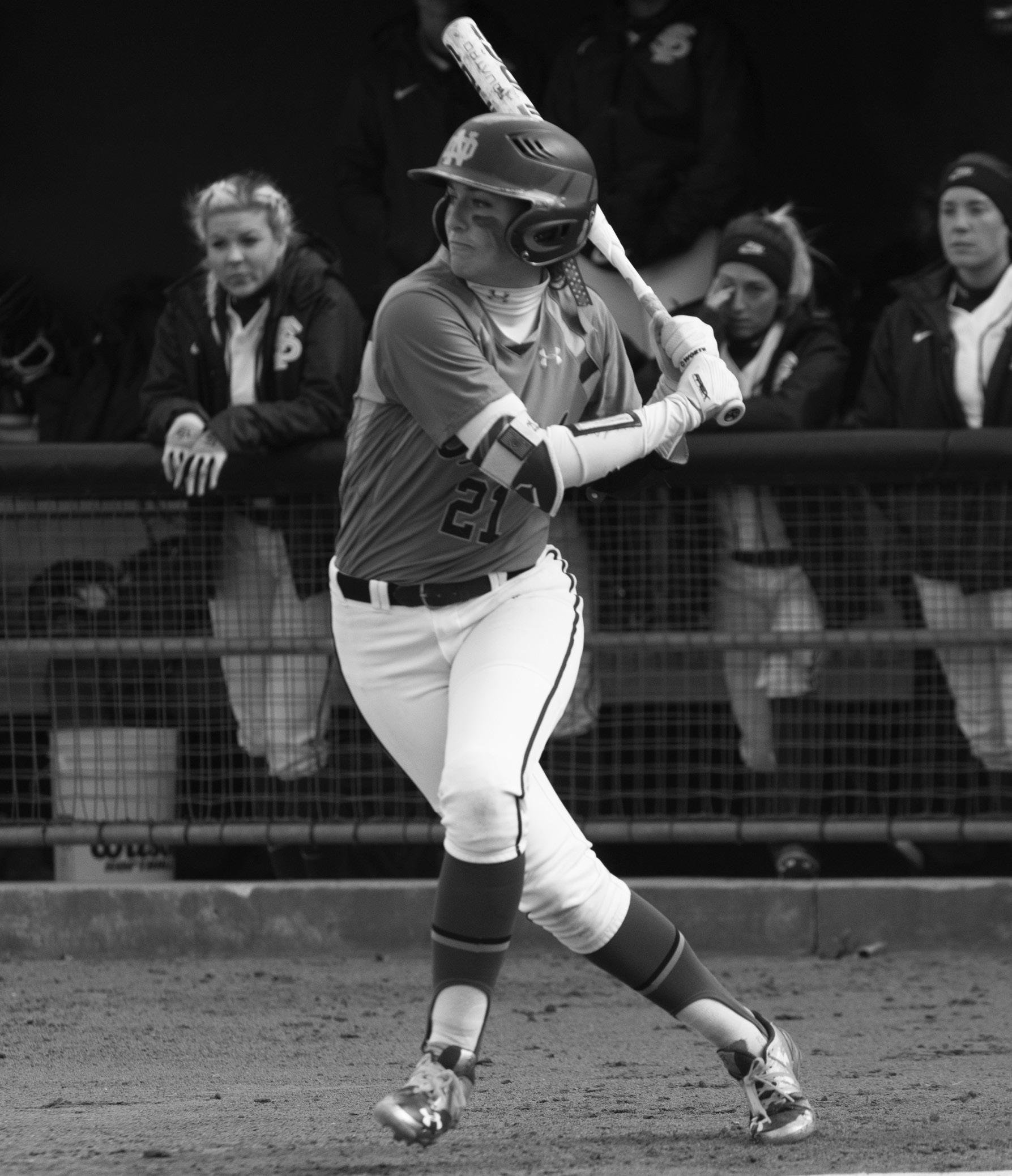
and 54 hits. Wester singled and scored in notre dame’s 5-4 win against the seminoles on sunday and also paces the team with 28 stolen bases in 31 attempts this season.
a fter the florida state games, Gumpf said patience will be a key for all of her players going forward, and used her team’s performance against seminoles redshirt freshman pitcher meghan King as an example.
“King did a great job with her up pitch with us,” Gumpf said. “When we were chasing, she was very successful. When we made her throw strikes, we were successful.”
t he contest against IupuI also marks the fourth game in a nine-game homestand for the Irish, something Gumpf is happy about.
“How nice is that?” Gumpf said. “We can kind of get in a rhythm here, and how cool is
that?”
a fter tuesday’s matchup against the Jaguars, notre dame welcomes depaul to melissa cook stadium on t hursday, before hosting pittsburgh in a three-game weekend series. notre dame and IupuI are scheduled to begin their matchup tuesday at 5 p.m. Contact Marek Mazurek at mmazurek@nd.edu

pa I d a dV ert Isement

said, following sunday’s action.
“I think it shows a little resiliency that these guys had, and maybe that carried into the next game — I’m not 100 percent sure — but certainly it was a good inning for us; just, unfortunately, a better inning for them.”
aoki said the team needs to parlay that momentum into a strong showing this week, as the Wolverines (20-5, 3-0 big ten) represent a strong resume boost for the ncaa tournament. the Irish also have a game against Valparaiso scheduled for Wednesday night and a threegame acc series with no. 3 miami over the weekend.
aoki said the opponents on the field aren’t even the only challenges for his team this week: in addition to trying to get rested and rehydrated after a long doubleheader sunday, off-the-field duties also beckon.
“unfortunately, I think mendoza has a battery of tests for the finance majors, so that’s not cooperating with it, but these guys are kind of used to it,” aoki said. “they understand what the deal is with that there, and so we try to get ourselves as rested as we can be and get back out there and play at a high level.”
despite the jam-packed week, however, aoki said he hasn’t considered resting anyone or modifying the lineup in any way.
“I think the thing is we’re playing hopefully to play our way into an ncaa berth,” aoki said. “so
you play the lineup that you think going to give you the best opportunity to win. most of your core guys, the infielders, you know who those guys are. We’ve obviously bounced around a little bit in the outfield with the exception of [freshman outfielder matt] Vierling as a steady presence out there, but we try to go and win.
“every one of these games counts towards ncaa stuff, and michigan has gotten off to a great start. they’re a good team, [with] obviously kind of that traditional football rivalry — I’m not sure if that exists to that extent in baseball, but I think any time that you can beat michigan, that’s probably a notch in your belt so to speak.”
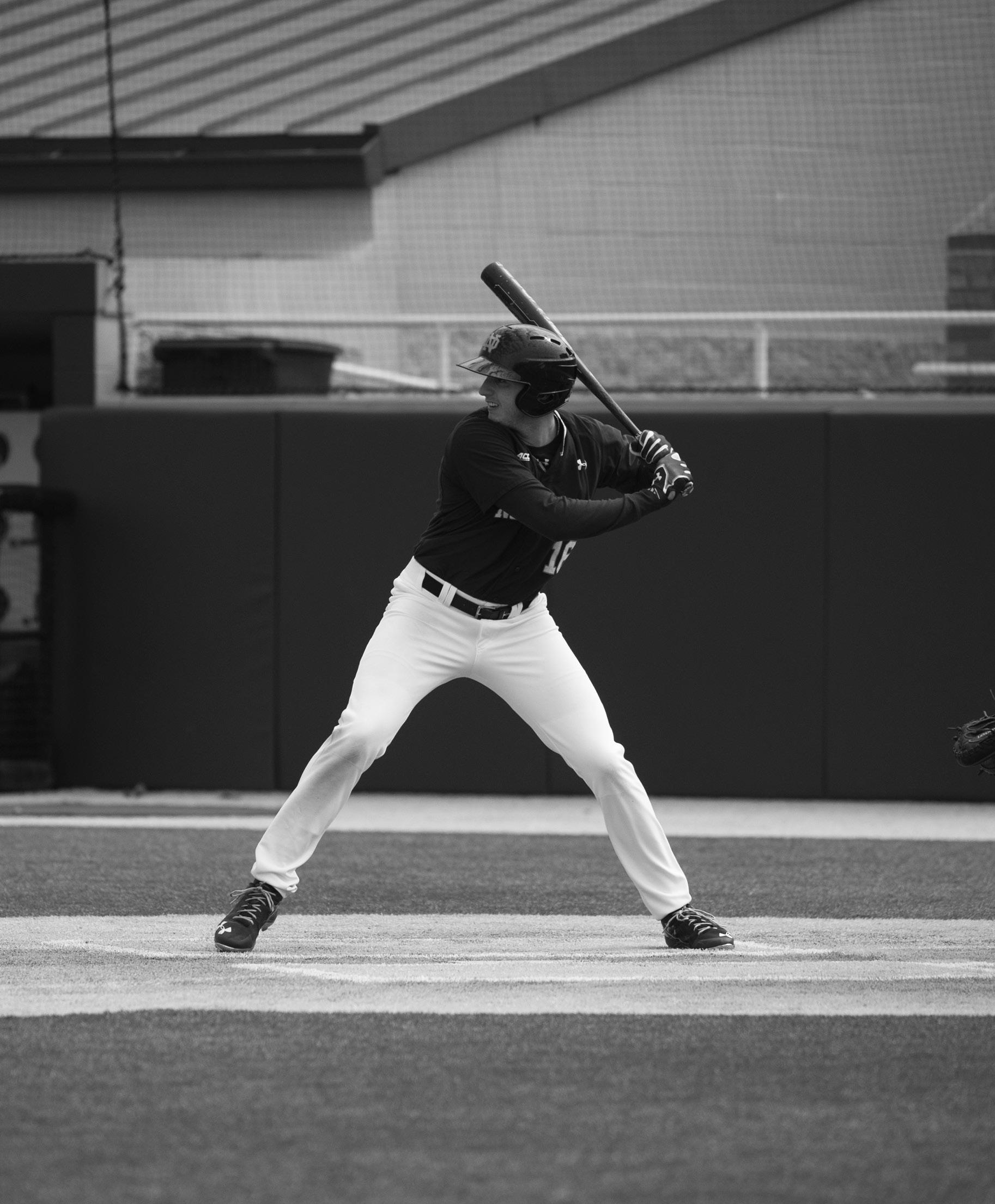
michael Hearne will get the start against the Wolverines on tuesday night. It will be the senior right hander’s sixth start and seventh appearance. Hearne is currently 2-0 on the season with a 3.67 era and 18 strikeouts over 27 innings of work.
His last start came last Wednesday during notre dame’s 6-3 win over visiting oregon. Hearne allowed three runs over four innings of work while striking out two on his way to a no decision.
notre dame and michigan last met april 9, 2014 in ann arbor, michigan, when the Irish rode a 4-for-5, 3 rbI day at the plate from current senior first baseman Zak Kutsulis to a 9-1 road victory. this year’s iteration of the rivalry is slated to begin tuesday at 6:05 p.m. at frank eck stadium.
Contact Zach Klonsinski at zklonsin@nd.edu
commended the senior for her play this weekend.
“talia had a really solid turnaround,” Holt said. “With what the conditions were, for her to be as consistent as she was, that was a very good showing for her. but really, all the girls had contributions to the weekend. We had some really good crucial rounds. It was a team effort, and that’s a good thing. We’ve never relied on the same group of individuals every day — it’s always just all of them pitching in.”
freshman maddie rose Hamilton tied for 26th place at 12-over-par 228, and fellow freshman Isabella dilisio tied for 34th place at 14-over-par 230.
Junior Jordan ferreira and freshman emma a lbrecht were part of a three-way tie for 42nd place at 16-over-par 232. Holt said she was pleased with the final rankings, but said believes there is room for improvement.
“We’ve always got things to
work on,” Holt said. “this weekend, putting was difficult, in part because of the wind. the balls were moving — kind of wiggling — on the green as we were trying to hit them there. even short gains could have been better. those were things we could have done better, but they had challenging conditions to deal with. We’ll get back in town and work on those things as we prep for accs around the corner.
“everybody is ready to play [at the acc championships] and looking forward to the challenge. the acc women’s golf conference is super competitive and we stand pretty well in those rankings. every time is just an opportunity to compete and get more experience. It’s going to be an interesting championship this year to see who comes out on top, because there are a lot of good teams.”
the Irish will return to Greensboro for the acc championships on april 15 - 17.
Contact Maureen Schweninger at mschweni@nd.edu
By ZACH KLONSINSKI
a ssistant managing e ditor
after winning its first home conference series of the year last weekend against Wake forest, notre dame returns to the frank eck stadium turf tuesday night against institutional rival no. 25 michigan.
the Irish (15-11, 6-6 acc) enter the mid-week contest with some momentum after clinching the series against the demon deacons (18-12, 5-7) with a victory in the second game of a doubleheader sunday. the team got on a roll starting with the final inning in the first game of the day.
notre dame entered the bottom of the ninth trailing 15-7 but clawed all the way back to put the tying run on base before ultimately falling 15-13. the Irish picked up right where they left off, though, en route to a 10-2 victory in the series’ rubber match.
“[the ninth inning charge] was good,” Irish head coach mik aoki
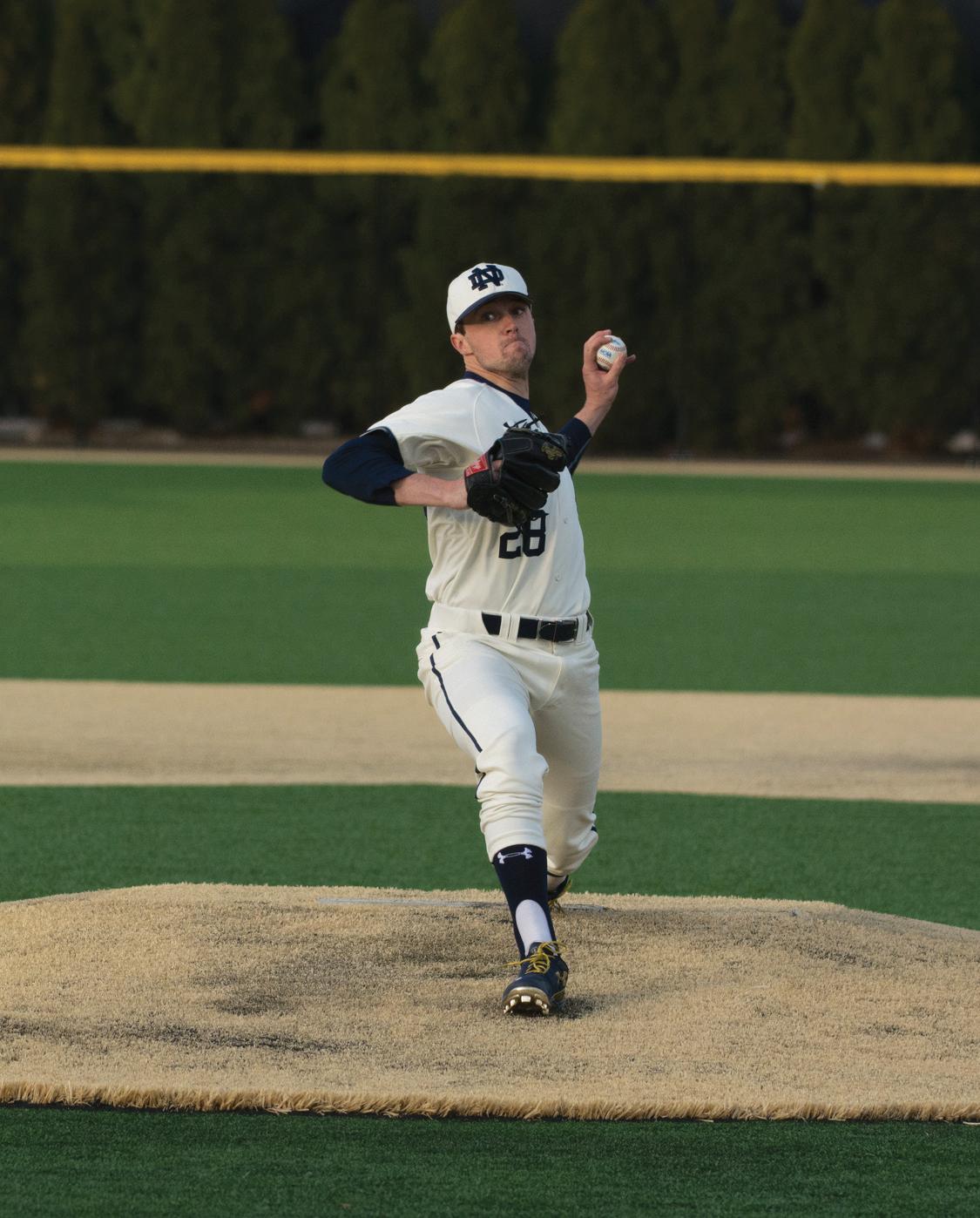
By MAUREEN SCHWENINGER sports Writer
a fter looking to improve an 11th-place finish at the lsu t iger c lassic, notre d ame posted a fifth place finish at the bryan national c ollegiate in Greensboro, north c arolina this weekend, despite poor weather conditions throughout the tournament.
With its sixth top-five finish this season, notre d ame finished at 45-over-par 909, edging out acc foes north c arolina state and m iami and rival m ichigan. no. 20 Virginia won the tournament with s outh c arolina, no. 21 f lorida state and Wake forest taking spots two through four. Irish head coach susan Holt said she was especially pleased by the team’s performance against in-conference opponents.
“o f course s outh c arolina is going to have a home-course advantage,” Holt said. “f lorida state [and] Virginia beat us, but we’ve beaten all of them at different points this season. I was just proud of [my team] for hanging in there.”
t he wind and weather conditions in Greensboro turned out to be the most difficult hurdle for the Irish, as gusts of up to 35 mph caused serious interference with play. no player broke 70 on the par-72 course all weekend and Holt said playing against the elements is the hardest variable to control.
“ t he conditions were tough to prepare for,” Holt said. “It was really challenging, and we certainly would have liked to have scored better. a t the end of the day, they got through it and I’m pleased overall with the finish. Golf is a mental game as much as it is a physical game, and with the conditions, it was pretty tough to stay positive and keep yourself going. a t the end of the day, it ended up pretty good.”
s enior captain talia c ampbell posted her best score of the year with a tie for eighth-place at eight-over-par 224. It was her 20th career team-leading finish, the second player in program history to hit that mark. Holt
By MICHAEL IVEY sports Writer
over the weekend, notre dame defeated florida state 4-3 in a home conference matchup friday at eck tennis pavilion. two days later, the Irish traveled to durham, north carolina for another conference matchup against no. 10 duke, where they lost 4-1 at the a mbler tennis center.
during friday’s matchup, the Irish (10-9, 4-6 acc) controlled most of the singles competition, winning four of the six matches. on court no. 2, junior monica robinson won her match 6-4, 6-2, followed by a victory by sophomore a llison miller 6-2, 6-4 on court no. 3. sophomore brooke broda won her match 6-1, 6-4 on court no. 5 and on court no. 6, junior Jane fennelly earned a hard fought 7-6(5), 6-2 win. on court no. 1, however, senior Quinn Gleason was defeated 6-4, 6-3. the other Irish singles loss was junior mary closs, who won the first set 6-4
before narrowly losing the last two sets 7-6(3), 6-3 on court no. 4.
In the doubles competition, the team of Gleason and robinson won 6-4 on court no. 1. the teams of senior Julie Vrabel and closs, and broda and miller both lost 6-3 on courts no. 2 and no. 3, respectively. on sunday, the Irish had a tougher time, winning only one singles matchup as broda claimed a 6-2, 7-6(3) victory on court no. 5. on court no. 1, Gleason lost 7-6, 6-3, followed by a robinson 6-3, 6-3 loss on court no. 2 and a miller 6-3, 6-4 loss on court no. 3. closs won her first set 7-6(5) before losing the second set 6-4 and was losing 4-0 in the deciding set when the match was discontinued on court no. 4. fennelly won her first two sets 6-4 and 5-3 before her match was discontinued on court no. 6. In the doubles competition, Gleason and robinson fought the 13th ranked duke (15-3,
nd soFtball
By MAREK MAZUREK sports e ditor
a fter splitting a twogame weekend series with no. 9 f lorida state, no. 22 notre dame returns to action tuesday against I upu I, looking to build on its momentum.
a fter losing 14-5 earlier in the day, notre dame (26-6, 5-3 acc ) rallied on sunday evening to snap f lorida state’s (27-4, 7-1) 22-game winning streak, with a walkoff single by sophomore left fielder bailey bigler.
t he split doubleheader puts the Irish at fourth place in the acc, and bigler said she thinks the team can build off the momentum of beating the acc-leading seminoles.
“from this point on, we know we’re a top team that can compete with these other teams,” bigler said. “We have the ability to put so many runs on the board and hits, and string them together and really go for the win.”