
n o T re d ame and s ain T m ary’s
nd community reacts to Laetare decision
University faculty, students offer perspectives on bestowal of award on Biden, Boehner
By KATIE GALIOTO
news e ditor
w hen the u niversity conferred an honorary degree to p resident Barack o bama in 2009, members of the campus community were quick to express their opinions on the controversial choice. n ow, n otre d ame students and faculty are once again debating the religious and political implications of a u niversity decision.
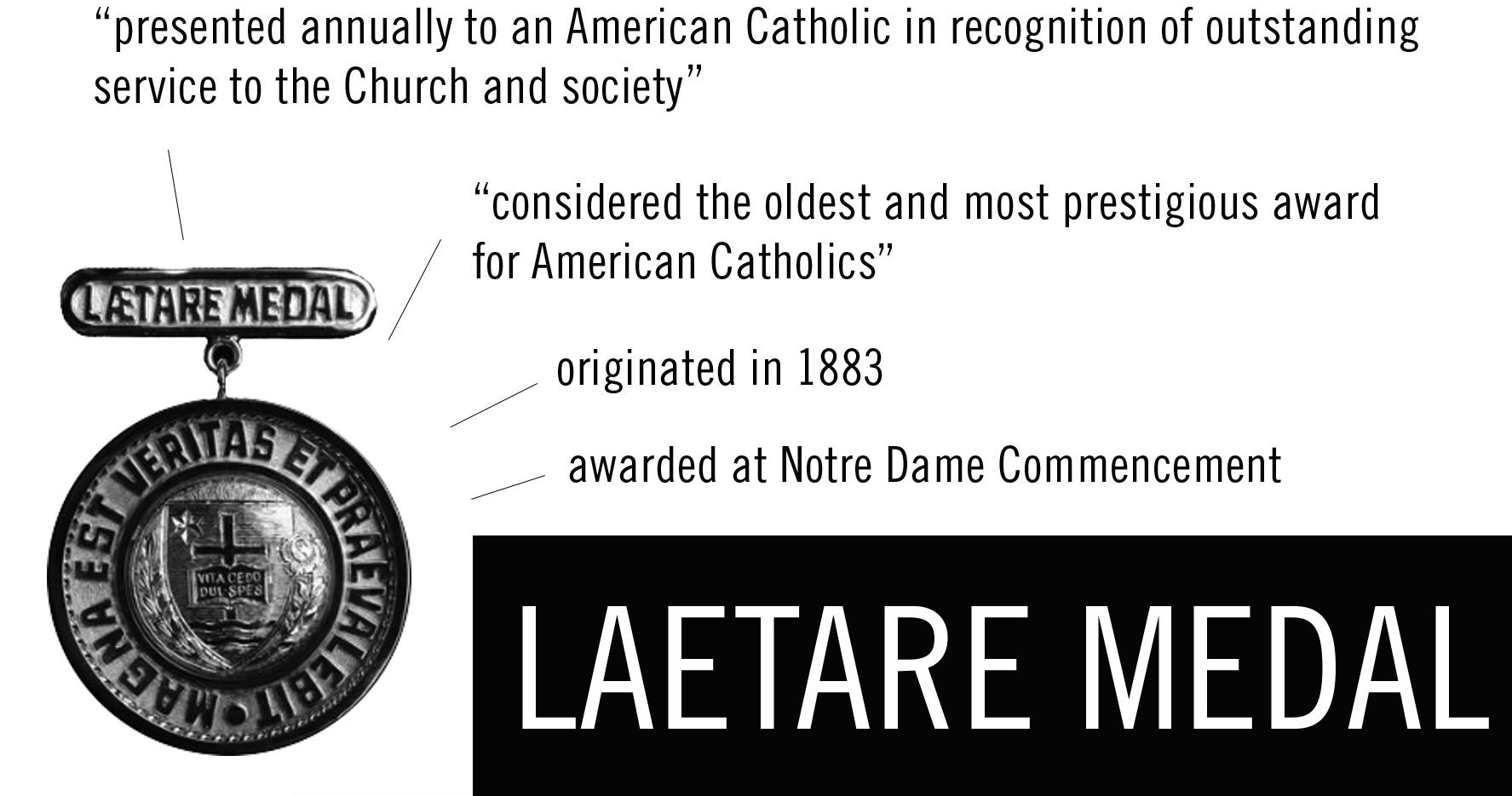
n otre d ame will jointly award the l aetare m edal to v ice p resident Joe Biden and former s peaker of the h ouse
John Boehner at the 2016 c ommencement c eremony, the u niversity announced in a press release on m arch 6. “ i n recognizing both men, n otre d ame is not endorsing the policy positions of either, but celebrating two lives dedicated to keeping our democratic institutions working for the common good through dialogue focused on the issues and responsible compromise,” Jenkins said in the release.
s ophomore Jack Kill, one of 89 students who signed
see medal PAGE 5
Observer Staff Report
university and c ollege administrators confirmed the safety of students participating in study abroad programs, following the Brussels attacks. Three explosions, two in the Brussels airport and one in a subway station, killed about 30 people and injured hundreds. The terrorist group isis later claimed responsibility for the attacks.
Tom g uinan, associate vice
president for administrative operations for n otre d ame i nternational ( ndi ), said in an email the u niversity has accounted for 421 of 433 students studying abroad.
“[ we] are waiting on confirmation from the remaining students who are in a sia and a ustralia, and one in l atin a merica. o f the students with whom we confirmed, none were in Brussels
see Brussels PAGE 4
By SARAH CATE BAKER news writer
n otre d ame signed an agreement with Kyoto u niversity in Japan two weeks ago that will allow for the exchange of faculty and graduate students between n otre d ame’s department of chemistry and biochemistry and Kyoto u niversity’s i nstitute for c hemical r esearch, Ken h enderson, chair of the department of
chemistry and biochemistry, said.
h enderson said this exchange program will be beneficial for faculty and graduate students at n otre d ame.
“They will potentially have access to equipment and expertise that faculty do not have here, which could strengthen the research program,” he said.
The partnership will also raise the international
profile of n otre d ame, h enderson said.
“Kyoto is one of the best universities in the world, and of course, Japan is very strong in science and technology,” he said.
a ccording to h enderson, the exchange agreement is the most recent development in a two-year conversation between the universities.
notre dame confirms safety University launches exchange program in Kyoto Professor lectures on personal finance
By LUCAS MASIN-MOYER news writer
Tuesday evening in deBartolo hall, carl ackermann, professional specialist in the mendoza college of Business, gave the second lecture in a three-part series on personal finance. ackermann’s lectures focus on how students can best secure their financial future right out of college.
ackermann began his talk with a brief summary of the previous talk, which discussed the benefits of investing in mutual funds.

“investing in mutual funds is such an outstanding way to invest because a stock mutual fund, for example, has many stocks, so if you buy into a stock mutual fund, you now own a piece of every stock that that mutual fund owns,” ackermann said. “[This] gives you instantly a widely diversified portfolio.” diversification of stocks is crucial in a portfolio, ackermann said.
“if you buy a stock mutual fund, you should achieve about
see acKermann PAGE 5




SUSAN ZHU | The Observer
see KyoTo PAGE 5
GRACE TOURVILLE | The Observer
Carl Ackermann, professional specialist in finance in the Mendoza College of Business, delivers his lecture Tuesday night. The presentation was the second in a three-part series on personal finance.
Advertising (574) 631-6900 ads@ndsmcobserver.com
Editor-in-Chief (574) 631-4542 mhynds@nd.edu
Managing Editor (574) 631-4542 kmullen2@nd.edu
Assistant Managing Editors (574) 631-4541 acarson1@nd.edu, zklonsin@nd.edu, ckossler@nd.edu
Business Office (574) 631-5313
News Desk (574) 631-5323 news@ndsmcobserver.com
Viewpoint Desk (574) 631-5303 viewpoint@ndsmcobserver.com
Sports Desk (574) 631-4543 sports@ndsmcobserver.com
Scene Desk (574) 631-4540 scene@ndsmcobserver.com
Saint Mary’s Desk ncaratas01@saintmarys.edu
Photo Desk (574) 631-8767 photo@ndsmcobserver.com
Systems & Web Administrators (574) 631-8839
Policies
The observer is the independent, daily newspaper published in print and online by the students of the university of notre dame du lac and saint mary’s college. editorial content, including advertisements, is not governed by policies of the administration of either institution. The observer reserves the right to refuse advertisements based on content. The news is reported as accurately and objectively as possible. unsigned editorials
Question of the Day:
What is your favorite Easter candy?
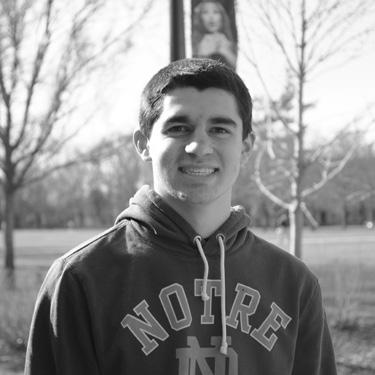
Mikey Farren freshman carroll hall “peeps.”
Erin Turley sophomore walsh hall “Jellybeans.”
Max Hammersmith freshman carroll hall “reese’s eggs.”
Have
Today’s Staff
Corrections
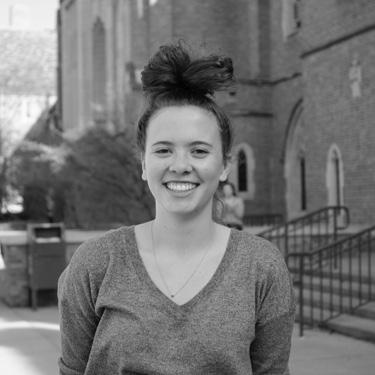
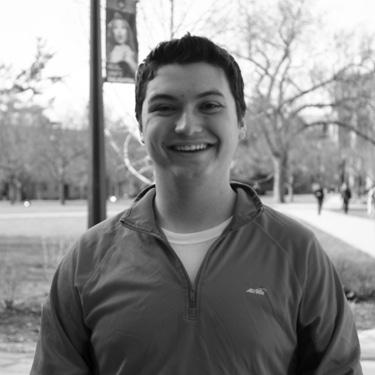
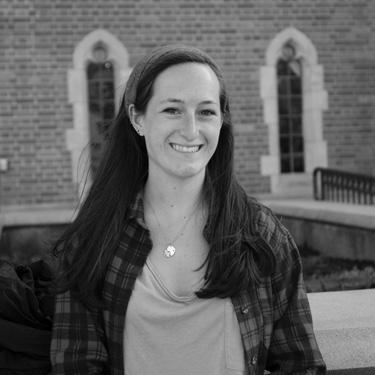
Aly Sonnen sophomore walsh hall “w hite chocolate easter eggs.”
Nick Martinez freshman o’neill hall “reese’s chocolate bunny all the way.”
Casey Kennedy sophomore walsh hall “peeps.”
Wednesday
Softball vs. Michigan
State
Melissa Cook Stadium
5 p.m. - 7 p.m.
The Irish take on the Spartans.
Film: “TOXI*City”
DeBartolo Performing Arts Center
8 p.m. - 10 p.m.
Narrative segments on Hurricane Sandy.
nEws
Thursday
Evening Mass
Basilica of the Sacred Heart
5 p.m. - 6 p.m.
Celebrate the Last Supper.
Adoration in the Lady Chapel
Basilica of the Sacred Heart
6:30 p.m. - 11 p.m. Personal prayer.
Friday
Celebration of the Lord’s Passion Basilica of the Sacred Heart
6:45 p.m. - 7:15 p.m. Solemn liturgy.
Stations of the Cross Basilica of the Sacred Heart
7:15 p.m. - 8:15 p.m.
Self-guided prayer and reflection.
Saturday
Women’s Lacrosse vs. Syracuse Arlotta Stadium
12 p.m. - 2 p.m.
The Irish take on the Orange.
The Paschal Vigil Mass
Basilica of the Sacred Heart
Begins at 9 p.m.
Easter Vigil Mass.
Sunday
Vespers
Basilica of the Sacred Heart
7:15 p.m. - 8:15 p.m. Evening prayer service.
Easter Sunday Student Mass
Basilica of the Sacred Heart
9 p.m. - 10 p.m. All students invited.
Lecturer examines hiring practices
By STEPHANIE SNYDER news writer
The student diversity Board’s social media committee at saint mary’s invited the college’s own Business professor, James rogers, to speak about the effect social media can have in a company’s hiring process.
rogers introduced his discussion by challenging students to ask themselves a single question before posting anything on their social media: “w hat could possibly go wrong?”
according to rogers, over 90 percent of employers recruit using info gathered from social media networks.
“They care about the person with whom they’re about to associate,” rogers said. in most states, he said, it is legal for an employer to ask for a prospective employee’s social media passwords. rogers said employers may do this even if it is not a prospective employee’s first job.
“it really is about the rest of your life,” he said.
rogers said in an average company, the cost of hiring an employee can be greater than $100,000. he asked students to put themselves in the employer’s shoes.
“if they choose to associate with you,
their reputation could be on the line,” he said.
even if a prospective employee were to present themselves well during interviews, rogers said the final decision may come down to social media. “This could be the make or break point for you,” he said.
rogers said students should avoid three pitfalls with respect to social media.
The first is to avoid remaining friends on social media with people who may tag you in questionable posts — unfriending someone on social media is not unfriending them in real life, rogers said.
“you can’t have stuff of theirs tagged with you. it spreads virally,” he said. another pitfall to avoid is a boring or nonexistent online presence, rogers said.
“The competitive process requires us to stand out in a positive way,” he said. “in the end, you want people to find someone who is hirable.”
The final pitfall, according to rogers, is having a tattoo as one of the first things a potential employer sees on social media.
“i know it sounds unfair and prejudicial,” rogers said. “But maybe the employer world isn’t going to be excited that this is the first thing they see about you.
“ … i’m not telling you to pretend to be someone you’re not. They look for honesty.
i urge you to be as transparent as one can be without placing yourself under peril.” rogers said that as negative as social media can be in the hiring process, social media can be positive and provide prospective employees with an advantage.
“you have to drown the negative,” he said. “Find the things that you are passionate about and use that to your advantage.” sophomore business major, Kiersten lieurance, said rogers’ lecture changed the way she thought about social media.
“i didn’t really think there are positive ways to impact your social media that your job will see or that they would be interested in,” lieurance said.
rogers recommended his students accomplish this by simply revealing their values and strengths through social media.
“get down to the core of what it means to be a saint mary’s college student,” rogers said. “The values that it represents — understanding education, ability, passion, spirituality — bring those things forward in your social media activities.”
rogers closed his talk with a reminder.
“our expectation of realistic privacy online is none,” he said.
Contact Stephanie Snyder at ssnyder02@saintmarys.edu
diversity director explores inclusion
By MEGAN VALLEY news writer
eric love, director of staff diversity and inclusion, presented to leaders and volunteers from nonprofit organizations Tuesday as part of the university’s nonprofit Breakfast series. The series, presented by the university’s office of public affairs and the mendoza college of Business, is designed to help nonprofit organizations learn from human resource experts to better manage employees.
love’s presentation focused on the benefits of diversity and how to better serve all constituents.
“inclusion is what we do with diversity,” he said. “if we really value diversity, if we really think it’s important, that inclusion is so important. we can only get the benefits of diversity if we give each other a voice and allow them to speak and share their perspective.
“so together, diversity and
inclusion are policies and practices of inclusion that promote understanding of cultural differences and encourage cooperation across the boundaries of diverse co-workers.”
The benefits of diversity, according to love, include enhanced critical and complex thinking, greater academic and work success and “greater engagement in the lifelong learning of understanding people and cultures in order to develop a more democratic community and equitable society.”
“when we start working with people who are different from us, we start to care about them, we care about their communities,” he said.
The first step to becoming more inclusive, love said, is to focus on yourself.
“i strongly believe awareness is the first step — the more comfortable we are with ourselves, the more comfortable we are with
other people,” he said. “if you know who you are, it doesn’t really matter who someone else is, because you’re secure with yourself. you’re comfortable with whoever else someone might be.”
when addressing organizations, love said leaders should aspire to be “multiculturally competent.”
“an organization is multiculturally competent when its members, majority and minority, have knowledge of, respect for and the skills necessary to interact with people from other cultures, within an international and domestic context,” he said.
when striving for multicultural competency, love said microaggressions, which he defined as “brief and commonplace” indignities that communicate “hostile or negative slights or insults,” are a crucial part of communication to be aware of.
“They are reminders that
recipients are not in the majority,” he said. “They can happen to women, to people of color, to people with disabilities and they add up to a pattern of exclusion. one microaggression is like a paper cut — it might sting a little bit, but ultimately it’s not that big of a deal. But multiple microaggressions every day, every week, over time can really start to add up.”
while it is important to be inclusive, the fear of “saying something wrong” shouldn’t prevent conversations from happening or questions from being asked, love said. “political correctness had noble intentions and it started to get us communicating in a more civil way,” he said. “But terminology changes and it can be hard to keep up. we all make mistakes; i’m the diversity guy and i make mistakes.”
Contact Megan Valley at mvalley@nd.edu
Expert named Cottrell Scholar
By SYDNEY ENLOW news writer
dr. Kathryn haas, assistant professor of chemistry and physics at saint mary’s, was named a 2016 cottrell scholar by the research corporation for science advancement in February. The cottrell scholar program awards $100,000 to 24 scientists to support research and teaching efforts, the program website stated.
The money from the award will allow her to hire undergraduate students to work during the summer, providing them with research opportunities, haas said.
“it’ll allow me to purchase equipment and materials that i need — chemistry costs a lot of money. it’ll also help me to travel and to pay for students to travel as well,” she said.
haas said receiving the award has been “very validating.”
“it’s amazing to be part of this community of people that are focused on science education,” she said. “i have access to some amazing mentors and networks that i would never have had without this recognition. i feel like i am part of a community that’s really changing science education in the world, and i’m doing it from saint mary’s college. we’re doing a lot of good things here, and it’s finally bringing light to that, so it feels really good.”
haas said her research focuses on copper’s interaction with the human body.
“i studied copper in graduate school, and my background is in studying how metals interact with biological systems, particularly how they affect human health,” haas said. “copper is an essential element, and i just kind of fell in love with it. i’ve been studying it ever since.”
haas said she is looking forward to expanding her research and sharing her findings with the public.
“we will publish our finding in journals,” haas said. “copper is involved with diseases, antibiotics and it’s essential for every single cell to live. so, we are trying to understand how our body works.”
haas said she hopes her continued research will shed light on how the body’s cells and proteins work to handle copper.
“copper has broader applications in things, like understanding antibiotic activity and understanding neurodegenerative diseases, but also in any kind of genetic disorder that is related to the misdistribution of copper,” she said.
Fordham professor lectures on Aquinas, morality of God
By SYDNEY ENLOW
n ews w riter
Fr. Brian d avies, a distinguished professor of philosophy at Fordham u niversity, has dedicated his academic career to studying and writing about the philosophy of religion, and has focused on the work of Thomas a quinas. Fr. d avies explored the question of why, if g od is all powerful and morally good, there is evil present in the world in a lecture held Tuesday night at r ice c ommons
The lecture focused on a quinas’s rejection of the argument against the existence of g od. a ccording to a quinas, g od is not a morally good agent, despite popular belief.
“a quinas views that g od should not be thought of as a moral agent in the first place, meaning that g od should not be thought of as something either morally good or morally bad,” d avies said. “a quinas maintains that we do not know what g od is … g od is strictly non-classifiable.”
v irtues are to only be associated with human beings, not g od, d avies said.
“a quinas thinks of virtues
Brussels
con T inued F rom page 1
this morning, and we have no reason to believe that the students who have yet to confirm are or were in Brussels,” he said.
i n an email to students currently studying abroad, g uinan said, students are advised to not travel to Belgium until further notice.
“The u s e mbassy in Brussels has issued this statement on the attacks, which includes a l evel 4 threat rating,” he said.
a lice s iqin yang, assistant director for g lobal e ducation at s aint m ary’s c enter for i ntercultural l eadership ( cwil ), said in an email the c ollege confirmed the safety of all students studying in e urope.
“ we contacted our r ome and i reland p rogram onsite directors. They told us all the students there are fine. we have also contacted the students in o xford ( u K), s pain
as what people need in order to flourish as human beings,” d avies said. “ s o he doesn’t think of g od as having the cardinal virtues a quinas doesn’t think of g od as being actually or possible virtuous.”
a ccording to d avies, a quinas believes it is difficult to attribute goodness to specific things,
“Aquinas thinks of virtues as what people need in order to flourish as humans beings. So he doesn’t think of God as having the cardinal virtues ... Aquinas doesn’t think of God as being actually or possibly virtuous.”
Fr. Brian Davies professor of philosophy Fordham University
especially g od, because the idea of goodness is concept-dependent.
and m orocco. a ll of them replied to our emergency response request email,” she said. “ s panish s tudies a broad, the provider of our s pain p rogram, also communicated with us regarding the situation of our students in s evilla. o ne nd student and one h oly c ross student are attending s aint m ary’s programs. we have already informed the two institutions of the situation of their students.
“The c ollege offers h T h international insurance for every study abroad student. h T h offered some updates on the situation in Brussels today. a ll the [study abroad] participants are enrolled in the s tate d epartment s mart Traveler e nrollment p rogram. we also received updates from o verseas s ecurity a dvisory c ouncil. we are monitoring the situation ”
Editors Note: Saint Mary’s Editor Nicole Caratas contributed to this story.
“’ g ood’ does not signify some distinct property had by all good things,” d avies said. “For him, the meaning of good is noun-dependent. There are good all sorts of things, but what makes them good make them different from kind to kind — goodness is, in a sense, relative. a quinas thinks that creaturely goodness must somehow reflect what g od is.
“a quinas doesn’t think of g od as containing creaturely goodness, but rather, goodness in creatures is a dim reflection of what exists simply and undividedly in g od”.
The same argument applies to the subject of evil, according to d avies. l ike goodness, a quinas does not view evil as something of substance.
“ m any things are generally in a bad way and he thinks that the sentence ‘evil exists’ makes sense,” he said. “ o n the other hand, he doesn’t think of evil as a substance. s ince a quinas thinks that victims of evil suffering certainly exist, he takes it for granted that g od is causally accounted for their being victims of evil suffering. h e does not
think that the evil in evil suffered is any kind of substance — there is only evil suffered only inasmuch there is a lack of goodness, and a quinas does not think a lack of goodness is something ‘create-able’.”
a quinas believed there is a problem in the world, but the problem stemmed from
“‘Good’ does not signify some distinct property had by all good things.”
Fr. Brian Davies professor of philosophy Fordham University
a lack of goodness and obligation, rather the existence of evil, d avies said.
“a quinas recognizes that there being something to be called the problem of evil, is rather a problem of why g od has not created more goodness,” d avies said. “ h owever, a quinas does not believe that g od has an obligation to create more goodness any more than g od has an obligation to create at all.”
Contact Sydney Enlow at senlow01@saintmarys.edu
paid a dverT isemen T
Kyoto
“a round two years ago, a representative of notre d ame i nternational mediated and signed a memorandum of understanding with Kyoto university,” henderson said. “ s o basically, that is an agreement saying that we are interested in developing partnerships — academic partnerships, undergraduate partnerships, research partnerships.”
The recent agreement represents the second memorandum between the two universities, he said.
“s o this [second memorandum] is basically saying that our department — chemistry and biochemistry — and [Kyoto’s] i nstitute ... will work together on things like research programs, joint seminars, workshops, a faculty exchange and some more things for graduate students,” henderson said.
a n additional benefit of the partnership is that notre d ame researchers are invited to Kyoto university’s i nternational p artnership c onference, henderson said.
“ we are now one of those who come every two years to be a part of the symposium,” he said. “a nd it is quite a prestigious group of people to be around.be a part of the symposium,” he said.
Contact Sarah Cate Baker at sbaker6@nd.edu

Ackermann
the same expected return as if you buy just a few stocks — but since when you buy a stock mutual fund, you hold a widely diversified portfolio of stocks. you achieve same expected return at dramatically lower risk,” ackermann said.
Though students are young, ackemann said it is important for them to understand 401(b) and 401(k) plans.
“you contribute an amount [of money] to one of these plans,” he said. “it’s taken right out of your paychec,k so you don’t even see it, and your employer often matches this contribution.” ackermann said these funds provide benefits to people who maintain them, as the govern-
“If you buy a stock mutual fund, you should achieve about the same expected return as if youbuy just a few stocks. .”
Carl Ackermann professional specialist finance
ment gives large tax breaks to those holding these funds. however, these funds have been largely ignored by many americans, despite the funds’ ability to appreciate in value, providing a safety net
paid a dverT isemen T

for retirement.
“Financial advisors often suggest that 110 minus your age should be the percentage you put in stock index funds, with the rest in a u s. Bond index,” he said, “within the stock index portion, they recommend that you should have 60% in u s. stock index funds and 40% in international index funds.”
There are two other types of investments that one could make in order to ensure their financial security, the first of these being an emergency fund, acvkermann said.
“Take six months of your family’s living expenses and put it in a bank savings account that has a competitive interest rate, so if you lose your job or get sick, you have funds to live off of,” ackermann said.
The other investment that ackermann suggested as a way to ensure financial security is a roth ira, if it was within the investor’s means.
“if you still have money left over, you’re going to want to look into something called a roth ira — a roth ira is an individual retirement plan that works a lot like a company retirement plan, except there is no company match,” ackermann said.
These roth iras have numerous benefits, he said.
“There is no taxation along the way, accumulation continues to accelerate — also, you can take your money out later, completely tax-free,” ackermann said.
Being in control of one’s finances is not only important for one’s financial stability, but allows one to be able to devote their time to worthwhile causes, ackermann said.
“Freely volunteering your time, contributing to charities, helping people, traveling — imagine doing all of this good for society in what many would consider the prime ages of their life,” he said
Contact Lucas Masin-Moyer at lmasinmo@nd.edu

an o bserver v iewpoint objecting to the u niversity’s decision, said he was disappointed when the honorees were announced.
“The l aetare m edal should be an award that we grant to individuals who have performed exemplary actions to further or help the c hurch and society,” he said. “ u nfortunately, as we well know in a merican society, it’s very hard to further both your country and your church.”
s enior Janelle wanzek, president of n otre d ame r ight to l ife, said she thinks awarding Biden and Boehner with the medal conflicts with some of the u niversity’s core c atholic values.
“ o ur club’s mission statement states that we’re working to promote and uphold the sanctity of all human life from conception until natural death, in the spirit of the c atholic c hurch,” she said. “ we believe that through awarding this c atholic medal, n otre d ame is not in line with upholding the teachings of the c atholic c hurch.”
d uring his time in office, Biden has supported abortion, capital punishment and embryonic stem cell research, junior e mily Burns, vice president of events for n otre d ame r ight to l ife, said. Boehner has also supported the death penalty in certain cases, she said.
“The medal itself that’s given to the recipients bears the inscription that translates to ‘truth is mighty, and it shall prevail,’” Burns said. “The question that we’re asking as a club … is how can we bestow the most prestigious award for c atholics in a merica to leaders who fail to protect the most vulnerable, which is a basic element of justice and a fundamental truth of
the c atholic faith?”
Fr. Bill m iscamble, professor of history, said he agrees with a statement released by Fort wayne- s outh Bend Bishop Kevin r hoades that criticized the u niversity’s decision.
“By conferring the award on Biden, n otre d ame misuses the l aetare m edal, which is meant to honor c atholics for their genuine and faith-inspired accomplishments, in order to promote an ill-conceived political agenda,” he said in an email.
o ther members of the n otre d ame community said they support the selection of Biden and Boehner as joint honorees. The decision makes a statement about political unity, senior m ichelle m c c arthy, co-president of c ollege d emocrats, said.
“ i think it’s an interesting choice because i don’t think that c atholicism maps out neatly onto either one of these parties,” she said. “ i think that we could make an argument that former s peaker Boehner has not done enough to promote fighting climate change, as the pope has talked about, or pushing through immigration reform, allowing us to provide preferential options for the poor.”
Junior g racie watkins, the other co-president of c ollege d emocrats, noted the importance of a current vice president and a former speaker of the h ouse taking the time to visit n otre d ame’s campus.
“ n otre d ame is a serious university and is taken as such in our nation’s highest offices. we should be proud, not dismayed, at the news of the joint award,” she said. c ollege r epublicans declined to comment on the matter.
d avid c ampbell, political science department chair, said he thinks the intent of the administration should be taken at face value.
“ w hen Fr. Jenkins and his office says that the u niversity wants to acknowledge civility and discourse, they want to acknowledge perspectives and viewpoints,” he said. “They want to provide a venue where people who disagree can come together and demonstrate there’s a greater cause than your own partisan position.
“ i think that’s the statement that the university is making. a nd i think that is all for the good, both at n otre d ame and for those who might be paying attention beyond n otre d ame.”
c ampbell said he was pleased to see n otre d ame recognize individuals in public life and elected office, something he said has not been done yet since o bama spoke in 2009.
“ i think it’s perfectly appropriate for the university to recognize the vice president’s service to the country,” he said. “ i also think it is appropriate to recognize the former speaker of the h ouse, just on the basic principle that these are people who have held important positions, have done good work — who have put themselves out there in a way that many choose not to in their lives.”
The decision to award the l aetare m edal to Biden and Boehner was a bold one, John d uffy, associate professor of e nglish, said. h owever, it sends the message that n otre d ame is concerned with the condition of public discourse, he said.
“ i think it’s a good decision, and i hope it sends a message to the students of n otre d ame, first of all, and perhaps beyond n otre d ame about the importance the university places on the qualities of engagement, generosity, and tolerance, especially when dealing with those people whose beliefs and values are different from our own,” d uffy said.
Contact Katie Galioto at kgalioto@nd.edu
paid a dverT isemen T
design thinking for all
Lauren Weldon graphic designer
The book, “imagine, design, create,” by the design software company autodesk, provides what i believe is the most comprehensive definition of design: “even with all the dramatic changes being wrought by technology, design remains, and likely always will be, a fundamentally human endeavor, fueled by the insights, ideas, passions, and talents of people in pursuit of progress.”
since the earliest developments of tools to do tasks more effectively than bare hands, to the development of machines in the industrial revolution, design is a way to answer or anticipate human needs. one of the biggest changes during the last century has been the transition from answer to anticipate; our consumer society creates a demand for innovation of goods and environmental concerns have created a demand for eco-mindful design for the future.
This begs the question: “w hat is good design?” over the last 20 years, since the rise of the internet era and the ability to research and compare different products quickly, the bar has elevated. it is no longer enough to be clever, now design must be thoughtful. it must consider, anticipate and analyze as never before, taking into account multiple human needs. it must factor in all the variables that can influence how a design will perform (or fail) once it is exposed to real-world pressures.
we are now expecting good design to know the unknown and to understand what we need, though we may not realize we need it yet. we want design to do all this and, oh by the way, make it all affordable, functional, scalable, sustainable and, of course, aesthetically beautiful.
so what is the role of a designer? a designer must be an interdisciplinary thinker who considers artistry, technology, social changes and consequences, both of the past and future. designers’ roles in society are only growing and the skills needed to be a good designer are becoming more technical and specified.
so where do we find these designers? The ones who will design for the needs of the soon-to-be retiring Baby Boomers and gen y-ers alike, who will anticipate ecological challenges, who will solve medical mysteries and save lives?
They are in classrooms. Their mothers and fathers may still be packing their lunches and taking them to fill-in-theblank practice, lesson, rehearsal or the big game.
This brings me to the importance of design education at the primary and intermediate level. The current core curriculum focuses on learning facts about many classic subjects but it does not teach how to solve problems. average history classes will speak of the past, good ones will speak of current world problems, but what about history’s implications in the future? one growing curriculum that i believe should be essential to the core of modern education is a concept called design thinking. design thinking at a rudimentary level entails “empathizing, defining, ideating, prototyping and testing.”
one may feel at first that this process is limited to consumer design projects or architectural studies, but it is really about how people interact with objects, spaces, processes and each other. in this way, it can be applied to nearly all human interactions and should be taught at a simplified level to even the youngest of children. much funding goes towards teaching young children how to respond to hurt feelings or how to respectfully attain an end goal; all of these can be solved with the application of the design thinking process.
The new generation, if armed with this reactive and responsive thought process, would be better prepared for everything from negotiating peace, designing for people, solving geopolitical conflicts, reconsidering urban planning and even just getting along on the playground.
Contact Lauren Weldon at lweldon@nd.edu
The views expressed in the Inside Column are those of the author and not necessarily those of The Observer.
Voices on China policy
l ast o ctober, the student body received an email from u niversity p resident Fr. John Jenkins announcing significant changes to the “Freedom of a ssociation” policy.
The original policy stipulated, “ n otre d ame licensed products [could not] be manufactured in countries lacking a legal right for workers to organize and form independent labor unions of their own choosing.”
c hina was by far the largest and most significant of the countries precluded from manufacturing n otre d ame products under this policy, leading to policy’s colloquial name of the “ c hina policy.”
i n his o ctober communication, Jenkins noted the u niversity would be moving forward with a pilot program in c hina. a small number of factories assessed by the u niversity and verité, an independent labor rights nonprofit, were allowed to begin production.
These assessments were done based upon the degree of worker participation, “as represented by 71 different criteria, meant to measure worker rights traditionally protected by freedom of association.” u pon the suggestion of the n otre d ame community, verité has also assessed factories in countries in which n otre d ame has already manufactured licensed goods.
o ne of the recommendations approved by Jenkins called for “a forum for continuing campus participation and feedback, including the establishment of a student subcommittee to the worker p articipation c ommittee.”
a fter seeing this recommendation, a group of students who had been following the issue united to form the s tudent worker p articipation c ommittee ( swpc ) to fulfill this role.
The proposal, drafted by the swpc and approved by e xecutive v ice p resident John a ffleck- g raves, brings together various student organizations, from the s tudent i nternational Business c ouncil to the p rogressive s tudent a lliance to the u ndergraduate s tudent g overnment and g raduate s tudent u nions.
a ltogether, nine student organizations have a permanent seat on the student subcommittee, with four “ o pen a cademic p ositions” filled by application.
The swpc is dedicated to providing a critical and informed voice to guide the administration’s discussion of this policy, keeping the student body as informed as possible and ensuring the voices of all concerned students are heard.
To reach every student who wishes to have a voice, we will provide forums for feedback from the community, including a town hall meeting wednesday, a pril 13 at 7:30 p.m. in the g eddes h all c offeehouse.
i f you would like to send questions or feedback directly to us at any time, message the n otre d ame s tudent worker p articipation c ommittee page on Facebook, which you can also follow for updates on the policy and related events.
i f you feel strongly, submit your own l etters to the e ditor so the debate remains open and accessible.
Finally, while applications are closed for this year, you can stay engaged and apply for an o pen a cademic p osition on the committee next spring.
your lively engagement will be invaluable as we work with u niversity leaders to craft a path forward that is open to emerging global markets, but grounded in the c atholic traditions of respect for human dignity and the dignity of work.
Bryan Ricketts, Chairman student g overnment
Matthew Caponigro, Secretary open academic position
Skyler Hughes p rogressive student a lliance
Devon Roura student i nternational Business c ouncil
Julie Mardini h iggins l abor studies p rogram
Samuel Cho diversity council
Niko Porter human r ights nd
Craig Iffland graduate student union
Lauren Nottoli student Bar a ssociation
Alex Arnold open academic position
Hannah O’Brien open academic position
Madeline Inglis open academic position
Clara Yang open academic position
Yuchen Zou open academic position
Preventing crime in the Catholic Church
investigating theft and other irregularities in corporations often starts with an analytical method known as the fraud triangle. This method examines three classic elements of criminal activity: opportunity, pressure/motivation and rationalization.
corporations typically claim that opportunity is the element over which they have the most control. accordingly, companies focus on limiting opportunities for crime with measures such as heightened security.
Businesses often assume pressure and motivation are beyond their control and characterize financial pressures, such as high medical bills, as personal matters. individual rationalizations may include a bonus that was expected but not received or payback for a poor work environment. in fact, the focus on aggressive short-term earnings targets may create the very pressure that could drive people to consider criminal options.
companies that operate under realistic market conditions, emphasizing sustainable growth and employee well-being, reduce pressures that skew behavior towards crime. competent and trusted companies apply lessons learned to detect illegal behaviors, shut them down in their early stages and implement additional controls and structural changes to limit further damage.
The pedophile priest scandals, as detailed in the Boston globe’s “spotlight” investigation, and the recent grand jury report on the diocese of a ltoonaJohnstown, illustrate extreme examples of the fraud triangle run amok. in the a ltoona-Johnstown cases, more than 50 priests and other church employees molested hundreds of children over four decades in the central pennsylvania diocese. in many cases, their superiors knew of the abuses but did not remove the priests or notify law enforcement.
if we analyze the crimes occurring here on at least two levels, then perhaps we can put ongoing processes in place to make sure this cannot occur again, at least
not on such a rampant scale. w ith respect to individual priests and employees, the pressure or motivation to commit crimes against children is of a personal nature, but it may be aggravated by factors unique to these actors. celibacy and sexual development truncated by entry into a seminary may contribute to an individual treating sex with a minor as acceptable behavior, but much more institutional input is likely involved.
in his differential association theory, criminologist edwin sutherland suggested that except for rare circumstances, criminals are not born. people learn criminal behavior from others through communication and example. sutherland found that people learn criminal behavior in intimate personal groups and this education includes techniques of committing the crime and motives, drives, rationalizations and attitudes that support the crime. can the very structure of clerical training and the church hierarchy’s response to crimes against children actually work toward nurturing criminal behavior?
Terminology is critical in assessing the church’s role in this matter. sexual contact with children, from fondling to rape, are criminal actions and not solely “sins” (though they indeed are sins, of the most grievous and mortal type).
The proper response is to handle these events as crimes and not assume recourse to the confessional and shuttling the offenders to new parishes with fresh victims offers anything except incentive for the next offender. once church officials know of an alleged crime, any response short of reporting the event to the proper law enforcement authorities may also constitute a criminal action.
in investigations of corporate crimes, special emphasis is given to high-ranking executives, characterized as politically exposed persons ( peps), individuals with prominent public functions often seen as the “face” of an organization. peps generally present higher risk for involvement in corruption based on the nature of their positions and potential influence. similarly, the pedophile priest cannot move himself from parish to parish, but the facilitator of such actions likely sits in a chair of high authority.
in the a ltoona-Johnstown cases, Bishop Joseph
adamec, former leader of the diocese, learned of allegations against one serial pedophile in 2009, but adamec and his successor, Bishop mark l . Bartchak, kept the perpetrator on as a pastor until shortly before his arrest in 2014. They followed the tradition set by previous Bishop James hogan, who from 1966 to 1986 repeatedly persuaded police and prosecutors to drop criminal cases against priests, failed to discipline abusers and relocated predatory priests where they could molest again.
l ast year, pope Francis called for the creation of a tribunal to judge bishops accused of negligence, but the vatican has yet to act on this. recently, the pope said bishops who kept abusive priests in ministry should resign. w hile we applaud the pope’s focus in going after the peps who place public relations wins above the well-being of their flocks, much more needs to be done on an ongoing basis to identify criminals who prey on children and subject them to the judicial system.
w ith respect to restitution, legislation has been stuck for years in committee in the pennsylvania legislature to abolish the statute of limitations in civil cases involving child abuse, and a proposed bill would create a special, two-year window allowing past victims to sue the church. u ltimately, federal legislation may be required to permit compensation for victims facing a patchwork of state laws.
These court and legislative actions may cast a harsh light on church hierarchy and increase scrutiny of clerical training and the effects of celibacy on the allmale priesthood. honest assessment of any institution whose goal it is to protect those entrusted to its care should be welcomed as a requirement for its continued existence. w hen pressure to maintain reputation becomes the overarching rationalization and motivation for official actions, all that remains is opportunity for criminal behavior to be hidden or excused.
Ray Ramirez is an attorney practicing, yet never perfecting, law in Texas while waiting patiently for a MacArthur Genius Grant. You may contact him at patrayram@sbcglobal.net
The views expressed in this column are those of the author and not necessarily those of The Observer.
Build bridges, not walls
pope Francis’ encyclical, “l audato si’,” was the subject of widespread controversy weeks before it was even published in may 2015. i n the time leading up to its release, presidential candidates, political pundits and even university p resident Fr. John Jenkins made statements on the matter.
The key difference between Jenkins’ commentary and that of various political figures, however, was what members of the c atholic c hurch and all citizens of the world should take away from the pope’s letter. p rominent c atholic politicians such as Jeb Bush and r ick santorum stated their disagreement with Francis and refused to integrate his thoughts on care for creation into their political decisions. The pope was heavily criticized by many for going too deep into the political realm with his encyclical.
i n an op-ed for the c hicago Tribune, Jenkins asserted that this line of thinking was erroneous. Francis, he wrote, was “not out to declare a side but to challenge the consciences of all of us.” i f people from either political party were seeking for the pope to affirm or oppose their policies, they were missing the point of the encyclical.
Jenkins ended his op-ed by stating, “The immediate question may not be whether or not we agree with the letter. it may be what kind of people we have to become to hear what the pope is trying to tell us.”
The university’s decision to jointly award v ice
p resident Joe Biden and former speaker of the house John Boehner with the l aetare medal is a challenge to our notre dame community to rise above the very same partisan bickering and hostile discourse that accompanied the publication of “l audato si’.”
The statement released by the university shared that by choosing to award both men the medal, notre dame did not endorse the policy positions of either. i nstead, it is meant to celebrate “two lives dedicated to keeping our democratic institutions working for the common good.”
recently, some have remarked that Biden is unfit to receive the l aetare medal because he has a record of supporting pro-choice legislation. They argue that this is contrary to c hurch teaching on the dignity of human life and an award considered to be the highest honor for an a merican c atholic ought to be reserved for someone who has performed “real service to the c hurch in this country.”
For those of us who view Biden in a favorable light, it is tempting to turn the same critical eye to Boehner’s policies and scrutinize the ways his actions while in public office may have been contradictory to c hurch teaching. doing so, however, would mean we too have missed the point of what Jenkins and the university are trying to communicate to us.
striving to be loyal to a political party, ideology or constituency are worthy goals. Be that as it may, there comes a time when one must rise above partisan political conflict and pursue the common good.
Just as Biden and Boehner sought to do in their careers, we have also been challenged to do so in our
own lives. it does no good to argue about the ways in which Biden and Boehner have or have not incorporated c hurch teaching into their policy.
e xchanging harsh words or calling one another “murderers” or “hypocrites” does nothing but harm our notre dame community and the discussions we have on critical issues facing our world today.
Francis gave a homily in 2014, where he discussed the need for people to “build bridges of dialogue, not walls of resentment.” a llowing the discussion on awarding the l aetare medal to Biden and Boehner to turn into a blame-filled political circus only supports the construction of such walls.
By honoring both men with this award, notre dame has presented us with the opportunity to foster constructive dialogue on how we can all learn to rise above differences amongst one another to work for the common good and better live out the principles of our faith.
so let the first among us who is without sin or flaws, who is a perfect c atholic, be the first to throw a metaphorical stone and criticize the religious devotion of others. until then, the rest of us will be busy building bridges, not walls.
Elizabeth Hascher is a sophomore from Grand Rapids, Michigan. She lives in Lewis Hall and studies political science with a minor in international development studies. She can be reached at ehascher@nd.edu
The views expressed in this column are those of the author and not necessarily those of The Observer.
Ray Ramirez
The c rooked path
Elizabeth Hascher d ignified response

By NORA McGREEVY
s cene writer
in the 1986 comedy “Ferris Bueller’s day off,” the charming Ferris Bueller ( matthew Broderick) is a high school senior who plays hooky on a beautiful spring day. he takes his girlfriend sloane ( m ia sara) and his friend cameron (a lan ruck) along for the ride, and the trio spend a day adventuring through chicago. in one iconic scene, the kids visit the a rt institute of chicago: they stare intently at paintings, link arms with a tour group of small children and jokingly mimic the pose of rodin’s impressive sculpture “portrait of Balzac.”
The museum scene is a lovingly-crafted, two-minute-long sequence that contrasts directly with the rest of the movie — whereas the scenes directly before and after are action-packed, the still shots of various paintings, ethereal music and total absence of dialogue within the marble walls of the i nstitute create a sense of intimate calm.
a lthough short, this scene had such an impact on the image of the museum that, while visiting the a rt institute with a group of notre dame students last sunday, our tour guide was only 10 minutes or so into her spiel when she mentioned the film. she laughed as she
described the numerous questions she’d received over the years about the film, calling the museum’s decision to allow hughes to film there the “best public relations move the i nstitute had ever made.”
our group consisted of freshman and senior notre dame students, with nearly every dorm and major represented. The scheduled, two-hour tour took us on a brief survey of some of the a rt institute’s highlights, including the a merican w ing, the modern and contemporary w ings and the hallmark impressionist collections that the museum is so famous for (and we saw many of the works featured in “Bueller” along the way).
some highlights included the recently opened edlis/neeson collection of contemporary a rt, featuring newly-acquired works by a ndy warhol and roy l ichtenstein. we also got the chance to take in marc chagall’s “w hite crucifixion,” just returned from its overseas visit to Florence where it met with pope Francis. The painting, which depicts christ on the cross and mixes both christian and Jewish symbolism, is pope Francis’ favorite.
additionally, a few of the students on our trip enrolled in an art history course had the special privilege of viewing the current exhibit “van g ogh’s Bedrooms,”
which includes 36 of v incent van g ogh’s original works, letters and sketches. The exhibit was jam-packed — we visited at peak traffic hours, a sunday afternoon — but the paintings and narrative structure of the exhibit were reportedly excellent. v isiting the institute demands that you, the visitor, engage intellectually. The museum houses a staggeringly abundant and wide-ranging collection; two hours spent in the walls of the museum barely allows you to scratch the surface. yet within our relatively short visit, each person found something that drew them in. our tour guide did an excellent job of casting the various works we viewed in an interdisciplinary lens, tying in einstein’s theory of relativity to our discussion of “portrait of danielhenry Kahnweiler” by pablo p icasso and explaining the conservative ideology behind “a merican g othic” by grant wood. some students discovered salvador dali for the first time, another person fell in love with “nighthawks” by edward hopper. a universal favorite was the extensive, world-renowned i mpressionist wing, especially the rooms upon rooms of scenes by c laude monet, p ierre-august renoir and their contemporaries. simply being in the presence of the paintings feels a bit like meditating.
The short clip in “Bueller” pays
homage to the encyclopedic qualities of the museum while also paying close attention to its impact on the patron — especially when cameron, Ferris’ anxious friend, stares intently at seurat’s “a sunday a fternoon on the island of l a grande Jatte.” a s the camera focuses in on the individual dots and loses the larger image, cameron’s eyes flicker agitatedly, suggesting his concern that he, too, appears insignificant under closer inspection.
The beauty of being in a large group was that you weren’t necessarily anchored to the tour, either. many students chose to explore individually, or to hang back and digest a painting on their own terms – a la cameron and his tiny dots. our tour guide didn’t mind; i think she, too, understood that art museums are a place for introspection.
on his day off, Ferris visited the a rt institute of chicago. if you have a free weekend coming up, i highly suggest that you do, too.
“van gogh’s Bedrooms” runs through may10. “white crucifixion”isondisplay through may 8. all other paintings mentionedaredisplayedyear-round.
Contact Nora McGreevy at nmcgreev@nd.edu

By ADAM RAMOS s cene writer
i have had over a week now to settle in, my spring break and midterms are officially over with and the monotony of routine has found its place again somewhere between my morning and afternoon cups of coffee.
don’t get me wrong, i like structure and as my computer’s calendar begins to saturate with color-coded meetings and activities, i can admit to feeling a satisfying sense of order. yet, while my complacency with the mundane is something i practice with pride, it is also the reason i find a nna meredith’s assault-on-the-senses debut album so thrilling. with its chaotic bouncing from classical to electronic with the rigor of and fervency of mike Brey’s postbasket clapping hands, “varmints” is a welcomed reprieve to the mid-semester humdrum.
meredith is no stranger to breaking the norm. everything about the scottish-born producer and composer’s career screams eccentricity; meredith has had prolific work composing with the BBc, provided
the music for an entire opera and toured with the likes of James Blake as well as The new puritans. in “varmints,” the 37-yearold pulls divine inspiration from this batch of diverse musical experiences, creating 2016’s most sonically-gripping album. opening track “nautilus” pleasantly welcomes the listener with a beautifully vivid horn arrangement before an imposing brass crescendo builds behind ominous synths and mottled reverbs. The transition is almost scary, evoking daunting childhood fears like that of an evil disney villain. “nautilus” unabashedly pronounces the vastness of meredith’s “varmints” and what follows builds in every direction, all while maintaining the same ambition as the opening track.
For the many readers not well versed in meredith’s classical/experimental/electronic genre, the pop tracks may be an instant draw. “Taken,” a starkly contrasting follow-up to the intriguing “nautilus,” is a splendidly uplifting ditty featuring glittery synths, harmonized male/female vocals and a chorus to rival even that of the most pronounced pop tracks. poppy vocals also shine on the album’s fourth track
“something helpful” as airy falsettos dance to shimmering bells and bouncing synths. But the pop is only the draw. as the album progresses, meredith presents provoking soundscapes, combining a myriad elements that shock just as much as they please.
combining her pop sensibility, avantgarde approach and mastery of percussion arrangements, meredith shows her true artistic merit. Tracks “r-Type” and “shill” frantically establish by means of artillery fire drum loops and searing guitar progressions. a nd as much as i appreciate the jittery wake-up these two tracks provide, it is in “scrimshaw” where everything seems to come together just right. The song’s juxtaposition of a rapid synth backbone and melancholy violin is surreal, and as the track builds with increasing anticipation, nothing seems rushed. Finally, at around 3:30, an explosion sends off to euphoria.
w hile it’s true that meredith is an expert in exhilaration, it is in the softer moments of “varmints” that demonstrate her range as a composer. one such moment comes in “honeyed words,” a slow, sci-fi ambient
track, which provides just enough time to reflect on varmint’s wild ride up to that point. meredith also sends her listener off on a similar note with the somber “Blackfriars,” a final breather and conclusion to the chaos it follows. monotony is just a part of life, but that doesn’t mean you have to get so prufrock about it. spontaneity and excitement are everywhere, you just have to keep your eyes — and in “varmints” case, ears — open.
Contact Adam Ramos at aramos6@nd.edu
“Varmints”
Anna Meredith
Label: Moshi Moshi Records
Tracks: “Scrimshaw,” “Something Helpful,” “Nautilus”
If you like: Julia Holter, Holly Herndon, CHVRCHES

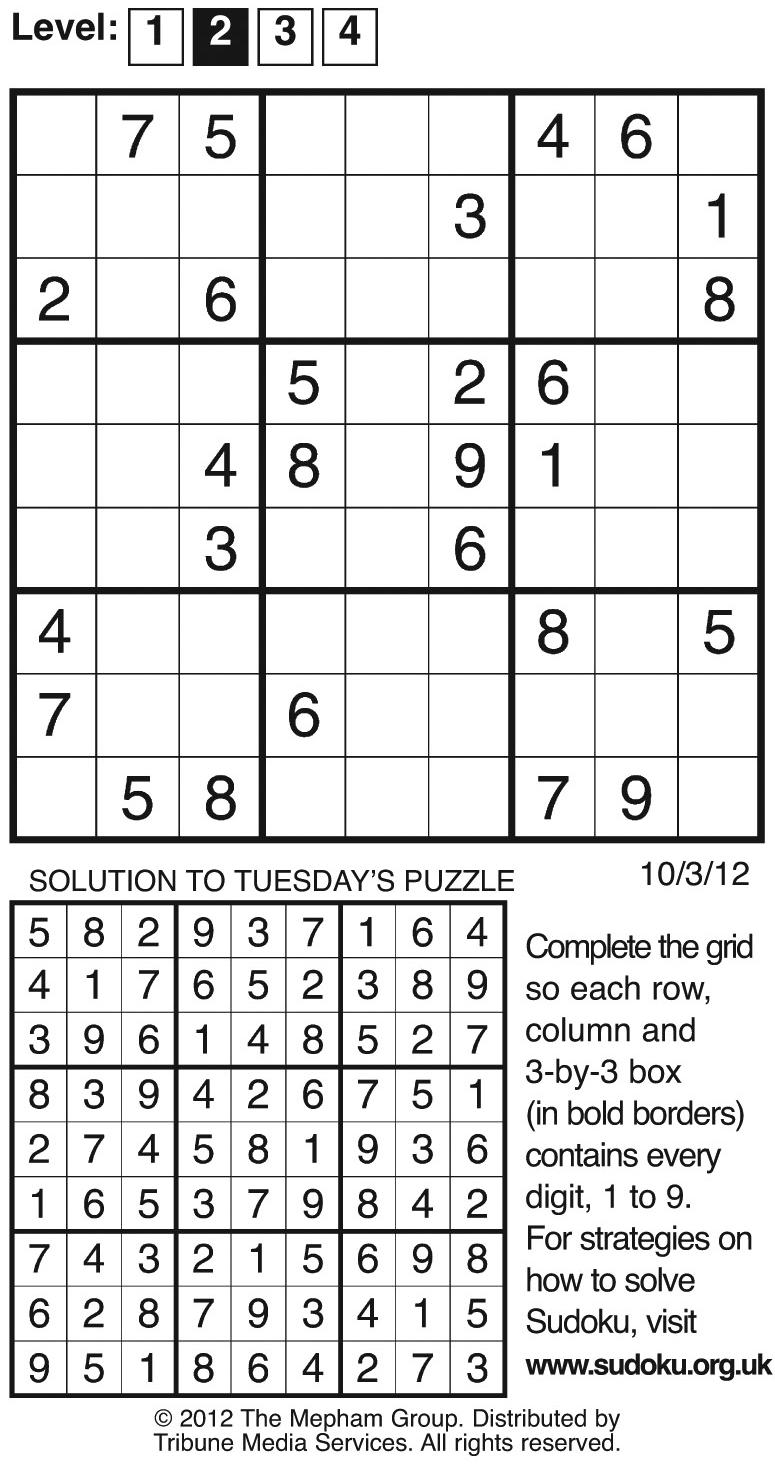
Happy Birthday: i nvestigate new ways to present your skills. p ick up information that will help improve your resume. c onsider what you are doing now and what you would like to be doing by the end of the year. s trive for perfection as well as satisfaction, and you will find your way to a less-stressful life and a happier future. your numbers are 2, 5, 19, 21, 24, 36, 48.
ARIES (March 21-April 19): d on’t waffle when it comes to your professional goals. i f you want to excel or make a change, take action and make it happen. i t’s up to you to fuel your own fire and strive to reach your dreams.
TAURUS (April 20-May 20): l isten to the voice of reason and discuss your plans with someone able to influence your decision and help you make your dreams come true. a joint venture is likely to pay off. s haring will propel you forward.
GEMINI (May 21-June 20): l isten, assess the situation you face and make choices based on what is in your best interest. you cannot give in to emotional manipulation or temptation. i f you desire change, make sure your motives are genuine.
CANCER (June 21-July 22): s urround yourself with creative individuals who will encourage you to explore your own ideas. m ake romance and collaboration with others a priority, but don’t go into debt trying to keep up with others.
LEO (July 23-Aug. 22): p rotect against loss or being taken advantage of by someone manipulative. p ut more emphasis on personal change, learning and expanding your friendships with those who will help you reach your goals. Take a proactive position when it comes to your beliefs.
VIRGO (Aug. 23-Sept. 22): Believe in yourself and what you can accomplish. d on’t let anyone’s negativity hold you back or cause you to underestimate what you are capable of. o ffer love and kindness, but don’t make sacrifices that will deter your success.
LIBRA (Sept. 23-Oct. 22): d elve into intriguing situations and look for ways to pursue what fascinates you. work toward a goal that will impress your peers, employers or teachers. i t’s up to you to bring about the changes that will improve your life.
SCORPIO (Oct. 23-Nov. 21): w hat you put out, you will get back in spades. d on’t hesitate to offer suggestions or pitch in to help a cause. your intuitive intelligence will allow you to shine and motivate others to help you make a difference.
SAGITTARIUS (Nov. 22-Dec. 21): g ather information and be certain before making a move that will have an impact on your reputation. d on’t let anyone lead you down a path of temptation. r ecognize what is in your best interest. Be willing to say “no.”
CAPRICORN (Dec. 22-Jan. 19): c heck over your plans, investments and any upcoming legal or medical procedures. i t’s always better to be safe and in control. d on’t let someone’s unexpected changes send you on a wild goose chase. r ide out the storm.
AQUARIUS (Jan. 20-Feb. 18): m ake personal changes that will encourage you to look for a job that will bring you a greater sense of satisfaction. s omeone or something from your past will help you recognize what you want to see unfold in your life.
PISCES (Feb. 19-March 20): partnerships will pose limitations if you let anger take over. d on’t say or do something you’ll regret. Treating others with a little love and compassion will improve your situation.
Birthday Baby: you are giving, dependable and committed. you are motivated and inspirational.

I’m just like my country, I’m young, scrappy, and hungry, and I’m not throwing away my shot! I’m ‘a get a scholarship to King’s College. I probably shouldn’t brag, but dag, I amaze and astonish. The problem is I got a lot of brains but no polish. I gotta holler just to be heard, with every word, I drop knowledge! I’m a diamond in the rough, a shiny piece of coal, tryin’ to reach my goal. My power of speech: unimpeachable.”
JumBLE | david hoyT and JeFF KnureK
Just Add wAtEr | John roddy & eric carlson
FLinG By sPrinG | riley mccurrie
Boxing out is the key to winning

Rachel O’Grady sports writer
a fter over a decade of watching me play (and warm the bench in) organized girls’ basketball, my dad is absolutely convinced the key to winning championships is simple: a ll you need to do is box out. i n my now almost three years removed from the sport itself, watching my sister’s games, i realized he wasn’t wrong. i recognize this isn’t a hot take. it’s kind of like saying the one team needs to score more points than the other one. it’s reminiscent of Baylor’s Taurean p rince’s response to an interview question after their loss to yale last weekend. The other team just needs to get more rebounds. h owever, it’s not that simple. a s hard as it is for me to admit my dad was right about something, boxing out is the key to getting more rebounds. p eriod. you can out-hustle, out-work, out-play the other team, but when it comes to the boards, it comes down to boxing out. you can be any size, shape, stature, athletic talent, etc., but if you can box out, you will get more rebounds. w hen it comes to rebounding, a 5-foot-5-inch, quick point guard can be equally as dangerous as a 7-foot, massive post player if they box out. a s a 6-foot, formerly-lanky post player, i can attest to the fact that both these players are lethal under the rim. i f they properly box out, you either end up fouling the point guard, who typically is a pretty decent shooter, or just giving the rebound to the taller player.
r ebounds directly translate to points, on both sides of the court. d efensively, a solid, well-positioned box out is getting a stop at the least or sending you to the charity stripe with some luck. o ffensively, it creates a wideopen, easy shot. But it goes beyond that. By boxing out, the team benefits. you may not get the clear shot yourself, but it opens up a clear shot for a teammate. There is no downside, but moreover,
the upside is so dramatically huge.
s ave the “they just scored more points” theory: There is not one, time-proven way to win games. Bo r yan came pretty close with his emphasis on rebounding (amongst other things) and his exemplary performance as the w isconsin head coach — it’s hard to look at r yan’s career and say it was anything less than impressive. h e took what, as assistant managing editor Zach Klonsinski said was basically the sports department here at The o bserver, plus one or two stand-out players, and always ranked in the top-four of the Big Ten, always made the tournament and consistently made it to the s weet 16. w hile that success could be accounted for by several things, rebounding deserves major credit. r yan’s focus on rebounding is what differentiated the Badgers from other teams, and it’s what contributed to consistent postseason appearances.
g ranted, i understand this doesn’t fix all problems. i f you can rebound, that doesn’t mean you’ll make the next shot. But on a more practical level, it significantly improves your chances. Teams still need to shoot well and defend well, but this job can be so much easier if they simply rebound well. i f they’re boxing out, they will rebound better and overall, their game will improve.
This isn’t the first time my dad has been right about something and it certainly won’t be the last, but i ’m convinced after watching m arch m adness this weekend that boxing out, more than ever, leads to consistent victory. w hile he might not be able to coach a d ivision i men’s basketball team to a national championship — yet — boxing out could at least lead to a girls’ high school state championship.
Contact Rachel O’Grady at rogrady@nd.edu
The views expressed in this Sports Authority are those of the author and not necessarily those of The Observer.
rowinG
irish look to build on success in trip to Texas
By ALEX BENDER sports writer
coming off a two-week stretch since its last regatta, no. 17 notre dame now heads down to Town lake, Texas, for the longhorn invitational this Friday and saturday, where the irish will face off with san diego on Friday and host no. 7 Texas on saturday morning.
notre dame’s first regatta of the season was the oak ridge cardinal invitational in Tennessee, where the team faced off against a number of ranked teams, including no. 4 virginia, no. 11 michigan, and no. 20 louisville. The team was able to come away with four firstplace and 10 runner-up finishes, and irish head coach martin stone said he was fairly satisfied with the start to the season.
“i think it went fine coming off spring break, where we were in a heavy training mode,” stone said. “i’m obviously
tr AcK & FiELd
disappointed that we lost to a few crews, but more important than anything we learned how to race as a group and improve our performance as the weekend progressed, so overall i would say it was a positive experience.”
The irish will be looking to better their performance even more this upcoming weekend, and this week’s preparation has readied the team for san diego and Texas, stone said.
“i think we have been getting better technically, so it’s been a solid week and a half of training,” stone said. “with races on Friday and saturday, we just have to go out and do our thing. we can’t be too worried about the competition. so if we just focus on ourselves, we should be okay, and we’ll just see what happens. i feel good about our preparation for this and i feel good about our chances against two very good programs.” san diego is coming from the west coast conference while the
longhorns compete in the Big 12 conference, and stone is eager to see how his team matches up. “a ll of our boats have been solid in training and will be ready to race, so we’ll see how they perform,” stone said. “This weekend will have much the same impact as any race throughout the season, as we will learn from it and hopefully be racing well. we are racing against two quality crews, so i’m interested to see these teams from the wcc and Big 12 and find out how we stack up against these schools. ultimately, our success will depend on just how much we learn and the effort we put forth in getting better throughout the weekend.”
racing for the irish will begin Friday at 5:20 p.m. while the early session saturday begins at 9:20 a.m. and wraps up at 9:40 a.m.
Contact Alex Bender at abender@nd.edu
Track moves outdoors for spring season
Observer Staff Report
The irish open their outdoor season this weekend as the team travels south for the yellow Jacket invitational, hosted by georgia Tech, and the raleigh relays, hosted by north carolina state. Both the men and the women will be looking to build on a strong indoor season, where notre dame soared to new heights.
leading the charge were the irish women, who on march 11 and 12 competed in the ncaa indoor championships in Birmingham, alabama. The team sent nine women to compete, headlined by senior captain molly seidel, where notre dame had considerable success. notre dame came in fifth in the overall standings, its highest finish in school history, and all nine who competed returned as first-team all-americans.
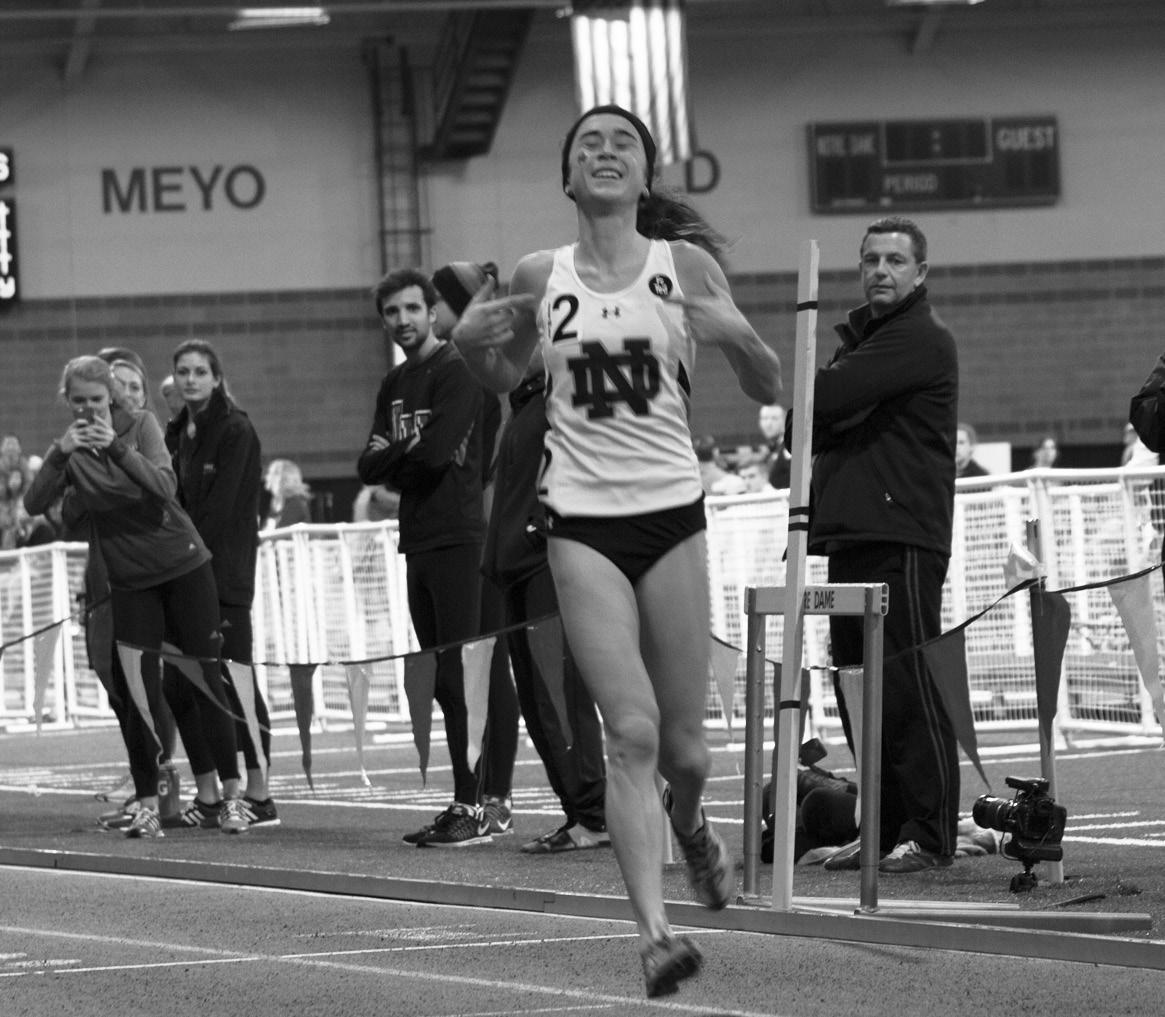
seidel stole the show in her final collegiate indoor meet, winning both the 3,000-meter and 5,000-meter runs, bringing her total to four ncaa titles in the past nine months. she set the school record in the 5,000 with a time of 15:15.21, and then followed it up the next day with another dominant display in the 3,000, winning in 8:57.86. she now holds the program’s record for national titles won, and her 20 points went a long way to notre dame’s strong finish at the championships.
Freshman anna rohrer, graduate student Kaila Barber and senior margaret Bamgbose also had high finishes for the team in the 5,000, 60-meter hurdles and the 400-meter dash, respectively. rohrer came in fourth in her first indoor championship, helping seidel set the pace early before finishing in 15:54.53. Barber came in sixth with a quick 8.07-second mark, while Bamgbose ran her fastest time all season at 52.12 seconds, good enough for fifth overall and another all-american performance, the ninth of her career. For the men, sole participant
junior pole vaulter nathan richartz brought home firstteam all-american honors with his eighth-place finish. seidel was recently awarded the women’s division i national athlete of the year award by the u s. Track and Field and cross country coaches association, as well as the acc women’s indoor Track performer of the year, as voted on by the coaches.
seidel, the defending champion in the outdoor 10,000-meter run, will look to build on her accolade-filled year and lead her team to new heights when the spring season begins this weekend.
CAITLYN JORDAN | The Observer
Molly Seidel celebrates after winning the 3,000-meter run and setting a new school record at the Meyo Invitational on Feb 6.
notre dame sends 12 fencers to ncaa title
By BEN PADANILAM
a ssociate sports e ditor
Following a strong showing at the midwest regional, notre dame will travel to compete in the ncaa championships starting Thursday.
The irish will send 12 fencers on their behalf to compete for the title, which is the maximum number a program was able to qualify at the regional. notre dame is one of four schools who qualified the maximum number, as columbia, princeton and st. John’s were all able to do so as well.
irish head coach gia Kvaratskhelia said he was pleased with his team’s performance at the qualifier, as it indicates the level of success they can achieve at the ncaa championships.
“our regular season served as good preparation for regionals,” Kvaratskhelia said. “on the day, our fencers stepped up and performed. in the big picture, it reinforces that our program is a perennial contender for [the ncaa] championships.”
notre dame will be sending two fencers in each of the three men’s and women’s events. on the men’s side, the irish will send senior garrett mcgrath and freshman darius Zacharakis to compete in epee, sophomores Jonathan Fitzgerald and Jonah shainberg in sabre and sophomore virgile collineau and freshman a xel Kiefer in foil. For the women, notre dame qualified senior catherine lee and freshman madeline antekeier in epee, sophomore Francesca russo and freshman Tara hassett in sabre and senior nicole mcKee and freshman sabrina massialas in foil.
Qualifying 12 fencers puts notre dame at a competitive advantage for the team championship, as every victory an individual fencer earns adds one point to the team’s total for the event, with the title being awarded to the team with the most points at the end of the competition. Kvaratskhelia said his team knows what it has to do to come away with a title against a strong field.
“To win at ncaas, every squad, every fencer needs to contribute,” Kvaratskhelia said. “if one person falters, it puts pressure on everyone else to make it up. … every year is different in regards to the competition. clearly, our main rivals are the other teams with 12 fencers: columbia, princeton and st. John’s. at the same time, other schools such as ohio state, penn state, harvard and penn will be very tough.
“we know our strengths and vulnerabilities, and those of our rivals. … it’s about execution.” individually, the women will compete first in the event Thursday and Friday and will be followed by the men saturday and sunday. Kvaratskhelia said he thinks Kiefer and massialas are in good spots to compete for individual titles, while the program’s only reigning individual champion competing this year, russo, has a tough field ahead for her.
“a xel Kiefer and sabrina massialas are serious contenders for the title,” Kvaratskhelia said. “w hile the ncaa is a unique event, once it gets to the final four, it becomes familiar territory for them — 15-touch bouts.
“as for [russo] repeating, it won’t be easy; there’s lots of
competition. she’s up to the challenge.”
The six freshmen notre dame qualified for the event will not be the only fencers who have no experience at the ncaa championships: lee and mcKee, two of the team’s senior leaders, will also be competing at this stage for the first time. Kvaratskhelia said he’s especially proud of them this season and expects them to perform at the same level they have all year.
“catherine and [nicole] have been fantastic captains and leaders this year, on and off the strip,” Kvaratskhelia said. “They’ve been the rocks on which two young weapon squads have anchored themselves, and have delivered great results. it’s great for them to finally have the chance to represent notre dame on the big stage.
“with that comes a unique knowledge that this is it. This may be a xel’s and sabrina’s first of four ncaas, if we’re lucky. But for catherine and [nicole], it gives them that extra motivation to put everything into it.”
Kvaratskhelia said the team has had a successful season thus far, but its true measure of this year will be this weekend. with that in mind throughout the last week of practice, the irish are as ready as they can be for the event, he added.
“we’ve had a great week of rest, training, and mental preparation,” Kvaratskhelia said. “we’re ready for ncaas.”
The irish will take the strip in the ncaa championships starting Thursday at gostman center in waltham, massachusetts.
Contact Ben Padanilam at bpadanil@nd.edu
paid a dverT isemen T
Irish set to face Ohio State
By MANNY DE JESUS sports writer
a week after squeaking by v irginia in an 8-7 overtime victory, no. 2 notre dame will travel to columbus, ohio, to face ohio state on saturday.
The i rish (5-1, 1-0 acc ) have the advantage over the Buckeyes (5-4, 0-0 Big Ten) heading into their 55th all-time meeting. notre dame has won each of the last 11 years and leads the overall series 33-21. its 9-0 victory at home over ohio state last season marked the second shutout in notre dame history. a fter the win, junior goalie shane doss was awarded the united states i ntercollegiate l acrosse a ssociation national player of the week.
This season, doss will lead the second-ranked irish defense as the reigning acc defensive player of the week following his performance against the cavaliers on saturday. in the overtime win, doss had 14 saves and left the opposition scoreless for the first 22 minutes of the game. he is currently first in the acc and second in the nation in goals against average (5.94) and save percentage (.624). doss credits the rest of the team for his string of recent successes.
“a huge part of my individual recognition has been the play of our defense early on this season,” doss said. “we have a core of really talented and experienced guys in front me who make it tough on opposing offenses to get good shots all game. a lso, i think having a year’s experience of starting behind me has really helped slow the game down and give

me confidence in high-pressure situations.”
Junior midfielder sergio perkovic has also given the irish momentum heading into this week’s matchup on the offense as the acc offensive player of the week. he scored a hat trick against the cavaliers, including a goal in the final minute to send the game into overtime, as well as the game-winning goal in overtime. w ith both the offense and defense firing on all cylinders, notre dame will prepare for an ohio state team that is on a three-game losing skid. a fter starting off the season 5-1, the Buckeyes have dropped games against no. 19 hofstra, no. 8 Towson and no. 1 denver. despite their struggles, the irish aren’t taking the Buckeyes for granted.
“This is a dangerous team, because they are always capable of playing to the level of their opponent,” doss said. “l ast year, they upset duke in the ncaa tournament and almost did it again to denver in the next round, so we know that they have some talented playmakers and a good coach. we just escaped from a good v irginia team in overtime in a game everyone had picked for us to win, so we know the problems with looking past an opponent or assuming anything will happen.”
ohio state is led by junior attack austin shanks, who transferred to ohio state this season after two years at Bellarmine. shanks is leading the Buckeyes with 17 points, including nine goals and a team-high eight assists. Junior attack eric Fannell is another transfer who has made an immediate impact for ohio state in his first season. coming from adrian, Fannell has scored 11 goals and recorded five assists on the season. senior attack carter Brown has also attributed 11 goals and five assists to the ohio state offense this season.
The irish have played into extra periods the last two games and would like to avoid falling into the same trap against the Buckeyes on the road.
“we haven’t really come out strong in either of the last two games, forcing ourselves to make plays in tight situations later on,” doss said. “if we can get on the board early and give ourselves some breathing room, i’m confident we have the talent to keep that lead for the rest of the game.”
The irish will look to start another winning streak saturday against ohio state at 1 p.m. before returning to acc play against syracuse on april 2.
Contact Manny De Jesus at mdejesus@nd.edu
mEn’s LAcrossE
m Bball
con T inued F rom page 16
a lot of the games will come down to the final four minutes, just how efficient you can be and how many stops you can get.”
w hile notre dame has spent the whole season firmly in the ncaa tournament picture, the seventh-seeded Badgers (22-12, 12-6 Big Ten) were an afterthought after former head coach Bo ryan announced his retirement on dec. 16. in mid-January, wisconsin was .500 overall and just 1-4 in Big Ten play, a team looking more likely to miss the postseason altogether than to burst through to the sweet 16.
But since then interim, and now permanent, Badgers head coach greg gard has led his team to an 11-3 mark, one that saw marquee wins over michigan state, indiana, maryland and iowa en route to a sixth-place finish in the Big Ten.
w hile wisconsin is known nationally for playing at a slow, deliberate pace — it ranks 345th out of 351 teams in tempo — Brey was quick to point out his irish also enjoy a slow game.
“i’ll give you a stat that no one thinks: They’re averaging 62 possessions a game in the ncaa tournament, we’re averaging 60,” Brey said. “everyone thinks we’re this track meet. … we’re grinding too.”
That said, Brey said the irish started searching for transition scores during their last five outings.
“we are pushing that thing up the floor and looking for some early buckets,” Brey said. “and that helped us in both games in Brooklyn.”
Just as notre dame advanced to the sweet 16 by winning close games, so too did the Badgers: wisconsin beat no. 10 seed pittsburgh 47-43 before upsetting second-seeded Xavier on sunday, 66-63.
“Both teams are finding ways to win, just believing that they can do it,” Brey said. “it’s interesting
how we both got here.”
Just five days after facing no. 14 seed stephen F. austin’s defensive pressure, the irish will face another strong defensive team — just one with a different philosophy.
“They try to keep you out of the lane,” junior forward v.J. Beachem said. “They’re not trying to deny so much on the wings and things like that, but [they’re] keeping you out of the lane and keeping you from getting easy shots.”
Beachem played with Badgers junior forward nigel hayes, his team’s leading scorer, in aau basketball during high school, but says the two aren’t on speaking terms this week.
“we’ve talked a lot, especially this year,” Beachem said. “ … i’m not gonna be talking to him [this week] until probably right before the game.”
and while notre dame benefits from a second-straight upset with stephen F. austin shocking thirdseeded west virginia and then wisconsin’s victory over Xavier, Jackson pointed out that everyone left at this stage can play.
“They’re a really great team — from here on out, we’re gonna be playing great teams,” Jackson said. “we have to be great to advance. so far, what we know about them is really how disciplined they are on both ends of the floor, defensively and offensively.”
and if this irish team really wants to distance itself from last year’s elite eight team, winning two more games and reaching the program’s second-ever Final Four would more than likely do the trick.
“[The elite eight is] something that we want to reach and surpass this year,” senior forward Zach auguste said. “For me individually, as a senior, i don’t want the last game to be until the championship game.”
Tipoff between notre dame and wisconsin is set for 7:27 p.m. Friday from philadelphia’s wells Fargo center.
Contact Alex Carson at acarson1@nd.edu

Baseball
con T inued F rom page 16
designated hitter Jake shepski, laid down a sacrifice bunt that pushed the runners to second and third.
senior catcher ricky sanchez followed up with a hard grounder that was rerouted by the mound then bounced off the glove of the second baseman, scoring vierling and allowing him to reach first. senior center fielder Kyle richardson then executed a safety squeeze perfectly, scoring richards.
with two outs, freshman third baseman cole daily kept the inning alive against Flames freshman right-hander reid Birlingmair with a single through the left side of the infield, putting runners at the corners.
Junior second baseman cavan Biggio then blasted a ground-rule double to score sanchez and advance daily to third. sophomore left fielder Jack Johnson and senior first baseman Zak Kutsulis then followed with back-to-back singles, the first of which scored Biggio. vierling ended the outburst with a fly out to right field, but in total 10 irish batters came to the plate in the inning.
“we strung, like, 10 quality atbats together there,” aoki said. “my sense is that their [pitcher] is kind of more a short-burst kind of kid, and he got extended just a little bit beyond where he’s comfortable going, which led to him to lose the zone.”
Birlingmair’s inability to find the zone became all the more apparent in the third, as the irish scored four runs with just one hit. a fter shepski reached on a dropped fly ball by uic sophomore left fielder Joe rossi, Birlingmair fell apart, walking three straight batters. head coach mike dee pulled Birlingmair in favor of freshman charlie cerny, but it made no difference, as Biggio tripled down the right field line to clear the bases and make it 9-0.
“i definitely want to be aggressive early in the count, especially with the bases loaded,” Biggio said. “in that situation, we needed to get a few runs across, and you know that new guy wants to get off to a good start, pounding the zone early, so i was ready to go and he made a mistake.”
Biggio ended the game 2-for-5 at the plate, driving in four runs while scoring one himself.
The strongest hitting night, however, belonged to an irish player who was not even expected to start before the weekend. sanchez went 3-for-3 with a walk, an rBi and two runs while also catching all nine innings in place of junior ryan lidge, who missed his seventh game of the season due to injury.
“i was just looking fastball and trying to keep it as relaxed as possible,” sanchez said. “i haven’t caught this much in my entire life, but my job is just to be ready whenever my name is called.”
a fter the third inning, notre dame’s offense quieted, producing just three hits over the
paid a dverT isemen T
next five innings. meanwhile, uic began to chip away at notre dame’s lead, scoring a run apiece on six hits in the fifth, sixth and seventh innings. The Flames’ nine spot in the lineup was particularly productive, with catchers freshman wyatt mascarella and sophomore gabe dwyer both doubling in a run.
in the end, however, irish senior left-hander michael hearne was able to limit the damage and produce a quality start of six innings and two earned runs for his second straight win.
“he was doing a good job of commanding his fastball, especially in against the righties,” aoki said of his pitcher. “it’s important for him to do that so that the changeup is more effective. … he commanded even some of the few breaking balls he threw.”
The irish have just one day off before they travel to Blacksburg, virginia, to face off against virginia Tech. a fter two acc series this year, notre dame is still looking for its first series victory, having been swept by no. 4 louisville and dropping two of three last weekend to no. 13 north carolina state.
The hokies have also gotten off to a rough start in conference play and are losers of seven straight. The three-game series is slated to start Thursday, with first pitch coming at 5:30 p.m. Thursday and Friday and noon saturday.
Contact Greg Hadley at ghadley@nd.edu

EMMET FARNAN | The Observer
Senior forward Zach Auguste attempts a layup during Notre Dame’s 76-75 win over Stephen F. Austin on Sunday.
notre dame senior associate athletic director Tom nevala told the minneapolis star Tribune the school saw the jump to the Big Ten as a way to return to notre dame’s traditional geographic base while maintaining the level of play found in hockey east.
“The competition has been excellent in the hockey east and in the Big Ten, and that’s where we want to be competing, with the best,” nevala said. “There is great excitement because we’re renewing the rivalries that we cherish, and it will be great to go to those campuses on a regular basis.”
The move returns the irish to a league that fits them better geographically: despite playing in a conference centered in new england, this year’s team roster contains only one player from the region: walk-on senior
goaltender nick stasack is from west springfield, massachusetts. Freshmen defenseman dennis gilbert and left wing Joe wegworth both hail from nearby new york, a state no hockey east teams call home.
notre dame’s 2015-16 roster is comprised of eight players from minnesota, four from illinois, two from michigan and one each from wisconsin and iowa, all states in the heart of Big Ten country. since the Big Ten began play, it has sought a way to expand on its six teams, but no other program in the conference has seriously considered making the jump to division i nebraska and illinois both field club teams, but both programs would require a large increase in funding and upgrades to the team facilities, according to Teddy greenstein of the chicago Tribune.
The Big Ten added Johns hopkins to its men’s lacrosse conference for the 2015 season, and

the Blue Jays became the first program from a non-Big Ten school to play in a Big Ten-sponsored conference. The irish will become the second team to fit this category when they begin play in 2017-18. notre dame’s hockey program began as a club team in 1912 and continued on and off at that level before making the jump to division i in 1968 with head coach lefty smith at the helm, a position he held until 1987. The irish originally played as an independent until they joined the wcha in 1971, where they spent the next 10 seasons before moving to the newly-formed ccha notre dame dropped ice hockey as a varsity sport during the 1983-84 season, when the squad returned to club status, but then the program returned to division i competition and the ccha the following year. after the ccha began to fall apart with the departure of michigan, michigan state and ohio state for the newly-formed Big Ten league leading up to the 2013-2014 campaign, notre dame announced it would move to hockey east, where it has played
hockey
“it’s pretty exciting,” Fogarty said. “The second our season ended last year, this was a goal of ours. it’s been a focal point of our team this year, and just to see our name up there is obviously really exciting. with a team like michigan, it makes it even cooler, so it’s pretty special, and we’re excited.”


the last three seasons. The irish claimed the final ccha tournament title in 2013 before major reshuffling of college hockey west of the appalachian mountains
By virtue of drawing michigan in the first round, the irish will renew a rivalry that has remained dormant since the ccha disbanded in 2013. The two teams have met 134 times since the rivalry started in 1921, with michigan leading the all-time series 73-56-5. They last met in the final ccha season, with the irish recording a 5-0-0 record against the wolverines in the 201213 season, including a 3-1 victory in the ccha championship game in detroit, michigan.
senior alternate captain and left wing sam herr talked about how much it means to be renewing a historic rivalry in such an important game.
“it’s arguably the best rivalry in sports as far as college goes,” herr said. “i grew up idolizing this rivalry. it’s pretty special i can be a part of it, let alone be a part of notre dame in general, so i’m embracing it. it means a lot that i can be a part of it.”
The irish and the wolverines have met once before in the ncaa tournament, a 2008 Frozen Four game in denver, colorado. The irish prevailed 5-4 in overtime to advance to the championship game.
“obviously football is a huge rivalry,” Fogarty said, “but when we were in the ccha, these two teams had a lot of good games. … we’re excited we get to play michigan. it’s pretty fun. obviously they’ve had some success this year, which makes it an exciting challenge, but we’re definitely up for it.”
michigan has had one of the strongest offensive seasons of any team in the tournament, led by three of the highest-scoring forwards in all of college hockey. Freshman Kyle connor and juniors J.T. compher and Tyler motte are three of the top four point scorers in the country, with 69, 60 and 54 points respectively.
irish head coach Jeff Jackson mentioned the need to contain the “ccm” line in particular after learning his team had drawn
drastically altered the composition of the wcha and signaled both the end of the ccha and the start of Big Ten hockey and the nchc
michigan in the first round.
“we haven’t played michigan in a few years,” Jackson said. “They obviously are one of the best teams in the country. They probably have the best player on the best line in the country. as usual, they’re a full throttle offensive juggernaut that can score in flurries. i think they are the leading scoring team in the country, so you always have to be prepared. michigan teams are always fast, always skilled. we’re gonna have to do a great job with the puck and also without it.”
after losing five of six games to close out their season, including a home sweep at the hands of northeastern in the hockey east tournament, the irish are thankful they have the chance to keep playing and to redeem themselves against top competition.
“we’re in the right set of mind right now, and all we’re gonna do moving forward is focus on michigan. with that being said, the guys are obviously excited. we’ve been excited all week, and we just have to come back monday ready to work, have a good week of practice, and we’ll see what happens on Friday.”
“i think for us, we ran into a really good team in the end there, obviously northeastern has proven that they’re not a fluke,” Jackson said. “i think for us it’s kind of a second life, a second opportunity to prove ourselves. we get into an opportunity where we get to play in the ncaa tournament, at that point it’s a new season.”
if the irish are able to get past the wolverines Friday night, they will play the winner of a game between no. 1-seeded north dakota and no. 4-seeded northeastern in the regional final saturday.
michigan and notre dame will meet in the opening round of the ncaa tournament Friday. The puck drops at 5:30 pm at u s. Bank arena in cincinnati.
Contact Hunter McDaniel at hmcdani1@nd.edu
MICHAEL YU | The Observer
Sophomore goalie Cal Petersen attempts to save a shot during Notre Dame’s 6-4 loss to Northeastern on March 12.
Notre Dame, Michigan to renew rivalry
Irish, Wolverines to open NCAA tournament Friday
By HUNTER McDANIEL sports writer
a fter bowing out of the h ockey e ast tournament in the quarterfinals, the i rish can now rest easy knowing they did enough during the season to earn a spot in the ncaa tournament.
n o. 12 n otre d ame (19-107, 15-5-2 h ockey e ast) will face n o. 7 m ichigan in the first round of the tournament in c incinnati, Friday evening at u s . Bank a rena.
The w olverines (24-7-5, 12-5-3 Big Ten) earned the n o. 2 seed in the m idwest r egion after winning the Big Ten tournament on s aturday while n otre d ame skates into the ncaa tournament with an at-large bid and the n o. 3 seed.
s enior captain and center s teven Fogarty said the team is excited to return to the tournament after missing out on a bid a season ago.

BAsEBALL | nd 9, illinois chicago 5
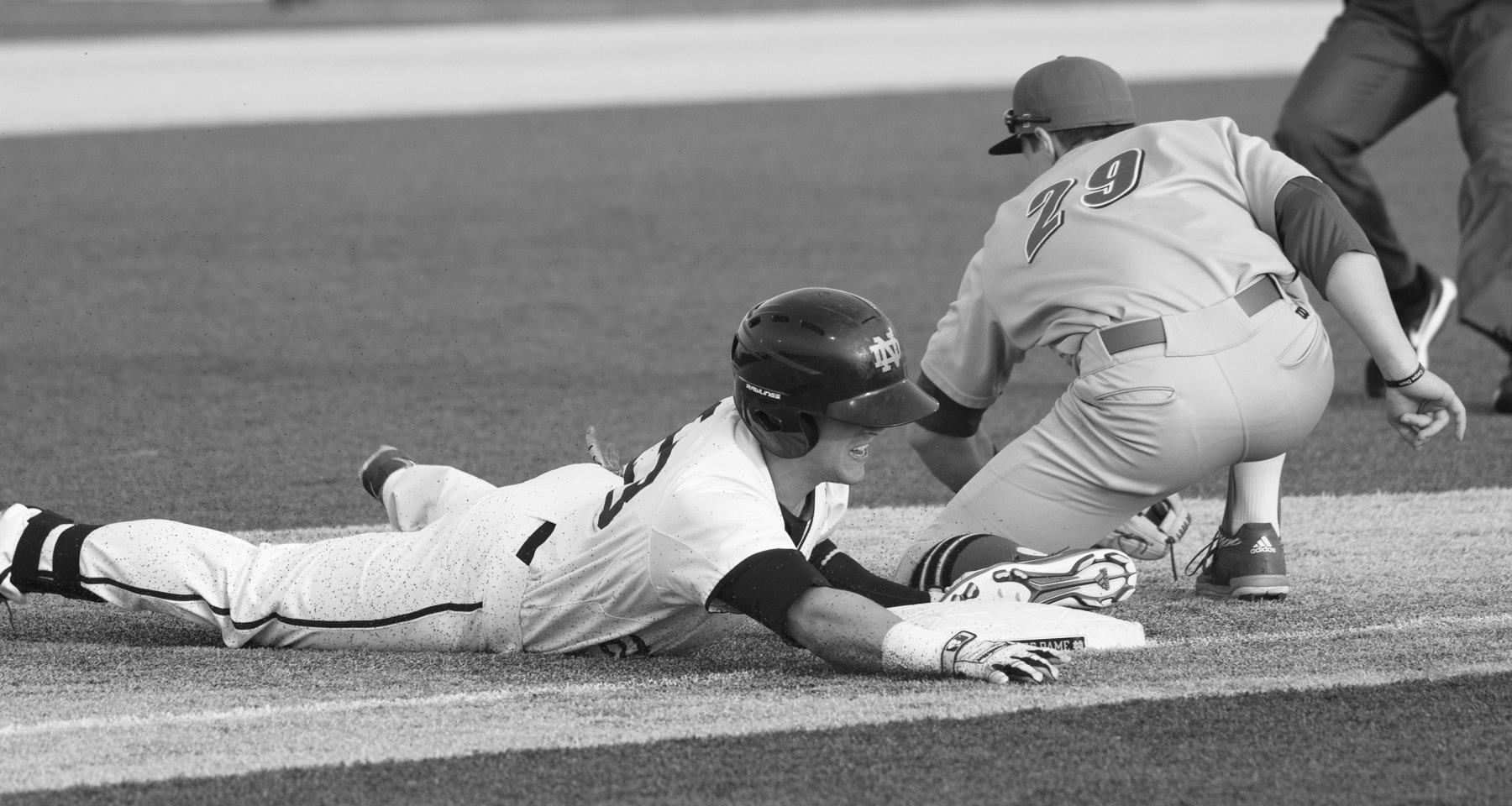
mEn’s
BAsKEtBALL
ND will move from Hockey East to Big Ten in 2017
Observer Staff Report
notre dame is joining the Big Ten — in one sport at least. a s originally reported by the c hicago Tribune, m inneapolis star Tribune and uscho, the i rish will join the Big Ten on the ice beginning with the 2017-18 season.
notre dame began play in hockey e ast during the 201314 campaign after spending the previous 16 seasons in the ccha
The Big Ten first sponsored a separate hockey conference starting that same year, and it is comprised of its six schools that support a division i hockey program: m ichigan, m ichigan state, ohio state, w isconsin, m innesota and penn state.
The i rish, Badgers and g ophers played together in the wcha from 1971 through 1981, while the wolverines, spartans and Buckeyes were members of the ccha with notre dame until joining the Big Ten.
see Big Ten PAGE 15
irish fend off uic comeback nd to face Badgers in sweet 16
By ALEX CARSON
a ssistant managing e ditor
w e almost got it a year ago.
h ad Jerian g rant’s finalsecond 3-point attempt hit, rather than missed, n otre d ame and w isconsin would have met in the Final Four.
a nd while things are different for both schools this year — there’s no g rant or s am d ekker, Frank Kaminsky or p at c onnaughton — we’ll get the matchup in Friday’s s weet 16 in p hiladelphia.
h aving to follow in the footsteps of last year’s team might have been difficult at times, but i rish head coach
no expectations after going 15-17, they could just play and develop and everything they did was gravy last year.
“This group had that hanging on their shoulder the whole time and to get to this point, fighting through that and having some tough times … i give them a lot of credit, and i give a lot of credit to our leadership.”
By GREG HADLEY
s enior sports writer
notre dame stormed to an early lead against illinoischicago, then held off a comeback attempt from the Flames (9-11, 2-1 horizon), coming away with a 9-5 win at Frank eck stadium on Tuesday.
a ll of notre dame’s offense came in the first three innings,
as the irish (9-10, 1-5 acc ) put up five runs in the second and four in the third.
“That’s what you’re looking for,” irish head coach mik aoki said. “Their pitcher was coming at us with fastballs early on, and i thought we did a pretty good job of getting ourselves on time.”
Freshman right fielder matt
v ierling got things started in the second with a single up the middle, then advanced to second on an error by Flames freshman third baseman a lex dee, who could not handle a grounder from irish senior shortstop lane r ichards. The next batter, sophomore
m ike Brey said he was proud of this i rish squad for securing consecutive s weet 16 appearances for the first time since the 1970s.
“This is a group that always wanted to distance themselves from last year’s team and have their own identity,” Brey said. “a nd i give them a lot of credit because last year’s team had
But while the n o. 6-seeded i rish (23-11, 11-7 acc ) don’t have g rant or c onnaughton this go-around, each of the squad’s five double-digit scorers was a rotation player during the e lite e ight run last season — and junior guard d emetrius Jackson said that experience benefits n otre d ame most in crunch time.
“a big point for us where [our experience] will show is in game situations,” Jackson said. “ i n that final four minutes, we understand how key it is to be able to execute and
MICHAEL YU | The Observer
Irish sophomore center Jake Evans maneuvers past a Huskie defender during Notre Dame’s 6-4 loss to Northeastern on March 12 at Compton Family Ice Arena.
see hocKey PAGE 15
KATHLEEN DONAHUE | The Observer
Irish junior infielder Cavan Biggio slides towards third base during Notre Dame’s 9-5 win over University of Illinois Chicago on Tuesday at Frank Eck Stadium.