Print Edition of The Observer for Wednesday, February 17, 2016
bridgend sponsors education debate
Students convene to argue for or against universal public education, increased privatization
By LUCAS MASIN-MOYER news writer
s tudents discussed the merits of education reform in a debate sponsored by b ridge nd Tuesday night in the mc neill r oom of the l a fortune s tudent c enter.
The students participating in the debate divided into two teams, one of which argued for universal public education while the other argued for school choice and increased privatization.
Those in favor of increased privatization outlined a system, which sophomore and b ridge nd secretary m imi Teixeira described.
“a school takes a voucher,
the voucher has a certain amount of money associated with it,” she said.
w ith a voucher system, each student would receive a voucher with an equal monetary value, Teixera said.
f reshman l iam d alton, another participant in favor of privatization, said competition and the free market create higher quality schools.
“i think there is an argument to be made for creative destruction in the area of education,” he said. “ it is the same way that we built one of the world’s greatest economies. ... we had to allow businesses who were not doing
Alumna explores loss, consolation in poetry reading
By KATHRYN MARSHALL
a ssociate saint mary’s e ditor
l isteners witnessed the journey from brokenness to consolation at a poetry reading in c arroll a uditorium Tuesday night at s aint m ary’s c ollege. m ary p inard, a s aint m ary’s alumna and professor of e nglish at b abson c ollege, read from her book “portal” as part of the spring season’s visiting writer series, sponsored by the e nglish department.
p inard said her brother drowned during a freak tugboat accident in the g rays h arbor e stuary in washington, and the event inspired the content of the collection.
“‘portal’ is a book which started with a personal story, a story of deep loss for me, that i think blinded me from being anything but sad for a long time,” p inard said. “i worked my way through some very raw places, trying to find a voice, an elegiac voice that
could somehow respond to the loss of a beloved brother.”
The resulting book is her personal elegiac journey from brokenness to consolation, she said. The book begins with a poem full of broken descriptions, titled “Theory of d isappearance,” followed by a series of poems involving the speaker talking to the lost brother.
writing a sonnet about her brother’s love of the smell of diesel, a poem about film found in the pocket of his raincoat after his death and another titled “blue l ath” — named after a woodworker’s tool used by her brother — among other poems, helped her move forward towards consolation, p inard said.
“l ate in the series [of poems] is where i am trying to face the matter of my brother’s death, and to make sense of it,” p inard said.
p inard said the image of
Lecturer reflects on life of influential theologian
By CATHERINE OWERS
a ssociate news e ditor
henri nouwen’s search for meaning led the catholic priest and theologian to a Trappist monastery, l atin a merica, and finally, the l’a rche community, a ndrea smith shappell said in a lecture Tuesday morning. The lecture, which detailed nouwen’s roles as teacher, searcher and pastor, was part of the center for social concerns research lecture series.
smith shappell, associate director for theological reflection and summer service learning, said her interest in nouwen began upon reading his works and meeting him while she was an undergraduate student at notre dame.
“i then looked forward to his visits to campus when i was working for the center for social concerns in the early years. i also served on the board of the henri nouwen society from 2005 to 2010,” she said.
a fter his ordination, nouwen asked for permission from his archbishop to study
psychology, smith shappell said, which was an “unusual” request in 1957.
“many c hristians at that time perceived psychology to be an enemy of the faith, largely due to freud’s influence,” she said. “but nouwen believed that psychology dealt
with issues that were important to the c hurch, particularly understanding human behavior in order to respond to the pastoral needs of humans.”
nouwen completed his doctorate in psychology and received a fellowship at the menninger c linic in Topeka, Kansas, smith shappell said. The clinic was the birthplace of the field of “clinical pastoral education.”
“nouwen drew upon his experience as a psychologist to
bring the knowledge of counseling and human behavior into pastoral ministry. he also adapted the cpe model to serve a wide audience of c hristians, from college students to parishioners,” she said.
smith shappell said although nouwen taught at prestigious institutions, published dozens of books and was a popular speaker, he was restless.
“he continually engaged in a process of discernment, a particular type of theological reflection in making decisions in light of faith,” he said. “for henri, the continuing question was, what is g od calling me to do?”
nouwen taught at yale from 1971 to 1981, and during this time he took sabbaticals at the abbey of g enesee, a Trappist monastery in new york.
“henri taught about solitude and inner freedom, but he struggled with his own compulsions to keep speaking, writing and teaching at a frantic pace. he needed to retreat
Photo courtesy of BridgeND
Students argue for universal public education during a debate held on Tuesday evening. The debate was sponsored by BridgeND, a bipartisan student political organization that fosters dialogue on policy issues.
Andrea Smith Shappell
Photo Desk (574) 631-8767 photo@ndsmcobserver.com
Systems & Web Administrators (574) 631-8839 Policies
Question of the Day:
Out
Cornelius McGrath junior duncan hall “snapchat.”
Meghan Callaghan freshman walsh
Maddie Loftin freshman welsh family hall “facebook.”
Emily McAuliffe freshman pangborn hall “i nstagram.”
Christian Frederickson freshman dillon hall “l aba rchives.”
Brennen Roetzel freshman dillon hall “netflix.”
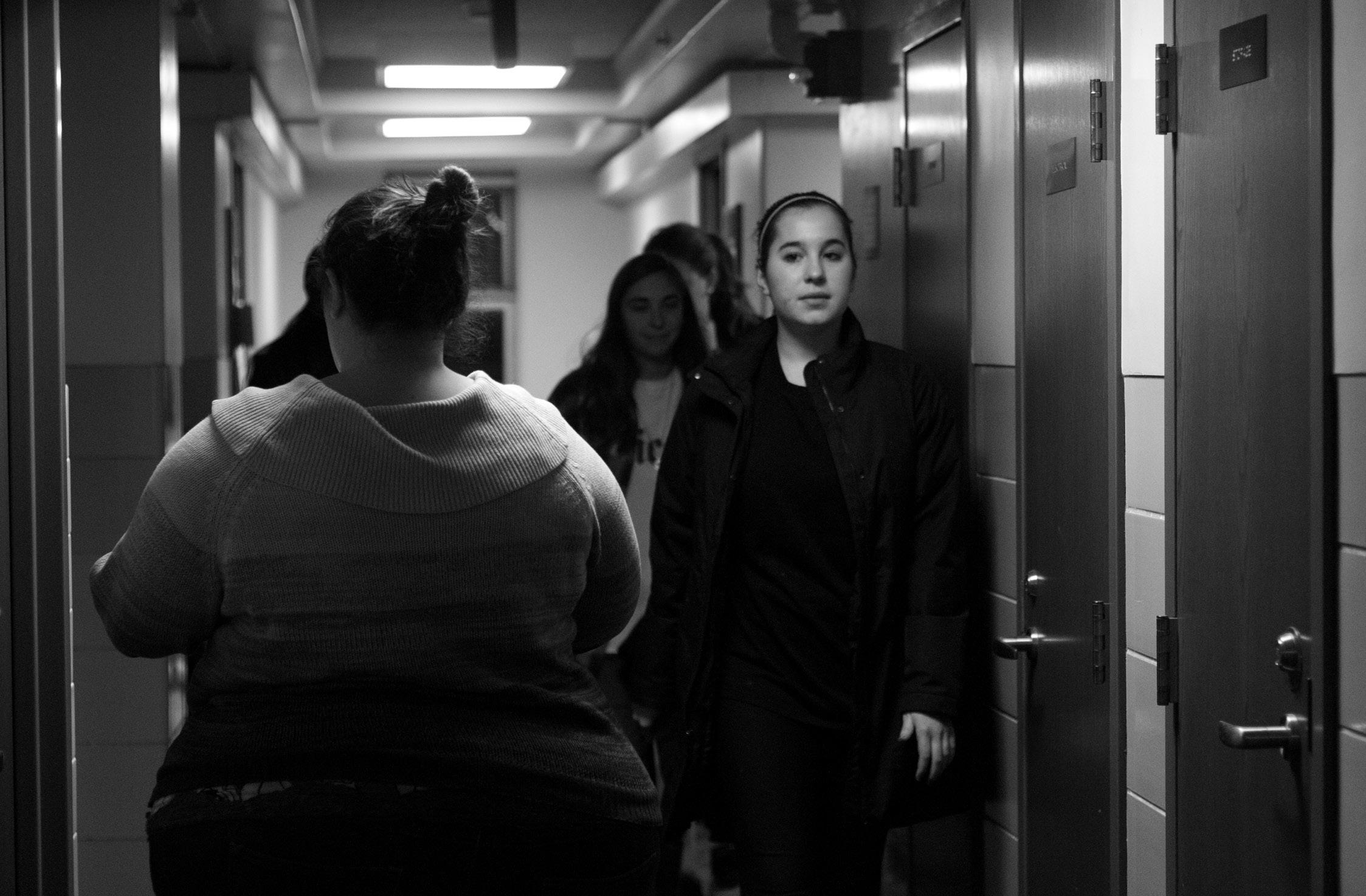
Residents of Walsh Hall attend an open house in Pangborn Hall, where they will be living next year while Walsh Hall is under renovation, before they make room picks. Pangborn’s current residents will move into the new women’s dorm in the
Today’s Staff
News
catherine o wers a ndrea vale
megan valley
Graphics
susan Zhu
Photo caitlyn Jordan
Corrections
Sports Kit l oughran ben padanilam e lizabeth greason Scene
Kelly mc garry Viewpoint bianca a lmada
The feb. 15 article on a saint mary’s student led discussion was incorrectly titled “p rofessor examines gender.” The observer regrets this error.
Wednesday
Brazilian Carnaval
Legends Night Club
7 p.m.-9 p.m.
Samba band and dance group, as well as light refreshments.
Martin Ott Reading Hammes Bookstore
7:30 p.m. -9:30 p.m.
Ott writes love poems that represent different eras.
Thursday
Chinese New Year’s Gala Washington Hall
7 p.m.-9 p.m.
Performaces of Chinese songs.
SUB Movie: “Brookyln” DeBartolo Hall
8 p.m.-10 p.m.
An Irish immigrant falls in love. Chaos ensues.
Friday
“The Bear” and “Afterplay” DeBartolo Performing Arts Center
7:30 p.m.-10 p.m. Two spirited comedies.
Improv Show: “Second City” Washington Hall
9 p.m.-11 p.m.
Join Second City for a night of laughter.
Saturday
Alex Wilson Invitational Loftus Sports Center all day
Men’s and women’s indoor track competes.
Junior Parents Weekend Concert Ricci Band Rehersal Hall
2 p.m.- 4 p.m. Jazz performances.
Sunday
ND Women’s Lacrosse vs. Boston College Arlotta Stadium
12 p.m.-2 p.m. The Irish against the Eagles.
Solemn Vespers Basilica of the Sacred Heart
7:15 p.m.-8:15 p.m.
Evening prayer in the Lady Chapel.
Professor dispels Zika virus misconceptions
By ANDREA VALE news writer
a fter the recent discovery in washington, d c . of mosquitoes capable of carrying and transmitting the Zika virus, worry over the disease — which can lead to severe birth defects — possibly spreading across the continental united states has grown. according to david s everson, a professor in the department of biological sciences, this panic over is not grounded in the reality of the situation.
s everson said his primary research areas include entomology, evolutionary biology, genetics and genomics and infectious and vector-born diseases. Though s everson does not work directly with the Zika virus, he has studied the mosquitoes that transmit the virus.
“people’s paranoia about Zika, in some ways is overdone. s ome of these other viruses are much more of a threat when you go to these places,” s everson said.
Those more threatening viruses include the dengue virus and yellow fever virus, both of which are of the f laviviridae family along with the Zika virus. a dditionally, the chikungunya virus, though of a different family, is carried through the same type of mosquito. a ll four related viruses
are found in the “new world tropics,” s everson said, though none of the viruses are endemic, but rather were brought over from a frica and southeast a sia during colonialism.
“ we’re in a global society,” s everson said, “i n most cases, with all four viruses, you may never realize you’re infected. s o … the virus is circulating in your system, but you either hardly get sick at all, or you might feel like you have a slight cold, something like that.”
s everson also said despite the recent discovery of mosquitoes that are capable of carrying the Zika virus in washington, d c ., “there’s little transmission in the continental u s ., although there is certainly potential for transmission.”
“a s far as we know, there is no virus, there has been no active transmission in the washington, d c . area,” s everson said, “but it’s at least five years that that population has been there … so if you have active breeding during the summer, and you have someone come in from brazil that lives in that neighborhood, you have the potential for a short term, seasonal outbreak of these viruses.
“ we have had dengue virus endemic transmission in southern f lorida for probably the last three or four years, probably a little longer,”
paid a dverT isemen T
s everson said, “s o we certainly have the potential for this coming in to the southern warmer areas around the east coast, then around the gulf and then along the Texasa rizona- c alifornia- m exican border.”
i f the Zika virus were to be transmitted widely across the united states, s everson said, “it probably won’t be as severe” as in c entral and s outh a merica.
“i n the u s . we have different standards of living: we tend to like air conditioning, we like screens on our windows, so we have everything closed up,” s everson said. “s o we have limited contact compared to … [for instance] brazil, you might not even have screens, people like to have the breeze blow through, so there’s a lot more opportunity for exposure to being bitten by a mosquito. a nd there’s a lot of opportunity for breeding sites, these things will breed in any little container that holds water for a couple weeks … and people don’t tend to have dependable municipal water in some places, so they’ll tend to hoard water in gallon drums or big plastic tanks … and those are the prime breeding grounds oftentimes.
“s o in the u s ., i suspect we’ll likely have some transmission. it’s the dry season in the new world tropics right now, so
mosquito breeding is at the lowest point of the whole year, disease transmission is at the lowest point of the whole year. r ainy season will start in early June and ramp up, and that’s when the mosquito breeding will start, and shortly after that there will be a rapid spike in disease transmission.”
Though there is no cure or treatment for the Zika, dengue or chikungunya viruses yet, s everson said that curbing outbreaks would begin with combatting insecticide resistance.
“r ight now with all those viruses, the only one for which there is a good vaccine is yellow fever,” s everson said, “There is no good vaccine for the other three. a nd there are no drug treatments. i f you get sick, you have to power through it and get better. s o right now the only way to deal with outbreaks of this or to try to prevent outbreaks is to try to control the mosquito population. s o there’s massive insecticide use throughout the tropics to try to control the mosquito population, and you get pretty strong genetic resistance to those. people are looking at different ideas on how to deal with this.”
s everson said his recent research with the mosquitoes that carry the dengue and Zika viruses has focused on “understand(ing) various pathways, what genes are up or down and regulated.”
“ we may be able to identify chemicals and drugs that you could take so if you were infected … you wouldn’t transmit it through the mosquito to another human host, so you could break the cycle that way,” he said.
s everson said he hopes that his research with mosquitoes could lead to possible vaccination developments in the future, as well as species-specific pesticides that would cut back on the use of pesticides that “blanket kill every insect that’s out there.”
“i f we understand what makes a mosquito genetically competent to transmit this pathogen, then perhaps we can engineer a genetically modified mosquito that’s no longer capable … [of transmitting] that virus,” s everson said, “Then look into actually releasing those into the environment. s o there’s a whole host of things that people have talked about, and some of those are actually in practice.”
a ccording to s everson, the Zika virus can only be transmitted from person to person in two ways. The first is through a blood transfusion, if the blood donor happens to be viremic. s everson said if a person goes to donate blood and finds that he or she is carrying the virus, however, “they might just say come back in
a couple weeks and then you can donate blood.”
Zika virus can also be sexually transmitted, s everson said, although this is “completely unusual,” noting there have only been two documented cases of sexual transmission.
“The point to remember with Zika is that this virus has been around for a long, long time,” s everson said. “a nd usually it’s been most people, probably 90-plus percent of people, either don’t know they’ve had it or they get some mild (symptom), a cold, a flu or they just don’t feel well. … m icrocephaly in brazil, that’s brand new, and outside of that, if you’re not a young woman in a child-bearing age where you have the potential to get pregnant, it’s generally a benign problem.”
a s far as taking precautions against these viruses, s everson said it is important to note the time of day in which mosquitoes transmitting Zika virus bite.
“These mosquitoes are day biters, they bite people during the daylight hours,” s everson said, “ you hear about malaria and people sleeping under bed nets, but they won’t stop Zika virus. The mosquitoes that transmit malaria are night biters. s o right now if you go to brazil, for example, it does absolutely zero good at preventing Zika or dengue or chikungunya to sleep under a bed net. The mosquitoes that transmit these viruses are most active right at dawn and right near dusk. … That coincides when people are the most active, getting up to go to school or go to work, you’re coming home … especially in the tropics.”
s everson said u s . citizens planning on traveling to brazil and other areas in which Zika outbreaks have been prevalent shouldn’t worry too much about the dangers of that virus, but should focus on avoiding the dengue virus.
“g lobally, there are about half a million hemorrhagic fever forms of (dengue) virus per year where you get internal hemorrhaging, and if you don’t get adequate healthcare, you could actually die from it,” s everson said, “s o for people going to [tropical areas], dengue is a much greater threat. a nd that’s another one where you get infected and in most people you get a mild illness. The same thing with chikungunya. it doesn’t tend to cause [fatality], but habitual neuropathy in some people. … s o of all the other things that are out there, outside of microcephaly coming through pregnant women, Zika is a pretty benign virus.”
Contact Andrea Vale at avale@nd.edu
well, not meeting standards, to fail to a certain extent.”
Teixeira said a lack of incentives has harmed the current public education system.
“ d o i think schools right now have any incentive to create better, more educated students?” she said. “ n o, they do not, especially in public schools where they have nowhere else to go. There are teachers who pass illiterate students every year.”
i ncreased privatization would also help students
Poetry
peonies inspired a poem titled “s eeing peonies,” written during a writing residency in peoria, where she went to learn more about tugboats, so as to better understand the environment in which her brother died.
The book ends with a poem of praise for an estuary, she said.
“The complexity that is in an estuary, where saltwater and freshwater braid, suggests
with disabilities, she said.
“ m entally and physically disabled kids are suspended and expelled at higher rates,” she said. “ i think that part of the reason for this is that public schools do not have the resources or ability to take care of these kids.”
s ophomore g eralyn s mith, a member of the team in favor of keeping and strengthening universal public education, said a more educated population would benefit the country.
“ i t would be in the government’s best interests, if [it] wants to increase the capital of each individual,” she said.
f reshman Kylie
that there are species that can only survive there,” p inard said. “b ecause it is so easy to discount it, it is also so easy to hurt it. for me, the coming together of consolation and the loss of my brother connects with my sense of consolation around trying to understand the nature of the estuary and potentially to save it.”
i n response to a student question, p inard said she developed a love of the languages of sciences after switching her course of study from premed to theater and e nglish her sophomore year at s aint
r uscheinski, who also argued for public education, said competition is not unequivocally beneficial in an education system.
“ i t should be a right for every child — no matter what socioeconomic class they are born into — they should have a right to an education,” she said. “ c ompetition has a benefit, but only so far. ... w hen schools are focused primarily on beating other schools, the students who fall through the cracks in that system are the kids with special needs and disabilities, those who are expelled.”
s enior d an s ehlhorst said there are dangers to a
m ary’s.
“i do think that there is a lot of beauty in language that poets can have access to, if they have a better relationship with disciplines that seem different from theirs,” p inard said.
“i think that’s the beauty of poetry. i f you take it seriously, then you have to become a scholar in a lot of different areas, if you are going to make all of those language work in those poems.”
f irst-year student e mily h arrast said she enjoyed the reading because she finds herself similar to p inard because
paid a dverT isemen T
privatized education system.
“The outcome of the privatization scheme is that the schools that produce the best economic effect will get more students and prosper, while schools that focus less on return, on investment will not prosper — which is not what an education should be,” he said.
“ i t scares me when we think of education as another competitive sphere in the free market — in competition there are always winners and losers,” freshman a dam w iechman said
Contact Lucas Masin-Moyer at lmasinmo@nd.edu
she is a biology major who also likes e nglish.
“it was interesting how she talked about poetry in relation to other subjects,” h arrast said. “i also thought it was interesting how she made the whole book about [the loss of her brother]. you could really tell how she changed over time, how she started the book so upset and then grew from there, eventually viewing something completely different from the same situation.”
Contact Kathryn Marshall at kmarsh02@nd.edu
from life at yale to address his compulsions in prayer and solitude,” he said. “nouwen was friends with g enesee abbot, dom bamberger, and made the unusual request to become a temporary member of the monastery. … w hile at the abbey, henri discovered the utter necessity of life in community as something he had craved. he reflected that his capacity
for intimacy with g od was his interrelated with his ability to love and live with other monks.”
a fter a few months at the monastery, smith shappell said, nouwen became frustrated by the isolation of the abbey.
“henri decided he wanted to return to yale to write more and speak less, realizing that none of the problems he brought to the abbey had been resolved, nor would a longer stay help him,” he said.
during his time at yale, nouwen developed an
interest in l atin a merica, smith shappell said.
“Through contacts with maryknoll missioners, henri made plans to spend six months in both bolivia and peru in 1981,” she said. ”he felt called to work in peru, but after a few months, he recognized that he did not fit in, and those that lived with him, the maryknoll missioners, recognized that as well.
“henri felt the maryknoll missioners were intensely individualistic in their struggle for
justice and peace. h is longing for a community of prayer was not compatible with their lifestyle nor did he agree with their more militaristic strain of liberation theology.”
a lthough few people have the ability to explore vocation by living in monasteries and traveling to south a merica, smith shappell said, “what we can learn from henri is to continually listen to g od’s call to deepen our attention to prayer and contemplation and to find ways to heed the call to action in response to injustice.”
nouwen returned to the united states, smith shappell said, when he recognized that he was not called to live in l atin a merica, but inform others what was happening there.
“one way he did this was to join a w itness for peace delegation, for a trip to the border of nicaragua and honduras. w itness for peace was a movement against the u s. involvement in the contra-war in nicaragua in the 1980s,” she said. “unlike the v ietnam war protests that were held in the united states, people traveled to nicaragua’s war zones to see firsthand the effects of the war.”
a fter meeting with women who lost their husbands and sons in the war, nouwen shared their stories in lectures across the united states.
“he wanted to show that what the u s. was doing was, in his words, unjust, illegal and immoral,” she said.
nouwen also proposed the concept of communal reconciliation, smith shappell said.
“henri continually asked forgiveness for the sins that the u s. government and citizens committed against the women and their country. h is experience stretched the understanding of reconciliation: it wasn’t an individual sacrament, but there was need, in a way, to enter into communal reconciliation for social sin,” she said. “he
toured the nation talking about this experience and the power of forgiveness. h is lens, though, was always one of spirituality — a pastoral response.”
nouwen did not choose to write or lecture about reconciliation or social sin, but he expressed his concern though his actions, smith shappell said.
“nouwen is not known as a social justice activist, but he marched with martin luther King, Jr., in selma. he protested against nuclear submarines connecticut, and he toured the country to tell people what was really happening in nicaragua,” she said.
i n the third phase of his life, nouwen lived in a l’a rche community, smith shappell said.
“l’a rche is a movement started by Jean vanier in france, creating communities of people who have disabilities, who live with assistants. The assistants help them to reach the expression of their full humanity,” she said.
smith shappell said nouwen’s move to the l’a rche community “meant counter-culturally embracing ‘downward mobility,’” a concept that was grounded in his understanding of the i ncarnation.
“h is experience living with the l’a rche community was the culmination of integrating his theology of downward mobility with his lived experience,” she said. “downward mobility led nouwen to a community where the core members did not read his books or know he wrote books.
“The accolades henri had received as a well-known speaker and author were replaced with a community that appreciated him as a human being, to love and be loved. This was the home — the earthly home — that henri had been searching for.”
Contact Catherine Owers at cowers@nd.edu
Scalia’s legacy is more than law
a simple tribute
Erin Rice graphics e ditor
There are many amazing people in the world. people have flown to the moon, led great warriors to victory, climbed the world’s highest mountains and discovered the cell that led scientists closer to a cancer vaccine.
my great-uncle herb drove a bus at the university of i llinois, yet he was one of the most amazing people in my life. w hen i was in first grade, he moved to my town to take care of my grandma after his brother, my grandpa, died. Throughout the years, his pure simplicity, extreme punctuality and intense love and dedication to my entire family perplexed me. i’ve spent the past 15 years discovering that the most beautiful and amazing people may also be the simplest. uncle herb died s aturday.
herb spent the majority of his adult life working odd jobs and watching over his brother’s family. a s a teenager, he wanted nothing more than to be able to follow his brother’s footsteps and join the military, but his small stature and irregular heart prevented him from entering.
This refusal wasn’t the end for him. he assumed a volunteer position by delivering military-death notifications to families door to door. for herb, this was his duty, and despite facing anger, fear and grief day after day, he put his whole heart into this task, similar to how he spent the last 15 years of his life dedicated to his brother’s family. w hile my grandpa died in 2001, herb continued to live and watch his brother’s wife grow old and his grandchildren grow up, graduate and get married, a privilege he felt he did not deserve. i hope he knew the grand impact he had on all of us. b ecause he put his own needs and wants aside and spent a lifetime dedicating himself to the people around him.
uncle herb once told me a story that really stuck with me. he explained the years after the great d epression and how they used to have jobs for people to shovel 15 tons of coal. he explained:
“They ain’t got jobs like that no more. you gotta work for what you know, not for what you do. you gotta learn so you know what to know. They already have people that do things. They have big companies shoveling the snow and mowing the grass. There ain’t no individuals doing that alone no more. you gotta get a job like your dad, working with computers and such. nothing comes easy in life. g o watch the janitors at u of i, working 5 p.m. to 1 a.m. That ain’t no life you wanna live.”
herb was a simple man with little wants. he loved his coffee, his one-liners, arriving 20 minutes early, $2 bills, his tan c adillac, my dogs and every single one of us. valentine’s day was the perfect day for herb to pass on, leaving us to remember the unending love he gave to our entire family. rest in peace, uncle herby.
Contact Erin Rice at erice4@nd.edu
The views expressed in the Inside Column are those of the author and not necessarily those of The Observer.
i did not agree with a lot of Justice antonin scalia’s legal decisions and opinions. as a moderate but socially liberal college student, i disagreed with many of his viewpoints on various cases. yet, with his passing this past weekend, i couldn’t help but think just how unique of a government figure he was.
political views aside, i admire scalia because he was different from almost every other person we see in government. a passionate man, he was never afraid to speak his mind for what he believed in. he had a set of principles he abided by and would not change his mind regardless of what he was confronted with.
politicians today are some of the most fickle people we see. constantly, we see candidates accuse each other of changing their opinions or deny the fact that they have. The reality is that all politicians change their minds. They want to get elected, to get to do the things they want to do and to be in power. citizens today are so numb to politicians changing their positions on things to what is convenient or politically expedient that it isn’t really a big deal anymore.
scalia, on the other hand, stuck to his principles for his entire career. This may have been difficult when he disagreed with the decisions people wanted him to make, but he rarely, if ever, relented. granted, it was easier to stick to his convictions because he didn’t have to answer to voters at the end of two, four or six years.
i admire scalia because of his willingness to adhere to a strict set of principles and values. i don’t necessarily agree with his legal views, but few, if any, judges have been able to stick to their convictions like he did. few are authentic enough to realize that sometimes a set of principles will lead you to a decision or situation you don’t necessarily agree with. That happened for scalia. he would seemingly randomly agree with liberal justices on certain cases when other conservative justices would not because of his interpretation
LeTTer To The ediTor: iMMiGraTion series
of the constitution. i’m sure that wasn’t easy for him, but he did it anyway.
furthermore, i’m consistently amused by scalia’s strong friendship with Justice ruth bader ginsberg. it baffles me. politics today are vitriolic and harsh. it’s hard to imagine president obama and paul ryan being friends or Jeb bush and donald Trump being friends. Then again, it’s difficult to imagine donald Trump being friends with anyone. yet two people who interacted and disagreed with each other vehemently on a daily basis managed to be best friends.
ginsberg is one of the most progressive judges the court has ever seen, while scalia was one of the most conservative in recent history. They managed to put politics aside, realizing that opinions were merely opinions. in doing so, they didn’t let their branch of government fall into the same confrontational and nasty politics we see in the other two. at the end of the day, scalia exemplified what we should want all of our politicians to be. he had a set of principles that he believed our country should be living by. he consistently did what he thought was best for our country in the present and in the future, and he didn’t let politics get in the way of what was truly important to him.
his legacy should teach all politicians that the most important thing is standing up for what you believe in. w hether that’s liberal, conservative or something totally different, it doesn’t matter. people are in politics because at their core, they want to make our country better. politics is only at its best, however, when it is an exchange of ideas between people who are passionate about what they believe in. our system only works when people can defend their positions and are consistent about them when attacked by opponents. That’s what scalia did and he never relented. That’s the legacy he leaves behind.
Neil Joseph is a junior living in Stanford Hall, majoring in political science and economics. He can be reached at njoseph2@nd.edu
The views expressed in this column are those of the author and not necessarily those of The Observer.
l ivesmatter
The cooler opened and the pungent smell immediately hit our noses. before our eyes were dozens of dead bodies, most of them labeled John and Jane doe. migrant deaths at the u s.-mexico border are flooding the pima county medical examiner’s office with hundreds of migrant remains each year. as a result, the office has been forced to expand its storage facilities by introducing outdoor coolers and trucks. u s. border enforcement and immigration policies are a huge part of the explanation for all these deaths. in post-9/11 america, the conversation about strengthening the border is often framed in terms of national security. however, the u s. has been tightening its border since around a decade before those terrorist attacks. beginning in the 1990s with operation hold the line in el paso and operation gatekeeper in san diego, the u s. government has continuously tightened and militarized its border with mexico by closing off urban ports of entry, building more walls and installing lighting systems and motion-sensor cameras.
This border enforcement strategy, known as prevention Through deterrence, has funneled undocumented migration toward remote border regions such as the sonoran desert of arizona, where border patrol has a hard time surveilling the land but crossing conditions are most treacherous.
The prevention Through deterrence policy did not have death in mind when it was initially enacted in the early 1990s. officials banked on the idea that very few would dare to attempt crossing into the u s. through the most remote, hot and dry regions of the borderlands.
however, the push-and-pull factors of migration are driving migrants to embark on this grave trek, where people are dying by the hundreds. The government has failed to respond adequately to these deaths, as they have continued to maintain the walls and border enforcement policies that drive migrants into these perilous regions, adding more and
more people to the border’s body count.
w hen we as a country know hundreds of people die at the border each year, it is unacceptable to continue to support policies that directly allow for this to happen. This is a nonnegotiable problem that should unite people and parties of differing opinions, rather than being avoided and ignored as it has continued to be. unnecessary and inhumane death in the desert is a reality for which no policy, politician or person should support or condone.
There are many strategies for border control being discussed at this time in our country, especially by the candidates in the presidential race: issue a larger number of visas, deport those who stay longer than their visas permit, increase the funding and force of the u s border patrol, build a wall that migrants cannot get through (even though the former arizona governor and former secretary of homeland security, Janet napolitano, has said, “you show me a 50-foot wall, and i’ll show you a 51-foot ladder” in reference to the inability of a wall to keep migrants from coming into this country).
w hat must come first in the minds of those reforming border security policies is the migrant and his or her risk of death in the desert. we need to get rid of policies that directly lead to migrant deaths and replace them with action and law that treat migrants as human beings. no man, woman or child should die at the border.
Neil Joseph moderately opinionated
Victor Benavides senior Katrina Linden senior
Tyler McGehee
inside CoLuMn
In our mothers’ hearts and minds
for the most part, we love our mothers and miss them when we are away. i n turn, most mothers love and care for their children and feel a strong connection with each child.
This bond is based in the intimate familiarity of pregnancy, the trauma and wonder of birth and the years of nurturing. o ur mothers may even remind us that we are always in their hearts and minds. o ngoing research suggests the physical connection with our mothers is more tangible and deeper than previously envisioned.
The placenta provides the first and most obvious connection between mother and child. This complex organ, purpose-built of cells from the fetus and the mother, serves as a channel for the exchange of nutrients, gasses and wastes. i n addition to the blood and other fluids, body cells migrate through the placenta between the mother and child, taking up residence in many of each other’s organs.
The presence of these ‘foreign’ cells in our bodies challenges the concept that we are wholly autonomous individuals made up of our own unique cells. we each carry parts of our parents, not just in the genetic sense, but as part of the cells incorporated into ourselves.
m ixing of cells from genetically distinct individuals is called chimerism (after the mythological fire-breathing c himera that was part serpent, lion and goat). naturally occurring chimeras include slime molds, corals and lichens, each of which thrives as a melding of genetically distinct species. m ythical chimeras include mermaids, centaurs and the disturbing puppy-monkey-baby.
The presence of groups of genetically distinct cells in an individual, or microchimerism, has been known for a while. r ecently, microchimeric cells
were not only found circulating in the blood, they were also found taking up residence in the brain. r esearchers examined the brains of deceased women and found cells containing male “ y ” chromosomes in various regions of more than 60 percent of the brains studied. The cells are genetically male and likely originated from their babies during gestation.
b ecause a lzheimer’s disease is more common in women who have multiple children, the hypothesis was that the number of chimeric brain cells would be greater in women with a lzheimer’s than those who had no such neurological disease. The result was the opposite: women with a lzheimer’s had fewer fetal-derived cells.
w hile this correlation is intriguing, it does not quite mean that more fetal cells in a woman’s brain can reduce a lzheimer’s. however, it is some comfort to think that each of us may contribute in this small way to our mother’s elderly wellbeing.
There are many ways to share or acquire microchimeric cells. i n addition to the placental route, a mother may transfer cells to her child through nursing and twins in utero may exchange cells. c ells residing in the mother from an older sibling may travel across the placenta to a younger sibling during the latter’s development in the womb.
a ccordingly, a woman may carry microchimeric cells from her mother as well as from her own children, and each of us likely carries such cells from our own mothers.
fetal microchimeric cells are analogous to stem cells in their ability to develop into a variety of tissues. o ne group of researchers studied fetal microchimeric cells placed into a mother rat after her heart was damaged. The fetal cells traveled to the mother rat’s heart and developed into cells that repaired the injury.
m icrochimeric cells identified in the brains of some animals had become nerve cells which appeared to be functionally integrated into the brain.
This may possibly be true of such cells in the brains of human mothers.
m icrochimeric cells may also impact the immune system. fetal microchimeric cells are recognized by the mother’s immune system partly as hers, since genetically the child is half-identical to the mother, but also viewed as half-foreign, based on the father’s genes. This may sensitize the mother’s immune system to handle cells not quite identical to the self. c ancer cells caused by genetic mutations are such “not-quite-self” cells and studies suggest that microchimeric cells pre-adapt the immune system to curtail the growth of tumors. i nterestingly, more microchimeric cells are found in the blood of healthy women as compared to the blood of those with breast cancer.
b ut in other circumstances, the “not-quite-self” aspect of chimerical cells may turn the immune system against the self. p eople with multiple sclerosis have been found to have more microchimeric cells than their siblings without the disease. a gain, the correlation is interesting and may suggest chimeric cells play a role in ms , perhaps by setting off an autoimmune attack of the self against the “not-quite-self.”
more research and discoveries are coming, but what we have already learned validates the truth that we are more closely connected, each to the other, as child to mother, than we have ever imagined. we, or at least some part of our cellular beings, truly may be in our mothers’ hearts and minds. o ur mothers may always be with us, not just as that little voice in our heads, but as the very neurons that carry thoughts of each other.
Ray Ramirez is an attorney practicing, yet never perfecting, law in Texas while waiting patiently for a MacArthur Genius Grant. You may contact him at patrayram@sbcglobal.net
The views expressed in this column are those of the author and not necessarily those of The Observer.
Sustainable development is the cure
not long after the disastrous outbreak of e bola in western a frica, the Zika virus has begun to spread quickly across l atin a merica. a flu-like illness that normally only causes mild symptoms, it has become a cause of increasing concern as more severe symptoms and birth defects such as microcephaly have emerged.
m argaret c han, d irector- g eneral of the world health o rganization ( who ), recently declared Zika a public health emergency of international concern.
a lthough e bola and Zika are different pathogens, both highlight a global inability to effectively deal with public health crises in a timely manner. a recent un panel on health crisis response stated, “The high risk of major health crises is widely underestimated, and the world’s preparedness and capacity to respond is woefully insufficient.”
The Zika virus may have even more potential than e bola to wreak havoc on large populations, as scientists are unsure of exactly how it can be spread and there are no existing vaccines or cures. c ertainly a lot of scientific work needs to be done in investigating Zika, but we must also consider underlying factors that enable the spread of such diseases and prevent action from being taken immediately.
e bola may be mostly contained at this point, but there are important lessons to learn from how communities and governments dealt with the crisis. These lessons should inform how we look at Zika
and other future public health issues.
i n order to most effectively address the spread of Zika, one of the first priorities must be to frame it as an issue of development, not simply one of public health. it is important to recognize that the communities most vulnerable to such a crisis are those with many residents living in conditions of poverty. The spread of infectious disease is often enabled by political and economic factors such as state incapacity and uneven development.
i n the case of e bola, the communities most affected were poor as well as lacking the resources to cure those infected and slow the spread of the disease to healthy members of the population. This is the case with many public health crises — those who do not have the resources or systems in place to deal with such issues are faced with the greatest burden.
This trend continues with Zika, as mosquitoes that carry the virus cluster around standing water. p oor, rural communities frequently lack sanitation or a clean water source, thus making them particularly vulnerable to the virus.
p roper solutions should not only provide resources to the most susceptible populations first, but also seek to resolve factors that contribute to a lack of development and state inaction. f urther, development solutions that address contributors to an inefficient public health system, such as endemic poverty and state incapacity, must be sustainable. it is not enough simply to rush more resources to those in dire need. This may help in the short term, but what will happen when the Zika virus is no longer considered a crisis? w ill the resources provided dry up, leaving the people still in poverty? w ill
there be systems established to ensure that those born with developmental disabilities and their families are able to lead happy, productive lives? mechanisms must be put in place to ensure that communities that receive assistance are able to sustain the quality of living that aid affords them. u ltimately, health crises such as e bola and Zika, which adversely affect the poor, must be considered first and foremost issues of development. w hile the spread of e bola has slowed dramatically, the solutions that led to its containment did not address the factors that allowed e bola to be so devastating in the first place.
it may not be possible to eliminate poverty overnight, but the best solutions to public health crises will acknowledge that the level of development in a community or country is often a key part of the problem.
i f we continue to tackle health crises like e bola and Zika on a case by case basis and do not acknowledge the factors that make poor populations much more vulnerable to such threats, the world will continue to see epidemics that impact human security on a vast scale. s cientific progress is important, but the role of sustainable development in preventing massive disease outbreaks cannot be ignored anymore.
Elizabeth Hascher is a sophomore from Grand Rapids, Michigan. She lives in Lewis Hall and studies political science with a minor in international development studies. She can be reached at ehascher@nd.edu
The views expressed in this column are those of the author and not necessarily those of The Observer.
Ray Ramirez
The c rooked path
Elizabeth Hascher dignified response
By ADAM RAMOS scene writer
on his third major stand-up special “comedy camisado” hannibal buress enters the stage quietly, letting out one thank you and a clap before getting into his first bit. dressed in modest, dark clothing, buress makes it clear from the get-go that his act lacks pizzazz. fortunately it is in this simplicity that the c hicago native shines as a stand-up comic.
hannibal buress has made a career of exposing the humor behind life’s innocent mundanities. beginning with everyday observations, buress’ gift of storytelling and frank delivery allows him to navigate the audience through hilarious and often provocative digressions. w hether buress is musing about
acting alongside a baby or explaining his gripe with intentional walks in baseball, “comedy camisado” succeeds in its unsophistication.
a fter impressing audiences with his oddball sensibility through a series of minor roles and writing credits on shows like “30 rock,” “l ouie” and “snl ,” buress landed a co-hosting role on adult swim’s “The e ric a ndre show.” a lethargic foil to a ndré’s off-the-wall insanity, buress established a brilliantly surreal dynamic on the late-night show parody and gained the attention of more mainstream outlets in the process.
This past year buress shined as the curiously lovable l incoln r ice on comedy central’s hilarious “broad c ity.” buress continued his success through voice roles on animated programs “c hozen,” “c hina, il” and “lucas
bros. moving co.” before earning his own comedy central late night show “w hy? with hannibal buress” in 2015 (since canceled).
some may recognize him as the comedian who in 2014 “made an offhand joke about cosby raping” buress explains in camisado, maintaining his signature nonchalance. buress is certainly more than “that comic,” the uproar was in part testament to just how funny that bit was. such unabashed bluntness is a hallmark of the buress’ brand, and is very present throughout much of “comedy camisado.”
“p itchers, that’s one of the few jobs where if you do your job poorly, there are explosions in the sky. one of the others is Tsa agent,” buress observes, as if just coming up with it on the spot before letting out a chuckle. The mix of honesty,
creativity and dark humor serve buress well. h is cool delivery ensures playful genuineness. colorful expressions, relatable references and passionate impersonations all add compelling components to buress’ act, and though it may not be the most gripping comedy, the short hour certainly flies by. Throughout most of the act, hannibal toes a fine line between corniness and authenticity, yet his experience and goofy stage presence is enough to ground at least most of his bits. That being said, there are some jokes, such as one bit on stevie wonder, which come off a bit undeveloped; but those moments are fleeting, quickly transitioning to more fruitful pursuits.
Contact Adam Ramos at aramos6@nd.edu
By MATTHEW MACKE scene writer
There were a lot of places “deadpool” could have gone wrong. a movie as self-aware as this one, whose titular character knows he’s a work of fiction, requires a delicate balancing act. l ean too far to one side and the movie lacks substance, lean too far to the other and it’s uncomfortably ignorant.
“deadpool” could have surrendered to the phenomenon known as “we showed all the funniest parts in the trailer.” s ee enough comedies and you’ll undoubtedly encounter this effect, leaving you feeling cheated when you exit the theater. w ith trailers as hilarious as those for “deadpool” this was a definite possibility.
There was also a chance that “deadpool” would collapse under the weight of its own nerd-fueled popularity and succumb to excessive fan service. given the character’s uniquely small but fervent fan-base, this was my biggest concern.
i am incredibly happy to say
“deadpool” easily cleared all of these hurdles. o n the surface, it’s a pretty typical love story. wade w ilson is your run-of-the-mill ex-special- o ps-soldier turned town mercenary. he meets the stripper of his dreams, gets terminal cancer and is forced to go to extremes to be cured. basically the plot of a nicholas sparks novel.
“deadpool” delivers everything fans were expecting and then some. i ntense violence? c heck. vulgar humor? c heck. holiday-themed sex montage? c heck. gratuitous i kea references? c heck. i n all seriousness, there hasn’t been a superhero movie this emotionally mature since the dark Knight trilogy. most comic book heroes are represented as having relatively unmoving personalities. it doesn’t matter what sorts of atrocities they see or violence they dish out, they will still be the heroes we know and love. c aptain a merica will still have his indomitable morals, Tony stark will still have a snappy comeback and hawkeye will still do whatever the director needs him to do to advance the plot.
no other hero has displayed as much depth as deadpool. it’s refreshing to have a movie emphasize the human part of superhuman. wade keeps his sense of humor (though it swings closer to insanity post-transformation), but appears genuinely terrified when undergoing the torture needed to activate his latent mutant powers. despite his apparent self-assuredness, he wrestles with whether or not to reveal his newly disfigured self to his fiancée. for all the praise heaped on “guardians of the g alaxy” and “The avengers,” the character development of each of those films feels decidedly unnatural compared to the evolution in “deadpool.”
i’m guessing that most people aren’t going to see “deadpool” for the unexpectedly substantial characters. They’re going to laugh. i n that regard, “deadpool” is exceptional. r yan reynolds plays the role he was born to play as “the merc with the mouth.” h is r-rated immaturity will keep you laughing throughout the entire film. morena baccarin and (especially) T.J. m iller do a great job as his
deadpan comedic foils. relative unknowns a ndre Tricoteux and brianna h ildebrand are amusing, if underused, sidekicks.
perhaps the one legitimate shortcoming in this film is the villains. e d skrein plays a generic scientist with super-strength named a jax, and former-mma fighter gina c arano plays his similarly strong henchwoman a ngel d ust. skrein’s performance isn’t bad, but a villain who “can’t feel anything” isn’t the most satisfying target of deadpool’s insults. at least he was allowed to talk — it seemed like the script actively avoided c arano.
but ultimately, this movie is the deadpool show — a monument built to showcase all that this character has to offer. The story is engaging, the action sequences beautiful and the humor sidesplitting. i can sleep soundly knowing “deadpool” is here to save us from getting our heads stuck too far up our cinematic universes.
Contact Matthew Macke at mmacke@nd.eduw
Happy Birthday: make home and family a priority, and you will excel outside your domestic environment. finding a healthy balance between work and play will help you accomplish as much as possible. personal improvements plus a generous attitude will help you attract special people into your life. love can make the world go round. be a giving participant. your numbers are 2, 9, 15, 22, 29, 34, 41.
ARIES (March 21-April 19): get involved in something that matters. surprise someone with an unexpected gesture. a chance to change your vocational path to a more academic position will lead to a higher income and greater satisfaction. don’t let anyone bully you.
TAURUS (April 20-May 20): don’t hold a grudge or argue about the way things get done. do your part and you will have no regrets. a partnership will go through changes, but in the end, it will bring you closer together and help you make personal gains.
GEMINI (May 21-June 20): don’t sit back. speak up and share your ideas. if someone tries to intervene or suggests unrealistic plans, take action that will allow you to stick to your plan without complications or taking on more than you can handle. emotional manipulation is apparent.
CANCER (June 21-July 22): Keep an open mind when dealing with authority figures or institutions. reserve judgment and get all the facts without sharing too much about your personal life. look for alternatives and don’t be afraid to do things differently.
LEO (July 23-Aug. 22): refuse to argue. remain calm and reticent about how you want to go about your business. Try to get everything in place before you make your next move. an interesting turn of events will develop while networking.
VIRGO (Aug. 23-Sept. 22): Keep your feelings to yourself. don’t let anyone put demands on you. Take care of your responsibilities and move on to more enjoyable pastimes. love and romance will help you resolve a misunderstanding or concern.
LIBRA (Sept. 23-Oct. 22): Take the plunge and sign up for something you want to do. whether it’s a course, trip or an event that gives you incentive to move forward, now is the time to put things in place. walk away from situations that cannot be resolved.
SCORPIO (Oct. 23-Nov. 21): Keep moving. idle time will lead to anxiety and runins with people who don’t see things the same way you do. focus on something that takes you away from your ordinary routine and allows you to develop a unique plan.
SAGITTARIUS (Nov. 22-Dec. 21): emotional tension will mount if you haven’t been honest. make changes at home that will help you gain confidence and allow you the freedom you need to excel. Think matters through and do what’s best for you.
CAPRICORN (Dec. 22-Jan. 19): don’t worry about what others do. focus on your goals and follow through with your plans. it’s up to you to protect your position, assets and possessions from anyone who is manipulative or has ulterior motives.
AQUARIUS (Jan. 20-Feb. 18): The changes you make at home will be beneficial but challenging. The chance to begin a new routine is within your reach. don’t get upset when you should take charge and set the stage for the way you want things to be.
PISCES (Feb. 19-March 20): your unpredictable nature will wreak havoc when dealing with colleagues, friends and family. don’t let your emotions take over, causing you to overreact or make assumptions that will put you in a vulnerable or awkward position.
Birthday Baby: you are free-spirited, resourceful and easygoing. you are brave and benevolent.
To receive The observer in your home, complete the form below. make checks payable and mail to:
is $130 for one academic year
is $75 for one semester
JuMbLe | david hoyT and Jeff KnureK
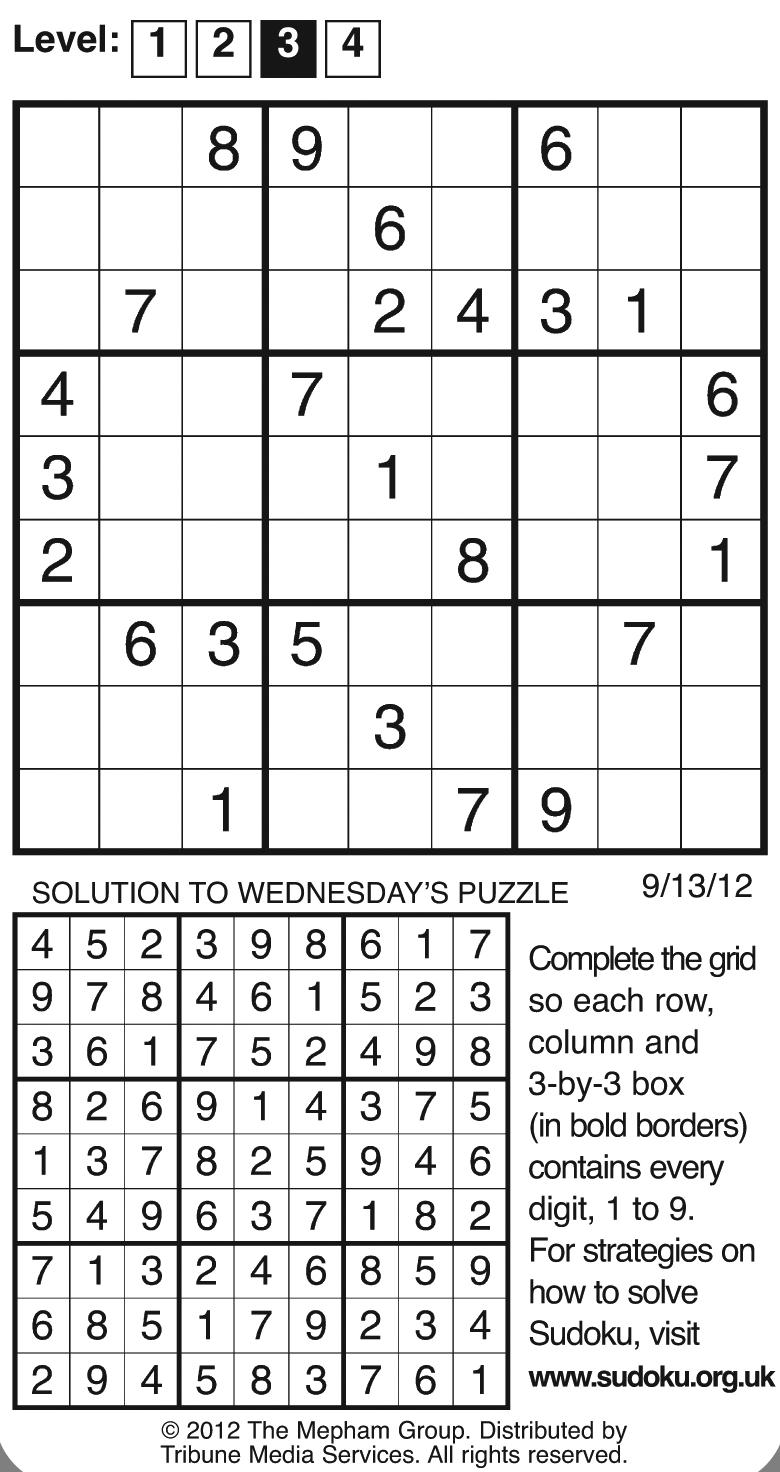
sudoku | The mepham group
JusT add waTer | John roddy & eric carlson
fLinG by sPrinG | riley mccurrie
nCaa
Make halftime shows the norm
The nba a ll- s tar game took place in Toronto this past weekend. i personally went into the nba’s annual, frenzied regalia thinking that s ting’s performance at halftime would be the best part of the weekend.
i was correct to believe that s ting would deliver.
h owever, s ting’s solid performance aside, two fellows named Zach l av ine and a aron g ordon proved me wrong by putting on an amazing slam dunk contest.
a nd two weeks ago, b eyoncé, b runo m ars and c oldplay — yes, i know c oldplay was the headlining act, and yes, i ’m still mentioning them third — put on a great s uper b owl halftime show. i ’m a sucker for “ u ptown f unk” and b eyoncé is, well, b eyonce.
a t this point, you may be sitting there and thinking, “ m arek, this is a sports authority, not a music rant.” you would be correct in that regard, but the point i ’m trying to make is that sporting events need more musical performances.
w hy should the s uper b owl and a ll- s tar games get all the musical acts and drama?
To channel my inner b ernie s anders, the system we have gives roughly 1 percent of the sporting events that take place every year about 99 percent of the musical acts. That’s just not right, and expanding musical performances to even regular season games would let everyone win.
Think about it: m ore halftime shows are good for both sports and music. would you watch an nhl regularseason game between the c olumbus b lue Jackets and the f lorida p anthers? p robably not, right? w hat if it had a halftime show featuring b ruce s pringsteen and d rake? b y adding bigger and better halftime shows, viewership of sporting events will only increase.
The same goes for the artists, too. b eyoncé may not need the increased draw sporting events provide, but it certainly isn’t going to hurt her record sales, either. a nd for artists who are less
famous than b eyoncé, sporting events represent a gold mine of potential listeners. h aving more games include a musical halftime show would also give teams a chance to create a unique identity. f or example, the m emphis g rizzlies could choose to feature country music artists during their halftime shows, and the b oston area could showcase local bands like a erosmith or b oston. The d allas c owboys would just listen to “The f ool on the h ill” on repeat, and i think the l os a ngeles r ams would be happy to have n ickelback to distract fans from the fact that c ase Keenum is their quarterback. b esides, it’s not like we have a shortage of aging rock bands looking for work. p laying at a mls game must be better than playing a kid’s birthday party for upand-coming indie artists or washed-up metal groups.
a nd just think of the awesome marketing potential: i magine the r oyals with halftime act Kansas, the b ears with c hicago, the g iants with They m ight b e g iants or the e agles with ... wait for it ... the e agles. a nd, if we’re really lucky, we can look forward to player-singer duets. i magine b oogie the rapper performing with d e m arcus “ b oogie”
c ousins. p lus, i think fans would enjoy n ick s aban jamming with lynyrd s kynyrd to “ s weet h ome a labama.” p lus, now that one dumb commentator on every show will have something to do. s haq can finally come into his own as T n T’s halftime act analyst, and, let’s be honest, i want to hear d ick v itale call Justin b ieber a “diaper dandy.”
l ook, i just enjoy the entertainment of halftime shows and want more of it.
i f it means i have to dvr the s uper b owl and fast forward through two hours of tape to watch b eyoncé, i ’ll do that.
i f it means i have to buy tickets to Jacksonville Jaguars games to see her, i ’ll do that too.
Contact Marek Mazurek at mmazurek@nd.edu
The views expressed in this Sports Authority are those of the author and not necessarily those of The Observer.
l onghorns hold off mountaineers at home
Associated Press
aus T in , Texas — e ric d avis Jr. scored 15 points and sparked a flurry of firsthalf 3-pointers for n o. 24 Texas as the l onghorns held off a late rally to beat n o. 10 west v irginia 85-78 on Tuesday night.
d avis made four 3-pointers in the first half and Texas (17-9, 8-5 b ig 12) had 10 in the game in capping a regular-season sweep of the m ountaineers. Texas broke a two-game losing streak.
Texas coach s haka s mart had implored his team to show more emotion heading in a tough, late-season gauntlet against four ranked opponents in six games. d avis responded with arguably his best half of the season after scoring seven total points in the previous four games.
i saiah Taylor led Texas with 23 points and seven assists.
Tarik p hillip scored 19 points for west v irginia (206, 9-4), which dropped one game behind n o. 2 Kansas in the b ig 12.
Jaysean p aige, the m ountaineers’ leading scorer at 14.0 points per game, injured an ankle in the first half and never returned.
west v irginia, which trailed by as many as 16 points in the second half,
nhL | capiTals 3, Kings 1
pulled within 77-71 on a three-point play by Jonathan h olton with 38 seconds left. Texas put the game away with eight consecutive free throws.
The win is another big result on the ncaa Tournament resume of firstyear coach s mart, who still hasn’t lost three straight with the l onghorns. Texas is 5-3 against ranked opponents this season and three of its last five games will come against n o. 25 b aylor, Kansas and n o. 3 o klahoma.
Just like its first win over the m ountaineers in January, Texas expertly handled west v irginia’s pressing defense, turning the ball over just seven times. west v irginia attacked Texas ballhandlers early and produced three quick turnovers in the opening minutes that fueled a 12-4 m ountaineers lead.
b ut Texas cleaned up the sloppy play and quickly fought back before d avis took over the last 6 minutes of the first half with a slew of 3-pointers. d avis made three as the teams traded seven straight 3-pointers and his fourth pushed the l onghorns to a 45-36 halftime lead.
The l onghorns kept up the barrage in the second half. c onnor l ammert’s 3-pointer followed by a
three-point play by Taylor quickly pushed Texas to a 12-point lead in the opening minutes.
e ven when Texas’ scoring slowed down, the m ountaineers couldn’t make the run they needed to rally. a fter shooting 63 percent in the first half, west v irginia tapered off badly in the second and struggled from the free throw line. a nd Texas kept handling the west v irginia press to perfection. Taylor’s offbalance alley-oop pass to p rince i beh for a dunk finished off a three-pass sequence that sliced through the m ountaineers and put the l onghorns up 65-52.
Tip-ins
west v irginia: The m ountaineers played without starting guard d axter m iles because of a strained right hamstring. s tarting in his place was Teyvon m yers, who came in averaging just 2.2 points and finished with six points, one assist and no steals.
Texas: The l onghorns are keeping watch on their own injured lineup. s mart said this week that center c am r idley still hasn’t been cleared to put his full weight on a surgically repaired bone in his right foot, putting his return before the postseason in doubt.
Capitals come from behind to beat Kings
Associated Press
washing T on — e vgeny Kuznetsov’s tiebreaking goal with 122 seconds remaining off an assist from exKings player Justin w illiams, a score that withstood a coach’s challenge for goalie interference, lifted the nhlleading washington c apitals to a 3-1 comeback victory over l os a ngeles on Tuesday night.
Kuznetsov’s 16th goal, but first in a month, gave him 20 points in his past 14 games. a ndre b urakovsky got a secondary assist on that score, after tying the game with 48.1 seconds left in the second period. Jason c himera added an empty-netter with 8.6 seconds left.
a nze Kopitar put l os a ngeles ahead in the first period on a short-handed goal.
washington goalie philipp
g rubauer, getting a rare start in place of braden holtby, made 39 saves.
Kings goalie Jonathan Quick, back after missing three games with a lowerbody injury, finished with 29 stops.
washington won despite a quiet night for a lex o vechkin, whose four-game goal streak ended, and the team’s league-best power play, which went 0 for 5, managed a total of only five shots in those 10 minutes with the man-advantage and was the unit responsible for allowing the Kings’ goal.
That’s because Kopitar scored his 17th goal while l os a ngeles was killing a penalty with a little under 3 1/2 minutes left in the first period.
d efenseman d rew d oughty set it up by diving headfirst in front of the crease and reaching out with his stick
to poke away a pass intended for o vechkin, camped out in his usual power-play spot near the left circle. d ustin brown corralled the puck and brought it up the right wing before sending it cross-ice.
Kopitar’s initial shot was blocked, but he lifted the rebound over g rubauer from a tough angle on the left side of the net.
washington made it 1-all when b urakovsky redirected a puck that d mitry o rlov put in front of the net. it was b urakovsky’s 12th goal. c apitals defenseman brooks o rpik earned the secondary assist in his return to action after missing the previous 40 games with a lowerbody injury. o rpik’s presence was acknowledged in the first period by a roar from the crowd when his no. 44 was shown on the overhead scoreboard.
Marek Mazurek sports writer
irish excel in two weekend meets
By TOBIAS HOONHOUT sports writer
n otre d ame sent competitors to both the i owa s tate i nvitational and the spire d ivision i meet last weekend and came away with strong performances on both the men’s and women’s sides as it heads into the final stretch before the acc indoor championships.
o n f riday, the dynamic duo of senior m olly s eidel and freshman a nna r ohrer placed first and second, respectively, in the 5,000-meter run at the i owa s tate i nvitational, notching personal bests in the process. s eidel broke her own school record with a time of 15:47.07, and r ohrer was right behind her with a time of 15:47.78.
“They weren’t running all out, which is pretty scary, especially considering how good m olly is getting right now,” i rish head coach a lan Turner said. “ i ’ve said it before, but she is just taking everything to another level. a nna is following right behind her. s he’s also a super talented individual as well. … Those two have just been lights out for us this entire season, and what they did at i owa s tate was actually expected.” a nother top performer for the women was graduate student c arly l oeffel, who took home the top spot in the pentathlon at the spire meet with a score of 4,019 points. a dditionally, the women’s 1600-meter relay of sophomores Jordan s head and p ayton m iller, senior m argaret b amgbose and graduate student Kaila b arber came in second on s aturday in the spire meet with a time of 3:37.87, their best time up to this point in the season and second best in the conference.
Turner said he was very pleased with the progress l oeffel has made this season as she looks to get back to the ncaa championships.
“ s he’s where she needs to be right now, and she’s going to have to duplicate those efforts in couple weeks at the acc s,” Turner said. “ s he’s been to the ncaa s in her sophomore year, so she has tasted being on the big stage, and she just wants to get back there. … h opefully [in the coming weeks] we can maximize all of our points in the women’s team and bring home an acc title.”
o n the men’s side, the i rish performed admirably, as a number of team members set
personal bests. i n the high jump, sophomore h unter h olton placed fifth with a jump of 2.06 meters, and freshman m atthew b irzer finished 10th with a personal best of 1.96 meters. i n the 3,000-meter run, sophomore Kevin p ulliam finished 11th with a personal-best time of 8:17.84, and senior Timothy b all came in 13th with his own personal record of 8:18.28.
a dditionally, juniors c hris m arco and Jacob d umford finished 14th and 15th in the mile, respectively. b oth edged closer to the 4-minute mark with nearly-identical times of 4:03.81 and 4:03.85, which Turner said is great so long as they continue to improve their placement in the conference.
“ i f they can put themselves in good positions for the acc they are going to place very high for us,” Turner said about m arco and d umford. “ b ut right now, it’s [less about hitting 4 minutes and] more about placing as high as they can in the acc , whether that’s 3:59 or 4:05 that gets us the victory.”
w ith the acc championships only two weeks away, the i rish are in the midst of preparation for the final stretch run, and that preparation continues this coming weekend when the team hosts the a lex w ilson i nvitational at l oftus s ports c enter on s aturday. The meet is set to start at 10 a.m.
Contact Tobias Hoonhout at thoonhou@nd.edu
CAITLYN JORDAN | The Observer
Irish sophomore Kirk Hansen sets his sights on the runner ahead of him during the 800-meter run at the Meyo Invitational on Feb. 6 at Loftus Sports Center. Hansen finished in 17th place in the event.
college baseball with 75 double plays in just 60 games last season, as well as Johnny bench awardcandidate lidge behind the plate.
“i continue to marvel at the guys in our infield the way they just continue to work, continue to develop and continue to get better,” aoki said. “ … Zach, cavan, lane and Kyle, i think all four of them are better players. and i think that that’s pretty remarkable considering the fact that they played at an extremely high level last year.”
one area notre dame will see some turnover in, however, is the back-end of the starting rotation.
“when you look at certain guys, some of these guys are going to be in a little bigger role,” aoki said. “if you look at [sophomores righthander] peter solomon and [lefthander] sean guenther, those are kids who were in the back end of our bullpen last year and are going to be at the front end to start the year this year. i don’t know that they’ve necessarily improved by leaps and bounds, but i think they’ve been able to adjust, make the adjustments to the starter’s role versus the closer’s role.”
guenther led the irish last season with five saves while compiling a 1-3 record, 2.72 era and 37 strikeouts in 46 1/3 innings of work over 27 appearances. solomon notched four saves of his own, throwing 19 1/3 innings on the way to a 2-0 record, 1.40 era and 19 strikeouts in nine appearances. both will see their time in the starting rotation, aoki said.
because the team believes it can compete with anyone in the country, aoki said the improvement he sees is more on the mental side of the game.
“i think our whole team has just done a really good job of embracing the whole idea of just trying to get a little bit better every day,” aoki said. “This competition isn’t necessarily against our opponents so much as it is ourselves, just pushing ourselves every day to try to maximize our potential. it’s really gratifying to watch these guys just go about the work of doing that.”
This weekend’s three-game set against the broncos (26-28, 12-15 west coast in 2015) is set to begin at 9 p.m. friday at stephen schott stadium. going into the series, aoki said he wants his team to start playing with a present-focused mindset.
“i think it’s very much the same as it was last year, which is to take the game one pitch at a time,” aoki said. “don’t worry about the past, don’t worry about the future, just be completely obsessed with the present, and just try to play as well as we are capable of playing.
“ … we’re not playing the game against the opponent. The opponent really is irrelevant. it’s us trying to maximize our individual and collective ability, and i think that’s going to be the message from the first day of the season to the very last day of the season, which hopefully is in late June.”
MICHAEL YU | The Observer
Irish junior right-hander Ryan Smoyer follows through after a pitch during Notre Dame’s 8-3 win over Central Michigan on March 18 at Frank Eck Stadium. Smoyer led the Irish in wins last season, compiling a 9-1 record, and had a 2.27 earned-run average over 79 1/3 innings of work.
MICHAEL YU | The Observer
Irish junior left-hander Scott Tully delivers a pitch during Notre Dame’s 8-3 win over Central Michigan on March 18 at Frank Eck Stadium. Tully led the team with 63 strikeouts over 65 1/3 innings as he started five games and compiled a 4-4 record and 3.17 earned-run average.
rigors with my football commitments has given me a great foundation for my next endeavor.”
The m idland, m ichigan, native said while he “poured everything into representing n otre d ame” as a member of the team, he’s ready to move on from football after three seasons.
“The excitement i feel about the professional opportunity in front of me has helped me to realize that i ’m just ready to be done with football,” e lmer said. “ i ’ve been playing this game for many years, and quite honestly my heart is no longer in it.”
i rish head coach b rian Kelly referenced his staff’s recruiting pitch that n otre d ame is more about the four years in college when praising e lmer’s character.
“ n otre d ame is a special place that develops unique and talented people,” Kelly said in a press release. “ s teve e lmer is such a person. h e chose n otre d ame to earn a degree from the top university in the world and play football at the highest level. h e’s accomplished both and so much more.
“This is an incredible professional opportunity for s teve. we, as a coaching staff, talk about how attending n otre d ame isn’t a four-year decision; rather it’s a 40-year investment into your life. This u niversity provides so many different avenues toward success, whether that’s on the football field or in the boardroom, and s teve’s another outstanding example.”
e lmer’s departure means the i rish will have to replace three starters on the offensive line, with graduate student n ick m artin exhausting his eligibility and senior r onnie s tanley forgoing his final season to enter a pril’s nfl d raft. s ophomore Quenton n elson and junior m ike m c g linchey are set to be the only returning starters.
e lmer said although making the call to leave n otre d ame wasn’t easy, it was the correct decision for him.
“ i f this sounds like it was a difficult decision for me, you would be right,” e lmer said. “ m y time at n otre d ame is something i will always cherish, leaving me with the best of friends and countless memories that i will carry with me for the rest of my life. i owe so much to this u niversity, not only for giving me the chance to play on college football’s biggest stage and preparing me for life beyond the game but for helping to make me the man i am today. a ll i ask from you is that you trust me when i say i know that i have made the right decision.”
w Tennis
and Quinn g leason (6-1, 7-6(3)) all fell in their singles matches.
d espite the loss that ended notre dame’s three-match winning streak, l ouderback said he was very pleased with the way his team performed sunday and feels the loss will motivate his team to do better.
“i felt like we played a very good match against m ichigan and were in position to have a chance to win the match,” l ouderback said. “l osing a close match like that makes us ready to get back on the court as soon as possible.”
a nd the i rish are ready to do just that, starting with
their doubles play. e ven though he believes the doubles teams are gradually improving, l ouderback said that his team is working on getting more overall production during the doubles matches.
“ we are going to continue to work on our doubles,” l ouderback said. “o ur doubles teams are playing better but we need to start getting some doubles points.”
Thirsty for more points, the i rish head to west l afayette, i ndiana, for an non-conference contest against p urdue on wednesday. The match will take place at the s chwartz Tennis c enter and is scheduled for 3 p.m.
Contact Michael Ivey at mivey@hcc-nd.edu
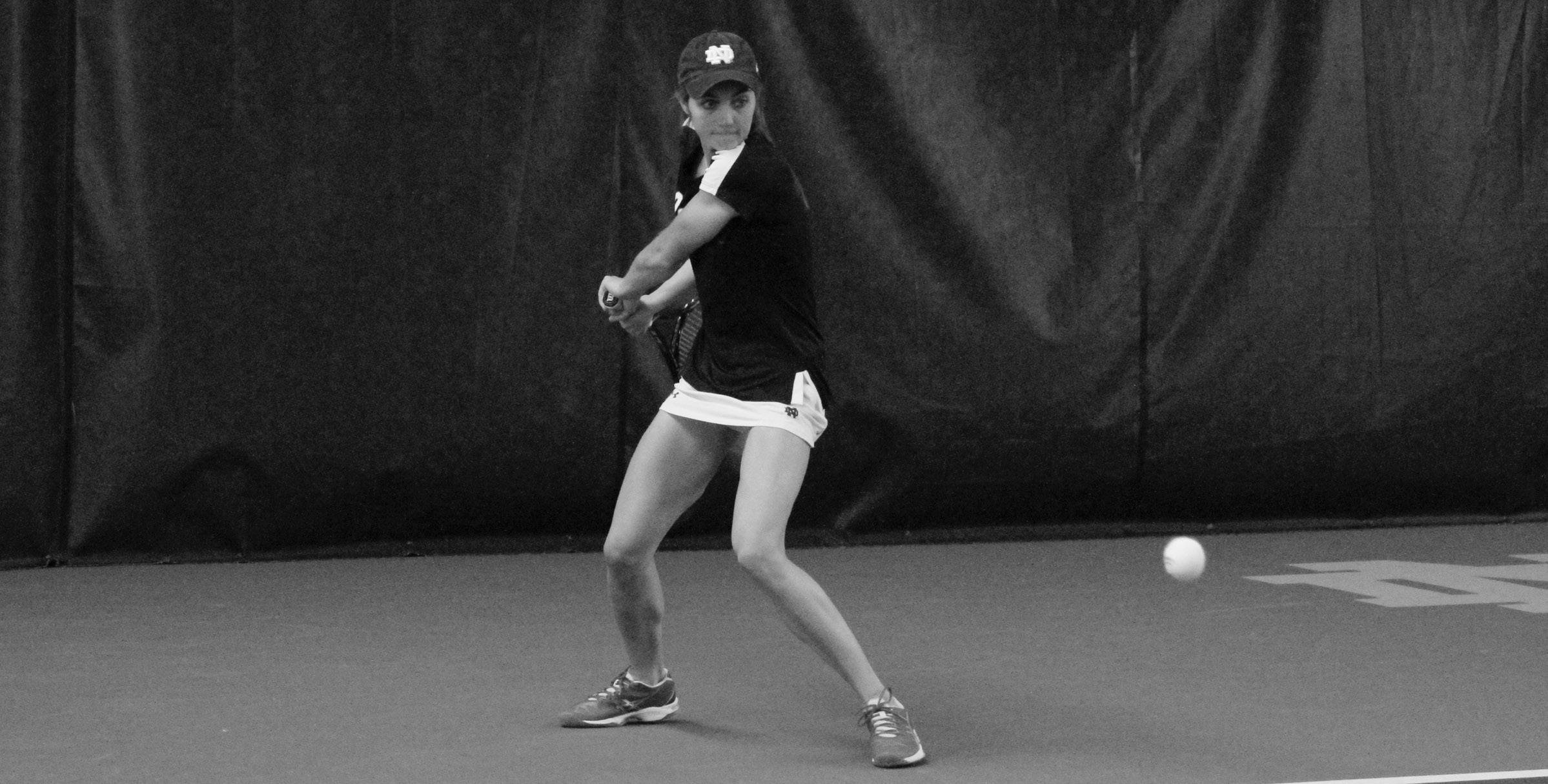
EMMET FARNAN | The Observer
Irish junior Mary Closs positions herself for a backhand during Notre Dame’s 7-0 win over Western Michigan on Jan. 19 at Eck Tennis Pavilion. Closs is 8-7 in singles play this season, as well as 2-2 in doubles play with her primary doubles partner, senior Julie Vrabel.
paid a dverT isemen T
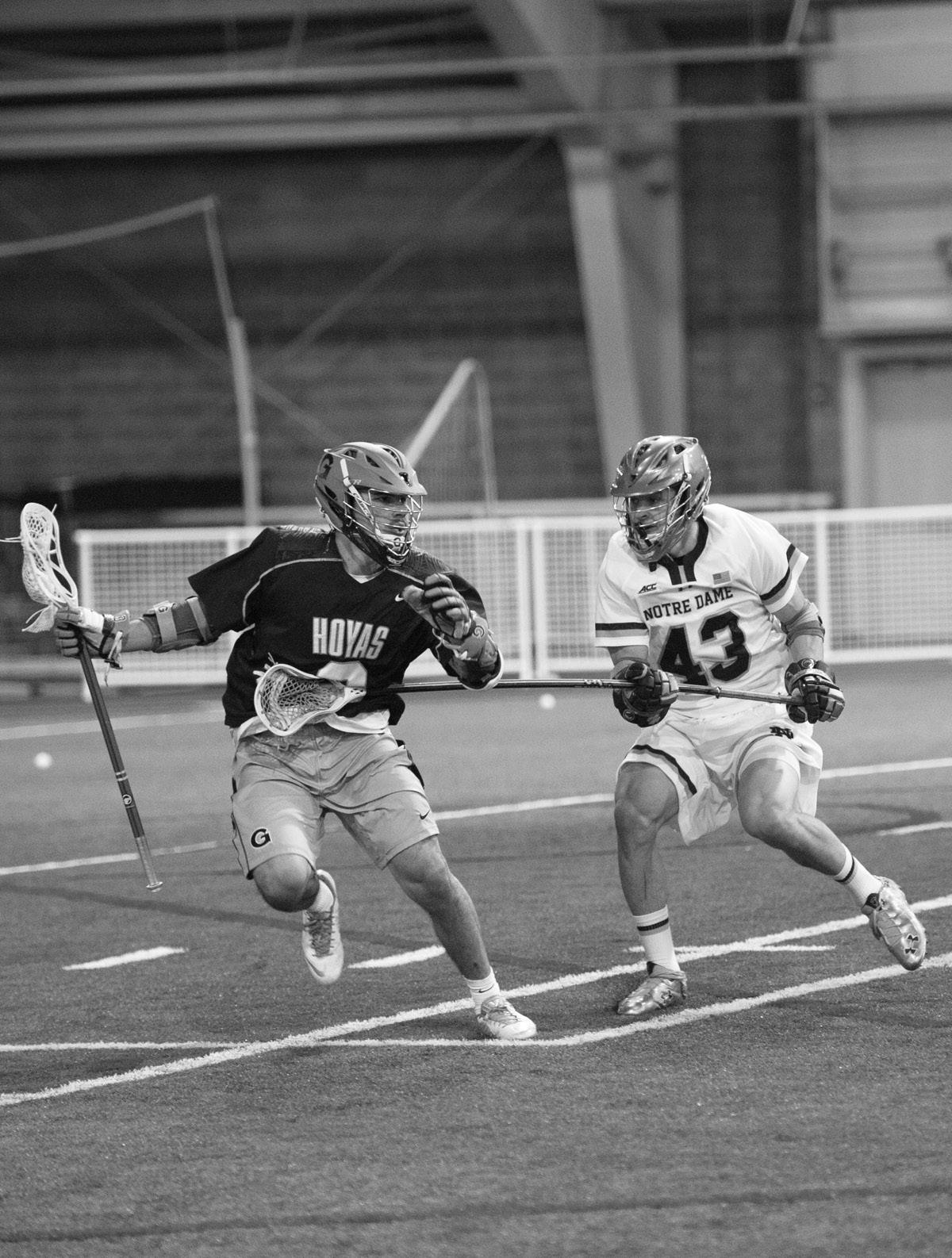
championship a number of different years, but that’s not really relevant. w hat is is how hard do you work every day. how hard do you prepare yourself. how good of a chance do you give yourself to be that best team at the end.” on paper, notre dame’s chances look good. The i rish return three of their top four goal scorers: senior attack matt Kavanagh, junior midfielder sergio perkovic and sophomore attack m ikey wynne. They return all three starters on defense, including senior and reigning acc defensive player of the year matt l andis. l andis and Kavanagh were both picked in the top five of the major l eague l acrosse draft in January.
w hile notre dame having a handful of the country’s top players will certainly help its quest for a first national title, corrigan said he is more focused on the team aspect and less on individual expectations.
“Quite honestly i think [expectations are] a muse for fans or people who are interested in the team,” corrigan said. “i think within the team what we need to be concerned about are our standards of performance every day — not getting guys caught up in expectations, because the only expectation that i want them to have is that we’re going to be as well prepared as we can possibly by every time we strap it up on saturdays.”
for corrigan’s part, he has instilled in his every one of players a sense of taking the season day-by-day and not looking ahead to the ncaa Tournament.
“i think we don’t want to have that attitude [of forward thinking] because if all we focus on is the end product, we’ll forget about all the steps it takes to get there,” l andis said. “i think we’re trying to … leave the field better than we stepped on [every day]. i f we look at it that way, and we’re not getting better every day, i don’t think we’ll get to the national championship.”
“we really try to stay focused
every single day on the day in front of us,” corrigan said. “it’s not about anything that’s going to happen in may, even anything that’s going to happen in march — it’s about today.” even with sky-high expectations this season, corrigan said the i rish will not necessarily be picking up right where they left off. former attack conor doyle and midfielders nick ossello, Jim marlatt, Jack near and w ill corrigan were all important pieces last season that have since been lost to graduation.
“There’s no question, every team has to develop its leaders as you lose those guys from the year before,” corrigan said. “but there’s also some little things that they did — the institutional knowledge, if you will, of how we do things.
“ … it’s a process to grow into that leadership for the next year. i think we’ve got guys who are doing that on an everyday basis. i think our seniors have been good during the preseason in trying to develop that, but you don’t pick up where you left off.”
w hether or not the seniors step up and lead the i rish to a national championship, corrigan said he is confident notre dame will be in the thick of things for the long haul.
“i think all of the pieces are in place,” corrigan said. “i think it took awhile for us to get all those pieces. The first time we went to the final four [in 2001], we didn’t have scholarships. we didn’t have a budget for assistant coaches, and we didn’t have a stadium to play in. we’ve got all those things now.
“ … a ll of the pieces have been put into place here for us to compete at a high level.”
l andis, who has suffered his fair share of heartbreaking losses in his three years at notre dame, was more matter of fact about getting over the hump.
“i n every single one of those games … it’s been a game that goes right down to the wire. … it’s just putting in a little more effort. we’re right there, we just need one percent more to go all the way.”
Contact Brian Plamondon at bplamond@nd.edu
ALARISSE LAM | The Observer
Irish sophomore attack Tyler Ruhl attempts to dodge a defender during Notre Dame’s scrimmage against Air Force on Jan. 30.
ALARISSE LAM | The Observer
Irish senior attack Matt Kavanagh surveys his options during Notre Dame’s scrimmage against Air Force on Jan. 30 at Loftus Sports Center. Kavanagh led the Irish with 52 points and scored 27 goals last season.
Lineman Elmer to forgo final year of eligibility
Observer Staff Report
Junior offensive lineman s teve e lmer will graduate early in m ay and forgo his final year of eligibility, n otre d ame announced Tuesday.
e lmer, who closed his i rish career with 27 consecutive starts as one of six players to start every game in the 2014 and 2015 seasons, will earn his degree in economics at the end of this semester and begin his professional life in washington, d c
“ w hile playing football for n otre d ame has been nothing short of an honor, i have been presented with an incredible opportunity to pursue a career doing something in which i have great interest, and at a great company to boot,” e lmer said in a letter written to i rish fans.
“The experience of balancing n otre d ame’s academic
Men’s
notre dame readies for p urdue
By MICHAEL IVEY sports writer
notre dame takes on nonconference opponent p urdue on wednesday.
The i rish (4-3, 1-0) visit p urdue at the s chwartz Tennis c enter in west l afayette, i ndiana.
i rish head coach Jay l ouderback said he believes the b oilermakers’ experience will play an important factor for the i rish during the match.
“p urdue is a very veteran team and one that is tough at home, so we know we will have to play well and be very patient,” l ouderback said.
The b oilermakers (7-5, 0-0) face the i rish after a busy doubleheader-weekend. They defeated d epaul, 5-2, before falling to Tulsa, 4-0, on sunday. b efore sunday’s win, the b oilermakers suffered three straight losses on-the-road against. They fell to Kansas and a rkansas in a
doubleheader Jan. 30-31 and no. 25 ole m iss, before beating memphis, 6-1, on feb. 7. o verall, p urdue has faced five ranked opponents so far this season, recording a 1-4 record in those contests.
l eading up to p urdue, the i rish lost, 5-2, on-the-road to no. 8 m ichigan on sunday. Juniors Jane fennelly and monica robinson notched the only singles wins for the i rish. fennelly battled against m ichigan sophomore a lex najarian in a 10-point set tiebreaker, ultimately handing notre dame its first point with a 6-3, 5-7, 10-3 victory. robinson also played to three sets. she beat freshman brienne m inor 7-5, 1-6, 6-4 to secure the i rish their second and final point of the day. fellow junior mary c loss (62, 7-6(3)), sophomore a llison m iller (6-2, 6-1) and seniors Julie vrabel (6-2, 6-3)
see w Tennis PaGe 14
nd returns solid pitching, defense Experienced Irish set to pursue first national title
By ZACH KLONSINSKI sports e ditor
despite reaching the ncaa tournament for the first time since 2006, the feeling around the clubhouse in the final hours before notre dame’s 2016 season gets underway is anything but satisfied.
“[it] wasn’t like we won the college world series,” irish head coach mik aoki said Tuesday afternoon, just 36 hours before his squad goes wheels-up for santa clara, california. “[ we] got to a regional, which was great, got our program back to a level of play that we feel like it should be at, which is great, but we just want to continue to get better.
“we want to continue to try to become as good as we can be, and with this particular squad, that could potentially be a pretty high place.”
The core of the 2015 squad that finished the season 37-23 overall and 17-13 in the acc remains in place as the irish head west to open their season with a threegame series against santa clara.
The irish return four of the five pitchers who threw at least 60 innings last season: senior
right-hander nick mccarty, juniors left-hander scott Tully and right-hander ryan smoyer and sophomore right-hander brandon bielak.
additionally, of the eight position players who appeared in 45 games or more last season, notre dame returns six: seniors shortstop lane richards, first baseman Zak Kutsulis and outfielder Kyle richardson as well as juniors third baseman Kyle fiala, second baseman cavan biggio and catcher ryan lidge. a seventh, graduated outfielder robert youngdahl, is still with the program as a volunteer assistant coach.
“The pitching staff, i think it’s deep, i think it’s experienced and i think it’s talented,” aoki said. “but i think you could use those same adjectives for our infield. That fits. our infield and our pitching i think probably are the heart and soul and the strength to our team.”
a ll four infielders — from third to first: fiala, richards, rawlings gold glove winner biggio and Kutsulis — return for a notre dame defense that led all of
By BRIAN PLAMONDON sports writer
forgive i rish head coach Kevin corrigan if he has grown a few more gray hairs than most over the last decade or so.
notre dame, which opens its 2016 season saturday against g eorgetown in atlanta, has now lost to the eventual national champion in the ncaa tournament eight of the last 10 years, only once by two or more goals. a fter falling in the final to duke in 2014 and the semifinals to denver last year, corrigan might have the best roster in his 28year tenure as notre dame’s coach — that’s at least what the media thinks, as the i rish are ranked no. 1 in the preseason rankings. corrigan, on the other hand, doesn’t see this season as being national championship or bust.
“we don’t talk about it that way,” corrigan said. “we felt like we’ve had a team good enough to win a national
nd woMen’s Tennis
WEI LIN | The Observer
Irish junior offensive lineman Steve Elmer, left, looks to make a block during Notre Dame’s 44-28 loss to Ohio State on Jan. 1. see elmer PaGe 14
L aCrosse
EMMET FARNAN | The Observer
Irish senior defender Matt Landis engages the opposing attack during Notre Dame’s 14-12 win over Georgetown on Feb. 14, 2015.