Print edition of The Observer for Monday, September 25, 2017
team e ffort
Irish sophomore cornerback Julian Love picked off the pass and took it back all 59 yards for the score. After junior kicker Justin Yoon’s extra point, n otre d ame held a 14-0 lead less than five minutes into the game.
“It was onion concept, so the two was going to the flat, and [defensive coordinator m ike] e lko calls a great defense for that,” Love said of his read on the interception.
“We’ve been preparing for their route concepts. That quarterback was really good on timing we learned early, and so it was a quick throw and I just broke on it. I don’t really remember the rest.”
b ut m ichigan s tate would respond on its next drive. Lewerke bounced back from the interception, turning a quarterback sneak into a 52yard pickup by taking advantage of confusion amongst the Irish front seven. f our plays later, Lewerke found sophomore wide receiver d arrell s tewart Jr. on a fade
route to cut the s partans’ deficit in half and making it a 14-7 game.
After trading punts to end the first quarter, the Irish were able to open up the scoring in the second period on the heels of another turnover. With Lewerke running towards the left sideline, Irish senior linebacker Greer m artini was able to force a fumble that sophomore defensive lineman d aelin h ayes would recover to give n otre d ame possession at m ichigan s tate’s 24yard line.
And six plays — including a near touchdown from Wimbush to s t. b rown that s t. b rown was unable to corral inbounds — later, the Irish were able to push the ball in when Wimbush rolled out right and found junior running back d exter Williams for an eight-yard score to extend the Irish lead to 21-7.
“I don’t think we think about it,” Wimbush said about the offense scoring after the defense gets a takeaway. “We think about each drive as a separate drive,
and the defense has been doing a great job of taking the ball away and giving us field position, and we’ve been able to capitalize.”
And then just when it looked as though the s partans would respond in turn with a touchdown of their own, c rawford took on s cott at the goal line, taking a puncher’s chance and turning it into yet another forced turnover.
“With the play going out to the goal line, I just saw the ball loose and knew I was going to get a punch at it,” c rawford said of the moment. “Actually, I was watching some videos of c harles Tillman throughout the week, so I wanted to get my hands on the ball.”
The resulting 80-yard drive capped off by a Williams rushing touchdown would give the Irish a 28-7 lead that they carried into the half.
And although the Irish would technically get outscored in the second half, it was a mere 11-10 difference, as the Irish were able to get stops defensively, despite not forcing another turnover
in the second half. The offense also sustained its success as far as managing the clock, as its three longest possessions of the game all came in the second half. Irish head coach b rian Kelly was particularly complimentary of the offense’s balance, as the team ran for 182 yards — despite not a single rusher amassing over 60 individual yards — and another 173 yards through the air.
“You know, [we’re] really starting to establish who we really are in that we got much more balance today,” Kelly said. “ b randon threw the ball well today, 14-for-20, so we can probably move on about he can’t throw it. h e’s just got the ability to do a lot at that position — he’s just growing. h e hasn’t arrived, but he did some really good things at the position tonight that helped us become efficient on offense.”
That balance even included 12 carries for sophomore running back d eon m cIntosh, who scored his first career collegiate touchdown for the only Irish score of the second half. Although
the Irish conceded a late score and two-point conversion to bring the game to its final tally of 38-18, Kelly said he was very happy with the team’s performance throughout all four quarters.
“[It’s a] good win for our kids,” Kelly said. “Anytime we go on the road … it’s hard to win on the road anyway, so to come in here against a team that was nationally ranked defensively and take the football away like we did and be opportunistic — really, really pleased with the results.”
And having locked up two wins on the road the last two weeks, the Irish can now turn their attention to hosting m iami ( oh ) to n otre d ame s tadium next weekend.
“I think we’re just going to keep it rolling,” Wimbush said. “We head back to s outh b end and back to our home and our home fans. I think these two road wins and then going back home will prove to be huge for the rest of the season.”
Contact Ben Padanilam at bpadanil@nd.edu
Play of the game
Trailing 21-7 in the second quarter, michigan state was driving with the hope of narrowing the gap to just one score, as spartans junior running back LJ scott took a handoff up the middle and surged towards the goal line. Just before scott crossed the plane, however, Irish junior cornerback shaun crawford stripped him and recovered the fumble for a touchback, maintaining notre dame’s double-digit lead.
Shaun Crawford Stri PS lj S C ott at the goal line
ROSIE LoVOI | The Observer
Irish junior quarterback Brandon Wimbush carries the ball upfield during Notre Dame’s 38-18 win over Michigan State on Saturday at Spartan Stadium in East Lansing, Michigan. Wimbush finished the game with a rushing touchdown and 52 yards on the ground, good for second on the team behind junior running back Josh Adams’ 56 yards.
CUSE facilitates workshops
By NATALIE WEBER
a ssociate news e ditor
in an effort to promote intellectual development, the Flatley center for Undergraduate scholarly engagement (cUse ) hosts workshops across campus that cater to undergraduates interested in research, scholarly engagement, creative endeavors and fellowships.
assistant director of undergraduate research, Yvonne mikuljan, said the cUse workshops introduce students to various kinds of research and learning experiences while offering advice about how to pursue those opportunities.
“cUse workshops and advising are designed to encourage undergraduates to think about their own unique interests and goals and assist students in developing meaningful research projects and experiences,” mikuljan said.
The two workshops cUse regularly offer are “Getting started in Undergraduate research,” which explores different kinds of research and scholarly engagement opportunities, strategies for finding a faculty mentor and developing a plan for pursuit of such interests and goals, and “crafting a strong Grant Proposal,” which walks students through funding sources at notre dame, the components of a grant application and a composing an effective grant proposal, mikuljan said.
student programming coordinator for cUse, Kati schuler, said
the workshops welcome students from all majors and grade levels every week.
“if you’re not quite sure where to begin exploring research and engagement opportunities at notre dame, ‘Getting started in Undergraduate research’ is the right workshop for you,” schuler said. “if you have a specific project planned and would like to start the process of securing funding, ‘how to Write a strong Grant Proposal’ would be the best.”
since 2012, cUse has offered about 35 workshops annually that are open to all undergraduate students, schuler said. The workshops are typically held in brownson hall.
“We also bring our workshops into classes if a professor requests it,” schuler said. “For example, in 2016–2017, 130 students attended the workshops held in the cUse office, but we saw another 245 students during inclass workshops.”
outside of workshops, schuler said cUse offers individual mentoring and advising to students pursuing scholarly engagement outside of class. students can make an appointment with an advisor to discuss their project plans and get help on drafting a proposal, she said.
“cUse can also help students connect to all of the various centers, institutes and resources on campus,” schuler said. “We work like a compass, helping to guide
Paid a dverT isemen T
you through all of the different opportunities at notre dame.”
mikuljan said cUse is currently in the process of developing a grant writing series to provide more hands-on assistance during the grant writing process.
“cUse is always working to create new and better workshops and resources to help students be successful in their research and scholarly endeavors,” mikuljan said. “Undergraduate students of every level and every college and discipline participate in a range for research activities at notre dame, around the country and abroad.”
sophomore anthropology major dayonni Phillips said she attended cUse workshops to learn how to write a grant after being invited to do research in ireland and attend a field school in Poland.
“i would definitely recommend students attend cUse workshops or get involved with cUse even if they do not have research plans,” Phillips said. “a lthough the cUse workshop was meant to teach students how to organize a general grant proposal, i felt like the instructor was interested in specific questions that students had pertaining to their personal grants, and he would then address those questions as well.”
Contact Natalie Weber at nweber@nd.edu
was interesting was what they were buying with it, which is very similar to what we have in the m arketplace: certain snack-related foods, but also salads and makeyour-own items.”
m any of the changes made were to increase the “value proposition,” director of student dining s cott Kachmarik said. a bayasinghe said moving from the “meal equivalency” of Grab ’n Go to using flex points at places like the m arketplace helps with this.
“ i t’s never really equivalent to a meal in a dining hall,” he said. “What we attempted to do with the flex points is allow you to say, ‘ h ey, today i ’m coming in for lunch, and i ’m going to buy these three items.’”
r ather than using Grab ’n Go for their third meal, Kachmarik said students were taking advantage of using multiple swipes at once — another change this semester — to stock up on snack food.
“a necdotally, we know meal counts are up in the dining halls, and meal counts are up in Grab ’n Go,” he said. “What we’re finding in Grab ’n Go, and we’re looking into that, is that it’s the snack food that’s going out, not the meals.
“ … They’re not getting that third meal, so that tells us those increased flex points are what people are using for that third meal. The usage of Grab ’n Go is also changing, and we’ll figure it out through fall break and in the weeks after fall break.”
r eggie Kalili, assistant director of marketing for campus dining, said the
difference between using meal swipes at Grab ’n Go and flex points at other venues “seems like semantics.”
“ i t’s all part of the meal plan, and we did allocate flex points because we knew the marketplace was going to be a little different than Grab ’n Go,” he said. “ i know people have been in the m arketplace and have really loved what’s there, so i don’t think there’s a negative to that or what they’re purchasing — an acai bowl, for example. They’re totally different concepts.”
While a bayasinghe said the plan is not necessarily to phase out Grab ’n Go — that will depend on feedback and usage, he said — the choice to not include something similar to the m arketplace in s outh d ining h all ( sdh ) was based on how the facility is designed.
“This really comes down to a design in infrastructure,” he said. “We were very, very intentional in how we designed the m arketplace, and also all of n orth d ining h all.
“ … The traditional Grab ’n Go that we have in s outh d ining h all — we’re kind of limited in what we can do there, infrastructurewise. You know how tiny that space is, and once you get the refrigeration in there, the ability to create the m arketplace [in sdh ] doesn’t really exist.”
Kalili said that while the m arketplace doesn’t exist in sdh yet, the plan was to include one in the future.
“ h ad we had the logistics and the space [in sdh ], we would have put it here as well, he said. “ s o when [ sdh ] gets renovated again, we’re definitely going to be adding a m arketplace here.”
Contact Megan Valley at mvalley@nd.edu
to grapple with in the this era of extreme acting up by white supremacists and other groups.”
r uss said the students in her class learn a lot from each other because those who are familiar with the musical and those who aren’t bring different perspectives to the subject matter.
“We’re developing a whole new language,” she said.
“We have the ‘h am Freaks’ and the ‘h am newbies.’ The ‘h am newbies’ are actually teaching our ‘h am Freaks’ a lot because they’re coming at this fresh and they see thing we have forgotten.”
Terri said she continues to be excited for this course because every class there is more to dive into and learn about.
“i’m a word nerd: i love language, i love playing with language and i love the nuanced ways we can use language to not only impart meaning but to really interpret the world in different ways,” r uss said. “e veryone in the class has had a moment when they realize one word and all the multiple meanings that word has, changed the way they understand everything.”
r uss said the ultimate goal of centering the course around “h amilton” is to engage students in the study of rhetoric.
“i know that rhetoric, in large, sometimes has a bad reputation, and so one of goals is to create a whole new generation of word nerds, which is happening,” r uss said.
Contact Sydney Doyle at sdoyle01@saintmarys.edu
his entire time at notre dame, said he doesn’t believe the requirement will have as much of an effect as most students think.
“i don’t believe that this requirement will completely ruin the sense of community of [notre dame] like many people are saying it will,” he said in an email. “i believe that the overwhelmingly negative response is being blown out of proportion. Things will not be that different. To my knowledge, most students stay on campus six semesters. so, there will be some people that will be affected. however, as new students start coming in, this will just become the norm and no one will really know the difference.”
another major question discussed at the town hall, which Zook initially raised, is whether or not the new six-semester requirement could potentially be harmful for students who have been sexually assaulted on campus.
Zook said the requirement for students who have gone through the experience to remain on campus represents a “lack of empathy” for those students.
“being assaulted or experiencing any type of trauma in a dorm has the potential to make someone never feel fully safe on campus again,” she said. “Living off
campus decreases the chances of running into one’s attacker — since they are rarely expelled — and allows for a survivor to be in much more control of their environment. requiring someone to stay on campus when they are no longer comfortable there is not only a complete lack of empathy on the part of the administration, it is a danger to the mental health and wellness of people who have already gone through awful things.”
Fonseca said the potential exceptions for survivor of sexual assault need to be determined before the requirement begins to affect students.
“especially the sexual assault issue — obviously anything with sexual assault — it needs to be addressed,” he said. “if someone feels unsafe on campus and wants to move off for that reason — and i don’t think the University would block them. erin hoffmann harding talked about potential waivers and things like that.”
While hoffman harding said at the town hall this conversation is one the administration will continue to have with students, Zook said the changes should not have been announced without an official solution to the problem.
“saving a conversation for later isn’t adequate when the issue affects so many people,” Zook said. one of the most common complaints from students about the
six-semester requirement is that living on campus typically costs more money than living off campus. Zook said this factor played a major role in her decision to move off campus as a junior.
“since i’m studying abroad next semester, i needed a way to somehow cut costs and start saving up,” she said. “ … i am saving literally thousands of dollars this semester, so going abroad would have been very difficult financially if i lived on campus. and although there are aspects of dorm life that i miss, i am overall much happier off campus.”
one suggestion raised by students at the town hall was staggering room and board pricing based on the quality of dorm facilities. This idea, hoffmann harding said at the town hall, would foster an environment that “would not be helpful to the integrated communities” the University is aiming for, a sentiment Fonseca said he agrees with.
“You would literally segregate the school by income — by family income — which i think is very dangerous,” he said. “so i do not think that staggering the housing prices is a good idea at all because people would know your socioeconomic background based on the hall you live in. so yeah, i think that would be a terrible idea.”
Two alternatives Fonseca said could be effective are decreasing
the cost of room and board somewhat for upperclassmen and updating meal plans for seniors.
“i think the University should … look into ways to subsidize oncampus housing or perhaps giving a break and a slight reduction in room and board to upperclassmen to encourage them to stay on campus,” Fonseca said. “That’s, i think, a very viable option. even a drop in $1,000 or $2,000 i think is a viable reason to stay on campus. and another thing they could do that i think we don’t do right now … a lot of people have swipes left over at the end of the week. and i think what we should do — and i think it makes perfect sense — is that all your swipes that are left over at the end of the week from your freshman through junior year, have those save up and then have that be your meal plan senior year.”
Zook said she appreciated that the initial email to students announcing these changes recognized flaws in residential life, but is disappointed the administration didn’t work to repair these flaws before enacting the requirement.
“i couldn’t believe that they sent an announcement of this magnitude in the middle of the night,” she said. “While reading the email for the first time, i was satisfied that they were accurately pointing out some of the problems of dorm life. but the decision
to create a new requirement rather than working to fix the problems really surprised me.”
While o’brien said he does not appreciate the fact that students will no longer be able to decide whether or not they stay on campus for six semesters, he can see the changes to residential life having some positive effects in the long run.
“i think the biggest drawback is that the element of choice has been removed,” he said. “i think a positive of this rule will be an increased focus on residential life, and i believe that this will lead to positive changes.”
The lack of student say in the matter, Zook said, remains a point of contention with many members of the student body.
“i think a big part of it is that we feel as though our opinions were not at all taken into consideration,” she said. “conducting focus groups did not seem to reflect the views of the current student body in general. a lso, simply put, as young adults we don’t [need] more restrictions. since notre dame already has such a high rate of upperclassmen living on campus, imposing a new requirement just didn’t seem necessary to many including myself. … There can be benefits, but they are reliant on some big ‘ifs.’”
Contact Courtney Becker at cbecker3@nd.edu
Paid a dverT isemen T
By RYAN ISRAEL scene Writer
“do you know that story of the russian cosmonaut?” beckons a mysterious female voice on the intro song for odesZA’s new album “A moment Apart.” The voice belongs to actress brit marling and is taken from her performance in the 2011 film “Another e arth.” on the track, marling’s character continues to tell the story of the cosmonaut — who when trapped in a space station with an incessant ticking noise decides that in order to save his sanity he must fall in love with the sound.
While the sample may seem obscure, it serves as the perfect introduction to the electronic duo’s latest album, which was released earlier this month.
The heavy panting of an unknown person transitions seamlessly from the “Intro” song to the album’s title track. The second song carries an upbeat tempo that immediately puts the listener into the world of odesZA’s genre and sets the stage for the rest of the album.
on “boy,” a clear standout on the album, the lack of vocals does not detract from the song’s excellence. The track holds an airy and chill mood until a magnificent beat drop sends it into a bright and energetic space. “Thin Floors And Tall c eilings” maintains a relaxed and pensive vibe throughout, lending the album a bit of diversity.
A number of talented vocalists are brought on by harrison m ills and c layton Knight, the duo behind
odesZA. Leon bridges brings the soulful sound of his latest album “c oming home” to the song “Across The room.” on the track, odesZA manages to blend their signature indie-electronic style with bridges’ ’60s inspired southern soul.
“Just A memory” utilizes regina spektor’s beautiful voice to create a break-up inspired love song that holds deep emotion. o ther notable artists that appear on “A moment Apart” include naomi Wild, Kelsey bulkin and sasha sloan.
one song that especially stands out on the album is “everything At Your Feet.” The song’s melodic verses are handled by the spanish-speaking indie-pop band The c hamanas. despite it being the only track sung exclusively in spanish, the song fits perfectly with the vibe of the other tracks on the album.
A later song on the album features some spanish in it’s title “La c iudad,” which translates to “The c ity.” despite its lack of vocals, “La c iudad” maintains a quick pace, creating a happy feel. odesZA’s unique genre proves that it can mesh well with both e nglish and spanish vocals.
Knight and m ills’ newest album does not stray far from the celebrated sound that the duo created on their first two albums “In return” (2014) and “summer’s Gone” (2012). many of the songs spark a feeling of youthfulness and elation. These songs could easily be the soundtrack to a YouTube montage of videos from travels around the world. Yet other songs on the album convey a slower and more thoughtful feeling, perfect
for relaxation and focus. odesZA’s style of electronic music can not be pinned down to a single category because it is so unique. The group’s music has elements from indietronica, chillwave, electropop and more.
“A moment Apart” has been well received and the success is well deserved. The album quickly gained the top spot on the billboard Top dance/e lectronic Albums list, unseating c alvin harris’ latest album, and appeared at third on the billboard Top 100 Albums list.
The album is exceptional in the way that it inspires a wide variety of emotions from joy and ecstasy to peace and bliss. Almost any listener will be able to find a song on “A moment Apart” that they enjoy while avid fans of odesZA and their genre will enjoy the entire album.
Contact Ryan Israel at risrael1@nd.edu
“A Moment Apart” ODESZA
Label: Counter Records
Tracks: “Boy”
If you like: Porter Robinson, Flume, Jai Wolf
By GRACE WEISSEND scene Writer
If you were suspicious of Fergie’s ability to deliver another high-quality pop album, your thinking was fictitious.
Fergie certainly understood the pressure that comes with a ten-year break between albums, but rather than pushing too hard to impress or to prove her staying power, the d utchess delivers an updated and innovative album for the Girlboss generation. Fergie still manages to weave in the explicitly sexual language we know and love her for (on “Like It Ain’t nuttin’” she tells her ladies to “rub it on [their] boobies”) but this album is less scandalous and more money-fiend; a lot of the energy put towards Fergie’s bedside manner in 2007’s “d utchess” is put towards her love of cold hard cash and being a boss lady on “d ouble d utchess.” Fergie’s love of “the flossy flossy” has been no secret since “Glamorous,” and this album feels like a reflection on her life in the fast lane. The opening track, “hungry,” whets your appetite for the rest of the album; the song is almost too hype for its own good (and it’s got a r ick ross feature, so how could it not get you going?). The beat features a soaring female chant that feels worthy of a cathedral, and Fergie makes sure you know she’s the deity in this church. The d utchess promises us that she’s still ambitious, still hungry for success, and that she plans on coming out on top: “girl in the mirror / only
one I fear, uh” she boasts in “hungry.”
o n “You Already Know,” Fergie does a nice job of throwing it back to some classic ’90s hip hop while keeping things fresh and modern. nicki m inaj’s feature kicks the badass babe power on the album into overdrive, even though there is an unfortunate lack of interaction between m inaj and Fergie on the track.
The song also manages to seamlessly weave in a swingy, big-band bridge that serves to surprise and delight, even if only for a few seconds. This genre flexibility within songs turns out to be one of the album’s biggest strengths, especially on the m atomasounding “Life Goes o n.” “d ouble d utchess” feels heavily influenced by the deconstructed style peppered throughout the latest albums from Kanye West, b on Iver and others — thanks in part to the abrupt tempo changes, spacey bridges and little kids talking about Jesus.
Unfortunately, there is no track to match the heartwrenching sing-along “big Girls d on’t c ry (Personal)” from her first album. This is especially disappointing given Fergie’s recently announced divorce from actor — and Adonis — Josh d uhamel. The more emotional songs on “d ouble d utchess” are vocally stunning but feel inauthentic, most obviously on the rather boring “A Little Work.” We get to the real deal on “Love Is Pain,” but Fergie isn’t inviting us to sing along with her – it’s clear from her cathartic scream-belting that she needs some alone time with this one.
A few songs on the album – “e nchanté ( c arine),”
“Tension,” “Love Is blind” – are definite bops, but “d ouble d utchess” doesn’t pack nearly as hard of a punch as “d utchess” did with its unprecedented number of hits. It would have been nearly impossible for Fergie to deliver another album as overflowing with pure pop gold, but it doesn’t make it feel any less disappointing. d on’t get me wrong, “d ouble d utchess” is a good album; the problem is that “d utchess” is objectively better. Thankfully for Fergie, I think I speak for the masses when I say I’ll always lose my mind when I hear “Glamorous” or “London bridge.” e ven if none of the tracks on “d ouble d utchess” reach this level of pop prestige, it’s still a Fergalicious listening experience. As m inaj purrs on her feature, “make some noise for my girl Fergie Ferg.”
Contact Grace Weissend at gweissen@nd.edu
“Double Dutchess” Fergie
Label: Dutchess Music/BMG Rights Management (US) LLC
Track: Hungry ft. Rick Ross
If you like: Rihanna, Beyoncé, Miley Cyrus
In search of hot dog man
Mary Stechschlute news Writer
It was fall of my freshman year, a hot autumn night, a Wednesday to be precise. I was in my room when the phone rang. It was my friend who had a rough day and wanted to do something wild. I, being the adventurous and bold person that I am, told her I would put on my hot dog suit — the one that I casually had lying around my dorm room. We took the 9:20 p.m. bus over to n otre d ame, getting many looks on the ride over. o nce at n otre d ame, we embarked on a trip across the quads, yelling strange things at complete strangers. After about a half hour, my friend and I made our way back to the Grotto bus stop.
s uddenly, a large group of male students, clad only in underwear and viking helmets, jogged towards us. They were s iegfried boys, if my sources are correct. They all looked over to see two freshmen girls standing in the moonlight, one wearing a hot dog costume. All at once they started to chant, “ h ot dog! h ot dog! h ot dog!” I was stunned — I had forgotten how to interact with the male species, due to the fact that I attend an all-women’s college.
Then, to my utter surprise, the crowd of boys split like the red sea, and out of the sea of men came one hot dog–clad boy sprinting directly towards me. We collided as he screamed in my face: “ om G! We are soulmates!” Alarmed by the events that had just occurred, I simply stared in utter disbelief. All of the mysterious hot dog man’s friends begin a new chant: “Kiss her! Kiss her! Kiss her!”
I did not, in fact, kiss hot dog man. Instead, he ran back into the crowd and out of my life forever. This was my first experience of n otre d ame campus, and I have never forgotten it. In hopes of finding my hot dog suit soulmate, I created a Tinder profile. After many inappropriate hot dog jokes and questions about my real identity, I gave up on my Tinder search. I have yet to meet my hot dog suit soulmate, and often wonder if any of my other chance n otre d ame encounters will live up to the magic of that night.
If you or any of your loved ones knows of him, please help a girl find love and send him my way. o ur grandchildren would love to hear our story.
Contact Mary Stechschlute at mstechschlute01@saintmarys.edu
The views expressed in the Inside Column are those of the author and not necessarily those of The Observer.
America’s own Don Quixote
c an you imagine what the c onstitutional c onvention in Philadelphia would have looked like if the founding fathers refused to listen to what the other members had to say? c an you imagine what would have happened if James m adison made pronouncements without any foundation and anticipated the potential arguments of those who might disagree with him, registering his opinion ahead of time and denying debate with them? What would the c onstitution have looked like? c ould there even have been one? Without discourse nothing can get accomplished; leaders aren’t accountable or responsible and America falters globally and domestically. President d onald Trump’s use of Twitter is, in effect, such an egregious affront to the principles upon which America was built.
o f course, the use of Twitter isn’t itself the problem. In an increasingly digital world, finding new ways of keeping in touch and facilitating debate is only natural. d emocracy entails politicians and leaders being accountable to the people who put them in office and the use of social media can be seen as an abstract sense of that idea. President o bama was the first president to have a Twitter account and his ethical utilization of social media bolstered both of his campaign successes. Today, many politicians, business leaders and others employ Twitter and other forms of social media. Although one could argue that tweeting may be one of the least “democratic” means of communicating with the people because it is, in effect, talking “at” people and not “with” them, when used properly it encourages debate and conversation about the topics being discussed.
b ut facilitating debate is exactly what @real d onaldTrump is not doing. For Trump, Twitter is the 140-character venting of often unreasoned, incendiary opinion intended to preempt discourse. It’s the shield he uses to deflect negative press and transfer the blame and attention onto someone else, whether political opponents, such as h illary c linton, or even members of his own party, such as s en. John m c c ain, who courageously once again announced that he would not support the latest effort to repeal and replace the Affordable h ealth c are Act.
v ia Twitter, Trump has escalated the tensions with n orth Korea, blatantly lied about reports involving the investigation with r ussia, shamed his own party and condemned the mayor of London while investigation was still pending concerning another armed attack. The point isn’t that our president should delete his account. The point is that there is no point in trolling straw men and, like d on Quixote, fighting fictitious enemies on battlefronts that either do not exist or that continuously change.
Trump’s use of Twitter goes against the cores of political responsibility and accountability that the founding fathers envisioned. They set the framework for the development of a government that is open
in its dealings, where the leaders of the government would be expected to listen to the will of the people. o f course, this is not to say that the voice of the “dissenter” should be prohibited. d issent is welcome and protected as a civil liberty in our c onstitution. Yet, at the core of our nation’s ideals, it is argument and counterargument which contribute to the debate and constructive discourse toward making America the very best it can be. o ne-hundred-forty–character retaliatory barbs against those with whom the president disagrees, many of which incite distress and discord and, one cannot help but believe, are intended to create division instead of unity, isn’t the way to conduct policy.
Americans need to make d onald Trump accountable for throwing out opinions that don’t allow debate and many of which are attacks on other people. The issue isn’t one of grand, sweeping societal reforms to upend a system and it is not one as dramatic as any sort of revolt. It certainly don’t mean foisting opinions onto others or requiring others to change. This is, in fact, the root of the problem that needs addressing. Americans need to take small steps that add up to big ones, and, ignoring the intentionally and often times adolescent rhetoric from a president who more resembles a child-king who retaliates against anyone who doesn’t affirm his immense and immensely fragile ego than the leader of the world’s greatest democracy, facilitate discussion that leads us to solutions.
d onald Trump has almost 36,000 tweets on his personal account and over 1,200 on the presidential account. b ut what is being said? In the Quixotic battles that are being waged, the only victor, the only speaker, the only voice in a debate that is shut down before it ever gets off the ground is that of d onald Trump. It is time to realize that the windmills against which America’s current president is waging an offensive war of words aren’t giants and focus on the conversations that matter. As the campaign of b ernie s anders powerfully demonstrated, college students and young adults are the ones who have the ability to swing and determine the outcome of elections and the future of America. If America’s current leaders across both sides of the aisle will not reign in a president who effortlessly hurls unsubstantiated epithets at those whom he feels might upstage him, most recently professional football players and basketball players, then college students and young adults need to demonstrate, at the polls and in writing campaigns, town hall meetings that they convene and through all forms of social media, like Twitter, that they will no longer vote for or support elected officials who refuse to take a stand against the offenses against fellow Americans and the principles upon which this country was established by a president who is best caricatured as Twitter m an.
Gabriel Niforatos is a freshman who is double majoring in economics and political science. When he’s not at school he is busy hiking and running in the New Mexico mountain range. His email is gniforat@nd.edu
The views expressed in this column are those of the author and not necessarily those of The Observer.
Gabriel Niforatos The road Less Traveled
Athletes should be able to protest
The days of kicking back with the boys watching a game free from political messages are long gone.
during televised football and basketball games viewers can expect to see active forms of political protest, from kneeling during the national anthem to warm up shirts with political messages such as “I can’t breathe.” The centuries-old imaginary boundary that has separated sports and politics has rapidly faded, and is almost nonexistent depending on which sport you’re watching. despite the initial taboo not to infiltrate the “sports sanctuary” with political agendas, in modern day sports it has become nearly impossible for sports to exists without including politics.
The great debate of whether or not athletes should be allowed to make political demonstrations during nationally televised games was sparked when former san Francisco 49ers quarterback colin Kaepernick spent the 2016 season kneeling during the national anthem to protest an increase in political injustice against African Americans and other minorities across the country. While some nFL players followed Kaepernick’s lead by protesting during the anthem, many players and owners harshly criticized Kaepernick for what they considered to be a disrespectful act against to the United states. similar protests have been done throughout the W nbA and nbA with the same mixed reactions for fans and media alike.
recently, the politically charged protests have made their first reaches into America’s favorite pastime: baseball. This past weekend, oakland Athletics catcher bruce maxwell became the first mLb player to take a knee during the national anthem. maxwell followed his protest by publicly voicing his frustrations about racial injustice and divisive comments from President Trump. maxwell kneeled with the intention of bringing awareness to the plight of minorities in the U.s., without disrespecting the flag or the country. Last month, during a boston red sox games against the A’s, fans were removed from Fenway Park for displaying a large sign which read: “racism is as American as baseball.” The sign captured the prevailing thought and fears that Kaepernick and many other supporters had been alluding to for the last few months.
The lingering question of whether or not athletes should
be allowed to protest has caused great controversy due to how the athletes are practicing their First Amendment rights. Given the current political climate of the country and the numerous issues that both directly and indirectly affect athletes, they should be allowed to participate in political protests without the fear of being disciplined.
The main reason for the drastic increase in political demonstrations can be correlated with a change in the political environment. over the last year American politics has drastically shifted, and has garnered a series of firsts including the election of the first president in the modern era without vast established political experience. Although, the average sports fanatic may not be pleased to watch the numerous political demonstrations, the demonstrations are necessary to bring public awareness to these issues. many sports fans would disagree and say that the protests are a distraction from the sport and have contributed to a decline in viewership, which is well within their rights to voice their opinions. but the racial injustices in America that have been present for decades, and they deserve to be in the national spotlight in order to help work toward resolutions.
The protests have been met with staunch criticism from sports writers and fans encouraging athletes to just stick to sports, but wouldn’t it also be fair to tell politicians to stick to politics? After all, it should be taken into considering that Trump has made it a priority to publicly criticize colin Kaepernick, stephen curry and all nFL owners. If sports and politics are going to coexist it should be acceptable to for both sides to voiced their opinions freely.
For those who attribute the demonstrations as actions disrespectful and detrimental to the country, it is also important take into consideration the issue and cause that the athletes are protesting not just how they chose to do so. considering the shift in the current political climate of United states sports fan should be prepared to see athletes taking many more political stands to combat the many underlying issues within the American justice system. only time will tell if sports can once again survive without political involvement.
Contact Mia Berry at mberry1@nd.edu
The views expressed in this Sports Authority are those of the author and not necessarily those of The Observer.
minute off of a shot by senior m eghan d oyle to seal the deal for the Irish.
s enior Lexi n icholas made her first career start for n otre d ame in goal, and also recorded her first shutout.
c oach r omagnolo was proud of how her team bounced back on s unday, and described how it is difficult to compare games with different opponents.
“It’s really hard to compare between the d uke game and the nc s tate game, since they are just different teams,” she explained.
“We had good moments basically all game against d uke outside of a tough
stretch, when there were three tough goals that were very preventable. It felt good coming back [ s unday] and having better defense and keeping possession of the ball more. We created nice pockets that we could play in, and we were aggressive in the final third. We kept attention to detail, making sure we were focused defensively, not even giving the opposing team a chance to possess the ball or have a look at the goal.”
s he noted the accomplishments of the team during their game against nc s tate.
“ s ome of the things we did well was keeping possession of the ball, being patient, and then breaking down the [opposing] defense and creating some
great opportunities,” she said.
“Then we executed on these opportunities with high quality finishes” c oach r omagnolo pointed out the keys of success for the Irish in s unday’s contest.
“We generally just try to stick to our game,” she noted.
“We were able to control the game by having the ball most of the time. We were able to get our feet on the ball in the midfield, so they didn’t have much of a look at the goal or that side of the field at all. I’m proud of our defensive mentality and our decision to keep the ball away from them.”
Contact Brenna Moxley at bmoxley@nd.edu
ZACH YIM | The Observer
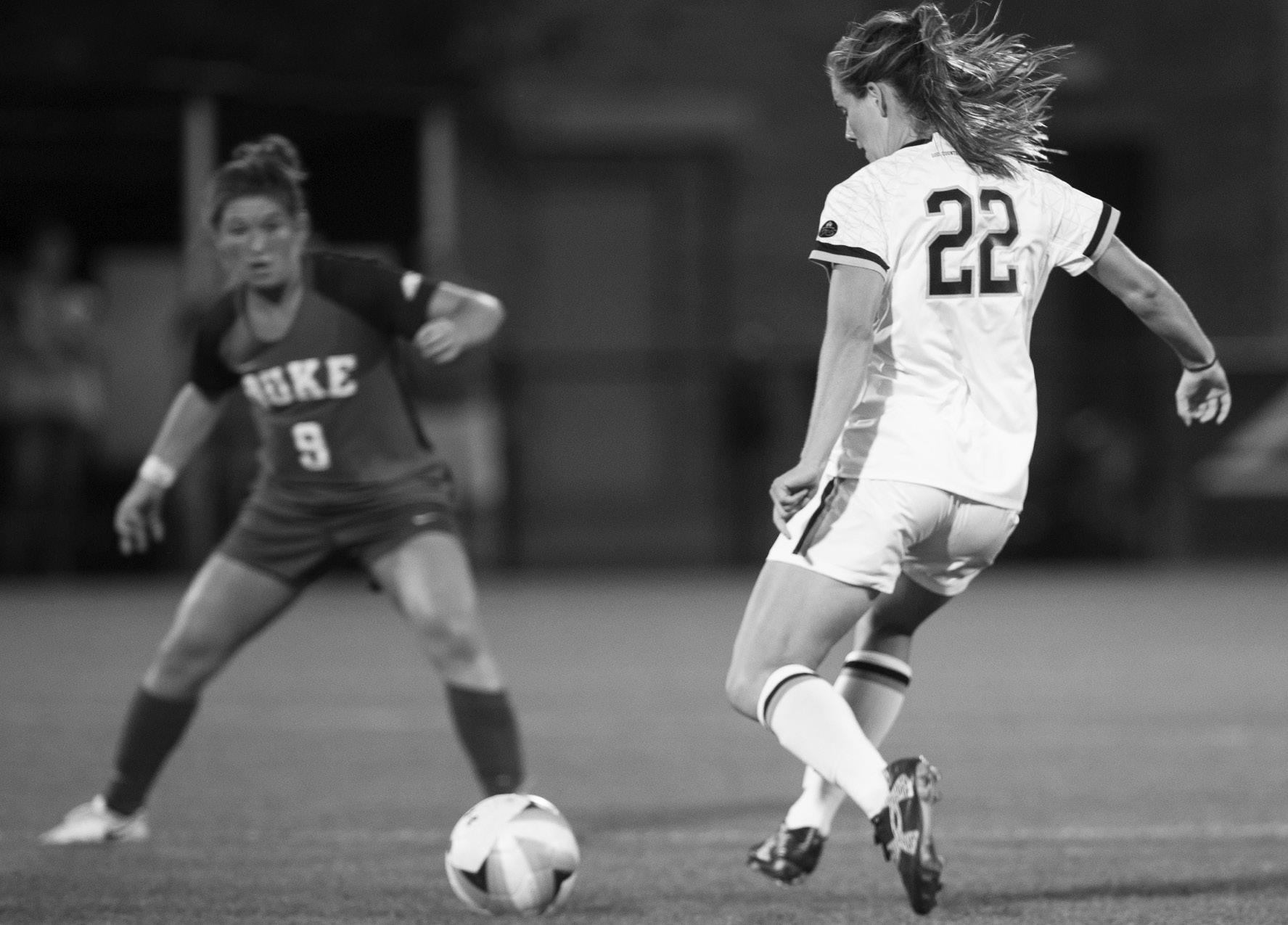
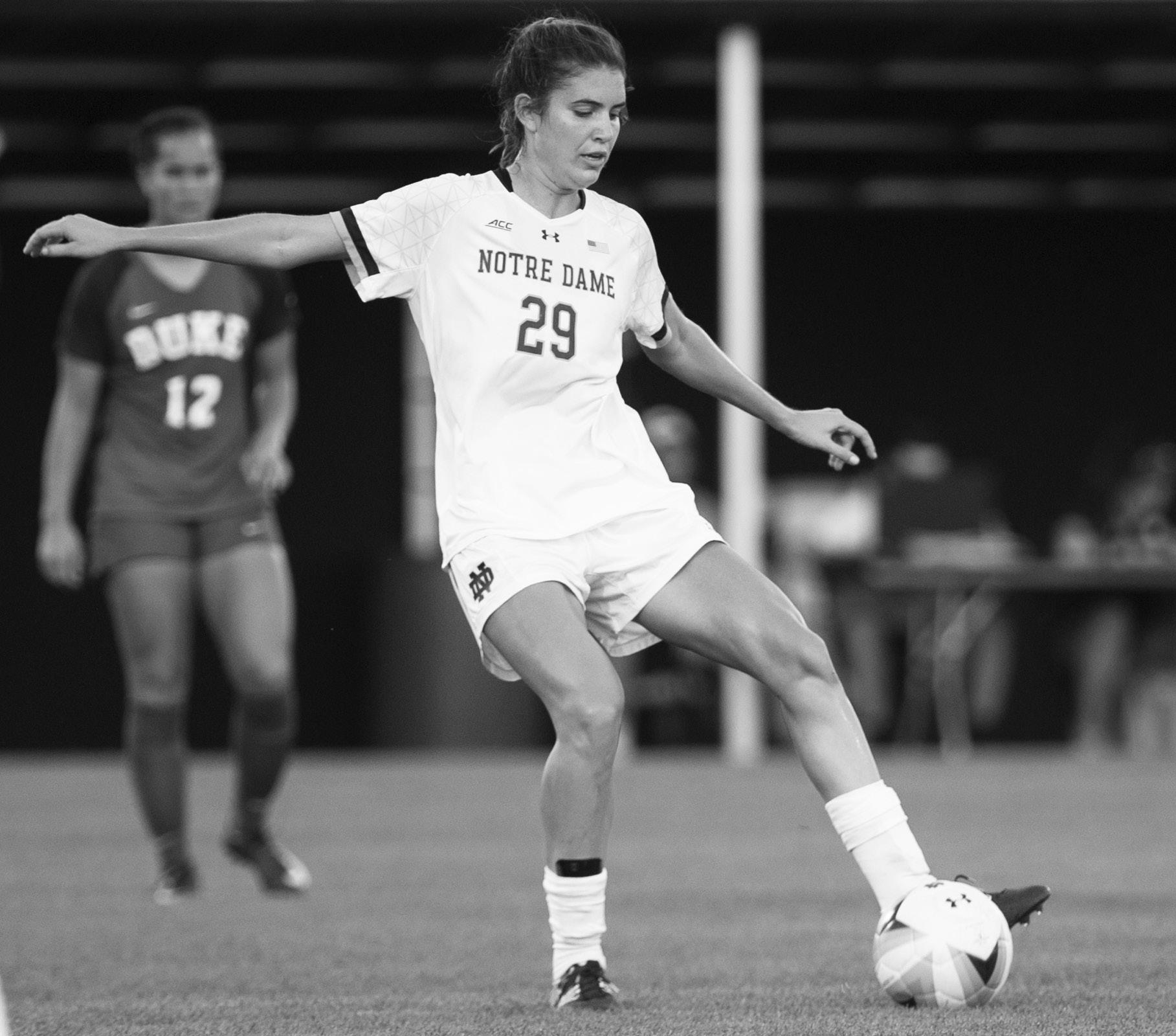
Irish senior midfielder Megan McCashland looks to pass during Notre Dame’s 3-0 loss to Duke on Thursday. McCashland has three shots and two shots on goal so far this season.
ZACH YIM | The Observer
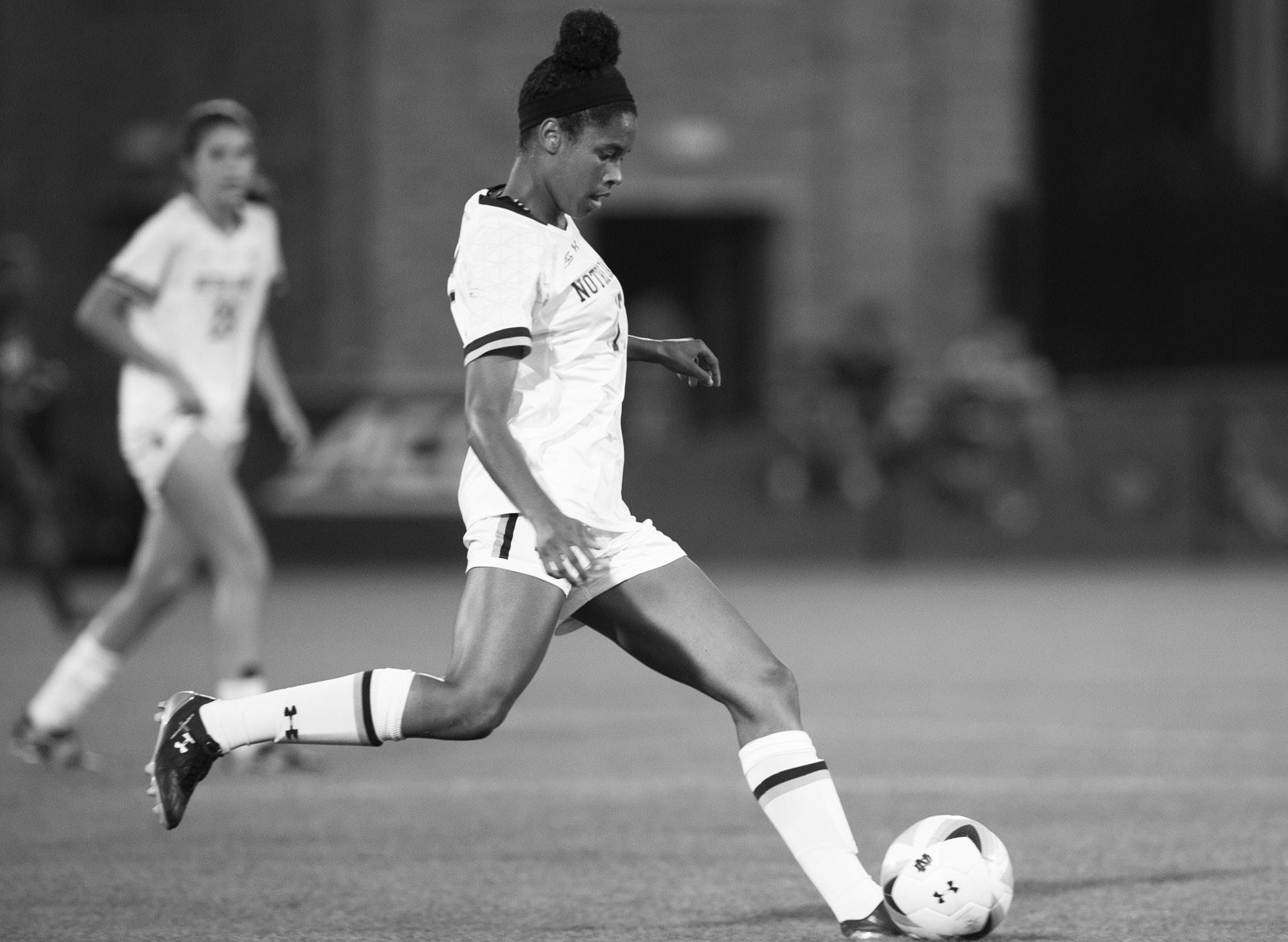
Irish junior defender Rachel Heard kicks the ball upfield during Notre Dame’s 3-0 loss to Duke at Alumni Stadium on Thursday. Heard has one shot on goal so far this season.
Mia Berry sports Writer
well. h e had two good wins and lost a heartbreaker to a very good player from Alabama on Friday. b ut he can still take confidence from that match and obviously to win two rounds in pretty easy fashion against this level of competition was a good thing too.
“... s o like I said, all four guys had strong moments and good things they accomplished, yet all four are probably going back to campus with some things they want to work on and address from now until they compete again next.”
s achire said he liked the improvement he saw in the doubles portion of the competition, but said his team will still work to improve in that area of their game.
“It’s tough because these are four different guys than the ones I was with out in c alifornia, so this was a different group of guys, but we definitely worked on doubles in practice over the last week and I think our guys reflected a little bit of that this weekend and it is still definitely going to be a point of emphasis here in the next couple of weeks,” s achire said. “Again, it is a long time until we start our dual match season in January, so we will have plenty of time to address it, but it is definitely still a concern and definitely something we want to keep working on.”
“I was just really proud of the way all of our guys competed and fought to this point in the fall and we just have to keep getting better and keep being the best that
we can be.”
s achire also said another portion of the game his team will work to improve in is their second serve.
“I think a big thing honestly for a lot of our guys is working on their second serve,” s achire said. “In tennis, to be a really good player, you’ve got to have a very reliable second serve, and I thought we double faulted a little too much this week down here, so I think in particular these guys will be doing a lot of second serve points and addressing that part of their game. You need to be able to not have that be a liability and a weakness in your game. s o I think that was one thing specifically that’s universal to all of these guys coming out of this, so we’ll address it over the next couple of weeks in practice.”
Contact Michael Ivey at mivey@hcc-nd.edu
PAI d AdverTIsemen T
MICHELLE MEHELAS | The Observer
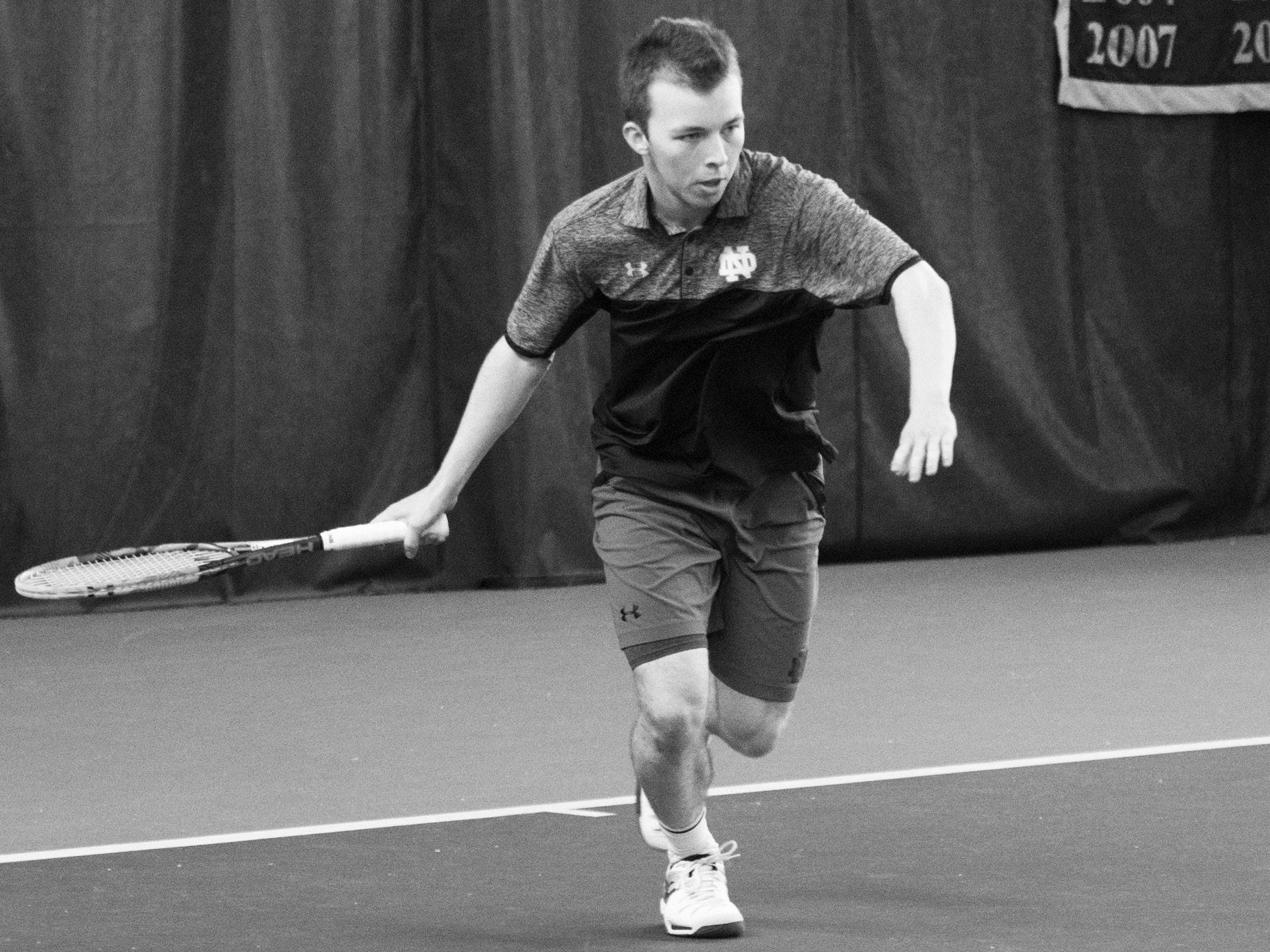
Irish sophomore Matt Gamble looks to hit a forehand during Notre Dame’s 4-1 win over Northwestern on Feb. 24 at Eck Tennis Pavilion. Gamble won his match in the Irish victory.
Irish drop first two ACC contests on the road
Observer Sports Staff
notre dame opened conference play this past weekend, but fell in hard fought five-set matches to both Louisville and north carolina state.
on Friday, the i rish (10-3, 0-2 acc ) dropped their second game of the season on the road at Louisville (7-5, 1-1). a lthough notre dame dropped the first set 25-23, the team rebounded and went on to win the next two sets, with the help of a crucial ace from senior libero natalie Johnson in the second set and senior outside hitter sydney Kuhn’s two straight kills to end the third.
but the i rish were unable to continue their hot streak in the final two sets, as Louisville got out to an early lead in the fourth set which they never gave up to force a fifth and final set. Trailing by four points in the final set, the i rish managed to tie the score at 8-8, but ultimately fell to the cardinals by a score of 15-11. despite dropping the match, Kuhn put on a stellar performance, recording 12 kills and 16 digs along with a season-high five blocks.
on sunday, the i rish looked to bounce back in raleigh, north carolina, as notre dame took on the Wolfpack of north carolina state (7-6, 2-0). i n another tightly contested affair, the i rish went down 1-0 after dropping the first set 25-17. The second set went to the i rish, as they fought back despite an early four point deficit with a 9-1 run to win the set 25-19.
The Wolfpack bounced back to win the third set 25-16 after going on their own nine point run. but notre dame stayed alive, as the i rish persevered to win the fourth set, never trailing and closing out the match to win 25-21.
but in the final set, north carolina state went ahead early and stayed ahead, winning the set 15-7 and the match 3-2. senior middle blocker sam Fry recorded her first double double of the season with 10 kills and 10 blocks to lead notre dame.
The i rish will look to bounce back in the conference next weekend when notre dame opens their conference home schedule with games against m iami on Friday and Florida state on sunday at Purcell Pavilion.
Paid a dverT isemen T
MICHELLE MEHELAS | The Obsever
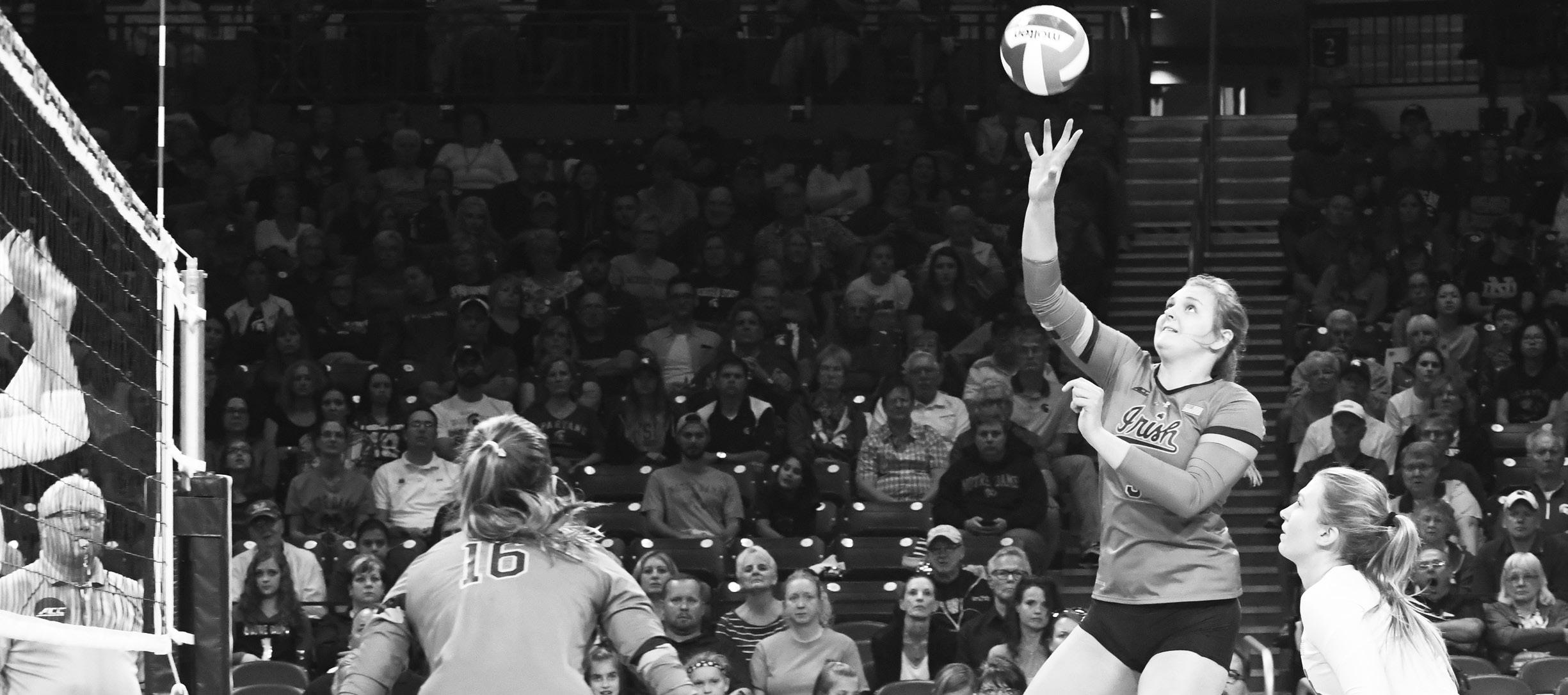
Irish junior outside hitter Rebecca Nunge tips the ball during Notre Dame’s 3-0 win over Michigan State on Sept. 15 at Purcell Pavilion. Nunge had three kills, three blocks and one dig in the victory. She also had nine kills and two service aces in the loss to Louisville on Friday.
men’s tennIs | crimson Tide 4-in-The-fall
Young players find doubles success on road
By MICHAEL IVEY sports Writer
four n otre d ame players competed in the c rimson Tide 4- i n-Thef all Tournament at the University of a labama in Tuscaloosa, a labama this past weekend.
a mong the notable results for the i rish include the doubles pair of junior d aniel r ayl and sophomore c onor s omers, who recorded two wins out of the three doubles matches they played over the weekend. The doubles team of freshman Paul Gota and junior n athan Griffin also recorded a doubles win on s aturday. r ayl, s omers, Gota and Griffin all recorded singles wins during the weekend.
i rish head coach r yan s achire said he was pleased with the performances of his players.
“a s a whole, i thought we did ok,” s achire said. “ i t wasn’t perfect by any stretch of the imagination, but there were certainly some good spots and i think everybody
can take some confidence from certain aspects and certain matches we played this weekend. n ow we have to build on them and try to do better in a couple of weeks when all of these guys play again in our next tournament.”
“ ... We brought four guys down to this tournament. i was really excited about the doubles level from d anny r ayl and especially in c onor s omers as well. They did a really good job in the doubles portion had two good wins, so that was a positive from the event from those guys. The other two guys who were here were Paul Goda, who is a freshman, and he played at a really high level especially for a freshman to come down here. h e played in the top draw with all the best players and he did well. h e won two matches and played really well actually in all four of his matches. Then n athan Griffin was the fourth guy who came down on the trip and he also played really
see m Tennis paGe 10
nd women’s soccer | dUke 3, nd 0; nd 4, nc sTaTe 0
i rish rebound with victory after loss to duke
By BRENNA MOXELY sports Writer
The irish split two conference games at a lumni stadium this past weekend, falling to the no. 4 duke blue devils on Thursday and shutting out no. 24 north carolina state on sunday.
notre dame (6-3-2, 2-1-0 acc) lost their first conference game on Thursday after being shutout 3-0 by a duke defense that has only given up six goals this season.
a lthough coming off a strong victory over clemson in notre dame’s conference opener, the irish offense, which leads the acc in shots, struggled to create chances and were held scoreless for only the third time this season.
The two squads both entered halftime scoreless, but the blue devils (10-1-0, 2-0) pulled away in the second 45 minutes, scoring in the 60th, 74th, and 76th minutes.
With the win, duke pushed its win streak to nine, and pushed notre dame’s home record to 2-2-1 for the year. The irish now have lost two home games this season, and only four in the past three seasons.
but the irish bounced back on sunday by besting north carolina state (8-2-1, 1-1-1) 4-0 on sunday, scoring four goals against a Wolfpack defense that has only allowed four goals prior to facing notre dame.
in a total team effort, notre dame’s offensive unit produced a total of nine shots on goal, while the defense allowed only two shots on goal.
sophomore forward natalie Jacobs scored the first goal of the day in the tenth minute, collecting a cross from graduate student midfielder sandra Yu and putting a shot off of the crossbar and in.
Yu followed this up with a goal of her own at the 31st minute mark, off an assist from junior defender sabrina flores.
a fter the halftime break, Yu added to her daily tally with a goal in the 60th minute, with senior defender monica flores setting up the goal. Yu now has a career-high six goals for the season.
notre dame’s fourth and final goal came only a few minutes later, when Jacobs capitalized on a rebound in the 63rd
MICHELLE MEHELAS | The Observer
Irish junior Alex Lebedev follows through on a serve during Notre Dame’s 4-1 win over Northwestern on Feb. 24 at Eck Tennis Pavilion. Lebedev dropped his match 6-4, 6-4.
ZACH YIM | The Observer
Irish senior midfielder Taylor Klawunder controls the ball during Notre Dame’s 3-0 loss to Duke on Thursday at Alumni Stadium. Klawunder has one shot on goal so far this season.
Turning over T he Spar TanS
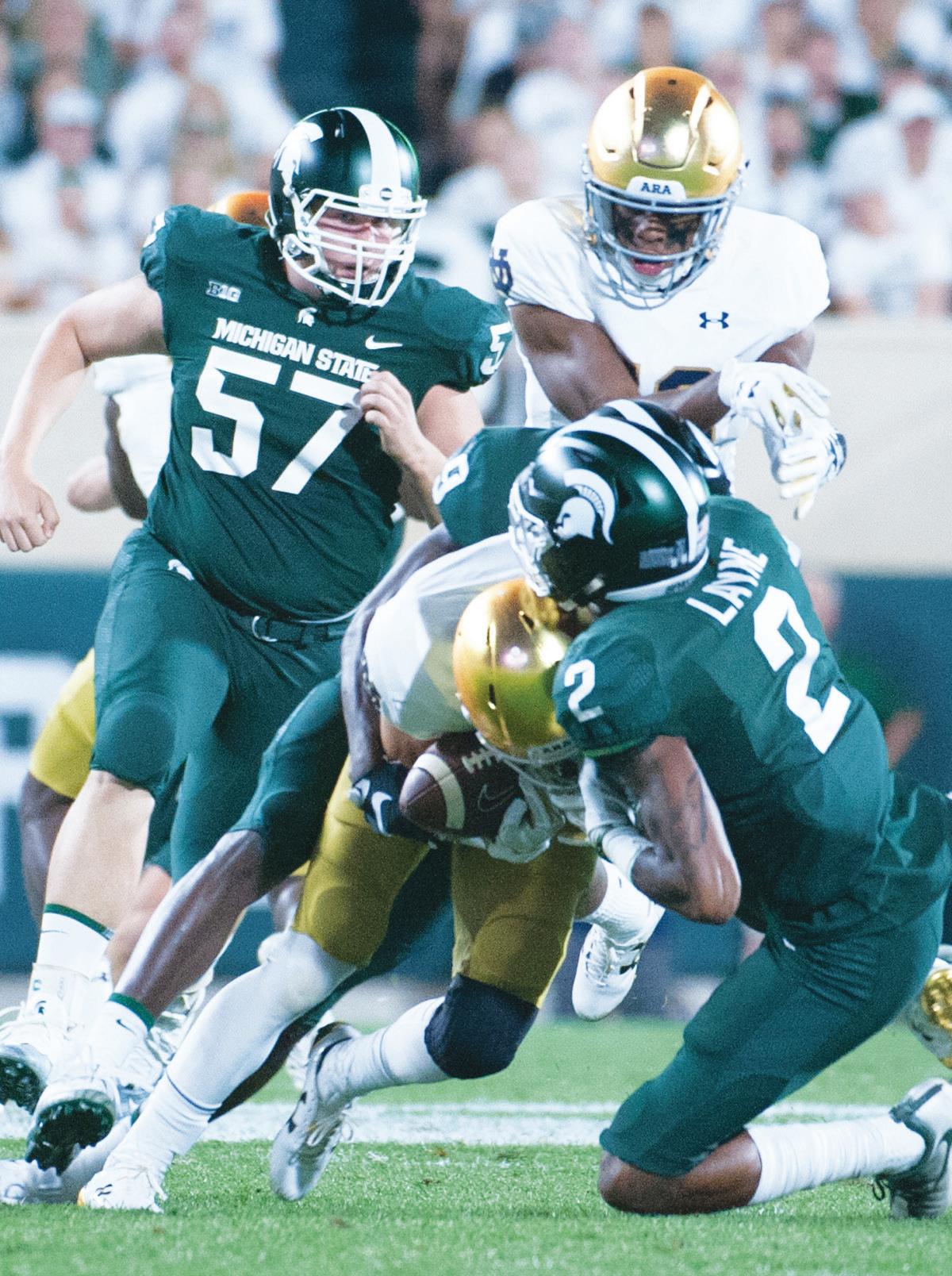
Notre Dame forced three turnovers in the first half, scoring on a pick-six as well as on two drives that followed fumble recoveries. The Irish took a 28-7 lead over the Spartans into halftime and chewed up the clock in the second half en route to a 38-18 victory. With the win, the Irish were able to avenge last season’s 36-28 loss to the Spartans at Notre Dame Stadium.
ROSIE LoVOI | The Observer
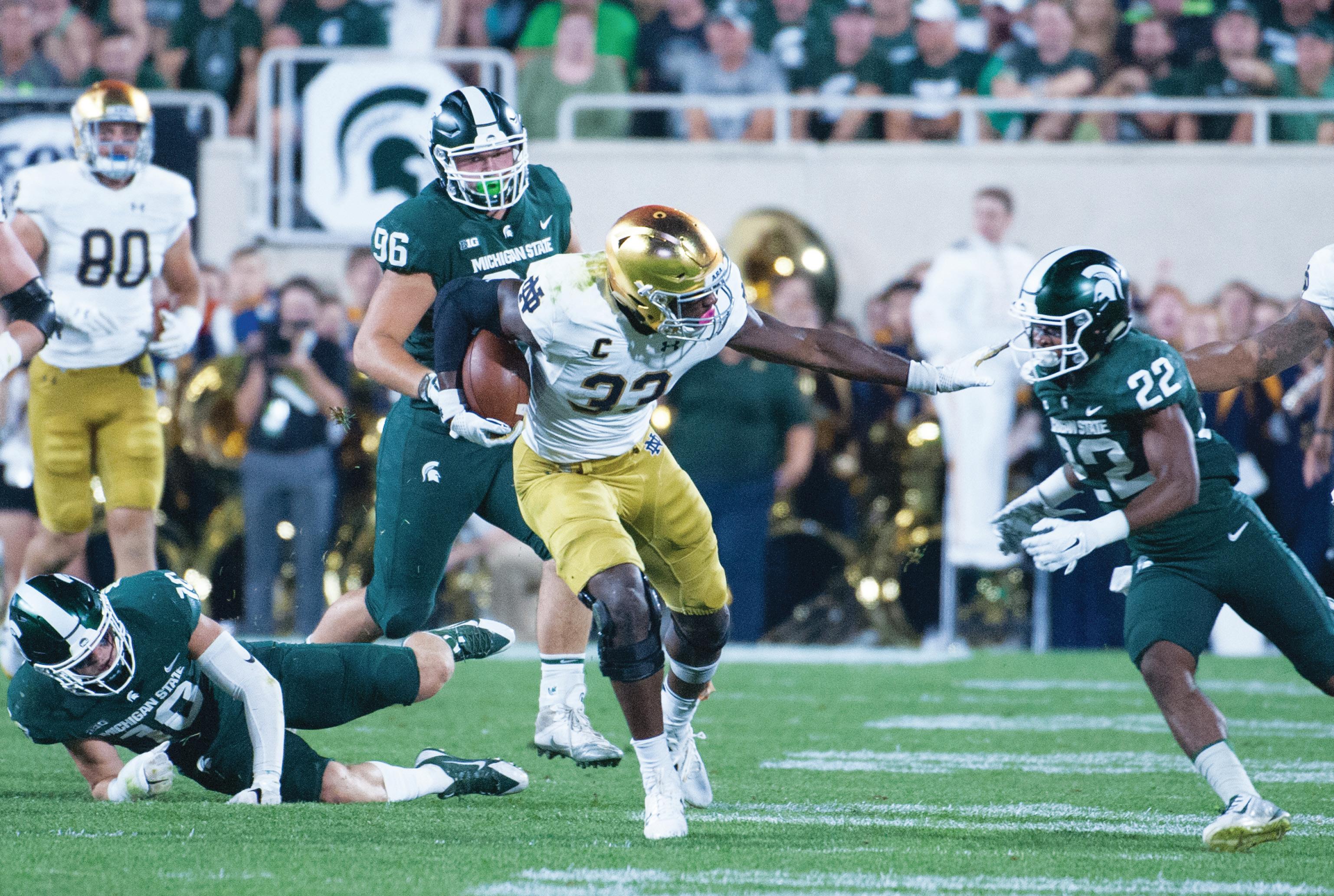
Irish junior running back and captain Josh Adams runs up the field and looks to stiff arm a Spartans defensive back during Notre Dame’s 38-18 win over Michigan State on Saturday at Spartan Stadium. Adams had a team-high 56 rushing yards against the Spartans, and his 499 yards on the ground this season also leads the Irish.
ROSIE LoVOI | The Observer
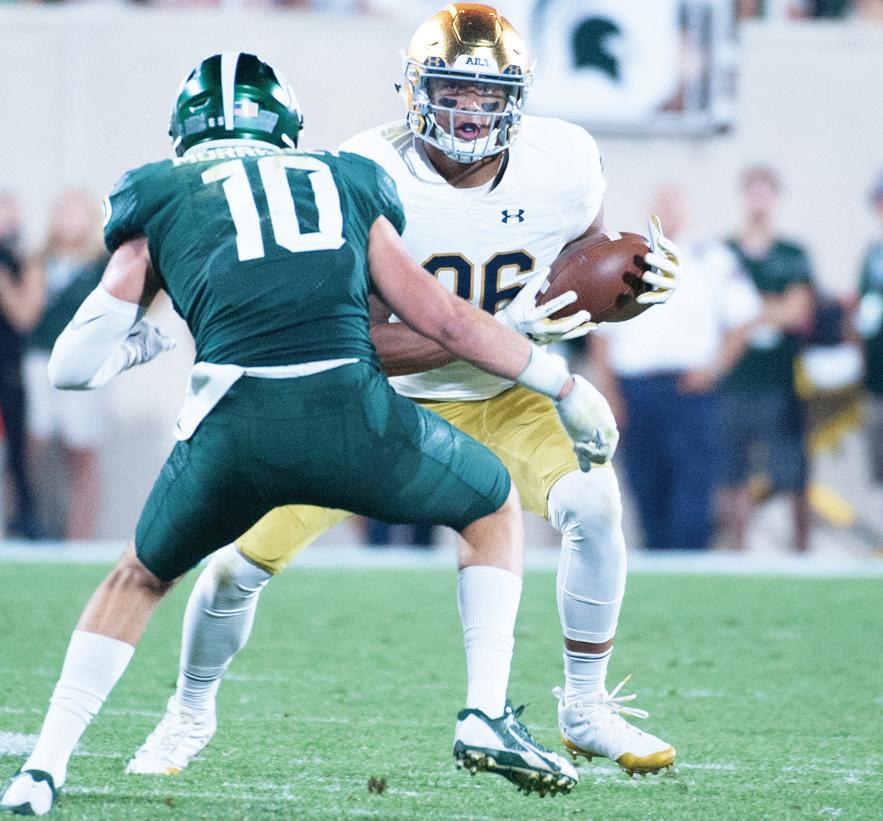
Irish junior tight end Alize Mack looks to elude a defender during Notre Dame’s 38-18 win Saturday.
ROSIE LoVOI | The Observer
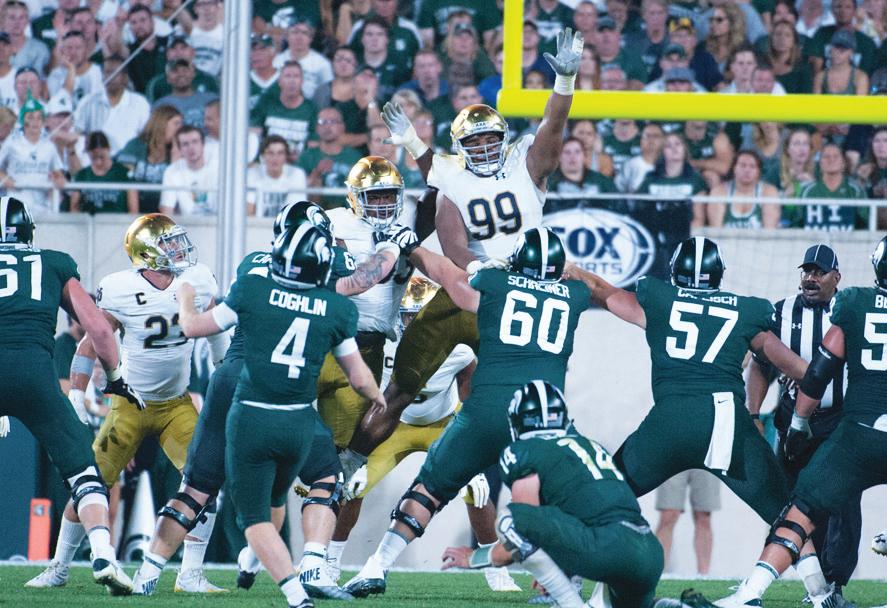
Irish junior defensive lineman Jerry Tillery tries to block a field goal at Spartan Stadium on Saturday.
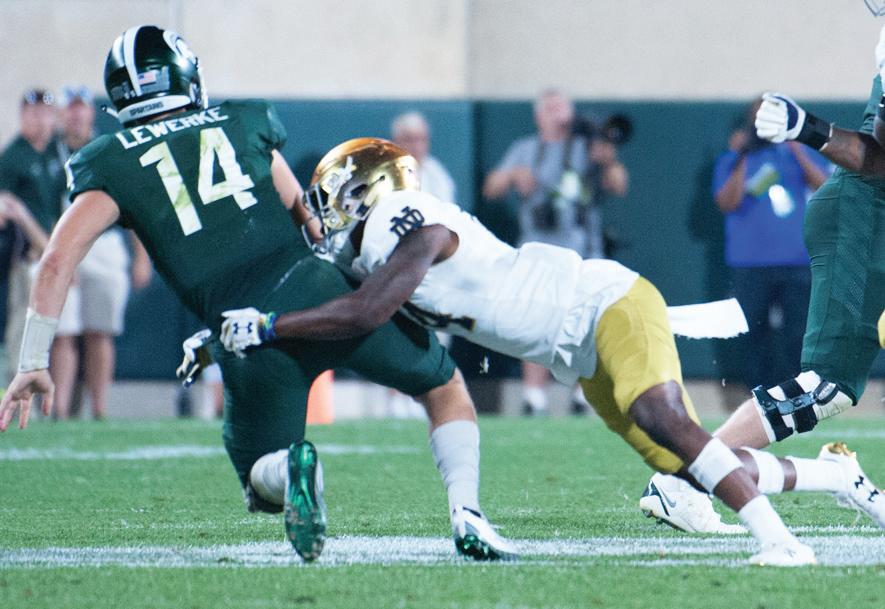
ROSIE LoVOI | The Observer Irish junior linebacker Te’von Coney hurries the quarterback during Notre Dame’s win Saturday.
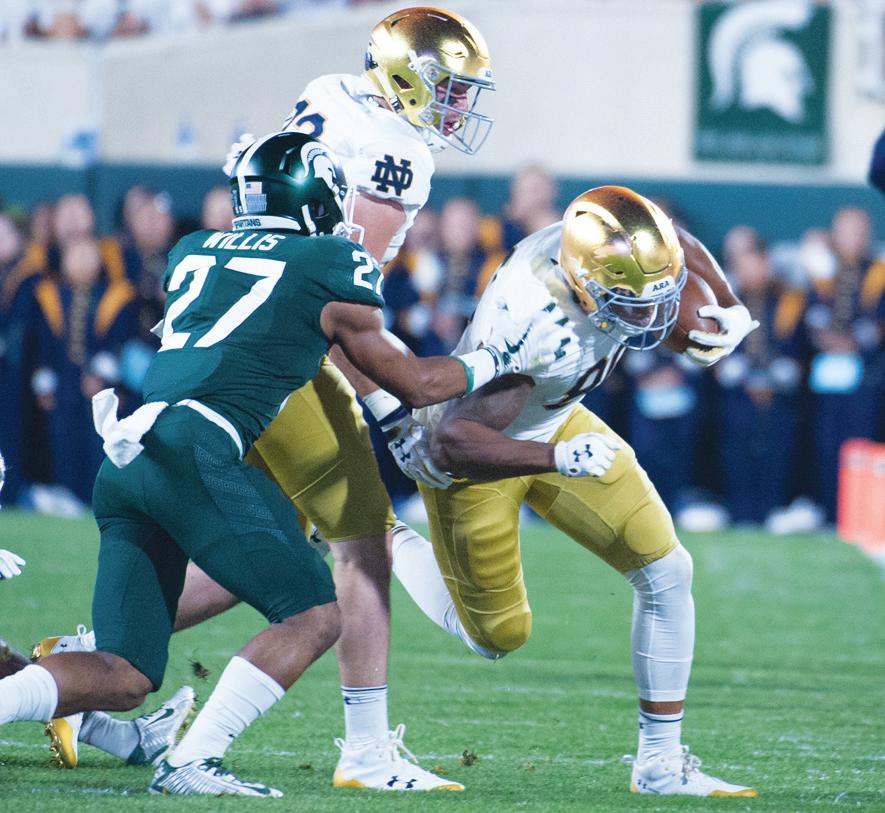
ROSIE LoVOI | The Observer Irish junior wide receiver Chris Finke, center, is tackled by multiple Spartan defenders while returning a punt during Saturday’s game.
ROSIE LoVOI | The Observer Junior tight end Alize Mack tries to get past a defender in Saturday’s game against the Spartans.