“Evangelii Gaudium” emphasizes responsibilities to the poor, presents practical solutions
By ANN MARIE JAKUBOWSKI News Editor
Pope Francis’s recent apostolic exhortation, “Evangelii gaudium,” highlighted many of the economic and social justice issues of today’s world and prompted reactions from critics worldwide.
William Purcell, associate director for Catholic Social Tradition and Practice at the Center for Social Concerns, said the pope “is not being an idealist, but a realist with ideals.”
Purcell said the apostolic exhortation’s contents are both prescriptive and intellectual, focusing largely on pastoral theology and how the Church can
engage and shepherd people.
“Francis addresses [“Evangelii gaudium”] to the whole people of god, so not just to the laity, but also to the bishops, clergy and religious,” Purcell said. “he’s talking to the leaders at all levels, including lay leaders … and he’s challenging us to find creative ways to share the key emphasis of god, which is love.”
Many of the critiques of and negative reaction to the text are “short-sighted,” Purcell said, misunderstanding the context of the pope’s statements and its background in Catholic Social Tradition. One notable criticism came from talk-show host Rush Limbaugh, who said Francis’s ideas were “pure Marxism” in
a Nov. 27 show about the document, titled “It’s Sad how Wrong Pope Francis Is.”
Purcell said people should remember that the pope is writing about theology, not ideology.
“What he’s really talking about is joy — that’s what ‘gaudium’ means,” Purcell said. “he’s talking about how we’re called to evangelize and that nobody likes a grim do-gooder.
“What he’s saying is that we’ve got to be joyful about it, we’ve got to be embracing it. We should attract people by our actions, and so we should be joyful and life-giving.”
The apostolic exhortation is
By CHRISTIAN MYERS News Writer
Prof. studies brain trauma Alumna named Mitchell Scholar
Research professor Mayland Chang is taking to heart the maxim “a mind is a terrible
thing to waste” in two ways, as she uses her mind to the fullest by working to develop a
treatment for traumatic brain injury (TBI).
Chang, director of the Chemistry-BiochemistryBiology Interface (CBBI) Program, said she and other researchers have been studying a group of 27 enzymes called Matrix metalloproteinases (MPPs) for more than a decade. She said the team has found a promising use for one of these enzymes, Matrix metallopeptidase nine (MPP-9), in treating TBI.
“We thought that this group of enzymes would be important for many diseases. Not
much was known, so we started making inhibitors,” Chang said. “It turns out MPP-9 plays a critical role in the pathology of TBI.”
Chang said every case of TBI essentially can be divided into two injuries, each with different effects.
“you have the primary injury, the blow to the head,” Chang said. “There is absolutely nothing you can do for the brain cells that die in the primary injury. This is followed by a cascade of events, starting with
By EMILY McCONVILLE News Writer
On Nov. 25, The u.S.-Ireland Alliance announced a 2008 Notre dame alumnus is one of this year’s Mitchell Scholars and will receive a full scholarship to a one-year Master’s program in Ireland.
According to her biography on
Molly hayes, a Kenya desk officer at the u.S. department of State who graduated from Notre dame with degrees in English and Arabic, was one of 12 people selected from a pool of 300 applicants.
Students showcase international research
By GABRIELA MALESPIN News Writer
Eight students who did research in underdeveloped countries, through various university programs, displayed their research projects in the geddes Coffee house on Tuesday. Students investigated various topics such as cultural identity, rehabilitation of marginalized populations, education and globalization.
Professor Vania SmithOka, assistant professor of
Anthropology, was responsible for mentoring the group of students and teaches the course cultural difference and social change, a three credit course designed for students who have completed study or research abroad that helps students understand their experience in an academic context.
“[The course] is an experience for them to make academic sense of what they’ve witnessed. This public presentation is a way for people to get interested in their experiences,” Smith-Oka said.
The projects ranged from examining the relationships between language and cultural identity to health care implementation to investigating the role of masculinity in sex trafficking, among other topics. The locations included guatemala, Tanzania, uganda, Mexico and Thailand, among other sites. Smith said students who engage in this type of research typically take the initiative afterward to undertake in-depth
Photo courtesy of Nikki Charter
Pope Francis greets the crowd in Saint Peter’s Square for his inaguaration mass in March. Since, the pontiff has received much criticism.
EMMET FARNAN | The Observer
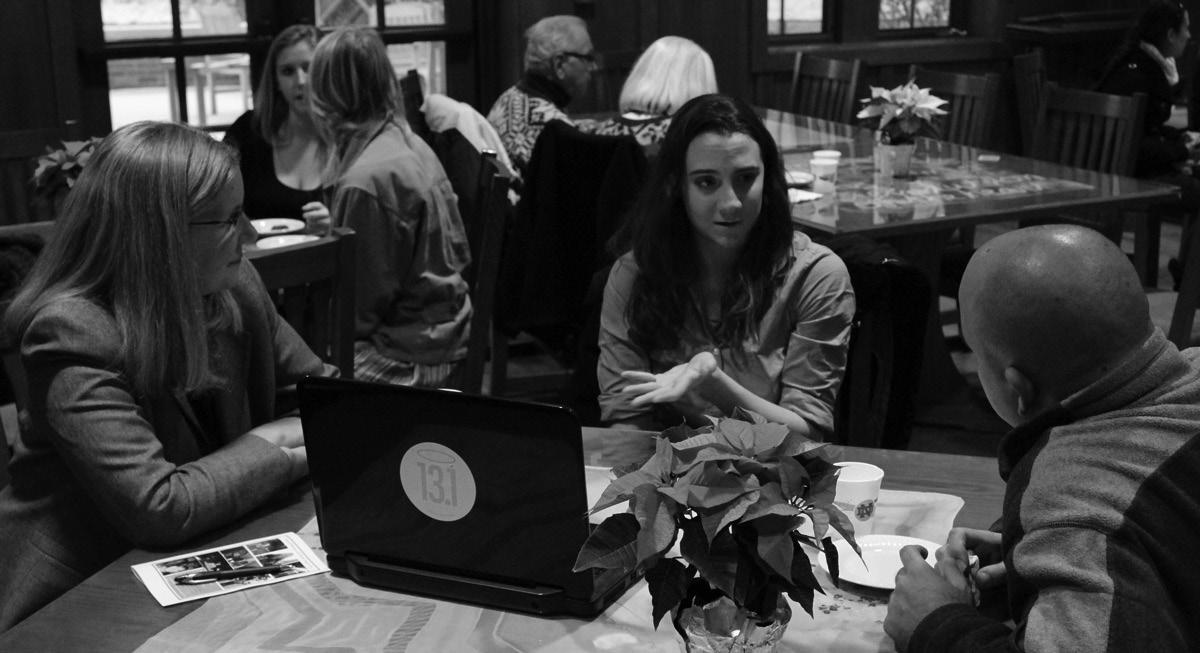
Students discuss their research on topics like cultural identity and education in underdeveloped countries in Geddes Coffee House.
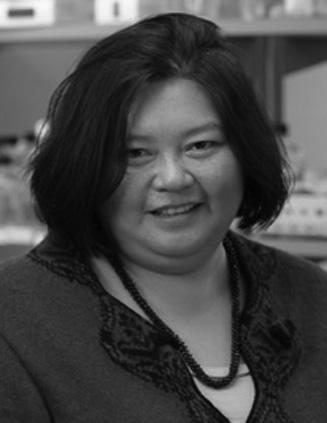
Mayland Chang research professor
see FRANCIS PAGE 4
Saint Mary’s Desk krabac01@saintmarys.edu
Photo Desk (574) 631-8767 obsphoto@gmail.com
Systems & Web Administrators (574) 631-8839
Question
Louann
Jae
Joyce Choe junior Ryan
“Food
Katie
Jessica Creager sophomore Lewis hall
“g oing home after finals.”
Amber Watson freshman Ryan hall
“New year’s Eve.”
Today’s Staff
News
Corrections
The Observer regards itself as a professional publication and strives for the highest standards of journalism at all times. We do, however, recognize that we will make mistakes. If we have made a mistake, please contact us at (574) 631-4541 so we can correct our error.
Men’s Basketball
Insights from Foresight Mendoza College
5 p.m.-7:30 p.m.
A showcase of student projects.
Fall
7 p.m. and 8:30 p.m. Family
Talk: Pentecostalism in Prison in Rio de Janeiro O’Shaughnessy Hall 11:45 a.m.-1:15 p.m.
University celebrates Advent with Las Posadas
By CHARLIE DUCEY News Writer
Among the Advent traditions celebrated on campus this season is Las Posadas, a procession that celebrates the journey of Mary and Joseph to the birthplace of Christ.
Three residence halls are hosting the event this week, the final part of which will start at the g rotto at 9 p.m. tonight and end at Farley h all.
Las Posadas, which means “lodgings” in Spanish, is a Christmastime tradition that originated in Spain and is now celebrated annually in Mexico, the southwestern united States and Latino communities in Central and South
America.
Elaine d eBassige, rector of Farley h all, said she grew up with the tradition of Las Posadas in New Mexico and wanted to ensure that the tradition became a part of Notre d ame’s Advent season.
“Notre d ame has held Las Posadas celebrations in years past, but usually it was just one night out of the year, and I don’t think it has been this organized,” d eBassige said.
In traditional Las Posadas observances, two individuals dressed as the holy couple lead a candle-lit procession to the home of a local family, who hosts a meal and prayer. A priest will normally bless the home and lead the
prayer service, which often takes place on nine successive nights leading up to Christmas Eve Mass, with Mary and Joseph walking down the church aisle to meet the Christ child at the crèche.
“The celebration is usually a novena,” d eBassige said. “Nine families will host the event in community, but we decided it would be easier to have only three dorms host this week.”
Keenan h all hosted the event Monday night, followed by howard h all on Tuesday night. Farley h all will host the final procession tonight.
The Keenan h all procession began with prayer at the g rotto, followed by a
procession featuring traditional music in Spanish, sung by the student group Coro Primavera.
Afterward, Ofelia Juarez, a Keenan h all housekeeper, and several of her family members prepared traditional Mexican tacos for the attendees.
Keenan h all rector Noel Terranova said Juarez has offered her cooking expertise for such events in the past.
“Ofelia is part of our family,” Terranova said. “She cooked for our Las Posadas celebration last year. She brings her family, her sons and grandchildren.”
As part of the procession, freshman h alie Berrigan from Farley h all dressed up as Mary
and freshman Luke Joseph from Siegfried h all dressed up as Joseph. The two said they agreed to don the costumes for Las Posadas at the request of d eBassige.
“We have a Monday night tradition where we have Mass and she feeds us, so she asked if we wanted to be Mary and Joseph,” Joseph said.
Las Posadas was new for many students who took part in the event, including Berrigan.
“I hadn’t heard of Las Posadas,” Berrigan said. “It’s a new tradition for me, and it’s cool to be a part of it.”
Contact Charlie Ducey at cducey@nd.edu
to the blood-brain barrier, that result in the secondary injury. The secondary injury is linked to long term problems, including coma and death.”
MPP-9 contributes to the secondary injury by cleaving tau proteins, so inhibiting MPP-9 can prevent the cascade of events leading to the secondary injury, Chang said.
Chang said she has personal
“It’s very challenging for drugs to cross the barrier and reach therapeutic concentration.”
Mayland Chang research professor
reasons for seeking an effective TBI treatment. her mother passed away as a result of a severe TBI in 1997 at the age of 70, having slipped and hit her head on her patio. Chang said she is also motivated by the threat of TBI her son faced as a competitive snowboarder.
Chang said no therapeutics for TBI currently exist because of the nature of the condition and reluctance on the part of pharmaceutical companies.
“There are no existing
therapeutics for TBI because of the difficulty of getting compounds through the brainblood barrier and because TBI is an acute condition and ‘big pharma’ is more interested in chronic conditions. … Big pharma is not really working on diseases like this,” she said.
Chang said her research group has been fortunate that the compounds they use effectively cross the blood-brain barrier, something more than 98 percent of drugs are incapable of doing.
“It’s very challenging for drugs to cross the barrier and reach therapeutic concentration,” she said. “We are lucky with the compounds we have, which are able to cross the barrier on their own.”
Chang said one of the biggest challenges has been maintaining this quality while also making the compounds more water-soluble. Water solubility enables the compounds to be injected, which is important, given that many patients with TBI are unconscious or otherwise unable to swallow.
The most recent version of the treatment compound is working in animal models, specifically, mice, in terms of both water solubility and penetrating the blood-brain barrier, Chang said.
Contact Christian Myers at cmyers8@nd.edu
group reviews OrgSync
By ALAINA ANDERSON News Writer
Saint Mary’s student senate met Tuesday night and discussed all the possibilities available on OrgSync, the website used to facilitate club registration at Saint Mary’s.
The student involvement and multicultural services office (SIMS) conducted the presentation on OrgSync.
Stephanie Bridges, director of SIMS, said the purpose of the SIMS office is to help and support Saint Mary’s students.
“We provide support for 70 plus student organizations on campus, which is a huge, huge job,” Bridges said.
The SIMS office is in charge of OrgSync, which was created at Saint Mary’s last year to give electronic support for student organizations. Bridges said SIMS wanted to make things as paperless as possible and make it easier to manage all the different things for which the SIMS office is responsible.
“It has been tremendously helpful for our offices to navigate the processes that
Showcase
field work, write senior theses, present at National conferences or go on to do graduate work.
“They’ve usually been life changing experiences, going from a more sheltered life at Notre dame to being able to witness disparity and marginality” Smith said.
Senior Rachael Krishnan researched the rehabilitation of sex workers in Kampala, uganda, and said that the experience enabled her to understand the dynamics between politics and
we have,” she said.
Assistant director of SIMS, Bianca Tirado, explained what OrgSync is and how to operate it.
“OrgSync is a way to help students connect with your organization. It’s also a way to create online communication so that it hits a broader audience,” she said.
“The belle tower is the home page of OrgSync which is accessible to everyone in the SMC community.
“It’s a great way for you to access your organization portals. If you’re a part of more than one club you can access those additional portals as well.”
Not only is there an internal website, but there is also an external website of OrgSync, which allows students to control what the external world can see. Student organizations can create their own external websites by creating a portal, and every new club can have a new portal on Belle tower.
Students can also register events for their organization on OrgSync, Tirado said. In order to create an event, a student would need to fill
vulnerable populations.
“I’ve gained a lot of skills in qualitative research, but I feel as if what I’ve gained is being able to view the world in a more culturally appropriate lens,” Krishnan said.
Senior Katy gorentz, who researched disability and identity in Sierra Leone, said her research brought both a new medical and new cultural perspective to her studies.
Junior Katie hamel, who researched language and identity in Amatlan, Mexico, said the experience helped her visualize the extent of social change needed to
out the event request form under the SIMS portal. This event registration spurs the merchandise request process as well.
“It’s best you make sure you do have a table [for your merchandise] and do it in a timely fashion,” she said. “If you want to sell something next week, it’s better you get it in as soon as possible.”
Tirado said, when selling merchandise, anything with a French cross symbol has to be approved by the SIMS office as well. The French cross is a religious symbol, so it cannot be obstructed by anything.
SIMS assistant director g raci Martsching said OrgSync is new but has already had a lot of success. She said SIMS hopes to raise awareness about the opportunities OrgSync and their office offer for students.
“The most important thing to remember is we are your advocates, we are here for you guys,” Martsching said. “ you can always come and knock on our doors.”
Contact Alaina Anderson at aander02@saintmarys.edu
resolve struggles faced by people in rural areas.
“I’ve gained a shift in my world view from the experience. I realized that people who live in rural areas face struggles that are difficult to overcome without larger changes in social structure” said hamel.
The student projects were funded by the CSC, the glynn Family honors Program, the Institute for Scholarship in the Liberal Arts and other funding entities.
Contact Gabriela Malespin at gmalespi@nd.edu
the first thing Francis has written completely on his own during his papacy, and Purcell said it pres-
“His insight comes from talking about these things in a new style, in an uplifting way, so people see the power of what we’re called to do.”
Purcell
William
associate director Center for Social Concerns
ents his vision of what the Church is about, speaking from his position as the head of the institution.
“I think it’s exciting because people have been taking notice,” Purcell said. “Some people react to it out of their ideology and not their theology, and people struggle with some of the things he’s talking about.”
Purcell said throughout the document, Francis quotes bishops from across the world, as well as past popes and saints. Because of this, the content “isn’t new, but part of our tradition.”
“his insight comes from talking about these things in a new style, in an uplifting way, so people see the power of what we’re called to do,” Purcell said. “he becomes so welcoming, so charismatic, and he speaks to the common person.
“It doesn’t become esoteric or dense, because he’s speaking to the person in the pew. People can read this and understand it … and I think they get excited by it.”
The four main themes of the text are joy, poverty, peace and justice, Purcell said. Beyond the thematic theological elements, Francis “becomes prescriptive and deals with real, concrete ways of addressing problems,” he said.
“The beauty of the exhortation is that he writes so well, and he writes so positively and so openly,” Purcell said. “This is a pope who is a Jesuit, so he’s a thinker. There are ideals of things like solidarity and the common good, but he’s being a realist about how we try to address those things.
“he gives concrete examples; he names saints or people or particular things so it doesn’t just become words like ‘solidarity,’ but you get the stories and symbols and scripture behind that makes it come alive.”
To best utilize the document’s wisdom, Purcell said parishes need to find a way to break it into parts and find pastoral applications for it.
“It’s too much to swallow all at one time, because it’s so rich and there’s so much good within it,” he said. “But it’s fun to look at since [Pope Francis is] just so positive, and he speaks so directly. he’s prophetic, but not obnoxious.”
Contact Ann Marie Jakubowski at ajakubo1@nd.edu
CONTIN u E d FROM PAgE 1
the Mitchell Scholars website, hayes has worked as desk officer for multiple North African nations, and she was a deputy coordinator for the Egypt Task Force during the Arab Spring.
during hayes’s time at Notre dame, the biography said, she founded Nd-Abroad, which worked to help students studying abroad and “developed a university Counseling Center support group for students who experienced trauma abroad.”
hayes plans to study postcolonial and world literature at National university of Ireland, Maynooth, according to the biography.
dr. Jeffrey Thibert, assistant director of National Fellowships at the Center for undergraduate Scholarly Engagement (CuSE), said the award, which is on par with the Rhodes and Marshall Scholarships, will bring prestige
to the university.
“These are the kinds of things that raise the academic profile of an institution and really enhance Notre dame’s reputation as a world-class research institution, and really is providing a world-class undergraduate education,” Thibert said. “I think, especially in Molly’s case, it’s a testament to the kind of … education she received here that helped her to achieve such great things in the past four to five years since she left.”
Thibert said the award also raises the profile of CuSE, through which hayes did research when she was an undergraduate.
“There are a lot of opportunities here, in part through CuSE, but also through other groups on campus to receive funding for undergraduate projects, undergraduate research of all different kinds,” he said. “I’ve been at a few other institutions, and I’m amazed at how much
support there is for that here, so I would really encourage people to take advantage of that.
“[doing research through CuSE] contributed, in a sense, to her winning this award, but it also contributed to her being able to get into the kinds of positions she got into with the State department. And I think that made a really big difference in her application to have these kinds of experiences, which she might not have been able to have if she had not had the opportunities she had here.”
Thibert said while some scholarship applications require university endorsements, the Mitchell Scholars Program does not. he said his office worked with her on other aspects of the application.
“We mostly worked on interviewing advice,” Thibert said.
Thibert said he also hopes the fact that hayes won the scholarship will raise awareness of the opportunities Notre dame alumni have, even after they graduate.
“We’re trying to do more to reach out to these alumni to get the word out about some of these awards, because sometimes people think when they graduate, that’s kind of it,” he said. “Even if they know they’re eligible for certain things, they don’t realize they can still work with us, but they can. As long as someone graduated from here, we are happy to work with him [or her].”
“We have sort of a database of information from past years because we’ve had people interviewing for these things and there’s also a fellowship adviser organization that collects information on these things. We were giving her some advice on what to expect from the semifinalist interview and then from the finalist interview.”
Contact Emily McConville at emcconv1@nd.edu
Violence increases in CAR civil strife
Associated Press
BANguI — More than 500 people have been killed over the past week in sectarian fighting in Central African Republic, aid officials said Tuesday, as France reported that gunmen killed two of its soldiers who were part of the intervention to disarm thousands of rebels accused of attacking civilians.
Aid workers have collected 461 bodies across Bangui, the capital, since Thursday, said Antoine Mbao Bogo of the local Red Cross. But that latest figure does not include the scores of Muslim victims whose bodies were brought to mosques for burial.
The government of the predominantly Christian country was overthrown in March by Muslim rebels from the country’s north. While the rebels claimed no religious motive for seizing power, months of resentment and hostility erupted last week in a wave of violence.
The French deaths came as French President Francois hollande arrived for a visit to France’s former colony, heading into the tumultuous capital after attending a memorial in South Africa for Nelson Mandela.
“The mission is dangerous. We know it,” hollande told troops in a huge airport hangar
after paying respects at the coffins of the two young soldiers. “But it is necessary in order to avoid carnage.”
President Michel djotodia condemned the attack on the French forces and blamed former leader Francois Bozize, whom he ousted from power in March, for creating the turmoil now being unleashed on the streets of Bangui. Some 100,000 people have been forced from their homes, aid officials say.
The early French casualties underscore the volatility of the mission to disarm combatants and bring stability to a largely anarchic capital. A mob on Monday stoned to death a suspected enemy in the street, and armed fighters have abducted and killed hospital patients.
Tensions flared again Tuesday as a mob of young men set fire to a mosque in the Fou neighborhood of Bangui. Smoke billowed from smoldering vehicles nearby, and young men used pick axes and whatever tools they found to try to tear down the walls of the mosque.
Elsewhere, citizens killed three suspected ex-rebels in the Miskine neighborhood of Bangui after the men apparently fired weapons at civilians, residents said.
President djotodia said Tuesday that former leader
Bozize and his supporters had set the stage for the crisis months ago.
“The current situation is the logical result of what former President Bozize set in motion by freeing prisoners and bandits, distributing weapons of war and machetes in the neighborhoods of Bangui, and inciting tribalism and religious hatred,” djotodia said.
Bozize was overthrown after a decade in power and his current whereabouts are unknown. The former president maintains it was the arrival of thousands of rebels who descended upon the capital with arms who created the chaos.
The government of Central African Republic, a predominantly Christian country, was overthrown in March by Muslim rebels from the country’s north. While the rebels claimed no religious motive for seizing power, months of resentment and hostility erupted last week in a wave of violence that left more than 500 people dead. The local Red Cross said Tuesday its toll alone had grown from 394 to 461.
France now has some 1,600 troops on the ground in Central African Republic, patrolling neighborhoods and trying to disarm militants from the Seleka rebel movement that forced the president into exile and installed their own leader Michel djotodia as head of state.
The two French troops were part of a team inspecting a neighborhood just over a kilometer (less than a mile) east of Bangui’s airport at about midnight Monday, in preparation for a disarmament operation, French military spokesman Col. gilles Jaron said in Paris.
Five to 10 gunmen opened fire on the French patrol, which returned fire, he said. Two Frenchmen were wounded but died in the hospital. It was unclear whether anyone else died in the clash.
Jaron described “sporadic fire” around Bangui and occasional clashes since the French disarmament efforts got under way Monday. France has described the program as a key part of its bid to stabilize Bangui, a city awash in weapons after years of rebellions and coups.
And France’s defense minister has warned militia groups to disarm peacefully — or French troops will do it by force.
“The launching of the disarmament operation of ex-Seleka in the city is an encouraging first stage in the effort to secure Bangui,” said Thibaud Lesueur of the International Crisis group. “From now on they should move to disarm the Seleka combatants who are in the neighborhoods and find the caches of weapons that are still numerous in the city.”
Two deaths within days of the operation beginning marks a significant toll compared to France’s mission in Mali earlier this year. A total of seven French soldiers have been killed there since January as a French-led African force routed al-Qaida-linked extremists controlling the north.
French officials have warned of the dangers of the enhanced military mission alongside African union troops in Central African Republic, authorized under a muscular mandate approved last week by the united Nations Security Council.
URUGUAY
uruguay legalizes retail pot
Associated Press
MONTEVIdEO — uruguay’s Senate gave final congressional approval Tuesday to create the world’s first national marketplace for legal marijuana, an audacious experiment that will have the government oversee production, sales and consumption of a drug illegal almost everywhere else.
The vote was 16 to 13, with the governing Broad Front majority united in favor. The plan now awaits the signature of President Jose Mujica, who wants the market to begin operating next year.
Two-thirds of uruguayans oppose a government-run marijuana industry, according to opinion polls. But Mujica said he’s convinced the global drug war is a failure and feels bureaucrats can do a better job of containing addictions and beating organized crime than police, soldiers and prison guards.
“Today is an historic day. Many countries of Latin America, and many governments, will take this law as an example,” cheered Sen. Constanza Moreira, voting with the Broad Front majority.
uruguay’s drug control agency will have 120 days, until midApril, to draft regulations imposing state control over the entire market for marijuana, from seed to smoke.
Everyone involved must be licensed and registered, with government monitors enforcing limits such as the 40 grams a month any adult will be able to buy at pharmacies for any reason or the six marijuana plants that license-holders will be allowed to grow at home.
Congress’ lower house approved the bill in late July, and senators rejected all proposed amendments, enforcing party discipline before Tuesday’s debate to assure the outcome.
Former health Minister Alfredo Solari, a Colorado Party senator, warned Tuesday that children and adolescents will more easily get their hands on pot and that “the effects of this policy on public health will be terrible.”
But Sen. Roberto Conde, a former deputy foreign minister with the Broad Front, said marijuana “is already established in uruguay. It’s a drug that is already seen as very low risk and enormously easy to get.”
“This is not liberalization of marijuana. It can be consumed within certain parameters established by law. I think it will reduce consumption,” Sen. Luis gallo, a retired doctor who favored the bill, told The Associated Press.
Feminism is for everyone
Finding my voice
Zachary Llorens Photographer
I am not a writer, but I love to share stories and capture moments that take your breath away. Working at The Observer has allowed me to do just that.
Early in the semester, I heard through the grapevine about the photo department and was compelled to join. I have always been interested in photography but really never had the extra time to go out and shoot as much as I would have liked. Picking up the camera as a parttime job for this newspaper has been a completely liberating experience for me.
While others at the paper share information, messages and opinions through words, our photo staff complements reporters’ stories with ideas of our own, in images. We do our best each and every day to freeze a moment, to make a lasting impression on the viewer.
There is no clean-cut definition for what makes the perfect picture, but there are a few things we look to get out of every shoot. First, we check exposure: Is it too dark, too bright, or just right? If it passes that first test, we go on to verify its focus: Is it sharp, and are the faces clear?
Next, we check content. Quite a few pictures that pass the first steps fail to make an impact on the viewer. Really, we look for pictures that elicit reactions from viewers. A diving catch and spectacular dunk can have their deserved place alongside a compelling picture of interesting campus architecture or the chubby little squirrels of god Quad.
Next time you page through The Observer, remember the thoughts in the writing, but also ask yourself just how a picture could be worth a thousand words, as well.
Contact Zachary Llorens at zllorens@nd.edu
The views expressed in the Inside Column are those of the author and not necessarily those of The Observer.
For some reason, men and women alike often look at me strangely when I tell them I am a feminist. They assume I hate men and the concept of marriage, burn bras, reject future motherhood or advocate for loose morals when it comes to sexuality. They assume I am physically unattractive, bitter about “not finding a man,” or a soon-to-be spinster or workaholic. None of these statements is true about me, nor do they define the majority of feminists. These are common and unfortunate misconceptions about what feminism really is. Feminism, at its core, is the belief that men and women should have equal rights and opportunities. The movement’s aim is to advocate for women’s rights on the grounds of political, economic and social equality to men. These principles should not be controversial, and it saddens me to know that so many uninformed individuals hold a false image of such an important movement.
According to a recent, national you g ov poll, only 20 percent of Americans consider themselves “feminists.” h owever, 82 percent say “men and women should be social, political, and economic equals.” This is preposterous, considering that the two phrases are synonymous. “Feminist” has come to be regarded as an extremist, outlandish view, as people associate it with things that do not, in any way, define the feminist movement. If you believe in equality between the sexes, then you are a feminist. Period. And you should not be afraid to publicize it.
Many people make the terrible mistake of assuming, “So much progress has already been made for women that there is no need for feminism anymore.” I do not deny that American women have made
tremendous progress and that they are some of the most privileged women in the world. They are free to vote, own property and sign contracts, enter the workforce in virtually any field, choose their marriage partners and make decisions regarding their personal health.
d espite these advances, the average working woman still makes only 77 cents for every dollar made by the average working man. One in seven women will receive negative repercussions — such as demotion, pay cuts, even termination — for asking for maternity leave. Women make up 50 percent of the population of the u nited States, but only have an 18 percent representation in Congress. Twenty percent of women are sexually assaulted before they graduate college, 60 percent of those women are too ashamed to report it, and only 1 percent of them see their perpetrator legally convicted. The Equal Rights Amendment never passed. Popular media communicates to young women that they should wait for a charming prince to rescue them, or that marriage and motherhood are the only pathways to happiness and satisfaction. These statements do not even take into account the extreme antifemale sentiments present worldwide. Forced prostitution, female genital mutilation, honor killings, child brides, legalized physical abuse and restriction from education are only some examples of the institutionalized travesties negatively affecting women around the globe. Worldwide, women account for 66 percent of the world’s labor, receive 10 percent of the world’s income and own less than 1 percent of the world’s property. There is no sane way to argue that feminism, in the truest sense of the word, is not necessary in the modern world.
I received numerous responses from readers after the publication
of my article, “Lines are not ‘blurred,’” (Oct. 31) one month ago. In the column, I dissected Robin Thicke’s “Blurred Lines” and discussed how it contributes to rape culture in popular society. Rape culture is created when prevalent attitudes, practices and cultural keystones — such as songs — normalize, excuse and tolerate behaviors related to sexual assault, thus degrading women and referring to them as objects. I would describe my piece as a feminist article, and my goal was to advocate a society in which the social and sexual equality of men and women is promoted, rather than mocked.
I received substantive feedback, both positive and negative. Every negative email or comment I received on the article, besides the anonymous website comments, was from a male. The standout was an anonymous computer-user stating, “This is one bitter woman… g et a life, or at least get a date.” My dating life is irrelevant to the substance of my writing or to the basis of my beliefs. This comment, among others, reflects the common, sexist, societal problem of directly linking a woman’s happiness or identity with her personal relationships with men. And, not that it matters, I have been in a committed relationship with a man for years — one that is based on respect, equality and the revere of feminism by both parties. The world needs feminism now more than ever. Feminism is not a bad word, and it is not an extremist position. Feminism is about logic, justice and respect, and that is always the right choice.
Bianca Almada is a sophomore residing in Cavanaugh Hall. She is studying English, Spanish and journalism. She can be contacted at balmada@nd.edu
The views expressed in this column are those of the author and not necessarily those of The Observer.
Today is not much but here is your clue. Miley Cyrus sang the exact answer you need too. h e wasn’t the best they ever seen laney — whoops I mean lately, man. The crazy thing about it was he got cut because he couldn’t jam.
h is practice paid and he was heeled; he shot and couldn’t miss. It wasn’t his shoes that made him like this. This clue is odd but does mean something, like the cool grey skins that N d has monthly.
lETTER To ThE EDIToR
Louis Nix
Bianca Almada This is Real Life
EDIToRIAl CARTooN
Notre Dame students from professors’ eyes
Sean Long, Nora O’Sullivan and Emily de Araujo guest Columnists
What do our professors think of us?
We all have experiences where a professor remarks, “Notre dame students are…” or “Notre dame students always…” We often dispel these remarks as off-the-cuff, but one story last spring stood out.
I used to ask freshmen how they liked Notre Dame, but what I stopped asking was “Why?” When I asked them how they liked ND, they’d respond, “I love it here, it’s great!”
When I asked them “Why?,” they’d say, “I’ve never been at a place with so many people just like me.”
For three months, we interviewed professors to understand the heart of this question. We wanted to write a profile of Notre d ame students, especially those in liberal arts, from their professors’ eyes. To accomplish this, we interviewed 14 faculty members within the College of Arts and Letters — from tenured deans to first-year professors, from multiple disciplines and backgrounds — with the aspiration to create a forum where professors serve as constructive critics of Notre dame liberal arts students. While we limited the profile’s scope to the College of Arts and Letters, we believe the results offer informative
lessons for the entire student body.
After more than 10 hours of faculty discussions — anonymous, to allow candid feedback — we offer three conclusions. In our research, we did not ask professors to agree or disagree with statements. Rather, we asked broader questions, such as “If you could change anything about Notre dame students, what would it be?” and noted overarching trends.
First, students are overcommitted, often at the expense of their ability to engage intellectually. More than three in five faculty members used “overcommitted” or a similar word to describe students, sometimes characterized as a tool to distract them from “thinking.”
“I also think it’s a distraction. Busy is a distraction. We do that to distract ourselves from things we don’t want to think about,” one professor concluded.
Second, unprompted, 46 percent of professors mentioned students’ desires for structure inside and outside the classroom. This relates to more than half (54 percent) of faculty that used “dutiful” or “diligent” to describe students — the notion students “want to know what they need to do well and then they do that.” Another professor recalled, “At my previous university, all anyone ever wanted was for you to raise an interesting question. At Notre dame, we want things to be clear, precise and manageable.”
Finally, nearly 70 percent of professors noted students are reluctant to challenge peers and professors for fear of standing out in the tight-knit “Notre dame community.” Roughly four in five students identify as Catholic, three in four are white and most arrive at Notre d ame from a middle or upper-middle-class upbringing. Mia Lillis’s column, (“h ard Mode,” d ec. 5) touches on this when she states, “The Frosh-O T-shirts disappeared after a few days, but the uniform of campus did not.” We champion the Notre dame community, but many argue the shadow of this is that campus solidarity makes students reluctant to stand out.
We conclude with a vignette to show that these results, while critical, are also hopeful. When teaching a seminar during his first two years at Notre dame, one professor described a “switch” that turns off with students. The first year, the seminar with firstsemester freshmen evoked emotional debate on divisive issues, ranging from the death penalty to abortion. however, when teaching the same seminar the next fall to sophomores, something changed. The students did not engage. “Something happened that made them listen but not talk,” the professor stated. “That’s terrible. ... It was my first two years here. I think that’s not an atypical experience.”
This anecdote demonstrates our assumption that these tendencies
are cultivated, not inherent, in Notre dame students. We discovered practices to counter these trends, like having an undergraduate ask the first question at visitor lectures, assigning students to yes/No roles on a divisive question to begin a semester and promoting creative thinking through a brief “imagination activity” to end each class. We conclude this is largely not a “people problem,” but a situational problem that warrants small and doable changes.
Now, why should students care?
Professors have an outside vantage point into students’ intellectual lives replicated by few others. We compare ourselves to one another, but professors — who have taught at peer institutions from g eorgetown to harvard — provide context. We, students and professors, should cultivate awareness that this perception exists and provoke dialogue about how our Notre dame community can grow together.
Sean Long is a junior living in St. Edward’s Hall. He can be contacted at slong4@nd.edu
Nora O’Sullivan is a junior living in Lyons Hall. She can be contacted at nosulli3@nd.edu
Emily de Araujo is a senior living off campus. She can be reached at edearau1@nd.edu
The views expressed in this column are those of the author and not necessarily those of The Observer.
My final Viewpoint column
Over the past few years, I have had the incredible opportunity to express my political views in The Observer. Rather than write about politics, my last op-ed will share the main lessons I learned from Notre d ame.
Looking back, the best thing to happen to me at Notre d ame was not getting accepted into the Politics, Philosophy and Economics (PPE) minor, an elite minor for very smart students. The sense of rejection was magnified by the acceptance of four mock-trial teammates. As a result, my confidence was bruised and I doubted my intelligence. To compensate, I started reading random books and articles like never before. d uring this time, I found some pieces on health care that made me extremely interested in a very important and complex issue. years later, I think I have found the cause of my life — to promote a better American health care system. I probably never would have realized it if I did not get denied from PPE. So, if you ever have a door slammed in your face, try to find an open window. you may be amazed where it leads you.
I have learned better than most that unexpected failures and losses happen in life. however, as d avid g ergen, former advisor to President Clinton, says, spending time in the “wilderness,” or experiencing times when we find ourselves incredibly lost or confused, enables us to grow into who we are ultimately meant to be.
My favorite story is about a man who, over the course of his life, lost his mother in his boyhood, failed in business twice, had a nervous breakdown, lost one race for state legislature, two races for Congress and two races for the Senate, spent much of his life in debt, and lost his fiancé and two children to early deaths. This man underwent tremendous suffering and torment, but he ultimately became stronger and smarter as a result. It is perhaps a good thing he did, because his name was Abraham Lincoln, and his ability to endure failure and loss helped saved the union amidst a civil war. Enduring pain and suffering does not necessarily mean we will get what we want in life. Rather, it is the resulting hope, optimism and learning that transforms us into the people we are meant to become. As the great Senator Bob d ole said of his war injuries, he was not
Bob d ole despite his suffering, but because of it.
While there are events that are out of our control, it is important to control what we can in order to ensure we make the best decisions possible with our lives. We should work to pursue our passions, even if that is not what others may want. h aving the courage to be ourselves is an incredibly important trait.
I should know. I started as a finance major, even though I knew I loved politics. With all due respect to Mendoza, it was not the right place for me. But I continued on because I thought I could not escape (or find a job after college). Telling my parents during Junior Parents Weekend that I did not belong in business and the subsequent process of switching to political science was one of the toughest things I have ever done. But I am incredibly glad I did it, because the past year and a half have been the most creative and growth-filled years of my college career. h aving the courage to exit a bad job, relationship, situation or mentality is one of the most important characteristics we can ever have.
This was one of many times when I had the courage to embrace my
differences from my peers. I have found embracing one’s differences is a prerequisite to happiness, and it has been the determining factor of my experience at Notre d ame.
As I write my final piece for Notre d ame, I come full circle as I reflect upon the first piece I wrote for Notre d ame — my college application. Specifically, I remember writing about Fr. Jenkins’s quote, “We at Notre d ame must have the courage to be who we are. If we are afraid to be different from the world, how can we make a difference in the world?”
I have found being different at Notre d ame is not as easy as Notre d ame’s application suggests. d ifferences lead to awkwardness, failure and insecurity. Conforming to society is always easier, but it does not provide much fulfillment in one’s life. Thus, the greatest lesson Notre d ame provided me: work to understand your differences, come to peace with them and use them to change the world.
Adam Newman is a senior studying political science. He can be reached at anewman3@nd.edu
The views expressed in this column are those of the author and not necessarily those of The Observer.
Adam Newman Scientia Potentia Est
By DANIEL BARABASI Scene Writer
Christmas carols are something of the far past, a time when our primitive ancestors still plugged away at typewriters. Mariah Carey, you’re no longer all I want for Christmas. Really, it’s time for Christmas to move over. We’re in a new age now: the age of ChRAgEmas (patent pending).
We can thank American dJ diplo, as well as his Mad decent label for “A Very decent Christmas,” for this amazing development. The mix highlights previously released tracks from artists on the label, only now in a more festive spirit. True to the label’s name, the songs blend trap, bounce, moombahton and every other “underrated” dance genre on the table right now. yet, diplo’s release of “A Very decent Christmas” isn’t the first time an electronic artist worked self-produced music into the festive spirit. Just a few weeks ago, fellow dJ Kaskade released a “Family. Friends. Freaks.” playlist for the holiday season.
So then why does diplo get to be the founder of ChRAgEmas? Kaskade released calmer mixes of Frank Sinatra and Bing Crosby in order to fit into the soft, festive
mood. While Kaskade played the family-friendly card, diplo understood the true meaning of festive. Festive means party, festive means music, festive means beats that melt your brain. Turn down for presents? Sounds like the stupidest thing, but it took diplo to show us we can rage on Christmas.
The defining mix takes traditional Christmas beats, such as “Jingle Bells” and “deck the halls,” ups the bass, adds a few jolly “ho, ho, ho’s,” then drops the bass like it’s no one’s business. It’s actually uncanny how readily Christmas music adapts to drops, only further showing that Saint Nicholas actually loves the naughty children of the world.
The first song off the record, “Turn up ye Merry gentlemen,” sets the mood for Christmas 2.0. The song uses sleigh bells heavily to set the holiday spirit and underlays it with vocals of “Turn up” and “ho! ho! ho!” when the bass is about to drop. The next defining song “RudE — OFF 2013” takes a daft Punk spin on Santa’s reindeer by listing the iconic names, focusing on Rudolph, to the style of “Technologic.”
The rest of the mixes continue with this musical absurdity, except for Mitch Murder’s “don’t Let Me Spend Christmas Alone.” I actually don’t understand how this song made it on the album, as it sounds like a traditional
Christmas melody propagating love and closeness, only with electronic background music. I’m assuming that Murder will soon be leaving the label for this transgression. With his “Very decent Christmas” mix, diplo continues his crusade to break the EdM brand he often gets lumped under. This is the guy who has Baauer, the artist behind “harlem Shake,” Riff Raff, allegedly paid in cocaine for performing at a uSC party, and Major Lazer, the guy behind “Bubble Butt” on his label.
Nevertheless, in an interview this year with The huffington Post, diplo ripped heavily on EdM. “dance music is so interchangeable,” he said. “There’s not a lot of face to it. It’s a bunch of dutch dJs with the same haircut. That’s not going to last very much longer, because kids see that it’s the same s*** every single time.”
ChRAgEmas follows this same theme. With “A Very decent Christmas,” diplo blasts preconceptions about what Christmas music sounds like. he argues with his music that we need the basic sounds of Christmas, but this doesn’t mean we need to have a boring Christmas. Essentially, why wait until New year’s if you can rave at ChRAgEmas?
Contact Daniel Barabasi at dbaraba1@nd.edu
Meghan Thomassen Managing Editor
By JOHN DARR & MATT McMAHON Scene Writers
Every year, I hope for a bright and shining album to fill the No. 1 spot on my end-of-year list. Every year, one manages to turn up. As our best-album-of-the-year list series comes to a close, I guess I’d like to leave you with one message. If you really care about art in any form — books, movies, video games, visual or performance arts, music, etc. — go out there and find that No. 1 spot for yourself. If you look hard enough, you’ll find it out there. The search is worth its every step, should you keep stepping until you reach your destination.
5.) “Shaking the habitual” – The Knife
By MATT McMA hON
Very few groups employ the tropes of the synth-pop genre in the way The Knife does. The Swedish electropop duo first bore their experimental teeth with 2010’s hugely ambitious, but uneven, opera ode to darwin, “Tomorrow, In A year.” Combining their past successes in art pop with the avant-garde experimentalism of that score, The Knife returned with the epic “Shaking the habitual.” The double album spans 98 minutes of intriguing long-form, linear song structuring. The duo merge Eastern- and Western- influenced sound, layering complex synth and percussion patterns that play off each other in captivating, wholly original ways. “Shaking the habitual” offers a unique experience, setting a sprawling atmosphere to get completely lost within.
Choice Cuts: “A Tooth for an Eye,” “Full of Fire,” “Without you My Life Would Be Boring”
By JOhN dARR
“One thing I know — change is inevitable.”
“People love watching a fire burn.”
“how do you stay motivated with everything that’s
going on?”
In the first minute of the album, disclosure unleashes the spirit of “Settle” — innovative, explosive and yet incredibly focused. Managing both a cohesive sound and incredible variety, “Settle” manages to be a rare thing: an album of brilliant standalone tracks, as well as a brilliant album as a whole. genres like deep house, dubstep, chillwave, European garage and IdM are mixed and mashed throughout the album, allowing for unique sounds using consistent sonic elements. A wide variety of guest singers allows for further variation between tracks; voices range from powerful to soft to sensual to comforting as the album progresses. If you’re into dance music and want an alternative to flashy radio EdM, this is the album for you.
Choice Cuts: “White Noise,” “Latch,” “help Me Lose My Mind”
3.) “Sunbather” – Deafheaven
By MATT McMA hON
uplifting” and “beautiful” might not be the first adjectives you expect someone to use to describe a black metal album. Furthermore, many black-metal purists may be very reluctant to even ascribe the label “black metal” to deafheaven — the album features much cleaner production and far more shoegaze and post-rock influence than traditional black metal. debates on their genre aside (and really, does it even matter?), deafheaven has composed one of the prettiest, while instrumentally harsh and powerful, albums of the year. The band’s meticulous construction and attention to detail manages to create equally impressive moments in the tense, quieter instants as it does in the bruising, climactic releases. Finding a perfect formula between buildup and downtime, “Sunbather” still surprises, even after it’s been listened to enough times to anticipate what’s about to come.
“Field of Reeds” is a truly challenging work. Best described as a quiet orchestral post-rock record, the sound of the album is warm and welcoming, and yet its form is ambitious and experimental. Acoustic instrumentation, calm tempos and clean production are paired with complex time signatures, unfamiliar chord progressions and unconventional song structures. Sounds that would normally offer straightforward relaxation to a listener instead disorient and even confuse. hooks are sparse, and major chords few and far between. The arrangements are minimal, allowing for large amounts of space in the arrangement. At first, “Field of Reeds” offers very little for a listener to hold onto.
And yet upon repeated listens, the hidden beauty on each track becomes more and more evident. Transient melodies become rewards that justify and transcend their respective journeys. Seemingly repetitive phases reveal subtle, yet intriguing, evolutions in sound. Each minute holds a thousand secrets waiting to be discovered.
“Field of Reeds” is an album that requires patience and true curiosity in order to be worth listening to, making it both the highest-risk and highest-reward album of the year. Look for this to become a classic.
Choice Cuts: “Fragment Two,” “V (Island Song),” “Field of Reeds”
By MATT McMA hON
Everyone knew Vampire Weekend could write an insanely catchy pop song. The evidence is all over their first two albums. But with their third LP, “Modern Vampires of the City,” the band matured into crafting meaningful, thought-provoking music, while not giving up any of the stickiness.
Putting aside the possibly pretentious, definitely slight, cryptic Ivy League lyricism — as well as their afro-pop inclinations — for views on spirituality, familial responsibilities and the general concepts that accompany growing up, Vampire Weekend assembled the most cohesive album of the year, thematically and instrumentally. The tracks are just as catchy and more technically sound, and they feature tighter production. “Modern Vampires of the City” showcases the next logical step in Vampire Weekend’s career: adulthood.
Addendum: We know, especially in the making of this list, that opinions vary. We love to talk music, and if anyone wants to contact us about the top-20 list, we highly encourage it. In fact, if anyone has a burning stance in support of or against inclusions or exclusions on this list, we might be tempted to write a future article about it.
Contact John Darr at jdarr@nd.edu and Matt McMahon at mcmaho7@nd.edu
4.) “Settle” – Disclosure
1.) “Modern Vampires of the City” – Vampire Weekend
More than just managers
Samantha Zuba Sports Writer
Let’s talk about baseball coaches for a moment.
you know, those guys who stand in the dugout and wave their hands around, allegedly signally something to their players.
On Monday, three of the greatest Major League Baseball managers of all time were inducted into the National Baseball hall of Fame. Tony LaRussa, Joe Torre and Bobby Cox were selected unanimously by the hall of Fame’s Expansion Era Committee and will be formally inducted in a ceremony next July. Although a committee voted them into the hall, public opinion could have just as easily done the job.
It’s easy to see why these three managers are famously great. They are among the winningest managers in MLB history, and they’ve won nine Manager of the year awards combined.
LaRussa coached his teams to three World Series titles. Torre won four championships with the New york yankees, and Cox won one World Series with the Atlanta Braves.
Sometimes, though, it can be hard to understand the scope of what baseball managers actually do — besides making wacky hand signals from the dugout steps. They don’t call plays the way a football coach does, but baseball managers are a different type of coach.
We can start with the fact that they’re called “managers” and not “head coaches.” Baseball has base coaches, hitting coaches and pitching coaches, but the manager does more than organize a hierarchy of more specialized coaches. Managers control every aspect of the game.
LaRussa was famous for toting around giant binders filled with statistics on opposing teams. he revolutionized the use of the bullpen because he worked statistical matchups in an exceedingly exact manner. LaRussa’s relief pitchers might face only one batter each, but that was their task for the game, and if they did their jobs right, the team won.
At the end of the day, players have to execute what their managers ask them to do for the team to succeed, but managers play a uniquely powerful role
in positioning their players like chess pieces. Few sports afford coaches the opportunity to so closely oversee the minutia of a game.
Some commentators argue that Torre only succeeded because he had the right players, courtesy of former yankees owner george Steinbrenner and his deep pockets. In baseball, however, it’s not enough just to have the right pieces — a manager has to know how to use them, and Torre did. he drew on his own playing experience to relate well with his players, and he managed with class.
Baseball is all about the details, and a talented but mismanaged team won’t win. Teams with a revolving managerial door understand this.
The Chicago Cubs will introduce yet another new manager next season, and although the organization has featured potent combinations of young talent in recent years, it hasn’t won much because it can’t secure consistent management for its inexperienced players. There’s hope for the Cubs if they can find the right, lasting formula.
Cox provided security for the Braves for 20 straight years upon his return to Atlanta from a short stint with the Toronto Blue Jays, and the Braves flourished with his steady hand at the helm.
Cox broke John Mcgraw’s infamous record for most alltime ejections, as his temper could be unpredictable, but his baseball intellect never flagged. Cox led the Braves to five National League Pennants and 14 straight National League East division titles.
LaRussa, Torre and Cox consistently achieved success by coaching a sport in which a person who succeeds one-third of the time is one of the game’s best players. Managers have extraordinary control over the layout of the field because of baseball’s stop-and-go nature, but there are countless bad ways for a ball to bounce.
Each of these great managers took bad breaks in stride and found ways to win at an extraordinary pace.
Cheers to the greats.
Contact Samantha Zuba at szuba@nd.edu
The views expressed in this Sports Authority are those of the author and not necessarily those of The Observer.
Arizona jumps Michigan State at top of polls
Associated Press
T uCSON, Ariz. (AP) — Some coaches shy away from a No. 1 ranking early in the season, worried about the impact it will have on their players’ psyche.
Count Arizona’s Sean Miller as one who embraces it.
Arizona moved up to No. 1 in The Associated Press’ college basketball poll for the first time since 2003 on Monday, an honor Miller views as not only recognition for what the Wildcats have done this season, but validation for the direction the program has taken in his five years in the desert.
“There’s tremendous satisfaction, no question,” Miller said. “Embracing the fact that we’re No. 1 is something I’m doing, our staff is doing and really our team is doing. It’s an honor a lot of teams would love to have. It’s something where no matter what happens the rest of the season, at
NFl
some point we were ranked No. 1 in the country.”
Coming off a hard-fought home win over u NLV, Arizona (9-0) received 63 first-place votes from the 65-member national media panel to earn the No. 1 spot in a season for the sixth time. The Wildcats are the Pac-12’s first No. 1 team since uCLA in January 2006.
Syracuse, which received the other first-place votes, and Ohio State moved up two places to second and third, while Wisconsin jumped four spots to fourth. Michigan State, which had been No. 1 for three weeks, dropped to fifth after losing 79-65 at home to North Carolina.
Louisville was No. 6, followed by Oklahoma State, d uke, Connecticut and Villanova.
The North Carolina Tarheels moved their way back into the poll at No. 18 after a one-week absence. Colorado and Missouri are in
the Top 25 for the first time this season. uCLA, Michigan and dayton fell out of the rankings.
Arizona was sixth in the preseason Top 25 after Miller, known for his recuiting, added another stellar class to a team that reached the Sweet 16 of last year’s NCAA Tournament.
Long, athletic and versatile, the Wildcats already have an impressive list of victories, including Texas Tech, San d iego State on the road and d uke in the championship game of the NIT Season Tip-off at Madison Square g arden.
“It’s no secret that this year our goal is to be playing in dallas (at the Final Four). This just starts it off,” Arizona junior guard Nick Johnson said. “We’ve done some good things to start our season and we just need to keep it going.” Arizona’s rise to No. 1 is a culmination of what Miller has done to return a storied program back to glory.
Rookie Te’o still seeking NFL breakout moment
Associated Press
ENgLEWOOd, Colo. (AP) — Manti Te’o says his rough rookie season has nothing to do with the flack he’s faced over getting fooled by a hoax involving a fake girlfriend while at Notre dame.
The San diego Chargers rookie linebacker said in his first conference call of the season Tuesday that he has yet to play a complete game in the NFL but that’s because of his adjustment to the pros and not because he’s distracted in any way by the catcalls from opposing teams or their fans.
Te’o said he does a good job blocking out the chatter from the stands.
“I’ve definitely heard things, but my job is to go out there do my best and hopefully come out with a win. So, all the other outside stuff, if I’m paying attention to that, then I’m in trouble,” Te’o said. “But that’s what fans do. They love their team. They’re passionate about their team, so it’s nothing that I didn’t expect.”
Te’o said he hasn’t really caught much grief from
opposing players.
“I haven’t really run into any of that. I think as players we understand that we’re all in the same situation. We’re all here to play ball and we’re here as football players, we’re trying to provide a life for our families and that’s about it,” Te’o said.
“When we step on the football field, it’s all about football and competing. So, I haven’t really run into any of that stuff.” yet, when asked a follow-up question about opponents trying to get under his skin, he did acknowledge that they sometimes bring up the issue.
“But to be honest, I’m so locked into the game that basically I don’t really catch it,” he said. “And at this point, it doesn’t really bother me. So, it’s no big deal, really.”
Te’o was an All-American linebacker whose draft stock fell after his poor showing in the BCS championship game against Alabama and once the hoax was revealed as front office personnel wondered if he’d be mentally tough enough to handle the grief he’d face over the girlfriend hoax.
The Chargers selected him in the second round of the draft, but his development was slowed by a sprained right foot in training camp and he was inactive for the Chargers’ first three games.
Since then, he’s been steady, collecting 69 tackles and breaking up four passes while playing inside linebacker next to donald Butler.
Chargers coach Mike McCoy said Te’o is facing the usual growing pains a rookie experiences but “each week he’s gotten a little bit better.”
Te’o, however, has yet to record an interception or a sack or really have a big impact on a game for the Chargers (6-7), who visit the Broncos (11-2) Thursday night.
“I still haven’t had a complete game yet,” Te’o said. “I’ve felt the most growth I would have to say the Kansas City game (on Nov. 24). There was a different feel to that game, I was comfortable to a level where I could just move. ... I’m looking forward to a time when I can have that complete game and I’m constantly working to do that.”
Pacers defeat Heat in first meeting of season
Associated Press
Roy hibbert threw all the inside body jabs Tuesday night. Paul george finished it off with the knockout blow.
Together, the Pacers’ devastating one-two scoring punch did it again to the champs.
hibbert finished with 24 points, george made two big 3-pointers during a 15-point second half scoring spree and Indiana rallied from a seven-point halftime deficit to take Round 1 against Miami 90-84.
“It was fun, a real intense game,” george said. “Both teams were playing at a high level. you could see an urgency to win this game tonight.”
While Indiana extended its franchise-record home start to a perfect 10-0 and took a threegame advantage over Miami in the early chase for home-court advantage, this was no ordinary regular season game. during pregame media availability, Indiana’s Lance Stephenson said this game felt like a championship matchup. Two of Miami’s big three, Chris Bosh and dwyane Wade, tried to downplay that sort of talk by explaining this was not a win or go home night.
The hometown fans didn’t care
what the heat thought. They were already in postseason form, booing loudly at the officials, chanting “he’s a flopper” on some contestable foul calls and eventually serenading Miami players with those familiar chants of “Beat the heat.”
But the Pacers (19-3) also understood this was only be the start of a season-long quest that could pit the two best teams in the East in the conference finals for a second straight year.
First, there’s the rematch in Miami on dec. 18. They won’t meet again until March 26 in Indy, then head back to Miami on April 11 before what most expect to be a third straight meeting in the playoffs. If those games have as much intrigue and pizazz as Tuesday night’s showdown, they may be the most compelling all season.
And the Pacers can’t wait to show how much they can improve — even on a win over the two-time champs and four-time MVP LeBron James.
“It’s just one game,” hibbert said. “We’re going to learn from it. It’s a learning experience. It’s still early in the season. We have a lot more work to do.”
To the average fan, it looked a lot like last season’s playoff series, which Miami won in seven games.
PAI d AdVERTISEMENT
hibbert dominated the middle, scoring nine of Indiana’s first 11 points and making a season-high 10 baskets — most from pointblank range — despite playing in the second half with cotton in his nose. david West added 17 points, nine rebounds and four assists including a left-handed 4-foot runner that gave Indiana an 88-81 lead with 38.9 seconds to go.
James’ defense and Miami’s physical double-teams frustrated george most of the night, but when george finally got free late, he made three big 3-pointers s to help the Pacers pull away. george, the NBA’s No. 4 scorer, finished with 17 points, three rebounds and four assists.
“I knew it was going to be a night when I was going to explode offensively,” george said. “I knew I had to move the ball and share it.”
Chasing george all night apparently took a toll on James and the heat (16-6).
While James, the league’s No. 2 scorer did get 17 points, 14 rebounds and six assists, he was just 3 of 11 from the field with nine points over the final 36 minutes — three quarters when Miami failed to top the 20-point mark and had five turnovers. Wade also finished with 17 points, while Bosh added 12.
ClUB SPoRTS
Men’s hockey splits weekend
Special to The Observer
Men’s Ice h ockey Irish sophomore forward Juan Carlos Tellez fired a shot through traffic that squeaked under the pads of the Indiana-Purdue Fort Wayne goaltender with 0.8 seconds remaining in overtime to give Notre d ame a 3-2 victory over the Mastodons on Saturday night in Fort Wayne, Ind. The goal gave the Irish a split in the weekend series, as IPFW bested the Irish 5-4 in overtime the night before.
Before Tellez’s game-winner on Saturday, junior forward Mike Marino staked the Irish to a 1-0 lead early in the second period after blocking a shot and racing in alone fon a breakaway. Marino faked left and slipped a wrist shot around the prone IPFW goaltender. After the Mastodons tied the game early in the third, senior forward Conor Kelly put the Irish up again, corralling the rebound of a shot bm junior forward d anny Lempres. For the second night in a row, however, IPFW rallied with a goal in the third period to send the game to overtime.
Irish sophomore goaltender Nick Stasack made a number of acrobatic saves to keep the game tied before Tellez’s last-second heroics.
On Friday, the Irish fell 5-4 in overtime after digging out of a 3-0 first-period hole. Senior defenseman Tomas Abrate found the net three times for the Irish, while senior forward Victor LeVasseur contributed a goal.
Women’s Ice h ockey
Notre d ame hosted the Kalamazoo Wicked at the Compton Family Ice Arena on Sunday, earning a 4-1 victory. Sophomore Lauren g aratoni opened the scoring for the Irish, receiving a pass from fellow sophomore Alex Stern behind the net and firing the puck over the Wicked goalkeeper’s left pad. The Wicked retaliated with a goal just 42 seconds later. For the rest of the period, the teams spent much of the time in the neutral zone, but with only 56.8 seconds remaining in the period and 54.8 seconds left on the power play, senior Meaghan Ayers put the Irish back on top. With a little give-andgo from sophomore Madison Ratycz, Ayers wristed the puck over the goalie’s glove. h alfway through the second period, Stern found herself
in the slot after receiving a tape-to-tape pass from junior Suzanne Fitzpatrick and fired the puck over the goalie’s glove. With 8:51 left in the game, the g aratoniStern-Fitzpatrick line combined again for l passing play that ended in a goal from Stern to seal the 4-1 Irish win. The gams markes the first career start ane first career win for St. Mary’s freshman goalkeeper Madeline Kramer. The Irish will next compete on the weekend of Feby 7-9, wheh Michigan State and u W-Madison traveling to the Compton Family Ice Arena.
Women’s Club Volleyball
Notre d ame attended the Wolverine Winter Classic in Ann Arbor, Mich., last weekend. Ranked third in their pool, the Irish concluded the tournament with a thirdplace finish in the 12-team field
Tournament Results
Pool Play
Michigan A – Split – 1425, 25-22
Eastern Michigan – W –25-16, 25-12
Saginaw Valley – W – 2515, 25-12
Gold Bracket
Bowling Greee B – W – 2515, 25-20
Grand Valley State A – l –13-25, 25-23, 12-15
Women’s Figure Skating
Notre d ame tied for second place last weekend at its first competition of the season, the d r. Richard Porter Synchronized Classid in Ann Arbor, Mich. The Irish competed against nine other college teams, finishing behind Lindenwood and tying with Minnesota- d uluth. The Irish displayed their new program, a fun compilation of songs by The Temptations, for the first time this weekens. The team had two falls in the opening warm-up block before its program began. Once the music started, however, the Irish were able to shake off the nerves and skate clean with lots of energy. The team will continue working very hard to prepare for its next competition, the Mid-America Synchronized Skating Championships in Fraser, Mich. on Jan. 11.
Renwick leaps into new season
By GREG HADLEY Sports Writer
As Notre d ame transitions to the ACC, Irish senior jumper and captain Logan Renwick does not think his team will be behind the learning curve heading into its first indoor season in the conference.
“I think we have really high expectations going into this year,” Renwick said. “We’ve always known we have a strong team, and now we get to go into a top-to-bottom stronger conference. We expect to come in and make an impact, and I think we have the athletes to do that.”
For Renwick himself, this season’s expectations will be just as high. Renwick had a breakout year as a junior, setting a personal record in the long jump, earning allBig East honors in the long jump at the conference’s outdoor championships, and advancing to the NCAA East Preliminary meet in both the long jump and triple jump for the first time in his career. Although he failed to qualify for the NCAA Outdoor Championships, finishing 38th in the long jump and 45th in the triple jump, Renwick said the season was still a success, and he hopes to use it as momentum heading into this winter.
In addition to his success in the sandpit, Renwick was also named a captain in the fall by his coaches.
“The coaches come together and nominate upperclassmen on the team who they’ve thought have come into that role,” Renwick said.
As a senior, Renwick said he hopes to lead and give advice to athletes from all events, as well as his fellow jumpers. “I’ve taken on that role of leader early in my career here at Notre d ame, and I’ve had great leaders here to grow under,” Renwick said. “I feel honored and humbled to step into that role.”
Renwick began his track career as a sprinter before picking up jumping. In college, Renwick has returned to the track for a few races, including this past weekend at the Blue & g old Invitational, when he finished the 60-meter event in a personal-best 7.16 seconds. Nevertheless, he said his first love remains the jumping events.
“I’m the youngest of four, and we all did track, but everyone else was sprinters,” Renwick said. “I happened to find my niche in jumping from an early age, and I’ve loved it ever since. It’s
definitely different from the conventional sense of track, but it’s a very interesting aspect of the sport.”
Just as he branched out from family tradition on the track, Renwick also bucked the trend when it came to choosing a college.
“I visited Penn State, Virginia, North Carolina, and Cornell, and my whole family went to Penn State, but as soon as I took my visit here, as cliché as it sounds, I knew this was where I needed to be,” Renwick said. “The community that you become a part of and all of the values give you such a well-rounded college experience. I couldn’t have picked a better place to spend four years.”
As good as Renwick has been athletically, he has had even more success in the classroom, making d ean’s List every semester of his college career. After last season, he was named to the uSTFCCCA All-Academic team and the Capital One Academic AllAmerican d ivision I Track & Field/Cross Country second team.
“Both of those were a huge honor for me” Renwick said. “I take pride in being both a student and an athlete here at Notre d ame, and I think the school puts a great priority on that.”
The Irish are off until Jan. 18, when they travel to Ann Arbor, Mich., for the Michigan Invitational.
Contact Greg Hadley at ghadley@nd.edu
M Bball
edge with 2:37 to go in Monday’s game.
“I think these have been hard games for us, and I think that’s been great for our development,” Brey said. “I think we’ve played good teams. I give them credit, and I tip my hat to them because they are pretty experienced. So I’m not going to lose sleep on that.”
Irish senior guard Jerian g rant has done his best to ice the past two games, hitting a pair of key jumpers in the final two minutes against d elaware as part of a 25-point performance and pouring in a quick seven points in the last three minutes Monday, en route to a 23-point outing.
“We are not going to blow
out teams all the time,” g rant said. “So to be in close games, to learn how to execute down the stretch, is good.”
Senior center g arrick Sherman and junior forward Pat Connaughton helped propel the Irish against Bryant, as Sherman logged 14 points, a careerhigh 13 rebounds and three blocks and Connaughton added 17 points and 11 boards. Brey pointed to the importance of those rebounding totals, in particular, especially considering the lack of size in Notre d ame’s new starting lineup — consisting of Sherman, Connaughton, g rant, senior guard Eric Atkins and freshman guard d emetrius Jackson — that has opened each of the past four games. Sherman leads the Irish with 7.4 rebounds per
game, followed closely by Connaughton’s 7.2 boards per game average.
“I’m encouraged by [Sherman’s] rebounding because that’s an area where he can keep getting better, and we’ve got to keep riding the double-digit rebounding from him,” Brey said. “ you can’t play small unless [Connaughton’s] doing that. Because he does that, we can play the small lineup long periods of time. h e’s just so dependable, reliable.”
Notre d ame will play its third game in five days when it closes out the regional round of the BlackRock g otham Classic tonight against the Bison. Tipoff is set for 7 p.m. at Purcell Pavilion.
Contact Mike Monaco at jmonaco@nd.edu
CONTIN u E d FROM PAgE 16
MICHAEL YU | The Observer
Irish freshman forward Austin Torres goes up for the dunk during Notre Dame’s 93-44 exhibition victory over Tusculum on Nov. 1 at Purcell Pavilion.
Irish travel to Puerto Rico for training trip
By MIKE GINOCCHIO
Sports Writer
In its final meet of the semester last weekend, Notre d ame powered its way to a win in the h awkeye Invitational in Iowa City, Iowa, beating three other teams by earning a total score of 1228.5 points.
The Irish (4-4) relied on several standout individual performances, including senior Frank d yer’s time of 46.92 seconds in the 100-yard butterfly to break the school record in the event. h ead coach Tim Welsh said he couldn’t be happier with the team’s performance in Iowa.
“Finishing first is icing on the cake,” Welsh said. “The cake was swimming our best. We went there with the idea of everybody swimming as fast as they ever had in their lives, and we wanted to see how fast we could go this time of year, and the results were just excellent.”
The Irish don’t swim again competitively until Jan. 11, when they face off against Northwestern. But that doesn’t mean the team will be resting on its accomplishments. From d ec. 30 to Jan. 9, the Irish will be practicing south of the border in Puerto Rico.
“ h ard training,” Welsh
said of the trip’s purpose.
“We train twice a day; we train outdoors. We’ll train in a 50-meter pool, and along with that, we’ll continue to do our strength training and conditioning and our dry land program. It is a training trip, period. … It’s also a very nice place.”
d espite coming off a string of three consecutive meet victories, the Irish have no reason to let up now, Welsh said.
“We can always polish up our fitness,” Welsh said.
“The guys are very focused about wanting to do a good job training.”
Tim Welsh Irish coach
“We also want to look very specifically at what our primary events are going to be.
We try not to base our success on what someone else does. If we improve based on the clock, we’ll be happy with the outcome. We also want to do as well as we can in our first ACC meet, and we want to advance as many people as we can to the NCAA Championship.”
While they’re in Puerto Rico, the team will be one of
PAI d AdVERTISEMENT
many to take part in the exhibition Copa Coqui meet.
“In good tourism fashion, it’s a bit of a spectacle compared to American meets,” Welsh said of the meet. “They have a buffet, they play music during events and in the exciting years, they have a mariachi band that will come to your team’s tent, and they’ll play a little bit. All this is just to celebrate the excitement of being together and having a swim meet.”
d espite the festive atmosphere, the team will be very focused on its main goals, Welsh said.
“We have been here before,” he said. “We have been to this pool before. The guys are very focused about wanting to do a good job training.”
But Welsh also acknowledged the Irish would have fun on their training trip.
“But they also enjoy it when you come back from a hard practice and you walk out the door and sit on the beach,” he said. …that’s a good life.”
The Irish will return to competitive racing when they travel to the Northwestern Aquatic Center in Evanston, Ill., to face Northwestern on Jan. 11
Contact Mike Ginocchio at mginocch@nd.edu
and six of the last 15, with seven appearances in the title game over the same stretch. It is arguably the best and most storied league in college hockey. As a displaced New Englander who grew up attending games at the u niversity of Maine and watching future N h L greats like Paul Kariya out on the ice, I was ecstatic to learn in 2011 that Notre d ame would be joining the conference.
But it wasn’t for November games against Merrimack.
The Irish will jump into their second half, New England and h ockey East with both feet Jan. 4 of the new year, as the team plays its second outdoor game in two seasons, this time against Boston College at Boston’s Fenway Park. Notre d ame will play in a series — “Frozen Fenway” — that will feature six h ockey East teams competing on perhaps the most hallowed ground in New England, a ballpark that recently witnessed a World Series championship for the beloved Boston Red Sox.
The game isn’t short on symbolism.
For the first time, Notre d ame will face Boston
College, the most successful college hockey team in the last 10 years, not just as a fellow Catholic institution and elite opponent, but also as a conference foe. From there, the Irish will travel to away series at New h ampshire and Providence, while hosting Northeastern, Maine and Boston u niversity. The regular season concludes with another trip to visit Boston College, this time on campus in Chestnut h ill, Mass.
These are the games that got Irish fans excited about the move east. Jackson has said repeatedly that he hopes to establish rivalries with h ockey East teams to replace the old foes Notre d ame left behind in the defunct CC h A, and the second half is when the Irish will make that happen.
Much like an outsider attending an intimate family gathering, the Irish have joined a league that is fiercely regional, historic and talented. They will have to fight for a seat at the table.
It should be a bucket of fun.
Contact Conor Kelly at ckelly17@nd.edu.
The views expressed in this column are those of the author and not necessarily those of The Observer.
WEI LIN | The Observer
Sophomore Andrew Jensen comes up for air in the 100-yard breaststroke race during Notre Dame’s win over Michigan State on Nov. 15.
I think every team grows.
loss,” Clark said. “We came in as the No. 1 seed and lost in the third round. It was disappointing, so this was a very determined group. We were also entering the ACC for the first time in school history. We knew that was going to be a challenge, so there was a lot of motivation to work during the summer.”
Although last season’s early tournament exit motivates this year’s team, the current Notre d ame squad has to make its own mark in the tournament, Clark said. “ you graduate players every year, and that means every team is going to be slightly different from the team before,” Clark said. “It happens naturally through graduation, so you’ve got to make your own history. h ow are you going to be remembered?”
Still, the 2013 Irish aren’t the first talented team to play for Clark in his tenure at Notre d ame.
In 2006, the Irish beat defending champion Maryland and made their first appearance in the NCAA Championship quarterfinals before a loss to Virginia kept them out of the College Cup.
A win against Santa Clara the following season sent Notre d ame to the tournament quarterfinals again, but the Irish lost to eventual tournament champion Wake Forest.
Clark said each team builds on Notre d ame’s past successes.
“I think there have been a lot of good teams,” Clark said. “It’s not like this is the first good team. There’s a pile of good teams and some great victories. … We’ve had good teams very close to being in this position, but it didn’t fall our way. As I said,
the team to be in the College Cup, but we aren’t satisfied yet,” he said.
“It’s great we have this opportunity, but in the talk going around the locker room, it’s been made clear that we want more.”
Before the Irish get ahead of themselves, their first priority is Friday’s semifinal matchup.
“Our focus is fully on New Mexico right now,” Irish coach Bobby Clark said. “We’ve watched film, spoke to those who have played them, and are putting the final touches on our scouting.
“They are a very solid allaround team. Without having huge superstars, they are really good in all departments and are a well-coached and welldisciplined team. One person I spoke to said New Mexico is probably the best team they played all year.”
“I think we always talk about teams growing. I think that’s the best way to respect the team that went before you, if you can add a little more shine to the jersey. I think this year’s team can put a little more gloss on it.”
2013 could be the year when the Irish reach the heights of their potential.
“As a coach, you want every team to fulfill its potential,” Clark said. “I think this team is capable of going the whole way. I think there’s no question about that. That would be their potential, but all four teams in the semifinals will be feeling the same way, so I don’t think anyone will be taking anything for granted.”
Clark said Notre d ame has built up its expectations as a program over his 12 seasons as coach. Now that the Irish have built up a successful tournament résumé, they can set their sights on bigger goals, including winning the national championship.
“I think the big thing is the expectations,” Clark said. “I think when I arrived here, we had had maybe two losing seasons, back-to-back. We hadn’t been to the [NCAA] tourney in about six years.
The expectation is first to get to the tournament. If you make the tournament, I always say that’s a good year.
That’s the first challenge. then you can make the Final Four. you take it one round at a time. When you’re in the Final Four, the next goal, obviously, is winning it.”
Notre d ame has the right mindset for the upcoming task, Clark said.
“This is a hard-nosed, driven, focused group of guys,” Clark said. “That’s something this team has.”
Contact Samantha Zuba at szuba@nd.edu
to create good scoring opportunities,” Irish senior forward harry Shipp said. If the Irish can create those opportunities to score and move past the Lobos, they will face a familiar opponent in the College Cup Final.“The nice thing, regardless if Virginia or Maryland wins, is we’ve played them both before,” Clark said. “We are in a position that we don’t have to worry about them at the moment, but we hope to have that problem of focusing on them on Saturday.”
Assuming Notre dame wins its semifinal game, it will face an opponent who gave the Irish trouble during he regular season
the ACC Championship with a 4-3 win in penalty kicks after a 3-3 draw in the tournament’e semifinals Nov. 15. Notre dame’s 2-0 loss to the Cavaliers on Oct. 26 marks the only loss on the season for the Irish.
“If we do win Friday, then we know how we match up against both teams,” Cicciarelli said. “We know their weaknesses and strengths, and they know ours.
“But, we are as confident as ever right now. We have the best coaching staff, and we are confident in them to come up with a game plan and strategy that will propel us to the National Championship.”
The Lobos (14-5-2, 7-1-1 Conference uSA) entered the Final Four after a 1-0 Elite Eight win over Washington on Saturday. This is the second College Cup appearance for New Mexico, who lost in the national championship game in 2005. The Lobos have not given up a single goal in the first three rounds of the tournament and have allowed only 0.86 goals per contest this season. “New Mexico’s defense is pretty stout, so the biggest challenge for us will be
“It’s hard to say who we would rather get another game against,” Shipp said. “Virginia is the one team we lost to all season, so obviously it would be nice to get redemption against them, but we also shared the ACCtitle with Maryland, and [the Terrapinsy won the ACC [Championshipt.”
Maryland (16-3-5, 7-1-3) enteres the College Cup after a 2-1 victory over No. 4 California in the quarterfinals Saturday. Notre dame and Maryland finished in a 1-1 draw Oct. 8, and the Terrapins went on to earn a 1-0 win over Virginia (13-5-5, 4-3-4) 1-0 in the ACC Championship gamn Nov. 17.
Before falling to Maryland, the Cavaliers knocked the Irish out of contention for
PAI d AdVERTISEMENT
Notre dame is unbeaten in its eight games since the regular-season loss to Virginik. The Irish are 7-0-1 within that stretch and have outscored opponents 21-7. The Irish have also played from behind for only 1:52 in their last eight games, as they only trailed against Wake Forest in the third round of the NCAA Championshit.
“We are going to keep doing what we are doing and play any of these games like its any other game,” Cicciarelli said. “We are focusing on what we do best against any of the opponents we face.”
The Irish make their debut College Cup appearance against New Mexico on Friday at 5 p.m. at PPL Park in Chester, Pa.
Contact Kit Loughran at kloughr1@nd.edu
COLBY HOYER | The Observer
Junior midfielder Robby Gallegos winds up for a free kick during Notre Dame’s 3-0 victory over Michigan on Sept. 17.
CELEBRITIES BORN ON THIS DAY: Simon helberg, 33; Felicity huffman, 51; donny Osmond, 56; dame Judi dench, 79.
Happy Birthday: Take your time getting the facts. you will be faced with confusion based on poor information this year if you don’t do your research. Change will be necessary with regard to home, family and partnerships. Set reasonable goals and stick to your plan. Letting outsiders interfere will be your downfall. Know what you want and finish what you start. your numbers are 7, 10, 13, 21, 29, 37, 46.
ARIES (March 21-April 19): don’t feel pressured to make a decision regarding your position, status or advancement. Recap what you’ve done in the past and consider how you can utilize your skills to bring better outcomes. An impulsive decision will not bring good results.
TAURUS (April 20-May 20): you call the shots. your wisdom and charm will attract people who can offer favors and information that will help you reach your goals. A partnership will turn into a long and profitable connection. Romance is highlighted. Share your feelings.
GEMINI (May 21-June 20): you’ll need discipline to finish projects that need to be wrapped up before the end of the year. Offer suggestions, but do not part with your cash. A service you can offer others will be well-received and bring in additional funds.
CANCER (June 21-July 22): Concentrate on getting odd jobs finished. Preparation will make your job easier, allowing you more time to spend doing something enjoyable. Make assessments and changes to your life and overall personal look. Plan a little romance to end your day.
LEO (July 23-Aug. 22): A unique approach or new surroundings will feed your creative imagination. Knowledge and honing your skills will spark an idea that can lead to extra cash. don’t let anyone limit what you can do. Be diplomatic but firm when faced with opposition.
VIRGO (Aug. 23-Sept. 22): Rethink your financial strategy. If you’ve been impulsive or emotional when it comes to spending, pull back and cut corners. help an older relative or friend, but don’t take over. Suggestions or physical assistance is one thing; meddling is another.
LIBRA (Sept. 23-Oct. 22): A change at work or with a partnership will come about quickly. don’t act surprised when you should be prepared to move without skipping a beat. discipline and hard work will pay off. Reconnecting with an old friend should be done cautiously.
SCORPIO (Oct. 23-Nov. 21): get up, get focused and accomplish everything on your to-do list. using friendly pressure to get what you want will work wonders. Social networking will pay off by introducing you to new people, places and possibilities. Love is highlighted.
SAGITTARIUS (Nov. 22-Dec. 21): Enjoy doing the things that ease your stress and add comfort to your life. Stick close to home and protect what you cherish. don’t let emotional uncertainty ruin your day. Recognize an unstable situation and act accordingly.
CAPRICORN (Dec. 22-Jan. 19): Take on whatever comes your way and you will send an impressive vibe that will help you control what’s going on around you. Visiting an inspirational place will have benefits. Make plans with someone you love.
AQUARIUS (Jan. 20-Feb. 18): What you do for others will be beneficial. Personalize a job you’ve been given. Someone will recognize your talent and offer you greater stability and hope for the future. A little daydreaming will help you recognize new possibilities.
PISCES (Feb. 19-March 20): your ingenuity, coupled with insight and reliability, will be your ticket to success. It’s what you do, not what you say, that will help you get ahead. don’t let a change throw you off course. Accept the inevitable and keep moving.
Birthday Baby: you are a humanitarian. you have vision and a persistent drive to succeed.
By SAMANTHA ZUBA Sports Writer
Notre d ame coach Bobby Clark has worked with some talented teams since he started coaching the Irish in 2001, but this season marks the program’s first appearance in the NCAA College Cup.
The Irish (15-1-6, 7-1-3 ACC) entered this season’s NCAA Championship as the No. 3 seed and won three consecutive games to reach the Final Four. In a way, Notre d ame’s postseason run is a continuation of last season’s unfinished business, when the No. 1 Irish lost 2-1 in doubleovertime to No. 16 Indiana in the third round of the NCAA Championship.
“They were very disappointed last year, and there are a lot of returning players who remember the [Indiana]
Notre dame looks to establish streak Second half to test ND Irish build on history
By MIKE MONACO Sports Editor
After winning its first two games of the BlackRock g otham Classic by an average of eight points, Notre d ame welcomes a team Irish coach Mike Brey calls “the best” of the three regionalround tournament opponents when North d akota State visits Purcell Pavilion tonight.
The Irish (7-2) snuck past d elaware, 80-75, on Saturday and had trouble closing out Bryant on Monday before claiming a 70-59 victory.
“We are playing three teams very similar that can win their league,” Brey said after Monday’s win. “I think [North d akota State] is better than the two we just played. I think they are the best.”
The veteran Bison (63) were picked to win the Summit League, receiving 25 of 28 first-place votes in the preseason poll. Four seniors average double-figure
points, including guard Taylor Braun, who leads the squad with 16.6 points per game.
After a 1-2 start to its season, North d akota State has won five of its last six games, most recently defeating Bryant, 66-62, on Saturday. Braun and senior forwards TrayVonn Wright and Marshall Bjorklund combined for 47 of the Bison’s points in the victory, and the defense limited Bryant to 41.1 percent shooting from the field.
“They jam it in defensively and, like these previous two teams, they are older and they’ve won together,” Brey said of the Bison. “So they are coming in loose.”
A similarly veteran Notre d ame squad enters the matchup after struggling to pull away in its past two games. The Irish led by only one point with 2:09 remaining in regulation Saturday and held a slim four-point
Conor Kelly Sports Writer
When Notre d ame lined up against Merrimack on Nov. 15 in the first h ockey East matchup at the Compton Family Ice Arena, it felt like an odd debut in the storied conference for the Irish.
Team set to face Lobos
By KIT LOUGHGRAN Sports Writer
Every player, coach and fan eagerly anticipates upcoming matchups in tournament play, and the case is no different for the No, 3 Irish in their race to win the College Cup.
The Irish (15-1-6, 7-1-3 ACC) are set to take on No. 7 New Mexico in the semifinals of the NCAA Championship on Friday in Chester, Pa. Notre dame’s fellow ACC rivals, No. 8 Virginia and No. 5 Maryland, will meet in the other semifinal game. Notre dame’s remaining path to a national title lacks little in terms of opponent talent. As Friday’s match marks Notre dame’s first ever College Cup appearance, the Irish are eagerly accepting the challenges of strong opponents and tough potential matchups, junior forward Vince Cicciarelli said.“It’s a pretty incredible feeling for
Coming from the recently disbanded CC h A, No. 13 Notre d ame lacks the regional ties that unite the rest of the members of h ockey East, though not the conference’s rich hockey pedigree. In a league whose member schools are all in New England, the Irish must travel 886 miles to reach Providence, their nearest conference rival, without a single player from the region on their roster Still, early season matchups with the likes of Merrimack, Vermont, Massachusetts-Lowell, Northeastern and Massachusetts are hardly what Irish coach Jeff Jackson and athletic director Jack Swarbrick had in mind when they made the move to h ockey East. In all fairness to the aforementioned teams, who collectively have held the Irish to a 3-4-1 record in the first half of the season, good for a solid eighth in the conference, they lack the cachet of Notre d ame’s second-half opponents. h ockey East teams have combined to win 12 total national championships
ZACH LLORENS | The Observer
Irish sophomore midfielder Connor Klekota battles with Michigan State forward Tim Kreutz for a header during Notre Dame’s 2-1 victory over the Spartans in the quarterfinals of the NCAA tournament on Saturday.
see CLARK PAGE 14
ALLISON D’AMBROSIA | The Observer
Irish freshman left wing Ali Thomas battles past the goalkeeper during Notre Dame’s 5-3 victory over Massachusetts on Saturday.