foxpaws FALL 2026
®
PALM DESERT
• INDIAN WELLS
BOARD OF TRUSTEES
FALL 2026
CONTENTS
FEATURES 4 The Man Who Made the Desert
Chairman Bill Appel*
PRESIDENT EMERITA Karen Sausman
Impossible to Ignore
Treasurer Craig McCollam*
TRUSTEE EMERITUS Curt Ealy
Secretary Sandra Cooper Woodson*
LEGAL COUNSEL Brian S. Harnik Roemer & Harnik, LLP
8 Have No Fear, We Need Predators Here 14 Stepping into the Field 18 Dog Days at the Zoo 20 The Evolution of IDCS
President/CEO & Assistant Secretary Allen Monroe*
Deborah Chapman * Susan Cooper Jeff Elder Candace Holzgrafe * Suz Hunt * Michael Kiner Justin McNulty Jneil Nelson Peter Scheer Sally Simonds Bill Simpkins Phil Smith * Mary Lou Solomon Larry Spicer Sam Spinello Nancy L. Stegehuis *
6 What’s Behind the Fence?
COLUMNS ADVISORY COUNCIL City of Indian Wells Mayor Toper Taylor City of Palm Desert Mayor Evan Trubee City of Rancho Mirage Mayor Lynn Mallotto Coachella Valley Water District Jim Barrett and Anthony Bianco Visit Greater Palm Springs Scott White and Davis Meyer
3 From the President’s Desk
22 Animals in Focus
24 Supporter Spotlight
26 WildFile 28 Membership Moment 29 Wonderfully Wild Kids 30 Events Calendar
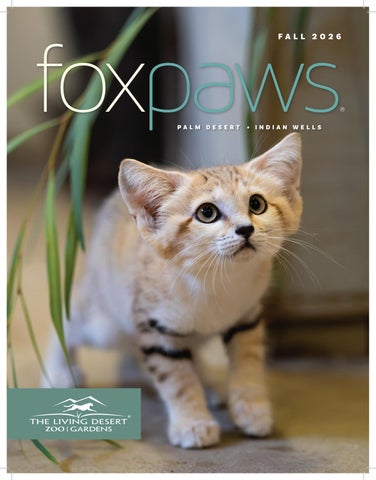
foxpaws ON THE COVER The first sand cat born at The Living Desert since 2019, this yet-to-be-named female sand cat kitten was born on May 10, 2026.
*Board of Directors
Our mission is desert conservation through preservation, education, and appreciation.
Turn to page 22 to learn more about her species. FOXPAWS EDITORIAL STAFF Managing Editor Jenny Lynn Robinson
The Living Desert Zoo and Gardens is a California 501(c)(3) non-profit public benefit corporation which receives no ongoing municipal tax support (EIN 95-3385354). We are supported solely by the generosity of individuals like you — your ongoing gifts make all that we do achievable. Donations are tax-deductible to the fullest extent possible. For more information, contact Development@LivingDesert.org or 760-346-5694.
foxpaws ©2026 The Living Desert Zoo and Gardens 2 foxpaws | FALL 2026
Designer Phaedra Heinen Project Coordinator Carlie Lee Photographer Matthew Colombo Proofreader Angela Woods
Contributors Hollie Anderson Alexandra Bonnet Regina Bakely-DeGenova Renee Barnett RoxAnna Breitigan Dr. James Danoff-Burg Kristal Granados Elizabeth Hiner Viviana Martinez Erik Rohrkaste Katie Shaw Jason Sherron Dr. Anna Young
FROM THE PRESIDENT’S DESK Allen Monroe with Cordelia, the Abyssinian ground hornbill.
together to protect the fragile ecosystems that sustain life on our planet. Every guest who walks through our gates leaves with the opportunity to become a Desert Defender, and that may be our greatest accomplishment of all. As I prepare to pass the baton to new leadership, I do so with complete confidence in the future of this remarkable institution. The Living Desert is financially strong, strategically focused, and guided by an exceptional Board of Trustees and leadership team. We have built an organization with the resilience to embrace new opportunities and the vision to meet tomorrow’s conservation challenges.
WHEN I ARRIVED at The Living Desert Zoo and Gardens twelve years ago, I saw an organization with tremendous potential, a place where extraordinary people shared an unwavering passion for wildlife, conservation, and inspiring others to care for our natural world. What I could not have imagined then was the remarkable journey we would take together. This fall, I will retire as President and CEO, and as I write what will be my final letter for foxpaws, my overwhelming emotion is one of gratitude. Together, we have transformed The Living Desert into one of the nation’s leading conservation-focused zoos and botanical gardens. We have welcomed record numbers of guests, expanded world-class animal habitats, launched innovative conservation efforts, strengthened educational programs, enhanced guest experiences, and secured the financial resources necessary to ensure that this organization will continue to thrive for generations to come. These accomplishments were never the work of one individual. They belong to an extraordinary team of dedicated employees, passionate volunteers, visionary trustees, generous donors, loyal members, and engaged community partners who believed in what this organization could become. Every milestone we reached was built upon countless acts of commitment, creativity, and hard work by people who care deeply about our desert conservation mission. I have often said that The Living Desert is much more than a zoo. It is a place where children discover their first connection with wildlife, where families create lifelong memories, where threatened species receive a second chance, and where science and conservation come
The future is exciting. Projects like Lion Ridge, expanded conservation partnerships, innovative educational experiences, and continued investments in animal care and guest engagement are only the beginning. The foundation has been laid, and I have every confidence that the next generation of leaders will build upon it in ways we can only imagine today. Over the course of my 45-year career in conservation, I have learned that progress is rarely measured in a single breakthrough. It is measured by thousands of people choosing to care, choosing to act, and choosing to believe that their individual efforts matter. Conservation is not the responsibility of a few; it is an opportunity for us all. To our members, thank you. Your support has made every success possible. Whether you visited with your family, volunteered your time, attended an event, made a donation, or simply shared our story with others — you became part of something much larger than yourselves. You helped create hope for wildlife and inspired future generations to protect our planet’s extraordinary biodiversity. Although I am retiring from this role, I will always remain one of The Living Desert’s greatest champions. I leave knowing that this organization is stronger than ever and that its best days are still ahead. I would like to leave you with these words from Sir David Attenborough that perfectly capture both the challenge before us and the optimism I carry into retirement: “We have a plan, we know what to do, there is a path to sustainability. If enough people can see the path, we may just start down it in time.” Thank you for allowing me to be part of this incredible journey. With gratitude,
Allen Monroe, President/CEO foxpaws | FALL 2026 3
The Man Who Made the Desert Impossible to Ignore
ALLEN MONROE’S NAME has become synonymous with two things: snazzy suit jackets and championing deserts. After 12 years as President/CEO of The Living Desert Zoo and Gardens, Allen is preparing to retire, leaving behind a legacy brighter than his iconic suit patterns: a vision that has brought new attention to the world’s deserts. Whenever he had the chance, Allen made the case — in his best impression of comedian Rodney Dangerfield — that “the deserts don’t get no respect.” Rainforests, coral reefs, and the Arctic often dominate the conservation conversation, whereas deserts have historically been dismissed as bland, barren landscapes. When Allen came to The Living Desert, he saw an opportunity to change that perception and help people discover the incredible diversity of desert ecosystems, connect with the wildlife that calls them home, and understand why these places are worth protecting. A BACKYARD ZOOKEEPER Allen’s love of the natural world began long before his career in zoos did. In fact, it began before he even made it to junior high. As a young child, Allen was enthralled by animals. After reading Tarzan, he dreamed of exploring the jungles of Africa and seeing the amazing wildlife for himself. Still, Allen was determined to find his own adventure in his 4 foxpaws | FALL 2026
home of Austin, Texas. When he couldn’t stop talking about getting a new pet, his parents told him he could keep anything he could catch. Allen took them at their word and hatched a plan. Armed with bits of leftover PB&J, young Allen spent countless afternoons in his backyard trying to lure an animal into becoming his next pet. He even propped up a laundry hamper with a stick attached to a string, hoping a curious bunny might take the peanut butter bait. Though he never caught any furry friends, he did catch a lifelong passion. A CHAMPION FOR CONSERVATION Many years later, when The Living Desert’s CEO search committee asked Allen to describe himself, he said without hesitation that he we was “a conservation educator,” an answer that stood out to then Board of Trustees Chairman Roger Snoble. “He was the one who really nailed the question,” Snoble recalled. “I was impressed by that because that’s what the job is all about.” Allen never lost sight of that idea. Conservation education became the throughline of his tenure, shaping everything from animal care and guest experience to how The Living Desert showed up in the community and around the world. He put connection at the center of the Zoo’s work, understanding that protecting a habitat or species requires people to take action.
“Allen is a visionary who has helped The Living Desert grow in so many ways, but particularly in conservation. Today, we are a conservation powerhouse thanks to the support, encouragement, and creativity of Allen Monroe.” — Dr. James Danoff-Burg, Vice President of Conservation
That focus helped expand The Living Desert’s role in conservation. Under Allen’s leadership, the Zoo became one of the first AZA institutions to join The International Union for Conservation of Nature (IUCN), and launched the one-of-a-kind Building Community Conservation Success (BCCS) program. Through the BCCS workshops, The Living Desert trains conservation organizations in Southern California and around the world to incorporate social science into their work, helping them better understand the human behaviors that can shape conservation outcomes. In 2025, The Living Desert further increased its dedication to social science and became the first organization in the U.S. to be named an IUCN Center for Species Survival: Behavior Change.
Photo of Allen Monroe at the Fort Worth Zoo by Star-Telegram/Willis Knight
Meanwhile, on campus, Allen challenged the Zoo to find new ways to connect guests with wildlife and conservation. What followed were innovative projects such as the guest-focused behavior-change initiative, Desert Defenders, and immersive habitats like Australian Adventures, Rhino Savanna, and the forthcoming Lion Ridge.
And in one of the clearest expressions of his commitment to deserts, The Living Desert founded World Desert Day and gained official recognition for it from the state of California, giving this oftenoverlooked ecosystem a moment in the global conservation conversation. FROM HIDDEN GEM TO GLOBAL STAGE The Living Desert has long been a treasured part of the Coachella Valley, woven into the stories and memories of generations of guests. But for much of its history, it was best known by the people who already knew and loved it. Often hailed as a “hidden gem,” the Zoo had a strong foundation and Allen saw an opportunity to build on it. From the day he joined The Living Desert, Allen pushed his team to think bigger and never settle for “good enough.” He often spoke about creating the Zoo of the Future, a place where exceptional animal care, immersive guest experiences, and conservation leadership could come together — and where guests would leave saying to each other, “That was the Best Day Ever!” This vision pushed The Living Desert to think beyond what it had been and consider what it could become.
“One of the biggest things Allen has done for the Zoo is set the vision of excellence and make sure we’re always leaders in each of our areas. We don’t rest on any laurels, and we don’t accept mediocrity. We’re always continuously improving; we’re making things bigger and better.” — Dr. Anna Young, Vice President of Learning and Impact
Today, The Living Desert is a world-class zoo, with a world-wide impact. More than 100 conservation projects now extend its reach to 12 countries around the globe, while thousands of students engage with wildlife and conservation through its education programs. Attendance nearly doubled during the first 10 years of Allen’s leadership, and national recognition followed: with The Living Desert earning a top-10 spot in USA Today’s 10Best awards and being named one of Condé Nast Traveler’s 10 best zoos in the country, with the latter calling it “undoubtedly the best desert-themed zoo in America.” For many years, Allen Monroe made an appearance as Captain America at The Living Desert’s Howl-O-Ween celebration (inset). However, this costume wasn’t inspired by a love of comics, but rather by one of the animals he cared for during his first zoo job in 1981: a sea lion at the Fort Worth Zoo, named Captain America.
What Allen leaves behind is more than growth, accolades, or even truly memorable jackets. He leaves behind a Zoo ready for what comes next — a Zoo of the Future. foxpaws | FALL 2026 5
So, What’s
Behind the Fence?
A NEW CHAPTER is beginning at The Living Desert, and guests may have already noticed the first signs of what’s to come. A previously unused area at the center of the Zoo is officially under development, as one of the most anticipated projects in The Living Desert’s history begins: Lion Ridge and the Connie and Bob Lurie Palm Pavilion. Although guests won’t be able to meet the future residents before fall 2028, the journey has begun and the first “big cats” are here. Behind the fence, CAT equipment rumbles to life each day as a crew of more than 100 builds a habitat fit for some of the desert’s most iconic apex predators. And soon, 6 foxpaws | FALL 2026
the rumble of construction will be replaced by something even more powerful: the unmistakable roar of lions. Lions are among the most recognizable animals on Earth. They are seen in books, on television and in zoos, and they can feel permanent, almost untouchable. But their iconic status can mask a more complicated reality: today fewer than 24,000 lions remain in the wild and they face increasing pressures from habitat loss, human-wildlife conflict, and declining prey populations. That’s why the habitat taking shape today is being designed with a much larger purpose in mind — supporting the care and
management of lions as part of a healthy, genetically diverse population under human care. It is a reflection of The Living Desert’s broader commitment to conserving wildlife and safeguarding desert species at risk. Through exemplary animal care, participation in species sustainability efforts, and meaningful educational opportunities, Lion Ridge will support the long-term future of lions while helping guests better understand the importance of conservation and the collective responsibility to protect vulnerable species for generations to come.
For years, an open space has rested at the heart of The Living Desert. Lion Ridge will bring it to life, transforming this open ground into a landscape filled with discovery, connection, and purpose. As guests gather and lions roam, the heart of the Zoo will beat stronger than ever.
LAYING THE FOUNDATION Before the lions arrive, there’s a lot of groundwork to be done — literally! The first steps of development include grading, earthwork, and utility installation. It will be a while before any large structures will emerge, but progress is well underway. In the meantime, all of the Zoo’s current animal habitats and amenities will remain open, ensuring guests can continue exploring and connecting with wildlife. For more than 50 years, the Zoo has grown alongside the community it serves and the support, passion, and curiosity of local residents and visitors have
These renderings offer a glimpse of the Louise and Ray Knowles Lion Surround (above) and the Eldorado Country Club and A.C. & Shaughne S. Warnack lion habitats (below). With the site work now underway, our vision is becoming reality!
helped shape The Living Desert into what it is today. As the development of Lion Ridge begins, The Living Desert looks forward to sharing this journey with the community. Immersive and interactive experiences throughout the construction process will offer behind-the-scenes perspectives on Lion Ridge’s evolution, creating meaningful connections to the wildlife, conservation efforts, and stories at the heart of the project. As with all of our major projects, this development has been guided by thoughtful planning, careful consideration of resources, and a commitment to creating an experience that reflects the
highest standards of animal care, conservation, and guest engagement. Only when the right pieces were in place, from design and funding to long-term sustainability, was it time to bring that vision to life. Lion Ridge and the Palm Pavilion will offer more than an opportunity to see lions. It will create a place for discovery, inspiration, and shared experiences. And when that first roar finally rings out across The Living Desert, it will symbolize not just the arrival of lions, but the realization of a dream years in the making.
foxpaws | FALL 2026 7
Have no fear,
we need predators here WHAT EXACTLY DEFINES an animal as a predator? Having sharp teeth? The ability to sprint at incredible speeds? Extraordinary eyesight to spot prey? Not necessarily. A predator is an animal that hunts other animals for food. But what makes a predator successful can look very different from species to species. From the stealthy scorpion to the mighty lion, each predator species has evolved its own set of adaptations and 8 foxpaws | FALL 2026
behaviors to survive in its unique environment and fill a specific ecological niche. African painted dogs, for example, have evolved to be remarkable pack hunters, able to catch their prey 70-90% of the time — making them one of Africa’s most successful predators. Their distinctive coats make it difficult for prey to tell where one dog ends and another begins, creating the illusion of a larger pack. They also possess incredible endurance, allowing them to pursue prey over
great distances, and are able to communicate with each other through vocalizations and even the position of their ears. Cheetahs, on the other hand, have evolved for speed. Their ability to run faster than any other land animal allows them to catch small, fast-moving prey that other predators may struggle to catch. They also have exceptionally keen eyesight to spot potential prey from a distance, giving them time to position themselves for success before the pursuit even begins.
GREATER ROADRUNNER
Geococcyx californianus
A LOT TO SAY
Contributors: Regina Bakely-DeGenova Animal Care Curator Renee Barnett Animal Care Curator Dr. James Danoff-Burg Vice President of Conservation Elizabeth Hiner Assistant Animal Care Curator Erik Rohrkaste Animal Care Curator
And, as The Lion King reminds us, every animal plays an important role in the circle of life. Predators are no exception. Removing them from an ecosystem can lead to ecological instability and even collapse! Without predators, populations of prey species can grow unchecked, putting additional pressure on food, water, and available habitat. Their impact ripples through the entire ecosystem, shaping prey behavior, protecting vegetation, and helping maintain biodiversity.
–0.95 lbs Adult weight: 0.45 ards, ers, scorpions, liz Diet: Insects, spid gs eg d an small birds, snakes, rodents, serts, dry Habitat/range: De en woodlands op d scrublands, an es tern United Stat of the southwes and Mexico ed fast, ground-bas Hunting style: A lk wa s er nn ru ad ro , pursuit predator t rs bu en th r prey, while scanning fo it. forward to seize n up adrunners can ru Did you know? Ro rarley ey th gh ou th d, an cts to about 15 mph e air to catch insce fly, will leap into th and small birds! s, Zoo’s roadrunner You can find the at the s, rlo Ca d an ries, Nellie, in Wild Prai Sonoran Aviary.
African painted dogs use a variety of high-pitched squeaks and vocalizations to stay connected with their pack. If a dog becomes separated from the group, they can send out a long-distance distress vocal signal known as a “hoo call.”
FROM CONFLICT TO COEXISTENCE Being a successful predator doesn’t mean being invincible. Hunting can be dangerous, and every chase comes with the risk of injury or death. Young predators are especially vulnerable and can become prey themselves. But the greatest threats facing predators today come from humans. Our hunting of predators — and the animals they depend on for food — along with vehicle
collisions, pollution, and climate change all put pressure on predator populations. As their natural ranges shrink, become degraded or fragmented, predators have fewer places to hunt, find mates, raise young, and move safely throughout their native range.
The good news? People can also be part of the solution. ►
foxpaws | FALL 2026 9
Mountain lion
Kit fox
AFRICAN LION Panthera leo
Adult weight: 270-600 lbs Habitat/range: Grasslands, savannas, and open woodlands in sub-Saharan Africa Diet: Large ungulates such as antelope, zebra, giraffe, wildebeest, and waterbuck, along with smaller mammals and even crocodiles Hunting style: Lionesses do most of the hunting for their pride, often working in groups of two or three to stalk and surround their prey. Fun fact: A lion can sprint the length of a football field in just six seconds! We look forward to welcoming a pride of lions to the Zoo in the fall of 2028!
10 foxpaws | FALL 2026
Harris’s hawk
The Living Desert supports more than 100 conservation projects around the world, working alongside communities and local conservation partners to reduce human-driven threats and create a future where both people and wildlife can thrive. From reducing conflict between predators and livestock to protecting wildlife on increasingly busy roads, these partnerships help create new pathways to coexistence. In Tanzania: We are proud to support WASIMA, a local organization dedicated to promoting human-lion coexistence and non-lethal methods of protecting livestock in southwestern Tanzania. Recently, our team facilitated a study to better understand how local communities perceive human-lion conflict and WASIMA was able to use those findings to develop and refine mitigation strategies tailored to the needs of their local communities.
Gila monster
In Zimbabwe: The Living Desert has a long-standing partnership with Painted Dog Research, supporting efforts to make the high-traffic Kazungula Road safer for endangered painted dogs. By encouraging drivers to slow down in areas where wildlife crosses the road, the project aims to reduce vehicle collisions and protect wildlife moving through their habitat. In Kenya: Through our partnership with Ewaso Lions, we support lion guardians who work to build stronger relationships between local communities and wildlife. These guardians serve as a bridge between people and predators, helping them find practical ways to coexist with lions. MAKING ROOM FOR WILDLIFE Here in the Coachella Valley, we can all help wildlife thrive! Here’s how you can Share the Habitat and help protect the balance of our local ecosystem.
Mexican wolf
Burrowing owl
Keep your cats indoors: Believe it or not, you might have a predator living in your home! Domestic cats are expert hunters, and freeroaming cats are estimated to kill 2.4 billion birds each year in the United States. Keeping cats indoors protects local birds and other wildlife while also protecting your cat from cars, accidental poisoning, disease, and larger predators like coyotes and raptors.
THINK FAST! While some of the most famous predators are large, plenty are small, such as the dwarf mongoose! With lightning-fast reflexes, these agile hunters can quickly snatch up crawling and flying insects. They are even known to team up with Von der Decken’s hornbills, and work together to find and catch prey.
American badger
Don’t feed wildlife: Feeding wildlife, even unintentionally, can attract animals to your neighborhood. If small rodents and mammals, like raccoons, are drawn to your yard, this can also encourage predators like bobcats or coyotes to follow. To reduce the potential for humanwildlife conflict, keep pet food and water bowls inside, regularly clean up spilled seed and fallen citrus, and reduce potential hiding places for prey by keeping outdoor spaces tidy and brush trimmed. ►
COYOTE Canis latrans 0 lbs Adult weight: 18-3 ds, rodents, birds, Diet: Berries, lizar and rabbits airies, forests, Habitat/range: Pr rts in North se de d an s, mountain ica er Am l ra nt Ce d an yotes are Hunting style: Co edators, and opportunistic pr ne. alo nt typically hu coyote can Fun fact: A single dents per year, ro consume 1,800 dent populations helping to keep ro l. under contro d tes, Thor, Loki, an Our “band” of coyo in Wild Americas. d Storm, can be foun
foxpaws | FALL 2026 11
TAKE PAWS Of the world’s 40 wild cat species, 33 are classified as small cats! Small cats at the Zoo include bobcats, sand cats, servals — and even cheetahs and mountain lions.
CHILEAN ROSE TARANTULA
Grammostola rosea
8g proximately 13-2 Adult weight: Ap ts and other Diet: Mostly insec sionally very small ca oc invertebrates; vertebrates y scrublands and Habitat/range: Dr neighboring areas d deserts of Chile an ica er Am h ut So of ey are nocturnal Hunting style: Th ators that detect sit-and-wait pred hairs, h their sensitive vibrations throug bdue su ssing prey and then lunge at pa . them with venom ntula of chewing, a tara s id Fun fact: Instead flu ive st ge with di liquefies their prey ng meal. lti su and drinks the re rose Bitsy, the Chilean You can find Itsy . on Cany tarantula, in Eagle
12 foxpaws | FALL 2026
Cover your trash: In the Coachella Valley, human-subsidized resources have enabled raven populations to reach levels 17 times greater than they were 40 years ago. Ravens are natural predators of the Mojave desert tortoise, burrowing owl, and desert horned lizard, but unnaturally high raven populations have put additional pressure on vulnerable local wildlife. Help reduce ravens’ access to human-provided food by keeping trash cans securely covered and picking up litter, so predators are less likely to find an easy meal in your neighborhood. PROTECTING THE MIGHTY (AND TINY) PREDATORS Behind the scenes at The Living Desert is the Desert Carnivore Conservation Center (DC3), a dedicated facility focused on breeding, research, and conservation for two remarkable small cats: the sand cat and the black-footed cat.
Established in 2016, DC3 is one of few facilities in the world that are breeding these species. At its opening, relatively little was known about both cats’ specialized husbandry needs or how to best support successful breeding in human care. Over the past ten years, the program has helped advance that knowledge while bringing greater attention to two species that remain vastly underrepresented in zoos. The program has already celebrated numerous births, including two this spring: a male black-footed cat born in April and a female sand cat born in May. For now, both kittens will remain behind the scenes at DC3 as they continue to grow and develop. While small in stature, these kittens represent something much bigger — the continued growth of carefully managed populations that can help safeguard these
New Cats on the Block For many years, African servals have been found at The Living Desert as animal ambassadors through scheduled connections. Now, we are excited to share that guests are able to observe these elusive desert predators every day in their newly renovated habitat across from the Sage Garden.
species for the future. Their births also contribute to our collective knowledge about caring for and breeding these elusive cats in human care, and can help inform conservation efforts beyond The Living Desert. Now, after years of research and fundraising, the Center is expanding
BLUE-TONGUED SKINK
Tiliqua scincoides
with larger, more dynamic habitats designed around the unique needs of these cats. Scheduled for completion this fall, the renovated facility will strengthen The Living Desert’s commitment to small cat conservation and help ensure these remarkable felines thrive for generations to come.
lbs Adult weight: 1–2 rrion, s, small animals, ca ail sn , ts ec Diet: Ins n tio d other vegeta flowers, fruits, an nds, oodlands, grassla Habitat/range: W ert habitats across es scrub, and semi-d of New Guinea Australia and parts and Indonesia -tongued skinks Hunting style: Blue to crush snails s use their strong jaw es. They will also at br te er inv and other d ws, vegetation, an investigate burro . leaf litter for food ight blue tongue Fun fact: Their br thick edators, while a pr f of helps ward and h tc ca em th s lp layer of mucus he consume prey. ngued skink, can be Acacia, our blue-to ventures . Ad an ali str found in Au
This habitat will be home to Nya, a female serval and former animal ambassador, and Khalid, a male who came to The Living Desert through the Association of Zoos and Aquariums’ (AZA) Species Survival Plan as Nya’s recommended breeding partner. The dynamic space gives Nya and Khalid opportunities to explore, climb, investigate, and display their natural behaviors, offering guests a closer look at what makes servals such fascinating predators. We’re hopeful that these new surroundings will encourage a strong bond and, ultimately, result in kittens that will contribute to the long-term sustainability of the species in AZA-accredited zoos. Stop by the habitat on your next visit and see if you can spot these cats in their new home!
foxpaws | FALL 2026 13
For these eight ZooTeens, a trip to Mongolia offered more than a chance to study conservation — it was an opportunity to become part of it.
Stepping into
the Field
OUR COLORADO DESERT and Mongolia’s Gobi Desert may be thousands of miles apart, but the conservation challenges they face are surprisingly familiar. Both are home to unique species, increasingly threatened by intensified drought and pressures from human activity, such as habitat loss and fragmentation. These shared challenges call for a collective commitment to protecting desert wildlife and the ecosystems they depend on. That work takes The Living Desert far beyond the Coachella Valley. For the past three years, the Zoo has partnered with the Mongolian Conservation Initiative (MCI) at the Ikh Nart Nature Reserve to study and conserve the desert steppe and 14 foxpaws | FALL 2026
Contributors: Hollie Anderson Volunteer Supervisor Viviana Martinez Learning Engagement Coordinator
its wildlife. This summer, eight of our local ZooTeens traveled more than 6,000 miles to participate in that work firsthand.
BEYOND THE CLASSROOM The goal of The Living Desert’s ZooTeen Program is to empower the next generation of conservation leaders, and this trip gave these students the opportunity to experience conservation in a way that simply isn’t possible in a classroom. For one ZooTeen, it was their first time on an airplane. For another, it was the longest they had ever been away from home. For all eight, the trip meant stepping outside their comfort zones, and every one of them returned with a new understanding of conservation.
Last fall, several of the ZooTeens made the wing tags our team used this summer to track cinereous vultures in Mongolia!
What the ZooTeens discovered: When you have the opportunity to do something that challenges you, take it. You never know where it might lead, who you might meet, or how it might change the way you see the world.
Sunset photo courtesy of ZooTeen Lara. Selfie-van photo courtesy of ZooTeen Madeleine.
They worked alongside MCI researchers to study small mammals, collect vegetation data, monitor vulture nests, assist with falcon and kestrel banding, and hike wildlife transects to estimate populations of argali sheep and Siberian ibex. Throughout the trip, they weren’t just watching conservation happen, they were contributing to it. Just as important as the research were the relationships they built. The ZooTeens worked side by side with university students from across Mongolia who were studying wildlife biology, ecology, and conservation. Although they came from different cultures, spoke different languages, and grew up on opposite sides of the world, they quickly discovered they shared the same passion for wildlife and the same desire to make a difference. Whether they were collecting data in the field, celebrating a birthday, sharing meals, or playing volleyball
after long days of research, they learned that conservation is built on collaboration and that protecting wildlife takes people from many backgrounds working toward the same goal. The lessons they brought home went far beyond learning research techniques. They learned that conservation is rarely glamorous and often means early mornings, long days, and repeating the same work over and over, because every observation contributes to a much bigger picture. They learned to ask better questions, think critically, adapt to unfamiliar situations, and understand that every person, no matter their age, can make a meaningful contribution to conservation. Most importantly, they came home believing in themselves. They discovered they were capable of traveling halfway around the world, adapting to a new culture, working alongside professional researchers, and becoming part of an international conservation community. Those experiences built confidence that will stay with them long after they forget the details of a data sheet or wildlife survey. So, while the Colorado Desert and the Gobi Desert are on opposite sides of the world, the mission is the same: protecting wildlife, safeguarding habitats, and inspiring the next generation to continue that work. ►
A Day in the Life 5:45 a.m. – Woke up in my ger (Mongolian yurt). Still can't believe I’m actually here! 6:45 a.m. – Saw a jerboa My home away fro m home today during our small mammal research! 8 a.m. – Eggs & sausage for breakfast in the community ger. 9:2O a.m. – Avian research to study lesser kestrels...the wind was wild. 11 a.m. – Met a local family and their herd of livestock. Such a cool look at everyday life here. 1:15 p.m. – Home-cooked lunch: noodles & beef today! 2:O8 p.m. – Pile in the van to drive across the Reserve and look for vulture nest sites. 3:12 p.m. – A HERD OF MONGOLIAN HORSES JUST RAN ACROSS THE HORIZON!
5:3O p.m. – We all tried to sing along with the Mongolian music on our drive home. 7 p.m. – Chicken, green beans, and potatoes back at the ger. 7:4O p.m. – Volleyball with the crew! 8:52 p.m. – Best sunset of my life. What a day.
1o/1o would recom
mend this team
foxpaws | FALL 2026 15
Meet Maddox and Marla What happens when students from opposite sides of the world come together with a shared passion for conservation? Great things! To see what they learned working side by side, we asked two of the students from this summer’s program to reflect on their time in Mongolia. Maddox, age 20 ZooTeen and university student, USA “This trip has definitely changed how I view the involvement of all sorts of people in conservation. To get work like this done, not only do you need a team of dedicated scientists and researchers, but also support staff. And to properly impact the world, you need connections to local communities.”
What was your favorite memory from the program? Maddox: Definitely when I held the lesser kestrel for wing tagging. It was awesome to be able to hold a bird of prey I actually helped catch. I even cheered when she and her mate went back to their nest. Marla: The moments when we worked together in the nature of Ikh Nart, conducted research, and shared even the small daily things with each other left the best memories. It felt wonderful to see people from different countries come together as a team in a short period and work toward a single goal. Was there a specific moment that surprised you or stuck with you? Maddox: One moment that really stuck with me was on our last full day when the Mongolian students and staff sang various songs of their culture for us. It was beautiful. Their voices rose as the rain got stronger and stronger around us until, finally, the sun broke through. Marla: It felt wonderful to see people arriving in Ikh Nart for the first time, showing so much curiosity and amazement toward the surrounding environment and wildlife. Also, seeing the nature and animals — which we often take for granted in our daily lives — through someone else’s eyes was a very interesting experience in itself. What do you hope people your age understand about conservation work after hearing about this trip? Maddox: I hope they can learn to appreciate not only all the work and effort that goes into conservation, but
16 foxpaws | FALL 2026
Marla, age 23 University student, Mongolia “It was fascinating to observe what caught the interest and attention of people visiting Ikh Nart for the first time. The ZooTeens’ innovative ideas, active participation, and interest in nature made the research work more engaging. Through their questions and observations, I was able to see things I hadn’t noticed before and gain a deeper appreciation for the unique nature and wildlife of Ikh Nart.”
also understand that it’s very possible for them to do. I had very little field experience going into this trip and by the end of it, I felt ready to take on any task assigned to me. Conservation is possible at any level and I hope people my age can gain confidence hearing of my experience. Marla: I hope young people realize that nature conservation is not just a job for professionals. Everyone can pay attention to nature in their own way and contribute through the right attitude and small actions. I also believe that the participation of youth in conservation is vital. What was it like working alongside people from a different country and culture? Did the language barrier change how you communicated or connected? Maddox: It was wonderful, the language barrier would occasionally pop up but at the end of the day, we’re all people working together towards the same goal, and a lot can be communicated by sheer body language and tone. It was great to learn about Mongolian culture and engage with the language. 10/10 would recommend! Marla: At first, communicating with people of different languages and cultures presented a bit of a challenge. However, we tried to understand each other, and sometimes we were able to connect through actions, smiles, and cooperation rather than just words. The language barrier did not limit our communication at all; instead, I believe it became a wonderful opportunity to learn from one another and understand different cultures.
Each morning, the ZooTeens helped MCI researchers weigh and gather measurements on small mammals. These studies help track population changes and inform future conservation efforts!
A Snapshot of Our Summer Fieldwork
It has been a productive summer at the Ikh Nart Nature Reserve in south-central Mongolia! The Living Desert co-manages this remarkable park with the Mongolian Conservation Initiative (MCI), an NGO based in Ulaanbaatar.
LEARNING BY DOING Conservation may look dramatic in nature documentaries but, in reality, much of the work is slow, careful observation, repeated measurements, and asking a lot of questions. During their time at the Reserve, the ZooTeens experienced that process firsthand. Each morning began with a drive out to a field site to check the live traps used to study the Reserve’s small mammal populations. The group recorded measurements and observations of animals like jerboas, gerbils, and hamsters, adding valuable data to the longterm ecological studies at Ikh Nart. Just before sunset, they would race down the field, resetting the live traps before heading back to camp. The ZooTeens also helped to complete vegetation surveys across 250 plots, identifying and counting plant species to help researchers understand how grazing, rainfall, and wildlife shape the landscape. They monitored raptor nests and observed cinereous vultures, lesser kestrels, saker falcons, and black kites, learning how tagging and long-term monitoring can help inform species management. To study large mammals, the ZooTeens hiked wildlife transects
using GPS units, compasses, and rangefinders to record observations of argali sheep, Siberian ibex, and other large mammals. They were also introduced to distancesampling techniques used to estimate wildlife populations, seeing how individual observations can contribute to a much larger picture of the ecosystem. The teens also had the opportunity to develop their own research questions through an independent project. Each student selected a question about the Ikh Nart ecosystem, formulated a hypothesis, and collected observations and other data to explore ecological patterns. Their questions reflected a growing curiosity about the desert steppe and a desire to understand how it works. By the end of the experience, the ZooTeens weren’t just learning; they were beginning to see themselves as scientists. They gained practical research skills, but, just as importantly, they developed curiosity, critical thinking, appreciation for the natural world, and the confidence to contribute to conservation themselves. These are the skills and perspectives that can help shape the next generation of conservationists.
Small mammals: Collected data from 118 individuals representing nine rodent species, helping researchers better understand population fluctuations. Lesser kestrels: Monitored four active nests to help researchers track breeding success, documenting seven chicks and six eggs. Cinereous vultures: Monitored more than 30 nests, including 24 active nests, to provide insight into breeding activity at Ikh Nart. Ten vultures were also fitted with wing tags to help researchers understand species status. Raptors: Fitted a lesser kestrel, saker falcon, and black kite with wing tags to support species monitoring. Plants: Sampled 250 vegetation plots, recording 57 plant species to help researchers track climate change impacts. Large mammals: Surveyed argali sheep and Siberian ibex to track their populations following a challenging winter two years ago and fitted several with satellite telemetry tracking collars. Sustainability upgrades: Our Gardens team partnered with MCI to build a greenhouse and covered vegetable bed to grow fresh produce for camp. Community-based conservation: Led a social science training workshop with community leaders and created two research programs that will be conducted this winter with 150 local herder families. Together, this work helps researchers better understand and protect the wildlife, plants and ecosystems of Ikh Nart. —Dr. James Danoff-Burg Vice President of Conservation foxpaws | FALL 2026 17
Dog Days at the Zoo
“This was one of the coolest things we’ve ever done! ” @noodleboymarlowe
A New Tail-Wagging Tradition RoxAnna Breitigan Chief Operating Officer
These interactions help Zoo animals practice calm coping behaviors, build confidence, and engage in new, enriching experiences.
BY BRINGING TOGETHER beloved pets, joyful guests, and meaningful animal care, The Living Desert’s newest event offers members and guests a fresh way to experience the Zoo. This spring, The Living Desert introduced a new tail-wagging experience that quickly exceeded expectations for both people and their furry friends. Dog Days at the Zoo welcomed nearly 1,100 dogs over five event days, giving pet owners and their well-behaved canine companions the rare opportunity to explore the park together. For a mission-based nonprofit organization continually seeking new ways to inspire connection, create memorable guest experiences, and support sustainable revenue opportunities, Dog Days delivered all that and more. 18 foxpaws | FALL 2026
The response was immediate and overwhelmingly positive. After each event, guests shared stories of gratitude, delight, and surprise. One visitor explained that she loves coming to the Zoo and spending time with her dog, but with only one day off each week, she often had to choose between the two. Being able to do both, she said, felt “magical.” Another couple shared that this was their first-ever trip to the Zoo because they rarely leave their dog home alone. For them, Dog Days made a long-awaited Zoo visit possible and unforgettable. BUILDING RESILIENCY WITH CANINE COMPANIONS For humans and animals alike, every day brings moments that shape how we learn, adapt, and respond to the world around us. The animals at The Living Desert are no different. As their
caretakers, the Animal Care teams intentionally design experiences that help them thrive, including carefully managed exposure to new or unfamiliar sights, sounds, and scents. This kind of positive challenge, known as “eustress,” supports resilience without causing physical or mental harm. Because Zoo animals live in a human-influenced environment, they benefit from gradual, positive exposure to
everyday activities like guests walking by, maintenance equipment moving through the park, veterinary care routines, and even occasional unexpected moments. That is where well-trained canine guests can play a valuable role. In addition to Dog Days, we have several partnerships with service dog, guide dog, and search-andrescue dog training programs. These dogs can provide natural, controlled opportunities for Zoo animals to encounter something unfamiliar in a safe and non-threatening way. At the same time, the dogs benefit too, especially service dogs in training. They learn to remain focused, confident, and responsive in a dynamic environment filled with new stimuli. The result is a mutually beneficial experience that supports The Living Desert’s commitment to high-quality animal care while also helping prepare dogs who may one day change human lives.
“I already love The Living Desert and now I find out there are dog days???? I don’t even have a dog, but I’m coming!!” @pebble.gus.mulligan
“I had the best day ever! There was so much to see and do. Can’t wait for the next one.” @benji_styles19 MAKING MEMORIES WITHIN OUR MISSION Dog Days at the Zoo also creates a meaningful opportunity to share our Desert Defender messages. Responsible pet ownership is closely connected to conservation. Cleaning up after pets, keeping dogs on leash, and respectfully sharing the habitat while hiking or exploring natural spaces all help protect wildlife and the places they call home. For guests, this new experience reflects what makes The Living Desert so special. It is joyful and welcoming, but also purposeful. It invites guests to see the Zoo in a new way while reinforcing the values at the heart of our mission: care for animals, appreciation for nature, and responsibility for the shared world around us. Watching dogs trot through the park, guests smile from ear to ear, and Zoo animals respond with curiosity has made Dog Days one of the happiest new experiences at The Living Desert. It is a celebration of companionship, conservation, and community — and a powerful reminder that a Best Day Ever can be meaningful for every species involved.
It’s time to Paw-ty! Friday, October 30: Pups & Pumpkins Monday, November 16 Thursday, December 10: Dog Night: Jingle Pups during WildLights Sunday, January 17 Friday, February 12: Tailgate Paw-ty Sunday, March 14 Monday, April 12 Saturday, May 1 Visit LivingDesert.org/DogDay to reserve your tickets!
“We just got home from Dog Day and it was SO amazing! We always say that we feel like we’re ‘cheating’ on our dogs when we go to The Living Desert, because they would love to be walked for that same amount of time. So this was amazing!” Jenna and Braden, 13-year members
foxpaws | FALL 2026 19
The
Evolution of IDCS
Dr. James Danoff-Burg, Vice President of Conservation Katie Shaw, Curator of Conservation – Social Science
SINCE ITS INCEPTION in 2020, The Living Desert’s International Desert Conservation Summit (IDCS) has brought together some of the world’s most passionate conservation leaders for a shared purpose: protecting deserts, wildlife, and the communities that depend on them. Those who have attended know the Summit has been much more than a conference. It has fostered meaningful partnerships, community engagement, and forward-thinking solutions.
On February 6, 2027, the International Desert Conservation Summit will return in an entirely new format, transforming from a multi-day conference into a prestigious daytime conservation forum, and high-impact evening awards program. The reimagined Summit will shine an even brighter spotlight on organizations delivering measurable conservation results while creating new opportunities for meaningful dialogue among leaders in the field.
Over the past five events, the Summit has welcomed conservation professionals from more than a dozen countries around the globe to Palm Desert to share successes, exchange ideas, and build partnerships. Many participants have worked alongside The Living Desert on projects that protect species, restore habitats, and improve conservation outcomes in some of the world’s most fragile ecosystems. The three-day gatherings consistently sold out, and left attendees energized by the opportunity to learn from one another and shape the future of desert conservation together.
The 2027 Summit will bring together finalists and award recipients whose work represents some of the most innovative and impactful conservation efforts around the world to participate in a series of discussions throughout the day: sharing lessons learned, successful strategies, and their visions for the future of desert ecosystems. There will also be a short film festival, featuring inspirational examples of compelling storytelling. The daytime Summit will be followed by an evening Conservation Awards Celebration, the announcement of winners, and an enjoyable dinner in The Living Desert’s scenic Bighorn Cafe.
Now, The Living Desert is preparing for the next evolution of this signature event.
20 foxpaws | FALL 2026
The International Desert Conservation Summit is launching a global, juried prize to recognize bold thinking, meaningful impact, and innovative approaches to protecting the world’s deserts. At the heart of the new format is the inaugural Community-Based Conservation Award, a juried international competition designed to recognize organizations that are creating extraordinary conservation outcomes through community partnerships and local leadership. The top recipient will receive a transformational monetary award. In addition, two runners-up will also receive significant funding. Together, these awards will celebrate organizations that place people at the center of conservation while delivering lasting benefits for wildlife and ecosystems. The Summit will also introduce a unique new recognition: the Overachiever Conservation Organization Award. This award was created specifically to celebrate smaller conservation organizations that achieve exceptional results despite limited resources. Open to organizations operating on an annual budget under $500,000, this award includes substantial funding to recognize innovation, measurable impact, organizational growth, and strong community partnerships. In addition to honoring conservation organizations, the 2027 IDCS will highlight the power of storytelling through two film competitions. The Short Film Award will recognize a filmmaker whose quality storytelling work brings attention to conservation challenges and successes across desert ecosystems. A separate Short Film Youth Award will help a Southern California filmmaker aged 22 or younger to further develop their work exploring environmental issues, conservation solutions, and the protection of desert landscapes. These film competitions reflect a growing recognition that
conservation success depends not only on scientific research and fieldwork, but also on compelling stories that inspire action and connect people to nature. The Living Desert expects the new awards-focused format to attract applications from conservation organizations and filmmakers around the world. Applicants will have the opportunity to showcase the impact they have already achieved while sharing ambitious plans for future conservation efforts. The resulting competition will elevate the visibility of outstanding work taking place across desert regions and create a platform for broader collaboration among practitioners. “This new chapter allows us to celebrate excellence in a more focused and impactful way,” said Allen Monroe, President/CEO of The Living Desert. “What began six years ago as The Living Desert’s vision has grown into a global gathering of conservation professionals, partners, and changemakers. The International Desert Conservation Summit celebrates the collective power of collaboration and demonstrates that the future of conservation is built through partnership, shared knowledge, and a commitment to working together.” While the format may be changing, the Summit’s mission remains the same. The Living Desert continues to serve as a catalyst for collaboration, connection, and innovation to advance desert conservation. Through this exciting new model, IDCS will continue to showcase world-leading conservation work while inspiring the next generation of changemakers dedicated to deserts around the globe.
foxpaws | FALL 2026 21
cats
IMPACT
BIG
ANIMALS IN FOCUS
small
Though they come from different parts of the world, black-footed cats and sand cats share many traits. Both are solitary, primarily nocturnal hunters that rely on camouflage, sharp senses, and stealth to survive in some of the planet’s most challenging environments. Both species face threats in the wild, making conservation efforts and carefully managed breeding programs important tools for
Black-Footed Cats Known as the smallest wild cat in Africa, mature blackfooted cats weigh just two to five pounds. Still, these tiny, but mighty predators have one of the highest hunting success rates of any feline species in the world! Their name was inspired by their distinctive black paw pads, which help protect their feet as they navigate the hot sands of their native habitat.
22 foxpaws | FALL 2026
supporting their long-term future. These programs also provide opportunities to learn more about these elusive felines and advance conservation and protection efforts. While small in stature, black-footed cats and sand cats are skilled predators that play important roles in their ecosystems — reminding us that even the smallest animals can have a big impact!
Sand Cats Sand cats are true desert specialists. Their thick, fur-covered paws act like snowshoes, helping them navigate loose, scorching sand without sinking or burning their feet. Native to the deserts of North Africa, the Middle East, and Central Asia, sand cats can survive in extreme environments with very little water and rely on their food to stay hydrated.
New at the Zoo This spring, The Living Desert celebrated two exciting births at our behind-the-scenes Desert Carnivore Conservation Center, a male black-footed cat, named Nkosi (right), born on April 14, and a yet-to-be-named female sand cat kitten (left), born on May 10.
foxpaws | FALL 2026 23
Supporter Spotlight
Squire and Angie alongside President/CEO Allen Monroe and local officials at the Patas Monkey Conservation Habitat opening, November 2025
J. SQUIRE JUNGER & ANGELA JUNGER Kristal Granados Senior Major Gifts Officer
WHEN SQUIRE AND ANGIE JUNGER began visiting The Living Desert Zoo and Gardens, they were immediately struck by how different and unique it felt here compared to the many other zoos they had visited around the world. As Squire states, “The beautiful setting at The Living Desert is comfortable for all guests and the remarkable near-natural animal habitats are well integrated into the local desert environment. The backto-nature experience at The Living Desert is welcoming, invigorating, and informative for visitors.”
Although mostly retired from their commercial careers — Squire from a world-wide leadership position in merger and acquisition services at Arthur Andersen LLP and subsequent roles, and Angie at her legal nurse consulting firm — they now support various charitable organizations with contributions of guidance and resources. Squire’s interest in animals began at 8 years old when he was a junior zookeeper at a Connecticut nature facility. From that experience he discovered his passion for zoos, animals, and conservation. As he visited more zoos around the globe, his first stop and longest visits were always with the primates. Over time, his long-term mission of supporting primates crystallized!
When Squire and Angie became supporters of The Living Desert many years ago, they immediately began advocating for the addition of primates to The Living Desert experience. They were thrilled when patas monkeys were confirmed to join the Zoo family; and their major gift supported the creation of the exceptional Patas Monkey Conservation Habitat. “We believe primates are now an important part of The Living Desert Zoo and Gardens. They are a strong learning tool for children, and indeed for all of us. We can see ourselves in them; they are familiar in behavior and family structure. We want to be with them and enjoy them.” The near-constant crowds of visitors at the patas habitat confirm that their vision was correct!
For more information on how you can make an impact, please contact: Jeff Petrovic, Chief Development Officer – JPetrovic@LivingDesert.org 24 foxpaws | FALL 2026
Travel with The Living Desert Experience extraordinary, custom-designed wildlife journeys with The Living Desert. Guided by local experts and specialists, these small-group adventures combine comfort, authenticity, and unforgettable encounters with nature — while directly supporting efforts to protect wildlife.
To reserve a spot or receive a full itinerary, contact Lin Conrad at 760-674-4684 or LConrad@LivingDesert.org
A Baja Wildlife & Conservation Adventure
Where Cheetahs Run: A Wild Journey to Namibia
February 14-22, 2027
Summer 2028 Exact dates to be announced
Experience the best of Baja California on a one-of-a-kind expedition. From the wildlife-rich El Vizcaíno Biosphere Reserve and the inspiring Peninsular Pronghorn Recovery Center, to unforgettable whale encounters at Ojo de Liebre Whale Sanctuary and wine tasting in the beautiful Valle de Guadalupe, this journey promises extraordinary encounters with Baja California’s diverse flora and fauna while celebrating the rich traditions of its wine industry.
Experience the untamed beauty of Namibia on a 16-day journey through one of Africa’s most captivating landscapes. This adventure offers an unforgettable blend of natural wonder, wildlife encounters, and conservation legacy. Along the way, visit the renowned Cheetah Conservation Fund to see conservation in action and gain a deeper understanding of the efforts helping protect Namibia's wildlife for generations to come.
Make the Most of Your Giving The Living Desert inspires guests every day through wildlife conservation, education, and the opportunity to experience unique desert ecosystems. Your generosity makes this work possible, and there are several tax-smart ways to support our mission, while potentially reducing your tax burden.
There are Several Tax-Smart Ways to Make Your Gift! Give Appreciated Securities Donating stock you’ve owned for more than one year may allow you to avoid capital gains tax while also receiving a charitable income tax deduction. Use Your Donor Advised Fund (DAF) Already have a Donor Advised Fund? Recommend a grant to The Living Desert to put your charitable dollars to work. You can also establish a DAF as a simple, flexible way to manage your giving over time. Make a Qualified Charitable Distribution (QCD) from Your IRA If you are age 70½ or older, you can give up to $111,000 directly from your IRA to The Living Desert without paying income tax on the distribution. If you are subject to Required Minimum Distributions, your gift may also satisfy all or part of your annual requirement. Not sure which giving strategy is right for you? We’re happy to help you explore your options.
Donna Raider, Planned Giving Officer (760) 674-4896 | DRaider@LivingDesert.org Please consult your tax advisor to determine how these opportunities may foxpaws | FALL 2026 25 apply to your individual circumstances.
WILDFILE This new play area has been thoughtfully designed with accessibility in mind, incorporating features that allow more guests to enjoy the space together. The design also embraces The Living Desert’s mission by featuring iconic desert species.
Reimagining Gecko Gulch For more than two decades, Gecko Gulch has been a beloved part of The Living Desert experience. First opened in 2003, and supported through the generosity of donors such as Spencer Boyd, the play area has provided generations of young adventurers with a place to climb, explore, imagine, and connect with nature. Now, Gecko Gulch is evolving into the Desert Adventure Zone — an exciting new chapter for this much-loved space. This transformation will create a more inclusive and immersive experience rooted in the wonder of desert ecosystems. The new Desert Adventure Zone will invite guests to discover the desert through play, while carrying forward the spirit of adventure that has made Gecko Gulch special for generations.
There will be two distinct experiences, with balance features, climbing elements, and opportunities for open-ended play that encourage children to engage with their environment in new ways. An area for children aged 5-12 years old will feature an impressive 10-foot-tall desert tortoise play structure that invites climbing, crawling, and imaginative exploration. An area for children under 5 years old will include a climbable Western bluebird structure, as well as swings and a slide made for young children. Natural textures and desert colors will be used throughout to reflect the beauty and character of our desert landscapes. More than just a place to play, the Desert Adventure Zone invites guests of all ages to experience the wonder of the desert through movement, discovery, and imagination. Scheduled to open in October, the Desert Adventure Zone will create a fresh, welcoming space for future generations of explorers. We can’t wait to share this exciting new adventure with our community. — Dr. Anna Young, Vice President of Learning and Impact
New Technology, New Possibilities When an animal is sick or injured, getting the right diagnosis is the first step toward providing the best possible care. Now, our Veterinary team has a powerful new tool to help them do just that: a state-of-the-art CT scanner at the Tennity Wildlife Hospital, funded in part by Captain Thomas George Moore. CT imaging can reveal injuries and lesions that may otherwise go undetected with conventional X-rays and can create detailed, three-dimensional images. This technology allows us to identify injuries and illnesses with greater speed, accuracy, and detail than ever before. Having a CT scanner will also open the door to new opportunities in veterinary medicine, research, and conservation, as The Living Desert is one of roughly 26 foxpaws | FALL 2026
a dozen zoos in the world to have this advanced technology! This mobile unit will be especially valuable when caring for exotic species whose anatomy is still being studied, helping us expand collective veterinary knowledge. This investment reflects our commitment to leading the way in animal wellbeing and innovative care, while advancing our community’s understanding of animal health for years to come.
The People Behind the
best day ever
EVERYONE PLAYS A PART IN MAKING IT THE BEST DAY EVER “Best Day Ever” is more than a phrase at The Living Desert — it’s our team’s shared philosophy. Every department and every team member plays a role in creating experiences that make guests feel welcome, connected, and inspired.
A Global Gathering for Deserts The Living Desert’s conservation work increasingly reaches beyond the boundaries of the Zoo, connecting our team with partners and conservation leaders around the world. This August, four members of our Conservation team participated in the United Nations Convention to Combat Desertification in Ulaanbaatar, Mongolia, joining representatives from 197 countries to address some of the most pressing challenges facing people and the planet. Held every two years, this convention brings together governments, conservation organizations, scientists, community leaders, and others to discuss how to best improve human and natural wellbeing in the face of a changing global climate and explore solutions to land
It’s All in the Details Long before our gates open and long after they close, our team is hard at work to make sure our guests can have the Best Day Ever when they arrive at The Living Desert. Among the many people working behind the scenes to fulfill this mission is Jesus Bibian, a member of our Environmental Services (EVS) team. Jesus has been part of the Zoo’s team for well over a decade and is an essential part of ensuring the park is clean, safe, and welcoming each day. While much of this work happens outside of guests’ sight, it’s an essential part of the experience we aim to create at the Zoo. The EVS team works throughout the day to respond to what the park needs, from keeping hightraffic areas looking their best to taking care of the little details so guests can focus on enjoying their day. And because they’re out and about throughout the Zoo, they’re often the team members you find offering directions, answering questions, or sharing the best spots to see your favorite animal. Jesus is one of the many people who help make The Living Desert so special and his impact can be seen throughout the Zoo — and in the experiences of the people who visit, work, and volunteer here every day. degradation, biodiversity loss, and climate change itself. These challenges are deeply interconnected, and addressing them requires approaches that recognize the needs and knowledge of the communities who live in and among these landscapes. As leaders in facilitating, training, and implementing community-led conservation, we were honored to contribute to conversations about how communities can lead the way in protecting wildlife, restoring ecosystems, and supporting the people who depend on them. The future of our deserts depends on more than preserving land and wildlife. It depends on building solutions that work for the people who live alongside them, creating healthier ecosystems, and stronger communities for generations to come.
foxpaws | FALL 2026 27
Membership Moment
gathered as our membership program continued to grow, one message became clear: members wanted more meaningful ways to connect with The Living Desert and with each other. When we shared the concept with members, the response was overwhelmingly positive. They were excited about having new ways to engage with animals and staff, discover more of the Zoo, and be recognized for participating. It felt like the perfect opportunity to make membership even more interactive while building community along the way. What are you most excited for members to discover and experience? I’m most excited to introduce members to a new way of experiencing The Living Desert and give members something to look forward to with every visit.
A NEW WAY TO EXPLORE THE ZOO STARTS HERE! We asked Membership Manager, Jason Sherron, to give us the inside scoop on Passport to Exploration, a new program created to provide members with even more ways to participate, discover, and connect at The Living Desert. What is the Passport to Exploration? Passport to Exploration is an invitation to discover The Living Desert. As a member, you get access to a series of exclusive events and hands-on activities to learn more about our animals, meet the people who care for them, connect with fellow members, and discover more of the Zoo. This new way to engage with member events begins with a collectible Passport to Exploration booklet and lanyard. As you participate in specially curated experiences, you can complete challenges and earn stamps. Each activity has a milestone to reach and, once completed, you will earn a unique collectible pin to add to your lanyard. Speak with a team member on your next visit to pick up your passport and start collecting! Every pin represents a new experience and your journey of desert discovery. As your collection grows, so does the story of how you’ve explored The Living Desert. What inspired this program? The Passport to Exploration was created with our members, for our members. Through weekly conversations, informal brainstorming sessions, a member roundtable, and feedback 28 foxpaws | FALL 2026
From meeting the Animal Care team at “Meet the Curator” and learning about conservation efforts at “Coffee and Conservation,” to building community through the Walking Club and connecting with nature during yoga events, there’s something for everyone. I am also excited that we are introducing new monthly garden walks and hikes for the upcoming season, bringing back the family-friendly Sunset Stampede with an Australian Outback theme during January’s Member Month, and continuing special member activities at signature events like Xerophilous, World Giraffe Day, and WildLights.
jason’s passport picks:
3 Things Every Member Should Add to Their To-Zoo List Hike the Nature Preserve It’s a fantastic way to immerse yourself in the beauty of the Colorado Desert and discover the landscapes and wildlife that make our region so unique. Explore the desert gardens With more than 50 unique desert gardens, there’s always something new to discover. Take your time exploring the incredible diversity and resilience of plants from desert ecosystems — or find a quiet spot to sit and read a book. Visit the Tennity Wildlife Hospital Stop by to meet our incredible volunteers and hear about our world-class animal care. You might even see one of our Veterinary team members conduct an animal examination. It’s a fascinating behind-the-scenes look at wildlife care and conservation in action.
Predator Word Search!
Kids
Over time, predators have developed special traits that help them search for and catch prey. Find the hidden words to discover some of these adaptations!
Shaped Word Search E L E C A I T N H G
T L L L E M S H T C E T R T R T E M N E G T L H R G C A M O U F L A G E E T O E N E S T E P N O C R P E H A E E O H W I H S S G O F C A P T R L P T I
HEAT SENSING
Solution SOLUTION
S S C T D E
S E H P
SMELL
H T E E T P N O R P E A E E H W I S S G F C A T R L
CLAWSSHARP TEETH SMELL VENOM HEAT SENSING SPEED AGILITY
CAMOUFLAGE VENOM R E O C E I
NOCTURNAL HEARING LARGE EARS CLAWS SHARP TEETH ECHOLOCATION
E L E O N S E C H O H O P P T I O N
NOCTURNAL SPEED HEARING AGILITY CAMOUFLAGE
CAMOUFLAGE VENOM HEAT SENSING
NIGHT VISION NIGHT VISION LARGE EARS
A C T M G F
HEARING ECHOLOCATION SMELL
N A M D O L
S E H P
R A I A
C E A N E A E A G Y N D H A T O U V M O E T N L T T R I Y S E N
S S C T D E
L H S C C T N T
G E E A R S N S H I I N S H T N A O G T G G N L O E E O N S I N G E L O G R P R A I H H U H E L A W S I N C H G I N H T A H N I G W M H F T S T S A S T I C L E S E
R I A N E A R P
N N L I G H I O
H E L A R E I L A A A L N L A H E N A H L O M I H E A T S E U I V I N I N N Y I O R G O T E C O I S I V T Y G L L R U I V S I G R I E P G N N
E L E C A I T N H G T L L L E M S H T C T R T R T E M N E G T R G C A M O U F L A G E I H E L A R G E E A R S N U E I L A A A S H I I N S I L N L A H H T N A O T E N A G T G G N L I H L O M I O E E O C H E A T S E N S I N G U I V I N E L O G R P R I N N Y I O A I H H U H E N R G O T E C L A W S I N C N O I S I V T H G I N H T A I Y G L L R U H N I G W M H H I V S I G R F T S T S A S O I E P G N N T I C L E S E E A N E A E A G Y N D H A T V M O E T N L T T R I Y S E N A M D O L A C T M G F
I U I T I C
L G I C U
H S C C T N T
NOCTURNAL CLAWS SHARP TEETH
I A N E A R P
NIGHT VISION LARGE EARS SPEED AGILITY
R A I A
R E O C E I
easywordsearchmaker.com - for personal use only
R L
EVENTS CALENDAR FALL/WINTER 2026–2027
Fall Plant Sale
SAVE THE DATE.. Zoobilee Gala: Wild Horizons
February 27, 2027 JW Marriott Desert Sands Resort and Spa Join us to support the preservation of desert wildlife and wild places with an evening featuring a live auction, cocktails, dinner, and dancing.
ONGOING .. Standard Hours Return
Starting October 1 The Living Desert returns to its regular operating hours of 8 a.m.-5 p.m. daily, with last admission at 4 p.m. The hiking trails and carousel will also resume regularly scheduled operating hours.
Me & You at the Zoo
Tuesdays and Fridays, 9:30 a.m.-10:30 a.m. This interactive program is designed for toddlers and their accompanying adults. No advance registration required. Free for members or with paid park admission.
Dog Days
The Living Desert’s wildly pup-ular Dog Days at are back! Guests and their well-behaved dogs are invited to experience the Zoo together — exploring new sights, sounds, and scents side by side. Space is limited at each event, so book early!
October 30: Pups & Pumpkins November 16 December 10: Jingle Pups
January 17 February 12: Tailgate Paw-ty March 14
.OCTOBER – FEBRUARY .. Wild At Heart: ZooCamp for Adults 9 a.m.–12:30 p.m. October 2: Desert Defenders November 14: Avian Expeditions December 11: Wild About Cats January 30: Grazers of the Wild February 19: Wildlife Mysteries
Designed for zoo-lovers 18+, this ZooCamp is for the young and wild at heart. Participants will discover the wonder of the deserts with exclusive encounters, unique programming, and even craft time!
30 foxpaws | FALL 2026
Scan here or visit LivingDesert.org/Events for tickets and more information.
October 17, 9 a.m.–1 p.m. Shop a wide selection of California desert native plants, perfect for your water-wise garden — grown right here at The Living Desert! This plant sale takes place outside Zoo gates and is open to the public. Zoo admission is not included.
ZooKeeper Academy
October 24, 8:30 a.m.–12:30 p.m. This career-based camp gives students in grades 7-10 a unique look at what it takes to care for the animals at the Zoo. Guided by staff, campers will get hands-on experience in the responsibilities of a zookeeper.
Howl-O-Ween
October 31, 9 a.m.–1 p.m. The Valley’s favorite family-friendly Halloween celebration is back! Come celebrate the season at the Zoo in costume and enjoy Halloween activities, trick-or-treating, and special pop-up experiences throughout the park. This event is free for members or with paid park admission.
Fall Mini ZooCamp
November 11, 8:30 a.m.–12:30 p.m. Make the most of your little’s day off and send them on a wild adventure! Grades K–1: Blazing Trails and Frosty Tails Discover how desert animals adapt to changing seasons and chilly temperatures to stay safe and warm! Grades 2–3: We Like to Move It, Move It Get moving like the animals! Explore the many ways desert plants and animals move across the sand, through the sky, and around the world. Grades 4–6: Leader of the Pack Who’s in charge? Explore animal social groups and discover how animals establish hierarchies, work together, and rise to the top.
Fall ZooCamp
November 23-25, 8:30 a.m.–12:30 p.m. Fall ZooCamp brings three days of hands-on learning, animal discoveries, and wild fun for campers in grades K–6. Grades K–1: Wild About Art Get creative while learning about desert animals through art and wildlife activities! Grades 2–3: Artful Impressions From Van Gogh to Picasso, artists have long found inspiration in nature. Explore the natural world and create art inspired by it! Grades 4–6: Eco-Expressions Turn inspiration into action with upcycled masterpieces that blend artistic expression and environmental stewardship.
Winter ZooCamp
December 21-23 and December 28-30 8:30 a.m.–12:30 p.m. Winter ZooCamp invites campers in grades K–6 to spend winter break exploring the desert, like never before! Grades K–1: Birds of a Feather Discover the amazing world of birds as we explore feathers, flight, and fledglings! Grades 2–3: Zoolympics Jump, balance, and race like the animals! Learn about their adaptations through fun, movement-filled challenges. Grades 4–6: Nocturnal Creatures Explore the fascinating desert plants and animals that come alive after dark.
WildLights
Member Preview Night: November 23 Dog Night: Jingle Pups: December 10 Select Nights: November 24 – December 30 Returning for its 34th season, WildLights transforms The Living Desert into a dazzling holiday wonderland filled with millions of twinkling lights, festive experiences, and returning favorites for the whole family.
World Giraffe Day — Desert Style
December 21, 9 a.m.–1 p.m. Celebrate the world’s tallest animal on the shortest day of the year! Join us in raising awareness of the giraffe’s silent extinction and then step inside the giraffe habitat for a unique experience while the savanna animals are behind the scenes.
World Desert Day
January 9, 2027, 9 a.m.–1 p.m. Deserts are home to incredible wildlife, unique plants, and communities around the world. Celebrate World Desert Day by learning more about these remarkable ecosystems and discovering how you can help protect them.
International Desert Conservation Summit
February 6, 2027 IDCS returns in a reimagined format, bringing together conservation leaders for a daytime forum followed by an evening awards presentation. Hear from finalists and award recipients, learn about innovative conservation strategies, enjoy a short film festival, and celebrate the people and organizations making a difference for deserts!
Women in STEAM Career Day
February 13, 2027, 9 a.m.–1 p.m. We’re proud to foster the next generation of conservation heroes at our fifth annual Women in STEAM Career Day! K–12 students are invited to meet women working in STEAM fields, participate in hands-on activities, and explore career possibilities. Featured speaker Dr. Rae WynnGrant will share her experiences as a wildlife ecologist and conservation scientist.
MEMBERS ONLY . Walking Club
Tuesdays and Thursdays,* 8–9:30 a.m. This scenic walk passes by fan-favorite animal habitats and gardens, with chances to discover fun Zoo facts, and swap Zoo stories along the way. Afterward, enjoy a casual social meet-up with complimentary iced tea and coffee.
Coffee and Conservation
Monthly: First Saturday,* 9–10 a.m. Hear from the teams leading the charge for desert conservation, here in Southern California and around the world! Learn how your support makes a meaningful impact, over a cup of bird-friendly coffee.
Garden Walks
Monthly: Second Saturday through January 2027 Third Saturday February through May 2027 9–10 a.m. Explore our gardens guided by our Horticulture team! Wander through breathtaking landscapes, see our conservation efforts in action around the Zoo, and learn how plants support desert wildlife.
Meet the Curator
Monthly: Last Wednesday November through April 2027 Meet our dedicated Animal Care team and hear from the people who know our animals best! Learn about animal care, conservation, wildlife management, and the work they do each day behind the scenes.
Guided Hikes
Monthly: Second Thursday November through April 2027 Explore the rugged beauty of our nature preserve on a guided 5-mile hike of the Wilderness Loop. Enjoy sweeping desert views and a panoramic overlook of the Coachella Valley. Rated “Hard” on AllTrails, this hike is best suited for experienced hikers.
Member Month
January 2027 We’re celebrating members all month long with special events and exclusive experiences. Mark your calendars for the family-friendly Sunset Stampede on January 23!
Yoga at the Zoo
Every other Saturday January 16 through April 2027 Find your balance surrounded by the beauty of the Zoo! Designed for all experience levels, this outdoor yoga class blends movement, mindfulness, and the tranquility of the desert for a truly refreshing experience. *Through May, 2027
foxpaws | FALL 2026 31
NON-PROFIT ORG. US POSTAGE PAID PERMIT NO.149 PALM DESERT, CA
47900 Portola Ave. Palm Desert, CA 92260
Wild LIGHTS
Printed with soy-based inks on responsibly sourced paper containing 30% recycled content.
Member Preview Night November 23 Select Nights November 24 through December 30 Dog Night: Jingle Pups December 10
Tickets on sale October 15! LivingDesert.org/WildLights
The 34th annual WildLights will feature festive fan favorites and sparkling new displays!