ENERGY FOCUS F R O M T H E E N E R GY I N D U ST R I E S CO U N C I L
AU T U M N 2 0 2 6 / I S S U E 6 4
1
OBITUARY Sir Ian Wood’s legacy across the energy industry
2
VIEW FROM THE TOP Steve Nicol, COO of Wood’s Operations business
3
SURVIVE & THRIVE X Members are going deeper and building capability
4
THE MIDDLE EAST Resilience, investment and opportunities
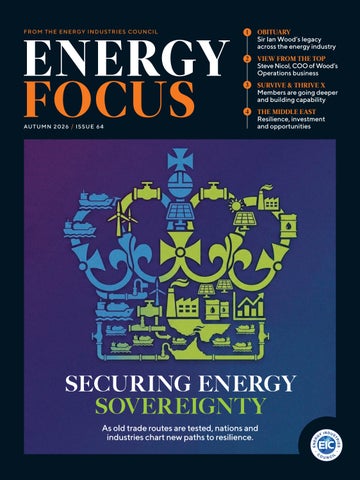
SECURING ENERGY SOVEREIGNTY As old trade routes are tested, nations and industries chart new paths to resilience.
Hughes Safety Showers is a premier manufacturer of emergency safety showers and eye/face wash equipment. Our products are designed to provide you with a safer working environment, greater protection against serious injury and peace of mind that you’re compliant with crucial safety standards.
Rapid decontamination. Expert protecton.
Emergency safety showers designed to operate in any environment Hughes offer an extensive range of safety showers and eye/face washes designed to operate in all locations and climates. Mains-fed or self-contained, insulated or heated - whatever your site requirement, we have a model to fit.
Protect worker safety speak to the experts today. +44 (0)161 430 6618 sales@hughes-safety.com
Scan here to view the range, or visit hughes-safety.com
Models pictured L-R: 1500L jacketed and insulated tank fed safety shower fitted with the Hughes Zero Power Cooler® to ensure tepid water in hot ambient climates, jacketed safety shower with lidded eye/face wash, unheated safety shower with stainless steel open bowl eye/face wash.
EF.Autumn26_002.indd 2
18/08/2026 11:00
CONTENTS
WHAT’S INSIDE
CONTENTS
FROM THE ENERGY INDUSTRIES COUNCIL AUTUMN 2026 / ISSUE 64
From the EIC
18
5 Foreword From the Chief Executive 6 Obituary: Sir Ian Wood, a legacy of humanity and leadership Stuart Broadley, CEO, EIC
26 Why thermal engineering will define next-generation low-carbon energy Dr Olu Baptist, Group CEO, Sterling Thermal Technology
RENEWABLES
8 View from the top Steve Nicol, Chief Operating Officer (Operations), Wood
28 Facing off to wind Hazwani Izzati, Energy Analyst, EIC Asia Pacific, and Beatriz Corcino, Energy Analyst, EIC Americas
12 News and events Updates from EIC 14 Survive & Thrive X: Member success stories Helena Bezerra, Editor & Internal Communications Coordinator, EIC South America 16 Survive & Thrive X: A project pipeline is not a supply chain Rebecca Groundwater, Global Head of External Affairs, EIC
ENERGY TRANSITION
OIL AND GAS 30 Gas security rewrites the LNG map Rodrigo Matsuda
6
36
POWER
18 Special feature: Securing energy sovereignty Tom Wadlow, Partner, WD Editorial
32 Connecting Scotland’s offshore wind boom Nabil Ahmed, Energy Analyst, EIC UK & Europe
22 Feature: Middle East – resilient and rising Ryan McPherson, Regional Director, EIC Middle East, Africa, Russia & CIS
NUCLEAR
8
38 A day in the life of… Henry Gomez, Senior Market Analyst for Latin America and the Caribbean, SGS INSPIRE
The Energy Industries Council 89 Albert Embankment, London SE1 7TP Tel +44 (0)20 7091 8600 Email info@the-eic.com Chief executive: Stuart Broadley
Should you wish to send your views, please email: info@redactive.co.uk
Editors Sairah Fawcitt +44 (0)20 7880 6200 sairah.fawcitt@redactive.co.uk Helena Bezerra +55 32 98410 1731 helena.bezerra@the-eic.com
Production director Rachel Young Senior designer Gene Cornelius Lead designer Craig Bowyer Picture editor Akin Falope Content sub-editor Kate Bennett
Sales and advertising +44(0)20 7324 2763 energyfocus@redactive.co.uk Energy Focus is online at energyfocus.the-eic.com
ISSN 0957 4883 © 2026 The Energy Industries Council
36 From ambition to execution: building Europe’s SMR future Nicole Holmes, Chief Commercial and Regulatory Affairs Officer, GE Vernova Hitachi Nuclear Energy
Energy Focus is the official magazine of the Energy Industries Council (EIC). Views expressed by contributors or advertisers are not necessarily those of the EIC or the editorial team. The EIC will accept no responsibility for any loss occasioned to any person acting or refraining from action as a result of the material included in this publication.
Publisher Redactive Media Group, 9 Dallington Street, London EC1V 0LN www.redactive.co.uk
Recycle your magazine’s plastic wrap – check your local LDPE facilities to find out how.
AUTUMN 2026 | ENERGY FOCUS | 3
03 contents_Autumn 2026_Energy Focus.indd 3
19/08/2026 09:16
.V]LYUTLU[ IHJRLK [YHKL ÄUHUJL 0UZ\YHUJL [V L_WVY[ ^P[O JVUÄKLUJL Tailored support from regional Export -PUHUJL 4HUHNLYZ 0M `V\»YL SVVRPUN [V do business overseas, UK Export Finance JHU OLSW `V\ HJJLZZ [OL Z\WWVY[ `V\ ULLK Get started at \RL_WVY[ÄUHUJL NV] \R
EF.Autumn26_004.indd 4
18/08/2026 11:01
FOREWORD
STUART BROADLEY, CEO
STUART BROADLEY
From the chief executive The fortunes of Wood Group, whose former chairr Sir Ian Wood passed away in July, light the way m forward in uncertain times: resilience, pragmatism and laser-focus are key to success
elcome to this edition of Energy Focus. As energy sovereignty rises to the top of the industry’s agenda, with governments and operators working to secure supply amid contested trade routes and vulnerable chokepoints, our special feature ‘Securing energy sovereignty’ examines how the sector is building alternative infrastructure and greater optionality into global energy flows. We also reflect on the enduring spirit of one of the world’s best-known engineering, procurement and construction businesses: Wood. Through our obituary to Sir Ian Wood and an exclusive View from the Top interview with Chief Operating Officer Steve Nicol, this issue charts the challenges and successes of Aberdeen’s definitive engineering powerhouse. This journey of resilience is just one example of the many stories featured in our 10th edition of Survive and Thrive. We begin by celebrating the extraordinary life of Sir Ian Wood KT GBE, who passed away in July 2026 at 84. Sir Ian was the visionary architect of Wood Group, transforming his family’s modest Aberdeen fishing business into a global FTSE 100 enterprise. Until his retirement in 2012, his leadership was defined by an unwavering drive, a deep sense of purpose
W
and a fundamental belief in people. Beyond corporate growth, his landmark 2014 Wood Review reshaped the UK’s offshore energy strategy. For generations of workers, Sir Ian left behind a corporate legacy built on safety, innovation and integrity – values that remain the company’s north star. Wood Group’s path since then has not always been smooth, facing operational challenges following its 2017 acquisition of Amec Foster Wheeler. However, its leadership found responsible, creative solutions to preserve its core identity
Facing adversity and finding solutions is a central theme in the 10th Survive & Thrive report for the next global chapter. Today, that resilience has evolved into the clear, pragmatic vision that Steve Nicol outlines under Sidara’s ownership. Global energy demands require a return to pragmatism, as Wood continues to support existing fossil fuel infrastructure while building lowercarbon systems such as renewables and electrification. To counter the risks and a broader industry skills crunch, Wood is actively investing in early careers and nextgeneration training. Backed by Sidara, its
leadership is ready to build tomorrow’s energy systems upon Sir Ian’s legacy. Facing adversity and finding responsible, creative solutions is a central theme in our 10th edition of the Survive & Thrive, which features 136 success stories from EIC member companies. This year, the number of companies interviewed across all regions made our research truly representative and global. The report highlights how the supply chain is navigating record revenues while executives remain cautious, proactively using this financial stability to fortify operational resilience against volatility. We also discuss the continued dominance and maintenance of oil and gas, which remains the undisputed frontrunner in providing the dependable work on which the industry relies. Additionally, we reflect on how even the least used growth strategy across all 10 years of the report still holds important lessons – which relates to The Great Bypass, the export feature in this edition. By highlighting the resilience of industry leaders amid shifting trade routes and the energy transition, we aim to deliver the essential insights required to drive success ahead. STUART BROADLEY Chief Executive Officer, Energy Industries Council stuart.broadley@the-eic.com
AUTUMN 2026 | ENERGY FOCUS | 5
05 foreword_Autumn 2026_Energy Focus.indd 5
18/08/2026 16:41
FROM THE EIC
SIR IAN WOOD
Sir Ian Wood with Stuart Broadley at EIC Energy Exports Conference 2022
OBITUARY
Sir Ian Wood: a legacy of humanity and leadership in the energy sector
he energy sector we know today would be very different without the vision, leadership and persistence of Sir Ian Wood. On 26 July, the UK oil and gas industry lost one of its most defining figures and respected leaders, who passed away peacefully at his home in
T
Aberdeen at the age of 84. While history will remember him as the industrialist who transformed a family fishing boat repair yard into a global engineering powerhouse, those closest to him will remember his kindness and unwavering commitment to his family. For the executives and energy leaders reading
this article, his passing represents the loss of a visionary whose influence shaped both our industry and communities. We reflect on his life with a profound sense of appreciation for a man who always understood that behind every megawatt, every subsea tie-back and every barrel of oil, there are people.
6 | ENERGY FOCUS | AUTUMN 2026
06-07 Sir Ian Wood_Autumn 2026_Energy Focus.indd 6
18/08/2026 17:22
Image: EIC
Sir Ian Wood, the industrialist who built Wood Group into a global energy powerhouse and reshaped UK offshore safety and policy, died on 26 July at his home in Aberdeen, aged 84
ENERGYFOCUS.THE-EIC.COM
Sir Ian understood that true accountability could not be delegated A career built on foresight Sir Ian’s professional journey was extraordinary yet deeply rooted in his home city. Born in Aberdeen in 1942, he graduated from the University of Aberdeen with a first-class honours degree in psychology before joining the family business in 1964. By 1967, he had become managing director. Recognising the potential of the early North Sea oil and gas sector long before many of his peers, he shifted the company’s focus to support offshore development. When he retired as chairman in 2012, the Wood Group employed more than 42,000 people across over 50 countries.
Piper Alpha and the safety legacy His commitment to the people who built the industry was never more evident than during the Piper Alpha tragedy of 1988. The disaster claimed the lives of 167 workers, including 39 from the Wood Group. Sir Ian
understood that true accountability could not be delegated. He stepped away from the corporate response to personally visit the grieving families of those who died – and then became an advocate for improving offshore safety across the supply chain. This was leadership grounded in the reality that an industry’s greatest operational responsibility is the protection of its workforce.
Shaping the energy transition Beyond his own enterprise, Sir Ian took on the responsibility of shaping the broader UK energy landscape. He led the independent Wood Review, commissioned by the UK government in 2013, which resulted in important regulatory reforms and the creation of today’s North Sea Transition Authority. Even after stepping down from the Wood Group, he turned his focus to the next great challenge: securing the supply chain’s role in a low-carbon future. He championed the transition to renewable energy while advocating for the continued drilling required in the North Sea to secure supply. His forward-looking vision directly led to the establishment of the Energy Transition Zone in 2021.
Philanthropy and legacy
Image: EIC
True to his belief in helping people help themselves, his investments focused on tackling social and economic inequality His impact spans from empowering 80,000 smallholder tea farmers in East Africa to supporting grassroots charities in Scotland. Through the Youth and Philanthropy Initiative, Scottish pupils learn to evaluate charities and secure £3,000 grants for them, emulating Sir Ian’s core values of tolerant and caring citizenship. He believed that good fortune in life carries a responsibility to help others realise their own potential. Sir Ian is survived by his wife, three sons and seven grandchildren. For those of us
navigating the future of UK energy, he leaves behind an important masterclass in leadership. “You can lead by your heart, but your head must come into it too!” he advised. Sir Ian proved that commercial success, energy security and profound philanthropy are not competing interests, but complementary ones. We will miss his presence, but his unwavering belief in the capability of our people and our supply chain remains the benchmark for everything we do next.
REFLECTION
Inspiring and humble leader “Sir Ian was the most inspiring and humble leader I have ever worked with, inspiring and challenging in equal measures. He drove his businesses with, as he used to say, one foot on the accelerator and one foot on the brake, using subtle signals like sharing a biscuit with you or asking your advice on something, when clearly he knew much more than me. “I had the privilege of working for Sir Ian for many years, and latterly of interviewing him many times as he supported Aberdeen Energy Exports Conference. I will miss his sharp wit, unwavering commitment to honesty and pragmatic policy, and his belief in community and teamwork. He was never arrogant, instead being eager to learn, generous and thoughtful. “Leaders like Sir Ian are few and far between, and all of us who knew him will miss him hugely. Indeed, those of you who did not know him personally will still miss the tireless work that he did behind the scenes to make working in North East Scotland’s world-class energy industry more productive, more embedded in the people and more profitable for its businesses. His voice and impact garnered respect; people always stopped and listened to him when he spoke. I fear we will miss the real influence he had more than we can imagine in the months and years to come.” Stuart Broadley, CEO, EIC
AUTUMN 2026 | ENERGY FOCUS | 7
06-07 Sir Ian Wood_Autumn 2026_Energy Focus.indd 7
18/08/2026 16:42
FROM THE EIC
Q&A: STEVE NICOL
VIEW FROM THE TOP Steve Nicol Steve Nicol, COO of Wood’s Operations business, talks to Energy Focus about the company’s focused growth strategy under Sidara ownership, the return of pragmatism to the energy debate, and the opportunities emerging across global energy and materials markets
At the top: Steve Nicol Steve has been at Wood for 25 years and joined its leadership team in 2023. He leads its Operations business, which delivers asset management solutions across the asset lifecycle. Specialising in operations, maintenance, modifications and brownfield engineering, it helps clients to optimise performance, extend asset life and reduce emissions via practical decarbonisation solutions. Steve is also Executive Sponsor of Wood’s Developing Professionals Network, championing workforce development.
8 | ENERGY FOCUS | AUTUMN 2026
08-11 View from_Autumn 2026_Energy Focus.indd 8
18/08/2026 16:43
ENERGYFOCUS.THE-EIC.COM
Wood in numbers
Wood has been through significant restructuring and divestments in recent years. What does the company’s strategy look like now, and what are its core activities today? The strategy today is about focus, discipline and growth. Wood is firmly centred on the energy and materials markets, where we have deep technical expertise and long-standing client relationships. Recent divestments have strengthened that focus, allowing us to focus on the markets and capabilities that matter most to our clients and longterm growth ambitions. We’re not trying to be all things to all people; we’re focused on the areas where we can create the greatest value. At our core, we’re a consulting, engineering and operations company, helping clients to solve complex challenges, improve performance and navigate an evolving energy landscape.
Which regions will offer the biggest growth opportunities over the next one to three years? The scale and pace of investment across the Middle East is creating significant opportunities to support clients across the full asset lifecycle, from consulting and engineering to operations. The Americas is also an important growth market, supported by continued investment in energy and industrial infrastructure.
The UK remains important, particularly as operators focus on getting more value from existing assets through life extension, operational efficiency and late-life asset management. Ultimately, growth follows investment confidence. Today, some of the strongest investment signals are coming from the Middle East, while the UK continues to offer attractive opportunities where clients are focused on maximising the value of existing infrastructure.
>50
COUNTRIES OPERATED IN AROUND THE WORLD
Which energy sectors will drive the most profitable growth in the next one to three years? One of the biggest shifts is the return of pragmatism to the energy debate. Energy security, affordability and decarbonisation all matter – and no single source can solve that challenge on its own. I therefore expect investment in oil and gas to remain resilient over the long-term, particularly where it improves energy security and reduces reliance on imports. That makes oil and gas the biggest near-term growth market for us, while renewables, electrification and other lower-carbon technologies grow alongside it. At the same time, clients are increasingly looking for partners rather than suppliers. We’re seeing growing interest in alliance models that align objectives, reward performance and create shared value over the life of an asset.
33,000
EMPLOYEES GLOBALLY
SUPPORTING THE DELIVERY OF
We’re not trying to be all things to all people; we’re focused on the areas where we can create the greatest value
30%
OF THE UK’S GAS SUPPLY
AUTUMN 2026 | ENERGY FOCUS | 9
08-11 View from_Autumn 2026_Energy Focus.indd 9
18/08/2026 16:43
FROM THE EIC
Q&A: STEVE NICOL
Some of the strongest investment signals are coming from the Middle East, while the UK continues to offer attractive opportunities Sidara is Wood’s new owner: how has this changed Wood, in terms of corporate culture, access to finance, and vision? The biggest difference is confidence. When people know where the business is heading and have a clear long-term owner behind them, it changes the conversation. We can focus our energy on serving clients, developing our people and pursuing growth opportunities, rather than managing uncertainty. We are proud to be part of the Sidara group. Sidara’s backing gives us greater stability, stronger financial foundations and access to a wider global network with complementary capabilities. But what excites me most is the opportunity to accelerate growth while retaining everything that makes Wood successful: our people, our technical expertise and our client relationships. Importantly, Wood remains Wood, with the same focus on delivering safe, reliable and sustainable solutions for our clients.
Wood employees in Iraq, where it is working on infrastructure development
Wood committed heavily to the green agenda over the past five years: is the plan to now refocus back to oil and gas? I don’t accept the premise that it’s one or the other. Energy security, affordability and sustainability all matter, and balancing those priorities requires investment across the entire energy mix – not in one source alone. Our focus on oil and gas has never gone away because our clients still need our expertise to deliver safe, reliable and affordable energy. At the same time, we’re helping them to reduce emissions and develop lower-carbon solutions. Our role is actually quite simple – helping clients to succeed in an increasingly complex energy landscape. That means supporting today’s energy systems while building tomorrow’s.
Has the conversation around energy sovereignty changed the type of projects that Wood is being asked to deliver? Not as much as some might expect. Energy sovereignty has become a bigger part of the political debate, but our clients’ priorities remain largely unchanged: safe operations, reliable production and long-term asset performance. The conversation may have
changed, but the fundamentals of what our clients need from us are largely the same.
How has the US-Israel war with Iran changed the attractiveness of the Middle east for investment? Geopolitical tensions inevitably create uncertainty, and our priority is always the safety of our people and supporting our clients. With more than 3,000 people across the region, that’s something we take extremely seriously. The Middle East continues to attract significant investment, underpinned by long-term energy demand and ambitious growth plans. Our opportunity pipeline remains strong and we continue to see significant opportunities across the region.
Do you face supply chain or skill constraints? If so, in what areas, and how is this affecting your business and your ability to scale up, diversify and retain key staff? Talent and supply chain capacity remain challenges across the industry, particularly as competition for experienced technical specialists continues to grow. For Wood, that means we have to work hard to attract, develop and retain the expertise that sets us apart. That’s
10 | ENERGY FOCUS | AUTUMN 2026
08-11 View from_Autumn 2026_Energy Focus.indd 10
18/08/2026 16:43
ENERGYFOCUS.THE-EIC.COM
Wood employees at the Central Area Transmission Terminal, Teesside, UK
North Sea is one of the world’s most technically demanding operating environments, and our expertise is well aligned with our clients’ needs.
Is the UK still a good place in which to invest, with its high costs of energy and of doing business? why we’re investing in early careers, skills development and the next generation of engineers and specialists – spanning both traditional engineering disciplines and emerging digital, data and AI-related capabilities. Digital skills, data and AI are increasingly important, but our longterm success will continue to depend on human judgement, engineering expertise and problem-solving capability. If we want a resilient industry in 10, 20 or or 50 years’ time, we need to invest in and nurture that capability today.
Many companies in the energy sector are exploring how AI will transform their business but have yet to see the benefits in their top and bottom line. What is Wood’s approach to AI? AI is only valuable when supported by trusted data, engineering expertise and operational execution. We combine all three to deliver better outcomes for clients. AI can identify patterns, but it’s human judgement and engineering expertise that determine what should happen next. For us, the opportunity with AI is to give our experts better information and insights so that they can make better
decisions, faster. That’s how we turn insight into action and protect value across the asset lifecycle.
How disruptive is geopolitical uncertainty to your planning, investments and growth? If I take the UK as an example, frequent changes in policy and direction can make it harder to attract capital, build long-term capability and retain critical skills. Capital and talent are mobile. When confidence falls, both tend to find opportunities elsewhere. If it affects our clients, it affects us. That’s why consistency and clarity are so important to industry’s long-term health.
Is the UK still a profitable market for Wood? Absolutely. The UK remains a strategically important market and continues to offer significant opportunities. It’s our home market, where our story began, and remains central to our future. We’ve grown alongside our clients and followed them around the world, but our commitment to the UK remains unchanged. The
Yes. The UK remains an attractive place to invest because of its people, capability and track record of delivery. The North Sea has earned a global reputation for technical excellence, supported by a highly skilled workforce and a strong supply chain. The question isn’t whether the UK has the capability – it does. The challenge is ensuring that we continue to invest in it. Without sustained investment, we risk losing not only our competitive advantage, but also the skills, knowledge and experience that have made the region successful.
What’s one piece of conventional industry wisdom that you’ve come to disagree with during your career? That stability, preserving consistency and prioritising permanence are the safest paths to success. The most successful people I’ve worked with in my career have been curious, adaptable and willing to challenge the status quo. In a constantly evolving industry, standing still is rarely an option. Whether it’s new technologies, new business models or changing client expectations, those who embrace change tend to create opportunities. Those who resist it often get left behind.
AUTUMN 2026 | ENERGY FOCUS | 11
08-11 View from_Autumn 2026_Energy Focus.indd 11
18/08/2026 16:43
FROM THE EIC
UPDATE
NEWS & EVENTS An oil refinery zone and logistics facility in Thailand
SURVIVE & THRIVE X
Don’t fall into the hype trap: oil and gas is still biggest EIC’s Survive & Thrive 2026 survey finds record revenues but growing caution, as renewables stall and oil and gas fund the supply chain BY STUART BROADLEY, CEO, EIC
n 2026, EIC’s senior team and I interviewed leaders from 136 EIC member energy supply chain companies across the UK, Europe, Middle East, Asia Pacific and Americas. The results, published in the 10th edition of the EIC Survive & Thrive Insight Report, show that revenues are rising strongly but leaders remain cautious about where they invest – and how much risk they will take on transition projects.
I
are concentrating on transformative change, margins, productivity, operational discipline and risk management. Supply chain companies have seen large project pipelines announced and then delayed. Many have invested time and engineering capacity into opportunities that went nowhere. They now want credible schedules, committed capital and a clear route to contract awards before committing resources.
Oil and gas still dominates revenues Oil and gas remains the main revenue source, with 94% of interviewed companies being active in the sector; on average, it accounts for 59% of their revenues. Conversely, companies active in renewables fell from 59% to 48%, reflecting the fact that limited renewables
Record revenues, rising caution Three-quarters of the companies reported record revenues in 2025, with average growth of 23%. Yet executives were far from complacent, mentioning geopolitical uncertainty, policy volatility, rising inflation and unpredictable schedules. Strong revenues are funding business protection rather than speculative growth. Strategies reflect this shift: optimisation accounts for 19%, while resilience has more than doubled to 18% in 2026. Companies
Companies move people and capital towards work that is ready to proceed. In many cases, that still means oil and gas
12 | ENERGY FOCUS | AUTUMN 2026
12-13 news and events 2_Autumn 2026_Energy Focus.indd 12
18/08/2026 16:44
ENERGYFOCUS.THE-EIC.COM SURVIVE & THRIVE
136
90%
COMPANIES FEATURE IN SURVIVE & THRIVE X
OF COMPANIES USE AI INTERNALLY
40%
23%
SERVICE & SOLUTIONS SUCCESS CASES
popular growth strategy across all 10 years of Survive & Thrive. Companies prefer expanding in familiar territories to avoid stretching resources thinly, with Europe being the established destination and the Middle East (45%) and Asia (44%) the leading targets for further growth.
AVERAGE GROWTH IN 2025
Upcoming events ROG.e 2026 21-24 September 2026 Rio de Janeiro, Brazil the-eic.com/Events/Exhibitions/ ROGe2026-UKPavilion
AI and data centres: new fronts Nearly 90% of companies use AI internally, but only 44% offer AI-related services to customers. Companies may be testing AI first, wanting evidence that it can improve productivity before making it central to their customer proposition. This means that, so far, there has been no uptick in the number of success stories being reported by companies owing to AI investments. We wait to see if that will come through more strongly in 2027. Data centres are a more immediate commercial opportunity, with 45% of companies interviewed entering the data centre infrastructure market. Many already have relevant capabilities in power systems, cooling, structural engineering and large-scale project delivery. Data centres offer a direct route into a fast-growing adjacent market without requiring new expertise.
EIC Awards
work is reaching the supply chain, and at low or negative margins. EIC’s final investment decision (FID) data, sourced from EICDataStream, shows that the global energy sector with the highest FID rate is upstream oil and gas, at 34%, compared with only 8% for fixedbed offshore wind. For hydrogen, the rate is 10%, while carbon capture is 8%, and floating offshore wind is below 1%. Supply chain companies cannot sustain capacity with such low progression rates. When transition projects are repeatedly delayed by financing costs, policy and regulatory uncertainty, infrastructure constraints or changes in scope, companies move people and capital towards work that is ready to proceed. In many cases, that still means oil and gas.
Exports and international trade hit a fouryear high of 56% in 2026, yet developing entirely new exports has been the least
The global energy supply chain is in strong financial health, but with a lower tolerance for uncertain work. Engineering capacity will not wait years for transition projects to secure finance or permits. Developers and policymakers must close the gap between ambition and investable projects by accelerating FID rates and providing schedule confidence. Until then, oil and gas will continue to provide the dependable work on which the industry relies. Image: iStock
Exports up, but playing safe
Closing the ambition gap
GET INVOLVED AND FIND OUT MORE Contact membership@the-eic.com to learn more about these new developments and how to join EIC.
EIC Infrastructure Breakfast at Hydrogen Energy Hamburg 20 October 2026 Hamburg, Germany the-eic.com/EventDetail/ dateid/4847
WESCA Awards London 29 October 2026 London, UK the-eic.com/WESCA/WESCAAwards-London
ADIPEC 2026 2-5 November 2026 Abu Dhabi, UAE the-eic.com/Events/Exhibitions/ ADIPEC2026%7CEIC
Check out our full calendar at the-eic.com/Events/Calendar
Latest reports EIC Survive & Thrive X EIC Insight Report: Hydrogen – Europe EIC Insight Report: Q2 Cross Sector Decommissioning Access to these reports and more is free to EIC members on EICDataStream. If you are not a member and want to know more, visit the-eic.com/Membership
AUTUMN 2026 | ENERGY FOCUS | 13
12-13 news and events 2_Autumn 2026_Energy Focus.indd 13
19/08/2026 09:16
FROM THE EIC
SURVIVE & THRIVE X
xport growth is now a defining feature of the global energy supply chain, but not in the way that many might expect. Companies are earning more revenue overseas without venturing into new and unfamiliar markets. Instead, they are becoming more international by going deeper: strengthening their position in locations where they already have customers, relationships, project experience nce or a clear route to growth. In 2026, the average export share of revenue among Survive v ve & Thrive respondents rose to 57% – its highest level in four years of reporting, and up from m 49% in 2025. A decade of Survive viv ve & Thrive data shows where that att growth is not coming from: developing new export markets ts has consistently ranked as the least favoured growth strategy. y. Most companies are taking a considered, targeted approach h instead, selling more to existing ng customers, following established hed project pipelines and expanding in countries where they already understand the commercial and regulatory landscape. A smaller number, however, are showing how carefully planned moves into new regions can deliver major strategic gains.
E
Permanent footholds For many companies, export growth starts with turning a long-standing overseas presence into something more permanent. Superheat, for example, had been serving the Gulf Cooperation Council (GCC) for more than 13 years by flying specialists in and out of the region. In 2023, it opened a permanent office in Abu Dhabi to strengthen its local presence and influence the region’s attitude towards heat treatment, using a remote
diterranean. the Eastern Me ; R ti tive I s gateway to ll vallve Reac – HFI's s b ba V pru BV AB Cy -A l, so l lan Ve ols itrans; V Top: Limas Navit Downhole To i ht: N ttom llefftt tto rig B Bott
SURVIVE & THRIVE 2026
Going deeper, not wider: Member success stories Survive & Thrive 2026 respondents are exporting more than ever – but not by entering new markets. They are going deeper into ones they already know BY HELENA BEZERRA, EDITOR & INTERNAL COMMUNICATIONS COORDINATOR, EIC SOUTH AMERICA
14 | ENERGY FOCUS | AUTUMN 2026
14-15 Survive and thrive_Autumn 2026_Energy Focus.indd 14
18/08/2026 16:47
ENERGYFOCUS.THE-EIC.COM
Left to right: Cutting & Wear do downhole milling tools; a Su Superheat heat treatment tec technician at work
E Export success depends less on chasing every opportunity and more on knowing where, an when and how to commit wh digital platform to train The result? local workforces. The Superheat secured 20% S year-on-year growth. Reactive Downhole Tools Middle East took a similar tack, moving from a US-based supply model to building a globally certified manufacturing hub in the UAE. This meant creating a facility from scratch in a market without a mature secondary supply chain. It helped the company to meet regional demand while gaining access to wider international export markets.
Localising for growth For other companies, localisation has been the key to unlocking entry barriers. Cutting & Wear focused on the Middle East as part of its post-pandemic recovery strategy, opening a UAE distribution centre. The decision cut customer lead times from six weeks to next-day delivery, boosting regional sales. Navitrans took a similar s a approach in Africa, one of its major markets. s. The company has built strong on-the-ground teams ms and deployed an integrated ated logistics model across oss more than 20 countries. This This allowed it to operate te in complex, infrastructurectureconstrained environments nments and create a repeatable able model for entering and
serving markets across the th continent.
Where growth is heading These examples reflect a wider trend revealed by our Survive & Thrive data: Europe remains the most established export market for many respondents, while the Middle East and Asia are most frequently cited as future growth targets. About 45% of respondents identified the Middle East as a priority market for new export activity, followed closely by Asia at 44%. Again, though, these are not unfamiliar destinations. Many companies already have a foothold in the Middle East or Asia through existing projects and business contacts. Regional figures underline how important international revenue has become. The average export share of revenue reported by European participants stood at 75% in 2026. That number was companies as 63% for o co pa es in the UK, Ireland and the
Americas. If anything, these figures indicate that overseas revenue is no longer a secondary opportunity for energy supply chain companies – it is central to their business model. At the same time, companies remain cautious about the cost and risk of building entirely new export markets. New market entry takes time. It requires local knowledge, regulatory understanding and relationships that are rarely built quickly. Still, for some companies, entering unfamiliar territory can be transformative.
When risk pays off Velan ABV faced this challenge when it targeted the Middle East, a region in which it had no previous footprint. The company lost a year to unexpected complexities in assessment audit documentation. Hugh Fraser International (HFI) faced a different kind of challenge when it opened an office in Cyprus, entering a new jurisdiction to manage growing regulatory demands in its core GCC market. In both cases, expansion was difficult – but the results were significant. For Velan ABV, moving into the Middle East helped to protect the business during a loss-making period and reduced its reliance on a single client. By securing
a facility location in Saudi Arabia, the company won tens of millions of US dollars in new orders and increased its revenue by 2.5 times over eight years. For HFI, the move into Cyprus created access to the Eastern Mediterranean’s advanced energy transition agenda. It gave clients a stable EU-based environment while opening the door to an estimated US$585bn pipeline of regional opportunities.
Knowing where to commit The picture is clear: the global energy supply chain is becoming more international, but companies are selective about where they take risk. That caution is understandable – export growth is rarely simple. But the companies doing it well are not expanding for the sake of expansion. They are choosing specific markets, solving specific barriers and building structures that make international growth more sustainable. Whether they are deepening their presence in familiar regions or entering new ones, the strongest performers are showing that export success depends less on chasing every opportunity and more on knowing where, when and how to commit.
AUTUMN 2026 | ENERGY FOCUS | 15
14-15 Survive and thrive_Autumn 2026_Energy Focus.indd 15
18/08/2026 16:47
FROM THE EIC
SURVIVE & THRIVE X
nergy policy is often measured by targets, announced capacity and the size of the development pipeline, but the supply chain experiences things differently. Its main concern is whether projects reach final investment decision, contracts are awarded and companies have enough visibility to invest in people, equipment and facilities.
E
What the numbers show EIC’s 10th Survive & Thrive report, based on interviews with 136 energy supply-chain companies, shows a sector that is strong yet careful about where it commits capability. Three quarters of participating companies reported average revenue growth of 23% in 2025, and 91% expected the growth to continue this year. However, supply chain companies are still very cautious and far from being in a state of complacency. In fact, resilience, optimisation and diversification are all among their favourite strategies. What is really happening is that companies are using the good years to protect themselves against weaker or less predictable project pipelines. This caution is well explained by final investment decision data. About one quarter of upstream, midstream and downstream projects under development has been given the go-ahead for building. Cleantech is in a different world, with 14% of renewable projects having received the green light for investment, 10% for hydrogen, 8% for carbon capture and offshore wind, and less than 1% for floating offshore wind.
BUILDING CAPABILITY
A project pipeline is not a supply chain EIC’s 10th Survive & Thrive report finds a sector growing steadily but wary of hollow promises. Two member companies show what it actually takes to turn a pipeline of announced projects into real, deliverable capability BY REBECCA GROUNDWATER, GLOBAL HEAD OF EXTERNAL AFFAIRS, EIC
These figures put the state of the supply chain in perspective and clearly tell us that a large, bloated pipeline of announced projects can create a lot of activity on paper – with frontend engineering design (FEED) and pre-FEED contracts – but does not generate the real work
that the chain needs, which is to actually build these projects. A pipeline of conceptual projects does not create supply chain capability. Companies – and entire sectors – build capability on the back of a sustained supply of projects that allows them to keep,
train and hire experienced engineers and qualified welders while maintaining factories, test facilities, vessel access, specialist software and, importantly, relationships. These assets take years to put together and can be lost beyond recovery when order books are
16 | ENERGY FOCUS | AUTUMN 2026
16-17 supply chain capability_Autumn 2026_Energy Focus.indd 16
18/08/2026 16:47
ENERGYFOCUS.THE-EIC.COM
Gas turbine electrical power plant
A pipeline of conceptual projects does not create supply chain capability
Capability built on the ground IEP Process Solutions’ work in Qatar shows how this works in real terms. The company, featured in the report, created Qatar’s first open analyser system integration facility, bringing design, engineering, fabrication, factory acceptance testing and commissioning into the country. Revenue doubled from £1.5m in 2023 to £3m in 2025 as exports reached 40% of turnover. Its conclusion was direct: “Building local engineering, fabrication and FAT [factory
acceptance testing] capability can improve project delivery, reduce coordination risks and strengthen long-term client relationships.”
Still funded by oil and gas This very situation of too few projects reaching construction helps to explain why oil and gas still accounts for an average of 60% of the revenue reported by participant companies, and why 94% of these businesses remain active in the sector – continuing to fund much of the engineering, manufacturing and operational base used elsewhere in the energy
Image: iStock
negligible and projects keep moving to the right.
industry. We cannot stress this fact enough, but it does not mean that renewables will have to be fed by oil and gas forever. The industry needs more projects that move at a faster pace, which will help to create more sustainable capacity and capabilities to deliver on net-zero targets. For now, the interviews show that the share of companies active in the renewables sector fell from 59% to 48%, even as its average contribution to revenue rose from 10% to 13%. Companies are also taking on more work outside energy, where the average revenue share reached 31%. That can protect jobs and facilities, but it also shows that energy projects are not producing enough work. This diversification creates work for the supply chain, but it is ultimately a sign of ailment: continued diversification into other sectors could mean energy industry capacity and capability lost beyond return. For many, the energy industry was the reason for their existence. If they continue this shift, that reason will cease to exist, and they will find a new purpose and a wholly new industry.
The real constraint is senior decision bandwidth – the people who own interfaces, close gaps and hold the delivery line under pressure Alessandro Carmo, DAPIN
Organisational capability Capability is organisational, too. DAPIN, another EIC member in the report, built its Middle East business around senior engineers, structured mobilisation, clear interface ownership and audit-ready documentation. In 2025 it generated an estimated €6.5m of regional workshare revenue and reported staff retention of 92% to 96%. Commercial director Alessandro Carmo says that the real constraint is rarely the number of junior staff available, but “senior decision bandwidth – the people who own interfaces, close gaps and hold the delivery line under pressure”. Pulled together, these strings tell us that policymakers should concentrate on the conditions that keep supply chain capability productive. A credible pipeline means investable projects that move beyond initial announcements and FEED. But supply chain capability is only strengthened through the right regulatory and physical infrastructure, including permitting, grid connections, ports and pipelines. The most important message from these interviews is that the supply chain is maintained and strengthened through continuity of work, the right infrastructure and investment confidence that allow projects to move from concept to build.
AUTUMN 2026 | ENERGY FOCUS | 17
16-17 supply chain capability_Autumn 2026_Energy Focus.indd 17
18/08/2026 16:48
SPECIAL FEATURE
GEOPOLITICS OF ENERGY
ENERGY CHOKEPOINTS
SECURING ENERGY SOVEREIGNTY With tensions in Strait of Hormuz rumbling on and vulnerabilities across key energy trade routes laid bare, governments and businesses are accelerating efforts to develop alternative infrastructure, new geopolitical alliances and strategic bypass mechanisms BY TOM WADLOW, PARTNER, WD EDITORIAL
18 | ENERGY FOCUS | AUTUMN 2026
18-21 Special feature_Autumn 2026_Energy Focus.indd 18
18/08/2026 16:49
ENERGYFOCUS.THE-EIC.COM
digital age. Today, roughly 90% of all global freight still travels by sea*, with much of this traffic flowing through a select number of pinch points. These include canals and straits that, in recent years, have become significant sources of economic headaches. Back in March 2021, the six-day blockage of the Suez Canal was estimated by the World Economic Forum to have cost global trade somewhere between US$6bn and US$10bn. In 2024, the Suez Canal Authority reported that its revenues had lummeted from US$10.2bn to US$4bn as shipping companies diverted vessels away from the Red Sea due to Houthi attacks. Since then, it has been revealed that the Panama Canal could face potential draught restrictions by 2027. And the US and Israel’s ongoing conflict with Iran has severely disrupted shipping through the Strait of Hormuz, which is typically responsible for the transit of around 20% of the world’s oil and liquefied natural gas. This has contributed to increased inflation across much of the world.
Two pipelines are rising to the fore The closure or threatened closure of these important chokepoints are forcing the energy industry to find new answers to an old question: how do you reliably move oil and gas from where it is produced to where it is needed? Lynn Coutts, Managing Director of Middle East for ATPI – a firm supporting international energy operators in the region with specialised travel services – is witnessing real changes. “The current situation has reinforced just how critical established energy transit routes remain to global markets, particularly the Strait of Hormuz,” she explains. “While the strategic
importance of these routes has long been recognised, recent events have accelerated efforts to reduce reliance on any single corridor by strengthening resilience and creating greater flexibility.” Coutts highlights Saudi Arabia’s East-West Pipeline to the Red Sea and the UAE’s pipeline to Fujairah as significant examples of transit routes that are receiving attention as alternative ways to export crude without the Strait of Hormuz. The objective, she argues, is not to replace existing routes, but to create greater optionality and ensure that there are viable alternatives if disruption occurs. “More broadly, regional pipeline, terminal and port developments are receiving renewed attention as countries look to diversify export options and reduce operational risk,” Coutts adds. “And companies are strengthening shipping strategies through greater use of strategic storage, more flexible vessel deployment, diversified supply arrangements and enhanced contingency planning.”
The industry is moving towards more diversified, flexible and resilient operating models, with energy security now viewed as a longterm strategic priority rather than a shortterm response to individual events Lynn Coutts, ATPI
Within the challenges lie opportunities Of course, the diversification of longestablished supply chains requires careful consideration. It is simply not possible to make wholesale switches overnight, with many significant operational challenges and risks to consider. “Diversification only creates resilience if organisations have the data, technology and governance to manage those options effectively,” Coutts says, emphasising the importance of visibility. “The biggest challenges to overcome will be higher costs; identifying, vetting, and establishing new suppliers; greater exposure to force majeure events; regulatory complexities across different countries; infrastructure limitations; larger and more complex supply networks; digital and cyber risks from increased connectivity;
*Source: https://pmc.ncbi.nlm.nih.gv/articles/PMC2880080
I
f 2026 has taught us anything, it is that physical trade – and the waterways on which relies – remains incredibly important in an increasingly
AUTUMN 2026 | ENERGY FOCUS | 19
18-21 Special feature_Autumn 2026_Energy Focus.indd 19
19/08/2026 09:30
SPECIAL FEATURE
GEOPOLITICS OF ENERGY
The legal and contractual landscape is shifting Undoubtedly, the expectation is that recent events will lead to lasting changes. This is the view of Pamela McDonald, Partner at multinational law firm Pinsent Masons and head of its Doha Office. Specifically, from a legal perspective, she anticipates that major energy project investors and lenders will place ever-greater emphasis on geopolitical resilience, should sustained disruptions continue. “Projects highly dependent on Middle East export routes could face high financing costs, enhanced lender due diligence, increased contingency requirements, greater scrutiny of supply chain resilience and demands for additional political risk protections,” McDonald says. “For major liquefied natural gas, petrochemical and power projects, lenders may require more robust contingency planning, additional reserves, enhanced insurance programmes and greater evidence that critical equipment and exports are not dependent on a single transport corridor.” As an adviser to Middle Eastern clients in the infrastructure and energy sectors, McDonald also reveals that the US and Israel’s ongoing conflict with Iran has already prompted legal advisers to conduct reviews of force majeure, material adverse change, insurance and risk-allocation provisions.
“In my view, future energy contracts are likely to address issues such as chokepoint disruption, sanctions escalation, war-risk insurance withdrawal, prolonged shipping re-routing and security-related supply shortages,” she says. She highlights the importance of contractual wording, given that recent disputes in the Red Sea and Strait of Hormuz have not centred on whether disruption occurred, but on which party bears the resulting consequences. “One of the clearest lessons from recent disruptions is that many legally viable claims fail because they are poorly documented,” McDonald adds. “By the time a dispute reaches arbitration, contemporaneous records frequently determine the outcome. The strongest claim is rarely the one with the strongest narrative – it is usually the one with the strongest evidence trail.”
For major liquefied natural gas, petrochemical and power projects, lenders may require more robust contingency planning… and greater evidence that critical equipment and exports are not dependent on a single transport corridor Pamela McDonald, Pinsent Masons
The US and Israel’s conflict with Iran is causing challenges to shipping in the Strait of Hormuz
workforce capability and skills availability; and balancing resilience with operational efficiency.” Alongside these varied challenges, however, are opportunities. The UAE is building a separate 1.5MMbbl/d pipeline to Fujairah alongside its existing 1.8MMbbl/d line, almost doubling combined pipeline capacity. Meanwhile, Goldman Sachs analysts estimate that planned pipeline and export infrastructure projects across the Gulf could create enough capacity to divert 7.3m barrels of oil per day away from Hormuz by 2028. This, together with existing bypass capacity, would allow roughly 60% of Gulf oil exports to avoid the strait. “Shipping and marine logistics providers are benefiting from increased
20 | ENERGY FOCUS | AUTUMN 2026
18-21 Special feature_Autumn 2026_Energy Focus.indd 20
18/08/2026 16:49
ENERGYFOCUS.THE-EIC.COM
demand for flexible vessel capacity, alternative routing and enhanced maritime risk management,” Coutts adds. “Companies are also investing more heavily in strategic energy storage, digital monitoring, predictive analytics, cybersecurity and supply chain visibility to improve operational resilience and respond more effectively to disruption.”
Images: iStock
Resilience relies on adaptability and optionality The consensus is that recent disruptions and geopolitical developments are changing the energy landscape. While the protection of supply chains has historically relied on predictable and largely secure trade routes, uncertainty has pushed resilience and adaptability to the heart of strategic considerations. Companies are investing in alternative export routes, expanding storage capacity, strengthening contractual protections and building greater flexibility into their operating models in recognition of the more complex geopolitical environment. There has also been a fundamental shift in how energy companies are working with their suppliers, Coutts says. “During periods of uncertainty, transactional relationships are no longer enough,” she explains. “Companies are looking for strategic
partners that understand their operations, can respond quickly and operate as an extension of their business. Strong local expertise and on-the-ground support in complex regions have become increasingly important. “The industry is moving towards more diversified, flexible and resilient operating models, with energy security now viewed as a long-term strategic priority rather than a short-term response to individual events.” The objective should not be about mitigating disruption – the last half decade has shown that geopolitical events are both unpredictable and inevitable. Rather, value chain players must focus on ensuring that their
Companies are investing in alternative export routes, expanding storage capacity, strengthening contractual protections, and building greater flexibility into their operating models operations are flexible enough to continue in the face of adversity. While new pipelines, ports and energy transit options will play a role, the global energy industry needs to rethink priorities and make it clear that optionality is now just as valuable as supply-chain efficiency. Indeed, the long-term winners will be those firms that can weather unique storms and thrive in the face of volatility.
A pipeline system for transporting crude from a wellhead to a gas-oil separation plant in Saudia Arabia
AUTUMN 2026 | ENERGY FOCUS | 21
18-21 Special feature_Autumn 2026_Energy Focus.indd 21
18/08/2026 16:49
SPECIAL FEATURE
MIDDLE EAST: RESILIENT AND RISING
Construction in Abu Dhabi, UAE
THE MIDDLE EAST
Resilience, recovery and the road to 2027 Despite months of geopolitical turbulence, the Middle East’s energy sector has proved resilient. As investment holds firm and reconstruction looms, the region is shifting from managing uncertainty to shaping the next phase of global energy growth BY RYAN McPHERSON, REGIONAL DIRECTOR, EIC MIDDLE EAST, AFRICA, RUSSIA & CIS
he past few months have once again demonstrated the remarkable resilience of the Middle East’s energy sector. While geopolitical tensions have understandably dominated the headlines and created periods of uncertainty, they have also reinforced a fundamental truth: the region remains central to global energy security and is one of the world’s
T
most significant destinations for energy investment. For companies across the energy supply chain, the conversation is already starting to shift from managing uncertainty to identifying opportunities. For those of us who live and work in the region, resilience is nothing new. Businesses have learned to adapt quickly, stay agile and continue to deliver projects even in the most
challenging circumstances. That ability has once again come to the fore and should give the industry confidence as we look towards the next phase of growth.
Investment never stopped One of the biggest misconceptions during periods of geopolitical uncertainty is that investment simply grinds to a halt. The reality on the ground tells a very different story.
22 | ENERGY FOCUS | AUTUMN 2026
22-24 The Middle East_Autumn 2026_Energy Focus.indd 22
18/08/2026 16:50
ENERGYFOCUS.THE-EIC.COM
Across the Gulf Cooperation Council (GCC), operators have continued to progress major capital programmes, engineering, procurement and construction contracts continue to be awarded, and investment in both traditional and low-carbon energy projects remains robust. National energy strategies, industrial diversification programmes and localisation initiatives have continued at pace, reinforcing the region’s commitment to long-term economic growth. Understandably, some companies temporarily reviewed their travel policies and project deployment, but very few fundamentally changed their longterm commitment to the Middle East. If anything, geopolitical shifts have proved that the region remains strategically important to the global energy system. The situation in Strait of Hormuz reminded the world that energy security and supply chain resilience are intrinsically linked. While alternative export routes are being explored, the Gulf’s infrastructure and logistics network remains irreplaceable for global energy markets. Recent events have highlighted just how dependent the world is on the region’s energy infrastructure and export capability, reinforcing the need for continued investment in resilient supply chains and strategic energy assets.
The Middle East is not simply recovering from recent events; it is positioning itself for its next chapter in supporting economic recovery, accelerating diversification and building resilience against future shocks. Rather than reacting to disruption, governments are using these strategic investment vehicles to strengthen industrial capability, develop critical infrastructure and position their economies for long-term growth. For international companies, success will increasingly depend not only on technical capability but also on demonstrating a genuine long-term commitment to each market. Investing in local partnerships, developing local workforces and supporting national economic ambitions will become even more important in the coming years.
Reconstruction: the next great pipeline While much attention has rightly focused on the geopolitical situation, the industry must also start to look beyond the current
headlines. History has consistently shown that when conflict subsides, reconstruction follows. Across parts of the wider Middle East, work has already commenced on assessing and rehabilitating damaged infrastructure. In the coming years, reconstruction is likely to create one of the largest project pipelines the region has experienced in a generation. However, this will not just involve rebuilding what already existed – it presents an opportunity to develop smarter, more resilient and more sustainable energy systems, integrating modern technologies, digital infrastructure, renewable energy and better grid resilience from the outset. For the energy supply chain, the challenge will be to identify where capability gaps exist, understand the complexities of these markets and position early to support this next development phase.
Images: Shutterstock/Getty
National priorities take centre stage As we move into the second half of 2026, I believe we will continue to see strong cooperation across the GCC, particularly around regional energy security, infrastructure development and industrial collaboration. However, there will also be a growing emphasis on national priorities. Countries across the region are rightly focused on maximising domestic economic value. Local content programmes continue to evolve, manufacturing capability is expanding, and In-Country Value policies are becoming more sophisticated. At the same time, sovereign wealth funds are playing an increasingly important role
The Strait of Hormuz
AUTUMN 2026 | ENERGY FOCUS | 23
22-24 The Middle East_Autumn 2026_Energy Focus.indd 23
18/08/2026 16:51
SPECIAL FEATURE
MIDDLE EAST: RESILIENT AND RISING
Oil prices and the long view Recent oil price fluctuation has naturally prompted questions on future investment, but history has consistently shown that the GCC takes a far longer-term view than short-term commodity price movements. National oil companies continue to invest based on strategic production capacity and long-term demand fundamentals, rather than reacting to temporary oil price fluctuations. The UAE’s decision to move beyond traditional OPEC production constraints provides additional flexibility to maximise production where market conditions allow, while continuing to invest
Ruwais Port and Refinery, UAE
heavily in the infrastructure needed to support future growth. Together with Saudi Arabia, Qatar and Oman, the UAE continues to demonstrate confidence in its long-term role in the global energy mix.
message has been remarkably consistent: businesses are cautious but optimistic. Travel has largely returned to normal, tendering activity remains healthy and companies are, once again, focusing on growth rather than uncertainty. Relationships continue to strengthen, with collaboration across governments, operators, contractors and suppliers remaining one of the regional energy sector’s defining characteristics.
Cautious optimism on the ground Speaking with EIC members across the region over recent weeks, one
MIDDLE EAST ENERGY TRENDS
The road to 2027
Resilient and rising Despite months of geopolitical turbulence, capital has kept flowing across the Gulf Cooperation Council (GCC). The numbers behind the region’s next chapter: Active project pipeline
US$675bn+
Traditional vs. low-carbon CAPEX split
Combined capital value of 516 sanctioned and planned energy projects tracked across the six GCC states
Diversification is underway – but oil, gas and conventional power still dominate near-term investment
EPC contracts awarded
72%
110
Oil, gas and conventional power
GCC capital pipeline by country (US$bn) Saudi Arabia UAE Oman Qatar Kuwait Bahrain
207 198 114 103 50 4
28% Renewables, transition, nuclear and storage
Reconstruction pipeline already identified
US$30bn+ 13 rehabilitation and reconstruction projects mapped across Iraq, Jordan, Lebanon and Syria – an early sign of the region’s next great project wave
Image: Shutterstock
Engineering, procurement and construction contracts awarded across the GCC, Q1 2025 – Q2 2026 – proof that investment never stopped
Looking ahead to 2027, I believe we will see continued acceleration across the GCC. Investment will stay strong, energy diversification will continue, industrial capability will expand and supply chain resilience will remain a strategic priority. At the same time, reconstruction activity across the wider region will start to create entirely new opportunities for those companies that are prepared to invest early and build long-term partnerships. The Middle East has once again shown that it is not just responding to global events – increasingly, it is shaping them. For the global energy supply chain, that should be encouraging. The fundamentals remain exceptionally strong. Governments continue to invest with confidence, operators continue to advance ambitious capital programmes and the commitment to building resilient, diversified economies has never been clearer. The Middle East is not simply recovering from recent events; it is positioning itself for its next chapter. For companies prepared to embrace the opportunities ahead, it promises to be one of the most exciting periods in the region’s history.
24 | ENERGY FOCUS | AUTUMN 2026
22-24 The Middle East_Autumn 2026_Energy Focus.indd 24
18/08/2026 16:51
5C
WHERE ENERGY OPPORTUNITY TAKES SHAPE
Energy is entering a new era.
ADIPEC in numbers:
Rising demand, new technologies and intensifying competition are reshaping global energy markets – creating unprecedented opportunities to expand supply, attract investment and strengthen economic competitiveness. From 2–5 November in Abu Dhabi, ADIPEC 2026 brings together leaders, capital and capability to turn opportunity into action – advancing the partnerships, projects and technologies that will shape how energy is produced, traded and delivered.
JOIN THE GLOBAL ENERGY COMMUNITY
239,000+
2,250+
Exhibition attendees
Exhibiting companies
16,500+
1,800+
Conference delegates
Conference speakers
Supported by
Partners
2756C
Platinum sponsors
Pantone Medium Blue C
TOTAL TOT_21_00008_TotalEnergies_Logo_CMYK JFB
30-34 Rue du Chemin Vert 75011 Paris +33 (0)1 85 56 97 00 www.carrenoir.com TONS RECOMMANDÉS
CYAN
RGB:20/40/160 CMYK:100/80/0/0
ARAB DEVELOPMENT
Technical Conference organised by
ADIPEC brought to you by
MAGENTA
Ce fichier est un document d’exécution créé sur Illustrator version CS6.
Date : 26/05/2021
TECHNIQUE
YELLOW
ENERGY TRANSITION
THERMAL TECHNOLOGY
ENGINEERING THE ENERGY TRANSITION
Why thermal engineering will define nextgeneration lowcarbon energy Hydrogen, carbon capture and renewables dominate the transition narrative, but thermal engineering quietly makes each one commercially and technically viable BY DR OLU BAPTIST, GROUP CEO, STERLING THERMAL TECHNOLOGY
he energy transition is often associated with hydrogen, carbon capture, renewable power and sustainable fuels. Yet behind each of these technologies lies a less visible, but equally critical enabler: thermal engineering. Efficient heat exchange and heat recovery are essential to making many low-carbon technologies technically viable and commercially scalable. For more than 120 years, Sterling Thermal Technology has designed and manufactured bespoke heat exchangers for some of the world’s most demanding industrial environments. Today, its expertise is helping to solve the engineering challenges that will define the next generation of clean energy infrastructure. As governments and industry work towards ambitious
T
decarbonisation targets, engineering companies that can deliver tailored thermal solutions will play an important role. The energy transition goes beyond fuel source replacement: it is about using energy more efficiently, recovering valuable resources that would otherwise be wasted and ensuring that new technologies can operate safely, reliably and economically. Whether they’re supporting hydrogen production, carbon capture, waste-to-energy facilities, renewable energy projects or industrial decarbonisation, heat exchangers optimise thermal energy transfer and recovery. They improve process efficiency, reduce fuel consumption and cut emissions while helping customers to maximise their return on investment.
In many applications, effective thermal management is the difference between a technology that works in theory and one that can be deployed at commercial scale.
Cracking the hydrogen challenge One project that demonstrates this point is Sterling’s contribution to the world’s first floating ammoniato-hydrogen cracker, delivered in partnership with a leading global engineering company. This is a significant milestone in the development of the international hydrogen economy and shows how specialist engineering expertise can unlock new opportunities. Hydrogen has the potential to decarbonise sectors where electrification alone is not practical, such as heavy industry, shipping and large-scale power generation. Ammonia has emerged as
26 | ENERGY FOCUS | AUTUMN 2026
26-27 Energy transition_Autumn 2026_Energy Focus.indd 26
18/08/2026 16:52
ENERGYFOCUS.THE-EIC.COM
Precision welding of bespoke heat exchangers
one of the most promising hydrogen carriers because it can be transported using established global infrastructure before being converted back into hydrogen close to the point of use. However, the ammonia cracking process presents exceptional engineering challenges. Sterling was initially engaged to design heat exchangers that could operate at temperatures approaching 900°C under high-pressure conditions. Working from only basic process parameters, the engineering team became far more than a component supplier – it became a collaborative design partner. The original concept using plate heat exchangers proved unsuitable for the operating conditions. The design was reworked, replacing the plate heat exchangers with shell-and-tube heat exchanger technology using Alloy 617, which can withstand the extreme temperatures required for thermocatalytic ammonia cracking. The solution comprised multiple bespoke heat exchangers, ammonia cracking reactors and waste heat recovery equipment. The successful delivery of the world’s first floating ammonia-to-hydrogen cracker shows the value of collaborative innovation in accelerating the commercial deployment of hydrogen technologies. The energy transition will not be delivered solely through breakthrough concepts or scientific discovery: success depends on engineering partners that can transform ambitious ideas into manufacturable and operable solutions.
Images: Sterling Thermal Technology
Recovering value from waste heat Waste-to-energy illustrates this principle in practice. Efficient heat recovery systems maximise the energy extracted from processes, sses, improving both environmental performance and commercial viability. Across several sectors, ors, businesses are recognising that recovering vering waste heat is one of the fastest and most cost-effective ways to reduce emissions. ions. Rather than releasing valuable thermal ermal energy into the atmosphere, advanced anced heat exchange systems reuse use it, lowering
In many applications, effective thermal management is the difference between a technology that works in theory and one that can be deployed at commercial scale fuel consumption while improving operational efficiency.
Proven expertise, applied across sectors This ability to transfer expertise between sectors is one of Sterling’s strengths. With an established heritage in the oil and gas, power generation and nuclear industries, it has deliberately diversified into hydrogen, carbon capture, renewable and energy storage. Today, around 75% of revenue comes from exports, reflecting growing international demand for specialist UK expertise. That diversity allows the company to apply proven technologies to emerging industries, helping customers to reduce technical risk while accelerating innovation. Every project expands Sterling’s knowledge and strengthens its ability to support increasingly complex energy transition programmes globally.
Building integrated energy systems As the transition gathers pace, the greatest opportunities will lie in
integrated energy systems, where hydrogen, carbon capture, renewable generation, energy storage and industrial heat recovery work together to create more resilient and efficient energy networks. Thermal management will be fundamental to every one of these technologies. Engineering succeeds by turning difficult problems into practical solutions. That principle continues to guide everything Sterling does. Whether it’s delivering bespoke heat exchangers for pioneering hydrogen infrastructure, improving energy recovery in industrial processes or supporting customers across multiple low-carbon sectors, the objective remains the same: to develop practical engineering solutions that enable cleaner, more efficient and more sustainable energy systems. Progress will be defined not only by the technologies, but by the ability to engineer them at scale. That is where Sterling is proud to make its contribution.
Shell-and-tube heat exchanger manufactured by Sterling Thermal Technology
AUTUMN 2026 | ENERGY FOCUS | 27
26-27 Energy transition_Autumn 2026_Energy Focus.indd 27
18/08/2026 17:22
RENEWABLES
OFFSHORE WIND
TWO-SPEED DEVELOPMENT
Facing off to wind
Offshore wind is developing at two speeds: fixed-bottom leads near-term investment decisions and subsidy awards, while floating wind still lags behind BY HAZWANI IZZATI, ENERGY ANALYST, EIC ASIA PACIFIC AND BEATRIZ CORCINO, ENERGY ANALYST, EIC AMERICAS
A
Fixed-bottom bankability is not guaranteed Technology maturity explains why fixedbottom projects account for most FIDs, but it does not eliminate delivery challenges. Fixed-bottom wind benefits from proven foundation designs and established supply chains, giving developers and lenders greater confidence in project costs and schedules. Yet rising costs can still make projects unviable. In Japan, Mitsubishi-led consortia withdrew from three fixedbottom projects totalling around 1.7GW in 2025 after low tariffs secured in 2021 failed to absorb inflation, higher financing costs and supply-chain pressures. Similar pressures have emerged across Europe. Denmark’s subsidy-free tender attracted no bids in 2024, prompting the Danish government to relaunch the programme with a two-sided Contracts for Difference (CfD) model. In the Netherlands, meanwhile, the Nederwiek I-A tender
received no applications in 2025, leading the Dutch government to introduce subsidised tenders for the 2GW IJmuiden Ver Gamma-A and Gamma-B sites. This shows that auction design must provide both competitive prices and sufficient revenue certainty to support investment.
Floating wind’s added technical and industrial risk Floating wind faces the same market pressures as fixed-bottom wind, but also greater technical and industrial risks. The technology remains less mature at commercial scale, and a limited pool of suppliers for mooring systems, anchors and dynamic cables continues to constrain deployment. Port and grid readiness add further bottlenecks, particularly as floating wind requires deepwater quays, heavy-load facilities and large assembly areas. Efforts to close this gap are underway: France’s Occitanie
28 | ENERGY FOCUS | AUTUMN 2026
28-29 Offshore Wind_Autumn 2026_Energy Focus.indd 28
18/08/2026 16:54
Image: iStock
round 16GW of floating wind capacity was announced worldwide in 2025 – a 44% increase from 2024. Despite this, fixed-bottom projects remain the industry’s foundation. Since 2022, EICDataStream has recorded 660GW of announced global offshore wind capacity, with fixed-bottom projects making up 77% of the total. The pipeline is led by established European markets such as the UK, Germany and the Netherlands, alongside key Asia Pacific (APAC) markets including South Korea and Taiwan (excluding China). Some 28 projects across Europe and APAC have reached final investment decision (FID), representing an estimated US$175bn in CAPEX and mostly being fixed-bottom developments. With only 6% of announced projects reaching FID, the data makes it clear that bankability remains elusive, even for established offshore wind technology.
ENERGYFOCUS.THE-EIC.COM
Leasing Round 5 is also at an early stage. Its three projects, offering up to 4.5GW of floating capacity, have progressed to signed agreements for lease, though nearterm work will stay focused on surveys, environmental studies, engineering, grid studies and ports preparation. Fixedbottom activity, by contrast, is already visible on the water. That pattern looks set to continue: Leasing Round 6, planned for H1 2027, could offer approximately 6GW or more, predominantly through fixedbottom projects off northeast England.
The UK’s two-speed pipeline
Two markets, two sets of opportunities
The UK experience reflects the offshore wind market’s two-speed development. Around 16.1GW was in operation as of June 2026 and the government is targeting up to 43–50GW by 2030, as set out under the Clean Power 2030 Action Plan. Allocation Round 7 (AR7) of the CfD scheme awarded approximately 8.4GW of offshore wind capacity, but only 2.3% was floating, through the Erebus and Pentland projects. Although policies such as the Clean Industry Bonus support supply-chain investment across both technologies, fixed-bottom projects remain better positioned to secure large awards. The strike-price gap makes this clear: the 1.38GW Phase B of the Berwick Bank fixed-bottom project cleared at £89.49/MWh, while the Erebus and Pentland projects cleared at £216.49/MWh – more than double the price. Floating wind is therefore being introduced more gradually while costs, infrastructure and commercial experience develop.
Image: iStock
ScotWind’s floating ambitions meet reality ScotWind shows a similar divide. Its 20 seabed option agreements represent up to 27.6GW, with approximately 17.8GW expected to use floating technology. However, these agreements grant development rights, not construction approval, and most projects still require consent, grid connections, revenue support and FID. Shell’s decision to return the 2GW CampionWind agreement in late 2025 is an early sign that part of this headline pipeline may shrink further as developers reassess commercial viability. The Celtic Sea’s
The opportunity is therefore not one offshore wind market but two, each with distinct entry points. Fixed-bottom wind offers near-term work in foundations, substations, cables, vessels, marine logistics, commissioning and operations and maintenance, particularly for projects such as Dogger Bank, Hornsea 3 and East Anglia THREE. Floating wind creates longer-term opportunities in substructures, moorings, anchors, dynamic cables, port infrastructure and tow-out operations, with earlier demand for surveys and engineering studies. Existing oil and gas ports, yards and offshore expertise could also help suppliers enter the market. Floating wind’s slower progress risks redirecting near-term capital and supplier attention towards fixed-bottom, but this does not diminish its long-term relevance: deepwater markets will still need it. In 2026–2027, members should watch for project-level FIDs, CfD strike prices, auction participation and firm supply chain commitments. Developer willingness to bid will be a major test: Germany’s second offshore wind auction in 2025 attracted no bids for 2.5GW of capacity under its negative-bidding framework. Floating wind may offer longterm resource opportunity, but fixedbottom projects are likely to dominate the near-term orderbook. WANT TO KNOW MORE ABOUT THE RENEWABLES MARKET? Contact: hazwani.izzati@the-eic.com and beatriz.corcino@the-eic.com
IN NUMBERS
Offshore wind Two speeds, one market Global pipeline since 2022
660GW announced worldwide: 77% fixed-bottom, 23% floating Led by the UK, Germany, the Netherlands, South Korea and Taiwan
Floating wind momentum
16GW capacity announced in 2025, representing a 44% increase from 2024
The bankability gap
Only 6% of announced projects have reached FID 28 projects
US$175bn CAPEX committed Mostly fixed-bottom development
UK strike-price gap (AR7) AR7 clearing prices, £/MWh: Fixed bottom – £89.49 Floating – £216.49 Floating cleared at more the 2x the fixed-bottom price Source: EICDataStream, June 2026
region is investing US$389m to upgrade the ports of Sète and Port-la-Nouvelle, while Spain has allocated US$242m to upgrade six ports. In addition, some markets are addressing grid constraints, including the UK’s proposed 4.5GW Celtic Sea network and transmission system operator-led connections in France and Norway. Even with these investments, commercial-scale capability is concentrated among relatively few companies and suppliers, limiting competition and adding pressure onto manufacturing capacity as projects scale up.
UK build-out to 2030 UK offshore wind operating capacity as of June 2026:
16.1GW Clean Power 2030 target:
43-50GW AUTUMN 2026 | ENERGY FOCUS | 29
28-29 Offshore Wind_Autumn 2026_Energy Focus.indd 29
18/08/2026 16:54
OIL AND GAS
LIQUEFIED NATURAL GAS
GROWING CAPACITY
Gas security rewrites the LNG map As Russian pipelines close and Gulf routes turn risky, liquefied natural gas buyers chase secure supply – driving a global race for capacity BY RODRIGO MATSUDA
wo developments are redrawing the map of global liquefied natural gas (LNG) supply. Russia was once a cornerstone of Europe’s gas security, but, since 2022, sanctions over the Russia-Ukraine war have cut off the supply. Now conflict in the Middle East is disrupting LNG assets and the Strait of Hormuz, a route that carries 20% of the world’s LNG trade. Unsettled buyers are looking for a stable supply – and producers outside these affected regions are capitalising on the demand, using it to push export projects over the line. Gas security is top of the agenda, and demand keeps climbing: coal-togas switching in Asia, rising power consumption from data centres, electrification, grid balancing, and gas-intensive industries such as fertiliser production are all adding load. The International Gas Union expects global liquefaction capacity to surpass 700 million metric tonnes per annum (MMtpa) by 2030, risking oversupply
T
before the market rebalances by the mid-2030s.
Fixed-bottom bankability is not guaranteed North America’s LNG capacity is set to grow by 543MMtpa through 2035, according to EICDataStream, with the US alone accounting for 438.51MMtpa. Most growth will land between 2029 and 2031, peaking in 2031, when 89.1MMtpa is expected to be added. Canada will contribute a further 43.4MMtpa, mostly between 2027 and 2031, while Mexico will add 61.14MMtpa more evenly across the period, leaning on smaller-scale and floating LNG projects. US has expanded capacity at the existing Plaquemines LNG and Elba Island LNG facilities, while new projects, including Golden Pass and Corpus Christi Stage 3, have added further volumes. The US share of EU LNG imports has risen to 58%, from 48% in 2023. Final investment decisions (FIDs) have run hot since 2025 and were further boosted in 2026; six projects have reached FID since Trump took office in 2025 and lifted the
moratorium on LNG export permits. Since the start of the war with Iran, three projects have received FID: CP2 Phase 2, Delfin LNG and Commonwealth LNG. With government backing and buyer interest from Japan, Korea, China and India, Canada is positioning itself as a more significant supplier over the coming years. LNG Canada, a Shell project and the country’s only operational export facility, started up in June 2025 with 14MMtpa; a decision on doubling that output is expected by the end of 2026 with phase 2 of the project. Mexico’s strategy centres on exporting US feed gas, channelled through facilities such as the Altamira floating LNG (FLNG) hub and the recently operational Costa Azul terminal. FLNG lets Mexico build capacity faster and more flexibly than conventional onshore plants, often through partnerships such as New Fortress Energy and state utility CFE, which supplies feed gas via its pipeline network. One project, the Amigo FLNG Export Terminal (Phase 1), is expected to achieve FID this year, adding
30 | ENERGY FOCUS | AUTUMN 2026
30-31 Oil and Gas_Autumn 2026_Energy Focus.indd 30
18/08/2026 16:55
ENERGYFOCUS.THE-EIC.COM
4.2MMtpa by 2028. With 11 projects in the pipeline up to 2035, Mexico could add more than 61MMtpa of liquefaction capacity to the market. Argentina is stepping up as an LNG exporter, powered by the Vaca Muerta shale play. Last year marked a milestone, with the Southern Energy FLNG project reaching FID, backed by a consortium of major domestic and international players. The project is expected to deliver 6MMtpa of export capacity by the end of the decade. Argentina LNG (Phase 3), led by YPF, Eni and XGR, has already secured offtake agreements in Europe and Asia, with FID expected this year. Argentina holds 2.5% of the world’s approved liquefaction capacity, and a further 24MMtpa pre-FID. The US accounts for 67% of the 814MMtpa of global liquefaction capacity under development to 2035. Geopolitical uncertainty and the push for supply diversification will open further space for projects in Canada, Mozambique and Argentina, among others.
A pipeline of opportunity The outlook is positive, driven by demand from coal-to-gas switching in Asia, rising power needs from data centres and electrification, grid balancing and gas-intensive industries. While most proposed capacity is US-based, projects are diversifying across the globe. FLNGs are central to this expansion, helping developers in markets such as Mexico and
Image: iStock
WANT TO KNOW MORE ABOUT THE OIL AND GAS MARKET? Contact: diveena.danabalan@the-eic.com
IN NUMBERS
Liquefied natural gas Top countries by number of projects and capacity expected to receive FID up to 2029 Countries
LNG liquefaction capacity (MMtpa)
Number of projects
120.36 26 19.2 18 18 15 9.5 4
13 5 2 2 1 1 2 1
US Canada Mexico Argentina Mozambique Tanzania Indonesia Papua New Guinea
Middle East: Qatar and the UAE under fire
Final investment decisions for new LNG liquefaction capacity 70
Capacity (MMtpa)
Qatar’s Ras Laffan and the UAE’s Das Island together account for around 82.4MMtpa of liquefaction capacity – roughly 20% of world LNG supply – and both have faced severe disruption, with LNG tankers struggling to transit the Strait of Hormuz amid security risks. Missile strikes damaged two liquefaction trains at Ras Laffan and wiped out 17% of Qatar’s exports; repairs are expected to take up to five years. LNG loadings from Qatar and the UAE fell by 25.7MMtpa cumulatively between March and June. Combined with the delays to Qatar’s North Field East expansion, the disruption is expected to leave a cumulative shortfall of 88.2MMtpa in global supply from 2026 to 2030. Before the strikes, Qatar had been expanding its Ras Laffan LNG liquefaction trains, with Qatar Energy targeting startup in 2027. Two expansions are planned, adding 31.2MMtpa and 15.6MMtpa. Despite the uncertainty, regional producers are taking a longer view – Adnoc’s US$900m order for four LNG carriers, due for delivery in 2029, is a case in point.
Argentina bring capacity online faster, which should sustain order flow for shipyards, engineering contractors and equipment suppliers. Gas security concerns and rising demand point to a healthy pipeline of opportunities for the supply chain.
USA Qatar United Arab Emirates Argentina Canada Mozambique Malaysia Mexico
60
New Fortress Energy
50
Qatar Energy
Mozambique Rovuma Venture Southern Energy (SESA)
40
30
Venture Global LNG, NextDecade, Sempra Infrastructure
20
Venture Global LNG, Commonwealth LNG, >EǡG *,%
Cedar LNG
10
0
Venture Global LNG, NextDecade, Sempra Infrastructure, Woodside Energy, Cheniere Energy
ADNOC LNG
Petronas 6HH=ǡ;K> *,%
2022
2023
2024
2025
H1 2026
AUTUMN 2026 | ENERGY FOCUS | 31
30-31 Oil and Gas_Autumn 2026_Energy Focus.indd 31
18/08/2026 16:55
POWER
TRANSMISSION LINKS
GRID BEFORE TURBINES
Connecting Scotland’s offshore wind boom SSEN Transmission’s £29bn grid programme is racing to keep pace with Scottish offshore wind volumes – as record clean energy auctions and further contract rounds make transmission capacity, not turbine numbers, the test of net-zero delivery BY NABIL AHMED, ENERGY ANALYST, EIC UK & EUROPE
ffshore wind is one of the most significant renewable energy sources, with the UK targeting up to 50GW by 2030 to help it reach net zero. But generation capacity alone is meaningless if the power cannot get from where it is produced to where it is consumed; the critical enabler is not the turbines, but the grid infrastructure.
O
Those projects only make commercial sense if the transmission infrastructure for carrying their output is ready when they are. Without timely grid reinforcement, the offshore wind capacity secured through CfD auctions becomes stranded, constraint costs spiral, and the economics of future rounds deteriorate.
Scotland is expected to account for around 20% of UK clean power generation by 2030, and around one-sixth of the economywide emissions reductions that the country must make by 2050 will need to come from renewables connected to its transmission network. The company responsible for that network, SSEN Transmission, is undergoing a £29bn-plus investment programme centred on 11 major projects, making it one of the largest infrastructure programmes in Scottish history and arguably the most consequential part of the UK energy transition.
Why grid timing matters Under the Contract for Difference (CfD) scheme, the journey from award to full commissioning typically spans many years; in Allocation Round 7 (AR7), for example, the required delivery window is up to five years after the award date.
The centrepieces of SSEN Transmission’s Scotland–England Reinforcement Programme are a series of high-voltage direct current subsea links known as the Eastern Green Links. Eastern Green Link 2 (EGL2) is a 505km electricity superhighway that will connect Peterhead in Aberdeenshire to the Drax power station site in North Yorkshire. It will be capable of carrying 2GW of clean electricity and is currently under construction, with a target completion date of 2029. Eastern Green Link 3 (EGL3), a joint venture between National Grid Electricity Transmission and SSEN Transmission, will deliver 2GW via a 680km subsea and underground cable route between Aberdeenshire and West Norfolk – the largest electricity transmission project of its kind in UK history. A marine licence application was submitted in February 2026, with construction planned from 2029 and operations targeted for 2033.
Image: Getty
The Eastern Green Links A £29bn investment programme
32 | ENERGY FOCUS | AUTUMN 2026
32-34power_v2_Autumn 2026_Energy Focus.indd 32
18/08/2026 16:55
ENERGYFOCUS.THE-EIC.COM
Eastern Green Link 5 (EGL5), estimated at £3bn, will run mainly offshore for 550km from Peterhead to Anderby Creek on the Lincolnshire coast. Developed on a similar scale to EGL3, it is currently in early consenting. Altogether, this programme of Scotland–England interconnectors represents a significant step forward in north-to-south transfer capacity and the relief of major grid bottlenecks.
AR7’s record auction and the road to AR8 The timing of Allocation Round 7 (AR7) and Allocation Round 8 (AR8) matters enormously for the CfD pipeline. AR7’s offshore wind auction was both the most competitive and the most successful in UK history, securing a record 8.4GW of offshore wind capacity, announced in January 2026. Among the winners was Berwick Bank, SSE’s major fixed-bottom project in the outer Firth of Forth, which secured 1.38GW. It cleared at £89.49 per megawatt-hour – a strong signal that Scottish offshore projects can compete on price. AR8, for which the government has confirmed an opening window of July 2026, is set to follow in 2027 and will be critical for the next cohort of projects, including ScotWind developments that did not reach sufficient maturity for AR7. Four years on from the 2022 ScotWind leasing round, none of the 19 awarded projects secured a CfD in AR7. This reflects not a lack of ambition but the long development timelines inherent to offshore wind at scale, and the transmission charging headwinds that continue to weigh on Scottish project economics.
Generation capacity alone is meaningless if the power cannot get to where it is consumed
AUTUMN 2026 | ENERGY FOCUS | 33
32-34power_v2_Autumn 2026_Energy Focus.indd 33
18/08/2026 16:55
POWER
TRANSMISSION LINKS
SSEN Transmission is undergoing a £29bn-plus investment programme centred on 11 major projects
Securing grid connection agreements and demonstrating a route to market will be the defining challenges for the ScotWind cohort as it prepares for AR8 and beyond. Throughout, the grid must be ready to receive these projects.
A supply chain under pressure
SSE’s history. More recently, in July 2026, SSEN Transmission signed a long-term framework agreement with Sumitomo Electric and Van Oord for the engineering, supply, transport and installation of HVDC subsea cable systems, anchored by the proposed Shetland 2 link.
Coordination is the decisive variable Image: Alamy
Delivering infrastructure at this pace and scale requires more than regulatory approval and committed capital: it needs a supply chain that can actually execute. High-voltage direct-current (HVDC) cable manufacturing capacity is globally constrained, while competition for installation vessels, converter station components and specialist engineering resources is intense. SSEN Transmission has moved proactively to secure its position. In January 2026, it awarded £1.75bn in contracts to NKT to supply and install cables for the Spittal-Peterhead link and the Western Isles HVDC cable – one of the most significant procurement exercises in
Coordination between transmission owners, system operators, developers and the regulator is critical, and can be the decisive variable. The National Energy
System Operator’s connections reform, among other factors, reflects a growing understanding that strategic grid planning and offshore wind leasing must advance in unison. AR7’s success showed that the offshore wind sector can deliver at pace when the conditions are right. AR8 will test whether that momentum can be sustained as projects become larger, further from shore and more dependent on transmission infrastructure that does not yet exist. Whether Scotland’s renewable potential is fully unlocked will depend on whether the grid keeps pace with the wind sector.
IN NUMBERS
The Eastern Green Links 10GW
~2,500km
~10 million
Total new transmission capacity
Combined cable length
Homes powered (estimated)
Project by project
EGL1
EGL2
EGL3
EGL4
EGL5
Route
Torness, East Lothian to Hawthorn Pit, County Durham
Peterhead, Aberdeenshire to Drax, North Yorkshire
Aberdeenshire to west Norfolk
Fife to Norfolk/ Lincolnshire
Peterhead, Aberdeenshire to Anderby Creek, Lincolnshire
Capacity
2GW
2GW
2GW
2GW
2GW
Cable length
196km
505km
680km
~646km
~550km
Homes powered
~2 million
~2 million
~2 million
~2 million
~2 million
Status
Operational route defined
Under construction, due 2029
Licence filed Feb 2026; ops 2033
Subsea and underground route
Early consenting, est. £3bn
Source: EICDataStream, July 2026
SSEN Transmission’s Scotland–England interconnector programme, Eastern Green Links 1–5
34 | ENERGY FOCUS | AUTUMN 2026
32-34power_v2_Autumn 2026_Energy Focus.indd 34
18/08/2026 16:56
HYDROGEN, CARBON CAPTURE, UPSTREAM & DOWNSTREAM
Sealing solutions • Local gasket manufaPturing
• Ultra-high pressure seals
• Sealing solutions
• Bespoke engineered solutions
• Bolting technology • Expansion joints
• Media validation and testing
• On-site services
• Low temperature sealing
Critical Metallic Sealing
Engineered Thermoplastics
Gaskets
High Performance Elastomers
www.jameswalker.biz
EF.Autumn26_035.indd 35
18/08/2026 11:02
NUCLEAR
SCALING EUROPE’S SMRs
NUCLEAR ADVANCES
From ambition to execution: building Europe’s SMR future Europe’s SMR moment has arrived – proven technology, growing government backing and a mobilising supply chain mean the industry can now move from ambition to delivery, together BY NICOLE HOLMES, CHIEF COMMERCIAL AND REGULATORY AFFAIRS OFFICER, GE VERNOVA HITACHI NUCLEAR ENERGY
Global Nuclear Fuel manufacturing
round the world, the conversation around small modular nuclear reactors (SMRs) has shifted from potential to delivery. In Europe, that matters more than ever. Increasingly, governments are focused on energy security. Industry needs reliable, clean power. Electricity demand is rising fast, driven by advanced manufacturing, data centres and AI. Europe needs stable, low-carbon electricity at pace. Nuclear energy has a central role to play, with SMRs, in particular, offering a practical route to cleaner, more secure, affordable and resilient power systems. After years of announcements and promises, the industry has moved into a new phase. Success will not be measured by ambition, but by projects that break ground, supply chains that scale and partnerships that deliver operating plants. GE Vernova Hitachi’s SMR, the BWRX-300, is already showing what that looks like in practice. In Ontario, Canada, construction of the first BWRX-300 is advancing at Ontario Power Generation’s Darlington New Nuclear Project site. As the first commercial-scale SMR to begin construction in the Western world, Darlington is showing that advanced nuclear projects can move beyond planning and into reality.
A
A blueprint for Europe’s nuclear future Every milestone achieved at Darlington will provide valuable experience for technology developers, suppliers, constructors, regulators and future customers. It is creating knowledge that will reduce risk and improve delivery for the projects that follow. That matters, because no one can build an SMR industry alone. Delivering the next generation of nuclear power will require a strong industrial ecosystem. Engineering firms, manufacturers, construction companies and service providers will all have roles to play. The sooner that ecosystem is in place, the faster projects can be delivered safely, efficiently and at scale. Europe is well positioned to lead in this next chapter.
36 | ENERGY FOCUS | AUTUMN 2026
36-37 Nuclear Hitachi_Autumn 2026_Energy Focus.indd 36
18/08/2026 16:56
ENERGYFOCUS.THE-EIC.COM
BWRX-300 construction at the Darlington New Nuclear Project
Across the continent, governments are recognising the role that nuclear can play in energy security, industrial competitiveness and decarbonisation. While each country will follow its own path, momentum is building behind advanced nuclear technologies that can be deployed faster, replicated across sites and integrated into wider clean energy strategies.
Momentum in the market In Poland, ORLEN Synthos Green Energy (OSGE) has applied to Poland’s Minister of Energy for a Contract for Difference to construct 14 BWRX-300s at three locations. In the UK, Synthos Green Energy (SGE) has submitted an application under the government’s Advanced Nuclear Framework to support plans for multiple BWRX-300 units across up to three sites. These are important signals, as the future of SMRs will be defined by fleet deployment, not one-off demonstrations. International collaboration is also deepening. GE Vernova, Hitachi, Samsung C&T and SGE recently announced a collaboration to explore opportunities to deploy the BWRX-300 across Europe. This kind of partnership reflects a simple reality: bringing advanced nuclear to market will require more than technology. It will need engineering capability, construction expertise, local supply chains and disciplined execution.
Reactivating the nuclear supply chain The supply chain is crucial to successful deployment. Building a fleet of
reactors means sourcing thousands of components and specialised services. It requires capabilities in advanced manufacturing, heavy fabrication, valves, pumps, instrumentation and controls, electrical systems, digital technologies, civil construction and long-term maintenance. Europe already has much of this capability. For suppliers, the opportunity is bigger than a single project. It is a chance to participate in a long-term deployment programme that could extend across sites and decades. Those who prepare now will be best placed to capture that opportunity. Investing in nuclear quality standards, workforce development, manufacturing capacity and strategic partnerships will be critical. Early engagement will build the confidence and capability needed as deployment accelerates. Collaboration between technology developers and the supply chain must start early. Shared expertise, clear expectations and a joint commitment to delivery will be essential – that’s how projects move faster, reduce risk and create lasting value. The energy transition is one of the defining industrial opportunities of our time. Realising it will take innovation, capital and sustained partnership across governments, utilities and industry. The foundations are being laid. Projects are advancing. Customers are making decisions. Governments are establishing policy frameworks. Supply chains are building capability. The momentum behind advanced nuclear is real and growing. The question is no longer whether SMRs can contribute to clean, secure and reliable electricity, but how quickly we can build them. By combining proven technology with strong partnerships and a world-class supply chain,, we have an opportunity to change hange how nuclear projects are delivered, and to provide the reliable electricity that will ill support economic growth, h, strengthen energy security and underpin a lower-carbon future for generations to come.
IN NUMBERS
Small reactor, big impact GE Vernova Hitachi’s BWRX-300 small modular reactor
10th generation The BWRX-300 uses 10th-generation boiling water reactor technology
300,000 homes One BWRX-300 generates enough electricity to power 300,000 homes
28,000 bundles Powered by an existing, licensed fuel design (known as GNF2, more than 28,000 bundles of this fuel design have been manufactured)
From ambition to delivery Canada – Darlington First commercial-scale SMR under construction in the Western world Poland – OSGE Applied for a Contract for Difference to build 14 units across three sites UK – SGE Applied under the Advanced Nuclear Framework for units across up to three sites
AUTUMN 2026 | ENERGY FOCUS | 37
36-37 Nuclear Hitachi_Autumn 2026_Energy Focus.indd 37
18/08/2026 16:57
MEMBER FOCUS
SGS INSPIRE
Left: members of the SGS INSPIRE global team; right: the company’s Fuel Quality Specifications Database
A DAY IN THE LIFE OF… SGS INSPIRE is a global market intelligence and consulting service that specialises in energy, fuels, vehicles and refining, providing up-todate country, regional and global analysis for more than 150 markets. We combine policy, regulatory, technology and market analysis with fuel quality data from the SGS Worldwide Fuel Survey, supported by a global team based in Geneva, Hamburg, Singapore, Madrid, London, Brussels, Cologne, Manila, Bogota and Mexico City.
policies, market developments, refining, biofuel and e-fuel production technologies, emissions, vehicle fleets, infrastructure, supply-demand dynamics and long-term market forecasts. This helps governments, fuel producers, refiners, vehicle manufacturers, investors and other stakeholders to make informed strategic, regulatory and commercial decisions. Our clients include leading global companies from sectors such as oil, gas, chemicals, biofuels and automotive, feedstock producers, governments, and the engines and automotive industry.
What does the company do? We provide web-based subscription services, expert consulting, in-depth reports and specialised training in fuels and transportation. This covers conventional and alternative fuels, including gasoline, diesel, biodiesel, bioethanol, hydrotreated vegetable oil (HVO), sustainable aviation fuel (SAF), hydrogen, compressed natural gas, liquefied natural gas, methanol, ammonia, e-fuels and other emerging energy carriers. We also analyse vehicle technologies, from conventional internal combustion engines to electric, fuel-cell and new energy vehicles. SGS INSPIRE delivers comprehensive intelligence on fuel quality, regulations,
Henry Gomez Senior Market Analyst for Latin America and the Caribbean at SGS INSPIRE
What’s your favourite part of working at SGS INSPIRE? Adding value to internationallevel strategic decisions that influence energy markets, sustainability and mobility. Supporting governments, refiners, biofuels suppliers, vehicle manufacturers, technology providers and investors in navigating rapidly evolving fuel markets and regulations. I help clients with questions and challenges, which evolve as global policy shifts. This requires a holistic view in a dynamic and diverse market. I like being part of a global organisation and engaging with professionals across affiliates, covering sectors such as oil, gas, agriculture, minerals, environment, environme chemicals and transportation. We have hav access to fuel quality data from 200 markets through our Worldwide Fuel Survey, one o on e of the industry’s most m ost comprehensive fuel quality datasets, ccovering overing diesel, biodiesel, b iodiesel, gasoline and d bioethanol. analysed b ioethanol. This is ana a at our Fuel Technology at Centre in Germany, an laboratory, accredited laborator r with more than n 215 fuel quality y parameters parame e analysed. analy y
We deliver comprehensive intelligence on fuel Your greatest achievement? Leading the development of the Global Fuels Outlook 2040 – a comprehensive market intelligence tool that provides long-term insights for stakeholders including automotive manufacturers, biofuel producers, feedstock suppliers and oil refiners; it is used to support long-term strategic planning across the fuels and automotive sectors. I also supported a government advisory project for Curaçao’s Ministry of Economic Development, delivering a technical roadmap and fuel quality recommendations that were considered by the country’s Council of Ministers. I have conducted in-depth technical analyses on global diesel quality and its effects on emissions, heavy-duty engine reliability, and emerging biofuels such as biodiesel, HVO, SAF and bioethanol. This helped clients and stakeholders to understand evolving fuel markets and regulatory trends, particularly in Latin America and the Caribbean. I also played a leading role in modernising SGS INSPIRE’s global Fuel Quality Specifications Database, enhancing access to more than 7,000 fuel grades in 240 countries and territories and ensuring up-todate coverage of regulatory, industrial and trading developments. These specifications include aviation, marine, non-road and on-road fuels.
What has changed since your first day at the company? Our depth of expertise has strengthened, and my own experience has grown through close work energy value chain, gaining exposure to market, policy and regulatory dynamics.
Images: SGS INSPIRE
Tell us about SGS INSPIRE.
38 | ENERGY FOCUS | AUTUMN 2026
38 my business_Autumn 2026_Energy Focus.indd 38
18/08/2026 16:57
EIC PODCASTS Listen to exclusive ive conversations with C-level leaders as they share insights, strategies, and experiences shaping the future of the energy supply chain.
LISTEN ON
Amplify your brand’s reach with a professional podcast production by the EIC! Advertising Opportunities:
PODCAST RECORDING PODCAST SPONSORSHIP PODCAST SOLUTIONS
CONTACT US
EF.Autumn26_039.indd 39
www.the-eic.com/MediaCentre/Podcasts
18/08/2026 11:04
THE HIGHEST RECOGNITION FOR THE WORLD’S ENERGY SUPPLY CHAIN Be part of the world’s leading energy supply chain awards programme. A global stage that puts your brand at the centre of industry excellence and visibility.
FINALISTS
WINNERS
ATTENDEES GLOBALLY
CEREMONIES
London - 29 October 2026
Dubai - 22 October 2026
Houston - 22 October 2026
Milan - 8 October 2026
Rio de Janeiro - 12 November 2026
Kuala Lumpur - 20 November 2026
Visibility among global decision-markers
Prestige within the energy supply chain
$ GHĆQLQJ PLOHVWRQH LQ FRUSRUDWH OHDGHUVKLS
AT T E N D | S P E A K | S P O N S O R www.the-eic.com/WESCA
EF.Autumn26_040.indd 40
18/08/2026 11:06