Celebrating its 80th anniversary in 2023, the Energy Industries Council (EIC) has had an incredible journey, starting with a meeting of 13 engineering business leaders in London in 1943. We are proud of our significant contributions to the energy sector and optimistic about the future. This EIC History Book honours eight decades of continued success, innovation, and commitment to the global energy supply chain.
No part of this publication may be reproduced, stored in a retrieval system or transmitted in any form by any means electronic, mechanical, photocopying, recording or otherwise without the prior written permission of the EIC.
The information herein is provided by the EIC and while we endeavour to keep the information up to date and correct, we make no representations or warranties of any kind, express or implied, about the completeness, accuracy, reliability, suitability or availability with respect to this report or the information, products, services, or related graphics contained in this report for any purpose. Any reliance you place on such information is therefore strictly at your own risk. In no event will the EIC be liable for any loss or damage including without limitation, indirect or consequential loss or damage, or any loss or damage whatsoever arising from loss of data or profit arising out of, or in connection with, the use of this report.
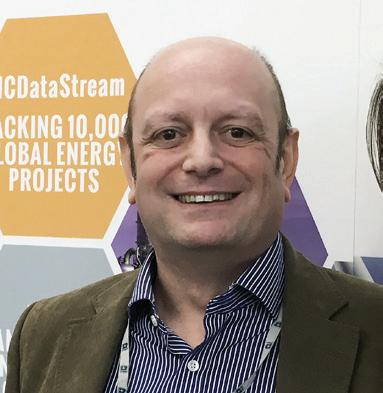
Bob Gear
Head of Information Systems
25 Years: the Changing face of the EIC’s Opportunity-Tracking Tools
2000
Origins: The Projects Database
In the beginning it was called ‘The Projects Database’. The year was 2000 and the Y2K bug had turned out to be a bit of an anticlimax (though no one really knew whether that was because there had never been much to worry about, or whether it was owing to a massive unseen effort by IT departments around the world).
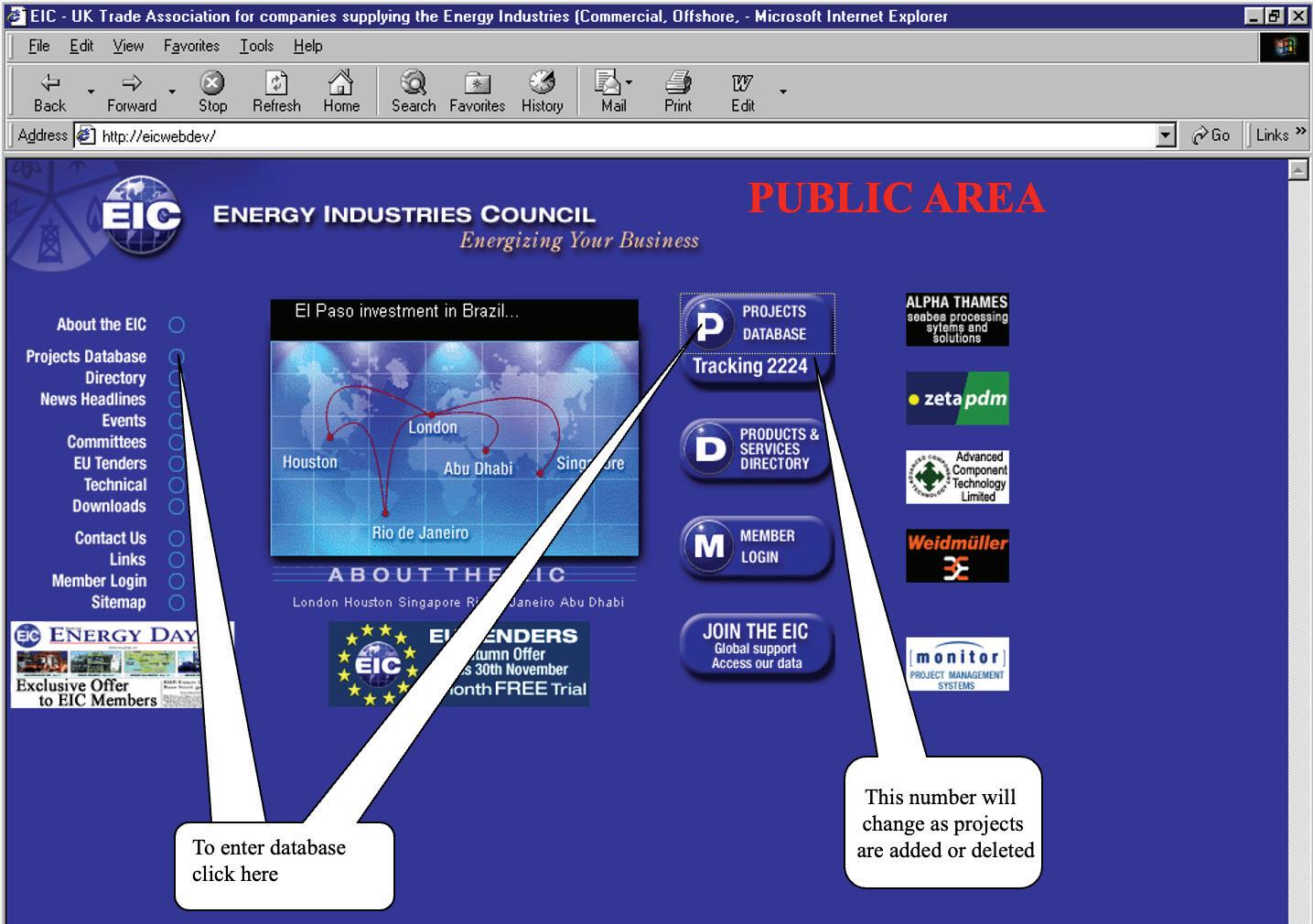
The EIC was launching its first website. This new online presence included an online version of the ‘Directory’ (later called the ‘Procurement Guide) and the ‘Projects Database.
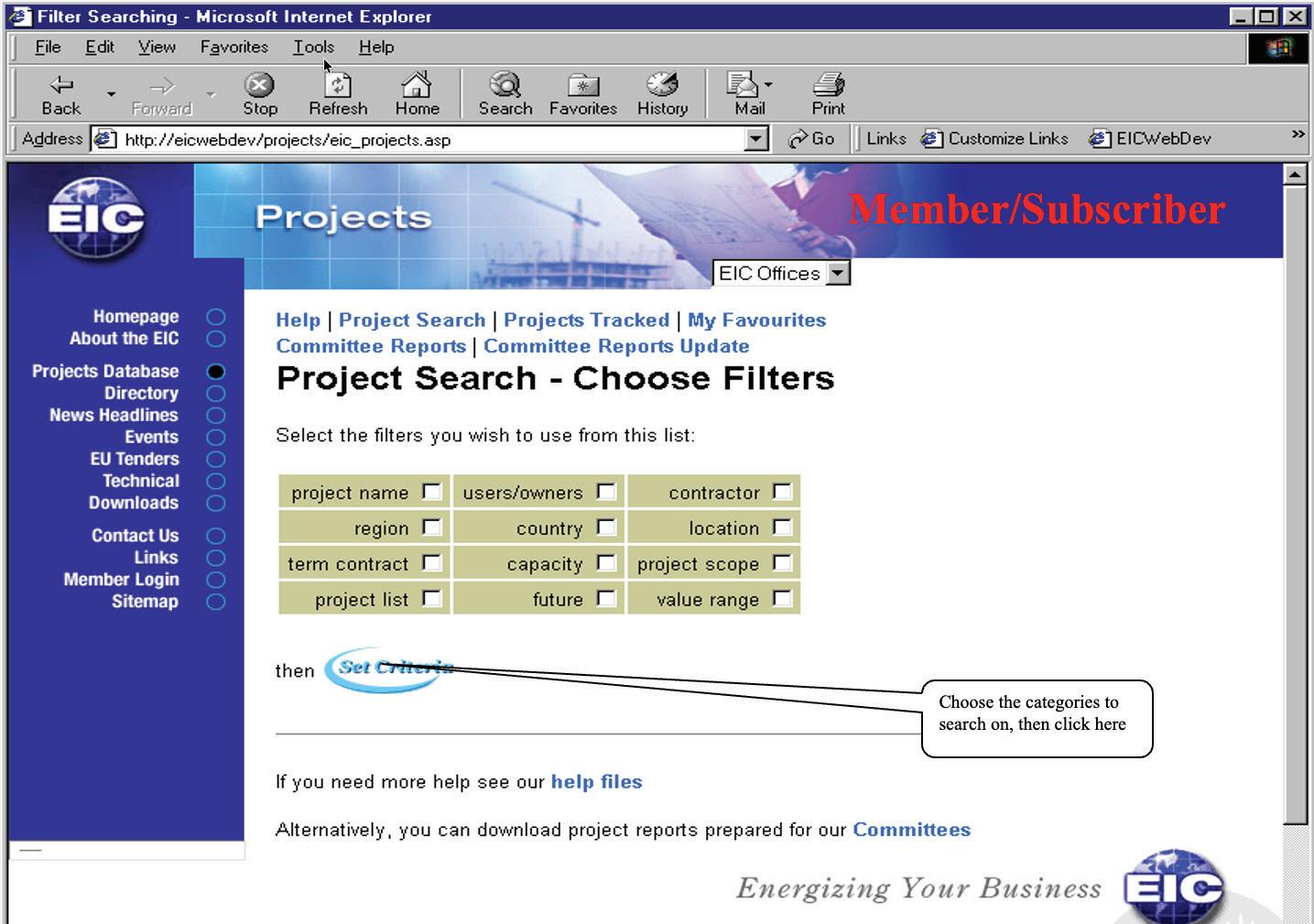
Everything was much smaller then. Searches could be based on multiple criteria, much as they are now but each project was nowhere near as comprehensive as we have become used to and the database held only about 1,500 projects.
There were no favourite lists, and things that we take for granted now like exports and geographical summaries did not exist.
The project editor, used by staff (of which there was only one in each office), was much less convenient to use and was written using technology that actually slowed progress.
As the number of projects grew, the ability to save archived projects - ones that had gone into production - was added. A new web-based project editor made the tasks of creating and maintaining the projects easier and facilitated the addition of favourite lists.
The addition of a project summary line with the ability to drill down to a details page made
the whole business of navigating around the database much more convenient.
Working With the Government
An attempt was made to secure Government funding - for which we would have to make a cut-down version of our full database generally available. The prototype was prepared and demonstrated to Trade Partners UK (the predecessor department to DIT). This was called the Global Opportunities Database (the GOD-Plan) and of the two companies that gave presentations to TPUK that afternoon, neither secured funding.
Having failed to get government funding, the EIC went it alone. Most of the development
work had already been done, so a payment gateway was added, and the Subscriber’s Project Database went live with the intention of acting as a low-cost entry point, leading to the ability to upsell EIC Membership with full access to the database and other EIC services. The uptake was disappointing (about 100 subscriptions), as was the number of upselling results. The service was shut down after a couple of years.
The Kazakhstan Oil and Gas Interest Group was supplied data though a restricted (and rebranded) variant of the Projects database. Government funding was obtained for thisto pay for the staff member who was housed in the EIC Office. KOGIG ran successfully for several years.
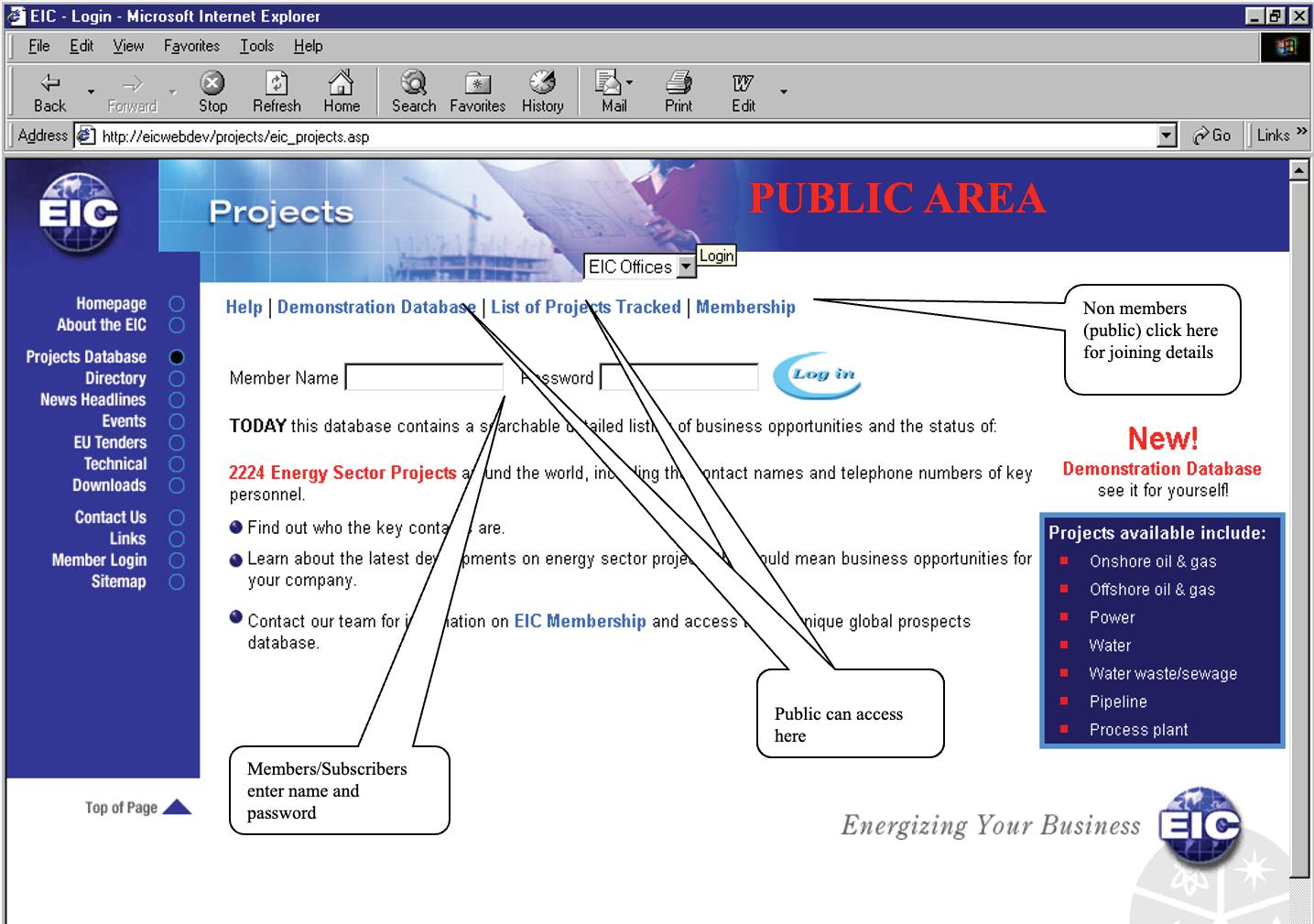
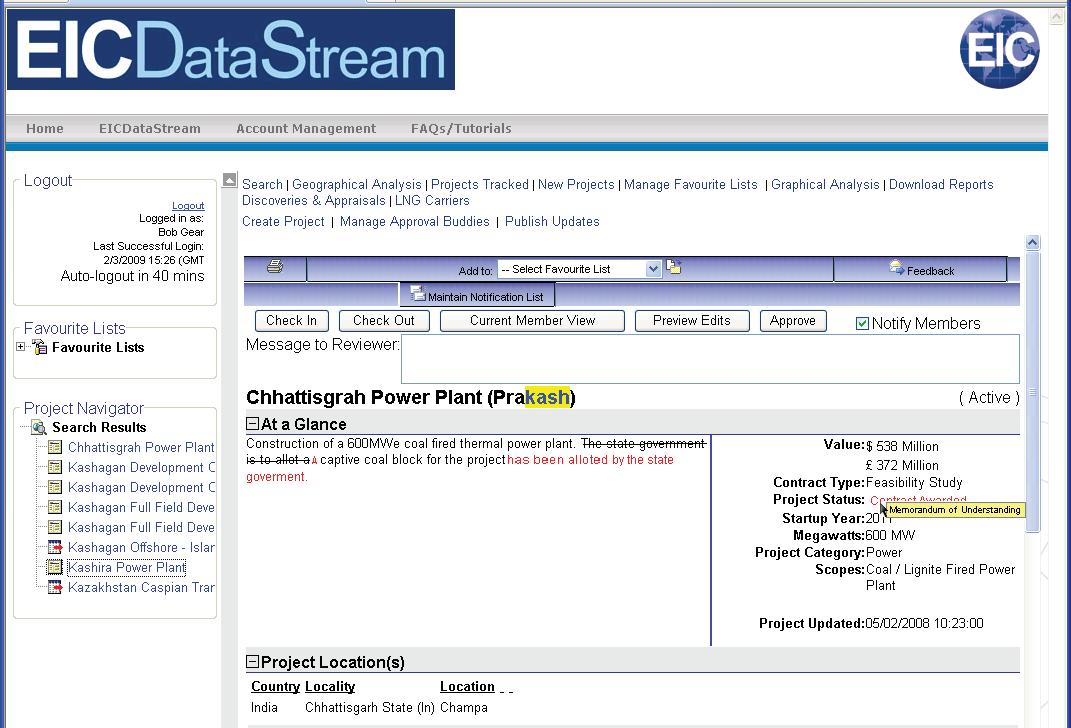
The EIC home page, logging in to the Projects Database and starting a search circa 2001
2008 2015
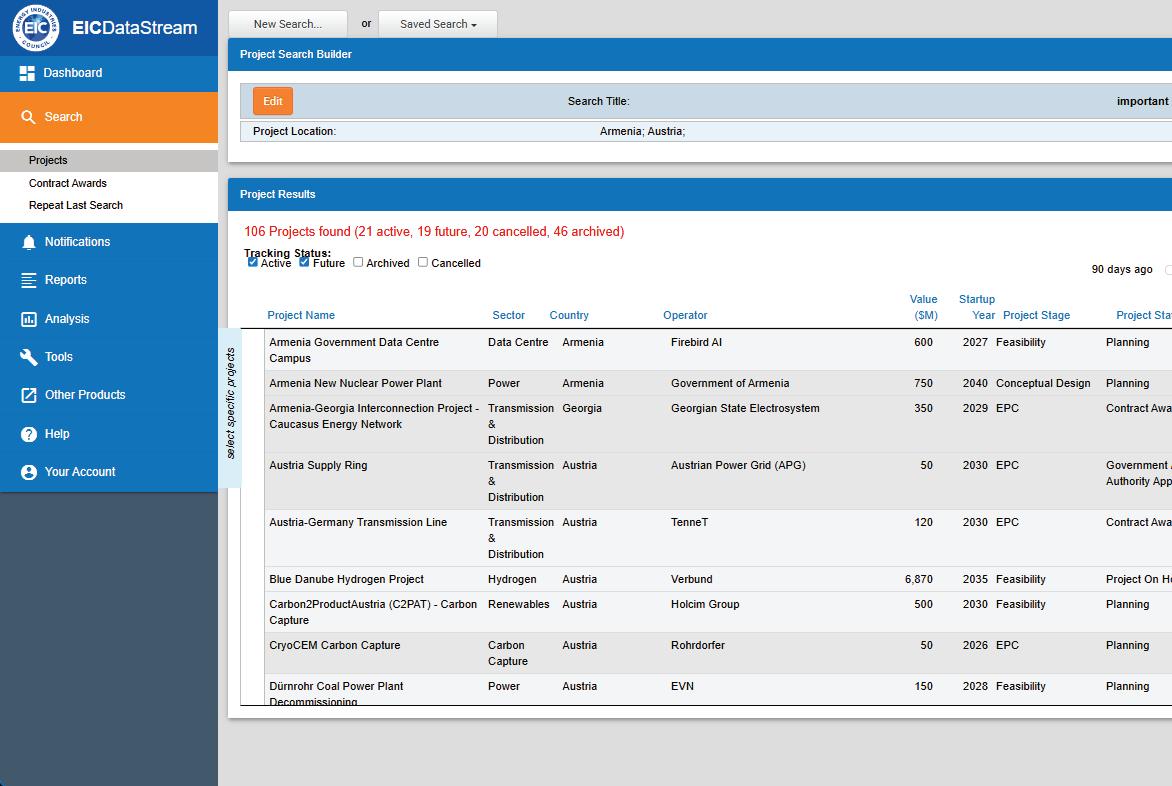
EICDataStream 2
EICDataStream 3
Eventually, after many incremental improvements, we started to outgrow the technology that the Projects Database was based on - it was time for a radical change. The Longbow Project gave us EICDataStream in 2008 - a much more capable product based on more robust technology, consistent with a growing membership and vastly more projects. The database now had a significant history of archived projects as well as many more features, including the ability to generate PDF reports based on search results.
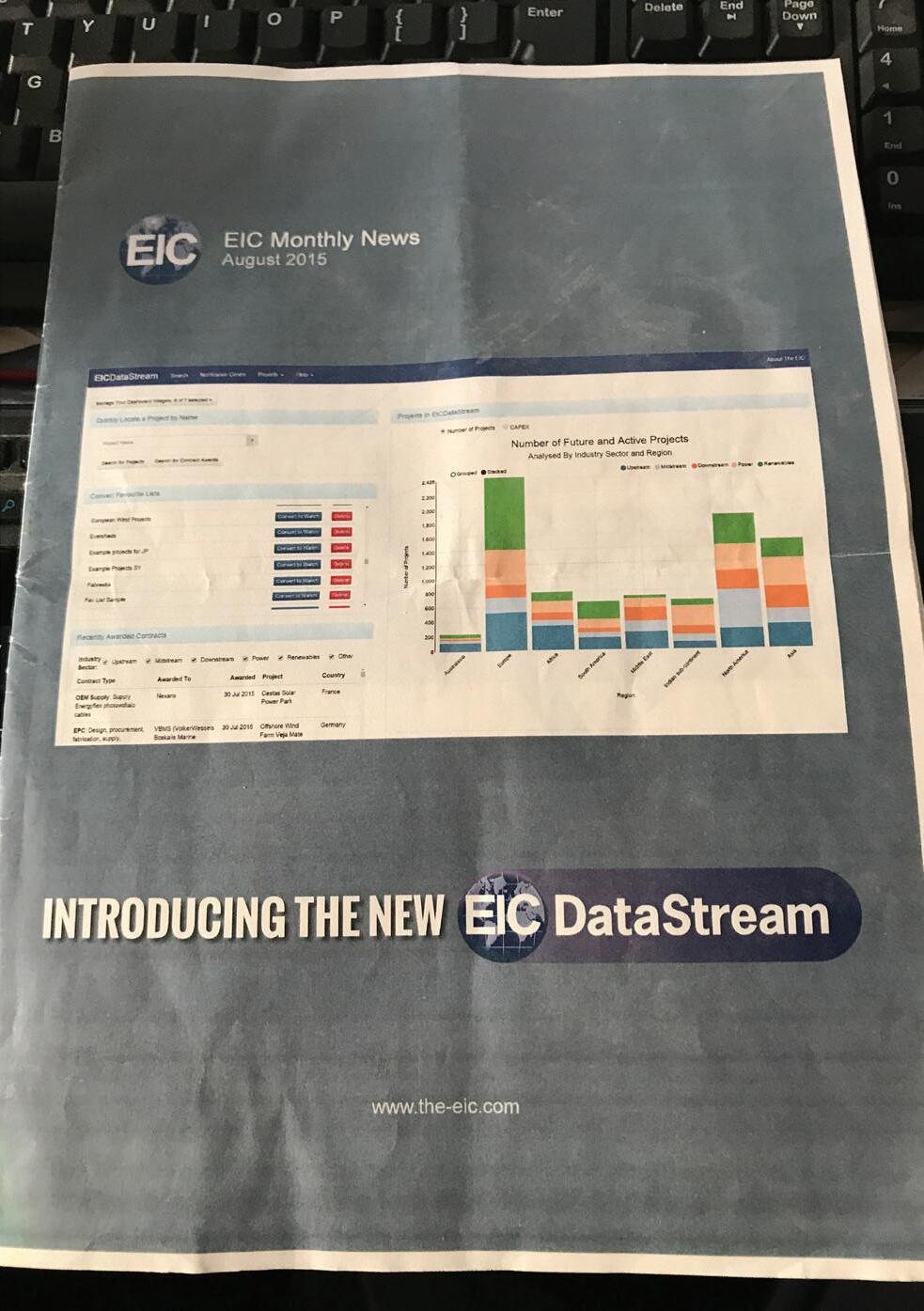
The winds of change blew again in 2015 with the release of EICDataStream 3. This latest version of EICDataStream was accompanied by a huge data conversion effort which again vastly increased the level of available detail and added may more search types. New services such as a completely rewritten PDF Projects service, Saved Searches and Dynamic Watches were among the new features.
Dynamic watches were especially well received by members. Favourite lists allowed users to save
EICDATASTREAM BRAND EVOLUTION
01 02 03
lists of projects they wanted to see again. Dynamic watches allowed members to save the results of a search – which would be automatically updated each time it was view and would send an email message if changes were made to any of the results.
PDF reports were improved – it was no longer necessary to recreate a report in its entirety to get an update – a user could simply rerun the existing report to get a new PDF containing updated data.
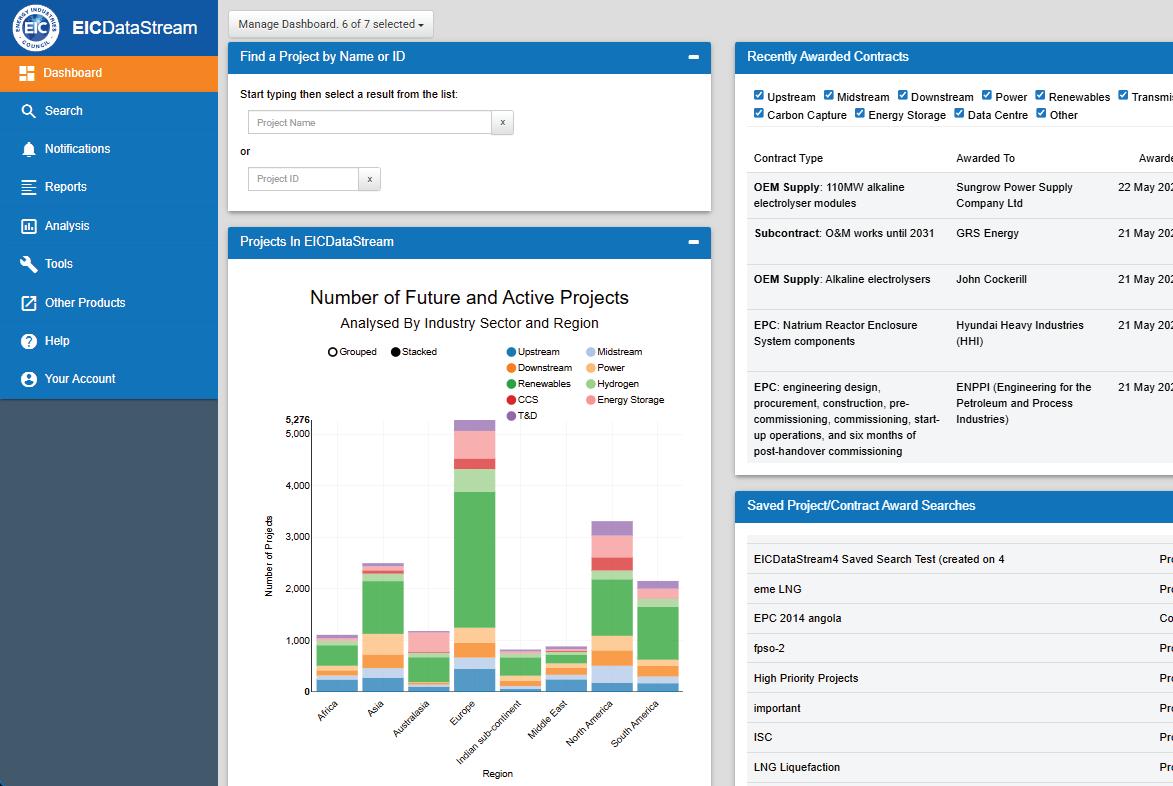
EICDataStream 4
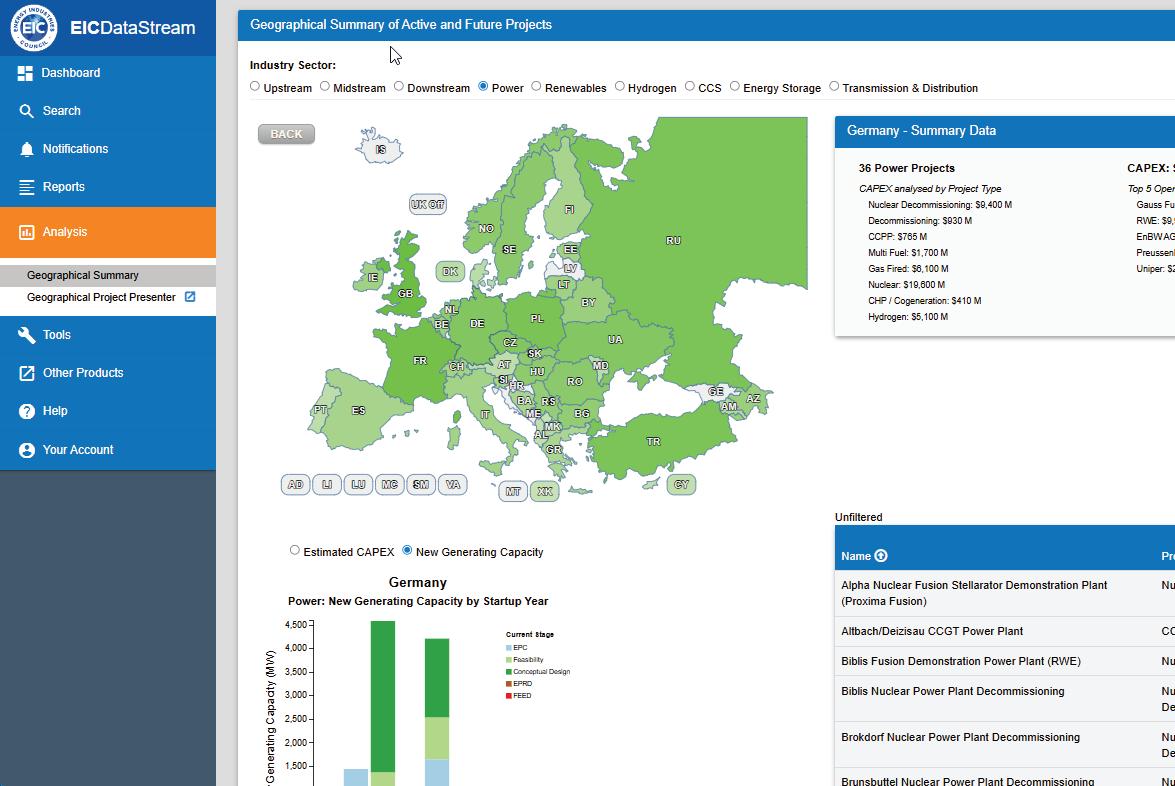
The purpose of EICDataStream 4 was three-fold. First, it aligned EICDataStream with the proper EIC brand style. Second, it was designed to make EICDataStream more useable on a mobile phone (and with the intention of further improving this capability in the future). Third, and most important, it lays the groundwork for future innovations to come in EICDataStream 5.
The Future
EICDataStream 5
EICDataStream 5 development has started. It will improve our coverage of the Hydrogen and Carbon Capture sectors and, most exciting, integrate our CAPEX and OPEX capabilities into one product.
API
In 2025, an API was be published as an extra service for global members. An API makes it possible to efficiently combine data sources and integrate EIC data into members’ applications without the need for export and import files.
A Culture of Improvement
The development of EICDataStream and the EIC’s other data products over the last 25 years has been one of continuous improvement, punctuated by radical step-changes in technology and product capability.
What might the coming years hold? Who knows - but the EIC will be here, improving the products and providing the best service possible for EIC Members.
EICDataStream 3 Arrives!
EICDataStream4
EICDataStream4
EICDataStream4
Questions
How has the team of product development/DS progressed over the 25 years?
Our ability to do the job of software development has improved beyond all recognition - tracking the growth in importance of our proprietary products. It started out with me being the IT Manager/Developer. Then we amalgamated a few other roles and some outsourced work and employed a full-time web developer
EICDataStream 2 was a problematic project for the large footprint that we needed to cover and the never-ending scope-creep.
During the never-ending scope-creep of EICDataStream 2 we realised the need for help with testing and employed a couple of temps – but it would be another 5 years before we actually employed a full-time qualified software tester. The first use of a source control system can be traced back to this time.
Rich Tappin joined the team for EICDataStream 3. Dana, who replaced our tester when she left has become a very able developer. Zoe joined when Dana stepped up to her development role and Adrian is the latest Software Developer to join the team.
When did archived projects become a thing at EIC?
Alen Lewendon was the original Head Market Intelligence, and he was soon supplemented by Malin Amundsson (Oil & Gas) and Phil Goddard (Power).
Alan used to occasionally ask me to clear down the old project to reduce clutter. On one of these occasions (after he had left the room), we had a discussion that decided that we were deleting useful information - so I offered to alter the system to implement a ‘soft delete’ – marking the projects as deleted and then hiding them from view. This would have been around 2002.
When designing the parameters of EICDataStream 2, I included the concept of Archived projects as a choice - so I think the possibility of finding and viewing archived projects must have been introduced to members around 2008.
How many projects now? Value of projects?
On 2 December 2024 On 2 December 2024 Total
CAPEX USD
Which has been the biggest challenge over those 25 years, and why?
1. EICDataStream 2
• It was (in retrospect) a dreadfully run project:
• Under resourced
• Over ambitious
• Never-ending scope-creep
• High pressure
I sleep-walked into the complexity of it and I was burnt out by the end. This was the low point of my time at the EIC and it was stubborn pride in finishing what I had started that kept me going.
On the plus side, all these negatives were the start of our agile journey because I decided that I would never be a part of a project like that again:
• Kanban
• Adaptive Planning
• User Stories
• Source Control
• Automated Testing
• Refactoring
• Continuous Delivery
• Continuous Improvement
Are now all parts of our agile toolkit and of our process.
2. PPM
Both Richard Tappin and I agree that the PPM is the single biggest (and most comprehensive) system component that we have worked on.
However, the performance overseas was poor. It was slow and unreliable – and we didn’t like that – so we improved it with some lateral thinking and the application of some novel techniques (and a lot of hard work, because it wasn’t easy)!
Now the PPM is part of a truly distributed Project Editing facility that works as well in our overseas offices as it does in London.
What are you most proud of?
My Team.
They are the best, most committed group I could hope to work with.
This team has a ‘Can-do’, ‘Challenge-accepted’ attitude about it that I am proud to be a part of.