

PHOTO











Venmo has canceled our account, but you can still pay using Square! You must identify your vendor so we know where to send the payment. Here's how:
your phone camera and scan the QR code on this page. This will take you to the landing page: thecontributor.org/pay.
After clicking “checkout,” type your vendor's name and four-digit badge number in the “Required” field. This allows us to know which vendor to



Since The Contributor started in 2007, more than 3,200 different vendors have purchased $2.3 million worth of The Contributor and sold over six million copies, generating over $15 million in income for themselves.
In 2019, our C.O.V.E.R. Program (Creating Opportunity for Vendor Employment, Engagement, and Resources) was the natural expansion of our mission of removing obstacles to housing. We now offer full case management, assistance with housing and rental expenses, addiction recovery, health insurance, food benefits, and SSI/SSDI assistance.





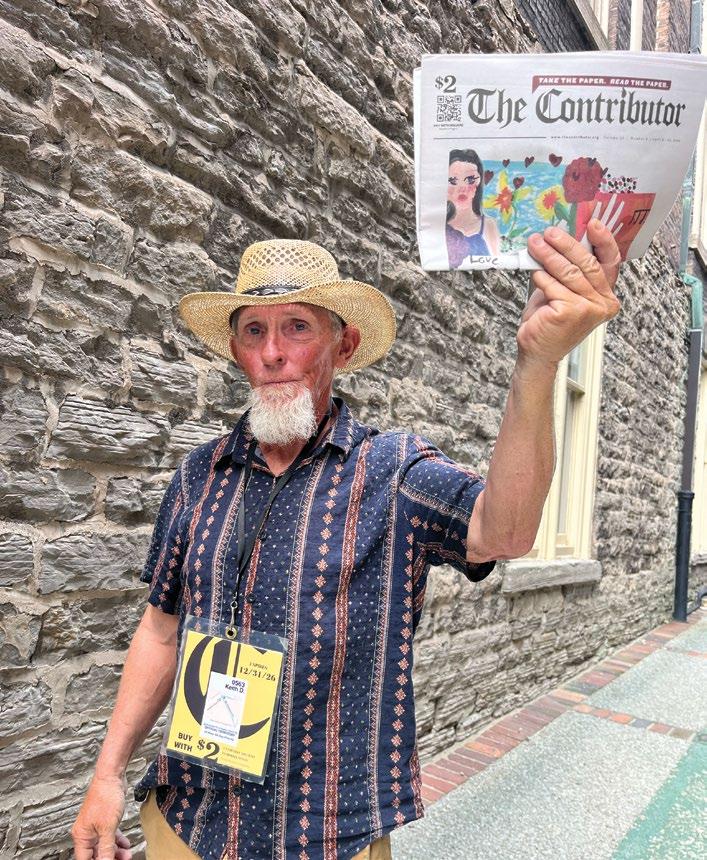
Fifteen years after starting at The Contributor, vendor Keith D. continues to consistently top the vendor sales list. Over the years, he’s learned which days are the best to sell the paper, how to manage his schedule based on the weather and how to show his customers his consistency. Keith now helps lead tours for Unseen Nashville, where he educates the community around what it is like to live on the streets in Nashville.
The Contributor asked Keith about his time at the paper, his garden and his beloved, wild outdoor cats.
When did you start selling the paper?
I started selling the paper on Halloween of 2011. I heard about it from four people on the bus who were discussing what they had made selling it. I looked at them and they all had badges on, and I wondered where could I go to start selling the paper. I had been fired from my job in March that year. I had eaten through my savings and hardly had anything left, so I came to the Contributor office, had an interview and started selling that day. During my interview, I bragged that I would be in the Top 15 of vendors because I had been a waiter before and I was sure that skill would transfer to selling papers. And it has because I’ve consistently been in the Top 15 for every issue, if not the Top 10.
Why do you keep selling the paper?
Well, I keep selling it because I can make my own hours, which means I know what I need to work to maintain rent, electric bill, phone bill, water bill, plus the necessities of life. And I have to work around the weather. I know if it’s going to rain that means I better work the sunny days before and after. And of course, I save any good days for bad because sometimes there’s a whole week off like the ice storm. I was able to pay my bills from what I had saved before the ice storm, which they had forecast was coming six days before it happened. And my power was only off 10 days, eight hours and 13 minutes.
Keith, that’s so long. Oh my gosh.
Well, take two minutes off the total. It came on the ninth day for two minutes and went back off.
What did you do during that time?
Froze. I had a kerosene heater and I learned how to cook on top of it. And of course that week it was down in the single digits at night and barely above 30 during the day for at least eight of those days. It was very cold! When I went to work a few days after the roads cleared, people were asking me, “It’s so cold. What are you doing out here?” And I said, “I’m just standing in this refrigerator to go home to the freezer.” My street has eight residences on it. So when the power went out, I looked around and I could see the lights on in a huge apartment complex right next to the property I live on. And I’m like, we’re screwed because I knew they were not going to be in a hurry to fix eight people’s electricity when supposedly 230,000 people were without power. I knew they were going to go hit the big places first.
What are your living arrangements?
A friend of mine built an addition on his house. It’s basically a small studio apartment. He wanted to rent it to somebody he knew, but he didn’t know anybody that would want to rent it. And I said I would. And he at first said no,
STORY AND PHOTO BY LINDA BAILEY
because if I sell papers, how could I pay rent? So I had him ask my previous landlord how I was on paying rent. And that landlord told him I paid up a month ahead sometimes, so I got to rent it, and I’ve been there ever since. And I get to have a garden. I like to grow things.
What are the plans for the garden this year?
This year, the ice storm made the deer leave. I haven’t seen a deer or a deer track since the ice storm. There’s a 180 acre field of winter wheat a quarter mile away from me. I think they all found that while wandering around trying to find something to eat. Hopefully they’ll stay there. I haven’t had squash or zucchini in four years because the deer would eat it as soon as it came out of the ground. A few years ago, they came up to my deck to eat the tomato plants! Five years ago there were deer around, but they never touched any of the squash or zucchini. But I guess they got so populous that they were just eating anything they could find because they are building apartments everywhere.
I’ve been lucky enough to receive some of your garden’s bounty over the years.
Well, every year when I plant stuff I say a prayer that if I have extra that I will share with everybody. Some years I’m able to give up to 80 bags of stuff to people. I could never tell you who I gave it to because I’ll be like, oh, I’ve got four bags, let’s see, I haven’t given this person any. So everybody gets a share of it. Some people will buy a paper from me and then I’ll give them a bag of produce and they’ll try to offer me money for it. But I know if I take money for any of this stuff, a plague will come and eat it up because I made a promise to give and not sell.
there’s History Corner, there’s vendor poetry. There’s something for everybody because I’ve had customers tell me particular things they like. I had one couple quit taking the paper. They told me it was “very left” and they didn’t want the paper anymore, but for some reason in the last three months they’ve been saying, “Oh, well we’ll go ahead and take the paper this time.” So, there’s something in it they like. They’re just not saying what is! It’s not due to my vendor writing, which I’m scared to submit to you.
I know that when you’re ready you’ll submit and I will love them.
You’re also part of the team of vendors who lead the Unseen Nashville tours that The Contributor has started offering people in the community. What do you hope people get out of your tours?
Well, I hope that they get to see firsthand the situation of homeless people. This week we led a practice tour that went down to the river where People Loving Nashville does their Monday night service. We discussed the noise level, the heat, the cold. You know, you’re doing this for an hour, but imagine living in this. You see that stinky alley? How would you like to find a piece of half clean cardboard to lay on in that muck that’s dripping down? So we want people to experience firsthand. I was homeless downtown in the late eighties, and there were hardly any homeless people back then. The homeless explosion started in the late ‘80s due to policy changes and the introduction of crack and all the hardcore drugs that you didn’t see earlier. When I was homeless downtown in the eighties, I spent the night at the Capitol building sometimes. I would be unseen because they used to have bushes and stuff down there. There’s no growth anywhere downtown anymore. The growth has been cut down from four feet tall down to the ground, so there’s no hiding anywhere downtown. The benches have all been taken up too. There’s some kind of movement putting handmade wooden benches everywhere and the city has decided to let them stay because people should have someplace to rest without having to pay for it.
What do you think of the newspaper?
It’s a well written paper. It’s balanced real well with vendor writing and other articles by other people that are not vendors. There’s a crossword,
I’ve got two right now that I’m working on. The first is “Mama Pal’s Ice Adventure” where she disappeared for 18 days and came back and petted me. I’ve never been able to pet her. And the other one I want to write is about when a homeless guy that holds a sign at my spot pointed at a big box of food a couple weeks ago and said, “You know what that man told me when he gave me that food? It’s out of date, but it’s good enough for me.” So I’m going to write a story about that because I’ve had people give me out of date stuff, but not say it that rude like that. I have one woman who flies by me to give me Boar’s Head meat and cheese, but it’s three weeks out of date. And I don’t realize who it is until I’m taking it out of her hand and I’m like, I should get her license plate and put an attempted murder charge on her. Because not only is that stuff three weeks out of date, but Boar’s Head was in the news for listeria. For some reason she keeps buying it and not eating it and thinks it’s good enough for somebody sitting down on the corner. But my cats love meat, so I give it to them.
Tell me about the cats on your spot.
I’ve got Mama Pal. She’s the original. Her wild mama dropped her off near my spot when she was eight weeks old. I named her kitten Little Pal and when Little Pal brought me two kittens a year and a half later, I knew it was Mama Pal, not Little Pal, not the male, I thought it was. I’ve got Mini, he’s three years old. He’s a tomcat and I can pick him uo, pet him. He follows me like a little dog every morning. His brother Muffin found a home and told me goodbye. I wrote about that for the paper last year. Then there’s Brownie. She’s a girl and there’s three one-year-old kittens that I haven’t named, but they all look alike.
Is there anything you would want to say to your customers?
Yeah, I deeply appreciate all the customers, especially my very regular customers. And I appreciate anyone who takes the paper and reads the paper. One third of the people that take the paper are Hispanic and don’t read English, but they take the paper knowing that’s what I want them to do, to take the paper. I wish there could be more stories translated into Spanish. I sell in Antioch and it’s about one third Hispanic. If it wasn’t for the Hispanic customers taking the paper and giving me money, I would be very low.
Is there anything you’d want to say to your fellow vendors?
Be consistent. Try to do the same hours every day that you work. Of course you can’t work every day due to weather or appointments and stuff, but the days you do work, be there at the same time every day. People look for that.
First and foremost, The Contributor is a newspaper. Selling the paper offers an income to its vendors, which many use to help them get off the streets and into permanent housing. The Contributor is also a nonprofit offering wraparound services and vendor-focused programming, all designed to bring our community together to make homelessness a brief, rare occurrence. We do this by empowering our homeless neighbors to achieve income, dignity, housing and community.
Because not all readers may be aware of these other programs and initiatives, I will list and explain them here. I also want to point out that for the past couple of years, The Contributor has pulled together some of the most consistent independent contractors who sell the paper (vendors) and formed a Vendor Leadership Team to regularly seek vendor input into the operational side of the nonprofit.
The biweekly newspaper is and will remain the core program of The Contributor. It offers an immediate income stream to people who are looking to move off the streets. Contributor vendors are independent contractors with a history of homelessness who sell the paper on street corners and in legal public spaces in Nashville. They are trained and their paper sales are tracked in a database. As a reader, you can now pay your vendor online (thecontributor.org/pay). Make sure to enter your vendor’s name and vendor number when you pay.
The Contributor is unique in that its vendors are independent contractors. In other words, they meet this nonprofit on an equal footing. Rather than coming up to ask for charity, Contributor vendors enter into a contractual agreement with the paper to create their own microbusinesses.
A little-known fact is that 70 percent of vendors who work with The Contributor for six months move into some form or housing.
The Contributor implements two government-funded housing programs serving about 80 to 100 people with a history of literal homelessness. To meet the federal chronically homeless definition, people must have experienced homelessness for at least one year (either consecutively or having had at least four episodes in the last three years that add up to one year) and suffer from a disabling condition. Most people are referred through the community’s coordinated entry program managed by the Office of Homeless Services. But The Contributor has negotiated that a few openings can be filled by selecting vendors in need who meet the organization’s own eligibility criteria.
SOAR stands for SSI/SSDI Outreach, Access and Recovery. The Contributor has created a partnership with two local hospitals, Park Center, and the city to identify people who may be eligible for disability benefits (SSI and SSDI) offered by the Social Security Administration. SOAR coordinators at The Contributor find, organize and help develop medical evidence for
BY JUDITH TACKETT
We print a biweekly, hyperlocal newspaper that challenges stereotypes around homelessness. The publication features writing by local journalists, content from our partner street papers, and most importantly writing by Contributor vendors themselves, giving them an important voice in their community.
The Contributor offers support finding permanent housing for people with a history of short-term and chronic homelessness.
SOAR links people with a disability who are unable to work with SSI/SSDI benefits.
We offer our vendors bus passes, food, drink, toiletries, feminine hygiene items and other basic needs.
Our resource guide has become a premiere information source in the nonprofit community.
In partnership with our leadership team, vendors have launched the Contributor’s new Unseen Nashville street tour, offering a street-level view of homelessness in Nashville from folks who have experienced it. Sign up for a tour at thecontributor. org/unseen-nashville-tours. UnZine, a community arts initiative, offers vendors the opportunity to write and publish work in small, DIY publications called zines.
each claimant and act as their representative and guide throughout the disability determination process. The Contributor’s SOAR program is the largest program of its kind in Nashville that does not require a person to have a diagnosed mental illness. Referrals are made though the hospitals and select nonprofit partners.
When vendors come up to us to purchase their papers, volunteers and staff use the opportunity to check in and see whether they need food, water, clothing, hygiene items or anything else that might be on hand. If the needs are more than basic, street newspaper vendors can go to the “Front Desk” and get assistance with solving problems around housing, health care, and other important areas. During those visits, vendors are linked to mainstream services they may qualify for such as food stamps (SNAP), journey passes (WeGo bus tickets), health or mental health care, etc.
The Contributor’s annual resource guide, Where to Turn in Nashville, has become a staple for Middle Tennessee area nonprofit organizations. The Contributor produces an
annual print version, which started in collaboration with housing justice nonprofit Open Table Nashville in 2013. In 2026,over 100,000 printed booklets have been distributed. Information is also available online at wttin.org.
The Unzine Nashville project connects Contributor vendors with local artists to create zines, which are low-fi, low-cost, and easily distributable DIY print publications. This program is implemented in collaboration with Stagger Press and creates another way to generate income for participating vendors. Visit unzine.org for more information.
If you wonder what homelessness feels like, looks like on the ground, and how people move themselves out of the situation, you should sign up for a Contributor vendor-led Unseen Nashville Street Tour. These guided one-mile walking tours offer powerful, first-person stories that reveal the struggles and resilience of unhoused Nashvillians. Unseen Nashville tour guides are open to any of your questions and welcome discussions about solutions to homelessness. Sign up online at thecontributor. org/unseen-nashville-tours or email unseen@
thecontributor.org.
People often ask me whether I really believe we can end homelessness.
My response is a resounding, “Yes, we can! But…,” and then I go into an explanation that there are two ways to look at how to end homelessness.
First, there is the individual level. When a person experiencing homelessness stands before us and asks for help, do we say, “Sorry, I don’t believe we can end your homelessness?” No! The Contributor and so many other organizations have already proven that we actually can end homelessness on an individual basis.
We know how it is done: by investing in housing through subsidies and building more supplies; by offering the right individualized support services to address any underlying needs; and by linking people with the income to help pay for their new living situation (in permanent housing).
The Contributor is a great example. Any person who shows up at the Vendor Office in the Downtown Presbyterian Church at 154 Rep. John Lewis Way North, two blocks from the WeGo Central Station, can access income immediately.
Specifically, a person with a history of homelessness who is interested in becoming a vendor is asked to arrive at 10 am on a Wednesday for an interview prior to joining a one hour vendor training at noon. After the training, the new vendor will leave with free papers, a Contributor badge, and a guide to help find a selling spot.
I don’t know of another program in town with a lower barrier to access work and income. Having said that, I learned from listening to vendors that it takes time and tenacity to establish their business as street vendors. But for many, the payoff is a flexible work schedule, independence, housing and finding and building a community to support them.
Furthermore, the newspaper helps establish a resume and when a vendor participates in the bi-weekly news release meetings and/or when the vendor comes to the office to purchase new newspapers, there is an ongoing check-in. Relationships between vendors, volunteers and Contributor staff members are built on equal footing like any other business interaction.Through these relationships, vendors can access other resources – either at The Contributor or through a referral to another service provider, depending on the needs of the person.
When you look at this approach, it becomes easy to see how an individual organization like The Contributor can help end homelessness.
When it comes to the question of whether homelessness will ever end in our city or across the nation, the answer becomes more
complex. But my response remains the same, “Yes, I believe we can do it. But….”
Building a safety net at the national, state and local levels that is strong enough to prevent homelessness for the majority of people in the first place is important.
Second, it is a matter of the federal, state and local governments’ willingness to invest in interventions that work, have honest conversations about what is needed to do so, and help coordinate programs within a city, county, or state that form a functioning cross-sector systems approach.
I recently read two relevant (and easyto-digest) articles on the topic of ending homelessness:
A. A housing policy debate by nationally renown researchers including Gregg Colburn, Marybeth Shinn, Smantha Batko, Martha Galvez & Margot Kushel from 2025 entitled “What Would It Take to End Homelessness in the United States;” and
B. A Substack article from Iain DeJong called “The Wrong Debate: Why Housing First vs. Treatment First Misses the Point.”
You can Google them and they pop right up.
In any case, both of them talk about what it takes to end homelessness. The fact is that the homelessness system alone will not end homelessness. The researchers I cite above say it the best way, “…this system alone will not end homelessness — just as a high-functioning emergency department won’t end illness and injury. Ultimately, the
Created by Mccollonough Ceili

only durable solution to homelessness is to prevent it from occurring — to reduce the flow of individuals and families who enter homelessness.”
But both articles stress the importance of having an overall systems approach in place.
DeJong puts it this way: “Outcomes are shaped less by the intervention a community selects and more by the conditions of the system expected to deliver it.”
He continues that, “four conditions consistently determine results:
1. the availability and affordability of housing
2. the capacity and quality of treatment and support services
3. the degree to which interventions are implemented with fidelity
4. the extent to which individuals and communities have meaningful decision-making power over the services that affect them.
“When these conditions are weak, no intervention performs well. When they are strong, different approaches can succeed. This does not mean frontline work lacks impact; it means that impact is often experienced at the individual level while system level results remain constrained.”
The bottom line of both articles is clear. We need politicians and governments to be willing to invest in long-term solutions. Yet, rather than doing so, our governments shift towards enforcement and making homelessness invisible rather than solving it.
We do have the money to provide hous -
ing and the needed stabilizing support services in this country. The current federal administration has just proven that to us by spending billions of dollars on a war abroad that nobody wants. What could we do if we instead invested this money to strengthen our communities’ safety net to prevent homelessness for the working poor through rent assistance, access to health care, access to mental and behavioral health, access to employment and education?
Organizations like The Contributor do their best, but we can do more. And we can start so by understanding why we need a strong local system (read Will Connelly’s piece on Page 7).
In short, yes, we can end homelessness at the individual and the systems level — and The Contributor is one of the organizations that is trying to do its part a) by offering direct partnerships with vendors; b) by implementing evidence-based solutions following high fidelity to program standards; c) by actively listening to the people with lived experience and expertise; and c) by creating awareness to further transparent talk about what a functioning Housing Crisis Resolution System in our community should look like and how we get there.
Judith Tackett is a longtime homelessness expert and advocate for housing-focused, person-centered solutions. Opinions in this column are her own.

Written by Chris Scott Fieselman, Vendor #0015
This ain’t… My first Tour of Duty. This ain’t… My first Time in Hell. There’s nothing that… You can do to me, That ain’t been done… By someone else. Now, I’m a real-long-way’s from a Virgin, And you Sure as Hell, Can’t say that, “I’m Green.” My past, ain’t some, Kind of Burden.
I can’t begin to tell you, All that I’ve See - een…
I’ve Been Up… I’ve Been Down… Take my word… I’ve Been Around… I’ve Been Here… I’ve Been There… I’ve Been All… Most Everywhere… I have seen, so many things… Been a Pauper… Been a King… Been Around this Mountain before... No, This Ain’t My First Rodeo...
Now, I’ve been with, People in Power. Had more than my, Five - Minutes of Fame.
I’ve been through my, Share of Darkest Hours.
Enjoyed the hell out of, Playing the Game. I can talk my way Out of Trouble. You may think? You’ve seen my kind before. Well, I hate to have to, Burst Your Bubble… But I always leave them, Begging for More…
Now, you’re never, Going to hear me, “Sing the Blues.” Though I know, I probably could, Because, I’ve Paid My Dues. You better listen close, To what I say.
“You Can Lead, You Can Follow, Or Get Out of My Way.” Hey - Hey - Hey...
I’ve Been Up… I’ve Been Down… Take my word… I’ve Been Around… I’ve Been Here… I’ve Been There… I’ve Been All… Most Everywhere… I have seen, so many things… Been a Pauper… Been a King… Been Around this Mountain before... No, This Ain’t My First Rodeo...
Written by Chris Scott Fieselman, Vendor #0015
I like to do things a little differently? I take on, the problems that are bothering me. These Medals of Honor, And Battle Scars, Come from Pushing the Envelope, A little too far.
I’m a Loaded Loose Cannon.
I’m a Vigilante.
I’m the First Defense, And I’m the Last Man Standing.
I’m a Trouble Maker. The Master-Mind.
A Mover and Shaker. A Thorn in Their Side…
And I’m a Renegade, Rebel and Rogue. Out of Touch and Out of Control.
I’m too Hard to Handle, And too Heavy to Hold.
I Disobey Orders, Won’t do What I’m Told. They say that I’m Crazy, I’m Brazen and Bold,
And I’m a Renegade, Rebel and Rogue…
A Man on a Mission, With a Noble Cause. Mixing Passion with Commitment, Can be Dangerous. Watering the Tree of Liberty. Bumping heads going against, The Powers that Be.
Giants and Tyrants, Have something to fear. They didn’t see me coming, But now, I’m Here.
Go ahead and draw, That Line in the Sand.
I’ve crossed it before, And I’ll cross it again…
A Patriot, a Martyr, a Man of God, Trying to build, “A Bridge Too Far…” My Strength comes from the Faith, I’ve placed in Jesus Christ… There’s No Greater Love, Or Sacrifice…
And I’m a Renegade, Rebel and Rogue. Out of Touch and Out of Control. I’m too Hard to Handle, And too Heavy to Hold.
I Disobey Orders, Won’t do What I’m Told. They say that I’m Crazy, I’m Brazen and Bold, And I’m a Renegade, Rebel and Rogue…

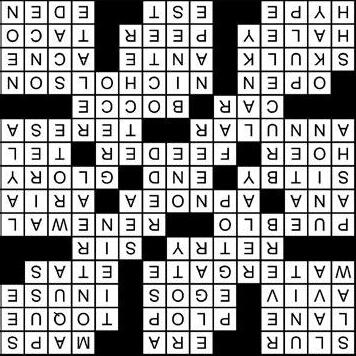
ACROSS
1. Verbal abuse
5. *Failed constitutional amendment, acr.
8. Google ____, navigation aid
12. Strip of roadway
13. Dripping faucet sound
14. Chef’s headgear
15. Tel ____, Israel
16. Prima donnas’ problems
17. Occupied (2 words)
18. *1974 scandal
20. Flight-related announcements, acr.
21. Attempt again
22. Male aristocrat’s honorific
23. Town, in Spanish
26. Recitaion of wedding vows, again
30. Santa ____ winds
31. Apnea, in U.K.
34. Operatic solo 35. ____ ____ or do nothing
37. Finish line
38. *1976 Woody Guthrie biopic: “Bound for ____”
39. Field worker
40. Avian rest stop
42. What lintel and mantel have in common
43. Ring-shaped
45. *1979 Nobel Prize-winning nun
47. *Alfa Romeo Giulietta, e.g.
48. Italian bowling
50. Type of tournament
52. *#33 Down Oscar winner
56. Lie in wait
57. Place one’s stake
58. Skin woe
59. *”Roots” by Alex
60. House of Lords
member
61. Chalupa alternative
62. Hoopla
63. “Right” coast time
64. *”The Barbara ____ Show”
DOWN
1. Deli side
2. *____ lamp, 1960s invention popular in 1970s
3. Newton, e.g.
4. Echo
5. “Pomp and Circumstance” composer
6. ____ Tooty Fresh ‘n Fruity
7. Cathedral part
8. *1976 Summer Olympics location
9. Caribbean color
10. Boot-wearing cat
11. *Johnny Nash’s “I Can ____ Clearly Now”
13. Spinning toy (2 words)
14. Make a logical connection (2 words)
19. 4 x 4 race
22. Dead one or Black one, e.g.
23. Ottoman Empire bigwig
24. Teamsters, e.g.
25. Consumed
26. *”Sanford and Son” star
27. “That’s all she ____”
28. Buenos follower
29. *Eric Clapton’s 1970 hit
32. Not ever, contraction
33. *1975 movie “____ Flew Over the Cuckoo’s Nest”
36. *Kung Fu movie star (2 words)
38. Domenikos Theotokopoulos, a.k.a. El
40. Away’s partner
41. Old master print maker
44. Scrawny
46. Feel sympathy
48. Common hops
49. Eight performers
50. No problem
51. Cheap reads
52. Back of neck
53. a.k.a. horse mackerel
54. *Jacqueline Susann’s best-seller “____ Is Not Enough”
55. Noble gas
56. “Zip it!”
In Nashville, we know that at least 3,500 - 4,000 people are living without housing at this very moment, many for months at a time. Time without housing is not a passive experience. It is a form of exposure that actively erodes health and shortens lives. Unhoused people die 20 years earlier than housed people, according to a 2024 policy brief from the National Healthcare for the Homeless Council.
If this were any other condition with this kind of mortality and decline, we would call it a public health emergency.
Each day outside carries a cost. Sleep is interrupted and unsafe, chronic illnesses worsen without treatment, and medications are often lost or stolen. The body absorbs heat, cold and stress without relief, and being a victim of violence becomes more likely. Small problems become much bigger. Over time, the damage compounds, and the path back to stability becomes more difficult.
We do not often talk about homelessness this way. Instead, we talk about “the homeless system” as if it already exists. I have spent my career inside that system, as a street outreach worker, an executive director and as someone responsible for running organizations expected to deliver results. In any of these positions, my priorities were focused on providing excellent services aligned with our organization’s mission and the requirements imposed on us by individual funding sources. While I attempted to take a bigger systems approach, and while we collaborated with other providers, the main focus remained on our internal outputs and outcomes.
A healthy homeless system, however, means that all nonprofits, government agencies and funders are working together toward the common goal of ending homelessness. What we currently have in Nashville is something looser: a network of shelters, outreach teams, nonprofits and public agencies doing important work, just not always moving in the same direction with a shared goal. Each organization can be well-run, mission-driven and even effective on its own terms. But that does not automatically add up to a system that reduces homelessness.
That difference is not semantic. It is the difference between effort and impact, between multiple organizations offering different programs and a system that actually works. A real system is not defined by how many programs it funds or how many people it serves. It is defined by whether those efforts are aligned around a single, measurable goal: helping people exit homelessness quickly and permanently.
Right now, Nashville, like many cities, is still somewhere in between. There is real progress to build on, but also clear signs of fragmentation and misalignment. Naming that gap is not a critique of the people doing the work. It is a necessary step toward making the work matter more.
BY WILL CONNELLY
“It is more comfortable to fund familiar programs than to ask whether they are producing the intended outcomes. And it is safer to count how many people are housed than to measure how many remain in permanent housing after two years or more.”
The clearest marker of a functioning system is what it treats as the end goal. If the goal is managing homelessness — keeping people safe, fed and indoors at night — then a collection of programs can do that reasonably well for a time. But if the goal is reducing homelessness, the system has to be built differently with permanent housing as the outcome rather than a distant aspiration.
That shift has practical implications. Every part of the response, from outreach to shelter to case management, has to be designed around a simple question: does this help someone move into housing faster? When that question is not clearly answered, programs drift. Over time, that drift adds up to longer stays in programs, slower exits, and a system that serves people without resolving their homelessness.
A real system disciplines itself to track a small set of outcomes consistently: how many people are entering homelessness, how many are exiting to permanent housing, how long they remain unhoused, and whether they return. Nashville has made progress in tracking several of these measures individually, but the full picture is still incomplete. That gap reflects a system that has not fully agreed on what success looks like.
For people experiencing homelessness, the system does not show up as a coordinated whole. It shows up as a series of entry points like street outreach encounters, program intakes and referrals from other agencies, each with its own process, timeline and expectations. While these pathways are all intended to help, they can lead to very different outcomes depending on where someone starts.
From the outside, that variety can look like flexibility. From the inside, it feels like repeating your story multiple times, navigating shifting requirements, fearing your “case” will fall through the cracks, and trying to understand what comes next while also meeting their basic needs day to day. The
burden of coordination often falls on the person experiencing homelessness rather than on the system itself.
A real system reduces that burden. It connects every entry point to a shared process that quickly identifies needs and routes people to resources that help them on their path to permanent housing. Nashville has a coordinated entry process that meets federal requirements, but implementation remains uneven and capacity is limited. Until those gaps are addressed, access will continue to depend too much on where and how someone enters.
One of the hardest shifts for any community is moving from measuring effort to measuring results. It is easier to count how many people are served than to track how many actually exit homelessness. It is more comfortable to fund familiar programs than to ask whether they are producing the intended outcomes. And it is safer to count how many people are housed than to measure how many remain in permanent housing after two years or more.
At the same time, the incentives built into the system can work against those outcomes. Funding tied to bed occupancy or service volume can encourage stability in programs rather than movement into housing. Providers are often asked to do more with less, while still being evaluated on activity rather than long-term impact. These dynamics are about how the system is structured, not about poor intent.
This is also where nonprofit leadership must be honest about its role. As an executive director, it is possible to run a strong, well-managed organization by meeting contract requirements, maintaining funding and delivering high-quality services, while still falling short of contributing to system-level change. The goal cannot be to operate a well-run nonprofit in isolation. The goal must be to connect that work to a broader strategy that reduces homelessness. Without that connection, even good work
can unintentionally reinforce the patterns it is trying to solve.
With over 20 years dedicated to ending homelessness, Will Connelly has remained a street outreach worker at heart, “creating space for the stranger” by connecting relationally and hospitably with people who are homeless to get off the streets as quickly as possible. His career includes a mix of direct service and systems-level work, including policy and planning roles for local and federal governments aimed at improving the performance of homeless and health systems. Formerly the Executive Director of both the Metro Homelessness Commission and the Metro Denver Homeless Initiative, Will also served as the CEO of Park Center, a mental health nonprofit in Nashville. His commitment to community and change continues as a co-founder and the current Executive Director of The Contributor.
BY WILL CONNELLY
Come. Sit with us a while. We are made of the same stuff as everything, carbon and memory, water and wound, the long slow turning of the earth that does not ask us to be simple.
You have heard things. You have known fear that had a voice, or many voices, rising up from somewhere deep in you like something the body remembered before the mind had words for it.
This is not so strange.
The roots of a tree go further down than anyone walking above them knows.
We do not gather here to silence what lives in you. We gather the way a field gathers rain, openly, without judgment, letting what falls, fall.
Bring your noise and your stillness. Bring the voices that frighten you and the ones you have almost learned to love. Bring your suspicions, your tender places, the long exhaustion of having to explain yourself to a world that prefers things quiet.
You are not a diagnosis. You are not a symptom.
You are a person: large, complicated, containing multitudes, and you have found your way here, to this room, to these people, who know something of what you carry.
That is enough.
That has always been enough.
Today
BY FREFOREVER , CONTRIBUTOR VENDOR
Today
By FreForever
It’s gonna be good day, no matter what you say, Be kind, Relax, Breathe, and Enjoy the vertical horizons; revealing their expertise in ways uncounted Today.
It’s gonna be a Good day, a Good Day Today, Today.
It’s gonna be a Good Day … Today.

BY SEAN L. , CONTRIBUTOR VENDOR
To and fro’ Come and go, They’re on the rise and making dough! The Gravy Train’s full steam ahead Where’s your ticket? Don’t you know?
Get on board and don’t be late, While it’s hot, gone’ get a plate! Everybody’s joining in While you’re there, pick up a date!
It’s here right now, though will soon be gone; Watch it as it moves along! From what I hear, it’s sure alright! But don’t ask me, I could be wrong.
See the smoke blow through the wind; Good times show up now and then. Sit back and remember “When”. The Gravy Train’s pulled off again!
State Representative Aftyn Behn made a national splash when she ran as a Democrat in the 2025 special election for Congressional District 7, and drew attention to Tennessee for being a viable candidate in a deeply red state.
Behn was first elected to the Tennessee House of Representatives in 2023, representing TN District 51, which she describes as “a very privileged white district.” It is somewhat surprising that a community organizer, activist and social worker turned to politics as the next phase of her career.
Behn grew up in East Tennessee, worked as a consultant with the United Nations High Commissioner for Refugee in Switzerland, and moved back to Tennessee in 2017 as a community health organizer with the Tennessee Justice Center.
Since then, she held community organizing positions with a national organization called Indivisible, where she campaigned for progressive candidates and policies. In 2021, she took a position as the campaign director for RuralOrganizing.org, a national organization with the mission to “rebuild a rural America that is empowered, thriving, and equitable.”
Tell us about your journey of holding people in power accountable and what made you decide to run for office?
It started in Appalachia, and so I quickly understood that there were power players that exploited our community, extracted as much wealth as possible, and left, leaving poverty in their wake. Early on, I had an understanding that those in power are often corrupted, and how they leverage that power to weaponize it against the masses.
I’ve worked at organizations that have been grassroots but also grasstops, trying to restructure power, not only in Tennessee, but this country — whether that’s wealth inequity and redistributing wealth and the way we pay taxes — and holding corporations and the wealthy accountable.
What made me decide to run for office [is] oftentimes I get really pissed off to be quite frank. I participated and helped organize The Tennessee Three protest in April of 2023. Knowing that I’m part of this long political trajectory of the state of Tennessee, I felt the state legislature would be an excellent place for me to organize. So I ended up running for office in 2023 and decided to run for Congress in 2025 because of the passage of the “Big Ugly Bill.”
Oftentimes it’s either legislation or those in power that upset me, and I decided to run for office to hold them accountable.
Talk about what you’ve learned through canvassing, which I believe is a big part of how you like to campaign. What is meaningful about that kind of one-on-one engagement?
Well, for me, the granular, the small is indicative of the large. And so the granular interaction with voters and those most impacted by the issues of which I’m legislating and or running on provides insight as to how people are thinking about really complex
BY JUDITH TACKETT
issues. You also learn a lot from folks as to the plurality of their experiences and the complex feelings and thoughts they have about combative issues, especially in Tennessee. It’s also a tactic when it comes to fighting misinformation and disinformation. You can have a conversation about what is real, what is not real at the door.
But for me, I love learning, and I love being out with people. That’s where I pull a lot of experiences that inform my legislation and the way I organize.
The Contributor is essentially focused on giving people we serve a voice. When it comes to big policy decisions, who do you see is rarely invited to the table? What can we do about it?
I’m guilty of this too. I mean, I try to do my best. With my legislative portfolio and as a social worker, my values [are] to [be responsive to] some of the most impacted. But does that mean that I have a focus group with unhoused people? I’m deeply connected to my community and my constituents, but I also represent a very privileged white district. And so for me, my legislation is about using the positionality of my privileged district to fight for and organize around legislation that would ensure that those that are most impacted feel the benefits first.
However, I do think that more elected officials need to either meet with groups like the unhoused throughout their tenure as they’re crafting or passing legislation to ensure that this is truly what the community wants. That was a lesson learned for me. During social work graduate school, my first practicum was at a transitional housing center for homeless youth. I remember I was very flustered because a lot of the youth in the facility would fight me on things that I thought they wanted. I felt like they needed X, Y, and Z when really, they didn’t need that at all. For me, that was an enlightening experience as to, “Is this truly what the community needs? Is this what they want? Is this in their best interest?” As a social worker you have to honor the self-determination of these populations before inserting your own bias.
You’ve done social work, been in activism, served in politics and been involved across many parts of the community. When it comes to housing, what do you think is missing from the conversation across the board?
I wrote a Substack about this with the title, The World Isn’t Ending ... Our Old Systems Are. I see that every day with the homelessness crisis in our city and state, and the response to providing care or the bastardized version of providing care is criminalization.
It’s a deeply diseased society that decides to criminalize just existing over providing care to people who have had the most adverse experiences in their lives that have led them to be unhoused. I think we’re seeing just the utter rupture of a system in real time that is not functional and not working for most people.
The scam in this country is that you think that you’re closer to being a billionaire than
you are being unhoused. I think that is just egregious on all fronts. I’m on the steering committee for Shelter Court, which seeks to reroute those that are unhoused out of the criminal justice system when they are cited for being unhoused downtown. I’ve learned a lot as to how dysfunctional the current systems are and where there needs to be more intervention to make things better.
What can be done to get more people into affordable housing from the seats you’ve been in? Who would you like to see doing more?
Housing advocates have taught me a lot about the crisis we’re experiencing, and I have understood it as there’s three S’s: supply, subsidize and stabilize.
We need more stabilization when it comes to the market. I filed a bill with Senator Charlane Oliver, it’s actually her bill, to ban private equity from buying single-family homes. So how do we stabilize the market and ensure that these corporations aren’t buying up apartments that could be released for affordable housing.
The supply: obviously we need more units. There’s not enough Section 8 or place-based vouchers in the city of Nashville. And especially with federal funding cuts, is there more money going to the Barnes Fund? Where is that money coming from? Especially in a state that has eroded our corporate tax base and [where] they’re saying that there’s not enough money to provide housing to folks. So that’s a problem.
The unhoused ecosystem that provides not only direct service to those that are unhoused, but also advocates for them … especially in downtown Nashville, there should be more collaboration. I’ve identified a lot of gaps in which there’s just not enough resources. Like, are there enough outreach coordinators? Who’s doing that outreach? I think we’re at an impasse right now where the conditions are going to continue to deteriorate. And so, how do we come together, fix the issues, and then move forward with a better agenda?
You’ve been focused on rural policy issues. When it comes to housing, do you hear from rural policy makers about the lack of affordable housing or the increase in families that can no longer pay for their basic needs, or is it still an issue more discussed in urban areas like Nashville?
This is an issue that is expansive across the state and touches every county in the state of Tennessee. Rural communities are dealing with that compounded housing crisis as well. The general consensus I have heard from lawmakers and local officials in these rural communities is that they’re seeing unparalleled homelessness in their own counties, and that they are fighting the same issues that their urban counterparts are.
A lot of that has to do with state preemption. The state of Tennessee often neuters a lot of policies that cities might want to put forward to ensure affordable and attainable housing for its residents. But I am seeing more [calls for solutions]. For example, the
libertarian think tank the Beacon Center has found itself in the middle of the attainable housing crisis and coming up with proactive solutions that often – some of them – are good ideas. And so, I think we’re seeing a broadened coalition because the calls are coming from both rural and urban communities.
Will affordable housing and other issues like that, especially when they affect rural counties, lend themselves to more bipartisanship to address them?
We saw that embodied in the bipartisan support for Senator Charlane Oliver’s hedge fund bills. Multiple Republicans signed on to it. Unfortunately, the sentiment at the Tennessee Legislature is that if we don’t acknowledge it’s a problem, then it doesn’t exist. That can be extrapolated to a lot of different agencies and issues we’re facing in the state. If they acknowledge that there was a problem, they would have to address it. Unfortunately, I haven’t seen any kind of transformative legislation that would either increase the supply or support the stabilization and/or subsidization of housing in the state of Tennessee. And it’s just sad.
Following up on the Charlane Oliver’s bill, which was not taken up in the House. We consequently saw infighting within the Democratic Party over this bill, even though it passed with bipartisan support in the Senate. Is there a problem in the Democratic Party? Is this an example of how Democrats operate?
I think it’s less interpersonal and more an indictment on the role of corporate money in democratic politics. At this juncture in Tennessee history, I’m one of the first kind of realm of Democratic legislators that have said no to corporate PAC money, and that’s a very new phenomenon as of the last 10 years. So those that are fighting against the issues and fighting with either big insurance or big equity … they are compromised by taking corporate PAC money. That has always been a core tenet of my organizing ethos and holding those accountable [includes] the acknowledgement of the role corporate money plays in democratic politics and how to extract that so that our politicians are not compromised.
You are speaking at The Contributor’s annual fundraising event on Thursday, April 30. Is there a preliminary message you would like to share with our Contributor readers?
I quote Rebecca Solnit a lot, and she says that this is an era of great nightmares and transformation. And for our unhoused community, they are on the receiving end of the most punitive and reprehensible policy decisions from a body that thinks that homelessness can be solved by jails.
I think your greatest revenge on the system is surviving. And I do believe that the pendulum will swing in the next few years. I hope that we will look back at this moment and understand that it could have been prevented and also that we legislate so it doesn’t happen again.
They Were Promised Apartments, They Got Evictions. Now Some are Filing Civil Rights Complaints.
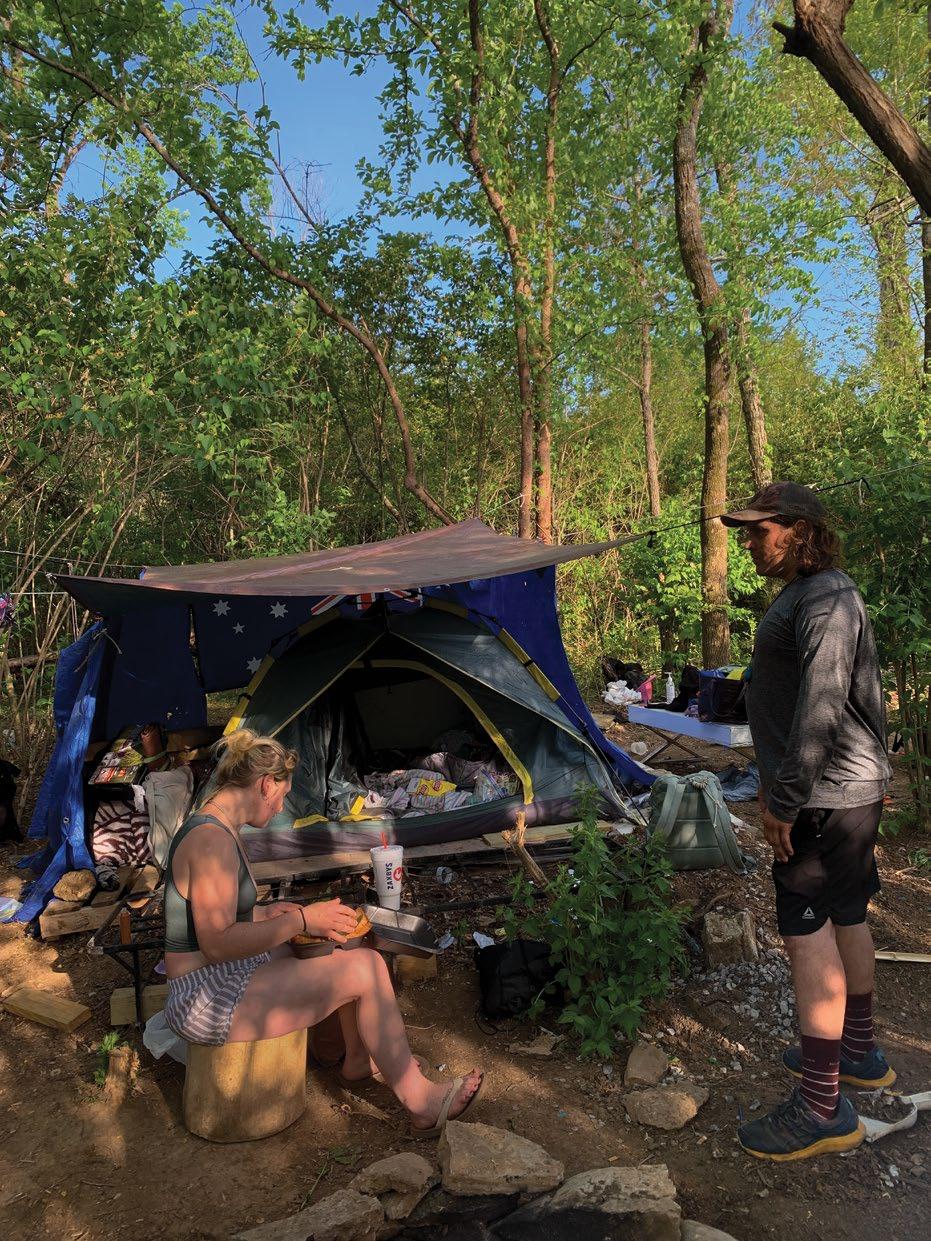
“What’s going on with the kid?” I asked “Carrie” as she sat in her tent in the woods between a shopping center and a suburb in Hermitage. She had recently given birth.
“I put it up for adoption,” she said.
“Do you think you would have done that if you had a place?”
“No.”
Two years ago, Metro Nashville’s Office of Homeless Services promised “Carrie” and her partner “Greg” housing. They say Metro staff moved them from their encampment to a motel and told them apartments were coming. At the center of what followed was a housing voucher — a federal subsidy that Nashville’s system appeared to route through a pipeline that kept residents in the dark about their own status. What came
BY MIKE LACY
instead of stable housing were evictions, lost documents and a return to the woods. An eviction record makes it nearly impossible for someone to qualify for receiving a housing voucher again. Seven people from that encampment say they are all homeless again, now with evictions on their record. They are not the only ones. In addition to an ongoing financial investigation from the Metro Internal Auditor, two families have recently filed Title VI civil rights complaints against Metro. Across both groups, a pattern emerges: residents were managed in ways that obscured their housing status on paper, promised vouchers that either never arrived, or were so mismanaged, their prospect of staying housed was arguably worse than before the city helped.
[Editor’s note: Lacy was asked to be a signed witness on the Title VI complaints referenced in this article, which came to light because of his reporting. This just means Lacy was present when the complainants relayed their story to Metro Human Relations Commission (MHRC). OHS stated in a written response that it would not comment on those complaints for that reason.]
There is no evidence that OHS keeps track of whether people they place in housing are subsequently evicted. I developed an eviction tracker using court data and offered it to OHS that could do this, but they did not express interest.
In a written response, OHS said 80 percent of the 39 residents from the Hermitage encampment remain housed, citing data re-
ported by the nonprofit partners who handled the placements. Seven former residents interviewed for this story say otherwise, and Davidson County court records reviewed independently identify more evictions than OHS’s figure accounts for.
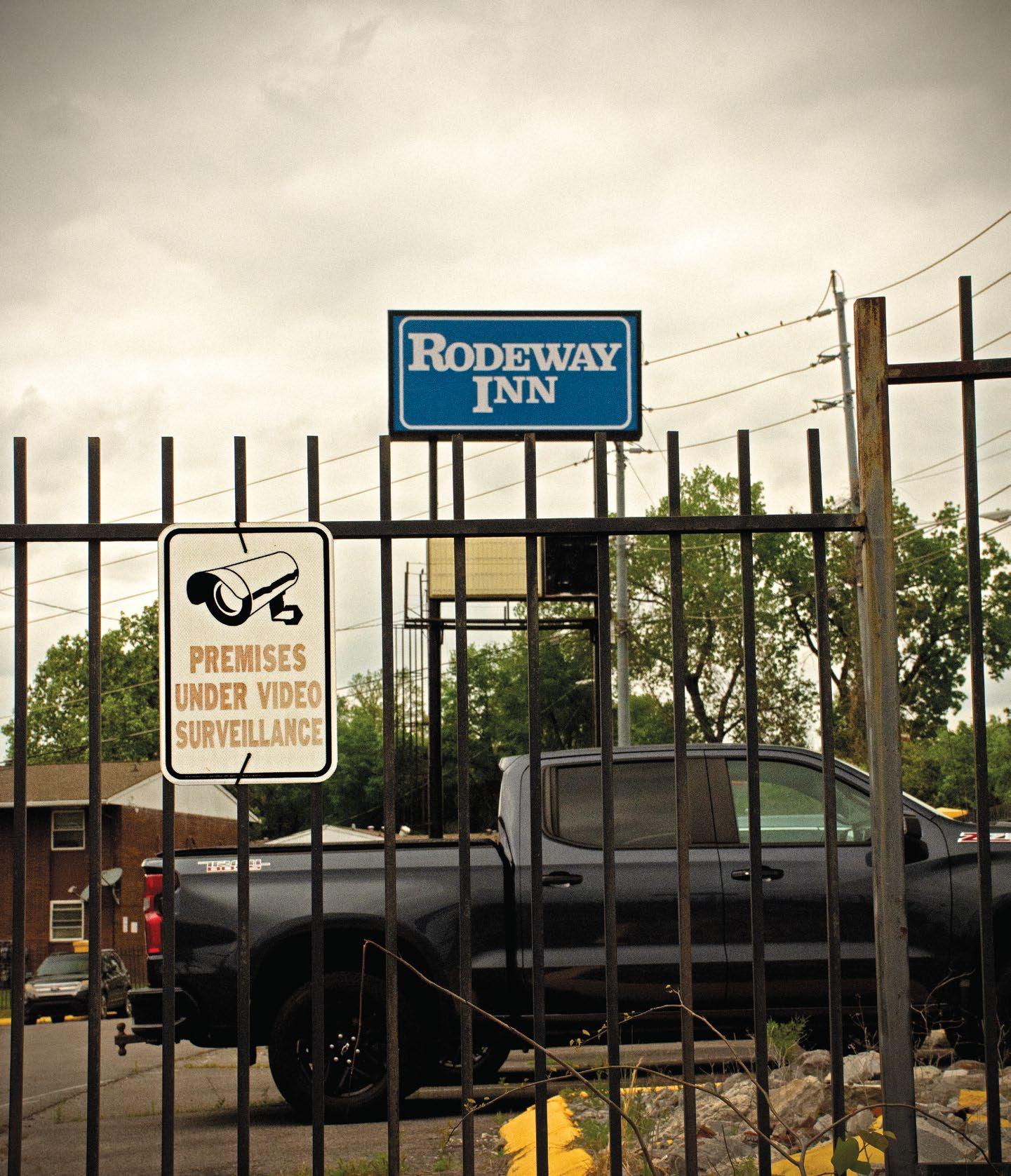
In January 2024, OHS conducted a “housing surge” in Hermitage, loading encampment residents into vans bound for the former Rodeway Inn, where the Salvation Army (TSA) was waiting. TSA had operated the facility as transitional housing since 2019. Inside, residents describe black mold and being explicitly told not to seek employment — an instruction that only makes sense if maintaining a particular income and housing status on paper was a condition of the voucher pipeline they were being moved
through. TSA said they did not tell anyone to remain unemployed. TSA’s contract for gap housing expired in October 2024 amid a public funding dispute with Metro. By April 2025, Hospitality Hub, a Memphis-based nonprofit, had replaced them as operators. Metro’s own guidance now classifies the Rodeway as an emergency shelter, not transitional housing. None of what residents were promised was on paper.
Carrie told me on April 14 that a TSA caseworker changed her address on her Social Security card documentation to TSA’s Dickerson Pike office — a place she has never lived — so her food stamps would not reflect her housed status at the Rodeway. She now receives government mail at an address she cannot access.
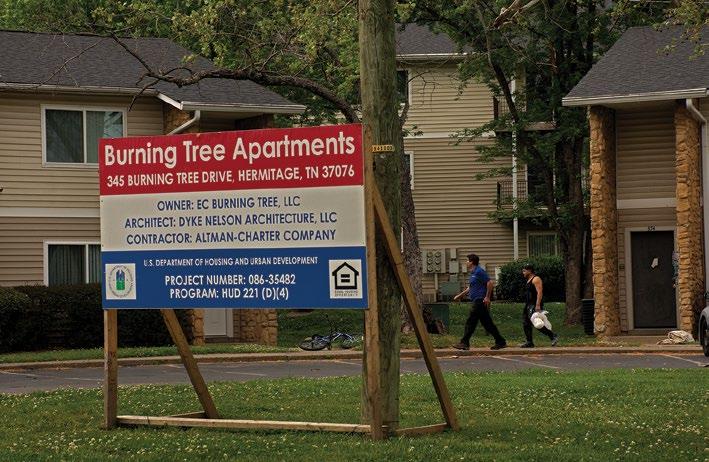
After months at the motel, residents were transitioned to apartments — but not together. Greg was sent to Burning Tree in Hermitage. Carrie was placed at Hillside Flats in Nashville, a part of the county she had explicitly told her caseworker she did not want to be in. Without a phone, without an ID, and 45 minutes by foot from anyone she knew, she lasted a week before the placement collapsed.
Their housing lasted three to six months. At Burning Tree, Greg told me every formerly homeless resident received an eviction notice on the same day — after renovations began on the property. Residents say they felt the funding from their vouchers may have been used to fund the renovations. Davidson County court records show more than 60 detainer warrants filed against Burning Tree residents since March 2025 — triple the property’s historical annual average. Every filing was handled by Nathan Chesley Lybarger, one of three attorneys my eviction tracker identified as dominating Davidson County’s eviction pipeline. Three new cases were filed the week this article was published.
Asked whether OHS or any organization working under contract placed people at Burning Tree, OHS said individuals were housed there by “a local nonprofit using one of more than 390 locations within the low-barrier housing collective,” and that because those placements were made by a nonprofit rather than OHS directly, the office relies on those agencies for housing status updates.
Residents say they were told their rent assistance would continue for a year. For Greg Montoney, it lasted six to seven months. He says he did not know, during any of that time, that the Metropolitan Development and Housing Agency (MDHA), the agency administering his voucher, had taken over his housing complex. What ended his tenancy was not a voucher lapse: he was evicted over an unexplained $500 fee before his annual recertification process even began. The recertification notice arrived in the mail after he was already evicted. Court records show a detainer warrant filed Oct. 6, 2025, 11 days later a judgment of $2,195.33, and active wage garnishment as of January 2026. Two other residents named by sources as coming from the same Hermitage encampment appear in the same records.
As of March 2025, Burning Tree is owned by MDHA — the same agency that administers Nashville’s Section 8 vouchers — after EC Burning Tree LLC quitclaimed the 22-acre property in a transaction prepared by Butler Snow LLP with no affordability covenants attached. The people placed there using vouchers, subsequently evicted and now garnished, were living in a property owned by the agency that controls whether they can ever receive a voucher again.
National best practice for permanent housing placements calls for home-based case management after move-in, with active retention services designed to catch landlord disputes, and to review certification failures and financial issues before they become eviction filings. Colorado’s state housing guidance sets a benchmark caseload of one case manager per 15 households. Residents interviewed for this story described no such follow-up. Carrie, pregnant in her apartment, said no one checked on her. The retention rates OHS cited in defense of its program describe interventions that deliver a service Nashville’s residents say they never received.
Public records requests show more than $350,000 in rent payments from OHS to private landlords with no Metro contracts on file.
OHS said these payments were authorized as “Bridge Funding” under a funding resolution, using Metro’s approved vendor payment process, but did not identify the resolution or explain the vendor approval standard. In an email to me last year about the placements, Director April Calvin described the program as “not to be published.” A vendor ledger obtained through public records requests shows Burning Tree’s property manager, Freeman-Webb Company, Realtors, as an active OHS rehousing vendor. The ledger also shows that Greenview Studios LLC received $53,299 in rehousing payments with no contract — exceeding the $50,000 threshold above which Metro procurement regulations require Division of Purchases approval.
Seven months after the Hermitage closure, eight families were taken from the Nashville Rescue Mission under nearly identical circumstances — at least $100,000 in COVID-era ARPA funds used to handpick families outside the coordinated entry process that OHS publicly holds up as its standard practice. Text messages obtained through public records requests show Director Calvin selecting families by texting confidential case files over unencrypted messages, replying with notes such as “Please remove this family from the list.” One message read: “The units selected are zero bedrooms/studios with two beds. The landlords will need names in advance so lease agreements can be generated over the weekend in preparation for Monday. Apologies for interrupting your weekend.”
Misty Hill was offered a full year of rent at The Avenue on Clarksville Pike at $1,400 a month, followed by a Section 8 voucher. A second family was placed at Hillside Crossing under the same verbal promise. For some families the vouchers eventually came; for others they lapsed without notice. In at least two cases, rent arrived late or not at all, prompting landlords to seek payment directly from tenants who were unable to pay on their own. The situation came to light through research, which I brought to the Nashville Scene. I am a signed witness on the Title VI complaint subsequently filed by two of these families.
Metro’s copies of the leases confirmed that despite OHS coordinating the placements, Metro appeared nowhere on them. The families say they were never given copies — something their case manager from Step Up on Second Street, who resigned in protest, asserts may have been deliberate. A signed lease would have categorized them as “permanently housed” and made them ineligible for the vouchers they were promised.
The same structure appeared at Wallace Studios, a 131-unit affordable housing complex at 97 Wallace Road that opened in 2024. OHS paid over $90,000 to the facility in landlord engage-

ment funds — Metro appearing nowhere on the leases, no documented commitment for ongoing rent support. When payments stopped, the debt became the tenants’. Court records show one woman hit with a judgment of $14,140 after Wallace Studios filed for eviction in March 2025, according to court documents. And in another OHS placement a judgment of $17,620 the following October, according to court documents. Both individuals were confirmed as placed there by OHS. The complex filed 33 eviction suits in its first year of operation.
One of the families that filed the Title VI complaint says that after months of trying to get Metro to deliver on the housing voucher she had been promised, she reached someone in the Mayor’s Office by phone. According to her, she was told that since she was now housed, there was no need for a voucher. She says that person
was Mayor Freddie O’Connell. The Mayor’s Office confirms someone from their office spoke with her, but denies it was O’Connell. Metro Legal advised against discussing constituent interactions publicly.
Carrie was pregnant in her apartment. She says no counselor or outreach worker checked on her. When her housing collapsed, she and Greg ended up back in a tent. She told me she gave the baby up for adoption.
She didn’t have to. At one point, she had a lease. She had a roof. For a brief window, she had the one thing that might have made it possible to keep her child.
They survived the ice storm in that thin tent. When I asked how it was for them, they exchanged a look that contained an ocean between them.
“It was rough,” Greg finally said.

























You know that one picture of The Loch Ness Monster where it’s just an out-of-focus blackand-white head sticking up out of the water? And maybe it’s a plesiosaur, or maybe it’s a duck at a weird angle, or just somebody’s hand sticking up out of a bathtub? Well, I just got my drivers license renewed and, for some reason, they used that picture. Do you think I should let them know or do you think they did it on purpose? But it lets me know that I’ve got a very specific idea of who I am and when somebody reflects that back to me as a very different picture, it’s pretty disorienting. If you feel like you’re being misunderstood, Aries, or presented as more mysterious than you were trying to be, take another run at explaining yourself. Worst case scenario, you might learn something about how you think of you.
First we mix the ingredients. Flour, water, salt, yeast. Then we knead the dough. Just enough. Never too much. Next we’ll let the dough rise. It takes patience, Taurus, but you’ve got plenty of that. Now we’ll bake the loaf. Trust the process, but keep an eye on it. Then we’ll let it cool. Saw off a thick slice And finally we’re ready to…wait, Taurus, what are you doing? No, we’re done you can just…oh, I get it. One more step to make this perfect. It’s got to go in the toaster. Get it a little crispy. Just a bit brown. Add some butter and, oh, this was a great idea, Taurus! Don’t let anybody else tell you when the project is finished, Taurus. You know if it needs one more thing. And the last step is delicious.
The fashion industry hasn’t contacted me for a check-in for quite a while. They used to seem concerned that I was wearing the same t-shirts from 4 years ago and my jeans are getting holes in all the wrong places. But I’m afraid they’ve given up on me, Gemini. All the designers in New York and Milan have decided I’m just not worth the effort. Fair enough, I suppose. I haven’t really given them any clues as to how they could help me. You, on the other hand, Gemini, have been a paragon of style lately. I appreciate how effortlessly yourself you are every time you leave the house. I hope you’ll remember to be just as authentic when you tell us what you need.
Are you familiar with “Exquisite Corpse,” Cancer? As I learned it, Exquisite Corpse is a writing game where one person writes down a word — for instance “The” and then hands the paper to the next person who writes the next word, perhaps “dog.” They pass the paper from person to person and try to make a story one word at a time. Each participant can read what’s been written before, but nobody gets to know where the story is going until they’ve arrived. Will it be “The dog chased after the ball?” Or “The dog gave a speech to the galactic council?” The only way to find out is to pick the next word. Collaborating has its challenges, Cancer, but it can often produce creative results. This week, try trusting your team to build the story. You might be pleasantly asparagus.

Honestly, I was as shocked as anyone to learn that my recent rise to “grassroots” fame was actually a psyop from amateur-astrology promotion-conglomerates that had been forcing my horoscopes into the social media feeds of unsuspecting Leos who would, naturally, believe they were receiving unsolicited guidance from the universe. Oh, hang on, I’m actually now being told I haven’t had a recent rise to fame and that what I’m describing is a psyop from my own imagination pretending that I’m receiving backlash to something that never happened. It’s hard to know where your own ideas come from these days, Leo. Be sure to keep some people around who you can trust.
Sometimes when I’m sitting on the edge of the bed scrolling on my phone with my brain turned off but I know I need to get up and put the laundry in the dryer I can feel the fight between my craving to not feel pain in the present moment and my knowledge that not having dry clothes to wear will cause me pain in the future. And sometimes in the fraction of a second that it takes for my thumb to slide up to the next piece of distracting, detaching, input, I realize that I have got to be feeling my life. That’s the only thing I’m really in control of, whether I notice my own life as I’m living it. And then I usually realize I can just bring my phone with me to the washing machine and keep scrolling while I put the wet clothes in the dryer. Whew! Whether it’s the wash cycle, or the rinse cycle, or the cycle of denying our own existence and agency, we’ve got to be breaking out of these cycles wherever we can, Virgo. I’ll try if you’ll try.
We’ve all been there, Libra. A horizontal battle on a two-dimensional playing field. Digital player vs. digital player. You’ve chosen your fighter, a mysterious, masked, and perhaps racially-stereotyped expert of a non-existent martial art. You’ve learned the basic combos. And you’ve got your opponent right where you want them. It’s time for your trademark finishing move. But before you can remember the correct sequence of buttons to mash, your adversary explodes into a fury of unstoppable kicks. You can’t get away. Defeat is imminent. But there’s one thing they weren’t expecting. You bump into the console power button with your toe. The screen goes black. Tricky, but you live to fight another day. Sometimes it’s better to just walk away, Libra.
My granddad was a whistler. I can still hear him piping out a loud, warbly Claire De Lune going down the echoey stairwell into the subway when he took me into the city. People would look around to see who was filling up their private ears in this public space and he’d smile with his eyes and keep whistling. If he had a song in his head, he wanted to get it into yours. It reminds me, Scorpio, that you don’t have to wait for somebody to ask you what you think before you say it. Even if you fill up the whole hall with your inside-thoughts and they echo back to you a little out of tune, we’ll be glad to hear them and to know you better.
In the 300,000 years since humanity emerged as a species, almost none of us have had to mow the lawn. That’s all pretty new. Even 100 years ago a home surrounded by land that was cultivated but not used to grow food was something only the very wealthy could afford. But we’re great at inventing unnecessary ways to use resources and expend energy and so the lawn was born. I wonder, Sagittarius, if there’s anything that’s taking up a lot of space in your life that could be approached a different way. Maybe all that time and space you spend mowing could be feeding you instead?
I’ve been trying to get less attached to the idea that I am separate from the rest of reality. I look at my cat laying in the sunbeam on the back of the futon and I don’t think she’s thinking about herself. I think she’s having a pure experience of sun and fur and purr and futon. That she’s in the universe and she is the universe. While I’m frantically looking for my keys because I’m “late” to “work.” I doubt that I’ll achieve this ego death before I clock in for my 9 p.m. night shift at 9:07, (So sorry to make you wait, Gina! Have a safe drive home.) but I think I can only go up from here, I guess. As for you, Capricorn, I’ll only suggest that you spend a little more time today noticing your immediate sphere of experience and maybe less energy on proving who you are.
I had a dream that I was walking down the hallway in the house where I grew up. It was just like it was back then, but instead of arriving at the bathroom door after I passed my brother’s room, the hall just kept going. There were more doors. Closets filled with boardgames I’d never played. Bedrooms of siblings I’d never met. And about the time I was getting worried, I turned around and saw you, Aquarius. Sometimes it’s such a relief to find a friendly face on the long walk from your childhood bedroom to wherever you are now. And when you find those people, Aquarius, I think it’s good to acknowledge how important they are. And also see if they know a shorter way to get to the bathroom.
My mom has recently learned how to generate AI pictures of me in different careers and text them to me. I think they’re just subtle hints that she thinks I could do better than working the night register at the Wandering Hills Super Video and Tan. Here’s one where I’m a fireman saving a cat from a tree. Here’s one where I’m a construction foreman. I just got another one where I’m supposed to be either a doctor or a wizard, but I’m a little unclear. It just reminds me, Pisces, that you might worry you should be doing something different. That’s totally fine. It might even be worth exploring. But if you’re basing that on messages you’re getting from somewhere else, maybe turn your ringer off for a couple of days.
Mr. Mysterio is not a licensed astrologer, a trained cryptozoologist, or a
lawn-care specialist. Want more? Visit mrmysterio.com Or just give him a call at
We are living in a crazy world and time. The cost of living is going up. The cost of gas is going up. The cost of housing is going up.
The partial government shutdown is still going on. Hopefully Congress will come back and agree on a deal to open it back up all the way.
BY LORA V., CONTRIBUTOR VENDOR
The war in the Middle East is still happening. They all decided to cease the bombing for two weeks. They are going to talk it out and maybe agree on something. Maybe keep the Strait of Hormuz open. Let peace win out.
I’m glad one thing is
working: the spaceship Artemis II went well. They reached the dark side of the moon, then they circled around and headed back to Earth on Friday, April 10, in the evening.
In closing, give peace a chance. Ring out. Peace, peace, peace.
BY JAMES “SHORTY” R., CONTRIBUTOR VENDOR
Change is good. Everybody changes for the good, and everything changes also.
There’s a very intelligent lawyer who is so intelligent he could be a member of MENSA. His wife is pregnant and about to give birth to twins. The lawyer also has a brother who is so dumb he tried to sue KFC cause their popcorn chicken didn’t taste like popcorn.
Well one day the lawyer was in court when he got the message that his wife was at the hospital in labor. So the lawyer asks the judge for a continuance because his wife is in labor.
The judge said, “NO! I want this case done today because you have had too many continuances already.” So the lawyer continues the case, wins the case and immediately heads for the hospital as quickly as he can. When he arrives the doctor meets him in the waiting and says, “Your wife gave birth to twins: a boy and a girl.”
You take a chance on what is ahead of you and see what is there to be grateful and thankful for what He shows you. We’ve come a long way, and like a seed we grow. So lets take in a little shine with the sun and a little bit of water.
The Contributor also helps us grow and teaches us things. Take it as it comes. It crawls,
Some years ago I was living in a group home in Washington State. The group home residents and staff all went up to the highest point of Mount Rainier to go cross country skiing. We had to find a good spot to build and dig a snowcap. We found a good spot and made camp. This was my first time doing anything like this and it was a wonderful time.
walks and runs with you. So be careful. It’s always gets better. We change for the better, so let’s change. Let’s do it together. Smile and keep on driving for the better. The best is yet to come.
Lawyer: “That’s great now I can go in there and my wife and I can name them.”
Doctor: “Oh you don’t have to worry about that your brother already named them.”
Lawyer: “WHAT! That idiot? OK, OK doc, what did he name the girl?”
Doctor: “Oh he named the girl Denise.”
Lawyer: “Denise, Da-Neece, hmm! I like it! So what did he name the boy?”
Doctor: “Da-Nephew!”
BY WILLIAM H., CONTRIBUTOR VENDOR
So we made camp and then we took out our shovels and started digging into the side of the mountain. We dug a snow cave that fit eight people: three adults and five kids. You can image how big that snow cave was if it fit all those people. You would think that it would be cold and very wet. But it was the total opposite. It was warm and dry.
Then the next morning during a headcount we discovered a person from the group home was missing. So you know what came next. The search. So, we went out to search two by two. While we were out searching we came across an ice bridge and I prayed that the kid didn’t fall down and off the ice and snow bridge. So, we made it to the park rangers and we told
them our situation and the park ranger called it in and we found out that the kid called for a ride and left the group.
So we went back to the snow cave and finished the Mount Rainier snow cave experience. But when we got back to the group home we dealt with the kid who left. All and all it was an experience that I will never forget.
Beware of the Boomerang: Even in Your Thoughts
Recently a young woman in L.A. won a $6 million lawsuit accusing Meta and Google (who owns YouTube) of causing her emotional crisis and depression. I ride the bus regularly and notice people, especially young people, flipping through their phones at one frivolous viewing after another. I heard one pastor say that Google is like the tree of knowledge of good and evil in the garden of Eden and I think he is right.
Solomon, known for his wisdom in the Bible said, “As the bird by wandering, as the swallow by flying, so the curse causeless shall not come.” Were the girl’s parents party to blame? Who is really to blame in that lawsuit? How about the jurors for having terrible judgement. Awarding $6 million to a plaintiff for not heeding her own conscience’s warning signals; that’s how far our culture’s values have versed from self-accountability and responsibility.
Years ago, there was a generation that believed in the boomerang effect. In my baby boomer generation we said, “What goes
BY GARY B., CONTRIBUTOR VENDOR
around comes around.” It’s also called Karma and Biblically it’s, “reaping what you sow.” It’s also understood as cause and effect. But the truth is that even our thoughts come back to us, sometimes to haunt us with guilt or remind us of something we’d do well to forget. To quote another pastor, “We remember the things we should forget and forget the things we should remember.” It pays to tend to the garden of your mind like a precious piece of land. As an older man I’m learning to treasure certain memories, especially those that encourage my faith in God. Journaling is also helpful.
The apostle Paul’s admonition is so true: “Finally, brethren, whatsoever things are true, whatsoever things are honest, whatsoever things are just, whatsoever are pure, whatsoever are lovely, whatsoever things are of good report, if there be any virtue and if there be any praise, think on these things.” (Phil. 4:8) But Paul had lots more to say about our thought life, “… this one thing I do, forgetting those things which are
behind and reaching forth unto those things which are before.”
The serenity prayer, spoken by AA members has the line, “Help me to accept the things I cannot change,” and there is nothing that can be done about the past (unless we need to go to a person and seek forgiveness or to make amends) but thankfully the cross of Jesus has made it possible to leave the past completely behind, and with a perfectly clean slate for the future. How is this possible? It’s because for Jesus’ sake God will forgive every sin.
It is no wonder Paul spoke so much about our thought life. He had health with his own memories of facilitating the martyrdom of many Christians prior to his conversion. In fact he was on his way to arrest Christians when a bright light knocked him to the ground, asking him, “Why do you persecute me? … It’s hard for you to kick against the pricks.” He later wrote to Timothy, “This a faithful saying and true, that ‘Christ came into the world to save sinners,’ of whom I
am chief.” When he wrote to the Corinthians saying, “bringing into captivity every thought to the obedience of Christ,” Paul probably had the guilt of his own past in the background.
In the great gospel manifesto to the Romans he said, “Oh wretched man that I am! Who shall deliver me from the body of this death?” Because he had once been an expert on Jewish law, Paul knew that based on that law, he was totally guilty. He goes on to say, “I thank God through Jesus Christ our Lord.”
This is the amazing wonder of the gospel, that all the consequences of a sin-fallen world met their doom when Jesus died on the cross. And if there is an interim of time before we see the final victory — such as worldwide peace — then we just have to persevere with faith and hope. The sun will soon rise and the clouds will give way! But God sees only hope and the possibilities of redemption through the blood of his Son. Let God lift the burden that plague you today. And believe his word for a totally bright future!




BY JOE NOLAN
Tamara Reynolds has spent her career embedding herself in communities that mainstream culture prefers to look away from. Her long-term project Southern Route examined identity, conflict and fading culture across the South, and her Guggenheim-winning photobook The Drake (Dewi Lewis, 2022) focused on the residents of a Murfreesboro Pike motel — portraits of people whose lives had been shaped by addiction, crime and abuse, viewed through Reynolds’ own personal history with addiction and recovery. That body of work formed a defining statement about marginalized communities. It’s a commitment she returns to in her latest work.
Melungeon, on view at Begonia Labs through June 26, finds Reynolds picturing Sneedville, Tenn., and the community historically identified as Melungeons — a mixedrace people whose ancestry braids African,
Native American, and European lineages. Pushed to the margins of Appalachian life and treated as racially indeterminate, they found refuge in the ridges and hollows of East Tennessee under the weight of generations of suspicion and exclusion. Reynolds’ connection runs deeper than documentary interest. Sneedville is her husband’s home community, and the trust that intimacy affords is inseparable from how these pictures were made.
Reynolds uses portraiture, landscape, exterior shots and intimate interiors to capture day-to-day life in the Sneedville community. In the images at Begonia Labs a rainstorm drapes a river bridge in quiet mist and a curly-haired little girl struggles to hike up a sunny hillside. An antique church is carved in bright light and deep shadows, and a man with his arms outstretched and his eyes closed floats across the surface of a
crystal clear stream. The look on his face is one part soul salvation, one part sweet relief from the Southern summer heat.
Reynolds’ works are untitled aside from simply noting their specific subjects. “Aibrianna at Clinch River” may be my favorite of all Reynolds’ photographs. It pictures the eponymous little girl underwater in the titular river, smiling up at the photographer through the rushing, rippling water. The refracting quality of the moving water distorts her face and body, but in a way that captures the strange magic of natural spaces on sun-drenched summer days. That distortion carries a darker resonance.
Distorted views of the Melungeon community cast them in a threatening light. Melungeons were landowners, and their racial ambiguity made their relative prosperity controversial at a time when black and white were strictly separated into distinct classes
in the South. In another image designated “Aibrianna in Sunlight” the same girl stands at the edge of the river soaking wet from swimming and draped in a beach towel. She stares defiantly at every viewer touring the display at Begonia Labs.
Whether she’s capturing candid moments, framing just the right ratios of water and woods or snagging perfectly angled shadows in the afternoon sun, Reynolds is technically masterful and has a great intuition for elements that bring narrative depth to her compositions. But her real gift is for documenting outsiders without reducing them to their otherness or inserting herself into their stories. She’s like an old-school fly-onthe-wall documentarian who manages to be intimate with her subject yet objective and removed. The photos in Melungeon offer an insider perspective, but one into which Reynolds has been invited.






Following a close call during a $3 million diamond heist, Davis (Chris Hemsworth) loses his nerve and questions his criminal path.
The meticulous, serial Los Angeles jewel thief has built a careful career targeting high-end robberies along the 101 Freeway. Like Alain Delon’s hitman in Le Samouraï, Davis wraps his crimes in a strict code: never hurt anyone, never deviate from the plan.
Money (Nick Nolte) — a legendary underworld fence who grooms troubled young men — gets the sense that Davis is damaged goods, so he reassigns the next big score to Ormon (Barry Keoghan), an unpredictable young biker with bleached blonde hair, a brutal criminal lineage and serious impulse control problems.
Bart Layton previously directed the excellent, experimental heist film American Animals. That movie combined actors like Keoghan and Evan Peters playing real-life college students-turnedart-thieves alongside the actual students commenting on the events playing out in the film. Crime 101 doesn’t include any purely documentary elements, but Layton’s frames are lived-in and packed with realistic detailing highlighted by a
BY JOE NOLAN, FILM CRITIC
light and shadows styling fitting this 21st-century noir. The opening montage of couriers and criminals arriving at a diamond delivery is intercut with upside-down shots of the Los Angeles skyline at night. A yoga instructor intones ironically in voiceover: “You hold the power to create all that you desire out of nothing.”
Searching for a way out of the criminal life, Davis’s path crosses with Sharon Combs (Halle Berry), a disillusioned insurance broker whose company pays out high-dollar settlements to Davis’s wealthy victims. Sharon is facing her own crossroads, stuck selling high-end policies to wealthy elites while questioning her life choices. Davis hopes one final $11-million-dollar score will give him the walk-away money he needs to make a fresh start. The question becomes whether he can actually walk away at all.
Layton’s cast of characters is rounded out by Detective Lou Lubesnick (Mark Ruffalo) and his partner Detective Tillman (Corey Hawkins). Lou’s identified a pattern in the 101 Freeway robberies and is convinced one man is responsible for them all. Lou is the last honest cop in an LAPD that’s become a corporation, where
the pressure to close cases at any cost makes his old-school integrity seem irrelevant. Fellow detectives see Lubesnick as a kind of nutjob conspiracy theorist, and Tillman questions whether his connection with Lou is hampering his own ambitions to climb the ladder into LAPD leadership. Lou’s estranged wife (Jennifer Jason Leigh) has left him, and his superiors want him padding arrest stats instead of chasing an imaginary thief. Despite objections, Lou is obsessed, and as the ultimate heist looms, the line between cop and criminal begins to blur.
The cast and Bart Layton’s script co-written with Peter Straughan are mostly excellent here. Between all the characters struggling with their various challenges in their intermingled careers, Layton’s only misstep is trying to shoehorn a romantic interest into the mix.
Maya (Monica Barbaro) meets Davis in a fender-bender mishap that registers the first false note of the film. I blame Layton more than Barbaro, and everything between her and Davis should be cut away from this story. Crime 101 is muscular and gritty at its best. It’s not breaking new ground, but its strength is the integrity of
the story, the characters and the performances that bring them to life. Pasting an obligatory romantic angle over the top of these intense proceedings is a major miscalculation.
Crime 101 is focused and relentless. It’s a story about ambition and achievement, but also about plain old survival on the mean streets of Los Angeles. It’s a wide-ranging police story that spans from criminal meetups in diners to high-stakes corporate headquarters to cluttered detective desks at the LAPD. It manages an ensemble of distinct, fully-fleshed-out characters with competing motives, but similar goals, and the blurry moral ambiguities that continually surface only add to the gripping texture of a movie that delivers the energy of a heist thriller along with the deeper human subtext viewers only find in the best of the genre.
Crime 101 is currently streaming on Amazon Prime Video.
Joe Nolan is a critic, columnist and performing singer/songwriter based in East Nashville. Find out more about his projects at www.joenolan.com.
“The Contributor” está trabajando con uno de los principales periódicos en español La Noticia para llevar contenido a más lectores en Middle Tennessee. Nuestros vendedores de periódicos han pedido durante mucho tiempo que nuestra publicación incluya contenido que apele al interés de residentes de habla hispana en nuestra comunidad.
“The Contributor” is working with one of the leading Spanish-language newspapers La Noticia to bring content to more readers in Middle Tennessee. Our newspaper vendors have long requested that our publication include content that appeals to the interest of Spanish-speaking residents in our community.

En un avance que podría transfor mar la medicina moder-
n a , u n e q u i p o d e investigadores de la Univer sidad Te xas
A & M
de rever tir procesos c

Por Yuri Cunza Editor in Chief
@LaNoticiaNe ws
mediante un sencillo spray nasal
E
n
s a bl e d e l d e t e r i o r o c o g n i t ivo f r e -
c u e n t e m e n t e a s o c i a d a c o n l a “ n i e bl a
m e n t a l ” y e n f e r m e d a d e s c o m o e l
A l z h e i m e r p o d r í a n o s e r i r r eve r s i bl e c o m o s e p e n s a b a
L a i nve s t i g a c i ó n f u e l i d e r a d a p o r e l
D r. A s h o k S h e t t y, p r o f e s o r d i s t i n g u i -
d o y s u b d i r e c t o r d e l I n s t i t u t o d e
M e d i c i n a Re ge n e r at iva , j u n t o c o n l o s c i e n t í f i c o s D r M a d h u L e e l ava t h i
N a r aya n a y D r M a h e e d h a r Ko d a l i
S u e q u i p o d e s a r r o l l ó u n t r at a m i e n t o
b a s a d o e n ve s í c u l a s e x t r a c e l u l a r e s
d e r iva d a s d e c é l u l a s m a d r e n e u -
r o n a l e s h u m a n a s , a d m i n i s t r a d a s a
t r av é s d e u n s p r ay n a s a l
L o n o t a bl e n o e s s o l o l a s i m p l i c i d a d
d e l m é t o d o, s i n o s u s r e s u l t a d o s : c o n ap e n a s d o s d o s i s , l o s i nve s t i g a d o r e s
l o g r a r o n r e d u c i r s i g n i f i c at iva m e n t e l a i n fl a m a c i ó n c e r e b r a l , r e s t a u r a r l a
f u n c i ó n d e l a s m i t o c o n d r i a s l a s “ c e n t r a l e s e n e r g é t i c a s ” d e l a s c é l u -
l a s y m e j o r a r l a m e m o r i a To d o
e s t o o c u r r i ó e n c u e s t i ó n d e s e m a n a s y
c o n e f e c t o s q u e s e m a n t u v i e r o n
d u r a n t e m e s e s


El estudio, publicado en el Jour nal of Extracellular Vesicles, podría redefinir el futuro de las terapias contra enfermedades neurode generativas y camb i a r l a m a n e r a e n q u e l a c i e n c i a entiende el envejecimiento del cerebro
En el centro del hallazgo se encuentra el fenómeno conocido como neuroinflammaging, una inflamación crónica y prog resiva que afecta al cerebro con la e d a d , e s p e c i a l m e n t e a l h i p o c a m p o, re gión c lave para la memoria y el aprendizaje Este proceso ha sido identificado como uno de los principales factores detrás del deterioro cognitivo.
L a t e r ap i a d e s a r r o l l a d a p o r e l e q u i p o d e Te x a s A & M a c t ú a d i r e c t a m e n t e
s o b r e e s t e p r o bl e m a L a s ve s í c u l a s e x t r a c e l u l a r e s c o n t i e n e n m i c r o A R N
( m i R NA ) , m o l é c u l a s c ap a c e s d e r e g ul a r l a a c t iv i d a d ge n é t i c a d e n t r o d e l a s
Conoce tus derechos: ¿Que hacer en caso de una redada?
Mantenerse callado
Sólo dar nombre y apellido
No mentir
Nunca acepte/lleve documentos falsos
No revelar su situación migratoria No llevar documentación de otro país
En caso de ser arrestado, mostrar la Tarjeta
Miranda sados en la Quinta Enmienda de la Constitución, derechos de guardar silencio y contar con un ogado fueron denominados Derechos Miranda go de la decisión de la Suprema Corte de Justicia Estados Unidos en el caso Miranda vs Arizona, 4 U S 436, de 1966
c é l u l a s A l s e r a dm i n i s t r a d a s p o r v í a i n t r a n a s a l , e s t a s ve s í c u l a s l o g r a n l l e -
g a r a l c e r e b r o y r e d u c i r l a a c t iv i d a d
i n fl a m a t o r i a e n l a s m i c r o g l í a s , l a s
c é l u l a s i n m u n o l ó g i c a s d e l s i s t e m a
n e r v i o s o c e n t r a l
Con el envejecimiento, estas microglías t i e n d e n a vo l ve r s e h i p e r a c t iva s ,
ge n e r a n d o u n e n t o r n o i n fl a m at o r i o que daña las neuronas El tratamiento, sin embargo, log ra “ re prog ramarlas”, disminuyendo la inflamación y favoreciendo un entor no más saludable para la función cerebral
Además, los investigadores identificaron moléculas específicas como miRNA-30e-3p y miRNA-181a-5p que desempeñan un papel clave al bloquear las vías inflamatorias más per jud i c i a l e s E s t e m e c a n i s m o n o s o l o reduce el daño, sino que también per-
mite restaurar procesos celulares esenciales, como la producción de energía y la inte g ridad mitocondrial.
Los resultados en modelos animales mostraron mejoras claras en la memoria y la función cognitiva, lo que abre la puerta a nuevas estrategias para combatir el envejecimiento cerebral Sin embargo, los expertos advierten que aún se requieren ensayos clínicos en humanos antes de que esta terapia pueda ser utilizada de forma generalizada
Aun así, el potencial es significativo En un mundo donde la esperanza de vida continúa en aumento, también crece la prevalencia de enfer medades neurode generativas El Alzheimer, por ejemplo, re presenta una de las principales causas de discapacidad en adultos mayores
Frente a este panorama, el desar rollo de tratamientos no invasivos, efectivos y de rápida acción podría marcar un cambio de paradigma Más allá de prolongar la vida, el objetivo es preservar la calidad de vida manteniendo la memoria, la inde pendencia y la capacidad de pensamiento
Si futuras investigaciones confir man e s t o s r e s u l t a d
s , e s t e s p r ay n a s a l podría conver tirse en una her ramienta clave para enfrentar uno de los mayores desafíos de la salud global: el envejecimiento del cerebro
Po
Envíenos sus sugerencias por correo electrónico: ne ws@hispanicpaper com|615-582-3757