NOVEMBER 18, 2026
ISSN 3111-3354 (PRINT) ISSN 3111-3362 (Online)
VOL. 34 // ISSUE 15
Seeing everything since 1993
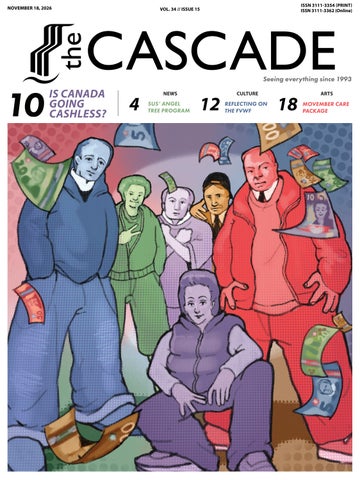
10
IS CANADA GOING CASHLESS?
4
NEWS
SUS’ ANGEL TREE PROGRAM
12
CULTURE
REFLECTING ON THE FVWF
18
ARTS
MOVEMBER CARE PACKAGE
VOL. 34 // ISSUE 15
Editor-in-Chief
Managing Editor
Business Manager
Creative Director
Darien Johnsen darien@ufvcascade.ca
Aneesha Narang aneesha@ufvcascade.ca
Production Manager
Anna McCausland anna@ufvcascade.ca
Cassie Williams cassie@ufvcascade.ca
Gabriela Gonzalez gabriela@ufvcascade.ca
Production Assistant Anayat Sandhu anayat@ufvcascade.ca
Features Editor
News Editor
Copy Editor
Sports Editor
Arts Editor
Opinion Editor
Snapshot Illustrator
Culture Editor
Caitlyn Carr caitlyn@ufvcascade.ca Zackery Fitzpatrick fitz@ufvcascade.ca
Sky Terrones sky@ufvcascade.ca
Iryna Presley
Staff Writer Indie McPhee
Staff Writer Abby Hansen
Staff Writer
Liam Pyper
Distributor
Kirat Dhami
Rachel Tait rachel@ufvcascade.ca Kait Thompson kait@ufvcascade.ca Natalia Toscano Murua natalia@ufvcascade.ca Jasleen Sandhu jasleen@ufvcascade.ca
Illustrator
Thea Van Agteren
Illustrator
Hannah Bricknell
Staff Writer Kara Dunbar
Columnist
Faby Cruz Alderete
NEWS 3 News Briefs 4 About the Angel Tree program 5 The Blue-nami 3 Remembering those who have fallen
Editorial //
7,8,9,10 Snapshots 5 Hyperexistentialism 6 Legends of the internet 7 AI hopes and fears 8 The Environmentalist: the fine print of progress 8 The consent advocacy program UFV sunk 9 Art in action
Space and time for reflection
10-11 The young and the cashless
Marley Penner
CONTRIBUTORS Jayden Peter Lexi Price
SPORTS 12 SFU vs UFV in men’s basketball
W W W.UFVC ASC ADE .C A I N S TAG R A M . CO M T H E C A S C A D E U F V TIKTOK CASCADE_ FY Volume 34 · Issue 15 Room S2111-33844 King Road Abbotsford, BC,V2S 7M8 604.854.4529 ISSN 3111-3354 (Print) · ISSN 3111-3362 (Online) The Cascade is UFV’s autonomous student newspaper and alternative press for the Fraser Valley. It originated under its current name in 1993, and achieved autonomy from the university and the Student Union Society in 2002. The Cascade is funded with UFV student funds, is a forum for UFV students to have their journalism published in an entirely student-run setting and is overseen by The Cascade Journalism Society Board, a body run by a student majority.The Cascade is published every other Wednesday with a print circulation of 800 and is distributed at Abbotsford, Chilliwack (CEP), Clearbrook, and Mission UFV campuses and throughout the surrounding communities. In order to be published in the newspaper, all work must first be approved by The Cascade’s editor-in-chief and the corresponding section editor. The Cascade reserves the right to edit submissions for clarity and length and will not print any articles or be a platform for any contributor or contractor who has shared racist, sexist, homophobic, or libellous content online in any form. Letters to the editor, while held to the same standard, are unedited, and should be under 200 words. Opinions expressed do not necessarily reflect that of UFV, The Cascade’s staff and collective, or associated members. The Cascade is published on the traditional, unceded territory of the Stó:lō peoples. We are grateful to be able to work and learn on this beautiful land.
2
In issue 34.14, published on Nov. 4, 2026, our October Senate Recap incorrectly wrote “Mateo Branzinha” instead of “Mateo Brazinha”. While no person or group was harmed by this mistake, we still felt it responsible to make the correction. As students running a paper, we sometimes make mistakes during our production process and The Cascade seeks to uphold journalistic standards!
OPINION
FEATURE Feature & Cover Illustrator
Correction from 34.14
CULTURE 12 FVWF: an institution 13 Gallery 7’s Frozen 13 Spreading awareness of global concerns on campus 14 Campus Fashion: gearing up for the holidays 15 Study Break
The theory of relativity explains the fabric of space and time. It states that the laws of physics and speed of light are constant. However, there are consequences to this theory. One of which is that time ticks by slower for objects that are moving very fast. Hm. I’ve been taking a modernist literature course, and honestly the more we study modernism, the more it feels like we’re describing this fall semester: confusing, daunting, and bizarre. In his poem, “The Second Coming,” W.B. Yeats describes modernism in one phrase: “Things fall apart; the centre cannot hold.” There’s this eternal search for some meaning, some centre, but ultimately there is none. Back to that theory of relativity… It focuses on constants, but what if there is none? What if Yeats is right and there’s no centre? This is what this fall semester has done to me. I’ve gone deep in the Yeats/modernism/retrograde spiral. However, I sense a big transitional period coming. A period to recognize that time is moving slower than you think and to match your pace to allow for some rest and appreciation. I don’t know if it’s because all those damn planets are finally out of retrograde or what, but I think it’s largely from the fact that we’re facing so many endings. The end of semester, end of the year, and the end of The Cascade’s publication until the new year. I hope this winter break offers a time of reflection for everyone in face of all these ends, because that reading “break” sure as hell wasn’t enough. So go see a movie, go read something for fun (you can start right here!). Whatever it is, do something for you this winter and we’ll see y’all next year!
ARTS 16 The beauty in accepting the end 16 Sir Patrick Stewart: gone too soon 18 Define “be a man” for me 17 Minecraft: more than a game 18 The Cascade Shuffle 19 A Nutcracker missing its magic 19 CIVL Charts Escher’s Relativity / Fair use (Old-50)
Cassie Williams
WEDNESDAY, NOVEMBER 18, 2026
VOL. 34 // ISSUE 15
news@ufvcascade.ca News Editor — Rachel Tait
NEWS N E W S
B R I E F S LOCAL //
NATIONAL //
INTERNATIONAL //
NATIONAL //
70,000 tents flooded in Gaza
First Nations leaders raise Chilliwack sees seasons concerns over Bill C-39 first case of Avian Flu
La Rose Vs His Majesty the King Trial
As heavy rains of the season increase in Gaza, refugees living in the multitude of camps and tent cities left in the wake of Israel’s destruction of Gaza are now at risk of flooding. On Saturday, Nov. 7 Gaza’s Government Media Office reported that over the course of 12 hours, approximately 70,000 tents were flooded due to the storm, causing a projected loss of three million dollars. The Civil Defense reported that there were over 1,500 distress calls received as the agency struggled to prevent and reduce flooding due to the lack of pump and drainage equipment. The flooding has destabilized buildings already damaged by the bombardment. Two Palestinians were hurt by a toppling wall and rescue crews worked to rescue residents from a collapsed building in Nuseirat. The Popular Front for the Liberation of Palestine (PFLP) cautioned that future flooding could worsen as the winter progresses, endangering over two million Palestinians who lack shelter, fabricated housing, and repair equipment needed to battle the storm. PFLP and Hamas have also urged international ceasefire mediators to convince Israel to enable humanitarian aid and shelter supplies to come into Gaza to help those in need.
On Tuesday, Nov. 3, Chief Cindy Woodhouse Nepinak, the National Chief of The Assembly of First Nations (AFN), who was a witness at a special Parliament committee about Bill C-39, expressed her frustration about how the Bill undercuts Indigenous rights. This proposed Bill is an expansion of the Building Canada Strong Act, which means if a project meets certain criteria, it can be exempt from laws like the Species at Risk Act and Heritage Acts. With Bill C-39, the federal government would have the power to determine projects of national interest. Specific concerns about the bill were raised at Parliament, including the fact that the First Nations right to free, prior, and informed consent (FPIC) is not mentioned within the 243 pages of the proposed legislation and how it aims for a “one approval, one year” timeline for major projects bypassing environmental, energy, labour, consultation and impact assessments. Hiawatha First Nation Chief Laurie Carr said that “greater efficiency cannot come at the expense of rights.” He also pointed out the issue of not being consulted beforehand. “Consultation cannot simply mean notifying, giving us a deadline and an opportunity to provide comments after the decision has been made.” With files from APTN News
On Oct. 26, 2026, the first trial in which Canadian youth are going to court with the government over climate change commenced. Back in 2019, 15 young people ages 10 to 20 filed against the Canadian government for climate change — seven years later, the case is finally going to court. The plaintiffs argue that climate change negatively impacts basic human rights, specifically those in section 7 of the Charter of Rights and Freedoms, which states that “[e]veryone has the right to life, liberty and security.” According to the youth, climate change endangers these rights, and it is the government’s responsibility to protect them. If successful, this case would be a milestone in future climate litigation and climate change action from the Canadian government. Law Professor Dr. Stepan Wood from Allard School of Law commented on how this case gives a voice to the younger generation in a court of law. “It’s also the first chance that they have to test the government’s story and its witnesses on the witness stand with cross-examination, so that makes it unique in Canadian history. It’s also one of the first handful of youth climate cases to go to trial worldwide.” Files taken from National Magazine and The New York Times.
LIAM PYPER
On Friday, Nov. 6, the Canadian Food Inspection Agency (CFIA) discovered the first local case of Avian flu in B.C. The infected bird was found in a “commercial poultry flock” in Chilliwack, and this marks the first outbreak of the season in B.C. In previous days, Ontario and Quebec have each found a case of Avian flu in their provinces. The last occurrence of a H5N1 case in poultry in the province was in December of 2025. Since 2021, the Avian flu has become a prolific problem in B.C., and the province holds the highest number of cases, with over ten million out of the national 18 million cases. While CFIA has explained that H5 will not impact food safety, infections spread rapidly and often result in entire flocks being culled. According to CFIA, a “primary control zone” has yet to be developed, and it is unknown at the moment how bad the bird flu season will be this year. With files from CBC News and 100 Mile House Free Press. LIAM PYPER
LEXI PRICE FABIOLA CRUZ ALDERETE
Local //
Abbotsford honours veterans on Remembrance Day A reminder of those who fought for peace and freedom JAYDEN PETER On Nov. 11, Abbotsford held their annual Remembrance Day parade and hybrid ceremony to honour those who have fought and died in war to help preserve freedom. Thousands attended the parade which began at 10:00 a.m. at both Garden and Simon streets, and consisted of local police, the Abbotsford Legion, the RCMP, and local youth cadets. The parade ended at 10:45 a.m., at Thunderbird Memorial Park, in time to participate in the Remembrance Day ceremonies. Participants stood at attention while the
ceremony commenced, consisting of the laying of the wreaths, the traditional moment of silence, and a rifle salute. In Mayor Ross Siemens’ welcoming address, he mentioned the Armistice Agreement, acknowledging the history of Remembrance Day. This holiday began long before it was ever known as Remembrance Day, beginning with the Armistice Agreement, which was an agreement between Germany and the Allied forces, during a ceasefire that brought World War I to a close in 1918. The armistice agreement went into effect
on the 11th hour of the eleventh day of the 11th month. The following year, Armistice Day was set in motion, which was a day to honour the fallen soldiers. In 1921, the Poppy was officially integrated into the holiday, in part due to the famous poem “In Flanders Fields,” by Lieutenant-Colonel John McCrae. Roughly a decade later, the holiday was renamed Remembrance Day, to put less an emphasis on the ceasefire and more on those who lost their lives during the World Wars. Mayor Siemens addressed veterans and their families in his ceremonial
speech, going over the different wars Canada has fought in, and gave his respects to those who have laid down their lives for others. He reminded citizens of the values Canada soldiers fought for, as well as noting how important their contributions were for humanity. “These acts unite us across generations and remind us that remembrance is both a freedom and responsibility.” This fact becomes even more relevant due to the fact that, as of 2021, there CONTINUED ON PAGE 4 3
WEDNESDAY, NOVEMBER 18, 2026
VOL. 34 // ISSUE 15
NEWS CONTINUED FROM PAGE 3 are only 5,500 veterans remaining who fought in World War II and the Vietnam War. Overall, the ceremony continued without issue which included the conduction of the act of remembrance, the prayer of Remembrance, and a reading of “In Flanders Fields.”
Apart from the parade and ceremony, Abbotsford had other ways to celebrate and honour their veterans. As with every year, there was a national poppy campaign where residents could buy a Poppy to pin on their persons, remembering the veterans Canada has lost in action. This year there was a slight difference to the procedure, and they began the campaign a week earlier, on Oct. 24.
During this campaign, there were several different ways to get a poppy for the ceremony. People could get one at a local Starbucks, through TD Banking, certain storefronts, and through the Legion either via their pop ups or online. This year, the Abbotsford Legion set up shop in Seven Oaks Mall, and remained there until Remembrance Day.
As Siemens said to close his speech, “We will always remember those who served, who continue to serve, and who will carry their stories forward so that future generations will understand the true cost of the freedoms we enjoy and we far too often take for granted. Lest we forget.”
Campus //
SUS’s fifth annual Angel Tree Program Making the holidays magical this season RACHEL TAIT The Angel Tree program, which provides gifts to children of UFV students for the holidays, has been run for the last five years by the Student Union Society (SUS) at UFV. SUS President, Tanvir Hundal, spoke to The Cascade about this initiative, their goal to help as many families as they can, and the importance of this program for the community.
Who qualifies for Angel Tree? It is open to any UFV student who has children under the age of 16. Even though that might come as a bit of a restriction, again, we always make accommodations if, for example, a child’s 17 or whatnot. We’re very open, we just ask that you clarify the purpose and the reasoning behind who you are [applying] to become an angel. You can apply for up to six dependents under yourself. Other than establishing that you’re a UFV student, a parent, you have dependents [that] are 16 or under, there’s really no other requirement as to who can become an angel. And in terms of donations, anybody can donate.
What is the timeline for Angel Tree?
have an opportunity to fulfill your wishes for these angels … from Nov. 18 to Dec. 2, [where] you’re able to start buying your gifts, or [give] any contributions you have for the angels. You can drop off the wishes from the 18th onwards … [and] drop-off is until Dec. 3. We’ll have multiple different locations across our campuses, and then pickup for the angels, depending on which campus you’re at, will be on different days. At the Chilliwack campus, it will be from Dec. 7 to 8, and at the Abbotsford campus, it’ll be [from] Dec. 8 to 9.
There is not a single aspect of this program that isn’t rewarding. It’s amazing to be in a position to spread the word and really give back to the community, [to] the students especially, at a time where we understand there are challenges, and maybe [they] just need a little extra support. Seeing those parents and guardians, and those angels get what they want over the holidays is always heartwarming. It’s great to have that direct connection, especially for students on campus. I think that’s the part that always resonates with us. These are our students that we’re able to support, and our community that we’re What goals do you have this year? able to bring together… and it’s not just Honestly, helping as many as we can. For other students who are contributing, but context, last year we had between 50 to also the staff, the faculty, and individuals 100 parents and guardians who registered that live across the region. to apply to have their angels [sponsored]. The number of angels we had was Why do you think this is a worthwhile cause? between 100 to 150 that we were able to provide gifts and presents to. There was Over the years, we saw time and time a year that we actually had [200] to 250, again students apply for this program, and so it has fluctuated over the years, but we we’ve seen an uptake and an increase in try our best to ensure that if we get angels, our numbers. When we see [the] return of there will be a way for us to provide them students, and being able to [help] sponsor [with] what they need … For example, we angels and bring people together, we see sell gingerbread cookies at Fair Grounds , that value [comes] out of this program … and any extra [proceeds] that we get from we’ve seen firsthand how big of an impact that will help to support [the] angels, just it has during the holiday season, and … it to make sure that we’re able to cover all has empowered us to keep it running. our bases.
The registration opens from Monday, Nov. 9 to Friday, Nov. 13. Then we will confirm that you are eligible for the program, and What is most rewarding about [we will] also start our outreach. You will running Angel Tree?
4
What advice would you give to those interested in sponsoring a child?
Angel Tree 2025 by UFV Student UnionSociety / Santa Booth in Chilliwack & Abbotsford Campus Don’t feel that you need to contribute the most, or that you’re not able to contribute. Anything you do is helpful for us, whether it’s spreading the word, asking those around you if they’re able to contribute, or something as simple as buying that cookie at fairgrounds… any contribution really helps. You don’t need to give the most, just do whatever you can within your means. Q&A has been edited for length and clarity.
WEDNESDAY, NOVEMBER 18, 2026
VOL. 34 // ISSUE 15
NEWS
International //
U.S. midterms reflect American’s frustrations with Trump Democrats’ major victories and what they could do going forward ABBY HANSEN Professor Eric Spalding is an associate professor in the department of Media and Communication Studies at the University of the Fraser Valley. The United States Republican Party suffered a major blow during the recent midterm elections that occurred on Nov. 3. The Democratic party won by a landslide across the country, gaining control of six historically important Republican states: Texas, Ohio, Iowa, Kansas, North Carolina, and South Carolina. Professor Spalding spoke with The Cascade on what influenced this monumental victory, and the future of American politics. “In retrospect, it just seems so obvious that there would be this blue tsunami, as everyone calls it, because Trump has been so atrocious as a president. Some people were comparing him to Nixon and how the Watergate scandal led Nixon to be impeached, and he had to resign from his position. Trump has done so many more things that are impeachable offences, and yet he goes on, except that the voters in a lot of states finally have had enough of [him].”
Spalding also mentioned how Trump’s actions at the White House have fuelled voter discontent. “Just the optics of his ballroom, for instance, which is going to cost many tens of millions of dollars. It’s not going to be something that’s open to the public [and] it almost looks like a giant bunker to protect the elite from average Americans. So I think the symbolism of these projects was also detrimental.” Another point Spalding brought up was the effects of the Iran war on American voters, which may have swayed their decision at the polls. “It’s the impact of the [Iran] war, the closing of the Strait of Hormuz, and the increase in the price of gasoline and diesel. [If] you think of the base for Trump, it’s been a lot of working-class white males [who] need diesel to earn a living … and they’ve just seen the price of diesel double in the past year under Trump, so a lot of them decided to stay at home and not vote, or to give the Democrats a chance.” A concern Spalding emphasized was that the Democratic Party might waste this opportunity that their wins have granted them.
“[The Democrats are] all saying they want to end the war in [Iran], and that seems like a wise first step toward [improving the government’s standing with Americans.] The mainstream media are all talking about the burden on Americans, but imagine what it’s like to live in [Iran] with this ongoing war and how many innocent lives have been lost because of this unwarranted American incursion in the country.” He suggested that perhaps the Strait of Hormuz could be re-opened — allowing oil to be transported, which would lead to a decrease in the costs of oil and gas. In terms of the future, Spalding said that he feels optimistic. “I think [Trump is] getting old [and] he’s getting tired. People say he cares more about his projects. He’s a real estate developer [and] you can see his true colours nowadays. He’s so focused on the reflecting [pool], the ballroom, the helicopter pad, and renovating the White House. Maybe just let him do that and not cause trouble for Americans and the rest of the world … I don’t think he’s got the same kind of vim and vigour that would enable him to be as oppressive as he’s been in his first two years.”
OPINION
Illustration by Thea Van Agteren / The Cascade opinion@ufvcascade.ca Opinion Editor — Natalia Toscano Murua
Hot Take //
Mind over matter Thoughts on what us, as matter of the universe, can and cannot understand NATALIA TOSCANO MURUA The idea that the matter that makes up everything — including us — could be as old as the universe itself is fascinating. It is known that the big bang is the most widely accepted theory for the origin of the universe, and since all matter originated from it, I like to think that at least some part of me must be atomically that old. I wonder, what kind of wisdom does my body hold that I might not be aware of? What other aspects of the universe and existence itself might we be connected to? If there’s one thing I know, it’s that I don’t know everything — nobody does. But, it is exactly within this realm of not-knowing that endless possibilities can arise. After all, even objective truths are only objective from a human perspective, we have no way of knowing if there are other non-human forms of truth. I’ve got
some very human existential thoughts on how our connection to the universe could “explain” phenomena that have no explanation. My argument: maybe it is not proven, but it is also not disproven. And besides, we are still talking from a human perspective, who knows what a non-human one might explain. We’ve likely heard about what ghosts are as a concept, and that their existence has not been scientifically proven. I have a personal theory that I like to go with to explain ghosts: they are higher dimensional beings. We exist in three dimensions, which is length, width, and height. Technically, since time affects us, we experience the fourth dimension of spacetime as well — but we cannot control it. There are theories that imagine what more dimensions could mean, but since we only exist within three, we have no way of experiencing more. Or do we?
I don’t think the universe is contained to only three dimensions, and even if our bodies are, what were we before existing within a body and what are we after? I imagine that before/after being contained within a body, we could exist in more dimensions. Maybe that is what ghosts are, experiences beyond the reach of humans as a whole — but not out of what is possible. Ghosts are just one example of something science hasn’t been able to explain, and something that, who knows, might be outside our reach to explain under the science and facts we can coexist with. Here’s another thought, what is inside a black hole? Science speculates that matter is crushed until it achieves infinite density, but the gravity of black holes is so strong that not even light can escape. So, again, there’s no way to know — no human way to know, that is. But I bet the
universe must know, and since we are a part of it, and it is a part of us, then a part of us must know. Obviously this is purely speculative, but just as I said before, there is no proving but also no disproving. It could be that while we exist as humans, we might not be able to access this knowledge, but if we were to be something other than human, then perhaps we could. Maybe in an existence within a higher dimension we could know. Another thing I often wonder is, what if our body knows more simply because of its link to everything? What if, not knowingly, we have some limited access to knowledge that is outside our reach? I sometimes wonder if the things we imagine can be classed as things that exist, because even if they are not tangible, they are there. I think they would not be there CONTINUED ON PAGE 6 5
WEDNESDAY, NOVEMBER 18, 2026
CONTINUED FROM PAGE 5 if they could not be there, but they can, and they are. We can imagine thanks to a brain that has the capacity to do so, and this brain is made up of matter — matter that came from somewhere that might “know” more than us.
VOL. 34 // ISSUE 15
This is all to say, I don’t think there is anything that can never be understood. However, I think there are limits to what a human lens can understand. I also think that we could be more than just human, but right now, we are just human, so we can only understand things from this starting point. Heck, even the big bang is
just a human concept, who knows what might actually be the reason behind, well, everything. Maybe the universe is not everything and there is more, but we as humans have no way to know. As humans. As something, someplace, sometime, some(???) else? I believe, yes, totally.
History //
SNAPSHOT Dreams are a fascinating thing
A new era of mythos How online “creepypastas” are creating modern folklore ABBY HANSEN Content warning: this article contains mention of suicide. What do you think of when you hear the word “folklore?” In my mind, the term evokes images of a dense, impassable forest, gently blanketed by fog. I think of mythical creatures, ancient spirits, and foreboding curses. But what exactly is folklore? Folklore is defined as a group of people’s preserved traditions that can involve tales, stories, sayings, dances, art, and more forms. These various rituals or stories, notably, are not something owned by anyone. They grow and change over time, with each story-teller adding their own unique flair — hence, the various iterations that manifest over time. Some might think of folklore as purely historical, but I’d argue that online spaces are expanding the limits of what folklore can be. A few years back, I took a class on Indigenous films and filmmaking — a core concept of the course was technology being described as a landscape. A new frontier where people create settlements in the form of social media platforms, online forums, and video games. So, of course it’s not surprising that these digital communities eventually create their own customs, mythos, and histories. This brings us to the concept of “creepypastas.” The term was originally coined in 2007, playing on the phrase “copypasta” — blocks of text that are designed to be copied and pasted online. Creepypastas encompass a wide range of online horror stories, concepts, and figures. I think these online myths and tales are similar to folklore in many ways. They range from simple stories, to detailed rituals, pieces of art, and songs, and in a similar fashion to folklore, creepypastas aren’t owned by anyone. They are often unique stories, or legends regarding already existing titles. I think the best way to demonstrate this is to compare modern-day creepypastas to traditional folklore and highlight the similarities from a narrative standpoint. It’s very likely that most people have heard of the backrooms concept by now. What originated as an ominous post on 6
4chan has since spiraled into its own narrative universe. Video games, books, and now a blockbuster film depict the never-ending twists and turns of the backrooms — a liminal space that merges with our reality, trapping people in the process. From the beginning, posts regarding the backrooms hinted at something lurking through the twisting hallways and disjointed rooms. Entities that are not to be crossed. Turning the backrooms from endless yet benign corridors into a hunting ground between predator and prey. This idea of a seemingly inescapable labyrinth is nothing new. Greek mythology tells of a complex maze that was so cleverly designed by Daedalus, it was practically inescapable. Haunting the labyrinth, was the creature known as the minotaur. The bull-like creature hunted the humans who were cast into the maze on a monthly basis as sacrifices. One of the most iconic creepypastas that I remember seeing growing up was Slender Man. A tall, thin, humanoid creature, often wearing a suit and tie. The pale figure haunts the forest at night, stealing anyone who dares to look at his featureless face. Some versions of Slender Man depict him stalking his victims for months or even years at a time before striking, driving them to madness in the process. I feel the Algonquin legend of the Wendigo mirrors Slender Man in several ways. They are often described as towering, skinny creatures who typically hunt their victims in the night.
A more disturbing tale that was shaped in online forums is the myth of Lavender Town Syndrome. This was a supposed string of child suicides caused by a soundtrack piece from the Japanese version of Pokémon Red and Green (1996). According to the myth, the high frequencies of the Lavender Town soundtrack that only children could hear led to severe cases of depression, driving these victims to do the unthinkable. Another one of the oldest and most famous mythological stories I like is that of the siren’s song. Famously depicted in Homer’s The Odyssey (700 BC), these half-bird, half-women lured men with their haunting voices to their doom. The siren’s song would be so alluring that the characters in The Odyssey plug their ears with wax to avoid being enchanted by the beckoning melodies. Storytelling has been an intrinsic part of society for as long as we have been capable of creating. Myth and legend are a part of that. I think we as humans crave a sense of wonder. The unknown mysteries of the world are not only terrifying, they are also morbidly fascinating, which is why I think these creepypastas spread like wildfire in online spaces and center themselves as permanent additions to mythos. Who knows? Maybe these online legends will have the same staying power as the classic mythical tales we all know and admire.
Illustration by Iryna Presley I think lucid dreaming is one of the mind’s most interesting capabilities. Being able to dream is already fantastic on its own, but knowing you are dreaming while you’re inside the dream has got to be one of the coolest sensations out there. The thought that everything that happens within a dream is constructed by your mind is fascinating. I am of the belief that you can only truly control what happens within you, and everything that happens outside you is not within your control. Within a lucid dream, you can technically influence what happens outside of you, because that “outside” still exists within you. All five senses can be engaged in a dream. Taste and smell are not common to experience, but they can happen. I once had a lucid dream where I transported myself to my aunt’s lakeside cabin, met my whole family having a blast there, and ate seven of my nana’s freshly made tortillas. Seven glorious tortillas. I remember chewing and tasting each one, that’s why I’m so sure it was specifically seven. There’s also flying freely, experiencing epic stories firsthand, wielding kickass powers… Ah, I don’t think I’ll ever get tired of lucid dreaming. NATALIA TOSCANO MURUA
Illustration by Hannah Bricknell / The Cascade
WEDNESDAY, NOVEMBER 18, 2026
VOL. 34 // ISSUE 15
Rant //
The hopelessness AI brings Why I think we should be concerned for future generations
SNAPSHOT AO3 is down so now I actually have to do my homework
Illustration by Iryna Presley I’m going to out myself with this snapshot, but guys I am a fanfic reader. I understand if your opinion of me has changed but sometimes your girl just wants to read a fluffy little romance about her two favourite Pitt characters. Now that AO3 (also known as Archive of Our Own) has been hacked and is shut down for maintenance I unfortunately have to do my homework instead of procrastinating by catching up on my favourite fics. I will say it’s been inspiring to see the fanfic community rally together sharing downloaded fics in these trying times. The one good thing about this is that all fic writers can rest easy or get adventurous for the next couple of weeks because they will be free from the AO3 curse. ANNA MCCAUSLAND
INDIE MCPHEE Why does our generation feel so hopeless? I’ve been asking myself this question ever since I graduated high school in 2024. I was exposed to world-impacting events like AI, climate change, and “unretirement” — with these topics especially gaining traction on social media platforms. Then, I feel we are told by the previous generations to be grateful for what we have, but they aren’t facing the same reality that we are. If you witnessed so many world-altering events in just a short time, how could you expect to be hopeful or grateful? The most recent addition to this nightmare, and what causes me the most distress, is the rise of AI and its usage among my peers. Ever since the release of ChatGPT in 2022, I feel students began to ride the wave of laziness, and encourage their peers to do so as well. There’s a fear present and a pressure to not be left behind this uprising of AI. I see this over-reliance on technology as damaging, especially if it’s all you’re depending on. Additionally, there’s the fear of AI replacing our jobs; and for many, this is already happening. According to the American Psychological Association’s (APA) 2026 Chatbots and Mental Health Survey, 77 per cent of psychologists say their patients report using AI as a mental health provider. This means citizens who believe they are mentally unwell are turning toward an AI instead of legitimate mental health practitioners in an attempt to diagnose and summarize their problems. Reading statistics like this makes me question if my generation considers the morality or ethicality of using AI. The same study tells us that a vast majority of psychologists (97 per cent) believe that chatbots reinforce the user’s opinions and ideas even if they’re negative behaviours. This creates confirmation bias in users, unintentionally searching for information that will please them. Instead of advice, the bot will tell you what you want to hear.
I think we’ve become so desensitized on social media to AI art and memes, we don’t even realize it wasn’t manmade while scrolling. It seems like no one cares anymore because it’s everywhere, and we can’t stop it, so we might as well get used to it. As each year passes, kids are getting phones at younger ages. This could lead to exposure to AI, violence, and inappropriate images or videos as their brains are still developing. The Pew Research Center states 60 per cent of kids under the age of 12 in the U.S. are allowed by their parents to use a smartphone. I can understand getting your child a phone to stay connected for safety, but I believe parents should still be applying limits to what their child can access. Allowing AI access to such a young audience may impact their critical thinking skills, as reported on by journalist Ali Shehab for Psychology today: “Studies suggest that frequent AI use can correlate with weaker reasoning and reduced engagement in metacognitive activities — the crucial skills of planning, monitoring, and evaluating one’s understanding.”
As I grow older, I notice more and more of my peers using AI and giving into the easy path, not realizing how they’re subconsciously encouraging the loss of childhood innocence, of the human touch, and of critical thought. While people like me try to hold onto hope, it’s incredibly hard when you’re losing community. Today, we’re losing what it means to be human, to be connected, especially when others would rather be at home, have ChatGPT organize their day. I believe there’s beauty in existing and creating with pure blood, sweat, and tears; something a robot could never replicate. I think the hopelessness of this generation comes from spreading awareness about the challenges we face — but it feels like no one listens. It seems like most people will always choose the easy path. I want to hope again, but in the current situation, I find it harder every day. For now, my hope is that getting these words out — real human words — can reach the people it needs to, and spark some change. Whether that is looking at AI under a different lens, or simply bringing light to worries that plague our generation, every effort to voice human concerns counts.
Illustration by Thea Van Agteren / The Cascade
7
WEDNESDAY, NOVEMBER 18, 2026
VOL. 34 // ISSUE 15
OPINION
THE ENVIRONMENTALIST: what progress could silence The environmental case against Bill C-39 FA B I O L A CR UZ A L D E R E T E
Welcome to The Environmentalist, your column for understanding the natural world. This edition explores the environmental concerns surrounding Bill C-39. As future professionals, we expect the government to make decisions for the betterment of our society, but what happens when it disregards research evidence in favour of what it calls the “national interest”? Rising temperatures across Canada are no secret. According to Canada’s Changing Climate Report 2026, Canada has warmed by 2.0°C from 1948 to 2023. Longer fire seasons, melting glaciers and warmer oceans will intensify with further warming. Stabilizing temperatures requires reducing global carbon dioxide emissions to net zero. Bill C-39, the Building Canada Strong Act, proposes a one-year federal decision timeline after required information is supplied and allows the designation of “regions of national interest” to facilitate approvals for eligible projects. The government says these reforms would reduce duplication and attract investment while maintaining environmental protections and Indigenous consultation obligations. World Wildlife Fund Canada president and CEO Megan Leslie put the question plainly, her concern challenging how Bill C-39 defines the benefits of development: “I think it’s in our national interest not to poison our lakes and rivers.” 56 Fellows of the Royal Society of Canada fear that Bill C-39 may cause irreversible environmental harm. In a letter dated Oct. 22, they identified concerns including allowing site clearance before environmental assessment is completed. They also questioned whether a one-year timeline allows adequate assessment of complex projects and opposed ministerial powers to remove conditions intended to prevent environmental harm. In the Salish Sea, endangered southern resident killer whales face threats from shipping, according to Lovel Pratt, the noise disturbance and water pollution in the area directly affect them. The Roberts Bank Terminal 2 project, a proposed container shipping terminal in Delta, raises another concern: West Coast Environmental Law warns that C-39 could weaken or remove its whale protections.
Illustration by Thea Van Agteren / The Cascade Vessel noise can interfere with the whales’ ability to find food and communicate. These whales carry family knowledge, or culture, as dialects learned from their mothers and feeding traditions passed through generations. Other whales cannot simply replace lost traditions. The Lummi Nation considers southern residents to be relatives; their disappearance would also be a loss within that enduring relationship. Research helps us understand what development could cost before those losses become irreversible. If the government claims to act in the national interest, it must explain how that interest includes the integrity of the environment and the communities connected to it. As a university community, we should expect the knowledge we produce to carry weight in decisions shaping our future. As the Lorax once said, “Unless someone like you cares a whole awful lot, nothing is going to get better.” So, let’s care.
Campus //
“In This Together” How UFV allowed a student led program against sexual misconduct to crumble LIAM PYPER Let me set the stage for you: you’re a new student at UFV, perhaps you just moved into the new UFV housing building, Lá:léms Ye EverGreen. You read the news late in September, when the story of the Cornell 7 made headlines. UFV sent an email letting students know where to access support resources. The email stated: “Sexualized violence is unacceptable. At UFV, students can access support and information about their options through trained staff and established policies and procedures.” 8
The question the email tries to answer? Where to go as a student to learn how to stay safe, and keep your community safe. And in the worst scenarios, how to find support as a person who has experienced sexual abuse. While UFV listed some resources, the email would perhaps have been more helpful, had the university not sunk its peer support program into oblivion and missed updating its sexual violence policy. The Cascade spoke with Ella Haladin, who used to work in UFV’s In This Together (ITT) program. She explained how the program functioned and how it impacted the UFV community. ITT came about as UFV created Policy 236 in
accordance with B.C.’s Sexual Violence and Misconduct Policy Act. It hosted workshops centred around consent and safe sex practice, and created information pamphlets so it was easy for students to learn where to go for help. Since it was all student run, ITT provided a form of peer support that was very unique to UFV. “I honestly think it was a generous interpretation of the policy at the time. No other university in B.C. has peer education this way. It was really forward-thinking of UFV to do that in the first place, which is why it’s unfortunate it doesn’t exist anymore.” Now, UFV offers a self-enrolled online module that explains Policy 236,
as well as consent, support for survivors, and how to report or disclose abuse. Haladin explained that the module was well put together, but that UFV could not legally enforce the module and its creator was laid off a year after its initiation. “I thought it was really good and clearly a labour of love and effort. And they were laid off less than a year after the contract started. Before they were laid off, they told me that under 10 people had completed the module in the semester that had been released.” The module is still available to sign up for, however, there is no requirement or CONTINUED ON PAGE 9
WEDNESDAY, NOVEMBER 18, 2026
VOL. 34 // ISSUE 15
OPINION CONTINUED FROM PAGE 8 incentive by the university to do so. The Cascade spoke with Robbyn Bennett, the executive director of Student Affairs, who explained in an interview and clarified through email that the module had 76 students complete or participate in the module and that it was seen by the university as more effective than ITT. Haladin also had concerns that UFV may be violating B.C.’s previously mentioned Sexual Violence and Misconduct Policy Act. The Cascade used the Internet Archive to check when UFV updated their sexualized violence policy, which they are obligated to review every three years according to Section 3 (1A) of the Act. In accordance with this, UFV added Policy 236 in 2017, with a review set for 2022. However, it wasn’t until 2024 when the Policy was actually updated, over seven years later. Bennet explained that this fell in line with the
university’s typical policy review system of within seven years, and speculated that UFV interpreted the section as only needing review or amendment to align with the legislation. “Our understanding of the three-year review requirement is that institutions are expected to assess their policies against the legislative requirements to ensure continued alignment. Where legislative changes are introduced, policies would need to be reviewed and amended as necessary to reflect those changes. “I’m not sure if it’s a formal revision that they’re calling for or not. I’d have to look into that. I don’t have an answer for you on that one.” As UFV grows its Abbotsford campus to potentially house around 600 students, the need for programs like ITT has further increased. Haladin explained that even though closing ITT may produce short term ease to UFV’s financial burdens,
there could be a greater cost in the long run. “Really, this is a reputational and financial cost. I think that UFV is going to incur on themselves by trying to save money through defunding this program. You don’t realize how much [prevention efforts] are helping until they’re gone.” While UFV’s new educational module is well put together, it cannot be a single solution to what is a deeply systemic problem. ITT, while also not perfect, provided a space for students to make connections, learn about themselves and their peers, and encouraged survivors to come forward. Defunding such a program will make it harder for survivors to access the support they need, and with such a large and growing community at UFV now present, it is imperative that our university expands their approach.
Illustration by Hannah Bricknell / The Cascade
Lifestyle //
A critical piece of change What role does art play in creating meaningful change KARA DUNBAR Finish the sentence for me: “Unless someone like you cares a whole awful lot…” if you know what comes after, then you are familiar with The Lorax (1971). And if you aren’t familiar, the book by Dr. Seuss told the story of one mystical orange creature (the Lorax) fighting for the Truffula Trees against the Once-ler, who stands to profit from them. In 2012, it was adapted into a full length animated movie musical, with such hits like “How Bad Can I Be?” and “Let it Grow.” Under the comedy, catchy tunes, and whimsical odd visuals, the story is a fable about economic growth being put overtop of environmental care to the point of destruction. Now, in and of itself the creation of The Lorax did not pass ecosystem protections or plant trees or protect old growth. But ideas were planted, emotional connections were made, and I would be surprised if the number of people that were inspired to actually start getting involved was zero. Art can shift our focus and perspectives, and foster dialogues. Art can build toward action. Art can also give words to the issues we care about. My most recent favourite song, “The Robot Killed the Working Man” by Zach Bryan doesn’t immediately take away the threat of increased automation in the workforce but it does tell me that I am not alone in my anxiety, it gives me a language to communicate with. Art can be an initiator of change. The Netflix mini-series, Adolescence (2025) follows the family of 13-year-old Jamie, who is accused of brutally murdering a female classmate. Not long after it was
released, the United Kingdom’s Prime Minister at the time spoke of the show in the House of Commons, and made calls for it to be shown in schools. This art brought the conversation of online misogyny, and male violence to the head of government.
Art can be a vessel for change. This past year, Olivia Rodrigo hosted Daisy Chain Fields, a music festival celebrating women in music and affirming music’s place as a driver of social change. The festival raised $20 million US dollars that went to non-profit beneficiaries that advocate for women’s health, reproductive
Photos by Anjali Randhawa / The Cascade
Photos by Anjali Randhawa / The Cascade
rights, and ending gender-based violence. One sentence in the mission statement sums it up: “It’s a place where inspiration and curiosity lead to knowledge, strength, and action.” Art can even fund change more directly, the organization Sounds Right initiative credits NATURE as a musical artist, and all royalties from streaming go directly to conservation efforts. NATURE has both relaxing nature sounds to browse from, and an initiative called feat. NATURE, where artists can collaborate to make more music that sends money to conservation. Artists like Hozier, Paris Paloma, AURORA, Ellie Goulding, and David Bowie have taken part, their songs can all be found on the feat. NATURE playlist. Art (like The Lorax) is inspiring, promoting, encouraging, and enabling action. It is not the final destination, but an integral part of the journey. It is telling a story of someone seeking justice. It is getting the message out to a wide audience. It is supporting artists from marginalized communities. It plays an important role in bringing long term change. Art is the stories that we tell ourselves and each other about the world, about how we relate to each other, and what we should care about. Art in and of itself then is not action, and not a stopping point, but a part of the bigger story of working towards a better world.
9
WEDNESDAY, NOVEMBER 18, 2026
VOL. 34 // ISSUE 15
FEATURE
feature@ufvcascade.ca Features Editor — Caitlyn Carr
THE COST OF CASHLESS Exploring the status of physical currency at home and around the world KARA DUNBAR
“C
ash rules everything around me” rings out the chorus of the Wu-Tang Clan’s 1994 hip-hop classic, “C.R.E.A.M.” I first heard the song in a Politics of the Arts class while studying abroad in Manchester. It tells of the chase, the desperation, and the need for cash. It speaks to how easy it is to fall into a worldview that cash rules over all, and that much is justified in its pursuit. It has claimed a secure spot in hip-hop history; Rolling Stone called it the 11th best hip-hop song of all time, and it has collected platinum record status. This got me thinking, while the song speaks more broadly about money, could I still take the lyrics at face value? Could I use the physical item of cash as the primary payment? Is cash still a synonym for money? As the winter holidays are coming up and we are getting into the busy spending season, it’s time we start asking ourselves: does cash still rule everything around us? THE DECLINE OF CASH USE IN CANADA In Canada, cash isn’t going anywhere anytime soon. In a 2024 Staff Discussion Paper from the Bank of Canada, researchers did a post-COVID overview on the Merchant Acceptance Survey. This survey specifically targets medium and small businesses, asking about their payment methods. It found that while retail payments have become increasingly digitized, and the piece of the payment pie that cash holds is smaller, it still holds a portion of it. Among Canadian small and medium sized businesses, 96 per cent of them accept cash, making it the most accepted form of payment. Merchants accepting cash, debit, and credit cards sit at a stable 84 per cent, with an increasing amount of mobile payment acceptance. There was a notable dip in cash payments during the COVID-19 pandemic, but since then, according to a policy report by the Uniform Law Conference of Canada (ULCC), cash use has been steady. Their report addresses policy concerns around the decline in the use of cash. The report’s key focus was to consider and propose a mandatory rule to ensure consumers’ ability to use cash to pay for goods and services remains an option. Their findings showed that 10
cash is used in 22 per cent of all purchases, and accounts for 12 per cent of the value of all purchases. That being said, we are at a point where the Bank of Canada has made a plan for an official digital currency, though there are no current steps in place to implement this. While cash is far from going anywhere, back in 2017, The Telegraph ranked Canada as the number one most cashless country worldwide. Countries that sit below us on that list have started implementing laws to protect cash, so should we? WHY CARE ABOUT CASH? Cash provides a tangible form of national idenCash provides a tangible form of national identity with the Bank of Canada calling each new bank note “a unique opportunity to represent Canada.” It takes years to design new coins and bills, with a combination of art and technology to protect against counterfeit bills. The principles that guide our bank notes are security, recognizability, accessibility, official languages, reflecting Canada, and having a broad appeal to Canadians. The design process includes long consultation with the Minister of Finance, relevant experts and organizations, and input from everyday Canadians. Aside from monarchs, the people featured on bills are there to represent pieces of our history, as seen with our upcoming five dollar bill featuring Terry Fox. The organization Cash Matters, supported by the International Currency Association (ICA), is dedicated to promoting and advocating for the continuous use of cash in the payment
landscape. In a piece on legislating for cash, they argue that cash is important for personal autonomy and social inclusion. While only a minority of Canadians do not have a bank account, according to ULCC, up to 15 per cent of the adult population does not have access to proper financial services. This population typically includes low-income households, Indigenous peoples, persons with physical or mental disabilities, the elderly, and newcomers to Canada. For these populations, if cash became a rarity, and not as accepted, it would run the risk of cutting these populations off from goods and services, thus excluding them from the Canadian economy. Cash access may also be limited in remote communities, which affects consumers ability to opt for cash payments if they wish. According to Cash Matters, cash is also a secure payment method in light of cyberattacks, and is not vulnerable to hits to energy infrastructure like digital payment is. There are no transaction fees, and limited personal data. Citizens are able to store cash independently
Illustration by Marley Penner / The Cascade
WEDNESDAY, NOVEMBER 18, 2026
and autonomously, with no need to rely on bank systems. Cash provides a more private option than digital payments, which, as ULCC reports, generate data relating to identity, location, and other details of the purchase. Companies then use this information for credit risk assessment, product development, and market analysis. While I find that card and contactless can admittedly be more convenient, what I am saving in time and hassle I might just be paying for in privacy. Cash provides the chance to unplug, and lessen our reliance on technology. It prevents issues such as the Rogers network outage in July 2022 which caused Interac to shut down for 15 hours, and many businesses were not able to accept debit or credit transactions. In a 2025 incident, province-run liquor and cannabis stores in New Brunswick were only able to accept cash payments for nearly two weeks due to a potential cybersecurity issue. Cash does not have the same vulnerabilities as these private service providers experiencing error or cyberattacks. Encouraging the use of cash protects all consumers in cases of technology breakdown. CASH AROUND THE WORLD While exploring Copenhagen with one of my sisters, our tour guide made a point to mention that Denmark made not accepting cash payments for the average retail purchase illegal, which was great news for us since we’d faced a few issues with our cards internationally. But with “C.R.E.A.M” regularly on my playlists, and this mention of requiring cash payments, I thought to look at a few laws that protect cash internationally and what we have here at home. Our tour guide had been correct; in 1984, Denmark introduced legal measures to ensure that there would be viable competition with card transactions.
VOL. 34 // ISSUE 15
On a larger scale, the European Union (EU) passed a proposal to form new regulations that strengthen the legal status of cash. The proposal aims to ensure convenient access to cash via reliable and frequent ATMs and bank branches, and enabling more “cashback” programs at store checkouts, where one asks at the checkout counter for the amount of cash you want to be added to your total before you pay with debit or mobile device and receive the requested amount in cash. In Spain, cash payments were placed under a consumer protection law, with consumers guaranteed the right to choose their preferred method of payment, refusing cash payments is subject to penalties within limits. It establishes cash as a public good necessary for society. Hungary introduced consumer protection legislation that placed the right to pay with cash in the fifteenth amendment of Hungary’s Fundamental Law, enshrining it as a fundamental right, with the goal to counter balance the shift toward digital and electronic payments. A 2020 local law in the City of New York makes it unlawful for retailers to refuse cash payments for consumer products. The Financial Conduct Authority in the United Kingdom identified gaps in cash access, assessed local needs, and worked to promptly provide increased cash access if significant gaps in accessibility were found. It mandated financial institutions to provide sufficient cash access across the country. In the United Kingdom, the Payment Choice Alliance is advocating for cash
“While I find that card and contactless can admittedly be more convenient, what I am saving in time and hassle I might just be paying for in privacy.”
protections in the UK citing personal freedom as a primary motivation, and references European countries and places like the Island of Jersey, where their parliament voted that businesses must accept cash. CASH IN CANADA Canada’s 1985 Currency Act lays out that cash is indeed “legal tender” but under Canadian law, businesses are free to set the terms of their contract. This includes the method of transaction, as long as it is disclosed prior to the transaction, such as the “Card only” or “No cash” signs at the registers. Given this, it is not illegal for businesses in Canada to refuse payments in cash. Still, they may do so to remove incentives for armed robbery and for efficiency, as handling and counting cash makes another task for employees to complete. Member of Parliament Ted Falk from Manitoba has put forward a private members bill: Bill C-276, the official description of which reads: “an Act to establish a framework for the continued access to and use of cash in Canada and to make related amendments to other Acts.” The text of the bill states that vulnerable groups like seniors, newcomers to Canada, Indigenous peoples, and low-income individuals use cash significantly more. It notes how non-profit and community organizations often rely on cash for fundraising events key to their operations. The bill also establishes that cash payments provide a higher level of privacy than digital, and provincial privacy legislation on top of the Canadian Charter of Rights and Freedoms and the Privacy Act enshrine Canadians’ right to privacy. So cash doesn’t seem to be going anywhere anytime soon, but it also is taking some bows to digital forms of payment which come with their own concerns. Everyone benefits from rules that safeguard autonomy, privacy, and protect against overreliance on technology. Bill C-276 has gone through first reading, but it is outside of the Order of Precedence, meaning that it is less likely to actually move through the legislature and become law. We do all have a part to play in keeping cash around. If you are interested in the bill, or encouraging bills like it, contact your MP to voice your concerns around cash, and speak to them about Bill C-276. Though often, numbers speak louder than words, so even just the continued use of cash protects its future. I don’t know about you, but I just might have to start stopping by the ATM more often. “Card rules everything around me” just doesn’t have the same ring to it.
Illustration by Marley Penner / The Cascade 11
WEDNESDAY, NOVEMBER 18, 2026
VOL. 34 // ISSUE 15
SPORTS
kait@ufvcascade.ca Kait Thompson — Sports
Basketball //
Simon Fraser University (SFU) vs University of the Fraser Valley (UFV) Men’s basketball exhibition game on Oct. 23, 2026
Photos by Anjali Randhawa / The Cascade
CULTURE
jasleen@ufvcascade.ca Jasleen Sandhu — Culture
Event Coverage //
Celebrating 19 years of FVWF Three days of storytelling, creating, and building connections JASLEEN SANDHU The 19th annual Fraser Valley Writers Festival (FVWF) returned to UFV from Nov. 5–7 to celebrate reading and writing, and building community through conversation. The Community Open Mic kicked off the weekend, taking place on Thursday evening, it gave writers an opportunity to share their work with others. Friday evening held the opening reception and keynote speakers with CBC reporter Justin McElroy and the Honourable Jody Wilson-Raybould in conversation with Dr. Roshan Danesh and UFV’s Dr. Kamyar Razavi. Saturday was divided into themes of “Lies” and “Truth,” with a full day of writing workshops and panels dedicated to their respective topics. Daniel Zomparelli, a writer who conducted Saturday’s “Make it Fabulist” workshop, spoke with The Cascade about his first time at the festival and the processes of writing. Zomparelli revealed that he rarely does workshops, but sharing his craft meant a great deal to him. “I really appreciate being in front of an audience. Because largely, you write alone.” His work includes comedy, so the chance to practice his material in front of others helped. 12
“It’s been amazing. If I’m hitting a punchline properly and hearing that audience laugh, that feels very validating for me.” Zomparelli left The Cascade with some personal experience that translated into words of wisdom. “Writing should always be a joyous experience. Editing is maybe not as fun, but my rule of writing is always, if I’m not having fun then I’m not going to write it.” Raven Coté, a third year UFV creative writing student, who attended Zomparelli’s workshop, shared her experience. “I really liked it. … [Surrealism’s] not really in my realm, but it was cool to see how I can add it into my writing.” To anyone debating attending next year’s festival, Coté emphasized the value of exploring the world of creative writing. “I think it’s a great opportunity for anyone who is interested in writing in any capacity. When I started at UFV, I had no idea that I would go into pursuing creative writing. I wanted to be a teacher my whole life, but my experience [of] taking part in writing courses and then attending the panels and workshops really [solidified] that.” The Cascade sat down with FVWF’s Director, creative writing Professor Rob Taylor, who divulged the details of this year’s festival.
Photos by Anjali Randhawa / The Cascade “There was a great turnout. Wonderful energy. Our keynotes were in sync with each other, and funny, and insightful. … The Open Mic had a huge turnout, and it was a wonderful mix of local community members … and a bunch of new students, so many people writing for the first time. That was really inspiring all around. Then on Saturday, just a wonderful energy in the room and such a wonderful mix of really funny people, and profound insights. Overall, I thought it went really well. It was a very smooth and successful festival this year.” There’s a lot of work that goes into preparing the festival. FVWF wouldn’t be complete without the hard work and dedication of student volunteers who collaborated with Taylor.
“[The] work is primarily done by third, fourth year undergrad students who have shown a long-term devotion to building literary culture at UFV. … We put a lot of responsibility on [their] shoulders. … I have extremely high levels of trust in them. … It’s a faith that I would happily give to students over and over again because they’re really talented.” While it was difficult to find one answer, The Cascade was able to coax Taylor into sharing some of his favourite aspects of the festival. “The thing that I think about all the time is seeing people having conversations, making connections. Somebody CONTINUTED ON PAGE 13
WEDNESDAY, NOVEMBER 18, 2026
VOL. 34 // ISSUE 15
CULTURE CONTINUTED FROM PAGE 12 It’s those social connections that are the lifeblood of this … we want to create talking to an author who they’ve admired, an environment where the joy, insight, but have been too scared to go up to, and enthusiasm we have when we read a book then we give them a little nudge, and on the page gets to flow through into you see them having a conversation. Or, human interactions.” a student alumni who comes back. And Taylor took a moment to gush about seeing authors who I really admire … the podcast portion.
“My favourite thing is always the live podcast recordings. … They always make me particularly delighted.” Next year will mark 20 years of FVWF — Taylor ensures that the event is open to all. “This is a festival for everyone, not just English or creative writing students,
and not just students. If you’re curious about the world of reading and writing … It can be really transformative to be in a room with others who are passionate about writing and reading. It can be transformative to meet people you admire, and it doesn’t cost you a thing.”
Community //
In Search Of Palestine spreads awareness UFV and Abbotsford community gather for Palestine LIAM PYPER On Nov. 5, UFV students, faculty, and members of the Abbotsford community came together to watch a screening of In Search of Palestine (2026), a two part documentary by The Guardian. In the series, Reporter Matthew Cassel interviews Palestinians across the West Bank, listening to their experiences and how they interpret a Palestinian state in wake of occupation. Cassel asks the question: “what does the idea of a ‘Palestinian state’ mean today?” He receives a mix of answers expressing confusion, anger, despair, and hope. The event was hosted by Finny Bicycle, a first-year student in the arts program, who screened the documentary. After the documentary concluded, the whole room participated in a discussion facilitated by Bicycle about takeaways and thoughts surrounding the film. There was a profound sense of connection and significant engagement between the attendees during the conversation. Several screenings have taken place on campus before, and from my experience, usually familiar community members are present. This time, however, there were many new faces, but the room as a whole was immersed in the context of the film, which allowed for in-depth discussion. The community in attendance connected the plight of the Palestinians to the challenges faced by Indigenous peoples in Canada, as both face, presently and historically, the traumas of settler
colonialism. People in the room also raised issues ranging from relating to Palestinian students, to the environmental racism that permeates the West Bank: for example, settler violence destroying olive groves. One of the community members present, Philip Sherwood, a UFV alumni, has been a consistent voice for Palestine in Abbotsford and the Lower Mainland. Sherwood has travelled numerous times to Palestine, and most recently visited the West Bank and East Jerusalem, in April 2025. After the film screening, Sherwood explained how his first trip to Palestine changed how he viewed the conflict and inspired him to become more involved, to participate in activism for Palestine, and bring awareness to the conflict by hosting discussions at UFV. “I came back wanting to learn more and to find ways to support the Palestinian people, and speak out against the occupation and the injustice I’d seen. In 2014, I was invited to classes at UFV. I went back to Palestine the second time, and I started presenting in political science classes, and that went on for close to 10 years.” The Cascade asked Sherwood whether the situation in the West Bank had gotten any better or worse since his last visit in 2025. He reported that ever since the events of Oct. 7, the barriers Palestinians face on a daily basis have increased significantly. Sherwood explained that since his trip in April, things have deteriorated. “I take part periodically in webinars with students from Bethlehem University
and it seems that things are getting worse. The settlers act with more impunity. The freedom of movement is more and more restricted. The soldiers are more vicious, and there’s no restraints, because they’re not accountable to anybody.” The Cascade asked for Sherwood’s opinion on whether the elections in Israel, where the Arab-led parties won an unprecedented 19
Video thumbnail from “Israel is promised only to the Jewish people” | In search of Palestine: Episode 2. The Guardian / YouTube.
seats, would instill any hope of change for Palestinians. “Palestinian citizens of Israel have traditionally boycotted the elections because they don’t want to lend legitimacy to it. But this time, they voted because things have become so dire for them, that they need to vote just to protect themselves. As you probably know, they won 19 seats of the 120 seat Knesset. It looks like they’re going to form a coalition with the opposition leader. How much that will change things, it will probably have a small effect.” The discussion with Sherwood allowed for a fantastic learning experience for all involved. The diversity of the community was perhaps the key takeaway of the film screening: folks from all ages, backgrounds, and occupations
came together to learn about and discuss Palestine. The Cascade asked Sherwood what students here can do to try to support Palestinians. He suggested that we continue to educate ourselves, attend events, and simply talk about the situation. “I would say to begin talking about Palestine, to break the silence, and to ask yourself, why is there no regular conversation about Palestine? Why are the instructors silent? Why are there no events? Why is there no outrage? So talk about Palestine with your friends, bring it up in classes, do term projects, and learn from them, because it’s very difficult to do anything by yourself.”
Theatre //
Frozen finds its magic From ice powers to quick changes, Gallery 7 embraces the challenge of staging Disney’s beloved musical SKY S. TERRONES As a theatre kid, musical apologist, and lover of cheerful stories, there was no winter storm that would keep me away from Gallery 7’s latest production. Yes, fellow fans, I’m talking about Disney’s Frozen: The Broadway Musical.
Truth be told, when I first learned that a local community theatre was staging Frozen, I was shocked. Having seen the original Broadway production in New York, my mind immediately jumped to one question: how would they tackle a show with so many technical demands? Curious, I reached out to Frozen Assistant Stage Manager and Head
of Backstage, Mackenna True, who graciously agreed to offer a glimpse into the challenge of bringing such an ambitious production to life. “Every show has unique challenges that others don’t … Frozen has magic in it, and how do you have visual magic on stage? How do you make ice powers, and make icicles shoot out from nowhere, and
make snow come from her hands? These are all things that we’ve had to figure out.” How do you, indeed? The answer is a collaborative effort involving practical effects, sound and lighting cues, projections, choreography, CONTINUTED ON PAGE 14
13
WEDNESDAY, NOVEMBER 18, 2026
VOL. 34 // ISSUE 15
CULTURE CONTINUTED FROM PAGE 13 and a healthy dose of theatrical ingenuity. Judging by the delighted gasps from the children seated around me, the illusion works. That said, this is hardly a show just for children. Like many audience members who grew up with the film, I had been eagerly awaiting one moment in particular: Elsa’s iconic dress transformation during “Let It Go.” As it turns out, True is one of the people responsible for making that moment happen. “When I found out that Frozen was the show we were gonna be doing, I immediately said, ‘I will be assistant stage manager, and I will be doing the dress reveal. Now I can sign my contract.’ … I feel like I’m the star of the show just a little bit because it’s such an iconic moment.” It’s hard to blame her. Recreating Elsa’s famous transformation is one of the show’s biggest challenges, and one of its most anticipated moments. Despite understanding the mechanics behind the trick, I still found myself wideeyed as Elsa’s glittering gown appeared. Special credit goes to costume designer Kelsey Cleave, whose creation was so stunning that even someone who never wears dresses (that’s me!) briefly considered making an exception.
Of course, there’s much more to the reveal than a well-designed costume and quick backstage work. “We’ve had to work with the set designers, the choreographers, and the costume designers to make sure that Elsa is where she needs to be for specific moments; that the set will work to support this dress reveal and also hide the crew members.” True shared that she, Production Manager Shannon Tauber, and Elsa performer Jaimee Huttema once spent roughly half an hour before the show opened perfecting that trick, which lasts only a second onstage. When asked about another of her favourite moments, True highlighted “Colder by the Minute,” praising Projection Designer Gabe Kirkley, the choreography, and the ensemble work that bring the sequence to life. From reassembling set pieces backstage to coordinating with a live orchestra and caring for Olaf, the Tauber-designed puppet who is, in True’s words, “quite a diva,” the company clearly invested tremendous care into the production. To be fair, the show isn’t flawless. A few microphones experienced signal issues throughout the performance, and occasional audio echoes threatened to break the spell. Some performers were left partially in shadow during important musical moments, and a handful of
Photo by Dianna Lewis songs could have benefitted from greater dynamism. Despite the cast’s natural chemistry, a few emotional beats also felt slightly rushed, leaving little room for some of the story’s most iconic moments to breathe. Still, these stumbles are outweighed by the production’s strengths. The inventive staging, impressive puppetry, strong vocal performances, and creative use of effects come together to create a heartfelt adaptation of this beloved story. Theatre asks us to arrive with open hearts and a willingness to believe.Frozen succeeds in creating a space where that belief feels easy. As I left the theatre, I caught up with Garrett Kidd, who plays the troll leader Pabbie, and asked what he would say to
anyone still on the fence about seeing the show. “They should come to see the magic. I mean, everybody knows the story, but seeing it done on the stage is something that I don’t think a lot of people have seen. So the projections, the live singing, it really is a lot different than watching the movie. The movie is great, don’t get me wrong. But coming to see live theatre is something that I recommend for absolutely everybody.” With tickets starting at $29 ($22 for children), audiences still have time to experience Gallery 7’s Frozen before its run concludes on Nov. 22.
Campus Fashion: what are you wearing for the holidays? How to look your best this season RACHEL TAIT This is Campus Fashion, your source of inspiration for seasonal trends, cool finds, and wardrobe basics to keep you looking stylish throughout the year. It’s that time of year again, and no matter what holiday you love celebrating, there is always the ever important question of what should one wear for the occasion? From casual to formal, The Cascade took a close look at some of the best holiday attire for December 2026!
Sequins A party classic, sequins add shine and glamour to the evening and are great to wear at get-togethers. For a playful look, emulate your inner Devil Wears Prada by combining a sequined blazer and matching dress pants with a black camisole, cubic zirconia earrings, necklace, and bracelet. For a ritzy affair, wear a champagne floor-length, sequined, long-sleeve gown with a faux fur wrap, nude heels, and a clutch purse.
Gemstones
14
Jewels add a touch of elegance and charm for the holidays this season. It’s as simple as pairing a red bejeweled sweater with black dress pants and kitten heels. You can also wear a bejeweled white cable-knit sweater dress with black fleece lined leggings, a long white wool coat with a gemstone broach, tall black leather boots, chandelier earrings, and a matching necklace for a night out with friends.
Velvet Soft and luxurious, velvet is another holiday staple sure to make your outfit extra special. Try adding a dark green velvet blazer over a white dress shirt, black dress pants, and black dress shoes for a formal dinner party. For a statement look, wear a burgundy off-the-shoulder velvet gown with a strand of white pearls, chandelier earrings, and burgundy heels.
Faux fur Look glamourous this season in faux fur, which adds a nice luxe look to any outfit. Wear a charcoal grey cardigan with a faux fur collar over a black lace camisole, blue jeans, and black ankle boots. For an old Hollywood glam look, add a long sable faux fur coat over a little black dress
and towering black heels for a dramatic entrance on New Year’s Eve.
Christmas sweaters You can always go old school, wearing your favourite Christmas sweater for the holidays. Whether it’s Grinchy or nice, Christmas sweaters look great and on theme. Try adding a red and green Grinch polar fleece over a red henley long-sleeve shirt, black jeans, and black ankle boots. For a more subtle look, add a white cable-knit sweater over a white long-sleeve shirt with a pair of khaki cords, and camel UGG slippers. There you have it, a list of fun clothes to make your holiday extra special. Wear what makes you happy this winter season, may you have a lovely little holiday and we’ll see you in the new year!
WEDNESDAY, NOVEMBER 18, 2026
VOL. 34 // ISSUE 15
STUDY BREAK Horoscopes // By: Lilith of Rhiannon
Aries - Mar. 21 to Apr. 19 Finally, you’ve found it — your true family. Your chosen family. And the bonus is they all live in your head, so you never have to be away from them. Now’s the time to celebrate, quietly though. You don’t need to go brag about it; people probably wouldn’t understand how living with a hoard of demonic trolls in your head brings you a true sense of belonging, and they don’t need to. The time will come.
Taurus - Apr. 20 to May 20 You can’t love with your brain. It doesn’t even make any sense, it’s not heartshaped. Quit intellectualizing your shitty relationships and making excuses for their bad behaviour. All our fathers suck, it isn’t a reason to treat your friends like shit. Move on and heal.
Gemini - May 21 to Jun. 21 We get it, you like cross-referencing. But you’re cross-referencing yourself into insanity. If you look hard enough nothing makes sense anymore and now your essay is all fucking over the place and reads like a collage of nonsensical academic jargon. Pick a lane!
Cancer - Jun. 22 to Jul. 22 Maybe binge-watching every episode of Futurama (1999–) isn’t the best way to spend your time right now? In the words of Fry: “It’s just like the story of the grasshopper and the octopus. All year long, the grasshopper kept burying acorns for winter, while the octopus mooched off his girlfriend and watched TV. But then the winter came, and the grasshopper died, and the octopus ate all his acorns and also he got a racecar. Is any of this getting through to you?”
Leo - Jul. 23 to Aug. 22 Four storage rooms is unnecessary. Sell all your possessions and move to Regina. They have a cool bar there called The Cure. Plus good tacos. Contract prairie madness in that frozen wasteland, everything looks like bones and death in the winter. Would probably be good for your art or something idk. Don’t even think about bandwagoning Saskatoon, that city is too cool for you.
Comic //
Virgo - Aug. 23 to Sept. 22 Something around here smells fishy. It’s probably fish. You always know, don’t you? It’s a gift; make a sushi truth spell for the world. They’re hungry.
Libra - Sept. 23 to Oct. 23 Time is a wheel and you’re stuck on the edge on the verge of slipping off into oblivion with only a pair of crappy flip flops. Find a shoemaker who can make you a pair of shoes with some sticky stuff on the bottom so you can spider crawl back to the centre and continue spinning around for all eternity.
Scorpio - Oct. 24 to Nov. 21 A house divided against itself will fall. Try giving your heart a salt bath.
Sagittarius - Nov. 22 to Dec. 21 Never speak to me or my son ever again! Wait, this message is for you! Have you checked in with your son lately, or are you too busy hiding behind the wall of vintage beanie babies you’ve spent the last decade collecting? Comfy wall of fortress, hey? NOT. Break that shit down and collect your son for some quality time.
Capricorn - Dec. 22 to Jan. 19 Ever had one of those awkward moments where you realize you don’t know who you are anymore and the carefully cultivated personality you’ve crafted for your lover is just a mish mash of the traits you admire in others and have mushed together into some frankenself? Take some space, deconstruct yourself, and water it like a chia pet. Maybe you’ll grow a cool Bob Ross afro.
Aquarius - Jan. 20 to Feb. 18 Stop planning out every sentence you’re going to say like it’s a goddam valedictorian speech and just spit out what’s on your mind already.
Pisces - Feb. 19 to Mar. 20 We all want to hack into the government’s secret, elaborate spy system. But at this point, the spies are already in your mind and they’re already planning their retaliation as you plan this master hack. Team up with your friends and update the collective malware first, then plan your attack. Community, right?
15
WEDNESDAY, NOVEMBER 18, 2026
VOL. 34 // ISSUE 15
ARTS
arts@ufvcascade.ca Arts Editor — Sky Terrones
In Memoriam //
Sir Patrick Stewart touched millions A beautiful legacy he leaves behind RACHEL TAIT The late Sir Patrick Stewart was a man of great depths, and his passing was a big blow to many, including myself. As someone who grew up watching Stewart in countless films and TV shows, he will always live on in my heart and in the hearts of others. An acclaimed actor on both stage and screen, a passionate supporter of charities that helped abused women, and a larger-than-life presence, Stewart touched many people’s lives through the work that he did and the example he set off screen. Born on July 13, 1940, in Mirfield, Yorkshire, England, Stewart was well acquainted with performing Shakespeare plays and was part of the Royal Shakespeare Company from 1966 to 1993. He became a global household name when he was cast as Captain JeanLuc Picard in Gene Roddenberry’s Star Trek: The Next Generation, from 1987 to 1994. Years later, he would become just as iconic to a new generation as Professor Charles Xavier in the X-Men franchise, a character he portrayed from 2000 to 2026, with Avengers: Doomsday coming out in December. While he may be best known for commanding the bridge of the USS Enterprise or leading the X-Men, Picard and Xavier represent only part of a remarkable career that spanned decades. Looking back at Stewart’s body of work, what stands out is how seamlessly he moved between genres. Whether in comedy, drama, historical epics, or even animation, he brought the same
unmistakable presence to every role. His credits include Robin Hood: Men in Tights (1993) as King Richard, the television mini series Moby Dick (1998) as Captain Ahab, A Christmas Carol (1999) as Ebenizer Scrooge, Charlie’s Angels (2019) as John Bosley, and The Sheep Detectives (2026) as Sir Richfield, to name a few. In recognition of both his artistic achievements and contributions to the performing arts, Stewart was knighted in 2010 with the “Knight Bachelor of the Order of the British Empire.” My first real memory of Stewart was watching an old rerun of the Star Trek: The Next Generation pilot episode, “Encounter at Farpoint,” and I can still remember hearing his theatrical, booming voice. He exuded an authority that felt Shakespearean, showcasing a unique gravitas to his performance. As a kid, I often remembered actors by their voices more than their faces, and no matter what Stewart starred in, I always recognized him immediately, and I suspect I always will. Since his passing on Oct. 28, I’ve learned much more about the advocacy work he carried out behind the scenes, and it has only deepened my admiration for him. Stewart has helped support numerous charities throughout his life, including Amnesty International, an organization dedicated to ensuring all people have access to their human rights. He also has collaborated with Amnesty International in creating and implementing the “Patrick Stewart Human Rights Scholarship,” that aids youth engaged in various individual projects that promote
David Shankbone, CC BY 3.0, via Wikimedia Commons and protect human rights both in the U.S. and abroad. What I found especially meaningful was learning that Stewart’s motive for helping others stemmed from his own youth growing up with an abusive father who was violent toward his mother. Yet, even more interesting, was that rather than viewing the situation through a single lens, Stewart recognized that his father was also someone in need of support after the trauma he experienced while serving in the Second World War. That ability to see beyond the anger and pain, and to understand the importance of healing and compassion, reveals a profound aspect of Stewart’s moral character that transcends what I already knew about the beloved actor.
Even as he moves on to a better place, Stewart’s charitable work and advocacy will live on because of his great love for others. Giving back to the community was clearly something that Stewart truly believed in, and it is a legacy that will endure in addition to his formidable collection of acting roles over his multi-decade career. I think for me, that is what made Stewart truly extraordinary. As such, I leave you with his own words: “I always have been optimistic about humanity’s future. Always. Even at the most dismaying of times.”
Books //
Before We Go and the art of embracing death Cézanne Laurette’s new guidebook on death is the embodiment of life ABBY HANSEN Death. It’s something that we all must face eventually, a process as natural to human beings as breathing. Yet, it remains a subject many people avoid discussing. The inability of people to speak openly about death has always been one of my greatest pet peeves. Then again, maybe that’s only human. We wouldn’t fear death unless we had something worth losing. The memories of all that we loved, all that we are, and the simple joys of existence are what make it so hard to let go. But like it or not, we will all eventually have to go. 16
I was fortunate enough to meet multiple grandparents, great-aunts and uncles, and great-grandparents. The joy of knowing someone, however, is always greeted by the pain of saying goodbye. Death is as inevitable as the changing tide or the rising sun, so why are we so reluctant to talk about it? Many of us spend years planning our futures: which schools we’ll apply for, what career goals we strive to achieve, where we might live. We meticulously map out every detail. But how many of us consider what our deaths will look like? What will we be remembered for? Are we doing ourselves justice in how we live?
How will we be honoured by those we leave behind? Cézanne Laurette invites readers to explore these questions in her guidebook and memoir, Before We Go (2026). The book provides a space for readers to document the parts of themselves they most want their loved ones to cherish, while also recording their wishes for funerals, memorials, and the legacy they hope to leave behind. Laurette was inspired to create the contemplative journal after conducting research at MacEwan University. She found that while most participants had thought about death, few had considered the funeral process, despite nearly 90 per
cent agreeing that doing so would help their loved ones grieve. The result is one of the most profound pieces of media I’ve encountered in recent years. In a world often obsessed with stoicism and nonchalance, Laurette encourages readers to dig deep and examine what makes them unique. Amidst her own personal stories and insights from others, are empty pages for answering an assortment of inquiries for readers to write down their own reflections. Before We Go is split into three sections: who we were, who we are, and CONTINUTED ON PAGE 17
WEDNESDAY, NOVEMBER 18, 2026
VOL. 34 // ISSUE 15
CULTURE CONTINUTED FROM PAGE 16 how we want to be honored in death. Throughout the book, prompts range from reminiscing about moments of immense joy and times we’ve been moved to tears, to considering what we would like done with our remains after we pass. Through these thoughtful stories and testimonies, gorgeous photographs, and opportunities for self-reflection, readers are asked to sit with the uncomfortable reality of our ultimate and unavoidable end. There’s a vulnerability to filling out this journal that deeply resonates with me. Being asked to sit with yourself and acknowledge every part of who you are, even the parts you may not like, can be a powerful experience. For me, it was life-changing. You can’t live authentically until you allow yourself to be authentic. This was a journey I thought I had already completed, but going through this journal challenged me in ways I didn’t expect,
and it ended up becoming a major moment of growth. Through writing down a full, real, and raw exploration of our souls, we are not only giving our loved ones a glimpse into our inner psyche, but we are also confirming to ourselves if we are truly living our lives to the fullest. Laurette writes with a wisdom that seems to come from witnessing death up close. There’s a certain acceptance of death that can only be achieved when one understands its inevitability. It’s an honesty
that I both appreciate and recognize in myself. In my own experience, facing and accepting that imminent eventuality in its full brutality has been oddly freeing. Taking time to appreciate the threads woven together in the complicated tapestry of being reveals how both joy and sorrow contribute to what makes life so rich. That’s what initially drew me to this book, and ultimately what made it so meaningful. Maybe contemplating our own deaths can be a beautiful thing. Maybe revisiting the triumphs and regrets helps us better understand what makes life so fascinating. Maybe it’s time to embrace all of the little intricacies of existence while we still can. If nothing else, Before We Go has been a compassionate and moving companion on that journey. If you’re looking for a chance to reflect, to make the abyss just a little less daunting, Cover of Before We Go by Cézanne Laurette. Image then maybe this book is just the thing for courtesy of Wild Skies Press. you.
Cascade Rewind: the End Poem A reflection of self-love INDIE MCPHEE Millions of players remember building their first house, surviving their first Creeper encounter, or finally defeating the Ender Dragon. Yet the part that has stayed with me all these years isn’t a block, biome, or boss battle. It’s a poem. Minecraft (2011) is an open-world sandbox game where you, the player, are in charge of your destiny. First launched in 2009 by Markus “Notch” Persson, this game became significant to millions through its unstructured gameplay and encouragement of creativity. The true beauty of Minecraft is that you can do whatever you want. To survive, you must fight mobs, hunt or harvest food, and defeat the Ender Dragon to complete the game. Or, you can switch to Creative Mode, and prioritize building or role-playing instead. If you eventually defeat the Ender Dragon — after a long and treacherous journey — you are presented with the “End Poem.” This piece has many meanings depending on who’s reading, but its message is deeply personal. I believe this is part of why Minecraft remains relevant today. It touched me greatly as a child, and I’m still drawn to it today. There are two beings in this piece, represented by green and blue text. They claim to be the universe, but they were once the Spirit of the Mountain. To me, this implies that they are the idea of God. It begins by addressing the player directly, even calling them by their username. It refers to the real world as the “long dream” and tells us to feel the air in our lungs before returning to it. Put simply, the game is telling us to log off. Live life, not because the short dream of Minecraft is worthless, but because there’s too much to experience in the long dream of reality to miss out on. The poem says, “I love you,” but it goes further than that: “and the universe said I love
you because you are love.” It presents the idea that you, the player, are the world. Everything you build, all the things you interact with in this dream state, is loved because you touched it. If everyone reading is a part of the universe, that means the developer and the game are, too. This implies we are the universe watching itself. The poem’s ideas about self-love are perhaps best expressed through the line, “And the universe said you are stronger than you know.” We may never fully understand our strength, yet the poem suggests some part of us already does. We are already aware, but because we so rarely look inward, we fail to recognize how capable we truly are. This out-of-body experience was a lot to digest as a child, but as I’ve grown older, I’ve come to appreciate its message and realize the importance of self-love. I had a core belief as a child: we’re all independent. We should achieve things on our own so we can proudly say, “I did it all myself!” After beating this game for the first time, alone, I was introduced to a different idea: connectedness. The End Poem proposes that we are linked by love and by our shared existence. It tells us that we are “the universe tasting itself, talking to itself, reading its own code”. Everything is made of atoms. The same stars that formed the universe also formed us. The poem takes that concept and elevates it, suggesting that we are not only our dreams and aspirations, but also our flaws, fears, and failures. The world is, in many ways, a result of humanity. It completely changed how I thought about interacting with the people around me. I began to see others not as entirely separate from myself, but as fellow participants in the same universe. Not simply because we’re composed of the same building blocks, but because everyone loves something. Everyone
Illustration by Hannah Bricknell / The Cascade cares for something. Love is how we create positive change in the world. Persson did not create the End Poem. It was written by his friend, Julian Gough, who is currently working on The Egg and the Rock. Like the poem, the book explores the author’s ideas about the universe, comparing life to an egg. What I appreciate about the poem, apart from the book, is its focus on the individual rather than the universe’s entire existence. Despite tackling ideas on a cosmic scale, it never loses sight of the person reading it. There’s still much to “explore, dream, discover.” Just know if you’re reading this, you are loved. Remind yourself that you are alive; take a step outside and breathe. You are everything you love, and everything you have conquered. Think of all the things you nurture and reflect that same care back onto yourself, because you are the love you share with others.
17
WEDNESDAY, NOVEMBER 18, 2026
T HE C ASC AD E S HU FFLE SKY S. TERRONES The last time I showed my personal playlist to someone, they instantly went, “Oh wow, I didn’t know you liked such risqué music.” Uhm, pardon? Apparently, they had previously thought my music taste was “basic,” whatever that even means. I’d argue that I’m proudly basic; that is, if “basic” means I’ll pretty much listen to anything that piques my interest. All is fair in love, music, and war, or something along those lines. The way my head clings to the highs and lows comes without judgment, so join me in this safe space for my contestably basic tunes. Billie Holiday – “Solitude” Ah, as red and orange hues invade our senses, so too should the dulcet tones of the brilliant Billie Holiday. So what if it makes me cry on my way to school? Electric Light Orchestra (ELO) – “The Fall” I’ve been on a TBT kick lately. ELO never fails to deliver, bringing back memories of windows rolled down as I was driven along Costa Verde, and late nights spent making the most of a stolen copy of Xanadu (1980). I’m due for a rewatch. Bia Ferreira – “Levante a Bandeira” I got the chance of a lifetime to revel in the queer magnificence of Bia Ferreira at the Vancouver Folk Festival earlier this year. What a presence! But more on that when I share the interview The Cascade was fortunate enough to conduct. Apashe, Wasiu – “Majesty” Honestly, my mind is already dancing. An old friend used to make fun of me whenever I’d hear a song and instantly go, “Hey, that’s on Just Dance.” What can I say? This game had everything. Major props for including “Majesty.” Who knew a song like this could be danced as a duel? Silvio Rodríguez – “Unicornio” Huh, perhaps we’re in a rainy mood. Though not widely known outside Latin America, Rodríguez wrote this to honour his revolutionary friend, poet Roque Dalton. A song about losing a blue unicorn has no right to hit this hard, or maybe that magical realism is just exactly why it does. ILLENIUM, Jon Bellion – “Good Things Fall Apart” What do you mean, your local rainbow dealer made a queer fanvid to the heartbreaking notes of this song? Curious accusation. Do you have any evidence?
18
VOL. 34 // ISSUE 15
ARTS Media Care Package //
Moustaches aren’t the only move for Movember Take a second look at masculinity with these resources KARA DUNBAR & ZACKERY FITZPATRICK Content warning: this article discusses suicide and contains spoilers for Dead Poets Society (1989). Beginning in 1999, International Men’s Day has been observed every Nov. 19 in more than 80 countries worldwide. The day highlights the experience of men, especially around issues like mental health, fatherhood, and cancer. Similarly, Movember draws focus to mental health, testicular cancer, and prostate cancer by encouraging participants to grow out a mustache and fundraise for related causes. In the spirit of both initiatives, we’ve gathered some resources that explore what healthier masculinity, happier men, and stronger relationships can and do look like. One hears a lot about toxic masculinity these days and not nearly enough about healthy alternatives. If healthier masculinity is something we want to encourage, it helps to understand what it actually means. Recommendations about masculinity can sometimes drift into defensiveness or self-help platitudes, but Remaking Manhood takes a different approach. Remaking Manhood: The Healthy Masculinity Podcast was active from 2021 to 2023. Hosted by two men, often interviewing researchers or those involved in men’s work, this is a podcast that calls men in to build healthier relationships with each other, with women, and with themselves. It is direct, personal, and accessible. Some standout episodes are “Coach Erik Becker on Coaching a Football of Love and Connection”, “Calling Men In - Interrupting Harassment and Rape Culture,” “Why Men Don’t Trust Each Other - 15 Minutes for Men,” and a personal favourite “Niobe Way: Boys are Telling Us What’s Wrong. Will We Finally Listen?” The Will to Change: Men, Masculinity, and Love (2004), by bell hooks appears on many recommended reading lists about gender, and this article provided the perfect excuse to finally pick it up. Though short and with concepts that are easy enough to understand, the book occasionally leans into more academic language, making it less suited as an introduction for readers entirely new to this conversation. What hooks does particularly well is point out how patriarchy harms men, and why these issues have been missing from discussions about gender equality. It’s largely empathetic to men without skirting around accountability, seeking
to understand where harmful behaviours come from rather than simply condemning them. While The Will to Change is old enough to buy a beer, and therefore predates issues like the rise of online misogyny, the underlying issues remain strikingly relevant. Whereas books and podcasts may help us define healthy masculinity, stories can often show it in action. Though not overtly about conceptions of what constitutes “masculinity”, Final Fantasy XV (2016) serves as a pleasantly surprising example of emotionally available men and vulnerability between them. The game follows Prince Noctis and his friends on an adventure-filled road trip. Each companion plays a role in keeping Noctis’ spirits up, and when he admits that he is not sure he deserves his friends, he is met with acceptance. Though the game has faults, such as the story breaking down in the back-half, its campfire conversations and side quests flesh out the bonds between the main cast in an incredibly moving way, showing players that support systems are integral to male friendship. Its all-male party might draw understandable eye-rolls, but it also offers a glimpse into a group of men who care for one another openly and without reservation. Men’s mental health is often overlooked, concealed, and buried beneath the pressures of stoicism, machismo, and resilience. The damage this can cause is explored powerfully in Dead Poets Society. The film follows Neil Perry
(Robert Sean Leonard), a gifted student who bears his father’s plans for his future so heavily that he conceals his passion for theatre. This is fairly inane on the surface, but he is passionate, and talented, and when his father finds out the truth, he is reprimanded because it isn’t conducive to a potential career. Faced with the prospect of losing what he loves so dearly, Neil takes his own life. The tragedy isn’t just about theatre, of course, but the crushing weight of expectations to present or provide in a particular way. The film highlights the contrast between Neil’s father’s rigid influence and the encouragement offered by his teacher, John Keating (Robin Williams). There is much to take away from this masterpiece, but one of its clearest messages is how the presence or absence of positive influences, can make or break a young boy’s formative years. Positive influences matter, and becoming one starts with self-reflection, compassion, and a commitment to supporting those around us. Our hope is that through these resources, as November plugs along, we can encourage discussions around men’s health, both physical and mental, and inspire them to build stronger relationships with themselves and the people around them. Grow a moustache, tell someone you love them, call your friends out on their shit when necessary, and set a better example.
Courtesy of Touchstone Pictures
WEDNESDAY, NOVEMBER 18, 2026
VOL. 34 // ISSUE 15
ARTS Movies //
A Nutcracker missing its magic
CHARTS
Barbie in the Nutcracker loses all the integrity of the OG film JAYDEN PETER There’s a growing trend in the animation industry, and that’s remakes. Usually done in live-action, these films are often shotfor-shot recreations or only lightly revised takes on stories audiences already know and love. We’ve seen Disney extensively mine its catalogue over the past decade, and even DreamWorks joined the trend last year. Now, another corporation has thrown its hat in the ring, ready to revisit one of its own beloved classics: Mattel’s Barbie in the Nutcracker (2001). For those out of the loop, Mattel has been making Barbie movies long before the live-action phenomenon that was Barbie (2023). Since 2001, the company has produced direct-to-video and directto-streaming animated films aimed at promoting its dolls. Yet many of these movies endured because they offered more than your typical cash grabs. The early Barbie films were obviously made with genuine care, earning a lasting place in the childhoods of many viewers. I grew up as one of those little kids who watched these Barbie movies. And sure, the animation could be stilted, and they were a little cheesy, but they made Barbie come alive as a character. Each movie felt unique and magical. While my personal favourite is still Barbie in the 12 Dancing Princesses (2006), the 2001 Barbie in the Nutcracker is still high on my ranking list. It was an eye-catching introduction to The Nutcracker ballet as a whole, staying true to the original while also adding that Barbie flair. Maybe that’s why I’m not too upset about the idea of it being remade. Barbie is to Mattel what Mickey Mouse
is to Disney — of course they’d want to get in on the trend. After all, Barbie in the Nutcracker was Barbie’s first featurelength film, and I’m not the only one who sees it as a cherished, timeless classic. Why wouldn’t Mattel want to introduce it to a new generation? As much as I understood the motivation behind it, the final result still left me sorely disappointed. I’m no fan of remakes to begin with, but I can usually understand why they’ve been made and why they might hold merit to others. But that isn’t the case here. Unfortunately, the new Barbie in the Nutcracker (2026) isn’t much of a remake at all but rather an entirely different movie wearing a familiar title. The biggest issue is the story itself. A remake typically preserves the core narrative while either adding or reimagining certain details, but this version abandons much of what made the original recognizable. Instead of loosely adapting the tale behind Tchaikovsky’s classic ballet, the film follows Malibu Barbie and Brooklyn Barbie after an argument. They both enter a dreamlike “Nutcracker-esque” world and must work together to retrieve the magical lockets stolen by the Rat King. At that point, it stops feeling like a reimagining of Barbie in the Nutcracker and starts feeling like a separate fantasy adventure altogether. While there is nothing inherently wrong with that approach, it does the movie a disservice because it distances itself from the elements older fans loved about the original. The ballet elements also leave much to be desired. The 2001 film took this part very seriously, featuring music
from Tchaikovsky’s ballet and using Peter Martin, A Master-in-Chief of City Ballet, for the choreography. Meanwhile, the remake treats these influences as an afterthought. Instead of drawing from the original score, the film relies on contemporary pop music — like something you’d find on TikTok and doesn’t even try to sound like ballet. Not only that but the choreography is all over the place. One minute the Barbies perform traditional ballet moves, the next, they’re dancing in a style more reminiscent of social media reels. The contrast is jarring and disconnects the movie from the film they’re claiming to celebrate. And to top it all off, the animation is incredibly stiff. Despite being released over two decades ago, the original’s dancing animations are way more fluid in comparison. Its movement captures the elegance of stage performance, whereas the remake feels more like what a little kid dreams ballet might be like. Which, judging from the plot, is likely what they were going for. Contrary to how it might seem, I’m not saying that this new Barbie movie is bad by any means. In fact, younger viewers will likely enjoy its colourful adventure, catchy music, and familiar Barbie charm. As I mentioned earlier, it hits all the classic Barbie beats. But if you’re looking for something that measures up to your favourite childhood classic, you should skip this one.
01. WINE LIPS TV Dinner 02. NORTHERN DARKHORSE Northern Darkhorse 03. TRUE MOUNTAIN LAUREL Angel So Bad 04. DYLAN SINCLAIR Make You Feel 05. DOOHICKEY CUBICLE Good At It 06. TARANEH 10:53 07. OLIVIA PENALVA Exit Wounds 08. LOV Iskwew 09. MAGI MERLIN POWER HOUSE 10. KRISTIN WITKO Lavender Town 11. NICKY MACKENZIE Morals 12. LAURA ROY Late Bloomer Season 13. PRAIRIE GAMBLE Prairie Gamble 14. SONREAL Here Goes Nothing 15. EMPANADAS ILEGALES LABORATORIO TROPICAL 16. TAXI GIRLS STATIC 17. SOPHIA STEL the greatest album of all time 18. ELEPHANT STONE ASHA 19. ANNIKA CATHARINA Up All Night 20. DEVON DALGARNO The Sweetest Thing
Where your music taste matters by CIVL’s Music Director, Stephen Munga.
Picture Credit: Mattel 19
EVENTS CALENDAR
DECEMBER • MEQÓ:S
Lunar Calendar Dec 9 – Jan 7 (fallen snow moon)
01
9:30–11:30 A.M. Pancake Breakfast @Building A Atrium, UFV Chilliwack
02
4:00–9:00 P.M. Flowerhouse Christmas Market @ The Flowerhouse, The Flowerhouse Garden Centre, 42522 Keith Wilson Rd, Chilliwack, BC
03
6:00–8:00 P.M. Macramé Christmas Ornament Workshop @Glenda’s Christmas Cottage,4557 Mount Lehman Rd, Abbotsford, BC
04
07:30 P.M. Holiday Comedy Rumble @Chilliwack Cultural Centre, Rotary Hall Studio Theatre, 9201 Corbould St, Chilliwack, BC
05
10:00 A.M.–12:00 P.M. 19th Annual Abbotsford Santa Shuffle @Salvation Army, Mill Lake Park - Bevan Entrance, 32960 Mill Lake Rd, Abbotsford, BC
06
2:00–6:00 P.M. Sunset Market Christmas Market @Sunset Market, Evergreen Hall, 9291 Corbould Street, Chilliwack, BC
07
7:00 P.M. Banff Centre Mountain Festival Film World Tour @Banff Centre for Arts and Creativity, Clarke Theatre 33700 Prentis Ave, Mission, BC
08
5:30–7:30 P.M. Winterfest @FVRL, 32320 George Ferguson Wy, Abbotsford, BC
10
6:00–8:00 P.M. Christmas Mug Painting Class @Glenda’s Christmas Cottage, 4557 Mount Lehman Rd, Abbotsford, BC
11
8:00 P.M. Candlelight: Tribute to ABBA @Chilliwack Cultural Centre, Rotary Hall Studio Theatre, 9201 Corbould St, Chilliwack, BC 7:30 P.M. Opening Night of A Christmas Carol @Gallery 7 Theatre, Matsqui Centennial Auditorium, 32315 South Fraser Way, Abbotsford, BC 6:00 P.M. Chilliwack Chiefs vs. Prince George Spruce Kings
12 @Chilliwack Chiefs, Chilliwack Coliseum, 45323 Hodgins Ave, Chilliwack, BC 14
6:30 P.M. Santa Cinema @Otter Co-op, HUB Theatre, 9201 Corbould St, Chilliwack, BC 6:30–7:30 P.M. Vinyasa Yoga
17 @Thrive Collective, Thrive Collective, 32310 South Fraser Way Unit 202, Abbotsford, BC 19
7:30 P.M. The Nutcracker @Chilliwack Arts & Cultural Centre Society, HUB Theatre, 9201 Corbould St, Chilliwack, BC 2:00 P.M. The Nutcracker
20 @Chilliwack Arts & Cultural Centre Society, HUB Theatre, 9201 Corbould St, Chilliwack, BC 22
8:00 P.M. Home for the Holidays - An Ella Fitzgerald Christmas @Ocean Entertainment Worldwide, Matsqui Centennial Auditorium, 32315 South Fraser Way
29-30
6:00–8:00 P.M. Wine’ng with James ~ The Greater World of Champagne @ Everything Wine, 125-1828 McCallum Road, Abbotsford, BC
NOTE: Some of the events require tickets, and most are online. If something catches your eye, take to the Internet for more details, including those about any safety measures for in-person events.
VIEW OUR WEBSITE FOR MORE DETAILS ON CURRENT EVENTS!