SEPTEMBER 23, 2026
ISSN 3111-3354 (PRINT) ISSN 3111-3362 (Online)
VOL. 34 // ISSUE 11
Reconciling since 1993
11
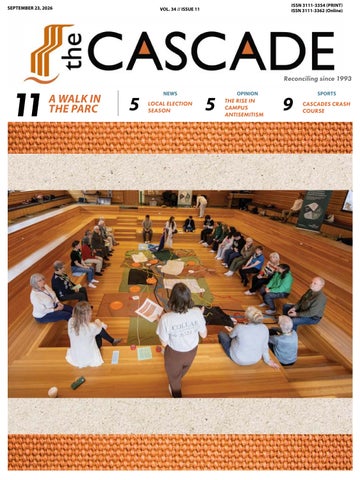
A WALK IN THE PARC
5
NEWS
LOCAL ELECTION SEASON
5
OPINION
THE RISE IN CAMPUS ANTISEMITISM
9
SPORTS
CASCADES CRASH COURSE
VOL. 34 // ISSUE 11
Editor-in-Chief
Darien Johnsen darien@ufvcascade.ca
Business Manager
Aneesha Narang aneesha@ufvcascade.ca
Production Manager
Anna McCausland anna@ufvcascade.ca
Features Editor
Caitlyn Carr caitlyn@ufvcascade.ca
Managing Editor Cassie Williams cassie@ufvcascade.ca
Creative Director
Gabriela Gonzalez gabriela@ufvcascade.ca
Production Assistant Anayat Sandhu anayat@ufvcascade.ca
News Editor
Rachel Tait rachel@ufvcascade.ca
NEWS 3 ��������������� News Briefs 3 ��������������� Abbotsford-Mission Byelection debates 4 ��������������� New Outreach Librarian at UFV 5 ��������������� Municipal elections on the horizon
Copy Editor
Opinion Editor
OPINION
Arts Editor
Sports Editor
Digital Media Assistant
Culture Editor
7,8,9,10 ����� Snapshots 5 ��������������� OpiNews: antisemitism on the rise, why? 6 ��������������� “The talk” 7 ��������������� The Environmentalist: why every fraction still matters 8 ��������������� Subscription hell
Zackery Fitzpatrick fitz@ufvcascade.ca
Sky Terrones sky@ufvcascade.ca
Manak Bakshi
Snapshot Illustrator
Iryna Presley
Staff Writer Abby Hansen
Staff Writer
Jasleen Sandhu
Staff Writer
Liam Pyper
Distributor
Kirat Dhami
Natalia Toscano Murua natalia@ufvcascade.ca Natalia Toscano Murua natalia@ufvcascade.ca Jasleen Sandhu jasleen@ufvcascade.ca
Digital Media Assistant Reza Keshavarz
Illustrator
Thea Van Agteren
Illustrator
Hannah Bricknell
Staff Writer Kara Dunbar
Columnist
Faby Cruz Alderete
FEATURE 11-14 ��������� Community spotlight: the Peace and Reconciliation Centre
SPORTS CONTRIBUTORS Brandon Gill Marley Penner Sho Okano
9 ��������������� Cascades 101 10 �������������� Women’s basketball newcomers 10 �������������� Spotlighting a local legend 15 �������������� Julia Tuchscherer: from UFV to England
CULTURE W W W.UFVC ASC ADE .C A I N S TAG R A M . CO M T H E C A S C A D E U F V TIKTOK CASCADE_ FY Volume 34 · Issue 11 Room S2111-33844 King Road Abbotsford, BC,V2S 7M8 604.854.4529 ISSN 3111-3354 (Print) · ISSN 3111-3362 (Online) The Cascade is UFV’s autonomous student newspaper and alternative press for the Fraser Valley. It originated under its current name in 1993, and achieved autonomy from the university and the Student Union Society in 2002. The Cascade is funded with UFV student funds, is a forum for UFV students to have their journalism published in an entirely student-run setting and is overseen by The Cascade Journalism Society Board, a body run by a student majority.The Cascade is published every other Wednesday with a print circulation of 800 and is distributed at Abbotsford, Chilliwack (CEP), Clearbrook, and Mission UFV campuses and throughout the surrounding communities. In order to be published in the newspaper, all work must first be approved by The Cascade’s editor-in-chief and the corresponding section editor. The Cascade reserves the right to edit submissions for clarity and length and will not print any articles or be a platform for any contributor or contractor who has shared racist, sexist, homophobic, or libellous content online in any form. Letters to the editor, while held to the same standard, are unedited, and should be under 200 words. Opinions expressed do not necessarily reflect that of UFV, The Cascade’s staff and collective, or associated members. The Cascade is published on the traditional, unceded territory of the Stó:lō peoples. We are grateful to be able to work and learn on this beautiful land.
2
16 �������������� Neighbourhood Concert Series 16 �������������� Abbotsford Film Society kicks off new season 17 �������������� Campus Fashion: falling for fall 18 �������������� Study Break
ARTS 19 �������������� What’s the deal with manga endings? 19 �������������� A return to peak fantasy 20 ������������� Weezer: from childhood to the fourth row 21 �������������� Creative Corner: Run 22 ������������� 15 years later, back through the Portal 23 ������������� Practical Magic 2 gets us ready for the fall 23 ������������� The Cascade Shuffle
Editorial //
Just sports Guess what friends? NFL’s back. I know, I know, we’re all cheering. No? Just me? Alright, I digress. As you may know, I’m a die hard Seattle Seahawks fan so seeing the boys back on the field has eased me into this tumultuous semester. Kickoff came just in time to provide a few hours of solace for me on Sundays, Mondays, and Thursdays. The rest of the days… we don’t talk about. With this exciting sports kickoff, came a less exciting one. And that involves the woman behind the most chaotic Euphoria (2019-2026) character — who just so happens to be my namesake. AKA: Miss. Sydney Sweeney, starring in yet another controversial advertisement. The aforementioned ad, for the sports betting company Novig, showcases Sweeney covered by nothing else than various sports equipment. Never thought I’d wish to see her in jeans (iykyk). Not to mention that the ad is streaming publicly on YouTube, for young girls to see and inevitably compare themselves to. Anyway… this ad has garnered enough attention, I’m not here to talk about all the issues with it. Instead, let’s talk about women in sports! Following its release, a multitude of athletes have come forward speaking out about the regressive nature of the ad. British sprinter and four-time European champion, Amy Hunt directed a comment at Sweeney while speaking to BBC saying, “when you’re a woman in sport, it’s not pretty. It’s not glamorous. It’s not sexy all the time, definitely.” Women were deemed too fragile and not taken seriously enough to compete in sports until the 18th century. Using solely a woman’s body and zero other characteristics — in fact dumbing her down by having her repeat “sports” over and over — sets the progress made in women’s sports back by generations. If you want to support some women athletes right here at UFV, there are accessible ways to do so. You can attend a game here at UFV — check out p. 9 for more deets. And if you want an even easier way, you can read about the new faces on UFV Cascades women’s basketball team right here in the very paper you’re holding on p. 10. And if you’re a woman who’s interested in writing about sports, we have a sports editor and varsity writer position open. While it isn’t new for women’s bodies and sex to be used as a sales tactic, this ad represents more. As a woman in sports myself, it’s a shame to see such a far step back in time, when representation and respect were almost non-existent — a time we should be much farther away from in 2026.
Cassie Williams
WEDNESDAY, SEPTEMBER 23, 2026
VOL. 34 // ISSUE 11
news@ufvcascade.ca News Editor — Rachel Tait
NEWS N E W S
B R I E F S
LOCAL //
PROVINCIAL //
NATIONAL //
INTERNATIONAL //
Upcoming Abbotsford election candidates and debates
Rare woolly dog pelt returns home
Canada could become the first Associate Member in partnership with the EU
Houthis gain control of Yemen’s Red Sea coast
Sept. 11 was the final day for nominations for local municipal elections in Abbotsford. Four candidates are running for mayor, 22 candidates for the eight council seats, and 20 candidates for the seven seats on the Board of Education. Running for mayor are Sukhi Dhami, Paul Mahil, David Pellikaan, and current Mayor Ross Siemens. Currently, four all-candidate meetings are scheduled for October, starting with the District Parent Advisory Council hosting nominees for the school board on Oct. 1 from 7:00-9:00 p.m. Sport Abbotsford will host council and mayor candidates on Oct. 3. Food security will be discussed by mayor and council hopefuls on Oct. 5 in an All Candidates meeting hosted by the Archway Food Justice Program. Finally, the Abbotsford Chamber of Commerce will hold a “Council Candidate Mingle & Mayoral Debate” on Oct. 7 from 5:007:00 p.m. The campaign period began Sept. 19, and advanced voting days are on Oct. 7, 10, and 11. Students living away from home may vote in only one local election, choosing between their home city or their current location. Mail ballot applications are being accepted for those unable to vote in person until Oct. 6 and general voting will occur on Oct. 17.
KARA DUNBAR
From August 2026 to September 2027, UBC’s Museum of Anthropology will display the last recorded woolly dog pelt. The News reported that this pelt had been safely stored away since going to the Smithsonian Institution in the 19th century. More than 100 years later, the pelt is being housed close to its birthplace. The pelt was loaned out at the request of Stó:lō Elders, knowledge keepers, and community members due to their close bond with it. UBC News explained the significance of the woolly dog’s presence in the lives of local Indigenous people. “Woolly dogs were specially bred by Salish and Makah peoples for their soft, woolly hair, which was woven into blankets, robes and clothing.” Jordan Wilson, curator of Pacific Northwest and Contemporary Indigenous Art, commented on how the woolly dog remains an enduring part of Indigenous cultures. “It speaks to a species’ extinction, which is just one of many profound impacts of settler colonialism. That’s something that cannot be undone. But it also speaks to the lives of our ancestors, their relationship with the more-than-human world, and their teachings and knowledge that continue to be passed forward.” UBC News reported that local Coast Salish communities can view the pelt before it officially goes on display.
On Wed. Sept 16, on behalf of the European Union, European Commission President Ursula von der Leyen made a proposal for Canada to become their first of 27 associate members, while little is known in terms of roles specifics, the intent behind the proposal focuses on strengthening the two country’s security and economic relationship. On Sept. 17, Canadian Prime Minister Mark Carney made a speech to the European Parliament that supported and encouraged this relationship. Carney specifically focused on collaborating with the European Union on core industries that include defence and artificial intelligence. He had a positive outlook on this deeper partnership with the EU, and he pointed out the importance of maintaining Canada’s ability to self-govern as a nation. “This is about sovereignty, our ability to live as we wish. We do not seek power to dominate others.” President Donald Trump was not thrilled by this news, seeing it as a “hostile act” if Canada goes through with this partnership, reported Kelly Geraldine Malone for ***Global News*. Trump threatened high tariffs on the EU should the partnership come to fruition. More updates on this story will come as events unfold.
RACHEL TAIT
On Sept. 10 Houthi forces entered the Yemeni port city of Mokha, seizing an important shipping point along the Red Sea. This marked a significant turning point in the Yemen civil war, which is at risk of erupting again. The Iran supported militia has been in conflict with the Saudi-backed Yemen government since 2014, and while violence quieted after a UN brokered ceasefire in 2022, Israel’s war on Gaza and the war on Iran have helped to reignite the conflict. The following day, the Houthis continued to advance along the coast and seized Perim Island, a critical point along the Bab El-Mandeb strait through which “ 8 per cent of global LNG trade” and 11 per cent of global shipping traverse, reported Al Jazeera. Saudi Crown Prince Mohammed bin Salman, in a call to the White House, asked for U.S. intervention in the Yemen war, which it declined, instead offering intelligence services to Riyadh. While the Houthis have threatened and attacked international shipping in years previous, their growing control of the Red Sea coast significantly increases their likelihood of being able to make good on their threats. However, Houthi officials have stated that the strait is only closed to Saudilinked shipping, effectively blockading the country.
LIAM PYPER
JASLEEN SANDHU
Local //
Abbotsford-Mission By-election debates Candidates discuss housing, the PST expansion, affordability, and healthcare KARA DUNBAR On Sept. 9, four out of the five candidates for the upcoming Abbotsford-Mission provincial by-election came together for a debate hosted by the Abbotsford Chamber of Commerce. In attendance were Pam Alexis for the New Democratic Party (NDP), Kerry-Lynne Findlay for the BC Conservatives, Stephen Fowler for the BC Greens, and Lakhwinder Jhaj for
CentreBC. Jeff Monds for the Libertarian Party was not in attendance. The debate was held from six to eight in the evening, and was moderated by Dr. Hamish Telford, a political science professor at the University of the Fraser Valley. The event was livestreamed, with no in-person attendance option. The debate is now available to watch on the Chamber’s YouTube channel. Discussed in this debate was encouraging business competitiveness, the
expansion of the point of sale tax (PST), international trade, increasing the workforce and job opportunities, the Sumas Prairie flooding, and potential transport projects. The candidates were asked about which specific provincial transportation investments they would prioritize next, besides the congestion of Highway 1 for Abbotsford-Mission. Jhaj talked about speeding up the expansion of Highway 1 and issues with congestion on the Mission
Bridge. Fowler brought up the issues of never-ending expansion, and the need to increase train and transit access in the area to ease the need for expanded roads. Findlay discussed serious issues with old and failing infrastructure across the province amid a growing population, while Alexis spoke about pushing forward the South Mission Transportation Plan that proposes a by-pass to ease traffic. CONTINUED ON PAGE 4 3
WEDNESDAY, SEPTEMBER 23, 2026
VOL. 34 // ISSUE 11
NEWS CONTINUED FROM PAGE 3 On Sept. 14 from six to eight at night, the same four candidates participated in a forum hosted by the Mission Chamber of Commerce at the Clarke Theatre. The event could be attended in person or watched via livestream on the Chamber’s YouTube account, where it is now available to stream. The discussion centred around emergency room (ER) wait-times in Mission, the upcoming PST expansion, high school capacity in Mission, increasing housing supply, supportive housing, public safety, and work with Indigenous communities. In the public questions portion of the debate, candidates were asked how they would support making post-secondary education more affordable for low income students.
Fowler went first and discussed post secondary falling under more federal jurisdiction, and passed on the question. Findlay talked about general affordability, lower taxes, and more productivity, putting an emphasis on unleashing more resource jobs. “We need to lower taxes, not increase taxes. We need to get productivity up. We need to unleash good resource jobs with good paychecks so that more students can afford education. I’m a big believer in education and I think that it should be more available. But we can do this by getting our house in order financially.” Alexis highlighted her recent visit to UFV for a lunch hosted for the Chamber of Commerce and manufacturing sector, and spoke about the provincial government’s commitment to opening up more doors in trades education and job opportunities.
“I know that government is very keen on ensuring that, in particular, the trades are supported. And so more has been done to open up the sector for opportunities and numbers to get what they need in order to work on all those infrastructure projects.” Jahj finished the subject, emphasizing the importance of education, and spoke of available grants and the possibility of those grants increasing. She also talked about having jobs that kept students in the community. “There are grants available for secondary education, but we need to expand on that because it’s very important that everyone gets [an] education. If they’re trades, [UFV’s] where students should go get the trades and the healthcare education with grants there, and that way they’re studying in the community and then they get jobs right here in the community.”
Saturday, Sept. 26 is the general voting day for the by-election. Advance voting is available Sept. 18-23. More information on how and where to vote can be found at elections.bc.ca. At the time of writing, it was announced that Kerry-Lynne Findlay officially resigned from her leadership position with the BC Conservatives. She is still running as a candidate to represent Mission-Abbotsford in the provincial legislature.
Campus //
UFV’s new outreach librarian Alexis McKenzie on reaching out to students and supporting their studies RACHEL TAIT On Sept. 1, Alexis McKenzie became an outreach librarian at UFV, holding a Master of Library and Information studies from McGill University. McKenzie has worked as an on-call auxiliary librarian since 2024, and shared details with The Cascade about her new job, useful support tools for students and upcoming events at the library.
What is your role as an outreach librarian? It’s a new role at UFV … but the primary focus is to work with students and faculty to help them be aware of how the library can assist them in their research and school needs. It’s like it sounds, we’re
Photo Submitted by Alexis McKenzie 4
reaching out. It’s easy to help students and faculty once they’re in the library, but how do we get them in? They have to know what we’re able to help them with and a big part of outreach is reaching out, going out of the library, going to different departments, events, spreading the word about all we have to offer, and then greeting those same folks when they come back in.
not everyone knows about this update. I believe it happened in the summer. We have a service called AskAway … it’s a live chat with librarians. If you have a question that maybe you don’t want to ask face to face … it can be nice to ask through live chat. And that’s an amazing service that a lot of students don’t know about. It’s staffed many hours of the day, often until 9 p.m. on weekdays. Another thing that students might not Are many students unaware of the know about is that we have therapy dogs library services? visit on the regular … you can come sit, We do find that, and we’re trying to get chill, pet the pup and it contributes to the creative about the different ways that we library as being a place where you can reach students and get that information relax and be calm. out to them. We’re very happy to see a student who comes into the library Why are librarians an important for the first time in their third year. We resource? would prefer to reach them in their first Students are pretty smart. I bet they could year if we can be helpful to them. Some find what they need without our help, at students [know] the library … But there’s least most of the time. We have students a great number who don’t know that we who haven’t set foot in the library until have printers here or that if you have a third year [and] they found a way to research question, you can come up to the make it through, but we are here to make front desk, and you don’t even need an it easier. I imagine we could show you appointment. how to find what you’re looking for in a way that sets you up for the rest of your What library resources are available academic career instead of painfully for students? muddling around … You don’t have to do Your student card is your library card it alone. We’re here for you. and it is also your printing card. It used to be that you had to go to the campus What advice would you give future card office or the bookstore in order to put librarians? money in your printing account, unless I’d like to borrow the words of a former you had cash … I’m very excited to tell boss of mine, a library manager, who you that now you can do this online. You when I asked her what makes someone can put money on your printing account successful in the library world, she said through an online portal … [and] I’m sing- a common misconception is that people ing it from the rooftops because maybe think libraries are a book business when in fact we are a people business. Yes, we
QR code to that takes you the library’s AskAway live chat do have a lot of books, but a huge part of our job is serving our patrons whether that’s through instructional sessions, one-on-one meetings, discovering their needs, sharing what we know, learning what they would like to know, it’s a very people-focused place. If you are someone who enjoys working with a variety of people, if you find that you’re very approachable, that might be a good fit.
Are there any upcoming events? On Oct. 15 from 11 a.m. – 1 p.m., we have the library’s fifth annual student welcome back event. We’re going to have the makerspace in full flow, we’ve got sewing machines, embroidery and a 3D printer [etc.]. Come check it out! There’ll be some prizes and it’s going to be a wonderful time to get oriented with the library in a fun atmosphere. Q&A has been edited for length and clarity
WEDNESDAY, SEPTEMBER 23, 2026
VOL. 34 // ISSUE 11
NEWS Local //
Choose your mayor! Local election season kicks off, Election Day set for Oct. 17 DARIEN JOHNSEN Hear ye! Hear ye! It’s that time again, folks! B.C.’s local general elections are gearing up for another exciting season. What’s a local general election, you may be asking? A local general election is a municipally managed electoral process that determines who the local leaders will be, most notably mayors, councillors, and school district trustees. These fun events are held every four years on the third Saturday in October, just in time for spooky season! Advance polls open on Oct. 7 and official Election Day is Oct. 17. Either way, get ahead of the game by checking out the local folks running for office. Being a Fraser Valley-based paper, The Cascade has done the digging on the mayoral candidates for the three surrounding districts of Mission, Abbotsford, and Chilliwack.
Chilliwack Chilliwack has a leg up in this race, with four candidates in the running. First is Jason Lum, a father and small-business owner who’s served on Chilliwack City Council for 15 years. He’s running on a “Growing Forward Together” platform that includes addressing issues of affordability, safety, recovery and treatment options, and infrastructure. Lum doesn’t want fear to dictate decisions or “outside partisan politics turning City Hall into another political battleground.” Next up is Gary Raddysh, a former high school teacher. Fraser Valley Today called him an “anti-tax crusader” in 2023, after he stated opposition to a significant property tax increase proposed by the city at a council meeting. Very little
information can be found about Raddysh other than a second hand account of the concerns he raised at a meeting in 2024. According to the account, Raddysh expressed frustration over low voter turnout and its impact on the democratic process, especially concerning the council’s financial decisions. On to Martina Rosini. This Conservative candidate prioritizes cutting taxes, being tough on crime, funding first responders, and putting families at the heart of decision making. She also calls for a Veterans crosswalk in Chilliwack and an end to bike lanes. Rosini has spent her entire career working in politics and highlighted “conservative values and common sense” as her advocacy goals. Finally, we have Farooque Syed. Independent reporter Paul Henderson interviewed Syed, a former gangster, about his life growing up in Vancouver, recovering from a life of drugs and gangs, and finally writing a book about it to help kids stay out of the same trouble. Currently, no campaign information could be found out about Syed at present.
Mission Congrats to Mission’s new Mayor, Jag Gill, who was declared the winner of the mayoral election by default over the weekend after rival candidate Kenny Braich dropped out of the running. Jag Gill is the youngest ever mayor of Mission at 31 years old and previously sat as a city councillor. He’s stated that he wants to prioritize small businesses, growth tied to infrastructure, transparency, and wants to make “decisions based on what’s best for the community, not politics.” Gill has proven himself popular, earning the most council votes in both the 2018 and 2022 elections.
Abbotsford Abbotsford has four candidates to choose from as well. First we have UFV Alumnus Sukhi Dhami. Dhami was raised on a family farm in Abbotsford, and now works in commercial and agricultural real estate. He advocates on “A Plan to Catch Up,” and cited the importance of people before policy, with a focus on affordability, a strong business climate, amenities, and a “vibrant local economy.” That takes us to Paul Mahil. Mahil stated in a social media video that it was “time to put a farmer back into city hall.” He stated that he’s tired of “corruption” and “closed door deals.” Mahil has an extensive platform listed on his website that includes addressing homelessness, generating city revenue, halting increases on property taxes, bettering cross-border flood prevention and management, and increasing recreational facilities. His unique calls to action include better truck parking, an increase in transparency, and the preservation and revitalization of farmland. David Pellikaan, is campaigning on the slogan: “Ask not what you can do for your city, but what your mayor can do for you!” His campaign Facebook page states that his commitment includes a promise to homeowners that “there will be no tax increase next year, 500$ rebate sent back to you due to rising inflation and the cost the mayor & council put on you.” His priorities include a forensic audit of the city, a change in chief of police, a family-oriented community, and a reinvestment in social housing and addiction services. Lastly, is the current Mayor, Ross Siemens, who has been mayor since 2022,
Photo courtesy of Elections BC having previously served as city councillor from 2015-2025, and sat on the District of Abbotsford Council from 1986 to 1990. He’s a business-oriented candidate, listing small businesses and the local economy as priorities. According to The News, his previous work as mayor includes securing investment in the Barrowtown Pump Station, and “up to $25.6 million through the federal Housing Accelerator Fund and additional funding for transportation, infrastructure, housing, homelessness services and flood recovery.” His profile on the City of Abbotsford website lists one of his passions as refugee relief work. Best of luck, cheery candidates! For a full list of councillors and trustees, you can visit the Elections BC website or go directly on your city’s website. As for voting, the Government of BC has all the information that you will need, even a handy voter’s guide that walks you through the whole process. Happy voting!
OPINION
opinion@ufvcascade.ca Opinion Editor — Natalia Toscano Murua
OpiNews //
Antisemitism on the rise for Canadian campuses A look at the concerning rise of antisemitism in Canada LIAM PYPER In August 2026, the Canadian government, in collaboration with the Association for Canadian Studies and the Metropolis Institute, released a report on Campus Antisemitism and Student Experiences (CASE). This came in response to a dramatic rise in antisemitic attacks against Jewish Canadians, with said incidents making up 68 per cent of
religious hate crimes and 18 per cent of hate crimes overall in 2024. The authors, Dr. Jack Jedwab and Dr. Paul Holley, found that 84 per cent of Jewish respondents said that antisemitism was a severe problem on campus, 95 per cent experienced or witnessed at least one incident in the past year, 72 per cent feel uncomfortable expressing their Jewish identity in class, and 57 per cent avoid wearing Jewish symbols due to safety concerns.
The report also explained that these incidents are not just single occurrences, but indicate a systemic issue of antisemitism on campuses, with even faculty perpetrating the abuses. In an interview with The Cascade, Dr. Eric Spalding, an associate professor with UFV’s School of Culture, Media and Society, offered his opinion on this rise of antisemitism on Canadian campuses,
pointing to the Hamas attacks on Oct. 7 as a key reason. “Oct. 7, 2023 … it’s the war in Gaza that is allowing some people, instructors and students, according to the report that I looked at, to engage in comments and behaviour that are disparaging towards Jewish students.” CONTINUED ON PAGE 6 5
WEDNESDAY, SEPTEMBER 23, 2026
VOL. 34 // ISSUE 11
OPINION CONTINUED FROM PAGE 5 Throughout the CASE report, direct quotes from students who experienced firsthand or witnessed antisemitism are included — it’s difficult and incredibly frustrating that these students, who should feel safe on campus, experienced these awful things. One quote reads:
“84 per cent of Jewish respondents said that antisemitism was a severe problem on campus, 95 per cent experienced or witnessed at least one incident in the past year, 72 per cent feel uncomfortable expressing their Jewish identity in class, and 57 per cent avoid wearing Jewish symbols due to safety concerns
“My friend was walking through [REDACTED] Hall. He also wears a kippah, and a group of students shouted, ‘there’s a Jew…let’s get him.’ They then chased him out of the building.” Dr. Spalding pointed out that holding Jewish students on campus as directly responsible for the Israeli government’s actions is nonsensical. “And the part of this, of course, that to most people doesn’t make any sense is that Jewish students on Canadian campuses are no more responsible for Netanyahu’s actions than you are or than I am. So to disparage them just because of the right-wing coalition in Israel and what they’re doing, it doesn’t make any sense.” Jewish students deserve to feel safe on campus, the significant rise in antisemitic attacks that the report points to is completely appalling. The key lesson I believe we need to get through our heads as Israel’s genocide against the Palestinian continues, should be to not blame or attack Jewish folk — there is absolutely no justification for that. Instead, that focus should be on how we can prevent further
genocide, deliberate targeting, stereotyping of groups, offensive language and graffiti, including those targeting Jewish students. I am critical of the state of Israel since genocide is being committed, however, this in no way means that I will go and insult or attack somebody on my campus who is not a perpetrator of those crimes. Dr. Spalding also expressed solidarity with Muslim students, explaining that Palestinian students will likely also be experiencing an increase in abuse. “Palestinians and other people from the Middle East, I’m sure, on a daily basis have to contend with oppression or disparaging comments or mistreatment. So the whole conflict in Palestine, in the Gaza Strip and the West Bank combined, it’s having ramifications on a global scale and impacting people on an individual level who don’t deserve to be mistreated, whether their religion is Islam or Judaism.” And in my own research on the subject I found that while the CASE report on Jewish students experiences with anti-semitism was extensive, up
to date and well researched, reports the Government of Canada had on what Palestinian and Muslim students may be experiencing were very outdated and very limited. A House of Commons committee report on the rise of Islamophobia in Canada was released in 2024, and it was heard from the National Council of Canadian Muslims that Isalmophobic reports had increased 1,300 per cent in the final quarter of 2023. The numbers have made it clear: intolerance is on the rise in Canada. If you or anyone you know has experienced antisemitism, islamophobia, or any kind of hate crime please contact the Racist Incident Helpline, they can be reached at 1-833-457-5463. UFV can also be alerted to a hate crime incident through their Equity, Diversity, and Inclusion Human Rights office.
Sex Life //
If reading this feels taboo, we need to talk It’s a good time to question how much you know about infections NATALIA TOSCANO MURUA Itchy, uncomfortable, taboo. The silent struggle that does not get enough talk — We’re here to blow it wide open for a hot minute. Let’s start with a story, shall we? One that completely threw me off guard and made me open my eyes to a serious realization. I grew up with access to sexual education, so I’ve been well aware since I was young about what sexually transmitted infections (STIs) are, how they spread, what some of the most common types are, and what symptoms to look out for. Armed with knowledge, I was convinced that if I ever found myself in a situation where I contracted a vaginal infection, I would be prepared. Except that, when it happened, I had no idea of how to deal with it, nor what I was even working with. It came seemingly out of the blue. I noticed vaginal discharge that was thicker than normal, I was inflamed, and the itch was unbearable. I didn’t have a sexual partner, and I hadn’t done anything differently that could serve as an explanation for that infection. It dawned on me how little I actually knew, how unprepared I was, how uncomfortable, intimidated, and frankly scared I felt, but most of all how confusing it was to navigate the situation. Only one thing was clear — I was dealing with some sort of vaginitis. There 6
are plenty of different causes for this; the most common of which are bacterial vaginosis, yeast infections, chlamydia, trichomoniasis, and viral vaginitis, which may be caused by viruses like herpes or human papillomavirus (HPV). While I looked at my healthcare options to see what support I could find to deal with my infection, I turned to the internet and tried to research as much as possible about what my mystery ailment could be, as one usually does I suppose. I did not have a doctor contact in Canada that could potentially point me in the right direction, nor did I know where to go to get my infection checked — this in itself was extremely frustrating, but that is another can of worms for another day. Ultimately, I was able to fortunately get medical advice on how to approach my specific situation as it progressed. I was informed the vagina has means of reestablishing balance and clearing some mild infections out on its own. However, if I did not see any improvement within one week, then I would need to find a doctor urgently. I was lucky. It was gone without a trace within a week, but the scare itself left a lasting impression on me and made me open my eyes to a pressing issue. I am convinced that even in the big 2026, infections related to the vagina, and dare I say for the penis as well, do not get enough visibility.
Illustration by Sho Okano / The Cascade The fact that navigating this experience was confusing for me is, in my eyes, an indicator that there are likely many more people in the same situation as I. STIs and vaginal infections can share similar symptoms, and yet, neither get talked about nearly as much as I think they should. A survey conducted by HealthyWomen highlighted the lack of awareness related to STIs, mentioning that eight in 10 people surveyed felt uncomfortable asking
about STIs to their healthcare providers. Chlamydia is the most common STI in Canada,with over 300 in every 100,000 people infected. And genital herpes affects 51.4 per cent of healthy adults in Canada. The numbers suggest that STIs may be more common than you think! The Tyee shared how despite bacterial vaginosis being estimated to affect one in four people with vaginas, it is an infection CONTINUED ON PAGE 7
WEDNESDAY, SEPTEMBER 23, 2026
VOL. 34 // ISSUE 11
OPINION CONTINUED FROM PAGE 6
SNAPSHOT Matcha
that is not yet well understood. In my case, it was only until I was afflicted with an infection myself that I found myself trying to connect with someone that had gone through something similar to find guidance, tips, reassurance — anything. In fact, I had never heard someone mention anything about STIs openly until I was about to write this article and shared the idea. To me, this is concerning. Although the topic can be awkward
and uncomfortable, it is important and it deserves to have a louder voice. Regrettably, to this day I still do not know what kind of infection I contracted, but I promised myself I would never forget the lesson learned: tackle the yucky conversation, spread awareness, contribute to this topic’s visibility and be open about it. I strongly believe the confusion I went through could have been avoided if the topic weren’t so taboo and had more people talking about it more often. So now, I want to do my part and help
other people feel less uncomfortable, lost, and confused when faced with a similar situation. It’s common, it’s human, and it happens.
THE ENVIRONMENTALIST: a climate beyond 1.5°C What happens after this temperature degree overshoot FA B I O L A CR UZ A L D E R E T E
Illustration by Iryna Presley Sometimes I take moments out of my day to appreciate little things that exist at the same moment in time as me. For example, one day I might look at a new building in construction and feel lucky I’m getting to witness it being built. Or, I may sit to play some video games and feel lucky that at present they feel so vast and imaginative. There’s one thing that I dare say, I appreciate way too much and perhaps way too intensely. That’s matcha. M a t c h a. The word itself rolls off the tongue beautifully. This fine green powder suspended in liquid pleases my taste buds like nothing else does. It is earthy, delicate, intricate — its velvety layers pull me in from the first sip of that sweet microfoam, all the way down to its rich core. I’ve prepared matchas for over half a decade. My friends and family know my matcha slaps — I usually don’t brag, but about my matcha? I tell you, it absolutely SLAPS. Sometimes I pause after the first sip, close my eyes with ecstasy, and thank the universe for allowing me to exist in a reality where matcha is a thing.
BY NATALIA TOSCANO MURUA
Welcome to The Environmentalist, your column for understanding the natural world. Today, we will be asking what happens and what does it mean when we cross 1.5°C. The United Nations Environment Programme (UNEP) recently released a new report confirming a fear that climate scientists have harbored for years: 1.5°C above pre-industrial levels is likely to be surpassed in the next few years. It will potentially stay above that level for decades to come, challenging the global community to devise a path to return to below 1.5°C in due course. For years, 1.5°C has been the number that humanity has strived to protect and preserve. But what does this threshold mean? The 1.5°C threshold refers to the increase in average global temperature since the pre-industrial period, but does not represent a uniform temperature increase across the globe. Under the 2015 Paris Agreement, countries aim to keep warming safely beneath 2°C while “pursuing efforts” to limit it to 1.5°C. However, the threshold is often mistakenly viewed as a tipping point separating a safe climate from a dangerous one. Climate change impacts are already being felt worldwide, and each additional fraction of a degree of warming brings greater risks of negative impacts. The possibility of the world exceeding the 1.5°C temperature limit has been frequently flagged over recent years. 2024 was the first time the global average temperature was more than 1.5°C above the pre-industrial average for a calendar year. However, that single year does not constitute an overshoot of the Paris temperature goal. It will take decades to determine whether 1.5°C has been exceeded in the long-term. New research suggests that we may have already entered the period in which long-term warming finally reaches 1.5°C, adding urgency to UNEP’s latest report. While that report warns of the dangers of an overshoot and whether or not it can be limited, it also shifts the focus onto how much of that overshoot can still be limited.
Illustration by Hannah Bricknell / The Cascade Overshoot doesn’t just matter in terms of degree, the length of time that we are above 1.5°C also matters greatly, as higher temperatures lead to more extreme weather, greater ecosystem loss, more sea level rise, and greater impacts on food and water security. Once the temperatures return to below 1.5°C, it won’t undo the negative effects. Some of the losses, like species extinctions, ice loss, and changes to ecosystems, could be irreversible or long lasting even after temperatures decrease. The goal, therefore, is to keep our time above 1.5°C as short as possible and to minimize the extent of the overshoot. Although we are still on course for around 2.8°C of warming this century, the extent to which we can limit the overshoot still remains in our hands. Every fraction of a degree of warming we can prevent will save lives, species, and ecosystems. As the Lorax once said, “Unless someone like you cares a whole awful lot, nothing is going to get better.” So, let’s care.
7
WEDNESDAY, SEPTEMBER 23, 2026
VOL. 34 // ISSUE 11
OPINION Lifestyle //
Subscription hell’s exit is blocked by a paywall Are subscriptions more financially convenient, or blatant corporate greed?
A word from a physical media enthusiast
ABBY HANSEN It’s hard to find a person who is not subscribed to some sort of service — subscriptions have become a fundamental part of our lives. According to Made in Canada, nearly 90 per cent of Canadian adults rely on some form of online streaming and, on average, spend around 10 hours per week watching streamed content. But take a moment and ask yourself, how many subscriptions are you currently paying for? There’s a chance it’s more than you think. In 2024, Hardbacon conducted a survey asking respondents how many subscriptions they thought they were paying for. The average answer was four — when it came to actually looking through their subscriptions, that number doubled to eight. Over the years the financial toll these streaming services have on customers has only risen. CNET’s yearly subscription report showed that the average adult from the United States spends over $1,000 USD per year on subscriptions, and an additional $200 USD on unused subscriptions. Even with all the investment into the entertainment you watch, you might not even be getting your money’s worth. More and more, these services are blocking titles and features behind a paywall, or removing them entirely. We’ve seen this with recent examples like Netflix removing over 100 of their original titles from their platform in 2026 alone. On Sept. 1, Sony removed all movies and TV shows by Studio Canal from PlayStation owners’ accounts, despite the fact that this content was individually purchased, not streamed. This phenomenon is referred to as “enshittification” — a term coined by Canadian writer and activist Cory Doctorow. He argues that this process is how platforms die, with consumers being unable to keep up with the ever-rising prices and dropping the service entirely. It’s not just streaming services that are being slowly strangled by corporate greed. A growing number of companies are cashing in on paid subscription models, and it might not just be digital goods and services that are blocked behind a paywall — now it can be basic household products. In 2013, HP launched its Instant Ink subscription service — the price changing based on the number of pages the customer prints. The service also replenishes ink cartridges when the printer detects the cartridges are low. This comes 8
SNAPSHOT
Illustration by Iryna Presley
Illustration by Hannah Bricknell / The Cascade with a myriad of problems, one being HP’s agency to completely block users’ ability to print completely if the subscription isn’t paid. In Oct. 2024, More Perfect Union reported that HP was enrolling customers into the Instant Ink program automatically. If the subscription wasn’t paid or cancelled, the company would remotely block access to printing, even if the cartridges were still full of ink. According to Driving, Tesla is another company trying to profit from the subscription model — removing their self-driving feature from the Model 3 and charging customers $99 USD per month in order to access the feature. So, on top of an already expensive product that only gets more more costly with inflation, we have to pay a monthly fee just to use the product we supposedly own? I don’t think it will take much convincing on my part for people to see how ridiculous this is. In fact, it appears that people’s tolerance for the subscription model is having the opposite effect that these major corporations intended. A report by MUSO recorded 216.3 billion visits to piracy websites — a drastic increase from the 130.5 billion that they reported in 2020. And this doesn’t appear to be coming from malicious intent. YouGov, a global research and analytic group, conducted a 2024 survey
questioning people who have illegally acquired media online. They found that the major reasons behind pirating were a lack of access, and prices simply being too high for people to keep up. To be very clear, this is not my public endorsement of piracy. Rather, I wish to point out how corporate greed drives people to piracy in the first place. We are at the point where almost everything we consume is made harder to access unless you pay a small fortune in subscriptions on top of the original cost of purchase. And the prices of these services are only increasing. With this in mind, how could I possibly judge those who do end up turning to theft? Should we be seeking to punish those who try to find some semblance of joy and entertainment in our current socio-economic climate? Or, perhaps, should we be looking at the companies who are increasingly driving up prices while continually removing more and more of their services? While I understand that companies need to make a profit, I worry that constantly applying a subscription model to anything and everything seems to only be driving customers away and it’s coming at the price of our entertainment.
I do not believe that physical media will ever die out. There will always be a need for it. Humans crave tangibility. The digitization of art and media has certainly made art easier to access, but physical books and film will always be necessary for archival purposes. In the era of streaming services run by multi-billion dollar corporations, the unchangeability of physical media becomes a shield. Scenes from stream-exclusive media can be cut. Passages from e-books might be edited or removed. A streaming service might remove an entire stream-exclusive series or movie just to cut costs. I was recently talking to a friend about the final season of Stranger Things (2016-2025) and how Netflix had removed and altered some of the scenes from season one in preparation for the finale. However, I have the season one DVD box set. As long as that exists, we will always be able to watch it in its original form. Online-exclusive media can easily be altered to suit a platform owner’s personal or financial interests. Without being properly archived through unbiased, non-profit channels, these essentially become lost media. When we forget the tried-and-true methods of cataloguing media, we risk losing it forever. BY ABBY HANSEN
WEDNESDAY, SEPTEMBER 23, 2026
VOL. 34 // ISSUE 11
SPORTS
sports@ufvcascade.ca Sports
Local Legends //
SNAPSHOT Kerry-Lynne Findlay, I believed in you
Illustration by Iryna Presley You may be aware that both our local general elections and provincial elections are fast approaching. I think it’s a terrible decision to hold them within a few weeks of each other. Regardless, I’m trying my best to stay at least acutely aware of both. What keeps my eyes truly glued to the news though is the most entertaining drama of it all: former B.C. Conservative leader, Kerry-Lynne Findlay. Until this past weekend, despite her red-pill menace style leadership being (arguably) the cause of the departure of nine caucus members from the B.C. Cons, she had refused to back down. While I loathe her politics, I respected that even though everyone hated her, she was still out there, fighting whatever fight she thought she was fighting. The more admirable thing? She’d united both liberals and conservatives in their hate. Alas, she finally conceded to the earth’s cries for her resignation and stepped down. Maybe she’ll still win her seat in the by-election and the collective hatred will continue. I think she’s on to something, and may have actually figured out the secret to stopping the divisive politics she actively fuels. A leader awful enough for everyone to despise.
Alanna Kraus: Abbotsford’s speedy legend Learn about this local Olympic medalist’s origins and triumphs NATALIA TOSCANO MURUA There is an entire cosmos made of sports stars from all parts of the world — they come from all walks of life, and each of their individual stories shines brightly and uniquely. Every star comes from somewhere, and for some of these stars, their origin lies within the Fraser Valley and its community. When it comes to local sports legends, celebrating their story and achievements is all the more precious and important. One such sports star is the short track speed skating Olympic medalist, Alanna Kraus. Stories often fade with the passage of time, and in Kraus’ case, it has been years since the last time anything has been mentioned about this incredible athlete and medallist. This changes here, with this rewind in time to bring her story back into stardom. Born on June 30, 1977 in Abbotsford, B.C., Kraus started short track speed skating with the Matsqui Blades at the age of four. She trained under Coach Jonathon Cavar, and she remained a part of the team for eight years. By the time the new century rolled in, she had joined Canada’s national team, Speed Skating Canada, to compete internationally, becoming
fundamental in earning the team a bronze medal for the 2000s World Championship 3,000-metre relay event. In the 2002 Winter Olympics in Salt Lake City, USA, Kraus qualified and competed in four different speed skating categories. One of her most notable career results was taking home bronze from the 3,000-metre relay tournament. Kraus returned for the 2006 Winter Olympics that took place in Turin, Italy, and managed to snatch a silver medal for the team under the 3,000-metre relay once more. In the years leading up to that silver medal, she had also managed to win bronze at the 2004 World Championships that took place in Gothenburg, Sweden, as well as silver in the team competitions of 2005’s World Championship in Beijing, China. After competing internationally for nearly a decade, Kraus retired in 2008 and turned her attention to becoming a skating coach in Abbotsford. Kraus’ husband had found a new job at the West Island, and as such, they moved there together, where she became a coach for the Dollard-des-Ormeaux’s speed skating club. Kraus spoke about wanting to help out the club, deciding to become a coach for the young athletes enrolled there.
Kraus is currently based in Montreal, Quebec, along with her husband and three kids. Although her time as an olympian has passed, and her days of short track speed skating competition are done and gone, her shine as a sports star and local legend remain. Her legacy as an athlete within the Abbotsford community was cemented when she was introduced to the Abbotsford Sports Hall of Fame in the class of 2004. Despite her prolific career and her international success, having earned bronze and silver multiple times for Canada, there has yet to be a complete recount of her origins in Abbotsford, her achievements within and beyond international competitions, and her legacy — Kraus’ story deserved to be revisited and shared. Alanna Kraus is a bright star hailing from the Fraser Valley — hers is a reminder that great stories surround us — with hard work and dedication she earned her place among the great cosmos of sports stars from all around the world. Alanna Kraus is one local legend indeed.
BY DARIEN JOHNSEN
Illustration by Marley Penner / The Cascade 9
WEDNESDAY, SEPTEMBER 23, 2026
VOL. 34 // ISSUE 11
SPORTS Campus //
How to rally for the valley A quick guide to UFV sports and recreation Saskatchewan here in the Athletic Centre which is Building E. If you can’t catch the Friday evening games, the same pair will go again on the evening of Saturday, Oct. 24. Finally, Sunday Oct. 25 will see the soccer teams play against the University of Victoria in the afternoon.
KARA DUNBAR With the semester on its way and schedules (hopefully) settled, it’s time to take a look around for what else is on campus. What can you do between classes? What activities and communities lay within and beyond the campus’ boundaries, and how can you get involved? The answer may be to get involved with UFV’s sports and physical activities. Regardless of if you’re someone who is “into sports,” cheering for a team or getting active can be a good way to get out and make connections in the community. So, here’s a guide to help you get involved within the UFV sports scape.
What teams are there?
How can we watch and support them?
Photos by Anjali Randhawa / The Cascade
and the University of Calgary at Abbotsford Rotary Stadium, followed by an afternoon men’s soccer game against the University of Alberta on Sunday, Oct. 4. The weekend of Oct. 23–25 is packed with Cascades sports. The afternoon of Friday, Oct. 23 will see both soccer When are the next home games? teams go up against Trinity Western On Friday, Oct. 2 the women’s and University at Abbotsford Rotary Stadium, men’s soccer teams will be playing the and the evening will see the volleyball University of Northern British Columbia teams face off against the University of There are four different varsity sports played at UFV: basketball, soccer, volleyball, and golf. All but golf have separate men’s and women’s teams, giving us seven varsity teams. There are two club sports teams, rowing and men’s baseball.
check out intramural sports leagues. These programs run for about eight weeks each semester. While registration is closed for the fall 2026 semester, be on the lookout for future semesters. The Summit Fitness Centre is also available if you’re looking for a gym environment. To participate in these you need to purchase a Campus Recreation Membership or grab a day pass at the front desk. If you’re looking for some free off-campus options, you can head to Abbotsford Recreation Centre, Mission Leisure Centre, or Matsqui Recreation Centre where your U-Pass, which was paid for in your student fees, gives you access to use of the pool, rinks, and weight rooms.
If you’re looking to catch some home games, UFV students get into basketball and volleyball games at the Athletic Centre for free if you bring your student card, and everyone gets in free for soccer games at Rotary Stadium. If you want to watch any game from the comfort of your own home, you can stream all games on Canada West TV, where there are options for single events, Why should you go out and cheer for them? season passes, and all access. As a commuter campus it can be harder What can the average student partic- to build a real sense of community and ipate in? belonging within the student body. Going There are drop-in sports and open gym out, cheering for our athletes, and taking time freely available for UFV commu- advantage of the extra programs offered nity members. You can head over to the can help you get to know more people in athletic centre for basketball, volleyball, school, be a fun night out, and help you pickleball, badminton, and futsal (indoor truly feel part of the Cascades. So maybe soccer) at the Athletic Centre. If you are it’s time to get out and rally for the valley. looking for something more structured,
Basketball //
Meet the Cascades’ women’s basketball team A fresh introduction for a fresh team, with a fun twist NATALIA TOSCANO MURUA Every return to classes brings with it new possibilities, opportunities, dynamics, challenges, and stories to uncover — for the UFV Cascades, it’s no different. With the arrival of the new academic year came the exciting arrival of new members for the Cascades’ women’s basketball team. With a stacked match lineup just on the horizon for the Cascades, now is the best time to get familiar with the names of the athletes that will be playing for UFV against the likes of the University of Victoria (UVic) Vikes, the University of British Columbia (UBC) Thunderbirds, the Trinity Western University (TWU) Spartans, and more! The Cascades’ women’s basketball team welcomed their new athletes with a fun dynamic in their social media that highlighted each teammate’s personalities by sharing more about their lives outside of basketball. This is a great opportunity to get an inside look at their teambuilding at work and connect with the team, 10
especially with its newcomers. Here are two of the confirmed new team members, what we know about them, and what the other rookies have shared with the public so far. Signed in advance for the 2026/27 season and announced on Mar. 23, Kylie Saranchuk from Maple Ridge Secondary School enters the team sporting the number 14. Measuring 6’0”, her assigned team position is forward. As shared on the team’s social media post, she aspires to become a radiologist when she grows up, and does baking in her free time, listing it as one of her hobbies. Regarding favourite food and colour, there is an answer for that too: it’s the colour blue and alfredo! Also signed in advance and sporting the number 13 is Ella Jay from Monte Sant’Angelo Mercy College located in Sydney, Australia. Much like her new teammate, she also measures 6’0” with her position, too, being forward within the team. Her commitment to the Cascades was announced early for the 2026/27 season, becoming public on March 26.
Through their recent team post, the audience got to learn some of Jay’s likes outside of basketball. Her aspiration is to become a business owner once she grows up, and mentioned her best friends are her teammates. The book series she enjoys the most is The Hunger Games, her favourite colour is red, and her favourite food is a good bowl of spag (spaghetti). Yet another fun coincidence is that Jay shares a hobby with Saranchuk — baking. Another early sign for the basketball team’s 2026/27 roster, having shared her signed confirmation in November of last year, is Macie Svehla. She comes from Chilliwack, entered the team to take the number seven, she came from GW Graham Secondary, and became the team’s 5’9” forward. For the post, she took a wholesome approach to the question of who her best friends are — she answered “teammates.” She also shared that she wants to become a speech pathologist when she grows up, that poutine is her favourite food, spikeball is her hobby, and blue is her favourite colour.
Last but not least, Jocelyn Boyes joins the team as the player with the number two, taking the position of point guard. She also announced her signing into the team last year in November, and comes from her hometown’s Pitt Meadows Secondary. She heartwarmingly shared that her best friends are her teammates, an answer that ties nicely into her aspiration to one day become a teacher. Just like Svehla, she also likes the color blue and enjoys spikeball. She also shared her favourite food with the audience, a true classic — hot dogs! As the school year begins, many adventures remain to be discovered, and it is just a matter of time before the women’s basketball team starts writing UFV Cascades’ history. It may be worth keeping an eye out for these rookies as they grow into their new roles, with the added touch that when their names get mentioned, we shall remember that we got to know a bit about them as people through the original, creative bits they decided to share!
WEDNESDAY, SEPTEMBER 23, 2026
VOL. 34 // ISSUE 11
FEATURE
feature@ufvcascade.ca Features Editor — Caitlyn Carr
What is the Peace and Reconciliation Centre? Discussing truth and reconciliation with PARC CAITLYN CARR One week from this issue’s release is the National Day for Truth and Reconciliation (NDTR). First established in 2021, this day provides an annual opportunity to reflect on the atrocities committed to Indigenous communities in residential schools. For this issue, The Cascade decided to spotlight UFV’s Peace and Reconciliation Centre (PARC), which was formed in 2020 and is primarily located on UFV’s Chilliwack campus. To learn more about PARC and to discuss the significance of Sept. 30, The Cascade spoke with Dr. Keith Carlson, the current director of PARC. In addition to that role, Carlson is a history professor at UFV and holds a Tier One Canada Research Chair in Indigenous and Community-Engaged History.
The Peace and Reconciliation Centre According to PARC’s website, their mission is to, “facilitate opportunities and innovative processes for faculty, students, and community partners to co-design and co-execute innovative research, scholarly and artistic activities, and then to cooperate in translating and mobilizing that new knowledge so it will have real world impacts and applications.” When asked to elaborate on this statement, Carlson explained that PARC’s ultimate mission is to be responsive. “We are a publicly funded institution with a mandate to educate and to conduct research, and we’re a research centre, so that’s our primary focus. And we want to build peace. We want to ensure there is movement toward genuine reconciliation, and so we’re doing that in ways that are responsive to needs that communities identify.”
BMO Collaboratorium Showcase 2024 (Photo courtesy of University of the Fraser Valley)
“That’s what I see PARC as being: a place where Indigenous and non-Indigenous students working with Indigenous and non-Indigenous communities can have really meaningful experiences to conduct original research that helps make positive change in those communities.”
Carlson added that PARC’s resources are not only limited to Indigenous communities. “If it’s reconciliation between two different faith communities that have had tension or misunderstanding, if it’s reconciliation between people who come from the LGBTQ+ community and a heteronormative kind of community, if it’s between Indigenous communities and settler communities — whatever it might be, we’re trying to say, ‘come identify with us what challenges you’re seeing, and let’s see how we can turn those into opportunities.’” According to Carlson, PARC is essentially a place of research for all communities, and as a place for students to gain research experience. “That’s what I see PARC as being: a place where Indigenous and non-Indigenous students working
with Indigenous and non-Indigenous communities can have really meaningful experiences to conduct original research that helps make positive change in those communities.”
Discussing residential schools PARC is involved in a number of events aimed at creating dialogue and promoting positive change. One such event is “Discussing Residential Schools: Local Perspectives,” which is part of Stó:lō Research and Resource Management Centre’s Cultural Experience Series Events. Carlson explained these discussions are recurring events for Indigenous leaders to share information with the public about the tragedies committed at residential schools. The evening also includes an 11
WEDNESDAY, SEPTEMBER 23, 2026 opportunity for questions in an effort to foster productive discussions. “PARC is one of the partners with the Stó:lō Research and Resource Management Centre, conducting research into the history of children who did not return from residential school … As we do that work, we pass that forward and it sits with the Stó:lō chiefs [and] the Stó:lō communities [who] share that internally with the families and the communities … Then they decide eventually
“The system itself, the school itself, was designed to take people out of their community, strip away their culture, and make them working-class, racialized people in Canada who did not have rights to their land, did not have rights to their resources, did not have the right to self-governance.”
VOL. 34 // ISSUE 11 To Carlson, NDTR should be thought of similarly to how we treat other statutory holidays that don’t face the same controversy, such as Family Day and Labour Day. “Family Day, a day just in February to sit with your family and try to think ‘how do I bring reconciliation between this tension between my aunt and my mother? How do I make sure I spend a bit more time with grandma before she passes away? How do I become a better brother to my little sibling?’ That’s an important day. “We have Labour Day, right? The unions of this country fought to get kids out of factories, to make sure that people got decent benefits and payment. That’s a wonderful day. Let’s celebrate those achievements — and let’s make Reconciliation Day something that is like
survivors are coming together to share their stories, to be vulnerable, and to work with the broader community who is asking sincere and genuine questions about how [to] bring Canada to a better place.” According to Carlson, deniers have a misguided notion of what the National Day for Truth and Reconciliation actually stands for. He shared that for him, the day isn’t necessarily “anti-Canada” in the way that many of these individuals believe, but rather a time of reflection to prevent history from repeating itself. “A lot of the so-called denialists and others will say [to] people like myself, ‘You hate Canada. You’re trying to tear everything down.’ Nothing could be further from the truth. I love this country, and I just want it to be a
that. That is saying we’re building towards something better, and we’re doing that in partnership.” Carlson expressed confusion at the amount of accusations coming from people who deny the harm done at residential schools and even threaten to disturb events being held for the National Day for Truth and Reconciliation. “The last few weeks on social media, there’s been some really angry, divisive people talking about reconciliation in some very unproductive and inaccurate ways, and potentially threatening to disrupt the reconciliation day events, and I really hope that doesn’t happen. These are days where Indigenous knowledge keepers and
better place. That means taking the things that work well and celebrating them and enhancing them, and taking the things that haven’t been right, that have been unjust, and exposing them, and finding ways to correct or compensate for that, and then moving forward so that they don’t happen again. That’s what Reconciliation Day is all about.” Carlson acknowledged that the issue isn’t that people have questions, but rather the hostile nature of those also making assumptions. “It’s completely legitimate for people to have questions and to ask questions. What I don’t understand is the anger and the accusations of cover-ups and hiding.”
when it’s the right time to make that information more broadly known.” PARC’s latest discussion occurred on Sept. 9 at Spirit of Hope Secondary School. The next is scheduled for Nov. 18 at the Gathering Space on UFV’s Chilliwack Campus at 6 p.m.
Addressing the denialists Unfortunately, not everyone believes that residential schools were as harmful as survivors say. Earlier this year, residential school denialist demonstrations hit some British Columbian campuses including UFV and the University of British Columbia. Carlson noted the rise of misinformation fuelling such demonstrations comes from those who doubt the amount of abuse committed at schools. However, Carlson, who clarified that these doubts were unfounded, emphasized the fact that the function of the residential school system was nonetheless a cruel attempt at oppression and cultural genocide. “Even if all the teachers were wonderful people and kind — but they weren’t — and even if [students] weren’t being abused when they [were] there, the system itself, the school itself, was designed to take people out of their community, strip away their culture, and make them working-class, racialized people in Canada who did not have rights to their land, did not have rights to their resources, did not have the right to self-governance.” Carlson doesn’t understand why the National Day for Truth and Reconciliation is at all controversial, and addressed those who object. “The people who criticize the day because maybe we haven’t yet fully presented all the reports and all the findings on the tragic story of children who didn’t come back from school — I don’t understand what their concern is. To me, it seems unequivocal that Canada needs a day where we stop and pause and reflect upon this, so that we can move forward with Indigenous people in a positive way. “And that’s what the survivors are saying — and as they refer to themselves as ‘thrivers’ today — they haven’t been saying, ‘go home, leave this country, go back to Europe, go back to Asia, go back.’ What they’ve been saying is, ‘we would like to live here with you, and be at the table.’”
12
WEDNESDAY, SEPTEMBER 23, 2026
VOL. 34 // ISSUE 11
Positive change for a better future
BMO Collaboratorium
Despite all the negativity, there are good things happening. Carlson shared that PARC is currently working with local authorities to improve their interactions with Stó:lō communities. “PARC is involved with the Abbotsford Police and the Chilliwack RCMP and helping them to engage better with Stó:lō communities to create training programs and professional development and cross-cultural understandings. We’re developing new curriculum[s] through the Peace and Reconciliation Centre with the Abbotsford School District, with some Stó:lō First Nations, Seabird Island, and others.”
According to Carlson, PARC’s most active and ongoing method of engaging with students is through the BMO Collaboratorium — named due to the funding PARC receives from the Bank of Montreal. “We create opportunities for students to work directly with community partners on projects that the communities themselves identify as priorities, and that the communities provide funding to the university to cover the students’ wages so they can have meaningful and paid internships over the summer, or part-time internships that run through the winter.” The BMO Collaboratorium, as Carlson explains on the project’s webpage, came from his observation of a
Xwelítem Siyáya: Allyship and Reconciliation Building Another of PARC’s major programs is the Xwelítem Siyáya: Allyship and Reconciliation Building, in which PARC collaborates with UFV’s School of Continuing Education, Stó:lō Nation, Stó:lō Research and Resource Management Centre, Stó:lō Tribal Council, and Stó:lō Grand Chief’s Council. Carlson stated that this program welcomes those from the general public who want to deepen their understanding of Indigenous matters, further explaining that doing so can be beneficial both professionally and personally. “That’s a program that we offer to the general public to say, ‘hey, are you interested in learning more about the Stó:lō, about the history of Indigenous settler relations, and to do that in a way that will enable you to have capacity to go back as a school teacher, as a prison guard, as a social worker, as an RCMP officer, to then bring those insights and that relationship building back into your organizations or your families, even right as individuals?” According to PARC’s website, the program is offered in two different learning streams: Foundations and Expanded Learnings. “The program’s new structure is intentionally designed to support participants at different stages of that journey. Foundations provides a shared grounding in Indigenous–settler histories, responsibilities, and relationships rooted in Stó:lō Téméxw. Expanded Learnings invites participants who have established that foundation to continue engaging more deeply through focused, action-oriented learning opportunities.” While the Expanded Learnings stream is still being developed, the Foundations stream currently totals 45 hours of workshop and research sessions. However, as stated on PARC’s website, PARC recognizes that reconciliation cannot be fully realized through one program. “Xwelítem Siyáya is grounded in the understanding that reconciliation is not a single workshop, module, or moment of awareness. It is an ongoing practice of learning, listening, relationship-building, reflection, and action.”
“Xwelítem Siyáya is grounded in the understanding that reconciliation is not a single workshop, module, or moment of awareness. It is an ongoing practice of learning, listening, relationship-building, reflection, and action.” BMO PARC Collaboratorium Announcement 2024 Another of PARC’s projects includes Beaver Tales, which Carlson explained is a book project PARC is working on in partnership with Matsqui First Nation that will explore ancient legends that have been lost or forgotten due to the effects of colonialism. “Working with UFV students, artists from the Matsqui community, knowledge keepers — we’re actually creating a book that will come out this winter that brings all those stories back to life with some beautiful illustrations and other things. So, there’s lots of exciting, positive things going on that’s great to be a part of.”
need for a space where students could practically apply the research skills they’d been learning. Thus, the BMO Collaboratorium was born, which Carlson shared continues to be a space for students to refine their research skills. “Through those internships, students get to bring skills and knowledge that they’ve already acquired in their classes, and refine those and expand those as they work on very particular research questions that communities have asked them to do as they generate reports, databases, curriculum education, resources, whatever it might be.”
Legacy of a Lynching The next event PARC has lined up (taking place the evening of this issue’s release, in fact), is a debut screening of the new documentary Legacy of a Lynching — Creating a Resting Heart (2026). Presented in partnership with the City of Abbotsford’s Culture City Program Series, Legacy of a Lynching shares the story of Louie Sam, a 15-year-old Stó:lō boy who was framed for murder and lynched by an American mob in 1884. According to PARC’s webpage, the screening will be followed by a Q&A with Carlson, Grand Chief Clarence “Kat” Pennier, Chief Dalton Silver, John Emmery, and Desiré Kokuvi Amouzou. This is the second time Carlson has been involved in a film about this tragedy, the first being The Lynching 13
WEDNESDAY, SEPTEMBER 23, 2026 of Louie Sam (2005). A key difference between the two films, however, is that Legacy of a Lynching will also follow a descendant of one of the American lynchers, John Emmery. Carlson shared that the idea for this upcoming documentary started when Emmery reached out to PARC after watching the 2005 documentary. “He had seen a documentary film [that] I was involved in back in [2005] that told the accurate story about what happened, how this boy was framed, and how this lynching occurred in Canadian soil by [an] American lynch mob who came across the border, took a young boy from Canadian police authorities and lynched him.” Carlson explained that Emmery wanted to make amends with the Sumas community for the harm his ancestor caused. “He was devastated to find out the true story … Not only did it have these tragic consequences in the Sumas community, it had tragic consequences for those who were the perpetrators of that, because they were racked with guilt and sickness for generations. “He wanted to make amends as best he could. He wanted to offer an apology to the Sumas community directly, personally, and made a point of coming out here to do that. And when he came here, and he did that, the Sumas community, with a generosity of spirit that was just incredible, reached back to him and helped him heal.” 1884 marked a turning point in the relationship between Stó:lō communities and the Canadian government, then led by Prime Minister John A. Macdonald. Carlson pointed out that after the lynching, Canada chose not to pursue justice for Louis Sam’s murder in fear of risking relations with the American government. He also shared that that same year, the Canadian government outlawed the potlatch and restricted the selling of salmon caught in the Fraser River — which significantly impacted the economy in Stó:lō communities. “The Canadians had decided that it was more important to placate the Americans than to bring justice to the Stó:lō … The year Louis Sam is lynched is also the year that the Stó:lō had their governance taken away with the potlatch and had their economy taken away, and they then were completely marginalized economically, socially, politically onto small tracts of land, as other people moved in and and became wealthy and prosperous people in this territory.”
VOL. 34 // ISSUE 11
In Common Speakers’ Series 2025 For readers interested in attending, the public screen- truth-telling, but in a way that is really driven towards ing of Legacy of a Lynching is on Sept. 23 at 6 p.m. at giving people opportunities to take positive action that Matsqui Centennial Auditorium in Abbotsford. will make positive change.” This free event will run on Sept. 30 from 10 a.m. – Stetís ímexstowx (“walk beside us”) event 3:30 p.m. around Thunderbird Square and Civic Plaza As for how PARC will be recognizing the National Day in Abbotsford. According to the event’s website, attendfor Truth and Reconciliation, Carlson shared that the ees can expect food trucks, vendors, and a variety of centre will be partnering with the City of Abbotsford, the activities — some of which will be presented by PARC Abbotsford School District, the Reach Gallery Museum, including “Beyond Blankets: A Stó:lō Lands Exercise,” and other local organizations for Abbotsford’s annual and “Sts’elemeqw Residential School Thriver’s Society Videos.” Carlson also added that the event is intended Stetís ímexstowx (“walk beside us”) event. “All these great local Abbotsford area partners for all ages. “The topics are heavy, but the fielding is upbeat in are all coming together with the Sumas community, some ways, if that makes sense. We have a wide range with Matsqui community, with some individual First of activities that are going on … that are all designed Nations and Métis people to try to create a day that is [for] children to senior citizens, from people who’ve lived in the valley for multiple generations, to the most recently arrived people in the valley. There’s something for everybody.”
Help make a difference When asked how readers can engage with PARC, Carlson encouraged them to visit the PARC website and to contact the centre’s Program Coordinator, Leanne Jarrett. Carlson also took the opportunity to share that PARC is not the only organization at UFV working toward shaping a better future, and that students should also consider reaching out to spaces like the Community Health and Social Innovation (CHASI) and the South Asian Studies Institute (SASI). “I would encourage you to please come check out the PARC website but [also] reach out to our program coordinator and others for opportunities. There’s always things happening and we’re not the only ones — do that with SASI, do that with CHASI, because there are some really fantastic research opportunities for undergraduate students at this university that don’t have parallels at the big universities.” Transparency note: the Editor in Chief and Creative Director of The Cascade are contracted student researchers with the Peace and Reconciliation Centre.
Xwelítem Siyáya: Allyship and Reconciliation Building Ceremony 2024 14
WEDNESDAY, SEPTEMBER 23, 2026
VOL. 34 // ISSUE 11
SPORTS
sports@ufvcascade.ca Sports
Cascade Q&A: Julia Tuchscherer JASLEEN SANDHU Julia Tuchscherer graduated from UFV in 2026 as a biology major and played on the women’s basketball team for five years. She currently plays as a centre for the London Lions.
How would you describe your time at UFV as a student athlete?
“ENJOY WHO YOU’RE AROUND AND JUST APPRECIATE THE TIME THAT YOU HAVE BEING A STUDENT ATHLETE.”
What are you most excited for in this chapter of your life?
I loved my time at UFV. I grew up watching UFV basketball, women’s basketball, specifically. My dad is the head coach at UFV and my mom played at UFV as well. There’s always been that family connection. When I decided to come here, that was a big factor. My sister was also playing at the time. That connection piece was really important to me. From a student aspect, I really loved how it’s a smaller campus. [It] just makes you feel more connected to professors, or who you’re sharing your classroom with.
I’m excited for everything, because everything here is so new to me. I don’t really know where I could be going in the future. Maybe I’m coming back here, maybe I’m not playing basketball, maybe I’ll play for five more years. It’s all quite uncertain. I’ve had stability for the past five years, [I’ve known] what I’m doing. I’m excited to see what’s coming next.
Is the goal a career in professional sports or are you thinking about pursuing something else?
Did you ever consider playing another sport?
I’m happy to keep playing basketball as long as I can. I’m [going to] work towards a master’s degree; I don’t know what it’s in yet. I’m just playing basketball as long as I can right now. I’m really enjoying it.
When I was younger, I definitely tried to rebel a little bit and go in a soccer direction. Then around 13, I was like six feet tall. So it was like, “Maybe you should go more [in the] basketball direction.” Then something just flipped and I stopped being stubborn, and decided to go all in with basketball. I’m really glad I did, because it’s brought me so many opportunities.
How’s it going in London so far? It’s good. I’ve been here for not even three weeks, but it’s been good so far. [There was a] transition that first week. I’m not from a big city and I’ve never actually [lived] far away from home, but it’s been good. My teammates are all super nice and I love the team so far. We’ve just finished our second week of practice.
Are all the skills you developed at UFV helping you immerse in the routine and culture of a new team? Yes. I feel like sometimes there’s a little misinterpretation of student athletes, that they’re just about their sport and don’t really care about school. I don’t think that’s necessarily the case. I think that [sports] help you with a lot of things that are important for everyday life. Like my time management: I’m going from an 8 a.m. to 11 a.m. practice with a lift right
but then going to university built that connection, and [we] helped each other through things like school, basketball. For sure, I miss it. I love playing with her, but I’m also excited to see what kind of new relationships I can form.
Is there any advice you’d like to give student athletes? Photo by Jordie Arthur / The Cascades after, then I have to go to three classes, then it’s finding time to eat, and [being] mentally available for all the things going [on] in your life, the social aspect. You gotta find balance. Being a part of a team and going to university at the same time really teaches you time management, communication, all those important things.
Do you miss the dynamic that you built with your sister on the UFV team? I got to play four years with Deanna. Playing with [my] sister, there’s that different kind of dynamic than any regular teammate. I think on and off the court, we got really close. We’re three years apart, so growing up, it wasn’t like we were super tight,
You gotta slow down and enjoy your time. I feel like everyone says it goes by so fast, but it really does. Then, once you’re gone, you’re like, “Wow, I spent probably eight hours a day with these people for the past five years”. I’m still good friends with everyone that I’ve played with, but it’s different, because you actually have to try to find new ways to stay connected with them. I think that’s the biggest thing for me: enjoy who you’re around and just appreciate the time that you have being a student athlete. It sucks sometimes, it’s hard, but at the end of the day you don’t really remember it being super hard, you remember enjoying every moment you had . Q&A has been edited for length and clarity.
The Cascade Annual General Meeting (AGM)
Join us for The Cascade’s AGM to elect board members and vote on proposed bylaw changes. Open Positions: 3 Student Representatives, 1 Faculty Representative, and 1 Continuity Representative. Proposed Bylaw Change (22.c): One staff or faculty representative, who currently holds a paid position at UFV, or one industry representative, who possesses sufficient experience and knowledge in the journalism industry. Date: Thu, October 15 | Time: 6 p.m. | Location: Room S2111, Abbotsford Campus 15
WEDNESDAY, SEPTEMBER 23, 2026
VOL. 34 // ISSUE 11
CULTURE
culture@ufvcascade.ca Culture
Event Coverage //
Backyards are perfect for concerts Building community through music JASLEEN SANDHU Community and music were celebrated this September during the Neighbourhood Concert Series (NCS) in the suburbs of Abbotsford. Backyards are the perfect concert venues: fresh air, hand-crafted decorations, people having fun, popcorn, and a dog greeting everyone: is there a better way to enjoy live music? NCS is a hidden gem of the local music scene and full of charm. The concert series is a three-night event, where local musicians perform in three backyards, in a neighbourhood right outside of Abbotsford’s downtown core. The Cascade got the chance to speak with John Dunning, an organizer of the event who works to book local bands and plan the logistics of live performances. NCS is a modest event with humble beginnings. Dunning discussed the details of how it started. “We were just hanging out with neighbours on a patio … and I thought … ‘Guys, what do you think of doing three shows in three days?’ Which seemed kind of wild at the time [but everyone was] like, ‘Yeah, let’s do it.’” The event thrives from community engagement. Dunning explained how people get involved each year. “I like to keep it open to whoever’s available. There’s some bands who booked tonight, [that] were just clients of my wife’s, who’s a hairdresser. Or co-workers from my work. I just like to try and leave it up to whatever comes our way.” As venues, backyards aren’t just innovative, they keep concerts affordable for organizers and attendees with $15 tickets. “It doesn’t take much. The overhead of organizing is very low because it’s in people’s spaces. Other than sound and
trying to pay bands as much as possible, it doesn’t take a whole lot.” This unique kind of concert allows for a family-friendly atmosphere where everyone can enjoy the show. A success, for Dunning, is how the NCS has brought people together over the last four years. “We hear these stories afterwards of families, people who met each other at this event. Different kids who’ve become friends … Stuff like that where you start to see [a] change in the neighbourhood in a way that’s more communal. I think the idea is to just break the regular routine for three days in a row. Make it more around art and coming together.” The Cascade connected with firsttime attendee of the concert series, Heidi. Word of mouth helps advertise the event; Heidi was inspired by the people in her life to show up. “I heard about it from my friend Andrea who is from Foxglove. And I heard it from my cousin who’s a hairdresser.” She told The Cascade what drew her to attend and emphasized the welcoming environment. “I’m a mom. I got lots of kids, so every Thursday night I get out. This is my night to go out. So it worked out for us to come … I love how many families with kids and stuff like that are here. Really enjoying that atmosphere.” The Cascade spoke with Scott Kuri, also known as Fun Director. The community around the NCS is close-knit. Kuri was introduced to the event last year, but has stuck around. “I performed last year, and this is my first year being involved doing sound … The mechanical work is super fun. I get to listen to the band. I get to listen to the audience, I get to try to balance those things and create a good atmosphere for everyone … It’s a fun party and you want to help make it a fun party.”
Photo by by Meghan Dubb He loves his craft too, explaining how “As an artist, you want to be singing your songs to people … and having an opportunity to play in front of people for a celebratory fun event is just awesome.” Kuri highlighted that the event wouldn’t be as successful without the people who organize it. “This is a really great community event. It’s very well done. The people who put it on care about music and they care about creating community. If you’re a person who wants to engage in community activity, this is a really great thing.” While the NCS celebrated its fourth year, Dunning doesn’t have plans to expand.
“We don’t have a lot of pressure on this becoming any more than it already is. There’s obviously ideas of what it could be. I love the idea of utilizing small, kind of communal spaces, rather than having a giant vision … having this many people at the shows is fun.” I’ve never experienced any kind of show like this, but I got to see strangers become friends, listen to local artists showcase their work, and appreciate the effort of community members sharing their love for music. I hope the NCS continues to go on for many years to come.
Film //
It’s time to spread your cinematic wings Abbotsford Film Society’s fifth season kicks off Sept. 28 KARA DUNBAR For their fifth active season, the Abbotsford Film Society will be showing movies they’ve long been waiting for. The 2026–27 season will include six films, and is — in the opinion of the society’s President and Founder Aaron Dawson — the most diverse season that they’ve presented. Talking about the selection Dawson said, “...we have six movies from 16
six different countries in five different languages.” The Abbotsford Film Society is a non-for-profit organization that aims to bring better access to Independent, Arthouse, Canadian, Foreign, and Classic films to Abbotsford, where Dawson said he saw a gap after returning from film school in Vancouver, “…getting to see films from all over the world and all different time periods and budget levels
was huge. And so I wanted to bring that sort of experience back with me when I moved back to Abbotsford, because it was something that I missed.” The season will start on Sept. 28 with Godzilla (1954). Dawson says he’s been waiting to screen Godzilla for years, holding off for when they could access a bigger screen and better sound quality. They were able to book the Abbotsford Arts Centre for five out of six of this
season’s screenings. Dawson credits the society being a recipient of the City of Abbotsford’s new Arts and Culture grant as a reason for being able to book the venue. Edge of the Knife (SGaawaay K’uuna) (2018) is set during a 19th century summer on Haida Gwaii and is the first feature film produced in the Haida Language. CONTINUED ON PAGE 17
WEDNESDAY, SEPTEMBER 23, 2026
VOL. 34 // ISSUE 11
CULTURE CONTINUED FROM PAGE 16 Two families are on an annual fishing retreat when the nobleman Adiits’ii accidentally causes the death of his best friend’s son, he retreats into the woods and, tormented by his actions, falls into insanity. The nobleman turns into the supernatural being Gaagiixid, crazed by hunger and survives the winter. When the families return for the next year’s fishing retreat, they try to convert Gaagiixid back into Adiits’ii. The film will be shown on Oct. 23. The Third Man (1949), which won an Oscar for Best Cinematography, Black and White will be shown on Nov. 27 at The Banquet Room. This psychological thriller film follows a pulp novelist that unexpectedly ends up investigating an old friend’s death while travelling to post-war Vienna. Hard Boiled (1992) directed by John Woo, is one that Dawson is specifically excited for. He describes it as a super stylish and kinetic Hong Kong action movie, and another one that he was waiting for a big screen to watch on. It is the first real “out and out” action movie they’ve shown, being played on Feb. 20, 2027. In Hard Boiled, a tough cop and undercover
agent get together to put a mobster and his crew out of business. Metropolis (1927) is one that is prompting the most curiosity for the society’s president. Set in a futuristic city, the film follows the son of the city’s mastermind as he falls in love with a working-class prophet, and discovers the truth behind what keeps the city running comfortably for the upper class. Being shown on Apr. 30, 2027, Metropolis marks the society’s first silent film. Dawson has been hesitant to show a silent film, not knowing if it would gain interest or be received well, but he’s hopeful and excited to watch it on the big screen himself due to the movie’s impact on science fiction and its special effects innovation. “And it is kind of the forefather of all science fiction cinema. You can trace Star Wars (1977), Blade Runner (1982), everything up to Megalopolis (2024) can kind of trace its roots back to Metropolis in some way. Even something like 1984 by George Orwell (1949) can kind of trace its roots back to Metropolis. So I’m very curious to see how people react to that one.” Flow (2024) will close the season on May 28. 2027. Flow follows Cat, who operates alone until a flood destroys his home. His new safe spot is on a boat full of
Image sourced from @abbotsfordfilmsociety on Instagram animals that are forced to work together to If you are a film person, looking to try survive. The Latvian film which features something new, or wanting a good night real animal noises but no spoken words, out the Abbotsford Film Society might be won an Oscar for Best Animated Feature one to look up. Film.
Campus Fashion: falling for fashion Top six fall fashion trends of the season RACHEL TAIT This is Campus Fashion, your source of inspiration for seasonal trends, cool finds, and wardrobe basics to keep you looking stylish throughout the year. ‘Tis the season for pumpkin spice and everything nice, as summer shifts into fall and students gear up for a brand new semester. With comfort and cozy in mind, The Cascade took a look at six popular trends for the fall that are sure to add pizazz to your wardrobe.
Suede boots Buttery soft and comfortable, suede boots are a nice change from leather, and can be dressy or paired down. For a casual look on campus, add a pair of dark brown suede ankle boots to a pair of medium boot cut jeans, a baby pink cable knit sweater, a dark brown leather jacket, and a pair of aviator sunglasses. For a more dramatic look, wear tall, over the knee, back suede boots with a little black dress and a faux fur coat.
Striped sweaters Nothing says fall quite like cozy sweaters. This fall in particular, watch out for fun, multi-coloured striped sweaters to wear as a layering piece. For a day of running errands, add a camel and white striped sweater over a white T-shirt, white jeans, and dark brown sneakers. For a playful look,
wear a vibrant multi-coloured sweater with a dark denim midi skirt, black moto leather jacket, and tall black leather boots.
Indigo denim Dark denim for the fall embraces the cooler tones of the season while still maintaining a fun and comfortable look. For a dressy day look, try pairing an indigo denim shirt dress with a cropped oatmeal cardigan, tall brown leather boots, and oversized sunglasses to complete the look. For a casual look, wear a pair of dark denim fit and flare jeans with a black turtleneck, a cream teddy polar fleece jacket, and black running shoes.
Military jackets Military jackets are back in style this fall and can add character to any outfit. Add a navy military jacket with gold naval buttons over a white T-shirt, medium wash Burnt orange jeans, and navy runners for an easy, casual look. Pair a cropped black military jacket over a charcoal grey cable Year after year, burnt orange is a great colour for the fall, knit sweater dress, black tights and tall black leather boots. encompassing the theme of pumpkin patches and the changing colours of the leaves in the fall. Sweatshirts with endearing pumpkin spice messages pair well with a Navy blue black crew neck T-shirt, your favourite go-to blue jeans One of the trending colours of the season, navy blue is and a comfortable pair of sneakers. For a more formal one of those dark colours that is softer than black but is look, wear an orange and yellow floral midi length dress just as flattering. Wear a navy blue chunky cable knit with a dark indigo denim jacket and tall dark brown sweater over light wash jeans, navy sneakers, and a white leather boots. puffer vest while out on doing errands. For a fun night out, And there you have it, a list of six trending styles swap the sweater and sneakers for a navy blazer and navy for fall 2026. May the beginning of your semester be pumps to complete the look. chillin’ as you go to class in style and all the best in your fall semester! 17
WEDNESDAY, SEPTEMBER 23, 2026
VOL. 34 // ISSUE 11
STUDY BREAK Crossword //
Horoscopes // By: Lilith of Rhiannon Aries - Mar. 21 to Apr. 19
Libra - Sept. 23 to Oct. 23
Be Icarus, fly toward the sun. Burn up. Embrace it. Laugh.
A stick up your ass isn’t an accessory. No, it doesn’t give you a mysterious “edge.” Fortunately, someone around you has a super shiny bag of magic rocks for you. Actually, they might have tried to give it to you before but you were like “the fuck do I want with a sack of rocks?” Anyways, if you take the rocks and plant them, a beanstalk will grow. Then you can climb it and destroy the tyrant giant who’s causing the cost of living crisis we’re in. But pull the stick out of your ass cuz while the stalk is a baby sprout it’ll need to be propped up or it’ll flop right over and grow all crooked.
Taurus - Apr. 20 to May 20 You’re all icky in the thickey of it, Taurus. Shed the dead friendships sucking the life out of you. Choose hermit-core — worked out well for Gollum, didn’t it? He became a big movie star. Find your precious and pull out all your hair to get that wispy fall look. Live!
Gemini - May 21 to Jun. 21 So, you met a sexy wizard at the ren faire and they’re like, super cool and full of all sorts of black magic powers. You’re obsessed for a reason. Turns out they’re also really smart. Take their advice. They’re not a cult leader, I promise.
Cancer - Jun. 22 to Jul. 22
So you wanna build a time machine but you misplaced the instructions. It happens. The thing is, you didn’t actually misplace them, they’re exactly where you know they are, liar. You’re just lazy as hell. Truth hurts, doesn’t it?
Cancer, you’re giving evil. And it’s like, sort of neat in a broody, Alestair Crowley kind of way. But Crowley was also fucking insane and manipulative and probably not someone you want to be. Honestly, you used to be more of a Mother Shipton type. Prophetess extraordinaire and all that. Maybe reevaluate your course load, I don’t know, you’re the witch here you tell me.
Sagittarius - Nov. 22 to Dec. 21
Leo - Jul. 23 to Aug. 22
Capricorn - Dec. 22 to Jan. 19
There’s this fable about a sick lion who lays in bed, summoning all the forest animals to come bid him farewell before he breathes his dying breath. The animals do it, cuz like, he’s the leader of the pack, right? Thing is, the animals never come back. I can’t remember how it ends, some fox or something I think outwitted him and ratted. Typical fox behaviour. Anyways, I think it’s a tale of not being a little whiney bitch or something.
You fill a jar full of tears and put it on an altar in your bedroom, staring into it day and night. Now you’re drowning, and there’s no one to save you. Drink the tears, be an Alice. Grow so much your tears wash the earth like a tsunami and drown everyone else instead.
Virgo - Aug. 23 to Sept. 22 So you found a portal to hell, huh? And you’re having a grand old time, unlocking all the secrets of the underworld and bringing them back to plot your success (and also maybe a little revenge while you’re at it because why the heck not, right?) But recently you’ve been getting a lot of stomach aches because of the donuts you’re forced to eat while there in exchange for the knowledge (nothing comes free, obviously.) If you’re into stomach aches, keep it up. If not, maybe seal the portal.
18
Scorpio - Oct. 24 to Nov. 21
Daddy Giles always saves the day (real ones know): “The knowledge gained from a computer, it has no texture, no context. It’s there and then it’s gone. If it’s to last, then the getting of knowledge should be tangible, it should be… smelly.”
Aquarius - Jan. 20 to Feb. 18 You’re clinging to threads of gold again, Aquarius. Holding them up and being like — “look at what I found, isn’t it just the most beautiful thing you’ve ever seen! Let’s stop going to work and taking care of ourselves to stare at it!” But threads are flimsy. They aren’t going to pay the bills. Besides, have you seen the price of gold recently? Dropping like a dead fly.
Pisces - Feb. 19 to Mar. 20 Has anyone ever told you you’re kind of like a snake? Those things can make a perfect circle with their body (allegedly). Lucky you.
WEDNESDAY, SEPTEMBER 23, 2026
VOL. 34 // ISSUE 11
CULTURE Media Care Package //
Why let Ren Faire end? Get the nostalgia going with this fantasy watchlist ZACKERY FITZPATRICK Autumn’s hit at a breakneck pace this year, and I couldn’t be more excited. With the Mission Ren Faire on the horizon as I write this — struck by the first crisp days of September — I long to be cozied up by the fire with stories and cider. To binge the classic fantasy media of my past as fall descends and get myself in the right state of mind for costumes, lore, and questionable purchases. So if, like me, you’re eager to discard the misery of summer and be brought a step or two closer to the world of early2000’s fantasy nostalgia, this is the media care package for you!
The Last Unicorn (1982) There are so many works of 80s and 90s fantasy that absolutely deserve a spot on this list — like Labyrinth (1986), The Dark Crystal (1982), The NeverEnding Story (1984) — but I told myself I was going to try and stick to early-2000’s media. Still, if there were ever a film to make an exception for, it would be The Last Unicorn. This 1982 animated adaptation of Peter S. Beagle’s novel comforted me when I was sick, delighted me when I was down, and lit the way when nights felt long and scary. In terms of animated fantasy nostalgia, it’s right up there alongside Studio Ghibli for me. And if you’re unfamiliar with it, congratulations, you have homework now.
Stardust (2007) I know what I said BUT, speaking of 80s fantasy, how could we forget about The Princess Bride (1987)?! Though perhaps more importantly to this list, its spiritual successor: Stardust! Ever heard of it? Oh man, this thing is star-studded, vibrant,
(1998-2006), Supernatural (2005-2020) (the early seasons anyway), and — well, you get the idea. WATCH IT!
and nostalgic (even upon first viewing). It’s an adaptation of a Neil Gaiman work — who isn’t exactly in public favour as of late, deservedly so — but the cast and crew bring so much life to it that the film feels quintessential early-2000s fantasy. So IMO, it’s mandatory viewing.
The 10th Kingdom (2000) Speaking of TV mini series, why does no one talk about The 10th Kingdom? I’ve seen this thing a hundred times, and though it’s technically a mini series, I fully recommend sitting down and watching it as one long, epic movie. It’s a retelling of the fairy tales you know and love, but with a modern-day twist, and it’s awesome. It’s everything the later series Once Upon A Time (2011-2018) (also great) wanted to be and more. Maybe it’s niche, but it’s right up there with the slightly more Christmas-y Snow Queen (2002), another mini series that’s in regular rotation for me. Actually, go watch them both. Get cultured. It’s good for you.
Eragon (2006)
OKAY LISTEN. Is it a horrible adaptation of The Inheritance Cycle (2002-)? Without question. But as a movie on its own, you can pry it out of my cold, dead hands. Jeremy Irons as Brom??? Eat shit — he’s perfect. There may be a new adaptation in the works, with much closer collaboration Image credits: Promotional posters from Christopher Paolini, but Eragon is courtesy of their respective one of those stories that (no matter the studios and distributors. format) cannot help but win me over. My Give this movie a second try and teenage heart still yearns to ride a dragon and do magic that’s basically just repack- THEN go read the books again, because surprise surprise, 15 years later I’ve aged science. learned Paolini is still writing and releas- The Lord of the Rings (2001-2003) ing them??? I fear I’d be a poser if I didn’t include at LEAST Fellowship (2001). I mean, what BBC’s Merlin (2008-2012) is there to say? Tolkien’s work syntheDon’t get me wrong, the 1998 mini series sized by Peter Jackson onto the silver of the same name (with Sam Neill) is screen — it’s foundational to everything GREAT. Excalibur (1981) is fucking that’s come after, especially my childhood fantastic. But Merlin just hit at the right brain formation and D&D-loving youth. time for me. Sure, there’s Arthurian Granted, there’s The Hobbit (2012-2014) fantasy out there that does a much better movies, there’s Rings of Power (2022-), job. But if you ignore the whispering and The Hunt for Gollum (2027) coming words of Thomas Malory in your ear, the out, but man, nothing has ever felt quite mid-2000s version starring Colin Morgan like the original trilogy, and I fear nothing (Merlin), Anthony Head (Uther), Katie really will again. McGrath (Morgana), etc, is a brilliant Well… there is one particular televiromp through Camelot. sion program that nearly had the same Ignoring my youthful preoccupa- staying power, but for certain finale-retion with Merlin/Arthur fanfiction, the lated-reasons the title simply escapes me. procedural villain-of-the-week format is still beloved to me, and it provides Image credits: Promotional posters nostalgia right up there with Buffy the courtesy of their respective Vampire Slayer (1997-2003), Charmed studios and distributors.
Manga //
The good, the bad, and the controversial A review of manga finales that challenge, frustrate, or reward readers BRANDON GILL The way a manga ends can make or break how readers remember an entire series. People spend their time, money, and energy investing in characters, worlds, relationships, and storylines with the hope of some kind of payoff. I’ve had endings that left me satisfied, confused, a crying mess, and occasionally wondering how everything went off the rails. Sometimes,
a manga sticks the landing. Sometimes, it does not. After being blindsided by a recent manga ending myself (curse you, Chainsaw Man (2018-2026)), I started revisiting other series to see how different authors handle the challenge of a finale. Five major manga titles illustrate the range of ways a story can wrap up. Each one takes its own approach to these endings, highlighting just how difficult it is to get right. Spoiler warning ahead!
Perhaps the clearest example of how to properly end a long-running manga is Fullmetal Alchemist (2001-2010). The story of Edward and Alphonse Elric is set up in the first few chapters, asking “what are the consequences of trying to cheat the natural order?” This question remains the heart of the entire series, and the story builds upon it until the climax. After that, the ending answers the central question while also bringing
character arcs to a meaningful, wellearned close. As a reader, it’s one of the few finales that made me feel like every chapter genuinely mattered. It may not be the “happily-ever-after” ending, but it is satisfying. A strong conclusion doesn’t necessarily need to shock the audience or spark debate — sometimes it simply needs to provide answers. CONTINUED ON PAGE 20 19
WEDNESDAY, SEPTEMBER 23, 2026
VOL. 34 // ISSUE 11
ARTS CONTINUED FROM PAGE 19 Then there’s Naruto (1999-2014), with 700 chapters worth of content leading into its finale. Beloved by many for its themes of perseverance, friendship, and breaking cycles of hatred, it handled several of its central ideas well and gave some characters thoughtful conclusions. But after spending hundreds of chapters building up a major villain, the story abruptly killed him off and replaced him with aliens. We went from grounded, technique-based and actually cool ninja battles to something closer to high-fantasy magic and otherworldly entities. The aliens weren’t inherently bad antagonists, but the original villain was far more developed and fit better within the setting. As someone who followed Naruto for years, that sudden shift felt like a total betrayal. It’s a good example of how an ending can still work overall, yet fumble a key payoff. Part of the finale also felt like a cheap segue into the follow-up series Boruto (2016), which didn’t help that sense of abruptness. And speaking of sudden alien appearances, Jujutsu Kaisen Modulo (2025-2026) — Jujutsu Kaisen’s (20182024) second chance to stick the landing — at least brought the whole spaceship with it and offered some backstory. Even so, it failed to redeem its predecessor’s incomplete ending, flying through major events just as quickly. After so many rushed endings, some finales provoked controversy instead. In my reading experience, few manga
arts@ufvcascade.ca Arts Editor — Sky Terrones conclusions generated as much debate as Attack on Titan (2009-2021). The series spent years presenting a morally complicated world, tackling themes like classism, genocide, freedom, and the consequences of violence. The finale attempted to pull all these threads together, but things became confusing as character motives suddenly shifted, major world-changing information appeared late, and contrived plot points still needed to be addressed (looking at you, Ymir). The final message was left deliberately ambiguous, which only fueled the discussion. When I finished it, I wasn’t sure whether it was a cheap ending or a great ending — and honestly, that’s part of the beauty of it! In the end, the disagreement around the finale doesn’t make it bad; it’s more so a choice of tragedy and ambiguity rather than a straightforward heroic conclusion, and that decision was bound to divide readers. Bleach (2001-2016) is an example of an ending that felt less like a natural conclusion and more like the manga running out of time to finish everything. The buildup to the finale was excellent, setting up engaging villains and building real momentum. But the final stretch moved far too quickly. Characters, plot elements, and major events were introduced and resolved almost immediately — even the final battle was laughably fast. While the epilogue chapters were enjoyable (it was genuinely nice to see where the characters ended up), the rushed climax made the ending feel very disappointing.
Illustration by Thea Van Agteren / The Cascade Ultimately, the best manga endings aren’t necessarily the happy ones, but the ones that feel earned. Personally, I often enjoy controversial endings because they spark conversations with others about what worked for us and what didn’t. That being said, some endings are simply
and objectively bad (curse you again, Chainsaw Man — more on that once I finish processing). A good ending doesn’t need to please everyone, but it should leave the readers feeling the journey was worth it.
Concerts //
What’s with these homies dissin’ my girl? Rogers Arena vs. 90’s/aughts-rock Rogers’ lady walked away, but returned a few minutes later. “How many are you?” she asked, assuming that my friend, the four-foot child, his father, and I were together. “Four,” I replied. “There’s free seats in row four.” And that, dear reader, is how I bitched my way into row four of Weezer’s The Gathering tour. The night had started in disappointment. We arrived just as the openers, Silversun Pickups, took the stage and were immediately underwhelmed. I could hardly hear the vocals, the lead guitar overshadowed everything else, and it was just — quiet. For such an enormous space, you’d think a band like the Pickups, who had hits featured in both Jennifer’s Body (2009) and Rock Band 2 (2008), would be treated with some level of professionalism. This was the band I’d been most excited to see, and for some reason the Rogers concert gods had stacked the
DARIEN JOHNSEN There I stood, 16-dollar Aperol spritz in hand, arguing with the Rogers Arena lady. It was a Saturday night in September, in the year of our lord 2026. Pyrotechnics blasted up from the stage as Rivers Cuomo wailed through that iconic “Hash Pipe” chorus, with Scott Shriner plugging away on the bass behind him. In front of me, a four-foot-tall kid was trying to catch a glimpse of Weezer from row 20, a seat ahead of me. And here was the establishment — Ms. Rogers Arena herself — telling him he couldn’t stand in the aisle to see the band. “This is the concert of a lifetime!” I called over the music. “He can’t see!” Did I know this anonymous, four-foot child and his accompanying father? No, I sure did not. But in some strange way, I was that seven-year-old kid once again, listening to Weezer in the garage (alias: Rogers Arena) with my dad. And by golly, this kid was going to see the show. 20
Photo by Darien Johnsen
CONTINUED ON PAGE 21
WEDNESDAY, SEPTEMBER 23, 2026
VOL. 34 // ISSUE 11
ARTS CONTINUED FROM PAGE 21 sound fates against me. The Pickups’ mix fell flat on an already flat audience, and with (seemingly) no overhead speakers on, it was totally pigeonholed to the stage. Sure, they’re not as popular as The Shins, who were up next, or the headliner Weezer, but they’re a band with die-hard fans, damnit! Their 25-minute set was a whirlwind of passive foot-tapping and overly generous gulps from my double-fisted drinks. My poor, inner, depressed teenage soul felt fully slapped in the face by this insult and brooded. Fine. Let them overlook this underrated band. It wasn’t for them, anyway.
Next was The Shins. I have to admit, I can only name one song from the band. Regardless, they were tight, and the sound crew clearly liked them more than their predecessors. The dynamic technical boost gave the set plenty of bravado, but I couldn’t help feeling like they were out of place, sandwiched between these two crunchy, alt-rock bands. But then — Weezer took the stage. After my final boss battle against the Rogers lady, I became thoroughly immersed in the rich, pyrotechnic masterpiece theater of a Weezer concert from the fourth row. They brought the stage to life with a prop house, white picket fence, mailbox, and even a full-sized powerline. They channelled all the late 90s suburban
drudgery they always have. With energy and precision, Weezer put their all into a full-bodied performance, even bringing out Silversun Pickups bassist Nikki Monninger for an epic three-song collab. Ah, how I love a redemption arc! And by Buddy Holly, I found myself a nine-year-old girl, dancing around my room again. Then I was 14, riding my bike through the farmlands of Langley listening to “Island in the Sun” on my iPod Nano, and lastly 22, mid-breakup and finally appreciating “Undone — the Sweater Song”. I was transported through the ages, like the rest of the crowd — young and old, carried by these ironically upbeat, eff-you-establishment songs.
I settled into the show, and with the start of the semester it was exactly what I needed. It reminded me of all the messiness I’ve been through and survived — survived because of the music I love, because of those few bands who pour their all into their craft, and share it with the rest of us. I hope, too, that my four-foottall friend grows up loving a band that continuously proves itself worth arguing with a Rogers Arena boss lady over. Rock on, little man — rock on for me.
Creative Corner //
Run
SKY S. TERRONES Run. One leg after the other, I force my feet to carry me forward — faster. I demand my body with strength unknown, yet not enough. No, please, no. I see the headlights rushing towards us, and everything is in slow motion, so why can’t I outrun what’s coming? I picture myself jumping, becoming a bulletproof vest against the moving vehicle — but I know it’s too late. I stumble, fall, scrape my knees. It doesn’t matter. I’m far too late. I must be screaming, yet I hear nothing. Nothing but the overwhelming silence of my best friend, my most faithful and loyal companion, of my little River, who lies with a vacant expression in a pool of blood in the middle of the street. It’s not real. It can’t be real. And as I cradle her to my chest, I ache for the softness of her gorgeous fur, the warmth of her tiny body, the steady beat of her heart. I’m sorry.
I don’t know how, but suddenly I’m at my doorstep. My friends are still desperately ringing the doorbell when it swings open, revealing the startled face of my mother. Her expression collapses into horror the second her eyes land on whom I so carefully hold on to. My light. My motivation. My responsibility. And just like that, I don’t feel 29 anymore — I’m a child who knows she fucked up, begging her mom to fix the unfixable. Please save her. She looks at me like she doesn’t know how to tell me she can’t. I’m inconsolable; no — I feel nothing. Why can’t I stop crying? Why can’t I do one thing right, just for once in my life? My mom tries to calm me down unsuccessfully — and that’s when she appears. My protector. My constant. My other best friend. My soulmate. I should feel safe, but I can’t bring myself to look at her. I failed. She used to be the one who kept everything in check. River would’ve listened to her. Why did I ever think it could be me? Please don’t hate me. I should’ve known better. They’ll all hate me. It’s my fault… I hate me. Panic rises again as the urge to explain what happened claws at me. I can feel myself losing focus, but she does not let me. She holds my arms, steady and firm, just like her gaze already locked on mine — Oh. Her eyes are telling me to breathe. I feel useless. She tells me, slowly but deliberately, that we’re going to the pet hospital. Her strong character and quiet authority make things easier. I may feel empty and lost now, maybe forever, but when she commands softly and shows me the way, I follow. I don’t know what’s happening anymore. I just know my mother keeps looking at me like I’m a ticking bomb
Illustration by Thea Van Agteren / The Cascade
Photo submitted by Sky S. Terrones about to go off. My sister is silent as a tomb, and River’s body sticks to me — heavy, limp, coated in red grime that will never wash away. As we arrive at the vet, I somehow let go. I see the pity in their eyes, but I refuse to process what it means. I feel myself being pulled away by that ever-confident presence my sister exudes. She takes me to the bathroom and closes the door. I’m sorry, I’m sorry, I’m sorry. It’s the only thing that keeps me grounded. It’s the only thing I know to say. It’s the only thing that I’ll ever say. The cold water shocks me back into the present as she tightly — yet ever so gently — washes the blood from my arms into the sink. I look deep into her eyes. “I’m sorry.” And almost as soon as the words leave me, I see it — a slight crack in her stoic
mask. Her eyes glisten, though tears would never see light. For an ephemeral moment, she looks as miserable as I feel. Then she takes a breath. One breath. “It’s not your fault.” It’s uttered with a kindness and certainty I feel undeserving of. I don’t believe her. I can’t believe her. “It’s not your fault,” she says again, with a compassion and courage I can only dream of possessing. “It’s not your fault.” Because she knows. She knows I might never believe her. “I’m sorry.” And then I feel her embrace — warm, safe, and forgiving. It’ll be okay, it’ll be okay. But will it? “It will. I promise it will.”
21
WEDNESDAY, SEPTEMBER 23, 2026
VOL. 34 // ISSUE 11
ARTS
Cascade Rewind: the cake is not a lie this time — Portal 2 turns 15! How has this iconic game held up over the years? ABBY HANSEN Time to bake a cake and deploy some smooth jazz — Portal 2 (2011) has officially hit its 15th anniversary! Originally released in April 2011 by Valve Corporation, the developers had much to live up to. Its predecessor Portal(2007) was an unexpected phenomenon, now cemented as a modern classic. The sequel was highly anticipated, and safe to say, it lived up to the hype. Portal 2 received mass amounts of praise, being rated one of the best games of 2011 by numerous media outlets including Time Magazine, NPR, and The Globe and Mail. Those who stepped through Aperture Laboratories — myself included — have been chasing that high since the moment we first woke up inside Aperture’s walls. For years, we have been scouring the desolate lands of Steam, searching for any form of a puzzle game that comes close to what the Portal series delivered. There have been some that come close — my personal favourite being The Talos Principle — but sometimes you just can’t outdo the original. So, for its 15th anniversary, I replayed Portal 2. And oh boy, do I have thoughts. The Portal games are master classes in storytelling for a number of reasons, but Portal 2 manages to go above and beyond for these aspects: The first thing that stands out is the humour. This was one of the first games that actually made me laugh out loud — and these jokes aren’t told simply for the sake of being funny. The degrading remarks thrown at the player by a vengeful GLaDOS are witty, sharp, and add to the sense of foreboding for what she has in store for you. J.K. Simmons’ ramblings as Aperture’s wildly incompetent founder, Cave Johnson, paint a perfect picture of a man whose corporate greed was his ultimate undoing. And Wheatley’s hilarious quips, voiced by Stephen Merchant, bring light to the otherwise bleak opening portions of the game — only to twist into something far darker once the little robot is driven mad with power, becoming the game’s main antagonist.
22
Another element that has stuck with me all these years is the game’s environmental storytelling. The level design isn’t just decorative; every detail plays a role in the overall plot. In Aperture’s offices, children’s science projects sit abandoned after the events of the first game, hinting at the lives disrupted by the facility’s collapse. Hidden dens tucked behind wall panels contain illustrations by the first game’s character “Ratman” — depicting tiny fragments of what happened between the first and second games. And deep in the remnants of Aperture’s original test chambers, faded posters urge scientists to warn their supervisors if they spot OSHA inspectors, police officers, or worse… journalists. Blending music with gameplay is not easy and Portal 2 implements it in such a unique way that most players might not even notice until they give it a closer listen. Harmonies layer themselves into the melody every time you line up a laser with its receiver. Trilling arpeggios rise in tandem with the music as you bounce across blue repulsion gel. Mechanical percussive hits add a satisfying crunch to the soundtrack when you pick up a cube or fly through the air by way of aerial faith plates. The music isn’t just a companion to the game, it is a very part of the mechanics. This all brings us to the gameplay. Even after countless replays, the puzzles were still enjoyable and challenging — balancing cleverness and creativity, while being user friendly enough for players of all ages to navigate the various tests. In fact, some of my fondest memories of this game are playing it with my younger cousins, and watching them experience the adventure for the first time. The introduction of new mechanics, like lasers and gels, only expands the gameplay without sacrificing the core of what made the first game fun. There isn’t a single element of Portal 2 that exists purely for show. Each piece is fundamental to the story. From the opening sequences, where
Promotional image for Portal 2. © Valve Corporation. you explore a seemingly abandoned facility, to the stretches where you navigate the remnants of its original testing chambers. You can feel the love and care the developers poured into this game the second you step foot into those Aperture Science Long Fall Boots. My thoughts on Portal 2 honestly haven’t changed much since my first playthrough. Booting it up again felt like visiting an old friend. The way the developers so carefully crafted the story was inspiring to me as a wannabe writer in high school, and it’s all the more poignant now that I understand the skill it takes as an actual writer. Its wit, its charm, and its intoxicating gameplay have earned it a permanent spot in my top 10 favourite games of all time.
WEDNESDAY, SEPTEMBER 23, 2026
VOL. 34 // ISSUE 11
ARTS Movies //
Magic and love are powerful forces Double the sisters, double the magic, but is it double the fun? JASLEEN SANDHU The season of the witch arrived early this year with the release of Practical Magic 2 (2026), but as a devoted fan of witchy media, I’m not complaining. The sequel to the nostalgic classic Practical Magic (1998) brings us back to the Owens sisters: Sally (Sandra Bullock) and Gillian (Nicole Kidman), plus, of course, the beloved aunts, Jet (Dianne Wiest) and Franny (Stockard Channing). This time, the story centres on Sally’s decision to withdraw from the magical world after the events of the first film. But keeping her daughters, Kylie (Joey King) and Antonia (Maisie Williams), in the dark about their heritage only causes new problems. This lack of information sparks a whole new set of issues, pushing the Owens women to work together to defeat the dark forces that pose threats to their family. Again. What the sequel does well is highlight that there’s always more to every story. Practical Magic 2 expands the Owens lineage, shifting its focus towards Maria Owens — the ancestor whose curse haunted the bloodline. The film digs into the question of why Maria created this curse in the first place, adding texture to the mythology. There’s a familiar charm here, at times echoing other witchy staples such as Twitches (2005) and Halloweentown (1998). Still, for me, this sequel doesn’t quite hold the same magic as the original. While watching it on the big screen felt like coming home — even with the characters older and their lives changed — the
film clearly wants to push the younger generation forward, and I just didn’t feel that connected to Sally’s daughters. Another aspect of the movie I had a hard time coming to terms with was how ominous it felt in comparison to the first one. Practical Magic dealt with mature themes (such as abuse and grief), but it balanced out those darker moments with the backdrop of a whimsical atmosphere that softened the edges. Practical Magic 2, overall, feels heavier. On the other hand, the dialogue holds onto the wit and wisdom of the original. I was overjoyed by the tiny bursts of humour and the callbacks. The sequel also preserves several crucial elements: the sisterhood, the magic at the heart of the story, and the Owens’ house, which remains an essential character in its own right. I’m also happy to report that the witches keep the brilliant costume design and aesthetic I adored from the first film. Another thing I appreciated is the emphasis on platonic and filial love. I did have some more gripes, unfortunately. The most poignant aspect of Practical Magic lies in the Owens curse: the women are destined to lose their true loves, as any man they fall for is fated to die. It’s a powerful narrative engine, creating conflict within the family and with the world around them, and it allows for the sequel to have something solid to draw from. But it also makes me wonder — why did none of the writers choose to explore sapphic Owens witches? It feels like a missed opportunity — especially since
Antonia is canonically queer in Alice Hoffman’s The Book of Magic (2021), which inspired the sequel. And from what we know, the curse only applies to male love interests, making the absence of queer storylines even more noticeable. Last, but certainly not least, the music was a big deal for me: I went in worried about it. Practical Magic included songs from Stevie Nicks and Joni Mitchell, the perfect voices to soundtrack witches’ lives; luckily, Practical Magic 2 didn’t let me down in that regard. Now, having seen the sequel, I’m looking forward to continuing my tradition of rewatching Practical Magic in October. I’ll admit, neither of the Practical Magic movies are perfect, but this fictional family of witches means a great deal to me, and I hold them near and dear to my heart. While Practical Magic 2 may not become an annual rewatch, it’s a film I can see myself returning to. All in all, the sequel carries forward the traditions of magic, sisterly love, and harnessing one’s power. Sure, it may not be the greatest sequel, but I did step out of the theatre having had a blast. If you’re a fan of witchy cinema, want to know what the Owens women have been up to for the last 28 years, or simply want to ease out of summer and into the fall season, I’d say it’s absolutely worth the watch.
THE C A SC A DE S H UF F LE DARIEN JOHNSEN Welcome to The Cascade shuffle! Over the summer, I had the chaotically rewarding opportunity to work for the Mission Folk Music Festival, which started me on a real folk/country kick. Here are some gems for your sweet little ears. Brudi Brothers - “Chasing Paper” It’s been an Odyssey-coded summer, folks. Recorded on a barge in Amsterdam, this wispy little treat of a tune offers a beautiful take on the story of Odysseus, painting him as a man so desperately in pursuit of wealth he fails to properly love his wife. Conrad Brudi has such a rich, carmel-like voice, I just want to crawl inside his mouth and live out the rest of my days there. Brudi Brothers - “Me More Cowboy Than You” Jumping right into another Brudi song, dear listeners. I truly can’t get enough of these busking brothers from Seattle. This track is a damn catchy satire on cowboy-culture appropriation, ideal for listening to on my way to Majors in Chilliwack (if you know, you know). Here’s a line: “...boys and girls are acting real strange / Pretending they’re welders and cowboys and such / Buying old work gear from the exchange / But you can tell their hands don’t do very much.” Iconic. Joshua Burnside - “Sycamore Queen” It’s almost impossible to pick a favourite song from this lovely Irish artist’s 2025 Teeth of Time experimental folk album. This supersonic track kicks off with a heady dose of reverb that just fucks you right up. It’s my favourite by a margin, with Teeth of Time/Mountain” and The Good Life coming in as near-equal seconds. Listen to the whole album — preferably after almost too much wine, lying flat on your bedroom floor in the dark. It’ll be a good time if you find suffering alongside incredible music enjoyable. “Keep the oil flowing right up to our waistbands,” am I right? Tia Blake - “Plastic Jesus” Originally written in 1957 and covered by many different artists, this satirical Americana folk song is super upbeat and puts me in a great mood. Tia Blake recorded this in 1971 and I just love singing along and tapping my hands on my steering wheel to her melodious, understated voice. And despite its critique of religious commercialization, it still makes me want a little plastic Jesus, sittin’ and grinnin’ on my dashboard. Gifts are accepted and can be delivered to our office on the second floor of the SUB.
Photograph: Warner Bros. Pictures 23