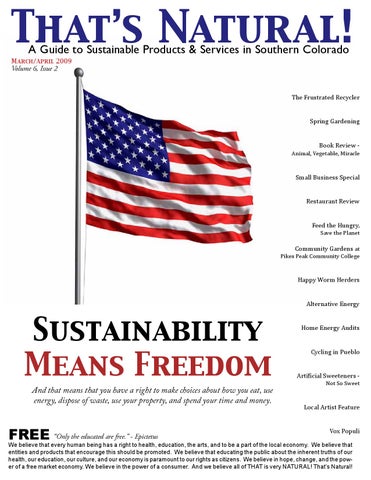
That’s Natural! A Guide to Sustainable Products & Services in Southern Colorado
March/April 2009
Volume 6, Issue 2
The Frustrated Recycler Spring Gardening Book Review -
Animal, Vegetable, Miracle
Small Business Special Restaurant Review Feed the Hungry, Save the Planet
Community Gardens at Pikes Peak Community College Happy Worm Herders
Sustainability Means Freedom
And that means that you have a right to make choices about how you eat, use energy, dispose of waste, use your property, and spend your time and money.
Alternative Energy Home Energy Audits Cycling in Pueblo Artificial Sweeteners Not So Sweet
Local Artist Feature
Vox Populi “Only the educated are free.” - Epictetus FREE We believe that every human being has a right to health, education, the arts, and to be a part of the local economy. We believe that entities and products that encourage this should be promoted. We believe that educating the public about the inherent truths of our health, our education, our culture, and our economy is paramount to our rights as citizens. We believe in hope, change, and the power of a free market economy. We believe in the power of a consumer. And we believe all of THAT is very NATURAL! That’s Natural!
We Are in the Business of $elling Social Change. That’s Natural! is a free news-magazine serving Southern Colorado. It is published bi-monthly, 4,000 + copies are circulated to over 170 locations in Pueblo, Fremont, Huerfano, Otero, and El Paso counties. We serve small businesses with their marketing needs and specialize in marketing programs that capitalize on Sustainability products and services that help people, the environment, and the community.
Meet the Team Tammy Stuever-Alhadef Editor
News from That’s Natural!
We have been working on several projects that have to do with you, our community, and promoting local economic development. What a wonderful issue we have, outlining many different topics of sustainability Health & Wellness, the Environment, and the Arts & Culure in Southern Colorado. We have also added to out team of folks that are making That’s Natural! a driving force behind change and promoting products and services that are good for people. My thanks to you for your hard work! Check out our work at: www.TNTeam.us.
What this is all about...
On the eve of our third year as a publication, we must take a look at what this source of information is really about. The term “Sustainability” - what does this mean for us and for our readers? After very little thought it was evident to us that it is about some very simple concepts.
FREEDOM & RIGHTS
If a community and a society are sustainable, then that society has freedom. Freedom of choice in a free-market economy, and freedom of press where people are able to express themselves and their views of ALL topics. If a community and a society are sustainable, then that society has unalienable rights. Our individual right to consume what we please and our rights to own property and do with that property what we like.
SUSTAINABILITY
This is all about being able to take care of the people that we love, the community that we live in, and the country that we believe in. This is about our choices as consumers and as citizens. That’s Natural! is dedicated to providing you information on products and services that are sustainable, are part of your freedom, and part of your rights. Tisha T. Casida, Publisher
That’s Natural! Marketing & Consulting PO Box 1476 Pueblo, CO 81002 (719) 210-8273 www.ThatsNatural.info Information: Thats.Natural.Info@gmail.com For Subscriptions, please send $15 to PO Box above. *You will receive 6 editions per year - every two months. (Please include your address and contact information) ** Make Checks Payable to “That’s Natural!”
The nutritional, health, environmental, and political information in this newsletter are based on personal experiences and research by the author(s). The author(s), editor, and publisher do not offer medical advice or prescribe the use of diet as a form of treatment for sickness without the approval of a health professional, nor do they accept any responsibility for your viewpoints being expanded or changed. If you do use the information contained in this newsletter without the approval of a health professional, an attorney, or a mentor that you deem worthy of your consciousness, you are prescribing and directing yourself, which is your constitutional right (that we encourage you to exercise), but the author(s), editor, and publisher assume no responsibility. That’s Natural! March-April 2 Lorem Sit Month 00, 00002009
Page 2
Kimberly Schaub Food & Nutrition Thomas Rupprecht Energy Jess Lundie Internet Content Manager & Guru Clifton Casida Video Production 719-252-1377 Mike Pyon Sales Exec Extraordinaire 719-214-9933
Contributors The Frustrated Recycler Tisha Casida...................................................................3 Spring Gardening Endeavors Tammy Stuever-Alhadef.................................................4 Book Review -Animal, Vegetable, Miracle Susan Fries......................................................................5 Small Business Trade-Page...........................................................6 Restaurant Review, Chong’s Cafe Kimberly Schaub............................................................7 Feed the Hungry, Save the Planet Jess Lundie.....................................................................8 Community Gardens at Pikes Peak Community College Nathan Dirnberger.........................................................9 Happy Worm Herders, Into the History Books Carolyn Kelly................................................................10 Alternative Energy, A Discussion Thomas Rupprecht..................................................11,12 Home Energy Audits Robert Johnson............................................................12 Cycling in Pueblo Courtney Sisco.............................................................13 Artificial Sweeteners - Not So Sweet Jennifer Conkey...........................................................14 Artists in Southern Colorado Brian Palomar..............................................................14 Vox Populi Joseph Poder................................................................15
Recycling in Southern Colorado
The Frustrated Recycler By Tisha Casida
An amazing phenomena is taking place in Southern Colorado. Several groups of committed businesses, non-profits, community members, and city officials, are getting together to figure out “How in the world can we recycle in Southern Colorado?”
Pueblo West within the next month. They are a drop-off location for both recyclables and trash. The recyclables--paper, cardboard, plastics (1-7), glass, and aluminum can all be placed into the same bin (single-stream). This is the first single-stream recycling available in Pueblo. Also, another bin will take the trash. This is an option so that members can replace their current trash service and save a little money. If people can recycle everything that is recyclable, they are not going to have much trash anyway. They may as well drop it off at the same time as they drop off their recyclables.
Want to know the real twist? We are trying to figure out how to do this and make it PROFITABLE for our community. Profitable by creating jobs, by providing a service to the community, by creating a sustainable solution to waste, and by benefiting organizations that are doing great things for the social well-being of our citizens. There is Waste Connections, who has There are several entities involved, and they partnered with Recycle Bank, and are very are dedicating themselves to specializing in interested in starting their program in Pueblo recycling various goods. County. Their program consists of having We have the Happy Worm Herders who two bins for their customers, one for trash and are finding sustainable solutions for organic one for single-stream recyclable goods, and waste, and have received amazing support they “give-back” coupons to local merchants from local organizations (see page 10 or visit for the various amounts of recyclable goods www.happywormherders.org). that you collect. The more you recycle, the more you get back in coupons, so that you are Jack Pendelton of Colorado Roll-Off off-setting your trash bill. This is just an idea, Services has partnered with GRX to recycle and something on the table – contact Pueblo’s electronics, and has this service available to City Council members to learn more and consumers at his transfer-station. voice your interest. Justin Parker, with WE RECYCLE (www. PDQ Printers, the very printers who were werecycleco-op.com), will be opening in
integral in starting the That’s Natural! Publication, have a facility that could potentially become a recycling center for Southern Colorado. For all of these organizations and ideas, we need feedback from YOU to find out if you would be willing to participate in a subscription-based service, where you would pay a monthly fee (between $10 and $15) to be able to drop off ALL of your recyclable goods at one location. This is how you can tell us if you would like to be one of the people to start a service that compliments your community, that provides jobs, that cleans up the environment, and that has social implications that we can never really put a price-tag on (although we should). We are truly saving the world here, in Southern Colorado. And this is because people like you are becoming educated and DOING SOMETHING with your POWER as a consumer. This is VOTING WITH YOUR DOLLAR. Contact us at: recycle@ thatsnatural.biz to voice your interest, or contact any of these entities directly if you would be interested in helping or participating with their programs. Way to make things happen Southern Colorado! This is because of you!
00, 0000 2009 Lorem Sit 3 3 That’s Natural!Month March-April Page
Spring Gardening Endeavors By Tammy Stuever-Alhadef
Take Control of Where Your Food Comes From
more to sell, share or trade. When we first looked into keeping laying hens we gathered every library book we could get our hands on. Most gave building instructions with complicated formulas for housing temperatures, proper ventilation and lists of grain requirements, mineral supplements and medicines we would need to keep our flock alive. Much of what the books claimed was necessary for keeping chickens sounded absurdly elaborate.
hung high on the wall.
Our neighbor, who grew up with family hens, explained that our girls needed a little privacy to do their business. Our coop was clean, with My husband and I looked at each other in fresh straw on the roosting shelves, but we’d wonder. forgotten to give them nesting boxes. A “Are they talking about raising chickens few large overturned flowerpots lined with or launching a rocket to the Moon?” Our straw did the trick. common sense told us that it shouldn’t be Laying hens are the perfect addition to that complicated. We asked around. any city or country homestead. Unlike “Forget the books,” we were told. “They’re your beloved cat or dog, the waste they We just added five little French hens to chickens, for Pete’s sake.” produce will keep a garden in plenty of free, our flock of egg layers. Salmon Faverolles, organic fertilizer. And you can’t beat fresh, known for their wide faces and the soft And chickens really are very easy to homegrown eggs that travel zero miles to curly feathers that fan out around their keep. They need very a simple shelter get to your table. ankles like flapper skirts. They remind to keep them safe from the weather and me of Anais Nin, with their big eyes and neighborhood dogs, and they need a cozy Even city dwellers here in Pueblo can delicately downward curving beaks. I’d love spot to lay their eggs. Feed is cheap—about keep up to ten hens in their backyards, to give them all names, like Armande or $16 a month for additive-free scratch and provided they follow a few guidelines. Cerise but they all look alike. And when cracked corn from our local feed mill. We If you’re looking to add a few hens to you’ve got as many hens as we do, you’ve also supplement with scraps from our table your garden, stop by City Hall to check just got to call them “the Ladies.” and extra produce from the garden. Our out the specifics. For just pennies a day you two-dozen girls spend most of their day All five of the new girls move around could be one step closer to a greener, more nibbling on bugs they’ve scratched up from the yard together like a single organism. independent life. under the leaves. They waddle en masse from spot to spot, Tammy Stuever -Alha d ef is a f reel ance ignoring the other chickens as best they can At first we couldn’t figure out why our writer who lives on a small far m near and veering from the paths of our curious happy little free-range hens wouldn’t lay. Puebl o, C ol ora d o with her hu sband turkeys. We’d go out to the hen house in search and t wo chil dren .You can rea d more of treasure and find one, maybe two eggs. Most of the birds in our flock are just about their a dventures in su stainabl e Then we began to find nests in the barn, beginning to give an egg a day, which living on her bl og at: means we’ve got plenty for our kitchen and under the trees, in an empty horse feeder, w w w.aw ren sne st.c om.
Country Roots Farm -your local source for -
CSA Program (Community Supported Agriculture) signup deadline 03/17/09. Farm Stand (opens in June) Saturdays 8:30am - 1pm & Wednesdays 1pm - 6pm We offer Certified Naturally Grown Vegetables and Herbs (including Heirloom Varieties!), Free Range Eggs - call for availability. Upcoming Event: “Spring Field Day” on Sunday, April 26th 11am - 3pm
719-948-2206 www.countryrootsfarm.com That’s 4 Lorem Natural! Sit Month March-April 00, 00002009
Page 4
Book Review By Susan Fries
Animal, Vegetable, Miracle - A Year of Food Life By Barbara Kingsolver with Steven L. Hopp and Camille Kingsolver Barbara Kingsolver is an undeniable master of storytelling. For the first time, she indulges us with a nonfiction story and she doesn’t disappoint. “Animal, Vegetable, Miracle” includes a year’s worth of trials and tribulations of her family as they produce, process, and enjoy their own food on a small farm in West Virginia. The result is a well-crafted tale about relationships, adoration, and worship of food, very much in the style of MFK Fisher, whose iconic writings, continue to uphold the highest standard of “food” writing. Kingsolver’s major focus in the book is to make a passionate case for the sustainable relationship that is formed between an individual and community when food consumption is centered around two things: producing food yourself and buying from local producers. Kingsolver tells a story about life centered around the seasons; the hard months of spring when cupboards are bare and gardens have yet to produce, the beauty of a fully producing garden in the summer, the intense months of harvest in the fall, and the joy of overstocked larders
in the winter. She captures the rhythm of life lived close to the earth while spinning stories about zucchini wars, 50th birthday parties, melting pumpkin carcasses, and turkey copulation. As a nonfiction book, “Animal, Vegetable, Miracle” provides exhaustively researched references about sustainable agriculture. Gleaning much from scientific research, government policy, and current trends in community activism, Kingsolver’s husband Steven L. Hopp shares essays that reinforce the farm experience in relation to the world community. The couple shares facts such as, “(b)uying your goods from local businesses rather than national chains generates about three times as much money for your local economy.” In addition to Barbara’s tale, her oldest daughter, Camille Kingsolver, includes her own memories of kitchen life and recipes that her mother may have mentioned in the chapters. It adds another beautiful dimension to the intensity of relationships that are woven within the book. The biggest obstacle for this high-desert
garden reader to overcome is the lusciousness of the Appalachian climate. Kingsolver’s book begins with her family moving from arid Phoenix to a farm tucked in the hills of West Virginia, where irrigation is never again mentioned. And yes, I’m jealous. Living in an environment where it’s impossible to pick up the daily paper and not read about water rights, the luxury of a non-irrigated garden is beyond my wildest dreams. And yet we persevere, with a heavy sigh. Kingsolver presents a convincing testimonial to the love of food, family, and community in this inspiring read. Susan Fries is executive director of the Pueblo Performing Arts Guild, as well as avid traveler, bookworm, gardener, and cook.
That’s Natural!Month March-April 00, 00002009 Lorem Sit Page 5 5
A For-The-Trade Look for Small Business Owners
Small Businesses Trade Page
Small businesses and their implications on the economy are what That’s Natural! Marketing & Media is all about. We know who you are, and we know your customers. We have targeted demographic information on consumers in Southern Colorado. We have publications that are reaching all of them. And we have an internet service that stretches beyond our community – into national and international markets. That’s Natural! Marketing & Media would like to welcome its new Publications and new Team Members who are creating quite a system for you to advertise your products and services. First of all, welcome to PULP (www. PuebloPULP.com), Pueblo’s newest alternative-read that has a fantastic events calendar and amazing editorial selections to enjoy and respond to. We would also like to welcome The Canon Beat (www.thecanonbeat.com), who truly is focused on The Heart of Colorado and is a fantastic resource for travelers and visitors. And we would also like to
welcome Terra Essentials – a guide to healthy living in Southern Colorado. All of these publications together provide your business with a Turn-Key Solution to your marketing needs. All of these are distributed at hundreds of locations throughout the southern part of the State, and together, make an excellent way to BRAND YOUR BUSINESS. Branding your business means keeping your name out in the public eye for a period of time, preferably 1 year. No matter what type of medium you use (i.e. newspaper, radio, television, etc.), a small business builds its brand by advertising in several different places for this period of time.
service, as well as the TN Team Blog (www. tnteam. us), where you can see what we are up to in the name of Sustainability and supporting our readers and advertisers.
That’s Natural! Marketing & Media is truly dedicated to assisting small businesses with their marketing needs because we believe in the power of small businesses, and feel that our country and our stability as an economy is based on community In addition to our publication selection, activities and supporting local merchants. we have also added our new contentWhy? Because all of THAT is VERY management site (www.ThatsNatural.info). NATURAL. This is where you will find continuously You can find more information on updated information from our authors. marketing your small business on our Our fabulous team members, Thomas marketing blog: www.ttmarketing.biz. Rupprecht, Kimberly Schuab, and Jess Lundie, will be a part of growing this
Internet Solutions for Small Businesses E-Commerce Site: www.ThatsNatural.biz Content Site: www.ThatsNatural.info TN Blog: http://blog.thatsnatural.info TN Team Blog: www.TNTeam.us Marketing Blog: www.TTmarketing.biz That’s 6 Lorem Natural! Sit Month March-April 00, 00002009
Page 6
Restaurant Review
Chong’s Café
By Kimberly Schaub
Authentic Chinese and Vietnamese food is hard to come by in Pueblo, or at least I thought so. I’ve enjoyed delicious green chili-smothered sloppers, fresh potica, and pasta dishes that rival any metropolitan city while living here. Now I can add tasty and authentic Southeast Asian food that doesn’t languish at buffet stations. Although it may be easy to pass by this restaurant, take a second look. Chong’s Café satisfies the tastes of connoisseurs and novices alike, and the selection is varied enough to encompass several Southeast Asian food styles. In honor of Chinese New Year, a few friends and I headed down to the restaurant. We sampled steamed dumplings, the pu pu platter, double jeopardy, vegetable with garlic sauce (tofu added), chicken with lemongrass, General Tso’s chicken, mu goo gai pan, chicken with garlic sauce, and the seafood hot pot. On a previous occasion, I tasted the pho combination soup. Each dish danced with its own flavor, and as one taste-tester told me, “This isn’t as sugary as all the other equivalent dishes I’ve tried in Pueblo.” When our food arrived, the table fell into a silence that can only testify to the unique and flavorful dishes we each had. The pu pu platter was of special note, which I ordered, because it comes with an insane selection of skewered meats, dumplings, chicken wings, and shrimp. It also came with a mini hibachi grill on which to reheat our meat. We were even served sugar donuts for dessert, because we kept the chef busy.
Boarding Your Pet
By Nicole Kochis
Boarding your pet—the thought can strike fear in the heart of any pet lover. Many pet owners think of boarding as jail. But wouldn’t you rather have your pet in jail than being forgotten by a family member or well intentioned neighbor? I have heard many horror stories about pets that have been lost, injured or left with no food or water and no one around to care for them. That is why boarding is a very good option for most pets. The boarding facility you choose for you pet is by far the most important decision you can make for them aside from their veterinarian. The boarding facility’s trained professionals will be there all day for your pet so that if there are any problems, they are there to spot it. When choosing a boarding facility, make sure you ask for a tour and ask a lot of questions so that you can make the right decision for your circumstances. Can Buddy have his favorite toy and blanket? How many times per day do they get let out of their kennel? Are they let out with other pets? My pet has a special diet, is that okay? If you have chosen the right kennel for you and your pet, the facility will make your pet’s stay as comfortable as possible. Not all pets love going to a boarding kennel, but rest assured your family member will be cared for the same way boarding facility’s employees love their own pets.
What a way to hail in the New Year. Check out Chong’s Café at 1301 N. Main St. or call them at 719-253-1985. The café is open from 11a.m. to 8:30p.m Monday through Thursday and Friday and Saturday until 9:00. They have room to dine-in, or you can order ahead and pick up. K imbe r ly S cha ub i s a pa ssion at e food l ove r. S he like s t o st u d y r e cipe s , cooking st yl e s , an d c ul t u r e s thr ou gh the ir c ui sin e s . S he coll e ct s cookbook s , cooking t ool s , an d uniqu e ing r e d ie nt s . S he al so e njoy s d i sc u ssion s about food , food safe t y, an d food se c u r it y. S he an d he r h u sban d can be se e n br owsing the book st or e s , an d she an d Ti sha can be foun d in the cof fe e h ou se s of Pu ebl o sipping E spr e ssos an d d i sc u ssing the t opics of the d ay.
Rising Spirit Hypnosis Hypnosis Works! Patricia M. Valdez, CH
719-671-7178, Call for appointment www.risingspiritcenter.com Tap Your Inner Wisdom 00, 00002009 Lorem Sit 7 7 That’s Natural!Month March-April Page
Agriculture & The World
Feed the Hungry, Save the Planet By Jess Lundie
In fields all over the world, a quiet agricultural revolution is underway. It has the potential to feed millions of people, while simultaneously preserving the environment for future generations and protecting our bodies and our ecosystems from harmful toxins. Unlike many environmentally sustainable alternatives discussed in today’s dialogue on climate change, the global food crisis and poverty eradication, this development does not involve complex technology or an expensive initial infrastructural investment. It merely requires the use of the most powerful tool we have in preserving our global future: education. The System of Rice Intensification (SRI) is a set of farming techniques which maximize rice yield while minimizing seed, fertilizer, land area
That’s Natural! March-April 8 Lorem Sit Month 00, 00002009
and water use. SRI was developed in the 1983 by French Friar Henri de Laulanié. Friar de Laulanié was the founder of an agricultural school in Madagascar and spent much of his life working with rural Malagasy farmers to increase production of rice, which comprises over half of the daily calories in the average Malagasy diet. The techniques used in SRI are not a fixed practice, but rather are an alternative approach to rice cultivation from seed to harvest. In practicing SRI, farmers must use between 11-23 percent more labor, but only use 10 percent of the seed and half the water, cutting their expenses substantially and conserving water in countries where it is becoming a scarce resource. Typical results are a 50-100 percent increase in rice production.
Page 8
SRI has only recently been embraced by the wider agricultural community as a truly groundbreaking and widely adoptable technique. However, with the help of Association Tefy Saina and the Cornell International Institute for Food, Agriculture and Development, SRI programs are underway in 47 countries around the world. For more information on this exciting innovation in sustainable agriculture visit http:// ciifad.cornell.edu/sri/. Jess Lundie grew up in Boulder, CO, a community with a strong committment to green living. After obtaining degrees in Political Science and Spanish, she moved to Washington, DC, where she is devoted to finding outside-the-box solutions to the challenges of living sustainably in a modern world.
“Never doubt that a small group of thoughtful, committed citizens can change the world. Indeed it is the only thing that ever has.” Margaret Mead
Local Students To Create Community Gardens By Nathan Dirnberger Each and every individual on this earth has a vested common interest in food. We must all consume plants or animals and animal byproducts in order to survive. We here at Pikes Peak Community College are working together by creating a community garden that will provide food for college students, faculty, and a local urban farmer. Chefs, culinary students, faculty members, and community members are showing their commitment to each other and this earth by developing a vegetable garden that will provide food for college students, faculty, and a local urban farmer. With the support of Pikes Peak Urban Gardens, the American Culinary Federation Pikes Peak Chapter, Phi Theta Kappa Alpha Gamma Alpha Chapter, Pikes Peak Community College Student Government, and many others, we are making change. As a chef, I have a direct influence upon the people whom I feed. The items I choose to serve and the voice with which I choose to serve them will have a profound effect upon the patrons of my
restaurant in the future. I believe that talk is cheap. If any individual wants to see real change in the world, they must first change themselves, and then do what they can to make change in the world. It is our responsibility as citizens, with the state of the economy, to provide direct actions against our impoverishment and indebtedness. The capability of each of us as committed citizens to change this world, by choosing to feed each other, is real. With the establishment of real world business modeled, community gardens and greenhouses, consumers will be provided with a resource of immeasurable value. The value of food is the greatest on this earth. Its value is even greater than money. Everyone has to eat. Our ability to influence the foodservice markets, and our society through our chefs and culinary students, at Pikes Peak Community College is extraordinary. Food’s effect upon the environment is horrific. A locally grown tomato and the accompanying basil has a significantly
lower carbon footprint than its massproduced counterpart shipped from across the country. With the proper technique, that tomato could be entirely organic, healthy, nutritious and delicious, and provide that garden fresh flavor that makes your mouth tingle with excitement. As a student of Pikes Peak Community College, I believe I have a responsibility to be the change that I want to see in the world. We must follow the example of our president; we must start finding ways to work smarter and not harder. It is my duty as a new world chef to set the example for those around me to follow. However, we’d like for this project to go much further. We want to develop a restaurant with the help of Denver University that will profit charitable causes, while serving local, organic, sustainable foods. If you would like to help us make a change or support us with materials, goods, or services please let us know. We can be reached at 719-210-5165 or 719-502-2104.
EcoSol has Your New Year’s Energy Solution! COMPLETE DESIGN & INSTALLATION
PHOTO OF QUALITY CUSTOM WOODWORK 100% SOLAR POWERED PLANT, PUEBLO
• COMPREHENSIVE COST BENEFIT ANALYSIS • TURN-KEY PROCESS FROM APPLICATION THROUGH INSTALLATION • FOR HOME, BUSINESS, AGRICULTURE, & INDUSTRY STATE LICENSED, FULLY INSURED - SERVING SOUTHERN COLORADO
CALL US @ 719-485-6598 to find out how to save!
www.e-co-sol.com That’s Natural! March-April Month 00, 0000 2009 Lorem SitPage 9 9
Vermicomposting
Local Non-Profit Organization WORMS Its Way Into The History Books
By Carolyn Kelly
As of December 2008 Pueblo-based nonprofit Gaia Institute Wellness Center and its subsidiary the Happy Worm Herders program was the first business in the State of Colorado to be awarded a provisional composting / vermicomposting license. This historic step could have far-reaching benefits to Colorado’s citizens and environment. On Dec. 5, Gaia received its second provisional permit allowing the organization to use, handle, and distribute bio-solids—an honor usually only bestowed on wastewater treatment facilities. Gaia, and its Happy Worm Herders program, is the first non-profit in the nation to have earned such privileges. In June 2008, Gaia and the Happy Worm Herders began collaborating with Pueblo’s public works and wastewater treatment departments to carry out an investigational project to determine if its vermicomposting technique would also work to deal with the problem of naturally occurring high levels of selenium in the city’s water. The tests were conclusive. Selenium levels within the worm castings (the end product of worm digestion,) came well within the acceptable guidelines established by the Environmental Protection Agency. In the early 1990’s, the EPA began
more stringent regulating of solid wastes. The current acceptable level for selenium, which occurs naturally throughout this part of the country, is 100 parts per million. Pueblo’s biosolids have exceeded that level through natural phenomenon, rendering that waste useless and destined for landfills until now. With the current worldwide green-thinking initiative it has proven to be the perfect time and opportunity for the merger between The Happy Worm Herders, the Department of Public Works, and the community. The worm herders will process thousands of tons of organic and non-organic solid waste during the one-year pilot project, producing an environmentally safe and beneficial product line. Several agencies have provided input and support to the project. The worm herders collect grass clippings, leaves and tree waste, agricultural waste, source-separated food and paper waste, coffee grounds, organic cloth, and other organic waste; then, mix those ingredients with bio-solids, commonly known as sewer sludge, and inorganic materials, such as sifted street sweeping material, to create the tasty gourmet diet for the worms. Once the worms
have done their work, the final product will be dried, tested, and sold through retail outlets, or distributed through special Happy Worm Herders programs. Worm castings are considered to be nature’s superior singleingredient fertilizer and soil amendment. The castings provide many naturally time-released nutrients and trace minerals, help soils retain moisture, and enhance root production and root strength, thereby helping prevent soil erosion. Over time, the worm herders’ activities will have far-reaching, economic, environmental, and social benefits. Nearly the entire low-tech operation will be built upon the principles of environmental stewardship by using recyclables commonly referred to by others as junk or garbage. Even their non-permanent buildings are being constructed with recyclable materials. Community members interested in becoming involved, volunteering, or making taxdeductible donations are encouraged to contact the institute at gaiawellnesscenter@ earthlink.net. The Web sites are www. happywormherders.org and www. happywormherders.net. Carolyn Kelly can be reached at: 719-320-5080.
Counseling & Regression Therapy “Self-Mastery is the journey”
Marcia Beachy, MS, LPC Licensed Professional Counselor Certified Clinical Hypnotherapist Regression Therapist Individual and Couple Counseling Pueblo, Colorado 81008
719-542-0156
info@marciabeachy.com
www.marciabeachy.com
Buy One Black and One Color RRI brand inkjet cartridge Located on US Hwy 50 West. and receive a second Black cartridge FREE! Just East of Lowe’s between ALLTEL and Subway
719-542-1916 One black and one color empty cartridge exchange required, cannot be combined with any other offers, see store for details.
10 Natural! Lorem Sit That’s
Month 00, 0000 March-April 2009
Page 10
Coupon Expires 3/31/09 valid at this location only.
Store Hours: Monday-Friday 9am-6pm Saturday 10am-4pm Sunday CLOSED
An Overview and Discussion of...
Alternative Energy By Thomas Rupprecht One of the biggest challenges our nation faces is the energy crisis. As important as this issue has become, I decided to take the opportunity to learn a little about the most relevant sources of energy we have available. As I see it, there are eleven major contenders in the fight to supply our nation with its electrical needs. Those eleven condensers are bio-energy, coal, fusion, geothermal, hydrogen, hydropower, natural gas, nuclear, ocean (tidal), oil, solar, and wind. The first in our list of energy sources is bio-energy. The term bio-energy means using organic biomass to create energy. This refers not only to electricity, but products like fuels and chemicals as well. The U.S. Department of Energy defines “biomass” as any organic matter available on a renewable basis, including dedicated energy crops and trees, agricultural food and feed crops, agricultural crop wastes and residues, wood wastes and residues, aquatic plants, animal wastes, municipal wastes, and other waste materials. While the some bio-fuels like plant and animal waste are cheap or even free, plants grown specifically for fuel take
fission reaction. This method creates an uncontrolled reaction that is only useful as a weapon, such as the hydrogen bomb. A Coal is the most commonly used fuel controlled reaction would be a very clean source for power plants in the United States. Over half of the electricity produced source of energy. If we can make it work, in the U.S. comes from coal-powered plants. it would produce an incredible amount of One reason it is so popular in our country is energy from very little fuel. because the United States has a lot of coal Just as you would expect from the name, available. One quarter of the earth’s known geothermal energy is heat energy from coal reserves are in the United States. Old the earth. Sources of geothermal energy coal-fired power plants were very dirty, but steps have been taken to make coal a cleaner can be hot water near the earth’s surface, hot rocks a few miles below the surface or source of energy. However, exhaust from magma deep below the surface. It is a clean coal power plants still contains several toxrenewable source of energy. Because the ins and green house gases that go directly heat stored in the earth is limitless by our into our atmosphere. standards, it is considered to be a renewable energy source. Because geothermal power Nuclear fusion should not be confused with nuclear fission. Fusion is putting atoms plants do not consume fuel, they are not affected by changes in fuel costs. Unfortutogether while fission is breaking atoms nately, designing a geothermal plant can be apart. When elements are pushed close very challenging due to the corrosiveness of enough to each other, they can combine the heat source. Geothermal heat sources to form a different element. This process are generally lower in temperature than is called fusion. When small elements are boilers used in coal plants so geothermal fused they release energy. Unfortunately, plants are less efficient. Continued Page 12 we cannot create pressures high enough to start a fusion reaction without using a resources away from food production.
Creating Health Medicine by the Numbers
“Thanks to modern medicine—more and more people are dying with better bloodwork.” Dr. Pam Popper, Naturopath; and PhD in Nutrition The FDA (aka Pharmaceutical Protection Agency) approves pharmaceuticals to improve biomarkers—such as blood sugar or cholesterol—but not to improve overall health or survival. One example: a recent study in the NEJM compared two groups of diabetics. One received intensive medication, the other standard medication. The intensive group gained 18 pounds vs 9 pounds in the standard group. Appropriate therapeutic intervention for diabetics should result in better body composition—not weight gain! In addition—the intensive med group had three times the number of sudden deaths! Not surprisingly—the more drugs people take—the sicker they get (or— dead-er!). Welcome to the state of so-called health care in America! Drugs do not address the underlying causes of disease. There is only one way to restore and preserve health—and that is dietary excellence and optimal health habits. Celebrate Earth Day and our journey on Planet Earth by remembering the power of Nature to heal. Let FOOD be your medicine. Call today to find out how you can start feeling and looking better!! Dr. Donna J Hinders has been practicing integrated natural health care for 24 years. She is a licensed chiropractor and acupuncture diplomate, with a focus on restoring health through functional medicine and the principles of Nature. 719-583-8258
Month 00, 0000 2009 Lorem SitPage 11 11 That’s Natural! March-April
Alternative Energy, Continued
Hydroelectric power is electric energy produced using water pressure. The Hoover Dam is an example of hydroelectric power. On the plus side, hydroelectric power is a low cost way to produce energy. It does not burn a fuel, so is not affected by changes in fuel costs. But there are limited resources available for hydroelectric power. There is simply not enough water in the United States to supply our electrical needs. Another downside is that damming a river can have harsh consequences on the environment and animal habitats. Natural gas is actually a mixture of several gases. The main component of natural gas is methane, but it also contains ethane, propane, butanes and pentanes. One of the biggest reasons we use natural gas power plants is they can be started very quickly to respond to sudden changes in electric demand. Natural gas is more popular than oil partially because is produced in the United States and burns cleaner than oil. Even though it burns cleaner than oil, it is far from perfect and it is a limited, nonrenewable resource. Nuclear energy generally refers to nuclear fission. Nuclear energy is energy produced from the fission, or breaking, of heavy elements such as uranium. Many consider nuclear energy to be a green energy because there is very little waste from nuclear
power plants and it can be contained. A lot of energy can be produced by a nuclear power plant at a relatively low cost. It is feasible to supply the needs of the nation on the nuclear resources available. However, nuclear waste can be very dangerous and can take hundreds of years to decay. Tidal energy converts the energy of the tides into electrical energy. It is not in use to any real extent today, but it has potential because tides are predictable. Many countries have been hesitant to use tidal energy because barges needed for a plant may have adverse consequences on the ecosystem. Oil refers to petroleum products that are burned to produce electrical energy. Oil powered plants can be quickly started up to meet sudden changes in the demand for electricity. For this reason, they are often used in conjunction with a coal plant to supply power during peak hours. Although many improvements have been made to oilpowered plants to reduce pollution, oil still does not burn clean. Solar is a very clean low-maintenance source of energy. Because of this photovoltaic solar cells are being installed in many homes. It is also very useful for areas where power lines are not available to transmit power. Even with tax incentives photovoltaic solar cells are expensive. They produce
DC current, which must be converted of AC for use on the power grid. These converters add cost and complexity to the systems. Wind energy is electrical energy produced by a wind turbine. Wind turbines are becoming very popular because they are low maintenance and use no fuel. Wind, however, is not predictable, so a wind farm may have unexpected slow periods. It also takes a lot of land in a very windy area to build a wind farm. I don’t believe that there is one solution the energy crisis. It will take several if not all of these solutions to supply our needs in the future. Over the next several months I will be looking at each of these energy alternatives more closely so that we can make better informed decisions about our energy future. I hope you come along. Tom’s career stared with military service as a nuclear power plant operator onboard the submarine U.S.S. Florida. After his service in the Navy he went on to graduate from the Colorado School of Mines. His passion for solar energy is reflected in his choice of school projects which include a funding proposal for a large solar power plant and a solar powered robotic rover. After graduation, Tom went to work for the country’s largest air medical helicopter company. His projects consist of civilian as well as several military projects.
Home Energy Audit By Robert W. Johnson It seems everyone is becoming more concerned about making dollars go farther. Many are also concerned about the impact their lives have on the environment. The link between these two concerns is perhaps most easily seen when examining monthly bills from the gas and electric company.
Home energy use can have a huge impact on bank accounts and the environment. How can this impact be reduced? The answers vary from simple steps like lowering the thermostat to shutting off lights and appliances when they are not in use. Greater steps may require engaging the expertise of a home energy auditor to evaluate your home and provide you with a checklist of improvements that can make a big difference in your pocketbook and your carbon footprint.
you with the names of qualified service A home energy audit evaluates your providers who can help you make your home’s energy consumption by examining insulation, weather stripping, windows, home more energy efficient. and air tightness. Other audit items include the condition and efficiency of furnaces or boilers, water heaters and major appliances. Areas of potential savings Home Inspections, LLC in electrical use are also “Services for Buyers, Sellers, & Home Owners” addressed.
R
ELIABLE
Robert W. Johnson Such tools as blower doors, duct blasters, and rwj@ghvalley.net infrared cameras may be 719-251-8841 used to complete the audit. The report you receive will -Your Home Energy Tune-up Specialistprovide steps you can take Learn more about to save money and reduce Reducing Your Energy Bill at: your energy consumption. www.hometuneup.com Most auditors can provide Now accepting VISA & Mastercard
That’s Natural!
March-April 2009
Page 12
Cycling in Pueblo
By Courtney Sisco
When I set out for a 25-mile ride on a sunny day in February, it never occurred to me it would be any more dangerous here than any other place. When cyclists take on the road, we knowingly take on the responsibility and danger, just as if we were driving a motor vehicle. Of course, not all drivers are thrilled to see a cyclist. Within my first 5 miles, I was honked at, yelled at, cursed at, and flipped off. I’m not surprised, because these things have happened to me before. I understand it can be frustrating to drivers, because I too have seen people on bicycles be unsafe by cutting across traffic, running stoplights, and riding the wrong way on streets. It goes both ways; cyclists and drivers alike need to know the laws
Calling All Farmers & Artists The Main Event & Evening Farmers’ Market at The Riverwalk
Every Thursday Night July 9- August 27
We Want Local Performers, Farmers, & Artists
and what they can do to be as safe as possible. I’m not about to stop riding in Pueblo. This is a great place to ride, especially when you are an amateur cyclist like myself. The elevation isn’t high enough that you notice the lack of oxygen. The rolling hills provide enough variation that you’re not bored but they aren’t so steep that you need to be a professional. The moderate weather allows riding even in the winter months, and the flat stretches provide time to practice your cadence. Cycling is great exercise and an earth-friendly form of transportation.
“Green Drinks” A monthly meet-up of Green-Thinking-Individudals. Come to Network, Discuss Local Environmental Topics, and Enjoy the Company of Like-Minded People.
To raise awareness for cycling safety, community rides will begin come warmer weather. This will give cyclists a chance to get on the road with an undeniable presence, and allow the drivers in Pueblo to realize we are here, and we’re on the roads. If you would like to be contacted with further information, please email info@thatsnatural.biz, and in the subjectfield put “Cycling”.
Reducing carbon footprints one step at a time.
Upcoming TOPICS
March 31st - Energy Audits & Solar Power April 28th - Recycling & More Meeting every LAST Tuesday of the month at 5:30 PM at ta location to be disclosed. Please RSVP! And bring a friend!
Contact Dena at 369-9087 OR recycle@ thatsnatural.biz
A consultation firm working in the now to bring about a better future for generations to come. Certified Energy Rater LEED Certifications Energy Star Rating Energy Audits
Call Susan
Renewable Energy SolarWindBiomass
719-242-6652
And visit...
PuebloPAG.org
Call us: 719/783.4191 or email info@sustainabilityconsultation.com That’s Natural!
March-April 2009
Page 13
Health Watch
Artificial Sweeteners - Not So Sweet By Jennifer Conkey
Who doesn’t love sweets? Everything from cakes and candies to beverages like soda pop and designer coffee drinks contain sugars that feed our never ending sweet tooth. Sugar cane, from which natural table sugar is produced, is grown in tropical and sub-tropical climates. It is cultivated by harvesting the tops of the plants, leaving the roots intact to produce new crops. White refined table sugar is known as sucrose. It is produced by extracting the sucrose from sugar cane plants, and is then purified and crystallized. Sugar contains calories. When used in excess it can cause weight gain and has also been shown to cause tooth decay. In an effort to avoid the additional calories found in this sweet product, many people have turned to artificial sweeteners. There are three major artificial sweeteners on the market today. Sucralose, aspartame and saccharin are sold under various labels. Other than being calorie free, virtually the only benefit found in these products is their
ability to make something sweet. All three sweeteners are produced from chemicals and are constantly being scrutinized by the US Food and Drug Administration. Known by chemists as benzosulfamide, saccharin is produced by reacting anthranilic acid with nitrous acid, sulfur dioxide, chlorine and then ammonia. It can also be synthesized using o-chlorotoluene. Sold commonly under the name Sweet’N Low, it is 300 times sweeter than sugar and has been regarded highly by diabetics since its discovery in 1880. Saccharin was nearly banned in the United States in 1977 when studies showed an increase of cancers in lab animals that received high doses. Although it took 14 years, the FDA finally gave in to public pressure, mainly from diabetics, to allow the sale of saccharin. Saccharin is still banned in Canada. Aspartame, known commonly as NutraSweet, is the methyl ester of the dipeptide of amino acids L-aspartic acid and L-phenylalanine. Commonly found in low calorie
Art in Conversation By Brian Palomar
soft drinks, aspartame is 180 times sweeter than sugar. Early testing that linked the compound to brain tumors kept the sweetener off the market for many years. However, the Reagan administration approved aspartame for sale in 1981. Sucralose, sold under the names Splenda and SucraPlus, is produced by chlorinating white granulated sugar. Three of the sugars hydroxyl groups are replaced with chlorine. It is 600 times sweeter than sugar. While none of these sweeteners have been proven to cause health risks, choose wisely when the urge hits to satisfy your sweet tooth. The simple sugars found in fruits are much easier on the body and can ease sugar cravings. Jennifer graduated with a Bachelor of Science degree - University of Southern Colorado 2002, major – Biology, minor – Chemistry. Currently she is working on a Master’s degree in Business Administration at CSU – Pueblo, and plans to graduate this summer.
Local Artists
For me, art has two parts. One is the nitty-gritty of laying down paint, and planning out a composition. The other is having something to say. I grew up having something to say, so I went to school to learn how to better say it. Raised in Denver, I came to Pueblo to go to college. I received bachelor’s degree in art and English about two years ago. Now, I’m working hard to get into the gallery scene both here in Pueblo, and as well as Denver. Beyond that, if I’m lucky, I may even go farther.
That’s Natural!
March-April 2009
Page 14
To create art is one thing and a completely different thing if you want enough people to see it. Putting yourself out there as an artist is a lot harder than I had thought. My current gallery show, “Portrait of a Story,” is on display until March 14 at The Downtown Bar, 103 Central Plaza. For more information call 719-544-1499. To check out more art visit: bpalomar.deviantart.com, or contact Brian at: 719-671-5240.
“The beauty of the second amendment is that it will not be needed until they try to take it.” -Thomas Jefferson
Vox Populi By Joseph Poder that. Freedom and being a consumer go hand in hand. We make our choices; we tell our markets what to do – our free markets – where we actively participate with minimal intervention from entities that are not consumers (this would mean government).
In times like these we re-visit the concepts and influences that have made our country and our communities what they are today. I personally believe that we live in the greatest country in the world. And I believe that our forefathers, who created the very documents that are supposed to act as a guiding light on our freedoms and rights, had every intention of keeping our country a place where we are free. Now, regardless of your political background and viewpoints, it is my estimation that most of us truly enjoy being “free.” When we drive to the grocery store – or, preferably, our local farmers’ markets – it is this freedom of choice that allows us to participate in such an activity. If we decide that we would like to grow our own produce on our own land, it is our freedom of choice and property rights that allow us to do
When we decide if we want to visit a medical doctor at a hospital or a holistic practitioner in their own home, that is another way we get to exercise our freedoms. We get to choose what we put in, on, and around our bodies. We get to choose how we take care of ourselves. When we decide if we want to purchase fossil fuels to drive our vehicles, or give up our vehicles to ride our bikes, walk, engage with the public transportation system, etc., we are exercising our freedoms. When we submit articles to publications, we are exercising our voice and our freedom to express how we feel and what we think. And the press, these publications and other content mechanisms have the right to publish this information. Freedom of speech and freedom of the press are other ways that we express and get to hear the expressions of consumers in our country.
Sustainability, the ability to take care of oneself, the ability to survive without the intervention and assistance of others are freedom. If I can grow my own food, create my own fuel or transportation, be able to protect myself, and be able to express myself to my community members, then I am free. And no matter who you are and what political viewpoints you have, and no matter what religion you believe in, I think that you would agree that you want to be free, and you want to be able to live a sustainable lifestyle where you can be able to do all of these things as an individual. I see many things going on in our country. Some of them are scary, and some of them give me a lot of hope for the future. The only thing I can do, as a man here in Southern Colorado, is express how I feel, hope that people will be able to see my words, and that somewhere, someone may say, “I feel that way too, what can I do to be free?” Joseph Poder, or Joe, is a small-time farmer/ rancher in Southern Colorado. He enjoys living “off-the-grid” in the house that he and his wife built by themselves, with their two daughters, 3 dogs, 7+ cats, and numerous other small creatures.
Public Art Exhibit The 50 pieces of art represented in this international art show have been produced by people from all over the world who have been diagnosed or touched by cancer. The art expresses the life-affirming changes that give their cancer journey meaning. May 11 - 29, 2009 Monday thru Friday, 8:30 am - 4:30 pm At the Dorcy Cancer Center For more information, call 719-557-4548 2004 Lake Avenue Pueblo, CO 81004 dorcycancercenter.org
That’s Natural!
March-April 2009
Page 15
Why You Need That’s Natural! A Great Guide To Products and Services that are Sustainable in Southern Colorado. See www.ThatsNatural.info If you refer us an advertiser, we will give you a $20 gift certificate to your choice of advertiser within That’s Natural! (subject to availability of advertisers) Continuous and Updated Information Available Online at http://blog.thatsnatural.info E-Commerce Capabilities for Local Merchants www.ThatsNatural.biz Connect with the TN Team, see what is happening in Southern Colorado, and start making a difference. www.TNTeam.us Find COUPONS, SPECIAL OFFERS, and DISCOUNTS for our advertisers, both in print and ONLINE. Remember what it means to have Freedom & Rights, as a consumer and as a Citizen. Feel Your Power!!
Farm-To-Fork Connecting Our Youth with Sustainable Agriculture Join Us At:
www. colorado-farm-to-fork. blogspot.com
www.HikeAndLearn.org 16 Lorem Sit
Month 00, 0000
- Educating our Youth about Susainable Farming Methods - Connecting Youth with Where Food Comes From - A Curriculum about Seasonality & Colorado Crops