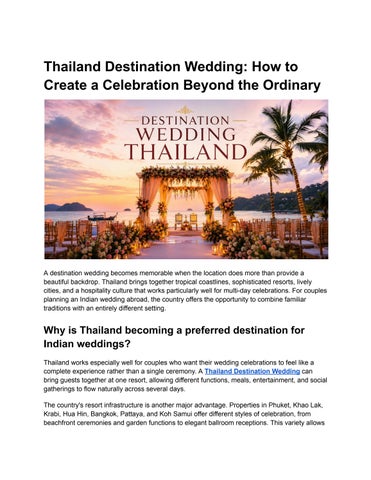
Thailand Destination Wedding: How to Create a Celebration Beyond the Ordinary
A destination wedding becomes memorable when the location does more than provide a beautiful backdrop. Thailand brings together tropical coastlines, sophisticated resorts, lively cities, and a hospitality culture that works particularly well for multi-day celebrations. For couples planning an Indian wedding abroad, the country offers the opportunity to combine familiar traditions with an entirely different setting.
Why is Thailand becoming a preferred destination for Indian weddings? Thailand works especially well for couples who want their wedding celebrations to feel like a complete experience rather than a single ceremony. A Thailand Destination Wedding can bring guests together at one resort, allowing different functions, meals, entertainment, and social gatherings to flow naturally across several days. The country's resort infrastructure is another major advantage. Properties in Phuket, Khao Lak, Krabi, Hua Hin, Bangkok, Pattaya, and Koh Samui offer different styles of celebration, from beachfront ceremonies and garden functions to elegant ballroom receptions. This variety allows
couples to choose a destination based on their wedding format instead of trying to fit their plans into one type of venue. Thailand is also familiar with international celebrations. Resort teams and local wedding professionals regularly work with guests from different countries, making coordination easier when families are travelling from several locations.
Which Thai destinations are best suited to different wedding styles? There is no single “best” wedding destination in Thailand. The right choice depends on the atmosphere, guest experience, ceremony requirements, and number of functions planned.
Phuket for a glamorous tropical celebration Phuket is one of Thailand's most versatile wedding destinations. Couples can choose beachfront resorts, private event spaces, gardens, and sophisticated indoor venues. It works particularly well when the wedding includes several functions and guests want plenty of activities outside the celebrations. For couples looking for a polished resort experience, properties such as JW Marriott Phuket Resort & Spa and Angsana Laguna Phuket offer very different settings within the same broader destination.
Khao Lak for a quieter resort experience Khao Lak is ideal when the wedding needs a more relaxed atmosphere. The destination has long stretches of coastline and large resorts where families can stay together while moving between different wedding functions. JW Marriott Khao Lak Resort & Spa and Avani Khao Lak Resort are notable options for couples considering this part of the Andaman coast.
Bangkok for a sophisticated city wedding Bangkok offers a completely different character. Instead of focusing entirely on beaches, couples can create an urban celebration surrounded by restaurants, shopping, cultural attractions, and luxury hotels. Anantara Riverside Bangkok Resort is particularly suited to couples who want a resort-like setting without leaving the capital.
Krabi for natural scenery
Krabi appeals to couples who want dramatic tropical surroundings. Limestone cliffs, islands, turquoise water, and lush landscapes create a distinctive setting for photographs and outdoor celebrations. Banyan Tree Krabi and The Ritz-Carlton, Krabi are examples of properties that can complement a more scenic wedding concept.
How can Indian wedding traditions be incorporated in Thailand? Indian wedding traditions do not have to be simplified simply because the celebration takes place overseas. With appropriate planning, the wedding can retain its cultural character while taking advantage of Thailand's surroundings. A typical multi-day celebration may include a welcome event followed by mehndi, haldi, sangeet, the main wedding ceremony, and a reception. Each function can have its own setting and visual identity. For example, a mehndi can be arranged in a garden or shaded outdoor area, while the sangeet can move into a larger indoor venue designed for music and performances. The wedding ceremony itself can take place beside the sea or in an elegant lawn setting, depending on the venue's permissions and practical requirements. Food is equally important. Indian wedding menus can be planned around vegetarian preferences, regional dishes, Jain requirements where available, and the expectations of different family groups. These details should be discussed with the venue and catering team well before guests arrive.
What should couples check before choosing a wedding resort? The appearance of a hotel should never be the only factor in the decision. A venue can look spectacular in photographs but still be unsuitable for a complex wedding schedule. First, consider whether the property has enough accommodation for the expected guest group. Keeping guests within the same property can simplify transfers between functions and make the overall celebration more connected. Next, examine the available event spaces. A venue should be able to accommodate the requirements of the ceremony, dining, entertainment, performances, and other functions without forcing every event into the same room.
Couples should also discuss practical details such as outdoor event restrictions, music timings, cooking arrangements, décor installation, mandap or ceremonial setup requirements, and backup options for outdoor functions. This type of venue assessment is particularly important for Indian weddings because the celebration often involves several distinct events rather than one reception.
How can couples make a beach wedding in Thailand feel personal? A beach setting already provides strong visual appeal, so successful décor does not need to overpower the surroundings. Instead, the styling can complement the natural landscape. A sunset ceremony might use restrained floral arrangements, a mandap positioned to frame the sea, and warm lighting for the transition from daylight to evening. A daytime haldi could use brighter floral details and open-air seating, while an evening reception could introduce a more sophisticated design. The strongest celebrations usually maintain a connection between the venue and the couple's personality. Instead of copying a generic tropical theme, décor, music, stationery, food, and guest experiences can reflect family traditions and the couple's story. That approach is particularly effective for a Beach Wedding in Thailand because the coastline becomes part of the experience rather than simply a decorative background.
What does the guest experience look like at a Thailand wedding? A destination wedding is also a holiday for the guests, which makes their experience an important part of planning. Guests may arrive from different cities and may have varying levels of familiarity with Thailand, so clear communication and coordinated arrangements can make the celebration considerably smoother. Arrival assistance, airport transfers, hotel check-in information, event schedules, local transportation, and welcome activities can all be planned in advance. The destination itself also gives families opportunities to spend time together outside the formal wedding functions. Depending on the location, guests can explore beaches, markets, temples, islands, cultural attractions, restaurants, and other local experiences. This creates a useful balance: the wedding remains the central occasion, while the surrounding destination gives guests additional memories to take home.
When should you begin planning a destination wedding in Thailand? For a larger Indian wedding, beginning the planning process around 8–12 months ahead is generally sensible. This provides time to shortlist destinations, evaluate resorts, understand venue capacity, coordinate guest accommodation, and build a realistic multi-day schedule. The season also needs to be considered geographically. Thailand does not experience identical weather conditions across every destination. Phuket, Krabi, and Khao Lak on the Andaman coast follow different seasonal patterns from Koh Samui on the Gulf coast. Rather than selecting a wedding date first and assuming every destination will have similar conditions, couples should compare their preferred dates against the weather patterns of their shortlisted region. Early planning also gives families more time to communicate travel information and allows vendors and venue teams to coordinate the many moving parts involved in an international celebration.
Is a Destination Wedding in Thailand suitable for a large Indian celebration? Yes, provided the resort is selected around the wedding's actual requirements. Large Indian celebrations often involve several functions, substantial guest movement, multiple food requirements, entertainment, décor installation, and detailed ceremony planning. A suitable resort should therefore be evaluated for more than its beach or ballroom. Accommodation capacity, function spaces, operational flexibility, catering arrangements, accessibility, and the experience of the local event team all matter. For example, JW Marriott Khao Lak Resort & Spa offers multiple event spaces and extensive resort facilities, making it an option worth considering for couples planning several functions at one property. In Bangkok, Anantara Riverside Bangkok Resort provides a different environment for couples who prefer a city-based celebration. The best venue is ultimately the one that supports the entire wedding schedule rather than simply offering the most impressive photograph.
How can couples combine Thai surroundings with Indian wedding traditions?
One of the most appealing aspects of Thailand weddings is the ability to create contrast without losing cultural identity. Indian ceremonies can remain traditional while the surroundings introduce something new. A traditional baraat can take place through a resort property before arriving at the ceremony area. Mehndi and haldi can incorporate regional Indian elements alongside tropical floral styling. A sangeet can become a high-energy evening production, while the reception can transition into a more contemporary celebration. Couples can also include subtle Thai touches through welcome experiences, local cuisine, floral details, cultural activities, or optional Thai blessings where appropriate. The goal is not to turn an Indian wedding into a themed event. It is to let the destination add another layer to an already meaningful celebration.
What makes Thailand different from a conventional wedding destination? Thailand offers a useful combination of accessibility, resort infrastructure, natural scenery, and cultural variety. Couples can choose between islands, beaches, quiet coastal resorts, and major metropolitan settings without leaving the country. More importantly, the destination allows the wedding and the guest experience to exist together. Families can stay, celebrate, dine, relax, and explore within the same trip. For couples considering Destination Wedding in Thailand, this flexibility can make the planning process more creative. The wedding does not have to follow a fixed formula. It can be intimate or expansive, traditional or contemporary, beachfront or city-based, depending on what matters most to the couple.
Frequently Asked Questions Is Thailand a good destination for an Indian wedding? Yes. Thailand combines international-standard resorts with beaches, gardens, ballrooms, and experienced hospitality teams, making it suitable for many Indian wedding formats.
Which Thai destinations are popular for weddings? Phuket, Khao Lak, Krabi, Bangkok, Hua Hin, Pattaya, and Koh Samui are among the destinations couples can consider, with each offering a different environment.
Can Indian wedding ceremonies be held at Thai resorts?
Many resorts can accommodate Indian wedding functions, but ceremony requirements, décor installations, catering arrangements, and outdoor-event permissions should be confirmed with the selected property.
Can a Thailand wedding include mehndi, haldi, and sangeet? Yes. A multi-day schedule can be designed around traditional Indian functions, with different venues or spaces used for each celebration.
Is a beach wedding possible in Thailand? Yes. Beachfront resorts across destinations such as Phuket, Khao Lak, Krabi, and Koh Samui provide settings that can work for seaside ceremonies, subject to the property's event policies and local conditions.
How early should an Indian couple start planning? For a larger multi-function celebration, starting approximately 8–12 months ahead provides useful time for venue selection, guest coordination, vendor planning, and scheduling.
Can guests enjoy activities outside the wedding? Yes. Thailand offers beaches, islands, cultural attractions, markets, restaurants, wellness experiences, and sightseeing opportunities, depending on the chosen destination.
Can the wedding remain traditionally Indian while taking place in Thailand? Absolutely. Indian rituals, food preferences, music, ceremonies, and family traditions can remain central while Thailand provides the setting and guest experience.