2026 State Of The Industry Apparel Production unspun’s Innovative Approach
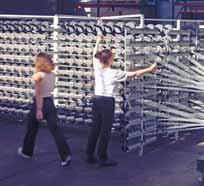
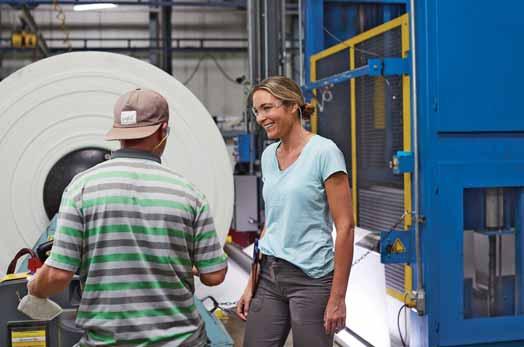
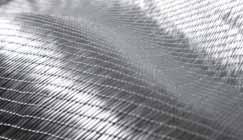
unspun is attacking the traditional bottleneck of downstream apparel assembly with their proprietary manufacturing process, where warp yarn is woven while suspended over a circularshaped core, resulting in a completed 3D woven fabric coming directly off the loom.
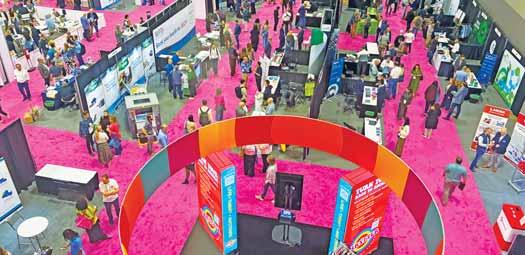
The Synthetic Yarn and Fabric Association (SYFA) event featured presentations, networking and annual tournament.
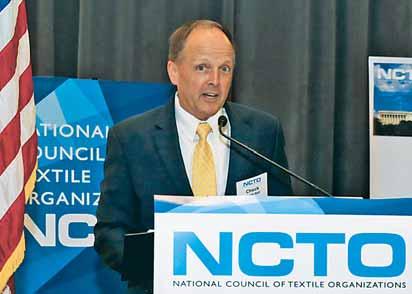
Outgoing NCTO Chairman Chuck Hall outlines the U.S. textile industry’s major challenges and achievements at NCTO’s 22nd annual meeting.
CEO Dr. Andreas Raps outlines growth strategy, portfolio management and sustainability initiatives shaping Freudenberg Performance Materials.
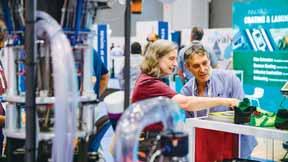
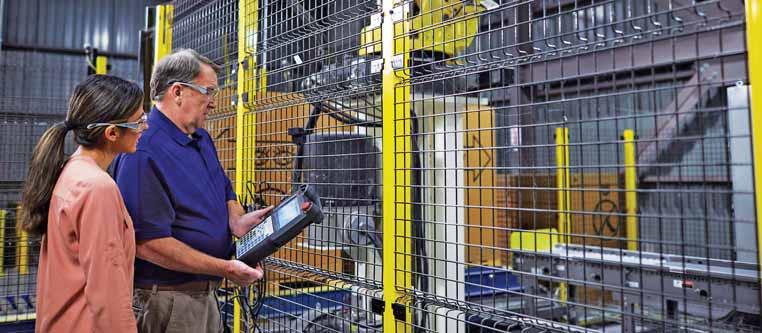
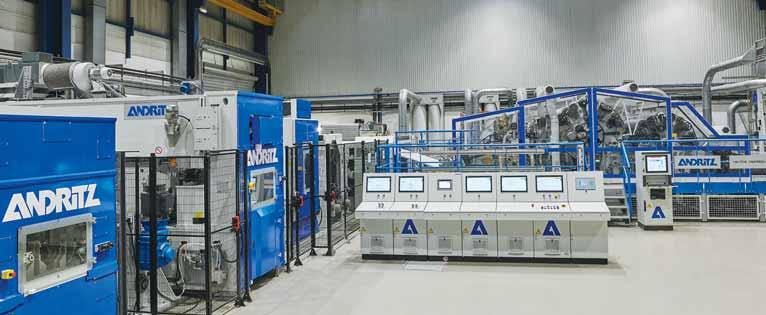
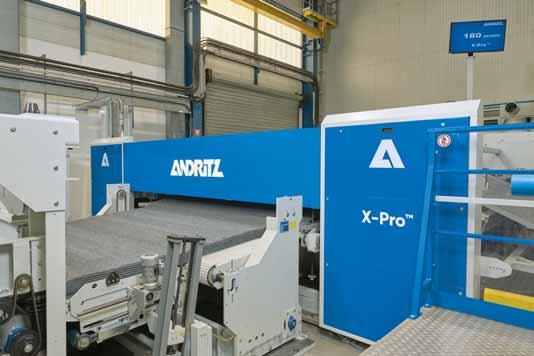
and robotics help textile manufacturers deliver customer value.
(Photo courtesy of unspun)
From Editor
The U.S.Textiles: Stressed
And Strategic
TThe U.S.textile industry has entered 2026 as both a stressed sector and a strategic pillar of the nation’s manufacturing base.
Chuck Hall,president and CEO of Spartanburg,S.C.-based Barnet and immediate past chairman of the National Council of Textile Organizations,makes that case in this issue’s State of the U.S.Textile Industry address (see “2026 State Of The U.S.Textile Industry,”page 12).
His remarks underscore how much is at stake for an industry that employs 453,122 workers and generates $60.9 billion in annual output while supplying critical components to apparel,automotive, industrial,hospitality and defense markets.
According to Hall’s address,the industry delivers more than $1.8 billion in uniforms and textile-based equipment and more than 8,000 textile products each year to the Department of War and the armed forces, including flame-resistant fabrics and advanced ballistic materials tied directly to mission readiness and national security.
Hall doesn’t hold back.He acknowledges that in the past two and a half years,more than 40 U.S.textile plants have closed,many in rural communities built around a single mill.Key indicators weakened in 2025,as man-made fiber,textile and apparel shipments slipped to an estimated $60.9 billion from $63.9 billion in 2024 and exports dipped to $27 billion from $28 billion.Blanket global tariff increases,predatory trade practices, illegal transshipments,customs fraud and logistics breakdowns have stressed the industry more than some could bear.
At the same time,Hall highlights real reasons for cautious optimism.From 2017 to 2024,the industry invested $34.3 billion in advanced domestic manufacturing and
$5.5 billion in new plants and equipment in 2024 alone; and the United States remains the second-largest individual country exporter of textile-related products.
Hall also emphasizes policy gains secured through the National Council of Textile Organizations’engagement with senior administration officials and Congress.
Hall points to other positives,including preserving duty-free treatment for qualifying textile and apparel trade under current trade law.Efforts to safeguard and expand the Berry Amendment requirements — along with a growing emphasis on American-made procurement across federal agencies — reinforce the link between national security and domestic capacity.
Taken together,the themes in Hall’s address amount to both a scorecard and a call to action.The challenge is clear: Policy shifts will only translate into durable advantages if companies continue to invest, engage on policy and adapt to a tougher global playing field.
For senior management throughout U.S.textiles,Hall’s address offers a concise view of where the industry stands,where policy is moving and where strategic decisions in 2026 may matter most.
Policy and politics remain a challenge, but Hall’s remarks suggest real strides have been made that provide U.S.textiles an opportunity to demonstrate its value — and strategic relevance — to the nation’s manufacturing base.
James M. Borneman jborneman@TextileWorld.com
EDITOR IN CHIEF James M. Borneman
TECHNICAL EDITORS Dr. Lisa Parillo Chapman
Dr. Peter J. Hauser
Dr. Trevor J. Little
Dr. William Oxenham
Dr. Behnam Pourdeyhimi
Dr. Abdel-Fattah Seyam
Dr. Andre West
CONTRIBUTING EDITORS Jim Kaufmann
CIRCULATION MANAGER Julie K. Brown-Davis
ADVERTISING BUSINESS MANAGER Denise Buchalter
ART & PRODUCTION MANAGER Julie K. Brown-Davis
OWNER/PUBLISHER James M. Borneman
PO Box 683155, Marietta, Georgia 30068, USA Telephone +678-483-6102 www. T e x t i l e W o r l d .com
ADVERTISING REPRESENTATIVES
UNITED STATES/CANADA Turner Marketing & Media, LLC +864-594-0921 • sturner@textileworld.com
MEXICO, CENTRAL & SOUTH AMERICA Virgilio L. González + 58-412-622-2648 • vlgonzalezp@gmail.com
EUROPE (except ITALY) Sabine Dussey +49-171-5473990 • sabine.dussey@dussey.de
ASIA James M. Borneman +678-483-6102 • jborneman@textileworld.com
INTERNET & CLASSIFIEDS OPPORTUNITIES Julie Davis +678-522-0404 • jdavis@textileworld.com
Arclin Completes Acquisition Of The DuPont™Aramids Business
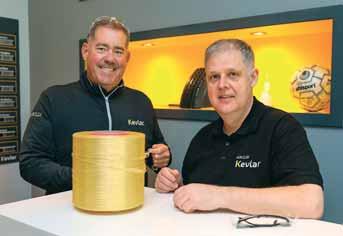
Alpharetta,Ga.-based Arclin has completed its approximately $1.8 billion acquisition of DuPont’s Aramids business,adding the Kevlar® and Nomex® brands and expanding its position in high-performance, life-critical materials.
“Kevlar® and Nomex® are the gold standard … and we are very excited to incorporate the Aramids platform,”said President Mark Glaspey.He said the deal adds manufacturing operations in Europe and Asia and about 1,800 employees,with a focus on operational continuity and investment in innovation.
The combined portfolio now spans aerospace,electrical infrastructure,electric vehicles,personal protection and defense,strengthening Arclin’s reach in advanced protective applications.
“We’re excited to join the Arclin family,”said Aramids Business Unit President Matt Reinhardt, citing expertise in aramid fiber,high-strength, heat-resistant materials.
CEO Bradley Bolduc said,“We’re focused on accelerating what these materials can do across performance-critical uses.”
USFibers Secures Investment To Support Growth, Capacity Expansion
Trenton,S.C.-based USFibers,a recycler and manufacturer of polyester staple fiber,announced a strategic investment from Glisco Partners and Orion Infrastructure Capital (OIC) to expand production capacity,enhance technical capabilities and reach new markets.
Founded in 1994, USFibers operates a vertically integrated recycling and production platform
Arvind Advanced Materials Acquires U.S. Nonwovens Maker Dalco-GFT
Ahmedabad,India-based Arvind Advanced Materials Limited (AAML),a wholly owned subsidiary of Arvind Limited,acquired a nearly 61% stake in Dalco-GFT,a U.S. manufacturer of specialized needle-punched nonwoven fabrics.
Dalco-GFT,established in 1988,operates two facilities in North and South Carolina with combined annual capacity of approximately 75 million pounds.The company serves automotive,industrial,construction and furniture sectors and reported revenue of approximately $100 million in calendar 2025.
“The acquisition of Dalco-GFT marks a transformational milestone in AAML’s growth journey,”said Punit Lalbhai, vice chairman of Arvind Limited.“Through this transaction, we are entering the world’s largest technical textile market — the United States.”
“Our customers can expect the same great service, relationships and product quality they’ve always known,” said Joey Duncan,CEO of Dalco-GFT.
AAML valued the transaction at 7.75 times EV/EBITDA. InCred Capital served as exclusive financial advisor.
that converts post-industrial and post-consumer PET waste into fiber for automotive,filtration and geotextile markets.
“This investment strengthens our capacity, broadens our capabilities and allows us to continue delivering high-quality, customized solutions to our customers,”said Teddy Oh,CEO of USFibers.
“We look forward to this partnership,supporting USFibers’expansion in a market with a growing demand for recycled polyester,”said Ethan Shoemaker,investment partner at OIC.
USFibers will continue operating under existing management.TM Capital served as exclusive financial advisor.
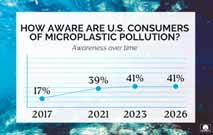
Shoppers Increasingly Aware Of Microplastics, Prioritize Natural Fibers
Cary,N.C.-based Cotton Incorporated released research showing consumer awareness of microplastics has climbed to 41%,up from 17% in 2017,with growing concern about synthetic fibers in clothing.
According to the company’s 2026 Global Sustainability Survey of 1,022 U.S.consumers,59% say they are likely to seek clothing made with microplastic-free fibers.Among those concerned about microplastics,41% consider wearing clothing containing microplastics a major concern.
“Consumers overwhelmingly view cotton as environmentally safe
compared with synthetic fibers,signaling that fiber perception is playing a larger role in how apparel sustainability is evaluated,”said Melissa Bastos,director of corporate strategy and insights at Cotton Incorporated.
Overall,environmental concern stands at 73%,while motivation-to-act sustainably rose to 76% in 2026 from 73% in 2023.
Consumers report taking action including limiting plastic purchases (37%), recycling (27%) and seeking natural materials (12%).However,37% feel overwhelmed by unclear information and 36% are unsure what to do,creating
opportunities for brands and mills to provide clearer guidance on natural-fiber options and anti-shedding innovations.
Cotton Incorporated released research showing consumer awareness of microplastics has climbed to 41%, up from 17% in 2017.
According to the company, unspun technology enables in-season production, reduces excess inventory and can improve margins by 400–500 basis points.
Apparel Brands Back unspun’s U.S. Automated Manufacturing Push
San Francisco-based unspun, backed by more than $50 million in venture funding,has secured letters of support from Walmart and REI to build U.S.-based automated apparel manufacturing hubs using AI-enabled 3D weaving technology.
Supply chain partners Bethel Industries,Peckham and PDS Ltd/ GSC Link will support development with initial production expected in the near term.The proprietary system produces semi-finished garments directly from yarn in minutes,replacing multiple cut-and-sew steps with a single automated process.
“We are not exploring whether domestic apparel manufacturing can work.We are building it,”said CEO Arne Arens.
According to the company, the technology enables in-season production,reduces excess inventory and can improve margins by 400–500 basis points.
“Our customers are proud to buy apparel made in America,”said Avisnash Bhasker,Walmart vice president of apparel production development.
unspun is evaluating U.S.sites and workforce training programs for deployment.
Serving America’s Textile Manufacturers
Non-contact precision spray technology and plasma treatment for sustainable finish applications.
Providing jet, jigger and cold pad batch dyeing machines with IR lab dyeing equipment. Continuous scouring, bleaching, mercerizing and singeing ranges.
Finishing and coating lines for woven and knit fabrics, technical textiles and nonwovens.
Detwisting, opening and web guiding for all fabric constructions.
Textile calenders for softening, lustre change, embossing and recalipering of textile substrates.
Foam generators, in line chemical mixing and blending systems.
Water treatment and water recovery plants in textile facilities.
Fabric surface finishing equipment: napping, sueding and shearing.
Circular knitting machines for apparel, mattress, home furnishings and footwear markets.
Turbotex Scrim Fabric machine.
In line, camera vision systems for on loom, tenter frames, sanforizers, coating/laminating and printing ranges.
Slitting, spooling and rewinding machines. Ultrasonic slitting for loom state and finished fabrics.
Automatic dispensing of powder dyestuffs and liquid chemicals for laboratory, and bulk textile production.
Automated inspection and packaging systems for rolled goods.
Textile Coating ranges, digital, flat bed and rotary screen printing and loop steamers.
For additional information on these companies contact Ian Mills at imills@fi-tech.com.
Techtextil North America Returns To Raleigh In 2026
TTechtextil North America will return August 4-6, 2026, to the Raleigh Convention Center in Raleigh, N.C., bringing together the technical textiles and nonwovens value chain from raw materials through end-use applications. The event will offer a mix of exhibits, education and networking aimed at helping decision-makers track developments across key application sectors.
“Techtextil North America 2026 is shaping up to be one of our most dynamic editions yet,” said Julie Nickel, senior show manager for organizer Messe Frankfurt Inc., based in Atlanta.
“Raleigh places us in the heart of a thriving technical textiles corridor, creating valuable opportunities for connection across the industry.”
Nickel noted that, alongside a strong exhibitor lineup and the returning Symposium and Tech Talks programs, the show will debut the Econogy Sustainability Forum to bring focused conversations on innovation and sustainability to the forefront.
Raleigh Bound
Raleigh provides a fitting backdrop for the 2026 edition. In addition to its role in research and innovation, the
August technical textiles event spotlights education, innovation and networking.
Textile World Special Report
city combines historic neighborhoods and cultural attractions with a growing advanced manufacturing and technology base. It is home to North Carolina State University’s Wilson College of Textiles, reinforcing the event’s connection to workforce development and academic research in textiles.
Twelve Application Areas
The exhibition floor will span 12 application areas, reflecting the breadth of the technical textiles industry. Agrotech covers products for agriculture, horticulture, forestry and landscape use, from crop-protection fabrics to shading and ground covers. Hometech encompasses upholstery fabrics, carpets and curtains for home and contract interiors, while Oekotech focuses on environmental protection, including erosion
control, waste-management textiles, and air and water filtration.
Buildtech highlights materials for construction and architecture such as membranes, awnings, tarpaulins and soundproofing. Packtech addresses packaging solutions including bags, sacks and flexible intermediate bulk containers.
Clothtech covers functional components for clothing and footwear, from interlinings and sewing threads to insulation materials. Geotech is dedicated to geotextiles used in civil engineering for reinforcement, filtration and drainage.
Indutech focuses on industrial applications such as filtration media, cleaning textiles and conveyor belts. Medtech centers on medical and hygiene uses, including surgical gowns, bandages and implants.
Mobiltech covers automotive and aerospace textiles, from seatbelts and airbags to interior fabrics. Protech addresses personal and property protection, including flame-retardant fabrics, bullet-resistant products and high-visibility clothing. Sporttech encompasses sports and leisure, from performance sportswear to equipment covers and sailcloth.
Symposium Sessions
The Techtextil North America Symposium will offer sessions on topics ranging from product development and performance to supply chains and reshoring. Planned sessions include: “Designing Textile-Based Medical Devices: From R&D to Real Use;” “Supply Chain: In the Round;” “Digital Design and Anthropometric Measurement;” “Protective and Military Textile Advancements;” “Designing for Real Performance;” and “Manufacturing/Re-shoring/Nearshoring.” The program is intended to deliver focused information on specific industry topics as well as perspectives on current and emerging market demands, and symposium registrants receive a three-day show-floor pass.
Tech Talks
Complementing the Symposium, the Tech Talks program will provide shorter, solution-focused sessions on emerging technologies, held directly on the show floor to encourage informal discussion and networking. The Start-Up Zone will give early-stage companies a dedicated area to present new technologies and business models to potential partners and customers.
Econogy Forum
Sustainability will also be highlighted through the Econogy Sustainability Forum on Thursday, August 6. The forum will feature two sessions in the Symposium Room: one examining circularity across the span of a textile career and another exploring how natural fibers can be reused and reimagined through technical textiles under the theme “Old to New — Circularity, Use and Reimagining of Natural Fibers Through Technical Textiles.”
Techtextil Innovation Awards
Innovation will be in focus through the Techtextil Innovation Awards, which recognize developments in research, materials, products, applications and technologies. Categories include new concepts, materials, applications, products, chemicals and dyes, recycled materials and recycling technologies, as well as production technology, digitalization and AI solutions.
“We look forward to celebrating the exhibitors whose advancements are elevating performance and pushing the boundaries of what’s possible across the technical textiles and non-
clockwise from upper left: Tech Talks draw diverse audiences; Symposium Sessions offer a wide range of industry-specific topics; the Student Poster Program highlights rising talents; and the annual Innovation Awards recognize new applications and industry solutions.
wovens community,” said Kristy Meade, vice president of Technical Shows for Messe Frankfurt Inc.
Award winners will be selected by a jury of industry experts and announced onsite during the event.
Networking will extend beyond the show floor through the Techtextil North America Reception, offering attendees an additional setting to connect with peers and customers in an informal environment.
Additional events organized by Messe Frankfurt include Texprocess Americas, Texworld events in New York and Los Angeles, and other trade shows in the United States, Canada and Mexico. TW
August 4-6, 2026
Show Floor Opens 8:00 a.m. Raleigh Convention Center 500 S. Salisbury St., Raleigh NC 27601
Tickets &Questions:
techtextil-north-america.us.messe frankfurt.com
Textile Recycling Expo USA Textile Recycling Expo USA Takes Charlotte
Inaugural event addresses pressing topic facing U.S. textiles.
Textile World Special Report
Event organizer Applied Market Information Ltd. (AMI) launched the Textiles Recycling Expo in Brussels, Belgium in 2025, as its first event focused on textile waste, leveraging its long experience in plastics recycling.
Building on the momentum that began in Brussels, the Charlotte Convention Center recently hosted the U.S. inaugural edition.
With 1,858 visitors, 95 exhibitors, and 52 speakers, the inaugural event was met with a diverse group of attendees and visitors engaged in finding connections and information on one of the most popular topics facing U.S. textiles — recycling.
“As organizer of the inaugural Textiles Recycling Expo USA, it was incredible to see the event come to life in Charlotte, with packed sessions, a busy show floor and real momentum across the industry,” commented Isobel Ree, Marketing Manager — Textiles Recycling Expo Portfolio, AMI.
“The quality of conversations and diversity of attendees showed just how committed the sector is to advancing textile circularity.
“It was a proud moment to see the industry come together on one platform, reinforcing just how essential collaboration will be moving forward.”
Opinion From The Floor
Speaker and exhibitor Meredith Boyd, EVP, Chief Product Officer, Greensboro, N.C.-based UNIFI, Inc., shared her views on the Expo: “We were very pleased with the Textiles Recycling Expo in Charlotte to have the opportunity to exhibit and showcase our newest textileto-textile, circular innovations: REPREVE Takeback™ and ThermaLoop™ insulation.
“The turnout was fantastic, and it validated that the industry – brands, mills, designers and developers – are looking for: solutions that are available now, globally and at scale. “
Long-time industry veteran Ludovic Pitrois, North America Sales Director, FIMIC, commented, “Having spent
the last six years in the plastics industry after a career in textiles, attending this inaugural U.S. edition was a particularly insightful experience.
“What surprised me most was the breadth of the technical discussions. I had anticipated a heavy focus on PET, but the curiosity extended across the entire polymer spectrum, including PA, PP and PE.
“Seeing that level of diversification in recycling interest was a very welcome surprise.”
Jessica Franken, Vice President, Government & External Affairs, Alexandria, Va.-based Secondary Materials and Recycled Textiles Association (SMART) made the first presentation on the agenda, stated, “It was a very positive and wellexecuted event; easy to navigate and a great platform to spotlight this rapidly growing area while bringing together a diverse mix of stakeholders across the value chain. The energy was palpable, with strong engagement between traditional textile players and those focused on reuse and recycling.”
Hardy Sullivan, Managing Director, Thies US, LLC, remarked, “Visitors included many people and companies new to me along with representatives based in the region. Awareness of the U.S.’ 17+ million tons per year of textile “waste” is growing, along with state-by-state regulatory initiatives. The Expo showed us that many companies want to either promote their approach or figure out what role to play.”
Adding some perspective, Sullivan added, “In my view, textile recycling is feasible, today, and if done right, it equates to strengthened domestic manufacturing. By turning “waste” into raw materials regionally, as opposed to shipping all used textiles offshore, means we will have raw materials for use by domestic sources, be it in textiles or other industries.
“I believe in the “All of the Above” strategy to recycling. “
Based on the industry’s positive reaction, the next edition of the Textile Recycling Expo USA will return to Charlotte, N.C. on April 7–8, 2027. TW
Jessica Franken, Vice President, Secondary Materials and Recycled Textiles Association (SMART) made that first presentation on the agenda of speakers.
The Synthetic Yarn and Fabric Association (SYFA) event featured presentations, networking and annual tournament.
Textile World Special Report
Officers
PRESIDENT
Chris Schultz, Shakespeare Company
SYFA Officers 2026-2028
Schultz
1ST VICE PRESIDENT
Kim Burton, SpunGold US
2ND VICE PRESIDENT
Celeste Ramsey, Indorama Ventures
SECRETARY/TREASURER
Meredith Boyd, Unifi Manufacturing
IMMEDIATE PAST PRESIDENT
Meredith Boyd, Unifi Manufacturing
PAST PRESIDENTS
Hardy Sullivan, Thies Corporation
Dan Sistrunk, Milliken & Company
MANAGING DIRECTOR
Laura Krulic, SYFA
Directors
Mike Becker, Sapona Manufacturing
Bart Krulic, Palmetto Synthetics
Nikki Brooks, Goulston Technologies
Joshua Sansbury, Fi-Tech
Ted Oh, US Fibers
Mike Hall, Drake Extrusion Inc.
Committees
MEMBERSHIP
John Amirtharaj, Premiere Fibers
Bart Krulic, Palmetto Synthetics
PUBLICATIONS/PUBLICITY/ARCHIVES
Meredith Boyd, Unifi Manufacturing
CONFERENCE
Kim Burton, SpunGold US
SYFA Conference, Networking And SYFA Scholarship
TThe Synthetic Yarn and Fabric Association (SYFA) hosted its Annual Spring Conference April 1-2, 2026, at the Sheraton Charlotte Airport Hotel. The event drew 104 attendees for presentations and networking with industry peers.
Themed “The Fabric Frontier: ‘Our Future in Every Fiber,’” the conference featured presentations by industry notables including Drake Extrusion, Nilit, Syre, Gaston College, S&P Global and Under Armour.
Chuck Hall, president and CEO of Spartanburg, S.C.-based Barnet, offered remarks on the “State of U.S. Textiles.” Hall, the 2025 National Council of Textile Organizations (NCTO) chairman recently addressed the NCTO’s 22nd annual meeting in Washington with the detailed presentation (see “2026 State Of The U.S. Textile Industry,” page 12)
Prior to the conference, the SYFA Fourth Annual Spring Golf Tournament was held at Rocky River Golf Club in Concord, N.C. The event
supports the SYFA Scholarship at Gaston College’s Textile Technology Center, offering technical training to students for careers in textile manufacturing.
“Participation in the Annual SYFA Tournament reflects our continued commitment to the textile industry, as well as our support for educational fundraising initiatives,” said Charlotte, N.C.-based BARMAG President Chip Hartzog.
“This year, we also showcased our new BARMAG branding through a hole sponsorship. Together we enjoyed a beautiful day and greatly valued the opportunity to spend quality time with our industry partners and customers.”
The conference closed with remarks by the new SYFA president, Chris Schultz of Columbia, S.C.based Shakespeare Company. Schultz takes the helm from Meredith Boyd of Greensboro, N.C.-based Unifi Inc. Boyd remains a strong supporter of SYFA and now serves as secretary and treasurer. TW
President Chip Hartzog and General Manager, Services Sales Manuel Wray enjoyed the fourth annual Spring Golf Tournament.
(Left to right): Charlotte, N.C.-based BARMAG members Matt Pierce and Daniel Page, both in Technical Service Sales, with BARMAG
Outgoing NCTO Chairman Chuck Hall outlined the U.S. textile industry’s major challenges and achievements of last year during his “State of the U.S. Textile Industry” address at NCTO’s 22nd annual meeting in Washington.
By Chuck Hall
2026 State Of The U.S. Textile Industry
IIt is a privilege to stand before you and deliver this year’s State of the Industry address on behalf of the U.S. textile industry — an industry that is not simply part of our manufacturing base, but also a strategic pillar of it.
The U.S. textile industry produces components for everything from wearing apparel and automotive interiors to advanced industrial applications; products for our hospitality markets and industrial markets; and our military and defense systems. Our integrated textile and apparel supply chain employs 453,122 American workers and generates $60.9 billion in annual output.
Each year, our industry supplies more than $1.8 billion in uniforms and textile-based equipment to the Department of War. We provide over 8,000 different textile products to our armed forces. From flame-resistant fabrics to advanced ballistic materials, American-made textiles are essential to mission readiness and national security.
A Year Of Historic Wins And Challenges
In 2025, the industry faced significant challenges in response to eco-
nomic upheavals and rapidly evolving trade policy developments.
Sweeping global tariff increases on nearly every country and imported products also triggered uncertainty and injected unpredictabilityinto global markets.
At the same time, predatory trade practices intensified. Illegal transshipments surged. Customs fraud continued. Logistics breakdowns rippled across supply chains.
And in just two and a half years, more than 40 U.S. textile plants have closed.
Let that sink in.
Forty facilities — many in rural communities where a textile mill is the economic backbone — shut their doors. Families were impacted. Communities were shaken.
NCTO’s Leadership In A Time Of Upheaval
Throughout this unprecedented time, the National Council of Textile Organizations (NCTO) initiated a strategic campaign to confront policy threats and elevate the industry’s strategic importance at the highest levels of government.
I’d like to focus some attention on the role NCTO plays in facilitating
access to key policymakers. Access provides opportunities for our industry to impact policy. Without it, there is no way to impact policy.
Thanks to the hard work behind the scenes by NCTO President and CEO Kim Glas, staff and industry leaders, we had access to the most influential administration and White House officials, which helped shape and effect change in this evolving trade environment.
Last year, we had face-to-face meetings with Treasury Secretary Scott Bessent, U.S. Trade Representative, Ambassador Jamieson Greer and Commerce Secretary Howard Lutnick. We also had access to key members of the Department of War and Defense Logistics Agency, and those meetings elevated our industry as a strategic sector and impacted policy. We made national and international news on our de minimis advocacy that closed this disaster once and for all. We played on both the offense and defense. And our voices were heard at the highest levels of the administration and on Capitol Hill. We made a meaningful difference in 2025 and we are positioned well to achieve some of our top priorities in 2026.
Chuck Hall
Before highlighting NCTO’s key policy wins, I want to quickly share a recap of the key data points from 2025 that highlight our industry’s resilience and staying power.
By The Numbers
In 2025, the industry’s key metrics registered slight declines across the board but remained stable relative to major trade and economic disruptions throughout the year. This again underscores the industry’s ability to adapt during challenging times and remain viable even while registering some losses.
Here are a few key industry facts for 2025:
•The estimated total value of U.S. man-made fiber, textile and apparel shipments was $60.9 billion compared with $63.9 billion in shipments in 2024.1
•U.S. exports of fibers, textiles and apparel were $27 billion in 2025 compared with $28 billion in 2024. 2
•From 2017 to 2024, our industry invested $34.3 billion in advanced manufacturing here in the United States.3
•The United States remains the second largest individual country exporter of textile-related products in the world.
•The U.S. textile and apparel industry invested $5.5 billion in new plants and equipment in 2024, the last year for which this data is available.4
Despite weakening in some fundamentals, I remain cautiously optimistic that the industry will once again navigate the disruptions and remain resilient this year.
Several policy wins and significant progress in key priority areas will generate more business opportunities for the industry, and thus provide a basis and foundation for optimism in 2026.
Policy Issues
Through high-level meetings, executive fly-ins, direct engagement with Cabinet secretaries and policymakers on Capitol Hill, as well as sustained grassroots advocacy, we secured a series of major policy wins in 2025 and early 2026.
Let me highlight some of the most consequential wins.
Closing The De Minimis Loophole
No issue defined 2025 more than de minimis.
At its peak, the de minimis loophole allowed 1.4 billion duty-free ship-
2025 EXPORT BREAKDOWN BY REGION
In $ Billions
Source: U.S. Census Bureau, Manufacturers’ Shipments, Inventories, and Orders (M3) Survey, and Annual Survey of Manufacturers (ASM), value of shipments for NAICS 313, 314, 315 & 32522. 2021 data used to estimate 2025 NAICS 32522 figure.
ments — more than 4 million packages per day — to enter the United States unchecked and duty free.
An estimated half of those shipments were textiles and apparel. Many were linked to forced labor, counterfeit goods and fentanyl trafficking. This loophole was the largest backdoor in U.S. trade policy and it was devastating to domestic manufacturers.
NCTO’s sustained advocacy led to a full closure of de minimis for commercial shipments globally through an executive order signed by President Trump, which took effect at the end of August. Our efforts also culminated in the passage of bipartisan legislation codifying the closure of de minimis, effective July 1, 2027.
Exports for U.S. Man-Made Fibers, Yarns, Fabrics, Apparel & Sewn Products only. Raw Cotton & Wool exports excluded.
Source: U.S. Department of Commerce data for Export Group 0: Textiles and Apparel.
These actions have led to a dramatic decline in small package shipments to the United States since the loophole has been closed. They also restored a level playing field, enhanced national security and sent a powerful signal that American manufacturing matters.
NCTO will continue engaging with the administration to ensure this loophole remains closed through every available authority.
2025 EXPORT BREAKDOWN BY CATEGORY
Source: U.S. Department of Commerce and U.S. International Trade Commission.
Securing Western Hemisphere Tariff Exemptions
The administration’s sweeping tariffs in 2025 aimed to rectify unfair trade practices and chronic U.S. trade deficits, and bolster U.S. manufacturing and jobs. While we have long supported the goal of leveling the playing field, there have been unintended consequences associated with these global tariffs.
The implementation of tariffs on nearly every country under the International Emergency Economic Powers Act (IEEPA) in 2025 created massive uncertainty at a moment when our industry was already under strain.
To address this, NCTO launched a focused campaign outlining refinements to the administration’s trade agenda to ensure it strengthens — not inadvertently weakens — U.S. textile producers.
As I noted, we raised concerns directly with Commerce Secretary Lutnick, Treasury Secretary Bessent and USTR Greer — and our engagement led to concrete and meaningful change, and results for the industry
NCTO’s focused engagement with the administration led to an early achievement: an exemption for qualifying textile and apparel imports from Mexico and Canada under the U.S.-Mexico-Canada Agreement (USMCA).
In November, NCTO notched another significant win in securing an exemption from reciprocal tariffs for qualifying textiles and apparel imports from Guatemala and El Salvador under the Dominican Republic-Central America Free Trade Agreement (CAFTA-DR).
The Supreme Court subsequently invalidated the IEEPA tariffs in a decision handed down in February this year; and the Trump administration imposed a sweeping 10 percent global tariff under Section 122 of the Trade Act of 1974.
NCTO’s advocacy and leadership this year in strong support for maintaining benefits for qualified trade can also be credited for the administration’s decision to exempt USMCA qualified trade and most recently CAFTA-DR qualifying textile and apparel imports from the 10 percent global tariff.
Preserving preferential treatment for qualified trade in the Western Hemisphere, which accounts for 70 percent of the U.S. textile industry’s exports, is absolutely critical to the U.S. textile industry and will provide incentives for more companies to onshore even greater production capacity, giving a boost to American textile manufacturers and their workers.
And we continue to engage at the highest levels to gain exemptions for inputs and machinery we don’t make
here. I know NCTO is working on this tirelessly to help our industry get this done.
Protecting The Berry Amendment And Strengthening Defense Procurement
In 2025, we strengthened and expanded defense procurement of American-made uniforms and textiles under the Berry Amendment as we intensified efforts to protect and expand Berry to all federal agencies.
We also fought back efforts by some to erode the Berry Amendment which would have crippled our industry and threatened our national security.
NCTO and more than 30 industry leaders met with the Defense Logistics Agency and the White House Made in America Office in the fall to underscore our strategic importance, and plot together to develop a plan to strengthen contracting procedures and provide certainty to the industry moving ahead. NCTO is in weekly touch with the Department of War to implement a strategic effort to help enable the industry to grow into the future.
In another win earlier this year, NCTO’s dedicated campaign to expand the Berry Amendment to all federal agencies led to the Department of Interior announcing a commitment to prioritize purchasing uniforms and textiles made in the United States.
NCTO is pressing the administration to implement an executive order to extend the Berry Amendment to all agencies that purchase textiles.
In addition, the Fiscal Year 2026 National Defense Authorization Act included robust support for expanding federal investments in the textile industrial base and improving oversight, forecasting and capacity assessments.
Elevating Customs Enforcement Plan
We elevated a customs enforcement plan to combat rampant fraud
as a cornerstone of the administration’s trade agenda.
NCTO continued to press all corners of the government to step up enforcement against China’s and other foreign competitors’ unfair trade practices causing damage to U.S. textile producers, from Uyghur Forced Labor Prevention Act (UFLPA) violations, to false origin claims, to abuse of “de minimis” tariff exemptions.
These efforts included meetings with the Department of Homeland Security and Customs and Border Protection (CBP) leadership.
We outlined the essentials of a customs textile enforcement plan for officials, including robust enforcement of free trade agreement rules of origin; stronger penalties for customs fraud; full enforcement of the UFLPA; and a textile-specific enforcement strategy.
NCTO will keep pushing for greater transparency and accountability in CBP’s enforcement activities, including regular publication of textile enforcement statistics and increased information sharing with the industry.
Unfortunately, we don’t have time to delve into all these important issues, but I do want to emphasize that NCTO remains highly engaged on every policy matter that affects the U.S. textile industry with the intent of shaping policies that directly benefit U.S. textile investment, production and employment.
Please also note that industry leadership and involvement is of paramount importance. From contributions to NCTO’s Textile PAC to arranging congressional visits, the industry makes a difference every day in raising awareness about our important contribution to local and state economies, and the U.S. economy overall.
Looking Ahead
We enter 2026 with many challenges ahead.
The work never ends and the challenges are ever evolving.
In 2026, global competition remains fierce. Policy uncertainty
CAPITAL INVESTMENT
Capital Investment in U.S. Yarn, Fabric, Apparel & Sewn Products Manufacturing – Data in $ Billions
Source: Bureau of Economic Analysis, Investment in Private Fixed Assets, Textile Mills and Textile Product Mills/ Apparel and Leather and Allied Products
remains real. Enforcement gaps remain persistent. But so does our resolve.
The positives are that the administration is focused on a strategy to support domestic manufacturing, and our industry, while showing some cracks, remains incredibly resilient.
The de minimis loophole has been closed, we gained exemptions for qualifying CAFTA-DR and USMCA trade, and we increased our presence in the minds of policy makers.
And we did it together.
References:
These things give us hope that 2026 will see our industry moving forward and becoming healthier.
NCTO’s top advocacy priorities this year include:
•Preserving duty-free treatment for USMCA and CAFTA-DR qualified textile and apparel goods;
•Heighening advocacy aimed at the administration and Congress to secure tariff exemptions for textile manufacturing inputs and machinery not available in the United States;
•Intensifying engagement to protect and expand the Berry Amendment through the National Defense Authorization Act and the House Berry Amendment Caucus;
•Expanding government procurement of American-made textiles and uniforms across all federal agencies; and
• Robust engagement with the administration on customs enforcement to combat rampant fraud.
NCTO and our industry will continue advancing policies that strengthen domestic manufacturing and ensure that the United States remains the global leader in highperformance textiles and advanced manufacturing.
Thank you. This concludes my formal remarks. TW
1U.S. Census Bureau, Manufacturers’ Shipments, Inventories, and Orders (M3) Survey, and Annual Survey of Manufacturers (ASM), value of shipments for NAICS 313, 314, 315 & 32522. 2021 data used to estimate 2025 NAICS 32522 figure.
2U.S. Department of Commerce data for Export Group 0: Textiles and Apparel.
3Bureau of Economic Analysis, Investment in Private Fixed Assets, Textile Mills and Textile Product Mills/Apparel and Leather and Allied Products.
4Bureau of Economic Analysis, Investment in Private Fixed Assets, Textile Mills and Textile Product Mills/Apparel and Leather and Allied Products.
Editor’s Notes: Information contained in the speech was current as of NCTO’s annual meeting. Chuck Hall is president and CEO of Spartanburg, S.C.-based Barnet. He served as the 2025 NCTO chairman. At the 2026 annual NCTO meeting in Washington, Amy Bircher Bruyn, CEO and founder of Brooklyn, Ohio-based MMI Textiles, succeeded Hall as NCTO chair; and Jay Todd, CEO and managing partner of Laurinburg, N.C.-based Service Thread, was elected vice chairman. The North American Industry Classification System (NAICS) is the standard used by Federal statistical agencies in classifying business establishments for the purpose of collecting, analyzing, and publishing statistical data related to the U.S. business economy. NAICS Subsector 313 covers Textile Mills, sub-sector 314 covers Textile Product Mills and subsector 315 covers Apparel.
ExecutiveForum
A Conversation With Freudenberg Performance Materials CEO Dr. Andreas Raps
CEO Dr. Andreas Raps outlines growth strategy, portfolio management and sustainability initiatives shaping Freudenberg Performance Materials.
By James M. Borneman, Editor In Chief
Dr. Andreas Raps
WWeinheim,Germanybased Freudenberg Group is a familyowned company operating in 60 countries, with more than 51,000 employees and 2025 sales of more than 11.7 billion euros,roughly $13.9 billion.
Freudenberg Group’s portfolio includes seals,filtration,technical textiles, specialty chemicals,medical products and cleaning technologies,among others.Freudenberg & Co.KG is Freudenberg Group’s strategic parent company and Freudenberg SE serves as the corporate parent overseeing business operations.
Freudenberg Performance Materials is Freudenberg Group’s specialist in nonwovens and technical textiles.The company reports that it operates 35 locations in 14 countries.
Widely known for Evolon,its proprietary microfilament textile platform used in technical and industrial applications, as well as other branded
technical textile platforms such as Colback,Dripstop, Enka Solutions and Lutradur,Freudenberg Performance Materials develops and manufactures nonwovens and technical textiles for markets including apparel,automotive,building materials, energy,filtration,health care,footwear and specialty applications.
Dr.Andreas Raps was appointed CEO of Freudenberg Performance Materials on Jan.1,2024. He previously held several executive positions at Freudenberg Sealing Technologies,starting in 2004 and most recently as CEO of the global Special Sealing Division,which has 17 manufacturing sites worldwide.
From 2016 to 2024, Dr.Raps was CEO of EagleBurgmann,a joint venture between the EKK Group of Japan and the Freudenberg Group.
Before joining Freudenberg,Dr.Raps worked for management consulting
firms in Boston,Munich and Zurich.He holds an MBA from the University of Passau and earned a PhD in business administration with a thesis on strategy implementation. Dr.Raps has also been a member of the Freudenberg SE Executive Council since 2020.
Recently,Dr.Raps sat down with the editors of Textile World to discuss his vision of Freudenberg Performance Materials’ many innovations,the management of a complex product portfolio and the company’s commitment to future-oriented,sustainable technical textiles.
Textile World : Dr Raps, Freudenberg Performance Materials’size,complexity and international footprint must present significant demands,what do you perceive as the most challenging aspect?
Dr.Andreas Raps: The biggest challenge is finding the right balance between global consistency and
local responsibility.At Freudenberg Performance Materials,we operate worldwide,but our customers and markets are very specific.That’s why we set clear global standards for aspects like quality, safety and performance, while empowering our regional teams to adapt solutions locally.
Secondly,collaboration is critical.We actively connect customers,R&D and Operations early on. Innovation doesn’t happen in isolation.Cross-functional teams and standardized development processes help us turn ideas into reliable solutions.
Finally,our Guiding Principles give us orientation.Principles like Customer Value, Innovation,Responsibility and Long-term Orientation are deeply rooted at Freudenberg and actively lived today. They help us stay stable, adaptable and trusted –by our customers and by our people.
TW : How do you prioritize opportunities across people,products and markets?
Dr.Raps: For us,it always starts with people. We invest strongly in developing our employees and in creating a culture where responsibility,collaboration and entrepreneurship are encouraged.
Our global talent management is very systematic because opportunities only become reality when people are empowered to act.
On the product side, close collaboration with customers is key.Innovation happens when we combine material science expertise with deep application and market understanding.International and cross-functional teamwork ensures that good ideas move quickly from concept to real impact.
In terms of markets, we continuously observe regional trends and emerging applications.Market responsibility is largely decentralized,which allows us to respond fast to local opportunities, while still leveraging the strength and scale of our global network.
TW : Many people speak about innovation,but how do you create and propagate a culture of innovation? How do you support it? What barriers impede it?
Dr.Raps: Innovation at Freudenberg Performance Materials is not a buzzword — it’s anchored in our Guiding Principles
and starts with real customer needs.We empower teams,encourage local decision making, and at the same time connect people globally through ONE FPM.ONE FPM is our shared way of working that breaks down silos and connects people, functions and regions worldwide to focus consistently on customer value and long-term success.
Leadership plays a central role.We lead based on trust,responsibility and clear direction.Cross-functional and cross-regional collaboration is actively supported and manufacturing expertise is an integral part of innovation, from the first idea all the way to industrial scale.
Of course,there are barriers.Our size and complexity can slow things down,so we work continuously on simplifying structures.
Risk aversion can also be an obstacle.We address this by encouraging learning,experimentation and — maybe most importantly — trust.And regarding silo thinking,ONE FPM helps us overcome it.
TW : How do you understand such a diverse product portfolio? How do you manage it and keep each product responsive, or even leading in its respective market segment?
Dr.Raps: We organize our portfolio around customer applications, not around internal technologies.That keeps us close to real market needs.
Every three years,we run a structured strategic planning process,including technology roadmaps. Each product area has clear ownership,a defined strategy and a clear customer value proposition. Application expertise is crucial here.It keeps us connected to the realities of each segment.At the same time,our matrix organization and corporate functions ensure coordination and alignment across the company.
TW : With such a large footprint and capabilities, how do you drive synergies across products and processes within the company?
Dr.Raps: ONE FPM is the central enabler.Shared technology platforms allow us to reuse solutions and accelerate development. Global manufacturing and process standards help
ensure consistent quality and scalability.In addition, joint development projects across sites and structured knowledge transfer are part of our daily work. Corporate functions support this coordination, but real synergies come from people collaborating openly across functions and regions.
TW : How do you stay on top of the future opportunities these products serve and beyond current markets?
Dr.Raps: Our sales teams continuously analyze how customer requirements,applications, and technologies are evolving.We look at new growth markets,strengthen local for local approaches, and advance circular economy concepts. At the same time,we are very disciplined in
Some of the many technical textile solutions by Freudenberg Performance Materials include (clockwise from upper left) Evolon®packing; Tacnera®silicone foam dressings; Dripstop® condensation control; and Filtura®air filtration.
focusing our resources on healthy and promising areas.This means avoiding tying up capacity in markets with declining demand, and freeing up investment for future-oriented solutions.
TW : The manufacture of nonwovens and technical textiles is an intensely technical business.How do developments,refinement of processes and innovation proliferate among Freudenberg’s divisions, sites and members?
Dr.Raps: International collaboration is part of our daily routine.Development expertise is bundled in global development teams, and production sites continuously share best practices under unified quality standards.
Dedicated process engineers run both local and global projects to improve our assets.This ensures that improvements and innova-
driven innovation? Does innovation take many different paths?
Dr.Raps: We aim for a healthy and balanced innovation portfolio.
As said,we develop solutions that are clearly market driven,where we see a concrete customer need and strong longterm potential.At the same time,we are deliberately pursuing technology push approaches,which usually take more time and involve higher risks. They can also lead to strong differentiation.
Netherlands,automated guided vehicles and robotics now handle heavy,repetitive tasks. This improves safety, productivity and product quality,giving people more time for quality critical work.
Overall,we aim to actively shape the market, guided by a strong customer perspective and long-term orientation.
TW : The topic of AI seems to enter every conversation.How will AI impact Freudenberg Performance Materials?
tions are spread across the entire organization.
TW : Dr.Raps,how do you combine the company’s overarching goals with developing a product from concept to market?
Dr.Raps: Sustainability is a good example,and currently a challenging one.
That’s why we focus on applications where sustainability delivers a clear functional and economic benefit.One example is plant propagation systems.
Our nonwoven paper pots are designed to remain in the soil,eliminating removal and disposal steps. They are made from 100% bio-based PLA and wood pulp,without chemical binders,combining functionality,ease-of-use and environmental benefits.
TW : How do you balance internal process innovation with customer-
Our Evolon is a good example of that.It’s a unique microfilament textile that combines extremely fine fibers into a strong,breathable and versatile material for demanding industrial and consumer applications.
Both paths are important.
TW : As a global manufacturer,what challenges lay ahead and how do you strategically prepare for them?
Dr.Raps: Sustainability is a major challenge.Our goal is CO2 neutrality by 2045,which requires further development of our energy-intensive processes,reducing energy consumption and transitioning to green energy.
Digitalization and automation are another key area.We focus on replacing safety-critical and ergonomicallydemanding tasks,scaling successful solutions globally.
For example,at our Emmen site in the
Dr.Raps: I see AI as a strategic enabler.It can make processes more efficient,sharpen demand analysis and accelerate innovation.But AI must be implemented responsibly. People development is at the core.We qualify our employees to use new technologies effectively.
TW: How do you foster the company’s commitment to future-oriented,sustainable technical textiles?
Dr.Raps: Sustainability is deeply rooted in our values and history.Today,it is firmly embedded in our strategy and increasingly demanded by our customers. Dedicated structures like our sustainability governance ensure that this commitment is translated into concrete action across the organization.
Our goal is to enable our customers to meet their own sustainability responsibilities through high-performance materials. TW
Engaging with clients is key to Freudenberg Performance Materials’ CEO Dr. Raps for building a clear customer value proposition.
Building A Smarter Textile Enterprise With Building A Smarter Textile Enterprise With AI And Automation
TThe textile industry is one of the oldest in the world, dating back to the late 1700s. It has survived centuries of transformation with each new wave of technology and now stands at another inflection point. As AI, automation and robotics reshape production, legacy manufacturers that want to remain competitive must be willing to rethink how they operate.
As customer expectations for quality, performance and lead times continue to evolve, digitalization and AI can no longer be viewed as optional or experimental. Companies that treat data as a core business need — rather than a passing trend — will be the ones best positioned for long-term success.
One of the most common misconceptions about automation is that it exists solely to replace jobs. In reality, the goal of digitalization in the textile industry is to empower teams and deliver enhanced value to customers. By embedding data analytics into operations, manufacturers can accelerate operational feedback loops, make better decisions and deliver better products with significantly less scrap.
In the end, this new era in the textile industry is about unlocking real business value. By strategically integrating AI models, robotics and sensors, manufacturers can elevate
AI, automation and robotics help textile manufacturers boost quality, cut waste and deliver customer value.
By Marcio Manique
product quality, increase asset reliability, enhance workplace safety and empower the next generation of industrial workers.
Elevating Quality And Precision In Production
Maintaining consistent textile product quality has historically been a subjective task. Key processes like fabric inspection, color matching and dye development have relied almost entirely on the human eye. However, relying on the human eye adds some variables, like differences in color perception or visual acuity, which can make an already complicated process even more so. While human judgment is still needed, relying only on manual visual inspection for highvolume production is tiring and can lead to mistakes that waste materials.
To solve this, leading manufacturers are turning to AI to enhance human oversight. During a typical shift, a team member may visually
inspect three to five miles of fabric. Today, camera systems paired with AI software can support this work by monitoring fabric in real time. Trained to detect specific defects, AIsupported systems can flag issues automatically and consistently. Unlike the human eye, these systems apply the same level of detection every time, regardless of fatigue or differences in vision. Because the software builds a comprehensive catalogue of defects, it can also help determine the most efficient way to parse out flaws and piece the fabric back together.
Similar technologies can also enhance decision making in color matching and the dye development processes. By digitizing visual inspection and color analysis, facilities can ensure greater specificity and significantly reduce scrap material. Automating these tedious tasks allows manufacturers to move workers to more satisfying roles, which makes the experience better for everyone involved and results in a better product.
Shifting From Reactive To Prescriptive Maintenance
While AI transforms finished goods inspection, it is equally beneficial for maintaining the complex machinery that produces textiles. Asset reliability is critical, especially
since unplanned equipment breakdowns can typically cost about three times as much as planned maintenance. Adding to this challenge is the ongoing labor shortage of specialized trades like electricians and maintenance technicians.
Prescriptive maintenance programs help address these risks. By equipping machinery with sensors that monitor critical operating data like temperature, pressure and vibration, data can be fed into AI models around the clock. Once a baseline for normal operation is established, the system can quickly detect unusual behavior and flag potential issues well before they escalate into failures.
Instead of reacting to costly breakdowns, plant managers can use AI insights to proactively plan repairs and schedule downtime around limited technical resources. This reduces unplanned disruptions and supports consistent output and overall efficiency.
Redefining Workplace Safety And Ergonomics
As experienced workers retire, the manufacturing sector is undergoing rapid change. By 2033, up to 3.8 million manufacturing jobs are expected to be needed, with as many as 1.9 million potentially going unfilled. As new hires who have never worked in manufacturing enter the industry and learn how to navigate complex, fastmoving environments, safety training and monitoring become increasingly important.
To support this transition, many facilities are using AI to enhance workplace safety. By layering AI software onto existing security camera systems, AI models can be trained to recognize established safety protocols. These tools can identify situations where personnel get too close to moving equipment or are missing required personal protective equipment (PPE), like high-visibility vests.
The goal is not surveillance, but insight. For example, if an AI system detects a spike in missing high-visibility vests in a specific warehouse zone, team leaders may discover that
outside delivery drivers are overlooking protocols. Plant leadership can then address the root cause without placing blame on the factory floor.
Beyond AI-supported safety monitoring, introducing robotics into material-handling operations reduces ergonomic risks associated with tasks
lenges and redeploy talent to dynamic roles. AI can also help preserve institutional knowledge. Digitizing decades of operational data can help teams quickly search and reference past insights, bridging the gap between retiring experts and the next generation of workers.
Ultimately, investing in digitalization is about building more efficient operations that empower the next generation of industrial workers to do their best work and deliver increased value to customers.
like moving heavy rolls, loading equipment and transporting materials, helping prevent injuries while improving efficiency.
Empowering The Workforce And Weaving The Path Forward
Discussions about robotics in manufacturing often come with underlying assumptions and “automation anxiety.” However, employees who work alongside these technologies quickly see the benefits, including reduced physical strain, improved safety, and more efficient workflows.
By automating repetitive tasks like manual fabric inspections and heavy lifting, textile manufacturers can better address persistent recruiting chal-
As data costs decrease and technologies continue to advance, textile manufacturers must adopt a practical test-and-learn approach to assessing new technologies. Evaluating tools on a small scale to prove their business value before broad rollouts allows teams to validate business impact and embrace adoption with confidence. Ultimately, investing in digitalization is about building more efficient operations that empower the next generation of industrial workers to do their best work and deliver increased value to customers. TW
Editor’s Note: Marcio Manique is executive vice president & managing director, apparel, at Milliken & Company.
Fiber World
UNIFI®, Makers of REPREVE®, introduces Luxel™: a linen-inspired, easy-care performance yarn
Greensboro,N.C.-based Unifi Inc.,maker of REPREVE recycled yarn, announced the launch of Luxel,a yarn technology that combines the look and feel of linen with performance features and recycled materials.
Luxel captures the natural look and feel of linen while offering moisture-wicking, wrinkle resistance and odor control.The technology is built into the yarn and is
suited for apparel,footwear, home furnishings,workwear and accessories.
Luxel is made with REPREVE recycled polyester yarn,including 30% REPREVE Takeback,which incorporates textile waste.
“We developed this yarn to provide designers and manufacturers with a product that delivers the premium look and tactile appeal of linen but delivering on enhanced benefits of easy care,durability and sustainability,”said Eddie Ingle,CEO of UNIFI.
Americhem Launches PFAS-Free Technology For Functional Fibers
Cuyahoga Falls,Ohio-based Americhem Inc.announced the launch of nDryve,a PFAS-free,in-melt surface-modifying technology platform designed to deliver durable multi-fluid repellency against alcohol and other low-surface-energy fluids in fiber systems.
As global regulations accelerate the phase-out of per- and polyfluoroalkyl substances (PFAS),manufacturers face pressure to maintain barrier performance without fluorinated chemistries. nDryve integrates directly into the polymer during melt processing,embedding surface-modifying functionality within the fiber matrix rather than relying on removable finishes.
“Evolving global PFAS regulations are reshaping how manufacturers evaluate barrier and surface performance technologies,”said Matt Miklos,vice president of corporate strategy and marketing at Americhem.“nDryve provides a PFAS-free pathway that aligns performance with emerging regulatory expectations.”
The technology is optimized for polyolefin and engineering fiber systems including PP,PET and PA6 for applications such as medical fibers,apparel,hygiene materials and industrial protective fabrics.
Barmag Huitong Makes PA6 Direct Spinning Economically Viable
Remscheid,Germany/ Yangzhou,China-based Barmag Huitong (Yangzhou) Engineering Co.Ltd.,a subsidiary of Barmag,commissioned the first continuous polymerization plant for polyamide 6 in China’s Zhejiang province.
Teijin Frontier Develops Stretch Polyester Yarn
Tokyo-based Teijin Frontier Co.Ltd.announced it has developed a stretch polyester yarn offering compatibility with high-performance polyester materials for sports and outdoor wear. According to the company,its proprietary polymer design and spinning technology impart elasticity to the yarn,adding stretchability and recovery to high-performance polyester materials.The yarn’s elasticity derives from polymer design and spinning control technology rather than yarn structure,providing soft stretchability and shape stability with recovery comparable to polyurethane-based elastic fibers.
The yarn enables development of 100% polyester textiles that maintain advanced functions including moisture absorption,quick drying and durable water repellency. The all-polyester composition also simplifies recycling.
Teijin Frontier plans to combine the yarn with high-performance polyester materials in textiles for sportswear,casual wear and innerwear.The company will begin selling to domestic and overseas markets in 2027,targeting annual sales of 100,000 meters in fiscal 2027 and 500,000 meters in fiscal 2029.
Following a construction and commissioning phase, the plant began production at the end of 2025.According to the company,20 metric tons of high-quality polyamide 6 are produced daily with significantly reduced energy consumption.The material is processed into filament yarn for textile applications via a direct spinning facility. The joint venture between German chemical fiber plant manufacturer Barmag and Chinese chemical plant specialist Huitong has further developed the classic two-reactor technology,making it competitive and establishing the concept as an option for future PA6 direct spinning.Barmag Huitong Engineering is working on process and equipment innovations to increase plant efficiency while promoting sustainable development of the nylon industry chain. TW
ExecutiveForum
With Arclin’s recent acquisition of the DuPont™aramids business complete, Arclin CEO Bradley Bolduc and President Mark Glaspey share their fresh perspective on shaping the future of Kevlar®and Nomex®.
A New Steward Steps In: Arclin’s Vision For Kevlar®And Nomex®
FFounded in 1992 and headquartered in Alpharetta,Georgia, Arclin is a privately held materials science company focused on advanced polymer technologies and engineered materials for demanding industrial and performance-driven applications.
With Arclin’s April 1 acquisition of the DuPont™ aramids business complete, Arclin CEO Bradley Bolduc and President Mark Glaspey are carving a fresh path forward for the iconic Kevlar® and Nomex® brands.While the acquisition marks Arclin’s entry into the textile industry, they say it represents a natural continuation of the company’s focus on performance materials, innovation and missioncritical applications.
Bradley Bolduc joined Arclin in 2012 and served across nearly every facet of the business before taking the helm as CEO in 2021.
Beginning his career in specialty chemicals,he brings a molecular-level approach to innovation, grounded in firsthand experience turning new technologies from concept into real-world applications. Under Bolduc’s leadership, Arclin has evolved into a diversified,global materials science company that serves customers across a range of end markets,including construction and building materials,industrial, personal protection,aerospace,defense, automotive and EV,pharmaceuticals and agriculture.
Mark Glaspey joined Arclin in 2002,beginning in technical sales and applications before progressing through senior leadership roles spanning manufacturing,operations and business execution.Appointed President in early 2026 after serving as Chief Operating Officer,Glaspey brings nearly 25 years of institutional knowledge and a
deep understanding of how innovation,reliability and customer trust intersect in complex materials businesses.
With the aramids acquisition behind them, Arclin enters the textile industry as the steward of two of the most renowned performance fiber brands in the world.In conversation with Textile World , Bolduc and Glaspey share how Arclin’s history,leadership philosophy and longterm investment mindset are shaping the future of Kevlar® and Nomex®
Textile World : Arclin may be new to textiles,but it is not new to performance materials.How do you describe Arclin to a textile audience that may be encountering the company for the first time?
Bradley Bolduc: At its core,Arclin is a materials science company.We design and manufacture polymer technologies,engineered
products and specialized materials that go into applications where performance truly matters and failure isn’t an option.What differentiates us is that we don’t just supply base chemistry — we tailor molecules,formulations and material systems specifically for how our customers need to use them.
That approach has allowed us to build long partnerships across industries,because we enable our customers’products to perform,last longer and deliver greater value.While textiles is a new industry for Arclin,performance is not new territory for us. Aramids fit naturally into our portfolio because they sit at the intersection of chemistry,processing and mission-critical application, which is where we feel right at home.
TW : Arclin has had several major acquisitions over the past few years, including The Willamette
Textile World Special Report
Bradley BolducMark Glaspey
meet modern protection and durability demands.
We believe the aramids brands are ready for their next chapter.As a private company,we can take a longer-term view.We can reinvest in innovation, modernize operations and expand applications thoughtfully.That ability to be patient and to invest through cycles is critical when you’re responsible for materials that are this vital.
and market needs.The goal is thoughtful enhancement and advancement rather than disruption.
TW : Those familiar with Arclin often speak of innovation,how does your chemistry background influence how the company approaches innovation?
Valley Company,Polymer Solutions Group and now DuPont’s aramids business.How does Arclin evaluate and integrate acquisitions?
Bolduc: Arclin has been a growth compounder for a long time.We’ve delivered over 15 consecutive years of organic EBITDA growth and that doesn’t happen by accident.It comes from
property,critical end-use performance,global relevance and the opportunity to invest and innovate over the long term.For us,this wasn’t diversification for diversification’s sake.
TW : Why acquire the aramids business now?
TW : The DuPont™ aramids business — the Kevlar ® and Nomex ® brands — have such a rich legacy,how do you approach continuity?
Mark Glaspey: Continuity is foundational. These brands carry decades of trust and our responsibility as stewards is to preserve what makes them successful while ensuring they remain competitive
“Arclin’s culture is built around innovation, discipline, and stewardship. We’ve compounded growth for more than 15 years by staying true to that DNA, and we plan to bring the same mindset to aramids.” — Bradley Bolduc, CEO, Arclin
being selective,from understanding how different technologies fit together and from having the discipline to say no when something doesn’t align. That same discipline guided our approach to the aramids business.We don’t view Kevlar® and Nomex® as standalone acquisitions or legacy products; we see platforms with significant runway.They check all our boxes: strong intellectual
Bolduc: We’re seeing renewed emphasis across industries on materials that protect people,assets and systems — asking them to go further and last longer.Aramids are category-defining materials in that regard,and decades after their introduction they continue to play an indispensable role.Today, platforms like Kevlar® EXO™ underscore how the category continues to evolve,bringing more tailored,applicationspecific performance to
for the future.From day one,our focus has been on operational continuity by maintaining manufacturing reliability,quality and customer relationships across a truly global footprint.
At the same time,continuity does not mean standing still.We are investing in manufacturing capabilities, process discipline and innovation infrastructure so that these brands can rise to meet increasing consumer
Bolduc: Our team recognizes that meaningful breakthroughs don’t happen overnight and that getting from ideation to commercialization requires patience,technical rigor and continued investment. For me,innovation is hands on.It’s about understanding the chemistry,the processing challenges and how materials behave in real world systems. That perspective guides how we allocate both time and capital.We’re willing to invest early,take a long view and support ideas through their full development cycle.
TW : Can you give an example of the process within Arclin?
Bolduc : Arclin Firepoint® is a good example. We spent nine years developing and refining the proprietary technology behind this sheathing because,as wildfire zones expand and families seek greater protection,we saw an opportunity to deliver a product that could meaningfully slow the spread of flames and help save lives.While most fire-resistant sheathing is rated for up to 60 minutes,Firepoint exceeds
Arclin CEOBradley Bolduc joined Plant Manager Sean Godfrey on a site tour in Maydown, Northern Ireland this spring.
that benchmark with a 90-minute rating.If we were overly focused on short-term returns, this product simply would not exist.
Being a private company helps enormously in this regard.We’re not managing to quarterly optics,so we’re
Bolduc: Anywhere performance and protection matter.That includes established applications, but also emerging use cases driven by higher expectations around durability,safety and reliability.We’re seeing opportunities where lightweight
TW : Mark,how does Arclin work with customers to translate their needs into applications?
Glaspey: Collaboration is critical here.Materials only deliver their full value when they can be effectively integrated into products and manufactur-
“Aramids are not static materials. There is real opportunity to advance them, not just at the molecular level, but in processing, form factors, and application.” — Mark Glaspey, President, Arclin
able to build platforms that compound value over years and decades.
TW : How does that philosophy apply to Arclin’s approach to aramids?
Glaspey: It translates into balance.Innovation must be paired with execution.Our responsibility is to ensure that advancements are scalable, repeatable and reliable for customers who depend on these materials every day. That means disciplined operations,rigorous quality systems and close collaboration with customers across the value chain.
Aramids are not static materials.There is real opportunity to advance them,not just at the molecular level,but in processing,form factors and application.Our role is to create an environment where that evolution can happen consistently and responsibly.
TW : Where do you see the most significant opportunities for innovation with aramids?
strength,thermal performance and resilience open doors to applications that didn’t exist or weren’t viable before.
What excites me is that these materials still have enormous room to grow. Advances like the next generation of Kevlar® EXO™,which is 30-40% stronger than legacy Kevlar®,much lighter, and able to be woven in a way that allows for maximum flexibility and softness while delivering unmatched thermal protection properties. We believe this is a game changer for the industry and a great example of what’s possible when you continue to invest in core technology: new generations of the“tried and true”that are bigger and better than the previous. If that wasn’t enough, we also are focused on remaining best-in-class when it comes to working with customers on application development.This is where our people and industry know-how never disappoint.Stay tuned!
tant for customers serving international markets.
TW : Finally,what message would you like to share with the textile community as Arclin begins this new chapter?
ing processes.Our teams work closely with customers to understand their requirements,constraints and long-term objectives.
Bolduc: First and foremost,we’re here for the long term.We respect the legacy of Kevlar® and Nomex® and we’re committed to investing in our combined future.These are not finished technologies; they’re evolving platforms with enormous potential.
Arclin believes Nomex®, alongside Kevlar®, are materials that still have enormous room to grow.
That partnership mindset has been core to Arclin for decades and will continue to guide how we support the aramids business.
Because we operate globally,we’re also able to bring consistent standards and support across regions, which is especially impor-
Arclin’s culture is built around innovation,discipline and stewardship.We’ve compounded growth for more than 15 years by staying true to that DNA and we plan to bring the same mindset to aramids.We’re excited to work alongside the textile industry,learn from you and help advance what these materials can do for years to come. TW
Dyeing,Printing & Finishing
Monforts Unveils Interactive Digital Platform For Finishers
Mönchengladbach,Germany-based Monforts launched a digital platform designed to give textile manufacturers access to the company’s finishing technologies,technical expertise,and aftersales support worldwide.
A key feature is a series of interactive 3D tours covering the company’s principal technology ranges.Visitors can virtually explore the latest MONTEX stenter lines, MONFORTEX sanforizing systems and THERMEX continuous dyeing technolo-
UK Defense Textile Collaboration Formed
By Pincroft, Toray Adlington,UK-based
Pincroft Dyeing & Printing and Toray Textiles Europe Ltd.announced a collaboration to supply printed woven technical textiles for the UK defense sector.Both companies are established suppliers to NATO military programs.
gies,as well as coating options and exhaust air cleaning modules.
The platform streamlines interaction with existing customers.Ordering spare parts and arranging service support can be initiated directly via a simplified contact tool,ensuring rapid routing of inquiries to specialists.
“Our new digital platform developed with a focus on usability and accessibility,” said Nicole Croonenbroek,marketing manager at Monforts.“It allows customers to engage with our technologies and experts, making essential services such as spare parts and technical support easier to access.”
Strategically located in northwest England,Pincroft operates one of Europe’s largest fully integrated textile processing, printing and finishing facilities.Exporting to more than 80 countries with annual production capacity exceeding 50 million meters, the company has built a reputation in military printing and flame-retardant finishing.
Toray Textiles Europe Ltd.specializes in weaving,dyeing and finishing of
synthetic fiber textiles across defense,medical, and industrial applications. The company recently invested more than £15 million in advanced looms and process machinery.
“Leveraging our combined expertise and innovation,alongside our UK-based operations and supply chains,Pincroft and Toray are well placed to support the shared goals of strengthening national security,driving economic growth and improving sustainability,”said Paul Farrell,group sales director at Pincroft.
“This collaboration supports employment across the manufacturing sector and helps build a resilient domestic supply chain,”said Paul Daynes,sales manager at Toray Textiles Europe Ltd.
AATCC Stain Release Replica Now More Sustainably Manufactured
Durham,N.C.-based American Association of Textile Chemists and Colorists announced advancements to the AATCC Stain Release Replica,the tool used to evaluate a fabric’s ability to release stains from corn oil (AATCC TM130) and household soils (AATCC TM215).
The AATCC Stain Release Replica evaluates a fabric’s ability to release oily stains after home laundering or household soils during home laundering.In AATCC Test Method 130,an oil stain is applied to fabric,weight is applied,and the fabric is washed using standardized home laundering conditions.In AATCC TM215,household stains including red wine,ketchup,mustard,coffee, and grape juice are applied to fabric,weight is applied,and standard laundering is conducted. Recent advancements have allowed AATCC to reduce adhesives and paper used in manufacture.The replica is now produced using a direct printing method,reducing paper and adhesive materials while maintaining the same consistent five-point rating scale.
Malmö,Sweden-based Polygiene announced the launch of Polygiene OdorCrunch2.0,a next-generation odor capture technology designed to reduce odors in apparel and textiles through a nonmetal capture mechanism.
Building on the original Polygiene OdorCrunch technology,OdorCrunch2.0 delivers enhanced odor absorption performance across a wider range of fabrics,including lightweight 100% polyester,blended constructions and natural fibers.The technology captures environmental odor molecules within the textile structure, preventing them from being released during wear.
Polygiene OdorCrunch2.0 is heavy-metal free and uses an odor capture mechanism that retains odor molecules without compromising fabric comfort,breathability, appearance,or performance. The technology can be integrated into existing finishing processes,including padding and exhaust application methods. According to the company,OdorCrunch2.0 provides high odor reduction in accordance with ISO 17299-3.The technology is suited to textile items that are not easily or frequently washed,such as garments requiring dry cleaning or specialist care.The technology contains no heavy metals,no PFAS and its biodegradability properties are under testing. TW
Pincroft’s new Zimmer Rotascreen TG
Nonwovens / TechnicalTextiles
Fire-Dex AeroFlex Turnout Earns UL Particulate Verification
Medina, Ohio-based Fire-Dex announced that UL Solutions verified particulate ingress results for its AeroFlex turnout system under UL Verification 1641. The verification confirms performance to NFPA Particle Inward Leakage testing requirements when the ensemble is worn in a specific configuration.
DimensionPolyant Launches X-Pac hyperTEC Fabric Series
Putnam, Conn.-based Dimension-Polyant introduced X-Pac hyperTEC, a family of advanced performance fabrics engineered for mountaineering, climbing, skiing and bikepacking applications.
AeroVent® technology allows sweat vapor to escape without letting heat inside.
“Particulate barriers in pant/coat interfaces add protection from contaminants, but the trade-off is that they can limit breathability,” said Todd Herring, vice president of product innovation and strategy at Fire-Dex. “AeroFlex is designed differently, with vents that help hot air escape from inside turnouts but that also keep particulates out.”
The evaluated configuration included the AeroFlex coat with a properly engaged self-contained breathing apparatus (SCBA), along with AeroFlex pants equipped with the optional particulate-blocking barrier. According to UL Solutions, testing reported less than 1 microgram exposure on the wearer across the ensemble.
The AeroFlex turnout system places VaporLite breathable composite panels where heat and sweat concentrate and integrates AeroVent Technology to move warm humid air outward under pressure with an integrated particulate-blocking element.
Aiken, S.C.-based AGY, a global supplier of specialty glass fiber reinforcements, and Saerbeck, Germany-based SAERTEX, manufacturer of multiaxial non-crimp fabrics, announced a joint development focused on using AGY’s high-strength S-2 Glass fiber in SAERTEX engineered non-crimp fabric architectures.
The collaboration combines AGY’s S-2 Glass reinforcement with SAERTEX’s tailored multiaxial NCF technology to deliver lightweight, high-strength composite solutions for aerospace, defense, industrial and advanced mobility applications.
SAERTEX non-crimp fabrics are designed with precisely aligned fiber orientations and optimized surface weights to maximize load performance while reducing component weight and layer count.
“Combining S-2 Glass with SAERTEX’s advanced multiaxial fabric design enables lightweight solutions that can compete in applications traditionally reserved for
AGY S-2 Glass non-crimp fabric using SAERTEX USA production process.
higher-cost materials,” said Patrick Hunter, chief commercial officer and president of AGY.
“The integration of AGY’s S-2 Glass fiber allows us to offer customers enhanced mechanical performance while maintaining the processing advantages of non-crimp fabrics,” said Christian Beckmann, CEO of SAERTEX.
The companies are qualifying multiple multiaxial constructions for structural composite applications.
“What sets X-Pac hyperTEC fabrics apart is their high-modulus fiber architecture,” said Taylor North, Dimension-Polyant global head of technical fabrics. “Using advanced fibers allows us to produce laminates that are ultra-light and have a tremendous strength-to-weight ratio, while maintaining the durability and reliability that X-Pac is known for.”
X-Pac hyperTEC fabrics are built with highmodulus fibers, advanced reinforcement and technical constructions engineered for resilience and optimized load paths. The company’s lamination technology delivers stable fabrics at lightweight specifications with inherent waterproof performance.
X-Pac hyperTEC UX fabrics are made with a 100% Ultra-PE (UHMWPE) face fabric and Ultra-PE X-PLY reinforcement. The series includes UX10 (82 grams per square meter), UX10 ST (122 grams per square meter), and UX20 ST (154 grams per square meter), each engineered for different performance and durability requirements. TW
Global Needlepunch Nonwovens Market Outlook
GGlobal nonwoven technology provider ANDRITZ reports the needlepunch nonwovens market as stable, supported by diversified end-use demand and infrastructure investment.
In the following report, Austriabased ANDRITZ outlines the market forces, application trends and technology developments influencing capital investment and competitiveness.
ANDRITZ Reports
The global market for needlepunch nonwovens continues to demonstrate strong structural resilience, supported by the technology’s exceptional versatility across a wide range of applications, including geotextiles, filtration, automotive interiors, synthetic leather, insulation and technical felts. Unlike single-segment textile technologies, needlepunch benefits from highly diversified end markets, each following its own investment and demand cycle. This diversity provides a natural buffer against economic volatility.
After a short slowdown in early 2020, the market strongly recovered until the third quarter of 2023, driven by infrastructure investments and renewed industrial activity across
ANDRITZ perspective
on demand drivers, regional developments and technology innovations shaping investment decisions.
World Special Report
Europe, North America and Asia. While 2024 has been a more cautious investment climate due to geopolitical tensions and inflationary pressures, the medium- and long-term outlook for 2025 and 2026 remains positive, supported by fundamental market drivers.
Regional Dynamics Shaping Demand
Europe and Turkey remain mature but strategically important markets, driven by high value-added applications such as automotive interiors, technical geotextiles, filtration media and specialty industrial felts. Investments in these regions are primarily aimed at productivity improvements, quality differentiation and energy efficiency rather than pure capacity expansion. Turkey, in particular,
plays a pivotal role as a competitive manufacturing and export hub, bridging European quality standards with cost-efficient production and strong access to regional and international markets.
Asia remains the strongest growth engine for needlepunch nonwovens, driven mainly by filtration, synthetic leather and stitch-bonded applications. This region benefits from strong domestic consumption, industrialization and export-driven manufacturing strategies, supported by strong financial assets and enabling multiple line investments.
Emerging regions such as the Middle East and parts of Central Asia are also gaining importance, supported by infrastructure development and growing interest in building local nonwoven production capabilities. In North America, renewed momentum can be observed in automotive applications, such as wheel arch liners and infrastructure-related geotextiles, where reshoring strategies and supply-chain security are influencing investment decisions.
Globally, demand growth is driven by infrastructure spending, environmental regulations, lightweight construction trends and the increasing use
Textile
Needlepunch technical center, located in Elbeuf, France
of recycled and bio-based fibers, applications where needlepunch technology offers clear technical advantages.
Investment Trends: Productivity, Quality And Flexibility
Despite a more cautious macroeconomic environment, nonwovens producers continue to invest in new machinery and line upgrades. Importantly, many recent projects represent net capacity additions rather than simple replacement investments, reflecting confidence in longterm demand.
Investment decisions are increasingly driven by fast ROI, low total cost of ownership, improved surface quality and web evenness, higher productivity with reduced mechanical stress and greater process flexibility. As needlepunch lines represent significant CAPEX, investment processes are becoming more structured and data-driven, relying on extensive feasibility studies, simulations and trials at technical centers.
Service capabilities also play a decisive role. Remote support, rapid spare-parts availability, retrofit solutions and process expertise are increasingly valued, particularly in the context of workforce turnover and skills shortages.
Key Applications Driving Investments
Geotextiles remains one of the largest and most stable application segments for needlepunch nonwovens, supported by global infrastructure projects, urbanization, road construction, erosion control and drainage systems. This cost-sensitive market demands high-output lines up to 2,000 kg/hour and advanced weight regulation systems, to maintain competitiveness.
In Asia, filtration media and synthetic leather remain key drivers of needlepunch investments. Stricter environmental regulations and sustained industrial growth continue to support demand, while synthetic leather applications increasingly rely
Executive Summary: Needlepunch Outlook
By Guillaume Julien, ANDRITZ Global Director Sales for Engineered Textiles
The global needlepunch nonwovens market demonstrates strong resilience, underpinned by its versatility across diversified applications such as geotextiles, filtration, automotive interiors, synthetic leather, insulation and technical felts. This diversity provides a natural hedge against economic volatility and supports long-term market stability.
Following a strong recovery through 2023, driven by infrastructure investments and renewed industrial activity, 2024 has seen a more cautious investment climate influenced by geopolitical tensions, inflation and energy costs. Nevertheless, the medium- and long-term outlook remains positive for 2026 and beyond.
Regional dynamics continue to shape demand. Asia stands out as the primary growth engine, driven by filtration, synthetic leather and industrial applications, while Europe and Turkey remain mature but strategically important markets focused on productivity, quality differentiation and energy efficiency. In North America, reshoring
on advanced needling patterns and precise batt formation to achieve high surface quality, uniformity and mechanical consistency.
Automotive demand remains regionally diverse. While North America continues to invest in wheel arch liners, Europe focuses increasingly on aesthetic interior components and Asia shows sustained interest in velour and technical felts for both automotive and footwear applications.
Sound absorption and insulation applications, often based on recycled or natural fibers, are gaining importance across construction and mobility markets. The ability of needlepunch lines to process 100% recycled materials while maintaining consistent quality has become a key factor for producers.
initiatives and infrastructure spending are reviving investments, particularly in automotive and geotextiles.
Investment decisions increasingly prioritize fast return on investment, low total cost of ownership, surface quality, productivity and process flexibility. The growing use of recycled and natural fibers is accelerating demand for robust, adaptable technologies.
Overall, the needlepunch market enters the coming years with solid fundamentals and strong innovation momentum — a clear shift toward flexible, efficient and quality-focused production solutions.
Lightweight nonwovens represent a highly demanding segment, requiring precise control to achieve low basis weights with stable performance. Applications such as hygiene, filtration and medical products rely on uniform web formation, carefully controlled pre-bonding and needling processes, including elliptical needling, with efficiency and material optimization acting as key investment drivers.
Technology Developments In Andritz Needlepunch Machinery
Recent improvements at ANDRITZ reflect a strong alignment between machine development and current market expectations for productivity, quality and process flexibility. These developments address a wide range
Guillaume Julien Guillaume Julien
of applications, from high-output geotextiles to lightweight and qualitycritical nonwovens.
In batt forming, the ANDRITZ X-Pro™ crosslapper represents a significant step forward in crosslapping performance for needlepunch lines. Its X-Path advanced web transfer concept ensures continuous web control from card delivery to batt forming, resulting in improved evenness, straight edges and stable processing at high speeds. This level of control is particularly relevant for demanding applications such as filtration, synthetic leather, geotextiles and automotive nonwovens.
The ANDRITZ neXloom elliptica Type DF-4 needleloom represents an advancement in pre-needling technology for high-quality nonwovens. Designed for light products processed
at high speed, it combines optimized pre-needling consolidation with improved surface appearance. Its elliptical needling process, using one needle per hole, eliminates surface marking, reduces fabric stretching and improves fabric uniformity, while enabling reliable and flexible operation for demanding applications such as automotive, paper felts, spunbond products and synthetic leather.
Outlook And Challenges
While the fundamental outlook for the needlepunch market remains positive, challenges persist. Investment timing remains sensitive to geopolitical tensions, energy costs and inflation, while skills development and knowledge transfer become increasingly critical as the workforce evolves. At the same time, the growing use of recycled and natural fibers (hemp, flax and jute)
ANDRITZ X-Pro™ crosslapper for high-speed nonwoven production
introduces greater variability in raw materials, requiring more robust and flexible process solutions.
Overall, the needlepunch nonwovens market enters the coming years with solid fundamentals, diversified demand and strong innovation momentum. Investments are clearly shifting toward flexible, efficient and quality-focused production solutions that offer fast returns and long-term competitiveness.
Unlock New Market Opportunities With Andritz Needlepunch Pilot Line
The ANDRITZ needlepunch pilot line at our Elbeuf technical center offers customers a unique opportunity to turn ideas into market-ready solutions. Built to full industrial scale and equipped with the latest ANDRITZ technologies, this pilot line enables realistic trials, rapid product development and confident investment decisions. Customers can test a wide range of fibers and applications under production-like conditions, supported by experienced process experts, advanced digital tools and an integrated testing laboratory.
Whether optimizing an existing process or developing an entirely new product, the ANDRITZ needlepunch pilot line is designed to accelerate innovation, reduce risk and unlock new market opportunities. TW
ANDRITZ neXloom elliptica Type DF-4 needleloom
Knitting / Apparel
LYCRA Introduces VintageFX Fiber For Heritage-Style Denim
Wilmington, Del.based LYCRA Company announced the global launch of LYCRA VintageFX fiber at Kingpins Amsterdam, April 15-16. The fiber delivers the look of vintage denim in modern silhouettes while
LYCRA® VintageFX delivers the authentic look of heritage denim with the comfort and fit that customers expect from stretch denim.
providing comfort, fit and shape retention.
Designed for denim and woven fabrics, LYCRA VintageFX fiber enables brands and mills to recreate rigid, heritage-inspired looks without sacrificing recovery, durability or comfort. The fiber addresses challenges in wide-leg, flares, boyfriend and mom jeans, particularly in the waist, hips and crotch.
“For brands and garment makers, its dual-core yarn construction, low growth and high recovery open new design possibilities,” said Ebru Ozaydin, product category director for denim and ready-to-wear at LYCRA Company.
Engineered with a proprietary fabric application, LYCRA VintageFX fiber works with LYCRA fiber in a dual-core structure. During finishing, the fiber shrinks under heat, controlling elastic extension and delivering enhanced shape retention.
Polartec Introduces Pre-Dyed Standard To Simplify Color Production
Spartanburg, S.C.-based Polartec, a Milliken & Company brand, introduced Standard Issue, a unified pre-dyed option available in black on its fleece fabric platform. The technology will be rolled out across the Polartec portfolio and expanded based on market demand.
According to the company, brands independently order thousands of rolls of fleece in nearly identical black shades annually. Each variation requires its own dye batch, minimum order quantity and production setup, adding time and complexity without meaningful differentiation.
“Standard Issue invites the industry to consider a shared alternative to producing countless variations of a visually identical color like black,” said Ramesh Kesh, senior vice president at Milliken & Company and business leader for Polartec.
“By providing brands with a consistent, ready-to-use color option, we are helping design teams move from concept to production more efficiently,” added Karen Beattie, director of product management at Polartec.
Penn Emblem Receives NAUMD Innovation Award For Glow-In-The-Dark Silicone Emblem
Trevose, Pa.-based Penn Emblem Company received the 2026 Network Association of Uniform Manufacturers and Distributors (NAUMD) Innovation Award for its glow-in-the-dark silicone emblem technology.
Apparel Brands Expand CiCLO Technology To Address Microplastics
Gastonia, N.C.-based Intrinsic Advanced Materials announced expanded adoption of CiCLO technology across performance apparel, outdoor and protective workwear as brands address microplastic fiber pollution.
CiCLO technology is embedded in polyester and nylon fibers during production, enabling the material to biodegrade at rates comparable to wool when exposed to seawater, soil or wastewater. According to the company, third-party lab studies show CiCLO fibers fully biodegrade in under four years compared to conventional fibers that remain intact.
New product launches include Fruit of the Loom’s Iconic Premium and Iconic 250 Sweats collections in Europe, ROFA’s MOVE EASY Workwear line and Black Diamond Equipment’s Rift Fleece collection in the United States.
“Integrating CiCLO technology into these collections allows us to introduce an ingredient innovation directly into core apparel categories,” said Christian Lanvermann, senior marketing manager for Fruit of the Loom Europe.
CiCLO fibers are available from certified manufacturers globally.
The award-winning design, the Centurion FR Silicone on Glow-in-theDark, combined advanced silicone molding, intricate detail and functional lowlight visibility. According to NAUMD, the emblem “pushes the frontier of emblem design” by combining “detailed FR logo artistry with a functional glow-inthe-dark silicone backing.”
“Silicone has been dominating the emblem market for the past few years, so our goal was to take it to the next level,” said Rich Hirsh while accepting the award on behalf of Penn Emblem. “Seeing it go from concept to a finished product and now to this stage is incredibly rewarding for our whole team.”
The company’s silicone emblems feature embossed 3D dimension, waterproof flexibility and wear resistance for uniforms, promotional products and branded apparel. TW
unspun: Focused On Creating A New Category Of Apparel Production
Backed by more than $50 million, the San Francisco startup aims to cut lead times, reduce waste, and make automation practical in apparel manufacturing.
Textile World Special Report
This animation still illustrates the unique manufacturing process developed by unspun: warp yarn is woven while suspended over a circular-shaped core, resulting in a completed 3D woven fabric directly off the loom.
Huntington Beach, Calif.-based Boardriders (brands Quiksilver and Billabong), signaling a shift from R&D into a phase focused on scaling and customer adoption.
3D Weaving
Conventional apparel production begins with fabric formation — weaving or knitting — and then moves through a series of downstream steps: cutting, sewing, assembling, finishing. Those downstream operations, according to the company, introduce time, variability and material loss, especially when production is distributed across multiple facilities and geographies.
WWhy apparel automation still hasn’t happened and why it matters now are questions San Francisco-based unspun is invested in answering.
According to the company, apparel is one of the world’s largest manufacturing industries, yet it remains defined by long lead times, laborintensive assembly and an economic model that routinely converts uncertainty into waste. “The playbook has been familiar for decades: forecast months in advance, place large minimum-order buys, ship across oceans, then markdown what doesn’t sell,” — a model unspun is set on disrupting, asserting this approach is optimized for unit cost but has built-in fragility.
Brands Facing Change
Today, brands face a different operating environment: higher demand volatility, pressure to reduce waste and overproduction, shifting trade and tariff dynamics, and increasing constraints on labor availability. In this context, “faster” is not just a customer-facing metric; it is a risk-control strategy.
Speed Matters
For unspun, the catch is that speed requires a fundamentally different production system — one that can run closer to demand with fewer manual steps, and with economics that do not depend on massive batch sizes. The company believes the enabling technology is automation — specifically, an AI-enabled 3D weaving platform designed to manufacture shaped garment components directly from yarn.
Focus On Scaling
Founded to rethink apparel manufacturing from first principles, unspun states it is building an end-to-end production platform that collapses multiple steps of traditional cut-and-sew into a more automated, upstream process. The company has raised more than $50 million in venture funding and is transitioning from technology development toward industrial deployment and commercialization.
In March 2026, unspun appointed Arne Arens as CEO. Arens brings decades of global brand leadership experience, including roles at Denver, Colo.-based The North Face and
unspun’s approach introduces shape at the point of textile formation. Using a proprietary 3D weaving method, the system is designed to create semi-finished garment components directly from yarn, rather than weaving yardage that must later be cut into pattern pieces. In other words, construction begins upstream.
A New Architecture
This shift is more than a new fabric technique; it proposes a different manufacturing architecture. According to unspun, when more of the garment’s structure is formed during weaving, the downstream assembly burden can be reduced, simplified, or redesigned — opening the door to higher levels of automation.
Technology Connects To Automation
Apparel has long been considered one of the hardest industries to automate. Soft goods are difficult to handle and sewing operations are complex, variable and historically dependent on skilled manual labor. While many upstream textile processes are already mechanized,
downstream assembly has remained stubbornly human-powered. unspun is attacking the bottleneck by moving complexity upstream and using software to make the system more adaptive, combining:
•Automated textile formation that creates shaped components rather than flat fabrics;
•An operating system that enables control and optimization to improve repeatability and uptime;
•Production consistency, a key requirement for industrial reliability; and
•A production flow designed for fewer handoffs, reducing handling steps that typically add time and variability.
For unspun, the result is a system designed to make automation practical not by forcing robots to mimic sewing but by changing what needs to be sewn in the first place.
Brands Are Paying Attention
Based on unspun’s analysis, new manufacturing technology only matters to brands if it changes a familiar set of outcomes: lead times, flexibility, unit economics, quality and supply-chain risk. unspun believes its platform is positioned around the three core operational levers:
• Lead Time Compression — By reducing the number of labor and logistics-heavy steps, production timelines can move from months to days or weeks, enabling faster replenishment and more demandaligned planning.
• Inventory and Waste Reduction — Shorter cycles can reduce forecast error exposure, lowering overproduction, markdowns and the hidden costs of excess inventory.
• Margin Resilience — When product can be made closer to demand, and closer to point-ofsale, brands can reduce the “tax” of long lead times: discounting, cancellations and write-offs. Even incremental improvements can translate into meaningful margin impact at scale.
unspun’s creative space showcases samples of yarn, flat and woven 3D fabric designs to demonstrate the scope of design potential using this unique process.
unspun posits that in a market where supply chains are being asked to do more with less risk, the promise is not just efficiency — it is a different way to compete.
From R&D To Deployment
According to unspun, interest in apparel automation is rising because the economics have changed. Labor availability is tightening, sustainability expectations are increasing and geopolitical volatility is reshaping sourcing strategies. In parallel, investors and strategic partners are increasingly focused on technologies that can rebuild industrial capability through the modernization of systems. unspun’s progress — combined with its venture backing and expanding ecosystem of brand and supplychain partners — signals that the industry may be approaching a tran-
sition point: from “pilot projects” to scaled, repeatable deployment.
Rebuilding Capability, Not Just Capacity
To unspun, if apparel can be produced with fewer manual steps and shorter cycles, the impact is broader than reshoring headlines. It is about building manufacturing systems that are responsive, resilient and economically viable at regional scale.
The near-term question is execution: translating advanced textile automation into a serviceable, highuptime production platform that can run day after day in real manufacturing environments. If unspun is successful, the outcome could be a new category of apparel production — one that treats automation and responsiveness as first-order requirements, not optional upgrades. TW
Warp yarn leaving the creel feeds unspun’s weaving machinery (left); and 3D woven pants produced in collaboration with designers Celine Kwan and Eckhaus Latta (far right).
People
Universal Fibers Appoints Jay Brown President
Bristol,Va.-based Universal Fibers announced the appointment of Jay Brown as president,effective May 1, 2026.Brown brings more than 35 years of leadership experience across the flooring,fiber and building materials industries.He previously served as president and chief operating officer at Bentley Mills and executive vice president at Happy Floors.
Carbon Appoints Jason Rolland Chief Technology Officer
Redwood City,Calif.-based Carbon , a product development and manufacturing technology company,announced the promotion of Jason Rolland ,Ph.D.,to chief technology officer.Rolland has been with Carbon for more than 12 years,built the materials team,and co-invented the company's patented dual-cure resin platform. He holds over 60 issued U.S.patents.
Lyle Shipley Joins Herculite As Innovation Director
Emigsville,Pa.-based Herculite Products announced that Lyle Shipley joined the company as director of innovation.Shipley brings more than 25 years of experience in the plastics industry with expertise in film formulation,product management and new product development.He most recently served as senior product manager at Continental AG.
Teruyuki Sakimon Named CEO Of Toray CMA
Tacoma,Wash.-based Toray Composite Materials America Inc. ,a manufacturer of advanced composite materials,announced the appointment of Teruyuki Sakimon as president and chief executive officer effective April 1, 2026.Sakimon has been with Toray CMA for more than 20 years and with Toray Industries’advanced composites division for nearly 30 years.He succeeds Dennis Frett ,who is retiring after more than 30 years with the company.
INDA Honors Four With 2026 Lifetime Awards
Cary,N.C.-based INDA,the Association of the Nonwoven Fabrics Industry, announced the four recipients of the 2026 INDA Lifetime Service Award and Lifetime Technical Achievement Award.
Tom Daugherty, Pricie Hanna,Carey Hobbs,and CK Wong are being recognized for their leadership,innovation and contributions to advancing the nonwovens industry.
“These awards celebrate individuals whose careers have helped shape the growth and progress of the nonwovens industry,”said Tony Fragnito,INDA president and CEO.
Tom Daugherty ’s career spans decades at Procter & Gamble and The Nonwovens Institute at North Carolina State University.He served on the INDA Board of Directors from 2007 to 2009 and the INDA Executive Committee from 2010 to 2016.
Pricie Hanna is managing partner of Price Hanna Consultants,specializing in nonwoven products and technologies.She was previously vice president of John R.Starr Inc.for 23 years.
Carey Hobbs joined Hobbs Bonded Fibers in 1963 and grew the company into a leader in the nonwoven industry until he sold it in 2015.He served two terms on INDA’s board of directors.
CK Wong was chairman and CEO of U.S.Pacific Nonwovens Industry Limited and served as INDA vice chairman.
Arne Arens Joins unspun As CEO
San Francisco-based unspun ,a B Corp-certified apparel technology company,announced the appointment of Arne Arens as chief executive officer. Arens brings decades of experience leading global consumer apparel brands including The North Face,where he served as global brand president,and Boardriders, where he served as CEO.Arens will guide unspun's next phase of growth as it scales automated,localized manufacturing infrastructure for the apparel industry.
Rolland
Brown
Shipley
Arens Sakimon (left) and Frett (right)
(clockwise from upper left)
Tom Daugherty, Pricie Hanna, Carey Hobbs and CK Wong
LYCRA Company Appoints Alistair Williamson Sustainability VP
Wilmington,Del.-based LYCRA Company appointed Alistair Williamson as vice president of product sustainability.Williamson brings four decades of experience in textile fibers and apparel,having held commercial,sales and marketing leadership roles across EMEA,North America and South Asia. He will guide the company’s sustainability strategy and oversee initiatives aimed at reducing environmental impact across products,operations and innovation platforms.Williamson joined the predecessor of LYCRA Company in 2007.
Thermore Appoints Don Reichelt To North American Sales Team
Milan,Italy-based Thermore,a supplier of sustainable synthetic insulation,appointed Don Reichelt as North American sales representative.Reichelt brings experience across the outdoor and endurance sports industries and is the founder of Coloradobased Rocky Peak Marketing.He has worked with brands in the outdoor,run and active lifestyle spaces.In his new role,Reichelt will focus on expanding Thermore’s relationships with North American apparel partners.
Trivantage Adds West Coast Furnishings Sales Representative
Burlington,N.C.-based Trivantage announced the appointment of Kate McCracken as a sales representative for the furnishings division.McCracken will strengthen customer relationships across the West Coast,focusing on outdoor furnishings and OEM segments.She brings nearly a decade of experience across textile sales,hospitality project management and the architectural industry.
Edd Denes Named CEO Of Accelerating Circularity
New York-based Accelerating Circularity announced the appointment of Edd Denes as chief executive officer. Denes previously served as board treasurer of Accelerating Circularity since 2021. He brings more than two decades of leadership experience spanning financial services, technology transformation and international operations. Accelerating Circularity works with brands,manufacturers, collectors,sorters,recyclers,and innovators to build systems for textile-to-textile recycling at scale.
Texcare Names Altmann-Morelli Director
Frankfurt Am Main,Germany-based Messe Frankfurt Exhibition GmbH named Vivien Altmann-Morelli director of Texcare International,effective May 1, overseeing the global laundry,dry-cleaning and textile services trade fair and brand portfolio.She will also lead Food Technologies and report to Kerstin Horaczek.Altmann-Morelli succeeds Johannes Schmid-Wiedersheim.
Standard Fiber Names Spence Merchandising Chief
Henderson,Nev.-based Standard Fiber named Randy Spence chief merchandising officer,a new role overseeing merchandising, product development,marketing and sourcing.He will unify product and brand strategy and report to Brett Scharf.Spence brings 40 years of experience across consumer goods, including roles at Pillowtex and Springs Global,and founded pet bed manufacturer NVM Pet,sold in 2020.
Nonwovenn Appoints Dr. Nisarg Tambe Innovation Director
Bridgwater,England-based Nonwovenn appointed Dr.Nisarg Tambe as director of innovation.Tambe brings more than a decade of experience in the nonwovens industry and most recently served as head of research and development for the Evolon product range at Freudenberg Performance Materials. Dave Hill will transition from innovations director to next gen products director,focusing on continuation and commercialization of existing product development activities.
ATLANTA-based Carter’s Inc. named Sharon Price John CEO and president, effective June 15,2026,and a board member. CFO/COO Richard F.Westenberger will serve as interim CEO.John joins from Build-A-Bear,where she drove profitability, omnichannel growth and market expansion. Douglas C.Palladini departed;the company reaffirmed its fiscal 2026 outlook. TW
Reichelt
McCracken
Dr. Tambe
Denes
John Williamson
Spence
Carters Names Sharon Price John CEO
AltmannMorelli
MAY
31-June 2 :Outlook Leadership Conference,organized by Advanced Textiles Association (ATA);Greenville,S.C.Visit usinfi.textiles.or g/outlook-conference.
3-4 :Furniture Manufacturing Expo,organized by Exposition Development Co.;Charlotte Convention Center,N.C. Visit furnituremanufacturing expo.com.
9-13 :ITM 2026 International Textile Machinery Exhibition, organized by Teknik Fuarcilik AS; Tüyap Fair Convention and Congress Center,Istanbul, Türkiye.Visit itmexhibition.com.
23-25 :Outdoor Retailer,organized by Emerald Expositions; Minneapolis Convention Center, .Visit outdoorretailer.com.
29-July 2 :World of Wipes® International Conference,organized by INDA – Association of the Nonwoven Fabrics Industry; Grand Hyatt Nashville.Visit worldofwipes.org.
29-31 :Texworld NYC, organized by Messe Frankfurt; Javits Center, New York City. Visit texworld-usa.us.messe frankfurt.com.
28-31 :Colombiamoda, organized by Inexmoda; Plaza Mayor,Medellín,Colombia. Visit colombiamoda.com.
AUGUST
4-6 :Techtextil North America, organized by Messe Frankfurt Inc.,Raleigh Convention Center,Raleigh,N.C. Visit techtextil-north-america. us.messefrankfurt.com.
18-21 :Febratex,organized by Febratex Group;Parque Vila Germanica,Blumenau,Brazil. Visit febratex.com.br.
18-20 :Apparel Sourcing Show,organized by VESTEX; Tika Futura Hotel &Convention Center,Guatemala City. Visit vestex.com.gt
25-26 :RISE® — Research, Innovation & Science for Engineered Fabrics — Technology Conference,organized by INDA;NCState University, McKimmon Conference Center, Raleigh,N.C.Visit riseconf.net.
25-27 :Intertextile Shanghai Apparel Fabrics;National Exhibition and Convention Center (NECC) Shanghai, China.Visit intertextileshanghai-apparel-fabricsautumn.hk.messefrankfurt.com /shanghai/en.html.
27 :BlueTIDE,organized by Polaris Tech Bridge in collaboration with the U.S. Navy;Sail Newport, Newport,R.I.Visit 401techbridge.org/bluetide.
SEPTEMBER
1-3 :CINTE Techtextil China, organized by Messe Frankfurt Hong Kong;Shanghai New International Expo Centre (SNIEC),Shanghai.Visit cinte-techtextil-china.hk. messefrankfurt.com.
10-12 :Expo Producción, organized by Exposition Development Co.with FESPA;Centro Banamex,Mexico City. Visit expoproduccionmexico.com.
10-12 :FESPA Mexico,organized by FESPA with Exposition Development Co.;Centro Banamex,Mexico City.Visit mexico.fespa.com.
16-18 :Dornbirn Global Fiber Congress,organized by the Austrian Fibers Institute;the Kulturhaus,Dornbirn,Austria. Visit dornbirn-grc.com.
15-16 :66th FILO Yarn Fair, Fiera Milano,Rho,Italy.Visit filo.it.
For a current calendar of events, visit textileworld.com/events
15-17 :SEAMS Annual Conference,organized by SEAMS – The Association and Voice of the U.S.Sewn Products Industry;Crown Plaza,New Orleans. Visit seams.org.
21-24 :CAMX 2026,the Composites and Advanced Materials Expo,organized by American Composites Manufacturers Association (ACMA) and Society for the Advancement of Material and Process Engineering (SAMPE); Georgia WorldCongress Center,Atlanta,Ga. Visit thecamx.org.
22-24 :EDANA’s OUTLOOK 2026,organized by EDANA; Hotel Miragem,Portugal. Visit edana.org.
OCTOBER
4-6 :AATCC International Summit,organized by American Association of Textile Chemists and Colorists (AATCC);Hotel Ballast Wilmington,N.C. Visit aatcc.org.
16-19 :Hygienix™ 2026, organized by INDA;Hyatt Regency Houston,Texas. Visit hygienix.org.
20-24 :ITMA Asia + CITME 2026,by ITMA Services Pvt. Ltd.;National Exhibition and Convention Center,Shanghai. Visit itmaasia.com/shanghai2026.
MARCH 2027
23-25 :IDEA®27,organized by INDA – Association of the Nonwoven Fabrics Industry; Kansas City Convention Center, Kansas,MO.Visit ideashow.org
SEPTEMBER 2027
16-22 :ITMA 2027,organized by CEMATEX;Hannover Exhibition Center, Hanover,Germany. Visit itma.com. TW
Quality Fabric
Engineered For Workwear
NILIT positions SENSIL® for evolving workwear needs.
CONTACT:
For more information, contact nilit.com
MMigdal Haemek, Israel-based NILIT is introducing a new collection of SENSIL ® technical fabrics and garment concepts for the workwear sector, designed to address durability, comfort and wearer well-being, according to the company. SENSIL ® is NILIT’s premium Nylon 6.6 brand for apparel.
According to NILIT, as job-site expectations evolve, workwear must do more than withstand wear and tear. Garments are increasingly expected to support productivity while improving physical and mental comfort. The company says it is leveraging its background in athleticwear, outerwear and fashion apparel to develop fabrics tailored for modern work environments.
“The workwear market requires welldesigned, multifunctional apparel that not only handles the demands of the workplace but supports the wearer with technical features that contribute to productivity, mental and physical comfort, and overall wellness,” said Sagee Aran, NILIT’s chief commercial officer.
The new collection is marketed under NILIT’s SENSIL® brand, its premium Nylon 6.6 platform. Nylon 6.6 is widely recognized for its strength, resilience and abrasion resistance, characteristics that make it suitable for performance applications, including workwear.
Within the SENSIL® portfolio, the fabrics are said to incorporate technologies intended to address key industry needs. These include thermal regulation to help maintain body temperature, moisture management to wick perspiration and odor control to support hygiene during extended wear. Additional features such as muscle support — described by the company as providing light compression — and abrasion and tear resistance are intended to improve durability and wearer comfort.
NILIT says the SENSIL® products are manufactured with an emphasis on sustainability and are designed to support circularity, referring to efforts to reduce waste and
(Photo: Nilit)
extend material life cycles. According to the company, these attributes align with emerging global regulations focused on environmental impact and transparency.
“While NILIT has always served the workwear market, we are now leveraging our proven expertise in athleticwear and fashion apparel into new workwear concepts that truly stand out for excellent performance, aesthetics and durability,” Aran said.
The collection also reflects evolving expectations around workwear aesthetics, according to NILIT. In addition to performance, garments are increasingly expected to deliver a professional appearance, particularly in customer-facing roles. The company says its fabrics are designed to support both functional and branding requirements.
The fabrics and garment concepts were presented at Techtextil Frankfurt 2026 in NILIT’s booth and through mill partners including Pontetorto, Concordia, Getzner, Edelweiss, Alto Milanese, FOV, IBQ and Sofileta. NILIT says these partnerships are intended to support broader adoption across the textile supply chain.
Target applications include corporate uniforming, hospitality, food service, construction, manufacturing, agriculture, first responders and military, sectors with varying performance requirements ranging from durability to long-wear comfort.
Founded in 1974, NILIT is a global producer of Nylon 6.6 fibers with four vertically integrated manufacturing facilities and global offices serving customers in EMEA, Asia, Latin America and North America. Its SENSIL® brand spans multiple apparel categories, including intimate apparel, legwear, activewear, denim, outdoor wear and workwear. TW
Textile World Special Report
website / magazine / e-newsletter
Add Your Digital Magazine Today
Subscribe to Textile World for complete coverage of the U.S. and global textile manufacturing industry — the latest technologies, applications, regulations and trends.
Now you can receive your Textile World magazine anywhere you go.
Magazine advertisers receive additional reach and linking with free inclusion in Digital Magazines.
read / share / engage
Beyond innovation
Register Today for the 2026 Edition of Techtextil North America!